Category: Lifestyle

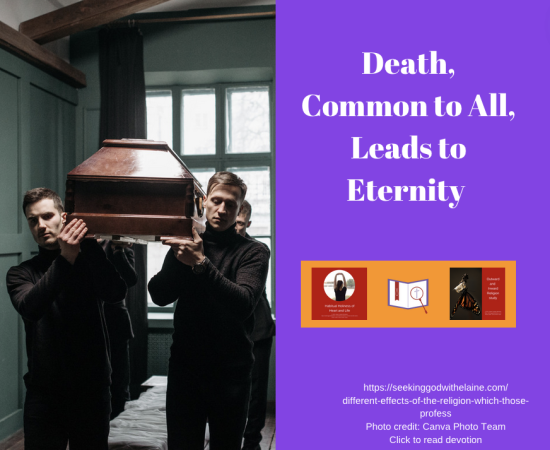
  • Death, Common to All, Leads to Eternity

    We all are going to experience death, and we all are going to experience eternity.  This devotional reading looks at how our actions dictate where we spend eternity.

    Nuggets

    • To spend eternity with God, we have to be blameless.
    • Goats appreciate the actions, not the commandment to love God above everything else.

    What Boston said in this point of his sermon interested me. He wrote, “In the different passage which those have out of time into eternity. Death is the point at which we all meet; but it is the point where outside and inside Christians part forever (Psalm 37:37, 38).”

    Resource

    In today’s vernacular, we would say that death is an equalizer. All will die one day. This is a result of sin.

    But then comes eternity. All will experience eternity, but there will be a huge separation that occurs when judgment is passed.

    The sheep will be separated from the goats. Goats aren’t going to like how they spend their eternity.

    Glossary

    Let’s Put It into Context

    To read devotions in the Habitual Holiness of Heart and Life theme, click the button below.

    Here is a running list of nuggets for the theme.

    Devotions in the Outward and Inward Religion study

    Here is a running list of nuggets for the study.

    We are using Boston’s sermon as the foundation for this series.

    Resource

    Sheep Are Blameless

    “Mark the blameless and behold the upright, for there is a future for the man of peace. But transgressors shall be altogether destroyed; the future of the wicked shall be cut off” (Ps. 37: 37-38 ESV)

    To spend eternity with God, we have to be blameless.

    When we read Psalm 37: 37-38, we question how anyone can be blameless. We think that means we have to have 100% of the desirable characteristics as good all the time.

    True, blameless means free from sin and impurity.

    But thinking we won’t sin anymore isn’t correct. No one can be 100% sinless — only Jesus because He was God’s Son.

    Instead, it is a growing process, as we said in the last two devotions. We have to be growing in knowledge and grace (II Pet. 3: 18 ESV).

    The problem is that there is no guarantee for growth — even for those who have accepted Jesus as our Savior.

    Evans has helped us understand that. He wrote, “True, there is the seed of all grace in the heart of every child of God, and it is an incorruptible seed, but it has to grow, and this takes long time, and, meanwhile, imperfection is often and sadly manifest.”

    Resource

    Let’s think that through. We are given grace when we accept the Plan of Salvation.

    Grace is a free and unmerited gift of love from the Heavenly Father, given through His Son, Jesus Christ, that enables salvation and spiritual healing to believers by the work of the Holy Spirit.

    Salvation is the gift of life through the deliverance from condemnation and sin to acceptance and holiness and changes us from being spiritually dead to spiritually alive.

    • Sin is not believing that Jesus is our Savior to save us from our actions by humans that disobey God and break one of His reasonable, holy, and righteous laws and commandments, goes against a purpose He has for us, or follows Satan’s promptings.
      • Holy means to be set apart — because of our devotion to God — to become perfect, and morally pure while possessing all virtues and to serve and worship God.
        • Perfection means we reach a state of maturity because the combination of the spiritual graces form, when all are present, spiritual wholeness or completeness — holy, sanctified, and righteous.
          • Spiritual graces are worldly morals that have been submitted to God to further His kingdom instead of enhancing this world.
          • Sanctified means to be set free from sin.
          • Righteous means we are free from sin because we are following God’s moral laws.
        • Pure means not being sinful or having the stain of sin. 
        • Virtues are standards of moral excellence.
      • Holiness is the transcendent excellence of His nature that includes elements of purity, dedication, and commitment that lead to being set apart.
        • Purity means possessing God’s moral character, having eliminated the stain of sin.
      • Spiritual death is the spiritual separation from God that occurred as a consequence of Adam and Eve’s original sin.
        • The spiritually alive are those who have ABCDed, so they are no longer separated from God.

    Glossary

    The ABCDs of Salvation

    If you have not become a believer in Christ, please read through the
    Plan of Salvation and prayerfully consider what God is asking you to do.

    A – admit our sins
    B – believe His Son Jesus is our Redeemer
    C – confess God as Sovereign Lord

    D – demonstrate that commitment by making any changes needed in our lives to live the way in which God has called us

    The Disciple’s Job Description

    When we make a genuine profession of faith, we can never lose our salvation. “I give them eternal life, and they will never perish, and no one will snatch them out of my hand. My Father, who has given them to me, is greater than all, and no one is able to snatch them out of the Father’s hand” (Jn. 10: 28-29 ESV).

    The key word is genuine. If we do not make a genuine profession of faith, we can lose our salvation.

    It isn’t going to be easy. Evans said that it takes long time, and we usually fail.

    How do we make it genuine? We grow closer to God. We love God, not the idea or principle of God.
    We love God, not the idea or principle of God.

    Goats Love the Principle of God

    “Then they also will answer, saying, ‘Lord, when did we see you hungry or thirsty or a stranger or naked or sick or in prison, and did not minister to you?’” (Mt. 25: 44 ESV)

    Goats appreciate the actions, not the commandment to love God above everything else.

    Wasn’t that what the goats did? They didn’t love God. They loved the principle of God, not Him.

    They love — if they believe there is a God — that God is love. They love that we can be good people and do random acts of kindness for others.

    They think that should be enough.

    They just blow by the fact that we have to submit to Jesus as Savior and Redeemer.

    Yes, we do need to be redeemed. No, we can’t do it ourselves.

    Everyone is going to be judged. Yes and no will be the only options available.

    Do we have a personal, growing relationship with Jesus or don’t we?

    The goats think they have done enough for admission to Heaven, just as the Matthew 7: 21 people do. Both find out they are wrong.

    But if we look at this passage in Matthew more closely, we see both the sheep and the goats are surprised.

    “Then the righteous will answer him, saying, ‘Lord, when did we see you hungry and feed you, or thirsty and give you drink?  And when did we see you a stranger and welcome you, or naked and clothe you?  And when did we see you sick or in prison and visit you?’” (Mt. 25: 37-39 ESV).

    The righteous were doing deeds because Jesus told them to do so. They were checking off a box.

    They weren’t doing the good deeds because that is to be our nature.

    The goats were doing good deeds to get recognition.

    We can’t tell them apart.

    That isn’t good. Jesus told us we should be different from the worldview people. “By this all people will know that you are my disciples, if you have love for one another” (Jn. 13: 35 ESV).

    Gray reminded us that the separation will be based on character. No, not that we have the character of a good person.

    Resource

    Do we have the character of God? Do we have the state of mind and heart He has?

    We had a whole series in the mind of Christ. We were talking about how to engage our minds to show our commitment to God.

    To read a devotion in the Commit to Grow Our Habits study, click on the button below.

    Here are some nuggets for that study:

    • Jesus hated sin so much that He came to die to pay the penalty for our sins.
    • Even though Jesus hates sin so much, He felt that we should be restored when we believe in Him. 
    • Jesus willingly gave up His Deity to become like mankind to save us from the penalty of our sins.

    For Jesus, His whole mission was about paying the penalty for our sins. He isn’t going to settle for us not dealing with our sins.
    death-common-to-all-leads-to-eternityFB

    Making the Connections

    Spurgeon made a good observation. He wrote, “Not one poor trembling sheep will be found amongst the goats.”

    Resource

    We have to be solid in our commitment to God. We can’t be doubting Him.

    I know. How does this mesh with “Blessed are those who mourn, for they shall be comforted” (Mt. 5: 4 ESV)?

    We are to cry out with repentance because we have sinned. We have to be remorseful.

    What Spurgeon meant, I think, is that we can’t be wavering in our repentance. The sheep have to truly be sorry for our sins, especially since we continue to commit sins.

    Our attitude has to be one of love toward God. We have to be trying to do His Will.

    How Do We Apply This?

    • Acknowledge and rejoice that Jesus will be our Judge.
    • Love God and others the way God wants.

    Resource

    Father God, we want to be blameless. We want to do Your Will Your way. But we have these sinful bodies with which to contend. Forgive us when we fail. Lord, we want to grow closer to You until we come home to spend eternity with You. Amen.

    What do you think?

    Leave me a comment below (about this or anything else) or head over to my Facebook group for some interactive discussion.

    If you don’t understand something and would like further clarification, please contact me.

    If you have not signed up for the email providing the link to the devotions and the newsletter, do so below.

    If God has used this devotion to speak with you, consider sharing it on social media.

  • Instead of Growing, Some Disciples Grow Worse and Worse

    When we are looking at inward and outward religion, there are different effects to each. This devotional reading looks at the effects of not growing in grace.

    Nuggets

    • A lukewarm believer is not following Jesus as He requires.
    • Indifference comes from our love of God failing.

    In the last devotion, we talked about the positive effects of growing our inward religion. This devotion looks at when we don’t grow.

    Let’s look at all that Boston said. He wrote, “In the different effects of the religion which those profess. Grace is of a growing nature (Proverbs 4:18). And the longer that saints have a standing in religion they will be the more firmly rooted (Psalm 92:13, 14; Proverbs 26:14). But others think they are right, and they seek no farther, and some, instead of growing better, grow worse and worse (Revelation 3:16).”

    Resource

    This devotional looks at when we think we are right — but aren’t. What causes this?

    Let’s Put It into Context #1

    To read devotions in the Habitual Holiness of Heart and Life theme, click the button below.

    Here is a running list of nuggets for the theme.

    Devotions in the Outward and Inward Religion study

    Here is a running list of nuggets for the study.

    We are using Boston’s sermon as the foundation for this series.

    Resource

    Let’s Put It into Context #2

    Salvation starts with grace, but it doesn’t end there. It is our choice to accept salvation or not. It is also our choice as to what we do with it.

    What we do with it is sanctification. Sanctification is about changing our character to be like God’s.

    Sanctification is a gradual growing process. It is going to take time – and be a struggle – to be changed to have God’s character.

    We have to choose to turn away from sin and turn toward the Son. We have to choose to turn away from the world and turn to God.

    We must be planted and firmly rooted in the house of the Lord.

    God comes to us as we are. He calls us to repentance and salvation. Then God starts us on the growing process.

    It is our choice to become firmly rooted in God. We do that by meditating on Christian truth – seeking Him.

    The process of sanctification has to be a success in order for us to enter into God’s presence. We are called to cleanse and purify in order to draw near to God.

    Our #1 priority is getting our relationship right with God.    

    Lacking Perseverance

    “So, because you are lukewarm, and neither hot nor cold, I will spit you out of my mouth” (Rev. 3: 16 ESV)

    A lukewarm believer is not following Jesus as He requires.

    Remember, we are looking at people who call themselves disciples but aren’t. They are the Matthew 7:21 disciples. Our job in this study is to determine if they are goats.

    They could be nominal disciples. Or they could be formalists.

    • Nominal disciples are those boasting they love God without even trying to imitate Him — those who dig on religion and its rituals without having a change in heart.
    • A formalist is a person who gives the appearance of being a disciple but, in reality, isn’t.

    The thing we don’t know is whether they made a genuine profession of faith or not. Since the verse in Revelation looks at the church of Laodicea, we are going to assume they made what they thought was a genuine profession of faith.

    I guess one of the first things we need to do is figure out the condition of being lukewarm. Is it due to a lack of perseverance or indifference?

    I love Boston’s definition of perseverance. He said it is the continued standing in a state in which we find ourselves.

    Resource

    Germane to this discussion is Boston’s reminder that not all who profess to be Christians persevere.

    But then Boston said something I have to process. He wrote, “Saints may lose the evidence of grace, so that they cannot discern it in themselves. They may lose the exercise of grace. They may lose much of the measure of grace they have had.”

    Resource

    Saints’ grace gets worse. We get to the point we can’t see God’s grace in us.

    Isn’t that bad?

    If holy exercises of grace – faith, fear, watchfulness, etc. – are not firmly planted and rooted in God, we lose them. That is much to lose.

    How do we lose grace? We don’t resist Satan’s temptation. We, instead, get caught up in the world’s snares. These corrupts our hearts.

    I am reading that lukewarm means that we are not growing. We are not seeking to get closer to God. We may just be trying to remain status quo.

    We’ve got to grow, or we don’t live. That is the opposite of losing.

    In order to grow, we have to pursue the path of Light – Jesus.

    Being Indifferent

    “And because lawlessness will be increased, the love of many will grow cold” (Mat. 24: 12 ESV)

    Indifference comes from our love of God failing.

    Why can we be indifferent when the love of God is so amazing? There could be several reasons.

    Many of us are casual about our relationships with God. There could be several reasons for that.

    We are casual about a lot of things. We may not have given a lot of thought about what it really means to be a disciple of Christ. Maybe we decided it was more than we signed up for.

    It could be that we are uninvolved. You know, it takes a big commitment to search for and seek God.

    Searching for and Seeking God

    Hearing His Word (Rom. 10: 17
    Reading His Word (Rev. 1: 3)
    Praying to Him (Heb. 4: 16)
    Studying His Word (Ac. 17: 11)
    Meditating on His Word (Ps. 1: 1-2)
    Memorizing His Word (Ps. 119: 11)

    Too many times, we think it is a one-and-done conversion. Conversion is the product of repentance, when we turn away from our sins and return to God, that secures salvation.

    • Repentance is acknowledging our separation from God and expressing sorrow for breaking God’s laws and commandments by making the commitment to change our sinful ways to ways of righteousness through obedience.
      • Sin is not believing that Jesus is our Savior to save us from our actions by humans that disobey God and break one of His reasonable, holy, and righteous laws and commandments, goes against a purpose He has for us, or follows Satan’s promptings.
        • Holy means to be set apart — because of our devotion to God — to become perfect, and morally pure while possessing all virtues.
          • Perfection means we reach a state of maturity because the combination of the spiritual graces form, when all are present, spiritual wholeness or completeness — holy, sanctified, and righteous.
            • Spiritual graces are worldly morals that have been submitted to God to further His kingdom instead of enhancing this world.
            • Sanctified means to be set free from sin.
            • Righteous means we are free from sin because we are following God’s moral laws.
          • Pure means not being sinful or having the stain of sin. 
          • Virtues are standards of moral excellence.
      • Obedience means submitting ourselves to the will of God as it is presented to us and living our lives accordingly.
    • Salvation is the gift of life through the deliverance from condemnation and sin to acceptance and holiness and changes us from being spiritually dead to spiritually alive.
      • Holiness is the transcendent excellence of His nature that includes elements of purity, dedication, and commitment that lead to being set apart.
        • Purity means possessing God’s moral character, having eliminated the stain of sin.

    Glossary

    Oh, yes. Our acceptance of God’s Plan of Salvation is a one-time deal.

    But that is the start of the Sanctification Road. Sanctification is the transformational process of the mind, body, and soul, which begins with regeneration; gradually changes our nature and morals through the promptings of the Holy Spirit; and ends with perfected state of spiritual wholeness or completeness.

    • Regeneration is being changed from spiritually dead to spiritually alive and the internal new birth and requickening that God brings about through the work of the Holy Spirit to give us new character.
      • Spiritual death is the separation from God that occurred as a consequence of Adam and Eve’s original sin.
        • The spiritually alive are those who have ABCDed, so they are no longer separated from God.

    Glossary

    The ABCDs of Salvation

    If you have not become a believer in Christ, please read through the
    Plan of Salvation and prayerfully consider what God is asking you to do.

    A – admit our sins
    B – believe His Son Jesus is our Redeemer
    C – confess God as Sovereign Lord

    D – demonstrate that commitment by making any changes needed in our lives to live the way in which God has called us

    The Disciple’s Job Description

    That definitely isn’t a one and done.

    Lack of perseverance and increased indifference may be the symptoms, but Matthew 24: 12 tells us the root cause — sin.

    Dale told us that the wicked are indifferent. Non-believers are identified in Scriptures by the terms wicked, dead, cursed, and evil.

    • Wicked means that the person purposefully does not follow God’s laws and commandments.

    Resource

    We know there are many more who are indifferent to Jesus. “Enter by the narrow gate. For the gate is wide and the way is easy that leads to destruction, and those who enter by it are many. For the gate is narrow and the way is hard that leads to life, and those who find it are few” (Mt. 7: 13-14 ESV emphasis added).

    Jesus wants us to be more than lukewarm – either way. It is easy to think that Jesus wants us to be either hot or cold.

    But that isn’t really right. Jesus wants us to gain salvation. “And Jesus said to him, ‘Today salvation has come to this house, since he also is a son of Abraham. For the Son of Man came to seek and to save the lost’” (Lk. 19: 9-10 ESV).

    Jesus would prefer that we be hot, not cold.

    Being lukewarm gains us nothing.

    Davies wondered — as a I did at the start of this section — how we could choose to be lukewarm and indifferent to the gospel. He felt it was because of presumption, pride, and self-flattery.

    Resource

    These feelings do not lead to conviction and repentance. It is an insult to God and Jesus.

    Part of being lukewarm means our prayers hit the ceiling. The reason may be that our hearts aren’t in it. We aren’t worshiping in the spirit.

    Marsden gave us a progression of spiritual decline.

    • Doubts and insensibility come first.
    • Worldview opinions and actions pull us.
    • We lose our love for God.

    Resource

    We have to persevere, not give into feelings of indifference.

    instead-of-growing-some-discipes-grow-worse-and-worseFB

    Making the Connections

    We have to remember we are talking about believers here. They have made a profession of faith.

    This is like the Parable of the Sower says. “Some fell on rocky places, where it did not have much soil. It sprang up quickly, because the soil was shallow. But when the sun came up, the plants were scorched, and they withered because they had no root. Other seed fell among thorns, which grew up and choked the plants” (Mt. 13: 5-7 ESV).

    We asked if being lukewarm meant indifference or a lack of perseverance. We also noted that Arnot said that sanctification will always be a success.

    For sanctification to be a success, we can’t have a lack of perseverance.

    But does lack of perseverance mean we lost what perseverance we had, or we weren’t saved in the first place?

    From what we have been reading so far in the series, I don’t think we can answer this question.

    How Do We Apply This?

    • Don’t stop growing.
    • Be content in gradual growth.
    • Have Godlike purity as our goal.
    • Constantly pursue wisdom.
    • Use our reflected light to witness.
    • Work to gain fruitfulness.
    • Begin now to bring forth fruit.
    • Utilize the ordinances of baptism and the Lord’s Supper to be more fruitful.

    Resources

    Father God. We praise You for Your gift of salvation. Thank You for forgiving us of our disobedience and making a way that we may be restored to You. Help us to become planted and firmly rooted in You. Lord, we don’t want to be lukewarm. We want to be totally focused on You. Amen.

    What do you think?

    Leave me a comment below (about this or anything else) or head over to my Facebook group for some interactive discussion.

    If you don’t understand something and would like further clarification, please contact me.

    If you have not signed up for the email providing the link to the devotions and the newsletter, do so below.

    If God has used this devotion to speak with you, consider sharing it on social media.
  • Different Effects of the Religion which Those Profess

    When we are looking at inward and outward religion, there are different effects to each. This devotional reading looks at the effects of growing in grace.

    Nuggets

    • Salvation starts with grace, but it doesn’t end there.
    • We must be planted and firmly rooted in the house of the Lord.

    Just as it is our decision whether to accept God’s gift of salvation, it is also our decision what to do with it after we have. Boston told us the two things we can do.

    We can either grow or not. Boston wrote, “In the different effects of the religion which those profess. Grace is of a growing nature (Proverbs 4:18). And the longer that saints have a standing in religion they will be the more firmly rooted (Psalm 92:13, 14; Proverbs 26:14).”

    Resource

    This devotion has gotten long, but it is not looking like breaking it into two is going to be easy. Bear with me on this. I am going to save the connections and application to the next devotion.

    Let’s Put It into Context

    To read devotions in the Habitual Holiness of Heart and Life theme, click the button below.

    Here is a running list of nuggets for the theme.

    Devotions in the Outward and Inward Religion study

    Here is a running list of nuggets for the study.

    We are using Boston’s sermon as the foundation for this series.

    Resource

    Growing Grace

    “But the path of the righteous is like the light of dawn, which shines brighter and brighter until full day” (Prov. 4: 18 ESV)

    Salvation starts with grace, but it doesn’t end there.

    It is our choice to accept salvation or not. It is also our choice as to what we do with it.

    Salvation is the gift of life through the deliverance from condemnation and sin to acceptance and holiness and changes us from being spiritually dead to spiritually alive.

    • Sin is not believing that Jesus is our Savior to save us from our actions by humans that disobey God and break one of His reasonable, holy, and righteous laws and commandments, goes against a purpose He has for us, or follows Satan’s promptings.
      • Holy means to be set apart — because of our devotion to God — to become perfect, and morally pure while possessing all virtues and to serve and worship God.
        • Perfection means we reach a state of maturity because the combination of the spiritual graces form, when all are present, spiritual wholeness or completeness — holy, sanctified, and righteous.
          • Spiritual graces are worldly morals that have been submitted to God to further His kingdom instead of enhancing this world.
          • Sanctified means to be set free from sin.
          • Righteous means we are free from sin because we are following God’s moral laws.
        • Pure means not being sinful or having the stain of sin. 
        • Virtues are standards of moral excellence.
    • Holiness is the transcendent excellence of His nature that includes elements of purity, dedication, and commitment that lead to being set apart.
      • Purity means possessing God’s moral character, having eliminated the stain of sin.
    • Spiritual death is the spiritual separation from God that occurred as a consequence of Adam and Eve’s original sin.
      • The spiritually alive are those who have ABCDed, so they are no longer separated from God.

    Glossary

    The ABCDs of Salvation

    If you have not become a believer in Christ, please read through the
    Plan of Salvation and prayerfully consider what God is asking you to do.

    A – admit our sins
    B – believe His Son Jesus is our Redeemer
    C – confess God as Sovereign Lord

    D – demonstrate that commitment by making any changes needed in our lives to live the way in which God has called us

    The Disciple’s Job Description

    What we do with it is sanctification. Sanctification is the transformational process of the mind, body, and soul, which begins with regeneration; gradually changes our nature and morals through the promptings of the Holy Spirit; and ends with perfected state of spiritual wholeness or completeness.

    • Regeneration is being changed from spiritually dead to spiritually alive and the internal new birth and requickening that God brings about through the work of the Holy Spirit to give us new character.

    Glossary

    Arnot reminded us that sanctification is about our character. He wrote, “The essentials of a just man’s character have been in all ages the same.”

    Resource

    The goal of sanctification is to change our character to be like God’s. We aren’t like Him when we are in our sinful state. God doesn’t flip a switch and make us like Him at conversion.

    Sanctification is a gradual growing process. We are gaining wisdom, holiness, and happiness.

    When the sun comes up, it doesn’t just magically appear in the sky. It gradually comes into view.

    When Adam and I went on our mission trip to Canada, we went to see the sunrise over Lake Erie. It was amazing. The changing colors and the rising of the sun over the water was beautiful.

    One thing we have to remember here is that Solomon said we are like the light, not the sun. The dawn is not the sun. It is the effect of the sun rising.

    Our character is a reflection of His. Salvation does not make us gods in our own right. It means we serve the One true God.

    It is going to take time – and be a struggle – to be changed to have God’s character.

    It is going to take time – and be a struggle – to be changed to have God’s character.

    Thomas reminded us that it is not just about character. Sanctification is about condition and destiny.

    Resource

    Our condition is that we are to be a new creation. “Therefore, if anyone is in Christ, he is a new creation. The old has passed away; behold, the new has come” (II Cor. 5: 17 ESV).

    What we were before – our sinful nature – has to be eliminated and replaced with God’s nature. As we said, this is going to take time.

    Glossary

    Sanctification is also about destiny. Arnot believed there was no doubt that sanctification would be successful – and this verse backs up that belief. “… which shines brighter and brighter until full day” (Prov. 4: 18 ESV).

    Let’s table our discussion on whether that no doubt was justified or not. Our focus right now is on those who do successfully navigate the Sanctification Road.

    I do believe there is no doubt of the outcome when we choose God every day. We will become more and more like Him.

    We just may have trouble seeing that.

    Sunrise occurs when our portion of this continent turns away from the sun. The light of dawn comes from diminishing darkness.

    We have to choose to turn away from sin and turn toward the Son. We have to choose to turn away from the world and turn to God.

    Oops. We kind of glossed over the righteousness part. Righteousness is the indwelling goodness that is the result of a solid relationship with God built by a sincere life of conscientious obedience to God’s laws and commandments and from which all virtues flow.

    We said sanctification is about growing. We are growing in our understanding of the truth. God is revealing Himself to us.

    One thing God is revealing to us is how we are to habitually live for Him. We must be holy because He is holy (I Pet. 1: 16).

    It is going to take perseverance. Growth is never easy. I remember the year Adam grew 9 inches in one year.

    The boy was hurting.

    But it is worth it. Sanctification and eventual perfection bring peace and satisfaction.

    Growing is all about growing grace. Grace is a free and unmerited gift of love from the Heavenly Father, given through His Son, Jesus Christ, that enables salvation and spiritual healing to believers by the work of the Holy Spirit.

    We want to grow God’s favor toward us.

    It isn’t about us being better people. Nor is it about us doing a better job of serving others.

    It is about us growing closer to God.

    Firmly Rooted

    “They are planted in the house of the LORD; they flourish in the courts of our God. They still bear fruit in old age; they are ever full of sap and green” (Ps. 92: 13-14 ESV)

    We must be planted and firmly rooted in the house of the Lord.

    Trees are very important to God. How do we know?

    Think about the tree of life.

    The kicker is that it is planted in the house of the Lord. Why is that so difficult to understand?

    God wants us where He is. Isn’t that what Heaven is all about – living with God eternally.

    To get there, we have to be planted and firmly rooted.

    Let’s continue on the growing theme. In order to grow, we have to be planted. We can’t plant ourselves in Heaven.

    Salvation is gained only one way – through Jesus. “Jesus said to him, ‘I am the way, and the truth, and the life. No one comes to the Father except through me’” (Jn. 14: 6 ESV).

    Spurgeon made a great observation that I had never thought of before. This planted doesn’t necessarily mean it was grown from seed. The trees are replanted.

    Resource

    God comes to us as we are. He calls us to repentance and salvation. Repentance is acknowledging our separation from God and expressing sorrow for breaking God’s laws and commandments by making the commitment to change our sinful ways to ways of righteousness through obedience.

    • Obedience means submitting ourselves to the will of God as it is presented to us and living our lives accordingly.

    Glossary

    Then God starts us on the growing process.

    We don’t lose our personality. We don’t become robots for God.

    We become uniquely us who look like Him.

    Johnson told us what looking like Him looks like. He wrote, “Piety must find its nutrition in holy exercises. Worship, meditation with the lights of Christian truth should lead on to far higher spirituality than the broken lights of the Old Temple services. There is never a doctrine in the Word or nature that is not intended for enrichment and elevation of the true and temper of life.”

    Resource

    Holy exercises – being firmly planted and rooted in God. We become new creations. We truly worship God, not give Him lip service.

    It is our choice to become firmly rooted in God. We do that by meditating on Christian truth – seeking Him.

    Searching for and Seeking God

    Hearing His Word (Rom. 10: 17)
    Reading His Word (Rev. 1: 3)
    Praying to Him (Heb. 4: 16)
    Studying His Word (Ac. 17: 11)
    Meditating on His Word (Ps. 1: 1-2)
    Memorizing His Word (Ps. 119: 11)

    Remember, Arnot said that there is no doubt as to the outcome of sanctification. Spurgeon agreed, citing this verse as a promise of that.

    But think about it. Where are we planted? In the house of the Lord.

    God cannot associate with sin. Whatever is planted in His house has to be pure.

    The process of sanctification has to be a success in order for us to enter into God’s presence. We are called to draw near to God. “Draw near to God and He will draw near to you. Cleanse your hands, you sinners; and purify your hearts, you double-minded” (Jas. 4: 8 ESV).

    We are called to cleanse and purify in order to draw near to God.

    We are called to cleanse and purify in order to draw near to God.

    When we are planted and firmly rooted, we do what we are supposed to do – bring forth fruit. “By this my Father is glorified, that you bear much fruit and so prove to be my disciples” (Jn. 15: 8 ESV).

    Many times, we think that bearing fruit means witnessing. That isn’t everything.

    Verse 8 starts with the infamous this. It points back to verse 7. “If you abide in me, and my words abide in you, ask whatever you wish, and it will be done for you” (Jn. 15: 7 ESV emphasis added).

    Don’t get me wrong. We are to witness and bring others to Christ. We are to serve others.

    Our #1 priority is getting our relationship right with God. As Orton said, our fruits must be “knowledge, holiness, patience, meekness, quietness of spirit, renunciation of the world, preparedness for death, a heavenly conversation, also a deep concern for the [honor] of God, the support of religion, and the good of mankind.”

    Resource

    We can’t do this outside of His house. We must accept the gospel message to be in a right relationship.

    Father God. We praise You for Your gift of salvation. Thank You for forgiving us of our disobedience and making a way that we may be restored to You. Amen.

    different-effects-of-the-religion-which-those-professFB

    What do you think?

    Leave me a comment below (about this or anything else) or head over to my Facebook group for some interactive discussion.

    If you don’t understand something and would like further clarification, please contact me.

    If you have not signed up for the email providing the link to the devotions and the newsletter, do so below.

    If God has used this devotion to speak with you, consider sharing it on social media.

  • Different Feelings in Religion

    As humans, we feel different things. This devotional reading looks at feeling contentment, joy, and bitterness.

    Nuggets

    • While godliness isn’t a feeling, contentment is.
    • Only those who believe in Jesus have joy.

    We’ve started looking at Boston’s sermon to find if there are degrees in salvation or if it is a yes/no deal. We wanted to see if we could determine whether Matthew 7: 21 people are goats or sheep.

    Boston’s next point was interesting. He wrote, “From the different feeling which those have of the advantage of religion, the ordinances and duties thereof.”

    Resource

    It kind of threw me when it started talking about our feelings. I think we need to make a choice to follow God, regardless of what we are feeling at the moment.

    The second toss was when I read those with empty husks were going to “… abide in the outer court of religion all their days.” What does that mean?

    Let’s Put It into Context

    To read devotions in the Habitual Holiness of Heart and Life theme, click the button below.

    Here is a running list of nuggets for the theme.

    Devotions in the Outward and Inward Religion study

    Here is a running list of nuggets for the study.

    We are using Boston’s sermon as the foundation for this series.

    Resource

    The blue headings are Boston’s words.

    Godliness with Contentment

    “But godliness with contentment is great gain” (I Tim. 6: 6 ESV)

    Some are acquainted with the gain of religion, and, from their own experience, can give a solid reason why they follow it (1 Timothy 6:6).

    While godliness isn’t a feeling, contentment is.

    We all strive for contentment, regardless of whether we are striving for godliness or not. To me, contentment is more of a feeling. Contentment is being satisfied regardless of the circumstances of our lives. It’s a choice.

    Satisfaction is a feeling, like happiness. Joy is a conscious choice to put our faith and trust in God.

    But contentment is not the focus of the verse. The subject is godliness with contentment. Godliness, equated with the Old Testament term fear of the Lord, is reverence in thought, feeling, and conduct that is promoted by walking in His Spirit and obeying God’s laws and commandments that produces a moral likeness of God. 

    I can see that. God wants us to focus on the spiritual, inward transformation rather than the outward religion.

    Godliness with contentment keeps our focus on God. We don’t elevate ourselves; rather we exalt God.

    At first, things swirled again when Champneys described godliness as the gospel. Paul summed up godliness in I Timothy 3: 16. “Great indeed, we confess, is the mystery of godliness: He was manifested in the flesh, vindicated by the Spirit, seen by angels, proclaimed among the nations, believed on in the world, taken up in glory” (I Tim. 3: 16 ESV).

    Resource

    So, it is a mystery because godliness has nothing to do with us really. It is about us being obedient to the gospel.

    God reveals everything to us. He shows us the way in which our sins are forgiven. He then tells us what He wants us to do with it: witness — telling others about Jesus.

    Godliness isn’t our actions. It is our worship.

    Godliness isn’t our actions. It is our worship.

    Isn’t that what religion is about? We are to revere God and submit to Him. Submitting to God is actions by humans that obey God and keep His reasonable, holy, and righteous laws and commandments, follow His purpose for us, and do not follow Satan’s promptings.

    We are to humble ourselves before Him.

    Our godliness is based on a mystery. South explained that. He wrote, “Instead of evidence springing from things themselves, and clear knowledge growing from such an evidence, his understanding must now be contented with the poor, dim light of faith, which guides only in the strength and light of another’s knowledge, and is properly a seeing with another’s eyes, as being otherwise wholly unable to inform us about the great things of our peace, by any immediate inspection of those things themselves.”

    Resource

    Our salvation really isn’t about knowledge. It is about faith.

    Salvation is the gift of life through the deliverance from condemnation and sin to acceptance and holiness and changes us from being spiritually dead to spiritually alive.

    • Sin is not believing that Jesus is our Savior to save us from our actions by humans that disobey God and break one of His reasonable, holy, and righteous laws and commandments, goes against a purpose He has for us, or follows Satan’s promptings.
      • Holy means to be set apart — because of our devotion to God — to become perfect, and morally pure while possessing all virtues and to serve and worship God.
        • Perfection means we reach a state of maturity because the combination of the spiritual graces form, when all are present, spiritual wholeness or completeness — holy, sanctified, and righteous.
          • Spiritual graces are worldly morals that have been submitted to God to further His kingdom instead of enhancing this world.
          • Sanctified means to be set free from sin.
          • Righteous means we are free from sin because we are following God’s moral laws.
        • Pure means not being sinful or having the stain of sin. 
        • Virtues are standards of moral excellence.
      • Holiness is the transcendent excellence of His nature that includes elements of purity, dedication, and commitment that lead to being set apart.
        • Purity means possessing God’s moral character, having eliminated the stain of sin.
      • Spiritual death is the spiritual separation from God that occurred as a consequence of Adam and Eve’s original sin.
        • The spiritually alive are those who have ABCDed, so they are no longer separated from God.

    Faith is a gift from God and a work of the Spirit that enhances the conviction that the doctrines revealed in God’s Word are true, even if we do not understand all aspects of them, a belief which impacts our lives and distinguishes us from others.

    Glossary

    The ABCDs of Salvation

    If you have not become a believer in Christ, please read through the
    Plan of Salvation and prayerfully consider what God is asking you to do.

    A – admit our sins
    B – believe His Son Jesus is our Redeemer
    C – confess God as Sovereign Lord

    D – demonstrate that commitment by making any changes needed in our lives to live the way in which God has called us

    The Disciple’s Job Description

    We’ve got to be content with the lack of knowledge. Our contentment is forged in our submission.

    Bradbury made an interesting point. The focus shouldn’t be on whether it is difficult or easy to understand. The focus is on it is a matter of faith.

    Resource

    Why is it so important that there is this mystery? It isn’t about knowledge or following the checklist.

    It is about obedience. We have to obey regardless of what our physical, sinful nature is telling us to show our contrition for disobeying Him in the first place.

    That is how we become godly. That leads to the great gain Paul told Timothy about — salvation, regeneration, sanctification, perfection, and eternal life.

    Empty Husks

    “The heart knows its own bitterness, and no stranger shares its joy” (Prov. 14: 10 ESV)

    But unto others all these things are but as empty husks (Proverbs 14:10). They abide in the outer court of religion all their days.

    Only those who believe in Jesus have joy.

    We have to know ourselves. If we don’t — or are being delusional about who and what we are — we aren’t letting God work in us.

    We have to know and confess what are sins are before we can ask forgiveness for them.

    Do you think that isn’t always the case? Spurgeon helped us understand this. He wrote, “When the Holy Spirit begins to convince the man of sin, of righteousness, and of judgment, then ‘the heart knoweth its own bitterness.’”

    Resource

    Non-believers are convicted of their sins. Disciples are convicted of their sins. Backsliders are convicted of their sins.

    Backsliding is when those who have made a profession of faith return to their sinful lives.

    We only find joy when we have forgiveness of our sins. That only comes through a reconciliation with God. Reconciliation brings the contentment and joy.

    Remorse brings the bitterness. We must grieve that we have disobeyed God.

    Johnston reminded us that our lives will not be total unicorns and rainbows. He wrote, “The heart that is right with God has much anxiety, disquiet, and sorrow. These are dependent on disposition and temperament” (emphasis added).

    Resource

    One more time. The heart that is right with God.

    Yes, even disciples are going to have anxiety, disquiet, and sorrow. God didn’t promise us a rose garden, especially after we turned away from the Garden He did give us.

    If the guilt doesn’t get us, the fear of doing wrong may. Many times, that is wound up in our faulty beliefs in God’s forgiveness. We either think God can’t forgive us because we are too sinful or that He won’t forgive us because we are too sinful.

    different-feelings-in-religionFB

    Making the Connections

    What have we gained in telling us who the goats are? And what is Boston really trying to tell us?

    Let tackle that last one first. We’ve picked apart what Boston said. Let’s put it back together.

    “From the different feeling which those have of the advantage of religion, the ordinances and duties thereof.” Some are acquainted with the gain of religion, and, from their own experience, can give a solid reason why they follow it (1 Timothy 6:6). But unto others all these things are but as empty husks (Proverbs 14:10). They abide in the outer court of religion all their days.

    Resource

    What this is telling me is some realize what we gain when we accept God’s gift of salvation. These are disciples.

    However, there are some to whom these gains mean nothing. At first, I thought these were non-believers.

    But that isn’t right, is it? They wouldn’t have outward religion if they were non-believers.

    So, what is the abide in the outer court of religion mean? The outer court was where the money changes were. It was where the Gentiles could be. But Jesus also taught there. It was outer part of the temple – but still in the temple.

    If I am reading this correctly (and I may be right or wrong), those who have an outward religion will still get to heaven. They are just going to be on the fringes.

    How Do We Apply This?

    • Respect salvation.
    • Argue for incarnation, satisfaction, and resurrection of Jesus.
    • Imitate Jesus’ example of godliness.
    • Pray for the Spirit to guide us.
    • Do our duty and be in God’s service.
    • Depend on the Spirit for revelation.
    • Diligently read God’s Word for sanctification, not because of curiosity or wanting to explain it.
    • Obey God’s Word.
    • Get our hearts right with God so that we can gain contentment.
    • Get our lives right with God through habitual obedience.
    • Take our bitterness to God.
    • Seek God in our own hearts.

    Searching for and Seeking God

    Hearing His Word (Rom. 10: 17)
    Reading His Word (Rev. 1: 3)
    Praying to Him (Heb. 4: 16)
    Studying His Word (Ac. 17: 11)
    Meditating on His Word (Ps. 1: 1-2)
    Memorizing His Word (Ps. 119: 11)

    Resources

    Father God. Lord, we don’t want to settle in getting to the outer court of Heaven. We want to be in Your temple, as close to You as possible. That means we have to be living godly lives. Help us to do that. Amen.

    What do you think?

    Leave me a comment below (about this or anything else) or head over to my Facebook group for some interactive discussion.

    If you don’t understand something and would like further clarification, please contact me.

    If you have not signed up for the email providing the link to the devotions and the newsletter, do so below.

    If God has used this devotion to speak with you, consider sharing it on social media.
  • Prayers as Outward Religion

    Prayer is an important duty for disciples. This devotional reading looks at how prayers can focus on outward religion.

    Nuggets

    • We are called to give our best to God and shouldn’t be surprised that our prayer life suffers when we don’t.
    • Our prayers must be humble and contrite, offered in the way found acceptable by God, not as sacrifices.
    • We must conduct our prayer lives not as the Israelites performed their sacrifices but through inward devotion.

    Boston had been discussing inward and outward religion. His next point has to do with faulty prayer.

    Boston wrote, “In the different acceptance which persons’ prayers get. Some are very pleasing, others God abhors (Proverbs 28:9; Isaiah 66:2, 3; Isaiah 1:11).

    Resource

    Let’s Put It into Context

    To read devotions in the Habitual Holiness of Heart and Life theme, click the button below.

    Here is a running list of nuggets for the theme.

    Devotions in the Outward and Inward Religion study

    Here is a running list of nuggets for the study.

    We are using Boston’s sermon as the foundation for this series.

    Resource

    The Connection between the Law and Prayer

    “If one turns away his ear from hearing the law, even his prayer is an abomination.” (Prov. 28: 9 ESV)

    We are called to give our best to God and shouldn’t be surprised that our prayer life suffers when we don’t.

    One of the duties we have to God when we accept His gift of salvation is to continue to hear His laws and commandments. Notice, this verse is Proverbs talks about hearing His law, not doing the law.

    There are several ways we can hear about God’s laws and commandments. We read it in His Word. We can listen to the Pastor Steve-types proclaim it.

    Many times, we hear it through the promptings of the Holy Spirit. This internal prompting teaches us about what those laws are.

    Another duty we have is to remain in communication with God through prayer. We grow closer to Him as we talk to Him daily.

    Look closely at what this verse is saying. If we stop hearing the law, our prayer life will suffer.

    But isn’t that the progression? We take the focus off of hearing what we should be doing. Pretty soon, we are doing the opposite.

    Moffat explained the importance of listening this way.  He wrote, “Man, as a fallen being, with alienated affections, debased tendencies, and distorted views, required precise directions as to his future course.”

    Resource

    We’re not going to get it on our own. We have to be told about God’s ways because His ways are higher than ours (Isa. 55: 8-9).

    Doesn’t that throw everything in a worldview person’s face? They think they can figure things out on their own. (You know they are more than likely not going to truly read God’s Word. So, they don’t heart it.)

    Our lack of hearing and disobedience does not lower God’s standard. It isn’t based on what we want or what we think we can do.

    God has set His laws and commandments based on His character.

    Why doesn’t God lower His standards when He finds out we can’t keep His laws and commandments? There are a couple of reasons I can think of.

    God can’t change His character. If the laws are based on Him, the standard can’t be lowered.

    I don’t see this as much as a condition as an expectation and a connection. We said about two devotions ago that God wants our whole commitment. Prayer without hearing His laws isn’t commitment.

    We talk a lot about motivation. Henry said that was the foundation of what God found unacceptable. He wrote, “The sinner whose prayers God is thus angry at is one who [willfully] and obstinately refuses to obey God’s commandments, who will not so much as give them the hearing, but causes his ear to decline the law, and refuses when God calls. God will therefore justly refuse him when he calls.”

    Resource

    The motivation was stubborn and persistent disobedience. It isn’t that we don’t listen sometimes or forget to pray.

    It is we choose to do the exact opposite of what God wants from us.

    We have to choose for or against God.

    The Connection between Sacrifices and Prayers

    “All these things my hand has made, and so all these things came to be, declares the Lord. But this is the one to whom I will look: he who is humble and contrite in spirit and trembles at my word. “He who slaughters an ox is like one who kills a man; he who sacrifices a lamb, like one who breaks a dog’s neck; he who presents a grain offering, like one who offers pig’s blood; he who makes a memorial offering of frankincense, like one who blesses an idol. These have chosen their own ways, and their soul delights in their abominations” (Isa. 66: 2-3 ESV)

    Our prayers must be humble and contrite, offered in the way found acceptable by God, not as sacrifices.

    Our character must show through our prayers. That character must be like God’s.

    If we don’t have humility, we don’t have religion. Why?

    Humility is important because it leads to self-denial. Self-denial is the giving up anything that is contrary or in competition with that which Jesus teaches or calls us to do.

    Religion isn’t true religion if we do not give up what is contrary to what Jesus teaches.  Those contrary things must be replaced by a contrite heart. We know we are insufficient.

    God has the power to make us humble and give us a contrite heart. He looks on us in acceptance.

    When we are contrite in spirit, we tremble at God’s Word. No, it doesn’t mean we are necessarily afraid.

    It means we are in awe of His power and what He can accomplish. “For nothing will be impossible with God” (Lk. 1: 37 ESV).

    Spurgeon gave us a list of reasons why we tremble. We tremble because of His majesty, at His Word, at the threatening word, fear of breaking God’s law, and fear of missing the promises.

    Resource

    I know verse 3 is talking about sacrifices. We talked about sacrifices and how they had taken a wrong turn.

    But we can apply that to prayer.

    • If we offer to God a prayer that is not acceptable, we are killing our relationship with Him.
    • Offering unacceptable prayers is as bad as breaking Fido’s neck.
    • We can’t substitute what we consider is a good prayer and think God will just have to accept it.
    • We can’t pretend we are praying to God but be putting our affections on worldview things.

    Our sacrifices – as our prayers – if done in the wrong way, are not acceptable to God.

    Our sacrifices – as our prayers – if done in the wrong way, are not acceptable to God.

    Inward Rather than Outward

    “What to me is the multitude of your sacrifices? says the Lord; I have had enough of burnt offerings of rams and the fat of well-fed beasts; I do not delight in the blood of bulls, or of lambs, or of goats.” (Isa. 1: 11 ESV)

    We must conduct our prayer lives not as the Israelites performed their sacrifices but through inward devotion.

    In this verse, we are still talking about sacrifices. It doesn’t say anything about prayer. The verse says nothing about inward religion, either.

    Instead, it has to do with outward religion.

    It seems like the sacrifices weren’t being performed correctly. They had turned into an outward religion.

    Listen to what Henry said. He wrote, “If God’s Word be not regarded by us, our prayers shall not only not be acceptable to God, but they shall be an abomination to Him; not only our sacrifices, which were ceremonial appointments, but even our prayers, which are moral duties, and which, when they are put up by the upright, are so much His delight.”

    Resource

    Let’s roost on the word abomination. God abhors His Will not being done.

    But God delights when we do follow His Will.

    Reading reminded us of something about sacrifices. He wrote, “GOD COULD NOT ABSOLUTELY REJECT SACRIFICES, because they were of His own appointing, as we are abundantly certified in the Books of Exodus and Leviticus.”

    Resource

    God had the sacrifices for a purpose. We all know that sacrifices taught them – and us – that blood needed to be shed for remission of sins.

    There was another purpose. They were to build a communion with God.

    That is what prayer does.

    That tells us that sacrifices and prayer themselves are not wrong. It is the way in which they are done and offered that God finds them an abomination.

    prayers-as-outward-religionFB

    Making the Connections

    “Thus says the Lord: ‘Heaven is my throne, and the earth is my footstool; what is the house that you would build for me, and what is the place of my rest?’” (Isa. 66: 1 ESV)

    We need to pray to God the way He requires. We want to follow His Will in all things.

    We don’t want our religion to be an outward only. We want our sacrifices and offerings of prayer correct so that our hearts can be transformed.

    We know that God look at the inside and not at the outside. “But the Lord said to Samuel, ‘Do not look on his appearance or on the height of his stature, because I have rejected him. For the Lord sees not as man sees: man looks on the outward appearance, but the Lord looks on the heart’” (I Sam. 16: 7 ESV).

    But it isn’t a lukewarm heart. Drive explained. He wrote, “… Jehovah’s regard was not to be won by the magnificence of a material temple, but by humility and the devotion of the heart.”

    Resource

    But aren’t outward actions easier than inward transformations? That is one reason why it is done so often.

    Nothing said being a disciple would be easy!

    How Do We Apply This?

    • Be humble in our lives as disciples.
    • Don’t think we are better or worse than others.
    • Don’t make our humility about self-conceit.
    • Be poor in spirit.

    Resource

    Father God. We want our prayers to be genuine and proper for You. We want our devotion to be at the heart level. We want to live for You. Amen.

    What do you think?

    Leave me a comment below (about this or anything else) or head over to my Facebook group for some interactive discussion.

    If you don’t understand something and would like further clarification, please contact me.

    If you have not signed up for the email providing the link to the devotions and the newsletter, do so below.

    If God has used this devotion to speak with you, consider sharing it on social media.
  • What Is Outward Religion?

    When we are thinking about outside and inside religion, we need to consider how what outward religion is. This devotional reading looks at how outward religion differs from inward religion.

    Nuggets

    • Following God and not believing in Him won’t cut it.
    • Believing in God and not following Him won’t cut it.
    • Believing in God and following Him is what we are commanded to do.

    When we were doing our Finding Jesus through Spiritual Worship study, I considered that there are two ways we can consider salvation. The first way is that it is just a yes and no option. We either are saved or not.

    The second way is that there are degrees of yes. We’ve made a true profession of faith. But we are backsliding. What happens?

    This second devotion in the series looks at different ways we miss the mark.

    Let’s Put It into Context

    To read devotions in the Habitual Holiness of Heart and Life theme, click the button below.

    Here is a running list of nuggets for the theme.

    Devotions in the Outward and Inward Religion study

    Here is a running list of nuggets for the study.

    Holy or Idle Form

    “having the appearance of godliness, but denying its power. Avoid such people” (II Tim. 3: 5 ESV)

    Following God and not believing in Him won’t cut it.

    If non-believers are on one end of the line and true disciples on the other end of the line, those who have the appearance of godliness – but it is only an appearance – are in the middle.

    Some people, when they make a profession of faith, don’t really mean it. Kollock explained it this way He wrote, “This form is a profession of religion; the outward appearance of piety; the external performance of holy duties.”

    Resource

    Oh, from the outside they may look like the profession was sincere. But it didn’t get down to the heart level.

    Why? Because they deny the power leading to transformation.

    The power is real, and it can transform us to walk in God’s Spirit and obey His laws and commandments that produces a moral likeness of God. 

    Don’t get me wrong. True disciples have to have a form of godliness. While in these sinful bodies, our godliness — and righteousness — is only a form.

    We will not truly be godly — or righteous — until we are changed when we are resurrected.

    But we have to have that form of godliness in order to have salvation. Salvation is the gift of life through the deliverance from condemnation and sin to acceptance and holiness and changes us from being spiritually dead to spiritually alive.

    • Sin is not believing that Jesus is our Savior to save us from our actions by humans that disobey God and break one of His reasonable, holy, and righteous laws and commandments, goes against a purpose He has for us, or follows Satan’s promptings.
      • Holy means to be set apart — because of our devotion to God — to become perfect, and morally pure while possessing all virtues and to serve and worship God.
        • Perfection means we reach a state of maturity because the combination of the spiritual graces form, when all are present, spiritual wholeness or completeness — holy, sanctified, and righteous.
          • Spiritual graces are worldly morals that have been submitted to God to further His kingdom instead of enhancing this world.
          • Sanctified means to be set free from sin.
          • Righteous means we are free from sin because we are following God’s moral laws.
        • Pure means not being sinful or having the stain of sin. 
        • Virtues are standards of moral excellence.
    • Holiness is the transcendent excellence of His nature that includes elements of purity, dedication, and commitment that lead to being set apart.
      • Purity means possessing God’s moral character, having eliminated the stain of sin.
    • Spiritual death is the spiritual separation from God that occurred as a consequence of Adam and Eve’s original sin.
      • The spiritually alive are those who have ABCDed, so they are no longer separated from God.

    The ABCDs of Salvation

    If you have not become a believer in Christ, please read through the
    Plan of Salvation and prayerfully consider what God is asking you to do.

    A – admit our sins
    B – believe His Son Jesus is our Redeemer
    C – confess God as Sovereign Lord

    D – demonstrate that commitment by making any changes needed in our lives to live the way in which God has called us

    The Disciple’s Job Description

    Glossary

    The problem we have is that we think we have to have the godliness of God now. We think that, once we make a profession of faith, we should not be able to sin. Then we do.

    We kick ourselves and kick ourselves.

    No, sinning is not right. Kicking ourselves isn’t right, either.

    Our goal in this life is to navigate the Sanctification Road so that we may become like God. It is a process, not a flip-the-switch occurrence.

    Sanctification is the transformational process of the mind, body, and soul, which begins with regeneration; gradually changes our nature and morals through the promptings of the Holy Spirit; and ends with perfected state of spiritual wholeness or completeness.

    • Regeneration is being changed from spiritually dead to spiritually alive and the internal new birth and requickening that God brings about through the work of the Holy Spirit to give us new character.

    Glossary

    It comes down to our attitude. Are we trying to follow God’s laws and commandments, or are we trying to rewrite God’s Word?

    We must choose to follow God and repent when we don’t.

    Kollock had some more things that I have to process.

    God isn’t looking for just outward service. “No, O people, the LORD has told you what is good, and this is what he requires of you: to do what is right, to love mercy, and to walk humbly with your God” (Mic. 6: 8 NLT).

    Service is included in the list of things that God requires. But so is to walk with God.

    Walking with God is part of our mission when we trust Jesus as our Savior and Redeemer. If we don’t, we are violating our mission.

    Walking with God is part of our mission when we trust Jesus as our Savior and Redeemer.

    It also violates our covenant. “For this is the covenant that I will make with the house of Israel after those days, declares the LORD: I will put my law within them, and I will write it on their hearts. And I will be their God, and they shall be my people” (Jer. 31: 33 ESV).

    We want to be godly and righteous. We want to imitate Jesus, Who’s godliness and righteousness were at the heart level.

    It is only this way that we can be forgiven if our sins and gain salvation.

    Head Knowledge, not Heart Knowledge

    “They profess to know God, but they deny him by their works. They are detestable, disobedient, unfit for any good work” (Ti. 1: 16 ESV)

    Believing in God and not following Him won’t cut it.

    At first glance, the verse in Titus may seem the opposite of the verse in II Timothy. That verse said the so-called disciple had the works but not the belief.

    This verse seems to say the so-called disciple had the belief but not the works.

    Works is generally being considered the good things we do for others. Good works, on the other hand, is the service we perform to glorify God.

    We would call these the nominal disciples. Nominal disciples are those boasting they love God without even trying to imitate Him — those who dig on religion and its rituals without having a change in heart.

    They come and worship, usually just on Sunday mornings. Some may come other times the doors are open, but it is just to hear the message.

    But the message never transforms them. If it does, they still don’t obey the “… ‘Go into all the world and proclaim the gospel to the whole creation’” (Mk. 16: 15 ESV) mandate. They don’t do the work of the Church.

    Bottom line is belief is not enough. Belief in our Savior and Redeemer has to permeate our being and impact out thoughts and actions.

    To do any less denies Jesus’ teaching. “And he said to all, ‘If anyone would come after me, let him deny himself and take up his cross daily and follow me’” (Lk. 9: 23 ESV).

    The Homilist told us one way nominal disciples deny Jesus. He wrote, “But they practically declare that self-interests are supreme, that every man should work for himself, regardless of the common good. He teaches to [honor] all men on account of what they are. They declare that those only are to be [honored] who are endowed with wealth, and move in the pageantry of worldly pomp and power.”

    Resource

    This is a form of hypocrisy. They are claiming to have God’s spiritual graces but don’t conform to His message. They are claiming to have knowledge of God but don’t implement it into their lives.

    Pretend Religion

    “And by this we know that we have come to know him, if we keep his commandments. Whoever says ‘I know him’ but does not keep his commandments is a liar, and the truth is not in him, but whoever keeps his word, in him truly the love of God is perfected. By this we may know that we are in him” (I Jn. 2: 3-5 ESV)

    Believing in God and following Him is what we are commanded to do.

    So, what have we discussed so far?

    • Following God and not believing in Him won’t cut it.
    • Believing in God and not following Him won’t cut it.
    • Doing either one of those means we are pretending to be disciples.

    What should we do? We just have to take out the nots.

    Believe in God and follow Him.

    The follow Him part is the deep part.

    • We have to personally know God by having a close relationship with Him.
    • This knowledge must be validated by our implementing His laws and commandments in our lives exactly as He intends them.
    • Implementation into our lives requires our thoughts and actions be in sync with our words.

    Maurice had some great insight. Let me do an Elaine-speak on it.

    • Keeping God’s laws and commandments means we obey them.
    • They must remain with us and be a part of us.
    • Our knowing God does not exalt us but exalts Him.

    Resource

    We can’t pretend to be religious to exalt ourselves. We must exalt God in all ways.

    We talked about power in the first section. Gibbon described the power of God’s commandments. He wrote, “These commandments are not arbitrary edicts of capricious power. They are the spontaneous growths of immaculate holiness and eternal love.”

    Resource

    The power isn’t to gain us worldly things. It is to grow our holiness and godly love.

    Notice that word is singular. “… but whoever keeps his word …” (I Jn. 2: 3-5 ESV).

    We know all the laws and commandments were summarized into the greatest commandments. “And you shall love the Lord your God with all your heart and with all your soul and with all your mind and with all your strength.’ The second is this: ‘You shall love your neighbor as yourself.’ There is no other commandment greater than these” (Mk. 12: 30-31 ESV).

    Only by keeping the greatest commandments are we perfected. In other words, we have to believe and follow.

    Glossary

    what-is-outward-religionFB

    Making the Connections

    Is it any wonder that non-believers question why the should become a disciple when they see disciples of varying commitment? Why should they put their trust in Jesus when they are every bit as good a person as Tom? Why should they give up their pet sins when Sally hasn’t?

    In other words, worldview people feel they can justify not following God because even His disciples don’t always follow Him.

    But then, aren’t they following the disciples, and not God?

    How Do We Apply This?

    • Recognize we are nothing when we do not have the love of God.
    • Recognize that pretending to be holy, but not truly being holy, does not cover our sins.
    • Not be a hypocrite.

    Resources

    Father God. Lord, we want our relationship with You to reach the heart level. When it does, we will serve others in Your name. Amen.

    What do you think?

    Leave me a comment below (about this or anything else) or head over to my Facebook group for some interactive discussion.

    If you don’t understand something and would like further clarification, please contact me.

    If you have not signed up for the email providing the link to the devotions and the newsletter, do so below.

    If God has used this devotion to speak with you, consider sharing it on social media.

  • The Difference between Outward and Inward Religion

    We have talked about inward transformation being needed as opposed to an outward walk. This devotional reading looks at applying that to the church as a whole.

    Nuggets

    • In the Day of the Lord, the net will sweep up everyone — believer and non-believers and everyone in between.
    • The goats are those who are cursed.
    • The determination of believers and non-believers will not happen until the Day of the Lord.
    • Both builders in the parable knew the building should be built but went about it in different ways.

    When we were doing our Finding Jesus through Spiritual Worship study, something flitted through my mind. We’ve talked about the sheep and the goats. We’ve also talked about the Matthew 7: 21 people.

    The sheep are believers. The goats are nonbelievers. The Matthew 7: 21 people are sheep who really aren’t sheep.

    What if the believers who are aren’t really sheep are goats?

    There are two ways we can consider salvation. The first way is that it is just a yes and no option. The second way is that there are degrees of yes.

    I found a sermon that I hope will help us figure this out. Is it yes or no, or is it a matter of transformation? How does that affect the church?

    Let’s Put It into Context

    To read devotions in the Habitual Holiness of Heart and Life theme, click the button below.

    Here is a running list of nuggets for the theme.

    Devotions in the Outward and Inward Religion study

    Here is a running list of nuggets for the study.

    We are using Boston’s sermon as the foundation for this series.

    Resource

    Different Characters Given in the Church

    “Again, the kingdom of heaven is like a net that was thrown into the sea and gathered fish of every kind. When it was full, men drew it ashore and sat down and sorted the good into containers but threw away the bad. So it will be at the end of the age. The angels will come out and separate the evil from the righteous and throw them into the fiery furnace. In that place there will be weeping and gnashing of teeth” (Mt. 13: 47-50 ESV)

    In the Day of the Lord, the net will sweep up everyone — believer and non-believers and everyone in between.

    The Day of the Lord is when we will be called home to Heaven to stand in judgment. This isn’t a selective judgment. Everyone will go through it.

    That is the symbolism of the net. Fishermen threw the net out and got everything in its path.

    Arnot stated it this way.  He wrote, “Good and bad alike are drawn in company towards the shore, but the good and bad are separated when they reach it.”

    Resource

    The separation comes later. The fishermen got off the boat and evaluated their catch.

    It is interesting that the angels are the ones doing the separating. No, not Jesus.

    That leads me to think that yes and no are the only options.

    Dods made a good point. The church is made up of a variety of people. If non-believers aren’t in the church, they won’t hear the Plan of Salvation. We know disciples are at differing places along the Navigational Road. Those who are believers have differing skills and abilities.

    Resource

    The separation must occur at the end of time. If it were to happen now, some who may be saved would be prevented from accepting God’s gift.

    We don’t want that to happen.

    God does not want us to not accept His salvation.

    • “The Lord is not slow to fulfill his promise as some count slowness, but is patient toward you, not wishing that any should perish, but that all should reach repentance” (II Pet. 3: 9 ESV).
    • “For I have no pleasure in the death of anyone, declares the Lord God; so turn, and live” (Ezek. 18: 32 ESV).
    • “For God so loved the world, that he gave his only Son, that whoever believes in him should not perish but have eternal life” (Jn. 3: 16 ESV).

    Keach said that the net is the gospel. Think about it. The gospel is sent out to all to gather those who would accept it.

    Resource

    I look at this as being an example of how God’s Word is applicable to both the present and the future. We know this happens.

    Goats and Sheep

    “Then he will say to those on his left, ‘Depart from me, you cursed, into the eternal fire prepared for the devil and his angels. For I was hungry and you gave me no food, I was thirsty and you gave me no drink, I was a stranger and you did not welcome me, naked and you did not clothe me, sick and in prison and you did not visit me.’ Then they also will answer, saying, ‘Lord, when did we see you hungry or thirsty or a stranger or naked or sick or in prison, and did not minister to you?’ Then he will answer them, saying, ‘Truly, I say to you, as you did not do it to one of the least of these, you did not do it to me.’ And these will go away into eternal punishment, but the righteous into eternal life” (Mt. 25: 41-46 ESV)

    The goats are those who are cursed.

    Jesus taught using examples that His audience would understand. They would know that sheep are obedient. Disciples are called to be obedient to God.

    Goats, on the other hand, are known to be unruly. They are also known as unclean.

    In the sheep and the goats passage, the goats on the left were called cursed. “Then he will say to those on his left, ‘Depart from me, you cursed, into the eternal fire prepared for the devil and his angels’” (Mt. 25: 41 ESV).

    Non-believers are identified in Scriptures by the terms wicked, dead, cursed, and evil. People who are cursed have not ABCDed.

    But this all started when I asked if people who are lip-service people are really cursed. So, let’s look at the separation.

    The cursed thought they were sheep. “Then they also will answer, saying, ‘Lord, when did we see you hungry or thirsty or a stranger or naked or sick or in prison, and did not minister to you?’” (Mt. 25: 44 ESV emphasis added). The goats thought they were doing enough to earn salvation.

    The Matthew 7: 21 people thought they were, too. “Not everyone who says to me, ‘Lord, Lord,’ will enter the kingdom of heaven, but the one who does the will of my Father who is in heaven” (Mt. 7: 21 ESV).

    Coad put it an interesting way. He wrote, “It will be a separation in interest and employment.”

    Resource

    It isn’t just the outward actions that earn us salvation. It is the inward transformation.

    Neither the goats nor the Matthew 7: 21 people had the inward transformation.

    Neither the goats nor the Matthew 7: 21 people had the inward transformation.

    Tares and Wheat

    “He put another parable before them, saying, ‘The kingdom of heaven may be compared to a man who sowed good seed in his field, but while his men were sleeping, his enemy came and sowed weeds among the wheat and went away. So when the plants came up and bore grain, then the weeds appeared also. And the servants of the master of the house came and said to him, “Master, did you not sow good seed in your field? How then does it have weeds?” He said to them, “An enemy has done this.” So the servants said to him, “Then do you want us to go and gather them?” But he said, “No, lest in gathering the weeds you root up the wheat along with them. Let both grow together until the harvest, and at harvest time I will tell the reapers, ‘Gather the weeds first and bind them in bundles to be burned, but gather the wheat into my barn’”’” (Mt. 13: 24-30 ESV)

    The determination of believers and non-believers will not happen until the Day of the Lord.

    We won’t know who is a sheep or who is a goat until the separation happens at the Day of the Lord. Until then, we will have people thinking they are spending eternity with God — and they aren’t.

    Gray explained. He wrote the tares are, “Those who outwardly profess religion, but inwardly reject it. It is likeness to wheat which makes tares specially mischievous.”

    Resource

    Again, we are talking about the condition of the church here. The weeds have infiltrated the church.

    The interesting point is the wheat knows it has been infiltrated. It wants out now.

    But God says wait.

    Part of the reason is because the enemy has done this (Mt. 13: 28). Satan is the enemy.

    Satan won’t be defeated until the Day of the Lord.

    What was one of Paul’s favorite topics? There were false teachers in the church.

    Unfortunately, we put too much emphasis on the teachers part and ignore the false part. Yes, they may have gotten leadership positions in our churches.

    But there are too many church members out there who are missing Jesus. They are compromising with Satan and trying to rewrite God’s Word. They aren’t teaching those with whom they come into contact about God.

    I don’t read this to say the church did anything to cause the infiltration. Satan snuck in and planted his seed.

    That tells me that we must be vigilant. God is always telling us to watch. We have to realize that Satan is going to try infiltrate us.

    What better way to try to bring down the church than to get sin as a part of it?

    Verse 25 talks about how Satan comes in when everyone is sleeping — i.e., not watching. He doesn’t need the instant gratification we think we deserve when we do something. He is okay with the long haul.

    Well, maybe the church did do something to help cause it. They didn’t watch, so it only took Satan one try to get the weeds planted.

    Again, the point is that people that looked to be disciples really weren’t.

    Wise and Foolish

    “Everyone then who hears these words of mine and does them will be like a wise man who built his house on the rock. And the rain fell, and the floods came, and the winds blew and beat on that house, but it did not fall, because it had been founded on the rock” (Mt. 7: 24-25 ESV)

    Both builders knew the building should be built but went about it in different ways.

    Oh, man. I have never looked at this parable through this lease.

    Burns invited us to look at both builders being in the church. He wrote, “They both heard Christ’s sayings; both saw the necessity of building a house, or place of refuge; both actually erected a house; both houses were exposed to storms; both builders rested with security in the edifices they had raised.”

    Resource

    That make sense. Non-believers wouldn’t be building the building.

    One chose not to follow Jesus’ words. They may have looked like it because they built the house.

    That is, they looked like it until the rains come. Then, it was shown that they did not have their foundation in Jesus.

    the-difference-between-outward-and-inward-religionFB

    Making the Connections

    Wow! Why are all these passages that I grew up thinking they were about non-believers really about believers?

    One reason is because I thought about believers, not about disciples. There is a difference.

    Believers can be those who only believe but are not growing. Disciples are students who are growing.

    I think another reason is because of John 3: 18. “Whoever believes in him is not condemned, but whoever does not believe is condemned already, because he has not believed in the name of the only Son of God” (Jn. 3: 18 ESV).

    Non-believers are already condemned. If they refuse to believe, nothing is going to change their minds.

    Those who have made a profession of faith once — albeit not genuine — will — hopefully — be more open to making a real profession.

    This goes along with what God has been telling Pastor Steve. His Church is missing Jesus.

    True disciples have to make an inward transformation.

    How Do We Apply This?

    • Resist and restore those who are doing wrong.
    • Watch for the enemies within.
    • Carefully examine what we are doing and why we are doing it.
    • Know Jesus personally as our Savior and Redeemer.
    • Realize the necessity of being godly.

    Resource

    Father God. Forgive us for not being true disciples. We want our foundation to be built on You. We don’t want Satan to sneak in and sow sin in our lives. We want to be one of Your sheep, led by the Shepherd. Amen.

    What do you think?

    Leave me a comment below (about this or anything else) or head over to my Facebook group for some interactive discussion.

    If you don’t understand something and would like further clarification, please contact me.

    If you have not signed up for the email providing the link to the devotions and the newsletter, do so below.

    If God has used this devotion to speak with you, consider sharing it on social media.

  • August 2023 Newsletter

    Main Nugget

    • We may not know or understand the totality of God’s plan for us, but we are to worship Him. Even through the trials, we are to worship Him anyway (God’s End in Sanctification).
    Sanctity is all about the change to become like God because we have submitted our lives to Him.
    We must follow God’s leading and worship Him His way.

    Forming Our Habits to Grow Our Relationship with God

    • The Israelites and Jews put great store in their temple, especially Solomon’s temple. In I Peter 2: 5, Peter tells us that we disciples are the living stones. We are that of what the Church is made (God’s End in Sanctification).
    • We also know that any building of the temple must be through Him. He is still putting His temple together. One way to look at this is the spiritual temple is being increased. It must be a living entity. It must be a living sacrifice. Thankfully, God is still adding people as living stones. God still offers people salvation. The second way is God is increasing us. We grow as we are sanctified (The Attitude of Spiritual Worship).
    • Mankind was created to worship God. Unfortunately, we disobeyed God’s one instruction. We lost the most important thing we had — a relationship with God. There was only one way that relationship could be restored. The penalty for sins had to be paid. There was only One Person Who was able to pay the price. That is God’s Son, Jesus. Only He could make atonement for them. Only the shedding of Jesus’ blood would pay the penalty (Redemption in Spiritual Worship).
    • Because God is Sovereign God, He is worthy of our praise. Because He is our Creator, it is our duty to worship Him. The obligation comes when we must worship God with our hearts, not just our lips. Our worship must flow from our love of God (If Spiritual Worship be Required).
    • We must submit totally to Him — and be sincere. When God asks us to submit, He is asking us to follow His laws and commandments. All are ones we can keep (If Spiritual Worship be Required).
    • In Revelation 8: 3, we are told where the worship is to happen. It occurs at the altar of God. We come to the altar, acting like priests. We offer sincere worship at this altar (The Attitude of Spiritual Worship).
    • Our worship must stem from God’s worthiness. We have to worship God for Who He is. He is a loving, caring Father (Why We Worship God).
    • God gives us specific instructions regarding what is and isn’t acceptable ways to worship Him. He gave specific instructions as to how we are to worship Him. The main point here is that God has specific requirements for worship. God will only accept genuine spiritual worship. We do not want to deviate from them (Why We Worship God; God’s End in Sanctification).
    • Spiritual worship is about how God has called us to worship. It isn’t about us worshiping any way we desire. This is evidence that we can’t just be a good person. God requires spiritual worship to be performed His way rather than the world’s way The worst thing we could do is follow the customs of the world. They may look all nice and shiny, but they aren’t designed to be loving and uplift us. We can’t even look like we are doing research on worshiping something else than God. It is too easy to be sucked into it. We need to leave it alone. (Spiritual Graces in Spiritual Worship).
    • God is worthy of our spiritual worship. More importantly, He designed Plan of Salvation, so that we could worship Him again (Why We Worship God).
    • God has no problem coming to us. He has always come down to us. He was face to face with Adam and Eve in the Garden of Eden. He was in the cloud by day and the pillar of fire by night, leading the Wilderness Wanderers to the Promised Land. Most importantly, God came down in the form of Jesus. He willingly came down, died, and rose again so that the penalty for our sins could be paid (God’s Approach to Man in Worship).
    • God makes His presence known not just by dropping thoughts into our minds. He uses all our senses to get our attention and get us in gear (God’s Approach to Man in Worship).
    • God will be with us every step of our journey (God’s Approach to Man in Worship).
    • We like the think that God is always near calling on us. We picture Jesus always knocking on our door. (Rev. 3: 20). Does God resign Himself that we aren’t going to repent and back off? He was still pleading with the church, but half-heartedly (Spiritual Graces in Spiritual Worship).
    • We must prepare to be in God’s presence for all eternity (God’s Approach to Man in Worship).
    • God charges us with our sins. He cannot associate with sinful creatures. These sins undermine our worship (If Spiritual Worship be Required).
    • God provides His best for mankind by offering us the Plan of Salvation. The best God could give us was the birth, death, and resurrection of His Son. By no other way could we gain salvation (A Twist on Best Spiritual Worship).
    • God chose to offer us the Plan of Salvation. It is up to us to accept it (Redemption in Spiritual Worship).
    • God provides His best for mankind by offering us eternity (A Twist on Best Spiritual Worship).
    • Salvation isn’t the end. Sanctification is. It is the restoration process (God’s Approach to Man in Worship).
    • God is holy — we aren’t. Jesus comes to us as we are. He sees the worthiness and beauty in us. Fortunately, Jesus doesn’t leave us as we are. Once we ask Him to be our Savior and Redeemer, we start on the Sanctification Road. What God is doing is sanctifying us so that we are holy as He is (God’s Nature and Our Nature; God’s End in Sanctification; A Twist on Best Spiritual Worship).
    • The wonderful thing about prayers is they will be answered. When we sincerely pray in God’s will, and in Jesus’ name, God will hear (The Attitude of Spiritual Worship).
    • We sometimes question how God can hear all of the different prayers. He can hear them all because they come to Him as one prayer. Every prayer must come through Jesus (The Attitude of Spiritual Worship).
    • Prayer is an important indicator of the sincerity of our spiritual worship. We have to be in communion with God to genuinely worship Him (The Attitude of Spiritual Worship).
    • Many in Jesus’ day thought suffering was the result of sin. Jesus’ suffering clearly shows us that is not the case. We can’t think that, because Jesus was 100% God, He didn’t suffer. He was also 100% man. He did suffer (Redemption in Spiritual Worship).
    • Jesus suffered in order to provide mankind redemption. So, the cause of His suffering was our sins. It is only through this suffering and atonement that we gain access to God. We are forgiven of our sins, making us holy and righteous. We can only have communion with God when we are pure as He is (Redemption in Spiritual Worship).
    • The great thing is Jesus had to suffer only once. True, it has been said that Jesus suffered from the cradle to the grave. But Jesus died only once to provide us salvation. We may continue to sin after conversion, but that doesn’t mean Jesus had to die again. Jesus died once so that everyone had the opportunity to be redeemed (Redemption in Spiritual Worship).
    • Jesus suffered physical death, but the spirit is more important than the physical body (Redemption in Spiritual Worship).
    • It was always in the Plan that the Messiah would suffer. God could have designed the Plan of Salvation to be fulfilled in some other way than death. He could have saved Jesus from death. But that was the Plan (Redemption in Spiritual Worship).
    • Our sufferings are not more extraordinary than Jesus’. He still suffered even though He was God (Redemption in Spiritual Worship).
    • Why was Jesus the only One Who could pay the penalty for our sins? He could provide redemption for us because He was the only One Who never sinned. He was the only just Person. Everyone else has chosen to disobey God. Jesus was the only One totally obedient (Redemption in Spiritual Worship).
    • Jesus was just; we aren’t. He died for us anyway. This shows us how much Jesus loves us (Redemption in Spiritual Worship).
    • Jesus could not raise Himself from the grave. Only God could do that (Redemption in Spiritual Worship).

    Glossary

    Jesus’ purpose of withstanding the suffering was to provide us salvation. Our purpose of withstanding the suffering is to become like Him.
    If we don’t consider ourselves priests, doesn’t that say our relationship with God is lacking?

    Forming Our Habits to Grow Our Maturity

    • We have to follow God’s directions. He wants our obedience. Our sacrifices have to be pure. No, I don’t think this is necessarily out of place. Yes, it is the end goal. We can only truly get there through sanctification (Why We Worship God).
    • This positive holiness has to get down to the heart level. It has to permeate our lives. We just have to make sure it is God’s moral attributes and spiritual graces that we are imitating and not the world’s morals. We also have to make sure that we have all of God’s spiritual graces. That is the only way we attain perfection (God’s Nature and Our Nature).
    • Why is it important that we are being sanctified? It is because, by being sanctified, we are becoming holy and righteous. Renewing our hearts is another way to describe sanctification. Mankind was one way in the Garden of Eden. Sin happened, and we changed. We need to change back so that our character will be more like God’s (God’s Approach to Man in Worship).
    • If we aren’t in the process of sanctification, God is not with us. That really speaks to those who think they can make a profession of faith so that they have fire insurance, but not do anything about it. We must change our character to God’s (God’s Approach to Man in Worship).
    • If we don’t renew our hearts, we are not sanctified. If we are not sanctified, we are not holy. If we are not holy, we will not be admitted to eternal life with God (God’s Approach to Man in Worship).
    • To withhold our spiritual faculties is to deny them the end and use for which they were given (When We Don’t Use Our Gifts in Spiritual Worship).
    • Our motivations have to be right and our worship sincere. We must worship God because He is worthy of worship. We have to keep the Lord’s Day. The assemblies, meetings, and feasts must be done in devotion to God. We have to tithe. To me, this is more than only giving money. It is giving God His due in all things. We must worship in faith and with repentance (Why We Worship God).
    • We can and do fake sincerity in private worship. But when we get to that point, don’t we usually stop worshiping? (Why We Worship God)
    • Bottom line is our worship must be an unblemished offering to Sovereign God. Our priority must be to give God the worship He is due. He must be the central, foremost object of our worship. The offering of worship must be given in reverence to God. Our spiritual worship must stem from Who God is and His difference from us. We can’t get sloppy and weary in worshiping Him. Our spiritual worship must stem from our quest for godly wisdom and understanding (Why We Worship God; God’s Nature and Our Nature).
    • To restore our worship of Him, we have to do exactly what God says for us to do (Why We Worship God).
    • Only those who fear God are truly wise. Spiritual worship is when we cry out for this knowledge and understanding. We are looking for knowledge and understanding that only God can supply (God’s Nature and Our Nature).
    • God has given each of us talents and abilities through His grace. He doesn’t give us these just so we have them. We are to use these gifts to worship Him. If we don’t use them to His glory, we sin. God does not give each of us every gift. Also, while God can give several disciples the same gift, He gives them to us at differing levels. If disciples don’t use their gifts, the focus is wrong, rendering the gifts ineffective. We have a responsibility to use our God-given gifts correctly (When We Don’t Use Our Gifts in Spiritual Worship).
    • In other words, we worship God by using our gifts to serve other disciples. Remember, James was talking to the church who — along with the Jews —had been dispersed across several nations. He isn’t talking about serving non-believers. That being said, we do use our gifts to serve non-believers. We use them God’s way, not the world’s way, to witness to them (When We Don’t Use Our Gifts in Spiritual Worship).
    • If we don’t use the talents and gifts God has given us, we sin and do not worship Him. We are stewards of the gifts God gives us, not owners (When We Don’t Use Our Gifts in Spiritual Worship).
    • We have to prepare for worship. If God Himself is approaching us, we have to know we are in the best possible place to welcome Him. We have to repent of our sins. We need to be focused on Him. We should be excited to be spending time with Him. It is important that we are navigating the Sanctification Road (God’s Approach to Man in Worship).
    • It is really hard to read — no less understand — God’s Word. It is really hard to keep the law. Come on, no one can keep all the laws God gave us. That is the point. We should serve God because He is worthy, and we aren’t. There is no way we’re going to save ourselves (Why We Worship God).
    • God wants all to accept the gift of salvation. In order to accept the Plan of Salvation, we need to repent (God’s Nature and Our Nature).
    • From the get-go, a response is required. Our first response is to accept the gift of salvation. After we have gained salvation, our response is to serve God and others (God’s Approach to Man in Worship).
    • We are living stones and priests only when we have asked Jesus to be our Savior and Redeemer. It is only through His intervention that we can access God (The Attitude of Spiritual Worship).
    • We shouldn’t be surprised to be called priests. We should expect that when our devotion to God is at that level (The Attitude of Spiritual Worship).
    • Our attitude in spiritual worship must be that we are seeking to please God. The attitude we have in prayer should be one of sacrificial offering (The Attitude of Spiritual Worship).
    • We can’t try to limit God based on what we know and believe is true. We have to worship him in spirit and truth (Why We Worship God).
    • We have no access to God when our sinful natures reign in our lives. We will not act differently toward Him until we submit our lives to Him. God doesn’t want us to be ruled by two masters (God’s Nature and Our Nature).
    • Being a disciple focuses on the positive — having a relationship with God, become more like Him, and the presence of grace. Another positive is that holiness is about imitation. We have to imitate God’s moral attributes by imitating Jesus (God’s Nature and Our Nature).
    • It isn’t about being a moral person and self-gratification. It is about submitting our Will to God, obeying Him, and serving one another. It is about doing God’s good rather than the world’s evil (When We Don’t Use Our Gifts in Spiritual Worship).
    • We only gain access to God after we have sincerely repented. God can’t let us into His throne room until we are set to leave our sins behind (God’s Approach to Man in Worship).
    • We have to have made a sincere profession of faith. That is shown by a genuine desire and intentional submission to God’s plan for our lives (God’s Approach to Man in Worship).
    • We think that suffering is bad. There is good that comes out of the pain. We learn much as we go through suffering. New ways are seen, and thought processes are changed (Redemption in Spiritual Worship).
    • Conquering these sufferings are beneficial. We find out what we can withstand and celebrate our victories. But we have to watch how we approach these sufferings. Yes, we withstand — but only when we depend on God. Our sufferings aren’t about us and how strong we are. They are about how dependent we are on God (Redemption in Spiritual Worship).
    • We show we are redeemed because of our spiritual worship (Redemption in Spiritual Worship).
    • We must go through a refining process in order to worship God. Refining is important in the sanctification process (God’s End in Sanctification).
    • It is easy for some to say we don’t need to be sanctified. We don’t think we need to change. But changing is all about switching from the old to the new. We are changing to meet the new standard — God’s standard. It isn’t a flip-the-switch deal. It takes time and incremental steps (God’s End in Sanctification).
    • The goal of both the refinement and sanctification processes is to remove the impurities and make us/the metals pure. Mankind has a sinful nature that needs to be removed so that we can associate with God once more (God’s End in Sanctification).
    • We are to reflect God. Because of that, it should be our desire to worship Him (God’s End in Sanctification).
    • It is our duty, obligation, and privilege to worship God (If Spiritual Worship be Required).
    • We sin and break God’s laws at times. However, we can choose to obey them and be successful (If Spiritual Worship be Required).
    • The psalmist said that we should worship the Lord with gladness. We shouldn’t consider submission a hard yolk (If Spiritual Worship be Required).
    • It is our privilege to worship God because He has redeemed us (If Spiritual Worship be Required).
    • We worship God for Who He is and what He has done for us (If Spiritual Worship be Required).
    • When we do not worship God – when we don’t even acknowledge Him – our sinful nature reigns unchallenged (If Spiritual Worship be Required).
    • By nature, we have sinful natures. These became part of us when Adam and Eve originally sinned (If Spiritual Worship be Required).
    • We think, after conversion, that we can’t sin. We also think that God has forgiven us of all our sins, so everything is okay. We forget about the sanctification process. God has forgiven us of our sins, but He does not exempt us from our cleansing (If Spiritual Worship be Required).
    • We prepare our hearts for worship when we read God’s Word. We focus on God when we listen to Him. That helps us focus on Him (If Spiritual Worship be Required).
    • When we don’t use our knowledge to worship God, we live far away from Him (If Spiritual Worship be Required).
    • We can’t offer worship to God that is not acceptable to Him (If Spiritual Worship be Required).
    • God tells us in His Word what is acceptable worship. We have to be knowledgeable about what is and isn’t acceptable (If Spiritual Worship be Required).
    • We want to stay close to God so that we can worship Him as we grow in our faith (If Spiritual Worship be Required).
    • Our spiritual graces show how we use or morals to worship God (Spiritual Graces in Spiritual Worship).
    • Our worship must be true, honest worship of Sovereign God. Our focus must not be elsewhere. We worship God because we love Him. We must worship God because we believe He is Sovereign God. Worshiping Him because of Who He is must be the foundation. We would humbly worship Him (Spiritual Graces in Spiritual Worship).
    • Worshiping God brings us inner peace. Part of this is because God is forgiving (Spiritual Graces in Spiritual Worship).
    • We have to worship God in purity. If purity means without sin, our worship has to be true worship God’s way. We would be obedient in our worship (Spiritual Graces in Spiritual Worship).
    • If sober means self-control, genuineness, and sound moral judgment as evidenced by a calm and temperate disposition, sober worship would follow those lines. I would say it would be respectful and consistent (Spiritual Graces in Spiritual Worship).
    • Our worship of God brings us hope. True worship will be rewarded with eternal life (Spiritual Graces in Spiritual Worship).
    • We must diligently worship the right way (Spiritual Graces in Spiritual Worship).
    • All we know was that, regardless how the outside looked, Jesus saw their hearts, and they weren’t right (Spiritual Graces in Spiritual Worship).
    • We know that diligence is important. It has several related words – consistency, perseverance, endurance, and discipline (Spiritual Graces in Spiritual Worship).
    • Revelation 3: 2 doesn’t say watch. It says wake up. The one has us looking for the threat without. The one here has us looking for the threat within (Spiritual Graces in Spiritual Worship).
    • Being a disciple isn’t just in name only. We have to love God to be a disciple (Spiritual Graces in Spiritual Worship).
    • When our worship is wrong, we lead others to worship wrong. We are to lead them to God, not away (Spiritual Graces in Spiritual Worship).
    • We can’t be disciples in name only. We must be totally committed to God (Spiritual Graces in Spiritual Worship).
    • We prepare our hearts for worship by seeking Him (Before and After Spiritual Worship).
    • What does it mean to be prepared for worship? We have to seek God before we can worship Him (Before and After Spiritual Worship).
    • God mercifully calls us to salvation. He calls us because salvation only comes from Him through Jesus, but we have to search for Him. In this search, He provides us the answers. We search for God the same way that we seek Him (Before and After Spiritual Worship).
    • We don’t know how God will call us. It could be through God’s Word, His Church, or His Spirit. However He chooses, He speaks to our souls. When God calls, we need to promptly answer. We need to do as He asks. That is the obedience for which God is looking. We don’t ask questions. We don’t doubt. We make a conscious decision to do what God says (Before and After Spiritual Worship).
    • We were created to worship God. So, it is our duty to believe in Him. But God allows us to choose. He gave us free will to do so (Before and After Spiritual Worship).
    • Our focus must be on God so that we can hear this echo. Notice how short God’s part is. “Seek my face” (Ps. 27: 8 KJV) and “Come and talk with me.” The echo must come from our hearts. Genuine spiritual worship comes from the heart (Ps. 27: 8 NLT) (Before and After Spiritual Worship).
    • We get that focus by reading God’s Word, praying to Him – seeking Him. When we do all that, God through His grace will meet us as we worship Him (Before and After Spiritual Worship).
    • How many times do we think we can’t witness because we don’t know God’s Word from cover to cover? We think our faith is too small. God is looking for a simple response. It is a practical and personal response (Before and After Spiritual Worship).
    • Spiritual worship shows us where our hearts and thoughts fail God (Before and After Spiritual Worship).
    • Worship is part of our sanctification process (Before and After Spiritual Worship).
    • We don’t have a correct handle on sin. We aren’t going to understand and correct the things we need to until we worship God (Before and After Spiritual Worship).
    • Worship is where we interact with God so that He can correct us. After worship, it is our duty to determine how God wants us to change (Before and After Spiritual Worship).
    • God doesn’t validate us as who we are. He corrects us so that we can become like Him (Before and After Spiritual Worship).
    • As He shows us how to grow, God comforts us. He is with us and love us through our sanctification process (Before and After Spiritual Worship).
    • Spiritual worship starts with our purity (Before and After Spiritual Worship).
    • Purity — being sinless — has to be complete. Our inward transformation must be seen in our outward walk. Our outward transformation must be because of an inward transformation.
    • Every aspect of our lives must be pure (Before and After Spiritual Worship).
    • It is only through our fellowship with God that we can attempt to be pure. Our attempts on our own will fail (Before and After Spiritual Worship).

    Glossary

    DifferentThingsConnected
    If we are not growing closer to God, we are growing closer to Satan.

    Forming Our Habits to Grow Our Relationship with Others

    • Prayer is how we are distinguished from non-believers (The Attitude of Spiritual Worship).
    • Our prayers are added to all other prayers. Yes, we are to pray individually to navigate the Sanctification Road as we should. But the prayers of all the saints are offered as one (The Attitude of Spiritual Worship).
    • We have a tendency to downplay our spiritual gifts — if not deny them altogether. God doesn’t want that. That doesn’t grow His kingdom (When We Don’t Use Our Gifts in Spiritual Worship).
    • Luckily with practice, we get better using these gifts. We need to use these gifts within the church to serve other disciples (When We Don’t Use Our Gifts in Spiritual Worship).
    • We can’t lose sight of the true purpose of the gifts. Yes, they are to be used to serve others. But their true purpose is to help sanctify us (When We Don’t Use Our Gifts in Spiritual Worship).
    • Our purpose is to worship God (When We Don’t Use Our Gifts in Spiritual Worship).
    • Without the engagement of our spirits, no act is an act of worship. The posture of the body is best to testify to the affection of the mind (When We Don’t Use Our Gifts in Spiritual Worship).
    • Our worship of God must be true worship. It can’t be lip service (When We Don’t Use Our Gifts in Spiritual Worship).
    • Spiritual worship is more than just doing the actions of being a good person (When We Don’t Use Our Gifts in Spiritual Worship).
    • We have to be fully engaged to be a disciple of Christ (When We Don’t Use Our Gifts in Spiritual Worship).
    • It is believing that we are in need of a Savior because we have sinned, that we can’t save ourselves, Jesus is the only one Who can save us, and we have to acknowledge God as Sovereign Lord. That reinforces that we can’t just have head knowledge. We have to have heart-knowledge (When We Don’t Use Our Gifts in Spiritual Worship).
    • Our belief in God has to make a difference in our lives. It has to change who we are, what we do, and why we do it (When We Don’t Use Our Gifts in Spiritual Worship).
    • It is our job as disciples to reach those who haven’t heard of Jesus’ love and sacrifice (Redemption in Spiritual Worship).
    • We know it is God sanctifying us. The world may like to think it is us following all of the self-help books, but we know that we could never become as God is on our own (God’s End in Sanctification).
    • Disciples won’t be at the same place on the Sanctification Road. Even those of the same age and same background won’t. Our faith is individual. It is between God and us where we are at and how He is going to get us where we are going (God’s End in Sanctification).
    • We have to individually and collectively worship God. It was His plan all along that we were made to worship Him (God’s End in Sanctification).
    We must use all our gifts to their full potential for God.
    We will become pure — perfect — when God calls His children home.

    Making the Connections

    • The Israelites were worshiping — but not the right way. They hadn’t gotten to the spiritual worship level. Isn’t there nothing worse than thinking we are doing it God’s way, but we aren’t? (Why We Worship God).
    • Mankind is proud. We are proud of our abilities and our accomplishments. Unfortunately, that can tend to make us become self-righteous. We feel we are always right. But it doesn’t stop there. We think others must think the same way we do. This was the same thing the Pharisees did. They rewrote God’s Word by adding a lot of laws that God didn’t say or even intend (God’s End in Sanctification).
    • However impure mankind is, God is always looking to refine us. That can only start when we accept His offer of salvation (God’s End in Sanctification).
    • The bottom line is we need refining because we have sinned. God offers us salvation and a process through which we can be refined (God’s End in Sanctification).
    • We can take comfort in the fact that God knows we will not be able to be totally pure in this lifetime. We must want to be pure and must be navigating the Sanctification Road so that we are getting closer to being pure (Before and After Spiritual Worship).
        •  


    habitual-holiness-of-heart-and-life-theme

    To read devotions in the Habitual Holiness of Heart and Life theme, click the button below.

    Here is a running list of nuggets for the theme.

  • Promise of a Lifetime

    Today is a music day. To read and hear the song, click here.

    Today was a kind of off day. I am going to blame it on the heat. It was 104 degree when Pastor Steve headed to work this afternoon.

    The move is all completed except for getting the boxes unpacked here. We’ve definitely gotten a smaller place.

    So, I am going to do a music day today. This is the song I am going to sing Sunday at our 5th Sunday All Music Service. I hope I can keep the words in mind!

    I think this will speak to several members who are going through a rough patch. I hope it gives you hope.

    Promise of a Lifetime
    Vocalist: Elaine Guthals
    Keyboard: Louise Guthals Weiss

    promise-of-a-lifetime-5FB

    What do you think?

    Leave me a comment below (about this or anything else) or head over to my Facebook group for some interactive discussion.

    If you don’t understand something and would like further clarification, please contact me.

    If you have not signed up for the email daily or weekly providing the link to the devotions and the newsletter, do so below.

    If God has used this devotion to speak with you, consider sharing it on social media.
  • July 2023 Newsletter

    I am glad that the month of June has been completed. I just wish I could say the same for the move.

    It is turning out to be the move that won’t end.

    Looking back at the devotions, we covered a lot of ground.

    Let’s Put It into Context

    To read devotions in the Habitual Holiness of Heart and Life theme, click the button below.

    Here is a running list of nuggets for the theme.

    Devotions in the Finding Jesus through Spiritual Worship study

    Here is a running list of nuggets for the study.

    The foundation of this series is Menander and Charnock’s Spiritual Worship.

    Resource

    Main Nugget

    We do not have faith in God if we do not have fear of Him, displayed in the feelings of awe, reverence, and love.
    If God isn’t the center of our faith, God isn’t the center of our worship.
    The focus should be on God, with worship an outpouring of our hearts.
    Worship must be our decision to offer our inmost being to God as we think solely of Him.

    Forming Our Habits to Grow Our Relationship with God

    • We can confidently worship God because He is holy and unchanging. We don’t have to fear that we are worshiping the wrong One or that He will go off on a tangent and pull us away from what is good (Spiritual Worship Performed in Holiness).
    • We can confidently worship God because of Jesus’ sacrifice (Spiritual Worship Performed in Holiness).
    • God’s laws, like His character, are perfect. Because they are good and not associated with evil, they never fail (Spiritual Worship Performed in Holiness).
    • We were created for the pleasure of God and to worship Him. No, that doesn’t make God selfish. God created us through love. We were created because of Who God is. That should lead us to worship Him (Thanksgiving and Adoration in Spiritual Worship).
    • God calls us to voluntarily accept the Plan of Salvation. He wants us to choose to follow Him. It is only through our acceptance of God’s Plan of Salvation that we can develop the dormant holiness, righteousness, and perfection that is within us because we were made in His image (Elements Needed for Building Habits for Spiritual Worship; Thanksgiving and Adoration in Spiritual Worship).
    • God calls us to evaluate our faith so that we know that we are worshiping God correctly and determine where our weaknesses are. God doesn’t want us to be worshiping only through lip service. He wants a strong relationship with us (Elements Needed for Building Habits for Spiritual Worship).
    • We read God’s Word to gain an introductory knowledge of Him. After we become His children, He reveals Himself to us through the Holy Spirit and His creation (United of Heart in Spiritual Worship).
    • God wants us to learn more about Him. What is God teaching us? His laws and commandments. By learning them, we learn about God’s character (United of Heart in Spiritual Worship).
    • We worship because of God’s holiness. We are adoring God’s perfection. God’s perfection is highlighted because of our imperfections. God accepts that — for now (Thanksgiving and Adoration in Spiritual Worship).
    • Even our very best praise and worship fall short of what Sovereign God deserves. But God still says it is our duty to worship Him. He accepts our praise and worship (Spiritual Habits in Spiritual Worship).
    • Our worship of God will lead us to perfection. We are called to be holy as He is (Spiritual Worship Performed in Holiness).
    • We don’t want to worship based on earthly things. But we must worship. That is the foundation of all the covenants God has made with us (Elements Needed for Building Habits for Spiritual Worship).
    • We do have some symbols. Baptism and the Lord’s Supper give us a framework but not step-by-step instructions on how to perform them. God tells us to worship Him but doesn’t tell us how to do it. Instead, God wants us to worship Him His way (Elements Needed for Building Habits for Spiritual Worship).
    • Regardless of how the articles matched exactly God’s specifications, they are just tools to be used in worship. It is when they are used to worship God correctly that they become tools of worship. Only then is worship acceptable to God. In other words, if we do not have sincere faith in God, our worship and our tools of worship are suspect (Elements Needed for Building Habits for Spiritual Worship).
    • God doesn’t want us to replace ritual for our relationship with God. He has supplied the truth (Jesus) to give us spiritual truth. It gives us spiritually of mind and heart (Elements Needed for Building Habits for Spiritual Worship).
    • It isn’t about the spectacle of the service. It isn’t about good music, good sermon, and good friends. It is about spending time with our Heavenly Father. It’s about building our relationship with Him (Spiritual Desires after God).
    • We are to thirst after God, but there are some in our worship services that aren’t really doing that (Spiritual Desires after God).
    • Desire leading to spiritual worship should focus on seeking God (Spiritual Desires after God).
    • We will be worshiping God in thanksgiving and adoration through all eternity (Thanksgiving and Adoration in Spiritual Worship).
    • God knows evil will come. He didn’t plan for it or make it come, but He knew it would and will come. Therefore, God has a judgment for the evil. He predestined that those who would commit evil and not repent would be judged. So, the bottom line is that we shouldn’t get conceited. We are only worthy to worship God because He has made it so (Paid with Humility to Obtain Spiritual Worship).

    Glossary

    God wants us to worship Him His way. God doesn’t want us to stop at the water in baptism and the bread and wine in the Lord's Supper. He wants us to get to Him.
    WorshipGod

    Forming Our Habits to Grow Our Maturity

    • The foundation of salvation is in our hearts. If we don’t fix our hearts on God, we haven’t really accepted His gift of salvation. Our faith is a decision; our worship is a result and a duty (Spiritual Habits in Spiritual Worship).
    • The knowledge part and the reverence part must go hand in hand. That leads to walking with God (United of Heart in Spiritual Worship).
    • We unite our hearts with God when we walk with Him, are sincere, and separate ourselves to be with God (United of Heart in Spiritual Worship).
    • We need to look to God so that He can reveal those plans to us. They are plans to fix our spiritual condition so that we can worship Him (United of Heart in Spiritual Worship).
    • We can’t be united with God when we don’t spend quality time with Him or are wandering away from Him. For that reason, we need to ensure we stay in lock step with Him. We must spend time with God — seek Him — if we are going to imitate Him (United of Heart in Spiritual Worship).
    • The activity of worship has to come out of our desire to praise Him (Spiritual Habits in Spiritual Worship). 
    • Our focus shouldn’t be doing worship. The focus should be on God, with worship an outpouring of our hearts (Spiritual Habits in Spiritual Worship).
    • Our worship should flow out of our faith for God because He wants us to simply believe in Him. It should flow out of our love for God because He has adopted us as His children to remove our bondage (Elements Needed for Building Habits for Spiritual Worship).
    • We must want to perform the duties of being a disciple. In doing that, we draw closer to God because we want to be with Him (Elements Needed for Building Habits for Spiritual Worship).
    • We have to pay attention to how we worship and the motivation to do so (Reverence in Spiritual Worship).
    • Our desires must be the product of spiritual motivation. Worship isn’t about what we receive; it is about honoring God with holy fear and awe. The object of our actions must be God. Our spiritual worship must be offered because we want to worship God (Spiritual Desires after God; Delight in Spiritual Worship; Reverence in Spiritual Worship).
    • The intent of our spiritual worship should be to see God in all His power and glory. Regardless of the circumstances in which we find ourselves, we must praise God (Spiritual Desires after God; Spiritual Habits in Spiritual Worship).
    • In order to worship spiritually, we need to build spiritual habits (Spiritual Habits in Spiritual Worship).
    • We have to respect God’s truth and do things God’s way. That means we have to know God’s laws and commandments – and do them – all of them We have to sincerely follow His direction. We can’t be trying to rewrite God’s Word and redefining sin (United of Heart in Spiritual Worship).
      ·      We have to be an active participant in worshiping God. Our lives have to live out the fact that we believe in Him. We have to be a living sacrifice (Delight in Spiritual Worship).
    • Our spiritual worship must be offered because we understand what God wants us to understand (Delight in Spiritual Worship).
    • As disciples, we should want to attend church regularly. We should desire the closeness with God that we can only get by meeting Him at His place. There is no substitute for corporate worship (Spiritual Desires after God).
    • We need to want to meet with like-minded believers. We learn so much from them. When our worship is combined with theirs, God is praised even more (Spiritual Desires after God).
    • Desire leading to spiritual worship should be intense. Since we desire God, we are to cling to Him (Spiritual Desires after God).
    • We are to humbly worship God because we are sinners saved by grace. We are to worship God humbly because He is King— Sovereign God — and we aren’t (Paid with Humility to Obtain Spiritual Worship).
    • Our worship, motivation, and obedience must get to the heart level. It is based on faith. We are to want to follow God through the good times and the bad (Spiritual Desires after God).
    • Yes, worship is a duty, something that is expected of us. That does not make worship a chore. We are to worship God joyfully (Delight in Spiritual Worship).
    • We worship because we want the communion with God. It opens those lines with Him. It is all about connecting with God. God can and does communicate with us individually wherever (Delight in Spiritual Worship).
    • We have to bring ourselves to Sovereign God for consecration (Delight in Spiritual Worship).
    • Worship can’t be lip service, pretending to be self-sacrifice. It has to be the real deal. Only when worship is real do we find joy in the Lord (Delight in Spiritual Worship).
    • Spiritual worship helps strengthen and expand our spiritual faculties. As we praise God more and more, He blesses us with more strength and understanding (Delight in Spiritual Worship).
    • We have to be engaged in service for the Lord because we want to do the work that he has for us to do. Just as we need more than just knowledge of God to gain salvation, we have to do more than just perform the acts. Service is also worship. It must focus on God. We worship through service because of God’s love and actions toward us. Worship is making ourselves available to complete His work (Reverence in Spiritual Worship).
    • We must be holy as God is to worship Him. The only way we can be good — be holy — is through believing in Jesus. We are totally unworthy to even go near God unless we have asked Jesus to be our Savior and Redeemer (Spiritual Worship Performed in Holiness; Paid with Humility to Obtain Spiritual Worship).
    • An important aspect of worship is our willingness to say as Isaiah did, “Here I am, Lord. Send me.” We have to be totally committed to God, regardless of what is asked of us (Paid with Humility to Obtain Spiritual Worship).
    • Our worship of God has to bubble out of our love for Him (Paid with Humility to Obtain Spiritual Worship).
    • We must have faith to engage in spiritual worship for spiritual ends (Motivation and Posture in Spiritual Worship).
    • Our faith is only as strong as our understanding of the object in which we are putting our faith. In this case, our faith is hindered by our lack of understanding of Who God is (Motivation and Posture in Spiritual Worship).
    • Our faith will start out the size of a mustard seed, but God doesn’t want it to camp out there. He wants it to grow. That is the whole point of sanctification. God takes us from where to are to where He wants us to be – like Him (Motivation and Posture in Spiritual Worship).
    • Our worship needs to affect us so much that we have a physical reaction (Motivation and Posture in Spiritual Worship).
    • God is expecting that we get something out of our worship. This something has to draw us closer to Him (Motivation and Posture in Spiritual Worship).
    • When our motivations are wrong, we need to correct them to focus on God (Motivation and Posture in Spiritual Worship).
    • Our worship has to be sincere because our faith is sincere. We have to diligently seek God and worship Him and only Him (Motivation and Posture in Spiritual Worship).
    • We are to participate in corporate worship. But individual worship must be in addition to corporate worship. Spiritual worship isn’t a Sunday-and-done thing. Spiritual worship is 24/7/365/eternity (Spiritual Habits in Spiritual Worship; Delight in Spiritual Worship).
    • There is going to be continuous worship in Heaven. Isaiah 6: 3 says it will come from the four living creatures. I, personally, don’t think that cuts us out. What did Paul say in Thessalonians? “Pray without ceasing” (I Thess. 5: 17 ESV). We aren’t expected to worship God continuously here but give that up when we hit the pearly gates. We will still be praising God. That, too, will never cease. Every creature in Heaven is going to worship God (Thanksgiving and Adoration in Spiritual Worship).
    • Those who have accepted Jesus as their Savior and Redeemer will be worshiping God for eternity (Thanksgiving and Adoration in Spiritual Worship).

    Glossary

    We have to grab onto God, latch on, and keep on so we can follow Him and be sustained by Him.
    Service is just going through the motions if we do not have God’s grace in it.

    Forming Our Habits to Grow Our Relationship with Others

    • Our church must be made up of believers and non-believers. If there are no non-believers in our midst, we are not fulfilling the Great Commission to make new disciples (Spiritual Desires after God).
    • Everyone is seeking some form of god, whether they acknowledge it or not. It can’t be some worldly draw. This isn’t an intellectual pursuit. We have to make sure we are seeking the One true God to put our faith and trust in Him. We have to seek the living God (Spiritual Desires after God).
    • We are all going to sin. We are all unworthy of having a relationship with God. God, however, doesn’t see it that way. We are only worthy because we have been saved by His grace. God sees us covered by the blook of Jesus Christ. He sees those who believe in His Son as their Savior and Redeemer as being worthy (Paid with Humility to Obtain Spiritual Worship).
    • Some non-believers like to think that God is not prejudiced about the sins they commit. On the flip side, other non-believers claim He is prejudiced because He does have a very strict policy against sin (Spiritual Worship Performed in Holiness).
    • God has no part in wrongdoing. He does not sin (Spiritual Worship Performed in Holiness).

    Making the Connections

    • In order to worship spiritually, we need to get our hearts involved (Spiritual Habits in Spiritual Worship).
    • Spiritual worship can only come out of a strong faith and is nothing without it (Spiritual Habits in Spiritual Worship; Motivation and Posture in Spiritual Worship).
    • Worship has to come out of our faith. Faith has to be about God, or it isn’t faith (Motivation and Posture in Spiritual Worship).
    • Our worship has to have an object on which to focus that worship. That focus has to be God to make it spiritual worship. That means God is our motivation (Motivation and Posture in Spiritual Worship).
    • Holiness cannot be achieved without worship, and vice versa (Spiritual Worship Performed in Holiness).  

    Spiritual worship is 24/7/365/eternity.
    It can’t just be the absence of sin. Holiness has to be the presence of God.