
Category: Lifestyle
-
The Family of Jesus
Jesus was divine, but He was also human. This devotional reading looks at how His ancestry fulfilled covenant promises.
Nuggets
- Since Matthew’s Gospel is the first book of the New Testament, his wording presents a bridge between the two testaments.
- Being placed at the beginning of Matthew’s gospel shows the importance of Yeshua being shown as a descendant of both Abraham and David.
- There are four women – other than Yeshua’s mother – identified in the lineage.
- Matthew would have probably used Joseph’s lineage because he would have been, by Jewish tradition, the legal father of Yeshua.
- Taken all together, Matthew’s genealogy shows the fulfillment of the covenants with Abraham (Gen. 12, 15, and 17) and David (II Sam. 7).
- Luke’s genealogy indicated that Yeshua was the Savior of the world.
One of the first questions first-century Jews would have asked about anyone claiming to be the Messiah was, “Is He descended from David?” Both Mary and Joseph were descendants of David.
This was essential to fulfill God’s promise through the prophet Jeremiah: “‘For the time is coming,’ says the Lord, ‘when I will raise up a righteous descendant from King David’s line. He will be a King who rules with wisdom. He will do what is just and right throughout the land. And this will be his name: “The Lord Is Our Righteousness.” In that day Judah will be saved, and Israel will live in safety” (Jer. 23: 5-6 NLT).
Let’s Put It into Context
To read devotions in The Battle for the Heart theme
Devotions in the Preparing for the Christ Child series
The Reason for the Genealogy
Since Matthew’s Gospel is the first book of the New Testament, his wording presents a bridge between the two testaments.
Even though today’s society doesn’t always put as much emphasis on family lines, first-century Jews did. It may be safe to say that Israelites in the Old Testament — stressed even more the importance of family even over character at times.
Genealogy is translated from the Hebrew word sēfer tôlədôt (סֵפֶר תּוֹלְדֹת). These genealogies tie Yeshua to Old Testament passages.
- “And through your [Abraham’s] descendants all the nations of the earth will be blessed — all because you have obeyed me” (Gen. 22: 18 NLT).
- “I see him [Jehovah], but not here and now. I perceive him, but far in the distant future. A star will rise from Jacob; a scepter will emerge from Israel. It will crush the heads of Moab’s people, cracking the skulls of the people of Sheth” (Num. 24: 17 NLT).
- “The scepter will not depart from Judah, nor the ruler’s staff from his descendants, until the coming of the one to whom it belongs, the one whom all nations will honor” (Gen. 49: 10 NLT).
- “Out of the stump of David’s family will grow a shoot — yes, a new Branch bearing fruit from the old root” (Isa. 11: 1 NLT).
- “For when you [David] die and are buried with your ancestors, I will raise up one of your descendants, your own offspring, and I will make his kingdom strong. He is the one who will build a house — a temple — for my name. And I will secure his royal throne forever” (II Sam. 7: 12-13 NLT).
Matthew was giving evidence that Yeshua was a descendant of King David and Father Abraham.
The Genealogy of Yeshua through Joseph
“This is a record of the ancestors of Jesus the Messiah, a descendant of David and of Abraham: Abraham was the father of Isaac. Isaac was the father of Jacob. Jacob was the father of Judah and his brothers. Judah was the father of Perez and Zerah (whose mother was Tamar). Perez was the father of Hezron. Hezron was the father of Ram. Ram was the father of Amminadab. Amminadab was the father of Nahshon. Nahshon was the father of Salmon. Salmon was the father of Boaz (whose mother was Rahab). Boaz was the father of Obed (whose mother was Ruth). Obed was the father of Jesse. Jesse was the father of King David. David was the father of Solomon (whose mother was Bathsheba, the widow of Uriah). Solomon was the father of Rehoboam. Rehoboam was the father of Abijah. Abijah was the father of Asa. Asa was the father of Jehoshaphat. Jehoshaphat was the father of Jehoram. Jehoram was the father of Uzziah. Uzziah was the father of Jotham. Jotham was the father of Ahaz. Ahaz was the father of Hezekiah. Hezekiah was the father of Manasseh. Manasseh was the father of Amon. Amon was the father of Josiah. Josiah was the father of Jehoiachin and his brothers (born at the time of the exile to Babylon). After the Babylonian exile: Jehoiachin was the father of Shealtiel. Shealtiel was the father of Zerubbabel. Zerubbabel was the father of Abiud. Abiud was the father of Eliakim. Eliakim was the father of Azor. Azor was the father of Zadok. Zadok was the father of Akim. Akim was the father of Eliud. Eliud was the father of Eleazar. Eleazar was the father of Matthan. Matthan was the father of Jacob. Jacob was the father of Joseph, the husband of Mary. Mary gave birth to Jesus, who is called the Messiah. All those listed above include fourteen generations from Abraham to David, fourteen from David to the Babylonian exile, and fourteen from the Babylonian exile to the Messiah” (Mt. 1: 1-17 NLT)
A Descendant of David and of Abraham
Being placed at the beginning of Matthew’s gospel shows the importance of Yeshua being shown as a descendant of both Abraham and David.
Matthew’s genealogy is interesting. The structure was built around the number seven. That signifies completion.
Matthew is not saying God’s work of redemption was complete at Jesus’ birth. It isn’t about completion of the Plan of Salvation.
It is the completion of waiting for salvation.
Three groups of 14 give structure to Matthew’s list. This meant he used the sabbatical system.
Williams helped us understand that concept. He wrote,
“The sabbatical meaning in the Bible is deeply connected to rest, trust in God, and letting go of control. It is not just about taking a break from work, but about entering a season where people, land, and even creation itself are allowed to rest under God’s care.”
Resource
Aren’t those all tied up in salvation – what we gain when Yeshua wins the battle for our hearts? Matthew was announcing that the long waiting for salvation was over.
More importantly, Matthew was signaling a new creation. That is exactly what happens when Yeshua wins the battle of the heart. We become a new creation.
The structure is meaningful. Matthew started with Abraham because that was where the covenant identity started.
Even though the firstborn sons were dedicated to Jehovah (Ex. 13: 1-2), Judah, Jacob, Isaac, and probably even Abraham himself were not the firstborn son of the family.
Firstborn sons were to be consecrated to Jehovah.
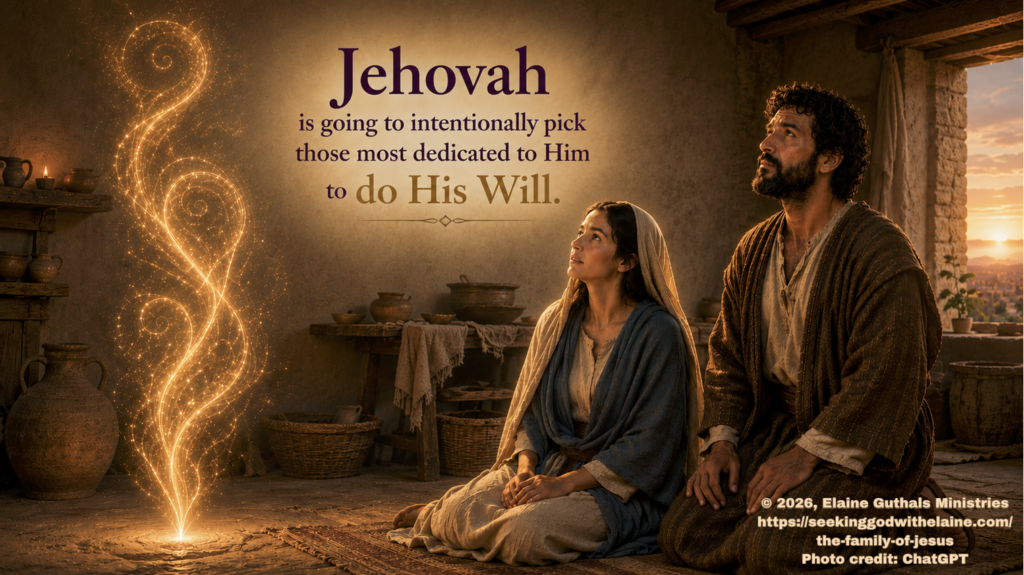
But that didn’t necessarily indicate who would serve Jehovah. Anyone could choose to serve Him. Jehovah is going to intentionally pick those most dedicated to Him to do His Will.
The middle section of the sabbatical system is important because it shows Yeshua’s right to the throne of David. This fulfilled a covenant promise.
The time between David and the exile shows the history of Israel. They were the chosen people who constantly chose not to follow Jehovah.
Because of that, Israel’s punishment included the loss of the land and Temple. Also lost was David’s throne.
Zerubbabel
This loss of the throne became painfully evident after the exile. This is probably when many of the Israelites began asking, “Did Jehovah’s promises fail?”
It became even more evident when David’s descendant Zerubbabel helped lead the first wave of exiles back to Israel and played a major role in rebuilding the Second Temple. Here was a descendant of the David and a leader in Israel – yet he never was anointed king.
Zerubbabel remained faithful to Jehovah, but David’s throne still stood empty. The uncertainty only deepened Israel’s longing for the promised Messiah.
Yeshua’s Grandmothers
There are four women identified in the lineage.
The four women identified in Matthew’s genealogy are women who were important to the history of the nation of Israel. All four were believed to be Gentile women.
- Tamar
- Rahab
- Ruth
- Bathsheba
Tamar was the wife of two of Judah’s sons, both who died. When Judah did not arrange the marriage to another of his sons, Tamar dressed as a prostitute, became pregnant by Judah, and had twin boys (Gen. 38).
Rahab was a Canaanite prostitute. She sheltered the Israelite spies when they reconned Jericho. Because she protected them, she and her family were protected in the fall of Jericho (Josh. 2).
Ruth was a Moabite woman who married an Israelite displaced by a famine. After her husband died and the famine ended, she remained faithful to her widowed mother-in-law when Naomi wanted to return to Israel (Ruth 1-4).
The New Living Translation did something differently. The last woman isn’t usually named except through context. “… David was the father of Solomon by the wife of Uriah” (Mt. 1: 6 ESV).
If we know who Solomon’s mother was, why didn’t Matthew just name her as Bathsheba?
By naming Uriah – Bathsheba’s first husband – first-century Jews were reminded of David’s greatest sin. It included adultery, murder, and abuse of power.
But it also included a psalm of repentance. We see this in Psalm 51.
Writing the lineage this way highlighted not only Uriah’s innocence but also Bathsheba’s. The story highlights Jehovah’s grace over failure.
Doesn’t that bring up a good point? The royal line also needed salvation and grace.
These women are included even though they are Gentiles. Moreover, they are all associated with scandal.
We see one important thread in their stories: they were given Jehovah’s unexpected grace. Jehovah’s redemptive plan advances not because of human perfection, but because of His covenant faithfulness.
Joseph, the husband of Mary
Matthew would have probably used Joseph’s lineage because he would have been, by Jewish tradition, the legal father of Yeshua.
No, we don’t know how many people knew the real story of the conception. We are never told if they were allowed to broadcast it, or whether they had to keep it quiet for security purposes.
Joseph was a righteous descendant of David who legally became Yeshua’s earthly father. Although Matthew introduces him only briefly here, his character will become central after the angel appears to him in a dream.
But Matthew was careful in his wording. He never said that Joseph was the father of Yeshua. He just acknowledged him as the husband of the mother of Yeshua.
All Those Listed Above
Taken all together, Matthew’s genealogy shows the fulfillment of the covenants with Abraham (Gen. 12, 15, and 17) and David (II Sam. 7).
Yeshua not only has a right to the throne of David, but He also fulfills the promise of blessing to the nations. Israel’s King and covenant fulfillment was coming to the earth.
The Genealogy of Yeshua through Mary
“Jesus was about thirty years old when he began his public ministry. Jesus was known as the son of Joseph. Joseph was the son of Heli. Heli was the son of Matthat. Matthat was the son of Levi. Levi was the son of Melki. Melki was the son of Jannai. Jannai was the son of Joseph. Joseph was the son of Mattathias. Mattathias was the son of Amos. Amos was the son of Nahum. Nahum was the son of Esli. Esli was the son of Naggai. Naggai was the son of Maath. Maath was the son of Mattathias. Mattathias was the son of Semein. Semein was the son of Josech. Josech was the son of Joda. Joda was the son of Joanan. Joanan was the son of Rhesa. Rhesa was the son of Zerubbabel. Zerubbabel was the son of Shealtiel. Shealtiel was the son of Neri. Neri was the son of Melki. Melki was the son of Addi. Addi was the son of Cosam. Cosam was the son of Elmadam. Elmadam was the son of Er. Er was the son of Joshua. Joshua was the son of Eliezer. Eliezer was the son of Jorim. Jorim was the son of Matthat. Matthat was the son of Levi. Levi was the son of Simeon. Simeon was the son of Judah. Judah was the son of Joseph. Joseph was the son of Jonam. Jonam was the son of Eliakim. Eliakim was the son of Melea. Melea was the son of Menna. Menna was the son of Mattatha. Mattatha was the son of Nathan. Nathan was the son of David. David was the son of Jesse. Jesse was the son of Obed. Obed was the son of Boaz. Boaz was the son of Salmon. Salmon was the son of Nahshon. Nahshon was the son of Amminadab. Amminadab was the son of Admin. Admin was the son of Arni. Arni was the son of Hezron. Hezron was the son of Perez. Perez was the son of Judah. Judah was the son of Jacob. Jacob was the son of Isaac. Isaac was the son of Abraham. Abraham was the son of Terah. Terah was the son of Nahor. Nahor was the son of Serug. Serug was the son of Reu. Reu was the son of Peleg. Peleg was the son of Eber. Eber was the son of Shelah. Shelah was the son of Cainan. Cainan was the son of Arphaxad. Arphaxad was the son of Shem. Shem was the son of Noah. Noah was the son of Lamech. Lamech was the son of Methuselah. Methuselah was the son of Enoch. Enoch was the son of Jared. Jared was the son of Mahalalel. Mahalalel was the son of Kenan. Kenan was the son of Enosh. Enosh was the son of Seth. Seth was the son of Adam. Adam was the son of God” (Lk. 3: 23-38 NLT)
Luke’s genealogy indicated that Yeshua was the Savior of the world.
Luke also included in his book a genealogy list. But when we look at it, it is different than Matthew’s list.
Right off, we can see the names are different. Matthew’s list says that Joseph’s father’s name is Jacob (Mt. 1: 16). Luke’s list says that Joseph’s father’s name is Heli (Lk. 3: 23).
What gives?
The explanation is simple. Matthew’s list shows Joseph’s lineage. Luke’s list shows Mary’s lineage.
That is understandable, too. It is believed that Matthew was writing to Jewish readers. They would have expected the father’s lineage – even though Joseph wasn’t Yeshua’s biological father. He was His legal father.
Luke, presumably writing to Greeks, used Mary’s lineage. She was Yeshua’s biological mother. Her father was Heli.
There is another difference in the genealogy lists. Matthew’s list started with Abraham and ended with Yeshua.
Luke’s genealogy started with Yeshua and ended with God. It showed that He was the Savior of all.
That makes sense to me. Yeshua came to address the sin issue that happened in the Garden of Eden with Adam and Eve. That was long before Jehovah made the covenant with Abraham and established the nation of Israel.
One thing that we may tend to forget is that Yeshua and John the Immerser were cousins. That would mean Yeshua was also descended from Levi, the line of priests.
Making the Connections #1
“… Two years after the great flood, when Shem was 100 years old, he became the father of Arphaxad. After the birth of Arphaxad, Shem lived another 500 years and had other sons and daughters. When Arphaxad was 35 years old, he became the father of Shelah. After the birth of Shelah, Arphaxad lived another 403 years and had other sons and daughters. When Shelah was 30 years old, he became the father of Eber” (Gen. 11: 10-14 NLT)
“… Eber was the son of Shelah. Shelah was the son of Cainan. Cainan was the son of Arphaxad. Arphaxad was the son of Shem …” (Lk. 3: 35-36)
In Genesis, Cainan was skipped, making Arphaxad the grandfather of Shelah, not the father as indicated in Luke.
But then, it really doesn’t say Shelah was Arphaxad’s son, just his descendant. A grandson would be his descendant.
Not only that, but there are also different spellings – depending on the translation used – for the names given for his father: Arphaxad or Arpachshad.
In other words, we don’t know who was what.
Making the Connections #2
We understand that the Israelites, later the Jews, put great store in their lineage. That is why there are so many genealogy lists in the Old Testament.
What can we learn from them?
Between the two lists, they show the humanity and divinity of Yeshua. It shows He is both Jew and Gentile. We see that He is mortal and immortal.
We see Yeshua’s imperfect human nature with His perfect divine nature. (That doesn’t mean that He sinned. It means that He had the human nature, so He could have.)
While He may have royal blood flowing through His veins, Yeshua was also intimately knowledgeable of poverty.
Making the Connections #3
Since there is an emphasis on genealogy lists, does that mean we need to know our ancestry in order to gain salvation?
No, these two lists are the only genealogy lists in the New Testament.
- “Don’t let them waste their time in endless discussion of myths and spiritual pedigrees. These things only lead to meaningless speculations, which don’t help people live a life of faith in God” (I Tim. 1: 4 NLT).
- “Do not get involved in foolish discussions about spiritual pedigrees or in quarrels and fights about obedience to Jewish laws. These things are useless and a waste of time” (Ti. 3: 9 NLT).
Paul was stressing that it doesn’t matter who our parents are – either believer or non-believer. Anyone can come to Yeshua for salvation.
Our ancestry cannot save us. Our faith in Yeshua can.
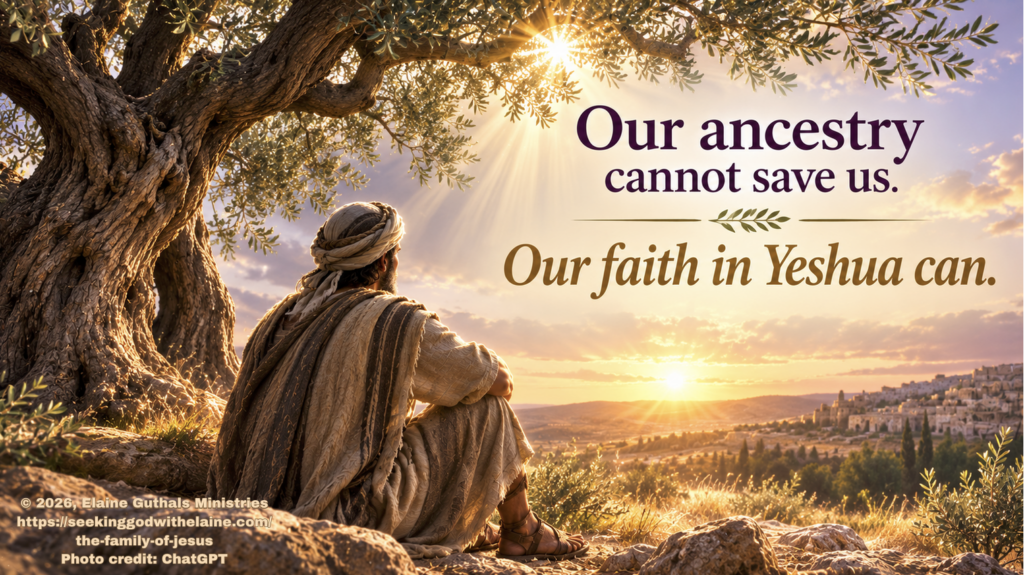
It also shows us that we need to focus on the present and the future, not the past. Our past sins are forgiven when we ask Jehovah for forgiveness. Obtaining that forgiveness and walking with Him daily takes precedence over the past.
Making the Connections #4
To understand the greatly anticipated first-century Messiah, we have to understand their expectation was profoundly covenantal and corporate. The people were waiting for Jehovah to act on behalf of the nation of Israel.
They had the covenant promises. However, covenant promises were not merely about personal spirituality. They addressed national destiny, covenant inheritance, land promise, temple hope, political liberation, and divine justice.
So, what were they expecting?
By the first century, Israel’s Messianic hopes had intensified dramatically. They weren’t however, waiting for a rabbi to die at the hands of Rome.
They were very exact in their expectations for the Messiah. We have to realize that they got most of these expectations directly from Scripture.
They expected the Messiah – Mashiach (מָשִׁיחַ) meaning anointed one – to embody covenant fulfillment itself.
More than anything, first-century Jews wanted the Messiah to be a conquering Messiah. They wanted Him to show up and kick Rome out of their country – the Promised Land.
The covenant promised land, which equated to independence from Gentile domination. The Messiah was expected to remedy that.
When first-century Jews thought of redemption, they thought Ga’al (גָּאַל). This meant to redeem, to reclaim, or to act as a kinsmen-redeemer.
This redemption was not limited to spiritual forgiveness. It involved restoration of inheritance, protection of covenant family, and liberation from oppression.
In the United States, we look at things through the lens of separation of church and state. Originally set up as the state has no jurisdiction within the church, many worldview people have flipped that to mean the church has no jurisdiction outside its walls.
A major part of Messianic expectation in first-century Israel was built on the belief that politics and theology were never fully separated. This belief was fostered by the fact that Israel was a covenant nation under divine kingship, not merely a religious community. Use of the same Hebrew term – Shuv (שׁוּב) – to refer to political restoration as well as covenantal restoration advanced this dual restoration.
First-century Jews believed the coming Messiah would overthrow pagan domination and restore righteous rule. That would make the Kingdom of God visible, politically and nationally.
All of the political and national hopes of a conquering king centered around the judgment of Israel’s oppressors. Scripture repeatedly declared that Jehovah would eventually judge those nations that had humiliated Israel – Babylon, Assyria, Edom, and later pagan oppressors.
Restoration theology dominated Jewish Messianic expectation. The prophets promised
- a future regathering of Israel
- renewal of covenant blessings
- restoration of the land
- purification from sin
- renewed obedience to Jehovah
This theology was tied to the belief that exile never ended.
Heart Check
Think about the battle Yeshua is engaged in for your heart. Ask yourself the following questions.
- Have I ever placed more confidence in my family background, church heritage, or good works than in my personal faith in Yeshua?
- Am I trusting God’s covenant faithfulness, even when His promises seem delayed like they did to Israel between the exile and the coming of the Messiah?
- Like Tamar, Rahab, Ruth, Bathsheba, and even David, do I believe Jehovah’s grace is greater than my past failures?
- Is my identity rooted more in whose I am than in who I come from?
How Do We Apply This?
- Thank Jehovah for faithfully keeping every covenant promise that led to the coming of Yeshua.
- If you’ve been relying on your religious background or family heritage, reaffirm that your hope for salvation rests in Yeshua alone.
- Evaluate where you’ve doubted God’s timing, and surrender it to Him
- Trust Him to keep His promises — even when fulfillment takes more time than we think it should.
Father God. Thank You for putting us in families that lead us to You. Thank You that this applies to our ancestors and to those who have become family to us. Help us to continue shepherding our descendants to You. Amen.
If you don’t understand something and would like further clarification, please contact me.
If you have not signed up for the email providing the link to the devotions and the newsletter, do so below.
If God has used this devotion to speak with you, consider sharing it on social media.
-
Introduction to the Battle for the Heart Theme
Yeshua’s mission, recorded in the Gospels, had one specific purpose. Our next theme looks at how His mission to make salvation possible is really a battle for our hearts.

We went from studying the Book of Revelation to the Book of Genesis. Right after we started Genesis, I knew I wanted the next theme to be Harmony of the Gospels.
That meant I have known since early 2025 that I was going to do this. I went back and forth on how to do this, so I’ve put a lot of thought into it.
I first wanted it to be chronological. Well, I wanted it to be as chronological as we know it to be. (That is when I thought the Gospels covered all three of the years of Yeshua’s ministry.)
But then I thought maybe the miracles might need to be taken together – look at all the healing the blind at once, etc.
So, I am trying to make the best of both worlds. The series within the theme will be:
- Preparing for the Christ
- The Birth and Early Childhood of Christ
- John the Baptist’s Ministry
- The Temptation of Christ
- The Early Ministry of Christ
- Miracles of Christ
- Jesus’ Parables
- Jesus’ Ministry
- Holy Week
- Jesus’ Death and Resurrection
I may hook the ascension on the end, even though it isn’t in the Gospels. It is an important part of Yeshua’s story.
It is important that we study this. True, first-century Jews thought their battlefield was Rome. We see how Yeshua battled the Pharisees and the Sadducees – and think that was it.
We’ll find out that much more was at stake.
Before we decide if we can take the word of the men who wrote the Gospels, we have to know who they are. This matters because the battle for the heart is the central theme of what they write about.
Authors
I hadn’t realized this until I started my research into this, but none of the authors identified themselves. Only the Book of Luke looks like it was written as a letter, as it identifies the person to whom it was written.
We aren’t given names, perspectives of the audience (Jewish or Gentile), or reasons why we are to take their word for it.
Matthew
The Book of Matthew gives the greatest evidence that it was written by a Jewish believer. It relies heavily on references to Old Testament scripture and Hebraic terms.
There is a copy of Matthew’s gospel written in Hebrew, which some may or may not believe to be the original. There are also copies of it translated into Greek.
Some questions exist as to whether the Book of Matthew or the Book of Mark was written first. Bradford noted the date the book was optimally written. He wrote,
“These ancient records state unequivocally that the Gospel of Matthew was written while Peter and Paul were still alive (early 60’s A.D.), and that Matthew was a Hebrew, and that he published a Gospel in his own dialect (which could have been either Hebrew or Aramaic as they are close-cousin languages and both were spoken fluently among ordinary Jewish folk in the 1st century A.D.).”
Resource
That would mean that there was a copy of the Book of Matthew before Jerusalem fell in 70 AD.
We traditionally believe that the first gospel was written by one of Yeshua’s Apostles, Matthew, the son of Alphaeus (Mk. 2: 14).
Mark
Some think that the Book of Mark is the oldest Gospel. Though the author is not named, it is attributed to John Mark, a contemporary of both Paul and Peter, whom both valued.
Possibly one of the better-known character studies in the New Testament, Mark, the cousin (anepsios) of Barnabas, is known for beginning Paul’s first missionary journey but bailing. Later —after Mark had matured — he became an asset to Paul’s ministry.
- “Aristarchus my fellow prisoner greets you, and Mark the cousin of Barnabas (concerning whom you have received instructions — if he comes to you, welcome him)” (Col. 4: 10 ESV).
- “Luke alone is with me. Get Mark and bring him with you, for he is very useful to me for ministry” (II Tim. 4: 11 ESV).
Possibly written mid- to late-60s AD, it is believed to have been written before the destruction of Jerusalem in 70 AD. It is thought to be a transcription of Peter’s memories, possibly compiled after his death.
The audience is believed to be disciples living under persecution in Rome. This is another point of evidence that Mark received his information from Peter, as his ministry field was Rome. Aramaic terms are translated, indicating the audience would not be familiar with the Jewish terms.
Mark attempted to encourage them by telling of Yeshua’s humbleness, persecution, and endurance.
Evidence of this may be seen as Peter is featured prominently. His successes are documented — as well as his failures. It includes
- Peter’s calling
- His confession at Caesarea Philippi
- A complete account of his denial of Christ in brutal detail
Also, the stories seem to be eyewitness accounts written from Peter’s perspective and from his preaching after the ascension. Details are included that only a witness would know. For example, Mark included the detail of Jesus sleeping on a cushion (Mk. 4: 38) and the color of the grass when feeding the five thousand (Mk. 6: 39).
In fact, Peter called Mark his son in faith. “She who is at Babylon, who is likewise chosen, sends you greetings, and so does Mark, my son” (1 Pet. 5: 13 ESV).
It was to Mark’s mother’s house he went to after being released from jail by the angel.
“When he realized this, he went to the home of Mary, the mother of John Mark, where many were gathered for prayer” (Ac. 12: 12 ESV).Growing up in a gathering place for new believers, the family connection with Barnabas, the possible mentorship by Peter, and the work in Paul’s ministry put Mark in a unique position to pen the Gospel account.
Luke
“Many people have set out to write accounts about the events that have been fulfilled among us. They used the eyewitness reports circulating among us from the early disciples. Having carefully investigated everything from the beginning, I also have decided to write an accurate account for you, most honorable Theophilus, so you can be certain of the truth of everything you were taught” (Lk. 1: 1-4 NLT)
Luke was a physician. His mind would have been logical and ordered. This is evident as he opened his Gospel as a historian would.
Many People Have Set Out to Write Accounts
We also know Luke’s was not the first Gospel written. He acknowledged others had been written (Lk. 1: 1). It is estimated that he wrote his Gospel anywhere between 60 and 85 AD.
I also think Luke’s mind would be opened. He would have known that nothing he did may have saved his patients. It would have had to be God.
Having Carefully Investigated Everything
Luke took pains to ensure his reader don’t believe he was an eyewitness to the events he wrote about. Instead, in the following years, Luke researched happenings and reported them.
Later, Luke was an eyewitness to happenings in the early Church. We know Luke sometimes traveled with Paul.
Luke seems to suggest that there were many writings about the life of Christ, not just those in the Gospel. That would be logical.
Yeshua’s impact would have been far reaching. It would have required a response.
I know, in writing these devotions, I do this to align my thoughts and beliefs. First-century Jews may have also done that.
They may have also, like Paul, written to others to witness to them and grow their faith. Just because those writings did not survive until today doesn’t mean they weren’t available at that time.
From reading what Luke says, it appears that he took those accounts — probably by friends of Yeshua’s teaching though inaccurate in some way — the Gospels that were already written, and stories that he was told by eyewitnesses to compile his Gospel. He urged Theophilus to seek out eyewitnesses. That would ensure the account was factual.
Luke knew that faith could come by hearing. For centuries, first called Hebrews, then called Israelites, now called Jews, they relied on oral tradition. This was what Moses had documented in the Torah. The Gospels document the oral teaching of Yeshua.
Why were the Gospels written? The four men who wrote these books recognized that the teachings of Yeshua must be written down for others to know. This is critical because of man’s condition after the Fall – our hearts are damaged.
White explained it this way. He wrote, “That man has lost himself by losing [the] knowledge of his God; and that he can recover himself, with the knowledge of his own nature and eternal destiny, only by recovering the knowledge of his Maker.”
Resource
This perfectly describes the purpose of the battle of our heart. We are separated from Jehovah, and there is nothing that we can do on our own to restore that relationship.
Winning this battle is fundamental for the peace of our souls. This win is also imperative for us to have the quality of moral character required by Jehovah. Again, we can’t gain this level of character without Him.
Theophilus
Luke is the only one who addressed his Gospel to someone. We don’t know, however, who that person – Theophilus – was.
Most think he was a Roman government official because of the greeting – here translated as most honorable Theophilus. This is believed because of that title was given to those who hold a high office.
At least, this is what I grew up thinking, not knowing there were conflicting stories as to his origin.
There are also some who think Theophilus was a high priest. Not only that, but they also put him in the line of Ananus (Annas). Yes, that would be of the Annas and Caiaphas dynasty.
Whoever Theophilus was, Luke’s writings were not his initiation into the story of Yeshua. Maurice called Theophilus a disciple.
Resource
We know names meant something in first-century Israel. Theophilus meant friend of God.
Certain of the Truth
Luke told us we can be certain of the Gospel. What he meant was that we can be sure of the Gospel of Jehovah.
Wait! What???? Isn’t the Gospel about Yeshua?
Well, yes and no. The Gospels tell the story about how Yeshua came to earth to die as the sacrifice for our sins.
But the whole Plan of Salvation is Jehovah’s. What does Yeshua’s name mean? God saves.
Another thing Luke was certain about was that there is nothing we can do to earn salvation. Being a good person won’t work. Salvation is only gained through belief in Yeshua.
Tradition says that Luke was hanged in Greece.
John
“Peter turned around and saw behind them the disciple Jesus loved — the one who had leaned over to Jesus during supper … This disciple is the one who testifies to these events and has recorded them here. And we know that his account of these things is accurate. Jesus also did many other things” (Jn. 21: 21, 24 NLT)
The Gospel of John was written, according to early Church tradition, by the Apostle John. John, the son of Zebedee and Salome and brother to James, was the youngest apostle.
Instead of being named, the author is referred to as the beloved disciple. As he was also identified as being at the Last Supper, it had to have been one of the Twelve Apostles. He is also credited with writing three epistles and the Book of Revelation.
Written decades – possibly 80 to 98 AD – after the other Gospels possibly by the request of the bishop of Asia Minor, it is totally different from the others. Where the other Gospels focused on the year following the death of John the Immerser, this Gospel looked at doctrine from beginning to end.
Doesn’t that seem logical considering the amount of time from when the other Gospels were written to this one? John would have heard the question raised, so – being the good teacher – answered them as he went along with the story.
Continuity — or Contradiction — of the Gospels
So, those are the men who wrote the Gospels. But each Gospel is unique and has its own stories the others don’t tell. However, there are a few things all four tell about. Other things may be told in two or three of the Gospels.
But what happens if the accounts aren’t exactly the same? Do they contradict each other, or do they expand our knowledge?
How can we tell which is correct so that we don’t choose wrong in the battle for our heart?
Looking through the different passages, we see similarities and differences. How can all of them be right?
Each author looked at the passage from a different perspective. How can that be if they are all looking at the same thing?
Think of it this way. Four people are standing outside my house on different sides.
- The person on the east side sees the huge front yard and trees. You see the deck, front door, and big picture window into the dining room. At night, you can clearly see the kitchen light over the stove that is on 24/7.
- The person on the north side of the house just sees windows. Time it just right, and you will probably see a cat or two in the windows. The person sees the driveway which leads from front to back.
- The person on the west side sees the sunroom. They see we have a basement. They don’t think we have any yard to speak of because they mostly see driveway.
- The person on the south side sees the back porch and overhang. Most of all, you get a good look at the church to which this house used to be the parsonage.
Can you see the church when you are on the east side of the house? Well, it depends on where you are standing. The pine trees planted right on the property line make a good curtain.
Look how Parker described it. He wrote,
“Mark observed a good many things that Luke never saw, or at least never recorded. Matthew also had his own way of looking at things; and as for St. John, what was he looking at? Apparently at nothing, for his inner eyes were fastened on the soul of Christ. If Luke had sharp eyes, what ears John had! for he heard whisperings of the heart, throbbings and beatings and sighings: and what a gift of expression I (sic) for he turned all that he heard into noble, sweet music for the soul’s comforting in all the cloudy days of Church time.”
Resource
Multiple people may be involved in a conversation, but each may focus on different aspects of it. That is because one thing is more important to them than others.
Think about it. If we didn’t have Luke’s account, we wouldn’t have the birth. If we didn’t have Matthew, we wouldn’t have the Magi. If we didn’t have John, we wouldn’t know Nicodemus. If we didn’t have Mark, we wouldn’t have the Parable of the Growing Seed (Mk. 4: 26-29).
Differences may be because of the different audiences to whom they were writing. Matthew was writing to Jews, where Luke was writing to Greeks. Mark, on the other hand, was writing to Romans. John was writing to everyone.
It also may be because of different audiences who heard the teaching of them. My opinion – Yeshua taught His parables and teachings multiple times to different audiences.
Yes, there would be some – like the Apostles – who heard it several times. Don’t we sometimes need to hear things more than once?
But there would be others who were specific to that recorded setting. Who is to say that Yeshua didn’t tweak them to fit the audience at the time?
We have to remember that they didn’t have a written New Testament. This wasn’t a letter that He had written to them.
This was their ears actually hearing it. Yeshua had to tell things multiple times to get His message across.
That doesn’t make the passages contradictory. It make different tellings recorded.
The Battle for the Heart
It is easy to pick up the Gospels and do a 100-yard dash read. There is only a couple of verses on each topic, and then it quickly goes on to the next.
That makes it surface reads. That may be okay for our schedule so we can check it off our list, but it doesn’t help our walk.
What was the reason Yeshua came to earth? He came to pay the penalty for our sins. That restores our relationship with Jehovah.
But that means Yeshua has to battle Satan for us. He does that by exposing several things:
- Self-trust
- Spiritual pride
- Fear disguised as piety
- Control disguised as zeal
- Tradition elevated above truth
The battlefield wasn’t Rome. It wasn’t the Pharisees or the Sanhedrin. It wasn’t even Satan in isolation.
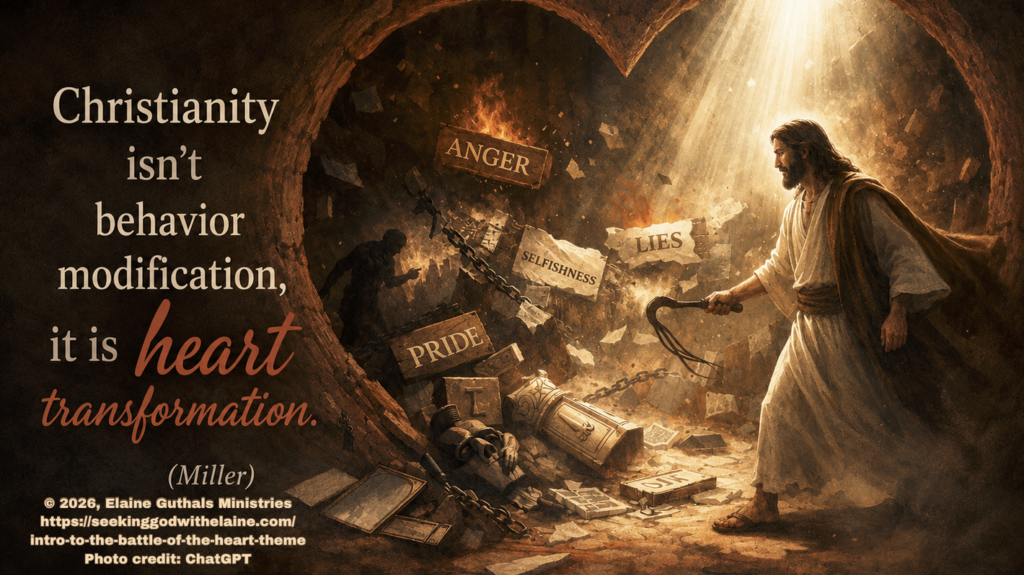
It’s inside us. Pastor Steve said, “Christianity isn’t behavior modification, it is heart transformation.”
Resource
Reading the Gospels correctly means that we have to take a lot of things into consideration.
- The Old Testament
- Messianic Expectations
- Second Temple
- Covenant Identity
Knowing that puts Yeshua v. Pharisees into perspective. It deepens the why of the miracles. It shows the dividing line of the parables. It emphasizes spiritual warfare.
Why is that important for disciples? There are too many goats in the sheep pen.
We are like the Pharisees. We think we are okay.
Ooo, baby. We are so Pharisees. “We’ve never done it that way in this Church!”
The issue is that our hearts aren’t right. Yeshua has to battle to get them right.
We tend to think that knowledge comes before faith. In a way it does. We can’t have faith in something we don’t know.
But just knowing something doesn’t necessarily bring us to Faith. We may choose not to pursue faith, or not to accept faith.
James told us in his epistle that even the demons have knowledge of Christ. That isn’t enough. Faith must be present for salvation.
Jehovah only give us an introduction in His Word. As our hearts become right with Him, He will reveal Himself to us.
That gives us victories in the Battle for the Heart.
Over the coming studies we won’t simply watch Jesus heal diseases or answer His critics. We’ll watch Him expose pride, dismantle false religion, confront Satan’s lies, fulfill centuries of prophecy, and call ordinary people into true discipleship. Every miracle, every parable, every confrontation asks the same question: Who will rule your heart?
If you don’t understand something and would like further clarification, please contact me.
If you have not signed up for the email providing the link to the devotions and the newsletter, do so below.
If God has used this devotion to speak with you, consider sharing it on social media.
-
What a Beautiful Name
Today is a music day.

Well, I don’t think I’ve done this before. Adam and I went to a church family funeral today. That meant three hours driving.
When I pulled up my post to put the finishing touches on it, I realized I wasn’t done with it.
That is the last thought I had. Seven hours not-moving later, I am resurfacing.
So, I think we are going to do a music day today. I got to talk with Pastor Chris while at the funeral, and he said that he had just been remembering recording songs for me to share with you.
I don’t know if this is the song he remembered, but it is one of my favorites from the time.
I hope it comforts you today.
What a Beautiful Name
Vocalist: Elaine Guthals
Keyboard: Chris Vieth
What do you think?
Leave me a comment below (about this or anything else) or head over to my Facebook group for some interactive discussion.
If you don’t understand something and would like further clarification, please contact me.
If you have not signed up for the email daily or weekly providing the link to the devotions and the newsletter, do so below.
If God has used this devotion to speak with you, consider sharing it on social media.
-
Joseph Alienated His Brothers
The covenant story has moved away from Jacob. This devotional reading introduces Joseph and sets up his story.
Nuggets
- Jacob settled in Canaan, probably at Hebron.
- The covenant story now transfers to Joseph.
- Joseph was still a teenager.
- Joseph was the employee to his half-brothers’ employers.
- Joseph worked as a shepherd.
- Jacob showed favoritism to Joseph.
- Jacob gave Joseph a long-sleeved tunic that may have represented a couple of things.
- The brothers did not react well to the coat.
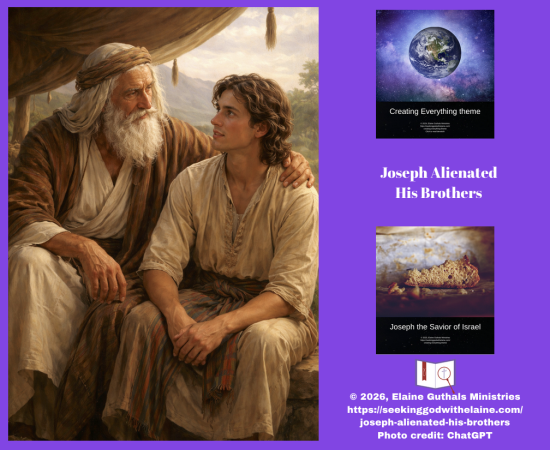
We would’ve thought Jacob would have learned. He should have known from his own childhood rivalry with Esau that playing favorites with children didn’t work well.
But Jacob must have been a slow learner. His favorite son was the eldest son of his favorite wife. And the sons of his other wives were not happy.
Let’s Put It into Context
To read devotions in the Creating Everything theme, click the button below.
Devotions in the Joseph the Savior of Israel series
Jacob Settled
“So Jacob settled again in the land of Canaan, where his father had lived as a foreigner” (Gen. 37: 1 NLT)
Jacob settled in Canaan, probably at Hebron.
When we left Jacob back in Genesis 35, we had finally declared him officially home. That was because after many, many years of traveling in Canaan, Jacob went home to his father. “So Jacob returned to his father, Isaac, in Mamre, which is near Kiriath-arba (now called Hebron), where Abraham and Isaac had both lived as foreigners” (Gen. 35: 27 NLT).
We aren’t explicitly told that Jacob settled in Hebron or when. Whenever it references where he lives, Moses always list his residence as the land of Canaan.
But it is a pretty safe assumption that this became Jacob’s headquarters. We get two nods to this. The first is Jacob “… settled … where his father had lived …” (Gen. 37: 1 NLT emphasis added). But the statement had lived makes it sound like he didn’t settle there until after Isaac had died.
The other one is, when Jacob sent Joseph to check on his brothers, “… Joseph traveled to Shechem from their home in the valley of Hebron” (Gen. 37: 14 NLT emphasis added). This makes it sound like they were in Hebron before Isaac died.
Why aren’t we told specifically? That could be to emphasize that Jacob, too, lived as a foreigner – i.e., lived as a nomad without owning land. We don’t know if he still owned the land he purchased in Shechem, but he didn’t live there.
Jacob may have taken over Isaacs tents. Isaac’s estate would have gone to Jacob, so there would have been many servants and animals that would now be under his care.
Jacob was used to the life as a shepherd. He would have moved with the flock for which he was caring. I bet this was especially true after Rachel died.
This, too, showed Jacob’s dependence on Jehovah. He had finally come to trust completely in his God.
I think the second reason why Jacob wasn’t given a permanent home is because the story is no longer his. At the end of Genesis 35, the story transitioned to the 12 tribes of Israel and the fledgling nation.
Therefore, it wasn’t important where Jacob specifically was. It was only important that the family was back in Canaan.
Joseph
“This is the account of Jacob and his family. When Joseph was seventeen years old, he often tended his father’s flocks. He worked for his half brothers, the sons of his father’s wives Bilhah and Zilpah. But Joseph reported to his father some of the bad things his brothers were doing. Jacob loved Joseph more than any of his other children because Joseph had been born to him in his old age. So one day Jacob had a special gift made for Joseph — a beautiful robe. But his brothers hated Joseph because their father loved him more than the rest of them. They couldn’t say a kind word to him” (Gen. 37: 2-4 NLT)
The covenant story now transfers to Joseph.
Abraham’s story took 13 chapters where Jacob’s took 10. Isaac’s story was basically snippets mixed in his father’s and son’s stories.
Joseph’s story also takes 13 chapters. We can tell from the get-go that it isn’t going to be an easy road for him.
Seventeen Years Old
Joseph was still a teenager.
Okay. We need to look at some of the timeline.
~1715 BC — Reuben born (Leah)
~1712 BC — Dan born (Bilhah)
~1711 BC — Naphtali born (Bilhah)
~1711 BC — Gad born (Zilpah)
~1710 BC — Asher born (Zilpah)
~1710 BC — Issachar born (Leah)
~1709 BC — Zebulun born (Leah)
1709 BC – Joseph was born (Rachel)
c. 1692 BC – Rachel died giving birth to Benjamin (Gen. 35: 16-20)
1692 BC — Benjamin born (Rachel)
1692 — Joseph receives his coat of many colors from his father JacobBased on Timeline from
If Joseph were born in 1709 that means he would have been 17 in 1692. That means Jacob gave Joseph his coat of many colors the year his mother died.
I wonder if it was before or after Rachel’s death. If it was before, I could see where our beliefs that it was just a gift of favoritism is logical.
But, what if Jacob gave Joseph that coat because he was in mourning? That is a whole different ball of wax.
Yes, Moses told us that the reason behind the code was favoritism. But what if the timing behind the gift was sympathy? He was helping his grieving son acclimate to a life without his mother.
What’s wrong with that? That makes his brothers even more insensitive — in my book.
Worked for His Half Brothers
Joseph was the employee to his half-brothers’ employers.
Look again at the list of brothers born to the concubines.
~1712 BC — Dan born (Bilhah)
~1711 BC — Naphtali born (Bilhah)
~1711 BC — Gad born (Zilpah)
~1710 BC — Asher born (Zilpah)Those in charge are only one to three years older than Joseph. That had the opportunity to end well or end badly.
We also must recognize that the household power was shifting with Rachel’s death. Before, there were essentially two maternal camps. Now the majority of the brothers belong to Leah’s camp. He was about to anger the brothers for whom he worked. Benjamin was a baby.
Joseph was isolated in the family structure.
Reported to His Father
Joseph worked as a shepherd.
We have no clue as to what the half-brothers did wrong. It doesn’t sound like that it was a false report.
Wells and Leale agreed that the report came out of Joseph’s love of obedience, truth, and right. That showed his righteousness. In other words, Taylor argued, Joseph was nothing like his brothers.
Resources
Gray had a completely different take. He thought that Joseph has been made an overseer of the brothers. That type of report would have been usual in that case. That isn’t what the Hebrew said.
Resources
But I’ve always thought Joseph was a little immature. He also lacked wisdom. He didn’t know how to handle his brothers.
Because he was open, Josep shared his thoughts and feelings – so it was natural he would share his dreams. In fact, Joseph probably just blurts out whatever he wants to say because he had no guile.
Joseph might be right on content but wrong in delivery.
That does nothing to make him one of them.
Joseph’s difference, favoritism, immaturity, and calling created distance, imbalance, provocation, and threat.
Whatever it was, it wrecked their relationships.
Jacob Loved Joseph More
Jacob showed favoritism to Joseph.
Jacob hadn’t learned from having a favorite wife that that practice doesn’t work well. But then, he didn’t learn that from his own experience either. He should have remembered the division and hate that Isaac and Rebekah ushered into their family with their favoritism.
I can see why Joseph held a special place in Jacob’s heart. He probably thought for a very long time that Joseph would be his youngest child.
Jacob was 91 years old when Joseph was born. Since Abraham was considered old when he had Isaac at 100, Benjamin was a miracle child at Jacob’s age (108).
Then Rachel suddenly died. I know childbirth was risky in those days, but the hope would always be there for everything to turn out fine.
Joseph would have been Jacob’s primary tie to Rachel.
A Beautiful Robe
Jacob gave Joseph a long-sleeved tunic that may have represented a couple of things.
In the Ancient Near East, clothing signified status and position. Yes, it showed favoritism, but it could have shown more. Smith said that a valuable garment was a typical gift from parents to children (and gave an elaborate description).
Resource
Did Jacob believe that he was designating Joseph as the future leader of the family when he gave him a coat? Rachel should have been his first wife — and probably only wife. That would have made Joseph the firstborn. In Jacob’s mind, maybe he truly was.
I hadn’t thought before that Jacob giving Joseph the coat would have humiliated the older boys, especially Reuben.
But have you ever thought that there had to have been something deeper than jealousy going on. Yeah, not being Mom or Dad’s favorite can hurt, but there had to be something else.
Let’s think this through.
Relationships are strained. There is jealousy present.
But the “outsider” gets a coat, and boys aren’t going to ridicule him? Come on, if nothing else, young adult men are going to rag on each other.
There had to be something that, when they saw it on Joseph, they thought suitable. Something clicked.
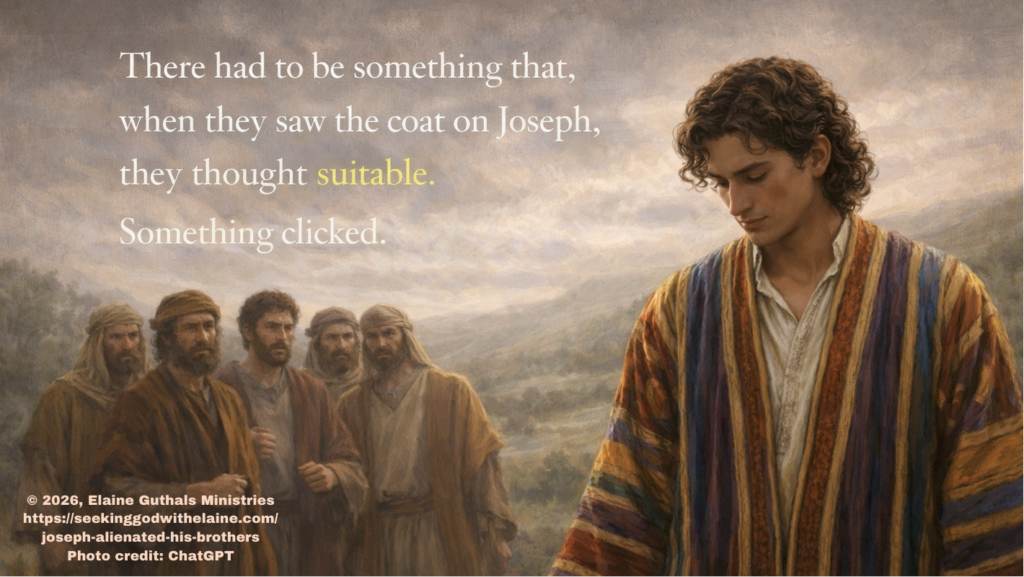
Because the emotion the picture elicited wasn’t radical. It was anger with a side of envy.
All ten of the boys would not have had the same response – legitimacy – if it hadn’t of created a reality that they couldn’t – wouldn’t – accept.
Do any of them have a clue as to what the future holds? No.
True calling can be visible before it is fully formed. Sometimes, we just need something to start the reveal.
His Brothers Hated Joseph
The brothers did not react well to the coat.
We aren’t told what the brothers’ relationship was before Joseph was given the coat. Did they have a calm nearly two decades?
Probably not. I doubt if the mothers had the rivalry going, the sons could have helped but have been dragged in it.
We know that Reuben was — or at least his mandrakes were (Gen. 30: 14-15). We also discussed whether his sleeping with Jacob’s concubine was an attempt to ensure that his mother’s arch-rival’s servant wasn’t elevated to legal wife.
We aren’t really told how the other ten brothers have a good relationship with each other. All being within seven years of each other — with the youngest ones, bunched up together – it probably had to have created problems. That is especially true for Reuben, as his normal authority as firstborn would have been weaker since he didn’t have the usual 10- to 15-year age gap with his siblings that most firstborn men enjoyed.
Just as Taylor argued that Joseph was nothing like his brothers, he also argued that they hated him for that reason.
Resource
I can see that. Joseph was totally different than the rest.
Joseph is described in words such as integrity, restraint, and consistent awareness of God. None of the other boys even come close – not even Benjamin.
Making the Connections #1
committed There are some who think that Joseph was sinless.
I — and Paul — disagree. “For everyone has sinned; we all fall short of God’s glorious standard” (Rom. 3: 23 NLT).
Yeshua was the only one that did not sin. No, Moses didn’t document a sin committed by Joseph — unless he sinned during the looting of Shechem.
Yes, Joseph was a forerunner of the Messiah. He was not a messiah.
Joseph does demonstrate moral clarity, as we will find out in a couple of chapters.
One day, it boiled over.
Making the Connections #2
Dods had a good description of Joseph. He listed the characteristics he inherited from his ancestors.
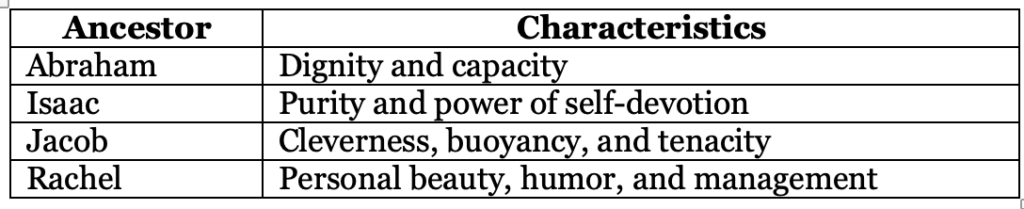
Resource
Since we know the rest of the story, we know that Joseph is going to need these characteristics!
Making the Connections #3
What was Jacob thinking? Didn’t he know his sons? Did he have even a slight inkling that giving Joseph a special coat wasn’t going to end well.
Jacob had to have known that the splintered relationships were present before he gave the coat. Did it even flit through his mind that this may not have been a good idea?
How Do We Apply This?
- Teach our children to word.
- Keep pure when surrounded by evil.
Resource
Father God. Family dynamics can be difficult. Help us to navigate thee relationships, imitating You each day to others. Amen.
If you don’t understand something and would like further clarification, please contact me.
If you have not signed up for the email providing the link to the devotions and the newsletter, do so below.
If God has used this devotion to speak with you, consider sharing it on social media.
-
Jacob the Patriarch Newsletter
Jacob: How God Broke Him to Bless Him
Have you ever sat down and taken a look at how complex Jacob was – and yet still feel an affinity for him?
We may be thinking Jacob started out with something we don’t have — he was known from the womb (Gen. 25: 23). But then again, so are we (Jer. 1: 5).
Why should we study Jacob’s life? Mercer gave us a good reason. He wrote, “His character was unlike that of the other patriarchs in this: Abraham and Isaac, such as we see them at first, are very much such as we see them at last. But Jacob only becomes his real, that is, his higher self at the last.”
Resource
If we take a close look at Jacob’s story, we see that Jehovah broke Jacob to bless him. That may sound strange, but Jehovah often works that way.
In today’s terms, we might say Jacob was moving from sinner to saint. More accurately, he was navigating his Sanctification Road.
What Jacob Did Right
Throughout his life, Jacob deeply wanted Jehovah’s promise. He accepted that it required effort, and he was willing to patiently work for it.
Jacob was described as quiet and settled (Gen. 25: 27). It makes you wonder if he spent time in contemplation, much like Isaac did (Gen. 24: 63). This may have happened more frequently when Jacob became a shepherd for Laban (Gen. 30: 29), surrounded by Jehovah’s beautiful world.
When Jacob finally returned to Canaan after twenty years, he came with the intention of reconciling with Esau. He knew Jehovah wanted him to make things right.
But when Jacob finally turned to Jehovah in prayer, it wasn’t in gratitude for being brought home. It was from fear because Esau was showing up with 400 soldiers.
And that is where Jacob was broken.
Jehovah met Jacob personally to wrestle with him. He removed Jacob’s advantages of strategy or strength.
What did Jacob do?
He clung.
He held on to Jehovah because he had nothing else left. In that moment, Jacob learned what it meant to depend fully on Him.
Jacob accepted that he was helpless and Jehovah was always in control.
What Jacob Did Wrong
From before he was born, Jacob’s parents knew he was going to be the covenant son. But there are times when he didn’t act like it.
From birth, Jacob was associated with grasping. He grasped at Esau’s heel — in fact, that is where he got his name.
That pattern played out in Jacob’s life by his reaching out for what he wanted, often before the right time. To secure what he wanted, Jacob used scheming and manipulation. Jacob acted as though Jehovah’s promise depended on his effort.
But grasping came at a cost.
Yes, Jacob obtained the blessing – but immediately, he lost his home. What looked like success became exile, and he was running for his life.
Oh, yes. Jacob was exiled to settle his future by obtaining a wife. What may have looked like a setback was a step forward.
Even years later, he was still trying to manipulate outcomes, still relying on strategy instead of surrender.
So, Jehovah stepped in – not to destroy him, but to transform him.
Jacob’s Covenant with Jehovah
When Jehovah confirmed His covenant with Jacob at Bethel, it was grace at its finest.
Jacob did not deserve it.
The first time at Bethel, Jacob bargained with Jehovah (Gen. 28: 20-21). The second time, he returned changed. He had seen Jehovah’s provision. He had learned what walking with Jehovah actually meant.
Jacob as a Model of Faith in Scripture
We see the turning point at the wrestling match.
Jacob did not leave the encounter the same. He still had flaws – he continued showing favoritism – but the direction of his life had changed.
He honored Esau.
He truly worshiped Jehovah.
He blessed others.Jehovah taught Jacob that blessing does not come through grasping hands, but through dependent faith.
What Jacob Teaches Us
We see what sanctification means through Jacob’s story. Jehovah is more than happy meeting us where we are — with the intention of taking us where He wants us to be.

The sanctification process is not meant to be some self-help exercise. It is surrender.
Sometimes that sanctification process means discipline. Sometimes it means breaking.
Jehovah does not mean to destroy us. He means to reshape our hearts.
God often breaks the self-reliance of His servants before He entrusts them with lasting blessing.
We, too, are brought into struggles. We are shaped through wrestling. We are given the opportunity to prevail.
We can’t overpower Jehovah. Like Jacob, we are brought to a place of acceptance where we must we stop relying on ourselves and start depending.
And in the end, we learn what Jacob learned: it was never his story. It was Jehovah’s story of grace.
Leah: The Unloved Wife Seen by God
We usually don’t think of Leah first when we think of Jacob’s wives. We think of his love for Rachel. We think of beauty, romance, and loss.
Leah, on the other hand, was accustomed to being overlooked.
But she was never overlooked by Jehovah.
As Laban’s oldest daughter, she should have been married first. If the Midrash is correct in that Leah was supposed to marry Esau, her story was even sadder.
Whatever the cause of her weak eyes, she likely lived with a sense of not measuring up.
What Leah Did Right
Leah entered a marriage that began with her and her father’s deception and lacked love. Yet she did not withdraw.
Leah made the best of her marriage with Jacob. Rather than retreating in bitterness or despair, Leah continued to live, bear children, and seek meaning in her life.
Most importantly, she turned to Jehovah.
We see her spiritual growth in the naming of her sons. The meaning of the names showed that she had moved from seeking Jacob’s approval (Gen. 29: 32) to praising Jehovah (Gen. 29: 35).
That was the turning point.
What Leah Did Wrong
Leah was not without fault. She remained silent in the deception that began her marriage. She struggled with wanting Jacob’s affection. She entered into the rivalry when Rachel gave her servant to Jacob.
This revealed Leah’s desire for human approval over Jehovah’s.
At times, Leah’s bitterness did get the best of her. Her bitter comment about Rachel stealing her husband (Gen. 30: 15) was not accurate. If anyone stole Jacob, it was Leah.
Leah, too, had to walk her Sanctification Road.
Jehovah’s Promise with Leah
Jehovah showed Leah much compassion. He saw her pain and provided for her.
Through Leah came Judah – the line of the Messiah (Gen. 49: 10). Jehovah advanced His covenant promise through the unloved woman.
Leah as a Model of Faith in Scripture
Leah’s faith appeared to develop earlier than Jacob’s.
By the time they leave Paddan-aram, there were signs the sisters had reached some level of peace. Leah had learned to place her identity not in Jacob’s love, but in Jehovah’s care.
What Leah Teaches Us
Leah shows us that Jehovah sees what this world overlooks. He wants us when the world does not. He sees us in our deepest pain.
We are seen because Jehovah is involved in each of our lives. He sees the unloved, overlooked, and quiet suffering.
And He works there.
Leah’s story reminds us that sanctification is a process. Growth happens in places of pain, not comfort.
Rachel: A Woman Deeply Loved, Deeply Longing
Rachel’s story carries a different kind of weight.
Rachel seems to be one of those women who are more of everything. She is more beautiful, more passionate — and at times it seems more self-centered.
Rachel’s story has it all — love, jealousy, barrenness, faith, and covenant purpose.
She was deeply loved – and yet deeply burdened. Her life was marked by longing.
What Rachel Did Right
Rachel was the love of Jacob’s life. He loved her with an intensity that said something about her. She was someone whom he was willing to wait for, work for, and be sanctified for.
Rachel wanted children — not just for herself, but to take part in Jehovah’s covenant family.
She followed Jacob when Jehovah called him back to Canaan (Gen. 31:13). She stayed within the covenant line and desired to belong to what God was doing.
In time, she recognized that children came from Jehovah.
What Rachel Did Wrong
Rachel’s longing turned into desperation. Her bitter demand for children (Gen. 30: 1) revealed how deeply this struggle affected her. Instead of waiting, she tried to take control – giving her servant to Jacob and intensifying the family conflict.
We don’t know the real reason behind why Rachel stole Laban’s teraphim. Whether it was about control, inheritance, or belief, it showed a lack of full trust in Jehovah.
Rachel’s faith was real – but it was often mixed with urgency and struggle.
Jehovah Promise with Rachel
Genesis is brutally honest regarding the toll Rachel’s barrenness took on her. She may have reacted with anger, jealousy, and despair, but Jehovah did hear her cry.
The child Jehovah gave her was one of the most significant figures in Israel’s history. Joseph is not only considered the Old Testament savior of Israel, but he is also compared to the New Testament Savior as a forerunner.
Rachel as a Model of Faith in Scripture
Rachel does not resolve as cleanly as Jacob or Leah. Her story remains marked by tension.
But that is what makes it relatable.
She believed yet struggled. She hoped yet wrestled with envy and fear.
And still — Jehovah heard her.
What Rachel Teaches Us
Rachel shows us that longing and faith can grow side by side. Both can be messy.
Rachel’s life reminds is that painful circumstances can distort relationships – but they do not stop Sovereign God’s purposes.
Jehovah works through real people — people who love, envy, hope, fail, and are still graciously used by God.
Final Thought
These three lives together show us what sanctification really looks like:
- Jacob — broken from self-reliance
- Leah — transformed through quiet suffering
- Rachel — shaped through longing
None of them were perfect.
All of them were changed.
And all of it points to the same truth:
It is not our story.
It is Jehovah’s.

To read devotions in the Creating Everything theme, click the button below.
Devotions in the Jacob the Patriarch series
-
Go Light Your World
Today is a music day.
I thought I was farther along on my post than I was. When we took our road trip today, I thought there wouldn’t be that much left for me to do.
Wrong.
Plus, in 20 minutes, we are going to lose electricity. There needs to be some line maintenance done after it was knocked out two different times during one snow storm.
So. here you go.
Go Light Your World
Vocalist: Elaine Guthals
Keyboard: Louise Guthals WeissWhat do you think?
Leave me a comment below (about this or anything else) or head over to my Facebook group for some interactive discussion.
If you don’t understand something and would like further clarification, please contact me.
If you have not signed up for the email daily or weekly providing the link to the devotions and the newsletter, do so below.
If God has used this devotion to speak with you, consider sharing it on social media.
-
Ishmael and His Descendants
Upon the death of Abraham, Isaac and Ishmael were both present for the burial. This devotion looks at what happened to Ismael.
Nuggets
- Let’s take a look at what we know so far about Ishmael.
- Ishmael had twelve sons, just as Jacob did.
- Ishmael died at the age of 137.
- Abraham is considered the father of Islam.
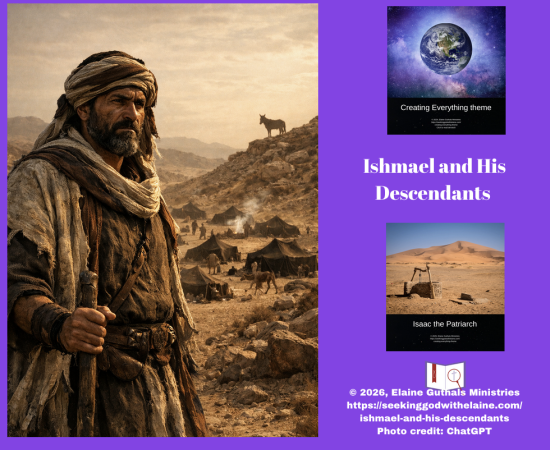
We’re going to take the verses of Genesis 25 a little bit out of order. We just finished up Abraham the Patriarch series with Genesis 25: 1-10. We’re moving on to Isaac.
In fact, the Genesis 25: 11 is about Isaac.
But then Genesis 25: 12-18 is about Ishmael. Then it goes back to Isaac.
So, we’re going to look at Ishmael before we jump into all the Isaac verses in Genesis 25.
Let’s Put It into Context
To read devotions in the Creating Everything theme, click the button below.
Devotions in the Isaac the Patriarch series
Ishmael
“This is the account of the family of Ishmael, the son of Abraham through Hagar, Sarah’s Egyptian servant” (Gen. 25: 12 NLT)
Let’s take a look at what we know so far about Ishmael.
Because Sarah was barren, she gave her Egyptian slave Hagar to Abraham to become his concubine/secondary wife. Hagar became pregnant, but she held her mistress in contempt.
Long story short. Hagar ran away, came back, had Ishmael, taught him to show contempt for the covenant son Isaac, and got sent away.
Before Isaac was born, Abraham tried to offer Ishmael for the covenant son. Bradford argued that was because he saw Ishmael as the promised son.
But Jehovah wasn’t having anything to do with that. He did promise to bless Ishmael, though. “As for Ishmael, I will bless him also, just as you have asked. I will make him extremely fruitful and multiply his descendants. He will become the father of twelve princes, and I will make him a great nation. But my covenant will be confirmed with Isaac, who will be born to you and Sarah about this time next year” (Gen. 17: 20-21 NLT).
Bradford made another important observation. He wrote, “… Ishmael is a Semite, just as Isaac was, and of course, as Abraham was. What’s a Semite? A descendant of Noah’s son Shem.”
Resource
Okay. Let’s mull on that for a second. We have Bradford to thank for this, too.
Resource
I have previously said Abraham was declared a Hebrew. Isaac was born into being a Hebrew.
But Ishmael wasn’t a Hebrew. Yes, we know Abraham was already called a Hebrew (Gen. 14: 13) when Ishmael was born (Gen. 16: 15). So, it wasn’t just birth.
God had to declare Isaac to be Hebrew. There was no such declaration for Ishmael.
Ishmael’s Descendants
Here is a list, by their names and clans, of Ishmael’s descendants: The oldest was Nebaioth, followed by Kedar, Adbeel, Mibsam, Mishma, Dumah, Massa, Hadad, Tema, Jetur, Naphish, and Kedemah. These twelve sons of Ishmael became the founders of twelve tribes named after them, listed according to the places they settled and camped. ” (Gen. 25: 13-16 NLT)
Ishmael had twelve sons, just as Jacob did.
Ishmael took an Egyptian wife. “And God was with the boy [Ishmael] as he grew up in the wilderness. He became a skillful archer, and he settled in the wilderness of Paran. His mother arranged for him to marry a woman from the land of Egypt” (Gen, 21: 20-21 NLT).
Ishmael’s descendants were hostile groups. They battled all their relatives — including Isaac’s descendants.
This hostility continues today. We know them today as Arabs, many of which— but not all — are descendants of Ishmael according to Got Questions.
Resource
Ishmael’s descendants made their home in the northern part of Arabian Peninsula. Nebaioth and Kedar were listed as shepherd in Isaiah 60: 7.
Bradford gave a good snapshot of Ishmael’s descendants.
- The descendants of Ishmael’s firstborn, Nebaioth, are known as the Nabaiati or Nabateans, currently the Jordanians of Petra.
- The descendants of Kedar associated with the Edomites. Today, they are a part of the Bedouins,
- Adbe’el (or Idiba’il) was conquered by Tiglath-Pileser, the conquerer of the Northern Kingdom of Israel.
- The land of Dumah’s tribe bordered that of Midian on the Arabian Peninsula. This tribe was mentioned in Isaiah 21.
- Tema and his tribe settled on a caravan route that ran from the southern part of the Arabian Peninsula to lower Mesopotamia.
- Jetur and Naphish combined into one tribe. It was called the Hagrites in 1 Chronicles 5: 10.
- Little reliable information is known about the rest of Ishmael’s sons.
Resource
Bradford also noted that Ishmael’s descendants lived in villages instead of walled cities. That would have fed the hostility they experienced among each other.
Ishmael also had a daughter. She married Esau. Two different names are given to her in the only two places she in mentioned in God’s Word.
- “So Esau visited his uncle Ishmael’s family and married one of Ishmael’s daughters, in addition to the wives he already had. His new wife’s name was Mahalath. She was the sister of Nebaioth and the daughter of Ishmael, Abraham’s son” (Gen. 28: 9 NLT).
- “He [Esau] also married his cousin Basemath, who was the daughter of Ishmael and the sister of Nebaioth. Adah gave birth to a son named Eliphaz for Esau. Basemath gave birth to a son named Reuel. Oholibamah gave birth to sons named Jeush, Jalam, and Korah. All these sons were born to Esau in the land of Canaan” (Gen. 36: 3-5 NLT).
The Death of Ishmael
Ishmael lived for 137 years. Then he breathed his last and joined his ancestors in death. Ishmael’s descendants occupied the region from Havilah to Shur, which is east of Egypt in the direction of Asshur. There they lived in open hostility toward all their relatives” (Gen. 25: 17-18 NLT)
Ishmael died at the age of 137.
When Ishmael died, it said that he was “… gathered unto his people” (Gen. 25: 17 KJV). Gathered to his people meant that Ishmael would be reunited with his ancestors who had died before him. We know he wasn’t buried with Abraham, but this meant he would have been reunited with him.
According to tradition, Ishmael is buried in Meca, Saudi Arabia, alongside Hagar. However, the exact location is not known. This allows other spots to be considered his burial place.
Islam
Abraham is considered the father of Islam.
Not only is Abraham known as the father of Judaism and Christianity, he is also considered the father of Islam. That is because its prophet, Muhammad, was believed to be a descendant of Ishmael.
Resource
There are some issues with trying to make Ishmael the covenant son. Many who believe in Allah believe that the Torah was changed to identify Isaac as the covenant son when it really should be Ishmael.
There is a problem with that. Muhammad was born (575 AD) 600 years after Yeshua’s life (100 AD) and 1,000 years after the final Old Testament book was written (400 BC).
If you are interesting in digging deeper into this, check out Bradford’s lesson. He is much more knowledgeable than I am about this topic.
Resource
Making the Connections #1
“Arise, Jerusalem! Let your light shine for all to see. For the glory of the Lord rises to shine on you. Darkness as black as night covers all the nations of the earth, but the glory of the Lord rises and appears over you. All nations will come to your light; mighty kings will come to see your radiance. Look and see, for everyone is coming home! Your sons are coming from distant lands; your little daughters will be carried home. Your eyes will shine, and your heart will thrill with joy, for merchants from around the world will come to you. They will bring you the wealth of many lands. Vast caravans of camels will converge on you, the camels of Midian and Ephah. The people of Sheba will bring gold and frankincense and will come worshiping the Lord. The flocks of Kedar will be given to you, and the rams of Nebaioth will be brought for my altars. I will accept their offerings, and I will make my Temple glorious” (Isa. 60: 1-7 NLT)
We talked about how some of the descendants of Ishmael were combined with the descendants of Keturah. That showed the breakdown on tribal lines.
But look what it really says in Isaiah 60: 1-7.
- Darkness is associated with those living apart from Jehovah.
- Israel is called to be “… ‘a light to the Gentiles, and you will bring my salvation to the ends of the earth’” (Isa. 49: 6 NLT).
- Toward the beginning of the ends times, nations will come to Jehovah.
- They will include descendants of Keturah’s son Midian and grandsons Ephah and Sheba. Kedar and Nebaioth were sons of Ishmael.
In other words, those who are Arab descendants of Abraham will come to worship Jehovah and Yeshua.
Making the Connections #2
Bradford told us why it is important to look at Ishmael as well as Isaac. He wrote,
“You see, Isaac and Ishmael represent the crux of the matter between Jews and Christians on the one side, and Muslims on the other; Isaac and Ishmael are a distinct fork in the road. And, please grasp that the differences between the Judeo-Christian world, and the Islamic world, are irreconcilable. There is no halfway point, there is no compromise. Islam says that the words from God, from Allah, and the people of the promise of the covenants with Abraham, come down through Ishmael and are recorded in the Koran. Of course, Jews and Christians maintain that the promise of the covenants comes down through Isaac, and are recorded in the Holy Scriptures.”
Resource
It is easy to think that the two religions are sort of a mirror of each other. That they say the same thing only differently.
That is false.
Isaac was the covenant son. That trumps Ishmael being born first.
“But My Brit (covenant) will I establish with Yitzchak [Isaac], which Sarah shall bear unto thee at mo’ed hazeh (this set time) next year” (Gen. 17: 21 OJB).
How Do We Apply This?
- Choose to follow Jehovah.
Father God. Thank You for giving us families. Help us to grow together in You individually and together. Amen.
If you don’t understand something and would like further clarification, please contact me.
If you have not signed up for the email providing the link to the devotions and the newsletter, do so below.
If God has used this devotion to speak with you, consider sharing it on social media.
-
Abraham the Patriarch Newsletter #5
Abraham’s Faith Tested
Jehovah Tested Abraham
Jehovah came to Abraham just as He usually did. It wasn’t a personal visit like Genesis 18. It wasn’t a dream, as He came to Abimelech (Gen. 21).
This sounded like it was how Jehovah usually came to Abraham. It was a voice in his spirit.Abraham was not told that this was a test. He had no clue what was happening. Most of all, Abraham didn’t know why it was happening.
Get one thing straight. Jehovah tested Abraham. He did not tempt him to sin.
Jehovah does test us to get us to prove our faith (Jas. 1: 13). God was not looking for the evil in Abraham — unless it is to eliminate it from his life. He was looking for the good.
Do we understand the purpose here? Jehovah knew Abraham had faith. He was trying to figure out how strong that faith was. We have to judge ourselves by God’s standards.
When Jehovah said, “Hey, Abraham!”, I bet Abraham was excited to talk to his Friend again.
“… ‘Here I am’” (Gen. 22: 1 NLT) implies both obedience on Abraham’s part and provision on Jehovah’s part. Abraham knew He could depend on Jehovah to carry him through whatever of which He was asking him.
Abraham’s response showed that he was ready to obey Jehovah in whatever was asked of him.
Your Only Son
The testing Jehovah gives us usually uses that which we love most and highly value.
Abraham was to take his beloved son Isaac, the covenant child, and sacrifice him on an altar to worship Sovereign God.
Talk about having the rug pulled out from under his feet. Abraham would not have seen this one coming.
Abraham would have never thought Jehovah would ask him to sacrifice his son. The whole covenant was contingent on Isaac’s birth and having kids of his own.
Abraham would have been shocked down to the bottom of his sandals.
What Abraham was told was that he was to not only kill Isaac but also burn him on an altar. It wasn’t a stick and done. It was a slay, dismember, and burn process.
This command seems so out of character for Jehovah to ask that. Because child sacrifice was common in many countries at the time – even Abraham’s – He has several times specifically stated that children were not to be sacrificed (Lev. 18: 21).
What happened to “thou shalt not kill” period?
Could a father legally do this? Well, back in Abraham’s day, yes. The father had complete rule over his son.
So, let’s go back to the Hebrew. “… offer him there for a burnt offering upon one of the mountains …’” (Gen. 22: 2 OJB). Not sacrifice. Offer.
But if we look at how to perform a burnt offering, we see the sacrifice is killed first (Lev. 2: 4-5). Before it was offered to God, the sacrifice was killed.
Can we start a sacrifice and pull out before the smoke starts? Is it really a sacrifice then? Is it even an offering? No.
Jehovah can require one time that which He has forbidden another. Otherwise, how can He test us?
What better way of showing us what He doesn’t want by asking for it and stopping it?
Abraham didn’t ask Jehovah to repeat the command or clarify it. He didn’t even demand evidence that it was coming from Him. He didn’t rail about not being left with a way to shimmy out of it.
Abraham straight up obeyed.
Jehovah told Abraham to take his son — the one he loved — and sacrifice him. Now, last chapter we were told that Abraham was told by Him to send Ishmael away. Even though Jehovah had made it clear that he wasn’t the covenant son, Abraham might have kept in the back of his mind that Ishmael was a spare in care something happened to Isaac.
Why would God ask Abraham to sacrifice the son that he waited for so long? Just because of that?
Think about it. Abraham didn’t have a bunch of sons. He had two.
I don’t think Jehovah was saying Abraham loved Isaac more than Him. If Jehovah was doing this as punishment for the sin of putting something before Him (Ex. 20: 3), it wouldn’t be a testing. If Abraham had put Isaac before Jehovah, I would think that would have created a much bigger response than testing. God may even could have gone through with the sacrifice.
Yes, it is sometimes easy to put something before Jehovah. We can’t put things – even family – above Sovereign God.
Do we put more faith in the blessing than the God Who gave us the blessing? In other words, would Abram make Isaac his idol?
But we have to understand Jehovah can ask of us anything He wants. It is not our place to question. It is our place to obey.
Why would Jehovah make Abraham go through all of this? He was giving a representation of Him and Yeshua.
The First Step of Obedience
Once again, God sent Abraham off without giving him a specific destination. All Jehovah had given Abraham was the area but not the specific mountain. That didn’t slow Abraham down.
Even though Jehovah asked what at first hearing Abraham would have recoiled from, he immediately made plans to fulfill the request. Abraham left early the next morning. He left at the first possible time.
We aren’t told what he told Sarah — if anything. I don’t see him going to her and saying, “God told me to go make a sacrifice — and that sacrifice is Isaac. See you when I get back.”
Abraham obviously didn’t tell Isaac.
Whatever Abraham was feeling, he started the next morning. This is the best indication of his faith.
We’ve talked about Abraham being disinterested before when he and Lot separated. Disinterestedness means a willingness to give up something for a greater good.
This is the type of faith and obedience Abraham showed. He was willing to give up his beloved son’s life for whatever greater good Jehovah was working.
It was smart to take wood with him because wood could be scarce around there.
I’m sure it wasn’t like throwing a couple of clothes in the suitcase and going. But still with each step he took, Abraham’s mind was probably racing, and his heart was trying to sink.
With all that, it doesn’t sound like Abraham let Isaac see his despair. He let him see his unwavering faith in a Sovereign God. He knew Jehovah would make clear to him exactly what He wanted him to do – without breaking the covenant they had together.
Not once in the journey did he turn around or even get lost on purpose. Think about the self-control that took.
Journey to the Mountain
On the Third Day
Abraham and Isaac made it to where they could see the mountain in the distance.
We have to clear up something. The New Living Translation says, “On the third day of their journey …” (Gen. 22: 4 NLT). If we go back to the Hebrew, it says, “Then on Yom HaShlishi …” (Gen. 22: 7 OJB).
Yom HaShlishi does mean the third day. But it means the third day of the week — our Tuesday – not the number of days in the journey.
Only Shabbat is the only day of the week given a name. Sunday is the first day, Monday is the second day, and Tuesday is the third day.
In other words, we don’t know how long the journey took.
All we know is that Abraham took the journey to worship Jehovah (Gen. 22: 5).
Stay Here with the Donkey
Abraham asked his servants to stay back, partially because he didn’t want them to try and stop him. He probably didn’t want any of the three to know yet who the sacrifice was going to be.
But I can also see this as being a very private act of worship for Jehovah’s glory. It was between Abraham and his God.
I think another reason is that Abraham wanted that time alone with Isaac.
In the Hebrew, Isaac is called “… the young man …” (Gen. 22: 5 OJB). He could have been anywhere from 15 up to 30 years old. A teenager isn’t necessarily a young man but a youth. To me that is more a young adult. Fifteen seems too young to me and thirty too old to me.
Abraham was convinced that it would turn out okay (Gen. 22: 4-5).
Heading toward the Altar
Abraham and Isaac carried what they needed to make the sacrifice. Isaac carried the wood, and Abraham carried the fire and knife. But that made something very obvious to Isaac.
Where was the animal to be sacrificed?
Did Abraham not answer Isaac’s question fully because he didn’t want to scare the boy? Or was he wanting to help grow Isaac’s faith? Probably a bit of both.
Because of Abraham’s strong faith, he knew that God would provide a sacrifice, or His promise would be null and void.
What has always amazed me is how calm on the outside Abraham was. His thoughts had to be racing because Satan had to be working on him.
Remember, this was “Some time later …” (Gen. 22: 1 NLT) after Abraham had sent Ishmael away. Talk about insult to injury.
Not one time did Abraham so much as even murmur against Jehovah. He always said, “Sir, yes Sir.”
Abraham’s obedience — and his faith — never wavered because of grace.
Built an Altar
The first thing that Abraham did when they arrived at the place for the sacrifice was to build an altar. Building altars was Abraham’s way to worship God.
It wasn’t something novel for God to ask Abraham to make a sacrifice. In fact, he had sacrificed enough that Isaac knew something was missing.
It was a novel experience that God asked Abraham to sacrifice Isaac, the son for whom he had waited so long.
Picked Up the Knife
Obedience isn’t complete without an inward transformation.
I bet there were tears running down his face as he bound Isaac. He had to be feeling a variety of thoughts.
The faith shown was that Abraham believed — even if he had to go through with the sacrifice — Jehovah was Sovereign God above all. The covenant promise would be kept in some way.
Abraham didn’t have to understand how that would play out. He just had to believe it would.
But Abraham also had to be willing to go the entire way if it didn’t play out the way he thought it should.
If we worship Jehovah with an expectation of some blessing, it really isn’t the kind of worship He requires.
If we worship because of receiving something in return, that isn’t true worship. We must worship Jehovah because He is Sovereign God.
Some of us are probably asking why Jehovah had to let it go this far. That is easy.
It didn’t mean anything until Abraham showed Jehovah that he would go all the way. Saying he would and not meaning anything proved nothing. It was just a lie.
Abraham had to pick up the knife. He more than likely had to lift it over his head.
Performance equals action. But not just any action — it has to be what Jehovah requires and performed through faith.
Kill His Son for a Sacrifice
The purpose of the burnt offering was not to wipe clean the person’s sin but is a gift of ransom to alter Jehovah’s attuned toward that person.
We don’t know what Abraham’s understanding of the coming Messiah was. This is a perfect example of what was coming.
When Jehovah gave the Levitical Sacrificial System to Moses, he would have understood the concepts behind it better because of this sacrifice. We better understand the concept of Yeshua being the sacrifice because of the substitution of the ram for Isaac.
A Wife for Isaac
The Charge
We aren’t told how old Abraham was, but he was between 137 and 140. Yes, that would make Abraham old. However, he lived another 35 years after that.
God had blessed Abraham in everything. That was because he had believed and been obedient. He had become a righteous man (Gen. 15: 6).
Now it was time for Abraham to take action for the next phase of the covenant.
One Day
Abraham sent his trusted servant to find a wife for Isaac.
Was Abraham taking things into his own hands again in trying to find Isaac a wife? I don’t think so. Jehovah doesn’t want us to just sit around waiting for Him to take care of us.

We just have to make sure we are listening to Jehovah’s voice. That is what Abraham – and Isaac – were doing: trusting in God.
So, if Isaac was pushing 40, why was Abraham the one arranging his marriage? Well, that was the custom in Abraham’s society.
Abraham and Isaac both knew that it would be Jehovah providing the wife. They had seen Him follow through on His promises before. Both men also knew that they must follow Sovereign God in all things – especially those covenant related.
His Oldest Servant
Abraham asked his trusted servant to accomplish the mission. Here, we aren’t given the name of the servant.
But we are given enough to give his name a good guess. It was “… his eved zekan of his bais, hamoshel …” (Gen. 24: 2 OJB). Eved was the term for slave, and zekan meant beard, which represented maturity.
Let’s see who that would be. “… the Ben Meshek of my Bais [son of possession, steward of my house] is this Eliezer of Dameshek (Damascus)?” (Gen. 15: 2 OJB).
The servant entrusted with the mission is probably Eliezer, the one who would have inherited if Abraham didn’t have an heir. He would have been Abraham’s oldest servant.
Ooo, baby. That took gumption for Abraham to ask Eliezer to find a wife for Isaac when he had already lost the wealth that would have come to him when Isaac was born!
Eliezer, though, had long proven his trustworthiness. He wouldn’t be in the position he was if he hadn’t. He certainly wouldn’t have been given this important mission.
Take an Oath
Abraham and Eliezer both knew the importance of a continuation of the covenant and showed their support by making an oath.
Abraham asked Eliezer to swear an oath, which was allowed in Judaism. Now, the way he swore sounds kind of yuck to us, but it is logical when we put it in Jewish culture.
Both men would have been circumcised on the same day (Gen. 17: 23). We know Eliezer was already in Abraham’s household (Gen. 15: 2).
Eliezer putting a hand under Abraham’s thigh would have been putting it close to the circumcised part. It is like our putting our hand over our heart to show our sincerity of our promise.
Abraham was asking Eliezer to perform a mission to keep his end of the covenant – have descendants.
Maybe that was Abraham’s way of saying, “You have been a faithful servant lo these many years, and you would have been a worthy heir. But God had different plans. We both want to be obedient to God.”
Think about this. Abraham was giving Eliezer permission to choose Isaac’s bride.
True, it probably was because he was sending him on a long journey that he didn’t feel he could make himself. Otherwise, I think he would have gone himself.
But Abraham also didn’t know how long this journey would take or if it would be successful. He was giving Eliezer this mission until it had a successful ending – even if Abraham was no longer alive.
So, Abraham sent his most trust servant – with very specific instructions.
You Will not Allow My Son to Marry a Canaanite Woman
The choice of Isaac’s wife was important for covenant purposes.
Abraham knew God didn’t want Isaac to take a wife from the local women. There was a couple of considerations for this.
Abraham knew of their idol worship. Their lifestyle was full of sin and depravity.
There was no way that Abraham wanted a woman of Canaanite religions raising the covenant sons.
Does that make a contradiction to what we saw in Genesis 23? I think not.
Remember, we have to be in the world but not of the world. In means it is okay to buy a field for burial, but not of, which means compromising with their belief system and taking their daughters in marriage. Compromise has to happen a lot in a marriage.
If Jehovah wants the eventual overthrow of idolatry, He would not allow it in His covenant line. Plus, He would not dilute the purity in that way.
Another consideration was that Abraham had been promised the land of Canaan for his descendants. He knew Jehovah was not going to have him make alliances with the current occupants to get it.
What that meant was the land would be taken from the current inhabitants. Abraham just didn’t know when or how. But he probably knew that they would have a hard-fought battle at the least or the Canaanites destroyed at the worst.
But what would it have done to Isaac’s marriage – and his safety – when ownership was switched if he had married a Canaanite woman? That wouldn’t have been a happy household.
Go Instead to My Homeland, to My Relatives
So, Abraham sent Eliezer back to his family.
We know Terah, Abraham and Nahor were living in Ur. We know they worshiped false gods (Josh. 24: 2-3).
Genesis 11: 31 says only part of the family came with Terah. Even though they are not listed, many believe that Nahor and Milcah should have been included in the list.
Maybe. Maybe not.
I can see Moses not including them in the list as — at that point — they weren’t main players in the story. Moses only put what was absolutely necessary.
But a lot of things in God’s Word have to be taken literally. Maybe Nahor came later.
It would be logical to believe that, if Nahor and Milcah didn’t go in 1890, they came sometime before Terah’s death in 1885. Nahor, as some believe he was the oldest son, would have become the patriarch upon his death.
When Abraham received an update from Milcah in Genesis 22: 20-26, Moses did not include where they were living. So, either Abraham already knew where that was, or it wasn’t an item Moses included.
Whatever, Abraham knew where to send Eliezer then. More importantly, he knew that they believed in Jehovah as Sovereign God.
Marrying within the clan was acceptable in those day, even encouraged. It provided economic stability.
Family is an ongoing theme within God’s Word.
What If?
Eliezer wanted to know what would happen if his mission failed and Abraham wasn’t around to give instructions.
In Eliezer’s mind, even being family didn’t necessarily guarantee the success of the mission. He wanted to make sure he knew what to do if it was a failure.
Oaths were taken very seriously in Abraham’s culture as they were binding and sacred. It showed the importance of the integrity to fulfill one’s promise.
Eliezer didn’t want to make a promise that he couldn’t keep.
Therefore, it was a big deal to be released from the oath. In effect, it was saying Eliezer had faithfully tried to comply with the oath and was innocent of not breaking the oath.
Abraham was thinking of the covenant when he answered Eliezer. Don’t take Isaac back on any condition.
No, it wasn’t that Abraham doubted that God wouldn’t hold up his end of the bargain. It is just that – other than Sarah’s burial place – we aren’t told he had acquired any more land. He would have felt his status in the region as tenuous at best.
The Distribution of Abraham’s Estate
Everything He Owned to Isaac
As (considered) firstborn, Isaac was entitled to a double portion of Abraham’s wealth.
Rather than meaning position in the lineup of sons, firstborn signified special status, preeminence, leadership, and inheritance. (Notice worldly inheritance is last on the list.)
That is because the designation firstborn meant that son was being set apart. In general terms, being designated firstborn had to do with birthright and inheritance.
The birthright meant who was going to take over authority and leadership of the clan. Because of this distinction, he got a double portion of the inheritance. He was given the worldly status associated with his position.
But we cannot overlook the fact that the firstborn was consecrated to Jehovah (Ex. 13: 2). Yeah, it does say birth order there. “… whatsoever openeth the rechem (womb) …” (Ex. 13: 2 OJB). But we know Jehovah didn’t always – in fact, usually so far – call the first son to be born.
Let’s think this through. We know Ishmael was 13 years older than Isaac. All of Keturah’s children were probably older than Isaac.
We have to keep in mind that Abraham was not just giving Isaac all of his worldly possessions here. He was giving him all the blessings of the covenant.
Gave Gifts to the Sons of his Concubines
Abraham presented gifts to each and sent them away from Isaac. This was a common practice in Abraham’s time. It was totally up to the father whether sons from concubines got anything at all.
Why did the sons from concubines not get a portion of the inheritance and be sent away? This was so they could not contest the inheritance, eliminating family conflicts. We mentioned how Abraham didn’t like conflicts.
This practice preserved the estate for the heir. In this case, it was preserving the covenant promises.
But giving them a gift instead of a portion could have escalated any hostilities instead of eliminating them. The gifts could have been anywhere from stingy to substantial.
Whatever the case, Isaac was made a very wealthy man.
We get that Abraham sent his other sons off to secure the Promised Land for Isaac. But why east?
Abraham wanted to establish a distance among the siblings. He may have thought about Jehovah’s promise to bless all nations through him, so he was dispersing them to do just that. This also allowed them to grow independently and develop their own identities.
We also know there was probably spiritual reason. Abraham may have been sending them east to the Land of Nod (Gen. 4: 16).
The Land of Nod was where the Land of Eden was not. Nod is a Hebrew word. It means wanderer, exile, or fugitive.
We said back in Genesis 4 with Cain’s exile that his journey would bring him first into what we know today as Arab nations. Those nations were being established here.
To read devotions in the Creating Everything theme, click the button below.
Devotions in the Abraham the Patriarch series
-
Abraham the Patriarch Newsletter #4
The Destruction of Sodom and Gomorrah
Lot
We know that Lot was the son of Haran, who had died back in Ur (Gen. 11: 27-28). Lot went with Terah when he left Ur (Gen. 11: 31).
Moses didn’t give us any clue as to how old Lot was. He was able to sit at the gate of Sodom, which usually was a position held by elders of the community. He also have virgin daughters who were betrothed, making them around 13.
Maybe Lot had started out from Ur following God’s call. Our initial acceptance of God at conversion is only the beginning. We must then walk with God daily as we are sanctified.
Lot may have been impacted by the wealth and opulence of Egypt. That may have turned him away from God if he had called upon God previously.
It may have been Abram’s religion and only rubbed off on Lot because of association with Abram, not with God.
Heavenly Visitors
One of the visitors was initially identified. It was God that appeared as a man. Never in a million years would we even think we would entertain angels, let alone God Himself.
God visits His children. It can be in human form, and it can be we don’t recognize Him.

We have to meet God in a quiet place.
The Hebrew word used in Genesis 18: 1 was terebinth. The tree described was part of the pistacia tree family, not an oak. It was known for its resilience and medicinal properties, probably using the resin.
Here were these three “men” standing near the grove. God was inviting Abraham into the shade with Him.

A grove of trees would be a wonderful place to meet with God.
God frequently reminds us in His Word to be watchful.
It was the heat of the day. Instead of seeking relief inside the tent, Abraham was sitting at the entrance.
But Abraham did more than just sit there. He looked up and saw the visitors.
We can’t focus on our earthly interests. We have to pray to Him and set our minds on things above (Col. 3: 1).
We, like Abraham, have to get out of our tent and go toward the Heavenly Father.
Meeting with God
I have heard that Jewish men never ran. That was what made the father in the Prodigal Son parable so interesting (Lk. 15: 20).
But here, Abraham ran to meet God, showing how deep his faith was. He recognized Him right off.
Our faith should be deep enough that we recognize God right off if He pops up before us. We need to want to get into His close presence as soon as we can get there.
When we are running toward God, we are proactively looking to Him for His help in our spiritual matters. It is an act of submission and obedience. It shows our commitment to Him.
One of the ways we search for and seek God is to meditate on our walk with God (Ps. 1: 1-2). This is where we think about what we have heard and read and apply it to our lives. This is where we just enjoy God’s presence.
We must worship God, listen and talk to Him, and love Him. We have to make Him a large part of our lives.
We have to abide with Him.
Normal Hospitality Practices
When family, friends, neighbors, and travelers came to visit, it was their duty to show hospitality to them. There weren’t any inns around. Even if the visitor came from across town, their feet would have been dirty in their sandals.
It was up to Abraham to be the host. There were several things that a good host would do in that culture. Doing these actions for people – whether they knew them or not – showed kindness, generosity, and reverence for God.
Also, a host may provide shelter for the night. Like I said, no inns.
Yeah, Abraham treated them as he would other travelers. He may not have (but probably did) pulled out the fatted calf for others, but the rest was standard operating procedure.
Look how quickly the meal was put together. But look at verse 8. Abraham didn’t even eat with them!
It doesn’t say that Abraham went on about his business and let them eat by themselves. It says he was taking the role of a servant, standing ready to refill drink glasses and get Them whatever They would ask.
The New Living Translation says, “… let me prepare some food …” (Gen. 18: 5 NLT). The Orthodox Jewish Bible says, “And I will bring a morsel of bread …” (Gen. 18: 5 OJB).
Some food is more in line with what Abraham spread before his Visitors than just a morsel of bread. From the list of food in verses 6-8, Abraham had a feast prepared.
I never caught before that Abraham gave Sarah instructions for the meal. Then, he started the servant on preparing the calf. But he put it all together himself.
It is interesting that, when Abraham gave Sarah the menu, he asked for cakes, not bread (Gen. 18: 6).
God and the angels ate the meal Abraham prepared. While He conversed with Abraham, God also spoke to and heard him.
Hiding in the Tent
In Abraham’s time, Sarah would have been expected to welcome and serve guests. So, why was she eavesdropping in the tent?
God is all knowing and all-seeing. But He isn’t a dictator. He asks us to join in the conversation. He allows us to truly converse with Him.
This shows that God was approaching Abraham as a friend. He didn’t have to stop there that day. He didn’t have to answer the questions Abraham asked when He was leaving.
God came to visit His friend — just as He is our friend.

God knew Sarah better than she knew Him. He knew she was going to doubt His promise. He knew her faith was weaker.
God used Sarah anyway.
A Timeline to Fulfill the Promise
This isn’t the first time God told Abraham that Sarah was going to give him a son (Gen. 15: 4 NLT). This was the first time God out it on the calendar.
Why does God tell us when some things are going to happen and other times not? Either way, He is testing our faith.
Why does God tell us that He will answer our prayers in some impossible way? So that, when it happens in just that way, we can say that it was only God Who did it and did it the way He promised.
When God doesn’t tell us how or when He will answer our prayers, He is expecting us to see His hand in it when it does happen.
At first, we think we can’t come down hard on Sarah for laughing. That was Abraham’s response, too (Gen. 17: 17).
Yes, Abraham laughed because he knew it was impossible, so he offered Ishmael as a second choice. I don’t think that Abraham thought the rest of the covenant couldn’t happen.
Well, yes, we can. Abraham believed when he was called on it. Sarah not only laughed, but she also denied that she laughed.
I think God expects us to question Him a little — through faith — when He promises to do the impossible. If we didn’t, we may be telling Him that we thought it was possible naturally.
How can we be worshiping the God of the Impossible if we just go, “Oh, okay,” when he says he is going to have old people become parents, or a virgin become a mother — or untested people like us — regardless of our age — do whatever He is calling us to do?
We have to acknowledge that something is happening only because God is powerful enough to make it happen. “I have no idea how You are going to pull this off, but then, You know a lot more than I do and can do anything You want.”
In essence, Sarah was calling God a liar because He was speaking the truth. God knows what is on our minds, so we can’t hide anything from Him.
Maybe worse yet, Sarah may not have thought the promise would really come to fruition. Then, here sits God says, “Hey, it’s now on the calendar. There is no way out.”
Aren’t there times that we think the promise we asked for is nice and shiny – until it is on the calendar? We are forced to think about all the diapers we will have to change, runny noses we will have to wipe, terrible two tantrums to teenage rebellion that the only way we are going to get through is to just deal.
Cue incredulity. All the sudden it doesn’t look so shiny. How can we do a 180o and still save face?
That may have been a part of Sarah’s response.
Aren’t there times when we want some kind of confirmation that God is going to keep His promise regardless of how long it is taking and how impossible it is? Oh, yeah.
I think what this probably tells us is that Sarah’s faith wasn’t as rock solid as Abraham’s, but that doesn’t mean she didn’t have faith.
Abraham’s response was worship. Sarah’s was a sin.
Sarah may have thought she was being sensible in not betting the bank on an impossible promise. God doesn’t want to hear that. He wants obedient acceptance.
This is another instance of one sin leading to another. We have to be careful.
Leaving the Hospitality
Abraham walked with them a bit when they started on their way, allowing God to tell Abraham His plans.
It looks like God was debating with Himself on whether or not He should say anything to Abraham. No, God isn’t undecided.
I think God was just allowing us to know why He was starting this conversation.
Sometimes, God shares His plans with us, though not always.Sovereign God has plans for each of us (Jer. 29: 11). But God does not always tell us everything (Deut. 29: 29).
Don’t read over this. Abraham had never asked God why He was there. He wasn’t trying to get a glimpse into God’s secret plans.
True, God had already given Abraham the timeline for his plan. The promised son would come in a year.
No, I don’t think Abraham didn’t ask because he didn’t care. I think that he knew God would tell him if it was his business to know.
We have this same access. We call it seeking God.
We access God through worshiping Him. If we can’t worship Him, are we really truly seeking Him?
It isn’t about religion. It is about relationship. We have to communicate to have a relationship.
God chose to reveal the plan to Abraham because He did honor him. He didn’t have to revel His plan to Abraham but chose to.
Everything God has put in His Word is there for a reason – the good, the bad, and the ugly.

Inclusion doesn’t mean God is approving of the actions. In fact, it is probably the opposite. God can also just be showing us the condition of mankind.
Another head-scratching verse is when God said He was “… going down to see if their actions are as wicked as I have heard. If not, I want to know” (Gen. 18: 21 NLT). God is all-seeing. He knows.
I read this to say that God was giving them a chance to repent.
Aren’t we like that? We want to know how far we can go before we can’t get away with it anymore.
We shade it to make it look like we are trying to stay obedient. Really, we just want to know how much sin we can keep.
God knew Abraham. It isn’t about having head-knowledge about Him. God knew Abraham’s heart and that His belief and love of God was at the heart-level.
God knew Abraham would witness to his descendants. Bedtime stories, celebrations, everyday conversations – this was how he would command/direct his descendants about Who God is and what He wants from us.
What Abraham was to pass on to his family was the things that qualified him for being the father of nations.

Sodom and Gomorrah’s Judgment
Sodom and Gomorrah were wonderful cities. Its position on the Babylon to Egypt trade route made Sodom prosperous.
The problem, though, was humans. Sin had become rampant again, possibly from the abundance of idleness.
Jehovah said that He had heard an outcry. We know that God can hear us from Heaven. But from whom did the outcry originate?
No, it wasn’t from Abraham, lamenting that humans had become as sinful as they had been before the flood. We really haven’t been told to this point that he was concerned whether others believed or not.
Jehovah had personal knowledge that there was evil in Sodom and Gomorrah.
Sin was rampant and horrific in Sodom and Gomorrah.
We’ll find out one of the sins of the cities was sexual immorality. We can deduct from the fact that there was not ten righteous men in the cities that there were thousands that cursed Jehovah. There was probably a big dose of pride.
Some may think that Jehovah really doesn’t know what was happening in Sodom and Gomorrah. Nothing is further from the truth. Jehovah wasn’t going there to make an initial evaluation. He is going to make a final evaluation.
The purpose was to pull out the righteous.
Jehovah wants us to evaluate our lives. First, we do it to determine if we need salvation. Then, we continue to evaluate ourselves to ensure we are navigating the Sanctification Road. We identify the areas Jehovah is working in our lives to make us more like Him.
In other words, this evaluation gives us a clear view of our sins.
The Angels Take Their Places
Do we think it is strange that Jehovah came this far but didn’t go any farther? Especially since He said that He wanted to know in verse 21.
At times, Jehovah does things Himself. He shut door of ark (Gen. 7: 16). He was in the burning bush to commission Moses (Ex. 3: 4).
At other times, Jehovah sends His messenger.
We don’t know that Jehovah didn’t go with the two angels. No, He wasn’t visible, but that doesn’t mean He wasn’t there.
But look at the two angels. They calmly left the dinner with their Master and friend and walked to Sodom and Gomorrah to carry out their assignment.
Yes, they were going to mete out vengeance. But they didn’t go to the cities with anger or even fanfare.
Abraham’s Response to the Plan
Abraham knew God. He knew that God would not execute the righteous with the unrighteous, but he had to ask.
In fact, this question probably just came flying out of Abraham’s mouth before the brain engaged. We can see why.
Abraham knew Jehovah as a merciful God. He wanted others to know Him as he did.
Abraham now knew Jehovah’s judgment of those who habitually sinned and chose to turn away from Him.
Disciples are called to look different than worldview people. We aren’t supposed to have the same values and social norms they have.
Why would we expect the same severe judgment?
We know that Jehovah does not always save His children from trials and persecution. Disciples are not exempt from suffering the results of sin.
However, we are not given the judgment of the unrighteousness.
Jehovah will not judge the righteous with the unrighteous. Otherwise, why would we choose to submit to Him?
We become righteous only through a greater connection with God. Our concern for other’s salvation comes out of that connection.
It was that connection that created the surety that God would not destroy the righteous along with the wicked that fostered Abraham’s boldness. He knew God as a Father, not just as Judge.
God is righteous, so that He can do no wrong. If He can’t do wrong, He won’t approve of us doing wrong.
Abraham interceded with Jehovah in confidence and doubt.
We may wonder that Abraham had the audacity to question Jehovah. But Abraham knew He could confidently approach his Friend. He didn’t approach God as an equal friend. He knew he was dealing with Sovereign God. That what the secret decrees is about (Deut. 29: 29 NLT).
Let’s look at how Abraham approached Jehovah.
- Boldly with reverence.
- Humbly (verse 27)
- Acknowledging God’s sovereignty and character.
- Just between the two of them.
- Persistently
Why did Abraham approached God this way?
- He understand God’s moral government of the world.
- He understand God’s patience.
- He acknowledge our position as subordinate.
- He acknowledge God’s right to determine what is a sin and when and how to judge disobedience.
Not only was Abraham confident in his relationship with Jehovah, but he also knew Jehovah’s character – and this plan, to Abraham, was out of character.
We look at the condition of Sodom and Gomorrah – and the world today – and question why a righteous Sovereign God allows the lawlessness to go on so long.
But the doubt also came in, I think, as to how far Abraham wanted to push it.
Abraham could intercede because he was a righteous man. Only those God considers holy can find the power in prayer.
But Abraham was only a righteous man because he knew he was still a sinful man. He was far from perfect – but he was forgiven.

If we really look at the questions, we see that it is really just the same question. How many righteous people must You find before You don’t destroy the cities?
What we can see as the number dwindles is that Jehovah was averse to punish the wicked of Sodom and Gomorrah. We can tell because as long as Abraham asked, He answered with they would be saved.
Jehovah would have much rather they would believe in Him (Gen. 18: 21). He is always open to people repenting from their sins and turning back to Him.
But as he got going in the prayer, Abraham asked for more and more. Saving thousands for the sake of 50 is one thing. Saving thousands for the sake of ten is something entirely different. Yeah, that would make him doubt if he should push that far.
Yet, we’ll find out that, though God didn’t save the cities, He saved three people and tried to save the fourth.
We think Jehovah is the God of big things, but not the little things. But then, we think He will be offended when we ask for the big things.
I wonder how this conversation strengthened Abraham’s faith. He had to have been comforted that his relationship with Jehovah was at a level where he could ask these questions.
It probably strengthened Abraham’s resolve to remain obedient to Jehovah.
The Visitors Arrived in Sodom
Sodom, as it held the first position in the list of the Cities of the Plains, was the major city of the region. While we don’t know the city’s exact location, it is believed that Sodom was at the southern end of the Dead Sea.
The northeastern gate is thought to have been the main entrance to the city. Usually when we hear about the entrance or the gate to a city, we think about it as the place townspeople gathered to govern the city or conduct their business there.
The angels were satisfied to complete the mission knowing they would have few that they would be leading out of the cities before its destruction.
How many times do we feel the success of our ministry means we have led many souls to Christ?
But look at it this way. How many souls are saved if they don’t have personal engagement with a disciple?
This one-at-a-time method that Yeshua employs is time consuming and fraught with risks. We are probably going to have a lot more rejections than acceptances.
Our marching orders are that we are called to spread the message. Acceptance or rejection comes from the work of the Holy Spirit.
We can’t forget the fact that the angel’s warning went up the evening before the destruction was set at dawn. They had one night to process their final warning and make their choice to obey or disobey Jehovah.
The two angels tasked with checking out Sodom and Gomorrah would have been looking for Abraham’s beloved nephew, Lot. They found him right away as they entered the city of Sodom.
Since it was evening, Lot may have just been sitting at the gate to enjoy the evening. He may have been looking for strangers to whom he could offer hospitality.
Gate police would have been a good indication that Lot was sick about the state of Sodom. It would have been a way for Lot to put actions to his feelings (II Pet. 2: 8).
We don’t know for sure why Lot was at the gate. All we know is that he was there.
The thing is, if Lot started out with Abraham’s faith in God, he lost some of it along the way. He was tied into the society in Sodom and Gomorrah – and enjoyed it (Gen. 19: 16).
Lot did show hospitality to the angels. Yes, selfish Lot opened his home to strangers. Because he knew the wickedness of the city, he knew the visitors shouldn’t spend the night in the square.
No, Lot probably didn’t see them as angels first off. He just saw them as vulnerable men. His actions should be seen as protection for the defenseless.
Twice that day, the angels ate because they were in human form. When we read verse 3 in the Hebrew, we learn matzot is unleavened bread. We know the importance of unleavened bread from the Passover Sadar meal (Ex. 12: 18-20).
It wasn’t only about the Israelites not having time to have the bread made with yeast rise – although that is a big part. It was also about yeast being a symbol of sin.
Having the unleavened bread served two purposes. It was a symbol of holy living. It also separated the Israelites from those around them.
Surrounded
Poor Lot. He was only trying to provide hospitality for two strangers. He never thought a consequence of that would be every single man from Sodom showing up at his doorstep and surrounding his house.
That supports Jehovah’s decision to destroy the cities. But don’t miss the fact that God gave every man there the final opportunity to repent.
Where the New Living Translation says young and old, the Orthodox Jewish Bible says boy and beard. More than just an appearance thing, beards represented maturity in Jewish culture. This is not only in wisdom but also in spirituality. The beard expressed – hopefully – a sincere walk with God.
The men of Sodom came to Lot’s house interrogate the two visitors at best and rape them at worst. But I think it is safe to go with the sexual definition (Jude 1: 7; Ezek. 16: 49-50).
Jehovah will hear the cry of the oppressed. He will see the injustice and lack of compassion. He will not put up with sin.
Just as Jehovah had judged His children in Genesis 11 for building the tower of Babel, He judged the people of the Plains.
Lot tried his best to deescalate the situation. He went out to talk with the men and try to reason with them.
It is interesting that Lot even called them brothers. Remember, in actuality they were cousins.
In today’s society, we question Lot’s decision to offer his two daughters in exchange for protection for two visitors. Talk about a moral dilemma! Must protection for visitors be at the detriment of the family?
The crowd was wanting homosexuality. Lot was offering fornication. Both are sins (Lev. 18: 22; Mt. 15: 19). God doesn’t want us to combat the commission of one sin with another.
Still, I can’t see how Jehovah could condone either choice. In the end, the angels provided the protection before it got to that point.
Lot needed to let Jehovah do His work and not try to take it over or do it on his own.
The men of Sodom didn’t even acknowledge Lot’s offer of his daughters, instead focused on their original intent to rape the visitors.
The men of Sodom considered Lot a second-class citizen, one they didn’t have to listen to or respect. As a foreigner in the city, Lot wasn’t “one of them.”
Wouldn’t they have been incensed at Lot not approving of their lifestyle? Here was this immigrant, telling them how to act or not act. This sojourner was condemning their behavior.
Lot probably appeared to them to be judge, jury, and executioner.
Our takeaway here is that Lot was not liked because he examined the people and found their actions sinful, and they felt his condemnation.

Instead of offering hospitality, the townsmen offered hostility. Worse than that, they were talking violence. They were talking about assaulting Lot.
The anger stemming from Lot’s judgmental ways helped fuel the townsmen to attempt to break down Lot’s door and forcibly remove the visitors.
With his selfishness and greed, Lot was probably seen as a hypocrite. But still, Lot had the courage to stand up to the crowd.
All of this for strangers.
The angels let the argument go on for a while. Remember, one of their missions was to find out what was actually going on in the region (Gen. 18: 21).
They found out. When the visitors had enough, they took over the situation. Their power showed Lot that they really were angels, not human men. The men of Sodom were physically blinded, but they were also mentally blinded.
You would have thought the townsmen would have known something was up when every one of them was blinded. But it sounds like they were slow on the uptake.
The New Living Translation said the men of Sodom just gave up. The Orthodox Jewish Bible says that they grew weary and stopped (Gen. 19: 11).
To me, that is a big difference. Yeah, we could say that they gave up after a while. But we could also think they gave up after five minutes.
The Orthodox Jewish Bible gave us the why the men gave up. They tried their best to get the job done – even blinded – but they couldn’t make it.
Isn’t it sad that they were so rooted in their sin that, even though they got a preliminary judgment of blindness, they refused to repent and turn away from their sin? They had to keep banging and banging on sin’s door.
The Mission Revealed to Lot
We can’t gloss over the fact that Lot probably didn’t know the visitors were from Jehovah until verse 13. That is the first time they told him about their mission. They were there because Jehovah wanted His messengers to have first-hand knowledge of the extent of the wickedness.
Jehovah carefully evaluates our relationship with Him before He enacts judgment upon us. I think He looks at our motivations, the situation, the choices available to us, and our ultimate decision. I would think He takes into consideration what type and degree of punishment we need to get us back on track with Him.

Lot was supposed to be in the city of Sodom but not of it, but he really wasn’t.
When Lot went down to Egypt with Abraham, he may have been dazzled by the splendor of Egypt. That may have conditioned Lot to want sinful things.
Lot lost all his possessions back in Genesis 14 when he was taken captive. Now, he was losing them again.
Disciples are to understand that this life is temporary. We must focus on preparing for eternal life.
We have to wonder if Abraham stopped at ten righteous people when he was questioning Jehovah because there were supposed to be ten people in Lot’s household that believed in Him.
It is interesting what the angels asked who Lot went to save (Gen. 19: 14). That tells me Lot didn’t have sons. I don’t think Moses would have told us the fiancés refused to come and not say sons did, too.
When Lot told the men his daughters were betrothed to that the city was going to be destroyed, they thought Lot was pulling their legs. They couldn’t see Jehovah destroying one city, let alone all the Cities of the Plains.
That tells us Lot hadn’t been telling them much about his relationship with Jehovah. He had been planning on yoking his daughters with non-believers.
Because he hadn’t shown himself set apart from the townspeople, Lot’s warning was dismissed by the two men.
We can’t ignore or tolerate sin.
I would use the same reasoning to think Lot and Mrs. Lot only had two daughters. Lot’s daughters’ fiancés would have been his sons-in-law eventually (Gen. 19: 14).

Lot’s voice may not have been heard in the outcry. But he made a silent cry (II Pet. 2: 7-8).
The angels were trying to push Lot along for good reason. If Lot and family didn’t leave the city, they would be swept away in the sin of the city.
Yes, the cities were going to be destroyed. That was for one reason, and one reason only. Sin.
Lot, Mrs. Lot, and the two daughters had a decision to make. Were they going to obey Jehovah or disobey Him?
If they obeyed, they would live. If they disobeyed, they would die.
Was this just a physical death or a spiritual death also? Well, that would be up to Jehovah, wouldn’t it?
Lot was dragging his feet at the last minute. As Lot did, we can get immune to sin because we are in the world. We focus on worldly attractions and domestic ties instead of focusing on God.
Knowing Lot, he didn’t seem to be a courageous man. He already wasn’t liked as He was thought of as a second-class citizen.
This – in Lot’s mind – may exacerbate the situation. When Lot’s God destroyed the cities, how would those remaining alive (such as in Mamre, Beer-sheba, etc.) look at Lot being the sole survivor with his daughters?
So, the angels grabbed everyone’s hands and pulled them along. “If you are not going to move, I am going to move you.”
Truth be told, many disciples today would lose the in-the-world-but-not-of-it test. Layer on top of that our track record at being obedient. We lose the race time and again.
That’s true for a lot of spiritual things. The things we have to be talked into are putting bricks on our Sanctification Road
The pull of the world can be great, and we can have trouble enduring. We focus too much on worldly things — especially leisure time — and give into temptation.
The wonder is that God will give us warning about impending judgment. So will He give warning to us.

Now, don’t be biting on the angels, thinking they should have been more polite. What were they supposed to say? “Oh, Lot. We know this has been your home for several years, but we really want you to think about leaving. I know that will be hard, but you need to think about what is the best for you.”
They dealt with Lot’s inability to just make a quick cut with the worldview, but they needed to get the job done. And right then, the job was rescuing Lot.
God will always rescue His children, even if it is against our will. He wants us to choose Him, not the world.
I can see why the angels told the family not to look back. Jehovah wanted them to make a clean break from the world. They had to show discipline and self-control.
Oh, the escape would have been rough on the family. Each step would probably have been agonizing. Not just because of the terrain, but they had to have been feeling great sorrow and loss.
If they listened to the angels, they would have accepted the urgency with which they had to get out of Sodom.
The angels who rescued Lot and his family told them where they should go next. Lot was told to start over again in the mountains.
God doesn’t want us to keep our pet sin. He wants us to repent of all sin.

If God wants to be the God of the little things as well as God of the big things, He is going to be concerned about little sins — especially little, pet sins.
Part of the reason little sins are so harmful is they are, in actuality, indulgences. We don’t necessarily need them — but we sure do want them. We may even think we are entitled to them.
Lot asked to go to the small town of Zoar instead of the mountains. He had the nerve to say, “No, I don’t want to go there. Can we go here instead?”
Seriously???? They just saved their lives. And he don’t want to do what they were told????????
Did Lot think God couldn’t protect them in the mountains? Or was he just being selfish?
It is so interesting that Lot didn’t want to move to the mountains. He would rather move to a small town.
Wouldn’t the destruction of the large cities give Lot pause when thinking about why it happened? Wouldn’t he have seen the connection to sin?
What Zoar had going for it was that it was small. It was probably a half-day’s journey from Sodom.
But later, Lot and his daughters finally do make it to the mountains (Gen. 19: 30).
At this point, Lot still didn’t want to give up the sinful atmosphere of a city.
Still, God saved Lot, even as imperfect as he was.
Jehovah did not start the destruction of Sodom and Gomorrah until after Lot and His family had arrived where they were going.
We can’t be pulled by the lure of this world. We have to keep our focus on God.
To read devotions in the Creating Everything theme, click the button below.
Devotions in the Abraham the Patriarch series