Category: Lifestyle

  • How Are We Different from the World? (Part 1)

    Do not be anxious or worried about anything, but in everything by prayer and petition, with thanksgiving, present your requests to God.
    Philippians 4: 6 (NIV)
    Scripture: Philippians 4

    In the previous devotion, we discussed the patterns of the world and how we are called to be different. But how do we actually do that? This devotion, the next in the What It Means to Be a Believer series, discusses inward ways believers are different from those with a worldview.

    Nuggets

    • To be different from the world, believers need to replace worry with faith – faith that God has us.
    • God wants us to trust in Him, rather than be suspicious.
    • Instead of being sorrowful, God wants us to enjoy life.
    Flowers with title How Are We Different from the World (Part 1)

    In the last devotion, we discussed what the patterns of the world looks like. Believers are called to be different. But what does that mean? How do we do that?

    Replace Worry with Faith

    We need to replace our worry with faith — the faith that, no matter the situation or outcome, God has us.

    Luke 12: 22-33 and Matthew 6:25-34 tell basically the same sermon. It perfectly tells us how to replace our anxieties with faith in God’s provision. If we put them together, we get something like this:

    “Therefore I say to you, do not worry about your life, what you will eat or what you will drink; nor about your body, what you will put on. Is not life more than food and the body more than clothing?” (Mt. 6: 25 NKJV).

    “Look at the birds of the air, for they neither sow nor reap nor gather into barns; yet your heavenly Father feeds them. Are you not of more value than they? Which of you by worrying can add one cubit to his stature?” (Mt. 6: 26-27 NKJV). “If you then are not able to do the least, why are you anxious for the rest?” (Lk. 12: 26 NKJV).

    “So why do you worry about clothing? Consider the lilies of the field, how they grow: they neither toil nor spin; and yet I say to you that even Solomon in all his glory was not arrayed like one of these” (Mt. 6: 28-29 NKJV). “If then God so clothes the grass, which today is in the field and tomorrow is thrown into the oven, how much more will He clothe you, O you of little faith?” (Lk. 12: 28 NKJV).

    “Therefore do not worry, saying, ‘What shall we eat?’ or ‘What shall we drink?’ or ‘What shall we wear?’” (Mt. 6: 31 NKJV). “For all these things the nations of the world seek after, and your Father knows that you need these things” (Lk. 12: 30 NKJV).

    “But seek first the kingdom of God and His righteousness, and all these things shall be added to you” (Mt. 6: 33 NKJV). “Therefore do not worry about tomorrow, for tomorrow will worry about its own things. Sufficient for the day is its own trouble” (Mt. 6: 34 NKJV).

    “Do not fear, little flock, for it is your Father’s good pleasure to give you the kingdom” (Lk. 12: 32 NKJV).

    Paul put it this way. “Do not be anxious about anything, but in every situation, by prayer and petition, with thanksgiving, present your requests to God. And the peace of God, which transcends all understanding, will guard your hearts and your minds in Christ Jesus” (Phil. 4: 6-7 NIV). We have to trust that God has this and accept the peace that He gives.

    Mark 10: 52 says, “‘Go,’ said Jesus, ‘your faith has healed you.’ Immediately he received his sight and followed Jesus along the road” (NIV). It is easy to just equate that to physical healing. But let’s expand that.

    Does God give us what we ask because we ask in faith? “Everything you ask for in prayer will be yours, if you only have faith.” (Mk. 11: 24 CEV). Yep, if we are asking in His will.

    Does God give us salvation and eternal life because we ask in faith? First Peter 1: 21 says, “Through Christ you have come to trust in God. And you have placed your faith and hope in God because he raised Christ from the dead and gave him great glory.” (NLT). So, the answer to the question is yep.

    The key is that we ask in faith. We have to believe God provides what we need when we ask in His Will.

    Replace Suspicion with Trust

    We can be so suspicious at times. The worldview programs us to question everything. We can’t take things at face value. We have to determine the motivation and intent.

    God just wants us to trust Him. “Sovereign LORD, you are God! Your covenant is trustworthy, and you have promised these good things to your servant” (II Sam. 7: 28 NIV). We know that we can.

    God has proven that He is trustworthy. Psalm 9: 10 says, “And those who know your name put their trust in you, for you, O LORD, have not forsaken those who seek you.” (ESV). Past experiences show that He will act in our best interests.

    One reason God is trustworthy is His unfailing love. “But I trust in your unfailing love; my heart rejoices in your salvation” (Ps. 13: 5 NIV). We know that — however He interacts with us — it is based on His love for us.

    The problem is that the worldview thinks God should either interact with them based on their wants and desires — or leave them alone entirely.

    God says that believers are not of this world (Jn. 17: 16). We are to be preparing for our life with Him.

    To read How Are We to be In the World But Not Of the World, click the button below.

    Replace Sorrow with Joy

    There is so much in our lives that can cause us sorrow — broken dreams, broken relationships — just plain broken us.

    God doesn’t want us to be sorrowful. He wants us to enjoy life.

    To read God Wants Us to Enjoy Life, click the button below.

    We are supposed to reflect God’s love, including His love of life. We are supposed to bloom where God plants us and be content.

    Yes, we will still have sorrow, especially grief. But “God blesses those people who grieve. They will find comfort! (Mt. 5: 4 CEV).

    God will comfort us when we get down. “The Lord is near to those who are discouraged; he saves those who have lost all hope” (Ps. 34: 18 CEV). He will heal us (Ps. 147: 3).

    Fog in meadow

    Some people think boundaries and rules are bad things. The opposite is true. “The commandments of the Lord are right, bringing joy to the heart. The commands of the Lord are clear, giving insight for living” (Ps. 19: 8 NLT).

    God is the giver of joy. “I will be filled with joy because of you. I will sing praises to your name, O Most High” (Ps. 9: 2 NLT). We are supposed to tap into this joy even during the rough times (Jas. 1: 2-3).

    Making the Connections

    When we have faith, trust, and joy — even in all of our trials — we have His peace. One reason we are different from the world is because we have access to His peace.

    When I was younger, every once in a while, I would have these episodes where I would lose feeling on one side of my body. My arm would go numb. My leg would go numb. It would affect my speech.

    My doctor had no idea what it was. He sent me down to a specialist in St. Louis.

    That doctor thought I had a blood clot. He thought I might now live until the weekend.

    I didn’t have a blood clot. He wasn’t able to figure out what I had.

    A couple of years later, when I went to church camp, God gave me this verse: “Peace I leave with you, my peace I give unto you: not as the world giveth, give I unto you. Let not your heart be troubled, neither let it be afraid” (Jn. 14: 27 KJV). God was telling me that He had me.

    Sunrise

    (I was diagnosed years later with migraine headaches. Does anyone else see the irony? They thought I was going to die of a headache. Apt? Yes, I’ve gotten a chuckle out of that over the years.)

    We have to not look to the world for our peace and joy. We shouldn’t put our faith and trust into it. We need to look to God.

    How Do We Apply This?

    We have to decide to have faith, to trust, and to respond in joy. No, it’s not easy at times. Satan will do everything in his power to take those away from us. But when we choose faith, trust, and joy, we get God’s peace.

    The world will look at us like we have a screw loose when we don’t respond in anger. When we don’t give into depression. When we don’t sport our sad face.

    The problem is, sometimes, we must make split decisions. We aren’t given time to consider. We aren’t given time to think things through. We aren’t given time to ask ourselves, “what would Jesus do?”

    Think about it, though, that makes our responses the real us. Our character is responding, not our intellect.

    We don’t have time to think about what looks best. We can’t think about the ramifications of our response. We go with our gut.

    Oh, I love that. I just had an autocorrect war. My iPad changed gut to God.

    That is my point. We have to hear, read, pray, study, meditate, and memorize beforehand so that, when the situation presents itself, we can respond the way God wants us to respond. We have to go with God.

    To read Has God Provided Everything We Need?, click the button below.

    No, it is not easy, but it is a choice. We make it our lifestyle. We need to choose God.

    And that is just the innards stuff. In the next devotion, we will explore the outward stuff.

    Father. This world is not as You created it to be. The worldview tells us we should not rely on You. It tells us Your laws are not relevant today and that You do not love us because You call us to follow Your laws and commandments. This world is wrong. Your ways are better than ours. Help us to be so grounded in You that, when trials and tastings arise, we automatically respond in Your way. When we do have time to think things through, may we always choose You. Amen.

    What do you think? Replacing worry with faith, suspicion with trust, and sorrow with joy. Can you think of any other inward things we need to replace to be different from the world?

    Leave me a comment below (about this or anything else) or head over to my Facebook group for some interactive discussion.

    If you don’t understand something and would like further clarification, please contact me.

    If you have not signed up for the email daily or weekly providing the link to the devotions and the newsletter, do so below.

    If God has used this devotion to speak with you, consider sharing it on social media.

  • What Are the Patterns of the World?

    Do not conform to the pattern of this world, but be transformed by the renewing of your mind. Then you will be able to test and approve what God’s will is — his good, pleasing and perfect will.
    Romans 12: 2 (NIV)
    Scripture: Ephesians 4: 17-24

    As a living sacrifice, believers are called to not conform to the patterns of this world. That is difficult in a world that rejects God. This devotion looks at a description of the world and begins the discussion of how believers are to be different.

    Nuggets

    • Believers are cautioned not to love the world.
    • Acceptance of the world often happens over a period of time instead of a conscious decision to follow the worldview.
    • Believers are called to watch the culture of the world in which we live.

    To read devotions in the What It Means to Be a Believer series, click the appropriate button below.

    Flowers with title What Are the Patterns of the World?

    If we are living sacrifices to God, then we are not of this world. However, Jesus knew how hard that would be when He prayed that His disciples be in the world but not of the world.

    To read How Are We to be In the World But Not Of the World, click the button below.

    Because we are most definitely in the world, we have to take a look at it to make sure we do not conform to it. In today’s society, that is challenging.

    Description of the World

    We can gain a description of “the world” in the Bible. This is important because I John 2: 15-16 says, “Do not love this world nor the things it offers you, for when you love the world, you do not have the love of the Father in you. For the world offers only a craving for physical pleasure, a craving for everything we see, and pride in our achievements and possessions. These are not from the Father, but are from this world” (I Jn. 2: 15-16 NLT).

    The worldview rejects God and His teachings. It says that if something brings you pleasure — especially physical pleasure — it is to be embraced. Also championed by the worldview is the accumulation of material possessions.

    The worldview of success advocates that we work hard — at the potential expense of relationships — using any means needed to fulfill our goals. Our purpose and goal in life should be, according to the worldview, to make more money, have nicer possessions, and continue to be promoted in our chosen professions.

    God understands the toxicity of the world in which we live. He offers something different. Believers are to “… keep oneself from being polluted by the world” (Jas. 1: 27 NIV). We are called to try to keep ourselves from bring tainted by the world.

    Also understood by God is the trouble this world brings. “I have told you these things, so that in me you may have peace. In this world you will have trouble. But take heart! I have overcome the world” (Jn. 16: 33 NIV). God has an infinite peace that He will give us to help us, too, overcome the world.

    Lighthouse

    Patterns of the World

    This is kind of a scary verse. The “pattern of this world” implies, to me, that it was built over a period of time. This isn’t something that happened overnight.

    It developed into what it was. Because it was built up over time, it is something that is entrenched.

    Can you see that happening? Often, we do not make a conscious, big decision to follow the worldview. It is something we slide into most of the time.

    Birds

    We make little decisions that lead us farther and farther away from God. We may not even realize it until it is entrenched in our lives.

    We aren’t supposed to conform to that patterns of this world any more. God calls us to be different. For all everyone talks about these days about valuing differences and accepting them, the world generally doesn’t.

    So, it is tough when we are different. A lot of times it feels like “me” against “everyone else.” That’s hard. That’s discouraging.

    Different from the World

    As believers, we are not to conform to the considerations, judgments, principles, and viewpoint of this world. The Message states it eloquently: “Don’t become so well-adjusted to your culture that you fit into it without even thinking. Instead, fix your attention on God. You’ll be changed from the inside out. Readily recognize what he wants from you, and quickly respond to it. Unlike the culture around you, always dragging you down to its level of immaturity, God brings the best out of you, develops well-formed maturity in you” (Rom. 12: 2 MSG). Don’t you love that translation?

    I think it is interesting that it says to watch the culture. Culture is made up of a lot of things. Religion and values are a part of it. Language and marriage are included. Then add in food, clothing, music, and such. Then … there are a lot of other things thrown in. That is a lot of things to watch, more than we can do on our own.

    Making the Connections

    Previously in the United States, we had what is called a melting pot culture. Those wanting to be Americans changed to conform to a new way of life. Now, people are calling for an anything-goes culture. Change is not to be desired or expected.

    As believers, God expects us to want to change. He expects our behaviors to change. We must stop doing what does not fit with how He calls us to live and be.

    It is easy to see how what we believe is counterculture. What is harder is living the counterculture in the world that insists we relax God’s laws and commandments to include whatever they can come up with on any given day.

    We’ve got to be on our toes. We’ve got to assess the situations we find ourselves in and stay true to God. We’ve got to stand firm and not let Satan chip away, making us tolerant of a culture of sin.

    Church

    How Do We Apply This?

    As believers, we are going to have to be constantly evaluating things around us to look below the surface. Satan will try anything in his power to turn us away from God.

    So, we have to know what the Godview is. We have to hear, read, pray, study, meditate, and memorize. We can’t stand firm on what God wants us to if we don’t know what it is.

    To read Has God Provided Everything We Need?, click the button below.

    “For the grace of God has appeared that offers salvation to all people. It teaches us to say ‘No’ to ungodliness and worldly passions, and to live self-controlled, upright and godly lives in this present age” (Ti. 2: 11-12 NIV). Oh, wow! That is a great verse. Just say “no.”

    Sounds simple, doesn’t it? It isn’t, especially in a society that is constantly trying to force us to compromise.

    Luckily, we don’t have to do it on our own — we couldn’t anyway. “I will give you a new heart and a new mind. I will take away your stubborn heart of stone and give you an obedient heart” (Ezek. 36: 26 GNT). God will transform us.

    This devotion gives an overview of what the world looks like. The next two devotions are going to give examples of how we are to different from the world.

    Father God. Satan is attacking Your church, making it challenging to be a believer. He is attempting to get us to unconsciously stray from You. Help us to stand firm and resist temptation. When we are accused because we do not follow the world’s standards, help us to testify of Your love and Your provision. Use us to be Your witnesses. Amen.

    What do you think? What do you see as patterns of this world that I haven’t mentioned? How do you need to resist the world?

    Leave me a comment below (about this or anything else) or head over to my Facebook group for some interactive discussion.

    If you don’t understand something and would like further clarification, please contact me.

    If you have not signed up for the email daily or weekly providing the link to the devotions and the newsletter, do so below.

    If God has used this devotion to speak with you, consider sharing it on social media.

  • Out of the Sick Man’s Comfort Zone

    When Jesus saw him lying there, and knew that he already had been in that condition a long time, He said to him, “Do you want to be made well?”
    John 5: 6 (NKJV)
    Scripture: John 5: 1-15

    We like things nice and tidy – and comfortable. Unfortunately, God has this tendency to call us out of our comfort zones. This devotion looks at when Jesus did just that as He healed the man at the pool.

    Cliff Notes

    • Jesus asked the man if he wanted to be healed, but the man didn’t answer that question.
    • Instead, he gave reasons as to why he couldn’t be healed, choosing instead to stay with the familiar in his comfort zone.
    • The man thought healing could only come from the stirring of the water.
    • We use our knowledge and experiences to stay in our comfort zones.
    • Sometimes the work we are called to do takes us out of our comfort zones.
    Flowers with title Out of the Sick Man's Comfort Zone

    Remember the story about Jesus healing the man that was by the healing pool? He had been sickly a really long time, and Jesus asked him if he wanted healed. Let’s break this story down.

    Let’s Put It into Context

    Jesus was in Jerusalem for the Passover feast. He basically went to the “hospital” to visit the sick. It was a pool or a bath where, every once in a while, the waters would be stirred. Whoever jumped in first was healed.

    Whoever. Regardless of the illness.

    Whoever didn’t hesitate but jumped in feet first was healed. They had to be seeking God’s healing.

    Enter Jesus — the Great Physician. It sounds like there were a lot of people lounging around waiting for the whirlpool to start up. Jesus could have picked anyone.

    Jesus picked this man. He pursued him. He came with good things without the man specifically asking Him for them. But first, Jesus asked him a really funny question.

    Do You Really Want Healed?

    “… Do you want to be made well?” (Jn. 5: 6 NKJV). Well, duh. That is why the man was by pool, wasn’t it?

    Edit Text Editor

When Jesus saw him lying there, and knew that he already had been in that condition a long time, He said to him, “Do you want to be made well?”
John 5: 6 (NKJV)

    But the man didn’t answer Jesus’ question. Shouldn’t he be going, “Please, please, please!!!”? His response, instead, was part defense and part whine.

    Instead of saying yes, the man gave reasons why he couldn’t be healed. He essentially told Jesus that he was right where he needed to be to be healed. This was where God did the healing, he needed healing, so he was in the right place.

    But the healing wasn’t taking place. Somebody else was faster. Nobody helped him. He couldn’t do it on his own. Whine, whine, whine.

    Let’s look at it this way. It kind of makes it look as though the man wanted to stay in the condition he was in instead of being healed. The man stayed within his comfort zone.

    Don’t we do that? We’ve gotten so used to the way things are that we don’t want them to change. This man had been this way for 38 years (Jn. 5: 5). It could have been all of his life. Yes, he was at the pool, but think of having to start over again after all those years. Scary, isn’t it?

    Do You Really Want to Do It a Different Way?

    Okay, this man had probably never met Jesus before. He may or may not have heard about Him and His healing powers since this was probably early on in His ministry.

    But still, Jesus just asked the man a simple question. Do you wanna?

    The man had tunnel vision. He was just looking at the water. That is how everyone else had gotten healed. He was basically telling Jesus, “You’re not an angel. What can You do for me?”

    Canyon

    Don’t we use our knowledge and experiences as our comfort zones? New and improved may not be. Different is decidedly wrong. True, at times it can be.

    But this was the Great Physician, not just an angel. Jesus was offering better. He was offering a sure thing. He was offering him exclusive.

    Do You Really Want to Do It the Unpopular Way?

    All it took was for Jesus to say, “… Rise, take up your bed and walk” (Jn. 5: 8 NKJV). Poof! He’s healed!!

    It was the “… take up your bed …” (Jn. 5: 8 NKJV) that caused the trouble. You see, it was the Sabbath day. Passover Sabbath, to be exact.

    Jesus asked the man to carry his bed. That was viewed as work. The Pharisees didn’t like that.

    And of course, the Pharisees caught the man in the act. They called him on it.

    Do we sometimes say, “No, I don’t want to get out of my comfort zone because what I am doing isn’t going to be well received”? We don’t want to go against the worldview.

    Making the Connections

    Christ didn’t have to use the water as a prop for healing. He could just speak the word.

    The man didn’t have to say yes, he wanted to be healed. We don’t know if the healing took place before or after he rose as His was bidden to do.

    What we do know is that the man went from zero to 60 — infirm (Jn. 5: 5) to strong enough to carry his bed — in nothing flat.

    Why? It reads like the man immediately obeyed Jesus. He didn’t lay there and say, “Can’t the Man see how scary that would be? Can’t the Man see that that isn’t how it is done here? Can’t the Man see that I will get in t-r-o-u-b-l-e doing that?”

    God, can’t you see that I’ve been in this job over [put in your number] years? How can you be asking me to start a new job?

    Or relationship. Or attending a specific church. [Put in your activity]?

    God, I don’t see how I can be a part of adult ministry. I’ve taught kid’s my entire life.

    God, can’t you see that I can’t go on a mission trip? I am a back-pew person. I don’t get involved.

    God, You can’t be asking me to do that. Someone is going to find out I am not perfect. Then it will wreck my witness for You.

    How Do We Apply This?

    Man, we are good at whining, too, aren’t we? How many people in the Bible have led with excuses?

    And how many did God use anyway? How many did He take out of their comfort zones? And it turned out exactly how He wanted it? How many times did it turn out better than the whiner ever imagined?

    May we be like the man. When God says, “Rise and do this I have called you to do,” May we do just that. Immediately. Even if it is outside our comfort zones.

    Loving Father. You pursue us. Whether we know we need something or whether we don’t, You come to us offering what we cannot even imagine. Lord, may we immediately do what You are asking of us. Thank You for the times You do let us process and convince ourselves when we need it. Help us to ignore what we feel is comfortable and know that You are there as our comfort. Amen.

    What do you think?

    Leave me a comment below (about this or anything else) or head over to my Facebook group for some interactive discussion.

    If you have not signed up for the email daily or weekly providing the link to the devotions and the newsletter, do so below.

    If God has used this devotion to speak with you, consider sharing it on social media.

  • How Are We to Evaluate Ourselves?

    But each person should examine his own work, and then he will have a reason for boasting in himself alone, and not in respect to someone else.
    Galatians 6: 4 (HCSB)
    Scripture: I Cor. 14: 1-25

    Sometimes, we have trouble looking at ourselves. We have trouble evaluating where we are in our walk with God. If we feel we are doing good, we may get prideful. If we aren’t, we may compare ourselves with others. This devotion looks at how we are to evaluate ourselves.

    Cliff Notes

    • We have to judge ourselves by God’s standards.
    • We shouldn’t have excessive pride but neither should we downplay our God-given talents.
    • We shouldn’t compare ourselves to others; rather we should imitate Jesus.

    To read a related devotion, click the button below.

    Flowers with title How Are We to Evaluate Ourselves?

    If you’ve been reading previous devotions, you know that Mud Spring has hit us really hard. We’ve had 25 inches of rain this year, 8 inches more than average. That total has probably gone up at least an inch today.

    It has been really hard for the farmers to put in their crops. Some — but still not all — are in the field and up. It is interesting to see the different heights of the corn.

    When I was first growing up, Dad always said corn should be “knee high by the 4th of July.” By the time he sold the farm, it was “head high by the 4th of July.”

    That got me thinking. I wonder if the farmers are comparing their crops to another farmer’s crops. We do that, don’t we?

    We compare ourselves to others. The Bible says we shouldn’t. In fact, we have trouble looking at ourselves sometimes. Let’s see what Galatians 6: 4 has to say.

    What Should We Judge?

    “You should each judge your own conduct …” (Gal. 6: 4 GNT).

    The Bible is also pretty specific about us taking stock in our own lives. Second Corinthians 13: 5 says, “Put yourselves to the test and judge yourselves, to find out whether you are living in faith. Surely you know that Christ Jesus is in you? — unless you have completely failed” (GNT). We have to judge ourselves by God’s standards.

    • Is our faith as deep as it could be?
    • If not, in what areas are we lacking?
    • What is God calling us to do to address that?
    • To where is He calling us?

    These are important questions to ask ourselves. Second Timothy 2: 15 says, “Work hard so you can present yourself to God and receive his approval. Be a good worker, one who does not need to be ashamed and who correctly explains the word of truth” (NLT).

    Yeah, it takes work. It is worth it because we will grow closer to God.

    How Much Pride Should We Have?

    “… If it is good, then you can be proud of what you yourself have done …” (Gal. 6: 4 GNT).

    Pride is one of the seven deadly sins. You know, pride — where we think a lot of ourselves and focus mainly on us.

    Jeremiah 9:23-24, “The LORD says: Don’t brag about your wisdom or strength or wealth. If you feel you must brag, then have enough sense to brag about worshiping me, the LORD. What I like best is showing kindness, justice, and mercy to everyone on earth” (CEV).

    Did you chuckle on that last verse? “… have enough sense to …” (Jer. 9. 24 CEV). Can you just hear your mom it.

    Oh, Mom would. Dad would just call us Dumb Clucks. Same thing, just more descriptive.

    But we don’t need to focus necessarily on sense. We have grace. “For through the grace given to me I say to everyone among you not to think more highly of himself than he ought to think; but to think so as to have sound judgment, as God has allotted to each a measure of faith” (Rom. 12: 3 NASB).

    We’ve been given that grace, too. What is grace? Grace is where God provided more than we deserved.

    Everything we’ve been given is a gift from God. “Every good gift and every perfect present comes from heaven; it comes down from God, the Creator of the heavenly lights, who does not change or cause darkness by turning” (Jas. 1: 17 GNT).

    Sunset

    God has given us so much more than we deserve. We shouldn’t get big-headed about it.

    Neither should we downplay it. Second Timothy 3: 17 says, “God uses it [scripture] to prepare and equip his people to do every good work” (NLT). We have what we need to do what we have been called to do. Listen to it in the King James Version: “That the man of God may be perfect, thoroughly furnished unto all good works” (II Tim 3: 17).

    Pride, low self-esteem — this verse is a comfort for both. We are exactly as God made us.

    Don’t Compare

    “… without having to compare it with what someone else has done” (Gal. 6: 4 GNT).

    This is the tough one. We run ourselves down so much. We also have the tendency to puff others up — sometimes more than is warranted.

    Second Corinthians 10: 12 says, “We won’t dare compare ourselves with those who think so much of themselves. But they are foolish to compare themselves with themselves” (CEV). We don’t want to judge ourselves based on the world’s standards.

    Remember, too, coveting was in the Ten Commandments, as in don’t. “You shall not covet your neighbor’s house; you shall not covet your neighbor’s wife, or his male servant, or his female servant, or his ox, or his donkey, or anything that is your neighbor’s” (Ex. 20: 17 ESV). That list is mostly tangible items, but I am sure it includes looks, smarts, even kindness.

    We all have our own spiritual gifts. “Since we have gifts that differ according to the grace given to us, each of us is to exercise them accordingly …” (Rom. 12: 6 NASB)

    It isn’t a competition as to whose spiritual gift is better or whose is more of the gift (Phil. 2: 3). We aren’t to be in the business of dividing the have whatever gift with the have nots. We aren’t supposed to rank the gifts.

    It isn’t a competition as to whose spiritual gift is better or whose is more of the gift (Phil. 2: 3). We aren’t to be in the business of dividing the have whatever gift with the have nots. We aren’t supposed to rank the gifts.

    What we are supposed to do is love one another. Remember John 15: 12: “This is my commandment: Love each other in the same way I have loved you” (CEV).

    Read that last part again — “… Love each other in the same way I have loved you” (Jn. 15: 12 CEV). “Do not love this world nor the things it offers you, for when you love the world, you do not have the love of the Father in you” (I Jn. 2: 15 NLT).

    What Does This Mean?

    God made each of us uniquely special. It doesn’t matter what Tom or Sally has because we have exactly what we need to carry out the plan He has for us.

    That should give us a peace. “I am leaving you with a gift—peace of mind and heart. And the peace I give is a gift the world cannot give. So don’t be troubled or afraid” (Jn. 14: 27 NLT). Don’t you love that? It is a little different than what I learned growing up.

    But it is so true. God didn’t give us a “peace” (i.e. lack of) from financial struggles, health struggles, relationship struggles, etc. He gave us peace in our hearts and minds as we go through them.

    How Do We Apply This?

    God made us exactly how He can use us. “I alone know the plans I have for you, plans to bring you prosperity and not disaster, plans to bring about the future you hope for” (Jer. 29: 11 GNT). So what do we have to do to get that future.

    We need to thank God. “Whatever happens, keep thanking God because of Jesus Christ. This is what God wants you to do” (I Thess. 5: 18 CEV). Above all, we need to “You must love him with all [our] heart[s], soul[s], mind[s], and strength” (Mk. 12: 30 CEV). If we “commit [our] way to the LORD; trust in him, and he will act” (Ps. 37: 5 ESV).

    God wants us to live the life to which we are called. “Finally, my friends, keep your minds on whatever is true, pure, right, holy, friendly, and proper. Don’t ever stop thinking about what is truly worthwhile and worthy of praise” (Philippians 4:8 CEV). I’m doing this, we will be imitators of Christ (I Cor. 11: 1).

    1 Thessalonians 4: 11-12 tells us how to do this in a nutshell. “… Aspire to live quietly, and to mind your own affairs, and to work with your hands, as we instructed you, so that you may walk properly before outsiders and be dependent on no one” (ESV).

    Yes, it is going to be hard work. With God’s help and guidance, we can do this.

    Father God. You have made us unique. You have equipped us for the tasks that You have set in front of us. Help us to do Your will. Help us to truthfully present You to those around us.

    “The Lord will fulfill his purpose for me; your steadfast love, O Lord, endures forever. Do not forsake the work of your hands” (Ps. 138: 8 ESV).

    Related Links

    I have created a worksheet of the questions above. Click on the button below to access it.

    What do you think? Leave me a comment below (about this or anything else) or head over to my Facebook group for some interactive discussion.

    If you have not signed up for the email daily or weekly providing the link to the devotions and the newsletter, do so below.

    If God has used this devotion to speak with you, consider sharing it on social media.

  • Why Do We Try to Rewrite Scripture?

    Can being a perfectionist be bad? Why do we try to sugar-coat God’s Word? This devotion looks at what God’s Word says about rewriting Scriptures.

    Nuggets

    • Heresies are opinions that are different from what the church believes.
    • Legalism is where the proponents advocate strict adherence to God’s laws.
    • Antinomianism says, because faith is all that is needed for salvation, we can ignore the laws.
    • Scriptures tell us that, if we try to rewrite Scriptures, we will be branded a liar.
    • Believers are not distinguishable from the world if we are not bearing fruit and living no differently than non-believers.
    Flowers with the title Why Do We Try to Rewrite Scripture?

    My Ladies and I are studying First Timothy right now. The lesson had some good points that I thought we would talk about. It really got me thinking about how some are trying to rewrite Scriptures these days.

    Now, this may be an instance where 2 + 2 = 5. I have warned you that sometimes my connections are only visible in my mind.

    Paul wrote to Timothy about false teachers. He also wanted to encourage the younger man to live a godly life.

    False Teachers

    “Now the Spirit expressly says that in later times some will depart from the faith by devoting themselves to deceitful spirits and teachings of demons, 2 through the insincerity of liars whose consciences are seared” (I Tim. 4: 1-2 ESV)

    We don’t hear the term false teachers used much these days. Just because we don’t hear about it, however, doesn’t mean that we don’t have them.

    To read a related devotion, click the button below.

    What my Ladies and I talked about was heresies. Heresies are opinions that are different from what the church believes. That is very prominent in today’s society.

    In our study time today, we talked about three different heresies. They have big churchy names (that led to some interesting autocorrect wars last night!). Two of them really struck me.

    Legalism

    Legalism is where the proponents advocate strict adherence to God’s laws. God has laws — or commandments. I’ve been calling them guidelines.

    Whatever we call them, we have to be careful. Our salvation is not tied to those laws. To gain salvation, we have to admit we are sinners, believe Jesus’ death was God’s gift to make salvation available to us, and confess that God is now our Lord of lords and King of kings.

    Salvation is the gift of life through the deliverance from condemnation and sin to acceptance and holiness and changes us from being spiritually dead to spiritually alive.

    • Sins are actions by humans that disobey God and break one of His reasonable, holy, and righteous laws and commandments, goes against a purpose He has for us, or follows Satan’s promptings.
    • Holiness is the transcendent excellence of His nature that includes elements of purity, dedication, and commitment that lead to being set apart. Purity means possessing God’s moral character, having eliminated the stain of sin.
    • Spiritual death is the spiritual separation from God that occurred as a consequence of Adam and Eve’s original sin. The spiritually alive are those who have ABCDed, so they are no longer separated from God.

    The ABCDs of Salvation

    If you have not become a believer in Christ, please read through the
    Plan of Salvation and prayerfully consider what God is asking you to do.

    A – admit our sins
    B – believe His Son Jesus is our Redeemer
    C – confess God as Sovereign Lord

    D – demonstrate that commitment by making any changes needed in our lives to
    live the way in which God has called us

    The Disciple’s Job Description

    Glossary

    Even if we don’t expect adherence to the laws for salvation, God does expect it later. Non-believers are quick to point out when believers fail to keep God’s law. This may not be strict legalism, but can we spell perfectionists?

    However, we sometimes try to adhere to laws that we’ve rewritten, especially to add things to them.

    We’ve talked about the Eve Syndrome.The Eve Syndrome is when we see a law and commandment and take it to the extreme. God told Adam and Eve not to eat of the fruit. Eve interpreted that as don’t touch.

    To read a related devotion, click the button below.

    We do that. We put add-ones to God’s laws. Sometimes, we do this to help keep temptation at bay.

    We aren’t the only ones to do that. The Pharisees did, too. But instead of getting atta-boys from Jesus, He kept telling them they had it all wrong.

    Person of Interest

    What does Scripture say? “You must not add anything to what I command you or take anything away from it, so that you may keep the commands of the LORD your God I am giving you” (Deut. 4: 2 CSB).

    A consequence is given. “Do not add to his words, lest he rebuke you and you be found a liar” (Prov. 30: 6 ESV). Lying is a sin.

    We have to be careful how we devise ways to keep from being tempted to commit the sin. This is especially true if we judge others for not following our add-ons. We aren’t supposed to judge anyway; but how are others going to know our add-ons?

    Antinomianism

    I know. I don’t think I pronounced that word right even one time today. I said it was a big churchy word.

    Antinomianism is the opposite of legalism. It says, because faith is all that is needed for salvation, we can ignore the laws.

    Faith is a gift from God that enhances the conviction that the doctrines revealed in God’s Word are true, even if we do not understand all aspects of them, a belief which impacts our lives and distinguishes us from others.

    Glossary

    That isn’t true, either. Remember what Jesus said? “Do not think that I have come to abolish the Law or the Prophets; I have not come to abolish them but to fulfill them. For truly, I say to you, until heaven and earth pass away, not an iota, not a dot, will pass from the Law until all is accomplished” (Mt. 5: 17-18 ESV). Unfortunately, worldview people have rewritten the laws.

    Glossary

    It seems like there are a lot of people who subscribe to a form of antinomianism. This is where they feel like they can keep on sinning, even after their salvation.

    Now, don’t get me wrong. No one is going to be perfect in following all of God’s laws. That is why legalism doesn’t work.

    We should follow God’s laws. Plus, we should repent when we break those laws.

    Repentance is acknowledging our separation from God and expressing sorrow for breaking God’s laws and commandments by making the commitment to change our sinful ways to ways of righteousness through obedience.

    We can’t ignore God’s laws just because we can’t keep them perfectly. It also doesn’t mean that we rewrite them to better fit into today’s society. God does not change (Jas. 1: 17), and neither has what He has asked of us.

    After we ask God to be Lord of our lives, we need to live the way He wants us to live. We can’t pick and choose which sins we want to give up and which we want to keep on doing.

    If we pick and choose, we make it about us, not about God’s authority. “And Jesus came and said to them, ‘All authority in heaven and on earth has been given to me’” (Mt. 28: 18 ESV). It is about Him, not us.

    why-do-we-try-to-rewrite-scripturesPin

    Making the Connections

    I can see shades of both heresies in society today — but with a different slant. I can see non-believers as being legalistic. We talked previously that they expect fruit-of-the-spirit perfection.

    To read a related devotion, click the button below.

    On the other hand, non-believers can think they don’t have to follow God’s laws after we’ve accepted the gift of salvation — because believers don’t. Have you ever heard someone say, “I can be a Christian and still [do this sin]?”

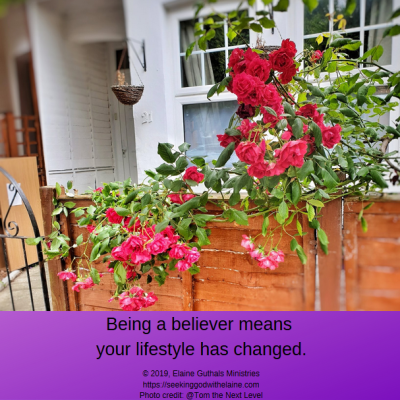
    We aren’t the ones to judge whether they are believers or not. But being a believer means your lifestyle has changed.

    House and flowers

    Pastor Chad was also preaching on this. His sermon series is from the Book of James. He said a couple of things that stuck with me.

    The first thing Pastor Chad said was “You can’t look into someone’s heart and see they are saved. We see Jesus through the fruit they bear and the life they live.” The second was “When our lives are undistinguishable from world around us, our faith is dead.”

    Believers are not distinguishable from the world if we are not bearing fruit and living no differently than non-believers. My Ladies and I said we were concerned that so many believers may be being pulled astray because society is branding believers as cold and heartless if we do not tolerate how society is choosing to live. We are allowing God’s laws to be rewritten in society so that we fit in better.

    How Do We Apply This?

    It is hard to stand up for our beliefs when we are in the minority. We don’t want to lose friends, and we don’t want to make enemies.

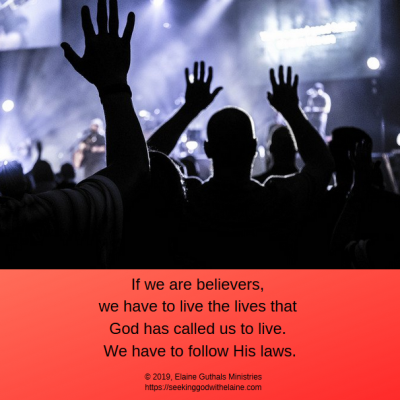
    If we are believers, we have to live the lives that God has called us to live. We have to follow His laws.

    Concert

    It is hard looking at ourselves sometimes, but we have to do that. “Examine yourselves, to see whether you are in the faith. Test yourselves. Or do you not realize this about yourselves, that Jesus Christ is in you? — unless indeed you fail to meet the test!” (II Cor. 13: 5 ESV. We have to see what laws we have rewritten or agreed to a rewrite by our silence.

    Most importantly, we need to ask God to show us those areas in our lives and ask for Him to change us. We can’t change on our own. He has to be the one to change us.

    It is so vital that believers live a life that is different from the world. Jesus needs to find us faithful to Him when He returns. We can’t do that by rewriting or ignoring God’s laws to sugar-coat it for the society in which we live. We have to be faithful to Him.

    Loving Father. Satan is fully in charge of our world today. Believers are called either to live up to fruit-of-the-spirit perfection or to sugarcoat your laws to appease those who wish to continue sinning. Lord, help us to stand firm in You Will. Help us to keep Your laws and Your commandments. Show us the areas on which we need to work. Help us grow in faith in You. Amen.

    What do you think? Leave me a comment below (about this or anything else) or head over to my Facebook group for some interactive discussion.

    If you don’t understand something and would like further clarification, please contact me.

    If you have not signed up for the email daily or weekly providing the link to the devotions and the newsletter, do so below.

    If God has used this devotion to speak with you, consider sharing it on social media.

  • How Is God Our Good Father?

    And I will be your Father, and you will be my sons and daughters, says the LORD Almighty.
    II Corinthians 6: 18 (NLT)
    Scripture: II Corinthians 6: 14-18

    God established Himself as our Father. That gives us a clear picture as to how dads [and moms] should interact with their children. In fact, we can learn much on how we should interact with anyone. This devotion looks at God our Father.

    Cliff Notes

    • A good father gives love unconditionally.
    • A good father takes care of his children’s needs.
    • A good father makes sure his children are safe.
    • A good father is just a phone call or shout out away.
    • A good father never punishes without a reason or without a purpose, but he does correct his children when needed.
    • A good father forgives his children when they apologize (and sometimes when they don’t), and they move on.
    • A good father is a constant in his children’s lives.
    Flowers with title How Is God Our Good Father?

    Some would say that it is hard to have a relationship with someone who is not here. That could be applied to God.

    However, God has established Himself in a very unique relationship with us – He is our heavenly Father. He is not only our Creator, Ruler and Judge, but He also loves us deeply.

    The Bible gives us a very comforting promise that shows the depth of this love: “I [God] will not leave you as orphans; I will come to you. (Jn. 14: 18 NIV). That says He will always be here for us and will seek us out when needed.

    We can learn a lot from how God interacts with us as our Father. This helps us see how fathers’ [and mothers’] relationship should be with their children. In reality, it gives us a good idea as to how we should interact with others – period.

    To make this read better, I am going to just say fathers (since this is Father’s Day). But every time I do, we can just in our minds read “person.”

    God Loves Us

    Think how much the Father loves us. He loves us so much that he lets us be called his children, as we truly are. But since the people of this world did not know who Christ is, they don’t know who we are (I Jn. 3: 1 CEV)

    We know that God has been described as being love (I Jn. 4: 8). His character exhibit this love. Our children need to know that we love them – by our telling them and by our showing them.

    Sometimes, though, it is hard to fathom just how much God loves us. “For this is how God loved the world: He gave his one and only Son, so that everyone who believes in him will not perish but have eternal life” (Jn. 3: 16 NLT). This is an extreme sacrifice because of love.

    Adult and Child Walking

    God did it willingly for us. Not only that, it was His plan – His idea. That speaks volumes.

    A good father gives love unconditionally. Unconditionally means without limits as to the depth of the love.

    God Provides for Us

    And my God will supply all your needs according to His riches in glory in Christ Jesus. (Phil. 4: 19 HCSB)

    Many people struggle today. It is hard to make ends meet.

    It is comforting to know that God will meet our needs. He may not necessarily meet our wants, but our needs will be met.

    Adult and Child Walking

    A good father takes care of his children’s needs. He provides a way for them to live.

    God Protects Us

    The Lord replies, “I will arise and defend the oppressed, the poor, the needy. I will rescue them as they have longed for me to do.” (Ps. 12: 5 LB)

    This one might be a harder one for us to see. We don’t see God grabbing us or shooting out a steadying arm when we are falling. We don’t see Him stepping in front of us when something bad is heading our way.

    Instead, God just does it. “But the LORD your God has promised to go ahead of you, like a raging fire burning everything in its path. So when you attack your enemies, it will be easy for you to destroy them and take their land” (Deut. 9: 3 CEV). He makes our way easier for us.

    A good father makes sure his children are safe. He stands up for them when they are threatened.

    God Is Available to Us

    “Ask, and it will be given to you; seek, and you will find; knock, and it will be opened to you. For everyone who asks receives, and he who seeks finds, and to him who knocks it will be opened. (Mt. 7: 7-8 NKJV)

    Some might think these verses makes God our genie – ask for three wishes, and they will be granted. It doesn’t work that way.

    If we seek Him, we will always find God. Ask Him, and He will always provide for us what we need (refer to #2). Knock, and He will lead us down the paths that are best for us.

    To me, this means that God is already just a prayer away, ready to provide for us.

    A good father is just a phone call or shout out away. He is ready to give advice or encouragement when needed. He is always there just to be there when needed.

    God Disciplines Us

    And have you forgotten the encouraging words God spoke to you as his children? He said, “My child, don’t make light of the LORD’s discipline, and don’t give up when he corrects you. (Heb. 12: 5 NLT)

    We talked a little in the previous devotion about the consequences of sin not meaning God doesn’t forget the sins.

    To read Does God Remember Our Sins?, click the button below.

    God disciplines us when we screw up in order to teach us how to do better. He wants us to learn from our mistakes in order to do better next time.

    A good father never punishes without a reason or without a purpose, but he does correct his children when needed. He trains his children so they are prepared to be good people (Prov. 22: 6).

    God Forgives Us

    Our God, no one is like you. We are all that is left of your chosen people, and you freely forgive our sin and guilt. You don’t stay angry forever; you’re glad to have pity (Mic. 7: 18 CEV)

    Because God loves us (refer to #1), He forgives us when we sin. Not only that, He provided the plan of salvation so that our relationship with Him could be restored.

    God’s mercy is the way He shows us His forgiveness. Mercy is when He doesn’t punish us as we deserve.

    Adult and Child Walking

    A good father follows God’s lead. He forgives his children when they apologize (and sometimes when they don’t), and they move on.

    God Never Changes

    Every good and perfect gift comes from heaven; it comes down from God, the creator of heavenly lights, who does not change or cause darkness by turning (Jas. 1: 7 GNT).

    We talked about some pretty nice characteristics that God has. We can be comforted by the fact that God isn’t going to change. He isn’t going to stop loving us, protecting us, or providing for us. God is always available for us. Even though He disciplines us, He will never not forgive us when we ask.

    A good father is a constant in his children’s lives. He is always there for them with love and protection. He is going to provide them what they need growing up and advice when they are grown. He is ready to forgive them and correct them when needed. He is always there.

    Father. All through Your Word, You have given us examples by which we should live our lives. The example that permeates Your Word is how You love us as a Father. Help us to follow Your example. Most of all, help us to raise our children and show others Your love and mercy for us. Amen.

    What do you think? Which characteristics are your strongest? Which do you need to work on?

    Leave me a comment below (about this or anything else) or head over to my Facebook group for some interactive discussion.

    If you have not signed up for the email daily or weekly providing the link to the devotions and the newsletter, do so below.

    If God has used this devotion to speak with you, consider sharing it on social media.

  • What Happens When We Hit Road Construction in Our Lives?

    For that is what God is like. He is our God forever and ever, and he will guide us until we die.
    Psalm 48: 14 (NLT)
    Scripture: Psalm 48: 1-14

    As we go through our lives, we encounter many different things on the road of life we had previously thought we had figured out. God can choose to send us a variety of different directions. This devotion looks at times when events can be caused by God or Satan.

    Cliff Notes

    • Events, at times, will stop us in our tracks, slow us down, or change our direction.
    • We have to determine whether those events are being caused by God or Satan.
    • We have to make sure our relationship with God is solid.
    Flowers with title What Happens When We Hit Road Construction in Our Lives?

    So, I went home again a week ago Friday. Yep, another funeral.

    I was trying to explain to Adam which cousin this one was. I said he was the oldest on Dad’s side, and I was the youngest. I said, “I’m not a spring chicken.” Adam said, “No, you are more of a squirrel.”

    Not much had changed in a week since the last time I went home for a funeral. There were not as many fields of bright yellow this time, but there still was little crops planted. I only saw one field of corn up.

    To read Are Moms a Substitute for God?, click the button below.

    Spring also brings road construction in Illinois. I saw the flashing sign saying that roadwork would begin May 29. They already had the signs out that would close one of the lanes, but they were on the side of the road.

    What got me was that the signs were pointing north. That wasn’t right. I was in the southbound lane.

    It wasn’t what I expected. I knew it didn’t matter because they were on the side of the road. But I knew that was not right. They couldn’t reroute the southbound lane north.

    But remember, I said I made funny connections sometimes. So, here goes.

    To read devotions in which I made different connections, click the button below.

    What Does This Mean?

    On our journeys through our lives, have we ever come upon road construction? Maybe we hit a closed road that stops us in our tracks. For example, we lose our job or our funding for an important project.

    Maybe we have to merge into one lane. We will still get where we are going, but it is going to take longer. For example, maybe we are in school, but we have to take a semester or two off because of illness.

    Maybe we have to detour all together. We will still get where we are going, but the road there looks nothing like we planned. For example, maybe we are going for a manager’s position at work, and we get it — but it is at a store two states away.

    Sometimes, we may get sent back the way we came. Have we ever taken a new job, not have it work out, and had the opportunity to get our old job back?

    [Add any of your own examples to personalize this.]

    How Do We Apply This?

    Life doesn’t seem like it is a straight line, does it? That can be especially frustrating, though, when we think we know what the Lord is calling us to do.

    We think when we are doing exactly what God wants us to do, there should be no challenges, no upsets in our paths.

    Highway

    But here come the upsets. We have to make a choice: Are they coming from God or Satan?

    Sometimes, it can be very difficult to determine is the road block is coming from God or Satan. Why would God send something that would take us off an exit if we are following His Will? He would if He wants us to switch focus.

    Other times, it can just be Satan trying to force us off the road. He wants us to fail — the bigger we fail, the better. That will wreck our self-confidence so that we think God can’t use us ever again — and if we are not careful, that becomes a self-fulfilling prophecy.

    It doesn’t help that, a lot of times, this is when God is the most silent. He lets us make our own choices as to whether we are going to follow Him or not.

    That just makes everything so fuzzy. Autofocus just doesn’t seem to work in those times.

    So, how do we figure out what we need to do? We keep as close to God as we can.

    We know the drill — read our Bibles, pray, communicate with other believers either in a group or individually.

    No, the answers I come up with do not change because the answer is always our relationship with God. These are always the building blocks — and the tar to patch the potholes — for that relationship.

    It all boils down to spending time with the Father. That is how we strengthen the relationship.

    Church

    The Rest of the Story

    So, I was going the same way this Tuesday and Wednesday. You guessed it — another funeral.

    The lane closure signs were there Tuesday. They were gone Wednesday. The flashing sign saying when the construction would begin was still there.

    It was the day the construction was supposed to begin — and the signs were gone. Go figure.

    We wish God would answer our prayers that quickly to remove the obstacles in our daily paths. He can. Usually, He doesn’t.

    God lets us experience things so we know without a shadow of doubt that He loves us and He will provide for us.

    The whole purpose of the obstacles is so we can grow. So I say it again, it all boils down to spending time with the Father. That is how we strengthen the relationship.

    “God, my shepherd! I don’t need a thing. You have bedded me down in lush meadows, you find me quiet pools to drink from. True to your word, you let me catch my breath and send me in the right direction. Even when the way goes through Death Valley, I’m not afraid when you walk at my side. Your trusty shepherd’s crook makes me feel secure. You serve me a six-course dinner right in front of my enemies. You revive my drooping head; my cup brims with blessing. Your beauty and love chase after me every day of my life. I’m back home in the house of God for the rest of my life” (Ps. 23 MSG). Amen.

    What do you think? How can you draw closer to God today? Leave me a comment below (about this or anything else) or head over to my Facebook group for some interactive discussion.

    If you have not signed up for the email daily or weekly providing the link to the devotions and the newsletter, do so below.

    If God has used this devotion to speak with you, consider sharing it on social media.

  • What I Learned from the Dog Walks

    God uses everything that He has created to reveal Himself to us. He even uses dog walks to show us about Him and His love for us. This daily devotional looks at some of the things two dogs have taught me.

    Nuggets

    • When temptations come along, we need to hide in God.
    • We need others to encourage us and to pray with and for us.
    • We will always have a Friend by our side.
    • We do want to follow in Jesus’ footsteps.
    • God is always there, waiting to rescue us from whatever trouble we have gotten ourselves into.
    • We just have to assess the situation, see the temptation for what it really is, and move back toward God.
    • God wants us to pay attention to Him.
    • We have to be watching for when we are called home.
    Flowers with title What I Learned from the Dog Walks

    I got to babysit my sister’s fur babies last summer. Then in March, I got to go down and help my brother-in-law when she was on a cruise. (Yes, you have been seeing some of her fantastic pictures from that trip.) I have also gotten to walk my Springfield Mom and Dad’s dog a couple of times over the past couple of months.

    It was interesting walking Journey and Shorty. They have taught me a couple of things.

    “I will walk among you; I will be your God, and you will be my people” (Lev. 26: 12 NLT)

    Try to Avoid Temptations

    Journey is really funny when a car comes along. He’ll pancake himself on the side of the road. He has his paws pretty well under him in this picture, but that isn’t always the case. At times, they can be sticking out in all directions. Either way, he hunkers down in the grass, trying to make himself invisible.

    When temptations come along, we need to avoid them. But we can’t hide just anywhere. We need to hide in God. He is our fortress and our shield (Ps. 18: 2).


    dog

    Run to Our Friends

    Journey’s nickname is Houdini. He will slip out of his collar real fast. But he always goes to see his buddy Bear.

    Before He died, Jesus set up a community of believers. He knew the early believers would have to support and uplift each other, especially when persecution came.

    That notion is still relevant today. We need others to encourage us and to pray with and for us. We can handle the trials so much easier with a friend by our side.

    Better Yet, Walk with a Friend

    A couple of times, we got to walk with Journey’s friend, Lucy. In the past, we have also walked with Bobby.

    We will always have a Friend by our side. Jesus told the disciples He would now call them friends (Jn. 15: 15). It is the same for us today.

    Watch Where You Walk

    I don’t know how many times I have asked Journey what I would ask Adam when he was younger: “Are you walking where you are walking or are you walking where I am walking?” He would get right in front of me and slow down.

    We, on the other hand, do want to follow in Jesus’ footsteps. We want to walk as closely to Him as we can — walking slowly with Him, getting the refreshing restoration. Yep, those are good times.

    Dog

    To read a related devotion, click the button below.

    Let Dad Get You Out of a Jam

    I looked back once, and Journey was almost out of his harness. It was wrapped around his nose and one leg. There was only one direction he wanted it to go — off. In order to make sure that didn’t happen, we had to stop. It probably took Dad five, maybe ten, minutes to get him straightened out — it sure seemed like a long time.

    How many times do we try to do things on our own? Yet, God is always there, waiting to rescue us from whatever trouble we have gotten ourselves into (Ps. 18: 16-19).

    Dog

    Sometimes, We Have to Sniff and Move On

    Walking Shorty is totally different from walking Journey. Short Girl stops a lot more times to sniff than Journey does. But she always moves on pretty quickly.

    We are going to be tempted. Hello! Satan wants to wreck our witnesses. He wants us back on his side of the ledger, not God’s.

    So the tempting is going to happen. We just have to assess the situation, see the temptation for what it really is, and move back toward God.

    Being tempted isn’t the sin. Giving into the temptation is. So we want to make sure we don’t stick around to get sucked into the temptation.

    Dog

    Being an Attention Hound Is Good

    Mom always gets on Shorty when Adam and I go over there to take them supper. Especially if we sit on the floor, Shorty is right there wanting some loving.

    God wants us to pay attention to Him, too. He doesn’t want us to just focus on what is happening in this world. God wants us to spend time with Him — in His Word, in prayer, praising Him, walking in His creation, singing His praises. He wants to spend time with us to strengthen our relationship with Him.

    Dog

    Know When It Is Time to Go Home

    I’ve only walked Shorty a couple of times, the second time by myself. I was ready to walk right by the gate to her backyard the last time. She was going, “Oh, no. We’ve walked enough. It is time to go home.”

    One day, our time on this earth will be through. Whether the angel comes to take us home in death or Jesus comes at the end of the age to call us all home, we have to be ready. We have to be watching. We don’t want to pass up the opportunities to turn our lives over to Him and serve Him.

    Dog

    I would say those two are smart little fur babies. Now, I just have to live what they taught me.

    Father. You use everything that You have created to reveal Yourself to us. Help us to take our focus off ourselves and this world. Strengthen our relationships with You so that we focus solely on You. Amen.

    What do you think?

    Leave me a comment below (about this or anything else) or head over to my Facebook group for some interactive discussion.

    If you don’t understand something and would like further clarification, please contact me.

    If you have not signed up for the email daily or weekly providing the link to the devotions and the newsletter, do so below.

    If God has used this devotion to speak with you, consider sharing it on social media.

  • What Does It Mean to Take Up Our Crosses?

    We have been looking at the job description for disciples. We are told to take up our crosses (Mt. 16: 24) but struggle with all that implies. The third devotion of four in the series will look at what it means to take up our crosses.

    Nuggets

    • Crucifixion was chosen as a form of punishment because it was painful and degrading.

    • Jesus died a very public death on the cross.

    Devotions in the What Does It Mean? series

    Flowers with title What Does It Mean to Take Up Our Crosses?

    Crucifixion is not a method of capital punishment these days. In our society today, we look for more humane forms of execution.

    We know Jesus died on a cross. However, we may not know all that a crucifixion meant and entailed.

    Crucifixion

    “Then Jesus told his disciples, ‘If anyone would come after me, let him deny himself and take up his cross and follow me’” (Mt. 16: 24 ESV)

    Crucifixion was chosen as a form of punishment because it was painful and degrading.

    Offenders were usually impaled on the stakes, but their wrists could have just been tied to the crossbeam.

    This brutal form of punishment was used frequently in Jesus’ day as a deterrent for deviant behavior. Coupled with scourging or flogging to ensure a “speedier” death, it was a bloody practice. That was why Jesus had the sign King of kings nailed on His cross (Jn. 19: 19).

    Offenders were paraded past the crowd carrying the crossbeam. Also carried was a tablet detailing the committed crimes, which was later put on the cross. The offenders’ wrists were either nailed or tied to the crossbeam, and then the crossbeam was fastened onto an upright pole. The feet were also either nailed or tied to the pole.

    Depending on the method, it could take days for offenders to die. This was because the cause of death was usually loss of blood circulation or heart failure. To hasten death, soldiers would break the offenders’ legs so they could not support the weight of their bodies.

    Crosses were usually situated near a road. Crucifixion would not be a deterrent if people did not see it.

    Jesus’ Death on the Cross

    Jesus died a very public death on the cross.

    Jesus’ death had one purpose: “He [God] erased the certificate of debt, with its obligations, that was against us and opposed to us, and has taken it away by nailing it to the cross” (Col. 2: 14 CSB). Jesus, through His death, paid the price for our sins.

    Sins are actions by humans that disobey God and break one of His reasonable, holy, and righteous laws and commandments, goes against a purpose He has for us, or follows Satan’s promptings.

    • Holy means to be set apart — because of our devotion to God — to become perfect, and morally pure while possessing all virtues.
      • Perfectionmeans we reach a state of maturity because the combination of the spiritual graces form, when all are present, spiritual wholeness or completeness — holy, sanctified, and righteous.
        • Spiritual graces are worldly morals that have been submitted to God to further His kingdom instead of enhancing this world.
        • Sanctified means to be set free from sin.
      • Pure means not being sinful or having the stain of sin.
    • Righteous means we are free from sin because we are following God’s moral laws.

    No, we don’t understand the why or specifically how. We don’t have to know. We just have to believe that God made this possible.

    Yes, it sounds foolish. “For the message of the cross is foolishness to those who are perishing, but to us who are being saved it is the power of God” (I Cor. 1: 18 NIV). We just have to believe.

    When we “see” Jesus on the cross, we see Him giving up His will for God’s Will. We know that Jesus was hoping some other way could be created to accomplish redemption. That was His prayer in the Garden of Gethsemane (Mt. 26: 36).

    Jesus on cross

    But Jesus said — regardless of how it had to shake out — He would do God’s Will. He couldn’t have been looking forward to the pain and humiliation. He went through with the plan anyway.

    what-does-it-mean-to-take-up-our-crossesPin

    Making the Connections

    “So to keep me from becoming conceited because of the surpassing greatness of the revelations, a thorn was given me in the flesh, a messenger of Satan to harass me, to keep me from becoming conceited. Three times I pleaded with the Lord about this, that it should leave me. But he said to me, ‘My grace is sufficient for you, for my power is made perfect in weakness.’ Therefore I will boast all the more gladly of my weaknesses, so that the power of Christ may rest upon me. For the sake of Christ, then, I am content with weaknesses, insults, hardships, persecutions, and calamities. For when I am weak, then I am strong” (II Cor. 12: 7-10 ESV)

    It means the same thing for us — complete surrender to God. We should imitate Jesus and do whatever God calls us to do.

    Glossary

    We should imitate Jesus and do whatever God calls us to do.

    This means we have to die to self. Paul explained it this way: “And those who belong to Christ Jesus have crucified the flesh with its passions and desires” (Gal. 5: 24 ESV). We have to put our wants and dreams second to what God wants for us.

    Sometimes, we put a negative connotation to this, like it is a thorn in our side. We get this from Paul. He talks about having a thorn in his side that he asked God to remove (I Cor. 12: 7-10). We interpret God saying no as meaning it was just something Paul had to live with for the rest of his life.

    Taking Up Our Cross

    But it isn’t just negative. We do not just lay down our lives, roll over, and die. We do not just sacrifice what we perceive to be good stuff and get nothing in return.

    We pick up whatever God has in store for us. We take up a new life in Jesus.

    We pick up whatever God has in store for us. We take up a new life in Jesus.

    I read somewhere that the writer thought sacrificing our “self” was sacrificing our individuality. I just don’t see it that way. My individuality is what makes me, me. Yours makes you, you. We aren’t sacrificing our character or personality. We are still us.

    That could be one thing trips up some non-believers. They think they would have to give up their characters or personalities — their essence.

    God comes to us as we are — faults, scars, and all. I don’t see Him doing that if He is planning to suck the “us” out of us.

    I think God is wanting us to sacrifice former conduct that isn’t in line with His teachings. Let’s look again at what Paul says. “But that is not the way you learned Christ!— assuming that you have heard about him and were taught in him, as the truth is in Jesus, to put off your old self, awhich belongs to your former manner of life and is corrupt through deceitful desires,  and to be renewed in the spirit of your minds, and to put on the new self, created after the likeness of God in true righteousness and holiness” (Eph. 4: 20-24 ESV). Even if we have enjoyed our former actions — if they do not fall under God’s laws and commandments — we need to give them up.

    We pick up what God has in store for us. Yes, it is going to be filled with trials because Satan is going to try to wreck our witness.

    Yes, it is going to be work. We pick up our responsibilities in the kingdom work. That will help us grow to be the people God intends.

    But it is so much more than that. We pick up the blessings God will bestow. We pick up the peace and love that He lavishes on us.

    We pick up a Friend. We no longer will be alone. We now have a haven, protector, and provider.

    We take up living as God would have us live. That is difficult in a sinful world. Yes, there are some things that we have to give up, but those are more than compensated by what we gain.

    Loving Heavenly Father. You ask us to do hard things. You ask us to follow Your will, which is sometimes in opposition to what the world in which we live considers good. But the reward for our obedience far outweighs the struggles we encounter in the world. Help us to focus only on You. Help us to deny our humanly selfish desires and complete the tasks You have for us. Lord, in all we do, we want to follow You. Amen.

    What do you think?

    Leave me a comment below (about this or anything else) or head over to my Facebook group for some interactive discussion.

    If you don’t understand something and would like further clarification, please contact me.

    If you have not signed up for the email daily or weekly providing the link to the devotions and the newsletter, do so below.

    If God has used this devotion to speak with you, consider sharing it on social media.

  • Why Are We Still Looking Up?

    After 40 days, Jesus ascended to heaven. The disciples continued to look for Him in the clouds, until the angel told them He wasn’t coming back. This daily devotional discusses where we should fix our gaze as we wait for Jesus to return.

    Flowers with title Why Are We Still Looking Up?

    “And while they were gazing into heaven as he went, behold, two men stood by them in white robes, 11 and said, “Men of Galilee, why do you stand looking into heaven? This Jesus, who was taken up from you into heaven, will come in the same way as you saw him go into heaven” (Ac. 1: 10-11 ESV)

    I have always liked these verses. The disciples must have been going through a whirlwind of emotions.

    No, they didn’t understand — really understand — what was happening. The past month and a half had been … shall we say, chaotic?

    When Jesus rose from the grave, the disciples were probably thinking things were sorta going to go back to normal. Don’t we crave normalcy?

    The Eleven were probably thinking they would take road trips again. People would be healed. They would keep doing what they had been doing.

    But then Jesus was gone again. We don’t know if He said, “Well, today is the day I go back to Dad.” He probably had been talking about it.

    Jesus did prepare the disciples for His death. He predicted His death in Mark 8: 31, Mark 9: 31, and Mark 10: 33-34.

    Jesus said in John 14: 3 that He was going away and coming back, but He said they would be with Him always. Wouldn’t He have dropped into the conversation that He was going to be heading out in a little bit, but they weren’t going with Him yet?

    To read a related devotion, click the button below.

    Maybe Jesus told them He was going back to His Father, but didn’t tell them when. Maybe this was another “only the Father knows” situation (Mk. 13: 32). He may have told them all He knew at the present time.

    Maybe Jesus did say that the disciples would be joining Him later. They had assignments to finish first.

    Or maybe the disciples just didn’t understand. Things had been happening that they hadn’t experienced before — again — still. They were probably just having trouble processing.

    Jesus would know, whatever He said, that this was going to blindside them. Being blindsided is not fun. I remember when Mom told me she had cancer. I was home alone one afternoon. The not-yet-ex was out and about. It was pre-Adam. We had given the cat away because the not-yet-ex was allergic to her and hadn’t gotten the dogs yet. So it was totally just me.

    Mom calls and says, “Hi. I’ve got cancer. I start radiation soon. I am going to beat this. Is there anything you want to tell me before we hang up?” Yes, that may not have been word for word, but it is pretty darn close.

    I’m going, “Oh, can we slow this puppy down? Can we back up and take another run at this? I am having a little trouble processing.”

    Don’t we do that? We get blindsided, and we just freeze. Everything comes to a complete standstill, and we just go, “Huh?”

    So, Jesus was gone, and as much as He had prepared them, the disciples froze and were still looking up.

    Aren’t We Supposed Look Up?

    Part of me says, but aren’t we supposed to look up? Aren’t we supposed to seek God? Aren’t we supposed to keep our eyes fixed on Him?

    Well, yes and no.

    Hebrews 12: 2 says, “We do this by keeping our eyes on Jesus, the champion who initiates and perfects our faith …” (ESV). Jesus was up in heaven now, so that is where our eyes are to be fixed.

    Proverbs 4: 25-27, on the other hand, says, “Let your eyes look straight ahead; fix your gaze directly before you. Give careful thought to the paths for your feet and be steadfast in all your ways. Do not turn to the right or the left; keep your foot from evil” (NIV).

    So, we’re supposed to look at Jesus in heaven and on the road before us. What? Are we supposed to be cross-eyed?

    Well, yes. We are supposed to be cross eyed while we live our lives. We need to keep our focus on Him while we journey through our lives.

    We are supposed to seek to know God and Who He is. We are supposed to seek His Will for our lives.

    Searching for and Seeking God

    Hearing His Word (Rom. 10: 17).
    Reading His Word (Rev. 1: 3).
    Praying to Him (Heb. 4: 16).
    Studying His Word (Ac. 17: 11).
    Meditating on His Word (Ps. 1: 1-2).
    Memorizing His Word (Ps. 119: 11).

    Get Moving

    Just like we have to sometimes stop praying and move, we have to stop seeking and move. True, we are to pray without ceasing (I Thess. 5: 17). But that doesn’t stop us from moving.

    To read a related devotion, click the button below.

    And move we must. Matthew 28: 19-20 says, “Go therefore and make disciples of all nations, baptizing them in[a] the name of the Father and of the Son and of the Holy Spirit, 20 teaching them to observe all that I have commanded you. And behold, I am with you always, to the end of the age” (ESV). A pastor once said that the beginning verb is the present tense: as you are going.

    Here on earth, God doesn’t call us to just sit here and worship Him. He doesn’t call us to sit here and let people come to us.

    God calls us to work to expand His kingdom. We have to tell others what He has done for us. We have to seek them out.

    What better way to show God we love Him than to live out our lives through faith? What better way to show His love for us and His great power than to extend that love to others?

    Church

    But that is hard. Satan is going to try to derail our trains. He is going to throw so many obstacles into our paths.

    We have to watch the paths before us so we can avoid the temptations. We have to remain strong in our faith. The best way to do that is keeping our eyes fixed on the giver of life.

    So, yes, we have to be cross-eyed.

    This Isn’t the End

    Jesus is coming back. “They said, ‘Men of Galilee, why do you stand looking up into heaven? This same Jesus, who has been taken from you into heaven, will come in the same way that you have seen him going into heaven’” (Ac. 1: 11 CSB). I wonder what the disciples felt when they heard these words.

    I mean, Jesus was there. Then He was gone. Then He was back. Now He was gone again. They were probably getting whiplash looking for Him.

    Little did they know at that point that Christ lives in us. “I have been crucified with Christ. It is no longer I who live, but Christ who lives in me. And the life I now live in the flesh I live by faith in the Son of God, who loved me and gave himself for me” (Gal. 2: 20 ESV). Believers journey through life with Christ inside of them.

    To read a related devotion, click the button below.

    That understanding was coming for the disciples. They figured things out after they were given the Holy Spirit. They went on to complete their work for Him.

    The disciples — and us — were given the reassurance that Jesus is coming again. “Then will appear in heaven the sign of the Son of Man, and then all the tribes of the earth will mourn, and they will see the Son of Man coming on the clouds of heaven with power and great glory” (Mt. 24: 30 ESV). Although we don’t know the exact day and time (so, all these predictions are wrong), we will have signs that He is coming.

    why-are-we-still-looking-upFB

    How Do We Apply This?

    What do we do until then? We multitask. We keep seeking, and we move. We learn more about Him, and we tell others. We keep praying, and we pray while we are going.

    How do we do that?

    • We read our Bible, and we live it out.
    • We grow our faith, and we put it into practice.
    • We grow to love Him more every day, and we love others.
    • We spend time in prayer with Him, and we pray in the moment.

    The screenplay for the ending of this heaven and earth has already been written. We are just waiting on the movie. Our jobs are to encourage people to look forward with us. Whether we are looking up, out, or in, we need to be focusing on God.

    Loving Heavenly Father. You loved us so much that You sent Your only Son to die for us so that we would not experience spiritual deaths (Jn. 3: 16). You love us so much that Jesus is coming back again (Ac. 1: 11). He is preparing our places to be with You eternally (Jn. 14: 3). Help us as we go about the lives that You have given us. Help us to seek You and grow in our faith. Help us to sidestep the temptations that Satan will place in our paths. Lord, we look forward to the day that Jesus will return on the clouds. Until then, we will look up, and in, and out. Amen.

    What do you think?

    Leave me a comment below (about this or anything else) or head over to my Facebook group for some interactive discussion.

    If you don’t understand something and would like further clarification, please contact me.

    If you have not signed up for the email daily or weekly providing the link to the devotions and the newsletter, do so below.

    If God has used this devotion to speak with you, consider sharing it on social media.