Category: Lifestyle

  • How Do We Spend Our Time on Our Walk?

    It can be difficult sometimes to make sure our walk is following how God wants us to live. Paul cautioned us to not be foolish. This devotion looks at how Paul suggested we live.

    Nuggets

    • Paul said that we have to be careful in our walk.
    • Paul said that we have to make the most of time.
    • God doesn’t want us to be foolish.
    Flowers with title How Do We Spend Our Time on Our Walk?

    Satan tries very hard to get us to abandon our walk with God. That is why Paul cautioned the Ephesians – and us – to tread carefully. Let’s see what Paul had to say.

    Tread Carefully

    “Look carefully then how you walk, not as unwise men but as wise” (Eph. 5: 15 RSV)

    Paul said that we have to be careful in our walk. What is our walk? That is our lives. You know, we “put one foot in front of the other” and make it through the days of our lives.

    So, let’s look at “carefully.” Isn’t our lives as disciples supposed to be easy? Nope.

    Our walk as disciples has been described as “hard, and there are few people who find it” (Mt. 7: 14 GNT). We have to carefully watch to make sure we are continuing to walk on the narrow path.

    How are we supposed to walk?

    • “… put on heartfelt compassion, kindness, humility, gentleness, and patience” (Col. 3: 12 HCSB).
    • “accepting one another and forgiving one another if anyone has a complaint against another …” (Col. 3: 13 HCSB).
    • “Above all, put on love …” (Col. 3: 14 HCSB).
    • “And let the peace of the Messiah, to which you were also called in one body, control your hearts …” (Col. 3: 15 HCSB).
    • “… Be thankful” (Col. 3: 15 HCSB).
    • “… teaching and admonishing one another in all wisdom …” (Col. 3: 16 HCSB).
    • “… singing psalms, hymns, and spiritual songs, with gratitude in your hearts to God.” (Col. 3: 16 HCSB).
    • “And whatever you do, in word or in deed, do everything in the name of the Lord Jesus, giving thanks to God the Father through Him” (Col. 3: 17 HCSB).
    • “… put away lying, Speak the truth …” (Eph. 4 25 HCSB).
    • “Be angry and do not sin …” (Eph. 4: 26 HCSB).
    • “… don’t give the Devil an opportunity” (Eph. 4 27 HCSB).
    • “The thief must no longer steal …” (Eph. 4: 28 HCSB).
    • “No foul language is to come from your mouth, but only what is good for building up someone in need …” (Eph. 4. 29 HCSB).
    • “… don’t grieve God’s Holy Spirit. …” (Eph. 4: 30 HCSB).
    • “All bitterness, anger and wrath, shouting and slander must be removed from you, along with all malice” (Eph. 4: 31 HCSB).

    When Paul said to be wise, he was giving us good advice that could be utilized in a variety of situations. We are wise when we are watchful in contentious circumstances. When we are attentive to the needs of others when we exercise “… compassion, kindness, humility, gentleness, and patience” (Col. 3: 12 HCSB).

    The flip side is walking as fools. That can be summarized as someone who gives “… the Devil an opportunity” (Eph. 4 27 HCSB). They live without love and peace in their hearts. They lie and steal.

    Those who walk foolishly sometimes feel this does not apply to them. When we feel that ends justify the means, we are not compassionate towards others and could, instead, lie and steal. When we buy into the “every man for himself” mentality, we do not operate in love.

    We have to remember that this wisdom is not that if the world. It is God’s wisdom. Luckily, we have help: “Now if any of you lacks wisdom, he should ask God, who gives to all generously and without criticizing, and it will be given to him” (Jas. 1: 5 HCSB).

    What Time Is It?

    “making the most of the time, because the days are evil” (Eph. 5: 16 RSV)

    How many times have we heard how precious time is? Theophrastus said, “Time is the most valuable thing a man can spend.” Once it is gone, it is gone.

    Paul said that we have to make the most of time. How do disciples do that?

    Remember, the early church members felt Jesus was going to return soon. Matthew 16: 28 says, “I assure you: There are some standing here who will not taste death until they see the Son of Man coming in His kingdom” (HCSB).

    To read a related devotion, click the button below.

    Yes, several did write things down. I really don’t think that they expected it to be put together and broken up into chapter and verse. I think they were just writing to people of the day to encourage them to walk in the way God wanted them to walk.

    I am glad someone put it together into a Bible and preserved it for us. Yes, I think that was a God’s intent. I am not sure He let Peter, John, Paul, Moses, Nehemiah, Isaiah, and the rest in on the plan.

    When we have an approaching deadline, we operate differently than if we think we have all summer, all year, or our whole lifetime.

    Whether we think we are in the end times or not, we have to be watching for Jesus’ return. We have to live like we could be called home tomorrow.

    Are we ready? Do we have unconfessed sin? Are we performing the tasks to which God has called us?

    How does Paul think we should be spending our time?

    • Do the good works to which God has created us (Eph. 2: 10)
    • Live in unity (Eph. 2: 14)
    • Understand what we can of God’s love (Eph. 3: 18)
    • Be filled with the fullness of God (Eph. 3: 19)
    • Walk worthy I’d the calling (Eph. 4: 1)
    • Change our lifestyle to one pleasing to God (Eph. 4: 22)
    • Imitating God (Eph. 5: 1)

    Paul cautioned the Ephesians — and us — that the days were evil. Remember, Ephesus was a center of pagan worship. A huge lifestyle change was needed when the Ephesians became disciples of a Jesus.

    Because evil was so prevalent in Paul’s day, the Ephesians needed to be light in their world. Because evil is still prevalent in our world today, we need to be light in our world.

    Don’t Be Foolish

    “Therefore do not be foolish, but understand what the will of the Lord is” (Eph. 5: 17 RSV)

    God doesn’t want us to be foolish. He wants us to grow in grace and knowledge (II Pet. 3: 18). He wants us to turn to His Holy Spirit living in us for comfort.

    God makes His Will known to us. He has ensured that the letters written by His chosen ones were preserved. He makes His Will known as we pray to Him and listen for Him to talk with us.

    As the Psalmist did, God wants us to use His “word is a lamp to my feet and a light to my path” (Ps. 119: 105 ESV).

    We’ve talked before about determining the Will of God. We said His laws and commandments show us His will. Also, when we grow closer to Him, He will make His Will known.

    To read a related devotion, click the button below.

    How Do We Apply This?

    We apply this by doing what Paul tells us to do. Yes, it is getting to be a long list. But if we work at it diligently, we will succeed.

    True, we will mess up occasionally (maybe even frequently). We just have to ask God’s forgiveness and try to do better.

    The biggest way we can apply this is prioritizing our time. Do we put God first? Have we chosen how we spend our time based on His plan for us? Are we doing what we are supposed to be doing when we are supposed to be doing it?

    We need to begin and end our day with God and keep in in the forefront throughout. Hopefully, we can have our alone time with Him.

    God wants to guide us through our lives. All we have to do is let Him.

    Lord. You want to guide us through our lives, but so many times we just barrel on without You. We try to depend on ourselves. We do want to bother You with the small stuff in our lives. Forgive us. Help us to quit wasting time and begin to focus more on the tasks to which You have called us. Amen.

    What do you think?

    Leave me a comment below (about this or anything else) or head over to my Facebook group for some interactive discussion.

    If you don’t understand something and would like further clarification, please contact me.

    If you have not signed up for the email daily or weekly providing the link to the devotions and the newsletter, do so below.

    If God has used this devotion to speak with you, consider sharing it on social media.

  • How Do We Respect Others?

    In telling his Ephesian readers how they were supposed to live, Paul did an excellent job of telling his readers the opposite way of living than how they had been. This devotion sees how that way is more superior to the ways they had been living.

    Nuggets

    • The eighth commandment says do not steal; that was what Paul taught.
    • Paul advised people to work for a living.
    • The agenda Paul was suggesting went from focusing on the thief to focusing on someone else who really was in need.
    • Our words do matter, because they produce actions.
    • We don’t want to cause injury – even through our words – to our fellow disciples.

    To read devotions in the How Are We Supposed to Live? series, click the appropriate button below.

    Flowers with title How Do We Respect Others

    Paul knew that, if the Ephesians – and we – were going to live different lives, those lives would have to be the opposite of the way we had been currently living. Let’s take a look.

    Opposite of Stealing

    “Let the thief no longer steal, but rather let him labor, doing honest work with his hands, so that he may be able to give to those in need” (Eph. 4: 28 RSV)

    I wonder what Paul was thinking when he wrote Ephesians 4: 28. Yes, the eighth commandments says, “you shall not steal” (Ex. 20: 15 ESV). The problem was that many of the Ephesians lived by stealing.

    Paul has a big heart. He had to have to endure all of the persecution for people to get to know their Redeemer and Sovereign God. He would have felt for his readers who would have a lifestyle change.

    However, Paul was also a law and commandments guy. The eighth commandment says do not steal. That was what Paul taught.

    When talking unity, Paul knew that unity would not be achieved if disciples were stealing from fellow disciples. Disciples’ trust in the thief would be damaged.

    Paul advised people to work for a living. He described it as “… doing honest work with his hands …” (Eph. 4: 28 RSV).

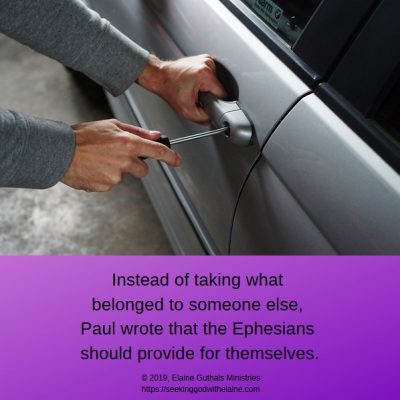
    Instead of taking what belonged to someone else, Paul wrote that the Ephesians should provide for themselves. Instead of being idle except when stealing, he said that they should labor.

    Thief breaking into a car

    But Paul didn’t stop there. He went on to say “… so that he may be able to give to those in need” (Eph. 4: 28 RSV).

    Wow! Paul turned the whole agenda. It went from focusing on the thief to focusing on someone else who really was in need.

    Opposite of Cut Down

    “Let no evil talk come out of your mouths, but only such as is good for edifying, as fits the occasion, that it may impart grace to those who hear” (Eph. 4: 29 RSV)

    It is so easy these days to cut people down. Yes, some of it is done in jest. Unfortunately, much of it today is people who think they have the right to rip up one side and down the other on someone who has a different opinion than theirs.

    David knew our mouths get us in trouble. In Psalm 141: 3, he said, “Set a guard over my mouth, Lord; keep watch over the door of my lips” (NIV). Can’t you see that image in your head — an angel standing guard right by lips.

    There is good reason to want a guard. “But no one can tame the tongue; it is a restless evil and full of deadly poison” (Jas. 3: 8 NASB). We can’t do it ourselves.

    “But no one can tame the tongue; it is a restless evil and full of deadly poison” (Jas. 3: 8 NASB).

    Sometimes, we may think our words don’t matter. They do matter, because they produce actions. Remember in the last devotion, we talked about conflict and anger. The genesis of those could have been by something someone said.

    To read a related devotion, click the appropriate button below.

    Paul knew what he was talking about when he said, “Let no evil talk come out of your mouths …” (Eph. 4: 29 RSV). Again, he suggested the opposite: “… but only such as is good for edifying, as fits the occasion …” (Eph. 4: 29 RSV).

    The old saying is so wrong. Words do harm. They can elicit emotions that can just bubble over and take situations to places we never intended

    Listen to Hawk Nelson’s song Words. It follows what Paul says.

    Related Links

    Hawk Nelson

    Remember, we are talking about unity of the early church in Ephesus. If they would have splintered, things would have been much different today.

    We don’t want to cause injury – even through our words – to our fellow disciples. Remember, “Owe nothing to anyone—except for your obligation to love one another …” (Rom. 13: 8 NLT) includes loving other disciples.

    But the opposite of cutdown is build up. We are called to be encouragers. “Therefore encourage one another and build one another up, just as you are doing” (I Thess. 5: 11 ESV). We are to bear each other’s burdens (Gal. 6: 2), not alienate them.

    Making the Connections

    Did you get the idea that Paul wasn’t suggesting that the end result of the work would be to hoard wealth? It was so that others who couldn’t work were supported.

    It speaks to the belief that all we have is given to us by God. “You, Lord, are all I have, and you give me all I need; my future is in your hands. 6 How wonderful are your gifts to me; how good they are!” (Ps. 16: 5-6 GNT). We are to use what we have to His glory and honor.

    When you think about it, that was the mindset of the early church. “All the believers were one in heart and mind. No one claimed that any of their possessions was their own, but they shared everything they had. … And God’s grace was so powerfully at work in them all that there were no needy persons among them. For from time to time those who owned land or houses sold them, brought the money from the sales and put it at the apostles’ feet, and it was distributed to anyone who had need” (Ac. 4: 32-35 NIV).

    It worked because people were willing to do their part. They were unified in their goals (there is that word again). Whether they had a little or a lot, they considered it God’s, not theirs.

    Because they were unified and giving, God blessed them. They had put Him and others first.

    They had to put others first when it came to the words they used. That happens easier when we are truly putting God above all.

    How Do We Apply This?

    Isn’t respect what this is really about? We have to recognize their worth as people. We have to appreciate similarities and differences.

    No, that does not mean we have to tolerate their sin. We have to lovingly show them their need to admit their sins, believe on Jesus as Redeemer, and confess God as Sovereign Lord. Then they have to demonstrate that commitment by working to change their lifestyle more align with God’s laws and commandments.

    We need to measure our words. I know that is hard when we are living in a world trying to move faster than the speed of sound. I think we have to learn the art of conducting a conversation again. Let me clarify that — face-to-face conversation. The internet has its benefits (I am talking to you, right?).

    But I think we have lost some of the skill sets needed to carry on a conversation and resolve issues right there while we are looking the person in the eye. I think accountability has been taken away.

    I think we’ve lost the art of staying silent. It seems to me that we have gotten to a point where we are more likely to respond— and not well — to something that triggers us. We’ve got to get the sound of silence back.

    We need to make sure we speak God, not ourselves. We want to expand His kingdom, not glorify ourselves. When we think on Him and meditate on Him, His words are going to come out of our mouths.

    We have a resource at our hands that I don’t think we tap into enough to help us with our conversations. We have the grace of God.

    What did Paul say? “assuming that you have heard of the stewardship of God’s grace that was given to me for you” (Eph. 3: 2 RSV). God gives us grace to pass on to others.

    Grace is a free and unmerited gift from Heavenly Father given through His Son, Jesus Christ that enables salvation and spiritual healing to believers. Because of God’s infinite grace, He devised the plan of salvation that made Jesus our Redeemer in order to forgive us of our sins.

    That is what God’s grace is. In a nutshell, it is where He provided more than we deserved. We can exhibit that to others.

    We also need to take a lesson out of God’s mercy book. Mercy is the unexpected way God responds in love to our needs. It is where He didn’t judge us to the extent He could have. We can do that, too.

    Paul said something else. “I therefore, a prisoner for the Lord, beg you to lead a life worthy of the calling to which you have been called, with all lowliness and meekness, with patience, forbearing one another in love, eager to maintain the unity of the Spirit in the bond of peace” (Eph. 4: 1-3 RSV emphasis added).

    Let’s chase a rabbit a second by looking at the fruits of the spirit: “… love, joy, peace, patience, kindness, goodness, faith, gentleness, self-control” (Gal. 5: 22-23 HCSB emphasis added). Paul mention almost half of the fruits. That is how we are supposed to live.

    Unfortunately, we aren’t fruit-of-the-spirit perfect. When we mess up, we need to ask forgiveness — from God and from others.

    Hopefully, we won’t steal. We know our words will hurt others. There will be times we put ourselves before others.

    We have to keep shooting for the perfection God wants from us. We can only do that with His guidance.

    Loving Father. Our relationships with others would go so much better if we would respect them. Instead, this world wants to tear us apart because of the differences. Help us to use our words wisely and lovingly. Use us to guide them to You. May we never compromise what You want us to be to fit into this world. Amen.

    What do you think?

    Leave me a comment below (about this or anything else) or head over to my Facebook group for some interactive discussion.

    If you don’t understand something and would like further clarification, please contact me.

    If you have not signed up for the email daily or weekly providing the link to the devotions and the newsletter, do so below.

    If God has used this devotion to speak with you, consider sharing it on social media.
  • How Are We Supposed to Live?

    Paul was the consummate teacher. He not only showed the Ephesians what was wrong, but he also told them how to do it right. This devotion look at how God has called us to live.

    Nuggets

    • Liars are children of the master deceiver, Satan.
    • It isn’t the anger itself that is the sin.
    • Just as nature fills a vacuum quickly, Satan will quickly take advantage of any opportunity too get us to sin or keep us sinning.
    Flowers with title How Are We Supposed to Live?

     Earlier in Ephesians 4, Paul was biting on the Ephesians for returning to a sinful way of life. He reminded them that they knew better. To close out the chapter, he gave a list of what they — and we — should be doing.

    To read a related devotion, click the appropriate button below.

    Be a Person of Integrity

    “Therefore, putting away falsehood, let every one speak the truth with his neighbor, for we are members one of another” (Eph. 4: 25 RSV)

    When God gave Moses the Ten Commandments, He said that “you shall not bear false witness against your neighbor” (Ex. 20: 16 ESV). In other words, they shouldn’t lie about their neighbor.

    God did say it more straightforwardly and didn’t qualify it. “You shall not steal; you shall not deal falsely; you shall not lie to one another” (Lev. 19: 11 ESV). Why should we put away telling lies?

    Handshake

    John 14: 6 says, “Jesus said to him, “I am the way, and the truth, and the life. No one comes to the Father except through me” (ESV). We are to be like Jesus. “For to this you have been called, because Christ also suffered for you, leaving you an example, so that you might follow in his steps” (I Pet. 2: 21 ESV).

    John 1: 14 says, “And the Word became flesh and dwelt among us, and we have seen his glory, glory as of the only Son from the Father, full of grace and truth” (ESV).

    Contrast that with what Jesus said of liars. “You are of your father the devil, and your will is to do your father’s desires. He was a murderer from the beginning, and does not stand in the truth, because there is no truth in him. When he lies, he speaks out of his own character, for he is a liar and the father of lies” (Jn. 8: 44 ESV). Ouch.

    Liars are children of the master deceiver, Satan. Well, Satan did tell the first lie. “But the serpent said to the woman, ‘You will not surely die’” (Gen. 3: 4 ESV).

    There are several consequences to lying. Liars will be punished. “But as for the cowardly, the faithless, the detestable, as for murderers, the sexually immoral, sorcerers, idolaters, and all liars, their portion will be in the lake that burns with fire and sulfur, which is the second death” (Rev. 21: 8 ESV).

    Let’s put it into the context of what Paul had been talking about — unity of the church. Those who are not telling the truth are not going to be promoting unity. Quite to the contrary, they will cause dissension as their deceit is uncovered.

    Paul said, “Therefore, putting away falsehood …” (Eph. 4: 25 RSV). He said it was a choice. We can choose to lie, or we can put away the urge.

    Don’t Be the Hulk

    “Be angry but do not sin; do not let the sun go down on your anger, and give no opportunity to the devil” (Eph. 4: 26-27 RSV)

    In the first Avenger movie, Bruce Banner tells Captain America that his secret of turning into the Incredible Hulk is that he is angry all the time. Paul said, “Don’t be the Hulk.”

    Did anyone read that as “don’t be angry?” That isn’t what Paul said.

    What Paul said was, “Be angry but do not sin …” (Eph. 4: 26 RSV). So, it isn’t the anger itself that is the sin.

    Anger is an emotion. Yes, you can control your emotions, but you are still going to feel them.

    Jesus was angry when he cleared the money changers out of the temple (Jn. 2: 13-22). But that was a holy anger. He was angry at sin.

    Most of the time, our anger is not a holy anger. It could be an unjust or excessive anger. It could be a selfish anger. Usually, it is a personal anger.

    What are the causes of our anger? Pride is a big one.

    Conflict with others is probably a close second. That can pull in anything from envy to controlling to hurt. When that conflict with others creates anger in the workplace sure decreases productivity.

    What Paul was saying was, don’t let your anger be a big volcanic eruption. Control your anger.

    I love Paul. He basically says, “Deal with it — quickly.” What he actually said was, “… do not let the sun go down on your anger …” (Eph. 4: 26 RSV).

    Ooo baby. Don’t let that anger just sit in you and stew. It will eat you up!

    I know Paul probably said that because we interact more during the day. It will rob our sleep if we let it.

    What I first thought of, though, was Sabbath began at sundown. Tying it into the unity theme — don’t be holding a grudge against a fellow disciple while you are worshiping God.

    There is another big reason for a speedy resolution to anger. “… and give no opportunity to the devil” (Eph. 4: 27 RSV).

    You know Satan. If he sees a toe hole that he can finagle his way in, he is going to slide in quicker than the cherries slid off a Black Forrest cake my sister and I made when we were younger — and that was instantaneously.

    Just as nature fills a vacuum quickly, Satan will quickly take advantage of any opportunity too get us to sin or keep us sinning. He wants dominance of us.

    Man

    Making the Connections

    You know, if you have to put away lying, at one point you had to have picked it up. Again, it was your choice. Why? It is a choice because we have a choice to follow God or not.

    I can hear you jumping up and down, saying, “But kids lie, and they haven’t made that choice yet.“ The choice was made for them by Adam and Eve. When they first bit and lied, the choice was made for all of us. Sin entered the building.

    I looked at an article Beth Arky’s article entitled Why Kids Lie and What Parents Can Do About It: How to help kids find honest alternatives to bending the truth. She talked about kids — besides trying to manipulate the situation — experimenting with behaviors, trying to increase self-esteem, deflecting attention, and speaking before thinking. The only time she mentioned lying as being hardwired into the kid was with kids suffering from ADHD. Other than those diagnosed with an illness (which they did not choose), it was their choice or a consequence of an action they chose to do.

    So, you can pick up and put away lying. Paul counseled us to put it away.

    Have you ever been around someone who is angry all the time? Not a very fun atmosphere, is it?

    If that person is a disciple, how would you characterize the witness to a nonbeliever? The nonbeliever would be wondering why we would think they would want to become that.

    I loved this quote I found. “The soul that is not filled with good thoughts and desires is left empty for the enemy to enter” (Norton).

    We got to fill our hearts and our minds with God and His desires for us. We can’t focus on this world. We have to stop being tolerant of what He clearly calls sin.

    How Do We Apply This?

    To fill our hearts with God, we have to be seeking Him. Probably most of us focus on the reading and hearing of His Word and praying to Him. (Yep, we could probably do better.)

    Searching for and Seeking God

    Hearing His Word (Rom. 10: 17 NLT).
    Reading His Word (Rev. 1: 3 ESV).
    Praying to Him (Heb. 4: 16 ESV).
    Studying His Word (Ac. 17: 11 NLT).
    Meditating on His Word (Ps. 1: 1-2).
    Memorizing His Word (Ps. 119: 11 NLT).

    To read Has God Provided Everything We Need?, click the button below.

    I think most of us (myself included) have to up our game on the meditating part. That is where we really apply it to our lives.

    I know. I know. Those lives are filled to the brim. We are going to go bonkers if we add one more thing to the schedule — and we will because the holidays are coming up.

    But we have to get our focus turned onto Him. (Oh, I love that. Autocorrect changed Him to I’m. He is I AM!).

    We/I have to do a better job at seeing what I AM is saying to us. Because He is talking to us — we are just usually so focused on talking to Him that we don’t listen.

    Lying and anger. One should be nonexistent, and the other should be short. One is a sin; the other could lead to sin if not controlled. Self-control is a fruit of the spirit (Gal. 5: 22-23).

    Let’s work on producing more fruit.

    Loving Father. Thank You for Paul. Thank You for his knowledge of You that He was able to share with us. Thank You that he loved us so much that he wrote down how we should live. Help us to take the focus off this world and put it on You. Help us to live as You have called us to so that Satan does not get a toe hold in us. May we live that life for You. Amen.

    What do you think?

    Leave me a comment below (about this or anything else) or head over to my Facebook group for some interactive discussion.

    If you don’t understand something and would like further clarification, please contact me.

    If you have not signed up for the email daily or weekly providing the link to the devotions and the newsletter, do so below.

    If God has used this devotion to speak with you, consider sharing it on social media.
  • Don’t Go Back to the Sinful Lifestyle

    Paul warned the Ephesians to no longer live in sin as they had before their conversions. This alienated them from God. This devotion looks at why we sometimes return to a sinful lifestyle and resources we can acquire to strengthen our relationships with God.

    Nuggets

    • When we become believers, we will have different priorities than we did before becoming a believer.
    • We’ve got to have God as our moral compass.
    • Upon conversion, the physical life or darkness should decrease its pull.
    Flowers with title Don't Go Back to a Sinful Lifestyle

    Starting at the beginning of this chapter, Paul told the Ephesians how to put into practice what he had told them in the first three chapters. He started out talking about different gifts God has given his people: apostles, prophets, evangelists, preachers and teachers.

    In these verses, it seems like Paul has taken a wild turn. He is talking about either going back to or not changing from the nonbeliever way of living their lives.

    Let’s Put It into Context

    Remember, we are talking about Ephesus here. It was one of the largest cities of the ancient world. It was a commercial city, being on several trade routes and having its own harbor. It also was home to the temple of Diana and all the pagan culture that went with it.

    Those who had formerly embraced that culture were probably struggling with change needed to be made to live as God wanted them to live. It would have been very easy for them to revert back to their old way of living.

    Watch How We Live

    “Now this I affirm and testify in the Lord, that you must no longer live as the Gentiles do, in the futility of their minds” (Eph. 4: 17 RSV)

    But Paul could affirm that lives could be changed. He was living proof. He had the testimony to back it up.

    When we become believers, we will have different priorities than we did before becoming a believer. Then, we probably wanted to climb the corporate ladder, find happiness in possessions, and bask in our accomplishments.

    Now, we want to become disciples. We want to spend time with our Heavenly Father, learning more about Him. We want to live the lives He has called us to live.

    The Disciple’s Job Description

    To access the complete job description, click the button below.

    The phrase “… in the futility of their minds” (Eph. 4: 17 RSV) is an interesting one. Many of the translations say futility — either of the mind or thoughts. Others say, “… hopelessly confused” (NLT) or “… vanity …” (KJV).

    The Good News Translation has an interesting take. “In the Lord’s name, then, I warn you: do not continue to live like the heathen, whose thoughts are worthless” (Eph. 4: 17 GNT).

    The Contemporary English Version gets downright harsh. “As a follower of the Lord, I order you to stop living like stupid, godless people” (Eph. 4: 17 CEV).

    Whoa! Isn’t that strong wording?

    What Paul was saying is that some of the Ephesians were pursuing the empty ways of the world. The were going back to being enslaved by the devil.

    Look at it this way. They were now disciples of Jesus. They had given their lives over to God to be changed.

    But they hadn’t changed, really. Yes, they may be attending church more or praying before eating (even in a restaurant).

    Still, they hadn’t completely given themselves over to God. They were keeping some of their pet moral sins.

    We’ve got to have God as our moral compass so we are not pulled back into the sinful lifestyle. We’ve got to look different than those in the world.

    Yes, that can be difficult. We open ourselves up to ridicule and harassment when we live as Jesus would.

    We have to obey God’s laws and commandments. If we don’t, we wreck our witness.

    Compass

    Alienated from the God

    “they are darkened in their understanding, alienated from the life of God because of the ignorance that is in them, due to their hardness of heart” (Eph. 4: 18 RSV)

    Upon conversion, the physical life or darkness should decrease its pull. We now know of the spiritual life or Light, which will last for a far longer time than this transient physical life.

    Unfortunately, it didn’t for some of the Ephesians. It sometimes happens to us, too.

    But let’s start at the beginning.

    We know sin separates us from God. “But your iniquities have made a separation between you and your God, and your sins have hidden his face from you so that he does not hear” (Isa. 59: 2 ESV). Iniquities is another word for sin.

    Who have sinned? “For all have sinned and fall short of the glory of God” (Rom. 3: 23 ESV). It is critical for us to rectify that because “… the wages of sin is death …” (Rom. 6: 23 ESV).

    Fortunately, God provided the way to fix that. “For by grace you have been saved through faith, and that not of yourselves; it is the gift of God” (Eph. 2: 8 NKJV).

    To read a devotion in the Foundations of Salvation series, click the appropriate button below.

    But we are still here in our physical bodies. God doesn’t just throw a switch and we sin no more.

    Our continuing to sin separates us from God. It keeps us from having the right relationship with God.

    It could have some really nasty consequences. “For if we deliberately sin after receiving the knowledge of the truth, there no longer remains a sacrifice for sins, but a terrifying expectation of judgment and the fury of a fire about to consume the adversaries” (Heb. 10: 26-27 HCSB).

    Sometimes, we can claim ignorance about not knowing about needing a Savior. We talked about this in the last devotion, where Jesus told Pharisees they now had to make a choice because they were no longer ignorant.

    To read a related devotion, click the button below.

    But we can’t claim that if we have already admitted our sins, believed that Jesus should be our Savior and Redeemer, and confessed God as our Sovereign Lord. If we are pulling back from that, it means we have hardened our hearts to Him.

    If we have a hardness or blindness of the heart, we are past feeling — past caring. It is hard to change someone’s mind when they don’t care one way or the other.

    Being uncaring about spiritual matters takes the filter away. We could end up committing some serious sins that have serious consequences, especially since the sinning is deliberate.

    Filter

    Given to Licentiousness

    “they have become callous and have given themselves up to licentiousness, greedy to practice every kind of uncleanness” (Eph. 4: 19 RSV)

    This is the sad part. They “… have given themselves up …” (Eph. 4: 19 RSV). It was deliberate. It was intentional.

    Licentiousness is an everyday word, right? Not.

    Let’s see how the other translations handled this word. The word was translated sensitivity (NIV), lustful pleasure (NLT), sensuality (ESV, NASB), lewdness (NKJV), lasciviousness (KJV), vice (GNT), and promiscuity (CSB, HSCSB).

    We’ve talked a couple of times about Paul’s list of sins. They are found in Galatians 5: 19-21, Ephesians 5: 3-6, and I Corinthians 6: 9-10. A partial list includes sexual immorality, impurity, homosexuality, idolatry/covetousness, jealousy, fits of anger, rivalries, dissensions, divisions, envy, greed, drunkenness, filthiness, and all impurity. Did you see that a couple of them deal with sexual sins?

    To read a related devotion, click the button below.

    Part of it was fueled by greed. The churchy word is covetousness. The Ephesians wanted more than they had.

    Whatever the reasons, the result was all kinds of sin. Sometimes, we sin because we have become hardened to the sin.

    Making the Connections

    What God is looking for people with a clean heart. He is looking for people who are willing to ask Him to be their Sovereign God.

    God knows that Satan is going to try to throw big obstacles in our way. He wants to knock us away from loving and serving God.

    How Do We Apply This?

    How do we make sure we don’t get off track? We make sure our relationship God is strong.

    I am in a couple of Christian blogger groups. Here are some links you can use to access resources developed by these bloggers to grow in your faith.

    Almighty Father. You have called us to live pure lives. That is very hard to do in these sinful bodies. Lord, forgive us when we slip and follow the ways of this world. Lord, we pray that we do not do this intentionally. We know, though, there are times that we do. Convict us of our sins so that we may confess them to You. Strengthen us as we seek You. Show us the lives we are to live in You. Amen.

    What do you think?

    Leave me a comment below (about this or anything else) or head over to my Facebook group for some interactive discussion.

    If you don’t understand something and would like further clarification, please contact me.

    If you have not signed up for the email daily or weekly providing the link to the devotions and the newsletter, do so below.

    If God has used this devotion to speak with you, consider sharing it on social media.

  • A Matter of the Heart

    You will seek me and find me when you seek me with all your heart.
    Jeremiah 29: 13 (NIV)

    The songs With Lifted Hands and Tell Your Heart to Beat Again can give us encouragement when we face defining moments in our lives. This devotion looks at some of the phrases in those songs.

    Nuggets

    • Every time our hearts beat, God is right there.
    • God wants to be involved in every aspect of our lives.
    • It is when God shakes up our lives — makes us take stock — that we really look to Him.
    • We have to lay ourselves at God’s feet.
    • We have to choose to start again.
    Flowers with title A Matter of the Heart

    I went to bed last night thinking I was going to write on one topic today. I got up this morning and decided to change it to something else. Then, God changed it again.

    You see, when I started writing this, I was sitting in a hospital waiting room in the big city. My BFF’s husband was having surgery.

    He is a great guy with a huge heart. He gives me drive-by hugs. “Hey, Elaine. How ya doing? [Hug] Good to see you!” And he walks off to hug someone else.

    When I told Adam that he was in the hospital, we talked about how he is a man of God. He is solid in his faith.

    This came up suddenly, but God has this. He told me so on the way down — yes, through music.

    Related Links

    Ryan Stevenson

    With Lifted Hands

    With every heartbeat in my chest

    God knows exactly what we need — even before we do. He knows what is happening in our circumstances, in our bodies, and in our lives. God knows the plan for our lives.

    Every time our hearts beat, God is right there. He already knows what the next moments will bring; He is right there beside us in this moment; and He will help us put the past behind us.

    I Surrender

    Lord, I surrender all that I have

    We have to give everything to God. We have to put it in His hands.

    I know. I know. That is so hard sometimes.

    It is hard for us to surrender. Sometimes, we just want to keep doing what we are doing. Other times, it just seems so overwhelming.

    Overwhelming or not, we can’t do it on our own. And I am not just talking about our favorite sins that we want to keep hold of here. Changing anything to a healthier lifestyle needs God’s help.

    God wants to be involved in every aspect of our lives. No, He doesn’t care if we wear the red or the blue today. He does care how we present ourselves through our wardrobe.

    More importantly, God cares about how we are taking care of His temple. “Do you not know that your bodies are temples of the Holy Spirit, who is in you, whom you have received from God? …” (I Cor. 6: 19 NIV).

    God cares about how we are representing Him. Are we obeying the laws and commandments? Or are we ignoring them.

    Yes, God knows that we aren’t going to be perfect until we get to heaven. We have to keep surrendering to Him on a daily basis – sometimes a minute-to-minute or a second-to-second basis.

    Defining Moments

    The days in the past, the days yet to come.

    Things usually come to a head at some point. There is a break. There is a turn around.

    We all have defining moments — those moments in life that make us the men and women we become. It seems to us that our lives are categorized by before this event took place and after this event took place.

    God is in control of these defining moments. In fact, He is very good at making sure we have these defining moments. If things are going alone smoothly, we tend to forget about Him.

    It is when God shakes up our lives — makes us take stock — that we really look to Him. He is right there. He never makes us go through them alone.

    Yes, sometimes, we have to change what we do — what we eat, our bad habits. But look at it.

    The days in the past can’t change. They may weigh on us, but we shouldn’t let them. We need to confess the things we need to confess, forgive ourselves, and move on.

    The days yet to come are uncertain. But God is right there. Remember, He has a plan, and He is working that plan.

    Everything

    I’m giving You all I am

    Nope, we can’t keep the pet sin. Nope, we can’t keep our bad habits.

    We have to lay ourselves at God’s feet. We have to give Him our hopes and dreams and let Him make them into what He wants us to be.

    Then, on the way home, after the surgery had been a success, I heard another song.

    Related Links

    Danny Goeke

    Tell Your Heart to Beat Again

    Beginnings

    Part of what makes the defining moment special is it is a start. The bad part is behind us. The sickness is behind us. We can’t continue to focus on that.

    God doesn’t want us to wallow in the regret, pain, or anger of the past. We wants us to grow past it.

    We have to choose to start again. That starts the healing process. God gives us a redo. He will help us pick up all the pieces.

    I love this one line in the song. “Be a picture that reminds you Who has carried you this far.”

    God has carried us this far. He is not going to stop now. We get to show that to others. Our defining moments make our testimony real.

    Yep, God has this.

    Father. You love us so much. You will never leave us to face our defining moments without You. You are always there to heal us — physically, mentally, and most importantly, spiritually. Lord, with every beat of our hearts, with every fiber within us, we surrender our wills and our lives to You. Help us to learn what we must from these moments. Change us in the ways that need to be changed. Help us to grow closer to You. Amen.

    What do you think?

    Leave me a comment below (about this or anything else) or head over to my Facebook group for some interactive discussion.

    If you have not signed up for the email daily or weekly providing the link to the devotions and the newsletter, do so below.

    If God has used this devotion to speak with you, consider sharing it on social media.

  • How Do We Speak?

    “Speak of it no more,” he ordered.
    Deuteronomy 3: 26 (LB)

    Speaking can sometimes get us in trouble. This devotion looks at talking to God, to others, and to ourselves.

    Nuggets

    • We end up sinning because we don’t trust that God will do what He says.
    • We are to be circumspect in what we say, speaking in love, not anger.
    • God sees our potential.
    Flowers with title How Do We Speak?

    Years ago, when I came across Deuteronomy 3: 26, all I wrote down in my for-a-future-devotion notebook was the speak-of-it-no-more part. Today, that got my mind reeling on possibilities. Let’s see what it really says first.

    Let’s Put It into Context

    To me, Deuteronomy is a whole book of remembrance. Moses is reminding the Israelites of the law. He is also reminding them of their history.

    It can get boring sometimes reading the laws. But we just talked about remembering.

    To read What Does “in Christ” Mean?, click the button below.

    This had to have been heartbreaking for Moses. He had overcome his stage fright and feelings of uselessness and led millions of people to their safety.

    There was this one problem. This silly rock.

    You remember, don’t you? “Then Moses raised the stick and struck the rock twice with it, and a great stream of water gushed out, and all the people and animals drank.” (Num. 20: 11 GNT).

    Did you get a picture in your head from just that? Stick raised, to me, means Moses was taking aim. He was gearing up for force. He wanted the punch behind the wallop.

    No, it wasn’t the rock’s fault. It was Moses’ fault. He didn’t follow directions.

    “Take the stick that is in front of the Covenant Box, and then you and Aaron assemble the whole community. There in front of them all speak to that rock over there, and water will gush out of it. In this way you will bring water out of the rock for the people, for them and their animals to drink” (Num. 20: 8 GNT).

    There was to be no hitting involved. It was just supposed to be speaking.

    Because he was rash (and angry) and didn’t follow directions, Moses was not allowed to cross over into the Promised Land. “You will die on that mountain as your brother Aaron died on Mount Hor, because both of you were unfaithful to me in the presence of the people of Israel. When you were at the waters of Meribah, near the town of Kadesh in the wilderness of Zin, you dishonored me in the presence of the people” (Deut. 32: 50-51 GNT).

    Now, this is different from Exodus 17: 6 where Moses was told to strike the rock. “I will stand before you on a rock at Mount Sinai. Strike the rock, and water will come out of it for the people to drink” (Ex. 17: 6 GNT). Strike came before no strike.

    Let’s see what Deuteronomy 3: 26 is telling us.

    Don’t Talk Back

    Can you just hear God saying to Moses, “Will you please just shut up about it? No, you are not going into the Promised Land. Your arguing is not going to change My mind.”

    Spoken like a true Parent.

    Oh, because can’t we sometimes argue with God! We want things our way.

    It is all because we got angry. Or frustrated. Or hurried. And we didn’t really listen to what God was telling us.

    Or we don’t see what the difference is. Or we think we knew better than God.

    We end up sinning because we don’t trust that God will do what He says. He says He will provide. “And my God will supply all your needs according to His riches in glory in Christ Jesus” (Phil. 4: 19 NASB).

    Watch What You Say

    Do you have a motormouth when you get angry? Oh, I bet there are times that we all can go from 0 to 60 in .000002 seconds.

    Do you think that is why there are so many verses in the Bible about the tongue?

    “As the scripture says, ‘If you want to enjoy life and wish to see good times, you must keep from speaking evil and stop telling lies’” (I Pet. 3: 10 GNT). Don’t you love that one. Hot-head, wild card Peter is telling us to bite our tongues.

    “Your speech should always be pleasant and interesting, and you should know how to give the right answer to everyone” (Col. 4: 6 GNT).

    “The more you talk, the more likely you are to sin. If you are wise, you will keep quiet” (Prov. 10: 19 GNT).

    “Kind words bring life, but cruel words crush your spirit” (Prov. 15: 4 GNT).

    “Watch your tongue and keep your mouth shut, and you will stay out of trouble” (Prov. 21: 23 NLT).

    “Set a guard, O LORD, over my mouth; Keep watch over the door of my lips” (Ps. 141: 3 NASB).

    And this isn’t even all of them!

    We are to be circumspect in what we say. We have to speak in love, not anger. We have to think about what we are saying, not just fly off the handle and spew.

    Watch How You Talk to Yourselves

    We’ve talked before about self-talk. I called it a form of self-perception. How we talk to ourselves in our minds (and, okay, with our mouths) has a lot to do with how we see ourselves.

    To read How Do We Wrestle with God?, click the button below.

    My former co-workers knew that they could judge my day by what I was calling myself. What level of bad name was I calling myself at that moment?

    So, our self-perception can change. It can be dependent on circumstances. Or it could be dependent on how Satan is filling out thoughts with doubts about ourselves.

    Just as we can use our words to build up or tear down others, we can tear ourselves down. What did Moses do at the bush encounter? “But Moses said to God, “I am nobody …” (Ex. 3: 11 GNT). “… I have never been a good speaker, and I haven’t become one since you began to speak to me. I am a poor speaker, slow and hesitant’” (Ex. 4: 10 GNT).

    Yep, we can bite on ourselves and list all the bad points. No, God doesn’t miraculously heal our issues upon appearing to us.

    But God sees us as made in His image (Gen. 2: 26-27). He also see us as Christ (Eph. 2: 8-9), washed free from the stain of sin.

    No, that doesn’t mean God is delusional about us. He can see the unconfessed sin. He doesn’t just ignore it.

    God sees our potential. He sees what He has planned for us.

    That is what God wants for us. He wants us to see Him in us and what He has planned for us.

    Making the Connections

    Jesus is the Rock. We’ve talked about this recently. He is the foundation of our faith.

    To read So, What Are the Foundations of Salvation?, click the button below.

    One of the commentaries I read brought up the point that Jesus had to only come once to die for our sins. The Rock didn’t have to be struck multiple times.

    One little wrong move. That was all Moses did. And he got kicked out of the Promised Land.

    But then, God “corrects everyone he loves, and punishes everyone he accepts as a child” (Heb. 12: 6 GNT). He is not going to let sin go unpunished. He will punish as He sees befits the crime, not as we do.

    It doesn’t matter if God tells us to do something one way one time but totally differently the next. We have to obey.

    God avenged the rock. Yes, this is just a thought of mine, but in a way, God did avenge the rock. He cares for all of His creation — the grass, trees, sky — spiders, snakes, alligators — and rocks.

    “[Jesus] answered, “I tell you, if these were silent, the very stones would cry out’” (Lk. 19: 40 ESV). Just because they are inanimate doesn’t mean we can whale on them.

    Speaking sometimes leads to actions. Oh, man. Have you ever talked yourself into something? You knew it was wrong, or you didn’t need to buy it, or it was going to hurt something or someone else.

    But you talked yourself into it anyway. I had someone one say to me that they had talked themself into thinking they deserved something. They could see how their actions were hurting me. Didn’t matter; they thought they deserved it.

    We have to watch what we are saying — to ourselves and to others.

    How Do We Apply This?

    We need to watch our words. We don’t back talk to God. He is Sovereign God. He gets to determine the punishment.

    We need to watch how we interact with others. We need to build them us, not tear them down.

    Related Links

    Words

    Hawk Nelson

    We need to watch how we talk to ourselves. Satan will use this to get us to deny God.

    We need to forgive ourselves of our sin. Once God has forgiven us, He forgets our sins. Psalms 103: 12 says, “As far as the east is from the west, so far does he remove our sins from us” (GNT). There is no running tab.

    Bottom line in all of this. We have to let God control — how we see ourselves, how we act, and how we respond to Him.

    Sovereign God. You are holy. You have called us to be holy — set apart for You. So many times, we don’t live up to that. Forgive us when we lose control or try to take the control out of Your hands. Help us to speak — and act — so that You are reflected in us. Amen.

    What do you think?

    Leave me a comment below (about this or anything else) or head over to my Facebook group for some interactive discussion.

    If you don’t understand something and would like further clarification, please contact me.

    If you have not signed up for the email daily or weekly providing the link to the devotions and the newsletter, do so below.

    If God has used this devotion to speak with you, consider sharing it on social media.

  • What Does “in Christ” Mean?

    Therefore remember that at one time you Gentiles in the flesh, called the uncircumcision by what is called the circumcision, which is made in the flesh by hands — remember that you were at that time separated from Christ, alienated from the commonwealth of Israel, and strangers to the covenants of promise, having no hope and without God in the world. But now in Christ Jesus you who once were far off have been brought near in the blood of Christ.
    Ephesians 2: 11-13 (RSV)

    Remembering may or may not be a pleasant experience. Paul wanted us to remember what it was like “without Christ” in order to contract it with our lives “in Christ.” This devotion looks at what exactly being “in Christ” means.

    Nuggets

    • Everybody was in the same unredeemed boat as, in the spiritual sense, we are all uncircumcised Gentiles.
    • Paul specifically wanted his readers to remember the time before salvation to contrast “without Christ” to “in Christ.”
    • When we are “in Christ,” sin no longer has a hold on us.
    • The restoration of our relationship with God has been made because of the power “… in the blood of Christ” (Eph. 2: 13 RSV).
    Flowers with title What Does "in Christ" Mean?

    Remembering our past can sometimes be something enjoyable. However, it can also be something we would rather not do.

    Paul wanted us to remember our lives before we had invited Jesus to be our Lord and Savior and God to be our Sovereign God — “without Christ.” He wanted us to remember so that we could be encouraged when looking at our lives “in Christ.” What, really, does “in Christ” mean?

    Remembering Our Sinful Condition

    “Therefore remember that at one time you Gentiles in the flesh, called the uncircumcision by what is called the circumcision, which is made in the flesh by hands” (Eph. 2: 11 RSV).

    I thought the words that Paul used was interesting: “… you Gentiles in the flesh …” (Eph. 2: 11 RSV). I wondered if Paul was trying to say everyone — even Jews — were in a lost condition.

    You know. “Obviously, the law applies to those to whom it was given, for its purpose is to keep people from having excuses, and to show that the entire world is guilty before God” (Rom. 3: 19 NLT). Everybody was in the same unredeemed boat.

    I think Paul was speaking more than literally here. Yes, “being Gentile” was a derogatory remark used by the Jews. The Israelites (the circumcised) looked down on the Gentiles (the uncircumcised). Big time.

    But Paul was saying, in the spiritual sense, we are all uncircumcised Gentiles. We are all “without Christ” until we ask Him to be our Lord and Savior.

    Paul was talking about an inward circumcision. “No, a true Jew is one whose heart is right with God. And true circumcision is not merely obeying the letter of the law; rather, it is a change of heart produced by the Spirit. And a person with a changed heart seeks praise from God, not from people” (Rom. 2: 29 NLT).

    But that isn’t the focus of the verse. The focus of this verse — and verse 12 — is to remember. Remember what used to be without Christ.

    Flowers

    “Without Christ”

    “remember that you were at that time separated from Christ, alienated from the commonwealth of Israel, and strangers to the covenants of promise, having no hope and without God in the world” (Eph. 2: 12 RSV).

    Paul specifically wanted his readers to remember the time that they were without Christ. He wanted them — and us — to contrast “without Christ” to “in Christ.” Paul said eight — maybe nine depending on how you read one of the “in Him” references — times that we are “in Christ.”

    That is stressing the contrast. Before Christ, we were lost; after Christ, we are saved. Before Christ, we were dead; after Christ, we are alive. Before Christ, we were miserable; after Christ, we are joyful.

    Some may consider the “alienated … strangers … having no hope …” (Eph. 2: 12 RSV) the worst parts. Paul saw the worst was “… without God …” (Eph. 2: 12 RSV).

    Paul’s point was we have nothing without God. We are not blessed without God.

    Yes, we know that God does bless even non-believers (Mt. 5: 45). Believers receive blessings abundantly. “But seek first his kingdom and his righteousness, and all these things will be given to you as well” (Mt. 6: 33 NIV). “All these things” are food, drink, and clothing. He will provide to His children.

    But it isn’t all about the material things. It is about eternal life.

    The kicker is we have no hope of it getting better if we don’t have God. This is about the alienation.

    There was a time when man was not alienated from God. “And they heard the sound of the Lord God walking in the garden in the cool of the day, and the man and his wife hid themselves from the presence of the Lord God among the trees of the garden” (Gen 3: 8 RSV).

    Yes, this was the only time we see the interaction between God and man in the Garden — and this doesn’t end well. But Adam and Eve are not hiding because God is in the Garden. They are hiding because they are naked.

    Their not being scared of Him leads us to believe that God had visited them before. That would mean He has seen them naked before. That is the polar opposite of alienation. That is relationship.

    That is what God wants back. He wants the connection. The sense of family.

    The way we get that back is to be “in Christ.” God used Family to get the family back.

    Kneeling at Cross

    But Now “in Christ”

    “But now in Christ Jesus you who once were far off have been brought near in the blood of Christ” (Eph. 2: 13 RSV).

    But now.

    Now that God has sent His Son to be our Redeemer and Savior. Now that the plan to restore our relationship with Him has been accomplished.

    Now that we have ABCDed. Now that we have asked Jesus to be our Redeemer and Savior.

    The ABCDs of Salvation

    A – admit our sins

    B – believe His Son Jesus is our Redeemer

    C – confess God as Sovereign Lord

    D – demonstrate that commitment by making any changes needed in our lives to

    live the way in which God has called us

    If you have not become a believer in Christ, please read through the Plan of Salvation and prayerfully consider what God is asking you to do.

    Now we are “in Christ.” Sin no longer has a hold on us.

    Our relationship has been restored. We can call on God as our Father. We can walk with Him in the Garden — and on the street and in our houses.

    That restoration has been made because of the power “… in the blood of Christ” (Eph. 2: 13 RSV). His blood sealed the everlasting covenant. “Now may the God of peace, who brought up from the dead our Lord Jesus — the great Shepherd of the sheep — with the blood of the everlasting covenant” (Heb. 13: 20 HCSB). The everlasting covenant is “… between me and you and your descendants after you for the generations to come, to be your God and the God of your descendants after you” (Gen. 17: 7 NIV).

    By putting our faith in Jesus, we are members of that covenant. By believing in the power of His blood, our sins are completely punished and pardoned.

    Making the Connections

    Looking at the bad reminds us of how good the good is. When we contrast “without Christ” to “with Christ,” there is no comparison.

    We also need to look back at the mistakes we have made in the past. God uses those experiences to bring us to Him.

    Remembering those experiences to help us grow in the present. This happens when we put the past experience in the right context.

    I am thinking of the I Am They song Scars. I love how it says, without the scars, we wouldn’t know who Jesus is.

    Related Links

    Scars

    I Am They

    Without our scars, we don’t know who we — and He — are.

    We shouldn’t just be humiliated and biting on ourselves. If we are stymied by that experience, it can’t be used to help us grow.

    However, if we truthfully look at the experience, evaluate it, and use it to set goals for improvement, we can grow from it.

    If we don’t remember, we can’t see how God uses this experience to expand His kingdom and help us grow. We will not be able to use our experiences to help others grow.

    God does want us to remember. “Remember that you were slaves in Egypt, and that I, the LORD your God, rescued you by my great power and strength. That is why I command you to observe the Sabbath” (Deut. 5: 15 GNT). He wants us to remember His love, power, and deliverance. He wants us to remember He saved us, not we ourselves.

    God wants us to remember so we can be grateful. It should make us want to change.

    How Do We Apply This?

    Satan is going to try to stymie us. He is going to use our past failures to get us to think we are unworthy of God’s love. That will make us think we can’t accept God’s gift of salvation.

    When we continue to mess up even as disciples, Satan will try to get us to think that God has given up on us. He hasn’t. He loves us and is preparing us — even through the mess ups — for life with Him.

    We’ve got to forget about this is how we messed up. We have to remember this is how God rescued us.

    Loving Heavenly Father. Thank You for not giving up on us. Thank You for loving us enough to want our relationships with You restored. Thank You for providing a way for that to be accomplished. Help us to remember all of the good things You have done for us. Help us to remember our mistakes so that we can grow closer to You. Amen.

    What do you think?

    Leave me a comment below (about this or anything else) or head over to my Facebook group for some interactive discussion.

    If you don’t understand something and would like further clarification, please contact me.

    If you have not signed up for the email daily or weekly providing the link to the devotions and the newsletter, do so below.

    If God has used this devotion to speak with you, consider sharing it on social media.

  • How Do We Remake Ourselves?

    For we are his workmanship, created in Christ Jesus for good works, which God prepared beforehand, that we should walk in them.
    Ephesians 2: 10 (RSV)

    We generally have something that we don’t like about ourselves. Many times, we wish for a makeover. In this devotion, we discuss how salvation provides the way to remake ourselves.

    Nuggets

    • The first thing we need to do to work out our salvation is to make a total commitment.
    • The second thing is living as God would have us live.
    • Finding God’s Will for our lives is the third thing.
    • To accomplish His Plan, God has prepared works for us based on our talents and nature.

    In Ephesians 2: 9, Paul emphatically told us that works were not necessary for salvation. In verse 10, he told us that we were “… created in Christ Jesus for good works …” (Eph. 2: 10 RSV). Did the boy lose a screw switching from one verse to the next?

    We have to look at this a little closer.

    Let’s Put It into Context

    “For we are his workmanship, created in Christ Jesus …” (Eph. 2: 10 RSV).

    Usually, there are things we don’t like about ourselves. We would like to remake ourselves.

    We are remade when we accept the gift of salvation. When we gain salvation, we are transformed. We become a spiritual as well as a physical being.

    People

    Sometimes, after we have accepted Jesus as our Lord and Savior, we don’t feel like we’ve changed. We don’t feel we are God’s workmanship.

    What we do feel is God was having an off day when we were created. There are a couple of reasons for that.

    One, we tend to just look at the physical body. The list of the things that we don’t like about ourselves is generally long.

    Cutting ourselves down is a consequence of the original sin. However, we are “… fearfully and wonderfully made …” (Ps. 139: 14 NIV).

    Two, we forget that we are made a new creation. “Therefore, if anyone is in Christ, he is a new creation. The old has passed away; behold, the new has come” (II Cor. 5: 17 ESV).

    Churchy word alert. That is called regeneration. Yep, we probably could (and should) do a whole devotion on that sometime.

    What does regeneration mean? It is the spiritual transformation through which God changes us from being spiritually dead to being spiritually alive by instilling in us a holiness of heart and life.

    We can’t see any of these changes since they are spiritual. Sometimes we don’t feel totally different — or we can go back to not feeling different.

    But let’s go on to the “… created in Christ Jesus for good works …” part (Eph. 2: 10 RSV). We just spent a whole devotion on how it was faith, not works, and here Paul slips in good works.

    To read So, What Are the Foundations of Salvation?, click the button below.

    I know. I had trouble with that, too, at first. But I think Paul has it right.

    Paul makes the argument that, by doing the good works, we become the creation that God has just recreated. He is saying, to me, that this is how we work out our salvation (Phil. 2: 12) and live a Christian life.

    To read How Do We Work Out Our Salvation?, click the button below.

    Good Works to Work Out Our Salvation

    We could say that making the decision to ABC is the fairly easy part. The D part is a little more challenging.

    The ABCDs of Salvation

    A – admit our sins

    B – believe His Son Jesus is our Redeemer

    C – confess God as Sovereign Lord

    D – demonstrate that commitment by making any changes needed in our lives to

    live the way in which God has called us

    If you have not become a believer in Christ, please read through the Plan of Salvation and prayerfully consider what God is asking you to do.

    God knew that it wouldn’t be easy. He also knew that a lot of us learn by doing.

    Another thing God knew was it was probably going to take us a little time to get used to the idea that now we are disciples of Jesus. Remember, what Jesus taught was countercultural — then and today.

    The first thing we need to do to work out our salvation is to make a total commitment. We have to believe that only He can — and will — change us. This is more than just head knowledge. This is believing it and putting it into action.

    The second thing is the action — living as God would have us live. That encompasses faith, love, and obedience. Here are just some of the things for which He is looking.

    • Transformation (Rom. 12: 2)
    • Avoidance of sinful activities (Col. 3: 5-10)
    • Followers of God’s Word (Jas. 1: 22-27)
    • Quick to hear, slow to anger (Jas. 1: 19-20)
    • Be kind and forgiving (Eph 4: 32)
    • Be content (Heb. 13: 5)
    • Be true, honorable, just, pure, lovely, and commendable (Phil. 4: 8-9)

    It must be a daily, consistent walk with and for God. “Remind the believers to submit to the government and its officers. They should be obedient, always ready to do what is good” (Ti. 3: 1 NLT). We have to be ready to do His work.

    We work out our salvation by being obedient in doing the good works God has for us. By doing those works, we are distinguished as being disciples.

    Finding God’s Will for our lives is the third thing. Many times, we struggle with this. Satan tries very hard to distinguish what God has called us to do. We need to remember that God has plans prepared for us.

    To read How Do We Determine God’s Will?, click the button below.

    Good Works Prepared for Us — and We for Them

    “… created in Christ Jesus for good works, which God prepared beforehand, that we should walk in them” (Eph. 2: 10 RSV).

    God’s Plan utilizes us to accomplish it. Our responsibility is not to just live our our lives. We are called to expand God’s kingdom.

    To accomplish His Plan, God has prepared works for us based on our talents and nature. God knows He is not going to use me for anything math and science related. But He knows I can organize and teach.

    People

    Don’t know what your spiritual gifts are?

    Take this Spiritual Gifts Inventory

    God has prepared us to perform those tasks. He has given us natural abilities. He has also provided us with the capacity to learn. He knows that these tasks will grow us into the disciples we need to be.

    Because it is God’s work that we will be doing, we will be successful at it. Now, we have to be careful that we don’t define success by the worldview. We will be successful in furthering God’s kingdom.

    Let’s think of it this way. God knows we will be successful at what He has called us to do, so He expects great things for and from us.

    There are also times where God can seem to suddenly take us in a different direction. We have to daily make sure we are following God’s Will. But read the last sentence of the last paragraph again. Even though plans have changed, God still expects great things from us. He can and will still use us.

    Look at verse 10 again. “… created in Jesus for good works …” (Eph. 2: 10 RSV). Jesus is in heaven. We will continue working once we are called home. Remember, we have said that this life is a practice for our next life.

    Making the Connections

    What Paul means here by the term good works is living a Christian life. Good works means that we give God our best to complete whatever tasks He assigns for us to do.

    We think of good works as activities we do. We don’t think of it as the worship and praise that we raise.

    Growing up, we may have been programmed to watch out for our pride in our accomplishments. Matthew 5: 16 puts a little different spin on that. “Make your light shine, so others will see the good you do and will praise your Father in heaven” (Mt. 5: 16 CEV).

    Luckily, we aren’t on our own. God has given us the Holy Spirit to guide us and instruct us. He also inspires us to perform these works in love. God also uses the Holy Spirit to refresh us.

    Don’t you think the good works are tied to the fruits of the spirit? It ties into what we were talking about in the last devotion.

    To read How Should We Give Thanks to God?, click the button below.

    Jesus said. “You can identify them by their fruit, that is, by the way they act …” (Mt. 7: 16 NLT).
    We said before that the fruits of the spirit show a pure heart: “… love, joy, peace, patience, kindness, goodness, faith, gentleness, self-control” (Gal. 5: 22-23 HCSB).

    Good works are going to come out of love, joy, peace, kindness, goodness, and gentleness. We use these to glorify God.

    How Do We Apply This?

    How do we apply this? We live it.

    The Disciple’s Job Description

    To read How Should We Give Thanks to God?, click the button below.

    Mission Statement

    “… If anyone would come after me, let him deny himself
    and take up his cross and follow me”
    (Mt. 16: 24 ESV).

    Job Description

    If you’ve read previous devotions, you know how much I struggled with is this really what God was calling me to do. I wish I would have known/remembered this then.

    God has a plan for us. It is the best plan. He has equipped us. Get on board.

    Verse 10 has verified what we discussed in the previous devotion. Works aren’t necessary for salvation. They are imperative for living for Christ.

    Gracious Heavenly Father. You humble us. That You love us so much You devised a plan to restore our relationship with You is something more than we can understand. But You don’t stop there. You have developed a plan so that we may complete tasks that will further Your kingdom and grow us. You chose these tasks based on the abilities we possess and the interests that we have. You have equipped us to accomplish them given us the Holy Spirit to help us. Lord, we pray that we are successful in these plans so that — whatever he outcome — Your kingdom be expanded. Amen.

    What do you think?

    Leave me a comment below (about this or anything else) or head over to my Facebook group for some interactive discussion.

    If you don’t understand something and would like further clarification, please contact me.

    If you have not signed up for the email daily or weekly providing the link to the devotions and the newsletter, do so below.

    If God has used this devotion to speak with you, consider sharing it on social media.

  • Are We to Live for Today or Tomorrow?

    Therefore do not be anxious about tomorrow, for tomorrow will be anxious for itself. Sufficient for the day is its own trouble.”
    Matthew 6: 34 (ESV)
    Scripture: Matthew 6

    God has told us in His Word that He wants us to focus on today, not tomorrow. But would that mean we could miss the narrow gate? This devotion looks at the connection of living for today and living for tomorrow.

    Nuggets

    • God wants us to focus what He is doing in our lives today.
    • We have to figure out how He wants us to live, leading to growing in Him.
    • We are supposed to focus on God’s kingdom first.
    • If we are trying to live a holy life for today, that will help us for living for His return tomorrow.
    • Jesus wants us to be evaluating the signs for His return.
    Flowers with the title Are We to Live for Today or Tomorrow?

    When I was writing a post for the What It Mean to Be a Believer? series, the question flirted through my mind as to whether we as disciples of Christ should live for today or for tomorrow. Let’s see what the Bible says.

    Live for Today

    There are several verses that tell us to focus on today. “Therefore do not be anxious about tomorrow, for tomorrow will be anxious for itself. Sufficient for the day is its own trouble” (Mt. 6: 34 ESV). God knows how hard this life is going to be.

    Uncertainty in Life

    God wants us to focus what He is doing in our lives today. Matthew 6: 25 says, “That is why I tell you not to worry about everyday life — whether you have enough food and drink, or enough clothes to wear. Isn’t life more than food, and your body more than clothing?” (NLT). God is going to provide what we need. “And my God will supply every need of yours according to his riches in glory in Christ Jesus” (Phil. 4: 19 ESV).

    That is a good thing because tomorrow doesn’t have any guarantees. “Do not boast about tomorrow, for you do not know what a day may bring” (Prov. 27: 1 ESV). In fact, we aren’t even guaranteed there will be a tomorrow. “Yet you do not know what tomorrow will bring. What is your life? For you are a mist that appears for a little time and then vanishes” (Jas. 4: 14 ESV).

    So, we are to focus on today but not worry about it. “Do not be anxious about anything, but in everything by prayer and supplication with thanksgiving let your requests be made known to God” (Phil. 4:6 ESV). God has this.

    Focus on Living Right

    But we’re supposed to do something, right? No, we don’t have to make any changes to get salvation. But He doesn’t want us to stay the way we are, right?

    To read
    Do We Have to Clean Up Our Acts to Get Salvation?
    and
    God Meets Us Where We Are,
    click on the appropriate button below.

    No, God doesn’t want us to stay where we are. Second Peter 3: 18 says, “But grow in the grace and knowledge of our Lord and Savior Jesus Christ …” (ESV). We have to figure out how He wants us to live. That will mean growing in Him.

    How are we supposed to do that? First Chronicles 16: 11 says, “Seek the Lord and his strength; seek his presence continually!” (ESV). We seek to learn how He wants us to live.

    Lake

    One way we are is to live is to not conform to the world (Rom. 12: 2). We recently talked about this in another devotion.

    To read What Are the Patterns of the World?, click the button below.

    So, how are we to live? Philippians 4: 8-9 says, “Finally, brothers, whatever is true, whatever is honorable, whatever is just, whatever is pure, whatever is lovely, whatever is commendable, if there is any excellence, if there is anything worthy of praise, think about these things. What you have learned and received and heard and seen in me—practice these things, and the God of peace will be with you” (ESV).

    We do this by following Colossians 3: 12-14. “Put on then, as God’s chosen ones, holy and beloved, compassionate hearts, kindness, humility, meekness, and patience, bearing with one another and, if one has a complaint against another, forgiving each other; as the Lord has forgiven you, so you also must forgive. And above all these put on love, which binds everything together in perfect harmony” (Col. 3: 12-14 ESV).

    We are called to follow God today. “This is the day that the Lord has made; let us rejoice and be glad in it” (Ps. 118: 24 ESV). Today is enough.

    Live for Tomorrow

    But are we just supposed to focus on today? Do we not give any thought to tomorrow? We have to think about tomorrow.

    Priority Is God’s Kingdom

    We are supposed to focus on God’s kingdom first — which we will be doing if we are putting priority on living the life God wants us to live today. Matthew 6: 33 says, “But seek first the kingdom of God and his righteousness, and all these things will be added to you” (ESV).

    Paul put it this way: “You have been raised to life with Christ, so set your hearts on the things that are in heaven, where Christ sits on his throne at the right side of God. Keep your minds fixed on things there, not on things here on earth. For you have died, and your life is hidden with Christ in God” (Col. 3: 1-3). Our focus should be upward.

    Our focus has to be upward. If we are just focusing on this life, what we create will be for nothing. Matthew 6: 19-20 says, “Don’t store up treasures on earth! Moths and rust can destroy them, and thieves can break in and steal them. Instead, store up your treasures in heaven, where moths and rust cannot destroy them, and thieves cannot break in and steal them” (CEV).

    Clouds

    Live a Holy Life

    If we are trying to live a holy life for today, that will help us for living for His return tomorrow. Matthew 7: 13-14 says, “Enter through the narrow gate. For wide is the gate and broad is the road that leads to destruction, and many enter through it. But small is the gate and narrow the road that leads to life, and only a few find it” (NIV).

    To read Will Being Kind to Others Get Us into Heaven?, click the button below.

    Sounds like we really need to pay attention to make sure we hit the narrow gate, doesn’t it? If we are not paying attention to the lives we are living today, we might be heading down a path that doesn’t lead to the gate.

    That is especially true when we remember Galatians 6: 7-8. “Do not be deceived: God is not mocked, for whatever one sows, that will he also reap. For the one who sows to his own flesh will from the flesh reap corruption, but the one who sows to the Spirit will from the Spirit reap eternal life” (ESV). If the life today is the sowing and the life tomorrow is the reaping, they really are interconnected.

    Matthew 16: 26 puts it all into perspective. “For what will it profit a man if he gains the whole world and forfeits his soul? Or what shall a man give in return for his soul?” (Mt. 16: 26 ESV). If we equate daily living with the world (because that is where we are) and heaven with the soul (because we will be changed to a spiritual body) — and don’t have the connection — we are up a creek with no boat or paddle. We will be swamped.

    Watch for Jesus’ Return

    We have talked in a previous devotion about what Jesus meant when He told us to watch. Jesus wants us to actively be alert. He wants us to be continuously on guard.

    To read What Did Jesus Mean When He Said Watch?, click the button below.

    Jesus wants us to be evaluating the signs for His return. No, He doesn’t want us to pick a day and time. He would rather we focus on being prepared for His return. He doesn’t want us to fall for impostors claiming to be Him.

    To read
    What Are the End Time Signs?
    and
    Will Jesus Come in Secret?,
    click on the appropriate button below.

    Again, that means we have to focus on the daily life, not just the tomorrow life. But that will get us to the tomorrow life in good shape. They are connected.

    Why are they so connected? Because “… our citizenship is in heaven, and from it we await a Savior, the Lord Jesus Christ, who will transform our lowly body to be like his glorious body, by the power that enables him even to subject all things to himself.” (Phil. 3: 20-21 NLT). We are citizens there but wait here.

    Church

    How Do We Apply This?

    In order to live for today and live for tomorrow, we need to live by God’s laws and commandments. That is what we will be living by after Jesus’ return. That is what God calls us to live by now.

    It is that simple. No, it isn’t easy to live by God’s standards in today’s world.

    We have to pray for strength and discernment to keep the focus where it should be — on God.

    Sovereign God. You have called us to live by Your laws and commandments. That will be easy when You have called us home and changed us to our spiritual bodies. Lord, that is challenging when we are still locked in this human body. Help us to know Your commandments. Help us to keep them. Help us to resist Satan as he tries to get us to break them. We look forward to Your blessings as we grow closer to You. Amen.

    What do you think? Do you focus more on living for today or living for tomorrow? What do you need to focus on in order to live for today ad tomorrow?

    Leave me a comment below (about this or anything else) or head over to my Facebook group for some interactive discussion.

    If you don’t understand something and would like further clarification, please contact me.

    If you have not signed up for the email daily or weekly providing the link to the devotions and the newsletter, do so below.

    If God has used this devotion to speak with you, consider sharing it on social media.

  • How Are We Different from the World? (Part 2)

    If the world hates you, just remember that it has hated me first.
    If you belonged to the world, then the world would love you as its own. But I chose you from this world, and you do not belong to it; that is why the world hates you.
    John 14: 18-19 (GNT)
    Scripture: John 14: 18-25

    In the previous devotion, we looked at how we should inwardly be different than the world. There are several outward differences that should be considered. This devotion explores how believers considering friends and priorities are different from the worldview.

    Nuggets

    • The believer’s call to be different from the world can create external challenges that must be addressed along with the internal challenges.
    • Friends should encourage our relationships with God rather than take our focus off God.
    • The Greatest Commandment shows that God should be our #1 priority.
    • The world tries to tell us that God doesn’t exist, but they are wrong.
    Flowers with title How Are We Different from the World (Part 2)

    In the previous devotion, we discussed how believers should be different from the world in faith, trust, and joy. Those are internal.

    The believer’s call to be different from the world can create external challenges as well. Believers can find themselves at odds with the world in terms of friends and priorities.

    You Should be Friends with Everyone

    The worldview wants us to love everyone. Yes, the Bible tells us to do that, but not the way the world is thinking.

    The world says tolerate everyone’s behavior because that is what love is. I don’t think so.

    God is love. First John 4: 8 says, “Anyone who does not love does not know God, because God is love” (ESV).

    First Corinthians 15: 33 says, “Do not be deceived: “Bad company corrupts good morals” (NASB). In some versions, it is translated as character. In the King James Version, it says manners.

    Morals deals with right or wrong behavior. Character is what makes us uniquely us. Manners is our outward behavior to others.

    I can see how all apply. Frank Outlaw is credited with saying, “Watch your thoughts, they become words; watch your words, they become actions; watch your actions, they become habits; watch your habits, they become character; watch your character, for it becomes your destiny.” This is so true.

    In all the translations of this verse, the point is that who we hang out with impacts us. Friends influence our behavior, especially how we treat others. Repeated instances of those responses build the person who we become.

    Pastor Chad talked about this in one of his sermons on the Book of James. He said, “It takes loyalty to the wrong focus, taking our lives in the wrong direction.”

    Our friends need to not take our focus off of God. Even better, they should help us keep on focus on God.

    Don’t Make God a Priority

    We are to be different from the world by seeking God as our first priority. Matthew 6: 33 says, “But more than anything else, put God’s work first and do what he wants. Then the other things will be yours as well” (CEV). We have to actively put God as #1 priority.

    This is one of the Ten Commandments. “You shall have no other gods before me” (Ex. 20: 3 ESV).

    We make God a priority when we do what Jesus said: “… If anyone would come after me, let him deny himself and take up his cross and follow me” (Mt. 16: 24 ESV).

    We make God a priority because we love Him. Matthew 22: 37-38 says, “… You shall love the Lord your God with all your heart and with all your soul and with all your mind. This is the great and first commandment” (ESV). If this is the greatest commandment, that gives it priority one.

    But think about it. Relationships take work. We have to spend time with the other person. We tell them things we probably wouldn’t tell anyone else. We feel safe and secure with them. God is looking for all of that with us.

    God Doesn’t Exist

    The world tries to tell us that God doesn’t exist. They say His existence isn’t logical. The world says that, rather than loving others, believers are hoping for the driest ruction fo the world.

    They are wrong.

    God does exist. He is a Sovereign God. He is the Creator and sustainer of the universe (Ps. 89: 11). Because of that, He controls the environment (Ex. 8: 22; Ex. 9: 29; Rev. 11: 13). Because of that, everything belongs to Him (Ps. 24: 1).

    There is no other god above Him (Ps. 95: 3-5). “The LORD will reign forever and ever!” (Ex. 15: 18 ESV). Deuteronomy 32: 39 says, “See now that I alone am He; there is no God but Me. I bring death and I give life; I wound and I heal. No one can rescue anyone from My hand.” (HCSB). He has declared the one day, every person will bow before Him (Isa. 45: 33).

    I don’t remember running across these verses before. Job 36: 5 says, “God is mighty, but he does not despise anyone! He is mighty in both power and understanding” (NLT). To me, that describes God perfectly.

    God is not only the majestic, Supreme Being (I Chron. 29: 11-12), but He is also Father. This deity that should probably be unapproachable isn’t. He wants a relationship with us.

    Making the Connections

    Believers have to be careful how we interact with the world. We can’t — and don’t want — to be removed from the world. We may be the only witness some see.

    We have to watch, though, as situations arise in our interactions with the world. We have to remember what Jesus told the disciples. “If the world hates you, keep in mind that it hated me first. If you belonged to the world, it would love you as its own. As it is, you do not belong to the world, but I have chosen you out of the world. That is why the world hates you” (Jn. 15: 18-19 NIV). There will be problems.

    How Do We Apply This?

    In order to withstand the pressures that the world puts on us, we have to have a firm relationship with God. Yes, I know I am a broken record. I am going to keep saying this until we do it.

    It will take hearing His Word, reading it, studying it, meditating on it, and memorizing it. All through that, we need to be in prayer, asking God to provide the meaning.
    To read Has God Provided Everything We Need?, click on the button below.

    We have to have thick skin to deal with many of the worldly challenges that we will face. However, we must also be loving and forgiving.

    No, it is easy to withstand the taunting of the world. We much succeed. We can only do that with God in our lives.

    Father. Satan is waging a full-scale attack on Your people. Help us to withstand Him. Help us to live for You. Amen.

    What do you think?

    Leave me a comment below (about this or anything else) or head over to my Facebook group for some interactive discussion.

    If you don’t understand something and would like further clarification, please contact me.

    If you have not signed up for the email daily or weekly providing the link to the devotions and the newsletter, do so below.

    If God has used this devotion to speak with you, consider sharing it on social media.