Category: Lifestyle

  • Who Should Be the Poster Child for Today’s Troubles?

    Nuggets

    • We could argue that the Pharisees were trying to keep the religion for themselves.
    • Instead of writing Sheep off, the Shepherd goes off to find it.
    • Every single sheep mattered – individually.
    • Don’t forget that this parable was given because the Pharisees wanted to divide people into groups – Jesus wasn’t having anything to do with it.
    • Jesus wasn’t a social Savior; He came to this earth for one reason – to save the lost.
    • Well, if we are talking like Jesus is talking, wouldn’t Nicodemus be the poster child?
    Flowers with title Who Should Be the Poster Child of Today's Troubless?

    The Parable of the Lost Sheep is getting a lot of airtime these days. It is being used to argue the point that Black Lives Matter. They do. This devotion discusses the point was Jesus trying to make with the parable.

    Tax Collectors and Sinners

    “All the tax collectors and sinners were approaching to listen to him. And the Pharisees and scribes were complaining, ‘This man welcomes sinners and eats with them’” (Lk. 15: 1-2 CSB)

    Jesus and the Pharisees were not on the same page. The Pharisees were about religion. Jesus was about salvation.

    Glossary

    To illustrate His point, Jesus told what we call the Parable of the Lost Sheep. We’ve talked about it before.

    To read a related devotion, click the button below.

    What started that was the Pharisees didn’t like the company Jesus was keeping. We talked about that, too.

    To read a related devotion, click the button below.

    We get the concept of a tax collector. In Jesus’ day, the people were heavily taxed. I did a quick internet search to see for what those taxes were used. I couldn’t find anything. I am sure in Rome’s case, the army got a chunk.

    All I could find was references to Matthew 22: 21. “… Then he said to them, ‘Give, then, to Caesar the things that are Caesar’s, and to God the things that are God’s’” (Mt. 22: 21 CSB). God allows the government to tax us, and we are to pay the tax — be it fair or exorbitant.

    In the Pharisees mind, lumped along with the despised tax collectors were the despised sinners. Sinners are all people who have not made a genuine profession of faith — who have not sincerely ABCDed.

    To read a related devotion, click the button below.

    We could argue that the Pharisees were trying to keep the religion for themselves. So, they led with an accusation. They didn’t ask why. They just started judging.

    Jesus Told a Story

    “So he told them this parable: “What man among you, who has a hundred sheep and loses one of them, does not leave the ninety-nine in the open field[a] and go after the lost one until he finds it? When he has found it, he joyfully puts it on his shoulders, and coming home, he calls his friends and neighbors together, saying to them, ‘Rejoice with me, because I have found my lost sheep!’” (Lk. 15: 3-6 CSB)

    Jesus answered the Pharisees’ accusation with a parable. A parable is a story that Jesus told to explain concepts of the kingdom of God.

    The story centered on a Shepherd who had lost a sheep. Read that again — this is about the Shepherd, not Sheep. Instead of writing Sheep off, the Shepherd goes off to find it.

    Jesus said that the Shepherd left the majority to bring the single sheep back into the fold. We are the sheep. What was Jesus saying?

    Each Sheep Matters to the Shepherd

    Every single sheep mattered. Individually.

    Paul wrote, “For those of you who were baptized into Christ have been clothed with Christ. There is no Jew or Greek, slave or free, male and female; since you are all one in Christ Jesus. And if you belong to Christ, then you are Abraham’s seed, heirs according to the promise” (Gal. 3: 27-29 CSB).

    Jesus shows no favorites. But then, these verses aren’t talking about everyone.

    • “For those of you who were baptized into Christ …” (Gal. 3: 27 CSB).
    • “… since you are all one in Christ Jesus” (Gal. 3: 28 CSB).
    • “And if you belong to Christ, then you are Abraham’s seed, heirs according to the promise” (Gal. 3: 27-29 CSB).

    Those who ABCD are those in Christ. In Christ means those who have admitted our sins, believed in Jesus as our Savior and Redeemer, and confessed God as Sovereign God have had the relationship with Him restored.

    Paul wrote about the unity of believers. “For he is our peace, who made both groups one and tore down the dividing wall of hostility. In his flesh, he made of no effect the law consisting of commands and expressed in regulations, so that he might create in himself one new man from the two, resulting in peace” (Eph. 2: 14-15 CSB). We are not supposed to divide ourselves, as the Pharisees were trying to divide people.

    Jesus’ sacrifice is for all who will accept Him. At another dinner party where the Pharisees questioned the company He kept, He said, “… It is not those who are well who need a doctor, but those who are sick. I didn’t come to call the righteous, but sinners” (Mk. 2: 17 CSB).

    All Sheep Matter to the Shepherd

    Don’t forget that this parable was given because the Pharisees wanted to divide people into groups.

    Jesus wasn’t having anything to do with it.

    • “For God so loved the world, that he gave his only Son, that whoever believes in him should not perish but have eternal life” (Jn, 3: 16 ESV emphasis added).
    • “For the Son of Man came to seek and to save the lost” (Lk. 19: 10 ESV emphasis added).
    • “For ‘everyone who calls on the name of the Lord will be saved’” (Rom. 10: 13 ESV emphasis added).

    Every lost person in the world will be saved — if they ABCD. It was Jesus’ mission to give them the opportunity to do that.

    Crowd

    Rejoicing over Repentance

    “I tell you, in the same way, there will be more joy in heaven over one sinner who repents than over ninety-nine righteous people who don’t need repentance” (Lk. 15: 7 CSB)

    Because that is who Jesus was talking about in this parable — the lost. Yes, Jesus went off to take care of Sheep, who needed Him. But what was His message?

    Jesus wasn’t talking social injustice. He wasn’t talking one ethnic group over another.

    Jesus wasn’t a social Savior. He was born into a family who lived in poverty. There was still poverty when He ascended. The Scriptures give us no indication that Mary’s socioeconomic status improved during Jesus’ lifetime. In fact, if Joseph was dead by the time Jesus was crucified, it probably got worse.

    To read a related devotion, click the button below.

    There was slavery when Jesus was born. There was still slavery when Jesus ascended.

    Jesus came to this earth for one reason. He was the Sacrifice to pay the penalty for our sins. He was talking about that one person who will repent and submit to God over all the other ninety-nine who don’t think they need God.

    Jesus on the cross

    So, Who Should Be the Poster Child?

    “Jesus replied, ‘Truly I tell you, unless someone is born again, he cannot see the kingdom of God'” (Jn. 3: 3 CSB)

    Well, if we are talking like Jesus is talking, wouldn’t Nicodemus be the poster child? This Jewish man came to Jesus to have the discussion Jesus wants us to have.

    But the focus really shouldn’t be on the poster child. We should all be the poster child.

    The focus should be on Jesus and what we are asking Him to do — save us from our sins.

    Making the Connections

    We have all sinned. Sin is when we disobey God and break one of His laws and commandments.

    Mankind are sinners because Adam and Eve originally chose to disobey God. That sin brought the consequences of spiritual death and separation from God. Spiritual death is the judgment of final separation from God, causing banishment to hell for eternity.

    Because of His grace, God wants to restore our relationships with Him and give us eternal life. Grace is a free and unmerited gift from Heavenly Father given through His Son, Jesus Christ, that enables salvation and spiritual healing to believers.

    Salvation is deliverance from evil and the consequences of sins to replace them with eternal life and good. Eternal life is the promise of living eternally – even if we have died in this life – because we have admitted our sins, believed Jesus as Savior and Redeemer, and confessed God as Sovereign Lord.

    That deliverance was accomplished because Jesus became our Redeemer.

    Redemption is where something is used in exchange for something else to gain or regain something. Jesus is our Redeemer because He was born of a virgin, making Him 100% God and 100% man; gave His life on the cross for us so that His blood could pay the price for our sins; and because of God’s great might and power, rose from the grave, conquering death and paying the price for our sins. Redemption allows us to receive forgiveness for our sins.

    Forgiveness is when God pardons us because we have broken His laws and commandments. We accept the pardon by letting go of the guilt and remorse that we feel because we have done something wrong. It is a conscious decision to accept His forgiveness.

    We make this decision through faith and repentance . Faith is the belief that the doctrines stated in God’s Word are true, even if we do not understand all aspects of them.

    Repentance is expressing sorrow for breaking God’s laws and commandments. But it is not just feeling sorry for doing those things. It is making the commitment to changing ourselves through obedience so that we no longer do the wrong things. Obedience means to hear and carry out the instructions that God gives us.

    How Do We Apply This?

    Have you had that conversation with Jesus? Are you the poster child?

    The ABCDs of Salvation

    If you have not become a believer in Christ, please read through the
    Plan of Salvation and prayerfully consider what God is asking you to do.

    A – admit our sins
    B – believe His Son Jesus is our Redeemer
    C – confess God as Sovereign Lord

    D – demonstrate that commitment by making any changes needed in our lives to
    live the way in which God has called us

    The Disciple’s Job Description

    Then we have to live as Christ would have us live.

    • In unity
    • Obeying God’s laws and commandments
    • Exhibiting grace for each other

    Yes, obeying God’s laws and commandments mean “… go, and sin no more” (Jn. 8: 11 KJV). It means we react — whether we are the one who wants to play the race card or the white privilege card — as Jesus would have us react.

    There are a lot of things in this world that should never have happened. They are going to happen because Satan is in control of this world. That does not give us license to sin. Besides, I am a firm believer that two wrongs do not make a right.

    Why is ABCDing important? I had this meme in my Facebook feed this morning.

    “While the devil is preparing the world for the antichrist,
    the Holy Ghost is preparing the Church for the Rapture”!

    This increase in chaos is evidence that Satan is in control of this world. He wants his last stand.

    Satan will lose.

    The end is coming. Judgment is coming. We have to make sure we are ready for it. Where we spend eternity depends on that one conversation — or lack thereof.

    Sovereign God. Our world is in chaos. It is hard not to focus on this world. We want to focus on You and our mission to proclaim Your gospel and make disciples for You. We want to focus on eternal life with You. Forgive us when we sow disunity. Help us to love as You love. Amen.

    What do you think?

    Leave me a comment below (about this or anything else) or head over to my Facebook group for some interactive discussion.

    If you don’t understand something and would like further clarification, please contact me.

    If you have not signed up for the email daily or weekly providing the link to the devotions and the newsletter, do so below.

    If God has used this devotion to speak with you, consider sharing it on social media.

  • What Authority Do Governments Have Over Disciples?

    How are disciples supposed to respond to secular governments? Paul told what is expected in Romans 13. This devotion looks at why disciples are to submit to governments.

    Nuggets

    • God has ordained the idea of a governmental ruling authority.
    • We must follow God’s laws and commandments first.
    • If we aren’t breaking the laws, we don’t have anything to worry about.
    • Disciples need to support the government — through their words and actions and through paying taxes.
    Flowers with title What Authority Do Governments Have Over Disciples?

    It seems that several countries have major divisions along party lines. We as disciples should not be promoting that division.

    Let’s Put It into Context

    Governing authorities were set up all the way back in Moses’ time. “But you should select from all the people able men, God-fearing, trustworthy, and hating dishonest profit. Place them over the people as commanders of thousands, hundreds, fifties, and tens. They should judge the people at all times. Then they can bring you every major case but judge every minor case themselves. In this way you will lighten your load, and they will bear it with you” (Ex. 18: 21-22 CSB).

    Governments were to be for public good. They generally still perform two of the three intended functions:

    • “Pray this way for kings and all who are in authority so that we can live peaceful and quiet lives marked by godliness and dignity” (I Tim. 2: 2 NLT).
    • “Give the king your justice, O God, and your righteousness to the royal son! May he judge your people with righteousness, and your poor with justice!” (Ps. 72: 1-2 ESV).

    Tyson explained that as governments should punish those who do evil and reward those that do good. They are to govern for the people.

    Many governments do not perform the third function these days. “They [the king’s officials] taught throughout Judah, having the book of the Lord’s instruction with them. They went throughout the towns of Judah and taught the people” (II Chron. 17: 9 CSB). Those governments not only do not teach God’s laws and commandments, but they also do not govern based on them.

    Note that God doesn’t tell us what form that government should take. What He does say is “… civil government is an ordinance of God, and that obedience to our lawful rulers is a Christian duty.”

    Submit to Governing Authorities

    “Let everyone submit to the governing authorities, since there is no authority except from God, and the authorities that exist are instituted by God. So then, the one who resists the authority is opposing God’s command, and those who oppose it will bring judgment on themselves” (Rom. 13: 1-2 CSB)

    Paul said that we are to submit to governments. God has ordained this idea of a ruling authority. He has also allowed — if not specifically placed — people to assume those positions. We are to respect their authority. Anything less is “… opposing God’s command, and those who oppose it will bring judgment on themselves” (Rom. 13: 2 CSB).

    What does this submitting entail?

    • “I urge you, first of all, to pray for all people. Ask God to help them; intercede on their behalf, and give thanks for them” (1 Tim. 2: 1 NLT).
    • “Respect everyone, and love the family of believers. Fear God, and respect the king” (I Pet. 2: 17 NLT).
    • “Do not curse the king even in your thoughts, and do not curse a rich person even in your bedroom, for a bird of the sky may carry the message, and a winged creature may report the matter” (Ecc. 10: 20 CSB).
    • “Remind the people to be subject to rulers and authorities, to be obedient, to be ready to do whatever is good” (Ti. 3: 1 NIV).

    Yes, disciples are expected to pray for all people. Elected officials are people too, even if they are not from our party of choice.

    I know. I chuckled at the bird thing, too.

    But think about it. Don’t people have a way of finding out what we say or think about them?

    And in this day and age, aren’t political opponents quick to make that known? Oh, the government official more than likely won’t know our names, but they will our opinions.

    No, I am not saying we have to give up our opinions (especially when they are tied to our values) and fall into line with the the prevailing opinion. Homiletic Monthly described what I am saying as it is “not abject subjection to governments, whatever their character; but intelligent, manly subordination to a divinely ordered arrangement — the social framework and the national dominion.”

    We must follow God’s laws and commandments first. Sandys wrote, “For the commands of the greatest potentates in the world are of no weight against the paramount authority of the King of kings and Lord of lords. When, however, they are not at variance with the law of God, the Scriptures expressly enjoin an unreserved obedience.” “But Peter and John replied, ‘Do you think God wants us to obey you rather than him?’” (Ac. 4: 19 NLT).

    It is the “Do not curse the king even in your thoughts …” (Ecc. 10: 20 CSB) part that is really being ignored these days. People are so much more vocal — and vitriol — about their opposition to elected officials.

    Sandys noted cursing our elected officials is not how God wants us to act. He wrote, “The blazoning abroad the faults of our rulers, so as to degrade them in the eyes of others, is an offence against God.” Instead, we should be respectful in our actions or speech.

    What is that accomplishing? Division.

    Who is the lord of division? Satan.

    Yes, Satan is dividing our society. And from the looks of things, he is doing a bang-up job.

    What If They Are Corrupt?

    “For rulers are not a terror to good conduct, but to bad. Do you want to be unafraid of the one in authority? Do what is good, and you will have its approval. For it is God’s servant for your good. But if you do wrong, be afraid, because it does not carry the sword for no reason. For it is God’s servant, an avenger that brings wrath on the one who does wrong” (Rom. 13: 3-4 CSB)

    I love what Paul says here. “If you aren’t breaking the laws, you don’t have anything to worry about.”

    Yes, there will be good government officials and bad government officials. Hoadley wrote, “And that governor who contradicts the character here laid down, who is not a terror to evil works but to good, is not the governor to whom Paul presses obedience.”

    Okay, does that contradict verses 1 and 2?

    Hoadley went on to say we have to obey those that God allows in positions of authority. We can oppose them if they are opposing God’s Will. I would say we have to do that in the correct way — in my case, it would be the ballet box.

    What are some ways government officials could oppose God’s Will?

    • Human rights infringement
    • Promote injustice

    Paul also said, “If you are breaking the laws, you do have something to worry about.” Those that promote evil will be punished.

    Government officials have been given swords — figuratively as the symbol of power. Farindon noted that “authority is not only ‘not in vain,’ but ‘profitable’ and necessary. God could have governed us without a sword, but it was not good for men to be so governed.”

    Support the Government

    “Therefore, you must submit, not only because of wrath but also because of your conscience. And for this reason you pay taxes, since the authorities are God’s servants, continually attending to these tasks. Pay your obligations to everyone: taxes to those you owe taxes, tolls to those you owe tolls, respect to those you owe respect, and honor to those you owe honor” (Rom. 13: 5-7 CSB)

    Disciples need to support the government — through their words and actions and through paying taxes.

    Jesus was asked once if taxes should be paid to Caesar. He replied, “…Give, then, to Caesar the things that are Caesar’s, and to God the things that are God’s” (Mt. 22: 21 CSB).

    Paul expanded that here to say we should pay all of our debts. We must be responsible with our obligations.

    Making the Connections

    One thing we have to remember is this life is preparing us for the next. What I get out of this is we have to submit. We have to submit to:

    • God
    • Government officials
    • Each other
    • Wives are to submit to husbands

    We have to remember that, when Jesus gave His instructions and when Paul was writing this, the government was the Roman Empire. It was not known as a Christian nation. Still, the directive is to obey.

    Kaye made a good point. If government officials are allowed to serve, then isn’t God permitting society to operate?

    No, that doesn’t mean God is condoning all of society’s actions. He isn’t giving everyone a permanent pass.

    It means God is letting everything play out before He ends this earth. Eventually, He all judge those who have not submitted their lives to Him.

    How Do We Apply This?

    The ABCDs of Salvation

    If you have not become a believer in Christ, please read through the
    Plan of Salvation and prayerfully consider what God is asking you to do.

    A – admit our sins
    B – believe His Son Jesus is our Redeemer
    C – confess God as Sovereign Lord

    D – demonstrate that commitment by making any changes needed in our lives to
    live the way in which God has called us

    The Disciple’s Job Description

    God has everything under control. We don’t always know how or why He is going to use something to further His kingdom. He does.

    That includes God’s use of government officials. We are instructed to submit to their rule. We need to do so.

    Father God. We choose to submit to You. In doing that, we will follow You laws and commandments. We will honor government officials as You have asked us to do. Amen.

    What do you think?

    Leave me a comment below (about this or anything else) or head over to my Facebook group for some interactive discussion.

    If you don’t understand something and would like further clarification, please contact me.

    If you have not signed up for the email daily or weekly providing the link to the devotions and the newsletter, do so below.

    If God has used this devotion to speak with you, consider sharing it on social media.

  • A To Do List for Life

    Paul gave us a to do list on how to live our lives. This devotion looks at what he advised.

    Nuggets

    • We need to focus on the needs of other saints first.
    • Whatever emotions someone is experiencing, we are experience those, too.
    • Live in harmony is the goal.
    • We are to love as God loves.
    Flowers with title A To Do List for Life

    Living in the world is difficult at best. It seems like a lot of us want directions that tell us how to make this world more palatable.

    Luckily for us, Paul gave us a to do list to do just that. Let’s take a look.

    Let’s Put It into Context

    According to the Merriam Webster Dictionary, dissimilation means “the change or omission of one of two identical or closely related sounds in a word.”

    Alrighty then. We’ll just have to see how Paul uses that in a sentence.

    Charity is agape (love) flavored with benevolence.

    To read a related devotion, click the button below.

    Liberality means being a cheerful, generous giver not looking for self gain.

    To read a related devotion, click the button below.

    To Do List

    “Share with the saints in their needs; pursue hospitality. Bless those who persecute you; bless and do not curse. Rejoice with those who rejoice; weep with those who weep. Live in harmony with one another. Do not be proud; instead, associate with the humble. Do not be wise in your own estimation. Do not repay anyone evil for evil. Give careful thought to do what is honorable in everyone’s eyes. If possible, as far as it depends on you, live at peace with everyone” (Rom. 12: 13-18 CSB).

    Sometimes, I think Paul just got caught up in his subject matter. Then, he got lost in it. What he was wanting to say just came pouring out of him — sometimes above our comprehension level.

    Other times, Paul gave a to do list with short, terse directions.

    • Help the needy saints.
    • Be hospitable.
    • Don’t be enemies with your enemies.
    • Whatever emotions someone is experiencing, experience those, too.
    • Get along with one another.
    • Bag the pride.
    • Pick friends that are humble.
    • Don’t be a smart aleck.
    • Your actions do not depend on what other’s actions were.
    • Think about what you are doing, and do what is right.
    • Once again, get along with one another.
    • Love without dissimulation.

    I know. I was scratching my head at the last one. Don’t leave out a closely related sound of love.

    Huh?

    I think what Paul is trying to say was don’t hold back on love. Don’t pick and choose who you are going to love. Just do it.

    Back to the top.

    Paul started out saying that we need to focus on the needs of other saints first. I can see this hooking in with the “They sold property and possessions to give to anyone who had need” verse (Ac. 2: 45 NIV). They put other disciples’ needs over their desire to hold on to material things.

    While the liberality starts with other disciples, it does extend to non-believers. This includes strangers and enemies (Lyth).

    Let’s roost on hospitality for a second. We think about it most times as opening up our homes to our friends.

    Biblical hospitality is a bit more than that. According to the Holman Bible Dictionary, hospitality is “to entertain or receive a stranger (sojourner) into one’s home as an honored guest and to provide the guest with food, shelter, and protection.”

    Ooo, baby. Someone we don’t know???

    Well, think about it. It is easy to get together with people we know.

    But we are to treat someone we don’t know like someone we do know.

    Look back at the to do list. Paul was talking strangers, enemies, and those we come into conflict.

    Paul wasn’t saying just do the easy stuff. He was saying make an impact.

    Drop causing ripples

    Experience Emotions

    “Rejoice with those who rejoice; weep with those who weep” (Rom. 12: 15 CSB)

    Whatever emotions someone is experiencing, we are experience those, too.

    Oh, no. That isn’t easy.

    That means we are to build relationships. That takes work.

    It means we have to be involved in their lives. We need to know when they are at the peaks and in the valleys.

    When my BFF would call me about something we were working on for the kid’s ministry at church, she would always end the conversations with, “How are you doing? How are you really doing?”

    You see, “I’m fine. Bless your heart for asking,” wasn’t a response she would accept.

    It is easy to rejoice with someone who is at the peak. It is harder to walk through the valleys with someone.

    God wants us to have sympathy for others. He wants us to build relationships so that, when something happens to one, it impacts the other.

    Dale described sympathy this way. He wrote, “It is not merely an ornament of character, but as essential a part of Christian life as worship.”

    This ties into the second greatest commandment, which says we are to love our neighbors — that means everybody. We are to love them using God’s definition of love, not the world’s definition.

    To read a related devotion, click the button below.

    Getting Along

    “Live in harmony with one another. Do not be proud; instead, associate with the humble. Do not be wise in your own estimation” (Rom. 12: 16 CSB)

    Don’t you love this verse. We could read this verse as live in harmony is the goal.

    Oh, but wait a second. Is this how we are expected to get there?

    • Bag the pride.
    • Pick friends that are humble.
    • Don’t be a smart aleck.

    Well, aren’t we supposed to be unified? “There is one body and one Spirit — just as you were called to one hope at your calling — one Lord, one faith, one baptism, one God and Father of all, who is above all and through all and in all” (Eph. 4: 4-6 CSB).

    If we are to be unified, that means we don’t try to appear smarter than other — or more superior to them in any way. Remember what we said in the last devotion. Blencowe said we are to think they are better than us.

    To read a related devotion, click the appropriate button below.

    When we have a prideful, smart aleck disposition, we are condescending. The kicker is it may be built on assumptions — wrong assumptions.

    That definitely is not imitating Christ!

    God doesn’t want us to have an inflated opinion of ourselves. He wants us to focus on growing our character to be like His.

    Us

    “Do not repay anyone evil for evil. Give careful thought to do what is honorable in everyone’s eyes. 18 If possible, as far as it depends on you, live at peace with everyone” (Rom. 12: 17-18 CSB)

    • Your actions do not depend on what other’s actions were.
    • Think about what you are doing, and do what is right.
    • Once again, get along with one another.
    • Don’t hold back on love.

    How are we supposed to live our lives? Not by this world’s standards.

    We don’t give what we get. We don’t say the ends justify the means. We don’t give someone their just desserts.

    We love.

    We are to love as God loves.

    Part of it is the Golden Rule. Our responses have been determined prior to the situations take place — we have to choose to respond the way in which God wants. The whole law is fulfilled in one word: love. We are to love our neighbors (i.e., everyone) because, when we do, we are imitating God.

    That eliminates retaliation. It takes our revenge.

    But look at verse 18. “If possible …” (Rom. 12: 18 CSB). God knows it always isn’t going to be possible. Can we say S-a-t-a-n?

    Human nature is going to have us wanting retaliation, wanting revenge. Our pride is going to get in the way. We are going to be condescending and make assumptions.

    That is all part of human nature.

    Making the Connections

    But that is what discipleship is all about. We try to limit the influence our human nature has on us and strive to live our lives based on our spiritual nature.

    No, it isn’t easy. Yes, we don’t hit the mark at times.

    God forgives us when we ask.

    How Do We Apply This?

    Beveridge gave us a list of great verses. These verses are a good to do list themselves.

    • “Love bears all things, believes all things, hopes all things, endures all things” (I Cor. 13: 7 ESV).
    • “It does not dishonor others, it is not self-seeking, it is not easily angered, it keeps no record of wrongs” (I Cor. 13: 5 NIV).
    • “Prophecy and speaking in unknown languages and special knowledge will become useless. But love will last forever! Now our knowledge is partial and incomplete, and even the gift of prophecy reveals only part of the whole picture!” (I Cor. 13: 8-9 NLT).
    • “What is the source of wars and fights among you? Don’t they come from your passions that wage war within you?” (Jas. 4: 1 CSB).
    • “Be angry and do not sin. Don’t let the sun go down on your anger” (Eph. 4: 26 CSB).
    • “Let all bitterness, anger and wrath, shouting and slander be removed from you, along with all malice” (Eph. 4: 31 CSB).
    • “But if you are bitterly jealous and there is selfish ambition in your heart, don’t cover up the truth with boasting and lying” (Jas. 3: 14 NLT).
    • “Pride leads to conflict; those who take advice are wise” (Prov. 13: 10 NLT).
    • “Everyone who hates his brother or sister is a murderer, and you know that no murderer has eternal life residing in him” (I Jn. 3: 15 CSB).
    • “They refuse to understand, break their promises, are heartless, and have no mercy” (Rom. 1: 31 NLT).

    To read a related devotion, click the button below.

    There was one more verse on Beveridge’s list. “What sorrow awaits the world, because it tempts people to sin. Temptations are inevitable, but what sorrow awaits the person who does the tempting” (Mt. 18: 7 NLT).

    The goal of the to do list is to imitate the Father — to build our character so that it reflects His. We will need that for when we our living with Him face to face.

    Do these devotions help us make this life more palatable? No. These devotions are designed to help us figure out what changes we need to make to grow in grace and knowledge.

    Our goal should be to prepare ourselves for eternity, not this life. That should be the outcome of our to do list.

    Father. We want to be like You. We want to have Your character. We want to be ready when You call us home. Only You can prepare us. Lord, do so. Amen.

    What do you think?

    Leave me a comment below (about this or anything else) or head over to my Facebook group for some interactive discussion.

    If you don’t understand something and would like further clarification, please contact me.

    If you have not signed up for the email daily or weekly providing the link to the devotions and the newsletter, do so below.

    If God has used this devotion to speak with you, consider sharing it on social media.

  • Does God Help Those Who Help Themselves?

    Does God really help all disciples, or does He just help those who help themselves? This devotion discusses whether God has favorites and the danger of thinking we can help ourselves.

    Nuggets

    • God was a hands-on Father with Adam and Eve.
    • God blesses those who want our relationship with Him restored.
    • God is the refuge for those who realize they are spiritually dead without him.
    Flowers with title Does God Help Those Who Help Themselves?

    This year, we are looking at self-discipline. We are using Vincent’s The Lesson of Ripeness sermon to look at the need to grow in our relationship with God. We morphed learning enough to be a teacher into determining some areas we need to grow so we can be mature disciples.

    Resource

    We had been looking at solidifying what we believe. When we witness, we need to be prepared to explain what we believe and why we believe it. We just finished (before we took a break for Easter) looking at the Trinity.

    For the Man category, we are going to look at some issues that might be brought up while we are witnessing. Disciples need to have a thoughtful answer.

    Devotions in the What I Believe series

    Devotions in the Man category

    Have you heard the saying, “God helps those who help themselves”? I think a lot of times when we say this, we are thinking that we will take care of the little stuff and let God go for the big stuff. We’ll take care of what we can and leave the hard stuff to Him.

    Some may think that means that we are supposed to work for a living. Scriptures do back that up. Proverbs 12: 11 says, “Those who work their land will have abundant food, but those who chase fantasies have no sense” (Prov. 12: 22 NIV).

    Since the majority of people are no longer agricultural, the New Living Translation put it this way: “A hard worker has plenty of food, but a person who chases fantasies has no sense” (Prov. 12: 11 NLT).

    We have to be really careful, though. “Help ourselves” might turn into “we don’t need God.”

    Let’s Put It into Context

    The worldview tells us that — we don’t need God. If we are doing so much for ourselves anyway, why are we messing with a higher power?

    Satan wants us to take our focus off God and put it on ourselves — which means he wins, and God loses.

    The goal Satan has is to get us to stop praying to God for direction. He wants us to think we can make our own decisions — especially if those decisions are the exact opposite of how God wants us to act.

    Let’s look how God really wants it to be.

    Past Participation

    “When the cooler evening breezes were blowing, the man and his wife heard the LORD God walking about in the garden …” (Gen. 3: 8 NLT)

    We see early on in Genesis that God spent time with Adam and Eve. He didn’t just dump them in the Garden and take off. God was a hands-on Father with Adam and Eve.

    This is what God is wanting back. He wants that close relationship with us restored.

    For this reason, God sent His Son Jesus to be our Redeemer. Jesus shed His blood for us so that payment could be given for our sins.

    If God went to that length to restore our relationship with Him, would He let us just go on our own merry way? No, He wants us to trust our lives to Him.

    Stained glass window

    Realizing Our Need

    “God blesses those who are poor and realize their need for him, for the Kingdom of Heaven is theirs” (Mt. 5: 3 NLT)

    God blesses those who want our relationship with Him restored. Being spiritually poor has to do with being aware of the fact that we are spiritually dead without God. We can’t make ourselves become spiritually alive. Only God can.

    God wants us to be blessed and perfect. Blessedness means we have been perfected. For the disciple, perfection is holy, sanctified, and righteous.

    We are on our way to being made holy, sanctified, and righteous when we realize how much we need God. Our most important need from Him is for gift of salvation. We admit our sins, believe Jesus as our Savior and Redeemer, and confess God as Sovereign Lord.

    The ABCDs of Salvation

    If you have not become a believer in Christ, please read through the
    Plan of Salvation and prayerfully consider what God is asking you to do.

    A – admit our sins
    B – believe His Son Jesus is our Redeemer
    C – confess God as Sovereign Lord

    D – demonstrate that commitment by making any changes needed in our lives to
    live the way in which God has called us

    The Disciple’s Job Description

    To read a related devotion, click on the appropriate button below.

    God Our Refuge

    “You have been a refuge for the poor, a refuge for the needy in their distress, a shelter from the storm and a shade from the heat. For the breath of the ruthless is like a storm driving against a wall” (Isa. 25: 4 NIV)

    Let’s see if we can interpret this verse under the lens of the poor in spirit need salvation.

    God is the refuge for those who realize they are spiritually dead without him. He shelters them through the trials of life — even the strongest trials that cause extreme suffering.

    Why would we want to help ourselves when the Creator of the universe wants to help us? God is all-knowing (I Jn. 3: 20) and all-powerful (Ps. 147: 5).

    Why wouldn’t we want to lean on Him?

    God does not pick favorites. Romans 2: 11 tells us that. “God doesn’t have any favorites!” (Rom. 2: 11 CEV). This help is available to all of His disciples.

    God is not going to give a different level of help to Tom than He does to Sally. Elaine isn’t out there on her own.

    God loves and cares for all of His disciples. He wants to be Lord of the Little Things as well as Lord of the Big Things. He wants us to totally submit to Him.

    Crowd

    Making the Connections

    God wants to get back to having the hands-on relationship with all of His creation. That is why His grace provided the plan of salvation.

    Unfortunately, God knows that not everyone is going to accept that gift. That spells bad news for those not submitting to Him. He is not going to give us a pass into heaven just because we want our ways. Plus, having hissy fits when we don’t isn’t going to change His mind.

    Our lives are so much more peaceful and joyful when we put our trust in Him. No, they aren’t smooth sailing. But when we give Him control, He fills us with that peace and joy.

    Glossary

    What does God bless? My interpretation of Emmons’ answered the question are this:

    • He blesses us when we try to improve the skills and knowledge that He has given us.
    • He blesses us when we prepare for the future service in His name.
    • He blesses us when we remain obedient to Him.
    • He blesses us when we live out His Word.

    Making the Connections to Self-Discipline

    We are also considering what we would say if a non-believer asked us about this topic. Here is the worksheet again. What would you tell someone about God wanting us to help ourselves?

    • What does the Scriptures say?
    • What do I believe?
    • Why do I believe the same/differently than the Scriptures?
    • What are the talking points when witnessing to a non-believer?

    Related Links

    I have created a worksheet of the questions above. Click on the button below to access it.

    How Do We Apply This?

    Being a disciple is about submitting to God. “Submit yourselves therefore to God. Resist the devil, and he will flee from you” (Jas. 4: 7 ESV).

    Manton gave us the following instructions. He wrote, “There is a threefold submission to God: of our carnal hearts to His holiness; of our proud hearts to His mercy; and of our revolting hearts to His sovereignty; and all this that we may be pure, humble, and obedient.”

    Notice what Manton mentioned first: our worldly hearts. We have to take our focus off this world and put it firmly on God.

    So, we’ve come full circle. Does God help those who help themselves?

    No.

    God helps and blesses those who submit to Him in obedience. We have to focus on Him, not on ourselves and the world.

    Loving Heavenly Father. You have so many blessings that You want to give us. All of those blessings are tied to our submitting and being obedient to You. We admit our sins, believe in Jesus as our Savior and Redeemer, and confess You as Sovereign Lord. Help us to be obedient in all that we do. Amen.

    What do you think?

    Leave me a comment below (about this or anything else) or head over to my Facebook group for some interactive discussion.

    If you don’t understand something and would like further clarification, please contact me.

    If you have not signed up for the email daily or weekly providing the link to the devotions and the newsletter, do so below.

    If God has used this devotion to speak with you, consider sharing it on social media.

  • Respect from the Cross

    What was Mary’s relationship with Jesus at the end of His life? The third saying from the cross had to do with Mary. This devotion looks at what Jesus had to say to His mother and one of His disciples.

    Nuggets

    • Jesus never called Mary mother but always woman.
    • Neither did Jesus neglect His responsibility to Mary nor did He elevate her position.
    • Mary and John had a comparable level of faith.

    Devotions in the Sayings from the Cross series

    Flowers with title Respect from the Cross

    If this series was divided into sections, this would be the concern for others section. Think about it. Jesus prayed for His enemies. He performed His duties as High Priest for His cross mate, and now He was taking care of His mother.

    I was sitting here thinking about what to say about Mary. She only appears a couple of times in the Scriptures.

    Let’s Put It into Context

    “But Mary treasured up all these things, pondering them in her heart” (Lk. 2: 19 ESV)

    We first meet Mary as a scared teenager who has a very unique visit. The angel Gabriel had come to tell her that she was going to be the mother of God’s Son.

    Right from the get-go, we see Mary as faithful and contemplative.

    Something that just struck me is that we never really see Mary alone. She is always with Joseph, Elizabeth, Jesus, her other kids, or even the caravan. She is always with the group, never the leader.

    That is logical. We think of Mary as an introvert. She hid words in her heart for later contemplation (Lk. 2: 19, 52).

    Still Standing

    “Standing near the cross were Jesus’ mother, and his mother’s sister, Mary (the wife of Clopas), and Mary Magdalene” (Jn. 19: 25 NLT)

    It would be interesting to know what was going through Mary’s mind as she stood at the foot of the cross. A safe bet would be that she was still pondering things in her heart.

    • “Now listen: You will conceive and give birth to a son, and you will name him Jesus. He will be great and will be called the Son of the Most High, and the Lord God will give him the throne of his father David. He will reign over the house of Jacob forever, and his kingdom will have no end” (Lk. 1: 31-33 CSB).
    • “They [the shepherds] hurried off and found both Mary and Joseph, and the baby who was lying in the manger” (Lk. 2: 16 CSB).
    • “Then Simeon blessed them and told his mother Mary: ‘Indeed, this child is destined to cause the fall and rise of many in Israel and to be a sign that will be opposed — and a sword will pierce your own soul — that the thoughts of many hearts may be revealed’” (Lk. 2: 34-35).
    • “Entering the house, they [the wise men] saw the child with Mary his mother, and falling to their knees, they worshiped him. Then they opened their treasures and presented him with gifts: gold, frankincense, and myrrh” (Mt. 2: 11 CSB).
    • “When the wine ran out, Jesus’s mother told him, ‘They don’t have any wine.’ ‘What does that have to do with you and me, woman?’ Jesus asked. ‘My hour has not yet come’” (Jn. 2: 3-4 CSB).
    • “‘Why were you searching for me?’ he asked. ‘Didn’t you know I had to be in my Father’s house?’” (Lk. 2: 49 CSB).
    • “A crowd was sitting around him and told him, ‘Look, your mother, your brothers, and your sisters are outside asking for you.’ He replied to them, ‘Who are my mother and my brothers?’” (Mk. 3: 32-33).

    Oh, yes. Mary would have been doing a roll call of conversations. That was her character.

    One thing I hadn’t noticed was Jesus never called Mary mother. He always called her woman.

    I wonder if that was because Jesus knew He couldn’t just be Mary’s son. That was always overshadowed (I don’t know if that is the right word) by being Savior.

    Perrowne talked about a perceived distancing of Jesus in His relationships with others. True, Jesus always has the about-my-Father’s-business attitude, but I don’t see Him being any different than any of us. He had to experience things as did. That meant close relationships.

    You know Jesus respected Mary as His mother. It is a commandment. “Honor your father and your mother so that you may have a long life in the land that the Lord your God is giving you” (Ex. 20: 12 CSB). Since Jesus did not sin, He kept this commandment.

    Goulburn noted that a son’s love for his mother included an aspect of “… reverence, honour, and gratitude.” Jesus did show Mary honor — even though He was God the Son and she was just plain ol’ Mary.

    We were told how Jesus lived that out. “Then he went down with them and came to Nazareth and was obedient to them” (Lk. 2: 51 CSB).

    I know. We read those verses and see that Jesus refused to see Mary when she and His brothers came to see Him. We start thinking that their relationship was fractured.

    I think “… Who are my mother and my brothers?” (Mk. 3: 33 CSB) is just a soundbite that can be misconstrued today.

    Think of it this way. “Do not have other gods besides me” (Ex 20: 3 CSB). We can — and do — define god a bunch of different ways: money, reputation, status, relationships…….

    I know my job as mom to Adam is to help him grow so he can be self-supporting — and that had a multitude of components, not just monetary. I’ve mentioned a couple of times that there are circumstances that make that a little more challenging than normal. But that is still the goal to which we work.

    Mary’s goal was to raise Jesus so He could be self-supporting. His self-supporting, though, was all tied up in His ministry.

    Once Jesus had left the nest, He had the responsibility to set His priorities. He did — the way God wanted.

    • God
    • Spouse
    • Children
    • Parents
    • Extended family
    • Brothers and sisters in Christ
    • Rest of the world

    Mary had always known that Jesus’ mission was the most important thing. She accepted that — except the one time when the family presumed that they should have been given access to Jesus.

    I think, all in all, Mary did exactly what was asked of her. Her faith in Jesus and what He was called to do is evident in the pages of the Scriptures.

    It had to have been a difficult job at times. This struggle would have been intensified if Mary did become a widow as believed.

    I think Jesus had a special spot for Mary in His heart.

    I think Mary had a special spot for Jesus in her heart. It would have to take a powerful love to stand there at the foot of the cross and witness that.

    mother and son

    Stand there, Mary did. It doesn’t really say, but I bet she was there from beginning to end.

    Only four of Jesus’ followers were named at being at the cross — and the majority of them women. Mary would not have wanted Jesus to feel alone.

    Jay made the comment that we really don’t know how much we can take until God calls us to take it. I think that is so true.

    Usually, we think, “Oh, I can’t do that.” No, we can’t.

    But God is doing it with us. He is all-powerful, so He can withstand anything — and hold us in the palm of His hand while He is doing it.

    Replacement Son

    “When Jesus saw his mother standing there beside the disciple he loved, he said to her, ‘Dear woman, here is your son’” (Jn. 19: 26 NLT)

    Okay, Jesus had four other brothers. But He was big Brother. He took His responsibilities seriously.

    Think of it this way. Jesus was dying. He was doing big time pain management — and probably not succeeding.

    I doubt Jesus looked out at the crows and said, “Oh, look who showed up. I have to do something about that.”

    It would probably be a safe bet that Jesus had already prayed about it. He’s already prayed for the disciples and their provision after His exit. So, I think He would pray for Mom, too.

    Jesus didn’t neglect His responsibility to Mary — even in His pain. But neither did He elevate her position. She went from being His mother to being John’s mother.

    Why didn’t Jesus make provisions with one of His brothers to support Mary? Perrowne noted that, with John, Jesus “… gave her a heart that could best understand her own.” Remember, none of His brothers were believers. Mary had a strong faith. He provided for her with another believer.

    Mudge made an interesting observation. He believed that John’s mother was one of the women at the cross.

    Hmmm. It didn’t appear that John’s mother had any problem with her son getting adopted or him adopting another mother. If she was like my mother, she knew that we need to be there for each other.

    To read a related devotion, click the button below.

    Second Mom

    “And he said to this disciple, ‘Here is your mother.’ And from then on this disciple took her into his home” (Jn. 19: 27 NLT)

    We know by reading between the lines that the disciple being discussed is John. “When Jesus saw his mother and the disciple he loved standing there …” (Jn. 19: 26 CSB).

    “The disciple He loved” was John’s code name. Beddome stated that John earned this code name because Jesus grew to love him as a friend as well as a disciple.

    I don’t think that is it. “I no longer call you slaves, because a master doesn’t confide in his slaves. Now you are my friends, since I have told you everything the Father told me” (Jn. 15: 15 NLT). I think Peter was a special friend, also.

    The closer explanation, I think, was given by Perrowne. He wrote, “She could be no more His mother, but He gave her another son, who of all His disciples was most like Himself.”

    If we just look at the gospel John wrote, it is of a different level than Matthew, Mark, and Luke. Those are more history lessons. John’s gospel is more contemplative – like Mary. Mary and John had a comparable level of faith.

    John was the only disciple to risk showing up at the crucifixion. Most had scattered after the Garden of Gethsemane; the rest, some time during it after the trials.

    It is believed that John did take this assignment from Jesus to heart. It is said that Mary stayed in his home until her death (Thomas).

    Making the Connections

    Jesus is in intense pain, feeling His life leave His body, and He is concerned about Mary. That is love.

    But that was Jesus’ ministry, also. He came for us — all of us. Not just His immediate family. Not for His friends. Not even just for the Jews.

    Jesus is the Savior of the world.

    Cross and world

    How Do We Apply This?

    Would we have Mary’s strength! Her faith was strong enough to face whatever she had to face.

    Yes, we all could use some more strength these days.

    Think about it a second. Was it strange for her to be at the foot of the cross? This is the teenage girl that, I am sure, had to live through the gossip when she got pregnant out of wedlock.

    I don’t see her hiding in her kitchen now.

    So, how can we do these this week?

    • Strengthen our faith?
    • Increase our courage to stand?
    • Show our love for others?
    • Keep the bonds of family in this time of social distancing?

    Father. Thank You for making us Your children. Thank You for making us families. Amen.

    What do you think?

    Leave me a comment below (about this or anything else) or head over to my Facebook group for some interactive discussion.

    If you don’t understand something and would like further clarification, please contact me.

    If you have not signed up for the email daily or weekly providing the link to the devotions and the newsletter, do so below.

    If God has used this devotion to speak with you, consider sharing it on social media.

  • Kindness and Love as Virtues

    If faith is on one end of the continuum and godliness on the other, where do kindness and love fit in as virtues? This devotion considers the last of the virtues discussed in Second Peter.

    Nuggets

    • Love is to bubble out of us and shine on others in the same way that God’s glory filled the temple!
    • Adams did qualify that this love is directed to other disciples, and Thompson also limited his directions to the church.
    • God’s character of love triggers the thought (godliness), which triggers the act itself (righteousness).
    • We are not using the world’s definition of love.

    Devotions in the Christian Virtues series

    Flowers with title Kindness and Love as Virtues

    As we close this series on virtues, we will be looking at kindness and love. In the last devotion, we learned that faith was on one end of the continuum and godliness on the other.

    I kept thinking, “Well, where is kindness and love?”

    Now, we just took a week to look at charity — or love. So, let’s dive in and see how kindness and love fits in the progression of virtues.

    Let’s Put It into Context

    “For this very reason, make every effort to supplement your faith with goodness, goodness with knowledge, knowledge with self-control, self-control with endurance, endurance with godliness, godliness with brotherly affection, and brotherly affection with love” (II Pet. 1: 5-7 CSB)

    Merriam-Webster Dictionary defines virtue as a “conformity to a standard of right” or “a particular moral excellence.” It is talking about how we conduct ourselves as we live our lives. Peter wrote this list of virtues as a progression, indicating there was growth associated with it.

    Kindness is defined by the Holman Bible Dictionary as “the steadfast love that maintains relationships through gracious aid in times of need.” Also noted was, “When kindness is included in lists of human virtues, it can be understood as helpfulness to others prompted by an experience of God’s redemptive love.”

    When I looked up charity for the What Is Charity? series, it was kind of a involved definition. I processed it like this:

    • Love is a main theme of the New Testament.
    • Charity (dearness, affection or high regard) is used to translate agape (God love).
    • Today, we think of charity as acts of benevolence.
    • What is meant is agape (love) flavored with benevolence.

    Devotions in the What Is Charity? series

    What Is the Difference Between Love and Kindness?

    As we can see from the definitions, love and kindness are related. Kindness is defined as an element of love.

    The biggest distinction I found was in Adams’ Brotherly Kindness. He wrote, “Charity hath a great latitude, and is like the heaven that covers all; brotherly kindness like the sun that shines upon the one half at once.”

    The sun is just one element in the sky. There are clouds, birds, and planes.

    But the sun is the biggest element. Without the sun, we would be in a world of hurt.

    Williams believed the difference was in their scope. He felt kindness was more of a human emotion. Love, on the other hand, came more from God.

    So, we can say there is a difference between love and kindness. However, there is a major connection. To simplify things here, we are going to say kindness is the way to express the love. I will probably just use love — unless I directly quote a resource.

    Adams did qualify that this love is directed to other disciples. Thompson also limited his directions to the church, “a body of professed believers in Christ, associated under a covenant for mutual watchfulness and help in the Christian life, and for maintaining the ordinances of the gospel.”

    Why Do We Need Love?

    We were told by John that God is love (I Jn. 4: 8). Thomas likened His love to His glory. “It is love which, like the Shekinah that glorified the temple, alone glorifies the structure of a character built on faith, and consisting of virtue, temperance, etc., is an empty shrine till it glows there.”

    Love is to bubble out of us and shine on others in the same way that God’s glory filled the temple! This comes out of faith, goodness, knowledge, self-control, patience, and godliness. We don’t have the others, we really aren’t going to have to love — not true love, not God’s type of love.

    Hear that loud and clear. We don’t have the godliness — we won’t have the love. Maclaren wrote, “There is only one thing that can conquer the selfishness which is the great enemy of this universal charity, and that is that the love of God poured into a man’s heart shall on its bright waves float out the self-regard which is central and deep almost as life itself.”

    When we are at the end of the progression, we can live the lives to which God has called us. We have true godly character.

    Thompson addressed equality. “This law of Christian brotherhood declared by our Lord, not only secures to each and every disciple the same rights and privileges in His kingdom; it forbids any relation between Christians which is inconsistent with their absolute equality before Him, and their fraternal love for each other.”

    We have to remember the why we are loving others. We love them because they, like us, are children of God. That is an equalizer.

    Maclaren did caution us. He noted, “The place which this brotherly kindness occupies in our series, may further teach us that it is a great mistake for good men to cultivate the gentler graces at the expense of the sterner and the stronger. Christian love is no mere feeble emotion, but a strong and mailed warrior, who beareth all things, and can do all things.”

    It is a progression — and it won’t be a walk in the park. We need one step for the foundation of the next. Only as we go through the process of sanctification do we get to righteousness and godliness. Satan is going to try to derail us off the oath of sanctification any chance that he gets.

    Get your equivalent of my Warrior Princess bracelet on!

    To read a related devotion, click the button below.

    Elements of Love

    Adams said that love is a product of piety. The Holman Bible Dictionary says there are a couple of words/phrases used to translate piety.

    • Fear of the Lord/reverence
    • Righteousness/blameless

    To read a related devotion, click the appropriate button below.

    Okay, let’s put all of the building blocks together.

    Godliness in the New Testament is equivalent to the Old Testament’s the fear of the Lord, which means reverence and love (What Does Fear of the Lord Mean?). Righteousness is the result of a solid relationship with God built by a sincere life of obedience to God’s laws and commandments (How Do Disciples Crave Righteousness?). Righteousness is the thought or behavior. Godliness is the cause of the thought or behavior.

    To read a related devotion, click the appropriate button below.

    Adams wrote that brotherly kindness helps moderate godliness. I know. I am still trying to wrap my head around that one. To me, godliness would moderate kindness since it is before kindness on the progression.

    Let’s look at it another way. We are equating kindness and love. God’s character is love — it is who He is. That triggers the thought (godliness), which triggers the act itself (righteousness). So, Who God is — in fact — is controlling thoughts and behaviors.

    That makes sense.

    This love comes out of renovated, regenerated, and sanctified hearts. Regeneration is the change in us that God brings about when we go from being spiritually dead to spiritually alive. Sanctification is the process where, through obedience, our lives are changed, and we made righteous.

    What Love Is Not

    We have to be careful that we make sure we are clear on what love isn’t. First off, we are not using the world’s definition of love. We are commanded to “… Love one another as [Jesus has] loved [us]” (Jn. 15: 12 CSB).

    To read a related devotion, click the button below.

    Williams warns us that “Spiritual ties, whilst overriding, do not annul all natural bonds.” We still have ties to friends, family, fellow citizens, etc.

    Thompson made a bold statement. He wrote, “Our very love for Christ forbids that we should love as brethren those who do not, above all errors and faults, clearly evince their love for Him.” I think I know what he was saying.

    Yes, we are to love our neighbors (Mk. 12: 31) and our enemies (Mt. 5: 44). But even though we are all made in God’s image, we are not all children of God.

    • “Stay away from people who are not followers of the Lord! Can someone who is good get along with someone who is evil? Are light and darkness the same?” (II Cor. 6: 14 CEV).
    • “Do not be deceived: ‘Bad company ruins good morals’” (I Cor. 15: 33 ESV).

    We have to watch with whom we associate. Yes, it says don’t ruin our morals. What are virtues? Moral excellence.

    We have got to make sure we focus on God and be obedient to Him. Obedience means to hear and carry out the instructions that God gives us. We don’t let someone else talk us into lowering our moral standards.

    Thompson has a lot of good reminders of what brotherly love does and does not require. Unfortunately, we don’t have room here to list them all. I strongly recommend that you check out his sermon at the link below.

    Making the Connections

    Hamer summed up the dilemma we may encounter. “Christianity, the religion of faith and love, is the law of the heavenly life, but it is sent to us here, and now, for the ordering of this earthly life.”

    We are to focus on God, not this world. Our job is to proclaim the gospel and make disciples so that the whole earth can be united under God’s love. God’s love shining out through us is an effective witness to those with whom we come into contact.

    Maclaren made a good comment. “It is just as much your duty to cherish brotherly love to all professing Christian people as it is to govern your own passions, or to do any of these other things that are enjoined upon us here.” Our relationship with Jesus is personal, but we were created to be witnesses.

    I am thinking godliness is the end of the continuum, but kindness and love overarch the whole continuum. God as love is involved every step of the way.

    Making the Connections to Self-Discipline

    There should be a correlation — growing in dependence on God, growing in our love for our fellow men. I know. We think it’s just about us, don’t we?

    Well, our salvation is personal. We can’t hook onto our parents’ salvation. We have to make the decision to admit our sins, believe on Jesus as our Savior and confess God as our Sovereign Lord on our own.

    How Do We Apply This?

    • We have to build relationships with those to whom we are going to witness.
    • Pray for them.
    • We have to frequently perform acts of love.
    • Look for good in others, don’t just tear them down.
    • We have to tame our pride and envy.
    • Most of all, we need to make sure our relationship with God is where it is supposed to be.

    Whether godliness is the end of the progression or love is, the focus has to be our growing to be more like God. We want the sanctification, so we get to righteousness.

    Father God. We want to be like You. Show us how to love as You love. Let others see You in us. Amen.

    What do you think?

    Leave me a comment below (about this or anything else) or head over to my Facebook group for some interactive discussion.

    If you don’t understand something and would like further clarification, please contact me.

    If you have not signed up for the email daily or weekly providing the link to the devotions and the newsletter, do so below.

    If God has used this devotion to speak with you, consider sharing it on social media.

  • Godliness as a Virtue

    Godliness means being like God, doesn’t it? It doesn’t!?!? This devotion determines what it really means and how we progress to achieve it.

    Nuggets

    • We love and show reverence to God by following His laws and commandments.
    • Faith is the foundation, and the end result is godliness.
    • We have to live like we were converted.
    • Righteousness is the thought or behavior; godliness is the cause for the thought or behavior.

    Devotions in the Christian Virtues series

    Flowers with title Godliness as a Virtue

    With this devotion, we turn a corner. The previous devotions in this series —really — focus on us: faith, goodness, knowledge, temperance, and patience.

    Now, we are going to focus on God. Specifically, we are going to talk about godliness. But what does that really mean? We have to know what we’re making the standard, right?

    Let’s Put It into Context

    “For this very reason, make every effort to supplement your faith with goodness, goodness with knowledge, knowledge with self-control, self-control with endurance, endurance with godliness, godliness with brotherly affection, and brotherly affection with love” (II Pet. 1: 5-7 CSB)

    Merriam-Webster Dictionary defines virtue as a “conformity to a standard of right” or “a particular moral excellence.” It is talking about how we conduct ourselves as we live our lives. Peter wrote this list of virtues as a progression, indicating there was growth associated with it.

    The Holman Bible Dictionary defines godliness as “an attitude and style of life that acknowledges God’s claims on human life and seeks to live in accordance with God’s will.”

    Hmmmm. An attitude? That really makes it clear as mud.

    Let’s try to flesh it out a little bit.

    Reverence and Love

    “For the training of the body has limited benefit, but godliness is beneficial in every way, since it holds promise for the present life and also for the life to come” (I Tim. 4: 8 CSB)

    Maclaren has an interesting take on what godliness is. He wrote that “the fundamental idea is reverence toward God.”

    Hmmm. I was expecting something along the line of this is God’s character — imitate it.

    There was another shocker. Maclaren also wrote, “The word covers substantially the same ground as the Old Testament expression, ‘the fear of the Lord.’”

    Whoa! We know what that is! We’ve talked about it before.

    We learned in What Does Fear of the Lord Mean? that the fear of the Lord means reverence and love, not terror. In What Does It Mean to Walk in the Spirit?, we said that walking in the Spirit should promote the fear of the Lord.

    In What Constitutes an Obedient Disciple?, we said that, when we fear God and give honor to Him, we want to serve Him. In Finding Favor by Acknowledging God, we talked about our following God’s laws and commandments shows that we fear God.

    We love and show reverence to God by following His laws and commandments. Isn’t that what the definition of godliness said: “… seeks to live in accordance with God’s will.”

    What trips us up is we think doing God’s Will is more personal. What career am I going to have? Who am I going to marry? Where am I going to church?

    Oh, yeah. God wants to be God of the little stuff, too.

    Sorry, that is little stuff to Him.

    Think spiritual, not physical. What do the laws and commandments tell us — what the character of God is.

    God isn’t as interested in what we do as He is who we are — and Whose we are. We will do as we are.

    If we have taken God’s laws and commandments to heart level, it will change who we are to be more like Him. If we change who we are, the rest will fall into place.

    To read a related devotion, click the appropriate button below.

    Don’t get me wrong. What we do or don’t do matters. That is the expression of our love and reverence. It is the evidence of who we are.

    Salvation is not a license to keep on doing the opposite of God’s laws and commandments. We are accountable for doing the do’s and not doing the don’ts.

    Godliness partially is loving God enough that we want to be like Him.

    Trees

    Bookends

    “Beyond all question, the mystery from which true godliness springs is great: He appeared in the flesh, was vindicated by the Spirit, was seen by angels, was preached among the nations, was believed on in the world, was taken up in glory” (I Tim. 3: 16 NIV)

    Let’s think about the progression for a second. Faith is on one end; godliness is on the other.

    We said that faith was the foundation. All of the others — goodness, knowledge, temperance, and patience — are built on that.

    The end result is godliness. It is a progression that takes patience and self-control to construct. The building blocks are goodness and knowledge.

    Maclaren put it this way. “No man becomes ‘godly’ by mere desiring. The bridge between faith and godliness is made of manly strength, discrimination and discernment of duty, rigid self-control, patient perseverance.”

    The discrimination can sometimes trip us up. That is talking about discerning between good and evil.

    Our physical nature wants to keep asking how much we can fudge the line between good and evil. I mean, it is a continuum, isn’t it?

    At least, we hope it is, don’t we? We hope there is some gray in there somewhere.

    Well, that brings up another issue, doesn’t it? We are accountable to God.

    Thompson wrote, “A religious man is he who practically makes his accountability to God the law of his life, who is bound to God with the sense of personal obligation for all that he receives, in all that he does.”

    Thompson contended that we aren’t just supposed to be like God. Rather, it is an attitude to put all of our love, trust, and reverence in Him. We submit to His authority and live under moral obligation to Him.

    Remember, we said that God’s #1 priority for us isn’t what we do or don’t do. Priority #1 is to submit to Him — and then do what He tells us.

    Church

    What Is and Isn’t on the Progression

    Maclaren made another interesting comment. “Exercise thyself into godliness, and do not fancy that the Christian life comes as a matter of course on the back of some one initial act of a long-forgotten faith in Jesus Christ.”

    We can’t admit our sins, believe He is our Savior and Redeemer, and confess God as our Sovereign Lord — and drop it. That is just signing up for fire insurance.

    We have to submit.

    We have to live like we were converted. We have to do the progression. We have to undergo the sanctification.

    Elements of Godliness

    “But you, Timothy, are a man of God; so run from all these evil things. Pursue righteousness and a godly life, along with faith, love, perseverance, and gentleness” (I Tim. 6: 11 NLT)

    Thompson set me straight on godliness and righteousness. I was thinking synonyms.

    Not so, as Thompson interprets Paul. He says righteousness is the thought or behavior. Godliness is the cause for the thought or behavior.

    Peter wrote, “But sanctify the Lord God in your hearts, and always be ready to give a defense to everyone who asks you a reason for the hope that is in you, with meekness and fear” (I Pet. 3: 15 NKJV).

    If sanctify is set apart or be made holy, how do we sanctify God in our hearts? Bright explained, “They sanctify Him who give Him His due, who treat His claims as real and absolute, who look away from all other powers, from all imagined resources or grounds of confidence, to Him as the origin and centre of their existence.”

    We sanctify God by reverencing Him. We fear the Lord — which we just said was the Old Testament equivalent of godliness.

    We not only reverence God, but we grow in that relationship. Bright also said that “true piety is grounded in a love of His holiness.” Piety is also translated as righteousness (and fear of the Lord), which is the result of a solid relationship with God built by a sincere life of obedience to God’s laws and commandments.

    To read a related devotion, click the button below.

    Making the Connections

    • Success does not equate to godliness.
    • Self-grandiosity does not cut it.
    • Just saying Jesus was a man or a prophet doesn’t cut it. We have to believe He is God’s Son and our Savoir.
    • It isn’t enough just to say there is a God.
    • It isn’t enough to plug into a ritual of a church.
    • We have to become godly through the process of sanctification.

    Making the Connections to Self-Discipline

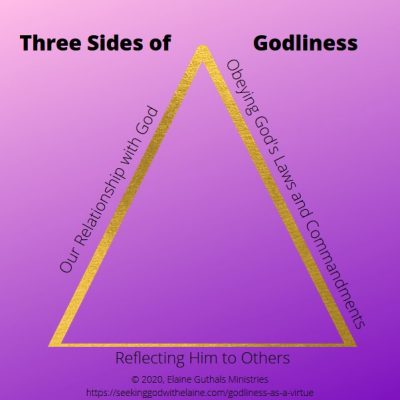
    Williams contends that godliness is a triangle. The three sides are the following:

    • Our relationship with God
    • Our assimilation of his laws and commandments into our life
    • Our reflection of Him to others.
    Triangle

    We can work on our relationship with God. We can work on our obedience. We can work on our witness.

    Yep, all three will take self-discipline.

    How Do We Apply This?

    Well, Williams put the brakes on us thinking we can do it ourselves. He said that godliness is a gift. It is a gift He gives through daily instruction.

    How do we do that? Yep, you guessed it.

    Searching for and Seeking God

    Hearing His Word (Rom. 10: 17).
    Reading His Word (Rev. 1: 3).
    Praying to Him (Heb. 4: 16).
    Studying His Word (Ac. 17: 11).
    Meditating on His Word (Ps. 1: 1-2).
    Memorizing His Word (Ps. 119: 11).

    Thompson reminded us about attitude. We should be reverent in prayer and in obedience.

    Maclaren did give a caveat. We can’t just isolate one virtue. They are all interrelated.

    Oh, yeah. I’ve been thinking that for a while now. All these churchy words do all tie together.

    I’ve just been sitting here thinking about how much ground we’ve covered these short two months since we started on this self-discipline kick. That isn’t counting where we’ve come in the past year.

    In my mind, I have been kicking around a tie-it-all-together piece. Stay tuned.

    But back to godliness for closure.

    Maclaren gave us one more nugget to help guide us. “Put godliness in the middle, let that be the centre, and from it will flow on the one side all needful self-discipline and tutoring, and on the other all wise and Christlike regard to the needs and sorrows of the men around us.”

    God wants us to become like Him. I heard a filler on the radio today. They were talking about being made in God’s image — but man looking nothing like God these days. Next is a paraphrase of what was said.

    We are made in God’s image. However, worldly man looks nothing like God. Do they resist submitting to God because they see the distance between what we are and what He is? But being like Him is our true selves. Why do we think we can’t get back there?

    We are capable of becoming godly — and holy, sanctified, and righteous. We have to accept His gift of bringing us back to who we were meant to be.

    Father. It is so comforting to think that You aren’t asking the impossible of us. You are leading us to get us back to what we were. We know we cannot do that on our own. While we can’t even do it period, You do ask us to have a part. Help us to grow to be like You. Amen.

    What do you think?

    Leave me a comment below (about this or anything else) or head over to my Facebook group for some interactive discussion.

    If you don’t understand something and would like further clarification, please contact me.

    If you have not signed up for the email daily or weekly providing the link to the devotions and the newsletter, do so below.

    If God has used this devotion to speak with you, consider sharing it on social media.

  • Patience as a Virtue

    What? Are you trying to tell me that we really can grow our patience? This devotion tells you how.

    Nuggets

    • We are going to need patience as Jesus Himself told us we would have trouble.
    • We have to keep keeping on until God calls time on whatever we are facing.
    • Meekness is an element of patience, but not the whole pie.
    • Patience doesn’t mean we just sit there and do nothing.

    Devotions in the Christian Virtues series

    Flowers with title Patience as a Virtue

    I’ve been looking forward to this one. We are finally at patience. It may be one of the best-known virtues.

    Have you ever told yourself “patience is a virtue”? Oh, I have.

    But 99% of the time, I follow it up with “but I am not very virtuous today.”

    Let’s see what I need to learn in this — and hopefully, you will see what you need to learn.

    Let’s Put It into Context

    “For this very reason, make every effort to supplement your faith with goodness, goodness with knowledge, knowledge with self-control, self-control with endurance, endurance with godliness, godliness with brotherly affection, and brotherly affection with love” (II Pet. 1: 5-7 CSB)

    Merriam-Webster Dictionary defines virtue as a “conformity to a standard of right” or “a particular moral excellence.” It is talking about how we conduct ourselves as we live our lives. Peter wrote this a progression, indicating there was a growth associated with it.

    According to the Holman Bible Dictionary, patience means “an active endurance of opposition, not a passive resignation. … Patience is endurance, steadfastness ….”

    Patience is another fruit of the spirit (Gal. 5: 22). It is interesting that, if the fruits are also written as a progression, goodness comes after patience as a fruit but before as a virtue.

    Let’s see what the research has to say.

    Why Do We Need Patience?

    “I have told you these things, so that in me you may have peace. In this world you will have trouble. But take heart! I have overcome the world” (Jn. 16: 33 NIV)

    As disciples, we are going to need patience. Jesus Himself told us we would have trouble.

    No, this isn’t all rainbows and unicorns. Trials are going to come.

    We know Satan is going to bite on us because we are no longer following the worldview. God’s tests aren’t going to be limited to easy ones.

    Thompson made an interesting statement. He wrote, “In working against evil we are prone either to irritation or to despondency.”

    I can see the irritation. We are doing what is right. We may not always understand when things aren’t smooth sailing.

    What kind of threw me was the despondency. Thompson explained some of the things that could make us lose hope. “We need this patience under the afflictions and wrongs which we personally suffer — afflictions at the hand of God, persecution, calumny, wrong from our fellow-men.”

    We need this patience so that we can accomplish the plans that God has for us. It is not going to be easy doing what He asks. It is totally opposite as to how the world operates. That will cause a lot of frustration for us.

    Our fellowmen may attack us — verbally, mentally, and physically. We have to keep on God’s plan and His timeline.

    Elements of Patience

    One element of patience is perseverance. According to Holman Bible Dictionary, perseverance is “maintaining Christian faith through the trying times of life.” We can’t give in to the despondency.

    It isn’t just keep putting one foot in front of the other until you have climbed the hill.

    It is just keep putting one foot in front of the other during the zombie apocalypse, being invaded by Elementals, and [add any trial that you are facing].

    We have to keep keeping on until God calls time on whatever we are facing. We can’t give up. We can’t lose faith in Him.

    Oh, yeah. It could get hard by the end. But we have the power of God behind us. We’ve got this.

    Sometimes, patience can be misinterpreted as meekness. Meekness is “a personality trait of gentleness and humility, the opposite of which is pride. Meekness does not refer to weakness or passivity but to controlled power.”

    Resource
    Holman Bible Dictionary’s definition of meekness
    https://www.studylight.org/dictionaries/hbd/m/meekness.html

    To read a related devotion, click the button below.

    Don’t get me wrong. Meekness is an element of patience, but not the whole pie.
    However, meekness is sometimes not seen by the world as controlled power but as a weakness.

    Perseverance and meekness have to have an element of tenacity mixed in there. You know – that latch-on-and-dig-in mentality.

    It is all about endurance. We have to be able to withstand whatever is thrown at us. Calmly. (I know, that can be the kicker.)

    Patience has the tenacity because it also has an element of hope. In fact, Thompson wrote, “Patience is incompatible with despair.” Instead, he wrote it is “… constancy, stability, steadiness.”

    What Patience Is Not

    Thompson tells us what patience is not. Patience doesn’t mean we just sit there and do nothing.

    True, there is the whole “Be still, and know that I am God! …” verse (Ps. 46: 10 NLT). But God isn’t calling for us to bury our heads in the sand.

    Remember, at a minimum, God has called us to watch. Believers must remain alert to keep on guard. We not only have to watch for Satan trying to tempt us, but we also have to watch for Jesus’ return, not knowing when that will be.

    To read a related devotion, click the appropriate button below.

    How Does Patience Change Us?

    Hamer really wrote a squirrelly sentence. He said disciples are “… stronger and yet more susceptible than he was before.”

    Well, think about it. “These trials will show that your faith is genuine. It is being tested as fire tests and purifies gold — though your faith is far more precious than mere gold. So when your faith remains strong through many trials, it will bring you much praise and glory and honor on the day when Jesus Christ is revealed to the whole world” (I Pet. 1: 7 NLT).

    God takes us like we are a hunk of gold (yes, that valuable) and gets all the impurities out. We just have to have patience while He is doing that.

    But that means we need the trials to light the fire. But remember, Jesus said we would have those.

    Making the Connections

    God wants us actively pursuing His plan. I loved Thompson saying we needed “the consciousness of a right intent.” We need to be aware of the purpose.

    Ooo, baby. Can’t we be more patient when we know the why something is happening? (And don’t we work harder and longer?)

    It does give our confidence a boost. Isn’t that what it is all about — our confidence in God?

    Well, what is confidence (I know, Dictionary Chick is slow here). Confidence is “a feeling or consciousness of one’s powers or of reliance on one’s circumstances
    had perfect confidence in her ability to succeed,” “faith or belief that one will act in a right, proper, or effective way,” “the quality or state of being certain,” and a relation of trust or intimacy” (Merriam-Webster Dictionary).

    Isn’t that what faith is about? Faith is the belief that the doctrines stated in God’s Word are true, even if we do not understand all aspects of them. “Now faith is confidence in what we hope for and assurance about what we do not see” (Heb. 11: 1 NIV).

    We don’t have confidence, we don’t have faith. We don’t have faith, we don’t have patience.

    Thompson also said that submission to God is an integral part of patience. When we submit to His leadership and have the confidence that we can stand on His promises, we can have patience.

    Patience comes after self-control or temperance. That is logical since self-control is the ability to regulate emotions, thoughts, or behavior. How are we going to have patience if we aren’t in control?

    Making the Connections to Self-Discipline

    I know. Sometimes, it doesn’t feel like we can teach ourselves patience. But Williams said it could be attained.

    How Do We Apply This?

    How?

    Searching for and Seeking God

    Hearing His Word (Rom. 10: 17).
    Reading His Word (Rev. 1: 3).
    Praying to Him (Heb. 4: 16).
    Studying His Word (Ac. 17: 11).
    Meditating on His Word (Ps. 1: 1-2).
    Memorizing His Word (Ps. 119: 11).

    To read Has God Provided Everything We Need?, click the button below.

    Specifically, Williams noted study and prayer.

    Notice he didn’t just say read. He said study.

    “The believer in Scripture who would feed, from its full pages, his faith and knowledge and piety into richer development and greater vigour, must be patient in searching, patient in pondering and comparing, and patient in praying over those sacred lines.”

    How many of us just read the textbook in school and nothing else? If there were questions at the end of the chapter, did we do them if they weren’t assigned?

    It has to be more than a quick skim.

    Williams noted that the end goal was to increase faith, not just increase patience.

    What does it take to gain knowledge? Patience.

    What does it take to gain faith? Patience.

    The progression is getting intertwined, isn’t it? That is because God wants all of us. He will sanctify all of us. Our whole being will be perfected by Him.

    Father. You love us so. Because of that, You are growing us to be more like You. Help us to learn patience. Give us the confidence we need to grow in You. Amen.

    What do you think?

    Leave me a comment below (about this or anything else) or head over to my Facebook group for some interactive discussion.

    If you don’t understand something and would like further clarification, please contact me.

    If you have not signed up for the email daily or weekly providing the link to the devotions and the newsletter, do so below.

    If God has used this devotion to speak with you, consider sharing it on social media.

  • Temperance as a Virtue

    Temperance is the churchy word for self-control. We aren’t talking about controlling the situations around us. This devotion looks at controlling our human passions so that we can let God have control.

    Nuggets

    • When disciples do not exhibit self-control, we are not following God’s laws and commands.
    • Obedience can only be attained when human passions can be controlled.
    • We can’t control ourselves because, since the original sin, these bodies are flawed.
    • Faith, strength, and insight help us learn self-control.

    Devotions in the Christian Virtues series

    Flowers with title Temperance as a Virtue

    We are moving along on our progression of virtues. So far, I can see the progression. I hope you can.

    Faith is the foundation because, without faith, we wouldn’t need the foundation. We wouldn’t care about anything godly.

    Fortunately, we do. Goodness is how God starts changing us. He does that through our gaining knowledge — of Him and of how He expects us to live.

    Next in the lineup is temperance. Oh, yes — old-time churchy word. We have talked about it before.

    Let’s Put It into Context

    “For this very reason, make every effort to supplement your faith with goodness, goodness with knowledge, knowledge with self-control, self-control with endurance, endurance with godliness, godliness with brotherly affection, and brotherly affection with love” (II Pet. 1: 5-7 CSB)

    Merriam-Webster Dictionary defines virtue as a “conformity to a standard of right” or “a particular moral excellence.” It is talking about how we conduct ourselves as we live our lives.

    When we think about a virtue, we think about this being something on which we do not compromise. At times, we look at it as a strength of character. Peter wrote this a progression, indicating there was a growth associated with it.

    The old-time word is temperance. That means, according to Merriam-Webster, “moderation in action, thought, or feeling — restraint.” It talks about a habitual moderation.

    To read a related devotion, click the button below.

    The Holman Bible Dictionary definition of self-control says this: “Modern translations’ term for several Greek words indicating a sober, temperate, calm, and dispassionate approach to life, having mastered personal desires and passions.” We’ve said before that self-control is the ability to regulate emotions, thoughts, or behavior in the face of temptations. It is where we master our reactions.

    We know self-control is a fruit (Gal. 5: 22-23). I believe that self-control is the end product of self-discipline.

    To read a related devotion, click the button below.

    Usually, when we think about self-control, we think about a couple of other words. Williams wrote, “Christian temperance … includes, thus considered, sobriety, and chastity, and moderation — all the varieties of a wise self-discipline, imposed on man’s fierce quest of pleasure.”

    These days, when we hear about sobriety, we generally think of drunkenness. That isn’t all it alluded to here. Sober, according to the Holman Bible Dictionary, means “characterized by self-control, seriousness, and sound moral judgment.” It is a character trait, not an action.

    Chastity is a form of chaste, which means “holy purity demanded of God’s people with special reference to the sexual purity of women” (Holman Bible Dictionary). These aspects help us exercise self-control.

    Why Is Self-Control Important?

    Self-control is important. When disciples do not exhibit self-control, we are not following God’s laws and commands. God wants to be in control of us.

    If God isn’t in control, our human nature is. If our human nature is in control, Satan is.

    Let’s look at it this way. We ABC. However, we don’t let God control us for the D.

    The ABCDs of Salvation

    If you have not become a believer in Christ, please read through the
    Plan of Salvation and prayerfully consider what God is asking you to do.A – admit our sins

    B – believe His Son Jesus is our Redeemer

    C – confess God as Sovereign Lord

    If you have not become a believer in Christ, please read through the Plan of Salvation and prayerfully consider what God is asking you to do.


    D – demonstrate that commitment by making any changes needed in our lives to

    live the way in which God has called us

    The Disciple’s Job Description

    Is God going to be okay if we lead in faith but veer off before we turn our lives over to Him? Oh, no, no, no, no. He is not going to accept that.

    Paul talked about this. “Those who obey their human nature cannot please God” (Rom. 8: 8 GNT). We can’t get any plainer than that.

    But don’t we know people who think that way? Some think belief is enough. It isn’t.

    James said, “You believe that there is one God. Good! Even the demons believe that — and shudder” (2: 19 NIV). Demons aren’t going to heaven because they believe.

    Only repentance is enough. “Now repent of your sins and turn to God, so that your sins may be wiped away” (Ac. 3: 19 NLT). If we don’t turn away and turn to God, it sounds like our sins are not wiped away.

    Williams made a real interesting point, that I had not thought of before. “Let it be remembered, then, that in the sin of our first parents, the knowledge which they sought, beyond God and His instructions, was knowledge which brought with it a sin against the holy temperance that had before been the law of Paradise, and the defence (sic) of primeval innocence.”

    Let’s break that down a little. We sometimes blow over the fact that Adam and Eve were looking for knowledge. We think of it as something more tangible — like power, prestige, or position.

    Their sin was, in part, lack of self-control. They couldn’t bring their passions their human nature under control. They wanted to bite — they bit.

    To read a related devotion, click the appropriate button below.

    So, God wants us to have self-control so that we follow Him, not our human passions.

    Cross in clouds

    When Self-Control?

    Abernethy made the point that, sometimes, self-control is needed for things good for us as well as things bad for us. It isn’t that we just have to cut out the stuff that is bad for us. We have to replace it with moderation.

    Have a cookie. One is good, right? Try five — maybe ten. More is better, right?

    What was good ends up not being so good, doesn’t it? Excuse me while I get told off by my stomach.

    Unfortunately, we want to rule ourselves. That is what the worldview tells us we should want.

    Maclaren wrote, “… the worth of self-control depends, to a large extent, on the motive from which it is practised (sic) ….” In other words, motive plays into how successful we are at self-control.

    Maclaren also contends that obedience can only be attained when human passions can be controlled. Obedience means to hear and carry out the instructions that God gives us. We are to respond in faith and do God’s Will.

    Why Doesn’t Our Self-Control Work?

    We are able-bodied, able-minded people. Why can’t we control ourselves?

    Maclaren gives us the answer to that, too. He remind us that, since the original sin, these bodies are flawed.

    Well, think about it. Maclaren wrote, men “… are seeking to exercise a thorough-going self-restraint, when the self which should govern is itself tainted and evil, the will bribed and enslaved, the conscience sophisticated and darkened.”

    Nailed it in one, didn’t he?

    What Works?

    Don’t worry. Maclaren had three suggestion to help us learn self-control: faith, strength, and insight.

    Faith is the belief that the doctrines stated in God’s Word are true, even if we do not understand all aspects of them. Remember, we said that faith is the foundation for all the other virtues.

    Strength is interesting to me. “And you shall love the Lord your God with all your heart and with all your soul and with all your mind and with all your strength” (Mk. 12: 30 NLT).

    I am going to paraphrase what the KJV Dictionary said about strength. It is the quality that allows us to move. It is the power and force behind the movements. But it is also firmness and toughness.

    Insight is “the power or act of seeing into a situation,” according to Merriam-Webster Dictionary.

    Ooo, baby. Think about what Maclaren was saying. We have the tenacity to discern something so we can believe it, even if we don’t understand it all.

    Doesn’t that help give us self-control? We have the tenacity to overcome [add your challenge] because we believe God can work it out and Jesus has rule in our hearts, even though we don’t understand how it can be accomplished. We can because we see what He is calling us to versus where we are if we continue [the challenge]. We choose to have God change us.

    Adams argues that self-control is not a virtue by itself. Rather, he says that it moderates all the other virtues.

    In one place, Adams talks about discretion. Ooo, doesn’t that add another dimension? That is where our free will comes into play.

    We have free will, but God asks us to put that will and self-control under His guidance. Lack of self-control can lead to self-indulgence, which can lead to sin. Thompson also talked about sins caused by lack of self-control had an element of selfishness in it.

    We can’t, no matter how much we try, bring self-control in line just by force of will. We also can’t just deny what we want to control.

    Making the Connections

    I think sometimes we believe that our desire for our earthly passions comes from one of our senses. We forget that they are all regulated by our minds. So, our self-discipline has to be 99% mind control.

    I think a lot of times we think that abstinence is synonymous with self-control. Some things we do have to give up all together because they are sins. Other things may not be a sin until the lack of restraint kicks in.

    Making the Connections to Self-Discipline

    Sometimes, we may be tempted to think that self-discipline is the end-all, be-all. It isn’t.

    Williams reminded us that “drunkenness is enough to damn a man; but the mere absence of drunkenness is by no means enough to save him.” Controlling our human passions isn’t enough.

    We are only saved through admitting our sins, believing Jesus is our Savior and Redeemer, and confessing God as Sovereign Lord. Then, and only then, does what we do or don’t do come into play.

    That being said, Williams also said, “[Self-control] is necessary to true piety. The knowledge and love of God cannot lodge in a heart crowded and dragged downward by debasing and sinful pleasure. If men are Christ’s, they are crucified with Him to the flesh and the world.”

    I interpret that as, on our sanctification road, self-control plays a big part in securing our successes along the way. We will not continue to progress toward righteousness if we allow our human passions to rule our lives.

    How Do We Apply This?

    • If we aren’t under God’s control, we may not be as useful to Him. Oh, yes. God may still use us, but not to the extent He could.
    • When we feel our self-control slipping, we should pretend we are in His presence. (I know, we really are, but don’t we forget that too often?)
    • Be sober — be serious and have sound moral judgment
    • Don’t miss the opportunities to fellowship with other disciples, specially those that have overcome this struggle
    • Seek God

    Searching for and Seeking God

    Hearing His Word (Rom. 10: 17).
    Reading His Word (Rev. 1: 3).
    Praying to Him (Heb. 4: 16).
    Studying His Word (Ac. 17: 11).
    Meditating on His Word (Ps. 1: 1-2).
    Memorizing His Word (Ps. 119: 11).

    To read Has God Provided Everything We Need?, click the button below.

    Self-control seems like it is a challenge that frequently trips us up. We need to do a better job at it, especially since it is in the middle of the virtues list.

    We need to master self-control so we can master patience.

    Father. We want You to be in control of our lives. We choose to serve You. Help us to control our human passions. Amen.

    If you have not admitted that your relationship is not right with God,

    have not asked Jesus to be your Lord and Savior,

    and have not confessed your sins,

    please read through the Plan of Salvation and prayerfully consider what God is asking you to do.

    Related Links

    Related Links

    Related Links

    Song

    Related Links

    I have created a worksheet of the questions above. Click on the button below to access it.

    Don’t know what your spiritual gifts are?

    Take this Spiritual Gifts Inventory

    The Disciple’s Job Description

    Complete Job Description

    Individual Description

    It Was Enough
    Vocalist: Elaine Guthals
    Keyboard: Chris Vieth

    What do you think?

    Leave me a comment below (about this or anything else) or head over to my Facebook group for some interactive discussion.

    If you don’t understand something and would like further clarification, please contact me.

    If you have not signed up for the email daily or weekly providing the link to the devotions and the newsletter, do so below.

    If God has used this devotion to speak with you, consider sharing it on social media.

  • Knowledge as a Virtue

    How much knowledge about God do we need to have? Just enough for salvation, right, then we are done??? This devotion discusses how God wants us to grow in knowledge of Him.

    Nuggets

    • God want us to make a conscious decision to follow Him, which means we need knowledge in order to do that.
    • Initially, we have to learn about Who God is and what He has done.
    • God’s laws and commandments are what are to guide us as to how to live our lives.
    • We are to take the knowledge that we learn when we are seeking God and use it transform us — sanctify us.

    Devotions in the Christian Virtues series

    Flowers with the title Knowledge as a Virtue

    We’ve been talking about growing our virtues. We are going to water that plant today with the topic of knowledge. We can’t grow without gaining knowledge, right?

    Let’s Put It into Context

    “For this very reason, make every effort to supplement your faith with goodness, goodness with knowledge, knowledge with self-control, self-control with endurance, endurance with godliness, godliness with brotherly affection, and brotherly affection with love” (II Pet. 1: 5-7 CSB)

    Merriam-Webster Dictionary defines virtue as a “conformity to a standard of right” or “a particular moral excellence.” It is talking about how we conduct ourselves as we live our lives.

    When we think about a virtue, we think about this being something on which we do not compromise. At times, we look at it as a strength of character. Peter wrote this a progression, indicating there was a growth associated with this.

    Merriam-Webster Dictionary defined knowledge as “the fact or condition of knowing something with familiarity gained through experience or association.” The Holman Bible Dictionary defined it as “… intellectual understanding, personal experience, emotion, and personal relationship (including sexual intercourse …).”

    Why is knowledge important? Adams put it succinctly: “If men will not know God, God will not know them.” Because of this, God requires us to gain knowledge in order to grow.

    Does God Really Want Us to Know?

    “But grow in the grace and knowledge of our Lord and Savior Jesus Christ” (II Pet. 3: 18 ESV)

    Yes, God wants us to have knowledge. No, He doesn’t want us just blindly following Him.

    God want us to make a conscious decision to follow Him. In order to do that, we need knowledge. “The more we can rule our lives by the intelligent application of principles, and not by mere use and wont, instinct, imitation, mechanism, necessity, the more we shall be the men and women that God meant us to be.”

    Oh, yes. There are some things that are below our pay grade that we do not need to know — however much we think we do.

    God is all-knowing and Creator of all we see and can’t see. It is okay for Him to be smarter than us. It is okay for us not to know.

    But what do we need to learn?

    Church

    Learn to Know God

    “Fear of the LORD is the foundation of wisdom. Knowledge of the Holy One results in good judgment” (Prov. 9: 10 NLT)

    We have to learn to know God — that includes learning about His character. That means we have to learn about heaven and eternity, too.

    We’ve talked before about the fear of the Lord. We learned in What Does Fear of the Lord Mean? that the fear of the Lord means reverence and love, not terror.

    Our following God’s laws and commandments shows that we fear God (Finding Favor by Acknowledging God). Walking in the Spirit should promote the fear of the Lord (What Does It Mean to Walk in the Spirit?).

    We’ve also talked about wisdom. Partridge defined wisdom as, “in the Scripture sense, is a virtue which makes a man not only skilful (sic) and intelligent, but also good and virtuous. It consists, not so much in knowledge, as in practice.”

    Not only skilled and intelligent, but also good and virtuous. (Well, doesn’t that fit into this discussion?)

    I see the difference between knowledge and wisdom. Knowledge is that kernel of fact that we learn. Wisdom is how that kernel of fact changes us for the better as a person.

    Initially, we have to learn about Who God is and what He has done. What He has done is the plan of salvation.

    • God, the Creator of the universe, is our Father Who wants to have a relationship with His people. God Sent His Son Jesus to be the Redeemer of mankind.
    • The Trinity, which consists of God as Father, Son, and Holy Spirit, are three different forms of the same Being.
    • Jesus was born of a virgin, making Him 100% God and 100% man.
    • Jesus gave His life on the cross for us so that His blood could pay the price for our sins.
    • Because of God’s great might and power, Jesus rose from the grave, conquering death and paying the price for our sins.
    • At some point, Jesus will come back to earth and take believers home with Him.

    To read a related devotion, click the button below.

    The ABCDs of Salvation

    If you have not become a believer in Christ, please read through the
    Plan of Salvation and prayerfully consider what God is asking you to do.

    A – admit our sins
    B – believe His Son Jesus is our Redeemer
    C – confess God as Sovereign Lord

    If you have not become a believer in Christ, please read through the Plan of Salvation and prayerfully consider what God is asking you to do.

    D – demonstrate that commitment by making any changes needed in our lives to
    live the way in which God has called us

    The Disciple’s Job Description

    Williams argues that we also need to know ourselves and Adam and Eve as they were originally created. Additionally, he cautioned that we need to know others as to how they are under the influence of the worldview.

    Then we have to learn God’s laws and commandments.

    Learn to Know God’s Laws and Commandments

    “These commandments that I give you today are to be on your hearts. Impress them on your children. Talk about them when you sit at home and when you walk along the road, when you lie down and when you get up” (Deut. 6: 6-7 NIV)

    Moses told the Wilderness Wanderers that they weren’t supposed to put God’s laws and commandments on a shelf, never to be thought about again.

    Instead, Moses told them that they were to put them on their hearts. We’ve talked about our hearts before.

    We’ve talked in Peace, Mercy, and Love about God’s peace, mercy and love is at our center. Our center is considered our hearts. That is our foundation.

    Also, we’ve talked in The Fullness of God’s Love about how Jesus is the Word (Jn. 1: 1) that we are to hide in our hearts (Ps. 119: 11). Jesus is a major part of that foundation.

    Obedience has to come from the heart. In Getting Obedience to the Heart Level, we said God’s Word is supposed to be a part of us. His laws and commandments are supposed to affect our character or our core – our heart level. If we are to engrave God’s laws and commandments on our hearts, we internalize them, and they change us.

    See? Laws and commandments are to go to heart level. They are supposed to be a part of us. They are supposed to change us.

    These are what are to guide us as to how to live our lives. Maclaren wrote, “So this knowledge is not only of what it is right and wise to do at the moment; but it is knowledge of what it is right and wise, on Christian ground, to do at the moment and in the circumstances.”

    What is right doesn’t change with the situation. If God says it is right, it stays right.

    Learn to Know Our Duty

    “Do not be conformed to this world, but be transformed by the renewal of your mind, that by testing you may discern what is the will of God, what is good and acceptable and perfect” (Rom. 12: 2 ESV)

    We are to take the knowledge that we learn when we are seeking God and use it transform us — sanctify us. Maclaren stated it this way: “Let the perception of duty be a perception illuminated and determined by the principles of the gospel, and bring that law to bear upon all life.”

    We have to daily be applying God’s laws and commandments to our lives. This isn’t something from which we take a vacation.

    We learn about God’s love and let that change us until we are full. “My brothers and sisters, I myself am convinced about you that you also are full of goodness, filled with all knowledge, and able to instruct one another” (Rom. 15: 14 CSB).

    I know. I read that and thought, “This is another one of those three-tense verses. I really isn’t going to happen until heaven.”

    Maybe. Maybe not. Thompson wrote, “Knowledge is a spiritual apperception of Divine things, forming and controlling the practical judgment. A soul informed by such knowledge discerns the way of truth and duty.”

    Here, we need to bounce new knowledge off old knowledge to assimilate it. There we won’t need to do that. We will already have all the knowledge we will need.

    Here, we have to assimilate the spiritual truths we learn into our standards — into our virtues.

    Making the Connections

    I think it would be a safe bet to say that — at least at one point in our lives — we were not feeling knowledgeable. We probably were not even feeling average. We were probably feeling down right stupid.

    Take heart. Peter wrote, “But grow in the grace and knowledge of our Lord and Savior Jesus Christ” (II Pet. 3: 18 ESV). He didn’t qualify it.

    Everyone can grow. No, it doesn’t matter how you did in school.

    The knowledge is from God. He gives it to us. It really isn’t a matter of us learning – it is Him giving.

    We just have to accept and assimilate – and keep learning.

    Thompson made an interesting comment. He wrote, “Knowledge is not the cause of sin, but ignorance; for virtue is begotten and nourished by knowledge.”

    Oh yes. Sometimes we feel proud of our smarts. Worse yet, sometimes we feel like we are as smart as – if not smarter than – God.

    To me, this says that faith must be equal to — if not more than — knowledge.

    Yes, I know it is first on the progression. I also know progressions generally go up.

    I think we have to cut this one a little slack. Faith has got to be right there when knowledge lets us down.

    Making the Connections to Self-Discipline

    Thompson also said, “This knowledge, combined with firmness in faith, gives beauty and dignity to character.” Our faith becomes firm through growth, fostered by self-discipline. That, in turn, helps us grow virtuous.

    How Do We Apply This?

    Yes, God gives us this knowledge, but it isn’t through osmosis or photosynthesis. We have to seek Him.

    Searching for and Seeking God

    Hearing His Word (Rom. 10: 17).
    Reading His Word (Rev. 1: 3).
    Praying to Him (Heb. 4: 16).
    Studying His Word (Ac. 17: 11).
    Meditating on His Word (Ps. 1: 1-2).
    Memorizing His Word (Ps. 119: 11).

    To read Has God Provided Everything We Need?, click the button below.

    Yes, we have to hear His Word, read it, study it, meditate on it, and memorize it. All through that, we need to be in prayer, asking God to provide the meaning.

    We have to actively be working to acquire God’s knowledge. Keep at it until you understand the passage.

    We have to be docile. We have to be teachable.

    We have to go in thinking reading and studying God’s word is going to change us. So, don’t be surprised when it does!

    We have to be obeying God’s laws and commands — just as Jesus did. That will help us grow.

    Knowledge is important. As disciples, we have to make sure we keep growing closer and closer to God. We do that through solidifying our relationships with Him even more by continuing to seek Him.

    Father. We want to grow in You. We want to gain faith and knowledge in You so that we can grow more like You in all ways. Help us to focus on You. Help us to make our time with You a priority. Amen.

    What do you think?

    Leave me a comment below (about this or anything else) or head over to my Facebook group for some interactive discussion.

    If you don’t understand something and would like further clarification, please contact me.

    If you have not signed up for the email daily or weekly providing the link to the devotions and the newsletter, do so below.

    If God has used this devotion to speak with you, consider sharing it on social media.