Category: Forgiveness

  • The Ideal Family

    If Adam and Eve didn’t have the ideal family, how would we describe what that was? This devotion looks at the type of foundation God expects to prepare our children for their lives ahead.

    Nuggets

    • Above all else, we need to individually love God; then, we need to love and worship God as a family.
    • Part of the function of the family is to provide the foundation on which the children will build their lives.
    • God wants us to remember, not erase or cover up the past.

    Devotions in the What I Believe series

    Devotions in the Family category

    The Ideal Family
    The Hopeful Family

    In Support of Widows
    Instructing Our Children
    Who Is the Greatest in the Kingdom of Heaven?

    Flowers with title The Ideal Family

    In the last devotion, we talked about how the family unit we see today was not what God had set up in the Garden of Eden. The family changed after sin entered into the world.

    So, what would God consider as the ideal family unit? Let’s see what we can see.

    Let’s Put It into Context

    Family is, according to the Holman Bible Dictionary, “the basic household unit which provides a person’s central relationships, nurture, and support.”

    Resource

    Ordinances are an expression of the disciples’ obedience. Marriage is an ordinance.

    Family Unity

    “Listen, Israel: The Lord our God, the Lord is one. Love the Lord your God with all your heart, with all your soul, and with all your strength. These words that I am giving you today are to be in your heart” (Deut. 6: 4-6 CSB)

    I know. We’ve had this passage before. And we will keep talking about it.

    To read a related devotion, click the appropriate button below.

    Jesus said it was the greatest commandment. We have to love God first and foremost. Even before loving others.

    This is what the gospel is all about. If you aren’t interested in getting this important fact, you are reading the wrong blog.

    Above all else, we need to individually love God. We have to be totally submitted to God. We have to be following His directives.

    How? “… with all our heart, with all your soul, and with all your strength” (Deut. 6: 5 CSB). In one of the iterations, it adds mind.

    We have to be all in. Then, we need to love and worship God as a family.

    We said in the last devotion that the family must be built on love. Well, think about it. God is love (I Jn. 4: 8).

    We are to grow our character to imitate Him. That means we are to be love, also — His type of love. When we are God’s type of love, our family dynamics are totally different.

    Think about what a strong family unit achieves. Love promotes unity.

    We react better to trials and frustrations, so our family members don’t have to worry if it is going to be nice Elaine who shows up or mean Elaine.

    That means the family members are calmer and think more clearly. That may help situations to be avoided.

    It also means we are more forgiving when things do go south. We see the good in our family members and are able to curb our feelings of anger and resentment toward them.

    We can concentrate on growing the positive things rather than having to mending the broken. We don’t get envious and overly critical.

    Church steeple

    Handing the Gospel Down

    “Repeat them to your children. Talk about them when you sit in your house and when you walk along the road, when you lie down and when you get up” (Deut. 6: 7 CSB)

    Part of the function of the family is to provide the foundation on which the children will build their lives. We parents do that by providing instruction and boundaries, establishing curfews, and meting out the punishment as needed.

    Vaughan felt that Deuteronomy 6: 5 is the perfect tool to build that foundation. He stated that “this verse is the meeting point of the law and the Gospel.”

    Resource

    Yes, God gives us laws and commandments. He doesn’t let us believe whatever we want to believe. We are to be believing what He believes.

    Yes, we can compromise on things — but not beliefs. We can’t tolerate what God has called sin. No, we don’t have to harp on something once they know our feelings, but we don’t have to give up our beliefs and give them our blessing because they want to keep on sinning.

    No, I don’t have to let Adam believe something that is wrong and not say anything because I don’t want to appear old fashioned or unbending. I have to be the champion of the gospel.

    I wouldn’t let Adam doing something in which he is going to get hurt just because he can make his own decisions. If I see something isn’t right, this mama bear is going to have a talk with that boy.

    Having a strong family unit means that we don’t tolerate actions because our family members mistake that tolerance for love. We have to love with a real love, not a fake love.

    We hold each other accountable for our actions based on God’s laws and commandments. We encourage each other and support each other even during the ouchy growing pains.

    How are we supposed to talk about all of this? When Moses was saying this, the Wilderness Wanderers didn’t have their own personal copy of the Scriptures. They couldn’t even pull one off of the internet.

    Parents had to say the laws and commandments over and over again so the kids could memorize them. If they didn’t pass them on, the kids would not have known them.

    But it is more than just a memorization exercise. The laws aren’t a checklist of what to do and what not to do. They are to build our character.

    Checklist

    Don’t Forget

    “Bind them as a sign on your hand and let them be a symbol on your forehead. Write them on the doorposts of your house and on your city gates” (Deut. 6: 8-9 CSB)

    God wants us to remember. He doesn’t want us to erase or cover up the past. We have all done things we shouldn’t have done. We have all said things we shouldn’t have said.

    We ask forgiveness for that and learn from that. If we don’t have that to learn from, we don’t have the building blocks from which to learn.

    More importantly, God wants us to remember how He has brought us through all the trials. We need to remember how He provided for us.

    God wants us to see that it isn’t us doing life by ourselves. It is Him working His plan in us.

    Instead, we’ve taken God out of our governments and out of our schools. Some have even taken God out of their churches.

    Newsflash. This world isn’t getting better. It is getting worse.

    That is because, by taking God out, we have let Satan in. Satan is the agent of chaos. He is delusion and lies.

    We need to take our homes, our schools, our cities, our states, our nations, our world back for God. We need to not only put His laws and commandments on our hands, foreheads, doorposts, and gates, but we also have to put them in our hearts, minds, and lives.

    Making the Connections

    Vaughan described God’s character.

    • active
    • strong
    • supporting many burdens of care, and work, and thought, and responsibility
    • has a warm heart
    • tenderness
    • craves affection
    • is touched by the response of gratitude
    • loves love
    • has even a void place within till love fills it

    Resource

    Making the Connections to Self-Discipline

    We’ve been looking at defending our beliefs when we are witnessing. That means we have to be secure enough to convince someone to accept our beliefs.

    Our questions should still serve us to determine on what we need to focus.

    • What does the Scriptures say?
    • What do I believe?
    • Why do I believe the same/differently than the Scriptures?
    • What are the talking points when witnessing to a non-believer?

    Related Links

    I have created a worksheet of the questions above. Click on the button below to access it.

    How Do We Apply This?

    How do we build character? Well, first we have to decide where we need the building to take place. Then we have to be intentional about building it and be accountable for getting it done.

    What better place to do all of that than in the family unit. The people who love us and know us can help us the most.

    Yes, I really liked Vaughan’s sermon. He gave us a way to apply this.

    “And what is this love which God asks of us? It is not different in kind, it differs only in direction, from that which we give one to another. Think what love is, as you give it to your nearest and best beloved.”

    Resource

    Give our love to our nearest and best beloved. Who is that besides our family?

    Father God. You instituted families so that we would not have to be alone. You also wanted to show us the fellowship that we can have with You. Help us to live the way You want us to, growing to be more like You. Amen.

    What do you think?

    Leave me a comment below (about this or anything else) or head over to my Facebook group for some interactive discussion.

    If you don’t understand something and would like further clarification, please contact me.

    If you have not signed up for the email daily or weekly providing the link to the devotions and the newsletter, do so below.

    If God has used this devotion to speak with you, consider sharing it on social media.

  • Spiritual Bondage

    In order to recognize and appreciate our freedom, we have to realize to what we are in bondage. This devotion looks the spiritual bondage all those who are not children of God face.

    Nuggets

    • Satan knows our weaknesses and how to use them to his advantage.
    • Death entered the world when Satan convinced Adam and Eve to sin.
    • Satan wants us to blame God.
    • A lot of times, the way Satan works our corruption is by promising us something.

    Devotions in the What I Believe series

    Devotions in the Religious Freedom category

    Spiritual Freedom
    Jesus the Liberator
    What Religious Freedom Doesn’t Mean

    Flowers with title Spiritual Bondage

    This series talks about spiritual freedom. To understand freedom, we have to understand to what we are in bondage — and to whom.

    We are in bondage to Satan and sin when we are not a child of God. “Jesus responded, “Truly I tell you, everyone who commits sin is a slave of sin” (Jn. 8: 34 CSB).

    This could be very difficult for non-believers to understand. When we are witnessing to them, we have to be clear on what we believe so that we can convey that to them.

    Luckily, we have several verses that we can use to present the concept. The foundation of this devotion was taken from the Sunday School Times’ sermon entitled Bondage and Freedom. Let’s check it out.

    Resource

    Let’s Put It into Context #1

    Freedom is, according to the Holman Bible Dictionary, “the ability of a person or group to be and do what they want instead of being controlled by another.” It is also referred to as liberty.

    Resource

    We talked about liberty before. We said that it runs the gamut, hitting all the things the worldview stresses.

    • We do what we please with no authority over us.
    • We make our own choices.
    • We don’t have to follow rules or limits.

    To read a related devotion, click the button below.

    Let’s Put It into Context #2

    Before mankind are children of God, they are sinners. Sinners are all people who have not made a genuine profession of faith — who have not sincerely ABCDed.

    Glossary

    The ABCDs of Salvation

    If you have not become a believer in Christ, please read through the
    Plan of Salvation and prayerfully consider what God is asking you to do.

    A – admit our sins
    B – believe His Son Jesus is our Redeemer
    C – confess God as Sovereign Lord

    D – demonstrate that commitment by making any changes needed in our lives to
    live the way in which God has called us

    The Disciple’s Job Description

    We are sinners because Adam and Eve committed the original sin in the Garden of Eden. Scriptures tell us that they disobeyed the express command of God — do not eat of the fruit from this one tree.

    Glossary

    Was the tree some magical tree? Maybe. Maybe not.

    I see the main issue was their disobedience. Adam and Eve did not submit their will and their lives to God. So, they did the exact opposite of what God told them to do.

    Yes, they had help. Satan was there to nudge them into disobedience.

    But the choice was all theirs. And mankind has suffered ever since. We have been in bondage ever since.

    In Bondage to Satan

    “Then they will come to their senses and escape from the devil’s trap. For they have been held captive by him to do whatever he wants” (II Tim. 2: 26 NLT)

    Satan is really sneaky. When he tempts us, it is hard for us to identify that it is him doing the talking. He makes it look like it is all our idea.

    What is worse is that Satan can use Scriptures against us. He did with Jesus.

    “Then the devil took him to Jerusalem, to the highest point of the Temple, and said, ‘If you are the Son of God, jump off! For the Scriptures say, “He will order his angels to protect and guard you. And they will hold you up with their hands so you won’t even hurt your foot on a stone”’” (Lk. 4: 9-11 NLT). If we don’t know the Scriptures and the context passage are used in, we won’t have on some of our armor to fight Satan.

    To read a related devotion, click the button below.

    Barlow explained why Satan is successful in tempting us. He wrote, “He conceives that some are apt to pride, malice, coveteousness, melancholy, mirth, silence, liberalness of speech, and according to our natural inclination he sets his gins for us.”

    Resource

    In Elaine-speak, Satan knows our weaknesses and how to use them to his advantage.

    Look at what Jesus called Satan. “… He was a murderer from the beginning and does not stand in the truth, because there is no truth in him …” (Jn. 8: 44 CSB).

    We say that we are taken captive by Satan. “… For they have been held captive by him to do whatever he wants” (II Tim. 2: 26 NLT).

    Satan may be sneaky in tempting us, but his objective is deadly. He wants us to remain spiritually dead. Spiritual death is the separation from God that occurred as a consequence of Adam and Eve’s original sin.

    Glossary

    The purpose of this captivity is so we will do anything Satan wants. What Satan wants is for us to do the exact opposite of what God wants.

    Two people fighting

    In Bondage to the Fear of Death

    “Now since the children have flesh and blood in common, Jesus also shared in these, so that through his death he might destroy the one holding the power of death —that is, the devil until we — and free those who were held in slavery all their lives by the fear of death” (Heb. 2: 14-15 CSB).

    Ooo, baby. Look what Gouge had to say. He wrote, “… the devil may be said to have the power of death,” which makes him the “… executioner of God’s just judgment …”

    Resource

    Think about it. The results of sin — poverty, crime, disease, death, etc. — are also the judgments of sin.

    Why does Satan have so much power over death? Death entered the world when Satan convinced Adam and Eve to sin. Satan brought death in, so he is considered “holding the power of death …” (Heb. 2: 14 CSB).

    Satan enslaves us by getting us to fear death. One thing that has been reinforced with Pastor Chad’s death is we have to be ready regardless of age. Being ready eliminates most of the fear.

    Oh, yeah. The mystery and leave-taking that Meyer talked about is still there. The pain may be there. However, we don’t have to fear the afterdeath.

    Resource

    Spurgeon wrote that Satan had power because he gets disciples to doubt their salvation. Or he will tell us that God really doesn’t forgive and forget the sins we have confessed. Worse yet, Satan may convince us that we will fail in heaven just as we did here.

    Resource

    But wait a second. We soft peddle fear these days, don’t we? We call it anxiety or stress.

    Oh, yeah. It can do bad things to us, but it is mostly because we aren’t handling it well.

    No. We need to fear Satan – and not in the love and reverence as we do to God. We need to steer clear of him and hold onto God’s peace.

    Glossary

    Ooo, baby. Smith got me to thinking. Why do non-believers fear death? Yeah, maybe the pain will last a little bit, but – in their opinion – then everything is over with because there is no afterlife.

    Resource

    Satan has them thinking about it backwards. The pain of death is only going to last a little bit. The sentences of judgment are going to last for eternity.

    Cemetary

    In Bondage to Sin

    “Don’t you realize that you become the slave of whatever you choose to obey? You can be a slave to sin, which leads to death, or you can choose to obey God, which leads to righteous living” (Rom. 6: 16 NLT).

    Sin. It comes down to sin. Sin is actions by humans that disobey God and break one of His laws and commandments, goes against a purpose He has for us, or follows Satan’s promptings.

    Glossary

    Melvill’s sermon talked about the effects of sin. He wrote, “Every pain to which flesh is heir, every sickness — the decay, and the dissolution of the body, are to be referred to sin as their first origin; and the temptation to sin having been of Satan, they are to be classed among the works of the devil.”

    Resource

    Yep, Adam and Eve followed Satan’s prompting. Bottom line, they were disobeying God.

    We disobey God when we don’t follow His laws and commandments. We disobey when He tells us to move somewhere, do something, or don’t do something – and we don’t, don’t, or do.

    Did you ever think about it? Adam and Eve got one chance. They had to obey, or else sin came into the world.

    We get more than one chance – even after we become disciples. God will forgive us of our sins when we repent. Repentance is expressing sorrow for breaking God’s laws and commandments by making the commitment to changing ourselves through obedience so that we no longer do the wrong things.

    Glossary

    Satan wants us to blame God. He isn’t to blame for our ills – Satan is, and we are. We are when we choose to disobey Him.

    Church

    In Bondage to Corruption

    “They promise freedom, but they themselves are slaves of sin and corruption. For you are a slave to whatever controls you” (II Pet. 2: 19 NLT).

    The Holman Bible Dictionary defines corruption as “used especially in the [King James Version] KJV to denote the transient nature of the material world —that is, the world’s bent toward change and decay …”

    Resource

    We talked before how Satan asked for Peter to be given to him. (I know, scary thought.) Jesus told Peter, “Simon, Simon, Satan has asked to sift all of you as wheat” (Lk. 22: 31 NIV).

    To read a related devotion, click the button below.

    A lot of times, the way Satan works our corruption is by promising us something. It could be through a relationship, a career, a skill – really anything that is attractive to us.

    But Satan is a liar. Adams wrote, “All sin is a servitude; and that which flatters men with the greatest opinion of liberty, makes them the most miserable vassals.”

    Resource

    In Elaine-speak, we generally get what is promised but find out we really didn’t want it at all. Usually, that is because the deceiver purposefully meant to deceive us.

    Making the Connections

    Snape showed us exactly how Satan’s treachery looks. He wrote, “… so the devil takes men’s souls alive by his subtlety: nay, more, unless they be recovered out of his snares, they must be alive for ever under his sway: lost, yet alive; hopeless, yet alive; tormented, yet alive; ever desiring to die, but never able.

    Yeah, Satan is talking out of both sides of his mouth. That makes him even sneakier.

    Johnson argued that we all do have liberty. To him, it is called free will. Free will is the ability within us to make decisions, which determine actions that produce character.

    Glossary

    Well, Johnson is correct. We all must make our own choices. We either choose to follow God or follow Satan. Not choosing to follow God is a choice for following Satan.

    Making the Connections to Self-Discipline

    Oh, man. How do we convince someone that Satan is a liar?

    We’ve been looking at defending our beliefs when we are witnessing. That means we have to be secure enough to convince someone to accept our beliefs.

    Our questions should still serve us to determine on what we need to focus.

    • What does the Scriptures say?
    • What do I believe?
    • Why do I believe the same/differently than the Scriptures?
    • What are the talking points when witnessing to a non-believer?

    Related Links

    I have created a worksheet of the questions above. Click on the button below to access it.

    How Do We Apply This?

    Barlow warned that Satan uses pleasures and suddenness to set his traps for us. He explained the pleasures this way. He wrote, “He sets a man’s affections on fire, kindles such a heat within him that for the present the object of temptation seems wonderful fair, delightful, honourable; though when he is ensnared he perceives no such thing, but the direct contrary.”

    Resource

    We have to counteract the suddenness and the intense desires with being focused on God. That focus comes when we seek God.

    Searching for and Seeking God

    Hearing His Word (Rom. 10: 17).
    Reading His Word (Rev. 1: 3).
    Praying to Him (Heb. 4: 16).
    Studying His Word (Ac. 17: 11).
    Meditating on His Word (Ps. 1: 1-2).
    Memorizing His Word (Ps. 119: 11).

    We know the steps. Yeah, that doesn’t make it any easier sometimes.

    Satan is good at what he does. He makes sin very attractive and promising. We just have to keep our eyes on Jesus.

    Father. We do not want to be in bondage to Satan. We want to follow You. Amen.

    What do you think?

    Leave me a comment below (about this or anything else) or head over to my Facebook group for some interactive discussion.

    If you don’t understand something and would like further clarification, please contact me.

    If you have not signed up for the email daily or weekly providing the link to the devotions and the newsletter, do so below.

    If God has used this devotion to speak with you, consider sharing it on social media.

  • What Else Is Expected of Disciples?

    When interacting with others, we are to show them the character of God. This devotion concludes our look at what is expected of disciples to do that.

    Nuggets

    • Meekness is a personality trait exhibiting a mild or moderate disposition that places dependence on God.
    • We’ve got to stand firm patiently.
    • We not only give up the right to retaliate, but we also initiate the forgiveness.
    • Compassion, kindness, humility, gentleness, patience, forbearance, and forgiveness all filter up into love.

    Devotions in the What I Believe series

    Devotions in the Social Order category

    Flowers with title What Else is Expected of Disciples?

    We started in the last devotion to look at what is expected of disciples from God and from the world. We talked about

    • God chose mankind to whom to show His love.
    • He has special blessings set aside for those who admit their sins, believe in Jesus as their Savior and Redeemer, and confess Him as Sovereign Lord.
    • God expects us to have a heartfelt sympathy for others.
    • Love is expressed through kindness – kindness is the action.
    • Humility means we have a real perspective about ourselves.

    Let’s see what else we can add to our list.

    Let’s Put It into Context

    We are going to use the following definition from the Merriam-Webster Dictionary for social. It is defined as “of or relating to human society, the interaction of the individual and the group, or the welfare of human beings as members of society.”

    Resource

    Gentleness

    “Therefore, as God’s chosen ones, holy and dearly loved, put on compassion, kindness, humility, gentleness, and patience, bearing with one another and forgiving one another if anyone has a grievance against another. Just as the Lord has forgiven you, so you are also to forgive” (Col. 3: 12-13 CSB)

    The word is translated gentleness here. In some cases, it is translated meekness. We’ve talked about that before.

    To read a related devotion, click the button below.

    Meekness is “a personality trait of gentleness and humility, the opposite of which is pride. Meekness does not refer to weakness or passivity but to controlled power.”

    Resource

    So, in order to find out what meekness is, we need to find out what humility (which we just talked about in the last devotion) and gentleness are. Of course, gentleness sends us to gentle.

    • Humility is a character trait that diminishes pride and places dependence on God while holding a modest view of our importance with respect to others.
    • Gentle is “free from harshness, sternness, or violence.”

    Resource

    Hmmm. Don’t you love when they tell you what something is by only telling you what it isn’t?

    We have to look to Daille to tell us that. He wrote that gentleness “… receives every one with an open heart and pleasing countenance, takes things in good part, and is proof against self-injurious irritations.”

    Resource

    So, I see someone who is gentle as having a mild or moderate disposition that doesn’t show favoritism. They don’t have the big mood swings from one extreme to another.

    That would make meekness a personality trait exhibiting a mild or moderate disposition that places dependence on God.

    The mild disposition is characterized by not taking offense (Barlow). This touches on self-control in the trials (Horton).

    Resources

    Hamilton suggested that, all wrapped up in meekness, is a self-evaluation component. He wrote, “It is the disciple praying and watching for the improvement of his talents, the mellowing of his temper, and the amelioration of his character.” We learn to detest our sinful nature and seek to imitate Jesus.

    Resources

    Glossary

    Patience

    We talked about patience in Patience as a Virtue. It is a steadfast endurance in opposition without losing a positive attitude. Patience is also translated as longsuffering.

    To read a related devotion, click the appropriate button below.

    Maclaren provides the distinction between patience and longsuffering. He wrote, “[Patience] is the temper which accepts God’s dealings, or evil inflicted by men without resistance, and its opposite is rudeness or harshness; [longsuffering] the long holding out before giving way to a temptation to an action or passion, and its opposite is swift resentment. While long-suffering floes not get angry soon, meekness does not get angry at all.”

    Resource

    Do you see how it builds on the meekness? Byfield showed how that plays out in real life.

    • We follow God’s opinions, not our own.
    • We don’t argue — if we answer at all.
    • We don’t pay back evil with evil.

    Resource

    Have you ever had a worldview person try to test your patience on something? I have. It is hard. It is frustrating.

    We’ve got to stand firm patiently. God gave me this passage today.

    “Here is my servant whom I have chosen, my beloved in whom I delight; I will put my Spirit on him, and he will proclaim justice to the nations. He will not argue or shout, and no one will hear his voice in the streets. He will not break a bruised reed, and he will not put out a smoldering wick, until he has led justice to victory. The nations will put their hope in his name” (Mt. 12: 18-21 CSB emphasis added).

    We’ve got to put our faith and trust in God, Whom we serve.

    Church steeple

    Forbearance and Forgiveness

    We tried looking at forbearance before. That was how we got to longsuffering last time.

    With it tied to patience last time, I found it interesting that, in this passage, it was tied to forgiveness.

    Maclaren made an interesting observation. He wrote, “Forbearing and forgiving are meekness and long-suffering in exercise. A man may forbear and bite his lips till the blood come rather than speak unkindly, but forgiveness is an entire wiping of enmity and irritation out of the heart.”

    Resource

    Barlow takes forgiveness a step further. He instructed that we shouldn’t participate in the quarrel in the first place.

    Resource

    E.T.E.B. took forbearance a level up, though. It was written that forbearance is not only forgiving another, but it is also going the extra distance to meet them halfway.

    Resource

    Ooo, baby. Doesn’t E.T.E.B. know how hard it is to forgive someone in the first place?

    Just think about it. We not only give up the right to retaliate, but we also initiate the forgiveness. Plus, we give up the hurt feelings.

    No, unfortunately, relationships aren’t always going to be put back together after forgiveness is given. In instances of abuse and manipulation, forgiveness isn’t going to make that go away.

    We need to forgive for our sake, not necessarily theirs.

    Children hugging

    Above All

    “Above all, put on love, which is the perfect bond of unity. And let the peace of Christ, to which you were also called in one body, rule your hearts. And be thankful” (Col. 3: 14-15 CSB)

    Does love sum it up or is it an overarching element? Either way, compassion, kindness, humility, gentleness, patience, forbearance, and forgiveness all filter up into love.

    Sometimes the word is translated as charity. Charity means showing others love flavored with acts of benevolence.

    Devotions in the What Is Charity? series

    Charity is also identified as a grace. Tuck noted that “Charity covers the whole life and relationships of the Christian …”

    Resource

    Why can’t everyone just love everyone else? Sin bashed that. Sin is actions by humans that disobey God and break one of His laws and commandments, goes against a purpose He has for us, or follows Satan’s promptings.

    Horton questioned the use of “… put on …” (Coll 3: 14 CSB). This isn’t a slip-your-head-and-arms-through-and-smooth-it-down type of deal.

    This is one of the character changes that we have to make. No matter how loving we are, we have to change to imitate God’s loving. That means we have to get to heart level.

    To read a related devotion, click the button below.

    Glossary

    Yes, the world loves differently than Jesus does. The worldview people have confused tolerance with love. Disciples are to tolerate their sins to show that we love them.

    Let’s look at it this way. Let’s take Tom.

    Tom and I are sitting at the airport waiting for our planes to take off. Someone comes and shoots Tom.

    Even though Tom and I don’t know each other, I bet it would be a safe bet that Tom would want me to love him enough to call an ambulance. At the screaming outside, Tom would be grateful if I bundled him up and took him to the hospital.

    I believe Tom has not ABCDed. I know that one day, if he hasn’t, Tom is going to stand before God at judgment day. God is going to look at Jesus, who will say, “Don’t look at Me. He’s not one of mine.” And Tom will be sentenced to an eternity in the fury of hell.

    The ABCDs of Salvation

    If you have not become a believer in Christ, please read through the
    Plan of Salvation and prayerfully consider what God is asking you to do.

    A – admit our sins
    B – believe His Son Jesus is our Redeemer
    C – confess God as Sovereign Lord

    D – demonstrate that commitment by making any changes needed in our lives to
    live the way in which God has called us

    The Disciple’s Job Description

    To read a devotion in the Hell Does Have Fury series, click on the appropriate button below.

    But worldview people don’t want disciples to love them enough to warn them about their future.

    Making the Connections

    Thomas perfectly described what meekness is. One of the things he said was it was “… boldness with humility …” In reality, that is what being a disciple is.

    Resource

    Some think disciples have to be doormats. That isn’t true. God knows we will encounter spiritual warfare — especially as we do more for Him.

    Making the Connections to Self-Discipline

    We’ve been looking at defending our beliefs when we are witnessing. That means we have to be secure enough to convince someone to accept our beliefs.

    Our questions should still serve us to determine on what we need to focus.

    • What does the Scriptures say?
    • What do I believe?
    • Why do I believe the same/differently than the Scriptures?
    • What are the talking points when witnessing to a non-believer?

    Related Links

    I have created a worksheet of the questions above. Click on the button below to access it.

    How Do We Apply This?

    I know. Every characteristic seems tied to the next. Yet, Barlow wrote, “The unity of Christian character is made up of many separate essential graces.”

    What that is telling me is that we have to work on them as a package deal.

    Oh, yes. I am a I’ll-work-on-this-first-and-that-next type of girl. That isn’t what I am reading here.

    So, let’s dig a moment.

    What we are doing is navigating the sanctification road so that we will imitate Jesus and grow into the character of God. Sanctification is the transformation of mind, body, and soul beginning with regeneration and ending with perfected state of spiritual wholeness or completeness. Regeneration is the change in us that God brings about when we go from being spiritually dead to spiritually alive.

    The end goal is being perfected. The perfected state indicates spiritual wholeness or completeness. Christian perfection is achieving the two greatest commandments.

    Glossary

    So, we should run everything we do through the greatest commandments. Is what we are going to say going to keep those commandments or break them? Does our attitudes foster patience, forbearance, gentleness, etc.? If we don’t love, we don’t have the right attitudes.

    Father. We want to love Your those You have made in Your image. We can do that through compassion, kindness, humility, gentleness, patience, forbearance, and forgiveness. It is our hope that they see You when they look at us. Amen.

    What do you think?

    Leave me a comment below (about this or anything else) or head over to my Facebook group for some interactive discussion.

    If you don’t understand something and would like further clarification, please contact me.

    If you have not signed up for the email daily or weekly providing the link to the devotions and the newsletter, do so below.

    If God has used this devotion to speak with you, consider sharing it on social media.

  • What Should We Do with Forbidden Sin?

    Licentious sins have been called the forbidden sins. This devotions looks at what they are and if they are the unpardonable sin.

    Nuggets

    • Paul recognized how this appears to be Satan’s go-to sin.
    • Maybe they think that they will always have the opportunity to repent, but that may not be the case.
    • We don’t want the judgment that comes along with committing the sin — but it comes.
    • Our relationship with God is on an individual basis.
    • We may feel that God can’t — or won’t — forgive us of sexual sins. That is not true.
    Flowers with title What Should We Do with Forbidden Sin?

    We are getting closer to the time when my Ladies and I can meet again for Sunday Morning Bible Study. I am really looking forward to getting back with them.

    Of course, Proverbs can have some really challenging lessons. Case in point — today’s devotion.

    Let’s Put It into Context

    The fifth chapter of Proverbs is about licentiousness. Licentious sins, according to the Merriam-Webster Dictionary, are those “lacking legal or moral restraints especially disregarding sexual restraints.”

    Sin is when we disobey God and break one of His laws and commandments. God hasn’t declared certain things are sins just to take away the good stuff or even to set us up for failure.

    Glossary

    God’s laws and commandments show us His character. They help us to be more like Him as we obey them.

    But why is licentiousness so bad? If it is a pleasure, why should it be guilty, right?

    Wrong. Jowett addressed this when he wrote, “It is not merely a vice or crime, or even an offence against the law of God, to be punished here and hereafter. It is more than this. It is what men feel within, not what they observe without them; not what shall be, but what is; a terrible consciousness, a mystery of iniquity, a communion with unseen powers of evil.” It is a sin against ourselves.

    It is our physical nature rearing it’s head in the most corrupted way. Solomon told us why. Let’s look.

    Forbidden Sin

    “Though the lips of the forbidden woman drip honey and her words are smoother than oil, in the end she’s as bitter as wormwood and as sharp as a double-edged sword. Her feet go down to death; her steps head straight for Sheol” (Prov. 5: 3-5 CSB)

    Solomon is advising his son once again on the company he keeps. Some may bristle, though, when they are forbidden something.

    The other versions explain the why it is forbidden. They translate forbidden as immoral or adulterous.

    The King James Version translates it as strange, which brings an interesting connotation. It implies that the woman is just different than we are.

    Binney explained this. He wrote, “The Jewish law was so framed as not to suffer any of the daughters of Israel to sink into harlotry; the text speaks of ‘a strange woman,’ because such were usually persons from the surrounding nations.”

    But we’ve got to get past that word to get to the real meat of Solomon’s objections. The woman could tempt the son to turn his back on God.

    Let’s see how she embodies sin.

    • Her deceiving speech
    • Her wrong actions.

    If indulgence is seen as corruption, then holiness is seen as abstinence. Holy means to be set apart, perfect, and pure. The Holman Bible Dictionary indicates that holiness “… is in tension with relational personhood. Holiness tends toward separation and uniqueness.”

    In the first chapter of Corinthians, Paul gave advice on how believers should address sexual sins. “But if they do not have self-control, they should marry, since it is better to marry than to burn with desire” (I Cor. 7: 9 CSB).

    Paul recognized how this appears to be Satan’s go-to sin. Jowlett wrote, “Above all other things, the apostle insisted on purity as the first note of the Christian character; and yet the very earnestness and frequency of his warnings show that he is speaking, not of a sin hardly named among saints, but one the victory over which was the greatest and most difficult triumph of the Cross of Christ.”

    Unstable Ways

    “She doesn’t consider the path of life; she doesn’t know that her ways are unstable. So now, sons, listen to me, and don’t turn away from the words from my mouth. Keep your way far from her. Don’t go near the door of her house” (Prov. 5: 6-8 CSB)

    Do you know people like that? They go through life by the seat of their pants. Whatever is the next interesting thing is what they are going to do.

    Do you know people who don’t have a moral compass? Nothing is off limits. There are no guilty pleasures. There is just pleasure.

    Solomon said that “… her ways are unstable” (Prov. 5: 6 CSB). Satan is wily. He knows what is most tempting, but he also uses a variety of temptations to trap us.

    Lawson outlined the consequences. He wrote, “The devil obtains more influence; conscience, forcibly repressed, ceases to reclaim with so loud a voice; God gives you up to the lusts of your own heart, and leaves you to choose your own delusions.”

    Maybe they think that they will always have the opportunity to repent, but that may not be the case. But we know God gives up on us when we continue to deny Him.

    God wants us to keep our eyes totally focused on Him. We do this by “[keeping our] way far from her. Don’t go near the door of her house” (Prov. 5: 8 CSB).

    Ooo, baby. Don’t we think we can get close? How many times to we risk it or justify it?

    Yep. We like to flirt with sin.

    The kicker is that the influences can come from within us, not just without. It is very easy to give into that temptation.

    We can’t do it alone. If we could resist temptation on our own, we wouldn’t need God. We wouldn’t need Jesus to be our Savior.

    We definitely need God and Jesus.

    Praying hands

    Consequences

    “Otherwise, you will give up your vitality to others and your years to someone cruel; strangers will drain your resources, and your hard-earned pay will end up in a foreigner’s house. At the end of your life, you will lament when your physical body has been consumed” (Prov. 5: 9-11 CSB)

    Sometimes, we expect God to just condone our actions. We don’t want the judgment that comes along with committing the sin.

    It comes.

    Look at what we give up.

    • our vitality (Prov. 5: 9 CSB)
    • our years (Prov. 5: 9 CSB)
    • our resources (Prov. 5: 19 CSB)
    • our hard-earned pay (Prov. 5: 10 CSB)
    • our physical body (Prov. 5: 11 CSB)

    Pretty much everything, right?

    No, Solomon didn’t take his own advice. He didn’t even learn from his father.

    That is how hard this sin can be to withstand.

    And the sad part is it is usually given under the mask of love. What most of us is looking for is the love.

    It really isn’t that hard to find it.

    • “Whoever does not love does not know God, because God is love” (I Jn. 4: 8 NIV).
    • “For God so loved the world that he gave his one and only Son, that whoever believes in him shall not perish but have eternal life” (Jn. 3: 16 NIV).

    What don’t we give up? Regardless of our lives in this world ends up, we don’t give up Heaven.

    True, we will probably still have regrets. And, for some, those regret may come only as we are dying.

    Death isn’t something we are going to avoid. Spurgeon called it the final trial. He noted three of four things that happened in the end.

    • Death
    • Judgment
    • Heaven
    • Hell

    How much different the end would be for some if they would just open themselves up to the possibility that there is a God! What if mankind all knew from the beginning of life without a shadow of a doubt that God did exist?

    An Individual Thing

    “Drink water from your own cistern, water flowing from your own well. Should your springs flow in the streets, streams in the public squares? They should be for you alone and not for you to share with strangers. Let your fountain be blessed, and take pleasure in the wife of your youth” (Prov. 5: 15-18 CSB)

    Man, that seems all gloom and doom.

    • Most disciples struggle with it.
    • The consequences are extreme.

    We may feel that God can’t — or won’t — forgive us of sexual sins. That is not true.

    God forgave David (II Sam. 11). Jesus told the crowd to cast the first stone to stone the adulterous woman — but only if they were without sin (Jn. 8: 1-11).

    God can and will forgive us of sexual sins. He will even forgive us for turning our backs on Him.

    This is not the unpardonable sin. The unpardonable sin is disbelief.

    That forgiveness comes when we confess and repent. Confession is a recognition of sin in our lives by a repentant sinner and the commitment of faith that God, as Sovereign Lord, can and will forgive those sins. Repentance is expressing sorrow for breaking God’s laws and commandments by making the commitment to changing ourselves through obedience so that we no longer do the wrong things.
    What can we do?

    The Homilist gave us some encouragement. He wrote, “Man has independent spiritual resources.” He listed these as thought, experience, and usefulness.

    At first glance, we might question why we are to drink from our own cistern. I think there are a couple of reasons.

    We can only use what is within us to follow God.

    Our relationship with God is on an individual basis. Yes, we congregate and form groups of like-minded believers. But our relationships with God are personal.

    We can’t expect someone else to take the blame for our sin. There is only one other person who will pay the penalty for it — Jesus.

    It Was Enough
    Vocalist: Elaine Guthals
    Keyboard: Chris Vieth

    Making the Connections

    We have to make sure that the only way we are moving is forward in grace and knowledge. We need to be correctly navigating the sanctification road. Sanctification is the transformation of mind, body, and soul beginning with regeneration and ending with perfected state of spiritual wholeness or completeness.

    We just never let Satan succeed in moving us away from God. He is going to try his best. We have to stand firm.

    How Do We Apply This?

    Jay told us six resources that can help keep us on track.

    1. Other disciples
    2. The Scriptures
    3. Our preachers and teachers
    4. The Holy Spirit using our conscience
    5. “Irrational creatures”
    6. “The dispensations of Providence”

    Providence, according to the Holman Bible Dictionary, is “God’s faithful and effective care and guidance of everything which He has made toward the end which He has chosen.” That means God Himself is a resource to us.

    No, God doesn’t want us to fail. God will help us — if we let Him.

    If we try to make God work things out to our liking, He won’t do it. He calls the shots. It is His way.

    We have to look to God for strength to follow His laws and commandments. He is the navigator on the sanctification road.

    Father. We admit our sins, we believe in Jesus, we confess You — but we still continue to sin. We don’t want to sin. We want to be more like You. Only You can make us that way. We pray that You will strength us to withstand the temptations he throws our way. Amen.

    What do you think?

    Leave me a comment below (about this or anything else) or head over to my Facebook group for some interactive discussion.

    If you don’t understand something and would like further clarification, please contact me.

    If you have not signed up for the email daily or weekly providing the link to the devotions and the newsletter, do so below.

    If God has used this devotion to speak with you, consider sharing it on social media.

  • A Steward Gone Bad

    We have difficulty with the parable Jesus told of the steward gone bad. We scratch our heads when He finds something to commend. This devotion looks at how God finds something on which He can build in all of us.

    Nuggets

    • God has called us to be stewards.
    • It is important that we manage God’s resources well.
    • The steward is going to have to be specific in what he did right and wrong.
    • Leave it to God to find that little blip of good.

    Devotions in the What I Believe series

    Devotions in the Steward category

    Flowers with title A Steward Gone Bad

    Jesus told a parable about a steward who found himself in hot water. But the thing is, Jesus found something to commend in the guy.

    Oh, we want Jesus to find the good in the bad in us, too. However, we scratch our heads when he tells a parable doing just that. Let’s take a look.

    Let’s Put It into Context

    According to the Holman Bible Dictionary, stewardship is “utilizing and managing all resources God provides for the glory of God and the betterment of His creation.”

    Resource

    A steward is a person in a subordinate position to God who has been given the responsibility to manage His resources for the purpose of expanding His kingdom.

    An Accusation

    “He also said to His disciples: “There was a certain rich man who had a steward, and an accusation was brought to him that this man was wasting his goods. So he called him and said to him, ‘What is this I hear about you? Give an account of your stewardship, for you can no longer be steward’” (Lk. 16: 1-2 NKJV)

    The parable introduces us to a rich man. We know that he has at least one steward managing his goods.

    But there is a problem. The steward is accused of squandering the man’s goods.

    I thought it was interesting that the man called the steward to give an accounting. However, it didn’t matter what the steward was going to say — he was going to be fired. Since the steward is the manager and not the owner, the steward is dependent on the owner’s prerogative.

    Liddon described the office of steward as a trust. The owner had to depend on the steward being ethical and competent in executing his responsibilities.

    Apparently, the steward in the parable broke that trust.

    God has called us to be stewards. Ketch gave a list of earthly and spiritual goods we are to manage. He listed the spiritual goods as

    • the gospel and its ministration
    • spiritual knowledge
    • gifts
    • grace
    • the worship of God,
    • His ordinances, promises, providences
    • care of His holy temple or vineyard

    It is important that we manage God’s resources well. That is what is going to last in the end.

    We know we are to grow in grace and knowledge (II Pet. 3: 18). We know that God has commanded us to use the gifts He has given us. “Each of you should use whatever gift you have received to serve others, as faithful stewards of God’s grace in its various forms” (I Pet. 4: 10 NIV).

    In the last devotion, we talked about “But someone who does not know, and then does something wrong, will be punished only lightly. When someone has been given much, much will be required in return; and when someone has been entrusted with much, even more will be required” (Lk. 12: 48 NLT). We said those who have experienced conversion but then turn their backs on God will be judged harsher than those who have never experienced conversion in the first place.

    We didn’t go on to the end of verse 48. “… When someone has been given much, much will be required in return; and when someone has been entrusted with much, even more will be required” (Lk. 12: 48 NLT).

    Stewards have a very important job. They are managers of resources. They have been given much.

    Man

    Disciples have been given much. These remain God’s for Him to use in us as He requires.

    We have to choose to allow Him to use us. We will be held accountable to God when we don’t use our resources correctly.

    We know that not all disciples will enter heaven. “Not everyone who says to me, ‘Lord, Lord,’ will enter the kingdom of heaven, but only the one who does the will of my Father in heaven” (Mt. 7: 21 CSB).

    To read a related devotion, click the appropriate button below.

    A Plan

    “Then the steward said within himself, ‘What shall I do? For my master is taking the stewardship away from me. I cannot dig; I am ashamed to beg. I have resolved what to do, that when I am put out of the stewardship, they may receive me into their houses.’ So he called every one of his master’s debtors to him, and said to the first, ‘How much do you owe my master?’ And he said, ‘A hundred measures of oil.’ So he said to him, ‘Take your bill, and sit down quickly and write fifty.’ Then he said to another, ‘And how much do you owe?’ So he said, ‘A hundred measures of wheat.’ And he said to him, ‘Take your bill, and write eighty’” ” (Lk. 16: 3-7 NKJV)

    Ooo, baby. The steward has to give an account to the owner, and he isn’t ready.

    But here the steward is — standing in front of the owner, required to give chapter and verse of his actions. No, he is not going to be allowed to gloss over things.

    The steward is going to have to be specific in what he did right and wrong.

    How do you think the owner would have responded if the steward had left something out? Or tried to lie about something? It would make a bad situation worse.

    The steward knows his goose is cooked. So, he tries to work things out in his favor. He tries to set up his next gig.

    To seemingly make nice with others, he asks them all the same question. “How much do you owe?”

    We are familiar with the concept of sin as debts. Sin is when we disobey God and break one of His laws and commandments. Another word for sin is iniquity.

    • “And forgive us our debts, as we also have forgiven our debtors” (Mt. 6: 12 CSB)
    • “Even if you wash with lye and use a great amount of bleach, the stain of your iniquity is still in front of me. This is the Lord God’s declaration” (Jer. 2: 22 CSB)

    The thing is we are all in debt to God. “For all have sinned and fall short of the glory of God” (Rom. 3: 23 CSB).

    Oh, yes. He can establish and collect the debt from us. He is the Sovereign God Who made us in His image.

    To read a related devotion, click the appropriate button below.

    God is the One who devised the plan of salvation so that we could be restored to Him. He is the one Who sent His Son to die to pay the penalty for our sins. He can require the conditions for our being eligible for forgiveness.

    If you have not admitted that your relationship is not right with God,

    have not asked Jesus to be your Lord and Savior,

    and have not confessed your sins,

    please read through the Plan of Salvation and prayerfully consider what God is asking you to do.

    We, like the steward, have a whole laundry list of sins that we have committed. Cadman gave us an overview of this list.

    • Laws we have broken
    • Duties we have neglected
    • Opportunities we have missed

    Back to the parable. The steward gives a discount on the debt. The thing is, one debt, he cuts in half; another, he just gives a discount.

    Ooo, baby. The steward just went from bad to worse. Remember, we said it seemed like he was making nice with those who owed the owner?

    Liddon said the steward was making “… provision for his own future by falsifying the bonds in his keeping, which represent debts due to his employer.”

    The steward was going to steal from the owner.

    A Commendation

    “So the master commended the unjust steward because he had dealt shrewdly. For the sons of this world are more shrewd in their generation than the sons of light” (Lk. 16: 8 NKJV)

    What? You think, if the steward is a baddie, he should be all bad? It usually doesn’t work that way. There is usually some redeeming quality — no matter how small.

    But we know the flip side of that. That means, also, every good person has some bad in them— no matter how small.

    Leave it to God to find that little blip of good. He found the virtue of prudence.

    I know. I love my old-time words. Prudence is wisdom. Wisdom, according to the Merriam-Webster Dictionary, is “ability to discern inner qualities and relationships” and “good sense.”

    We know God values wisdom. To Him, wisdom is not only discernment and good sense, but it also leads to goodness and virtue that can be applied to life.

    • “I have taught you the way of wisdom; I have led you in the paths of uprightness” (Prov. 4: 11 ESV).
    • “The Lord by wisdom founded the earth; by understanding he established the heavens; by his knowledge the deeps broke open, and the clouds drop down the dew” (Prov. 3 19-20 ESV)
    • “But the wisdom from above is first of all pure. It is also peace loving, gentle at all times, and willing to yield to others. It is full of mercy and the fruit of good deeds. It shows no favoritism and is always sincere” (Jas. 3: 17 NLT).

    Why is this wisdom so important? It reminds us of the future that is coming. Jesus will return. He must find us watching for Him.

    So, what was Jesus commending, especially when the steward had not one lick of principles and honesty in him? Seiss wrote that God was praising his “… cunning, skill, calculation, farsightedness, and perfection of adjustment of means to his ends …”

    Yes, it would have been better if the steward would have used it for better purposes. But remember, this is a parable. A parable is a story that Jesus told to explain concepts of the kingdom of God.

    Oh, yes. The steward was looking toward his future. He knew today was temporary, so he wanted to make sure tomorrow was in the bag. He wasn’t going to let this opportunity slip by him.

    Seiss argued that, while we are not to make an idol out of money, the money we do possess can be used for God’s glory. We can gain blessings when we use it for His work.

    What have we said before? We learn more from our mistakes than from the smooth sailing. We can learn from the experience of others.

    Woman

    Making the Connections

    So, was Jesus condoning stealing? Lying?

    No. Jesus’ point was we can’t just sit back and let life happen to us. We have to be diligently working for God’s purposes. Ogle wrote, “Instead of merely hoping, wishing, they put their shoulder to the wheel.”

    That may mean we have to give things up sometimes. It always means we have to evaluate ourselves.

    We may be the stewards and not the owners, but we are called to be faithful in whatever duties God gives us. Barfield noted that satisfaction was your in that only occurs when we are in Christ.

    Glossary

    But I also think Jesus’ point was was aren’t too far gone that He can’t save us. Yes, we have to ABCD. We have to repent. But There is only one unpardonable sin — disbelief.

    Jesus loves us enough to save the worst of us — if we ask Him.

    Making the Connections to Self-Discipline

    In order to be virtuous, we need to know what the virtues are. That takes study. That takes self-discipline to act virtuously when tempted.

    We’ve been looking at defending our beliefs when we are witnessing. That means we have to be secure enough to convince someone to accept our beliefs.

    Our questions should still serve us to determine on what we need to focus.

    • What does the Scriptures say?
    • What do I believe?
    • Why do I believe the same/differently than the Scriptures?
    • What are the talking points when witnessing to a non-believer?

    Related Links

    I have created a worksheet of the questions above. Click on the button below to access it.

    How Do We Apply This?

    How do we make provisions for the future. We search for and seek God.

    Searching for and Seeking God

    Hearing His Word (Rom. 10: 17).
    Reading His Word (Rev. 1: 3).
    Praying to Him (Heb. 4: 16).
    Studying His Word (Ac. 17: 11).
    Meditating on His Word (Ps. 1: 1-2).
    Memorizing His Word (Ps. 119: 11).

    If we haven’t already, we need to ABCD.

    The ABCDs of Salvation

    If you have not become a believer in Christ, please read through the
    Plan of Salvation and prayerfully consider what God is asking you to do.

    A – admit our sins
    B – believe His Son Jesus is our Redeemer
    C – confess God as Sovereign Lord

    D – demonstrate that commitment by making any changes needed in our lives to
    live the way in which God has called us

    The Disciple’s Job Description

    Satan is going to tempt us to get us to act like the steward. We have to learn how to please God. We need to evaluate ourselves, so we know the areas in which we are falling short.

    Related Links

    God expects us to work and to do that work honestly. He does expect us to look holy. He expects us to be holy.

    Father God. You love us so much that You provided a way for us to be restored to You. Yes, You insist that there is just one way to You. Help us to submit to You and live the way You wish us to live. Amen.

    What do you think?

    Leave me a comment below (about this or anything else) or head over to my Facebook group for some interactive discussion.

    If you don’t understand something and would like further clarification, please contact me.

    If you have not signed up for the email daily or weekly providing the link to the devotions and the newsletter, do so below.

    If God has used this devotion to speak with you, consider sharing it on social media.

  • Will Disciples Have a Judgment Day?

    Since disciples have repented and Jesus paid the penalty for all of our sins, we won’t have a judgment day, right? This devotion looks at several verses to answer that question.

    Nuggets

    • When we look at Revelation 20: 12 through the lens of Hebrews 9: 27, we see it is talking about all mankind.
    • At the judgment, books will be opened to determine everyone’s individual verdict.
    • The verdict will either be rewarded or repaid.

    Devotions in the What I Believe series

    Devotions in the End Times category
    Judgment Day Focus

    Flowers with title Will Disciples Have a Judgment Day?

    In the last devotion, we looked at instances where the Israelites received judgment for their angering God. We did touch on the final judgment.

    For the most part, New Testament references center on that final judgment. Yes, Jesus does prophecy the destruction of the temple, but that is also a prophecy about the final judgment.

    What we are going to look at in this devotion is that final judgment and how that will affect disciples.

    Let’s Put It into Context

    The Holman Bible Dictionary defines judgment day as “time of God’s punishment and refining of the evil in the world, especially of the final, history-ending time of eternal judgment.”

    Resource

    Are Disciples Invited to the Judgment?

    There is some debate as to whether or not disciples are going to have a judgment day. It is argued that, since our sins have been forgiven, we get to skip judgment, pass go, and collect eternity.

    John 5: 21 and 29 are used as evidence for that thought. “And just as the Father raises the dead and gives them life, so the Son also gives life to whom he wants” (Jn. 5: 21 CSB).

    Well, to me, it reads everyone will be raised from the dead by God to exist through eternity. It doesn’t qualify who “… raises the dead and gives them life …” (Jn. 5: 21 CSB) are.

    We know there is a subset that “… the Son also gives life to whom he wants” (Jn. 5: 21 CSB). Those who have chosen Jesus to be their Savior will be given eternal life in heaven rather than eternal death in hell.

    Jesus will give life to those who have ABCDed. That is the only criteria He uses. He doesn’t give eternal life on a whim.

    However, that verse doesn’t address how or when that will occur.

    “Do not be amazed at this, because a time is coming when all who are in the graves will hear his voice and come out — those who have done good things, to the resurrection of life, but those who have done wicked things, to the resurrection of condemnation” (Jn. 5: 28-29 CSB).

    I am sorry. I am just not seeing it. If this speaks to no judgment for disciples, to me, it also speaks to no judgment for the condemned. All it is talking about here is the dead will be raised and separated.

    Don’t get hung up on the terminology wicked. Non-believers are identified in Scriptures by the terms wicked, dead, cursed, and evil. That is because they are following Satan, the evil one.

    Alexander argues that there will be three resurrections.

    Judgment #1: Awakening of the dead
    Judgment #2: “… a department of the same spiritual resurrection”
    Judgment #3: A general resurrection and judgment.

    How I read that is Judgment #1 and Judgment #2 will be the rapture (so some may consider that just one resurrection). Judgment #3 will be the grand finale. That goes along the lines of First Thessalonians 4: 16-17. “For the Lord himself will descend from heaven with a shout, with the archangel’s voice, and with the trumpet of God, and the dead in Christ will rise first. Then we who are still alive, who are left, will be caught up together with them in the clouds to meet the Lord in the air, and so we will always be with the Lord” (I Thess. 4: 16-17 CSB).

    To me, there has to be a point where the sheep are separated from the goats. That is a judgment. I say that especially in light of Matthew 7: 21. “Not everyone who says to me, ‘Lord, Lord,’ will enter the kingdom of heaven, but the one who does the will of my Father who is in heaven” (Mt. 7: 22 ESV).

    Those thinking they are sheep but end up in the goat’s line will think of it as a judgment.

    For the sheep, this judgment isn’t going to be a biggy. I see it as us stepping up, Jesus calling “Mine,” and we head right.

    But let’s look at some other Scriptures to see what we can see.

    All Must Appear

    “For we must all appear before the judgment seat of Christ, so that each one may receive what is due for what he has done in the body, whether good or evil” (II Cor. 5: 10 ESV)

    Revelation 20: 12 says, “I also saw the dead, the great and the small, standing before the throne …” (CSB). Everything in this verse hinges on who the dead are.

    Remember, death has three prongs:

    • Physical death
    • Separation from God
    • Spiritual death

    The original sin “killed” us all because it separated us from God. We are going to be separated until the judgment — even though we are made spiritually alive at conversion.

    I know. I made that clear as mud. We were spiritually dead. We ABCDed, so now we are spiritually alive. But we are still separated from God because He is in heaven and we aren’t. That will be fixed one of these days.

    When we look at Revelation 20: 12 through the lens of Hebrews 9: 27, we see it is talking about all mankind. “And just as it is appointed for people to die once ​— ​and after this, judgment” (Heb. 9: 27 CSB).

    That makes Romans 14: 12 crystal clear. “So then, each of us will give an account of himself to God” (Rom. 14: 12 CSB).

    I see this as Judgment #3. It is going to include everyone.

    Check the Books

    “I also saw the dead, the great and the small, standing before the throne, and books were opened. Another book was opened, which is the book of life, and the dead were judged according to their works by what was written in the books” (Rev. 20: 12 CSB)

    At the judgment, books will be opened to determine everyone’s individual verdict. Not all of the books are given names and their content identified. Because of that, there has been a lot of speculation as to what the content is.

    • Morrell identified the books that are opened as the books of memory. No, God didn’t forget anything that has happened. I see this more as an official record of what happened.
    • Morrell also felt we each will have our own individual books of what happened in our lives.
      • Talmage broke those down into several different books. One was a book of tears. Otherwise, how would “they that sow in tears shall reap in joy” (Ps. 126: 5 KJV) be fulfilled?
      • Others were books of good deeds and unforgiven sins.
        • If there is no book of good deeds, there would be no documentation for the “For I was hungry and you gave me something to eat …” (Mt. 25: 35 CSB), etc. list.
      • We sin daily. We would have to be constantly praying asking for forgiveness to get to heaven all forgiven.
    • Talmage wrote that the book of privileges will contain “… so many strivings of the spirit, so many sicknesses when we vowed return, so many sacraments, so many death-beds, so many accidents, so many escapes, so many warnings, so many glorious invitations of a crucified Jesus.”
    • We really want our names to be written in the book of life. Wells wrote, “And if our names be written in this book of life, then the law of life is written vitally in our souls.”

    The Basis of the Verdict

    “I tell you that on the day of judgment people will have to account for every careless word they speak. For by your words you will be acquitted, and by your words you will be condemned” (Mt. 12: 36-37 CSB)

    The verdict will be based on whether or not we’ve ABCDed. The sheep’s list of accomplishments will be used as evidence of the D part of disciple’s lives.

    Goats will not get into heaven only on the D part. They must have completed the ABC part. But then they would be sheep, not goats.

    The ABCDs of Salvation

    If you have not become a believer in Christ, please read through the
    Plan of Salvation and prayerfully consider what God is asking you to do.

    A – admit our sins
    B – believe His Son Jesus is our Redeemer
    C – confess God as Sovereign Lord

    D – demonstrate that commitment by making any changes needed in our lives to
    live the way in which God has called us

    The Disciple’s Job Description

    The verdict will either be rewarded or repaid, which we’ve already talked about. We said that depended on what creature we are. If we are a sheep, it will be fine. If we are a goat, it won’t be pretty.

    To read a related devotion, click the appropriate button below.

    Either way, it will be determined by what we have done in our lives. “Behold, I am coming soon, bringing my recompense with me, to repay everyone for what he has done” (Rev. 22: 12 ESV).

    But we sometimes we think little things — like idle words — will be glossed over. Not so.

    Melvill explained why nothing is really insignificant. He wrote, “It cannot be a small thing to disobey God, though it may be a small thing in which I disobey Him.”

    We talked about that a long time ago. We like to think there are good sins and bad sins. That way we can think we aren’t totally bad or we are not as bad as Tom, Sally, or Elaine.

    To read a related devotion, click the button below.

    Whatever the sin, the root is our sinful nature against our spiritual nature. We are disobeying God’s laws and commandments regardless if we are lying, stealing, or murdering someone.

    But this verse focuses on idle words. Beecher gave us a list of what idle words entail. They are the following:

    • Tattling.
    • Tale-bearing.
    • “Slang” conversation.
    • Boasting.
    • Swearing.

    Making the Connections

    What all this tells me is there is going to be a judgment day, even for disciples. No, God is not expecting us to be perfect. He is expecting us to be forgiven and sincere.

    We must wholly trust in Jesus as our Savior and Redeemer. We must be seeking His Will and doing our best to follow it.

    Making the Connections to Self-Discipline

    We’ve been asking these questions all along so we can prepare for when we are asked to defend our beliefs. Here is the worksheet again. How would you describe who gets invited to the judgment and the basis of the verdict?

    • What does the Scriptures say?
    • What do I believe?
    • Why do I believe the same/differently than the Scriptures?
    • What are the talking points when witnessing to a non-believer?

    Related Links

    I have created a worksheet of the questions above. Click on the button below to access it.

    How Do We Apply This?

    I know. This is my stock answer — because it is.

    We have to be seeking God. We have to been buried in the Word, totally focused on God so that we can withstand all of the temptations Satan sends our way.

    Searching for and Seeking God

    Hearing His Word (Rom. 10: 17).
    Reading His Word (Rev. 1: 3).
    Praying to Him (Heb. 4: 16).
    Studying His Word (Ac. 17: 11).
    Meditating on His Word (Ps. 1: 1-2).
    Memorizing His Word (Ps. 119: 11).

    If we aren’t, it will be easy to get tripped up with the idle words. If we don’t love others God’s way, it will easy to gossip about them and point out to others where they have messed up. Throw in jacking up our pride in comparison, and we are way off course from where God wants us to be.

    We also have to watch the words we use. God calls us to be different from the world, not using the same coarse language. I know. It is easy to let it slip in. We need to imitate God, instead.

    Glossary

    Bottom line is we need to continue to ask for forgiveness of our sins. We need to be prepared for Jesus’ return.

    Father. Lord, we are watching for Jesus’ return. Help us to seek You daily. Forgive us of our sins. We patiently wait for the day we can see You face to face. Amen.

    What do you think?

    Leave me a comment below (about this or anything else) or head over to my Facebook group for some interactive discussion.

    If you don’t understand something and would like further clarification, please contact me.

    If you have not signed up for the email daily or weekly providing the link to the devotions and the newsletter, do so below.

    If God has used this devotion to speak with you, consider sharing it on social media.
  • Prayers of Forgiveness from the Cross

    This devotion begins the Sayings from the Cross series. In this devotion, we look at Jesus’ prayer of forgiveness for man.

    Nuggets

    • Jesus knew His crucifixion was the expected outcome for the day, so He didn’t hold it against the soldiers in carrying out the orders.
    • The innocent Man died for all mankind.
    • Jesus’ mission was to establish forgiveness for sin, so Jesus prayed for man’s forgiveness.

    Devotions in the Sayings from the Cross series

    Flowers with title Prayers from the Cross

    Jesus didn’t say a whole lot while He was up on the cross. Or at least, not much was recorded.

    I’m thinking Jesus didn’t say much because He was in pain management mode. He was just trying to keep breathing.

    But that gives what Jesus said that much more importance. In this week leading up to Easter, we are going to take a look at the seven statements He made.

    Jesus started out with forgiveness. Those few short words encapsulated His whole reason for coming and being our sacrifice.

    Let’s Put It into Context

    “Then Jesus said, ‘Father, forgive them, because they do not know what they are doing.’ And they divided his clothes and cast lots” (Lk. 23: 34 CSB)

    If things would have worked like the system planned it, Jesus would have been being punished for a crime (or crimes) that He committed. God has said that this world is run by laws and commandments. Vaughn wrote, “God’s government of this world is a moral government, and it is essential to moral government that every sin should have its retribution.” When one is broken, a penalty has to be paid.

    Okay, in people’s minds, the punishment may seem a little over the top. But there were reasons for crucifixion and that it happened to this particular Man.

    To read a related devotion, click the button below.

    The kicker is that Jesus didn’t break the laws and commandments. Yet, He paid the penalty for everyone — E-V-E-R-Y-O-N-E.

    It had to be Jesus this way because He had the blood for the sacrifice. Jesus is the only person who has ever been born or will ever be born that did not sin. Sin is when we disobey God and break one of His laws and commandments. He is the only one Who could because He was 100% God as well as 100% man.

    Glossary

    Part of me wants to say Jesus’ mission on earth was a one-time shot. I guess that is true. If Jesus would have chosen not to hang on that cross, the plan of salvation would have been lost.

    Ten Thousand Angels
    Vocalist: Elaine Guthals
    Keyboard: Chris Vieth

    I think we have a tendency to think it was a done deal from the start. I wonder, though. Was it?

    Jesus was 100% Man, so He had 100% free will. He really could have chucked it all.

    But He didn’t.

    Praying to Dad

    “Jesus said, ‘Father …’” (Lk. 23: 34 NLT)

    “Hey, Dad. It’s me. Hi. I’m kind of in a pickle here. Ummm. Do you have an angel You could spare just for a minute? Well, three hours would really be nice.”

    No, that isn’t what Jesus said. He didn’t pray for Himself. But He did pray to Dad.

    Jesus knew that this plan of salvation was God’s baby. He’d had this idea a long time before it came into fruition.

    Praying for His Enemies

    In a way, we have a dangling pronoun here. The them being discussed here are the Roman soldiers. “When they came to the place called the Skull, they crucified him there, along with the criminals — one on his right, the other on his left” (Lk. 1: 33 CSB).

    The Romans were kind of roped into this because the Jews could not sentence anyone to die on their own. Because of that, Jesus’ mockery of a trial had to go before Pilate.

    To read a related devotion, click the appropriate button below.

    Jesus knew His crucifixion was the expected outcome for the day, so He didn’t hold it against the soldiers in carrying out the orders.

    But what if Jesus is talking about more than just the Romans? What if He is talking the Jews?

    Oh, yes. I can see Jesus wanting to forgive the Jews. They were just being as obstinate as the Wilderness Wanderers of old.

    The thing is the Jews had to sentence Jesus to death. Rome couldn’t have arrested Him without the Jews. That would have made Satan the one arresting Him.

    No, it wasn’t a fair trial. But there were no charges on which to arrest Jesus — except that He was God’s Son.

    This world saw that as sin. In reality, it was truth.

    That is what had to happen. Jesus had to spill His blood.

    Still, look what Watson said. He wrote, “The cross is for ever the sign of the world’s darkest crime: it reveals what is lying at the root of all sin; and it opens up the nature of that dread conflict which is ever going on between the kingdom of darkness and the kingdom of God.”

    The innocent Man died for all mankind. The kingdom of God beat the kingdom of darkness.

    But all mankind includes everyone — even Tom, Sally, and Elaine. So, when Jesus was interceding for forgiveness, it was for you and me, too.

    It is believed that Jesus uttered the “Father, forgive them” words soon after He was suspended from the cross. Emmons said that this was when it would hurt the most.

    Jesus is hurting the most, and He is praying for mankind? Can we spell l-o-v-e?

    Forgiving Our Enemies

    “Jesus said, ‘Father, forgive them …’” (Lk. 23: 34 NLT)

    Jesus, being Jesus, prayed for man. His main mission was to be God on Earth. It was to establish forgiveness for sin, so Jesus prayed for man’s forgiveness.

    Jesus had to forgive them. He had to die.

    I love Flavel’s definition of forgiveness. He wrote, “Forgiveness is God’s gracious discharge of a believing penitent sinner from the guilt of all his sin, for Christ’s sake.

    Christ’s sake was, because He agreed to be and became the sacrifice. Because His blood paid the penalty for our sins, God can mark our books paid.

    So right away, Jesus forgave the men for what they did. They didn’t ask for this. He gave it to them. He wanted what He accomplished through His death to be available to them, also.

    The world would have denounced His accusers and executioners. Jesus, the High Priest, prayed for them. Well, actually, He was starting His job as intercessor early.

    To read a related devotion, click the appropriate button below.

    Cutting Enemies Slack

    “Then Jesus said, ‘Father, forgive them, because they do not know what they are doing.’ …” (Lk. 23: 34 CSB)

    Let’s roost a second on “… they do not know what they are doing …” (Lk. 23: 34 CSB). Let’s assume Jesus is talking about the Roman soldiers. They are just following orders.

    Oh, I am am sure that they knew the stories floating around town. What did the two men from Emmaus say? “One of them, named Cleopas, asked him, ‘Are you the only one visiting Jerusalem who does not know the things that have happened there in these days?’” (Lk. 24: 18 CSB).

    Yep, the town had been stirred up after Jesus rode into town. The opposition was very vocal.

    Jesus wasn’t praying for just anyone. He was praying for the nail tappers. He prayed for the spear wielder. He even prayed for the that’s-an-order guys.

    Did they know they shed innocent blood? The centurion figured it out. “The centurion, seeing what had happened, praised God and said, ‘Surely this was a righteous man’” (Lk. 23: 47 CSB).

    What does this say about the mercy of Jesus? Mercy is the unexpected way God responds in love to our needs. It shows His mercy, compassion, and love.

    Let’s open this discussion up and not apply it to only cross participants. This is about all of us, too.

    Face it. We think there are little bitty sins and sins that we think are of a lesser value than others.

    In other words, we humans are really good at downplaying the value of sins.

    Sometimes, it is because we think sins are just the evilest of evil things. Or we think it is all about intent. We just don’t realize intent isn’t what makes something evil.

    Look what Jesus says about them. “… they do not know what they are doing.’ …” (Lk. 23: 34 CSB). Some of them are just doing their jobs. Others may be thinking they are executing someone who is trying to overthrow Rome.

    Jesus told God that they don’t have a clue.

    Yes, Jesus asked that they be forgiven this sin — His execution. He didn’t give them a blanket all-your-sins-are-forgiven pardon. “Though their ignorance afforded a plea for mercy, they were not to be pardoned without repentance” (Theological Sketch-book).

    Making the Connections

    Spurgeon wrote, “Forgiveness is the first, chief, and basis blessing.” This is where salvation starts.

    The whole reason Jesus gave His life was forgiveness. Easy for Him to give, right?

    How easy is it to accept this forgiveness? Oh, don’t we come up with all sorts of reasons why Jesus couldn’t mean us? We think we have to be worst of the worst sinners.

    Or worse yet, God forgives us, and we don’t think we need it.

    But we all are spiritually dead — until we admit our sins, believe on Jesus as Savior and Redeemer, and confess God as our Sovereign Lord. Once we ABCD, God regenerates us and makes us spiritually alive.

    To read a related devotion, click the button below.

    How Do We Apply This?

    If we haven’t ABCDed, we need to follow the Holy Spirit’s promptings.

    The ABCDs of Salvation

    If you have not become a believer in Christ, please read through the
    Plan of Salvation and prayerfully consider what God is asking you to do.

    A – admit our sins
    B – believe His Son Jesus is our Redeemer
    C – confess God as Sovereign Lord

    D – demonstrate that commitment by making any changes needed in our lives to
    live the way in which God has called us

    The Disciple’s Job Description

    Manton said that, from Christ’s example, we could learn meekness, patience, and humility. We’ve recently looked at those.

    To read a related devotion, click the appropriate button below.

    Flavel thought this is what Christianity is really about — praying for and asking forgiveness for our enemies. The forgiveness is based on the love we find in Jesus.

    We are to imitate Jesus. That would include being forgiving to others.

    Loving Father. Lord, it is our prayer that we imitate Your love to others. We want to forgive as You do. Amen.

    What do you think?

    Leave me a comment below (about this or anything else) or head over to my Facebook group for some interactive discussion.

    If you don’t understand something and would like further clarification, please contact me.

    If you have not signed up for the email daily or weekly providing the link to the devotions and the newsletter, do so below.

    If God has used this devotion to speak with you, consider sharing it on social media.
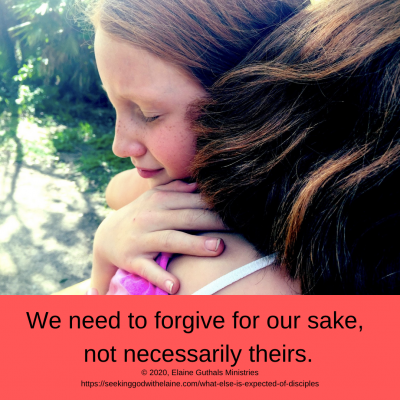
  • Did Jesus or His Blood Redeem Us?

    What is the difference between propitiation and atonement? One talks about Jesus while the other talks about His blood. This devotion looks at both aspects.

    Nuggets

    • We couldn’t redeem ourselves, so Jesus became the substitute.
    • We just have to have faith that Jesus’ blood will do what it is supposed to do – it will.
    • Jesus’s blood covers everyone from Adam to the last baby that was born — as long as they ABCD.
    • Atonement had to be part of the justification process – or there would be no need for substitution.

    Devotions in the God’s Righteousness series

    Did Jesus or His Blood Redeem Us?

    Flowers with title Did Jesus or His Blood Redeem Us?

    Now, depending on the translation, we get different words in Romans 3: 25. To me, they are two different concepts, so we are going to look at both.

    One word is propitiation; the other, atonement. To me, one talks Jesus, the other talks blood.

    So, which one redeemed us?

    Let’s Put It into Context

    Jesus became the propitiation for us. Propitiation means that a substitute is offered to avoid God’s wrath. Jesus knew God’s wrath had to be appeased so He shed His blood to pay the price for our sins.

    Where propitiation is about the substitute, atonement is about repayment for a wrong. The repayment was the shedding of His blood.

    So, which one redeemed us?

    Propitiation

    “God presented Him as a propitiation through faith in His blood, to demonstrate His righteousness, because in His restraint God passed over the sins previously committed” (Rom. 3: 25 HCSB)

    We couldn’t redeem ourselves, so Jesus became the substitute. He could do the hard stuff, the stuff we would never be able to do.

    But did you catch the first part of the verse. “God presented Him as a propitiation …” (Rom. 3: 25 HCSB).

    It was God’s idea. “God has now revealed to us his mysterious will regarding Christ — which is to fulfill his own good plan” (Eph. 1: 9 NLT).

    God picked the substitute. It was His plan of salvation. He picked the Sacrifice.

    God picked Jesus as the substitute because He wasn’t leaving anything to chance. He didn’t want there to be any possibility that He could not accept the sacrifice. He knew Jesus was worthy to be the sacrifice.

    We mean that much to Him.

    Remember, Paul had just said, “Even before he made the world, God loved us and chose us in Christ to be holy and without fault in his eyes” (Eph. 1: 4 NLT). We’ve talked before about how much God loves us because He put this plan in place even before He made us.

    Jesus never balked at being the substitute. He was always up for it. He was invested in the plan even before He met us.

    We mean that much to Him.

    We just have to have faith that Jesus’ blood will do what it is supposed to do. It will.

    So, let’s move on to the last half of the verse. I want to focus on “… to demonstrate His righteousness, because in His restraint God passed over the sins previously committed” (Rom. 3: 25 HCSB).

    Dykes explained what that meant. He wrote, “God suffered [the sins of men] to go by unavenged.”

    Jesus was put up on the cross — so everyone could see the sacrifice that would pay the price for our sins. Because Jesus did that, God isn’t punishing us as we deserve – our sins are unavenged. That is where God’s mercy comes into play.

    Glossary

    But it is also more than that. Remember we talked about longsuffering. Longsuffering is persevering through an event — particularly a hardship — for a significant amount of time with patience.

    To read a related devotion, click the appropriate button below.

    God wanted our relationships restored. But He had to patiently wait until the time was right to send Jesus to be the Sacrifice. He had to be longsuffering.

    What did God gain when Jesus finished the plan? Dykes wrote, “But now, since Christ has died, God has no need to ‘wink at’ sin, and pass it by. He no longer holds out to penitents as He used to do a hope that it will one day become possible for Him to blot their sins. For He is now able to deal finally and effectually with sin. Justice has received all the satisfaction it needs or can ask for. No shade of suspicion, whether of feebleness or of injustice, can rest upon the Divine character, in acquitting at once any man for whose guilt Christ has made complete atonement. Now, therefore, God is in a position, not to pretermit sins only, but to remit them; not to promise forgiveness merely, but to confer it. This new attitude it is worth while to trace out in detail.”

    If we look at it that way, it wasn’t actually avenging. Jesus wasn’t punishing the wrongdoer — at least not yet.

    Jesus really was pardoning us. We were absolved of the consequences of our sin — when we ABCD.

    Hell

    Atonement

    “God presented him as an atoning sacrifice in his blood, received through faith, to demonstrate his righteousness, because in his restraint God passed over the sins previously committed. God presented him to demonstrate his righteousness at the present time, so that he would be righteous and declare righteous the one who has faith in Jesus” (Rom. 3: 25-26 CSB).

    When I see propitiation, I see Jesus. When I see atonement, I see blood.

    I mean, there is only so much blood in the human body. How could that finite amount of blood cover the sins of billions and billions of people. Because as of this moment, there are 7,772,500,137. (Fun fact: the population grew by 200,745 today [March 21, 2020]).

    Jesus’s blood covers everyone from Adam to the last baby that was born — as long as they ABCD.

    Emmons wrote, “Adam knew that God was good, but he knew, too, that God was just; that it was morally impossible that He should exercise His goodness inconsistently with His justice; and that His perfect justice implied an inflexible disposition to punish the guilty. It is not probable that Adam thought of an atonement; and if he did, he could not see how an atonement could be made.”

    Atonement had to be part of the justification process. Otherwise, there would be no need for substitution. Atonement is required because God is just.

    Let’s look at it this way. God is just — He doesn’t play favorites.

    • We ask forgiveness for Law #1 — and He forgives us.
    • We do not ask forgiveness for Law #2 — but He forgives us anyway.

    God is not being just if He would do that.

    Oh, I see you jumping up and down. You think I should have said He forgave some people but not others. That is a way He would be unjust if He did that.

    But a lot of people these days think we should be able to pick and choose which laws and commandments we shouldn’t be required to follow. Doesn’t work that way.

    We are called to obey all the laws and commandments, not just the ones we think are still relative.

    See what Jesus said. “Do not think that I have come to abolish the Law or the Prophets; I have not come to abolish them but to fulfill them. For truly, I say to you, until heaven and earth pass away, not an iota, not a dot, will pass from the Law until all is accomplished. Therefore whoever relaxes one of the least of these commandments and teaches others to do the same will be called least in the kingdom of heaven, but whoever does them and teaches them will be called great in the kingdom of heaven” (Mt. 5: 17-19 ESV emphasis added).

    Emmons made an excellent point. “Nothing which Christ did or suffered altered their characters, obligations, or deserts. His obedience did not free them from their obligation to obey the Divine law, nor did His sufferings free them from their desert of suffering the penalty.”

    Neither did Jesus force God to forgive us, even when we don’t ask. Nor did He secure a reward for obedience.

    We have to ask for forgiveness. We have to obey.

    Making the Connections

    “For we conclude that a person is justified by faith apart from the works of the law” (Rom. 3: 28 CSB)

    I had a coworker who, when you asked him an either/or question where the answer was both, would answer “yes.” Did Jesus or His blood redeem Us? Yes.

    Whichever word we use in the verse, we needed both of them. Our blood won’t atone, so we need a substitute. It had to be His blood. No one else was worthy.

    Okay, let’s hook this to the previous devotion. Here are the nuggets.

    • When we look at the list of what the righteousness of God is, it bleeds into His righteousness filtering down to us.
    • If righteousness is a gift, it is received through faith.
    • Jesus justifies us when we put our lives in His hand.
    • God did not have to extend grace to us.
    • To redeem us — to pay the price for our sins — Jesus has to suffer.

    Righteousness, faith, justification, grace, redemption, propitiation, and atonement.

    Faith is the belief that the doctrines stated in God’s Word are true, even if we do not understand all aspects of them. Justification is the act of making something righteous before God through forgiveness. Grace is a free and unmerited gift from Heavenly Father given through His Son, Jesus Christ that enables salvation and spiritual healing to believers. Redemption is where something is used in exchange for something else to gain or regain something. Propitiation means that a substitute is offered to avoid God’s wrath. Atonement is repayment for a wrong.

    • Because of grace, the plan of salvation was designed.
      In order to justify us, Jesus had to be the propitiation for us.
      This atonement accomplished in redemption.
      We access the gift through faith.

    Bottom line. We couldn’t get the job done. We can’t secure forgiveness of our sins by ourselves. All we can do is have the faith that Jesus could — and can — save us.

    Making the Connections to Self-Discipline

    We are also considering what we would say if a non-believer asked us. Here is the worksheet again. What would you tell someone about God forgiving and forgetting sins?

    • What does the Scriptures say?
    • What do I believe?
    • Why do I believe the same/differently than the Scriptures?
    • What are the talking points when witnessing to a non-believer?

    Related Links

    I have created a worksheet of the questions above. Click on the button below to access it.

    How Do We Apply This?

    • Quit running ourselves down. If God values us this much, why don’t we have more self-esteem?
    • Understand we are sinners, can’t save ourselves, and can only reply on Jesus’ sacrifice to pay the price for our sins.
    • ABCD

    The ABCDs of Salvation

    If you have not become a believer in Christ, please read through the
    Plan of Salvation and prayerfully consider what God is asking you to do.

    A – admit our sins
    B – believe His Son Jesus is our Redeemer
    C – confess God as Sovereign Lord

    D – demonstrate that commitment by making any changes needed in our lives to
    live the way in which God has called us

    The Disciple’s Job Description

    Isn’t it wonderful to know that, because we couldn’t save ourselves, God took care of it? But He doesn’t force Himself on us.

    We have two choices — ABCD or not. Choose wisely and choose soon — there may not be much more time left for us to choose. If we don’t, the choice will be made for us — and we don’t want those consequences.

    Father God. You are Sovereign God, and You are — and want to be — our a Father. Convict those who need to ABCD. Nudge those who need to confess unconfessed sin. Thank You for sending Jesus to be our Redeemer. Amen.

    What do you think?

    Leave me a comment below (about this or anything else) or head over to my Facebook group for some interactive discussion.

    If you don’t understand something and would like further clarification, please contact me.

    If you have not signed up for the email daily or weekly providing the link to the devotions and the newsletter, do so below.

    If God has used this devotion to speak with you, consider sharing it on social media.

  • How Are Disciples Humble?

    What does it mean to be spiritually humble as a disciple? This devotion discusses being humble, being proud, and which will inherit the earth.

    Nuggets

    • Spiritually humble and meek disciples are to imitate God.
    • The opposite of being humble is being proud.
    • If disciples humbly submit to God, they will inherit the earth.

    Devotions in the The Beatitudes Show Us How to be Docile series

    Flowers with title How Arre Disciples Humble?

    The third Beatitude talks about being humble and meek. It has a very nice reward attached to it. Let’s take a look.

    Let’s Put It into Context

    We are taking in this series about how disciples ae to be docile. Docile means easily taught. As we grow in our relationship, we become blessed.

    Blessedness means we have been perfected. For the disciple, perfection is holy, sanctified, and righteous.

    Holy means to be set apart, perfect, and pure. Sanctification is the process where our lives are changed, and we made holy. Righteousness is the result of a solid relationship with God.

    Most of the newer versions translate the word humble. Humility is “a personal quality in which an individual shows dependence on God and respect for other persons” (Holman Bible Dictionary).

    The older versions translate it as meek. Meekness is “a personality trait of gentleness and humility, the opposite of which is pride. Meekness does not refer to weakness or passivity but to controlled power.”

    Just a reminder — gentleness is one of the fruits of the Spirit (Gal. 5: 22-23). If we combine Merriam-Webster Dictionary definitions of gentleness and gentle, we get that is the quality or state of being free from harshness, sternness, or violence.

    Did you catch that? Gentleness is used to define meekness, and humility is used to define meekness. So, the foundation is dependence on God.

    What Is Humble?

    “Blessed are the humble …” (Mt. 5: 5 CSB)

    Why are disciples called to be humble and meek? This is how we submit to God.

    Scriptures call us to be

    • Humble — “Therefore, as God’s chosen ones, holy and dearly loved, put on compassion, kindness, humility, gentleness, and patience” (Col. 3: 12 CSB).
    • Respectful of others — “respect everyone, and love the family of believers. Fear God and respect the king” (II Pet. 2: 17 NLT).
    • Submissive — “Therefore, submit to God. Resist the devil, and he will flee from you” (Jas. 4: 7 CSB).
    • Meek — “But the meek shall inherit the land and delight themselves in abundant peace” (Ps. 37: 11 ESV).
    • Gentle — “To speak evil of no one, to avoid quarreling, to be gentle, and to show perfect courtesy toward all people” (Ti. 3: 2 ESV).
    • Not prideful — “When pride comes, then comes disgrace, but with the humble is wisdom” (Prov. 11: 2 ESV).
    • Not harsh — “A soft answer turns away wrath, but a harsh word stirs up anger” (Prov. 15: 1 ESV).
    • Not violent — “not given to drunkenness, not violent but gentle, not quarrelsome, not a lover of money” (I Tim. 3: 3 NIV).

    Barker wrote, “A meek spirit is a spirit of goodwill and clemency: is placid and calm amidst the vexations and cares of life (1 Peter 3:4); is tractable and submissive; forbearing and forgiving; bows to the rod of affliction.”

    Spiritually meek disciples are to imitate God. If God blesses us, we are to thank him. If God tests us, we are to thank Him and pass His test.

    Blackall made an interesting point. He said that humble disciples “will gladly except and thankfully acknowledge help and relief from others.” Ooo, baby that is hard.

    I remember, after Mom got sick, she said the hardest thing for her was to let others do anything for her. She was one independent lady. She said she had to tell herself to let others help her so that they could receive their blessing.

    So, let’s talk about the opposite of being humble. That would be pride.

    In What Are Moral Sins?, we said pride is “undue confidence in and attention to one’s own skills, accomplishments, state, possessions, or position.”

    The Bible talks about two conditions that take confidence over the top: boasting and arrogance. These verses sums it up.

    “But understand this, that in the last days there will come times of difficulty. For people will be lovers of self, lovers of money, proud, arrogant, abusive, disobedient to their parents, ungrateful, unholy, heartless, unappeasable, slanderous, without self-control, brutal, not loving good, treacherous, reckless, swollen with conceit, lovers of pleasure rather than lovers of God, having the appearance of godliness, but denying its power. Avoid such people” (II Tim. 3: 1-5 ESV emphasis added).

    See how important self-discipline is?

    Well, worldview followers probably don’t mind being called lovers of self and money. They are perfectly fine with being called disobedient to God (therefore, unholy).

    Ooo, baby. How many of us want to be called abusive, ungrateful, and heartless? Yep, worldview followers would take issue with that.

    Let’s take ungrateful first. God created mankind (Gen. 1: 26-27). God blessed us (Gen. 1: 28).

    But instead of being grateful and worshiping God, worldview followers are “… lovers of pleasure rather than lovers of God, having the appearance of godliness, but denying its power …” (II Tim. 3: 4-5 ESV).

    How do worldview followers appear godly? Many people today care about others. The problem is their motivation.

    Many worldview followers fight for the right to choose how they are going to live, regardless of what God’s laws and commandments say. Refusing to acknowledge God as Sovereign Lord and not living the way He decrees is not going to end well for them.

    Okay, let’s go to heartless. I would argue that this means they do not have a circumcised heart.

    We talked a couple of times about circumcision of the heart. Circumcision of the heart is where God changes our hearts.

    God wants us to cut out the old sin and replace it with His love and grace. He doesn’t want it to just be a ritual or symbolic. God wants the change to be real, personal, and genuine.

    To read a related devotion, click the appropriate button below.

    Our hearts will always be wicked (sinful) because of our human nature (Jer. 17: 9). That doesn’t mean we get a pass because of that. We will still have to pay the consequences of our sins.

    To read a related devotion, click the appropriate button below.

    Worldview followers do not have a circumcised heart, which could be interpreted as heartless. That, too, is understandable when they refuse to acknowledge God as Sovereign Lord.

    Disciples are persecuted. We have not been persecuted as much in the United States, but we will be. We are going to hold off for now on this discussion because this is a separate Beatitude.

    What Do We Inherit?

    “… for they will inherit the earth” (Mt. 5: 5 CSB)

    If disciples humbly submit to God, they will inherit the earth. The resources that are utilize did not say much about disciples inheriting the earth. Jordan noted that disciples will inherit this earth and the new earth.

    So, let’s look at inheritance. We have looked at it before.

    To read a related devotion, click the button below.

    We become children of God when we asked Jesus to become our Lord and Savior (Jn. 1: 12). Our faith makes us heirs of God (Gal. 3: 26). Our inheritance is a reward for doing God’s Will.

    Three specific rewards that are mentioned are the Holy Spirit (Jn. 3: 5-6), eternal life (Ti. 3: 7), and the kingdom (Jas. 2: 5). The last inheritance is of interest to us right now.

    Another reference we need to look at is Revelation 21: 1-3. It says, “Then I saw a new heaven and a new earth; for the first heaven and the first earth had passed away, and the sea was no more. I also saw the holy city, the new Jerusalem, coming down out of heaven from God, prepared like a bride adorned for her husband. Then I heard a loud voice from the throne: Look, God’s dwelling is with humanity, and he will live with them. They will be his peoples, and God himself will be with them and will be their God” (Rev. 21: 1-3 CSB).

    We know this earth is going to end one day. It isn’t going to be because of something we have or haven’t done. This earth will end because God’s plan of salvation will be complete.

    A new heaven and new earth will take its place. Somewhere here is where we are going to be. Where we will be is with God.

    Making the Connections to Self-Discipline

    Ooo, baby. Go back to the definition of meekness. It is controlled power. Blackall wrote that meek disciples “… have command over their passions.”

    Can we say self-discipline?

    Good wrote about “Resignation to His will” and “Subjection of the mind and judgment to the revelation He has made of His character and grace.” We can only do that through self-discipline.

    How Do We Apply This?

    Okay, we are talking spiritual meekness here. So, what are we talking about?

    We are talking our relationship with God.

    • We need to be submissive and let Him control us.
    • We aren’t supposed to talk back and try to tell Him we know better than He does.
    • We are to change our lives to imitate Him.
    • We are to make Him the priority in our lives.
    • We are to be kind and gentle with others, not argumentative.
    • We are to forgive others, as He forgave us.

    Bottom line is the humility of a disciple is because we know we have sinned and fall short of God’s glory (Rom. 3: 23). We need to submit to His Will.

    Father God. We submit our will to You. We humbly ask that keep us to the day when this earth has passed away. Amen.

    What do you think?

    Leave me a comment below (about this or anything else) or head over to my Facebook group for some interactive discussion.

    If you don’t understand something and would like further clarification, please contact me.

    If you have not signed up for the email daily or weekly providing the link to the devotions and the newsletter, do so below.

    If God has used this devotion to speak with you, consider sharing it on social media.

  • Why Joseph?

    Mary wasn’t the only one who had a change in plans. Joseph did, too. This devotion looks at how Joseph’s character led him to forgiveness.

    Nuggets

    • Joseph was considered a righteous man.
    • Never in his wildest dreams — at this point — did Joseph think Mary was going to be the mother of the Messiah.
    • God changed his plans again.
    Flowers with title Why Joseph?

    I wonder if Joseph’s in-laws realized what a man of character they had for a son-in-law. The little we know about Joseph is positive.

    Joseph probably had his life all planned out. He was going to marry Mary, build up his carpenter shop, have kids, and live a good, long life.

    The clinker came when God changed his plans. Let’s take a look.

    Let’s Put It into Context

    “The birth of Jesus Christ came about this way: After his mother Mary had been engaged to Joseph, it was discovered before they came together that she was pregnant from the Holy Spirit” (Mt. 1: 18 CSB)

    Mary ended up pregnant before the wedding day. In today’s society, that isn’t a big deal. It was back then.

    To read a related devotion, click the button below.

    Oh, man, did Joseph’s bubble of a dream burst right away! Plans changed.

    Things had probably been planned for a while. Betrothals were negotiated by fathers for their kids to be married when they were early youths. There was money (mohar) and gifts (mattan) involved.

    There were two ceremonies. The first ceremony celebrated the betrothal; the second, the marriage. Even though nothing much changed after the first ceremony (like residences), the couple was considered married.

    So, here came Mary, breaking her betrothal vow — or so it appeared. What is Joseph going to do?

    Call the lawyer, it’s time for a divorce. Joseph knew the child wasn’t his. Even if it had been his, there would probably have been talk.

    But it wasn’t, and Joseph didn’t want to be part of that talk. Mary was the one who was unfaithful. It was time to beat a hasty retreat.

    Secret Plans

    “So her husband Joseph, being a righteous man, and not wanting to disgrace her publicly, decided to divorce her secretly” (Mt. 1: 19 CSB).

    Joseph was considered a righteous man. Righteousness is the product of being holy, created by having faith and loving as Jesus does. Holy means to be set apart, perfect, and pure. God gets to choose what is acceptable.

    Now remember, Joseph was an Old Testament person. All he had was the promise of the Messiah. Joseph had the Old Testament faith.

    Never in his wildest dreams — at this point — did Joseph think Mary was going to be the mother of the Messiah. To him, this was just a regular baby — the baby that wrecked his plans.

    Any anger Joseph had — and it would have been human to be angry — did not stop him from thinking this through. He was conscientious and had integrity.

    Things were right, then they went wrong, but Joseph wanted to do the right thing.

    So, Joseph decided to exit quietly. He didn’t want to add to the talk surrounding Mary. He was hurt, yes – but he obviously felt something for her and didn’t want to add to the gossip mill.

    How many of us would do that? We would be concentrating on our own hurt, not what Mary was feeling. Even if we did, we would probably say she got her just desserts.

    No, Joseph was a man of character and didn’t get tunnel vision.

    Plans Get Changed Back

    “But after he had considered these things, an angel of the Lord appeared to him in a dream, saying, ‘Joseph, son of David, don’t be afraid to take Mary as your wife, because what has been conceived in her is from the Holy Spirit’ (Mt 1: 20 CSB)

    Oops. God changed his plans again. What is He thinking? He’s already turned Joseph’s life upside down. Now what?!

    Well, God changed it back to what Joseph was originally planning – he was to marry Mary. He was supposed to accept Someone else’s child – and love Him and raise Him.

    Did you catch that? Joseph’s father was not named David. “and Jacob fathered Joseph the husband of Mary, who gave birth to Jesus who is called the Christ” (Mt. 1: 16 CSB).

    Like Mary (Lk. 3: 31), Joseph was a great … great grandkid of David (Mt. 1: 6) — only different one of David’s kids. Saying he was the son of King David would have told Joseph right off that this was something of importance.

    The reference also would have told Joseph that this was beyond him and Mary. It would have told him it had national importance.

    Dad Duty

    “She will give birth to a son, and you are to name him Jesus, because he will save his people from their sins” (Mt. 1: 21 CSB)

    One of the first things dads get to help in is naming the baby. Up to now, he has just been support during delivery.

    Naming the baby was important to the Jewish people. We know that “naming a baby is a statement of [his] character, [his] specialness, and [his] path in life” (Simmons).

    Do you think that, even though God is giving Joseph the name — just as He did Mary (Lk. 1: 31) — He is saying, “Jesus is going to need you as a father. You are going to have to stand up and say ‘His name is Jesus.’ I picked you, too.”

    Making the Connections

    Okay, it wasn’t exactly as Joseph planned. He was going to be Mary’s husband. A Kid was definitely in the future. I love what Adam once said. “Just because we think we know what God has planned doesn’t mean he can’t blindside us with something better.” Joseph did get something better.

    Just because we think we know what God has planned doesn’t mean he can’t blindside us with something better. -- Adam Carrier

    Joseph exhibited the forgiveness that God has for us. Even once he knew that this was a special baby and Mary wasn’t unfaithful, he could have still carried resentment that his plans had changed. But he didn’t. He was able to forgive and move on.

    This man of character was to be there to support Mary in all of the difficult times ahead. He was to be there to take charge when Herod’s men came calling (Matt. 2: 13-16).

    We talked in about Joseph having three recorded dreams. 1) Marry Mary. 2) Go to Egypt. 3) Go home.

    To read a related devotion, click the button below.

    When Joseph’s plans changed and changed again, how did he react? He immediately obeyed God (Matt. 1: 24; 2: 14).

    Joseph made his dreams be what God had planned for him.

    How Do We Apply This?

    In the eyes of the world, Mary screwed up. Mary “sinned.” (We know she didn’t, but townspeople would have thought she did.)

    We can learn a lot from Joseph.

    • How do we interact with someone who has sinned?
    • How do we forgive them?
    • How do we mend the relationship?

    When things are in turmoil, we have to fall back on our character. We have to stand rock firm on our faith.

    No, we don’t know much about Joseph except he probably didn’t get his long life. Somewhere between when Jesus was 12 and when He was 30, we think God changed Joseph’s plan again and called him home.

    Somehow, I just bet Joseph said what John the Baptist said, “He must increase, but I must decrease” (Jn. 3: 30 KJV). Joseph was truly a man of character.

    Lord God Jehovah. You have told us in Your Word that You have plans for us. We have plans for our lives, also. Help us to seek You Will, not our own. Forgive us when we have trouble giving up our own plans when You change them. Yours are better for us. We want to do You Will. Amen.

    What do you think?

    Leave me a comment below (about this or anything else) or head over to my Facebook group for some interactive discussion.

    If you don’t understand something and would like further clarification, please contact me.

    If you have not signed up for the email daily or weekly providing the link to the devotions and the newsletter, do so below.

    If God has used this devotion to speak with you, consider sharing it on social media.