Category: Forgiveness

  • Joseph Provided for His Brothers and Family

    Jacob’s 11 sons were returning home with good news. This devotional reading looks at their leaving Egypt and Jacob’s reaction to that good news.

    Nuggets

    • Everyone was happy for Joseph that his family was there.
    • Joseph began providing for his family even before they moved there.
    • If we look at the Hebrew for this passage, layers of emotion are added to what we can already see.
    • The impossible was happening.
      Joseph was a man to whom people bowed down.
    • Jacob had a much more physical reaction than being stunned.
    • But no – it was too much for Jacob to believe.
    • The brothers came clean.
    • Now – now – Jacob wasn’t just happy; he had his life back.
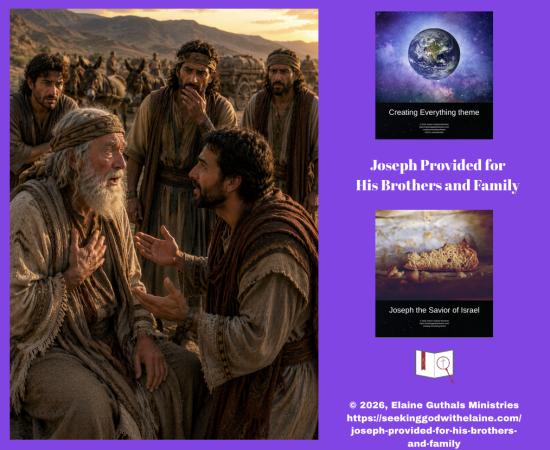
    joseph-provided-for-his-brothers-and-family

    Joseph had revealed who he really was to his brothers, and they had an emotional reunion.

    But it’s now time to go back to Canaan, pick up his father, and move down to Egypt. How in the world could they pull that off?

    Let’s Put It into Context

    To read devotions in the Creating Everything theme, click the button below.

    Devotions in the Joseph the Savior of Israel  series

    Pharaoh Invited Jacob to Egypt

    “The news soon reached Pharaoh’s palace: ‘Joseph’s brothers have arrived!’ Pharaoh and his officials were all delighted to hear this. Pharaoh said to Joseph, ‘Tell your brothers, “This is what you must do: Load your pack animals, and hurry back to the land of Canaan. Then get your father and all of your families, and return here to me. I will give you the very best land in Egypt, and you will eat from the best that the land produces.”’ Then Pharaoh said to Joseph, ‘Tell your brothers, “Take wagons from the land of Egypt to carry your little children and your wives, and bring your father here. Don’t worry about your personal belongings, for the best of all the land of Egypt is yours”’” (Gen. 45: 16-20 NLT)

    Everyone was happy for Joseph that his family was there.

    Sometimes, we get an engraved invitation. Pharaoh himself invited Jacob and his family to move to Egypt. In fact, he made the move easy by providing wagons. He promised to give them the best land. He even said leave your personal belongings because they would be replaced.

    Israel’s sojourn in Egypt started out on friendly terms. Remember the promise in Abraham’s covenant. “I will bless those who bless you and curse those who treat you with contempt …” (Gen. 12: 3 NLT).

    Because Egypt is participating in covenant preservation, they were blessed.

    Knowing how the story ends, we know it didn’t end well regardless of how it started out.

    But isn’t that how sin works? It looks all good and shiny at the beginning.

    That, however, is what Satan wants it to look like. We wouldn’t be tempted if it looked all hard and painful.

    There is only so long that Satan can keep up – and wants to keep up – the delusion. He wants us to get to the acknowledgment that it really is a sin.

    But this is what Jehovah wanted. He wanted Israel tucked safely in Egypt to ride out the famine.

    The Brothers Left Egypt

    “So the sons of Jacob did as they were told. Joseph provided them with wagons, as Pharaoh had commanded, and he gave them supplies for the journey. And he gave each of them new clothes — but to Benjamin he gave five changes of clothes and 300 pieces of silver. He also sent his father ten male donkeys loaded with the finest products of Egypt, and ten female donkeys loaded with grain and bread and other supplies he would need on his journey. So Joseph sent his brothers off, and as they left, he called after them, ‘Don’t quarrel about all this along the way!’” (Gen. 45: 21-24 NLT)

    Joseph began providing for his family even before they moved there.

    Along with the wagons Pharaoh had provided, Joseph took care of many other things they would need. He provided food, money, supplies, animals, and clothes.

    The brothers – this time – were not jealous when Benjamin got special treatment. They had changed.

    That last verse always slays me. “Don’t quarrel, guys.” Did Joseph know his brothers or what!?

    Well, that is human nature – especially on a road trip. Nothing is normal or routine. There were 11 personalities that were in play.

    I wonder if Joseph had a clue what the quarrel would be about – responsibility for selling Joseph.  That is human nature, too.

    It wasn’t that Joseph didn’t want them to not take responsibility for their actions. He knew each one would have to be held accountable by Jehovah for their part.

    So, it wasn’t about shirking responsibility and accountability.

    It was about transforming their relationship with each other. Yes, Joseph was going to have to build a relationship with each brother.

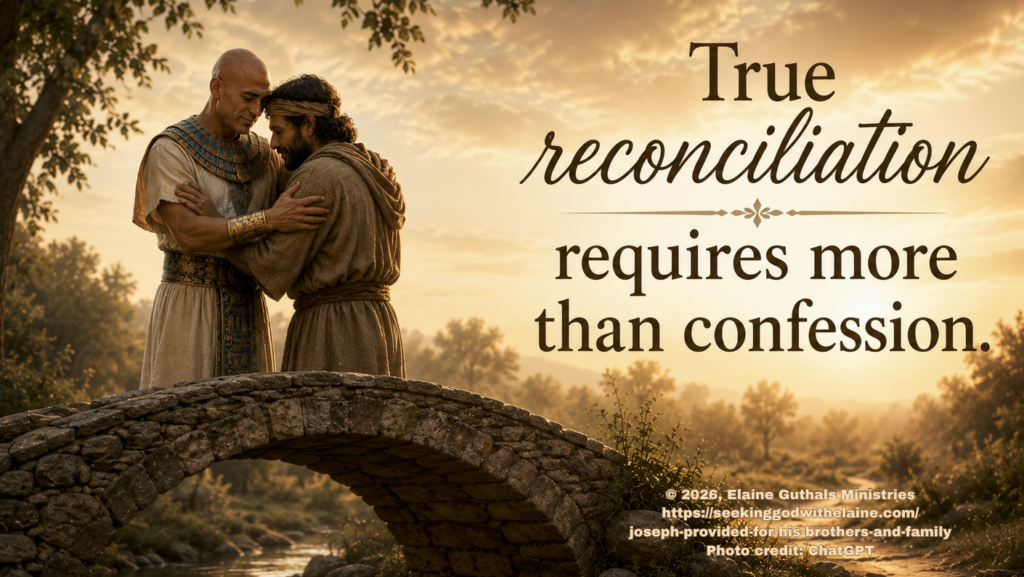
    But Joseph knew that they were going to have to work on their interpersonal relationships, too. True reconciliation requires more than confession.
    Arrived Home

    “And they left Egypt and returned to their father, Jacob, in the land of Canaan. ‘Joseph is still alive!’ they told him. ‘And he is governor of all the land of Egypt!’ Jacob was stunned at the news — he couldn’t believe it. But when they repeated to Jacob everything Joseph had told them, and when he saw the wagons Joseph had sent to carry him, their father’s spirits revived. Then Jacob exclaimed, ‘It must be true! My son Joseph is alive! I must go and see him before I die’” (Gen. 45: 21-28 NLT)

    Left Egypt

    If we look at the Hebrew for this passage, layers of emotion are added to what we can already see.

    It says that the brothers went up – ‘alah (עָלָה). This is true because Canaan is at a higher elevation geographically than Egypt.

    But going up also signifies a spiritual and covenant significance. Their dire circumstances were being provided for by Jehovah.

    True, Egypt would be a temporary provision. Canaan was the covenant land.

    For this trip, they were returning to the covenant patriarch.

    Joseph Is Still Alive!

    The impossible was happening.

    The wording in the Hebrew is in a little different order. They are the same words, but the different order places the emphasis elsewhere.

    The Hebrew – ʿôd yôsēp ḥay (עוֹד יוֹסֵף חַי) – says still Joseph lives. Yes, it was Joseph they were talking about.

    But for over twenty years, Jacob thought Joseph was dead. After all these years – the years that Jacob had emotionally lived through – Jacob was going to see Joseph again. He was going to get to talk to him and hold him.

    Governor of All the Land of Egypt

    Joseph was a man to whom people bowed down.

    In the Hebrew, Joseph’s title is mōshēl (מֹשֵׁל) – ruler, governor, or one exercising dominion. This word connects back to Joseph’s dreams in Genesis 37.

    Jacob would have known that the brothers were angry at Joseph for his dreams. He would also know that they had come true – in a grander fashion than any had imagined could happen.

    Jacob Was Stunned

    Jacob had a much more physical reaction than being stunned.

    The Hebrew is wayyāp̄og libbô (יָּפָג לִבּוֹ). The important word is the verb – pûg (פּוּג). This can mean grow faint, become weak, lose strength, become cold, or collapse emotionally.

    Yeah, I would say that Jacob experienced all of that. His whole emotional system essentially just shut down.

    Probably the first month, Jacob thought Joseph would come walking into camp – torn up by some animal, true – but home. Any parent would probably hope beyond hope that, since there was no body found, Joseph got away from whatever attacked him.

    Hard telling how long Jacob would have thought that. Slowly, he would recognize that Joseph wasn’t coming home.

    Acceptance does not stop grief from occurring, especially debilitating grief.

    Remember how Moses described it. “Then Jacob tore his clothes and dressed himself in burlap. He mourned deeply for his son for a long time. His family all tried to comfort him, but he refused to be comforted. ‘I will go to my grave mourning for my son, he would say, and then he would weep” (Gen. 37: 34-35 NLT).
    He Couldn’t Believe It

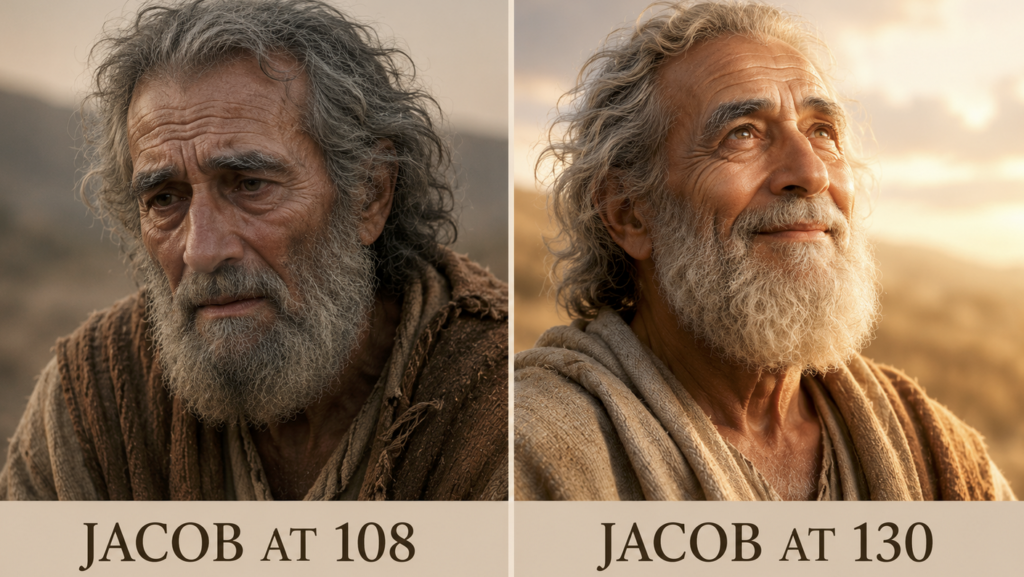
     But no – it was too much for Jacob to believe.

    Look at the Hebrew. It says he didn’t believe them – lōʾ-heʾĕmîn lāhem (לֹא־הֶאֱמִין לָהֶם). The verb is ʾāman (אָמַן). It means believe, trust, support, confirm, or establish.

    There are some powerful words that are in the same root family. They are Amen, faithfulness, firmness, and reliability.

    The brothers lied to their father. No, Jacob probably didn’t have any clue about what they had done. But it was a dysfunctional family – all the way back to Abraham.

    Jacob would have known the character of his sons.

    True, what they told their father wasn’t something that could be understood on first telling.

    That just shows even more how God is God of the impossible. “But Jesus looked at them and said, ‘With man this is impossible, but with God all things are possible’” (Mt. 19: 26 ESV).

    Repeated to Jacob Everything Joseph Had Told Them

    The brothers came clean.

    The brothers told them all the words of Joseph. That would have included “But don’t be upset, and don’t be angry with yourselves for selling me to this place. It was God who sent me here ahead of you to preserve your lives” (Gen. 45: 5 NLT).

    They would have told Jacob of false evidence, hidden guilt, silence, and fear. They would have told him of jealousy and anger.

    But there was visible evidence that they were now telling Jacob the truth. The wagons were real.

    If Jacob had any emotions left to feel, those words would have probably used those up.  How can a father listen to his ten sons tell him that they did what they did to Joseph?

    Forget that Joseph was the favorite for a minute. Think only about the ten sons. Jacob would have more than likely asked himself how they could have gotten to that point.

    But then Jacob would have to stop and take responsibility for his actions. His favoritism can’t be forgotten for long.

    They all – except Benjamin – had a hand in this sorry tale.

    Their Father’s Spirits Revived

    Now – now – Jacob wasn’t just happy; he had his life back.

    Moses said that the spirit of their father Jacob revived – watteḥî rûaḥ yaʿăqōb (וַתְּחִי רוּחַ יַעֲקֹב). The verb is ḥāyâ (חָיָה). It means live, revive, restore to life, or recover vitality.

    For over twenty years, Jacob had existed as a dead man. He was in mourning and deep despair. He expected his own death.

    It was more than that. His rûaḥ (רוּחַ) – spirit, inner life, or vitality – had returned.

    Had Joseph’s disappearance strained Jacob’s relationship with Jehovah? If it had, that relationship had now been restored.

    In verse 28 in the Hebrew, Jacob is called Israel. Remember, we said that occurs when we are talking covenant identity and his patriarchal role.

    It was enough. Jacob didn’t have to see Joseph. He just had to know that his son lived. He was now a father again.

    The hope of seeing Joseph was all that Jacob needed.

    Making the Connections

    Joseph’s reveal was an important, emotional time for the brothers. It might remind us of another meeting.

    Think about when Jacob reunited with Esau after 20 years. It had some similar elements to it while carrying other elements.

    Esau had threatened to kill Jacob after Jacob had deceived Isaac and received the firstborn’s blessing. The brothers had initially wanted to kill Joseph.

    Both Jacob and Joseph were away from their family for two decades. Joseph was gone a couple of more years that Jacob.

    Both worked under the supervision of someone else. Neither – until Joseph interpreted a dream – were in charge of their actions. Jacob probably had a little more say in his life than Joseph did – but probably not a whole lot.

    Both fulfilled covenant responsibilities when in exile to another land.

    A big difference was that Jacob was free. He was receiving compensation for his work – the chance to marry Rachel. Joseph was a slave and, until the king needed an interpreter, he was in prison.

    Their age difference was also significant. Jacob was 77 when he fled Canaan. Joseph was 17 when he had no choice but to go with the traders.

    What can we learn from this? Jehovah does work in patterns. He does do things in His own time. Most of all, He follows His plan, regardless of how challenging and heartbreaking it is for us.

    How Do We Apply This?

    • Trust Jehovah even when you cannot see what He is doing behind the scenes and His plans seem delayed.
    • Wait patiently for Jehovah’s timing instead of demanding your own.
    • Surrender the unanswered parts of your story to Jehovah’s care.
    • Refuse to let grief become your identity by choosing hope instead of despair when circumstances seem impossible.
    • Look for evidence of Jehovah’s faithfulness when doubt begins to overwhelm you.
    • Thank Jehovah for the ways He has carried you through past trials and demonstrated His faithfulness.
    • Allow Jehovah to restore what grief, disappointment, or loss has taken from you.
    • Believe that Jehovah can accomplish what seems impossible from a human perspective.
    • Focus on God’s promises rather than your present circumstances.

    Father God. Thank You that You are in control even when we don’t see You working. Help us to wait patiently for You to work and to remain obedient in all times. Amen.

    If you don’t understand something and would like further clarification, please contact me.

    If you have not signed up for the email providing the link to the devotions and the newsletter, do so below.

    If God has used this devotion to speak with you, consider sharing it on social media.
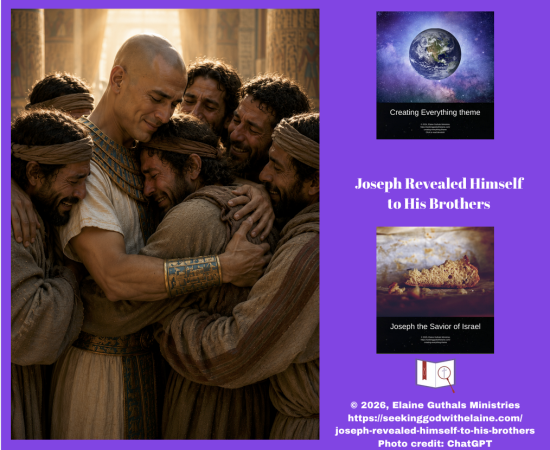
  • Joseph Revealed Himself to His Brothers

    The day had finally come. This devotional reading looks at the time when Joseph revealed to his brothers who he actually was.

    Nuggets

    • When Joseph became emotional and was going to reveal himself to his brothers, he didn’t want an audience.
    • Ooo, baby! Were the brothers in for the shock of their lives!
    • Joseph asked his brothers about Jacob.
    • Joseph’s reveal stopped his brothers in their tracks.
    • Joseph knew this was bigger than him.
    • Joseph explained the famine was going to be around for a while.
    • Joseph recognized that his brothers were not responsible for sending him to Egypt – but that did not erase their responsibility.
    • Joseph told his brothers to quickly bring Jacob to Egypt.
    joseph-revealed-himself-to-his-brothers

    The brothers had put Joseph through much pain and sorrow. Joseph had put his brothers through a period of testing to see if they had changed over the 22 years since they had sold him into slavery.

    Now, it was time to reveal who he really was.

    Program note: This devotion went long, so I cut it in half. I am leaving the connections and applications for the next devotion.

    Let’s Put It into Context

    To read devotions in the Creating Everything theme, click the button below.

    Devotions in the Joseph the Savior of Israel  series

    Joseph Reveals His Identity

    “Joseph could stand it no longer. There were many people in the room, and he said to his attendants, ‘Out, all of you!’ So he was alone with his brothers when he told them who he was. Then he broke down and wept. He wept so loudly the Egyptians could hear him, and word of it quickly carried to Pharaoh’s palace. ‘I am Joseph!’ he said to his brothers. ‘Is my father still alive?’ But his brothers were speechless! They were stunned to realize that Joseph was standing there in front of them” (Gen. 45: 1-3 NLT)

    Many People in the Room

    When Joseph became emotional and was going to reveal himself to his brothers, he didn’t want an audience.

    I guess it never registered before that there were so many people in the room. It does seem logical.

    Joseph was a very important person in the Egyptian government. If he is responsible for seeing all those who have come to buy grain, that would be Egyptians and other foreigners, such as his brothers were.

    There may have been people who helped the customers pay, pick up their grain, find the door out – any number of things. Then there was probably one person who was keeping an accounting record.

    There may even have been what we would call security guards.  If others from another country were there to overtake the Egyptians, it would fit that they have guards there to protect Joseph.

    Joseph became so emotional that he had to reveal himself. It sounds like he broke down and sobbed.

    I am sure that the emotion stemmed from his realization that there could be true reconciliation with his brothers.

    Think about it. Joseph had been in Egypt 22 years. There had probably been a time or two that he dreamed of this moment – especially after the brothers’ first visit. He probably yearned for a time when the family could be reunited and restored.

    That day had come.

    I Am Joseph!

    Ooo, baby! Were the brothers in for the shock of their lives!

    “Hey, I’m really Joseph.”

    They probably weren’t even thinking that this was #2 in all of Egypt. They weren’t thinking of dreams and bowing down.

    They were probably thinking, “This is who we wronged.” We’ll talk about this again in Genesis 50.

    But just think. If they were still wrestling with this after five more chapters, this was a big moment for them.

    Is My Father Still Alive?

    Joseph asked his brothers about Jacob.

    I don’t get this. Judah had just told Joseph about Jacob not wanting Benjamin to come with them on this trip. If he was dead, that wouldn’t have happened. Did Joseph think Judah had lied to him?

    Maybe Joseph was just so emotional and happy to be able to talk about it, he just asked. I think that has to be something for the UNR book – understanding not required.

    His Brothers Were Speechless

    Joseph’s reveal stopped his brothers in their tracks.

    We do have to cut the brothers some slack. The Joseph they probably had in their mind all these 22 years was the 17-year-old tattletale. They would have never imagined he would become the #2 man in Egypt.

    The brothers would never have connected that dreamer with the powerhouse that stood before them.

    But isn’t that what often happens to us? Our view of today is often colored by our perceptions of the past. “Oh, he is mean because he threw a chair at me 20 years ago when he was 5.”

    The boys knew they had sold Joseph into slavery. But I wonder if they had somewhat begun to believe Joseph had been killed by an animal — just of the two-legged variety.

    We have to let go of the past when the present is staring us in the face. Yes, hard. But necessary.

    Joseph Explained

    “‘Please, come closer,’ he said to them. So they came closer. And he said again, ‘I am Joseph, your brother, whom you sold into slavery in Egypt. But don’t be upset, and don’t be angry with yourselves for selling me to this place. It was God who sent me here ahead of you to preserve your lives. This famine that has ravaged the land for two years will last five more years, and there will be neither plowing nor harvesting. God has sent me ahead of you to keep you and your families alive and to preserve many survivors. So it was God who sent me here, not you! And he is the one who made me an adviser to Pharaoh — the manager of his entire palace and the governor of all Egypt” (Gen. 45: 4-8 NLT)

    But Don’t be Upset

    Joseph knew this was bigger than him.

    Oh, it probably took a minute to get to that realization. But Joseph got to this point.

    Joseph knew that, as bad as being sold by his brothers was, Jehovah did that for a reason. That reason was standing in front of him.

    Jacob’s family was starving, and they needed Joseph to save them. Sovereign God made sure Joseph was there to do that.

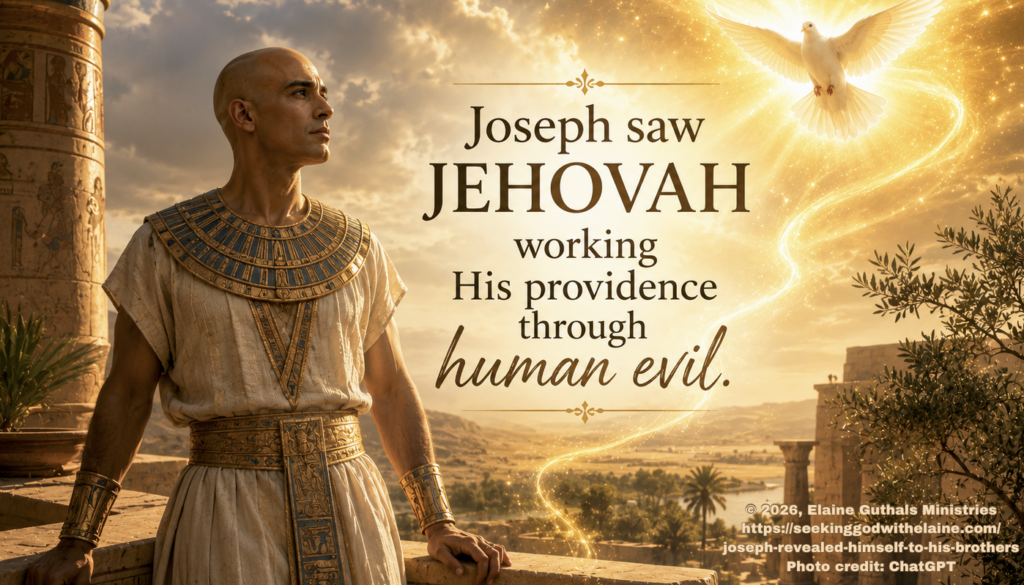
    Joseph saw Jehovah working His providence through human evil.

    We sometimes think only good things should happen to us when we are disciples of Christ. We think believing in Him should make for smooth sailing.

    That isn’t the case.

    True be known, we grow quickly in the throes of a trial. When we know we can’t rely on ourselves, we learn the lesson better that we must rely on Jehovah.

    Jehovah will use both good and bad to further His kingdom. We don’t know when the bad is the best for us.

    This Famine

    Joseph explained the famine was going to be around for a while.

    Since Jehovah had Joseph interpret Pharaoh’s dream, he knew how long the famine would last. He knew his family would have trouble in Canaan.

    Joseph got it. The covenant family must survive.

    Their family may have been small at that time; but if they didn’t survive, they wouldn’t have the opportunity to grow larger.

    Without Joseph,

    • Jacob’s family would have died in the famine.
    • Israel would have never grown into a nation.
    • The covenant line would collapse.
    • The messianic line wouldn’t have followed.

    God Sent Me Here, not You

    Joseph recognized that his brothers were not responsible for sending him to Egypt – but that did not erase their responsibility.

    Joseph saw God’s hand orchestrating every step of his journey. The brothers would not have sold him to Egypt if it would not have been part of His plan.

    Still, the brothers made the choice to sin.

    I know. We struggle with that concept.

    How can it be a sin when it was what Jehovah wanted?

    That is an easy answer. The ends do not justify the means.

    • The brothers didn’t love Joseph.
    • They didn’t follow God’s Will when he told them that they would bow to Joseph.
    • They let their pride and anger rule them instead of love and compassion.
    • They deceived Jacob.
    • They didn’t respect a person’s life.

    God’s sovereignty is above human rebellion.

    The rejected son was set up to provide for the family. He can do this because he was an advisor to Pharaoh.

    Sending the Brothers Home

    “Now hurry back to my father and tell him, ‘This is what your son Joseph says: God has made me master over all the land of Egypt. So come down to me immediately! You can live in the region of Goshen, where you can be near me with all your children and grandchildren, your flocks and herds, and everything you own. I will take care of you there, for there are still five years of famine ahead of us. Otherwise you, your household, and all your animals will starve’” (Gen. 45: 9-11 NLT)

    Joseph told his brothers to quickly bring Jacob to Egypt.

    Joseph even knew where the family could live. There was an area of Egypt called Goshen that was perfect for shepherding. A secondary bonus was that it was separated from Egyptian society.

    Sandwiched in Jacob’s speech were the words, “I will take care of you.” He could do that because he had become the master over all land of Egypt.

    Providing for the Family

    “Then Joseph added, ‘Look! You can see for yourselves, and so can my brother Benjamin, that I really am Joseph! Go tell my father of my honored position here in Egypt. Describe for him everything you have seen, and then bring my father here quickly.’ Weeping with joy, he embraced Benjamin, and Benjamin did the same. Then Joseph kissed each of his brothers and wept over them, and after that they began talking freely with him” (Gen. 45: 12-15 NLT)

    Ooo, baby, I bet the brothers didn’t know what to think at first.

    Joseph didn’t flat out say that the brothers had sold him into slavery. He did, however, imply what they had done was something terrible.

    But this reconciliation wasn’t about what they had done. It was about what needed to be done in the immediate future.

    They needed to get on their donkeys and ride back to Jacob. They needed to pack up their households and come back.

    Joseph would have seen the confusion on their faces. He knew he was basically being raised from the dead in their minds. He knew there were probably some fallout from any lingering guilt.

    The tears, embraces, and kisses put them at ease. The best words of the whole story are, “… after that they began taking freely with him” (Gen. 45: 15 NLT).

    I wonder if they were ever able to talk peacefully and freely with Joseph. Jacob’s favoritism was long-rooted and deep-seated. They would have grown up angry at Joseph.

    Sin fractured the family. Jehovah restored communication.

    Father God. We love happy endings. We thank You that You preserved the covenant line. If You hadn’t we wouldn’t be able to call You Father today. Amen.

    If you don’t understand something and would like further clarification, please contact me.

    If you have not signed up for the email providing the link to the devotions and the newsletter, do so below.

    If God has used this devotion to speak with you, consider sharing it on social media.
  • Joseph’s Final Test

    Joseph was attempting to reconcile with his brothers. This devotion looks at the final test Joseph had for them before he revealed himself to them.

    Nuggets

    • Joseph gave the steward specific instructions about how to handle the grain for the brothers.
    • Joseph had the steward to put a silver cup in Benjamin’s bag.
    • Joseph sent the steward to stop the brothers.
    • The steward probably blindsided the brothers with his accusation.
    • Without knowing the “culprit,” the brothers sentenced the guilty person to death.
    • And worse luck — the cup was found in Benjamin’s sack.
    • Tore their clothing is a classic way to show sorrow.
    • The brothers came back to Joseph’s palace to defend Benjamin.
    • Judah answered for the brothers.
    • Joseph reiterated that the judgment was only for Benjamin.
    • Judah laid it all out for Joseph.
    • Judah argued that making Benjamin a slave in Egypt would destroy Jacob completely.
    • Judah offered to remain as Joseph’s slave in Benjamin’s place.
    josephs-final-test

    We left Joseph and the brothers eating a meal together – sort of – at least in the same room. We don’t know what happened after that.

    We pick up the story the next morning. The brothers are getting ready to go back to Canaan. And that is when everything falls apart.

    Let’s Put It into Context

    To read devotions in the Creating Everything theme, click the button below.

    Devotions in the Joseph the Savior of Israel  series

    Setting Up the Ruse

    “When his brothers were ready to leave, Joseph gave these instructions to his palace manager: ‘Fill each of their sacks with as much grain as they can carry, and put each man’s money back into his sack. Then put my personal silver cup at the top of the youngest brother’s sack, along with the money for his grain.’ So the manager did as Joseph instructed him” (Gen. 44: 1-2 NLT)

    Joseph Gave These Instructions

    Joseph gave the steward specific instructions about how to handle the grain for the brothers.

    Okay, the steward – who sounds like he had a clue about what was going on – was probably still scratching his head. “Wine them and dine them. Give them back their money. Put a surprise gift in the sack. Accuse them.”

    But look at it this way. Even the steward knew who the youngest brother was.

    Joseph didn’t hide the fact that his family were there. What does that tell us about his relationship with his servants?

    The first thing is that Joseph confided in them. He was the second-most important person in Egypt at that time, and he shared this personal experience with at least one of his servants.

    The second thing is how much joy Joseph must have been feeling to see his family again. Yes, they treated him unfairly. They were downright mean to him.

    Joseph still loved them.

    The third thing is that it showed how much Joseph valued people and relationships. I am sure he got satisfaction from knowing Jehovah used him to save lives.

    Joseph would have had to have had an accomplice in the drama he was creating. He wouldn’t have been able to pull this off on his own. I think it would have been very difficult for him to put the money in the sack by himself.

    The reason for putting the money in the bags hadn’t changed from the last time. Since Joseph saved the whole country from starvation, surely his family could eat for free. He was going to provide for them.

    Personal Silver Cup

    Joseph had the steward to put a silver cup in Benjamin’s bag.

    The brothers had sold Joseph for 20 pieces of silver (Gen. 37: 28). Now, that sin would be revisited and cut off by Joseph’s orchestrating events to frame Benjamin.

    Later, this cup was described in helping Joseph with divination. Divination was an Ancient Near Eastern practice of determining divine will, through objects and ritual techniques. They believed the gods communicated indirectly through signs in nature, including celestial movements, animal organs, unusual, births, dreams, and historical events.

    Joseph was propagating the ruse that he used divination. We know that is not correct, but he was strengthening the brothers’ perception that he was an Egyptian.

    Going After the Brothers

    “The brothers were up at dawn and were sent on their journey with their loaded donkeys. But when they had gone only a short distance and were barely out of the city, Joseph said to his palace manager, ‘Chase after them and stop them. When you catch up with them, ask them, “Why have you repaid my kindness with such evil? Why have you stolen my master’s silver cup, which he uses to predict the future? What a wicked thing you have done!”’” (Gen. 44: 3-5 NLT)

    Joseph sent the steward to stop the brothers.

    Dawn broke, and the brothers were on their merry way back to Canaan. They would have thought of it as a win: all 11 were riding their donkeys.

    The brothers hadn’t gotten very far before Joseph implemented Step 2. They had sold their brother for silver, deceived their father, and abandoned a favorite son. How many of the activities of Genesis 27 could Joseph reproduce?

    What does Joseph was doing was building a scenario to determine whether the brothers will sacrifice Benjamin or save themselves. He was doing this through public accusation, apparent betrayal, threat of punishment, and danger centered on Benjamin.

    Accusing the Brothers

    “When the palace manager caught up with the men, he spoke to them as he had been instructed. ‘What are you talking about?’ the brothers responded. ‘We are your servants and would never do such a thing! Didn’t we return the money we found in our sacks? We brought it back all the way from the land of Canaan. Why would we steal silver or gold from your master’s house? If you find his cup with any one of us, let that man die. And all the rest of us, my lord, will be your slaves.’ ‘That’s fair,’ the man replied. ‘But only the one who stole the cup will be my slave. The rest of you may go free.’ They all quickly took their sacks from the backs of their donkeys and opened them. The palace manager searched the brothers’ sacks, from the oldest to the youngest. And the cup was found in Benjamin’s sack! When the brothers saw this, they tore their clothing in despair. Then they loaded their donkeys again and returned to the city” (Gen. 44: 6-13 NLT)

    Caught Up with the Men

    The steward probably blindsided the brothers with his accusation.

    The brothers had been upfront about the money the first time, and the steward told them, “We are all good.” They thought that should show they were trustworthy.

    They make a rash declaration that sounds familiar. “But as for your gods, see if you can find them, and let the person who has taken them die! And if you find anything else that belongs to you, identify it before all these relatives of ours, and I will give it back!” But Jacob did not know that Rachel had stolen the household idols” (Gen. 31: 32 NLT).

    If You Find His Cup with Any One of Us

    Without knowing the “culprit,” the brothers sentenced the guilty person to death.

    That is huge. They were all in on selling Joseph. They would be all in if Benjamin was found to be a thief.

    But they also said that the rest of them would become slaves. They were pronouncing judgment on themselves.

    The steward softened the sentence. Only the one who committed the crime would be a slave.

    The Cup Was Found

    And worse luck — the cup was found in Benjamin’s sack.

    But ooo, baby. Another of daddy’s favorites was in the figurative pit, but it wasn’t their doing this time. Time to pay the piper.

    They were betting death and slavery that they would be shown honest.

    Tore Their Clothing

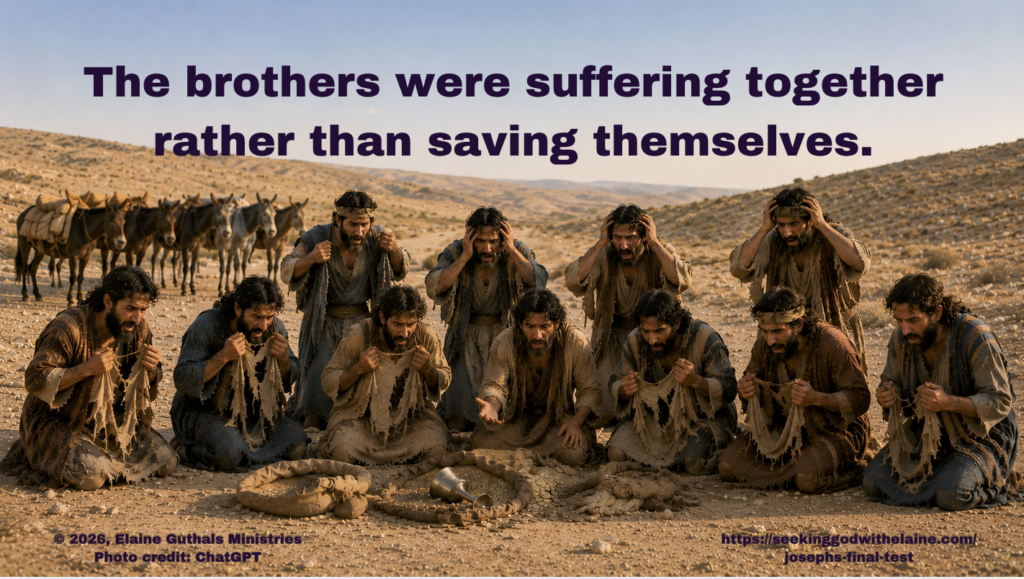
    Tore their clothing is a classic way to show sorrow.

    We have to put this into context. Clothing, in the Ancient Near East, showed identity, dignity, social standing, stability, and public honor.

    Tearing (qāraʿ (קָרַע) — to tear, rend, and rip apart) that clothing symbolized grief, horror, mourning, repentance, outrage, and unbearable emotional collapse.

    It is a visible way to say, “I am undone.” It signifies that their world is ripping apart internally, so they rip apart what covers them externally.

    This is an obvious demonstration of the brothers’ changed characters. They had sold their brother, watched their father tear his garments, and concealed the truth.

    The brothers were suffering together rather than saving themselves.

    We can’t gloss over the fact that this applied to all brothers. They acted as one.

    All repented. Even though we aren’t told their stories in Scripture, they all acted differently.

    Joseph Was Waiting for Them

    “Joseph was still in his palace when Judah and his brothers arrived, and they fell to the ground before him. ‘What have you done?’ Joseph demanded. ‘Don’t you know that a man like me can predict the future?’ Judah answered, ‘Oh, my lord, what can we say to you? How can we explain this? How can we prove our innocence? God is punishing us for our sins. My lord, we have all returned to be your slaves — all of us, not just our brother who had your cup in his sack.’ ‘No,’ Joseph said. ‘I would never do such a thing! Only the man who stole the cup will be my slave. The rest of you may go back to your father in peace’” (Gen. 44: 14-17 NLT)

    Joseph Was Still in his Palace

    The brothers came back to Joseph’s palace to defend Benjamin.

    Of course, Joseph was waiting for the brothers at the palace. It is fitting that he asks what they have done and can’t he predict the future.

    What they had done was betray Joseph. He had predicted their future when Jehovah visited him in a dream to tell him his brothers would bow to him.

    Judah Answered

    Judah answered for the brothers.

    It is interesting to note that Reuben, the firstborn, did not speak up. Judah had already taken over the responsibility of the firstborn after Reuben’s betrayal and Simeon and Levi’s hatred and violence.

    Reuben wasn’t the leader. But then, Judah was one of the instigators in selling Joseph (Gen. 37: 26-27).

    No, Judah wasn’t the man that he was then. His failure in Genesis 38 had humbled him. He had been restored as a covenant son.

    Judah acknowledged the brothers’ guilt — no, not in stealing the cup. They understand this was happening because of their treatment of Joseph.

    Jehovah knew the brothers’ guilt (Gen. 44: 16). Hidden guilt will always surface.

    I Would Never Do Such a Thing!

    Joseph reiterated that the judgment was only for Benjamin.

    This is critical. Joseph had been the last of the baby war. (Benjamin had been born 17 years later so he wasn’t involved.)

    During those 17 years, the baby war had morphed into maternal camps. He knew how important that was to them.

    So, this was the heart of Joseph’s test. Would they leave Benjamin behind?

    Judah’s Speaks for His Brothers

    “Then Judah stepped forward and said, ‘Please, my lord, let your servant say just one word to you. Please, do not be angry with me, even though you are as powerful as Pharaoh himself. My lord, previously you asked us, your servants, “Do you have a father or a brother?” And we responded, “Yes, my lord, we have a father who is an old man, and his youngest son is a child of his old age. His full brother is dead, and he alone is left of his mother’s children, and his father loves him very much.” And you said to us, “Bring him here so I can see him with my own eyes.” But we said to you, “My lord, the boy cannot leave his father, for his father would die.” But you told us, “Unless your youngest brother comes with you, you will never see my face again.” So we returned to your servant, our father, and told him what you had said. Later, when he said, “Go back again and buy us more food,” we replied, “We can’t go unless you let our youngest brother go with us. We’ll never get to see the man’s face unless our youngest brother is with us.” Then my father said to us, “As you know, my wife had two sons, and one of them went away and never returned. Doubtless he was torn to pieces by some wild animal. I have never seen him since”’” (Gen. 44: 18-28 NLT)

    Judah laid it all out for Joseph.

    Judah respectfully approached Joseph.

    This was more than justifying why Judah had answered Jacob the way he did in Genesis 43: 3. It was more than just a “he said, we said, we did” account.

    The speech is emotional, layered, and sacrificial.

    Judah started with information Joseph knew or could figure out. Benjamin became Jacob’s favorite when Joseph was gone.

    Then Judah got to the part which would have interested Joseph. It emphasized the father-son bond.

    That bond with Joseph was what the brothers had been trying to break when they sold him. Joseph wouldn’t have known how they ignored Jacob’s grief.

    Twenty-two years after Rachel’s death, Joseph and Benjamin were still tied to her. Benjamin was the only thing Jacob had left of her.

    But Judah knows now what that grief felt like. He two had lost two sons.

    Sticking Up for Benjamin

    “Now if you take his brother away from me, and any harm comes to him, you will send this grieving, white-haired man to his grave. And now, my lord, I cannot go back to my father without the boy. Our father’s life is bound up in the boy’s life. If he sees that the boy is not with us, our father will die. We, your servants, will indeed be responsible for sending that grieving, white-haired man to his grave. My lord, I guaranteed to my father that I would take care of the boy. I told him, ‘If I don’t bring him back to you, I will bear the blame forever’” (Gen. 44: 29-32 NLT)

    Judah argued that making Benjamin a slave in Egypt would destroy Jacob completely.

    This is the turning point. Judah acknowledges they cannot leave Benjamin to whatever fate Joseph would have for him — deserved, which they doubted, or undeserved.

    But notice. It is no longer about the cup. It is about relationships.

    It was about how Jehovah uncovers deeper, hidden guilt.

    Judah stated that he had personally guaranteed Benjamin’s safety. He didn’t shift the blame. He didn’t protect himself. He didn’t seek gain.

    Judah readily admitted that he was accountable.

    The Substitution

    “So please, my lord, let me stay here as a slave instead of the boy, and let the boy return with his brothers. For how can I return to my father if the boy is not with me? I couldn’t bear to see the anguish this would cause my father!” (Gen. 44: 33-34 NLT)

    Judah offered to remain as Joseph’s slave in Benjamin’s place.

    Remember, the cup hadn’t been directly mentioned since the brothers returned to Joseph’s palace in verse 14. Joseph referred to it by saying he did divination, but he didn’t say how.

    Judah knew this had grown to something bigger than the cup. So, he said, “Pick me.”

    If someone had to stay in Egypt, Judah didn’t want it to be Benjamin. He had promised Jacob he would bring the boy home.

    Judah could take responsibility and offer to be the substitute. This is love, sacrifice, and leadership.

    Making the Connections #1

    Judah’s offer to be the substitute sets up major biblical theology later.

    • Substitution
    • Sacrificial love
    • Intercession
    • Bearing the cost himself
    • The royal line of Judah.

    Judah’s willingness to substitute himself becomes a shadow of a far greater substitution to come.

    Making the Connections #2

    Why is Judah’s transformation important here? Why did we need to see Judah’s failure, humiliation, taking responsibility, and sacrifice?

    Isn’t this about Joseph being the savior of Israel and saving them from the famine?

    No. This is a building block for Genesis 49.

    This is about Joseph saving Judah so Yeshua could be born.

    Yeshua is needed as the Savior of the world because of men and women like Judah. People who sin, have their sins exposed, repent of them, are transformed into having Jehovah’s character, and following His call need Yeshua.

    Every one of us need Yeshua.

    Making the Connections #3

    This chapter also marks another turn. Judah and Joseph emerge as leaders of the family.

    Jacob was hinting at Joseph being designated firstborn when he gave him the tunic. Judah became a leader through living the path Jehovah had for him. He was being prepared for his role in the covenant.

    All Judah needed to do was say, “I was wrong.”

    Making the Connections #4

    Why did Joseph construct this ruse? He wasn’t doing it out of revenge.

    Joseph was trying to determine if there was anything on which true reconciliation could be built.

    If the brothers were not repentant, I don’t think Joseph would have revealed himself to his brothers.

    And I think Joseph would have gotten Benjamin away from them and figured out a way to rescue Jacob.

    Here, Joseph was ensuring there was a foundation on which trust could be built.

    How Do We Apply This?

    • Show repentance by responding differently to the same kind of test.
    • Understand that buried sin is not sin removed.
    • Realize forgiveness does not require pretending nothing happened.
    • Become spiritually mature enough to move from self-preservation to sacrificial love.
    • Stop coming up with excuses so you can begin godly leadership.
    • Don’t feel disqualified from future covenant usefulness because of past failures if repentance is real.
    • Recognize that we need a substitute, not just self-improvement.

    Father God. We fail you. You are always ready to forgive our sin when we repent and turn back to You.  Thank You for sending Yeshua as a substitute for us so that we can ask Your forgiveness. Amen.

    If you don’t understand something and would like further clarification, please contact me.

    If you have not signed up for the email providing the link to the devotions and the newsletter, do so below.

    If God has used this devotion to speak with you, consider sharing it on social media.

  • Joseph and the Brothers Have a Meal Together

    Jacob’s eleven sons reach Egypt to buy more grain and have Simeon released. This devotional reading looks at the beginning of reconciliation.

    Nuggets

    • Joseph had his brothers over for lunch.
    • The brothers quickly come clean about the returned money with Joseph’s servant.
    • The brothers bowed before Joseph again, further fulfilling the prophecy of the dreams.
    • Joseph probably hadn’t gotten over  the loss of his relationship with Jacob.
    • Jacob immediately blessed his brother Benjamin.
    • The fellowship meal that the brothers had was layered.
    joseph-and-the-brothers-have-a-meal-together

    When we last saw Jacob’s sons, they had just arrived at Egypt and presented themselves to Joseph. I wonder what was going through their minds.

    Their last trip to Egypt hadn’t really gone that well. They were accused of being spies. They had to leave Simeon there in prison and bring Benjamin back with them.

    How was this trip going to top that trip?

    Let’s Put It into Context

    To read devotions in the Creating Everything theme, click the button below.

    Devotions in the Joseph the Savior of Israel  series

    Responding to Unexpected Kindness

    “When Joseph saw Benjamin with them, he said to the manager of his household, ’These men will eat with me this noon. Take them inside the palace. Then go slaughter an animal, and prepare a big feast.’ So the man did as Joseph told him and took them into Joseph’s palace. The brothers were terrified when they saw that they were being taken into Joseph’s house. ‘It’s because of the money someone put in our sacks last time we were here,’ they said. “He plans to pretend that we stole it. Then he will seize us, make us slaves, and take our donkeys.’ The brothers approached the manager of Joseph’s household and spoke to him at the entrance to the palace. ‘Sir,’ they said, ‘we came to Egypt once before to buy food. But as we were returning home, we stopped for the night and opened our sacks. Then we discovered that each man’s money — the exact amount paid — was in the top of his sack! Here it is; we have brought it back with us. We also have additional money to buy more food. We have no idea who put our money in our sacks.’‘Relax. Don’t be afraid,’ the household manager told them. ‘Your God, the God of your father, must have put this treasure into your sacks. I know I received your payment.’ Then he released Simeon and brought him out to them. The manager then led the men into Joseph’s palace. He gave them water to wash their feet and provided food for their donkeys. They were told they would be eating there, so they prepared their gifts for Joseph’s arrival at noon” (Gen. 43: 16-25 NLT)

    These Men Will Eat with Me This Noon

    Joseph had his brothers over for lunch.

    It was the moment that Joseph was waiting for. Benjamin – his only full brother – was presented to him.

    We have to remember. Based on the timeline we’ve been using, Jacob left Canaan in 1692 BC. This meal occurred around 1670 BC.

    Let’s put this in ages. Joseph was 17 years old when he left Canaan. Benjamin probably wasn’t even a year old then.

    That had been 22 years ago. Benjamin would have no memories of Joseph. Joseph would have memories of Benjamin, but he was no longer that baby.

    Joseph immediately had them taken to his palace. He instructed his servants to fix a meal for them. Not just any meal – it was a huge feast.

    Knowing Joseph was their brother, that is logical. The brothers had just come from a famine-ravaged country. Hard telling when and how much their last meal was.

    Joseph cared for them. So, he took them home and fed them.

    But Joseph’s formerly confident – maybe even cocky – brothers were now fearful men. All they could think of was about the money that had appeared in their sacks of grain.

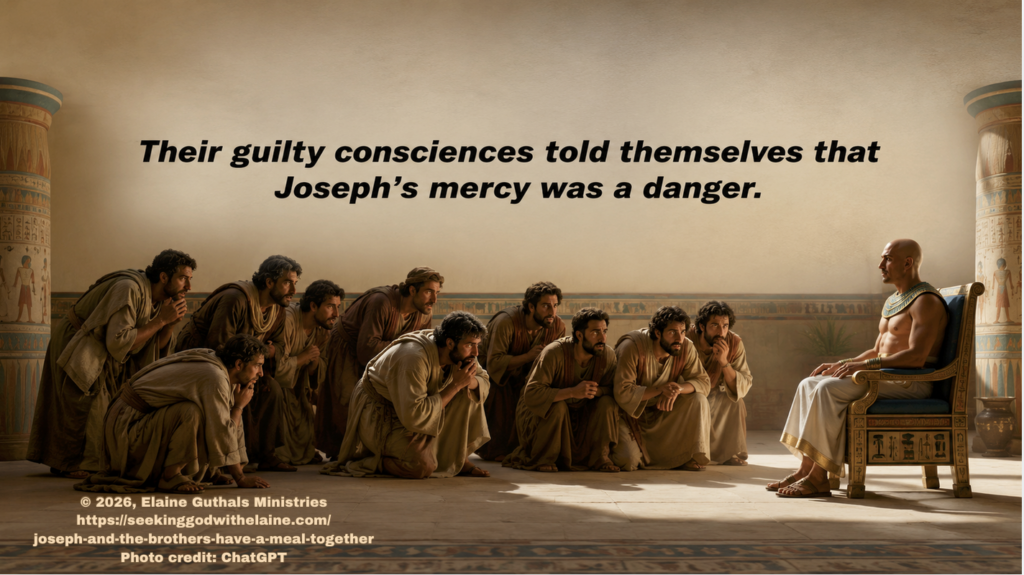
    They panicked. Their guilty consciences told themselves that Joseph’s mercy was a danger.

    Seriously, if Joseph was out to get them, wouldn’t he have them arrested on sight? He wouldn’t have them taken to his house — he would have had them taken straight to jail?!

    They thought they were going to be taken into slavery. Were they thinking an eye for an eye?

    But we do the same thing, don’t we? We see something good and look at it suspiciously – seeing good makes things looks worse.

    We focus on how we are afraid things are going to go. That may be based on reality, or it just may be based on our fear. Fear distorts kindness.

    The Brothers Approached Joseph’s Household Manager

    The brothers quickly come clean about the returned money with Joseph’s servant.

    The best defense is a good offense. The brothers laid out their side of the story to Joseph’s household manager.

    But that is the way it should be. They were being honest. True ,they didn’t want the accusation, but they wanted a situation they saw as wrong cleared up.

    So, they tell the house manager the whole story.  Well, they might have condensed part of it. They didn’t know all the money had been returned to them until they returned home.

    But their fear was leading the explanation.

    True, they had good reason to be afraid. Egyptian officials possessed enormous authority. An accusation involving royal grain could carry a severe punishment.

    The manager set their minds to ease. He even reunited them with Simeon.

    But this brings up a good point. I wonder how much Joseph had told his servants. “Hey, these are my brothers. We parted on not so good terms. I want to see if they grew up in the interim. Can you help me out with this?”

    Probably not. Joseph did have an Egyptian reputation to maintain.

    The servants probably would have known Jacob was a believer in Jehovah. If they didn’t know the story of him interpreting Pharaoh’s dreams, they would have been him daily, praying to Jehovah.

    Joseph had been an influence in his own household.

    Interacting with His Brothers

    “When Joseph came home, they gave him the gifts they had brought him, then bowed low to the ground before him. After greeting them, he asked, ‘How is your father, the old man you spoke about? Is he still alive?’ ‘Yes,’ they replied. ‘Our father, your servant, is alive and well.’ And they bowed low again. Then Joseph looked at his brother Benjamin, the son of his own mother. ‘Is this your youngest brother, the one you told me about?’ Joseph asked. ‘May God be gracious to you, my son.’ Then Joseph hurried from the room because he was overcome with emotion for his brother. He went into his private room, where he broke down and wept” (Gen. 43: 26-30 NLT)

    They Gave Him the Gifts

    The brothers bowed before Joseph again, further fulfilling the prophecy of the dreams.

    We talked about the gifts Jacob had sent with them. The interesting thing is that Jacob was allowed to send luxury or specialty products from Canaan to the “Egyptian” ruler. They followed the Ancient Near East custom of approaching powerful rulers with gifts.

    They had luxury items but not standard food items. They included “… balm, honey, gum, aromatic resin, pistachio nuts, and almonds” (Gen. 43: 11 NLT).

    Joseph probably would have known these from Jacob, not his brothers.

    The Old Man You Spoke About

    Joseph probably hadn’t gotten over  the loss of his relationship with Jacob.

    When he sees his brothers, Jacob’s thoughts immediately turn to his father.

    “Is he alright?”

    Joseph may be following Egyptian customs on the outside. Inside he is still that Hebrew boy that never gave up waiting for his Father.

    May God be Gracious to You, My Son

    Jacob immediately blessed his brother Benjamin.

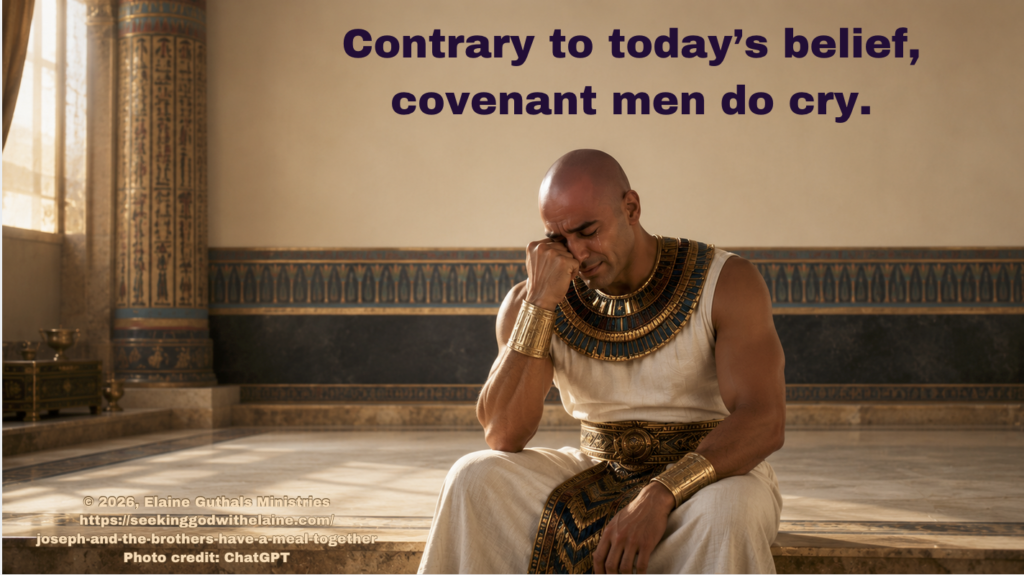
    Joseph became deeply emotional. His compassion physically overwhelmed him.

    In becoming overwhelmed, Joseph cried. It showed Jacob’s grief, love, memory — and restraint.

    Contrary to today’s belief, covenant men do cry.

    Bring Out the Food

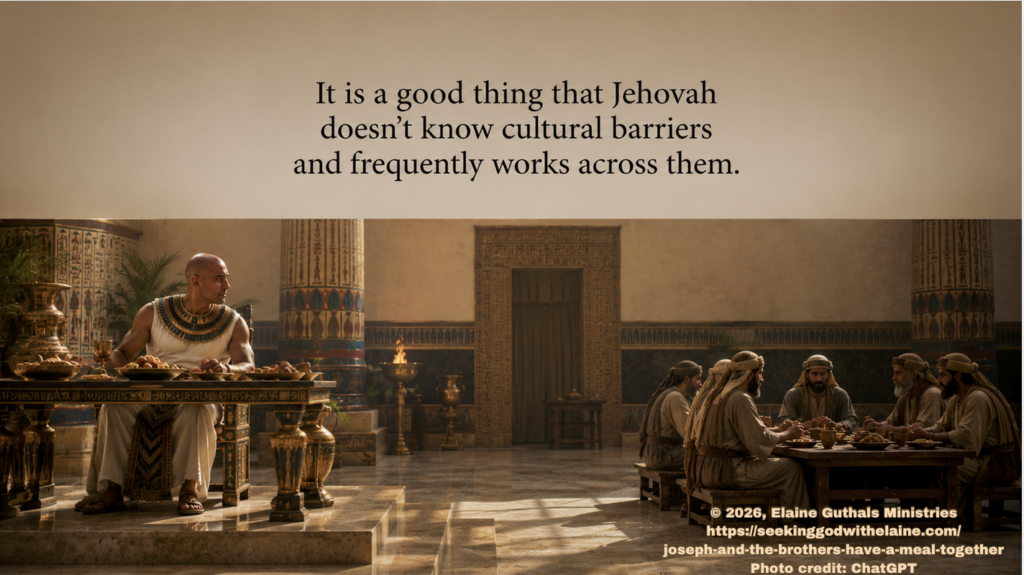
    “After washing his face, he came back out, keeping himself under control. Then he ordered, ‘Bring out the food!’ The waiters served Joseph at his own table, and his brothers were served at a separate table. The Egyptians who ate with Joseph sat at their own table, because Egyptians despise Hebrews and refuse to eat with them. Joseph told each of his brothers where to sit, and to their amazement, he seated them according to age, from oldest to youngest. And Joseph filled their plates with food from his own table, giving Benjamin five times as much as he gave the others. So they feasted and drank freely with him” (Gen. 43: 32-34 NLT)

    The fellowship meal that the brothers had was layered.

    We have to understand about meals in the Ancient Near East. On top of that, we need to understand the dynamics of an Egyptian serving Hebrews.

    Remember in the last devotion, we talked about Judah saying that an audience with a ruler indicated acceptance? Having a meal with him cemented that acceptance.

    This meal would have carried covenant and relational significance. It symbolized peace, acceptance, and restored relationship.

    Joseph was showing his brothers forgiveness – even if they didn’t know it yet.

    This has always kind of gotten me. Joseph couldn’t eat with his brothers because of customs of the day. He had to keep up the ruse.

    Even though Joseph had told them he believed in their God, he couldn’t buck Egyptian norms. Egyptians didn’t eat with Hebrews for purity concerns, ethnic separation, and cultural prejudice. They were shepherds, weren’t they — an inferior breed?

    It is a good thing that Jehovah doesn’t know cultural barriers and frequently works across them.

    But the brothers had to know something was up when he seated them by their ages.

    Didn’t they see Joseph getting all choked up? Joseph was carefully orchestrating events to culminate in his big reveal.

    Then Benjamin got special treatment.

    Even it also was another test, not just a personal feast for Joseph’s baby brother. The brothers back in around 1692 BC would have been jealous if Joseph would have gotten a significant portion over them.

    How would they react to Benjamin getting that?

    Obviously, they didn’t. I am sure Moses would have documented that if they pitched a fit.

    Making the Connections #1

    After 22 years, the brothers still feel guilty about selling Joseph into Egypt.

    No, that is a good thing in this case. Unresolved guilt reshapes perception.

    Before, there was not one drop of remorse in their bodies. Somewhere along the line, they started thinking, “Maybe we shouldn’t have …”

    Maybe it was Judah. He was taking lead of the family. He had gotten his own restoration encounter.

    Truth be told, Jehovah was probably working in all of them. They all needed restoration. They all had to acknowledge their sin.

    Making the Connections #2

    Jacob’s sons were all sitting down having a meal together. Had they ever really fellowshipped? Probably not.

    When Joseph was still in Canaan, the brothers were divided into maternal camps. They competed, envied, and deceived. Then it went from bad to worse when favoritism was weaponized.

    Did they ever truly function as covenant brothers emotionally?

    And no, this probably didn’t feel like fellowship either. But it was more than the brothers expected.

    How Do We Apply This?

    • Don’t mistake mercy for judgment.
    • Refuse to let fear distort the way you see people and situations.
    • Recognize that true fellowship requires humility and forgiveness.
    • Trust that Jehovah can restore what sin once fractured.

    Father God. This was more than a simple meal. It was a step toward reconciliation – but the brothers didn’t know that yet. You did. You were orchestrating everything. Thank You. Amen.

    If you don’t understand something and would like further clarification, please contact me.

    If you have not signed up for the email providing the link to the devotions and the newsletter, do so below.

    If God has used this devotion to speak with you, consider sharing it on social media.

  • Testing the Brothers

    After placing his brothers in prison for three days, Joseph brings them before him again. This devotional reading looks at the audience the brothers have with Joseph before they are allowed to go home.

    Nuggets

    • Three-day periods in Scripture indicate a time of testing.
    • It may or may not have startled the brothers that Joseph said he was a God-fearing man.
    • The bottom line didn’t change in the three days – bring Benjamin back.
    • The brothers brought up their sin against Joseph, wondering if this trouble was punishment for that sin.
    • Joseph responded to their fear.
    • Joseph picked Simeon to remain while the others left.
    testing-the-brothers

    This trip to Egypt wasn’t just a quick trip to buy grain. But Jacob’s sons didn’t know that until they got there.

    The reception with the one man didn’t go well. The brothers had been accused of being spies and thrown into prison.

    Let’s Put It into Context

    To read devotions in the Creating Everything theme, click the button below.

    Devotions in the Joseph the Savior of Israel  series

    After The Brothers’ Time in Prison

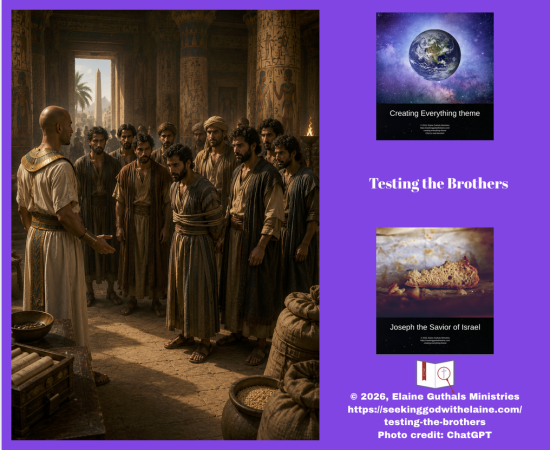
    “On the third day Joseph said to them, ‘I am a God-fearing man. If you do as I say, you will live. If you really are honest men, choose one of your brothers to remain in prison. The rest of you may go home with grain for your starving families. But you must bring your youngest brother back to me. This will prove that you are telling the truth, and you will not die.’ To this they agreed” (Gen. 42: 18-20 NLT)

    Third Day

    Three-day periods in Scripture indicate a time of testing.

    We know of other times when three days occurred. The Hebrew used here was bayyôm haššĕlîšî (בַּיּוֹם הַשְּׁלִישִׁי) — on the third day.

    • Abraham and Isaac’s journey to Mt. Moriah (Gen. 22: 4)
    • Israel meeting Jehovah on Mt. Sinai (Ex. 19: 11)
    • Jonah in the whale (Jon. 1)
    • Hezekiah was healed (II Kgs. 20: 5)
    • Esther approached the king (Est. 5: 1)
    • Yeshua raising on the third day

    Third day was symbolic. It means

    • transition
    • divine intervention
    • emergence from danger/death
    • covenant movement
    • revelation
    • restoration


    I Am a God-Fearing Man

    It may or may not have startled the brothers that Joseph said he was a God-fearing man.

    I wonder if the brothers were standing when Joseph told them that he feared Jehovah. If they were, were they on the floor quickly?

    But maybe not.

    Remember, the ruler was a Hyksos Pharaoh. The Hyksos (heqa khasut or rulers of foreign lands) were a mixed-race people of primarily West Semitic origin. That means he was a possible descendant of Ishmael, Abraham’s son. If not, he may have been a descendant of Ham, Noah’s son.

    The Egyptians would have remembered Joseph as the Hebrew dream interpreter. Some may have remembered Who he said interpreted Pharaoh’s dreams.

    “‘It is beyond my power to do this,’ Joseph replied. ‘But God can tell you what it means and set you at ease’” (Gen. 41: 16 NLT).

    But the brothers wouldn’t have known that.

    This reiterates the fact that, while Joseph would change his outward appearance, he wouldn’t change his heart.

    Bring Your Youngest Brother Back

    The bottom line didn’t change in the three days – bring Benjamin back.

    We talked a little bit in the last devotion about things that wouldn’t be why Joseph asked that Benjamin be brought back. With the tunic, dreams, and sale occurring the same year as Rachel’s death – and Benjamin’s birth – happening in one year, Benjamin himself wasn’t really the central issue.

    The whole reason Joseph wanted Benjamin to come back was the brothers.

    Joseph knew his father. He knew Jacob would have become more protective of Benjamin. That would have been the exact opposite of what the brothers would have been hoping for by selling him.

    Did you notice that, in the three days the brothers were in jail, Joseph changed his mind. At first, he was going to have all stay except one who was going to go back and get Benjamin.

    “One of you must go and get your brother. I’ll keep the rest of you here in prison …” (Gen. 42: 16 NLT).

    Now, Joseph was going to allow all but one leave. But he was constant in saying they had to bring Benjamin back.

    The Brothers Gave Some Insight to That Day

    “Speaking among themselves, they said, ‘Clearly we are being punished because of what we did to Joseph long ago. We saw his anguish when he pleaded for his life, but we wouldn’t listen. That’s why we’re in this trouble.’ ‘Didn’t I tell you not to sin against the boy?” Reuben asked. ‘But you wouldn’t listen. And now we have to answer for his blood!’” (Gen. 42: 21-22 NLT)

    The brothers brought up their sin against Joseph, wondering if this trouble was punishment for that sin.

    I bet Joseph got an education listening to his brothers hash it out. First off, they acknowledged that they knew Joseph was hurting in the pit — and they didn’t care at the time.

    Wait! What????

    Joseph pled for his life? We weren’t told that in Genesis 37.

    “Then they grabbed him and threw him into the cistern. Now the cistern was empty; there was no water in it. Then, just as they were sitting down to eat, they looked up and saw a caravan of camels in the distance coming toward them. It was a group of Ishmaelite traders taking a load of gum, balm, and aromatic resin from Gilead down to Egypt” (Gen. 37: 24-25 NLT).

    True, biology doesn’t always mean family members see things the same way and get along.

    Reuben had been the only one who had wanted to return Joseph to his father (Gen. 37: 29-30). He couldn’t because the others had sold him to the Ishmaelite traders.

    But Reuben knew there would be a reckoning. We are held accountable for our actions. “Yes, each of us will give a personal account to God” (Rom. 14: 12 NLT).

    Joseph Heard Their Fear

    “Of course, they didn’t know that Joseph understood them, for he had been speaking to them through an interpreter. Now he turned away from them and began to weep. When he regained his composure, he spoke to them again. Then he chose Simeon from among them and had him tied up right before their eyes” (Gen. 42: 23-24 NLT)

    Joseph responded to their fear.

    But the bigger thing was Joseph knew they still felt guilty about what they did to him. Time had shown them the error of their ways. The guilt was still there.

    Do we think that Joseph should have made himself known to his brothers right then? Isn’t that what many want – instantaneous forgiveness?

    Joseph had probably always been Jacob’s favorite, so the brothers had 17 years of envying him.

    No, Joseph had probably already forgiven them when he saw God’s plan for his life. But they had killed his trust in them. That was going to take more than a he’s-gone-and-we’re-paying-for-it-now discussion.

    He Chose Simeon

    Joseph picked Simeon to remain while the others left.

    We would probably think Reuben — as the oldest — would have been the one to be chosen. But he had just said (Gen. 42: 22) that he had stuck up for Joseph that day 13 years ago (Gen. 37: 21). The problem was he didn’t stop his brothers; so he, too, was guilty.

    Reuben’s big sin was against Jacob (Gen. 35: 22), not Joseph.

    Were we surprised that it was Simeon who stayed behind in Egypt?

    Simeon was the next oldest. He should have been advocating for his younger brother. Instead, Simeon was one of the ones advocating to punish Joseph for his favoritism.

    Simeon also had also committed another sin. It was him and Levi who had killed all the men of Shechem for Prince Shechem defiling Dinah (Gem. 34: 25-26).

    It doesn’t say the brothers were bound when Joseph put them in prison three days ago (Gen. 42: 17).

    Making the Connections

    Did Jehovah convict people of their sins in the Old Testament?

    Well, yes. A major way in which Jehovah calls us from rebellion to holiness is by what we call conviction.

    This conviction comes from Jehovah – we know now through the Holy Spirit. The Holy Spirit worked in a different way – that we know of — before resurrection.

    There wasn’t an indwelling of the Spirit then. He came and rested on people for an undisclosed amount of time.

    But did the Holy Spirit still convict sinners as He does now?

    Maybe. Maybe not. We do know of times of conviction.

    Take, for example, Adam and Eve after the original sin. In Genesis 3: 9, Jehovah approached them with a question, “… ‘Where are you?’” (ESV).

    David’s sin with Bathsheba precipitated the writings of a couple of Psalms, detailing his feelings while under conviction (Ps. 32, Ps. 51).

    Frothingham asserted that, when the Holy Spirit first convicts us, we feel fear. This stems from a sense of awe toward an invisible presence that impresses upon one’s conscience a moral awareness.

    Resource

    Ooo, baby. We can be afraid when Sovereign God is convicting us for disobedience to Him. We can worry about the type and severity of that punishment.

    Part of the fear, too, can be because we know we have disappointed Jehovah.

    Frothingham gave us insight on the timing of these convictions. He wrote, “
    The God whom we ‘fear’ deals with us in the slow course of His appointments, through the gradual changes of time and age.”

    Conviction forces our souls to turn inward to address the musings of our conscience. This was what the brothers were doing when they were discussing whether their current situation was punishment from Jehovah for their sin.

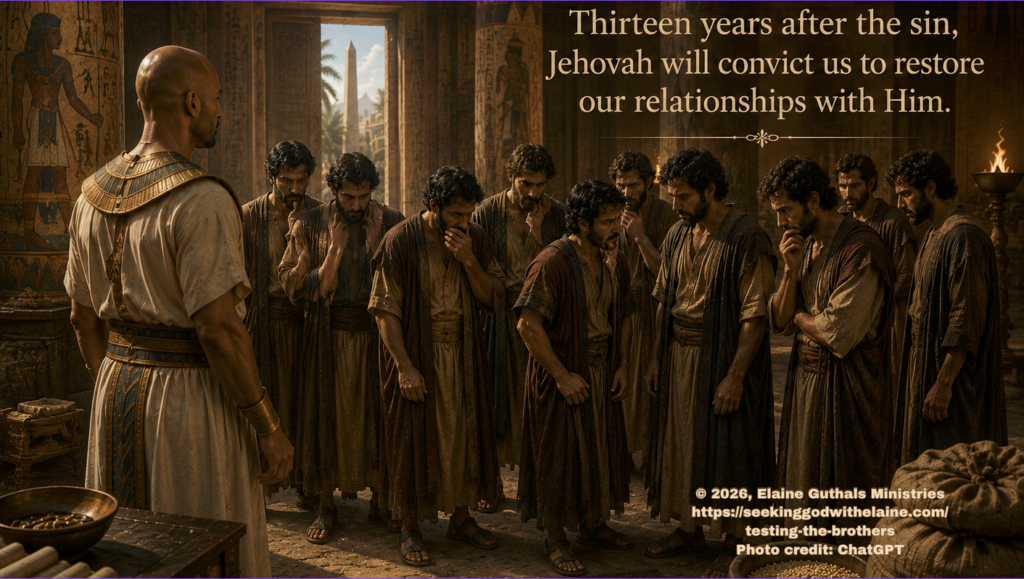
    Yeah, 13 years after the sin, Jehovah will convict us to restore our relationships with Him.

    Conviction is a major element early on in the redemption process.

    ·      Conviction – yākhaḥ (יָכַח); elegchō (ἐλέγχω)
    ·      Return – shûb (שׁוּב)
    ·      Transformation – metanoia (μετάνοια)

    How Do We Apply This?

    • Allow Jehovah to expose sins you have tried to bury.
    • Do not mistake delayed consequences for erased guilt.
    • Respond to conviction with repentance instead of defensiveness.
    • Remember that forgiveness and restored trust are not always instantaneous.
    • Let conviction draw you toward restoration instead of shame.
    • Acknowledge the pain your actions may have caused others.
    • Understand that Jehovah may revisit old wounds in order to bring healing.
    • Do not ignore the warnings of your conscience.
    • Accept that sanctification sometimes involves uncomfortable exposure.
    • Trust that Jehovah’s testing is meant for restoration, not destruction.
    • Be willing to face difficult truths about yourself.
    • Confess not only outward sin but also hidden motives and attitudes.
    • Learn to recognize conviction as an act of covenant love.

    Father God. Thank You for families. Help us when we become dysfunctional families. Help us to confess our sins, repent, and forgive each other. Amen.

    If you don’t understand something and would like further clarification, please contact me.

    If you have not signed up for the email providing the link to the devotions and the newsletter, do so below.

    If God has used this devotion to speak with you, consider sharing it on social media.
  • Judah, Tamar, and the Covenant Line

    After Judah’s visit to a prostitute, he returns to his everyday life. This devotional reading looks at the restitution part of Judah’s repentance, forgiveness, and restitution process.

    Nuggets

    • Sin is never hidden from Jehovah.
      Judah was concerned with reputation — not righteousness.
    • People find out the widow was pregnant.
    • The very things Judah used to live and act as who he was become the evidence that forces him to face who he was.
    • Judah repented and was forgiven and restored.
    • Jehovah was ensuring the continuation of the covenant line.
    judah-tamar-and-the-covenant-line

    We’ve been following along on the story of Jacob’s son Judah. He and his brothers had sold their brother Joseph into slavery.

    Now, Judah was continuing a descent into sin.

    But time passes, and hidden things do not always stay hidden.

    Let’s Put It into Context

    To read devotions in the Creating Everything theme, click the button below.

    Devotions in the Joseph the Savior of Israel  series

    Aftermath

    “Afterward she went back home, took off her veil, and put on her widow’s clothing as usual” (Gen. 38: 19 NLT)

    Sin is never hidden from Jehovah.

    I went back and forth about connecting this with the last section on the last devotion or letting it stand on its own. I think this is very important. We can’t bury it.

    Judah went home convinced that the secret of his procuring the services of a prostitute was safe with him. He had every intention of making the payment.

    Case closed.

    But Tamar had a much bigger case against Judah than he realized. And she had the forensic-level proof to prove it.

    How does this work into Jehovah’s opportunity for repentance, forgiveness, and renewal?

    Judah thought – like we think – our sins are hidden. What is done in private is supposed to stay in private.

    We only wish that.

    Instead, Judah left – again, like we leave – undeniable evidence. People were changed. Situations were changed.

    More importantly, Sovereign God – the all-knowing, all-seeing Supreme Being – knows our sin.

    Nothing is hidden from Jehovah. We may think that. We may convince ourselves that He doesn’t care.

    He does.

    Payment Attempted

    “Later Judah asked his friend Hirah the Adullamite to take the young goat to the woman and to pick up the things he had given her as his guarantee. But Hirah couldn’t find her. So he asked the men who lived there, ‘Where can I find the shrine prostitute who was sitting beside the road at the entrance to Enaim?’ ‘We’ve never had a shrine prostitute here,’ they replied. So Hirah returned to Judah and told him, ‘I couldn’t find her anywhere, and the men of the village claim they’ve never had a shrine prostitute there. Then let her keep the things I gave her,’ Judah said. ‘I sent the young goat as we agreed, but you couldn’t find her. We’d be the laughingstock of the village if we went back again to look for her’” (Gen. 38: 20-23 NLT)

    Judah was concerned with reputation — not righteousness.

    Yay, Judah! He did exactly what he said he would do.

    Judah sent Hirah – the only other person who knew of Judah’s transgression – to make the payment. He kept his end of the bargain.

    But that is where things began to fell apart.

    We get another snippet of information. Hirah thought Tamar was a temple prostitute. At least that is how most versions translate it.

    We have to dig in a bit here to look at a discrepancy.

    When Judah first saw Tamar, he called her a זֹנָה (zonah) – a common prostitute. “Judah noticed her and thought she was a prostitute, since she had covered her face” (Gen. 38: 15 NLT).

    Hirah, when he was delivering the payment, asked about the קְדֵשָׁה (qedeshah) – translated as either temple prostitute or cult prostitute.

    There may or may not have been a pagan temple in the area. Qedeshah was connected to pagan religious practices, such as fertility cults and Canaanite worship systems. It could have been a localized shrine or sacred site. In fact, it may have just been a recognized category of women.

    Fertility worship was common. We know how important family, especially sons, were in the Ancient Near Eastern society. So, qedeshah likely referred to women associated with these fertility practices.

    Stop a second. It is an entirely different matter if Judah was procuring the services of a temple prostitute rather than a common prostitute. It deepens his compromise if he was engaging someone associating within the Canaanite moral-religious framework.

    Judah left the covenant family. He went to live among those Jehovah did not want to associate with the covenant family. This shows that Judah was fully embedded in the Canaanite system.

    To me, that meant Judah – the future patriarch of the family – turned his back on the covenant with Jehovah. (But remember, this is the story of repentance, forgiveness, and renewal. Stay tuned.)

    Yes, living in the world is difficult. We may think it was harder then, but it is just as hard as now.

    Still, Jehovah calls us now — as He called then — to be in the world but not of it (Jn. 15: 19). We can’t just say, “Oh, the circumstances I am in left me no other choice but to sin.”

    We are called to be faithful to Jehovah regardless of our circumstances.

    Of course, Tamar wasn’t around because she wasn’t a temple prostitute or any other kind.

    This is what I don’t get. Judah had given her his identity to secure the payment. And he was just going to give it up so he doesn’t become the laughingstock of the village???? If what he gave Tamar was his identity, why did Judah give them up without a fight?

    What did laughingstock mean?

    Laughingstock, in the Ancient Near East, meant public ridicule, loss of honor, and damage to social standing. But it didn’t stop there.

    Think about what people would ask if and when they learned of Judah looking for a woman. “Why is Judah looking for this woman? What kind of transaction did they make? What did he give her as security?”

    It would come out that Judah gave his seal, cord, and staff. It would become public knowledge that he gave up his identity.

    So, Judah had a couple of options. He could have kept searching and chance drawing attention to his search.

    Or Judah could walk away. Keep the matter quiet. Make it go away.

    Judah chose to keep quiet, protect the secret, and lose his identity. He chose to protect his reputation.

    Yeah, it would come back and bite him.

    The Secret Was Out

    “About three months later, Judah was told, ‘Tamar, your daughter-in-law, has acted like a prostitute. And now, because of this, she’s pregnant.’ ‘Bring her out, and let her be burned!’ Judah demanded. But as they were taking her out to kill her, she sent this message to her father-in-law: ‘The man who owns these things made me pregnant. Look closely. Whose seal and cord and walking stick are these?’ Judah recognized them immediately and said, ‘She is more righteous than I am, because I didn’t arrange for her to marry my son Shelah.’ And Judah never slept with Tamar again” (Gen. 38: 24-26 NLT)

    Acted Like a Prostitute

    People find out the widow was pregnant.

    I always laugh when I read that whoever told Judah accused Tamar of being a prostitute. Remember, Judah’s transgression was supposed to be a secret. I wonder if his face went pale when the man said that.

    Ooo, baby. Judah still was sure quick to judge Tamar.

    Even though he didn’t know he was the father of the baby at that time, Judah did know that he had frequented a prostitute. True, that may have been the only time he had.

    Judah may have forgotten — probably did — about the episode by then.

    Judah was quick to accuse – that is, until he was faced with irrefutable evidence. He couldn’t deflect, deny, or shift blame.

    But why was there an uproar because of the pregnancy?

    We can’t forget Tamar’s situation. She was a party to a levirate marriage even if she did not have a husband at that moment. That meant she was bound to Judah’s family.

    Even though he had no plans on going through with the marriage, Judah did not release Tamar from that agreement. Tamar was not “free” – or divorced, as we would say.

    That was all the community needed to know. Tamar’s sexuality was controlled by the family structure.

    Probably the bigger questions in everyone’s mind – that wasn’t recorded here – was, “Who was the father?” That uncertainty could have threatened the family line. It may have impacted inheritance.

    Any lineage confusion brought about social instability. (Did you ever wonder why there are so many genealogy lists in God’s Word?)

    This was about Judah’s reputation. (Remember, that was the reputation he was trying to preserve.)

    If Tamar was acting outside of social norms, Judah’s household was dishonored. He was seen as being weak.

    That is why Judah’s verdict immediately went to execute her. He wanted to publicly purge this dishonor, restore his control, and protect the family name.

    Judah got what he wanted. This made him appear righteous. It didn’t matter that Tamar appeared to be guilty when she wasn’t.

    Let’s stop a second and think this through.

    On the wedding night, Tamar’s guardianship would have passed from her father to Er, her new husband. It probably passed to Onan when he became her levirate husband.

    What would have happened to it when Onan died?

    It wouldn’t have passed to Shelah. He wasn’t her husband yet because he wasn’t of age.

    Did it go back to Tamar’s father? She wouldn’t be tied to Judah’s family if it did.

    Did it pass to Judah? If it did, he still had it.

    Wherever the guardianship went, Judah was controlling the narrative. But then, no one was asking, “Why isn’t Tamar married to Shelah now that he is of age?”

    Sent This Message

    The very things Judah used to live and act as who he was become the evidence that forces him to face who he was.

    Yep, up to this point, everything was stacked against Tamar. The evidence was irrefutable. Public opinion was against her, and Judah was firmly in control.

    But remember, Tamar was a smart girl. She had irrefutable forensic-level evidence.

    She didn’t come out accusing Judah, not our Tamar. She asked basically the same question Judah and brothers asked Jacob when they sent him Joseph’s tunic. “Do you recognize this?”

    That is another big step in Jehovah’s practice of repentance, forgiveness, and restoration. We can’t repent of something that we don’t recognize as wrong.

    So, in the end, the system that had failed Tamar was the one that exposed Judah’s sin.

    She Is More Righteous than I

    Judah repented and was forgiven and restored.

    Was Tamar being righteous when she sinned by having sex — not just with any man but with her father-in-law? Yes, in this instance.

    Tamar was following the levirate marriage law where Judah hadn’t. She held up the spirit of the law better than he did.

    We have to watch when we think we are in an ends-justify-the-means situation. That isn’t our call. That call solely rests in Jehovah’s hands. Only He can identify what a sin is or isn’t.

    But Genesis 38 is about Judah and his restoration to Jehovah.

    This is where Judah’s transformation began. It wasn’t where his restoration began and was awarded to him elsewhere.

    It was where Judah’s restoration took place.

    When we sincerely repent and tell Jehovah we will obediently follow His Will, He will give us salvation. In the same way, He will restore our relationship with Him upon our sincere immediate repentance.

    • “Come close to God, and God will come close to you. Wash your hands, you sinners; purify your hearts, for your loyalty is divided between God and the world” (Jas. 4: 8 NLT).
    • “Create in me a clean heart, O God. Renew a loyal spirit within me. Do not banish me from your presence, and don’t take your Holy Spirit from me. Restore to me the joy of your salvation, and make me willing to obey you” (Ps. 51: 10-12 NLT).
    • “But if we confess our sins to him, he is faithful and just to forgive us our sins and to cleanse us from all wickedness” (I Jn. 1: 9 NLT).

    If you want a visual of this, look to the Parable of the Prodigal Son in Luke 15: 11-32. The Father came running to the son – running, which was considered undignified.

    Does this passage say anything about Judah’s restoration? Well, yes and no.

    Moses didn’t really get into Judah’s spiritual condition. But then, he was a man of few words.

    There is one word that is a good clue of were Judah was at. Moses used the word righteous. That was not a word he would have used lightly.

    Did Judah say he had become righteous? No. He said Tamar was better at it than he was.

    But go back to what we said the reason this chapter was placed in this place. This chapter is in exactly the position it needs to be because we need to follow Judah on his transformation.

    Genesis 38 shows Judah’s moral collapse and turning point. Jehovah recognizes and rewards our sincere turning point. Forgiveness and restoration is given; transformation begins.

    The Covenant Line

    “When the time came for Tamar to give birth, it was discovered that she was carrying twins. While she was in labor, one of the babies reached out his hand. The midwife grabbed it and tied a scarlet string around the child’s wrist, announcing, ‘This one came out first.’ But then he pulled back his hand, and out came his brother! ‘What!’ the midwife exclaimed. ‘How did you break out first?’ So he was named Perez. Then the baby with the scarlet string on his wrist was born, and he was named Zerah” (Gen. 38: 27-30 NLT)

    Jehovah was ensuring the continuation of the covenant line.

    At this point, it looks like Jacob had problems with who was going to be his firstborn son. Reuben staged a coup (Gen. 35: 22). Simeon and Levi committed murder (Gen. 34: 25).

    Jehovah chose Judah to be the covenant son. Yeshua would be the great … grandson of Perez.

    I thought it was interesting that the twins struggled within Tamar’s womb, just as Jacob and Esau did. However, Perez was the firstborn.

    Making the Connections #1

    Joseph was down in Egypt. Since we don’t know what year this was, we don’t know if he had just arrived or if he was getting ready to interpret Pharaoh’s dreams.

    We get one chapter to see Judah hit rock bottom and turn back to Jehovah. If he didn’t turn back to Jehovah here, the chapter didn’t need to be placed here.

    Making the Connections #2

    We’ve been talking about the repentance, forgiveness, and restoration process. What is that process? When we genuinely repent:

    • “He has removed our sins as far from us as the east is from the west.” (Ps. 103: 12 NLT).
    • “It’s your sins that have cut you off from God. Because of your sins, he has turned away and will not listen anymore” (Isa. 59: 2 NLT).
    • “But if we confess our sins to him, he is faithful and just to forgive us our sins and to cleanse us from all wickedness” (I Jn. 1: 9 NLT).
    • “So now there is no condemnation for those who belong to Christ Jesus” (Rom. 8: 1 NLT).
    • “This means that anyone who belongs to Christ has become a new person. The old life is gone; a new life has begun!” (II Cor. 5: 17 NLT).
    • “Finally, I confessed all my sins to you and stopped trying to hide my guilt. I said to myself, ‘I will confess my rebellion to the Lord.’ And you forgave me! All my guilt is gone” (Ps. 32: 5 NLT).
    • “He canceled the record of the charges against us and took it away by nailing it to the cross” (Col. 2: 14 NLT).
    • “For the grace of God has been revealed, bringing salvation to all people. And we are instructed to turn from godless living and sinful pleasures. We should live in this evil world with wisdom, righteousness, and devotion to God” (Ti. 2: 11-12 NLT).
    • “Restore to me the joy of your salvation, and make me willing to obey you” (Ps. 51: 12 NLT).
    • “Come close to God, and God will come close to you. Wash your hands, you sinners; purify your hearts, for your loyalty is divided between God and the world.” (Jas. 4: 8 NLT).
    • “So let us come boldly to the throne of our gracious God. There we will receive his mercy, and we will find grace to help us when we need it most” (Heb. 4: 16 NLT).
    • “And I will forgive their wickedness, and I will never again remember their sins.” (Heb. 8: 12 NLT).

    This reminds us that we cannot pick and choose what we read in God’s Word. We need to read it all to make all the connections.

    We need to sincerely complete all these steps. We wouldn’t want to miss a step because we hadn’t read it.

    How Do We Apply This?

    • Walk in the paths Jehovah calls us to walk.
    • Repent when we sin.

    Father God. We are humbled that You come to bring our sins to the forefront so that we may repent of them. Lord, we sincerely repent. Forgive us. Restore us to full fellowship with You. Amen.

    If you don’t understand something and would like further clarification, please contact me.

    If you have not signed up for the email providing the link to the devotions and the newsletter, do so below.

    If God has used this devotion to speak with you, consider sharing it on social media.
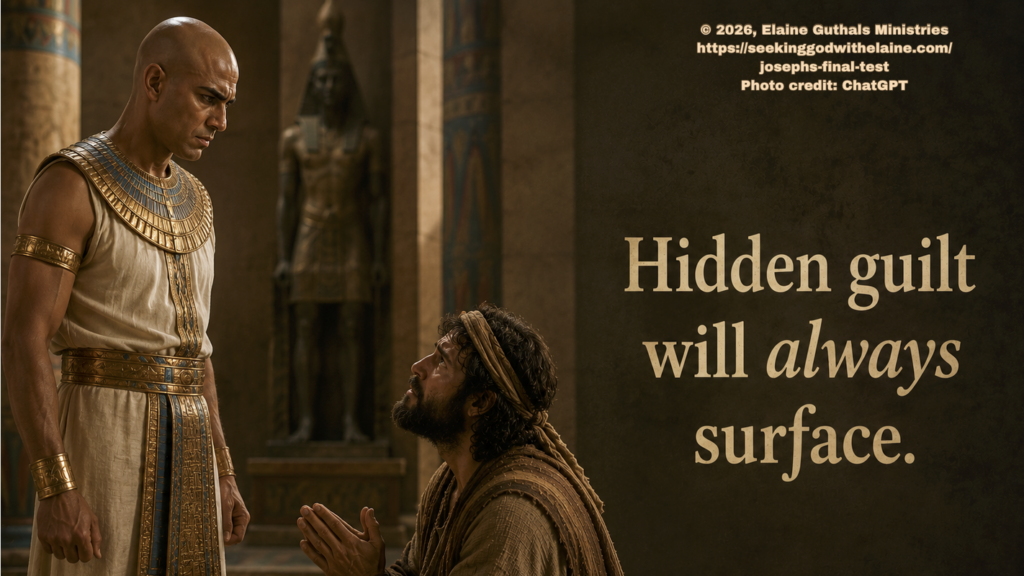
  • Judah and Tamar

    Judah had moved away from his family – the covenant family. This devotional reading looks at how he continued to move farther away from the covenant.

    Nuggets

    • While some is relative, years is plural – meaning it took time for the story to continue.
    • Judah reentered public life with an old friend.
    • Tamar reentered the story by learning about Judah’s plans.
    • Judah propositioned Tamar, who was disguised as a prostitute.
    judah-and-tamar

    We’ve been walking through Genesis 38. It is a snapshot in Judah’s life.

    More importantly, it is a story about repentance, forgiveness, and restoration.

    But we aren’t there yet. We’re still setting up what went wrong.

    Programming note: I am going to wait to do the connections and application at the end of the chapter.

    Let’s Put It into Context

    To read devotions in the Creating Everything theme, click the button below.

    Devotions in the Joseph the Savior of Israel  series

    Picking Up the Story

    “Some years later Judah’s wife died. After the time of mourning was over, Judah and his friend Hirah the Adullamite went up to Timnah to supervise the shearing of his sheep. Someone told Tamar, ‘Look, your father-in-law is going up to Timnah to shear his sheep.’ Tamar was aware that Shelah had grown up, but no arrangements had been made for her to come and marry him. So she changed out of her widow’s clothing and covered herself with a veil to disguise herself. Then she sat beside the road at the entrance to the village of Enaim, which is on the road to Timnah” (Gen. 38: 12-14 NLT)

    Judah’s Wife Died

    While some is relative, years is plural – meaning it took time for the story to continue.

    The story continued by anchoring it around the death of Judah’s wife. We were first introduced to Mrs. Judah in Genesis 38: 2.

    Maybe Moses didn’t feel the need to give us her name because she was a Canaanite woman. He knew that Jehovah would not be pleased with that marriage.

    Still, Jehovah had blessed that union with three sons. Er and Onan had been killed by Jehovah because of their wickedness. Shelah was the youngest son.

    We may think it strange that Moses securing the rest of the story around Mrs. Judah’s death. But let’s dig in a little bit — and try not to read too much into it, but enough.

    Moses specifically stated, “… After the time of mourning was over …” (Gen, 38: 12 NLT). There was no fixed “mourning period,” but Judah obviously mourned his wife’s passing and re-enters public life.

    The time of grief and loss can be a very tumultuous time emotionally for some. People can feel emotionally exposed and less guarded. We don’t always make the best decisions when we are mourning what was and what no longer is.

    That is especially true when we are trying to “get back to normal” when we are making a new normal. Add to that a time of celebration.

    Judah and Hirah Supervised the Shearing of Sheep

    Judah reentered public life with an old friend.

    When Judah first moved to Adullam in the Shephelah (lowland hills), he stayed with Hirah. Remember, Adullam was about 10 to 15 miles south of Hebron.

    In Genesis 38: 12, Judah and Hirah were going to Timnah in the Sorek Valley region. That was a five-to-ten-mile jaunt to the northwest. It was about a half-day walk uphill.

    It wouldn’t have been a big deal to head over to Timnah. It sounds like it is in a different region, but both Adullam and Timnah sound like they are on their respective borders.

    Bottom line is this isn’t a huge move away from home, it sounds like it is a usual sheep trip.

    We may not think of sheep shearing as a time of celebration, but then most of us haven’t sheared any sheep lately.

    Sheep weren’t raised just as a food source — or as just a sacrificial animal. Their wool was a major source of wealth. It could be sold as trade good or clothing.

    To get the wool off the sheep, they had to be sheared. This was a celebration because it meant the flock survived another year and the production could be collected.

    In essence, it was a harvest festival for livestock. This “festival” occurred pretty much the same time each year in spring to early summer.

    But it consisted of a lot of work. It required multiple workers and coordination. What happens when people gather together? It becomes a social event.

    We see one such event described in I Samuel 25. Nabal lived like a king, drinking heavily, during his sheep-shearing feast. That shows us that food, drink, and excess were normal.

    This was especially true when the work was done. Not only would there be a harvest festival atmosphere, but there would also be the harvest wrap party and payday all wrapped into one.

    This was an event. People traveled to attend, including business partners and wanna-be business partners. In other words, it wasn’t a private party — it was public and communal with all the hospitality laws in force.

    Superimpose the party atmosphere over the grief atmosphere. Was Judah having conflicting emotions? Or was he more than ready to live it up some?

    Someone Told Tamar

    Tamar reentered the story by learning about Judah’s plans.

    When Er died (Gen. 38: 7), he left a wife named Tamar without an heir to keep his line going. Onan, Er’s younger, married may or may not have brother Tamar through the levirate marriage provision (Gen. 38: 8). However, Onan didn’t fulfill his duty, and Jehovah took his life as well (Gen. 38: 9-10).

    Judah sent Tamar back to her parents’ home. What he didn’t tell her was that he had no intention of allowing Tamar to marry Shelah (Gen. 38: 11).

    Tamar had figured this out when the time had come without any marriage ceremony taking place. So, she took matters into her own hand.

    Is there any significance that Tamar was still in widows’ clothing? Maybe, but maybe not.

    While there was no fixed “mourning period,” Tamar may have remained in a widow’s garb more because of her status than because of emotion. Her legal status was widow, but she was also childless and promised to Shelah. That last piece is the kicker.

    Besides, Judah’s instructions in Genesis 38: 11 were to live as a widow, not remarry, and wait under family authority.

    But Shelah had become of marrying age and crickets. No marriage ceremony, not even a save-the-date card.

    We may look at Tamar’s actions and think they are just as suspect as Judah’s. How can her having sex with her father-in-law be permissible?

    We have to look at it through Ancient Near Eastern norms. Tamar was seeking her legal right to offspring. She was still a member of that family, and she was preserving her place within it.

    One thing that would resonate with many of us is that Tamar was forcing justice when the system had failed her. Well, we could say when Judah failed to follow the system as he should have.

    There was nothing radical about Tamar’s actions.

    The Act Occurred

    “Judah noticed her and thought she was a prostitute, since she had covered her face. So he stopped and propositioned her. ‘Let me have sex with you,’ he said, not realizing that she was his own daughter-in-law. ‘How much will you pay to have sex with me?’ Tamar asked. ‘I’ll send you a young goat from my flock,’ Judah promised. ‘But what will you give me to guarantee that you will send the goat?” she asked. ‘What kind of guarantee do you want?” he replied. She answered, ‘Leave me your identification seal and its cord and the walking stick you are carrying.’ So Judah gave them to her. Then he had intercourse with her, and she became pregnant (Gen. 38: 15-18 NLT)

    Judah propositioned Tamar, who was disguised as a prostitute.

    Yeah. Judah just lost his wife, but he was hooking up with a prostitute.

    No, that isn’t something that was unlawful. But it is morally revealing.

    But isn’t that one reason Genesis 38 is following Genesis 37? We started the last devotion with the question about the significance of its placement.

    Judah was already on a downward spiral spiritually after the wanting-to-kill-but-ended-up-selling-Joseph episode. He was spiritually corrupt.

    This is an indication that Judah continued to drift. He and his brothers weren’t caught in their deception to Jacob. Their secret was safe for the time being. Who besides Hirah would know of his indiscretion now?

    So, to tie all this up, the death of Mrs. Judah set the stage by creating the conditions in which Judah’s character was revealed. Our character must be revealed before repentance and forgiveness can occur.

    To pick up the story, Judah noticed who he thought was a prostitute. How did he make that determination?

    Go back to Genesis 38: 14. “… So she changed out of her widow’s clothing and covered herself with a veil to disguise herself. Then she sat beside the road at the entrance to the village of Enaim, which is on the road to Timnah” (Gen. 38: 14 NLT).

    The veil wasn’t assigned ritual or covenantal symbolism, but it was more than just an element of disguise. In the Ancient Near East culture, it would signify sexual availability in certain contexts.

    Judah read the signal exactly as Tamar intended. But let’s tie it back to something even further.

    “Then the brothers killed a young goat and dipped Joseph’s robe in its blood. They sent the beautiful robe to their father with this message: “Look at what we found. Doesn’t this robe belong to your son?’” (Gen. 37: 31-32 NLT).

    Where Judah used a garment to conceal his actions, Tamar used a garment to reveal the truth.

    When Jehovah orchestrates an opportunity of repentance, forgiveness, and renewal, He snips all the lose threads. He restore everything, sometimes what look as if it is in reverse order.

    The veil also functions as a mechanism of justice. Tamar has been denied her rightful place within Judah’s family and is left without security or future. By veiling herself, she operates outside the constraints that have been imposed upon her. This allows her to create a situation in which Judah’s failure is brought to light. The concealment is temporary, but the revelation it produces is permanent.

    We are going to see in a couple more verses where Judah acknowledges the role reversal. The wronged widow, even in the appearance of a prostitute, highlights the moral failure of a patriarch.

    Judah and Tamar make arrangements for the financial aspects of the transaction. Would a goat have been a standard, reasonable payment.

    Well, yes. Goats were common, portable, and valuable but not excessive. Young goats were often used as food, gifts, and transactions. In other words, if Tamar didn’t want to/couldn’t keep it for personal use, it would be good currency for a future transaction.

    But then, this could be another loose end that Jehovah was snipping. Look a couple of paragraphs back to where we looked at Genesis 37: 31. The animal used to supply the blood that stained Joseph’s coat was a goat.

    Why wouldn’t Judah have offered a sheep? Well, a sheep was not only an animal, but it was also a money maker. The wool provided more of a revenue than a goat – even selling its milk – would have provided.

    The way it reads to me is that Tamar accepted payment but was saying, “What is your collateral that I can hold until I get the payment?” Who says you are going to keep up your end of the bargain and send me payment?

    But being the smart girl that Tamar was, she also wanted something more tangible. She also wanted something more recognizable as Judah’s.

    Tamar asked for three things: Judah’s seal or signet, the cord, and his walking stick. What was the significance of each?

    Let’s look at the walking stick first. It probably wasn’t some limb just pulled off a tree. More than likely it was uniquely shaped and identifiable. It could have even functioned as a tribal marker of authority.

    Why would that have been important to Tamar. Judah had used his tribal authority to send her back to her parents and to tell her to wait for the next levirate marriage.

    The seal or signet was essentially Judah’s signature. He used it to seal documents and authorize transactions. It was his legal identity marker.

    When attached to the cord, it was Judah’s wearable identity. It was something he would have and probably would have taken with him, much as we do with a driver’s license or state ID.

    This is the one that always got me. Why would Judah give up something so important?

    Not only was it important, but the seal was also irreplaceable. Yes, Judah was giving up his signature and authorization. He was giving up his identity, authority, and legal power.

    All for a roll in the hay with someone he thought he didn’t know.

    Ooo, baby. Did Judah underestimate Tamar and the situation! It was an anonymous transaction. It was never meant to be temporary. It was very high-risk for Tamar.

    Object. Recognition. Truth revealed. Wasn’t that what Judah wanted when he and his brothers sent the tunic to Jacob? Only they didn’t want truth revealed. They wanted the deception to hold.

    Father God. There are so many times that we are thrown into situations that we never thought we would find ourselves. We are glad that You are in control. Help us to keep our focus on You and to always be obedient to Your Will. Amen.

    If you don’t understand something and would like further clarification, please contact me.

    If you have not signed up for the email providing the link to the devotions and the newsletter, do so below.

    If God has used this devotion to speak with you, consider sharing it on social media.
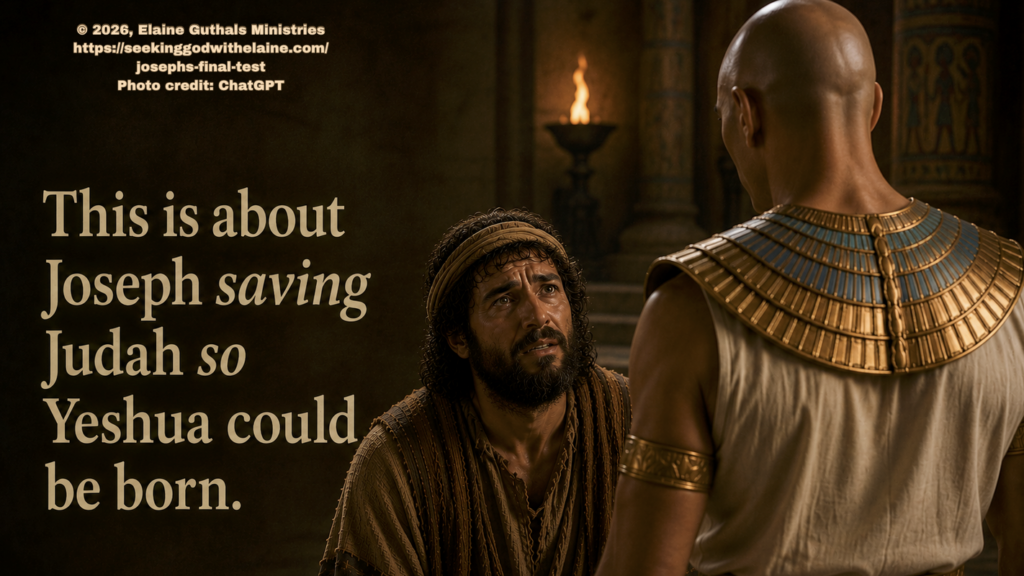
  • Redeemed

    Today is a music day. To read and hear the song, click here.

    The past couple of days have been a challenge for the three of us in my household. Part of the problem is an elevated pollen count.

    So, I am going to do a music day today. For Sunday’s service, I asked my sister to record the piano part for what I wanted to sing for the offertory. Then I told her to add an alto part.

    As part of my practicing, I recorded my part as well so that I could share it with you.

    Enjoy.

    Redeemed
    Vocalists: Elaine Guthals and Louise Guthals Weiss
    Keyboard: Louise Guthals Weiss

    creating-everything-theme

    What do you think?

    Leave me a comment below (about this or anything else) or head over to my Facebook group for some interactive discussion.

    If you don’t understand something and would like further clarification, please contact me.

    If you have not signed up for the email daily or weekly providing the link to the devotions and the newsletter, do so below.

    If God has used this devotion to speak with you, consider sharing it on social media.
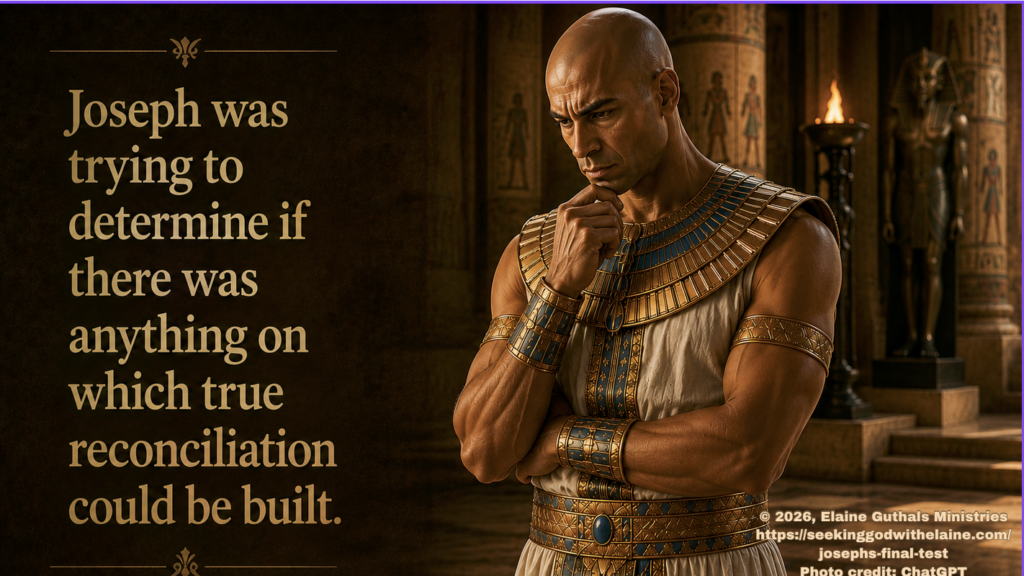
  • Covering Our Sins with Blood

    Once the couple had received their punishment, God was ready to forgive them of their sin – if they would commit to obey Him. This devotional reading looks at how God accomplished covering their sins – and foreshadowed how He would do it on a more permanent basis later.

    Nuggets

    • The man and the woman were finally named.
    • Only God can deal with our sin.
    covering-our-sins-with-blood

    God knew before we were created that humankind would disobey Him. He had the Plan of Salvation ready before the couple ever showed up.

    God had to provide the opportunity for repentance. The couple had to feel repentant and want restoration.

    How was God going to pull that off?

    Let’s Put It into Context

    To read devotions in the Creating Everything theme, click the button below.

    Devotions in the Celebrating Creation’s Story series

    The Couple Named

    “Then the man — Adam — named his wife Eve, because she would be the mother of all who live” (Gen. 3: 20 NLT)

    The man and the woman were finally named.

    Moses introduced us to humans in Genesis 1: 26-27. “Then God said, ‘Let us make human beings in our image, to be like us. They will reign over the fish in the sea, the birds in the sky, the livestock, all the wild animals on the earth, and the small animals that scurry along the ground.’ So God created human beings in his own image. In the image of God he created them; male and female he created them (Gen. 1: 26-27 NLT).

    We get a more in-depth look at man’s creation in Genesis 2: 7. “Then the Lord God formed the man from the dust of the ground. He breathed the breath of life into the man’s nostrils, and the man became a living person” (Gen. 2: 7 NLT).

    The woman’s creation is detailed in Genesis 2: 21-22. “So the Lord God caused the man to fall into a deep sleep. While the man slept, the Lord God took out one of the man’s ribs and closed up the opening. Then the Lord God made a woman from the rib, and he brought her to the man” (Gen. 2: 21-22 NLT).

    We aren’t told their names until here in Genesis 3: 20. A lot has happened to them in those 38 verses, hasn’t it?

    Did they not have names before this? Did they think they didn’t need them because there was only the two of them?

    Well, Adam probably did. Mah in Hebrew is man or human — earth man.

    Bevan showed us the importance of the man being the one to name the woman after the fall. Put it into context.

    • “And I will cause hostility between you and the woman, and between your offspring and her offspring. He will strike your head, and you will strike his heel” (Gen. 3: 16 NLT emphasis added).
    • “By the sweat of your brow will you have food to eat until you return to the ground from which you were made. For you were made from dust, and to dust you will return” (Gen. 3: 19 NLT emphasis added).
    • “Then the man — Adam — named his wife Eve, because she would be the mother of all who live” (Gen. 3: 20 NLT emphasis added).

    Look what Bevan said. He wrote,

    “It is not because the man refused to accept the judgment of God, not because he refused to submit to the doom. He did not refuse, he did not set himself up against God. He caught the tenderness of the Divine voice even as it pronounced the judgment. He saw the gleam of grace in the darkness of the doom. It is then that he turned to his wife and said, ‘Eve, the living one?’”

    Resource

    We talked about in a past devotion whether Adam had asked God to forgive him. By so naming Eve, I see this as a strong proclamation of his faith.

    We could suppose that Adam and Eve, when they took the bite, did not lose their basic faith that God is Sovereign Lord and Creator. Yes, it was bad that they wanted to be gods themselves.

    But it looks like Adam and Eve’s disobedience didn’t shake their overall faith in God.

    Eve really gets a bum rap for biting first. Yet, she is “… the mother of all who live” (Gen. 3: 20 NLT).

    Bevan stressed the dignity of motherhood. We don’t hear of Adam and Eve’s kids until Genesis 4, but here, she is considered a mother. To me, that means the mother of all humans who are children of God.

    If we look at the blessing given in Genesis 1: 28, one of the most important purposes women have is to produce children. “Then God blessed them and said, ‘Be fruitful and multiply …’” (Gen. 1: 28 NLT)

    No, it doesn’t say Adam is the father of all who live. That is logical. The Father of all who live is God.

    Don’t worry, guys. Adam’s immediate acceptance of God’s promise is important. What was God’s promise? The salvation of the race through the one of Adam and Eve’s descendant.

    Yeah, Adam has an important part to play in the continuance of the race.

    Adam acknowledged the promise and promised to do his part. In other words, he would complete his end of the covenant.

    Bonar had an interesting take. God named Adam when he called him Mah. God did not name Eve; Adam did.

    Resource

    Bonar came up with good explanations for this. Along with Adam’s acceptance of God’s promise, he felt this showed several things.

    • To show God’s grace.
    • To show Adam as the head of the family unit.
    • To show the couple’s solidarity even after Adam had tried to place the blame on Eve.

    All that is true. But then God created the animals, but Adam named them. Is this any different? He named the animals as he was looking for a helper. That helper ended up being Eve. Why shouldn’t he name her, too?

    Let’s go back to the first bullet. God’s grace has always been free. We cannot earn it or produce it ourselves.

    “God saved you by his grace when you believed. And you can’t take credit for this; it is a gift from God. Salvation is not a reward for the good things we have done, so none of us can boast about it” (Eph. 2: 8-9 NLT). Grace is always a God thing.

    Forgiving the Sin

    “And the LORD God made clothing from animal skins for Adam and his wife” (Gen. 3: 21 NLT)

    Only God can deal with our sin.

    Verse 21 is a simple statement that is packed. Let’s try to unpack it.

    God made the covering for Adam and Eve’s nakedness. Nothing we can do is enough to cover our sins. Only God can do that.

    Dods talked about it being a covering because God could no longer look at us in our sinful state. In reality, this covering was only temporary.

    Jesus had to come and shed His blood for an eternal covering of our sins. God’s goal at this point was to restore blessedness.

    Jukes’ noted that God ended His resting period to work to make the covering for sin. This was important to Him.

    Resource

    He is not going to sit idly by and just let sin take over. He has always been in the business of forgiving us when we ask for forgiveness.

    Song

    Tauren Wells/We the Kingdom/Davies

    The garments were made of animal skins. This is said to be the first sacrifice.

    But then I had never really thought of it the way Dods did. He wrote, “Adam took leaves from an inanimate, unfeeling tree; God deprived an animal of life, that the shame of His creature might be relieved.”

    Resource

    I am not sure I would have said it the way he did. I do see what he was saying, though.

    While Adam tells me I am a bad plant lady because my plants seem to die on me, they are living and growing. Dods made the comment that sin couldn’t be covered by taking something that would be easily replaced – the leaves would grow back on the plant the next year.

    Yet, they are not living, breathing beings. They don’t have the organs we do, certainly not the ability to think, speak, and reason. The plant’s death is not the same as our death.

    Animals had to be sacrificed so that blood could be shed. Sin is only covered by blood. “In fact, according to the law of Moses, nearly everything was purified with blood. For without the shedding of blood, there is no forgiveness” (Heb 9: 22 NLT).

    Yes, it is animals plural. An animal had to die for each of them.

    This is what the sacrifices are all about in Leviticus. The sacrifices provide a substitute for the loss of Life as payment of sins, foreshadowing the sacrifice of Jesus. The sins of the one doing the sacrifice is transferred onto the animal.

    But look at it this way, too. Adam – and Eve when she was created – had no concept of what death was when God made the covenant with Adam. “But the Lord God warned him, ‘You may freely eat the fruit of every tree in the garden — except the tree of the knowledge of good and evil. If you eat its fruit, you are sure to die’” (Gen. 2: 16-17 NLT).

    They bit (Gen. 3: 6), but they didn’t die a physical death. They now knew what disobedience was, but they may or may not have equated that to spiritual death – and certainly not physical death.

    The animals had to die to show then what physical death was – what was in store for them. It had to suffer for them. Suffering plays a big role in punishment for sin.

    Every time a sacrifice was made – all the way from Abel’s sacrifice to those offered until the temple was destroyed – it reminded them that death was a result of sin.

    Making the Connections #1

    If Satan thought God was going to strike Adam and Eve down right then, he was wrong.

    Oh, make no mistake. God can and will kill disobedient people, sometimes on the spot. Sometimes not.

    • “The ten men Moses had sent to explore the land — the ones who incited rebellion against the Lord with their bad report — were struck dead with a plague before the Lord. Of the twelve who had explored the land, only Joshua and Caleb remained alive.” (Num. 14: 36-38 NLT).
    • “And Moses said, ‘This is how you will know that the Lord has sent me to do all these things that I have done — for I have not done them on my own. If these men die a natural death, or if nothing unusual happens, then the Lord has not sent me. But if the Lord does something entirely new and the ground opens its mouth and swallows them and all their belongings, and they go down alive into the grave, then you will know that these men have shown contempt for the Lord.’ He had hardly finished speaking the words when the ground suddenly split open beneath them. The earth opened its mouth and swallowed the men, along with their households and all their followers who were standing with them, and everything they owned. So they went down alive into the grave, along with all their belongings. The earth closed over them, and they all vanished from among the people of Israel” (Num. 16: 28-33 NLT).
    • “So the Lord sent poisonous snakes among the people, and many were bitten and died. Then the people came to Moses and cried out, ‘We have sinned by speaking against the Lord and against you. Pray that the Lord will take away the snakes.’ So Moses prayed for the people” (Num. 21: 6-7 NLT).

    But God is a God of mercy. That means He doesn’t give us the punishment we deserve.

    Satan tries to use the fact that God will correct us through love to get us to fear and disobey Him. He knows we like to do things our own way without any consequences.

    Doesn’t the delay of our punishment of death show how much He does love us? He is postponing it to allow us to repent of our sins.

    Making the Connections #2

    What does all that has transpired in Genesis 3 have to do with justification? Justification is the act through the merits of Christ that makes us free from sin because we are following God’s moral laws. Jesus justifies us when we put our lives in His hand.

    Adam and Eve tried to atone for their sins their own way. They failed miserably.

    Part of the reason is because we can’t restore God’s righteousness. Our righteousness is but a poor knockoff of God’s righteousness.

    Trench put it this way. He wrote, “There is no robe of our own righteousness which can cover us and conceal our shame.”

    Resource

    Our sins must be covered by blood of a pure sacrifice. That sacrifice was Jesus.

    We cannot be the sacrifice as our blood is not pure. Face it, not many people would calmly go to their death to atone for their sin.

    It would be useless if we did. We would be dead and not reap the benefits of the forgiveness of our sins.

    Enter Jesus. He died spilling His blood and rose again so that we may have a perfected life in Him. He is the only way.

    • “Salvation is not a reward for the good things we have done, so none of us can boast about it” (Eph. 2: 9 NLT).
    • “There is salvation in no one else! God has given no other name under heaven by which we must be saved” (Ac. 4: 12 NLT).
    • “You must not have any other god but me. You must not make for yourself an idol of any kind or an image of anything in the heavens or on the earth or in the sea” (Ex. 20: 3-4 NLT).
    • “Jesus told him, ‘I am the way, the truth, and the life. No one can come to the Father except through me’” (Jn. 14: 6 NLT).

    Yes, the Plan of Salvation was finished upon the cross, but the results of sin were not addressed until Jesus rose from the grave.

    How Do We Apply This?

    Remember that, even in our worse condition, God will provide for us.
    Remember that God always calls us to faith.
    Fully embrace God’s promises.
    Document God’s mercies to and provisions for us.

    Resource

    Father God. Your love for us is so everlasting. We disobey You so many times. Thank You that You don’t accept our disobedience. Thank You for holding us accountable when we break Your laws and commandments. And thank You for taking us back with open arms. Amen.

    What do you think?

    Leave me a comment below (about this or anything else) or head over to my Facebook group for some interactive discussion.

    If you don’t understand something and would like further clarification, please contact me.

    If you have not signed up for the email providing the link to the devotions and the newsletter, do so below.

    If God has used this devotion to speak with you, consider sharing it on social media.
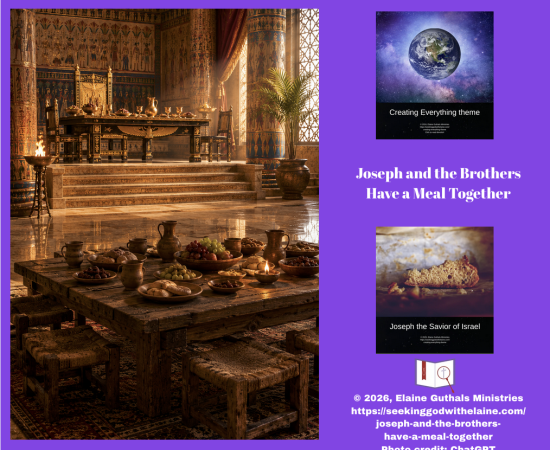
  • When We Deny Jesus

    Peter gave us an excellent example of how a disciple can still sin. This daily devotional looks at how it occurred and Jesus’ response.

    Nuggets

    • We don’t want to do as Peter did and distance ourselves from Jesus.
    • Knowing Jesus should be our life goal.
    • Jesus sees us when we sin and holds us accountable.

    Devotions in the Luke’s Diagnosis and Prescription series

    In the last Sunday Morning Bible Study devotion before we backtracked, we left Jesus as He was being arrested in the Garden of Gethsemane. We pick it up where Peter is fixing to betray Him.

    Now, remember, Jesus told Peter he would  betray Him three times before morning when they were talking after the Passover meal (Jn. 13: 38). What we are looking at now is the fulfillment of that prophecy.

    Peter Distanced Himself from Jesus

    “They seized him, led him away, and brought him into the high priest’s house. Meanwhile Peter was following at a distance. They lit a fire in the middle of the courtyard and sat down together, and Peter sat among them” (Lk. 22: 54-55 CSB)

    We don’t want to do as Peter did and distance ourselves from Jesus.

    I guess I have never really thought about what all it meant that Peter was following at a distance (Lk. 22: 54). I always figured that he was trying to not get arrested. Bottom line, I probably felt — as Braithwaite did — this was just a moment of cowardice.

    Resource

    Mudge felt that it was more a decision of character. He felt Peter was “not giving the whole heart’s affection to Him.”

    Resource

    I have to wrap my head around this. Yes, this is impulsive, wild-card Pete. We see Peter as a gruff, homely sort. To be a fisherman, he had to have some patience and determination.

    Hitchcock thought we may not always be able to trust Peter’s judgment. He felt that was because Peter had such a big heart. The bottom line is he didn’t want to lose Jesus.

    Resource

    But this is the guy that popped right up and said, “You are the Christ” (Mt. 16: 16). Peter not only was an apostle, but he also was in the inner circle.

    I guess I have always wondered what happened between the Garden of Gethsemane and the courtyard. Peter wasn’t acting like an inner circle member.

    Jesus told Peter point blank that he was going to deny Him. Even with his “wash all of me,” it didn’t help.

    To read a related devotion, click the button below.

    What Peter was doing was distancing himself from Jesus. He may have thought he was keeping up with Him. He wasn’t.

    Peter Denied Jesus

    “When a servant saw him sitting in the light, and looked closely at him, she said, ‘This man was with him too.’ But he denied it: ‘Woman, I don’t know him.’ After a little while, someone else saw him and said, ‘You’re one of them too.’ ‘Man, I am not!’ Peter said. About an hour later, another kept insisting, ‘This man was certainly with him, since he’s also a Galilean.’ But Peter said, “Man, I don’t know what you’re talking about!” Immediately, while he was still speaking, a rooster crowed” (Lk. 22: 56-60 CSB)

    Knowing Jesus should be our life goal.

    Here Pete was, saying he never knew Jesus. Not just once, but three times!

    More than that, Peter just as vehemently denied that he knew Jesus as he did when he told Jesus he never would.

    We do assume that Peter denied Jesus because he feared for his own safety. Hitchcock, though, felt that wouldn’t have been the case if he had acknowledged his attachment to Jesus.

    That means there was no reason for Peter to deny Jesus.

    Resource

    Braithwaite gave us four reasons why Peter could have denied Jesus. When Jesus told Peter that he would deny Him, he was so sure he wouldn’t do that. We can’t be confident in ourselves. We have to be confident in God.

    Instead, Peter was blinded by the confidence. Gray contended that Peter was blindsided by the first of the accusations. But then, Peter was so certain of himself, that he didn’t expect the confrontations.

    Resource

    That meant Peter wasn’t prepared for the confrontations. So, he fell to Satan’s trickery.

    Resource

    Satan likes to trick us into denying Jesus. He will do anything to wreck our relationship with Him. We talked before about Jesus saying Satan was asking for the disciples.

    To read a related devotion, click the button below.

    Denying Christ is a biggy. Mudge felt that we do because we either fear the consequences men will heap on us or love this world too much.

    We let the opinions of others keep us from having a relationship with Jesus or destroying it once we make a profession of faith. We let our fears and insecurities damage it.

    We have to make a decision about what we are going to do with Jesus. We can’t waffle. We can’t follow Him sporadically or half heartedly.

    We have to be all in. We need to ask Him to be our Savior and Lord.

    It is important that we realize we have to make the decision about trusting Jesus now. Putting it off won’t be good if it ends up that we don’t have that time.

    It is important that we realize we have to make the decision about trusting Jesus now. Putting it off won’t be good if it ends up that we don’t have that time.

    Jesus Holds Us Accountable

    “Then the Lord turned and looked at Peter. So Peter remembered the word of the Lord, how he had said to him, ‘Before the rooster crows today, you will deny me three times.’ And he went outside and wept bitterly” (Lk. 22: 61-62 CSB)

    Jesus sees us when we sin and holds us accountable.

    We talk about Mom looks. Sometimes, moms discipline just by a look.

    Jesus did the same thing to Peter. He looked at him (although the look isn’t described).

    Peter showed us true repentance. He wept bitter tears.

    We might say Peter was caught up in the horror of the situation. When he calmed down, he was disgusted with himself.

    Braithwaite made a good point. This denial may have been sudden, but it was done soon. The incident took maybe two hours.

    Resource

    It was a once-and-done. Peter never denied Jesus again.

    This was all predicated on Peter’s genuine repentance. It had to be an ugly cry. It couldn’t be a light weep.

    Carter was so right. He said, “The saddest part of our sin is, that we are so slow to confess it.”

    Resource

    We want to bury our sin, not pull it out in the open. We definitely don’t want it to come under Jesus’ stare.

    Ooo, baby. I have to process this. Carter wrote, “Now faith is not the belief of any particular dogma, nor is it the same as a spirit of assurance, neither is it any peculiar feeling appropriating some special promise; but it is the bent, the aim of the whole soul. It is the prevailing direction of all the powers of man toward God; it is the apprehension of the inner man embracing, grasping the invisible; living in things which are unseen and eternal, and raising him out of the sphere of sight which lives in things that are temporal. Faith may lay hold of one particular promise at one time, of another at another. And thus he had learnt to regard sin in the light of another world — sin abstractedly in itself, as a loss of spiritual life, as a thing abhorrent to God, as an utter contrariety to all that his soul was aspiring after.”

    Resource

    • Faith isn’t about a specific creed.
    • It isn’t based on our confidence in it.
    • It isn’t about feelings at all.
    • It is about Who our complete trust is in.
    • It is the conviction that the doctrines revealed in God’s Word are true, even if we do not understand all aspects of them.

    Carter made another interesting observation. Maybe all of Peter’s actions — refusal to let Jesus wash his feet, cutting off the servant’s ear, denying Him — was more of a human, physical love.

    It wasn’t yet love of the Suffering Savior.

    Gray pointed out something that isn’t addressed in these verses. Once Peter got the ugly cry out, he sought out his fellow disciples.

    Resource

    Peter may have felt unworthy to be called a disciple still, but he didn’t break his fellowship with his fellow believers. They probably encouraged him to take it all to God.

    So, just think about how Peter felt when the women came back from the empty tomb and said, “But go, tell his disciples and Peter that he is going before you to Galilee …” (Mk. 16: 7 ESV).

    Think about, though, what Spurgeon said that the look looked like. He wrote, “When the Lord looked upon Peter, though He did refresh his memory, and make an appeal to his conscience, yet there was still more evidently a glorious manifestation of love.”

    Resource

    Oh, I think so. Jesus knew Peter just needed a nudge into complete repentance. He gladly gave it — because He did love Peter and knew what Peter would become.

    WhenWeDenyJesusPin

    Making the Connections

    We can learn a lot from Peter.

    • We may have a rock-solid faith one day and sin big time the next.
    • I want to say this right and am not sure I will. It really isn’t the sin that is the issue. We are going to sin because we are still in physical bodies. God will forgive all sins except the unpardonable sin, which I feel is unbelief. So, the sin isn’t the focus — it is the repentance.
    • We have to weep bitter tears in repentance. We have to mean it and show we mean it by turning away from the sin.

    It isn’t about us. It is about God’s grace.

    We’ve already talked about how Jesus restored Peter.

    To read a related devotion, click the button below.

    How Do We Apply This?

    First, we have to choose to follow Jesus

    The ABCDs of Salvation

    If you have not become a believer in Christ, please read through the
    Plan of Salvation and prayerfully consider what God is asking you to do.

    A – admit our sins
    B – believe His Son Jesus is our Redeemer
    C – confess God as Sovereign Lord

    D – demonstrate that commitment by making any changes needed in our lives to
    live the way in which God has called us

    The Disciple’s Job Description

    Then we really have to follow Him. Remember our mission statement.

    The Disciple’s Job Description

    Mission Statement

    “… If anyone would come after me, let him deny himself
    and take up his cross and follow me”
    (Mt. 16: 24 ESV).

    To read a  devotion in the What Does It Mean? series, click the appropriate button below.

    To read a related devotion, click the button below.

    • We need to learn to meditate on the Person of Jesus.
    • We need to learn to see our sins as God does.
    • We need to be on our guard against Satan’s temptation.

    Resource

    We will never be strong enough to resist Satan unless we are in Him.

    Glossary

    Foote make a good observation. Just as Jesus looked with pity on Peter, we too should long with pity on those who need our encouragement.

    Resource

    No, we hope we don’t sin. We especially pray that we never deny Jesus.

    When we sin, we need to ask for forgiveness. When we genuinely ask, God will always grant it.

    Father God. Thank You that You included in Your Scriptures the occasion where Peter denied Jesus. It shows us that we can be forgiven — even after we commit terrible sins. We pray we keep Your laws and commandments but know we will continue to break them.

    What do you think?

    Leave me a comment below (about this or anything else) or head over to my Facebook group for some interactive discussion.

    If you don’t understand something and would like further clarification, please contact me.

    If you have not signed up for the email daily or weekly providing the link to the devotions and the newsletter, do so below.

    If God has used this devotion to speak with you, consider sharing it on social media.