When the time was right, Jehovah sent His grace and truth to the world to redeem it. This devotional reading looks at Who the source is.
Nuggets
- Moses and Yeshua have similarities, but Yeshua isn’t merely another Moses.
- Moses gave instructions while Yeshua embodies grace and truth.
- John wasn’t saying the Law was bad while grace is good.
- Everything Moses pointed toward comes to fulfillment in Yeshua.
- Yeshua was the source of grace and truth.
- Grace is finding favor is Jehovah’s eyes, and truth is reality according to God.
Yeshua had a mission here on earth. His ministry was to be the Savior of the world.
The foundation of that ministry was that, the fullness of Jehovah’s time, we received His grace and truth. Because of His unending and overflowing grace, Jehovah sent Yeshua to be the Sacrifice that we needed.
In other words, Yeshua was the source of Jehovah’s grace.
Let's Put It into Context
To read devotions in The Battle for the Heart theme
Devotions in the The Early Ministry of the Messiah series
The Source of Law: Moses
“For the law was given through Moses …” (Jn. 1: 17 ESV)
Moses and Yeshua
“Come, I will send you to Pharaoh that you may bring my people, the children of Israel, out of Egypt” (Ex. 3: 10 ESV)
“She will bear a son, and you shall call his name Jesus, for he will save his people from their sins” (Mt. 1: 21 ESV)
Moses and Yeshua have similarities, but Yeshua isn’t merely another Moses.
First-century Jews would have known all about Moses. Even to them – as covenant mediator – he would have been a Hall of Famer.
The exodus from Egypt was an important event in Israel’s history. Their release from slavery allowed them to become the nation of Israel.
John placed Yeshua in a recognizable Moses-shaped pattern so that first-century Jews – and us – see the continuity. That connection was deliberate.
The differences between Moses and Yeshua are recognizable. They aren’t equals.
Yeshua does more than just lead His people. He offers a different kind of deliverance – a new covenant.
Yeshua came to deliver us from the bondage of sin.
We may see the parallels of Moses and Yeshua. One thing we have to realize is that Yeshua was walking into Israel’s story.
Yeshua never intended to start a new story. He specifically said that He came to be a part of that story.
The plan was for Yeshua to step into a centuries-old story. It was a story of deliverance, covenant, rebellion, judgment, mercy, and Jehovah’s faithfulness to His people.
Moses had done his part. The exodus and the covenant had been part of that story.
Yeshua walked into that story – but it wasn’t the only story. He wasn’t merely fulfilling the covenant given to Abraham, Moses, and David. He was fulfilling the covenant given to Adam.
All who accept Yeshua as the Savior would be delivered and redeemed. Our judgment would be taken by Yeshua because of Jehovah’s mercy and grace.
The Giving of the Law Verses the Coming of Grace and Truth
“Do not think that I have come to abolish the Law or the Prophets; I have not come to abolish them but to fulfill them. For truly, I say to you, until heaven and earth pass away, not an iota, not a dot, will pass from the Law until all is accomplished. Therefore whoever relaxes one of the least of these commandments and teaches others to do the same will be called least in the kingdom of heaven, but whoever does them and teaches them will be called great in the kingdom of heaven” (Mt. 5: 17-19 ESV)
Moses gave instructions while Yeshua embodies grace and truth.
Both Moses and Yeshua went up a mountain – but for different reasons. Moses went up Mt. Sinai to receive the Law – more importantly, the covenant terms.
Yeshua, at the Sermon on the Mount, teaches. But really what He was teaching about was Himself.
But Yeshua was more than just a Teacher. In order to understand that, we have to understand the difference between the Law and grace.
What John Is and Isn’t Saying about the Law
“For by works of the law no human being will be justified in his sight, since through the law comes knowledge of sin” (Rom. 3: 20 ESV)
John wasn’t saying the Law was bad while grace is good.
Some think the Law can save us. If we keep the Law, we don’t sin. Therefore, keeping the Law is supposedly what we need for eternal life.
It doesn’t work that way.
- “We ourselves are Jews by birth and not Gentile sinners; yet we know that a person is not justified by works of the law but through faith in Jesus Christ, so we also have believed in Christ Jesus, in order to be justified by faith in Christ and not by works of the law, because by works of the law no one will be justified” (Gal. 2: 15-16 ESV).
- “For all who rely on works of the law are under a curse; for it is written, ‘Cursed be everyone who does not abide by all things written in the Book of the Law, and do them.’ Now it is evident that no one is justified before God by the law, for ‘The righteous shall live by faith.’ But the law is not of faith, rather ‘The one who does them shall live by them’” (Gal. 3: 10-12 ESV).
- “You are severed from Christ, you who would be justified by the law; you have fallen away from grace.” (Gal. 5: 4 ESV).
Let’s unpack those.
The Law gives knowledge of sin. Basically, a sin is when we do something that disobeys Jehovah. The Laws show us Jehovah’s character.
In other words, the Law doesn’t just tell us, “You are going 90 miles per hour in a 55-mile-per-hour zone.” It says, “Your actions aren’t being performed in a way that obeys Jehovah.”
So, when we are breaking the Laws, we are acting outside of Jehovah’s character.

Being a Jew didn’t justify first-century Jews – or any that came before them. Justification is where we are declared righteous before Jehovah. Our guilt is removed and we are accepted as righteous because of our faith in the Messiah.
Some like to think justification is a New Testament concept. It really isn’t.
Abraham was declared righteous – therefore, justified – when he believed (Gen. 15: 6). Noah was a righteous man because he walked with Jehovah (Gen. 9: 9). Job was blameless and upright (Job 1: 1).
They weren’t justified by their actions. They were justified by their belief in Jehovah.
No one is justified by the Law. We can keep the law, but still not be walking with Jehovah. We may be trying to do everything He says, but we may not believe that we should submit our lives to Him.
That speaks to motivation. Are we walking with Jehovah because we want to do His will, or do we just think it is the right thing to do?
To me, the bottom line is that the Law doesn’t help us to rectify a situation when we have broken the Law. There may be punishment associated with the Law, but the stain of the sin is still there.
That stain is still there because the Law doesn’t provide the means of justification and final redemption for sin. It doesn’t include the Plan of Salvation.
Only Yeshua’s mission carries that.
Why Moses and Yeshua Are in This Relationship
“For if you believed Moses, you would believe me; for he wrote of me. But if you do not believe his writings, how will you believe my words?” (Jn. 5: 46-47 ESV)
Everything Moses pointed toward comes to fulfillment in Yeshua.
Moses was considered the mediator of the covenant because Jehovah chose him to be the intermediary between Himself and the Israelites. His job was to deliver the Law, intercede for the people, and formalize the covenant on Mt. Sinai.
The whole purpose of giving the Law was so that Jehovah would be revealed to the Israelites – and us. Moses took these revelations from Him and communicated them to the people.
The Law could only go so far, though. Think about Moses striking the rock and, as punishment, losing the chance to enter the Promised Land. That case showed the limitations of the Law.
The case showed that the Law could identify disobedience and establish its consequences, but it couldn’t provide the final redemption from sin.
Yeshua made it clear that He wasn’t replacing the Law. He was fulfilling it.
Think about it. Many see the Law as a list of do’s and don’ts. It is – but it really isn’t.
The Law shows us Jehovah’s character. It shows us that toward which we are to strive.
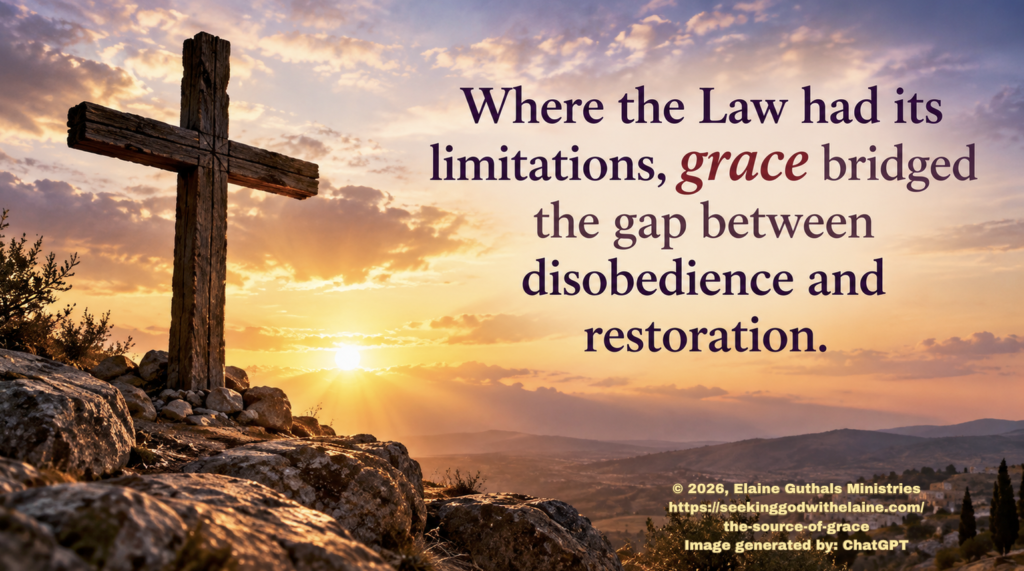
Where the Law had its limitations, grace bridged the gap between disobedience and restoration. Yeshua’s death paid the penalty for our sins.
Yeshua’s covenant fulfills the promises of Jeremiah 31: 31-34 and Ezekiel 36: 26-27. It offers a transformed life to those who accept a personal relationship with Him. It was established in Luke 22: 20.
- “Behold, the days are coming, declares the Lord, when I will make a new covenant with the house of Israel and the house of Judah, not like the covenant that I made with their fathers on the day when I took them by the hand to bring them out of the land of Egypt, my covenant that they broke, though I was their husband, declares the Lord. For this is the covenant that I will make with the house of Israel after those days, declares the Lord: I will put my law within them, and I will write it on their hearts. And I will be their God, and they shall be my people. And no longer shall each one teach his neighbor and each his brother, saying, ‘Know the Lord,’ for they shall all know me, from the least of them to the greatest, declares the Lord. For I will forgive their iniquity, and I will remember their sin no more” (Jer. 31: 31-34 ESV).
- “And I will give you a new heart, and a new spirit I will put within you. And I will remove the heart of stone from your flesh and give you a heart of flesh. And I will put my Spirit within you, and cause you to walk in my statutes and be careful to obey my rules” (Ezek. 36: 26-27 ESV).
- “And likewise the cup after they had eaten, saying, “This cup that is poured out for you is the new covenant in my blood” (Lk. 22: 20 ESV).
Yeshua’s covenant provides forgiveness of sin.
The Source of Grace: Yeshua
“For the law was given through Moses; grace and truth came through Jesus Christ” (Jn. 1: 17 ESV)
Charis and Aletheia
Yeshua was the source of grace and truth.
In the last devotion, we talked about grace and truth.
- Charis (χάρις) means grace (grace, favor, graciousness, goodwill, or a gracious gift).
- Aletheia (ἀλήθεια) means truth (what is true, genuine, real, reliable, and not concealed).
What John is saying here is what came through Yeshua didn’t come through Moses.
Wait! What??
Are we trying to say that grace only appeared where Yeshua first stepped foot on earth? No, we know Jehovah was always gracious toward His people.
- “The Lord is gracious and merciful, slow to anger and abounding in steadfast love.” (Ps. 145: 8 ESV).
- “Gracious is the Lord, and righteous; our God is merciful” (Ps. 116: 5 ESV).
- “‘Yet even now,’ declares the Lord, ‘return to me with all your heart, with fasting, with weeping, and with mourning; and rend your hearts and not your garments.’ Return to the Lord your God, for he is gracious and merciful, slow to anger, and abounding in steadfast love; and he relents over disaster” (Joel 2: 12-13 ESV).
- “But the Lord was gracious to them and had compassion on them, and he turned toward them, because of his covenant with Abraham, Isaac, and Jacob, and would not destroy them, nor has he cast them from his presence until now” (II Kgs. 13: 23 ESV).
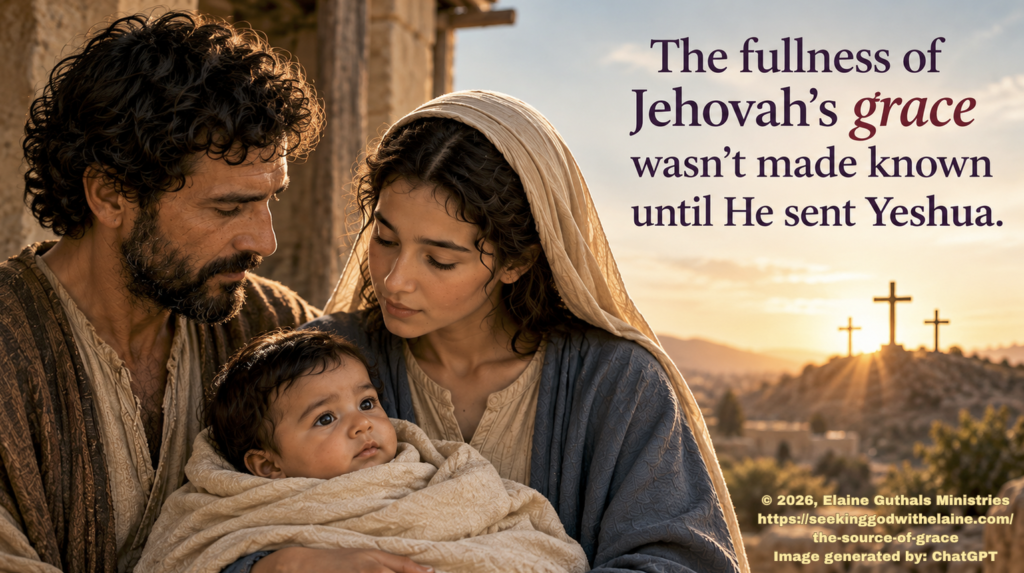
But the fullness of Jehovah’s grace wasn’t made known until He sent Yeshua.
Jehovah isn’t telling us, “Go and be gracious like me.” He is saying, “You can only be gracious through me.”
Then there is truth. Yeshua didn’t just tell the truth. He was the truth.
One isn’t given to us without the other.
Grace and Truth
“… and we have seen his glory, glory as of the only Son from the Father, full of grace and truth” (Jn. 1: 14 ESV).
Grace is finding favor is Jehovah’s eyes, and truth is reality according to God.
We looked at grace and truth in the last devotion. However, I used an incorrect Hebrew word. So, I am going to correct that here.
The Hebrew Scriptures also describe Jehovah Himself as chanun (חַנּוּן), meaning gracious. When Jehovah reveals His character to Moses, He says that He is “… merciful and gracious, slow to anger, and abounding in steadfast love and faithfulness” (Ex. 34: 6 ESV).
More importantly, it is finding favor in another’s eyes – namely Jehovah. The Hebrew concept is matza chen b’ene (מָצָא חֵן בְּעֵינֵי).
John doesn’t separate grace from the person of Christ. “So the Word became human and made his home among us. He was full of unfailing love and faithfulness.” (Jn. 1: 14 NLT).
We have to be very careful about its meaning, though. Grace doesn’t mean that Jehovah simply overlooks sin. It means that Jehovah acts toward people from His own gracious character rather than because they have established a claim upon Him.
Grace doesn’t say: “Sin does not matter.” Grace says: “God has acted graciously toward you; therefore, live differently.”
Truth in the Hebrew Scriptures isn’t merely information that happens to be accurate. The primary Hebrew word translated truth is ’emet (אֱמֶת’). It describes something that is dependable, trustworthy, established, and true to reality.
The Hebrew understanding, therefore, joins two ideas that modern English can sometimes separate: truthfulness and faithfulness.
Biblical truth is something upon which a person can stand.
This means that when Scripture speaks about truth, it is not presenting truth as something detached from character.
- Truth is dependable because it is firm.
- Truth is trustworthy because it is faithful.
- Truth can be believed because it is reliable.
Truth is reality according to God.
Heart Check
Think about the battle Yeshua is engaged in for your heart. Ask yourself the following questions.
- Am I obeying Jehovah because I love Him and want to walk with Him, or simply because I believe I should?
- Where am I knowingly acting outside of Jehovah’s character?
- Am I treating Jehovah’s grace as permission to continue in sin, or am I allowing His grace to lead me toward restoration and a changed life?
- Am I trusting Yeshua as the One who provides the forgiveness and redemption the Law cannot provide?
- Is my life being shaped by the truth of who Jehovah is?
How Do We Apply This?
- Recognize where you are walking outside of Jehovah’s character.
- Receive the grace Yeshua provides.
- Let grace lead you toward restoration.
- Walk in the truth according to Jehovah.
- Live differently because of the grace you have received.
Father God. Lord, let us receive Your grace so that our relationships with You will be restored. We choose daily to walk with You. Amen.
If you don’t understand something and would like further clarification, please contact me.
If you have not signed up for the email providing the link to the devotions and the newsletter, do so below.
If God has used this devotion to speak with you, consider sharing it on social media.