John understood his mission. This devotional reading looks at how John knew he was preparing the way for Someone else.
Nuggets
- When asking what right did John have to baptize people, the cultural expectation would be that John would provide a name of the rabbi under which he studied.
- John knew the limitations of his baptism.
- John was rock solid in his job of preparing the way for the Messiah.
- In fact, John knew that his position was so far below the Messiah’s that he didn’t consider him worthy enough to be His slave.
- The spirit signifies renewal, and the fire signifies refinement or destruction.
- Those who are holy and righteous will be separated from those who are unholy and unrighteous.
We are lucky. We look at things that already happened. First-century Jews didn’t have that luxury.
John knew of his mission. Others didn’t.
That led to John having to explain his mission to others.
Let's Put It into Context
To read devotions in The Battle for the Heart theme
Devotions in the The Ministry of John the Baptist series
Someone Else Is Coming
“I baptize with water those who repent of their sins and turn to God. But someone is coming soon who is greater than I am — so much greater that I’m not worthy even to be his slave and carry his sandals. He will baptize you with the Holy Spirit and with fire. He is ready to separate the chaff from the wheat with his winnowing fork. Then he will clean up the threshing area, gathering the wheat into his barn but burning the chaff with never-ending fire.”” (Mt. 3: 11-12 NLT)
“John announced: ‘Someone is coming soon who is greater than I am — so much greater that I’m not even worthy to stoop down like a slave and untie the straps of his sandals. I baptize you with water, but he will baptize you with the Holy Spirit!’” (Mk. 1: 7-8 NLT)
“Everyone was expecting the Messiah to come soon, and they were eager to know whether John might be the Messiah. John answered their questions by saying, ‘I baptize you with water; but someone is coming soon who is greater than I am — so much greater that I’m not even worthy to be his slave and untie the straps of his sandals. He will baptize you with the Holy Spirit and with fire. He is ready to separate the chaff from the wheat with his winnowing fork. Then he will clean up the threshing area, gathering the wheat into his barn but burning the chaff with never-ending fire’ John used many such warnings as he announced the Good News to the people” (Lk. 3: 15-18 NLT)
“Then the Pharisees who had been sent asked him, ‘If you aren’t the Messiah or Elijah or the Prophet, what right do you have to baptize?’ John told them, ‘I baptize with water, but right here in the crowd is someone you do not recognize. Though his ministry follows mine, I’m not even worthy to be his slave and untie the straps of his sandal.” This encounter took place in Bethany, an area east of the Jordan River, where John was baptizing” (Jn. 1: 24-28 NLT)
What Right Do You Have to Baptize?
When asking what right did John have to baptize people, the cultural expectation would be that John would provide a name of the rabbi under which he studied.
The Pharisees weren’t really asking John why he did what he was doing. They were asking who have him permission – who gave him authority – do baptize.
Rabbis in first-century Israel taught disciples by interpreting Scripture and tradition. Some rabbis had more authority than others. That authority would carry forward to their students.
No, we aren’t told that John studied under a rabbi. I would say that was because he didn’t.
That concept would be foreign to the Pharisees. Why would John be baptizing if no one taught him?
John answered their question truthfully. “My authority comes from the One Who comes after me. I am preparing the way for the Anointed One – the King Messiah (Melech HaMoshiach – מֶלֶךְ הַמָּשִׁיחַ).
John’s authority came from Jehovah’s commission. He was “… the voice of someone shouting, ‘Clear the way through the wilderness for the Lord! Make a straight highway through the wasteland for our God’!” (Isa. 40: 3 NLT).
The Gospel of John hooked this question on to the ones about whether John the Immerser was the Messiah, Elijah, or the prophet of which Moses spoke.
I Baptize with Water
John knew the limitations of his baptism.
Just as John knew what his position was, he understood what his baptism did. He baptized with water. It was an outward expression.
John knew that it was a symbol of obedience rather than a reception of inward grace.
Some see baptism as a part of the salvation process – a completion of our asking Jehovah to forgive us of our sins. John wouldn’t have seen it that way.
John knew he was called to prepare people. He was not completing the work.
The call John was raising was to turn around their lives and be baptized as an outward expression of that repentance. He knew that the spiritual transformation had to come from the Messiah.
John knew exactly where his ministry stood. He knew its scope and position in the plan Jehovah was working out.
Someone Is Coming
John was rock solid in his job of preparing the way for the Messiah.
From the time Zechariah and Elizabeth were told were going to have a son, they knew he was called to have a special job in the Kingdom of God. He was going to prepare the way for the promised Messiah.
John was sure in what he was called to do. We do not see any mention in the gospels that he doubted that calling.
True, there was one time when John questioned Yeshua to make sure He was the Messiah (Mt. 11: 2-19). Part of those doubts could have been precipitated because of the Messianic expectation that all prisoners would be freed.
“The Spirit of the Sovereign Lord is upon me, for the Lord has anointed me to bring good news to the poor. He has sent me to comfort the brokenhearted and to proclaim that captives will be released and prisoners will be freed” (Isa. 61: 1 NLT).
Still, John knew his place within the plan. He was to start the discussion about the appearance of the Messiah. Then he was to back off and let Him have His ministry.
“He must become greater and greater, and I must become less and less” (Jn. 3: 30-35 NLT).
Not Worthy Even to be His Slave
In fact, John knew that his position was so far below the Messiah’s that he didn’t consider him worthy enough to be His slave.
Servants or usually the lowest slave were assigned to wash a visitor’s feet. They had to take the sandal off first.
Draw the picture in your mind. The visitor is either standing or sitting. Either way the servant has to basically get on the floor to perform the task.
This signifies the social significance. The servant was placing himself beneath the person whose feet was being washed.
Think what John was saying. “I’m not worthy of completing Step 1, let alone Steps, 2, 3, and 4.”
Yes, John was saying the Messiah was above him. But he was also saying that he was at the absolute bottom of the social hierarchy.
Baptize You with the Holy Spirit and with Fire
The spirit signifies renewal, and the fire signifies refinement or destruction.
The renewal goes back to Ezekiel. “Then I will sprinkle clean water on you, and you will be clean. Your filth will be washed away, and you will no longer worship idols. And I will give you a new heart, and I will put a new spirit in you. I will take out your stony, stubborn heart and give you a tender, responsive heart. And I will put my Spirit in you so that you will follow my decrees and be careful to obey my regulations” (Ezek. 36: 25-27 NLT).
Maclaren helped us to understand the connection between water and fire. He wrote, “Baptism with the Holy Ghost is not one thing and baptism with fire another, but the former is the reality of which the latter is the symbol.”
Resource
.At first glance, we may think this means baptism by immersion – like John did – and the separation at the end of the age. “And anyone whose name was not found recorded in the Book of Life was thrown into the lake of fire” (Rev. 20: 15 NLT).
But it is more than that, isn’t it? We are refined in the fire. “So be truly glad. There is wonderful joy ahead, even though you must endure many trials for a little while. These trials will show that your faith is genuine. It is being tested as fire tests and purifies gold — though your faith is far more precious than mere gold. So when your faith remains strong through many trials, it will bring you much praise and glory and honor on the day when Jesus Christ is revealed to the whole world” (I Pet. 1: 6-7 NLT).
Baptism by fire purifies and is part of the sanctification process. We are refined to better reproduce Jehovah’s character in our hearts.
Sanctification, therefore, is a battle for our hearts.
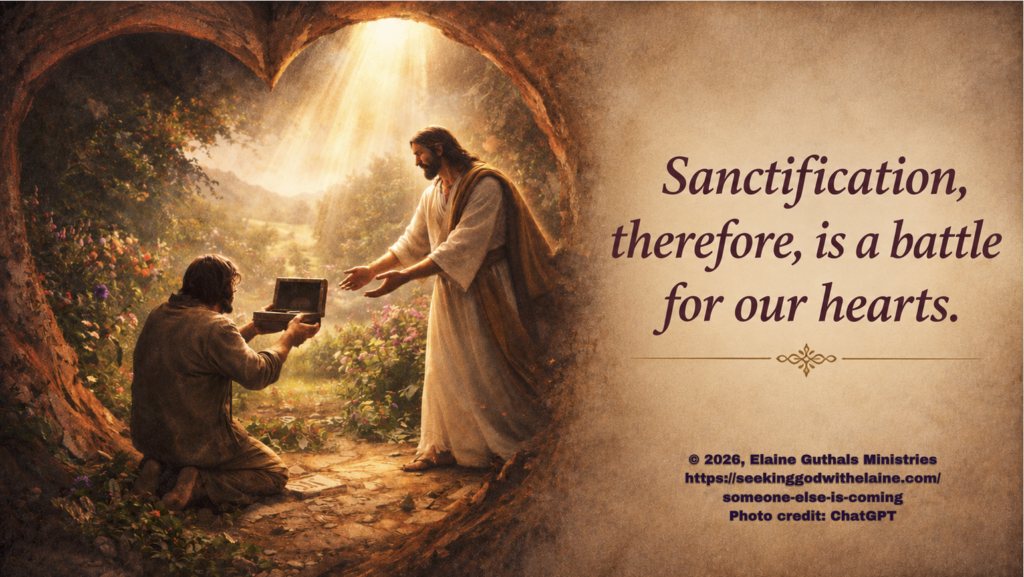
The fire also heats our hearts. It increases our enthusiasm.
We can see how this prophecy was fulfilled on Pentecost. “On the day of Pentecost all the believers were meeting together in one place. Suddenly, there was a sound from heaven like the roaring of a mighty windstorm, and it filled the house where they were sitting. Then, what looked like flames or tongues of fire appeared and settled on each of them. And everyone present was filled with the Holy Spirit and began speaking in other languages, as the Holy Spirit gave them this ability” (Ac. 2: 1-4 NLT).
Ready to Separate
Those who are holy and righteous will be separated from those who are unholy and unrighteous.
From the beginning of creation, Jehovah has been separating those who believe in His with those who don’t believe in Him. He chose Abel over Cain, Isaac over Ishmael, Jacob over Esau, David over his brothers – need we go on?
Once Yeshua came, this separation became undeniable. We either ask Him to be a Savior and Redeemer – or we don’t.
“There is salvation in no one else! God has given no other name under heaven by which we must be saved” (Ac. 4: 12 NLT).
Eventually, there will come a time for judgment ad purification.
At the end of the age, Yeshua will perform the final separation. “But when the Son of Man comes in his glory, and all the angels with him, then he will sit upon his glorious throne. All the nations will be gathered in his presence, and he will separate the people as a shepherd separates the sheep from the goats. He will place the sheep at his right hand and the goats at his left” (Mt. 25: 31-33 NLT).
The Threshing Floor, the Winnowing Fork, and the Wheat v. Chaff
The harvest imagery is classic prophetic judgment language.
We may think that John was referring to three different things when he was talking about the fork, the floor, and the wheat. He really isn’t. He was talking about one process.
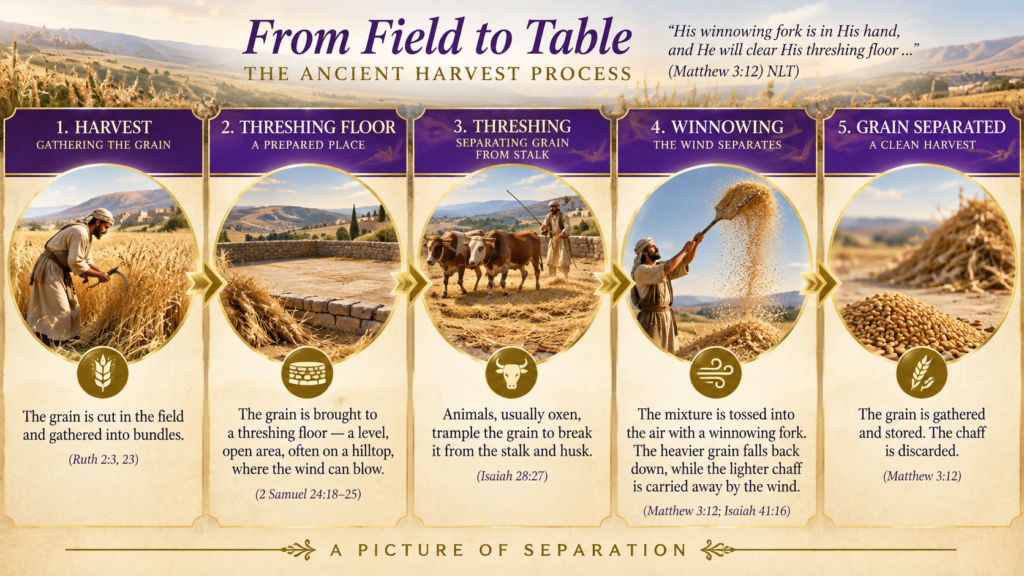
In first-century Israel, grain of wheat would be cut in the field. It would be brought to the threshing floor.
The wheat seeds were threshed to loosen them from the stalk and husk. It would then be tossed in the air with the winnowing fork to separate the wheat from the chaff.
Gathering but Burning
Once the wheat is separated from the chaff, the wheat is gathered and stored while the chaff is burned.
If you know anything about wheat harvesting, you know that it is a dusty, messy process – even with machinery. It would have been worse doing it manually with oxen.
What would have been done with the output? The wheat would have been stored, and the chaff would have been burned.
Isn’t that a wonderful illustration of what will happen in the final judgment? Believers will live for eternity with Jehovah. Non-believers will be thrown in the lake of fire.
Making the Connections
Think about John’s character. Curteis helped us with this.
- John was faithful and unselfish.
- He was loyal.
- He wasn’t afraid to ask for clarification when he doubted.
- John was quick to rebuke sin.
- He was humble.
Resource
This is the man who said, “I am not worthy to even take the shoes off your feet.”
Heart Check
Think about the battle Yeshua is engaged in for your heart. Ask yourself the following questions.
- Am I willing to let Yeshua become greater in my life while I become less?
- Have I confused an outward act of obedience with genuine inward transformation?
- Am I more concerned with my position and importance than with faithfully doing the work Jehovah has given me?
How Do We Apply This?
- Know your assignment.
- Let Yeshua transform your heart. .
- Welcome the refining fire.
- Become less so Yeshua can become greater.
- Stay ready.
Father God. Thank You for John, who came to prepare the way. Thank You for Yeshua, Who came as Your Light.Amen.
If you don’t understand something and would like further clarification, please contact me.
If you have not signed up for the email providing the link to the devotions and the newsletter, do so below.
If God has used this devotion to speak with you, consider sharing it on social media.