Author: admin

  • Jacob Proclaimed His Intention to Marry Rachel

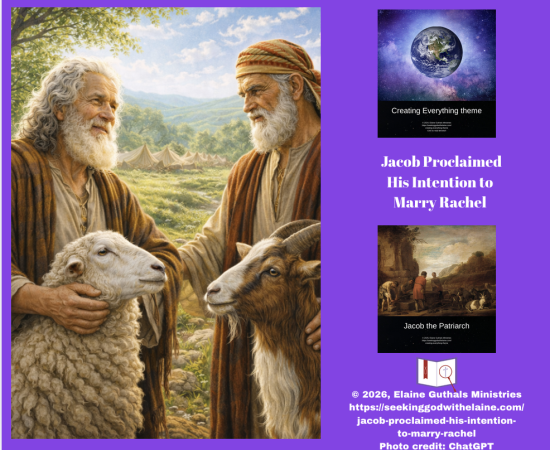
    Jacob had come to Paddan-aram to find a wife. This devotional reading looks at who he chose for his wife and how he would pay the bride-price.

    Nuggets

    • Jacob probably started working for Laban right away, but it took a month until Laban discussed wages.
    • There is as much contrast between Leah and Rachel as there is between Esau and Jacob.
    • Jacob, there to find a wife, was the one to suggest he work seven years for Rachel’s hand in marriage.
    jacob-proclaimed-his-intention-to-marry-rachel

    Jacob was welcomed by Laban with open arms. He probably told them right off that he had come looking for a wife.

    Laban, probably mourning the lost days of bride gifts, had to figure out how to make it work for him. Let’s see what he came up with.

    Let’s Put It into Context

    To read devotions in the Creating Everything theme, click the button below.

    Devotions in the Jacob the Patriarch series

    Let’s Put It into Context #2

    Let’s take a look at the betrothal process. I had thought that the whole process had changed between Abraham’s use of it and Jacob’s use of it — and the divine law hadn’t. Jacob’s circumstances, authority, and covenantal maturity had.

    The betrothal process was a negotiation between the groom’s family and the bride’s family. Negotiations revolved around the mohar — or bride-price. These gifts formed a transfer of wealth — commonly in the form of silver, livestock, or other valuables — from the groom’s household to the bride’s father.

    The mohar, provided by the groom’s father, served several functions:

    • Paid the bride’s family for the loss of her labor and presence as the family functioned as a single economic and social unit
    • Showed the bride’s family that the groom had the ability to provide
    • Formalized the marriage agreement

    Determining Jacob’s Wages

    “… After Jacob had stayed with Laban for about a month, Laban said to him, “You shouldn’t work for me without pay just because we are relatives. Tell me how much your wages should be’” (Gen. 29: 14-15 NLT)

    Jacob probably started working for Laban right away, but it took a month until Laban discussed wages.

    We have already seen where Jacob interacted with the shepherds at the well. He seemed to know about well etiquette.

    But how did Jacob get to full-time shepherd?

    Well, we don’t know.

    We hear nothing about Jacob being a shepherd with Isaac’s flocks. In fact, we really don’t hear much about Isaac’s flocks.

    The only reference we get was when Isaac and Rebekah were living in Gerar. “When Isaac planted his crops that year, he harvested a hundred times more grain than he planted, for the Lord blessed him. He became a very rich man, and his wealth continued to grow. He acquired so many flocks of sheep and goats, herds of cattle, and servants that the Philistines became jealous of him” (Gen. 26: 12-14 NLT).

    This says Isaac has flocks and herds but doesn’t say who took care of them. It doesn’t say if Isaac did or if he has herdsmen and shepherds.

    What we know about Jacob is said contrasting him with Esau. “As the boys grew up, Esau became a skillful hunter. He was an outdoorsman, but Jacob had a quiet temperament, preferring to stay at home” (Gen. 25: 27 NLT).

    We can take this stay-at-home time two ways. The first is the way the classic midrash — a Jewish interpretive method that is a running commentary on biblical verses that expands Scriptures — interprets it. “Jacob was a quiet man, dwelling in tents” is seen as meaning that he dwelled in “the tent of Shem and the tent of Eber.” The emphasis here is on Jacob as a student of wisdom/Torah rather than as a pastoral worker.

    Remember, genealogy said Noah begat Shem, who begat Arphaxad/Arpachshad, who may have begat Cainan, who begat Shelah, who begat Eber (Gen. 11; Lk. 3).

    Anyway, tent dweller, not hired shepherd.

    But Jacob did arrive in Haran knowing something about the shepherd’s role. Since he stayed close to the tent, he may have helped around the household (including with flocks) in more informal ways. This would also fit in well with his helping with family affairs as the responsible firstborn-in-character son.

    Laban probably decided that Jacob was going to stick around for a while. He probably saw Jacob’s growing attachment to Rachel.

    Laban’s Daughters

    “Now Laban had two daughters. The older daughter was named Leah, and the younger one was Rachel. There was no sparkle in Leah’s eyes, but Rachel had a beautiful figure and a lovely face” (Gen. 29: 16-17 NLT).

    There is as much contrast between Leah and Rachel as there is between Esau and Jacob.

    Part of the contrast between Leah and Rachel is the physical description. We are told that Rachel was stunning.

    Leah’s description is harder for us to understand. The New Living Translation takes a confusing definition of the Hebrew word rakkoth. Other versions translate it in a variety of ways:

    • Weak eyes (NIV, ESV, NASB, CJB, OJB)
    • Delicate (KJV)
    • Tender (CSB)
    • Ordinary (HCSB)
    • Lovely (GNT)

    The Hebrew word does mean delicate and tender. It also means soft.

    Yeah, that could be talking physical characteristic. But remember, Jehovah is more interested in the spiritual aspect of our character.

    The midrash states that Leah was supposed to marry Esau. Upset at his violent and immoral character, we would say she cried her eyes out. All this crying made her eyes soft.

    I like to think what it was getting at was that she was tenderhearted. That is a contrast to Rachel’s character.

    Let’s face it. Rachel didn’t have the most sterling character. She stole Laban’s household idols (Gen. 31: 19) but lied about it (Gen. 31: 34-35). She was envious of Leah’s ability to hear children, so like Sarah, takes matters into her own hands and offers a concubine.

    While having the physical beauty, Rachel seems to have a more worldly heart. Leah, on the other hand, persevered and trusted in Jehovah’s care.

    Isn’t that Jehovah’s goal for us? We are to trust Him in everything — the good and the bad — the easy and the hard.

    We are to content where Sovereign God places us. Leah went through those hard, bad times and always looked to Jehovah for strength — which He provided.
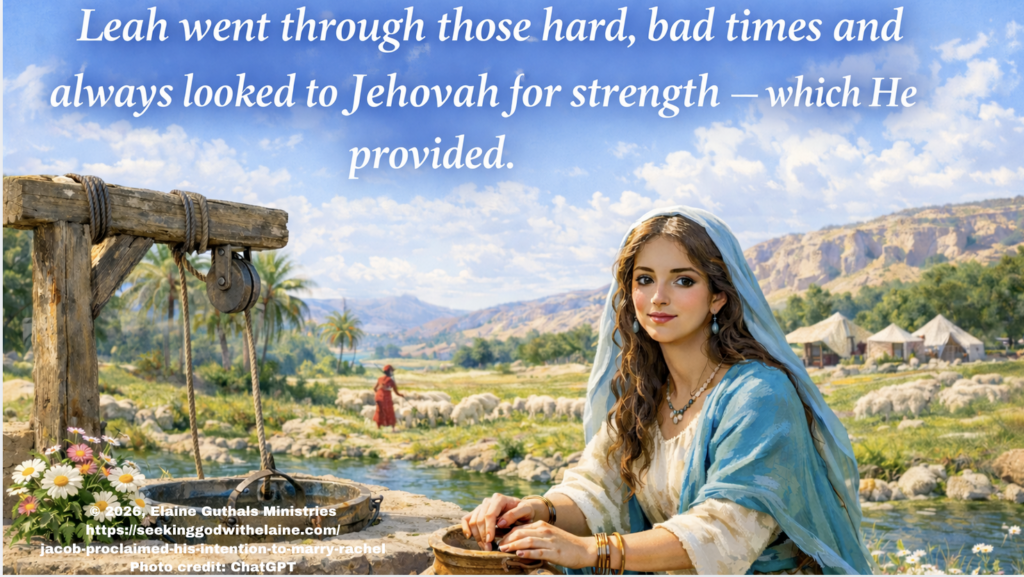
    Jehovah knows what we are facing and how we are reacting. He is there to lead us to Him.

    The Bride-Price

    “Since Jacob was in love with Rachel, he told her father, ‘I’ll work for you for seven years if you’ll give me Rachel, your younger daughter, as my wife.’ ‘Agreed!’ Laban replied. ‘I’d rather give her to you than to anyone else. Stay and work with me.’ So Jacob worked seven years to pay for Rachel. But his love for her was so strong that it seemed to him but a few days” (Gen. 29: 18-20 NLT)

    Jacob, there to find a wife, was the one to suggest he work seven years for Rachel’s hand in marriage.

    Either I have always read this wrong, or I just didn’t catch it. Jacob was the one to set the term of the wages. I always thought it was Laban.

    Part of the reason I thought this was because of what Leah and Rachel said. “Rachel and Leah responded, ‘That’s fine with us! We won’t inherit any of our father’s wealth anyway. He has reduced our rights to those of foreign women. And after he sold us, he wasted the money you paid him for us’” (Gen. 31: 14-15 NLT emphasis added).

    But we’ll dive into that when we get there. For now, let’s stick with the betrothal process.

    Remember, the process hadn’t changed since Abraham sent Eliezer to Haran to find Rebekah, but Jacob’s circumstances had. The absence of formal rituals — oaths, immediate payment, or public consent scenes — left Jacob on his own.

    Laban probably was mourning the lack of the twelve camels with bride-gifts. But here came Jacob, a displaced son instead of an established heir operating from Isaac’s estate.

    Jacob still had to provide something of value to Laban — money, livestock, or service. Since the first two were out, the bride-price (mohar) had to be service.

    Where other groom’s fathers provided the bride-price — and Isaac didn’t — Jacob had to come up with it himself.

    Why didn’t Issac provide the mohar? Possibility 1 is Isaac did, but Jacob lost access to them. Maybe Laban finagled Jacob into a position where he had to work.

    I don’t buy that. Jacob’s sole purpose for this journey was to find a wife. I don’t think conniving Laban would have been able to wheedle them out of Jacob’s possession without the bride in return.

    Possibility 2 read that Isaac purposefully did not send the bride-gifts. I can see this because Jacob not only deceived his father but “stole” the blessing from Isaac’s favorite son.

    This one hits because this whole journey has been about Sovereign God teaching Jacob about humility, endurance and dependence on Him.

    A third possibility makes sense, also. Isaac was probably thinking his life was almost over. That was why he chose to give the blessing when he did.

    But Isaac had thought that he was giving the blessing to Esau. What if he had already started transferring it to who would have been expected heir?

    Both of those land for me and don’t appear to be mutually exclusive.

    Hmmmm. Servitude was a legitimate option for paying for the bride-price, but that wasn’t selling the girls?

    But back to the agreement.

    Jacob said that he would work seven years for the privilege of taking Rachel as a wife.

    We have no way of knowing what the going wage would have been for a lowly shepherd. It could have been a modest wage. Remember, shepherding was low-status work.

    They also could have been paid in a share of the stock or grain. We know Laban eventually paid Jacob in sheep and goats (Gen. 30: 31).

    Even though seven years would not have netted a high wage, the work was hard. So in other words, the years’ work may not have equated what the bride-price would have been, but it had been worth it.

    Rachel was worth it.

    But look at who each man was talking about. Jacob said, “… if you’ll give me Rachel …” (Gen. 29: 18 NLT).

    In verse 19, Laban responded, “… I’d rather give her to you …” (Gen. 29: 19 NLT emphasis added).

    We don’t consider that a dangling pronoun because we assume, as did Jacob, that Laban was talking about Rachel. Maybe he was; maybe he wasn’t.

    Making the Connections #1

    As part of the negotiations between the groom’s and the bride’s families, the bride’s family would give a dowry (nedunyah) to the bride. This provided her economic protection as she entered a new household.

    Making the Connections #2

    Dods contrasted Jacob and Esau. He wrote,

    • “Constancy, persistence, dogged tenacity is certainly the striking feature of Jacob’s character.”
    • “In contrast with his tenacious, constant character stands Esau, led by impulse, betrayed by appetite, everything by turns and nothing long.”

    Resource

    Would Esau have worked for Laban for 7 years, let alone 14? Probably not.

    Making the Connections #3

    Jehovah knows how to smack us down, doesn’t he? Here was the covenant son agreeing to be the hired hand. The master’s son was forced to be a servant.

    Look what Leale said. He wrote, “The nation was thus taught that all its greatness and prosperity were not due to natural endowments and industry, but to the electing love of God. The strength of His grace was made perfect in weakness.”

    Resource

    Look how Yeshua put it after He had washed the Apostles’ feet. “I tell you the truth, slaves are not greater than their master. Nor is the messenger more important than the one who sends the message. Now that you know these things, God will bless you for doing them” (Jn. 13: 16-17 NLT).

    The Apostles had dealt with arguing about being the greatest. Yeshua said, “Flip that. Exhibit servant leadership. Humility is the best because it isn’t about you. It is about Him.”

    How Do We Apply This?

    • Focus on Jehovah’s plan for our lives.
    • Be a servant leader.

    Father God. Thank You for the institution of marriage. It was never Your plan that we be alone. Help us to look to You for guidance in choosing our mate. May we always focus on Your plan. Amen.

    If you don’t understand something and would like further clarification, please contact me.

    If you have not signed up for the email providing the link to the devotions and the newsletter, do so below.

    If God has used this devotion to speak with you, consider sharing it on social media.
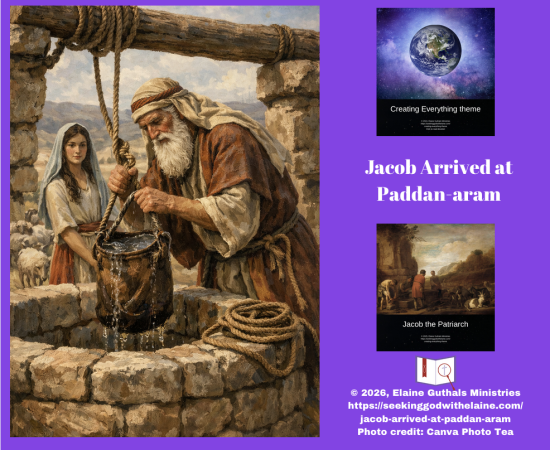
  • Jacob Arrived at Paddan-aram

    Jacob had been traveling to Paddan-aram. This devotional reading looks at his arrival and his connecting with his family.

    Nuggets

    • The trip from Beersheba to Paddan-aram would have lasted weeks.
    • Jacob immediately searched for his mother’s family when he got to the well.
    • Jacob asked his new shepherd friends if they had heard of Laban.
    • Rachel came to the well with her father’s sheep.
    • Rachel went home to get Laban – just as Rebekah had done.
    jacob-arrived-at-paddan-aram

    Jacob, though 77 years old, had been living with his father. Well, that fell apart when he and his mother deceived his father.

    The main reason for the journey to his mom’s family was to find a wife. The timing of the trip was determined by Jacob’s brother wanting to kill him.

    Let’s look at Jacob getting to where he was going.

    Let’s Put It into Context

    To read devotions in the Creating Everything theme, click the button below.

    Devotions in the Jacob the Patriarch series

    Travel

    “Then Jacob hurried on, finally arriving in the land of the east” (Gen. 29: 1 NLT)

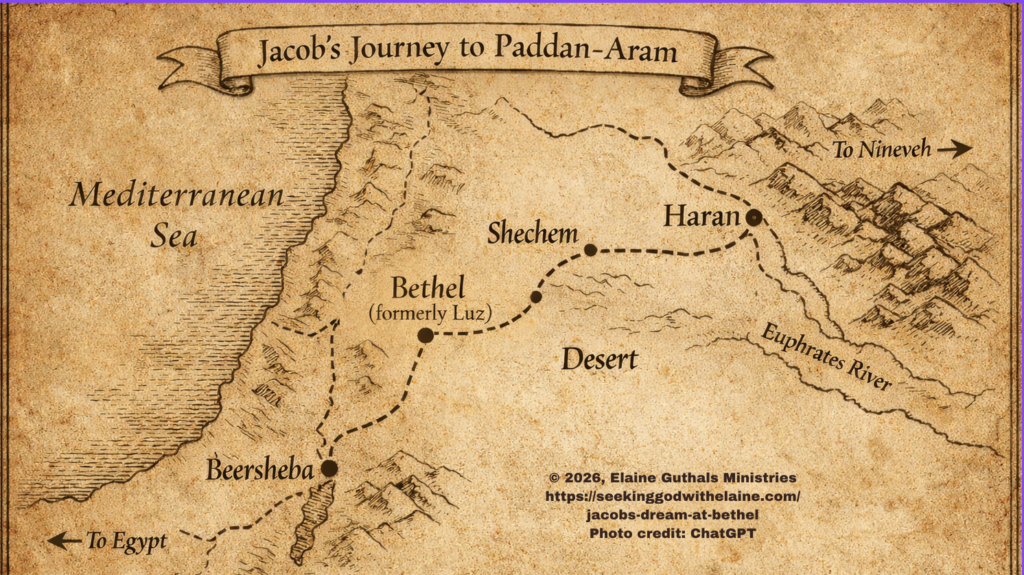
    The trip from Beersheba to Paddan-aram would have lasted weeks.

    Jacob continued on after the stop at Bethel. It says nothing about camels this time, so we have to assume he was waking.

    Since more than likely he took a trade route, such as the ancient Way of the Patriarchs, Jacob would have traveled approximately 75 miles (100-120 km) from Beersheba to Bethel. If he got to cover 12-20 miles a day, which was the average for ancient foot travelers, that is a minimum four-day trek or a maximum six-day hike.

    That was the short part of the journey. The trip from Bethel to Haran was approximately 400-450 miles.

    I am sure that there were many factors that went into determining how fast Jacob could go. He would have been going over mountains, across rivers and deserts, and through rocky wilderness according to Gray.

    Resource

    Plus, I am sure it wouldn’t be the same number of miles each day. Some days it would be 12 miles a day; some 15; some 20; and some anywhere in between.

    What would Jacob’s day look like?

    • In the early morning cool on the open road, Jacob could have gone at a good clip for 2.5- to 3-miles an hour.
    • Toward late morning when the sun started to heat up, he’d have to take a water break. But he may have to go a little longer to find a well or shade trees.
    • Late morning to early afternoon would be slower going. The overhead sun would dry out the air. That would be uncomfortable if there was little shade on long, open stretches.
    • Jacob would stop entirely during the heat of the day.
    • He’d be off again once the heat broke. As it got closer to sunset, Jacob would start looking for a campsite: a safe place near water but away from wild animals. He might build a fire and eat.

    That isn’t factoring in weather or terrain. It would seem to me that 12 to 15 miles a day would be the usual.

    If he did take an established route, Jacob may have encountered other travelers. It would have been safer that way.

    Otherwise, Jacob would have had a lot of me time. I am sure thoughts were crashing around in his head. That would have been especially true after his dream. That would have taken up a lot of think time — and hopefully prayer time.

    What we do know for sure is that Jehovah went with Jacob. He said He would, so He did.

    Leale summed up Jacob’s life to this point and explained why this journey was so important. He wrote, “All his life through Providence had guided him, but he knew it not as he ought to know. Now, even in the most ordinary and likely events of life he learns to trace the hand of Providence.”

    Resource

    Bradford’s agreed. He said that encounter with Jehovah made Jacob a changed man. He now possessed Jehovah’s peace.

    Resource

    Isn’t that what an encounter with Jehovah is supposed to do? Yes, He comes and meets us where we are.

    But the whole goal is sanctification. That is where we are changed to be as Jehovah wants us — like Him.

    Jacob Arrived at the Well

    “He saw a well in the distance. Three flocks of sheep and goats lay in an open field beside it, waiting to be watered. But a heavy stone covered the mouth of the well. It was the custom there to wait for all the flocks to arrive before removing the stone and watering the animals. Afterward the stone would be placed back over the mouth of the well. Jacob went over to the shepherds and asked, ‘Where are you from, my friends?’ ‘We are from Haran,’ they answered. ‘Do you know a man there named Laban, the grandson of Nahor?’ he asked. ‘Yes, we do,’ they replied. ‘Is he doing well?’ Jacob asked. ‘Yes, he’s well,’ they answered. ‘Look, here comes his daughter Rachel with the flock now.’ Jacob said, ‘Look, it’s still broad daylight — too early to round up the animals. Why don’t you water the sheep and goats so they can get back out to pasture?’ ‘We can’t water the animals until all the flocks have arrived,’ they replied. ‘Then the shepherds move the stone from the mouth of the well, and we water all the sheep and goats’” (Gen. 29: 2-8 NLT)

    Jacob immediately searched for his mother’s family when he got to the well.

    A Well in the Distance

    My first thought was, “Was this the well where Eliezer met Rebekah?”

    Jacob would have heard the story. Eliezer came to town — probably by the same route he had. Rebekah gave him and his camels a drink — which was his fleece to ensure he picked who Jehovah wanted for Isaac’s wife.

    Here came Jacob up to 100 years later.

    c. 1823–1820 BC – Abraham sent Eliezer to Paddan-Aram to find a wife for Isaac (Gen. 24)
    1820 BC – Isaac, at age 40, married Rebekah (Gen. 25: 20)
    1800 BC – Jacob and Esau were born (Gen. 25: 24-26)
    1723 BC – Jacob cheated Esau (both age 77) out of the birthright blessing given by Isaac age 137). He flees Canaan to Paran-Aman to Rebekah’s family. He agrees to work seven years to earn the right to marry Rachel (Gen. 29: 1-20)

    Based on Timeline from

    The outcome — securing a wife — was still the same. Look what else Leale said. He wrote,

    “Providence brings to this spot the very woman who is designed to be the wife of Jacob. Surely he could not fail to see that even through all the strange trials of his journey, and through the most untoward events, the will of God was being accomplished.”

    Resource

    But why were the shepherds standing around waiting for everyone to get there before uncapping the well?

    Think about what we know of wells. Abraham dug some, so they became his wells. This showed wells could be owned by individual families or landowners. Sometimes, they were commissioned by rulers or governing authorities.

    It wouldn’t have been easy to dig a well in those days. They had to have resources, significant labor, and technical skill. On top of all that was the risk involved.

    • Locating groundwater
    • Excavating deep into hard soil or rock
    • Lining the shaft with stone to prevent collapse

    Once the wells were built, they had to be maintained. Silt had to be removed. The stone lining had to be repaired. The covering stone had to be maintained.

    If the owner of the well had extensive herds, as Abraham and later Isaac did, there would be a need to maintain the rights. It would be understood that it was not a public access well.

    That is one reason the well was capped, but there are more. It protected the water from contamination by dust, debris, and animals. It prevented unauthorized use. It hinted at a system of fairness in dispensing the water and discouraged monopolization.

    So, if it wasn’t a public access well, how did the shepherds gain access to the water? That would have been through agreements, relationships, and covenants.

    Jacob would have understood this.

    What he didn’t understand was a why they didn’t go ahead and take off the stone. Talmage could see two reasons. He thought they may have been being courteous and waiting for all. He also mentioned the weight of the stone being heavy.

    Resource

    They had their reasons, and they had their system.

    Do You Know?

    Jacob asked his new shepherd friends if they had heard of Laban.

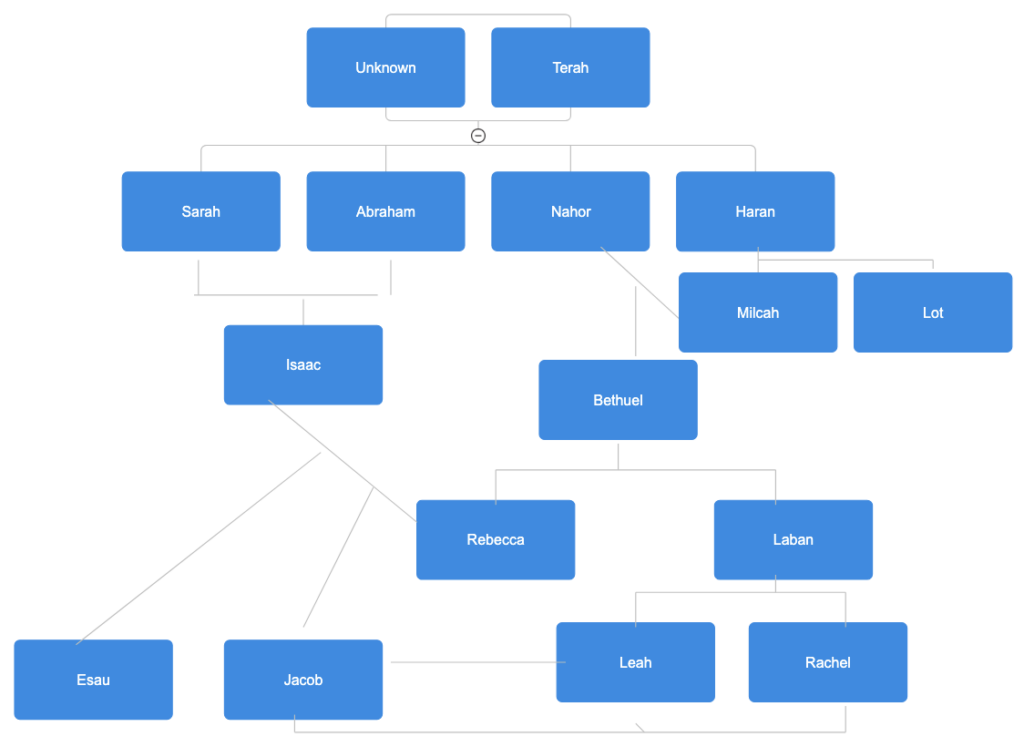
    If we go back to the Hebrew, he would have asked about Lavan ben Nachor. That may seem strange to us.

    Jacob skipped right over Bethuel, Laban’s father.

    Why ask about Nahor?

    What Jacob was doing was identifying the clan. This is addressing the family hierarchy.

    • Tribe: Terah
    • Clan: Nahor
    • Household: Bethuel
    • Man-by-man (family): Laban

    Rachel Arrived

    “Jacob was still talking with them when Rachel arrived with her father’s flock, for she was a shepherd. And because Rachel was his cousin — the daughter of Laban, his mother’s brother — and because the sheep and goats belonged to his uncle Laban, Jacob went over to the well and moved the stone from its mouth and watered his uncle’s flock. Then Jacob kissed Rachel, and he wept aloud. He explained to Rachel that he was her cousin on her father’s side — the son of her aunt Rebekah. So Rachel quickly ran and told her father, Laban” (Gen. 29: 9-12 NLT)

    Rachel came to the well with her father’s sheep.

    Jacob had an immediate encounter with Laban’s family.  Look what Hughes said. He wrote, “God’s good hand [sends] the mercy sometimes to His servants while they inquire about it.”

    Resource

    Isn’t it so like Jehovah to answer our prayer before we get finished asking it? That’s what He did with Eliezer (Gen. 24: 15).

    Ditto Jacob — even though Jacob was not in the attitude of prayer.

    Rachel was there as a shepherdess, not with a water jar like Rebekah had (Gen. 24: 15). Bradford said that it was unusual for Mesopotamian women to ten flocks and herds.

    Gray disagreed. He thought daughters of wealth pitched in to care for the flocks and herds.

    Resource

    Moses recorded that Jacob was the one to remove the cap stone from the well. That is significant.

    Beyond being a practical gesture, it could show Jacob’s willingness to engage with the community he was entering. He knew that, in order to secure a bride, he was going to have to barter something — probably work related.

    Remember, we said the betrothal process had changed. The highly structured process where someone negotiated for the groom directly with the bride’s family bride-gifts (mōhar) and secured consent was a thing of the past.

    Jacob was on his own. There would be no oaths, no immediate payment, and no public consent scenes.

    With what did Jacob have to barter? Being a shepherd.

    Back to the well.

    I always thought that Jacob took the cap stone off before he was supposed to do so. To me, Laban asking why Rachel got back early solidified that reasoning.

    But look how carefully Moses described it. “And because Rachel was his cousin — the daughter of Laban, his mother’s brother — and because the sheep and goats belonged to his uncle Laban, Jacob went over to the well and moved the stone from its mouth and watered his uncle’s flock” (Gen. 29: 10 NLT).

    Cousin — belonged to family. That gave him the justification to move the stone.

    Bradford thought Jacob had another reason for removing the stone cap. He just wanted the other herds to get gone so he could talk to his family.

    Was it a coincidence that Rachel — the mother of the Church — was a shepherdess?

    Jacob lost it. After the long hard journey and — bam! Here was the woman of his dreams.

    Don’t read anything into the kiss Jacob gave Rachel. That was the standard greeting, equivalent to our handshake.

    Leale explained these tears. Jacob was probably remembering from where he started — faithless, questioning. But he made it — and he was a better man.

    Resource

    Jacob was where he was supposed to be.

    On top of that, the approximate 500-mile journey was successfully completed. He was with family.

    Laban Arrived

    “As soon as Laban heard that his nephew Jacob had arrived, he ran out to meet him. He embraced and kissed him and brought him home. When Jacob had told him his story, Laban exclaimed, ‘You really are my own flesh and blood!’ …” (Gen. 29: 13-14 NLT)

    Rachel went home to get Laban – just as Rebekah had done.

    I wonder what Laban was thinking when he heard family had returned from Canaan. Remember last time? Bride gifts.

    We talked about how Laban saw the bride gifts before he heard the story of who the man giving them was. He probably thought Eliezer was blessed, not necessarily Abraham. Schmoozing? Probably.

    Laban probably thought — if he worked it right — he could get some of that wealth for himself.

    Who is to say that Laban might have thought — again — “How can I tap into the wealth again?”

    Once again, Laban offered hospitality to family.

    Gray thought Jacob would have announced his birthright and the covenant blessing given to him. I can see this because he knew he was to go to his mother’s family — specifically to Laban — to secure a wife.

    Resource

    I am sure that he did at some point. I don’t know if he led with that.

    But we know there was time for that.

    Making the Connections #1

    Rachel, like Rebekah, was just going about her day. True, it was herding sheep instead of household duties.

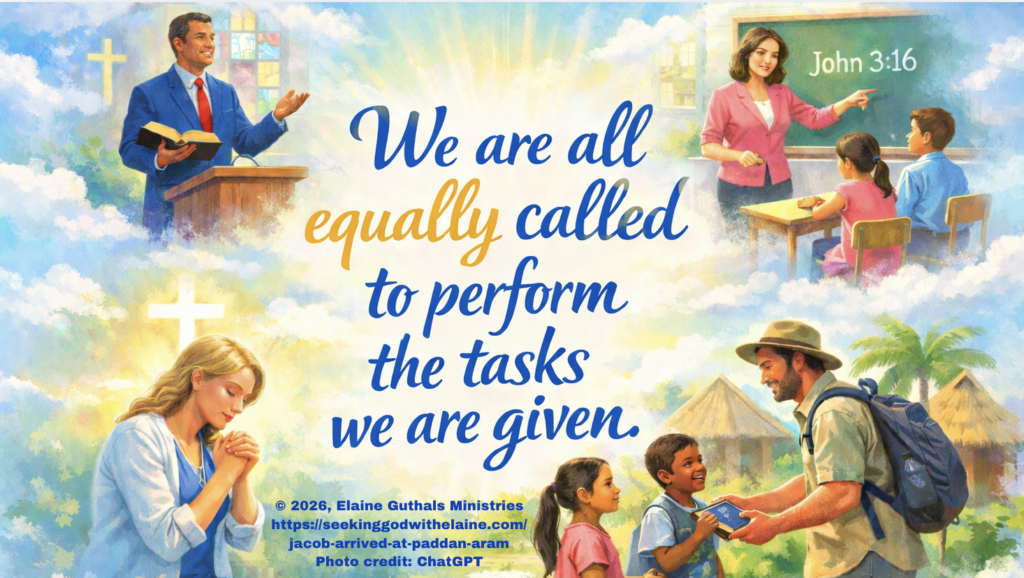
    We each are called to work. That work isn’t always the same.

    That doesn’t mean one job is more important than another. We are all equally called to perform the tasks we are given.

    Making the Connections #2

    Talmage equate the well in Jacob’s time to the well around which the Gospel gathers. Yeshua is the well of Living Water (Jn. 4: 10).

    Resource

    Ooo, baby. Do we come up with excuses as to why we can’t uncap the well and witness!

    We shouldn’t. There are so many who need to hear of Yeshua and His love. They need to get to know Him as their Savior.

    We can’t be like the Pharisees and say that the Church is just for us. Witnessing isn’t about the Church. It is about the Messiah. All need the Messiah’s saving grace.

    Talmage gave a list of what is stopping us from witnessing.

    • Pride
    • A stubborn heart

    Yeshua said, “Come unto me, all ye that labour and are heavy laden …” (Mt. 11: 28 KJV). He could have just as easily said, “Come, ye who are thirsty.”

    How Do We Apply This?

    Listen for Jehovah’s encouragement and look for His directions.
    Go where He is calling us to go.
    Observe how Jehovah orders our steps.
    See how Jehovah keeps His promises — especially when we commit to Him.

    Resources

    Father God. You call us into a covenant relationship with You. Then You bless us with the things You have promised. Thank You. Amen.

    If you don’t understand something and would like further clarification, please contact me.

    If you have not signed up for the email providing the link to the devotions and the newsletter, do so below.

    If God has used this devotion to speak with you, consider sharing it on social media.

  • Jacob’s Response to God

    After Jacob dreams of a ladder reaching to Heaven, he hers God speaking to him This devotional reading looks at his response and how his request for a promise pertains to us today.

    Nuggets

    • Jacob acknowledged Jehovah’s presence in that place.
    • Jacob went to bed fine and woke up afraid.
    • Because the God of his fathers was made his God, Jacob responded with action and commitment.
    • Jacob awoke and immediately erected a memorial.
    • Jacob didn’t realize that all the earth is hallowed ground.
    • Jacob responded to Jehovah by making a vow.
    jacobs-response-to-god

    What can we learn from Jacob’s response to God’s presence? One of the sermons I read sort of set the foundation for this post. I agree and disagree with Maclaren’s take on that reaction.

    Maclaren’s The Heavenly Pathway and the Earthly Heart
    https://www.biblehub.com/sermons/auth/maclaren/the_heavenly_pathway_and_the_earthly_heart.htm

    But then I branched off from there.

    Let’s Put It into Context

    To read devotions in the Creating Everything theme, click the button below.

    Devotions in the Jacob the Patriarch series

    Jacob’s Response

    “Then Jacob awoke from his sleep and said, ‘Surely the Lord is in this place, and I wasn’t even aware of it!’ But he was also afraid and said, ‘What an awesome place this is! It is none other than the house of God, the very gateway to heaven!’” (Gen. 28: 16-17 NLT)

    This place

    Jacob acknowledged Jehovah’s presence in that place.

    It must have been a little startling to wake up to the realization that Sovereign God had talked to you. Jacob put that down to the place. He said it was fearsome.

    Jacob seemed to have limited understanding of God’s presence. He claimed ignorance of Jehovah being in that place, leading us to believe he bought into the localization of gods. Jacob focused on the spot rather than the spirit.

    I’m sure it would be difficult bucking that belief. It would have been a long-held belief held by many — if not most — in that society.

    But we would think that Jacob, of all people, would have learned from Abraham’s story that Jehovah isn’t tied to a specific spot. If He were, wouldn’t that spot have been Ur or Haran, not Bethel?

    Yet we are not saved because of our parents’ religion. We are only saved through a personal relationship with Jehovah. He reveals Himself to each of us individually.

    He Was Afraid

    Jacob went to bed fine and woke up afraid.

    I don’t think that Jacob was terrified by God. I believe that he meant that the place was awesome because it was the house of God. When we are told to fear God, we are to hold Him in reference, not run from Him in terror.

    That being said, I think we should approach Jehovah a little unsettled. We aren’t told Jacob was feeling remorse for his deception of Isaac, but he probably was questioning if he was worthy of a divine visit.

    We need to approach Jehovah ready to confess our sins.

    Maclaren thought that Jacob’s fear stemmed from the fact that he associated Jehovah with Isaac, not himself. Plus, there was also the localized god theory. Ancient near eastern gods didn’t follow people around.

    But think about it. To this day, we still wrestle with the concept of omnipresence. How can a God we don’t see be present with us?

    Maclaren also thought Jacob was afraid he had defiled the holy ground without even knowing. He wrote,

    “He does not draw the conclusion from the vision that all the earth is hallowed by a near God, but only that he has unwittingly stumbled on His house; and he does not learn that from every place there is an open door for the loving heart into the calm depths where God is throned, but only that here he stands at the gate of heaven.”

    Resource

    Yep. Missed it.

    Jacob reacted with fear instead of joy. He was trembling instead of leaping.

    But we have to be careful assuming that Jacob’s response equates to low religious feeling. Let’s focus on the fear a second.

    Every time — except for Abraham in Genesis 18 — humans reacted with some expression of fear when having a heavenly visit. (And an argument could be made that Abraham did know they were heavenly beings.)

    • Moses hid his face at the burning bush (Ex. 3).
    • Israel recoiled in terror at Sinai (Ex. 19–20).
    • Manoah feared for his life after realizing he has seen the Angel of the LORD (Judg. 13).
    • Isaiah cried “Woe is me!” in the temple (Isa. 6).
    • Ezekiel fell on his face (Ezek. 1).
    • Daniel was left trembling and without strength (Dan. 10).
    • Zechariah, Mary, the shepherds, Peter, and even the disciples at the Transfiguration responded with fear when confronted by divine or angelic presence.
    • John fell “as though dead” in Revelation 1.

    Bottom line, fear is the normal response, not the exception.

    We also have to talk about the correct definition of fear. Fear of the Lord means that the person reacted with reverence and awe — very acceptable and the most appropriate of reactions.

    That means Jacob’s trembling may have been exactly what he should have done. He may have had a huge realization about Who his Visitor actually was.

    Remember, we said this may have been the first encounter Jacob had with Jehovah. This might be the first moment Jacob truly grasped that the God of his fathers is not just a distant family deity, but a living, present, holy Lord.

    This visit was also making the God of his fathers his God.

    The Next Morning

    “The next morning Jacob got up very early. He took the stone he had rested his head against, and he set it upright as a memorial pillar. Then he poured olive oil over it. He named that place Bethel (which means ‘house of God’), although it was previously called Luz” (Gen. 28: 18-19 NLT)

    Because God of his fathers was made his God, Jacob responded with action and commitment.

    Whatever guilt or remorse Jacob had felt upon leaving Beersheba, he was felt reconciliation with Jehovah. How do we know?

    Reconciliation includes that the distance between God and man is lessened.

    Whatever fear Jacob felt was gone. If the ladder symbolized love, it eased his fear.

    “Such love has no fear, because perfect love expels all fear. If we are afraid, it is for fear of punishment, and this shows that we have not fully experienced his perfect love” (I Jn. 4: 18 NLT)

    Jacob’s actions proved his change of heart.

    • He set up a stone pillar.
    • He named the place Bethel (“House of God”).
    • He made a vow, essentially entering into a relationship with God.

    The Stone

    Jacob awoke and immediately erected a memorial.

    How many of us would want to have a stone for our pillow? I know for me, it would be hard to sleep because of the discomfort.

    But it has a deeper meaning. Having a stone as a pillow speaks to hardship and isolation. I’m sure Jacob was feeling just that.

    Jacob used the stone that had been his pillow as a standing stone. In the Complete Jewish Bible, stone pillar and stone monument are the same word — standing stone. I think that is another instance where modern translators used modern words for our ease.

    A standing-stone (or Matstsebah) was an ancient custom where a large stone was placed to commemorate sacred covenants or important events. They were used in the Bronze and Iron Ages (3150-586 BC).

    In our vernacular, we would say Jacob erected a memorial.

    Bradford said that it was also a type of Zevah or peace offering. It could also have been an early type of altar.

    Resource

    This memorial is something special. It is a foreshadowing of worship practices to come in Israel.

    But isn’t that what Jehovah wants? Jehovah wants us to take the hard, give it to Him, and be content in our lives for Him.

    Pouring oil on something was a common practice in God’s Word. It was also a command.

    House of God

    Jacob didn’t realize that all the earth is hallowed ground.

    When Jacob woke up and considered the dream, he recognized the sacredness of the place. He saw it as a place where Heaven and earth intersects.

    That is what House of God means. It doesn’t mean a physical building where we go to worship Jehovah.

    It means it is an access point. Jehovah broke into human space.

    This was the House of God because God was present.

    Having a loving Jehovah take up residence in our hearts would be even more foreign. Yeah, part of that is the localized god superstition.

    I think Jehovah specifically picked this place. It wasn’t just on the road to Haran.

    Bethel was a place where Abraham built an altar (Gen. 12: 8). The covenant was about continuity.

    Was that the only gate to Heaven? Maybe. But maybe not.

    What is important is that Jehovah met Jacob here, and Jacob responded by renaming the town of Luz to Bethel. He acknowledged the ordinary becomes sacred because of Sovereign God’s presence.

    Go back to verse 17 a second. “… ‘… It is none other than the house of God, the very gateway to heaven!’” (Gen. 28: 16-17 NLT)

    A gate is the point of access. “Go in through the narrow gate; for the gate that leads to destruction is wide and the road broad, and many travel it; but it is a narrow gate and a hard road that leads to life, and only a few find it” (Mt. 7: 13-14 CJB).

    The house is a permanent dwelling place.

    Jacob Made a Vow

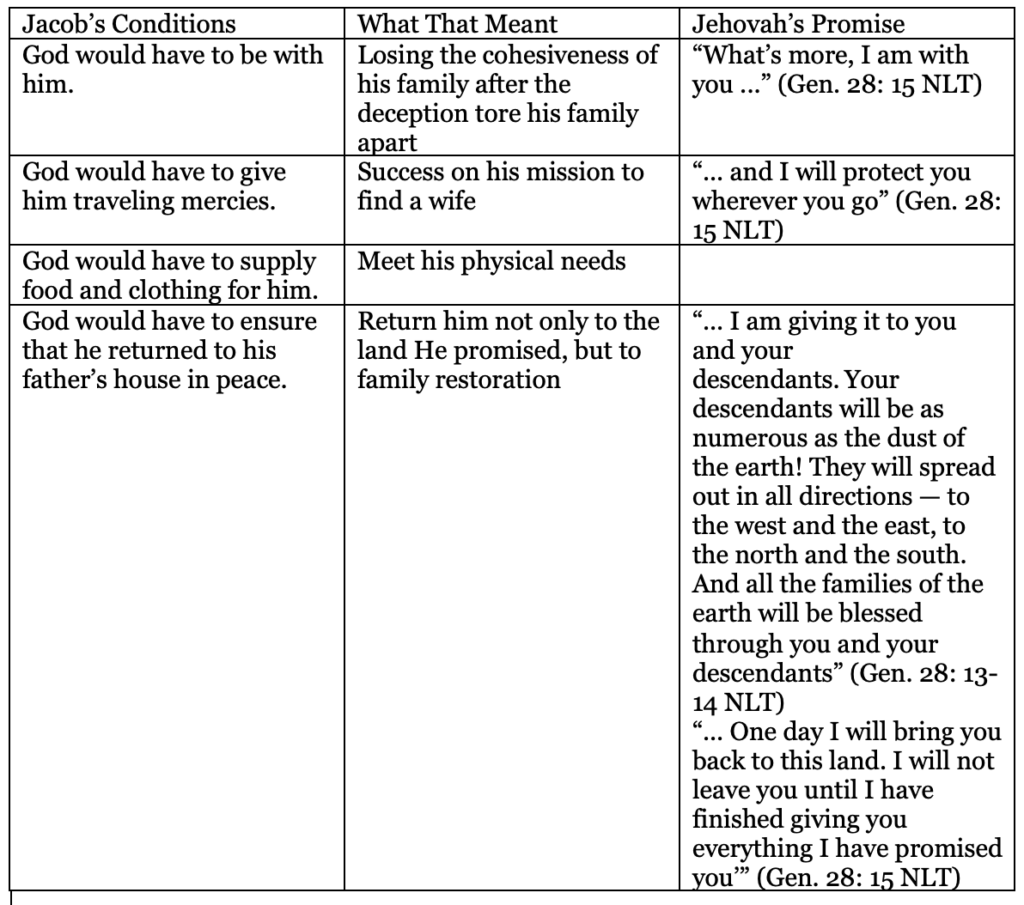
    “Then Jacob made this vow: ‘If God will indeed be with me and protect me on this journey, and if he will provide me with food and clothing, and if I return safely to my father’s home, then the Lord will certainly be my God. And this memorial pillar I have set up will become a place for worshiping God, and I will present to God a tenth of everything he gives me’” (Gen. 28: 20-22 NLT)

    Jacob responded to Jehovah by making a vow.

    Jehovah had placed the stairway to symbolize the connection between Heaven and earth. The activity of the angels showed that Heaven is actively involved in the affairs of the earth.

    The crowning point was when Jehovah Himself spoke directly to Jacob. Even though He is Sovereign God, He initiated the encounter with Jacob.

    As a response to the dream, Jacob made a vow. Robinson talked about the reach of vows. He wrote, “The reach of these vows is universal. They cover our possessions — our ways — our hearts — our lives.”

    Resource

    Jacob promised to return to Jehovah one-tenth of all he would earn or accumulate. But he set several conditions for this to happen.

    We have to realize Jacob wasn’t saying that he didn’t accept his covenant responsibilities. Wasn’t Jacob vowing back covenant responsibilities?

    Then, and only then, would Jacob consider God his God.

    Should we bite on Jacob for that?

    But isn’t that how we approach Jehovah sometimes?  We want things to happen our way.

    Robertson take on this is one I agree with. He wrote, “A kind of bargain is struck. If religion makes me happy then I will be religious.”

    Resource

    Robertson’s take on this was that Jacob hadn’t reached the level of disinterestedness, which is a willingness to give up something for a greater good.

    But was it really selfishness?

    No, Jacob was responding back saying he agreed to every promise from Jehovah.

    Craig’s viewpoint was a little different. He thought this showed Jacob’s moderation. He only asked for the necessities of life beyond the covenant blessings.

    Resource

    Jehovah was taking Jacob where he was at to start him on his Sanctification Road to get him to where He wanted.

    We shouldn’t be upset when Jehovah’s promises come with the expectation of a vow from us. Salvation should be accompanied by the vow to live for Him.

    Making the Connections #1

    Bible Verse

    Maclaren said something interesting. The dream didn’t contain a religious vibe.

    Resource

    As we said, we aren’t told Jacob had any prior communication with Jehovah. That would mean he was just starting out on his Sanctification Road. He was at the conversion point.

    This reaffirmation of the covenant didn’t really have any calls for obedience from Jacob. But then, that was already given to Abraham.

    • Believe
    • Walk with me
    • Circumcise your boys

    A relationship with us is the most important element to Jehovah. If we prioritize that relationship, all the rest will fall into place.

    Making the Connections #2

    Think about what Jacob saw.

    • Heaven “opened”
    • A stairway/ladder connecting heaven and earth
    • Angels ascending and descending
    • God standing above it, speaking promises of presence and protection

    What does that tell us? God is not cut off from the world. There is traffic between heaven and earth, and God can draw near.

    We are called to respond.

    Making the Connections #3

    Jehovah never asked for a Temple to be built in His name. He did give instructions for a Tabernacle. It was a place where His children could come be in His presence.

    But Yeshua turned that on its ear, didn’t He? When talking to Nathaniel, “Then he said, ‘I tell you the truth, you will all see heaven open and the angels of God going up and down on the Son of Man, the one who is the stairway between heaven and earth’” (Jn. 1: 51 NLT).

    Jehovah isn’t just a Presence in a place. He is always present in a Person.

    Where Yeshua is, Heaven is active.

    Making the Connections #4

     Think about where Jacob was at on his Sanctification Road. He was probably just beginning. He wasn’t mature enough in his faith to wait on Jehovah.

    But Jacob wanted to be the covenant son. If he didn’t want a relationship with Jehovah, he wouldn’t be.

    Jehovah wasn’t ready to bring Yeshua on the scene. So, that meant Jacob received what he was meant to see in the only way possible at his point in the story.

    Making the Connections #5

    I like what Mears said. He wrote, “Gratitude should be the very first fruit of religion.”

    Resource

    Notice again what was in Jacob’s vow: spiritual blessings and basic necessities.

    But Jacob asked for less than the covenant blessings. He said nothing about descendants or land.

    Instead, Jacob recognized that all he would gain on this journey came from and through Jehovah.

    So, Jacob was starting this journey off on the right foot.

    Making the Connections #6

    How can we not trust Jehovah’s promises? He is unchangeable after He has made the promise.

    We just have to remember Romans 8: 28. “Furthermore, we know that God causes everything to work together for the good of those who love God and are called in accordance with his purpose” (Rom. 8: 28 CJB).

    Jehovah will keep the promises that promote good — sanctification — in our lives.

    Making the Connections #7

    We cannot gloss over the fact that Jehovah presented Himself to Jacob. Jacob didn’t take off one day to go find Him. He came to where Jacob was.

    Jehovah comes to us, too. We, as did Jacob, have to respond.

    Making the Connections #8

    “Then the Lord said to Abram, ‘You can be sure that your descendants will be strangers in a foreign land, where they will be oppressed as slaves for 400 years’” (Gen. 15: 13 NLT)

    Did Jacob equate this revelation with Jehovah’s prophecy? “I’ll be with your descendants when they are in a strange land.”

    This omnipresence rather than a localized god may have been an unfamiliar concept to Jacob at this point. I wonder if he thought of it when he was in the cart riding to Egypt. Did he take heart to this promise?

    Making the Connections #9

    Up until now, we haven’t heard the phrase, “And God was with him.” We’ve had some important Hall of Famers — Noah, Abraham — but they didn’t get to hear that phrase.

    Jacob asked for Jehovah’s presence for himself. Jehovah answered the request not only for him, but also for his descendants.

    • “The LORD was with Joseph, so he succeeded in everything he did as he served in the home of his Egyptian master” (Gen. 39: 2 NLT).
    • “David continued to succeed in everything he did, for the LORD was with him” (I Sam. 18: 14 NLT).
    • “Look! The virgin will conceive a child! She will give birth to a son, and they will call him Immanuel, which means ‘God is with us” (Mt. 1: 23 NLT).

    Not a bad response to prayer. That response includes us.

    “The Lord is close to all who call on him, yes, to all who call on him in truth. He grants the desires of those who fear him; he hears their cries for help and rescues them” (Ps. 145: 18-19 NLT).

    How Do We Apply This?

    • Don’t expect mere religious emotion to be enough to gain salvation.
    • Value our church privileges.
    • Vow inward transformation as well as outward worship to Jehovah.
    • Thoughtfully contribute by plan, not impulse.
    • Give cheerfully.

    Resources

    Father God. Thank You that You come to us Thank You that You stay with us. Amen.

    If you don’t understand something and would like further clarification, please contact me.

    If you have not signed up for the email providing the link to the devotions and the newsletter, do so below.

    If God has used this devotion to speak with you, consider sharing it on social media.
  • Jacob’s Dream at Bethel

    As Jacob started on his journey to Paddan-aram, he had a very important encounter. This devotional reading looks at how Jehovah, at the top of the stairway, met Jacob, at the bottom.

    Nuggets

    • While he was going to family, it is probably a safe bet that Jacob had never left Canaan before.
    • We’ve have heard this described as both Jacob’s ladder and a stairway to Heaven.
    • This is the first time we are told that Jehovah communicated with Jacob.
    • God reaffirmed with Jacob the covenant that he made with Abraham.
    jacobs-dream-at-bethel

    Jacob hadn’t gotten too terribly far on the first day of his journey to Paddan-aram. But something very important happened.

    Let’s Put It into Context

    To read devotions in the Creating Everything theme, click the button below.

    Devotions in the Jacob the Patriarch series

    Set Up Camp

    “Meanwhile, Jacob left Beersheba and traveled toward Haran. At sundown he arrived at a good place to set up camp and stopped there for the night. Jacob found a stone to rest his head against and lay down to sleep” (Gen. 28: 10-11 NLT)

    While he was going to family, it is probably a safe bet that Jacob had never left Canaan before.

    That is a little more amazing when we remember that Jacob was 77 years old.  He was just starting to assert his independence.

    Jacob had set off with his father’s blessing to find a covenant bride. Abraham was already married to Sarah when we met them. It took us several devotions to get Isaac married off.

    Now it is Jacob’s turn to go wife hunting.

    But this is much different than when Abraham sent Eliezer to get Rebekah as Isaac’s bride. As covenant bearer, Abraham assumed full responsibility for ensuring Isaac’s marriage aligned with God’s promises.

    The process was highly structured. Eliezer negotiated directly with Rebekah’s family, presented bride-gifts (mōhar), and secured consent.

    Rebekah’s voice was acknowledged, yet the decisive authority remained with the patriarchal household. The marriage was finalized before Isaac ever met his bride, emphasizing that covenant continuity — not personal choice — drove that union.

    By contrast, Isaac’s sending of Jacob occurred under duress. Esau’s marriages to Canaanite women had already demonstrated the dangers of covenantal compromise (Gen. 26:34–35). Jacob was sent away both to preserve lineage and to escape Esau’s wrath.

    Unlike Eliezer, Jacob traveled without wealth, servants, or formal authority. He had to negotiate his own marriage arrangements, offering labor in place of material bride-price (Gen. 29:18–20). The absence of formal rituals — oaths, immediate payment, or public consent scenes — left Jacob vulnerable to deception by Laban. The substitution of Leah for Rachel exposed how fragile betrothal arrangements became when authority and security were lacking.

    Theologically, the aim of betrothal remained constant: preservation of the covenant line through faithful, endogamous marriage. What changed was the human mechanism. Abraham’s confidence and resources produced order; Jacob’s exile produced disorder. Yet God remained sovereign in both settings.

    We have to remember that Jacob was essentially running for his life. Esau had promised to kill him after Isaac died (Gen. 27:  41). Jacob may have thought Esau would like to fulfill his promise sooner rather than later.

    This was, though, right after Isaac had blessed Jacob as the heir to Abraham’s covenant. Although God had told Rebekah that Jacob would be the family ruler (Gen. 25: 23), it was now official.

    Jacob didn’t know if Esau came after him when he found who he would have called the deceiver was gone. Because of that, Jacob must have been looking back at least as many times as he looked forward. His level of fear would be elevated.

    Jacob traveled until he reached the town of Luz. The interesting thing is Luz was the original name of the city. Later it was known as Bethel (Gen. 28: 19) – one of the places Abraham built an altar.

    I love Mears’ description of Jacob’s campsite. He wrote, “It was upon the barren mountainside. Tier on tier of rocks reaching to the mountain-summit were the stairs of nature’s cathedral.”

    Resource

    At Luz, God came to Jacob in a dream. 

    Don’t write the dream off as just a fantasy. We’ll find out just how real this vision was.

    Let’s just say right now that Jacob had to stop his forward motion to his destination.

    Dreamed of a Stairway to Heaven

    “As he slept, he dreamed of a stairway that reached from the earth up to heaven. And he saw the angels of God going up and down the stairway” (Gen. 28: 13 NLT)

    We’ve have heard this described as both Jacob’s ladder and a stairway to Heaven. In the Hebrew, both are correct. A sullam is a ladder or stairway.

    The stairway would have been a sight to see. We can’t gloss over the fact that traffic was heading both ways. Angels were coming and going.

    Was this stairway a one-shot deal? I don’t see how it could be.

    Jehovah wouldn’t have needed a stairway to meet with Jacob. If that is the focus of the visit — which it was — the angels didn’t have to be present. They weren’t germane to the narrative.

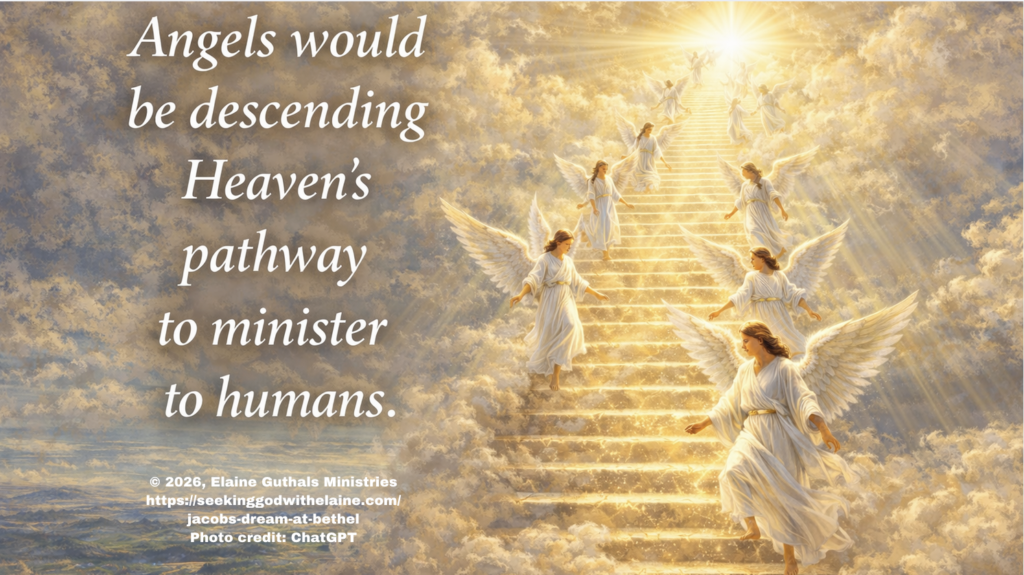
    Angels would be descending Heaven’s stairway to minister to humans. They care about our welfare.

    For one night, Jehovah made it visible to one man. It was important that He show Jacob how the seen and the unseen are connected.

    Roost there for a second. In one of His parables, Yeshua said that there is an impassable chasm between Heaven and he’ll (Lk. 16: 26). That cannot be said between Heaven and earth.

    We are not completely cut off from Jehovah. Reconciliation is possible.

    Beecher thought we each have our own stairway. He said, “No man can be a Christian by separating himself from his kind.” Jehovah and Yeshua will always be present. Angels will also traverse our stairway.

    Resource

    Flip the picture a second. Jacob, through Rebekah’s persuasion, took matters into his own hands and deceived Isaac to secure the covenant blessing. He didn’t wait on Jehovah.

    And here, Jehovah came to him.

    The God of Abraham and the God of Isaac

    “At the top of the stairway stood the Lord, and he said, ‘I am the Lord, the God of your grandfather Abraham, and the God of your father, Isaac …’” (Gen. 28: 13 NLT)

    This is the first time we are told that Jehovah communicated with Jacob.

    Think how comforting that would have been for Jacob. Running for his life, leaving all he had ever known — just to meet the King of the universe.

    This is especially important when we think that Jacob was probably still experiencing guilt. He had sinned against Esau and deceived Isaac. And here he was meeting the King of the universe.

    More than likely, Jacob’s ambition was wrestling with his faith. He wanted the covenant relationship with Jehovah, but what did that look like in application?

    We are never told that God appeared to Isaac as he did to Abraham (Gen. 18: 1). Still, God identified Himself as the God of Isaac.

    Think about it. We aren’t told how much time passed between “So Isaac sent Jacob away, and he went …” (Gen. 28: 5 NLT) to “Meanwhile, Jacob left Beersheba and traveled toward Haran” (Gen. 28: 10 NLT). I doubt there would be much.

    With all that Jacob had done and all the emotions he would have been feeling, the first words he heard Jehovah say was, “I am the God of your fathers.”

    No, his name wasn’t included at the moment. It would be later. But Jacob had a choice.

    Was Jacob going to follow the God of his fathers and walk with Him, or was Jacob going to try to keep on doing this his own way?

    So, Jehovah came to Jacob. Not only did He show him the connection between Heaven and earth, but He also showed him that He is ruler of all.

    But we said it once, Jacob was 77 years old at that time. And he and God hadn’t met before???

    We have to put this into societal context. The gods in the ancient Near Eastern world were considered localized gods. In other words, they stayed in their temple, city, or region, and didn’t come out.

    Here Jacob was traveling from Beersheba to Haran. If going with prevailing theory, Jehovah would stay put in Canaan.

    But Jehovah didn’t stay in Beersheba. He met Jacob in Bethel.

    Covenant Blessings Belong to You

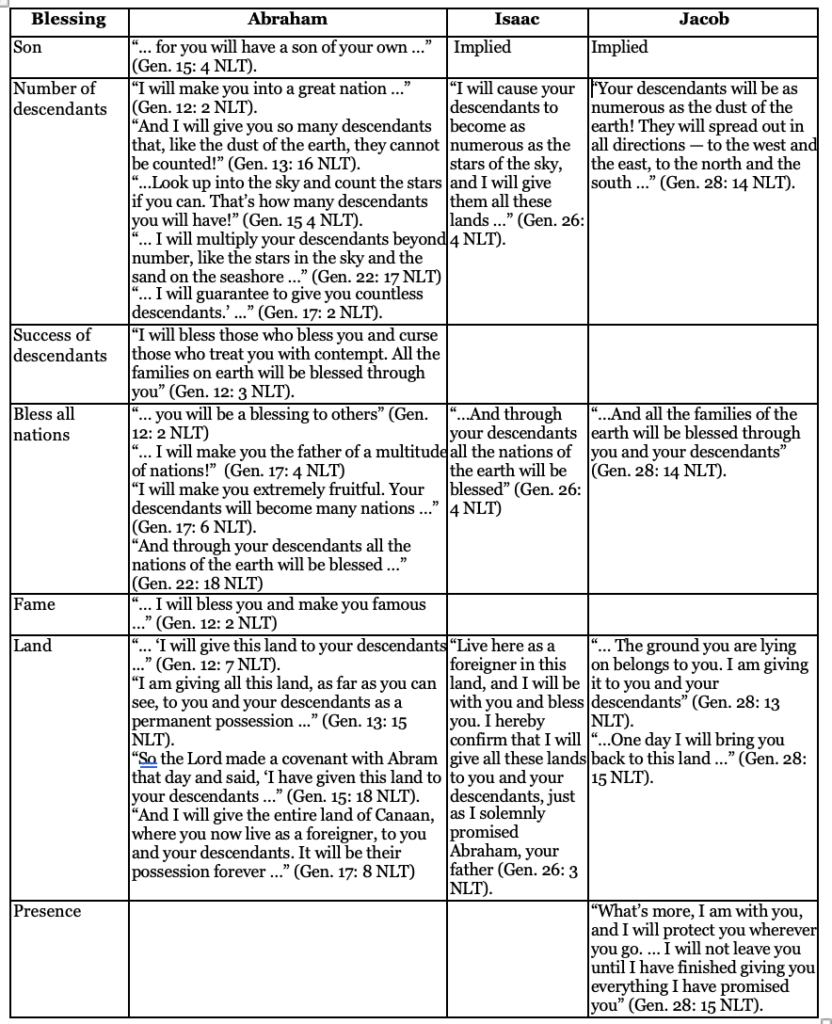
    “…The ground you are lying on belongs to you. I am giving it to you and your descendants. Your descendants will be as numerous as the dust of the earth! They will spread out in all directions — to the west and the east, to the north and the south. And all the families of the earth will be blessed through you and your descendants. What’s more, I am with you, and I will protect you wherever you go. One day I will bring you back to this land. I will not leave you until I have finished giving you everything I have promised you’” (Gen. 28: 13-15 NLT)

    God reaffirmed with Jacob the covenant that he made with Abraham.

    Jacob would have grown up with hearing about Abraham’s covenant with Jehovah. This would be about the first opportunity He had to affirm it with him.

    What we do know was this is the first day of the journey. Jehovah didn’t take much time to reaffirm the covenant. And reaffirm it, He did.

    • Jehovah would give the land he laid on to him (Gen. 28: 13).
    • His descendants would be numberless (Gen. 28: 14).
    • All the Earth would be blessed through him and his descendants (Gen. 28: 14).

    This sounds a lot like Abraham’s covenant.

    Yes, there was a big addition. Jehovah promised Jacob His presence and protection. It was needed as, beyond Abraham’s trip to Egypt, we aren’t told that either patriarch left Canaan.

    Jehovah included that He would keep Jacob safe, wherever he went. He also told Jacob that he would return to this land at a future date. Basically, what God was saying was that he would be with Jacob always.

    This new addition is very meaningful. Jehovah has told us many times in His Word that He will never leave us.

    • “Even when I walk through the darkest valley, I will not be afraid, for you are close beside me. Your rod and your staff protect and comfort me” (Ps. 23: 4 NLT).
    • “Don’t be afraid, for I am with you. Don’t be discouraged, for I am your God. I will strengthen you and help you. I will hold you up with my victorious right hand” (Isa. 41: 10 NLT).
    • “Teach these new disciples to obey all the commands I have given you. And be sure of this: I am with you always, even to the end of the age” (Mt. 28: 20 NLT).
    • “So be strong and courageous! Do not be afraid and do not panic before them. For the Lord your God will personally go ahead of you. He will neither fail you nor abandon you” (Deut. 31: 6 NLT).
    • “I can never escape from your Spirit! I can never get away from your presence! If I go up to heaven, you are there; if I go down to the grave, you are there. If I ride the wings of the morning, if I dwell by the farthest oceans, even there your hand will guide me, and your strength will support me” (Ps. 139: 7-10 NLT).

    What we may or may not always remember is that Jehovah doesn’t put any conditions on that. He will be with us when we are walking the path with Him and when we go off trail.

    The wording was a little different on the descendants. Jacob and his descendants would expand to all four points of the compass.

    This is important as we read in other books of God’s word that this means inclusion for Gentiles. Remember in Isaac’s blessing, the different used of the word nations. It wasn’t goy — nation. It was ve-hayita likhal — assembly/peoples.

    Making the Connections #1

    Okay. People believed that gods were localized, but hadn’t Jehovah already shown them He could? Abraham was called by Him in Haran (and maybe even Ur). He brought him to Canaan. He even went with him to Egypt and Gerar.

    Wasn’t that evidence enough? Jacob would have known this.

    Jacob may have known this in his head. But I’m sure there was a lot of tradition and cultural norms that would have to be set aside to get this down to heart-level acceptance. Knowing something and putting it into practice are two different things.

    That is an important point. What happens on Abraham’s Sanctification Road sometimes has to be repeated on Jacob’s Road.

    This begins the pattern: Jehovah will go with them wherever they go. It doesn’t matter if the road leads to Haran, Egypt, Babylon, or the ends of the earth.

    Sovereign God will always be with us – even when we have our fears and doubts.

    Making the Connections #2

    We said that each of us have our own ladders. Ours are bit different than Jacob’s.

    Yeshua is our ladder. He not only gives us access to the Father, but He also expands it.

    Nose called it a living ladder. Yeshua was dead, and now He lives. Because we have accepted the gift of His salvation, we will live eternally.

    Resource

    This ladder is built with love. It is inclusive for those that accept His gift.

    Communication is key.

    Making the Connections #3

    Ooo, baby. I like what Tipple and Jenkins had to say. In Elaine-speak:

    • We can’t rely on our feelings to know if Jehovah is near.
    • Our awareness/unawareness does not negate His presence.
    • We don’t dream about spiritual things.
    • Whatever anxiety Jacob had felt during the day, it melted away as he slept.
    • We have to remove ourselves from the equation before Jehovah can come in and make things add up.
    • We have to begin to identify His presence in all things.

    Resources

    Making the Connections #4

    Robinson called Jacob the typical Jew. He was separated from Jehovah but desiring a relationship with Him.

    Resource

    Continuing, Robinson compared Jacob to the Church.

    • He was chosen in the womb.
    • His human nature struggled with grace.
    • He chose Jehovah.

    We see that when we look beyond this being just a personal experience. It is more than just a provision of care.

    This is a reaffirmation of the covenant. That covenant lasted through many generations and is still in effect today — albeit merged with Yeshua’s covenant.

    Making the Connections #5

    Yes, Jehovah is up in Heaven where we can’t see Him. Still, He reveals Himself to us — especially when we need it.

    Making the Connections #6

    I hadn’t really thought about this before.

    Jehovah had Abraham go out into the night sky to see the expanse of the covenant promises. “Then the Lord took Abram outside and said to him, ‘Look up into the sky and count the stars if you can. That’s how many descendants you will have!’” (Gen. 15: 5 NLT).

    Here, Jacob was already outside. So, Jehovah showed him the expanse of Heaven.

    It was like Jehovah was saying, “Don’t let your limited perception of space minimize what I am promising you. Not even the sky is the limit when you choose Me.”

    We talk about expanding our horizons. We have to let Jehovah expand then.

    How Do We Apply This?

    • Get the stairway of repentance, submission, and obedience.
    • Keep a good grip on the ladder.
    • Find success and security in repenting.
    • Realize the repenting does not good if we do not intend to turn away from the sin.
    • Recognize some of our covenant decision must be made in a split second’s time.
    • Use our experiences to grow in grace.
    • Recognize Jehovah is nearer to us than we realize.

    Resources

    Father God. You are with us always. You are there when we are doing routine activities, and You are their when we are journeying into the unknown. Thank You for Your care and provision. Amen.

    If you don’t understand something and would like further clarification, please contact me.

    If you have not signed up for the email providing the link to the devotions and the newsletter, do so below.

    If God has used this devotion to speak with you, consider sharing it on social media.
  • Jacob Sent to Laban

    In order to evade Esau’s anger, Jacob is sent to Paddan-aram to find a wife. This devotional reading looks at the blessing Isaac gives him and the newsletter for the Isaac the Patriarch series.

    Nuggets

    • Isaac finished the covenant blessing when sending Jacob off to find a wife.
    • Esau married another wife, which set up enemies for Israel.
    jacob-sent-to-laban

    This devotion is going to be totally different. I had thought I was going to do the newsletter next, but found out I needed to do the first part of Genesis 28 before that.

    But that passage is very short.

    So, I’ve decided to do the next part of our story where we, in essence finish up Isaac’s story — except for his death.

    Then I am hooking on the newsletter — which is totally different, too. It isn’t a rehash of what we’ve already read.

    It is something that has been swirling in my mind since we finished Isaac’s near sacrifice — which I have since learned was called the Akedah. I had never thought about the fallout of that testing.

    So, let’s jump in.

    When we left Isaac’s family in the last devotion, Rebekah had just approached Isaac about sending Jacob to her brother’s house to find a wife. While that was an important task for him to accomplish, getting him away from Esau’s anger was a more pressing matter.

    Esau was plotting his brother’s murder after their father’s death. Again, Rebekah stepped in. Let’s see what Isaac has to say about this.

    Let’s Put It into Context

    To read devotions in the Creating Everything theme, click the button below.

    Devotions in the Isaac the Patriarch series

    Sending Jacob Off

    “So Isaac called for Jacob, blessed him, and said, ‘You must not marry any of these Canaanite women. Instead, go at once to Paddan-aram, to the house of your grandfather Bethuel, and marry one of your uncle Laban’s daughters. May God Almighty bless you and give you many children. And may your descendants multiply and become many nations! May God pass on to you and your descendants the blessings he promised to Abraham. May you own this land where you are now living as a foreigner, for God gave this land to Abraham.’  So Isaac sent Jacob away, and he went to Paddan-aram to stay with his uncle Laban, his mother’s brother, the son of Bethuel the Aramean” (Gen. 28: 1-5 NLT)

    Isaac finished the covenant blessing when sending Jacob off to find a wife.

    Why was it so important that Jacob not take a local wife? Seeing that Abraham’s covenant would be carried out through him and not Esau, it was extremely important.

    The Canaanites were descendants of Ham’s son Canaan. Ham was cursed when he saw his father Noah’s nakedness when he was drunk (Gen. 9: 20-25).

    Since the covenant was being fulfilled by Jacob, he needed to take a wife from Abraham’s family.

    Isaac sent Jacob to Rebekah’s family, which was Abraham’s brother’s family. He specifically sent him to Laban’s family.

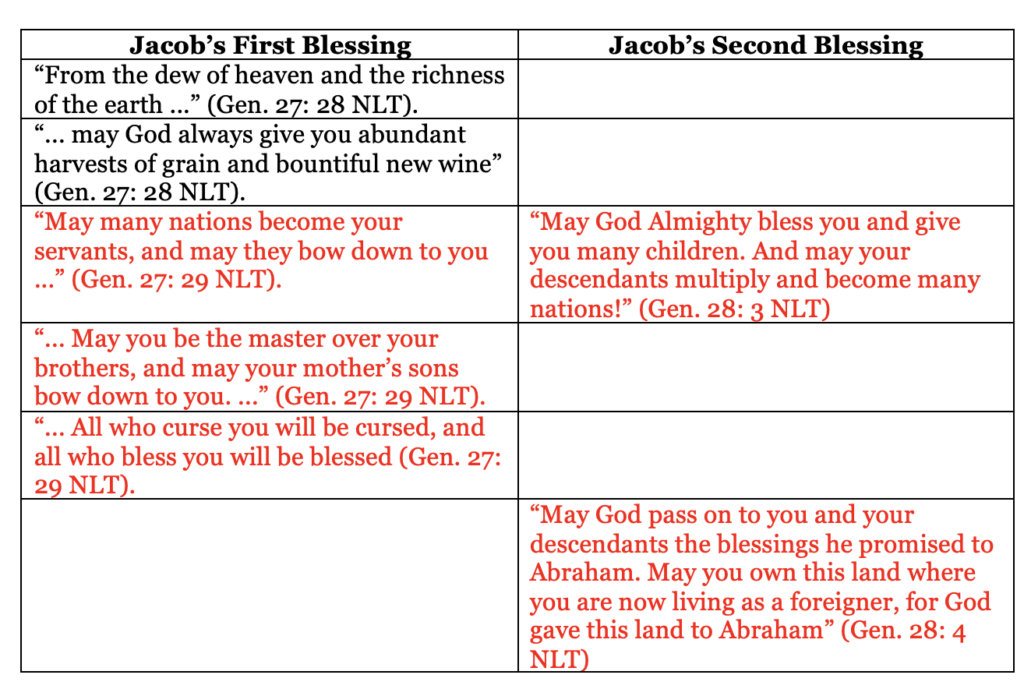
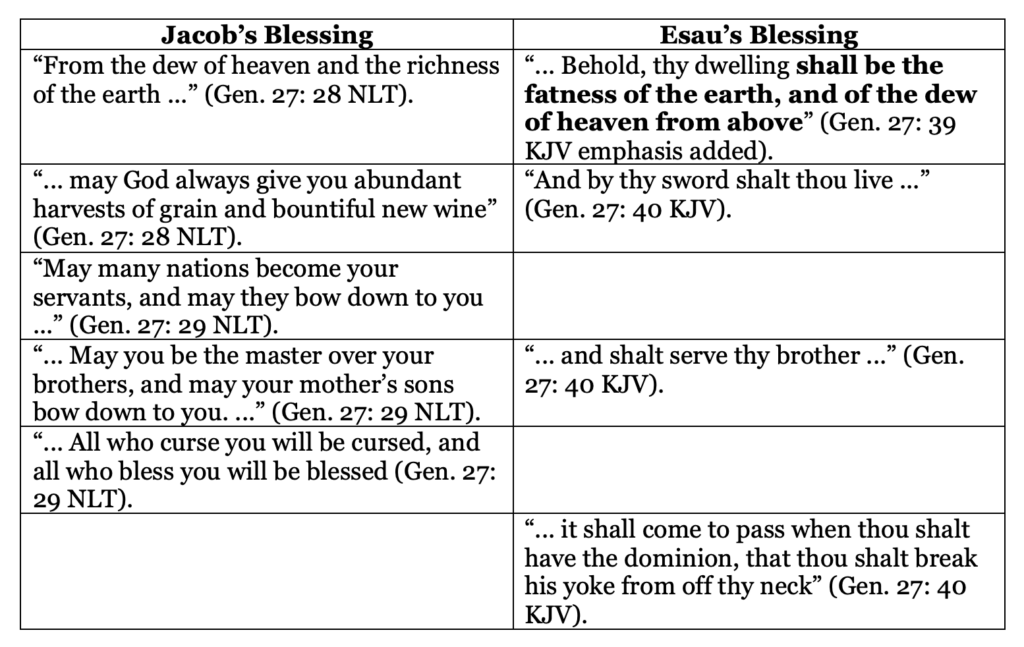
    As we discussed, there were some covenant blessings in Jacob’s first blessing. However, not all were included.

    Okay, this time, it looks like Isaac fell in line with Jehovah’s wishes. Maybe Rebekah did convince Isaac to follow Jehovah’s Will. Maybe it was Isaac’s choice to repent.

    As Pastor Steve says, the blessings are in the obedience.

    Bradford gave a possible explanation as to why the first blessing was a partial covenant blessing. He taught,

    “… Isaac was in the middle of a real battle with his faith. I think we can also safely assume that Isaac was not entirely convinced that the one he gave the blessing to was Esau (which, of course, it was NOT)……..and that he wasn’t exactly enamored with the character of either of his twin sons. So, either he gave the blessing half-heartedly, because he was unconvinced his son would actually carry it forward, or he was withholding part of it until he sensed the time was right.”

    Resource

    How were the two blessings different? (I’ve marked the covenant blessings in red.)

    Bradford reminded us of an important act. Ishmael and Esau were not Hebrews. Only Isaac and Jacob were.

    However, all of Jacob’s descendants would be Hebrews. Thant is why there is a difference in Abraham’s and Jacob’s blessings.

    Because of that Jacob’s become a nation is different than Abraham’s become a nation.

    • “I will make you into a great nation [goy] … (Gen. 12: 2 NLT).
    • “… And may your descendants multiply and become many nations [ve-hayita likhal]!” (Gen. 28; 3 NLT).

    Goy means nations. Ve-hayita likhal means assembly/peoples. Rather than promising the emergence of a nation from nothing, the blessing anticipates the formation of multiple tribes or sub-groups united by covenant.

    Abraham’s blessing initiates the covenantal project. Isaac preserves it. Jacob receives it in a form that anticipates structure, multiplicity, and continuity. By the time Genesis 28 is reached, the covenant is no longer abstract or undefined; it is focused, inherited, and internally organized.

    Esau Marries another Wife

    “Esau knew that his father, Isaac, had blessed Jacob and sent him to Paddan-aram to find a wife, and that he had warned Jacob, ‘You must not marry a Canaanite woman.’ He also knew that Jacob had obeyed his parents and gone to Paddan-aram  It was now very clear to Esau that his father did not like the local Canaanite women. So Esau visited his uncle Ishmael’s family and married one of Ishmael’s daughters, in addition to the wives he already had. His new wife’s name was Mahalath. She was the sister of Nebaioth and the daughter of Ishmael, Abraham’s son” (Gen. 6-9 NLT)

    Esau married another wife, which set up enemies for Israel.

    Esau had two Canaanite wives. We’ve already read that they did not get along with Isaac and Rebekah (Gen. 26: 35).

    That wasn’t an issue in Esau’s mind — until they sent Jacob off to find so that he wouldn’t take a Canaanite wife. He decided to choose another.

    Am I the only one questioning if that should be the foundation of a marriage? “I’m going to marry you to please my parents. I am going to marry you because it is good for my brother, so it should win me points with Jehovah.”

    No, I don’t think I am the only one shaking my head at Esau. Leale called him a mercenary. Hughes called him an imitator. Both called him a hypocrite.

    Resources

    Esau chose his third wife from family. Mahalath was Esau’s cousin. She was Isaac’s brother Ishmael’s daughter.

    We know Sarah asked Abraham to send Ishmael away because he was teasing Isaac (Gen. 21: 9-10). We also know that, even if their relationship hadn’t improved, both were present at Abraham’s burial (Gen. 25: 9).

    Would Isaac and Rebekah be any happier with that union?

    We have to be very careful. Jehovah doesn’t want us to play at religion. He doesn’t want us to imitate a disciple thinking that will get His blessing.

    Everything is dependent on our relationship with Jehovah. Marrying someone isn’t going to gain us His favor.

    Bradford said it was even worse than this. He wrote,

    “But, as matter-of-fact as this event is told, its future effect is beyond calculation. Because here an alliance through intermarriage is formed, that bonds the two dispossessed firstborns, rejected by Yahoveh as possible heirs to the covenant line of promise, Ishmael and Esau, into what will rather quickly turn into a permanent anti-Israel group of nations. It is the alliance and gene pool mixing of Ishmael and Esau who form the vast bulk of Islam in the world today, and the entire bulk of Arabs.”

    Resource

    We have to watch when we are trying to make things better.

    Newsletter

    As many times as I have read the passage about Abraham and Isaac’s near-sacrifice, I missed one important nugget. Where did Abraham live after Isaac’s Akedah?

    Akedah is a Hebrew word that means binding. It specifically refers to Abraham binding his beloved son Isaac to sacrifice him at the request of Jehovah.

    “And they came to the place which God had told him of; and Abraham built an altar there, and laid the wood in order, and bound Isaac his son, and laid him on the altar upon the wood. And Abraham stretched forth his hand, and took the knife to slay his so” (Gen. 22 9-10 NLT).

    After the Akedah, we get a verse talking about Abraham’s residence. “So Abraham returned unto his young men, and they rose up and went together to Beersheba; and Abraham dwelt at Beersheba” (Gen. 22: 19 NLT).

    Let’s do a little history lesson.

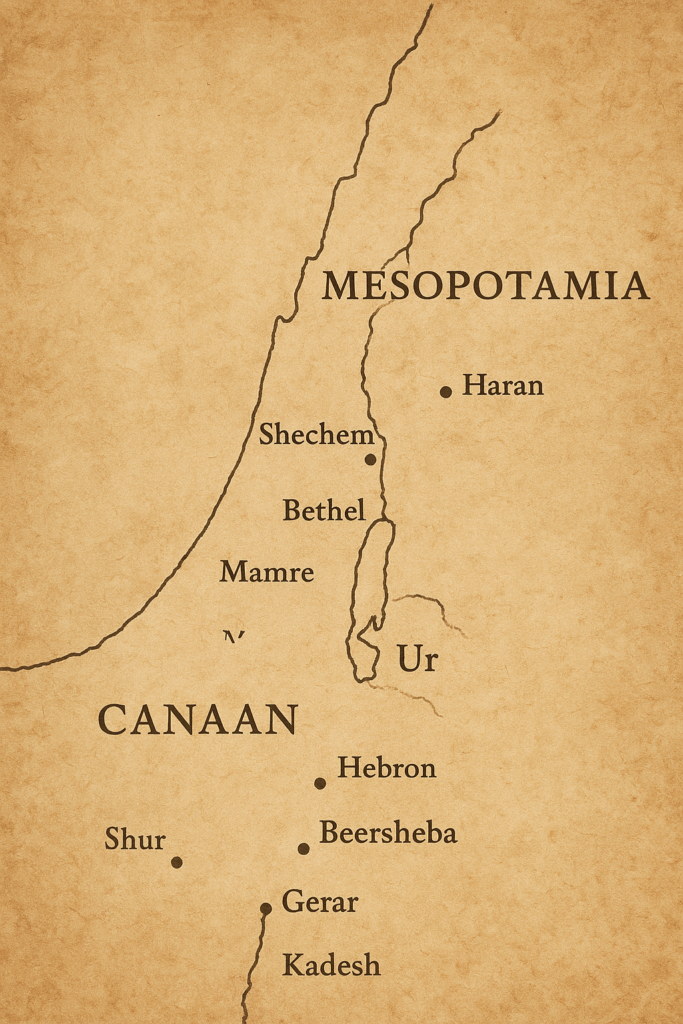
    Where Abraham Lived

    Abraham moved from Ur to Haran with his father Terah, his wife Sarah, and his nephew Lot (Gen. 11: 31). (True, Abraham and Sarah had different names, but it was still them.)

    When Jehovah called Abraham to move to Canaan, he settled in Shechem (Gen. 12: 6). From there, Abraham moved his household between Bethel and Ai (Gen. 12: 8).

    After coming back from Egypt through the Negev, Abraham returned to Bethel (Gen. 13: 3). He moved to Hebron by the grove belonging to Mamre (Gen. 13: 18) after he separated from Lot.

    I’ve always assumed that Abraham remained at Hebron for the rest of his life. It was there that Jehovah and the two angels appeared to him before the destruction of Sodom and Gomorrah (Gen. 18: 1).

    When another famine occurred, Abraham moved between Kadesh and Shur before moving to Gerar (Gen. 20: 1). Abraham was given royal protection after a dispute between him and Abimelech. “Then Abimelech said, “Look over my land and choose any place where you would like to live.” (Gen. 21: 15 NLT).

    We are not told when Abraham moved back to Heron. That is, however, the traditional birthplace of Isaac (Gen. 21: 2).

    The next time we are given Abraham’s location is when he enters into the covenant with Abimelech. It was made at Beersheba (Gen. 21: 31-32), where Abraham secured water rights. Wells in Genesis function as legal and economic markers of land use, but they do not require permanent residence.

    It is important to note that is before the near-sacrifice if it is going in chronological order.

    Akedah

    Jehovah tested Abraham’s faith by requiring him to sacrifice his beloved son Isaac as a burnt offering (Gen. 22: 2 NLT). Abraham did not waver but journeyed to the mountain on which Jehovah told him to go.

    Abraham bound Isaac and placed him on the altar he had built (Gen. 22: 9). He had the knife in hand to complete the sacrifice (Gen. 22: 10).

    An angel of the Lord stopped Abraham from killing his son (Gen. 22: 11-12). Jehovah provided a ram to be sacrificed.

    Where Do Abraham Go from There?

    “Then they returned to the servants and traveled back to Beersheba, where Abraham continued to live” (Gen. 22: 19)

    Genesis 22: 19 is an interesting verse. It doesn’t say Abraham returned to Hebron. It says he “… continued to live” (Gen. 22: 19) in Beersheba.

    That verse opens a whole can of worms.

    • What does continued mean?
    • Where was Sarah?
    • Where was Isaac?

    Continued Living in Beersheba

    We know that God’s Word does not read as if it were a daily diary. In Genesis 21, we read where Isaac was born. The only indication we are given of the passage of time is verse 8. “When Isaac grew up and was about to be weaned, Abraham prepared a huge feast to celebrate the occasion” (Gen. 21: 8 NLT).

    Jewish children were weaned anywhere from 18 months to 5-years old. Isaac would have probably been a two- or three-year-old child.

    The next time we pick up on Isaac’s story, he is probably anywhere from 15 to 30 years old and traveling to the Akedah.

    The Hebrew word that describes Abraham’s tenure in Beersheba is yashav. While this does indicate residency, it can mean either temporary or regional dwelling.

    In other words, the nomad Abraham could have moved the flocks down there to pasture.

    Sarah’s Relationship with Abraham after the Akedah

    The last time we heard anything about Sarah was at the weaning celebration. She demanded that Abraham cast Hagar and Ishmael out for the 16-year-old’s mockery of a two- or three-year-old.

    Sarah’s name is not mentioned again until we are informed of her death. “When Sarah was 127 years old, she died at Kiriath-arba (now called Hebron) in the land of Canaan. There Abraham mourned and wept for her” (Gen. 23: 1-2 NLT).

    Some Jewish interpretive traditions believe that – after the Akedah – Abraham and Sarah lived separately. That could be one reason why Abraham is said to have “… continued to live” (Gen. 22: 19) in Beersheba.

    Let’s stop a second and talk this through.

    We aren’t told what Abraham told Sarah — if anything — about what Jehovah told him to do. I don’t see him going to her and saying, “God told me to go make a sacrifice — and that sacrifice is Isaac. See you when I get back.”

    Resource

    We know that Abraham didn’t tell Isaac. “So Abraham placed the wood for the burnt offering on Isaac’s shoulders, while he himself carried the fire and the knife. As the two of them walked on together, Isaac turned to Abraham and said, ‘Father?’ ‘Yes, my son?’ Abraham replied. ‘We have the fire and the wood,’ the boy said, ‘but where is the sheep for the burnt offering?’ ‘God will provide a sheep for the burnt offering, my son,’ Abraham answered. And they both walked on together” (Gen. 22: 6-8 NLT).

    If Abraham didn’t tell Isaac until he had to bind him, he didn’t tell Sarah. His answer to Issac shows the faith that had to have gone with him every step that the return steps would have Isaac by his side.

    With that much confidence, Abraham would not have told Sarah beforehand. But how would she have reacted when they got home and told her what Jehovah had asked? I don’t know how I would take it.

    Sarah’s trouble accepting that Abraham could even have thought about sacrificing Isaac could have eroded their marriage.

    No, God’s Word doesn’t say one way or the other what Sarah’s reaction was. What it does say is, when she died, “… Avraham came to mourn for Sarah, and to weep for her” (Gen. 23: 2 OJB emphasis added).

    If Abraham had to come, that means he wasn’t there when she died. Was he just elsewhere pasturing the flock? Was he living elsewhere?

    Isaac’s Relationship with Abraham after the Akedah

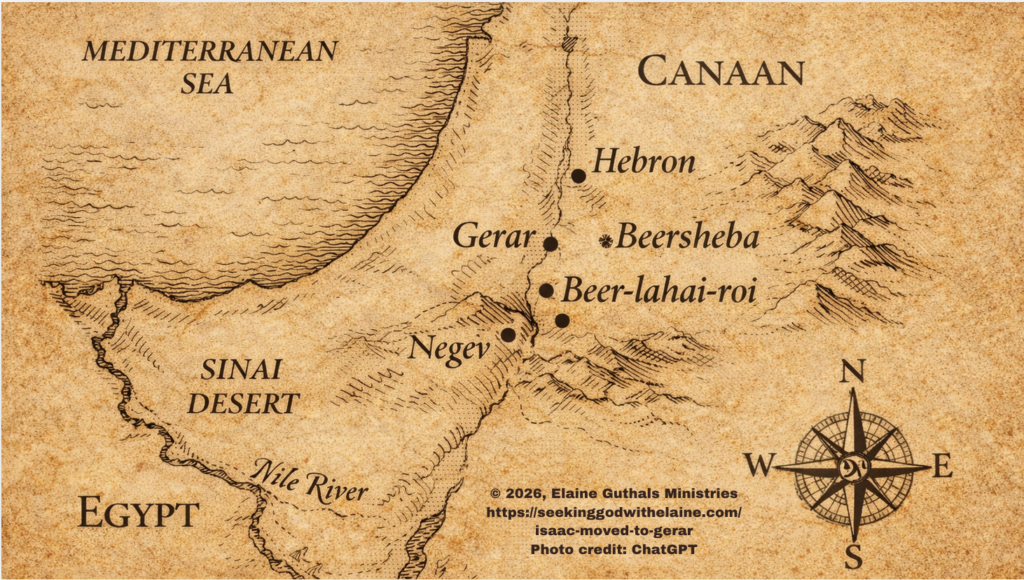
    We know that, when Eliezer returned from Paddan-aram to get a wife for Isaac, he was at where Abraham lived – but it wasn’t where Isaac lived. “Meanwhile, Isaac, whose home was in the Negev, had returned from Beer-lahai-roi” (Gen. 24: 62 NLT)

    Isaac must have been visiting Abraham. Since Moses said he returned to there, I’ve always assumed that here was Hebron. But then, it may have been Beersheba because that is the last place it stated Abraham lived.

    It seems that Isaac’s relationship with Abraham weathered the Akedah.

    Conclusion

    It threw me for a loop when I read that Abraham didn’t go back to Hebron after the Akedah. Then when I read that he and Sarah were living separately, it really jolted me.

    I hope that wasn’t the case. Ending a marriage is difficult for all those involved – parents and children.

    But we think that everything will go swimmingly when Jehovah gives us a task or a mission. We especially think that knowing the blessings are in the obedience.

    That isn’t a guarantee that others will accept Jehovah’s plan for us. Things may still fall apart when we do everything right.

    Lack of clarification and elaboration can sometimes lead us where Jehovah doesn’t want us to go. Still, I think we can learn a very important lesson from looking at this story through this lens.

    Jehovah calls us to obedience. That isn’t obedience only when it is easy. It isn’t obedience when our family allows it.

    We have to always put God first – no ifs, ands, or buts.

    Jehovah will call us to make hard sacrifices. If every choice would be between the easy and the easier, obedience wouldn’t mean anything.

    If you don’t understand something and would like further clarification, please contact me.

    If you have not signed up for the email providing the link to the devotions and the newsletter, do so below.

    If God has used this devotion to speak with you, consider sharing it on social media.
  • Isaac Blessed Esau

    Oh, no! Isaac hadn’t blessed Esau – he had blessed Jacob. This devotional reading looks at how Isaac blessed Esau and Esau’s response.

    Nuggets

    • Timing can be everything, but Jacob almost didn’t have enough time.
    • There were probably several reasons Isaac trebled uncontrollably.
    • As usual, Esau didn’t blame himself.
    • Rebekah championed for a daughter-in-law she would never meet.
    • Rebekah told the truth when warning Jacob.
    • Apparently, Rebekah didn’t want to tell Isaac that Esau was planning murder.
    isaac-blessed-esau

    When we’d left our family, Jacob had just deceived his father, Isaac — at the direction of his mother, Rebekah.

    Jacob’s deception is about to be found out.

    Let’s Put It into Context

    To read devotions in the Creating Everything theme, click the button below.

    Devotions in the Isaac the Patriarch series

    What’s Left for Esau?

    “As soon as Isaac had finished blessing Jacob, and almost before Jacob had left his father, Esau returned from his hunt. Esau prepared a delicious meal and brought it to his father. Then he said, ‘Sit up, my father, and eat my wild game so you can give me your blessing.’ But Isaac asked him, ‘Who are you?’ Esau replied, ‘It’s your son, your firstborn son, Esau.’ Isaac began to tremble uncontrollably and said, ‘Then who just served me wild game? I have already eaten it, and I blessed him just before you came. And yes, that blessing must stand!’ When Esau heard his father’s words, he let out a loud and bitter cry. ‘Oh my father, what about me? Bless me, too!’ he begged. But Isaac said, ‘Your brother was here, and he tricked me. He has taken away your blessing.’ Esau exclaimed, ‘No wonder his name is Jacob, for now he has cheated me twice. First he took my rights as the firstborn, and now he has stolen my blessing. Oh, haven’t you saved even one blessing for me?’ Isaac said to Esau, ‘I have made Jacob your master and have declared that all his brothers will be his servants. I have guaranteed him an abundance of grain and wine — what is left for me to give you, my son?’ Esau pleaded, ‘But do you have only one blessing? Oh my father, bless me, too!’ Then Esau broke down and wept. Finally, his father, Isaac, said to him, ‘You will live away from the richness of the earth, and away from the dew of the heaven above. You will live by your sword, and you will serve your brother. But when you decide to break free, you will shake his yoke from your neck’” (Gen. 27: 30-40 NLT)

    As Soon as Isaac Had Finished Blessing Jacob

    Timing can be everything, but Jacob almost didn’t have enough time.

    ut we still have to deal with Esau.

    I read verse 30 to say that Esau almost caught Jacob coming out of Isaac’s tent. Esau was returning to camp, so he wasn’t ready to give Isaac his meal. He had to prepare it first.

    Esau got the meal prepared, probably humming as he worked. He was about to get what he wanted — wealth with no responsibility.

    Was Esau in for a surprise! Isaac sure was.

    Isaac Trembled Uncontrollably

    There were probably several reasons Isaac trebled uncontrollably.

    We may jump to thinking Isaac was mad when he started to tremble uncontrollably (Gen. 27: 33). He wouldn’t have liked that he was duped.

    Part of me thinks Isaac trembled because he realized he did give the covenant blessing – whether that is what he intended in the first place or not. I remember Pastor Steve describing the experience of Jehovah setting him aside and preaching through him one morning. Or should I clarify, blasting through him.

    That was an awe-inspiring and humbling experience.

    I can also see that Isaac realized just how closely he came to really disobeying Jehovah. He was going to go against what he had been told was His plan.

    Esau’s Blessing

    I can see where Isaac would have wanted to bless Esau, too. But the blessing he gave Jacob was irreversible.

    What more did Isaac have to give? He was limited in what he could do.

    Several translations including the King James Version, however, have it wrong in the first element of the blessing. Let’s compare Jacob’s blessing to Esau’s blessing. They weren’t the same blessing, though sometimes it reads as if they are.

    Both Jacob and Esau can’t have the fatness/richness of the earth and dew from heaven in their blessings!

    Does that mean King James Version translator missed the not, or took it out on purpose?

    Well, we feel sorry for Esau – sort of. We can’t go against God’s Will. Worse, we can’t lead others against God’s Word.

    I think it is more of an issue of mistranslating the Hebrew.

    Look how Genesis 27: 28 starts: “From the dew of heaven and the richness of the earth, may God always give you …” (NLT). It is all about Jehovah’s abundant provision.

    The Hebrew reads almost as the New Living Translation says (as opposed to the King James Version): “From the fatness of the earth shall be your dwelling, and from the dew of heaven above.” “From the fatness of the earth” is a lot different than “… Behold, thy dwelling shall be the fatness of the earth …: (Gen. 27: 39 KJV).

    The biggest difference that the Hebrew tells us is that Jacob’s blessing was talking inheritance. Esau’s blessing was talking habitation.

    We know from Malachi that Esau did live in a desert. “And the Lord replies, ‘This is how I showed my love for you: I loved your ancestor Jacob, but I rejected his brother, Esau, and devastated his hill country. I turned Esau’s inheritance into a desert for jackals’” (Mal. 1: 2-3 NLT).

    I wonder, though, if Isaac was trembling because he knew God wanted Jacob to have the blessing, but he had followed his own will instead of God’s. Was he concerned for his own consequences?

    We should tremble when we know we have willingly brought God’s wrath down upon ourselves.

    Cheated Me Twice

    As usual, Esau didn’t blame himself.

    Esau was right and wrong. “Esau exclaimed, ‘No wonder his name is Jacob, for now he has cheated me twice. First he took my rights as the firstborn, and now he has stolen my blessing’” (Gen. 27: 36 NLT).

    Esau was right that Jacob cheated him out of the blessing because of the way he did it.

    Esau was wrong that Jacob was the reason he wasn’t blessed. That was God’s decision. Isaac got his hopes up when he told him he would bless him anyway.

    Also wrong was that Jacob cheated Esau out of his birthright. Esau sold them to Jacob 62 years prior. He could have said no if he thought more of his responsibilities than his stomach.

    But Esau didn’t want clan leadership. He wanted the wealth.

    Jacob Flees to Paddan-Aram

    “From that time on, Esau hated Jacob because their father had given Jacob the blessing. And Esau began to scheme: ‘I will soon be mourning my father’s death. Then I will kill my brother, Jacob.’ But Rebekah heard about Esau’s plans. So she sent for Jacob and told him, “Listen, Esau is consoling himself by plotting to kill you. So listen carefully, my son. Get ready and flee to my brother, Laban, in Haran. Stay there with him until your brother cools off. When he calms down and forgets what you have done to him, I will send for you to come back. Why should I lose both of you in one day?’ Then Rebekah said to Isaac, ‘I’m sick and tired of these local Hittite women! I would rather die than see Jacob marry one of them’” (Gen. 27: 41-46 NLT)

    Rebekah championed for a daughter-in-law she would never meet.

    Esau Began to Scheme

    Oh, I bet Esau did hate Jacob after this. He didn’t really care about the birthrights because of the responsibility of family leadership that went with it.

    Esau didn’t like that Jacob got the money.

    So, Esau’s solution was to plan to kill Jacob. Isn’t it true that sin snowballs? We commit a little sin, then slide into a bigger one, then a bigger one. Sounds like Esau cut out some slides, though.

    Rebekah stepped in again. She found out that Esau was planning to kill Jacob upon Isaac’s death.

    Rebekah Said to Jacob

    Rebekah told the truth when warning Jacob.

    Rebekah’s first thought would have been of getting Jacob to safety. He was her favorite son.

    Besides, Jacob was the covenant son. Nothing could happen to him, or the covenant would be broken.

    Again, it seems like Rebekah thought she needed to step in and keep the covenant moving in the right direction. Again, she didn’t wait until Jehovah acted.

    Would Esau really have followed through with his threat? We’ll never know.

    Why didn’t Jacob have a wife already? If Esau got married at 40 and this was years after, where was Jacob’s wife?

    Remember, if Isaac was 40 years old when he married Rebekah, Abraham was 140. Since Abraham died at 175, he secured a wife for Isaac 35 years before he died.

    Isaac was securing Jacob’s wife 44 years before he died.

    But, no, none of them were spring chickens.

    Rebekah Said to Isaac

    Apparently, Rebekah didn’t want to tell Isaac that Esau was planning murder.

    Isn’t that like mothers? We want to shield everyone involved in the best way possible. Unfortunately, sometimes that means saying our motive is Plan A – which is true – instead of Plan B – equally true but more painful.

    Is this another form of deception? Is “hiding” an ulterior motive deceptive when both are true?

    Was Rebekah afraid to say that Jacob should go to Paran-Aram for covenant purposes when Isaac had so blatantly ignored the covenant?

    Remember, according to the timeline we’ve been using, Isaac was 137 when he gave the blessings. He died when he was 180. That was 43 years later.

    Based on Timeline from

    Rebekah told Isaac to send Jacob where he was supposed to go to find a wife. But let’s look at different translations of what she said.

    • “… ‘I’m sick and tired of these local Hittite women!’ …” (Gen. 27: 46 NLT).
    • “… ‘I’m sick of my life because of these Hethite girls’ …” (Gen. 27: 46 CSB).
    • “… ‘I am tired of living because of the daughters of Heth’ …” (Gen. 27: 46 NASB).
    • “… ‘I am weary of my life because of the daughters of Heth’ …” (Gen. 27: 46 KJV).

    It is kind of a progression into darkness, isn’t it? Do we have an idea how she was really feeling?

    Let’s go back to the Hebrew. Yes, it is showing the contempt for her life when taken literally.

    • “I am disgusted/weary of my life”
    • “My life is a burden to me.”

    But that is a common Semitic idiom. We would say, “I can’t stand this. I’m miserable.” We might even say, “I’m at the end of my rope.”

    Rebekah might be being a bit of a drama queen. But the question she is posing is a rhetorical question, not a call for suicide intervention. She is talking hyperbolically.

    Finding a non-Canaanite wife was true as Jehovah would not want a marriage with a Canaanite woman in the covenant line. We know how that turned out with Isaac’s wives (Gen. 26: 35). It wasn’t very complimentary.

    Rebekah was talking through her anguish and feeling of urgency, not depression. She was probably overwhelmed and scared stiff.

    If she was trying to ensure the correct covenant line, this shows how much was at stake. It’s planning redemption’s’ story in a very human situation.

    But let’s focus on securing Jacob a covenant wife.

    This time, Isaac wasn’t doing the securing as Abraham did. He wasn’t sending an Eliezer-type to Panan-Aram. He was sending Jacob himself.

    That was because the betrothal process had changed. Jacob not only didn’t have a servant making the arrangement, but he also didn’t have the presents to provide the family of the bride he chose.

    Yeah, Laban was probably really missing that part of the deal.

    But this meant that Jacob didn’t have the formal authority to secure arrangements for a bride. He had to make his own arrangements. Yes, labor was par for the course then.

    This absence of the formal rituals, though, didn’t do Jacob any favors. That opened the door to the deception by Laban.

    What hadn’t changed was securing a marriage partner who was within the family. What hadn’t changed was Jehovah control over both processes.

    Making the Connections #1

    One thing we have to recognize here was that Isaac did not do the opposite of bless. He did not curse Esau.

    Instead, Isaac describe the man that Esau was/would become.

    But it sure does look like a curse if we think anything good is a blessing, anything hard is a curse.

    Esau, like his Uncle Ishmael, would have had a hard life. Both were fighting men.

    I guess it would be natural that the two bloodlines would commingle. In Genesis 25, we talked about Arabs, many of which — but not all — are descendants of Ishmael according to Got Questions. Bradford reminded us that many of which — but not all — are also descendants of Esau. They make up the majority of the population of Muslims.

    Resources

    So, this was part character analysis, part prophecy.

    Making the Connections #2

    Each person in Isaac’s family sinned.

    • Isaac ignored Jehovah’s will in favor of rewarding his favorite son.
    • Rebekah developed a sinful plan to obtain the right thing and encouraged her child to deceive his father.
    • Esau was impulsive and selfish, living only for the day and ignoring his responsibilities to Sovereign God as firstborn.
    • Jacob did not trust in Jehovah to provide His promises.

    How Do We Apply This?

    • Truly love our family, not just have an affection for them.
    • Watch our thoughts.
    • Remember one sin leads to another.
    • Realize that early sins stick with us long into life.
    • Don’t play favorites with your kids.
    • Recognize that Jehovah as our Creator has to the right to do what He wants.

    Resources

    Father God. You have made the family a central part of Your call for us. You place us in families here so we can be a family through eternity. But we are flawed. We quarrel. We are self-centered. Unfortunately, we sin in the way we interact with each other. Forgive us, Lord. Help us to have Your character and treat each other as You would. Amen.

    If you don’t understand something and would like further clarification, please contact me.

    If you have not signed up for the email providing the link to the devotions and the newsletter, do so below.

    If God has used this devotion to speak with you, consider sharing it on social media.
  • Isaac Blessed Jacob

    Isaac started things in motion to bless Esau, but Rebekah came up with a plan so that Jacob could get the blessing. This devotional reading looks at how the deception was carried out.

    Nuggets

    • Jacob followed through with Rebekah’s plan.
    • Jacob deceived Isaac and received the blessing meant for Esau.
    isaac-blessed-jacob

    This story looks like it is each parent was battling so that his/her favorite child would receive the blessing. What was termed blessing ended up being the covenant blessing.

    So, did the covenant son receive it or not?

    Let’s Put It into Context

    To read devotions in the Creating Everything theme, click the button below.

    Devotions in the Isaac the Patriarch series

    Jacob Executes Rebekah’s Plan

    “So Jacob took the food to his father. ‘My father?’ he said. ‘Yes, my son,’ Isaac answered. ‘Who are you — Esau or Jacob?” Jacob replied, ‘It’s Esau, your firstborn son. I’ve done as you told me. Here is the wild game. Now sit up and eat it so you can give me your blessing.’ Isaac asked, ‘How did you find it so quickly, my son?’ ‘The LORD your God put it in my path!” Jacob replied. Then Isaac said to Jacob, ‘Come closer so I can touch you and make sure that you really are Esau.’ So Jacob went closer to his father, and Isaac touched him. ‘The voice is Jacob’s, but the hands are Esau’s,’ Isaac said. But he did not recognize Jacob, because Jacob’s hands felt hairy just like Esau’s. So Isaac prepared to bless Jacob. “But are you really my son Esau?” he asked. ‘Yes, I am,’ Jacob replied. Then Isaac said, ‘Now, my son, bring me the wild game. Let me eat it, and then I will give you my blessing.’ So Jacob took the food to his father, and Isaac ate it. He also drank the wine that Jacob served him” (Gen. 27: 18-25 NLT)

    Jacob followed through with Rebekah’s plan.

    It has long amazed me how a 77-year-old-man could let his mother talk into perpetuating a lie. But perpetuate he did.

    Why?

    • Did Jacob think he was saving his father from sin?
    • Did he think this was what Sovereign God wanted?

    Jacob did everything he could to make himself into Esau. He put on Esau’s favorite clothes. Rebekah put goat skin on his neck and arms. Food was prepared (Gen. 27: 14-17 NLT).

    Did this make Jacob a weak and pliable man, as Leale suggested? Hmmm. Maybe. I mean, he was 77 years old, and he doesn’t question Mom. All he was worried about was getting caught.

    Resource

    Did Jacob see any other way he was going to get what Jehovah had promised him? Probably not. That is usually when we jump right in to get what we know is right.

    But two wrongs don’t make a right.

    Jacob went to see Isaac with substituted meat in hand. Isaac thought something was fishy – and he didn’t think it was the meat.

    Isaac was skeptical that this was his son Esau. We might wonder why he couldn’t definitely distinguish between his sons. It seemed like he could: Esau’s hair but Jacob’s voice.

    Why didn’t Isaac stick to his guns? “You aren’t Esau.”

    Isaac Blessed Jacob

    “Then Isaac said to Jacob, ‘Please come a little closer and kiss me, my son.’ So Jacob went over and kissed him. And when Isaac caught the smell of his clothes, he was finally convinced, and he blessed his son. He said, ‘Ah! The smell of my son is like the smell of the outdoors, which the LORD has blessed! From the dew of heaven and the richness of the earth, may God always give you abundant harvests of grain and bountiful new wine. May many nations become your servants, and may they bow down to you. May you be the master over your brothers, and may your mother’s sons bow down to you. All who curse you will be cursed, and all who bless you will be blessed’” (Gen. 27: 26-29 NLT)

    Jacob deceived Isaac and received the blessing meant for Esau.

    But Isaac gave Jacob the blessing. Yes, that is what God wanted, but He wanted it done His way where it glorified Him.

    The b’rakhah is a prayer that is a blessing. Many of the Jewish blessings start with the same six words, according to Adath Shalom. They are Barukh Ata Adonai, Eloheinu Melekh Ha’olam. In English that reads: Blessed are You, Lord our God, King of the universe.

    Resource

    It starts off with praise, hope, and gratitude — not petition. But what is relevant to this conversation is that the b’rakhah shows finality in a long-settled issue.

    The long-settled issue was that Jacob was the covenant son. It was settled that the plenty and power belonged to Jacob, not Esau.

    Bradford had a great reminder. While Isaac was blessing Jacob, he was probably thinking Esau. That would mean he wanted for Esau, not Jacob

    • Dew
    • Fatness of the earth
    • Abundance of grain and wine
    • Servants
    • Nations below him
    • Master of his brothers
    • Sons
    • Curse those who curse you, bless those who bless you.

    Wait a minute!

    • “… One nation will be stronger than the other; and your older son will serve your younger son” (Gen. 25: 23 NLT).
    • “Then the Lord took Abram outside and said to him, ‘Look up into the sky and count the stars if you can. That’s how many descendants you will have!’” (Gen. 15: 5 NLT).
    • “I will bless those who bless you and curse those who treat you with contempt …” (Gen. 12: 3 NLT).

    Esau was not to be the covenant son! Isaac knew that!!!!

    But think about it. Isaac was thinking Esau, blessing Jacob. That definitely would have been included in Jacob’s covenant blessing. It would have been horrible if it was left out.

    So, it is perfectly appropriate in this blessing – regardless of who Isaac had in mind.

    Bradford told us what Isaac was trying to do. He wrote, “Isaac isn’t trying to say Jacob isn’t the firstborn; he’s just trying to take most of the rights of the firstborn away from Jacob and give them to Esau……just another way to skin a cat.”

    Resource

    So, Bradford thought Isaac knew exactly what he was doing and did it anyway. He may not have thought of Esau as the covenant son, but he wanted all the good stuff for him.

    But the covenant son did get the covenant blessing, despite Isaac’s best efforts. Yes, God’s Will would be done.

    Harper said something interesting. The blessings that Isaac was giving were temporary.

    Resource

    That is true – up until the last three. Dew, fatness of the earth, abundance of grain and wine, servants, and nations below him were all tied to this earthly existence.

    Master over Your Brothers

    Were you squinting at that, too? Why does it say brothers – plural?

    Aren’t Jacob and Esau the only children Isaac and Rebekah had? How can their “… mother’s sons …” (Gen. 27: 29 NLT) bow down to them if there are no other mother’s sons?

    We know earlier in Genesis when it was giving death lists, it would say “After the birth of Son, Dad lived another so many years and had other sons and daughters.”

    We’ve never heard that about Isaac. Moses listed Abraham’s concubine Keturah and her sons. Why wouldn’t he have done the same with Isaac?

    Besides Jewish tradition or ancient writings don’t say anything about other kids. You would have thought somewhere along the line, a descendant this close to Abraham wouldn’t have been left out.

    Well, all through God’s Word brothers and sisters mean more than biological siblings. It can mean anywhere from close relatives and clan members to other believers of the faith.

    What Isaac could have been meaning was that Jacob’s descendants – with Jacob as the representative head – would rule over Esau’s descendants – with Esau as the representative head.

    This does play out in Scripture down the line. Edom is described as Israel’s “brother” nation. “You shall not abhor an Edomite, for he is your brother. You shall not abhor an Egyptian, because you were a sojourner in his land” (Deut. 23: 7 ESV).

    So, this has to be forward-looking. That is what a covenant blessing would do.

    Sons

    At first, I didn’t include sons in this breakout. But then I decided I had better.

    Yes, sons were very important to any family in that society. They would all be concerned about securing the family line.

    But we are talking covenant sons here. “All those listed above include fourteen generations from Abraham to David, fourteen from David to the Babylonian exile, and fourteen from the Babylonian exile to the Messiah” (Mt. 1: 17 NLT).

    Sons were important because they led to Yeshua.

    Curse You and Bless You

    When we think of bless-those-who-bless-you-and-curse-you-who-curse-you in a spiritual context, blessing is equated with salvation. Cursing is associated with being thrown in the lake of fire (Rev. 20: 15).

    That is for eternity.

    If Isaac was giving the covenant blessing – which he was because it was Jacob – he would have been blessing the covenant line. The covenant line culminates in Yeshua and salvation.

    Making the Connections #1

    Jacob got the blessing God wanted him to have. But how did he feel?

    Bradford took a stab at that. He wrote,

    “But, no doubt Jacob felt none of the inner joy and sense of humility before God that should have been present after being anointed as the bearer of the line of covenant promise that was so important for the future of all mankind. For Jacob had done wrong in making sure to obtain it….his deception was sin against God….and his conscience probably dogged him for the rest of his life.”

    Resource

    Does that surprise you? Did you think he would be giddy with joy?

    By his deception, Jacob tainted that which was pure and good.

    Making the Connections #2

    “From the dew of heaven and the richness of the earth, may God always give you abundant harvests of grain and bountiful new wine” (Gen. 27: 28 NLT)

    Jacob’s blessing talked of Jehovah’s provision. But that didn’t mean he didn’t have a big role to play.

    Fertility of the soil and the dew do come from Jehovah. However, it is provided through the answer of prayer.

    We should never take Jehovah’s promises for granted. We must never feel like we are entitled.

    We must praise Jehovah for what only He can do.

    Making the Connections #3

    Rebekah did pay the consequences for her deception. She never saw Jacob again.

    We don’t know when Rebekah died because it isn’t mentioned in God’s Word. It is, though, in Jewish tradition.

    What we do know is that, when Jacob and his family left to return to Canaan (Gen. 31: 3) in 1703 BC, Rebekah was already dead.

    Wait a second! I have to process this.

    c. 1823–1820 BC – Abraham sent Eliezer to Paddan-Aram to find a wife for Isaac (Gen. 24)
    1820 BC – Isaac, at age 40, married Rebekah (Gen. 25: 20)
    1723 BC – Jacob flees Canaan to Paddan-aram to Rebekah’s family (Jacob age 77; Isaac age 137).
    1703 BC – Jacob and his family left to return to Canaan (Gen. 31: 3)

    Tradition says that Rebekah died at age 133. The reason given by Biblical Hermeneutics is that Esau’s attendance to the funeral rather than Jacob carried a great shame. Jacob was supposedly on his way back but hadn’t arrived yet.

    Resource

    We know tradition gets some things right and some things wrong. So, let’s say she died in 1703 BC. That means she was born in 1836 BC. It would have made her 16 when she married Isaac.

    That fits the custom of a marriage age of 15–17 for the bride. That would make Isaac 24 years older than Rebekah.

    Making the Connections #4

    I liked what Watt said about Jacob craving the blessing. But was he right when he said, “JACOB’S CONDUCT PROVES THAT THERE MAY BE MORE RELIGION ON THE LIPS THAN IN THE LIFE (ver. 20)?

    Resource

    So, what is verse 20 about? “Isaac asked, ‘How did you find it so quickly, my son?’ ‘The Lord your God put it in my path!’ Jacob replied.” (Gen. 27: 20 emphasis added).

    What is lip service? “And so the Lord says, ‘These people say they are mine. They honor me with their lips, but their hearts are far from me. And their worship of me is nothing but man-made rules learned by rote’” (Isa. 29: 13 NLT).

    Was Jacob just doing lip service? If he was craving the blessing because for worldly gain, he is just doing lip service.

    But look what Jacob said, “… The Lord your God put it in my path …” (Gen. 27: 20 NLT emphasis added). He invoked the Lord’s provision for a lie.

    Jehovah had nothing to do with Rebekah’s deception. He didn’t tell her to concoct this scheme.

    So, yeah. At this point, we would say Jacob wasn’t a worthy covenant son. He does want it more than Esau, but he wants it on his own terms and in his own way.

    God was going to have to get Jacob’s attention.

    Making the Connections #5

    Do we think we are going to get a get-out-of-jail card for sin? This isn’t the board game Monopoly.

    I like what Bradley said. He wrote,

    “The instant we look at him [Jacob], we are struck with this fact, that the nearer a man is to God, the more God is displeased with any iniquity He sees in him, and the more openly and severely He punishes it. Of all this family, Jacob was the most beloved by Him, but yet, as far as regards this world, he appears to have suffered from this transaction the most bitterly.”

    Resource

    No, it isn’t smooth sailing for believers. We are corrected by Jehovah when we sin.

    Making the Connections #6

    Look what Parker said. He wrote, “Jacob was a destined man; Jacob was destined before he was born; what, then, was his error? Not in feeling, how mysteriously soever, the pressure of his destiny, but in prematurely taking it into his own hands.”

    Resource

    I guess I am tripping over prematurely. Yes, he and Rebekah didn’t do things on Jehovah’s timetable.

    No, Jacob wasn’t ready yet. He needed character building.

    But that explains every new disciple. Jehovah meets us where we are and transforms us into who we need to be.

    We just can’t let our character be built through deception.

    Don’t be Jacob — right thing, wrong way, wrong time.

    Let me do some Elaine-speak on what else Parker said.

    Right is not simply about a single issue. It is about all of the issues and events that make up our lives.

    We can’t make a profession of faith but not transform into a person like Yeshua. We have to do that on our Sanctification Road, not through our own efforts.

    Motivation plays a big role in that. Did Rebekah do what she did to ensure the covenant line — or because she didn’t want the man whose wives disrupted the family get the good stuff?

    Rebekah’s right thing, wrong way perpetuated right thing, wrong way, wrong time.

    Making the Connections #7

    Jacob was right in wanting God’s Will. He was wrong in the way he went about staying in it.

    Esau was wrong to despise God’s Will. He was right that Jacob went the wrong way about getting it.

    Jehovah chose Jacob as the third Patriarch because of several things Mercer listed.

    • Esau was too caught up in day-to-day life.
    • Jacob accepted that he had to work for good, and he patiently and gladly did so.
    • Jacob’s means were never wicked without a good reason.

    We aren’t called disciples because of doing the do’s and not doing the don’ts. We are disciples because we submit to God’s Will. We show His grace by our inadequacies.

    Look at what Mercer said that meant. He wrote, “He [Jacob] was, even in his weakest points, far better fitted to lay the foundations of a family and kingdom than the impulsive and purposeless Esau.”

    Resource

    Mercer also pointed out the contrast between pure Abraham and flawed Jacob. Jehovah used both — just as He uses us.

    Making the Connections #8

    Harper had an interesting take. He wrote,

    “The blessing of Isaac, therefore, must have comprised something more than what we have here recorded; otherwise we may be well assured that Jacob would never have risked so much to obtain it, nor would his mother ever have placed him in so hazardous and perilous a situation.”

    Resource

    I can see that. It was all temporary blessings. However, Jehovah had already said that the older would serve the younger (Gen. 25: 23).

    But wouldn’t Moses have recorded the more spiritual aspects rather than the earthly?

    Making the Connections #9

    Did Jacob think Isaac wasn’t going to bless him as himself? Worse, did he think Isaac was going to curse him?

    We’ll never know, will we?

    How Do We Apply This?

    • Don’t champion a lie or deceitful circumstances.
    • Avoid anything evil.
    • Don’t undermine moral development.
    • Don’t expect Jehovah to justify the sinful means to get to His covenant promises.
    • Realize that early sins stick with us long into life.
    • Don’t sin because of a feeling of entitlement — reply on divine provision.

    Resources

    Father God. This is a great example of how we can plan and scheme, but Your Will will always be done. Forgive us when we get impatient and take things into our own hands. Worse, forgive us when we lie and deceive to get our way. Help us to wait on You. Amen.

    If you don’t understand something and would like further clarification, please contact me.

    If you have not signed up for the email providing the link to the devotions and the newsletter, do so below.

    If God has used this devotion to speak with you, consider sharing it on social media.
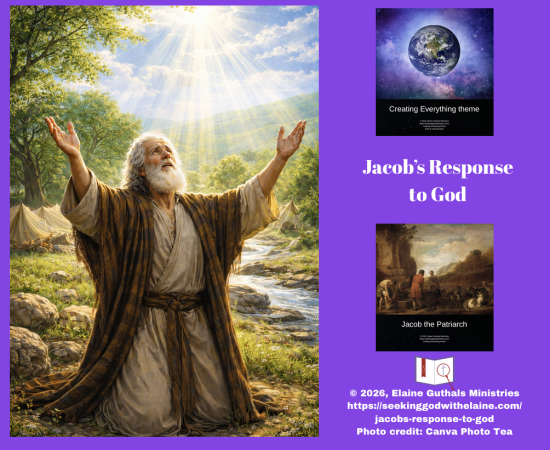
  • Preparing to Bless Esau

    Esau had sold the birthright to Jacob many years before. This devotional reading looks at setting up the blessing.

    Nuggets

    • Isaac was going to go against Jehovah’s decree and give the blessing to Esau.
    • Isaac gave Esau specific instructions.
    • Rebekah stepped up to put things back on the right track, but she went about it the wrong way.
    preparing-to-bless-esau

    Remember, I think Genesis 26 should have gone before Genesis 25. The last part, though, was current and in the right place.

    If we look at the end of Genesis 26, we said that — for what was being discussed in Genesis 26: 34-35 — Esau was then  40, making Isaac 100.

    We are only told in Genesis 27 that Isaac was facing some challenges. But if we look at the timeline we have been using, it tells us how much time has transpired.

    1860 BC — Isaac was born (Gen. 21: 2)
    1800 BC – Jacob and Esau were born (Gen. 25: 24-26)
    1785 BC — Abraham died at the age of 175 (Gen. 25: 7 – 8)
    1785 BC – Esau sold the birth right to Jacob in exchange for lentil stew Jacob was cooking while mourning for Abraham
    1760 BC — Esau at age 40 married Canaanite women (Gen. 26: 34-35), making Isaac 100.
    1723 BC – Jacob cheated Esau out of the birthright blessing given by Isaac. He flees Canaan to Paran-Aman to Rebekah’s family. He agrees to work seven years to earn the right to marry Rachel (Gen. 29: 1-20)
    1680 BC – Isaac died at the age of 180 (Gen. 35: 28-29)

    Resource

    Isaac was 137, and Esau and Jacob were 77.

    Let’s Put It into Context

    To read devotions in the Creating Everything theme, click the button below.

    Devotions in the Isaac the Patriarch series

    Isaac Planned to Give the Blessing to Esau

    “One day when Isaac was old and turning blind, he called for Esau, his older son, and said, ‘My son.’ ‘Yes, Father?’ Esau replied. ‘I am an old man now,’ Isaac said, ‘and I don’t know when I may die. Take your bow and a quiver full of arrows, and go out into the open country to hunt some wild game for me. Prepare my favorite dish, and bring it here for me to eat. Then I will pronounce the blessing that belongs to you, my firstborn son, before I die’” (Gen. 27: 1-4 NLT)

    Isaac was going to go against Jehovah’s decree and give the blessing to Esau.

    Isaac Called for Esau

    Wait! What????

    I thought this had been settled. I thought oldest was going to serve the youngest.

    “And the Lord told her, ‘The sons in your womb will become two nations. From the very beginning, the two nations will be rivals. One nation will be stronger than the other; and your older son will serve your younger son’” (Gen. 25: 23 NLT emphasis added).

    True, God told that to Rebekah. But she and Isaac had a great love story going on. He loved her deeply. “And Isaac brought Rebekah into his mother Sarah’s tent, and she became his wife. He loved her deeply, and she was a special comfort to him after the death of his mother (Gen. 24: 62-67 NLT emphasis added).

    They would have talked.

    Yes, we think this would have gone against the customs of the land. Firstborn rights were par for the course.

    But that isn’t necessarily true. Most importantly, if God said differently, why didn’t Isaac obey?

    Rebekah would have told Esau and Jacob that the older would serve the younger. She would not let Esau get 77 years old and drop this bombshell on him.

    Was it only because Esau was Isaac’s favorite? Our opinions don’t matter to God.

    That includes Isaac and Rebekah. They were not consulted before the decision was made.

    Everyone had 62 years to get used to the idea that Esau sold away his birthright. He was no longer considered firstborn.

    God chooses the one who will be most obedient to Him. That means, Jacob would be the more righteous man.

    That is what is important to God — the condition of our soul. He is more concerned about our spiritual condition.

    Isaac had to have known. Esau had already had two wives who were local women.

    Remember what Moses wrote when he announced to us Esau’s marriages? “But Esau’s wives made life miserable for Isaac and Rebekah” (Gen. 26: 35 NLT).

    But here went Isaac, making the decision for himself. “Then I will pronounce the blessing that belongs to you, my firstborn son, before I die” (Gen. 27: 4 NLT emphasis added).

    Could Isaac just not stand his favorite not getting what most firstborn would get? Was he thinking Jehovah made the wrong decision? Was he thinking He had to follow His own laws?

    “Dedicate to me every firstborn among the Israelites. The first offspring to be born, of both humans and animals, belongs to me” (Ex. 13: 2 NLT).

    Bradford identified what Isaac was doing as tempting Jehovah. He quoted Edersheim when he said, “We do so tempt the Lord when, listening to our own inclinations, we put once more to question that which He has already clearly settled. Where God has decided, NEVER let us doubt, nor lag behind.”

    Resource

    We can’t bite on Isaac too much because we do the same thing. We ignore Jehovah’s decision. We argue that He made the wrong decision. We scream, shout, and tap our foot demanding that He let us have our way — with let not the right word choice.

    How many times have we went our own way — even in worship — and figure Jehovah would bless us anyway?

    We forget Jehovah is Sovereign God. He is our Creator and our Judge, Jury, and Executioner.

    But let’s put this into context – 1700 BC Ancient Near East context.

    • Birthright dealt with a double portion of the inheritance and clan leadership, not birth order.
    • Blessings were a verbal act of conveying legitimacy, destiny, and status. It has been described as The Last Will and Testament.
    • As they were not connected, the two did not have to go to the same son.
    • There was no formal ceremony to formally announce the recipient.
    • Evidence from that time shows the firstborn does not always get both or either.

    We have to remember the main purpose of this practice was ensuing the family line remained stable and intact. (That was one reason we gave as to why Abraham married within his family.)

    If the father was not convinced that the firstborn could provide the stability the line needed, a different son could be – and usually was – chosen. Infertility could play a part as well as adoption.

    Bradford cautioned that the term double portion sounds like a strict, precise measurement. He wrote, “More often, these portions were approximates; a double portion could have been anything from a little bit more than the others, to practically everything of value.”

    Resource

    So, the blessing was distributing the wealth.

    Prepare My Favorite Dish

    Isaac gave Esau specific instructions.

    • Go hunting with your bow
    • Take lots of arrows
    • Go hunting in the open country
    • Snag some wild game
    • Make it like I like it
    • Bring it to me

    We know that meals were a big part of covenants. The blessing was a part of the covenant, so it is logical eating would be a part.

    Rebekah Foiled Isaac’s Plan

    “But Rebekah overheard what Isaac had said to his son Esau. So when Esau left to hunt for the wild game, she said to her son Jacob, ‘Listen. I overheard your father say to Esau, “Bring me some wild game and prepare me a delicious meal. Then I will bless you in the LORD’s presence before I die.” Now, my son, listen to me. Do exactly as I tell you. Go out to the flocks, and bring me two fine young goats. I’ll use them to prepare your father’s favorite dish. Then take the food to your father so he can eat it and bless you before he dies.’ ‘But look,’ Jacob replied to Rebekah, ‘my brother, Esau, is a hairy man, and my skin is smooth. What if my father touches me? He’ll see that I’m trying to trick him, and then he’ll curse me instead of blessing me.’ But his mother replied, ‘Then let the curse fall on me, my son! Just do what I tell you. Go out and get the goats for me!’ So Jacob went out and got the young goats for his mother. Rebekah took them and prepared a delicious meal, just the way Isaac liked it. Then she took Esau’s favorite clothes, which were there in the house, and gave them to her younger son, Jacob. She covered his arms and the smooth part of his neck with the skin of the young goats. Then she gave Jacob the delicious meal, including freshly baked bread” (Gen. 27: 5-17 NLT)

    Rebekah stepped up to put things back on the right track, but she went about it the wrong way.

    Yes, Rebekah was trying to get back to a the-older-will-serve-the-younger blessing. Did she think God needed help?

    Ooo, baby! God does not need our help. He will work His plan His way.

    No, I have no clue how that would have looked in this situation. No animals to shoot in the open country? Esau trip and break a bone?? Somebody show up right before he was to leave that stopped him from going????

    Who knows. Sovereign God could have used any number of things — even a change of heart on Isaac’s part.

    We do know that Jehovah allowed this to happen this way.

    Rebekah’s intervention were for the right reasons – and she clearly thought she was in the right. Her husband, the ruler of the house, was refusing what Jehovah had already ordained.

    Look at Cooper’s proposed other reason. He wrote, “She knew that he [Jacob] was fittest for receiving it. She knew that he highly valued it, not merely for the sake of any worldly benefit annexed to it, but on account of the spiritual promises contained in it. Esau, on the contrary, had repeatedly shown the greatest contempt for the blessing and its promises.”

    Resource

    The deception was sinful. She not only didn’t trust God to keep His promises, but she also lied to get her plan accomplished.

    The ends do not justify the means. Covenant work should not be completed by actions that break Sovereign God’s laws and commandments.

    Just because it ended up with what was supposed to happen happening, it doesn’t mean that there were no consequences. We’ll talk about that later.

    Jacob did question Rebekah about her plan. Well, about how to pull it off. Not once does he say – that was recorded – “This plan is wrong. It is deceitful.”

    Maybe Jacob thought it was okay since Rebekah was willing to take the blame. “But his mother replied, ‘Then let the curse fall on me, my son! Just do what I tell you …” (Gen. 27: 13 NLT).

    Yes, God wants us to take responsibility for our actions. That doesn’t mean Jacob didn’t feel any consequences.

    Why was the food important? Every covenant was ratified through a meal.

    Making the Connections #1

    Why was Isaac so set that the firstborn would get the blessing? Even if he was resigned to Jacob getting the firstborn advantages, he may not have wanted the same thing that happened to him and Ishmael happen to Esau and Jacob.

    Making the Connections #2

    Pearse made a great observation. Remember, we talked about Isaac being a quiet man.

    So, here comes this famine that throws Isaac out of his element. How did he step up? Fearfully with a flat-out lie thrown in.

    Pearse addressed this. He wrote, “They who are weakest need most of all the help of God and have most room for it. They who have no other gifts must make the most of this.”

    Resource

    It appears that Isaac went back to his quiet life. Babies were born; babies grew up. He had finally gotten to where there was room for him to live.

    Not only that, but Isaac got a promise from Sovereign God that he would be blessed.

    And Isaac returns this with ignoring Jehovah’s proclamation. There are times we just want to shake our heads and ask, “What was that man thinking?”

    Making the Connections #3

    One of the hardest things to do on our walk with Jehovah is to wait for Him to work things out and keep His promises. It isn’t just the we-want-things-when-we-want-them attitude.

    It is seeing things only through our limited perspective and not through the God-of-the-impossible perspective. We don’t have to help Him do what we can’t do ourselves.

    It is our thinking that we have to help. Have you ever had a spouse or child that wanted to badly to help you, and you just wanted to scream, “I can do it myself!”

    It doesn’t work in this case.

    Making the Connections #4

    Remember, until Moses came along and got the laws on Mount Sinai, birthright meant that the firstborn was the priest of the family. Do we see Esau in that role? NO!

    Making the Connections #5

    Cooper had another great nugget and a questionable second nugget. He argued,

    “In all cases the Law of God is to be our rule. In no case can we claim the privilege of setting it aside. Rebekah’s sin, however she might excuse it to herself, was sufficient to have ruined her soul; and unquestionably, unless through God’s grace she had afterwards repented and obtained forgiveness, it would have ruined her soul. Such is the case with every sin.”

    Resource

    I agree with the first two sentences. I don’t know about the last two.

    We can’t ignore or even rewrite God’s laws. We are going to break them because we are still sinful people.

    At what point do we lose our salvation? That is above my pay grade.

    There is only one unpardonable sin. That has to do with rejecting salvation.

    Does one unrepented sin strip us of our salvation? Did Rebekah’s choice mean she turned her back on Jehovah?

    I don’t think so.

    I agree that all sin stems from our disobedience to God and His laws. Still, I think the judgment varies – my own opinion – decide what you believe.

    How Do We Apply This?

    • Always listen to Jehovah to ensure our actions follow His Will.
    • Repent of any sin that we have committed.

    Resource

    Father God. Lord, we can be so self-involved at times. We want what we want, even if it is the direct opposite of what You want. Other times, we want what You want — but we go about it in a way You don’t want. Forgive us. Help us to always do Your Will. Amen.

    If you don’t understand something and would like further clarification, please contact me.

    If you have not signed up for the email providing the link to the devotions and the newsletter, do so below.

    If God has used this devotion to speak with you, consider sharing it on social media.
  • Isaac and Abimelech

    Like Abraham’s Abimelech, Isaac’s Abimelech came to enter into a treaty with Isaac. This devotional reading looks at their relationship after Isaac’s lie was exposed.

    Nuggets

    • Isaac obeyed Jehovah.
    • Isaac – like Abraham – was fearful for his life because of his beautiful wife.
    • Isaac’s love for Rebekah was evident.
    • There might have been a famine in the land of Canaan, but Isaac was successful in Gerar.
    • Isaac did what was good resource management by reopening the closed wells that Abraham dug and digging new ones.
    • It is significant that Jehovah appeared to Isaac on the night he arrived in Beersheba.
    • Abimelech decided, if he couldn’t defeat Isaac, he had better make friends with him.
    • Esau’s decision to take Canaanite women went against Jehovah’s commands.
    isaac-and-abimelech

    This part of the chapter will particularly show why this chapter is out of place. It smacks of déjà vu.

    Let’s Put It into Context

    To read devotions in the Creating Everything theme, click the button below.

    Devotions in the Isaac the Patriarch series

    Isaac and Abimelech

    “So Isaac stayed in Gerar. When the men who lived there asked Isaac about his wife, Rebekah, he said, ‘She is my sister.’ He was afraid to say, ‘She is my wife.’ He thought, ‘They will kill me to get her, because she is so beautiful.’ But some time later, Abimelech, king of the Philistines, looked out his window and saw Isaac caressing Rebekah. Immediately, Abimelech called for Isaac and exclaimed, ‘She is obviously your wife! Why did you say, “She is my sister”?’ ‘Because I was afraid someone would kill me to get her from me,’ Isaac replied. ‘How could you do this to us?’ Abimelech exclaimed. ‘One of my people might easily have taken your wife and slept with her, and you would have made us guilty of great sin.’ Then Abimelech issued a public proclamation: ‘Anyone who touches this man or his wife will be put to death!’” (Gen. 25: 6-11 NLT)

    Isaac Stayed in Gerar

    Isaac obeyed Jehovah.

    Jehovah told Isaac to stay put in Gerar instead of going to Egypt (Gen. 26: 2). He not only listened, but he also obeyed.

    We don’t know how long he stayed. But he did.

    Asked Isaac about his Wife

    Isaac – like Abraham – was fearful for his life because of his beautiful wife.

    Some would say that the circumstances conveyed fear. Famine. Strangers. Different customs. Lack of trust.

    Did Isaac take a page from Abraham’s playbook? He must have. He handled it the same way.

    Go to another country. Lie about your relationship with your wife so you don’t get killed.

    The thing is, Sarah was Abraham’s sister. Rebekah was Isaac’s cousin, granddaughter of Abraham’s brother Nahor.

    Leale noted that Isaac would have suffered greater guilt than Abraham. I can see that. His lie was a flat-out lie, not a deception.

    Resource

    Why do I say this chapter is out of order? If Isaac and Rebekah would have had kids already, they wouldn’t have been able to pull this off. I think this is true if the kids were toddlers, but equally true if they were teenagers.

    Abimelech Saw Isaac Caressing Rebekah

    Isaac’s love for Rebekah was evident.

    We don’t know how much time some time was. It could have been a week. It could have been an undisclosed number of months.

    Unlike Sarah, Rebekah was not taken to become a member of Abimelech’s haram. That allowed Isaac and Rebekah to remain together.

    More than that, they were doing what husbands and wives do. Isaac caressed Rebekah. They may have thought they were alone.

    They weren’t.

    Yep, Abimelech was angry. It hurts when someone lies to you.

    But, as with Abraham, when the truth was told, Isaac’s Abimelech ordered their men not to touch the women in Abraham’s family.

    Isaac’s Abimelech must have heard about what had happened to Abraham’s Abimelech. “… thou shouldest have brought asham (guilt) upon us” (Gen 26: 10 OJB).

    Jehovah stepped in and spoke to Abraham’s Abimelech.

    • “Now return the woman to her husband, and he will pray for you, for he is a prophet. Then you will live. But if you don’t return her to him, you can be sure that you and all your people will die” (Gen. 20: 7 NLT).
    • “Then Abraham prayed to God, and God healed Abimelech, his wife, and his female servants, so they could have children. For the Lord had caused all the women to be infertile because of what happened with Abraham’s wife, Sarah” (Gen. 20 17-18 NLT).

    God Blessed Isaac

    “And Isaac sowed in that land and reaped in the same year a hundredfold. The Lord blessed him, and the man became rich, and gained more and more until he became very wealthy. He had possessions of flocks and herds and many servants, so that the Philistines envied him. (Now the Philistines had stopped and filled with earth all the wells that his father’s servants had dug in the days of Abraham his father.) And Abimelech said to Isaac, ‘Go away from us, for you are much mightier than we’” (Gen. 26: 12-16 NLT)

    There might have been a famine in the land of Canaan, but Isaac was successful in Gerar.

    We may think that shepherds did not plant crops. Bradford noted that those who had flocks and herds in Isaac’s day would plant what we would call a garden to provide grain and herbs.

    Resource

    No, the nomads were not fixing to settle down. But they didn’t want them or their animals to starve.
    God blessed him with a bountiful harvest. He also gained flocks and herds. That meant he needed people to watch over the animals, so he gained servants.

    In fact, God blessed Isaac so much, the Philistines started envying him. If truth be told, they were probably fearing him as well. They more than likely saw Isaac as a threat.

    Abimelech took the easy way out. He just told Isaac to go away. He was only a visitor, wasn’t he?

    Could Isaac have refused? Probably. He probably had the strength to counter any attack that Abimelech made.

    Beginning Well Problems

    “So Isaac moved away to the Gerar Valley, where he set up their tents and settled down. He reopened the wells his father had dug, which the Philistines had filled in after Abraham’s death. Isaac also restored the names Abraham had given them. Isaac’s servants also dug in the Gerar Valley and discovered a well of fresh water. But then the shepherds from Gerar came and claimed the spring. ‘This is our water,’ they said, and they argued over it with Isaac’s herdsmen. So Isaac named the well Esek (which means ‘argument’). Isaac’s men then dug another well, but again there was a dispute over it. So Isaac named it Sitnah (which means ‘hostility’). Abandoning that one, Isaac moved on and dug another well. This time there was no dispute over it, so Isaac named the place Rehoboth (which means ‘open space’), for he said, ‘At last the Lord has created enough space for us to prosper in this land’” (Gen. 26: 17-22 NLT)

    Isaac did what was good resource management by reopening the closed wells that Abraham dug and digging new ones.

    The problem was the Philistines were still envious. Plus, isn’t it so much like today’s society: “I want something, but I don’t want to do it myself. So, I’ll wait for you to do it and take yours.”

    Their envy of Isaac probably started with their envy of Abraham. That played out in the Philistines responses to Abraham digging wells – they filled them in.

    “Then Abraham complained to Abimelech about a well that Abimelech’s servants had taken by force from Abraham’s servants” (Gen. 21: 25 NLT). Once they got possession of the wells, they closed them.

    Isaac did what was good resource management. He reopened the closed wells that Abraham dug and dug new ones.

    The problem was the Philistines were still envious. Plus, isn’t it so much like today’s society: “I want something, but I don’t want to do it myself. So, I’ll wait for you to do it and take yours.”

    God’s Word says that four wells were dug. Clark believed that Isaac moved from well to well until he reached Beersheba and enough room.

    Resource

    I always laugh at the meaning of the last name. Did Isaac name it open space with a touch of humor, or through total exasperation and relief?

    Either way, Isaac saw that his prosperity and peaceful existence came from Sovereign God.

    Another Visit from God

    “From there Isaac moved to Beersheba, where the Lord appeared to him on the night of his arrival. ‘I am the God of your father, Abraham,’ he said. ‘Do not be afraid, for I am with you and will bless you. I will multiply your descendants, and they will become a great nation. I will do this because of my promise to Abraham, my servant.’ Then Isaac built an altar there and worshiped the Lord. He set up his camp at that place, and his servants dug another well” (Gen. 26: 23-25 NLT)

    It is significant that Jehovah appeared to Isaac on the night he arrived in Beersheba.

    Remember, Isaac had left the land of Canaan because of a famine.

    Isaac’s arrival at Beersheba meant he was back on Promised Land. In fact, the city is mentioned several times in Scriptures when the writer is taking about the land that encompasses the Promised Land.

    • “Then all the Israelites were united as one man, from Dan in the north to Beersheba in the south, including those from across the Jordan in the land of Gilead. The entire community assembled in the presence of the Lord at Mizpah” (Jdg. 20: 1 NLT).
    • “And all Israel, from Dan in the north to Beersheba in the south, knew that Samuel was confirmed as a prophet of the Lord” (I Sam. 3: 20 NLT).

    It was also a previous home to Abraham. “Then they returned to the servants and traveled back to Beersheba, where Abraham continued to live” (Gen. 22: 19 NLT).

    There was no city at this time. There was just the well by which Abraham and Abimelech made their covenant. “Then he named the place Beersheba (which means ‘well of the oath’), because that was where they had sworn the oath” (Gen. 21: 31 NLT).

    The night Isaac “got home,” Sovereign God was right there. To celebrate, Isaac built an altar.

    Isaac’s Covenant with Abimelech

    “One day King Abimelech came from Gerar with his adviser, Ahuzzath, and also Phicol, his army commander. ‘Why have you come here?’ Isaac asked. ‘You obviously hate me, since you kicked me off your land.’ They replied, ‘We can plainly see that the Lord is with you. So we want to enter into a sworn treaty with you. Let’s make a covenant. Swear that you will not harm us, just as we have never troubled you. We have always treated you well, and we sent you away from us in peace. And now look how the Lord has blessed you!’ So Isaac prepared a covenant feast to celebrate the treaty, and they ate and drank together. Early the next morning, they each took a solemn oath not to interfere with each other. Then Isaac sent them home again, and they left him in peace. That very day Isaac’s servants came and told him about a new well they had dug. ‘We’ve found water!’ they exclaimed. So Isaac named the well Shibah (which means ‘oath’). And to this day the town that grew up there is called Beersheba (which means ‘well of the oath’)” (Gen. 26: 26-33 NLT)

    Abimelech decided, if he couldn’t defeat Isaac, he had better make friends with him.

    My first thought whenever I read this is, “Did Abimelech just show up on Isaac’s doorstep and want to make nice now?” It didn’t trouble him taking over wells that he hadn’t had dug????

    Isaac also seems to have questioned Abimelech’s intentions. He got his dig in before Abimelech said anything.

    Isaac’s Abimelech showed up with two people. Abraham’s Abimelech (Gen. 21: 22) showed up with one. He showed up with Phicol, so that must be a title, also, instead of a name.

    Abimelech’s response in interesting. “They replied, “We can plainly see that the Lord is with you …” (Gen. 26: 28 NLT).

    Again, I go back to Isaac’s Abimelech knowing about Abraham’s Abimelech’s conversation with Jehovah. He would have known the might of Jehovah.

    Abimelech was interested in a peace treaty. “Swear that you will not harm us …” (Gen. 26: 29 NLT). This would be a binding covenant, confirmed by an oath.

    This treaty is similar to the one Abraham and his Abimelech entered into. We might be able to say that this was a reactivation or an extension of the existing covenant.

    Why did Isaac need this peace treaty? Bradford told us that by guaranteeing the peace, Isaac was given the space to grow and prosper.

    Esau Takes Two Wives

    “At the age of forty, Esau married two Hittite wives: Judith, the daughter of Beeri, and Basemath, the daughter of Elon. But Esau’s wives made life miserable for Isaac and Rebekah” (Gen. 26: 34-35 NLT)

    Esau’s decision to take Canaanite women went against Jehovah’s commands.

    Okay, let’s do some figuring. Isaac was 40 when he got married and 60 when he became a father. The kids are now 40, so Isaac is 100.

    Abraham was 100 when Isaac was born, so he would have been 200 when Esau got married. But he died at the age of 175.

    Esau was without Abraham’s influence for 25 years. Would the outcome have been any different if Abraham was still alive?

    Do we think Esau should marry anyone he wants? Parker disagreed. He wrote, “Esau went against the law of his country and his people in marrying Canaanitish women.”

    Resource

    So, what was Esau’s punishment for breaking that law? He lost his right as firstborn.

    Was this how Jehovah planned to give Jacob birthright privileges? He should have waited 25 years.

    The sad part was “But Esau’s wives made life miserable for Isaac and Rebekah” (Gen. 26: 35 NLT)

    Making the Connections #1

    In a previous devotion, we talked about how Jehovah works through patterns. This is an example. We can see that through the several similarities in the stories.

    Making the Connections #2

    Yes, Isaac was tempted when he showed up at Gerar. But don’t forget – Jehovah sent him there.

    Fuller addressed that. He wrote, “Even the calls of necessity and duty may, if we be not on our watch, prove ensnaring; and if so, what must these situations be in which we have no call to be found?

    Resource

    Why would Jehovah send us places where He knows we will be tempted? Because He knows Romans 8: 28. “And we know that God causes everything to work together for the good of those who love God and are called according to his purpose for them” (Rom 8: 28 NLT).

    Sovereign God knows we learn best through the trials rather than the mountaintop experiences.

    Making the Connections #3

    Remember, names were important to Hebrews. Isaac’s meant laughter. That would mean he would be filled with joy and laughter.

    In spite of the lie, it seems like Isaac handled the Philistines correctly. Hughes said that he showed patience and – like Abraham – did not like confrontations.

    Resource

    Not bad.

    Making the Connections #4

    Think about it. Isaac lied.

    • “You must not testify falsely against your neighbor” (Ex. 20: 16 NLT).
    • “Do not steal. Do not deceive or cheat one another” (Lev. 19: 11 NLT).
    • “The Lord detests lying lips, but he delights in those who tell the truth” (Prov. 12: 22 NLT).
    • “I will not allow deceivers to serve in my house, and liars will not stay in my presence” (Ps. 101: 7 NLT).

    But still Jehovah came to Isaac personally. He used him for covenant purposes.

    Making the Connections #5

    I like how Clark described Isaac. He wrote,

    “I have said that he had a good father behind him, a brave heart within him, a good will to men about him; but he put the crown upon his success by owning and seeking THE FAVOUR OF GOD ABOVE HIM.”

    Resource

    It is easy to focus on how Isaac has a dysfunctional family. It is nice to be reminded there was good as well as the bad.

    How Do We Apply This?

    • Recognize that prosperity as well as poverty can be a testing.
    • Choose peace.

    Resource

    Father God. We know You are Truth. Help us to not fall into the temptation of telling lies. May we stay wholly focused on You. Amen.

    If you don’t understand something and would like further clarification, please contact me.

    If you have not signed up for the email providing the link to the devotions and the newsletter, do so below.

    If God has used this devotion to speak with you, consider sharing it on social media.

    Making the Connections

    Post

    To read a related devotion, click the button below.

    Resource

    Glossary

    How Do We Apply This?

    Post

    To read a related devotion, click the button below.

    Resource

    Glossary

    The ABCDs of Salvation

    If you have not become a believer in Christ, please read through the
    Plan of Salvation and prayerfully consider what God is asking you to do.

    A – admit our sins
    B – believe His Son Jesus is our Redeemer
    C – confess God as Sovereign Lord

    D – demonstrate that commitment by making any changes needed in our lives to live the way in which God has called us

    The Disciple’s Job Description

    Heading

    Heading

    Searching for and Seeking God

    Non-believers search for God.
    Disciples seek Him.

    Hearing His Word (Rom. 10: 17)
    Reading His Word (Rev. 1: 3)
    Praying to Him (Heb. 4: 16)
    Studying His Word (Ac. 17: 11)
    Meditating on His Word (Ps. 1: 1-2)
    Memorizing His Word (Ps. 119: 11)

    It Was Enough
    Vocalist: Elaine Guthals
    Keyboard: Chris Vieth

    Person of Interest

    Fun Fact

    Verse Commentary

    Related Links

    Artist

    Related Links

    I have created a worksheet of the questions above. Click on the button below to access it.

    Don’t know what your spiritual gifts are?

    Take this Spiritual Gifts Inventory

    The Disciple’s Job Description

    Complete Job Description

    Individual Description

    The Disciple’s Job Description

    Complete Job Description

    Individual Description

    Job Duty #4
    Proclaim the Gospel (Mark 16: 15)

    Job Duty #6
    Make Disciples (Matthew 28: 19-20)

    If you don’t understand something and would like further clarification, please contact me.

    If you have not signed up for the email providing the link to the devotions and the newsletter, do so below.

    If God has used this devotion to speak with you, consider sharing it on social media.

  • Isaac Moved to Gerar

    We finally have a chapter that focuses solely on Isaac. This devotional reading looks at his move to Gerar when a famine occurred.

    Nuggets

    • A severe famine in Canaan necessitated that Isaac leave to find food.
    • Abraham had lived Gerar before, but Isaac hadn’t.
    • No, this is not the same Abimelech from Abraham’s time.
    • Jehovah stopped Isaac from going to Egypt.
    • Since it was the first – and only – direct communication that we know about, God reconfirmed the covenant promises He made to Abraham.
    • Jehovah reiterated that all nations will be blessed through Isaac’s descendants.
    isaac-moved-to-gerar

    This chapter is out of place. There is no way that Isaac is going to pass off Rebekah as his sister if they have two kids — especially if they are at least 15.

    Not happening.

    But we can still learn from it even if time jumped.

    Let’s Put It into Context

    To read devotions in the Creating Everything theme, click the button below.

    Devotions in the Isaac the Patriarch series

    Another Famine

    “A severe famine now struck the land, as had happened before in Abraham’s time. So Isaac moved to Gerar, where Abimelech, king of the Philistines, lived” (Gen. 26: 1 NLT)

    A severe famine in Canaan necessitated that Isaac leave to find food.

    What? Have we gotten stuck in a time loop? Haven’t we heard this story before.

    Well, yes, we have; but no, we haven’t.

    Back in Genesis 20, Abraham moved to Gerar. We aren’t told why he moved. Being a nomad, he probably moved to find better pastureland.

    Back in Genesis 12, Abraham moved to Egypt. That one was because of a famine.

    Neither move turned out well — and for the same reason Isaac’s didn’t.

    Famine

    Let’s focus on the famine a second. Dykes had a great description of the land. He wrote, “Another characteristic which qualified Palestine to be a training ground for the Hebrews was this: that it combined to an unusual degree high agricultural fertility with exposure to sudden and severe disasters.”

    Resource

    That sounds like the possibility of a famine is very real.

    Gerar

    Abraham had lived Gerar before, but Isaac hadn’t.

    Well, maybe. Maybe not. We figured when Abraham’s fiasco happened with his Abimelech that Sarah was just about to or just had become pregnant.

    We are only told of Isaac living two places before this. He was born in Hebron. When he became an adult, he moved to Beer-lahai-roi.

    Abimelech

    No, this is not the same Abimelech from Abraham’s time.

     Same title, different person. Remember, Abimelech wasn’t only a name. It was also a title that meant my father is king. So, we take it that this Abimelech’s father the king died making him, the prince, king.

    God’s Promise to Isaac

    “The Lord appeared to Isaac and said, ‘Do not go down to Egypt, but do as I tell you. Live here as a foreigner in this land, and I will be with you and bless you. I hereby confirm that I will give all these lands to you and your descendants, just as I solemnly promised Abraham, your father. I will cause your descendants to become as numerous as the stars of the sky, and I will give them all these lands. And through your descendants all the nations of the earth will be blessed. I will do this because Abraham listened to me and obeyed all my requirements, commands, decrees, and instructions’” (Gen. 26: 2-5 NLT)

    Jehovah stopped Isaac from going to Egypt.

    It sounds like Isaac was headed to Egypt. I can see two reasons for doing that. He would have been following in Abraham’s footsteps. He may have been trying to get as far away from the famine as he could, and he knew it was a bad one. It was “… as had happened before in Abraham’s time …” (Gen. 26: 1 NLT).

    Bradford said that the route Isaac took would have been a well-established trade route connecting Canaan to Egypt. This would have taken them through Philistine land.

    Resource

    Going to Gerar would have been logical – especially if that was where a major trade route could be caught. Since it was where the king lived, it would be a safe bet that the cities had food stored there, as most of the taxes were probably paid in grain or produce.

    The Lord Appeared

    The Hebrew word used, va-yerah, is the verb translated appeared. This means it is not simply physical vision alone but an encounter with God. They interacted together.

    Resource

    Yeah, don’t we wish we had a relationship with Jehovan like that?

    God directed Isaac. This is the first — and only — time we read of God communicating directly with Isaac.

    • Isaac prayed to Jehovah for a child, and He answered his prayer – we just aren’t told this was done verbally (Gen. 25: 21).
    • When Jehovah identified two sons in Rebekah’s womb, He was talking to her, not Isaac (Gen. 25: 23).

    Jehovah instructed Isaac to live as a foreigner in the land. I take that to read, “Don’t get comfortable — this is temporary.”

    Think about that. Isaac is probably seeing the situation deteriorating in Beer-lahai-roi. If he was planning on keeping going south, it would be logical to think the famine wasn’t getting better.

    And here is Jehovah saying, “Stop forward movement. Plant yourself here.”

    Bradford was right. This was Isaac’s time of testing.

    Is Isaac going to follow Jehovah’s direction, or is he going to make the decision on his own?

    But look at the map again. It wasn’t that far away.

    Rebekah, maybe some of the livestock wranglers, and household servants were thinking Isaac had a screw loose for stopping so early.

    Isaac passed the test.

    But let’s chase a rabbit for a second. We aren’t told how old Isaac was when the trip occurred. We said it was probably pre-twins.

    If it were pre-twins, that means Abraham was still alive. If Jacob was cooking because mourning practices said Rebekah couldn’t, this was at a minimum 15 years before Abraham’s death.

    We aren’t told that Abraham moved with Isaac.

    The Covenant Renewed

    Since it was the first – and only – direct communication that we know about, God reconfirmed the covenant promises He made to Abraham.

    If the was the very first time Jehovah talked to Isaac, he may have been wondering about his role in the covenant. We know Jehovah can speak to more than one person at a time, but I doubt the covenant would have officially transferred yet.

    Even if Jehovah would have conversed with Isaac prior to this, that doesn’t mean he didn’t question Jehovah’s continued presence. We said that was what Abraham’s problem was at the beginning of Genesis 15.

    We sure do that. How many times have we asked, “Hey, God. Where are you?”

    Let’s head at this from a covenant perspective. Land had long been a part of the covenant.

    But we aren’t told that Isaac had any more land than Abraham did. We know Abraham would have had the burial cave because Rebekah arrived on the scene after Sarah’s death.

    What better time for Jehovah to appear than when Isaac was fixing to leave the Promised Land? And He stopped him from leaving it.

    Nations of the Earth Will be Blessed

    Jehovah reiterated that all nations will be blessed through Isaac’s descendants.

    Something Bradford said got me digging. He said the Hebrew actually says will bless themselves.

    Resource

    Wait! What?!?!?!

    There is no way that we can save ourselves – which is what blessed means. So, what is this talking about?

    This is like the word trust. We’ve talked before that where our versions use the word faith, the Hebrew versions use the word trust. That means belief alone isn’t what is being discussed. It is the belief that triggers an action – obedience.

    This is something similar. It does say all nations will bless themselves. What that means is that the through you makes them the standard.

    • “And through your descendants all the nations of the earth will be blessed—all because you have obeyed me” (Gen. 22: 18 NLT emphasis added).
    • “I will cause your descendants to become as numerous as the stars of the sky, and I will give them all these lands. And through your descendants all the nations of the earth will be blessed.” (Gen. 26: 4 NLT emphasis added).
    • “Your descendants will be as numerous as the dust of the earth! They will spread out in all directions — to the west and the east, to the north and the south. And all the families of the earth will be blessed through you and your descendants” (Gen. 28: 14 NLT emphasis added).

    Look what Paul said about this. We talked about how the Jews thought salvation came through Abraham instead of Yeshua. Paul said, “Nope.”
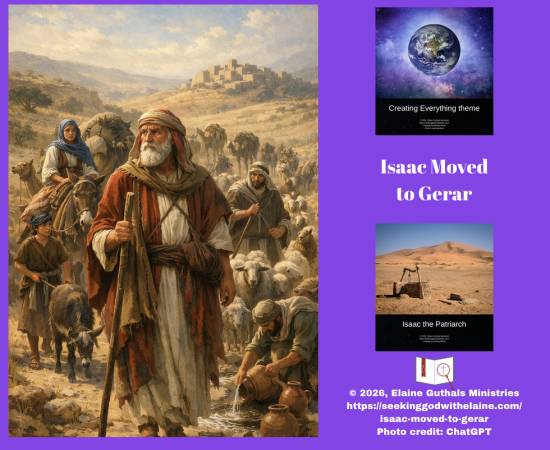
    • “The real children of Abraham, then, are those who put their faith in God” (Gal. 3: 7 NLT).
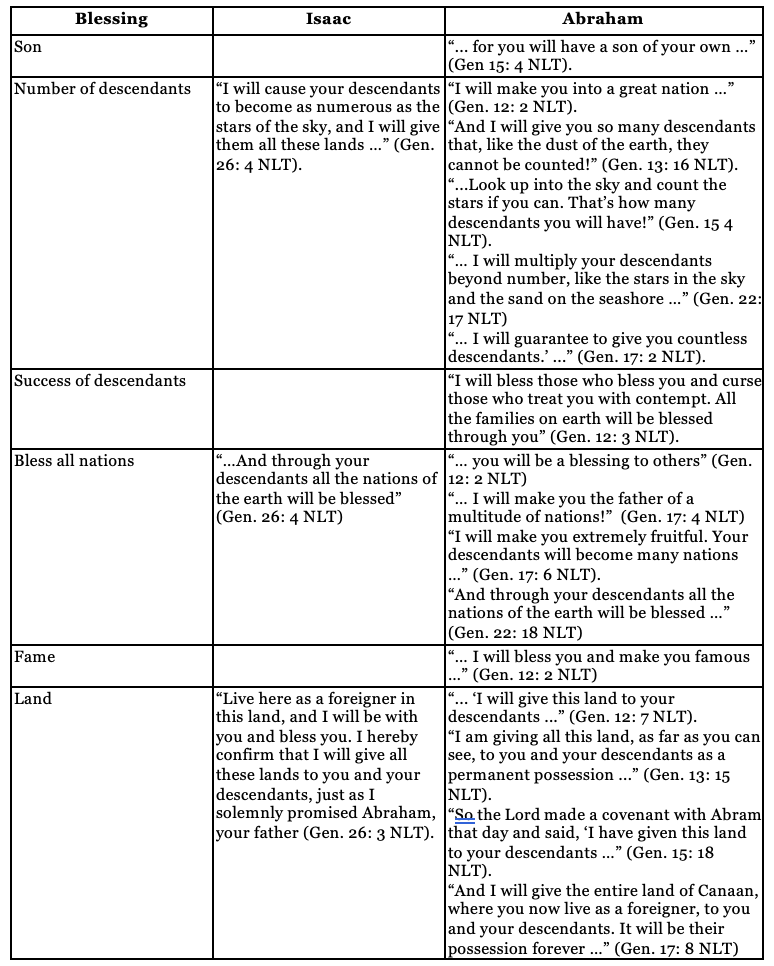
    • “So all who put their faith in Christ share the same blessing Abraham received because of his faith” (Gal. 3: 9 NLT).

    Making the Connections #1

    Abraham and Isaac have a covenant with Jehovah. Wouldn’t that mean trials like this famine wouldn’t happen?

    No, that would mean Jehovah was after a prosperity gospel.

    I have to process what Robertson said. He started by equating our lives with Canaan. Here’s what I think in Elaine-speak with Elaine-opinion mixed in.

    • We have access to the covenant promises.
    • The idea that the covenant promises creates a utopia is fabricated.
    • That begs the question as to the validity of the promises.
    • Jehovah created the expectation of happiness.
    • But happiness does not always come from utopian experiences.
    • We learn more going through trials – such as perseverance and contentment.
    • The happiness stems from what Robertson called “… the habit of soul-communion with God.”

    Resource

    Doesn’t it feel like we have famines in our lives? Don’t those trials of famines lead to blessings?

    Making the Connections #2

    Okay, the famines happened to test both men. Both started for Egypt.

    Jehovah told Isaac to stop. He let Abraham go.

    Why?

    Robertson thought this was because, though they were father and son, they had different characters and circumstances.

    Look what Robertson said – and he added Jacob into the description. He wrote,

    “It is almost certain that Abraham, being a wise man and a man of faith, was permitted by God to judge for himself, and that Isaac was required to turn back that he might learn the duty of trust; and that Jacob was commanded to go forth in order to cure his love of the world, and to teach him that life is but a pilgrimage. Hence we arrive at a doctrine: duties vary according to differences of character.”

    Resource

    Doesn’t it feel like we have famines in our lives? Don’t those trials of famines lead to blessings?

    We say that we are given differing abilities. That means we have different needs for testings.

    Making the Connections #3

    Why was Jehovah doing this? Simple.

    “I will do this because Abraham listened to me and obeyed all my requirements, commands, decrees, and instructions’” (Gen. 26: 5 NLT).

    Nope. It had nothing to do with Isaac. Instead, “Understand, therefore, that the Lord your God is indeed God. He is the faithful God who keeps his covenant for a thousand generations and lavishes his unfailing love on those who love him and obey his commands” (Deut. 7: 9 NLT emphasis added).

    How Do We Apply This?

    • Recognize that – even in times of trials – Jehovah provides comfort.
    • Recognize that duty is prescribed differently among His children.

    Resources

    Father God. Thank You that You made a way for us to be blessed through Abraham and Isaac. May we learn from their obedience to see how we are to live for You. Help us to seek the happiness only found in You. Amen.

    If you don’t understand something and would like further clarification, please contact me.

    If you have not signed up for the email providing the link to the devotions and the newsletter, do so below.

    If God has used this devotion to speak with you, consider sharing it on social media.