Author: admin

  • Esau and His Descendants

    Even though Esau wasn’t the covenant son, he was blessed by Jehovah. This devotional reading looks at how Isaac’s blessing in Genesis 27 was fulfilled.

    Nuggets

    • Our allegiance to God is influenced by the company we keep, especially who we bring in as family.
    • The country of Edom began as Seir.
    • Esau’s genealogy list turned into a clan list.
    • Moses gave us a list of people Esau displaced or assimilated into his clan.
    • Just as the Israelites later did, the Edomites also wanted a king to rule them.
    • Moses ended the chapter by giving a list of leaders.
    esau-and-his-descendants

    We’ve read about the struggles Jacob and Esau had with each other even before they were born.  We knew each were going to go on to found nations of their own.

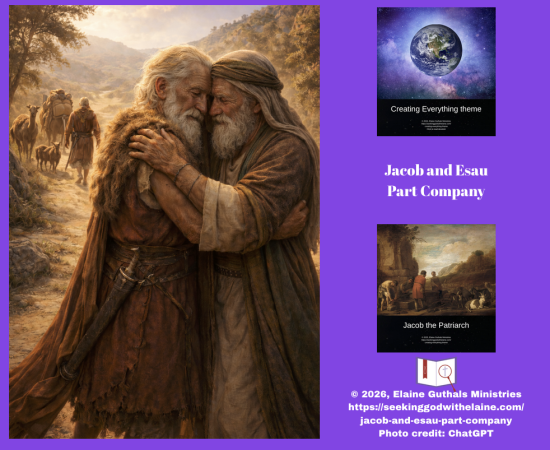
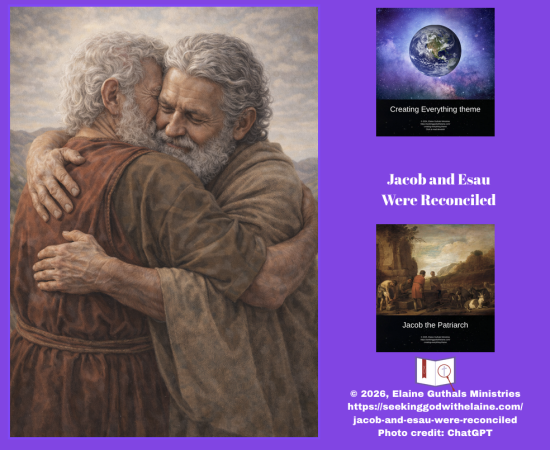
    They reconciled after Jacob came back from Paddan-aram. Both seemed ready and eager to do just that.

    But did the reconciliation stick? More importantly, did their families become reconciled?

    Let’s dig in.

    Let’s Put It into Context

    To read devotions in the Creating Everything theme, click the button below.

    Devotions in the Jacob the Patriarch series

    Esau’s Wives and Sons

    “This is the account of the descendants of Esau (also known as Edom). Esau married two young women from Canaan: Adah, the daughter of Elon the Hittite; and Oholibamah, the daughter of Anah and granddaughter of Zibeon the Hivite. He also married his cousin Basemath, who was the daughter of Ishmael and the sister of Nebaioth. Adah gave birth to a son named Eliphaz for Esau. Basemath gave birth to a son named Reuel. Oholibamah gave birth to sons named Jeush, Jalam, and Korah. All these sons were born to Esau in the land of Canaan” (Gen. 36: 1-5 NLT)

    Our allegiance to God is influenced by the company we keep, especially who we bring in as family.

    We have talked about Esau’s wives before.

    • “At the age of forty, Esau married two Hittite wives: Judith, the daughter of Beeri, and Basemath, the daughter of Elon. But Esau’s wives made life miserable for Isaac and Rebekah” (Gen. 26: 34-35 NLT).
    • “It was now very clear to Esau that his father did not like the local Canaanite women. So Esau visited his uncle Ishmael’s family and married one of Ishmael’s daughters, in addition to the wives he already had. His new wife’s name was Mahalath. She was the sister of Nebaioth and the daughter of Ishmael, Abraham’s son” (Gen. 28: 8-9 NLT).

    Isaac and Rebekah alone could not dissuade Esau from marrying a Canaanite woman. Esau was without Abraham’s influence for 25 years, so he didn’t have any recent guidance from that area.

    Since that had caused difficulties, Esau also married one of Uncle Ishmael’s daughters.

    There is a big issue of names here. The wives’ names do not match up.
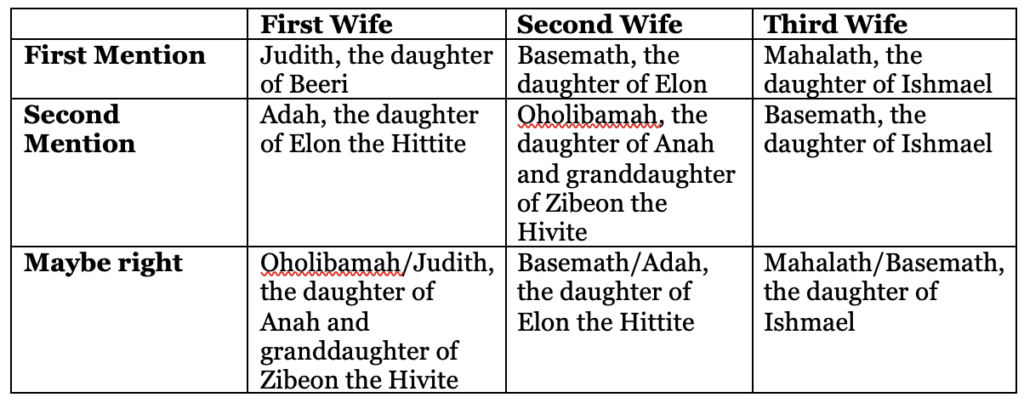
    What gives? More than likely, when the women were first identified, their common name was given. Probably in Genesis 36 — being official lineage names — others are given.

    Another reason for the switch is maybe the women were renamed. This would have following in line with Sairi getting renamed Sarah.

    Could Esau have married within the covenant line? Well, yes. Remember, we talked about the reason why Leah’s eyes were considered weak. The midrash states that Leah was supposed to marry Esau. Upset at his violent and immoral w, we would say she cried her eyes out, making them soft.

    It sounds like it was his choice not to marry the covenant cousin.

    Esau had five sons of whom we know. Could there have been more sons? Couldn’t there have been some daughters? Maybe. Maybe not.

    Bottom line is Esau didn’t choose wives who would bring him closer to Jehovah. In fact, they took him toward the world – even his cousin.

    Living in Seir

    “Esau took his wives, his children, and his entire household, along with his livestock and cattle — all the wealth he had acquired in the land of Canaan — and moved away from his brother, Jacob. There was not enough land to support them both because of all the livestock and possessions they had acquired. So Esau (also known as Edom) settled in the hill country of Seir” (Gen. 36: 6-8 NLT)

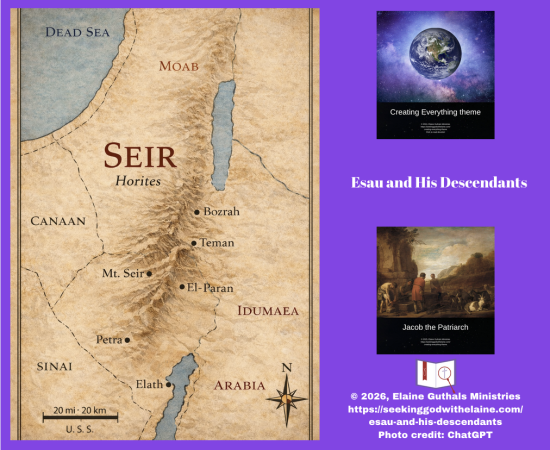
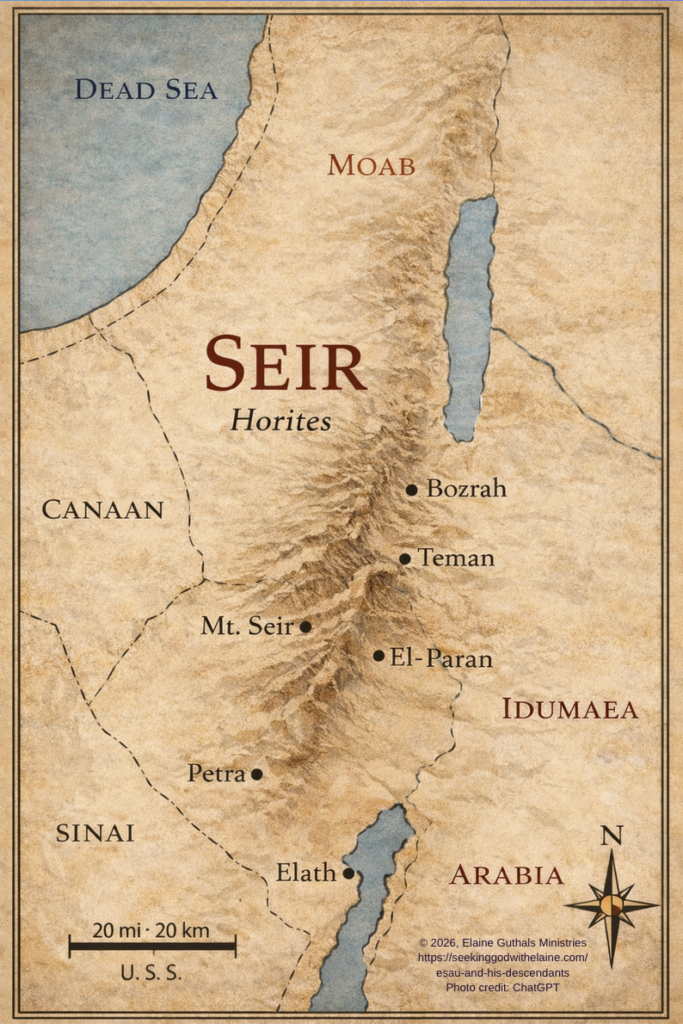
    The country of Edom began as Seir.

    First, Sauter helped us locate the area. He wrote, “The Edomites controlled an area east of the Arabah, from the Zered to the Gulf of Aqaba. Their capital was Bozrah, which sat in the northern part of their territory.” It is located south of the Dead Sea, reaching into the Arabian Peninsula.

    Resource

    The region did not worship Jehovah. Their god’s name was Qaus (or Qos).
    Okay. Wait a second. I’m confused.

    When Jacob and Esau were breaking up their roadside reunion, Moses said that Esau was going back to Seir. “So Esau turned around and started back to Seir that same day” (Gen. 33: 16 NLT).

    Plus, Esau had already married the women 37 years before Jacob left for Paddan-aram.

    We have to look at this as a summary of Esau’s journey. It is explanation as to how Esau got to be where he was.

    • Married two Canaanite women when he was 40 and still living with Isaac and Rebekah (Gen. 26)
    • Maybe began expanding herd range
    • Started living their with his wives, children, and at least 400 men
    • Going back to Seir (Gen. 33)
    • Fully living there (Gen. 36)

    So, the move happened offstage.

    When it says, “Esau took his wives, his children, and his entire household, along with his livestock and cattle — all the wealth he had acquired in the land of Canaan — and moved away from his brother, Jacob.” (Gen. 36: 6 NLT), it isn’t talking about a current event. It is explaining why the separation exists. It is more like an Abraham/Lot separation (Gen. 13). Too many flocks and herds on too little land.

    Esau’s Descendants

    “This is the account of Esau’s descendants, the Edomites, who lived in the hill country of Seir. These are the names of Esau’s sons: Eliphaz, the son of Esau’s wife Adah; and Reuel, the son of Esau’s wife Basemath. The descendants of Eliphaz were Teman, Omar, Zepho, Gatam, and Kenaz. Timna, the concubine of Esau’s son Eliphaz, gave birth to a son named Amalek. These are the descendants of Esau’s wife Adah. The descendants of Reuel were Nahath, Zerah, Shammah, and Mizzah. These are the descendants of Esau’s wife Basemath. Esau also had sons through Oholibamah, the daughter of Anah and granddaughter of Zibeon. Their names were Jeush, Jalam, and Korah. These are the descendants of Esau who became the leaders of various clans: The descendants of Esau’s oldest son, Eliphaz, became the leaders of the clans of Teman, Omar, Zepho, Kenaz, Korah, Gatam, and Amalek. These are the clan leaders in the land of Edom who descended from Eliphaz. All these were descendants of Esau’s wife Adah. The descendants of Esau’s son Reuel became the leaders of the clans of Nahath, Zerah, Shammah, and Mizzah. These are the clan leaders in the land of Edom who descended from Reuel. All these were descendants of Esau’s wife Basemath. The descendants of Esau and his wife Oholibamah became the leaders of the clans of Jeush, Jalam, and Korah. These are the clan leaders who descended from Esau’s wife Oholibamah, the daughter of Anah. These are the clans descended from Esau (also known as Edom), identified by their clan leaders” (Gen. 36: 9-19 NLT)

    Esau’s genealogy list turned into a clan list.

    I have to put this into perspective.

    • Nation: Edom
    • Tribe: Eliphaz
    • Clan: Amalek

    The clan heads, like Amalek, were semi-nomadic-tribal heads. It is good to know that because Amalek shows up again in Exodus 17 as a fierce enemy of Israel.

    Amalek, Esau’s grandson, was the founder of the Amalekites. They attacked Israel when they were marching to the Promised Alan’s (Ex. 17: 8-16).

    The Amalekites were raiders, not a kingdom. They operated out of the Negev and the wilderness zones.

    Original Peoples of Edom

    “These are the names of the tribes that descended from Seir the Horite. They lived in the land of Edom: Lotan, Shobal, Zibeon, Anah, Dishon, Ezer, and Dishan. These were the Horite clan leaders, the descendants of Seir, who lived in the land of Edom. The descendants of Lotan were Hori and Hemam. Lotan’s sister was named Timna. The descendants of Shobal were Alvan, Manahath, Ebal, Shepho, and Onam. The descendants of Zibeon were Aiah and Anah. (This is the Anah who discovered the hot springs in the wilderness while he was grazing his father’s donkeys.) The descendants of Anah were his son, Dishon, and his daughter, Oholibamah. The descendants of Dishon were Hemdan, Eshban, Ithran, and Keran. The descendants of Ezer were Bilhan, Zaavan, and Akan. The descendants of Dishan were Uz and Aran. So these were the leaders of the Horite clans: Lotan, Shobal, Zibeon, Anah, Dishon, Ezer, and Dishan. The Horite clans are named after their clan leaders, who lived in the land of Seir” (Gen. 36: 20-29 NLT).

    Moses gave us a list of people Esau displaced or assimilated into his clan.

    I know. We get tired of reading names of dead people.

    But family relationships were very important. They wanted to show how they descended from Abraham.

    More importantly, each one of us is important to God. He loves non-believers as He does believers.

    Who are these people? How do they further our story?

    • Before Esau came here to Seir to live, it was inhabited by an indigenous people led by named Seir, a Horite.
    • They likely were cave dwellers.
    • Anah had a daughter named Oholibamah, who married Esau.

    So, that would mean Esau married the granddaughter.

    • Nation: Seir
    • Tribe: Anah
    • Clan: Esau and Oholibamah – if he would have filtered in as Jacob did to Laban.

    What happened later was that Esau’s descendants intermarried and absorbed the Horites. That way of integration and identity merging didn’t always have to follow conquest.

    This is later confirmed. “In earlier times the Horites had lived in Seir, but they were driven out and displaced by the descendants of Esau, just as Israel drove out the people of Canaan when the Lord gave Israel their land.)” (Deut. 2: 12 NLT).

    Rulers of Edom

    “These are the kings who ruled in the land of Edom before any king ruled over the Israelites: Bela son of Beor, who ruled in Edom from his city of Dinhabah. When Bela died, Jobab son of Zerah from Bozrah became king in his place. When Jobab died, Husham from the land of the Temanites became king in his place. When Husham died, Hadad son of Bedad became king in his place and ruled from the city of Avith. He was the one who defeated the Midianites in the land of Moab. When Hadad died, Samlah from the city of Masrekah became king in his place. When Samlah died, Shaul from the city of Rehoboth-on-the-River became king in his place. When Shaul died, Baal-hanan son of Acbor became king in his place. When Baal-hanan son of Acbor died, Hadad became king in his place and ruled from the city of Pau. His wife was Mehetabel, the daughter of Matred and granddaughter of Me-zahab” (Gen. 36: 31-39 NLT)

    Just as the Israelites later did, the Edomites also wanted a king to rule them.

    It is interesting that the Edomites had kings long before Israel did.

    But then it isn’t. Israel was putting their trust in God. The Edomites didn’t have that.

    Leaders of Clans

    “These are the names of the leaders of the clans descended from Esau, who lived in the places named for them: Timna, Alvah, Jetheth, Oholibamah, Elah, Pinon, Kenaz, Teman, Mibzar, Magdiel, and Iram. These are the leaders of the clans of Edom, listed according to their settlements in the land they occupied. They all descended from Esau, the ancestor of the Edomites” (Gen. 36: 40-43 NLT)

    Moses ended the chapter by giving a list of leaders.

    Okay. This is another big list. It is of the chiefs. One of them is named Oholibamah.

    Wait. We’ve already been talking about someone by that name. That someone was Esau’s wife.

    It probably isn’t the same person. This list is of chiefs, but it is also a list of territories or regions.

    This Oholibamah would have been a tribal male.

    Maybe Mrs. Esau’s wife’s descendants formed a clan, became associated with a region, and had a chief that took her name.

    Remember we talked about intermarrying? Absorbing? Esau’s family wasn’t just biological. It was absorbing and organizing existing people.

    So, Genesis 36: 41 is talking about a woman’s clan legacy, not the woman herself.

    Making the Connections #1

    “Finally, his father, Isaac, said to him [Esau], ‘You will live away from the richness of the earth, and away from the dew of the heaven above. You will live by your sword, and you will serve your brother. But when you decide to break free, you will shake his yoke from your neck’” (Gen. 27: 39-40 NLT)

    Think back to Isaac’s blessing of Esau.

    Yep. Edom stretched into the Arabian Peninsula. That is a scorched, unwelcoming land. Isaac nailed his blessing as prophecy.

    When we read that it sounded like Esau’s descendants just kind of married into and took over the clan, we may say that his descendants didn’t have to live by the sword.

    But Bradford said they did. He explained, “Esau’s descendants didn’t become shepherds……they became conquerors and bands of robbers who descended on caravans that passed through their lands. War was their way of life; war is even at the heart of what is now their religion; Islam.”

    Resource

    It took a while before the final blessing manifested itself. We’re going to talk about that in the next connection.

    Esau did have a large family. He was able to form clans and build a nation, even establishing kings.

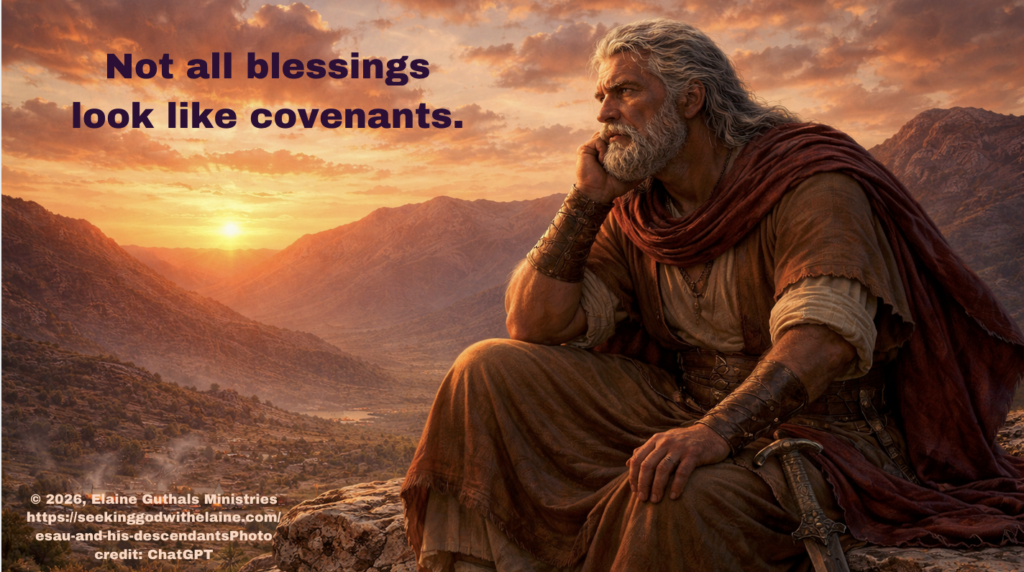
    It is obvious to see that Jehovah kept His promise to bless Esau. Was he the covenant son? Well, no, but He had a different purpose for him. Not all blessings look like covenants.
    Making the Connections #2

    Fairy tale stories end with the saying, “And they lived happily ever after.” That doesn’t always happen in real life.

    Esau’s Edom and Jacob’s Israel were often in conflict in future years. In fact, Jews in first-century Israel would have identified Edomites as their enemies.

    That is one reason that it is very appropriate that this chapter be included. It can be used as a political map of the future.

    One of Esau’s descendants was Amalek.

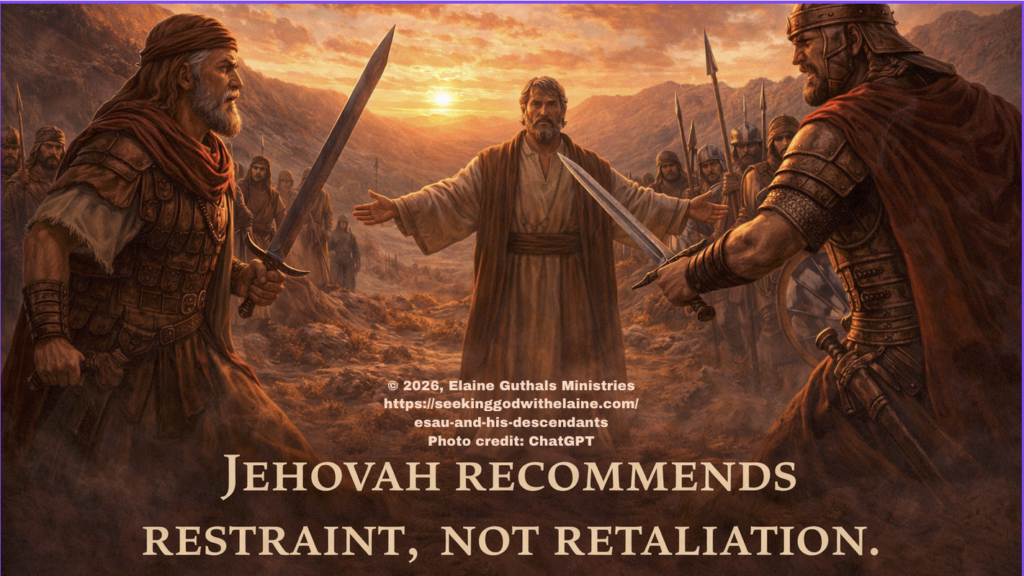
    It is interesting (not really) that Israel is instructed not to attack Edom (Deut. 2: 4-5; 23: 7). Family means something to Jehovah – even rebellious family. He does not want us to respond in the same way to them.

    Jehovah recommends restraint, not retaliation.
    No, that didn’t last much longer than it took Israel to get a king. Saul fought the Edomites (I Sam. 14: 47). David eventually defeated them (II Sam. 8: 13-14).

    Go back to Isaac’s blessing. “You will live by your sword, and you will serve your brother.  But when you decide to break free, you will shake his yoke from your neck’” (Gen. 27: 39-40 NLT emphasis added).

    David may have had a decisive victory, but the Edomites weren’t totally subdued. Hadad escaped to Egypt and came back to haunt Solomon.

    The Edomites revolted during the reign of Jehoram of Judah. They did break off Israel’s yoke.

    But of course, they couldn’t leave Israel alone. In II Chronicles 28: 17, the Edomites attached when Israel was weak. They were on hand when the Babylonians destroyed Jerusalem.

    Yes, that was a brotherly betrayal. But here they were seen as cheering for their destruction (Ps. 137: 7).

    Unfortunately, that isn’t the end.

    • Ezekiel 25: 12-14, 35
    • Amos 1: 11-12
    • Isaiah 34: 63
    • Jeremiah 49: 7-22
    • Malachi 1: 2-4

    Whatever started as a pair of twin brothers ended up with rivalry, hostility, and betrayal.

    Making the Connections #3

    Esau started out with the same opportunities Jacob had. Even if he was not chosen as the covenant son, he could still have been Jehovah’s son.

    Having Isaac as a father and Abraham as a grandfather did not guarantee Esau anything with Jehovah. No elder can make it for us.

    So, instead of one of the chosen, we see Esau in all his pride, violence, evil, and opposition.

    What did it boil down to? The same test Cain had to go through – how do you treat your brother?

    Making the Connections #4

    Doesn’t it seem strange, though Jehovah had promised the land to Israel, that Edom was the first to obtain land? We would think it would have come about the reverse way.

    The problem is we aren’t always on Jehovah’s timetable. He likes to say, “Wait.”

    There are times I think that we don’t put enough honor in the covenant son. Jacob’s descendants put much stock in being Jehovah’s chosen people. Jehovah is most important.

    How Do We Apply This?

    • Be thankful that we are children of Jehovah.
    • Repent when we do not choose Him.

    Father God. You give each of us the same choice to make for ourselves: are we going to obey or disobey You? Help us to make the right decision. Forgive us when we get jealous of those we think You are using to do what we think we could. Help us to rely solely on Your Will. Amen.

    If you don’t understand something and would like further clarification, please contact me.

    If you have not signed up for the email providing the link to the devotions and the newsletter, do so below.

    If God has used this devotion to speak with you, consider sharing it on social media.
  • The Tribes of Israel Established

    At the end of Genesis 36, the tribes of Israel were established. This devotional reading looks at closing up Jaccob’s story to prepare the way for the tribes to take over the story.

    Nuggets

    • Jacob was still Jacob, but his family and descendants were now the nation of Israel.
    • The Migdal-eder became tied to the history of Israel.
    • Reuben’s act was more than just a one-night stand with his father’s concubine.
    • Jacob heard about the coup and didn’t do anything about it!?!?!
      With the birth of Benjamin, the twelve tribes were complete.
    • There is one way, in my opinion, that we can look at it to me the statement about Benjamin’s birth being in Paddan-aram.
    the-tribes-of-israel-established

    Genesis 36 is one of those chapters that have a little bit of everything stuck all over. We talked first about Jacob and his family renewing the covenant with Jehovah. Then we started taking verses out of order to look at the three deaths addressed in the chapter: Deborah, Rachel, and Isaac.

    Now, we are going to turn to the story of Jacob’s twelve sons. Jehovah had plans for them – which we will start digging in when we get to Genesis 37.

    But let’s set it up.

    Let’s Put It into Context

    To read devotions in the Creating Everything theme, click the button below.

    Devotions in the Jacob the Patriarch series

    The Transfer from Jacob’s Story

    “Then Jacob traveled on and camped beyond Migdal-eder. While he was living there, Reuben had intercourse with Bilhah, his father’s concubine, and Jacob soon heard about it…” (Gen. 35: 21-22 NLT)

    Jacob

    Jacob was still Jacob, but his family and descendants were now the nation of Israel.

    It is interesting that the New Living Translation called him Jacob. Every other version listed in Bible Hub used the name Israel.

    Resource

    This, too, was a transition. The focus is not solely on Jacob. It is on the nation.

    Isaiah also showed this distinction between the man and the nation. “But now, O Jacob, listen to the Lord who created you. O Israel, the one who formed you says, ‘Do not be afraid, for I have ransomed you. I have called you by name; you are mine’” (Isa. 43: 1 NLT).

    This surprised me. I was thinking that nation really didn’t become a nation until they left Egypt.

    That tells me the potential was there. They just had to grow it to the level needed.

    Migdal-eder

    The Migdal-eder became tied to the history of Israel.

    The Hebrew Migdal-eder means Tower of Flock. A lot is known about this tower – and some is text. But there is also a lot of tradition and theology surrounding it.

    The Migdal-eder has long been a part of Jewish history. We know it was real because it is a landmark in Jacob’s travels shortly after Rachel died. This was the last location marker that we have before we are told that Reuben slept with his father’s concubine.

    Its function was to be used as a watchtower for the shepherd near Bethlehem. It would have been placed in an agricultural area to provide visibility to the shepherds and protection from predators – the two-legged and four-legged kind.

    Another thing we now is that David tended sheep around Bethlehem. He may or may not have frequented the Migdal-eder.

    The pastureland wouldn’t have a fence like Dad put up on the farm. David and first-century shepherds would have had boundaries – but those spaces would be fenced in by customs and tradition instead of fences. They would have been bound by tribal lands. Bethlehem was in the tribe of Benjamin.

    That is logical. This was rocky hill country. There would have been seasonal grass sprouting from thin soil. Shepherds would need the flexibility to move their flocks hunting that food and water. Think active management, not passive grazing.

    The fiction part may come in with regards to the sheep. They may or may not have been raised for Temple sacrifices. While the proximity would be a vote in favor of believing that, nothing has survived that specifically indicates that.

    Reuben

    Reuben’s act was more than just a one-night stand with his father’s concubine.

    I know. This has an ewww factor. It also was a scandal, not just a one-night stand.

    What Reuben was seeing was his mother’s arch-rival was now dead. He didn’t want the rival’s servant to be the one to whom Jacob turned. He especially didn’t want her elevated to legal wife.

    Truth be told, though, Reuben was probably mounting a coup. He was probably trying to depose Jacob by asserting leadership as firstborn.

    That is how this was usually interpreted in the Ancient Near Eastern culture. It was seen as challenging and claiming patriarchal authority.

    Remember, concubines (pilegesh) – while they were generally servants – were secondary wives, typically chosen to bear children when the primary wife was barren. Women who had the legal status of concubines, though, did not have the full privileges of the primary wife. Leah and Rachel were both primary wives, while Bilhah and Zilpah were concubines.

    That means Bilhah was in Jacob’s household and under his authority. Reuben ignored Jacob’s marital – and I would say legal – domain.

    Think Absalom rebelling against David (II Sam. 16: 21-22). Think Adonijah challenging Solomon (I Kgs. 2: 17).

    Jacob Heard about It

    Jacob heard about the coup and didn’t do anything about it!?!?!

    Well, not immediately. Babington tried to show us Jacob’s reasoning. He wrote, “Surely the reason was this, that we might thereby conceive that the grief was greater than could be expressed, to have his bed defiled by his own son.”

    Resource

    Eventually, Reuben will lose his birthright privileges. He was no longer considered the firstborn. He lost clan leadership and the double portion that went to the firstborn son.

    It is important that it is mentioned here, even if Jacob didn’t get around to doing anything about it until Genesis 49. This chapter includes the first listing of the tribes of Israel.

    Look at it this way. As the twelve tribes were about ready to be announced, Reuben lost his rights as firstborn. That prepares us for the coming change.

    Keep this power struggle in mind when we start talking about Joseph’s story.

    The Tribes of Israel Named for the First Time

    “… These are the names of the twelve sons of Jacob: The sons of Leah were Reuben (Jacob’s oldest son), Simeon, Levi, Judah, Issachar, and Zebulun. The sons of Rachel were Joseph and Benjamin. The sons of Bilhah, Rachel’s servant, were Dan and Naphtali. The sons of Zilpah, Leah’s servant, were Gad and Asher. These are the names of the sons who were born to Jacob at Paddan-aram” (Gen. 35: 22-26 NLT)

    The Tribes of Israel

    “… These are the names of the twelve sons of Jacob: The sons of Leah were Reuben (Jacob’s oldest son), Simeon, Levi, Judah, Issachar, and Zebulun. The sons of Rachel were Joseph and Benjamin. The sons of Bilhah, Rachel’s servant, were Dan and Naphtali. The sons of Zilpah, Leah’s servant, were Gad and Asher. These are the names of the sons who were born to Jacob at Paddan-aram” (Gen. 35: 22-26 NLT)

    With the birth of Benjamin, the twelve tribes were complete.

    Why is this important? Israel now existed as a full tribal family structure.

    We can’t talk about moving forward until we take a peek back. The twelve tribes of Israel can only move forward because the covenant family was purified in verses 2 through 4.

    Yes, we know Reuben was no longer purified. He just needed to ask forgiveness to be restored.

    Born in Paddan-aram

    There is one way, in my opinion, that we can look at it to me the statement about Benjamin’s birth being in Paddan-aram.

    Okay. I am confused. Rachel died in childbirth and was buried in Bethlehem. That isn’t Paddan-aram.

    That would mean that Benjamin was the only son born in the Promised Land.

    Why isn’t that highlighted? It could be that this was not meant as a strict geographic statement. Benjamin belonged to the time of wandering as Jacob had not settled in one spot yet – even though he was in Canaan.

    This may also have been considered a summary statement. I don’t know how long they had traveled, but maybe Rachel conceived in Haran.

    Some may see it as the end of the child-bearing era. We aren’t told of Jacob fathering any other children.

    I personally think that Benjamin was considered to be born in Paddan-aram because we aren’t told that Jacob had seen his father yet.

    That was part of the condition Jacob put on God the first time in Bethel. “Then Jacob made this vow: “If God will indeed be with me and protect me on this journey, and if he will provide me with food and clothing, and if I return safely to my father’s home, then the Lord will certainly be my God.” (Gen. 28: 20-21 NLT emphasis added).

    So – unless Moses didn’t put things in chronological order or skipped important details – Jacob hadn’t seen Isaac yet..

    Let’s look at it another way. All the sons but Benjamin were born under Laban’s authority. I think it is important that the last son – Rachel’s so – wasn’t.

    Stay tuned to see the important role Benjamin plays in the subsequent story.

    Making the Connections #1

    I think it is significant that Jacob returned to Mamre/Hebron. This is where Abraham eventually settled. This was where Sarah and Rebekah were buried. This is where Isaac, Leah, and Jacob himself would be buried.

    This was the ancestral home. Jacob was home.

    But then, on his way home, Jacob had hit three important locations central to the covenant story.

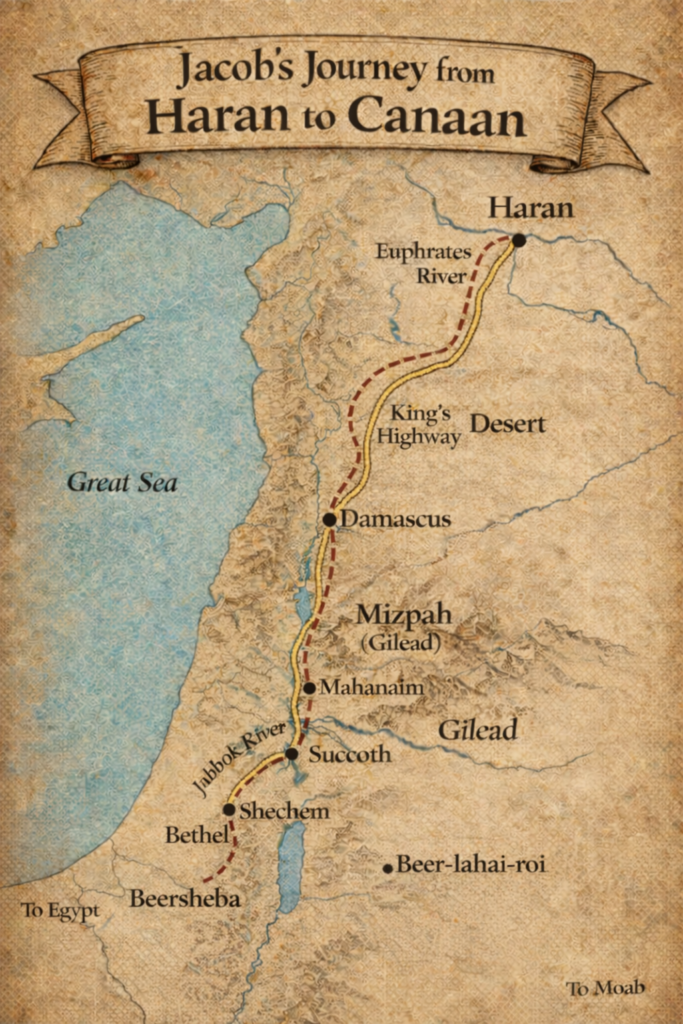
    First, he stopped in Shechem. This was where Abraham first entered the Promised Land (Gen. 12: 6-7). This was where Abraham built his first altar.

    Abraham entered into the promise here. Jacob and his whole family were tested — and failed.

    Then there was Bethel. Abraham did live here a while before (Gen. 12: 8) and after (Gen. 13: 3) his jaunt into Egypt. We aren’t really told Jacob actually stayed there a significant amount of time.

    Finally, there was Mamre, later named Hebron.That is where Abraham settled (Gen. 13: 18), Isaac settled (Gen. 35: 27), and Jacob settled (Gen. 35: 27).

    Through these three places, Jehovah has the family enter into the Promised Land; He reveals Himself to them; and He gives them rest and a place to call home across generations.

    Making the Connections #2

    We can argue that Jacob settled in Haran after going there to find a wife.

    We can also say that Jacob wandered for 30 years. He worked as a shepherd. He would have taken the flock wherever pastureland was available. We aren’t told that he settled in one area.

    Most importantly, Jacob wandered because he wasn’t living in the Promised Land. That has now changed. He was home.

    Jacob was not only home, but he was now the head of the covenant family. But it was more than a family.

    The nation was beginning to emerge.

    Making the Connections #3

    Ooo, baby. A lot happened in Genesis 35.

    Jacob finally arrived home and stopped wandering. The covenant was renewed after the atrocity of Shechem. The tribal formation was complete. After we check in with Esau in Genesis 36, we begin the story of Joseph.

    We went from the command to worship Jehovah to His establishing the covenant family. We went from removal of idols to the listing of the twelve tribes. We went from travel to settlement.

    Genesis 35 isn’t just diary entries. Everything in Genesis 35 moved toward God’s promises and the future of the covenant family.

    The covenant is the center of Israel’s story. Everything else is supporting narrative. Everything centers in Jehovah’s promises.

    How Do We Apply This?

    • Remember, sanctification comes in stages.

    Resource

    Father God. You have plans for each of us. Some plans take years to work out; some take centuries. Through all, thank You for being our Father. Amen.

    If you don’t understand something and would like further clarification, please contact me.

    If you have not signed up for the email providing the link to the devotions and the newsletter, do so below.

    If God has used this devotion to speak with you, consider sharing it on social media.

  • Transition and Loss

    We transition from one stage to another in life. This devotional reading looks at Jacob’s transition through the death of Deborah, Rachel, and Isaac.

    Nuggets

    • The death of Rebekah’s nurse Deborah may have stood in place of Rebekah’s death for Jacob.
    • Since childbirth in that day was hard enough, a complicated childbirth was probably almost impossible when traveling.
    • Sometimes, it feels like default mode to ask what sin was committed when someone experiences a trial.
    • Rachel was not buried in the family tomb at Machpelah.
    • Finally, finally, finally, Jacob made it home to Isaac.
    transition-and-loss

    While Jacob was heading home, tragedy struck. Three of his family members lost their lives.

    Let’s Put It into Context

    To read devotions in the Creating Everything theme, click the button below.

    Devotions in the Jacob the Patriarch series

    Death of Deborah

    “Soon after this, Rebekah’s old nurse, Deborah, died. She was buried beneath the oak tree in the valley below Bethel. Ever since, the tree has been called Allon-bacuth (which means “oak of weeping”)” (Gen. 35: 8 NLT)

    The death of Rebekah’s nurse Deborah may have stood in place of Rebekah’s death for Jacob.

    When we were introduced to Deborah, we weren’t given her name. “So they said good-bye to Rebekah and sent her away with Abraham’s servant and his men. The woman who had been Rebekah’s childhood nurse went along with her” (Gen. 24: 59 NLT).

    This is the only other place in Scriptures she is mentioned. Why is it important for us to know who she was?

    Bradford thought Deborah’s death represented a dissolving of the tie to Mesopotamia. I can see that. Jacob was the last covenant son to return “home” to Mesopotamia to find a wife.

    Resource

    I read some resources that said the tie was severed with her passing. I don’t see that. Rachel is still alive at this point as is Leah. They were born in Haran.

    Deborah’s death is a link beginning to close that generation.

    The name of burial spot – the oak of weeping – implies she was much loved. Her death (symbolizing the death of Rebekah’s household) may have also given Jacob a chance to mourn his mother’s death.

    Robertson disagreed with me. He felt Jacob hadn’t felt much for his mother in life let alone in death.

    Resource

    But why is Deborah there, and how did she get there?

    When Jacob left Canaan 30 years before, he left alone. Deborah did not return home with him.

    It is widely assumed that Rebekah has passed before these events occurred. The Midrash explained this as Deborah may have been sent to Jacob in Haran to tell him of his mother’s death and stayed with him.

    Other tradition describes Rebekah’s burial as intentionally private. Esau was known for his wickedness, and Jacob wasn’t there. The private burial was done to protect Rebekah’s honor.

    Another explanation is that not all the deaths of the matriarchs are given. Sarah’s death was recorded in Genesis 23. The next verses we will look at tell us of Rachel’s death. Rebekah’s and Leah’s deaths are not recorded.

    What we do know is that Isaac was living at Hebron (formerly called Mamre. Deborah was not living with him if she was buried in Bethel.

    But this gives us a sad bit of information. This almost certainly tells us that Rebekah died never having seen Jacob again. She would never meet the wives that she sent Jacob to find. The son she favored and schemed for had been lost to her.

    Death of Rachel

    Leaving Bethel, Jacob and his clan moved on toward Ephrath. But Rachel went into labor while they were still some distance away. Her labor pains were intense. After a very hard delivery, the midwife finally exclaimed, ‘Don’t be afraid — you have another son!’ Rachel was about to die, but with her last breath she named the baby Ben-oni (which means ‘son of my sorrow’). The baby’s father, however, called him Benjamin (which means “son of my right hand”). So Rachel died and was buried on the way to Ephrath (that is, Bethlehem). Jacob set up a stone monument over Rachel’s grave, and it can be seen there to this day” (Gen. 35: 16-20 NLT).

    Rachel Went into Labor

    Since childbirth in that day was hard enough, a complicated childbirth was probably almost impossible when traveling.

    Remember what Rachel said when Joseph was born? “And she called his name Joseph, saying, ‘May the Lord add to me another son!’” (Gen. 30: 24 ESV).

    Childbirth in the Ancient Near East was risky and precarious. This was a dangerous event in Jacob’s culture.

    Add to that the stress and struggles of a road trip. It was a recipe for disaster.

    I wonder what exactly the midwife meant when she said another son was born. Was she just informing Rachel of the gender of the child? Did she mean Rachel wouldn’t die, or Benjamin wouldn’t die? Or was it a callback to her prophecy when Joseph was born?

    Rachel wasn’t content with one child, but she died giving birth to the child for which she prayed. That was why she named him son of my sorrow.

    Newton took a stab at determining Rachel’s intent. He wrote, “She was sorry to leave her husband, her family, and her friends; and this feeling of sorrow led her to call his name Ben-oni.”

    Resource

    I can see why having a name of son of my sorrow might have comforted Ben. He could take it to mean that she was sorrowful that she couldn’t live to get to know him. (That is, if she didn’t selfishly experience the sorrow at her own death.)

    But I can see why Jacob changed the name. It was bad enough that Ben was going to grow up without Rachel, but knowing his name was wrapped up in her death could have been crushing.

    Jacob renamed the son to have a name that portrays hope.  It literally means son of my right hand. Benjamin would have been a great comfort to him.

    Fuller surmised that it probably meant that Ben was taking Rachel’s place in Jacob’s heart. I can see that, too.

    Resource

    Fuller also reminded us to look on this life as temporary.

    So Rachel Died

    Sometimes, it feels like default mode to ask what sin was committed when someone experiences a trial.

    We have to ask. Did Jacob unwittingly bring about Rachel’s death?

    Could Jacob have made a vow before Jehovah – or at least pronounced a curse? “But as for your gods, see if you can find them, and let the person who has taken them die! …” (Gen. 31: 32 NLT). At that time, he didn’t know Rachel was the one he was condemning.

    Was Rachel’s death just fallout from her taking the teraphim? Was it judgment?

    But them some may say Rachel prophesied her own death. “… She pleaded with Jacob, ‘Give me children, or I’ll die!’” (Gen. 30: 1 NLT). Yeah, children plural.

    We have to remember that Joseph was almost 17 then. Let’s look at our timeline.

    1709 BC – Joseph was born (Rachel)
    c. 1692 BC – Rachel died giving birth to Benjamin (Gen. 35: 16-20)

    Based on Timeline from

    Rachel so wanted children, but she was barren for almost seven years. Then she waited another 17 years to become pregnant with Benjamin.

    Leale made a good observation here. He wrote, “Death is here represented, not as the complete extinction of all thought and feeling, but as the separation of soul and body. It is not a sinking into nought, but only a change of state and place.”

    Resource

    Rachel was not buried in the family tomb at Machpelah.

    As Jacob’s household was traveling, Rachel was buried where she passed. Jacob’s erecting a standing stone is an expression of his grief.

    In the Complete Jewish Bible, stone pillar and stone monument are the same word — standing stone. So, what are standing stones?

    A standing stone was a large stone that was placed to commemorate sacred covenants or important events. They were used in the Bronze and Iron Ages (3150-586 BC).

    Oh, this is interesting.

    • “Jacob set up a stone pillar to mark the place where God had spoken to him …” (Gen. 35: 14 NLT).
    • “Jacob set up a stone monument over Rachel’s grave, and it can be seen there to this day” (Gen. 35: 20 NLT).

    The two standing stones were erected for different reasons. The first was erected to worship God. The second one was erected to memorialize a human, albeit the love of his life.

    This wasn’t something God instituted. This was an ancient custom.

    These were visible reminders for future generations of covenants and the significance of events.

    Rachel’s tomb played a role in future generations. “This is what the Lord says: ‘A cry is heard in Ramah — deep anguish and bitter weeping. Rachel weeps for her children, refusing to be comforted — for her children are gone’” (Jer. 31: 15 NLT).

    The children Rachel was supposedly mourning were those who had been exiled to Babylon. We know this verse was also used in conjunction with the Massacre of the Innocents in Matthew 2: 16-29.

    Death of Isaac

    “So Jacob returned to his father, Isaac, in Mamre, which is near Kiriath-arba (now called Hebron), where Abraham and Isaac had both lived as foreigners. Isaac lived for 180 years. Then he breathed his last and died at a ripe old age, joining his ancestors in death. And his sons, Esau and Jacob, buried him” (Gen. 27-29 NLT)

    Finally, finally, finally, Jacob made it home to Isaac.

    What in the world took Jacob so long to go home to his father? There might be some reasons.

    Jacob grew a lot in the way home. Yes, he grew a lot in Haran, but He went through trials and purifications I Genesis 34 and 35. He had to go through development stages.

    But that is what we do on our Sanctification Road. Jacob was no different. We don’t get a data dump from Jehovah, but rather a consistent growth.

    For better or worse, Jacob settled in Shechem. The whole debacle happened with Hamor and Shechem, but Jacob also worshiped. He built an altar and worshiped.

    Jacob and Esau had reconciled; but sometimes, reconciliation has to stabilize. The passage reads like true reconciliation, but Jacob may have it was probably tenuous at best. He may have wanted to stay in the central hull country for safety’s sake.

    We have to remember that Jacob wasn’t really a clan until he left Haran. He had always been a part of Laban’s clan. Now, he had to establish himself.

    Plus, Jacob had a large household, many animals, and servants and herdsmen. Pastoral migration may have been slow, especially if they experienced drought.

    Mainly, the passage reads like Jacob was experiencing spiritual hesitation. He wasn’t quick to fulfill his vow. That is, until he renewed his bow at Bethel.

    Jacob finally made it to Isaac. From the timeline, it looks like Isaac and Jacob were given roughly ten years to restore their relationship.

    We don’t hear anything about Isaac’s life after Jacob’s return. It seems like his life was always overshadowed by Abraham’s and Jacob’s lives. Yet he lived the longest of the three.

    We aren’t told that Abraham, Isaac, and Jacob had any concept of eternal life. So, “… he died and was gathered to his people …” (Gen. 35: 29 ESV) was probably just a way of saying he was buried.

    Just as Isaac and Ishmael had stood at Abraham’s grave, Esau and Jacob stood at Isaac’s. The twins had put their differences aside.

    Making the Connections #1

    I think it was interesting that Deborah was buried at Bethel. This was the place where Jacob first met Jehovah on his way out of Canaan. Now, he was returning with a mature faith.

    Jacob was ready to step into his role a patriarch. That meant he was taking over from the old generation, of which Deborah was numbered.

    Making the Connections #2

    We have to watch the phrase were gathered to his people or ancestors. It may have been a form of ancestor worship, a practice in the Ancient Near East.

    Got Questions gave us a good definition of what that was. They said it “… involves religious beliefs and practices consisting of prayers and offerings to the spirits of dead relatives.”

    Resource

    This was a pagan practice that championed the belief that dead ancestors lived on in spirit to influence the lives of living relatives. They were considered mediators between the living and their Creator.

    Taking that a step further, they believed a living ancestor — because of their morality — could act like gods, influencing their descendants.

    Disciples know that this is not the case. We know this because God’s Word tells us it is not.

    • “Finally, the poor man died and was carried by the angels to sit beside Abraham at the heavenly banquet. The rich man also died and was buried, and he went to the place of the dead” (Lk. 16: 22-23 NLT).
    • “So we are always confident, even though we know that as long as we live in these bodies we are not at home with the Lord” (II Cor. 5: 6eb NLT).
    • “And just as each person is destined to die once and after that comes judgment” (Heb. 9: 27 NLT).

    Yeshua is the only Mediator we have before Jehovah. Dead relatives don’t make our case for us any more than live ones do.

    God’ Word is explicitly we are to have no other gods but Jehovah. Honoring our parents — or ancestors — is one thing. Worshiping them is totally forbidden.

    Bible Hub told us how we are to treat our ancestors.

    • We want to treat them with respect.
    • We want to learn from our ancestors and follow their examples.
    • We want to be thankful for their testimony.

    Resource

    We don’t want to cross the line into worship.

    How Do We Apply This?

    • Remember that our souls do not die.
    • Don’t expect a prosperity gospel – at times it will feel like we go from one trial to another.
    • Remember, sanctification comes in stages.

    Resource

    Father God. Lord, we hurch what our family members pass. We know they are in a better place because they are with You in Paradise. Help us as we learn to live without them. Amen.

    If you don’t understand something and would like further clarification, please contact me.

    If you have not signed up for the email providing the link to the devotions and the newsletter, do so below.

    If God has used this devotion to speak with you, consider sharing it on social media.
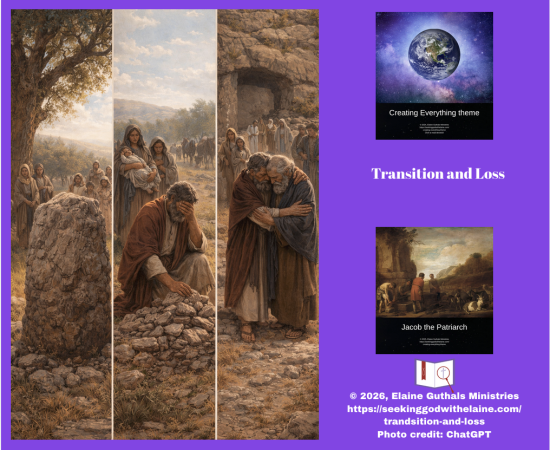
  • Jacob Returned to Bethel

    Jacob finally made it back to Bethel. This devotional reading looks at how he worshiped Jehovah and how the covenant was reaffirmed.

    Nuggets

    • Jehovah will get us where He always wanted us to go.
    • Where Jacob had erected a standing stone before, he now built an altar.
    • God reiterated that He had changed Jacob’s name.
    • We are told in the verse that El-Shaddai means God Almighty.
    • The be fruitful and multiply promise occurs right after the name El -Shaddai.
    • Jehovah reaffirmed the covenant promises that He had given to Abraham and Isaac.
    jacob-returned-to-bethel

    Jacob had spent 20 years in Paddan-aram working for his wives and animals. Then, he had spent 10 years wandering around Canaan.

    Finally, finally, Jacob was going to fulfill his vow to return to Bethel. But he had some preparation to do first.

    Now, he was ready to worship.

    Let’s Put It into Context

    To read devotions in the Creating Everything theme, click the button below.

    Devotions in the Jacob the Patriarch series

    Jacob Built an Altar

    “As they set out, a terror from God spread over the people in all the towns of that area, so no one attacked Jacob’s family. Eventually, Jacob and his household arrived at Luz (also called Bethel) in Canaan. Jacob built an altar there and named the place El-bethel (which means ‘God of Bethel’), because God had appeared to him there when he was fleeing from his brother, Esau’” (Gen. 35: 5-7 NLT)

    They Set Out

    Jehovah will get us where He always wanted us to go.

    Jacob and his family set off for Bethel. I bet the people of the surrounding area did give them a wide berth. They would have heard about the massacre in the City of Shechem.

    They wouldn’t have wanted to get on Jacob’s bad side.

    But then one of the Proverbs has a good reminder. “When people’s lives please the Lord, even their enemies are at peace with them” (Prov. 16: 7 NLT).

    As Pastor Steve says, there are blessings in the obedience.

    But we can look at it another way. Jehovah goes before us and clears the path. That is a common theme throughout His Word.

    • “Do not be afraid or discouraged, for the Lord will personally go ahead of you. He will be with you; he will neither fail you nor abandon you” (Deut. 31: 8 NLT).
    • “You go before me and follow me. You place your hand of blessing on my head” (Ps. 139: 5 NLT).
    • “The Lord replied, ‘I will personally go with you, Moses, and I will give you rest — everything will be fine for you” (Ex. 33: 14 NLT).
    • “You will not leave in a hurry, running for your lives. For the Lord will go ahead of you; yes, the God of Israel will protect you from behind” (Isa. 52: 12 NLT).

    Instead of allowing neighboring clans to retaliate, Jehovah kept them safe.

    Why did Jehovah do that? He always wanted Jacob to come back to Bethel. He knew about Laban’s deception even before Laban knew he was going to switch the sisters as bride. He knew exactly how long Jacob was going to be gone.

    Everything Jacob had done was leading him back to Bethel.

    Built an Altar

    Where Jacob had erected a standing stone before, he now built an altar.

    A lot had changed since Jacob had erected that standing stone when he left Canaan in 1723 BC. He had grown up a lot. More importantly, he had grown in his relationship with Jehovah.

    Where he had seen the area as the house of God (Gen. 28: 19), Jacob now saw Jehovah Himself. He showed that by the name of the altar – God of Bethel.

    The standing stone was a memorial to the memory of the dream. Jacob was alone and fleeing – until Jehovah appeared to him.

    Now, Jacob knew this was a mizbeach – a place for sacrifice and worship. He needed to celebrate with his Creator that the promise made decades ago had come full circle.

    Jacob knew what was expected of him. Jehovah wanted ongoing worship.

    Jacob was no longer surprised by God. He didn’t need a conditional vow anymore.

    More than that, Jacob didn’t need to just say, “God met me here.” He now chose to say, “I belong to You.”

    Jacob had left as Jacob. He came back as Israel.

    Covenant Reaffirmation

    “Now that Jacob had returned from Paddan-aram, God appeared to him again at Bethel. God blessed him, saying, ‘Your name is Jacob, but you will not be called Jacob any longer. From now on your name will be Israel.’ So God renamed him Israel. Then God said, ‘I am El-Shaddai — ‘God Almighty.’ Be fruitful and multiply. You will become a great nation, even many nations. Kings will be among your descendants! And I will give you the land I once gave to Abraham and Isaac. Yes, I will give it to you and your descendants after you.’ Then God went up from the place where he had spoken to Jacob. Jacob set up a stone pillar to mark the place where God had spoken to him. Then he poured wine over it as an offering to God and anointed the pillar with olive oil. And Jacob named the place Bethel (which means ‘house of God’), because God had spoken to him there” (Gen. 35: 9-15 NLT)

    Jehovah reaffirmed the promises to Jacob that He made to Abraham.

    Nothing interrupts the covenant promise — even deaths of key players. Not even waiting ten years to make it to Bethel.

    This is the only time where Jacob hears the complete covenant promises directly from Jehovah. He heard some in the blessing from Isaac – but that was Isaac, not Jehovah, and not all.

    Jacob heard some from Jehovah the last time he stopped at Bethel. But he was running and not in a good place spiritually.

    This affirmation is also important because it is the final time that the covenant will be confirmed to the patriarch himself. After this point, covenant responsibilities fall to Jacob’s descendants.

    Your Name Will be Israel

    God reiterated that He had changed Jacob’s name.

    When Jacob was wrestling with the man the night before he was to encountered Esau, the man changed his name to Israel.

    You know, I don’t remember Moses calling him Israel after that. I remember him still being called Jacob.

    Maybe that is the reason God felt like He had to reiterate it here.

    • You are Israel.
    • You are going to be the nation of Israel.
    • In fact, you are going to be a couple of nations.
    • You great …. grandsons will be kings.
    • I am going to give this land to your descendants.

    What is mildly mind boggling is that, when Jehovah changed Abram’s name to Abraham, he forever thereafter went by the name Abraham. Not so with Jacob. He usually was called Jacob, not Israel.

    Jewish tradition has some ideas about that. The names have two different meanings. Jacob means heel-grabber. Israel, on the other hand, means he struggled and prevailed.

    Like we said, Jacob isn’t the same person that he was when he left. He is ready to walk into the role as patriarch.

    I think it is a little more than that. It seems like Jacob is called that when it refers to his personal life. When talking about his spiritual or national role, he is called Israel.

    Yeah, Jacob may now be the father of the covenant people, but he is still a fallible man. He continued to struggle and grow his faith.

    Still, Jehovah acknowledged his transformation. He also acknowledged that this is the beginning of the family line.

    If we look, though, we will the nation referred to as both Jacob’s names. The nation is Israel, but it is also the House of Jacob.       

    But here, at this altar in this moment, Rachel is probably pregnant with Benjamin. Everything is almost in place.

    Jehovah confirmed that Jacob was a patriarch of the covenant people.

    El-Shaddai

    We are told in the verse that El-Shaddai means God Almighty.

    This isn’t the first time that this name of Jehovah was used.

    • “When Abram was ninety-nine years old, the Lord appeared to him and said, ‘I am El-Shaddai — “God Almighty.” Serve me faithfully and live a blameless life” (Gen. 17: 1 NLT).
    • “May God Almighty bless you and give you many children. And may your descendants multiply and become many nations!” (Gen. 28: 3 NLT).

    Think about it. The verse in Genesis 17 was the last recorded time that Jehovah and Abraham talked about the covenant. It was when he instituted circumcision.

    The verse in Genesis 28 was the blessing Isaac gave Jacob knowing it was Jacob, knowing he was giving the covenant son the blessing.

    This name was used during covenant discussions. Why is this name so important to the covenant?

    Well, El means God. It emphasizes power, might, and authority.

    Shaddai takes a little more explanation. That is because there are a couple of interpretations.

    The traditional translation of Shaddai is Almighty. It speaks to overwhelming power. We would see this as Jehovah being all-sufficient – that He can keep His promises.

    What are Jehovah’s promises? The wording says be fruitful and multiply, but that can only happen when He wills it to happen. And several times when He wills that to happen, the result will be the descendants will serve as King of Israel.

    A second translation of Shaddai is that Jehovah is God of the Mountain. In other words, He is God of the high place.

    Well, Jehovah is God in Heaven, the highest place there is. As Creator, He is sovereign over creation.

    But that kind of smacks of Ancient Near East pagan culture.

    The third and final translation is that Shaddai means God Who Nourishes or Sustains. It connects to the Hebrew word shad or breast.

    This translation focuses on the provision, nourishment, and life-giving power.. It would follow the Ancient Near East’s fertility ideas. It, too, goes along with be fruitful and multiply.

    Be Fruitful and Multiply

    The be fruitful and multiply promise occurs right after the name El-Shaddai.

    This is a restatement of past promises.

    • “Then God blessed them and said, ‘Be fruitful and multiply. Fill the earth and govern it …’” (Gen. 1: 28 NLT).
    • “Then God blessed Noah and his sons and told them, ‘Be fruitful and multiply. Fill the earth’” (Gen. 9: 1 NLT).

    It is like Jehovah was saying, “I am the God who has the power to bring life and sufficient enough to accomplish promises.”

    Wouldn’t that have been so comforting to Jacob at that time? Here he was struggling to deal with the chaos of Shechem. He went through the purification process and buried the idols (and maybe found out Rachel had Laban’s household gods all along).  Now, he is reestablishing covenant identity.

    And here Jehovah is saying, “Remember all those promises I gave Abraham? I am giving them to you. I have the power to pass them on to you, and nothing you will do is going to derail these promises. I have called you.”

    The original human blessing (Gen. 1) is now flowing through the covenant family (Gen 12, 35). Creation’s purpose is coming through Abraham’s line.

    A Great Nation, Kings among Descendants, and Give You the Land

    Jehovah reaffirmed the covenant promises that He had given to Abraham and Isaac.

    The best way to look at this is to dig out the chart again and update it.

    We can’t forget that the patriarchal covenant began near Bethel in Genesis 12. Jacob did experience exile, but Jehovah brought him back to Bethel.

    A Stone Pillar

    Jacob used the standing stone in worship to Jehovah.

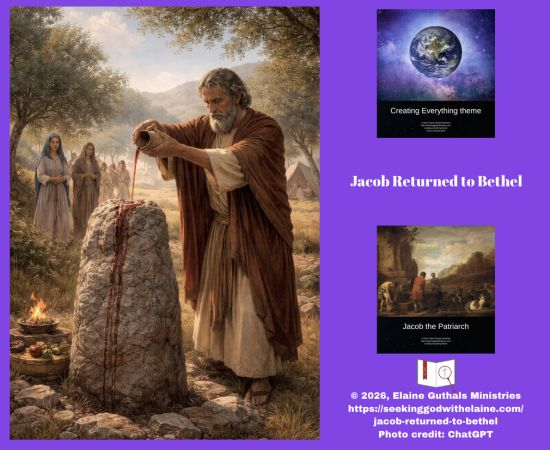
    We are told that Jacob offered a drink offering (nesek) and poured out oil. There is no mention of a burnt offering here where an animal was offered. That would have happened at the altar Jacob built if it did.

    A drink offering in Moses’ time (and we have no difficulty in believing this is what happened in Jacob’s time) consisted of pouring our wine before Jehovah. This symbolized complete surrender.

    It was notable that the drink offering occurred on the standing stone rather than the altar. It was all about honor because it was poured on the standing stone marking God’s presence.

    Jacob also poured oil on the standing stone. In other words, he was consecrating it by setting it apart as holy.

    True, Jacob already did this to the first standing stone he erected in Genesis 28. Now, he understands more. It means more because his relationship with Jehovah is more.

    We could look at this as a vow offering. Jacob was fulfilling his vow made in Genesis 28. It could have been a peace offering that celebrated restored relationships.

    Making the Connections #1

    Did you catch this? Jacob erected a standing stone in Genesis 28: 18. Thirty years later, he built an altar in Genesis 35: 7 and a standing stone in Genesis 35: 14.

    If Jacob used these as memorials, why did Jehovah outlaw them?

    Standing stones were a part of the Ancient Near East culture. They were religious and boundary markers as well as covenant witnesses. Sometimes, they were even symbols of deities.

    In other words, Jacob was using a cultural norm to commemorate when God revealed Himself to him.

    Jacob used them to correctly here and when it was used as a boundary between him and Laban. He didn’t set up idols, just memorial markers.

    But later, standing stones became more strongly associated with Canaanite idol worship. They were placed next to fertility shrines and Asherah poles and on Baal worship sites.

    The stones themselves didn’t change. What changed was their use in the culture. What the standing stones represented had changed.

    They had become a central feature of pagan worship. The law was made so that Israel did not compromise with the Canaanite pagan worship.

    That is a good reminder to us. What may start out as something innocuous can change into something sinful if used to represent evil or used in an evil way.

    But then, Jehovah allowed a standing stone memorial when the Israelites crossed the Jordan River into the Promised Land. The memorial was used in the correct way – as a memorial, not as a god.

    Making the Connections #2

    Robinson made a great observation. Jacob had changed – Jehovah hadn’t.

    Robinson said Jehovah still hasn’t changed. He wrote, “The same Divine Being, with all attributes and characteristics unchanged, rules to-day as then.”

    Resource

    Have you ever thought about how Jehovah makes our relationship with Him work? I mean, think about it. We are independent, free-willed creatures.

    And yes, that is we plural. He has billions of us to deal with daily.

    But Jehovah chooses us. He chose Jacob over Esau. He chose Isaac over Ishmael. He chose the ones He knew would choose Him and would endure to the end (Mt. 24: 13).

    What we can stand up and shout hallelujah at is that Jehovah is preparing us for the long haul. He is there to help us endure to the end.

    Making the Connections #3

    This gives us a good snapshot of early worship. It was simple, symbolic, and personal. It may not have been systematized, but it was already theologically rich and meaningful.

    We get more about how Jacob worshiped than we were told with Abraham. But isn’t that to be expected? It shows growth over generations.

    Jehovah remembered His vow, and now Jacob was living like he remembered his.

    How Do We Apply This?

    • Endure to the end.
    • Recognize that even when obedient, we may still suffer losses.
    • Learn more of Him while we learn more of ourselves.
    • Recognize that Jehovah is sufficient to fulfill the promises that He has given us.

    Resource

    Father God. You patiently wait for us to come back to You. Yes, You expect us to come after we have repented and been purified. But You love us so much, You wait for us. Thank You. Amen

    If you don’t understand something and would like further clarification, please contact me.

    If you have not signed up for the email providing the link to the devotions and the newsletter, do so below.

    If God has used this devotion to speak with you, consider sharing it on social media.

  • Jacob Called to Bethel

    After the heartbreak of Dinah’s defilement, Jacob and his family are called to Bethel to meet God. This devotional reading looks at the purification process to prepare them for that encounter.

    Nuggets

    • Jacob was finally going to fulfill the vow he made decades earlier at Bethel.
    • Before encountering Jehovah, Jacob’s household had to abandon the idols with which they compromised.
    • We cannot approach Jehovah when we allow other things to divide our focus on Him.
    • We may think it was interesting that Jacob buried the idols, not burned them.
    • Jehovah not only required them to rid themselves of idols, but He also required them to purify themselves.
    • Purification requires an outward response of change.
    • Those in Jacob’s household voluntarily gave up the idols they had in their possession.
    jacob-called-to-bethel

    Jacob was still on his way home from Paddan-aram. After being sidetracked in Shechem — and probably for several years — Jacob was finally heading for Bethel.

    But a lot of bad things had happened in Shechem. Before they got to Bethel, the whole family had to rededicate their lives to Jehovah.

    I’m going to take the verses out of order in the next couple of devotions. We have three very important deaths that I want to address together.

    But it isn’t all mourning. Stuck in the middle is the travel explanation and the formation of Israel — which (after Genesis 36) is the focus of the rest of the Book of Genesis.

    But first we have to get to Bethel.

    Let’s Put It into Context

    To read devotions in the Creating Everything theme, click the button below.

    Devotions in the Jacob the Patriarch series

    Renewal after Compromise

    “Then God said to Jacob, ‘Get ready and move to Bethel and settle there. Build an altar there to the God who appeared to you when you fled from your brother, Esau” (Gen. 35: 1 NLT)

    Jacob was finally going to fulfill the vow he made decades earlier at Bethel.

    More importantly, Jacob was going to obey this direct command from Jehovah.

    Bethel is well known to us. We have hear heard of it since the time of Abraham.

    • “After that, Abram traveled south and set up camp in the hill country, with Bethel to the west and Ai to the east. There he built another altar and dedicated it to the Lord, and he worshiped the Lord” (Gen. 12: 8 NLT).
    • “From the Negev, they continued traveling by stages toward Bethel, and they pitched their tents between Bethel and Ai, where they had camped before. This was the same place where Abram had built the altar, and there he worshiped the Lord again” (Gen. 13: 3-4 NLT).
    • “The next morning Jacob got up very early. He took the stone he had rested his head against, and he set it upright as a memorial pillar. Then he poured olive oil over it. He named that place Bethel (which means ‘house of God’), although it was previously called Luz” (Gen. 28: 18-19 NLT).
    • “I am the God who appeared to you at Bethel, the place where you anointed the pillar of stone and made your vow to me. Now get ready and leave this country and return to the land of your birth” (Gen. 31: 13 NLT).

    When Jacob first came to Bethel, Jehovah met with him there at His initiation. The promise was given to Jacob.  Unfortunately, Jacob responded imperfectly.

    What is really beautiful in Genesis 31: 13 is that Jehovah never forgot the vow Jacob first made at Bethel. He was calling him back to it.

    Now, that promise was going to be fulfilled.

    God wanted Jacob to worship Him. He gave him specific instructions as to where and how this worship should be.

    That is what Bethel was — a place of encounter, worship, return, and covenant reaffirmation.

    Robertson had an interesting comment. He wrote,

    “The third thing we mark here is the consecration of the place (ver. 1). It is not in reference to God, but for a help to our own feelings that we consecrate certain spots of earth and buildings. There are sacred places, not sacred for their own sake, but sacred to us.”

    Resource

    I get that. Only Jehovah has the right to designate a place as sacred. We each, though, have our own Bethel where we encounter Jehovah.

    Does my Bethel make it sacred for you? No. Does it make it sacred for me? Yes.

    We each need our own Bethel.

    It is very important that we don’t skip over Who was doing the calling. “… the God who appeared to you when you fled from your brother, Esau” (Gen. 35: 1 NLT).

    The God Who had been with Jacob when he left, had been with him for 20 years while he was gone, and had called him home. He was preparing Jacob and his family for the future.

    Our worship must be continual. We must always have an attitude of worship.

    Purification from Idolatry

    “So Jacob told everyone in his household, ‘Get rid of all your pagan idols, purify yourselves, and put on clean clothing. We are now going to Bethel, where I will build an altar to the God who answered my prayers when I was in distress. He has been with me wherever I have gone.’ So they gave Jacob all their pagan idols and earrings, and he buried them under the great tree near Shechem” (Gen. 35: 2-4 NLT)

    Before encountering Jehovah, Jacob’s household had to abandon the idols with which they compromised.

    Jacob’s family needed to purify themselves so that they could return to Jehovah. They had slid away from Him in varying degrees – and the way from passivity to murder.

    It was time to get right with Jehovah.

    Get Rid of All Idols

    We cannot approach Jehovah when we allow other things to divide our focus on Him.

    At this point, Isaac and Jacob and their families may have been the only ones who worshiped Jehovah. Yet Jacob had allowed idols to enter his house.

    Idols are anything that take our worship away from Jehovah.

    Hmmmmm. I wonder if Rachel had already gotten rid of the teraphim she took from Laban. Remember, when Jacob and crew left Paddan-aram. She took these and hid them her saddlebag on her camel.

    But there may have been more idols in the household than the ones Rachel took. They probably took some when they looted Shechem. This could have included idols, cult objects, and jewelry with religious significance.

    The first clue was when it says, “So they gave Jacob all their pagan idols and earrings, and he buried them under the great tree near Shechem” (Gen. 35: 4 NLT emphasis added).

    We may just see earrings as a fashion accessory. In the Ancient Near East, they also often had religious or magical significance. The all-encompassing term was amulets, an ornament or small piece of jewelry to give protection against evil, danger, or disease.

    It wasn’t just earrings. It was also rings, beads, and pendants. They had several purposes.

    • ward off evil spirits
    • invoke protection from a deity
    • bring fertility or good fortune.

    In other words, they could be used as protective charms. It was like they had their own personal portable religious objects.

    This does just say earrings here.

    All in all, there may have been more items buried than the teraphim Rachel took. Jacob was eliminating everything associated with Canaanite religion.

    He Buried Them

    We may think it was interesting that Jacob buried the idols, not burned them.

    Let me tell you. When I first read this, I was like Watkinson. Why didn’t Jacob burn the idols?

    Watkinson thought Jacob was up to his old tricks. He was double-dealing and not completely focused on Jehovah.

    Resource

    Looking into it more, I don’t think so. Part of that has to do with figuring out the culture in which Jacob lived.

    First off, we have to note that never one in God’s Word does it say that Jacob worshiped the false idols. They were Laban’s. Rachel took them. The boys looted Shechem.

    Nothing put the idols in Jacob’s possession.

    A second point of evidence shows Jacob’s immediate obedience to the call to move to Bethel. He immediately starts the purification process.

    So, what was the significance of Jacob burying the idols and Canaanite religious objects?

    Jacob was performing what we would call a ritual disposal. In the Ancient Near East, burial meant:

    • Removing it from circulation
    • Putting it “out of reach”
    • Treating it as something no longer to be used

    This meant a permanent separation.

    Jacob was symbolically removing the pagan influence. In essence, he was saying, “We are leaving this behind permanently.

    When something dies, we bury it. Idols were not living gods. They were just powerless objects.

    Jacob was following Ancient Near Eastern custom. Burial of religious objects were not casually destroyed. Hiding them was a way of decommissioning sacred objects without mishandling them.

    At this point, Jehovah had not commanded the idols be burned. He would in the Book of Deuteronomy. That is logical because, at the moment, it wasn’t a known, entrenched threat to believers.

    So, Jacob was going more by instinct in this instance than by Jehovah’s command.

    We can’t gloss over the fact that Jacob buried the idols at Shechem, where his sons had just murdered people and looted the city. In other words, he was leaving the impurity at Shechem, where it had bloomed.

    Purify Yourselves

    Jehovah not only required them to rid themselves of idols, but He also required them to purify themselves.

    The second action was to purify themselves. Jehovah wanted them to remove everything that was dividing their loyalty to Him.

    Repentance isn’t just feeling bad. It is about turning away from what is bad. It is about removing what competes with God and leaving it behind.

    Purify describes an inner ritual cleansing to remove contamination. The Hebrew word is tāhar. It means to be clean, to be pure, or to be pronounced clean.

    That means we

    • Become ritually clean.
    • Free from defilement.
    • Made pure before Jehovah.

    We can’t forget that this is more than removing spiritual contamination. Purification happens after disease and after contact with death.

    The internal and spiritual preparation shows itself in outward actions, such as washing.

    The goal is purity. Purity means possessing God’s moral character, having eliminated the stain of sin.

    But there is something else we usually don’t connect to this. We read about others who were performing the ritual purification act before meeting Jehovah.

    “Then the Lord told Moses, ‘Go down and prepare the people for my arrival. Consecrate them today and tomorrow, and have them wash their clothing. Be sure they are ready on the third day, for on that day the Lord will come down on Mount Sinai as all the people watch’” (Ex. 19: 10 NLT).

    I know. One says purify, and the other says consecrate. Purification is the preparation. Consecration is the identity. Probably more appropriate, purity is cleaning the vessel. Consecrating is dedicating the vessel.

    Jacob’s focus was on getting rid of the sin. Moses’ focus was on setting them apart to enter the covenant law.

    But both includes cleaning. We have to get rid of the sin either way.

    Put on Clean Clothing

    Purification requires an outward response of change.

    Look how else they were to prepare for worship. Purify themselves and put on clean clothes.

    True, I bet part of the purification process was for them to take a bath. A logical follow up to that would be clean clothes.

    But it doesn’t put any other qualifiers on that. It doesn’t say put on your best clothes.

    The emphasis is on exchanging and replacing that which is contaminated with that which is pure.

    Purity is the goal. Being clean is how we do that. We can’t put on anything unholy.

    We have to look at the Ancient Near East culture. Clothing at that time symbolized status, identity, or condition.

    Putting on clean clothing shows the inner purification through a changed outward appearance.

    We again see that again several times in God’s Word.

    • On Mount Sinai in Exodus 19
    • In Zechariah 3 when Joshua the High Priest appeared in filthy garments
    • Purification in Revelation 7: 14.

    It is obvious we need both purifying and changing. We need both the inward focus as well as the outward focus to remove spiritual contamination and displaying the new pure condition.

    So They Gave Jacob All Their Idols

    Those in Jacob’s household voluntarily gave up the idols they had in their possession.

    Jacob didn’t have to search the compound as Laban did. His family willingly gave them up.

    This is a family-wide preparation. Jacob was about to return where others had never been: “… Bethel (which means ‘house of God’) …” (Gen. 28: 19 NLT).

    Making the Connections #1

    So, what do we need to have a pure heart?

    • A willing heart
    • A life where the things that divide our spiritual focus removed
    • A genuine love for Jehovah and His ways

    Making the Connections #2

    Do we like it when Jehovah brings up our past? Ooo, baby. Huge emphatic NO!!!

    We don’t like to be reminded of our failures. But we must remember Jehovah’s provision to us. We have to respond with gratitude.

    Making the Connections #3

    Part of Jacob’s issue here was that he had made a vow to Jehovah when he was leaving Canaan. He had been back around nine years — and he hadn’t been to Bethel yet.

    If Jehovah remembers His vows to us, He remembers the ones we have made to Him.

    Let’s dig in.

    What was Jacob’s vow to Jehovah? “Then Jacob made this vow: ‘If God will indeed be with me and protect me on this journey, and if he will provide me with food and clothing, and if I return safely to my father’s home, then the Lord will certainly be my God.  And this memorial pillar I have set up will become a place for worshiping God, and I will present to God a tenth of everything he gives me’” (Gen. 28: 20-22 NLT).

    1723 BC – Jacob cheated Esau (both age 77) out of the birthright blessing given by Isaac age 137). He flees Canaan to Paddan-aram to Rebekah’s family. He agrees to work seven years to earn the right to marry Rachel (Gen. 29: 1-20)
    ~1709 BC — Zebulun born (Leah)
    ~1709 BC — Dinah born (Leah)
    1709 BC – Joseph was born (Rachel)
    1709 BC – Jacob, 91, finished working seven years for Rachel and agreed to continuing working for Laban to build up his personal wealth.
    1703 BC – Jacob, 97, and his family left to return to Canaan (Gen. 31: 3)
    ~1694 BC — Dinah was defiled
    c. 1692 BC – Rachel died giving birth to Benjamin (Gen. 35: 16-20)

    Based on

    It was time to go to Bethel, and Jacob was going about it in the correct way.

    Making the Connections #4

    Craig was so right. He wrote, “The religion of the Gospel, though it is a scheme of mercy, is a system of discipline.”

    Resource

    Jehovah showed us mercy by not judging us to the full extent He could have. But mercy does not cancel responsibility.

    In a covenant, both sides have obligations—and ours must be marked by discipline, purification, and obedience.

    Making the Connections #5

    How many of us have drifted from our Bethel? We haven’t realized the compromises that we have made at our Shechem. We don’t expect the covenant responsibilities to apply to us.

    But we have drifted. We are in need of purifying ourselves and putting on new garments.

    We’ve got to bury or even burn our own idols.

    How Do We Apply This?

    • Be obedient to Jehovah’s call for purification.
    • Be thankful for all Jehovah has done for us in the past and all He will do for us in the future.
    • Grow in grace to aid in obedience.
    • Depart from evil so that we can repent.
    • Avoid doing wrong and actively pursue doing right.

    Resources

    Father God. We want to restore our covenants with You. Purify us and help us to change our garments so that we may be consecrated to You.

    If you don’t understand something and would like further clarification, please contact me.

    If you have not signed up for the email providing the link to the devotions and the newsletter, do so below.

    If God has used this devotion to speak with you, consider sharing it on social media.
  • Dinah’s Defilement Avenged

    A great dishonor had been done to Jacob’s only daughter. This devotional reading looks at what Jacob’s sons did to get vengeance on the men of Shechem.

    Nuggets

    • Dinah’s brothers were not negotiating – they were planning revenge.
    • It wasn’t unheard of having men from other countries completed the circumcision ceremony and became Israelites.
    • Hamor and Shechem convinced the men of the city to agree to the alliance.
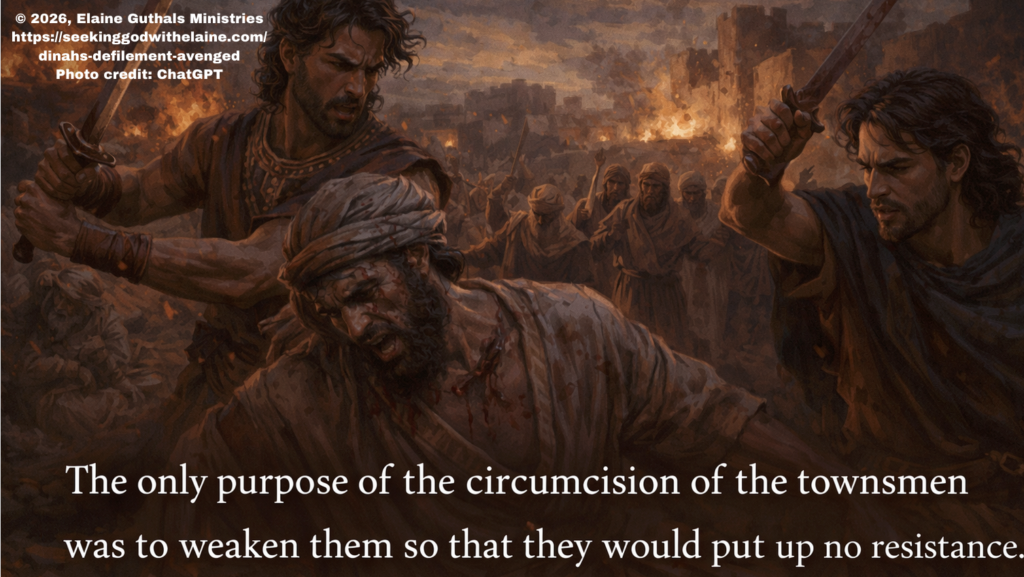
    • The circumcision procedure left the men physically weakened, allowing Simon and Levi opportunity to commit an unjust and cruel sin.
    • Jacob finally broke his silence after his sons carried out their vengeance.
    dinahs-defilement-avenged

    When we ended the last devotion, we were learning that Jacob and his sons were in negotiations between and Hamor and Shechem, the man who had defiled Dinah. Shechem said, “No matter what dowry or gift you demand, I will gladly pay it — just give me the girl as my wife” (Gen. 34: 12 NLT).

    Shechem wanted to marry the girl. What would her brothers say and do?

    Let’s Put It into Context

    To read devotions in the Creating Everything theme, click the button below.

    Devotions in the Jacob the Patriarch series

    Jacob’s Sons Respond

    “But since Shechem had defiled their sister, Dinah, Jacob’s sons responded deceitfully to Shechem and his father, Hamor. They said to them, ‘We couldn’t possibly allow this, because you’re not circumcised. It would be a disgrace for our sister to marry a man like you! But here is a solution. If every man among you will be circumcised like we are, then we will give you our daughters, and we’ll take your daughters for ourselves. We will live among you and become one people. But if you don’t agree to be circumcised, we will take her and be on our way’” (Gen. 34: 13-17 NLT)

    Jacob’s Sons Responded Deceitfully

     Dinah’s brothers were not negotiating – they were planning revenge.

    Well, deceit travels from generation to generation. Abraham lied about Sarah. Isaac lied about Rebekah. Jacob lied about so many things.

    Think about the times we’ve talked about deceit and manipulation already.

    • Deceiving Isaac (Gen. 27: 35)
    • Deceived by Laban (Gen. 29)
    • Deceiving Esau (Gen. 33: 14)
    • Used strategic manipulation in Genesis 30 against Laban

    We shouldn’t be surprised the cycle hadn’t been broken.

    No, the sin grew. Where Jacob used deception to receive a blessing, his sons now used deception to carry out vengeance.

    Let’s just stop a second because we really need to make sure we don’t miss this. This is the turning point in the chapter.

    Before this verse, the emphasis was on diplomacy and negotiation. Afterwards, the emphasis is on deception and violence.

    Moses didn’t distinguish between the brothers here. He does name names later, but here it looks like a united front. It is written like all brothers were in on the deception — even Joseph.

    We think our sin is hidden. The problem is sin grows.

    Not only that, but sin also travels. Our response to someone else’s sin can mushroom.

    You’re not Circumcised

    It wasn’t unheard of having men from other countries completed the circumcision ceremony and became Israelites.

    Sit back a second, and let’s take a look at ancient Shechem. It was a fortified settlement. Archaeological evidence shows that it had massive defensive walls with gates and towers.

    Along with the 1,000 to 5,000 residents and surrounding farmland and villages, it functioned as a regional administrative center.  It was on a major north-south trade route, the King’s Highway.

    This would have been a big deal.

    Well, they carried out their revenge by using a big deal. They used a covenant deal – circumcision.

    Yes, Gentiles could become Jewish by being circumcised. But here it became a religious boundary marker. “You’ll only be accepted if you do this.”

    Where was Jacob at in all of this? Was he even at the table? If he was, he gave the boys free reign and stayed silent.

    We don’t know if Jacob approved or disapproved of his sons’ plan. All we know is that he didn’t stop it.

    Convincing the Townsmen

    “Hamor and his son Shechem agreed to their proposal. Shechem wasted no time in acting on this request, for he wanted Jacob’s daughter desperately. Shechem was a highly respected member of his family, and he went with his father, Hamor, to present this proposal to the leaders at the town gate. ‘These men are our friends,’ they said. ‘Let’s invite them to live here among us and trade freely. Look, the land is large enough to hold them. We can take their daughters as wives and let them marry ours. But they will consider staying here and becoming one people with us only if all of our men are circumcised, just as they are. But if we do this, all their livestock and possessions will eventually be ours. Come, let’s agree to their terms and let them settle here among us.’ So all the men in the town council agreed with Hamor and Shechem, and every male in the town was circumcised” (Gen. 34: 18-24 NLT)

    Hamor and Shechem convinced the men of the city to agree to the alliance.

    Hamor and Shechem fell for it. That was because they had dollar signs in their eyes. They thought they were going to steal Jacob’s wealth.

    In that time period, court was held at the town gate. But what we see here is the extent of Hamor’s political authority.

    Hamor and Shechem convinced the townsmen that Jacob and his sons were friends. Would they have let their daughter and sister’s attacker get off scott free? I don’t think so. They would have been gathering their clansmen and riding off to Jacob’s shelters.

    The men of Shechem agreed to the plan because they, too, had dollar signs in their eyes. Not just a little, but “But if we do this, all their livestock and possessions will eventually be ours …” (Gen.  34: 23 NLT emphasis added).

    Hamor and Shechem saw Jacob and his sons as easy marks. Remember how large we said Jacob’s possessions and livestock had to be to be able to split into two camps and still make it look like one camp was all of his wealth?

    Wrong, but I wish the boys would have found another way to avenge Dinah.

    The Deceit Revealed

    “But three days later, when their wounds were still sore, two of Jacob’s sons, Simeon and Levi, who were Dinah’s full brothers, took their swords and entered the town without opposition. Then they slaughtered every male there, including Hamor and his son Shechem. They killed them with their swords, then took Dinah from Shechem’s house and returned to their camp. Meanwhile, the rest of Jacob’s sons arrived. Finding the men slaughtered, they plundered the town because their sister had been defiled there. They seized all the flocks and herds and donkeys—everything they could lay their hands on, both inside the town and outside in the fields. They looted all their wealth and plundered their houses. They also took all their little children and wives and led them away as captives” (Gen. 34: 25-29 NLT)

    The circumcision procedure left the men physically weakened, allowing Simon and Levi opportunity to commit an unjust and cruel sin.

    One man had committed a sin against Dinah. Jacob’s sons were going to take it out on the city – really, the city-state of Shechem.

    Simon and Levi didn’t have to worry about the fortified gate. They didn’t need to be concerned about being outnumbered.

    They got to focus on the killing.

    Only two of Jacob’s sons did the actual killing. All, however, took part in plundering the city, taking livestock, rounding up women and children. Again, Joseph was included in the group.

    Why just the two? One reason is the three of them were offspring of Leah. They were full brothers and sisters.

    What about Reuben, Judah, Issachar, and Zebulun? If Dinah was 15, they would have been 21, 18, 16, and 15. (Simon would have been 20, and Levi would have been 19.) They were also children of Leah?

    You know, reading this again, it doesn’t look like any but Simon and Levi knew that was what they were going to do. “Meanwhile, the rest of Jacob’s sons arrived. Finding the men slaughtered …” (Gen. 34: 27 NLT).

    It seems a little strange that Dinah was at Shechem’s house. The marriage hadn’t taken place. Still, she was kept in Shechem’s household after the assault.

    Was Dinah glad to be going home? Did they have to drag her kicking and screaming out of Shechem’s house? Was she appalled at the bloodshed?

    Regardless of the rescue of Dinah, the way they wreaked their vengeance was a sin. Yes, rape is horrible, but killing the entire male population of the town for the actions of one man is way over the top. All but Shechem were innocent of the crime for which they were punished.

    Don’t even think for one minute that they did it because of their religion. Leale called it a hypocritical pretense of religion. Bush addressed this, too. He wrote, “They knew that if the Shechemites were persuaded to submit to circumcision it would be a mere form, leaving them as to their relation to God just where they were before.”

    Resources

    Jacob’s sons may not have known the plan to steal all of Jacob’s wealth. They did know the men of Shechem weren’t going to be converts to Judaism.

    The only purpose of the circumcision of the townsmen was to weaken them so that they would put up no resistance.

    No, the eye-for-an-eye verse does not justify this (Ex. 21: 24, Lev. 24: 20, and Deut. 19:21). Eye-for-an-eye justice wasn’t about personal vengeance. It was actually a legal principle used by judges to regulate justice and limit retaliation.

    Remember the culture of the day. Clans were very quick to defend their honor with out-of-control retaliation. They wanted to make sure the punishment must not exceed the offense.

    Yep, it sure did in this instance.

    Jacob Finally Weighs In

    “Afterward Jacob said to Simeon and Levi, ‘You have ruined me! You’ve made me stink among all the people of this land — among all the Canaanites and Perizzites. We are so few that they will join forces and crush us. I will be ruined, and my entire household will be wiped out!’ ‘But why should we let him treat our sister like a prostitute?’ they retorted angrily” (Gen. 34: 30-31 NLT)

    Jacob finally broke his silence after his sons carried out their vengeance.

    I can get Jacob’s concerns, and I can get the boys’ anger. Both were right.

    Jacob saw it as life is full of one thing after another. Jesus said that was the way it was going to be. “I have told you all this so that you may have peace in me. Here on earth you will have many trials and sorrows. But take heart, because I have overcome the world” (Jn. 16: 33 ESV).

    We sometimes feel that we have to take everything into our own hands. We don’t wait and let God take care of it.

    But this was bloodshed. This wasn’t self-defense. It was flat out murder.

    And all Jacob was interested in was political retaliation. Now, Jacob would have to live in fear of of that threat.

    Jacob was putting down roots in Shechem. He bought land. Yeah, what shepherd does that?

    But since Jacob didn’t’ step up and say, “Boys, this plan of yours is wrong. It is murder!”, he had to move on.

    Making the Connections #1

    We see the focus on the family honor – which is good to have. But where were the boys’ individual morality? Even Joseph pitched in to ransack the city.

    Were they so blinded by their anger at the dishonor done to Dinah that they lost their honor? Or was this an indication of the condition of their hearts?

    We should never say, “Oh, this was Jacob and his family. Nothing bad like this should ever have happened to him.”

    Remember, it is during experiences like this this that new bricks are laid on our Sanctification Road. Even Jacob – even Reuben – even Joseph – has their own Sanctification Road. It is how we grow closer to Jehovah.

    Making the Connections #2

    This story of violence and dishonor is sandwiched between Bethel stories.

    Jacob and his family had just arrived at the end of Gensis 33. There was just one problem.

    Jacob went to Shechem, not Bethel. Yes, Shechem was the location of Abraham’s first altar. It is where he landed upon reaching the Promised Land.

    But that wasn’t where Jacob was commanded to go. He was supposed to go to Bethel. If we look at our timeline (which we’ll discuss more fully in the next devotion), it looks like Jacob could have stayed in Shechem for over 10 years.

    That isn’t following Jehovah back to Bethel. “And this memorial pillar I have set up will become a place for worshiping God, and I will present to God a tenth of everything he gives me” (Gen. 28: 22 NLT).

    We’ll find out in Genesis 35 that Jehovah clearly commands Jacob to go to Bethel. Good things happen, which we will get into next.

    The takeaway here is that Sovereign God will pull us back when we sin.

    Making the Connections #3

    Let’s look at the escalation of sin.

    • Dinah left the covenant compound.
    • She was met with sexual violence.
    • A political compromise was offered to lull believers into assimilation with non-believers.
    • Jacob’s sons as well as Hamor and Shechem were deceitful.
    • The boys used something sacred as a weapon of violence.
    • Revenge became mass murder.
    • Plundering and enslavement topped whole sad affair.

    So, it started out with the sin of one man. It escalated to a family’s response. A whole town was destroyed.

    How Do We Apply This?

    • Understand no one is above God’s Laws.
    • Don’t allow our grief or anger lead us into sin.

    Resource

    Father God. We say two wrongs don’t make a right. That was especially true in this case — and a whole town suffered because humans think it does. Forgive us when we struck back after suffering a devastating experience. Amen.

    If you don’t understand something and would like further clarification, please contact me.

    If you have not signed up for the email providing the link to the devotions and the newsletter, do so below.

    If God has used this devotion to speak with you, consider sharing it on social media.
  • The Defilement of Dinah

    We’ve made our way to Genesis 34, a chapter that is hard to read. This devotional reading looks at the lust, vengeful violence, and deception caused by one act of sin.

    Nuggets

    • Dinah was the only daughter that we know of born to Jacob.
    • Jacob had moved his family to Shechem upon return from Paddan-aram.
    • Shechem seemed like he wanted to make amends for forcing himself on Dinah.
      Rape, in the Ancient Near East culture, was primarily considered an offense against the woman’s family.
    • Since Shechem had fallen in love with Dinah, a required marriage fit into his plans.
    • Whether Jacob was stunned by the turn of events or biding his time for the boys to get home, he and his household faced a really dreadful calamity.
    • While there was no indication of remorse in the rape of Dinah, a bigger alliance than just a marriage was being offered.
    the-defilement-of-dinah

    This story is one of the saddest ones in God’s Word. We can’t look at it through the lens of today’s society, though. We have to look at it through Ancient Near Eastern culture.

    Even when we get a better idea of the cultural backdrop, we see that the of  actions taken by Shechem can’t be justified.

    But then, the consequences of those actions were not justifiable, either. Let’s jump into this sad story.

    Let’s Put It into Context

    To read devotions in the Creating Everything theme, click the button below.

    Devotions in the Jacob the Patriarch series

    The Defiling of Dinah

    “One day Dinah, the daughter of Jacob and Leah, went to visit some of the young women who lived in the area. But when the local prince, Shechem son of Hamor the Hivite, saw Dinah, he seized her and raped her.But then he fell in love with her, and he tried to win her affection with tender words. He said to his father, Hamor, “Get me this young girl. I want to marry her’” (Gen. 34: 1-4 NLT)

    Dinah Went to Visit

    Dinah was the only daughter that we know of born to Jacob.

    Dinah was the daughter of Jacob and Leah. “Later she gave birth to a daughter and named her Dinah” (Gen. 30: 21 NLT).

    So, where did Dinah come in on the baby war?

    1716 BC – Jacob, 84, was tricked into marrying Leah. He agreed to work seven more years for Rachel
    ~1715 BC — Reuben born (Leah)
    ~1714 BC — Simeon born (Leah)
    ~1713 BC — Levi born (Leah)
    ~1712 BC — Judah born (Leah)
    ~1712 BC — Dan born (Bilhah)
    ~1711 BC — Naphtali born (Bilhah)
    ~1711 BC — Gad born (Zilpah)
    ~1710 BC — Asher born (Zilpah)
    ~1710 BC — Issachar born (Leah)
    ~1709 BC — Zebulun born (Leah)
    ~1709 BC — Dinah born (Leah)
    1709 BC – Joseph was born (Rachel)
    1703 BC – Jacob, 97, and his family left to return to Canaan (Gen. 31: 3)

    Based on Timeline from

    We know that Dinah fit in between Zebulon and Joseph. She would have been around seven when Jacob moved the family back to Canaan.

    The thing is that we don’t know how long Jacob had been in the land. Ness and Kalisch estimated that it was six to eight years. That would have made Dinah around 13 to 15 – marriageable age.

    Resources

    While she was not yet married (which usually happened when they were 15 to 17 years old, she was old enough to —apparently — go out on her own. Dinah interacted socially with Canaanite women of the area.

     Lived in the Area

    Jacob had moved his family to Shechem upon return from Paddan-aram.

    We have to put things into perspective. When we left Jacob in Genesis 33, we had just been told that he had bought some land.

    “Later, having traveled all the way from Paddan-aram, Jacob arrived safely at the town of Shechem, in the land of Canaan. There he set up camp outside the town. Jacob bought the plot of land where he camped from the family of Hamor, the father of Shechem, for 100 pieces of silver” (Gen. 33: 18-19 NLT).

    Jacob would have moved his family to Shechem in 1703 BC. Dinah would have been seven at the time.

    If she was a teenager in this story, that would have put it at least five years at a minimum after the family moved into the area.

    It appears that Dinah had become friendly with other girls in the neighborhood. One day, she paid them a visit. An Ancient Near East teenager would typically do this.

    Leale thought Dinah had developed a curiosity about her new homeland. When we move somewhere new, it is understandable to want to learn that areas customs and way.

    Resource

    But as people who walk with Jehovah, we have to watch very carefully that we aren’t reeled into walking away from Him. The world and its glitter can be very tempting – especially to a teenager.

    Shechem

    Shechem seemed like he wanted to make amends for forcing himself on Dinah.

    We know a couple of things about Shechem.

    • He was a prince.
    • His father’s name was Hamor — remember Jacob – who hadn’t owned land before – had bought this land from the family of Hamor.
    • Hamor was a Hivite.

    We haven’t talked about Hivites before, but they are important in the history of Israel.  This was one of the nations the Israelites were told that Jehovah would clear out of Canaan upon their return from captivity in Egypt (Deut. 7: 1).

    As well as living here at the city of Shechem, Hivites lived in the region of Gibeon. This group tricked Joshua and the Israelites into making a treaty with them (Josh. 9).

    It is believed that the Hivites could be either city-dwelling or agriculturally based. Under local prince’s rule, some cities like Shechem were organized as small kingdoms.

    This is an element that upped the ante a bit. When the marriage proposal was introduced in a couple of verses, Hamor suggestions of intermarriage, shared land, and economic integration were not things Jehovah wanted.

    Why did Jehovah want the Hebrews intermingling with the Canaanite people? “You must not intermarry with them. Do not let your daughters and sons marry their sons and daughters, for they will lead your children away from me to worship other gods. Then the anger of the Lord will burn against you, and he will quickly destroy you” (Deut. 7: 3-4 NLT).

    Israelites tended to adopt Canaanite customs – especially idol worship – when alliances were formed.

    Anyway, back to Shechem.

    Seized and Raped Her

    Rape, in the Ancient Near East culture, was primarily considered an offense against the woman’s family.

    Versions in the Sefaria Library run the gamut on the word used to describe Shechem’s actions toward Dinah.

    • Lay
    • Humbled
    • Mistreated
    • Disgraced/violated
    • Forced/defiled

    Resource

    Some scholars, though, do not think this should be classified as a rape. They point to her silence in trying to defend herself by calling out.

    Did you catch that Dinah said nothing during this whole chapter. But the whole chapter started with her honor and ended with her honor.

    If we go back to the Hebrew for verse 2, we see the words do cry rape. These are

    •          “took her” (lāqaḥ) – forceful taking
    •          “lay with her” (šākab) – sexual relations
    •          “humiliated/defiled” (ʿānâ) – violation or dishonor

    Kadari documented some of the interpretations in the Midrash and Aggadah. I have to be honest. Some of the rabbinical interpretations presented to fill in the gaps – for me – were really out there. One such interpretation noted Dinah’s desire to be noticed as she visited the Canaanite daughters.

    Resource

    Whatever Shechem’s actions were, the outcome had disastrous results for Dinah. Adelman explained. She wrote,

    “In the biblical world of the Ancient Near East, when a virgin had sex out of wedlock — whether seduced or raped — she was devalued in terms of her social status, bringing shame upon the family. Her virginity was crucial in negotiations over bride-price and the familial alliances forged through marriage. In the legal discourse around sexual intercourse with a virgin outside of wedlock, whether she was betrothed to another man or not, the woman was presumed to have consented if she did not cry out in protest in the city or town, and to have been raped if she was taken in the open country where her cries could not have been heard (Deuteronomy 22:23-29).  The woman’s will or testimony was simply not taken into account.”

    Resource

    I keep thinking this may just be another example of Moses’ brevity of information. Whether the act was committed through violence or promiscuity, it was committed.

    The outcome was the same. Dinah’s mohar (bride-price) just went down big time.

    But did it? “Suppose a man has intercourse with a young woman who is a virgin but is not engaged to be married. If they are discovered, he must pay her father fifty pieces of silver. Then he must marry the young woman because he violated her, and he may never divorce her as long as he lives” (Deut. 22: 28-29 NLT).

    Jehovah established consequences that allowed victims to be united in marriage with their violator.

    It was interesting that Kalisch equated this with two other accounts where the women in Abraham’s line were taken by the leaders of the area they were in. Sarah was taken by Pharaoh, and Rebekah was taken by Abimelech.

    The difference, of course, in those two cases were that the men – Abraham and Isaac – lied, saying their wives were their sisters.

    Here, Jacob did everything right (that we can tell). Where the older women were probably taken to establish alliances, this sounds like pure lust on Shechem’s part.

    The difference here, too, was that Dinah was defiled. Sarah and Rebekah weren’t.

    Look at what Kalisch said about this. He wrote,

    “She paid the full penalty of her carelessness. She suffered the fate which Sarah and Rebekah encountered in the land of Pharaoh and of Abimelech; she was seen and taken by the son of the prince; but no angel guarded her innocence; no Divine vision shielded her from disgrace; and she fell a victim to Shechem’s passion. She did not require that immediate protection which her ancestors had enjoyed; she was a maiden, no wife; her father possessed a piece of land within which he was safe; and she belonged to a numerous family well capable of defending their rights.”

    Resource

    This instance turned out very differently. One reason was probably because she was never chosen to bear a covenant son.

    He Fell in Love with Her

    Since Shechem had fallen in love with Dinah, a required marriage fit into his plans.

    But then the plot thickens. Shechem fell in love with Dinah. He wanted her for his wife.

    No, I don’t think that should excuse Shechem; but under other circumstances, that would have been a benefit to a forced marriage.

    Regardless of whether he forced or seduced Dinah, Shechem did the right thing and pursued marriage.

    So, Shechem sent his dad Hamor to negotiate with Jacob so he could have Dinah as his wife. This was normally the way the negotiations worked. It’s called standard patriarchal marriage diplomacy.

    We’ve talked about the marriage negotiations before – and it was negotiations!

    True, a big part was the mohar or bride price. It was a transfer of wealth. It could be silver, animals, or some other valuables.

    No, the Law hadn’t been given yet. But Jehovah is the same yesterday, today, and tomorrow.  I think this forced marriage with the bride-price would have been required anytime the offense occurred.

    Jacob’s Response

    “Soon Jacob heard that Shechem had defiled his daughter, Dinah. But since his sons were out in the fields herding his livestock, he said nothing until they returned. Hamor, Shechem’s father, came to discuss the matter with Jacob. Meanwhile, Jacob’s sons had come in from the field as soon as they heard what had happened. They were shocked and furious that their sister had been raped. Shechem had done a disgraceful thing against Jacob’s family, something that should never be done” (Gen. 34: 5-7 NLT)

    Whether Jacob was stunned by the turn of events or biding his time for the boys to get home, he and his household faced a really dreadful calamity.

    In the New Living Translation in these verses, Jacob is portrayed as someone who wants to keep peaceful relations with those around him. That makes us think of Abraham. We can see his response to the situation stemming from that.

    In the Complete Jewish Bible, though, it says that Jacob had to restrain himself until his sons came back. They are described as saddened and very angry.

    That would put Jacob’s feelings on par with those of his sons.

    But let’s put it into context again. We said that rape, in the Ancient Ner East culture, was primarily considered an offense against the woman’s family. That meant it affected more than just dear old dad. It affected brothers, too.

    Think clan mentality. This was clan business. Honor issues required a family response.

    But remember, Hamor was a prince. Shechem himself was probably a powerful local ruler. Jacob would have been a resident alien.

    Hamor did his part. He went to see Jacob. It sounds like he, too, wanted to make the situation right. He wanted to work the established process.

    If we look at verse 7 in the Orthodox Jewish Bible, it says that the offense was against Israel. Not Jacob. Not his family.

    Against the nation. This is the first time the nation of Israel is addressed. They are starting to get their identity.

    The Negotiations

    “Hamor tried to speak with Jacob and his sons. ‘My son Shechem is truly in love with your daughter,’ he said. ‘Please let him marry her. In fact, let’s arrange other marriages, too. You give us your daughters for our sons, and we will give you our daughters for your sons. And you may live among us; the land is open to you! Settle here and trade with us. And feel free to buy property in the area.’ Then Shechem himself spoke to Dinah’s father and brothers. ‘Please be kind to me, and let me marry her,’ he begged. ‘I will give you whatever you ask. No matter what dowry or gift you demand, I will gladly pay it — just give me the girl as my wife’” (Gen. 34: 8-12 NLT)

    While there was no indication of remorse in the rape of Dinah, a bigger alliance than just a marriage was being offered.

    Hamor didn’t say a word about the rape. He offers a political integration:

    • Intermarriage
    • Shared land
    • Economic cooperation

    Yeah, it sounded like a treaty deal, didn’t it?

    If Hamor wasn’t going to address it, why did Shechem feel he had done something wrong?

    But wasn’t Shechem offering the normal bride price and gifts? Plus, he added he would do whatever was demanded – as long as he got the girl.

    God did not want Jacob’s sons marrying the local girls. It is sad that He allowed it to go to this length to make it so.

    Making the Connections #1

    We all know that sin can bring fairly immediate consequences. Depending on how long a time had occurred from arrival in Shechem to the disastrous visit to Canaanite daughters, this may or may not have been the case.

    But it may have been punishment for sin. Look back at some verses.

    ·      “What’s more, I am with you, and I will protect you wherever you go. One day I will bring you back to this land. I will not leave you until I have finished giving you everything I have promised you” (Gen. 28: 15 NLT).
    ·      “I am the God of Bethel, where you anointed a pillar and where you made a vow to me. Now leave this land at once and go back to your native land” (Gen. 31: 13 NIV).

    Jacob, that night at Bethel, said his condition was that he bring him back to his father’s house (Gen. 28: 21).

    Meyer argued that Jacob was not where he was supposed to be. “God had not said, Go to Shechem; but, “I am the God of Bethel.” Bethel, rather than Shechem, was his appointed goal.”

    Resource

    We can’t bite on Jacob for disobeying Sovereign God when we do the same thing. We either don’t listen or decide to do things our own way.

    Meyer took Jacob’s disobedience one step farther. He set up his new home before the Shechem (just as Lot did before Sodom).

    Making the Connections #2

    Was this Satan trying to get Jacob to disobey Jehovah and allow intermarriage with the Canaanites? Maybe. Maybe not.

    Making the Connections #3

    The issue wasn’t whether or not Shechem loved Dinah. We know he wanted her.

    The issue was that Jacob’s family was not to intermarry with the Canaanites. That is why Abraham sent Eliezer to get Isaac a wife. That is why Jacob went himself.

    The covenant line needed covenant people from Abraham’s extended family to ensure a pure bloodline.

    How Do We Apply This?

    • Recognize that even believers will face trials.
    • Accept that the faith of the parents is not always reflected in their children.

    Resources

    Father God. Sin is a terrible thing. When we sin reacting to a sim, that is worse. Help us to focus on You. Amen.

    If you don’t understand something and would like further clarification, please contact me.

    If you have not signed up for the email providing the link to the devotions and the newsletter, do so below.

    If God has used this devotion to speak with you, consider sharing it on social media.
  • Jacob and Esau Part Company

    After Jacob and Esau’s emotional reunion, it was time to move on. This devotional reading will look at whether they stayed together or separated.

    Nuggets

    • The time had come for Jacob and Esau to leave where they were.
    • Jacob refused Esau’s offer to send some of his men with Jacob as protection.
    • Instead of going to Seir, Jacob ended up in Shechem.
    jacob-and-esau-part-company

    The meeting with Esau turned out much better than Jacob had hoped or dream. They were reconciled.

    But how was their parting? Did they stay together or part on bad terms again?

    Let’s Put It into Context

    To read devotions in the Creating Everything theme, click the button below.

    Devotions in the Jacob the Patriarch series

    Moving On

    “‘Well,’ Esau said, ‘let’s be going. I will lead the way.’ But Jacob replied, ‘You can see, my lord, that some of the children are very young, and the flocks and herds have their young, too. If they are driven too hard, even for one day, all the animals could die. Please, my lord, go ahead of your servant. We will follow slowly, at a pace that is comfortable for the livestock and the children. I will meet you at Seir’” (Gen. 33: 12-14 NLT)

    Time had come for Jacob and Esau to leave where they were.

    We may think it was nice that Esau had reconciled enough to offer to travel ahead of Jacob to offer mutual protection. What we may or may not know is that was probably Esau’s attempt attempt to form an alliance. Another reason may have been that Esau saw it as shared leadership.

    What the Hebrew really said, though, was proceed at your pace. Going alongside of you is a whole lot different than blazing the trail, which is what the New Living Translation implies.

    Smith suggested that Jacob was still a little afraid of Esau. We don’t know how long their hugging/weeping/kissing/catching up session lasted. Was it a couple of hours or a couple of days!

    Resource

    Maybe. But maybe Jehovah told Jacob that, deep down, Esau still was not following Him. He probably didn’t want an alliance between the twins.

    Smith pointed out that Jacob would need to raise his sons to understand and follow the Abraham’s covenant. It wasn’t just the firstborn who would be the covenant son.

    Jacob declined the offer politely. He noted they would have to move slower. That was true.

    The reason Jacob gave first was probably correct. He would only be able to drive the herds and flocks only so quickly.

    We estimated the age of the kids.

    1716 BC – Jacob, 84, was tricked into marrying Leah. He agreed to work seven more years for Rachel
    ~1715 BC — Reuben born (Leah)
    ~1714 BC — Simeon born (Leah)
    ~1713 BC — Levi born (Leah)
    ~1712 BC — Judah born (Leah)
    ~1712 BC — Dan born (Bilhah)
    ~1711 BC — Naphtali born (Bilhah)
    ~1711 BC — Gad born (Zilpah)
    ~1710 BC — Asher born (Zilpah)
    ~1710 BC — Issachar born (Leah)
    ~1709 BC — Zebulun born (Leah)
    1709 BC – Joseph was born (Rachel)
    1703 BC – Jacob, 97, and his family left to return to Canaan (Gen. 31: 3)
    1680 BC – Isaac died at the age of 180 (Gen. 35: 28-29)

    Based on Timeline from

    Joseph and Zebulun may have been 6. Issachar and Asher may have been 7. Gad and Naphtali may have been 8. Dan and Judah may have been 9. Levi, Simeon, and Reuben may have been 10, 11, and 12 respectively.

    Kalisch thought Jacob’s fear of Jacob was exaggerated but warranted. He knew Esau’s character. If it had changed, it might revert at any time.

    Resource

    Jacob agreed to meet Esau in Seir. That may seem strange — especially since he didn’t go — but hospitality etiquette would have ensured that Esau would keep Jacob safe.

    Moving Apart

    “‘All right,’ Esau said, ‘but at least let me assign some of my men to guide and protect you.’ Jacob responded, ‘That’s not necessary. It’s enough that you’ve received me warmly, my lord!’ So Esau turned around and started back to Seir that same day.  Jacob, on the other hand, traveled on to Succoth. There he built himself a house and made shelters for his livestock. That is why the place was named Succoth (which means ‘shelters’)” (Gen. 33: 15-17 NLT)

    Jacob refused Esau’s offer to send some of his men with Jacob as protection.

    Is it strange that Jacob didn’t want to travel with Esau or any of his men? Well, he had been on his own for 20 years. I bet that would have been an independent person.

    But if Esau was going for a political alliance, Jacob didn’t seem like he wanted anything to do with that.

    But where was Jacob heading to in the first place? Was he going to Esau or Isaac? If he was going to Isaac, that would have been through Sukkot and Shechem — the way he ended up going.

    So, did Jacob lie?

    HaCohen gave one explanation. What if Jacob previously lived in Seir? Look what HaCohen wrote.

    “As I argued in my “Locating Beer-lahai-roi” (TheTorah 2014), the story of Jacob stealing his brother’s blessing (Genesis 27) is set in the area of Ein el-Chai, biblical Beer-lahai-roi, a site midway between Siq el-Bared (biblical Bered) and Ein el-Musa (biblical Kadesh), on the outskirts of Petra (Gen 16:14). In fact, the Torah is explicit elsewhere that this is where Isaac lived …”

    Resource

    Maybe Jacob was going to both Esau and Isaac. I do not believe — and God’s Word never tells us — that Jacob ever lived in Seir.

    I have to process this. We know Isaac lived at Beer-lahai-roi before he and Rebekah were married (Gen. 24: 62). He was still there when Abraham died (Gen. 25: 11).

    Genesis 26 talked about Isaac and Rebekah moving to Gerar. I am of the opinion that happened before the twins were born. Even if it happened after the boys were 15, it would be obvious that Rebekah was a mother. The whole Abimelech episode wouldn’t have happened if he would have known that.

    Isaac moved to Beersheba in Genesis 26: 23. We know they are still there when Jacob leaves for Paddan-aram because that is from where he left (Gen. 27: 10).

    Maybe Isaac had moved back to Beer-lahai-roi sometime in the 20 years. We do know, though, that when he died 23 years later, he lived in Mamre — renamed Hebron (Gen. 35: 27-29).

    But the problem is that most think Beer-lahai-roi was not in Seir, as HaCohen had it.

    There may have been a deeper reason Jacob didn’t go with Esau to Seir. “And the Lord told her, ‘The sons in your womb will become two nations. From the very beginning, the two nations will be rivals. One nation will be stronger than the other; and your older son will serve your younger son’” (Gen. 25: 23 NLT).

    They were to become separate nations. Jacob’s future had long been known to be Canaan. Esau’s territory was Seir/Edom.

    To me, this might be another Abraham/Lot situation. We are told Jacob has a lot of livestock. We aren’t really told about Esau, but he probably had a herd and flock or two.

    Jacob went to Succoth and, basically, built a house. He built shelters for the livestock.

    Going a Different Ways

    “Later, having traveled all the way from Paddan-aram, Jacob arrived safely at the town of Shechem, in the land of Canaan. There he set up camp outside the town.  Jacob bought the plot of land where he camped from the family of Hamor, the father of Shechem, for 100 pieces of silver.  And there he built an altar and named it El-Elohe-Israel” (Gen. 33: 18-20 NLT)

    Instead of going to Seir, Jacob ended up in Shechem.

    This is the first time Jacob is said to have built an altar. What he did at Bethel was a standing stone (a memorial).

    We need to remember the significance of Shechem. “… When they arrived in Canaan, Abram traveled through the land as far as Shechem. There he set up camp beside the oak of Moreh. At that time, the area was inhabited by Canaanites.” (Gen. 12: 5-6 NLT).

    Jehovah had not only brought Jacob back to the land promised to Abraham but also to the first place that we know Abraham built an altar.

    So many emotions probably prompted Jacob to build this altar. He was thankful that Jehovah had brought him home — and given him comfort and guidance throughout the 20 years.

    It was probably the first time that Jacob felt he could build an altar on which to worship God and how his faith. True, he probably lived on land owned by Laban — and you would think Laban should have been okay with that.

    But this is the first time we are told that Jacob bought land. “Jacob bought the plot of land where he camped from the family of Hamor, the father of Shechem, for 100 pieces of silver” (Gen. 33: 19 NLT).

    More importantly, Jacob now probably had the hope of the covenant — and the realization that he was truly the covenant son. Yes, he grew up hearing about it from Abraham and Isaac.

    Now, after all that had happened, it was real. It was real because Jacob was walking more closely with Jehovah. He knew he could depend on Jehovah’s promises.

    I like what Jacob called the altar that he built – El-Elohe-Israel (God, the God of Israel). Jacob was owning his new identity.

    Look what Sherwood said. He wrote, “Only when he ceased to rely on his own strength, and resorted to the weapon of prayer, did he succeed. So it is ever with the Christian.”

    Resource

    We should follow Jacob’s example.

    But I think Jacob’s destination was always Bethel. Shechem wasn’t far from Bethel.

    Making the Connections #1

    I love the story Guthrie told about reconciliation. He wrote,

    “A man lying under sentence of death has sent off a petition for mercy, and waits the answer in anxious suspense. One day his ear catches rapid steps approach his door — they stop there. The chain is dropped; the bolts are drawn; a messenger enters with his fate; the sovereign pities the criminal, but cannot pardon the crime. His hopes dashed to the ground, he gives himself up for lost. And now the messenger draws near, and tells him that if the king’s son would change places with him and die in his room, that would satisfy justice, and set him free. Drowning men will catch at straws; not he at that. The king give up his son! If there is no hope but that, there is no hope at all! Now fancy, if you can, his astonishment, sinking to incredulity, and then rising into a paroxysm of joy, when the messenger says, I am the king’s son; it is my own wish, and my father’s will that I should die for you; take you the pardon, and give me the fetters. In me shall the crime be punished; in you shall the criminal be saved. Such love never was shown by man; only by God. Did David, when he considered the heavens the work of God’s fingers, exclaim, What is man that Thou art mindful of him? How much more may God’s people break out into expressions of adoring wonder, when they stand beneath the Cross.”

    Resource

    No, it really isn’t about Jacob and Esau.

    But this story is about true reconciliation. That is true atonement.

    Making the Connections #2

    This chapter has had everything, hasn’t it?

    • Divine provision
    • Fear
    • Transformation
    • Covenant understanding and acceptance
    • Reconciliation
    • Mercy

    Yes, we all have our own Sanctification Roads.

    One thing we might not recognize is that the whole chapter reads like a formal reconciliation ceremony. Let’s look at the clear example of Ancient Near Eastern diplomacy.

    • Fear of confrontation
    • Tribute gifts
    • Submission gestures
    • Approach with bows
    • Emotional reconciliation
    • Gift exchange
    • Escort offer
    • Peaceful separation

    According to established cultural rules of honor and reconciliation, Esau and Jacob’s relationship was fully restored.

    Jacob apologized for his devotion. But he also restored Esau’s honor.

    Making the Connections #3

    One thing that it is easy to forget is that the twins were 97 years old. They were 77 when Jacob left, and that was 20 years ago.

    They were not young heroes going to battle against their foe from their early adulthood. True, Isaac lived to 180, but Jacob didn’t.

    I doubt that Esau was a reckless man charging toward Jacob. But he would have been a seasoned soldier by then.

    Remember, Esau was his own nation. So, he was a patriarch as much as Jacob was.

    How Do We Apply This?

    • Put our faith and trust in Jehovah.

    Father God. You want us to be at peace with others. We also know that there are those You don’t want us to be around. Help us to associate those who live for You. Amen.

    If you don’t understand something and would like further clarification, please contact me.

    If you have not signed up for the email providing the link to the devotions and the newsletter, do so below.

    If God has used this devotion to speak with you, consider sharing it on social media.
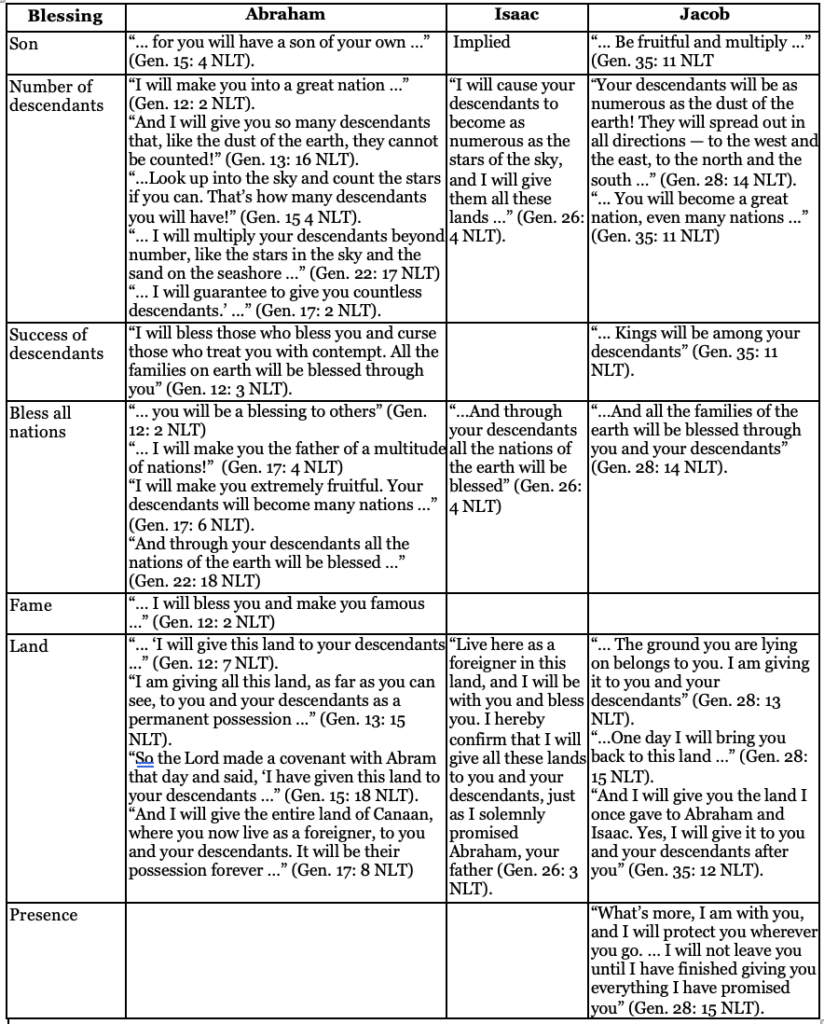
  • Go Light Your World

    Today is a music day.

    I thought I was farther along on my post than I was. When we took our road trip today, I thought there wouldn’t be that much left for me to do.

    Wrong.

    Plus, in 20 minutes, we are going to lose electricity. There needs to be some line maintenance done after it was knocked out two different times during one snow storm.

    So. here you go.

    Go Light Your World
    Vocalist: Elaine Guthals
    Keyboard: Louise Guthals Weiss

    What do you think?

    Leave me a comment below (about this or anything else) or head over to my Facebook group for some interactive discussion.

    If you don’t understand something and would like further clarification, please contact me.

    If you have not signed up for the email daily or weekly providing the link to the devotions and the newsletter, do so below.

    If God has used this devotion to speak with you, consider sharing it on social media.
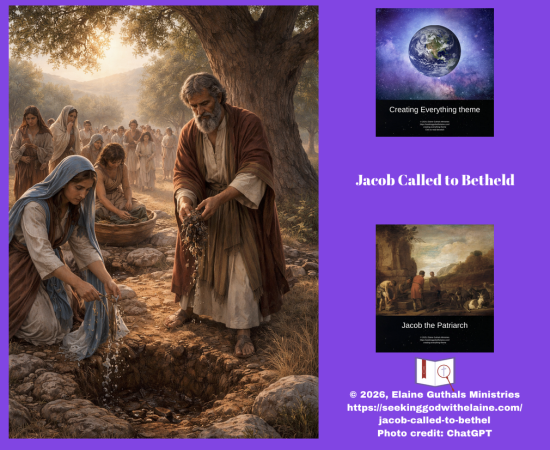
  • Jacob and Esau Were Reconciled

    Jacob must have gotten up that morning thinking, “Today is the day.” This devotional reading looks at Jacob and Esau’s meeting after 20 years – and how it didn’t go as planned.

    Nuggets

    • Morning had arrived and so had Esau.
    • Jacob showed that he was cautious and still thought strategically by dividing his family into groups.
    • We need to understand the cultural significance of “… he bowed to the ground seven times before him” (Gen. 33: 3 NLT).
    • Instead of vengeance, Esau offered Jacob reconciliation.
    • Esau saw Jacob’s family as a blessing.
    • Esau questioned the gifts from Jacob.
    • We may think Jacob’s comment about seeing Esau’s face was “… like seeing the face of God!” (Gen. 33: 10 NLT) equated the two, but it didn’t.
    • Jacob was asking Esau to accept this blessing.
    jacob-and-esau-were-reconciled

    The Jacob/Esau story had been a long time in the making. From Genesis 25 — when Jacob stole the birthright when they were probably age 15 — through stealing the blessing at age 77 all the way up to now at age 97 when Jacob returned with wives and much livestock.

    1820 BC – Isaac, at age 40, married Rebekah (Gen. 25: 20)
    1800 BC – Jacob and Esau were born (Gen. 25: 24-26)
    1785 BC – Esau sold the birth right to Jacob in exchange for lentil stew Jacob was cooking while mourning for Abraham
    1723 BC – Jacob cheated Esau (both age 77) out of the birthright blessing given by Isaac (age 137). He flees Canaan to Paddan-aram to Rebekah’s family. He agrees to work seven years to earn the right to marry Rachel (Gen. 29: 1-20)
    1716 – Jacob, 84, was tricked into marrying Leah. He agrees to work seven more years for Rachel
    1709 BC – Jacob, 91, finished working seven years for Rachel and agreed to continuing working for Laban to build up his personal wealth.
    1709 BC – Joseph was born
    1703 BC – Jacob, 97, and his family left to return to Canaan (Gen. 31: 3)

    Based on Timeline from

    Twenty years was a long time, but was Esau able to hold a grudge against Jacob all that time?

    How would Esau feel now about Jacob’s deceit?

    Let’s Put It into Context

    To read devotions in the Creating Everything theme, click the button below.

    Devotions in the Jacob the Patriarch series

    The Meeting Anticipated

    “Then Jacob looked up and saw Esau coming with his 400 men. So he divided the children among Leah, Rachel, and his two servant wives. He put the servant wives and their children at the front, Leah and her children next, and Rachel and Joseph last. Then Jacob went on ahead. As he approached his brother, he bowed to the ground seven times before him” (Gen. 33: 1-3 NLT)

    Saw Esau Coming

    Morning had arrived and so had Esau.

    Jacob had spent the night wrestling with Sovereign God. One look at Esau and his 400 men brought the fear crushing back. The number is significant.

    We are probably looking at a couple of Ancient Near East practices.

    • An Ancient Near Eastern leader would travel with a large entourage to show his strength and ensure the honor he deserved.
    • The number conveys a military potential, the size of a clan chief’s war band.

    Gray wondered if maybe Esau did initially come to meet Jacob to exact revenge. Maybe Jehovah worked on his heart and flipped it – as He did Laban’s.

    Resource

    One sermon I read said that Jehovah had, even if it doesn’t tell us, appeased Esau like He had Laban. Well, yes and no. Jehovah may have appeared, but the outcome was different.

    Resource

    Laban attributed Jehovah’s intervention in everything. He was blessed because of Jacob (Gen. 30: 27). He responded without force when it reads as if he was chomping at the bit to do so (Gen. 31: 29). But Laban left in peace — sort of.

    We are never expressly told that Jehovah intervened with Esau. It looks like He providentially softened Esau. The reunion had a much happier ending!

    Who knows when the change of heart came. Maybe Esau was just trying to show his power.

    Though seeing all the wealth in the gifts of livestock, Esau knew Jacob hadn’t had an easy life.

    Divided the Family

    Jacob showed that he was still cautious and thought strategically by dividing his family into groups.

    Jacob always had his favorites. It looks like does so now as he lines them up from the least favored to the most favored.

    But Jacob also uses the family hierarchy. The concubines come before the wives.

    The difference is that Leah, as first wife, comes before Rachel, as second wife. That makes Rachel and Joseph the most protected.

    Jacob Went on Ahead

    Even though Jacob divided his family into groups, he went before them.

    This is huge. Jacob was approaching Esau after 20 years. He was not running. He was not scheming. He was not hiding behind deception.

    Jacob was limping. He was limping toward the brother he wronged — the one who even now might be fixing to kill him.

    One thing is for sure – Jacob was not the strong man who left Beersheba. He now had what many would see in his day as a permanent weakness.

    But neither did Jacob now feel the fear that drove him away. (Oh, he was still afraid of Esau, but he put his trust in Jehovah.)

    He had learned humility. He was now full of hope and confidence because he had wrestled with Jehovah and prevailed.

    Jehovah’s work was more than just an internal transformation. He changed the way Jacob walked into reconciliation. As Gray said Jacob “… — the prevailer — does not fear to meet the first storm of his brother’s rage.”

    Resource

    Bowed to the Ground Seven Times

    We need to understand the cultural significance of “… he bowed to the ground seven times before him” (Gen. 33: 3 NLT).

    As disciples of Christ, we see the number seven and think completion. That isn’t the case here.

    When a person in the Ancient Near East bowed seven times, they were showing a formal diplomatic gesture of submission and repentance. Yes, it was an Ancient Near East custom, but it has a huge significance for Jacob.

    Twenty year prior, Jacob had stolen the blessing from Esau. Now, he was acting like the younger brother again. He was giving Esau the submission and respect he deserved while acknowledging his authority.

    Jacob was righting the social order between him and Esau. He removed the insult that he gave to Esau.

    We may think of Jacob’s language of my lord/your servant as something inappropriate between brothers. But it was common dialogue between brothers and relatives.

    The Meeting Took Place

    “Then Esau ran to meet him and embraced him, threw his arms around his neck, and kissed him. And they both wept. Then Esau looked at the women and children and asked, ‘Who are these people with you?’ These are the children God has graciously given to me, your servant,’ Jacob replied. Then the servant wives came forward with their children and bowed before him. Next came Leah with her children, and they bowed before him. Finally, Joseph and Rachel came forward and bowed before him. ‘And what were all the flocks and herds I met as I came?’ Esau asked. Jacob replied, ‘They are a gift, my lord, to ensure your friendship.’  ‘My brother, I have plenty,’ Esau answered. ‘Keep what you have for yourself.’ But Jacob insisted, ‘No, if I have found favor with you, please accept this gift from me. And what a relief to see your friendly smile. It is like seeing the face of God! Please take this gift I have brought you, for God has been very gracious to me. I have more than enough.’ And because Jacob insisted, Esau finally accepted the gift” (Gen. 33: 4-11 NLT)

    Esau Ran to Meet Him

    Instead of vengeance, Esau offered Jacob reconciliation.

    I guess that Esau didn’t get the memo that Hebrew men do not run. It was undignified as they had to lift up their robes in order to complete the activity. Running was for the young – and face it, the twins weren’t young.

    But this is telling me how strong Esau’s emotions were. He was not only willing but also eager to reconcile with his brother.

    Ooo, baby. I bet Jacob was surprised to see Esau running toward him. That was not the welcome-home response that ever entered Jacob’s mind.

    Neither did Jacob expect the tears. That act — including falling on Jacob’s neck and kissing him — truly showed Esau’s heart and coming from a point of restored kinship.

    Esau was exhibiting all the actions of reconciliation. He ran, embraced, kissed, and wept. The deep emotions were clearly evident.

    But the meaning behind all of those emotions are precious. We see urgency, initiative, acceptance, reconciliation, and healing.

    If Jacob had changed, so had Esau.

    How many times do we expect something to go down one way, and it occurs totally the opposite?

    We base our determinations on the old Tom or Sally — and the old Elaine. Or we generalize some other experience we have had with experience at hand. Maybe worse, we take what we think we have seen happen to someone else and apply it to our situation.

    We need to follow God. God said He was bringing Jacob back. Esau was still there. That meant Jacob and Esau were going to have to live together somehow.

    We have to have faith that God will change our Esau’s as he changes us.

    Who Are These People

    Esau saw Jacob’s family as a blessing.

    We may read Esau’s question as a little terse. It wasn’t.

    Esau was recognizing Jacob’s family. He knew families were a blessing (Gen. 1: 28).

    This allowed Jacob to acknowledge they were a gift from Jehovah. It was further evidence to Esau that Jacob had changed.

    Each group came forward and bowed before Esau. This was symbolic restitution. Even though Jacob once stole Esau’s blessing, his entire household now honored Esau.

    Flocks and Herds

    Esau questioned the gifts from Jacob.

    Esau talked about the tribute appeasement that we read about in Genesis 32. (Remember, there were goats, sheep, camels, cattle, and donkeys that Jacob was giving Esau.) Esau would have understood that practice, too.

    The purpose of sending the waves of animals as gifts to Esau was to demonstrate submission and soften Esau’s anger. But it was also restoring Esau’s honor and publicly acknowledging the wrong.

    Custom said Esau was first supposed to decline the gifts. Then at Jacob’s insistence, he was free to accept them. (We saw it play out this way when Abraham bought the cave to bury Sarah in Genesis 23.)

    Part of us says, come on, we know Esau was always materialistic. He didn’t care about birthrights and blessings. He didn’t care about God. All he had cared about was wealth and power. He didn’t want the duties that went with it.

    That was part of why Jacob got the covenant promise. It was the most important thing to him. Material wealth was secondary.

    God was Jacob’s priority.

    But Jacob needed Esau to accept the gifts. Reconciliation wouldn’t occur if he didn’t.

    What if it was more than that? What if it was Esau’s statement that he didn’t demand compensation for reconciliation? We really don’t know how successful Jehovah was in softening Esau’s heart.

    Think about it. Esau many have not gotten the covenant blessing, but he was still blessed (Gen. 27: 39-40). He was promised material blessing outside Israel.

    I think Esau did forgive Jacob, and Jacob did forgive Esau. I like how Guthrie put it. He wrote, “The long estranged brothers have embraced and buried in one grave Esau’s wrongs and Jacob’s crimes — being enemies, they were reconciled.”

    Resource

    It does seem like reconciliation took place. Esau called Jacob brother in verse 9.

    Something else is really huge. Esau said he had enough (Gen. 32: 9 JPS). Jacob said he had plenty (Gen. 32: 11 JPS).

    Enough signifies adequate. Plenty — as in Jehovah’s blessings — means we have an abundance.

    Like Seeing the Face of God

    We may think Jacob’s comment about seeing Esau’s face was “… like seeing the face of God!” (Gen. 33: 10 NLT) equated the two, but it didn’t.

    This statement of Jacob’s in verse 10 may be totally unexpected to us, especially after Genesis 32: 30. Jacob actually saw God’s face.

    That was a cultural thing, again. A ruler’s face would determine a person’s fate. Seeing anger in the person’s fate would mean punishment was coming. If the ruler’s face showed acceptance, it meant the person was safe.

    At Peniel, Jacob saw God’s mercy. Here, he saw Esau’s mercy. Of course, he would connect those in his mind because God answered Jacob’s prayer and did that.

    I’d say Jehovah changed both boys’ hearts.

    Look at verse 11 again. “‘Please take this gift I have brought you, for God has been very gracious to me. I have more than enough.’…” (Gen. 33: 11 NLT).

    Jehovah was enough for Jacob.

    Please Accept

    Jacob was asking Esau to accept this blessing.

    If we don’t go back to the Hebrew, we may miss something important. Yes, Jacob was wanting Esau to accept the gift.

    But the Hebrew word used — berakhah — means blessing. Jacob was returning the stolen blessing to Esau.

    Resource

    Both had learned the meaning of disinterestedness. Disinterestedness means a willingness to give up something for a greater good. Both had finally learned the lesson Abraham had.

    Is that contentment only given to disciples? No. Worldview people can be totally content in their lives.

    Unfortunately, their contentment doesn’t come from Jehovah’s provision. It comes from reliance upon themselves.

    Making the Connections #1

    This restoration was more than Jacob hoped would happen. What he feared would happen didn’t.

    Grace can appear where judgment is expected.

    Did Jacob kick himself for being fearful for 20 years? Did he wish he would have come home sooner?

    I guess Jacob could have gotten home, and Esau could have said, “You know, I’m going to wait to see if he has really changed.”

    But Esau took Smith’s advice. He wrote,

    “Therefore, as the apostle says, Repent, for the kingdom of heaven is at hand, we may say, Forgive, for the kingdom of heaven is at hand. Forgive while forgiveness is worth having; forgive while there remains enough of life for the renewal of kindness; forgive while you have something else to bestow on repentance than lingering looks and faltering words.”

    Resource

    Forgiveness is for us, not them.

    Making the Connections #2

    Speaking of grace, doesn’t this whole chapter reveal Jehovah’s character?

    Our character includes sinful things. We betray each other — sometimes through violence— causing division.

    Jehovah offers reconciliation, preservation, and salvation.

    • Ishmael and Esau were reconciled enough to stand together when Abraham died (Gen. 25: 9).
    • Jacob and Esau were reconciled.
    • Joseph explained to his brothers that Jehovah used his brothers’ evil to save what would become the nation of Israel and preserve the covenant.

    Making the Connections #3

    Compare this to the Parable if the Prodigal Son.

    Mercy moves faster than judgment.

    Making the Connections #4

    Leale made a statement that kind of set me back for a minute. Talking about the differences of character, he wrote, “Esau was generous and forgiving.” On the other hand, he said, “In Jacob there are traces of his old subtlety.”

    Resource

    Wait! What????

    Jacob was the one who gave all the animals. Wasn’t that generous?

    Well, no. Not if that was what was expected to appease the other.

    We see Jacob’s subtlety as he divides the wives and kids up. He had Plan B in place if Jehovah let Plan A fall apart.

    Esau, on the other hand gave unconditional forgiveness.

    The worldview would question whether that made Esau a better candidate for covenant son than Jacob. The answer would be no.

    The status of being covenant son is based upon keeping the covenant, not performing the Matthew 25 to-do list. It isn’t even based on our being 100 perfect in slaying our sinful nature.

    Being the covenant son is based on submission to the Heavenly Father, not submission to the older brother. Jacob showed humility to both.

    How Do We Apply This?

    • Respect our brothers and our sisters.
    • Consider children a gift from Jehovah.
    • Practice self-denying submission when we have wronged someone.

    Resource

    Father God. Thank You that You have a plan for each of our lives. We thank You control how they intersect with others. All that happens is in Your plan. Amen.

    If you don’t understand something and would like further clarification, please contact me.

    If you have not signed up for the email providing the link to the devotions and the newsletter, do so below.

    If God has used this devotion to speak with you, consider sharing it on social media.