Author: admin

  • Esau Sold His Birthright

    Isaac and Rebekah’s twin boys grew but had different viewpoints. This devotional reading looks at their controversy over the birthright.

    Nuggets

    • Isaac had a dysfunctional family — probably because he came from one.
    • Jacob had something Esau wanted, so there had to be a means to trade.
    • Jacob seemed to be helping Jehovah along with transferring the birthright to him.
    esau-sold-his-birthright

    Let’s do a check. When Isaac was 60 years old and Rebekah was probably 33, their family expanded with the birth of Esau and Jacob.

    Even before they were born, Jehovah told Rebeka that the older would serve the younger. In other words – once again – birth order meant nothing in the covenant line. The covenant would proceed through Jacob’s line.

    We are not told that Rebekah told the others, but it is logical she did. Why would she keep that to herself when it was Jehovah that spoke?

    Unfortunately, the family didn’t proceed as if they knew that information – or some just didn’t accept it. At least that is how it looked 15 years later.

    Let’s Put It into Context

    To read devotions in the Creating Everything theme, click the button below.

    Devotions in the Isaac the Patriarch series

    Let’s Put It into Context #2

    Let’s make a timeline for Isaac.

    1860 BC — Isaac was born (Gen. 21: 2)
    c. 1858 BC — Isaac was weaned (Gen. 21: 8)
    c. 1845 – 1830 BC — God tested Abraham, at the age of 115- 130, by commanding he sacrifice his only son Isaac, making Isaac 15-30 (Gen. 22)
    c. 1823–1820 BC – Abraham sent Eliezer to Paddan-Aram to find a wife for Isaac (Gen. 24)
    1820 BC – Isaac, at age 40, married Rebekah (Gen. 25: 20)
    1800 BC – Jacob and Esau were born (Gen. 25: 24-26)
    1785 BC – Esau sold the birth right to Jacob in exchange for lentil stew Jacob was cooking while mourning for Abraham
    1723 BC – Jacob cheated Esau out of the birthright blessing given by Isaac (Gen. 29: 1-20)

    Based on Timeline from

    Let’s Put It into Context #3

    We know that a right is a basic human freedom. This encompasses several aspects that we acknowledge is inherent to all people.

    • the right to life, liberty, and security
    • freedom from slavery and torture
    • right to fair trials, expression, assembly, and religion
    • social rights to work, education, health, food, and housing

    Biblical birthright had to do with spiritual heritage. Brown gave a great definition. He said that it “… combines high [honor] with sacred duty; it confers dignity and power, but it demands self-abnegation and unselfish work.”

    Resource

    But now it isn’t just the firstborn, as it was in Jacob and Esau’s day, that has these birthrights. Every individual is inherently endowed with certain birthrights.

    • We have a duty to Jehovah.
    • We have access to His power.
    • Being His child gives us dignity.
    • It does come through submission to His Will.

    Isaac loved Esau, but Rebekah loved Jacob

    “As the boys grew up, Esau became a skillful hunter. He was an outdoorsman, but Jacob had a quiet temperament, preferring to stay at home. Isaac loved Esau because he enjoyed eating the wild game Esau brought home, but Rebekah loved Jacob” (Gen. 25: 27-28 NLT)

    Isaac had a dysfunctional family — probably because he came from one.

    In a way, it seems strange that — since Isaac was a meditative man (Gen. 24: 63) — the quiet son was not Isaac’s favorite. I guess opposites do attract.

    But then if we think about it, doesn’t Esau sound a lot like Ishmael? “And God was with the boy as he grew up in the wilderness. He became a skillful archer, and he settled in the wilderness of Paran …” (Gen. 21: 20-21 NLT).

    Where Ishmael grew up in the wilderness, Esau was similarly an outdoorsman. As an archer, Ishmael probably hunted as Esau did.

    Was Isaac wanting to be everything Ishmael was and he wasn’t? Was he wanting this to be the relationship he could never have with Ishmael?

    Jacob was more like Isaac than he was Ishmael. He comes across as more contemplative, more spiritual. Farrar described him as a harmless shepherd.

    Resource

    Many times, we look at this only as Jacob deceiving Esau for the birthright. The narrative changes slightly when we consider that the whole family knew of Jehovah’s choice all along. It makes us wonder if Rebekah had filled Jacob’s head with the notion that Esau would serve him.

    How was Jacob supposed to get the birthright? Since he was quiet, it is easy to think that Jacob wouldn’t take Esau in a test of strength.

    Cooking Some Stew

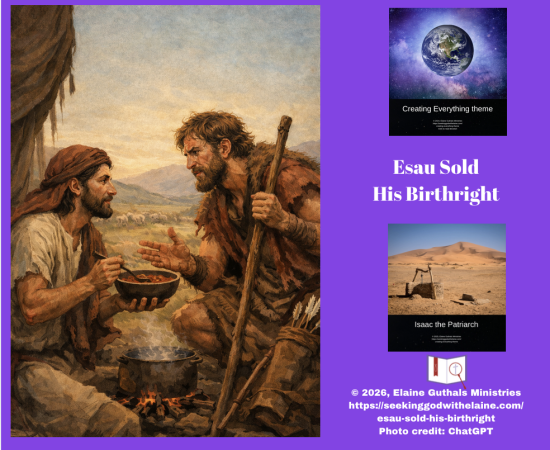
    “One day when Jacob was cooking some stew, Esau arrived home from the wilderness exhausted and hungry. Esau said to Jacob, ‘I’m starved! Give me some of that red stew!’ (This is how Esau got his other name, Edom, which means ‘red.’)” (Gen. 25: 29-30 NLT)

    Jacob had something Esau wanted, so there had to be a means to trade.

    We might consider it strange that Jacob was cooking. Remember Abraham put most of the meal together when God and His angels came down to destroy Sodom and Gomorrah (Gen. 18: 6-8).

    But still, Bradford said that the men usually did not do the cooking. He offered an explanation for Jacob cooking.

    Lentil stew, a practical, common dish for peasants, was made from what was produced from the land. Lentils were a staple food in the ancient Near East as its short growing season and long storage period were ideal for the nomads moving as their flocks required. It would have been cooked over a fire pit, as communal food was cooked during that time.

    Lentil stew, according to Bradford, was usually served while sitting Shiva. This led him to believe the family might have been in mourning for Abraham.

    Resource

    Even back then, neighbors brought food when there was a death in the family as immediate family members, such as Rebekah – the normal cook – were not supposed to cook. Jacob would not have been an immediate family member.

    Eats History also had an interesting take on the stew that Jacob was cooking. It said, “The dish itself becomes a symbol of choice — the immediate hunger of the body against the enduring inheritance of the spirit.”

    Resource

    The stew, though, also had symbolism. Bread and stew (noted in verse 34 as the menu for this meal) were used in the meal portion of a covenant. Sharing was considered an act of peace. Withholding was considered an act of power.

    That made this more of a sacred transaction. It would be easy to see Jacob thinking that, but would Esau have been?

    Adams pointed out the words that Esau used.

    • Give me what I want now.
    • I don’t care about the future – now is what is important.
    • You have to satisfy my need, or I’ll die.

    Resource

    On top of this, Esau later swore an oath. Remember, oaths were legally binding. It was like entering into a covenant agreement.

    Esau came home and all but demanded Jacob feed him. Jacob said, “Okay, but not so fast.”

    Trade Me Your Rights as the Firstborn Son

    ‘All right,’ Jacob replied, ‘but trade me your rights as the firstborn son.’ ‘Look, I’m dying of starvation!’ said Esau. ‘What good is my birthright to me now?’ But Jacob said, ‘First you must swear that your birthright is mine.’  Esau swore an oath, thereby selling all his rights as the firstborn to his brother, Jacob. Then Jacob gave Esau some bread and lentil stew. Esau ate the meal, then got up and left. He showed contempt for his rights as the firstborn” (Gen. 25: 31-34 NLT)

    Jacob seemed to be helping Jehovah along with transferring the birthright to him.

    That is what I always figured. Remember in the last devotion, we said that we have to accept Jehovah’s response to our prayer requests because they may contain temptation as well as mercy.

    Resource

    Jacob had been promised the mercy in being chosen as the covenant son. But there was precedence that the covenant son had to wait for the promise.

    • Abraham waited 25 years for Isaac to be born.
    • Isaac waited 20 years for Jacob to be born.
    • Jacob was 15 years old, and we haven’t been told that Jehovah had communicated with him yet.

    But let’s chase a rabbit for a second. If this was when Abraham died, Jacob didn’t give Jehovah time to do His work to switch the birthright to him.

    True, Jacob probably grew up with the story that Abraham didn’t wait and fathered Ishmael. But that should have been used as a wait-on-the-covenant-promises lesson.

    What was the holdup? And how long did he have to wait?

    So, Jacob succumbed to the temptation to make it happen before Jehovah kept His promise.

    It makes even more sense if we look at the lentil stew as a covenant meal.

    If we look at the lentil stew as a mourning meal, that begs the question as to why Esau was hunting. Am I the only one who thinks it is strange that, instead of being with family during a time of mourning, Esau is out having fun?

    If Abraham just died, why is Esau teasing about him starving to death? That is insensitive. Even if he was a rebellious teenager, he is making a very inappropriate statement for the situation.

    It doesn’t say Esau questioned this. It sounds like he just went along with it.

    Well, he did make the statement that he was about to starve to death (Gen. 25: 32). But Bradford thought that was more of a who cares statement.

    Bradford made a great observation. He said, “Of course, since God had long ago settled the issue, in reality Esau had no birthright to sell, for it already belong to Jacob. And, Jacob had no need to resort to treachery to obtain the birthright, because the Lord had already assigned it to him: but neither Jacob nor Esau had the faith to accept it as fact.”

    Resource

    But was Esau focusing on the common food aspect or the covenant aspect?

    Whether it be considered a covenant meal or a mourning meal, the last verse sums it up Esau’s attitude. He showed contempt for his birthright.
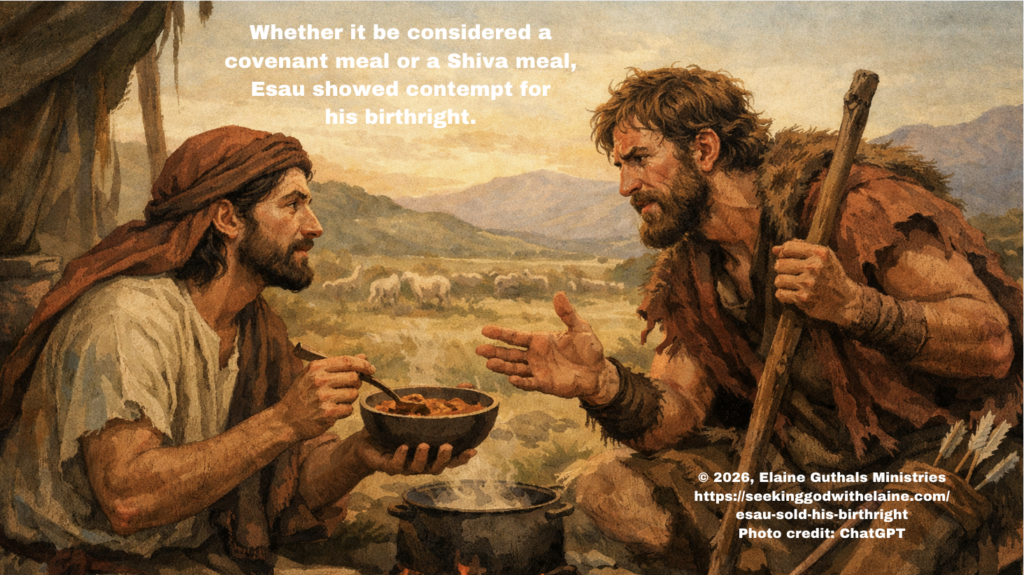
    Esau had already made his choice about serving Jehovah. He said no.

    It also shows a lot about Esau’s character. He was passionate, but not in a good way. He lacked integrity and goodness. He was impulsive, worldly, greedy, reckless, and I want to say shallow. He took no thought to responsibilities but rather thought only of himself.

    That was not what Jehovah was looking for in a covenant son. Esau was no more qualified for that position than Ishmael.

    But still, we can feel for Esau. Going on the assumption Rebekah did tell Esau he was born first but he wasn’t the firstborn, how would that have made him feel?

    Remember, the firstborn got the double portion of the wealth. They were made head honcho after the man in power no longer was in power.

    Esau – being a human being – would probably have always wondered if that was why Rebekah favored Jacob more. Did she see Jacob as a winner and Esau as a loser? Was she aligning herself with the future power?

    Was there anything Esau could have done to win Rebekah’s love? Did this create a bitterness within him?

    Or did he cultivate the who cares attitude as a defense mechanism? “If I don’t care, it won’t hurt me.”

    Or did Esau see the covenant responsibilities that came from Abraham through Isaac and say, “I don’t want to have anything to do with that”? That carried duties beyond the normal leader of the family responsibilities.

    If Jacob saw Esau’s attitude as wanting to not accept covenant duties and family responsibilities, he chose a good time to make his bid for the birthright.

    But does that mean Jacob went about this the right way? No.

    This isn’t how you treat a brother. He was cunning and deceitful because he took advantage of Esau.

    Worst of all, Jacob didn’t wait for Jehovah’s promise. It showed a lack of faith and irreverent.

    Jacob reduced the birthright to a business transaction.

    Making the Connections #1

    Esau was given a nickname because of the color of the stew he ate. Let that sink in a second.

    Once his in-the-moment needs were met, did Esau think what he had given up? No, “… He showed contempt for his rights as the firstborn” (Gen. 25: 31-34 NLT)

    Farrar said something interesting. He wrote, “Beware lest, in a moment of weakness and folly, you sell your birthright and barter your happy innocence for torment and fear and shame.”

    Resource

    Hmmmm. I never thought of Esau as being tormented, fearful, or full of shame.

    This choice that Esau made would follow him around for the rest of his life. It is bad enough that he had so little respect for the tradition surrounding the firstborn inheritance.

    But this nickname would mean that it would have been thrown in Esau’s face every time he would have been called that.

    Making the Connections #2

    Esau was said to have had a ruddy appearance. Another described in that manner was King David (I Sam. 16: 12).

    Making the Connections #3

    Bradford reminded us that only one other person in God’s Word is described as a hunter. That was Nimrod, who may or may not have helped build the Tower of Babel.

    Further, Bradford said that it refers to a stone-cold killer.

    Resource

    On the other hand, Jacob was described as a peaceful man, a quiet man. He was blameless or righteous.

    I would say that Esau not only didn’t value his birthright, but he also didn’t value life – where Jacob did.

    Making the Connections #4

    We hate to think about division in families. But Jehovah expects it. Yeshua even said so.

    “Do you think I have come to bring peace to the earth? No, I have come to divide people against each other! From now on families will be split apart, three in favor of me, and two against — or two in favor and three against. ‘Father will be divided against son and son against father; mother against daughter and daughter against mother; and mother-in-law against daughter-in-law and daughter-in-law against mother-in-law’” Lk. 12: 51-53).

    Making the Connections #5

    Esau and Jacob did reconcile. “Then Esau ran to meet him and embraced him, threw his arms around his neck, and kissed him. And they both wept” (Gen. 33: 4 NLT).

    I know their descendants were enemies, and Jacob still feared Esau. But Esau seemed to make peace with the fact he was not the covenant son.

    Making the Connections #6

    Remember, Esau wasn’t just giving up the earthly recognition that went along with the birthright. Until Jehovah set up the priestly system after the exodus, the firstborn was the priest of the family.

    Esau was turning his back on Sovereign God and all the covenant promises.

    • Esau gave up being the priest of the family, therefore, being the person with whom Jehovah spoke.
    • He gave up the promise of land.
    • He gave up being the ancestor of the Messiah.

    But isn’t that what Adam and Eve did? They gave up their birthright as children of Sovereign God because of the shiny, attractive object of the moment and how it satisfied earthy needs.

    Making the Connections #7

    Meyer had a great sermon reminding us of Jacob’s character. He looks a lot like the ordinary human.

    • Schemer but spiritual
    • In exile but attached to the land

    Resource

    We know Jacob was chosen from the womb. We see his many failings.

    But we also see Jacob’s unwavering faith. What did Hosea say about him?

    “Even in the womb, Jacob struggled with his brother; when he became a man, he even fought with God. Yes, he wrestled with the angel and won. He wept and pleaded for a blessing from him. There at Bethel he met God face to face, and God spoke to him — the Lord God of Heaven’s Armies, the Lord is his name!” (Hos. 12: 3-5 NLT emphasis added).

    Jacob believed wholeheartedly in Jehovah.

    Making the Connections #8

    Look at this reminder from Roberts. He wrote, “Although Jacob obtained, in virtue of his election, a certain priority over Esau, yet was Esau also, equally with Jacob, the subject of Divine sovereignty.”

    Resource

    We are all created in Jehovah’s image whether we acknowledge His as Sovereign God or not. We are all under His rule as our Creator.

    Being Jehovah’s creation does not secure our eternal destiny. Only Jehovah’s children will live with Him in eternity.

    Only those who believe in Yeshua being our Savior and submitting our lives to Him are Jehovah’s children. “But to all who believed him and accepted him, he gave the right to become children of God. They are reborn — not with a physical birth resulting from human passion or plan, but a birth that comes from God” (Jn. 1: 12-13 NLT).

    But non-believers are still creations of Jehovah.

    Roberts made another great point. Sovereign God works everything out for His good (Rom. 8: 28 NLT).

    This was also Esau’s good — even though he had to give up some things to get it.

    Making the Connections #9

    Is this a good argument for the nature/nurture debate? Maybe.

    The boys were brought up in the same household, but they were not treated equally. True, both were a favorite of a parent; but that doesn’t guarantee they were treated equally.

    To me, it comes down to both had a choice to make. Were they going to submit to Jehovah or not? They chose differently because, even though they were twins, they were different people.

    Making the Connections #10

    Fuller distilled things for us. He said that

    • Esau would have wanted the birthright if it consisted of worldly advantages.
    • Jacob, in his lifetime, gained none of the benefits of the birthright.

    Resource

    So, why did Jacob want it?

    • Spiritual privilege
    • Leadership
    • Double inheritance

    How Do We Apply This?

    • Raise our children to worship Jehovah.
    • Recognize our children’s need of love.
    • Find ways to cement a good relationship between siblings.
    • Recognize one sin leads to another.
    • Set our hearts on spiritual things.

    Resources

    Father God. Forgive us when we refuse to wait for the fullness of Your time on Your promises. Help us to keep focused solely on You. Amen.

    If you don’t understand something and would like further clarification, please contact me.

    Father God. Forgive us when we refuse to wait for the fullness of Your time on Your promises. Help us to keep focused solely on You. Amen.

    If you have not signed up for the email providing the link to the devotions and the newsletter, do so below.

    If God has used this devotion to speak with you, consider sharing it on social media.

  • The Birth of Jacob and Esau

    Isaac has now become the Patriarch. This devotional reading looks at how Jehovah blessed him, including by answering his prayer for children.

    Nuggets

    • Because Isaac was the covenant son and obedient, Jehovah blessed him.
    • Based on the ages given and calculated, Abraham would have known the twins.
    • Rebekah suffered from barrenness.
    • Even before birth, the twins struggled with each other.
    • God flat out told Rebekah that her sons would be rivals.
    • Once again, Jehovah chose a younger son over the firstborn.
    • The birth occurred as Jehovah said.

    In the middle of talking about Abraham’s death and closing the book on Ishmael, we had one verse about Isaac. Since the story from Genesis 25 to 26 is about Isaac, we left that verse until now.

    What we’ve seen so far about Isaac is that he was a reflective, peaceful man. He went out into the country to meditate.

    Isaac was obedient to his father Abraham. He was obedient to his Father Jehovah when He told Abraham to sacrifice Isaac to Him. As Isaac was anywhere from 15 to 30 years old, he could have easily overpowered his 115- to 130-year-old father.

    Isaac was obedient to Jehovah.

    Let’s Put It into Context

    To read devotions in the Creating Everything theme, click the button below.

    Devotions in the Isaac the Patriarch series

    Transition from Abraham to Isaac

    “After Abraham’s death, God blessed his son Isaac, who settled near Beer-lahai-roi in the Negev” (Gen. 25: 11 NLT)

    God Blessed Isaac

    Because Isaac was the covenant son and obedient, Jehovah blessed him.

    Abraham lived 175 years. Isaac lived 180 years. Jacob lived 147 years.

    We got 15 chapters about Abraham. We got 24 chapters about Jacob.

    But we only a few snippets about Isaac.

    • Genesis 17 where he is born as the covenant child.
    • Genesis 22 where he is slated to be sacrificed – but that was about Abraham’s obedience.
    • Genesis 24 where someone else is finding a wife for him, and he showed up for the wedding — but that is mostly Abraham’s story.
    • Genesis 25 where he buried his father and continued the covenant line through the birth of his sons.
    • Genesis 26 where he had problems with people.
    • Genesis 27 where he can’t really tell his kids apart — but that is really Jacob’s story.
    • Chapter 28 where he sent Jacob off to find a wife — but that is really Jacob’s story.
    • Chapter 35 where he died.

    Yep, Isaac lived the longest, but he got the least amount written about him.

    That is backwards to the way we think, isn’t it? Isaac, as a Patriarch, was an important man. He was good — and he didn’t die young. There should have been at least ten chapters on him at a minimum, right?

    Pearse had a great way of looking at it. He wrote,

    “God is the God of Abraham. Yes, we do not wonder at that — Abraham the hero, the warrior, the father and founder of great nations — the man of such gifts and such achievements. But God is the God of Isaac, too — the God of the quiet uneventful life. The heavenly Father hath room in His heart for all His children.”

    Resource

    Pearse made the point that we need the Abraham’s as well as the Isaac’s. He called him common.

    I can see that. We need followers as well as leaders. We need the consistent worker as well as the high-profile.

    I think Jehovah would call this being sober minded. Being sober is a character trait distinguished by self-control, genuineness, and sound moral judgment.

    There are no big highs. There are no big lows. There is just consistent faith in Sovereign God.

    Beer-lahai-roi in the Negev

    Isaac lived by the well where Hagar saw Jehovah.

    The New Living Translation is missing something. “… and Isaac dwelt by the well Lahairoi” (Gen. 25: 11 NLT). The version we used didn’t mention the well.

    But we knew that because we talked about where Isaac lived after Eliezer got back from Paddam-Aram. “Meanwhile, Isaac, whose home was in the Negev, had returned from Beer-lahai-roi” (Gen. 24: 62 NLT)

    We talked then that Be’er-Lachi Roi (also called Kadesh-barnea) was where Hagar ended up by the well when she was running away from Sarah.  “… She [Hagar] said, ‘You are the God who sees me.’ She also said, ‘Have I truly seen the One who sees me? So that well was named Beer-lahai-roi (which means ‘well of the Living One who sees me’) …” (Gen. 16: 13-14 NLT).

    Possibly one of the reasons Isaac lived here and not Hebron with his father was that he also owned flocks and herds. They may have been separated for the same reason Lot separated from Abraham — there were not enough resources to handle two flocks.

    The Birth of Jacob and Esau

    “This is the account of the family of Isaac, the son of Abraham. When Isaac was forty years old, he married Rebekah, the daughter of Bethuel the Aramean from Paddan-aram and the sister of Laban the Aramean. Isaac pleaded with the Lord on behalf of his wife, because she was unable to have children …” (Gen. 25: 19-21 NLT)

    When Isaac Was Forty Years Old

    Based on the ages given and calculated, Abraham would have known the twins.

    If Isaac was 40 years old when he married Rebekah, Abraham was 140. Since Abraham died at 175, his demise had not been impending when he sent Eliezer to find Isaac a wife.

    Abraham did live to see his grandchildren. Isaac was 60 when they were born, making Abraham 160.

    She Was Unable to Have Children

    Rebekah suffered from barrenness.

    It is interesting that Rebekah was considered barren. She probably would have been about 13 when she and Isaac were married, making her probably 33 when her children were born.

    Look what Dods said. He wrote,

    “The intended mother of the promised seed was left for twenty years childless — to contend with the doubts, surmises, evil proposals, proud challengings of God, and murmurings, which must undoubtedly have arisen even in so bright and spirited a heart as Rebekah’s. It was thus she was taught the seriousness of the possession she had chosen for herself, and gradually led to the implicit faith requisite for the discharge of its responsibilities. … It is a humbling thing to stand in-some other person’s way; but if it is by no fault of ours, but in obedience to affection or conscience we are in this position, we must, in humility and patience, wait upon Providence as Rebekah did, and resist all morbid despondency.”

    Resource

    Did Rebekah have second thoughts about marrying Isaac? She had no doubts when she agreed to the marriage.

    Bradford noted that this barrenness meant no children were born, not just daughters. It seems strange that Jehovah said, “I’ll make your descendants a nation,” and Sarah, Rebekah, and Rachel dealt with the inability to produce children.

    Resource

    Still, Isaac, however, did not approach a solution the way Abraham and Sarah did. He didn’t acquire concubines.

    Isaac prayed to Jehovah. He waited on Him.

    Did Isaac remember his birth? He was an answer to prayer to a barren couple.

    But then, neither Isaac nor Rebekah were beyond childbearing age. In fact, a CrossTalk article said Rebekah was within the typical childbearing age for her time.

    Resource

    So, the issue wasn’t that Rebekah couldn’t get pregnant. She just hadn’t yet.

    Rivalry in the Womb

    “… The Lord answered Isaac’s prayer, and Rebekah became pregnant with twins. But the two children struggled with each other in her womb. So she went to ask the Lord about it. ‘Why is this happening to me?’ she asked. And the Lord told her, ‘The sons in your womb will become two nations. From the very beginning, the two nations will be rivals. One nation will be stronger than the other; and your older son will serve your younger son’” (Gen. 25: 21-23 NLT)

    Struggled with Each Other in Her Womb

    Even before birth, the twins struggled with each other.

    Esau and Jacob were a handful even before they were born. They fought each other inside the womb. This activity was definitely not normal.

    This translation sugarcoats their struggles and Rebekah’s frame of mind. “The children fought with each other inside her so much that she said, “If it’s going to be like this, why go on living?” So she went to inquire of ADONAI” (Gen. 25: 22 CJB).

    The Orthodox Jewish Bible is more descriptive in referring to what the boys were doing. “And the banim struggled jostling within her; and she said, If it be well, why am I thus? And she went to inquire of Hashem” (Gen. 25: 22 OJB).

    Hosea also described the conflict occurring in Rebekah’s body. “Even in the womb, Jacob struggled with his brother; when he became a man, he even fought with God. Yes, he wrestled with the angel and won. He wept and pleaded for a blessing from him. There at Bethel he met God face to face, and God spoke to him — the Lord God of Heaven’s Armies, the Lord is his name!” (Hos. 12: 3-5 NLT)

    Rebekah was getting despondent. If the boys didn’t get along prior to birth, how were they going to be after birth?

    Two Nations

    God flat out told Rebekah that her sons would be rivals.

    There was a good reason that the boys were struggling in their mom’s womb. That was going to be the story of their existence. In other words, don’t look for any relief any time soon.

    The two boys would be struggling for dominance for a good chunk of their lives.

    We should keep in mind as we go on with the story that God told Rebekah that Esau would serve Jacob. Bradford said something we have already noted. He wrote, “This is a theme that is ongoing in the Bible; a theme that separates what SEEMS to be from a physical-earthly sense, from what actually IS from spiritual-heavenly point of view”

    Resource

    Jehovah is once again separating His chosen people.

    Your Older Son Will Serve Your Younger Son

    Once again, Jehovah chose a younger son over the firstborn.

    At this point, some of us may begin to wonder why Jehovah even bothered with dedicating the firstborn to Himself. In the most important cases that we know of, that wasn’t the case.

    • God called Seth. He didn’t call Cain or Abel.
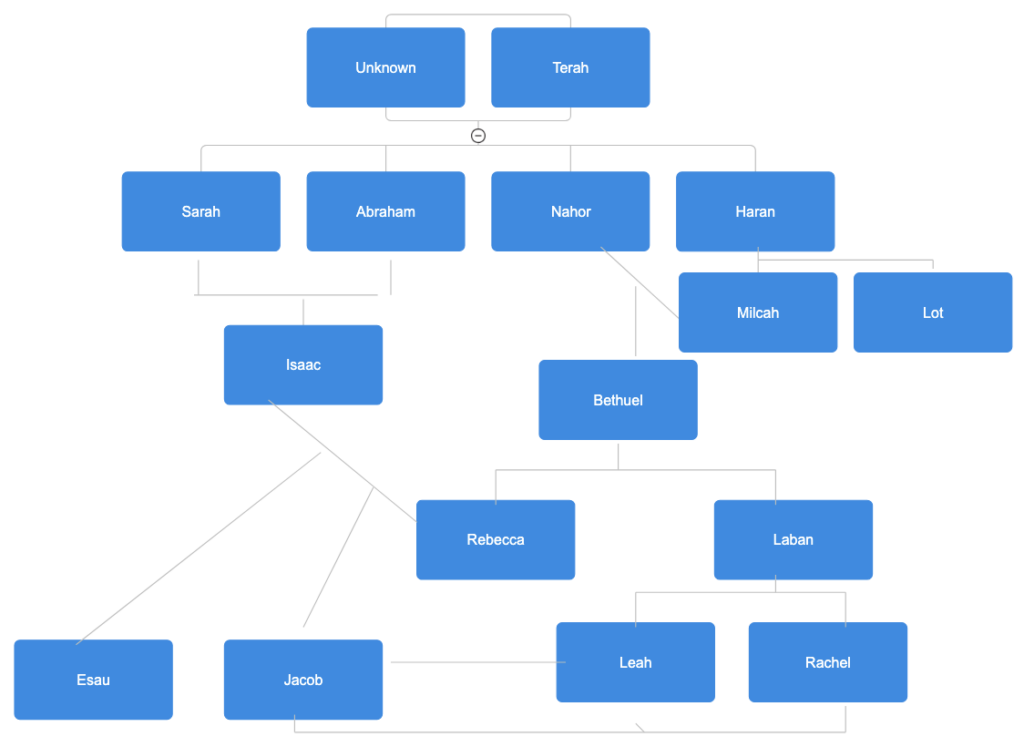
    • God called Abraham. He didn’t call Nahor and Haran, his older brothers.
    • God called Isaac. He did not call Ishmael, the firstborn.
    • God called Jacob. He did not call Esau, the firstborn.
    • God called Judah. He did not call Reuben, the firstborn.
    • God called Ephraim. He did not call Manasseh, the firstborn.
    • God called David. He did not call Eliab, Abinadab, Shimea, — or any of his other four brothers.

    In Esau and Jacob’s case, Esau was not even chosen to be called a Hebrew. How could that happen when they were twins?

    Easy. The distinction was made by Jehovah’s declaration based on being spiritual, not genealogy.

    So, being a Hebrew had nothing to do with physical birth. It was by declaration.

    Bradford reminded us that is what election means. It means being chosen by Jehovah by His sovereign decision.

    Resource

    But that doesn’t mean Jehovah would forget about Esau. Just as He did Ishmael, He said that Esau would be a separate nation. We know He kept His promise – Esau’s descendants are the Edomites. And just as Ishmael’s descendants, the Arabs, are in conflict with Israel, so too were the Edomites.

    Happy Birthday!

    “And when the time came to give birth, Rebekah discovered that she did indeed have twins! The first one was very red at birth and covered with thick hair like a fur coat. So they named him Esau. Then the other twin was born with his hand grasping Esau’s heel. So they named him Jacob. Isaac was sixty years old when the twins were born” (Gen. 25: 24-26 NLT)

    The birth occurred as Jehovah said.

    Back in Rebekah’s day, there were no sonograms so that science could confirm what Jehovah said. She had to wait until she gave birth.

    And, as always, things happened just as Jehovah said it would.

    The son they named Esau arrived first. I love how Bradford described him – “… loveable little fuzzball.”

    Resource

    Just because Esau wasn’t the covenant son didn’t mean he was lacking physically.

    But that also doesn’t mean Jacob didn’t do his best to be born first. Verse 26 says he came out grasping his brother’s heel.

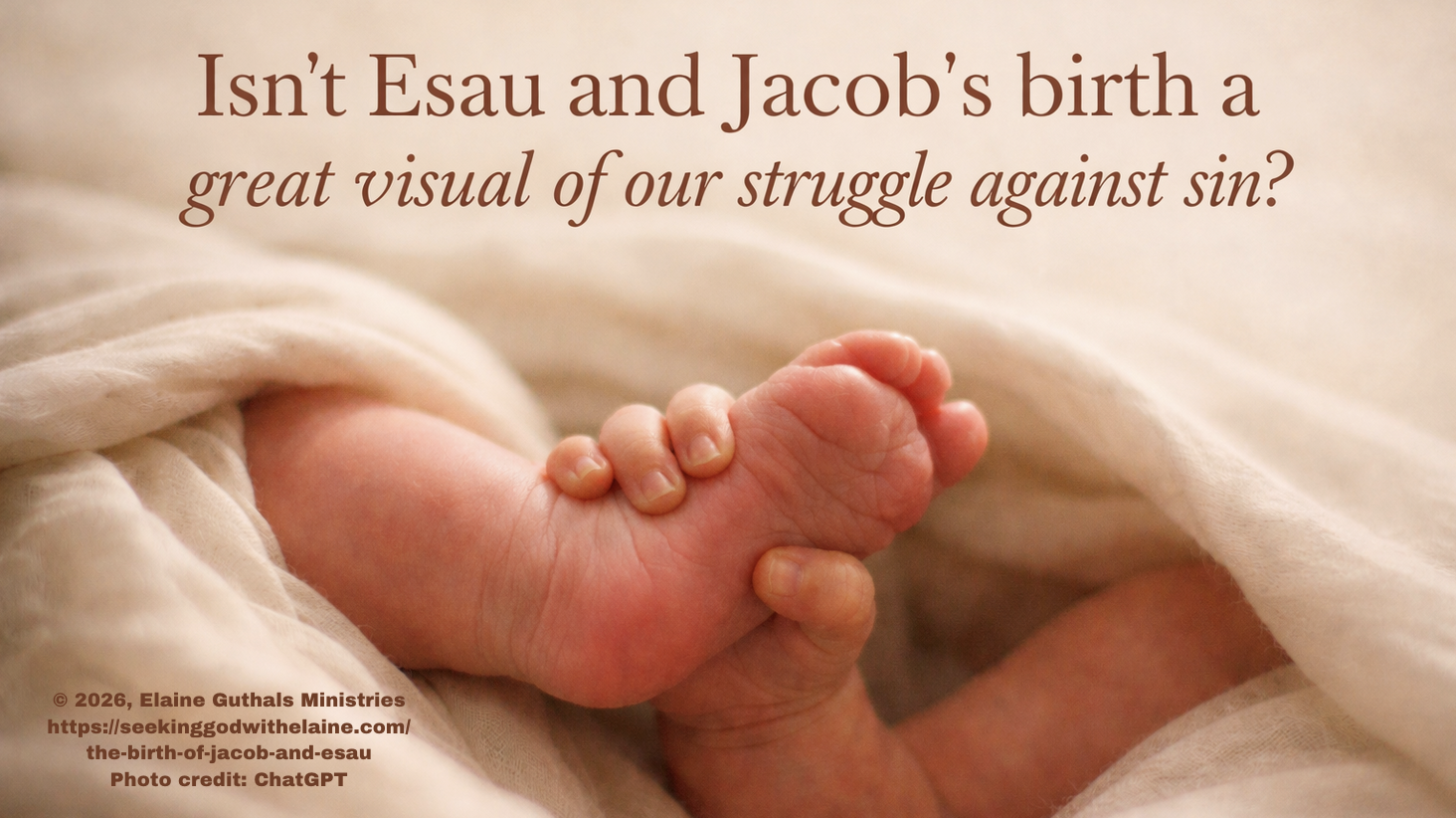
    Isn’t Esau and Jacob’s birth a great visual of our struggle against sin?

    We tend to grasp onto sin. We don’t want to let it go – but then again, we don’t want it to get the best of us.

    Either way, we tend to hold on.

    But we know, in this instance, Jacob wanted to be the firstborn. He was trying to keep Esau back.

    Making the Connections #1

    Watt had a great observation about two principles Jehovah has— but to some it will seem like a contradiction. He wrote, “… (1) that God repeats Himself in His modes of training men; and (2) that God does not repeat Himself.”

    Resource

    Does Jehovah bless all His children? Emphatic YES! Does He bless us all in the same way? Emphatic NO!

     Our loving Heavenly Father blesses us the most by increasing our faith. He will bless each individual who genuinely seeks Him.

    Yeshua said that the Holy Spirit would be given to each of Jehovah’s children. And He does instruct us and correct us.

    But we are all on different places on our Sanctification Road. Each of our roads are made of bricks — experiences, testings — but those are different for each of us.

    Jehovah repeats Himself because it is one message. That message is that salvation can only be gained through Yeshua — and we all need it.

    Sometimes, we have to hear the same thing over and over again before we grab hold of it and make it our own. He wants to communicate with us as clearly as possible.

    We also need to hear things again for confirmation. We need that assurance. It is purposeful redundancy for our instruction.

    But Jehovah doesn’t repeat Himself. What if the only message we ever hear is salvation?

    Those who truly want salvation should be saying, “And then what?”

    Just preaching salvation and never getting to sanctification throws the new believer out into the world to stand up to Satan without giving them the tools to do so.

    Making the Connections #2

    Woolnough listed three habits Isaac possessed that we need.

    • Thought
    • Dealing with others
    • Home

    We talked a lot about Isaac’s habit of meditation. This is the process by which we take what Jehovah has revealed to us and decide how we are going to apply it to our lives.

    Woolnough explained what he meant by Isaac’s habit of dealing with others. He wrote, “But notably you feel in Isaac’s case what is that influence which leads a man to make ample and timely disposition of his secular affairs, that he may give himself more fully to better things.”

    Resource

    Home is very important to Jehovah, but we usually use a different word to describe it — families. Families within their homes have an important task assigned to them by Him.

    “And you must commit yourselves wholeheartedly to these commands that I am giving you today. Repeat them again and again to your children. Talk about them when you are at home and when you are on the road, when you are going to bed and when you are getting up. Tie them to your hands and wear them on your forehead as reminders. Write them on the doorposts of your house and on your gates” (Deut. 6: 6-9 NLT).

    Families are teach each other in Jehovah’s ways.

    Making the Connections #3

    We talked about Jehovah told Rebekah that Esau would serve Jacob. I have long baffled by the rest of the story.

    Didn’t Rebekah tell Isaac that Jacob was the covenant son? Wouldn’t that have been something that she would at least have dropped into a conversation with Isaac?

    Bradford said that if she did keep it to herself, she would have been disloyal and disrespectful. We don’t get that vibe from of their relationship.

    I could see a parent not telling a child that – especially the child not chosen. But the chosen one was Rebekah’s favorite.

    But Bradford was right. Imagine waiting until the boys were mature and telling Esau, “You’re not chosen.”

    Resource

    Part of me also says that Jehovah would not have just told Rebekah. He would also have told Isaac.

    How Do We Apply This?

    • Know that Jehovah will answer our prayers.
    • Accept Jehovah’s response to our prayer requests because they may contain temptation as well as mercy.

    Resource

    Father God. When You give us a nice, quiet life, You are with us. When You make us wait for Your timing, You are with us. When You fulfill Your promises, You are with us. In all circumstances — good or bad — You are with us. Thank You. Amen

    If you don’t understand something and would like further clarification, please contact me.

    If you have not signed up for the email providing the link to the devotions and the newsletter, do so below.

    If God has used this devotion to speak with you, consider sharing it on social media.
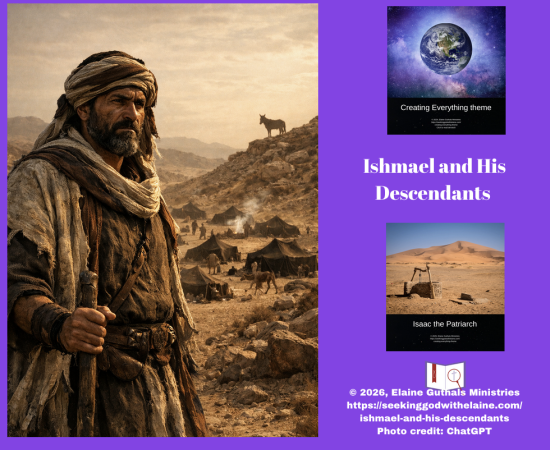
  • Ishmael and His Descendants

    Upon the death of Abraham, Isaac and Ishmael were both present for the burial. This devotion looks at what happened to Ismael.

    Nuggets

    • Let’s take a look at what we know so far about Ishmael.
    • Ishmael had twelve sons, just as Jacob did.
    • Ishmael died at the age of 137.
    • Abraham is considered the father of Islam.
    ishmael-and-his-descendants

    We’re going to take the verses of Genesis 25 a little bit out of order. We just finished up Abraham the Patriarch series with Genesis 25: 1-10. We’re moving on to Isaac.

    In fact, the Genesis 25: 11 is about Isaac.

    But then Genesis 25: 12-18 is about Ishmael. Then it goes back to Isaac.

    So, we’re going to look at Ishmael before we jump into all the Isaac verses in Genesis 25.

    Let’s Put It into Context

    To read devotions in the Creating Everything theme, click the button below.

    Devotions in the Isaac the Patriarch series

    Ishmael

    “This is the account of the family of Ishmael, the son of Abraham through Hagar, Sarah’s Egyptian servant” (Gen. 25: 12 NLT)

    Let’s take a look at what we know so far about Ishmael.

    Because Sarah was barren, she gave her Egyptian slave Hagar to Abraham to become his concubine/secondary wife. Hagar became pregnant, but she held her mistress in contempt.

    Long story short. Hagar ran away, came back, had Ishmael, taught him to show contempt for the covenant son Isaac, and got sent away.

    Before Isaac was born, Abraham tried to offer Ishmael for the covenant son. Bradford argued that was because he saw Ishmael as the promised son.

    But Jehovah wasn’t having anything to do with that. He did promise to bless Ishmael, though. “As for Ishmael, I will bless him also, just as you have asked. I will make him extremely fruitful and multiply his descendants. He will become the father of twelve princes, and I will make him a great nation. But my covenant will be confirmed with Isaac, who will be born to you and Sarah about this time next year” (Gen. 17: 20-21 NLT).

    Bradford made another important observation. He wrote, “… Ishmael is a Semite, just as Isaac was, and of course, as Abraham was. What’s a Semite? A descendant of Noah’s son Shem.”

    Resource

    Okay. Let’s mull on that for a second. We have Bradford to thank for this, too.

    Resource

    I have previously said Abraham was declared a Hebrew. Isaac was born into being a Hebrew.

    But Ishmael wasn’t a Hebrew. Yes, we know Abraham was already called a Hebrew (Gen. 14: 13) when Ishmael was born (Gen. 16: 15). So, it wasn’t just birth.

    God had to declare Isaac to be Hebrew. There was no such declaration for Ishmael.

    Ishmael’s Descendants

    Here is a list, by their names and clans, of Ishmael’s descendants: The oldest was Nebaioth, followed by Kedar, Adbeel, Mibsam, Mishma, Dumah, Massa, Hadad, Tema, Jetur, Naphish, and Kedemah. These twelve sons of Ishmael became the founders of twelve tribes named after them, listed according to the places they settled and camped. ” (Gen. 25: 13-16 NLT)

    Ishmael had twelve sons, just as Jacob did.

    Ishmael took an Egyptian wife. “And God was with the boy [Ishmael] as he grew up in the wilderness. He became a skillful archer, and he settled in the wilderness of Paran. His mother arranged for him to marry a woman from the land of Egypt” (Gen, 21: 20-21 NLT).

    Ishmael’s descendants were hostile groups. They battled all their relatives — including Isaac’s descendants.

    This hostility continues today. We know them today as Arabs, many of which— but not all —  are descendants of Ishmael according to Got Questions.

    Resource

    Ishmael’s descendants made their home in the northern part of Arabian Peninsula. Nebaioth and Kedar were listed as shepherd in Isaiah 60: 7.

    Bradford gave a good snapshot of Ishmael’s descendants.

    • The descendants of Ishmael’s firstborn, Nebaioth, are known as the Nabaiati or Nabateans, currently the Jordanians of Petra.
    • The descendants of Kedar associated with the Edomites. Today, they are a part of the Bedouins,
    • Adbe’el (or Idiba’il) was conquered by Tiglath-Pileser, the conquerer of the Northern Kingdom of Israel.
    • The land of Dumah’s tribe bordered that of Midian on the Arabian Peninsula. This tribe was mentioned in Isaiah 21.
    • Tema and his tribe settled on a caravan route that ran from the southern part of the Arabian Peninsula to lower Mesopotamia.
    • Jetur and Naphish combined into one tribe. It was called the Hagrites in 1 Chronicles 5: 10.
    • Little reliable information is known about the rest of Ishmael’s sons.

    Resource

    Bradford also noted that Ishmael’s descendants lived in villages instead of walled cities. That would have fed the hostility they experienced among each other.

    Ishmael also had a daughter. She married Esau. Two different names are given to her in the only two places she in mentioned in God’s Word.

    • “So Esau visited his uncle Ishmael’s family and married one of Ishmael’s daughters, in addition to the wives he already had. His new wife’s name was Mahalath. She was the sister of Nebaioth and the daughter of Ishmael, Abraham’s son” (Gen. 28: 9 NLT).
    • “He [Esau] also married his cousin Basemath, who was the daughter of Ishmael and the sister of Nebaioth. Adah gave birth to a son named Eliphaz for Esau. Basemath gave birth to a son named Reuel. Oholibamah gave birth to sons named Jeush, Jalam, and Korah. All these sons were born to Esau in the land of Canaan” (Gen. 36: 3-5 NLT).

    The Death of Ishmael

    Ishmael lived for 137 years. Then he breathed his last and joined his ancestors in death. Ishmael’s descendants occupied the region from Havilah to Shur, which is east of Egypt in the direction of Asshur. There they lived in open hostility toward all their relatives” (Gen. 25: 17-18 NLT)

    Ishmael died at the age of 137.

    When Ishmael died, it said that he was “… gathered unto his people” (Gen. 25: 17 KJV). Gathered to his people meant that Ishmael would be reunited with his ancestors who had died before him. We know he wasn’t buried with Abraham, but this meant he would have been reunited with him.

    According to tradition, Ishmael is buried in Meca, Saudi Arabia, alongside Hagar. However, the exact location is not known. This allows other spots to be considered his burial place.

    Islam

    Abraham is considered the father of Islam.

    Not only is Abraham known as the father of Judaism and Christianity, he is also considered the father of Islam. That is because its prophet, Muhammad, was believed to be a descendant of Ishmael.

    Resource

    There are some issues with trying to make Ishmael the covenant son. Many who believe in Allah believe that the Torah was changed to identify Isaac as the covenant son when it really should be Ishmael.

    There is a problem with that. Muhammad was born (575 AD) 600 years after Yeshua’s life (100 AD) and 1,000 years after the final Old Testament book was written (400 BC).

    If you are interesting in digging deeper into this, check out Bradford’s lesson. He is much more knowledgeable than I am about this topic.

    Resource

    Making the Connections #1

    “Arise, Jerusalem! Let your light shine for all to see. For the glory of the Lord rises to shine on you. Darkness as black as night covers all the nations of the earth, but the glory of the Lord rises and appears over you. All nations will come to your light; mighty kings will come to see your radiance. Look and see, for everyone is coming home! Your sons are coming from distant lands; your little daughters will be carried home. Your eyes will shine, and your heart will thrill with joy, for merchants from around the world will come to you. They will bring you the wealth of many lands. Vast caravans of camels will converge on you, the camels of Midian and Ephah. The people of Sheba will bring gold and frankincense and will come worshiping the Lord. The flocks of Kedar will be given to you, and the rams of Nebaioth will be brought for my altars. I will accept their offerings, and I will make my Temple glorious” (Isa. 60: 1-7 NLT)

    We talked about how some of the descendants of Ishmael were combined with the descendants of Keturah. That showed the breakdown on tribal lines.

    But look what it really says in Isaiah 60: 1-7.

    • Darkness is associated with those living apart from Jehovah.
    • Israel is called to be “… ‘a light to the Gentiles, and you will bring my salvation to the ends of the earth’” (Isa. 49: 6 NLT).
    • Toward the beginning of the ends times, nations will come to Jehovah.
    • They will include descendants of Keturah’s son Midian and grandsons Ephah and Sheba. Kedar and Nebaioth were sons of Ishmael.

    In other words, those who are Arab descendants of Abraham will come to worship Jehovah and Yeshua.

    Making the Connections #2

    Bradford told us why it is important to look at Ishmael as well as Isaac. He wrote,

    “You see, Isaac and Ishmael represent the crux of the matter between Jews and Christians on the one side, and Muslims on the other; Isaac and Ishmael are a distinct fork in the road. And, please grasp that the differences between the Judeo-Christian world, and the Islamic world, are irreconcilable. There is no halfway point, there is no compromise. Islam says that the words from God, from Allah, and the people of the promise of the covenants with Abraham, come down through Ishmael and are recorded in the Koran. Of course, Jews and Christians maintain that the promise of the covenants comes down through Isaac, and are recorded in the Holy Scriptures.”

    Resource

    It is easy to think that the two religions are sort of a mirror of each other. That they say the same thing only differently.

    That is false.

    Isaac was the covenant son. That trumps Ishmael being born first.

    “But My Brit (covenant) will I establish with Yitzchak [Isaac], which Sarah shall bear unto thee at mo’ed hazeh (this set time) next year” (Gen. 17: 21 OJB).

    How Do We Apply This?

    • Choose to follow Jehovah.

    Father God. Thank You for giving us families. Help us to grow together in You individually and together. Amen.

    If you don’t understand something and would like further clarification, please contact me.

    If you have not signed up for the email providing the link to the devotions and the newsletter, do so below.

    If God has used this devotion to speak with you, consider sharing it on social media.
  • Abraham the Patriarch Newsletter #5

    abraham-the-patriarch-newsletter-5

    Abraham’s Faith Tested

    Jehovah Tested Abraham

    Jehovah came to Abraham just as He usually did. It wasn’t a personal visit like Genesis 18. It wasn’t a dream, as He came to Abimelech (Gen. 21).
    
This sounded like it was how Jehovah usually came to Abraham. It was a voice in his spirit.

    Abraham was not told that this was a test. He had no clue what was happening. Most of all, Abraham didn’t know why it was happening.

    Get one thing straight. Jehovah tested Abraham. He did not tempt him to sin.

    Jehovah does test us to get us to prove our faith (Jas. 1: 13). God was not looking for the evil in Abraham — unless it is to eliminate it from his life. He was looking for the good.

    Do we understand the purpose here? Jehovah knew Abraham had faith. He was trying to figure out how strong that faith was. We have to judge ourselves by God’s standards.

    When Jehovah said, “Hey, Abraham!”, I bet Abraham was excited to talk to his Friend again.

    “… ‘Here I am’” (Gen. 22: 1 NLT) implies both obedience on Abraham’s part and provision on Jehovah’s part. Abraham knew He could depend on Jehovah to carry him through whatever of which He was asking him.

    Abraham’s response showed that he was ready to obey Jehovah in whatever was asked of him.

    Your Only Son

    The testing Jehovah gives us usually uses that which we love most and highly value.

    Abraham was to take his beloved son Isaac, the covenant child, and sacrifice him on an altar to worship Sovereign God.

    Talk about having the rug pulled out from under his feet. Abraham would not have seen this one coming.

    Abraham would have never thought Jehovah would ask him to sacrifice his son. The whole covenant was contingent on Isaac’s birth and having kids of his own.

    Abraham would have been shocked down to the bottom of his sandals.

    What Abraham was told was that he was to not only kill Isaac but also burn him on an altar. It wasn’t a stick and done. It was a slay, dismember, and burn process.

    This command seems so out of character for Jehovah to ask that. Because child sacrifice was common in many countries at the time – even Abraham’s – He has several times specifically stated that children were not to be sacrificed (Lev. 18: 21).

    What happened to “thou shalt not kill” period?

    Could a father legally do this? Well, back in Abraham’s day, yes. The father had complete rule over his son.

    So, let’s go back to the Hebrew. “… offer him there for a burnt offering upon one of the mountains …’” (Gen. 22: 2 OJB). Not sacrifice. Offer.

    But if we look at how to perform a burnt offering, we see the sacrifice is killed first (Lev. 2: 4-5). Before it was offered to God, the sacrifice was killed.

    Can we start a sacrifice and pull out before the smoke starts? Is it really a sacrifice then? Is it even an offering? No.

    Jehovah can require one time that which He has forbidden another. Otherwise, how can He test us?

    What better way of showing us what He doesn’t want by asking for it and stopping it?

    Abraham didn’t ask Jehovah to repeat the command or clarify it. He didn’t even demand evidence that it was coming from Him. He didn’t rail about not being left with a way to shimmy out of it.

    Abraham straight up obeyed.

    Jehovah told Abraham to take his son — the one he loved — and sacrifice him. Now, last chapter we were told that Abraham was told by Him to send Ishmael away. Even though Jehovah had made it clear that he wasn’t the covenant son, Abraham might have kept in the back of his mind that Ishmael was a spare in care something happened to Isaac.

    Why would God ask Abraham to sacrifice the son that he waited for so long? Just because of that?

    Think about it. Abraham didn’t have a bunch of sons. He had two.

    I don’t think Jehovah was saying Abraham loved Isaac more than Him. If Jehovah was doing this as punishment for the sin of putting something before Him (Ex. 20: 3), it wouldn’t be a testing. If Abraham had put Isaac before Jehovah, I would think that would have created a much bigger response than testing. God may even could have gone through with the sacrifice.

    Yes, it is sometimes easy to put something before Jehovah. We can’t put things – even family – above Sovereign God.

    Do we put more faith in the blessing than the God Who gave us the blessing? In other words, would Abram make Isaac his idol?

    But we have to understand Jehovah can ask of us anything He wants. It is not our place to question. It is our place to obey.

    Why would Jehovah make Abraham go through all of this? He was giving a representation of Him and Yeshua.

    The First Step of Obedience

    Once again, God sent Abraham off without giving him a specific destination. All Jehovah had given Abraham was the area but not the specific mountain. That didn’t slow Abraham down.

    Even though Jehovah asked what at first hearing Abraham would have recoiled from, he immediately made plans to fulfill the request. Abraham left early the next morning. He left at the first possible time.

    We aren’t told what he told Sarah — if anything. I don’t see him going to her and saying, “God told me to go make a sacrifice — and that sacrifice is Isaac. See you when I get back.”

    Abraham obviously didn’t tell Isaac.

    Whatever Abraham was feeling, he started the next morning. This is the best indication of his faith.

    We’ve talked about Abraham being disinterested before when he and Lot separated. Disinterestedness means a willingness to give up something for a greater good.

    This is the type of faith and obedience Abraham showed. He was willing to give up his beloved son’s life for whatever greater good Jehovah was working.

    It was smart to take wood with him because wood could be scarce around there.

    I’m sure it wasn’t like throwing a couple of clothes in the suitcase and going. But still with each step he took, Abraham’s mind was probably racing, and his heart was trying to sink.

    With all that, it doesn’t sound like Abraham let Isaac see his despair. He let him see his unwavering faith in a Sovereign God. He knew Jehovah would make clear to him exactly what He wanted him to do – without breaking the covenant they had together.

    Not once in the journey did he turn around or even get lost on purpose. Think about the self-control that took.

    Journey to the Mountain

    On the Third Day

    Abraham and Isaac made it to where they could see the mountain in the distance.

    We have to clear up something. The New Living Translation says, “On the third day of their journey …” (Gen. 22: 4 NLT). If we go back to the Hebrew, it says, “Then on Yom HaShlishi …” (Gen. 22: 7 OJB).

    Yom HaShlishi does mean the third day. But it means the third day of the week — our Tuesday – not the number of days in the journey.

    Only Shabbat is the only day of the week given a name. Sunday is the first day, Monday is the second day, and Tuesday is the third day.

    In other words, we don’t know how long the journey took.

    All we know is that Abraham took the journey to worship Jehovah (Gen. 22: 5).

    Stay Here with the Donkey

    Abraham asked his servants to stay back, partially because he didn’t want them to try and stop him. He probably didn’t want any of the three to know yet who the sacrifice was going to be.

    But I can also see this as being a very private act of worship for Jehovah’s glory. It was between Abraham and his God.

    I think another reason is that Abraham wanted that time alone with Isaac.

    In the Hebrew, Isaac is called “… the young man …” (Gen. 22: 5 OJB). He could have been anywhere from 15 up to 30 years old. A teenager isn’t necessarily a young man but a youth. To me that is more a young adult. Fifteen seems too young to me and thirty too old to me.

    Abraham was convinced that it would turn out okay (Gen. 22: 4-5).

    Heading toward the Altar

    Abraham and Isaac carried what they needed to make the sacrifice. Isaac carried the wood, and Abraham carried the fire and knife. But that made something very obvious to Isaac.

    Where was the animal to be sacrificed?

    Did Abraham not answer Isaac’s question fully because he didn’t want to scare the boy? Or was he wanting to help grow Isaac’s faith? Probably a bit of both.

    Because of Abraham’s strong faith, he knew that God would provide a sacrifice, or His promise would be null and void.

    What has always amazed me is how calm on the outside Abraham was. His thoughts had to be racing because Satan had to be working on him.

    Remember, this was “Some time later …” (Gen. 22: 1 NLT) after Abraham had sent Ishmael away. Talk about insult to injury.

    Not one time did Abraham so much as even murmur against Jehovah. He always said, “Sir, yes Sir.”

    Abraham’s obedience — and his faith — never wavered because of grace.

    Built an Altar

    The first thing that Abraham did when they arrived at the place for the sacrifice was to build an altar. Building altars was Abraham’s way to worship God.

    It wasn’t something novel for God to ask Abraham to make a sacrifice. In fact, he had sacrificed enough that Isaac knew something was missing.

    It was a novel experience that God asked Abraham to sacrifice Isaac, the son for whom he had waited so long.

    Picked Up the Knife

    Obedience isn’t complete without an inward transformation.

    I bet there were tears running down his face as he bound Isaac. He had to be feeling a variety of thoughts.

    The faith shown was that Abraham believed — even if he had to go through with the sacrifice — Jehovah was Sovereign God above all. The covenant promise would be kept in some way.

    Abraham didn’t have to understand how that would play out. He just had to believe it would.

    But Abraham also had to be willing to go the entire way if it didn’t play out the way he thought it should.

    If we worship Jehovah with an expectation of some blessing, it really isn’t the kind of worship He requires.

    If we worship because of receiving something in return, that isn’t true worship. We must worship Jehovah because He is Sovereign God.

    Some of us are probably asking why Jehovah had to let it go this far. That is easy.

    It didn’t mean anything until Abraham showed Jehovah that he would go all the way. Saying he would and not meaning anything proved nothing. It was just a lie.

    Abraham had to pick up the knife. He more than likely had to lift it over his head.

    Performance equals action. But not just any action — it has to be what Jehovah requires and performed through faith.

    Kill His Son for a Sacrifice

    The purpose of the burnt offering was not to wipe clean the person’s sin but is a gift of ransom to alter Jehovah’s attuned toward that person.

    We don’t know what Abraham’s understanding of the coming Messiah was. This is a perfect example of what was coming.

    When Jehovah gave the Levitical Sacrificial System to Moses, he would have understood the concepts behind it better because of this sacrifice. We better understand the concept of Yeshua being the sacrifice because of the substitution of the ram for Isaac.

    A Wife for Isaac

    The Charge

    We aren’t told how old Abraham was, but he was between 137 and 140. Yes, that would make Abraham old. However, he lived another 35 years after that.

    God had blessed Abraham in everything. That was because he had believed and been obedient. He had become a righteous man (Gen. 15: 6).

    Now it was time for Abraham to take action for the next phase of the covenant.

    One Day

    Abraham sent his trusted servant to find a wife for Isaac.

    Was Abraham taking things into his own hands again in trying to find Isaac a wife? I don’t think so. Jehovah doesn’t want us to just sit around waiting for Him to take care of us.

    We just have to make sure we are listening to Jehovah’s voice. That is what Abraham – and Isaac – were doing: trusting in God.

    So, if Isaac was pushing 40, why was Abraham the one arranging his marriage? Well, that was the custom in Abraham’s society.

    Abraham and Isaac both knew that it would be Jehovah providing the wife. They had seen Him follow through on His promises before. Both men also knew that they must follow Sovereign God in all things – especially those covenant related.

    His Oldest Servant

    Abraham asked his trusted servant to accomplish the mission. Here, we aren’t given the name of the servant.

    But we are given enough to give his name a good guess. It was “… his eved zekan of his bais, hamoshel …” (Gen. 24: 2 OJB). Eved was the term for slave, and zekan meant beard, which represented maturity.

    Let’s see who that would be. “… the Ben Meshek of my Bais [son of possession, steward of my house] is this Eliezer of Dameshek (Damascus)?” (Gen. 15: 2 OJB).

    The servant entrusted with the mission is probably Eliezer, the one who would have inherited if Abraham didn’t have an heir. He would have been Abraham’s oldest servant.

    Ooo, baby. That took gumption for Abraham to ask Eliezer to find a wife for Isaac when he had already lost the wealth that would have come to him when Isaac was born!

    Eliezer, though, had long proven his trustworthiness. He wouldn’t be in the position he was if he hadn’t. He certainly wouldn’t have been given this important mission.

    Take an Oath

    Abraham and Eliezer both knew the importance of a continuation of the covenant and showed their support by making an oath.

    Abraham asked Eliezer to swear an oath, which was allowed in Judaism. Now, the way he swore sounds kind of yuck to us, but it is logical when we put it in Jewish culture.

    Both men would have been circumcised on the same day (Gen. 17: 23). We know Eliezer was already in Abraham’s household (Gen. 15: 2).

    Eliezer putting a hand under Abraham’s thigh would have been putting it close to the circumcised part. It is like our putting our hand over our heart to show our sincerity of our promise.

    Abraham was asking Eliezer to perform a mission to keep his end of the covenant – have descendants.

    Maybe that was Abraham’s way of saying, “You have been a faithful servant lo these many years, and you would have been a worthy heir. But God had different plans. We both want to be obedient to God.”

    Think about this. Abraham was giving Eliezer permission to choose Isaac’s bride.

    True, it probably was because he was sending him on a long journey that he didn’t feel he could make himself. Otherwise, I think he would have gone himself.

    But Abraham also didn’t know how long this journey would take or if it would be successful. He was giving Eliezer this mission until it had a successful ending – even if Abraham was no longer alive.

    So, Abraham sent his most trust servant – with very specific instructions.

    You Will not Allow My Son to Marry a Canaanite Woman

    The choice of Isaac’s wife was important for covenant purposes.

    Abraham knew God didn’t want Isaac to take a wife from the local women. There was a couple of considerations for this.

    Abraham knew of their idol worship. Their lifestyle was full of sin and depravity.

    There was no way that Abraham wanted a woman of Canaanite religions raising the covenant sons.

    Does that make a contradiction to what we saw in Genesis 23? I think not.

    Remember, we have to be in the world but not of the world. In means it is okay to buy a field for burial, but not of, which means compromising with their belief system and taking their daughters in marriage. Compromise has to happen a lot in a marriage.

    If Jehovah wants the eventual overthrow of idolatry, He would not allow it in His covenant line. Plus, He would not dilute the purity in that way.

    Another consideration was that Abraham had been promised the land of Canaan for his descendants. He knew Jehovah was not going to have him make alliances with the current occupants to get it.

    What that meant was the land would be taken from the current inhabitants. Abraham just didn’t know when or how. But he probably knew that they would have a hard-fought battle at the least or the Canaanites destroyed at the worst.

    But what would it have done to Isaac’s marriage – and his safety – when ownership was switched if he had married a Canaanite woman? That wouldn’t have been a happy household.

    Go Instead to My Homeland, to My Relatives

    So, Abraham sent Eliezer back to his family.

    We know Terah, Abraham and Nahor were living in Ur. We know they worshiped false gods (Josh. 24: 2-3).

    Genesis 11: 31 says only part of the family came with Terah. Even though they are not listed, many believe that Nahor and Milcah should have been included in the list.

    Maybe. Maybe not.

    I can see Moses not including them in the list as — at that point — they weren’t main players in the story. Moses only put what was absolutely necessary.

    But a lot of things in God’s Word have to be taken literally. Maybe Nahor came later.

    It would be logical to believe that, if Nahor and Milcah didn’t go in 1890, they came sometime before Terah’s death in 1885. Nahor, as some believe he was the oldest son, would have become the patriarch upon his death.

    When Abraham received an update from Milcah in Genesis 22: 20-26, Moses did not include where they were living. So, either Abraham already knew where that was, or it wasn’t an item Moses included.

    Whatever, Abraham knew where to send Eliezer then. More importantly, he knew that they believed in Jehovah as Sovereign God.

    Marrying within the clan was acceptable in those day, even encouraged. It provided economic stability.

    Family is an ongoing theme within God’s Word.

    What If?

    Eliezer wanted to know what would happen if his mission failed and Abraham wasn’t around to give instructions.

    In Eliezer’s mind, even being family didn’t necessarily guarantee the success of the mission. He wanted to make sure he knew what to do if it was a failure.

    Oaths were taken very seriously in Abraham’s culture as they were binding and sacred. It showed the importance of the integrity to fulfill one’s promise.

    Eliezer didn’t want to make a promise that he couldn’t keep.

    Therefore, it was a big deal to be released from the oath. In effect, it was saying Eliezer had faithfully tried to comply with the oath and was innocent of not breaking the oath.

    Abraham was thinking of the covenant when he answered Eliezer. Don’t take Isaac back on any condition.

    No, it wasn’t that Abraham doubted that God wouldn’t hold up his end of the bargain. It is just that – other than Sarah’s burial place – we aren’t told he had acquired any more land. He would have felt his status in the region as tenuous at best.

    The Distribution of Abraham’s Estate

    Everything He Owned to Isaac

    As (considered) firstborn, Isaac was entitled to a double portion of Abraham’s wealth.

    Rather than meaning position in the lineup of sons, firstborn signified special status, preeminence, leadership, and inheritance. (Notice worldly inheritance is last on the list.)

    That is because the designation firstborn meant that son was being set apart. In general terms, being designated firstborn had to do with birthright and inheritance.

    The birthright meant who was going to take over authority and leadership of the clan. Because of this distinction, he got a double portion of the inheritance. He was given the worldly status associated with his position.

    But we cannot overlook the fact that the firstborn was consecrated to Jehovah (Ex. 13: 2). Yeah, it does say birth order there. “… whatsoever openeth the rechem (womb) …” (Ex. 13: 2 OJB). But we know Jehovah didn’t always – in fact, usually so far – call the first son to be born.

    Let’s think this through. We know Ishmael was 13 years older than Isaac. All of Keturah’s children were probably older than Isaac.

    We have to keep in mind that Abraham was not just giving Isaac all of his worldly possessions here. He was giving him all the blessings of the covenant.

    Gave Gifts to the Sons of his Concubines

    Abraham presented gifts to each and sent them away from Isaac. This was a common practice in Abraham’s time. It was totally up to the father whether sons from concubines got anything at all.

    Why did the sons from concubines not get a portion of the inheritance and be sent away? This was so they could not contest the inheritance, eliminating family conflicts. We mentioned how Abraham didn’t like conflicts.

    This practice preserved the estate for the heir. In this case, it was preserving the covenant promises.

    But giving them a gift instead of a portion could have escalated any hostilities instead of eliminating them. The gifts could have been anywhere from stingy to substantial.

    Whatever the case, Isaac was made a very wealthy man.

    We get that Abraham sent his other sons off to secure the Promised Land for Isaac. But why east?

    Abraham wanted to establish a distance among the siblings. He may have thought about Jehovah’s promise to bless all nations through him, so he was dispersing them to do just that. This also allowed them to grow independently and develop their own identities.

    We also know there was probably spiritual reason. Abraham may have been sending them east to the Land of Nod (Gen. 4: 16).

    The Land of Nod was where the Land of Eden was not. Nod is a Hebrew word. It means wanderer, exile, or fugitive.

    We said back in Genesis 4 with Cain’s exile that his journey would bring him first into what we know today as Arab nations. Those nations were being established here.

    creating-everything-theme

    To read devotions in the Creating Everything theme, click the button below.

    Devotions in the Abraham the Patriarch series

  • Abraham the Patriarch Newsletter #4

    abraham-the-patriarch-newsletter-4

    The Destruction of Sodom and Gomorrah

    Lot

    We know that Lot was the son of Haran, who had died back in Ur (Gen. 11: 27-28). Lot went with Terah when he left Ur (Gen. 11: 31).

    Moses didn’t give us any clue as to how old Lot was. He was able to sit at the gate of Sodom, which usually was a position held by elders of the community. He also have virgin daughters who were betrothed, making them around 13.

    Maybe Lot had started out from Ur following God’s call. Our initial acceptance of God at conversion is only the beginning. We must then walk with God daily as we are sanctified.

    Lot may have been impacted by the wealth and opulence of Egypt. That may have turned him away from God if he had called upon God previously.

    It may have been Abram’s religion and only rubbed off on Lot because of association with Abram, not with God.

    Heavenly Visitors

    One of the visitors was initially identified. It was God that appeared as a man. Never in a million years would we even think we would entertain angels, let alone God Himself.

    God visits His children. It can be in human form, and it can be we don’t recognize Him.

    We have to meet God in a quiet place.

    The Hebrew word used in Genesis 18: 1 was terebinth. The tree described was part of the pistacia tree family, not an oak. It was known for its resilience and medicinal properties, probably using the resin.

    Here were these three “men” standing near the grove. God was inviting Abraham into the shade with Him.

    A grove of trees would be a wonderful place to meet with God.

    God frequently reminds us in His Word to be watchful.

    It was the heat of the day. Instead of seeking relief inside the tent, Abraham was sitting at the entrance.

    But Abraham did more than just sit there. He looked up and saw the visitors.

    We can’t focus on our earthly interests. We have to pray to Him and set our minds on things above (Col. 3: 1).

    We, like Abraham, have to get out of our tent and go toward the Heavenly Father.

    Meeting with God

    I have heard that Jewish men never ran. That was what made the father in the Prodigal Son parable so interesting (Lk. 15: 20).

    But here, Abraham ran to meet God, showing how deep his faith was. He recognized Him right off.

    Our faith should be deep enough that we recognize God right off if He pops up before us. We need to want to get into His close presence as soon as we can get there.

    When we are running toward God, we are proactively looking to Him for His help in our spiritual matters. It is an act of submission and obedience. It shows our commitment to Him.

    One of the ways we search for and seek God is to meditate on our walk with God (Ps. 1: 1-2). This is where we think about what we have heard and read and apply it to our lives. This is where we just enjoy God’s presence.

    We must worship God, listen and talk to Him, and love Him. We have to make Him a large part of our lives.

    We have to abide with Him.

    Normal Hospitality Practices

    When family, friends, neighbors, and travelers came to visit, it was their duty to show hospitality to them. There weren’t any inns around. Even if the visitor came from across town, their feet would have been dirty in their sandals.

    It was up to Abraham to be the host. There were several things that a good host would do in that culture. Doing these actions for people – whether they knew them or not – showed kindness, generosity, and reverence for God.

    Also, a host may provide shelter for the night. Like I said, no inns.

    Yeah, Abraham treated them as he would other travelers. He may not have (but probably did) pulled out the fatted calf for others, but the rest was standard operating procedure.

    Look how quickly the meal was put together. But look at verse 8. Abraham didn’t even eat with them!

    It doesn’t say that Abraham went on about his business and let them eat by themselves. It says he was taking the role of a servant, standing ready to refill drink glasses and get Them whatever They would ask.

    The New Living Translation says, “… let me prepare some food …” (Gen. 18: 5 NLT). The Orthodox Jewish Bible says, “And I will bring a morsel of bread …” (Gen. 18: 5 OJB).

    Some food is more in line with what Abraham spread before his Visitors than just a morsel of bread. From the list of food in verses 6-8, Abraham had a feast prepared.

    I never caught before that Abraham gave Sarah instructions for the meal. Then, he started the servant on preparing the calf. But he put it all together himself.

    It is interesting that, when Abraham gave Sarah the menu, he asked for cakes, not bread (Gen. 18: 6).

    God and the angels ate the meal Abraham prepared. While He conversed with Abraham, God also spoke to and heard him.

    Hiding in the Tent

    In Abraham’s time, Sarah would have been expected to welcome and serve guests. So, why was she eavesdropping in the tent?

    God is all knowing and all-seeing. But He isn’t a dictator. He asks us to join in the conversation. He allows us to truly converse with Him.

    This shows that God was approaching Abraham as a friend. He didn’t have to stop there that day. He didn’t have to answer the questions Abraham asked when He was leaving.

    God came to visit His friend — just as He is our friend.

    God knew Sarah better than she knew Him. He knew she was going to doubt His promise. He knew her faith was weaker.

    God used Sarah anyway.

    A Timeline to Fulfill the Promise

    This isn’t the first time God told Abraham that Sarah was going to give him a son (Gen. 15: 4 NLT). This was the first time God out it on the calendar.

    Why does God tell us when some things are going to happen and other times not? Either way, He is testing our faith.

    Why does God tell us that He will answer our prayers in some impossible way? So that, when it happens in just that way, we can say that it was only God Who did it and did it the way He promised.

    When God doesn’t tell us how or when He will answer our prayers, He is expecting us to see His hand in it when it does happen.

    At first, we think we can’t come down hard on Sarah for laughing. That was Abraham’s response, too (Gen. 17: 17).

    Yes, Abraham laughed because he knew it was impossible, so he offered Ishmael as a second choice. I don’t think that Abraham thought the rest of the covenant couldn’t happen.

    Well, yes, we can. Abraham believed when he was called on it. Sarah not only laughed, but she also denied that she laughed.

    I think God expects us to question Him a little — through faith — when He promises to do the impossible. If we didn’t, we may be telling Him that we thought it was possible naturally.

    How can we be worshiping the God of the Impossible if we just go, “Oh, okay,” when he says he is going to have old people become parents, or a virgin become a mother — or untested people like us — regardless of our age — do whatever He is calling us to do?

    We have to acknowledge that something is happening only because God is powerful enough to make it happen. “I have no idea how You are going to pull this off, but then, You know a lot more than I do and can do anything You want.”

    In essence, Sarah was calling God a liar because He was speaking the truth. God knows what is on our minds, so we can’t hide anything from Him.

    Maybe worse yet, Sarah may not have thought the promise would really come to fruition. Then, here sits God says, “Hey, it’s now on the calendar. There is no way out.”

    Aren’t there times that we think the promise we asked for is nice and shiny – until it is on the calendar? We are forced to think about all the diapers we will have to change, runny noses we will have to wipe, terrible two tantrums to teenage rebellion that the only way we are going to get through is to just deal.

    Cue incredulity. All the sudden it doesn’t look so shiny. How can we do a 180o and still save face?

    That may have been a part of Sarah’s response.

    Aren’t there times when we want some kind of confirmation that God is going to keep His promise regardless of how long it is taking and how impossible it is? Oh, yeah.

    I think what this probably tells us is that Sarah’s faith wasn’t as rock solid as Abraham’s, but that doesn’t mean she didn’t have faith.

    Abraham’s response was worship. Sarah’s was a sin.

    Sarah may have thought she was being sensible in not betting the bank on an impossible promise. God doesn’t want to hear that. He wants obedient acceptance.

    This is another instance of one sin leading to another. We have to be careful.

    Leaving the Hospitality

    Abraham walked with them a bit when they started on their way, allowing God to tell Abraham His plans.

    It looks like God was debating with Himself on whether or not He should say anything to Abraham. No, God isn’t undecided.

    I think God was just allowing us to know why He was starting this conversation.
    Sometimes, God shares His plans with us, though not always.

    Sovereign God has plans for each of us (Jer. 29: 11). But God does not always tell us everything (Deut. 29: 29).

    Don’t read over this. Abraham had never asked God why He was there. He wasn’t trying to get a glimpse into God’s secret plans.

    True, God had already given Abraham the timeline for his plan. The promised son would come in a year.

    No, I don’t think Abraham didn’t ask because he didn’t care. I think that he knew God would tell him if it was his business to know.

    We have this same access. We call it seeking God.

    We access God through worshiping Him. If we can’t worship Him, are we really truly seeking Him?

    It isn’t about religion. It is about relationship. We have to communicate to have a relationship.

    God chose to reveal the plan to Abraham because He did honor him. He didn’t have to revel His plan to Abraham but chose to.

    Everything God has put in His Word is there for a reason – the good, the bad, and the ugly.

    Inclusion doesn’t mean God is approving of the actions. In fact, it is probably the opposite. God can also just be showing us the condition of mankind.

    Another head-scratching verse is when God said He was “… going down to see if their actions are as wicked as I have heard. If not, I want to know” (Gen. 18: 21 NLT). God is all-seeing. He knows.

    I read this to say that God was giving them a chance to repent.

    Aren’t we like that? We want to know how far we can go before we can’t get away with it anymore.

    We shade it to make it look like we are trying to stay obedient. Really, we just want to know how much sin we can keep.

    God knew Abraham. It isn’t about having head-knowledge about Him. God knew Abraham’s heart and that His belief and love of God was at the heart-level.

    God knew Abraham would witness to his descendants. Bedtime stories, celebrations, everyday conversations – this was how he would command/direct his descendants about Who God is and what He wants from us.

    What Abraham was to pass on to his family was the things that qualified him for being the father of nations.

    Sodom and Gomorrah’s Judgment

    Sodom and Gomorrah were wonderful cities. Its position on the Babylon to Egypt trade route made Sodom prosperous.

    The problem, though, was humans. Sin had become rampant again, possibly from the abundance of idleness.

    Jehovah said that He had heard an outcry. We know that God can hear us from Heaven. But from whom did the outcry originate?

    No, it wasn’t from Abraham, lamenting that humans had become as sinful as they had been before the flood. We really haven’t been told to this point that he was concerned whether others believed or not.

    Jehovah had personal knowledge that there was evil in Sodom and Gomorrah.

    Sin was rampant and horrific in Sodom and Gomorrah.

    We’ll find out one of the sins of the cities was sexual immorality. We can deduct from the fact that there was not ten righteous men in the cities that there were thousands that cursed Jehovah. There was probably a big dose of pride.

    Some may think that Jehovah really doesn’t know what was happening in Sodom and Gomorrah. Nothing is further from the truth. Jehovah wasn’t going there to make an initial evaluation. He is going to make a final evaluation.

    The purpose was to pull out the righteous.

    Jehovah wants us to evaluate our lives. First, we do it to determine if we need salvation. Then, we continue to evaluate ourselves to ensure we are navigating the Sanctification Road. We identify the areas Jehovah is working in our lives to make us more like Him.

    In other words, this evaluation gives us a clear view of our sins.

    The Angels Take Their Places

    Do we think it is strange that Jehovah came this far but didn’t go any farther? Especially since He said that He wanted to know in verse 21.

    At times, Jehovah does things Himself. He shut door of ark (Gen. 7: 16).  He was in the burning bush to commission Moses (Ex. 3: 4).

    At other times, Jehovah sends His messenger.

    We don’t know that Jehovah didn’t go with the two angels. No, He wasn’t visible, but that doesn’t mean He wasn’t there.

    But look at the two angels. They calmly left the dinner with their Master and friend and walked to Sodom and Gomorrah to carry out their assignment.

    Yes, they were going to mete out vengeance. But they didn’t go to the cities with anger or even fanfare.

    Abraham’s Response to the Plan

    Abraham knew God. He knew that God would not execute the righteous with the unrighteous, but he had to ask.

    In fact, this question probably just came flying out of Abraham’s mouth before the brain engaged. We can see why.

    Abraham knew Jehovah as a merciful God. He wanted others to know Him as he did.

    Abraham now knew Jehovah’s judgment of those who habitually sinned and chose to turn away from Him.

    Disciples are called to look different than worldview people. We aren’t supposed to have the same values and social norms they have.

    Why would we expect the same severe judgment?

    We know that Jehovah does not always save His children from trials and persecution. Disciples are not exempt from suffering the results of sin.

    However, we are not given the judgment of the unrighteousness.

    Jehovah will not judge the righteous with the unrighteous. Otherwise, why would we choose to submit to Him?

    We become righteous only through a greater connection with God. Our concern for other’s salvation comes out of that connection.

    It was that connection that created the surety that God would not destroy the righteous along with the wicked that fostered Abraham’s boldness. He knew God as a Father, not just as Judge.

    God is righteous, so that He can do no wrong. If He can’t do wrong, He won’t approve of us doing wrong.

    Abraham interceded with Jehovah in confidence and doubt.

    We may wonder that Abraham had the audacity to question Jehovah. But Abraham knew He could confidently approach his Friend. He didn’t approach God as an equal friend. He knew he was dealing with Sovereign God. That what the secret decrees is about (Deut. 29: 29 NLT).

    Let’s look at how Abraham approached Jehovah.

    • Boldly with reverence.
    • Humbly (verse 27)
    • Acknowledging God’s sovereignty and character.
    • Just between the two of them.
    • Persistently

    Why did Abraham approached God this way?

    • He understand God’s moral government of the world.
    • He understand God’s patience.
    • He acknowledge our position as subordinate.
    • He acknowledge God’s right to determine what is a sin and when and how to judge disobedience.

    Not only was Abraham confident in his relationship with Jehovah, but he also knew Jehovah’s character – and this plan, to Abraham, was out of character.

    We look at the condition of Sodom and Gomorrah – and the world today – and question why a righteous Sovereign God allows the lawlessness to go on so long.

    But the doubt also came in, I think, as to how far Abraham wanted to push it.

    Abraham could intercede because he was a righteous man. Only those God considers holy can find the power in prayer.

    But Abraham was only a righteous man because he knew he was still a sinful man. He was far from perfect – but he was forgiven.

    If we really look at the questions, we see that it is really just the same question. How many righteous people must You find before You don’t destroy the cities?

    What we can see as the number dwindles is that Jehovah was averse to punish the wicked of Sodom and Gomorrah. We can tell because as long as Abraham asked, He answered with they would be saved.

    Jehovah would have much rather they would believe in Him (Gen. 18: 21). He is always open to people repenting from their sins and turning back to Him.

    But as he got going in the prayer, Abraham asked for more and more. Saving thousands for the sake of 50 is one thing. Saving thousands for the sake of ten is something entirely different. Yeah, that would make him doubt if he should push that far.

    Yet, we’ll find out that, though God didn’t save the cities, He saved three people and tried to save the fourth.

    We think Jehovah is the God of big things, but not the little things. But then, we think He will be offended when we ask for the big things.

    I wonder how this conversation strengthened Abraham’s faith. He had to have been comforted that his relationship with Jehovah was at a level where he could ask these questions.

    It probably strengthened Abraham’s resolve to remain obedient to Jehovah.

    The Visitors Arrived in Sodom

    Sodom, as it held the first position in the list of the Cities of the Plains, was the major city of the region. While we don’t know the city’s exact location, it is believed that Sodom was at the southern end of the Dead Sea.

    The northeastern gate is thought to have been the main entrance to the city. Usually when we hear about the entrance or the gate to a city, we think about it as the place townspeople gathered to govern the city or conduct their business there.

    The angels were satisfied to complete the mission knowing they would have few that they would be leading out of the cities before its destruction.

    How many times do we feel the success of our ministry means we have led many souls to Christ?

    But look at it this way. How many souls are saved if they don’t have personal engagement with a disciple?

    This one-at-a-time method that Yeshua employs is time consuming and fraught with risks. We are probably going to have a lot more rejections than acceptances.

    Our marching orders are that we are called to spread the message. Acceptance or rejection comes from the work of the Holy Spirit.

    We can’t forget the fact that the angel’s warning went up the evening before the destruction was set at dawn. They had one night to process their final warning and make their choice to obey or disobey Jehovah.

    The two angels tasked with checking out Sodom and Gomorrah would have been looking for Abraham’s beloved nephew, Lot. They found him right away as they entered the city of Sodom.

    Since it was evening, Lot may have just been sitting at the gate to enjoy the evening. He may have been looking for strangers to whom he could offer hospitality.

    Gate police would have been a good indication that Lot was sick about the state of Sodom. It would have been a way for Lot to put actions to his feelings (II Pet. 2: 8).

    We don’t know for sure why Lot was at the gate. All we know is that he was there.

    The thing is, if Lot started out with Abraham’s faith in God, he lost some of it along the way. He was tied into the society in Sodom and Gomorrah – and enjoyed it (Gen. 19: 16).

    Lot did show hospitality to the angels. Yes, selfish Lot opened his home to strangers. Because he knew the wickedness of the city, he knew the visitors shouldn’t spend the night in the square.

    No, Lot probably didn’t see them as angels first off. He just saw them as vulnerable men. His actions should be seen as protection for the defenseless.

    Twice that day, the angels ate because they were in human form. When we read verse 3 in the Hebrew, we learn matzot is unleavened bread. We know the importance of unleavened bread from the Passover Sadar meal (Ex. 12: 18-20).

    It wasn’t only about the Israelites not having time to have the bread made with yeast rise – although that is a big part. It was also about yeast being a symbol of sin.

    Having the unleavened bread served two purposes. It was a symbol of holy living. It also separated the Israelites from those around them.

    Surrounded

    Poor Lot. He was only trying to provide hospitality for two strangers. He never thought a consequence of that would be every single man from Sodom showing up at his doorstep and surrounding his house.

    That supports Jehovah’s decision to destroy the cities. But don’t miss the fact that God gave every man there the final opportunity to repent.

    Where the New Living Translation says young and old, the Orthodox Jewish Bible says boy and beard. More than just an appearance thing, beards represented maturity in Jewish culture. This is not only in wisdom but also in spirituality. The beard expressed – hopefully – a sincere walk with God.

    The men of Sodom came to Lot’s house interrogate the two visitors at best and rape them at worst. But I think it is safe to go with the sexual definition (Jude 1: 7; Ezek. 16: 49-50).

    Jehovah will hear the cry of the oppressed. He will see the injustice and lack of compassion. He will not put up with sin.

    Just as Jehovah had judged His children in Genesis 11 for building the tower of Babel, He judged the people of the Plains.

    Lot tried his best to deescalate the situation. He went out to talk with the men and try to reason with them.

    It is interesting that Lot even called them brothers. Remember, in actuality they were cousins.

    In today’s society, we question Lot’s decision to offer his two daughters in exchange for protection for two visitors. Talk about a moral dilemma! Must protection for visitors be at the detriment of the family?

    The crowd was wanting homosexuality. Lot was offering fornication. Both are sins (Lev. 18: 22; Mt. 15: 19). God doesn’t want us to combat the commission of one sin with another.

    Still, I can’t see how Jehovah could condone either choice. In the end, the angels provided the protection before it got to that point.

    Lot needed to let Jehovah do His work and not try to take it over or do it on his own.

    The men of Sodom didn’t even acknowledge Lot’s offer of his daughters, instead focused on their original intent to rape the visitors.

    The men of Sodom considered Lot a second-class citizen, one they didn’t have to listen to or respect. As a foreigner in the city, Lot wasn’t “one of them.”

    Wouldn’t they have been incensed at Lot not approving of their lifestyle? Here was this immigrant, telling them how to act or not act. This sojourner was condemning their behavior.

    Lot probably appeared to them to be judge, jury, and executioner.

    Our takeaway here is that Lot was not liked because he examined the people and found their actions sinful, and they felt his condemnation.

    Instead of offering hospitality, the townsmen offered hostility. Worse than that, they were talking violence. They were talking about assaulting Lot.

    The anger stemming from Lot’s judgmental ways helped fuel the townsmen to attempt to break down Lot’s door and forcibly remove the visitors.

    With his selfishness and greed, Lot was probably seen as a hypocrite. But still, Lot had the courage to stand up to the crowd.

    All of this for strangers.

    The angels let the argument go on for a while. Remember, one of their missions was to find out what was actually going on in the region (Gen. 18: 21).

    They found out. When the visitors had enough, they took over the situation. Their power showed Lot that they really were angels, not human men. The men of Sodom were physically blinded, but they were also mentally blinded.

    You would have thought the townsmen would have known something was up when every one of them was blinded. But it sounds like they were slow on the uptake.

    The New Living Translation said the men of Sodom just gave up. The Orthodox Jewish Bible says that they grew weary and stopped (Gen. 19: 11).

    To me, that is a big difference. Yeah, we could say that they gave up after a while. But we could also think they gave up after five minutes.

    The Orthodox Jewish Bible gave us the why the men gave up. They tried their best to get the job done – even blinded – but they couldn’t make it.

    Isn’t it sad that they were so rooted in their sin that, even though they got a preliminary judgment of blindness, they refused to repent and turn away from their sin? They had to keep banging and banging on sin’s door.

    The Mission Revealed to Lot

    We can’t gloss over the fact that Lot probably didn’t know the visitors were from Jehovah until verse 13. That is the first time they told him about their mission. They were there because Jehovah wanted His messengers to have first-hand knowledge of the extent of the wickedness.

    Jehovah carefully evaluates our relationship with Him before He enacts judgment upon us. I think He looks at our motivations, the situation, the choices available to us, and our ultimate decision. I would think He takes into consideration what type and degree of punishment we need to get us back on track with Him.

    Lot was supposed to be in the city of Sodom but not of it, but he really wasn’t.

    When Lot went down to Egypt with Abraham, he may have been dazzled by the splendor of Egypt. That may have conditioned Lot to want sinful things.

    Lot lost all his possessions back in Genesis 14 when he was taken captive. Now, he was losing them again.

    Disciples are to understand that this life is temporary. We must focus on preparing for eternal life.

    We have to wonder if Abraham stopped at ten righteous people when he was questioning Jehovah because there were supposed to be ten people in Lot’s household that believed in Him.

    It is interesting what the angels asked who Lot went to save (Gen. 19: 14). That tells me Lot didn’t have sons. I don’t think Moses would have told us the fiancés refused to come and not say sons did, too.

    When Lot told the men his daughters were betrothed to that the city was going to be destroyed, they thought Lot was pulling their legs. They couldn’t see Jehovah destroying one city, let alone all the Cities of the Plains.

    That tells us Lot hadn’t been telling them much about his relationship with Jehovah. He had been planning on yoking his daughters with non-believers.

    Because he hadn’t shown himself set apart from the townspeople, Lot’s warning was dismissed by the two men.

    We can’t ignore or tolerate sin.

    I would use the same reasoning to think Lot and Mrs. Lot only had two daughters. Lot’s daughters’ fiancés would have been his sons-in-law eventually (Gen. 19: 14).

    Lot’s voice may not have been heard in the outcry. But he made a silent cry (II Pet. 2: 7-8).

    The angels were trying to push Lot along for good reason. If Lot and family didn’t leave the city, they would be swept away in the sin of the city.

    Yes, the cities were going to be destroyed. That was for one reason, and one reason only. Sin.

    Lot, Mrs. Lot, and the two daughters had a decision to make. Were they going to obey Jehovah or disobey Him?

    If they obeyed, they would live. If they disobeyed, they would die.

    Was this just a physical death or a spiritual death also? Well, that would be up to Jehovah, wouldn’t it?

    Lot was dragging his feet at the last minute. As Lot did, we can get immune to sin because we are in the world. We focus on worldly attractions and domestic ties instead of focusing on God.

    Knowing Lot, he didn’t seem to be a courageous man. He already wasn’t liked as He was thought of as a second-class citizen.

    This – in Lot’s mind – may exacerbate the situation. When Lot’s God destroyed the cities, how would those remaining alive (such as in Mamre, Beer-sheba, etc.) look at Lot being the sole survivor with his daughters?

    So, the angels grabbed everyone’s hands and pulled them along. “If you are not going to move, I am going to move you.”

    Truth be told, many disciples today would lose the in-the-world-but-not-of-it test. Layer on top of that our track record at being obedient. We lose the race time and again.

    That’s true for a lot of spiritual things. The things we have to be talked into are putting bricks on our Sanctification Road

    The pull of the world can be great, and we can have trouble enduring. We focus too much on worldly things — especially leisure time — and give into temptation.

    The wonder is that God will give us warning about impending judgment. So will He give warning to us.

    Now, don’t be biting on the angels, thinking they should have been more polite. What were they supposed to say? “Oh, Lot. We know this has been your home for several years, but we really want you to think about leaving. I know that will be hard, but you need to think about what is the best for you.”

    They dealt with Lot’s inability to just make a quick cut with the worldview, but they needed to get the job done. And right then, the job was rescuing Lot.

    God will always rescue His children, even if it is against our will. He wants us to choose Him, not the world.

    I can see why the angels told the family not to look back. Jehovah wanted them to make a clean break from the world. They had to show discipline and self-control.

    Oh, the escape would have been rough on the family. Each step would probably have been agonizing. Not just because of the terrain, but they had to have been feeling great sorrow and loss.

    If they listened to the angels, they would have accepted the urgency with which they had to get out of Sodom.

    The angels who rescued Lot and his family told them where they should go next. Lot was told to start over again in the mountains.

    God doesn’t want us to keep our pet sin. He wants us to repent of all sin.

    If God wants to be the God of the little things as well as God of the big things, He is going to be concerned about little sins — especially little, pet sins.

    Part of the reason little sins are so harmful is they are, in actuality, indulgences. We don’t necessarily need them — but we sure do want them. We may even think we are entitled to them.

    Lot asked to go to the small town of Zoar instead of the mountains. He had the nerve to say, “No, I don’t want to go there. Can we go here instead?”

    Seriously???? They just saved their lives. And he don’t want to do what they were told????????

    Did Lot think God couldn’t protect them in the mountains? Or was he just being selfish?

    It is so interesting that Lot didn’t want to move to the mountains. He would rather move to a small town.

    Wouldn’t the destruction of the large cities give Lot pause when thinking about why it happened?  Wouldn’t he have seen the connection to sin?

    What Zoar had going for it was that it was small. It was probably a half-day’s journey from Sodom.

    But later, Lot and his daughters finally do make it to the mountains (Gen. 19: 30).

    At this point, Lot still didn’t want to give up the sinful atmosphere of a city.

    Still, God saved Lot, even as imperfect as he was.

    Jehovah did not start the destruction of Sodom and Gomorrah until after Lot and His family had arrived where they were going.

    We can’t be pulled by the lure of this world. We have to keep our focus on God.

    creating-everything-theme

    To read devotions in the Creating Everything theme, click the button below.

    Devotions in the Abraham the Patriarch series

  • Abraham the Patriarch Newsletter #3

    abraham-the-patriarch-newsletter-3

    Abraham and His Disobedience

    A Famine in Canaan

    Abram probably had some of the doubts we have, too. We get really good at questioning God after the fact when things don’t turn out the way we think they should.

    That has the potential of making us take our focus off God. Makes it a good test, doesn’t it? Can we focus on God over and above the chaos?

    The onset of these trials doesn’t mean that God has forsaken us. It means He is sanctifying us.

    We say we take what we have learned from past experiences, evaluate what we are going through now, and grow. But if our perception of the past is flawed, the growth is flawed, isn’t it?

    I can just see Satan using that to ensure that we are thinking we’re good to go — but we aren’t.

    Egypt

    The famine in Genesis 12 must have been really bad for Abram to even consider moving. It must have been widespread for him to consider moving to another country.

    There is one tidbit on which this section that is glaringly silent. Did God tell Abram to go to Egypt? Maybe. Maybe not.

    Did Abram have any business being in Egypt? Not if God didn’t tell him to go.

    We aren’t told how long Abram and Sarai stayed in Egypt, but we are given only half of one chapter of their story there – and it isn’t a flattering one.

    Since it said Abram lived as a foreigner in Egypt, I would think he took his whole household.

    Abram probably didn’t know how long the famine was going to last. He didn’t have a Joseph-type down in Egypt prophesying there was even going to be a famine.

    Abram wasn’t given the land in Canaan. He wasn’t even given possession of any of it until later in life.

    That may have caused Abram to still have the urge to wander. If he doesn’t own the land, how can he put down roots?

    But surely, Abram considered God’s provision getting him from Ur to Shechem. Whether obedient or not, Abram and Sarai headed down to Egypt.

    As obedient as Abram had been, he succumbed to the temptation of sin by not believing God could handle what his new circumstances were.

    Abram thought he would run into trouble in Egypt. He was concerned for his life. He thought the men of Egypt would kill him to take Sarai.

    Moses doesn’t tell us how much of a struggle Abram had making this decision. We have no way of knowing if Abram immediately thought God wouldn’t be able to take care of them or if he had to talk himself into it.

    Abram decided to tell, and Sarai agreed to go along with, a lie. He forfeited truth for safety.

    True, Sarai was Abram’s sister. But she was more – she was his wife.

    But Abram wasn’t really worried about Sarai in this instance. He was worried for himself! He was asking Sarai to lie for him for his benefit.

    Faith opposes false practicality. We can’t conceal the truth because a lie would be easier or more rewarding.

    Abram may not have liked confrontation. He was a peaceful man.

    Don’t we hate it when Hall of Famers disobey God? If they mess up, how will we not?

    But Abram — like us — probably thought this was a small thing. It was just a lie. We don’t like to bother God with the small things.

    God says, “Nothing you go through is a small thing to me. You must decide in every situation whether nor not you are going to trust me and obey me.”

    God knows we are not going to be 100% fruit-of-the-Spirit perfect. He knows He will forgive us when we ask.

    Arrival in Egypt

    God didn’t like how things were going down and stepped in.

    When we tell a lie, we tell ourselves that no one will know. Well, maybe no human will know.

    God always knows. God is all-seeing and all-present.

    God stepped in the situation to put things back to right.

    Yes, Abram had sinned. He didn’t trust God.

    That didn’t stop God.

    The Pharaoh found out that God is all-powerful. Pharaoh may have thought he was, but he was no match for God.

    We aren’t told what the plagues were and how many (since it is plural). I doubt that they were to the level of the plagues Moses saw God do.

    This time God didn’t send a Moses-type to warn the Pharaoh the plagues were coming. We aren’t told how Pharaoh figured out that it was because he was messing with Abram’s wife.

    Yeah, this may be Moses picking and choosing what to tell of the story.  What is important to know is God instigated the tell-all, and Abram’s secret was made known.

    Abram was concerned for his life. Instead, his integrity took a hit. He probably would have used the word dishonored instead of integrity.

    What the Egyptians saw was Abram was not, in God’s terms, pure and righteous. They probably would have just said he was a liar and untrustworthy.

    The Egyptians were quick to point out that Abram caused the problem by not telling them Sarai was his wife. And they would be right.

    Yes, Abram told a lie. That lie did not force them to take Sarai into the palace. That was their choice alone.

    This is just another example of deflection of sin. “I did it, but it isn’t my fault.”

    But the Egyptians were done with Abram. In fact, he and his family were being escorted out of the country of Egypt.

    Abraham Deceived Abimelech

    God’s Word does not tell us why Abraham moved again. We have to remember that Abraham was a shepherd. In other words, he was a nomad.

    More than likely, at Mamre, Abraham had used up its resources. He had to move on to find grazing lands and water for his flocks and herds.

    Was it a famine as it was when Abraham and Sarah moved to Egypt? Maybe it was a famine that wasn’t as severe as the earlier one.

    When Abraham went to Egypt, we weren’t told that God moved him. We aren’t told that He initiated this move, either.

    We don’t know that for sure. Again, Moses didn’t reference God here.

    Gerar was in the land that – in the future – would be the land of Philistia, aka the Gaza Strip. Yes, the Philistines are the modern-day Palestinians – the Greek translation of Philistine.

    Gerar was on the eastern border.

    She Is My Sister

    Abraham didn’t learn the first time in claiming Sarah was his sister. He did it again. He said that Sarah was his sister, not his wife.

    Isn’t it easy to forget about what went wrong when it ended up okay? I mean, it had been 24 years since the last deception. Memories fade.

    Doesn’t that also show us that, when we think we have learned from one temptation, it will probably come up again to make sure we have learned it?

    But since Abraham had been tempted once – and caved – and was being tempted again and caved, wouldn’t that make this sin worse in our way of thinking?

    Abraham was more concerned about his life in the lawless region – again – than his wife’s safety.

    Does Jehovah allow us to throw out His laws and commandments just because we live in the world? A big emphatic NO!

    The opposite is true. Jehovah doesn’t want us to compromise His laws and commandments, let alone throw them out altogether. He wants us to be the example in a lawless society.

    I think many disciples have done compromised today. We want to be very careful doing that. When we find we have, we need to repent and turn from those actions and thoughts.

    King Abimelech

    Abimelech wasn’t only a name. It was also a title that meant my father is king. So, we don’t know if this Abimelech was king or prince. I think the way we should look at it is that this Abimelech’s father the king died making him, the prince, king.

    Sarah was taken again. Yep, a 90-year-old woman was taken for her beauty.

    Since the visit was mostly peaceful, it wasn’t the kidnapping the Egypt situation may have been.

    But if – going into this – knowing it was all about an alliance – a marriage – was Abraham going to give up his wife????

    Didn’t Abraham think about his covenant with Jehovah (Gen. 18: 10 NLT)?

    Jehovah Came to Abimelech

    Once again Jehovah came to deal with the situation. Abraham appears to have been okay with it going on. God wasn’t.

    Abraham had agreed to put his faith and trust in God. He was to rely on Jehovah’s provision. That went out the window again.

    It may be interesting to some that Jehovah came to Abimelech. He came to a Gentile.

    What? Do we think Jehovah only comes to His children?

    In Elaine-speak, God will use believers and non—believers to further His plan.

    Since Abimelech was a Gentile, we may question how he knew it was Jehovah.

    I don’t think we are going to know. It has to go in our UNR book – understanding not required.

    Jehovah came out playing hardball. Abimelech was a dead man because of what he had done.

    I’m sorry. I’m tripping over Abimelech taking a pregnant woman for an alliance. If she was showing – as much as children, especially sons, were valued – I don’t see him taking someone else’s son if this was a peaceful alliance.

    Abimelech Defends Himself

    We can see Abimelech’s outrage. He was just acting on the information he had been given. There was no way he would know if it was truth or a lie.

    Isn’t that how we comfort ourselves? We make the best decision we can with the information that we have at that time. What else can we do?

    Besides, Abimelech hadn’t slept with Sarah yet.

    It doesn’t seem that Abimelech had any trouble understanding what the dream meant.  A God was talking to Him, albeit one he didn’t know.

    But as a pagan, Abimelech may have believed that there were many gods. Some believed each region had their own gods. As Abraham was from a different region, Abimelech may have thought that this was Abraham’s God – which it was.

    Still, that would have been something foreign to Abimelech. Yes, they believed there were gods over regions, but they didn’t believe that those gods could function outside of those regions. To have one to come with Abraham all this way would have been unnormal.

    Whatever Abimelech thought, he knew he was talking to a god. He gave Jehovah the title Adonoi – Lord.

    God’s Response

    Jehovah acknowledged that Abimelech had not done nothing wrong – but only because He hadn’t allowed it.

    So, what Jehovah was saying was, if Abimelech would have bedded Sarah, he would have suffered the death penalty. Not knowing Sarah’s status wasn’t enough to commute the sentence.

    In this instance, Jehovah accepted Abimelech’s ignorance in the situation. That is not always the case.

    But the ball was in Abimelech’s court. If he would have pursued the path that led to bedding Sarah, he would have been put to death by Jehovah.

    It is interesting that God would call Abraham a prophet. We think of him as Patriarch, not a seer.

    God gave Abimelech the opportunity to do what was right.

    Even if Abimelech didn’t acknowledge God as Sovereign Lord, he listened to Him when he came to him in the dream. He did what God said – and immediately.

    Plus, Jehovah recognized his intentions. We can’t judge someone else’s relationship with Jehovah. We don’t know their hearts or intentions.

    Abimelech probably knew Jehovah meant business. If he didn’t immediately return Sarah to Abraham, He would make good His word and make Abimelech a dead man.

    We have to give Abimelech his due. It quickly set up getting Sarah back.

    Called Out

    Abimelech didn’t mince words with Abraham. He said that people just don’t do this to others.

    Abraham was allowed to defend himself. The problem was that it showcased his doubt that God would protect them.

    The fact that Sarah really was Abraham’s sister caused him to believe he really wasn’t telling a lie. She was his sister, but it was a lie because she was his wife, also.

    But Abraham’s insecurities all stemmed from him believing Abimelech was a godless man. Instead of fearing for his life this time, Abraham said that he was afraid Abimelech didn’t reverence God.

    No amount of whining from Abraham was going to make it less a lie. He should have just left it at, “I lied.”

    Abraham blamed this on God (Gen. 20: 13 NLT). That isn’t a smart thing to do.

    The choice was Abraham’s. He could have chosen to tell the truth, but he chose to lie.

    Restitution

    Once again, Abraham was rewarded handsomely for lying. Abimelech gave him everything the Pharaoh gave him except donkeys and camels.

    Instead, Abimelech gave Abraham 1,000 pieces of silver. That wasn’t too shabby.

    Well, at least Abraham wasn’t kicked out of the country this time. He just got loot again – making him even more wealthy.

    But don’t we question when Jehovah rewards sinful behavior? We question why Abraham should have – again – increased his wealth for telling a lie.

    Another Intercessory Prayer

    God had Abraham intercede for Abimelech. What he was interceding for was for the ability of Abimelech’s wives and concubines to become pregnant.

    If the consequence was done in a night, it wouldn’t be much of a consequence. It had to be felt.

    God had Abraham pray for Abimelech for a couple of reasons. We build that faith by spending time with God in prayer. Even though Abraham was righteous, there was more work needed to be done in him.

    Abraham had to be gracious and truthful in praying for Abimelech. If he rebelled about what Jehovah would have him do, He wouldn’t answer the prayer.

    But remember. Jehovah called Abraham a prophet. This after calling him His friend.

    I wonder if part of the reason was because the last time Abraham tried to intercede – for Sodom and Gomorrah – it didn’t go so well.

    Remember, the 20 questions that Abraham asked Jehovah about finding the righteous in Sodom and Gomorrah. That was him interceding with Him.

    In reality, Abraham was interceding for Lot. That was accomplished. But his prayer was also for the whole cities of the plains. That didn’t succeed.

    But as he stood looking at the smoke across the plain (Gen. 19: 28), Abraham’s heart had to be breaking.

    Did Abraham think Jehovah hadn’t answered his prayer? Did He ignore his intercession?

    At that point, Abraham didn’t know Lot’s fate. He probably felt his intercessory prayers wouldn’t be answered.

    God wanted to prove differently to Abraham.

    A Visit from Abimelech

    Abraham and Abimelech’s relationship had been built on shaky ground.

    It has been a minute since we discussed Abraham and Abimelech. Their relationship didn’t start off on a good note. Abraham lied to Abimelech.

    Abraham had moved to Gerar, probably in search of pastureland. Abimelech, probably a Philistine, was the king of Gerar.

    Abraham was more concerned about his life in the lawless region – again – than his wife’s safety. He tried to pass Sarah off as his sister.

    Just as the Pharaoh had done in Egypt, Abimelech “… brought [Sarah] to him at his palace” (Gen. 20: 2 NLT). He may have done this in order to form an alliance through marriage with Abraham.

    Whatever the reason for Abimelech taking Sarah, Jehovah intervened. He came to Abimelech in a dream.

    This had to have occurred sometime between the destruction of Sodom and Gomorrah in 1861 BC and the birth of Isaac in 1860 BC. Abraham was living in Mamre when Sodom and Gomorrah was destroyed.

    At the time of this story, it was at least 1858. According to its placement — which may or may not be chronological, it was after Isaac was weaned.

    Abimelech didn’t come alone. He brought his army commander, Phicol. This was probably due to the perilousness of the journey. If Abimelech thought he would need military support when talking to Abraham, I think Phicol would have been mentioned more than just at the arrival and departure.

    A Treaty with Abimelech

    Since a good relationship wasn’t really established, Abimelech wanted to establish a treaty with Abraham.

    I doubt Abimelech knew of Jehovah’s blessing. “I will bless those who bless you and curse those who treat you with contempt. All the families on earth will be blessed through you” (Gen. 12: 3 NLT).

    What Abimelech did know was that Abraham’s success came from Jehovah.

    We talked about Sarah may or may not have been pregnant when the fiasco happened with Abimelech. Either way, Abimelech would have acknowledged the miracle needed for this old couple to have conceived a child.

    But Abimelech’s view would also be a worldview. Don’t we like to have successful, influential friends?

    It may have been that — after they got Abraham’s deception straightened out — Abimelech saw Abraham as he really was. He would have seen a goodness in Abraham.

    Still, Abimelech prefaced the treaty with one condition — don’t deceive me or mine again. He was telling Abraham that for however long it had been since Abraham had been living in the country as a foreigner, he had been loyal to him despite the initial deception.

    Abimelech was wanting a little reassurance that that loyalty would not be returned with more deception n the future.

    Abraham’s answer was immediate. “Yes, let’s make a treaty.”

    Remember, Abraham’s reason for the deception was that he thought the land was lawless. He would have been told, I am sure, that Jehovah came to speak to Abimelech.

    Working Out a Problem

    This is the first time we are told that Abraham dug wells. It is logical that he would. He needed water for his flocks.

    This will be confirmed when we get to Genesis 26. “So the Philistines filled up all of Isaac’s wells with dirt. These were the wells that had been dug by the servants of his father, Abraham” (Gen. 26: 15 NLT).

    When I googled it, it said these wells were a source of water for his family, servants, and livestock.

    So, go back to Hagar and Ishmael. When Abraham told them they had to leave, they would probably have been traveling from well to well. If Abraham built them for family use, and not just livestock use, they would have been depending on these wells.

    If the wells had been commandeered by the pre-Philistines, they may not have let travelers use them. That is especially true for travelers association with the man who dug them in the first place and from whom they commandeered them.

    creating-everything-theme

    To read devotions in the Creating Everything theme, click the button below.

    Devotions in the Abraham the Patriarch series

  • Abraham the Patriarch Newsletter #2

    abraham-the-patriarch-newsleter-2

    The Covenant between Jehovah and Abraham

    Jehovah entered into a covenant with Abram.

    • Covenant established (Gen. 12: 1-3)
    • Blessings of the covenant (Gen. 12: 7; Gen.13: 14-17)
    • Sign of the covenant (Gen. 15: 1-21)
    • Acceptance of the responsibilities of the covenant (Gen. 17: 1-27)Promise of the covenant (Gen. 18: 9-15).

    Five promises were given during Abraham’s original call.

    • I will make you a nation (Gen. 12: 2).
    • I will bless you (Gen. 12: 2).
    • I will make your name great (Gen. 12: 2).
    • I will bless those who bless you, curse those who curse you (Gen. 12: 3).
    • All will be blessed through you (Gen. 12: 3).

    We have to look at the Hebrew here because something is lost in translation. “On that day Hashem cut a brit (covenant) with Avram, saying, Unto thy zera have I given ha’aretz hazot, from the Wadi of Mitzrayim unto the great river, the river Euphrates:” (Gen. 15: 18 OJB emphasis added).

    The Hebrew word for cut is karat. What did Abram do to most of the animals that were sacrificed in Genesis 15: 10? He cut them in half. That allowed the parties to pass through them, showing agreement and acceptance of the covenant.

    But it is more than that. If the covenant was broken – one party did not do what was required – the other party could cut him in two!

    So, God cut a covenant with Abram.

    The covenant was kept for many years. Then, Israel broke it – and was cut into two nations.

    There are three ways God says that the covenant with be eternal.

    • generation to generation (Gen. 17: 7)
    • everlasting covenant (Gen. 17: 7)
    • possession forever (Gen. 17: 8)

    We don’t want to miss this. God made one man – Adam – and, through his family, created all humankind. God made one man – Noah – and, through his family, saved humankind from distinction. God made one man – David – and, through him, really made Israel into a nation. God made one man – Jesus – and, through His sacrifice, saved all humankind from our sins when we accept Him as our Savior.

    Don’t think one person doesn’t have influence.

    Promise of a Son  

    The promise was fulfilled with the birth of Isaac.

    Sovereign God knew that Abram was right in Genesis 15 – all the promised blessings hinged on him having a son.

    Abram struggled with the promise of descendants. Giving Abram the land meant nothing if he didn’t have descendants.

    Oh yeah. This was probably building up for a while. Ten years is a long time to wait.

    No, we don’t know why God asked Abram to wait for a son. God had his reasons. Maybe Abram knew them. Maybe he didn’t.

    We aren’t always told why. We are told to obey anyway. Abram did.

    Abram wasn’t doubting. He was just impatient.

    Abram only wanted to know. It wasn’t that he didn’t believe. He only needed a little reassurance.

    Jehovah was looking into the future when He came to Abram to repeat the promise of the covenant (Gen. 15: 2-3). Abram was looking into the future, too, but he wasn’t seeing what God was seeing. He didn’t see how he was going to get there.

    What Abram was seeing was that he was old and Sarai was old. That left a servant for his heir – not exactly what God was promising.

    Abram wasn’t just saying, “I don’t have a son.” He was saying, “I can’t take my eyes off of today’s problems, so they are blocking the view of tomorrow.”

    The thing is we have to watch how we approach Sovereign God. We don’t want to whine. We definitely don’t want to doubt.

    Jehovah answered Abram’s whine. He said, “Have faith. You are going to have a son.”

    We need to remember that we can be rock solid when we are standing on God’s promises. If He has promised it, He will see it through to completion.

    Notice, God wasn’t slapping Abram down for questioning. He wasn’t upset at Abram because he was going through a hard time.

    Just the opposite. “I am your shied and your reward because you belong to Me. You are mine.”

    It doesn’t matter if our trials come through nature or Satan himself – even if we bring them on ourselves – Jehovah is right there with us.

    Genesis 17 was the first time Sarah is directly included in the covenant. When God and Abraham had talked covenant dealings before, Abraham hadn’t really talked about Sarah’s part of it. There is no talk of who would be the mother of the descendants.

    Sarai not only got a name change, but she also got the promise of a son. Sarai means princess. Sarah means mother of nations.

    Moses really didn’t say anything about Sarah’s faith. She had to believe in the promise as much as Abraham did, or I doubt the couple would have been chosen. But we do see her arrogance in the way she treated Hagar.

    Abraham and Sarah both laughed (Gen. 17: 17; 18: 11-12). They were both old, way past the childbearing years.

    God is the God of the impossible (Lk. 1: 37). We can’t limit Him by our human limitations. We have to let Him work in our lives.

    The laughter in Genesis 17 was just the outward expression of Abraham’s lack of faith that he and Sarah would have a child. That is the main reason he offered Ishmael as the covenant son.

    Since Abraham didn’t believe deep down to his core that God was the God of the impossible, he offered the son he had.

    We can’t lose track of the fact that, the last time God and Abraham had a covenant discussion, Abraham was 85 years old. Now, he was 99. In his estimation, time wasn’t only a-wasting, but it was already gone.

    The other reason Ishmael was offered as a substitute was that, regardless of Abraham’s relationship with Hagar — slave, concubine, or wife — he probably saw Ishmael as his firstborn. It was common practice in the culture that the firstborn was the one to inherit. Plus, we know that Abraham probably loved him (Gen. 21: 11).

    In that culture, children whose mother was a slave was also a slave. Isaac was born free — his mother wasn’t a slave. Ishmael was a slave because his mother was a slave.

    Abraham could have been praying that God not take out his and Sarah’s unbelief on Ishmael. He may have thought that God would end Ishmael’s life when Isaac was born. At a minimum, he may have thought Ishmael would be banished as Cain was.

    Abraham may have been praying for Ishmael’s spiritual condition. At the core, he knew that walking with God was how we needed to live. He was asking that Ishmael walk as God had told Abraham to: “… Walk in my presence and be pure-hearted” (Gen. 17: 1 CJB).

    Abraham wanted Ishmael to have a relationship with God. He not only wanted Ishmael to be living and breathing but also obediently walk with God and worshiping Him.

    But God’s refusal to choose Ishmael most assuredly stemmed from one fact. That fact was Isaac was the chosen son.

    God assured Abraham that Ishmael — even though he was rejected — would be blessed.

    Now it was time — when Abraham was 100 and Sarah was 90 — to fulfill that promise. The promise had taken a quarter of a century or more to be fulfilled.

    The covenant son wasn’t just any son — like Ishmael Abraham’s son through Hagar. It was Sarah’s son (Gen. 18: 10 NLT).

    Isaac was born only through the grace of God in a distinctive action. Without God giving Abraham and Sarah this child as promised, he would not have been born. This is like Jesus.

    Isaac was born within the bounds of matrimony. God is all about working through families.

    The bottom line was God’s covenant was through Isaac, a type of Christ.

    Descendants

    It wasn’t just one son Abraham was being promised. He was being promised many sons (Gen. 17: 7 NLT).

    Think about it. Here was this possibly despondent man in Genesis 15. It definitely sounds like he was frustrated.

    God told him, “You may not hear pitter patter of little feet right now, but eventually you are going to have as many descendants as there are stars in the sky.”

    Sovereign God’s talking to Abram had the intended effect. “And Abram believed the Lord, and the Lord counted him as righteous because of his faith” (Gen. 15: 8 NLT).

    The thing is we all need to have a faith like Abram’s. That is the way in which we will be blessed through the covenant.

    Look at all the “I will” combinations in this passage.

    • “I will make a covenant with you, by which I will guarantee to give you countless descendants” (Gen. 17: 2 NLT).
    • “This is my covenant with you: I will make you the father of a multitude of nations!” (Gen. 17: 4 NLT).
    • “I will make you extremely fruitful. Your descendants will become many nations, and kings will be among them! I will confirm my covenant with you and your descendants after you, from generation to generation. This is the everlasting covenant: I will always be your God and the God of your descendants after you. And I will give the entire land of Canaan, where you now live as a foreigner, to you and your descendants …” (Gen. 17: 6-8 NLT).

    Seven “I will” statements in eight verses. God was committed to this covenant. We know He followed through on His part!

    We also need to react to Jehovah as Abram did. We need to fall on our faces before God. Yeah, this may mean literally down on the ground. It definitely means figuratively.

    Abram believed that, through his descendants, humans would be reconciled to God. He may not have known that Jesus was the One to do it, but he knew the Messiah would be His descendant.

    This covenant was for Abraham and his descendants. (Yeah, we get that with it being an everlasting covenant.) But does that mean they have no choice in the matter?

    Abraham’s children still had free will. They had to choose to serve God.

    A Great Nation

    Sovereign God really didn’t elaborate in Genesis 12 on make a nation as Abram having kids — or specifically kid singular. But Abram was saying in Genesis 15: 4, “What good would any other blessing be if I don’t have a son?”

    Jehovah would make of Abraham a great nation. To me, this goes back a couple of chapters. “… This is now etzem (bone, essence, self, substance) of my etzem, and basar (flesh, meat) of my basar …” (Gen. 2: 23 OJB).

    Otherwise, who’s to say that can’t be interpreted as Abraham defeating a king and becoming ruler of an established nation — which is not what Jehovah had in mind.

    Right from the get-go, God told Abram that He was not only calling Abram but also calling his descendants. He was going to be the father of many.

    Abram was going to be blessed by his descendants forming a nation as well as blessing others.

    Abram’s name change showed the changes that would be coming in his life. Both Abram and Abraham showcase aspects of fatherhood.

    ·      Abram means exalted father.
    ·      Abraham means father of many nations.

    Abraham would also be the father of many faiths. We also know that he is the patriarch of Judaism, Christianity, and Islam. That would probably make the name change based on a change of character, also. Abraham would now be the father of the faithful, also.

    It is interesting what Genesis 17: 4 says in the Orthodox Jewish Bible. “As for Me, hinei, My brit (covenant) is with thee, and thou shalt be an Av [father, forefather] of many Goyim [see 18:18] [Gentiles]” (Gen. 17: 4 OJB).

    The translation for the word hinei delivered a much deeper commitment — a total commitment — to fulfilling this covenant.

    Maybe I am just being picky, but it seems like the New Living Translation has rewritten verse 5 “…. I will make you the father of a multitude of nations!” (Gen. 17: 5 NLT).

    Look what the Hebrew says. “… Av hamon Goyim (Father of a multitude of Goyim) have I made thee. [T.N. Ga 3:29 says “And if you belong to Moshiach [Messiah] (YESHAYAH 53:10), then you are of the ZERAH [shining, brightness, dawning] of Avraham Avinu, [our father] you are yoreshim (heirs) according to the havtachah (promise).]” (Gen. 17: 5 OJB).

    It doesn’t necessarily say nations. It says a multitude of Gentiles.

    Blessing to Others

    God had an ideal in view when He made the choice of Israel to be His peculiar people.

    One promise was to bless everyone through Abram. Yes, he was going to have enough descendants to become a nation. But even people not his descendants were going to be blessed – even Ham’s descendants including Nimrod.

    We just have to grab hold of that blessing (Jer. 17: 7 NLT). The opposite is to be cursed (Jer. 17: 5 NLT).

    It has nothing to do with our moral characteristics – being a good person. Salvation is based only on our relationship with God. We have to be a good, not evil, person before we can do good for others – spiritual or physical.

    The Jews, though, thought salvation came through Abraham. Jesus said, “Wrong. It comes through Me.”

    Jehovah blessed Abraham, and He blesses us in the same way.

    Jehovah comes to us. He doesn’t force Himself on us. We have to be obedient, like Abram, and listen to His call.

    We use Genesis 12: 3 to say that those who bless Israel will be blessed, and those who curse Israel will be cursed. I think the bless those that bless you part is talking about Jesus. God has already talked about the Messiah (Gen. 3: 15). He is going to take care of our spiritual condition before a physical condition.

    The most important thing Abram gained was that his descendant – Jesus – became the Savior for all, not just the Hebrews/Israelites/Jews. That is what everyone from Adam on own needed/needs.

    Land

    When Abram left Haran, he wasn’t promised land of his own. Genesis 12: 7 was the first time the promise of land was involved. Jehovah gave the land of Canaan to Abraham as a permanent possession.

    Once Lot moved, Sovereign God came to Abram. He had a special reason for coming. He clarified what land He was giving to Abram and his descendants.

    God gave Abraham the land “… as far as you can see in every direction — north and south, east and west” (Gen. 13: 14 NLT). That is a lot of land.

    Why would God tell Abram to look in all directions?

    Bethel was in the land that – in the future – would be given to the tribe of Benjamin. That was considered the middle of the Promised Land.

    So, yes, Abram could see all of the Promised Land from where he was standing.

    God knew that the only land Abram was going to own in his lifetime was where he was going to be buried. But He had something bigger in mind.

    God knew that, even though Abram would have a dysfunctional family, he was a family man. So, He made sure he saw the land that would be given to his descendants. “It’s not yours, but look at it.”

    This road trip in Genesis 13 would have made it more tangible for Abram. He could see the land on which he was walking.

    But think about it. Abram could only see that day. God could see hundreds of years into the future.

    Sovereign God was confirming the covenant He made with Abram. God promised the land of Canaan to Abram four times (Gen. 12: 7: 13: 15; 15: 7; and 17: 8).

    We like to say the third time is the charm. God went even one more.

    Protection and Reward

    In the sign of the covenant with Abram, Jehovah promised him to protect and reward/fulfill his desires.

    For 10 years, Abram has been walking with God, following His commandments. Sometimes, he did a good job. Sometimes, he didn’t.

    Before, God promised blessings. What God had offered Abram in Genesis 15 was Himself.

    God never gave up on Abram. He knew Abram would become Abraham, the father of Israel.

    On this day, when Jehovah came to Abram, He told him not to fear. What did Abram have to fear?

    • Famine, which had occurred and may again (Gen. 13)
    • War, which already had occurred once and probably would again (Gen. 14).
    • Persecution, considering he was surrounded by idol worshipers.
    • Pain, because it is customary to humans.

    Abram already knew God would protect Him. He showed him that in Egypt (Gen. 13).

    God came with assurance.

    God said, “I am thy shield and reward” (Gen. 15: 1 OJB). Not that “… your reward will be great” (Gen. 15: 1 NLT).

    It isn’t that we will live eternally in Heaven. It is that we will live eternally with God.

    If you can’t stand to live with God now, you aren’t going to Heaven. If you can’t stand to do His laws and commandments by His interpretation, you aren’t going to Heaven.

    Because God Himself is our reward, we have a surety of Him being our shield. He will keep us safe. King said He would defend us by his providence and grace.

    God is our portion means He is the definitive source of our happiness, fulfillment, and inheritance. In all things, we can be content in Him.

    Our joy and happiness — in fact, life current and eternal — is only through Him.

    The Mark of the Covenant

    God’s making a covenant with Abraham was a sure thing, but Abraham had responsibilities that he had to perform. His part was simple.

    • Walk in God’s presence (Gen. 17: 2)
    • Be pure-hearted (Gen. 17: 2)
    • Practice circumcision (Gen. 17: 10)

    Bottom line is we have to be obedient to what God says.

    It is easy to think that circumcisions began with Abraham, that this was a new and singular practice of the Hebrews/Israelites/Jews. Wrong. The practice was practiced throughout other people groups.

    Circumcision was required of all males in Israel. This included those who were born as slaves into the household or bought into it. No, God didn’t make it about a tight knit group.

    God knew having worldview people around would lead us to drawing away from Him. He didn’t want to put us in that predicament.

    True, babies don’t have a choice, but their parents do. Yeah, circumcision was required but again, humans have free will.

    Anyone who was not circumcised was cut off (Gen. 17: 14 NLT). Remember, God is in the business of separating and dividing. He wants His children to have obvious differences from those around them.

    There is another aspect to this. God works through families. This practice was to be handed down through the generations.

    We can’t think the act of circumcision was just about the physical act, even though the stone knife used certainly made it that. We need to know the spiritual meaning of it. By this act, others would know they were God’s people as they were dedicated to God.

    We have to remember that blood is shed in this practice. That made it a personal covenant.

    We know that only through the blood are our sins forgiven. Some may say that Yeshua did away with the circumcision requirement. Oh, no.

    Abraham was prompt in getting himself, Ishmael, and all other makes in his household circumcised. He didn’t put it off (Gen. 17: 23).

    Think about it. Abraham was diligent and circumcised Ishmael even though he knew Ishmael would not be a Hebrew. Maybe he was keeping him as a spare just in case. Maybe he thought God would change His mind.

    Look at it this way. Ishmael was not the chosen son, but he was allowed into the covenant process. He could have chosen to follow God.

    Ishmael chose not to follow God.

    This wasn’t just a works-based faith. Yes, the circumcision was outward, but it had to be fostered by an inward faith.

    No, Abraham didn’t say that he was old, so he wasn’t going to change the way he worshiped God. He didn’t shy away from the pain and blood.

    Abraham circumcised his heart.

    In accordance with the covenant, Abraham had Isaac circumcised on the eighth day after his birth.

    Though circumcision did not originate with the Hebrews, it was the sign of the covenant with Abraham (Gen. 17: 9-14). Yet where those were probably a medical procedure to prevent incurable diseases and disorders, this was an act of acceptance of the covenant.

    Circumcision was required of all males in Israel. This included those who were born as slaves into the household or bought into it. Circumcision was required, but humans have free will to chose to do it or not. The consequences of choosing not to be circumcised was being cut off from Jehovah.

    Just as he was obedient when the sign was given, Abraham was obedient when his covenant son was born.

    creating-everything-theme

    To read devotions in the Creating Everything theme, click the button below.

    Devotions in the Abraham the Patriarch series

  • Abraham the Patriarch Newsletter #1

    abraham-the-patriarch-newsletter-1

    Abraham and His Family

    1960 BC — Abram was born (Gen. 25: 7)
    1950 BC – Sarai was born (Gen. 17: 17)   
    1890 BC — Terah, Abram, Sarai, and Lot moved from Ur to Haran (Gen. 11: 31)
    1885 BC — Abram called at age 75 (Gen. 12: 1-3)
    c. 1880 – 1875 BC — Abram defeated King Chedorkiamer to rescue Lot (Gen. 14)
    1875 BC — God promised an 85-year-old Abram that he will have a son (Gen. 15)
    1874 BC — Ishmael was born (Gen. 16: 15)
    1861 BC — God reestablished His covenant with Abram; and Abraham, Ishmael, and males were circumcised (Gen. 17)
    1861 BC — Sodom and Gomorrah were destroyed one year before the birth of Isaac (Gen. 18 – 19)
    c. 1861-1860 BC – Abraham and Sara move to Gerar, and Abraham deceives Abimelech
    1860 BC — Isaac was born (Gen. 21: 2)
    c. 1858 BC — Isaac was weaned (Gen. 21: 8)
    c. 1845 – 1830 BC — God tested Abraham, at the age of 115- 130, by commanding he sacrifice his only son Isaac (Gen. 22)
    1823 BC – Sarah died (Gen. 23: 1)
    c. 1823–1820 BC – Abraham sends Eliezer to Paddan-Aram to find a wife for Isaac (Gen. 24)
    1820 BC – Isaac, at age 40, marries Rebekah (Gen. 25: 20)
    1785 BC — Abraham died at the age of 175 (Gen. 25: 7 – 8)

    Based on Timeline from

    Terah’s Descendants

    We are told that Terah lived in Ur of the Chaldeans, possibly from the plain of Shinar where they tried to construct the Tower of Babel. We know he and his sons worshiped false gods (Josh. 24: 2-4 NLT). In fact, Terah may have sold idols, sometimes enlisting Abram as a salesman.

    Terah was the one who chose to move to Canaan. However, he never went farther than Haran.

    It is believed Nahor was the oldest, and Abraham was the youngest. Once again, God called the son who was not the firstborn in the family.

    Think about it. Terah was the father of Abraham, Sarah, Nahor, and Haran. Since Milcah was Haran’s daughter, Nahor kept it in the family also. They did this for continuation of the family line and inheritance purposes.

    Way back in Genesis 12, we talked about whether Terah or Abraham was called. If Terah was not, he was still picked to have the chosen family to descend from him.

    Haran and Lot

    Terah’s middle son Haran, though his wife was not listed, had a son named Lot, who will figure greatly into the Genesis narrative. Haran also had two daughters, Milcah and Iscah (Gen. 11: 29).

    Unfortunately, Haran died before the family left Ur.

    Some think Mrs. Lot came with them from Ur. However, we aren’t told that for sure.

    Nahor and Milcah

    Nahor married his brother Haran’s daughter Milcah. They raised a large family.

    The most important to Abraham’s future was Bethuel. Bethuel would become the father of Rebecca, Isaac’s future wife, and Laban, Jacob’s father-in-law.

    Abraham and His Wives

    Abraham died at the age of 175.

    The wording of Genesis 25: 8 indicated that Abraham had a good life. They didn’t have any concept of eternity, so living a long life was what was prized.

    Abraham’s death happened as it was foretold by Sovereign God as peaceful (Gen. 15: 15).

    Abraham was being gathered to his people. More importantly, he was being gathered to his Heavenly Father.

    Gathered to his people means more than Abraham was buried in the cave alongside Sarah. It meant that Abraham would be reunited with his ancestors who had died before him — Terah, Shem, Noah, and Seth.

    Whatever Abraham gave up, he was given more back because of his faithfulness.

    Abraham had three wives. Concubines (pilegesh) – while they were generally servants – were secondary wives, typically chosen to bear children when the primary wife was barren.

    Women who had the legal status of concubines, though, did not have the full privileges of the primary wife. But they were treated well and held in high regard.

    There would have been no betrothal, no marriage ceremony. There would have just been a statement.

    Abram and Sarai

    Because of his faith, Abraham became the first Hebrew patriarch. That is why he is called “father of the Jews.”

    But with Sarai barren, Abram wasn’t becoming the father of anything.

    It was very important for women to bear children in those days. The woman’s job was to reproduce and build the family.

    Sarah’s barrenness would have been difficult for Abraham because it was his legacy. It would have been an embarrassment to Sarah because she wasn’t fulfilling her purpose.

    When Sarah took matters into her own hands to get a son through Hagar, Abraham and Sarah were looking at the promise from their perspective. They thought they needed to understand before it could happen. They were wrong on both counts.

    Added to that, they were unwilling to wait on Jehovah for His time.

    Sarah devised a plan to hurry Jehovah along in His promise of a child and then didn’t like how it turned out. She could be seen as being mean to Hagar and Ishmael — even though they brought some of that upon themselves.

    The thing is, Abraham loved her. Yeah, Abraham did try to pass Sarah off as just his sister – which she was. They had a long, full life together; and in the end, Abraham mourned for Sarah.

    Sarah was Abraham’s last link to Ur. She wasn’t just his wife; she was the last family member (sister) — person altogether — to have seen the complete transformation from idol worshiper to child of Jehovah.

    Her death may have thrown Abraham for a loop. Sarah was ten years younger than him. Yet she died first.

    If we go back to the Hebrew, it says something interesting. Genesis 23: 1 talks about two lives. What does two lives mean? There are a couple of ways this is interpreted.

    The first way is that Sarah had a full significant life. In other words, it was a she-had-a-good-life statement.

    The other way to interpret it is that there were two distinct phases in Sarah’s life. It is easy to see the dividing line.

    She was born Sarai and lived most of her life as that person. In fact, she lived 89 years under this name. She went from a child to an adult, from being single to being a wife.

    The second phase, she became Sarah — a mother with a spiritual transformation. She was a princess who became princess, mother of nations.

    But this is something Jehovah’s children would understand (II Cor. 5: 17 NLT). We call it changing from a physical life to eternal life.

    Sarah lived 127 years. She was 65 when Abraham received the call to go to Canaan. She stayed with him up until now.

    This had to have been one of the biggest separations Jehovah required of Abraham.

    Abraham had already experienced the death of a loved one – father and brother. But this was Abraham’s mate – the mother of the covenant son.

    Abram and Hagar

    If Abram had been in Canaan ten years (Gen. 16: 3), Chapter 16 had to happen fairly soon after the events of Genesis 15.

    Sarai and Abraham were going to have a baby — together. It was a promise from the Sovereign God.

    But seriously! They were 85 and 75 respectively. It was impossible, right?

    We can see that Sarai was all in on the plan of her having a child. It probably was natural instinct to do all in her power to get the baby she had probably wanted for years.

    Sarai couldn’t see how God was going to keep His promise that she would have a biological son.

    The problem was that her desire for a child overshadowed the fact that it was going to be God Who gave it to her. She probably had a little fear in the back of her mind as as to whether or not God could do as He promised.

    So, she took matters into her own hands.

    Sarai had a slave (shifchah [female slave of the lowers rank]) named Hagar. She performed menial duties.

    Hagar was Egyptian. She probably became Sarai’s servant when they were in Egypt (Gen. 12: 14-16).

    Jewish tradition — Midrash — believes that Hagar was Pharaoh’s daughter. Instead of allowing her to be a princess in her own country, her father gave her to Abraham in the great payoff (Gen. 12: 16), thinking she would be better off there — even if it was as a slave.

    A slave in that culture could be used as a surrogate mother, but that isn’t what Jehovah wanted. He is One to keep clean blood lines.

    In the Hebrew in Genesis 16: 2, Hagar was given the title isha (wife), not philegesh (concubine) or a secondary wife with lower legal and social status.

    However, Hagar is always referred to as shifchah [female slave of the lowers rank] by Sarai, Abram, and Jehovah in Genesis 16: 5, 6, and 8, respectively.

    Sarai’s plan came to fruition – and it didn’t work out the way she wanted. After she became pregnant, Hagar held Sarai in contempt.

    Sarai blamed Abram, even though it had been her plan. Instead of taking responsibility for her actions, Sarai tried to shift the blame onto Abram.

    Because Sarai was probably mad on a couple of fronts, she mistreated Hagar. She was taking her frustration and hurt out on the person she put in the middle in the first place.

    It seems to me that Hagar thought she was better than her mistress. It probably stemmed from the fact that Hagar could provide what Sarai couldn’t – a child.

    I get it that Hagar may have thought she was going to get to be primary isha, not philegesh, but she was still a shifchah in everyone’s eyes but her own. She was asked to do one thing – which would have, in her mind, elevated her son to firstborn status and set him for life.

    Hagar must have been wandering how things worked out the way it did. But in a way, didn’t she bring it on herself?

    No, Hagar probably didn’t have any say in the matter about becoming Abram’s secondary wife. She did have a say about the contempt and disrespect she felt for Sarai.

    Hagar’s response was to run away. She jumped ship before the baby was born. She wasn’t going to put up with Sarai’s abuse.

    That wasn’t what God wanted, either.

    In the New Living Translation, it says God sent an angel to comfort her. If we go back to the Hebrew, the way I read it is it says God came Himself. Yes, Hagar was an Egyptian and, therefore, a Gentile. God still came to her to provide for and comfort her.

    God was gracious to her. No, He didn’t elevate her; but He didn’t start accusing her, either. God came to her with pity.

    Notice Hagar didn’t answer the angel’s second question. She either didn’t know where she was going or didn’t want to say. She may not have thought it was an option to return, even if the Holy Spirit was prompting her.

    God had plans for who Hagar’s baby would be. One of those plans was to be raised by Abram.

    God knew He wasn’t going to make Hagar’s son the firstborn even though he was born first. (God has a way of usually doing that.) That privilege was saved for Sarai’s firstborn.

    But that didn’t mean God left Hagar high and dry. He came to comfort her.

    God wanted Hagar to go back to her station and rank. We have to remember that Hagar was an escaped slave. As much as we may want to cheer for her freedom, she legally was in the wrong.

    Still, God came and found Hagar.

    God really didn’t cut Hagar any slack. Some would think she was entitled to a pass because of the harsh treatment of Sarai against her. Nope.

    It was Hagar’s duty to go back. Yes, that grates on our sensibilities in today’s society, but we cannot judge ancient society.

    We need to see what God says about it. He worked Hagar’s plan out just as He did Abram’s and Sarai’s.

    God laid out who Ishmael would become.

    Hagar, a Gentile, responded to Abram’s God. If she had known anything about Abram’s God, she would have known he had never seen Him. He was always up in Heaven.

    But here God was — on earth — talking to Hagar — a Gentile.

    Not only does God see us, but He also sees the real us. He knows our thoughts and motives. He knows what our actions will be before we do them.

    Most of all, God sees our response to Him. Are we His child or just one of His creation? Does our faith produce obedience and fruit, or do we even believe He is God?

    Because God came to Hagar and ministered to her in .her time of need, she obeyed Him and returned to Mamre.

    Once the covenant child was born, issues arose between him (Isaac) and Abraham’s firstborn son (Ishmael).

    At the celebration of Isaac being weaned, Ishmael and his mother Hagar made fun of Isaac. A 16-year-old was mocking and scoffing a 2- or 3-year-old?

    For 16 years — even if he knew about the covenant — Ishmael probably thought there was a chance that he would be Abraham’s heir as he would have qualified as heir without Isaac. We know Ishmael was much loved by Abraham.

    It was Sarah’s idea that Ishmael be born in the first place, but now she just wanted him to go away.

    After the covenant son was born, any standing Hagar gained in that plan would have gone down. A good-enough heir was no longer needed.

    Hagar was Sarah’s slave, not Abraham’s. Sarah was operating legally with regard to Hagar. But Abraham, as Ishmael’s father, had the final determination whether he would be allowed to go with Hagar.

    It was Jehovah’s direct command to Abraham that got Hagar and Ishmael cast out. In the end, Sarah was following God’s plan to banish them from the clam.

    Here, Jehovah did not want any confusion about who the covenant child was. This is especially true since, for 13 years, Ishmael would have been considered the firstborn.

    Isaac was a Hebrew. Ishmael wasn’t. It wasn’t about ancestry. Jacob was a Hebrew. Esau wasn’t.

    Abraham knew Ishmael wasn’t the covenant son. Jehovah made that clear. But Jehovah also made it clear that He would bless Ishmael (Gen. 17: 16-18 NLT).

    For all parties involved, it was better to cut Ishmael’s dream of an inheritance off right then.

    Abraham agreed with Sarah’s request and was obedient to Jehovah’s direction and sent Hagar and Ishmael away.

    The Wilderness of Beersheba included wells dug by Abraham. Wouldn’t Hagar and Ishmael have known where those were at — especially if Ishmael helped with the flocks?

    But there were some problems with at least one of the wells. It was called the well of oath because Abraham’s men and Abimelech’s men quarreled over it.

    Maybe this was why the water wasn’t available to Hagar and Ishmael.

    We don’t know how long Hagar and Ishmael wandered in the Wilderness of Beersheba.

    Since the water had run out, Hagar and Ishmael were about to die of thirst. She was ready to give up.

    The last thing Hagar wanted to do was to see Ishmael die.

    Hagar may have thought the Genesis 16 prophecy had already come true. She may not have known about the Genesis 17 prophecy.

    Ishmael, so named because Jehovah heard Hagar during the first flight from Sarah, was heard by Jehovah. The last time, Jehovah heard Hagar. This time, He heard Ishmael crying.

    Remember Hagar’s first flight away from Sarah’s cruelty? Jehovah Himself came to Hagar (Gen. 16: 7). This has different wording (Gen. 21: 17).

    Think about it. This was the second time that Hagar was in the wilderness. And the first time she talked to “… the God who sees me …” (Gen. 16: 13 NLT).

    Hagar should have drawn from the faith she established then.

    Jehovah in His mercy opened Hagar’s eyes to what she needed. Did the well just miraculously appear? Or did Hagar not see it because she had sand and tears in her eyes?

    What we need will always be within arm’s reach. The big question for us is how many times do we not see Jehovah’s well right beside us? He offers us living water from that well.

    Jehovah promised Hagar that a nation would come through Ishmael’s line as well as through Isaac’s line.

    If we read through those verses, we think that Ishmael got the exact same inheritance that Isaac did. Everything except being the covenant son.

    Nowhere in God’s Word was Ishmael ever promised land. He was promised nations — people groups. Isaac, the covenant child, was promised land.

    Ishmael grew under Jehovah’s provision. As Ishmael grew, he learned how to defend himself. Eventually, Ishmael became a husband and a father himself.

    Abram and Keturah

    Abraham took Keturah as a wife, with whom he had several sons.

    Remember, concubines had legal status but did not have the full privileges of the primary wife. To me, this is why Keturah could be called an isha in Genesis 25: 1 and a pilegesh in I Chronicles 1: 32. She was a secondary isha because she was a pilegesh.

    This is different than how Hagar is described. True, Hagar was given the title isha (wife), not philegesh (concubine) in Genesis 16: 2. After that, she is always referred to as a shifchah [female slave of the lowers rank] (Gen. 16: 5, 8).

    But then concubines (pilegesh) generally were slaves/servants.

    I had always been under the impression that Abraham married Keturah after Sarah had died. This could have occurred during the 13 years between Ishmael’s birth and Isaac’s birth. They may not have been mentioned before because they did not further the spiritual narrative.

    The mention of Ishmael may have been representative of the others. Plus, it may have been more of a story because of the demand of Sarah and the flight of Hagar.

    A fun fact is that Abraham’s son Midian was the ancestor of the Midianites, who were spice traders who traveled in caravans. These were the people to whom Moses fled after killing the Egyptian.

    Abraham may have had more wives because there were a lot of things about his life that we weren’t told. I would say that he probably didn’t.

    We are told that Abraham had concubines, but we aren’t told if two was it or if or how many sons the others had.

    Abraham wouldn’t have been lamenting he was childless – meaning in Hebrew destitute of children – if Eliezer was his biological child. “… since I go childless …” (Gen. 15: 2 OJB). (To me, this means he couldn’t have been married to Keturah at this point and had children with her.)

    Abraham had no problem with suggesting Ishmael as a substitute. Why wouldn’t he have offered the older, who was more in line with the character Jehovah wanted?

    Home

    When we were first introduced to Abraham – then Abram – he lived in Ur. In 1890 BC, he and at least part of his family moved to Haran.

    In 1885 BC, Abram was called by Jehovah to move to an unnamed country. That country turned out to be Canaan.

    Abraham lived several other places in his lifetime. Upon arriving in Canaan, he settled in Shechem (Gen. 12: 6).

    Next, Abraham moved between Bethel and Ai (Gen. 12: 9). When a famine came to the region, he and his family lived as foreigners in Egypt (Gen. 12: 10).

    When they left Egypt, Abraham moved his family back between Bethel and Ai (Gen. 13: 3). He then moved to a small village named Mamre by Hebron and settled near the oak grove belonging to Mamre (Gen. 13: 13).

    To read devotions in the Creating Everything theme, click the button below.

    Devotions in the Abraham the Patriarch series

  • The Death of Abraham

    Abraham lived a live that is an example to us all. This devotional reading looks at the end of his life.

    Nuggets

    • Abraham took Keturah as a wife, with whom he had several sons.
    • As (considered) firstborn, Isaac was entitled to a double portion of Abraham’s wealth.
    • The half-brothers were probably ticked off that they just got gifts of Abraham’s estate, not a portion of it.
    • Abraham died at the age of 175.
    the-death-of-abraham

    From the day he was called until the day he died, Abraham lived a life that gained him the distinction of being called righteous. “And Abram believed the Lord, and the Lord counted him as righteous because of his faith” (Gen. 15: 6 NLT).

    One thing Abraham did not escape was physical death. Let’s take a look at the end of his life.

    Let’s Put It into Context #1

    To read devotions in the Creating Everything theme, click the button below.

    Devotions in the Abraham the Patriarch series

    Let’s Put It into Context #2

    Let’s start this discussion by doing some background information on marriage.

    I like Hampshire’s purpose for marriage. He wrote, “God gave us marriage to enjoy and display the gospel.”

    Resource

    Yes, Jehovah was the Creator of marriage – as a covenant relationship. It is a visual of our relationship with Jehovah and His relationship with us. It is a display of His power and character.

    We see this as Yeshua is identified as the Bridegroom, and the Church is identified as the Bride.

    Woman was created so that man would not be alone (Gen. 2: 18). “This explains why a man leaves his father and mother and is joined to his wife, and the two are united into one” (Gen. 2: 24 NLT).

    Human marriage, according to Hampshire, is to have the following elements:

    • Unending love
    • Mutual submission
    • Forgiveness
    • Compassion
    • Self-sacrifice

    Because of sin, marriage was distorted. In the Old Testament, this included taking concubines. Concubines (pilegesh) – while they were generally servants – were secondary wives, typically chosen to bear children when the primary wife was barren.

    I had always considered the wife to have the legal status and the concubine to be more of a mistress in today’s terminology. I was wrong.

    Women who had the legal status of concubines, though, did not have the full privileges of the primary wife. In other words, according to Lyons, the terms were not used interchangeably.

    Resource

    But they were treated well and held in high regard.

    There would have been no betrothal, no marriage ceremony. There would have just been a statement.

    The status of concubine, according to Got Answers, was permanent. Rushmore said that meant the slave could not be sold if the owner was no longer satisfied with her.

    Resources

    Because they were considered wives, they were part of the family.

    Even though God’s Word tells us that Abraham, Jacob, David, Solomon, and others had more than one wife, we should not read that as Jehovah giving His blessing to do that. His idea of the institution is that it is one man and one woman until death do them part.

    One reason given by Got Questions for God tolerating this practice was that it fulfills the go-forth-and-multiply blessing (Gen. 1: 28). That was a way to populate the earth.

    Abraham Married Another Wife

    “Abraham married another wife, whose name was Keturah. She gave birth to Zimran, Jokshan, Medan, Midian, Ishbak, and Shuah. Jokshan was the father of Sheba and Dedan. Dedan’s descendants were the Asshurites, Letushites, and Leummites. Midian’s sons were Ephah, Epher, Hanoch, Abida, and Eldaah. These were all descendants of Abraham through Keturah” (Gen. 25: 1-4 NLT)

    Keturah

    Abraham took Keturah as a wife, with whom he had several sons.

    Keturah is mentioned twice in God’s Word. But her positions is described differently in the two references.

    Remember, concubines had legal status but did not have the full privileges of the primary wife. To me, this is why Keturah could be called an isha in Genesis 25: 1 and a pilegesh in I Chronicles 1: 32. She was a secondary isha because she was a pilegesh.

    This is different than how Hagar is described. True, Hagar was given the title isha (wife), not philegesh (concubine) in Genesis 16: 2. After that, she is always referred to as a shifchah [female slave of the lowers rank] (Gen. 16: 5, 6, and 8).

    But then concubines (pilegesh) generally were slaves/servants.

    I had always been under the impression that Abraham married Keturah after Sarah had died. Got Questions and Lyons didn’t think this was the case. Got Questions thought Keturah was more of a concubine while Sarah was alive who then was elevated to (probably) primary wife after Sarah’s death.

    Resource

    Bradford gave us a good explanation of why Abraham would have had to be married to Keturah before Sarah died, giving us a big caution about believing God’s Word is given in a chronological manner. If the marriage happened after Sarah’s death, the birth of Keturah’s sons would have been miraculous conceptions also.

    Resource

    This could have occurred during the 13 years between Ishmael’s birth and Isaac’s birth. They may not have been mentioned because they did not further the spiritual narrative.

    The mention of Ishmael may have been representative of the others. Plus, it may have been more of a story because of the demand of Sarah and the flight of Hagar.

    Did Abraham have more wives? We aren’t told.

    Abraham may have had more wives because there were a lot of things about his life that we weren’t told. I would say that he probably didn’t.

    We are told that Abraham had concubines, but we aren’t told if two was it or if or how many sons the others had.

    I did read an article that said Eliezer was Abraham’s son. I don’t think so.

    Resource

    Lindsey based her opinion (probably in part) on the Septuagint. “And Abram said, Master Lord, what wilt thou give me? whereas I am departing without a child, but the son of Masek my home-born female slave, this Eliezer of Damascus” (Gen. 15: 2 SEP emphasis added).

    Just because Masek was a female slave born in Abraham’s house didn’t make Abraham  the father of her child. According to Got Questions, it was a common practice in Abraham’s time to adopt a servant as an heir. But I don’t think our adopt had the meaning Abraham was going for.

    Resource

    Abraham wouldn’t have been lamenting he was childless – meaning in Hebrew destitute of children – if Eliezer was his biological child. “… since I go childless …” (Gen. 15: 2 OJB). (To me, this means he couldn’t have been married to Keturah at this point and had children with her.)

    Abraham had no problem with suggesting Ishmael as a substitute. Why wouldn’t he have offered the older son, who was more in line with the character Jehovah wanted?

    Midian

    A fun fact is that Abraham’s son Midian was the ancestor of the Midianites, who were spice traders who traveled in caravans. These were the people to whom Moses fled after killing the Egyptian.

    Bradford told us where the Midianites’ territory was. He wrote, “Their territory was located on the Arabian Peninsula, bordered by the eastern edge of finger of the Red Sea today called the Gulf of Aqaba.” This is modern Saudi Arabia and Jordan.

    Resource

    We read of Midianite merchants purchasing Joseph and taking him to Egypt (Genesis 37: 25–28). Eventually, the Midianites became an adversary because they led Israel into idolatry (Num. 25: 6-18). The Midianites were some of the people ruining the Israelite’s crops during the time of Gideon (Jdgs. 6: 3-6).

    At times, the Midianites were referred to as Ishmaelites. While the shared a heritage with the descendants of Ishmael and were in goose proximity to them, this was a mistaken identification.

    The Distribution of Abraham’s Estate

    “Abraham gave everything he owned to his son Isaac. But before he died, he gave gifts to the sons of his concubines and sent them off to a land in the east, away from Isaac” (Gen. 25: 5-6 NLT)

    Everything He Owned to Isaac

    As (considered) firstborn, Isaac was entitled to a double portion of Abraham’s wealth.

    Rather than meaning position in the lineup of sons, firstborn signified special status, preeminence, leadership, and inheritance. (Notice worldly inheritance is last on the list.)

    That is because the designation firstborn meant that son was being set apart. In general terms, being designated firstborn had to do with birthright and inheritance.

    The birthright meant who was going to take over authority and leadership of the clan. Because of this distinction, he got a double portion of the inheritance. He was given the worldly status associated with his position.

    But we cannot overlook the fact that the firstborn was consecrated to Jehovah. “Dedicate to me every firstborn among the Israelites. The first offspring to be born, of both humans and animals, belongs to me” (Ex. 13: 2 NLT).

    Yeah, it does say birth order there. “… whatsoever openeth the rechem (womb) …” (Ex. 13: 2 OJB). But we know Jehovah didn’t always – in fact, usually so far – call the first son to be born.

    • Jehovah called Abel. He did not call Cain, the firstborn. When Cain killed Abel, God called Seth.
    • Jehovah called Abraham. He did not call Nahor, the firstborn.
    • Jehovah called Isaac. He did not call Ishmael, the firstborn.
    • Jehovah called Jacob. He did not call Esau, the firstborn.
    • Jehovah called Judah. He did not call Reuben, the firstborn.
    • Jehovah called Ephraim. He did not call Manasseh, the firstborn.
    • Jehovah called David. He did not call Eliab, Abinadab, Shimea, — or any of his other four brothers.

    Let’s think this through. We know Ishmael was 13 years older than Isaac. All of Keturah’s children were probably older than Isaac.

    We have to keep in mind that Abraham was not just giving Isaac all of his worldly possessions here. He was giving him all the blessings of the covenant.

    Gave Gifts to the Sons of his Concubines

    The half-brothers were probably ticked off that they just got gifts of Abraham’s estate, not a portion of it.

    Abraham presented gifts to each and sent them away from Isaac. This was a common practice in Abraham’s time. It was totally up to the father whether sons from concubines got anything at all.

    Why did the sons from concubines not get a portion of the inheritance and be sent away? This was so they could not contest the inheritance, eliminating family conflicts. We mentioned how Abraham didn’t like conflicts.

    This practice preserved the estate for the heir. In this case, it was preserving the covenant promises.

    But giving them a gift instead of a portion could have escalated any hostilities instead of eliminating them. The gifts could have been anywhere from stingy to substantial.

    Whatever the case, Isaac was made a very wealthy man.

    Bradford reminded us that this was just another example of dividing and separating. It goes hand in hand with electing.

    Resource

    We get that Abraham sent his other sons off to secure the Promised Land for Isaac. But why east?

    Abraham wanted to establish a distance among the siblings. He may have thought about Jehovah’s promise to bless all nations through him, so he was dispersing them to do just that. This also allowed them to grow independently and develop their own identities.

    We also know there was probably spiritual reason. Abraham may have been sending them east to the Land of Nod. “So Cain left the LORD’s presence and settled in the land of Nod, east of Eden” (Gen. 4: 16 NLT).

    The Land of Nod was where the Land of Eden was not. Nod is a Hebrew word. It means wanderer, exile, or fugitive.

    We said back in Genesis 4 with Cain’s exile that his journey would bring him first into what we know today as Arab nations. Those nations were being established here.

    The Death of Abraham

    “Abraham lived for 175 years, and he died at a ripe old age, having lived a long and satisfying life. He breathed his last and joined his ancestors in death. His sons Isaac and Ishmael buried him in the cave of Machpelah, near Mamre, in the field of Ephron son of Zohar the Hittite. This was the field Abraham had purchased from the Hittites and where he had buried his wife Sarah” (Gen. 25: 7-10 NLT)

    Abraham died at the age of 175.

    The wording of verse 8 indicated that he had a good life. They didn’t have any concept of eternity, so living a long life was what was prized.

    Maclaren agreed that a long and satisfying life was not based on a numeric standard. He wrote, “The words point to a calm close, with all desires granted, with hot wishes stilled, and a willingness to let life go, because all which it could give had been attained. We have two main things to consider.”

    Resource

    Abraham’s death happened as it was foretold by Sovereign God. “(As for you, you will die in peace and be buried at a ripe old age.)” (Gen. 15: 15 NLT).

    No, Jehovah wasn’t talking about a number and a feeling. When reviewing Abraham’s life, Jehovah was talking longevity in Abraham’s steadfast service of Him.

    The New Living Translation called it joined with his ancestors. I’m used to hearing it said as gathered to his people.

    Gathered to his people means more than Abraham was buried in the cave alongside Sarah. It meant that Abraham would be reunited with his ancestors who had died before him — Terah, Noah, Shem, and Seth.

    Bradford said that this was different from the phrase went down to Sheol. It was not intimating an end.

    Resource

    Still there was no mention of Heaven. Bradford that the afterlife, while hinted at, was not addressed in depth. The existence of eternal life with Jehovah did not considered until the end of the Old Testament around 400 BC.

    Maclaren had an interesting thought. How many times have we said that the bricks in Abraham’s Sanctification Road was built on bricks of his separation from things here in this life?

    • Left his country and kin (Gen. 11: 31).
    • Father died (Gen. 11: 32).
    • Left Haran (Gen. 12: 1)
    • Left Canaan for Egypt (Gen. 12: 10).
    • Left Egypt (Gen. 12:  20).
    • Separated from Lot (Gen. 13: 13).
    • Separated from Ishmael (Gen. 21:  14).
    • Almost separated from Isaac (Gen. 22: 10).
    • Separated from Sarah (Gen. 23:  1-2).
    • Separated from worldly possessions (Gen. 25: 5).
    • Separated from life (Gen. 25:  7-8).

    Now, Abraham was being gathered to his people. More importantly, he was being gathered to his Heavenly Father.

    Whatever Abraham gave up, he was given more back because of his faithfulness.

    While it didn’t mention any of the other sons, Isaac and Ishmael were both present at Abraham’s burial. Leale called it a time of peace.

    Resource

    We know the illness and death of loved ones can tear families apart. Whatever animosity Isaac felt because of Ishmael’s treatment of him in life, he could stand side by side with him at the death of their father.

    Making the Connections #1

    Abraham had a rich life in his 175 years. He went from a nobody who worshiped false gods to the spiritual leader of a new nation.

    • Abraham taught to remain faithful to Jehovah.
    • He taught us to always be obedient even in the difficult missions.
    • He taught us to remain pure even if it meant giving up that — especially those — who we dearly love.
    • He taught us to build our relationship with Jehovah while we walk with Him.
    • He taught us to honor Jehovah as He controls our lives.
    • He taught us to wait on Jehovah no matter how long it takes for Him to fulfill His promises.

    Making the Connections #2

    Regardless of what sins Abraham committed in his life, he has been shown to us as a model of faithfulness.

    • “It was by faith that Abraham obeyed when God called him to leave home and go to another land that God would give him as his inheritance. He went without knowing where he was going. And even when he reached the land God promised him, he lived there by faith — for he was like a foreigner, living in tents. And so did Isaac and Jacob, who inherited the same promise. Abraham was confidently looking forward to a city with eternal foundations, a city designed and built by God” (Heb. 11: 8-10 NLT).
    • “It was by faith that Abraham offered Isaac as a sacrifice when God was testing him. Abraham, who had received God’s promises, was ready to sacrifice his only son, Isaac, even though God had told him, ‘Isaac is the son through whom your descendants will be counted.’ Abraham reasoned that if Isaac died, God was able to bring him back to life again. And in a sense, Abraham did receive his son back from the dead” (Heb. 11: 17-19 NLT).
    • “Circumcision was a sign that Abraham already had faith and that God had already accepted him and declared him to be righteous — even before he was circumcised. So Abraham is the spiritual father of those who have faith but have not been circumcised. They are counted as righteous because of their faith. And Abraham is also the spiritual father of those who have been circumcised, but only if they have the same kind of faith Abraham had before he was circumcised” (Rom. 4: 11-12 NLT).
    • “Abraham never wavered in believing God’s promise. In fact, his faith grew stronger, and in this he brought glory to God. He was fully convinced that God is able to do whatever he promises. And because of Abraham’s faith, God counted him as righteous. And when God counted him as righteous, it wasn’t just for Abraham’s benefit. It was recorded for our benefit, too, assuring us that God will also count us as righteous if we believe in him, the one who raised Jesus our Lord from the dead. He was handed over to die because of our sins, and he was raised to life to make us right with God” (Rom. 4: 20-25 NLT).
    • “In the same way, ‘Abraham believed God, and God counted him as righteous because of his faith.’ The real children of Abraham, then, are those who put their faith in God” (Gal. 3: 6-7 NLT).

    How Do We Apply This?

    • Remain faithful to Jehovah.
    • Be sanctified to have His character.
    • Understand that we cannot altar Jehovah’s plan.

    Resource

    Father God. Thank You for the example of Abraham. Thank You for showing us what faith and obedience look like. Thank You for showing us we are rewarded for that even when we falter, sin, and repent. Amen.

    If you don’t understand something and would like further clarification, please contact me.

    If you have not signed up for the email providing the link to the devotions and the newsletter, do so below.

    If God has used this devotion to speak with you, consider sharing it on social media.
  • Christmas Greetings 2025

    Merry Christmas, everyone!

    I can’t believe it is the end of the year already. The snow has already started to fly — and stack up — and the temperatures have tanked.
    But not this week. I was telling one of our church members that this may be another year we threaten to have Christmas dinner on the picnic table.

    It just doesn’t feel like Christmas this year. We’ve had to cancel three out of the four advent services.

    Two of the three in my family have finally started feeling better. Unfortunately, Pastor Steve is dealing with some health issues, so say a little prayer for him.

    I think right now I need a little Breath of Heaven. It is nice to know that Jehovah never leaves us. He is always there to hear our “Help me!”

    Praise to the Father for sending the Son for us.

    Breath of Heaven
    Vocalist: Elaine Guthals
    Keyboard: Louise Guthals Weiss

    creating-everything-theme

    If you don’t understand something and would like further clarification, please contact me.

    If you have not signed up for the email daily or weekly providing the link to the devotions and the newsletter, do so below.

    If God has used this devotion to speak with you, consider sharing it on social media.