Author: admin

  • Jacob’s Wrestling Match with God

    The Jabbok River was behind Jacob, and Esau was in front of him. This devotional reading looks at the night in between, which included an unusual wrestling match.

    Nuggets

    • Jehovah comes to us when we are alone.
    • A vision wouldn’t have given Jacob a permanent limp.
      Jacob was earnest to receive a blessing from the man.
    • Jehovah didn’t need to ask Jacob’s name — He wanted him to think.
    • Joy comes in the morning, but many things leave a scar.

    jacobs-wrestling-match-with-god

    When Jacob crossed the Jabbok, he had done things right according to custom. He called Esau my lord and himself his servant. He declared his wealth to establish a peaceful intent.

    Esau respond with an army of 400 soldiers. Jacob sent his family on to ensure their safety.

    This was a crisis point in Jacob’s life. It is in this point that he met Jehovah.

    Let’s Put It into Context

    To read devotions in the Creating Everything theme, click the button below.

    Devotions in the Jacob the Patriarch series

    The Wrestling Match

    “This left Jacob all alone in the camp, and a man came and wrestled with him until the dawn began to break. When the man saw that he would not win the match, he touched Jacob’s hip and wrenched it out of its socket. Then the man said, ‘Let me go, for the dawn is breaking!’ But Jacob said, ‘I will not let you go unless you bless me.’ ‘What is your name?’ the man asked. He replied, ‘Jacob.’ ‘Your name will no longer be Jacob,’ the man told him. ‘From now on you will be called Israel, because you have fought with God and with men and have won.’ ‘Please tell me your name,’ Jacob said. ‘Why do you want to know my name?’ the man replied. Then he blessed Jacob there” (Gen. 32: 24-29 NLT)

    A Man Came and Wrestled with Jacob

    Jehovah comes to us when we are alone.

    Remember, Jacob was alone in his camp. He had sent his family across the Jabbok.

    Later that night, a wrestling match occurred. At first, we are just told it was a man. Later, we are told it was Jehovah.

    One thing is for sure – it wasn’t a vision. We’ll get to that in a second.

    This was a Man, but we are told it was Jehovah. Because of that, many think this is Yeshua.

    Maybe, but I don’t think so – and neither does Jewish tradition. Yes, Yeshua and God are One (Jn. 10: 30), but they are separate. Their nature is one.

    Look at Hosea 12: 3-4. “Even in the womb, Jacob struggled with his brother; when he became a man, he even fought with God. Yes, he wrestled with the angel and won. He wept and pleaded for a blessing from him. There at Bethel he met God face to face, and God spoke to him” (Hos. 12: 3-4 NLT).

    Angel. God. Man. What are some thoughts as to who/Who this is?

    • Esau’s guardian angel
    • A prophetic visitation 
    • A messenger from God, so he “saw” God

    Never once does it say that is Yeshua or a pre-incarnate Messiah. Jewish interpretation does not say that it was Jehovah in the flesh.

    I go with Door #3, which is Hebrew thought. The shaliach principle is where an agent represents the sender so fully that he can speak as the sender.

    The messenger can speak as Jehovah and be described as Jehovah but not be Jehovah.

    So, Jacob was alone, wrestling with a divine being that had a solid form. That tells me that Jehovah’s messenger, being a spirit, took on the substance of humans, specifically a male.

    Some think this was only a spiritual wrestling. I agree that was the most important aspect, but I disagree that there was no physical wrestling happening.

    If this was just spiritual, Jacob would have had to be dreaming — but like Ness said, Jacob wasn’t getting mush sleep that night. He wrote,

    “Assuredly Jacob had little either list or leisure for sleeping, much less for dreaming, while he was so struck even with a panic fear of his bloody brother. It was, therefore, a real and corporal combat, not visional or imaginary, which appears by many reasons.”

    Resource

    But if we are totally honest, wasn’t the wrestling both spiritual and physical?

    How did Jacob triumph in his wrestling match? He realized he couldn’t rely on his own strength — he had to depend on Jehovah. He had to acknowledge his weakness.

    This strength had to be a spiritual force. It is made up of trust and prayer.

    He Touched Jacob’s Hip and Wrenched It

    A vision wouldn’t have given Jacob a permanent limp.

    Norwood believed that the wrestling was spiritual in nature, not physical. I don’t think so.

    Resource

    How could a vision or a conversation within his heart wrench Jacob’s hip? Seriously?

    Yes, I know Jehovah spoke this universe into existence. But He touched Jacob. I really don’t think that is a figurative touch.

    Yes, we are to pray. But I believe Abraham saw men. They ate with him. They ate with Lot.

    Why couldn’t Jehovah or His messenger come wrestle with Jacob?

    Whoever it was and however the match occurred, there is something everyone could agree upon. Jacob walked a different walk after his wrestling match with Jehovah.

    The Midrash reminds us that our encounters with Jehovah are meant to leave their mark. They are meant to make us different people.

    Jacob’s limp has become a type of badge of victory. The injury occurred when the man could not best Jacob. True, the victory did not come without a cost, but Jehovah always rewards perseverance.

    To honor this struggle, Moses told us that the sciatic nerve is not eaten. To this day, the nerve is removed in a process called nikkur.

    One thing we have to keep in mind is that Jacob’s limp is not looked on as punishment. It is seen as the struggle happened in the darkness, the blessing – including the limp – occurred at sunrise. Jacob won, not by strength, but by refusing to let go.

    The limp marks the moment the struggle becomes visible.

    Not Unless You Bless Me

    Jacob was earnest to receive a blessing from the man.

    Jacob, sometime in the preceding hours, had gone from fearful to comforted. He was comfortable enough to wrestle with Jehovah or His messenger.

    It is only when we wrestle with Jehovah — against doubt, against temptation, and against anything thrown at us by our enemies — that we can and and will receive the blessing.

    When Jacob yielded to Jehovah or His messenger, we can see that he fully trusts Jehovah. Carpenter said that he became a spiritually minded man.

    I love what Carpenter also said. He wrote, “At Bethel Jacob said, ‘If Thou wilt be with me and wilt do me good.’ At Jabbok his first thought was, ‘Tell me Thy name.’ He desired to know more of God, not to get more from God. To gain further spiritual experience — this is the thirst of the spiritual man. To make a friend of God for the good that we can get — this is the idea of the merely religious man.”

    Resource

    Jacob went from making a deal with Sovereign God to knowing His Heavenly Father.

    Did you catch this? Jacob stole the blessing from Esau. Here, he clings until he gets one from with whom he is wrestling.

    Will No Longer Be

    Jehovah didn’t need to ask Jacob’s name — He wanted him to think.

    Names were very important to the Hebrews. It wasn’t just an identifier. It showed the person’s character.

    Jacob got a name change — and a character change — because he clung to Jehovah. Look what Krumreacher said. He wrote, “The Lord had asked Jacob how he was called, not as if He did not know it, but in order to give him a name more in accordance with his present state of grace.”

    Resource

    When Jacob got his blessing, I bet he went, “Huh? How is that going to help me?”

    The blessing which Jacob was a name change. When he was born, we thought Jacob was the perfect name. He had come out holding Esau’s heel, and he was a deceiver.

    That’s what Jacob means. It means heel grabber, supplanted, and trickster.

    Jacob was not that anymore. As names were to mean something, his name no longer reflected who he had become.

    Jacob would now be Israel. That means he who struggles with God or God prevails.

    The name change was to reflect Jacob’s new purpose in life. He went from deceiver to conquerer.

    Gregory said that it acknowledged Jacob’s change in his state. It was an inward deliverance. He also received a change of character.

    God was starting to reveal more of His plan. Abraham the Hebrew had Isaac the Hebrew and Ishmael (and others) the non-Hebrew. Isaac had Jacob the Hebrew and Esau the non-Hebrew. Jacob the Hebrew had all Hebrew children.

    God’s nation — as promised to Abraham in Genesis 12 — was in its infancy.

    There was probably another reason God changed Jacob’s name. In the past, he had been a deceiver. True, I don’t think Jacob had done a complete about face.

    But Jacob was now more sensitive to the feelings of others, case in point Esau. He knew more about what God was looking for in relationships with others.

    Most importantly, Jacob now knew what Jehovah expected of him.

    Jacob still wasn’t totally consistent after he was renamed. Yes, he’d grown and grew some more. None of us are going to be perfect in this life. We just have to be growing in maturity.

    The Limp

    “Jacob named the place Peniel (which means ‘face of God’), for he said, ‘I have seen God face to face, yet my life has been spared.’ The sun was rising as Jacob left Peniel, and he was limping because of the injury to his hip. (Even today the people of Israel don’t eat the tendon near the hip socket because of what happened that night when the man strained the tendon of Jacob’s hip)” (Gen. 32: 30-32 NLT)

    Joy comes in the morning, but many things leave a scar.

    After however much sleep Israel got — if any — he got up a changed man. He had a new name, a new character — and a new limp.

    What? Do you really think we  are supposed to come out of trials with no scars?

    Vaughan said no way. He wrote,

    “We may wrestle and prevail, but there will be touches of the enemy, which will leave their long and bitter memories. The way to heaven is made of falling down and rising up again. The battle is no steady, onward fight, but rallies and retreats, retreats and rallies.”

    Resource

    When we come face to face with our Sovereign God, it changes us.

    Making the Connections #1

    The last time I wrote on this passage, I told you about my Warrior Princess Bracelet. It was a little cuff that said Believe. Unfortunately, both of the bracelets I had like that kept getting caught on something. One totally broke; the other was on the way to breaking.

    To read a related devotion, click the button below.

    This year for my birthday, my wonderful sister bought me a bracelet that connects with my phone. It pulls up Bible verses when I activate it. It is my new Warrior Princess bracelet.

    I have turned my fake-it-till-I-make-it attitude into a self-fulfilling prophecy. I look at it as identity preceding full maturity.

    I did it through my own type of wrestling. I am a processor. In the past, I have had coworkers ask me something and then comment, “Oh, I see the gears spinning in your head.” That is because I am thinking things through.

    In my mind, I take all of these pieces of information and find the connections. Okay, some may be a stretch for other people, but they make perfect sense in my wee mind.

    As I put the connections together, I learn new things. It helps me strengthen or question past knowledge and beliefs.

    I do this with scriptures, also. One word or phrase may trigger some connection that others may or may not see. Since then, I’ve started looking at how Scriptures were actually written — what they actually said.

    I can see my growth. (I hope that if you have been with me a while that you can see it, too).

    I only grew because Jehovah grew me. It wasn’t something I could do on my own. He had to reveal His word to me.

    I like what Magee said about wrestling. He wrote,

    “It is by wrestling that we win the Divine blessing, but whether in struggling against doubt, against temptation, or against the enemies of the Church, we must take heed that we fight wisely as well as earnestly. We may strive, and we must strive; but let us strive wisely and lawfully if we would win the blessing.”

    Resource

    God wants us to wrestle with Him so that we can grow. He wants us to figure it out.

    The biggest and greatest struggle of our lives is to know Jehovah.

    Making the Connections #2

    When we look back at Bethel, we see Jacob beginning to understand the Sovereign God that established the covenant with his family. Parker said that he wasn’t promoted to his high place with Jehovah.

    Resource

    Now, that night around the Jabbok River, Jacob received his blessing.

    What was present? Faith, atonement, justification, regeneration

    Making the Connections #3

    We can’t gloss over the fact that this blessing was given because Jacob prayed back in verses 9-12. Jacob prayed a powerful pray showing he now possessed a living faith. It was about safety — but it wasn’t about safety.

    Jacob didn’t give up because — at the moment he prayed — no heavenly fire fell from the skies and consumed the threat against him.

    In fact, it didn’t look like there was any kind of answer from Jehovah.

    At that time.

    But Jehovah answered Jacob’s prayer on His schedule and in His way. We have to wait on Him.

    Look what Taylor said. He wrote,

    “When our earnest applications to Him appear to be met with indifference, when our repeated importunity seems only to call forth repeated repulse, when in the yearning earnestness of our entreaty, our hearts feel as if they had lost all strength, even as Jacob’s limb went from beneath him when the angel touched it, let us remember that His design is either to bring our faith to the birth, or by the discipline of resistance %o develop it into greater strength, and let us cling to Him all the more, saying, “I will not let Thee go, except Thou bless me.”

    Resource

    I know. Taylor must have graduated from Paul’s School of Writing. So, let’s break this down.

    • Looks like prayer unanswered
    • Even repeated prayers don’t seem to get the job done
    • Even when really important to us
    • Even when our hearts feel dejection
    • Even when we crumble
    • Strengthen our faith.
    • Keep on clinging

    Making the Connections #4

    Wait a second. I thought Jehovah told Moses that no one could see Him face to face. “But you may not look directly at my face, for no one may see me and live” (Ex. 33: 20 NLT).

    There are Scriptures that says humans did.

    • “The Lord appeared again to Abraham near the oak grove belonging to Mamre. One day Abraham was sitting at the entrance to his tent during the hottest part of the day. He looked up and noticed three men standing nearby. When he saw them, he ran to meet them and welcomed them, bowing low to the ground” (Gen. 18: 1-2 NLT).
    • “Jacob named the place Peniel (which means ‘face of God’), for he said, ‘I have seen God face to face, yet my life has been spared’” (Gen. 32: 30 NLT).
    • “Inside the Tent of Meeting, the Lord would speak to Moses face to face, as one speaks to a friend …” (Ex. 33: 11 NLT).
    • “Then Moses, Aaron, Nadab, Abihu, and the seventy elders of Israel climbed up the mountain. There they saw the God of Israel. Under his feet there seemed to be a surface of brilliant blue lapis lazuli, as clear as the sky itself” (Ex. 24: 9-10 NLT).
    • “It was in the year King Uzziah died that I saw the Lord. He was sitting on a lofty throne, and the train of his robe filled the Temple” (Isa. 6: 1 NLT).
    • “As the flames from the altar shot up toward the sky, the angel of the Lord ascended in the fire. When Manoah and his wife saw this, they fell with their faces to the ground” (Jdgs. 13: 22 NLT).

    Okay. So, Exodus 33: 20 is after Exodus 33: 11 and way after Exodus 24: 9-10. What gives?

    The way I see it, Jehovah chose a form in which to appear to Abraham, Jacob, and Moses. That was fine with Moses – until he wanted more.

    “Moses responded, ‘Then show me your glorious presence’” (Ex. 33: 18 NLT).

    Moses wanted to see all of Sovereign God as He is.

    No, Jehovah didn’t bite on Moses, telling him that he was asking too much. Our loving Father wants us to grow our relationship with Him until we want more and more of Him.

    How Do We Apply This?

    • Make our prayers genuine.
    • Rely on the weapon of prayer.
    • Rest on Jehovah’s promises.

    Resources

    Father God. May we have the transformation that Jacob did. May we persevere in our struggles. May we consider the scars as badges of honor as those trials put bricks in our Sanctification Road. May we always pray to You in good times and in bad. Amen.

    If you don’t understand something and would like further clarification, please contact me.

    If you have not signed up for the email providing the link to the devotions and the newsletter, do so below.

    If God has used this devotion to speak with you, consider sharing it on social media.
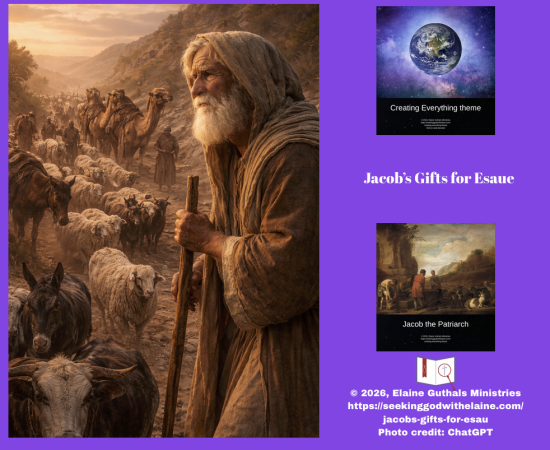
  • Jacob’s Gifts for Esau

    Jacob and Esau had parted company 20 years early with anger and fear. This devotional reading looks at how Jacob tried to curry Esau’s favor.

    Nuggets

    • Jacob’s gift to Esau wasn’t a casual gift.
    • Jacob presented the animals to Esau to secure peace.
    • Jacob instructed the men what to say as the gift was from him.
    • Jacob atoned for his sins against Esau.
    • Pass through the water can have significant meaning.
    jacobs-gifts-for-esau

    Jacob sent Esau a message in order to give Esau fair warning and not blindside him.

    The message was structured according to custom. Jacob used very deferential language in his message to Esau. He called Esau my lord and himself his servant. He declared his wealth to establish a peaceful intent.

    How did Esau respond? With an army of 400 soldiers.

    In order to soften Esau’s temper, Jacob sent him a really nice gift.

    Let’s Put It into Context

    To read devotions in the Creating Everything theme, click the button below.

    Devotions in the Jacob the Patriarch series

    The Gift Strategy

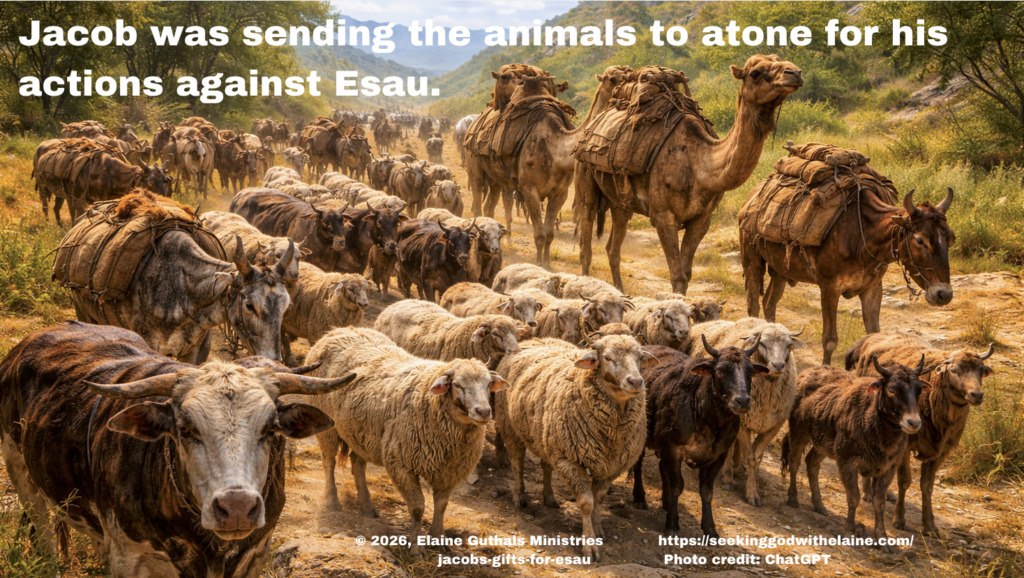
    “Jacob stayed where he was for the night. Then he selected these gifts from his possessions to present to his brother, Esau: 200 female goats, 20 male goats, 200 ewes, 20 rams, 30 female camels with their young, 40 cows, 10 bulls, 20 female donkeys, and 10 male donkeys. He divided these animals into herds and assigned each to different servants. Then he told his servants, ‘Go ahead of me with the animals, but keep some distance between the herds.’ He gave these instructions to the men leading the first group: ‘When my brother, Esau, meets you, he will ask, “Whose servants are you? Where are you going? Who owns these animals?” You must reply, “They belong to your servant Jacob, but they are a gift for his master Esau. Look, he is coming right behind us.”’ Jacob gave the same instructions to the second and third herdsmen and to all who followed behind the herds: ‘You must say the same thing to Esau when you meet him. And be sure to say, “Look, your servant Jacob is right behind us.”’ Jacob thought, ‘I will try to appease him by sending gifts ahead of me. When I see him in person, perhaps he will be friendly to me.’ So the gifts were sent on ahead, while Jacob himself spent that night in the camp” (Gen. 32: 13-21 NLT)

    These Gifts

    Jacob’s gift to Esau wasn’t a casual gift.

    We have to think about Jacob’s gift in his time. It was an Ancient Near Eastern custom to have sequential waves of gifts to soften a superior’s anger.

    But Ligonier.org thought this was an excessive gift. They argued that Jacob had already returned the stolen blessing (Gen. 25: 23; 27: 27–29) by calling Esau my lord. The author questions Jacob’s sincerity regarding the means he used to obtain the ends. Was he really sorry for how he gained the wealth?

    Resource

    Yes, Jacob is following the custom of the day – a pagan custom. Is he just trying to buy Esau’s favor and forgiveness?

    But that what Jacob is trying to do? I don’t think so.

    Several times in this passage, Jacob uses the Hebrew word minchah. The New Living Translation uses the word gifts.

    • “… Then he selected these gifts from his possessions to present to his brother, Esau” (Gen. 32: 13 NLT emphasis added).
    • “You must reply, ‘They belong to your servant Jacob, but they are a gift for his master Esau. Look, he is coming right behind us’” (Gen. 32: 18 NLT emphasis added).
    • “… Jacob thought, ‘I will try to appease him by sending gifts ahead of me …’” (Gen. 32: 20 NLT emphasis added).
    • “So the gifts were sent on ahead …” (Gen. 32: 21 NLT emphasis added).

    Why is this important? Look at Leviticus 2. In Hebrew, Bradford said the grain offering is called the Minchah. The Englishman’s Concordance used a slightly different spelling – except in the URL.

    Resources

    It wasn’t a gift or present. It was an offering.

    No, Jacob wasn’t trying to make Esau a god. He was atoning to his Sovereign God through restoring his relationship with his brother.

    “So if you are presenting a sacrifice at the altar in the Temple and you suddenly remember that someone has something against you, 24leave your sacrifice there at the altar. Go and be reconciled to that person. Then come and offer your sacrifice to God” (Mt. 5: 23-24 NLT).

    Can we make an argument that Jacob was combining the sacred and the pagan? Probably.

    Did Jacob go too far in trying to make amends with Esau? Maybe.

    Did Jehovah have a problem with this? Well, Moses didn’t say one way or the other.

    Divided These Animals

    Jacob presented the animals to Esau to secure peace.

    Jacob just didn’t willy-nilly give Esau the animals. He provided the servants to care for those animals.

    In other words, Jacob put some thought into it. This showed his sincerity.

    The way that Jacob sent them is waves is also an Ancient Near East custom when a servant was trying to appease a king. The sequential gifts in waves were meant to soften a superior’s anger.

    Instructions to the Men

    Jacob instructed the men what to say as the gift was from him.

    I am sure that Jacob picked men that were not only good livestock handlers but also ones who would carry out his instructions fully.

    The message was, “Tell Esau the animals are his, and that I’m coming.”

    Jacob Thought

    Jacob atoned for his sins against Esau.

    The Hebrew in verse 20 says kaphar panav. Kaphar means atone, pacify, or cover. Panav means his face. Taken together, it is talking about atoning for his presence.

    Resources

    I can see that. Jacob is asking Esau’s forgiveness upon returning (coming into his presence again) by giving him to animals to pacify his anger and atone for his sins.

    But the really telling thing is the root part of the word. It is the same root as atonement – kippur.

    Jacob’s intent was to have the herds and flocks function as a show of reconciliation. He did all that he could to turn aside his brother’s wrath and curry his favor. He was sending the animals to atone for his actions against Esau.

    Wasn’t that what Jehovah wanted? Jacob was the covenant son, not Esau. Rebekah knew that from before they were born (Gen. 25: 23).

    I say it again. The ends do not justify the means. Election does not excuse deception.

    So, Jacob needed to atone for his sins.

    To do this, instead of buying the blessing now, he was trying to repair the breach. That is how much he has grown.

    Crossing the Jabbok

    “During the night Jacob got up and took his two wives, his two servant wives, and his eleven sons and crossed the Jabbok River with them. After taking them to the other side, he sent over all his possessions” (Gen. 32: 22-23 NLT)

    Pass through the water can have significant meaning.

    Think about this – I hadn’t before.

    Jacob sent everyone ahead. He had to reenter Canaan by himself. He left alone; he had to come back alone.

    But it is more than that, isn’t it? Water.

    • Jacob, in this instance, is crossing the river.
    • Moses and the Israelites crossed the Red Sea (Ex. 14: 21-22).
    • Elijah crossed before his ascension (2 Kgs. 2: 8).

    Can we see this as a type of baptism? We’re getting to the spot where Jacob will have a new identity.

    Even in the Old Testament, Jehovah wanted the Hebrews and then the Israelites to become new creations. “This means that anyone who belongs to Christ has become a new person. The old life is gone; a new life has begun!” (II Cor. 5: 17 NLT).

    Making the Connections #1

    When Jacob crossed the Jabbok, he needed rescue from Esau. When he limped into the sunrise renamed Israel, he needed belonging – identity.

    Both were true within 24 hours.

    Who showed up? Angels surrounding Jacob to fulfill their purpose.

    We shouldn’t bite ourselves when our Sanctification Road takes swings like that.  We have angels guarding us, also.

    • “For he will order his angels to protect you wherever you go. They will hold you up with their hands so you won’t even hurt your foot on a stone” (Ps. 91: 11-12 NLT).
    • “Therefore, angels are only servants — spirits sent to care for people who will inherit salvation” (Heb. 1: 14 NLT).
    • “For the angel of the Lord is a guard; he surrounds and defends all who fear him” (Ps. 34: 7 NLT).

    Look what Spurgeon said. He wrote,

    “When God means to deliver you, beloved, in the hour of danger, you will find the appointed force ready for your [succor]. God’s messengers are neither behind nor before their time; they will meet us to the inch and to the second in the time of need; therefore let us proceed without fear, like Jacob, going on our way even though an Esau with a band of desperadoes should block up the road.”

    Resource

    This is but one way Jehovah provides for us. It is but one way that He is always with us.

    Making the Connections #2

    I like what Ligonier.org said about why Jacob was fearful. We tend to think fear and anxiety should be washed away in the baptismal waters. Wrong.

    “Fear remains a factor among God’s chosen. True, fearfulness is not ideal, and some biblical heroes seem to fear nothing (see Dan. 6, for example). Yet until we are glorified, we will battle the flesh (Rom. 6:12–14). ‘Perfect love casts out fear’ (1 John 4:18), but love, faith, and hope (1 Cor. 13:13) will not be perfected in us until that final day (1 John 3:2). Christ destroyed sin’s power (Rom. 8:2), but its presence remains; thus, fear often colors our faith, hope, and love.”

    Resource

    How many times do verses start out with “Don’t be afraid”? No, it isn’t 365 times. That is a nice thought, but not true.

    It is a part of many of our Sanctification Roads that we turn from fear to trust. We van do this as our faith in and love for Jehovah grows.

    That is going to be a struggle for us until we are called home.

    Listen to this song by John Reddick. It has a good message about not fearing.

    Related Links

    John Reddick

    How Do We Apply This?

    • Realize our past sins will come up if we have not repented of and/or confronted them.
    • Meet difficulties with prayer.

    Resource

    Father God. You don’t want us to have conflicts with others, especially our family. But Yeshua knew that would happen (Lk. 12: 51-53; Mt. 10: 34-36). Help us be grounded in our faith in You so that we can witness to our families for You. Amen.

    If you don’t understand something and would like further clarification, please contact me.

    If you have not signed up for the email providing the link to the devotions and the newsletter, do so below.

    If God has used this devotion to speak with you, consider sharing it on social media.
  • Jacob and Esau on a Collision Course

    With Jacob on the way home from Paddan-aram, we know he is going to run into Esau sooner or later. This devotional reading looks at what happened when Jacob knew Esau was coming.

    Nuggets

    • Jacob again encountered Jehovah’s messengers.
    • Jacob made contact with Esau according to custom.
    • Esau was already on his way.
    • Jacob’s reaction was to divide into two camps.
    • Jacob finally put his situation in God’s hands.
    • We have to acknowledge Jehovah’s sovereignty and appealed to the Maker of the covenant.
    • We need to keep ourselves humble before Jehovah and express our need for Him.
    • Jacob knew his petitions would be answered because he knew he could count on Jehovah’s mercies.
    • We have to claim Jehovah’s promises with us and assure Him that they are at the forefront of our minds.
    jacob-and-esau-on-a-collision-course

    The morning after Jacob and Laban made their covenant, Laban kissed his daughters and grandchildren and left. We do not hear about him again.

    Jacob was ready to move on, too.  He may no longer have totally feared Laban, but he was his rearview mirror.

    Esau, who would have been a fiercer enemy than Laban, was in his windshield. They had parted with a rocky relationship.

    Had Esau made his peace, or did Jacob still need to be on his toes?

    Let’s Put It into Context

    To read devotions in the Creating Everything theme, click the button below.

    Devotions in the Jacob the Patriarch series

    The Angels at Mahanaim

    “As Jacob started on his way again, angels of God came to meet him. When Jacob saw them, he exclaimed, ‘This is God’s camp!’ So he named the place Mahanaim” (Gen. 32: 1-2 NLT)

    Jacob again encountered Jehovah’s messengers.

    To begin Genesis 32, we have another encounter with angels. That is what all Hebrew translations I’ve found calls the beings we see in Genesis 32: 1.

    Both the Greek and Hebrew words mean messenger. The Greek is angelos where the Hebrew word is malake.

    Resource

    The problem I have with the Greek translation is that deities and mythological figures in Greek culture also were associated with angels. It would have been easy for them to bring that worldview image into their spiritual lives.

    The reality is that we aren’t told how Jehovah’s messengers look. Wings? Who knows? Halos? Doesn’t say. Young, old, strong, swift? Your guess is as good as mine – and it would be a guess.

    You know, we said a while back that everyone but Abraham was afraid when they saw angels. I think we need to add Jacob to that list of being unafraid.

    Go back to Bethel on the trip to Paddan-aram (Gen. 28: 12). Jacob saw angels in his dream. He could have written that off as a … dream. He didn’t. He accepted it as a real conversation with Jehovah.

    No, this wasn’t a dream. This was a wide-awake, I-can-see-you experience.

    The messengers met Jacob where he was in his walk.

    Think of it this way. Just as Jacob was leaving Canaan, he had a visit. Now that he was reentering, he gets another visit. Jehovah is not only with us in the day-to-day walk but also in the transitions.

    Here, Jacob recognized them for what they were. We don’t know the express reason for their visit, but I think we can take a good stab at it with Leale’s help.

    We are told in verse 2 that Jacob named the place the visitation occurred. Names are important in Scripture, even names of places. Mahanaim means two camps.

    Leale thought that name came from the unknown number of messengers splitting up and going before and after Jacob.

    Resource

    Can we spell escort and legitimacy even in the unsettling?

    To me, it sounds like a squadron of messengers. When Jacob called the place Mahanaim, it was military language. I would say it had to be enough to give Jacob that impression.

    It may have been an acknowledgement that Jacob was at a different place in his relationship with God than he was when he left Canaan 20 years before.

    But it also brings up a very good point. Our loving Father will come to meet us where we are with what we need.

    Once again, Jacob had an encounter with the unseen world.

    The Esau Crisis

    “Then Jacob sent messengers ahead to his brother, Esau, who was living in the region of Seir in the land of Edom. He told them, ‘Give this message to my master Esau: “Humble greetings from your servant Jacob. Until now I have been living with Uncle Laban, and now I own cattle, donkeys, flocks of sheep and goats, and many servants, both men and women. I have sent these messengers to inform my lord of my coming, hoping that you will be friendly to me.”’ After delivering the message, the messengers returned to Jacob and reported, “We met your brother, Esau, and he is already on his way to meet you — with an army of 400 men!” Jacob was terrified at the news. He divided his household, along with the flocks and herds and camels, into two groups. He thought, ‘If Esau meets one group and attacks it, perhaps the other group can escape’” (Gen. 32: 3-8 NLT)

    Jacob Sent Messengers Ahead

    Jacob made contact with Esau according to custom.

    Jacob wasn’t sure what kind of reception he was going to get from Esau. When he had left those twenty years before, Jacob had to high tail it out of there because he thought Esau was going to kill him.

    Now, Jacob was coming home an influential man. He has all these wives, kids, servants, flocks, and herds that were coming with him.

    But Jacob couldn’t know if Esau was still steamed about the birthright and blessing theft. Oh, yeah. Esau made the choice to sell him his birthright, but it wasn’t something really Jacob should have approached.

    Jacob approached this correctly, though. He didn’t blindside Esau — he gave him fair warning.

    Jacob used very deferential language in his message to Esau. He called Esau my lord. He said he was his servant.

    We may think listing his wealth meant Jacob was trying to be a show-off. That is far from the truth.

    It was an Ancient Near Eastern custom to declare wealth to establish a peaceful intent. I mean, how many times have we heard of raiding parties listing their assets?

    Esau and His Army Is Already on His Way

    Esau was already on his way.

    Esau’s response? Jacob’s messengers weren’t even back before Esau had started out.

    Moving with enough to break into two camps probably meant they weren’t moving stealthily. Esau probably had warning someone was coming.

    Or did Jehovah tell Esau to come meet Jacob? He knew this issue had to be settled.

    Whichever way, it sure sounded like a war party to Jacob. That was a show of strength.

    Jacob didn’t wait for anything. Immediately upon hearing of Esau’s threat, Jacob acted.

    Does this show Jacob has retained a measure of his planning and scheming? Well, he should.

    Jehovah is an organized God. He runs on plans. So should we.

    We do have to calculate the consequences of our actions — both good and bad. That must be factored into our decision-making process.

    But what about the scheming? Sometimes, we may have to make plans in secret, but they shouldn’t be underhanded.

    In the end, Jacob wronged his brother by his suspicions that Esau was coming to take revenge.

    Yare’ means afraid, coming from the root word yira meaning to fear. Tsar means distressed.

    This wasn’t just external pressure. It was an internal panic.

    Wouldn’t we have had the same feelings as Jacob? He sent servants. Esau sent soldiers.

    Jacob Divided His Household

    Jacob’s reaction was to divide into two camps.

    Yeah, go back to verse 1 and 2. That was two camps, also; but that wasn’t out of fear.

    This – even with the escort of the messengers – was done out of fear.

    Ooo, baby. Can’t things of this world really scare us at times? Sometimes, it is just a gut reaction.

    Dividing into two camps wasn’t a show that Jehovah could not protect him. Jacob was saying he was going to do everything is his power to protect what Jehovah gave him.

    The dividing came out if responsibility. Jacob had a responsibility to his family to provide for their safety. In this case, he succeeded.

    It was stewardship. True, he should have said the prayer before he did the dividing. Was he afraid he didn’t have time?

    Gray had a good point. He wrote, “It must have been a huge company at the first, for him to think, after the message he sent (vers. 4, 5), that his brother would imagine the half was all he had.”

    Resource

    Jacob’s second step was to pray.

    Jacob’s Prayer

    “Then Jacob prayed, ‘O God of my grandfather Abraham, and God of my father, Isaac — O Lord, you told me, “Return to your own land and to your relatives.” And you promised me, “I will treat you kindly.”  I am not worthy of all the unfailing love and faithfulness you have shown to me, your servant. When I left home and crossed the Jordan River, I owned nothing except a walking stick. Now my household fills two large camps!  O Lord, please rescue me from the hand of my brother, Esau. I am afraid that he is coming to attack me, along with my wives and children. But you promised me, “I will surely treat you kindly, and I will multiply your descendants until they become as numerous as the sands along the seashore — too many to count”’” (Gen. 32: 9-12 NLT)

    Jacob Prayed

    Jacob finally put his situation in God’s hands.

    We get the first recorded prayer from Jacob in this chapter. Craig told us that gave us a good picture of his heart. He also called it a real prayer.

    Resource

    Where Jacob had always been impulsive and took care of business by himself before, His time in Paddan-aram has taught him to trust in Jehovah.

    Jacob did ask Jehovah to bless his plan. Good thing that was His plan all along. What Jacob lost doing it this way was peace.

    Yeah, Jacob knew the messengers were there and would protect him. But the threat was real, not something to be ignored.

    And doesn’t that tell us something? Jehovah answered the prayer before Jacob prayed it. So, no. Jacob didn’t necessarily get the order wrong.

    Jacob started his prayer out by telling Jehovah what circumstances he was in. Because Jehovah didn’t know? No!

    We pray to align our will with Jehovah’s. We have to tell Him where we are at now, even if it is afraid and distressed.

    I see you jumping up and down over there. You think we aren’t supposed to feel anxious. “Don’t worry about anything; instead, pray about everything” (Phil. 4: 6 NLT).

    Merimnate, the Greek word used, is translated several different ways in English. Don’t worry. Don’t be anxious. Take no thought. Be careful.

    Resource

    Not feeling anxious isn’t going to happen. It is human nature.

    I take this as, “Don’t keep worrying and feeling anxious. Start praying. He’s got this.”

    O God

    We have to acknowledge Jehovah’s sovereignty and appealed to the Maker of the covenant.

    Part of us may look at “… ‘O God of my grandfather Abraham, and God of my father, Isaac …’” (Gen. 32: 9 NLT) and think, “Why didn’t he say, ‘Where is my God?’”

    No, Jacob wasn’t backsliding. He was making a covenant appeal.

    Jackson acknowledged that Jacob was addressing Sovereign God’s presence in his family’s past. He was hooking into his family’s past obedience to help grow his faith.

    Resource

    This wasn’t just about Jacob. It was about the promises Jehovah made to Abraham and Isaac. He promised a relationship with them – and carried that on to Jacob.

    This was a don’t-leave-me-now plea.

    But this is also about Jacob’s obedience. “You told me to come home, and I came. You said You would work things out. This is a big thing only You can work out.”

    I Am not Worthy

    We need to keep ourselves humble before Jehovah and express our need for Him.

    How do we know Jacob was making a covenant appeal? “I am not worthy of all the unfailing love and faithfulness you have shown to me, your servant …” (Gen. 32: 10 NLT). Then he said, “But You promised.”

    Think again of leaving and returning to Canaan. Jacob left with a staff. He was a cheater and liar. We would think that would disqualify him from being a man of faith.

    Jehovah doesn’t. What made Jacob — and us — God’s people, His children, is our acknowledgment that we need Him and His saving grace.

    We have to admit that we cannot save ourselves. Only belief in Jesus can do that.

    The foundation of our belief must be our recognizing Sovereign God’s love and faithfulness to us. All we have to do is to submit to Him. What that means is we follow His laws and commandments.

    Now, Jacob returned with wives, children, flocks, herds, camels – enough for two camps.

    More importantly, Jacob has fixed his relationship with His Creator. The deceiver had been humbled. The Hebrew word is qatonti — I have become small.

    That humility is exactly what Jehovah wants.

    On top of that, this follows the classic covenant prayer structure.

    In this prayer, Jacob also acknowledged everything that Jehovah had given him. He gave him enough to divide into two companies, each of which looked big enough to be all he had.

    Please Rescue Me

    Jacob knew his petitions would be answered because he knew he could count on Jehovah’s mercies.

    Jacob asked Jehovah to “… rescue me from the hand of my brother, Esau …” (Gen. 32: 11 NLT).

    Don’t we hate it when our peaceful gestures are met with hostility?

    Let’s step back a second. What was Jacob feeling?

    There was fear. This time, Esau had the army to do him the bodily hard that he had threatened.

    There was the guilt. Now, Jacob now fully admitted he was guilty. He would take responsibility for his actions.

    But there are other responsibilities. He has a wife, children, servants, and livestock. What would Esau and his vengeance do about those lives?

    Now, there was humility.

    We can’t miss one very important aspect of Jacob’s prayer. We have to ask Jehovah what we want Him to do.

    Yes, that was going to be the way the prayer was answered because this was a covenant prayer. But we have to ask that Sovereign God’s Will be done.

    This is how we align with that Will.

    You Promised Me

    We have to claim Jehovah’s promises with us and assure Him that they are at the forefront of our minds.

    Does it seem arrogant to give Jehovah’s words right back to Him? No. We show we are listening and expect Him to keep His promises.

    Jehovah wants us to quote Scripture and promises back to Him. Through these prayers is one way He will broaden our understanding of them.

    Making the Connections #1

    I loved what Spurgeon said. He wrote,

    “He was leaving Laban and the school of all those tricks of bargaining and bartering which belong to the ungodly world. By a desperate stroke he cut himself clear of entanglements; but he must have felt lonely, and as one cast adrift. He missed all the associations of the old house of Mesopotamia, which, despite its annoyances, was his home. The angels come to congratulate him. Their presence said, ‘You are come to this land to be a stranger and sojourner with God, as all your fathers were. We have, some of us, talked with Abraham, again and again, and we are now coming to smile on you. You recollect how we bade you good-bye that night, when you had a stone for your pillow at Bethel; now you have come back to the reserved inheritance, over which we are set as guardians, and we have come to salute you. Take up the nonconforming life without fear, for we are with you. Welcome I welcome I we are glad to receive you under our special care.’”

    Resource

    Jehovah and his messengers know when we have given up a previous life to be obedient to Him. They know when that gives us a queasy tummy.

    They are right there to encourage, protect, and guide us.

    Did Jacob need a reminder about Bethel, as Spurgeon questioned? Maybe. Jehovah and His messengers were right there for that, too.

    Making the Connections #2

    Vaughan gave us a good description of a messenger’s job description.

    • Ministering spirits to the heirs of salvation.
    • Perform the tasks given to them by Jehovah.
    • Listen to what Sovereign God said in His Word.

    Resource

    What they don’t do is just sit there and worship Jehovah all day. They have tasks to do.

    Making the Connections #3

    Doesn’t the twins’ actions show the still-present differences in their characters? “As the boys grew up, Esau became a skillful hunter. He was an outdoorsman, but Jacob had a quiet temperament, preferring to stay home” (Gen. 25: 27 NLT).

    Jacob was still with his family, and Esau was still displaying his physical strength and skills.

    How Do We Apply This?

    • Advance when Jehovah calls us to advance.
    • Move in the way Jehovah commands.
    • Acknowledge received blessings.
    • Pray when obeying Jehovah’s directions.
    • Take care of what Jehovah has given us.

    Resources

    Father God. We know that You will protect us. Forgive us when we take our eyes off you and focus on the coming trouble. Amen.

    If you don’t understand something and would like further clarification, please contact me.

    If you have not signed up for the email providing the link to the devotions and the newsletter, do so below.

    If God has used this devotion to speak with you, consider sharing it on social media.
  • Jacob and Laban’s Covenant

    Laban caught up with Jacob after he quietly left Haran. This devotional reading looks at the covenant the two made.

    Nuggets

    • I wonder if Jacob would have sentenced the thief to death if he would have known it was Rachel.
    • Jacob unloaded because years of pent-up frustration came spewing out.
    • Laban again staked his claim but accepted defeat.
    • Jacob and Laban made a covenant and had a meal to seal the deal.
    • On the surface, it looks like Laban and Jacob are swearing by the same God, but they may not have been.
    • Jacob and Laban entered into a covenant agreement, but it doesn’t seem like their relationship was mended.
    jacob-and-labans-covenant

    Things had gone downhill between Laban and Jacob. When Jehovah had told Jacob to return to Canaan, he rounded up the flocks and herds, put his wives and children on camels, and set off.

    The problem was that Jacob set off in secret without telling Laban. What did Laban think of that?

    Let’s Put It into Context

    To read devotions in the Creating Everything theme, click the button below.

    Devotions in the Jacob the Patriarch series

    Rachel and the Teraphim

    “‘But as for your gods, see if you can find them, and let the person who has taken them die! And if you find anything else that belongs to you, identify it before all these relatives of ours, and I will give it back!’ But Jacob did not know that Rachel had stolen the household idols. Laban went first into Jacob’s tent to search there, then into Leah’s, and then the tents of the two servant wives — but he found nothing. Finally, he went into Rachel’s tent. But Rachel had taken the household idols and hidden them in her camel saddle, and now she was sitting on them. When Laban had thoroughly searched her tent without finding them, she said to her father, ‘Please, sir, forgive me if I don’t get up for you. I’m having my monthly period.’ So Laban continued his search, but he could not find the household idols” (Gen. 31: 32-35 NLT)

    I wonder if Jacob would have sentenced the thief to death if he would have known it was Rachel.

    Rachel had taken the figurines on her own. Jacob knew nothing about it.

    Because of that, Jacobs reaction to Laban was totally honest. “What are you talking about?”

    Did Jacob make a vow before sovereign God? We can look at it that way. We know the rest of the story.

    Rachel got as far as Bethlehem in Canaan. There, she died in childbirth.

    Was this because Jacob made a vow to God that the person who took the idols would die? Was this just Sovereign God punishing the thief?

    We talked about the different possible reasons why Rachel took them.

    • These figurines were connected to inheritance rights.
    • Rachel could have seen that as a transfer of clan leadership from Laban to Jacob.
    • She may have taken them for worship purposes, if she retained a mixed allegiance like Laban did.

    Moses didn’t pass judgment on Rachel’s actions either way. He did not justify them, but he did not condemn them either.

    But once we connect this to Rachel’s death in Genesis 35, the question hangs in our minds.

    Back to 1703 BC. Laban searched.

    It is interesting he saved Rachel for last. Did he think she was the last one to take the idols? Or did he think she did and saved her for last in order to increase the humiliation he would think he was heaping on Jacob?

    The Teraphim were in the camel saddle while Rachel sat on them. Was this a way to subtlety Laban’s gods? The excuse of her claiming menstrual impurity would have been symbolic humiliation.

    Remember, Rachel and Leah had felt like Laban had treated them as foreigners. They felt that they had been sold off to Jacob (Gen. 31: 14-15).

    They were not expecting to be written into dear old dad’s will.

    In Rachel’s mind, this would have been great payback. Her manipulative father would be searching, powerless, without his gods — outwitted by a woman.

    Jacob’s Defense Speech

    “Then Jacob became very angry, and he challenged Laban. ‘What’s my crime?’ he demanded. ‘What have I done wrong to make you chase after me as though I were a criminal? You have rummaged through everything I own. Now show me what you found that belongs to you! Set it out here in front of us, before our relatives, for all to see. Let them judge between us! For twenty years I have been with you, caring for your flocks. In all that time your sheep and goats never miscarried. In all those years I never used a single ram of yours for food. If any were attacked and killed by wild animals, I never showed you the carcass and asked you to reduce the count of your flock. No, I took the loss myself! You made me pay for every stolen animal, whether it was taken in broad daylight or in the dark of night. I worked for you through the scorching heat of the day and through cold and sleepless nights. Yes, for twenty years I slaved in your house! I worked for fourteen years earning your two daughters, and then six more years for your flock. And you changed my wages ten times! In fact, if the God of my father had not been on my side — the God of Abraham and the fearsome God of Isaac — you would have sent me away empty-handed. But God has seen your abuse and my hard work. That is why he appeared to you last night and rebuked you!” (Gen. 31: 36-42 NLT)

    Jacob unloaded because years of pent-up frustration came spewing out.

    Can we read that tirade and not feel sorry for Jacob?

    • 20 years of service
    • Heat by day, frost by night
    • Losses absorbed personally
    • Wages changed ten times

    This is another place that we can’t forget that this is clan business. Jacob was putting putting forth a formal legal defense.

    I think this is the only place where it does not read as some form of the “God of Abraham, God of Isaac, God of Jacob” the patriarchal line.

    This talks about the “… fear of Isaac …” (Gen. 31: 42 NLT). Remember, this was the son who Jehovah told his father to bind and sacrifice (Gen. 22: 1-19).

    Oh, yeah, some of the terror was probably there. But in the end, it was replaced by the revenant awe that he was saved. I am sure that shaped Isaac’s relationship with Jehovah as well as his outlook on life.

    Bottom line here is Jacob acknowledged Jehovah’s watch care and His provision.

    Laban’s Counterclaim

    “Then Laban replied to Jacob, ‘These women are my daughters, these children are my grandchildren, and these flocks are my flocks — in fact, everything you see is mine. But what can I do now about my daughters and their children? So come, let’s make a covenant, you and I, and it will be a witness to our commitment’” (Gen. 31: 43-44 NLT)

    Laban again staked his claim but accepted defeat.

    I am sure when Laban left Haran, he thought that he would be victorious. He would avenge the slight leveled toward his clan and, most importantly, get back his wealth.

    Even though in clan culture Laban would have been able to justify his actions, he deferred to Jehovah’s command. So, instead of violence, he and Jacob made a covenant.

    The Covenant of Mizpah

    “So Jacob took a stone and set it up as a monument. Then he told his family members, ‘Gather some stones.’ So they gathered stones and piled them in a heap. Then Jacob and Laban sat down beside the pile of stones to eat a covenant meal. To commemorate the event, Laban called the place Jegar-sahadutha (which means ‘witness pile’ in Aramaic), and Jacob called it Galeed (which means “witness pile” in Hebrew). Then Laban declared, ‘This pile of stones will stand as a witness to remind us of the covenant we have made today.’ This explains why it was called Galeed — ‘Witness Pile.’ But it was also called Mizpah (which means ‘watchtower’), for Laban said, ‘May the LORD keep watch between us to make sure that we keep this covenant when we are out of each other’s sight. If you mistreat my daughters or if you marry other wives, God will see it even if no one else does. He is a witness to this covenant between us” (Gen. 31: 45-50 NLT)

    Jacob and Laban made a covenant and had a meal to seal the deal.

    In the Complete Jewish Bible, stone pillar and stone monument are the same word — standing stone. I think that is another instance where modern translators used modern words for our ease.

    A standing stone (or Matstsebah) was an ancient custom where a large stone was placed to commemorate sacred covenants or important events. They were used in the Bronze and Iron Ages (3150-586 BC). This practice was banned in Deuteronomy 16: 22 NLT).

    In our vernacular, we would say Jacob and Laban erected a memorial. It is interesting that Jacob’s family was in charge of gathering the stones.

    We see a difference of language with Laban and Jacob. While both are Semitic languages, they were distinct languages. I won’t bore you with the grammatical similarities and differences.

    We know Hebrew was the language of ancient Israel. Most of the Scriptures were written in Hebrew.

    Aramaic began in Laban’s neck of the woods – Aram (the region of Syria) – but became the diplomatic and trade language of the Ancient Near East. So, it became an international language, much like English is today.

    In fact, by Yeshua’s time, the everyday spoken language had shifted to Aramaic.

    We see several elements of a covenant here. Covenants are agreements, contracts, or promises between two parties to perform the responsibilities listed in the covenant.

    • A bond was formed to mutually benefit both parties.
    • Both accepted the responsibilities of the covenant – not crossing the line.
    • The covenant fellowship meal was had. 
    • A sacrifice was made.
    • I don’t know if the covenants was written on stone pillar or not.

    In verse 49 when Laban said “… May the LORD keep watch between us …” (Gen. 31: 49 NLT), he called Jehovah by name. He wanted to be sure that Jehovah saw that he kept his end of the bargain.

    But that also stemmed from Laban’s distrust of Jacob. “May God keep watch over you so you don’t come back and get me.”

    Oath by Different Gods

    “‘See this pile of stones,’ Laban continued, ‘and see this monument I have set between us. They stand between us as witnesses of our vows. I will never pass this pile of stones to harm you, and you must never pass these stones or this monument to harm me. I call on the God of our ancestors—the God of your grandfather Abraham and the God of my grandfather Nahor — to serve as a judge between us’” (Gen. 31: 51-53 NLT)

    On the surface, it looks like Laban and Jacob are swearing by the same God, but they may not have been.

    Laban invokes the name of Abraham and Nahor’s God. Yes, Abraham’s God was Jehovah. We aren’t really told that Nahor worshipped the same God once they stopped worshipping the false gods in Ur.

    But Nahor’s side of the family tree produced the women (other than Sarah who was Terah’s daughter) who were the matriarchs of the covenant line. I don’t see Jehovah picking a family that did not follow Him.

    Still, Laban is calling on the broader ancestral deity. Jacob is calling on the God of the covenant.

    There is a theological divide there.

    Garris had an interesting article on this. I am just going to leave you the address, and you can read it for yourself if you are interested.

    I know there is the debate on whether Nahor went with Abraham and Terah when they first left Ur or if they came later. Either way, Nahor’s — and eventually Laban’s — walk with Jehovah was different. Different people, different experiences, different levels of faith and obedience.

    In the end, Garris wasn’t really sure what Laban meant. He wrote, “Thus, when Laban spoke of the elohim of Nahor and Terah in Genesis 31:53, he could have meant the false ‘gods’ of Nahor and Terah, or he could have meant Yahweh the ‘God’ of Nahor and Terah. The verse is ambiguous.”

    Resource

    It is safe to know that Abraham’s family knew of Jehovah. I would say probably Nahor did serve Him also. Laban always has struck me as taking a more worldview approach — which in his world would mean hedging his bets by worshiping many gods.

    Departure

    “So Jacob took an oath before the fearsome God of his father, Isaac, to respect the boundary line. Then Jacob offered a sacrifice to God there on the mountain and invited everyone to a covenant feast. After they had eaten, they spent the night on the mountain. Laban got up early the next morning, and he kissed his grandchildren and his daughters and blessed them. Then he left and returned home” (Gen. 31: 54-55 NLT)

    Jacob and Laban entered into a covenant agreement, but it doesn’t seem like their relationship was mended.

    When Jacob left Haran, he left in fear. When Laban chased Jacob, he did so in anger.

    When they separated to go their different ways, there was no warmth or reconciliation. They had just made a formal – conditional – peace.

    Jacob was now free to truly become a patriarch.

    Making the Connections

    Jacob sure wasn’t on the same spot on the Sanctification Road when he left Paddan-Aram compared to when he got there. We see a lot of spiritual growth.

    Laban — not so much. Even after he recognized the blessings came from Jehovah, he didn’t really choose to serve only Him.

    That is sad. “No one can serve two masters. For you will hate one and love the other; you will be devoted to one and despise the other. You cannot serve God and be enslaved to money” (Mt. 6: 24 NLT).

    Straddling the fence isn’t going to cut it. We have to be totally faithful to Jehovah.

    How Do We Apply This?

    • Submit totally to Jehovah.

    Father God. You watch over us and care for us through the good times and the bad times. You are there when we are pursued and when we worship. Thank You for never leaving us. Amen.

    If you don’t understand something and would like further clarification, please contact me.

    If you have not signed up for the email providing the link to the devotions and the newsletter, do so below.

    If God has used this devotion to speak with you, consider sharing it on social media.

  • Jacob and Laban’s Conflict Comes to a Head

    Jacob had taken off from Haran to return to Canaan. This devotional reading looks at what happened when Laban went after him – and caught up with him.

    Nuggets

    • After Laban learned of Jacob’s departure, he and his clansmen pursued him.
    • Laban caught up with Jacob and aired his grievances — all the while remembering his hands were tied.
    • Jacob had reason to be afraid.
    jacob-and-labans-conflict-came-to-a-head

    Things had gone downhill between Laban and Jacob. When Jehovah had told Jacob to return to Canaan, he rounded up the flocks and herds, put his wives and children on camels, and set off.

    The problem was that Jacob set off in secret without telling Laban. What did Laban think of that?

    Let’s Put It into Context

    To read devotions in the Creating Everything theme, click the button below.

    Devotions in the Jacob the Patriarch series

    Laban Pursues

    “Three days later, Laban was told that Jacob had fled. So he gathered a group of his relatives and set out in hot pursuit. He caught up with Jacob seven days later in the hill country of Gilead. But the previous night God had appeared to Laban the Aramean in a dream and told him, ‘I’m warning you — leave Jacob alone!’” (Gen. 31: 22-24 NLT)

    After Laban learned of Jacob’s departure, he and his clansmen pursued him.

    Let’s go back a little and talk about Jacob leaving. I wrestled and wrestled with where Jacob was in relation to Laban.

    Jacob’s escape wasn’t a midnight panic. It was a carefully staged withdrawal. The flocks were already three days away (Gen. 30: 35-36). What if those flocks and herds were three days to the south – i.e., on the way home?

    The Bible Hub pointed out that it would have been easy to send those in stages, led by his four older sons. The Euphrates River, 60 to 70 miles south, could have been a staging point (Gen. 31: 21).

    Resource

    Then when it was all set, Jacob could have put his family on the camels and left (Gen. 31: 17).

    The head start was built into the system. By the time Laban realized what had happened, Jacob was already moving toward the hill country — toward covenant ground.

    Laban had gone to shear sheep (Gen. 31: 19). Three days after Jacob left, Laban learned the news.  It is logical to think that it would take him three days to get back to Haran. Then he would have to gather his clansmen, which would probably take another day or two.

    Did that stealthy exit give Laban the authority to go after them? Well, yes.

    Remember, we said that the wedding ceremony was when the guardianship of the bride passed from the father to the husband. That happened about the time that the wedding couple went into the special tent.

    But remember also, nothing about Jacob’s stay in Haran had been typical. He didn’t use the bride price – mohar – hadn’t been an upfront payment. Instead, he had worked for seven years.

    The second issue was that of establishing an independent household. Jacob doesn’t do that. He is still living on Laban’s land, working within his economic system and Laban’s supervision.

    In other words, the sisters were still part of Laban’s clan. Laban still thought of the grandchildren as being part of his clan.

    The flocks and herds, while they were Jacob’s wages, were still under Laban’s authority. They were on his land.

    Jacob did not choose the normal way to sever the treaty he had with Laban. Yes, his reasoning was very sound but still wrong.

    On top of all that, something that we would consider as Laban’s personal possession was taken. And it really was a theft.

    Yes, Jehovah will speak to those who do not totally believer in Him, such as Laban. He spoke to Abimelech (Gen. 20: 3) who totally didn’t believe in Him.

    Some versions translate verse 24 to read “… Don’t say anything to Jacob, either good or bad” (Gen. 31: 24 NIV, ESV, KJV, NKJV, NASB, CSB). Good News Translation admonished Laban not to threaten Jacob. The Contemporary English Version added don’t make a promise.

    The Hebrew translates it as tov (good) and rah (bad, evil, or wicked). It is interested that this is formed in spiritual terms.

    But not really. This is the covenant son, not just some standard, run-of-the-mill shepherd.

    The Confrontation

    “Laban caught up with Jacob as he was camped in the hill country of Gilead, and he set up his camp not far from Jacob’s. ‘What do you mean by deceiving me like this?’ Laban demanded. ‘How dare you drag my daughters away like prisoners of war? Why did you slip away secretly? Why did you deceive me? And why didn’t you say you wanted to leave? I would have given you a farewell feast, with singing and music, accompanied by tambourines and harps. Why didn’t you let me kiss my daughters and grandchildren and tell them good-bye? You have acted very foolishly! I could destroy you, but the God of your father appeared to me last night and warned me, “Leave Jacob alone!” I can understand your feeling that you must go, and your intense longing for your father’s home. But why have you stolen my gods?” (Gen. 31: 25-30 NLT)

    Laban caught up with Jacob and aired his grievances — all the while remembering his hands were tied.

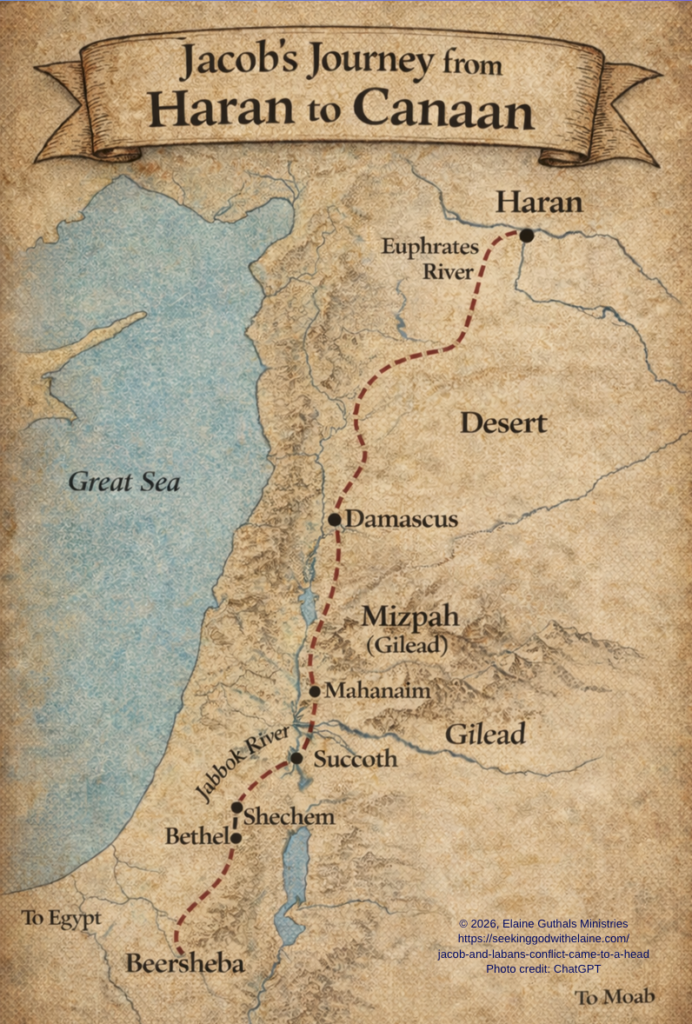
    First, we have to deal with travel issues. In my wee little mind, I have trouble making it connect.

    • Laban was told on the third day that Jacob had fled.
    • He pursued him seven days.
    • He overtook him in the hill country of Gilead.

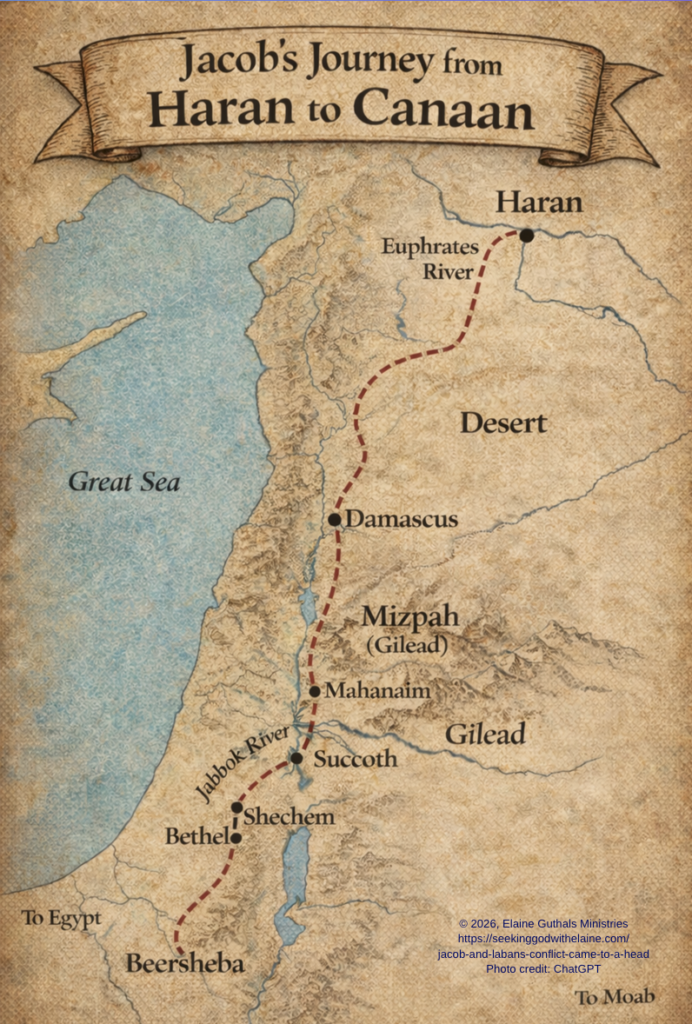
    So, I had a new map drawn and formatted differently. This helped.

    I know. Part of us is saying why would Laban throw this farewell feast when he refused to let Jacob go six years before.

    Go back to verse 2. “And Jacob began to notice a change in Laban’s attitude toward him” (Gen. 31: 2 NLT).

    Jacob was no longer the favored son-in-law. Despite all of Laban’s manipulations, Jacob got wealthy off him.

    Maybe Laban was no longer seeing his wealth increase because of Jacob (Gen. 30: 27). We said that, when Jehovah is working to prepare us for a change, He uses discontent. I think — especially in this case — the discontent had to have been on both sides.

    So, in a way, Laban throwing a party seems out of character. But then, he may have said that because he wouldn’t have wanted to lose face by not giving them the expected send off.

    In a way, I am surprised Laban told Jacob that Jehovah told him to cease and desist. But then, that is probably logical, too.

    Laban would have had the stronger party. Verse 23 only says that he “… gathered a group of his relatives … (Gen. 31: 23 NLT).

    Those weren’t just any relatives. Remember, this was clan business. They would have been battle ready.

    We said that Jacob now headed a clan, but it was filled with women and children. On top of that, the children were young.

    1716 BC – Jacob, 84, was tricked into marrying Leah. He agreed to work seven more years for Rachel
    1715 BC — Reuben born (Leah)
    1714 BC — Simeon born (Leah)
    1713 BC — Levi born (Leah)
    1712 BC — Judah born (Leah)
    1712 BC — Dan born (Bilhah)
    1711 BC — Naphtali born (Bilhah)
    1711 BC — Gad born (Zilpah)
    1710 BC — Asher born (Zilpah)
    1710 BC — Issachar born (Leah)
    1709 BC — Zebulun born (Leah)
    1709 BC – Joseph was born (Rachel)
    1703 BC – Jacob, 97, and his family left to return to Canaan (Gen. 31: 3)

    Based on Timeline from

    Reuben would have been 12 the way we figured it. Joseph would have been 6. If only four sons helped as Bible Hub said, I think the years on some are wrong.

    They may or may not have added to the fighting numbers.

    I’m sure Jacob did have some fight-ready servants. He wouldn’t have gone on that long of a journey without at least some.

    Clearly, Laban led the stronger party. And Jehovah neutralized him. This was Him protecting the covenant line —protection only because He interceded.

    Roost there a second. This world said that Laban was justified in using whatever force necessary to reclaim his claim. Sovereign God overruled that.

    Sovereign God will always overrule this world. Yes, Satan rules it now. Now.

    Jacob Responded

    “‘I rushed away because I was afraid,’ Jacob answered. ‘I thought you would take your daughters from me by force’” (Gen. 31: 31 NLT)

    Jacob had reason to be afraid.

    Laban gave this whole big spiel. Jacob answered him in a sentence.

    We will never know what Laban would have done had not God restrained him. Considering he was loaded for bear, we probably have a pretty good idea.

    Jacob distilled it down to the most important thing. He was afraid Laban would have taken his wives – plural. He did not leave Leah out. We may be surprised that he didn’t include his sons and his fear.

    Who is this Jacob not trusting Sovereign God to protect him? I don’t think so.

    Jehovah knows the anxiety is going to come. That isn’t a problem.

    It is what we do with that fear that is the problem. We could say that Jacob fleeing in secret showed that he did not trust God.

    I think the most telling part is that Jacob, in spite of his fear, was obedient and left. He trusted God to get him home.

    Making the Connections #1

    This just shows how much a big deal clans were. It took this to sever the patriarchal authority that Laban had over Jacob.

    Yeah, Jacob’s situation was different because he didn’t have the bride-price.

    We can see Laban’s side a little better. No, that doesn’t excuse his behavior toward Jacob – like changing his wages many times.

    But Laban was justified in his actions.

    Making the Connections #2

    Once again, Jehovah stepped in. He did with Abraham and Abimelech. He did with Laban.

    I bet Jehovah steps in more times than we know to protect us.

    How Do We Apply This?

    • Always be obedient to Jehovah, even when we are most fearful.
    • Go when he says go.

    Father God. We know You always watch over us — especially when we are being faithful. Help. us when we struggle with those of this world. Amen.

    If you don’t understand something and would like further clarification, please contact me.

    If you have not signed up for the email providing the link to the devotions and the newsletter, do so below.

    If God has used this devotion to speak with you, consider sharing it on social media.
  • Jacob Fled from Laban

    God told Jacob that it was time to leave Haran. This devotional reading looks at how Jacob got that accomplished this time.

    Nuggets

    • When Jehovah is working to prepare us for a change, he uses discontent.
    • Jehovah called Jacob home.
    • Jacob explained his plans to Leah and Rachel.
    • God was working even when it looked like agricultural folklore.
    • The covenant son got the covenant call.
    • This has to have been a big undertaking.
    • I see that the sisters’ response as one highlights their own growth on their Sanctification Roads.
    • Teraphim were small figurines that were kept in the home associated with family worship and divination.
    • Jacob was finally getting away from Laban and coming into his own.
    jacob-fled-from-laban

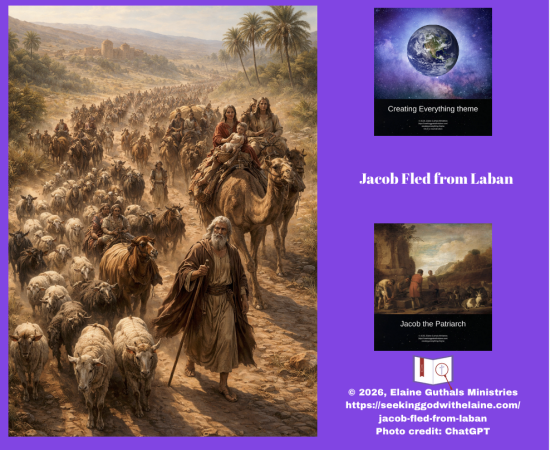
    It was time for Jacob to return to Canaan. But remember, he tried that once already.

    What was different this time? What he going to make it?

    Let’s Put It into Context

    To read devotions in the Creating Everything theme, click the button below.

    Devotions in the Jacob the Patriarch series

    The Atmosphere Turned

    “But Jacob soon learned that Laban’s sons were grumbling about him. ‘Jacob has robbed our father of everything!’ they said. ‘He has gained all his wealth at our father’s expense,’ And Jacob began to notice a change in Laban’s attitude toward him” (Gen. 31: 1-2 NLT)

    When Jehovah is working to prepare us for a change, he uses discontent.

    Jacob knew that he would return home “… One day I will bring you back to this land. I will not leave you until I have finished giving you everything I have promised you” (Gen. 28: 15 NLT). Rebekah said a big part of his going was for Esau to settle down so he could come back.

    Now, in Jacob’s eyes, Esau seems to be the least of the two enemies. He doesn’t hold a candle to Laban.

    That tracks. Esau never did anything to Jacob. Jacob is the one who lied and stole what socially should have been Esau’s.

    But a lot changes in six years. The world around us changes, we become discontented, and God changes our mission.

    Laban’s sons basically accuse Jacob of theft. They said he “took” what was their father’s.

    Well, no. Whatever flocks Jacob received was in agreement of the wages established in Genesis 30: 32.

    We have to remember in the Ancient Near East, wealth was seen as honor and inheritance security. They felt stripped of that.

    It wasn’t just the sons. It was Laban, too. “And Ya’akov beheld the countenance of Lavan, and, hinei [behold], it was not toward him as before” (Gen. 31: 2 OJB).

    Countenance means more than just our facial expression. It means support, also.

    Jacob was no longer the favorite son-in-law. Laban now showed hostility toward him.

    Jacob was a threat to Laban because he was no longer a hired hand. He was an equal if not higher up on the pecking order than Laban.

    Think about it. Laban liked Jacob when he was a dependent son-in-law as well as an employee. Even more, he liked it when Jacob could be considered a manipulated outsider.

    Jacob wasn’t that now. He was wealthy. “As a result, Jacob became very wealthy, with large flocks of sheep and goats, female and male servants, and many camels and donkeys” (Gen. 30: 43 NLT).

    In the Ancient Near East – as in today’s society – power followed the wealth. It is just that wealth took the form of livestock and offspring.

    Jacob had his own clan now. Clans were kinship networks tied to an ancestor. It would have provided protection, economic stability, marriage alliances, legal representation, blood-avenging justice, and land inheritance continuity.

    Laban’s sons were probably getting what Laban had refused to admit. The balance of power had shifted. In that time, that felt like rebellion.

    Divine Authorization

    “Then the Lord said to Jacob, ‘Return to the land of your father and grandfather and to your relatives there, and I will be with you” (Gen. 31: 3 NLT)

    Jehovah called Jacob home.

    We aren’t told that God told Jacob to return when the 14 years were up. He was now. He had matured enough to become obedient.

    Go back to Abraham’s call. “The Lord had said to Abram, “Leave your native country, your relatives, and your father’s family, and go to the land that I will show you” (Gen. 12: 1 NLT).

    Leave. Return. The covenant was tied to the land.

    But wherever Jacob was, Jehovah promised to be with him. “What’s more, I am with you, and I will protect you wherever you go …” (Gen. 28: 15 NLT).

    Jehovah wasn’t – like the false gods of the time – only tied to the building, city, or region. Sovereign God is God of all.

    The departure is not impulsive. It is divinely sanctioned.

    Jacob could have said that he wanted to stay in his comfort zone. He could have said that he had grown so much here, he wanted to continue on that path. But God calls us to obedience, not comfort. He doesn’t want us to take the safe path. He wants us to take His path.

    Look at how much Jehovah changed Jacob in his tenure in Haran. He hadn’t run away when Laban deceived him. He stayed, negotiated for what he wanted, built a clan, and endured injustice.

    It takes a lot of Jehovah’s sanctifying work to go from an impulsive person to one who is seasoned.

    Jacob was now ready to be obedient. He was ready to move when he got the call.

    Jacob Explained the Injustice

    “So Jacob called Rachel and Leah out to the field where he was watching his flock. He said to them, ‘I have noticed that your father’s attitude toward me has changed. But the God of my father has been with me. You know how hard I have worked for your father, but he has cheated me, changing my wages ten times. But God has not allowed him to do me any harm. For if he said, ‘The speckled animals will be your wages,’ the whole flock began to produce speckled young. And when he changed his mind and said, ‘The striped animals will be your wages,’ then the whole flock produced striped young.  In this way, God has taken your father’s animals and given them to me’” (Gen. 31: 4-9 NLT)

    Jacob explained his plans to Leah and Rachel.

    Jacob doesn’t say, well, I have to check with my wives. He did take the time to explain it to them (Gen. 31: 4-16). He wanted them (and us) to know that God acts for us.

    Since back in those days, wives were considered property, Jacob didn’t have to do that. He could have just said, “We’re going,” and they would have had to fall in line.

    But Jacob respected them enough to tell them and allow them to have input.

    It is interesting that Jacob brought the sisters out to the field. He wanted to have a private conversation with them.

    We know two of Laban’s servants made it into Jacob’s household. We don’t know if more had. To whom would they have been loyal? Maybe he just didn’t want to take a chance.

    Maybe Jacob just wanted the visual representation of the contested wealth.

    Jacob lays out his argument.

    • He has served faithfully (verse 6).
    • Laban has been deceptive by changing his wages repeatedly (verse 7).
    • Jehovah didn’t allow Laban to harm Jacob (verse 7).
    • Regardless of Laban’s manipulation, the flocks designated as Jacob’s wages prospered (verse 8).

    The only conclusion Jacob could make was that Jehovah’s hand was over it all.

    Link about it. When we were talking about Laban’s divination, we said economic shifts was one of the things interpreted.

    Here, Jacob is saying those economic shifts were divine justice.

    Where was the calculating, strategic man we have seen since Rebekah’s womb?

    We can tell that Jacob grew a lot on his Sanctification Road. He doesn’t say, “Look at my animal husbandry abilities.” See what he did say.

    • “God has not allowed him to harm me.”
    • “God took away your father’s livestock and gave them to me.”
    • “The God of Bethel … said to me…”

    Jacob said, “It was all Jehovah.”

    Think about it. Bethel was a private meeting with Jehovah. Now, Jacob is testifying. He went from personal survival to shared conviction.

    I think Jacob was pretty much settled in his faith at this point. The ride back may have settled him some more, but he was talking here with a maturity about his faith when talking to his wives that we hadn’t seen to that point.

    On Jacob’s Sanctification Road, he learned that he didn’t have to scheme. He could and had to depend on Sovereign God’s faithfulness.

    We are going to be on our Sanctification Road until Jehovah calls us off it. But hopefully, we get closer to the end transformation wise than later.

    After he explained the situation and acknowledged Jehovah’s faithfulness, Jacob asked his wives to agree with his plan.

    Yeah, the deceiver and manipulator spread out his plan and let the sisters make up their own minds.

    The Dream of the Rams

    “One time during the mating season, I had a dream and saw that the male goats mating with the females were streaked, speckled, and spotted.  Then in my dream, the angel of God said to me, ‘Jacob!’ And I replied, ‘Yes, here I am.’ The angel said, ‘Look up, and you will see that only the streaked, speckled, and spotted males are mating with the females of your flock. For I have seen how Laban has treated you” (Gen. 31: 10-12 NLT)

    God was working even when it looked like agricultural folklore.

    God didn’t just leave Jacob at Bethel and never talk to him again. He showed him that He was with him in Haran by coming to him in a dream.

    Why didn’t Moses tell us this in Genesis 30? Why did he lead us to think that Jacob bought into some of the folklore prevalent in that society?

    It could have been Moses’ economic use of words. He only says what he has to in order to move the narrative.

    But then, Moses probably told it in classic biblical storytelling fashion.

    The most important thing we see now is that it wasn’t chance. It wasn’t magic.

    It was Sovereign God implementing His Will.

    Jacob’s Call

    “I am the God who appeared to you at Bethel, the place where you anointed the pillar of stone and made your vow to me. Now get ready and leave this country and return to the land of your birth’” (Gen. 31: 13 NLT)

    The covenant son got the covenant call.

    Sovereign God had kept His part of the vow. No, Jacob probably thought He had taken a night off when Leah got substituted, but he does seem to have had at the very least a minimal marriage with her. He didn’t ignore her.

    But Jacob had learned that Jehovah had never left him.

    If we go back to the Hebrew, we see that it said Jehovah was the God of Beit-El or Bethel (Gen. 31: 13 CJB). “He named that place Bethel (which means ‘house of God’), although it was previously called Luz” (Gen. 28: 19 NLT).

    When Jacob had anointed the stone, he was running, alone, and afraid. Now, he was wealthy, had his own clan, and divinely protected.

    This was all part of Jehovah’s divine plan. Was it messy? Ooo, baby, yes!!! Was it intentional? Ooo, baby, yes!!!

    Rachel and Leah Responded

    Rachel and Leah responded, ‘That’s fine with us! We won’t inherit any of our father’s wealth anyway. He has reduced our rights to those of foreign women. And after he sold us, he wasted the money you paid him for us.  All the wealth God has given you from our father legally belongs to us and our children. So go ahead and do whatever God has told you’” (Gen. 31: 14-16 NLT)

    I see that the sisters’ response as one highlights their own growth on their Sanctification Roads.

    Did we ever think we were going to see these sisters speak in one voice? From one accusing the other of husband stealing – when it was actually she who stole the husband to the baby war, it could have seemed like their relationship had no choice of being righted. This is especially true as this division probably had been occurring most of their lives.

    Now, we hear the disillusion in their words. Not only has their attitude toward each other changed, but also their attitude toward their father.

    They may have then seen their lives and were sorry for their part in the conspiracy. Even if things work out the way they are supposed to, Jehovah wants us to repent when we do wrong. Lying is wrong.

    They may have seen the consequences for their actions for what it was — consequences. Yeah, everything worked out to God’s plan, but that doesn’t give sin a pass.

    These were big consequences.

    • Sister rivalry
    • Manipulated marriages
    • Fertility wars
    • Transactional intimacy
    • Spiritual superstition
    • Paternal exploitation

    They were happy with Jacob’s decision to follow his call. They were not big fans of Laban at the moment.

    It was strange, though, that they talked of inheritance. Usually daughters didn’t, just sons.

    What daughters did receive was dowries. However, it sounded like they didn’t. Basically, they were saying, “He sold us and consumed our money.”

    Didn’t that sound like Laban? The bride-price he received from Jacob — the labor — was used to his profit. He didn’t turn around and preserve any of that wealth for their security.

    That is why they said, “All the wealth God has given you from our father legally belongs to us and our children …” (Gen. 31: 16 NLT). They saw Jehovah’s actions as justice.

    They felt exploited. Whatever they felt when the conspiracy started, they did not feel Laban treated them right in the end.

    The Departure Began

    “So Jacob put his wives and children on camels, and he drove all his livestock in front of him. He packed all the belongings he had acquired in Paddan-aram and set out for the land of Canaan, where his father, Isaac, lived” (Gen. 31: 17-18 NLT)

    This has to have been a big undertaking.

    Remember, they were going around 525 miles. It was 400 to 450 miles from Haran to Bethel, and another 75 to Beersheba.

    It would be a large caravan, especially if he could offer Esau as many animal as he did and have a lot left for himself. But they did leave without Laban’s knowledge.

    Well, sometimes you have to go and then say goodbye or you won’t be allowed to go.

    Let’s look at why leaving was such a big deal. Jacob didn’t just marry two sisters. He married into Laban’s clan.

    Jacob wasn’t just quitting his job. He was abandoning the clan. He is establishing his own.

    We can’t overlook the importance of this. Clans meant a corporate identity, a shared honor and guilt, and a shared inheritance and destiny.

    In a society of the fractured family, we may read over that.

    Rachel Stole the Teraphim

    “At the time they left, Laban was some distance away, shearing his sheep. Rachel stole her father’s household idols and took them with her” (Gen. 31: 19 NLT)

    Teraphim were small figurines that were kept in the home associated with family worship and divination.

    These figurines were also connected to inheritance rights. We know this from Ancient Near Eastern legal texts, like the Nuzi tablets.

    I’ve heard the inheritance claim before. I don’t know if I had ever heard about Laban keeping the dowry, but I can see Rachel believing entitlement. Oh, I could see her taking his authority as she took being first wife from her.

    Rachel could have seen that as a transfer of authority from Laban to Jacob. She may have been declaring Jacob’s claim to the family property.

    But I also wonder about the worship part. Since she wanted the mandrakes for folklore purposes, I had always wondered if she retained a mixed allegiance, as Laban did.

    It is hard to give up a belief that you have held all your life. Even if you don’t totally believe it is true, it is still hard to turn your back on your upbringing.

    Rachel may have seen this as a way to take back authority in the way that Leah seized first wife status. Or she may have seen this as a way to take control of her own life.

    Whatever the reason(s), I don’t see this as a random theft. I see it more as a strike against Laban.

    Rachel’s decision to take the Teraphim may contain snippets of all these reasons — and possibly some we don’t know about. Ancient people were very good at hedging spiritually.

    What is clear is that Rachel made a conscious decision to quietly take the figurines.

    Jacob Deceives Laban

    “Jacob outwitted Laban the Aramean, for they set out secretly and never told Laban they were leaving. So Jacob took all his possessions with him and crossed the Euphrates River, heading for the hill country of Gilead” (Gen. 31: 20-21 NLT)

    Jacob was finally getting away from Laban and coming into his own.

    Many see this as Jacob deceiving Laban. In other words, you have to be a trickster to deal with a trickster.

    I don’t see it as Jacob is now deceiving Laban.

    Sometimes, you just have to follow God’s Will, and His Will was for Jacob to go home.

    I don’t think Jacob ever stopped being somewhat strategic. We can submit to God, but we have to be intentional enough that we ensure we are doing what He has called us to do.

    Jacob slipped away with his complete household. It wasn’t cowardice or treachery.

    It was necessary for Jacob to get away from the oppression. Secrecy to accomplish that is not necessarily sin.

    The issue was Jacob was leaving the clan without permission from the clan leader. He had asked once (Gen. 30: 25) and ad been refused.

    But the intent of leaving was to obey Jehovah.

    Making the Connections #1

    Don’t read this passage focusing on the theft, trickery, or even family drama. Look at the faith and obedience.

    Jacob said that Jehovah knew what Laban had done with his wages. He sees, and He keeps promises.

    Making the Connections #2

    Think back to when Jacob’s married life began. Two wives in two weeks. It was began with anger, hurt, rejection, and bitterness,

    Now, it seems like there is unity. There is maturity.

    Making the Connections #3

    Jacob has grown so much in his faith. He wasn’t a patriarch when he arrived at Haran. He is now.

    Before, Jacob was looking for blessings. Now he knows he has been blessed.

    Jacob has come into his own. He is becoming the patriarch.

    This is the last time that we will see Jacob under someone else’s authority.

    Jacob never railed on Jehovah – not for 20 years. He didn’t crow about outsmarting Laban. He didn’t panic about leaving.

    Jacob just packed up his household and left. He called his wives out to the field for privacy and laid everything out clearly and concisely. He was strategic in leaving.

    Making the Connections #4

     Here Jacob was trying to make a break from Laban and his mixed worship practices, and Rachel brings it with her.

    How Do We Apply This?

    • Grow in faith in Jehovah.

    Father God. Thank You for us seeing Jacob’s growth in You. Help us to grow, also. Amen.

    If you don’t understand something and would like further clarification, please contact me.

    If you have not signed up for the email providing the link to the devotions and the newsletter, do so below.

    If God has used this devotion to speak with you, consider sharing it on social media.
  • Jacob’s Prosperity

    Jacob was the covenant son, but he had been working as a shepherd for 14 years for the privilege of marrying two wives. This devotional reading looks at what happened at the end of those years.

    Nuggets

    • Jacob, upon the birth of a son with his beloved as his mother, decided to go back to Canaan.
    • Laban learned by experience that Jehovah blessed him because of Jacob.
    • What I had never caught before was that Laban asked Jacob, “How much do I owe you?”
    • Jacob wanted to build his house, not Laban’s.
    • It was usual for a shepherd to be paid in animals and grain in the Ancient Near East.
    • Laban tried to pull a fast one on Jacob.
    • Jacob utilized some common animal husbandry practices of the time.
    jacobs-peosperity

    Jacob had wanted to marry Rachel – and had worked for her father for seven years for that privilege. But Laban had substituted Leah as the bride. That meant Jacob had to work seven more years for Rachel.

    The agree-upon time was now up. What would Jacob do now – and more importantly, what would Laban do?

    Let’s Put It into Context

    To read devotions in the Creating Everything theme, click the button below.

    Devotions in the Jacob the Patriarch series

    Wanting to Go Home

    “Soon after Rachel had given birth to Joseph, Jacob said to Laban, ‘Please release me so I can go home to my own country. Let me take my wives and children, for I have earned them by serving you, and let me be on my way. You certainly know how hard I have worked for you.’ ‘Please listen to me,’ Laban replied. ‘I have become wealthy, for the Lord has blessed me because of you. Tell me how much I owe you. Whatever it is, I’ll pay it.’ Jacob replied, ‘You know how hard I’ve worked for you, and how your flocks and herds have grown under my care. You had little indeed before I came, but your wealth has increased enormously. The Lord has blessed you through everything I’ve done. But now, what about me? When can I start providing for my own family?’” (Gen. 30: 25-30 NLT)

    Soon after Rachel Had Given Birth to Joseph

    Jacob, upon the birth of a son with his beloved as his mother, decided to go back to Canaan.

    Jacob had had a busy seven years after his marriage. He was working for Laban doing the seven years for Rachel all the while babies were coming right and left.

    1716 BC – Jacob, 84, was tricked into marrying Leah. He agreed to work seven more years for Rachel
    ~1715 BC — Reuben born (Leah)
    ~1714 BC — Simeon born (Leah)
    ~1713 BC — Levi born (Leah)
    ~1712 BC — Judah born (Leah)
    ~1712 BC — Dan born (Bilhah)
    ~1711 BC — Naphtali born (Bilhah)
    ~1711 BC — Gad born (Zilpah)
    ~1710 BC — Asher born (Zilpah)
    ~1710 BC — Issachar born (Leah)
    ~1709 BC — Zebulun born (Leah)
    ~1709 BC – Joseph was born (Rachel)
    ~1709 BC — Jacob, 91, completed the seven years he worked for Laban for Rachel

    Based on Timeline from

    What Jacob had been waiting for was finally there. Rachel presented him with a son.

    It was time to make a change.

    Jacob wanted to go home. He may have wanted to mend fences with Isaac and Esau. He definitely would have wanted to see Rebekah.

    More likely, Jacob recognized that he had accomplished what he had set out to do — find a covenant wife. It was time to go home to the Promised Land

    For the Lord Has Blessed Me Because of You

    Laban learned by experience that Jehovah blessed him because of Jacob.

    Laban didn’t want to hear, really, that Jacob wanted to leave. He knew Jehovah had blessed him because of Jacob. The New Living Translation has a footnote that says Laban learned that by divination.

    What exactly is divination? It is the practice of trying to gain hidden knowledge — usually about the future, unseen causes, or divine favor — through supernatural means or through ritual practices.

    This was the normal way in the Ancient Near East to communicate with their gods. It was up to them to interpret the signs.

    • Irregularities of the liver of a sacrificed animal
    • Unusual animal behavior
    • Weather patterns
    • Economic shifts
    • Dreams

    When the Law was given, divination was forbidden. “For example, never sacrifice your son or daughter as a burnt offering. And do not let your people practice fortune-telling, or use sorcery, or interpret omens, or engage in witchcraft, or cast spells, or function as mediums or psychics, or call forth the spirits of the dead.” (Deut. 18: 10-11 NLT).

    Laban saw that, after Jacob arrived, his flocks increased, their fertility rose, providing him with more wealth. To him, that was omen interpretation.

    Today, we might say it was that Jacob knew better animal husbandry practices. We might call it evaluating the circumstances.

    We also know that Laban had household gods (which Rachel took in Genesis 31). In other words, even though Laban knew about Jehovah, he covered all the bases.

    • He knew the name of Jehovah.
    • He spoke the religious language.
    • But he still operated like a Mesopotamian pagan household head.

    We aren’t told that Jehovah specifically made promises to Laban, but he knew He did to his family. Lot picked it up, but he had a closer relationship with Abraham after his call.

    Tell Me How Much I Owe You

    What I had never caught before was that Laban asked Jacob, “How much do I owe you?”

    Hadn’t Jacob been working for the wives? There was no mention of wages on top of that.

    • “Since Jacob was in love with Rachel, he told her father, ‘I’ll work for you for seven years if you’ll give me Rachel, your younger daughter, as my wife’” (Gen. 29: 18 NLT).
    • ‘“But wait until the bridal week is over; then we’ll give you Rachel, too — provided you promise to work another seven years for me’” (Gen. 29: 27 NLT).

    Isn’t it un-Laban-like for him to voluntarily suggest more wages on top of that?

    But that isn’t really what Laban was saying. If we look at verse 27 in the Orthodox Jewish Bible, we see something totally different. “And Lavan said unto him, Now, if I have found chen (favor, grace) in thine eyes, tarry; for I have learned by nachash (divination) that Hashem [God] hath made a brocha upon me for thy sake” (Gen. 30: 27 OJB emphasis added).

    Laban said, “Please don’t leave. I’ll pay you to stay so the money train does leave the station.

    When Can I Start Providing for My Own Family?

    Jacob wanted to build his house, not Laban’s.

    Jacob details how Laban has benefited from their arrangement. But his family had grown.

    Jacob has 12 children — 11 sons and 1 daughter. He more than likely had other servants besides the two Laban gave his daughters (that became his concubines).

    But look what Jacob said. “The Lord has blessed you through everything I’ve done. But now, what about me? When can I start providing for my own family?’” (Gen. 30: 30 NLT).

    Isn’t this the first time since Bethel that Jacob brought Jehovah into the conversation?  Nothing was said about his asking Him who should be his wife.

    Jacob is maturing in his relationship with Jehovah.

    Securing Jacob’s Stay

    “‘What wages do you want?’ Laban asked again. Jacob replied, ‘Don’t give me anything. Just do this one thing, and I’ll continue to tend and watch over your flocks. Let me inspect your flocks today and remove all the sheep and goats that are speckled or spotted, along with all the black sheep. Give these to me as my wages. In the future, when you check on the animals you have given me as my wages, you’ll see that I have been honest. If you find in my flock any goats without speckles or spots, or any sheep that are not black, you will know that I have stolen them from you.’ ‘All right,’ Laban replied. ‘It will be as you say.’ But that very day Laban went out and removed the male goats that were streaked and spotted, all the female goats that were speckled and spotted or had white patches, and all the black sheep. He placed them in the care of his own sons, who took them a three-days’ journey from where Jacob was. Meanwhile, Jacob stayed and cared for the rest of Laban’s flock” (Gen. 30: 31-36 NLT)

    Wages

    It was usual for a shepherd to be paid in animals and grain in the Ancient Near East.

    We might scratch our heads about the wages Jacob finally requested. He asked for:

    • Speckled and spotted sheep
    • Dark sheep
    • Spotted and speckled goats

    But if we think about it, it should be logical. Those were the minority animals. Most sheep and goats would have been solid colored.

    What? You’re not going to ask your boss to pay you 75% of the profit. Jacob get a smaller percentage because he was the low-status shepherd.

    Here is the best part. Laban didn’t have to worry that Jacob was trying to deceive him. It would be obvious at first glance which sheep and goats belonged to Laban, and which sheep and goats belonged to Jacob.

    But doesn’t this also keep Laban from deceiving Jacob? The boy was a quick study.

    But That Very Day

    Laban tried to pull a fast one on Jacob.

    Laban agreed to what Jacob proposed for his wages. At first glance, it might seem that he removed what were now Jacob’s sheep and goats as a, “Hey, here you go.”

    There is some disagreement as to whether it is those animals that are now Jacob’s or just the spotted, speckled, and dark ones born after that day.

    I could see that Laban was just separating out Jacob’s — except for the but in verse 35. Laban separated those animals from the main flock by a three-day journey. Was Jacob good with that?

    Or was Laban trying to rig the system? Did he think, “If there are no spotted, speckled, and dark animals for the solid-colored animals to breed with, no more – or very few – of that type of animal would be born.”

    We do know that this wasn’t a one-time wage. It was an ongoing division of Laban’s solid-color animals from those Jacob had requested for his wages.

    Laban was trying to ensure that Jacob wouldn’t be getting many sheep and goats. There was no starter flock to build the spotted, specked, and dark flock and herd.

    Animal Husbandry Practices

    “Then Jacob took some fresh branches from poplar, almond, and plane trees and peeled off strips of bark, making white streaks on them. Then he placed these peeled branches in the watering troughs where the flocks came to drink, for that was where they mated. And when they mated in front of the white-streaked branches, they gave birth to young that were streaked, speckled, and spotted. Jacob separated those lambs from Laban’s flock. And at mating time he turned the flock to face Laban’s animals that were streaked or black. This is how he built his own flock instead of increasing Laban’s. Whenever the stronger females were ready to mate, Jacob would place the peeled branches in the watering troughs in front of them. Then they would mate in front of the branches. But he didn’t do this with the weaker ones, so the weaker lambs belonged to Laban, and the stronger ones were Jacob’s. As a result, Jacob became very wealthy, with large flocks of sheep and goats, female and male servants, and many camels and donkeys” (Gen. 30: 37-43 NLT)

    Jacob utilized some common animal husbandry practices of the time.

    This is another head-scratcher passage. We look at these verses and go, “Huh? I don’t get it.”

    Well, Jacob did. In his day there was this thing that we would call the maternal impression theory. It was a long-held belief that, if the pregnant momma – human or animal – had negative emotions, thoughts, or visual experiences, those effected the fetus negatively.

    Yes, genetics has debunked that, but don’t we still buy into that to some extent? I know when Adam was a bun in the oven, it was suggested that I listen to Mozart to help him develop.

    It could be said that Jacob’s peeled rods (white streaks on dark bark) could be seen as a speckled pattern if not a striped pattern. We may see it as a forerunner of genetic imprinting.

    This is seen ask Ancient Near East folklore. There were other interpretations of this verses, however.

    The writers of Beyond Today Bible Commentary thought this was a practice to manipulate when the animals went into heat. He wrote,

    “By peeling the fresh cut rods (verse 37), Jacob caused the sap-filled meat of the rods to be exposed, thus possibly allowing the sap of the rods to mingle with the water in the watering troughs. Perhaps he believed this additive in the water would help to bring the animals to heat.”

    The commentary also suggested that the rods might have been used to create a corralling fence. This makeshift pen would provide a place for a longer mating session.

    Resource

    This may have been an attempt at selective breeding beyond what we would normally think. Jacob’s attempts wouldn’t matter.

    Only Jehovah caused the sheep and goats to be born speckled, spotted, and dark.

    Jacob also utilized herd management techniques. He knew his animals – the strong from the weak.  It was on the strong that he used the rods.

    Making the Connections #1

    “I will bless those who bless you and curse those who treat you with contempt. All the families on earth will be blessed through you” (Gen. 12: 3 NLT)

    When we think of Jehovah’s promise to Abraham to bless all the families of earth, we may tend to think of everyone except Abraham’s extended family. They weren’t left out.

    This became evident to Laban when he looked at the increases after Jacob arrived in Paddan-aram. True, he saw sheep patterns and liver irregularities as omens – but he did see them and credited them to Jehovah.

    Making the Connections #2

    Taylor made an excellent point. We do learn a lot about ourselves when we go through life experiences. We also learn about the world that way.

    Most importantly, Jehovah uses those experiences to reveal Himself to us. Taylor said, “This testimony of experience thus grows with our growth and strengthens with our strength. It is a fortress which is utterly impregnable.”

    Resource

    Why do you think it was important that Yeshua experience what we experience? True, it wasn’t so He could grow His nature to be closer to Jehovah’s. It was to show us that we can do it.

    We just have to pay attention to make sure we are hearing His still small voice.

    Making the Connections #3

    If we look back at how Jacob worked with the flocks and herds, we can see three schools of thought operating at the same time.

    Yes, it seems like Jacob was utilizing some cultural practices of the time if the rods were being used to produce the spotted, striped, and dark animals.

    If the rods were being used to allow more time for the breeding to occur – along with ensure the strongest animals breed, that is good animal husbandry practices.

    But most of all, we know that Jacob left the outcome up to Jehovah.

    • “He said to them, ‘I have noticed that your father’s attitude toward me has changed. But the God of my father has been with me’” (Gen. 31: 5 NLT).
    • “… But God has not allowed him [Laban] to do me [Jacob] any harm” (Gen. 31: 7 NLT).
    • “In this way, God has taken your father’s animals and given them to me” (Gen. 31: 9 NLT).

    Jacob has increased in faith, hasn’t he?

    Jehovah has made us stewards of this earth. He wants us to utilized best practices in caring for the animals over which He gives us dominion.

    We have to acknowledge that all outcomes come from Him, not just from what we have done.

    How Do We Apply This?

    • Learn to trust Jehovah more than ourselves.
    • Recognize how frail our nature is.
    • Follow Jehovah’s practices rather than worldview practices.
    • Be good stewards of all He has entrusted to us.
    • Give Jeh0vah praise and glory for all the outcomes of our labors.

    Resource

    Father God. Thank You that You are in control of every aspect of our lives. Forgive us when we follow worldly practices to get the outcome we desire. We know we must be good stewards of the resources that You give us. Let us always acknowledge that You are the One Who decides the outcomes. Amen.

    If you don’t understand something and would like further clarification, please contact me.

    If you have not signed up for the email providing the link to the devotions and the newsletter, do so below.

    If God has used this devotion to speak with you, consider sharing it on social media.
  • The Baby War

    After Jacob married Leah and Rachel a week apart, it was time to get on with creating descendants for the covenant line. This devotional reading looks at how the dysfunctional family handled that challenge.

    Nuggets

    • Leah was compensated for being unloved.
    • Rachel was upset that she wasn’t having children.
    • History repeated itself.
    • Because she gave her servant to Jacob as a surrogate, Rachel felt like she was winning the baby war.
    • Since Rachel gave her servant to Jacob as a concubine, Leah had to, also.
    • One afternoon, neither sister looked like they were relying on God.
    • Finally, finally, finally, Jehovah gave Rachel a son.
    the-baby-war

    The first recorded words that Jehovah said to humans was, “Go forth and multiply.” He wanted babies.

    I am fairly confident in saying that Jehovah did not really want a baby war. But that is just what He got with Jacob, Leah, and Rachel.

    We’re going to read all the verses together and then discuss.

    Let’s Put It into Context

    To read devotions in the Creating Everything theme, click the button below.

    Devotions in the Jacob the Patriarch series

    Jacob’s Sons

    “When the Lord saw that Leah was unloved, he enabled her to have children, but Rachel could not conceive. So Leah became pregnant and gave birth to a son. She named him Reuben, for she said, ‘The Lord has noticed my misery, and now my husband will love me.’ She soon became pregnant again and gave birth to another son. She named him Simeon, for she said, ‘The Lord heard that I was unloved and has given me another son.’ Then she became pregnant a third time and gave birth to another son. He was named Levi, for she said, ‘Surely this time my husband will feel affection for me, since I have given him three sons!’ Once again Leah became pregnant and gave birth to another son. She named him Judah, for she said, ‘Now I will praise the Lord!’ And then she stopped having children” (Gen. 29: 31-35 NLT)

    “When Rachel saw that she wasn’t having any children for Jacob, she became jealous of her sister. She pleaded with Jacob, ‘Give me children, or I’ll die!’ Then Jacob became furious with Rachel. ‘Am I God?’ he asked. ‘He’s the one who has kept you from having children!’ Then Rachel told him, ‘Take my maid, Bilhah, and sleep with her. She will bear children for me, and through her I can have a family, too.’ So Rachel gave her servant, Bilhah, to Jacob as a wife, and he slept with her. Bilhah became pregnant and presented him with a son. Rachel named him Dan, for she said, ‘God has vindicated me! He has heard my request and given me a son.’ Then Bilhah became pregnant again and gave Jacob a second son. Rachel named him Naphtali, for she said, ‘I have struggled hard with my sister, and I’m winning!’” (Gen. 30: 1-8 NLT)

    “Meanwhile, Leah realized that she wasn’t getting pregnant anymore, so she took her servant, Zilpah, and gave her to Jacob as a wife. Soon Zilpah presented him with a son. Leah named him Gad, for she said, ‘How fortunate I am!’ Then Zilpah gave Jacob a second son. And Leah named him Asher, for she said, ‘What joy is mine! Now the other women will celebrate with me’” (Gen. 30: 9-13 NLT)

    “One day during the wheat harvest, Reuben found some mandrakes growing in a field and brought them to his mother, Leah. Rachel begged Leah, ‘Please give me some of your son’s mandrakes.’ But Leah angrily replied, ‘Wasn’t it enough that you stole my husband? Now will you steal my son’s mandrakes, too?’ Rachel answered, ‘I will let Jacob sleep with you tonight if you give me some of the mandrakes.’ So that evening, as Jacob was coming home from the fields, Leah went out to meet him. ‘You must come and sleep with me tonight!” she said. “I have paid for you with some mandrakes that my son found.’ So that night he slept with Leah. And God answered Leah’s prayers. She became pregnant again and gave birth to a fifth son for Jacob. She named him Issachar, for she said, ‘God has rewarded me for giving my servant to my husband as a wife.’ Then Leah became pregnant again and gave birth to a sixth son for Jacob. She named him Zebulun, for she said, ‘God has given me a good reward. Now my husband will treat me with respect, for I have given him six sons.’ Later she gave birth to a daughter and named her Dinah” (Gen. 30: 14-21 NLT)

    “Then God remembered Rachel’s plight and answered her prayers by enabling her to have children. She became pregnant and gave birth to a son. ‘God has removed my disgrace,’ she said. And she named him Joseph, for she said, ‘May the Lord add yet another son to my family’” (Gen. 30: 22-24 NLT)

    Jehovah Enabled Leah to Have Children

    Leah was compensated for being unloved.

    We aren’t told how long after the marriage that Leah started having children, but we can probably be safe in saying that she did not suffer from barrenness.

    Remember, it was 20 years before Rebekah gave birth to Jacob and Esau, and Isaac had asked Jehovah for children (Gen. 25: 21). Sarah, also, was barren.

    It sounds like Leah started having her children right away — and for a very good reason. Leah was not loved by Jacob.

    God felt compassion for her.

    Still, Jacob treated her as a wife.

    Let’s do some math using our timeline. Jacob and his wives had 11 kids in 7 years. Now, these dates may or may not be right, but it is going to help me to visualize it.

    1716 BC – Jacob, 84, was tricked into marrying Leah. He agrees to work seven more years for Rachel
    1715 BC — Reuben born (Leah)
    1714 BC — Simeon born (Leah)
    1713 BC — Levi born (Leah)
    1712 BC — Judah born (Leah)
    1712 BC — Dan born (Bilhah)
    1711 BC — Naphtali born (Bilhah)
    1711 BC — Gad born (Zilpah)
    1710 BC — Asher born (Zilpah)
    1710 BC — Issachar born (Leah)
    1709 BC — Zebulun born (Leah)
    1709 BC – Joseph was born (Rachel)

    Based on Timeline from

    Maybe Jacob and Leah were able to conceive during the year they got married. That would have eased the number being born together in the end,

    My point is — somewhere along the line, at least two boys had to be born in the same year.

    But let’s look at the names Leah picked for her children. They all gave praise to Jehovah. They acknowledged the children came from Him.

    Bradford pointed out that, with each name, Leah was revealing her character. She. Trusted in Jehovah.

    Resource

    True, with Levi, Leah talked about winning Jacob’s affection since she had given him sons.

    Each of the four oldest sons were very important to Jacob’s story — either in a good way or bad way. Reuben lost his right to be called Jacob’s firstborn. Simeon and Levi made a bad decision.

    But all of the priests came from Levi’s great-great-grandson, Aaron. Judah’s descendant was the Messiah.

    Look what the Croswalk said about Leah. It says, “Naming her sons tells the spiritual journey of contentment in the Lord’s provision. Jacob did not see, hear, or attach himself to Leah, but the Lord filled the void Jacob created Leah’s life.”

    Resource

    If we are unloved by our spouse, are we content? NO!!! We are very vocal about our discontentment.

    Leah found contentment in her difficult situation.

    We aren’t told why Leah lost her ability to have kids. We just know that she did for a while.

    Rachel Pleaded with Jacob

    Rachel was upset that she wasn’t having children.

    Poor Rachel. It sounded like she was in denial. It was obvious the problem wasn’t with Jacob, but it was easier to make him the bad guy.

    Or was it worse than that? We know she was jealous and envious. Leale said she didn’t have a good outlook on life.

    Resource

    Rachel obviously didn’t have the relationship that Leah had with Jehovah.

    I may be reading into it, but it seems to me that Rachel didn’t have the rough life that Leah did. Things came easier to her because of her beauty.

    Rachel may have even thought she was better than Leah. Sometime — no, not always — but sometimes — arrogance comes along with beauty.

    This may have been the first time Leah had “bested” Rachel. And Rachel didn’t like that one bit!

    Rachel did get what she wanted. She did marry Jacob.

    But Rachel didn’t get what she wanted. Legally, Leah was first wife, and Rachel was second wife. Even though they were on equal footing, Rachel wasn’t top wife.

    Then to add insult to injury, Rachel’s rival was winning the baby war.

    Only Jehovah can bring true joy to our lives.

    Take My Maid

    History repeated itself.

    Ooo, baby. Didn’t Rachel learn anything from Sarah?

    Remember, it was culturally acceptable for servants/slaves to be taken as concubines when fertility issues were encountered.

    Now, let’s look at the names Rachel gave the children and what she said.

    • “… ‘God has vindicated me! He has heard my request and given me a son’” (Gen. 30: 6 NLT).
    • “… ‘I have struggled hard with my sister, and I’m winning!’” (Gen. 30: 8 NLT).

    No, Rachel didn’t acknowledge God. She focused on the baby war.

    Struggled and Won

    Because she gave her servant to Jacob as a surrogate, Rachel felt like she was winning the baby war.

    Was that because Bilhah had more children than Leah? No.

    Let’s dig in a little and think through why Rachel thought she was winning the baby war when she had used a surrogate and only had half the number of children Leah did.

    Remember, fertility was directly tied to honor, stability, and covenantal significance in the world in which Leah and Rachel lived. A wife who bore sons gained status within the household and security for the future — i.e., social power.

    Rachel was struggling for status through motherhood. She was trying to participate in the race, regain social footing, and prove she is not cursed.

    If we go back to the Hebrew, the phrase naphtulei Elohim indicates an intense struggle — twisting, grappling, even combat-like effort. It is describing an agonizing contest rather than mild rivalry.

    If we look back over the verses in Chapters 29 and 30, we see some very encouraging phrases: God saw, God heard, and God remembered. Children come from Sovereign God, not through anything we can concoct.

    Rachel was wrestling for a blessing. She said she won because she was no longer losing.

    What Rachel may or may not have realized was that she was wrestling with Sovereign God about her faith. He always grows our faith through the wrestling, not the calm seas of life.

    Statham explained why this happens. He wrote,

    “To him that [overcomes] the glorious promise of victory is vouchsafed. But the struggle will be severe; we shall have not only ordinary sorrows, superficial anxieties, but great wrestlings; and this is the victory that [overcomes] the world, even our faith.”

    Resource

    It is about endurance.

    No, Take My Maid

    Since Rachel gave her servant to Jacob as a concubine, Leah had to, also.

    Two more sons were added to the list by Leah’s servant. The last one, Asher, was given a name that meant joy.

    The Hebrew word for that is B’ashri. The root of this word conveys happiness, blessedness, or fortunate status. So, Genesis 30: 13 reads, “‘In my happiness! For the daughters will call me blessed.’ So she called his name Asher.”

    Yes, it does talk about public recognition. That would have been important to Leah as the position but not the love. Remember, in Leah’s culture, fertility elevated the woman’s standing.

    But we know being blessed has to do with our salvation. It is what happens when our relationship is right with God.

    Mandrakes

    One afternoon, neither sister looked like they were relying on God.

    I had no idea what mandrakes are. To me, they look like a sweet potato.

    More important than looks is what it was supposed to do. In the ancient Near East, mandrakes were widely believed to enhance fertility and stimulate sexual desire. They were associated with love, conception, and marital potency.

    Mandrakes contain alkaloids such as atropine and scopolamine. That is fine in small doses as sedatives, analgesics, and mild hallucinogens. Larger quantities prove the plant is toxic. While most of it is folklore, the plant does possess physiological properties that may have contributed to its perceived potency.

    So, here came Reuben bringing some to Leah. When Rachel saw them, her struggle with barrenness and social vulnerability made here desperate for some of that.

    Unloved Leah, on the other hand, has the upper hand. She has what Rachel wants. I have to ask – did she really want to give it to Rachel?

    This is the one interaction between the sisters that the rivalry is evident. Leah snaps back, “You stole my husband?”

    Well, no. Jacob was to be Rachel’s husband and never Leah’s husband, so she didn’t steal anything.

    Rachel barters Jacob for mandrakes. She wanted to the folklore to be true, so she “allowed” her husband to receive what would help her have kids.

    By this point, we have to look at both women at that time. They both were wounded and desperate for security. That made both of them competitive. It doesn’t help that Jacob drifted between the two.

    But look how Leah told Jacob. “… ‘I have paid for you with some mandrakes that my son found’ …” (Gen. 30: 16 NLT). The English Standard Version used the word hired. I probably would have said bought.

    Why would this be included – beyond setting Leah up for more kids? It is about taking matters into our own hands, isn’t it? Neither really depended on Sovereign God to do His Will.

    The interesting thing – the way it reads – is Jehovah opened Leah’s womb for that encounter. Then He gifted her with another son and a daughter.

    Rachel’s Prayers Are Answered

    Finally, finally, finally, Jehovah gave Rachel a son.

    Why did Jehovah have Rachel wait? Leale told us. She had to learn dependence, patience, faith, and hope.

    Resource

    Yep, this is how it goes. God grows us and rewards us.

    We will be talking about Joseph in many more devotions to come.

    Making the Connections #1

    Why would Jehovah had allowed four women to have given Jacob children? One wife couldn’t have done it — not if the timeline we use is correct.

    This has to be fairly close. Look at Joseph’s timeline.

    1692 BC — Joseph receives his coat of many colors from his father Jacob. Soon after receiving the gift, at the age of 17, he is sold into slavery by his brothers (Gen. 37).
    1679 BC — Joseph, at the age of 30 (Gen. 41: 46), interprets a dream experienced by Pharaoh to mean Egypt will have seven years of bountiful harvests followed by seven years of famine. The Egyptian ruler rewards Joseph’s insight, given by God, by making him the second most powerful person in Egypt (Genesis 41).
    1679 – 1672 BC — Egypt experiences seven years of bountiful harvests. It is during this period that Joseph’s two sons, Manasseh and Ephraim, are born (Gen. 41: 47 – 53).
    1672 – 1665 BC — Egypt, including Canaan and the rest of the world (Gen. 41: 56), endures seven years of drought conditions and famine (Gen. 41: 53 – 57).
    1670 BC — Jacob and his family, after two years of famine in the land (Gen. 45: 6), migrate to the land of Egypt (Gen. 46 – 47: 9).
    1653 BC — Jacob (Israel) blesses Joseph’s sons Manasseh and Ephraim and well as his own twelve sons (Gen. 48). He then dies at the age of 147 and is buried in Hebron (Gen. 49: 29 – 50: 13).
    1599 — Joseph dies at the age of 110 in Egypt (Gen. 50: 22 – 26).

    Based on Timeline from

    Sovereign God knew Laban was going to deceive Jacob and used it for His glory.

    Rachel was the love of Jacob’s life. Kalisch believed — and so do I — that he only intended to marry her. When he found he had been deceived, he didn’t renounce Leah, but he also did give up Rachel.

    Resource

    And in doing this, Jacob was able to lay the foundation that built the nation of Israel.

    Making the Connections #2

    Was Leah’s fate to be married to someone who didn’t love her and Rachel’s barrenness because of both of their parts in Laban’s deception? Maybe. Maybe not.

    We like to say, “If A happens, B will happen.” That is especially true when we put it in past tense. We want to know why something bad has happened.

    But then, when we do that, aren’t we trying to play god?

    Making the Connections #3

    Our first thought may be, “Isn’t it sad that the sisters have a rivalry?” It gets even sadder when we consider it continued to their sons — specifically Judah and Joseph.

    We talked about birthright and blessing being two different things. The birthright is family leadership. The blessing is worldly possessions. We think it usually goes to the firstborn.

    Jacob’s firstborn, we’ll find out, staged a coup. The second and third born sons avenged their sister by killing all the men in one town. They were all passed over as being declared the firstborn.

    The next in line was Judah. He got the birthright.

    But Judah didn’t get the blessing. Joseph did. How did that play out?

    Judah’s descendant was David — King David to be exact. When the nation split, David’s descendants populated the northern kingdom.

    The southern kingdom was dominated by the descendants of Joseph — Ephraim and Manasseh.

    Yeah, what started out as a rivalry between sisters escalated to geography of the nation.

    The rivalry between Leah and Rachel shows that Jehovah will provide covenant purposes though earthly tension, not apart from. He will use the hood and the bad to advance His purposes.

    Making the Connections #4

    This wasn’t the only co-wife rivalry we hear about in God’s Word — and the other has barrenness, also. Hannah (the prophet Samuel’s mother) also experienced barrenness and was Elkanah’s co-wife with Peninnah (I Sam. 1).

    Making the Connections #5

    Starting with Jacob’s children, there was a change. Each of them were declared to be a Hebrew. None of his children were excluded.

    Remember, we said Isaac was a Hebrew, but Ishmael wasn’t. Jacob was a Hebrew, but Esau wasn’t.

    Why did this change? It changed because the descendants of each son (including Benjamin, who hadn’t been born yet) formed the Twelve Tribes of Israel.

    Bradford said that didn’t preclude Gentiles from becoming a Hebrew. He wrote, “… if that gentile wanted to become part of the Hebrew people, it was allowed by means of some rules, some laws, that had been set down by Yahweh.”

    Resource

    Even then, Jehovah made a way for all people to have a way into His family.

    How Do We Apply This?

    • Rely on God to work His Will in our lives.

    Father God. Your Will is best for us. Help us to wait on Your timing. Amen.

    If you don’t understand something and would like further clarification, please contact me.

    If you have not signed up for the email providing the link to the devotions and the newsletter, do so below.

    If God has used this devotion to speak with you, consider sharing it on social media.
  • Jacob’s Wedding Ceremony

    The seven years that Jacob had worked for Laban for Rachel’s hand in marriage had gone off without a hitch. This devotional reading looks at how the morning after the wedding ceremony fell apart.

    Nuggets

    • Jacob receives compensation for his seven years of labor for Laban, but it wasn’t the wife on which he agreed.
    • Leah was gaining a husband but not a real marriage.
    • We have to be asking ourselves by this point, where in the world was Rachel?
    • Finally, Rachel was given by Laban to Jacob as his wife.
    jacobs-wedding-ceremony

    The moment Jacob has been waiting for for seven long years was finally here. But it sure didn’t turn out as he planned!

    Let’s Put It into Context

    To read devotions in the Creating Everything theme, click the button below.

    Devotions in the Jacob the Patriarch series

    Let’s Put It into Context #2

    What was an Ancient Near East wedding ceremony like?

    It started with a public feast. That means witnesses — possibly a lot of them if we are talking whole village.

    There was a formal transfer of the bride from her father to the groom. This would have been done in the evening.

    There was nothing like we would see in even first-century Israel. Jacob’s ceremony would have had no rabbi, no chuppah, no standardized liturgy, no ring ceremony, and no glass breaking.

    It would have had a feast (probably for several days), a procession to the groom’s house, the transfer, and the consummation.

    Laban’s Deception

    “Finally, the time came for him to marry her. ‘I have fulfilled my agreement,’ Jacob said to Laban. ‘Now give me my wife so I can sleep with her.’ So Laban invited everyone in the neighborhood and prepared a wedding feast. But that night, when it was dark, Laban took Leah to Jacob, and he slept with her. (Laban had given Leah a servant, Zilpah, to be her maid.)” (Gen. 29: 21-24 NLT)

    Jacob receives compensation for his seven years of labor for Laban, but it wasn’t the wife on which he agreed.

    Now, we get to see a dysfunctional family at its finest. Yes, Jacob was probably saying déjà vu, but each of the characters in this play wanted something they didn’t have.

    They weren’t as easy to herd as the sheep.

    Too bad the Law hadn’t been given yet. “While your wife is living, do not marry her sister and have sexual relations with her, for they would be rivals (Lev. 18: 18 NLT).

    But then, what happened really wasn’t Jacob’s choice, was it?

    Jacob just wanted a wife — and he wanted that wife to be Rachel.

    How come in verse 21, Jacob said, “… give me my wife …” (Gen. 19: 21 NLT)? Why didn’t he name Rachel? Probably, Jacob assumed that wife was not dangling but that it was referring back to the agreement.

    The deceiver had done everything by the book — at least we aren’t told he did anything differently (and I think we would have been). This was the love of his life that he was working for — he wouldn’t screw it up.

    But look at it this way. Jacob had pretended to be the older brother, too. Granted, he was the covenant son.

    Still, the firstborn held special status in the Ancient Near East. That included the women as well as the men.

    We don’t know if Laban always intended to switch Leah for Rachel (or switch her if she hadn’t found a husband by then). Since it was the custom that the older be married first, he conveniently left that out of the agreement. Plus, wouldn’t Jacob know that?

    That Laban knew but didn’t say anything about it when entering into the agreement with Jacob makes it easy to assume the switch was always the plan.

    Whatever his intent and purpose, Laban’s words did not match his actions. He let Jacob think for seven years that he was working for Rachel.

    Look at when the daughter is finally identified. “But that night, when it was dark, Laban took Leah to Jacob, and he slept with her” (Gen. 29: 23 NLT). This was the point of no return. The sun had probably been down a long time, and the oil lamps would have been lit.

    This was definitely Laban’s choice. He took Leah to Joseph instead of Rachel.

    Leah’s Deception

    “But when Jacob woke up in the morning — it was Leah! ‘What have you done to me?’ Jacob raged at Laban. ‘I worked seven years for Rachel! Why have you tricked me?’ ‘It’s not our custom here to marry off a younger daughter ahead of the firstborn,’ Laban replied” (Gen. 29: 25-26 NLT)

    Leah was gaining a husband but not a real marriage.

    Growing up, I just heard about Jacob and Laban. But think about it. Leah and Rachel had to be in on the conspiracy. Let’s take Leah first.

    Leah probably had always had the expectation to be married first. It probably was the custom that the oldest marry first, sometimes delaying a younger daughter’s marriage. Archeological evidence proves that was the preference in the region.

    But look at Laban’s wording. He never said never or forbidden. He just said custom.

    True, family honor was tied up in marriage negotiations. But Laban came off as a deceiver since he didn’t bring up the custom until after the deception.

    It doesn’t seem like Leah had any prospects. Remember, though, that the midrash states that Leah was supposed to marry Esau. That was supposedly the reason behind her weak, soft eyes.

    Huh. Maybe that is why Laban did the switch. He must have thought that Isaac reneged on the deal since Esau was happily married.

    In a way, that makes sense to me. If all her other suitors were turned away or didn’t show up in the first place because she was promised, Laban may have thought her chances were slim to none after he realized that negotiation fell through and Rachel had a fish on the line.

    Still, that doesn’t excuse Laban’s action. Deception is deception regardless of motivation. Or as we say, two wrongs don’t make it right.

    Anyway, Leah must have been in on the conspiracy.

    Leah had to have had strict orders not to open her mouth and give away who she was. The heavy veiling helped the deception.

    I know. We don’t know when the switch occurred. It is easy to think she was switched right before the consummation time.

    I don’t see Laban allowing the wedding night before the transfer.

    But what about the feast? Was Leah veiled then and have to keep her mouth shut for 10 hours maybe? Probably six at the screaming outside. It depended on how long the feast took place.

    The key legal moment was when Laban handed Leah to Jacob for the transfer into the groom’s household. That would have been in the evening, heavily veiled and after the fruit of the vine had flowed freely.

    Instead of getting a husband who loved her, Leah got a husband who didn’t trust her — and it was her fault. She had gone along with the deception.

    Could Jacob have refused Leah? (All he said basically was, “What’s up?) Well, yes and no.

    The bride-price had been paid. It was paid through labor, not money that could just be given back.

    The feast had occurred, as had the transfer and the wedding night. It would have been very catastrophic for Leah if Jacob would have said, “No deal.”

    Don’t forget location. Jacob was around 500 miles on his own. It would have taken anywhere from three to five and a half weeks to make the journey back to Beersheba — one way.

    Double that if he called for reinforcements. And wouldn’t that have gone over like a lead balloon?

    But back to the wedding night. Ancient Near East law — like Hammurabi’s Code composed during 1755–1751 BC — said after transfer and consummation (not the “I do’s” as we know it), it as legally binding.

    The reason for that was it would shame the bride and disgrace the father. (I think that is, in this case, a bit absurd. Shouldn’t both have felt shame for their deception?)

    Jacob said nothing about annulling it. He didn’t reject Leah and give her back.

    So, Jacob and Leah were married. But Leah was used by her father, married to a man who didn’t want or love her, and — in case they weren’t before — became a rival with her sister.

    Put this into context with what happened to Jacob. Isaac was blind, where this took place in the dark. Leah was heavily veiled, where Jacob had props of goat skins covering his smooth skin. Leah passed herself off as Rachel, where Jacob had passed himself off as Esau. The marriage, just like the blessing, was irreversible.

    Rachel’s Deception

    “But wait until the bridal week is over; then we’ll give you Rachel, too — provided you promise to work another seven years for me” (Gen. 29: 25-27 NLT)

    We have to be asking ourselves by this point, where in the world was Rachel?

    God’s Word is glaringly silent on where Rachel was and what she was thinking and feeling.

    Let’s look at some of the options Rachel had. She had a choice between obeying or disobeying her father. I know, integrity says disobey.

    Was that really an option? In that culture, she would not have gotten any support to do that.

    In that culture, daughters were valued within the household, partly because of economic significance. The big reason was she was under the authority of her father until marriage — when guardianship was transferred to the husband. That is why daughters could be used for family alliance-building.

    We know Rebekah had a voice as to when she was leaving (Gen. 24: 57) to go to Hebron or Beersheba (wherever Abraham was). But she didn’t have a say whether she was willing to be married.

    A daughter having a voice was very limited in that culture. But just as Leah was silent, Rachel was silent.

    Did this make Rachel complicit or pressured?

    There is nothing in the Scriptures that says Rachel felt any differently about Jacob than he did for her. So, here is the love of Rachel’s life marrying her sister. Her sister is getting the wedding she always dreamed of having (because it doesn’t say they threw a second big party the next week when Rachel and Jacob finally got to get married).

    Rachel may have known that Laban eventually was going to give her as a wife to Jacob. But she wouldn’t get a feast of her own — and she couldn’t go to the wedding feast they had.

    Think about it. They were having a seven-day wedding celebration — and we know it did go on for seven days. “But wait until the bridal week is over; then we’ll give you Rachel, too …” (Gen. 29: 27 NLT).

    If Leah was veiled, and Rachel showed up, the deception would have been revealed. Oh, wouldn’t that have been priceless?

    Rachel slides up to her cousin Levi and says, “How is it going?” He’s doing this dramatic double take. “Aren’t you supposed to be over there in the wedding party?” So, no. Rachel must have been in seclusion.

    But we never see where Jacob even considered Rachel’s complicity in the deception. He may have thought her hands were tied.

    Rachel could have made it know that she wasn’t the one going into the tent with him. But she kept silent.

    Since the feast did go on a week, it would have been expensive. The community probably couldn’t come to a two-week feast. Besides, they may have considered a second week an extension of the first.

    Yes, all in all, Rachel came out okay. Leah may have gotten the wedding, but Rachel got the honeymoon.

    Seven More Years

    “So Jacob agreed to work seven more years. A week after Jacob had married Leah, Laban gave him Rachel, too. (Laban gave Rachel a servant, Bilhah, to be her maid.) So Jacob slept with Rachel, too, and he loved her much more than Leah. He then stayed and worked for Laban the additional seven years” (Gen. 29: 28-30 NLT)

    Finally, Rachel was given by Laban to Jacob as his wife.

    Kalisch made an interesting observation we might discount at first glance. He said that Laban’ deception destroyed the practice of monogamy within the patriarchs.

    Resource

    I see you jumping up and down over there. No, I am not forgetting Hagar and Keturah.

    Remember, both Hagar and Keturah were concubines. Sarah was first wife.

    Legally, Leah was first wife, and Rachel was second wife. But Leah and Rachel were on equal footing. Rachel wasn’t a concubine.

    How do we know Rachel wasn’t a concubine?

    • Laban gave Rachel to Jacob as his wife.
    • Jacob paid the mohar by seven more years of service.
    • Rachel was called isha, not pilegesh.

    Rachel may have been the intended bride and was the beloved wife, but she was not the first wife except in emotion priority.

    Jacob may have felt there was no issue loving one wife more than the other. After all, he had grown up in a family where Isaac had Esau as his favorite while Rebekah had Jacob as her favorite.

    How would wives be much different!

    Making the Connections #1

    We have to talk about the God factor.

    Does it say that Jacob asked Jehovah who his wife should be? No.

    Is that definite proof that Jacob didn’t? No.

    What is evident throughout the story is that Jehovah was in control.

    Let’s look at it from this way. Jehovah was wanting to build a nation. He had picked Abraham. He had picked Isaac. Now, He had picked Jacob.

    Yes, Jehovah picked Rachel, too. But for reasons only He knows, He decided that she would only have two kids. Yes, Abraham had Isaac, Ishmael, and the five sons of Keturah; and Isaac had Jacob and Esau.

    Still, the nation wasn’t getting anywhere fast on those low numbers — especially when we remember six of Abraham’s sons were not Hebrews.

    Jehovah wanted a big population boost here. He knew that Jacob would only and always see Rachel as his soul mate.

    Jehovah wanted to get the party started.

    No, I don’t know why Jehovah had to go and choose sisters. This is especially true when He later outlawed it (Lev 18: 18).

    And then to add two more concubines on top of that. (Laban gave servants to each of the girls, who became concubines in the baby war.)

    Yes, Jehovah had to do something. Jacob would have been content with just Rachel.

    Jehovah used the situation to further His kingdom by making sure Jacob would have 12 children.

    Making the Connections #2

    Meyer said that marriage should only be “in the Lord.” He gave two verses to illustrate what he meant.

    Resource

    • “You must not intermarry with them. Do not let your daughters and sons marry their sons and daughters” (Deut. 7: 3 NLT).
    • “A wife is bound to her husband as long as he lives. If her husband dies, she is free to marry anyone she wishes, but only if he loves the Lord” (I Cor. 7: 39 NLT).

    What are we to glean from these two verses?

    • Believers should not intermarry with non-believers.
    • The bond of marriage is for life. It can only be broken by the death of a spouse.

    Making the Connections #3

    So, did Laban consider his daughters as property? Maybe. Maybe not.

    As father, Laban was, according to Mendelsohn, the baal — or owner — of his wives and children. He had complete say as to his daughters’ future.

    Resource

    But women were important members of the household. They shared part of the labor, resources, and responsibilities for the wellbeing of the family.

    The family was more of an economic and social unit. This is probably due to the multigenerational nature of the household.

    That doesn’t mean that Laban didn’t love his daughters. We know that “Laban got up early the next morning, and he kissed his grandchildren and his daughters and blessed them. Then he left and returned home” (Gen. 31: 55 NLT emphasis added).

    Kalisch had a good observation about the bride-price. He noted that some may think that, if the bride-price included money, the groom was basically buying his wife as a slave.

    Resource

    Vital to his happiness. Worth more than money. A treasure. Most valuable asset.

    Not slave. Not even servant.

    I think it would be more of a slap in the face if the loss of a valued member if the family was ignored back in those days.

    Many of the fathers of the Ancient Near East funneled a part of the mōhar to the daughter. It was to ensure her future security.

    Unfortunately, Laban did not forward the money to either daughter. He kept it all for himself.

    Making the Connections #4

    We may think lying has no consequences. We would be wrong. We find out what the consequences feel like when the deception is pulled on us.

    Pain is generally associated with being lied to — the severity of it depends on the who, what, when, why, and where. But the hurt from the lie can be devastating.

    The degree of anger is probably in correlation to the degree of pain. Sometimes, it is not even a conscious reaction. We just react.

    That says nothing about the fallout from the deception. Even if there is no physical consequences — like lost wages, lost time, etc. — there can be some variation of lost relationship. Are we really doing to trust that person again?

    Jacob now knew how it felt.

    Is that to say that Jacob hadn’t been on the receiving end of a lie before? Oh, no.

    That means nothing had been more important to him than this.

    And now he knows.

    Making the Connections #5

    We aren’t told how old Leah and Rachel are. But let’s look at the timeline.

    1723 BC – Jacob cheated Esau (both age 77) out of the birthright blessing given by Isaac age 137). He flees Canaan to Paddan-aran to Rebekah’s family. He agrees to work seven years to earn the right to marry Rachel (Gen. 29: 1-20)
    1716 BC – Jacob, 84, was tricked into marrying Leah. He agrees to work seven more years for Rachel
    1709 BC – Jacob, 91, finished working seven years for Rachel and agreed to continuing working for Laban to build up his personal wealth.
    1703 BC – Jacob, 97, and his family left to return to Canaan (Gen. 31: 3)

    Based on Timeline from

    If we go on usual ages, Rachel would have probably been 15 to 17. Leah was older, so she could have been — at a minimum — 16 to 18.

    Jacob could have had been 70 years older than the girls.

    How Do We Apply This?

    • Confessed our sins to God and forgive
    • Obey God’s Word.
    • Make sure our actions do follow our words.
    • Be people of integrity and honesty.
    • Ensure that our actions follow our words.

    Father Good. We can be so deceptive at times. But You take all our choices and work the into Your plan. Thank You. Amen.

    If you don’t understand something and would like further clarification, please contact me.

    If you have not signed up for the email providing the link to the devotions and the newsletter, do so below.

    If God has used this devotion to speak with you, consider sharing it on social media.
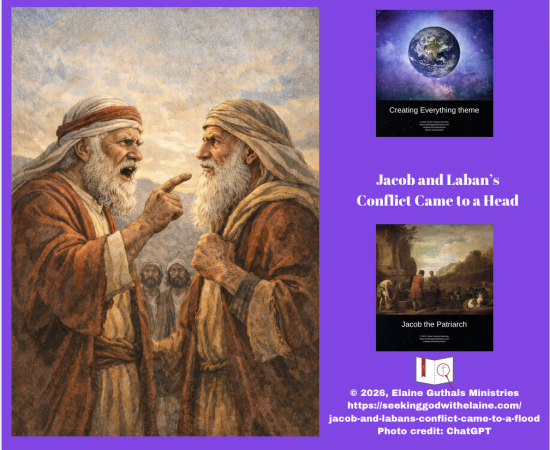
  • Why We Should Know God’s Reckless Love

    Today is a music day.

    Today has been an off day for me. I woke up not feeling well.

    When I finally stopped coughing, my get up and go had got up and went, and I didn’t have the get up and go to get up and go after it.

    So, I didn’t get done any of the writing I needed to do.

    But I know that even on worse days than this, I have a loving Heavenly Father Who loves me even more than I can imagine.

    It isn’t about feeling that love. It is about knowing it is there.

    Feelings can be so fickle. They can be dependent on our circumstances — if we get up on the right side or wrong side of bed or if we don’t get up at all.

    But Jehovah isn’t interested in  physical, worldly feelings. He is interested in the spiritual, heart-level knowledge that His grace is sufficient for us. 

    How do we get to that? Walking with Him through the good times and the bad. Relying on Him when we now there is nothing we can do.

    Knowing that we can always trust in His promises — a big one being that He will never leave us.

    This is one of the first songs I recorded to post, and it has been a while since I have heard it. I hope that it reminds you that, no matter what our feelings are, Jehovah will always kick down whatever He needs to in order to get to us.

    Reckless Love
    Vocalist: Elaine Guthals
    Keyboard: Chris Vieth

    If you have not signed up for the email daily or weekly providing the link to the devotions and the newsletter, do so below.

    If God has used this devotion to speak with you, consider sharing it on social media.