Category: Worship

  • Ceremonial Law v. Spiritual Worship

    The Jews in first-century Israel were all about the ceremonial law. This devotional reading begins to look at the differences between ceremonial law and spiritual worship.

    Nuggets

    • Spiritual worship doesn’t follow the requirements of ceremonial law.
    • Spiritual worship requires a change of reliance.

    There were many ceremonial laws given to Moses in the Torah, the first five books of God’s Word. They pertained to festivals, priests, and sacrifices.

    Disciples today do not have to follow these laws. Charnock told us why. He wrote, “The ceremonial law was abolished to promote spirituality of worship.”

    Resource

    • Jesus was the Sacrifice, negating the need for any other.
    • God comes to us individually through His Holy Spirit, eliminating the need for an intermediary.

    The ceremonial law, while it brought cleansing, did not bring atonement. “For that old system deals only with food and drink and various cleansing ceremonies — physical regulations that were in effect only until a better system could be established” (Heb. 9: 10 NLT).

    God didn’t want a stopgap anymore. His motive was, as Guyse wrote, “… to establish a more pure and spiritual worship and government …” It allows our motivations to be more pure and less sinful, strengthening our desire to be made like Him.

    Resource

    Let’s look at what verses in God’s Word used to explain why spiritual worship replaced ceremonial law. This review is going to take two devotions.

    Let’s Put It into Context

    To read devotions in the Habitual Holiness of Heart and Life theme, click the button below.

    Here is a running list of nuggets for the theme.

    Devotions in the Finding Jesus through Spiritual Worship study

    Here is a running list of nuggets for the study.

    The foundation of this series is Menander and Charnock’s Spiritual Worship.

    Resource

    New Requirements

    “Jesus became a priest, not by meeting the physical requirement of belonging to the tribe of Levi, but by the power of a life that cannot be destroyed” (Heb. 7: 16 NLT)

    Spiritual worship doesn’t follow the requirements of ceremonial law.

    If we look at the genealogy in Matthew 1, we quickly run into a problem. Matthew 1: 2 indicates that Jesus sprang from the tribe of Judah, not Levi.

    What’s the big hairy deal about that?  “But appoint the Levites over the tabernacle of the testimony, and over all its furnishings, and over all that belongs to it …” (Num. 1: 50 ESV).

    Tribe of Levi, not Judah. Priests weren’t supposed to come from the tribe of Judah (Heb. 7: 14).

    Edwards argued that this meant there was a shift in the tribe of priests. He wrote, “The commandment that constituted Aaron priest has not indeed been violently abrogated; [but] it was thrust aside in consequence of its own inner feebleness and uselessness. It has been lost, like the light of a star, in the spreading ‘dawn’ of day.” The priesthood was being transferred to Judah.

    Resource

    I can see this. The covenant of Abraham was replaced by the covenant of Jesus, providing the opportunity for the switch. Smith gave the reason as Judah being not only one of the strongest tribes, but also only one of two tribes who remained faithful to the house of David.

    To read a related devotion, click the button below.

    Glossary

    Resource

    Jesus was chosen to be praised because of His qualifications. Regardless of his lineage, He was, and will always be the only one who is pure enough to be a priest.

    I can also see a second shift. “But you are a chosen race, a royal priesthood, a holy nation, a people for his own possession, that you may proclaim the excellencies of him who called you out of darkness into his marvelous light” (I Pet. 2: 9 ESV).

    We, too, are now priests.

    I know. We don’t feel qualified to be priests.

    Title reminded us that priests were not chosen because of their gifts. They were chosen because they knew they didn’t have those gifts.

    Resource

    Sounds familiar, doesn’t it? Some may have felt that they did not possessed what it took to be a priest. God chose them anyway.

    God chooses us based on our faithfulness to Him. Then He equips us for service.

    “Now may the God of peace — who brought up from the dead our Lord Jesus, the great Shepherd of the sheep, and ratified an eternal covenant with his blood — may he equip you with all you need for doing his will. May he produce in you, through the power of Jesus Christ, every good thing that is pleasing to him. All glory to him forever and ever! Amen” (Heb. 13: 20-21 NLT).

    Paul was praying for us, too. He just didn’t know it at the time.

    Title also said something else really interesting. He said Jesus was chosen to be priest because this was what was in Him.

    Think about it. Yeah, the 100% God part remained pure. It was Jesus’ choice that the 100% Man part did also.

    We are called to choose God daily. “Then he said to the crowd, ‘If any of you wants to be my follower, you must give up your own way, take up your cross daily, and follow me’” (Lk. 9: 23 NLT).

    Melchizedek’s name is also floated around. Remember, he was the king and priest that blessed Abraham in Genesis 14: 18-20. Jesus, too, is a Priest and King.

    Spiritual worship can only replace the ceremonial law because Jesus is the Lord of lords and King of kings.

    Neither Jesus’ priesthood nor kingship is temporary. Jesus will be our High Priest and King for eternity. That means our spiritual worship will never end.

    When the writer of Hebrews wrote, “… the power of a life that cannot be destroyed” (Heb. 7: 16 NLT), Ker said that wasn’t talking about Jesus’ previous life in Heaven. He said it was taking about Jesus always being our mediator.

    I like how Ker described the power. He wrote, “The words mean an indissoluble or indestructible life, safe against the assault of all enemies, and secure from all decay, or possibility of diminution.”

    Resource

    Nothing is going to be successful against that power! What hope that brings us!!!

    Change can be a good thing. We have to not hold onto the old ceremonial law when the new spiritual worship offers so much more.
    Neither Jesus’ priesthood nor kingship is temporary. Jesus will be our High Priest and King for eternity.

    New Lives

    “How foolish can you be? After starting your new lives in the Spirit, why are you now trying to become perfect by your own human effort?” (Gal. 3: 3 NLT)

    Spiritual worship requires a change of reliance.

    We’ve talked several times about becoming new creations when we submit to God. “This means that anyone who belongs to Christ has become a new person. The old life is gone; a new life has begun!” (II Cor. 5: 17 NLT).

    Glossary

    Included in that different way of seeing ourselves is the change in priorities. We are to focus on God rather than ourselves.

    It would be horrible for us to start this new life of faith and spiritual privilege and keep hold of the old way of life.

    The King James Version translates the end of the verse this way: “… are ye now made perfect by the flesh?” The flesh is our human, sinful nature.

    We are looking to God but holding on to our old way of doing things.

    God doesn’t want us to rely on ourselves any more than He wanted us to rely on the ceremonial law for salvation.

    Paul had two other great verses in the letter to the Galatians.

    • “So now that you know God (or should I say, now that God knows you), why do you want to go back again and become slaves once more to the weak and useless spiritual principles of this world?” (Gal. 4: 9 NLT).
    • “When you follow the desires of your sinful nature, the results are very clear: sexual immorality, impurity, lustful pleasures” (Gal 5: 19 NLT).

    God wants to get us out of that terrible situation and into His love and protection.

    Ceremonial law is still law, and the law will not gain us salvation. We can only come to salvation through Jesus Christ.

    To read a related devotion, click the button below.

    We shouldn’t think we can rely on ourselves more than we can on God. He is all-knowing, all-seeing, and all-powerful. He will never leave us.

    It should be our choice to focus on Him. “Trust in the Lord with all your heart; do not depend on your own understanding” (Prov. 3: 5 NLT).

    We are blown every which way by circumstances. God never changes. We can rely on Him to see us through whatever life throws our way.

    Holding onto self-reliance rather than fully embracing spiritual worship is not good. We have to be totally submitted to and truly worshiping Him.
    ceremonial-law-v-spiritual-worshipFB

    Making the Connections #1

    Sometimes, disciples are like first-century Jews. We like the name children of God as much as they liked God’s chosen people. They liked all the entitlements they thought came with it.

    Glossary

    Truth be known, so do we.

    But really, we, they, and non-believers all are sinful. Children of God have just asked God to forgive them of their sins and submit their lives to them.

    Making the Connections #2

    The first-century Jews thought their ceremonial law was enough for salvation. God didn’t want their outward obedience alone. He wanted their inward transformation to holiness.

    God wants the same for us.

    The ceremonial law may not have been able to provide salvation, but God’s moral law perfects us. We need it for the Sanctification Road.

    Salvation is the gift of life through the deliverance from condemnation and sin to acceptance and holiness and changes us from being spiritually dead to spiritually alive.

    • Sin is not believing that Jesus is our Savior to save us from our actions by humans that disobey God and break one of His reasonable, holy, and righteous laws and commandments, goes against a purpose He has for us, or follows Satan’s promptings.
      • Holy means to be set apart — because of our devotion to God — to become perfect, and morally pure while possessing all virtues and to serve and worship God.
        • Perfection means we reach a state of maturity because the combination of the spiritual graces form, when all are present, spiritual wholeness or completeness — holy, sanctified, and righteous.
          • Spiritual graces are worldly morals that have been submitted to God to further His kingdom instead of enhancing this world.
          • Sanctified means to be set free from sin.
          • Righteous means we are free from sin because we are following God’s moral laws.
        • Pure means not being sinful or having the stain of sin. 
        • Virtues are standards of moral excellence.
    • Holiness is the transcendent excellence of His nature that includes elements of purity, dedication, and commitment that lead to being set apart.
      • Purity means possessing God’s moral character, having eliminated the stain of sin.
    • Spiritual death is the spiritual separation from God that occurred as a consequence of Adam and Eve’s original sin.
      • The spiritually alive are those who have ABCDed, so they are no longer separated from God.

    Sanctification is the transformational process of the mind, body, and soul, which begins with regeneration; gradually changes our nature and morals through the promptings of the Holy Spirit; and ends with perfected state of spiritual wholeness or completeness.

    • Regeneration is being changed from spiritually dead to spiritually alive and the internal new birth and requickening that God brings about through the work of the Holy Spirit to give us new character.

    The ABCDs of Salvation

    If you have not become a believer in Christ, please read through the
    Plan of Salvation and prayerfully consider what God is asking you to do.

    A – admit our sins
    B – believe His Son Jesus is our Redeemer
    C – confess God as Sovereign Lord

    D – demonstrate that commitment by making any changes needed in our lives to live the way in which God has called us

    The Disciple’s Job Description

    Glossary

    How Do We Apply This?

    • Grow our recognition that the world needs Jesus and fulfill the Great Commandment to spread His gospel to all creatures.
    • Pray constantly that God Will transform us on the Sanctification Road.
    • Grow to have Jesus’ heart and sympathy.
    • Understand we grow to be more like Him through our labors.
    • Cultivate our patience to be like Christ’s.
    • Increase God’s joy present in our lives through self-sacrifice.
    • Start with the end in mind and continue as we started.

    Resource

    Father God. Thank You for sending Your Son to be our Savior when the ceremonial law was not enough to save us. Help us to obey Your moral law to aid us on the Sanctification Road. Amen.

    What do you think?

    Leave me a comment below (about this or anything else) or head over to my Facebook group for some interactive discussion.

    If you don’t understand something and would like further clarification, please contact me.

    If you have not signed up for the email providing the link to the devotions and the newsletter, do so below.

    If God has used this devotion to speak with you, consider sharing it on social media.

  • True Spiritual Worship

    God wants us to sincerely worship Him in spirit and truth. This devotional reading begins looking at what true spiritual worship is.

    Nuggets

    • True spiritual worship is a duty.
    • True spiritual worship focuses on God, not us.
    • True spiritual worship is rewarding true submission.

    If you were with me for the content part of the Committing to Grow Our Habits study (the last devotion), you know we did an overview of spiritual worship. Where I wanted to go with it was outside the focus of that study.

    I found a sermon that will lead us through a comprehensive study of what spiritual worship is. Yes, I know. Sometimes going through other people’s sermons can be a good thing; sometimes, it is a bad thing.

    We are going with it being a good thing.

    God has been telling Pastor Steve that the Church has been missing Jesus. If we’ve been doing it wrong, we need to find out how to do it right.

    Let’s Put It into Context

    To read devotions in the Habitual Holiness of Heart and Life theme, click the button below.

    Here is a running list of nuggets for the theme.

    Devotions in the Finding Jesus through Spiritual Worship study

    Here is a running list of nuggets for the study.

    The foundation of this series is Menander and Charnock’s Spiritual Worship.

    Resource

    In this devotion, we’re going to shake up the order of the verses from what they had them.

    The Way We Worship

    “It is good to give thanks to the LORD, to sing praises to your name, O Most High; to declare your steadfast love in the morning, and your faithfulness by night, to the music of the lute and the harp, to the melody of the lyre” (Ps. 92: 1-3 ESV)

    True spiritual worship is a duty.

    We have an obligation to worship God in spirit.

    After Adam and Eve committed the original sin, the ball was in God’s court. He could either condemn them or restore them.

    Actually, God did both. He condemned mankind and designed the Plan of Salvation to restore us to Him.

    Both responses stem from God’s nature. “But you are pure and cannot stand the sight of evil. Will you wink at their treachery? Should you be silent while the wicked swallow up people more righteous than they?” (Hab. 1: 13 NLT).

    God is pure, so He cannot associate with sin. That is the reason mankind was condemned after the original sin.

    But God loves us too much to give up on us. He sent His Son Jesus to be our propitiation. Propitiation means that a substitute is offered to avoid God’s wrath.

    Menander said that spiritual worship comes out of God’s concern for the condition of our souls. I can see that.

    spiritual worship comes out of God’s concern for the condition of our souls.

    We usually think about God’s concern for our condition. But we have to be just as concerned.

    We not only have to accept God’s Plan of Salvation, but we also have to totally embrace God and how He is calling us to live and worship.

    Charnock warned us the result of our choice not to worship God. He wrote, “He that denies worship to be due to God denies His Deity; he that waives spiritual worship, denies His spirituality.”

    Resource

    So, what does our duty to worship look like? Worship is our personal or corporate response of admiration (confession, thanksgiving, praise, etc.) based on our attitude to God’s presence and our imitation of His character.

    Be Thankful

    We have much for which to be thankful. That thankfulness must be expressed in our worship.

    We are to give thanks in all circumstances in our lives. At times, that seems really hard to do. We lose a loved one, a job, our peace of mind, and our thankfulness goes out the window.

    But look what Lewis said. He wrote, “… the natural heart is apparently more susceptible of this Christian grace than of any other, so that they who show right feeling in nothing else have seemed moved at times to gratitude to God.”

    Resource

    We are more sensitive to thank God than any other spiritual grace. But I wonder how much of that is caught up in we are thankful for the good things.

    Does God really need us to thank Him? No. He doesn’t need us to stroke His ego.

    Why should we thank God? Wells said it was because thanksgiving not only helps us in this life but also enlarges our spiritual capacity by making it more perceptible. It does this by increasing our love for and confidence in God.

    Resource

    Doesn’t that make sense? We become freer with our gratitude as our thankfulness increases. We do become more confident that God is Who He says He is and will do what He says He will.

    Praise God

    The thankfulness should ring through our praise for Him. Praise is our response to God, but it usually involves music.

    Why should we worship God? Because it pleases Him. Yes, He enjoys our attempts at worship.

    Also, we should worship God because He deserves it. He is our Creator and Redeemer. We would be nothing without Him.

    When we try to explain away things through science, that isn’t praising and worshiping God. That is denying His deity.

    Yes, He is still God whether we worship Him or not, but it is for our benefit that we do. We gain peace through our worship of Him. It brings us refreshment.

    We want to be like the angels and magnify God’s name.

    We want to be like the angels and magnify God’s name.

    Love God

    Wells told us this psalm was sung in the morning Sabbath service. It was sung when the drink offering was given with the offering of the first lamb.

    What a reminder that we should love God at the beginning and end of the day — and every moment throughout!

    Spurgeon reminded us that we shouldn’t get ritualistic in our worship. True spiritual worship is fresh.

    Resource

    What ways do we become ritualistic? Well, we can’t change the order of the service, not even to shuffle them around. Then just mention changing the look of the bulletin, and it is considered heresy.

    Worse yet is when we become ritualistic because it becomes the same ol’, same ol’. This is one instance when becoming a habit may not necessarily be a good thing.

    Spurgeon reminded us about meditating before praying. This is a good habit before worship.

    True spiritual worship of God eliminates the discord that sin has caused. We show God our true faith in Him.

    The Way We Serve

    “Make a joyful noise to the LORD, all the earth! Serve the LORD with gladness! Come into his presence with singing!” (Ps. 100: 1-2 ESV)

    True spiritual worship focuses on God, not us.

    We have to take the focus off ourselves and our selfishness and put it on God. That is what makes the distinction between thanksgiving and praise — it isn’t about us.

    This switch of focus occurs as we grow to know God more. This is a part of sanctification. Sanctification is the transformational process of the mind, body, and soul, which begins with regeneration; gradually changes our nature and morals through the promptings of the Holy Spirit; and ends with perfected state of spiritual wholeness or completeness.

    • Regeneration is being changed from spiritually dead to spiritually alive and the internal new birth and requickening that God brings about through the work of the Holy Spirit to give us new character.
      • Spiritual death is the separation from God that occurred as a consequence of Adam and Eve’s original sin.
        • The spiritually alive are those who have ABCDed, so they are no longer separated from God.
    • Perfection means we reach a state of maturity because the combination of the spiritual graces form, when all are present, spiritual wholeness or completeness — holy, sanctified, and righteous.
      • Spiritual graces are worldly morals that have been submitted to God to further His kingdom instead of enhancing this world.
      • Sanctified means to be set free from sin.
      • Righteous means we are free from sin because we are following God’s moral laws.

    The ABCDs of Salvation

    If you have not become a believer in Christ, please read through the
    Plan of Salvation and prayerfully consider what God is asking you to do.

    A – admit our sins
    B – believe His Son Jesus is our Redeemer
    C – confess God as Sovereign Lord

    D – demonstrate that commitment by making any changes needed in our lives to live the way in which God has called us

    The Disciple’s Job Description

    Glossary

    But it is more than just knowing God. It is changing to become like Him. “For although they knew God, they did not honor him as God or give thanks to him, but they became futile in their thinking, and their foolish hearts were darkened” (Rom. 1: 21 ESV).

    We honor God with our transformation.

    I love what the Homilist said. “Worship is at once the duty of all duties, the service of all services, the joy of all joys.”

    Resource

    When we come to know God more and more, we find out Who He really is. We find how His character is good.

    We want to grow more like Him.

    We want to serve Him more. We want to expand His kingdom. We want to be involved in His work.

    As we grow to know God more, we can’t keep the worship to ourselves. We have to witness and share.

    We have to serve the Lord with gladness. Service is a product of our worship. It can only be a result of our faith in and love of Him. Faith is a gift from God and a work of the Spirit that enhances the conviction that the doctrines revealed in God’s Word are true, even if we do not understand all aspects of them, a belief which impacts our lives and distinguishes us from others.

    Glossary

    Spurgeon reminded us that someone who is walking with God is one with the right mindset to serve. Walking with God means we are humble, reverent, teachable servants of God. 

    Resource

    We know we are serving God because we are no longer under the bandage of sin. That should make us want to jump for joy!

    The Way We Submit

    “The LORD your God will make you abundantly prosperous in all the work of your hand, in the fruit of your womb and in the fruit of your cattle and in the fruit of your ground. For the LORD will again take delight in prospering you, as he took delight in your fathers, when you obey the voice of the LORD your God, to keep his commandments and his statutes that are written in this Book of the Law, when you turn to the LORD your God with all your heart and with all your soul” (Deut. 30: 9-10 ESV)

    True spiritual worship is rewarding true submission.

    I always worry when we come across verses like these. We have to make sure we read it the way God intended.

    Nowhere in God’s Word does it say we will have a prosperity gospel. We aren’t guaranteed a mansion in this life. We can’t expect no money problems or any other kind of worries.

    Don’t get me wrong. God does provide for us. He gives us food, clothing, family – He gives us everything.

    Verse 10 tells the requirements for God to reward us for our service to Him.

    • Obey the Lord.
    • Keep his commandments and his statutes.
    • Turn to God with all our heart and soul.

    What this verse means is we have to continuously obey Him. We have to submit to Him with all our being.

    I know. We’re human. We can’t be 100%-fruit-of-the-Spirit perfect.

    When we do disobey and break a law or commandment, we ask God for forgiveness. Asking God for forgiveness is a form of worship.

    Asking God for forgiveness is a form of worship.

    Charnock reminded us that spiritual worship is always expected by God. I read that to say that there is never a holiday for worshiping Him. His disciples are expected to worship Him 24/7/365/eternity.

    Resource

    There is a big difference between Old Testament worship to New Testament worship. Before Christ, worship was all wrapped up in the laws and commandments.

    Unfortunately, the people in those days didn’t realize there was no way we could keep them. They didn’t see that the law’s purpose was to show us our need for a Savior.

    These days, some don’t like the idea that we need someone else to save us. That is too simplistic for them.

    What is required now is a relationship with God. Yes, He wants us to submit to Him, but He also wants us to be in communication and communion with Him.

    true-spiritual-worshipFB

    Making the Connections

    Spurgeon made an interesting comment. He wrote, “The more hypocritical a people are, the more solemnly miserable their outward aspect when at worship.”

    Resource

    Hmmm. What is the best word for hypocritical? Insincere? Two-faced? Phony?

    Yeah, they all say about the same thing, but they can have different nuances. I can see insincere as meaning some of it but not all. Phony is just plain false.

    No, that is the opposite of true spiritual worship.

    True worship is sincere reverence to God.

    How Do We Apply This?

    • Be thankful always.
    • Meditate before worship and prayer.
    • Praise God in the morning.
    • Be thankful in the evening.
    • Worship God daily.

    Resource

    Father God. Forgive us for not worshiping You in spirit and in truth. Show us how to fully submit to You and fill our worship with praise and thankfulness. Amen.

    What do you think?

    Leave me a comment below (about this or anything else) or head over to my Facebook group for some interactive discussion.

    If you don’t understand something and would like further clarification, please contact me.

    If you have not signed up for the email providing the link to the devotions and the newsletter, do so below.

    If God has used this devotion to speak with you, consider sharing it on social media.
  • The Sincerity of Spiritual Worship

     We must be sincere in worshiping God. This devotional reading looks at serving God with all our hearts.

    Nuggets

    • We are to be sincere, but sincerely alone isn’t what we are talking about.
    • We should worship God in spirit and truth because of our love for Him.

    Last year, our theme was getting our sanctification to the heart level. We know the heart is the seat of our thoughts, intellect, will, and affections that produces our character, from which all things spring, including controlling our spiritual position.

    Getting our faith to the heart level means a couple of things. The first is that our faith has to impact all our thoughts, intellect, will, and affections. We can’t give God only part of us.

    The second thing is that we have to be sincere. We can’t give God lip service. We have to mean it when we say we submit to God.

    Charnock agreed that our spiritual worship has to be sincere. This must be the foundation of our living sacrifice.

    Let’s Put It into Context

    To read devotions in the Habitual Holiness of Heart and Life theme, click the button below.

    Here is a running list of nuggets for the theme.

    Devotions in the Finding Jesus through Spiritual Worship study

    Here is a running list of nuggets for the study.

    The foundation of this series is Menander and Charnock’s Spiritual Worship.

    Resource

    Worship Because of Intent

    “God knows how often I pray for you. Day and night I bring you and your needs in prayer to God, whom I serve with all my heart by spreading the Good News about his Son” (Rom 1: 9 NLT)

    We are to be sincere, but sincerely alone isn’t what we are talking about.

    Pope called our attention to Paul himself. He was one way when he was Saul.

    • “I am a Jew, born in Tarsus in Cilicia, but brought up in this city, educated at the feet of Gamaliel according to the strict manner of the law of our fathers, being zealous for God as all of you are this day” (Ac.  22: 3 ESV).
    • “… If anyone else thinks he has reason for confidence in the flesh, I have more: circumcised on the eighth day, of the people of Israel, of the tribe of Benjamin, a Hebrew of Hebrews; as to the law, a Pharisee; as to zeal, a persecutor of the church; as to righteousness under the law, blameless” (Phil. 3: 4-6 ESV).

    Saul was sincere about serving God the way he thought was right. It wasn’t.

    See what Pope said. He wrote, “The service he offered was sincere, but ignorant and bigoted, a service which rejected Christ and persecuted His saints.”

    Resource

    That tells us how much Saul changed to be Paul. Paul worshiped God through his belief in Jesus. He did it right.

    We can be sincere about feeding the hungry, caring for the sick — all the sheep and goats activities. They mean nothing if we aren’t sincere about worshiping God.

    Glossary

    This isn’t the first time we’ve talked about being sincere. (It probably won’t be the last time.)

    We have to submit all our heart to God. We can’t hold some back for ourselves. We can’t give God lip service.

    When we ask Jesus to be our Savior and Redeemer, we have to truly desire to become like Him. We have to genuinely repent and not commit our sins again. Repentance is acknowledging our separation from God and expressing sorrow for breaking God’s laws and commandments by making the commitment to change our sinful ways to ways of righteousness through obedience.

    • Sin is not believing that Jesus is our Savior to save us from our actions by humans that disobey God and break one of His reasonable, holy, and righteous laws and commandments, goes against a purpose He has for us, or follows Satan’s promptings.
      • Holy means to be set apart — because of our devotion to God — to become perfect, and morally pure while possessing all virtues and to serve and worship God.
        • Perfection means we reach a state of maturity because the combination of the spiritual graces form, when all are present, spiritual wholeness or completeness — holy, sanctified, and righteous.
          • Spiritual graces are worldly morals that have been submitted to God to further His kingdom instead of enhancing this world.
          • Sanctified means to be set free from sin.
        • Pure means not being sinful or having the stain of sin. 
        • Virtues are standards of moral excellence.
    • Righteous means we are free from sin because we are following God’s moral laws.
    • Obedience means submitting ourselves to the will of God as it is presented to us and living our lives accordingly.

    Glossary

    Our intent in performing our actions must be to worship God in spirit and truth.

    Worship Because of Love

    “O my son, give me your heart. May your eyes take delight in following my ways” (Prov. 23: 26 NLT)

    We should worship God in spirit and truth because of our love for Him.

    Why is God asking for our hearts? Because He loves us.

    Spurgeon told us how that works. He wrote, “Only love seeks after love.”

    Resource

    Love is an attribute of God’s. “So we have come to know and to believe the love that God has for us. God is love, and whoever abides in love abides in God, and God abides in him” (I Jn. 4: 16 ESV).

    Love is the essence of God. It is Who He is.

    We read this verse, and some may think it is a direct command. No, it is a request.

    God asks for our love. It is our choice whether or not to give it to Him.

    Spurgeon also told us why we have to give God our whole heart. He wrote, “You cannot give Christ a piece of a heart, for a heart that is halved is killed.”

    Resource

    Jesus gave the why of that. “No one can serve two masters. For you will hate one and love the other; you will be devoted to one and despise the other. You cannot serve God and be enslaved to money” (Mt. 6: 24 NLT).

    By giving God our hearts, we pledge to seek His Will rather than our own.

    We do this to show God our love and gratitude. We also acknowledge that He is Sovereign God.

    God has good reason to want our hearts. He wants to cleanse them with Jesus’ atoning blood. Then, He wants to full us with wisdom and understanding through the work of the Holy Spirit.

    The choice to give God our hearts is ours. He acknowledges our dignity.

    It is understandable why God wants our hearts. If we give Him that, in essence, we are giving Him all of us — our will, strength, and love.

    I know. This goes against our human nature. But it brings us back to our made-in-His-image nature.

    Only God can do that — sanctify us. Sanctification is the transformational process of the mind, body, and soul, which begins with regeneration; gradually changes our nature and morals through the promptings of the Holy Spirit; and ends with perfected state of spiritual wholeness or completeness.

    • Regeneration is being changed from spiritually dead to spiritually alive and the internal new birth and requickening that God brings about through the work of the Holy Spirit to give us new character.
      • Spiritual death is the separation from God that occurred as a consequence of Adam and Eve’s original sin.
        • The spiritually alive are those who have ABCDed, so they are no longer separated from God.

    The ABCDs of Salvation

    If you have not become a believer in Christ, please read through the
    Plan of Salvation and prayerfully consider what God is asking you to do.

    A – admit our sins
    B – believe His Son Jesus is our Redeemer
    C – confess God as Sovereign Lord

    D – demonstrate that commitment by making any changes needed in our lives to live the way in which God has called us

    The Disciple’s Job Description

    Glossary

    What has this to do with worship? Giving God our hearts is spiritual worship.

    the-sincerity-of-spiritual-worshipFB

    Making the Connections #1

    Bird made a great observation that addresses sincerity. He wrote, “How much of God’s worship is performed outwardly when it is inwardly disliked.”

    Resource

    How many times have we heard it? Have we said it?

    • I don’t like praying in public.
    • I don’t like praying period.
    • I can’t sing, so I don’t.
    • I don’t like to read.
    • I can’t understand what I read in the Bible, so I will read some devotion like Seeking God with Elaine’s to interpret it for me.

    Suck it up. All of those are worship. We have to worship how God calls us to worship.

    If we don’t, we aren’t sincere. We’re a Matthew 7: 21 disciple.

    Making the Connections #2

    Not long ago, we talked about the sacrifices required of the Jews. We said Jesus fulfilled the ceremonial law, making it so we do not have to sacrifice animals.

    Instead, we have to be a living sacrifice. A living sacrifice is the embodiment of becoming sanctified and giving everything to God after being forgiven of our sins.

    Smith had a great explanation of this. He wrote,

    “Once God required offerings and sacrifices which men were unwilling to give, because it was a dear service of God; but now He saith that the heart is more than all burnt-offerings and sacrifices. Thy alms to the poor, thy counsel to the simple, thy inheritance to thy children, thy tribute to Caesar, but thy heart to God. Not a piece of thy heart, not a room in thy heart, but thy heart. Some have a double heart, but God acknowledgeth only one heart. God doth not require the heart as though He required no more but the heart. The heart carrieth the whole man with it.”

    Resource

    Okay, let’s try that in Elaine-speak.

    Smith felt that the Jews had trouble with the animal sacrifices because they were asked to give up something that cost them. The gift of their hearts was more important.

    Doing the sheep and goats activities are great. They are not the most important.

    We must give all of our hearts to God. We can’t be double minded (Jas. 1: 7-8).

    To read a related devotion, click the button below.

    How Do We Apply This?

    • Sanctify our hearts so that our bodies will be temples unto God.
    • Make it a habit to focus on our inward transformation while we hid with Jesus in God.
    • Make prayer a habit.
    • Sincerely accept God’s request for our love.
    • Guard our hearts so we do not give our love to Satan.
    • Decide to love God how so that our hearts are occupied and does not continue to be occupied by evil.
    • Abandon all that God has forbidden.
    • Believe in God’s promises.
    • Seek God.
    • Give God our hopes, fears, joy, desire, love, and delight.
    • Hate evil.
    • Delight in following God’s laws and commandments.
    • Rejoice in obeying Him and accept His correction when we don’t.
    • Work to understand the whys of His ways, not to understand hows of His wisdom.

    Resource

    Searching for and Seeking God

    Hearing His Word (Rom. 10: 17)
    Reading His Word (Rev. 1: 3)
    Praying to Him (Heb. 4: 16)
    Studying His Word (Ac. 17: 11)
    Meditating on His Word (Ps. 1: 1-2)
    Memorizing His Word (Ps. 119: 11)

    Father God. We give our hearts to You. We sincerely love You. Help us to seek You. Amen.

    What do you think?

    Leave me a comment below (about this or anything else) or head over to my Facebook group for some interactive discussion.

    If you don’t understand something and would like further clarification, please contact me.

    If you have not signed up for the email providing the link to the devotions and the newsletter, do so below.

    If God has used this devotion to speak with you, consider sharing it on social media.

  • We Are to Worship God with Our Hearts

    Worship isn’t true worship unless we get it down to the heart level. This daily devotional looks at how worship has to be sincere and not ritualistic.

    Nuggets

    • God does not like it when our worship is not sincere.
    • Ritualism leads to a routine worship of God that takes our eyes off Him.
    • Praising God with all our hearts is based on our attitudes.

    To read devotions in the At the Heart Level theme, click the button below.

    Devotions in the Preparing for Worship series

    We talked in the last devotion about how we need to be worshiping God 24/7/365. “Through him then let us continually offer up a sacrifice of praise to God, that is, the fruit of lips that acknowledge his name” (Heb. 13: 15 ESV).

    But we do worship in fits and starts. It definitely isn’t continual.

    How do we get back to a heart of worship?

    Let’s Put It into Context #1

    Here is a running list of what we’ve discussed previously.

    Let’s Put It into Context #2

    Matt Redman has a beautiful song entitled The Heart of Worship. This is where we want to go.

    Related Links


    Matt Redman

    What Is the Problem?

    “And so the Lord says, ‘These people say they are mine. They honor me with their lips, but their hearts are far from me. And their worship of me is nothing but man-made rules learned by rote’” (Is. 29: 13 ESV)

    God does not like it when our worship is not sincere.

    Our worship should be a genuine worship of our Creator. We should worship God because He is Sovereign God.

    But too many times, our worship becomes routine. We do the same things over and over and lose sight of the meaning of why we are doing them.

    Repetitively doing this is called ritualism. Gladstone gave us a definition. At first I thought it was a good one. Then, I think he stopped short.

    What Gladstone said was ritualism was when anything intrudes to hinder our worship of God. Well, in a way.

    Resource

    Ritualism doesn’t just slow down and impede our worship. We can think we are worshiping when we are doing it the same way each time.

    The problem isn’t necessarily that there is no change.

    What Is Wrong with That?

    Ritualism leads to a routine worship of God that takes our eyes off Him.

    The problem is that we get in a rut. When things become ritualistic, we put the emphasis on the ceremony instead of on God.

    We’re going through the motions.

    God doesn’t want us on autopilot. He wants to be our Pilot.

    God doesn’t want us on autopilot. He wants to be our Pilot.

    Think of it this way. We are commanded to worship God.

    But ritualism takes what is necessary and pure and makes it a sin. That is just what Satan wants!

    It is 180 degrees in the wrong direction.

    Gordon contended that the danger of formal worship is that we deny that God is Sovereign God.

    Resource

    In the past, we haven’t called it formal worship. We have said that we are nominal disciples. Nominal disciples are those boasting they loved God without even trying to imitate Him — those who dig on religion and its rituals without having a change in heart.

    To read a related devotion, click the button below.

    We have to worship God because of His attributes. He is eternal, unchanging, all powerful, all knowing, all present God. He does not have to depend on someone else ruling with Him.

    God is loving, faithful, and true.

    So, what do we do?

    What Is the Right Way?

    “I will praise you with all my heart, Lord my God, and will honor your name forever” (Ps. 86: 12 CSB)

    Praising God with all our hearts is based on our attitudes.

    Still a little confused about how we worship with our hearts? Let’s see what Benson had to say.

    Resource

    Our main purpose of worship has to be to honor God. We do this through being ready, cheerful, and with a passionate intensity.

    Being ready for worship means we have tune out the things of this world. I know. This is hard sometimes.

    On the way to pick up Pastor Steve Sunday, my check engine light came on in my car. That was frustrating frightening, and infuriating.

    I had to refocus because it was the first time I would be teaching a Sunday School class and leading the music in the Sunday morning worship service. I needed to focus on God, not my problems.

    I — and we — need to be ready to engage in “… singing psalms and hymns and spiritual songs, with thankfulness in [our] hearts to God” (Col. 3: 16 ESV) starting with the first hymn or song.

    We shouldn’t wait until the pastor gets up to speak. We’ve missed half of the opportunity to praise God.

    We are not to just act like we mean to worship God — we need to really worship God.

    We are to glorify God in this life and in the next. That has to be our priority.

    I don’t think this means that we have to be jumping around, clapping our hands, to show our intensity. That would be outward.

    God is more interested in inward. Are our hearts passionate about meeting with our Father? Is that the most important thing for that moment?

    Do we really mean our conversion?

    we-are-to-worship-god-with-our-heartsFB

    Making the Connections

    “And whatever you do, in word or deed, do everything in the name of the Lord Jesus, giving thanks to God the Father through him” (Col. 3: 17 ESV)

    It all comes down to attitude. How are we going to approach worship? What choices are we going to make to ensure our focus is fixed on God?

    God is very specific in His description of how we are to worship Him. We must follow His directions or expect consequences for our actions.

    How Do We Apply This?

    • Genuinely seek God.
    • Be consistent in our worship.
    • Be sincere and honest in our worship.
    • Repent of our sins as needed.
    • Worship only God.
    • Fulfill our duty in worshiping God.

    Resources

    Searching for and Seeking God

    Hearing His Word (Rom. 10: 17).
    Reading His Word (Rev. 1: 3).
    Praying to Him (Heb. 4: 16).
    Studying His Word (Ac. 17: 11).
    Meditating on His Word (Ps. 1: 1-2).
    Memorizing His Word (Ps. 119: 11).

    Father God. You have made us to praise You. Yet, we must choose to praise You. You are very specific in how we are to do this. Help us to follow your commandments so that we may give You the honor and glory that You deserve. Amen.

    What do you think?

    Leave me a comment below (about this or anything else) or head over to my Facebook group for some interactive discussion.

    If you don’t understand something and would like further clarification, please contact me.

    If you have not signed up for the email daily or weekly providing the link to the devotions and the newsletter, do so below.

    If God has used this devotion to speak with you, consider sharing it on social media.
  • Preparing Our Hearts for Worship

    We can sometimes ask what we need to do to prepare our hearts for worship. This daily devotional looks at how and where we praise God.

    Nuggets

    • God expects us to worship corporately.
    • We need to praise God throughout our lives.
    • We need to worship God completely in our hearts.

    To read devotions in the At the Heart Level theme, click the button below.

    Devotions in the Preparing for Worship series

    I thought — this coming out on our day of worship — that we should talk about preparing our hearts for that. I thought there would be a lot of verses on preparation.

    Wrong.

    Most of the verses commanded us to worship. The others had a different take.

    Let’s look.

    Let’s Put It into Context #1

    Worship is our personal or corporate response of admiration (confession, thanksgiving, praise, etc.) based on our attitude to God’s presence and our imitation of His character.
    Praise is also our response to God, but it usually involves music.

    Praising God in His House

    “Praise the Lord! Praise God in his sanctuary; praise him in his mighty heavens! (Ps. 150: 1 ESV)

    God expects us to worship corporately.

    When we think of the word sanctuary, how many times do we think of cathedrals — at a minimum church buildings? In David’s day, it would have been the tabernacle as the temple hadn’t been built yet.

    Whatever the name, it was a designated spot that was considered the house of the Lord. We were supposed to go there.

    Yes, we still are. The problem with that is we feel like we are just visiting.

    Well, if that is the way we approach worship, we are just visiting.

    Jones said that we have to get our worship down to the heart level. He wrote, “He that singeth hymns, and psalms, and spiritual songs must make melody in his heart unto the Lord; he must hold faith and a good conscience; he must also have a mind superior to the world and its low enjoyments and cares; for that soul which is chained down to the earth, no praises, no, not the finest harmony in the world, can lift up into heaven.”

    Resource

    That tells me that it isn’t about where we go to praise God. It talks more of our motives.

    We can’t just sit in the back row, sing the songs, and listen to the preacher. We have to prepare to truly praise God.

    The reason for worshiping God is to fix our hearts on Him.

    The reason for worshiping God is to fix our hearts on Him.

    How do we do that? We have to keep our minds on God. We have to distance ourselves from the worldly things and look solely to Him.

    In another devotion series, we called it setting our hearts on things above. “Since, then, you have been raised with Christ, set your hearts on things above, where Christ is, seated at the right hand of God” (Col. 3: 1 NIV).

    To read a devotion in the On Things Above series, click on the button below.

    To read a related devotion, click the button below.

    It gets easier to focus on worship as we continue to focus on worship. That brings us peace.

    We do that through faith. Faith is a gift from God that enhances the conviction that the doctrines revealed in God’s Word are true, even if we do not understand all aspects of them, a belief which impacts our lives and distinguishes us from others.

    Glossary

    We worship God so that we can hear about the doctrines and grow our faith.

    Another way of looking at that is we grow our confidence in God. We know He will meet us in our sanctuary. Our worship is accepted when we worship His way.

    As we grow closer to God, Satan is defeated. We prepare ourselves for an eternity of praising God.

    Praising Him in Our Walk

    “Through him then let us continually offer up a sacrifice of praise to God, that is, the fruit of lips that acknowledge his name” (Heb. 13: 15 ESV)

    We need to praise God throughout our lives.

    Wait! What?

    Where is the prayer for God to open our hearts so we can engage? Where is the shut off from things of this world? Where is the repent from sins?

    How can we get prepared an hour or two before the service starts if we aren’t told how?

    Easy. We are always supposed to be prepared for worship because we are always supposed to be worshiping.

    We are always supposed to be prepared for worship because we are always supposed to be worshiping.

    24/7/365. From conversion to eternity.

    We talked about this before. When God created the universe, on Days 1 though 6, He always said morning and evening made a day.

    On Day 7, there was a morning, but there never was an evening. That means we are still experiencing the Sabbath.

    To read a related devotion, click the button below.

    It says we are to “… continually offer up a sacrifice of praise to God …” (Heb. 13: 15 ESV). We go from being out of line with God’s laws and commandments in our sinful life to being a living sacrifice after conversion.

    A living sacrifice is the embodiment of becoming sanctified and giving everything to God after being forgiven of our sins. That is the first duty in our disciple’s job description.

    The Disciple’s Job Description

    Complete Job Description

    But look what this verse says. It says nothing about getting all the laws and commandments right. It says, “… let us continually offer up a sacrifice of praise to God, that is, the fruit of lips that acknowledge his name” (Heb. 13: 15 ESV).

    • We have to acknowledge His name, i.e., His authority.
    • It comes from our lips, not our actions, so it is a confession (Rom. 10: 9).
    • It should never stop.

    Doing acts of kindness is not worshiping God if we are not accepting His authority and always proclaiming it with our lips. We have to submit to Him.

    The outward expression is not the focus. It is the inward compliance to God’s Will.

    Being inward takes the worship out of the cathedral, church, tabernacle, or temple. It puts it in our hearts.

    What tells me is the place doesn’t matter. Heart-felt worship is supposed to be part of the walk. Walking is the term used to describe how we live our lives.

    Heart-felt worship is supposed to be part of the walk.

    Spurgeon expanded on that. He wrote, “Not only in this place or that place, but in every place, we are to praise the Lord our God. Not only when we are in a happy frame of mind, but when we are cast down and troubled. The perfumed smoke from the altar of incense is to rise towards heaven both day and night, from the beginning of the year to the year’s end.”

    Resource

    Spurgeon was talking praise and trust here. Trust is assurance that the promises of God are true.

    It is our expression of gratitude. We finally find our happiness and contentment when we find the purpose God has for us.

    We need to start today.

    Dwelling in His Worship

    “Let the word of Christ dwell in you richly, teaching and admonishing one another in all wisdom, singing psalms and hymns and spiritual songs, with thankfulness in your hearts to God” (Col. 3: 16 ESV)

    We need to worship God completely in our hearts.

    Paul advised us to “Let the word of Christ dwell in you richly …” (Col. 3: 16 ESV). He wanted us to get it to the heart level.

    What Paul wasn’t talking about here is head knowledge. Oh, yes. Many people have heard Who Christ is and what He has done.

    We have to put our complete faith and trust in Jesus. We have to hide Him in our hearts.

    • “In the beginning was the Word, and the Word was with God, and the Word was God” (Jn. 1: 1 ESV).
    • “I have stored up your word in my heart, that I might not sin against you” (Ps. 119: 11: ESV).

    I love how Sydnor explained it. He wrote, “It must not be as a stranger, or a visitor, or as an acquaintance with whom we are not specially intimate, or as a friend away and seldom seen, but rather as a resident member of our family with whom we are in constant and loving communication. … It must be in our heart, pervading our whole spiritual nature, directing and controlling all our life and conduct.”

    Resource

    See, Sydnor said constant. As in all the time.

    It has to be in our hearts, as that is where our relationship with God is. That is where our character is, so it can control it.

    Did you see how it is supposed to be in our hearts? Richly.

    No, that has nothing to do with money. Paul is talking about it being completely in our hearts.

    Not just a part of it. Not just sometimes.

    Wholly and continuously.

    We’ve talked about it before.

    Candlish made an interesting point. Scriptures aren’t Scriptures just because Jesus taught them. They are Scriptures because they are the inspired Word of God about Him, His love for us, and His plan of restoration for us.

    Resource

    The gospel is all about Jesus. It is His message.

    preparing-our-hearts-for-worshipFB

    Making the Connections

    Isn’t preparing ourselves for an eternity of praising God what it’s all about? The only way we can do that is by getting our relationship cemented in him.

    This can’t be a once–a–week occurrence. It has to be continual.

    Wynne made a great observation about the Book of Psalms. He noted that it starts out with songs of confession. Then, it progresses to prayers. But then the trials start popping up. In the end, though, the focus is praise.

    Resource

    Isn’t that how life goes? It circles around in fits and starts until we finally find the traction we need to start praising God as we should.

    How Do We Apply This?

    • Grow in child-like faith.
    • Believe what God’s Word says.
    • Strengthen our prayer life.
    • Find joy and be content in where God has placed us.
    • Be genuine in our praise.
    • Foster a sincere gratitude for all God has done for us.
    • Love God with all of our hearts and study His character.

    Resource

    We were made to worship God. We need to continually praise Him.

    Father God. We want to worship You in the way You desire and deserve to be worshiped. Help us to continually worship You. Amen.

    What do you think?

    Leave me a comment below (about this or anything else) or head over to my Facebook group for some interactive discussion.

    If you don’t understand something and would like further clarification, please contact me.

    If you have not signed up for the email daily or weekly providing the link to the devotions and the newsletter, do so below.

    If God has used this devotion to speak with you, consider sharing it on social media.

  • Glorifying God Together

    Paul continues his theme of glorying God and unity. This daily devotional looks at building community to promote unity, especially between especially between Jews and Gentiles.

    Nuggets

    • Our greeting must encompass Jesus’ love for all in order to build community.
    • Because Jesus completed the Plan of Salvation, He fulfilled God’s promises of Savior and Redeemer.
    • Scriptures tell us that it was always God’s intent that the Gentiles be offered salvation.

    To read devotions in the Redo for Godliness series, click the appropriate button below.

    Devotions in the Transformed to Perfection series

    Yes, Paul was still focusing on unity and glorifying God. To him, these were both big topics. Important topics.

    If something is important, we talk about it, right? And Paul talks – well, writes.

    Let’s Put It into Context #1

    Here is a running list of what we’ve discussed previously.

    Let’s Put It into Context #2

    “Now may the God who gives endurance and encouragement grant you to live in harmony with one another, according to Christ Jesus so that you may glorify the God and Father of our Lord Jesus Christ with one mind and one voice” (Rom. 15: 5-6 CSB).

    Paul started verse 7 off with a therefore, so let’s look at what he was looking back on out of the way. He had just said that we may glorify God in unity because God gives us patience and encouragement when we imitate Jesus.

    We glorify God when we use what we learn from seeking Him to change our words and actions in order to obey and praise Him. It isn’t about us. It is about God and reflecting Him — scattering His light.

    If it isn’t about us, it isn’t about how far we are away from Him. It is whether our noses are in the right direction. God wants us to continually choose Him, even when we are feeling guilty for sinning against Him.

    God’s children are to worship Him by living united in believing in Him and raising their voices in worship.

    It’s All in a Greeting

    “Therefore welcome one another, just as Christ also welcomed you, to the glory of God” (Rom. 15: 7 CBS)

    Our greeting must encompass Jesus’ love for all in order to build community.

    I think a good way for us to look at how we can receive others is to look at how Christ received those closest to Him. That would be the Twelve.

    Jesus picked twelve Pharisees — the cream of the crop of religious leaders, right? They knew the law and commandments and were established in the hierarchy of the temple.

    Wrong.

    Most of the disciples were fishermen. All of them were uneducated.

    But it goes deeper than that. Jesus takes us as we are. The only thing we have to do is recognize we want/need to change from our sinful ways.

    Sins are actions by humans that disobey God and break one of His reasonable, holy, and righteous laws and commandments, goes against a purpose He has for us, or follows Satan’s promptings.

    Glossary

    We get to come to Jesus just as when are. It is after salvation that we start navigating the Sanctification Road.

    • Salvation is the gift of life through the deliverance from condemnation and sin to acceptance and holiness and changes us from being spiritually dead to spiritually alive.
    • Holiness is the transcendent excellence of His nature that includes elements of purity, dedication, and commitment that lead to being set apart. Purity means possessing God’s moral character, having eliminated the stain of sin.
    • Spiritual death is the spiritual separation from God that occurred as a consequence of Adam and Eve’s original sin. The spiritually alive are those who have ABCDed, so they are no longer separated from God.

    Glossary

    • Sanctification is the transformation of mind, body, and soul, which begins with regeneration, gradually changes our nature through the promptings of the Holy Spirit, and ends with perfected state of spiritual wholeness or completeness.
    • Regeneration is being changed from spiritually dead to spiritually alive and the internal requickening in us that God brings about through the work of the Holy Spirit to give us new character.
    • The perfected state indicates the combination of the spiritual graces which, when all are present, form spiritual wholeness or completeness.
    • Spiritual graces are worldly morals that have been submitted to God to further His kingdom instead of enhancing this world.

    The ABCDs of Salvation

    If you have not become a believer in Christ, please read through the
    Plan of Salvation and prayerfully consider what God is asking you to do.

    A – admit our sins
    B – believe His Son Jesus is our Redeemer
    C – confess God as Sovereign Lord

    D – demonstrate that commitment by making any changes needed in our lives to
    live the way in which God has called us

    The Disciple’s Job Description

    Glossary

    Jesus welcomed us, and we should welcome others. This should be done “… as heirs together of the grace of God.”

    Resource

    Lyth made a great point. Our condition aside, we should welcome each other freely. We also have to receive each other sincerely. It is a two-way street.

    Why is it so important that we have this unity? Watts wrote, “It gives courage to every Christian to profess and practise (sic) his religion when many persons are engaged by mutual agreement in the same profession and practice.”

    Resource

    In verse 7, we were just talking about how God encourages us. Usually, we don’t want to be alone. We really don’t want to be the only one who is doing something.

    That is why we have the saying, “strength in numbers.” There is truth in that.

    We have talked before that is was always God’s plan for us to build a community. He doesn’t want us to be alone, and He doesn’t want us to work alone.

    Glossary

    I am lucky. I have always been free to openly worship God as I please. God, Himself, has told us that will not always be the case.

    We know the church will be persecuted in the end times. “Then they will hand you over to be persecuted, and they will kill you. You will be hated by all nations because of my name.” (Mt. 24: 9 CSB). We will be able to encourage each other.

    It is a great witness to be a group and be in agreement. Our divisiveness is the biggest rip in our witness today.

    We need to do a better job imitating Jesus.

    Jesus Fulfilled God’s Promises

    “For I say that Christ became a servant of the circumcised on behalf of God’s truth, to confirm the promises to the fathers, and so that Gentiles may glorify God for his mercy …” (Rom. 15: 8-9a CSB)

    Because Jesus completed the Plan of Salvation, He fulfilled God’s promises of Savior and Redeemer.

    We have to remember that in, of, and around it — Jesus was a Jew. He followed the law. He observed the Passover.

    Glossary

    Not that long ago in the scheme of things we had a discussion of why the disciples had marching orders to start in Jerusalem. We didn’t talk about why Jesus came to the Jews first.

    To read a related devotion, click the button below.

    Jesus made no bones about coming first for the Jews. “He replied, ‘I was sent only to the lost sheep of the house of Israel’” (Mt. 15: 24 CSB).

    God had long called the Israelites His people. All the way back too Abraham, He had made a covenant that He would be with them, and He would provide. God kept His promises.

    Glossary

    Just because Jesus came to the Jews first, He didn’t stop there. He did come for the Gentiles. The Gentiles are everyone else.

    Jesus came to save the whole world. “For God so loved the world, that he gave his only Son, that whoever believes in him should not perish but have eternal life” (Jn. 3: 16 ESV).

    In the last couple of devotions, we’ve been talking love, joy, hope, and peace. That is for all of us.

    But it isn’t so everyone has a good life. It isn’t so we get good stuff.

    It is so we all glorify God. What did verse 6 say? “so that you may glorify the God and Father of our Lord Jesus Christ with one mind and one voice” (Rom. 15: 6 CSB).

    What did Paul say in the last chapter? “for it is written, ‘As I live, says the Lord, every knee shall bow to me, and every tongue shall confess to God’” (Rom. 14: 11 ESV).

    We may think Paul rambles and talks around things. He does tie everything all together.

    God does this all because of His mercy. God’s mercy is an act of sovereign will that produces an unexpected and undeserved response from God as He responds in love to our needs.

    Glossary

    Unexpected and undeserved. We are not entitled to it. We cannot earn it.

    It is God’s choice because of His love for us.

    As It Is Written

    “… As it is written, Therefore I will praise you among the Gentiles, and I will sing praise to your name. Again it says, Rejoice, you Gentiles, with his people! And again, Praise the Lord, all you Gentiles; let all the peoples praise him! And again, Isaiah says, The root of Jesse will appear, the one who rises to rule the Gentiles; the Gentiles will hope in him” (Rom. 15: 9b-12 CSB)

    Scriptures tell us that it was always God’s intent that the Gentiles be offered salvation.

    • “Therefore I will give thanks to you among the nations, LORD; I will sing praises about your name” (Ps. 18: 49 CSB).
    • “Rejoice, you nations, concerning his people, for he will avenge the blood of his servants. He will take vengeance on his adversaries; he will purify his land and his people” (Deut. 32:43 CSB).
    • “Praise the LORD, all nations! Glorify him, all peoples!” (Ps. 117: 1 CSB).
    • “On that day the root of Jesse will stand as a banner for the peoples. The nations will look to him for guidance, and his resting place will be glorious” (Isa. 11: 10 CSB).

    As you can see, God always intended salvation to come to the Gentiles. Martin believed, basically, that God was utilizing the start-small theory. Unfortunately, the Israelites didn’t want to share.

    Gods wants all believers unified. Martin said that “all the earth is hallowed ground.”

    Resource

    Hall reminded us that the Messiah has been given authority over all the earth. “And Jesus came and said to them, ‘All authority in heaven and on earth has been given to me’” (Mt. 28: 18 ESV).

    God loves us all and offers salvation to all of us.

    GlorifyingGodTogetherPin

    Making the Connections

    Watts said something that I thought, “Oh, I don’t know about that.” But then I thought, “Well, maybe.”

    So, I threw it down here so I could keep going up there and not get bogged down.

    Watts wrote, “In order to keep the Church pure from sin and scandal, they should separate themselves from those that walk disorderly, who are guilty of gross and known sins.” Let’s look at some of the verse he cites before we react one way or the other.

    Resource

    • “Let no one deceive you in any way. For that day will not come, unless the rebellion comes first, and the man of lawlessness is revealed, the son of destruction, who opposes and exalts himself against every so-called god or object of worship, so that he takes his seat in the temple of God, proclaiming himself to be God. Do you not remember that when I was still with you I told you these things? And you know what is restraining him now so that he may be revealed in his time” (II Thess. 2: 3-6 ESV).
    • “When you are assembled in the name of the Lord Jesus and my spirit is present, with the power of our Lord Jesus, you are to deliver this man to Satan for the destruction of the flesh, so that his spirit may be saved in the day of the Lord” (I Cor. 5: 4-5 ESV).
    • “Cleanse out the old leaven that you may be a new lump, as you really are unleavened. For Christ, our Passover lamb, has been sacrificed. Let us therefore celebrate the festival, not with the old leaven, the leaven of malice and evil, but with the unleavened bread of sincerity and truth” (I Cor. 5: 7-8 ESV).
    • “But now I am writing to you not to associate with anyone who bears the name of brother if he is guilty of sexual immorality or greed, or is an idolater, reviler, drunkard, or swindler—not even to eat with such a one” (I Cor. 5: 11 ESV).
    • “God judges those outside. ‘Purge the evil person from among you’” (I Cor. 5: 13 ESV).

    How does this fit with the unity Paul has been stressing?

    I can see why God does not want us associating with blatant sinners. They will corrupt us until we are participating in the sins they are committing. We have talked before about watching the company we keep.

    To read a related devotion, click the button below.

    We do have to witness to sinners, so we can’t stay away from them totally. I think this is an admonition to not condone their actions by compromising with the worldview.

    How Do We Apply This?

    We all need salvation. In order to get that, we need to search for God.

    Searching for and Seeking God

    Hearing His Word (Rom. 10: 17).
    Reading His Word (Rev. 1: 3).
    Praying to Him (Heb. 4: 16).
    Studying His Word (Ac. 17: 11).
    Meditating on His Word (Ps. 1: 1-2).
    Memorizing His Word (Ps. 119: 11).

    Father God. You call us to salvation. You call us to be unified. That unity is to be found in You. We are to be in agreement in Your character, and Your laws and commandments, and in Your work. Help us to be unified so that Your work can be accomplished and that souls can be saved. Amen.

    What do you think?

    Leave me a comment below (about this or anything else) or head over to my Facebook group for some interactive discussion.

    If you don’t understand something and would like further clarification, please contact me.

    If you have not signed up for the email daily or weekly providing the link to the devotions and the newsletter, do so below.

    If God has used this devotion to speak with you, consider sharing it on social media.

  • Glorifying God through Patience, Endurance, and Unity

    When we are navigating the Sanctification a road, we are patiently changing our characters to be more like God’s. This daily devotional looks at patiently bringing into clearer focus being holy, pure, and righteous to be unified to glorify God.

    Nuggets

    • Endurance and encouragement can only come from God when we live our lives imitating Jesus and loving one another.
    • We have one job as a unified body — glorify God.

    To read devotions in the Redo for Godliness series, click the appropriate button below.

    Devotions in the Transformed to Perfection series

    Okay. Back on track.

    Paul was still talking about unity. He was looking at it now, though, through the lens of patience and endurance.

    Let’s Put It into Context #1

    Here is a running list of what we’ve discussed previously.

    Bringing It into Focus

    “Now may the God who gives endurance and encouragement grant you to live in harmony with one another, according to Christ Jesus” (Rom. 15: 5 CSB)

    Endurance and encouragement can only come from God when we live our lives imitating Jesus and loving one another.

    Thomas made an interesting statement. He wrote, “Where there is nothing to try the temper there can be no patience.”

    Resource

    I know that is kind of a duh statement, but think about it. (At least I admit it!)

    Little kids aren’t usually born with a whole lot of patience. When they are hungry, they let you know it — usually loudly — and consistently if you ignore them.

    When they start interacting with other kids, sharing becomes an issues. True, a lot of that is possessiveness, but some of that is patience at waiting our turn.

    The point is, we have to learn patience. It has to come from somewhere.

    It comes from God.

    Thomas got it right when he said patience was a feeling. To me, that is what we feel for others.

    Endurance is a synonym for patience, but I think it is more than that. To me, it is the ability to stick with something. Paul-speak is to stay with the course.

    We need the ability to suffer without getting upset to be able to stick with the course until the end.

    I must be in the minority, though. All the sermons I am reading are sticking with patience.

    Ooo, baby. Kollock called the nature of patience “… a modification of the Divine goodness. While goodness respects all creatures, patience has as its object only the sinner.”

    Resource

    Brain blip. I have to work through that one.

    God’s goodness is His holy, pure, and righteous behavior.

    • Holy means to be set apart, perfect, and morally pure while possessing all virtues.
    • Pure means not being sinful or having the stain of sin.
    • Righteous means we are free from sin because we are following God’s moral laws.

    Kollock said that patience is a clarifying of holy, pure, and righteous. I see it as a bringing it into clearer focus.

    PatienceClarify

    Don’t for one second think modification means chucking God’s goodness so we can compromise with the worldview. Compromising God’s goodness would mean compromising God’s holiness, purity, and righteousness — meaning we would have the stain of sin because we would not be following God’s moral laws.

    Can’t do that.

    Paul said the patience came from knowledge. We jump to us knowing more about God.

    We gloss over the fact that God knows every one of our sins. Because of Jesus and the fact that we have accepted Him as our Savior and Redeemer, He forgives us of those sins.

    • Sins are actions by humans that disobey God and break one of His reasonable, holy, and righteous laws and commandments, goes against a purpose He has for us, or follows Satan’s promptings.
    • Forgiveness is, when we ask, God pardons us because we have shown repentance for breaking His laws and commandments.

    God can do that because He has the covenant with Jesus — forever.

    Glossary

    The end game for all of this is still unity. That isn’t going to change because we are to be like minded with Jesus. Jesus isn’t going to change because He has God’s character.

    Yep, it snakes its way back to character. Imitating Jesus means we have His character. It takes patience and endurance to build it because that is what we are doing on the Sanctification Road.

    • Sanctification is the transformation of mind, body, and soul, which begins with regeneration, gradually changes our nature through the promptings of the Holy Spirit, and ends with perfected state of spiritual wholeness or completeness.
    • Regeneration is being changed from spiritually dead to spiritually alive and the internal requickening in us that God brings about through the work of the Holy Spirit to give us new character.
    • Spiritual death is the separation from God that occurred as a consequence of Adam and Eve’s original sin. The spiritually alive are those who have ABCDed, so they are no longer separated from God.
    • The perfected state indicates the combination of the spiritual graces which, when all are present, form spiritual wholeness or completeness.
    • Spiritual graces are worldly morals that have been submitted to God to further His kingdom instead of enhancing this world.

    The ABCDs of Salvation

    If you have not become a believer in Christ, please read through the
    Plan of Salvation and prayerfully consider what God is asking you to do.

    A – admit our sins
    B – believe His Son Jesus is our Redeemer
    C – confess God as Sovereign Lord

    D – demonstrate that commitment by making any changes needed in our lives to
    live the way in which God has called us

    The Disciple’s Job Description

    Glossary

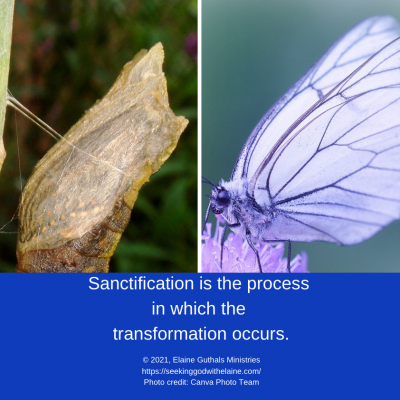
    That is what the transformation is about.

    Sanctification is the process in which the transformation occurs.

    Glorifying God as a Unified Body

    “so that you may glorify the God and Father of our Lord Jesus Christ with one mind and one voice” (Rom. 15: 6 CSB).

    We have one job as a unified body — glorify God.

    Time out! How do we glorify God? We glorify God when we use what we learn from seeking Him to change our words and actions in order to obey and praise Him.

    Salter noted that it might seem like a tall order for us to accomplish. He wrote, “But the perfect Christian may be compared to a perfect mirror, which, though dark and opaque of itself, being placed before the sun reflects his whole image, and may be said to increase his glory by increasing and scattering his light.”

    Resource

    It isn’t about us. It is about God and reflecting Him — scattering His light.

    If it isn’t about us, it isn’t about how far we are away from Him. We just talked about that not long ago. It isn’t how far — it is whether our nose is in the right direction.


    To read a related devotion, click on the appropriate button below.

    We said that God wants us to continually choose Him, even when we are feeling guilty for sinning against Him.

    Let’s go back a second to scattering light. This doesn’t mean running in terror. This means bursting forth in shining glory.

    How many verses now have we been talking unity? God’s children are to worship Him by living united in believing in Him and raising their voices in worship.

    God’s children are to worship Him by living united in believing in Him and raising their voices in worship.

    Making the Connections

    What flitted through my mind when we were going through this was direction, not distance, was another way of looking at the weak/strong issue. Think about the devotions we just had on this.

    • People are very important to God. Whether they are a strong disciple or a weak disciple today isn’t how He sees them. He sees them as perfected (How to Promote Peace).
    • Yes, we may be weak, but we are as God made us. Yes, we may we strong, but we may be fall into temptation and lose our way (How to Promote Peace).
    • It is our duty as a disciple to help our fellow disciples in their walks and not cause them to stumble (Living in Faith and Love).
    • The strong need to help the weak by being a good example to them. Don’t just bite on them. Show them better. Help them to be better (Who Do We Please?).
    • Paul told us we have to make a conscious decision to give up what pleases us and please others (Who Do We Please?).
    • Paul was only talking to the strong. He didn’t say a word to the weak. He didn’t say sign up for strength training. He didn’t call them second-class citizens (Who Do We Please?).
    • Every Tom. Every Sally. Every Elaine. No one is exempt from pleasing the neighbor. Neighbor meant everyone else. No one is exempt here, either. No one is given a pass (Who Do We Please?).
    • The strong are commanded to build up the weak here — teach the one who is weaker in the faith (Who Do We Please?).
    • Think back to what we we talked about in Chapter 14. Lead with love. Don’t judge. Here, we are adding tolerate another disciple’s weaknesses, encourage them, and seek their strengths (Who Do We Please?).

    To read a related devotion, click the button below.

    We like to pat ourselves on the back and say we are doing so much better in our walk than Tom, Sally, or Elaine. We can’t compare. It isn’t right to judge.

    God just wants us to be where we are supposed to be, doing what we are supposed to be doing, learning what we are supposed to be learning. He wants us to be navigating the Sanctification Road on His plan, not our own.

    How Do We Apply This?

    The best thing to do is to seek God. It always comes back to that.

    But then, isn’t that everything? Praying? Reading His Word? Studying it? Really applying it to our lives.

    Searching for and Seeking God

    Searching for and Seeking God

    Hearing His Word (Rom. 10: 17).
    Reading His Word (Rev. 1: 3).
    Praying to Him (Heb. 4: 16).
    Studying His Word (Ac. 17: 11).
    Meditating on His Word (Ps. 1: 1-2).
    Memorizing His Word (Ps. 119: 11).

    God wants us to succeed.

    Father God. You are patient with us. You encourage us. You want us to succeed. You call us to be patient and endure. You call us to unity and to encourage each other. You call us to glorify You. We praise Your name, Father. Amen.

    GlorifyingGodThroughPatienceEnduranceAndUnityPin

    What do you think?

    Leave me a comment below (about this or anything else) or head over to my Facebook group for some interactive discussion.

    If you don’t understand something and would like further clarification, please contact me.

    If you have not signed up for the email daily or weekly providing the link to the devotions and the newsletter, do so below.

    If God has used this devotion to speak with you, consider sharing it on social media.

  • The Silence of Cheerfulness and Rejoicing

    Say what? How can we be silent while cheerfully rejoicing? This daily devotional looks at what silence in the temple really means.

    Nuggets

    • God’s temple is an essential part of His kingdom.
    • Silence facilitates worship.
    • Silence is an indication of self-denial, self-discipline, and self-sacrifice.

    To read devotions in the Redo for Godliness series, click the appropriate button below.

    Devotions in the Silence of the Soul series

    When we did the Silence of the Soul series, I did all of the devotions on my list – except this one. It just didn’t seem to fit with the others.

    The other ones talked about us being truly silent. But this one was different.

    Part of it is the contrast between silence and rejoicing. It is hard to be silent when we are truly rejoicing.

    So, what is it truly trying to tell us? Let’s see where we can go with this.

    Let’s Put It into Context #1

    Here is a running list of what we’ve discussed previously.

    Let’s Put It into Context #2

    Our soul is our spiritual part that is immortal. The mind is a component of the soul that controls our will. It is in our minds that we process and make judgments and decisions.

    The Merriam-Webster Dictionary defines rejoice as “to feel joy or great delight.” Cheerfulness is defined by them as ungrudgingly, such as in cheerful obedience.

    Resource

    Cheerfulness and Rejoicing

    “But the Lord is in his holy temple; let all the earth keep silence before him” (Hab. 2: 20 ESV)

    Now, wait a minute. Aren’t we supposed to be praising and worshiping God in the temple? I don’t equate that with silence.

    Let’s concentrate on the temple first.

    The Importance of the Temple

    God’s temple is an essential part of His kingdom.

    Mortimer wrote, “God loves the tents of Jacob, He loves the dwellings of Israel, but He loves His own house above them all, as the place where He makes His honour to be known.” That means the temple is consecrated — it is holy.

    Resource

    Our being in the temple has no bearing with God being in the temple. “But the Lord is in his holy temple …” (Hab. 2: 20 ESV). Hastings said we could be indifferent, neglectful, or downright rebellious toward God. He will still be God in His temple.

    We just talked about God being self-existent or self-sufficient. God doesn’t need us in order to be Sovereign God.

    To read a related devotion, click the button below.

    But we need to be in His temple. God wants to have a relationship with us. That is an important place where God reveals Himself to us.

    We need to be in a continuous state of worship. That is especially so when we are in His house. Roberts said we are to adore Him.

    We can’t think that God is only in His temple. One thing we cannot forget is we are also God’s temple. He lives within us.

    Also, Jack reminded us that the universe is God’s temple. Every person — even worldview people — are in God’s temple.

    Resource

    Roberts noted that “a Church is sanctified by the Word of God, prayer, and praise, independent of all other ceremonies.” We listen to His Word; we communicate with Him; we acknowledge His sovereignty.

    Resource

    Silence leads to celebration!

    Silence leads to celebration!

    The Importance of Silence in Worship

    Silence facilitates worship.

    The silence comes in because Jesus said that “… My house shall be called a house of prayer …” (Mt. 21: 13 ESV).

    When we pray, we have to settle ourselves down. Why? Prayer is a two-way communication with God.

    Hastings told us about the the importance of silence. He wrote, “‘Keeping silence’ indicates a sense of weakness and unworthiness, reverence and devout attention. It points also to the glory, majesty, and power of the Lord God omnipotent.” Collier said we should zip it unless we are praying or praising God.

    Resource

    God doesn’t want us to think we have to rely on ourselves. He wants us to submit to Him and rely on Him.

    Calvin contended that submission is silence. He wrote, “But there is another kind of silence, and that is, when we willingly submit to God; for silence in this respect is nothing else but submission: and we submit to God, when we bring not our own inventions and imaginations, but suffer ourselves to be taught by His Word.”

    Resource

    I would say that Calvin was saying we need to silence our independence. Our arrogant, selfish desires need to be silenced. We can’t kick and scream when things don’t go our way.

    The Biblical Illustrator noted there are five types of silences:

    • Humiliation
    • Adoration
    • Submission
    • Expectation
    • Quiet resolution

    Hmmm. I wish they would have expanded on what they were thinking on quiet resolution.

    Collier reminded us of something important. He wrote, “The Psalmist calls the human voice ‘man’s glory’; and so it is, as sharing with the possession of reason ‘the glory’ of distinguishing between man himself and the coasts that perish. And our Lord warns us against the vain and idle use of this great gift, by the solemn declaration that ‘by thy words thou shalt be justified, and by thy words thou shalt be condemned’; and again, that ‘for every idle word that men shall speak, they shall give account thereof in the day of judgment.’

    Resource

    The voice is man’s glory, not God’s glory. We use our words to build ourselves up and heap the honor on ourselves.

    The words that justify us are “Father, I have sinned” and “I submit to You, Sovereign Lord.”

    Anything but that would be the vain use of the gift. Would it be an idle use?

    Psalms 4: 4 says, “Stand in awe, and sin not: commune with your own heart upon your bed, and be still” (KJV). We talked about this before as meditating on Him.

    To read a related devotion, click the button below.

    What we said there was, when we meditate on God, we look inside ourselves to take stock. He wants us to think about where we are as a disciple and what we need to work on to be more holy. We have to come into God’s presence the right way.

    Collier also said that the silence allows us to prepare for when “… the sinner stands before God self-accused and self-condemned.” We will all stand before God one day and be judged.

    But to me, it is more than that, too. When I decided to do a blog online, I needed to be quiet. I didn’t need to be telling God, “I can and will do this, and this, and this. But I will not do that, and that, and that.“ I needed to listen.

    Kelman brought up the fact that people today call for more leisure time. This is different than silent time. Kelman wrote, “No one can worship rightly, no one can even hear the call to worship, who does not often feel that he must be silent.”

    Resource

    Too often, we think of leisure time as sport and hobby time. Maybe it is decomp time.

    God wants it to be listening time. We listen as we study His Word and pray to Him. We listen as we worship.

    God wants it to be listening time. We listen as we study His Word and pray to Him. We listen as we worship.

    What Is the Root of Silence?

    Silence is an indication of self-denial, self-discipline, and self-sacrifice.

    OK, let’s stop a second. Where did I get this topic? The Silence of the Soul series came out of Edwards’ sermon Of Taking Up the Cross when we were doing the What Should We Do about Who Jesus Is? devotion.

    That devotion was in the Who Is Jesus? series. It was in the Sunday Morning Bible Study series. Jesus was asking His disciples Who they thought He was.

    Then He told them, “Then he said to them all, ‘If anyone wants to follow after me, let him deny himself, take up his cross daily, and follow me’” (Lk. 9: 23 CSB).

    Edwards told us that submission and silence fuel happiness. I think the submission fuels the silence.

    Resource

    The root of all of that is self-denial. We talked self-denial, self-discipline, and self-sacrifice.

    We take self out. We put the focus on God— which leads to the silence.

    How do we do that? Foote said we must give up our sinful bodily indulgences. They eat at the spirituality of our mind.

    Resource

    When we live a life of self-denial, we focus on God. When we focus on God, we worship Him.

    God wants it to be listening time. We listen as we study His Word and pray to Him. We listen as we worship.

    Making the Connections

    But sometimes, we get the wrong attitude. Hastings said something that stopped me in my tracks. He wrote, “He is accountable to no one.”

    Resource

    Ooo, baby. Don’t we try to make God accountable to us sometimes? Let Him not answer a prayer on our timetable or in the way we want. Don’t we start trying to make Him see things our way?

    TheSilenceOfCheerfulnessAndRejoicingPin

    How Do We Apply This?

    • We need to fear the Lord. We need to reverence Him and praise Him.
    • We should meet whenever possible in the house of the Lord. He reveals Himself to us there.
    • Jack said that it is our duty to worship God.
    • Edwards said that Heaven is a temple. We need to prepare to praise and worship God for eternity.
    • We have to voluntary submit.
    • Bag the evil voices. Kelman listed them as “passion, selfishness, self-assertion, lust, fear …”
    • We must calm our mind, heart, and conscience.
    • We need to study God’s Word and communicate with Him.

    Resource

    It is important to remember that we are God’s temple. Think of it this way. We are unworthy, rebellious creatures who are made worthy because of our faith in Jesus. He comes to live inside of us, just as He fills His temple

    The biggest silence is the silence of death. There will be a judgment day, but it is not going to be a debate. It is not going to be a trial where we defend ourselves. It will be the books being opened, our lives being examined, and God judging us while we stand there silently.

    We have to make decisions in this life. It is our choice now whether to submit to God or not. Once we die, we cannot change our choice.

    We have to ABCD – today. We can’t wait, because we are not guaranteed tomorrow.

    The silence of cheerfulness and rejoicing. If silence is submission to God, that leads to cheerfulness and rejoicing because that makes Him our Heavenly Father. Being a child of God for eternity brings much joy.

    Father God. We talk too much. Lord, we need to listen to You and focus on what You are telling and teaching us. We stand in silence at the foot of Your throne, listening to what You need to say to us. Amen.

    The ABCDs of Salvation

    If you have not become a believer in Christ, please read through the
    Plan of Salvation and prayerfully consider what God is asking you to do.

    A – admit our sins
    B – believe His Son Jesus is our Redeemer
    C – confess God as Sovereign Lord

    D – demonstrate that commitment by making any changes needed in our lives to
    live the way in which God has called us

    The Disciple’s Job Description

    What do you think?

    Leave me a comment below (about this or anything else) or head over to my Facebook group for some interactive discussion.

    If you don’t understand something and would like further clarification, please contact me.

    If you have not signed up for the email daily or weekly providing the link to the devotions and the newsletter, do so below.

    If God has used this devotion to speak with you, consider sharing it on social media.

  • We Will Worship Jesus

    Jesus wasn’t interested in appearing as an earthly king. He was interested, though, that we worship Him. This daily devotional looks at the triumphant entry.

    Nuggets

    • Jesus borrowed a colt for an important ride.
    • The triumphant entry treated Jesus as a King but was really a worship service.
    • God will always be praised, even if we aren’t praising Him.

    Devotions in the Luke’s Diagnosis and Prescription series

    Jesus’ triumphant entry into Jerusalem was an important time in Jesus’ ministry. We’re just going to dive in.

    Securing Transportation

    “As he approached Bethphage and Bethany, at the place called the Mount of Olives, he sent two of the disciples and said, ‘Go into the village ahead of you. As you enter it, you will find a colt tied there, on which no one has ever sat. Untie it and bring it. If anyone asks you, ‘Why are you untying it?’ say this: ‘The Lord needs it.’ So those who were sent left and found it just as he had told them. As they were untying the colt, its owners said to them, ‘Why are you untying the colt?’ ‘The Lord needs it,’ they said” (Lk. 19: 29-34 CSB)

    Jesus borrowed a colt for an important ride.

    Jesus was focused on His mission. In Luke 9: 52, Luke wrote, “As the time drew near for him to ascend to heaven, Jesus resolutely set out for Jerusalem” (NLT). We don’t know if He went straight there, but that was His goal.

    • “Jesus went through the towns and villages, teaching as he went, always pressing on toward Jerusalem” (Lk. 13: 22 NLT).
    • “As Jesus continued on toward Jerusalem, he reached the border between Galilee and Samaria” (Lk” 17: 11 NLT).
    • “Taking the twelve disciples aside, Jesus said, “Listen, we’re going up to Jerusalem, where all the predictions of the prophets concerning the Son of Man will come true” (Lk. 18: 31 NLT).
    • “After telling this story, Jesus went on toward Jerusalem, walking ahead of his disciples” (Lk. 19: 28).

    This resoluteness showed Jesus’ willingness to die. He could have turned around at any time and said, “I’m not going there.” He didn’t.

    Power pointed out that Jesus had to be totally dedicated to His mission. He wrote, “Firmly and intelligently, with a full knowledge of the indignity and death before Him, our Lord started forth, and took the headship of His little band on His way to Jerusalem. That steadfastness is of immense importance to us. Were there the least wavering in Christ’s character, we were undone.”

    Resource

    We have to remember how Jesus got to Jerusalem. He was poor, so He and the disciples walked everywhere. That also meant He was probably hungry and thirsty.

    It changed when Jesus got to the outskirts of Jerusalem. He went big here.

    Well, shouldn’t He? Jesus was meeting His destiny. He just needed one little thing.

    Jesus sent a couple disciples off to pick up a colt. It always amazed me that the owner would accept the sentence of, “The Lord has need of it” and would let them take the colt. But He did, and he did.

    Jesus did need the colt — to fulfill prophecy. “Rejoice, O people of Zion! Shout in triumph, O people of Jerusalem! Look, your king is coming to you. He is righteous and victorious, yet he is humble, riding on a donkey— riding on a donkey’s colt” (Zech. 9: 9 NLT).

    Parker argued that, if God could manage small details like that, doesn’t that mean He is going to manage all of the details? God does everything for a purpose.

    Resource

    Strauss argued that this proved Jesus was a King. The evidence was Jesus was able to procure the colt by the power of His will.

    Resource

    A Traveling Worship Service

    “Then they brought it to Jesus, and after throwing their clothes on the colt, they helped Jesus get on it. As he was going along, they were spreading their clothes on the road. Now he came near the path down the Mount of Olives, and the whole crowd of the disciples began to praise God joyfully with a loud voice for all the miracles they had seen: Blessed is the King who comes in the name of the Lord. Peace in heaven and glory in the highest heaven!” (Lk. 19: 35-38 CSB)

    The triumphant entry treated Jesus as a King but was really a worship service.

    Jesus road into town in style on the colt. No, this was a change of procedure.

    In the past, Jesus had declined to be recognized as King. “When Jesus saw that they were ready to force him to be their king, he slipped away into the hills by himself” (Jn. 6: 15 NLT). Parker said that He would not be made King in this way because “… what is done by compulsion may by compulsion be undone.”

    Resource

    Jesus knew that, if he was crowned king in Jerusalem, He would never be crowned king in our hearts. The Jews would focus even more on an earthly kingdom rather than a spiritual kingdom.

    Our spiritual health was the sole reason Jesus came. He came, as Strauss said, “… as a Friend and Saviour; and wants to be loved, not feared.”

    Resource

    Jesus’ mission was not to eliminate poverty, disease, death. He was here to right injustices and cure racism.

    The sole purpose of Jesus’ ministry was to die on the cross so that His blood could atone for our sins. Period. End of story.

    Glossary

    Why would Jesus sacrifice Himself for us? He loves us that much. He didn’t want Heaven without us.

    What a Beautiful Name
    Vocalist: Elaine Guthals
    Keyboard: Chris Vieth

    I learned two things reading through this today. All of the versions — even the King James — translated it as placing their clothes on the ground for the colt to walk on.

    I always thought it was branches in the King James Version. I misremembered.

    I also always thought it was the entire crowd praising Jesus. It was only “… the whole crowd of the disciples …” (Lk. 19: 37 CSB). I guess I had always thought this was a foreshadowing of “that at the name of Jesus every knee should bow, in heaven and on earth and under the earth” (Phil. 2: 10 NLT).

    Sorry, guys. It is important that we sing to God. Spurgeon wrote, “… not one silent tongue among the disciples — not one who withheld his song.”

    Resource

    The ones who withhold their song is going to be the Pharisees and worldview people. They don’t believe Jesus is the Messiah.
    Whoever was praising Him, they didn’t wait until Jesus hit Jerusalem’s gate. They started praising where they were.

    Did you catch that they were praising God in a loud voice? They weren’t hiding the fact that they were glorifying God.

    They were specific in their praise. “Blessed is the King who comes in the name of the Lord. Peace in heaven and glory in the highest heaven!” (Lk. 19: 38 CSB).

    We’ve said before that blessedness means we have been perfected. The perfected state indicates the combination of the graces which, when all are present, form spiritual wholeness or completeness.

    They were praising Jesus for becoming perfected because they knew He would accomplish His mission. It wasn’t the way any of them envisioned it, but they knew Jesus would succeed.

    The disciples did it right. They were generating the enthusiasm we should have when praising God.

    Gregg asked the question, “What is your religion if it have no enthusiasm in it?” Good question.

    Resource

    Enthusiasm needs to be a integral part of our worship. The joy we feel in being forgiven and redeemed should bubble out of us.

    A Choir of Stones

    “Some of the Pharisees from the crowd told him, ‘Teacher, rebuke your disciples.’ He answered, ‘I tell you, if they were to keep silent, the stones would cry out’” (Lk. 19: 39-40 CSB)

    God will always be praised, even if we aren’t praising Him.

    Of course, the Pharisees had something to say about it. Their mission in life was finding fault with everything that Jesus did.

    Jesus didn’t follow the Pharisee’s line of thinking, so they wanted the praising shut down. At a minimum, they wanted the disciples to be given a bad performance evaluation.

    Spurgeon felt the foundation of their objections was their jealousy. They thought if the disciples were praising Jesus, then they wouldn’t be praising God.

    Resource

    Jesus didn’t address the disciples. He said praise was going to happen regardless of what the Pharisees wanted.

    What they didn’t understand was that enthusiasm that we talked about in the last section. They also didn’t understand that praise was a requirement for disciples.
    The Pharisees just saw the legalistic viewpoint. We have to do this. We can’t do this.

    It didn’t sink in that — for all of eternity — we will be singing “… Holy, holy, holy is the Lord God, the Almighty — the one who always was, who is, and who is still to come” (Rev. 4: 8 NLT). (Yes, guys. Singing.)

    For Jay, it all boiled down to this. He wrote, “If we have ourselves received the knowledge of Christ, we are bound to impart it.”

    Resource

    It all goes back to our job description. We are to preach the gospel and make disciples.

    The Disciple’s Job Description

    Complete Job Description

    Individual Description

    Job Duty #4
    Proclaim the Gospel (Mark 16: 15)

    Job Duty #6
    Make Disciples (Matthew 28: 19-20)

    What is the root of our praise? It is our love for Jesus. We are to love Him so much that we must “… must deny themselves and take up their cross daily and follow me” (Lk. 9: 23 NIV).

    I keep thinking when reading this passage how the worldview is trying shut Christianity down. Ooo, baby. Wouldn’t they be surprised if the rocks started singing?

    WeWillWorshipJesusPin

    Making the Connections

    No, Jesus wasn’t interested in being an earthly king. He was interested in being our spiritual King.

    Jesus is interested in us praising Him. He wants us accept the gift of salvation.

    How Do We Apply This?

    The ABCDs of Salvation

    If you have not become a believer in Christ, please read through the
    Plan of Salvation and prayerfully consider what God is asking you to do.

    A – admit our sins
    B – believe His Son Jesus is our Redeemer
    C – confess God as Sovereign Lord

    D – demonstrate that commitment by making any changes needed in our lives to
    live the way in which God has called us

    The Disciple’s Job Description

    Praise Him, praise Him, praise Him.

    Father God. We are humbled that Jesus agreed to be our Savior and Redeemer. Even when we were mired in sin, He chose to die for us. Lord, we worship Him and praise His name. We worship You for designing this plan, so that we could be restored to You. We will sing Your praises for eternity. Amen.

    What do you think?

    Leave me a comment below (about this or anything else) or head over to my Facebook group for some interactive discussion.

    If you don’t understand something and would like further clarification, please contact me.

    If you have not signed up for the email daily or weekly providing the link to the devotions and the newsletter, do so below.

    If God has used this devotion to speak with you, consider sharing it on social media.

  • Morality for Honoring God

    We are to be moral disciples for more than just being good people. Through our morals, we honor God. This daily devotional, the first in a two-part miniseries, looks at how we dishonor God.

    Nuggets

    • Disciples are to honor God’s name by acknowledging His nature.
    • Dishonoring the Lord brings severe consequences.
    • We dishonor God when we let go of Jesus.

    To read devotions in the Redo for Godliness series, click the appropriate button below.

    Devotions in the Moralities Lead to Godliness series

    Manton concluded his sermon entitled The Moralities of Christianity by telling us that religion should have honor. He wrote, “The credit of religion depends much on the credit of its professors …” This went long, so I am going to have to split it.

    Resources

    When I first pulled the verses, my thought was, “Well, this is how not to honor God.” We learn that way, too. Let’s check it out.

    Let’s Put It into Context

    The definition of moral, according to the Merriam-Webster Dictionary, is “of or relating to principles of right and wrong in behavior.” Morality, then, is “a doctrine or system of moral conduct.” When it is the plural form — moralities — it is a “particular moral principles or rules of conduct.”

    Resources

    Our morals determine our character. Character, according to the Merriam-Webster Dictionary, is “the complex of mental and ethical traits marking and often individualizing a person, group, or nation.”

    Resource

    Honor means to esteem and respect another because of a good reputation.

    How Do We Honor God’s Name?

    “But when they came to the nations, wherever they came, they profaned my holy name, in that people said of them, ‘These are the people of the Lord, and yet they had to go out of his land.’ But I had concern for my holy name, which the house of Israel had profaned among the nations to which they came” (Ezek. 36: 20-21 CSB)

    Disciples are to honor God’s name by acknowledging His nature.

    Every version but the New Living Translation translates the word profane. “But when they were scattered among the nations, they brought shame on my holy name …” (Ezek. 36: 20 NLT).

    Davidson said that we do not bring shame on God when we “… recognise (sic) that which He is, or ascribe to Him His true nature.” We honor God by recognizing that He is Sovereign God.

    Resource

    Oh, I have to process this. Davidson wrote, “Only the other hand, when the iniquities of His people constrain Him to act in such a way as to disguise any of His great attributes, such as His power, in the eyes of the nations, so that they misinterpret His being, His holy name is ‘profaned’ …” When we sin, God cannot interact with us the way He wants. “But you are pure and cannot stand the sight of evil …” (Hab. 1: 13 NLT).

    When we sin, God cannot interact with us the way He wants.

    I get it. God interacts with us on an if…then basis. “Then if my people who are called by my name will humble themselves and pray and seek my face and turn from their wicked ways, I will hear from heaven and will forgive their sins and restore their land” (II Chron. 7: 14).

    • If we acknowledge Him as Sovereign God
    • If we accept the gift of salvation
    • If we obey His laws and commandments

    God doesn’t have anything to do with entitlement. Just because He created us doesn’t mean we can disobey Him and still expect that He is supposed to bless us right and left.

    God has expectations of us that we must fulfill. If we don’t, we, like the Israelites, bring the disasters upon ourselves.

    It is our choice, not a handout.

    Davidson brought up a good point. Our refusing to make the right choices can lead others to believe God is weak. He wrote, “Naturally, the idea of a god exercising a moral rule over his own people would not yet occur to them.”

    Resource

    The Scriptures talk a lot about honoring God’s name. We only know God’s name because He has chosen to reveal it to us. It solidifies His relationship with us.

    By knowing His name, we learn of God’s power, authority, and holiness. In essence, we learn of God Himself.

    Resource

    Disciples are told we are to live in His name. “Though all the peoples walk in the name of their own gods, we will walk in the name of the LORD our God forever and ever” (Mal. 4: 5 CSB). Walking is the term used to describe how we ulive our lives.

    Guthrie translated that to mean we are to obey God’s laws and commandments. We also are to obey His ordinances. We are to honor however God makes Himself known to us.

    Resource

    Our focus should be on God, not ourselves.

    What Happens When We Dishonor God’s Name?

    “Nevertheless, because by this deed you have utterly scorned the Lord, the child who is born to you shall die” (II Sam. 12: 14 CSB)

    Dishonoring the Lord brings severe consequences.

    God knows we are sinful creatures, right? He is going to give us a pass when we dishonor His name. Otherwise, He won’t have anyone praising His name because no one can meet His high standard? WRONG!

    Paul made it very clear that God will correct us when we sin. “Do not be deceived: God is not mocked, for whatever one sows, that will he also reap” (Gal. 6: 7 ESV).

    God will correct us when we sin.

    Look at Second Samuel. This was David being talked about. David — the man after God’s own heart. Yes, he is to be one of our role models.

    David still paid the consequences of his sins of adultery and murder. Cox said that we get forgiveness from God, not immunity. If He doesn’t punish our sins, don’t we start convincing ourselves that means they really aren’t sins?

    Resource

    We can’t soften the effects — or the consequences — of sin. We can’t work to clear ourselves of the stain of sin. The “… whatever one sows, that will he also reap” (Gal. 6: 7 ESV) part will come to fruition — either now or at judgment day.

    Lewis addressed whether our inability to stop sinning negates that salvation can come from a holy God. He said no because — even though we are still sinful creatures — we should not condone sin. He wrote, “Their sins are held up to our abhorrence, and as proceeding from the want of more of the power of godliness.”

    Resource

    We have got to see the flaws of the saints. If we don’t, we won’t identify with them. We wouldn’t be able to see ourselves receiving God’s forgiveness if they didn’t.

    Instead, we see much about God’s character. He is loving. He forgives when we ask. He has provided the way in which our sins can be forgiven.

    Okay. I have to process what Lewis said. He wrote, “Will it be objected that religion has but little power, if it leaves men to fall into such sins, and that unassisted reason can produce as pure a morality as in the Bible?”

    Elaine-speak. People will accuse God of having little power if He lets people fall into sin. He must assist us in producing the morality He requires.

    Lewis argued that God isn’t going to judge us just on our failures. He is going to look at the whole picture.

    I can see that. David loved God with all of his heart. He strived to follow God’s laws and commandments. His goal was to provide for His people.

    That is very comforting! God isn’t into once-and-done. He forgives us multiple times for the same sin — as long as we are ultimately trying to honor His name.

    God also forgives us for a variety of sins — all of them, in fact. The only sin He won’t forgive us for is the unpardonable sin, which I believe is unbelief.

    Glossary

    We have to show God that we are following His will, as the Essex Remembrancer put it, “… in the combined and duly regulated exercise of the whole range of moral perfections.” Remember, a couple of devotions ago we said that “… all goodness, righteousness, and truth” (Eph. 5: 9 CSB) is a packaged deal. We don’t get to choose the goodness and pass on the righteousness part because they are interwoven.

    Resource

    To read a related devotion, click the button below.

    That tells me God is interested in the motivation more than the execution. He is interested in the long haul. He is looking for order, commitment, and compassion.

    • Justice is order in creation.
    • Holiness is more than a character trait; it is purity, dedication, and commitment that lead to being set apart.
    • Disciples’ mercy is a characteristic of compassion for the needs of others, especially those who are in distress.

    When we genuinely repent, God will forgive us. Repentance is acknowledging our separation from God and expressing sorrow for breaking God’s laws and commandments by making the commitment to changing ourselves through obedience so that we no longer do the wrong things. Forgiveness is, when we ask, God pardons us because we have broken His laws and commandments and restores our relationship with Him.

    What Happens When We Choose the Path of Sin?

    “Even so, many will follow their immoral ways; and because of what they do, others will speak evil of the Way of truth” (II Pet. 2: 2 GNT)

    We dishonor God when we let go of Jesus.

    Adam’s contended that there are, many times, instigators who lead us to let go of Jesus. Paul describes these as those who “… [don’t] hold on to the head, from whom the whole body, nourished and held together by its ligaments and tendons, grows with growth from God” (Col. 2: 19 CSB).

    We dishonor God when we do not accept or choose to follow His Son. Jesus is the only way in which we can gain access to God (Jn. 14: 6).

    We have to acknowledge that we are sinful creatures separated from God. It is only through the birth, death, and resurrection of Jesus Christ that we can be restored to a relationship with Sovereign God.

    MoralityForHonoringGodPin

    Making the Connections

    We have to be very careful. God is Sovereign God.

    We can’t try to bring Him down to our level. When we try to understand the concepts of the gospel, we have to keep God on His throne.

    How Do We Apply This?

    • We have to evaluate our lives to determine where we are honoring God and where we aren’t.
    • Take extra caution in areas we know will be tempted.
    • Be disciples with integrity.
    • Witness to others.
    • Seek God’s blessings.

    Resource

    This devotion looked at aspects of dishonoring God. In the next devotion, we will look into honoring Him.

    Father God, we want to give You all the praise and honor that You are due. There are things we cannot understand. Help us to understand what we can. Guide us to live in step with Your Will. Amen.

    What do you think?

    Leave me a comment below (about this or anything else) or head over to my Facebook group for some interactive discussion.

    If you don’t understand something and would like further clarification, please contact me.

    If you have not signed up for the email daily or weekly providing the link to the devotions and the newsletter, do so below.

    If God has used this devotion to speak with you, consider sharing it on social media.