Category: Worship

  • Waiting for the Messiah

    While Mary and Joseph were fulfilling Jehovah’s laws in the Temple, two people recognized Baby Yeshua for Who He was. This devotional reading looks at Simeon and Anna’s interaction with the Messiah.

    Nuggets

    • Mary and Joseph met Simeon in the Temple.
    • Simeon entered the story because he walked with Jehovah.
    • Like so many in Israel, Simeon was waiting for the coming of the Messiah.
    • Simeon was led by the Holy Spirit to go to the Temple that day.
    • Jehovah pressed upon Simeon’s heart that he would not die before he had seen the Messiah.
    • Simeon not only got to see the Messiah, but he also got to hold him.
    • Simeon was highlighting more than just his promise.
    • Yeshua is the Savior of Jews and Gentiles.
    • Simeon was pointing us back to Jehovah’s glory.
    • Simeon had some prophetic words for Mary, but they weren’t necessarily a comfort.
    • Covenants usually require signs.
    • The deepest thoughts of hearts are whether they choose Yeshua or not.
    • Simeon prophesied how Mary would be affected by Yeshua’s rejection.
    • A woman who was also in the Temple that day recognized the Messiah.
    We are told to watch and wait for the return of the Messiah. In first-century Israel, they were waiting for Him to make His first appearance.

    Two such people were Simeon and Anna. Mary and Joseph encountered them when they presented Yeshua in the Temple.

    More importantly, they encountered Him.

    Let’s Put It into Context

    To read devotions in The Battle for the Heart theme

    Devotions in the The Birth and Early Childhood of Christ series

    The Prophecy of Simeon (Shim‘on)

    “At that time there was a man in Jerusalem named Simeon. He was righteous and devout and was eagerly waiting for the Messiah to come and rescue Israel. The Holy Spirit was upon him and had revealed to him that he would not die until he had seen the Lord’s Messiah. That day the Spirit led him to the Temple. So when Mary and Joseph came to present the baby Jesus to the Lord as the law required, Simeon was there. He took the child in his arms and praised God, saying, ‘Sovereign Lord, now let your servant die in peace, as you have promised. I have seen your salvation, which you have prepared for all people. He is a light to reveal God to the nations, and he is the glory of your people Israel!’” (Lk. 2: 25-32 NLT)

    Simeon

    Mary and Joseph met Simeon in the Temple.

    We aren’t told anything about who Simeon was. We don’t know if he lived in Jerusalem or was visiting. We don’t know his age – other than assuming he was old. We don’t know his family status: never married, married, widower.

    What we do know is what Simeon was in Jehovah’s eyes.

    Righteous and Devout

    Simeon entered the story because he walked with Jehovah.

    Simeon was described as righteous and devout. To be a tzaddik (צַדִּיק) – or a righteous person – is to faithfully walk according to Jehovah’s covenant. That is the Abrahamic covenant.

    In other words, Simeon’s condition and character were right.

    It isn’t talking about sinless perfection here. Instead, it shows someone whose life is spent in covenant faithfulness. This standing is based on Jehovah’s gracious acceptance.

    Devout — chasid (חָסִיד) – is the attitude of holding Jehovah in reverence and treating Him, His holiness, His worship, and His revealed Will with careful respect and faithful obedience.

    Devoutness is, therefore, an attitude toward Jehovah that affects conduct. Simeon felt His presence and performed all his acts and thoughts for Him.

    Holy Spirit Was upon Him

    Simeon was led by the Holy Spirit to go to the Temple that day.

    In the Old Testament, the Holy Spirit didn’t dwell in people as He did after Pentecost. The Holy Spirit is the One Who brought Simeon to the Temple that day.

    Could Simeon have been a priest? He may have been – it just wasn’t his rotation that day.

    But nothing leads us to believe that. All we are told is that Simeon lived in Jerusalem.

    What we are told is that this was a prophetic moment. Simeon was there because of divine timing.

    He Would not Die

    Jehovah pressed upon Simeon’s heart that he would not die before he had seen the Messiah.

    There are times Jehovah lets us know what He has in store for us. This was one of them.

    You have to think that the promise was given because Simeon was so righteous and devout. Probably.

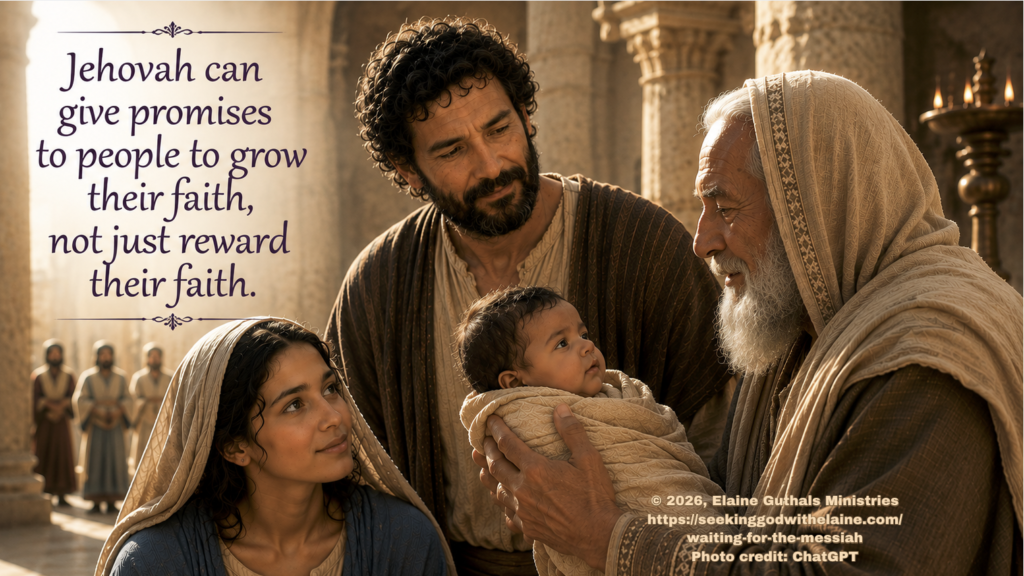
    But Jehovah can give promises to the righteous and devout – who don’t feel they are so righteous and devout. He can give promises to people to grow their faith, not just reward their faith.
    Took the Child in His Arms

    Simeon not only got to see the Messiah, but he also got to hold Him.

    We aren’t told anything about the moment of recognition. Yeah, it would have been great to know the joy and wonderment Simeon was feeling.

    It seems like Simeon immediately knows. The Holy Spirit didn’t make him wait.

    There was no waiting on Simeon’s part. No hesitation. No sign needed.

    Simeon’s waiting formed his seeing.
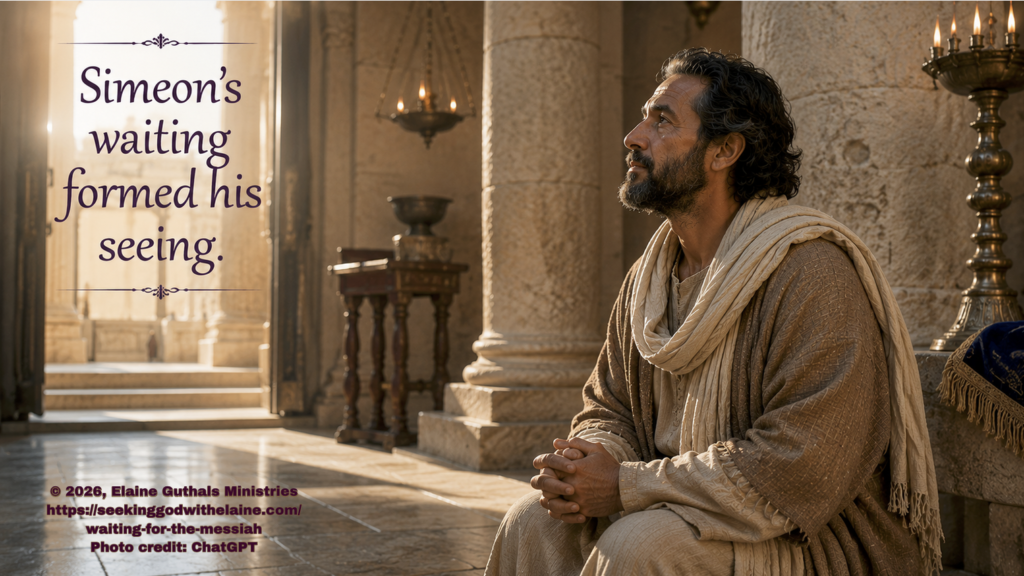
    That is where Simeon’s faith is displayed most strongly. Waiting is one thing, but what if we refuse to believe when the promise is fulfilled? We have to exercise faith then, too.

    Seen your Salvation

    Simeon was highlighting more than just his promise.

    Yes, Simeon used I-type statements. Your servant (Lk. 2: 29). I have seen (Lk. 2: 30).

    But Simeon quickly transitions to Your salvation (Lk. 2: 30) and prepared for all people (Lk. 2: 31).

    Simeon wasn’t only celebrating that he had seen the Messiah. He was also celebrating that the Messiah had come – and brought the promised salvation.

    • “He says, ‘You will do more than restore the people of Israel to me. I will make you a light to the Gentiles, and you will bring my salvation to the ends of the earth” (Isa. 49: 6 NLT).
    • “‘The Redeemer will come to Jerusalem to buy back those in Israel who have turned from their sins,’  says the Lord” (Isa. 59: 20 NLT).

    That is for which Simeon was waiting. That makes him saying “I’ve been waiting for the consolation” and I’ve seen your salvation” so powerful.

    Consolation – nechamah (נֶחָמָה) – talks about restoration. Salvation – Yeshuah (יְשׁוּעָה) – means deliverance and rescue.

    What Simeon was saying was, “I have seen your Yeshuah (יְשׁוּעָה).

    We say that salvation is a process. It is more than that. It is a Person.

    Prepared for All People

    Yeshua is the Savior of Jews and Gentiles.

    Was Simeon like so many other first-century Jews looking for a military messiah? I don’t think so.

    Simeon’s expectation clearly transcended a merely political salvation.

    All people would have included the Gentiles. Many first-century Jews wouldn’t have seen Messiah coming for Gentiles.

    Simeon connected the light — or (אוֹר) – for the nations phrase from prophecy. Go back and reread Isaiah 49: 6 in the last section.

    • “The people who walk in darkness will see a great light. For those who live in a land of deep darkness, a light will shine” (Isa. 9: 2 NLT).
    • “I, the Lord, have called you to demonstrate my righteousness. I will take you by the hand and guard you, and I will give you to my people, Israel, as a symbol of my covenant with them. And you will be a light to guide the nations” (Isa. 42: 6 NLT).
    • “Arise, Jerusalem! Let your light shine for all to see. For the glory of the Lord rises to shine on you. Darkness as black as night covers all the nations of the earth, but the glory of the Lord rises and appears over you. All nations will come to your light; mighty kings will come to see your radiance” (Isa. 60: 1-3 NLT).

    Remember, this is the same light as used in Genesis 1: 3. “Then God said, ‘Let there be light,’ and there was light” (Gen. 1: 3 NLT).

    This is Jehovah’s shekinah – His presence.

    Think about it, Yeshua was born and raised in obscurity. His death was anything but hidden. His coming is going to be not only world-wide but for everyone past and present at that time.

    The Glory of Your People Israel!

    Simeon was pointing us back to Jehovah’s glory.

    So, what does the glory (kavod – כָּבוֹד) of Jehovah’s people mean? Does it mean He is bringing them status?

    No.

    • “For I am ready to set things right, not in the distant future, but right now! I am ready to save Jerusalem and show my glory to Israel” (Isa. 46: 13 NLT).
    • “Arise, Jerusalem! Let your light shine for all to see. For the glory of the Lord rises to shine on you” (Isa. 60: 1 NLT).

    Jehovah’s glory is associated specifically with Jerusalem/Israel and God’s saving action toward His covenant people. Israel has its role in His redemptive plan.

    Notice, Simeon says the Child is the glory of Israel. That ties back into Messianic prophecy and expectations.

    Blessing Mary and Joseph

    Jesus’ parents were amazed at what was being said about him. Then Simeon blessed them, and he said to Mary, the baby’s mother, ‘This child is destined to cause many in Israel to fall, and many others to rise. He has been sent as a sign from God, but many will oppose him. As a result, the deepest thoughts of many hearts will be revealed. And a sword will pierce your very soul’” (Lk. 2: 33-35 NLT)

    Destined to Cause Many in Israel to Fall and Rise

    Simeon had some prophetic words for Mary, but they weren’t necessarily a comfort.

    First, Simeon reminded Mary that the Messiah would be rejected. Walk through this with me.

    From the Suffering Servant passage in Isaiah, “He was despised and rejected —  a man of sorrows, acquainted with deepest grief. We turned our backs on him and looked the other way.  He was despised, and we did not care” (Isa. 53: 3 NLT).

    No, most first-century Messianic expectations didn’t connect the Messiah with suffering. We really don’t read that they felt the Messiah would be rejected.

    But from the very first prophecy, Jehovah clearly stated that the Messiah would suffer. “And I will cause hostility between you and the woman,  and between your offspring and her offspring. He will strike your head, and you will strike his heel” (Gen. 3: 15 NLT).

    We may read this to mean all humans are going to become victims of Satan. If this is a messianic prophecy – and it is – wouldn’t that also mean attacks on the Messiah?

    The wording just guarantees attacks. To me, it doesn’t guarantee Satan is successful.

    But attacks can be painful. Satan thought he was attacking Yeshua by sending Him to the cross.

    That was painful.

    Satan found out too late that it was Yeshua’s plan all along that He end up there. He found out it was Jehovah controlling the plan.

    Let’s go back to something we just bowled over. Messiah could be rejected.

    The salvation Yeshua secured with His death and resurrection is offered to us as a gift. It is up to us to accept or reject it.

    Rejecting Yeshua means the falling (naphal – נָפַל). Accepting Him means the rising (qum – קוּם)

    Oh, yeah. Accepting salvation is much more beneficial than rejecting it. Still, we are offered a choice.

    This brings division. “Do you think I have come to bring peace to the earth? No, I have come to divide people against each other! From now on families will be split apart, three in favor of me, and two against—or two in favor and three against. ‘Father will be divided against son and son against father; mother against daughter and daughter against mother; and mother-in-law against daughter-in-law and daughter-in-law against mother-in-law’” (Lk. 12: 51-53 NLT).

    That definitely didn’t jibe with first-century Messianic expectation.

    Sent as a Sign from God

    Covenants usually require signs.

    Don’t misread this. It isn’t saying that Yeshua would perform signs – miracles – so people would know who He was. Yes, He did do that.

    This said that Yeshua WAS the sign – ot (אוֹת).

    Wait! How does a sign fit into light and division?

    Yeshua is Jehovah’s sign that His promised salvation has arrived.

    Let’s look at it this way. A covenant almost always included a sign.

    Yeshua’s coming was as fulfillment of the promises of the Abrahamic covenant. More importantly, He was bringing a new covenant.

    Yeshua was the sign of the new covenant. This new covenant focused on the battle of the heart.
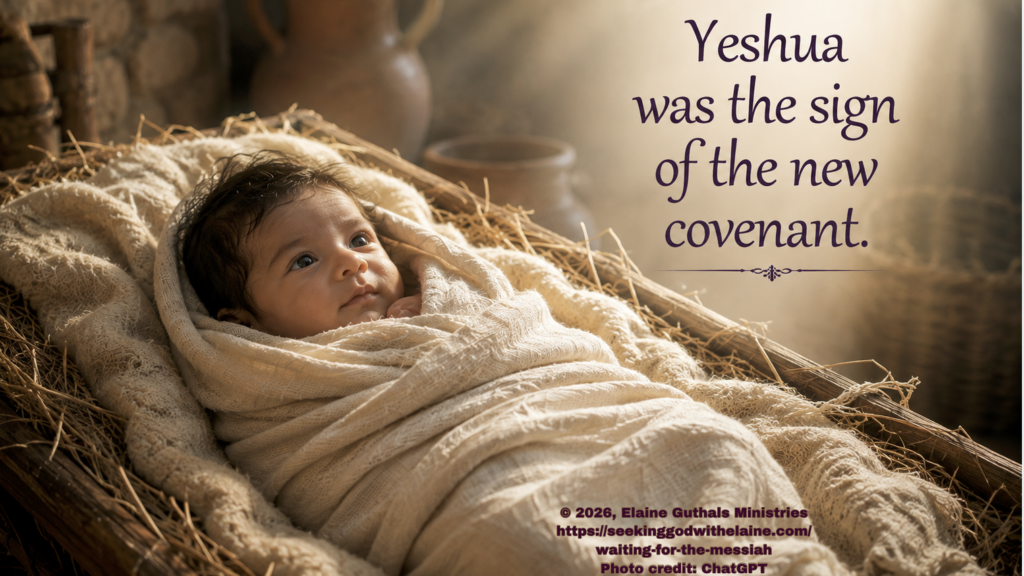
    We have to choose if we are going to submit our lives to Yeshua and Jehovah or not. The choice is ours.

    That choice follows a pattern that Jehovah established way back in Genesis. Going back to Cain and Abel, Jehovah separated those who followed Him from those who didn’t.

    Division?  That can happen on our end.

    The Deepest Thoughts of Many Hearts Revealed

    The deepest thoughts of hearts are whether they choose Yeshua or not.

    At the end of the age, Yeshua will separate believers from unbelievers. “He will place the sheep at his right hand and the goats at his left” (Mt. 25: 33 NLT).

    The separation into believer and nonbelievers is based on the condition of the heart – where the thoughts rest.

    Wait! How would Yeshua know what we think? Well, He does.

    • “Jesus knew what they were thinking, so he asked them, ‘Why do you have such evil thoughts in your hearts?’” (Mt. 9: 4 NLT; Lk. 5: 22 NLT).
    • “But Jesus didn’t trust them, because he knew all about people. No one needed to tell him about human nature, for he knew what was in each person’s heart” (Jn. 2: 24-25 NLT).
    • “‘But some of you do not believe me.’ (For Jesus knew from the beginning which ones didn’t believe, and he knew who would betray him.)” (Jn. 6: 64 NLT).

    Yeshua knows our thoughts, especially when they apply to our relationship with Him.

    A Sword Will Pierce Your Soul

    Simeon prophesied how Mary would be affected by Yeshua’s rejection.

    When Gabriel told Mary that she would be a mother, he didn’t tell her about the hard part of the job. But then a mother always feels for their child.

    The sword (cherev – חֶרֶב) was figurative. Simeon warned Mary about the rejection and suffering. He didn’t say that it was ultimately fulfilled in the cross.

    Still, Mary knew from Yeshua being a month old that it would be hard for her.

    The Prophecy of Anna (Chanah)

    “Anna, a prophet, was also there in the Temple. She was the daughter of Phanuel from the tribe of Asher, and she was very old. Her husband died when they had been married only seven years. Then she lived as a widow to the age of eighty-four. She never left the Temple but stayed there day and night, worshiping God with fasting and prayer. She came along just as Simeon was talking with Mary and Joseph, and she began praising God. She talked about the child to everyone who had been waiting expectantly for God to rescue Jerusalem” (Lk. 2: 36-38 NLT)

    A woman who was also in the Temple that day recognized the Messiah.

    Luke gave us more information regarding Anna. She was a widow for around 60 years, making her elderly.

    Being of the tribe of Asher, Anna was Galilean.

    Like Simeon, she was devout. We are told that she never left the Temple.

    Also, like Simeon, Anna recognized the Messiah.

    Luke said that Anna witnessed to anyone who would listen. “… and spoke of Him to all those who looked for redemption in Jerusalem” (Lk. 2: 38 ESV).

    Isn’t that a little strange? First-century Jewish women weren’t considered reliable witnesses.

    Where Simeon prayed, Anna praised. She worshiped.

    Making the Connections #1

    Why was it important for us to meet Simeon and Anna? They were bridge figures between the Old Testament and the New Testament.

    Simeon was a prophet who followed the lead of the Holy Spirit. He spoke the divine truth.

    Anna was a prophet who worshiped and speaks about Him to those who were already waiting for redemption in Jerusalem.

    Making the Connections #2

    We don’t want to miss the theology flow.
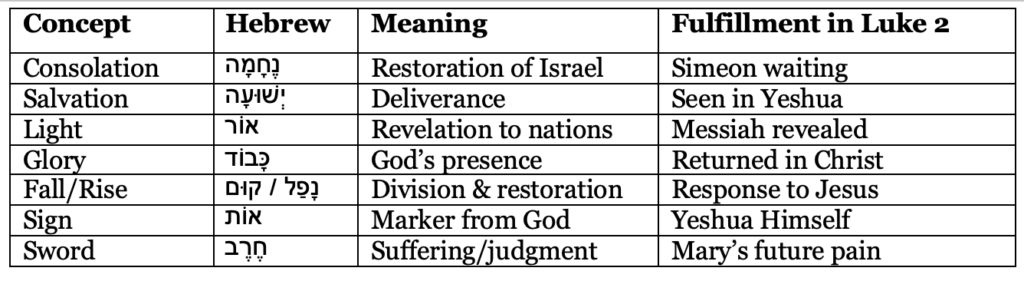
    Simeon recognizes in Yeshua the long-awaited נֶחָמָה (consolation) of Israel and declares Him to be יְשׁוּעָה (salvation), אוֹר (light) to the nations, and כָּבוֹד (glory) to Israel — while foretelling that He will become an אוֹת (sign) that brings both נָפַל (fall) and קוּם (rising), and a חֶרֶב (sword) of suffering.

    Making the Connections #3

    Jehovah was making the rounds. Already He had brought a childless elderly couple into the plan. His plan hinged on the obedience of a faithful teenager and a righteous man.

    The birth announcement was given to lowly shepherds and foreign astronomers (who may also have been priests).

    Now, within the walls of His Temple, Jehovah fulfilled His promises to faithful servants.

    While He was doing this, Yeshua was fulfilling everything required of Him as a human. Everything a common first-century Jewish boy experienced, He experienced.

    Yeshua was fulfilling the law and prophecy. All that transpired fulfilled the prophecy in Micah. “‘In that coming day,’ says the Lord, ‘I will gather together those who are lame, those who have been exiles, and those whom I have filled with grief. Those who are weak will survive as a remnant; those who were exiles will become a strong nation. Then I, the Lord, will rule from Jerusalem as their king forever.” (Mic. 4: 6-7 NLT).
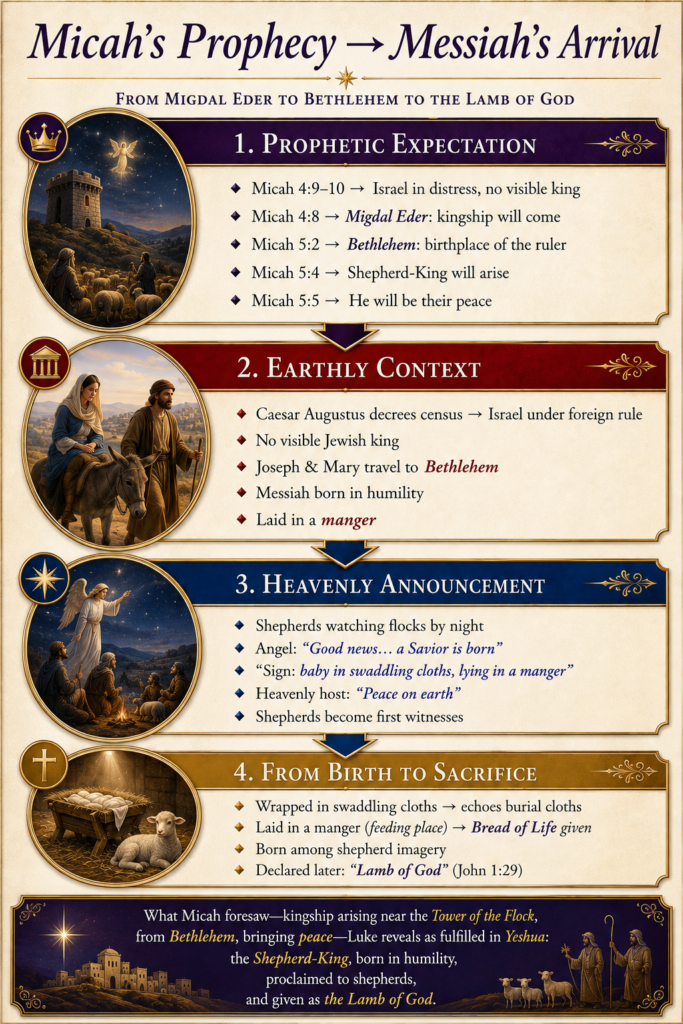
    Micah’s prophecy had followed a progression.

    • Distress under foreign rule
    • No visible king in Israel
    • Promise of restoration begins
    • Migdal Elder: watching the flock
    • Kingship will return
    • Bethlehem named
    • Ruler will be born
    • Shepherd-King
    • He will bring peace

    Heart Check

    Think about the battle Yeshua is engaged in for your heart. Ask yourself the following questions.

    • Am I willing to wait on Jehovah, even when I cannot yet see how He will fulfill His promise?
    • When Jehovah fulfills a promise differently than I expected, will I recognize what He is doing?
    • Does my heart truly belong to Yeshua, or am I still trying to decide whether I will submit to Him?
    • What do my thoughts, choices, and responses reveal about the condition of my heart?
    • Am I willing to let Yeshua reveal what is really in my heart, or will I resist what He shows me?

    How Do We Apply This?

    • Wait faithfully when Jehovah gives you a promise but not the timetable.
    • Let His Word shape what you expect from Him rather than allowing your expectations to shape His Word.
    • When Jehovah fulfills a promise, look for His hand—even when the fulfillment does not look the way you imagined.
    • Choose Yeshua every day, knowing that following Him may bring division or rejection.
    • Let Yeshua examine your heart and bring anything that needs to change into His light.


    Father God. Help us to wait as Simeon and Anna did for Yeshua’s first coming. Let us be watching for His second coming. Not only let us recognize Him, but let Him also recognize us. Amen.

    If you don’t understand something and would like further clarification, please contact me.

    If you have not signed up for the email providing the link to the devotions and the newsletter, do so below.

    If God has used this devotion to speak with you, consider sharing it on social media.

  • Visitors from the East

    Yeshua had some important visitors. This devotional reading looks at who the Magi may have been and how they got where they needed to be.

    Nuggets

    • Herod the Great was egotistical and self-centered.
    • Men from a far-off country were led to worship Yeshua.
    • The wise men – who had given up a lot to get there – arrived in Jerusalem because that was where the palace was.
    • The Magi asked the king about the birth of the King of the Jews.
    • The Magi were guided by a star.
    • We tend to think that Herod was disturbed about the question the Magi were asking.
    • King Herod went to those that would be in the know to find the answer to the Magi’s question.
    • The religious leaders Herod contacted found the prophecy in Micah.
    • Herod set up a chance to talk with the men privately.
    • The Magi not only saw the star but also followed it to Jerusalem.
    • We don’t know when the Magi made their journey.
    • The Magi obeyed Jehovah.

    The birth of Yeshua was not hidden from everyone. From the east came men who had seen His star and traveled a great distance to find the newborn King. But when they arrived in Jerusalem, they discovered that knowing where to look would require more than following a star.

    Let’s Put It into Context

    To read devotions in The Battle for the Heart theme

    Devotions in the The Birth and Early Childhood of Christ series

    Jesus Was Born in Bethlehem

    “Jesus was born in Bethlehem in Judea, during the reign of King Herod. About that time some wise men from eastern lands arrived in Jerusalem, asking, ‘Where is the newborn king of the Jews? We saw his star as it rose, and we have come to worship him’” (Mt. 2: 1-2  NLT)

    Reign of King Herod

    Herod the Great was egotistical and self-centered.

    Herod ruled the Jews but was not of the Davidic line. To make matters worse, he was chosen to be King of the Jews by Octavian Augustus and the Roman Senate around 40 BC.

    Herod tried to curry the favor of his subjects by rebuilding the Temple and funding public works. However, he alienated many by his close ties with Rome and his violent and unpredictable behavior.

    In 4 BC, Herod died. It is believed John the Immerser and Yeshia were both born in the last year of his life.

    A good summary of Herod’s reign would be that he was a false king. He reigned through power, fear, and death. Yet he set the stage for the Messiah, who reigned in humility and divine authority.

    Wise Men from Eastern Lands

    Men from a far-off country were led to worship Yeshua.

    Some versions translate it as wise men. Other use the word Magi.

    So, who were these people? We don’t know for sure. Some of that uncertainty can be attributed to how words are translated.

    Wise men were astronomers. They interpreted celestial signs.

    While Magi were also astronomers, they were likely priests from Persia/Babylonia. They also interpreted dreams.

    The problem is that the Greek word can mean magician or sorcerer. That would be someone who dealt in occult knowledge.

    Nowhere does it say the Magi were kings. Instead, they were highly educated scholars or priests.

    Nowhere does it say there was just three. We assume that because there was three gifts.

    I am sure there was a whole contingent from the far east, as that would have been an 800-900 mile treacherous and dangerous trip. Got Questions said that there would have been servants and soldiers along.

    Resource

    Most people have come to see them as non-Jews. But why would Jehovah summon Gentiles before summoning the Jews?

    I can see that they were Gentiles. The star was shown to those from the far east. Jews were expected to be living only in Israel at that time.

    But were they Gentiles? The Complete Jewish Study Bible offered archeological evidence that the Magi were neither Gentile nor astronomers. Benner agreed with this.

    Resource

    What if they were, in fact, Jews linked to Daniel’s time during the exile to Babylon? No, I’d never thought of it this way, so let’s dig in a second.

    Jerusalem was captured by the Babylonians in 597 BC. The Jews were defeated by them in 586 BC. They were in exile 70 years.

    But when they were allowed to go back to Israel, all of them didn’t just pick up and go back. They came in three waves.

    • 538 BC under Zerubbabel
    • About 458 BC under Ezra
    • 445/444 BC under Nehemiah

    Some second- or third-generation Jewish Babylonians didn’t want to leave. Gutknecht estimated that, of the 15,000 men that were exiled (II Kgs. 24: 14-16; Jer. 52: 28-30). It  is estimated that 42,360 returned — meaning 80% of the Jewish population living in Babylon after 70 years remained there.

    Resource

    All they knew was their lives in Babylon, lives in which they had become productive members of society.

    It makes sense that they would have been descendants from exiled Jews who chose to stay. They would have had access to Daniel’s prophesy.

    “Now listen and understand! Seven sets of seven plus sixty-two sets of seven will pass from the time the command is given to rebuild Jerusalem until a ruler—the Anointed One — comes. Jerusalem will be rebuilt with streets and strong defenses, despite the perilous times” (Dan. 9: 25 NLT).

    Remember, Daniel was chief of the court seers in Persia in his time (Dan. 2: 48). Seers was another name for prophets.

    Daniel may also have turned them on to Numbers 24: 17 as it was prophecy. We’ll talk about that one in a minute.

    Arrived in Jerusalem

    The wise men – who had given up a lot to get there – arrived in Jerusalem because that was where the palace was.

    Bethlehem was David’s hometown and the place where he was anointed, but Jerusalem became his capital. Only six miles north of Bethlehem, Jerusalem became his capital after upon his capture of it from the Jebusites, traditionally dated around 1003 BC.

    There was reasons for making Jerusalem the capital. Jerusalem was strategically located between the northern and southern tribal territories and wasn’t identified as the possession of one Israelite tribe. That made the capital politically neutral.

    King of the Jews

    The Magi asked the king about the birth of the King of the Jews.

    The Greek phrase is basileus tōn Ioudaiōn (βασιλεὺς τῶν Ἰουδαίων) — King of the Jews. In Hebrew, this is Melech HaYehudim. Melech means king, while Yehudim is the Hebrew word for Jews.

    Yehudim comes from Yehudah – Judah – but by the first century it had become the normal designation for the Jewish people. Remember, when the kingdom divided, the Southern Kingdom comprised of Judah and Benjamin. They became known as the Jews.

    His Star

    The Magi were guided by a star.

    When I was younger, I questioned how the Magi would know there would be a star to mark the Messiah’s birth. Answer, it was prophesied.

    “I see him [Jehovah], but not here and now. I perceive him, but far in the distant future. A star will rise from Jacob; a scepter will emerge from Israel. It will crush the heads of Moab’s people, cracking the skulls of the people of Sheth” (Num. 24: 17 NLT emphasis added).

    In God’s Word, stars symbolize glory and triumph. Both were on full display that night for the magi and shepherds.

    Herod Questioned the Priests and Teachers

    “King Herod was deeply disturbed when he heard this, as was everyone in Jerusalem. He called a meeting of the leading priests and teachers of religious law and asked, ‘Where is the Messiah supposed to be born?’ ‘In Bethlehem in Judea,’ they said, ‘for this is what the prophet wrote: “And you, O Bethlehem in the land of Judah, are not least among the ruling cities of Judah, for a ruler will come from you who will be the shepherd for my people Israel.” Then Herod called for a private meeting with the wise men, and he learned from them the time when the star first appeared. Then he told them, ‘Go to Bethlehem and search carefully for the child. And when you find him, come back and tell me so that I can go and worship him, too!’” (Mt. 2: 3-8 NLT)

    Deeply Disturbed

    We tend to think that Herod was disturbed about the question the Magi were asking.

    As paranoid as Herod was, I am sure that he didn’t want to hear that a new king had been born. He would have known of their distrust of a king who was not a Jew.

    Yeah, Herod would have been upset by the question. We know he saw this baby as a threat to his rule.

    I wonder if Herod was also disturbed because a large contingent of foreigners showed up unannounced. That also seems logical to me.

    But would that have upset everyone in Jerusalem? Herod was not especially liked as a king. They probably wouldn’t have been upset about a threat to him.

    They would, however, been upset if they thought the Magi were there to make war on the city of Jerusalem. That would have put them in danger.

    I can see that response to anywhere from a couple of dozen to a couple of hundred people showing up.

    Leading Priests and Teachers of Religious Law

    King Herod went to those that would be in the know to find the answer to the Magi’s question.

    Of course, Herod went to the priests and scribes. The priests were representatives of Jehovah.

    Don’t think of the word scribe as just a glorified robot copying word for word what the scrolls said. When there was a question, they were the ones to research God’s Word to determine the answer. Then they were to teach the Torah.

    We might think that the religious leaders, upon knowing the prophecy had been fulfilled, would be asking the Magi if they would mind them tagging along. Why didn’t they speed to Bethlehem and find the Christ Child?

    It sounds like they just gave Herod the answer he wanted – and dropped it.

    This is just another example of what happens when you have knowledge but no response. Nothing happened. They didn’t meet their Savior.

    Was it because they considered the Magi Gentiles – even if they were part of the Lost Tribes of Israel? Did they think Jehovah wouldn’t announce the birth of the Messiah to anyone but them?

    Bethlehem

    The religious leaders Herod contacted found the prophecy in Micah.

    “But you, O Bethlehem Ephrathah, are only a small village among all the people of Judah. Yet a ruler of Israel, whose origins are in the distant past, will come from you on my behalf” (Mic. 5: 2 NLT).

    What is the significance of this? This allowed Matthew to tie Matthew to Messianic prophecy.

    But it is also important that the religious leaders identified Messiah. The religious leaders had to learn that Messiah was in the world.

    Why does Micah emphasize that Bethlehem is “too little” or insignificant among Judah’s clans? We talked about how Nazareth and Bethlehem were both smaller villages.

    Bethlehem, unlike Nazzareth, had history, identity, and prophetic weight.

    Private Meeting

    Herod set up a chance to talk with the men privately.

    Does that seem strange to you?

    If his real purpose was to worship the King of the Jews, why would Herod want to keep that from his court? Wouldn’t he think they would be wanting to do the same thing?

    But no. Herod goes into stealth mode. He spoke with the Magi privately.

    Because we have hindsight, we know that worship of the King was not Herod’s intent. Worship was not the objective.

    Headed to Bethlehem

    “After this interview the wise men went their way. And the star they had seen in the east guided them to Bethlehem. It went ahead of them and stopped over the place where the child was. When they saw the star, they were filled with joy! They entered the house and saw the child with his mother, Mary, and they bowed down and worshiped him. Then they opened their treasure chests and gave him gifts of gold, frankincense, and myrrh” (Mt. 2: 9-11 NLT)

    When They Saw the Star

    The Magi not only saw the star but also followed it to Jerusalem.

    When I was younger, I wondered how the Magi would know that a star would mark the Messiah’s birth. The answer may be found in prophecy.

    “‘I see him, but not here and now. I perceive him, but far in the distant future. A star will rise from Jacob; a scepter will emerge from Israel. It will crush the heads of Moab’s people, cracking the skulls of the people of Sheth’” (Num. 24: 17 NLT).

    Balaam wasn’t speaking about a star in the sky in isolation. He was prophesying about a ruler who would arise from Israel. The star and the scepter appear together — a sign of kingship.

    That makes the Magi’s statement interesting. They didn’t simply say they had seen a star. They said, “We saw his star as it rose.” They understood the celestial sign as connected to a particular King.

    And where did that star lead them? To Jerusalem.

    That makes sense. They were looking for a king, and Jerusalem was the capital. They had come a tremendous distance because they believed the sign meant that a King had been born.

    But the star didn’t give them everything they needed to know.

    They still had to ask.

    They came to Jerusalem asking, “Where is the newborn King of the Jews?” Their observation of the heavens had gotten them to the right country and the right city, but they needed God’s written Word to tell them where the King would be found.

    That matters.

    Creation can point us toward Jehovah. Signs can awaken our attention. But we need His Word to understand what we are seeing.

    The Magi followed the light they had been given. Then, when they needed more direction, they asked.

    And Jehovah gave them the answer through Scripture.

    Entered the House

    We don’t know when the Magi made their journey.

    What we do know is they didn’t show up at the stable. Where, then, did they go?

    But remember our discussion on Luke 2: 7? While there were inns in first-century Israel, it is more likely that there was no room in the guest room at Joseph’s family’s house. They were given shelter where his family kept their animals – which was probably an addition to the house.

    Look at the Greek here. It is oikia (οἰκία) – house. Luke 2: 7 uses the Greek katalyma (κατάλυμα) – which can mean guest room.

    Bottom line, though. We don’t know whose house it was. It may have been a family home or another dwelling where Joseph’s family could stay. Matthew didn’t tell us any more than Luke did. Matthew simply told us that the Magi entered “the house” and found the child with Mary.

    Here is another wrinkle. Luke told us about the place where Yeshua was laid after His birth. Matthew told us where the Magi found Him later. We don’t know if that is the same location or a different one.

    We don’t know how long it was between those two events. If I were to guess, I would say the Magi got to Bethlehem before Yeshua was presented in the Temple. Luke told us the Holy Family went back to Nazareth after that.

    True, we tend to think Yeshua was older when the Magi got there. This is due to all the sons two years and younger being killed by Herod.

    But we don’t know for sure. Why would Mary and Joseph remain in Bethlehem when their home was in Nazareth?

    The Return Home

    “When it was time to leave, they returned to their own country by another route, for God had warned them in a dream not to return to Herod” (Mt. 2: 12 NLT)

    The Magi obeyed Jehovah.

    The Magi had gone to Jerusalem because they were looking for a King. Herod told them to return and tell him where the child was. Herod claimed that he wanted to go worship Him, too.

    But Jehovah knew Herod’s heart. So, He warned the Magi in a dream not to go back to him.

    And they obeyed.

    Think about that for a minute. They had traveled hundreds of miles following a sign they believed came from Jehovah. They had asked questions when they needed answers. They had listened to Scripture. They had found the child. They had bowed down and worshiped Him. And now they were given one more instruction.

    Don’t go back to Herod.

    Matthew doesn’t tell us that they argued with the warning, questioned why they couldn’t simply take the familiar route, or worried about what Herod might think. They simply returned to their own country by another route.

    Their journey had changed them.

    They had come looking for a King. They found Him. And once they had encountered Him, they obeyed Jehovah rather than the earthly king who had commanded them to return.

    That is part of being wise.

    Wisdom isn’t simply knowing things. It is knowing Whom to obey.

    The Magi came from far away to worship the King. Then they left by another route because Jehovah told them to.

    Sometimes following Jehovah means taking a different route than the one we originally intended.

    The question is whether we will recognize His direction — and obey.

    Making the Connections

    Coming after the chapter of genealogy and an angelic visitation to the legal father, first-century Jews wouldn’t just see this as some Baby being born. They would have heard a number of things.

    • “This child is restarting Israel’s story.”
    • “This is the true Son God called out of Egypt.”
    • “A new Moses has arrived”
    • “The exile may finally be ending”

    Some may have been concerned when they heard this. They would have seen their religious leaders missed this. They would also have thought the end of the age was coming before they were righteous.

    Matthew was laying out his Gospel to remind them of the prophecy, history, and identity. But he was also showing them the patterns used throughout Scripture.

    Heart Check

    Think about the battle Yeshua is engaged in for your heart. Ask yourself the following questions.

    • Am I genuinely seeking Yeshua, or am I satisfied with knowing about Him?
    • When Scripture reveals something I didn’t understand before, am I willing to follow where it leads?
    • Do I worship Yeshua for who He is, or only for what I hope He will do for me?
    • When Jehovah redirects me, am I willing to take a different route?
    • Am I more concerned about obeying Jehovah than about pleasing people?
    • Do I allow knowing Scripture to substitute for obeying Scripture?

    How Do We Apply This?

    • Intentionally seek Yeshua.
    • Let Scripture direct your search.
    • Respond when Jehovah reveals truth.
    • Worship Yeshua for who He is.
    • Obey when Jehovah changes your route.
    • Don’t let people outrank Jehovah.

    Father God. You always deserve praise. Yeshua always deserves praise. Thank You for the Magi who came to worship Him. Let us worship Him, too. Amen.

    If you don’t understand something and would like further clarification, please contact me.

    If you have not signed up for the email providing the link to the devotions and the newsletter, do so below.

    If God has used this devotion to speak with you, consider sharing it on social media.
  • A Humble Heart Exalts a Holy God

    Mary’s response to Elizabeth was much more than a beautiful song of praise. This devotional reading looks at the covenant themes woven throughout Mary’s song and how they reveal the character of God.

    Nuggets

    • Mary humbled her soul before the Lord.
    • Translating the word as praises loses something important.
    • Knowing she would bear the Messiah, Mary’s joy is focused on Jehovah Himself.
    • Mary exalted Jehovah with her whole being.
    • The soul proclaims Jehovah’s greatness while the spirit delights in His salvation.
    • Jehovah chose a lowly teenage girl, not someone who others would think was more appropriate.
    • All generations echoes covenant language.
    • The Magnificat is all about Mary’s certainty of what Jehovah was doing.
    • Mary focused on Jehovah’s might and power.
    • Our definition of holy usually includes aspects of being morally pure, sinless, and righteous, but that’s not quite correct.
    • Mercy was based on covenant faithfulness.
    • If Jehovah is that merciful, why would He want us to fear Him?
    • Jehovah’s promises aren’t random – they have a continuity.

    The teenager from a small village was in a very unique position. When she was told that she was going to have a Baby Who would be the Son of God, she went to see her relative.

    Elizabeth was in a very unique position, also. Although she was beyond childbearing age, she was having a baby herself.

    After Elizabeth had blessed Mary, Mary broke into praise for Jehovah. But how she worded it shows us that it was much more than just praise.

    It was a covenant acknowledgment.

    Let’s Put It into Context

    To read devotions in The Battle for the Heart theme

    Devotions in the Preparing for the Christ Child series

    Praise

    “Mary responded, ‘Oh, how my soul praises the Lord’” (Lk. 1: 46 NLT)

    How My Soul

    Mary humbled her soul before the Lord.

    The Greek word for soul is psychē (ψυχή), and in Luke 1:46 it translates the Hebrew idea of nephesh (נֶפֶשׁ).

    We look at soul as being the immaterial part that goes to Heaven. Not necessarily.

    The soul is the whole inner person – the seat of our desires, affections, will, and identity. It is who we are at the deepest level of our being.

    In Hebrew thought, humans weren’t divided into body, soul, and spirit as we see it. They were a nephesh – a living being.

    Think back to Genesis 2: 7. Jehovah formed our bodies from the dust. But it was an inanimate object until He gave us the breath of live or spirit. This made us a living soul – a nephesh.

    Mary is saying all that is within her is declaring Jehovah’s greatness. She acknowledged His absolute supremacy, infinite majesty, and boundless nature.

    Jehovah’s covenant faithfulness flows from His goodness. Every first-century Jew would have used the Abrahamic and Davidic covenants as examples of that. His covenant culminated in the promise of the Messiah. That feeds right into Messianic expectations.

    That was the Baby Jehovah asked Mary to carry.

    Praises the Lord

    Translating the word as praises loses something important.

    Hmmm. I don’t know if I have ever heard this translated as praises. It usually is magnifies the Lord.

    I know. Magnifies isn’t a common word in our vocabulary – unless the form magnifying is used, and it is followed by the word glass.

    The Greek word used is megalynō (μεγαλύνω). It means to make great, to magnify, to declare as great, or to exalt.

    The key idea is greatness. This is much richer than simple praise.

    Mary wasn’t making God greater than He is. Nothing we can do or say can make Him greater – or lessen Who He is.

    Mary was proclaiming His greatness with every part of her being. She was taking her figurative glass and showcasing Who He is.

    When we understand Jehovah’s greatness, we should be filled with joy.

    Worship should come from who we are. Every part of us should exalt Him.

    Mary would have seen it as Jehovah reversing her – and other’s – circumstances.

    Jehovah would have once again been raising the lowly. Mary would have known the covenant examples of Joseph, Moses, Ruth, David, Esther.

    The teenager from the back road village would have been humbled to be added to the list.

    Exaltation is not supposed to just be an emotional response. It was about changing positions. It is more than a feeling – it is a conscious choice.

    It is easy to see that just as a physical reversal, but that would be looking at it wrong. Jehovah is in the business of working our physical circumstances for the good of His kingdom. “He has brought down princes from their thrones and exalted the humble” (Lk. 1: 52 NLT).

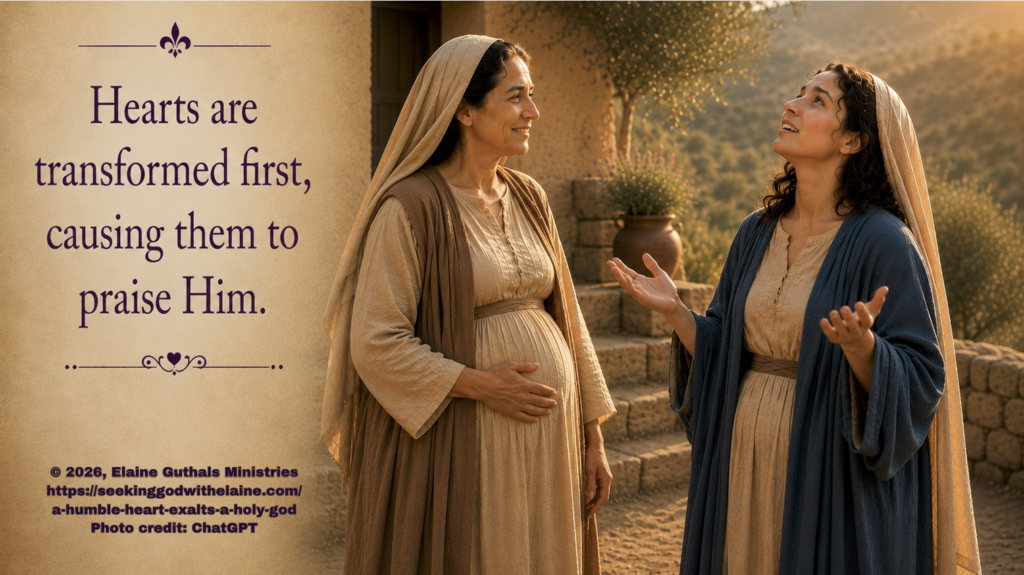
    That shows that Jehovah is in the business of transforming our hearts. Hearts are transformed first, causing them to praise Him.

    The Lord

    Knowing she would bear the Messiah, Mary’s joy is focused on Jehovah Himself.

    We can’t gloss over the word Lord because we think we know it. Lord is a replacement for the name YHWH – Jehovah (Ex. 3: 14-15). It means

    • the eternal One
    • the self-existent One
    • the covenant-keeping God
    • the God who redeemed Israel from Egypt
    • the God who keeps His promises

    It is shorthand for Israel’s entire covenant history. Mary would only have had to remember it.

    Mary would have known that Jehovah created the heavens and earth so that He could dwell with His people. When sin entered humans, she knew He dwelt with them in the wilderness Tabernacle and then in Solomon’s Temple.

    She knew of the second exile – this one to Babylon. Mary knew the nation had deserved the punishment they received. While she knew they were home, she knew that Jehovah didn’t currently dwell with them.

    Mary would have been taught of the covenant promises. She would have grown up on stories of Abraham’s call, Isaac’s provision, and Jacob’s wrestling with Him. She well knew that Jehovah gave David of an everlasting kingdom.

    Israel’s history would have been present to Mary. She learned how Jehovah had provided during the famine that sent Joseph to Egypt to store grain for its coming. She probably loved the stories of Moses being called at the burning bush. This humble leader had been used by Jehovah to part the Red Sea to bring Israel out of Egypt. Then He gave His law to him.

    Mary didn’t elevate herself because of the honor she had received – and didn’t expect others to, either. She wasn’t the focus.

    Jehovah is. Yeshua is, too.

    But Mary’s response is all about Jehovah.

    Mary would have known about the covenant promises through the synagogue, family instruction, memorization, and songs and prayers.

    Acknowledging God our Savior

    “How my spirit rejoices in God my Savior! ” (Lk. 1: 47 NLT)

    My Spirit Rejoices

    Mary exalted Jehovah with her whole being.

    Verse 47 continued the thought of verse 46 through parallelism. There is overlap rather than separate parts.

    The Greek word for spirit is pneuma (πνεῦμα). The Hebrew word is ruach (רוּחַ). The spirit is the part of us that relates to, responds to, and communes with God.

    David understood this concept. “Bless the Lord, O my soul, and all that is within me, bless his holy name!” (Ps. 103: 1 ESV emphasis added).

    In other words, the two terms are distinct but intimately connected.

    God my Savior

    The soul proclaims Jehovah’s greatness while the spirit delights in His salvation.

    We have to be very careful not to look at “… God my Savior!” (Lk. 1: 47 NLT). We can’t see it through a twentieth-century lens. Mary wasn’t saying, “God is saving me from my sins so I can go to heaven.”

    We see salvation as a personal salvation. Mary wouldn’t have.

    The Greek word is sōtēr (σωτήρ), which means Savior, Deliverer, or Rescuer. The Hebrew idea behind it is often yasha (ʿיָשַׁע), to save or to deliver. It is the root from which we get Yeshua (Jesus) —Yahweh saves.

    Mary would have said it through covenant overtones. In the Old Testament, Jehovah was Israel’s Savior many times.

    • delivered Israel from Egypt
    • rescued them from their enemies
    • preserved them during famine
    • restored them from exile
    • kept His covenant promises

    Mary’s response was saturated in the covenant.

    Think of it this way. Mary knew God was fulfilling His promise for a Messiah. Their redemption had begun. Jehovah would once again dwell with His creation.

    No, Mary didn’t understand the cross, substitutionary atonement, justification by faith, the inclusion of Gentiles, and the resurrection. Yeshua hadn’t been born yet, and this is the beginning of Luke and the other Gospels.

    But look at how things have been revealed so far. Zechariah got the first revelation He told Elizabeth. Mary got the next revelation. Soon, we will dig deeper into Joseph, Simeon, and Anna.

    They have a beginning revelation – and they get it (or will) – but it is still incomplete.

    Each one of these accepted the revelation as being a true response from Jehovah.

    Mary’s Circumstances

    “For he took notice of his lowly servant girl,  and from now on all generations will call me blessed” (Lk. 1: 48 NLT)

    His Lowly Servant Girl

    Jehovah chose a lowly teenage girl, not someone who others would think was more appropriate.

    Hmmmm. Look at Jehovah’s lowly servant girl.

    No, Mary wasn’t trying to pull attention onto herself. She was saying something totally different.

    The Greek reads, ἐπέβλεψεν ἐπὶ τὴν ταπείνωσιν τῆς δούλης αὐτοῦ. It literally means He has looked upon the lowliness (or humble estate) of His servant. That is talking about a humble condition or estate. This translated to a lowliness or low social position. At times, it could be translated to mean humiliation or affliction.

    It isn’t talking about Mary personally. It is talking about her condition.

    Mary was from Nazareth, not Jerusalem. An insignificant village or the holy capital city.

    But this teenager from an insignificant village understood more than we sometimes give her credit for. True, she still knows less than we do. But she fully embraced what was given to her.

    Mary knew Jehovah  had chosen her for something special – something unique. Hers wouldn’t be just another birth.

    From that moment on, things would change. She knows that the long-awaited promises were being fulfilled – and that would change the world.

    All Generations

    All generations echoes covenant language.

    That change would mean people in future generations would remember what God had done. We would call her blessed.

    More than that, it fulfilled the covenant promise to Abraham. “… All the families on earth will be blessed through you” (Gen. 12: 3 NLT).

    Will Call Me Blessed

    The Magnificat is all about Mary’s certainty of what Jehovah was doing.

    No, Mary wasn’t saying she was great – remember, she was just talking about her lowly estate.

    She was focusing on the goodness of Jehovah.

    Jehovah’s Holiness

    “For the Mighty One is holy, and he has done great things for me” (Lk. 1: 49 NLT)

    Mighty One

    Mary focused on Jehovah’s might and power.

    Jehovah had proved His might throughout the Old Testament. Mary only had to remember Israel’s history.

    • “The Lord merely spoke, and the heavens were created. He breathed the word, and all the stars were born” (Ps. 33: 6 NLT).
    • “And the Lord said, ‘I will wipe this human race I have created from the face of the earth. Yes, and I will destroy every living thing — all the people, the large animals, the small animals that scurry along the ground, and even the birds of the sky. I am sorry I ever made them’” (Gen. 6: 7 NLT).
    • “Is anything too hard for the Lord? I will return about this time next year, and Sarah will have a son” (Gen. 18: 14 NLT).
    • “So the people of Israel ate manna for forty years until they arrived at the land where they would settle. They ate manna until they came to the border of the land of Canaan” (Ex. 16: 35 NLT).
    • “David replied to the Philistine, ‘You come to me with sword, spear, and javelin, but I come to you in the name of the Lord of Heaven’s Armies — the God of the armies of Israel, whom you have defied. Today the Lord will conquer you, and I will kill you and cut off your head. And then I will give the dead bodies of your men to the birds and wild animals, and the whole world will know that there is a God in Israel!’” (I Sam. 17: 45-46 NLT).
    • “In the first year of King Cyrus of Persia, the Lord fulfilled the prophecy he had given through Jeremiah. He stirred the heart of Cyrus to put this proclamation in writing and to send it throughout his kingdom” (Ez. 1: 1 NLT).

    But Mary wasn’t focusing on just a list of miracles. She was remembering how Jehovah displayed His power to advance His covenant.

    Every mighty act in Israel’s history  advanced His covenant purposes. We may not see it at the time, but Mary, looking through history, could see His hand in everything.

    The same God who created the world, rescued Israel, overthrew Pharaoh, fed His people, fulfilled His promises to Abraham and Sarah, and preserved us through exile has now acted in a teenager’s life.

    Holy

    Our definition of holy usually includes aspects of being morally pure, sinless, and righteous, but that’s not quite correct.

    That isn’t wrong, but they identify the results of holiness rather than define it.

    Mary would have known the Old Testament word for holy: qādôš (קָדוֹשׁ). That shows the concept of separation: to be set apart, to belong to a different category, and to be distinct.

    But it isn’t talking morality. It is talking more of separation such as we could find in the Temple.

    The Temple didn’t behave any more than the altar, lampstands, priests’ garments behaved. Nothing they did made them holy. The Sabbath by itself wasn’t holy any more than any other day of the week was holy.

    Those objects are holy because Jehovah made them holy.

    Jehovah is holy because there is nothing else in existence like Him. Mary recognized His attributes. He is uncreated, self-existent, and eternal. He is perfectly righteous, faithful, loving, and just.

    But all that brings up a good point.  Set apart isn’t the act that makes things – or us – holy. It is utterly unique in His being. Jehovah’s holiness is what He is by nature.

    We have to become like Him. “Give the following instructions to the entire community of Israel. You must be holy because I, the Lord your God, am holy” (Lev. 19: 2 NLT).

    Nothing is holy until Jehovah declares it so. He sets something apart for Himself.

    We may look at that and go, “Whoa.”  We see the sin in our lives and think He can’t go that for us.

    But that is what salvation is about. Being made holy comes through regeneration, sanctification, and justification.

    • “he saved us, not because of the righteous things we had done, but because of his mercy. He washed away our sins, giving us a new birth and new life through the Holy Spirit” (Ti. 3: 5).
    • “I am writing to God’s church in Corinth, to you who have been called by God to be his own holy people. He made you holy by means of Christ Jesus, just as he did for all people everywhere who call on the name of our Lord Jesus Christ, their Lord and ours” (I Cor. 1: 2).
    • “Therefore, since we have been made right in God’s sight by faith, we have peace with God because of what Jesus Christ our Lord has done for us” (Rom. 5: 1).

    That is talking heart transformation, isn’t it?

    Throughout the Sermon on the Mount – the pathway to salvation – Yeshua wasn’t calling us to different actions to form a checklist. He was calling us to different attitudes – a heart change.

    The Beatitudes show us the doorway to salvation and His kingdom. The rest of the sermon shows what the transformed life looks like in everyday life.

    A holy life isn’t produced by keeping enough rules. It’s the fruit of a heart being conformed to God’s character. Conduct flows from character.

    Jehovah’s Mercy

    “He shows mercy from generation to generation to all who fear him” (Lk. 1: 50 NLT)

    Mercy

    Mercy was based on covenant faithfulness.

    The Greek word translated as mercy is eleos (ἔλεος). They do mean mercy, compassion, and kindness.

    The Hebrew word means much more than that. The word used – hesed (חֶסֶד) – encompass several of our English words.

    • Steadfast love
    • Lovingkindness
    • Covenant love
    • Faithful love
    • Mercy

    Hesed doesn’t mean that we simply have compassion. It means that love is conveyed through covenant faithfulness.

    Applying that here, it means that God wasn’t just feeling sorry for humans. He was acting faithfully because of His covenant character.

    Jehovah’s mercy flows from His holiness. He isn’t merciful because He overlooks sin. He is merciful because His holy character is full of covenant faithfulness.

    Fear

    If Jehovah is that merciful, why would He want us to fear Him?

    No, this doesn’t mean that we have to stand there with our knees knocking in terror. It also, doesn’t mean that we don’t obtain His mercy only if we are good enough.

    Someone with fear of the Lord is a person who lives in humble faith before Him. We are in awe of Him.

    We have the position of the covenant believer.

    From Generation to Generation

    Jehovah’s promises aren’t random – they have a continuity.

    We would probably translate Mary’s thought as saying Jehovah has always been kind. No, it is more than that.

    What Mary was saying is that Jehovah has never stopped keeping His promises – and He never will.

    Even when Israel was forced into exile, the covenant people knew that Jehovah hasn’t failed in His promises.

    True, sometimes today we may think Jehovah has given up on His promises because we don’t see ourselves under His covenant. We would be wrong.

    The new covenant secured through Yeshua’s sacrifice is in force today. He still hasn’t stopped keeping His promises.

    That throws out our standard definition of mercy. We say that it is Jehovah not giving us what we deserve. It is more than that.

    Mercy is God’s compassionate and faithful action toward His people because of His covenant love. It’s not simply pity for the miserable, nor merely withholding deserved judgment. It’s God’s steadfast commitment to act with compassion and undeserved kindness toward those who belong to Him, remaining faithful to His promises generation after generation.

    Making the Connections #1

    Mary’s humility comes across loud and clear.

    Mary considers herself a daughter of Zion.

    Making the Connections #2

    We think of the Magnificat as a poem or song of worship. It isn’t.

    It is an example of faith. This is obvious in the thread running through the Magnificat.

    • Lord tells us who God is.
    • Savior tells us what He does.
    • Mighty One tells us what He is able to do.
    • Holy tells us what He is like.
    • Mercy tells us how He consistently relates to His covenant people.

    Making the Connections #3

    Look at all the titles Mary calls Jehovah.

    • Lord — the covenant God
    • God my Savior — the covenant Deliverer
    • His servant — the covenant relationship
    • The Mighty One — the covenant Warrior who acts
    • Holy is His name — the covenant God’s perfect character

    The connecting factor in all of that is the covenant. They aren’t just random titles. They have a history and a purpose.

    Each title reveals another facet of Jehovah’s character.

    Heart Check

    Think about the battle Yeshua is engaged in for your heart. Ask yourself the following questions.

    • Do I delight more in God’s gifts than in God Himself?
    • When God blesses me, does my praise point others to Him or to me?
    • Do I see my life through the lens of God’s covenant faithfulness or only through my present circumstances?
    • Am I trying to become holy by my own efforts, or am I allowing God to transform my heart?
    • Do I trust that Jehovah is faithfully accomplishing His purposes even when I cannot yet see them?

    How Do We Apply This?

    • Marvel at who Jehovah is before focusing on what He has done for you.
    • Remember His covenant faithfulness when your circumstances tempt you to doubt Him.
    • Allow His holiness to transform your heart instead of merely changing your behavior.
    • Rest in His mercy, knowing it flows from His faithful character rather than your performance.
    • Respond to God’s work with humble worship that points others to Him.

    Father God. We praise and worship You in all circumstances. Transform our hearts to make us like You – holy and set apart. Amen.

    If you don’t understand something and would like further clarification, please contact me.

    If you have not signed up for the email providing the link to the devotions and the newsletter, do so below.

    If God has used this devotion to speak with you, consider sharing it on social media.
  • Abram and the Kings

    The celebrating starts after the battle is won. This devotional reading looks at how Abram celebrated with two kings.

    Nuggets

    • The King of Sodom was a worldview king.
    • Melchizedek was a king but also a High Priest – just like Jesus.
    • We not only receive blessings from God, but we also bless Him.
    • Abram’s disinterestedness and independence led to him not taking any of the recovered goods.
    abram-and-the-kings

    It’s time to celebrate the victory of Abram defeating the four kings. How does he do that?

    Let’s Put It into Context

    To read devotions in the Creating Everything theme, click the button below.

    Devotions in the Abraham the Emigrant series

    Abram, the King of Sodom, and the King of Salem

    “After Abram returned from his victory over Kedorlaomer and all his allies, the king of Sodom went out to meet him in the valley of Shaveh (that is, the King’s Valley). And Melchizedek, the king of Salem and a priest of God Most High, brought Abram some bread and wine” (Gen. 14: 17-18 NLT)

    Abram met with two diverse kings after returning.

    King of Sodom

    The King of Sodom was a worldview king.

    Hmmmm. Genesis 14: 17 is like a throwaway sentence.

    How does it move Abram’s narrative forward? Well, it doesn’t – hence throwaway sentence. (We’ll have to wait a while to get the rest of the story.)

    What can we gain from it by itself? Two things.

    The New Living Translation sugarcoats the battle. It says victory. The Complete Jewish Bible says slaughter.

    Our worshiper was a really good warrior.

    The King of Sodom came to Abram, not the other way around. Sounds like Abram thought this was just a duty call.

    The Valley of Shaveh may be the Kidron Valley, according to the Digital Bible. This is important because of its link to Jerusalem (ancient Salem). Then again, it may be the intersection of the Kidron Valley and the Valley of Hinnon.

    Resource

    Josephus, as reported by the Encyclopedia of The Bible, gave more insight to its location. He said it was the Valley of Hinnon, which was ¼ mile from Salem/Jerusalem

    Resource

    Anyway, it sounds like a meeting place of king.

    That is fitting since Abram met the King of Sodom and the King of Salem, who was also a High Priest.

    Here, it doesn’t sound like Abram gave the King of Sodom any great reverence. He did for the High Priest and King.

    Yeah, probably ungodly verses godly had something to do with it.

    King of Salem

    Melchizedek was a king but also a High Priest – just like Jesus.

    Wait! What????

    “… and a priest of God Most High …” (Gen. 14: 18 NLT). Where did he come from?

    Genesis 14: 18 details a visit from Melchizedek. Let’s look at these verses in the 

    Hebrew to make sure we aren’t missing something.

    “And the Melech [king, angel] Sodom went out to meet him after his return from the defeat of Kedorlaomer, and of the. melachim [kings, angels] that were with him, at the Valley of Shaveh, which is the Valley of the King. And Malki-Tzedek Melech Shalem brought forth lechem [bread of life] and yayin [wine] and he was the kohen [High Priest] of El Elyon [God Most High]” (Gen. 14: 17-18 OJB).

    The first thing I found interesting is that Melech is translated both king and angel. It reminds me of when we were studying the letters in Revelation. There was some debate as to whether the letters to the churches were to the angel or the Pastor Steve-type.

    The other thing I found interesting is the bread of life and wine Melchizedek gave Abram.

    Abram took a minute to worship God with Melchizedek.

    This is probably the reason Melchizedek got a better reception from Abram than the King of Sodom did. Taylor thought so. He wrote,

    “When Melchizedek came forth to meet him, Abraham did not treat him with coldness, because he happened at the moment to be in company with the King of Sodom. On the contrary, he showed him special honour, was not ashamed to receive his benediction, and gave him, without asking anyone’s leave, a tithe of the spoils. Now there was true courage!”

    Resource

    Digital Bible said this was important. This set the pattern for future blessings.

    Resource

    Also, for the first time, we learn about tithing. Abram gave Melchizedek a tenth of the spoils.

    Jerdan thought Melchizedek was a descendant of Ham. No, I don’t see that. Why would the High Priest be a descendant of the cursed son?

    Resource

    I know. Sons are not their fathers, just as Ham wasn’t Noah. Melchizedek may have been more like Noah than he was like Ham.

    But this is a High Priest – the very first mentioned in Scriptures. I don’t see him as a descendant of anyone but Shem.

    Stafford said that some people think this is Shem himself, with Melchizedek being a title. Well, it could have been. He lived from 2411 to 1811 BC. (Remember, this somewhere between 1880 and 1875 BC.).

    Resources

    But the Stafford didn’t buy that. Why wouldn’t Moses call Shem Shem since he already had. He didn’t think Shem would be living in that area without previous conversations.

    If Melchizedek was Shem, we would know his father and mother (though not her name). We know he died (Gen. 11: 11).

    But Messiah came from Shem’s line.  Plus, that was close to if not Shem’s territory.

    Some say it was Jesus. Well, He is King and High Priest. Those are the elements of the Lord’s Supper. And bread of life???? Plus, titles of King of Righteousness and King of Peace?????????

    There are some verses to back that up.

    Resource

    •  “The LORD has taken an oath and will not break his vow: ‘You are a priest forever in the order of Melchizedek’” (Ps. 110: 4 NLT emphasis added).
    • “Jesus has already gone in there for us. He has become our eternal High Priest in the order of Melchizedek” (Heb. 6: 20 NLT emphasis).
    • “Accept their gifts, and make a crown from the silver and gold. Then put the crown on the head of Jeshuad son of Jehozadak, the high priest. Tell him, ‘This is what the LORD of Heaven’s Armies says: Here is the man called the Branch. He will branch out from where he is and build the Temple of the LORD. Yes, he will build the Temple of the LORD. Then he will receive royal honor and will rule as king from his throne. He will also serve as priest from his throne, and there will be perfect harmony between his two roles’” (Zech. 6: 11-13 NLT emphasis added).
    • “This Melchizedek was king of the city of Salem and also a priest of God Most High. When Abraham was returning home after winning a great battle against the kings, Melchizedek met him and blessed him. Then Abraham took a tenth of all he had captured in battle and gave it to Melchizedek. The name Melchizedek means ‘king of justice,’ and king of Salem means ‘king of peace.’ There is no record of his father or mother or any of his ancestors—no beginning or end to his life. He remains a priest forever, resembling the Son of God” (Heb. 7: 1-3 NLT emphasis added).

    I can go with the first two bullet points. I can see the third bullet at Jesus referred to Himself as the Temple.

    I don’t know about the last bullet point. There are a lot of people in God’s Word that we aren’t given birth, death, or parents – not even lineage. 

    That is what it basically says in Hebrew. But it has a lot of capitalization, parentheses, and quotes that confused me. 

    I just have problems with Jesus being in human form before it was time to be Messiah. Did He come down and not sin? Or did He sin as Melchizedek? 

    Even if He was Melchizedek – if He sinned – wouldn’t that disqualify Jesus as Messiah?

    The Congregational Pulpit thought Melchizedek was a foreshadowing of Christ. I can go with that. Joseph also was.

    Was this Shem? Was this Jesus? Was this a model for Jesus?

    Who knows for sure?

    God does. We should put this in the UNR book — understanding not required.

    What we do see here is Abram has communion with another saint.

    Look at this. The priest came after the war was won. He didn’t come in condemnation. He came with food — whether it be a practical meal for physical refreshment or a spiritual foreshadowing of the Lord’s Supper.

    Melchizedek Blesses Abram

    “Melchizedek blessed Abram with this blessing: ‘Blessed be Abram by God Most High, Creator of heaven and earth. And blessed be God Most High, who has defeated your enemies for you.’ Then Abram gave Melchizedek a tenth of all the goods he had recovered” (Gen. 14: 19-20) NLT)

    We not only receive blessings from God, but we also bless Him.

    The job of the priest is to bless others. Melchizedek performed this task.

    Melchizedek also knew that Abram was a blessing to God. We are to bless God with our faith, obedience, and worship.

    We know, there were no Levitical priest at this time. Abram didn’t have a son, let alone a great grandson.

    Leale argued Melchizedek was a more superior priest when put alongside the priesthood of Aaron. He said this was an evident in time, dignity, and duration.

    Resource

    Meyer agreed, saying this priesthood was instituted by God, not by human birth. It was a royal, eternal priesthood.

    Resource

    Abram saw Melchizedek someone to whom he was inferior. He acted in what he considered an appropriate way.

    King of Sodom’s Reward for Abram

    “The king of Sodom said to Abram, ‘Give back my people who were captured. But you may keep for yourself all the goods you have recovered.’ Abram replied to the king of Sodom, ‘I solemnly swear to the Lord, God Most High, Creator of heaven and earth, that I will not take so much as a single thread or sandal thong from what belongs to you. Otherwise you might say, ‘I am the one who made Abram rich.’ I will accept only what my young warriors have already eaten, and I request that you give a fair share of the goods to my allies — Aner, Eshcol, and Mamre’” (Gen. 14: 21-24 NLT)

    Abram’s disinterestedness and independence led to him not taking any of the recovered goods.

    Abram accomplished his goal of rescuing Lot. He didn’t care about the rest. It wasn’t his before. He had no desire for it after he gave the 10 percent to God.

    Jerdan said that Abram had done his duty. He didn’t feel he should be paid for doing what was expected from him.

    Resource

    We also say Abram took none of the spoils from defeating Kedorlaomer and company from the King of Sodom. It seemed like he really didn’t want to have anything to do with him.

    • “Walk with the wise and become wise; associate with fools and get in trouble” (Prov. 13: 20 NLT).
    • “Don’t be fooled by those who say such things, for ‘bad company corrupts good character’” (I Cor. 15: 33 NLT).

    Abram certainly didn’t want to gain from people who had lost because of war. But then was it the King of Sodom’s stuff get give away anyway?

    But there is a part I don’t remember ever thinking about.

    Bible Hub got me thinking about Abram as victor. In Abraham’s Actions, it said,

    “Abraham conquers him in battle; so Canaan became the conqueror’s by conquest; he became the heir of Canaan. The history holds forth this mystery: that all Christians, the children of Abraham, are by their new birth born heirs of heaven, the celestial Canaan; they should therefore be valiant for it (Jeremiah 9:3).” (emphasis added)

    Resource

    Country A invades Country B. At least back then, Country B now belonged to Country A.

    Elam, Babylonia, Ellasar, and Goiim invaded Sodom, Gomorrah, Adman, Zeboiim, and Zoar. Abram defeated Elam, Babylonia, Ellasar, and Goiim. Abram then owned Canaan.

    Abram didn’t take the country, did he? Why? Wouldn’t that have legitimized the promise God gave Abram?

    But then the land wouldn’t be a gift from God. It would have been something Abram earned. It would have been from man – specifically the Sodomites.

    Some may say that Abram should have taken it. Maybe then Sodom and Gomorrah wouldn’t have been destroyed (Gen. 19).

    If Abram would have demanded the land, then the covenant would have been broken.

    It seems like Mamre, Eshcol and Aner did go with Abram (Gen. 14: 13). It wasn’t Abram’s decision if they should give up their fair share of the spoils.

    Abram also accepted what his soldiers had used as rations. That is logical. They got your stuff back – this is their payment.

    Making the Connections #1

    There is a huge contrast between Kedorlaomer and Abram. Kedorlaomer probably did all his fighting with the motivation of greed, covetousness, and pride.

    Abram on the other hand, went into this fight because of love. He loved his nephew, and he didn’t like to see how he and other innocent people were taken hostage.

    So, Abram did something about it.

    Making the Connections #2

    We talked about, in the Genesis 14: 14-16 discussion, how God expects us to defend ourselves and our loved ones but also to submit to earthly authority.

    Spurgeon talked about another kind of warfare that disciples are engaged in — spiritual warfare. This is inward and outward warfare.

    There many be times in our own spiritual warfare that it looks like the odds were about those at which Abram was looking. One man with 318 fighting men plus however many Mamre, Eshcol and Aner brought along with them. They were fighting against four kings who were great sovereigns in their own rights and however many fighting men they had.

    Abram had to go into this in faith. I like what Spurgeon said. He wrote, “Faith was Abram’s continual comfort.”

    Resource

    We are called to stand firm during spiritual warfare. Paul told us about the spiritual armor. We are to put it on.

    Spurgeon pointed out Abram’s actions that we should emulate.

    • Use discretion in choosing how and when to attack.
    • Attack at the correct time.
    • ·Keep going until victory is won.

    One thing we don’t think about that Spurgeon brought up is seizing Jesus during the fighting. Think Shadrach, Meshach, and Abednego (Dan. 3: 16-28).

    We are not alone in our spiritual warfare. We may not see Him waking in the fire with us — He is there.

    Spurgeon made another interesting observation. Melchizedek may have shown up to refocus Abram to God. The victory must have brought with it a big rush.

    It worked. Abram tithed.

    Making the Connections #3

    Fuller reminded me that Melchizedek could have been a descendant of Ham. Yes, he was the cursed son.

    Resource

    But God is about forgiveness. Melchizedek didn’t have the door shut on his faith because of his ancestor.

    All can come to Christ. “There is no longer Jew or Gentile, slave or free, male and female. For you are all one in Christ Jesus” (Gal. 3: 28 NLT).

    There are no barriers in coming to Christ.

    How Do We Apply This?

    • Don’t skip our worship of God just because there is an ungodly person in the room.
    • Fight our foes.
    • Use discretion in choosing how and when to attack.
    • Attack at the correct time.
    • Keep going until victory is won.
    • Act in humility.
    • Act in thankfulness.
    • Be steadfast.

    Resources

    Prayer

    What do you think?

    Leave me a comment below (about this or anything else) or head over to my Facebook group for some interactive discussion.

    If you don’t understand something and would like further clarification, please contact me.

    If you have not signed up for the email providing the link to the devotions and the newsletter, do so below.

    If God has used this devotion to speak with you, consider sharing it on social media.

  • Noah Worshiped God through Sacrifice

    Once off the ark, Noah built an altar and offered a sacrifice to God. This devotional reading looks at what that sacrifice was and why so many animals were sacrificed.

    Nuggets

    • Noah immediately worshiped God after he disembarked from the ark.
    • Every clean animal and bird were offered to God to restore their blessing.
    noah-worshiped-god-through-sacrifice

    I wonder what the earth looked like when Noah and his family stepped off the ark. Was it a flood-ravaged land? Or did it look pure, as the Garden of Eden had?

    Either way, Noah had to have been overwhelmed by gratitude that God was willing to let even a small remnant of humans remain.

    God not only allowed Noah and his family to continue living, but He also made a covenant with then.

    Let’s Put It into Context

    To read devotions in the Creating Everything theme, click the button below.

    Devotions in the Creation’s Do-Over series

    Let’s Put It into Context #2

    Covenants are agreements, contracts, or promises between two parties to perform the responsibilities listed in the covenant. The parties can either have equal standing or be between unequal parties, such as kings and subjects. When parties had unequal footing, the one in the king position would outline the protection offered through the agreement, and the subjects would pledge their loyalty to the king.

    God always initiated and designed the covenants made between He and humans. This is important because it solidifies our position as recipient, not contributor. We are to accept what God offers.

    While we do have free will to accept salvation and enter into a covenant with God, it is an all-inclusive covenant. Those who do not obey His covenant will be punished.

    Baker’s Evangelical Dictionary of Biblical Theology noted the frequency of covenants in both the Old and the New Testaments. They wrote, “The biblical words most often translated ‘covenant’ are berit [tyir.B] in the Old Testament (appearing about 280 times) and diatheke [diaqhvkh] in the New Testament (at least 33 times).”

    Resource

    Fun fact. Testament is a synonym for covenant. In other word, all of God’s Word is a covenant with us.

    A bond would be formed to mutually benefit both parties. Acceptance of the responsibilities of the covenant is shown by giving an oath.

    There were several elements in covenants. Many included a time of fellowship centered around a meal.

    Others included shedding of blood, usually an animal given as a sacrifice. A sacrifice was especially appropriate as a penance when one of the parties was offended. It was to precede a reconciliation.

    Some covenants were written on stone tablets to show it was a binding covenant. Such a covenant could not be amended. Breaking the tablets would have shown its termination.

    There would be provisions for rewards and punishments when the agreement was kept or broken. These blessings and cursings show that God will bless obedience and punish disobedience.


    Noah Built an Altar

    “Then Noah built an altar to the Lord, and there he sacrificed as burnt offerings the animals and birds that had been approved for that purpose” (Gen. 8: 20 NLT)

    Noah immediately worshiped God after he disembarked from the ark.

    First things first. The way it was written, it sounds like Noah – immediately after disembarking – built an altar and sacrificed to God. God didn’t tell him to do that – he just did it.

    Noah was still being obedient.

    Noah didn’t build his house first. He didn’t build a temple – or even designate a garden.

    The burnt sacrifice Noah offered was to restore his relationship with God because of humankind’s sinful nature. (Daily animal sacrifices were need according to the Law of Moses because animal blood could not change our sinful nature. Only the blood of Jesus could do that.)

    We know humans had offered sacrifices to God previously. That was what got Cain in trouble (Gen. 4: 3-7).

    This was the first time that we are told the sacrifice was given on an altar. Even if Cain and Abel – along with Adam and Eve – didn’t have a physical structure for an altar, they certainly would have had a place of consecration at which to perform the sacrifice.

    But God being One Who never changes and works through patterns, I think we would be safe in assuming that there had always been an altar. They may not have been as defined as they were in the Law of Moses, but I see it as a progression – altar of common material to altar in the Tabernacle to altar in the Temple.

    God works through progressions, too.

    Look at it this way. Noah – if we take it one way – was the only righteous man before the flood. If that was the case, his family was saved because of him.

    During the long year on the ark, Noah could have thought about that and gotten prideful. He didn’t.

    Immediately after getting off the ark, Noah must have felt the weight of repopulating the earth. He must have thought he was not only representing his family – who probably were right there beside him – as the priest but also every person that would come after him – including you and me.

    Exell reminded us of one way in which Noah showed his righteousness. He wrote, “This sacrifice was the natural outcome of Noah’s gratitude.”

    Resource

    It was more than Noah was sincerely grateful to God for saving the lives of him and his family. He was acknowledging God’s sovereignty and his dependance. Noah was also pledging to continue to be obedient the rest of his life.

    This sacrifice was even more than that. It was a visual exhibition of Noah’s faith. It spoke of his future atonement.

    As our Creator, God has authority to determine acceptable and unacceptable relationships and behaviors and do something about it when they tip to unacceptable.

    Some of Every Clean Animal and Bird

    Every clean animal and bird were offered to God to restore their blessing.

    I guess I had always read over this part of verse 20. I hadn’t considered that more than one animal was sacrificed.

    But some of every clean animal and bird were sacrificed. That means not only on species, but also more than one of a species. (And I would say that Noah wouldn’t break up a pair, so it would be at least one or two pair.)

    We think of clean animals as bulls, sheep, goats, doves, and pigeons.

    • “The Lord called to Moses from the Tabernacle and said to him, ‘Give the following instructions to the people of Israel. When you present an animal as an offering to the Lord, you may take it from your herd of cattle or your flock of sheep and goats’” (Lev. 1: 1-2 NLT).
    •  Then the Lord said to Moses, ‘Dedicate to me every firstborn among the Israelites. The first offspring to be born, of both humans and animals, belongs to me’” (Ex. 13: 1-2 NLT).

    That isn’t all. Animals for eating had to be clean, also.

    • “Then the Lord said to Moses and Aaron, ‘Give the following instructions to the people of Israel. “Of all the land animals, these are the ones you may use for food. You may eat any animal that has completely split hooves and chews the cud”’” (Lev. 11: 2-3 NLT).
    • “These are the animals you may eat: the ox, the sheep, the goat, the deer, the gazelle, the roe deer, the wild goat, the addax, the antelope, and the mountain sheep” (Deut. 14: 4-5 NLT).
    • “Of all the marine animals, these are ones you may use for food. You may eat anything from the water if it has both fins and scales, whether taken from salt water or from streams” (Lev. 11: 9 NLT).
    • “You may, however, eat winged insects that walk along the ground and have jointed legs so they can jump. The insects you are permitted to eat include all kinds of locusts, bald locusts, crickets, and grasshoppers” (Lev. 11: 21-22 NLT).

    If you are interested, the Bible Study website has an extensive list on clean and unclean animals for food.

    Resource

    No, sacrifices didn’t always have to be to this extent. Usually, sacrifices were one per person, maybe family at the most.

    There were times when multiple sacrifices were offered.

    • “After the ordination ceremony, on the eighth day, Moses called together Aaron and his sons and the elders of Israel. He said to Aaron, ‘Take a young bull for a sin offering and a ram for a burnt offering, both without defects, and present them to the Lord. Then tell the Israelites, ‘Take a male goat for a sin offering, and take a calf and a lamb, both a year old and without defects, for a burnt offering. Also take a bull and a ram for a peace offering and flour moistened with olive oil for a grain offering. Present all these offerings to the Lord because the Lord will appear to you today”’” (Lev. 9: 1-4 NLT).
    • “King Solomon offered a sacrifice of 22,000 cattle and 120,000 sheep and goats. And so the king and all the people dedicated the Temple of God” (2 Chron. 7: 5 NLT).
    • “On the first day Nahshon son of Amminadab, leader of the tribe of Judah, presented his offering [for the dedication of the altar. His offering consisted of a silver platter weighing 3 1⁄4 pounds and a silver basin weighing 1 3⁄4 pounds (as measured by the weight of the sanctuary shekel). These were both filled with grain offerings of choice flour moistened with olive oil. He also brought a gold container weighing four ounces, which was filled with incense. He brought a young bull, a ram, and a one-year-old male lamb for a burnt offering, and a male goat for a sin offering. For a peace offering he brought two bulls, five rams, five male goats, and five one-year-old male lambs. This was the offering brought by Nahshon son of Amminadab” (Num. 7: 12-17 NLT). NOTE: Each tribe offered the exact same offering, so multiply this by 12 to get the entire offering.

    Each sacrifice – regardless of the number – had to be offered in faith and gratitude and had to consist of our best. Best means unblemished, pure, or first (as in first fruits).

    God had told Noah to bring seven pair of animals for sacrifice. “Take with you seven pairs — male and female — of each animal I have approved for eating and for sacrifice, and take one pair of each of the others. Also take seven pairs of every kind of bird. There must be a male and a female in each pair to ensure that all life will survive on the earth after the flood” (Gen. 7: 2-3 NLT).

    I can see that Noah had to offer each pair of animals and birds to God to restore their blessing. “Then God blessed them, saying, ‘Be fruitful and multiply. Let the fish fill the seas, and let the birds multiply on the earth’” (Gen 1: 22 NLT).

    But all that must not overshadow the significance of the blood. The blood of the sacrifices brought penance for humans. The sacrifice of Jesus’ blood brought salvation. God only accepts the covering of our sins by blood so that we can once again appear before Him.

    Making the Connections #1

    Okay. God doesn’t require us to sacrifice animals anymore. So, how are supposed to offer sacrifices?

    Jesus was the Sacrifice. Instead of a lamb, He was the Pascal Lamb that shed His blood to cover our sins.

    We are to come reverently before God, thanking Jesus for His sacrifice, and expressing guilt for our sins.

    No, we don’t transfer our sin to an animal anymore. They are transferred to Jesus.

    We do, however, have to acknowledge our sins and specifically ask forgiveness for them.

    Making the Connections #2

    Burton said something important.

    • We are more selfish in our sacrifices than Noah was.
    • We want our worship of God to be in the way that we want to give it, not necessarily as God says we should worship Him.
    • We want to worship God when it doesn’t cost us anything. God doesn’t promise that.

    Resource

    Noah didn’t count the cost. He sacrificed a significant amount of the animals to worship God. He did it voluntarily and promptly.

    Making the Connections #3

    I love what Arnold said. He wrote,

    “Everything is properly called good or evil according as it answers or defeats the purpose for which it was made. We were made for our Maker’s glory, after His own image, that we should make His will the rule of our lives, and His love and anger the great objects of our hope and fear; that we should live in Him, and for Him, and to Him, as our constant Guide and Master and Father. If we answer these ends, then we are good creatures; if we do not, we are bad creatures.”

    Resource

    We were made to worship and glorify God. Nothing else that we do makes up for not doing that.

    “A good tree produces good fruit, and a bad tree produces bad fruit. A good tree can’t produce bad fruit, and a bad tree can’t produce good fruit. So every tree that does not produce good fruit is chopped down and thrown into the fire. Yes, just as you can identify a tree by its fruit, so you can identify people by their actions” (Mt. 7: 17-20 NLT).

    How Do We Apply This?

    • Be sure to offer our praise, worship, and sacrifices to God before, during, and after His acts of deliverance.
    • Realize that we only serve God through our sacrifice.
    • Express feelings of thankfulness and guilt when we offer our sacrifice.
    • Worship God in the way He requires.
    • Worship God voluntarily and promptly.

    Resource

    Father God. We so often think that only one pair of animals were taken on the ark. But there were more that were of the ones that were designated to worship and honor You. Thank You for showing us how to worship You. Amen.

    What do you think?

    Leave me a comment below (about this or anything else) or head over to my Facebook group for some interactive discussion.

    If you don’t understand something and would like further clarification, please contact me.

    If you have not signed up for the email providing the link to the devotions and the newsletter, do so below.

    If God has used this devotion to speak with you, consider sharing it on social media.
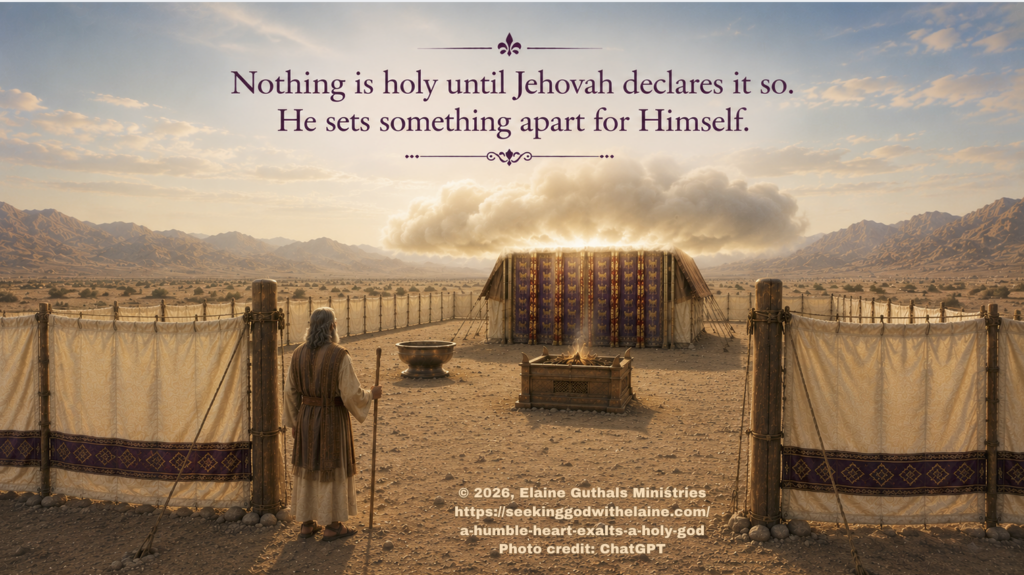
  • Only One Sacrifice Accepted

    Adam and Eve had raised their sons to sacrifice to the Lord. This devotional reading looks at, though both had offered sacrifices, only one was accepted.

    Nuggets

    • Abel’s sacrifice was accepted because God was pleased with his life and offering.
    • Just as we said God accepted Abel and his offering, God rejected Cain and his offering.
    only-one-sacrifice-accepted

    We aren’t told here why Abel’s gift was accepted while Cain’s gift was rejected. Abel’s was okay, but something was wrong to cause God not to accept Cain’s.

    But if we dig in, I think we can get a pretty good idea why Cain’s wasn’t accepted.

    Let’s Put It into Context

    To read devotions in the Creating Everything theme, click the button below.

    Devotions in the The Influence of Sin series

    Abel’s Offering

    “Abel also brought a gift — the best portions of the firstborn lambs from his flock. The LORD accepted Abel and his gift, but he did not accept Cain and his gift. This made Cain very angry, and he looked dejected” (Gen. 4: 4-5 NLT)

    Abel’s sacrifice was accepted because God was pleased with his life and offering.

    We aren’t told how God notified Abel that his sacrifice was acceptable. Maybe it was because Abel’s sacrifice was consumed by fire, so he didn’t need any other communication.

    • “Fire blazed forth from the LORD’s presence and consumed the burnt offering and the fat on the altar. When the people saw this, they shouted with joy and fell face down on the ground” (Lev. 9: 24).
    • “Then the angel of the LORD touched the meat and bread with the tip of the staff in his hand, and fire flamed up from the rock and consumed all he had brought. And the angel of the LORD disappeared” (Jdgs. 6: 21 NLT).
    • “Immediately the fire of the LORD flashed down from heaven and burned up the young bull, the wood, the stones, and the dust. It even licked up all the water in the trench!” (I Kgs. 18: 38 NLT).

    Later, we are told why Abel’s sacrifice was accepted. “It was by faith that Abel brought a more acceptable offering to God than Cain did. Abel’s offering gave evidence that he was a righteous man, and God showed his approval of his gifts. Although Abel is long dead, he still speaks to us by his example of faith” (Heb. 11: 4 NLT).

    The fact that Abel brought a meat offering showed His commitment to God. He accepted the obligation to make an animal sacrifice to God.

    We are also given another clue as to why Abel’s sacrifice was accepted.

    • “But Samuel replied, ‘What is more pleasing to the LORD: your burnt offerings and sacrifices or your obedience to his voice? Listen! Obedience is better than sacrifice, and submission is better than offering the fat of rams’” (I Sam. 15: 22 NLT).
    • “The LORD is more pleased when we do what is right and just than when we offer him sacrifices” (Prov. 21: 3 NLT). 
    • “I want you to show love, not offer sacrifices. I want you to know me more than I want burnt offerings” (Hos. 6: 6 NLT).

    Obedience, righteousness, justice, steadfast love. “… The LORD accepted Abel and his gift” (Gen. 4: 4 NLT emphasis added).

    • Doing what God tells us to do.
    • Having the characteristics of God.
    • Bringing order back to God’s creation so that all people receive the rewards He has for His children.
    • Having all-encompassing favor that is not dependent on actions.

    Abel gave the best that he had from a willing, contrite heart. He knew he needed atonement for His sins.

    That goes along with the first item on the disciples’ job description. “And so, dear brothers and sisters, I plead with you to give your bodies to God because of all he has done for you. Let them be a living and holy sacrifice—the kind he will find acceptable. This is truly the way to worship him. Don’t copy the behavior and customs of this world, but let God transform you into a new person by changing the way you think. Then you will learn to know God’s will for you, which is good and pleasing and perfect” (Rom. 12: 1-2 NLT).

    Our worship is our unwavering love and praise God for Who He is that permeates the life we live.

    We have to worship though our lives, not just an occasional gift/sacrifice to God. We have to live through the week what God teaches us on Sunday.
    Abel’s sacrifice was accepted because of his attitude. He acknowledged his sinfulness, rather than tried to justify his actions and beliefs. He had the mind/attitude of Christ.

    Bonar agreed. He wrote, “Abel comes acknowledging death to he his due; for he brings a lamb, and slays it before the Lord, as a substitute for himself.”

    Resource

    Abel would have killed the goat or sheep, so there would be blood on his hands.” And Hevel [Abel], he also brought of the bechorot [firstborn] of his tzon [goats and sheep] and of the chelev [fat] thereof” (Gen. 4: 4 OJB).

    Remember, blood is the only thing that covers our sins.

    Only living and worshiping as Abel did will ensure our sacrifice is accepted by God. We’ve got to be all in. Salvation has to change us from the inside out.

    Cain’s Offering

    “… Cain presented some of his crops as a gift to the Lord” (Gen. 4: 3 NLT)

    “but he did not accept Cain and his gift. This made Cain very angry, and he looked dejected” (Gen. 4: 5 NLT)

    Just as we said God accepted Abel and his offering, God rejected Cain and his offering.

    We aren’t told here how or why God notified Cain that his sacrifice was unacceptable. We are just told God didn’t accept it. (It was probably obvious it wasn’t accepted when the same thing that happened to Abel’s sacrifice didn’t happen to Cain’s.)

    We ask about why the burnt offering was accepted, but the grain offering wasn’t. Later when God gave the law about sacrifices, He allowed grain offerings along with burnt offerings. In fact, there is a whole festival designed around the first fruits.

    “Then the Lord said to Moses, ‘Give the following instructions to the people of Israel. When you enter the land I am giving you and you harvest its first crops, bring the priest a bundle of grain from the first cutting of your grain harvest. On the day after the Sabbath, the priest will lift it up before the Lord so it may be accepted on your behalf. On that same day you must sacrifice a one-year-old male lamb with no defects as a burnt offering to the Lord. With it you must present a grain offering consisting of four quarts of choice flour moistened with olive oil. It will be a special gift, a pleasing aroma to the Lord. You must also offer one quart of wine as a liquid offering. Do not eat any bread or roasted grain or fresh kernels on that day until you bring this offering to your God. This is a permanent law for you, and it must be observed from generation to generation wherever you live” (Lev. 23: 10-14 NLT).

    True, in Cain and Abel’s time, the law about sacrifices had not yet been given. But we don’t know that for sure. We do know God had given them at least one law. “But the Lord God warned him, ‘You may freely eat the fruit of every tree in the garden — except the tree of the knowledge of good and evil. If you eat its fruit, you are sure to die’” (Gen. 2: 16-17 NLT).

    This may have been the or a precursor to the Festival of the Harvest. The timing is right. But then, it may have been a Shabbat sacrifice.

    We can come up with some reasons the offering wasn’t accepted. Cain’s offering did not indicate it was the first fruits, just some of his crops. It did not even say it was the best.

    Most importantly, we can understand why Cain’s sacrifice wasn’t accepted. His heart wasn’t right. Pastor Steve said in a recent sermon, “The problem with Cain’s offering wasn’t the offering, but the problem was his heart.”

    I never thought of it this way. The Essex Remembrancer wrote that Cain’s offering came from an attitude of thankfulness instead of an attitude of faith.

    Resource

    God wants our thanks, but He requires more than that.

    Yes, Cain lacked faith. Since he didn’t have faith, he didn’t have obedience.

    All Cain had to do was say, “I’m sorry for not being the sacrifice. I needed to have genuine faith in You and offer the sacrifice in a humble manner.”

    Cain chose not to do that.

    So, Cain got angry. He didn’t understand why God neither accepted his gift nor the way it was given.

    Why did Cain get so angry? His anger probably had a strong foundation of envy.

    On top of that was the feeling of humiliation that had to have been a major element. Our feelings of being wronged does much too flame of the fires of anger.

    I can’t but think that there has to be an ingredient of self-will in here. Did Cain leave? God should just accept what he offered regardless of how or what was offered?

    God will only accept true worship.

    Grantham likened Cain to a Pharisee. I can see that — especially if he added the indignation they felt at being told they were wrong.

    Cain had neither latched on to the realization that he had sinned nor the was cognizance that he had to repent.

    Making the Connections #1

    Go back to Genesis 3: 15. “And I will cause hostility between you and the woman, and between your offspring and her offspring. He will strike your head, and you will strike his heel” (Gen. 3: 15 NLT).

    Hostility would occur between humans when one follows good and the other, evil. Isn’t that what happened here – with deadly consequences?

    Yes, God is in the business of establishing families, but He is also in the business of separating people — the goats from the sheep.

    As the parents weren’t shielded from temptation to sin, the children were not shielded from division.

    In Elaine-speak, the problem — this time — wasn’t about the offering. The problem — always — is the condition of our hearts. Do we choose to obey God or not?

    Making the Connections #2

    I love what Babington had to say. Yeah, he wrote in King James Version, but we get it. He wrote, “They both offer, but the one thinketh anything good enough, and the other in the zeal of his soul and fulness of his Lord thinketh nothing good enough.”

    Resource

    Cain thought God should accept as good enough whatever way he offered as worship. He more than likely didn’t see the sacrifice as a substitute. “I’ll just offer God this grain, and He won’t expect anything more.”

    Abel thought nothing we have to offer is good enough because we aren’t good enough.

    Dods noted that God isn’t going to accept our sacrifice if we are not right. Leavitt explained that by saying right is a life of faith.

    Resources

    How many of us worship as Cain did? How many of us are going to be surprised to find out we are goats masquerading as sheep?

    Making the Connections #3

    Abel wasn’t the only one to have a lock on faith. Abraham did. Noah did. They offered sacrifices to God.

    Abraham was even going to sacrifice his son Isaac because God told him to do so. That was a test of his faith — and he passed with flying colors.

    Knowing His will gives us what we need to know what is required of us.

    It is essential that we appropriately respond to God’s love for us. That response is ABCDing. That response is walking in His Spirit and offering appropriate sacrifices to acknowledge that love.

    Making the Connections #4

    How many of us still today worship as Cain does?

    Pastor Steve made an interesting comment in his sermon this morning. He said that the society in first-century Ephesus mirrored today’s society.

    In the letter to the church of Ephesus, they were called lukewarm. They were neither hot nor cold.

    Isn’t that what many disciples today are? They have compromised with the worldview so that they no longer reflect the character of God. Their actions may reflect godliness, but their motivation screams that of the devil.

    We can’t stand on the fact that we attend services every time the doors are open. Disciples touting worldview philosophies are just as false in their worship as Cain was.

    We can’t do the right thing for the wrong reasons any more than we can do the wrong things for the right reasons.

    It was interesting. Jackson equated Cain’s offering to taking the Lord’s supper and Abel’s offering to Jesus’ purpose — atonement.

    Resource

    We are not to just go through the motions — as right as they might be. Our worship for God must produce a change in us — and continue changing us until we are called home.

    We can’t go to worship because it is expected of us. We must go out of our desire to be in God’s presence so that He can sanctify us.

    We must be going into worship with the intent of placing our sins at the foot of the cross and asking God to forgive us for them.

    Making the Connections #5

    How far does God have to go to spell out what is right and what is wrong?

    Maurice helped us with that. He wrote,

    “Although we should certainly have expected Moses to inform us plainly if there had been a direct ordinance to Adam or his sons concerning the offering of fruits or animals, we have no right to expect that he should say more than he has said to make us understand that they received a much more deep and awful kind of communication.”

    Resource

    What has God told us He wanted?

    • For us to have total, unswerving faith that He is Who He says He is.
    • Act totally and sincerely in obedience to Him — having the appropriate motivation fueling that obedience.
    • For us to actively listen to His revelations.
    • Examine ourselves to determine motives — and make sure those motives are to enhance God’s kingdom.

    Making the Connections #6

    Where was Abel when Cain was wrestling with his envy? Worshiping God.

    Abel was doing everything he was supposed to be doing. We can read into that loving Cain.

    And look what Abel got for that. In this devotion, it would be hatred. Stay tuned.

    How Do We Apply This?

    • Understand that humankind is presumed guilty until proven innocent — condemned until saved by Christ.
    • Never forget that forgiveness of sin must be accomplished through a substitute of person.
    • Honor God by more than going through the sacrifices; rather, have a humble attitude in serving Him through sacrifice.
    • Recognize that sacrifices are more about getting right than giving up.
    • Don’t be too prideful to refuse to knowledge that we are sinners.
    • Participate in pure worship of God.
    • Shoot to just serve God acceptably — give God our best.

    Resources

    Father God. We want to have the faith and obedience of Abel. Grow us so that we become more faithful. Forgive us when we are like Cain and are envious and angry. Help us not to murder our relationship with You. We want to give You true worship and honor. Amen.

    What do you think?

    Leave me a comment below (about this or anything else) or head over to my Facebook group for some interactive discussion.

    If you don’t understand something and would like further clarification, please contact me.

    If you have not signed up for the email providing the link to the devotions and the newsletter, do so below.

    If God has used this devotion to speak with you, consider sharing it on social media.
  • The First Recorded Sacrifice by Humans

    An important aspect of worship is our asking God for forgiveness of sin. This devotional reading looks at the Old Testament ceremony of sacrifice and how that applies to Cain and Abel.

    Nuggets

    • Both sons worshipped the One true God but in different ways.
    • We aren’t really sure what time to which the verse was referring.
    • While each brought offerings, they were different.
    the-first-recorded-sacrifice-by-humans

    God must have been the one to initiate sacrifices. He is very specific as to what is acceptable worship and what isn’t.

    Let’s Put It into Context

    To read devotions in the Creating Everything theme, click the button below.

    Devotions in the The Influence of Sin series

    Two Offerings Given

    “When it was time for the harvest, Cain presented some of his crops as a gift to the LORD. Abel also brought a gift — the best portions of the firstborn lambs from his flock …” (Gen. 4: 3-4 NLT)

    Both sons worshiped the One true God but in different ways.

    If we stop and think about it, we realize that we aren’t told how Adam and Eve worshiped God in the Garden of Eden. All that we can glean from it is that they regularly met with God.

    In other words, the most important thing is being in God’s presence.

    But that is one thing we lost in the original sin. Adam and Eve were kicked out of the Garden of Eden, so they lost that presence.

    We don’t know how long after the eviction this sin took place. If we would describe is based on child development stages, I would say sin was probably still a child — a teenager at the most.

    That being said, I would envision Cain and Abel to be teenagers at the youngest, somewhere in their 20s at the oldest. Yes, that would have them born before the regions sin, but we know God’s Word isn’t always chronological.

    Once an animal was sacrificed to make clothes for Adam and Eve to cover the original sin, a sacrificial system could be set up. We talked about Moses writing down oral tradition of creation.

    The sacrificial system was a foreshadowing that we need blood to cover our sins. The only blood that could do that once and for all was through Jesus shedding His blood on the cross.

    Maybe God did give instructions, but Moses didn’t record the oral tradition on sacrifices. That doesn’t mean it wasn’t initiated.

    I know. We would have thought Moses was all-inclusive on the laws. But maybe he wasn’t as inclusive on what we would call ceremonies.

    We can’t gloss over the fact that Adam and Eve raised their boys to worship God. They must have had regular Shabbat times He instituted this at the end of creation.

    Those times would have included being in His presence and sacrificing to Him.

    Adam and Eve would have shown them the right way to offer sacrifices. That would include how to pick the sacrifice (without blemish) and how to offer it. They would have seen how God accepted it.

    That brings up the question whether this was the first time a sacrifice was not accepted. Was this an ongoing issue, or was it the first time?

    We don’t know. That is something for the UNR book – understanding not required.

    When It Was Time

    “And in ketz yamim [end of days or last days] it came to pass, that Kayin [Cain] brought of the p’ri haadamah [the fruit of the earth] a minchah [offering] unto Hashem [God]. And Hevel [Abel], he also brought of the bechorot [firstborn] of his tzon [goats and sheep] and of the chelev [fat] thereof …” (Gen. 4: 3-4 OJB).

    We aren’t really sure what time to which the verse was referring.

    Now, we think of the end of days as the Day of the Lord. This earth will pass away, and we will be called to Paradise to live eternally with God. That is one meaning, since we are all here today, that didn’t happen.

    It also refers to the Messianic time. But then all the way up to the crucifixion, Jews thought the coming of the Messiah would be the Day of the Lord. Again, still here or has come and gone.

    The third meaning is the one that makes sense in this passage. It means a significant historical endpoint.

    It doesn’t necessarily mean harvest. It does mean a transition from what was to a new normal.

    How would this apply here? This will be the first instance of God dividing and separating. Those disobedient to God would be driven away from the obedient.

    God doesn’t do this to be mean. He does this to remove some temptation from us.

    It is just like when God drove the current inhabitants out of the Promised Land. “You must destroy all the nations the Lord your God hands over to you. Show them no mercy, and do not worship their gods, or they will trap you” (Deut. 7: 16 NLT emphasis added).

    God wanted those who may lead His people astray to be removed.

    Bottom line is God removes those who do not believe and obey Him.

    Cain Presented Some Crops, and Abel Brought the Best Firstborn Lambs

    While each brought offerings, they were different.

    In this instance, both sons wanted to take the fruits of their labors and honor God. Cain offered some of his crops, and Abel offered a firstborn lamb.

    To put it this way, Cain and Abel both came to the Lord for mercy and salvation. They agreed that God deserved their worship and adoration.

    There has been some discussion as to whether these were gifts (as the New Living Translation says) or sacrifices.

    We should want to give gifts to God – over and above our sacrifices. “You must each decide in your heart how much to give. And don’t give reluctantly or in response to pressure. ‘For God loves a person who gives cheerfully’” (II Cor. 9: 7 NLT).

    But sacrifices have a specific purpose. Only blood can cover the stain and guilt of sin. That wouldn’t be relegated to a gift. Our confession wouldn’t be seen as a gift.

    Alexander – I think, if I read it right – said that there would be no way that slaying an animal would be seen as a gift to God. We talked about God using the animals to make clothing for Adam and Eve after the original sin. He would not give an animals’ life lightly.

    Resource

    Only blood can cover the stain and guilt of sin. That wouldn’t be relegated to a gift. Our confession wouldn’t be seen as a gift.

    It is our duty to give sacrifices. In the Old Testament, I see that as their form of confession.

    Whenever it was, it seems like the boys offered their respective offerings through the same ceremony.

    Bradford dove into what the Hebrew words meant. Minchah is interpreted differently in Genesis than in Leviticus.

    In Leviticus, minchah is the grain offering. In Genesis, minchah is the sacrifice animal.

    Bradford felt that meant sacrifice here, not designating what that sacrifice was. This may just reflect an evolution of the Hebrew language.

    Bradford clarified that the emphasis was placed on the way the sacrifice was offered, not what was offered. He wrote,

    “In other words, its not so much about it being grain, as it is that it is meant as tribute, or a gift to God. So in both of the first two types of sacrifices we’re studying, the ‘Olah [burnt offering] and now the Minchah [grain offering], part of their basic essence is that they are gifts to God. But, they are also REQUIRED gifts…..which is the nature of tribute.”

    Resource

    We are not told why it wasn’t accepted here. Later, we are told why Abel’s sacrifice was accepted. “It was by faith that Abel brought a more acceptable offering to God than Cain did. Abel’s offering gave evidence that he was a righteous man, and God showed his approval of his gifts. Although Abel is long dead, he still speaks to us by his example of faith” (Heb. 11: 4 NLT).

    Making the Connections

    How should we offer our sacrifices?

    • We should acknowledge that it is our duty to offer sacrifices to God.
    • We should perform that duty with a faithful heart without seeking personal gain.
    • The sacrifices must be an expression of our true worship felt all the way in the soul.

    Resource

    We are expected to worship God in who we are. Cain and Abel brought sacrifices from who they were – their occupation.

    Think about it. God gives us an occupation as a calling. Ness noted that it is a sin for us to live without a calling.

    Resource

    I can see that. If we live without a calling, that means we are living without God. Living without God is a sin.

    How Do We Apply This?

    • Examine our offerings to God to ensure they come through faith.
    • Recognize that it is our duty to make sacrifices to God.
    • Work to raise our family to understand their duty toward God.
    • Understand our obligation to give offerings to God.
    • Present to God our offerings a worship to Him.

    Resources

    Father God. You want our praise and worship. Most of all, You want our lives to reflect You Help us to give ourselves to You daily so that we can become more like You. Amen.

    What do you think?

    Leave me a comment below (about this or anything else) or head over to my Facebook group for some interactive discussion.

    If you don’t understand something and would like further clarification, please contact me.

    If you have not signed up for the email providing the link to the devotions and the newsletter, do so below.

    If God has used this devotion to speak with you, consider sharing it on social media.
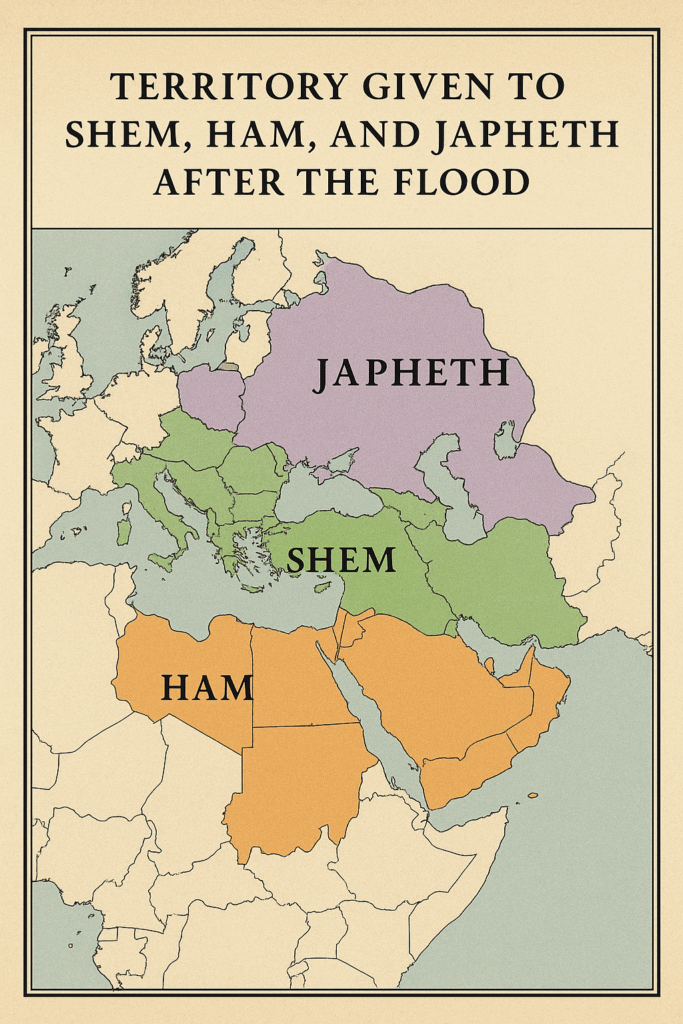
  • The Songs of the Angels and Creation

    The worship service in Heaven expanded. This devotional reading looks at how the angels and creation joined in to worship the Lamb.

    Nuggets

    • An angel choir joined in the worship service with a song of their own.
    • The choir expanded in the third hymn to be sung by all creation.
    the-songs-of-the-agels-and-creation

    The elders and the living creatures started the worship service. But they weren’t the only ones in attendance.

    John recorded a song sung by the angels. Then, he told us about the song sung by creation.

    Let’s Put It into Context

    To read devotions in the On the Day of the Lord theme, click the button below.

    Devotions in the Worshiping the Lamb Who Was Slain series

    The Song of the Angels

    “Then I looked, and I heard around the throne and the living creatures and the elders the voice of many angels, numbering myriads of myriads and thousands of thousands, saying with a loud voice, ‘Worthy is the Lamb who was slain, to receive power and wealth and wisdom and might and honor and glory and blessing!’” (Rev. 5: 11-12 ESV)

    An angel choir joined in the worship service with a song of their own.

    I cannot wait to get to Heaven and hear all the multitude of angels singing praises to the Lamb. There are thousands of thousands of them.

    What does it sound like? I think we can hook this with Revelation 19: 6. “Then I heard what seemed to be the voice of a great multitude, like the roar of many waters and like the sound of mighty peals of thunder, crying out, ‘“Hallelujah! …’” (Rev. 19: 6 ESV).

    The angels formed another circle around the Lamb, elders, and living creatures. It is like they are standing guard.

    We shouldn’t think that makes them second-class citizens. Johnston contended that they are standing equally around the throne as the elders and living creatures are.

    Resource

    There is just more of them, necessitating a position a little further back. The position does not carry any semblance of rank.

    Sometimes, I think we consider the angels are the worker bees. They probably do work.

    But they take time to praise the Lamb.

    Worthy Is the Lamb

    The angels know that the Lamb is worthy.

    Isn’t that amazing if we think about it? The angels – most of them – have always been faithful to God. The ones who weren’t have been banished from Heaven.

    Jesus didn’t redeem the angels. They didn’t need redemption. They never sinned.

    In a way, we can say that it isn’t personal for them – not like it is for us. We need redemption – they don’t.

    They praise anyway! “… ‘Worthy is the Lamb who was slain, to receive power and wealth and wisdom and might and honor and glory and blessing!’” (Rev. 5: 12 ESV).

    The angels know the magnitude of the Lamb’s sacrifice. They understand the importance of why it needed to be done.

    Look at what Balmer said. He wrote, “I might remark that, allowing He has conferred on angels higher capacities and higher joys, our happiness has been procured by Him at a price far more costly.”

    Resource

    We know what the psalmist said. “When I look at your heavens, the work of your fingers, the moon and the stars, which you have set in place, what is man that you are mindful of him, and the son of man that you care for him? Yet you have made him a little lower than the heavenly beings and crowned him with glory and honor. You have given him dominion over the works of your hands; you have put all things under his feet” (Ps. 8: 3-6 ESV).

    We are below the angels, but God paid a higher price for us.

    But we can’t forget that the angels are adding their voices to the elders, who had been redeemed. “… ‘Worthy are you to take the scroll and to open its seals, for you were slain, and by your blood you ransomed people for God from every tribe and language and people and nation’” (Rev. 5: 9 ESV).

    Heaven is all about unity. Everyone who acknowledges God as Sovereign Lord and Jesus as Savior and Redeemer can worship the Lamb.

    The angels ask that the Lamb receive a bunch of things. Kennedy talked about why the angels included things that ran the gamut. He wrote, “This seems to include everything that mind can conceive of supreme ownership and control. They lay the universe down at His feet.”

    Resource

    Yes, that is right. We are to give everything to God. We aren’t supposed to keep anything under our own control.

    We are to give everything to the Lamb.

    We have confidence to do that because the Lamb is in control of everything. He is in control because of Who He is.

    But that sounds like it is what we give to Jesus. What does Jesus get?

    Power

    We know that Jesus has already been given authority. “And Jesus came and said to them, ‘All authority in heaven and on earth has been given to me’” (Mt. 28: 18 ESV).

    This also falls in line with what Daniel said. “And to him was given dominion and glory and a kingdom, that all peoples, nations, and languages should serve him; his dominion is an everlasting dominion, which shall not pass away, and his kingdom one that shall not be destroyed” (Dan. 7: 14 ESV).

    Wealth

    We know that Jesus gave up everything to come to earth to be our Savior. “For you know the grace of our Lord Jesus Christ, that though he was rich, yet for your sake he became poor, so that you by his poverty might become rich” (II Cor. 8: 9 ESV).

    Jesus received it back when He returned victorious. Maybe this is the angels asking that He get it back.

    Wisdom

    Jesus is wisdom.

    “But God chose what is foolish in the world to shame the wise; God chose what is weak in the world to shame the strong; God chose what is low and despised in the world, even things that are not, to bring to nothing things that are, so that no human being might boast in the presence of God. And because of him you are in Christ Jesus, who became to us wisdom from God, righteousness and sanctification and redemption, so that, as it is written, ‘Let the one who boasts, boast in the Lord’” (I Cor. 1: 27-31 ESV).

    Did Jesus lay down some of His wisdom to come to earth? Maybe. Again, this may be restoring Him to His full wisdom.

    Might

    Jesus suffered for us. “For Christ also suffered once for sins, the righteous for the unrighteous, that he might bring us to God, being put to death in the flesh but made alive in the spirit” (I Pet. 3: 18 ESV).

    We know Jesus did not lose any of His righteousness. However, it may have taken something out of Him to see all of the sin up close and personal.

    Honor

    Jesus accomplished a great feat when He completed the Plan of Salvation. He was the only One Who could do it. He was the only perfect Lamb.

    That means Jesus deserves all the honor that can be bestowed on Him. Part of the honor is taking His place at the right hand of God.

    Glory

    Sometimes, we think that glory and honor are synonyms. They really aren’t. Glory is the outward show of the essence of God — His majesty, splendor, and beauty — representing the attributes of God resulting from the authority and holiness of God.

    The writer of Hebrews talked about this.

    “Long ago, at many times and in many ways, God spoke to our fathers by the prophets, but in these last days he has spoken to us by his Son, whom he appointed the heir of all things, through whom also he created the world. He is the radiance of the glory of God and the exact imprint of his nature, and he upholds the universe by the word of his power. After making purification for sins, he sat down at the right hand of the Majesty on high, having become as much superior to angels as the name he has inherited is more excellent than theirs” (Heb. 1: 1-4 ESV).

    Blessing

    I think this is a segue into the song of creation. Jesus is blessed by everyone bowing down to Him.

    The Song of Creation

     “And I heard every creature in heaven and on earth and under the earth and in the sea, and all that is in them, saying, ‘To him who sits on the throne and to the Lamb be blessing and honor and glory and might forever and ever!’ And the four living creatures said, ‘Amen!’ and the elders fell down and worshiped” (Rev. 5: 13-14 ESV)

    The choir expanded in the third hymn to be sung by all creation.

    This is why I have trouble seeing Revelation in a chronological way. It isn’t just all creatures in Heaven and earth joining in the song.

    It is the dead ones, too. “And I heard every creature in heaven and on earth and under the earth and in the sea, and all that is in them …” (Rev. 5: 13 ESV).

    That would make this occurring after the Day of the Lord. All of creation is not going to bow to Him until then.

    • “So that at the name of Jesus every knee should bow, in heaven and on earth and under the earth, and every tongue confess that Jesus Christ is Lord, to the glory of God the Father” (Phil. 2: 10-11 ESV).
    • “For it is written, ‘As I live, says the Lord, every knee shall bow to me, and every tongue shall confess to God’” (Rom. 14: 11 ESV).
    • “By myself I have sworn; from my mouth has gone out in righteousness a word that shall not return: ‘To me every knee shall bow, every tongue shall swear allegiance’” (Isa. 45: 23 ESV).

    We were created to worship God. That is what we are going to do throughout eternity. We will be singing the songs of Heaven, not necessarily the songs of earth.

    More importantly, we will be seeing the Lamb in the midst.

    The four living creatures – who may or may not be the Cherubim – close the hymn with a hearty Amen. Just think of the vocal symphony that will be!

    Making the Connections #1

    Well, maybe I had better take back what I said about this occurring after the Day of the Lord. (This is a learning process for me, too.)

    Look in Hebrews. “But you have come to Mount Zion and to the city of the living God, the heavenly Jerusalem, and to innumerable angels in festal gathering, and to the assembly of the firstborn who are enrolled in heaven, and to God, the judge of all, and to the spirits of the righteous made perfect, and to Jesus, the mediator of a new covenant, and to the sprinkled blood that speaks a better word than the blood of Abel” (Heb. 12: 22-24 ESV).

    Whoever the writer was, and whoever his audience was, he was using the present perfect tense. He was hooking what was happening then to what had happened in the past.

    The Wilderness Wanderers got to Mt. Sinai. God told them to get ready to worship.

    • Consecrate themselves that day and the next (Ex. 19: 10).
    • Wash their garments (Ex. 19: 10).
    • Be ready for the third day (Ex. 19: 11).
    • Set limits for the people all around (Ex. 19: 12).
    • Do not engage in sexual activities (Ex. 19: 15).

    Then comes the important verse. “The Lord came down on Mount Sinai, to the top of the mountain …” (Ex. 19: 20 ESV).

    The writer of Hebrews said that we should expect that same presence in our corporate worship service.

    When you go to worship, do you just step foot in the church at [insert your town and state], or do you go to New Jerusalem, Heaven?

    Well, I’ve always heard, “Father, be present on this place.” God, come down to us.

    God does.

    But is that keeping it just earthly worship? We are told to worship God in spirit and in truth (Jn. 4: 24).

    Doesn’t that mean we should go to Him and join in the heavenly song? We’ve said before that eternity has already started.

    Making the Connections #2

    We gain holiness and righteousness through praising the Lamb.

    Look what Kennedy said. He wrote,

    “The song of creation and the song of providence will both embrace these attributes [holiness and righteousness] in tones of varied praise. But the song of redemption will speak of them with a fulness and emphasis all its own. Both Sinai and Calvary will be summoned to bear witness that God is a holy and righteous God.”

    Resource

    That is our goal – to be like a holy and righteous God. Praising the Lamb for Who He is shows us how we are to be.

    Lay down our lives? Maybe.

    Be obedient? Definitely!

    Making the Connections #3

    “Oh, I don’t like the music. I wish we would just get to the sermon.”
    “I can’t stand the sermon. I wish we could just sing the whole time.”
    “I’m not into Bible reading. The Pastor should just talk about how to apply things to my life.”

    And these people think they would enjoy Heaven?

    We are not told in Revelation that there will be any sermons preached. We are told that there will be music – singing and instrumental. The themes in the Bible come straight from Heaven.

    Will God pick up our worship service and drop it into Heaven? No.

    God will drop us into the worship service that is already being held in Heaven.

    Remember, this life is a training ground. If we can’t learn to love it here, we won’t get there.

    Making the Connections #4

    What is so important for us hear the songs of the elders along with the living creatures, the angels, and creation?

    One of the whole purposes of God giving the message of Jesus to John was to warn the Church. Tribulation was and is coming.

    The Church was and is going to suffer.

    I know. We hate to hear that. We want smooth sailing. We definitely don’t want the pain and fear associated with suffering.

    But suffering plays an important part in our sanctification. It is only through suffering that we truly know who we are and what we truly believe. It shows us what needs to be changed to be more like God.

    How Do We Apply This?

    • Sing about redemption to remind us we need redemption.
    • Realize our worth – we are suitable of being redeemed.
    • Obey God and the Lamb so we can truly worship Them.

    Resources

    Father God. Jesus deserves all the praise and worship that we can give Him. Help us to worship Him correctly. Remind us that we are joining in the worship service already going on in Heaven. We can’t wait until the day we can participate in it by being there. Amen.

    What do you think?

    Leave me a comment below (about this or anything else) or head over to my Facebook group for some interactive discussion.

    If you don’t understand something and would like further clarification, please contact me.

    If you have not signed up for the email providing the link to the devotions and the newsletter, do so below.

    If God has used this devotion to speak with you, consider sharing it on social media.
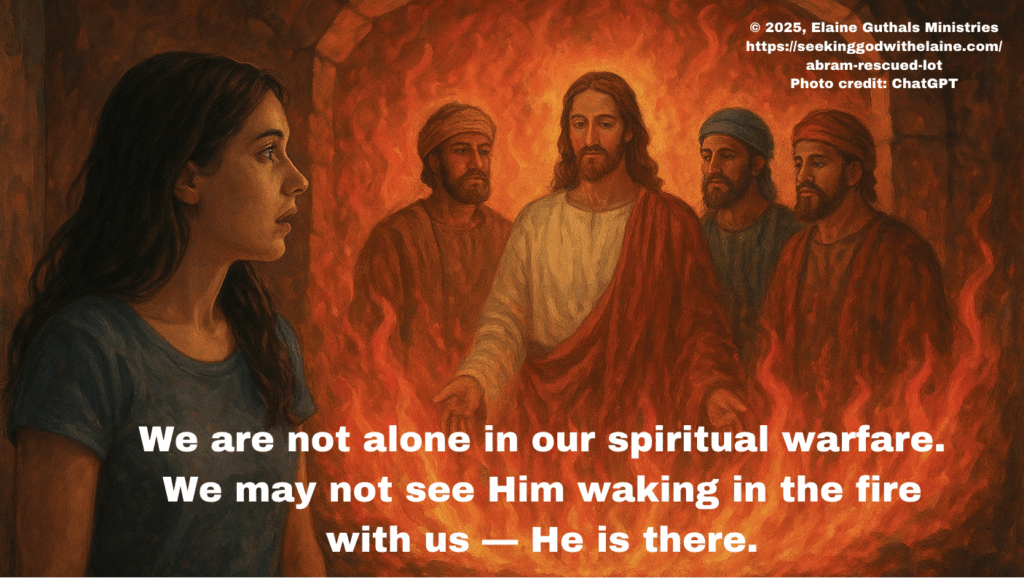
  • The Song of the Elders and Living Creatures

    The end verses of Revelation 5 tell us about three songs of praise raised in Heaven. This devotional reading looks at the first of those hymns.

    Nuggets

    • The elders and the living creatures took their musical instruments without hesitation and sang to the Lamb with one accord.
    • The ransomed will be rewarded with titles of kings and priests.
    the-song-of-the-elders-and-living-creatures

    The elders and living creatures had fallen down to worship the Lamb Who was slain. Many times, worship includes songs.

    In this instance, there were three songs recorded in the closing verses of Revelation 5.

    Let’s Put It into Context

    To read devotions in the On the Day of the Lord theme, click the button below.

    Devotions in the Worshiping the Lamb Who Was Slain series

    A New Song

    “And they sang a new song, saying, ‘Worthy are you to take the scroll and to open its seals, for you were slain, and by your blood you ransomed people for God from every tribe and language and people and nation’” (Rev. 5: 9 ESV)

    The elders and the living creatures took their musical instruments without hesitation and sang to the Lamb with one accord.

    Heaven was immediately filled with song. They were commemorating the opening of the scroll — or at least they will in the future because, remember, this is a vision of things to come.

    It is a new song, but it could be based on God’s Word. “Now therefore, if you will indeed obey my voice and keep my covenant, you shall be my treasured possession among all peoples, for all the earth is mine; and you shall be to me a kingdom of priests and a holy nation.’ These are the words that you shall speak to the people of Israel” (Ex. 19: 5-6 ESV).

    • It hinges on obedience – “… if you will indeed obey my voice and keep my covenant …” (Ex. 19: 5 ESV).
    • It is for every tribe and nation of the whole world (Jn. 3: 16) – “… for all the earth is mine” (Ex. 19: 5 ESV).
    • God’s kingdom is set apart – “… you shall be to me a kingdom of priests and a holy nation.’ …” (Ex. 19: 5-6 ESV).

    Are you kind of scratching your head as to how that verse connects? I know. I did, too.

    But think about it. That is what the living creatures and the elders were – set apart to obey God.

    That is what is expected of us.

    I know worldview people want to label us as doormats and submissives. The worship bubbled out of the living creatures and elders because they were full of a life they enjoyed. “The living, the living, he thanks you, as I do this day; the father makes known to the children your faithfulness” (Isa. 38: 19 ESV).

    If Someone is forcing us to do something we don’t want to do, I don’t think we would be singing with the reverence given to the Lamb. We would be kicking and screaming.

    Instead, this worship was real and heartfelt.

    Worthy

    The song starts and ends with Christ. He alone is worthy to open the scroll.

    Spurgeon told us what that really means. He wrote, “To have Christ standing between God and man is the joy of every believing heart.

    Resource

    Jesus is constantly standing in the gap for us. This ties in with His job as Mediator.  He is an intermediary between us and God – until we are allowed to see God face to face.

    What is perplexing me is that this theme hadn’t been sung in Heaven before this time. I can get it that, even though the Plan of Salvation and the knowledge that Jesus would be the Savior was known before the foundation of the world, it wasn’t set to song.

    Jesus could have backed out up until the time He said, “It’s finished.” Face it, most of us would have been having second, third, unteenth thoughts about getting out of Dodge and missing the blood and gore.

    I could see them not praising Jesus until it was a done deal.

    But Jesus had ascended back to heaven years before. It had probably been around 60 years since the last time John had seen Jesus.

    Why didn’t they praise Jesus for His obedience when the Plan of Salvation was completed?

    In any case, it wasn’t until John was invited to be in the audience.

    For You Were Slain

    Yes, Jesus had to die. It is only through His shed blood that we are saved.

    We are naturally condemned because of Adam and Eve’s original sin. We are also condemned because we choose to sin.

    “Whoever believes in him is not condemned, but whoever does not believe is condemned already, because he has not believed in the name of the only Son of God” (Jn. 3: 18 ESV).

    Sacrifices dedicated to God always called for the spilling of blood. This was no different. This was to God, and blood was needed.

    The song focuses on Jesus’ obedience. The operative word is the Lamb Who was slain.

    Jesus wasn’t going to complete the Plan of Salvation sometime in the future. He had already done it.

    That is totally the case, but look at it this way, too. This happened 2,000+ years ago. There was a lot of saving that was waiting to happen – including you and me.

    This just demonstrates Jesus’ love for us.

    We can’t think that, just because Jesus was slain, He is still dead. He isn’t. He arose victorious.

    Jesus is very much alive.

    We can never forget that Jesus died for us. We might think He would do that for a friend or someone who was worthy.

    Paul told us not so. “For one will scarcely die for a righteous person—though perhaps for a good person one would dare even to die — but God shows his love for us in that while we were still sinners, Christ died for us” (Rom. 5: 7-8 ESV).

    From Every Tribe and Language and People and Nation

    There was a reason why Jesus shed His blood. It was for our redemption. That is the theme of this song.

    Jesus didn’t play favorites. “… you ransomed people for God from every tribe and language and people and nation” (Rev. 5: 9 ESV).

    Yes, the Israelites are God’s chosen people. He also chose us for whom to lay down His life for our redemption.

    However, it wasn’t a blanket redemption for the whole world.  Redemption is only available to those who ABCD.

    Why? Because we are being redeemed to God. We have to be forgiven of our sins to have access to God.

    Those who have not ABCDed are still mired in their sin. God cannot grant them an audience.

    Salvation must start here in this life. We can’t expect to get to Heaven on the Day of the Lord and be rewarded for a life that was not lived for God. This life is a training ground for Heaven.

    This is interesting. The English Standard Version and the Complete Jewish Bible translate this basically the same. “… you ransomed for God persons from every tribe, language, people and nation” (Rev. 5: 9 CJB).

    The King James Version has a slightly different take – or it could be read as that. “… and hast redeemed us to God by thy blood out of every kindred, and tongue, and people, and nation” (Rev. 5: 9 KJV).

    Yes, all three have the everybody component. The KJV makes the elders a part of that component. That would seem to validate that the elders are the sons of Israel and the Apostles.

    Some believe that only the elders are singing the song. I even read in one instance that the living creatures had their own song.

    No, I don’t think the living creatures came from earth and were changed to be the creatures described. I believe they are heavenly beings.

    I think the living creatures are singing the same song. “And when he had taken the scroll, the four living creatures and the twenty-four elders fell down before the Lamb, each holding a harp, and golden bowls full of incense, which are the prayers of the saints. And they sang a new song, saying, ‘Worthy are you to take the scroll and to open its seals …” (Rev. 5: 8 ESV emphasis added).

    It can go another way. We must have a personal relationship with Jesus.

    Church attendance doesn’t cut it. Having a family that is believers in Him doesn’t do anything for us.

    We have to make a conscious and sincere decision to believe in Jesus and submit to God in order to be saved.

    Each of us has to sing the song and mean it.

    We also have to consider that the song was sung specifically because John was in the audience. He needed to know that he – and the Church – were included in the everybody component.

    A Reward for the Ransomed

    “and you have made them a kingdom and priests to our God, and they shall reign on the earth” (Rev. 5: 10 ESV)

    The ransomed will be rewarded with titles of kings and priests.

    Made Them a Kingdom and Priests

    I know we’ve talked about this before. So, let’s just look at what Spurgeon said. He wrote,

    “They are kings and reign. We too are kings; but as yet we are not known or [recognized], and often we ourselves forget our high descent. Up there they are crowned monarchs, but they say, ‘Thou hast made us kings.’ They are priests too, as we are now, every one of us. The priesthood of God’s saints, the priesthood of holiness, which offers prayer and praise to God — this they have in heaven; but they say of it, ‘Thou hast made us priests.’ What the saints are, and what they are to be, they ascribe to Jesus. They have no glory but what they received from Him, and they know it, and are perpetually confessing it.”

    Resource

    We are already royalty but not crowned, and we are already priests. Yes, we are already supposed to be holy saints. The world is supposed to see a difference in us.

    That difference is the Lamb Who was slain. We are royalty because Jesus is the King of kings, and we’ve been adopted into God’s family.

    We are only kings and priests when we have given our allegiance to the Lamb Who was slain. It is only through the exaltation that we receive for making that decision do we become this.

    We are royals and priests because of grace. We are priests because we have access to God.

    Leitch really put it into perspective. He wrote, “Christ has made us kings, and the first subject He gives us to rule is our own spirit.”

    Resource

    Ooo, baby. That isn’t what most have in mind, is it?

    But that is what our salvation is about. We have to rule our own spirit so that we do not want to continue to sin.

    Yes, we will because we are still in this physical, sinful bodies. It is our attitude that must change.

    No, that doesn’t give us license to sin. It shows us we do not have to throw in the towel when we do.

    Our goal should not be to be royals. We know the least shall be greatest. “But many who are first will be last, and the last first” (Mt. 19: 30 ESV).

    Reign on the Earth

    We’ve already talked in these devotions about the concept of us reigning on earth. Here it pops up again.

    We are tabling this discussion until Revelation 20.

    Walker gave us a good reminder about the song as a whole. He wrote, “Let us mark here not merely the fact that it is a scene of triumphant song, but especially the object that causes the gladness, and the difference in the mode of expressing it.”

    Resource

    We don’t worship just to sing. We worship to praise the Lamb that was slain.

    Making the Connections

    Oh, if we would only worship Jesus like that! Immediate submission. Heartfelt adoration. Worship for the correct reason.

    Too many times, we worship based on our own agenda. We want the fire insurance, but nothing else. We want the blessings without the obedience.

    How Do We Apply This?

    • Know Jesus as Savior and Redeemer is in control of the past, present, and future.
    • Give Christ the reverence He deserves.
    • Be comforted in the fact that, though Book of Revelation contains many frightful things, believers will be singing His glorious praise.
    • Worship Jesus as the elders and living creatures do.

    Resources

    Father God. Thank You for allowing us to be introduced to the song of the elders and living creatures. We want to praise You in the way most fitting the Sovereign God, the Creator of the universe. Amen.

    What do you think?

    Leave me a comment below (about this or anything else) or head over to my Facebook group for some interactive discussion.

    If you don’t understand something and would like further clarification, please contact me.

    If you have not signed up for the email providing the link to the devotions and the newsletter, do so below.

    If God has used this devotion to speak with you, consider sharing it on social media.
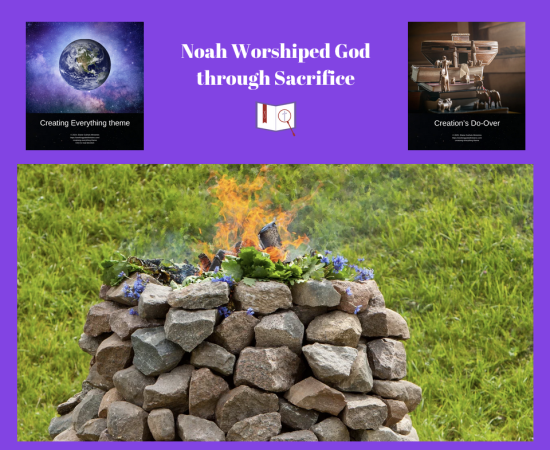
  • Worshiping the Lamb that Was Slain

    Jesus’ appearance brought immediate response from the four living creatures and the elders. This devotional reading looks at what that response was.

    Nuggets

    • The Lamb that was slain deserves our worship.
    • Music has always been an important part of worship.
    • Our prayers are worship of Jesus.
    worshiping-the-lamb-that-was-slain

    Now that we have a little clearer understanding of music in worship, we can look at the worship service honoring the Lamb Who was slain.

    At this point, the only inhabitants of Heaven that we have seen are the God, Jesus, the Holy Spirit, the elders and the living creatures. God and Jesus are the objects of worship. (We never hear of the Holy Spirit being worshiped.)

    In this passage, the focus is on worshiping the Lamb. Let’s see what happens.

    Let’s Put It into Context

    To read devotions in the On the Day of the Lord theme, click the button below.

    Devotions in the Worshiping the Lamb Who Was Slain series

    Fell Down before the Lamb

    “And when he had taken the scroll, the four living creatures and the twenty-four elders fell down before the Lamb, each holding a harp, and golden bowls full of incense, which are the prayers of the saints” (Rev. 5: 8 ESV) 

    The Lamb that was slain deserves our worship.

    Jesus had just received the scroll from God. Immediately, everyone we have met so far fall down and worship Him.

    They didn’t fall down in fear. They didn’t lose their balance because they were trying to run away.

    They worshiped in joy. They worshiped in humility.

    Isn’t that how it should be? Jesus is the source of our joy because He is the source of our salvation. That should humble us!

    Let’s look at it this way. If the elders are the sons of Israel and the Apostles, we are seeing the joy and humility of the Church. (Yes, if the sons of Israel are part of the elders, they are part of the Church. The Church has not replaced God’s chosen people.)

    McCosh said something that I think is wonderful. He wrote,

    “The faith that saves does not consist of a single glance; ‘looking unto Jesus’ is the habitual attitude of the believer’s soul. Led to love the Lamb of God when on earth, trained by the Spirit of God and by all the dispensations of God to love Him more and more, he finds when he has crossed the dark valley of the shadow of death that the first object that meets his eye, and the most conspicuous, is a Lamb as it had been slain.”

    Resource

    Yes, we are saved the minute we give our lives to Jesus. But we also know it isn’t a once-and-done thing.

    We have to follow the instructions of the Holy Spirit as we navigate the Sanctification Road. It is only as we work out our salvation and are changed to imitate Him that our salvation takes on meaning.

    McCosh talked about a habitual attitude. We can’t do a one-and-done prayer. We can’t not read God’s Word.

    We have to have the mind of Christ – His attitude. We have to follow His example.

    It is only as we step through the open door to Heaven that we find true salvation. It is then we see the Lamb and receive the bodies in which we will never sin again.

    Holding a Harp

    Music has always been an important part of worship.

    What the elders used to worship the Lamb is reminiscent of what was used in the Temple. A couple of devotions ago, we talked about the belief of some that the elders were priests.

    I personally think – and I may be right or wrong – that they are not Levitical priests just because they use the instruments and implements of the Temple.

    I think that is the wrong way to look at it. I think the Temple was patterned off of the heavenly temple.

    We are all to worship God. If the elders are the sons of Israel and the Apostles, then worship is for all believers.

    I think there might be a little bit more to it than that. Every elder had a harp. Each of the four living creatures had a harp.

    That is 28 instruments. They had to be in tune. They had to sound as one.

    Yes, we all get to have our opinions in the church. We still have to be united. We have to worship as one.

    Think about this. When the music director announces that the congregation will be learning a new song, most probably cringe. Some choose not to sing.

    Not so with the living creatures and the elders. Every one of them sang. They already knew the song.

    They sang it with joy and abandon.

    When we get to Heaven, we will join in, too. Don’t sing here on earth? You will there.

    Golden Bowls Full of Incense

    Our prayers are worship of Jesus.

    Let’s start at the back first. Some of us may question if the term saint applies to us.

    Spurgeon said it does. He wrote,

    “And who are the saints? They are men whom the Lord has made holy by the power of His Spirit, whose nature He has purified. Then, in the matter of intercession, one of the most important things is the character of the person. We must, by the Spirit’s power, maintain the saintly character; we must walk apart from worldliness and covetousness; we must put aside uncleanness, anger, wrath, and every evil thing, or else we shall not be able to present unto the Lord such sweet [odors] as His soul delighteth in.”

    Resource

    Incense is made of spices. There are some wonderful smelling spices!

    Our prayers are like incense to God. “O Lord, I call upon you; hasten to me! Give ear to my voice when I call to you! Let my prayer be counted as incense before you, and the lifting up of my hands as the evening sacrifice!” (Ps. 141: 1-2 ESV).

    I can get that. The purpose of the sacrifices was so that God would smell the aromas and be pleasing.

    We know God was so pleased with Noah’s sacrifice after he got off the ark, that He made a covenant to not flood the earth again. “And when the Lord smelled the pleasing aroma, the Lord said in his heart, ‘I will never again curse the ground because of man, for the intention of man’s heart is evil from his youth. Neither will I ever again strike down every living creature as I have done’” (Gen. 8: 21 ESV).

    It kind of throws us for a loop when we read what Paul said. “For we are the aroma of Christ to God among those who are being saved and among those who are perishing” (II Cor. 2: 15 ESV).

    Or does it? What if the aromas are brought on by our character?

    In the golden bowls are more than one person’s prayers. “… which are the prayers of the saints” (Rev. 5: 8 ESV). Saints is plural.

    That means our prayers are combined – or if we continue with the culinary reference, they are blended. That also pulls in the harmony of the harps.

    Making the Connections #1

    Did we see who all is around the throne? We have the elders and the living creatures. We know there is more.

    Jesus is in their midst. He is having complete fellowship with them.

    The object of their worship isn’t off in some unknown place (like we have right now in this life). He is right there.

    They get to love on Jesus.

    They also get to love on each other. Yes, worship can be private, but worship is also corporate.

    I can’t wait to be included in the group. Can you?

    Making the Connections #2

    Spurgeon made a good observation. At the time that the worship service began, Jesus hadn’t touched any of the seals. He had just been handed the scroll from God.

    Resource

    The worship service wasn’t really about what Jesus did. It was about Who He was.

    Heaven was worshiping Jesus because He was the pure Lamb. It was His character that was the focus. He was worthy.

    Yes, Lamb is followed by that was slain – Jesus’ actions.

    If Jesus had refused going to the cross, He would have sinned. He would no longer be pure and blameless. He would no longer be worthy.

    The actions, in this instance, are important only because of the effect on Jesus’ character.

    It is the same with us. Doing the do’s and not doing the don’ts is important because that is how we sin.

    What is more important is that we do the do’s and not do the don’ts because that is how we have God’s character.

    Making the Connections #3

    I have to process something the Homilist said. In Elaine-speak: when we die, our need for some prayers stop. We will no longer have to ask for forgiveness because we will have new bodies that can no longer sin.

    We won’t have to have deliverance from error. Ditto. Error is sin. Not going to be an option.

    We won’t have to pray for victory over foes. We won’t have foes in Heaven.

    But then the Homilist said we would still need the spirit of prayer. What in the world does that mean?

    That means we will still have a dependence on God. He will still have to supply our needs. We won’t have to struggle through eternal life without Him.

    So, prayer shows our dependence on God. It isn’t just our laundry list of God-do-this-for-me things. It is God-I-need-You every day.

    How Do We Apply This?

    • Be born again so that we can enter the kingdom of God and see Jesus face to face.
    • Continually praise and honor God.
    • Look to the Lamb for comfort in sorrows.

    Resource

    Father God. We need You. We will always need You. We want to always fall before You in worship and in praise. Amen.

    What do you think?

    Leave me a comment below (about this or anything else) or head over to my Facebook group for some interactive discussion.

    If you don’t understand something and would like further clarification, please contact me.

    If you have not signed up for the email providing the link to the devotions and the newsletter, do so below.

    If God has used this devotion to speak with you, consider sharing it on social media.