Category: Provision

  • Trust as the Foundation for Peace

    Have you ever thought that peace has to be built on something? Trust in God is the foundation on which peace is built. This daily devotional looks at how trusting in God brings stability, security, and protection – which leads to peace.

    Nuggets

    • Stable things bring us security, which brings us peace.
    • Trust in God brings security because it brings God’s promises with it.
    • We will spend eternity in peace with our Heavenly Father.
    • If we put our trust in the feelings, we won’t have stability, security, and protection when the trial winds start blowing.

    Devotions in the Peace Leads to Tranquility series

    Let’s Put It into Context

    We’ve talked about peace several times. Peace is an inward tranquility or composure of the mind resulting from a balanced life with spiritual order, equity, and truth.

    Glossary

    Peace isn’t just the absence of conflict. It is a positive condition.

    God wants disciples of Christ to experience peace in the midst of conflict. We can do that when we put our faith and trust in Him.

    Trust is assurance that the promises of God are true. It is that bone-deep knowledge that God is going to do what He says.

    Maclaren stated that the word means to hang on to something. It paints a picture of not letting go.

    Resource

    Trust in God Brings Stability

    “Those who trust in the Lord are like Mount Zion. It cannot be shaken; it remains forever” (Ps. 125: 1 CSB)

    Stable things bring us security, which brings us peace. By trusting in God, we get safety in God.

    I have heard about Mount Zion all my life, but I am a little shaky on what it is. When I read the definition for Zion in the Holman Bible Dictionary, I said to myself, “That’s why.”

    Oh, Mount Zion is a mountain. Well, it is more of a “… fortified hill of pre-Israelite Jerusalem between the Kedron and Tyropean valleys.”

    Resource

    I thought it was interesting that the definition said that the “stronghold of Zion” may have only been talking about the fortified sections. This is important when we realize Jerusalem incorporated villages and houses outside of this fortified area. These days, we might say Jerusalem and all of its suburbs.

    But then, Scriptures didn’t use the term to just talk about mountains. Zion was also used to refer to Solomon’s temple.

    If that isn’t confusing enough, the term was also used to talk about the nation of Israel as a whole. So, we’ve got a mountain, a building, and a nation.

    Let’s add to the confusion. The term was also used to talk about the heavenly Jerusalem. Add future city to the list.

    But look at that list — a mountain, a building, a nation, and a future city. We think of those as some pretty stable things.

    This stability isn’t a fly-by-night peace. This is an eternal peace. Even when this world is dead and gone, God’s peace will still be around.

    Jarvie told us what is securing this peace for us.

    • “The almightiness of God
    • “His unerring wisdom
    • “His unchanging love”

    Resource

    We refer to God as all-powerful, all-knowing, and all-present. That does make Him all-mighty.

    We have to put our trust in God. We have to open our eyes like Elisha’s servant did. “And Elisha prayed, ‘Open his eyes, Lord, so that he may see.’ Then the Lord opened the servant’s eyes, and he looked and saw the hills full of horses and chariots of fire all around Elisha” (II Kgs. 6: 17).

    The servant thought he and Elisha were fighting the battle outnumbered. Ooo, baby. Was he wrong!

    The Homilist contended that security is conditional. We have to have the trust in order to have the security.

    How do we tap into these defenses? “I pray that the eyes of your heart may be enlightened so that you may know what is the hope of his calling, what is the wealth of his glorious inheritance in the saints” (Eph. 1: 18 CSB).

    To read a related devotion, click the button below.

    We have to get from the head knowledge down to the heart knowledge level. We have to ABCD.

    The ABCDs of Salvation

    If you have not become a believer in Christ, please read through the
    Plan of Salvation and prayerfully consider what God is asking you to do.

    A – admit our sins
    B – believe His Son Jesus is our Redeemer
    C – confess God as Sovereign Lord

    D – demonstrate that commitment by making any changes needed in our lives to
    live the way in which God has called us

    The Disciple’s Job Description

    Trust in God Brings Security

    “The mountains surround Jerusalem and the Lord surrounds his people, both now and forever” (Ps. 125: 2 CSB)

    Trust in God brings security because it brings God’s promises with it. One of those promises is God doesn’t abandon us.

    Maclaren reminded us that Mount Zion was just one of the mountains that surrounded Jerusalem. We are surrounded by God. He is not going to let anything slip through His defenses that isn’t in His plan.

    Resource

    But being surrounded also means something else. We are close to the almighty God.

    When the lack of stability strips away our peace, we begin to think God isn’t there with us. We begin to think that He has abandoned us.

    God hasn’t.

    Ooo, baby. Hoyt just out all of this into perspective. He said this Psalm is about when the remnant returned from exile. What they came back to was a city in ruins.

    Resource

    Think of the destruction, but then think of the mountains.

    No, God didn’t stop the invading army. Jerusalem lost. The Israelites were taken captive.

    But the mountains are still there. God is still loving them and calling to them for obedience.

    Yeah, God encircles us with protection. But He also disciplines us when we need it. Hoyt also said that “… a forgiven man is by no means a perfect man.”

    Resource

    We remember what perfect is. The perfected state indicates spiritual wholeness or completeness. That isn’t going to happen until Heaven.

    Glossary

    What this verse is talking about is security. Disciples of Christ will encounter spiritual warfare, but we are secure when we are secure in our trust of God.

    I love the point that Spurgeon made in The Security of the Church. We read in books of history about how early Christians were sport for the gladiators and lions.

    That stopped. Why? Because Satan found out he wasn’t accomplishing his purpose when he was attacking the church as a whole.

    Did Satan give up in defeat? No, he started attacking us with slander, false teachers, and division.

    The type of attack doesn’t matter. Regardless of our outcome, “no weapon that is fashioned against you shall succeed, and you shall refute every tongue that rises against you in judgment. This is the heritage of the servants of the LORD and their vindication from me, declares the LORD” (Isa. 54: 17 ESV).

    God will be victorious in the end. That should give us a ton of security.

    Breastplate

    Trust in God Brings Protection

    “The scepter of the wicked will not remain over the land allotted to the righteous, so that the righteous will not apply their hands to injustice” (Ps. 125: 3 CSB)

    God’s ultimate victory should also show us that we will be delivered from Satan’s treachery. Satan cannot defeat us when we are under the Lord’s protection. We will spend eternity in peace with our Heavenly Father.

    We’ve talked before about the curse after the original sin. “I will put hostility between you and the woman, and between your offspring and her offspring. He will strike your head, and you will strike his heel” (Gen. 3: 15 CSB).

    We see that as the promise of Jesus. But isn’t that the promise of judgment day, also? “Death and Hades were thrown into the lake of fire. This is the second death, the lake of fire” (Rev. 20: 14 CSB).

    Trust in God Brings Peace

    “Do what is good, Lord, to the good, to those whose hearts are upright. But as for those who turn aside to crooked ways, the Lord will banish them with the evildoers. Peace be with Israel” (Ps. 125: 4-5 CSB)

    I know. We finally get around to the peace part. But can we have peace if we don’t have stability, security, and protection?

    Well, yes, we can. We don’t have those because we put our trust in feelings. We have them because we put our trust in God.

    Period. End of story.

    If we put our trust in the feelings, we won’t have stability, security, and protection when the trial winds start blowing. We will be concentrating too much on the howling winds.

    Instead, we need to be concentrating on the Lord. We have to make sure our hearts are upright.

    Disciples of Christ need to stay on the narrow path. We don’t, as Dickson pointed out, want God to call us hypocrites.

    Resource

    Instead, we want the peace that only God gives to those who trust Him. McMichael noted that “theirs is a peace which the world can neither give nor take away.” We are confident of that peace because of the stability we enjoy.

    Resource

    TrustAsAFoundationForPeacePin

    Making the Connections

    Sometimes, we think that none of the bad stuff should happen to disciples of Christ. That is not the case.

    When the trials come, we have stability because of the mountain. We are not alone because of the city. When we run to the temple for shelter, we will get it. And we will have it forever and ever when we are residents of the eternal city.

    Jarvie put it this way. He wrote, “Having a hold of God, they cannot be permanently injured in their highest and eternal relations. Moved they may be, but never removed; ‘perplexed, but not in despair; persecuted, but not forsaken; cast down, but not destroyed.’”

    Resource

    The Homilist told us that putting our trust in God strengthens our love, faith, and purpose.

    Resource

    It is all predicated around our trusting God. Not trusting ourselves. Not trusting our jobs. Not trusting our significant other.

    Trusting God alone. “But blessed is the one who trusts in the Lord, whose confidence is in him. They will be like a tree planted by the water that sends out its roots by the stream. It does not fear when heat comes; its leaves are always green. It has no worries in a year of drought and never fails to bear fruit” (Jer. 17: 7-8 NIV).

    The peace comes because we are trusting Truth, not the lies of chaos. We are trusting the One who loves us unconditionally and everlastingly.

    Making the Connections to Self-Discipline

    Peace is an attitude. We can discipline ourselves in our attitudes. We can grow our trust.

    How Do We Apply This?

    Spurgeon said that it is a very simple thing to trust the Lord. Part of me says yes. Part of me says no.

    Yes, it is easy to trust God because we don’t have to clean up our acts in order to gain a His attention or love — or His acceptance.

    God is asking us to genuinely ABCD. We have to decide if we are going to do that or not.

    I think that can be a hard decision for some, so I don’t want to minimize that process. No, we don’t have to have the smarts or the education, as Spurgeon said.

    What we do have to have is the submissive attitude. That is hard for some people.

    It all comes down to a decision. Spurgeon wrote, “Trusting in the Lord is taking at His word One who cannot lie, or change, or fail; and certainly this is no great feat if we look at it from the carnal man’s own point of view. At the same time, it is very right.”


    Resource

    Sometimes, that decision can be easy. Sometimes, it can be hard. In the end, we have to give up our desires to understand everything and just go with trusting God.

    However, we have to grow our trust until it is a steadfast trust. Spurgeon also wrote, “Believers are too often tossed about in their minds, and suffer great shakings and movings of heart because they do not trust in the Lord as they should. These things ought not to be, for we ought to be steadfast and immovable; but by reason of infirmity and immaturity many are tossed to and fro as with a tempest.”

    Resource

    Ooo, baby. We can’t remain milk babies. We have to grow to steak adults. Steak adults trust God wholeheartedly.

    To read a related devotion, click the button below.

    Make it a goal to grow your trust in God today.

    Father. We trust You. We want that to be part of the foundation of our relationships with You. That will bring us peace. Amen.

    What do you think?

    Leave me a comment below (about this or anything else) or head over to my Facebook group for some interactive discussion.

    If you don’t understand something and would like further clarification, please contact me.

    If you have not signed up for the email daily or weekly providing the link to the devotions and the newsletter, do so below.

    If God has used this devotion to speak with you, consider sharing it on social media.

  • Being Content with What We Have

    Life is hard. Sometimes, disciples struggle with how to be content in Christ. This daily devotional looks at how disciples in Christ can be content with the life to which God has called us.

    Nuggets

    • Since we were separated from God by the original sin, we have to choose God to gain access to Him again.
    • God has commanded all disciples be content in our situations.
    • Sometimes, God calls us to remain in a bad situation.
    • Disciples of Christ are not meant to be sticks in the mud.
    Flowers with title Being Content with What We Have

    This year, we are looking at self-discipline. We are using Vincent’s The Lesson of Ripeness sermon to look at the need to grow in our relationship with God. We morphed learning enough to be a teacher into determining some areas we need to grow so we can be mature disciples.

    Vincent made a comment that really struck a chord with me. He wrote, “And time ought to have ripened faith in the sense of restfulness. We count it strange if natural manhood does not bring with it increased composure, tranquillity, balance. Shall we count it any less strange if, with the lapse of time, Christian manhood does not become better poised, more restful and quiet, less easily thrown off its balance?”

    Resource

    Now, we are going to look at tranquility.

    We are going to approach tranquility from two different ways. First, we are going to look at contentment. Then, we are going to look at peace.

    Devotions in the Contentment Leads to Tranquility series

    Let’s Put It into Context #1

    The Holman Bible Dictionary defines contentment as “an internal satisfaction which does not demand changes in external circumstances.”

    Resource

    Let’s Put It into Context #2

    Where did our contentment go? Adam and Eve had it. If we look in Genesis 2, we hear only good stuff.

    • A description of the Garden of Eden
    • Creation of Eve

    Then came Chapter 3.

    Sin stole our contentment. Dale noted that we no longer need to gauge the degree of human deprivation. Instead, we can become recipients of God’s mercy. God’s mercy is the unexpected way God responds in love to our needs.

    Resource

    Only with God can we find contentment.

    Content with Our Boundaries

    “The boundary lines have fallen for me in pleasant places; indeed, I have a beautiful inheritance” (Ps. 16: 6 CSB)

    Since we were separated from God by the original sin, we have to choose God to gain access to Him again. When we do, we can find contentment — mainly because we now have boundaries.

    Glossary

    Whoa! What? Boundaries give us contentment?!?!

    First off, we have to figure out what boundary lines is talking about. Maclaren told us that they were “… the measuring cords by which the estate was parted off and determined …” It shows us what is ours and what is off limits.

    Resource

    If we are not submitting to God, we do not follow His laws and commandments. In other words, we cross the boundaries.

    We have mentioned before that these laws and commandments show us God’s character. When we followed them and imitate God’s character, we are content.

    We find contentment because we are confident that God has forgiven us for our sins and has made us His children again. “LORD, you alone are my portion and my cup; you make my lot secure” (Ps. 16: 5 NIV).

    Glossary

    But look at that. It says, “… in pleasant places …” (Ps. 16: 6 CSB).

    The Contemporary English Version explains what it means there. “You make my life pleasant, and my future is bright” (Ps. 16: 6 CEV).

    Contentment is for life as a whole. It isn’t contingent on certain circumstances. It puts our focus on Him instead of this world.

    Above all, it is our inheritance — which also knows no bounds. But it doesn’t mean we will be the recipient of money, family heirlooms, and sentimental objects.

    Contentment is about being able to come into the presence of Sovereign God here in this life. It is about being able to spend eternity with Him.

    Lake

    Content with Our Situation

    “Let each one live his life in the situation the Lord assigned when God called him. This is what I command in all the churches” (I Cor. 7: 17 CSB)

    Paul talked about the need for us to be content in our situations. God has commanded this of all disciples.

    Paul reminded us that we aren’t in Heaven yet, so we haven’t earned our inheritance yet. There is life to experience here still, and we are expected to experience the life into which God has called us.

    Yes, God assigns us to our lot in life. God didn’t assign me to be a mathematician. He didn’t assign me to be a dancer, either.

    God assigned me to be the mother of a guy who really needed me. He assigned me to support faculty so they could teach their students. He assigned me to write words so you could get an idea of Who He is.

    I have to follow God’s plan for my life. You have to follow God’s plan for your life.

    If we don’t, we don’t find contentment. Yeah, it may be just a little off. More than likely, it will be dissatisfying.

    Lyth made a good point. He stressed it “allows of no exception unless when compliance is sinful.”

    Resource

    We have duties that God has given us to perform. We have to perform them — with only one exception. If something is going to cause us to sin, we are to not sin.

    I know. That is a little of a head scratcher, isn’t that? What gives?

    In my opinion — and I may be right, I may be wrong — God gives us duties. I don’t think He micromanages the situation. He gives us options to do what He wants us to do.

    Remember, we have said God isn’t a dictator. It is always about free will. Free will is the ability within us to make decisions, which determine actions that produce character.

    Let’s think about it this way. Worldview people are very quick to point out when disciples don’t do the do’s and do the don’ts. They think it is about execution.

    It isn’t. The do’s and don’ts are about building character. It is about making the decisions, not necessarily what decision we make.

    I think it is really about growing in grace through the situations in which He calls us.

    Lady

    Content to Remain in Bad Situations

    “Let each of you remain in the situation in which he was called” (I Cor. 7: 20 CSB)

    Sometimes, God calls us to remain in a bad situation. In those instances, we have to trust God’s provision.

    How can we remain content when God chooses not to rescue us from a bad situation?

    I’ve told you before that I am a firm believer that everything happens for a reason. That is what Solomon told us. “For everything there is a season, and a time for every matter under heaven” (Ecc. 3: 1 ESV).

    Nothing happens that God has not allowed to happen. The reason it has happened is because – in some way – it will expand His kingdom.

    It may be my reason something happens to me. It may be my sister’s, or someone at church’s – or yours.

    I may never know the reason why something happened. But someone, somewhere was brought closer to God because of what happened to me.

    God knows I like to know why something is happening. I do work better when I can make sense of things.

    Realizing that has helped me deal with several things that have happened to me. I don’t have to know. I have to trust God.

    When we trust God and put everything firmly in His hands – especially in the difficult situations – He will greatly bless us. We also grow closer to Him.

    BeingContentWithWhatWeHavePin1

    Content to Enjoy Life to the Fullest

    “Go, eat your bread with pleasure, and drink your wine with a cheerful heart, for God has already accepted your works. Let your clothes be white all the time, and never let oil be lacking on your head. Enjoy life with the wife you love all the days of your fleeting life, which has been given to you under the sun, all your fleeting days. For that is your portion in life and in your struggle under the sun” (Ecc. 9: 7-9 CSB)

    Disciples of Christ are not meant to be sticks in the mud. God wants us to enjoy our lives while we grow to be like Him.

    If we always go around stressed out, why would non-believers want to believe in God? If we are always worried about how we are going to make ends meet, how do we convince non-believers that God will provide for us?

    If non-believers think being a disciple of Christ is all about what we have to give up, why would they want that?

    Yes, these words do look like something a non-believer would say to take things to the extreme that God doesn’t want. We know God doesn’t want that.

    But we also know that God doesn’t want us to go to one extreme or the other. He wants us to maintain a sober disposition.

    To read a related devotion, click the button below.

    No, sober doesn’t mean stick in the mud, either. Sober is a character trait distinguished by self-control, genuineness, and sound moral judgment. It is a calm and temperate disposition.

    God wants us to enjoy our lives, but we need to remain in control so that we don’t sin.

    Making the Connections

    I found a really neat sermon by Statham. He gave us what God considers pleasure is not.

    • Not a belittling power
    • Not using noise to call attention to itself
    • Not limited because we can have too much of it
    • Not a selfish pleasure

    Resource

    We don’t need what the worldview thinks we need to be content. We only need God.

    Making the Connections to Self-Discipline

    It takes trust and faith to be content in difficult situations. Sometimes, it takes a change in our attitude. That definitely takes self-discipline to accomplish!

    How Do We Apply This?

    We apply this by going from a milk baby to a steak adult. We grow our faith and trust.

    To read a related devotion, click the button below.

    Once we are really depending on God, we are more content in whatever situation we find ourselves in.

    I see our becoming content with our lives as we submit more to God. As we learn to trust Him and depend on Him, we know He will take care of us.

    We don’t have to stress. We don’t have to worry.

    We have to depend on God’s provision.

    Father God. There are so many times we want to depend on ourselves. We think we know what we want and need. We think we have to provide it for ourselves. We don’t. We have to trust You. We have to depend upon Your provision because You know what is best for us. Help us to grow closer to You. Amen.

    What do you think?

    Leave me a comment below (about this or anything else) or head over to my Facebook group for some interactive discussion.

    If you don’t understand something and would like further clarification, please contact me.

    If you have not signed up for the email daily or weekly providing the link to the devotions and the newsletter, do so below.

    If God has used this devotion to speak with you, consider sharing it on social media.

  • Collecting for Others

    God calls disciples to be generous when other disciples are in need. This devotion looks at a collection taken for the Jerusalem church that Paul used the Macedonian Church as an example for the Corinthian Church.

    Nuggets

    • We learn by example.
    • Paul and Barnabas for the able ones to give to the needy ones.
    • The disciples in Macedonia were having a difficult time, but they took up a collection for other disciples.
    • The Corinthians, according to Paul, had everything.
    • A disciple gives mainly based on God’s grace.
    • We are to love our fellow disciples because God is love.
    • The best example we have is Jesus.

    Devotions in the What I Believe series

    Devotions in the Cooperation category

    Flowers with title Collecting for Others

    We as disciples are called to support each other. Sometimes, that will be monetary support.

    Paul used the Macedonian Church as an example to the Corinthian Church. Let’s see what we can learn from this example.

    Let’s Put It into Context #1

    The Merriam-Webster Dictionary defines cooperation as “the actions of someone who is being helpful by doing what is wanted or asked for” and “association of persons for common benefit.”

    Resource

    Let’s Put It into Context #2

    Macedonia was a province north of Greece. It reads like it was a part of Greece at one time. Bible History said that “Alexander the Great (King of Macedonia) conquered the Persian empire.”

    Resource

    Because of this, Arnold said there was desolation and distress in that province. This was due to civil wars, wars with other countries, and other miseries.

    Resource

    Raising Money

    “We want you to know, brothers and sisters, about the grace of God that was given to the churches of Macedonia: During a severe trial brought about by affliction, their abundant joy and their extreme poverty overflowed in a wealth of generosity on their part. I can testify that, according to their ability and even beyond their ability, of their own accord, they begged us earnestly for the privilege of sharing in the ministry to the saints, and not just as we had hoped. Instead, they gave themselves first to the Lord and then to us by God’s will. So we urged Titus that just as he had begun, so he should also complete among you this act of grace” (II Cor. 8: 1-6 CSB)

    We learn by example. Paul used the churches in Macedonia as an example.

    Look again at what Paul said these disciples did. “During a severe trial brought about by affliction, their abundant joy and their extreme poverty overflowed in a wealth of generosity on their part” (II Cor. 8: 2 CSB).

    The disciples in Macedonia were having a difficult time. They were undergoing a severe trial and were expiring extreme poverty.

    Now, the worldview today would be saying that a collection needed to be taken to ease their poverty and persecution. A Save the Macedonians campaign would be launched.

    Nope. The Macedonians took up a collection for other disciples — disciples they probably hadn’t even met. The disciples in the Jerusalem church were experiencing an extreme famine.

    Paul and Barnabas were the organizers of the collection. They called for the able ones to give to the needy ones. Burrell told us if the various places within the Scriptures where this call and collection took place:

    • Acts 2: 27-30
    • Romans 15: 26
    • I Corinthians 16: 1
    • Romans 15: 27

    Resource

    What Paul was teaching the Corinthians was unity — cooperativeness.

    Why did the Macedonians do this? They did it because of their liberality.

    We’ve talked about that word before, back in our What Is Charity? series. Liberality means generosity.

    Devotions in the What Is Charity? series

    Generosity has several elements to it.

    • It is voluntary given.
    • It is given at amount more than what would be expected, even to point a point of self-denial.
    • It is done based on the giver’s beliefs.
    • It is done as an act of fellowship.
    • It is personal.

    A disciple gives mainly based on God’s grace. Grace is a free and unmerited gift from Heavenly Father given through His Son, Jesus Christ that enables salvation and spiritual healing to believers. Because God gave so freely and abundantly to us, we give to others.

    We look at it through the lens of stewardship. Stewardship is managing all resources resources God has given us for the purpose of expanding His kingdom.

    Devotions in the Stewardship category

    We look at it as, if God has generously provided it to us, we should generously give it back — either directly to His church or to another of His disciples.

    But I want to pounce on the fellowship aspect a second. Foster wrote, “Fellowship is an interflow of hearts and a cooperation with others.”

    Resource

    We said cooperation was doing something to help someone else. We do it generously when we do it with liberality.

    But did you see what Paul said? Their contribution exceeded expectations.

    Remember when Jesus made the comment on the widow’s offering (Mk. 12: 41-44). He said, “They all gave out of their wealth; but she, out of her poverty, put in everything — all she had to live on” (Mk. 12: 44 NIV). What He was saying was that the amount wasn’t what was the defining factor. It was the sacrifice.

    But You

    “Now as you excel in everything — in faith, speech, knowledge, and in all diligence, and in your love for us — excel also in this act of grace. 8 I am not saying this as a command. Rather, by means of the diligence of others, I am testing the genuineness of your love” (II Cor. 8: 7-8 CSB)

    The Corinthians, according to Paul, had everything — “… faith, speech, knowledge, and in all diligence, and in your love for us …” (II Cor. 8: 7 CSB). They had what the Macedonians did not.

    Paul wanted them to excel in one other thing. “… excel also in this act of grace” (II Cor. 8: 7 CSB).

    Moir gave us three reasons why offerings have been occurring since the time of Cain and Abel.

    1. We depend on God.
    2. We are obliged to God.
    3. It promotes spiritual welfare.

    Resource

    All of this is built on the concept of love. We are to love our fellow disciples because God is love. We are to imitate His character.

    What was the old saying? Love isn’t love until you give it away.

    One of the sermons I read brought up a good point. How could our religion be real if love was not the essence?

    Resource

    If God is love, our actions must grow out of Him. They must prove the influence of Him in our lives. Our actions must show love.

    Hands forming heart

    But Jesus

    “For you know the grace of our Lord Jesus Christ: Though he was rich, for your sake he became poor, so that by his poverty you might become rich. 10 And in this matter I am giving advice because it is profitable for you, who began last year not only to do something but also to want to do it. 11 Now also finish the task, so that just as there was an eager desire, there may also be a completion, according to what you have” (II Cor. 8: 9-11 CSB)Bible Verse

    The best example we have is Jesus. He gave up Heaven and came to earth to be born into poverty.

    “Adopt the same attitude as that of Christ Jesus, who, existing in the form of God, did not consider equality with God as something to be exploited. Instead he emptied himself by assuming the form of a servant, taking on the likeness of humanity. And when he had come as a man, he humbled himself by becoming obedient to the point of death — even to death on a cross” (Phil. 2: 5-8 CSB).

    No, Jesus didn’t give money. He gave Himself instead.

    Remember, back in verse 7, we talked about the Corinthians having knowledge. Clemance detailed four areas where we gain knowledge of Christ’s grace.

    1. “The infinite love of God (Rom. 5: 8).
    2. “The value of man in the eye of Heaven.
    3. “The Divine consecration of self-sacrifice.
    4. “The Divine lever by which God would lift the world.”

    Resource

    But being generous doesn’t mean anything until we take the necessary actions.

    Denney made a good point. In today’s vernacular, we would say Pay It Forward would be taking place.

    Yes, the Jerusalem church was benefiting right now. But they would be expected to pitch in during the next collection. Denney wrote, “Brotherhood cannot be one-sided; it must be mutual, and in the interchange of services equality is the result.”

    Resource

    This is one of the ways we could interpret “And all the believers met together in one place and shared everything they had” (Ac. 2: 44 NLT).

    Making the Connections

    Disciples have to be giving. Bolland wrote, “Failing to see that liberality is a grace, we have made it a burden. As a grace in the heart, liberality struggles for an outlet in acts of benevolence; as a duty or a burden, it needs to be urged.”

    Resource

    If disciples aren’t giving, they will probably be labeled as selfish. We really don’t get ahead that way, though. God will not reward that. Burrell wrote, “The rule of holy loving is never selfishness, but always self-forgetfulness.”

    Resource

    I love what Spurgeon told us. He wrote, “The great works of the world are not done by the great people of the world; but as the tiny coral insects, patiently working unseen, produce large results, it often happens that the weakest brethren bestow large blessings.”

    Resource

    Think back on inventors, scientists, etc. They probably had a lot of failures before they hit their success. That means they probably weren’t a household name — at first.

    We aren’t called to be successful. We are called to be faithful.

    Person on mountaintop

    If we look at how God set up his church, we see that He set it up based on giving. The Great Commission says, “Therefore go and make disciples of all nations, baptizing them in the name of the Father and of the Son and of the Holy Spirit, and teaching them to obey everything I have commanded you. And surely I am with you always, to the very end of the age” (Mt. 28: 19-20 NIV). We give by

    • Going
    • Making
    • Baptizing
    • Teaching

    It is going to take time, money, skill, reputation, perseverance — I bet we could list more.

    Making the Connections to Self-Discipline

    This world previously had programmed us to the Me First mentality. I think this generation has done much to counteract that.

    However, they are not being generous for God’s purposes. Unfortunately, some may think their generosity is enough.

    Unless they ABCDed, their generosity won’t be enough. What will you say when someone you are witnessing to raises this issue.

    We’ve been looking at defending our beliefs when we are witnessing. That means we have to be secure enough to convince someone to accept our beliefs.

    Our questions should still serve us to determine on what we need to focus.

    • What does the Scriptures say?
    • What do I believe?
    • Why do I believe the same/differently than the Scriptures?
    • What are the talking points when witnessing to a non-believer?

    Related Links

    I have created a worksheet of the questions above. Click on the button below to access it.

    How Do We Apply This?

    • We have to dedicate ourselves to God, which will lead us to be more giving.
    • We need to surrender all we have and all we are to Him to use as He sees fit.
    • We choose to have a cheerful attitude toward giving.
    • We need to imitate Jesus.
    • We should find the areas in our church where there are needs and try to meet those needs as God directs.

    God calls us to love and support fellow disciples. In doing that, we are supporting His mission.

    Father. You have given us so much. Help us to share what You have given us with others so that we can support Your ministry. Amen.

    What do you think?

    Leave me a comment below (about this or anything else) or head over to my Facebook group for some interactive discussion.

    If you don’t understand something and would like further clarification, please contact me.

    If you have not signed up for the email daily or weekly providing the link to the devotions and the newsletter, do so below.

    If God has used this devotion to speak with you, consider sharing it on social media.

  • Are Spiritual Gifts Different?

    Spiritual gifts come from God, but He does not give us all the same gifts or at the same level. This devotion looks at why gifts are different but yet the same.

    Nuggets

    • From the beginning, Jesus recognized the diversity of disciples.
    • We can determine if it is a spiritual gift by its use for expanding God’s kingdom.
    • Each disciple has been assigned a job to do — someone to whom they should witness.

    Devotions in the What I Believe series

    Devotions in the Cooperation category

    Flowers with title Are Spiritual Gifts Different?

    Equality is a real important word these days. At least it is to worldview people.

    What does God think? Take spiritual gifts, for example. Does everyone get the same spiritual gifts? If they do, are they at the same level?

    Let’s take a look.

    Let’s Put It into Context #1

    The Merriam-Webster Dictionary defines cooperation as “the actions of someone who is being helpful by doing what is wanted or asked for” and “association of persons for common benefit.”

    Resource

    Let’s Put It into Context #2

    Spiritual gifts, according to the Holman Bible Dictionary, are “the skills and abilities which God gives through His Spirit to all Christians, which equip Christians to serve God in the Christian community.”

    Jesus promised these gifts to His disciples. “And these signs will accompany those who believe: In my name they will drive out demons; they will speak in new tongues; they will pick up snakes; if they should drink anything deadly, it will not harm them; they will lay hands on the sick, and they will get well” (Mk. 16: 17-18 CSB).

    Yeah, these are a little different than the ones Paul describes here, which we will get into in a second. Let’s just say Jesus promised His disciples would be given needed skills and abilities.

    Paul knew people were going to have a lot of questions about spiritual gifts. These gifts given to disciples are to be used to grab the attention of non-believers (Liddon).

    Liddon, Doris, and Riddell argued that these gifts no longer exist within the body of believers. It was felt the gifts are not needed because the church is now established. Riddell contended, though, that those gifts have been replaced by even better gifts.

    Instead of spiritual gifts, Hodge called these graces of the soul. He described them as “… forms of ministering to Christ, or the effects of God’s power …”

    Paul made it abundantly clear that these gifts, even bestowed on a variety of believers, came from one faith — faith in our Lord Jesus Christ.

    One Ordainer

    “Now there are different gifts, but the same Spirit. There are different ministries, but the same Lord. And there are different activities, but the same God works all of them in each person” (I Cor. 12: 4-6 CSB)

    From the beginning, Jesus recognized the diversity of disciples. Still, He had one goal — save all of them from spiritual death.

    Because of that diversity, Jesus gave us various ordinances. Ordinances are an expression of the disciples’ obedience.

    Hodge explained it as we are given the Holy Spirit in different forms. It was God’s way of providing what we need.

    These differences were not meant to divide us. Riddell wrote, “There is variety in unity.

    Paul wanted to make one thing clear. They might have been diverse, but all gifts, ministries, and activities are to lead to Jesus.

    We are not all cut out by the same cookie cutter because those we are witnessing to aren’t the same. God provides each person with what they need to witness to those they are assigned.

    God does, though, give some of us the same gifts — just at different levels of development. That allows us to mentor and help each other as we grow to our full potential.

    Bottom line is all of God’s children are given abilities. The Holy Spirit teaches us how to use them and prompts us when it is time to put them to use. But we need to be unified in their use.

    Dove

    One Work

    “A manifestation of the Spirit is given to each person for the common good: to one is given a message of wisdom through the Spirit, to another, a message of knowledge by the same Spirit, to another, faith by the same Spirit, to another, gifts of healing by the one Spirit, to another, the performing of miracles, to another, prophecy, to another, distinguishing between spirits, to another, different kinds of tongues, to another, interpretation of tongues. One and the same Spirit is active in all these, distributing to each person as he wills” (I Cor. 12: 7-11 CSB)

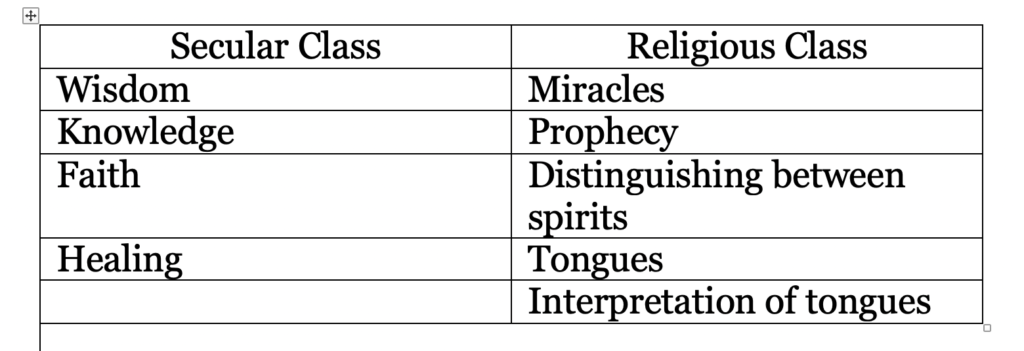
    Paul gives us a list of what these gifts are in First Corinthians 12: 7-11. They are the following:

    I know. I think some of those are still in existence in God’s church today. But if you look at them, it is more the ones that Momerie calls the secular class. The ones in what Momerie calls the religious class seem to be more hidden from us these days.

    We can determine if it is a spiritual gift by its use for expanding God’s kingdom. For example, some may become doctors for the money or the prestige. Others may feel called by God to make it their life’s work.

    Using spiritual gifts means using them for the betterment of others. God wants us to help others improve morally.

    Let’s say that a different way. We don’t get the gifts for ourselves. We receive gifts to be used for the church.

    One important thing to point out is no one has all nine of the gifts — not even Paul. I don’t remember Scriptures saying that he spoke or interpreted tongues.

    That means we have to cooperate and work together. The church must be one. “His mystical body, the Church, is like His natural body, or any of our bodies, in respect that although it is made up of many members, each having its own office, yet it is truly, strictly, mysteriously one. What makes it one, and binds it together, is the Holy Spirit of God dwelling in each person’s soul and body, to unite him truly to Jesus Christ.”

    The diversity must be acknowledged and fostered. All of God’s children must be allowed to grow their gifts and use them in the manner to which God has called them.

    One last thing. Paul noted that “a manifestation of the Spirit is given to each person …” (I Cor. 12: 12 CSB). The Spirit clearly shows us who God is. The bonus is the Spirit will never leave us. “‘And as for me, this is my covenant with them,’ says the LORD: ‘My Spirit that is upon you, and my words that I have put in your mouth, shall not depart out of your mouth, or out of the mouth of your offspring, or out of the mouth of your children’s offspring,’ says the LORD, ‘from this time forth and forevermore’” (Isa. 59: 21 ESV).

    One Body

    “For just as the body is one and has many parts, and all the parts of that body, though many, are one body — so also is Christ. For we were all baptized by one Spirit into one body — whether Jews or Greeks, whether slaves or free — and we were all given one Spirit to drink. Indeed, the body is not one part but many. If the foot should say, ‘Because I’m not a hand, I don’t belong to the body,’ it is not for that reason any less a part of the body. And if the ear should say, ‘Because I’m not an eye, I don’t belong to the body,’ it is not for that reason any less a part of the body. If the whole body were an eye, where would the hearing be? If the whole body were an ear, where would the sense of smell be?” (I Cor. 12: 12-17 CSB)

    When we were walking through Ephesians, we talked about one body. If the body is the church, baptism changed them — and us — all into one body. That baptism into one body by the Spirit brings us unity through one Lord.

    To read a related devotion, click the button below.

    Paul’s analogy using a body to describe the body of the church is fitting. Jesus is the head of the body. His church makes up the body. The church must be unified as the human body is.

    Each disciple has been assigned a job to do — someone to whom they should witness. If we do not do our jobs, the body does not grow as it should.

    We are all doing the same work — witnessing — but in different ways. I may witness through my songs and these words. You may have someone over to your house.

    The message is still the same — ABCD.

    The ABCDs of Salvation

    If you have not become a believer in Christ, please read through the
    Plan of Salvation and prayerfully consider what God is asking you to do.

    A – admit our sins
    B – believe His Son Jesus is our Redeemer
    C – confess God as Sovereign Lord

    D – demonstrate that commitment by making any changes needed in our lives to
    live the way in which God has called us

    The Disciple’s Job Description

    We can only accomplish the work that God has given us to do. He has equip us only with the skills we need.

    If we would like to have a skill our brother has, we should encourage him. If our sister’s skill is more developed than ours, we need to complement her.

    God didn’t set us up in competition. He set us up as a team.

    Regardless of our denomination, God has placed all who have admitted their sins, believed in Jesus as Savior, and confessed Him as Sovereign God in the team. That is the only admission requirement to the team.

    Team

    Making the Connections

    Yes, we all have different gifts. Get over it. God has His reasons for doing that.

    No, God doesn’t have to make us equal. No, He doesn’t have to explain Himself.

    What does God make equal? Each and every gift is important. Every gift should lead to His kingdom being expanded.

    Oh, yes. The gifts may have differing importance, but He wouldn’t accomplish what is planned if He had left even one out.

    We may think the splashy gift of tongues is more important. Liddon said it isn’t. He said teaching and prophecy is more important.

    No, God isn’t going for Hollywood splash. He would much rather we learn what we need to know to grow closer to Him.

    Robertson also out things into perspective. He wrote, “It is far more important to ascertain that a man is a Christian than what sort of Christian he is.” What our gifts are doesn’t matter. They don’t make us more of less of a disciple.

    But we need to have ABCDed.

    Why do we feel encouraging is not a gift? It is probably one that is most needed.

    Can you complement someone? Can you give a hug (once we can again)? Can you write a note? Type an email? Pat someone on the cheek?

    Making the Connections to Self-Discipline

    Some gifts we many have to keep using or we will use them. I am a first soprano. I used to could hit the high C6 and sometimes the high D6.

    Now, I struggle sometimes to hit F5. Singing harmony, I don’t even get to try to go that high.

    We have to keep ourselves disciplined when we are in between assignments to use our gifts. We can’t let them go — unless God is moving us to use a different gift.

    How does all of this tie in with witnessing? Remember Momerie’s two classes. We may have difficulty convincing a worldview person that God also presents us with the secular one. What should we do?

    We’ve been looking at defending our beliefs when we are witnessing. That means we have to be secure enough to convince someone to accept our beliefs.

    Our questions should still serve us to determine on what we need to focus.

    • What does the Scriptures say?
    • What do I believe?
    • Why do I believe the same/differently than the Scriptures?
    • What are the talking points when witnessing to a non-believer?

    Related Links

    I have created a worksheet of the questions above. Click on the button below to access it.

    How Do We Apply This?

    Liddon made a really good point. What do we do with gifts? Keep them? No, we give them away. We can’t keep the gifts for ourselves. We have to use them to teach and support others.

    What if we have high-powered gifts? What should we do? Robertson told us.

    • Be humble.
    • Have sympathy (I Cor. 12: 26)

    We have to use our gifts responsibly for God’s purposes.

    Father. You didn’t have to give us anything. You didn’t have to design the plan of salvation to restore our relationships with You. You didn’t have to give us spiritual gifts. But You did, and You do. We commit to using these gifts as You call us to use them. Amen.

    What do you think?

    Leave me a comment below (about this or anything else) or head over to my Facebook group for some interactive discussion.

    If you don’t understand something and would like further clarification, please contact me.

    If you have not signed up for the email daily or weekly providing the link to the devotions and the newsletter, do so below.

    If God has used this devotion to speak with you, consider sharing it on social media.

  • Faithful and Unfaithful Stewards

    Is it important to remain faithful while we wait for Jesus to return? This devotion looks at how the steward is faithful and unfaithful and the consequences incurred.

    Nuggets

    • Since God has given us important jobs to accomplish, we need to do our part to see them come to fulfillment.
    • We have to watch that we don’t get discouraged when Jesus doesn’t come when we think He should.
    • If we know God’s will and don’t do it, we earn the punishment we get.

    Devotions in the What I Believe series

    Devotions in the Stewardship category

    Flowers with title Faithful and Unfaithful Stewards

    In the previous devotion, we started looking at being prepared for Jesus to come as a thief in the night. This devotion looks at how we remain faithful or unfaithful as we wait.

    Let’s Put It into Context

    According to the Holman Bible Dictionary, stewardship is “utilizing and managing all resources God provides for the glory of God and the betterment of His creation.”

    Resource

    A steward is a person in a subordinate position to God who has been given the responsibility to manage resources for the purpose of expanding His kingdom.

    Who Is a Faithful Steward?

    “Peter said, ‘Lord, are You addressing this parable to us, or to everyone else as well?’ And the Lord said, ‘Who then is the faithful and sensible steward, whom his master will put in charge of his servants, to give them their rations at the proper time? Blessed is that slave whom his master finds so doing when he comes. Truly I say to you that he will put him in charge of all his possessions’” (Lk. 12: 41-44 NASB)

    You have to love Peter. He may not have been the sharpest saw in the tool shed, but He loved his Lord.

    Peter wanted to make sure he understood everything Jesus was trying to tell Him. He wasn’t afraid to ask the questions that needed to be asked. He knew Jesus didn’t think there was a dumb question.

    God does not mind us asking questions — even the big why question. Just look at Psalm 74. “Why have you rejected us forever, God? Why does your anger burn against the sheep of your pasture?” (Ps. 74: 1 CSB). David is asking a really big why.

    David was a man after God’s own heart, so God knew David wasn’t asking Him, “You said You would never leave me, and here You are gone. So, why did You break Your Word?”

    God knew David was saying, “It feels right now that You have rejected us forever, but You said You would never do that. It has to be something we did. Tell us what we did, so we can confess our sins to You.”

    God lets us ask — when we ask in faith and submission. It is when we as in anger or disbelief that God does not like us questioning Him.

    Lady praying

    To read a related devotion, click the button below.

    Because Peter was asking for clarification, Jesus answered him. But He switched terminology.

    Look back at verses 37 and 38. “Blessed are those slaves whom the master will find on the alert when he comes; truly I say to you, that he will gird himself to serve, and have them recline at the table, and will come up and wait on them. Whether he comes in the second watch, or even in the third, and finds them so, blessed are those slaves” (Lk. 12: 37-38 NASB). The King James Version called them servants.

    Here, Luke used the word we are looking at in this series — steward. “And the Lord said, ‘Who then is the faithful and sensible steward, whom his master will put in charge of his servants, to give them their rations at the proper time?’ (Lk. 12: 42 NASB).

    Remember, we said that a steward is a person in a subordinate position to God who has been given the responsibility to manage resources for the purpose of expanding His kingdom. Part of those resources could be human resources.

    Aren’t we, as disciples, called to manage human resources? We are called to proclaim the gospel and make disciples. That means dealing with people.

    The Disciple’s Job Description

    Complete Job Description

    Since God has given us important jobs to accomplish, we need to do our part to see them come to fulfillment. Parsons gave us a list.

    • We must determine what jobs God has given to us.
    • We must faithfully execute those jobs out of a sincere desire to do them.
    • We must do what we are asked to do.
    • We must consider the cost of doing God’s work.

    I think the reason why slave was used was to contrast it with the master. If we have not ABCDed and given our lives to the Master, we are a slave to sin. “Thanks be to God, who delivers me through Jesus Christ our Lord! So then, I myself in my mind am a slave to God’s law, but in my sinful nature a slave to the law of sin” (Rom. 7: 25 NIV).

    The ABCDs of Salvation

    If you have not become a believer in Christ, please read through the
    Plan of Salvation and prayerfully consider what God is asking you to do.

    A – admit our sins
    B – believe His Son Jesus is our Redeemer
    C – confess God as Sovereign Lord

    D – demonstrate that commitment by making any changes needed in our lives to
    live the way in which God has called us

    The Disciple’s Job Description

    Even if a steward is a class above a slave, the steward is still subordinate to God. God is Master of both.

    The important thing is that the steward and the slave be found to be doing what God has for him or her to do. Blessed are the obedient.

    Girl praying

    Who Is an Unfaithful Steward?

    “But if that slave says in his heart, ‘My master will be a long time in coming,’ and begins to beat the slaves, both men and women, and to eat and drink and get drunk; the master of that slave will come on a day when he does not expect him and at an hour he does not know, and will cut him in pieces, and assign him a place with the unbelievers. And that slave who knew his master’s will and did not get ready or act in accord with his will, will receive many lashes, but the one who did not know it, and committed deeds worthy of a flogging, will receive but few. From everyone who has been given much, much will be required; and to whom they entrusted much, of him they will ask all the more” (Lk. 12: 45-48 NASB)

    Ooo, baby. Then things went wrong.

    I don’t know if the servant gets tired of waiting. Maybe the servant starts getting an elevated ego.

    The end game is still the same. There is violence and drunkenness.

    We have to watch that we don’t get discouraged when Jesus doesn’t come when we think He should. Our charge was to watch until He came.

    Worse yet, we should not devolve into sin because Jesus has not come. We should not consciously sin.

    Oh, yes. We are still in this physical, sinful body, so we will continue to sin. It should not be our choice to do so. We should choose God.

    There will be consequences for those who consciously sin against God. “And that slave who knew his master’s will and did not get ready or act in accord with his will, will receive many lashes, but the one who did not know it, and committed deeds worthy of a flogging, will receive but few …” (Lk. 12: 47-48 NASB).

    Yes, disciples who are not found waiting will receive more of a punishment than non-believers who are not found waiting. Why?

    Let’s try to process this a second. We’ve said before that the end of the world is not going to happen until everyone has had a chance to make a choice to ABCD or not. “When the good news about the kingdom has been preached all over the world and told to all nations, the end will come” (Mt. 24: 14 CSB).

    If they will have heard, how can they be ignorant?

    Tillotson tried to explain it. He wrote, “There is an ignorance which doth wholly excuse and clear from all manner of guilt, and that is an absolute and invincible ignorance, when a person is wholly ignorant of the thing, which, if he knew, he should be bound to do, but neither can nor could have helped it, that he is ignorant of it; that is, he either had not the capacity, or wanted the means and opportunity, of knowing it. In this case a person is in no fault, if he did not do what he never knew, nor could know to be his duty.”

    I said tried.

    What I got out of that is this.

    • If someone is totally, totally ignorant of something, they get a pass.
    • There was something beyond his control preventing him from obedience.
    • There is a mental deficiency so he does not have the capacity to be obedient.
    • He does not have the necessitates and occasions of knowing it.

    What I think this is getting at is not salvation. Salvation is deliverance from evil and the consequences of sins to replace them with eternal life and good.

    Look back at Luke 12: 37. “Blessed are those slaves whom the master will find on the alert when he comes; truly I say to you, that he will gird himself to serve, and have them recline at the table, and will come up and wait on them” (Lk. 12: 37 NASB). These are slaves that had ABCDed.

    I read this to say that those who have experienced conversion but then turn their backs on God will be judged harsher than those who have never experienced conversion in the first place.

    It may mean non-believers choosing not to follow God. But they would already be receiving the consequences of their choice — eternity in hell. They did not “[know] his master’s will and did not get ready or act in accord with his will …” (Lk. 12: 47 NASB).

    The only other thing I can think about what this is talking about is that God hasn’t had a chance to reveal it yet. We’ve said before that God only totally reveals Himself to His children. He does this over time, as we can learn and accept things.

    To read a related devotion, click the button below.

    Glossary

    God isn’t going to hold it against us if He hasn’t revealed it to us yet.

    Bottom line for me is that the servant knew God’s will and didn’t do it. They earned the punishment they will get.

    If we know God’s will and don’t do it, we earn the punishment we get.

    The worldview people have a problem with this. This flies right in the face of their ability to make their own choices.

    Oh, God lets them make their own choice. They are just going to suffer the consequences for making wrong choices. As we are all God’s creation, we will all be judged.

    It is all about being held accountable for our choices and actions. God can — and will — hold us accountable. We are responsible for the gifts God has given us.

    Making the Connections

    However long Jesus takes in returning should have no bearing on our obedience. We need to remain obedient always.

    I love how Cox described the faithful servants being obedient. He wrote, “But, however long he delayed his coming, they kept a keen look-out for him. When night fell, instead of barring up the house and retiring to rest, they girt up their long outer robes, that they might be ready to run out at any instant to greet him; they kindled their lamps, that they might run safely, as well as swiftly, on his errands. They even prepared a table for him; for, though he was coming from a feast, he may have had to ride far and long, and, in any case, a little fruit and a cup of pure water or of generous wine might be very acceptable to him.”

    They did everything like he was already there. We have to operate like Jesus will be returning right now — if not He is here already.

    That mindset should impact how we use the gifts God has given us. It should direct our lives.

    Making the Connections to Self-Discipline

    If we are looking at stewardship as a ministry, we can see where we need self-discipline. We will undoubtedly need practice in using and managing this ministry. This is especially true since it will involve interacting with others.

    We’ve been looking at defending our beliefs when we are witnessing. That means we have to be secure enough to convince someone to accept our beliefs.

    Our questions should still serve us to determine on what we need to focus.

    • What does the Scriptures say?
    • What do I believe?
    • Why do I believe the same/differently than the Scriptures?
    • What are the talking points when witnessing to a non-believer?

    Related Links

    I have created a worksheet of the questions above. Click on the button below to access it.

    How Do We Apply This?

    The Preachers’ Analyst reminded us — once again — the expectations God has for stewards.

    • Faithful
    • Repentant
    • Working to advance the kingdom
    • Working through personal sanctification
    • Doing all through love

    Gray said we do that through prayer, being consistent, and being patient.

    Oh, yes. This is important. Look what Cox had to say.

    “It comes at least to this: that, somewhere in the future, there is to be a better world than this — a world more wisely and happily ordered, a world in which all that is now wrong will be righted, a world of perfect beauty and growing righteousness”

    Because — ready or not — Jesus is coming again. Not everyone will be invited into that new world.

    Will you? Are you ready?

    Father. Thank You for choosing us. We choose You to be our Lord and Savior. Help us to be faithful. Amen.

    What do you think?

    Leave me a comment below (about this or anything else) or head over to my Facebook group for some interactive discussion.

    If you don’t understand something and would like further clarification, please contact me.

    If you have not signed up for the email daily or weekly providing the link to the devotions and the newsletter, do so below.

    If God has used this devotion to speak with you, consider sharing it on social media.

  • Stewards Who Are Ready

    Another time Jesus called us stewards was when He was giving a parable about watching for the second coming. This devotion looks at how we are to be prepared for Jesus to come as a thief in the night.

    Nuggets

    • If we are focusing on what is coming tomorrow instead of the chaos today, then we can prepare for His coming.
    • We also have to prepare by living for Christ.
    • We can only enter heaven when we are like God.

    Devotions in the What I Believe series

    Devotions in the Stewardship category

    Faithful and Unfaithful Stewards
    A Steward Gone Bad

    Flowers with title Stewards Who Are Ready

    As stewards, we are to be managing God’s activities here on earth. We know that there will be a completion date for those activities.

    That will occur with Jesus’ second coming. Stewards have been instructed to be ready for His return.

    In this devotion, we will start looking at being prepared for Jesus to come as a thief in the night. Since it got too long, the next devotion will be looking at how we remain faithful or unfaithful as we wait.

    Let’s Put It into Context #1

    According to the Holman Bible Dictionary, stewardship is “utilizing and managing all resources God provides for the glory of God and the betterment of His creation.”

    Resource

    A steward is a person in a subordinate position to God who has been given the responsibility to manage resources for the purpose of expanding His kingdom.

    Let’s Put It into Context #2

    “For where your treasure is, there your heart will be also” (Lk. 12: 34 NASB)

    Jesus had just been talking to the disciples about anxiety. It is really easy to get worried about something of which we don’t know the outcome.

    Instead of worry, we should remember God’s provision. “Consider how the wildflowers grow: They don’t labor or spin thread. Yet I tell you, not even Solomon in all his splendor was adorned like one of these” (Lk. 12: 27 CSB).

    Many would say that Jesus had a radical approach to eliminating worry. “Sell your possessions and give to the poor. Make money-bags for yourselves that won’t grow old, an inexhaustible treasure in heaven, where no thief comes near and no moth destroys” (Lk. 12: 33 CSB).

    Jesus was telling us to put it into perspective. We shouldn’t focus on this world, which is temporary. We need to focus on eternity.

    To read a related devotion, click the appropriate button below.

    Let’s Put It into Context #3

    “Therefore be alert, since you don’t know what day your Lord is coming. But know this: If the homeowner had known what time the thief was coming, he would have stayed alert and not let his house be broken into. This is why you are also to be ready, because the Son of Man is coming at an hour you do not expect” (Mt. 12: 42-44 CSB)

    Luke doesn’t really tell us the parable. Matthew did in Matthew 24: 42-44. This is all wrapped up in Jesus’ explaining to the disciples what the end times would be like.

    Matthew gave us the parable. Luke gave us the application.

    We’ve talked about a lot in the rest of Matthew 24. But we didn’t address these verses.

    To read devotions in the How Do We Know If We Don’t Know series, click the appropriate button below.

    Be Prepared

    “Be dressed in readiness, and keep your lamps lit. Be like men who are waiting for their master when he returns from the wedding feast, so that they may immediately open the door to him when he comes and knocks. Blessed are those slaves whom the master will find on the alert when he comes; truly I say to you, that he will gird himself to serve, and have them recline at the table, and will come up and wait on them. Whether he comes in the second watch, or even in the third, and finds them so, blessed are those slaves” (Lk. 12: 35-38 NASB)

    First off, we have to talk about the wedding. It wasn’t like the weddings to which I am used to attending. Those, we go for a couple of hours, and we’re done.

    That isn’t what Jesus is talking about here. Cox explained it when he wrote, “The festivities connected with an Eastern marriage were spread over many days, a week at least, sometimes a month. All the friends of the family were expected to put in an appearance, but only a select few remained to the end. The rest might come and go at any hour, on any day, that suited their convenience or pleasure.”

    If we are focusing on what is coming tomorrow instead of the chaos today, then we can prepare. We don’t have to be caught off guard.

    This all ties in with being watchful. Watchfulness is a continual conscious examination of ourselves and events so that we may follow God in all things.

    We’ve talked about being watchful a number of times. We have to watch not only for when Satan tries to tempt us, but also for our opportunities to serve and the blessings God gives us. We have to watch the kind of company we are keeping.

    Most importantly, disciples must remain alert to watch for Jesus’ return, not knowing when that will be. That is what Jesus was talking about in this passage, too.

    To read a related devotion, click the appropriate button below.

    Jesus knew He was going to go away, but He knew He was coming back again. He was trying to prepare His disciples — and us — for His return.

    When we know something is coming, it is easier to prepare. When Mom was going through her cancer treatments, the chemo was harder on her because she had the radiation first. Long story short, she ended up asphyxiating and going into a comma.

    Mom came out of it fine, but we thought we were going to lose her then. As bad as it was then, that helped us prepare for when she actually passed.

    Dad, on the other hand, got up one morning thinking he had the flu. It ended up being a mild heart attack. The thing was, six hours after Mom called me to tell me he was okay but in the hospital, he had a big one and died. Nope, I wasn’t prepared for that.

    Jesus told us the future so that we can be prepared. We have to prepare in a couple of different ways.

    We need to fix our status of being spiritually dead. Spiritual death is the separation from God that occurred as a consequence of Adam and Eve’s original sin.

    The only way we can do that is if we want spiritual life. The spiritually alive are those who have ABCDed.

    The ABCDs of Salvation

    If you have not become a believer in Christ, please read through the
    Plan of Salvation and prayerfully consider what God is asking you to do.

    A – admit our sins
    B – believe His Son Jesus is our Redeemer
    C – confess God as Sovereign Lord

    D – demonstrate that commitment by making any changes needed in our lives to
    live the way in which God has called us

    The Disciple’s Job Description

    We also have to prepare by living for Christ. Even though we are changed to being spiritually alive at conversion, we still have the capacity to sin.

    Spurgeon addressed it this way. He wrote, “… even if a man’s sins are pardoned, he would not be prepared to die if his nature were not renewed.”

    That is why we go through sanctification. Sanctification is the transformation of mind, body, and soul beginning with regeneration and ending with perfected state of spiritual wholeness or completeness.

    If we aren’t on the sanctification road, we aren’t trying to change our character to be more like God — holy and righteous. Holy means to be set apart, perfect, and pure. Righteousness is the result of a solid relationship with God built by a sincere life of conscientious obedience to God’s laws and commandments.

    We can only enter heaven when we are like God. “But nothing unclean will ever enter it, nor anyone who does what is detestable or false, but only those who are written in the Lamb’s book of life” (Rev. 21: 27 ESV).

    No, we are not currently like God and won’t be on this earth. That is why Paul wrote, “Listen, I am telling you a mystery: We will not all fall asleep, but we will all be changed, in a moment, in the twinkling of an eye, at the last trumpet. For the trumpet will sound, and the dead will be raised incorruptible, and we will be changed” (I Cor. 15: 51-52 CSB). We have to be prepared for Heaven.

    We have to give evidence that we are putting our trust in God that He will change us to how we need to be. Trust is assurance that the promises of God are true.

    The watchfulness has to be motivated by the love of the Lord. We have to want to be like Him.

    We also have to feel the expectation along with the watchfulness. We have to have a certainly that Jesus is coming.

    Jesus

    As a Thief

    “But be sure of this, that if the head of the house had known at what hour the thief was coming, he would not have allowed his house to be broken into. You too, be ready; for the Son of Man is coming at an hour that you do not expect” (Lk. 12: 39-40 NASB)

    We think we would be more prepared if we knew the actual date and time of Jesus’ return. But would we really?

    Can we spell p-r-o-c-r-a-s-t-i-n-a-t-i-o-n?

    Jesus compared His coming to that of a thief in the night. But we lock our doors at night, don’t we, in order to deter said thief from gaining entrance?

    But we also lock our door during the day to deter said thief’s brother from the same thing.

    Carr made an interesting point. He reminded us that we live in the dark of the night until we are introduced to Jesus as the Light.

    The promptings of the Holy Spirit call us out of the dark into the light. Once we ABCD and are in Christ, we are in the light.

    Glossary

    How Jesus finds us watching will determine whether we are happy about His return or not. But that is consequences based on the decision we make on our own.

    We will either be faithful or unfaithful stewards when Jesus returns. That will be the topic of discussion in the next devotion.

    Father. You are a loving Father. You devised a plan of salvation so that we could be restored to You. That plan called for the death and resurrection of Your Son to pay for our sins. Soon, He will return to call us home. We long for that day. Lord, may He find us watching for Him, faithfully performing the duties You have given us. Amen.

    What do you think?

    Leave me a comment below (about this or anything else) or head over to my Facebook group for some interactive discussion.

    If you don’t understand something and would like further clarification, please contact me.

    If you have not signed up for the email daily or weekly providing the link to the devotions and the newsletter, do so below.

    If God has used this devotion to speak with you, consider sharing it on social media.

  • Learning to be a New Creation

    We’ve talked before about becoming a new creation when we make a profession of faith. But how do we do that? This change is brought about by our learning about God. This devotion explores putting off our former self, renewing the spirit of our minds, and putting on a new self.

    Nuggets

    • When we search for Christ, we learn about Him.
    • Knowing Jesus has to change us.
    • We search for and seek Him in the same way.
    • Putting on the new self is a lifetime process.

    Devotions in the What I Believe series

    Devotions in the Religious Education category

    Flowers with title Learning to be a New Creation

    Yeah! My new computer got here today. Okay, it is still in the box right now, but it is here. Pretty soon, I am going to have a computer that is not trying to audition as a disco ball in a 70s movie.

    Plus, I got an email from tech support. Hopefully, tomorrow’s devotion will be back to normal. I am really missing giving you the buttons so you can drill back to resources and previous posts.

    (NOTE: I was able to update this post once my issues were fixed.)

    What Have We Been Talking About?

    What is the purpose of education? The Holman Bible Dictionary wrote, “The primary purpose of education among the Jews was the learning of and obedience to the law of God, the Torah.”

    Resource

    To me, religious education is instruction to teach us about the Plan of Salvation and the character of God, in order to build relationships so that we can imitate Him.

    Worship is our personal or corporate response (confession, thanksgiving, praise, etc.) based on our attitude to God’s presence. Praise is also our response to God, but it usually involves music.P

    Let’s Get Started

    We recently talked about being a new creation. We said that we have to believe in Jesus to become a new creation.

    To read a related devotion, click the button below.

    We’ve look at this passage before. We talked about it as regeneration. We’ve looked at it as renewing our minds.

    To read a related devotion, click the appropriate button below.

    But God doesn’t just flip a switch, and we are that new creation. It takes work on our part. That work is done as we learn Who God is and what He wants us to be.

    Let’s take a look.

    Beginning Instruction

    “But that is not how you came to know Christ, assuming you heard about him and were taught by him, as the truth is in Jesus” (Eph. 4: 20-21 CSB)

    When we search for Christ, we learn about Him. We have to hear His Word, read it, study it, meditate on it, and memorize it. All through that, we need to be in prayer, asking God to provide the meaning.

    As we are pulling in all this new information, we have to decide if we are going to believe it. We have to determine if we believe what we read and hear is the truth.

    Yes, Jesus said He is the Truth. “Jesus answered, ‘I am the way and the truth and the life. No one comes to the Father except through me’” (Jn. 14: 6 NIV).

    But what exactly is truth in the Scriptures? The Holman Bible Dictionary indicated that “The essential idea of truth in the Bible is not conformity to some external standard but faithfulness or reliability.”

    Resource

    That is saying, to me, that we have to have faith that the Scriptures are true. Faith is the belief that the doctrines stated in God’s Word are true, even if we do not understand all aspects of them.

    The worldview standard is we — or someone we respect like a scientist — have to understand what is being presented. It also is based on a morality of tolerance to sin.

    When we come to know Jesus, we are called to abandon our previous sinful life. We are to embrace God’s laws and commandments.

    Dale reminded us that we do not do that on our own. He wrote, “The ethical change was not to be partial, but complete. But this complete moral revolution is not accomplished either by one supreme effort of our own will, or by any momentary shock of Divine power. It is a lifelong and painful process.”

    Resource

    But isn’t part of the problem our expectations? We think we just have to learn the ritual and the rules, and we’ll be good to go. We don’t realize that just learning it is not enough.

    Spurgeon gave us a list of the forms of knowledge we have to access. He advised we need to know the following:

    • Jesus as our personal Savior.
    • His nature.
    • His position of authority, so we can give Him the honor due Him
    • How He completed the plan of salvation for us.
    • The nature of His influence over us.
    • Know Him we’ll enough to imitate Him.

    Resource

    We learn about Jesus. In other words, we get to know Him. We establish a relationship.

    But this isn’t something we can learn on our own. We can only come to God when He sends the Holy Spirit to call us. “For no one can come to me unless the Father who sent me draws them to me, and at the last day I will raise them up” (Jn. 6: 44 NLT). He is going to reveal Himself to us.

    It is fairly easy to make a profession of faith. Well, it is easy to say the words. The next step is a kicker.

    Dealing with the Old

    “to take off your former way of life, the old self that is corrupted by deceitful desires” (Eph. 4: 22 CSB)

    Like we said, knowledge isn’t enough. Jesus has to change us. We need to divest ourselves of what used to be.

    Don’t worry. God will show us what needs to be changed.

    No, God won’t bop us over the head — unless we need it. He will correct us through love. Bayne assured us that “faith works by love …”

    Resource

    What are we taking off? We are divesting ourselves of our corrupt nature of sin. No, we won’t be able to totally do that. But we have to strive to follow God’s laws and commandments.

    What God has said is a sin is a sin. We can’t contradict Him or negotiate. We have to submit to our Creator. We are changing our character that does not fit with God’s.

    We are giving up our sinful habits. We have to mortify our sins. Mortify means to place a death penalty on our sins.

    Glossary

    Watkinson cautioned that this renunciation must be complete. He wrote, “The purity demanded of us is inward, spiritual, moral.” We can’t hold on to our pet sin.

    Resource

    Sounds like a difficult task, doesn’t it? Dale gave us a couple of hints on how to do that.

    • Self-evaluation to look for our sins and weaknesses
    • Self-discipline to correct what we find wrong

    Resource

    Oh, yes. Every part of us will need to go under God’s microscope to make sure all sin has been cut out.

    And oh, yeah. We will probably be our own worst enemy.

    Don’t worry. That is a lifetime, progressive process called sanctification. Sanctification is the transformation of mind, body, and soul beginning with regeneration and ending with perfected state of spiritual wholeness or completeness.

    Glossary

    Switch!

    “to be renewed in the spirit of your minds” (Eph. 4: 23 CSB)

    This is where the actual change takes places.

    How do we facilitate that change? We have to:

    • Hear His Word: “So faith comes from hearing, that is, hearing the Good News about Christ” (Rom. 10: 17 NLT).
    • Read His Word: “Blessed is the one who reads aloud the words of this prophecy, and blessed are those who hear, and who keep what is written in it, for the time is near (Rev. 1: 3 ESV).
    • Pray to Him: “Let us then with confidence draw near to the throne of grace, that we may receive mercy and find grace to help in time of need” (Heb. 4: 16 ESV).
    • Study His Word: “They searched the Scriptures day after day to see if Paul and Silas were teaching the truth” (Ac. 17: 11 NLT).
    • Meditate on His Word: “Blessed is the man who walks not in the counsel of the wicked, nor stands in the way of sinners, nor sits in the seat of scoffers; but his delight is in the law of the Lord, and on his law he meditates day and night. (Ps. 1: 1-2).
    • Memorize His Word: “I have hidden your word in my heart, that I might not sin against you” (Ps. 119: 11 NLT).

    Yes, we said earlier that this is how we search for God. We search for and seek Him in the same way. We do these activities to establish and grow our relationships with Him.

    Eadie pointed out something I hadn’t caught before. Where does verse 23 say we are to be renewed? “… in the spirit of your minds” (Eph. 4: 23 CSB). How is “in the spirit of your minds” different from “in our minds”?

    When Eadie explained it, it was understandable. He wrote, “The organism of the mind survives as it was, but the spirit which inhabits and governs it is entirely changed.” That makes sense. What we do with our minds is changed.

    Resource

    Welcoming the New

    “and to put on the new self, the one created according to God’s likeness in righteousness and purity of the truth” (Eph. 4: 24 CSB)

    Putting on the new self is a lifetime process. We don’t get the new self immediately. We only get it at the end of the sanctification road.

    What we get is continual instruction from Jesus. Maclaren wrote, “His teaching is not one act, but a long, patient discipline.”

    Resource

    Watkinson discussed some obstacles disciples run into sometimes. There are times we are disappointed with our lives. He also stated that disciples can possess poverty of character. Our old character must be replaced with character representing God.

    We talked about poverty of spirit in How Are Disciples Docile?. We said it is really about knowing we are nothing without God. Poverty of character would be something similar. We don’t possess God’s character.

    When we are putting on a new self, we should choose things that imitate God. Watkinson wrote, “We are to aspire to a Divine moral likeness, to be ‘perfect, even as our Father who is in heaven is perfect.’”

    Resource

    To read a related devotion, click the button below.

    What new things are we supposed to welcome?

    • New thoughts
    • New habits
    • New motivations
    • New character
    • New preferences
    • New opinions
    • New likes

    Making the Connections

    Oh, yeah. Making the profession of faith is easy. Sanctification is a long, difficult, painful process.

    But it is worth it. Allen wrote, “Those who learn Christ properly, to the salvation of their souls, learn the WORTH of Christ.”

    Making the Connections to Self-Discipline

    We’ve been looking at defending our beliefs when we are witnessing. That means we have to be secure enough to convince someone to accept our beliefs.

    Our questions should still serve us to determine on what we need to focus.

    • What does the Scriptures say?
    • What do I believe?
    • Why do I believe the same/differently than the Scriptures?
    • What are the talking points when witnessing to a non-believer?

    Related Links

    I have created a worksheet of the questions above. Click on the button below to access it.

    How Do We Apply This?

    • We have to learn from the Holy Spirit, not the world.
    • We’ve got to change to imitate Him.
    • Wilmot-Buxton wrote that we have to conquer ourselves.

    The whole purpose of our learning is so that we progress on the sanctification road and become more like Jesus. We have to follow the promptings of the Holy Spirit as He teaches us about Jesus. Then, we will get our well-done-good-and-faithful-servant (Mt. 25: 21) at the appropriate times.

    Father. We can’t wait until the day we see You face to face. Help us in our walks so that we remain firmly on the sanctification road. We look forward to hearing You say, “Well done.” Amen.

    What do you think?

    Leave me a comment below (about this or anything else) or head over to my Facebook group for some interactive discussion.

    If you don’t understand something and would like further clarification, please contact me.

    If you have not signed up for the email daily or weekly providing the link to the devotions and the newsletter, do so below.

    If God has used this devotion to speak with you, consider sharing it on social media.
  • Learning about Jesus from the Holy Spirit

    If Jesus is the Master Teacher, what content are we learning? How does the Holy Spirit fit into the mix? This devotion looks at how much Jesus taught us (or didn’t) and how the Holy Spirit helps fill the gaps.

    Nuggets

    • Jesus knew we could only take so much at once.
    • Jesus did mostly do His teaching in groups, but He realized that believing is personal.
    • The Holy Spirit can personalize our learning.
    • Both the Old and New Testament center on Jesus — His coming, His work here, and His second coming.

    Devotions in the What I Believe series

    www.seekinggodwithelaine.com/what-i-believe

    Devotions in the Religious Education category

    What Is Religion Instruction (www.seekinggodwithelaine.com/what-is-religious-instruction)
    Jesus as a Teacher (www.seekinggodwithelaine.com/jesus-as-a-teacher)
    Learning about Jesus from the Holy Spirit
    Learning to be a New Creation
    Using Worship to Educate Our Thoughts

    I was so hoping that my technology problems would have been fixed by now. Unfortunately, I think the update that was pushed through last week blew up on many more people than just me. I know for me, this is much harder for me to read. I can’t wait to get back to normal. Thank you for your patience.

    In the last devotion, we talked about Jesus being a Master Teacher from whom we could learn. But He is more than that, isn’t He?

    Jesus is the subject matter we are to study. Luckily, we have another Teacher to aid us.

    Let’s Put It into Context

    What is the purpose of education? The Holman Bible Dictionary wrote, “The primary purpose of education among the Jews was the learning of and obedience to the law of God, the Torah.”

    Resource
    Holman Bible Dictionary’s definition of Education in Bible Times
    https://www.studylight.org/dictionaries/hbd/e/education-in-bible-times.html

    To me, religious education is instruction to teach us about the plan of salvation and the character of God, in order to build relationships so that we can imitate Him.

    Did Jesus Teach Us Everything?

    “I still have many things to say to you, but you cannot bear them now. When the Spirit of truth comes, he will guide you into all the truth, for he will not speak on his own authority, but whatever he hears he will speak, and he will declare to you the things that are to come” (Jn. 16: 12-13 ESV)

    Wait! What? Jesus didn’t teach us everything we need to know????

    Okay, let’s start off by seeing what Jesus did teach. Liddon wrote, “Our Lord spoke about Himself, His sinlessness, His claims upon human thought and human affection, His power of enlightening and saving human beings, His future coming to judge all human beings …” That makes sense. He talked about being Savior of the world.

    Resource
    Liddon’s Divine Teaching Gradual
    https://biblehub.com/sermons/auth/liddon/divine_teaching_gradual.htm

    Liddon also gave us another list of nuggets from Jesus’ teachings.

    Politics shouldn’t lose morality.
    Duties are more important than rights.
    Impurity brings ruin.
    Righteousness is the road to success.

    Resource
    Liddon’s Christ’s Gradual Teaching by His Providence
    https://biblehub.com/sermons/auth/liddon/christ’s_gradual_teaching_by_his_providence.htm

    It took Paul, in Romans, to really flesh out what the plan of salvation is and compare grace and the law. That wasn’t going to happen in an oral presentation. It needed to be written down and digested.

    Coupled with that is the fact that the Holy Spirit hadn’t come yet. I know, I know. Jesus was right there in front of their eyes. You would think that would be enough.

    We’ve talked before about the role of the Holy Spirit. “But the Counselor, the Holy Spirit, whom the Father will send in my name, will teach you all things and remind you of everything I have told you” (Jn. 14: 26 CSB). The Spirit will help us put it all together.

    To read Holy Spirit in the glossary, access www.seekinggodwithelaine.com/holy-spirit-glossary

    But that still doesn’t answer the question as to why Jesus didn’t teach everything. We have to look at verse 12 to see the reason. “I still have many things to say to you, but you cannot bear them now” (Jn. 16: 12 ESV).

    Jesus knew we could only take so much at once. He was well aware that sanctification is a process.

    To read Sanctification in the glossary, access www.seekinggodwithelaine.com/sanctification-glossary

    Liddon put it this way. He wrote, “He taught men gradually, and as they were able to bear the strong light of His doctrine, because He loved men too well to shock or blind them by a sudden blaze of truth, for which they were as yet unprepared.”

    Sanctification is a life-time process. It isn’t something that can be rushed. God’s ways are occasionally polar opposite to the world’s ways.

    Resource
    Liddon’s Divine Teaching Gradual
    https://biblehub.com/sermons/auth/liddon/divine_teaching_gradual.htm

    Resource
    Liddon’s Christ’s Gradual Teaching in the Church
    https://biblehub.com/sermons/auth/liddon/christ’s_gradual_teaching_in_the_church.htm

    Jesus also knew that we would have to revisit some lessons over and over. Let’s face it. His ministry was only three years long. He had a lot of ground to cover and a short time to get there. While He constantly had audiences of people who had never heard the gospel story, He didn’t have time for some repetition.

    The Holy Spirit Gets the Job Done

    “When the Spirit of truth comes, he will guide you into all the truth. For he will not speak on his own, but he will speak whatever he hears. He will also declare to you what is to come. He will glorify me, because he will take from what is mine and declare it to you. Everything the Father has is mine. This is why I told you that he takes from what is mine and will declare it to you” (Jn. 16: 13-15 CSB)

    Liddon also gave us another reason the Holy Spirit was needed. We’ve talked before how believing is all in the mind.

    To read How Can We Corral Our Thoughts?, access www.seekinggodwithelaine.com/how-can-we-corral-our-thoughts

    Resource
    Liddon’s Teaching Should be Adapted to the Condition of the Mind
    https://biblehub.com/sermons/auth/liddon/teaching_should_be_adapted_to_the_condition_of_the_mind.htm

    That shows us the individuality of our relationships with God. Yes, Jesus did mostly do His teaching in groups. But He realized that believing is personal.

    That doesn’t even get into our differing capacities to learn. I once used a fictional example of Tom’s and my differing abilities to do economics.

    To read How Are We to Be Inclusive in Our Worship?, access www.seekinggodwithelaine.com/how-are-we-to-be-inclusive-in-our-worship

    Some of us may be able to understand certain aspects better than others. It doesn’t mean one person is better than another. It means we have differing mental capacities.

    The Holy Spirit can personalize our learning. He can spend the time with us that we need to learn.

    Teaching is all about condition. Learners have to be in the right condition to learn, but learning is also about conditioning. Conditioning takes time.

    What? Are you questioning my use of the word conditioning. But isn’t that what the sanctification road is — a process of training us to improve?

    Six paragraphs ago, we said that God’s ways are opposite to the world’s ways. We have to train ourselves to operate under His ways. God’s ways are different at minimum, scary at a maximum.

    What all is the Holy Spirit telling us?

    • Truth (verse 13)
    • The future (verse 13)
    • What is Jesus’ (verse 14)

    That is a lot. Parker wrote, “All that we know of truth, holiness, destiny, we know directly or indirectly from Christ.”

    Resource
    Parker’s Human Capacity the Measure of Divine Communication
    https://biblehub.com/sermons/auth/parker/human_capacity_the_measure_of_divine_communication.htm

    The only way we are going to get all of that is walking with the Spirit. Walking is the term used to describe how we live our lives. It is going to take a while.

    That is the Spirit’s mission: showing us Christ.

    What We Are Taught

    Let the word of Christ dwell richly among you, in all wisdom teaching and admonishing one another through psalms, hymns, and spiritual songs, singing to God with gratitude in your hearts” (Col. 3: 16 CSB)

    The Word of Christ is the Scriptures. Both the Old and New Testament center on Him — His coming, His work here, and His second coming.

    Look at John 1: 1. “In the beginning was the Word, and the Word was with God, and the Word was God” (Jn. 1: 1 KJV). That is the textbook that the Holy Spirit uses to teach us.

    What do we do with this Word? “I have stored up your word in my heart, that I might not sin against you” (Ps. 119: 11 ESV). We have to use it to transform our character so that we are imitating God.

    To read Imitate in the glossary, access www.seekinggodwithelaine.com/imitate-glossary

    I love how Sydnor put it. He wrote, “Let it dwell in you. It is not enough that it be in our house, study, pocket, and so at hand. It must be in our heart, pervading our whole spiritual nature, directing and controlling all our life and conduct.”

    Resource
    Sydnor’s The Word of Christ
    https://biblehub.com/sermons/auth/sydnor/the_word_of_christ.htm

    To read Heart in the glossary, access www.seekinggodwithelaine.com/heart-glossary

    What does it mean when it says “… dwell richly among you …” (Col. 3: 16 CSB)? Candlish wrote that it had to be used as a fertilizer.

    Resource
    Candlish’s The Indwelling Word of Christ
    https://biblehub.com/sermons/auth/candlish/the_indwelling_word_of_christ.htm

    Now, when I was younger, my family went to a customer appreciation thingy, where I won the door prize of having fertilizer spread on 25 acres for free. (I traded Dad for the plastic pitcher and four tumblers that he won. Can we say I got the short end of the deal?)

    The fertilizer, when applied to plants, helps them grow. The chemicals replace the nutrients that are washed away by the rains.

    Ooo, baby! What washes away our obedience to God? Sin.

    And you know what they say. When it rains, it pours. Satan tries to flood us, so we take our eyes off God and drown.

    The Word of Christ is to teach us how to live for Christ. This instruction can come through psalms, hymns, and spiritual songs.

    To read How Does Wisdom Lead to Praise?, access www.seekinggodwithelaine.com/how-does-wisdom-lead-to-praise

    Making the Connections

    Even though Jesus didn’t teach everything while He was here, we can’t think that He added to it. The opposite is true. “Beloved, although I was very eager to write to you about our common salvation, I found it necessary to write appealing to you to contend for the faith that was once for all delivered to the saints” (Jude 1: 3 ESV).

    We’ve talked before about God revealing Himself more fully to us after we make a profession of faith. God reveals the meat of His Word only to His children. “For what seems to be God’s foolishness is wiser than men’s wisdom, and what seems to be God’s weakness is stronger than men’s strength” (I Cor. 1: 25 TEV).

    To read Why Should We Study the Scriptures?, access www.seekinggodwithelaine.com/why-shold-we-study-the-scriptures
    To read How Do We Renew Our Minds?, access www.seekinggodwithelaine.com/how-do-we-renew-our-minds

    All in all, we have to remember what the purpose of teaching is. Yes, it is to get us to where we will make the profession of faith. But it is also so we can grow in grace and knowledge (II Pet. 3: 18).

    We have to be growing closer to God. He is looking for sincere disciples.

    To read What Do You Mean All Disciples Won’t Get into Heaven?, access www.seekinggodwithelaine.com/what-do-you-mean-all-disciples-wont-get-into-heaven

    Making the Connections to Self-Discipline

    I have to admit, it was kind of a kick when I first read that Jesus didn’t teach us everything while He was here.

    We’ve been looking at defending our beliefs when we are witnessing. That means we have to be secure enough to convince someone to accept our beliefs.

    Our questions should still serve us to determine on what we need to focus.

    • What does the Scriptures say?
    • What do I believe?
    • Why do I believe the same/differently than the Scriptures?
    • What are the talking points when witnessing to a non-believer?

    Related Links
    I have created a worksheet of the questions above. Access it through https://seekinggodwithelaine.com/what-i-believe-worksheet

    How Do We Apply This?

    Repetition is a good thing. Once and done is gone in my mind. (Yep, that is one reason I repeat myself.)

    We have to talk our learner’s language. When I was getting my Bachelor’s degree, I was in class with one of my coworkers. Sally was having a really difficult time understanding the concepts. At one point, I stopped the instructor, turned to her, and said, “Remember when we were in that meeting and discussing this (and explained it in the language we used in the meeting)? That is what the professor is talking about.” She asked some questions, which I answered. She understood the concepts, then. Everyone in the room was looking at me, and I said, “What? I talk Sally.”

    We have to connect with the learner in their language, based on where they are at in their lives. No, not to stay there. Our goal is to grow them to where God wants them to be.

    As we teach others, we have to remember it really isn’t us doing the teaching. The Holy Spirit is talking Fred.

    Jesus was not only the Teacher, but He was also the subject matter. We are taught and assisted by the Holy Spirit.

    Father God. We choose to imitate Jesus. We want to know Him better and teach His ways to others. Thank You for sending the Holy Spirit to teach us and assist us. Lord, we pray that we do our part in leading others to You. Amen.

  • Jesus as a Teacher

    Wouldn’t it be nice if, when we began to teach other abouts God, we had a mentor who had already been a teacher? We do. This devotion looks at how we can imitate Jesus’ teaching.

    Nuggets

    • Jesus was sent to earth by God to accomplish the plan of salvation and to pay the penalty for our sins.
    • Everything Jesus did was for the glory of God.
    • Jesus was filled with the Holy Spirit.
    • We are to proclaim the gospel.
    • Jesus made sure people could understand what He was saying.

    Devotions in the What I Believe series

    www.seekinggodwithelaine.com/what-i-believe

    Devotions in the Religious Education category

    • What Is Religion Instruction?
    • Jesus as a Teacher
    • Learning from the Holy Spirit
    • Learning to be a New Creation
    • Using Worship to Educate Our Thoughts

    When we start something new (or even just want to grow), oftentimes, we look to a mentor. That is someone more experienced than us who can help us be better at whatever we are wanting to be after at.

    Teachers in the public school system have to start out doing a semester of student teaching before they can graduate and get their first teaching job. They go into a classroom with someone who can evaluate their skills and give them direction and encouragement to improve. The student teacher can watch the supervising teacher and pick up hints on things that are needed and best practices.

    We have a Mentor that we can pattern our teaching experiences after. Who better to follow than the Master Teacher, Jesus?

    For this devotion, I am using Sherman’s Christ as a Teacher sermon as a foundation.

    Resource
    Sherman’s Christ as a Teacher
    https://biblehub.com/sermons/auth/sherman/christ_as_a_teacher.htm

    Let’s Put It into Context

    What is the purpose of education? The Holman Bible Dictionary wrote, “The primary purpose of education among the Jews was the learning of and obedience to the law of God, the Torah.”

    Resource
    Holman Bible Dictionary’s definition of Education in Bible Times
    https://www.studylight.org/dictionaries/hbd/e/education-in-bible-times.html

    To me, religious education is instruction to teach us about the plan of salvation and the character of God, in order to build relationships so that we can imitate Him.

    Jesus’ Qualifications

    Sherman noted three qualifications Jesus had for being a teacher. They are His nature, His commission, and His endowments.

    His Nature

    “Just believe that I am in the Father and the Father is in me. Or at least believe because of the work you have seen me do” (Jn. 14: 11 NLT)

    Jesus was sent to earth by God to accomplish the plan of salvation. He came to pay the penalty for our sins.

    But it was more than that. “I and the Father are one” (Jn. 10: 30 NIV). They are of the same nature.

    We may be saying, “Well, that let’s us out.” But it really doesn’t.

    We are called to imitate God and Jesus.

    “Therefore, be imitators of God, as dearly loved children” (Jn. 10: 30 NIV).
    “A disciple is not above his teacher, but everyone when he is fully trained will be like his teacher” (Lk. 6: 40 ESV).
    “For to this you have been called, because Christ also suffered for you, leaving you an example, so that you might follow in his steps” (I Pet. 2: 21 ESV).

    Our walk is to be defined by us changing our character to be more like God. We are to embrace His nature and imitate it.

    To read Imitate in the Glossary, access www.seekinggodwithelaine.com/imitate-glossary

    Yes, Jesus could speak with authority because He was of God. So can we. “Proclaim these things; encourage and rebuke with all authority. Let no one disregard you” (Ti. 2: 15 CSB).

    What, you ask, are these things? “For the grace of God has appeared, bringing salvation for all people, instructing us to deny godlessness and worldly lusts and to live in a sensible, righteous, and godly way in the present age, while we wait for the blessed hope, the appearing of the glory of our great God and Savior, Jesus Christ. He gave himself for us to redeem us from all lawlessness and to cleanse for himself a people for his own possession, eager to do good works” (Ti. 2: 11-14 CSB).

    When we are redeemed from lawlessness and cleansed, we take on God’s nature. Oh, yes. There is a lot of work left to do to get us totally like Him — and it won’t be complete until we finish the sanctification road when we see Him face to face.

    To read Sanctification in the Glossary, access www.seekinggodwithelaine.com/sanctification-glossary

    His Commission

    “For I have not spoken on my own, but the Father himself who sent me has given me a command to say everything I have said” (Jn. 12: 49 CSB)

    Jesus was very humble. Humility is a character trait stressing dependence on God and a modest view of our importance with respect to others.

    To read How Are Disciples Humble?, access www.seekinggodwithelaine.com/how-are-disciples-humble

    Teachers should be humble. Thomas wrote, “A teacher is great and divine just in proportion to his humility.”

    Resource
    Thomas’ Christ as a Teacher
    https://biblehub.com/sermons/auth/thomas/christ_as_a_teacher.htm

    Everything Jesus did was for the glory of God. He was totally obedient. He took His commission very seriously.

    We have a commission, too. “Go, therefore, and make disciples of all nations, baptizing them in the name of the Father and of the Son and of the Holy Spirit, teaching them to observe everything I have commanded you. And remember, I am with you always, to the end of the age” (Mt. 28: 19-20 CSB).

    We have a message and a purpose. It isn’t to build ourselves up. It is to invite those who are spiritually dead to the cross so that the blood of Christ — when they accept His gift of salvation — can cleans them from their sins.

    Spiritual death is the separation from God that occurred as a consequence of Adam and Eve’s original sin. Sin is when we disobey God and break one of His laws and commandments.

    His Endowments

    “He has also put his seal on us and given us the Spirit in our hearts as a down payment” (II Cor. 1: 22 CSB)

    Jesus was filled with the Holy Spirit. “The Spirit of the Lord is upon me, because he hath anointed me to preach the gospel to the poor; he hath sent me to heal the brokenhearted, to preach deliverance to the captives, and recovering of sight to the blind, to set at liberty them that are bruised” (Lk. 4: 18 KJV).

    We’ve talked about being sealed before. Being sealed is another way to show that we are set apart from the world. It shows us God’s love.

    God sealed Jesus first. “But don’t be so concerned about perishable things like food. Spend your energy seeking the eternal life that the Son of Man can give you. For God the Father has given me the seal of his approval”

    To read Sealed in the Glossary, access www.seekinggodwithelaine.com/sealed-glossary

    We are to be filled with the Holy Spirit. We are to let Him lead as we walk in the Spirit.

    To read What Does It Mean to Walk in the Spirit?, access www.seekinggodwithelaine.com/what-does-it-mean-to-walk-in-the-spirit

    We, too, have the Spirit leading us as we teach others.

    Jesus’ Instructions

    I am sure that Jesus left heaven with marching orders. God had a plan — a plan that had been set up a long time. I think it is safe to say that Jesus was thoroughly briefed as to what that plan was.

    To read Before the Foundation of the World in the glossary, access www.seekinggodwithelaine.com/before-the-foundation-of-the-world-glossary

    Revelation of Grace

    “For by grace you have been saved through faith. And this is not your own doing; it is the gift of God, not a result of works, so that no one may boast” (Eph. 2: 8-9 ESV)

    Salvation was made possible through the gift of grace. There is only one way to salvation. “Jesus said to him, ‘I am the way, and the truth, and the life. No one comes to the Father except through me’” (Jn. 14: 6 ESV).

    That should be just what we preach. We are to proclaim the gospel. “Then he said to them, “Go into all the world and preach the gospel to all creation” (Mk. 16: 15 CSB).

    Teaching Style

    “The officers answered, ‘No man ever spoke like this Man!’” (Jn. 7: 46 NKJV)

    We talked in the last devotion how the Scriptures were written in the common language of the day. That was how Jesus taught. He made sure people could understand what He was saying.

    Jesus taught in parables. A parable is a story that Jesus told. Remember, I’ve said a couple of times that we learn by hooking new information with what we already know?

    Jesus was a master at this. He used everyday occurrences to explain the kingdom of God. Sherman wrote that He taught with “… authority, power, simplicity, consistency.”

    Resource
    Sherman’s Christ as a Teacher
    https://biblehub.com/sermons/auth/sherman/christ_as_a_teacher.htm

    Results

    “Jesus replied, ‘The truth of the matter is that you want to be with me because I fed you, not because you believe in me’” (Jn. 6: 26 LB)

    Oh, yeah. Jesus got frustrated. Remember a while back, we talked about how He called people on just coming to hear Him so they could get free food?

    To read How Should We Be Fed by Jesus?, access www.seekinggodwithelaine.com/how-should-we-be-fed-by-jesus

    Sometimes, our learners will get what we are telling them and accept Jesus. Other times, they won’t.

    We can’t give up. Jesus was content being the planter and letting someone else be the harvester. We won’t see results all the time, either.

    I know. That is discouraging, but we have to persevere.

    We can’t deviate from our job description. We are to proclaim the gospel and make disciples.

    Making the Connections

    We are called to teach others God’s Word and His ways. When we are doing His will, it will be okay. “So also will be the word that I speak – it will not fail to do what I plan for it; it will do everything I send it to do” (Isa. 55: 11 GNT).

    Making the Connections to Self-Discipline

    We’ve been looking at defending our beliefs when we are witnessing. That means we have to be secure enough to convince someone to accept our beliefs.

    Our questions should still serve us to determine on what we need to focus.

    • What does the Scriptures say?
    • What do I believe?
    • Why do I believe the same/differently than the Scriptures?
    • What are the talking points when witnessing to a non-believer?

    Related Links
    I have created a worksheet of the questions above. Access it through https://seekinggodwithelaine.com/what-i-believe-worksheet

    How Do We Apply This?

    How should we be like Jesus as a Teacher? I found a lot of suggestions.

    Resources
    Sherman’s Christ as a Teacher
    https://biblehub.com/sermons/auth/sherman/christ_as_a_teacher.htm
    Morris’ Our Lord a Model for Sunday-School Teachers
    https://biblehub.com/sermons/auth/morris/our_lord_a_model_for_sunday-school_teachers.htm

    We need to know our subject matter. Sherman wrote, “Every teacher should have a concordance, a commentary, and a companion to the Bible.”

    Resource
    Sherman’s Christ as a Teacher
    https://biblehub.com/sermons/auth/sherman/christ_as_a_teacher.htm

    Those can be found online. I use www.biblehub.com for the different versions of the Bible and commentaries. I also use www.biblegateway.com for different versions. I think they have more resources that I haven’t looked at yet.

    We have to believe what we are teaching. If we don’t think Jesus rose from the dead, we aren’t going to convince our learners that He did. If we don’t think we should follow all of God’s laws, we will not convince our learners that they should. We have to live what we teach.

    That also means that we have to decide to be teachers.

    If we are going to teach, we need to pray. We have to pray to the Father in Jesus’ name with the help of the Holy Spirit for guidance. Morris wrote, “Without prayer you might as well not teach at all.”

    We need to be filled with compassion for our learners. Morris wrote, “Kindness, the key to the human heart, therefore, was the temper in which He taught.”

    Resource
    Morris’ Our Lord a Model for Sunday-School Teachers
    https://biblehub.com/sermons/auth/morris/our_lord_a_model_for_sunday-school_teachers.htm

    I have to want to and enjoy teaching you and my Ladies. I have to want to provide you with information that will help you grow in your relationships with God. I have to present the information in love.

    This can’t be a hit and miss deal. When we commit to teaching, we have to be faithful in carrying out our duties. We not only have to teach during the assigned time, but we also have to prepare beforehand and be available afterwards to answer questions.

    We have been entrusted with a very important mission. Morris wrote, “Nothing can be greater than to teach truth to an immortal mind.”

    Resource
    Morris’ Our Lord a Model for Sunday-School Teachers
    https://biblehub.com/sermons/auth/morris/our_lord_a_model_for_sunday-school_teachers.htm

    Jesus tailored His teaching to His audiences. I am sure He taught differently on the mountainside than He did in the synagogue than He did to the Pharisees. We have to know our audience.

    Always, always, always, Jesus spoke the Truth. We need to, also.

    Father God. You provide everything we need. You have provided Jesus as a Mentor so we can know the best teaching practices to spread Your Word. Help us to do just that. Amen.

  • What Is Religious Instruction?

    I think I am getting closer to getting my technology problems fixed. Oh, I hope so. Thank you for your patience.

    An important component of witnessing is that others understand the gospel message. This is accomplished through religious instruction. This devotion looks at instruction from both the teacher’s and the learner’s perspective.

    Nuggets

    • If we are the learner, we have to listen to what the content we are studying is telling us.
    • As a teacher helping someone to understand, we need to help them focus.
    • The real teaching has to come from above like the rain.
    • God wants us to remember.
    • God wants us to respect and learn from our parents.

    This year, we are looking at self-discipline. We are using Vincent’s The Lesson of Ripeness sermon to look at the need to grow in our relationship with God. We morphed learning enough to be a teacher into determining some areas we need to grow so we can be mature disciples.

    Resource
    Vincent’s The Lesson of Ripeness
    https://biblehub.com/sermons/auth/vincent/the_lesson_of_ripeness.htm

    We have been looking at solidifying what we believe. When we witness, we need to be prepared to explain what we believe and why we believe it. We have looked at the Scriptures; the Trinity (God, Jesus, and the Holy Spirit); man; salvation; grace; the church; divine ordinances; worship; God’s kingdom; end times; and evangelism and missions. Now, we are going to look at religious education.

    Religion, according to the Holman Bible Dictionary, is “a relationship of devotion or fear of God or gods.” But in order to have that relationship, we must learn of God.

    Resource
    Holman Bible Dictionary’s definition of religion
    https://www.studylight.org/dictionaries/hbd/r/religion.html

    The Holman Bible Dictionary has much information on education in the Bible times. While the Scriptures emphasize religious education should occur, God did not issue a law mandating that.

    We are in a unique position. We need to be both teachers and learners.

    I know. Most of us really don’t see ourselves as teachers. In fact, as I said, we morphed this series from being a teacher into being mature disciples.

    But we are teachers as others watch us as we go about our lives. We may be the only Bible they ever read. Our homes may be the only churches they enter.

    So, we are going to look at both roles. Remember, we are looking at the topics not only from the viewpoint of how we grow, but also through the lens of witnessing.

    Devotions in the What I Believe series

    What I Believe

    What I Believe Series

    Devotions in the Religious Education category

    What Is Religious Instruction?
    Jesus as a Teacher
    Learning from the Holy Spirit
    Learning to be a New Creation
    Using Worship to Educate Our Thoughts

    Let’s Put It into Context

    What is the purpose of education? The Holman Bible Dictionary wrote, “The primary purpose of education among the Jews was the learning of and obedience to the law of God, the Torah.”

    Resource
    Holman Bible Dictionary’s definition of Education in Bible Times
    https://www.studylight.org/dictionaries/hbd/e/education-in-bible-times.html

    To me, religious education is instruction to teach us about the plan of salvation and the character of God, in order to build relationships so that we can imitate Him.

    General Instructions

    “Pay attention, heavens, and I will speak; listen, earth, to the words from my mouth. Let my teaching fall like rain and my word settle like dew, like gentle rain on new grass and showers on tender plants. Remember the days of old; consider the years of past generations. Ask your father, and he will tell you, your elders, and they will teach you” (Deut. 32: 1-2, 7 CSB)

    “Pay attention …” (Deut. 32: 1 CSB)

    First off, we have to pay attention. If we are the learner, we have to listen to what the content we are studying is telling us.

    We don’t learn by osmosis. We can’t just listen.

    We have to figure out what it is intended for us to learn.
    Next, we have to interpret what we think it is saying.
    Then, we have to determine what we believe.
    At times, we may need to dig further.
    Finally, we have to determine how we need to use the content to change our character.

    To access the What God’s Word Said to Me worksheet, use www.seekinggodwithelaine.com/what-gods-word-said-to-me

    We have to put some work into it. We have to assimilate it.

    a teacher helping someone to understand, we need to help them focus. Satan will be trying do all he can to put obstacles in the way. We will need to be encouragers as well as be knowledgeable of the content.

    “Let my teaching fall like rain and my word settle like dew, like gentle rain on new grass and showers on tender plants” (Deut. 32: 2 CSB)

    The real teaching has to come from above like the rain. It has to come from God.

    We talked about the dew in the last devotion. The west winds, which happen in September and October, bring moisture from the Mediterranean Sea. It falls as mist during the night, mistakenly called a dew instead of a gentle mist.

    To read a related devotion, access www.seekinggodwithelaine.com/wisdom-produces-compassion

    A gentle mist isn’t cramming for a test. It isn’t waiting for the last minute to make a profession of faith.

    It is a slow, steady soaking so we can consciously made decisions about what we will believe. Jarman noted the gentleness this represents. God loves us immensely.

    Plants are better watered with the dew rather than the downpour. This is fitting, according to Jarman, as “the operation of the Spirit is always total and entire.”

    Resource
    Jarman’s God’s Doctrine as the Dew
    https://biblehub.com/sermons/auth/jarman/god’s_doctrine_as_the_dew.htm

    Jarman also told us about how the dew transfers from one plant to the next. That is very appropriate for our discussion on religious education. We are to pass our knowledge on to others.

    But look at it this way. What if, as Jarman asked, it has to be a drizzle because there is some deficiency in our obedience to Him? We may need the downpour instead of the drizzle. We’ve said we learn more during the struggles.

    Still, God is so gentle with us. He doesn’t write us off (we reject Him). He gently loves us back into His fold.

    We need to welcome the showers as we receive guidance from God. He will tell us what sin we need to eliminate and how we need to change our character to become more like Him.

    “Remember the days of old; consider the years of past generations …” (Deut. 32: 7 CSB)

    We’ve talked before about how God wants us to remember. God wants us to remember His laws and commandments. He wants us to look back at all the times He has helped us through situations that were impossible for us but possible for Him (Mt. 19: 26).

    To access the Remember glossary, use www.seekinggodwithelaine.com/remember-glossary

    I know. This is the opposite of what the world is telling us lately. It says we have to erase our past.

    We can’t. We have acknowledge our actions. We have to learn from our past. If we don’t acknowledge where we are, we won’t know what all we will need to do to get where we want to be.

    “… Ask your father, and he will tell you, your elders, and they will teach you” (Deut. 32: 7 CSB)

    This is kind of a continuation of erasing history. The past is outdated. Parents made wrong decisions.

    That isn’t how God wants us to operate. God wants us to respect and learn from our parents.

    We shouldn’t think that we can learn everything on our own. We need a teacher.

    That teacher cannot be someone who someone who has no experience or knowledge. Many times, that means someone older than us.

    Interpret for Me

    “ Jeshua, Bani, Sherebiah, Jamin, Akkub, Shabbethai, Hodiah, Maaseiah, Kelita, Azariah, Jozabad, Hanan, and Pelaiah, who were Levites, explained the law to the people as they stood in their places. They read out of the book of the law of God, translating and giving the meaning so that the people could understand what was read” (Neh. 8: 7-8 CSB)

    The important part of the instruction is that the learner has to understand. Oh, no. “‘For my thoughts are not your thoughts, and your ways are not my ways.’
    This is the Lord’s declaration” (Isa. 55: 8 CSB). We aren’t going to understand everything.

    Why is understanding the Scriptures important? Finlayson wrote, “The sacred Scriptures are useful to us in proportion as they help us to worship God more reverently, intelligently, and spiritually; and therefore we truly honour them by diligently seeking to understand their real sense, and to profit by their meaning.”

    Resource
    Finlayson’s The Bible Ought to be Intelligently Understood
    https://biblehub.com/sermons/auth/finlayson/the_bible_ought_to_be_intelligently_understood.htm

    Think about that. We are called to worship God.

    • We aren’t called to know if it was creation or evolution.
    • We aren’t called to know how to fix the social ills of this society.

    We are called to admit our sins, believe in Jesus as Savior and Redeemer, confess God as Sovereign Lord, and demonstrate that commitment by obeying Him.

    Horder wrote, “It is the duty of the pulpit to give the sense of Scripture.” Remember in What Is Missions?, we said that preaching could mean church work as simple as one person talking to another person, telling how to ABCD.

    To read a related devotion, access www.seekinggodwithelaine.com/what-is-missions

    We may think that the Scriptures were written in the King James Version because we no longer use that style of speaking. However, the original text was written in the common language of the day. They would readily understand it.

    True. Scriptures will be difficult for some to understand. “Instead, God has chosen what is foolish in the world to shame the wise, and God has chosen what is weak in the world to shame the strong” (I Cor. 1: 27 CSB).

    That is why God has given us the Holy Spirit to instruct us. “But the Helper, the Holy Spirit, whom the Father will send in My name, He will teach you all things, and bring to your remembrance all that I said to you” (Jn. 14: 26 NASB).

    Making the Connections

    Religious instruction is like any other instruction. Some things we get right away. Sometimes, it takes a while before the lightbulb comes on.

    Parker put it this way. He wrote, “The Word does not always produce an instantaneous effect: the Word has sometimes to filter well down into the thought and into the heart and life …”

    Resource
    Parker’s Doctrine as Rain; Speech as Dew
    https://biblehub.com/sermons/auth/parker/doctrine_as_rain_speech_as_dew.htm

    God will reveal things to us as we need to know them. He will help us understand what we need to know.

    Making the Connections to Self-Discipline

    Some find Scriptures confusing. Others, it seems that they feel they should understand all of it perfectly without reflection. How can we prepare to witness to those feeling that way?

    We’ve been looking at defending our beliefs when we are witnessing. That means we have to be secure enough to convince someone to accept our beliefs.

    Our questions should still serve us to determine on what we need to focus.

    • What does the Scriptures say?
    • What do I believe?
    • Why do I believe the same/differently than the Scriptures?
    • What are the talking points when witnessing to a non-believer?

    Related Links
    I have created a worksheet of the questions above. Access https://seekinggodwithelaine.com/what-i-believe-worksheet

    How Do We Apply This?

    The Homilist felt that religious teaching is gentle, penetrating, and refreshing. That is so true.

    We can’t bulldoze instruction over someone. It has to penetrate our hearts and our lives so we make changes in our lives. That change has to be a positive change in lives.

    Resource
    Homilist’s Genuine Religious Teaching
    https://biblehub.com/sermons/pub/genuine_religious_teaching.htm

    Yes, we have to become teachers and learners. Paster Chad gave us wonderful encouragement.

    “Each and every one of us, through the power of the gospel message, have the ability to bring change in this world because, by just simply speaking the gospel, introducing people to God through His Word, people will come to know Him, and peoples’ lives will be transformed. Once you’ve had an encounter with Christ, your life will be transformed. We understand that, if we can introduce people to Christ and they can come to be saved, then the problems of this world will seem like bygone issues.”

    To listen to the full sermon, access https://www.rochesterfirstbaptist.org/podcast/episode/2885fe16/daniel-and-the-sovereign-god-daniel-10-1-27-pastor-chad-williams

    That is why religious instruction is necessary. It is how we bring people to Christ.

    Loving Father. We want to learn about You. Help us to listen to the Holy Spirit so that we can learn to imitate You. Amen.