Category: Promises

  • Staying Strong in God during Hard Times to Build Hope

    We don’t like hard times. However, those trials build our character to be more like God’s. This devotion looks at how disciples of Christ endurance builds character to build hope.

    Nuggets

    • Trials are hard to endure, but we have to persevere through them.
    • By getting the sin out of our lives, God is growing our character to be more like Him.
    • Patience comes only when we give God control of everything.
    • We build our character when we follow God’s mind and Will.

    Devotions in the What Is Hope? series

    The first couple of verses in Romans were very encouraging. Then we get to verse 3, where it starts talking about trials.

    Paul says we can still have hope – even in the trials. Let’s take a look.

    Let’s Put It into Context #1

    Hope is where we desire for something that we believe is obtainable.

    Our foundation is built on the blessings of faith, hope, peace, joy, comfort, and glory. It is only through Jesus’ love that we have hope.

    If Jesus is not Lord of our lives, we do not have hope. If Jesus didn’t justify us, we wouldn’t have hope.

    We show God’s merit when we give Him reverence. When we respond in humility, we show that we agree that He is higher than us. Our trust, love, and hope show how much we believe in His love and provision.

    Because we have the hope, we believe in the ultimate triumph of Truth. That will be Jesus’ second coming.

    Let’s Put It into Context #2

    “Therefore, since we have been justified through faith, we have peace with God through our Lord Jesus Christ, through whom we have gained access by faith into this grace in which we now stand. And we boast in the hope of the glory of God” (Rom. 5: 1-2 NIV).

    • In order to have hope, we need to be justified; in order to be justified, we have to have faith.
    • We get faith through grace.
    • God readily gives us peace and helps us grow into holiness.
    • Because of the magnificence of His glory, we have the assurance that God can provide the atonement for our sins.

    How Do We Trust God in Hard Times?

    “Not only so, but we also glory in our sufferings, because we know that suffering produces perseverance; perseverance, character; and character, hope” (Rom. 5: 3-4 NIV)

    Paul just got done writing that we glory in justification, faith, grace, and peace. Now he is telling us we also glory in suffering. Let’s looks at how we build faith through building endurance, character, and hope during trials.

    Wait! What? Suffering hurts. How are we going to be glad?

    We will be glad because of what we learn through the trials.

    • Endurance
    • Character
    • Hope

    How Do Disciples of Christ Gain Endurance?

    Making it through the difficult trials is a challenge. Through the difficulties, disciples of Christ need to build endurance. We are to grow in patience in hard times, so that we can grow in endurance.

    Trials are hard to endure, but we have to persevere through them. Perseverance is a steady, earnest effort to withstand hardship or adversity that builds self-control. We’ve talked about endurance or perseverance before.

    • We have to be alert to dodge those things that Satan throws.
    • Perseverance is all about going from milk babies to steak adults.
    • Our goal is to please God.
    • When we gather the knowledge and study His Word, God wants that information to change us.

    To read a related devotion, click on the appropriate button below.

    It is through these hard times that we grow. God may be showing us where we have sin in our lives.

    By getting the sin out of our lives, God is growing our character to be more like Him. That is the whole purpose of the Sanctification Road.

    Sanctification is the transformation of mind, body, and soul, which begins with regeneration, gradually changes our nature through the promptings of the Holy Spirit, and ends with perfected state of spiritual wholeness or completeness. Regeneration is the change in us that God brings about when we go from being spiritually dead to spiritually alive.

    Glossary

    Experiencing the trials not only builds endurance, but it also builds patience. Patience is a steadfast endurance in opposition without losing a positive attitude. That is one of the virtues we talked about.

    To read a related devotion, click the button below.

    I love what Spurgeon said. He wrote, “Patience is a pearl which is only found in the deep seas of affliction; and only grace can find it, bring it to the surface, and adorn the neck of faith therewith.”

    Resource

    Of course, at first, we are going to be impatient. We are going to want the trial over and done with — now. We won’t be feeling hopeful.

    Then our patience has to kick in.

    Stewart made a good point. Patience isn’t an action. He wrote, “That patience, which is a Christian grace, is not mere mental composure in the midst of outward troubles, and fixedness of purpose when excited passion threatens to bear the spirit away from its firmest resolves, but it is all this from right religious views and principles.”

    Resource

    Patience comes only when we give God control of everything. If we don’t totally submit to Him, we aren’t going to have patience or build our character to be like His.

    But while we are enduring, we see how God loves us. We see His hand guiding us and providing for us. That builds our faith. That is from where the views and principles come.

    Runners

    How Does Endurance Build Character?

    We build our character when we follow God’s mind and Will. That is the whole goal of being sanctified.

    God, like any good teacher, will test us to see what we have learned. Yeah, sometimes that hurts as much as the trials. From our perspective, we can’t see much difference.

    Why does God test us? Isn’t it enough that we are doing it?

    No. We can go through the motions but not be genuinely following God’s mind and will. He wants total submission, not a show.

    Runner

    How Does Building Endurance and Character Build Hope?

    How does building endurance and character lead to hope? Stewart wrote, “The fact of his being a believer implies that he has faith in the unseen realities of the future world. … The Divine Spirit, by infusing love towards God into the believer’s heart, gives him assured grounds to regard himself a child of God; and being assured of this, and knowing that on this point there is no delusion or self-deception, then he knows for certain that his hopes can never be disappointed — that be they ever so bright they shall be far more than realised (sic).”

    Let’s look at it this way. “For the LORD disciplines those he loves, and he punishes each one he accepts as his child” (Heb. 12: 6 NLT). By correcting us when we have sinned, God allows us opportunities to submit and depend on Him.

    How many of us learn by doing? That is what is happening when we go through the trials. We are experiencing God’s promises of never leaving us. We are getting tangible evidence of His providing for us.

    That makes it a grounded hope. We knew God provided in past trials. We can transfer that assurance to a present trial.

    Related Links

    Antrim Mennonite Choir

    Okay. I have to process this one. Chalmers said that this hope is different than the hope in verse 2. Okay, really, it is verses 1 and 2.

    Resource

    • “Therefore, since we have been justified through faith, we have peace with God through our Lord Jesus Christ, through whom we have gained access by faith into this grace in which we now stand. And we boast in the hope of the glory of God” (Rom. 5: 1-2 NIV).
    • “perseverance, character; and character, hope” (Rom. 5: 4 NIV).

    Verses 1 and 2 are all about hope because we believe in God. I can see it being a product of faith.

    But it is more than that. It comes directly from God. It is the testimony that God can and will deliver on His promises.

    The hope in verse 4 is the product of the experience. It is us implementing the hope of believing to really make it our own. The experiences build that hope.

    I don’t think I see them as different. I think one is more mature than the other.

    Well, isn’t that what we are supposed to do? We take the faith we have at conversion and grow it. Shouldn’t we do the same with hope?

    StayingStrongInGodDuringHard TimesToBuildHopePin

    Making the Connections

    Think about what the disciples went through upon Jesus’ death. Spurgeon described it as, “Sore was the tribulation which came upon the disciples as they thought upon Christ’s death and burial. But after a little patience and experience, their hope revived; for their Lord arose. After that hope had been begotten in them, the Holy Spirit’s Divine influence was shed abroad upon them. They were not ashamed of their hope, but fearlessly proclaimed Jesus, their hope of glory.”

    Resource

    I have to process again. Magee wrote, “Is there, then, no real righteousness in the believer? does God pronounce him who is unholy, holy; and admit the unclean, in his uncleanness, into His presence? Assuredly not. God never pronounced any man holy whom He did not also make holy. There is a righteousness external and a righteousness internal: both are real — both shall one day be perfect; but that which is wrought for us is perfect from the first; that which is wrought in us is imperfect, and gradually arrives at perfection: the one at once and forever justifies; the other progressively sanctifies.”

    Resource

    Does God say we are holy when we aren’t? Part of me wants to say yes because we are never going to be fully holy until we get to Heaven.

    But that isn’t right. Upon conversion, God makes us holy when we are regenerated.

    Oh, yeah. We have a long way to go until we are like God. But we are different than we were before conversion.

    I would say the internal and external righteousness is our character and how we exhibit that character to others. Character is an internal thing. We are deciding the moral code we will follow.

    It is external because, as we follow that code, it impacts how we interact with others. God wants us to interact as He would.

    Making the Connections to Self-Discipline

    We need to be very self-disciplined during trials. We need to keep control to ensure that we do not sin.

    How Do We Apply This?

    Spurgeon indicated that it will be a cycle:

    • Trials
    • Perseverance
    • Hope
    • Satisfaction

    Resource

    Stewart showed us how we bring our character in line with God’s.

    • Rely on God’s strength to do what He has called us to do
    • Submit fully to Him

    Resource

    So, we need to approach trials as a test. Is there sin we still need to root out? Will we hold on in the midst of the worst trials? Is our focus wrong?

    Everything that happens to us is to refine us to truly be God’s child. He has given us hope to help sustain us through the roughest spots.

    Gracious Heavenly Father. You provide so much for us. You have promised us hope. Regardless of the outcome of the trials, we know Your Word is secure. You are in control, and You have us. Help us to keep our focus on You. Amen.

    What do you think?

    Leave me a comment below (about this or anything else) or head over to my Facebook group for some interactive discussion.

    If you don’t understand something and would like further clarification, please contact me.

    If you have not signed up for the email daily or weekly providing the link to the devotions and the newsletter, do so below.

    If God has used this devotion to speak with you, consider sharing it on social media.
  • What Is Hope in God to a Disciple of Christ?

    We are told that we have hope in God. But what is that hope, and how do disciples of Christ build it? This daily devotional looks at how justification, faith, and grace are the foundation of peace, holiness, and hope.

    Nuggets

    • In order to have hope, we need to be justified; in order to be justified, we have to have faith.
    • We get faith through grace.
    • God readily gives us peace and helps us grow into holiness.
    • Because of the magnificence of His glory, we have the assurance that God can provide the atonement for our sins.

    Devotions in the What Is Hope? series

    We really haven’t spent much time taking about the hope that we have in Jesus. We’ve mentioned it in passing a couple of times, but we haven’t dug in to really understand it.

    Let’s remedy that now.

    This year, we are looking at self-discipline. We are using Vincent’s The Lesson of Ripeness sermon to look at the need to grow in our relationship with God. We morphed learning enough to be a teacher into determining some areas we need to grow so we can be mature disciples.

    Resource

    Vincent talked about the assurance of Christian truth. We see assurance as hope.

    We have hope because it is based on other elements. That means it is going to take more than this devotional to work all the way through this.

    Let’s Put It into Context

    Hope is where we desire for something that we believe is obtainable.

    Our foundation is built on the blessings of faith, hope, peace, joy, comfort, and glory. It is only through Jesus’ love that we have hope. If Jesus is not Lord of our lives, we do not have hope. If Jesus didn’t justify us, we wouldn’t have hope.

    We show God’s merit when we give Him reverence. When we respond in humility, we show that we agree that He is higher than us. Our trust, love, and hope show how much we believe in His love and provision.

    Because we have the hope, we believe in the ultimate triumph of Truth. That will be Jesus’ second coming.

    The Foundation for Justification Is Faith

    “Therefore, since we have been justified through faith, we have peace with God through our Lord Jesus Christ, through whom we have gained access by faith into this grace in which we now stand. And we boast in the hope of the glory of God” (Rom. 5: 1-2 NIV).

    In order to have hope, we need to be justified. In order to be justified, we have to have faith. We get faith through grace. Let’s look at all of those elements.

    Justification

    Justification is the act of God as Judge pronouncing us guiltless through the atonement of Jesus Christ, which frees us from sin. Jesus justifies us when we put our lives in His hand.

    We need to understand what all that means. Jesus justifies us — we don’t justify ourselves.

    What that does for us is change us. That drops us into the past, present, and future definitions of being perfected.

    Since the perfected state indicates spiritual wholeness or completeness, we were changed immediately at conversion (the past) so that we can be become perfected.

    Glossary

    The Homilist reminded us a couple of things. We need this justification because of the sin in our lives.

    Resource

    Justification, though, does not make us righteous. God counts us as righteous. “And the Scripture was fulfilled that says, ‘Abraham believed God, and it was counted to him as righteousness’ — and he was called a friend of God” (Jas. 2: 23 ESV)

    Getting there is a process — the sanctification process (the present).

    We will not be whole or complete until we are called home at the end of our lives or when Jesus returns (the future).

    Faith

    Faith is the belief that the doctrines revealed in God’s Word are true, even if we do not understand all aspects of them, a belief which impacts our lives.

    What is one of the things we have to believe? We need to believe that Jesus was the substitute in paying the penalty for our sins.

    Jesus substituted — became the propitiation — for us so He could do the hard stuff, the stuff we would never be able to do. Jesus knew God’s wrath had to be appeased so He shed His blood to pay the price for our sins.

    The Homilist explained that the substitution is not automatic. It was written, “Substitution, to be effectual, not only requires its acceptance by the judge, but the acceptance of the Saviour by the sinner as his Substitute. Faith is that acceptance by the sinner.”

    Resource

    But faith is hard, isn’t it? We are so programmed to be independent, to rely on ourselves. That makes it difficult for us to rely on God.

    We have to look at terminology, though. Magee wrote, “… we are not justified because of our faith, but by our faith” (emphasis added).

    Resource

    We can ask for the gift of salvation as many times as we want. It is not until God offers us the gift can we take it.

    Okay. Let’s do some substitutions. We are not justified because of the reason of our faith, but by the degree of our faith.

    How I read that is it has to be a heart faith, not a head faith. We can’t just know God. We have to totally be faithful and and fully submitted to Him.

    When we have heart faith, we have a closer relationship with God. That is because the communication is there.

    We can also read that to be faithful is a condition of our justification. We don’t have the faith — we aren’t justified.

    Woman

    Grace

    Grace is a free and unmerited gift from Heavenly Father given through His Son, Jesus Christ that enables salvation and spiritual healing to believers by the work of the Holy Spirit. Because of God’s infinite grace, He devised the plan of salvation that made Jesus our Redeemer in order to forgive us of our sins.

    Let’s say that again. God’s grace is free. We don’t have to clean up our acts before He will accept us.

    It isn’t grace light. This isn’t God doing the minimum so that we might be redeemed. This is God giving His only Son to die to that we might live.

    What Are the Fruits of Justification through Faith?

    If salvation did not provide peace and holiness, Magee argued that it would be a false religion. God readily gives us peace and helps us grow into holiness.

    Peace

    Peace is an inward tranquility resulting from a balanced life with spiritual order, equity, and truth. Our peace stems from God’s mercy. God’s mercy is the unexpected way God responds in love to our needs.

    Glossary

    When we are justified, we gain God’s peace. Magee wrote, “This justification is indispensable to peace with God, for guilt cannot be at peace with justice.”

    Resource

    We have peace with God by being restored to Him. That means that our relationships with God is fixed. Macbriar wrote, “Peace is the first blessing promised by Christ to the returning sinner, and it is a great one.”

    Resource

    It is imperative that we understand that we cannot restore ourselves. Even if we are doing the do’s and not doing the don’ts, we are not restored until we ABCD.

    Doing good works does not change our spiritual condition. We need to address being spiritually dead. Spiritual death is the separation from God that occurred as a consequence of Adam and Eve’s original sin.

    Bunting noted that this peace is felt because “the ground of God’s controversy with us [has been] removed …” Oh, yeah. We are still going to feel the results of sin. We no longer are under the consequences of sin.

    Resource

    Holiness

    Holiness is more than a character trait; it is purity, dedication, and commitment that lead to being holy. Holy means to be set apart, perfect, and pure.

    We are pure because the stain of sin has been taken from us. Shouldn’t that give us peace? We no longer have to pay the penalty for our sins.

    Okay. I have to process what Magee said. He wrote, “On the other hand the doctrine of justification by inherent righteousness does not, and never can, give perfect peace; for it is a righteousness partly human and partly Divine, and therefore partakes of the uncertainty and imperfection of all things human.”

    Resource

    Justification by righteousness. Justification is the act of God as Judge pronouncing us guiltless through the atonement of Jesus Christ, which frees us from sin. Righteousness is the result of a solid relationship with God built by a sincere life of conscientious obedience to God’s laws and commandments.

    Okay. That means there was nothing we could ever do that would pay the penalty for our sins. It had to be a blood sacrifice, and only Jesus’ blood was perfect.

    Glossary

    We would never be good enough. As long as we are in these human bodies, we have the capacity to sin.

    Instead, holiness is being like God. It is imitating Him.

    Glossary

    The Hope of the Glory of God

    The glory of God is one of the things we have no point of reference to even begin to fathom how great His glory is. Glory is the expression the splendor representing the attributes of God resulting from the authority of God.

    I know. The glory of God is hard to understand. Gifford described it as, “Like the righteousness, the truth and the life of God (Ephesians 4: 18), it has its hidden source in the Father, it is manifested in the Son, it is reflected in man (John 17: 22).”

    Resource

    Because of the magnificence of His glory, we have the assurance that God can provide the atonement for our sins. Adams wrote, “The glory of God’s kingdom is to be ours in a sense vastly higher than anything we are said to possess in the present life.”

    Resource

    This hope is to provide disciples joy. This joy should sustain us through the trials of this life and death as we transition to eternal life.

    WhatIsHopeInGodToADiscipleOfChristPin

    Making the Connections

    Faith gives us peace and hope because it takes away the censure that we have for our sins. When we ask God to forgive us, He does.

    We have to realize that God doesn’t just call us holy upon our asking Him to forgive us from our sins. This is another past, present, and future definitions of being holy.

    We were not holy, so upon conversion, God changes us so that we can be holy. As we navigate the Sanctification Road, we become more holy. We will have our ups and downs until we get out new bodies and are made like Him.

    Making the Connections to Self-Discipline

    We’ve talked a couple of times in this devotion how we are to grow to be more like God as we navigate the Sanctification Road. We must discipline ourselves to stay on that road.

    How Do We Apply This?

    • We have to ABCD.
    • Since this represents our greatest need, we should strive to navigate the Sanctification Road.

    Our hope stems from our justification through faith. In the next devotion, we will look at how that Hope sustains us through suffering.

    Father God. We are humbled that our belief in You can justify us from our sins. We are sinful, and You are holy. Yet, You forgive us of our sins when we genuinely ask. Help us as we navigate the Sanctification Road so that we become more like You. Amen.

    The ABCDs of Salvation

    If you have not become a believer in Christ, please read through the
    Plan of Salvation and prayerfully consider what God is asking you to do.

    A – admit our sins
    B – believe His Son Jesus is our Redeemer
    C – confess God as Sovereign Lord

    D – demonstrate that commitment by making any changes needed in our lives to
    live the way in which God has called us

    The Disciple’s Job Description

    What do you think?

    Leave me a comment below (about this or anything else) or head over to my Facebook group for some interactive discussion.

    If you don’t understand something and would like further clarification, please contact me.

    If you have not signed up for the email daily or weekly providing the link to the devotions and the newsletter, do so below.

    If God has used this devotion to speak with you, consider sharing it on social media.

  • The Promise of the Righteousness of God

    We gain several promises when we accept the gift of salvation. One of those promises is righteousness. This daily devotional looks at how righteousness comes from reconciliation and adoption.

    Nuggets

    • Righteousness comes from Christ.
    • The plan of salvation is all about reconciliation.
    • God loves us so much that He wants us to be His children.

    Devotions in the Promises of Salvation series

    The Promise of the Righteousness of God

    Salvation means that we have to trust in God to provide us with that salvation. Once God has forgiven us, He promises to give us righteousness.

    Let’s Put It into Context

    God gives us promises of forgiveness.

    • God promises to provide us forgiveness of our sins when we sincerely ask that of Him.
    • God forgave us from the start and kept providing for us
    • But that means we have to believe that God will forgive us when we ask.
    • We have to take our faith and do something with it.
    • We not only live our lives as God wants us to, but we are also the people He wants us to be.
    • When we have the faith that God has forgiven us and provided us with salvation, we can trust that God has carried through with his promises – one being eternal life.

    We Are Promised Righteousness

    “More than that, I also consider everything to be a loss in view of the surpassing value of knowing Christ Jesus my Lord. Because of him I have suffered the loss of all things and consider them as dung, so that I may gain Christ and be found in him, not having a righteousness of my own from the law, but one that is through faith in Christ ​— ​the righteousness from God based on faith” (Phil. 3: 8-9 CSB)

    Righteousness comes from Christ. Spurgeon wrote, “…you are not only pardoned, that is, washed and made clean, but you are robed in garments such as no man could ever weave.”

    Resource

    This isn’t righteousness of the law. It isn’t righteousness of the do’s and don’ts.

    It is righteousness of faith. It starts with believing Jesus died on the cross to pay the price for our sins.

    So, how do we get this righteousness? Boston wrote, “Righteousness is the result of obedience to the law.”

    Resource

    Scratching you head on that one? We just said it wasn’t the law, and now we are saying it is the law.

    Well, yes and no. It is the same law. That didn’t change.

    It is just a different fulfiller.

    It isn’t us doing the do’s and not doing the don’ts. We would never be able to do that. Besides, if we could, that would fall in the works category.

    “For you are saved by grace through faith, and this is not from yourselves; it is God’s gift — not from works, so that no one can boast” (Eph. 2: 8-9 CSB).

    The only way we can become righteous is believe that Jesus died, was buried, and rose again to pay the penalty for our sins.

    But it doesn’t stop there. We need to work on doing the do’s and don’ts.

    No, we won’t be perfect in keeping them. When we break a law or commandment — when we sin — we need to ask God to forgive and try to do better.

    How could Jesus fulfill the laws and we can’t? He perfectly kept the laws where we couldn’t.

    This wasn’t a halfhearted keeping. Jesus wasn’t just doing the best that He could.

    This was an active keeping. It was a conscious choice.

    It all comes down to faith. Boston wrote, righteousness “… is received and becomes ours by faith, as faith unites us to Christ. Upon this union follows a communion with Christ in His righteousness.”

    Resource

    Righteousness alone will satisfy God’s wrath. “In his days Judah will be saved,
and Israel will dwell securely. This is the name he will be called: The Lord Is Our Righteousness” (Jer. 23: 6 CSB). Isn’t it appropriate that righteousness is the only thing that God will except because it comes from Him.

    When we think about keeping the law, we think it will be a burden. Instead, it should bring us joy.

    To read a related devotion, click the button below.

    Look at Paul. He counted everything lost. We look at this as a bad thing, but it isn’t. Things of this world no longer brought him joy because he had some thing better.

    Think about it this way. We should have been condemned for our sin. But we aren’t. “There is therefore now no condemnation for those who are in Christ Jesus” (Rom. 8: 1 ESV).

    Instead, we have the benefits of salvation. “In him we have redemption through his blood, the forgiveness of our trespasses, according to the riches of his grace” (Eph. 1: 7 ESV).

    It is only through the plan of salvation that we can attain this righteousness. “For God has done what the law, weakened by the flesh, could not do. By sending his own Son in the likeness of sinful flesh and for sin, he condemned sin in the flesh, in order that the righteous requirement of the law might be fulfilled in us, who walk not according to the flesh but according to the Spirit” (Rom. 8: 3-4 ESV).

    We Are Promised Reconciliation

    “For he chose us in him, before the foundation of the world, to be holy and blameless in love before him” (Eph. 1: 4 CSB)

    The plan of salvation is all about reconciliation. It is about getting back to the walking in the garden in the cool of the evening to visit (Gen. 3: 8).

    God chose us — even when we were still sinners. He wanted to bring us back to living in accordance with His Will.

    The ultimate goal is for us to get back to being blameless. Blameless means without sin. The only way we can do that is to ABCD and get to Heaven.

    The ABCDs of Salvation

    If you have not become a believer in Christ, please read through the
    Plan of Salvation and prayerfully consider what God is asking you to do.

    A – admit our sins
    B – believe His Son Jesus is our Redeemer
    C – confess God as Sovereign Lord

    D – demonstrate that commitment by making any changes needed in our lives to
    live the way in which God has called us

    The Disciple’s Job Description

    Barry reminded us that this isn’t a quick fix. It is a total fix. There is not even a slight indication that we were ever sinful.

    Resource

    Isn’t that humbling when we think about it? God didn’t have to save us. He wants to save us. He wants to save everyone.

    Unfortunately, there are those who will never believe. That is, they won’t believe until it’s too late. That is sad.

    We Are Promised Adoption

    “He predestined us to be adopted as sons through Jesus Christ for himself, according to the good pleasure of his will” (Eph. 1: 5 CSB)

    We’ve talked about a couple of the topics in this verse a couple of times each. We’ve talked predestination and adoption. Adoption is the gift of acceptance into God’s family when Jesus redeems us and changed to be spiritually alive like God.

    To read a related devotion, click on the appropriate button below.

    Glossary

    I love how Burns described adoption. He said it is “the act of grace by which God takes the children of the wicked one out of the world, and makes them the sons and daughters of His spiritual family.

    Resource

    I see several promises wrapped up in that. We have the promise of newness. We get new names, new character, and new values.

    To read a related devotion, click on the appropriate button below.

    We are promised access to the Heavenly Father. The original sin squashed that access. Jesus’ death restored it.

    Glossary

    Our focus has changed. We no longer focus on this world because we have the promise of a new world — Heaven.

    Burns noted that the internal signs of adoption were “peace of mind, comfort of heart, [and] spiritual joy.”

    Resource

    There are some requirements that go along with adoption. We need to follow God’s laws and commandments. We have to imitate God.

    Bowes made some really good points, too.

    • God adopted us even though He already had a Son.
    • God adopted us even though we didn’t deserve it.
    • God adopted us even though we were dead.
    • God adopted us even though there were many of us who needed adopting.

    Resource

    God loves us so much that He wants us to be His children. There are requirements we must meet to become His children. But He wants to promise us much.

    ThePromiseOfRighteousnessPin

    Making the Connections

    We have many promises for which to be thankful. We don’t deserve these promises. We aren’t entitled to them.

    God wants to give them to us because He loves us.

    Yes, they do come with requirements. We have to agree to terms of the covenant.

    Glossary

    How Do We Apply This?

    • Watch our thoughts about sin
    • Don’t minimize forgiveness
    • Follow God’s laws and commandments
    • Work to imitate Him.

    Resource

    Righteousness comes when we are reconciled to God, adopted into His family, and strive to become more like Him.

    Gracious Heavenly Father. We praise Your name. You are righteous and holy — everything we are not. Yet even while we are in our sin, You want us to be restored to You. Lord, we admit we are separated from You, we believe Jesus is our Savior and Redeemer, and we confess You as Sovereign God. We submit ourselves to You and will live in a way that we grow to be holy and righteous like You. Amen.

    What do you think?

    Leave me a comment below (about this or anything else) or head over to my Facebook group for some interactive discussion.

    If you don’t understand something and would like further clarification, please contact me.

    If you have not signed up for the email daily or weekly providing the link to the devotions and the newsletter, do so below.

    If God has used this devotion to speak with you, consider sharing it on social media.

  • Trust as the Foundation for Peace

    Have you ever thought that peace has to be built on something? Trust in God is the foundation on which peace is built. This daily devotional looks at how trusting in God brings stability, security, and protection – which leads to peace.

    Nuggets

    • Stable things bring us security, which brings us peace.
    • Trust in God brings security because it brings God’s promises with it.
    • We will spend eternity in peace with our Heavenly Father.
    • If we put our trust in the feelings, we won’t have stability, security, and protection when the trial winds start blowing.

    Devotions in the Peace Leads to Tranquility series

    Let’s Put It into Context

    We’ve talked about peace several times. Peace is an inward tranquility or composure of the mind resulting from a balanced life with spiritual order, equity, and truth.

    Glossary

    Peace isn’t just the absence of conflict. It is a positive condition.

    God wants disciples of Christ to experience peace in the midst of conflict. We can do that when we put our faith and trust in Him.

    Trust is assurance that the promises of God are true. It is that bone-deep knowledge that God is going to do what He says.

    Maclaren stated that the word means to hang on to something. It paints a picture of not letting go.

    Resource

    Trust in God Brings Stability

    “Those who trust in the Lord are like Mount Zion. It cannot be shaken; it remains forever” (Ps. 125: 1 CSB)

    Stable things bring us security, which brings us peace. By trusting in God, we get safety in God.

    I have heard about Mount Zion all my life, but I am a little shaky on what it is. When I read the definition for Zion in the Holman Bible Dictionary, I said to myself, “That’s why.”

    Oh, Mount Zion is a mountain. Well, it is more of a “… fortified hill of pre-Israelite Jerusalem between the Kedron and Tyropean valleys.”

    Resource

    I thought it was interesting that the definition said that the “stronghold of Zion” may have only been talking about the fortified sections. This is important when we realize Jerusalem incorporated villages and houses outside of this fortified area. These days, we might say Jerusalem and all of its suburbs.

    But then, Scriptures didn’t use the term to just talk about mountains. Zion was also used to refer to Solomon’s temple.

    If that isn’t confusing enough, the term was also used to talk about the nation of Israel as a whole. So, we’ve got a mountain, a building, and a nation.

    Let’s add to the confusion. The term was also used to talk about the heavenly Jerusalem. Add future city to the list.

    But look at that list — a mountain, a building, a nation, and a future city. We think of those as some pretty stable things.

    This stability isn’t a fly-by-night peace. This is an eternal peace. Even when this world is dead and gone, God’s peace will still be around.

    Jarvie told us what is securing this peace for us.

    • “The almightiness of God
    • “His unerring wisdom
    • “His unchanging love”

    Resource

    We refer to God as all-powerful, all-knowing, and all-present. That does make Him all-mighty.

    We have to put our trust in God. We have to open our eyes like Elisha’s servant did. “And Elisha prayed, ‘Open his eyes, Lord, so that he may see.’ Then the Lord opened the servant’s eyes, and he looked and saw the hills full of horses and chariots of fire all around Elisha” (II Kgs. 6: 17).

    The servant thought he and Elisha were fighting the battle outnumbered. Ooo, baby. Was he wrong!

    The Homilist contended that security is conditional. We have to have the trust in order to have the security.

    How do we tap into these defenses? “I pray that the eyes of your heart may be enlightened so that you may know what is the hope of his calling, what is the wealth of his glorious inheritance in the saints” (Eph. 1: 18 CSB).

    To read a related devotion, click the button below.

    We have to get from the head knowledge down to the heart knowledge level. We have to ABCD.

    The ABCDs of Salvation

    If you have not become a believer in Christ, please read through the
    Plan of Salvation and prayerfully consider what God is asking you to do.

    A – admit our sins
    B – believe His Son Jesus is our Redeemer
    C – confess God as Sovereign Lord

    D – demonstrate that commitment by making any changes needed in our lives to
    live the way in which God has called us

    The Disciple’s Job Description

    Trust in God Brings Security

    “The mountains surround Jerusalem and the Lord surrounds his people, both now and forever” (Ps. 125: 2 CSB)

    Trust in God brings security because it brings God’s promises with it. One of those promises is God doesn’t abandon us.

    Maclaren reminded us that Mount Zion was just one of the mountains that surrounded Jerusalem. We are surrounded by God. He is not going to let anything slip through His defenses that isn’t in His plan.

    Resource

    But being surrounded also means something else. We are close to the almighty God.

    When the lack of stability strips away our peace, we begin to think God isn’t there with us. We begin to think that He has abandoned us.

    God hasn’t.

    Ooo, baby. Hoyt just out all of this into perspective. He said this Psalm is about when the remnant returned from exile. What they came back to was a city in ruins.

    Resource

    Think of the destruction, but then think of the mountains.

    No, God didn’t stop the invading army. Jerusalem lost. The Israelites were taken captive.

    But the mountains are still there. God is still loving them and calling to them for obedience.

    Yeah, God encircles us with protection. But He also disciplines us when we need it. Hoyt also said that “… a forgiven man is by no means a perfect man.”

    Resource

    We remember what perfect is. The perfected state indicates spiritual wholeness or completeness. That isn’t going to happen until Heaven.

    Glossary

    What this verse is talking about is security. Disciples of Christ will encounter spiritual warfare, but we are secure when we are secure in our trust of God.

    I love the point that Spurgeon made in The Security of the Church. We read in books of history about how early Christians were sport for the gladiators and lions.

    That stopped. Why? Because Satan found out he wasn’t accomplishing his purpose when he was attacking the church as a whole.

    Did Satan give up in defeat? No, he started attacking us with slander, false teachers, and division.

    The type of attack doesn’t matter. Regardless of our outcome, “no weapon that is fashioned against you shall succeed, and you shall refute every tongue that rises against you in judgment. This is the heritage of the servants of the LORD and their vindication from me, declares the LORD” (Isa. 54: 17 ESV).

    God will be victorious in the end. That should give us a ton of security.

    Breastplate

    Trust in God Brings Protection

    “The scepter of the wicked will not remain over the land allotted to the righteous, so that the righteous will not apply their hands to injustice” (Ps. 125: 3 CSB)

    God’s ultimate victory should also show us that we will be delivered from Satan’s treachery. Satan cannot defeat us when we are under the Lord’s protection. We will spend eternity in peace with our Heavenly Father.

    We’ve talked before about the curse after the original sin. “I will put hostility between you and the woman, and between your offspring and her offspring. He will strike your head, and you will strike his heel” (Gen. 3: 15 CSB).

    We see that as the promise of Jesus. But isn’t that the promise of judgment day, also? “Death and Hades were thrown into the lake of fire. This is the second death, the lake of fire” (Rev. 20: 14 CSB).

    Trust in God Brings Peace

    “Do what is good, Lord, to the good, to those whose hearts are upright. But as for those who turn aside to crooked ways, the Lord will banish them with the evildoers. Peace be with Israel” (Ps. 125: 4-5 CSB)

    I know. We finally get around to the peace part. But can we have peace if we don’t have stability, security, and protection?

    Well, yes, we can. We don’t have those because we put our trust in feelings. We have them because we put our trust in God.

    Period. End of story.

    If we put our trust in the feelings, we won’t have stability, security, and protection when the trial winds start blowing. We will be concentrating too much on the howling winds.

    Instead, we need to be concentrating on the Lord. We have to make sure our hearts are upright.

    Disciples of Christ need to stay on the narrow path. We don’t, as Dickson pointed out, want God to call us hypocrites.

    Resource

    Instead, we want the peace that only God gives to those who trust Him. McMichael noted that “theirs is a peace which the world can neither give nor take away.” We are confident of that peace because of the stability we enjoy.

    Resource

    TrustAsAFoundationForPeacePin

    Making the Connections

    Sometimes, we think that none of the bad stuff should happen to disciples of Christ. That is not the case.

    When the trials come, we have stability because of the mountain. We are not alone because of the city. When we run to the temple for shelter, we will get it. And we will have it forever and ever when we are residents of the eternal city.

    Jarvie put it this way. He wrote, “Having a hold of God, they cannot be permanently injured in their highest and eternal relations. Moved they may be, but never removed; ‘perplexed, but not in despair; persecuted, but not forsaken; cast down, but not destroyed.’”

    Resource

    The Homilist told us that putting our trust in God strengthens our love, faith, and purpose.

    Resource

    It is all predicated around our trusting God. Not trusting ourselves. Not trusting our jobs. Not trusting our significant other.

    Trusting God alone. “But blessed is the one who trusts in the Lord, whose confidence is in him. They will be like a tree planted by the water that sends out its roots by the stream. It does not fear when heat comes; its leaves are always green. It has no worries in a year of drought and never fails to bear fruit” (Jer. 17: 7-8 NIV).

    The peace comes because we are trusting Truth, not the lies of chaos. We are trusting the One who loves us unconditionally and everlastingly.

    Making the Connections to Self-Discipline

    Peace is an attitude. We can discipline ourselves in our attitudes. We can grow our trust.

    How Do We Apply This?

    Spurgeon said that it is a very simple thing to trust the Lord. Part of me says yes. Part of me says no.

    Yes, it is easy to trust God because we don’t have to clean up our acts in order to gain a His attention or love — or His acceptance.

    God is asking us to genuinely ABCD. We have to decide if we are going to do that or not.

    I think that can be a hard decision for some, so I don’t want to minimize that process. No, we don’t have to have the smarts or the education, as Spurgeon said.

    What we do have to have is the submissive attitude. That is hard for some people.

    It all comes down to a decision. Spurgeon wrote, “Trusting in the Lord is taking at His word One who cannot lie, or change, or fail; and certainly this is no great feat if we look at it from the carnal man’s own point of view. At the same time, it is very right.”


    Resource

    Sometimes, that decision can be easy. Sometimes, it can be hard. In the end, we have to give up our desires to understand everything and just go with trusting God.

    However, we have to grow our trust until it is a steadfast trust. Spurgeon also wrote, “Believers are too often tossed about in their minds, and suffer great shakings and movings of heart because they do not trust in the Lord as they should. These things ought not to be, for we ought to be steadfast and immovable; but by reason of infirmity and immaturity many are tossed to and fro as with a tempest.”

    Resource

    Ooo, baby. We can’t remain milk babies. We have to grow to steak adults. Steak adults trust God wholeheartedly.

    To read a related devotion, click the button below.

    Make it a goal to grow your trust in God today.

    Father. We trust You. We want that to be part of the foundation of our relationships with You. That will bring us peace. Amen.

    What do you think?

    Leave me a comment below (about this or anything else) or head over to my Facebook group for some interactive discussion.

    If you don’t understand something and would like further clarification, please contact me.

    If you have not signed up for the email daily or weekly providing the link to the devotions and the newsletter, do so below.

    If God has used this devotion to speak with you, consider sharing it on social media.

  • Are Spiritual Gifts Different?

    Spiritual gifts come from God, but He does not give us all the same gifts or at the same level. This devotion looks at why gifts are different but yet the same.

    Nuggets

    • From the beginning, Jesus recognized the diversity of disciples.
    • We can determine if it is a spiritual gift by its use for expanding God’s kingdom.
    • Each disciple has been assigned a job to do — someone to whom they should witness.

    Devotions in the What I Believe series

    Devotions in the Cooperation category

    Flowers with title Are Spiritual Gifts Different?

    Equality is a real important word these days. At least it is to worldview people.

    What does God think? Take spiritual gifts, for example. Does everyone get the same spiritual gifts? If they do, are they at the same level?

    Let’s take a look.

    Let’s Put It into Context #1

    The Merriam-Webster Dictionary defines cooperation as “the actions of someone who is being helpful by doing what is wanted or asked for” and “association of persons for common benefit.”

    Resource

    Let’s Put It into Context #2

    Spiritual gifts, according to the Holman Bible Dictionary, are “the skills and abilities which God gives through His Spirit to all Christians, which equip Christians to serve God in the Christian community.”

    Jesus promised these gifts to His disciples. “And these signs will accompany those who believe: In my name they will drive out demons; they will speak in new tongues; they will pick up snakes; if they should drink anything deadly, it will not harm them; they will lay hands on the sick, and they will get well” (Mk. 16: 17-18 CSB).

    Yeah, these are a little different than the ones Paul describes here, which we will get into in a second. Let’s just say Jesus promised His disciples would be given needed skills and abilities.

    Paul knew people were going to have a lot of questions about spiritual gifts. These gifts given to disciples are to be used to grab the attention of non-believers (Liddon).

    Liddon, Doris, and Riddell argued that these gifts no longer exist within the body of believers. It was felt the gifts are not needed because the church is now established. Riddell contended, though, that those gifts have been replaced by even better gifts.

    Instead of spiritual gifts, Hodge called these graces of the soul. He described them as “… forms of ministering to Christ, or the effects of God’s power …”

    Paul made it abundantly clear that these gifts, even bestowed on a variety of believers, came from one faith — faith in our Lord Jesus Christ.

    One Ordainer

    “Now there are different gifts, but the same Spirit. There are different ministries, but the same Lord. And there are different activities, but the same God works all of them in each person” (I Cor. 12: 4-6 CSB)

    From the beginning, Jesus recognized the diversity of disciples. Still, He had one goal — save all of them from spiritual death.

    Because of that diversity, Jesus gave us various ordinances. Ordinances are an expression of the disciples’ obedience.

    Hodge explained it as we are given the Holy Spirit in different forms. It was God’s way of providing what we need.

    These differences were not meant to divide us. Riddell wrote, “There is variety in unity.

    Paul wanted to make one thing clear. They might have been diverse, but all gifts, ministries, and activities are to lead to Jesus.

    We are not all cut out by the same cookie cutter because those we are witnessing to aren’t the same. God provides each person with what they need to witness to those they are assigned.

    God does, though, give some of us the same gifts — just at different levels of development. That allows us to mentor and help each other as we grow to our full potential.

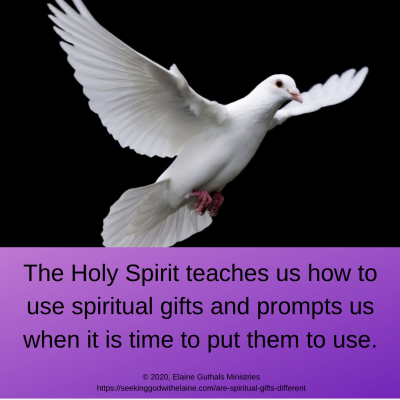
    Bottom line is all of God’s children are given abilities. The Holy Spirit teaches us how to use them and prompts us when it is time to put them to use. But we need to be unified in their use.

    Dove

    One Work

    “A manifestation of the Spirit is given to each person for the common good: to one is given a message of wisdom through the Spirit, to another, a message of knowledge by the same Spirit, to another, faith by the same Spirit, to another, gifts of healing by the one Spirit, to another, the performing of miracles, to another, prophecy, to another, distinguishing between spirits, to another, different kinds of tongues, to another, interpretation of tongues. One and the same Spirit is active in all these, distributing to each person as he wills” (I Cor. 12: 7-11 CSB)

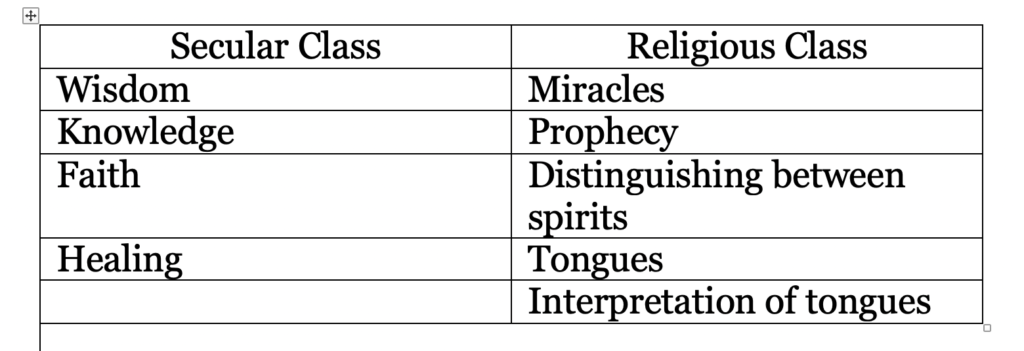
    Paul gives us a list of what these gifts are in First Corinthians 12: 7-11. They are the following:

    I know. I think some of those are still in existence in God’s church today. But if you look at them, it is more the ones that Momerie calls the secular class. The ones in what Momerie calls the religious class seem to be more hidden from us these days.

    We can determine if it is a spiritual gift by its use for expanding God’s kingdom. For example, some may become doctors for the money or the prestige. Others may feel called by God to make it their life’s work.

    Using spiritual gifts means using them for the betterment of others. God wants us to help others improve morally.

    Let’s say that a different way. We don’t get the gifts for ourselves. We receive gifts to be used for the church.

    One important thing to point out is no one has all nine of the gifts — not even Paul. I don’t remember Scriptures saying that he spoke or interpreted tongues.

    That means we have to cooperate and work together. The church must be one. “His mystical body, the Church, is like His natural body, or any of our bodies, in respect that although it is made up of many members, each having its own office, yet it is truly, strictly, mysteriously one. What makes it one, and binds it together, is the Holy Spirit of God dwelling in each person’s soul and body, to unite him truly to Jesus Christ.”

    The diversity must be acknowledged and fostered. All of God’s children must be allowed to grow their gifts and use them in the manner to which God has called them.

    One last thing. Paul noted that “a manifestation of the Spirit is given to each person …” (I Cor. 12: 12 CSB). The Spirit clearly shows us who God is. The bonus is the Spirit will never leave us. “‘And as for me, this is my covenant with them,’ says the LORD: ‘My Spirit that is upon you, and my words that I have put in your mouth, shall not depart out of your mouth, or out of the mouth of your offspring, or out of the mouth of your children’s offspring,’ says the LORD, ‘from this time forth and forevermore’” (Isa. 59: 21 ESV).

    One Body

    “For just as the body is one and has many parts, and all the parts of that body, though many, are one body — so also is Christ. For we were all baptized by one Spirit into one body — whether Jews or Greeks, whether slaves or free — and we were all given one Spirit to drink. Indeed, the body is not one part but many. If the foot should say, ‘Because I’m not a hand, I don’t belong to the body,’ it is not for that reason any less a part of the body. And if the ear should say, ‘Because I’m not an eye, I don’t belong to the body,’ it is not for that reason any less a part of the body. If the whole body were an eye, where would the hearing be? If the whole body were an ear, where would the sense of smell be?” (I Cor. 12: 12-17 CSB)

    When we were walking through Ephesians, we talked about one body. If the body is the church, baptism changed them — and us — all into one body. That baptism into one body by the Spirit brings us unity through one Lord.

    To read a related devotion, click the button below.

    Paul’s analogy using a body to describe the body of the church is fitting. Jesus is the head of the body. His church makes up the body. The church must be unified as the human body is.

    Each disciple has been assigned a job to do — someone to whom they should witness. If we do not do our jobs, the body does not grow as it should.

    We are all doing the same work — witnessing — but in different ways. I may witness through my songs and these words. You may have someone over to your house.

    The message is still the same — ABCD.

    The ABCDs of Salvation

    If you have not become a believer in Christ, please read through the
    Plan of Salvation and prayerfully consider what God is asking you to do.

    A – admit our sins
    B – believe His Son Jesus is our Redeemer
    C – confess God as Sovereign Lord

    D – demonstrate that commitment by making any changes needed in our lives to
    live the way in which God has called us

    The Disciple’s Job Description

    We can only accomplish the work that God has given us to do. He has equip us only with the skills we need.

    If we would like to have a skill our brother has, we should encourage him. If our sister’s skill is more developed than ours, we need to complement her.

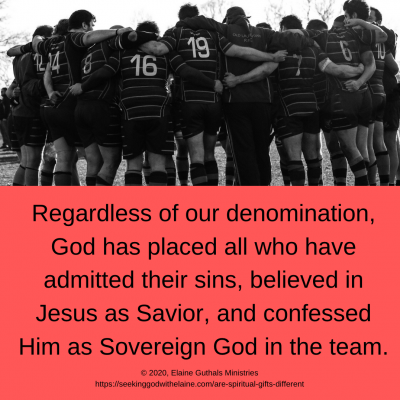
    God didn’t set us up in competition. He set us up as a team.

    Regardless of our denomination, God has placed all who have admitted their sins, believed in Jesus as Savior, and confessed Him as Sovereign God in the team. That is the only admission requirement to the team.

    Team

    Making the Connections

    Yes, we all have different gifts. Get over it. God has His reasons for doing that.

    No, God doesn’t have to make us equal. No, He doesn’t have to explain Himself.

    What does God make equal? Each and every gift is important. Every gift should lead to His kingdom being expanded.

    Oh, yes. The gifts may have differing importance, but He wouldn’t accomplish what is planned if He had left even one out.

    We may think the splashy gift of tongues is more important. Liddon said it isn’t. He said teaching and prophecy is more important.

    No, God isn’t going for Hollywood splash. He would much rather we learn what we need to know to grow closer to Him.

    Robertson also out things into perspective. He wrote, “It is far more important to ascertain that a man is a Christian than what sort of Christian he is.” What our gifts are doesn’t matter. They don’t make us more of less of a disciple.

    But we need to have ABCDed.

    Why do we feel encouraging is not a gift? It is probably one that is most needed.

    Can you complement someone? Can you give a hug (once we can again)? Can you write a note? Type an email? Pat someone on the cheek?

    Making the Connections to Self-Discipline

    Some gifts we many have to keep using or we will use them. I am a first soprano. I used to could hit the high C6 and sometimes the high D6.

    Now, I struggle sometimes to hit F5. Singing harmony, I don’t even get to try to go that high.

    We have to keep ourselves disciplined when we are in between assignments to use our gifts. We can’t let them go — unless God is moving us to use a different gift.

    How does all of this tie in with witnessing? Remember Momerie’s two classes. We may have difficulty convincing a worldview person that God also presents us with the secular one. What should we do?

    We’ve been looking at defending our beliefs when we are witnessing. That means we have to be secure enough to convince someone to accept our beliefs.

    Our questions should still serve us to determine on what we need to focus.

    • What does the Scriptures say?
    • What do I believe?
    • Why do I believe the same/differently than the Scriptures?
    • What are the talking points when witnessing to a non-believer?

    Related Links

    I have created a worksheet of the questions above. Click on the button below to access it.

    How Do We Apply This?

    Liddon made a really good point. What do we do with gifts? Keep them? No, we give them away. We can’t keep the gifts for ourselves. We have to use them to teach and support others.

    What if we have high-powered gifts? What should we do? Robertson told us.

    • Be humble.
    • Have sympathy (I Cor. 12: 26)

    We have to use our gifts responsibly for God’s purposes.

    Father. You didn’t have to give us anything. You didn’t have to design the plan of salvation to restore our relationships with You. You didn’t have to give us spiritual gifts. But You did, and You do. We commit to using these gifts as You call us to use them. Amen.

    What do you think?

    Leave me a comment below (about this or anything else) or head over to my Facebook group for some interactive discussion.

    If you don’t understand something and would like further clarification, please contact me.

    If you have not signed up for the email daily or weekly providing the link to the devotions and the newsletter, do so below.

    If God has used this devotion to speak with you, consider sharing it on social media.

  • Master, the Tempest Is Raging

    I am numb right now. I have been since Monday night.

    Pastor Chad went home to be with the Lord. This was very unexpected — for us. I’ve heard several “Is this for real?” responses to the email that went out.

    I’ve introduced you to Pastor Chad through things he’s said in his sermons and providing links to them. One of my favorite quotes was the following.


    “Each and every one of us, through the power of the gospel message, have the ability to bring change in this world because, by just simply speaking the gospel, introducing people to God through His Word, people will come to know Him, and peoples’ lives will be transformed. Once you’ve had an encounter with Christ, your life will be transformed. We understand that, if we can introduce people to Christ and they can come to be saved, then the problems of this world will seem like bygone issues.”


    To me, that was Chad’s motto and mission. That was also his charge to us.

    When I texted Chad and told him I was using the quote, I also told him I was modifying it a little from how it came across on the video. I took out a “because” and an “and” and broke it into three sentences. I just have a thing about 89-word sentences. He got a laugh.

    What Does Satan Have to Do with This?

    We had our first post-COVID prayer breakfast Tuesday morning. We were discussing how far our church has come in the two years Chad has been our pastor.

    The comment was made that Satan is trying to tear the church apart.

    I got to thinking. Satan can’t do anything that God does not allow him to do. He cannot disrupt God’s plans.

    This has always been God’s Plan A for Chad’s life and for our church’s life. God doesn’t do Plan Bs.

    We don’t understand why this had to happen. We don’t know why a wife and four young kids are now without their husband and father. We don’t understand why our church is without our leader.

    God lets us come to Him and ask why — when we do so in faith. We have to say His way is always best.

    We may not be told all of the reasons why. God will tell us what we need to know — and that will be good enough.

    Day Off

    I always get things scheduled to broadcast late in the evening. Wednesday night, we are going to have a prayer vigil. It is going to be a rough one.

    I haven’t done this since I have started putting these devotions out here. I am going to take a day off and concentrate on me, Adam, and my church family.

    So, instead of doing a devotion, I am going to leave you with this song. It was one of my favorite hymns growing up.

    It has the message I need to hear right now. (I’ve said before that these devotions start with God talking to me first.)

    Master the Tempest is Raging
    Vocalist: Elaine Guthals
    Keyboard: Louise Guthals Weiss

    Please Pray

    In your prayers, say a prayer for the Williams family and for the church family. Pray that we will move on with a cooperative spirit. Pray that we let God lead us to where He is taking us.

    I’ll be back tomorrow.

  • When We Settle for Less than God’s Promises

    When God has promised us so much, why do we settle for less? But we do for whatever reason. This devotion looks at the time some of the Wilderness Wanderers settled.

    Nuggets

    • The Reubenites and Gadites didn’t want to live in the Promised Land.
    • Moses questioned if it was right that the rest of the tribes went to war and they didn’t.
    • The tribes came back with an offer that, if they let them build cities and sheep pens, they would go fight with the other tribes.
    • The Gadites and Reubenites were going to get one shot to keep their end of the agreement.
    • When we become believers, we enter into an agreement with God.
    Flowers with title When We Settle for Less than God's Promises

    God has promised us many things. However, we sometimes settle for something else, which causes us to sin.

    Some of the Wilderness Wanderers settled for land on this side of the Jordan River. They didn’t firmly grasp God’s promises. Let’s take a look.

    Let’s Put It into Context

    “They said, ‘If we have found favor with you, let this land be given to your servants as a possession. Don’t make us cross the Jordan’” (Num. 32: 5 CSB).

    Moses may have known his time was short, and he may have known that Joshua was going to succeed him. But he wasn’t done yet.

    The Wilderness Wanderers had some curve balls they wanted to lob. One such curve ball was from the Reubenites and Gadites.

    They didn’t want to live in the Promised Land.

    They wanted to stay on the other side of the Jordan River.

    Seriously?

    Moses came back with, “Don’t you remember God was really, really mad when your parents tried to pull a stunt 40 years ago?” I am thinking Moses was probably hot under the collar, too.

    Can you believe those Reubenites and Gadites? How selfish could they be?

    The Reubenites and Gadites were putting worldly gain above God’s provision. They saw that the land “which the Lord struck down before the community of Israel, is good land for livestock, and [they] own livestock” (Num. 32: 4 CSB). The dots connected in their mind.

    They should be given the land.

    They didn’t care about what God had in store for them. They didn’t care about the other tribes who were crossing the river.

    I guess they thought an acre in hand was better than one they may or may not get.

    Oh, it doesn’t say in these verses, but I would bet Moses talked to at least some of them about God always coming through with His promises. And He had promised them land — on the other side of the river.

    How often do we tell God, “Oh, I know You’ve promised something different, but this is good enough. We’ll settle.”

    Moses did hit them with a good argument. “But Moses asked the Gadites and Reubenites, ‘Should your brothers go to war while you stay here? Why are you discouraging the Israelites from crossing into the land the Lord has given them?’” (Num. 32: 6-7 CSB).

    Were some of the troops going to go AWOL and leave the rest depleted? Were they going to start another exodus?

    Because let’s face it. It doesn’t take much to discourage us at times. Life down here is hard, especially when Satan is attacking.

    Wouldn’t it be discouraging for the others that these tribes chose to split the nation? We think about the nation not splitting until after David. But they chose to split here.

    Bottom line, they didn’t want the gift God had for them. Should not God be angry? Were they doubting His word, His provision, or His goodness? Or did they just have a closed mind on religion?

    Warning!

    “Moses replied to them, ‘If you do this — if you arm yourselves for battle before the Lord, and every one of your armed men crosses the Jordan before the Lord until he has driven his enemies from his presence, and the land is subdued before the Lord — afterward you may return and be free from obligation to the Lord and to Israel. And this land will belong to you as a possession before the Lord. But if you don’t do this, you will certainly sin against the Lord; be sure your sin will catch up with you’” (Num. 32: 20-23 CSB)

    The tribes came back with an offer. Let them build cities and sheep pens, and they would go fight with the other tribes.

    Moses accepted that but issued a warning.

    • They forfeited any inheritance on the other side.
    • Each one of the fighting men had to be in for the duration. None of them could cut out early.
    • If they lied and didn’t keep their word, they would have to pay the consequences.

    Let’s take another run at this. God had promised them the Promised Land. He was giving it to them.

    • They still had to fight for it.
    • They didn’t just get it handed to them.
    • They had to show up and possibly get hurt — or killed.

    One more nugget. “But if you don’t do this, you will certainly sin against the Lord; be sure your sin will catch up with you” (Num. 32: 23 CSB).

    So many times, we focus on sins of commission — and they were sinning by willfully not following God’s direction to enter the Promised Land. But not following through on their word would also be a sin of omission.

    Sometimes, it can be more devastating to not do something God is calling us to do. Why don’t we do what He call us to do?

    Maybe we get lazy. Maybe we would rather do it our way. Maybe we have an issue with the other person. Maybe we are just selfish.

    But we don’t do what God has called us to do. Consequences will follow.

    Sins are routinely uncovered. God does punish. Plumer noted that sometimes the punishment is “… loss of respect, esteem, or confidence.” We tend to think monetary loss, job loss, illness, and death.

    We Have Agreement

    “The Gadites and Reubenites answered Moses, “Your servants will do just as my lord commands. Our dependents, wives, livestock, and all our animals will remain here in the cities of Gilead, but your servants are equipped for war before the Lord and will go across to the battle as my lord orders’” (Num. 32: 25-27 CSB)

    The Gadites and Reubenites agreed to the proposal. Those were things in which they could agree.

    When we become believers, we enter into an agreement with God. We agree that we will:

    • Be a Living Sacrifice (Romans 12: 1-2)
    • Work Out Our Salvation (Philippians 2: 12)
    • Bring Him Glory (Matthew 5: 16)
    • Proclaim the Gospel (Mark 16: 15)
    • Love People (John 15: 12)
    • Make Disciples (Matthew 28: 19-20)
    • Other Duties as Assigned (Ecclesiastes 3: 1)

    The Disciple’s Job Description

    We Have Accountability

    “So Moses gave orders about them to the priest Eleazar, Joshua son of Nun, and the family heads of the Israelite tribes. Moses told them, ‘If the Gadites and Reubenites cross the Jordan with you, every man in battle formation before the Lord, and the land is subdued before you, you are to give them the land of Gilead as a possession. But if they don’t go across with you in battle formation, they must accept land in Canaan with you’ The Gadites and Reubenites replied, ‘What the Lord has spoken to your servants is what we will do’” (Num. 32: 28-31 CSB)

    Moses passed on the terms of the agreement. He knew he wouldn’t be around to execute it. Joshua and Eleazar were going to be responsible.

    Let’s think about this a second. We had talked before about God giving second chances. Sometimes, He does — the Wilderness Wanderers got many chances. Moses didn’t — he hit the rock, and he was done.

    The Gadites and Reubenites were going to get one shot. If they didn’t do what they said for the length of time agreed upon, they were done.

    One way they could have tripped up was by not standing by their word. Some these days may think that is not as important as it was.

    God still thinks it is important.

    When we become believers, we give Him our word that we will follow the job description — that we will live for Him.

    Yes, that is a huge job description. It has several hard duties on it.

    God doesn’t give us just one chance. He gives us multiple chances. He will forgive us when we don’t perform perfectly.

    That doesn’t give us license to not do the job description. We have to tell others about Him and make disciples. We have to love others His way (not according to the worldview).

    God allows us to come to Him when we mess up and ask forgiveness.

    Bible

    Making the Connections

    Oh, wow. So many times, we want our sins to stay covered up. We don’t want them uncovered.

    Problem. God is so good at uncovering them.

    God has to. He has to bring them out so we can eliminate them.

    We’ve got to be people of integrity. If we say we going to cross the river and fight, we need to cross, fight, and help clean up.

    A while back we talked about whether there was good sins or bad sins — did sins have different levels? I said, no, because all sin is against God.

    I still think that. But I think our sins have different effects. The sin of murder would have a different effect than the sin of lying.

    How Do We Apply This?

    We are prone to discouragement. That means we have to  encourage our fellow disciples. We need to pray for our brothers and sisters in Christ. We need to send cards, give them a hug, schedule a lunch — whatever.

    The materials I use for the lessons with my Ladies generally end up with a question on some variation of “how are we going to encourage each other this week?” Now, my Ladies are pro encouragers.

    A lot of times we don’t think we are encouragers. We know the value of encouragement but didn’t see ourselves as encouragers. Others might not see that as being that important.

    Ooo, baby. It is. Never ever sell yourself short on the value of you encouraging a fellow disciple. That just may be God’s way of helping them to withstand Satan’s attack on them.

    We probably acknowledge we aren’t encouragers because we see how inconsistent we are. We may take advantage of one opportunity but miss several. I pray that God will open our eyes and our hearts to see all the opportunities and that we don’t diminish the impact of our encouragement.

    That is all wrapped up in our being sympathetic to others. It means that we are involved enough with others that that we know when and how to encourage them.

    Moses called these Wilderness Wanderers on keeping their word. He just have thought this would be an issue along with shirking the duties to the others. He must have thought they wanted to take the easy way out.

    Sometimes, we want to take the easy way out. We don’t want God to uncover our sins — at least not so that everyone can see.

    We can’t pick and choose our job duties. We can’t just love others and not proclaim the gospel. We have to do all of them.

    Father God. You are so good to us. You have promised that You will provide for us. Unfortunately, we do not always see how You are keeping that promise. Or You are providing something different — better — than we are expecting. Forgive us when we are so focused on this world that we don’t see how You are preparing us for eternity. Help us to always live for You. Amen.

    What do you think?

    Leave me a comment below (about this or anything else) or head over to my Facebook group for some interactive discussion.

    If you don’t understand something and would like further clarification, please contact me.

    If you have not signed up for the email daily or weekly providing the link to the devotions and the newsletter, do so below.

    If God has used this devotion to speak with you, consider sharing it on social media.

  • Blessings, Not Curses

    Balaam and Balak thought they could get God to change His mind and curse the Wilderness Wanderers. But God cannot change His mind. This devotion shows us that we can trust His promises because He will not change.

    Nuggets

    • On the surface, the sacrifices looked legitimate, but Balaam and Balak weren’t submitting in any way, shape, or form!
    • The discussions with the donkey and the angel did not convince Balaam to repent.
    • God has one purpose — to further His kingdom – which He does that by choosing to show us grace and mercy.
    • The Wilderness Wanderers were still wandering, but God’s promises were going to come to fruition.

    To read devotions in the A Man and His Donkey series, click the appropriate button below.

    Blessings, Not Curses

    Flowers with title Blessings, Not Curses

    For the past three devotions, we have been discussing Balaam and Balak’s efforts to curse the Wilderness Wanderers. Today is the day they chose for that to happen. Let’s see if they got their wish.

    Let’s Put It into Context

    “The next morning Balak took Balaam up to Bamoth-baal. From there he could see some of the people of Israel spread out below him” (Num. 22: 41 NLT)

    We talked in the last devotion how Balak thought he had Balaam right where he wanted him. Because of this, he didn’t waste any time the next morning after Balaam got there. He got Balaam up on a hill so he could see the Wilderness Wanderers.

    The Sacrifices

    “Then Balaam said to King Balak, “Build me seven altars here, and prepare seven young bulls and seven rams for me to sacrifice” (Num. 23: 1 NLT)

    On the surface, the sacrifices looked legitimate. It was significant that they sacrificed seven bulls and rams on seven altars. Seven was a perfect number. Bulls and rams were the animals to be sacrificed for burnt offerings.

    Their problem was that they thought, “We sacrificed; You have to do what we say.” Well, don’t we do this with prayers sometimes? “We prayed to You; You have to give us what we prayed for, even if it the opposite of Your Will.”

    The Israelites were supposed to sacrifice to God as worship. “The sacrifice pleasing to God is a broken spirit. You will not despise a broken and humbled heart, God” (Ps. 51: 17 CSB). Sacrifices were to represent submission to God.

    Ooo, baby. Balaam and Balak weren’t submitting in any way, shape, or form! They were not asking what was in God’s Will (Num. 22: 12).

    There was another reason why God would not accept the sacrifice. Balaam was offering the sacrifice partly in faith, partly in divination. It doesn’t say anything in Chapter 23. However in Chapter 24, it says, “By now Balaam realized that the Lord was determined to bless Israel, so he did not resort to divination as before” in Numbers 24: 1 (NLT).

    The Messages

    God gave Balaam three messages to give Balak.

    The First Message

    “Balak summoned me to come from Aram; the king of Moab brought me from the eastern hills. ‘Come,’ he said, ‘curse Jacob for me! Come and announce Israel’s doom.’ But how can I curse those whom God has not cursed? How can I condemn those whom the Lord has not condemned? I see them from the cliff tops; I watch them from the hills. I see a people who live by themselves, set apart from other nations. Who can count Jacob’s descendants, as numerous as dust? Who can count even a fourth of Israel’s people? Let me die like the righteous; let my life end like theirs’” (Num. 23: 7-10 NLT)

    The first message was a recap of then-current events. Here was what Balak wanted. But there was what God wanted.

    It all boiled down to verse 8. God said, “I know what you want to do, but I won’t allow it. Israel is safe.” Verses 9 and 10 clarified for Balak God’s protection of the Wilderness Wanderers.

    Balaam “saw” the Wilderness Wanderers living daily lives. He saw their contentment. He saw the victory that God would give them.

    I wonder what Balaam felt. He was supposed to be this great soothsayer. Remember, back in Who Is Balaam?, we said that “…the art of divination was the highest point to which the heathen world had been able to attain in their pursuit of the unseen ….” This was not going to be good for Balaam’s reputation.

    When you think about how many there were went Israel went to Egypt, you realize just how blessed they were. The 70 turned into 2.4 million (Got Answers).

    Genesis 28: 14 says, “Your offspring will be like the dust of the earth, and you will spread out toward the west, the east, the north, and the south. All the peoples on earth will be blessed through you and your offspring” (CSB). God had kept that promise. How could Balaam and Balak doubt He would keep His promise to protect them?

    In verse 10 when it say, “… Who can count even a fourth of Israel’s people?” (Num. 23: 10 CSB). Henry says that is referring to how Israel set up camp. They formed a cross around the tabernacle, with four tribes on each side.

    The “… let me die …” part may be a tad bit confusing. I really doubt that this was part of God’s message. It is probably an add-on by Balaam.

    I don’t think Balaam was asking for his death to occur anytime soon. I think he was just asking that it be a righteous death (Spurgeon). He wanted a part of all the good stuff that he saw.

    The problem is, the discussion with the donkey and the angel did not convince Balaam to repent. Oh, he acknowledged he had sinned.

    But repentance is expressing sorrow for things we’ve done wrong. It is not just feeling sorry for doing those things. It is making the commitment to changing ourselves so that we no longer do the wrong things.

    Balaam did not turn away from his sin. He continued to practice divination, which God said was a no no (Lev. 19: 26 CSB).

    If we want to be blessed, we have to live righteously. We have to be set apart and holy in order to be blessed.

    Balaam didn’t practice self-discipline to master his selfishness and covetousness. It doesn’t look like he was blessed. If he wasn’t, he won’t get to be a sheep on the right.

    To read a related devotion, click the button below.

    The Second Message

    “God is not a man, so he does not lie. He is not human, so he does not change his mind. Has he ever spoken and failed to act? Has he ever promised and not carried it through? Listen, I received a command to bless; God has blessed, and I cannot reverse it! No misfortune is in his plan for Jacob; no trouble is in store for Israel. For the Lord their God is with them; he has been proclaimed their king. God brought them out of Egypt; for them he is as strong as a wild ox. No curse can touch Jacob; no magic has any power against Israel. For now it will be said of Jacob, ‘What wonders God has done for Israel!’ These people rise up like a lioness, like a majestic lion rousing itself. They refuse to rest until they have feasted on prey, drinking the blood of the slaughtered!” (Num. 23: 19-24 NLT)

    Balak was furious. He wanted to try again to get God to change His mind.

    Problem was, God isn’t human like us. He doesn’t change His mind. If He could, He wouldn’t be divine (Melvill).

    Remember back in Does God Tempt Us?, we talked about God can’t tempt us because God isn’t evil? “No one undergoing a trial should say, ‘I am being tempted by God,’ since God is not tempted by evil, and he himself doesn’t tempt anyone” (Jas. 1: 13 CSB). He won’t mislead — unknowingly or purposefully — anyone.

    To read a related devotion, click the appropriate button below.

    God has one purpose — to further His kingdom. He does that by choosing to show us grace and mercy. He is not going to change His purpose.

    Has God ever broken a promise? Has He failed to act?

    No.

    God’s not answering our prayers the way we demand is not Him failing to act. God answers prayers that are in His Will.

    God reiterated in this second message that He was going to bless Israel (Num. 23: 20). There was no way Balak and Balaam were going to stop it.

    Israel was going to be unstoppable.

    Not only that, “These people rise up like a lioness, like a majestic lion rousing itself. They refuse to rest until they have feasted on prey, drinking the blood of the slaughtered!” (Num. 23: 24 NLT).

    Well, the lion is the king of the jungle, but the lioness are pretty ferocious themselves. “They refuse to rest until they have feasted on prey, drinking the blood of the slaughtered!” (Num. 23: 24 NLT). Israel would be focused on the task at hand — defeating evil and spiritual wickedness.

    What all of this is saying is that God is present with His people. “Then I will live among the people of Israel and be their God” (Ex. 29: 45 NLT). His plan for Israel would be accomplished.

    The Third Message

    “This is the message of Balaam son of Beor, the message of the man whose eyes see clearly, the message of one who hears the words of God, who sees a vision from the Almighty, who bows down with eyes wide open: How beautiful are your tents, O Jacob; how lovely are your homes, O Israel! They spread before me like palm groves, like gardens by the riverside. They are like tall trees planted by the Lord, like cedars beside the waters. Water will flow from their buckets; their offspring have all they need. Their king will be greater than Agag; their kingdom will be exalted. God brought them out of Egypt; for them he is as strong as a wild ox. He devours all the nations that oppose him, breaking their bones in pieces, shooting them with arrows. Like a lion, Israel crouches and lies down; like a lioness, who dares to arouse her? Blessed is everyone who blesses you, O Israel, and cursed is everyone who curses you.” (Num. 24: 3-9 NLT)

    Balak didn’t need a soothsayer to know he would need defeat if he openly battled the Wilderness Wanderers. Balaam knew that his divination wasn’t getting him anywhere. When he didn’t use it, he is described as “… the man whose eyes see clearly” (Num. 24: 3 NLT)

    Vaughan listed all the things that Balaam had learned up to that point. “He has learned the helplessness of man striving with his Maker. He has learned the futility of approaching the God of truth with a lie in the right hand. He has learned that to ‘set the face toward the wilderness’ is the one hope and wisdom of inquiring man; to look away from enchantments; to look away from courts and crowds, from pleasures and businesses; to look away from types and forms, and to fix the earnest gaze upon that solitude of earth and heaven which is the presence of the soul in the presence of God.”

    What struck me about these verses is, I read them like they were past tense. “They spread …” (Num. 24: 6 NLT). “Water [flowed] from their buckets …” (Num. 24: 7 NLT).

    The Wilderness Wanderers were still wandering, but God’s promises were going to come to fruition. Nothing Balaam or Balak could do or say was giving to change that.

    It was a done deal.

    The deal also was, “… Blessed is everyone who blesses you, O Israel, and cursed is everyone who curses you.” (Num. 24: 9 NLT). If the surrounding nations wanted to prosper, they needed to befriend Israel, not war against her.

    Making the Connections

    • The enemies of God’s people may be able to hurt them, but they cannot curse them.
    • Just as the Wilderness Wanderers were to be set apart from the world, so, too, are we.
    • We can depend on God to keep His promises.
    • Evil will not triumph over good in the end.

    How Do We Apply This?

    These three messages should show us that God deserves our worship because He keeps His promises. But they also show that God’s Will will be done. We have to make Him the Sovereign God of our lives.

    Father. Thank You that You do not change. Your promises are secure. Help us to give You the praise You deserve. Amen.

    What do you think?

    Leave me a comment below (about this or anything else) or head over to my Facebook group for some interactive discussion.

    If you don’t understand something and would like further clarification, please contact me.

    If you have not signed up for the email daily or weekly providing the link to the devotions and the newsletter, do so below.

    If God has used this devotion to speak with you, consider sharing it on social media.

  • Light in the Darkness

    The world is on hold. It is waiting for a Son to be born. This devotion talks about the light that the Baby will provide.

    The world lay peaceful and still, slumbering in the darkness. It was quiet. There was an expectation – a waiting for something to happen.

    Then a Light was struck. It was not a light shining from the brightest Christmas tree. The star shone brightly, but it was more than that. The star was way up in the sky.

    The light was much closer.

    It was a light that shown in a mother’s eyes as her Son was born. It was the light in a father’s eyes as he watched a promise being fulfilled.

    It was a light that shone in poor men’s eyes as they were asked to share in the Good News. It was a light in rich men’s eyes as they found that for which they had been looking.

    It was a Light that started as a tiny speck, grew as He became a Man, continued as He gave His life, and still continues today through you and me.

    The Light was and is Jesus. He was the fulfillment of all of God’s promises. He was what we need — even if we aren’t looking for Him.

    It is a Light that shines for all of us to see. It is a beam that cuts through the black of sin to show our need for a Saviour.

    “The people who walk in darkness
    will see a great light.
    For those who live in a land of deep darkness,
    a light will shine” (Isa. 9: 2 NLT)

    Moon on water

    What do you think?

    Leave me a comment below (about this or anything else) or head over to my Facebook group for some interactive discussion.

    If you don’t understand something and would like further clarification, please contact me.

    If you have not signed up for the email daily or weekly providing the link to the devotions and the newsletter, do so below.

    If God has used this devotion to speak with you, consider sharing it on social media.

  • Why Aren’t God’s Promises Received Now?

    These all died in faith, not having received the promises, but having seen them afar off were assured of them, embraced them and confessed that they were strangers and pilgrims on the earth.
    Hebrews 11: 3 (NKJV)

    It is our expectation many times that promises should be received closely to the time the promise is made. However, that is not the way God works. This devotion looks at how Faith Hall of Famers died in faith – without receiving their promises.

    Nuggets

    • Up to the day they died, these Faith Hall of Famers believed whatever was promised would still happen.
    • Faith is about the assurance that, even though it seems impossible, everything is possible with God (Mt. 19: 26).
    Flowers with title Why Aren't God's Promises Received Now?

    Can we say instant gratification? How about entitlement? Those are two concepts that seem to run society.

    God doesn’t work that way. In fact, Hebrews said several faithful followers died without receiving their promises. What gives with that?

    Let’s Put It into Context

    The writer of Hebrews gave a list of saints that had been inducted into the Faith Hall of Fame. You know, the best of the best. The successful. They are our role models after Jesus.

    What makes them role models is their faith. Faith is the belief that the doctrines stated in God’s Word are true, even if we do not understand all aspects of them.

    To read
    What Is Faith?
    and
    Which Is Foundational: Faith or Works?,
    click on the appropriate button below.

    The writer of Hebrews put it this way: “Now faith is the assurance of things hoped for, the conviction of things not seen” (Heb. 11: 1 RSV). We can’t depend on ourselves. At some point, we just have to say, “It may seem impossible, but I believe this.”

    The chapter goes on to explain why these believers are the cream of the crop. But he starts it with a very mind-boggling statement. “These all died in faith, not having received the promises …” (Heb. 11: 13 NKJV).

    No. That is just wrong. Rewards are supposed to happen not only within our lifetimes but also right away.

    Ummm. That isn’t how God works. Let’s break this down.

    Dying in Faith

    “These all died in faith, not having received the promises …” (Heb. 11: 13 NKJV).

    Everyone the writer mentioned died before the promise was fulfilled. Abel died before he could be rewarded for his sacrifice. Noah knew he was one of eight to survive to repopulate the earth — but that isn’t very many. Abraham was also promised a lot of descendants.

    Theses men of faith did not get instant gratification. They didn’t even get closure.

    Didn’t matter.

    Up to the day they died, these Faith Hall of Famers believed whatever was promised would still happen. Some day. No, not in their lifetime, but some day.

    They probably got discouraged at tines when it was taking (in their minds) too long for the promise to show up. They did not give up. They continued to believe because God said so.

    The Faith Hall of Famers enjoyed even though they did not experience. But isn’t that what faith is all about?

    The Old Testament saints were promised a Messiah but never saw Him. The New Testament saints were promised the Messiah would come again, but He still hasn’t yet.

    So, what did it mean they died in faith?

    • They knew God was Sovereign God.
    • They believed what God had told them.
    • They trusted that Jesus would come.
    • They knew that their sins were forgiven.
    • They persevered in believing in God.
    • They worked to withstand Satan’s temptation.

    Living in Faith

    “… but having seen them afar off were assured of them, embraced them …” (Heb. 11: 13 NKJV).

    No, the Faith Hall of Famers hadn’t experienced the promises, but they could describe them to us. They may have even talked about them in the present tense.

    Do we know of people who say they have to see something before they believe it? Have nonbelievers told you they have to understand before they can believe?

    That isn’t what faith is about. Faith is about the assurance that, even though it seems impossible, everything is possible with God (Mt. 19: 26). It is believing in what God says to us.

    That is the faith disciples are to live. We are to boldly pursue God and the promises that He gives us. We are to boldly do the tasks that God has assigned to us.

    We have to embrace God — His laws and commandments, His plans for our lives. Most of all, we have to diligently work to grow in grace and knowledge (II Pet. 3: 18).

    To read How Can We Wait Silently While Not Being Silent?, click the button below.

    We have to think about why God gives us promises. Why doesn’t He just do what He is going to do and let us catch up as He does it?

    “Because of your promise and according to your will, you have done all these great things and have made them known to your servant” (II Sam. 7: 12 NLT). God wants us to see His heart. He wants us to know His love.

    Promises focus us on the Provider and the provision rather than the product. We focus on God giving us what we need instead of the the actual gift.

    Sunrise

    Faith has to permeate our lives. When it does, the product is trusting and believing. That brings joy and contentment while we wait for the fulfillment of the promises.

    Disciples have to know that we cannot look to the ruler of this world to fulfill promises. Satan is a liar and a deceiver. “This great dragon—the ancient serpent called the devil, or Satan, the one deceiving the whole world—was thrown down to the earth with all his angels” (Rev. 12: 9 NLT).

    Confessing in Faith

    “… and confessed that they were strangers and pilgrims on the earth” (Heb. 11: 13 NKJV).

    Stranger has several definitions. It is a person we don’t know, maybe because they are a newcomer. They aren’t family or a member of the group. Strangers can be seen as outsiders.

    A pilgrim is someone who journeys to a sacred shrine or place. During the Journey, the pilgrim becomes the stranger in different places through which is traveled.

    Ooo, baby. We talked about this in the last devotion.

    To read Should Disciples Compromise Their Beliefs?, click the button below.

    God doesn’t want us to look like the world. “Do not conform yourselves to the standards of this world, but let God transform you inwardly by a complete change of your mind. Then you will be able to know the will of God—what is good and is pleasing to him and is perfect” (Rom. 12: 2 GNT).

    To read
    How Are We Different from the World (Part 1)
    and
    How Are We Different from the World (Part21),
    click on the appropriate button below.

    When we think about it, strangers is a good term to describe disciples. We aren’t supposed to be a member of the worldview family. They do see us as outsides — and the division is becoming more prominent.

    True disciples think differently. We act differently. We have different interests.

    We are pilgrims. We are just passing through this life on our way to being called home for eternity. Our citizenship is in heaven, not earth.

    When I was going the research for this post, I came across this statement. “Heaven is held out in the gospel not in bargain as a reward to our performance of God’s precepts, but simply in anticipation as a fulfilment to our hope of God’s promises” (Chalmers).

    Oh, man. Don’t we sometimes think heaven is going to be our prize instead of our promise? We think we are going to “win” it by doing as many of the do’s as we can and avoiding as many of the don’ts as we can.

    We don’t get it that we can’t earn our way into heaven. Yes, after we admit our sins, believe on Jesus as Redeemer, and confess God as Sovereign Lord, we do have to demonstrate that commitment by following God’s laws and commandments.

    In the scheme of things, we are on this earth only for a little while. We will be in eternity for a really, really long time.

    The journey is a good metaphor to explain our time here on earth. We have a starting point and an ending point. We are moving through in anticipation of getting where we are going.

    We don’t want to stop and roost. We want to continue to press on to our destination.

    We don’t compare ourselves with citizens we encounter on the journey. We know our destination has totally different priorities than this world.

    Making the Connections

    Oh, yes. This talked to me first. I’ve told you that these devotions are one way God talks to me

    Are you like me — struggling with something that didn’t happened as planned? We thought A was our promise; but now we are on the path to B.

    God’s promises really aren’t for this world. Our comfort and happiness in this life is not God’s priority.

    God’s priority is restoring our relationship with Him and preparing us for eternity with Him. Period.

    Yes, God will provide what we need for this life. It may not always be what we are looking for, but it will be the best for us. It may not be what we define as success.

    How Do We Apply This?

    We have to live faithfully for God. No, it isn’t going to be easy. It will be worth it.

    Loving Father. Your Word is filled with Your promises. We claim those promises — not because of something we have done. We claim Your promises because we have put our faith in You. Help us as we complete this journey. We press on to our home in heaven. Amen.

    The ABCDs of Salvation

    A – admit our sins

    B – believe His Son Jesus is our Redeemer

    C – confess God as Sovereign Lord

    D – demonstrate that commitment by making any changes needed in our lives to

    live the way in which God has called us

    If you have not become a believer in Christ, please read through the Plan of Salvation and prayerfully consider what God is asking you to do.

    What do you think?

    Leave me a comment below (about this or anything else) or head over to my Facebook group for some interactive discussion.

    If you don’t understand something and would like further clarification, please contact me.

    If you have not signed up for the email daily or weekly providing the link to the devotions and the newsletter, do so below.

    If God has used this devotion to speak with you, consider sharing it on social media.