Category: Promises

  • What the Jews Expected in a Messiah

    In the last devotion, we discussed  the atmosphere of first-century Israel. This devotional reading looks at the expectations they had for a Messiah.

    Nuggets

    • Many first-century Jews were looking for Mashiach (מָשִׁיחַ) – the Anointed One.
    • Jehovah promised One Who would defeat the oppressors and deliver His people.
    • Restoration theology dominated Jewish Messianic expectation.
    • Overall, first-century Jews were looking for the establishment of Jehovah’s reign by the Messiah, including His dwelling among His people again.
    We tend to look at the Gospels from the end view. We know the stories – some have heard them many times – and we know how it ends.

    First-century Jews didn’t. They were waiting for the Messiah.

    They didn’t know Messiah’s name, face, or even how Jehovah would fulfill His promises – they just knew that He would.

    In the last devotion, we talked about the oppressors that had occupied Irael from around 198 BC until they won their independence in 142 BC. Rome captured Jerusalem in 63 BC.

    Many first-century Jews considered themselves still in exile because, though they worshiped in a rebuilt Temple and lived in their ancestral land, they remained subject to Gentile authority.

    So, what did Israel expect in a Messiah?

    Let’s Put It into Context

    To read devotions in The Battle for the Heart theme

    Devotions in the The Ministry of John the Baptist series

    Israel Expected a King

    “Rejoice, O people of Zion! Shout in triumph, O people of Jerusalem! Look, your king is coming to you. He is righteous and victorious, yet he is humble, riding on a donkey — riding on a donkey’s colt. I will remove the battle chariots from Israel and the warhorses from Jerusalem. I will destroy all the weapons used in battle, and your king will bring peace to the nations. His realm will stretch from sea to sea and from the Euphrates River to the ends of the earth” (Zech. 9: 9-10 NLT).

    Many first-century Jews were looking for Mashiach (מָשִׁיחַ) – the Anointed One.

    While some spiritual teachers could be anointed first-century Israel was looking for David’s descendant to take over the physical throne. He was to become their earthly leader.

    They wanted their national identity back. They were so done with foreign occupation and foreign domination. Many of those oppressors tried to get them to give up that which made them Jewish.

    That is why they were looking for the Son of David. We’ve talked a little about this.

    • ·Gabriel told Mary that her Son would inherit David’s throne. “… The Lord God will give him the throne of his ancestor David. And he will reign over Israel forever; his Kingdom will never end!” (Lk. 1: 32-33 NLT).
    • The angel in Joseph’s dream call him, “… Joseph, son of David …” (Mt. 1: 20 NLT).

    This wasn’t something the Jews had come up with. These were expectations based on Scripture known to many. The Davidic covenant transformed David’s royal line into a Messianic hope.

    • “All kings will bow before him, and all nations will serve him” (Ps. 72: 11 NLT).
    • “… And my servant David will be their prince forever. And I will make a covenant of peace with them, an everlasting covenant. I will give them their land and increase their numbers, and I will put my Temple among them forever” (Ezek. 37: 25-26 NLT).
    • “Jesus was in the center of the procession, and the people all around him were shouting, ‘Praise God for the Son of David! Blessings on the one who comes in the name of the Lord! Praise God in highest heaven!’” (Mt. 21: 9 NLT).

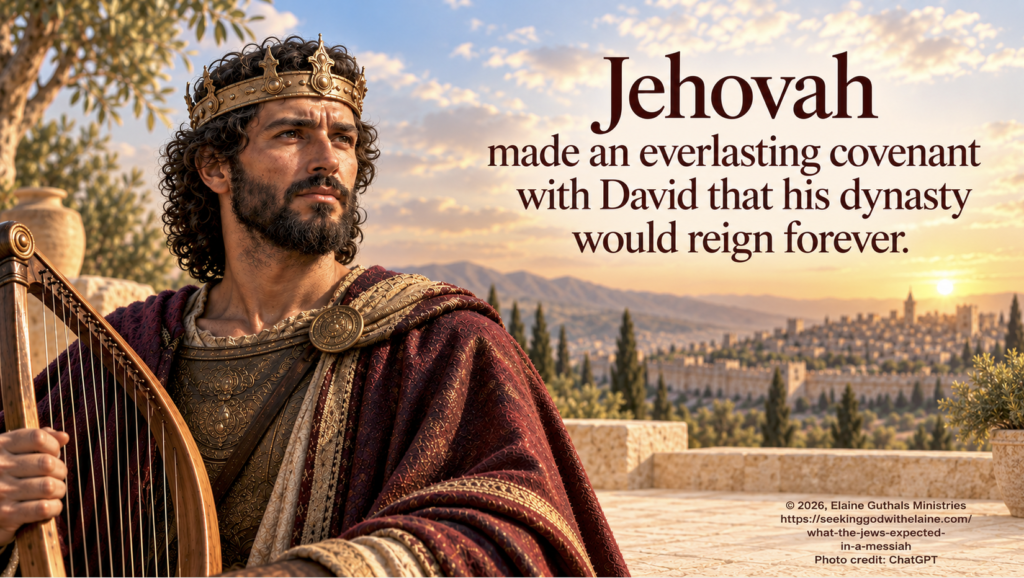
    Jehovah made an everlasting covenant with David that his dynasty would reign forever.
    Israel Expected a Deliver

    “For to us a child is born, to us a son is given; and the government shall be upon his shoulder, and his name shall be called Wonderful Counselor, Mighty God, Everlasting Father, Prince of Peace” (Isa. 9: 6 NLT)

    Jehovah promised One Who would defeat the oppressors and deliver His people.

    Go back to Israel being under foreign domination. They wanted the Messiah to deliver them from their oppressors.

    Think about it. If we had been under 100 years of foreign domination, we would want the same thing. We would want our freedom to worship as Jehovah had commanded.

    Remember, the Seleucids especially promoted Hellenization, pressuring Israel to abandon its traditional Jewish practices. This would have gone against the Jewish expectation many had that they had to return to Jehovah before the Messiah would come.

    Israel had long been rescued from their oppressors by a strong leader. Moses delivered the Hebrews from  Egyptian oppression. Joshua led them on the conquest of the Promised Land.

    David was a strong protector of the nation. It was the son of this mighty warrior that they were looking to deliver them from Roman occupation.

    Of course, many thought this deliverance will be accompanied by the judgment of their oppressors. They would have loved to see Jehovah show them His superiority – especially if there were payback included for their treatment of the Jews.

    Israel Expected a Restorer

    “‘The day is coming,’ says the Lord, ‘when I will make a new covenant with the people of Israel and Judah. This covenant will not be like the one I made with their ancestors when I took them by the hand and brought them out of the land of Egypt. They broke that covenant, though I loved them as a husband loves his wife,’ says the Lord. ‘But this is the new covenant I will make with the people of Israel after those days,’ says the Lord. ‘I will put my instructions deep within them, and I will write them on their hearts. I will be their God, and they will be my people. And they will not need to teach their neighbors, nor will they need to teach their relatives, saying, “You should know the Lord.” For everyone, from the least to the greatest, will know me already,’ says the Lord. ‘And I will forgive their wickedness, and I will never again remember their sins’” (Jer. 31: 31-34 NLT)

    Restoration theology dominated Jewish Messianic expectation.

    The people are restored to the covenant relationship and blessings Jehovah promised. When first-century Jews thought of redemption, they thought Ga’al (גָּאַל). This meant to redeem, to reclaim, or to act as a kinsmen-redeemer.

    It was more than restoration of the land. They were looking for purification of the people and renewed covenant faithfulness to Jehovah.

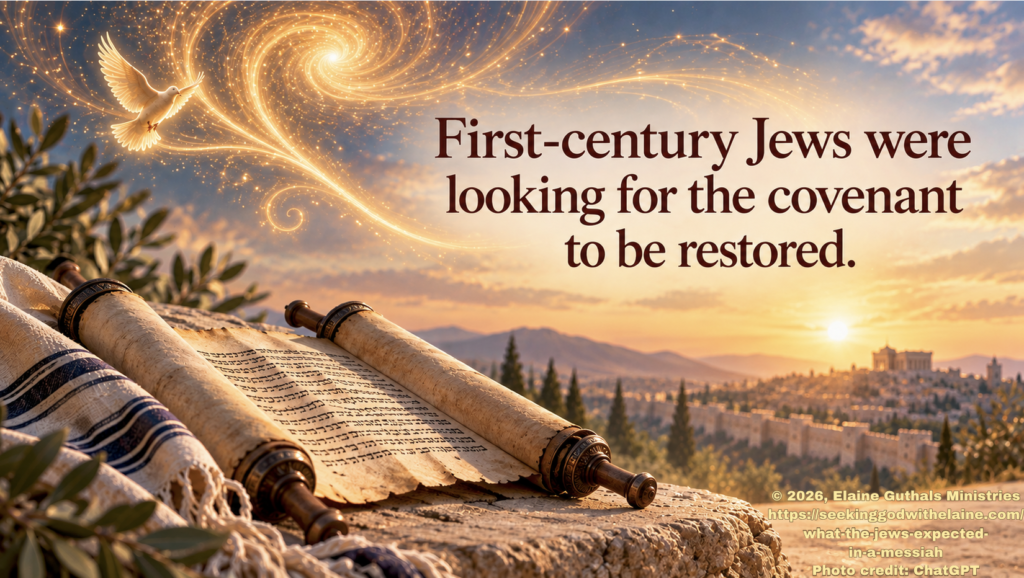
    First-century Jews were looking for the covenant to be restored. Jehovah had made covenant promises to Israel, and they were waiting for Messiah to bring those promises to their promised fulfillment….
     They were looking for the rebuilding of Jerusalem, which first necessitated the defeat of hostile nations. Again, they were looking for the restoration of the Davidic kingship.

    Included in restoring the Davidic kingship was bringing home the Lost Tribes – the ones that had either stayed in Babylon or had scattered elsewhere. They wanted a complete rebuilding of the Northern and Southern Kingdom.

    Again, the first-century Jews were looking for the restoration of their Davidic king and national identity. Upon defeating the foreign powers, they looked for worldwide acknowledgment of Jehovah.

    This theology was tied to the belief that exile never ended. They were back in their land, but they were still under foreign – Gentile – rule.

    To many, something was still missing. The restoration promised by the prophets had not yet arrived in its fullness.

    First-century Jews were looking for the complete restoration promised.

    Israel Expected God’s Kingdom

    “And I will make a covenant of peace with them, an everlasting covenant. I will give them their land and increase their numbers, and I will put my Temple among them forever. I will make my home among them. I will be their God, and they will be my people. And when my Temple is among them forever, the nations will know that I am the Lord, who makes Israel holy” (Ezek. 37: 27-28 NLT)

    Overall, first-century Jews were looking for the establishment of Jehovah’s reign by the Messiah, including His dwelling among His people again.

    They didn’t think of this as, “Hey, we’re going to go to Heaven.” It was definitely more than a warm, fuzzy feeling.

    To them, they wanted Jehovah’s presence to be as His glory was in the Temple.

    “When Solomon had finished praying, fire came down from heaven and consumed the burnt offering and the sacrifices; and the glory of the Lord filled the temple. And the priests could not enter the house of the Lord, because the glory of the Lord had filled the Lord’s house” (II Chron. 7: 1-2 NLT).

    Jehovah had been living among His people from the beginning. He met face to face with Adam and Eve. His presence filled the Tabernacle. Later it field the Temple.

    Before the Babylonian exile, that presence left the Temple. While they had the Second Temple, Jehovah’s presence hadn’t returned.

    The first-century Jews were eagerly awaiting the return of Jehovah’s presence to live among them.

    The Jews thought of Jehovah’s kingdom in very concrete concepts.  They expected restoration of Israel, vindication of covenant promises, defeat of oppressors, and visible rule under Jehovah’s appointed king.

    First-century Jews had increased hopes of the Messiah coming.

    Making the Connections #1

    The first-century Jews were waiting for Jehovah to deal with someone who has wronged us can contain both faith in His justice and very human desires about what that justice ought to look like.

    This is what they were expecting. And honestly, given what they had experienced, you can understand why.

    One thing we can’t expect, though, is for Jehovah to right every wrong that has been done to us. I don’t think that is in His plan.

    Jehovah will judge the person who has wronged us by how that wronged Him – not us.

    Making the Connections #2

    If we look back at the four sections, they are related. There is some overlap between sections.

    • Jehovah would send His anointed King.
    • His King would deliver His people.
    • His King would restore what had been broken.
    • Through His King, Jehovah’s righteous reign would be established.

    No, things didn’t happen exactly the way the first-century Jews expected it to happen. But that is okay.

    It isn’t going to happen the way we expect it to, either. No one is going to get everything right.

    Even people who sincerely believe God’s promises and understand much of Scripture correctly can still misunderstand how Jehovah will fulfill those promises.

    Heart Check

    Think about the battle Yeshua is engaged in for your heart. Ask yourself the following questions.

    • Have I decided what Jehovah must do before I am willing to recognize what He is doing?
    • When someone has wronged me, am I trusting Jehovah with justice — or am I telling Him what I think justice should look like?
    • Do I trust Jehovah enough to believe that His fulfillment of a promise may look different from what I expected?
    • Am I willing to let Jehovah fulfill His promises His way and in His timing?

    How Do We Apply This?

    • Trust Jehovah with what you cannot see yet.
    • Don’t confuse your expectation with Jehovah’s promise.
    • Give your hurts to Jehovah.
    • Stay open to Jehovah’s way.
    • Remember that understanding can grow.

    Father God. You told us that You would send a Messiah to redeem us. You did – even when their expectations didn’t turn out as they thought. Lord, Yeshua is coming again. Help us to expect Him and show us how and when we are to watch. Amen.

    If you don’t understand something and would like further clarification, please contact me.

    If you have not signed up for the email providing the link to the devotions and the newsletter, do so below.

    If God has used this devotion to speak with you, consider sharing it on social media.
  • Christ, the Eternal Word

    Christ, like God, is eternal. This devotion looks at when the Word and Light came to earth.

    Nuggets

    • Yeshua was present in all eternity.
    • Yeshua is the Word.
    • Yeshua also existed before the foundation of the world.
    • Being with God means more than Jehovah and Yeshua being in the same room.
    • Jehovah and Yeshua are the same nature and essence.

    The first four books of the New Testament are called the Gospels. They tell the story of Yeshua.

    But Yeshua’s story didn’t begin when He walked on this earth. We can’t trace its beginning.

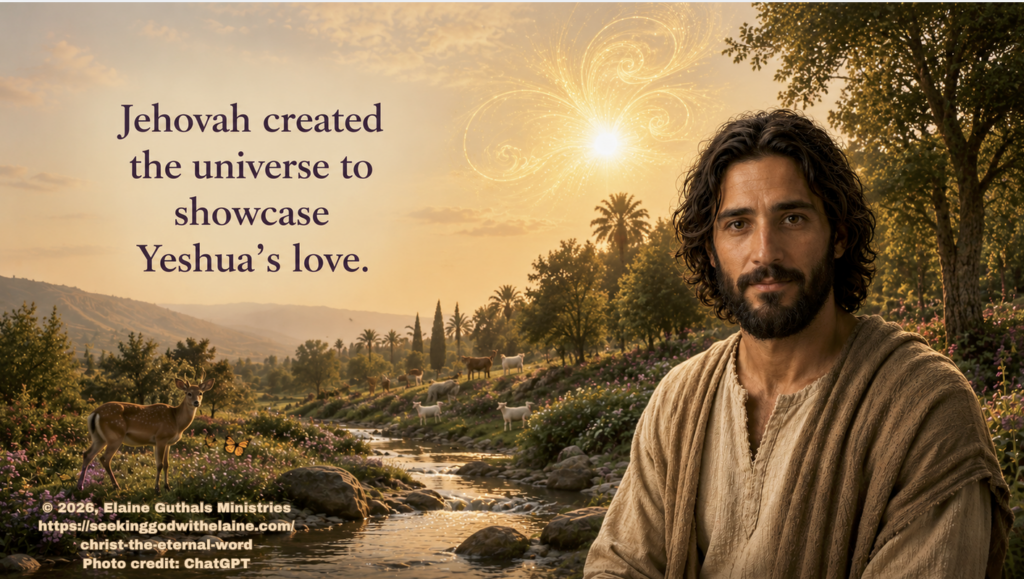
    What we do know is that Yeshua was the inspiration for creation of this universe. Jehovah created it to showcase Yeshua’s love.

    John began his Gospel trying to line that out for us. He explained that the Son is not a piece of God but God Himself — distinct in person yet fully sharing the same divine nature.

    What does that mean to us? If the One Who created all things is the same One Who came to save you and me, then He is not distant, and He is not uncertain. He is both the Author of our beginning and the One Who secures our end. That is the One we can trust.

    Let’s dig in.

    Let’s Put It into Context

    To read devotions in The Battle for the Heart theme

    Devotions in the Preparing for the Christ Child series

    Eternal

    “In the beginning the Word already existed. The Word was with God, and the Word was God. He existed in the beginning with God” (Jn. 1: 1-2 NLT).

    In the Beginning

    Yeshua was present in all eternity.

    John opened his Gospel in an unusual way. Instead of doing a genealogy, he hooked Yeshua back to Genesis – the creation, the origin. “In the beginning God created the heavens and the earth” (Gen. 1: 1 NLT).

    One point John wanted to get across was the team that Jehovah and Yeshua made. Both were present at creation. We’ll talk about this more in a little bit.

    Was the Word

    Yeshua is the Word.

    We get that Yeshua is divine. We also get that He divested Himself of that divinity and became human.

    “Though he was God, he did not think of equality with God as something to cling to. Instead, he gave up his divine privileges; he took the humble position of a slave and was born as a human being. When he appeared in human form, he humbled himself in obedience to God and died a criminal’s death on a cross (Phil. 2: 6-8 NLT).

    But we don’t necessarily get it right off why Yeshua was called the Word.

    I like how John 1: 1 reads in the Orthodox Jewish Bible. It can be a little confusing, but I think it will help us process all this.

    “Bereshis (in the Beginning) was the Dvar Hashem …, and the Dvar Hashem was agav (along with, etzel, …) Hashem, and the Dvar Hashem was nothing less, by nature, than Elohim! …” (Jn. 1: 1 OJB emphasis added).

    Dvar in Hebrew is Word. Hashem means God. (In the Greek, Word gives form and meaning.)

    To me, that connects Word/Yeshua and God. We would say that as the Word of God.

    The Gospel – the good news – God’s Word – is Yeshua’s story: His birth, His death, and His resurrection. His story is told because it is only through Him that we are redeemed. “There is salvation in no one else! God has given no other name under heaven by which we must be saved” (Ac. 4: 12 NLT).

    That makes Yeshua THE Word!

    Further clarification of Yeshua as the Word is given in Revelation 19: 13. “He wore a robe dipped in blood, and his title was the Word of God” (Rev. 19: 13 NLT).  That is a perfect description of Yeshua.

    We come to Yeshua – the Word and Light – by God’s Word. We’ll get into Yeshua as the Light later too.

    • “So faith comes from hearing, that is, hearing the Good News about Christ” (Rom. 10: 17 NLT).
    • “Your word is a lamp to my feet and a light to my path” (Ps. 119: 105 ESV).

    Yeshua is the Light that illuminates the path that leads us to Jehovah.

    Already Existed

    Yeshua was present in all eternity.

    Jehovah had to be here before the beginning. Otherwise, He couldn’t create it.

    Paul also talked about Jehovah and Yeshua already existing before the creation of the world. “For God saved us and called us to live a holy life. He did this not because we deserved it, but because that was his plan from before the beginning of time – to show us his grace through Christ Jesus” (II Tim. 1: 9 NLT emphasis added). That also shows His clock is different from ours.

    But Jones didn’t think John could say before the beginning. He wrote, “Had St. John said ‘before’ the beginning, he would have presented eternity under the laws of time, a mistake as grave as to describe the Infinite under the conditions of the finite. But mounting up higher than time and space, he leads us to the calm where God dwelleth.”

    Resource

    Either way, it is our way of trying to describe the before. We don’t really understand it – and we can’t because we aren’t Jehovah.

    We just have to take it by faith that – however it should be described – Jehovah and Yeshua were both there, planning for the creation of humans.

    We can be as confused about Yeshua’s origin as we are of Jehovah’s. When did They begin?

    One mission for Yeshua is to reveal Jehovah to us. Moment said it this way. He wrote, “God revealed Himself through His Son before the Incarnation.”

    Resource

    • “Blessed be the God and Father of our Lord Jesus Christ, who has blessed us in Christ with every spiritual blessing in the heavenly places, even as he chose us in him before the foundation of the world, that we should be holy and blameless before him …” (Eph. 1: 3-4 ESV).
    • “He [Yeshua] was foreknown before the foundation of the world but was made manifest in the last times for the sake of you” (I Pet. 1: 20 ESV)
    • “Father, I [Yeshua] desire that they also, whom you have given me, may be with me where I am, to see my glory that you have given me because you loved me before the foundation of the world” (Jn. 17: 24 ESV).

    If we want more of a first-person account, look at Proverbs 8.

    “The LORD formed me from the beginning, before he created anything else. I was appointed in ages past, at the very first, before the earth began. I was born before the oceans were created, before the springs bubbled forth their waters. Before the mountains were formed, before the hills, I was born — before he had made the earth and fields and the first handfuls of soil” (Prov. 8: 22-26 NLT).

    This translation says formed. Some say created. If we go back to the Hebrew, it says  “… the LORD possessed the beginning of his way…” (Prov. 8: 22 INT).

    Resource

    Possessed here means brought forth or established. So, it doesn’t mean created.

    It is pretty obvious that LORD is Jehovah, but who is me? If we go all the way back to Proverbs 8: 1, we find out. “Listen as Wisdom calls out! …” (Prov. 8: 1 NLT).

    Let’s take a look at the Hebrew.

    • “Doth not Chochmah [wisdom] cry out? …” (Prov. 8: 1 OJB).
    • “Hashem [a title used to refer to God] possessed me in the reshit [firstfruits] of His derech [way], before His works of old” (Prov. 8: 22 OJB).

    Wisdom – chochmah (חָכְמָה) – is a pure, active, and insightful form of intellect that comes from “nowhere” and serves as the initial inspiration for creation.

    Yeshua is Wisdom personified. This understanding is reflected in the Aramaic word memra (מֵימְרָא) — Word — which Jewish rabbis used to describe God’s self-revelation. Yeshua is both the Memra (Word) of Jehovah and Wisdom personified. Through Him, Jehovah expresses and reveals Himself.

    Once again, Yeshua was the inspiration for creation. Jehovah created the universe to showcase Yeshua’s love.

    • “God has united you with Christ Jesus. For our benefit God made him to be wisdom itself. Christ made us right with God; he made us pure and holy, and he freed us from sin” (I Cor. 1: 30 NLT).
    • “But in fact, Christ has been raised from the dead. He is the first of a great harvest of all who have died” (I Cor. 15: 20 NLT).
    • “But there is an order to this resurrection: Christ was raised as the first of the harvest; then all who belong to Christ will be raised when he comes back” (I Cor. 15: 23 NLT).

    Look at I Corinthians 1: 30 in the Orthodox Jewish Bible. “But you are of Hashem [a title used to refer to God] in Rebbe, Melech HaMoshiach Yehoshua who became to us chochmah (wisdom) from Hashem, our Tzidkanut (Righteousness) and our Kedushah (Holiness) and our Geulah LaOlam (Redemption to the world), [Jer 23:5,6; 33:16]” (I Cor. 1: 30 OJB).

    Go back to Proverbs 8: 22. “The LORD formed me from the beginning, before he created anything else” (Prov. 8: 22 NLT).

    Goulburn took a stab at explaining all this. He wrote, “St. John intimates that THERE WAS A PERIOD WHEN, although both blessed Persons existed, yet THE SON WAS IN THE BOSOM OF THE FATHER; when, though the Word was, yet the Word came not forth. That is like reason, with the faculty of speech latent in it, not put forth.”

    Resource

    So, when do we see Yeshua first revealed in creation? “Then God said, ‘Let there be light,’ and there was light” (Gen. 1: 3 NLT). Light came forth on Day 1 — the “… first of the works of old” (Prov. 8: 22 JPS).

    The Hebrew word used in Genesis 1 for darkness is choshekh (חֹשֶׁךְ), which leads to death and destruction. The word used for light – or (אוֹר) – means divine illumination, truth, hope, and the presence of God.

    If Satan is darkness – choshekh (חֹשֶׁךְ) – then Jesus is Light – or (אוֹר).

    Think about it. Yeshua is said to be the Light of the world. This symbolizes salvation, truth, life, and joy.

    Pochtar explained it this way. He wrote, “It’s what shattered the darkness at the very beginning when God said, ‘Let there be light’ (Genesis 1:3). And ever since, God’s light has been at the center of His plan to rescue and restore this world.”

    Resource

    The Light at the center of Jehovah’s Plan of Salvation has always been Yeshua. That Plan is told in the story of His birth, His death, and His resurrection — the Gospel, God’s Word — which is Yeshua.

    With God

    Being with God means more than Jehovah and Yeshua being in the same room.

    Remember, we just talked about Jehovah and Yeshua having the same nature. It is more than just having the same personality.

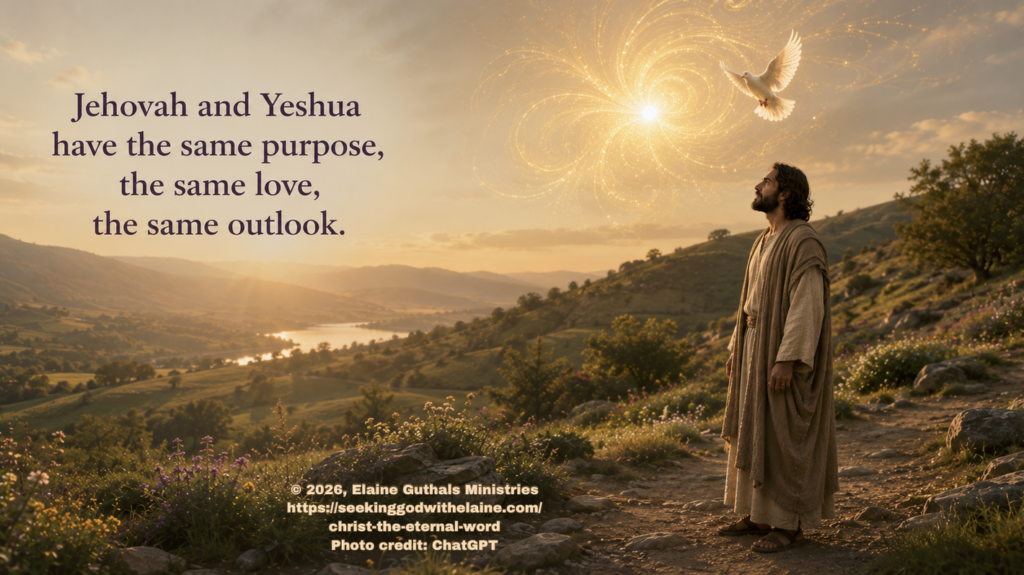
    Jehovah and Yeshua have the same purpose, the same love, the same outlook.

    Jones said it this way. “The Word was ‘with God’ in respect of personality. Omnipotence is eternally in God; Jesus Christ is eternally with God — a mode of speech signifying distinct, but not separate, personal subsistence.”

    Resource

    I know. How can They be the same but different?

    Don’t worry. We aren’t the only ones to struggle with that. The early Church did, too – that is why the concept of the Trinity took root.

    The Word was God

    Jehovah and Yeshua are the same nature and essence.

    John said here that Jehovah and Yeshua are equals. Yeshua said, “The Father and I are one” (Jn. 10: 30 NLT). Yeshua being God makes Him and Jehovah One and the same.

    We generally think this is talking about unity and equality, especially of nature. God’s Word tells us there is more to it than that.

    In today’s language, we would say they are the same all the way down to the DNA.

    • “Abraham, Isaac, and Jacob are their ancestors, and Christ himself was an Israelite as far as his human nature is concerned. And he is God, the one who rules over everything and is worthy of eternal praise! Amen” (Rom. 9: 5 NLT).
    • “But to the Son he says, ‘Your throne, O God, endures forever and ever.  You rule with a scepter of justice’” (Heb. 1: 8 NLT).
    • “And we know that the Son of God has come, and he has given us understanding so that we can know the true God. And now we live in fellowship with the true God because we live in fellowship with his Son, Jesus Christ. He is the only true God, and he is eternal life” (I Jn. 5: 20 NLT).

    This is the Savior of whom John will be discussing in the succeeding verses.

    Thomas helped us understand that Yeshua is a separate entity from Jehovah. He wrote, “‘And the Word was with God?’ The expression implies that He had a conscious existence distinct from the Absolute One.”

    Resource

    As Thomas said, that makes Yeshua Jehovah in action. This is how He expresses Himself.

    When we see Yeshua, we see Jehovah.

    Making the Connections #1

    Why would John go all the way back to creation to set up his Gospel account? It is easy.

    There is only one way in which sin can be eliminated within humans. It is through acceptance of the Savior in order to gain forgiveness from Sovereign God.

    Who better to take away the sin of the world than the Creator? Who else but Sovereign God could accomplish that?

    Why is it important to eliminate that sin? Look what Ryle said. He wrote,

    “If no one less than the Eternal God, the Creator and Preserver of all things, could take away the sin of the world, sin must be a far more abominable thing in the sight of God than most men suppose. If Christ is so great, then sin must indeed be sinful!”

    Resource

    That is why we cannot take away our own sins.

    So, John wanted to set the stage Who by giving His qualifications.

    Making the Connections #2

    There is another reason it is appropriate for John to begin his gospel by taking us back to creation. Adam, the first man, sinned and fell from grace. Yeshua, the second Man, came to restore that which was lost.

    “The Scriptures tell us, ‘The first man, Adam, became a living person.’ But the last Adam — that is, Christ — is a life-giving Spirit. What comes first is the natural body, then the spiritual body comes later. Adam, the first man, was made from the dust of the earth, while Christ, the second man, came from heaven” (I Cor. 15: 45-47 NLT).

    Culross explained. He wrote, “While the Evangelist begins with creation, he goes very far beyond, and consequently uses many words that were not needed in the book of Genesis, but are indispensable to his purpose — such as these — law, grace, truth, faith, sons of God, and so on.”

    Resource

    Genesis 1 started with no explanation of Who God is. Now, we are introduced to our Savior.

    I can see this. I am sure Moses and the Prophets were writing thinking their audience would only be Hebrews/Israelites/Jews.

    Yeshua changed that. He was battling for the hearts of all people — Jews and Gentiles.

    Making the Connections #3

    Goulburn had a great quote that fits in well with our The Battle of the Heart theme. He wrote,

    “Like the Personal Word, the Written Word rises up in meek majesty to make those who approach it with hostile intent go backward and fall to the ground; upon it descends the holy dove; over it hangs the bright cloud; it quickens human souls; it says to the stormy sea of the human heart, ‘Peace, be still’; before it the demons of lust, pride, covetousness, worldliness, quake and flee.”

    Resource

    Yeshua is the Personal Word. God’s Word is the Written Word. Both are eternal.

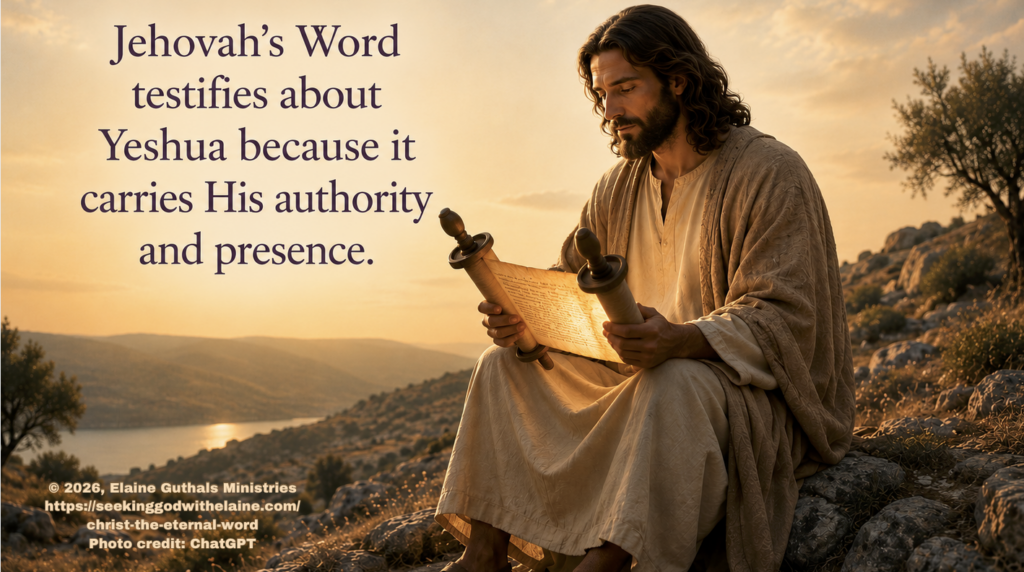
    Jehovah’s Word testifies about Yeshua because it carries His authority and presence.

    Look at these verses.

    • “And you know that the Scriptures cannot be altered …” (Jn. 10: 35 NLT).
    • “So the Word became human and made his home among us. He was full of unfailing love and faithfulness. And we have seen his glory, the glory of the Father’s one and only Son” (Jn. 1: 14 NLT).

    God’s Word is true and unchangeable. They reveal Yeshua and His glory to us. If it were not about Yeshua, it would be as any other book on the shelf.

    Yeshua is the Light — God’s Word is the lamp. It is the vehicle through which the Light can shine.

    We also read of Yeshua’s authority in the Garden of Gethsemane. “As Jesus said ‘I am he,’ they all drew back and fell to the ground!” (Jn. 18: 6 NLT).

    God’s Word has the same effect on some. When they approach it arrogantly, skeptically, and hostilely, they will find out its authority is true.

    The dove is a perfect image to include. Remember the dove was present at Yeshua’s baptism (Mt. 3: 16).

    This is the same Spirit that gives the Word as divine revelation to the human authors that record it. “Above all, you must realize that no prophecy in Scripture ever came from the prophet’s own understanding, or from human initiative. No, those prophets were moved by the Holy Spirit, and they spoke from God” (II Pet. 1: 20-21 NLT).

    Yeshua’s authority was also seen at the Mount of Transfiguration. “But even as he spoke, a bright cloud overshadowed them, and a voice from the cloud said, ‘This is my dearly loved Son, who brings me great joy. Listen to him’” (Mt. 17: 5 NLT).

    One purpose of God’s Word is to tell those words to us: peace, be still (Mk. 4: 39). When our hearts become the battlefield, Yeshua will calm us as well.

    It is by Yeshua’s authority that demons are driven out. When we hear the word demons, we may think of all the miracles where demons were cast out.

    But we experience demons — demons of lust, prides and covetousness. “For the world offers only a craving for physical pleasure, a craving for everything we see, and pride in our achievements and possessions. These are not from the Father, but are from this world” (I Jn. 2: 16 NLT).

    • Physical pleasure = lust
    • Craving everything we see = covetousness
    • Pride = pride

    God’s Word shows us what sin is and what is in our hearts.

    We see in the pages of God’s Word the Light that dispels darkness. When the Word enters our hearts, the war begins — and the darkness cannot stand against us.

    How Do We Apply This?

    • Trust in the One who is Creator of all things.
    • Come to Yeshua as the only way to the Father.
    • Submit to the authority of God’s Word as His revealed presence.
    • Allow His Light to expose and overcome the darkness in your heart.
    • Rest in His eternal plan, established before the foundation of the world.

    Father God. We can’t comprehend eternity, but we accept that You and Yeshua have always been. We thank You that He is Your Word and Your Light. We are humbled that the first thing You placed in creation was Yeshua as Light. You knew that we would disobey You, so You wanted our Salvation in the world even before we were created. Thank You for loving us so much. Amen.

    If you don’t understand something and would like further clarification, please contact me.

    If you have not signed up for the email providing the link to the devotions and the newsletter, do so below.

    If God has used this devotion to speak with you, consider sharing it on social media.
  • The Baby War

    After Jacob married Leah and Rachel a week apart, it was time to get on with creating descendants for the covenant line. This devotional reading looks at how the dysfunctional family handled that challenge.

    Nuggets

    • Leah was compensated for being unloved.
    • Rachel was upset that she wasn’t having children.
    • History repeated itself.
    • Because she gave her servant to Jacob as a surrogate, Rachel felt like she was winning the baby war.
    • Since Rachel gave her servant to Jacob as a concubine, Leah had to, also.
    • One afternoon, neither sister looked like they were relying on God.
    • Finally, finally, finally, Jehovah gave Rachel a son.
    the-baby-war

    The first recorded words that Jehovah said to humans was, “Go forth and multiply.” He wanted babies.

    I am fairly confident in saying that Jehovah did not really want a baby war. But that is just what He got with Jacob, Leah, and Rachel.

    We’re going to read all the verses together and then discuss.

    Let’s Put It into Context

    To read devotions in the Creating Everything theme, click the button below.

    Devotions in the Jacob the Patriarch series

    Jacob’s Sons

    “When the Lord saw that Leah was unloved, he enabled her to have children, but Rachel could not conceive. So Leah became pregnant and gave birth to a son. She named him Reuben, for she said, ‘The Lord has noticed my misery, and now my husband will love me.’ She soon became pregnant again and gave birth to another son. She named him Simeon, for she said, ‘The Lord heard that I was unloved and has given me another son.’ Then she became pregnant a third time and gave birth to another son. He was named Levi, for she said, ‘Surely this time my husband will feel affection for me, since I have given him three sons!’ Once again Leah became pregnant and gave birth to another son. She named him Judah, for she said, ‘Now I will praise the Lord!’ And then she stopped having children” (Gen. 29: 31-35 NLT)

    “When Rachel saw that she wasn’t having any children for Jacob, she became jealous of her sister. She pleaded with Jacob, ‘Give me children, or I’ll die!’ Then Jacob became furious with Rachel. ‘Am I God?’ he asked. ‘He’s the one who has kept you from having children!’ Then Rachel told him, ‘Take my maid, Bilhah, and sleep with her. She will bear children for me, and through her I can have a family, too.’ So Rachel gave her servant, Bilhah, to Jacob as a wife, and he slept with her. Bilhah became pregnant and presented him with a son. Rachel named him Dan, for she said, ‘God has vindicated me! He has heard my request and given me a son.’ Then Bilhah became pregnant again and gave Jacob a second son. Rachel named him Naphtali, for she said, ‘I have struggled hard with my sister, and I’m winning!’” (Gen. 30: 1-8 NLT)

    “Meanwhile, Leah realized that she wasn’t getting pregnant anymore, so she took her servant, Zilpah, and gave her to Jacob as a wife. Soon Zilpah presented him with a son. Leah named him Gad, for she said, ‘How fortunate I am!’ Then Zilpah gave Jacob a second son. And Leah named him Asher, for she said, ‘What joy is mine! Now the other women will celebrate with me’” (Gen. 30: 9-13 NLT)

    “One day during the wheat harvest, Reuben found some mandrakes growing in a field and brought them to his mother, Leah. Rachel begged Leah, ‘Please give me some of your son’s mandrakes.’ But Leah angrily replied, ‘Wasn’t it enough that you stole my husband? Now will you steal my son’s mandrakes, too?’ Rachel answered, ‘I will let Jacob sleep with you tonight if you give me some of the mandrakes.’ So that evening, as Jacob was coming home from the fields, Leah went out to meet him. ‘You must come and sleep with me tonight!” she said. “I have paid for you with some mandrakes that my son found.’ So that night he slept with Leah. And God answered Leah’s prayers. She became pregnant again and gave birth to a fifth son for Jacob. She named him Issachar, for she said, ‘God has rewarded me for giving my servant to my husband as a wife.’ Then Leah became pregnant again and gave birth to a sixth son for Jacob. She named him Zebulun, for she said, ‘God has given me a good reward. Now my husband will treat me with respect, for I have given him six sons.’ Later she gave birth to a daughter and named her Dinah” (Gen. 30: 14-21 NLT)

    “Then God remembered Rachel’s plight and answered her prayers by enabling her to have children. She became pregnant and gave birth to a son. ‘God has removed my disgrace,’ she said. And she named him Joseph, for she said, ‘May the Lord add yet another son to my family’” (Gen. 30: 22-24 NLT)

    Jehovah Enabled Leah to Have Children

    Leah was compensated for being unloved.

    We aren’t told how long after the marriage that Leah started having children, but we can probably be safe in saying that she did not suffer from barrenness.

    Remember, it was 20 years before Rebekah gave birth to Jacob and Esau, and Isaac had asked Jehovah for children (Gen. 25: 21). Sarah, also, was barren.

    It sounds like Leah started having her children right away — and for a very good reason. Leah was not loved by Jacob.

    God felt compassion for her.

    Still, Jacob treated her as a wife.

    Let’s do some math using our timeline. Jacob and his wives had 11 kids in 7 years. Now, these dates may or may not be right, but it is going to help me to visualize it.

    1716 BC – Jacob, 84, was tricked into marrying Leah. He agrees to work seven more years for Rachel
    1715 BC — Reuben born (Leah)
    1714 BC — Simeon born (Leah)
    1713 BC — Levi born (Leah)
    1712 BC — Judah born (Leah)
    1712 BC — Dan born (Bilhah)
    1711 BC — Naphtali born (Bilhah)
    1711 BC — Gad born (Zilpah)
    1710 BC — Asher born (Zilpah)
    1710 BC — Issachar born (Leah)
    1709 BC — Zebulun born (Leah)
    1709 BC – Joseph was born (Rachel)

    Based on Timeline from

    Maybe Jacob and Leah were able to conceive during the year they got married. That would have eased the number being born together in the end,

    My point is — somewhere along the line, at least two boys had to be born in the same year.

    But let’s look at the names Leah picked for her children. They all gave praise to Jehovah. They acknowledged the children came from Him.

    Bradford pointed out that, with each name, Leah was revealing her character. She. Trusted in Jehovah.

    Resource

    True, with Levi, Leah talked about winning Jacob’s affection since she had given him sons.

    Each of the four oldest sons were very important to Jacob’s story — either in a good way or bad way. Reuben lost his right to be called Jacob’s firstborn. Simeon and Levi made a bad decision.

    But all of the priests came from Levi’s great-great-grandson, Aaron. Judah’s descendant was the Messiah.

    Look what the Croswalk said about Leah. It says, “Naming her sons tells the spiritual journey of contentment in the Lord’s provision. Jacob did not see, hear, or attach himself to Leah, but the Lord filled the void Jacob created Leah’s life.”

    Resource

    If we are unloved by our spouse, are we content? NO!!! We are very vocal about our discontentment.

    Leah found contentment in her difficult situation.

    We aren’t told why Leah lost her ability to have kids. We just know that she did for a while.

    Rachel Pleaded with Jacob

    Rachel was upset that she wasn’t having children.

    Poor Rachel. It sounded like she was in denial. It was obvious the problem wasn’t with Jacob, but it was easier to make him the bad guy.

    Or was it worse than that? We know she was jealous and envious. Leale said she didn’t have a good outlook on life.

    Resource

    Rachel obviously didn’t have the relationship that Leah had with Jehovah.

    I may be reading into it, but it seems to me that Rachel didn’t have the rough life that Leah did. Things came easier to her because of her beauty.

    Rachel may have even thought she was better than Leah. Sometime — no, not always — but sometimes — arrogance comes along with beauty.

    This may have been the first time Leah had “bested” Rachel. And Rachel didn’t like that one bit!

    Rachel did get what she wanted. She did marry Jacob.

    But Rachel didn’t get what she wanted. Legally, Leah was first wife, and Rachel was second wife. Even though they were on equal footing, Rachel wasn’t top wife.

    Then to add insult to injury, Rachel’s rival was winning the baby war.

    Only Jehovah can bring true joy to our lives.

    Take My Maid

    History repeated itself.

    Ooo, baby. Didn’t Rachel learn anything from Sarah?

    Remember, it was culturally acceptable for servants/slaves to be taken as concubines when fertility issues were encountered.

    Now, let’s look at the names Rachel gave the children and what she said.

    • “… ‘God has vindicated me! He has heard my request and given me a son’” (Gen. 30: 6 NLT).
    • “… ‘I have struggled hard with my sister, and I’m winning!’” (Gen. 30: 8 NLT).

    No, Rachel didn’t acknowledge God. She focused on the baby war.

    Struggled and Won

    Because she gave her servant to Jacob as a surrogate, Rachel felt like she was winning the baby war.

    Was that because Bilhah had more children than Leah? No.

    Let’s dig in a little and think through why Rachel thought she was winning the baby war when she had used a surrogate and only had half the number of children Leah did.

    Remember, fertility was directly tied to honor, stability, and covenantal significance in the world in which Leah and Rachel lived. A wife who bore sons gained status within the household and security for the future — i.e., social power.

    Rachel was struggling for status through motherhood. She was trying to participate in the race, regain social footing, and prove she is not cursed.

    If we go back to the Hebrew, the phrase naphtulei Elohim indicates an intense struggle — twisting, grappling, even combat-like effort. It is describing an agonizing contest rather than mild rivalry.

    If we look back over the verses in Chapters 29 and 30, we see some very encouraging phrases: God saw, God heard, and God remembered. Children come from Sovereign God, not through anything we can concoct.

    Rachel was wrestling for a blessing. She said she won because she was no longer losing.

    What Rachel may or may not have realized was that she was wrestling with Sovereign God about her faith. He always grows our faith through the wrestling, not the calm seas of life.

    Statham explained why this happens. He wrote,

    “To him that [overcomes] the glorious promise of victory is vouchsafed. But the struggle will be severe; we shall have not only ordinary sorrows, superficial anxieties, but great wrestlings; and this is the victory that [overcomes] the world, even our faith.”

    Resource

    It is about endurance.

    No, Take My Maid

    Since Rachel gave her servant to Jacob as a concubine, Leah had to, also.

    Two more sons were added to the list by Leah’s servant. The last one, Asher, was given a name that meant joy.

    The Hebrew word for that is B’ashri. The root of this word conveys happiness, blessedness, or fortunate status. So, Genesis 30: 13 reads, “‘In my happiness! For the daughters will call me blessed.’ So she called his name Asher.”

    Yes, it does talk about public recognition. That would have been important to Leah as the position but not the love. Remember, in Leah’s culture, fertility elevated the woman’s standing.

    But we know being blessed has to do with our salvation. It is what happens when our relationship is right with God.

    Mandrakes

    One afternoon, neither sister looked like they were relying on God.

    I had no idea what mandrakes are. To me, they look like a sweet potato.

    More important than looks is what it was supposed to do. In the ancient Near East, mandrakes were widely believed to enhance fertility and stimulate sexual desire. They were associated with love, conception, and marital potency.

    Mandrakes contain alkaloids such as atropine and scopolamine. That is fine in small doses as sedatives, analgesics, and mild hallucinogens. Larger quantities prove the plant is toxic. While most of it is folklore, the plant does possess physiological properties that may have contributed to its perceived potency.

    So, here came Reuben bringing some to Leah. When Rachel saw them, her struggle with barrenness and social vulnerability made here desperate for some of that.

    Unloved Leah, on the other hand, has the upper hand. She has what Rachel wants. I have to ask – did she really want to give it to Rachel?

    This is the one interaction between the sisters that the rivalry is evident. Leah snaps back, “You stole my husband?”

    Well, no. Jacob was to be Rachel’s husband and never Leah’s husband, so she didn’t steal anything.

    Rachel barters Jacob for mandrakes. She wanted to the folklore to be true, so she “allowed” her husband to receive what would help her have kids.

    By this point, we have to look at both women at that time. They both were wounded and desperate for security. That made both of them competitive. It doesn’t help that Jacob drifted between the two.

    But look how Leah told Jacob. “… ‘I have paid for you with some mandrakes that my son found’ …” (Gen. 30: 16 NLT). The English Standard Version used the word hired. I probably would have said bought.

    Why would this be included – beyond setting Leah up for more kids? It is about taking matters into our own hands, isn’t it? Neither really depended on Sovereign God to do His Will.

    The interesting thing – the way it reads – is Jehovah opened Leah’s womb for that encounter. Then He gifted her with another son and a daughter.

    Rachel’s Prayers Are Answered

    Finally, finally, finally, Jehovah gave Rachel a son.

    Why did Jehovah have Rachel wait? Leale told us. She had to learn dependence, patience, faith, and hope.

    Resource

    Yep, this is how it goes. God grows us and rewards us.

    We will be talking about Joseph in many more devotions to come.

    Making the Connections #1

    Why would Jehovah had allowed four women to have given Jacob children? One wife couldn’t have done it — not if the timeline we use is correct.

    This has to be fairly close. Look at Joseph’s timeline.

    1692 BC — Joseph receives his coat of many colors from his father Jacob. Soon after receiving the gift, at the age of 17, he is sold into slavery by his brothers (Gen. 37).
    1679 BC — Joseph, at the age of 30 (Gen. 41: 46), interprets a dream experienced by Pharaoh to mean Egypt will have seven years of bountiful harvests followed by seven years of famine. The Egyptian ruler rewards Joseph’s insight, given by God, by making him the second most powerful person in Egypt (Genesis 41).
    1679 – 1672 BC — Egypt experiences seven years of bountiful harvests. It is during this period that Joseph’s two sons, Manasseh and Ephraim, are born (Gen. 41: 47 – 53).
    1672 – 1665 BC — Egypt, including Canaan and the rest of the world (Gen. 41: 56), endures seven years of drought conditions and famine (Gen. 41: 53 – 57).
    1670 BC — Jacob and his family, after two years of famine in the land (Gen. 45: 6), migrate to the land of Egypt (Gen. 46 – 47: 9).
    1653 BC — Jacob (Israel) blesses Joseph’s sons Manasseh and Ephraim and well as his own twelve sons (Gen. 48). He then dies at the age of 147 and is buried in Hebron (Gen. 49: 29 – 50: 13).
    1599 — Joseph dies at the age of 110 in Egypt (Gen. 50: 22 – 26).

    Based on Timeline from

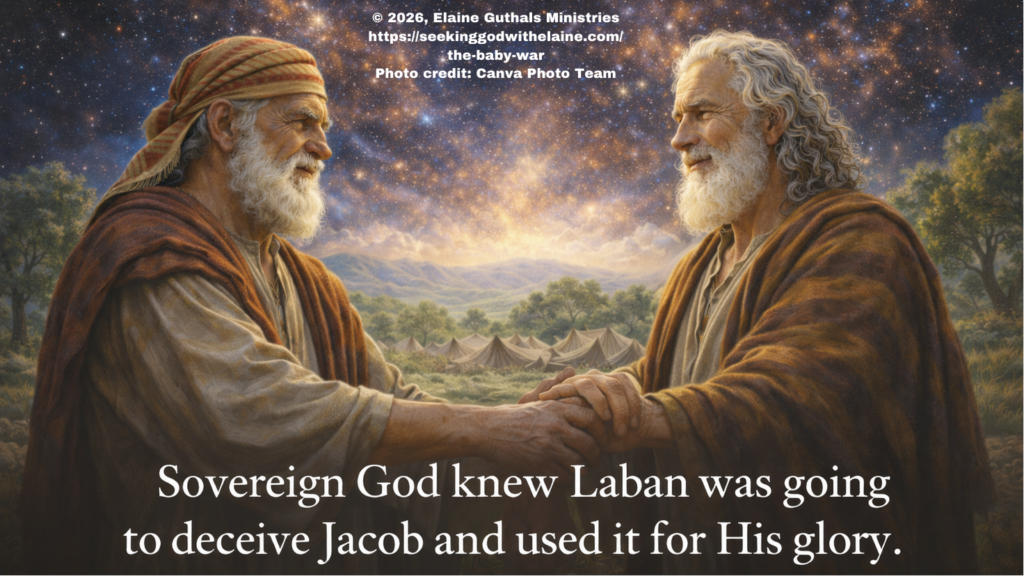
    Sovereign God knew Laban was going to deceive Jacob and used it for His glory.

    Rachel was the love of Jacob’s life. Kalisch believed — and so do I — that he only intended to marry her. When he found he had been deceived, he didn’t renounce Leah, but he also did give up Rachel.

    Resource

    And in doing this, Jacob was able to lay the foundation that built the nation of Israel.

    Making the Connections #2

    Was Leah’s fate to be married to someone who didn’t love her and Rachel’s barrenness because of both of their parts in Laban’s deception? Maybe. Maybe not.

    We like to say, “If A happens, B will happen.” That is especially true when we put it in past tense. We want to know why something bad has happened.

    But then, when we do that, aren’t we trying to play god?

    Making the Connections #3

    Our first thought may be, “Isn’t it sad that the sisters have a rivalry?” It gets even sadder when we consider it continued to their sons — specifically Judah and Joseph.

    We talked about birthright and blessing being two different things. The birthright is family leadership. The blessing is worldly possessions. We think it usually goes to the firstborn.

    Jacob’s firstborn, we’ll find out, staged a coup. The second and third born sons avenged their sister by killing all the men in one town. They were all passed over as being declared the firstborn.

    The next in line was Judah. He got the birthright.

    But Judah didn’t get the blessing. Joseph did. How did that play out?

    Judah’s descendant was David — King David to be exact. When the nation split, David’s descendants populated the northern kingdom.

    The southern kingdom was dominated by the descendants of Joseph — Ephraim and Manasseh.

    Yeah, what started out as a rivalry between sisters escalated to geography of the nation.

    The rivalry between Leah and Rachel shows that Jehovah will provide covenant purposes though earthly tension, not apart from. He will use the hood and the bad to advance His purposes.

    Making the Connections #4

    This wasn’t the only co-wife rivalry we hear about in God’s Word — and the other has barrenness, also. Hannah (the prophet Samuel’s mother) also experienced barrenness and was Elkanah’s co-wife with Peninnah (I Sam. 1).

    Making the Connections #5

    Starting with Jacob’s children, there was a change. Each of them were declared to be a Hebrew. None of his children were excluded.

    Remember, we said Isaac was a Hebrew, but Ishmael wasn’t. Jacob was a Hebrew, but Esau wasn’t.

    Why did this change? It changed because the descendants of each son (including Benjamin, who hadn’t been born yet) formed the Twelve Tribes of Israel.

    Bradford said that didn’t preclude Gentiles from becoming a Hebrew. He wrote, “… if that gentile wanted to become part of the Hebrew people, it was allowed by means of some rules, some laws, that had been set down by Yahweh.”

    Resource

    Even then, Jehovah made a way for all people to have a way into His family.

    How Do We Apply This?

    • Rely on God to work His Will in our lives.

    Father God. Your Will is best for us. Help us to wait on Your timing. Amen.

    If you don’t understand something and would like further clarification, please contact me.

    If you have not signed up for the email providing the link to the devotions and the newsletter, do so below.

    If God has used this devotion to speak with you, consider sharing it on social media.
  • Promise of a Lifetime

    Today is a music day.

    Today was a good day. Pastor Steve and I went back to Rochester. The church had its 50th anniversary celebration.

    It was a wonderful service. We got to sing on the praise team.

    So, I am going to do another music day. (I promise. It will be a while before I do another!)

    Promise of a Lifetime
    Vocalist: Elaine Guthals
    Keyboard: Chris Vieth

    promise-of-a-lifetime-4FB

    What do you think?

    Leave me a comment below (about this or anything else) or head over to my Facebook group for some interactive discussion.

    If you don’t understand something and would like further clarification, please contact me.

    If you have not signed up for the email daily or weekly providing the link to the devotions and the newsletter, do so below.

    If God has used this devotion to speak with you, consider sharing it on social media.
  • Promise of a Lifetime

    Today is a music day. To read and hear the song, click here.

    Hi. This is Elaine.

    No, that isn’t the way I normally start my devotions. I just want to talk to you for a bit.

    No, I am not sick again. In fact, I am weaning myself from the seizure medicine since the diagnosis was changed to migraines. That is going well.

    Well, I do have the normal sinus gunk that I always get this time of year. Right now, my sinus drainage seems like it is trying drown me.

    I just feel God is calling me to start a new series. I don’t exactly know where He is going with this and what it is exactly going to look like.

    But I do know where God wants it to start.

    I don’t know how it is going to look or what it is going to entail.

    I just know it isn’t starting today. Let me get a little more figured out on it, and then we’ll start.

    Right now, we’ll have a music day. I love Promise of a Lifetime. It is about total submission.

    promise-of-a-lifetime-3-FB

    Promise of a Lifetime
    Vocalist: Elaine Guthals
    Keyboard: Louise Guthals Weiss

    What do you think?

    Leave me a comment below (about this or anything else) or head over to my Facebook group for some interactive discussion.

    If you don’t understand something and would like further clarification, please contact me.

    If you have not signed up for the email daily or weekly providing the link to the devotions and the newsletter, do so below.

    If God has used this devotion to speak with you, consider sharing it on social media.

  • Promise of a Lifetime

    Today is a music day.

    Everything is fine here, but I am just totally exhausted. I had a very good time with family yesterday. It just wore me out.

    Then I didn’t get much sleep last night. I don’t know why.

    I am so tired, I am all but weepy. I hate getting like this, but this is what happens when I hit rock bottom of the energy tank.

    This song talks about hitting rock bottom — but more than just the energy tank. It talks about being so far down that the only way they see going up is to fall on their knees before God.

    Why do we do that? Why do we wait until we get so low before we take our problems to God?

    God is always there. He is more than willing to help us. In fact, He wants us to bring our problems to Him.

    In some cases, God won’t provide until we ask. Why does He wait for us to ask if He is going to give it to us anyway?

    God wants us to submit to Him. We need to know that He is the provider.

    Submitting is a part of salvation. When we do, we get the promise of a lifetime — an eternal lifetime.

    Promise of a Lifetime
    Vocalist: Elaine Guthals
    Keyboard: Louise Guthals Weiss

    PromiseOfALifetimePin

    What do you think?

    Leave me a comment below (about this or anything else) or head over to my Facebook group for some interactive discussion.

    If you don’t understand something and would like further clarification, please contact me.

    If you have not signed up for the email daily or weekly providing the link to the devotions and the newsletter, do so below.

    If God has used this devotion to speak with you, consider sharing it on social media.

  • Promise of a Lifetime

    Today is a music day.

    Well, I started writing a post, and it wasn’t going well. So, we are going to have a music day today. I will work on fixing the post for tomorrow.

    Now, don’t listen to this song and think I got bad news on the health side. In fact, since I tapered off my old medicine and started this new medicine, I am much better.

    All the side effects from the old medicine went away. The new side effect is that it makes me tired. I go from a half dose to the full dose Monday, so it will be interesting to see what happens.

    This song was one that I found when I had my spiritual tornado. Then, I was frequently down on my knees, pouring my heart out to God.

    God helps us put ourselves back together after our worlds fall apart. He is there to pick us up and put us back together.

    God promised to be with me then. He has promised to be with me now. He will always be with me. He will never leave me.

    God won’t leave you either. And this promise is for our lifetime — our eternal lifetime.

    Promise of a Lifetime
    Vocalist: Elaine Guthals
    Keyboard: Louise Guthals Weiss

    PromiseOfALifetimePin

    What do you think?

    Leave me a comment below (about this or anything else) or head over to my Facebook group for some interactive discussion.

    If you don’t understand something and would like further clarification, please contact me.

    If you have not signed up for the email daily or weekly providing the link to the devotions and the newsletter, do so below.

    If God has used this devotion to speak with you, consider sharing it on social media.
  • Isaiah’s Message on God’s Deliverance

    God had promised the Israelites that He would provide for them as they were in the path of the advancing Assyrian army. This daily devotional looks at how He fulfilled that promise.

    Nuggets

    • God is always with us as He never leaves us.
    • God wants our confession.
    • God wants us to get to the point that we totally depend on Him.
    • Sometimes, God responds right away; sometimes, He makes us wait.
    • The remnant escaped.

    Devotions in the Isaiah’s Message from Sovereign God series

    The last time we left Isaiah and the Israelites, they were fixing to get overrun by the Assyrians – or so they thought. God promised that He would provide for them.

    God keeps His promises. He delivered the Israelites from the Assyrian army. Let’s see how.

    Let’s Put It into Context

    “So the servants of King Hezekiah went to Isaiah, who said to them, ‘Tell your master, ‘The Lord says this: Don’t be afraid because of the words you have heard, with which the king of Assyria’s attendants have blasphemed me. I am about to put a spirit in him and he will hear a rumor and return to his own land, where I will cause him to fall by the sword’” (Isa. 37: 5-7 CSB)

    “… So when [Sennacherib] heard this, he sent messengers to Hezekiah, saying, ‘Say this to King Hezekiah of Judah: “Don’t let your God, on whom you rely, deceive you by promising that Jerusalem won’t be handed over to the king of Assyria. Look, you have heard what the kings of Assyria have done to all the countries: they completely destroyed them. Will you be rescued? Did the gods of the nations that my predecessors destroyed rescue them — Gozan, Haran, Rezeph, and the Edenites in Telassar? Where is the king of Hamath, the king of Arpad, the king of the city of Sepharvaim, Hena, or Ivvah?’” (Isa. 37: 9-13 CSB)

    Okay, Hezekiah did right. He went to Isaiah to get a message from God.

    But Hezekiah also got a message from Sennacherib — a totally different message. Problem was, Sennacherib’s message was really a message from Satan.

    It is a standard Satan message — we can’t depend on God to do what He says He will do.

    Ooo, baby. If that would happen, we would really be in a pickle.

    Sennacherib was correct. All of those other people groups and cities had fallen to the Assyrian army.

    There was one big difference. Those who fell did not have Sovereign God fighting for them.

    What Was Hezekiah’s Prayer?

    “Hezekiah took the letter from the messengers’ hands, read it, then went up to the Lord’s temple and spread it out before the Lord. Then Hezekiah prayed to the Lord: Lord of Armies, God of Israel, enthroned between the cherubim, you are God — you alone — of all the kingdoms of the earth. You made the heavens and the earth. Listen closely, Lord, and hear; open your eyes, Lord, and see. Hear all the words that Sennacherib has sent to mock the living God. Lord, it is true that the kings of Assyria have devastated all these countries and their lands. They have thrown their gods into the fire, for they were not gods but made from wood and stone by human hands. So they have destroyed them. Now, Lord our God, save us from his power so that all the kingdoms of the earth may know that you, Lord, are God — you alone” (Isa. 37: 14-20 CSB)

    Hezekiah was a man of faith. Pentecost even described him as righteous.

    Resource

    Oh, no. Hezekiah wasn’t perfect — none of us are. But he prayed to the Sovereign Lord.

    This time, Hezekiah didn’t stay home and pray. He went to God. “Now my eyes will be open and my ears attentive to the prayers offered in this place” (II Chron. 7: 15 NIV).

    What does this tell us? Hezekiah took time out of his busy day to go to God. He thought the situation warranted him going to God’s house to bring his petition.

    Sure, God is always with us. He never leaves us.

    But don’t we take that for granted sometimes? We expect God to be over our left shoulders, watching over us — even if we aren’t looking back.

    Hezekiah said he wasn’t going to do that. He was going to go to God. He was going to God in faith, asking for discernment. Discernment means we can evaluate the situation and recognize right from wrong.

    “Lord of Armies …” (Isa. 37: 16 CSB). Hezekiah knew that God would fight for His people, so that was the name of God he used.

    Hezekiah was not only acknowledging God’s superiority, but he was also putting Him on His throne. It is from this place God rules the entire universe.

    Did you see that Hezekiah took the letter with him? Yes, God would have known the contents of the letter if he would have left it at home.

    God will take our thoughts and our feelings that we bring to Him. When we have undisputed evidence, we should bring that, too.

    Pentecost felt this was leaving the planning too God as to how it would be addressed. Usually, we have our plan of attack all ready to and ask God to bless it. That isn’t relying on Him.

    Resource

    Hezekiah correctly read the situation and realized Israel was in trouble. He correctly went to God for His deliverance.

    Verse 17 might lead us to believe that, even though God is with us, He isn’t paying attention. Nothing could be further from the truth.

    This is showing us the attitude with which we need to approach God. Pentecost wrote, “True prayer has always reference to the glory of God, however much our own personal desires and needs may be involved in the things asked for.” We are told to ask God for what He is already planning to provide.

    Resource

    God wants our confession. He wants us to be really clear about the situations we are facing. He doesn’t want us to be delusional.

    God wants us to get to the point that we totally depend on Him. Hezekiah acknowledged that, for two centuries, the Assyrians had a really good track record.

    Now, however, they were coming up against the Sovereign God. They didn’t stand a chance if God would fight for His people.

    “Now, Lord our God, save us from his power so that all the kingdoms of the earth may know that you, Lord, are God — you alone” (Isa. 37: 14-20 CSB). That is a simple, straightforward prayer. Hezekiah wanted God’s power to be known by all.

    Knowing God means we don’t want to keep Him for ourselves. We want others to experience the blessings of salvation. Salvation is deliverance from evil and the consequences of sins to replace them with good and eternal life.

    Knowing God means we don’t want to keep Him for ourselves.

    What Was God’s Answer to Hezekiah’s Prayer?

    “But I know your sitting down, your going out and your coming in, and your raging against me” (Isa. 37: 28 CSB)

    God responded to Hezekiah’s prayer through Isaiah. We don’t know how long it took to get the answer. Sometimes, God responds right away. Sometimes, He makes us wait.

    Through Isaiah, God told Hezekiah that He was going to answer his prayer.

    “I designed it long ago; I planned it in days gone by. I have now brought it to pass, and you have crushed fortified cities into piles of rubble” (Isa. 37: 26 CSB).

    Nothing was happening outside of God’s plan. God chose His people. He also allowed the Assyrians victories.

    No, just because they didn’t claim Him as Sovereign God didn’t mean He wasn’t in control of their future. God has ultimate control.

    God knows everything about everyone of His creations— regardless if we are His children or just made in His image.

    Glossary

    God is in control. Sennacherib could boast all he wanted. He was going to find out reality.

    How Did God Provide for Israel?

    “‘This will be the sign for you: This year you will eat what grows on its own, and in the second year what grows from that. But in the third year sow and reap, plant vineyards and eat their fruit. The surviving remnant of the house of Judah will again take root downward and bear fruit upward. For a remnant will go out from Jerusalem, and survivors from Mount Zion. The zeal of the Lord of Armies will accomplish this.’ ‘Therefore, this is what the Lord says about the king of Assyria: He will not enter this city,
shoot an arrow here, come before it with a shield, or build up a siege ramp against it. He will go back the way he came, and he will not enter this city. This is the Lord’s declaration. I will defend this city and rescue it for my sake and for the sake of my servant David’” (Isa. 37: 30-35 CSB)

    Isaiah came back to talking about the remnant. A remnant of believers is the those who remained faithful to God even when the nation of Israel did not. It describes the identity of the church.

    Irons stressed that the remnant escaped. Did that mean they did not deal with any of the issues the nation was experiencing, like possibly lack of water and food or terror of an advancing or besieging army?

    Resource

    No, the remnant would have still felt the effects of the punishment the nation was experiencing. They, however, did not lose their lives.

    Verse 31 talks about being rooted. We’ve talked about being rooted and grounded before. Navigating the Sanctification Road is the process of becoming rooted and grounded.

    Glossary

    The root is the foundation of the plant that we normally do not see. Our faith must have an element of being hidden. Irons wrote, “If you have no more religion than what is seen, it is not worth your possessing. The real Christian has a hidden life.”

    Yes, others must see our testimony being lived out. We also need our private time with Sovereign God.

    Gods has a remnant for a reason. McAfee put it this way: “Rooting for the sake of fruiting …”

    Resource

    ˘We are to acknowledge God’s protection in our lives by telling others what He has done for us. We need to be vocal about His providing for us.

    Look at how God provided for Jerusalem in verses 33 and 34.

    • Not enter this city (Isa. 37: 33)
    • No arrows (Isa. 37: 33)
    • No shields (Isa. 37: 33)
    • No siege ramp against it (Isa. 37: 33)
    • Go back the way he came (Isa. 37: 34)
    • Not enter this city (Isa. 37: 34)

    I guess Hezekiah had to hear not enter the city twice. It sandwiches everything else.

    IsaiahsMessageonGodsDeliverancePin

    Making the Connections

    If we look at the Old Testament, we see many instances where Israel needed God’s provision. God gave it every time.

    Oh, yes. Israel may have been carried off into exile. However, God always provided and maintained the remnant.

    God controls yesterday, today, and tomorrow for all of His creation. We can count on Him.

    We need faith.

    How Do We Apply This?

    Hezekiah didn’t get it right all of the time (II Kgs. 18: 14). When he didn’t k he repented. Repentance is acknowledging our separation from God, expressing sorrow for breaking God’s laws and commandments by making the commitment to changing ourselves through obedience so that we no longer do the wrong things.

    We need to repent, too.

    The army of Judah knew they were no match for the Assyrian army. What they did now was that God was stronger than the Assyrian army.

    We can rely on God, too.

    Hezekiah had faith that he could go to God and ask Him for deliverance. He had access to God.

    We have faith and access, too.

    In God, we have all that we need.

    Father. Thank You for providing for us. Even when you are correcting us, You provide. May we be like Hezekiah and keep our trust in You. Amen.

    What do you think?

    Leave me a comment below (about this or anything else) or head over to my Facebook group for some interactive discussion.

    If you don’t understand something and would like further clarification, please contact me.

    If you have not signed up for the email daily or weekly providing the link to the devotions and the newsletter, do so below.

    If God has used this devotion to speak with you, consider sharing it on social media.

  • Isaiah’s Message on God’s Provision

    The Book of Isaiah contains many prophecies. One reason for these prophecies was so that Israel could see God’s provision for her. This daily devotional looks at how God promises to provide for us.

    Nuggets

    • The Israelites were looking to Egypt to be their savior against the advancing Assyrians.
    • Isaiah used lions and birds as analogies for God’s provision.
    • God calls disciples of Christ back from rebellion.

    Devotions in the Isaiah’s Message from Sovereign God series

    God wants us to rely totally on Him. He doesn’t want us looking to others – even other governments – to save us.

    Isaiah had to address this when Israel was fixing to get defeated by the Assyrians. Let’s take a look.

    Let’s Put It into Context

    In Isaiah 30, Judah was wanting to make an alliance with Egypt. When we think of Israel and Egypt, we generally think about the time Jacob moved his family there because Joseph was second in command and there was a famine happening.

    We sometimes may forget that Egypt was a powerhouse. The Israelites must have thought they should go with the devil that they knew, as there were times they wanted to make alliances with Egypt.

    At one point, Egypt did rule over Judah. They were trying to stop the advance of Babylon (Holman Bible Dictionary).

    Resource

    We also know a little about Egypt in Jesus’ time. That was where Joseph took his family to avoid Herod’s killing spree. By the time of Jesus’ ministry, Egypt had fallen under Roman rule.

    Israel Didn’t Believe in God’s Providence

    “Woe to those who go down to Egypt for help and who depend on horses! They trust in the abundance of chariots and in the large number of horsemen. They do not look to the Holy One of Israel, yes 
and they do not seek the Lord. But he also is wise and brings disaster. He does not go back on what he says; he will rise up against the house of the wicked and against the allies of evildoers. Egyptians are men, not God; their horses are flesh, not spirit. When the Lord raises his hand to strike, the helper will stumble and the one who is helped will fall; both will perish together” (Isa. 31: 1-3 CSB)

    The Israelites were looking to Egypt to be their savior against the advancing Assyrians. What Israel saw was Egypt perceived might instead of God’s wisdom.

    We can’t look at this passage through today’s lens. Warfare was nothing like today’s warfare.

    There were no tanks at the time. Planes hadn’t been invented.

    There were armies marching. There was hand-to-hand combat.

    Occasionally, there was horses pulling chariots. Those were the really strong armies.

    Egypt had an abundance of horses. Israel didn’t have many.

    Resource

    So, going by the worldview at the time, Egypt was one to be feared.

    You would think that Israel would have remembered when God defeated Egypt’s chariots.

    • “The Egyptians set out in pursuit — all Pharaoh’s horses, his chariots, and his horsemen—and went into the sea after them” (Ex. 14: 23 CSB). 
    • “[God] caused their chariot wheels to swerve and made them drive with difficulty …” (Ex. 14: 25 CSB).
    • “So Moses stretched out his hand over the sea, and at daybreak the sea returned to its normal depth. While the Egyptians were trying to escape from it, the Lord threw them into the sea.  The water came back and covered the chariots and horsemen, plus the entire army of Pharaoh that had gone after them into the sea. Not even one of them survived” (Ex. 14: 27-28 CSB).
    • “That day the Lord saved Israel from the power of the Egyptians, and Israel saw the Egyptians dead on the seashore” (Ex. 14: 30 CSB).

    Israel was told not to rely on Egypt — in fact any foreign government. “When the LORD your God hands these nations over to you and you conquer them, you must completely destroy them. Make no treaties with them and show them no mercy” (Deut. 7: 2 NLT).

    What Israel saw was Egypt’s perceived might. What they didn’t see was God’s wisdom. Wisdom is knowledge, discernment, and good sense that leads to goodness and virtue, which can be applied to life.

    Israel was to rely on God’s providence. Providence is God’s acts of meeting the needs of His creation.

    • “And my God will supply every need of yours according to his riches in glory in Christ Jesus” (Phil. 4: 19 ESV)
    • “Therefore do not be anxious, saying, ‘What shall we eat?’ or ‘What shall we drink?’ or ‘What shall we wear?’ For the Gentiles seek after all these things, and your heavenly Father knows that you need them all” (Mt. 6: 31-32 ESV)
    • “If you then, who are evil, know how to give good gifts to your children, how much more will your Father who is in heaven give good things to those who ask him!” (Mt. 7: 11 ESV).
    • “Consider the ravens: they neither sow nor reap, they have neither storehouse nor barn, and yet God feeds them. Of how much more value are you than the birds!” (Lk. 12: 24 ESV).

    God wants us to focus on spiritual things, not things this world has to offer. Spirits are mightier than men or animals.

    By Israel wanting an alliance with Egypt, they were rejecting God. They were making decisions based on what the world could do for them, not what God had promised.

    God has promised to provide for us. He will take care of us.

    God has promised to provide for us.

    What Do Lions and Birds Have to Do with God’s Provision?

    “For this is what the Lord said to me: As a lion or young lion growls over its prey when a band of shepherds is called out against it, and it is not terrified by their shouting or subdued by their noise, so the Lord of Armies will come down to fight on Mount Zion and on its hill. Like hovering birds, so the Lord of Armies will protect Jerusalem; by protecting it, he will rescue it; by passing over it, he will deliver it” (Isa. 31: 4-5 CSB)

    Isaiah used lions and birds as analogies for God’s provision. This shows how God is both a loving God and a vengeful God.

    We may not be totally familiar with shepherds and lions, but I think we can figure this out with a little help.

    There are predators; and there are prey. Lions are predators. Sheep are prey.

    Lions attack the sheep because they are trying to get food. They are generally not inclined to give up their supper, even when the shepherds are screaming and shaking their sticks at them.

    Smith said that the lion represents God. No, God is not going to devour us. He will, however, latch onto us and not give us up to Satan.

    The description Smith gave of the shepherds is interesting. He wrote, “For these are the ‘shepherds’ Isaiah means — sham shepherds, the shrieking crew of politicians, with their treaties and military display.”

    The shepherds aren’t really concerned about the sheep. They are deluding the sheep into thinking they have the sheep’s best interests in mind.

    The shepherds in this illustration aren’t true shepherds. Jesus is our true Shepherd. “I am the good shepherd. The good shepherd lays down his life for the sheep” (Jn. 10: 11 CSB).

    God is the mighty lion. He does not heed what the leaders of this world tell Him. He has His plans for us. He is going to work those plans.

    Then, Isaiah talks about hovering birds. Maclaren likens that to a mother bird watching over her nest.

    Resource

    We like the care-taking mother picture a lot better than the devouring lion picture.

    Really, God is both. He is the loving God and vengeful God.

    Driver had a different perspective. He thought the Assyrians were the lion. That makes the switch to the protecting bird sudden, though.

    Resource

    Hmmmm. What should we make of that?

    We know the Israelites were in this pickle because of disobedience. God allows correction — even when it hurts.

    The purpose of God’s correction is to restore us to Him. We go through the season until we have learned what we were supposed to have learned or until we are sorry for the offense.

    Then God restored us. He becomes the protective Parent.

    Called Back from Rebelling against God

    “Return to the one the Israelites have greatly rebelled against. For on that day, every one of you will reject the worthless idols of silver and gold that your own hands have sinfully made. Then Assyria will fall, but not by human sword; a sword will devour him, but not one made by man. He will flee from the sword; his young men will be put to forced labor. His rock will pass away because of fear, and his officers will be afraid because of the signal flag. This is the Lord’s declaration — whose fire is in Zion and whose furnace is in Jerusalem” (Isa. 31: 6-9 CSB)

    God calls disciples of Christ back from rebellion. Remember, this is prophesy.

    Isaiah was prophesying the Assyrian’s defeat. Assyria was going to fall to the sword — but not an earthly sword.

    God was telling His people not to align themselves with the losing party.

    This is the message God gives His people — who it seems like are in continuous rebellion. He is constantly telling us not to align with the world or it’s ruler — Satan.

    Still, we do. In so many ways, we allow Satan to rule us.

    God calls us back, and He will refine us in the fire. Heat kills a lot of bad things, purifying what has been placed in the heat.

    Maclaren wrote, “Water cleanses the surface, and becomes dirty in the process. Fire cleanses within and throughout, and is not tainted thereby.”

    Resource

    IsaiahsMessageOnGodsProvisionPin

    Making the Connections

    Too many times, we leave God as a last resort. We don’t see God at work in our lives because our relationships with Him aren’t strong.

    We get into trouble when we limit God’s provision for us. We want God to provide for us in the ways we want — which are not necessarily the ways that are best for us.

    We need to depend on God through the hardest times. We are to seek God not only for His advice on what we should do with our lives, but we also must seek His protection.

    How Do We Apply This?

    • ABCD

    The ABCDs of Salvation

    If you have not become a believer in Christ, please read through the
    Plan of Salvation and prayerfully consider what God is asking you to do.

    A – admit our sins
    B – believe His Son Jesus is our Redeemer
    C – confess God as Sovereign Lord

    D – demonstrate that commitment by making any changes needed in our lives to
    live the way in which God has called us

    The Disciple’s Job Description

    • Take refuge in God whenever trials come.
    • Live for Him. Wileman said “True happiness is obtained when our will is brought into harmony with God’s will.”
    • Trust that He will protect us.
    • Praise Him, thank Him, and ask Him for His protection.
    • Obey His laws and commandments.

    Resource

    God wants us to totally rely on Him. He has promised He will provide for us. He will take care of us — even during the times He is correcting us.

    We just have to rely on Him.

    Loving Father. You are all-powerful. You control all that happens. You have promised to take care of us and provide for us. Sometimes, that caring for us includes correcting us. Help us to always look to You for provision through the good times and the bad. Amen.

    What do you think?

    Leave me a comment below (about this or anything else) or head over to my Facebook group for some interactive discussion.

    If you don’t understand something and would like further clarification, please contact me.

    If you have not signed up for the email daily or weekly providing the link to the devotions and the newsletter, do so below.

    If God has used this devotion to speak with you, consider sharing it on social media.

  • God’s Love as a Foundation of Hope

    When trials come our way, we look for hope. Disciples of Christ don’t have to look far. This daily devotional looks at how God’s love for us is the foundation of hope.

    Nuggets

    • Our hope is built on the Rock.
    • One of the foundations of hope is God’s love for us.
    • God gives us direction regarding His Will through the Holy Spirit, which gives us hope.

    Devotions in the What Is Hope? series

    We have been winding our way around the first part of Romans 5 to learn more about hope. After talking about justification, faith, grace, and peace, Paul talked about trials. Underlying all of this is the hope that we find in God.

    Let’s Put It into Context #1

    Hope is where we desire for something that we believe is obtainable.

    Our foundation is built on the blessings of faith, hope, peace, joy, comfort, and glory. It is only through Jesus’ love that we have hope.

    If Jesus is not Lord of our lives, we do not have hope. If Jesus didn’t justify us, we wouldn’t have hope.

    We show God’s merit when we give Him reverence. When we respond in humility, we show that we agree that He is higher than us. Our trust, love, and hope show how much we believe in His love and provision.

    Because we have the hope, we believe in the ultimate triumph of Truth. That will be Jesus’ second coming.

    Let’s Put It into Context #2

    “Not only so, but we also glory in our sufferings, because we know that suffering produces perseverance; perseverance, character; and character, hope” (Rom. 5: 3-4 NIV)

    • In order to have hope, we need to be justified; in order to be justified, we have to have faith.
    • We get faith through grace.
    • God readily gives us peace and helps us grow into holiness.
    • Because of the magnificence of His glory, we have the assurance that God can provide the atonement for our sins.
    • Trials are hard to endure, but we have to persevere through them.
    • By getting the sin out of our lives, God is growing our character to be more like Him.
    • Patience comes only when we give God control of everything.
    • We build our character when we follow God’s mind and Will.

    Hope’s Foundation Is Rock Solid

    “And hope does not put us to shame, …” (Rom. 5: 5 NIV)

    What we’ve learned over the past two devotions is that hope is not just handed out like candy. We have to do our parts to secure hope.

    We get to the point where we have confidence in our hope. We know our hope is valid because of in Whom we place our trust.

    Let’s face it. Life is complex. We hope something will happen, but its happening is contingent on yada, yada, and yada. Yada may just blow up on us.

    Isn’t it great to know that our hope is built on the Rock? What we think is attainable is contingent on what is the same yesterday, today, and tomorrow (Heb. 13: 8).

    Related Links

    Philips, Craig & Dean

    We know we can put our hope in God because of what He has promised. We know we can put our hope in Jesus because of what He has done for us.

    Clarke said that we sometimes mix up hope and desire. If we look at desire as expressing a wish for something, we may or my not believe it is attainable. What we see as desire in some cases may, in reality be despair.

    Also, if the desire slips over to coveting something, we have now sinned. We have to watch the desire so that we are following God’s will.

    Don’t read this as we are not supposed to desire something. Clarke reminded us that “hope is made up of desire and faith — it is the confident expectation of coming good.”

    Resource

    So, we are to hope on God alone. As Spurgeon said, we can have “… absolute certainty that our hope will be realised (sic).”

    Resource

    Hope’s Foundation is God’s Love

    “… because God’s love has been poured out into our hearts …” (Rom. 5: 5 NIV)

    How can we have this absolute certainty? One of the foundations of hope is God’s love for us.

    It is mind boggling to think God loves us — but He does. We have disobeyed and continue to disobey Him.

    Let’s look at it this way. God set up the Plan of Salvation before He created the universe. He loved us before we did anything wrong.

    But God also loved us before we did anything right. So, what makes God love us?

    God loves us because it is Who He is. God is love (I Jn. 4: 8). It is His character, so it does not depend on anything to be sustained.

    God loved us so much that He sent His Son to die for us. It wasn’t because we were so perfect and good. “But God proves his own love for us in that while we were still sinners, Christ died for us” (Rom. 5: 8 CSB).

    That is a strong foundation on which to build our hope. It isn’t about what we do or don’t do. It is about our accepting what Jesus has already done for us.

    Doesn’t that make the gift more precious? We totally did not deserve it. God gave it to us anyway.

    Spurgeon said something that just hit me. He wrote, “That the Lord must ever us now that we are reconciled.”

    Resource

    Once God gives us the pardon of our sins when we ABCD, His decision to reconcile us to Him is forever made. He can’t pull His love away from us.

    But it is based on us being genuine. We have to follow through with the submission after the asking for forgiveness. We have to out Sovereign God on the throne of our hearts.

    That makes God’s love unfailing. “But each day the LORD pours his unfailing love upon me, and through each night I sing his songs, praying to God who gives me life” (Ps. 42: 8 NLT).

    Because of this love, we have God’s support. He fights for us. “The Lord will fight for you, and you have only to be silent” (Ex. 14: 14 ESV).

    God isn’t stingy with this love. Because of it, we are the recipients of God’s grace. Grace is a free and unmerited gift from Heavenly Father given through His Son, Jesus Christ that enables salvation and spiritual healing to believers by the work of the Holy Spirit.

    Where is this love revealed? In our hearts. That makes it personal.

    What do we keep saying? God wants to change our character. That happens at the heart level.

    Brown put it this way. He wrote, “Personal piety has to do not only with the conduct, but the character; and the character is decided by the condition of the heart in the sight of God. Out of the heart are the issues of life, and if the love of God be there holiness will be stamped upon thought, word, and deed.”

    Resource

    Hope activates us. Because we have confidence in God’s love, we can put our trust in hope. That means we can do what God asks us to do.

    We Have Hope through the Holy Spirit

    “… through the Holy Spirit, who has been given to us” (Rom. 5: 5 NIV)

    God gives us direction regarding His Will through the Holy Spirit, which gives us hope. We can really know and experience God’s love because God promised that the Holy Spirit would dwelling within us.

    Yes, the Holy Spirit lives in disciples. “Do you not know that you are God’s temple and that God’s Spirit dwells in you?” (I Cor. 3: 16 ESV).

    Did you really read those words? “… through the Holy Spirit, who has been given to us” (Rom. 5: 5 NIV). He gives us the assurance of God’s love, the foundation of hope.

    It isn’t us. It is what has been given to us.

    Oh, we like to think it is us. We like to think we can change ourselves and those around us.

    But look what Spurgeon said. He wrote, “We can shed that love abroad by preaching, but we cannot shed it abroad in the heart.”

    Resource

    I know. I keep wanting to change shed to spread. But focus, people.

    One of our duties is to witness. “And he said to them, ‘Go into all the world and proclaim the gospel to the whole creation’” (Mk. 16: 15 ESV).

    We can talk and talk and talk. But we can’t make someone take our words to the heart level.

    The Holy Spirit is the one who prompts them.

    That doesn’t mean we shouldn’t witness. It means we have to do our part.

    We witness; God saves.

    WeWitnessGodSaves

    Making the Connections

    We said God loves us with an unfailing love. But there are some times that we do not feel this love.

    That is not on God. That is on us.

    We lose sight of God when we have sin in our lives. That makes us take our eyes off of him and put them on this world.

    We have to respond to God’s love. God is not a dictator Who forces Himself on us. The choice is ours.

    Well, Hodges blew my mind. He wrote that we don’t see ourselves as the objects of God’s love “… because we [don’t] see in ourselves effects of regeneration and the evidences of holiness; for — (1) This love was prior to regeneration. (2) Holiness is the fruit of the assurance of it.”

    Resource

    Okay, I have to process that. God loved us before we were regenerated. He can’t love us more (or less) now that we have been. So, we don’t see a change in His love.

    What is running through my mind right now is how do we reconcile that with the fact that God has a special place in His heart for His people? Wouldn’t He love us more after we ABCD?

    I would say that God has known from before creation that we would be His children. So, He has always loved us as His child.

    If we do not ABCD, God still loves us as His creation. That love doesn’t change either.

    The ABCDs of Salvation

    If you have not become a believer in Christ, please read through the
    Plan of Salvation and prayerfully consider what God is asking you to do.

    A – admit our sins
    B – believe His Son Jesus is our Redeemer
    C – confess God as Sovereign Lord

    D – demonstrate that commitment by making any changes needed in our lives to
    live the way in which God has called us

    The Disciple’s Job Description

    Making the Connections to Self-Discipline

    Yes, we are hoping on the unseen. Our ability to do that is probably going to be dependent on how much we are seeking God. If we don’t seek Him, we won’t have as much confidence in our relationships with Him and in His promises.

    Searching for and Seeking God

    Hearing His Word (Rom. 10: 17).
    Reading His Word (Rev. 1: 3).
    Praying to Him (Heb. 4: 16).
    Studying His Word (Ac. 17: 11).
    Meditating on His Word (Ps. 1: 1-2).
    Memorizing His Word (Ps. 119: 11).

    How Do We Apply This?

    Since we are hoping on the unseen, that means we have to open the eyes of our hearts to see it. God uses the insights that He puts in our hearts through our observations so we can utilize that, rather than our own understanding, to determine what He is telling us.

    To read a related devotion, click the button below.

    We’ve got to keep our relationships with God strong so that we can strengthen our ability to hope. We do that by seeking Him.

    Nothing can equal the love of God, and it is on this love that we build our hope. God can love us no less than He does. Hope is the product of this love.

    Father God. We are humbled by Your great love for us. It is on that unfailing, everlasting love that we build our hope. We know that Your promises are true. Help us to keep a strong faith in You. Amen.

    GodsLoveAsAFoundationOfHopePin

    What do you think?

    Leave me a comment below (about this or anything else) or head over to my Facebook group for some interactive discussion.

    If you don’t understand something and would like further clarification, please contact me.

    If you have not signed up for the email daily or weekly providing the link to the devotions and the newsletter, do so below.

    If God has used this devotion to speak with you, consider sharing it on social media.