

Today is a music day.
Well, I think I got some of my technical issues fixed last night. The problem was I was forced to start addressing those after midnight.
It took a while doing that. Then I had to get the last devotion in.
Today was kind of thrown off because of that. Plus, I had to do Pastor’s Wife stuff.
So, I am going to do a music day today. This is one of my favorite songs originally performed by one of my favorite groups.
Even when things are falling apart, we need to praise God. Even in the wee hours of the morning when we aren’t sleeping like we should be, we need to praise God.
God is in control of the storm. He has a plan for us.
Our job is to praise.
Praise You in This Storm
Vocalist: Elaine Guthals
Keyboard: Louise Guthals Weiss
What do you think?
Leave me a comment below (about this or anything else) or head over to my Facebook group for some interactive discussion.
If you don’t understand something and would like further clarification, please contact me.
If you have not signed up for the email daily or weekly providing the link to the devotions and the newsletter, do so below.
If God has used this devotion to speak with you, consider sharing it on social media.
We like to fill purpose-filled lives. This daily devotional looks at how doing everything in Jesus’ name with thanksgiving gives us clean, pure hearts.

When I was researching another devotion, I found a group of sermons that talked about how we are supposed to live. It intrigued me.
It was the art of holy and happy living part that caught my eye. I want to see how that relates to a clean, pure heart.
Disciples are called to follow God’s Will in everything we do.
Paul told us many times that we are to completely submit our lives to God. He also said that here in Colossians 3: 17.
Whatever we do. Whatever we say. Whatever we think. Whatever we desire. Whatever task we perform. Everything.
Everything covers a lot of ground, doesn’t it?
Who is supposed to act this way? Disciples – the elect. When we choose to accept the gift of salvation, we become the elect.
Only those who believe in Jesus Christ as our personal Savior are governed by this verse. Spurgeon told us what we are to do.
That looks about like every act that we are called as believers to do.
How does God want us to live? We are to walk with God. Walking with God means we are humble, reverent, teachable servants of God.
There are other ways we are called to live for God. We are to patiently endure while we love others.
Look at it this way. We are called to do everything according to the Will of God. That means we are not supposed to compromise with the worldview.
If God says it is a sin – like homosexuality – it is a sin (Lev. 18: 22). We don’t say it is okay because the world has moved on from that stance.
God’s laws and commandments are for forever. We are called to keep all of them.
Jesus has the authority over all the things we do, so we should perform everything we do to glorify Him.
Right before He ascended to Heaven, Jesus told His disciples that God had given Him the authority of all things. “And Jesus came and said to them, ‘All authority in heaven and on earth has been given to me’” (Mt. 28: 18 ESV)
If Jesus has all authority, everything that we do as His disciples should be done in His name.
It goes back to the submission part. If Jesus is King – and He is – then we are His servants. We don’t do things for our own glory. We do it for His.
This also means that we need to follow Jesus’ orders. We can’t pick out what we want to do – even if it is something that is a good thing in Jesus’ name – and do it if Jesus isn’t calling for us to do so.
Spurgeon thought it was a little more than that. Remember in the 1990s, there was the phrase, what would Jesus do? We have to use Jesus as an example.
When we do it in Jesus’ name, He gives us the strength to accomplish His Will. “I can do all things through him who strengthens me” (Phil. 4: 13 ESV).
This section of the verse is talking about motive. Why are we doing what we are doing? Is it for some worldview reason, or is it to do God’s Will and glorify Jesus?
Macgregor tied this with our hearts. He wrote, “If religion consists in entering the service of a God who looks not on the outward appearance but on the heart, that religion will be the only true one which produces right dispositions towards Him of faithfulness in all things, the smallest as well as the biggest.”
A relationship with God changes our hearts when we are faithful to Him. That change affects our character. Our character must be like God’s.
If truth be told, that is probably going to be the only way we can tell a disciple from a worldview person. We know that being a good person isn’t enough. We have to be children of God to gain eternal life.
To read a related devotion, click the button below.
Remember, God wants to be God of the little stuff as well as the big stuff. That means no duty we perform – great or small – escapes His notice.
In everything we do, we are to give thanks to God.
Thankfulness is a response of gratitude to an act of God.
Spurgeon listed the motives that lead our hearts into obedience.
We’re talking attitude here. If we think we are entitled to God’s love, we miss the boat. If we genuinely give thanks, we sing eternal praises to Him.
Think of it this way. Daille said that we give thanks to God through Jesus, and God’s goodness is directed back to us.
We shouldn’t complete the tasks for what we get out of them. We should do everything to glorify God and because He deserves it.

Only life in Christ makes us joyful. When we complete our tasks in His name, we find we can do everything for Him. We become even more grateful to Him.
Father God. We commit to performing every task You ask us to in Jesus’ name. We will live lives filled with thanksgiving. Help us to keep our focus on You. Amen.
What do you think?
Leave me a comment below (about this or anything else) or head over to my Facebook group for some interactive discussion.
If you don’t understand something and would like further clarification, please contact me.
If you have not signed up for the email daily or weekly providing the link to the devotions and the newsletter, do so below.
If God has used this devotion to speak with you, consider sharing it on social media.
Today is a music day.

We talked in the previous devotion about how we wait until the last moment to fall on our knees to ask God to help us in our trials. We shouldn’t do that, but we do.
Instead, we should praise God in the storm. God sends the trials to help us grow. They bring us closer to Him.
We just have to focus on Him.
Praise You in the Storm
Vocalist: Elaine Guthals
Keyboard: Louise Guthals Weiss

What do you think?
Leave me a comment below (about this or anything else) or head over to my Facebook group for some interactive discussion.
If you don’t understand something and would like further clarification, please contact me.
If you have not signed up for the email daily or weekly providing the link to the devotions and the newsletter, do so below.
If God has used this devotion to speak with you, consider sharing it on social media.
Today is a music day. To read and hear the song, click here.

This is another song that was part of my ice-breaker when I went on my retreat during my spiritual tornado. It was to help me focus on God. It seemed very appropriate.
God doesn’t want to be just the God of the good days. He wants to be God of the bad days, too. He wants us to look to Him during our most tumultuous trials.
He is right there. God will never leave us.
It is up to us to praise. Yes, even when we don’t feel like it. We need to praise Him for the trials because they are going to help us grow closer to Him.
Praise You in This Storm
Vocalist: Elaine Guthals
Keyboard: Louise Guthals Weiss

What do you think?
Leave me a comment below (about this or anything else) or head over to my Facebook group for some interactive discussion.
If you don’t understand something and would like further clarification, please contact me.
If you have not signed up for the email daily or weekly providing the link to the devotions and the newsletter, do so below.
If God has used this devotion to speak with you, consider sharing it on social media.
Disciples of Christ are called to worship God. But how do we do that all the way down to our souls? This daily devotional finishes looking at how Clarkson’s list of choosing to put God first in every way increases our worship of God.
Devotions in the Soul Worship series

We started in the last devotion looking at Clarkson’s list of how we worship God in our souls. We only got halfway through.
Worship is an important duty on a disciple’s job description. Let’s finish up what we can learn from this sermon to help us up our worship.
Hope helps grow disciples of Christ in faith. The product is a life lived in worship.
We just got done with a series of hope. The definition we used was more of a general one. Hope is the expectation, also called a living hope, based on the confidence that, because of our relationship with God, our names will be found in the book of life.
Let’s see what we learned from our series.
Hope is a future expectation, called a living hope, based on the confidence that our names will be found in the book of life. Disciples of Christ wait for Jesus’ return and the awarding of our inheritance.
This living hope fuels our worship. Our thanksgiving bubbles out of us as praise.
We show God that we desire a relationship with Him when we seek Him. As we grow in that relationship, we grow in our worship of God.
We seek God by hearing His Word, reading it, studying it, meditating on it, and memorizing it. All through that, we need to be in prayer, asking God to provide the meaning.
Hearing His Word (Rom. 10: 17).
Reading His Word (Rev. 1: 3).
Praying to Him (Heb. 4: 16).
Studying His Word (Ac. 17: 11).
Meditating on His Word (Ps. 1: 1-2).
Memorizing His Word (Ps. 119: 11).
God wants to provide the meaning for us. He wants us to understand what we need to understand in order to submit to Him. “Now if any of you lacks wisdom, he should ask God — who gives to all generously and ungrudgingly —and it will be given to him” (Jas. 1: 5 CSB).
No, we are not going to understand everything. That is where faith comes into the picture. Faith is the belief that the doctrines revealed in God’s Word are true, even if we do not understand all aspects of them, a belief which impacts our lives.
When we give up on our insistence that we have to understand everything, we can appreciate the power of God. As we learn more of His character, we can see Who we are worshiping.
We have to seek God with all of our hearts. We have to worship God with all of our hearts.

When we are pleased with someone, we delight in them. Rejoicing is showing that delight. What we show is joy. That is what worship is about — showing our delight in the Lord by rejoicing in joy.
Delight. Rejoice. Joy.
What is joy? The Weekly Pulpit wrote that “joy is soul elation, or the feeling of extreme pleasure.”
We should have joy because of our conversion. When we give our lives to Jesus, we gain a family, which should bring us joy. That bubbles out of us to serve others.
Where is this joy found? In the Lord. “But the fruit of the Spirit is love, joy, peace, patience, kindness, goodness, faithfulness, gentleness, and self-control …” (Gal. 5: 22-23 CSB).
Because we have this joy, disciples should use it to worship the One who gives it to us.

We worship that about which we are enthusiastic. We need to make sure we are zealous for God.
We don’t want to be like the Roman church. It was zealous, but they were not living as God wanted them to live (Barr). We want to be living on God’s Truth.
Our worship cannot be like the Jews. They didn’t have zeal. It isn’t about religion and ceremony.
It is about strengthening our relationships with God. We need to change our characters to be like Him.
But we aren’t supposed to keep our worship to ourselves. We are to witness to the lost. Barr wrote, “The object of zeal is to make converts, not proselytes; to bring accessions to the Church from the world, not to transfer the members of one religious denomination to another.”
This is important because our zeal should be based on our love of God and love of man. Those are the two greatest commandments.
Our worship should be based on God’s character. Because He is good, we should be forever grateful to God. That impacts our worship.
If we take out what He’s done for us, we are left with God’s character. That is enough to demand our worship of Him.
We’ve already talked about God’s love. He also possesses an infinite mercy. God’s mercy is an act of sovereign will that produces an unexpected and undeserved response from God as He responds in love to our needs.
We are to give thanks for God’s mercy and love through worship.
God calls us to be dedicated to Him. We are to serve — and worship — only Him.
Cooper told us what it means to serve two masters. He wrote, “The man who serves his master serves him with faithfulness and singleness of heart, with a mind wholly given to his service.”
The master we serve will be the master we worship. We need to worship the Master.

If we don’t worship God, we worship an idol. An idol is an object of worship in any form that takes from God the worship that is His due.
If we are worshiping an idol, we are not fulfilling the covenant of grace. That means we risk being the fake disciple.
We have to make sure our worship, like our life, is pure. That means we want to have God cut out the sin in our lives.
We need to be pure and joyful.
Gracious Heavenly Father. You are omnipotent, omniscient, and omnipresent. Yet, You desire relationships with us. Through these relationships, we are to worship You. Father, we praise Your name. We will lift our voices to sing Your praises and live our live to reflect Your character. Amen.
What do you think?
Leave me a comment below (about this or anything else) or head over to my Facebook group for some interactive discussion.
If you don’t understand something and would like further clarification, please contact me.
If you have not signed up for the email daily or weekly providing the link to the devotions and the newsletter, do so below.
If God has used this devotion to speak with you, consider sharing it on social media.
It frequently astounds us that God calls us to minister for Him. God does know what He is doing when He calls us. This daily devotional looks at how God’s call for our lives is done.
Isaiah’s Message from Sovereign God Series
Isaiah teaches us so much. He teaches us how God calls us and how we are to respond.
This devotion is going to look at God choosing us to be His messengers. The next devotion will look at our response.
Usually, when the books of the prophets start out, they list how the prophets were called first. Isaiah’s wasn’t.
I can see why Isaiah didn’t focus on himself first. He seems to be a real down-to-earth type of guy. He wasn’t into prophesying for his own gain.
Isaiah’s message was all about God’s message. So, His message came first.
The message was really important – and would have been scary.
“For behold, the Lord God of hosts is taking away from Jerusalem and from Judah support and supply, all support of bread, and all support of water; the mighty man and the soldier, the judge and the prophet, the diviner and the elder, the captain of fifty and the man of rank, the counselor and the skillful magician and the expert in charms” (Isa. 3: 1-3 CSB).
Most of us probably aren’t expecting a vision from God to ever happen in our lifetimes. That doesn’t mean we aren’t called. We are still shown God’s glory when He calls us.
There is some debate as to where Isaiah was when He received his calling. It is believed that Isaiah remained in the Temple after all other worshipers had gone home.
We would assume God would come to Isaiah while he was in the Temple. However, I doubt Moses’ bush was in the Temple, so we shouldn’t limit God. God comes to us in our hearts.
Others argue it has to be Heaven’s throne room since God is on the throne. There was no throne in the Temple at Jerusalem.
Matthews wrote, “As Isaiah was an attendant on both [Temple and court], it is probable that the ideas under which he sets forth the kingship of Christ, as priestly and yet regal, were drawn from his own observation of the centres of government and worship in his own country. Ideas of righteousness, and sympathy, and sacrifice unite in his conception of the invisible kingdom.”
Allen contended that this was Jesus as Redeemer on the throne. He cites First John 4: 12 as evidence that it wasn’t God Himself. “No one has ever seen God …” (I Jn. 4: 12 NLT).
Further, Matthew pointed to John 12: 41 that it was Jesus. “Isaiah was referring to Jesus when he said this, because he saw the future and spoke of the Messiah’s glory” (Jn. 12: 41 CSB).
There is also the fact that God is Spirit. He can’t be seen by the human eye. When He does reveal Himself to us, it is through faith and conscience.
So, it flips it around if this is Jesus, and not God, doesn’t it? It verified that Jesus has authority over Heaven and earth (Mt. 28: 18). His rule is obvious since His train fills the Temple (Isa. 6: 1).
Isaiah knew that he was unworthy being in the Lord’s presence. One of the seraphim angels assisted with that.
The Homilist made an interesting statement. It was written that, “Whilst holiness is the normal, depravity is the actual state of man.”
I guess, if you think about it, holiness was supposed to be the norm. Mankind was made in God’s image. God is holy. That would make us supposed to have been holy.
Yeah, we messed that up. Because a consequence of the original sin was separation from God, we need to be restored to our relationships with Him.
The Homilist argued that all disciples should have seen an inner vision of God. It was contended that these visions are one of the ways used by the Holy Spirit when convicting us.
Spurgeon added that we can only see ourselves when we have seen God. When we see God, we should fall flat on our faces because we will see that we are unworthy. It takes this self-reflection to know that we need a Savior. We have to take an honest look at ourselves and see where we are not holy. We can only worship when we’ve gone through the steps: the identification of our sin, the submission to God for forgiveness, and the completion of doing what God tells us to do.
We need to make sure we have the right attitude when prompted by the Holy Spirit. “… Woe is me for I am ruined because I am a man of unclean lips and live among a people of unclean lips, and because my eyes have seen the King, the Lord of Armies” (Isa. 6: 5 CSB).
We have to approach God as Sovereign God. God is not our equal. He is not even just our boss. He is our Creator and all-powerful Ruler.
Because Isaiah saw the Lord, he was more aware of sin. It was abundantly clear to Isaiah that he and mankind needed for a Savior.
That knowledge of his inadequacy had to place some fear into Isaiah’s being. Look how efficiently the seraphim took care of that. “Then …” (Isa. 6: 6 CSB). It didn’t take an hour. There wasn’t a long debate as to Isaiah’s sincerity.
The seraphim grabbed the coal and went. Did you catch that the coal cane from the altar? The coal was meant to cleanse Isaiah so that He could be saved.
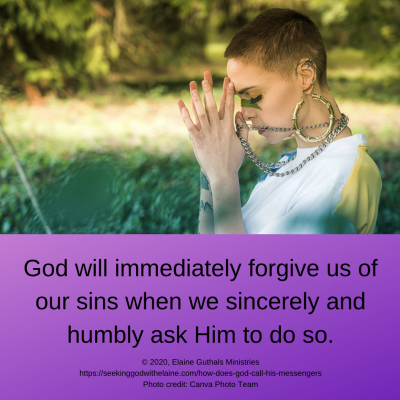
God will immediately forgive us of our sins when we sincerely and humbly ask Him to do so.
What is also needed is to take away our guilt. Aren’t we good at holding on to the feelings of inadequacy and regret?
We not only are forgiven by God, but we also know we are forgiven by God. He doesn’t hide the fact of His pardon. We have to forgive ourselves.
Look at how Isaiah was cleansed. It was a coal — a glowing coal. That means it was taken from the fire that burned the sacrifice.
Rooting out the sin in our lives hurts. It not only is the cutting and tearing, but it can also be the I-don’t-want-to-give-that-up struggle. We need to be fully cleansed so that we are set to serve our Lord.
We have to stop making this about us. It isn’t.
It is about how God wants us to expand His kingdom. It is about Him.
God knows exactly the abilities we have that He wants to use. He knows what is best for us.
Do I think God is going to come meet us in the church building? Maybe. He can still do that.
I think, more than likely, He is going to use His Holy Spirit to prompt us within our hearts.
We apply this by listening for Him. We can’t approach God filled with our own self-importance. The focus has to be on worshiping Him because of His majesty.
We have to sincerely seek God. He will tell us His Will for our lives.
Hearing His Word (Rom. 10: 17).
Reading His Word (Rev. 1: 3).
Praying to Him (Heb. 4: 16).
Studying His Word (Ac. 17: 11).
Meditating on His Word (Ps. 1: 1-2).
Memorizing His Word (Ps. 119: 11).
Father God. We do feel so unworthy. We know the only reason we are worthy to be in Your Presence is because we have accepted Jesus as our Lord and Savior. Help us to keep our focus on You so that we may do Your Will. Amen.
What do you think?
Leave me a comment below (about this or anything else) or head over to my Facebook group for some interactive discussion.
If you don’t understand something and would like further clarification, please contact me.
If you have not signed up for the email daily or weekly providing the link to the devotions and the newsletter, do so below.
If God has used this devotion to speak with you, consider sharing it on social media.
Disciples will be worshiping out Lord through eternity. This devotion look at how Jesus will be the judge of the living and dead.

The problem with Paul’s letters is each verse is so jam packed with wonderful nuggets that it fills up a devotion quickly. That is what happened with the previous devotion. It filled up before I had all the verses done. So, I broke what I had been planning on into two devotions.
Another problem is I woke up with a migraine this morning. I was able to sleep several more hours, but I woke up again with it still there.
So, this devotion is going to be shorter than normal. That is okay. I have been planning on doing the Final Judgment two series from now. I am going to do a very narrow focus here and hit it harder then.
Let’s finish out the Sunday Morning Bible Story lessons.
Worship, according to the Holman Bible Dictionary, is “Human response to the perceived presence of the divine, a presence which transcends normal human activity and is holy.”
According to the Holman Bible Dictionary, the Sabbath is “the day of rest, considered holy to God by His rest on the seventh day after creation and viewed as a sign of the covenant relation between God and His people and of the eternal rest He has promised them.”
We are back talking about being judgmental and censorious. Again, Paul told us not to be critical of others.
But this time, Jesus is the Judge. He has been designated Judge as a reward for His obedience in becoming the Sacrifice for our sins. When judgment day comes, He will judge the living and the dead. “For he has set a day for judging the world with justice by the man he has appointed, and he proved to everyone who this is by raising him from the dead” (Ac. 17: 31 NLT).
We finished up the last devotion talking about how Jesus is Lord of the living and dead. That is very important. Paul said that everyone will stand before the judgment seat — the living and the dead. He also does not distinguish between sheep and goats. We all just give an account of ourselves.
But did we see what Paul did here? He called Jesus God. “I and the Father are one” (Jn, 10: 30 ESV). Paul called them One because Jesus said They are.
It was important that Paul establish Jesus’ divinity and His role as judge. Paul was fixing to quote Isaiah 45: 23: “By myself I have sworn; truth has gone from my mouth, a word that will not be revoked: Every knee will bow to me, every tongue will swear allegiance” (CSB). Paul had to identify the Me he was talking about.
Even though it says every knee will bow, it does not mean every person will be saved (Thomas). Some worldview people may think that because God is love and they are made in His image, that is enough to gain them salvation in the end.
It isn’t. “Jesus answered, ‘I am the way and the truth and the life. No one comes to the Father except through me’” (Jn. 14: 6 NLT). Salvation only comes through Jesus.
If we don’t gain freedom from Jesus (Jn. 8: 36), we will be subjected to torment in hell.
To read a devotion in the Hell Does Have Fury series, click on the appropriate button below.
We won’t get to the worshiping in heaven part if we don’t worship in this life. Once Jesus comes, it is going to be too late to change our minds.
So, let’s recap what we learned in this series.
We’ve been asking these questions all along so we can prepare for when we are asked. Here is the worksheet again. If someone asked you about worshiping for eternity, what would you tell them?
I have created a worksheet of the questions above. Click on the button below to access it.
To up our worship game, we have to be sincere and consistent. We have to put in the time to do it.
That doesn’t mean just go to church every time the doors are open. That means we have to faithfully seek God. We have to worship God privately as well as publicly.
Hearing His Word (Rom. 10: 17).
Reading His Word (Rev. 1: 3).
Praying to Him (Heb. 4: 16).
Studying His Word (Ac. 17: 11).
Meditating on His Word (Ps. 1: 1-2).
Memorizing His Word (Ps. 119: 11).
Heaven right now is filled with praises to God. Think of what it will be like when we all get there. And heaven will ring with Hs praises for all of eternity.
Don’t miss it.
The ABCDs of Salvation
If you have not become a believer in Christ, please read through the
Plan of Salvation and prayerfully consider what God is asking you to do.
A – admit our sins
B – believe His Son Jesus is our Redeemer
C – confess God as Sovereign Lord
D – demonstrate that commitment by making any changes needed in our lives to
live the way in which God has called us
Father. We praise You in this life. We can’t wait to praise You face to face for eternity. Amen.
What do you think?
Leave me a comment below (about this or anything else) or head over to my Facebook group for some interactive discussion.
If you don’t understand something and would like further clarification, please contact me.
If you have not signed up for the email daily or weekly providing the link to the devotions and the newsletter, do so below.
If God has used this devotion to speak with you, consider sharing it on social media.
How can worship be a life and death matter? This devotion looks at how and why we worship.
Sometimes, we can convince ourselves that worship isn’t important. Or we try to justify our absence in corporate worship by detailing all of the ways we feel it does not fit what God had in mind.
Worship is really important to God. In fact, it is a life and death matter.
Worship, according to the Holman Bible Dictionary, is “Human response to the perceived presence of the divine, a presence which transcends normal human activity and is holy.”
According to the Holman Bible Dictionary, the Sabbath is “the day of rest, considered holy to God by His rest on the seventh day after creation and viewed as a sign of the covenant relation between God and His people and of the eternal rest He has promised them.”
Consecration, according to the Holman Bible Dictionary, “refers to persons or things being separated to or belonging to God.” The Merriam-Webster Dictionary agreed with the being part but focused more on the “made or declared sacred” aspect. It was more of a ceremony.
I can see the why it talks about the process rather than just being a segregated group. We are made separate because we make a conscious decision.
Don’t get me wrong. We make a lot of involuntary decisions.
However, disciples have to choose to worship God and live accordingly. Hull wrote that, “In the Christian idea the whole of those marvellous activities that rise from our will are to be one scene of dedication to God.” When temptation comes, we have to choose to follow God’s laws and commandments.
Those choices show our submission to God no matter what life throws at us. We choose to worship and praise Him.
Burn told us four area that we have to dedicate to God in order to live a consecrated for the Lord.
Our conscious decisions have to be made after we have looked at what God has done for us and what He will do for us in the future. We have to do that through hearing His Word, reading it, studying it, meditating on it, and memorizing it. All through that, we need to be in prayer, asking God to provide the meaning.
When we make the decision to worship God, we give Him our love make him and receive love, joy, and hope. We live for Him to make the decision to love, to be joyful, and to have hope.
Then we have to tell others. We worship God and live for Him by wanting to sharing that love, joy, and hope.
Bottom line, though, is it is all about the spiritual. Salvation is the deliverance from the consequences of sin. This brings regeneration.
Regeneration is the change in us that God brings about when we go from being spiritually dead to spiritually alive. That regeneration makes us saints.
Saint means holy ones. Holy means to be set apart, perfect, and pure. We are consecrated to be holy.
But what about the dying part? Smith wrote that dying to God means “to have a view to the glory of God in all that pertains to our death.”
It is all about our frame of mind when we think about death. Are we terrified by it? Do we love this life so much that we aren’t looking forward to it?
Or do we trust God that, even in our illness and death, He will be praised? Are we looking forward to spending eternity with Him?
It is all about denying ourselves. “Then Jesus told his disciples, ‘If anyone would come after me, let him deny himself and take up his cross and follow me’” (Mt. 16: 24 ESV).
To read devotions in the What Does It Mean series, click the appropriate button below.
Jesus came to earth to live and die for us. He did this to save us from our sins.
This makes Jesus the master of the living and dead. Isn’t it comforting that we not only will live with Him forever but also will be reunited with our loved ones?
Huntington explained it this way. He wrote, “He who rose is the Lord of the living and the dead. They are not two families, but one, because they are all in Him, in spite of the transient curtain that hangs between the departed and ourselves — a curtain that probably has its only substance in the eyes of our flesh.”
The living and the dead who believe in Jesus are His church. “The church is Christ’s body, the completion of him who himself completes all things everywhere” (Eph. 1: 23 GNT).
Sibbes explained how Jesus is our Lord. He wrote, Jesus “… is a Lord of the whole man, body and soul. He sits in the throne of conscience. There He prescribes laws to it, pacifies, stablishes, and settles it against all fears. He bows the neck of the inward man, and brings it wholly to be subject to Him.”
But aren’t we normally just concerned about the living? The dead are that — dead and gone.
We think the living are the only ones with a future. Oh, yes. We know the whole heaven thing. But don’t we get narrowly focused on this life and forget there is more?
Nope. Jesus is Lord of the living and the dead. But remember all the different names He had. Mediator, advocate, intercessor, physician, elder brother, forerunner, king, master, head, high priest, captain, and bridegroom.
Yes, there are some royal aspects in there. But Candlish reminded us that Jesus did not live and die to become Lord. “But He died and rose not that He might be different as Lord from what He was as dying and rising. He is the same yesterday, to-day, and for ever.”
Jesus came to be a servant. He came to pay the penalty for our sins.
Isn’t God so good at doing that? We think things are going to happen one way.
But no. God takes it and flips it on its ear.
And you know what? It is so much better His way.
It is really comforting that Jesus is Lord of the living and the dead. That really validates our work for Him in this life. It has real meaning.
Non-believers may have difficulty believing the whole resurrection/Lord of the living and dead aspect. Part of the reason is because it is beyond our building blocks of knowledge. Another reason is the focus non-believers have on this world.
We’ve been asking these questions all along so we can prepare for when we are asked. Here is the worksheet again. What would you say about our interactions with others, especially those believe freedom means they do not have to follow God’ laws and commandments?
I have created a worksheet of the questions above. Click on the button below to access it.
We need to
Hearing His Word (Rom. 10: 17).
Reading His Word (Rev. 1: 3).
Praying to Him (Heb. 4: 16).
Studying His Word (Ac. 17: 11).
Meditating on His Word (Ps. 1: 1-2).
Memorizing His Word (Ps. 119: 11).
Mortify means to place a death penalty on our sins.
Walker asked four questions that I thought, though dated and maybe a little off topic, were excellent questions. So, I updated them, and added some to them, and made a worksheet.
I have created a worksheet of the questions above. Click on the button below to access it.
How — and how often — we worship God is a good indication of our spiritual condition. What condition we are in is important.
Worship is a life and death matter. When Jesus comes to take us home, we want Him to find us worshiping while we are waiting.
Gracious Heavenly Father. We lift our praises to You. You deserve our praise because You are Sovereign God. Jesus deserves our praises because He willingly became the sacrifice to pay the penalty for our sins. Help us to not only worship You more, but also to worship You more sincerely and correctly. May Jesus find us worshiping You when He comes. Amen.
What do you think?
Leave me a comment below (about this or anything else) or head over to my Facebook group for some interactive discussion.
If you don’t understand something and would like further clarification, please contact me.
If you have not signed up for the email daily or weekly providing the link to the devotions and the newsletter, do so below.
If God has used this devotion to speak with you, consider sharing it on social media.

Being inclusive, not judgment, is a way we honor God in our worship. But we have worship sincerely and consistently. This devotion looks at how that is our choice to do so.
Worship, according to the Holman Bible Dictionary, is “Human response to the perceived presence of the divine, a presence which transcends normal human activity and is holy.”
According to the Holman Bible Dictionary, the Sabbath is “the day of rest, considered holy to God by His rest on the seventh day after creation and viewed as a sign of the covenant relation between God and His people and of the eternal rest He has promised them.”
I know I think differently than other people. I connect things differently. Because of that, I may put a different amount of importance on something than someone else does.
Paul said we are going to do that. We are all different. We have had different experiences. It is part of what makes us, us.
That is okay. Paul just cautioned that we have to be convinced.
But is Paul really talking about the Sabbath here? Remember, God created the Sabbath for man, not the other way around.
When Wardlaw muddled through these verses, he thought there had to be a qualification. If we didn’t qualify this, we might think Paul was telling us we wouldn’t need a day set apart for worship.
What Wardlaw ended up with was the belief that we are free to observe the Sabbath or not. Which is true.
God created us with free will. We get to make our choices – even if we choose not to follow Him.
Wardlaw said something that threw me – and I’m having trouble processing it. He wrote that “… the sabbath was not a peculiarly Jewish institution …” Paul was, he contended, dealing with the last day/first day of the week issue.
Robertson thought it was a more of an “opening up” of the Sabbath. If Sabbath was a Jewish institution, Gentiles would be excluded in Christianity. That is not what Jesus taught.
Remember, Romans 14: 1-4 were talking about inclusiveness. No one was excluded – unless they chose to be excluded.
This also touches on our having differences of opinions. Paul doesn’t bite on us for having those different opinions.
Instead, Paul said – in my words – “Know what you believe.” And not just knowledge. “… Let each one be fully convinced in his own mind” (Rom. 14; 5 CSB). Know without a shadow of a doubt.
(And isn’t that what we have been doing in the What I Believe Series!)
You see, God doesn’t want us ABCing just to have fire insurance. He wants the D. We have to demonstrate that commitment. That commitment has to include changing our character to imitate Him.
The ABCDs of Salvation
If you have not become a believer in Christ, please read through the
Plan of Salvation and prayerfully consider what God is asking you to do.
A – admit our sins
B – believe His Son Jesus is our Redeemer
C – confess God as Sovereign Lord
D – demonstrate that commitment by making any changes needed in our lives to
live the way in which God has called us
Go back to free will. Free will is the ability within us to make decisions that determine actions that produce character.
Actions produce character. Decisions produce actions. Free will allow us to make the decisions.
But God wants us to decide that we want to make decisions pleasing to Him. Those decisions trigger actions that change our character to be more like His.
That is what sanctification is all about. Sanctification is the transformation of mind, body, and soul beginning with regeneration and ending with perfected state of spiritual wholeness or completeness.
In order to choose the sanctification road, we have to be all in. We have to be deeply committed.

Know what we believe without a shadow of a doubt and act on that. Consistently.
Robertson addressed the consistency part. He wrote, “The spiritual intent of Christianity is to worship God every day in the spirit. But had this law been given to the unspiritual Jews, instead of turning every week-day into a Sabbath, they would have transformed every Sabbath into a week-day.”
God doesn’t want part-time believers. That is why I keep harping on we have to do all the steps in seeking God. (Yes, I am harping on myself, too, here.)
Hearing His Word (Rom. 10: 17).
Reading His Word (Rev. 1: 3).
Praying to Him (Heb. 4: 16).
Studying His Word (Ac. 17: 11).
Meditating on His Word (Ps. 1: 1-2).
Memorizing His Word (Ps. 119: 11).
Remember what we said in What Is the Sabbath? If Day Seven is the Sabbath — the day we are to worship — and it hasn’t ended, we are to continuously worship the One true God.
We are to worship daily so that the consistency helps us change our character to imitate God. Being consistent is easier when we are more consistent.
Lyth reminded us the benefits of being consistent in our worship. It is easier for us to act on fixed principles. That way we don’t waffle. Boy, doesn’t that promote peace.
Oh, doesn’t that contradict what worldview people think? Some don’t think their actions affect anyone but themselves. Some think that there should be no consequences.
They think wrong.
Why is worship important? Why is consistency in worship important?
It is a life and death matter.
We no doubt have heard the saying that no man is an island. Priestley wrote, “Man himself is but a link, though the highest link, of this great chain, all the parts of which are closely connected by the hand of our Divine Author.”
It is our job to proclaim the gospel to non-believers and make them disciples. We do this because we love God and love them.
We do not want to see them remain spiritually dead. If they remain spiritually dead in this life, they will remain spiritually dead throughout eternity.
“But how can they call on him to save them unless they believe in him? And how can they believe in him if they have never heard about him? And how can they hear about him unless someone tells them?” (Rom. 10: 14 NLT).
We are witnesses without uttering a single word. My ladies and I discussed before that not only are nonbelievers observing disciples’ actions but also their attitudes and motives to make sure we are real. Elliot said it this way: “Every life is a little Bible — a revelation of God.”
What I kept thinking about in all of this is that Jesus said some sheep are really going to be goats. “Not everyone who calls out to me, ‘Lord! Lord!’ will enter the Kingdom of Heaven. Only those who actually do the will of my Father in heaven will enter” (Mt. 7: 21 NLT).
The will of God is that we worship Him. It is that we submit to him.

The Merriam-Webster Dictionary defines freedom as “the absence of necessity, coercion, or constraint in choice or action.” Unfortunately, some see freedom as the ability to do anything we want.
Free will gives us freedom, but it is based on a foundation of God’s law and commandments. It isn’t that we can just do anything we want.
But then again, we must follow the laws of the land. So, while we are free here in America, there is some standards we must follow.
So, it isn’t that some are against following laws. They just don’t want to follow God’s laws and commandments. There are two things they don’t realize.
Freedom does not mean there is no consequences. They will still be judged in the end times.
“So if the Son sets you free, you are truly free” (Jn. 8: 36 NLT). It isn’t just about the consequences of this life. It is about eternal life.
We have to make sure that we allow differing opinions. Talmage wrote, “While our conscience will not allow us to choose some of these beliefs, we must allow to others the liberty of conscience which we demand for ourselves.”
We are free to choose to not worship God in the Sabbath — or any other day. We cannot expect God to change His mind and say not worshiping Him is not a sin.
We cannot let the “we’re not going to worship God in this way” mask the unpardonable sin. If we do that, we will be a goat on the left.
We’ve been asking these questions all along so we can prepare for when we are asked. Here is the worksheet again. What would you say about our interactions with others, especially those believe freedom means they do not have to follow God’ laws and commandments?
I have created a worksheet of the questions above. Click on the button below to access it.
We have to
We don’t honor God in worship when we keep our worship to ourselves. We must use that worship to witness to others.
Loving Heavenly Father. We praise Your name. We give You all honor and glory. Help us to show others Your love through our interactions with them. Amen.
If you have not admitted that your relationship is not right with God,
have not asked Jesus to be your Lord and Savior,
and have not confessed your sins,
please read through the Plan of Salvation and prayerfully consider what God is asking you to do.
I have created a worksheet of the questions above. Click on the button below to access it.
Take this Spiritual Gifts Inventory
Job Duty #1
Be a Living Sacrifice (Romans 12: 1-2)
Job Duty #2
Work Out Our Salvation (Philippians 2: 12)
Job Duty #3
Bring Him Glory (Matthew 5: 16)
Job Duty #4
Proclaim the Gospel (Mark 16: 15)
Job Duty #5
Love People (John 15: 12)
Job Duty #6
Make Disciples (Matthew 28: 19-20)
Job Duty #7
Other Duties as Assigned
(Ecclesiastes 3: 1)
It Was Enough
Vocalist: Elaine Guthals
Keyboard: Chris Vieth
What do you think?
Leave me a comment below (about this or anything else) or head over to my Facebook group for some interactive discussion.
If you don’t understand something and would like further clarification, please contact me.
If you have not signed up for the email daily or weekly providing the link to the devotions and the newsletter, do so below.
If God has used this devotion to speak with you, consider sharing it on social media.
On first read, Roman 14: 1-4 may be somewhat confusing. Bottom line, it is talking about who we should include in worship – especially when things get contentious. This devotion looks at how we shouldn’t be judgmental, but inclusive.
How Are We to Be Inclusive in Our Worship?
I don’t plan it, but sometimes these devotions fall in line with my Sunday Morning Bible Study lessons. When that happens, I am awed by how God connects things.
No, my Ladies and I still aren’t meeting yet (oh, how I miss them!), but we were supposed to be studying Romans. How can I pass up looking at Romans?
Then to have this week’s lesson passage show up on a topic search for the Worship category. Best of both worlds!
What I saw when I read this passage was who we should include in worship – and who we shouldn’t exclude. Paul supported his position. Let’s take a look.
Worship, according to the Holman Bible Dictionary, is “Human response to the perceived presence of the divine, a presence which transcends normal human activity and is holy.”
According to the Holman Bible Dictionary, the Sabbath is “the day of rest, considered holy to God by His rest on the seventh day after creation and viewed as a sign of the covenant relation between God and His people and of the eternal rest He has promised them.”
Inclusive, according to the Merriam-Webster Dictionary, means “including everyone, especially: allowing and accommodating people who have historically been excluded (as because of their race, gender, sexuality, or ability).”
Once we admit our sins, believe Jesus as Savior and Redeemer, and confess God as Sovereign God, we start on the sanctification road. Sanctification is the transformation of mind, body, and soul beginning with regeneration and ending with perfected state of spiritual wholeness or completeness.
The ABCDs of Salvation
If you have not become a believer in Christ, please read through the
Plan of Salvation and prayerfully consider what God is asking you to do.
A – admit our sins
B – believe His Son Jesus is our Redeemer
C – confess God as Sovereign Lord
D – demonstrate that commitment by making any changes needed in our lives to
live the way in which God has called us
Perfection means we have become holy, sanctified, and righteous. Christian perfection is achieving the two greatest commandments: loving God and loving others.
The road to sanctification is hilly and curvy. It won’t be smooth sailing.
Because it isn’t smooth sailing, sometimes our faith may be strong. Faith is the belief that the doctrines stated in God’s Word are true, even if we do not understand all aspects of them. But sometimes, our faith may be weak because we are having a really hard time dealing with the trial.
That doesn’t even get into going from milk babies to steak adults. When the Scriptures use the term milk, they are equating our spiritual life with that of a baby. Disciples are unskilled babes when we have given up reading God’s Word. The Bible tells us what our character should be like to grow us into steak adults.
But isn’t that what the road to sanctification is? We’ve given it several “names”:
Really, aren’t they all the same thing? We want to grow to be like God.
Some of us are going to do a better job at it — or we will think someone else is doing a better job than we are. We’ve got to keep some things in mind.
If someone is committing a sin, yes. We need to counsel them. “Brothers, if anyone is caught in any transgression, you who are spiritual should restore him in a spirit of gentleness. Keep watch on yourself, lest you too be tempted” (Gal. 6: 1 ESV). We will need to follow God’s directions as to how and when to do that.
Lyth had some good advice. He reminded us “to give each other credit for sincerity.” We talked about the Beatitude saying we should crave righteousness, not that we had to be 100% fruit of the Spirit perfect.
To read a related devotion, click the button below.
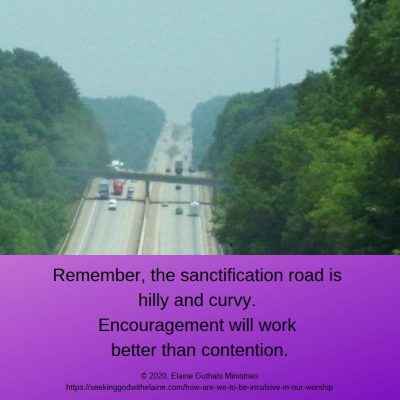
Remember, the sanctification road is hilly and curvy. Encouragement will work better than contention.
Bottom line, we are commanded to love others. We do that by, as Henry said, denying ourselves. We are patient with them.
To read a related devotion, click the appropriate button below.
Hmmm. So, this is confusing. “… one who is weak eats only vegetables” (Rom. 14: 2 CSB).
Okay, I didn’t really become a vegetable eater until I was in my 30s. So, I am kind of scratching my head at this one. There has to be some backstory that I don’t know about.
Tyson cleared up some confusion. He wrote, “The question was, did Christianity or did it not require abstinence from certain meats, and observance of certain fasts and festivals?”
I see. This is like Eve and the apple.
In his conversation with Eve, Satan enlarged the restriction God had given from one tree to every tree in the garden. She countered by telling him they couldn’t touch the tree.
God didn’t say anything about touching. He just put the restriction on eating.
But don’t we do that? If we think abuse of something is a sin, we do a 180-degree and go for abstinence.
Tyson interpreted Paul as saying the person who pushes for abstinence is really just weak in faith. He argued that we don’t understand Jesus’ work in us. If we have a strong faith, we should be able to withstand the testing.
That takes us back to the milk babies and steak adults. We have to be actively seeking God so that we can have that strong faith.
Hearing His Word (Rom. 10: 17).
Reading His Word (Rev. 1: 3).
Praying to Him (Heb. 4: 16).
Studying His Word (Ac. 17: 11).
Meditating on His Word (Ps. 1: 1-2).
Memorizing His Word (Ps. 119: 11).
Paul wrote elsewhere, “Therefore, don’t let anyone judge you in regard to food and drink or in the matter of a festival or a new moon or a Sabbath day. These are a shadow of what was to come; the substance is Christ” (Col. 2: 16-17 CSB).
I’m reading this and am thinking this is getting back to works. We aren’t saved by works. “For it is by grace you have been saved, through faith — and this is not from yourselves, it is the gift of God” (Eph. 2: 8 NIV).
What I see this saying is that differences of opinions should not undermine unity. Yes, that is a favorite topic of Paul’s. Hmmm. Can we say it is needed?
Look at verse 3. “… God has accepted him” (Rom. 14: 3 CSB). Yes, we may have differences of opinions, but God has adopted all of us into His family.
When we sincerely admit our sins, believe in Jesus, and confess God as Sovereign Lord, He accepts us. Other believers cannot reject us.
We’ve talked about censoriousness before. It is about being critical of others. We are not to pass judgment on people — especially when we use our standards.
To read a related devotion, click on the appropriate button below.
Okay, this says “… another’s household servant …” (Rom. 14: 4 CSB). What this is saying is, don’t look down on someone who is serving you. We would apply that as meaning a restaurant server, retail clerk, or a bank teller.
But we could also see this as talking about someone who is in a lower socioeconomic class than we are. It is also talking about a debt collector and a teacher, isn’t it? To me, it is talking about anyone who is performing their job.
We can look down on people who we feel are beneath us for other reasons. We may think we are so much smarter than they are. Or we look down on them because we disagree with their political opinions. (If you don’t think that is a problem, you haven’t been on Twitter and Facebook lately.)
One thing we need to remember is we are all servants. We are servants of God.
Where I used to work, there were four employee classifications and then pay grades within each classifications. God only has one classification: servant.
Still, there may be different pay grades. God doesn’t reveal things to us the same. Nell described it as, “The clearer light of the strong is due to God’s special mercy and their superior advantages.”
It is kind of like when we were in school. Tom and I are in an economics class together. I had two semesters of economics. Trust me, I didn’t totally understand everything.
But Tom did. God knew he was going to be an economist and I wasn’t. So, God gave him the knowledge because that was going to expand His kingdom.
Maybe Tom’s dad was a economist, so he had heard terminology his whole life. Mine was a farmer. He knew economics as it applied to crops and animals.
Burn reminded us that is why we were created — to serve God. God has commanded us to love each other, to support each other, to teach each other.
We all have our job to accomplish in God’s kingdom. Paul gave the classifications. “And his gifts were that some should be apostles, some prophets, some evangelists, some pastors and teachers” (Eph. 4: 11 RSV).
There is a very big connection that we have to make here. Paul is writing to believers. Swing reminded us that man “… is imperfect, and therefore should also be tolerant.”
Paul was not arguing that we have to be tolerant of sin. A sin was a sin back in Noah’s day. It still was in Jesus’ day. It still is now. It will be until Jesus comes back.
Oh, yeah. We are talking relationships here – we’re talking conflict. Yep, that is a definite topic for self-discipline.
We’ve been asking these questions all along so we can prepare for when we are asked. Here is the worksheet again. What would you say about inclusiveness and unity in our worship?
I have created a worksheet of the questions above. Click on the button below to access it.
Father God. We want to love like You do. We want to extend that love to all of Your children. Help us to be unified as Your church. In this way we can show those made in Your image that You, indeed, are Love. Amen.
What do you think?
Leave me a comment below (about this or anything else) or head over to my Facebook group for some interactive discussion.
If you don’t understand something and would like further clarification, please contact me.
If you have not signed up for the email daily or weekly providing the link to the devotions and the newsletter, do so below.
If God has used this devotion to speak with you, consider sharing it on social media.