Category: Praise

  • How Do We Worship Through Praise?

    One element of worship is praise. This devotion looks at different ways we praise God.

    Nuggets

    • Everyone is supposed to shout joyfully and triumphantly praising God.
    • We worship God because we praise Him as Sovereign God.
    • There are three types of worship: personal, family, and corporate.
    Devotions in the What I Believe series

    Devotions in the Worship category

    Flowers with title How Do We Worship Through Praise?

    One element of worship is praise. We can do a variety of things to express praise.

    Let’s Put It into Context #1

    Worship, according to the Holman Bible Dictionary, is “Human response to the perceived presence of the divine, a presence which transcends normal human activity and is holy.”

    Resource

    According to the Holman Bible Dictionary, the Sabbath is “the day of rest, considered holy to God by His rest on the seventh day after creation and viewed as a sign of the covenant relation between God and His people and of the eternal rest He has promised them.”

    Resource

    Praise, according to the Holman Bible Dictionary, is our response to God “to proclaim His merit or worth.”

    Let’s Put It into Context #2

    This psalm was written as a call to worship. The people had been exiled and the temple destroyed. Now, they were back, and the temple had been restored.

    It was time to praise God again.

    All Praise, All the Time

    “Come, let’s shout joyfully to the Lord, shout triumphantly to the rock of our salvation! Let’s enter his presence with thanksgiving; let’s shout triumphantly to him in song” (Ps. 95: 1-2 CSB)

    I am having a real hard time focusing my mind this morning, but the first thing that popped into my mind when I read this verse is that we are still in day seven of creation. We are still in the Sabbath.

    We should still be praising God.

    So, who is verse 1 talking about? That would be everyone. Everyone is supposed to shout joyfully and triumphantly praising God. Everyone is supposed to enter into His presence.

    I hear you. Not everyone wants to enter into God’s presence.

    But that is what He wants. “This is good, and it pleases God our Savior, who wants everyone to be saved and to come to the knowledge of the truth” (I Tim. 2: 3-4 CSB).

    What do we not see in these verses? Along with not seeing this limited to specific people groups such as disciples, we don’t see it limited to a specific time.

    We don’t see God saying this is a Sunday-morning-go-to-meeting response. It isn’t limited to when the church doors are open.

    It is 24/7/365.

    It is to be joyful and triumphant. That will bring us happiness and peace.

    Tuck brought up an interesting idea. If there are limits as to who praises and gives thanks, we think it is limited to disciples. We think the non-believers can’t because God doesn’t accept it. Tuck argues that that notion is not scriptural.

    I guess I can see that. It could be something as simple as an acknowledgement of a beautiful day. It could be a thankfulness that someone was healed or we were protected in an accident.

    No, non-believers aren’t actively engaging in worship when they are doing that. They are, however, giving praise to the Creator.

    Look at the first word of verse 1. Come. We are saying this to each other. It isn’t an edict from God.

    Worship is voluntary. It must be sincere. But it also has to be consistent.

    I know. That is where we get tripped up. We let this world worm its way in and steel our focus off of God.
    Raised hands

    Sovereign God

    “For the Lord is a great God, a great King above all gods. The depths of the earth are in his hand, and the mountain peaks are his. The sea is his; he made it. His hands formed the dry land” (Ps. 95: 3-5 CSB)

    We worship God because we praise Him as Sovereign God. We are to put Him above all other gods — even the gods of money and prestige.

    Why is God a great God? Go back to verse 1 a second. “… the rock of our salvation!” (Ps. 95: 1 CSB). He is steady, and He is strong.

    God doesn’t change. “God is not a man, so he does not lie. He is not human, so he does not change his mind. Has he ever spoken and failed to act? Has he ever promised and not carried it through?” (Num. 23: 19 NLT).

    The greatness of God is also shown through His creation. He made the mountains (Amos 4: 13; Ps. 104: 8), the sea (Ps. 104: 6, Ps. 146: 6), and the dry land — and everything else (Ps. 90: 2; Ps. 104: 5). He continues to sustain and maintain it.

    God is great because He alone is immortal. “He alone can never die, and he lives in light so brilliant that no human can approach him. No human eye has ever seen him, nor ever will. All honor and power to him forever! Amen” (I Tim. 6: 16 NLT).

    We recently talked about the three omnis: omnipotent, omniscience, and omnipresent. God is all-powerful, all-knowing, and all-present.

    To read a related devotion, click on the appropriate button below.

    All Together Now

    “Come, let’s worship and bow down; let’s kneel before the Lord our Maker. For he is our God, and we are the people of his pasture, the sheep under his care. Today, if you hear his voice: Do not harden your hearts as at Meribah, as on that day at Massah in the wilderness” (Ps. 95 6-8 CSB)

    Look how verse 6 starts — verse 1 started the same way. “Come, let’s …” (Ps. 95: 6 CSB). Not you. Not I.

    Us. This is worshiping together. Praising God together.

    Spurt told us that there are three types of worship: personal, family, and corporate. We have to actively pay homage to our Sovereign God through all of these avenues of worship.

    If we only worship in public but not privately — or vice verse (except when we physically cannot get out) — our worship isn’t truly genuine. When we do not share our worship with our family, we are not sharing the gospel in the way God has called us to.

    Yes, we are called to corporate worship. “And let us not neglect our meeting together, as some people do, but encourage one another, especially now that the day of his return is drawing near” (Heb. 10: 25 NLT).

    No, Jesus didn’t condone the religion of the Pharisees. He did not, however, shut down going to the synagogue.

    Where verse 1 focused on the inward worship, verse 6 looked at the outward. shout joyfully and triumphantly. Bow down and kneel.

    What does that tell us?

    • Worship submissively.
    • Worship reverently.
    • Worship positively.

    God can ask for and expect our praise because He is our Creator.

    Maybe we all can’t literally bow down before God because of physical ailments. Every one of us can and must bow our hearts and our minds. We have to submit to His authority.

    That is easy to do when we realize that God is worthy of our worship.

    One day, we will all bow down.

    • “By myself I have sworn; from my mouth has gone out in righteousness a word that shall not return: ‘To me every knee shall bow, every tongue shall swear allegiance’” (Isa. 45: 23 ESV)
    • “For it is written, ‘As I live, says the Lord, every knee shall bow to me, and every tongue shall confess to God’” (Rom. 14: 11 ESV)
    • “So that at the name of Jesus every knee should bow, in heaven and on earth and under the earth” (Phil. 2: 10 ESV).

    I thought the “… Today, if you hear his voice: Do not harden your hearts …” (Ps. 95: 7-8 CSB) was interesting.

    Today. We have the opportunity now. Don’t put worshiping off until tomorrow because tomorrow might be too late.
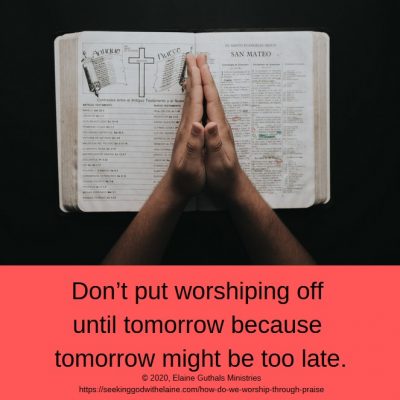
    Bible and praying hands

    But every day is going to be today. We have to choose daily to worship Him. We have to choose minute by minute if we are going to follow His laws and commandments — which is a form of worship.

    If we hear His voice says a lot. How many times are we so caught up in our physical life that we shut God out? We get on our hamster wheel and don’t let Him into our lives.

    It is worse, though, when we harden our hearts. According to the Holman Bible Dictionary, hardness of the heart means “a stubborn attitude that leads a person to reject God’s will.”

    Yep. Hardness of the heart is an attitude. It is a choice.

    We choose not to hear God’s voice. We ignore the promptings of the Holy Spirit.

    Making the Connections

    Foster listed the elements of true worship.

    • “Profound reverence”
    • “Humility”
    • “Submissive trust and love”
    • “Humble hope.”

    We show God’s merit when we give Him reverence. When we respond in humility, we show that we agree that He is higher than us. Our trust, love, and hope show how much we believe in His love and provision.

    We are to worship the One true God on the Sabbath and at all times by proclaiming His worth to show that we are in a covenant relation with Him.

    Making the Connections to Self-Discipline

    Hardness of the heart is an attitude. It is a choice.

    Don’t choose it.

    But a circumcised heart needs to grow closer to God. That takes self-discipline.

    We’ve been asking these questions all along so we can prepare for when we are asked. Here is the worksheet again. What would you say about praising God in our worship?

    • What does the Scriptures say?
    • What do I believe?
    • Why do I believe the same/differently than the Scriptures?
    • What are the talking points when witnessing to a non-believer?

    Related Links

    I have created a worksheet of the questions above. Click on the button below to access it.

    How Do We Apply This?

    Spurt made an excellent observation. He wrote, “Worship only begins when faith acknowledges the Almighty Creator: it dies away as faith in Him decays; it dies away as He gives place in thought to some purely human imagination respecting how the universe came to be what it actually is.”

    Liddon expanded that. He reminded us that worship ours us in the presence of God. He wrote, “The very first effort of worship implies that God is resuming, has resumed, His true place in our thoughts, that He is no longer jostled out of our mental life by a hundred puny worthless rivals belonging to the world of sense.”

    Foster had a good reminder. “As the face is the index of the emotions, so outward acts are the index of the spiritual feelings within.” Our demeanor must show our reverence to God when we worship Him in praise.

    Sincere worship through praise will help solidify our relationships with God. This will help as we fight the spiritual warfare in our lives.

    Father. We praise Your holy name. We thank You for creating us, loving us, and protecting us. Help us to be more like You. Amen.

    What do you think?

    Leave me a comment below (about this or anything else) or head over to my Facebook group for some interactive discussion.

    If you don’t understand something and would like further clarification, please contact me.

    If you have not signed up for the email daily or weekly providing the link to the devotions and the newsletter, do so below.

    If God has used this devotion to speak with you, consider sharing it on social media.
  • How Do We Keep the Sabbath Holy?

    If the Sabbath is a day of rest where we worship the One true God to show our covenant relationship with Him, how do we keep the Sabbath holy? What happens when we see others have needs? This devotion looks at how Jesus is the Lord of the Sabbath.

    Nuggets

    • When the disciples picked the grain, they were technically harvesting.
    • Jesus reminded the Pharisees that David did something what they would have considered worse.
    • Jesus is greater than the temple.
    • Sabbath was made for all mankind — Jews and Gentiles.
    • God is love, so He wants us to treat His creation with love.
    • The man with the withered hand wasn’t saved because he went to church that morning – he was saved because he interacted with the Savior.

    Devotions in the What I Believe series

    Devotions in the Worship category

    Flowers with title How Do We Keep the Sabbath Holy?

    Jesus always went to the synagogue to worship on the Sabbath day. However, that did not always please the Pharisees. Jesus did not always follow their laws.

    Let’s look at one of their skirmishes.

    Let’s Put It into Context #1

    Worship, according to the Holman Bible Dictionary, is “Human response to the perceived presence of the divine, a presence which transcends normal human activity and is holy.”

    Resource

    According to the Holman Bible Dictionary, the Sabbath is “the day of rest, considered holy to God by His rest on the seventh day after creation and viewed as a sign of the covenant relation between God and His people and of the eternal rest He has promised them.”

    Resource

    Let’s Put It into Context #2

    “At that time Jesus passed through the grainfields on the Sabbath. His disciples were hungry and began to pick and eat some heads of grain. When the Pharisees saw this, they said to him, ‘See, your disciples are doing what is not lawful to do on the Sabbath’” (Mt. 12: 1-2 CSB)

    The Pharisees were always looking for points to trip Jesus up to prove He wasn’t the Messiah. They must have thought they really had Him on this incident.

    When the disciples picked the grain, they were technically harvesting. Harvesting is work.

    The fourth commandment is explicit about no work. “You are to labor six days and do all your work, but the seventh day is a Sabbath to the Lord your God. You must not do any work — you, your son or daughter, your male or female servant, your livestock, or the resident alien who is within your city gates” (Ex. 20: 9-10 CSB)

    How was Jesus going to get out of this one?

    Worse Things Happen

    “He said to them, ‘Haven’t you read what David did when he and those who were with him were hungry: how he entered the house of God, and they ate the bread of the Presence — which is not lawful for him or for those with him to eat, but only for the priests? Or haven’t you read in the law that on Sabbath days the priests in the temple violate the Sabbath and are innocent? I tell you that something greater than the temple is here. If you had known what this means, I desire mercy and not sacrifice, you would not have condemned the innocent. For the Son of Man is Lord of the Sabbath’” (Mt. 12: 3-5 CSB)

    Jesus reminded the Pharisees that David did something what they would have considered worse. When David was on the run, he went to see a priest to ask for food (I Sam. 21: 1).

    Now, Jesus didn’t bite on David for eating the bread of the Presence. According to the Holman Bible Dictionary, Bread of the Presence “… consisted of twelve loaves of presumably unleavened bread, and it was replaced each sabbath.”

    The Bread of the Presence was to be on the table at all times. “Put the Bread of the Presence on the table before me at all times” (Ex. 25: 30 CSB). The table was in the Holy Place.

    To read a related devotion, click the appropriate button below.

    David asked for regular food. He didn’t ask for the Bread of the Presence. “… which is not lawful for him or for those with him to eat, but only for the priests?

    We know that Jesus didn’t come to do away with the laws. “Don’t think that I came to abolish the Law or the Prophets. I did not come to abolish but to fulfill. For truly I tell you, until heaven and earth pass away, not the smallest letter or one stroke of a letter will pass away from the law until all things are accomplished” (Mt. 5: 17-18 CSB).

    So, how did Jesus justify this seemingly contradictory response?

    Someone Greater

    “I tell you that something greater than the temple is here. If you had known what this means, I desire mercy and not sacrifice, you would not have condemned the innocent. For the Son of Man is Lord of the Sabbath’” (Mt. 12: 6-8 CSB)

    Jesus is greater than the temple. Well, of course. He is God.

    Described as the cornerstone (Eph. 2: 19) and the head (Col. 1: 18), Jesus makes the church. The church is nothing without Jesus.

    McLeod brought up some good points. Jesus created the church, which gave it life. He gave it His righteousness. Everything came from Him.

    We have to remember that the temple was God’s baby. He gave specific directions as to how they were to be built.

    We have to remember that we are now His temple. God is the one who makes us.

    For Man

    “Then he told them, ‘The Sabbath was made for man and not man for the Sabbath. So then, the Son of Man is Lord even of the Sabbath’” (Mk. 2: 27-28 CSB)

    Matthew’s statement of “For the Son of Man is Lord of the Sabbath’” (Mt. 12: 8 CSB) is explained in Mark 2: 27. Mark added the concept that the Sabbath was made for man, not the other way around. That makes Jesus the Lord of the Sabbath.

    Let’s think of it this way, like Cohen did. Sabbath was made for all mankind — Jews and Gentiles. If mankind would have been made for the Sabbath, it would have just been made for the Jews because the Jews were His chosen people.

    In the last devotion, we talked about the Sabbath being the day of rest where we worship the One true God to show that we are in a covenant relationship with Him.

    We get to slow down/stop our hectic lives to recharge. We get to fellowship with like-minded believers — well, in normal circumstances.

    Cohen wrote “Jesus is the Lord of the Sabbath, the Proprietor of it, the Owner of it, the Master of it. It is His.” He is the Judge. That means He gets to say what is acceptable and unacceptable actions.

    That is one reason we call it the Lord’s Day.

    But how many times have we heard — or even said — “It’s my life. I’ll decide how I am going to spend my time. I don’t need God to tell me what to do.”

    We want it to be our day.

    We just talked about whether governments have authority over disciples. Jesus told us that God has ordained the idea of a governmental ruling authority. We do have those who have authority over us — and one is God.

    To read a related devotion, click the appropriate button below.

    As Lord of the Sabbath, that means Jesus is above the laws of the Sabbath. It is His choice. Sadler wrote, “Nothing can show the Divine nature of our Lord more clearly than that He is above such a law of God, so that He should modify it, relax it, change it at His pleasure.”

    Healing a Man’s Hand

    “Moving on from there, he entered their synagogue. There he saw a man who had a shriveled hand, and in order to accuse him they asked him, ‘Is it lawful to heal on the Sabbath?’ He replied to them, ‘Who among you, if he had a sheep that fell into a pit on the Sabbath, wouldn’t take hold of it and lift it out? A person is worth far more than a sheep; so it is lawful to do what is good on the Sabbath.’ Then he told the man, ‘Stretch out your hand.’ So he stretched it out, and it was restored, as good as the other. But the Pharisees went out and plotted against him, how they might kill him. (Mt. 12: 9-14 CSB)

    Okay, back to Matthew. But Jesus and His disciples had moved on. They went to the synagogue and see a guy with a withered hand.

    Not one to pass up a learning opportunity, Jesus asked, “If we can’t harvest and work, can we heal?” But Jesus wasn’t only asking about the rules.

    Jesus was asking about their hearts. God is love, so He wants us to treat His creation with love.

    People

    Pearse got me realizing something else about this passage. The man with the withered hand wasn’t saved because he went to church that morning. He was saved because he interacted with the Savior. He talked with Him, listened to Him, and did what He told Him to do.

    Jesus put the man with the withered hand before the law. He valued the man.

    Making the Connections

    We have to be very careful. We cannot say, “Oh, Jesus set that law aside …

    • “So He did it permanently” or
    • “He did it for all of His laws and commandments.”

    Jesus didn’t say it was okay to commit a sin because we want to do what we want to do. We don’t get to judge or pick and choose which laws to follow. God has called us to obedience.

    Jesus put the disciples’ and the man’s needs before the laws. He put us first.

    Making the Connections to Self-Discipline

    God wants us to focus on our relationships with Him and with others. Our relationship with Him is strengthened when we seek Him. That takes self-discipline.

    Our relationships with others also takes self-discipline. Any relationship takes work to strengthen – and that takes time and patience.

    We’ve been asking these questions all along so we can prepare for when we are asked. Here is the worksheet again. What would you say about our interactions with others, especially those who think disciples should be able to ignore God’s laws and commandments?

    • What does the Scriptures say?
    • What do I believe?
    • Why do I believe the same/differently than the Scriptures?
    • What are the talking points when witnessing to a non-believer?

    Related Links

    I have created a worksheet of the questions above. Click on the button below to access it.

    How Do We Apply This?

    • Follow what God tells us to do.
    • If God wants a relationship rather than religion with us, doesn’t He want that to extend to others?
    • Don’t expect God to tell us something isn’t a sin because we don’t want it to be.
    • Help meet the needs of others, while not helping them sin.

    Father. We want to imitate You. We want to show others who You are. Help us grow in Your grace and knowledge. Amen.

    What do you think?

    Leave me a comment below (about this or anything else) or head over to my Facebook group for some interactive discussion.

    If you don’t understand something and would like further clarification, please contact me.

    If you have not signed up for the email daily or weekly providing the link to the devotions and the newsletter, do so below.

    If God has used this devotion to speak with you, consider sharing it on social media.
  • What Is the Sabbath?

    We are commanded in the fourth commandment to keep the Sabbath. But what does keeping it really mean? This devotion looks at what the Sabbath is and how we keep it.

    Nuggets

    • Disciples are commanded to keep the Sabbath day holy.
    • The Sabbath is a day of rest, not a day of business as usual.
    • We are to focus on all things spiritual on the Sabbath.
    • Worship is priority #1.
    Flowers with title What Is the Sabbath?

    This year, we are looking at self-discipline. We are using Vincent’s The Lesson of Ripeness sermon to look at the need to grow in our relationship with God. We morphed learning enough to be a teacher into determining some areas we need to grow so we can be mature disciples.

    Resource

    We have been looking at solidifying what we believe. When we witness, we need to be prepared to explain what we believe and why we believe it. We looked at the Scriptures, the Trinity (God, Jesus, and the Holy Spirit), man, salvation, grace, the church, and divine ordinances. Now, we are going to look at worship.

    Devotions in the What I Believe series

    Devotions in the Worship category

    This series started off as a look at the Sabbath. It quickly expanded to encompass worship and praise.

    We are commanded in the fourth commandment to keep the Sabbath. But what does keeping it really mean? Let’s start off by looking at what the Sabbath is.

    Let’s Put It into Context

    Worship, according to the Holman Bible Dictionary, is “Human response to the perceived presence of the divine, a presence which transcends normal human activity and is holy.”

    According to the Holman Bible Dictionary, the Sabbath is “the day of rest, considered holy to God by His rest on the seventh day after creation and viewed as a sign of the covenant relation between God and His people and of the eternal rest He has promised them.”

    Remember in Order to Preserve

    “Remember the Sabbath day, to keep it holy” (Ex. 20: 8 CSB)

    This is the fourth commandment, and it starts out with the word remember. I guess I had always just thought that the law was established when God gave Moses the Ten Commandments. I thought this fourth commandment meant to establish the Sabbath.

    Right out of the chute, Maurice challenged my thinking of the Sabbath.

    Not from this day forward. Not a new commandment I give you.

    Maurice argued that the remember takes us backwards because the Sabbath has already been established. He was correct.

    “So the heavens and the earth and everything in them were completed. On the seventh day God had completed his work that he had done, and he rested on the seventh day from all his work that he had done. God blessed the seventh day and declared it holy, for on it he rested from all his work of creation” (Gen. 2: 1-3 CSB).

    Disciples are commanded to keep the Sabbath day holy. Holy means to be set apart, perfect, and pure. There were specific laws detailing how the Sabbath was to be celebrated (Dale).

    Clayton gave us a list of how we should observe the Sabbath that will help us to not only not forget the Sabbath, but also will put us in a better position to grow in grace and knowledge.

    • Prepare for it.
    • Make sure we don’t loose our respect of it.
    • Not engage in secular occupations on the Sabbath.
    • Spend the time on religious matters.
    • Maintain a balance between legalism of Sabbath laws and lackadaisical disregard.

    Searching for and Seeking God

    Hearing His Word (Rom. 10: 17).
    Reading His Word (Rev. 1: 3).
    Praying to Him (Heb. 4: 16).
    Studying His Word (Ac. 17: 11).
    Meditating on His Word (Ps. 1: 1-2).
    Memorizing His Word (Ps. 119: 11).

    No Hamster, But No Sloth Either

    “You are to labor six days and do all your work, but the seventh day is a Sabbath to the Lord your God. You must not do any work — you, your son or daughter, your male or female servant, your livestock, or the resident alien who is within your city gates” (Ex. 20: 9-10 CSB)

    The Sabbath is a day of rest. It isn’t supposed to be a day of business as usual.

    However, disciples did have responsibilities for the day.

    Adam called me Hebert on my hamster wheel back when I had 100 meetings a month. So, this tells me I am not supposed to keep up my Herbert on the hamster wheel schedule I did throughout the workweek. I am supposed to hang it up on the Sabbath. But I am not supposed to chill and move as slowly as a sloth, either.

    We are to focus on all things spiritual on the Sabbath. Thompson wrote, “The mind is called away from all its cares and all its common vulgar interests. The man is called to rise out of the changing into the unchanging, out of the temporary into the eternal, out of the low into the infinitely lofty, out of the strife into the deep calm of the eternal peace.”

    How many of us carry our work home with us? Maybe we don’t carry it in a briefcase. Instead, we carry it in our minds.

    We can’t keep our focus on work an inordinate amount of time. We have to have a break.

    But Satan has us convinced that we need to keep spinning on our wheel so we can advance on the corporate ladder or have the material possessions we want. That is just another way Satan has screwed up what God originally planned.

    Seventh Day

    “For the Lord made the heavens and the earth, the sea, and everything in them in six days; then he rested on the seventh day. Therefore the Lord blessed the Sabbath day and declared it holy” (Ex. 20: 11 CSB)

    We can take two things away here.

    • God worked.
    • God rested.

    God didn’t make the angels create the universe. He did not give the order and make Jesus do it.

    God is the Creator.

    We have this day of rest because God rested on the seventh day of creation. No, He wasn’t tired and had to take a nap.

    Still, God stopped working.

    I read something a while back. I thought I threw it in the drafts folder, but of course, I can’t find it when I need it. I can’t give credit to the person who gave me a duh moment.

    Anyway, we read that, at the end of each day of the creation, it says that the morning and evening made that day.

    Let’s reread about Day Seven. “So the heavens and the earth and everything in them were completed. On the seventh day God had completed his work that he had done, and he rested on the seventh day from all his work that he had done. God blessed the seventh day and declared it holy, for on it he rested from all his work of creation” (Gen. 2: 1-3 CSB).

    There is no morning and evening. We know it had a morning because Day 6 had an evening. Day Seven didn’t.

    We are still in Day Seven.

    If Day Seven of creation is the Sabbath — the day we are to worship — and it hasn’t ended, we are to continuously worship the One true God.

    Creation

    That makes worship priority #1. Even over work.

    Oh, isn’t that a kick for those who think we can earn our way into heaven? The workweek is over. Only thing happening now is the church service.

    Making the Connections

    Dale compared the Jewish Sabbath to the Christian’s Lord’s Day. He wrote, “To the idea of the Jewish Sabbath rest was essential, worship was an accident; to the idea of the Christian Sunday worship is essential, rest an accident. The observance of Sunday as a religious institution is a question of privilege, not of duty.

    Making the Connections to Self-Discipline

    Attending worship services takes a commitment. It is a choice we make – and continue to keep making. To do this, we need self-discipline.

    We’ve been asking these questions all along so we can prepare for when we are asked. Here is the worksheet again. What would you say about the purpose and necessity of worship?

    • What does the Scriptures say?
    • What do I believe?
    • Why do I believe the same/differently than the Scriptures?
    • What are the talking points when witnessing to a non-believer?

    Related Links

    I have created a worksheet of the questions above. Click on the button below to access it.

    How Do We Apply This?

    Keep the Sabbath holy — fourth commandment. Break the commandment, it is a sin.

    God tells us to keep the Sabbath. God instructs us to worship.

    Hopefully, churches will be able to open up soon. We can gather to sing praises and fellowship with one another.

    Until then, find an online church. Churches have websites. They also do Facebook live feeds.

    Here are some links if you can’t find any in your area.

    Why do we need to make sure we participate in services and worship? Remember we are in dress rehearsals for eternity.

    The Sabbath is the day of rest where we worship the One true God to show that we are in a covenant relation with Him.

    Father. You deserve our praise. Thank You that You have set time apart so that we can come into Your presence and be restored. Help us to share Your love with all around us. Amen.

    What do you think?

    Leave me a comment below (about this or anything else) or head over to my Facebook group for some interactive discussion.

    If you don’t understand something and would like further clarification, please contact me.

    If you have not signed up for the email daily or weekly providing the link to the devotions and the newsletter, do so below.

    If God has used this devotion to speak with you, consider sharing it on social media.

  • Why Is the Feast of Tabernacles Important to Us?

    Nuggets

    • The Feast of Tabernacles was to be a celebration.
    • And we are still celebrating the Festival of Tabernacles in heaven.
    • Refusing to worship God has consequences.
    Flowers with title Why Is the Feast of Tabernacles Important to Us?

    There were several festivals mentioned in the Bible. Are they all past history? This devotion looks at the Feast of Tabernacles and why it is important.

    Let’s Put It into Context

    “The Lord said to Moses, ‘Say to the Israelites: ‘On the fifteenth day of the seventh month the Lord’s Festival of Tabernacles begins, and it lasts for seven days’’” (Lev. 23: 33-34 NIV)

    The Feast of Tabernacles was to be a celebration. Grout described it as “a protracted religious meeting.”

    It happened five days after the Day of Atonement (Num. 29: 12) and lasted for seven days (Lev. 23: 34). The purpose of the festival was to remind the Israelites of their deliverance: from Egypt and from sin.

    It also reminded them from where they came. They had been slaves in Egypt — and now they were landowners. To get there, they had to go through a lot.

    There was three components to the festival. It was a remembrance of the years of wondering in the wilderness. Yes, they had a lot to remember. God always wants us to remember how he has provided for us.

    One of the things God provided was His presence. We talked recently about the tabernacle where He lived among them and the pillar that led the wanderers.

    To read a related devotion, click the button below.

    The festival was timed after the gathering of the crops. This, too, showed how God continued to provide for them.

    Because of God’s provision, the Israelites were to make the daily sacrifices. Oh, man — were they supposed to sacrifice! Over the eight days, here are the totals:

    Bulls – 71
    Rams – 15
    Lambs – 105
    Goats – 8
    Grain – 696+ quarts

    That’s a lot. I didn’t get all of the grain offering figured out. There was also a liquid offering that they were supposed to sacrifice.

    The third component was the joy they were to experience. Worshiping God is to make us happy. We are to be content where we are at in life (Phil. 4: 11-13).

    What was interesting in this festival was that the Israelites were to live in booths or tabernacles during the seven days. That was a throwback to their wilderness wandering years.

    But look at it this way. The festival “ended” with their arrival in the Promised Land. What if that was a foreshadowing of our arrival in eternity? It ended on the first day of the new week — the day Jesus rose from the grave.

    Why Is the Feast of Tabernacles Important?

    “Then the survivors from all the nations that have attacked Jerusalem will go up year after year to worship the King, the Lord Almighty, and to celebrate the Festival of Tabernacles” (Zech. 14: 16 NIV)

    Okay, one more thing. We have to go back to Zechariah 14: 1 to frame verses 16 and 17. “Watch, for the day of the LORD is coming when your possessions will be plundered right in front of you!” (Zech. 14: 1 NLT).

    The day of the LORD is described in two ways. It is either the day when Jesus returns, or it is the day of judgment. That is an important day!

    The ABCDs of Salvation

    A – admit our sins

    B – believe His Son Jesus is our Redeemer

    C – confess God as Sovereign Lord

    D – demonstrate that commitment by making any changes needed in our lives to

    live the way in which God has called us

    If you have not become a believer in Christ, please read through the Plan of Salvation and prayerfully consider what God is asking you to do.

    So, this heaven and earth passes away, and we are living our lives for eternity. We are there because we have admitted our sins, believed on Jesus as our Savior and Redeemer, and confessed Him as Sovereign Lord. We demonstrated that commitment by following our job description.

    The Disciple’s Job Description

    And we will still be celebrating the Festival of Tabernacles.

    We will still remember God’s protection and provision. We will be joyous!

    But isn’t that what heaven is going to be about? We talked about waking up wherever we are going and remembering our lives here on earth. We also talked about that memory being on steroids because things we have forgotten will be called to mind.

    To read a devotion in the Hell Does Have Fury series, click on the appropriate button below.

    I don’t know what kind of sacrifices will happen throughout eternity. I would doubt it reverts to the blood sacrifice. Jesus has taken care of that. “He entered the most holy place once for all, not by the blood of goats and calves, but by His own blood, having obtained eternal redemption” (Heb. 9: 12 HCSB).

    I would say we keep on being a living sacrifice. “Therefore, brothers and sisters, in view of the mercies of God, I urge you to present your bodies as a living sacrifice, holy and pleasing to God; this is your true worship” (Rom. 12: 1 CSB).

    Because worship, we will! “But we will bless the LORD, both now and forever. Hallelujah!” (Ps. 115: 18 CSB).

    We will get to sing with the angels! “… Day and night they never stop, saying,

    Holy, holy, holy,
    Lord God, the Almighty,
    who was, who is, and who is to come” (Rev. 4: 8 CSB).

    Showers of Blessing

    “If any of the peoples of the earth do not go up to Jerusalem to worship the King, the LORD Almighty, they will have no rain” (Zech. 14: 17 NIV)

    I am a sunny and 80 degrees type of girl. I love a nice warm day.

    If you read my devotions from this spring, you know I got really tired of Mud Spring. Yes, rain is nice on the tin carport — not that much at once for so long.

    Refusing to worship God has consequences — “… they will have no rain” (Zech. 14: 17 NIV). That may sound a little squirrely to us, but remember in Bible speak, rain is equated with blessings.

    Related Links

    Willie Nelson

    Think of it this way. No rain = no crops. No crops = no food. No food = famine, pestilence, disease, and death.

    From where did famine, pestilence, disease, and death come? Those are results of sin.

    To read a related devotion, click the button below.

    Worshiping God = loving God. Not worshiping God = not loving God. Not loving God = sin.

    Let’s come at it from another angle. “… For he gives his sunlight to both the evil and the good, and he sends rain on the just [blessed] and the unjust [cursed] alike” (Mt. 5: 45 NLT). Right now, everyone receives some blessings.

    It isn’t going to stay that way. “He will put the sheep on his right and the goats on the left. Then the King will say to those on his right, ‘Come, you who are blessed by my Father; inherit the kingdom prepared for you from the foundation of the world … Then he will also say to those on the left, ‘Depart from me, you who are cursed, into the eternal fire prepared for the devil and his angels!’” (Mt. 25: 33-34, 41 CSB emphasis added).

    We’ve talked about this before. People are sheep on the right because they are blessed. “The person who trusts in the Lord, whose confidence indeed is the Lord, is blessed” (Jer. 17: 7 CSB).

    To read a related devotion, click the button below.

    On the flip side is the cursed. “But if you refuse to listen to the LORD your God and do not obey all the commands and decrees I am giving you today, all these curses will come and overwhelm you” (Deut. 28: 15 NLT).

    The blessings for the cursed are going to end one day.

    People

    Making the Connections

    “And I heard a loud voice from the throne, saying, ‘Behold, the tabernacle of God is among men, and He will dwell among them, and they shall be His people, and God Himself will be among them’” (Rev. 21: 3 NASB)

    That is what it is all about. Are you blessed, or are you cursed? One day God will dwell among us. Forever.

    Jesus dwelled among us for a while. It is interesting that Henry said that many think He was born around the time of this feast.

    I know. Jesus left heaven — like the Israelites left Egypt — to live among us. Scriptures really don’t tell us how He lived. We just know that He said, “…The foxes have holes and the birds of the air have nests, but the Son of Man has nowhere to lay His head” (Mt. 8: 20 NASB). Did Jesus live in a tent (tabernacle/booth)?

    Leviticus 23: 40 says. “On the first day gather branches from magnificent trees — palm fronds, boughs from leafy trees, and willows that grow by the streams. Then celebrate with joy before the Lord your God for seven days” (NLT). John 12: 12 says, “The next day, the news that Jesus was on the way to Jerusalem swept through the city. A large crowd of Passover visitors took palm branches and went down the road to meet him …” (NLT).

    How Do We Apply This?

    Zechariah was all about that praise — whether it be bass or soprano or somewhere in between. We should be, too.

    Yep, we are going to be singing. And listening to the preaching. And whatever other form worshiping is going to take.

    Practice now. Start liking it now.

    We have role models through which we can see how to live this life. Look at Jesus. Look at David. Look at Moses. Look at all of them. See how they praised God.

    Be in God’s presence whenever we can. Continuously pray (I Thess. 5: 17). Read His Word (Josh. 1: 8). Sing praises (Ps. 105: 2).

    This life is preparation for the next. Don’t waste it.

    Come, let us sing to the Lord!
    Let us shout joyfully to the Rock of our salvation.
    Let us come to him with thanksgiving.
    Let us sing psalms of praise to him.
    For the Lord is a great God,
    a great King above all gods” (Ps. 95: 1-3 NLT)

    What do you think?

    Leave me a comment below (about this or anything else) or head over to my Facebook group for some interactive discussion.

    If you don’t understand something and would like further clarification, please contact me.

    If you have not signed up for the email daily or weekly providing the link to the devotions and the newsletter, do so below.

    If God has used this devotion to speak with you, consider sharing it on social media.

  • Is Thankfulness Different from Praise?

    Can we praise God without being thankful? Can we be thankful without praising God? This devotion looks at the two elements of worship.

    Nuggets

    • Praise and thanksgiving are both elements of worship.
    • We are to be thankful in every circumstance.
    • Praise has to be genuine.
    Flowers with title Is Thankfulness Different from Praise?

    If you have read other devotions, you know by now that I like finding connections and nuances. It jumped in my head once how thankfulness is different than praise. Let’s take a look.

    Let’s Put It into Context

    Praise and thanksgiving are both elements of worship. “I will praise the name of God with a song, and will magnify him with thanksgiving” (Ps. 69: 30 KJV).

    But how do they connect and diverge?

    Thankfulness

    The Holman Bible Dictionary defines thanksgiving as a response of gratitude to an act of God. “As you therefore have received Christ Jesus the Lord, so walk in Him, rooted and built up in Him and established in the faith, as you have been taught, abounding in it with thanksgiving” (Col. 2: 7 NKJV). It should be an integral part of our walk as a disciple.

    Don’t we have a lot for which to be thankful? We have eternal life. We have provision and protection from the One Who made this universe. God gives us guidance and healing.

    Well, that is something we are just supposed to do. “Make thankfulness your sacrifice to God, and keep the vows you made to the Most High” (Ps. 50: 14 NLT).

    Did you catch that? “Make thankfulness your sacrifice to God …” (Ps. 50: 14 NLT). Remember, job description #1 says we are to be living sacrifices.

    The Disciple’s Job Description

    Complete Job Description

    Individual Description

    Job Duty #1
    Be a Living Sacrifice (Romans 12: 1-2)

    How are we supposed to give thanks to God? “And give thanks for everything to God the Father in the name of our Lord Jesus Christ” (Eph. 5: 20 NLT). It should be through the name of Jesus.

    It is only through Jesus that we even have access to God. If Jesus hadn’t paid the price for our sins with His blood — and we hadn’t accepted the gift of salvation — we wouldn’t have access to God.

    We are to be thankful in every circumstance. “In every thing give thanks: for this is the will of God in Christ Jesus concerning you” (I Thess. 5: 18 KJV).

    Yes, that is hard to do. But it takes the focus off of us and puts it on Him — where it should be.

    If you go to Nave’s Topical Bible and navigate to thankfulness, you see a long list for which we should be thankful. Yep, it is a long list, but I am sure it isn’t everything. If we took a look at what is on it, we would be here past Christmas.

    Praise

    Holman Bible Dictionary describes praise as “one of humanity’s many responses to God’s revelation of Himself.” We praise God because we know His importance and significance.

    Praise is expressed through different ways: “glory,” “blessing,” “thanksgiving,” and “hallelujah” (Holman Bible Dictionary). That means we can do a variety of things to express it. I thought it was interesting that praise and music is specifically linked.

    From where is this praise supposed to come? “But what comes out of the mouth comes from the heart, and this defiles a person” (Mt. 15: 18 CSB).

    Okay. Hang on. That verse talks about good and bad.

    Well, yes. What it is saying is the praise has to be genuine. If I get up to sing a song because I want everyone to see how good a singer I am — or even how saintly I am — I am not praising God. I am praising me. If I keep the focus on Him, I am genuinely praising Him.

    Read the book of Psalms. Psalms means praise. And remember, many of those were the songs in the synagogue service.

    “Lord, our Lord, how magnificent is your name throughout the earth! You have covered the heavens with your majesty” (Ps. 8: 1 CSB).

    “The instruction of the Lord is perfect, renewing one’s life; the testimony of the Lord is trustworthy, making the inexperienced wise” (Ps. 19: 7 CSB).

    “The Lord reigns! He is robed in majesty; the Lord is robed, enveloped in strength. The world is firmly established; it cannot be shaken. Your throne has been established from the beginning; you are from eternity” (Ps. 93: 1-2 CSB).

    “Lord, you have searched me and known me. You know when I sit down and when I stand up; you understand my thoughts from far away” (Ps. 139: 1-2 CSB).

    Making the Connections

    At first, I thought we can praise without giving thanks — but I don’t think we can be thankful without praising. “I will praise the name of God with a song, and will magnify him with thanksgiving. This also shall please the Lord better than an ox or bullock that hath horns and hoofs” (Ps. 69: 30-31 KJV).

    Definition Chick — magnify means to make great or celebrate in praise. The word is usually used when talking about the character of God.

    Now that we have that out of the way, look at verse 31. “This also shall please the Lord better than an ox or bullock that hath horns and hoofs” (Ps. 69: 31 KJV). What we do doesn’t please God as much as our praising and being thankful to Him.

    It isn’t about us; it is about Him.

    Okay, that turned into chasing a rabbit. Back on track.

    Then, I thought this is another chicken-and-egg thing. We aren’t going to praise if we aren’t thankful. The thankful bubbles into the praise.

    But wait a second. What about the tough times when we definitely are not thankful? We don’t feel like praising.

    Remember, “And give thanks for everything to God the Father in the name of our Lord Jesus Christ” (Eph. 5: 20 NLT emphasis added). That means the good times and the bad.

    That is when we have to be thankful anyway. We have to take our eyes off of us so we can praise God in all things.

    How Do We Apply This?

    We apply this by being thankful and giving praise with more than just our words. We do this with our lives. Remember, living sacrifice.

    But it is more than just doing the do’s and not doing the don’ts. We have to be instruments of worship up to a sacrifice of worship. Remember, we said that, by being one of His priests, we show others through our praise what He is accomplishing in our lives.

    We let God use us in any way He calls. I know that is hard sometimes. But God knows what is best for us.

    So, how do we wrap all this up with a bow? We are told to be thankful always — even in the bad times. That means we should be praising God always. Thankfulness is what we feel; praise is the expression of that thankfulness.

    Praise the Lord!
    Praise God in his sanctuary;
    praise him in his mighty heavens!
    Praise him for his mighty deeds;
    praise him according to his excellent greatness!
    Praise him with trumpet sound;
    praise him with lute and harp!
    Praise him with tambourine and dance;
    praise him with strings and pipe!
    Praise him with sounding cymbals;
    praise him with loud clashing cymbals!
    Let everything that has breath praise the Lord!
    Praise the Lord! (Ps. 150: 1-6 ESV)

    What do you think?

    Leave me a comment below (about this or anything else) or head over to my Facebook group for some interactive discussion.

    If you don’t understand something and would like further clarification, please contact me.

    If you have not signed up for the email daily or weekly providing the link to the devotions and the newsletter, do so below.

    If God has used this devotion to speak with you, consider sharing it on social media.
  • How Does Wisdom Lead to Praise?

    Paul had just told the Ephesians not to be foolish. Instead, he wanted them to be wise and worshipful. This devotion looks at this wisdom facilitating our being filled with the Holy Spirit, leading to praise and thankfulness.

    Nuggets

    • We do not put a wise foot forward when we drink excessively.
    • When we begin to follow God, we turn from our sinful ways and walk in the way in which He calls us.
    • Our music is to be our praise to God for what He has done for us.
    • We have to have a grateful heart.
    Flowers with title How Does Wisdom Lead to Praise?

    I wonder if Paul had ADHD. You think he is wrapping up a topic to move on, and no, he backtracks and gives you just a bit more.

    I think Paul would throw in things when he thought of them. He wanted to make sure he gave them all the advice they needed. Let’s see what he had to say.

    Let’s Put It into Context

    “Therefore do not be foolish, but understand what the will of the Lord is” (Eph. 5: 17 RSV)

    God doesn’t want us to be foolish. He wants us to grow in grace and knowledge (II Pet. 3: 18).

    Paul has just given us several verses as to how we can apply all of this knowledge to walk in the way God wants us to walk. When we do this, His light will shine through us.

    To read a related devotion, click the button below.

    Excess

    “And do not get drunk with wine, for that is debauchery; but be filled with the Spirit” (Eph. 5: 18 RSV)

    In What Does It Mean to Deny Ourselves?, we talked about whether or not drinking alcohol itself is a sin. There are several verses that say drinking wine is okay.

    To read a related devotion, click the appropriate button below.

    However, there are probably just as many verses that call drunkenness a sin. If we look at this verse in the King James Version, debauchery is talking about excess: “And be not drunk with wine, wherein is excess; but be filled with the Spirit” (Eph. 5: 18 KJV).

    I don’t want to rehash what we’ve said before, but we learn by taking prior knowledge and evaluating it against new knowledge. So, let’s see what this section will give us.

    When we put this in the context of wisdom, we do not put a wise foot forward when we drink excessively. Drunkenness takes away our control.

    This can lead to our committing other sins. We may make decisions that we shouldn’t, such as drinking and driving.

    Drunkenness can cause us to not “… put on heartfelt compassion, kindness, humility, gentleness, and patience” (Col. 3: 12 HCSB). It can cause us to misplace our filter say things we normally wouldn’t say to others. This can destroy relationships.

    We also have to put this in the context of Paul’s audience. He was writing to the saints at Ephesus. We’ve talked several times about the pagan culture of that day, including the worship of the goddess Diana. This would have included drunken orgies.

    To read a related devotion, click the appropriate button below.

    What had Paul been telling them — and us — for most of the letter? When we begin to follow God, we turn from our sinful ways and walk in the way in which He calls us.

    It is really hard to stop doing something that is just a normal part of life and start doing the exact opposite. That is especially true if everyone around is is still doing it. Peer pressure is really hard to withstand.

    We have to be filled with the Spirit. We have to be influenced by the Spirit. We have to walk in the way God calls us.

    When we are filled with the Spirit, we are filled with truth, life, grace, and wisdom. The Spirit is able to reveal to us what we need to know. He is able to comfort us when needed.

    Dove

    Role of Music

    “addressing one another in psalms and hymns and spiritual songs, singing and making melody to the Lord with all your heart” (Eph. 5: 19 RSV)

    It has been said that singing is the language of the heart. I can agree with that. When you get a song with a great melody and touching lyrics performed beautifully, it can really speak to us.

    Paul talked about three types of songs. When we hear the word psalms, we generally think about the ones that David and others wrote that make up the book. These were used in worship services. Scriptures also contain songs called hymns that were written by others, like Moses (Ex. 15) and Hezekiah (II Chron. 29: 30). There are also spiritual songs.

    I think it is interesting that Paul is saying here that the music should be unifying. I don’t know if it is as big of an issue as it was a couple of years ago, but the hymn/contemporary issue was causing dissension in many churches.

    I can see both sides. I grew up on the old hymns. There is a lot of biblical truths in many of them.

    Now that almost everyone has a radio, I can see singing songs that are potentially heard daily. Especially if we aren’t musically inclined, herding the songs throughout the week helps us learn them.

    Congregations are going to have proponents in both camps. One isn’t wrong; one isn’t necessarily right.

    What we have to be is unified in deciding what music is best for our congregation. We have to make sure decisions are made with “… heartfelt compassion, kindness, humility, gentleness, and patience” (Col. 3: 12 HCSB).

    I bet Paul would say that the tune, tempo, and style isn’t what is the most important aspect. What is important is “… singing and making melody to the Lord with all your heart” (Eph. 5: 18 RSV emphasis added)

    Our music is to be our praise to God for what He has done for us. We are to worship Him and thank Him.

    Music

    Giving Thanks

    “always and for everything giving thanks in the name of our Lord Jesus Christ to God the Father” (Eph. 5: 20 RSV)

    Okay, I would put this under job duty #3. Giving thanks — praising God — would bring Him glory.

    The Disciple’s Job Description

    Complete Job Description

    Individual Description

    Job Duty #3
    Bring Him Glory (Matthew 5: 16)

    We have to have a grateful heart. From that heart, the music is to flow.

    Did you see that? “always and for everything …” (Eph. 5: 20 RSV). Not just when things are going right. Not just when we want something. Always. For everything — the good and the bad; the big things and the little things.

    We give thanks to God through the name of Jesus. We give thanks through Jesus because He is our Mediator. “For there is one God, and there is one mediator between God and men, the man Christ Jesus” (I Tim. 2: 5 ESV).

    Jesus is not only our Mediator, but He also intercedes for us. “Who is the one who condemns? Christ Jesus is the One who died, but even more, has been raised; He also is at the right hand of God and intercedes for us” (Rom 8: 34 HCSB).

    This ties into something else we’ve talked about. God wants us to remember. He wants us to look back at all the times He has helped us through situations that were impossible for us but possible for Him (Mt. 19: 26). He wants us to make the connections, so we grow in knowledge. He wants us to look back and see what we couldn’t see in the heat of the moment.

    To read a related devotion, click the appropriate button below.

    Let’s look at it this way. We wouldn’t even be able to approach God if Jesus hadn’t paid the price for our sins. We had this broken relationship with God that He fixed without our even asking (Gen. 3: 15).

    My Ladies and I were talking about that Sunday. God designed the plan of salvation before Adam and Eve has even bit — before they were even created. Why didn’t He just make it so they wouldn’t sin? Why would He out all of us through this?

    Love.

    God could have probably talked until He was blue in the face telling us He loved us. Until His actions proved His words, we probably wouldn’t believe Him.

    So, God showed us.

    Making the Connections

    Let’s go back and talk about not going along with the crowd, especially when we used to do that. (Okay, did I pull a Paul? Deal with it.)

    As much as individuality is championed these days, we really don’t like being lone rangers. We don’t want to stand out from others. Plus, we don’t want to go outside of accepted norms.

    Disciples of Jesus are starting to get outside of accepted norms. We are going to need to remain filled with the Spirit to remain strong when we are going against society.

    How Do We Apply This?

    How should we remain filled with the Spirit? We need to work on our relationship. That means we have to continue to seek God.

    Searching for and Seeking God

    Hearing His Word (Rom. 10: 17 NLT).
    Reading His Word (Rev. 1: 3 ESV).
    Praying to Him (Heb. 4: 16 ESV).
    Studying His Word (Ac. 17: 11 NLT).
    Meditating on His Word (Ps. 1: 1-2).
    Memorizing His Word (Ps. 119: 11 NLT).

    To read Has God Provided Everything We Need?, click the button below.

    But it means more than that, too. We get to be filled with the Holy Spirit! That should make us sing. Our praises should be raising the rafters.

    That should mean we want to give God even more control of our lives. We want to walk even closer to Him and live exactly the way He wants us live. It means we should want even more to do the do’s and not do the don’ts. We should want excess of Him.

    Father. Accept our praise. Fill us with Your Spirit. May ur songs of joy be beautiful in Your ears. Amen.

    What do you think?

    Leave me a comment below (about this or anything else) or head over to my Facebook group for some interactive discussion.

    If you don’t understand something and would like further clarification, please contact me.

    If you have not signed up for the email daily or weekly providing the link to the devotions and the newsletter, do so below.

    If God has used this devotion to speak with you, consider sharing it on social media.
  • Paul’s Prayer of Praise

    Now to him who by the power at work within us is able to do far more abundantly than all that we ask or think, to him be glory in the church and in Christ Jesus to all generations, for ever and ever. Amen.
    Ephesians 3: 20-21 (RSV)

    Paul finishes his prayer is Ephesians 3 by acknowledging God’s abundant power. This translates to His answering our prayers abundantly. This devotion looks at how we glorify Him now and will throughout eternity.

    Nuggets

    • God has abundant power, but we limit Him by asking based on our own understanding.
    • Abundant fits in with “… the unsearchable riches of Christ” (Eph. 3: 8 RSV) and “… the immeasurable riches of his grace …” (Eph. 2: 7 RSV).
    • God is working in us to make us more Christ-like.
    • God is glorified in us.
    Flowers with title Paul's Prayer of Praise

    Ephesians 3: 20-21 finish up the prayer that Paul started in verse 14. He covers a lot of ground in those six verses and adds more in these last two. Let’s take stock of what we have already:

    • Paul reverently approaches God.
    • He acknowledges that God is the Father of our Lord Jesus Christ.
    • We are made part of the Family when we accept Jesus as our Lord and Savior.
    • “The riches of his glory” are the blessings that we receive through Christ.
    • God gives us strength.
    • Jesus Christ dwells in our hearts through faith.
    • The rooting and grounding in His love ends up producing love.
    • We cannot comprehend God’s power.
    • God will give us the power to understand what we need to understand to make the decision to believe in Him.

    To read
    Pray for the Family
    and
    The Fullness of God’s Love,
    click on the button below.

    Those are some deep topics!

    What Paul is doing here is breaking into praise because of the awesomeness of the God he has just described. It may have just hit Paul that God was going to do exactly what Paul asked — give the Ephesians (and us) the riches of His glory!

    Abundant Power

    “Now to him who by the power at work within us is able to do far more abundantly than all that we ask or think” (Eph. 3: 20 RSV).

    This is God that we are talking about. You know, the One Who created everything we see and don’t see. The One that raised Jesus (and others) from the dead. The One Who is going to end this heaven and earth and create new ones. He has abundant power.

    Paul knew that God was going to answer his prayer abundantly. We can’t out-ask or out-give our loving Heavenly Father!

    The problem we have is we ask based on our own understanding. We try to limit God because we only see things one way — our way. We don’t see that “… with men this is impossible, but with God all things are possible” (Mt. 19: 26 NKJV). We see the answer only through our perception.

    We shouldn’t be surprised at Paul’s use of the Word abundant. We’ve already talked about “… the unsearchable riches of Christ” (Eph. 3: 8 RSV) and “… the immeasurable riches of his grace …” (Eph. 2: 7 RSV). We should be used to going big.

    To read
    What Should We Do About a Career Change?,
    What Are Heavenly Places?,
    and
    What Is the Foundation of Salvation?,
    click on the appropriate button below.

    But let’s refocus here. “… by the power at work within us …” (Eph. 3: 20 RSV). When we think of work, we think of eight hours a day/five days a week/forty hours a week/fifty weeks a year [put in whatever your work schedule is]. Many times, we see work as unending.

    God is working on us. Remember what we said in What Is the Foundation of Salvation?

    God initially forgives us of our sins and restores our relationship with Him. He makes us a spiritual being.

    Then comes the hard part. That salvation changes us, but we are still in this earthly body. We have a long way to go to learn about who God wants us to be.

    We still have the capacity to sin. God doesn’t just throw a switch and we are a totally different person who no longer sins. We are still us. That makes us a work in progress as we try to change to be more like God wants us to be.

    We will be sin-free only when we get to heaven. That is after we are changed (I Cor. 15: 52).

    So, yes. God is working in us to make us more Christ-like.

    Eternal Glory

    “to him be glory in the church and in Christ Jesus to all generations, for ever and ever. Amen” (Eph. 3: 21 RSV).

    We’ve talked about glory before. Glory is the expression of the qualities of God resulting from the authority of God.

    To read What Is the Foundation of Salvation?, click on the button below.

    To read What Is the Foundation of Salvation?, click the button below.

    But this is different. It says glory, but I think it means glorify. Glorify means to worship God through our praises because we recognize and accept His divinity. We acknowledge His power and majesty.

    How is God going to be glorified? “… in the church and in Christ Jesus …” (Eph. 3: 21 RSV). We are the church.

    So, how is God glorified in us?

    • God is glorified when the church grows. Most of the time when we say this, we think numbers. Yes, God wants people to believe. He wants all people to (I Tim. 2: 4) but knows that isn’t going to happen. So, He wants many.
      But God also wants us to grow spiritually. We do this by being true disciples. Remember, that means being students.
      Discipleship graph

    Seeking to Be a Disciple

    Hearing His Word (Rom. 10: 17 NLT).
    Reading His Word (Rev. 1: 3 ESV).
    Praying to Him (Heb. 4: 16 ESV).
    Studying His Word (Ac. 17: 11 NLT).
    Meditating on His Word (Ps. 1: 1-2).
    Memorizing His Word (Ps. 119: 11 NLT).

    To read Has God Provided Everything We Need?, click the button below.

    • God is glorified when we live out our faith. When we follow the do’s and don’ts, we show how they are right and good for us.
    • God is glorified when the family is at peace with itself.
    • God is glorified when we serve in Jesus’ name. He is glorified when we point others to His Son so that they, too, may ask Him to be their Lord and Savior.

    Now look at the last part. “… to all generations, for ever and ever. Amen” (Eph. 3: 21 RSV). We aren’t going to just glorify God once we are called home. We glorify Him now.

    We aren’t going to just glorify God now. We are going to glorify Him forever and ever. Even when this heaven and earth passes away, we will glorify Him. Without end. Through eternity.

    But let’s get this straight. God really doesn’t need us to praise Him. He is still going to be Sovereign God even if we don’t. We don’t add anything to Him (and we don’t take away anything if we don’t Praise Him).

    We gain by praising God. When we praise God, we put Him on His throne. That takes the focus off of us. That makes us want to learn more about Him. In turn, God blesses us more as we grow in knowledge and faith (II Pet. 3: 8).

    Making the Connections

    Too many times, I am afraid — when we do get around to praying — we don’t put the focus on God. We, at best, breeze through the Acknowledgment, Confession, and Thanksgiving part. At worst, we skip those all together. Either way, we land on the Supplication part and roost.

    How Do We Apply This?

    Do you have a prayer journal? I have one that I use when my Ladies and I voice our praises and prayer requests during class. I will go back through occasionally and indicate which prayers have been answered.

    On my actual prayer list, I make sure it always starts out with Acknowledgment, Confession, and Thanksgiving. Then I list my son and my sister, the person I am praying for that month, my focus for the day, my secret pal, and my Ladies. Then I get to the Supplications.

    I find the structure works better for me. But I also have to be carefully that it doesn’t just become a checkoff list. I want to make sure that I am having a sincere conversation with my Father.

    Our awesome, powerful Heavenly Father deserves to be praised. Remember, we are practicing now for praising Him throughput eternity.

    Gracious Father God. We praise You for Your awesome power and glory. We are amazed that You are even mindful of us. Lord, we claim the blessings that You have for us today. Help us to pray to You more. This will help us know You better and better discern Your plan for our lives. Lord, we can’t wait to praise You through eternity. Amen.

    What do you think?

    Leave me a comment below (about this or anything else) or head over to my Facebook group for some interactive discussion.

    If you don’t understand something and would like further clarification, please contact me.

    If you have not signed up for the email daily or weekly providing the link to the devotions and the newsletter, do so below.

    If God has used this devotion to speak with you, consider sharing it on social media.

  • How Should We Give Thanks to God?

    Give thanks to the LORD, proclaim his greatness; tell the nations what he has done.
    Psalm 105: 1 (GNT)
    Scripture: Psalm 136

    Too many times, we don’t show our thanks to God. We let our circumstances dictate whether we are thankful or not. This devotion looks at why and how we should be thankful.

    Cliff Notes

    • We have many reasons that we should be thankful to God.
    • However, we usually let circumstances dictate whether we are thankful or not.
    • The fruits of the spirit signifies a pure heart.
    • We are still witnessing to non-believers even if we don’t say a word to them.
    • We should live our lives to honor Jesus.
    Flowers with title How Should We Give Thanks to God?

    Today, I am really thankful. Late last night, my technology problems for some reason went away. I assume that the tech guys reset everything back to the way it was. For that I am very grateful.

    But if you are like me, you probably don’t thank God enough. Part of me says that we can never thank God enough for what He has done for us. Still, we do need to thank God more. How do we do that?

    Thanks

    Thanks is an expression of gratitude for something. We have so many reasons to be thankful.

    God created us. God provides for us. Jesus was victorious over sin and death. So, we should be thankful.

    Part of the problem is that gratitude is a feeling. Feelings come and go based on our circumstances.

    First Thessalonians 5: 18 says, “give thanks in all circumstances; for this is the will of God in Christ Jesus for you” (RSV). That is hard — all circumstances. Pastor Tim said today that we are always in one of three conditions: getting ready to enter trials, experiencing trials, or ending trials. That means circumstances will probably never be described as optimal for us to feel thankful.

    Crowd

    We should be thankful anyway because God is always there for us. Psalm 146: 5-6 are interesting verses. Let’s unpack them.

    “But joyful are those who have the God of Israel as their helper …” (Ps. 146: 5 NLT).

    There are so many ways in which God helps us. He strengthens us (Isa. 41: 10), upholds us (Ps. 54: 4), and gives us confidence (Heb. 4: 16).

    To read Our Joy Is Not Dependent on Circumstances, click the button below.

    Not only that, but God has given us the Holy Spirit as a helper. “But the Helper, the Holy Spirit, whom the Father will send in my name, he will teach you all things and bring to your remembrance all that I have said to you” (Jn. 14: 26 ESV).

    “… whose hope is in the Lord their God” (Ps. 146: 5 NLT).

    We have hope in the Lord because “faith makes us sure of what we hope for and gives us proof of what we cannot see” (Heb 11: 1 CEV). When our hope is in the Sovereign God, faith is fairly easy.

    “He made heaven and earth, the sea, and everything in them …” (Ps. 146: 6 NLT).

    God is the Creator of the universe. While Genesis 1 tells the whole story, there are many places in the Bible that reaffirms this. Just one is “You are the LORD, you alone. You have made heaven, the heaven of heavens, with all their host, the earth and all that is on it, the seas and all that is in them; and you preserve all of them; and the host of heaven worships you” (Neh. 9: 6 ESV).

    “… He keeps every promise forever” (Ps. 146: 6 NLT).

    Have you ever said of someone, “I wish I could just believe what s/he said?” You can with God. He isn’t going to lie to you. He isn’t going to say He is going do something for you, and them have something else come up. He promises; it will be.

    Why can we believe that? “So God has given both his promise and his oath. These two things are unchangeable because it is impossible for God to lie. Therefore, we who have fled to him for refuge can have great confidence as we hold to the hope that lies before us” (Heb. 6: 18 NLT).

    That gives us reason to praise Him! With all the turmoil going on in the world today, it is comforting to have this assurance.

    We have the assurance because we have the faith, but that also brings responsibilities. “So let’s come near God with pure hearts and a confidence that comes from having faith. Let’s keep our hearts pure, our consciences free from evil, and our bodies washed with clean water” (Heb. 10: 22 CEV).

    My ladies talked this morning about what signifies a pure heart. We decided that it was the fruits of the spirit. You know, “… love, joy, peace, patience, kindness, goodness, faith, gentleness, self-control” (Gal. 5: 22-23 HCSB).

    Heart

    How do we keep our consciences free from evil? I would say controlling our thoughts goes a long way. Satan wants to control us, and one of the easiest ways for him to do so is to take over our thoughts.

    To read How Can We Corral Our Thoughts?, click the button below.

    Baptism is symbolic of our bodies being washed with clean water. It is a way people can show by their actions that they have accepted Jesus’ message and repented of their sins. It also shows their entrance into the fellowship.

    Proclaim

    We are to proclaim God’s greatness. Oooo, baby. That means witnessing.

    Witnessing is usually so hard for us. That means we have to put ourselves out there for rejection and ridicule.

    To read When to Talk the Talk, click the button below.

    But we are witnesses without uttering a single word. My ladies and I talked discussed that not only are non-believers observing believers’ actions but also their attitudes and motives to make sure believers are real.

    Unfortunately, non-believers are expecting fruit-of-the-spirit perfection from believers. Jesus is the only one that pulled that off. Non-believers are putting unrealistic expectations on believers.

    Meeting

    Why? My ladies and I think it is so they can discount God and His love. If they can “prove” that believers are “liars,” then they can justify their decision to not trust in God.

    Problem is they are just proving how much we need God. We could never improve ourselves into salvation.

    So, believers get a pass from witnessing because we are never going to change the minds of non-believers? Nope. We must praise God. We must tell of His love. We must tell what He has done for us. That is our job as believers.

    What He Has Done

    What has God done (besides what we’ve already talked about)? He equips us with everything we need to do His will (Heb. 13: 20-21 NLT). He grows us into the people we need to be to do His work.

    We can do and face anything because of God. “For I can do everything through Christ, who gives me strength” (Phil. 4: 13 NLT). Said another way, “Christ gives me the strength to face anything” (Phil. 4: 13 CEV). Whatever — God is equipping us to handle it. So whatever condition we are in (entering, experiencing, or ending trials), we can be thankful that God will give us what we need.

    How Do We Apply This?

    Colossians 3: 17 says, “Everything you do or say, then, should be done in the name of the Lord Jesus, as you give thanks through him to God the Father” (GNT). To me, that means we need to give thanks always. We need to live our lives — through what we say and do — in honor of Jesus. That is an outward expression of thanks.

    Psalm 9: 1 echos that but also extends it. “I will give thanks to you, Lord, with all my heart; I will tell of all your wonderful deeds.” (Ps. 9: 1 NIV). We honor Jesus with our heart, but the thanks just wants to bubble out of us so that we can’t keep quiet about it. Haven’t you been so excited about something that you just can’t wait to tell everyone you see?

    Not only that, remember what we were just saying about what signifies a pure heart? The fruits of the spirit (Gal. 5: 22-23) should also bubble out of that pure heart.

    Being a musician, I like the next verse. “Let us come into his presence with thanksgiving; let us make a joyful noise to him with songs of praise!” (Ps. 95: 2 ESV). Whether it is music or noise, it is to come out of us.

    Not a musician? I bet God would be just as pleased if we wrote words down instead of sang them. I bet He would be just as pleased if we spoke those words to someone else — especially if the someone else was a non-believer.

    Think about it this way. What are we supposed to do? Give thanks. Why? Because of all He has done for us. How? Bubbling. Telling others what He has done for us. We can do this because He is going to equip us.

    Merciful Father. You deserve our praise. We say that not because our praise is excellent but because of Who You are and what You have done for us. You deserve more praise than what we give You. Forgive us, Lord, when we get so caught up in whatever condition we are in — when we put this world above You. Help us to look to You. Help us to tell others of Your love and mercy.

    What do you think? Leave me a comment below (about this or anything else) or head over to my Facebook group for some interactive discussion.

    If you have not signed up for the email daily or weekly providing the link to the devotions and the newsletter, do so below.

    If God has used this devotion to speak with you, consider sharing it on social media.
  • God the Creator

    He who forms the mountains, creates the wind, and reveals his thoughts to man, he who turns dawn to darkness, and treads the high places of the earth — the Lord God Almighty is his name.
    Amos 4: 13 (NIV)

    Scripture: Psalm 8: 3-9

    God created a wonderful world in which we live. The majesty of the mountains, the power of the wind, the beauty of the sunsets help show us God Himself. This devotion praises God for the way He reveals Himself in the world.

    Look out your window. As I wrote this, I saw a mountain, one of the few mountains I’d seen in my life up to that point. Coming from an area that is basically flat as a board, with only a little roll, I was fascinated by the mountain. It was beautiful how it rose up to tower over us. I’m sure I was miles from it, yet was still clearly visible.

    Amos413

    God should be like that. He is physically miles from us in heaven, yet we should feel His presence. No matter the distance, we should see Him as well. It isn’t Him that becomes clouded; it is our vision.

    God is looking down at us like the mountain. He is steadfast like the mountain. He cannot be moved.

    GodMayBeMilesAway

    Sometimes don’t you think the wind is like the personality of God? Sometimes the wind blows gently along showing us God is always present – when things are going right and when things are not going right.

    Then the wind picks up a little as we are tempted; and He speaks to us, encouraging us. Occasionally, the wind becomes tornado force. Everything gets all shook up in our lives. That can be scary. It can either be God showing His displeasure, or just Him shaping our character. Either way, God is in control.

    Have you ever contemplated why God reserves the most vivid colors for sunset and not sunrise? Don’t get me wrong. Dawn is beautiful as the day slowly wakes up. It is as if the curtain is slowly drawn back to reveal the light that has always been there.

    But the reds, pinks, oranges and purples come out when the darkness approaches. They paint the sky in dramatic colors. And these exchanges go on day after day.

    Evenings are when it is easy to give into temptation. It is when you feel more alone and more depressed. Do you think maybe God gives us the spectacular beauty of the sunset to remind us of His presence and lead us into the night? God is always there with us, also, “an ever-present help in trouble” (Ps. 46:1 NIV).

    EveningIsWhenItIsEasyToGiveInToTemptation

    Isn’t that like God? Our lives are overcast and full of showers, maybe even the thunderstorm, tornado or hurricane variety. God is above our troubles. God is our ray of hope and our cushion to fall back on.

    The Lord God Almighty is His name. The God of Abraham, Isaac and Jacob. The Great I Am. Loving, guiding, caring and merciful are the adjectives. He is simply Father. Better yet, He is Daddy.

    Father. The earth is Your masterpiece. The mountains, the wind, the dawn, the sunset, the clouds, the sunshine – everywhere we look we are reminded of your majesty. They remind us of Your presence. Lord, unfortunately there are times we need to be reminded of Your presence. We forget You are there with us because we take our focus off You. But You are always there, Father – when the wind barely blows and when it blows fiercely. Thank You. You are the one true constant in our lives. Amen.

    What do you think? What is our biggest challenge in putting our trust in God? What are some ways we can forget the destination and concentrate on today’s miles? Leave me a comment below or head over to my Facebook group for some interactive discussion.

    If you have not signed up for the email providing the link to the daily devotion and the monthly newsletter, do so below.

    If God has used this devotion to speak with you, consider sharing it on social media.