Category: Praise
-
The Shepherds Went and Found the Christ Child
The shepherds had been given a wonderful message. This devotional reading looks at how they respond – after the angel praise time.
Nuggets
- The one angel was then joined by a multitude of angels.
- The host of angels were acknowledging Jehovah’s act of love.
- The angels praised Jehovah in Heaven.
- Jehovah was providing a way to have peace with Him as well as have peace with others.
- Peace must come from Jehovah’s good will.
- The outcasts who were not allowed in the temple knew the message was from Adonai.
- They said, “Let’s go,” and off they went in a hurry.
- Regardless of the acceptability of the shepherds in society, the first visitors to see the Baby were Jewish shepherds.
- First to Mary and Joseph, then to anyone they met, the shepherds told their story to all who would listen.
- Mary was a person who thought things through.
- After we meet Messiah, we return to our lives – transformed.
The shepherds had a choice to make. Were they going to do what the angel charged them to do, or were they going to stay put?
But first, the shepherds witnessed an angel worship service.
Let’s Put It into Context
To read devotions in The Battle for the Heart theme
Devotions in the The Birth and Early Childhood of Christ series
The Host of Angels
“Suddenly, the angel was joined by a vast host of others — the armies of heaven — praising God and saying, ‘Glory to God in highest heaven, and peace on earth to those with whom God is pleased’” (Lk. 2: 13-14 NLT)
Joined by a Vast Host of Other Angels
The one angel was then joined by a multitude of angels.
We know the shepherds were the first human evangelist, but the angel was really the first.
The shepherd couldn’t tell others about the Christ Child until they were told themselves. Their messenger was an angel.
If that wasn’t amazing enough, the one angel was soon joined by a host – an innumerable company – of other angels. The night sky was filled with them.
It is through that lens that we must view the multitude of angels.
Wouldn’t this have been considered a humiliation – a god come down to earth and lived among the people in human form? How many of the false gods have done that? None.
Instead, the heavenly host brought the celebration to the shepherds. They did what they do best — sang praises to Jehovah.
Sibbes described singing as a form of praise and a fitting expression of joy. The angels’ joy was because the Christ Child was born.
Resource
Songs conveyed that any goodwill from heaven or peace on earth must align with the glory of God to be imparted to humanity. They encourage devotion and awaken deeper love within the soul.
We read of much music in Heaven. Music reflects the enduring nature of heavenly existence, embodying both freedom and pleasure. This flows from the joy received from Jehovah when doing His Will.
Why did the heavenly host show up after the first angel had already given the pertinent message? Hacker said it was because Jehovah likes to be worshiped by multitudes.
Resource
Jehovah deserves or praise and worship.
Think about it. Before His birth, the angels would have been giving constant praise to Yeshua.
The divine Yeshua lowered Himself – but the angels still praised Him anyway.
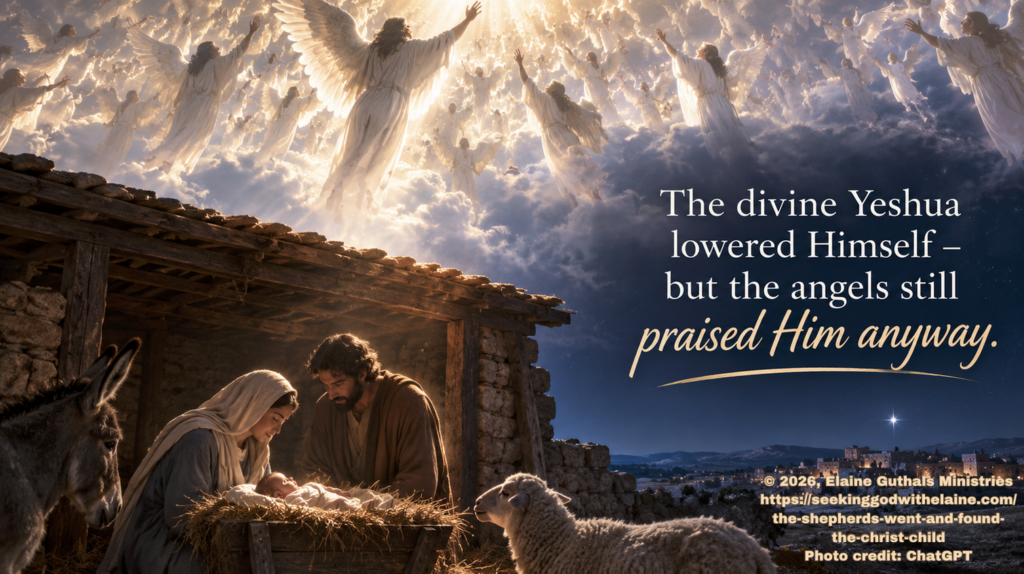
The angels were praising Yeshua because they knew He would secure our salvation.
Glory to God
The host of angels were acknowledging Jehovah’s act of love.
We should give glory to Jehovah every Christmas Day – and every other day. The reasons are
- God is with us.
- He conquered Satan and sin.
- Our salvation has arrived.
Spurgeon noted that this salvation was what gave Jehovah His highest glory. This showed Jehovah’s wisdom and power. It also celebrated His justice. He was sending His Son to suffer for us who had rebelled and broken His law.
Resource
Gumming agreed. To him, glory had three foundations: the substance of the Gospel, how it was disseminated, and the outcomes it had on transforming the hearts and habits of men.
Resource
I get that. Redemption had begun! But that redemption was offered to us, not forced upon us. Redemption didn’t take hold until we are transformed.
Yes, sanctification is a life-long process. We have to be committed to it to start it.
The angels knew to what we could be elevated because – now – Messiah had come as promised.
Because of that, Jehovah’s name should be praised. Only He could provide the Sacrifice worthy enough for the mission.
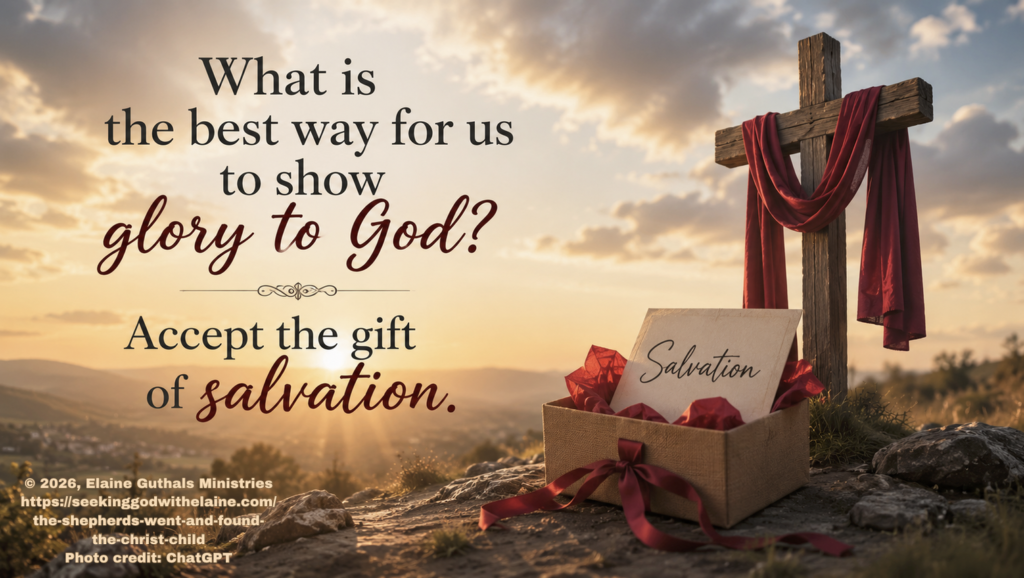
What is the best way for us to show glory to God? Accept the gift of salvation.
In Highest Heaven
The angels praised Jehovah in Heaven.
Jehovah, through this act of sending His Son to be our Savior, showed the angels who knew no sin what redemption from our sins.
The host of angels were focusing humans’ attention on a fair and just Sovereign God.
Peace on Earth
Jehovah was providing a way to have peace with Him as well as have peace with others.
Hmmm. I thought, under Rome, they were supposed to have Pax Romana – peace – in the Roman empire. Maybe, but this earthly peace isn’t the only kind of peace being offered.
Jehovah is offering to make peace with humans after we rebelled against Him, our Creator. He is offering peace within our hearts.
It is not some type of generic peace that can be imposed or enforced. This is shalom (שָׁלוֹם). It is for those who have found favor with Jehovah.
Peace is the product of righteousness. “… Be joyful. Grow to maturity. Encourage each other. Live in harmony and peace. Then the God of love and peace will be with you” (II Cor. 13: 11 NLT).
Think about it. Ask Jehovah to give us this: May your peace be on earth, as it is in heaven.
It is only when we ask Sovereign God for that true peace and believe only He can offer and provide it that we can receive it.
The host of angels were declaring what Micah 5: 5 had prophesied. “And he will stand to lead his flock with the Lord’s strength, in the majesty of the name of the Lord his God. Then his people will live there undisturbed, for he will be highly honored around the world. And he will be the source of peace …” (Mic. 5: 4-5 NLT).
Those with Whom God Is Pleased
Peace must come from Jehovah’s good will.
We’ve also taken the emphasis off who gets the peace. It isn’t peace for mankind. It is peace for those who have ABCDed.
With whom God is pleased? Good will to men, to me doesn’t translate to God is pleased with us. That takes the focus off Jehovah and puts it onto us.
God wasn’t pleased that sin is in the world, so He sent His beloved Son to fix that. Only He could do that, and it pleased Him to do so.
Why would a Sovereign God Who despises sin go to so much trouble to redeem those who rebelled against Him? He loves us that much. His love and mercy shines through this act.
This goodwill is toward humans. Jehovah didn’t offer salvation to Satan and the demons who sinned.
The Complete Jewish Bible has a different take on this along the lines of my take. “Suddenly, along with the angel was a vast army from heaven praising God: ‘In the highest heaven, glory to God! And on earth, peace among people of good will!’” (Lk. 2: 13-14 CBJ).
If we go back to the Greek, it literally says, “Glory in the highest to God, and on earth peace, among people of [God’s] good pleasure/favor.”
The phrase I am questioning is eudokias (εὐδοκίας). That comes from εὐδοκία (eudokia) — pleasure, good will, favor, or good pleasure.
That ς – s – makes a big difference. It makes the phrase mean people of God’s good pleasure or people who have God’s favor.
So, New Living Translation and Complete Jewish Bible aren’t really saying the same thing. True, they are related – and sound similar.
They aren’t.
We have to understand it as God’s good pleasure/favor, not just that were are nice, peaceful, well intentioned people.
This focuses the peace onto Jehovah’s people, not His creation. Believers – not everyone.
Let’s put all this together. Human discord – even those that lead to wars – was not going to stop. The announcement was that Jehovah’s peace was arriving through his Messiah and resting upon those who are recipients of His favor.
Obeying the Angel’s Command
“When the angels had returned to heaven, the shepherds said to each other, ‘Let’s go to Bethlehem! Let’s see this thing that has happened, which the Lord has told us about.’ They hurried to the village and found Mary and Joseph. And there was the baby, lying in the manger. After seeing him, the shepherds told everyone what had happened and what the angel had said to them about this child. All who heard the shepherds’ story were astonished, but Mary kept all these things in her heart and thought about them often. The shepherds went back to their flocks, glorifying and praising God for all they had heard and seen. It was just as the angel had told them” (Lk. 2: 15-20 NLT)
Let’s Go to Bethlehem!
The outcasts who were not allowed in the temple knew the message was from Adonai.
Even the poorest, simplest, most insignificant person can come to Yeshua for salvation. Though shepherds were seen as ignorant men, they knew enough to listen to the angels and obey Jehovah.
It is hard, when animals are involved, to drop everything and go somewhere. I remember when Grandma died, and we had to drive 350 milts the next day to attend the funeral the day after that.
There weren’t many people around that could milk the cows – and they sure didn’t milk themselves. Dad was only able to go to the funeral because my uncle was on vacation and could do the milking.
The point of the story – animal husbandry includes responsibility for the animal’s production and wellbeing.
We said in the last devotion that the shepherds were keeping watch through the different segments of the dark hours. They were protecting the sheep from wild animals.
Yet, Luke doesn’t tell of any cautionary remarks. No, “Hey, who is going to take care of the flock?” No, “Ooo, baby. We are going to lose our job if the owner finds out about this.”
They turned to each other and said, “Let’s go!”
Look what it says. They were going to search for the manger because they were convinced that the birth had already happened.
Hurried to the Village
They said, “Let’s go,” and off they went in a hurry.
The way I would read it is the shepherds left immediately and ran all the way to the manger. They didn’t wait.
Think about it. In the last devotion, we didn’t say the shepherds were waiting. We said they were watching.
Isn’t watching an active task of waiting? We can wait without watching, but we can’t watch without waiting.
The shepherds – as all of Israel was – were waiting for Messiah to come. They were actively watching for Him to appear.
At least this group of men took the proclamation and acted on it.
Remember, these shepherds had started out afraid of the angel. Now, they are not afraid. It doesn’t even sound like they are confused.
They are confident that the message is from Jehovah.
There Was the Baby, Lying in the Manger
Regardless of the acceptability of the shepherds in society, the first visitors to see the Baby were Jewish shepherds.
This is another good example of hearing not being enough. We have to act on the knowledge that we receive about Messiah. We have to come to Him.
The shepherd found the Baby exactly as the angel said they would. Here was this baby in ordinary swaddling clothes. He was in the extraordinary position of laying in the manger.
Told Everyone
First to Mary and Joseph, then to anyone they met, the shepherds told their story to all who would listen.
Think about it. The men whose testimony was not accepted were given the assignment of being the first to spread the news of Messiah’s birth.
Why? Jehovah chooses the willing. He chooses those who will step up when opportunities present themselves for sharing the Gospel. He chooses those who look for that opportunity. He even chooses those who are willing to post teaching on the internet.
No, nothing we have done makes us worthy of serving Jehovah. We are made worthy because He has chosen us.
The shepherds proved themselves as willing. They told all who would listen.
We have to make our decisions – after the angels have left, after we’ve been to the manger. True, there are many times within the process that we have to make choices.
We have to be committed to the end.
Mary Kept All These Things in Her Heart
Mary was a person who thought things through.
What does that mean? Mary connected the dots. She knew about prophecy. She thought through what Gabriel had told her, what Elizabeth had told her, and what transpired. She saw what meshed.
Everything meshed.
Of course, it did. If Jehovah promises something is going to happen it is going to happen.
If it is important, Jehovah is going to tell us about.
Oh, we aren’t necessarily talking about something specific to us. We are talking about what is promised for a significant number of people.
Went Back to their Flocks, Glorifying and Praising God
After we meet Messiah, we return to our lives – transformed.
What happens after we meet the Christ Child? The shepherds went back to work.
Did we think that they were going to keep evangelizing? If that is what Jehovah would have wanted, that is what would have happened.
Instead, it was not in their plan for them to become a disciple or even an apostle of Messiah.
Wonnacott explained it this way. He wrote,
“And if for you the world has been transfigured, and common things have received the impress of heaven by the vision of God’s salvation, then in the place where your daily lot is cast, in the sphere of your common duties and [labors], stand forth a witness for righteousness and for God, preach the gospel of peace and salvation to the sin-stricken, sorrow-laden men and women all around you.”
Resource
They went home to become preachers. Jehovah wanted them to spread the good news to those with whom they came into contact.
They also went home to keep watching and protecting the sheep. This may have been a lowly employment but watching sheep that may – or may not – have been later sacrificed to the Lord God, King of the Universe, was humbling.
Making the Connections #1
There is some discussion on the status of shepherds.
However they were accepted, it was not disputed that they were Jews. The first guests to see the Baby were from the House of Israel – to whom Messiah had come. “Then Jesus said to the woman, ‘I was sent only to help God’s lost sheep — the people of Israel’” (Mt. 15: 24 NLT).
Making the Connections #2
Cox had a wonderful way to state what our daily walk should be like. He wrote,
“The sages [wise men] and the shepherds were men who looked before as well as after, men who knew little and were aware of it, or men who knew much and yet accounted that much but little compared with what God had to teach. Let us be followers of them, ever looking for more truth while we walk by the truth we know. And, walking in the light we have, it will grow larger and purer; using the gifts we possess, more will be added unto us.”
Resource
- Regardless of how much or how little we know, we know less than Jehovah.
- Jehovah is willing to teach us if we are willing to learn.
- We have to seek for Jehovah’s truth.
- Continued growth leads to purity of character.
Making the Connections #3
Think about David a second. He was born in the same area that Messiah was. He went out from there to do the work that Jehovah had for him.
Really, that is what Yeshua would do. He was born here and went out to do Jehovah’s Will.
Making the Connections #4
Think about what Spurgeon said. He wrote,
“From henceforth, when God looks upon man, He will remember that His own Son is a man. As in the case of war, the feud is ended when the opposing parties intermarry, so there is no more war between God and man, because God has taken man into intimate union with Himself. Herein, then, there was cause for joy.”
Resource
Jehovah no longer sees our sin. He sees His Son’s blood covering them.
Making the Connections #5
Think about the way Yeshua came to earth. He was here to right what we did wrong. What King ever did that?
Yeshua was here to take our sin upon Himself. That would mean He would lose access to Jehovah.
The form of execution was a shame and humiliation in itself. But Yeshua suffered all of this.
Why? Because He loves us. He wanted our relationship restored with Jehovah.
Making the Connections #6
The shepherds did everything right. They sought out the Baby in the manger. They told everyone they came into contact with that Messiah was born. They praised Jehovah.
Heart Check
Think about the battle Yeshua is engaged in for your heart. Ask yourself the following questions.
- Have I acted on what Jehovah has shown me, or am I still standing where I was when I heard it?
How Do We Apply This?
- Act on what Jehovah has shown you.
- Seek Messiah rather than merely knowing about Him.
- Don’t keep the news about Messiah to themselves.
- Return to our daily responsibilities transformed.
- Keep watching for what Jehovah wants to teach us.
Father God. We may feel like the shepherd – lowly people who society rejects. Thank You that You don’t reject us when we genuinely follow Messiah. Transform us from the inside out to become more like You. Amen.If you don’t understand something and would like further clarification, please contact me.
If you have not signed up for the email providing the link to the devotions and the newsletter, do so below.
If God has used this devotion to speak with you, consider sharing it on social media.
-
The Shepherds and the Angel
Now that Messiah had been born, Jehovah was ready announce the birth of His Son. This devotional reading looks at how the good news was told and to whom.
Nuggets
- News of Messiah’s birth was shared first with hard-working shepherds.
- Sometimes, suddenly can be relative.
- When Jehovah called Abram (later known as Abraham) to follow Him, He knew that He was not going to stop with Israel in the restoration from the consequences of the Fall.
- The little Baby had three major titles associated with Him.
- The Anointed One was born in the city the king had been anointed.
- The sign given to the shepherds was very specific and easily recognized and verified.
Things just were not turning out as the Pharisees and Torah-teachers thought it would. The Sadducees would never have picked this way for Messiah to appear.
Messiah didn’t show up at the Temple and start the restoration process – which included kicking Rome out.
Messiah stayed in the manger. Jehovah orchestrated all other events.
Let’s Put It into Context
To read devotions in The Battle for the Heart theme
Devotions in the The Birth and Early Childhood of Christ series
The Shepherds
“That night there were shepherds staying in the fields nearby, guarding their flocks of sheep” (Lk. 2: 8 NLT)
News of Messiah’s birth was shared first with hard-working shepherds.
First off, Jehovah wanted the news taken to shepherds in the fields around Bethlehem. We don’t know who owned the fields, what the sheep were being raised for – or anything other than the fact that they were shepherds.
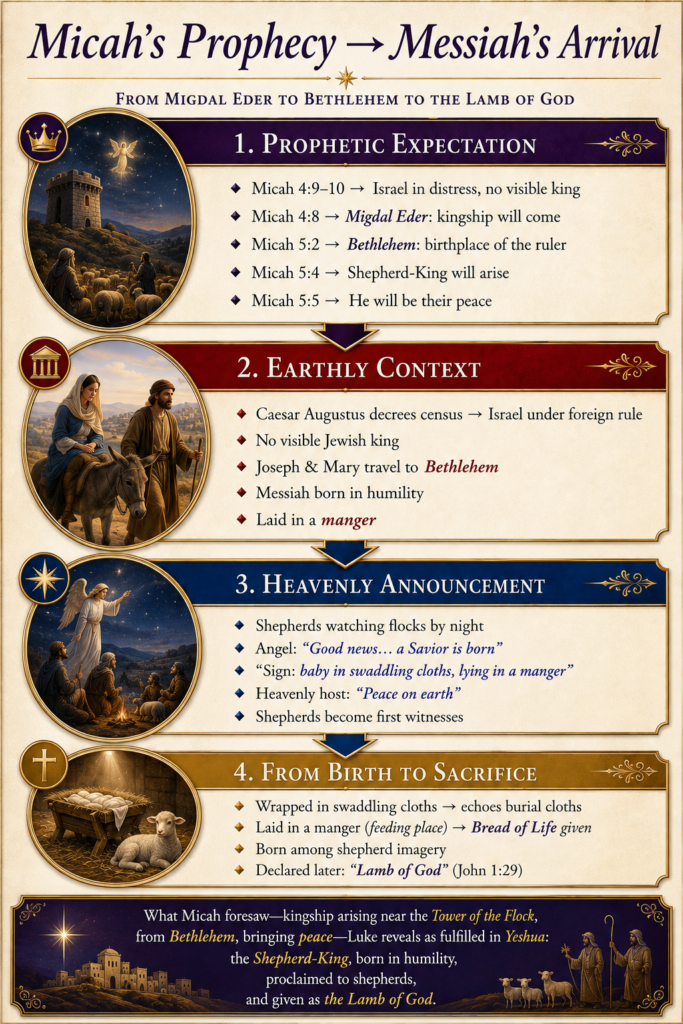
Micah gave us a clue. “And you, O Migdal-eder, Outpost of Fair Zion, It shall come to you: The former monarchy shall return — The kingship of Fair Jerusalem” (Mic. 4: 8 JPS).
Let’s piece together what we can
Migdal Eder (מִגְדַּל־עֵדֶר) – the Tower of the Flock – was a watchtower constructed to the east of Bethlehem. The tower, according to Mishna Shekalim 7:4, was part of a system for preparing and inspecting lambs for Temple sacrifice.
No, this does not mean all sheep in the fields of Bethlehem were destined for sacrifice. It does connect the Midgal Eder, which was in the Bethlehem area, with those sacrifices.
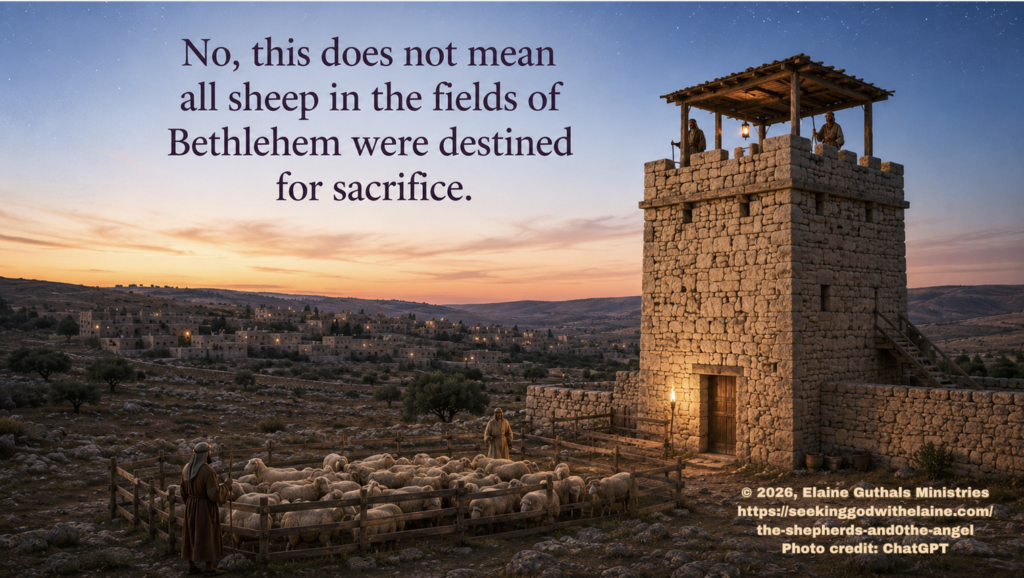
Think about the implication if they were. Jehovah chose societal outcasts who were performing an important task for the Temple – ensuring the purity of the sacrifices – to announce the birth of the Lamb of God – the Pascal Lamb.
That sounds like – to me – a connection Jehovah would make.
What Luke does tell us is important because of its specificity. They were in the Bethlehem region – Bethlehem being the city of David. It was night – an interesting nugget we really didn’t need to know but Luke told us anyway – when the shepherds were watching their flocks.
Society thought they were outcasts. Jehovah didn’t. They still had an important task to perform – and they were performing it. They were protecting the system that excluded them.
Look at the Greek a second. Luke uses ἀγραυλοῦντες (agraulountes), meaning they were staying/living in the open fields, and then φυλάσσοντες φυλακὰς τῆς νυκτός (phylassontes phylakas tēs nyktos), literally something like guarding the watches of the night.
The night was divided into watches. As watch here is plural, to me that mean all the watches were covered. They were looking and waiting for whatever to happen. They were active in their duties.
Jehovah calls us to be active in watching for Messiah’s return.
The Angel
“Suddenly, an angel of the Lord appeared among them, and the radiance of the Lord’s glory surrounded them. They were terrified, but the angel reassured them. ‘Don’t be afraid!’ he said. ‘I bring you good news that will bring great joy to all people. The Savior — yes, the Messiah, the Lord — has been born today in Bethlehem, the city of David! And you will recognize him by this sign: You will find a baby wrapped snugly in strips of cloth, lying in a manger’” (Lk. 2: 9-12 NLT)
Suddenly
Sometimes, suddenly can be relative.
Usually, we think of suddenly meaning that one minute something is true, the next something totally different is now true. That may, however, be contingent on when we notice something.
Still, what happened here was unexpected. The shepherds didn’t anticipate the angels appearing.
The angels did just that because this was where Jehovah sent them to be.
Good News of Joy to All People
When Jehovah called Abram (later known as Abraham) to follow Him, He knew that He was not going to stop with Israel in the restoration from the consequences of the Fall.
Yes, Abraham was going to have enough descendants to form a nation. But even people not his descendants were going to be blessed through him.“… All the families on earth will be blessed through you.” (Gen. 12: 3 NLT).
This blessing was going to be in the Person and mission of Yeshua – the promised Messiah in Genesis 3: 15. Through Him, sin and its originator would be defeated.
It was going to be for everyone.
- “I will give you to Israel as my personal covenant, and you will be a light to the nations.” (Isa. 42: 6 NLT).
- “The LORD has demonstrated his holy power before the eyes of all the nations. All the ends of the earth will see the salvation of our God.” (Isa. 52: 10 NLT)
- “I will also make you a light to the Gentiles, and you will bring my salvation to the ends of the earth.” (Isa. 49: 6 NLT).
Savior, Messiah, and Lord
The little Baby had three major titles associated with Him.
Savior means in Hebrew – moshiaʿ (מֹושִׁיעַ) – savior, deliverer, and one who saves/rescues. The Greek is sōtēr (σωτήρ) and means savior, deliverer, or rescuer.
This calls back to Luke’s previous discussion of salvation in Zechariah’s Benedictus. “He has sent us a mighty Savior from the royal line of his servant David” (Lk. 1: 69 NLT).
Zechariah also stated Yeshua’s mission. “And you, my little son, will be called the prophet of the Most High, because you will prepare the way for the Lord. You will tell his people how to find salvation through forgiveness of their sins” (Lk. 1: 76-77 NLT).
Fast forward to the night Yeshua was born. The same language was used.
What the angel was telling the shepherds was that Jehovah’s salvation promised under the covenant was being fulfilled in Bethlehem that night.
The title of Messiah – Mashiach (מָשִׁיחַ) – in Greek is Christos (Χριστός). Both mean anointed one.
Kings and priests were anointed. As both, Messiah would be anointed.
- “He will be very great and will be called the Son of the Most High. The Lord God will give him the throne of his ancestor David” (Lk. 1: 32 NLT).
- “and he will reign over the house of Jacob forever, and of his kingdom there will be no end.” (Lk. 1: 33 ESV).
The promised Anointed King had arrived.
Then the Baby the shepherds were being told about was called Lord – Kyrios (κύριος) in Greek and Adonai (אֲדֹנָי) in Hebrew. Luke has already set up his readers to understand that He is discussing Jehovah.
- “Then the angel said, ‘I am Gabriel! I stand in the very presence of God. It was he who sent me to bring you this good news!’” (Lk. 1: 19 NLT).
- “He will be a man with the spirit and power of Elijah. He will prepare the people for the coming of the Lord. He will turn the hearts of the fathers to their children, and he will cause those who are rebellious to accept the wisdom of the godly” (Lk. 1: 17 NLT).
- “And you, my little son, will be called the prophet of the Most High, because you will prepare the way for the Lord” (Lk. 1: 76 NLT).
The same Gospel that is preparing us for the coming of the Lord now announces that the Lord has arrived.
This is extremely telling when we read Isaiah.
- “I, yes I, am the Lord, and there is no other Savior.” (Isa. 43: 11 NLT).
- “… Was it not I, the Lord? For there is no other God but me, a righteous God and Savior. There is none but me” (Isa. 45: 21 NLT).
In Bethlehem, the city of David!
The Anointed One was born in the city the king had been anointed.
We’ve talked about Bethlehem being the city of David. That was because he was born there.
Bethlehem was also where David was anointed. Take a look.
- “Now the Lord said to Samuel, ‘You have mourned long enough for Saul. I have rejected him as king of Israel, so fill your flask with olive oil and go to Bethlehem. Find a man named Jesse who lives there, for I have selected one of his sons to be my king’” (I Sam. 16: 1 NLT).
- “So Jesse sent for him. He was dark and handsome, with beautiful eyes. And the Lord said, ‘This is the one; anoint him.’ So as David stood there among his brothers, Samuel took the flask of olive oil he had brought and anointed David with the oil. And the Spirit of the Lord came powerfully upon David from that day on. Then Samuel returned to Ramah” (I Sam. 16: 12-13 NLT).
What had David been doing when he was called in from the field to be anointed? He was being a shepherd watching a sheep.
That makes a great segue into Messiah as a Shepherd King.
Scripture is filled with men and women who were shepherds and shepherdesses. Abel, Abraham, Isaac, Jacob, Rachel, Moses, and David are the most familiar.
David saw the qualities shepherd possess with those of the Lord, Who was the Good Shepherd. “The LORD is my shepherd; I have all that I need” (Ps. 23: 1 NLT).
Shepherds – ro’eh (רֹעֶה) – protected and fed their flock. They guided them and even risked their lives for them.
The title of shepherd was given to the kings. It was their responsibility to ra’ah (רָעָה) – to pasture, to tend and to shepherd – Jehovah’s covenant people. To be more specific, the image became the symbol for covenant care, righteous leadership, and faithful guidance.
Messianic expectation saw Messiah being a Shepherd of His people. This shines through the promises given through David and the prophets while revealing the heart of Jehovah’s Kingdom.
Many saw Messiah being the One to fulfill Jehovah’s covenant promises to judge the false shepherds, gather His scattered sheep, and personally shepherd His people through David’s descendant.
Micah 5 – along with Jeremiah 23 – anticipate a righteous Shepherd-King who restores Israel and rules in peace. “And he will stand to lead his flock with the Lord’s strength, in the majesty of the name of the Lord his God. Then his people will live there undisturbed, for he will be highly honored around the world” (Mic. 5: 4 NLT).
Recognize Him by This Sign
The sign given to the shepherds was very specific and easily recognized and verified.
The angel told the shepherds three very concrete signs – semeion (σημεῖον) meaning a sign, mark, token, or identifying indication through which they could identify the Christ Child. We’ve already been told what the signs are, but Luke repeated them in the angel’s explanation of why they showed up on the hillside that night.
The first sign we may miss. The angel said that the Baby was born that day. Jehovah didn’t waste time in revealing His beloved Son’s birth to those who needed to know.
The Babe would be wrapped in swaddling clothes. That wasn’t unusual. That didn’t even indicate lack of wealth on the parents’ part.
What it did say was that the Baby was taken care of and loved.
The unusual identifying marker was that the Baby was lying in an animal feeding trough. Probably even more astounding to the shepherds was the fact that this Baby was identified as the Savior.
The enormous titles did not fit the setting.
We tend to focus on our perception that being a King in a manger makes Yeshua humble. It does show His humility.
To me, it shows from the first seconds after His arrival on earth, Yeshua was destined to be the Lamb of God, the Sacrifice Who takes away the sins of the world.
Ordinary shepherds would have been affected by the sign. Migdal Eder shepherds wouldn’t be able to miss that even with their eyes closed.
These shepherds would have known how to protect a lamb meant for sacrifice. They would have seen the Baby as entering the world the same way the other lambs did.
The Messiah existed with a Jewish sacrificial-animal framework. Because of that, the Davidic kingship would be restored. He would be the ruler who would shepherd Israel.
Making the Connections #1
The angel told the shepherds that they were being provided a sign. That is covenant language.
The most recognizable covenant sign to all is the rainbow. “Then God said, ‘I am giving you a sign of my covenant with you and with all living creatures, for all generations to come. I have placed my rainbow in the clouds. It is the sign of my covenant with you and with all the earth’” (Gen. 9: 12-13 NLT).
We are also familiar with the sign for the Abrahamic covenant. “You must cut off the flesh of your foreskin as a sign of the covenant between me and you” (Gen. 17: 11 NLT).
So, the angel starts it out by using the same language – this will be a sign to you. But then it took a turn.
Yeshua wasn’t just pointing toward Jehovah’s covenant promise. He was the covenant promise.
- “I, the Lord, have called you to demonstrate my righteousness. I will take you by the hand and guard you, and I will give you to my people, Israel, as a symbol of my covenant with them. And you will be a light to guide the nations” (Isa. 42: 6 NLT).
- “At just the right time, I will respond to you. On the day of salvation I will help you. I will protect you and give you to the people as my covenant with them. Through you I will reestablish the land of Israel and assign it to its own people again” (Isa. 49: 8 NLT).
Yeshua was the covenant. He especially showed this at the Last Supper. “After supper he took another cup of wine and said, ‘This cup is the new covenant between God and his people — an agreement confirmed with my blood, which is poured out as a sacrifice for you” (Lk. 22: 20 NLT).
Making the Connections #2
Luke is quietly foreshadowing what will happen when Yeshua finished His mission.

Making the Connections #3
What does the scene surrounding Yeshua’s birth tell us? Jehovah wasn’t interested in the way the world did things. He certainly didn’t need to ask anyone’s permission to do things His way.
Jehovah didn’t let the focus of the moment to be taken off the incarnation. Here He came to earth as flesh in the form of His Son.
Yeshua came where He needed to be.
Making the Connections #4
When we started this devotion, the shepherds were afraid. Well, that is the first thing we read in any angel encounter.
It really isn’t said here, but by the end of the devotion, they weren’t afraid anymore.
When we are open to what Jehovah is telling us, we shouldn’t be afraid. True, some things we have to experience is hard and hurts.
Experiences are meant to grow our understanding of Jehovah, bringing us closer to Him.
Heart Check
Think about the battle Yeshua is engaged in for your heart. Ask yourself the following questions.
- Am I watching for Yeshua, or am I spiritually asleep?
- Am I willing to receive what God reveals, even when it doesn’t look like what I expected?
- Do I understand that Yeshua came as Savior for all people, rather than restricting God’s grace to the people I think deserve it?
How Do We Apply This?
- Where does Yeshua need you to be?
Father God. So many times You show us that Your ways are not our ways. Thank You for using those times to show us Your love for us. Amen.
If you don’t understand something and would like further clarification, please contact me.
If you have not signed up for the email providing the link to the devotions and the newsletter, do so below.
If God has used this devotion to speak with you, consider sharing it on social media.
-
Zechariah’s Benedictus
More happened at the circumcision ceremony than just the circumcision and the naming of the baby. This devotion looks at Zechariah’s prophecy called the Benedictus.
Nuggets
- When Zechariah got his voice back, he immediately praised Jehovah.
- Prayers and blessings always began with the Berakhah.
- The nation of Israel had long known that redemption was part of the Messianic expectations.
- Rescue and deliverance was on its way.
- First-century Jews believed they were still under the Abrahamic and Davidic covenants, even though they had not experienced full restoration after the Babylonian exile.
- Many first-century Jews correctly longed for deliverance, but they misunderstood the enemy from whom the Messiah had primarily come to save them.
- While many believed full exile restoration hadn’t happened yet, they believed that Jehovah had not abandoned them.
- We are rescued from the condemnation of the Law, the power of sin, and the fear of death.
- We talk of salvation as a free gift from Jehovah.
- Zechariah and his audience would have seen these verses as renewal of the covenant instead of a new covenant with Yeshua.
The setting was the ceremony for John the Immerser’s circumcision. In the last devotion, we talked about the confusion of his name and how Zechariah blessed him.
But before he did, Zechariah broke out into praise about Yeshua. He prophesied as to the coming Messiah.
Let’s Put It into Context
To read devotions in The Battle for the Heart theme
Devotions in the Preparing for the Christ Child series
Zechariah’s Prophecy
“Then his father, Zechariah, was filled with the Holy Spirit and gave this prophecy” (Lk. 1: 67 NLT)
When Zechariah got his voice back, he immediately praised Jehovah.
Zechariah’s blessing of John is beautiful, but it is also inspirational. We can’t gloss over the fact that Zechariah was being more than just a proud papa. He was filled with the Holy Spirit and prophesying (Lk. 1: 67).
The main focus of the blessing wasn’t John – it was Yeshua.
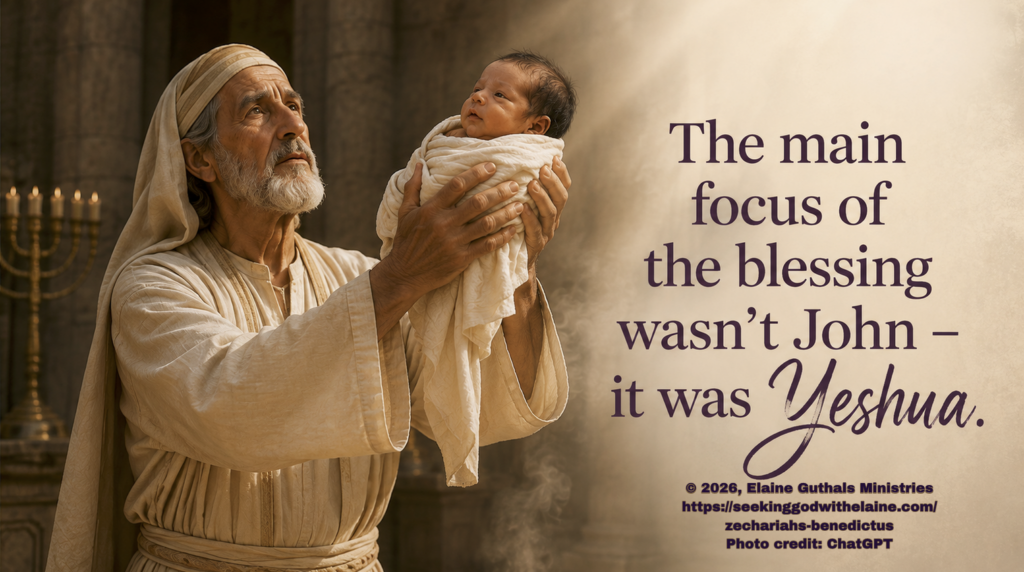
Zechariah could have just focused on his returned voice and his miracle baby. He didn’t.
Covenant faithfulness focused on national redemption.
But we have to resist going down the path that it seems Parker’s first sentence took. He then seems to straighten it out.
Parker wrote,
“The inspiration of Zacharias recognized most emphatically the preceding inspiration with which God had [favored] His Church. Zacharias seems to be standing in the midst of that summer of which Old Testament times were but the spring. And as, on the one hand, his inspiration seemed to contract the past until Abraham lived but yesterday; so, on the other, it contracts the future, and makes John already the full-grown messenger and herald of the Messiah.”
Resource
Parker uses the imagery of spring and summer to describe the progression from Old Testament promises to their fulfillment in Zechariah’s day. I agree that Zechariah stood at a significant turning point, but that did not mean Jehovah was replacing Israel with the Church. The covenant promises were being fulfilled through the Messiah.
Jehovah hasn’t replaced Israel with the church.
Zechariah’s blessing was not focused on the early church. It was a covenant blessing from start to finish.
Parker was right that Zechariah and John were on the threshold between Zechariah’s priests and John’s Holy Spirit-filled life.
We have to remember this was before the Temple was destroyed in 70 AD. Messianic expectation was high.
Those that believed in the Messiah who fulfilled those expectations wouldn’t – in one aspect – see themselves as much different as they had been. They were still Torah-observant, Temple-attending covenant believers.
In other words, they did not see the Messiah as forming a new religion. He was fulfilling the covenant promises.
Enter Zechariah with what is called the Benedictus. It would have been seen as a live covenant proclamation.
Praise to the Covenant Maker
“Praise the Lord, the God of Israel, because he has visited and redeemed his people” (Lk. 1: 68 NLT)
Praise the Lord
Prayers and blessings always began with the Berakhah.
Berakhah (בְּרָכָה) means blessing. Blessings praising Jehovah often began with a declaration of His blessedness.
Zechariah’s prophecy begins with this familiar Jewish pattern of blessing. Luke records his opening words: “Blessed be the Lord, the God of Israel” (Lk. 1:68). First-century Jewish listeners would have recognized the language as familiar, connecting his blessing with Israel’s Scriptures and covenant relationship with Jehovah.
Remember who Zechariah was. He was a righteous priest who ministered through ordained ritual.
He Has Visited and Redeemed His People
The nation of Israel had long known that redemption was part of the Messianic expectations.
Ever since the Garden of Eden, the story of redemption has been unfolding. But most first-century Jews didn’t go back that far.
Israel’s identity was rooted in faithful Abrahamic covenant relationship with God, who called, redeemed, and set them apart for His purposes. First-century Jews believed that the covenant relationship would be renewed through renewed holiness and purified worship.
The Babylonian exile rocked their covenant identity. They knew they had broken the covenant, but they wondered if Jehovah would abandon them forever.
Many first-century Jews believed that the covenant relationship would be renewed through renewed holiness and purified worship. The prophets had talked of restoration – restoration that hadn’t happened yet. Many knew they had broken the covenant and wondered if Jehovah would abandon them forever.
For many, Messiah, therefore, was expected to accomplish national redemption.
Zechariah was there to tell them that the Messiah had come. Yeshua had visited them. True, He was still growing in His mother’s womb, but He was here.
Unfortunately, many saw this as a new Exodus intervention. They saw it as liberation from Rome.
The Savior Was Sent
“He has sent us a mighty Savior from the royal line of his servant David” (Lk. 1: 69 NLT)
Rescue and deliverance was on its way.
Luke was probably writing in Greek. Verse 69 in the Greek was, “Kai ēgeiren keras sōtērias hemin en oikō Dauid paidos autou (καὶ ἤγειρεν κέρας σωτηρίας ἡμῖν ἐν οἴκῳ Δαυὶδ παιδὸς αὐτοῦ).” Literally, that reads, “He has raised up for us a horn of salvation in the house of David His servant.”
If Luke would have written it in Hebrew, it would probably have been, “Hēqîm lanu qeren yeshu’ah b’veit David avdo (הֵקִים לָנוּ קֶרֶן יְשׁוּעָה בְּבֵית דָּוִד עַבְדּוֹ).
The Hebrew literally says the same thing as the Greek. So, let’s look at the words.
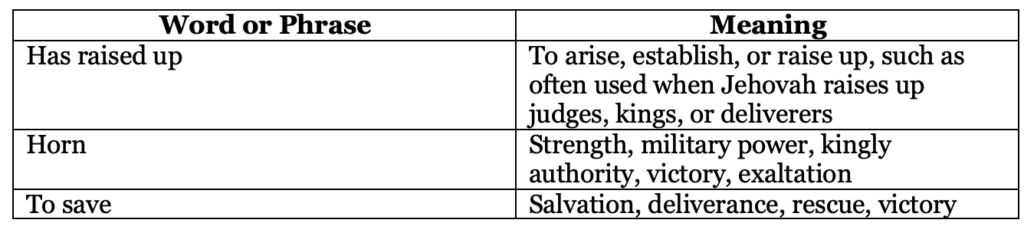
Fun fact. Yeshua comes from the same root as to save. So, Zechariah is proclaiming that Jehovah has raised up a qeren yeshu’ah – a horn of salvation – that is embodied in Yeshua Himself.
So, the horn would have been seen as strong and powerful.
This verse ties together the Davidic Covenant, royal hope, and Zechariah’s prophecy in one thread. That would have conveyed first-century Jews the understanding that the royal covenant promise was alive.
While first-century Jews would have seen this as salvation from Rome, Yeshua pointed them in the way of restoration from sin, death, and spiritual bondage.
Promised Long Ago
“just as he promised through his holy prophets long ago” (Lk. 1: 70 NLT)
First-century Jews believed they were still under the Abrahamic and Davidic covenants, even though they had not experienced full restoration after the Babylonian exile.
At the beginning of the Babylonian exile, the Israelites questioned whether Jehovah had abandoned them. They believed He still intended to fulfill His promises.
They saw the Messiah as the one to fulfill those promises. Way back in the Garden of Eden, Jehovah had promised that one of human’s seed would crush one of the serpent’s seed.
I know. Wouldn’t that have made them realize that faith in Yeshua was covenant continuity, not covenant departure?
From Abraham’s covenant, through David’s royal promises, through the pain of exile, Jehovah had never abandoned His covenant purposes. Zechariah’s prophecy announces that the long-awaited fulfillment had finally begun.
Rescue at Hand
“Now we will be saved from our enemies and from all who hate us” (Lk. 1: 71 NLT)
Many first-century Jews correctly longed for deliverance, but they misunderstood the enemy from whom the Messiah had primarily come to save them.
Remember, many were looking for a Messiah to overthrow Rome. They interpreted Scripture to say this because Jehovah had sent military saviors before.
Yeshua did save them – and us – from our worst enemy – Satan. He came to defeat sin, Satan, and death — the enemies from which humanity most desperately needed rescue.
Satan and the demons hate us. Also, those who are Satan’s hate us.
While the Messianic expectations believed by first-century Jews included renewed holiness and purified worship, they felt it was covenant renewal. They didn’t believe it was Eden renewal.
They believed that being Abraham’s descendants was the entryway to the salvation offered by the Messiah. If they would have heard “… I am the way, the truth, and the life …” (Jn. 14: 6 NLT), they would have thought their beliefs were already there.
Covenant Mercy
“He has been merciful to our ancestors by remembering his sacred covenant — the covenant he swore with an oath to our ancestor Abraham” (Lk. 1: 72-73 NLT)
While many believed full exile restoration hadn’t happened yet, they believed that Jehovah had not abandoned them.
The exile to Babylon had occurred because Israel broke its covenant with Jehovah. The consequences of that disobedience were expulsion from the Promised Land for most of the Israelites and loss of the Davidic throne.
While first-century Jews were back home in the Promised Land, the throne hadn’t been restored. Many still considered themselves under exile.
The appearance of the Messiah would have verified that Jehovah remembered the covenant that He not only made with Abraham but also with David.
“For when you die and are buried with your ancestors, I will raise up one of your descendants, your own offspring, and I will make his kingdom strong. He is the one who will build a house — a temple — for my name. And I will secure his royal throne forever. I will be his father, and he will be my son …” (II Sam 7: 12-14 NLT).Holiness and Righteousness Restored
“We have been rescued from our enemies so we can serve God without fear, in holiness and righteousness for as long as we live” (Lk. 1:74- 75 NLT)
Rescued
We are rescued from the condemnation of the Law, the power of sin, and the fear of death.
Some might consider it strange that we are rescued from God’s law. He gave it to us, didn’t He? The law shows us His character, doesn’t it?
True, but many first-century Jews – and those still today – believe those laws can save us. They can’t.
God’s laws show us our need for a Savior.
The rescue we got was redemption. It came because of the tender heart of Jehovah.
Serve Him
We talk of salvation as a free gift from Jehovah.
While salvation might be to us a free gift, Boston reminded us it wasn’t to Yeshua. He wrote, “All the benefits of the covenant, to be bestowed on His spiritual seed, are made over to Him on a valuable consideration. God gives us to serve our Redeemer, because Christ served Him perfectly in our room and stead.”
Resource
We are called to serve Jehovah. That is a covenant responsibility.
Does that mean there are strings attached to the gift? No. Boston called it a privilege and a benefit to serve Jehovah.
We accept the responsibilities of the covenant when we put our faith in Yeshua as our Savior.
That doesn’t make us slaves to Jehovah. It doesn’t even make us hired hands.
It is our honor to serve Jehovah. We are ministers – a priesthood – for Him.
The Temple was still functioning and would for a couple more decades. They would have seen holiness and righteousness prophesied in Jeremiah 31 and Ezekiel 36 as being tied with Israel’s priestly vocation.
- “‘But this is the new covenant I will make with the people of Israel after those days,’ says the Lord. ‘I will put my instructions deep within them, and I will write them on their hearts. I will be their God, and they will be my people’” (Jer. 31: 33 NLT).
- “And I will give you a new heart, and I will put a new spirit in you. I will take out your stony, stubborn heart and give you a tender, responsive heart” (Ezek. 36: 26 NLT).
Hey, new covenant, New Testament, right? Abrahamic covenant, Davidic covenant, and Messianic covenant all interconnected.
Yes, but not in the way they thought.
We have to go back to the Hebrew to understand this. What Jeremiah was talking about – and what they would have connected to Ezekiel – was berit chadashah (בְּרִית חֲדָשָׁה).
Yes, it could mean new, but it also could mean renewed or restored. That is what many first-century Jews heard – restored.
But it was only a covenant with the House of Israel and the House of Judah. “See, a time is coming — declares GOD — when I will make a new covenant with the House of Israel and the House of Judah” (Jer. 31: 31 JPS).
First-century Jews generally expected the new covenant to renew Israel, not expand her to include Gentiles; to transform hearts, not abolish Torah; and to restore covenant faithfulness, not establish a different faith. What they didn’t anticipate was that this renewal would be inaugurated through the atoning death and resurrection of the Messiah Himself.
Holiness and Righteousness
Zechariah and his audience would have seen these verses as renewal of the covenant instead of a new covenant with Yeshua.
We’ve heard about holiness and righteousness many times. Those can be confusing terms, though, to some.- Holiness is the state of being set apart to God, increasingly reflecting His character through a life devoted to Him. As we grow in holiness, holiness produces a clean heart, a steadfast will, and a life wholly dedicated to God.
- Righteousness is the inward reign of Christ that reshapes our desires before it reshapes our behavior.
The service we are called to perform is to continue the rest of our lives. We serve Jehovah because we are set apart to do it. This is a lifelong act because it is part of our Sanctification Road – which is a lifelong process.
Making the Connections #1
How many times can Satan convince us that we have gone one sin too far? He loves to tell us that we crossed the line, and Jehovah will never forgive us.
Since it was probably around 3 or 4 AD, the friends and family that came to the B’rit Milah (בְּרִית מִילָה) would have seen Zechariah’s prophecy as hopeful and anticipatory. They wouldn’t have seen Zechariah’s prophecies as a departure from Judaism.
Making the Connections #2
Look at what Boston said. He wrote,
“The first covenant required a lasting service, but secured not man from breaking the service. But the second covenant secures the perpetuity of the service, that, however fickle the believer is, yet he shall serve the Lord all the days of his life. It imports that he shall serve the Lord for ever and ever, in heaven, after death.”Resource
Satan is wrong. There is only one sin that Jehovah won’t forgive. It is called the unpardonable sin. In my opinion, it has to do with unbelief and refusal to surrender to Him even if we do believe.
That should comfort us. Once we are Jehovah’s, only we can choose to turn our back on Him. He never will turn away from us.Making the Connections #3
Zechariah praised Jehovah because He remembered His covenant. Jehovah has never failed to keep His promises. The better question for us is whether we are faithfully walking with Him each day. Have we allowed distractions, sin, or complacency to pull us away from the relationship He has graciously established through Yeshua? Covenant faithfulness begins with the daily choice to follow Him.
Heart Check
Think about the battle Yeshua is engaged in for your heart. Ask yourself the following questions.
- Am I choosing to follow Yeshua daily, or am I slowly turning away from Him?
How Do We Apply This?
- Praise Him for keeping every promise.
- Remember what He has rescued you from.
- Walk faithfully with Him daily.
- Serve Him without fear, in holiness and righteousness.
Father God. We choose You daily. Help us to grow closer to You as we walk with You. May we praise You as Zechariah did for the covenant that we have with Yeshua. Amen.
If you don’t understand something and would like further clarification, please contact me.
If you have not signed up for the email providing the link to the devotions and the newsletter, do so below.
If God has used this devotion to speak with you, consider sharing it on social media.
Lorem ipsum dolor sit amet, consectetur adipiscing elit. Ut elit tellus, luctus nec ullamcorper mattis, pulvinar dapibus leo.
-
Mary Visited Elizabeth
After she had received a visit from an angel to tell her of her pregnancy, Mary went to visit her relative, Elizabeth. This devotional reading looks at the greeting between the two women and the unique situations in which they found themselves.
Nuggets
- Mary chose to go visit her relative Elizabeth, who was also pregnant, to process what was happening to her.
- Mary and Elizabeth lived in totally different places.
- Luke didn’t record the town in which Elizabeth and Zechariah lived.
- More than Elizabeth greeted Mary.
- Filled with the Holy Spirit, Elizabeth began to prophecy.
- Blessed among women was not new language about Mary.
- Yeshua was called Lord before He was born.
- Elizabeth affirmed Mary’s faith.

It wasn’t every day that an angel paid a human a visit. It wasn’t every day that a virgin was told she was going to have a baby. It wasn’t every day that a virgin was told that her relative, who was beyond childbearing age, was going to have a baby.
All that once in 2 million lifetimes meant that a road trip was needed. Mary decided to go see her relative.
Let’s Put It into Context
To read devotions in The Battle for the Heart theme
Devotions in the Preparing for the Christ Child series
Mary Visited Elizabeth
“A few days later Mary hurried to the hill country of Judea, to the town where Zechariah lived… (Lk. 1: 39-40 NLT)
A Few Days Later
Mary chose to go visit her relative Elizabeth, who was also pregnant, to process what was happening to her.
We don’t know if Mary talked to Joseph before she left town. She may have gotten out while the getting was good, but I don’t really think so.
Stowe felt this trip highlighted Mary’s character. She wrote, “The next step taken by Mary is in accordance with the calmest practical good sense, and displays an energy and a control over other minds which must have been uncommon.”
Resource
Mary was a woman of integrity, so I would think she talked to Joseph first. Besides, he probably already knew about the pregnancy when the angel came to talk with him.
Some versions say that Mary “… went into the hill country with haste …” (Lk. 1: 39 KJV). The Greek word is meta spoudēs (μετὰ σπουδῆς); it means haste, eagerness, diligence, earnestness, zeal, and promptness.
Hebrew doesn’t have a direct word that translates to this. Several express the same idea. One is mahēr (מַהֵר), which means hasten, hurry, and make haste. Another is ḥāpaz (חָפַז), meaning to hurry or be in haste.
That follows Mary’s faith. She immediately submitted in obedience when Gabriel said she was going to carry God’s Son.
Everything Gabriel said was said for a reason. That means he told Mary about Elizabeth’s pregnancy for a reason.
As she was also involved in Jehovah’s plan, Elizabeth may have been the one person most likely to have understood.
I wonder if Mary was concerned about what Elizabeth’s reception of her would be. Would Mary’s news be accepted, or would she be seen as someone who was delusional?
The Hill Country of Judea
Mary and Elizabeth lived in totally different places.
Nazareth, where Mary lived, was a small inconsequential village. Its only claim to fame was that it was where the Messiah lived during childhood and early adulthood.
The hill country (har Yehudah – הַר יְהוּדָה) was something entirely different. It would have been considered the heartland of Judah.
It stretched from Jerusalem to Hebron. This was the place where Abraham settled. It is where Abraham, Sarah, Isaac, Rebekah, Jacob, and Leah are buried.
It was also home to King David while he was fleeing Saul. Also, his first capital was in the region before it was moved to Jerusalem.
Mary would have then passed many spots where Israel history had been made. (She would make the same journey again within nine months.)
It was the rugged mountainous region, within the land of Judah, which surrounded Jerusalem. There were fairly large mountains at 2,500 to 3,300 feet above sea level. Because of this, the area was characterized by limestone ridges, steep valleys, and terraced hillsides, and scattered villages built from local stone.
The arid climate fostered the growth of olive groves and vineyards. The stony ground would have made their growth difficult and cause extensive cultivation.
Because of its proximity to Jerusalem, it hosted many priestly settlements.
Where Zechariah Lived
Luke didn’t record the town in which Elizabeth and Zechariah lived.
Early Christian tradition identified it as Ein Kerem, a village five miles southwest of Jerusalem. This is where a known priestly settlement – one of many – was located in the hill country.
Geikie felt that what was meant was Mary went to the city of Judah – or Juttah. He argued that just saying a city in Judah was too vague.
Resource
The journey from Nazareth to Ein Kerem would have been considerable in first-century Israel. It was approximately 80 to 100 miles. A normal trip would take four to six days to make on foot.
No, that wasn’t a trip Mary would have taken alone. She would have traveled with a caravan of pilgrims, merchants, or other relatives heading toward Jerusalem.
Even with other people, she was probably traveling alone – meaning no parents or siblings went with her. That took courage and determination.
But get there, Mary did.
Now, Mary may or may not have used the Central Ridge Route to get to the Hill Country. That went right through Samaria – and most Jews bypassed that. It would have depended on what the caravan or whoever was leading the trip decided.
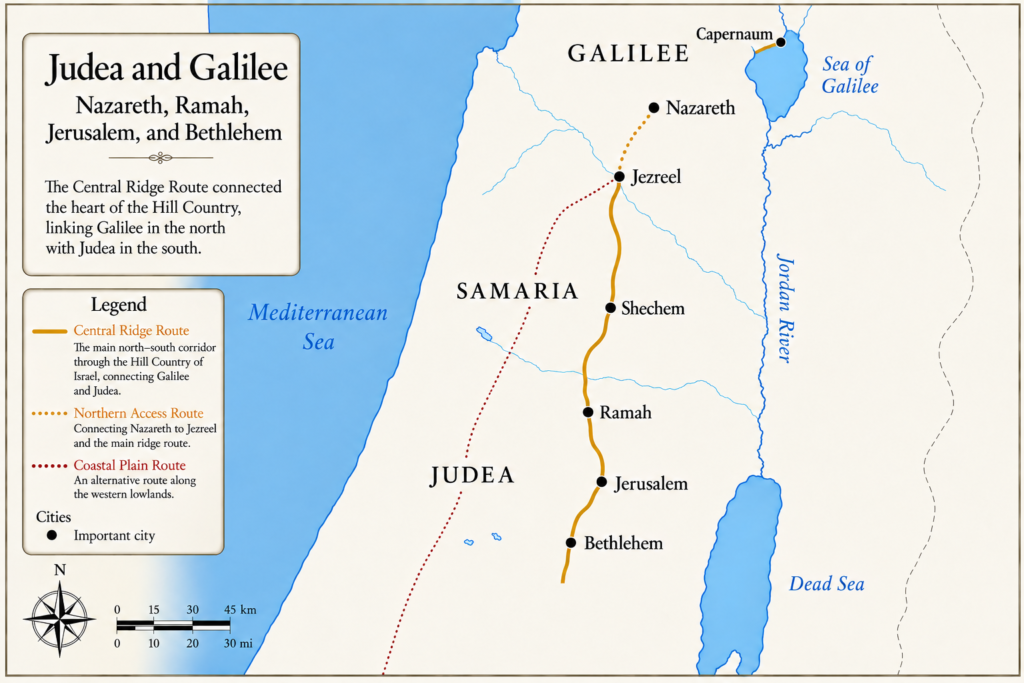
The young virgin from an overlooked village traveled to the ancient covenant heartland, where the first public recognition of Israel’s Messiah would occur.
Greeting
“… She entered the house and greeted Elizabeth. At the sound of Mary’s greeting, Elizabeth’s child leaped within her, and Elizabeth was filled with the Holy Spirit” (Lk. 1: 40-41 NLT)
More than Elizabeth greeted Mary.
It doesn’t sound like Mary even got to tell her news. Elizabeth was told by the Holy Spirit. Mary greeted – John leaped – Elizabeth was filled with the Holy Spirit.
John greeted Jesus’s mother. More importantly, before either were born, John was already greeting unborn Yeshua.
We shouldn’t be surprised. Gabriel said John would be filled with the Holy Spirit in the womb (Lk. 1: 15).
No, the first recognition of the Messiah was not Zechariah, the priest – or any priest in the Temple. It was in a faithful elderly couple’s home by the forerunner of the Messiah.
Jehovah’s plan was known to its principal players.
Elizabeth Was Filled with the Holy Spirit
“Elizabeth gave a glad cry and exclaimed to Mary, ‘God has blessed you above all women, and your child is blessed. Why am I so honored, that the mother of my Lord should visit me? When I heard your greeting, the baby in my womb jumped for joy. You are blessed because you believed that the Lord would do what he said’” (Lk. 1: 42-45 NLT)
Gave a Glad Cry
Filled with the Holy Spirit, Elizabeth began to prophecy.
No, Elizabeth didn’t suddenly have insight on her own. There was no way she would have known that Mary was pregnant.
They didn’t have phones or internet in that day. The media wouldn’t have been alerted.
Elizabeth was filled with the Holy Spirit. That is the way He worked in Old Testament times. (This occurred before Pentecost, when the Holy Spirit permanently indwelt believers.)
The Holy Spirit landed on people for a specific purpose. He didn’t indwell in them yet.
Mary may have been there because of Elizabeth, but Elizabeth quickly turned the focus onto Mary.
God Has Blessed You above All Women
Blessed among women was not new language about Mary.
I wonder what Mary thought when Elizabeth started the blessing. “Blessed are you among women …” (Lk. 1: 42 ESV).
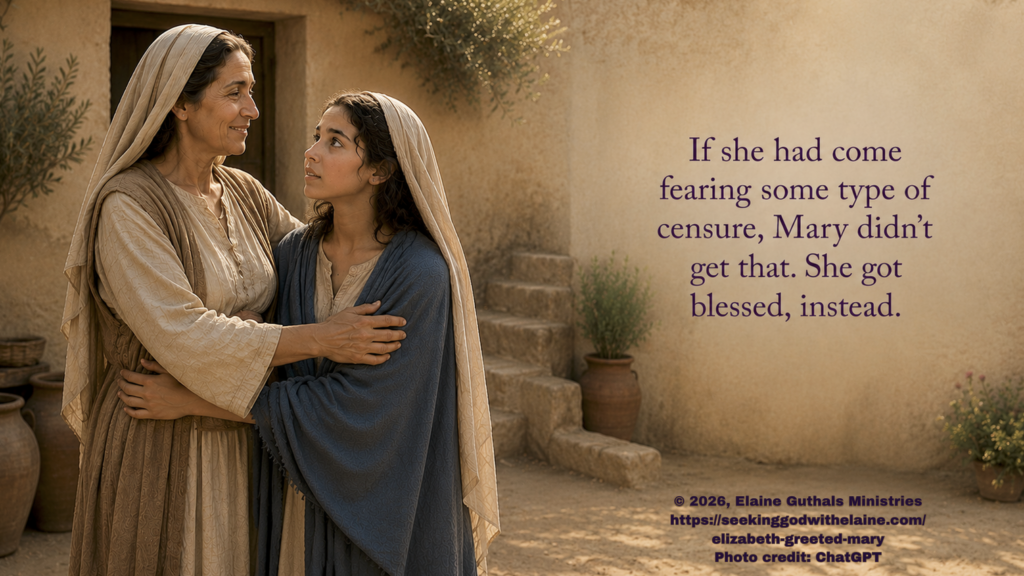
If she had come fearing some type of censure, Mary didn’t get that. She got blessed, instead.
Other women had been blessed in Scripture. “Most blessed among women is Jael, the wife of Heber the Kenite. May she be blessed above all women who live in tents” (Jdgs. 5: 24 NLT). In Jewish tradition, there is also Judith, in the Book of Judith, who was blessed among women.
No, this didn’t elevate Mary above humanity in any way. It means that she had received an unparalleled privilege in Jehovah’s redemptive plan.
The Mother of my Lord
Yeshua was called Lord before He was born.
It is one thing that Elizabeth recognized that Mary was pregnant without being told. But to know that her child was Krios – Lord – this she would have only gotten from the Holy Spirit.
Elizabeth recognized the identity of Mary’s child. Before Jesus ever performed a miracle, preached a sermon, or called a disciple, He was already acknowledged as Lord.
True, the title has an element of respect to it. Luke, however, repeatedly uses it in ways that echo the divine covenant name, especially when quoting or alluding to the Old Testament.
Because You Believed
Elizabeth affirmed Mary’s faith.
Again, Elizabeth didn’t know about the conversation between Gabriel and Mary. But she could tell Mary’s obedience.
Zechariah had been visited by Gabriel and was made speechless because of his disbelief. Mary stood before Elizabeth talking, joyful, and free. She had responded with faith and obedience.
Just think how Mary would have felt. She was a teenager who was asked to have a baby when everything in that society would have seen that as a huge sin.
This visit was another indication to Mary that everything was going to be okay.
Making the Connections #1
When we read through the whole passage, what comes flowing out of it is the joy. Both ladies approach their situations with joy.
- Mary traveled with eager obedience.
- Elizabeth was filed with the Holy Spirit.
- Even John got into the action by leaping in the womb.
- Blessings are spoken repeatedly.
- Faith is celebrated.
Nowhere was fear mentioned. Those who trust Jehovah do so with joy. That trust produces joyful recognition and worship.
Making the Connections #2
Knowing that Jehovah exists isn’t faith. It is knowledge.
It is listening to Jehovah, trusting Him, and being obedient to His call.
Making the Connections #3
This was a quiet family visit. Two women, both miraculously pregnant, taking comfort from each other.
Yes, this was a religious event.
No priests – because we hear nothing about Zechariah being present.
No Temple.
But the Holy Spirit was there.
The Holy Spirit confirmed the identity of the Messiah. The forerunner rejoiced.
Mary and Elizabeth responded because they believed God’s Word.
Making the Connections #4
Did you catch that? Yeshua hasn’t been born yet. He hasn’t preached a sermon. More importantly, He hasn’t done a miracle.
The baby was still identified as the Messiah.
Later, how many people would only believe because of the miracles? How many would see the miracles and still not believe?
Heart Check
Think about the battle Yeshua is engaged in for your heart. Ask yourself the following questions.
- Do I respond to God’s leading with eager obedience like Mary?
- Do I rejoice when I see God working in someone else’s life?
- Am I willing to trust God before I understand everything He is doing?
- Does my faith produce joy, or does fear dominate my response?
How Do We Apply This?
- Worship Jehovah with joyful expectation.
- Trust Jehovah’s timing even when you don’t understand His plan.
- Keep your eyes on Jehovah instead of your circumstances.
- Encourage someone else’s faith the way Elizabeth encouraged Mary’s.
- Respond to God’s Word with immediate obedience.
Father God. Thank You for families that lead us to You and encourage us when we are anxious about Your calling. Thank You when we can go to brothers and sisters in Christ and get encouragement. Amen.
If you don’t understand something and would like further clarification, please contact me.
If you have not signed up for the email providing the link to the devotions and the newsletter, do so below.
If God has used this devotion to speak with you, consider sharing it on social media.
-
Happy Easter 2025
He is risen! He has risen indeed!!!!
It is my hope that you will be able to spend Easter with your family and/;or your church family.
Pastor Steve and I were just talking today about how sin came into the world through Adam. Jesus provided a way for sin to be defeated.
Adam lived in the Garden of Eden. Jesus was mistakenly thought to be the Gardener.
Adam was kicked out of the Garden of Eden. Jesus’ sacrifice allows us to return to the Garden of Eden.
O Praise the Name (Anastasis)
Vocalist: Elaine Guthals
Keyboard: Louise Guthals WeissWhat do you think?
Leave me a comment below (about this or anything else) or head over to my Facebook group for some interactive discussion.
If you don’t understand something and would like further clarification, please contact me.
If you have not signed up for the email daily or weekly providing the link to the devotions and the newsletter, do so below.
If God has used this devotion to speak with you, consider sharing it on social media.
-
Hosanna (Praise Is Rising)

Well, life happened this week. We have had to take a couple of long road trips. Let me tell you. I came home and slept the day after we got back.
But that means I didn’t get much writing in, and I am not ahead as I was.
My wonderful sister recorded the piano part for Hosanna (Praise Is Rising) so I can sing it for Palm Sunday at church. I recorded my part, so I could share it with you.
Unfortunately, I don’t think we praise God enough. During this Easter season, we have to think about all Jesus went through so that our relationships with God could be restored.
Let’s be purposeful in praising God and Jesus next week.
Hosanna (Praise Is Rising)
Vocalist: Elaine Guthals
Keyboard: Louise Guthals Weiss
What do you think?
Leave me a comment below (about this or anything else) or head over to my Facebook group for some interactive discussion.
If you don’t understand something and would like further clarification, please contact me.
If you have not signed up for the email daily or weekly providing the link to the devotions and the newsletter, do so below.
If God has used this devotion to speak with you, consider sharing it on social media.
-
Give Thanks
Today is a music day.

It is the wee hours of the morning, and I just finished writing the next devotion. The first problem is that it is way too long.
The second problem is that the front is starting to come through and going through my head as usual.
The third problem is my internet is cutting in and out. I want to get this posted before it goes out all together.
So, I am going to do a music day today and do the devotion next time.
I had thought about doing this song for music day for the last devotion, but decided to go ahead and do the devotion.
We need to be grateful year round.
Give Thanks
Vocalist: Elaine Guthals
Keyboard: Louise Guthals WeissWhat do you think?
Leave me a comment below (about this or anything else) or head over to my Facebook group for some interactive discussion.
If you don’t understand something and would like further clarification, please contact me.
If you have not signed up for the email daily or weekly providing the link to the devotions and the newsletter, do so below.
If God has used this devotion to speak with you, consider sharing it on social media.
-
Being Grateful
God wants us to be grateful to Him. This devotion looks at what we are to be grateful for and what we gain when we are.
Nuggets
- We need to be grateful that God crowns us as His children.
- We will be surrounded by God.

I wrote this on the day before Thanksgiving, planning on posting it that day. However, my technology failed me. That probably worked out better because we got to finish up Joel with no interruptions.
But I didn’t want to lose this, so I’m posting it today.
Wednesday is pizza day in the Miller household. On the way back, God gave me something that I believe He wants me to share with you.
Being Grateful Even Though We Die
“He redeems me from death and crowns me with love and tender mercies” (Ps. 103: 4 NLT)
We need to be grateful that God crowns us as His children.
I had the radio on, and a preacher was talking about these verses. It got me thinking.
At first glance, worldview people would love this verse. They don’t die, and they get a crown. (Who doesn’t like being treated like royalty?)
But that is the worldview. It isn’t necessarily God’s view.
The don’t die part here isn’t talking about physical death. The only way we may not die a physical death is if we are raptured when Jesus comes to get His church.
“Behold! I tell you a mystery. We shall not all sleep, but we shall all be changed, in a moment, in the twinkling of an eye, at the last trumpet. For the trumpet will sound, and the dead will be raised imperishable, and we shall be changed. For this perishable body must put on the imperishable, and this mortal body must put on immortality” (I Cor. 15: 51-53 ESV).
Now, I don’t know what the change entails. It may be physical death, and our bodies are left. We may float away like Thanos’ snap victims in Avengers: Infinity War.
That shouldn’t be our focus. Our focus should be on what happens after we are changed.
We are going to be judged and sentenced either to Heaven or hell. Wherever we go is where we are going to live for eternity.
Jesus redeems us from eternal death. He does that by paying the penalty for our sins. We gain eternal life by admitting our sins, believing on Jesus as Redeemer, confessing God as Sovereign, Lord and demonstrating that commitment by following our job description.
We should be very grateful for eternal life, not eternal death. Eternal death is going to be torment. “And if anyone’s name was not found written in the book of life, he was thrown into the lake of fire” (Rev. 20: 15 ESV).
Instead, we get Heaven.
Being Grateful for being Crowned
We will be surrounded by God.
What really caught my attention was when the radio pastor talked about being crowned. He said it didn’t mean we were going to get a jeweled headpiece.
The radio pastor said that God’s children would be surrounded with “… lovingkindness and tender mercies” (Ps. 103: 4 KJV).
Think about it. The crown isn’t a worldly crown. It doesn’t elevate us to where we would even begin to think we are equals with God.
It is all about what God does for us. He shows us kindness and mercy.
It isn’t just a surface kindness or a random act of kindness. It is a loving kindness.
We know God loves us. He sent His Son to die for us so that our relationships with Him can be restored.
That is a major demonstration of love!
God shows us mercy. God’s mercy is an act of sovereign will that produces an unexpected and undeserved response from God as He responds in love to our needs.
We deserve eternal death because we disobey God. We don’t deserve eternal life.
God designed the Plan of Salvation anyway.

Making the Connections
We have so much for which to be grateful to God. No, it isn’t going to follow the worldview where we elevate ourselves. We are not even in the same ballpark as God.
We are to be eternally grateful for what God has done for us. He loves us and saves us.
How Do We Apply This?
The ABCDs of Salvation
If you have not become a believer in Christ, please read through the
Plan of Salvation and prayerfully consider what God is asking you to do.A – admit our sins
B – believe His Son Jesus is our Redeemer
C – confess God as Sovereign LordD – demonstrate that commitment by making any changes needed in our lives to live the way in which God has called us
The Disciple’s Job Description
Father God. We are grateful that You created us. We thank You that You designed the Plan of Salvation to restore our relationships with You. Lord, we look forward to the day that we will spend eternity with You. Amen.
What do you think?
Leave me a comment below (about this or anything else) or head over to my Facebook group for some interactive discussion.
If you don’t understand something and would like further clarification, please contact me.
If you have not signed up for the email daily or weekly providing the link to the devotions and the newsletter, do so below.
If God has used this devotion to speak with you, consider sharing it on social media.
-
How Do We Bless God? (1.1)
There are many verses in Scriptures that say God will bless us. But Paul says that we are to bless God. What? This daily devotional looks at how we can and should bless God.
Nuggets
- Blessings begin with God, the Father.
- Spiritual blessings are delivered by the Holy Spirit.
- The reason we can receive the blessings is because Jesus died for our sins.
Devotions in the The Letter of Paul to the Ephesians series

Sometimes, Satan tempts us to take our focus off of God. It seems like we get stuck on the what’s-in-it-for-me cycle. That is quickly followed by what-has-God-done-for-me-lately whine.
Paul kind of flipped that on its ear, though. (He was good at doing that, wasn’t he?) Paul said that we were to bless God.
Wait! How is that even possible? I mean, we are talking about Sovereign God here — Creator of the universe. Author of salvation.
Yes, God would be like a parent. What could you get Him for birthdays and Christmas? He has everything — and made it.
So, how are we going to bless God?
This is just a foreign concept for me. Stroll along beside me as I try to figure this one out.
Let’s Put It into Context #1
Here is a running list of nuggets for the series.
Let’s Put It into Context #2
First things first. What does bless even mean?
Bless is one of those words that have several meanings. We generally think of it as an act of God that shows His favor toward us.
If you look at the definition, it does say that it is an act or words that imparts a special favor or mercy. It doesn’t limit it to just God.
We know that mercy is where God doesn’t judge us to the extent He could. Even though we deserve bad things, God doesn’t give them to us.
But we also say we bless the meal when we eat. That is a type of praise or worship.
So, let’s dive into the verse now.
God the Father
“Blessed be the God and Father of our Lord Jesus Christ …” (Eph. 1: 3 KJV).
Blessings begin with God, the Father.
We know there are many verses saying God blesses. Numbers 6: 24-26 says, “The LORD bless you and keep you; the LORD make his face shine on you and be gracious to you; the LORD turn his face toward you and give you peace” (NIV). The whole Beatitudes is about those who are blessed.
Then we get to John 1: 16. “Out of his fullness we have all received grace in place of grace already given” (Jn. 1: 16 NIV). The Plan of Salvation that God devised is our greatest blessing.
But what about “Bless the Lord, O my soul: and all that is within me, bless his holy name” (Ps. 103: 1 KJV)?

You see, it isn’t a one-sided blessing. No, we will never be able to out-bless God.
But we are supposed to praise God with every fiber of our being. Praise is our response to God, but it usually involves music.
We are supposed to continuously praise Him. We are supposed to humble ourselves so that our praise is real.
I see you jumping up and down over there, saying you are too smart to give your allegiance to an unseen God. If you think about it, we need our intelligence, our will, and our intent to praise God.
No, we will never understand everything. But we have to process it enough to say, “You know, it may not make sense to some, but it makes sense to me. God is supreme.”
Paul addressed that in his letter to the Corinthians. “The natural person does not accept the things of the Spirit of God, for they are folly to him, and he is not able to understand them because they are spiritually discerned” (I Cor. 2: 14 ESV).
We have to give up our will (in other words, control of our lives) in order to do what God is calling us to do. When we do this, we have to go whole hog. We can’t keep some area back for our control.
We can’t say, “Well, I am going to pretend to follow Him until He convinces me He is real.” We can tell from the Stories About the End Times series that, if you do that, it isn’t going to end well for you.
To read a related devotion, click the button below.
We have to really, really want to do what God wants us to do. Remember, God can see the desires of our hearts. The desire to obey Him really has to be there.
We bless God when things don’t go the way we want, but we are okay with that. When we give up our expectations and desires and truly follow His will, we bless Him.
How can we bless God even more? We can by witnessing. If we love Him so much that we want others to share in what we have, that blesses God.
Let’s look at it this way. How did God describe Himself in the Old Testament? He was “… the God of Abraham, the God of Isaac, and the God of Jacob …” (Ex. 3: 15 ESV).
Now, how did Jesus describe Him? “… I am ascending to my Father and your Father, to my God and your God” (Jn. 20: 17 ESV).
What does that say about the expectation of a relationship? To me, it went from God way off in heaven to God taking residence in our hearts and lives.
What Kind of Blessings?
“… who has blessed us in Christ with every spiritual blessing in the heavenly places” (Eph. 1: 3 ESV).
Spiritual blessings are delivered by the Holy Spirit.
What kind of blessings can we expect? Yes, we can expect earthly blessings. God will provide what we need (Phil. 4: 19).
God is more interested in spiritual, heavenly blessing. What are spiritual blessings? They are blessings that address heavenly things.
They are about our salvation. They are about our relationship with God.
We get spiritual blessings through the Holy Spirit. God blesses us as we change to become more like Him.
Go back to Abraham a second. When God established His covenant with Abraham, Abraham didn’t own any land in Canaan. In fact, when Abraham died, he only owned the land on which he was buried.
But the blessing wasn’t all about Abraham. The covenant was about Israel. Ultimately, it was about God. That is His singular focus.
God is going to bless His children in order to expand His kingdom. He will bless those faithful to Him: “A faithful man will abound with blessings” (Prov. 28: 20 ESV).
Full Circle
“… in Christ …” (Eph. 1: 3 ESV).
The reason we can receive the blessings is because Jesus died for our sins.
It comes back to Christ. Jesus came to earth, lived, died an agonizing death, and rose again so that our relationship with God can be restored.
To restore that relationship, we have to admit our sins, believe on Jesus as Redeemer, and confess God as Sovereign Lord.
The ABCDs of Salvation
If you have not become a believer in Christ, please read through the
Plan of Salvation and prayerfully consider what God is asking you to do.A – admit our sins
B – believe His Son Jesus is our Redeemer
C – confess God as Sovereign LordD – demonstrate that commitment by making any changes needed in our lives to
live the way in which God has called usThe Disciple’s Job Description
Once this relationship has been restored, God can bless us — all because of and through Jesus. We can only approach Him through the name of Jesus in prayer and praise.

Making the Connections
We have to remember the Paul of old days — back when He was Saul and held the cloaks when Stephen was stoned (Ac. 7: 54-60).
This, however, is 25 to 30 years after Paul met Jesus on the Damascus Road. That encounter changed Paul’s entire life. He had done a drastic 180 degree turn.
Paul had learned to be content (Phil. 4: 11), even though he encountered trials and hardships daily.
How Do We Apply This?
Jesus wants to change our lives so that God can bless us, also. He wants us to ABCD.
We need to bless God by praising Him. We don’t do this just when things are going good. We do this all the time. We need to break into praise as Paul did — frequently.
So, we can bless God. We do every time that we praise Him. We have to become more intentional in our own worship of God and in leading others to accept Him.
Loving Father. We do praise You. We thank You that You loved us enough to send Jesus as our Savior. Forgive us when we get so caught up in this world that we don’t praise You and thank You as we should. We claim all the blessings that You have in store for us today. Amen.
What do you think?
Leave me a comment below (about this or anything else) or head over to my Facebook group for some interactive discussion.
If you don’t understand something and would like further clarification, please contact me.
If you have not signed up for the email daily or weekly providing the link to the devotions and the newsletter, do so below.
If God has used this devotion to speak with you, consider sharing it on social media.