Once again, Joseph found himself wrongly accused. This devotional reading looks at how Joseph stood in faith and integrity while he faced a temptation from an authority figure.
Nuggets
- It is not Scripturally accurate to say no one else was around.
- We don’t know exactly what chore Joseph was attempting to perform or exactly where he went in to do it.
- It would be logical to think that Joseph went into what was part of Mrs. Potiphar’s private rooms.
- In her skewed recitation of what happened, Mrs. Potiphar accused Joseph of trying to make fools of them.

Joseph must have thought he hit rock bottom when he was sold in slavery to Egypt. He would have been wrong.
During the early years of his captivity (and we don’t know how long), Joseph was well provided for in Potiphar’s house. He was put into a position of authority.
But that safe lifestyle was about to change.
Let's Put It into Context
To read devotions in the Creating Everything theme, click the button below.
Devotions in the Joseph the Savior of Israel series
Joseph and Mrs. Potiphar
“One day, however, no one else was around when he went in to do his work" (Gen. 39: 12 NLT)
No One Else Was Around
It is not Scripturally accurate to say no one else was around.
As a top official, Potiphar would, regardless of his wealth, have essentially had an estate. There would have been layers of servants that would have been around.
If we go back to the Hebrew it says something different than what the New Living Translation says. Where this says no one else is around, the Hebrew says no man of the men of the house were around.
- ’îš (אִישׁ) means a man
- mēʾanšê (מֵאַנְשֵׁי) means from the men of
Resource
Who would the males have been?
There would have been other overseers around. (Remember, Joseph was Overseer of the House.) There would have been accounts and scribes along with stewards.
As Captain of Pharaoh’s Guard, Potiphar would have had a security detail. There would have been personal guards as well as estate security. There may even have been sentries that rotated shifts.
That would include those men that may have been moving in and out of the house. If the estate was associated with land, there may have been field workers, transport workers, and storage and supply handlers.
No, the lowest workers probably wouldn’t have had access to the house. Their overseers probably would have been summoned from time to time to give reports.
Oh, yes. There would have been female servants around.
There would have been Mrs. Potiphar’s personal attendants, domestic workers, and textile workers. There could have been assistants, runners, and even lower-level help.
Why did Moses not mention them? Surely, Mrs. Potiphar did not want to be seen by anyone.
What it is really saying here is there were no male witnesses around. Mrs. Potiphar picked a time that offered a moment of isolation. She didn’t want witnesses to hold her immediately accountable.
If there were female servants around, Mrs. Potiphar either felt like they wouldn’t intervene or they would answer to her.
As mistress of the house, wife of a high-ranking official, and a member of Egypt’s elite class, she would outrank every servant. But her authority would be real, not ultimate.
Mrs. Potiphar would have the ability to give the male servants orders; and in practice, most would have obeyed her. But she would have taken a risk — especially in this instance.
The order Mrs. Potiphar would have given to cover this up wouldn’t have been with regard to day-to-day household operations.
Plus, Mrs. Potiphar would have given it to men who ultimately belonged in Potiphar’s chain of command, not hers. They were not just domestic extensions of her will.
More than likely, Mrs. Potiphar was thinking exposure and witnesses. She was controlling the situation — because this was intentionally staged.
Went in to Do His Work
We don’t know exactly what chore Joseph was attempting to perform or exactly where he went in to do it.
We were told in Genesis 39: 4 that Joseph had been made overseer of the house. This is a title that is recorded in Egyptian records that has survived.
We’ll get into that in a little bit. Right now, we are going to say that – once again – Joseph was just going about his duties as assigned, and someone else made a bad decision. He didn’t let someone else’s actions dictate his response.
Joseph responded the way God wanted him to respond.
She Demanded
"She came and grabbed him by his cloak, demanding, ‘Come on, sleep with me!’ Joseph tore himself away, but he left his cloak in her hand as he ran from the house. When she saw that she was holding his cloak and he had fled, she called out to her servants. Soon all the men came running. ‘Look!’ she said. ‘My husband has brought this Hebrew slave here to make fools of us! He came into my room to rape me, but I screamed. When he heard me scream, he ran outside and got away, but he left his cloak behind with me.’ (Gen. 39: 12-15 NLT)
It would be logical to think that Joseph went into what was part of Mrs. Potiphar’s private rooms.
We know that this wasn’t the first incident in which Mrs. Potiphar tried to start something with Joseph. The last time, he had appealed to Mrs. Potiphar to recognize her marriage vows as binding.
She didn’t.
Mrs. Potiphar commanded that Joseph lie with her. That wasn’t seduction — that was assertion.
“I am the mistress of the house. You are a slave. You will do what I say.”
That may or may not have been true as Joseph was most assuredly under Potiphar’s chain of command. But Joseph didn’t consider that to be under his authority.
When his reasoning for not doing what she demanded had started with the things that affected her, Joseph ended with remaining true to Jehovah. He didn’t need her to accept that reason.
But Joseph knew that he needed to remain true. He tore himself away.
Well, that is a little more dramatic than what the Hebrew actually says. The Hebrew word used was vayyānas (וַיָּנָס). It comes from the root word nûs (נוּס), which means to flee, escape, or run away.
Tore himself away may have been more of a functional definition.
But it takes the passage in a different direction than intended. The text does not emphasize the struggle. It emphasizes the decision — Joseph fled.
Why did Joseph run? He knew no one would stop him – and no one would believe him or defend him.
Remember, there were no credible witnesses around. All the men were out of the house.
But the reason was more important. Joseph didn’t just leave her — he left the house, because sometimes obedience requires complete separation, not partial distance.
Joseph refused to cross the same boundary Judah didn’t. Judah gave into the temptation to sleep with a prostitute. Joseph refused to fall into the temptation of the advances given his way.
The problem was, in fleeing, Joseph left his garment behind. Mrs. Potiphar had proof that he had been there and something had come off that shouldn’t have.
In her skewed recitation to the servants of what happened, Mrs. Potiphar accused Joseph of trying to make fools of them. She probably assumed that strengthened her case against Joseph. In reality it was another form of betrayal.
To Fool Around with Me
She kept the cloak with her until her husband came home. Then she told him her story. ‘That Hebrew slave you’ve brought into our house tried to come in and fool around with me,’ she said. ‘But when I screamed, he ran outside, leaving his cloak with me!’" (Gen. 39: 16-18 NLT)
In her skewed recitation to her husband of what happened, Mrs. Potiphar changed her story from what she told the servants.
But go back to Judah and Tamar. A garment had been used by Judah to deceive Jacob to believe Joseph was dead. A veil was used by Tamar to deceive Judah into thinking she was a prostitute.
Now, a garment was used by Mrs. Potiphar to deceive Potiphar that Joseph had wrong intentions. She used it as physical evidence to become the victim.
Mrs. Potiphar knew the accusation of Joseph making fools of them wouldn’t hold with Potiphar. So, she just gave him the facts.
Making the Connections #1
Why did we go into Joseph’s duties as steward and overseer? Yes, it was to explain Potiphar’s reaction.
Yes, it was to show how Joseph was gaining needed knowledge and skills to be used in overseeing seven years of plenty and seven years of famine.
More importantly – whether he was under authority of others and had authority over others – Joseph not only remained under authority to himself, but he also remained under Jehovah’s authority.
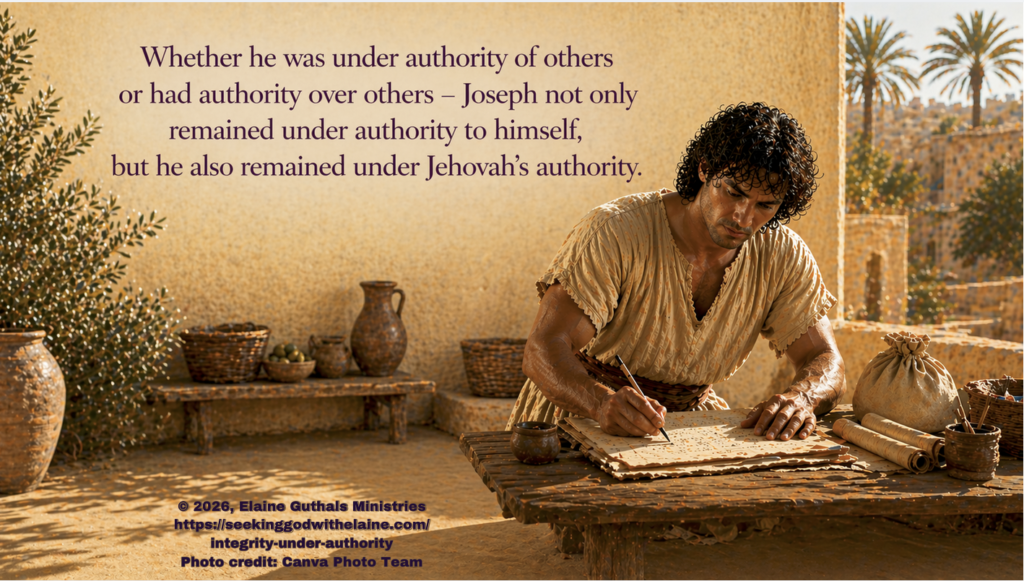
What does all that mean? Joseph was faithful in tasks, with things, and with people. In short, he was faithful in everything that he was given. He faithfully managed what wasn’t his.
Joseph’s obedience was not tied to his position, but to his perspective. He did not see himself as a victim of his circumstances, but as a steward within them – regardless of his position.
Making the Connections #2
Joseph lost his garment again — but this time, he lost it doing what is right. Let’s compare the two.
Remember Jacob gave Joseph a tunic, not a coat of many colors. The Hebrew word is kĕtōnet (כְּתֹנֶת), a long garment associated with status, favor, and identity.
What Joseph had on in Potiphar’s house was a beged (בֶּגֶד), a generic word for clothing, which could have been a tunic, outer garment, or cloak.
Symbolic garment v. working garment.
They aren’t the same – but the function is almost identical. Joseph loses each time.
When his brothers stripped him of the kĕtōnet, Joseph lost identity and status. When he lost the beged, he lost position. The first time, his only crime might have been arrogance. This time, he was falsely accused.
Both times, the garment is removed, used as false evidence, and Joseph suffered.

Joseph lost the first garment in betrayal. He lost the second one in obedience.
How Do We Apply This?
- Remain faithful and obedient in all situations.
- See His guiding hand in all our trials.
Father God. We know trials are part of our Sanctification Road. Help us to keep our mind set firmly on You through all that we experience in life. Amen.
If you don’t understand something and would like further clarification, please contact me.
If you have not signed up for the email providing the link to the devotions and the newsletter, do so below.
If God has used this devotion to speak with you, consider sharing it on social media.