Category: Obedience

  • Response to Obedience

    Our band of travelers have reached their destination in Canaan. This devotional reading looks at God extending the blessings of the covenant and Abram’s response to that.

    Nuggets

    • Genesis 12: 7 was the first time the promise of land was involved.
    • Throughout Abram’s lifetime, he built altars to memorialize the mercies of God.
    • Abram didn’t stay put at Shechem.
    response-to-obedience

    Abram, Sarai, and Lot have come the long way from Haran. They land at Shechem.

    How is God going to reward Abram’s obedience? How is Abram going to respond?

    Let’s check it out.

    Let’s Put It into Context

    To read devotions in the Creating Everything theme, click the button below.

    Devotions in the Abraham the Emigrant series

    God Extended the Blessings of the Covenant

    “Then the Lord appeared to Abram and said, ‘I will give this land to your descendants.’ And Abram built an altar there and dedicated it to the Lord, who had appeared to him” (Gen. 12: 7 NLT)

    Genesis 12: 7 was the first time the promise of land was involved.

    Remember that God entered into a covenant with Abram. I would say that we need to add this to the blessing section of the covenant.

    • Covenant established (Gen. 12: 1-3)
    • Blessings of the covenant (Gen. 12: 7; Gen.13: 14-17)
    • Sign of the covenant (Gen. 15: 1-21)
    • Acceptance of the responsibilities of the covenant 17: 1-27)
    • Promise of the covenant (Gen. 18: 9-15).

    When Abram left Haran, he wasn’t promised land of his own. In fact, when I got the list above, nothing was said about these verses.

    But I think they are important. Land is a part of the promise to Abram.

    We’ll wait to have a discussion about the land when we get further in.

    Abram Built an Altar

    Throughout Abram’s lifetime, he built altars to memorialize the mercies of God.

    We have had minimal glimpses of altars previously in Genesis. We saw the sacrifices of Cain and Abel – which had to have been done on an altar even though it doesn’t say (Gen. 4: 3-4). We also know Noah built an altar as he existed the ark and sacrificed a slew of animals (Gen. 8: 20).

    We aren’t told Abram built an altar in Haran. Personally, I don’t think he did.

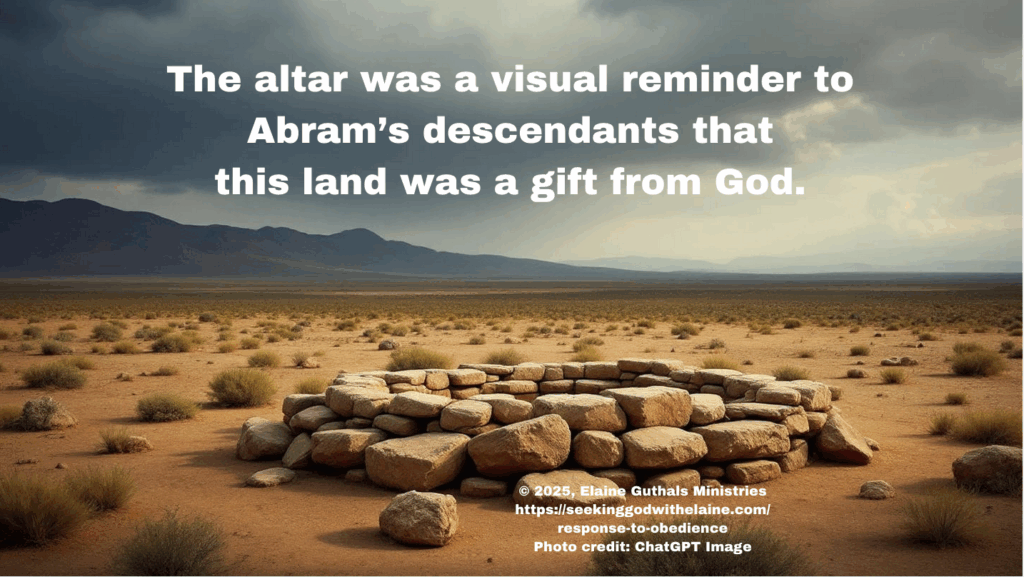
    Abram built an altar to exclusively honor God. He wanted to show his thankfulness for the promise of provision. The altar was a visual reminder to his descendants that this land was a gift from God.
    Kalisch put the location of the altar into perspective. He wrote,

    “The place of the ancient tree, which so long witnessed superstitious and cruel rites, was hallowed by a Divine vision, and converted into a sacred spot; and at the side of the idolatrous temple rose an altar dedicated to the God of heaven and earth.”

    Resource

    Just to keep it straight in my mind, we know of four altars Abram/Abraham built.

    • Shechem: Abram built his first altar upon entering the land of Canaan (Gen. 12: 7).
    • Bethel: He constructed an altar between Bethel and Ai as a place of worship (Gen. 13: 3).
    • Hebron: Abram built an altar in the region of Mamre, near Hebron (Gen. 13: 18).
    • Mount Moriah: Abraham prepared an altar for the sacrifice of Isaac, demonstrating his faith (Gen 22: 9).

    Yes, Abram kept building altars because they were in different places. He wanted something where he was.

    More importantly, Abram kept building altars because He kept worshiping God whatever the circumstance.

    But Abram was taking a chance, wasn’t he? The Canaanites were not followers of God. They had their own gods they followed.

    They could have disagreed strenuously – and probably painfully for Abram. Abram built them anyway.

    Isn’t that what we are supposed to do? We are supposed to be in the world but not of the world.

    Yeah, Abram had Sarai and Lot – who had issues of their own. I bet he felt alone a lot of the time.

    So, why did Abram build this altar? Since he just finished his journey, I bet his mind was going all the way back to Ur. How different his life would have been then

    God is a more hands-on God than those false idols. Abram wouldn’t have seen that as an intrusion. He had just traveled however many miles under God’s leadership He knew without a doubt that he c0ould rely on Him.

    Abram now knew what dependence on God really was. It wasn’t slavery. It wasn’t subjugation. It was a relationship with the all-knowing, all-powerful Sovereign God. It was being the recipient of His mercy.

    Hasting said something that got me thinking. How did God view this altar? He didn’t see it as just a pile of stones.

    God saw, as Hastings said, “…  ABRAHAM’S READINESS TO CONSECRATE HIMSELF ENTIRELY TO GOD.” He saw Abram’s heart. It was built because of character, mindset, and purpose.

    Resource

    Abram worshiped God where he was, in whatever circumstance he was in. He left a visible sign of the highs and lows of his journey.

    Ness used God’s Word to tell us how we are priests, have altars, and Who sanctifies the sacrifice.

    • “And you are living stones that God is building into his spiritual temple. What’s more, you are his holy priests. Through the mediation of Jesus Christ, you offer spiritual sacrifices that please God” (I Pet. 2: 5 NLT).
    • “He has made us a Kingdom of priests for God his Father. All glory and power to him forever and ever! Amen” (Rev. 1: 6 NLT).
    • “We have an altar from which the priests in the Tabernacle have no right to eat” (Heb. 13: 10 NLT).
    • “And I will give you a new heart, and I will put a new spirit in you. I will take out your stony, stubborn heart and give you a tender, responsive heart” (Ezek. 36: 26 NLT).
    • “How blind! For which is more important—the gift on the altar or the altar that makes the gift sacred?” (Mt. 23: 19 NLT).

    So, our heart is the altar. It has to be visible to worldview people.
    Isn’t that what Jesus said? We need to be lights on a hill.

    • “You are the light of the world — like a city on a hilltop that cannot be hidden. No one lights a lamp and then puts it under a basket. Instead, a lamp is placed on a stand, where it gives light to everyone in the house. In the same way, let your good deeds shine out for all to see, so that everyone will praise your heavenly Father” (Mt. 5: 14-16 NLT).
    • “… Live clean, innocent lives as children of God, shining like bright lights in a world full of crooked and perverse people” (Phil. 2: 15 NLT).
    • “Be careful to live properly among your unbelieving neighbors. Then even if they accuse you of doing wrong, they will see your honorable behavior, and they will give honor to God when he judges the world” (I Pet. 2: 12 NLT).

    After That

    “After that, Abram traveled south and set up camp in the hill country, with Bethel to the west and Ai to the east. There he built another altar and dedicated it to the Lord, and he worshiped the Lord.  Then Abram continued traveling south by stages toward the Negev” (Gen. 12: 5-9 ESV)

    Abram didn’t stay put at Shechem.

    Sometimes, God moves us from the farm to city. Sometimes, He moves us from Illinois to Missouri. Sometimes, God moves us from the USA to another country. (No, I am not planning on moving again.)

    When God says, “Go,” we need to go.

    There are all kinds of different reasons. The generic answer is God moves us through the stages of our lives.

    As painful as it might be, we don’t want to skip a stage. We don’t want to miss those lessons.

    I like what Hughes said. He wrote, “Faith [causes] souls to adhere unto and make profession of the true religion of God in all places; faith is never ashamed of God, truth, worship, or way.”

    Resource

    If we haven’t made a true profession to God, the stimulant isn’t faith – it is something else. Only genuine faith results in salvation.
    Our goal must be set on obeying God. That means we have to distance ourselves from engaging in current, worldly events.

    Making the Connections #1

     Robertson put Genesis 12: 7 into perspective. It didn’t have to do with Abraham.

    It had to do with Moses. Robertson believed Moses was writing this record right before the Israelites made the exodus from Egypt.

    Resource

    Wouldn’t that have given the Israelites a boost before the start of their journey?

    Hey, Abraham (the name by which they knew the man) had a journey of his own. He took it with faith and obedience — just like you should. His destination was Canaan — which is your destination, too — it’s called the Promised Land.

    Why is it the Promised Land? God promised it to Abram as a permanent possession.

    • Then the Lord appeared to Abram and said, ‘I will give this land to your descendants.’ And Abram built an altar there and dedicated it to the Lord, who had appeared to him” (Gen. 12: 7 NLT).
    • “After Lot had gone, the LORD said to Abram, ‘Look as far as you can see in every direction — north and south, east and west. I am giving all this land, as far as you can see, to you and your descendants as a permanent possession’” (Gen. 13: 14-15 NLT emphasis added).
    • “Then the LORD said to Abram, “You can be sure that your descendants will be strangers in a foreign land, where they will be oppressed as slaves for 400 years. But I will punish the nation that enslaves them, and in the end they will come away with great wealth. (As for you, you will die in peace and be buried at a ripe old age.) After four generations your descendants will return here to this land, for the sins of the Amorites do not yet warrant their destruction’” (Gen. 15: 13-16 NLT emphasis added).

    What were they doing? They were fixing to return.

    Sure, they didn’t know they were going to become the Wilderness Wanderers.

    • They probably heard the “… they will come away with great wealth” (Gen. 15: 14 NLT) part and thought they would be millionaires.
    • They probably heard the it’s-a-permanent-possession part and think there were going to waltz right in and take possession.

    Their misinterpretation of what God was going to do didn’t keep God from doing what He was going to do.
    But this was a great pep talk for them as they were preparing the first Passover meal. The uncertainty and drama of the exodus may have been minimized by the expectation of the fulfillment of the promise.

    Making the Connections #2

    How did Abram’s journey follow our journey to salvation? Temple told us.

    • We have to stop fighting the promptings of the spirit and go forth into a relationship with God.
    • That means we abandon the road leading to the wide gate and enter the narrow gate towards grace.
    • We let You direct every aspect of our lives. We make Your principles our own.
    • We look to You in the good times and, especially, in the bad times — whatever the time frame.
    • We successfully complete the journey we start.

    Resource

    Remember, Ur to Haran was an unsuccessful journey because the destination was Canaan. Haran to Canaan was the successful journey.

    Trumbull gave an explanation as to why Ur to Canaan was not have been successful. He wrote,

    “Terah’s journeying was only in search of pasture and an abode. So he dropped his wider scheme when the narrower served his purpose. It was an easy matter to go from Ur to Haran. Both were on the same bank of the Euphrates. But to cross the broad, deep, rapid river was a different thing, and meant an irrevocable cutting loose from the past life. Only the man of faith did that.”

    Resource

    Whether or not those excuses are the ones Terah used, ooo baby, do some use them today!

    • Isn’t it the going gets rough, and the weak-in-faith people stop going?
    • Why should we go on if we’ve gotten what we want, even if we did say our end goal was exactly the same as God’s?
    • Give up everything and everyone from our past life? That is unthinkable for You to even ask us.

    We would call these the lukewarm Christians. They aren’t cold because they think they have given their life to Jesus as their Savior and Redeemer. But they aren’t hot because they quit, their motivation is wrong, and they hold on to sin.

    Look at it this way. The starting immediately matters, but the enduring to the end is just as, even maybe more, important. “But the one who endures to the end will be saved” (Mt. 24: 13 NLT).

    Making the Connections #3

    Have you ever thought about why God chose Palestine to be the Promised Land? It was described as a land of milk and honey, right, so, it would be a wonderful piece of land.

    Ummm. Not according to Dykes. He wrote,

    “Another characteristic which qualified Palestine to be a training ground for the Hebrews was this: that it combined to an unusual degree high agricultural fertility with exposure to sudden and severe disasters.”

    Resource

    It had the both – fertility and disasters. The Promised Land had the good for providing for God’s people and the bad for growing God’s people.
    In other words, the Hebrews and later the Israelites that lived in this land could make a living off of it, but they would also be tested to ensure their reliance was on God.

    Isn’t that what sanctification is all about?

    How Do We Apply This?

    • Worship God by speaking in His name.

    Resource

    Father God. We pray that You find us as obedient as Abram. We give You our hearts as an altar. We are the living sacrifice. We praise and honor You. Amen.

    What do you think?

    Leave me a comment below (about this or anything else) or head over to my Facebook group for some interactive discussion.

    If you don’t understand something and would like further clarification, please contact me.

    If you have not signed up for the email providing the link to the devotions and the newsletter, do so below.

    If God has used this devotion to speak with you, consider sharing it on social media.
  • Obedience to the Call

    Abram received the call from God to go to a land which He would show him. This devotional reading looks at what he did with that call.

    Nuggets

    • Abram immediately set out as God instructed him for a new home.
    • Abram arrived at Haran without stopping.
    • Though the Canaanites were family, they were the enemies of God.
    obedience-to-the-call

    Abram and his family traveled from Ur to Haren, where they stopped for five years. Then Abram got the call from God.

    So, what did Abram do with it?

    Let’s Put It into Context

    To read devotions in the Creating Everything theme, click the button below.

    Devotions in the Abraham the Emigrant series

    Departure

     “So Abram departed as the Lord had instructed, and Lot went with him. Abram was seventy-five years old when he left Haran. He took his wife, Sarai, his nephew Lot, and all his wealth — his livestock and all the people he had taken into his household at Haran — and headed for the land of Canaan …” (Gen. 12: 4-5 NLT)

    Abram immediately set out as God instructed him for a new home.

    We hear about Abram’s faith time after time. Faith is nothing without obedience.

    Wait! What????

    Meyer called Abram’s obedience only partial. I have to process this.

    Resource

    • “It was by faith that Abraham obeyed when God called him to leave home and go to another land that God would give him as his inheritance. He went without knowing where he was going” (Heb. 11: 8 NLT emphasis added).
    • “One day Terah took his son Abram, his daughter-in-law Sarai (his son Abram’s wife), and his grandson Lot (his son Haran’s child) and moved away from Ur of the Chaldeans. He was headed for the land of Canaan, but they stopped at Haran and settled there” (Gen. 11: 31 NLT emphasis added).
    • “So Abram departed as the LORD had instructed, and Lot went with him. Abram was seventy-five years old when he left Haran” (Gen. 12: 4 NLT emphasis added).

    We talked before about whether Terah was called or Abram was called to leave Ur. Another question was if Genesis 11: 31 was Moses’ after-the-fact insertion of knowledge rather than Terah or Abram’s knowledge at the time.

    God wants total obedience. But, whoever got the call in Ur, Terah and Noah stopped at Haran for five years.

    Were they obedient in stopping?

    Maybe. Maybe not.

    If we put all of this together, this is about the only way I see it working.

    • Terah was not called.
    • Terah may have been prompted to go to Canaan, but he probably didn’t know it. Moses probably put that in after—the-fact.
    • Terah stopping may have been the plan.
    • Abram was called when he was in Haren.
    • Abram immediately left when he was called and didn’t stop until he got to Canaan.

    Let’s go at this another way. God tests us to grow us. He knows Satan is going to tempt us to get us to fail the test. He knows we have to make choices — and that may be a struggle.

    Yes, the ultimate is we make the right choice immediately. But He knows that we grow more by our mistakes.

    So, is God more concerned about our journey where we learn to rely on and choose Him? Or does God want total immediate submission?

    Can it be both?

    Well, God is not a dictator. Does He want submission to His laws? Of course. But He gives us the free will to make obedience a choice.

    I am sure God would prefer us to make the choice sooner rather than later. He will forgive us when we make the wrong choice then repent and ask for forgiveness.

    What do I think? I think we each have our own Sanctification Road. Our roads are made up of the bricks made by our trials and testing.

    The time to my submission in obedience may be different to yours. I may take more off ramps than you do, but God needs those to get me to where He wants me to be.

    We can’t compromise with the worldview. We can’t place someone or something— like our father — over God.

    I said faith is nothing without obedience. Obedience is a product of faith.

    Does this mean we have to separate from our family? We’ve said that God is in the business of separating and dividing. So, maybe.

    But doesn’t that go against the first blessing we read in God’s Word? “Then God blessed them and said, ‘Be fruitful and multiply …’” (Gen. 1: 28 NLT).

    Maclaren argued that because Abram went “… from [his] country and [his] kindred and [his] father’s house …” (Gen. 12: 1 NLT), God was able to use him. Remember, Abram’s wife Sarai and nephew Lot went with him.

    Resource

    We know of Abram’s obedience because of the outward things he did. He left. He built an altar. He made the public profession of faith.

    But did Abram really follow God’s Word? “This explains why a man leaves his father and mother and is joined to his wife, and the two are united into one” (Gen. 2: 24 NLT).

    Did Abram lose five years of obedience because of Terah? Leale believed that showed Abram’s consideration of others.

    Resource

    Nice sentiment — until we put others before our call. That means we aren’t obeying God.

    Let’s take that a step farther. “I say this as a concession, not as a command. But I wish everyone were single, just as I am. Yet each person has a special gift from God, of one kind or another. So I say to those who aren’t married and to widows — it’s better to stay unmarried, just as I am” (I Cor. 7: 6-8 NLT).

    I get what Paul was trying to get at. We shouldn’t divide our focus. God must always be first with us.

    But I know God called me to be a pastor’s wife. I know Pastor Steve and I are a team because God called us to be together.

    Pearse made two excellent points. The first was that Abram’s call by God wasn’t harsh. It was a merciful call.

    Resource

    The second point made by Pearse was that some of the troubles Abram had did stem from Sarai and Lot. We’ll dive into those in later devotions.

    Arrival

    “… When they arrived in Canaan, Abram traveled through the land as far as Shechem. There he set up camp beside the oak of Moreh. At that time, the area was inhabited by Canaanites” (Gen. 12: 5-6 NLT)

    Arrived

    I think I read somewhere the distance our small party had to travel. It was a couple of hundred miles — first from Ur to Haran, then another couple of hundred miles from Haran to Canaan.

    There wouldn’t have been a Motel 6 on the way. No one, opposite to the tag line in the commercial, left the light on for them.

    They slept in tents. That means Abram went from being a ruler in Ur with the living arrangements for someone in that status to a nomad in a tent.

    Look what Pearse said about that. He wrote, “It was the outward and visible sign of the inward and invisible grace.”

    Resource

    It was the outward sign of Abram’s relationship with God. God commanded. Abram obeyed.

    We aren’t told if they had any difficulties on the way. All we know is they arrived.

    We would think that they were having a mountain-top experience, wouldn’t we? Abram was being obedient. Nothing should go wrong, right?

    Well, weather, robbers, camel step on something wrong and hurt a leg. And the big thing — “… At that time, the area was inhabited by Canaanites” (Gen. 12: 6 NLT). They probably wouldn’t look kindly on what they would see as a squatter.

    What can we learn about the journey? It took time. We don’t know how long the trip was; but going by camel with family, furniture, possessions, and people, it probably took more than a month. That was a long time for God to teach Abram about Who He is.

    This is a great example of sanctification. Pastor Steve found a great definition of sanctification in Finney’s book. Finney wrote, “Sanctification, as a process, means obeying him more and more perfectly.”

    Resource

    Sanctification is the process of learning to be obedient.

    Inhabited by Canaanites

    Though the Canaanites were family, they were the enemies of God.

    As much as the Canaanites warred with the Israelites, it is hard to remember that they were distant cousins. Abram was a descendant of Shem’s. The Canaanites were descendants of Ham.

    Yeah, both of them were sons of Noah. Their kids looked at themselves as anything but distant cousins.

    We have to assume that the Canaanites didn’t know Abram from Adam. He was a stranger, not family.

    • “Also I give to you and your descendants after you the land in which you are a stranger, all the land of Canaan, as an everlasting possession; and I will be their God” (Gen. 17: 8 NKJV).
    • “Here I am, a stranger and a foreigner among you. Please sell me a piece of land so I can give my wife a proper burial” (Gen. 23: 4 NLT).
    • “By faith he made his home in the promised land like a stranger in a foreign country; he lived in tents, as did Isaac and Jacob, who were heirs with him of the same promise” (Heb. 11: 9 NIV).

    Let’s talk a little about where in Canaan Abram first settled after crossing the Jordan River. Kalisch gave us an idea of what Shechem was like.

    • It was located in the exact middle of Palestine.
    • The oak of Moreh was a gathering place for all the tribes of the country.

    Kalisch went on to tell us more significantly about its location. He wrote,

    “Shechem, perhaps one of the oldest towns of Palestine, and in early times inhabited by the Hivites, is situated in a narrow but beautiful valley, between 1,200 to 1,600 feet wide, seven miles south of Samaria, not far from the confines of the ancient provinces of Ephraim and Manasseh, and in the range of the mountains of Ephraim, at the foot both of Mount Ebal and Gerizim, which enclose it north and south, which were themselves famous by early altars and sanctuaries, and were of the highest religious interest by the blessing and the curse proclaimed on them for the observance or the neglect of the Law. The town was not only important in the history of the patriarchs, but in the theocratical and political history of the Israelites; it was a city of refuge and a Levitical town.”.

    Resource

    I wonder if Abram knew he was going to the innermost town of the territory which would be given to his descendants. I can see God telling him, and I can see God letting it all play out.

    We do know that God did give him a clue fairly quickly. “After Lot had gone, the LORD said to Abram, ‘Look as far as you can see in every direction — north and south, east and west. I am giving all this land, as far as you can see, to you and your descendants as a permanent possession. And I will give you so many descendants that, like the dust of the earth, they cannot be counted! Go and walk through the land in every direction, for I am giving it to you” (Gen. 13: 14-17 NLT)

    Wilkins gave us a snapshot of what Abram would have seen.

    • The inhabitants of Canaan lived in cities instead of being nomadic.
    • Still, they lived in a primitive society.
    • At times, they labeled the patriarch as king, but it was only a title.
    • As yet, the society was not totally corrupted countries that would fight the Israelites after the Exodus.

    Resource

    This is also the land of the wicked in which God dropped Abram to be a missionary.

    Hadn’t thought of it that way before, had we? But Abram would have been a witness for God.

    Ham’s descendant: “Why did you move here?”
    Abram: “God told me to.”

    Doesn’t it feel sometimes today like we are Abram? We are homeless people wandering through a world governed by people who are supposed to be like-minded but is anything but.

    To many, that seems backwards. We are God’s children. We are trying to be obedient while we surrender our lives to Him. Why are we the ones under attack and deprived?

    The worldview people are the ones mired in their sins. Why are they the ones who are successful by the world’s standards?

    Horton had a great observation. He said our Canaan is within us.

    Resource

    Ooo, baby. It sure feels that way.

    Why? Because Satan is the one attacking us, not the worldview people. They are already his children. He wants to get us back.

    Making the Connections #1

    Faith is nothing without obedience. Obedience is a product of faith.

    Gray told us how faith with obedience helps build our character.

    • We gain courage when we don’t have others on whom to rely.
    • We do God’s Will because of our disinterestedness — our willingness to give up things to put God first.
    • We understand there is no retirement from doing Good’s Will.

    Resource

    We have to realize that when we say family ties were broken, we don’t mean they had some big fall out. If Abram had a cell phone, he would have called Nahor — especially to tell him Terah died.

    Abram may have never seen Nahor again.

    Abram may have loved living in Ur. But he left to go on this amazing, dangerous journey.

    All Abram had to rely on was God. What more did he need?

    God still calls us to give up the love of our hometown. It is much easier to zip back for a family funeral these days, but we may still not be able to make it back. We may be facing the scary unknown.

    God never leaves us. What more do we need?

    We need to possess a relationship with God.

    Making the Connections #2

    Pearse really had some good points in his sermon. Look at this one trying Abram’s faith to Jesus’ salvation. He wrote, “The Cross of Christ is our three-fold death: death to sin, death to self, death to the world.”

    Resource

    • Death to sin: Abram exhibited great faith and obedience.
    • Death to self: Abram gave up the life as a ruler in Ur to be obedient to God’s call.
    • Death to the world: Abram left the idolatry in which his family participated in Ur to follow God.

    Making the Connections #3

    We talked in Genesis 5 and 11 how difficult it was to read the genealogies. Dad lived # years until he had son. Then he lived # years, having other sons and daughters, until he died.

    From here on out, we don’t get that. Here, Vaughan told us what was more important than numbers. He wrote, “The great secret of life is to have a strong aim. All through his life Abraham had one single object in view. It was Canaan.”

    Resource

    We say people lived from (date of birth) – (date of death). From here on out, more emphasis is put on what happens during the dash.

    How Do We Apply This?

    • Complete the action to which God has called us.
    • Do not substitute our plans for God’s plans.
    • Don’t give up — endure to the end.
    • Abide in our land of Canaan until God calls us home.
    • Be in the world but not of it.
    • Worship God in whatever territory in which we reside.
    • Keep on in our walk with God.
    • Work because the harvest is still coming.
    • Don’t fixate on worldly things.
    • Bear witness, as Abram did, to the significance of godliness.
    • Bear witness, as Abram did, of God’s love for us by offering us the Plan of Salvation.
    • Bear witness to God’s faithfulness in our lives.
    • Preach righteousness.

    Resource

    Father God.  You call us to do Your Will. Help us to hear Your still small voice. We always want to be obedient to You. Amen.

    What do you think?

    Leave me a comment below (about this or anything else) or head over to my Facebook group for some interactive discussion.

    If you don’t understand something and would like further clarification, please contact me.

    If you have not signed up for the email providing the link to the devotions and the newsletter, do so below.

    If God has used this devotion to speak with you, consider sharing it on social media.
  • The Call of Abram

    When God called Abram, He established a covenant with him. This devotional reading looks at that call.

    Nuggets

    • God called Abram to follow Him into the unknown.
    • Abram was making this journey on faith.
    • Abram was going to be blessed by his descendants forming a nation as well as blessing others.
    the-call-of-abram

    This is the passage we believe begins Abram’s story. We forget about Genesis 11: 31-32.

    When Genesis 12 starts, Abram was not in Ur. He was in Haran.

    Abram was living there because his father, Terah, had been heading to Canaan. He stopped in Haran — and died.

    We pick up the story about five years after they got to Haran and right after Terah died. (The rest of the 28 chapters in Genesis are about Abram and his descendants.)

    God’s call to Abram is also His first covenant with him. It was given with no strings attached and promised that his descendants would make a great nation, making his name great.

    Program note: This went long, so I am saving one of the verses and the connections for the next devotion. Technology is sort of working tonight, but not fully. So bear with me.

    Let’s Put It into Context

    To read devotions in the Creating Everything theme, click the button below.

    Devotions in the Abraham the Emigrant series

    Get Going

    The Lord had said to Abram, ‘Leave your native country, your relatives, and your father’s family, and go to the land that I will show you” (Gen. 12: 1 NLT)

    God called Abram to follow Him into the unknown.

    It was with Abram the covenant that made the Israelites God’s people was established.  

    • Covenant established (Gen. 12: 1-3) 
    • Blessings of the covenant (Gen.13: 14-17)
    • Sign of the covenant (Gen. 15: 1-21)
    • Acceptance of the responsibilities of the covenant (Gen. 17: 1-27)
    • Promise of the covenant (Gen. 18: 9-15).

    Leave

    After five years, God called Abram, making a covenant with him.
     
    If God had talked to anyone between Noah and Abram, Moses didn’t tell us
    that. I can see that. Noah may or may not have been the only righteous
    one in his time.  Abram was the next righteous man of note.
     
    If we go with the biblestudy.org’s timetable, the year is 1885 BC. It has
    been five years since Terah died. Verse 4 tells us Abram is now 75 years
    old.

    Resource

    Abram was being called to start moving again. Verse 1 states that Abram was to “… ‘Go from your country and your kindred and your father’s house to the land that I will show you’” (Gen. 12: 1 ESV).
     
    This was the first time that terminology was used. It was a call. It wasn’t persecution, famine, poverty, or wanderlust that got Abram moving.
     
    It was God’s call.
     
    Why would God tell Abram to “… ‘Go from your country and your kindred and your father’s house …” (Gen. 12: 1 NLT) if they weren’t in Ur?
     
    Have you ever thought that it was strange that Terah stopped in a city named the same as his son? According to Altein, some think that Terah used to live in – and Abram was born in – Haran. We’ve seen others – Cain and Seth – who have named or possibly named cities after their sons.

    Resource

    At some point, they moved to Ur Kasdim and – five years ago – moved back. That could be the explanation for being called from his country.

    But not all of Abram’s kindred moved to Haran from Ur. Nahor and Milcah stayed in Ur. Only Terah, Abram, Sarai, and Lot moved to Haran (Gen. 11: 31). All but Terah journeyed on with Abram.

    Abram would have left his father’s household. According to the biblestudy.org, “Terah, after living in Haran for five years, dies at the age of 205.”

    Resource

    If Abram left Ur in 1890 BC at the age of 70, they would have had to get there within the year if Terah lived five years in Haron before he died and Abram was called to move in 1885 at 75 years old.

    So, Terah may have set up a household in Haran from which Abram left. He had to if Abram was to leave some – and possibly never see them again – since everyone else who came from Ur left with Abram.

    Doesn’t God have to get us off by ourselves sometimes so that He can grow us? We may not like the isolation, but it is the best for us sometimes. God has to separate us from others.

    It was hard to move off the farm from my parents. It was hard to move out of state away from my Springfield mom.

    God is still calling us to do just that. “If you love your father or mother more than you love me, you are not worthy of being mine; or if you love your son or daughter more than me, you are not worthy of being mine. If you refuse to take up your cross and follow me, you are not worthy of being mine. If you cling to your life, you will lose it; but if you give up your life for me, you will find it” (Mt. 10: 37-39 NLT).

    Another possible explanation is that God included both trips – the trip from Ur to Haran and the trip from Haran to Canaan. That would have been
    logical for two reasons.

    The first reason is God often does things in steps. First, God separated Abram from his homeland of Canaan and any relatives that remained there. Then He separated him from his father.

    The second reason is God would have included it to recognize Abram’s obedience. God will always recognize and reward obedience.

    Do you think Abram should have just gone ahead and left after Terah died? He knew he was called to go. He didn’t know where.
     
    But Abram didn’t just go. Just as Noah who waited until he was told to get on and off the ark, Abram was following God’s directions every step of the way.
     
    How many of us would be obedient and go?
     
    What does God’s call teach us?

    • God is intimately involved in our lives.
    • God rewards the faithful and obedient.
    • The reward of eternal life is based on submission in this life.

    To the Land that I Will Show You

    Abram was making this journey on faith.

    In the last devotion, we talked about whether Abram knew where he was going. There are contradictory verses.

    • “One day Terah took his son Abram, his daughter-in-law Sarai (his son Abram’s wife), and his grandson Lot (his son Haran’s child) and moved away from Ur of the Chaldeans. He was headed for the land of Canaan, but they stopped at Haran and settled there” (Gen. 11: 31 NLT).
    • “It was by faith that Abraham obeyed when God called him to leave home and go to another land that God would give him as his inheritance. He went without knowing where he was going. And even when he reached the land God promised him, he lived there by faith — for he was like a foreigner, living in tents” (Heb. 11: 8-9 NLT).

    We figured – for Paul to have been correct – Moses dropped the destination in “after the fact.” God didn’t tell Abram – or even Terah – but Moses told us.

    Look at it this way. The Promised Land has been described as one that was flowing with milk and honey. “Then the Lord said, “I have surely seen
    the affliction of my people who are in Egypt and have heard their cry because of their taskmasters. I know their sufferings, and I have come down to deliver them out of the hand of the Egyptians and to bring them up out of that land to a good and broad land, a land flowing with milk and honey, to the place of the Canaanites, the Hittites, the Amorites, the Perizzites, the Hivites, and the Jebusites” (Ex. 8: 7-8 NLT).

    God didn’t entice Abram to leave because He was offering this spectacular living place. The place could have been a desert for all Abram knew.

    Abram had to put his faith and trust solely in God.

    We don’t like it when God doesn’t tell us His plans for us. We want to know Plan A – and there better not be a need for Plans B C, and D.

    We hear people say, “Don’t do anything until you are absolutely sure.” How do we get anything done that way?

    If we are absolutely sure, we are not stepping out in faith. We are relying on ourselves to figure it out.

    We aren’t relying on God. We aren’t letting Him guide us.

    God calls us to put our trust in Him — in the big things and the little
    things. Even when we have the blinding terror, we can trust in His plan.

    Parker had a great reminder for us. He wrote, “God never calls men for the
    purpose of making them less than they are, except when they have been
    [dishonoring] themselves by sin. His calls are upward; towards fuller
    life, purer light, sweeter joy.”

    Resource

    No, it usually doesn’t turn out exactly how we have planned. It turns out exactly as He has planned.
     
    We have to do as Abram did – unconditionally trust God even when He doesn’t share the plan with us.
     
    Gilfillan estimated that God was calling Abram to a 300-mile trip. That isn’t much these days, but it was then.

    Resource

    Think about this. This is the first time God promised to give Canaan to Abram and his family. Abram got to Canaan. He didn’t get to stay there very
    long. Stay tuned for a couple of devotions from now.

    A Great Nation

    “I will make you into a great nation. I will bless you and make you famous, and you will be a blessing to others” (Gen. 12: 2 NLT)

    Abram was going to be blessed by his descendants forming a nation as well as blessing others.
     
    Right from the get-go, God told Abram that He was not only calling Abram but also calling his descendants. He was going to be the father of many.
     
    The Jews put a lot of stock in being descendants of Abraham and being a great nation. 
     
    It wasn’t until the Israelites were called out of Egypt that they could be considered a nation of God’s people. That made them very proud of their
    identify.
     
    But this pride was also a blessing and a warning. The topical encyclopedia at biblehub.com talks about this. The topic explains one element of the pride of Israel. It wrote, 
     
    “On one hand, it represents the unique relationship between God and Israel, a nation set apart to reflect God’s glory and righteousness. This pride is rooted in the covenantal promises made to the patriarchs — Abraham, Isaac, and Jacob — and the subsequent establishment of Israel as a nation under God’s law. On the other hand, the pride of Israel often
    becomes a source of downfall when it transforms into arrogance and self-reliance, leading the people away from their dependence on God.”

    Resource

    Part of that pride was shown in how the Israelites/Jews separated themselves from the world. Yes, even today, we are supposed to be in the word but not of the world.

    Still, we have our marching orders.

    • “And then he told them, ‘Go into all the world and preach the Good News to everyone’” (Mk. 16: 15 NLT).
    • “Therefore, go and make disciples of all the nations, baptizing them in the name of the Father and the Son and the Holy Spirit. Teach these new disciples to obey all the commands I have given you. And be sure of this: I am with you always, even to the end of the age” (Mt. 28: 19-20 NLT).
    • “… And you will be my witnesses, telling people about me everywhere—in Jerusalem, throughout Judea, in Samaria, and to the ends of the earth” (Ac. 1: 8 NLT).

     
    Our relationship with God has to be based on an inward transformation. But it must make itself evident in outward expression.

    Father God. You come to us individually to call us to be Your child. Lord, may we always obey You with faith and obedience as Abram had. Whatever You call us to do, we will do. Amen.

    What do you think?

    Leave me a comment below (about this or anything else) or head over to my Facebook group for some interactive discussion.

    If you don’t understand something and would like further clarification, please contact me.

    If you have not signed up for the email providing the link to the devotions and the newsletter, do so below.

    If God has used this devotion to speak with you, consider sharing it on social media.
  • Establishing the Covenant with Noah

    The covenant that God was establishing with Noah was coming to the big reveal. This devotional reading looks at the promise given to Noah by God.

    Nuggets

    • God chose to make a covenant with those who are made in His image, even though we had so angered Him.
    • God wanted to make sure we knew that He was the author of the covenant.
    • God’s promise to never flood the earth again was unconditional.
    • Even those who refuse to confess God as Sovereign Lord sometimes benefit from the blessing God gives to His children.
    establishing-the-covenant-with-noah

    God had already told Noah some of the terms of the covenant. “And the Lord was pleased with the aroma of the sacrifice and said to himself, ‘I will never again curse the ground because of the human race, even though everything they think or imagine is bent toward evil from childhood. I will never again destroy all living things. As long as the earth remains, there will be planting and harvest, cold and heat, summer and winter, day and night’” (Gen. 8: 21-22 NLT).

    • The earth wouldn’t be cursed again because of humans.
    • There would not be an event that would lead to total destruction of all living things.

    But now, God was going to tell Noah what that really entailed.

    Let’s Put It into Context

    To read devotions in the Creating Everything theme, click the button below.

    Devotions in the Creation’s Do-Over series

    Establishing the Covenant

    “Then God told Noah and his sons, ‘I hereby confirm my covenant with you and your descendants, and with all the animals that were on the boat with you — the birds, the livestock, and all the wild animals — every living creature on earth” (Gen. 9: 8-10 NLT)

    God chose to make a covenant with those who are made in His image, even though we had so angered Him.

    We can’t order God around It was His, and only His, right to offer a covenant with humans.

    God tried again. His covenant with Adam was broken. God’s Word doesn’t tell us He made another one with him, possibly because he was so associated with sin.

    After creation’s do-over, God wanted mankind to remain holy and pure. He wanted to make a covenant with the righteous man, Noah.

    I don’t think God had any concerns about Noah. It was his children that He knew would fall away.

    Still, God transmitted the covenant to include them. “Behold, I establish my covenant with you and your offspring after you” (Gen. 9: 9 NLT).

    We can’t gloss over the fact that God was binding Himself to humans. Not just His protection or blessings. He wanted the relationship that was lost in the Garden restored.

    No, even though Noah was deemed a righteous person, God was not obligated to make a covenant with him. Noah still had a sinful nature.

    Because God had forbearance, He did offer the covenant to Noah. “… People are made right with God when they believe that Jesus sacrificed his life, shedding his blood. This sacrifice shows that God was being fair when he held back and did not punish those who sinned in times past, for he was looking ahead and including them in what he would do in this present time. God did this to demonstrate his righteousness, for he himself is fair and just, and he makes sinners right in his sight when they believe in Jesus” (Rom. 3: 25-26 NLT).

    This forbearance is a product of God’s grace. It is unconditional.

    One thing we tend to forget – and non-believers refuse to see – is that sin has clouded our perception of spiritual things.

    If we think God is hiding things from us, this is partly the reason. Leale told us why. He wrote, “He [Humans] was not able to appreciate Divine truth in its pure and native form. God must speak to him by signs and symbols, and encourage him by promises of temporal blessing.”

    Resource

    In our vernacular, we would say that God had to dumb it down for us. “‘My thoughts are nothing like your thoughts,’ says the Lord. ‘And my ways are far beyond anything you could imagine. For just as the heavens are higher than the earth, so my ways are higher than your ways and my thoughts higher than your thoughts’” (Isa. 66: 8-9 NLT).

    Hold that thought until the next devotion.

    The timing of the covenant is important. It was after the punishment had been meted out. God was now instructing humans – yeah, again – what He expected of them.

    Even before God makes the promises of the covenant, Noah – and everyone since then – knows that He has the power and desire to keep those promises.

    Never Again by Water

    “Yes, I am confirming my covenant with you. Never again will floodwaters kill all living creatures; never again will a flood destroy the earth.” (Gen. 9: 11 NLT)

    God wanted to make sure we knew that He was the author of the covenant.

    “I establish my covenant with you …” (Gen. 9: 11 NLT). That makes sense.

    God is righteous. We aren’t. God should be the One to initiate the covenant.

    Remember what righteous means. It is we exhibit a moral uprightness that shows through just behavior, putting us in good standing with God.

    Righteousness isn’t something we earn by being a good person and doing the right things. We are actively striving to imitate God’s character. We are endeavoring to reflect God.

    This only happens through faith in Jesus. If we don’t have Jesus in our hearts and lives, being a good person who tries to be fair means nothing.

    By Water

    God’s promise to never flood the earth again was unconditional.

    When we think of God’s promise to never flood the earth again, these are the verses we call to mind. But these are just a restatement of His promise.

    “And the LORD was pleased with the aroma of the sacrifice and said to himself, ‘I will never again curse the ground because of the human race, even though everything they think or imagine is bent toward evil from childhood. I will never again destroy all living things” (Gen. 8: 21 NLT).

    Candlish saw two principles wrapped up in this.

    • Humans had been punished enough – for now – because they would just rebel more with further threat of flooding because humans are unable to be disciplined.
    • Noah’s sacrifice of “… some of every clean animal and some of every clean bird …” (Gen. 8: 20 NLT).

    Resource

    It goes back to we sin because of our nature. A flood isn’t going to change that – it didn’t for Noah.

    That was a great promise, but what if God had kept it to Himself? What if Noah didn’t know anything about it?

    It would be human nature for Noah and his family, as they were just closing the book to this terrifying chapter of their lives, would think it may happen again. Yeah, I bet they told their children about the time God unleashed the rain on the earth to show then what happens when they disobey God and are wicked.

    That is just parental nature.

    But Father God didn’t really want us to feel that. He wanted to assure us that a flood will never again destroy the earth.

    Even with the promises and whatever signs God gives us, don’t we sometimes think He isn’t going to keep them? We tie ourselves up thinking the promise isn’t going to be kept.

    God isn’t that way. What He promises, He holds Himself to it.

    Yes, God still allows flooding to happen – localized. Don’t ignore the “that never again shall all flesh be cut off by the waters of the flood, and never again shall there be a flood to destroy the earth” (Gen. 9: 8-11 NLT emphasis added) parts.

    Also, don’t read into this that God promised Noah that He wouldn’t destroy the earth in another way. He will. “… The earth and sky fled from his presence, but they found no place to hide” (Rev. 20: 11 NLT).

    But God put so much stock into this promise, He formalized it. put it in His covenant with Noah.

    Kingsley made an interesting point. He wrote, “They would have been likely to take to praying to the rain and thunder, the sun and the stars.”

    Resource

    You know, with the power of the flood, the noise of the thunder, and the scariness of lightening, we can kind of see how they saw the phenomena as “living.” In future years, they would give these phenomena names and call them gods, according to mythology.

    God wanted them to know that He alone causes the rain and thunder. They are to look to Him and pray to Him.

    With Every Living Creature

    Even those who refuse to confess God as Sovereign Lord sometimes benefit from the blessing God gives to His children.

    God does love non-believers. At times, the blessing He gives His children benefit them.

    • “In that way, you will be acting as true children of your Father in heaven. For he gives his sunlight to both the evil and the good, and he sends rain on the just and the unjust alike” (Mt. 5: 45 NLT).
    • “But God showed his great love for us by sending Christ to die for us while we were still sinners” (Rom. 5: 8 NLT).

    Making the Connections #1

    There are seven laws – called the Noachide Law – that come out of the God’s covenant with Noah (Noach in Hebrew). Some consider these the basis of civilized society. Let’s review what the Jewish Virtual Library said these seven laws, found in the Talmud, are.

    “The Noachide Laws are seven laws considered by rabbinic tradition as the minimal, moral duties required by the Bible on all men. … he [non-Jews] who accepts these obligations is considered a righteous person who is guaranteed a place in the world to come.

    The seven Noachide laws, as traditionally enumerated are:

    “1.        Do Not Deny God
    “2.       Do Not Blaspheme God
    “3.       Do Not Murder
    “4.       Do Not Engage in Incestuous, Adulterous or Homosexual Relationships.
    “5.       Do Not Steal
    “6.       Do Not Eat of a Live Animal
    “7.       Establish Courts/Legal System to Ensure Law Obedience”

    Resource

    Hmmm. When I thought, hey, I want to dig into this to see what it was all about, I thought it would come out of Genesis 9: 1-6.

    Two things were mentioned in those verses.

    When I looked up an article on the Got Questions website, it noted that – according to tradition – all but the last one were given to Adam in the Garden of Eden. (See, I keep saying Moses may not have written everything down.)

    Resource

    Jeremy wrote on the Noahide Life website that Adam was given these laws on the day he was created. We have nothing in God’s Word that would confirm or deny this. To me, the when wouldn’t be as important as he was given them.

    Resource

    The first law is talking about idolatry. We know that our idolatry today goes beyond a graven image someone has made.

    Whomever wrote the Got Questions article also brought up the fact that Adam didn’t eat meat. So why would #7 have been given to him?

    The Noahide Life article expanded each law to show what it was addressing. #2 included that prayer was required.

    But that is a pretty decent list of what we need to do to walk with God. Why were these laws needed if the Torah is available?

    The Torah was for Jews, the Noachide Laws, Gentiles. Christians would be considered Noachites.

    Making the Connections #2

    Fairbairn made an interesting observation. The climate was going to change. He wrote,

    “We incline, therefore, to the opinion that, in the announcement here made, intimation is given of a change in the physical relations or temperature of at least that portion of the earth where the original inhabitants had their abode; by reason of which the descent of moisture in showers of rain came to take the place of distillation by dew, or other modes of operation different from the present. The supposition is [favored] by the mention only of dew before in connection with the moistening of the ground (Genesis 2:6); and when rain does come to be mentioned, it is rain in such flowing torrents as seems rather to betoken the outpouring of a continuous stream, than the gentle dropping which we are wont to understand by the term, and to associate with the rainbow.

    Resource

    Think about it. Way back in Genesis 2, we were told why some of the vegetation was not yet growing. “When the Lord God made the earth and the heavens, neither wild plants nor grains were growing on the earth. For the Lord God had not yet sent rain to water the earth, and there were no people to cultivate the soil. Instead, springs came up from the ground and watered all the land.” (Gen. 2: 4-6 NLT).

    Okay, where did the mist come from to which Fairbairn referred? “But there went up a mist from ha’aretz, and watered the whole face of the Adamah” (Gen. 2: 6 OJB).

    The point is that God controls the climate. Nothing happens to it that He doesn’t allow.

    Any fluctuations in climate is either God’s plan for the earth to spin on or is because of the curse of sin.

    And we know, as we grow closer to the Day of the Lord, these fluctuations will occur.

    • “And there will be strange signs in the sun, moon, and stars. And here on earth the nations will be in turmoil, perplexed by the roaring seas and strange tides” (Lk. 21: 25 NLT).
    • “There will be great earthquakes, and there will be famines and plagues in many lands, and there will be terrifying things and great miraculous signs from heaven” (Lk. 21: 11 NLT).
    • “And I will cause wonders in the heavens and on the earth — blood and fire and columns of smoke” (Joel 2: 30 NLT).
    • “Immediately after the anguish of those days, the sun will be darkened, the moon will give no light, the stars will fall from the sky, and the powers in the heavens will be shaken” (Mt. 24: 29 NLT).
    • “I watched as the Lamb broke the sixth seal, and there was a great earthquake. The sun became as dark as black cloth, and the moon became as red as blood” (Rev. 6: 12 NLT).

    God is in control.

    How Do We Apply This?

    • Don’t think we have a right to spiritual things.
    • Fulfill responsibilities of covenants that God made with us so that we will be blessed with God’s goodness.
    • Watch for God to reveal His love to us.
    • Live a life of faith

    Resources

    Father God. Thank You for Your mercy when You do not give us the punishment that we deserve. Instead of giving us what we deserve, You give us what we don’t deserve – Your grace. Thank You for not flooding the world again to punish us for our sin. Amen.

    What do you think?

    Leave me a comment below (about this or anything else) or head over to my Facebook group for some interactive discussion.

    If you don’t understand something and would like further clarification, please contact me.

    If you have not signed up for the email providing the link to the devotions and the newsletter, do so below.

    If God has used this devotion to speak with you, consider sharing it on social media.
  • Expanding on the Covenant

    For the last two devotions, we have been working through God’s covenant with Noah. This devotional reading expands on His provision of animals for food and continues the blessing.

    Nuggets

    • Life – human and animal – is very precious to God.
    • God values life and will punish anyone who takes another’s life.
    • After the flood, God expanded the region in which Noah’s descendants could live.
    expanding-on-the-covenant

    The first two verses we will look at are tied closely with the last verse. “I have given them [the animals] to you for food, just as I have given you grain and vegetables” (Gen. 9: 3 NLT).

    God now allowed humans to eat the animals’ meat, but He had a very specific restriction that He put on it. Then He continued to bless Noah and his family – and all humans.

    Let’s Put It into Context

    To read devotions in the Creating Everything theme, click the button below.

    Devotions in the Creation’s Do-Over series

    God Values Life

    “And I will require the blood of anyone who takes another person’s life. If a wild animal kills a person, it must die. And anyone who murders a fellow human must die. If anyone takes a human life, that person’s life will also be taken by human hands. For God made human beings in his own image” (Gen. 9: 5-6 NLT)

    Lifeblood

    Life – human and animal – is very precious to God.

    While He was giving Noah the go-ahead to eat animals, He did put one restriction on it. No, it wasn’t necessarily geared to how the animal was killed.

    God just wanted to make sure the animal was dead before it was eaten. The best way to ensure the animal was dead was to drain its blood – its lifeblood.

    “And if any native Israelite or foreigner living among you eats or drinks blood in any form, I will turn against that person and cut him off from the community of your people, for the life of the body is in its blood. I have given you the blood on the altar to purify you, making you right with the Lord. It is the blood, given in exchange for a life, that makes purification possible” (Lev. 17: 10-11 NLT emphasis added).

    Disease would be in the blood because it carries waste products along with bacteria and viruses. It would make the person sick.

    Murder

    God values life and will punish anyone who takes another’s life.

    Don’t miss what it really says. “And I will require the blood of anyone who takes another person’s life. If a wild animal kills a person, it must die. And anyone who murders a fellow human must die” (Gen. 9: 5 NLT).

    It is an easier read in Exodus. “You must not murder” (Ex. 20: 13 NLT).

    Yes, God was the first One to call for capital punishment.

    I see you jumping up and down saying, “What about Cain? He didn’t forfeit his life for killing Abel.”

    Venables addressed that. He wrote,

    “The case of Cain — the strong case of the opposers of death for murder — is, when rightly understood, a strong case against them. Cain declared that the first person that met him would slay him. Who but God had written this in the tables of his heart? who save He could have engraven this on his conscience? It was a recognized principle from the beginning that the murderer should not live. But it is objected, ‘God interfered and saved his life.’ Quite true. But then, if God had not interfered, his life would have been justly taken in obedience to the general laws of God implanted in the consciences of all men; and therefore, unless God similarly interferes now by a special and marked revelation, the original rule holds good, and the murderer is put to death.”

    Resource

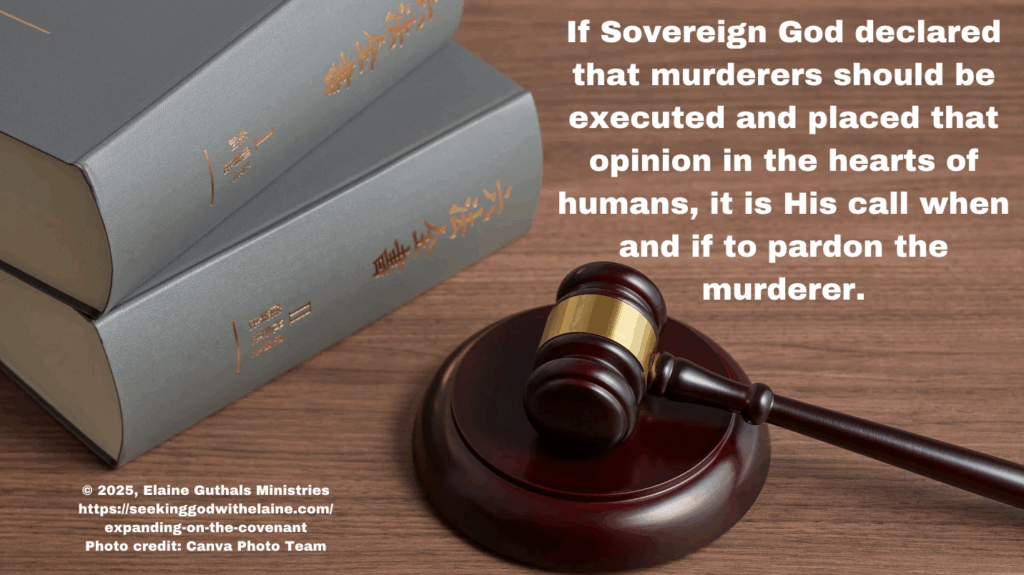
    If Sovereign God declared that murderers should be executed and placed that opinion in the hearts of humans, it is His call when and if to pardon the murderer.

    We cannot choose whether or not to follow only certain laws that God had instituted. We cannot substitute a more lenient – or in other cases, a harsher – punishment.

    We have to go with what God says.

    Why was the command that the murderer be executed in the first place?

    Venables tied it to being made in God’s image. God patterned humankind after Himself to be holy and pure.

    Adam and Even tarnished that with the original sin. Cain further corrupted human flesh when he offered and unacceptable sacrifice to God. He annihilated it when he murdered Abel.

    The murderer is no longer in God’s image because he has let sin rule his life. He is no longer holy and pure – he has a corrupted body.

    Venables disagreed that letting a murderer live in prison is more egregious to him than executing him. (How can he feel the consequences of his actions when he is dead?)

    Bottom line, though, is God commanded it so that sin could be destroyed.

    I know a lot of punishments listed in God’s Word are not followed in today’s society. We say that those punishments were ended when Jesus died on the cross. Some even call this just a prediction.

    Does God’s Word say that? It says He addressed the consequences of sin. When we ABCD, we no longer are spiritually dead and separated from God.

    It says nothing about the punishment for the behavior of sin. It talks about eradicating the spiritual consequences of sin.

    God can use a variety of punishments in this life to judge us for sin. He could allow us to get sick, lose a job, suffer a loss, etc.

    God is our Creator and Judge. It is all up to Him if, when, and how we are judged in this life.

    Our biggest takeaway here should be how much God values human life – even if we have tarnished being made in His image. Murder shatters our relationship as a family.

    Added to the Blessing

    “Now be fruitful and multiply, and repopulate the earth” (Gen. 9: 7 NLT)

    After the flood, God expanded the region in which Noah’s descendants could live.

    Fairbairn made an interesting observation that I hadn’t really thought through before. He wrote,

    “The first is the new condition of the earth itself, which immediately appears in the freedom allowed and [practiced] in regard to the external worship of God. This was no longer confined to any single region, as seems to have been the case in the age subsequent to the Fall.”

    Resource

    We know the Garden of Eden was off limits. The cherubim made certain of that.

    We know that Cain was exiled to the Land of Nod, which some believe to be anywhere but the Garden of Eden area.

    So, God was sending them off into the big, bad area ruled by Satan. No wonder the world went back to being wicked lickety-split.

    Think of it this way. The cherubim was guarding the gate. That showed that God was there.

    But now Noah’s family and descendants were going where God was not and (hopefully) taking Him there with their internal worship of God.

    That would make Noah the first missionary.

    It makes sense. Creation was getting a do-over. Hopefully, it would do a better job because it was a new creation.

    Sounds familiar, doesn’t it? “This means that anyone who belongs to Christ has become a new person. The old life is gone; a new life has begun!” (II Cor. 5: 17 NLT).

    Fairbairn made another point that God gave His children – children of faith – heirship of this world. Because of grace, God gave His children heirship and dominion of the earth.

    I can see why God gave that to Noah, and not Adam. Adam will forever be tied with the original sin. Noah will forever be tied to being righteous enough – if not the only righteous man – to be saved from the flood.

    Making the Connections #1

    We talked about this a long time ago in another devotion. All sin is directed at God.

    Calthrop agreed. He wrote, “Murder, in its essence, if you trace it far enough, is not merely an injury inflicted on our fellow — not merely an act by which pain and deprivation are caused to the individual, and loss to society. It is all this, of course; but it is also more than this — it is a striking at God in the person of him who was made in the image of God.”

    Resource

    We can substitute adultery is not merely an injury inflicted on our spouse. Theft is not merely inflicted on the owner. Gossip is not merely inflicted on the person of which we are discussing.

    It is all about God.

    Making the Connections #2

    Look what Fairbairn said when he was talking about the old things become new. He wrote,

    “But this again indicated that, in the estimation of Heaven, the earth had now assumed a new position; that by the action of God’s judgment upon it, it had become hallowed in His sight, and was in a condition to receive tokens of the Divine [favor], which had formerly been withheld from it.

    Resource

    We talked about the earth being cursed because of the sin of humans. Way back in Genesis 3, God cursed the ground because of humankind’s sin. “And to the man he said, ‘Since you listened to your wife and ate from the tree whose fruit I commanded you not to eat, the ground is cursed because of you …’” (Gen. 3: 17 NLT).

    God said that He would no longer curse the earth because of humans. “And when the Lord smelled the pleasing aroma, the Lord said in his heart, ‘I will never again curse the ground because of man, for the intention of man’s heart is evil from his youth. Neither will I ever again strike down every living creature as I have done’” (Gen. 8: 21 NLT).

    The earth got its own do-over.

    It became its own new creation. It was now blessed and sanctified again.

    How Do We Apply This?

    • Value life as God does.
    • Walk the Sanctification Road so that we can become the true new creation that God has made us.
       
      Father God. You value life because You are life. It is Satan that is death. Lord, may we follow Your laws and commandments so that we make have Your eternal  life in us. Amen.

    What do you think?

    Leave me a comment below (about this or anything else) or head over to my Facebook group for some interactive discussion.

    If you don’t understand something and would like further clarification, please contact me.

    If you have not signed up for the email providing the link to the devotions and the newsletter, do so below.

    If God has used this devotion to speak with you, consider sharing it on social media.
  • God’s Covenant with Noah

    The sacrifice that Noah offered when they disembarked from the ark was part of the covenant process. This devotional reading looks at the promise made by God.

    Nuggets

    • Noah immediately worshiped God after he disembarked from the ark.
    • The goal of the burnt offering was to create a pleasing aroma for God.
    • God promised to never again flood the earth.
    • When the Day of the Lord comes, the earth will pass away; but until then, it will remain.
    • God promised Noah as soon as he got off the ark that life will be sustained while the earth remains.
    gods-covenant-with-noah

    Noah was obedient in offering the sacrifice to God. It was now up to God to accept it or reject it. If He accepted it, it would lead into the responsibility part of the covenant.

    Let’s Put It into Context

    To read devotions in the Creating Everything theme, click the button below.

    Devotions in the Creation’s Do-Over series

    The Sacrifice Accepted

    “And the Lord was pleased with the aroma of the sacrifice and said to himself, ‘I will never again curse the ground because of the human race, even though everything they think or imagine is bent toward evil from childhood. I will never again destroy all living things’” (Gen. 8: 21 NLT)

    The Pleasing Aroma

    The goal of the burnt offering was to create a pleasing aroma for God.

    What is described here is the olah – or burnt – offering. Olah is one of those Hebrew words that doesn’t have a good translation. The functional definition tells us it means ascend, go up, or bring-near.

    The offering is burnt so that the smoke ascends to God to bring Him near to the one offering the sacrifice.

    We know that if we say that God smells the offering, we would be attributing to him human characteristics that He doesn’t have.

    Bradford took a stab at describing how the aroma affected God. He wrote, “It would not be incorrect to say that the smoke of the sacrifice soothed God and this allowed God to have a more favorable attitude toward that man who was making the ‘olah.’”

    Resource

    I can see that – a type of aromatherapy.

    God accepted Noah sacrifice and gave him a promise for the future. The promise was more than just verse 22. It was that He would accept the sacrifice of Jesus’ blood as atonement for our sins.

    Law talked about God’s truth also having an aroma. While the Gospel offers salvation, the sweet aroma, it will be a bitter aroma for those who choose not to accept the gift of salvation.

    Resource

    We want to be in a position where we have accepted His salvation.

    The Promise

    God promised to never again flood the earth.

    Way back in Genesis 3, God cursed the ground because of humankind’s sin. “And to the man he said, ‘Since you listened to your wife and ate from the tree whose fruit I commanded you not to eat, the ground is cursed because of you …’” (Gen. 3: 17 NLT).

    Here, God is saying that He will no longer curse it.

    Spurgeon also pointed out what seems like a contradiction.

    • “And the Lord said, ‘I will wipe this human race I have created from the face of the earth. Yes, and I will destroy every living thing—all the people, the large animals, the small animals that scurry along the ground, and even the birds of the sky. I am sorry I ever made them’” (Gen. 6: 7 NLT).
    • “And when the Lord smelled the pleasing aroma, the Lord said in his heart, ‘I will never again curse the ground because of man, for the intention of man’s heart is evil from his youth. Neither will I ever again strike down every living creature as I have done’” (Gen. 8: 21 NLT).

    Resource

    Yes or no? Is God going to destroy humankind or not?

    Well, not now because He smelled the aroma from Noah’s sacrifice and was soothed.

    Will that soothed spirit last forever? No. Eventually, God will destroy the earth and condemn non-believers to eternity in hell. That will happen when mankind becomes as wicked as they were then.

    • “And I saw a great white throne and the one sitting on it. The earth and sky fled from his presence, but they found no place to hide. … And anyone whose name was not found recorded in the Book of Life was thrown into the lake of fire” (Rev. 20: 11, 15 NLT).
    • “But when the Son of Man comes in his glory, and all the angels with him, then he will sit upon his glorious throne. All the nations will be gathered in his presence, and he will separate the people as a shepherd separates the sheep from the goats. He will place the sheep at his right hand and the goats at his left. … Then the King will turn to those on the left and say, ‘Away with you, you cursed ones, into the eternal fire prepared for the devil and his demons.’” (Mt. 25: 31-33, 41 NLT).
    • “When the Son of Man returns, it will be like it was in Noah’s day” (Mt. 24: 37 NLT).

    Man’s Evil Heart

    God knows us, our very hearts.

    Unfortunately, God knows our hearts are evil. Arnold had it right. He wrote,

    “There is so much more bad than good in us that we should certainly go wrong if left to ourselves, and the bias of our nature to evil is so strong that it can only be corrected by changing the very nature itself; or, in the words of Scripture, by being born again of the Spirit.”

    Resource

    This is why we can’t save ourselves. Bad moral character doesn’t change into good moral character without God’s intervention.

    We can’t enter Heaven unless we have been washed by the blood of the Lamb.

    God will meet us where we are, but we cannot stay there. We have to be sanctified so we become more like Him.

    Seasons Will Remain for a While

    “As long as the earth remains, there will be planting and harvest, cold and heat, summer and winter, day and night” (Gen. 8: 22 NLT)

    While the Earth Remains

    When the Day of the Lord comes, the earth will pass away; but until then, it will remain.

    Some might see verses 21 and 22 a promise that life as we know it will never end. They would be wrong.

    The determining factor is “While the earth remains …” (Gen. 8: 22 NLT). It doesn’t say how long the while is going to last.

    In a way, while has the same definition as soon – according to God’s Will.

    This is a definition statement, though, that the earth isn’t going to always remain. “And I saw a great white throne and the one sitting on it. The earth and sky fled from his presence, but they found no place to hide” (Rev. 20: 11 ESV).

    Noah got off the ark, and we think everything was back to Garden of Eden pristine.

    Wrong.

    Mankind is still made in Adam’s image (Gen. 5: 3). Noah and his family weren’t automatically cleansed by the flood.

    Blood cleanses us, not water.

    We do not get a free ride just because we are the creation of God. We are still held accountable for when we sin.

    Each person is accountable for individual behavior.

    There is a good reason why we aren’t told the exact time of the Day of the Lord. We are to put our faith and obedience in God. We are to watch.

    What are we to do while we watch?

    • “From that time Jesus began to preach, saying, “Repent, for the kingdom of heaven is at hand.” (Mt. 4: 17 ESV emphasis added).
    • “Now repent of your sins and turn to God, so that your sins may be wiped away” (Ac. 3: 19 NLT emphasis added).
    • “Peter replied, ‘Each of you must repent of your sins and turn to God, and be baptized in the name of Jesus Christ for the forgiveness of your sins. Then you will receive the gift of the Holy Spirit’” (Ac. 2: 38 NLT emphasis added).

    It is a progression, isn’t it? God sends the Holy Spirit to convict us. He regenerates us. “God saved you by his grace when you believed. And you can’t take credit for this; it is a gift from God. Salvation is not a reward for the good things we have done, so none of us can boast about it” (Eph. 2: 8-9 NLT).

    Pastor Steve put it this way. He said, “God gave us regeneration to give us a new spiritual life.”

    Resource

    God gives us regeneration so that we can approach Him so He can give us salvation. Yeah, it probably happens in a nanosecond and is all part of a mysterious process.

    We don’t need to figure it out. We need to believe in God.

    Once we believe, we are to turn from our sinful ways. One way we do that is follow His in obedience – symbolized first by baptism.

    No, there are many who will not repent. They may repent but won’t turn from their sins. They won’t be obedient.

    That in no way, shape, or form effects God’s promise. He will do what He has promised.

    Seasons Will Remain

    God promised Noah as soon as he got off the ark that life will be sustained while the earth remains.

    Spurgeon said it this way. He wrote, “It is a promise concerning temporal things, but yet it breathes a spiritual air, and hath about it the smell of a field that the Lord hath blessed.”

    Resource

    God is most concerned about our spiritual condition. He will, though, provide for our physical condition by providing temporal things.

    God has kept all His promises. Spurgeon made a good point. If non-believers can believe in the promise of the seasons, why can’t they believe His other promises?

    But Spurgeon makes another important observation. Things around us will change.

    No, God doesn’t change, but we change as He grows us. He grows us by revealing Himself to us slowly.

    God does things in an orderly fashion. As I am writing this, corn is beginning to tassel, which gives way to the ear being formed on the stalk.

    The ear can’t show up on a knee-high corn stalk. The stalk wouldn’t be able to support the growth. It has to show up after the stalk has matured.

    Sometimes, we have to go through the same testing to get to where God wants us to be. But there is order to that, also.

    Is that a blast of reassurance or what?!? We can hold fast to God and His promises.

    All that said, winter will come. It follows autumn every year.

    But doesn’t autumn have its own form of death? The corn stalk dies before the ear is harvested.

    Endings will come. Our trials will cease.

    Sometimes, good things cease when God calls us to a different mission field. I didn’t get to stay in Springfield and take care of my Springfield Mom like I always thought I would. God had different plans.

    We have to remember that Revelation talks about the harvest of the earth. “Then I saw a white cloud, and seated on the cloud was someone like the Son of Man. He had a gold crown on his head and a sharp sickle in his hand. Then another angel came from the Temple and shouted to the one sitting on the cloud, ‘Swing the sickle, for the time of harvest has come; the crop on earth is ripe.’ So the one sitting on the cloud swung his sickle over the earth, and the whole earth was harvested” (Rev. 14: 14-16 NLT).

    Isn’t harvest the culmination of the seasons? Isn’t it a time of joy and abundance?

    Making the Connections #1

    Ooo, baby. I need to process this.

    Mungeain was talking about God’s faithfulness. He wrote, “‘But,’ you will say perhaps, ‘it is not God’s faithfulness I question — I doubt His mercy.[’] The Word of the Lord, that shall stand; but ‘His mercy is in the heavens.’ It reacheth not to me.’” And why not? What but mercy, infinite mercy, so prevailed with the Almighty that He should promise ‘seed time and harvest’ so long as the earth endureth!”

    • We have to be very careful doubting God. He does allow us to question Him, but we cannot question His sovereignty.
    • We just tell ourselves that God’s mercy is only in Heaven. But then, our doubts can block God’s mercy from falling upon us.

    Look what David wrote. “Your unfailing love, O Lord, is as vast as the heavens; your faithfulness reaches beyond the clouds. Your righteousness is like the mighty mountains, your justice like the ocean depths. You care for people and animals alike, O Lord. How precious is your unfailing love, O God! All humanity finds shelter in the shadow of your wings” (Ps. 36: 5-7 NLT emphasis added).

    If God’s faithfulness reaches us, so does His mercy. It can because it reaches beyond the clouds. Plus, we are right there with God in the shadow of His wings.

    Clissold reminded us that God does not give judgment without mercy. He is not an unjust God.

    Resource

    We wouldn’t have the promise of seasons without God’s mercy and justice.

    Making the Connections #2

    Mackennal said something way cool. He wrote, “Spiritual winter is an ordination of God. The true spiritual analogue of winter is not spiritual death, not even feeble spiritual life. There is an orderly change in the soul.”

    Resource

    How many times do we bite on ourselves because we’re going through our spiritual seasons and come to spiritual winter? We think everything within us is dead.

    It may come after a time of intense testing. We may feel like God is nowhere to be found.

    But just as the soil is dormant in the winter, our souls need the respite. It doesn’t mean God has banished us to eternal damnation. It doesn’t mean we are weak.

    It hurts to be harvested, but that confirms and strengthens our faith.

    “He lets me rest in green meadows; he leads me beside peaceful streams” (Ps. 23: 2 NLT). In our winter, God is letting us rest.

    How Do We Apply This?

    • Hold fast to God and His promises.
    • Believe in God’s wise providence.
    • Know God has a purpose for us and fulfill that purpose.
    • Work knowing life is short.
    • Constantly walk with God to keep our souls focused on Him.
    • Remember what nature does in winter and allow God to do that in our hearts.

    Resource

    Father God. Thank You for allowing us to worship You. Lord, we want to worship You in the way You want. We want to always be obedient to Your covenant with us. Amen.

    What do you think?

    Leave me a comment below (about this or anything else) or head over to my Facebook group for some interactive discussion.

    If you don’t understand something and would like further clarification, please contact me.

    If you have not signed up for the email providing the link to the devotions and the newsletter, do so below.

    If God has used this devotion to speak with you, consider sharing it on social media.
  • The Flood Is Over!

    The day was finally here! This devotional reading looks at how the period of the flood ended.

    Nuggets

    • The rain had stopped, and the earth had dried out.
    • God told Noah when to exit the ark.
    the-flood-is-over

    The flood was a thing of the past. The rain had stopped, and the water had receded.

     It was now time to get off the ark and get on with life.

    Let’s Put It into Context

    To read devotions in the Creating Everything theme, click the button below.

    Devotions in the Creation’s Do-Over series

    The Flood Officially Over

    “Noah was now 601 years old. On the first day of the new year, ten and a half months after the flood began, the floodwaters had almost dried up from the earth. Noah lifted back the covering of the boat and saw that the surface of the ground was drying. Two more months went by, and at last the earth was dry!” (Gen. 8: 13-14 NLT)

    The rain had stopped, and the earth had dried out.

    It was over. The flood that God said would come had come and gone. Before, Noah may not have even known what rain was.

    Now, Noah would have heard the rain. There was most likely thunder and lightning associated with it. It may have even been a hurricane.

    No, I doubt that it was a gentle summer shower.

    It was a judgment. It would have been a catastrophe.

    Yes, part of Noah’s heart would be hurting because of people that died. He would be mourning relationships lost.

    But overall, Noah would have humbly bowed to an omnipotent God. He would have acknowledged God’s authority to judge those who refused to recognize Him as Sovereign Lord.

    Still, the Homilist noted that Noah had a futuristic understanding of this calamity. It was written, “That it was only a faint type of the final judgment.”

    Resource

    I really doubt that Noah had any concept of the Day of the Lord. It would be thousands of years before Revelation was written by John.

    But in the back of his mind, Noah had to be wondering what God would do the next time He judged the world.

    Oh, come on. You think that Noah didn’t know sin would still be in the world. Stay tuned. It didn’t take long.

    Sin is in human nature. If we are human, we have a sinful nature.

    The flood did not take away Noah’s sinful nature.

    “The law of Moses was unable to save us because of the weakness of our sinful nature. So God did what the law could not do. He sent his own Son in a body like the bodies we sinners have. And in that body God declared an end to sin’s control over us by giving his Son as a sacrifice for our sins. He did this so that the just requirement of the law would be fully satisfied for us, who no longer follow our sinful nature but instead follow the Spirit” (Rom. 8: 3-4 NLT).

    Even though Moses’ law was not given yet, we know that pieces of it had – if not all. I could see that Moses accomplished in getting it written down.

    Think about it. If Noah and his ancestors only had the one law that Adam got, it didn’t have any way to restore their relationship with God. “But the Lord God warned him, ‘You may freely eat the fruit of every tree in the garden — except the tree of the knowledge of good and evil. If you eat its fruit, you are sure to die’” (Gen. 2: 16-17 NLT).

    Remember, the fruit wasn’t the only issue here. The main issue was obedience — and still is. This was more than a Garden of Eden law.

    Still, Noah would have had to have felt God’s loving mercy. We have a saying, “There but by the grace of God go I.”

    Ooo, baby. Noah was feeling that big time.

    What is the difference between grace and mercy?

    • Grace is a free and unmerited gift of love from the Heavenly Father, given through His Son, Jesus Christ, that enables salvation and spiritual healing to believers by the work of the Holy Spirit.
    • Mercy is an act of sovereign will that produces an unexpected and undeserved response from God as He responds in love to our needs.

    In other words, God gives us what we don’t deserve (grace) and doesn’t give us what we do deserve (mercy).

    Noah would have felt both of those because he would have had the Old Testament salvation – faith and obedience.

    The Time in the Ark Is Completed

    “Then God said to Noah, ‘Leave the boat, all of you — you and your wife, and your sons and their wives. Release all the animals — the birds, the livestock, and the small animals that scurry along the ground — so they can be fruitful and multiply throughout the earth.’ So Noah, his wife, and his sons and their wives left the boat. And all of the large and small animals and birds came out of the boat, pair by pair” (Gen. 8: 15-19 NLT)

    God told Noah when to exit the ark.

    I bet Noah and his family were more than ready to exit the ark. They had to have been cramped in the enclosed space.

    It had to have been somewhat depressing. I don’t know how much sunshine – once the sun shown again – would have made its way into the ark. (It just says that there was one window – one that had to be opened. “After another forty days, Noah opened the window he had made in the boat” (Gen. 8: 6 NLT).

    It would have been a really neat experience to see all of the animals tamed for the moment. But I bet it was a lot of work for the eight people to feed all of them. That must have taken most of the day.

    They were probably ready to get back to whatever their occupations were preflood.

    But Noah waited for God to say, “It’s time to get out.” He didn’t want to get ahead of God.

    Ooo, baby. Don’t we do that at times? God is working too slowly for our liking, so we take things into our own hands and do what we want to do on our timetable.

    That usually doesn’t work out real well.

    We talked about God remembering the ark passengers. “But God remembered Noah and all the beasts and all the livestock that were with him in the ark …”  (Gen. 8: 1 NLT).

    Noah would have been remembering, too. He would have been remembering about how bad it was and humbled – and probably brooding – about thinking he and his family would be responsible for repopulating the earth.

    Did Noah wonder if he would ever lose his obedience to God? Did he ponder over how he could steer his family to not make the mistakes of disobedience that were made before? Did he wonder about people years after him remembering the flood and judgment that is given when we are disobedient to God?

    Ooo, baby. That first step onto dry land after a year would have been exciting and scary!

    Noah had to take comfort in the fact that he had his family with him. Look what Exell said. He wrote,

    “He [Noah] goes forth in company with the relatives of his own family. God permitted the family of Noah to be with him in the ark, to relieve his solitude, to aid his efforts, to show the protective influence of true piety; and now they are to join him in the possession of the regenerated earth, that they may enjoy its safety and aid its cultivation.”

    Resource

    We can’t be stymied by sin after we have experienced God’s judgment. He doesn’t judge us to drive us away.

    God judges us to correct us and bring us back to Him. We have to let Him and not let our doubts and guilt get in the way.

    Making the Connections

    I love what the Homilist wrote. It says, “Christianity, the great expedient for saving souls from the deluge of moral evil, is God’s plan.”

    Resource

    The Plan of Salvation has always been God’s plan. It was always in the plan to create the Church – a body of believers with Jesus as the Head. “God has put all things under the authority of Christ and has made him head over all things for the benefit of the church” (Eph. 1: 22 NLT).

    God had it in place before the foundation of the universe.

    • “God chose him as your ransom long before the world began, but now in these last days he has been revealed for your sake” (I Pet. 1: 20 NLT).
    • “Even before he made the world, God loved us and chose us in Christ to be holy and without fault in his eyes” (Eph. 1: 4 NLT).
    • “And all the people who belong to this world worshiped the beast. They are the ones whose names were not written in the Book of Life that belongs to the Lamb who was slaughtered before the world was made” (Rev. 13: 8 NLT).
    • “Father, I want these whom you have given me to be with me where I am. Then they can see all the glory you gave me because you loved me even before the world began!” (Jn. 17: 24 NLT).
    • “The beast you saw was once alive but isn’t now. And yet he will soon come up out of the bottomless pit and go to eternal destruction. And the people who belong to this world, whose names were not written in the Book of Life before the world was made, will be amazed at the reappearance of this beast who had died” (Rev. 17: 8 NLT).
    • “For God saved us and called us to live a holy life. He did this, not because we deserved it, but because that was his plan from before the beginning of time—to show us his grace through Christ Jesus” (II Tim. 1: 9 NLT).
    • “Then the King will say to those on his right, ‘Come, you who are blessed by my Father, inherit the Kingdom prepared for you from the creation of the world’” (Mt. 25: 34 NLT).
    • “If that had been necessary, Christ would have had to die again and again, ever since the world began. But now, once for all time, he has appeared at the end of the age to remove sin by his own death as a sacrifice” (Heb. 9: 26 NLT).

    We don’t know how much Noah really knew about this plan, but I bet he knew more was needed to fix our sinful nature.

    How Do We Apply This?

    • Wait for God’s mercy when we experience testings and trials.
    • Exercise patience during those times.
    • Seek mercy through patience.
    • Understand that mercy is sometimes shown through what is withheld from us.
    • Expect God’s providence in situations when we are following His Will.
    • Wait for the completion of the testings and trials.
    • Don’t turn away from God after He has judged and corrected us.

    Resources

    Father God. Thank You for always being with us – in the trials and during the smooth sailing. We know there is a day when the trials will end and that You have carried us through. Amen.

    What do you think?

    Leave me a comment below (about this or anything else) or head over to my Facebook group for some interactive discussion.

    If you don’t understand something and would like further clarification, please contact me.

    If you have not signed up for the email providing the link to the devotions and the newsletter, do so below.

    If God has used this devotion to speak with you, consider sharing it on social media.
  • Sending Out the Birds

    It was about time for the occupants of the ark to be able to disembark. This devotional reading looks at how Noah sent birds out to determine the status of the land.

    Nuggets

    • The first bird that Noah sent out was a raven, an unclean bird.
    • We aren’t told how long Noah waited on the raven before he sent out the dove.
    • The second dove sent out by Noah came back with an olive branch.
    • Noah knew their time in the ark was about over when the third dove didn’t come back.
    sending-out-the-birds

    In the last devotion, we talked about God being the One that steered the ark to Mt. Ararat. Noah was perfectly fine with that.

    Noah had to know that the time for the ark trip was coming to an end. Some may see Noah sending out the birds as an act of impatience. I don’t see it that way.

    I don’t think God was upset that Noah was checking out the status of the drying operation. He didn’t put us on this earth to just sit around waiting on Him.

    On the contrary. God has a role for us to plan in expanding His kingdom. He also expects us to be stewards of His creation.

    Let’s Put It into Context

    To read devotions in the Creating Everything theme, click the button below.

    Devotions in the Creation’s Do-Over series

    Raven

    “After another forty days, Noah opened the window he had made in the boat and released a raven. The bird flew back and forth until the floodwaters on the earth had dried up” (Gen. 8: 6-7 NLT)

    The first bird that Noah sent out was a raven, an unclean bird.

    “These are the birds that are detestable to you. You must never eat them: the griffon vulture, the bearded vulture, the black vulture, the kite, falcons of all kinds, ravens of all kinds, the eagle owl, the short-eared owl, the seagull, hawks of all kinds, the little owl, the cormorant, the great owl, the barn owl, the desert owl, the Egyptian vulture, the stork, herons of all kinds, the hoopoe, and the bat” (Lev. 11: 13-19 emphasis added).

    Why would Noah choose an unclean bird before he chose a clean one? Well, it was probably because, being unclean, it was more suited to what it would find.

    Ravens are scavengers. There would have been a lot of dead things on which it would be able to feed. It could fly long distances, which would have been a good reason to send it as a scout.

    Gray told us why a long-distance bird was needed. He wrote,

    “Doubtless he would often look forth on the waste of waters. The rapid evaporation, etc., would very much intercept a distant view. Fogs and mists, etc. Hence to know the state of things beyond the reach of his vision he would send forth messengers.”

    Resource

    The raven would have been a great choice.

    But then, the raven didn’t come back. It just kept flying back and forth until it found a spot to land. It could survive on its own.

    That sounds familiar. “‘Where have you come from?’ the Lord asked Satan. Satan answered the Lord, ‘I have been patrolling the earth, watching everything that’s going on’” (Job. 1: 7 NLT).

    Well, that is logical. The raven, being an unclean bird, was associated with death – aka sin.

    Creation just had a redo, and sin still wasn’t gone from the world. In fact, something unclean was the first thing that got out of the ark.

    And after 271 days if my math is right, (10th day of the 2nd month to the 11th day of the 11th month), sin still wanted to get away from God.

    Gray made another great point. The raven would have been able to see the ark. It wasn’t this small boat.

    Remember, by this time, the ark was parked on Mt. Ararat. It didn’t leave the area, stranding the raven.

    That rules out the raven not being able to find it.

    First Dove

    “He also released a dove to see if the water had receded and it could find dry ground. But the dove could find no place to land because the water still covered the ground. So it returned to the boat, and Noah held out his hand and drew the dove back inside” (Gen. 8: 8-9 NLT)

    Noah sent out the dove at the same time as the raven.

    Yeah, Noah sort of got a report from the raven by his not coming back, but he really didn’t know much more than he did before. So, he also sent a more reliable messenger.

    A dove was a clean bird. It could be used for the olah offering (the burnt offering) for those who could not afford a bull, sheep, or goat. “If you present a bird as a burnt offering to the Lord, choose either a turtledove or a young pigeon” (Lev. 1: 14 NLT).

    In other words, the dove was accessible to everyone. That resonates with me since the Holy Spirit, Who has been depicted as a dove, is available to everyone. “One day when the crowds were being baptized, Jesus himself was baptized. As he was praying, the heavens opened, and the Holy Spirit, in bodily form, descended on him like a dove. And a voice from heaven said, “You are my dearly loved Son, and you bring me great joy” (Lk. 3: 21-22 NLT).

    I can see the dove instinctively flying away from the ark. Prior to this trip, it probably had not been a tamed bird.

    But the dove came back. Maybe it had developed a relationship with Noah over its time in the ark. It knew who had been feeding it.

    Maybe God was guiding it to accomplish His plan. We remember Balaam and his donkey (Num. 22: 21-39). God used animals.

    Whatever, the dove came back.

    This poor little guy flew around for a while but didn’t find a landing spot. So, it came back – back to God in the ark. With God is the only place we find peace.

    Look at the reception the dove got. Noah reached out and lovingly pulled it back in.

    No, I don’t think Noah had made the ark a prison. True, the wild animals may have been normally comfortable with the arrangement, but I am sure that God gave them His peace.

    Second Dove

    “After waiting another seven days, Noah released the dove again. This time the dove returned to him in the evening with a fresh olive leaf in its beak. Then Noah knew that the floodwaters were almost gone” (Gen. 8: 10-11 NLT)

    The second dove sent out by Noah came back with an olive branch.

    The olive branch brought back by the second dove Noah sent out was very important. It meant that things were growing again in the earth. If the plants could grow, it would soon be inhabitable by the humans.

    Olive trees also have a spiritual meaning. They are symbolic of peace and forgiveness.

    • “Oh, the joys of those who do not follow the advice of the wicked, or stand around with sinners, or join in with mockers. But they delight in the law of the Lord, meditating on it day and night. They are like trees planted along the riverbank, bearing fruit each season. Their leaves never wither, and they prosper in all they do” (Ps. 1: 1-3 NLT).
    • “But I am like an olive tree, thriving in the house of God. I will always trust in God’s unfailing love” (Ps. 52: 8 NLT).
    • “But some of these branches from Abraham’s tree — some of the people of Israel — have been broken off. And you Gentiles, who were branches from a wild olive tree, have been grafted in. So now you also receive the blessing God has promised Abraham and his children, sharing in the rich nourishment from the root of God’s special olive tree” (Rom. 11: 17 NLT).

    That is just talking about the olive trees. The olives themselves are significant when made into olive oil.

    • “Then the Lord said to Moses, ‘Collect choice spices — 12 1⁄2 pounds of pure myrrh, 6 1⁄4 pounds of fragrant cinnamon, 6 1⁄4 pounds of fragrant calamus, and 12 1⁄2 pounds of cassia — as measured by the weight of the sanctuary shekel. Also get one gallon of olive oil. Like a skilled incense maker, blend these ingredients to make a holy anointing oil. Use this sacred oil to anoint the Tabernacle, the Ark of the Covenant, the table and all its utensils, the lampstand and all its accessories, the incense altar, the altar of burnt offering and all its utensils, and the washbasin with its stand. Consecrate them to make them absolutely holy. After this, whatever touches them will also become holy” (Ex. 30: 22-25 NLT).
    • “Command the people of Israel to bring you pure oil of pressed olives for the light, to keep the lamps burning continually” (Lev. 24: 2 NLT).
    • “You prepare a feast for me in the presence of my enemies. You honor me by anointing my head with oil. My cup overflows with blessings” (Ps. 23: 5 NLT).
    • “Are any of you sick? You should call for the elders of the church to come and pray over you, anointing you with oil in the name of the Lord” (Jas. 5: 14 NLT).
    • “And they cast out many demons and healed many sick people, anointing them with olive oil” (Mk. 6: 13 NLT).

    So, the fact that the dove – in which the Holy Spirit has been known to take bodily form – is offering Noah and his family peace, forgiveness, and blessings.

    Why was Noah offered peace, forgiveness, and blessing? He walked with God. He was faithful and obedient.

    God will use what we may think is common and ordinary for His holy purposes.

    Third Dove

    “He waited another seven days and then released the dove again. This time it did not come back” (Gen. 8: 12 NLT)

    Noah knew their time in the ark was about over when the third dove didn’t come back.

    The third dove was the charm. It didn’t come back, so Noah knew the earth was inhabitable again.

    Noah just had to wait for God’s directions.

    Making the Connections #1

    Yeah, Noah opened the window and let the birds out. He wasn’t impatient to get out of the ark.

    Noah was content in whatever situation in which God Him. “I am not saying this because I am in need, for I have learned to be content whatever the circumstances. I know what it is to be in need, and I know what it is to have plenty. I have learned the secret of being content in any and every situation, whether well fed or hungry, whether living in plenty or in want. I can do all this through him who gives me strength” (Phil. 4: 11-13 NLT).

    I can see Noah saying the same thing. He had just gone through a harrowing experience.

    We never once see any talk back – not like Moses did. All we see is faith and obedience.

    Everyone is going to have their own harrowing experience. Exell agreed and told us why. He wrote, “That when God does place men in unwelcome positions, it is that their own moral welfare may be enhanced.”

    Resource

    Yes, the trials are hard. But God is always with us. He always has a purpose for the trials – the core of which is to strengthen our faith and patience.

    Making the Connections #2

    We should learn from the doves. Cuyler told us how. Look what he said first.

    Cuyler wrote, “God has designed but one resting place for the soul, and that is the restoration of peace between it and Himself. On Jesus’ breast we may lay our weary heads.”

    Resource

    • We won’t be able to find rest until we come back to God.
    • We need to come back to God with a repentant soul, not making excuses or deflecting our guilt.
    • Jesus is the only way to gain salvation.

    How Do We Apply This?

    • Lean on God’s understanding, not our own.
    • Use the talents that God has given us.
    • Always follow where God leads.
    • Wait patiently on God to provide answers to prayers.

    Resources

    Father God. We want to have the faith and obedience of Noah. We want to have his patience and contentment, even in difficult trials. Help us to follow his example. Amen.

    What do you think?

    Leave me a comment below (about this or anything else) or head over to my Facebook group for some interactive discussion.

    If you don’t understand something and would like further clarification, please contact me.

    If you have not signed up for the email providing the link to the devotions and the newsletter, do so below.

    If God has used this devotion to speak with you, consider sharing it on social media.
  • The Calm before the Storm

    In the last devotion, we talked about Noah getting the call to enter the ark. This devotional reading finishes up that conversation by God filling Noah in a little more about His plan.

    Nuggets

    • The other purpose of building the ark, besides saving the people, was to save the animals.
    • God provided Noah and his family with advanced notice of when the rain was going to start.
    • I wonder how long it took the wicked to admit that Noah wasn’t a fool.
    • God intended to totally annihilate the population – except for those riding in the ark.
    • Noah had come this far; he wasn’t going to start being disobedient then.
    the-calm-before-the-storm

    As I start out writing this, I am not sure how things are going to go. I found, reading ahead, that it seems like verses are repeated, maybe adding little nuggets at a time.

    So, I am not going to go in a straight verse order. I am going to group the like verses together.

    But that means this will probably get long, so bear with me.

    Let’s Put It into Context

    To read devotions in the Creating Everything theme, click the button below.

    Devotions in the Creation’s Do-Over series

    Taking Pairs of Animals

    “Take with you seven pairs — male and female — of each animal I have approved for eating and for sacrifice, and take one pair of each of the others. Also take seven pairs of every kind of bird. There must be a male and a female in each pair to ensure that all life will survive on the earth after the flood” (Gen. 7: 2-3 NLT)

    “With them were all the various kinds of animals — those approved for eating and for sacrifice and those that were not — along with all the birds and the small animals that scurry along the ground. They entered the boat in pairs, male and female, just as God had commanded Noah” (Gen. 7: 8-9 NLT)

    “With them in the boat were pairs of every kind of animal — domestic and wild, large and small — along with birds of every kind. Two by two they came into the boat, representing every living thing that breathes. A male and female of each kind entered, just as God had commanded Noah …” (Gen. 7: 14-16 NLT)

    The other purpose of building the ark, besides saving the people, was to save the animals.

    God didn’t want to just save the people to repopulate the earth. He wanted to save the animals, too.

    We’ve already briefly touched on the other occupants in the ark. “Bring a pair of every kind of animal — a male and a female — into the boat with you to keep them alive during the flood. Pairs of every kind of bird, and every kind of animal, and every kind of small animal that scurries along the ground, will come to you to be kept alive” (Gen. 6: 19-20 NLT).

    We mentioned in passing that verse 19 talks about a pair – singular – where verse 20 talks about pairs – plural.

    Usually, I think, in our minds — and definitely in pictures and songs — we think about a two-by-two line patiently waiting to get into the ark. And I think that is significant.

    Just as God was planning Noah and his family repopulating the earth through the family unit, He was planning the same thing through the animals. That connection was important to Him. He puts a lot of emphasis on us bring the family of God.

    But God also has Noah bring seven pairs of a lot of animals. Seven is also a significant number. It means completion. On the seventh day of creation God rested.

    There were two specific reason God wanted more of these animals. The first was they were to provide food for the humans.

    We remember God told Noah to pack enough food for the float trip. “And be sure to take on board enough food for your family and for all the animals” (Gen. 6: 21 NLT).

    I keep trying to think what kind of food that might have been. Probably there were some vegetables. God would have made sure they stayed fresh (unlike my refrigerator lately where they have gone to die).

    Mrs. Noah probably included some spices. They didn’t want week after week of bland food.

    But just as God did later in the wilderness, God provided the meat. “Then Moses added, ‘The Lord will give you meat to eat in the evening and bread to satisfy you in the morning, for he has heard all your complaints against him. What have we done? Yes, your complaints are against the Lord, not against us’” (Ex. 16: 8 NLT).

    God provided animals for them to eat. Yeah, they’d have had to build a kitchen, so I would think they would also build a butcher room.

    The second reason seven pairs were needed was because these were the animals for sacrifice to God.

    Did they perform sacrifices on ark? It doesn’t say one way or the other. We know they did prior to entry into the ark, and they would once they got off.

    But think about it. Noah didn’t have to go round up the animals. They came to him.

    What did all the scoffers think when they came walking up? Maybe some of these they had never seen before. (God only knows how long some of them had to travel to get there.)

    Gilfillan reminded us of the parade of animals before Adam to receive a name (Gen. 2: 19-20). This spectacle would rival that.

    Resource

    That doesn’t take into consideration the birds. There would be seven pairs of every species — all the way from cardinals to turkey vultures — winging its way to do some flyovers before they settled into their room.

    And think of the creepy-crawly things. Tarantulas, termites, slugs, bedbugs — yeah probably some that would have asked God to leave them off this trip.

    When I was on Facebook tonight, there was an advertisement for a live-action play called Noah. I actually had the sound on for once and heard I believe the stage manager say, “Cue the goats. Cue the pigs. Cue the skunks.”

    That would have been God calling the animal actors to the stage on the ark. Only He could get the wild animals there in a timely, safe fashion.

    Did the wicked have such hardened hearts even that wouldn’t have convinced them what God said was going to happen? Did their hearts feel God trying to chip at the ice but just didn’t decide to believe?

    The Game Plan Revealed

    “Seven days from now I will make the rains pour down on the earth. And it will rain for forty days and forty nights, until I have wiped from the earth all the living things I have created” (Gen. 7: 4 NLT)

    Seven Day Forecast

    God provided Noah and his family with advanced notice of when the rain was going to start.

    Talk about vindication for Noah! For 120 years, others had been laughing at him for building a boat nowhere close to water.

    But everyone — Noah included — was going to find out what rain was. But God gave them a seven-day reprieve before He started the rain.

    I like what Fuller had to say about that. He wrote, “He who in well-doing commits himself into the hands of a faithful Creator, needs not fear being overtaken by surprise. What have we to fear, when He whom we serve hath the keys of hell and of death?”

    Resource

    I know. At times, it feels like God hits us out of the blue with something. But regardless of the amount — or lack — of warning, we should be content in what Go has for us.

    God knew the outcome, but He was still offering the wicked mercy.

    It probably took longer than the seven days that Noah and family were given to get themselves and the animals situated for the wicked to decide they had chosen wrong. The door wasn’t shut yet, so if any of the wicked would have repented, they may have gotten in.

    But part of me doubts that.

    What we do know is that God gave Noah time to get things situated within the ark before the rocking started. The eight people had a lot of work to get done to get ready for launch.

    Rain for Forty Days and Forty Nights

    I wonder how long it took the wicked to admit that Noah wasn’t a fool.

    Did they see the error of their ways when Noah and his family entered the ark? No, what was really different about that? Nothing.

    Did it finally dawn on them when the rain started to fall? Maybe, maybe not. It depends on how hard it rained.

    They wouldn’t have been afraid of puddles. They may not have been too concerned about knee deep.

    Adults probably would have started getting alarmed when it got waist high. But then small children would have been washed away by then.

    Devastation Voiced

    God intended to totally annihilate the population – except for those riding in the ark.

    God had told Noah before what He was going to do and the extent to which it would go. “So God said to Noah, ‘I have decided to destroy all living creatures, for they have filled the earth with violence. Yes, I will wipe them all out along with the earth!’” (Gen. 6: 13 NLT).

    I guess it just hit me this time how much God was to the point this time. “… until I have wiped from the earth all the living things I have created” (Gen. 7: 4 NLT).

    Maybe it had to more with last time was a one-day type notification. This was was an the-time-has-come type notification.

    That makes it way more important.

    • It came when it was predicted to come (after the death of Methuselah).
    • It came the way it was predicted – a whole lot of rain.
    • The extent of the result (which we will get to) that was predicted happened (every breathing thing annihilated).

    Talk about survivor guilt.

    Noah Still Obedient

    “So Noah did everything as the Lord commanded him. Noah was 600 years old when the flood covered the earth. He went on board the boat to escape the flood — he and his wife and his sons and their wives” (Gen. 7: 5-7 NLT)

    Noah had come this far; he wasn’t going to start being disobedient then.

    If we look back to Genesis 5, the menfolk listed generally lasted around 900 years. That would mean Noah would have lived two-thirds of his life.

    Noah didn’t bring up that he was pushing retirement age. He — again like it said in Genesis 6: 22 — did what God commanded him to do.

    There had been 120 years of probably back breaking labor. On top of that would have been 120 years of mocking and disdain.

    No more. Even if it wasn’t starting to cloud up, no one could have — should have — discounted the animals.

    And here was Noah — still in the business of obeying.

    Making the Connections

    I love what Gray said. He wrote, “The world comes to look, and wonder, and laugh. Science and selfishness have furnished their arguments, and begin to launch them. On a huge platform of timber stands the ark.”

    Resource

    One thing they didn’t acknowledge until it was too late — if even then — that God can and will do the impossible.

    How Do We Apply This?

    • Pay attention to God’s warnings and invitations.
    • Work out our salvation (Phil. 2: 10) by following the Sanctification Road.
    • Know where our refuge is — in the arms of Jesus.

    Resource

    Father God. You make us so many wonderful promises. We are humbled when those promises comes to fruition. Thank You for preserving the story of Noah so that we can see Your provision for us. Amen.

    What do you think?

    Leave me a comment below (about this or anything else) or head over to my Facebook group for some interactive discussion.

    If you don’t understand something and would like further clarification, please contact me.

    If you have not signed up for the email providing the link to the devotions and the newsletter, do so below.

    If God has used this devotion to speak with you, consider sharing it on social media.
  • Entering the Ark

    The time of building and preparation were done. This devotional reading looks at the command to enter the ark.

    Nuggets

    • Things happen in the fullness of God’s time.
    • God invited Noah and his family to enter the ark.
    • Personally, I think the translators have it wrong when they say only Noah was righteous.
    entering-the-ark

    We always hear about how Noah was ridiculed by his neighbors for building the ark.

    It would be logical. Noah was living his life counterculture to everyone else. Now, he was visibly — and verbally — telling people they will be held accountable for their lifestyles.

    When Sodom and Gomorrah were destroyed because of their sinfulness, the townspeople came and harassed Lot. And that was just a couple of hours.

    But it doesn’t say that about Noah’s time in God’s Word. It skips 120 years. It goes from build it to get in.

    When God was ready, He got the show on the road — or water, in this case.

    Let’s Put It into Context

    To read devotions in the Creating Everything theme, click the button below.

    Devotions in the Creation’s Do-Over series

    When Everything Was Ready

    “When everything was ready, the Lord said to Noah, ‘Go into the boat with all your family, for among all the people of the earth, I can see that you alone are righteous” (Gen. 7: 1 NLT)

    Things happen in the fullness of God’s time.

    God had a plan. He wanted a redo for the creation He had made. It had become corrupted, and God wanted to cleanse and liberate it.

    But it wasn’t something that could happen right then. Oh, it could if God had just gone and done it all.

    God doesn’t work that way. He allows things to happen when it is the best time for them to happen.

    Time is also allowed to pass to allow God to call us to do His work. In this instance, Noah had to prove his obedience by building (which he may or may not have known what to do) this huge ark (which he may have had no concept of what it was) to withstand a flood (when he had never seen rain).

    Noah’s faith stood the test of time and service.

    Go into the Ark with Your Family

    God invited Noah and his family to enter the ark.

    God told Noah when it was time to get into the ark. He didn’t leave Noah to figure it out on his own.

    Yes, God calls us to do His work. He then doesn’t turn around and walk off then. He stays with us and leads us.

    I am sure, when the ark was completed — and probably several times in between — Noah looked at God’s directions on how to build it (Gen. 6: 14-16). He most definitely did when God said it was time.

    Had Noah obediently followed every direction God had given him? Yes, he had, so he could confidently enter the ark.

    I wonder what Noah was feeling. He was probably glad that the labor of building the ark was over. The mocking was over, too.

    Oh, but I bet Noah’s heart was breaking. He had to have family that was on the outside. Even if he didn’t, he had friends and neighbors.

    Tears of Noah’s heart if not tears of his eyes were probably falling like rain.

    I like the way Exell put it. He wrote,

    “This termination [of building the ark] would inspire a sad but holy pride within his heart. And so Christian service often reviews its work, its calm faith, its patient energy, and its palpable result, with sacred joy, but when it is associated with the judgments of heaven upon the ungodly, the joy merges into grief and prayer. The best moral workman cannot stand unmoved by his ark, when he contemplates the deluge soon to overtake the degenerate crowds around, whom he would fain persuade to participate in the refuge he has built.”

    Resource

    When God calls us to witness to others as our marching orders say, our success doesn’t hinge on our message being accepted. We just have to be obedient.

    It is up to the wicked to choose whether nor not to accept God’s love for us. Just as in the Days of Noah, those who choose against God will suffer the consequences.

    Only Noah

    We talked about Noah being the only one called righteous. His wife, the triplets, and their wives got to enter the ark, too.

    That is logical. The earth would need to be repopulated. God would do that through the family, as He had the first time.

    Ever since we talked about this in Genesis 6: 9, I have been mulling around what the rest of the family not being righteous really means. I am not sure I have this figured out, so let’s think it through.

    “These are the toldot [accounts] of Noach; Noach was an ish [man] tzaddik (righteous or just] and tamim [complete, wholehearted, blameless] among those of his time, and Noach’s halachah [way to behave or way of walking] was with HaElohim [God]” (Gen. 6: 9 OJB).

    That doesn’t say anything about Noah being the only righteous person. It just comments on his spiritual condition, no one else’s.

    We talk about it here, too. “And Hashem [God] said unto Noach, Come thou and all thy bais into the tevah (ark); for thee have I found tzaddik [a righteous person or saint] before Me in dor hazeh [this generation]” (Gen. 7: 1 OJB).

    Interestingly, if those are put together, Tzaddik Ha-Dor refers to the most righteous of this generation — with the potential of becoming the Messiah.

    Back to this generation. Noah was considered a righteous person in this generation but not necessarily the most righteous.

    That makes sense to me. Methuselah would have died the year the rain came. He was righteous. When I googled it, AI said that he even helped Noah witness to the wicked about the flood.

    But then, it doesn’t evaluate his family’s spiritual condition at all. It doesn’t call them Tzaddikim — righteous ones (plural). (This would be the Hebrew word for Christians.)

    The rest of the family may have been righteous; they may not have been. We could say that – whatever they believed of God – they believed in Noah.

    But I think they were righteous. God only talked to Noah. To me, that is why the you are righteous is singular, but doesn’t mean only.

    If the were not righteous, why were they saved, and others weren’t? Most agree they got the ark ticket because it was Noah’s reward.

    I agree and disagree. He hadn’t said it yet, but I would think God blessed those who blessed Noah. “I will bless those who bless you and curse those who treat you with contempt. All the families on earth will be blessed through you” (Gen. 12: 3 NLT).

    In other words, God would bestow His divine favor on them. One purpose of building the ark was to save Noah and his family.

    I don’t think this would extend to spiritual salvation.

    • “But blessed are those who trust in the LORD and have made the LORD their hope and confidence” (Jer. 17: 7 NLT).
    • “Then Jesus told him, ‘You believe because you have seen me. Blessed are those who believe without seeing me’” (Jn. 20: 29 NLT).
    • “You are blessed because you believed that the Lord would do what he said” (Lk. 1: 45 NLT).

    Believing leads to salvation.

    • “If you openly declare that Jesus is Lord and believe in your heart that God raised him from the dead, you will be saved” (Rom. 10: 9 NLT).
    • “They replied, ‘Believe in the Lord Jesus and you will be saved, along with everyone in your household’” (Ac. 16: 31 NLT).

    Now, that last verse brings us back full circle. Could Noah’s family have gained salvation because Noah did?

    Acts 11: 14 talks about the household coming to salvation. “He will tell you how you and everyone in your household can be saved!” (Ac. 11: 14 NLT).

    Well, that doesn’t sound like it is a household pardon. Peter would have told everyone in Cornelius’ household the one way to be saved: through believing in Jesus. Believing in Jesus as our Savior and Redeemer is an individual decision.

    • “For this is how God loved the world: He gave his one and only Son, so that everyone who believes in him will not perish but have eternal life. God sent his Son into the world not to judge the world, but to save the world through him. There is no judgment against anyone who believes in him. But anyone who does not believe in him has already been judged for not believing in God’s one and only Son” (Jn. 3: 16-18 NLT emphasis added).
    • “Look! I stand at the door and knock. If you hear my voice and open the door, I will come in, and we will share a meal together as friends” (Rev. 3: 20 NLT emphasis added).
    • “For it is by believing in your heart that you are made right with God, and it is by openly declaring your faith that you are saved” (Rom. 10: 10 NLT emphasis added).
    • “If you look for me wholeheartedly, you will find me” (Jer. 29: 13 NLT emphasis added).

    Probably the most appropriate verse for this discussion is Ezekiel 14: 20. “As surely as I live, says the Sovereign LORD, even if Noah, Daniel, and Job were there, they wouldn’t be able to save their own sons or daughters. They alone would be saved by their righteousness” (Ezek. 14: 20).

    That verse was talking about the certainty of judgment in Ezekiel’s time. If Noah couldn’t even do it in his time, how can anyone else?

    Anyone and everyone who believes. And it isn’t just believing, it is believing wholeheartedly and openly declaring that belief. That’s what leads to salvation.

    I don’t really like how the New Living Translation translates John 3: 18. It isn’t that we will be judged, and a sentence be passed. It is we will be judged and condemned if we do not believe in Jesus Christ as our Lord and wholeheartedly, openly declared that.

    So, I think the family’s spiritual condition was right with God. That allowed them to go forth and multiply is done through the family unit.

    Whatever the case, the family’s spiritual condition didn’t reflect on Noah and his success in carrying out the marching orders. Like Enoch, Noah pleased God and walked with Him.

    Making the Connections #1

    Noah was obedient in building the ark. It took him 120 years, and he never wavered.

    But now was D day. The time had come to make the final decision.

    Noah and his family still had a choice after all that time. They could get into the ark, or they could stay home and die.

    They had until the door was shut on the ark to make their decision.

    Look what Spurgeon said about that. He wrote,

    “Now it would have been of no use for Noah to have gone on making preparations for his dwelling in the ark: that he had done long enough. Neither would it have done for Noah to go round the ark to survey it again. No longer look at Christ externally, nor survey Him even with a grateful eye for what He has done for others, but come now and commit yourself to Him. There stands the door, and you have to go through it, and enter into the inner chambers, or you will find no safety. Neither would it have been of any use for Noah to go up to the ark and stand against the door and say, “I do not say that I am not going in, and I do not even say that I am not in already; I have got one foot in, but I am a moderate man, and like to be friendly with both sides. I am in and yet not in. If the door was shut I do not know but that it would cut me in halves; but, anyhow, I do not want to be altogether out, and I do not want to be quite in. I should like to stand where I could hurry in as soon as I saw the water coming up; but, still, while there is another opportunity of taking a walk on the dry land I may as well avail myself of it. There is no hurry about it, is there? You see, if a man keeps his finger on the latch of the door he can pop in as soon as ever he sees the first drop of rain descending, or the water coming up anywhere near him; but is there any reason for being so decided all at once? No, that would not do for Noah.”

    Resource

    That shouldn’t do for us, either.

    How many many books have I started to put together of these devotions (8), and how many have I gotten published (0)? What am I waiting for — Christmas?

    How many times do we keep one foot in the ark and one foot on the (for now) dry land? But that is just compromising with the worldview.

    How many times do we let the water get to our knees before we decide for God? Do we let it get waist high? Head high?

    How many times do we keep a hand on the latch so we can flip it when the going gets tough? We want it to be a prosperity gospel, not a relationship in which we are tested and tried.

    There’s the door. Use it as a door.

    Making the Connections #2

    Fuller made a good point. He wrote,

    “The righteousness of Noah is repeated, as the reason of the difference put between him and the world. This does not imply that the [favor] shown to him is to be ascribed to his own merit; for whatever he was, he was by grace, and all his righteousness was rewardable only out of respect to Him in whom he believed; but being accepted for His sake, his works also were accepted and [honored].”

    Resource

    We find favor with God when we have faith and obey Him. The righteousness is tied more to the faith than the obedience.

    There is no way we earn anything from God. Everything — grace, mercy, faith, salvation— is all a gift from God. Obedience is how we express we have that. Faith is the first greatest commandment; obedience, the second.

    How Do We Apply This?

    • Don’t let time run out on you to choose to obey God.
    • Evaluate the work you do for God.
    • Serve God completely in the way He calls you.
    • Hear, believe, and obey.
    • Understand we are called to be righteous even in the difficult, sin-filled times.

    Resources

    Father God. Lord, just as You called Noah into the ark, You call us to You. Help us to heed your call and come as righteous, blameless, and obedient children of Sovereign God.

    What do you think?

    Leave me a comment below (about this or anything else) or head over to my Facebook group for some interactive discussion.

    If you don’t understand something and would like further clarification, please contact me.

    If you have not signed up for the email providing the link to the devotions and the newsletter, do so below.

    If God has used this devotion to speak with you, consider sharing it on social media.