Category: Ministry

  • John Baptized Jesus

    John’s ministry was to prepare the way for the Messiah. He did this by baptizing those who repented and returned to covenant faithfulness. This devotion looks at what happened when the Messiah showed up for baptism.

    Nuggets

    • The day for the event we are studying in this devotion was when John was being  questioned by Pharisees.
    • By calling Yeshua the Lamb of God, John was pointing toward His eventual sacrifice.
    • Unlike the Paschal Lamb, the sacrifice of the Lamb of God did something about sin.
    • John verified that what he had told them the day before was true because the One he spoke of was there.
    • Jesus’ baptism occurred at the beginning of His ministry.
    • John couldn’t see the need to baptize Yeshua because it was a baptism of repentance.
    • Yeshua set the example because baptism is required – but required for what?
    • The Plan of Salvation was designed to reestablish our access to Jehovah.
    • The Voice was present to show that Jehovah was the One doing the sending, and the dove was present to identify the work of the Holy Spirit.
    • The Jews would have known Israel as Jehovah’s son.
    • John’s account of the baptism was a little different from the other Gospels because it was a testimony, not a first-hand description of the event.
    John’s ministry of preparing Israel for the coming of the Messiah occurred along the Jordan River. He used the river when baptizing those who repented and returned to covenant obedience.

    Imagine John’s surprise when the Messiah came to him for baptism.

    Let’s Put It into Context #1

    To read devotions in The Battle for the Heart theme

    Devotions in the The Ministry of John the Baptist series

    Let’s Put It into Context #2

    Some denominations believe that we must be baptized in order to be saved. Others believe it is among the first acts of obedience of a new believer – important but not essential for salvation.

    In first-century Israel, it was not seen as a requirement to become a Jew. People who were not Jewish by birth became Jewish another way.

    Strugnell helped us understand the meaning of baptism in first-century Israel. He wrote,

    “It was a rite (immersion in running water) that symbolized repentance in preparation for the coming world judgment and was to be accompanied, before and afterward, by a righteous life. It was hardly conceived as a sacrament, in the Christian sense, conveying forgiveness, or as superseding Judaism and marking off a new people, including both Jews and Gentiles, prepared for God’s final kingdom.”

    Resource

    First-century Jews would have seen it as an act of covenant faithfulness.

    John Introduced Jesus

    “John testified about him when he shouted to the crowds, ‘This is the one I was talking about when I said, “Someone is coming after me who is far greater than I am, for he existed long before me”’” (Jn. 1: 15 NLT).

    “The next day John saw Jesus coming toward him and said, ‘Look! The Lamb of God who takes away the sin of the world! He is the one I was talking about when I said, ‘A man is coming after me who is far greater than I am, for he existed long before me” (Jn. 1: 29-30 NLT)

    The Next Day

    The day for the event we are studying in this devotion was when John was being  questioned by Pharisees.

    “John told them, ‘I baptize with water, but right here in the crowd is someone you do not recognize. Though his ministry follows mine, I’m not even worthy to be his slave and untie the straps of his sandal’” (Jn. 1: 26-27 NLT).

    We can assume that John hadn’t known that Yeshua would show up for baptism the next day. If he had, he probably would have said something to the effect, “Someone is coming after me – and He is coming tomorrow.”

    But John didn’t say that.

    That leads us to believe that John knew his mission. He just didn’t know the timing of the plan.

    The Lamb of God

    By calling Yeshua the Lamb of God, John was pointing toward His eventual sacrifice.

    The Complete Jewish Study Bible explained the significance of Lamb of God. It says, “When Yochanan the Immerser speaks of Yeshua as the ‘Lamb of God’ (John 1: 29), he is invoking both the Temple and Pesach [Passover] imagery.”

    Resource

    The Greek word used was amnos (ἀμνός) — lamb, particularly in sacrificial contexts. This was crucial to the sacrificial system Jehovah had instituted.

    The Temple was built around the sacrificial system. It communicated concepts of sin, guilt, holiness, substitution, cleansing, and approaching Jehovah.

    John was very specific about the Lamb. He didn’t say ,kk lamb. He said the Lamb.

    What is the distinction? Many times, when first-century Jews offered a sacrifice, they provided a lamb.

    That wasn’t happening here. Jehovah was providing the Lamb.

    Jehovah had done that before. When He tested Abraham by telling him to sacrifice his son Isaac, He provided the lamb when Abraham had passed the test (Gen. 22: 12-14).

    Jehovah was doing the same thing here – providing the Lamb for sacrifice.
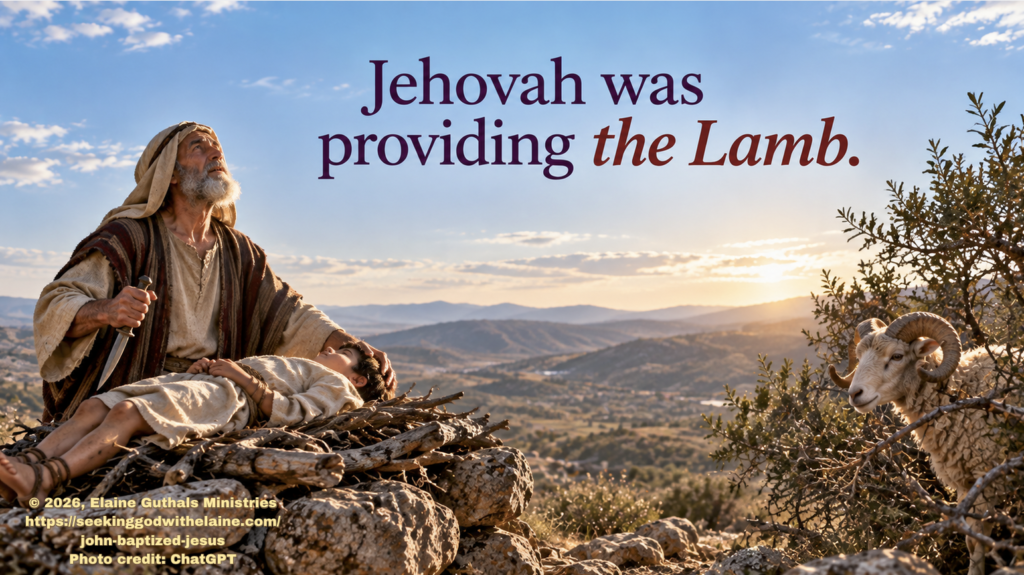
    The Passover lamb was a special lamb, called the Paschal Lamb. It represented deliverance. Its blood was associated with protection from judgment

    The Paschal Lamb was to be without defect, according to Exodus 12.

    Who Takes Away the Sin of the World!

    Unlike the Paschal Lamb, the sacrifice of the Lamb of God did something about sin.

    The Greek word used was airō (αἴρω) — to take up, remove, or carry away. The sacrificial lamb was to provide a way for them to deal with sin and restore the covenant relationship.

    By calling Yeshua the Lamb of God, John was putting Yeshua smack-dab in the middle of the sacrificial framework.

    He Is the One

     John verified that what he had told them the day before was true because the One he spoke of was there.

    There are times when we have to wait for Jehovah’s promises to come true. That day wasn’t one of those times.

    John told his listeners that the Messiah was coming soon. The next day was soon.

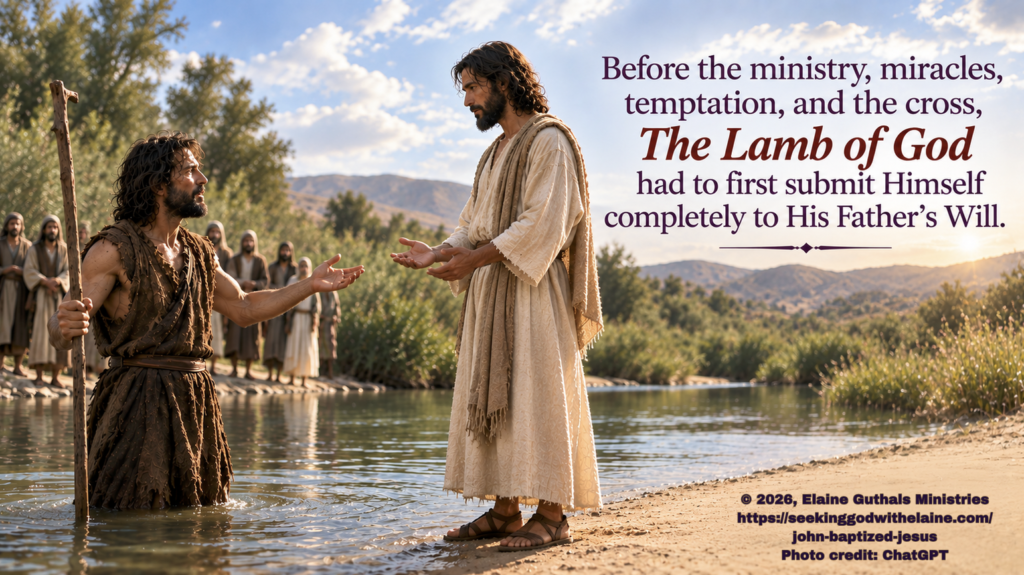
    John Baptized Jesus

    “Then Jesus went from Galilee to the Jordan River to be baptized by John. But John tried to talk him out of it. ‘I am the one who needs to be baptized by you,’ he said, ‘so why are you coming to me?’ But Jesus said, ‘It should be done, for we must carry out all that God requires.’ So John agreed to baptize him. After his baptism, as Jesus came up out of the water, the heavens were opened and he saw the Spirit of God descending like a dove and settling on him. And a voice from heaven said, ‘This is my dearly loved Son, who brings me great joy’” (Mt. 3: 13-17 NLT)

    “One day Jesus came from Nazareth in Galilee, and John baptized him in the Jordan River. As Jesus came up out of the water, he saw the heavens splitting apart and the Holy Spirit descending on him like a dove. And a voice from heaven said, “You are my dearly loved Son, and you bring me great joy” (Mk. 1: 9-11 NLT)

    “One day when the crowds were being baptized, Jesus himself was baptized. As he was praying, the heavens opened, and the Holy Spirit, in bodily form, descended on him like a dove. And a voice from heaven said, ‘You are my dearly loved Son, and you bring me great joy’” (Lk. 3: 21-22 NLT)

     Went from Nazareth in Galilee to the Jordan River

    Jesus’ baptism occurred at the beginning of His ministry.

    Mark was a little more specific in his details than Matthew was. He gave us more information as to where Yeshua had been and where he was going

    • “Then Jesus went from Galilee to the Jordan River …” (Mt. 3: 13 NLT).
    • “One day Jesus came from Nazareth in Galilee … baptized in the Jordan River” (Mk. 1: 10 NLT).
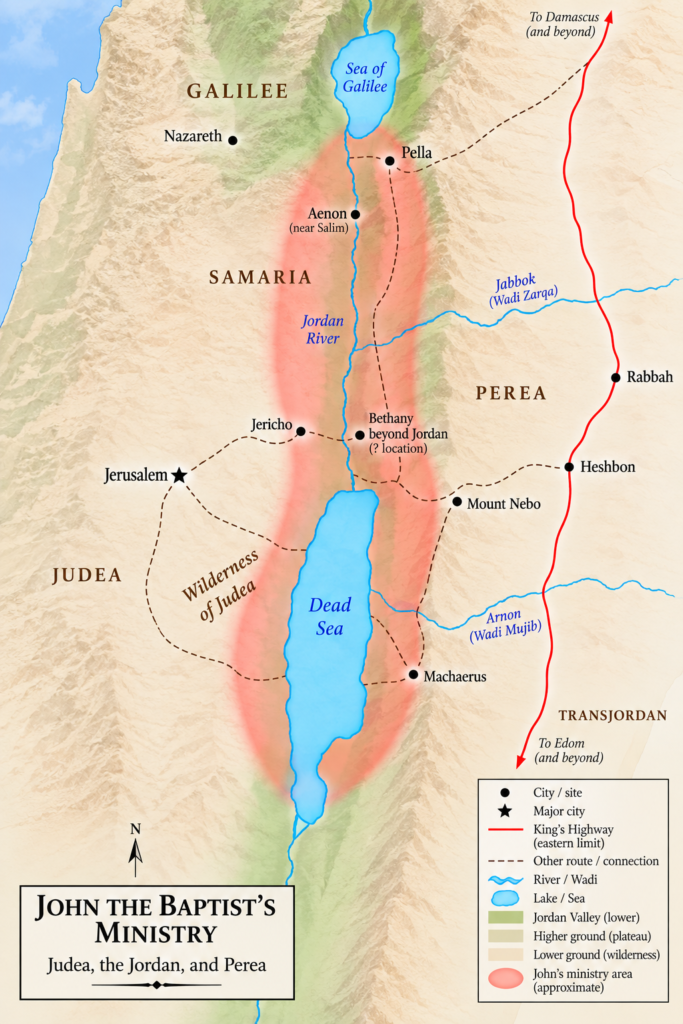
    Why is it important to know specifics? Sometimes, it helps put things into context.

    “When Jesus heard that John had been arrested, he left Judea and returned to Galilee. He went first to Nazareth, then left there and moved to Capernaum, beside the Sea of Galilee, in the region of Zebulun and Naphtali” (Mt. 4: 12-13 NLT).

    We know that the baptism was before the temptation (Mt. 4: 1-11). We also know that it was before Yeshua moved His base of operations to Capernaum.

    Why is that important? It reads that the first thing Yeshua did before anything else was to be obedient in baptism.

    John Tried to Talk Him Out of It

    John couldn’t see the need to baptize Yeshua because it was a baptism of repentance.

    Matthew told us that John pushed back against the need of his baptizing Yeshua. He could not see where Someone Who hadn’t sinned needed the baptism of repentance.

    Well, John wasn’t wrong. Yeshua hadn’t sinned.

    But remember, John wasn’t offering a baptism tied to salvation. He was baptizing people to restore covenant faithfulness.

    That is two different things.

    But Yeshua said it emphasized the need to fulfill all righteousness.

    Think about it. Yes, Yeshua came to fulfill covenant promises – but that wasn’t all.

    Yeshua came to be the sacrifice for our sins. He paid the penalty for what happened in the Garden of Eden on down.

    Yeshua didn’t sin, but He took on the capacity to sin when He took human form. If He hadn’t, His sacrifice would have meant nothing.

    John saw Yeshua as the spotless Lamb of God. To him, that meant no baptism was necessary.

    To Yeshua, He was setting the example.

    What God Requires

    Yeshua set the example because baptism is required – but required for what?

    Yeshua told John that baptism is required by Jehovah. But what did He mean?

    This was a way in which Yeshua identified with those He came to save. This was another way in which prophecy was fulfilled.

    “He was counted among the rebels. He bore the sins of many and interceded for rebels” (Isa. 53: 12 NLT).

    We’ve already talked about how Yeshua came in obedience. Yeshua didn’t come down here with a plan of His own.

    The plan being worked was the Plan of Salvation. It was designed totally by Jehovah. He figured out a way to reconcile us to Himself.

    Yeshua agreed to implement the plan.

    But look at it this way. John’s mission was to prepare the way by calling Israel back to obedience to Jehovah.

    Yeshua deliberately submitted to John’s baptism because John was carrying out his assignment from Jehovah.
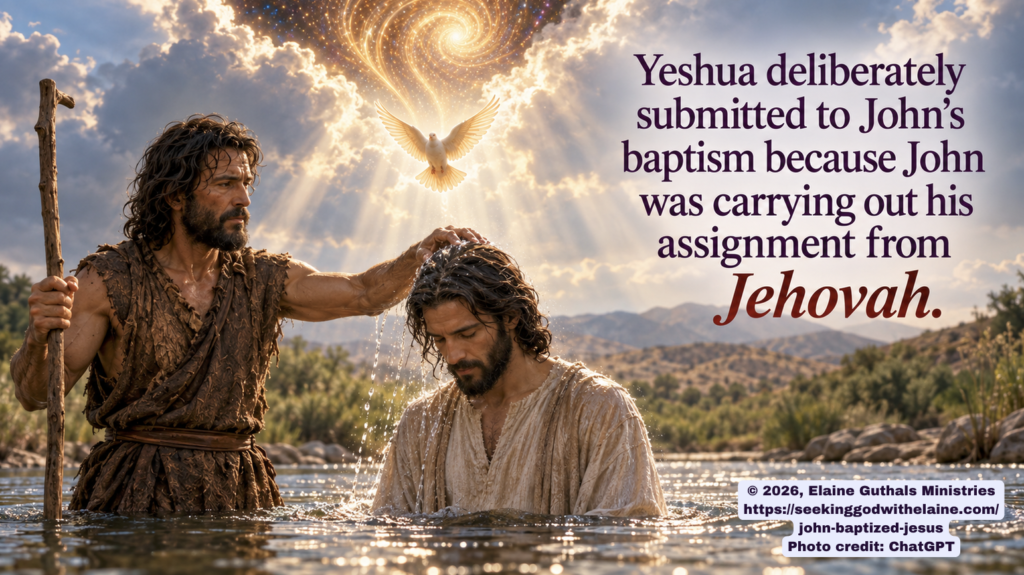
    Nowhere else in Scripture are we told that John and Yeshua got together for anything. There was no family get-together – remember they were cousins. They didn’t strike out together for Yeshua to preach and John to baptize.

    This was the one time that their ministries collided. Yeshua wasn’t going to bypass Jehovah’s appointed way at the beginning of His ministry.

    Besides, remember what John got to say? “Here is the Guy I was talking about yesterday.”

    Up until this time, there had been no public announcement of Who Yeshua was. Now, He was identified by the man most if not all knew was on a mission from Jehovah.

    But isn’t it more than that? Yeshua said so Himself.

    “Don’t misunderstand why I have come. I did not come to abolish the law of Moses or the writings of the prophets. No, I came to accomplish their purpose:” (Mt. 5: 17 NLT).

    Yeshua wasn’t saying it was about the act. He was saying it was about the submission.

    Isn’t that true? It isn’t about us doing the do’s and not doing the don’ts. It is about our relationship with Jehovah – which is characterized by our submission to Him.

    Before the ministry, miracles, temptation, and the cross, The Lamb of God had to first submit Himself completely to His Father’s Will.
    Heavens Splitting Apart

    The Plan of Salvation was designed to reestablish our access with Jehovah.

    Matthew and Luke said that the heavens opened. The Greek word used was the verb is related to anoigō (ἀνοίγω) – to open, to unlock, or to make accessible.

    Yeshua’s mission was exactly that – to make Jehovah accessible again to His children. It also allowed those who were not yet His children an opportunity to become so.

    Mark gave more of a violent description — “… he saw the heavens splitting apart …” (Mk. 1: 10 NLT). At a minimum, it sounds dramatic.

    The Greek word here was schizō (σχίζω). It means to split, tear, or rend apart.

    But The Complete Jewish Study Bible said it was just that. The being torn apart harkend back to the creation of the universe.

    Resource

    The Hebrew thought behind this was baqaʿ (בָּקַע) – to split, cleave, break open, or tear apart. It is simply more than the opening of something.

    Baqaʿ paints the imagery that something that was closed or separated was forcefully broken  open.

    What first jumped into my mind was the splitting of the veil. “Then Jesus shouted out again, and he released his spirit. At that moment the curtain in the sanctuary of the Temple was torn in two, from top to bottom. The earth shook, rocks split apart, and tombs opened. The bodies of many godly men and women who had died were raised from the dead” (Mt. 27: 50-52 NLT).

    Put all that together. At the beginning of Yeshua’s ministry, Jehovah opened up the opportunity for people to come to believe in Yeshua. It was only at the end of His ministry – when the Lamb had been sacrificed – that the then-current sacrificial system was no longer needed because the Lamb had been sacrificed.

    Jehovah was answering Israel’s prayer. “Oh, that you would burst from the heavens and come down! How the mountains would quake in your presence!” (Isa. 64: 1 NLT).

    More importantly, Jehovah was opening up something that had been closed since the Garden of Eden. He was finally allowing access again to Himself.

    Voice and a Dove

    The Voice was present to show that Jehovah was the One doing the sending, and the dove was present to identify the work of the Holy Spirit.

    A Voice was heard, and a dove descended, meaning all Three of the Trinity were present.

    Matthew presents the words of the voice in the third person. Mark and Luke use the second person. Was it a public declaration or a direct address?

    But it was more than that.

    The Voice from Heaven would have been considered by first-century Jews as divine testimony. Jehovah Himself was weighing in on Who this Person was.

    They would have seen the dove as anointing imagery.

    Think about it. Yeshua submits Himself to Jehovah’s Will, and Jehovah immediately responds.

    And the message was very important.

    This Is My Son

     The Jews would have known Israel as Jehovah’s son.

    “The king proclaims the Lord’s decree: ‘The Lord said to me, “You are my son. Today I have become your Father”’” (Ps. 2: 7 NLT).

    The Israelites were His children. But they missed verse 6. “For the Lord declares, ‘I have placed my chosen king on the throne in Jerusalem, on my holy mountain’” (Ps. 2: 6 NLT).

    They thought this referred to David. In reality, it also referred to David’s Descendant. This was one of the Messianic expectation verses.

    Jehovah made a specific proclamation here – and He was doing it in covenant language.

    In Matthew, Jehovah introduced Yeshua to Israel. In Mark and Luke, He spoke directly to Him.

    In Whom I Delight

    The Complete Jewish Bible has the wording a little different. “then a voice came from heaven, ‘You are my Son, whom I love; I am well pleased with you’” (Mk. 1: 11 CJB).

    This is closer to the Hebrew, in my opinion. This reminds us of what Jehovah said to Abraham. “Take your son, your only son — yes, Isaac, whom you love so much …” (Gen. 22: 2 NLT).

    Your son, your only son, whom you love. My Son, whom I love, with Whom I am pleased.

    “Look at my servant, whom I strengthen. He is my chosen one, who pleases me. I have put my Spirit upon him. He will bring justice to the nations” (Isa. 42: 1 NLT).

    The Holy Spirit came down in the form of a dove and landed upon Him. He  was empowering Yeshua for His mission.

    John Recognized Jesus

    “‘I did not recognize him as the Messiah, but I have been baptizing with water so that he might be revealed to Israel.’ Then John testified, ‘I saw the Holy Spirit descending like a dove from heaven and resting upon him. I didn’t know he was the one, but when God sent me to baptize with water, he told me, “The one on whom you see the Spirit descend and rest is the one who will baptize with the Holy Spirit.” I saw this happen to Jesus, so I testify that he is the Chosen One of God’” (Jn. 1: 31-34 NLT)

    John’s account of the baptism was a little different from the other Gospels because it was a testimony, not a first-hand description of the event.

    Okay. These guys were cousins. Both moms knew from before conception who they would turn out to be.

    Elizabeth didn’t say anything to John?????? Did Yeshua know?

    John was looking to Jehovah to give him a sign. Ooo baby, did He ever!

    Remember, the dove settled on Yeshua. It didn’t just touch down and fly away.

    It came to roost on Him.

    “And the Spirit of the Lord will rest on him — the Spirit of wisdom and understanding, the Spirit of counsel and might, the Spirit of knowledge and the fear of the Lord” (Isa. 11: 2 NLT).

    Even if Mary and Elizabeth had told John what was what, he still needed to hear it from Jehovah. Jehovah had to call him personally to the ministry.

    John could have said, “Sorry. Don’t like the wilderness. Allergic to locust. Who would be caught dead in camel hair?”

    John was human – he could have come up with any number of excuses. He didn’t.

    Making the Connections

    We see Jehovah, Yeshua, and the Holy Spirit working together. Jehovah speaks. The Spirit descends. Yeshua stands.

    Jehovah created the Plan of Salvation. Yeshua implemented it and carried it out. The Holy Spirit works within us to convict us to accept the gift of salvation.

    Heart Check

    Think about the battle Yeshua is engaged in for your heart. Ask yourself the following questions.

    • Am I willing to submit to Jehovah even when I don’t fully understand what He is doing?
    • Do I sometimes focus more on doing the right things than on having a heart that is submitted to Jehovah?
    • When Jehovah asks me to do something, do I look for reasons why I shouldn’t—or do I trust Him enough to obey?
    • Am I willing to follow Jehovah’s appointed way, even when it isn’t the way I would have chosen?
    • What is Jehovah asking me to surrender to Him right now?

    Resource

    How Do We Apply This?

    • Submit before we understand.
    • Don’t confuse obedience with relationship.
    • Respect the assignment Jehovah has given others.
    • Remember that obedience may be preparation for what comes next.
    • Look for Jehovah’s work in the obedience.

    Father God. Above all, You ask us to be obedient to You and submit ourselves to Your Will. Give us clarity so that we may do that. Amen.

    If you don’t understand something and would like further clarification, please contact me.

    If you have not signed up for the email providing the link to the devotions and the newsletter, do so below.

    If God has used this devotion to speak with you, consider sharing it on social media.
  • Someone Else Is Coming

    John understood his mission. This devotional reading looks at how John knew he was preparing the way for Someone else.

    Nuggets

    • When asking what right did John have to baptize people, the cultural expectation would be that John would provide a name of the rabbi under which he studied.
    • John knew the limitations of his baptism.
    • John was rock solid in his job of preparing the way for the Messiah.
    • In fact, John knew that his position was so far below the Messiah’s that he didn’t consider him worthy enough to be His slave.
    • The spirit signifies renewal, and the fire signifies refinement or destruction.
    • Those who are holy and righteous will be separated from those who are unholy and unrighteous.

    We are lucky. We look at things that already happened. First-century Jews didn’t have that luxury.

    John knew of his mission. Others didn’t.

    That led to John having to explain his mission to others.

    Let’s Put It into Context

    To read devotions in The Battle for the Heart theme

    Devotions in the The Ministry of John the Baptist series

    Someone Else Is Coming

    “I baptize with water those who repent of their sins and turn to God. But someone is coming soon who is greater than I am — so much greater that I’m not worthy even to be his slave and carry his sandals. He will baptize you with the Holy Spirit and with fire. He is ready to separate the chaff from the wheat with his winnowing fork. Then he will clean up the threshing area, gathering the wheat into his barn but burning the chaff with never-ending fire.”” (Mt. 3: 11-12 NLT)

    “John announced: ‘Someone is coming soon who is greater than I am — so much greater that I’m not even worthy to stoop down like a slave and untie the straps of his sandals. I baptize you with water, but he will baptize you with the Holy Spirit!’” (Mk. 1: 7-8 NLT)

    “Everyone was expecting the Messiah to come soon, and they were eager to know whether John might be the Messiah. John answered their questions by saying, ‘I baptize you with water; but someone is coming soon who is greater than I am — so much greater that I’m not even worthy to be his slave and untie the straps of his sandals. He will baptize you with the Holy Spirit and with fire. He is ready to separate the chaff from the wheat with his winnowing fork. Then he will clean up the threshing area, gathering the wheat into his barn but burning the chaff with never-ending fire’ John used many such warnings as he announced the Good News to the people” (Lk. 3: 15-18 NLT)

    “Then the Pharisees who had been sent asked him, ‘If you aren’t the Messiah or Elijah or the Prophet, what right do you have to baptize?’ John told them, ‘I baptize with water, but right here in the crowd is someone you do not recognize. Though his ministry follows mine, I’m not even worthy to be his slave and untie the straps of his sandal.” This encounter took place in Bethany, an area east of the Jordan River, where John was baptizing” (Jn. 1: 24-28 NLT)

    What Right Do You Have to Baptize?

    When asking what right did John have to baptize people, the cultural expectation would be that John would provide a name of the rabbi under which he studied.

    The Pharisees weren’t really asking John why he did what he was doing. They were asking who have him permission – who gave him authority – do baptize.

    Rabbis in first-century Israel taught disciples by interpreting Scripture and tradition. Some rabbis had more authority than others. That authority would carry forward to their students.

    No, we aren’t told that John studied under a rabbi. I would say that was because he didn’t.

    That concept would be foreign to the Pharisees. Why would John be baptizing if no one taught him?

    John answered their question truthfully. “My authority comes from the One Who comes after me. I am preparing the way for the Anointed One – the King Messiah (Melech HaMoshiach – מֶלֶךְ הַמָּשִׁיחַ).

    John’s authority came from Jehovah’s commission. He was “… the voice of someone shouting, ‘Clear the way through the wilderness for the Lord! Make a straight highway through the wasteland for our God’!” (Isa. 40: 3 NLT).

    The Gospel of John hooked this question on to the ones about whether John the Immerser was the Messiah, Elijah, or the prophet of which Moses spoke.

    I Baptize with Water

    John knew the limitations of his baptism.

    Just as John knew what his position was, he understood what his baptism did. He baptized with water. It was an outward expression.

    John knew that it was a symbol of obedience rather than a reception of inward grace.

    Some see baptism as a part of the salvation process – a completion of our asking Jehovah to forgive us of our sins. John wouldn’t have seen it that way.

    John knew he was called to prepare people. He was not completing the work.

    The call John was raising was to turn around their lives and be baptized as an outward expression of that repentance. He knew that the spiritual transformation had to come from the Messiah.

    John knew exactly where his ministry stood. He knew its scope and position in the plan Jehovah was working out.

    Someone Is Coming

    John was rock solid in his job of preparing the way for the Messiah.

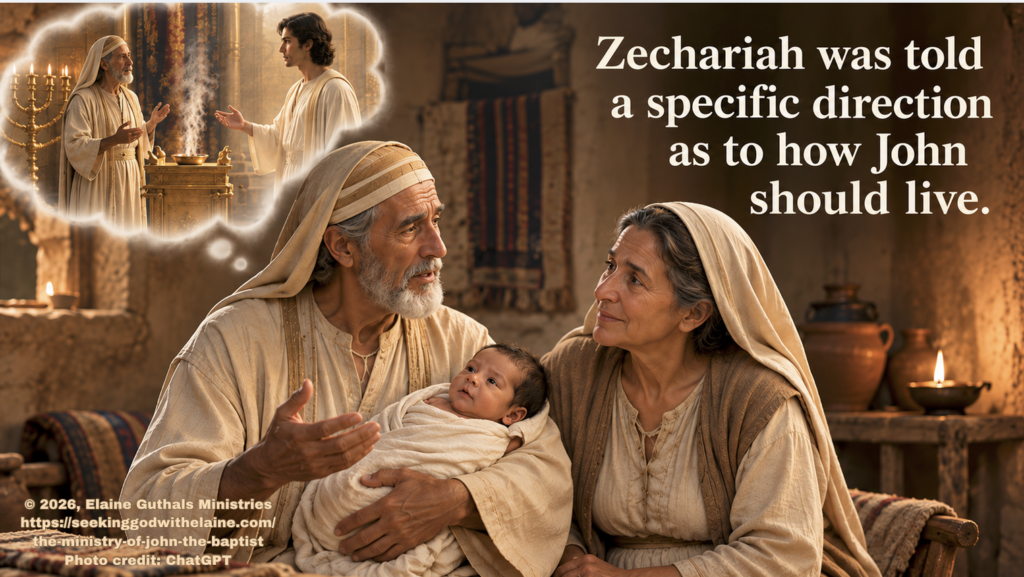
    From the time Zechariah and Elizabeth were told were going to have a son, they knew he was called to have a special job in the Kingdom of God. He was going to prepare the way for the promised Messiah.

    John was sure in what he was called to do. We do not see any mention in the gospels that he doubted that calling.

    True, there was one time when John questioned Yeshua to make sure He was the Messiah (Mt. 11: 2-19). Part of those doubts could have been precipitated because of the Messianic expectation that all prisoners would be freed.

    “The Spirit of the Sovereign Lord is upon me, for the Lord has anointed me to bring good news to the poor. He has sent me to comfort the brokenhearted and to proclaim that captives will be released and prisoners will be freed” (Isa. 61: 1 NLT).

    Still, John knew his place within the plan. He was to start the discussion about the appearance of the Messiah. Then he was to back off and let Him have His ministry.

    “He must become greater and greater, and I must become less and less” (Jn. 3: 30-35 NLT).

    Not Worthy Even to be His Slave

    In fact, John knew that his position was so far below the Messiah’s that he didn’t consider him worthy enough to be His slave.

    Servants or usually the lowest slave were assigned to wash a visitor’s feet. They had to take the sandal off first.

    Draw the picture in your mind. The visitor is either standing or sitting. Either way the servant has to basically get on the floor to perform the task.

    This signifies the social significance. The servant was placing himself beneath the person whose feet was being washed.

    Think what John was saying. “I’m not worthy of completing Step 1, let alone Steps, 2, 3, and 4.”

    Yes, John was saying the Messiah was above him. But he was also saying that he was at the absolute bottom of the social hierarchy.

    Baptize You with the Holy Spirit and with Fire

    The spirit signifies renewal, and the fire signifies refinement or destruction.

    The renewal goes back to Ezekiel. “Then I will sprinkle clean water on you, and you will be clean. Your filth will be washed away, and you will no longer worship idols. And I will give you a new heart, and I will put a new spirit in you. I will take out your stony, stubborn heart and give you a tender, responsive heart. And I will put my Spirit in you so that you will follow my decrees and be careful to obey my regulations” (Ezek. 36: 25-27 NLT).

    Maclaren helped us to understand the connection between water and fire. He wrote, “Baptism with the Holy Ghost is not one thing and baptism with fire another, but the former is the reality of which the latter is the symbol.”

    Resource

    .At first glance, we may think this means baptism by immersion – like John did – and the separation at the end of the age. “And anyone whose name was not found recorded in the Book of Life was thrown into the lake of fire” (Rev. 20: 15 NLT).

    But it is more than that, isn’t it? We are refined in the fire. “So be truly glad. There is wonderful joy ahead, even though you must endure many trials for a little while. These trials will show that your faith is genuine. It is being tested as fire tests and purifies gold — though your faith is far more precious than mere gold. So when your faith remains strong through many trials, it will bring you much praise and glory and honor on the day when Jesus Christ is revealed to the whole world” (I Pet. 1: 6-7 NLT).

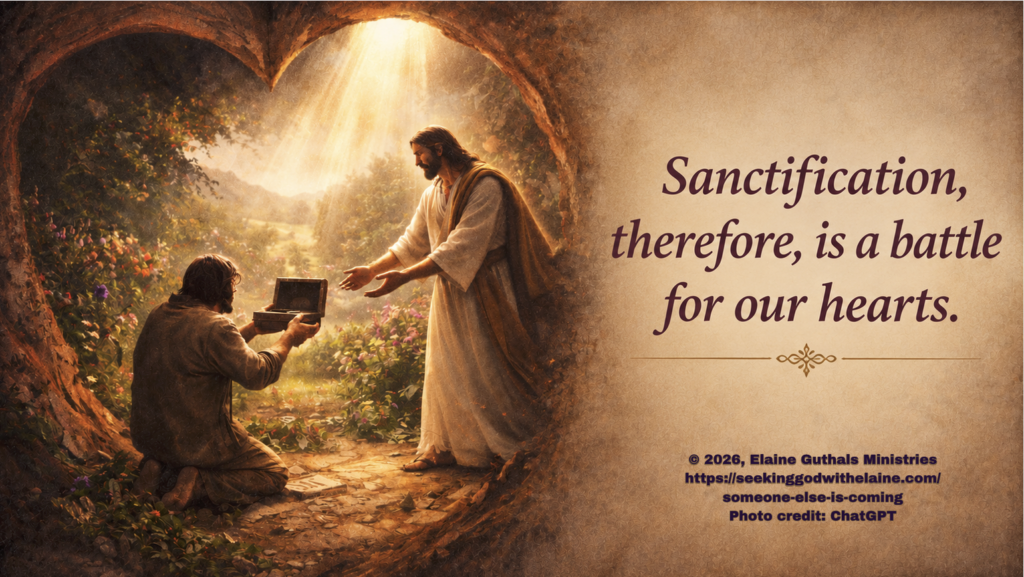
    Baptism by fire purifies and is part of the sanctification process. We are refined to better reproduce Jehovah’s character in our hearts.

    Sanctification, therefore, is a battle for our hearts.

    The fire also heats our hearts. It increases our enthusiasm.

    We can see how this prophecy was fulfilled on Pentecost. “On the day of Pentecost all the believers were meeting together in one place. Suddenly, there was a sound from heaven like the roaring of a mighty windstorm, and it filled the house where they were sitting. Then, what looked like flames or tongues of fire appeared and settled on each of them. And everyone present was filled with the Holy Spirit and began speaking in other languages, as the Holy Spirit gave them this ability” (Ac. 2: 1-4 NLT).

    Ready to Separate

    Those who are holy and righteous will be separated from those who are unholy and unrighteous.

    From the beginning of creation, Jehovah has been separating those who believe in His with those who don’t believe in Him. He chose Abel over Cain, Isaac over Ishmael, Jacob over Esau, David over his brothers – need we go on?

    Once Yeshua came, this separation became undeniable. We either ask Him to be a Savior and Redeemer – or we don’t.

    “There is salvation in no one else! God has given no other name under heaven by which we must be saved” (Ac. 4: 12 NLT).

    Eventually, there will come a time for judgment ad purification.

    At the end of the age, Yeshua will perform the final separation. “But when the Son of Man comes in his glory, and all the angels with him, then he will sit upon his glorious throne. All the nations will be gathered in his presence, and he will separate the people as a shepherd separates the sheep from the goats. He will place the sheep at his right hand and the goats at his left” (Mt. 25: 31-33 NLT).

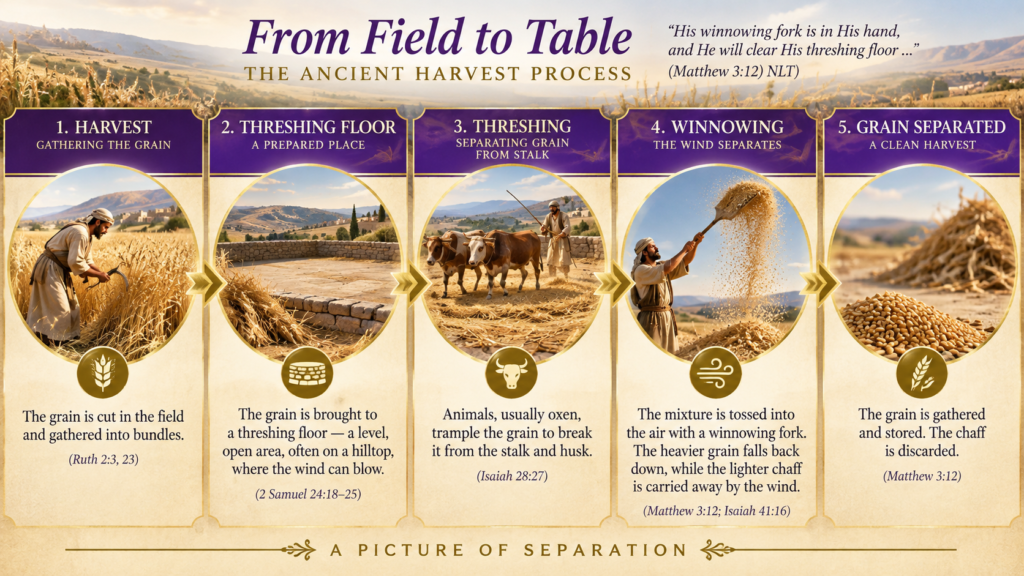
    The Threshing Floor, the Winnowing Fork, and the Wheat v. Chaff

    The harvest imagery is classic prophetic judgment language.

    We may think that John was referring to three different things when he was talking about the fork, the floor, and the wheat. He really isn’t. He was talking about one process.

    In first-century Israel, grain of wheat would be cut in the field. It would be brought to the threshing floor.

    The wheat seeds were threshed to loosen them from the stalk and husk. It would then be tossed in the air with the winnowing fork to separate the wheat from the chaff.

    Gathering but Burning

    Once the wheat is separated from the chaff, the wheat is gathered and stored while the chaff is burned.

    If you know anything about wheat harvesting, you know that it is a dusty, messy process – even with machinery. It would have been worse doing it manually with oxen.

    What would have been done with the output? The wheat would have been stored, and the chaff would have been burned.

    Isn’t that a wonderful illustration of what will happen in the final judgment? Believers will live for eternity with Jehovah. Non-believers will be thrown in the lake of fire.

    Making the Connections

    Think about John’s character. Curteis helped us with this.

    • John was faithful and unselfish.
    • He was loyal.
    • He wasn’t afraid to ask for clarification when he doubted.
    • John was quick to rebuke sin.
    • He was humble.

    Resource

    This is the man who said, “I am not worthy to even take the shoes off your feet.”

    Heart Check

    Think about the battle Yeshua is engaged in for your heart. Ask yourself the following questions.

    • Am I willing to let Yeshua become greater in my life while I become less?
    • Have I confused an outward act of obedience with genuine inward transformation?
    • Am I more concerned with my position and importance than with faithfully doing the work Jehovah has given me?

    How Do We Apply This?

    • Know your assignment.
    • Let Yeshua transform your heart. .
    • Welcome the refining fire.
    • Become less so Yeshua can become greater.
    • Stay ready.

    Father God. Thank You for John, who came to prepare the way. Thank You for Yeshua, Who came as Your Light.Amen.

    If you don’t understand something and would like further clarification, please contact me.

    If you have not signed up for the email providing the link to the devotions and the newsletter, do so below.

    If God has used this devotion to speak with you, consider sharing it on social media.
  • Questions from John the Baptist’s Audience

    John taught large audiences in the wilderness. This devotional reading looks at how he responded to some of their questions.

    Nuggets

    • John the Immerser’s testimony was clear.
    • The Jews were looking for a King Messiah (Melech HaMoshiach – מֶלֶךְ הַמָּשִׁיחַ), but not the Messiah that came.
    • Some in John’s audience thought he was the prophet Elijah come back from the dead.
    • John was questioned whether he was the prophet they were to expect.
    • The last thing we should do is read this to mean, “What should we do to be saved?”
    • We see from these verses that a diverse population came to listen to John.

    John interacted with his audience. He wanted to ensure that they understood his message.

    Let’s Put It into Context

    To read devotions in The Battle for the Heart theme

    Devotions in the The Ministry of John the Baptist series

    Identify Yourself

    “This was John’s testimony when the Jewish leaders sent priests and Temple assistants from Jerusalem to ask John, ‘Who are you?’ He came right out and said, ‘I am not the Messiah.’ ‘Well then, who are you?’ they asked. ‘Are you Elijah?’ ‘No,’ he replied. ‘Are you the Prophet we are expecting?’ ‘No.’” (Jn. 1: 19-21 NLT)

    John’s Testimony

    John the Immerser’s testimony was clear.

    The Greek word used for testimony is martyria. Along with testimony, it also means record or witness — as used in John 1: 7-8.

    But the Greek loses the Hebrew flavoring. The Hebrew word is edut (דוּת), meaning testimony, witness, or evidence.

    Think about it. The Ark of the Covenant was frequently called the Testimony. It held the tables containing the Ten Commandments – the ten words – that were a fundamental part of the covenant.

    And here was John, standing on the banks of the Jordan River. John was not only the witness who testified to what Jehovah was about to do; his coming, his message, and his ministry were themselves evidence that the Kingdom of Heaven had drawn near.

    We know that – by John’s words – he was the bridge between Jehovah’s promise and His fulfillment of that promise.

    • Repent: “Repent of your sins and turn to God, for the Kingdom of Heaven is near …” (Mt. 3: 2 NLT).
    • Baptism: “I baptize with water those who repent of their sins and turn to God” (Mt. 3: 11 NLT).
    • Coming Messiah: “… But someone is coming soon who is greater than I am—so much greater that I’m not worthy even to be his slave and carry his sandals. He will baptize you with the Holy Spirit and with fire” (Mt. 3: 11 NLT).
    • Moral living: “… turn to God …” (Mt. 3: 2 NLT).
    • Preparation: “… for the Kingdom of Heaven is near” (Mt. 3: 2 NLT).
    • Humility: “He must become greater and greater, and I must become less and less” (Jn. 3: 30 NLT).

    Who Are You?

    The Jews were looking for a King Messiah (Melech HaMoshiach – מֶלֶךְ הַמָּשִׁיחַ), but not the Messiah that came.

    We have to think about the particulars surrounding John’s ministry. He was the first prophet in 400 years to have a message to give to the nation of Israel. This covenant silence had lasted 400 years.

    It was the message for which many had been waiting and watching. They had been waiting for thousands of years.

    So, it doesn’t mean we should bite on first-century Jews for wanting to make John the Messiah. They had been waiting so long for Messiah to come, and John was telling them it wasn’t him.

    John had the message right. “… ‘Look! The Lamb of God who takes away the sin of the world!’” (Jn. 1: 29 NLT).

    The message John was giving them was the next best thing. “I’m not the Messiah, but He is here now.

    John was the witness that the hour had come for the Messiah – Yeshua – to come.

    Are You Elijah?

    Some in John’s audience thought he was the prophet Elijah come back from the dead.

    We know in the Old Testament that some people were resurrected from the dead. Elijah did it himself (I Kgs. 17: 17-24). But this is talking about reincarnation.

    The Jews of John’s day had good reason to ask the question. It was talked about in the Old Testament, what they knew of as the Tanakh.

    • “‘Look! I am sending my messenger, and he will prepare the way before me. Then the Lord you are seeking will suddenly come to his Temple. The messenger of the covenant, whom you look for so eagerly, is surely coming,’ says the Lord of Heaven’s Armies” (Mal. 3: 1 NLT).
    • “Look, I am sending you the prophet Elijah before the great and dreadful day of the Lord arrives. His preaching will turn the hearts of fathers to their children, and the hearts of children to their fathers. Otherwise I will come and strike the land with a curse” (Mal. 4: 5-6 NLT).

    Well, they got it right, and they got it wrong.

    First-century Jews wouldn’t have believed in reincarnation (but then, the Sadducees didn’t believe in resurrection, either). Besides, like Enoch, Elijah didn’t die (II Kgs. 2: 11).

    They could have been expecting the real Elijah to come back in bodily form from Heaven. John said that wasn’t so.

    I can see why they thought John was Elijah. Their messages were pretty much the same: repent and turn back to Jehovah.

    The two men wore similar attire (II Kgs. 1: 8; Mt. 3: 4). They carried out their mission in the wilderness (Mt. 3: 1).

    What John had done was to come in the spirit of Elijah. “He will be a man with the spirit and power of Elijah. He will prepare the people for the coming of the Lord. He will turn the hearts of the fathers to their children, and he will cause those who are rebellious to accept the wisdom of the godly” (Lk. 1: 17 NLT emphasis added).

    I know. That isn’t exactly what Jesus said.

    • “And from the time John the Baptist began preaching until now, the Kingdom of Heaven has been forcefully advancing, and violent people are attacking it. For before John came, all the prophets and the law of Moses looked forward to this present time. And if you are willing to accept what I say, he is Elijah, the one the prophets said would come” (Mt. 11: 12-14 NLT).
    • “‘But I tell you, Elijah has already come, but he wasn’t recognized, and they chose to abuse him. And in the same way they will also make the Son of Man suffer.’ Then the disciples realized he was talking about John the Baptist” (Mt. 17: 12-13 NLT).

    No, Yeshua did not lie. John was a type of Elijah; however, the audience probably wouldn’t have accepted a no, but because that wasn’t the answer they wanted.

    Besides, Elijah came on the Mount of Transfiguration (Mt. 17: 1-3). But most people — not even all of the Apostles — knew that.

    Are You the Prophet

    John was questioned whether he was the prophet they were to expect.

    Wait! What?? There was someone else besides Elijah that they were expecting????

    Remember, the first-century Jews knew their Torah. They knew what Moses had said.

    “Moses continued, ‘The Lord your God will raise up for you a prophet like me from among your fellow Israelites. You must listen to him’” (Deut. 18: 15 NLT).

    No, Moses didn’t name names – worse luck. He just said someone is going to come.

    The only clue Moses did give was it was going to be someone like him.

    First-century Jews were expecting the Prophet Moses had said Jehovah would raise up — the prophet like Moses. And the New Testament identifies that expectation as ultimately fulfilled in Yeshua.

    “When the people saw him do this miraculous sign, they exclaimed, ‘Surely, he is the Prophet we have been expecting’” (Jn. 6: 14 NLT).
    “Then times of refreshment will come from the presence of the Lord, and he will again send you Jesus, your appointed Messiah. For he must remain in heaven until the time for the final restoration of all things, as God promised long ago through his holy prophets. Moses said, ‘The Lord your God will raise up for you a Prophet like me from among your own people. Listen carefully to everything he tells you.’ Then Moses said, ‘Anyone who will not listen to that Prophet will be completely cut off from God’s people” (Ac. 3: 20-23 NLT).

    In other words, they weren’t looking for some random prophet. They were asking about a specific prophet that Scripture told them to expect.

    They knew their prophecies. They didn’t know what the fulfillment was going to look like.

    Direction to the Crowds

    “The crowds asked, ‘What should we do?’ John replied, ‘If you have two shirts, give one to the poor. If you have food, share it with those who are hungry.’ Even corrupt tax collectors came to be baptized and asked, ‘Teacher, what should we do?’ He replied, ‘Collect no more taxes than the government requires.’ ‘What should we do?’ asked some soldiers. John replied, ‘Don’t extort money or make false accusations. And be content with your pay’” (Lk. 3: 10-14 NLT)

    What Should We Do?

    The last thing we should do is read this to mean, “What should we do to be saved?”

    John didn’t go there. He was talking covenant faithfulness, not salvation. John was talking preparation, not acceptance.

    If You Have

    We see from these verses that a diverse population came to listen to John.

    At first, Luke just mentioned people. Then, he mentioned groups.

    Luke didn’t identify his audience as Jew or Gentile. Instead, he talked about groups: specifically, tax collectors and soldiers.

    So, who exactly was Luke showing us came to John?

    If these soldiers were Roman soldiers, that would mean Gentiles were among John’s audience. That is possible.

    John wouldn’t have been in a building. Anyone walking along could have stopped to listen.

    We can’t, though, just assume these soldiers were Roman, not Jewish.

    Wait! What??? There were Jewish soldiers who jumped ship and went to Rome???

    Well, maybe.

    Let’s think this through. Luke used the word strateuomenoi (στρατευόμενοι). It simply means serving as soldiers or military personnel.

    It doesn’t give any indication of nationality.

    Rome controlled Israel. Would there still be Jewish soldiers? Would Rome have dismantled the army, or would they have merged them with their army?

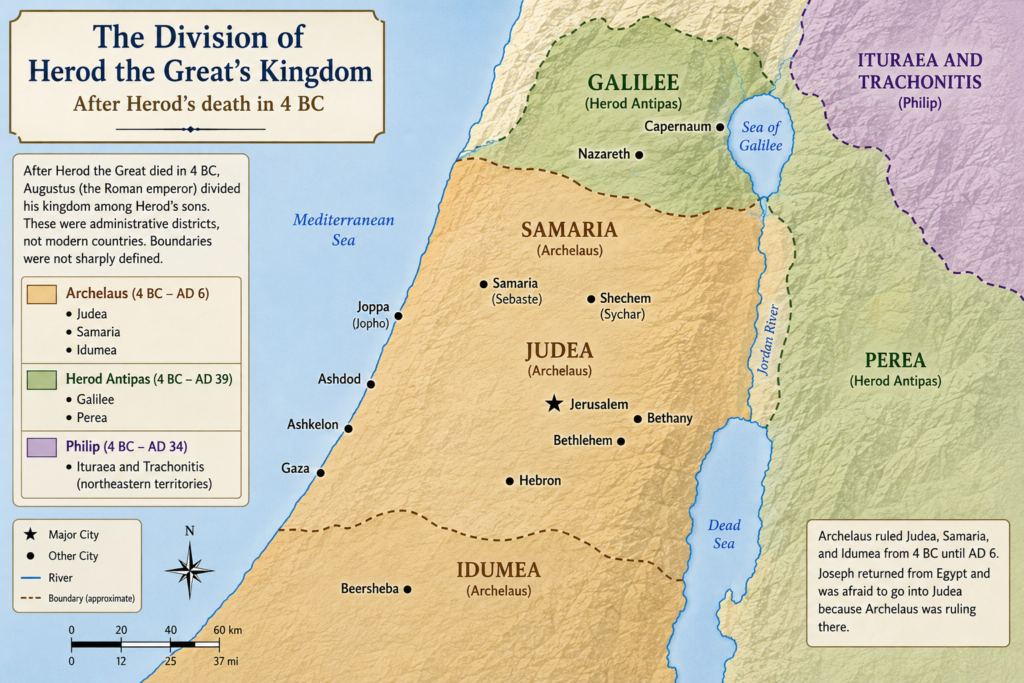
    We know from historical sources that Herod the Great had Jewish soldiers in his army. He was appointed king by Rome. What kind of soldiers were serving under Herod Antipas, and could they have been Jewish?

    We also have to remember where John was. He was in territory ruled by Herod Antipas.

    Let’s just stop there a second. First-century Jews hated the tax collectors because they considered them traitors.

    How much more would they consider those who could be fighting to free them from opposition but were working for the opposition?

    In truth, we can’t say that all of them were traitors. Some were probably serving because they were forced to do so.

    There were Jews who accommodated Rome, Jews who worked within Herodian administration, Jews who opposed Rome, and Jews whose position was somewhere in between.

    Still, they more than likely would have seen soldiers working for other military units as against Jewish independence.

    Jump to Luke 3: 15 a second. “Everyone was expecting the Messiah to come soon, and they were eager to know whether John might be the Messiah” (Lk 3: 15 NLT). Roman soldiers wouldn’t have been expecting a Jewish Messiah – if that verse is talking about this group of people. We see from these verses that a diverse population came to listen to John.

    It seems like Luke hasn’t combined sermons. He went on saying, “John answered their questions by saying …” (Lk. 3: 16 NLT).

    But that is talking about them asking about John being the Messiah. Luke doesn’t go into that as John did. Matthew and Mark just noted that John prepared the way for Yeshua.

    So, the question becomes: is Luke talking about one sermon or is he using his typical form of narrative summary?

    Does it really matter? We need to focus on the passage and see what we can learn from it.

    Luke gave us three groups of people: ordinary people, tax collectors, and soldiers.

    • John told the crowd that they were to share.
    • He told the tax collectors not to exploit their authority to take more than that to which they were entitled.
    • He told the soldiers not to use their physical power to shake down – diaseiō (διασείω) – someone to frighten them into paying money.

    Looking at this notwithstanding of who he was actually talking to, it looks like John was calling all to turn back to Jehovah regardless of their station in life.

    Making the Connections #1

    There is another connection between John and Elijah. Both were preparing the way for someone greater than themselves.

    We get that with John and Yeshua. We forget about that with Elijah and Elisha.

    The significance of Elisha asking for and receiving doesn’t always sink in. “When they came to the other side, Elijah said to Elisha, ‘Tell me what I can do for you before I am taken away.’ And Elisha replied, ‘Please let me inherit a double share of your spirit and become your successor’” (II Kgs. 2: 9 NLT).

    Elisha was talking about spirit and power, just like was said about John in Luke 1: 17. It was talking about spiritual authority and power to continue Jehovah’s work.

    But John is Elijah, and Yeshua is Elisha when talking about typology/spirit and ministry, not literal identity. “He must become greater and greater, and I must become less and less” (Jn. 3: 30 NLT).

    Making the Connections #2

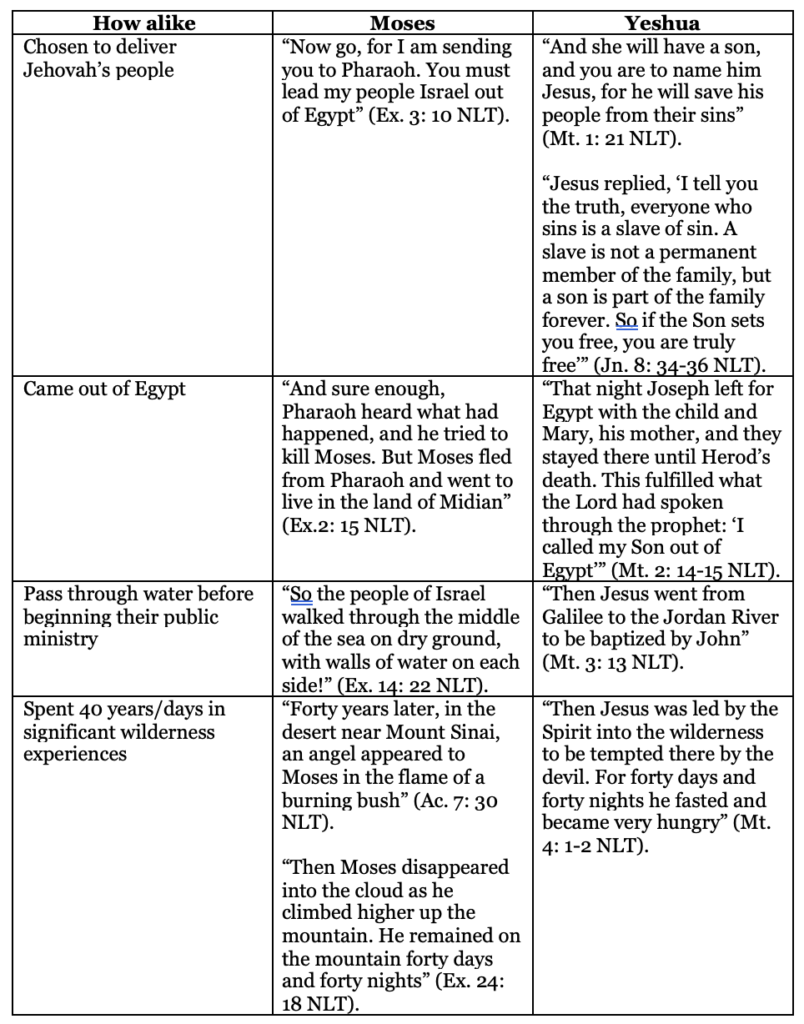
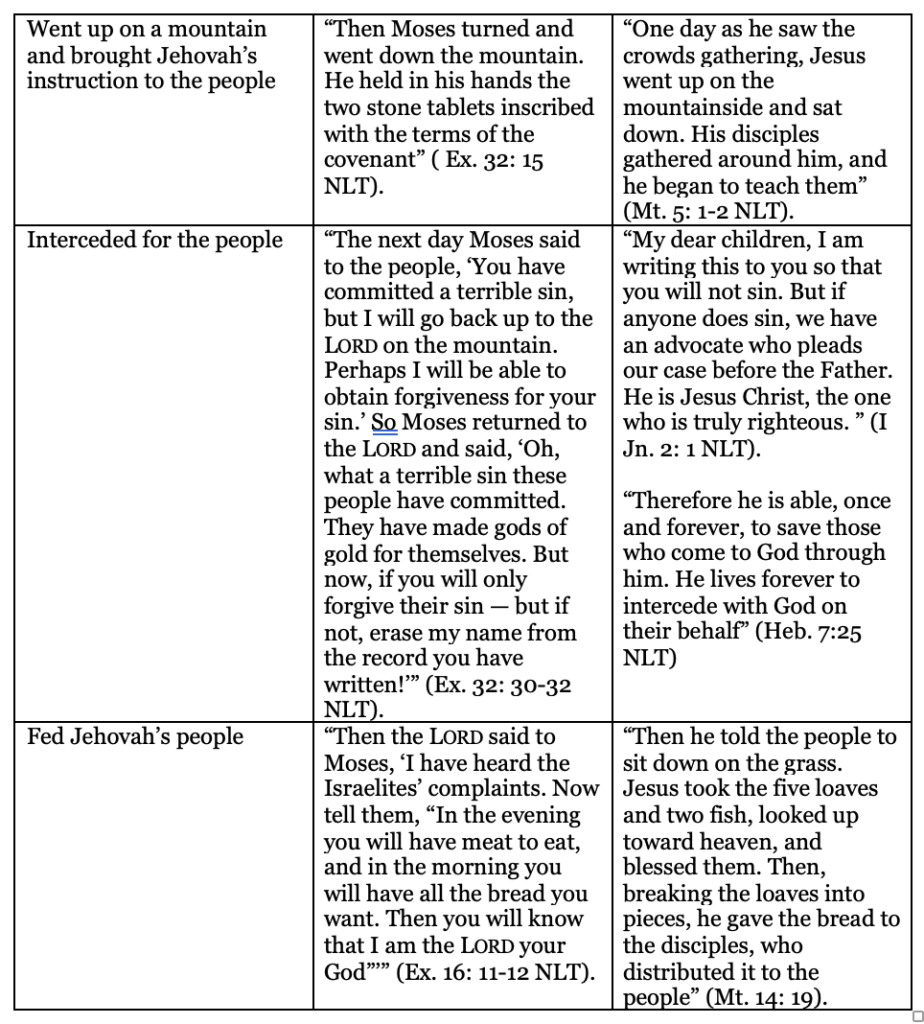
    Moses said that the prophet would be like him. So, how alike were Moses and Yeshua?

    Moses gave Israel bread from heaven – Yeshua identifies Himself as the true bread from heaven (Jn. 6: 32–35).

    Moses mediated the covenant at Sinai – Yeshua establishes the new covenant (Lk. 22: 20).

    Moses brought God’s instruction to Israel – Yeshua is God’s Word made flesh (Jn. 1: 1–14).

    Moses led Israel toward the Promised Land – Yeshua leads His people into the Kingdom of God.

    John’s audience wasn’t foolish for asking about “the Prophet.” They were reading their Scriptures and looking for the person Moses had said was coming. Their problem wasn’t that they were looking for fulfillment. Their problem was that they had not yet recognized what fulfillment would look like.

    Heart Check

    Think about the battle Yeshua is engaged in for your heart. Ask yourself the following questions.

    • Am I willing to let Jehovah show me what His promises actually look like, even when the fulfillment does not look the way I expected?
    • When Jehovah is doing something in my life, am I looking for Him—or am I looking for Him to do it my way?
    • If John were speaking directly to me today, what would repentance look like in my particular station in life?

    How Do We Apply This?

    • Know what Scripture says, but don’t decide in advance what fulfillment must look like.
    • Don’t become so focused on identifying the messenger that you miss the One being announced.
    • Repentance should change how we live, not merely what we believe.
    • Use whatever authority or position Jehovah has given you to serve rather than exploit others.
    • Ask what faithfulness looks like in the place where Jehovah has put you.
    • Be willing to become smaller when Yeshua must become greater.

    Father God. Thank You for showing us how John responded to his audience. Help us to evaluate ourselves so that we can respond in the way he instructed. Amen.

    If you don’t understand something and would like further clarification, please contact me.

    If you have not signed up for the email providing the link to the devotions and the newsletter, do so below.

    If God has used this devotion to speak with you, consider sharing it on social media.
  • John the Baptist’s Audience

    Many people from all around came to hear John the Baptist’s message. This devotional reading looked at who they were and some of their responses to his message.
     

    Nuggets

    • John’s audience consisted of Jewish people, not pagan Gentiles.
    • John’s message wasn’t just for his audience.
    • All who came to John were looking for Jehovah to do something.
    • Baptism wasn’t simply John’s version of a modern altar call.
    • The Jordan River was an important river in the history of Israel.
    • The Pharisees struggled with John’s message.
    • It was the Sadducees’ responsibility, though not always priests, to maintain the elements of Temple worship.
    • John loved to call the Pharisees and Sadducees names.
    • We don’t know for sure what John’s question was about.
    • Jehovah will judge us according to the condition of our hearts.
    • Their belief was their reliance on Abraham’s ancestry.
    • We prove that we are living the way Jehovah wants us to when we produce the fruit He wants.

    John the Immerser didn’t set up court in the Temple. His mission field was the wilderness.

    Still, John drew large crowds to hear him preach. Some came from miles away to hear the message.

    Not all liked what they heard, though.

    Let’s Put It into Context

    To read devotions in The Battle for the Heart theme

    Devotions in the The Ministry of John the Baptist series

    John’s Audience

    “People from Jerusalem and from all of Judea and all over the Jordan Valley went out to see and hear John. And when they confessed their sins, he baptized them in the Jordan River” (Mt. 3: 5-6 NLT)

    “All of Judea, including all the people of Jerusalem, went out to see and hear John. And when they confessed their sins, he baptized them in the Jordan River” (Mk. 1: 5 NLT)

    People from Jerusalem

    John’s audience consisted of Jewish people, not pagan Gentiles.

    More than just the priests resided in Jerusalem. Residents were also ordinary first-century Jews.

    It was those common people who also flocked to the Jordan River to see the prophet. More importantly, they were going to renew their relationships with Jehovah.

    Many probably would have questioned John’s message to them. Why was he calling covenant people to repentance?

    But then Jehovah repeatedly called Israel to repentance.   The prophets had warned Israel that merely possessing the covenant, the temple, circumcision, sacrifices, or ancestry did not make them faithful to Jehovah.

    John’s first-century audience would have seen this as a call to return to covenant faithfulness.

    All of Judea

    John’s message wasn’t just for his audience.

    When Matthew and Mark said all of Judea, they weren’t talking about just the people who came to the Jordan and heard his message. He was talking about every Jewish person everywhere.

    Jehovah was sending His salvation for all who would believe and obey.

    Judea is the mountainous southern region of Israel. Named after Jacob’s son Judah, it includes the key cities of Jerusalem, Bethlehem and Hebron.

    It was formed around 930 BC when the kingdom split into the Northern Kingdom of Israel and the Southern Kingdom of Judah.

    All Over the Jordan Valley

    All who came to John were looking for Jehovah to do something.

    Many people who came from all over believed that John’s message would be the beginning of Jehovah restoring Israel’s freedom from foreign oppression. They were ready for that.

    This belief would have been strengthened by the language John used. He talked through kingdom language.

    But they would have believed that John’s message was telling them that foreign domination and Gentile influence was going to be ending.

    Baptized

    Baptism wasn’t simply John’s version of a modern altar call.

    John was calling Israelites to undergo a baptism associated with repentance as they prepared for God’s coming intervention. That would have been a huge slap to many of the Jews in his audience.

    Don’t assume that being Jewish means you are automatically ready for what God is about to do.

    John was telling them to not put too much stake in family lineage. He was also telling them that going through the motions of religion wasn’t what Jehovah expected.

    Jehovah was interested in the condition of their hearts. Nothing has changed – He is still interested in the condition of our hearts.

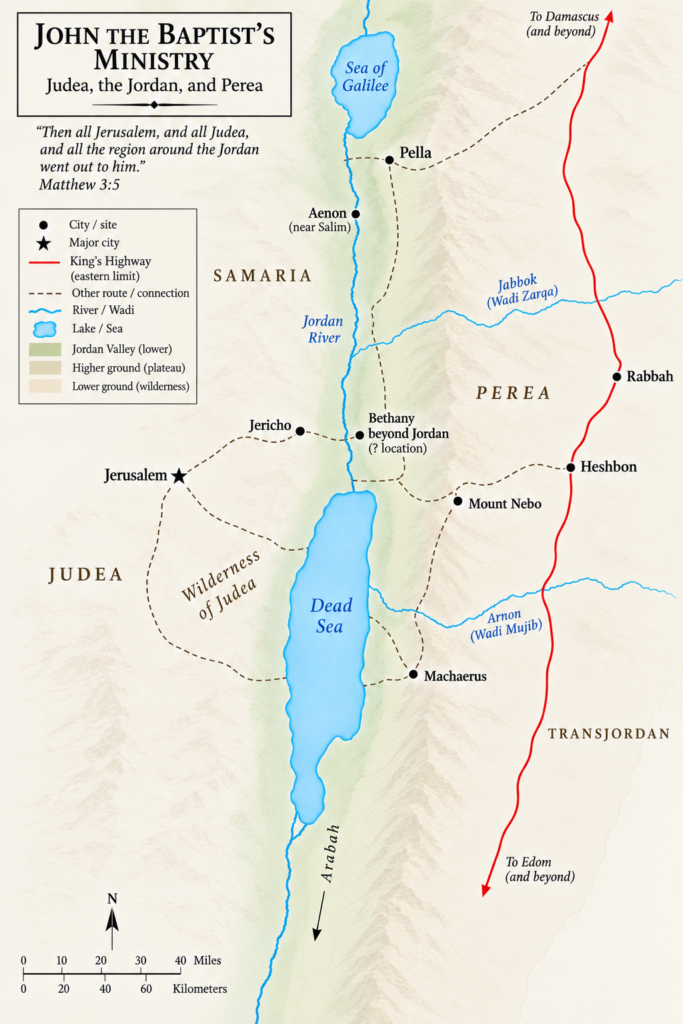
    Jordan River

    The Jordan River was an important river in the history of Israel.

    We tend to think that the Jordan River is the boundary of Israel. That is because it is described as crossing the Jordan River into the Promised Land.

    “The eastern boundary will start at Hazar-enan and run south to Shepham, then down to Riblah on the east side of Ain. From there the boundary will run down along the eastern edge of the Sea of Galilee, and then along the Jordan River to the Dead Sea. These are the boundaries of your land” (Num. 34: 10-12 NLT).

    That doesn’t mean the area east of the river – the Transjordan – wasn’t important. It was in that area that the tribes of Reuben, Gad, and the half tribe of Manasseh settled.

    The two and a half tribes were seen as refusing to enter the Promised Land. It was seen as the dividing line between faith in divine faithfulness and unbelief.

    I always thought it was fitting that Israelites’ wandering after their exodus was bookended between two miraculous events that showed the power of Jehovah. Just as He parted the Red Sea that ensured their departure, He parted the Jordan for their entrance.

    Questioned by the Religious Leaders

    “But when he saw many Pharisees and Sadducees coming to watch him baptize, he denounced them. ‘You brood of snakes!’ he exclaimed. ‘Who warned you to flee the coming wrath? Prove by the way you live that you have repented of your sins and turned to God. Don’t just say to each other, “We’re safe, for we are descendants of Abraham.” That means nothing, for I tell you, God can create children of Abraham from these very stones. Even now the ax of God’s judgment is poised, ready to sever the roots of the trees. Yes, every tree that does not produce good fruit will be chopped down and thrown into the fire” (Mt. 3: 7-10 NLT)

    “When the crowds came to John for baptism, he said, ‘You brood of snakes! Who warned you to flee the coming wrath? Prove by the way you live that you have repented of your sins and turned to God. Don’t just say to each other, “We’re safe, for we are descendants of Abraham.” That means nothing, for I tell you, God can create children of Abraham from these very stones. Even now the ax of God’s judgment is poised, ready to sever the roots of the trees. Yes, every tree that does not produce good fruit will be chopped down and thrown into the fire’” (Lk. 3: 7-10 NLT)

    Pharisees

    The Pharisees struggled with John’s message.

    We tend to make the Pharisees into one of the villains, but we shouldn’t. They were doing what they thought Jehovah had called them to do.

    Pharisees weren’t priests. They didn’t have any role in the Temple system.

    What Pharisees were was a lay movement devoted to the careful study, preservation, instruction, and practice of the Law of Moses. That made them guardians of the law. They were the bridge between the Law of Moses and the people.

    Unfortunately, many Pharisees were keeping the Law in a way that had become detached from repentance, mercy, and inward change. They added to the Law that resulted in a distortion of the Law. Also, they elevated tradition over the Law.

    Sadducees

    It was the Sadducees’ responsibility, though not always priests, to maintain the elements of Temple worship.

    Known for their acceptance of the Torah as their primary authority, this powerful group read Scripture in a conservative way. Their desire was to preserve existing structures.

    Many collaborated with the Roman authorities to maintain their status. This made them appear to be more concerned with politics than religion. Many served in the Sanhedrin, gaining a majority in the highest court in Israel.

    Because of this accommodation with the Romans, common Jews didn’t relate to the Sadducees as they did the Pharisees. It didn’t help, either, that the Sadducees were upper class and wealthy – therefore, out of touch with the common Jewish people.

    You Snakes

    John loved to call the Pharisees and Sadducees names.

    Here, it was snakes. Yep, John did not cut them any slack. He called them on their sincerity.

    Sometimes translated as brood of vipers, John was calling them sons of serpents. He was referring to their legalism, hypocritical attitudes, and corruption.

    Shaan Sharma, who played Schmuel in The Chosen, had a really good observation. He said, “When we think of all of them [the Pharisees] all as a block and try to ascribe a quality  to them all like all Pharisees are bad or whatever, that just doesn’t make sense. Even the apostles did not fully understand what Jesus was trying to tell them.”

    Resource

    No, you and I can’t pass judgment on the genuineness of another’s salvation. That is only up to Jehovah.

    Pastors are to counsel their congregation when they see someone sinning. It is for the strength of the congregation.

    Who Warned You

    We don’t know for sure what John’s question was about.

    More than likely, John was asking a rhetorical question. He wasn’t looking for a name.

    If we look ahead, we may get a clue. Connect “Prove by the way you live …” (Mt. 3: 8 NLT) and “… we are descendants of Abraham …” (Mt. 3: 10 NLT).

    The who warned you isn’t as important as what makes you think you can escape it.

    Think about it. The Pharisees have shown up for baptism. And John was saying, “Wait a second. So, you know judgment is coming, too?”

    They know Jehovah’s judgment is coming. Their belief in Jehovah and Scripture wasn’t being questioned.

    But to answer the question, we can figure several possibilities. They were at the Jordan, so they heard John’s preaching. That means they recognized the prophetic significance of him.

    Their presence may have been sincere. We know some of the Pharisees did believe in Yeshua.

    We also know that not all did. John may have been exposing their insincerity.

    John could have been telling them that outward actions alone aren’t what Jehovah is after. He was saying reality has to be shown in our hearts.

    Jehovah looks for repentance, not self-righteousness.

    We must truly repent for salvation.

    Who Warned You

    We don’t know for sure what John’s question was about.

    More than likely, John was asking a rhetorical question. He wasn’t looking for a name.

    If we look ahead, we may get a clue. Connect “Prove by the way you live …” (Mt. 3: 8 NLT) and “… we are descendants of Abraham …” (Mt. 3: 10 NLT).

    The who warned you isn’t as important as what makes you think you can escape it.

    Think about it. The Pharisees have shown up for baptism. And John was saying, “Wait a second. So, you know judgment is coming, too?”

    They know Jehovah’s judgment is coming. Their belief in Jehovah and Scripture wasn’t being questioned.

    But to answer the question, we can figure several possibilities. They were at the Jordan, so they heard John’s preaching. That means they recognized the prophetic significance of him.

    Their presence may have been sincere. We know some of the Pharisees did believe in Yeshua.

    We also know that not all did. John may have been exposing their insincerity.

    John could have been telling them that outward actions alone aren’t what Jehovah is after. He was saying reality has to be shown in our hearts.

    Ax of God’s Judgment

    Jehovah will judge us according to the condition of our hearts.

    We may think the ax is the punishment for bad behavior. It isn’t.

    John is making use of prophetic imagery. We may not recognize it, but his audience did.

    The audience would have heard already laid at the root of the trees. They would have understood imminence.

    The woodcutter has already arrived, cutting off the opportunity for the Pharisees and Sadducees having even one more season to prove themselves. The ax is placed at the root. This isn’t a pruning. It is a fundamental failure of character.

    Tree imagery was often used in the Old Testament to represent people, rulers, nations – especially when Jehovah’s judgment was involved.

    They wouldn’t have seen this as a call to be a better person. They would have heard the language of the prophets – judgment is coming.

    Abraham Is Our Father

    Their belief was their reliance on Abraham’s ancestry.

    John said that being Abraham’s descendants alone wasn’t going to save them.

    I am sure the Pharisees were tripping over this. What I think it is saying is that Jehovah can make anyone a descendant of Abraham — Jews and Pharisees.

    Jehovah chooses how we are saved. He said it is only through belief and imitation of Yeshua. “There is salvation in no one else! God has given no other name under heaven by which we must be saved” (Ac. 4: 12 NLT).

    It is also Jehovah’s choice as to who is saved. He had long said that all people would be offered salvation (Gen. 12: 3).

    Prove by the Way You Live – Produce Good Fruit

     We prove that we are living the way Jehovah wants us to when we produce the fruit He wants.

    Okay, John was talking to the Pharisees, but he was telling them to produce fruit. I bet that went over like a led balloon.

    Remember, the Pharisees thought they were so righteous. But Yeshua was battling for their hearts.

    And Yeshua doesn’t pull punches.

    We see the word fruit, and we think of fruit of the spirit (Gal. 5: 22-23). That isn’t what is being discussed here.

    Producing fruit is the byproduct when we live a life that builds our relationship with Jehovah. Seeking Him, trusting Him, and abiding in Him result in righteousness.

    We have to prove our sincerity by walking with Jehovah.

    Making the Connections #1

    Conder gave us a physical description of the Jordan River. He wrote,

    “The Jordan rises as a full-grown river, issuing from the cave at Banihs, about 1,000 feet above the level of the Mediterranean …. In twenty-six and half miles, there is a fall of 1,682 feet, or more than sixty feet to the mile ….”

    Resource

    Making the Connections #2

    I have been puzzling over something since Yeshua was presented at the Temple. But we need to set some background first.

    It had been 400 years since Israel had a prophet. The last one had been Malachi.

    That is widely accepted.

    But when Yeshua was presented at the Temple, Anna was called a prophet. “Anna, a prophet, was also there in the Temple …” (Lk. 2: 36 NLT).

    How can they say they had no prophets if they recognized Anna as a prophet?

    Well, Anna’s role was different than John’s. She only appears in the Temple, waiting for and recognizing Yeshua. That was a single event that didn’t speak to the nation of Israel.

    John had a whole ministry in the wilderness. He was saying that Jehovah’s promised intervention was arriving.

    We also have to remember that Yeshua called John more than a prophet (Mt. 11: 11; Lk. 7: 28).

    The prophets of the Old Testament just proclaimed the arrival of the Messiah. John was saying, “He’s here.”

    Does that mean there could have been more prophets between Malachi and John? Possibly.

    It just means that prophetic forecasting was being accomplished through John’s message.

    John was the first great prophetic voice to arise in Israel’s wilderness since the days of the Old Testament prophets, and his ministry marked the long-awaited transition from prophetic anticipation to the arrival of the Messiah.

    Making the Connections #3

    John – and Yeshua – had to combat the Pharisees’ and Sadducees’ belief that being Abraham’s descendants was enough. Part of the reason was because the Messiah was fulfilling a covenant promise.

    They had trouble seeing that the promise was made long before the covenant was struck between Jehovah and Abraham. The promise wasn’t made to Abraham. He was just the vehicle through which the promise was fulfilled.

    Heart Check

    Think about the battle Yeshua is engaged in for your heart. Ask yourself the following questions.

    • Am I trusting Jehovah, or am I trusting my religious identity?
    • Am I genuinely repenting, or am I only going through religious motions?
    • Am I producing the fruit Jehovah wants, or am I producing the fruit I want?
    • Am I following Jehovah’s way, or am I relying on my own way?

    How Do We Apply This?

    • Ask Jehovah to reveal where we have become self-righteous.
    • Don’t use our heritage, church attendance, or religious service as evidence of salvation.
    • Take repentance seriously.
    • Let our actions demonstrate what we believe.
    • Prepare our hearts to follow Yeshua wherever He leads.

    Father God. Thank You for those who bring Your message to us. Help them to boldly tell us Your words that we need to hear. Help us to open our hearts so that Your message transforms us into who You want us to be. Amen.

    If you don’t understand something and would like further clarification, please contact me.

    If you have not signed up for the email providing the link to the devotions and the newsletter, do so below.

    If God has used this devotion to speak with you, consider sharing it on social media.
  • John the Baptist’s Mission

    John was given a specific job by Jehovah. This devotional reading looks at the ministry and message given to John.

    Nuggets

    • John’s mission was long and firmly established.
    • Voice is an interesting word that has many definitions.
    • It really wasn’t John’s mission.
      Luke is the only Gospel to repeat the complete passage from Isaiah.
    • If Luke was trying to quote Isaiah 40: 5, it seems like he missed the mark.
    • The wilderness was a place where Jehovah spoke and revealed Himself.
    • John’s task was to restore the nation’s relationship with Jehovah, awaken a community lost in indifference and unwillingness to repent, encourage repentance, announce that the Kingdom of Heaven was near, and introduce a new era.
    • We tend to see salvation as the acknowledgment of our personal sins.
    • More than just turning away from sin, we have to turn to Jehovah.
    • The concept of immersion was not a new idea.
    • The Kingdom of Heaven really wasn’t a place – it was a reign.

    It was known before John was born what he would do with his life. Jehovah had called him to prepare the way for Messiah.

    Let’s Put It into Context

    To read devotions in The Battle for the Heart theme

    Devotions in the The Ministry of John the Baptist series

    John’s Ministry Prophesied

    “The prophet Isaiah was speaking about John when he said, ‘He is a voice shouting in the wilderness, “Prepare the way for the Lord’s coming! Clear the road for him!”’ (Mt. 3: 3 NLT)

    “This is the Good News about Jesus the Messiah, the Son of God. It began just as the prophet Isaiah had written: ‘Look, I am sending my messenger ahead of you, and he will prepare your way. He is a voice shouting in the wilderness, “Prepare the way for the LORD’s coming! Clear the road for him!”’” (Mk. 1: 1-3 NLT)

    “Isaiah had spoken of John when he said, ‘He is a voice shouting in the wilderness, “Prepare the way for the LORD’s coming! Clear the road for him! The valleys will be filled, and the mountains and hills made level. The curves will be straightened, and the rough places made smooth. And then all people will see the salvation sent from God.”’ (Lk. 3: 4-6 NLT)

    “‘Then who are you? We need an answer for those who sent us. What do you have to say about yourself?’ John replied in the words of the prophet Isaiah: ‘I am a voice shouting in the wilderness, “Clear the way for the LORD’s coming!”’ (Jn. 1: 22-23 NLT)

    John’s mission was long and firmly established.

    John’s mission was known from before he was born. Gabriel told Zechariah what John was to do.

    “He will be a man with the spirit and power of Elijah. He will prepare the people for the coming of the Lord. He will turn the hearts of the fathers to their children, and he will cause those who are rebellious to accept the wisdom of the godly” (Lk. 1: 17 NLT).

    Zechariah would have seen this as covenant language. Gabriel’s words hearkened back to the prophecy in Isaiah 40: 3 – sorta.  “Listen! It’s the voice of someone shouting, ‘Clear the way through the wilderness for the Lord! Make a straight highway through the wasteland for our God!

    This is echoed in similar passages in Malachi.

    • “Look! I am sending my messenger, and he will prepare the way before me. Then the Lord you are seeking will suddenly come to his Temple. The messenger of the covenant, whom you look for so eagerly, is surely coming,” says the Lord of Heaven’s Armies” (Mal. 3: 1 NLT).
    • “Look, I am sending you the prophet Elijah before the great and dreadful day of the Lord arrives. His preaching will turn the hearts of fathers to their children, and the hearts of children to their fathers. Otherwise I will come and strike the land with a curse” (Mal. 4: 5-6 NLT).

    Let’s break it down.

    Voice Shouting in the Wilderness

    Voice is an interesting word that has many definitions.

    Many times, when we just hear the word voice, we immediately focus on the definition that describes the sound produced that comes through our mouths. But it also refers to producing that sound through the resonance of the vocal cords.

    Our voice also means the opinion or attitude we are expressing. If it is used as a verb, it refers to the act of presenting that opinion or attitude.

    Other definitions refer to the use of the voice. We express those opinions and attitudes in words. We use that voice in concert with others.

    When I put all that together and apply it to this Scripture, it takes the focus off John. It shows the most important thing is the message John was giving.

    This is important – and for more reasons than its physical attributes.

    Prepare the Way

    It really wasn’t John’s mission.

    We’ll get to John’s message in a bit. But he knew what the purpose of his ministry was.

    John was preparing the way for Yeshua. He wasn’t trying to set up a new religious movement. He wasn’t really explaining everything they needed to know.

    What John was saying was that the King of the world was coming.

    Be ready.

    The Valleys Will Be Filled

    Luke is the only Gospel to repeat the complete passage from Isaiah.

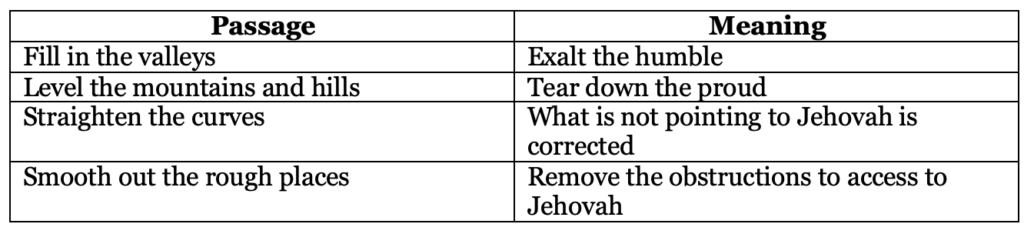
    Luke quotes Isaiah 40: 4 almost verbatim. “Fill in the valleys, and level the mountains and hills. Straighten the curves, and smooth out the rough places” (Isa. 40: 4 NLT).

    Isaiah used the process of building a road to describe what Jehovah was going to do.

    In order to make a road level, dirt must be moved from one place to another. The spots that are at a higher elevation must be cut down. That dirt must be used to fill in that area with a lower elevation.

    I grew up saying the country roads were placed to go around the 40s. The land was plotted out in 40-acre portions. Those who built the road didn’t want it to go through the middle of the field – and take out a lot of farmland from production.

    Instead, the new road followed the plots. It went between them. So, there were a lot of curves.

    Here, Jehovah said, “Nope. I am not going to worry about physical, worldview notions. I am going to cut straight to the matter – your heart.”

    We can read this another way.

    John wasn’t preparing the path to Jehovah through the wilderness; he was preparing the people’s hearts to receive Him.
     
    Jehovah hasn’t moved away from us. He is right there calling us back to Him.
     
    Neither will Jehovah lower His standards to bring us to Him. He expects us to follow Him.

    Salvation Sent from God

    If Luke was trying to quote Isaiah 40: 5, it seems like he missed the mark.

    Take a look at the last verse of Isaiah’s prophecy. “Then the glory of the Lord will be revealed, and all people will see it together. The Lord has spoken” (Isa. 40: 5 NLT).

    That is much different from what the Hebrew says. And the glory of YHWH shall be revealed, and all flesh shall see [it] together, for the mouth of YHWH has spoken.

    That seems much different from “And then all people will see the salvation sent from God.” (Lk. 3: 4-6 NLT), doesn’t it?

    But is it?

    Think about it. The glory of the Lord is Jehovah’s presence.

    More importantly, Yeshua is the glory of the Lord. Put these verses together. 

    • “So the Word became human and made his home among us. He was full of unfailing love and faithfulness. And we have seen his glory, the glory of the Father’s one and only Son” (Jn. 1: 14 NLT).
    • “I have seen your salvation, which you have prepared for all people. He is a light to reveal God to the nations, and he is the glory of your people Israel!” (Lk. 2: 30-32 NLT).
    • “The Son radiates God’s own glory and expresses the very character of God, and he sustains everything by the mighty power of his command. When he had cleansed us from our sins, he sat down in the place of honor at the right hand of the majestic God in heaven” (Heb. 1: 3 NLT).

    Remember, Yeshua means God saves. Immanuel means God is with us.

    Yeshua is our salvation and the glory of the Lord.  He brings both.

    So, when the Hebrew wording says, all flesh shall see [it] together, it is correct. It refers to Jehovah’s glory – which Yeshua is.

    When the modern wording says see the salvation, that is correct also.

    John’s Mission Field

    “In those days John the Baptist came to the Judean wilderness and began preaching …” (Mt. 3: 1 NLT)

    “This messenger was John the Baptist. He was in the wilderness …” (Mk. 1: 4 NLT)

    “Then John went from place to place on both sides of the Jordan River …..” (Lk. 3: 3 NLT)

    “At this time John the Baptist was baptizing at Aenon, near Salim, because there was plenty of water there; and people kept coming to him for baptism. (This was before John was thrown into prison.)” (Jn. 3: 23-24 NLT)

    The wilderness was a place where Jehovah spoke and revealed Himself.

    Jehovah took the Israelites/Jews away from their comfort zones and placed them in a broken landscape where they had to depend on Him.

    In the wilderness, Jehovah exposed their hearts.

    From before Yeshua stepping onto the stage to discuss redemption, Jehovah was saying, “Look at your hearts. That is what I want – not actions.”

    John was firmly committed to Jehovah. He separated himself from the world, preferring solitude to reflect and connect with God and remain detached from its influences.

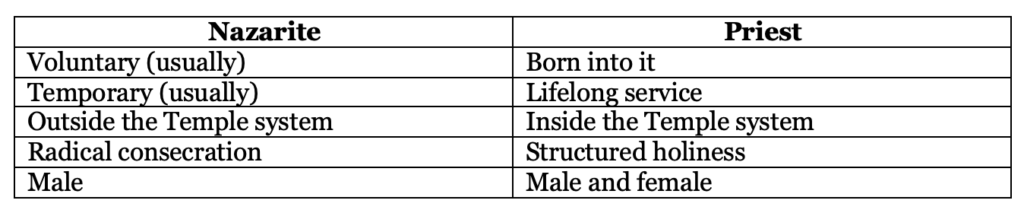
    John wasn’t commissioned to be a priest, even though he was of the lineage of Aaron. Instead, he took the Nazarite vow.

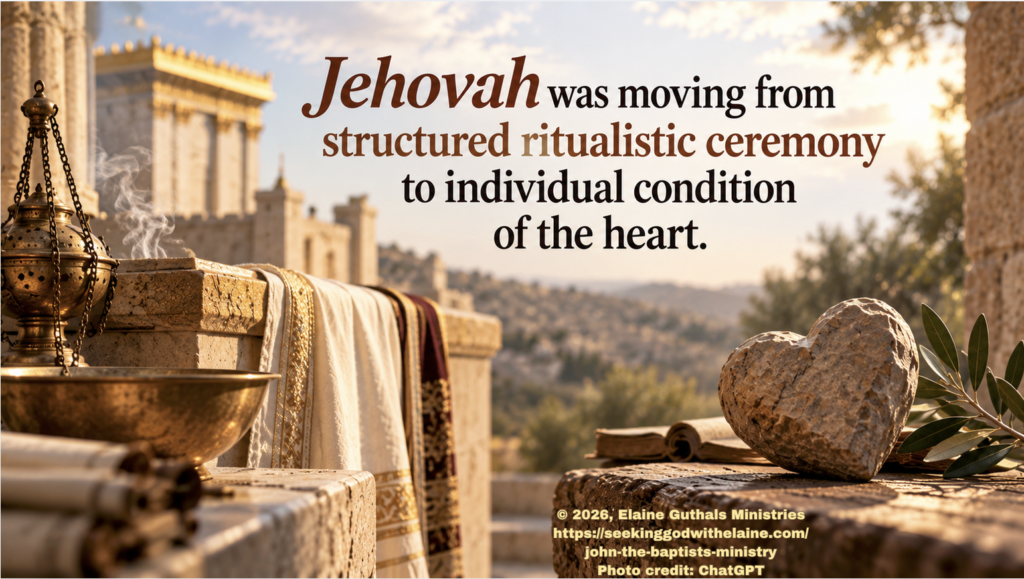
    This is a huge shift. Jehovah was taking religion out of the Temple and putting it into the wilderness.

    Jehovah was moving from structured ritualistic ceremony to individual condition of the heart.

    John’s Message

    “… His [John the Immerser’s] message was, ‘Repent of your sins and turn to God, for the Kingdom of Heaven is near’” (Mt. 3: 1-2 NLT)

    “This messenger was John the Baptist. He was in the wilderness and preached that people should be baptized to show that they had repented of their sins and turned to God to be forgiven” (Mk. 1: 4 NLT)

    “… preaching that people should be baptized to show that they had repented of their sins and turned to God to be forgiven” (Lk. 3: 3 NLT)

    John’s task was to restore the nation’s relationship with Jehovah, awaken a community lost in indifference and unwillingness to repent, encourage repentance, announce that the Kingdom of Heaven was near, and introduce a new era.

    Repent of your sins

    We tend to see salvation as the acknowledgment of our personal sins.

    Isn’t that what repent and be baptized is all about? Well, yes and no.

    In the Old Testament, the primary Hebrew concept is expressed through shuv (שׁוּב), meaning to turn, return or go back, and nacham (נָחַם), which can express regret, relenting, or a change of mind/intent.

    This carried into the New Testament as to change one’s mind or way of thinking.

    John’s message, while it did invite personal repentance, was more for the nation of Israel. Look back at what Gabriel told Zechariah.

    “And he will turn many Israelites to the Lord their God” (Lk. 1: 16 NLT).

    Remember, Israel had a covenant relationship with Jehovah. The problem Israel’s leaders encountered was they forgot that was a relationship, rather than just ritual ceremony.

    Turn to God

    More than just turning away from sin, we have to turn to Jehovah.

    You are moving away in sin. Do a u-turn. Take a roundabout. Pull into a driveway, back out, and come back the way from which you came.

    In other words, do a 180 degree and come back to Jehovah.

    • “… He [John the Immerser] … proclaiming an immersion involving turning to God from sin in order to be forgiven” (Mk. 1: 4 CBS).
    • “Turn from your sins to God, for the Kingdom of Heaven is near!” (Mt. 3: 2 CJB).

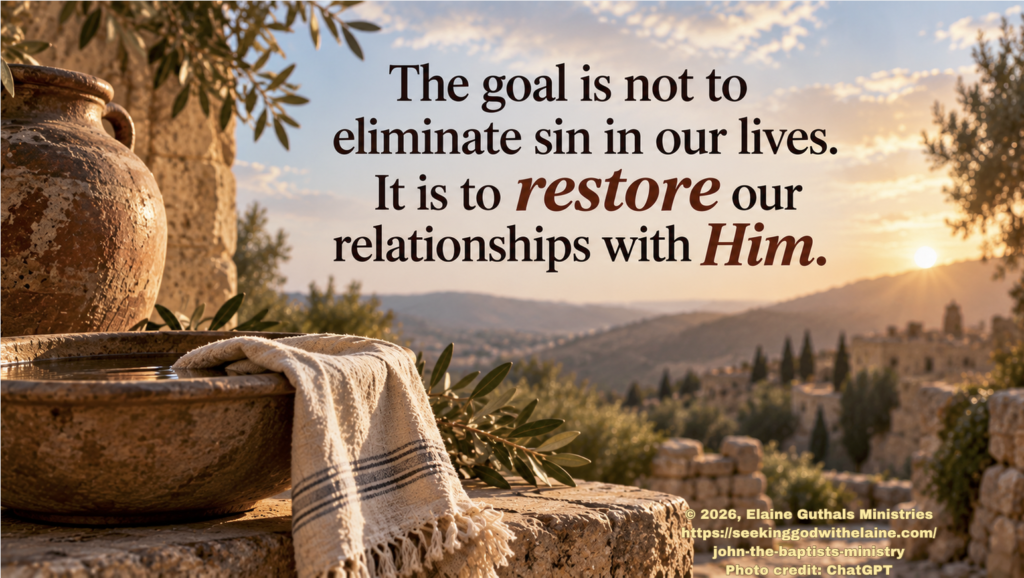
    The goal is not to eliminate sin in our lives. It is to restore our relationships with Him.

    Baptized

    The concept of immersion was not a new idea.

    First-century Jews were familiar with immersion in the mikvah. The mikvah (מִקְוֶה) refers to a collection of water and came to be associated with the ritual bath used for purification.

    In the Torah, immersion in water could mark a person moving from a condition of ritual uncleanness to ritual cleanness. John’s audience would have understood the action.

    They would have seen a big difference. John was not having them immerse in the mikvah but in the Jordan River.

    This would have carried national significance, too. It was this river that the fledgling Israelite nation crossed after 40 years of wandering in the wilderness.

    John was taking Israel back to the Jordan River so that they could be immersed. They would enter unclean and emerge prepared for what Jehovah was about to do.

    No, that doesn’t say they emerged ritually clean.

    John’s immersion was a public act of purification and preparation — a person went down into the water and came back out symbolically prepared for the imminent arrival of the Lord. John physically stood in the wilderness, at the Jordan, immersing Israelites as he prepared a people for Jehovah.

    The Kingdom of Heaven

     The Kingdom of Heaven really wasn’t a place – it was a reign.

    When Matthew said that John’s message was that the Kingdom of Heaven was at hand, it wasn’t talking about a kingdom that exists in the sky.

    It was talking about the rule of God becoming manifest. Jehovah’s reign was about to start.

    Here is how Strugnell explained it. He wrote,

    “John’s baptism probably symbolized not so much anticipated entrance into the kingdom of God as an anticipatory submission to the coming world judgment, which was represented as a coming second ‘baptism’ by the Holy Spirit in a river of fire.”

    Resource

    So, it had nothing to do with where the kingdom would be – rather it told Who was going to rule the kingdom.

    John wasn’t merely calling individual Jews to become better people. He was calling Israel to prepare itself as a people for the arrival of its King. Their immersion in the Jordan became a visible declaration: “We are turning back to Jehovah, and we are preparing ourselves for what He is about to do.”

    Making the Connections #1

    Let’s put the progression together.

    • Jehovah is coming.
    • His glory will be revealed.
    • His reign is drawing near.

    John was immersing people to prepare them for the arrival of Jehovah’s reign.

    What would first-century Jews have heard? They would hear John say, “Jehovah is about to take His rightful place as King!”

    They weren’t looking for a different place to live. They were looking for Jehovah to take the action He had promised.

    Making the Connections #2

    We can’t hide behind some persona of being a good person. We have to deal with the root cause of spiritual death — humans are sinful — each and every one of us.

    We like to say, “Repent. Say you’re sorry, and everything will be okay.”

    The term for repent in Hebrew is shuv (שׁוּב). It means to turn, return, go back, and restore.

    Redemption starts with confessing our sins (Mk. 1: 5). We can only confess what we acknowledge.

    But we can’t do it on our own. Oh, yes, we make the decision that we want to repent and turn.

    We can only accomplish that through Jehovah’s grace. When we return to Jehovah, we are restored.

    “Restore us, O Lord, and bring us back to you again! Give us back the joys we once had!” (Lam. 5: 21 NLT).

    What do we return to? We are restored to righteousness.

    From the moment of birth to the moment of our conversion, there had never been a moment when we were righteous. To be righteous, we faithfully walk according to Jehovah’s covenant.

    We may think we were good people. That is not a substitute for righteousness.

    Making the Connections #3

    To concept of repentance carried into the New Testament as to change one’s mind or way of thinking.

    Think about it. We are not called just to change our actions. We are called to change our attitudes and priorities.

    When we do that, we change our way of thinking. We change our thinking to align with Jehovah’s ways.

    Heart Check

    Think about the battle Yeshua is engaged in for your heart. Ask yourself the following questions.

    • Am I merely trying to become a better person, or am I actually turning back to Jehovah?
    • Have I allowed sin, pride, tradition, or self-reliance to become an obstruction between me and Jehovah?
    • What needs to change in my heart so that my life is pointing toward Jehovah rather than away from Him?

    How Do We Apply This?

    • Examine where our hearts are pointing.
    • Identify the obstructions of pride, sin, self-reliance, misplaced priorities, and even religious traditions that can become barriers that keep us from fully surrendering to Jehovah.
    • Turn around and return to Jehovah.
    • Prepare our hearts for the King.
    • Let Jehovah restore what has been broken.

    Father God. Thank You for the message You gave to John. Lord, help us turn back to You so that we are walking Your paths. Amen.

    If you don’t understand something and would like further clarification, please contact me.

    If you have not signed up for the email providing the link to the devotions and the newsletter, do so below.

    If God has used this devotion to speak with you, consider sharing it on social media.
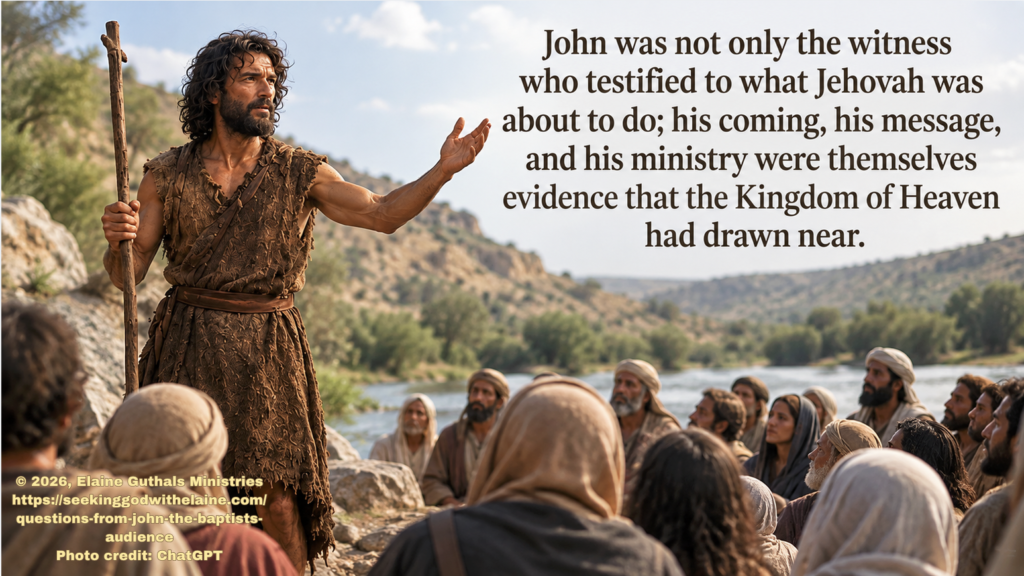
  • The Ministry of John the Baptist

    In anticipation of Yeshua’s ministry, John was called to prepare the way for Him. This devotional reading looks at the world in which John began his ministry.

    Nuggets

    • Luke used the timestamp of the ministry of John the Immerser beginning during the fifteenth year of Tiberius as Roman emperor, around AD 28-29.
    • Tiberius was the second Roman Emperor, who was born in 42 BC.
    • Pontius Pilate was the prefect of Judea under Rome from approximately AD 26 to AD 36.
      Herod Antipas was the son of Herod the Great.
    • Philip the Tetrarch was the son of Herod the Great and the brother of Herod Antipas.
    • Annas was the Jewish High Priest from around AD 6 to AD 15.
    • Caiaphas served as High Priest from around AD 18 to AD 36.
      John’s diet was based on what he found in the wilderness.
    • We don’t know how the message came to John – we just know it did.

    Yeshua was now among Jehovah’s people, but it wasn’t time for Him to start His ministry. Someone else had to come first.

    That someone was John the Immerser.

    John the Immerser was born six months before Yeshua in the hill country (har Yehudah – הַר יְהוּדָה), possibly in Ein Kerem for Juttah, near Jerusalem. His birth was foretold to his father by an angel (Lk. 1: 11). It was a miracle because Zechariah, a Levitical priest of the order of Abijah, and Elizabeth were both elderly, and Elizabeth was barren.

    Elizabeth was a relative of Mary, the mother of Yeshua. While we aren’t sure how they were related, many think they were sisters. This made Yeshua and John cousins.

    Zechariah was told a specific direction as to how John should live. He was not to drink alcohol (Lk. 1: 15). This is in line with the Nazarite vows.

    John the Immerser ministered in the lower valley around the Jordan River.

    In a way – to me – it is sad that John has been labeled as the Baptizer. He is so much more than just dunking people in the Jordan.

    That leads us away from John the Immerser’s devoutness and submission to Yeshua as Messiah and God as Sovereign Lord.

    Jehovah had a very important plan for John’s life. He was to be the forerunner of the Messiah (Lk. 1: 16-17 NLT). This preparation of the way for the Messiah fulfills the prophesy we find in Isaiah.

    John knew his place as forerunner. “He must become greater and greater, and I must become less and less” (Jn. 3: 30 NLT).

    Let’s Put It into Context

    To read devotions in The Battle for the Heart theme

    Devotions in the The Ministry of John the Baptist series

    Let’s Put It into Context #2

    What is a Nazarite vow (found in Numbers 6)?

    • It is a vow that can be taken by a man or a woman.
    • It is voluntary.
    • It signifies a complete dedication to God in certain areas of life.
    • It is a temporary vow.
    • It has specific requirements and restrictions.
    • A sacrifice is offered at the conclusion of the vow, including burning the person’s hair.

    Although not specifically identified as a Nazarite vow, three prominent figures are often associated with the vow. They are Sampson (Jdg. 13: 5 NLT), Samuel (1 Sam 1: 11 NLT), and John the Immerser (Lk. 1: 15 NLT).

    The difference was John’s and Samson’s vows was that vow was to be lifelong. Jehovah Himself had commanded it of John.

    The Nazarite vows consecrate the person to Jehovah or separate that person for Him.

    Setting the Stage

    “It was now the fifteenth year of the reign of Tiberius, the Roman emperor. Pontius Pilate was governor over Judea; Herod Antipas was ruler over Galilee; his brother Philip was ruler over Iturea and Traconitis; Lysanias was ruler over Abilene. Annas and Caiaphas were the high priests …” (Lk. 3: 1-2 NLT)

    Fifteenth Year

    Luke used the timestamp of the ministry of John the Immerser beginning during the fifteenth year of Tiberius as Roman emperor, around AD 28-29.

    What was the nation of Israel like in the first century? It had had a long line of occupation.

    The Seleucids ruled Judea from around 198 to 167 BC. They aggressively promoted Hellenization, pressuring Israel to abandon its traditional Jewish practices.

    These actions transformed political domination into a direct attack on covenant identity. Because of this, many Jews still considered themselves to be under exile.

    The Seleucid rule led to the Maccabean Revolt that occurred began in 167 BC. The successful revolt resulted in the rededication of the Temple and was a powerful symbol of covenant faithfulness and resistance to foreign oppression. It also demonstrated that zealous loyalty to Jehovah could bring national deliverance.

    This independence lasted from 142 to 63 BC. Though it was close to national restoration, it still fell short because there was no descendant of David on the throne. Still, internal corruption developed, and many promises of the prophets remained unfulfilled.

    Roman occupation began when Pompey captured Jerusalem in 63 BC during a Roman civil conflict in the region. By the first century, Rome controlled Judea through governors, client kings, taxation, and military force.

    Many first-century Jews considered themselves still in exile because, though they worshiped in a rebuilt Temple and lived in their ancestral land, they remained subject to Gentile authority.

    This environment fueled widespread expectation that Jehovah would send His Messiah to restore Israel, defeat her oppressors, and establish His kingdom.

    Tiberius, the Roman Emperor

    Tiberius was the second Roman Emperor, who was born in 42 BC.

    The adopted son and stepson of Augustus, Tiberius ruled from AD 14 until AD 37. He was said to be reserved, suspicious, and increasingly withdrawn. Even though he was described to be relatively competent and financially conservative, he was also paranoid.

    Tiberius’ reign as emperor encompassed the whole time of John’s and Yeshua’s ministry. He died in AD 37, not too many years after Yeshua was crucified.

    Pontius Pilate

    Pontius Pilate was the prefect of Judea under Rome from approximately AD 26 to AD 36.

    As prefect, Pilate was responsible for maintaining Roman order and collecting revenue. His administrative center was in Caesarea Maritima, but he would have been in Jerusalem as required. One time that presence was required was during Jewish festivals.

    Pilate, as Rome’s representative, had the Roman authority to impose the Roman death penalty. This was the authority needed to order Yeshua’s crucifixion.

    The relationship between Pilate and the Jewish population was strained at best. There were several instances in which Pilate’s actions provoked serious Jewish opposition. One such instance is documented in Luke 13: 1.

    Ultimately, Pilate was a Roman official, using deeply offensive symbols and authority, who was governing a nation with a strong religious identity. 

    Pilate was relieved of his position around AD 36. Though he was taken to Rome to answer accusations of how he handled a confrontation with the Samaritans, he arrived after Tiberius’ death. His fate is uncertain.

    Herod Antipas

    Herod Antipas was the son of Herod the Great.

    Upon Herod the Great’s death, Herod Antipas was one of his sons who received part of his divided kingdom. Antipas became tetrarch of Galilee and Perea, including where John conducted his ministry. His reign lasted from 4 BC to AD 39.

    Philip

    Philip the Tetrarch was the son of Herod the Great and the brother of Herod Antipas.

    It is important to note that he was not the husband of Herodias. Herodias was married to another of Herod the Great’s sons, also named Herod Philip. Philip the Tetrarch was married to Herodias’ daughter, Salome.

    Philip ruled the territories northeast and east of Galilee. He ruled there from approximately 4 BC until AD 34.

    Philip was known as a relatively capable and peaceful ruler. He was the founder of Caesarea Philippi.

    Annas

    Annas was the Jewish High Priest from around AD 6 to AD 15.

    Annas was appointed to be the Jewish High Priest by Roman Governor Quirinius. Even though the Roman authorities removed him from office, he retained influence as several family members served as High Priest, including Caiaphas.

    Caiaphas

    Caiaphas served as High Priest from around AD 18 to AD 36.

    This was an unusually long tenure as High Priest. He was removed from the office around the same time Pontius Pilate, in AD 36.

    Caiaphas was also the son-in-law of Annas.

    John Was Unique

    “John’s clothes were woven from coarse camel hair, and he wore a leather belt around his waist. For food he ate locusts and wild honey.” (Mt. 3: 4 NLT)

    “His clothes were woven from coarse camel hair, and he wore a leather belt around his waist. For food he ate locusts and wild honey” (Mk. 1: 6 NLT)

    John’s diet was based on what he found in the wilderness.

    We think John was an interesting dude who made interesting choices in his wardrobe and diet. He wore a camel’s hair garment and ate wild honey and locusts.

    This was understandable when we consider the region in which John the Immerser lived. Strugnell explained what that meant. He wrote,

    “His formative years were spent in the Judaean desert, where monastic communities, such as the Essenes (a strict Jewish sect  that existed from about the 2nd century BCE to the end of the 1st century CE), and individual hermits often educated the young in their own ideals.”

    Resource

    Because of this, he was often compared to Elijah. The two men wore similar attire (II Kgs. 1: 8; Mt. 3: 4). They both carried out their mission in the wilderness (Mt. 3: 1).

    We may cringe when we read John ate locust. People in John’s day knew the nutritional value of this reliable wilderness food source — and it was kosher (Lev. 11: 22).

    John’s Call

    “… At this time a message from God came to John son of Zechariah, who was living in the wilderness” (Lk. 3: 2 NLT)

    We don’t know how the message came to John – we just know it did.

    In Jewish thought, John was called an ish haElohim (אִישׁ הָאֱלֹהִים), a man of God.

    Think about it. “God sent a man, John the Baptist” (Jn. 1: 6 NLT). That doesn’t really sound like much.

    In the Hebrew, it says Jehovah shalach (שָׁלַח) ish (אִישׁ). John wasn’t the only man sent. This was the way Jehovah introduced Moses, Samuel, Elijah, and Isaiah. Great company!

    John was sent to be a witness. His call was to prepare the way for the Messiah.

    Think about Zechariah. When Gabriel came to tell him that he and Elizabeth would have a son, he probably thought John would become a priest, as he was.

    In the end, Zechariah may have thought of John as a radical. He probably saw John as being outside the religious system.

    John wasn’t a priest. He wasn’t even in the temple.

    John was in the wilderness.

    The wilderness was important in John’s day. He was in the Judean Wilderness, a harsh and rocky region east of Jerusalem. It stretched toward the Jordan River and the Dead Sea.

    The Hebrew term for it is midbar (מִדְבָּר). It wasn’t considered just an empty land. It was where God spoke and revealed Himself to people. It taught dependence on Jehovah.

    When we think wilderness, we think trees – lots and lots of trees. This wilderness boasted jagged limestone hills, steep ravines known as wadis, and dry, chalky soil. The vegetation was limited to thorn bushes and scattered scrub growth.

    The extreme climate ran from intense daytime heat to cold nights. Rain was limited, which limited food sources. Those living in the wilderness had to gather what the wilderness provided – locusts and wild honey.

    We may scratch our heads. Into this dry, arid place, John brought baptism.

    John didn’t bring it into the Temple, where first-century Jews would go to worship. He brought it to the wilderness, where people had to make an effort to go hear Jehovah.

    It put feet to John’s message.

    • We have to deliberately seek Jehovah.
    • We have to enter into testing in our wilderness.
    • We have to leave the comfort behind and migrate toward change.

    We must step out to meet Jehovah.

    Making the Connections #1

    Why would we want to start this series reading about all these dead guys? Simple.

    Luke proved to us that this was a true account of what happened in a specific period of time. Historical accounts back up the fact that these people existed during this period.

    Not only that, but it is giving us the background of where the nation of Israel was during that time. This political oppression has to be understood to order to understand the Messianic expectations. Jewish leadership has to be understood for the same reason.

    Making the Connections #2

    Pastor Steve made a good connection in his A Voice Crying in the Wilderness blog. He reminded us that there are so many voices in the wilderness right now.

    We have to watch who we listen to. Pastor Steve said that “We MUST seek the Lord at all times for the truth.”

    Resource

    We have to listen to men and women sent by Jehovah to hear the truth. We must do our own due diligence and determine that what was said really is the truth.

    Heart Check

    Think about the battle Yeshua is engaged in for your heart. Ask yourself the following questions.

    • Am I listening to the voices around me, or am I seeking Jehovah for His truth?
    • Have I allowed the circumstances around me to shape what I believe Jehovah is doing?
    • Am I willing to leave my comfort behind when Jehovah calls me toward change?
    • Am I deliberately seeking Jehovah, even when doing so requires me to step into my wilderness?
    • Am I willing to listen when Jehovah speaks truth that challenges me?

    How Do We Apply This?

    • Seek Jehovah deliberately.
    • Seek Him and determine whether what you hear is truly His truth.
    • Don’t run from the place where He is calling you to grow.
    • Leave comfort behind.
    • Listen to the people Jehovah sends.
    • Prepare your heart for what Jehovah wants to do.

    Father God. Since before the creation of the universe, you knew Yeshua would be our Savior and Redeemer. You called John to prepare His way. Lord, help us to step out to seek You. Amen.

    If you don’t understand something and would like further clarification, please contact me.

    If you have not signed up for the email providing the link to the devotions and the newsletter, do so below.

    If God has used this devotion to speak with you, consider sharing it on social media.
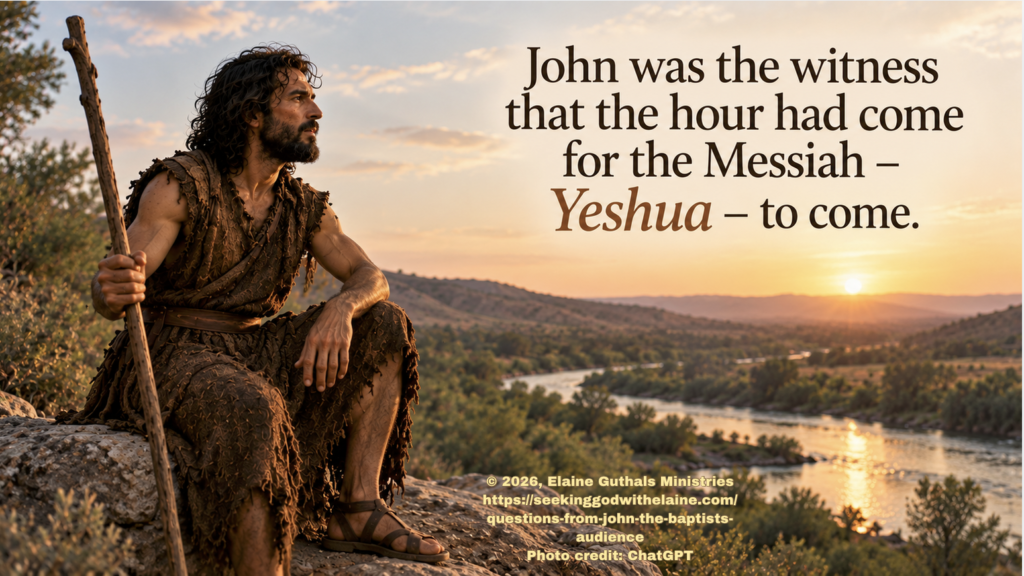
  • Who Gabriel Said Jesus Would Be

    Gabriel told Mary that her Son would be the Son of the Most High. This devotional reading unpacks all that means.

    Nuggets

    • Mary was about to be told she was going to have a very special Baby.
    • Mary’s Son would be exalted above every other man.
    • The Messiah had several Son of titles that heightened the expectation of His mission.

    In the last devotion, Gabriel came to Nazareth to give Mary exciting news. This teen-aged virgin was going to have a baby.

    We looked at Mary and her response to the message. We didn’t look at Who the angel said her Son would be.

    Let’s dig into that now.

    Let’s Put It into Context

    To read devotions in The Battle for the Heart theme

    Devotions in the Preparing for the Christ Child series

    Who Yeshua Would Be

    “He will be very great and will be called the Son of the Most High. The Lord God will give him the throne of his ancestor David. And he will reign over Israel forever; his Kingdom will never end!” (Lk. 1: 30-33 NLT)

    He Will Be Very Great

    Mary was about to be told she was going to have a very special Baby.

    There is an interesting contrast here. Go back to Gabriel’s last visit. Zechariah was told that John would “… be great in the eyes of the Lord …” (Lk. 1: 15 NLT).

    Here, Gabriel doesn’t put any qualifier on great but rather adds an adverb that expands the definition. Yeshua would be very great.

    But great can be relative sometimes, can’t it? We may see it as boundless or abundant.

    When she heard the word great, Mary probably thought gādôl (גָּדוֹל). She would have hooked it to Scripture.

    • “Great is the Lord! He is most worthy of praise! He is to be feared above all gods” (Ps. 96: 4 NLT).
    • “‘But my name is honored by people of other nations from morning till night. All around the world they offer sweet incense and pure offerings in honor of my name. For my name is great among the nations,’ says the Lord of Heaven’s Armies” (Mal. 1: 11 NLT).
    • “Great are the works of the Lord, studied by all who delight in them” (Ps. 111: 2 ESV).
    • “And David became greater and greater, because the Lord God of Heaven’s Armies was with him” (II Sam. 5: 10 NLT).
    • “(Now the Lord had caused the Egyptians to look favorably on the people of Israel. And Moses was considered a very great man in the land of Egypt, respected by Pharaoh’s officials and the Egyptian people alike.)” (Ex. 11: 3 NLT).

    Mary would have understood great to mean exalted.

    Think about it. Here was this teenager, excitedly planning her upcoming marriage. She heard the angel tell her that she was going to have a baby. She wouldn’t have the stigma of barrenness that Elizabeth had carried for so many years.

    Son of the Most High

    Mary’s Son would be exalted above every other man.

    Yeshua’s greatness would not merely  describe His influence or reputation. It would flow from who He is – the promised Messiah, the Son of the Most High, and the eternal King.

    Mary was about to be told she was going to have a baby in an unimaginable way.

    Gabriel told Mary that she was going to have a Son – not just any son, but the Son of God. Mary’s Son would “… be called the Son of the Most High …” (Lk. 1: 32 NLT). This identified Him as fully divine. “And she will have a son, and you are to name him Jesus, for he will save his people from their sins” (Mt. 1: 21 NLT).

    Son

    The Messiah had several Son of titles that heightened the expectation of His mission.

    The Hebrew word for son is ben (בֵּן). This means more than biological ancestry. It refers to membership, character, covenant relationship, inheritance, or reputation.

    In Hebrew thought, a son was expected to represent his father’s character, authority, and mission. Thus, son often described identity and function rather than merely ancestry.

    Don’t miss the character part. We say many times that we have the character traits of our parents. But the first-century Jews would know this could designate a metaphysical relationship.

    I can understand that. I’ve spoken of my Springfield Mom several times. That relationship is and has been very important to me – even though there is nothing biological about it.

    Here, it also has the aspect of bearing another’s authority. The son represents the father and exercises his delegated authority.

    Son of God

    The title Son of God is one of the richest Messianic designations in Scripture. While we see it through the lens of modern theology, first-century Jews saw it through language of the covenant, kingship, and divine appointment.

    For Christians, the title ultimately reveals the Messiah’s eternal relationship with the Father. First-century Jews, however, would initially have understood it through the language of covenant, kingship, and divine appointment. “Then you will tell him, ‘This is what the Lord says: Israel is my firstborn son. I commanded you, “Let my son go, so he can worship me.” But since you have refused, I will now kill your firstborn son!’” (Ex. 4: 22-23 NLT).

    The Gospels, however, deepen our understanding of the title as Yeshua tried to deepen their understanding. He was the covenant heir to David’s throne and the rightful King of Israel. The kingdom, however, was the Kingdom of God — renewing covenant people and extending the blessing to all the nations.

    The Throne of His Ancestor David

    Son of David

    Mary’s Son was going to sit on the throne of David.

    The title Son of David is one of the clearest Messianic titles in first-century Judaism. It strengthened the hope that the Messiah would restore the kingdom of Israel by recalling the Davidic covenant. “Your house and your kingdom will continue before me for all time, and your throne will be secure forever” (II Sam. 7: 16 NLT).

    This Son was going to be the promised Messiah because “… His kingdom will never end” (Lk. 1: 33 NLT).

    By Yeshua’s time, centuries of theological development had intertwined with covenant, kingship, Temple, and restoration. Son of David had become virtually synonymous with Messiah.

    To call Yeshua the Son of David was not merely to identify His ancestry but to confess that He was the promised heir to David’s throne and the One through whom Jehovah would fulfill His covenant promises.

    This was how the promise came down. Messiah — King — victorious. All three things were true — just not in the way the Jews were looking for Him.

    Gabriel was talking to Mary in covenant language. What he was saying fulfilled II Samuel 7: 16. David was promised an unending dynasty when one of his Descendants would rule for eternity.

    In this section, Gabriel doesn’t go into the miraculous part of the conception. What he does talk about is a normal, run-of-the-mill pregnancy. This stresses that Jesus is going to be fully human and fully divine.

    Making the Connections #1

    “The Spirit of the Sovereign Lord is upon me, for the Lord has anointed me to bring good news to the poor. He has sent me to comfort the brokenhearted and to proclaim that captives will be released and prisoners will be freed. He has sent me to tell those who mourn that the time of the Lord’s favor has come, and with it, the day of God’s anger against their enemies. To all who mourn in Israel, he will give a crown of beauty for ashes, a joyous blessing instead of mourning, festive praise …” (Isa. 61: 1-3 NLT)

    Isaiah 61: 1-3 gives some more items on Yeshua’s job description. Let’s pick them out.

    • Bring good news to the poor
    • Comfort the brokenhearted
    • Proclaim and release the captives
    • Sent to those who mourn
    • Give a crown of beauty for ashes
    • Give joyous blessing
    • Give festive praise

    Isaiah talked about the poor and those who mourn. They are the first two Beatitudes.

    Brokenhearted doesn’t mean the common heartbreak we humans suffer. It means we have a sinful heart, but we are remorseful about that. “And the prayer of faith will save the one who is sick and the Lord will raise him up. And if he has committed sins, he will be forgiven” (Jas. 5: 15 ESV).

    Is there anything else on Yeshua’s job description – or maybe a more concise way to say it?

    • Offer salvation and eternal life through faith in Him to the captives who are poor in spirit.
    • Fulfill Old Testament prophecies as the Messiah.
    • Serve as a mediator between God and humanity.
    • Teach love, compassion, and forgiveness to all people.
    • Perform miracles to demonstrate divine power and compassion.
    • Model a life of humility, service, and sacrifice for others.

    Making the Connections #2

    “My Spirit remains among you, just as I promised when you came out of Egypt. So do not be afraid” (Hag. 2: 5 NLT)

    “Then he said to me, ‘This is what the Lord says to Zerubbabel: It is not by force nor by strength, but by my Spirit, says the Lord of Heaven’s Armies’” (Zech. 4: 6 NLT)

    These two verses represent the last time Jehovah had spoken with Israel. That was approximately 520 BC.

    The Israelites were back from exile. They were building the Second Temple.

    Then … silence. Four hundred long years of silence.

    Then Gabriel went to see Zechariah. Next, he went to see Mary.

    This time, to that sweet young girl, who welcomed Gabriel into her world for that five minutes. This time, he talked about the Holy Spirit.

    In the Old Testament, the Ruach Elohin Ruach Elohim (רוּחַ אֱלֹהִים) – Spirit of God – or the Ruach YHWH (רוּחַ יְהוָה) – Spirit of the LORD – had several duties.

    • Brought order out of chaos (Gen. 1: 2)
    • Empowered individuals for tasks (Samson, Gideon, David)
    • Prophetic inspirations
    • Moral/Spiritual renewal promised but not fulfilled (Ezek. 36: 26-27; Joel 2: 28)

    The Spirit had not yet come to permanently indwell God’s people. He was selective, temporary, and task oriented.

    Even before Yeshua said He had to go so the Spirit could be sent (Jn. 16: 7), He was in John in the womb. Elizabeth and Zechariah were filled with the Spirit, and Mary was overshadowed by it.

    What changed?

    We have to realize that the work the Spirit is doing in Luke 1 is the ignition point. It is temporary still, but He is working.

    Making the Connections #3

    Before we continue, let’s step back a moment to look at the biblical background. To understand why Gabriel’s words were so astonishing, we need to understand what Mary already knew.

    Gabriel’s announcement didn’t happen in a vacuum. He was announcing the fulfillment of promises Jehovah had been making for centuries.

    If we don’t understand those promises, we’ll miss much of what Mary would have heard in his words. This is going to be important for all of our dives into the Gospels.

    The coming of the Messiah was foretold through the covenant promises. It provided Israel with a covenant identity. Their covenant identity was the identity Jehovah gave, defined, sustained, and governed through the covenant relationship with Himself. It was corporate, covenantal, relational, and generational.

    Jehovah introduced the Messianic promises through a series of covenants.

    After the original sin – commonly called the Fall – Jehovah judged the man, the woman, and the serpent, declaring the spiritual conflict that would follow between the serpent and the woman, and between his seed and hers. This promise culminated with the declaration that the seed of the woman would crush the serpent’s head while sustaining injury Himself.

    This marked the beginning of the expectation and the hope for a Messiah.

    The covenant with Abraham dramatically expanded the scope of Messianic hope. In Genesis 12, 15, 17, and 22, Jehovah pledged a variety of promises to Abraham (then called Abram). The promise to bless all families of the earth revealed the outward reach of God’s redemptive plan.

    The covenant underscored continuity through a chosen line. Although that line traces back through Adam’s son Seth and Noah’s son Shem, it was not formally established as the covenant line until Jehovah made His covenant with Abraham.

    Jacob introduced royal and kingship imagery that profoundly shaped later Messianic expectation in his last words to his son Judah. It was through him the Messiah – the scepter – shevet (שֵׁבֶט) – would come and never depart (Gen. 49: 10).

    The people of Israel didn’t demand a human monarchy until the days of Samuel the Prophet. Jehovah’s choice of David, from the tribe of Judah, as king was significant because it moved the future hope from an abstract promise into the framework of royal history and theology.

    Making the Connections #4

    Gabriel wasn’t simply announcing a pregnancy. He was announcing the fulfillment of thousands of years of covenant promises. Mary’s Son would be the Son of God, the Son of David, Israel’s Messiah, and the eternal King whose kingdom would never end.

    Heart Check

    Think about the battle Yeshua is engaged in for your heart. Ask yourself the following questions.

    • Have you received Jesus only as a good teacher, or have you trusted Him as the Son of God and your King?
    • Is there an area of your life where you need to surrender to His authority as the eternal King?

    How Do We Apply This?

    • Thank Jehovah for His faithfulness in fulfilling His covenant promises.
    • Worship Jesus as the Son of God and rightful King.
    • Submit your life to His authority today.
    • Thank Jehovah for keeping His covenant promises through Christ.

    Father God. Your Promises last generation to generation. And regardless of how long we have waited for them to be fulfilled, You will fulfill them on Your timetable – and it will be wonderful. Thank You for sending Your Son to allow us to restore our relationships with You.

    If you don’t understand something and would like further clarification, please contact me.

    If you have not signed up for the email providing the link to the devotions and the newsletter, do so below.

    If God has used this devotion to speak with you, consider sharing it on social media.
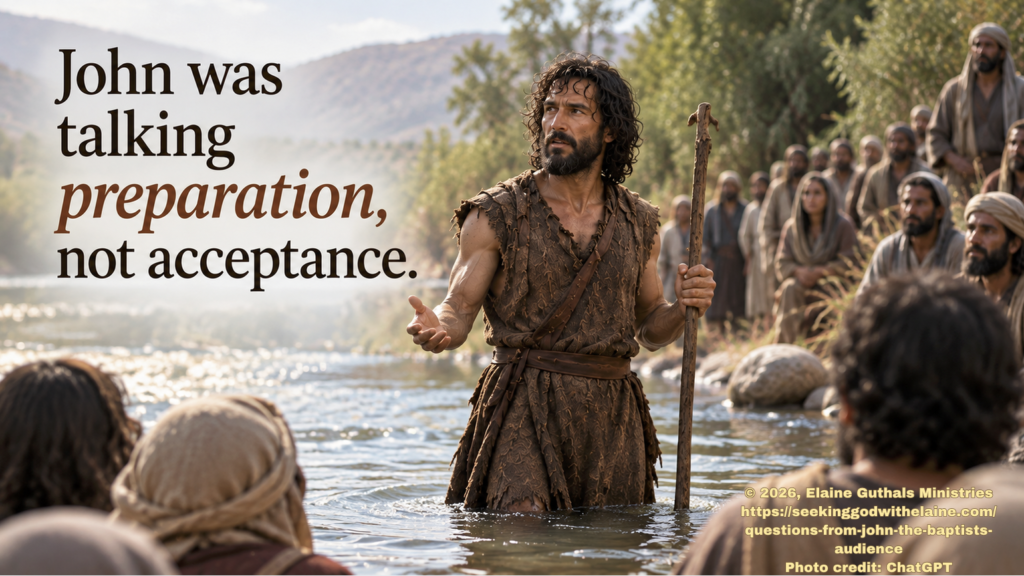
  • John the Baptist’s Birth Foretold

    We start Yesha’s story by relating His cousin’s story. This devotional reading begins looking at John the Baptist’s story.

    Nuggets

    • Jehovah had a plan for reconciling us to Him and sent a man to prepare the way.
    • Herod the Great was religious but ruthless, powerful but fearful, and magnificent yet miserable.
    • The priestly order of Abijah was created by David in I Chronicles 24.
    • Zechariah was an ordinary priest who had been chosen for an extraordinary task, and Elizabeth was a blameless person who was barren.
    • Even if we think Zechariah’s service was random, Jehovah didn’t.

    This is the first account of two miraculous birth. They mothers were from the same family – descendants of Aaron.

    The prophesied son would have an important role in the coming events to restore the nation to Jehovah.

    Let’s Put It into Context

    To read devotions in The Battle for the Heart theme

    Devotions in the Preparing for the Christ Child series

    John the Baptist (Yochanan) Introduced

    “God sent a man, John the Baptist, to tell about the light so that everyone might believe because of his testimony. John himself was not the light; he was simply a witness to tell about the light” (Jn. 1: 6-8 NLT)

    Jehovah had a plan for reconciling us to Him and sent a man to prepare the way.

    From the beginning, it was evident that John the Immerser was going to be a great man. In fact, he was considered a great prophet.

    John’s role was foretold by Isaiah. The total passage is Isaiah 40: 1 to Isaiah 45: 25. We are more familiar with Isaiah 40: 3.

    “Listen! It’s the voice of someone shouting, ‘Clear the way through the wilderness for the Lord! Make a straight highway through the wasteland for our God! Fill in the valleys, and level the mountains and hills. Straighten the curves, and smooth out the rough places. Then the glory of the Lord will be revealed, and all people will see it together. The Lord has spoken!’” (Isa. 40: 3-5 NLT).

    This is an important passage for two connected reasons. First, the first is John was to clear the way, calling Israel to repentance. This is critical because the second is that Someone was coming – the Messiah.

    Second, John called Israel to repentance before they encountered the Messiah. Just as worshipers prepared themselves before entering God’s presence in the Temple, John called the nation to prepare their hearts for the coming King.

    John the author made sure his audience knew that John the Immerser was not the Light (or – אוֹר). He was a witness (ed – עֵד) for the light, but he was more than just that. John came in Jehovah’s authority.

    This is huge. John not only had the knowledge of Jehovah, but he also testified to the truth, established facts, and upheld covenant realities.

    John the Immerser was tasked with increasing their faith – their emunah (אֱמוּנָה), a steadfast trust that comes from the Hebrew root ʾāman (אָמַן), meaning to believe, to trust, or to be faithful. We are to establish a firm trust in Jehovah and Yeshua.

    John’s Birth Announced to Zacharias (Zecharyah)

    “When Herod was king of Judea, there was a Jewish priest named Zechariah. He was a member of the priestly order of Abijah, and his wife, Elizabeth, was also from the priestly line of Aaron. Zechariah and Elizabeth were righteous in God’s eyes, careful to obey all of the Lord’s commandments and regulations. They had no children because Elizabeth was unable to conceive, and they were both very old” (Lk. 1: 5-7 NLT)

    Herod

    Herod the Great was religious but ruthless, powerful but fearful, and magnificent yet miserable.

    Luke put a timestamp on his gospel by acknowledging that Herod the Great was king in Jerusalem at the time. At one time, Israelites had wanted a king – they did not want this one.

    Born around 73 BC, Herod was not of Israelite descent but of Edomite descent. His family was forced to convert to Jewish years before his birth.

    In other words, he ruled the Jews but was not of the Davidic line. To make matters worse, he was chosen to be King of the Jews by Octavian Augustus and the Roman Senate around 40 BC.

    That wouldn’t have gone over well.

    Herod’s reign lasted from 37 to 4 BC. While he did maintain stability in the region, his fear of losing power made him a brutal ruler.

    The Temple that stood in Yeshua’s day had undergone a massive expansion under Herod’s rule. Yes, Herod built the stage on which Yeshua’s ministry would exist, but he entered the story only briefly — ordering the murder of the innocents when Yeshua was born. (Herod died shortly after the births of John the Immerser and Yeshua.)

    Herod tried to curry the favor of his subjects by rebuilding the Temple and funding public works. However, he alienated many by his close ties with Rome and his violent and unpredictable behavior.

    While Herod passed before Yeshua’s ministry began, he helped create the environment that had many expecting the Messiah’s arrival. He did this through political tension and religious compromise.

    Upon his death in 4 BC, Herod’s kingdom was divided between his sons. It is one of them that will take a prominent role in the life of John the Immerser and the events of Holy Week.

    Luke used a shorthand to set the stage in letting us know what the situation was that was the backdrop of the story. Rome occupied Israel, and Herod represented a compromised leader. This brought a spiritual longing to the people, increasing their Messianic expectations.

    It was in this atmosphere that Jehovah started to move.

    Priestly Order of Abijah (Aviyah)

    The priestly order of Abijah was created by David in I Chronicles 24.

    Jehovah choose Aaron’s (Aharon) line to serve Him as priests. Only his descendants could serve in this capacity.

    David (Dovid) separated Aaron’s descendants, the priests, into 24 divisions – mishmarot (מִשְׁמָרוֹת) meaning daily ministry – because the priests had become so numerous. Farrar noted that only four of the divisions returned from Babylonian exile. But Geikie reported that, in the first century, around 24,000 priests lived in Jerusalem and approximately 12,000 lived in Jericho.

    Resource

    Each division served in rotation at the Temple. They ensured order and efficiency in conducting Temple services. This rotation ensured all priestly families were allowed to serve.

    This order identity was very important. Abijah was listed as the eighth division. It had a long history of service to Jehovah.

    When the division served twice each year, their rotation lasted one week. They rotated according to the list. All divisions, however, served during the major festivals: Pesach  – פֶּסַח (Passover), Shavuot – שָׁבוּעוֹת (the Feast of Weeks), and Sukkot – סֻכּוֹת (the Feast of Tabernacles).

    True, Temple rotations were disrupted by exile and later history. But this priest was where he was scheduled to be.

    Why is it important to know the division this priest in question served? We learn that the timing of this announcement wasn’t left to random chance. It was steeped in history, structure, and legitimacy.

    That history and structure was an established covenant structure. Core responsibilities hadn’t changed since the days of Moses (Moshe) when the office of priest was set up.

    The angelic visit occurred inside the established rhythm of Temple worship. Daily temple worship had a rhythm to it, which included:

    • Offering sacrifices on behalf of the people
    • Maintaining ritual purity
    • Caring for sacred objects
    • Safeguarding the sanctity of the Temple
    • Administering the Priestly Blessing
    • Incense offering and prayer

    They were charged with distinguishing between what was holy and common, clean and unclean, and with teaching the people God’s instructions.

    The most coveted of the duties was to enter the Holy Place and offer incense on the golden altar. Many never received it even once.

    The priest offering the prayer would pray for the nation. He would additionally pray for those congregated at that time.

    What better place to announce the start of fulfilling the Messianic expectations! The old Temple became the launch for the new Temple — the Messiah.

    The Parents

    Zechariah was an ordinary priest who had been chosen for an extraordinary task, and Elizabeth was a blameless person who was barren.

    As a descendant of Aaron, Zechariah became a priest. As such, he served in the Temple only when it was time for his division to serve.

    Zachariah and Elizabeth (Elisheva) were faithful to Jehovah. Both were counted as righteous – tzaddik (צַדִּיק). They followed all of the commandments of the Sovereign God.

    Names are important. Zachariah’s name means Yahweh remembers. Elizabeth’s name means My God is faithful to His oath.

    Many versions translate this tzaddik as blameless. Paul told us how we could be blameless. “… Live clean, innocent lives as children of God, shining like bright lights in a world full of crooked and perverse people” (Phil. 2: 15 NLT).

    Both were descendants of Aaron. The marriage was easier because like-minded people married.

    It sounds like they were unified in all things. It sounds like they had a good life. 

    The only disappointment was Zachariah and Elizabeth didn’t have any children. Now that they had gotten on in years, they had probably given up hope of ever becoming parents.

    That must have weighed on Elizabeth, because Jewish women were expected to produce children. By the first century, barrenness still carried much of the same social stigma it had in the days of Sarah and Rachel.

    Although the Law never taught that childlessness was a punishment for sin, many people viewed it as a sign that God had withheld His blessing. When no children came, Elizabeth was probably very ashamed. She may have even gotten laughed at.

    Elizabeth’s joyful declaration that the Lord had “… taken away my disgrace among the people …” (Lk. 1: 25 NLT)  shows that this painful assumption still lingered in Israel.

    But they weren’t alone. Think Sarah and Isaac. Think Rebekah, Esau, and Jacob. Think Jacob, Rachel, and Joseph. Think Hannah and Samuel.

    Do we think when we are walking with Jehovah that the bad things shouldn’t happen to us? It doesn’t work that way.

    Zechariah was exactly where Jehovah wanted him to be. He was coming to Him, serving Him. Jehovah had another way Zechariah could be of service.

    A Priest Went into the Temple

    “One day Zechariah was serving God in the Temple, for his order was on duty that week. As was the custom of the priests, he was chosen by lot to enter the sanctuary of the Lord and burn incense. While the incense was being burned, a great crowd stood outside, praying” (Lk. 1: 8-10 NLT)

    Even if we think Zechariah’s service was random, Jehovah didn’t.

    Zechariah was serving in the Temple. He had been assigned to burn the incense, the most sacred daily task in the Holy Place. He was assigned that task by casting lots.

    People were in the outer courts. Priests ministered daily in the Holy Place. The Holy of Holies could only be entered by the high priest on Yōm Kippūr (יוֹם כִּפּוּר) – the Day of Atonement.

    When it was the division’s time to serve, the duties were assigned by lot. We aren’t sure what the process was for casting lots in the first century. The Mishnah does discuss how it was done later.

    It was believed that casting lots would both be fair and be a way to determine Jehovah’s Will. “We may throw the dice, but the LORD determines how they fall” (Prov. 16:33 NLT).

    • The priests would gather in a chamber in the Temple.
    • An official would choose a number larger than the number of priests present.
    • The priests would stand in a circle and each extend one or more fingers.
    • The official would then count around the circle until reaching the selected number.
    • The priest on whom the count landed received the assignment.
    • Several lots were conducted each day to assign different responsibilities.

    Zechariah drew the task with the highest honor and extraordinarily rare privilege – perform the daily incense offering. Other tasks included removing ashes from the altar, preparing sacrifices, and tending the menorah.

    The daily incense offering was a carefully prescribed ritual. First, Zechariah and assistant priests would have taken the hot coals brought in by other priests from the great altar outside (where sacrifices were made)  and placed them on the golden altar.

    After the assistant priests withdrew, Zechariah would have poured the incense on the hot coals. This would cause the incense to rise heavenward.

    This connected prayer and incense in Jewish symbolism. Burning incense represented the prayers of Israel. “Accept my prayer as incense offered to you, and my upraised hands as an evening offering” (Ps. 141: 2 NLT).

    At that point, Zechariah stood alone before the veil.

    Let’s just stop a second. There were some priests who never were assigned this task. And Zechariah was chosen.

    Zechariah was chosen that day.

    No, there was no luck of the draw about it. Jehovah had Zechariah right where He could use him.

    God interrupted normal ritual with a new act of redemption. Ritual isn’t enough for us to worship Him. Going through the motions can turn into lip service real quick.

    I thought it was very important that the congregation was praying while Zachariah was performing his duties. Jehovah was initiating His most important plan, and it was being bathed in prayer.

    This shows us that, even though God knows the outcomes of our efforts, He wants us to pray for guidance, strength, and His blessing. He wants us to let Him have His way. He will bless us beyond measure if we ask.

    Making the Connections #1

    It is easy to forget that Christianity offers various perspectives to different individuals, meaning I can’t always offer a single explanation on a given topic. That is on top of the fact that nothing I say can fully capture its intellectual and spiritual depth.

    We also forget the complexity of the message of the Gospels. Parker helped remind us. He wrote, “The facts of Christianity are few and simple, but the truths arising out of them are innumerable and profound.”

    Resource

    Each disciple creates our own interpretation of Christ’s life. Does that mean there is more than one way to salvation? No. It means that we are different people with differing life experiences and lifestyles.

    Jehovah meets us where we are at. That allows for our individual differences.

    But Jehovah sanctifies us with one goal in mind — making us as He is. Though our Sanctification Roads may take different routes, the destination is still the same.

    We have to seek the meaning of the Word for ourselves. Even listening to the Pastor Steve-types doesn’t negate the fact that we have to be students of the Word for ourselves.

    Making the Connections #2

    I have to think about this. Essex Remembrancer wrote,

    “Religion, wherever it exists, will leave its own entire impression upon the character; not one feature, but every feature of the ‘new man’ will be developed; the duties to man, as well as those we owe to God, will be conscientiously regarded.”

    Resource

    Jehovah isn’t interested in half of us. He is interested in all of us.

    Jehovah will make all of us a new creation. We will have a new character.

    That character is built through the tasks that we do for Jehovah.

    But we can’t equate blameless with sinless. We will still sin – even after we become disciples of Christ.

    Heart Check

    Think about the battle Yeshua is engaged in for your heart. Ask yourself the following questions.

    • Have I invited Jehovah to transform my entire life, or am I asking Him to change only the parts I’m willing to surrender?

    • Like Zechariah, am I faithfully serving Jehovah in the ordinary moments of life, allowing Him to shape my character while I wait on His timing?

    How Do We Apply This?

    • Thank Jehovah for the ordinary places where He has placed you today.
    • Ask Him to help you trust His timing, even when you cannot see His purpose.
    • Look for ways God may be preparing you through today’s ordinary responsibilities.
    • Choose faithfulness over recognition.
    • Spend time in confession, asking Jehovah to prepare your heart to hear His voice.
    • Pray that your heart would be ready whenever God chooses to work.
    • Remember that God often answers prayers in ways we never expect.
    • Before attending church this week, ask God to keep your worship from becoming routine.
    • Ask yourself whether your worship is flowing from your heart or simply from habit.
    • Trust that Jehovah is working even when your life feels ordinary.
    • Prepare your heart daily so you are ready when God chooses to move.
    • Serve faithfully today, knowing that no act of obedience is insignificant in God’s plan.

    Father God. You have a plan for all our lives. In those plans, you call us to certain tasks for Your benefit and ours. Thank you that You use us to expand Your kingdom. Amen.

    If you don’t understand something and would like further clarification, please contact me.

    If you have not signed up for the email providing the link to the devotions and the newsletter, do so below.

    If God has used this devotion to speak with you, consider sharing it on social media.
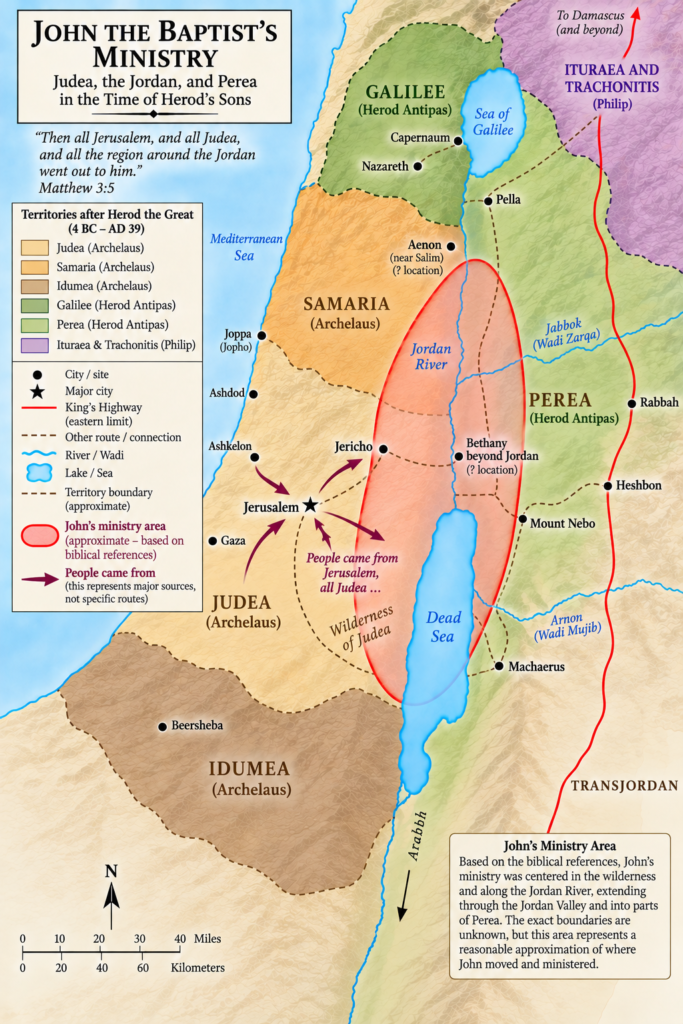
  • Announcing a Program Change

    This daily devotion is announcing a change I plan to make.

    Hey, guys. I just want to talk with you today. I’ve finally made a decision, and I want to share it with you.

    When I started this blog, I thought it was really important that I post something daily. We are to be in God’s Word daily.

    Pastor Chad thought I didn’t know what I was biting off there. And he was right — but not for a while.

    It is just me here doing everything — unless I can get Pastor Steve to write a post for me. He is very willing to do that, but he is working two jobs himself. He doesn’t always have time to write something.

    I was able to keep up the daily for three years. I even kept doing at least something every day when I had the seizure diagnosis.

    But this past year has seen a lot of changes in my life. I think the COVID took something out of me.

    Then God blessed me greatly, allowing me not only to be Steve’s wife but to also be a pastor’s wife. But that means I have a lot more things going on.

    It has been challenging to get something out daily. I know I have been doing a lot of rewrites and music days lately because they take less time. I haven’t gotten the newsletters out. These have bothered me.

    I’ve also had unexpected technical problems. I’ve been entering in a post, and my internet would go out. That isn’t fun.

    Adam has been concerned for the last couple of years about how much it takes for me to do these devotions. I tried to cut down the length when I was sick, but that didn’t really happen.

    So after much prayer, I have decided to not post something daily. I am going to post something on Tuesdays, Thursdays, and Saturdays.

    That being said, I don’t know if I will get something out this Tuesday. I have out-of-town training in the morning. I am not sure how much I will be able to get done to post for Tuesday. So, it will come out either Tuesday or Wednesday.

    Because it is no longer going to be daily, I am going to not have an option for a weekly email. Lately, I haven’t been getting that out — which I feel REALLY bad about.

    It might take me a little bit to get all of the technology updated to reflect this. (I will probably have to relearn what it takes to make the changes.) But that is where I am going.

    Maybe someday I can go back to daily or even on weekdays. Right now, I think I just have to take care of me a little better.

    Thank you for all the support that you have given me in the past — especially when I was learning everything. May God bless you as I know He has been blessing me.

    announcing-a-program-changeFB

    What do you think?

    Leave me a comment below (about this or anything else) or head over to my Facebook group for some interactive discussion.

    If you don’t understand something and would like further clarification, please contact me.

    If you have not signed up for the email daily or weekly providing the link to the devotions and the newsletter, do so below.

    If God has used this devotion to speak with you, consider sharing it on social media.
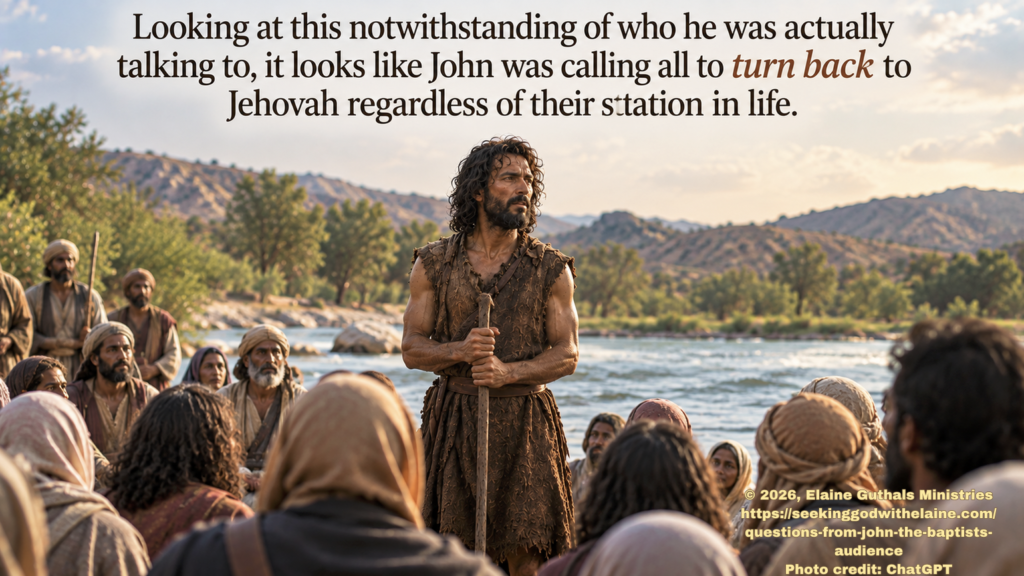
  • Broken Vessels

    Today is a music day.

    Today was a good day — just not for writing. I spent a lot of time with my guys talking about the future.

    One thing I have come to realize in the last month and a half is that many of us are broken vessels. Life is anything but fair.

    But God is right there with His mercy and love. He puts our pieces back together — through His Will or by using others to heal us.

    When we allow Him to make us His vessels, God will use us to do His work to expand His kingdom.

    Broken Vessels
    Vocalist: Elaine Guthals
    Keyboard: Chris Vieth

    BrokenVesselsPin

    What do you think?

    Leave me a comment below (about this or anything else) or head over to my Facebook group for some interactive discussion.

    If you don’t understand something and would like further clarification, please contact me.

    If you have not signed up for the email daily or weekly providing the link to the devotions and the newsletter, do so below.

    If God has used this devotion to speak with you, consider sharing it on social media.