John was given a specific job by Jehovah. This devotional reading looks at the ministry and message given to John.
Nuggets
- John’s mission was long and firmly established.
- Voice is an interesting word that has many definitions.
- It really wasn’t John’s mission.
Luke is the only Gospel to repeat the complete passage from Isaiah. - If Luke was trying to quote Isaiah 40: 5, it seems like he missed the mark.
- The wilderness was a place where Jehovah spoke and revealed Himself.
- John’s task was to restore the nation’s relationship with Jehovah, awaken a community lost in indifference and unwillingness to repent, encourage repentance, announce that the Kingdom of Heaven was near, and introduce a new era.
- We tend to see salvation as the acknowledgment of our personal sins.
- More than just turning away from sin, we have to turn to Jehovah.
- The concept of immersion was not a new idea.
- The Kingdom of Heaven really wasn’t a place – it was a reign.
It was known before John was born what he would do with his life. Jehovah had called him to prepare the way for Messiah.
Let's Put It into Context
To read devotions in The Battle for the Heart theme
Devotions in the The Ministry of John the Baptist series
John’s Ministry Prophesied
“The prophet Isaiah was speaking about John when he said, ‘He is a voice shouting in the wilderness, “Prepare the way for the Lord’s coming! Clear the road for him!”’ (Mt. 3: 3 NLT)
“This is the Good News about Jesus the Messiah, the Son of God. It began just as the prophet Isaiah had written: ‘Look, I am sending my messenger ahead of you, and he will prepare your way. He is a voice shouting in the wilderness, “Prepare the way for the LORD’s coming! Clear the road for him!”’” (Mk. 1: 1-3 NLT)
“Isaiah had spoken of John when he said, ‘He is a voice shouting in the wilderness, “Prepare the way for the LORD’s coming! Clear the road for him! The valleys will be filled, and the mountains and hills made level. The curves will be straightened, and the rough places made smooth. And then all people will see the salvation sent from God.”’ (Lk. 3: 4-6 NLT)
“‘Then who are you? We need an answer for those who sent us. What do you have to say about yourself?’ John replied in the words of the prophet Isaiah: ‘I am a voice shouting in the wilderness, “Clear the way for the LORD’s coming!”’ (Jn. 1: 22-23 NLT)
John’s mission was long and firmly established.
John’s mission was known from before he was born. Gabriel told Zechariah what John was to do.
“He will be a man with the spirit and power of Elijah. He will prepare the people for the coming of the Lord. He will turn the hearts of the fathers to their children, and he will cause those who are rebellious to accept the wisdom of the godly” (Lk. 1: 17 NLT).
Zechariah would have seen this as covenant language. Gabriel’s words hearkened back to the prophecy in Isaiah 40: 3 – sorta. “Listen! It’s the voice of someone shouting, ‘Clear the way through the wilderness for the Lord! Make a straight highway through the wasteland for our God!
This is echoed in similar passages in Malachi.
- “Look! I am sending my messenger, and he will prepare the way before me. Then the Lord you are seeking will suddenly come to his Temple. The messenger of the covenant, whom you look for so eagerly, is surely coming,” says the Lord of Heaven’s Armies” (Mal. 3: 1 NLT).
- “Look, I am sending you the prophet Elijah before the great and dreadful day of the Lord arrives. His preaching will turn the hearts of fathers to their children, and the hearts of children to their fathers. Otherwise I will come and strike the land with a curse” (Mal. 4: 5-6 NLT).
Let’s break it down.
Voice Shouting in the Wilderness
Voice is an interesting word that has many definitions.
Many times, when we just hear the word voice, we immediately focus on the definition that describes the sound produced that comes through our mouths. But it also refers to producing that sound through the resonance of the vocal cords.
Our voice also means the opinion or attitude we are expressing. If it is used as a verb, it refers to the act of presenting that opinion or attitude.
Other definitions refer to the use of the voice. We express those opinions and attitudes in words. We use that voice in concert with others.
When I put all that together and apply it to this Scripture, it takes the focus off John. It shows the most important thing is the message John was giving.
This is important – and for more reasons than its physical attributes.
Prepare the Way
It really wasn’t John’s mission.
We’ll get to John’s message in a bit. But he knew what the purpose of his ministry was.
John was preparing the way for Yeshua. He wasn’t trying to set up a new religious movement. He wasn’t really explaining everything they needed to know.
What John was saying was that the King of the world was coming.
Be ready.
The Valleys Will Be Filled
Luke is the only Gospel to repeat the complete passage from Isaiah.
Luke quotes Isaiah 40: 4 almost verbatim. “Fill in the valleys, and level the mountains and hills. Straighten the curves, and smooth out the rough places” (Isa. 40: 4 NLT).
Isaiah used the process of building a road to describe what Jehovah was going to do.
In order to make a road level, dirt must be moved from one place to another. The spots that are at a higher elevation must be cut down. That dirt must be used to fill in that area with a lower elevation.
I grew up saying the country roads were placed to go around the 40s. The land was plotted out in 40-acre portions. Those who built the road didn’t want it to go through the middle of the field – and take out a lot of farmland from production.
Instead, the new road followed the plots. It went between them. So, there were a lot of curves.
Here, Jehovah said, “Nope. I am not going to worry about physical, worldview notions. I am going to cut straight to the matter – your heart.”
We can read this another way.
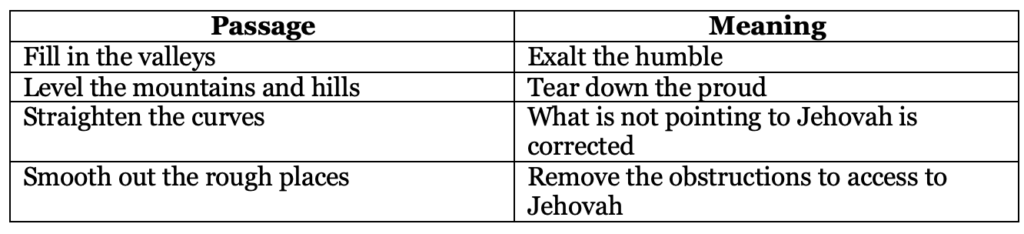
John wasn’t preparing the path to Jehovah through the wilderness; he was preparing the people’s hearts to receive Him.
Jehovah hasn’t moved away from us. He is right there calling us back to Him.
Neither will Jehovah lower His standards to bring us to Him. He expects us to follow Him.
Salvation Sent from God
If Luke was trying to quote Isaiah 40: 5, it seems like he missed the mark.
Take a look at the last verse of Isaiah’s prophecy. “Then the glory of the Lord will be revealed, and all people will see it together. The Lord has spoken” (Isa. 40: 5 NLT).
That is much different from what the Hebrew says. And the glory of YHWH shall be revealed, and all flesh shall see [it] together, for the mouth of YHWH has spoken.
That seems much different from “And then all people will see the salvation sent from God.” (Lk. 3: 4-6 NLT), doesn’t it?
But is it?
Think about it. The glory of the Lord is Jehovah’s presence.
More importantly, Yeshua is the glory of the Lord. Put these verses together.
- “So the Word became human and made his home among us. He was full of unfailing love and faithfulness. And we have seen his glory, the glory of the Father’s one and only Son” (Jn. 1: 14 NLT).
- “I have seen your salvation, which you have prepared for all people. He is a light to reveal God to the nations, and he is the glory of your people Israel!” (Lk. 2: 30-32 NLT).
- “The Son radiates God’s own glory and expresses the very character of God, and he sustains everything by the mighty power of his command. When he had cleansed us from our sins, he sat down in the place of honor at the right hand of the majestic God in heaven” (Heb. 1: 3 NLT).
Remember, Yeshua means God saves. Immanuel means God is with us.
Yeshua is our salvation and the glory of the Lord. He brings both.
So, when the Hebrew wording says, all flesh shall see [it] together, it is correct. It refers to Jehovah’s glory – which Yeshua is.
When the modern wording says see the salvation, that is correct also.
John’s Mission Field
“In those days John the Baptist came to the Judean wilderness and began preaching …” (Mt. 3: 1 NLT)
“This messenger was John the Baptist. He was in the wilderness …” (Mk. 1: 4 NLT)
“Then John went from place to place on both sides of the Jordan River .....” (Lk. 3: 3 NLT)
“At this time John the Baptist was baptizing at Aenon, near Salim, because there was plenty of water there; and people kept coming to him for baptism. (This was before John was thrown into prison.)” (Jn. 3: 23-24 NLT)
The wilderness was a place where Jehovah spoke and revealed Himself.
Jehovah took the Israelites/Jews away from their comfort zones and placed them in a broken landscape where they had to depend on Him.
In the wilderness, Jehovah exposed their hearts.
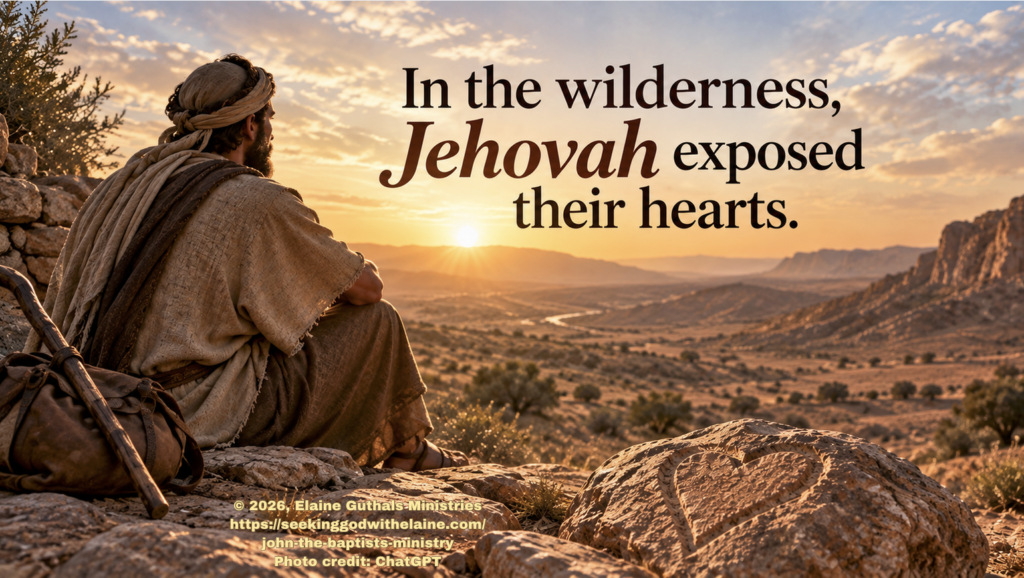
From before Yeshua stepping onto the stage to discuss redemption, Jehovah was saying, “Look at your hearts. That is what I want – not actions.”
John was firmly committed to Jehovah. He separated himself from the world, preferring solitude to reflect and connect with God and remain detached from its influences.
John wasn’t commissioned to be a priest, even though he was of the lineage of Aaron. Instead, he took the Nazarite vow.
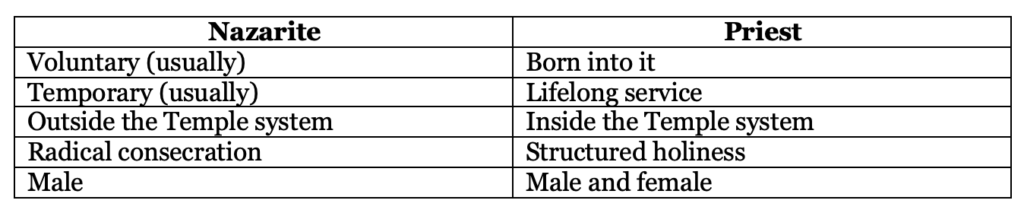
This is a huge shift. Jehovah was taking religion out of the Temple and putting it into the wilderness.
Jehovah was moving from structured ritualistic ceremony to individual condition of the heart.
John’s Message
“... His [John the Immerser’s] message was, ‘Repent of your sins and turn to God, for the Kingdom of Heaven is near’” (Mt. 3: 1-2 NLT)
“This messenger was John the Baptist. He was in the wilderness and preached that people should be baptized to show that they had repented of their sins and turned to God to be forgiven” (Mk. 1: 4 NLT)
“... preaching that people should be baptized to show that they had repented of their sins and turned to God to be forgiven” (Lk. 3: 3 NLT)
John’s task was to restore the nation’s relationship with Jehovah, awaken a community lost in indifference and unwillingness to repent, encourage repentance, announce that the Kingdom of Heaven was near, and introduce a new era.
Repent of your sins
We tend to see salvation as the acknowledgment of our personal sins.
Isn’t that what repent and be baptized is all about? Well, yes and no.
In the Old Testament, the primary Hebrew concept is expressed through shuv (שׁוּב), meaning to turn, return or go back, and nacham (נָחַם), which can express regret, relenting, or a change of mind/intent.
This carried into the New Testament as to change one’s mind or way of thinking.
John’s message, while it did invite personal repentance, was more for the nation of Israel. Look back at what Gabriel told Zechariah.
“And he will turn many Israelites to the Lord their God” (Lk. 1: 16 NLT).
Remember, Israel had a covenant relationship with Jehovah. The problem Israel’s leaders encountered was they forgot that was a relationship, rather than just ritual ceremony.
Turn to God
More than just turning away from sin, we have to turn to Jehovah.
You are moving away in sin. Do a u-turn. Take a roundabout. Pull into a driveway, back out, and come back the way from which you came.
In other words, do a 180 degree and come back to Jehovah.
- “… He [John the Immerser] … proclaiming an immersion involving turning to God from sin in order to be forgiven” (Mk. 1: 4 CBS).
- “Turn from your sins to God, for the Kingdom of Heaven is near!” (Mt. 3: 2 CJB).
The goal is not to eliminate sin in our lives. It is to restore our relationships with Him.
Baptized
The concept of immersion was not a new idea.
First-century Jews were familiar with immersion in the mikvah. The mikvah (מִקְוֶה) refers to a collection of water and came to be associated with the ritual bath used for purification.
In the Torah, immersion in water could mark a person moving from a condition of ritual uncleanness to ritual cleanness. John’s audience would have understood the action.
They would have seen a big difference. John was not having them immerse in the mikvah but in the Jordan River.
This would have carried national significance, too. It was this river that the fledgling Israelite nation crossed after 40 years of wandering in the wilderness.
John was taking Israel back to the Jordan River so that they could be immersed. They would enter unclean and emerge prepared for what Jehovah was about to do.
No, that doesn’t say they emerged ritually clean.
John’s immersion was a public act of purification and preparation — a person went down into the water and came back out symbolically prepared for the imminent arrival of the Lord. John physically stood in the wilderness, at the Jordan, immersing Israelites as he prepared a people for Jehovah.
The Kingdom of Heaven
The Kingdom of Heaven really wasn’t a place – it was a reign.
When Matthew said that John’s message was that the Kingdom of Heaven was at hand, it wasn’t talking about a kingdom that exists in the sky.
It was talking about the rule of God becoming manifest. Jehovah’s reign was about to start.
Here is how Strugnell explained it. He wrote,
“John’s baptism probably symbolized not so much anticipated entrance into the kingdom of God as an anticipatory submission to the coming world judgment, which was represented as a coming second ‘baptism’ by the Holy Spirit in a river of fire.”
Resource
So, it had nothing to do with where the kingdom would be – rather it told Who was going to rule the kingdom.
John wasn’t merely calling individual Jews to become better people. He was calling Israel to prepare itself as a people for the arrival of its King. Their immersion in the Jordan became a visible declaration: “We are turning back to Jehovah, and we are preparing ourselves for what He is about to do.”
Making the Connections #1
Let’s put the progression together.
- Jehovah is coming.
- His glory will be revealed.
- His reign is drawing near.
John was immersing people to prepare them for the arrival of Jehovah’s reign.
What would first-century Jews have heard? They would hear John say, “Jehovah is about to take His rightful place as King!”
They weren’t looking for a different place to live. They were looking for Jehovah to take the action He had promised.
Making the Connections #2
We can’t hide behind some persona of being a good person. We have to deal with the root cause of spiritual death — humans are sinful — each and every one of us.
We like to say, “Repent. Say you’re sorry, and everything will be okay.”
The term for repent in Hebrew is shuv (שׁוּב). It means to turn, return, go back, and restore.
Redemption starts with confessing our sins (Mk. 1: 5). We can only confess what we acknowledge.
But we can’t do it on our own. Oh, yes, we make the decision that we want to repent and turn.
We can only accomplish that through Jehovah’s grace. When we return to Jehovah, we are restored.
“Restore us, O Lord, and bring us back to you again! Give us back the joys we once had!” (Lam. 5: 21 NLT).
What do we return to? We are restored to righteousness.
From the moment of birth to the moment of our conversion, there had never been a moment when we were righteous. To be righteous, we faithfully walk according to Jehovah’s covenant.
We may think we were good people. That is not a substitute for righteousness.
Making the Connections #3
To concept of repentance carried into the New Testament as to change one’s mind or way of thinking.
Think about it. We are not called just to change our actions. We are called to change our attitudes and priorities.
When we do that, we change our way of thinking. We change our thinking to align with Jehovah’s ways.
Heart Check
Think about the battle Yeshua is engaged in for your heart. Ask yourself the following questions.
- Am I merely trying to become a better person, or am I actually turning back to Jehovah?
- Have I allowed sin, pride, tradition, or self-reliance to become an obstruction between me and Jehovah?
- What needs to change in my heart so that my life is pointing toward Jehovah rather than away from Him?
How Do We Apply This?
- Examine where our hearts are pointing.
- Identify the obstructions of pride, sin, self-reliance, misplaced priorities, and even religious traditions that can become barriers that keep us from fully surrendering to Jehovah.
- Turn around and return to Jehovah.
- Prepare our hearts for the King.
- Let Jehovah restore what has been broken.
Father God. Thank You for the message You gave to John. Lord, help us turn back to You so that we are walking Your paths. Amen.
If you don’t understand something and would like further clarification, please contact me.
If you have not signed up for the email providing the link to the devotions and the newsletter, do so below.
If God has used this devotion to speak with you, consider sharing it on social media.