Many people from all around came to hear John the Baptist’s message. This devotional reading looked at who they were and some of their responses to his message.
Nuggets
- John’s audience consisted of Jewish people, not pagan Gentiles.
- John’s message wasn’t just for his audience.
- All who came to John were looking for Jehovah to do something.
- Baptism wasn’t simply John’s version of a modern altar call.
- The Jordan River was an important river in the history of Israel.
- The Pharisees struggled with John’s message.
- It was the Sadducees’ responsibility, though not always priests, to maintain the elements of Temple worship.
- John loved to call the Pharisees and Sadducees names.
- We don’t know for sure what John’s question was about.
- Jehovah will judge us according to the condition of our hearts.
- Their belief was their reliance on Abraham’s ancestry.
- We prove that we are living the way Jehovah wants us to when we produce the fruit He wants.

John the Immerser didn’t set up court in the Temple. His mission field was the wilderness.
Still, John drew large crowds to hear him preach. Some came from miles away to hear the message.
Not all liked what they heard, though.
Let's Put It into Context
To read devotions in The Battle for the Heart theme
Devotions in the The Ministry of John the Baptist series
John’s Audience
“People from Jerusalem and from all of Judea and all over the Jordan Valley went out to see and hear John. And when they confessed their sins, he baptized them in the Jordan River” (Mt. 3: 5-6 NLT)
“All of Judea, including all the people of Jerusalem, went out to see and hear John. And when they confessed their sins, he baptized them in the Jordan River” (Mk. 1: 5 NLT)
People from Jerusalem
John’s audience consisted of Jewish people, not pagan Gentiles.
More than just the priests resided in Jerusalem. Residents were also ordinary first-century Jews.
It was those common people who also flocked to the Jordan River to see the prophet. More importantly, they were going to renew their relationships with Jehovah.
Many probably would have questioned John’s message to them. Why was he calling covenant people to repentance?
But then Jehovah repeatedly called Israel to repentance. The prophets had warned Israel that merely possessing the covenant, the temple, circumcision, sacrifices, or ancestry did not make them faithful to Jehovah.
John’s first-century audience would have seen this as a call to return to covenant faithfulness.
All of Judea
John’s message wasn’t just for his audience.
When Matthew and Mark said all of Judea, they weren’t talking about just the people who came to the Jordan and heard his message. He was talking about every Jewish person everywhere.
Jehovah was sending His salvation for all who would believe and obey.
Judea is the mountainous southern region of Israel. Named after Jacob’s son Judah, it includes the key cities of Jerusalem, Bethlehem and Hebron.
It was formed around 930 BC when the kingdom split into the Northern Kingdom of Israel and the Southern Kingdom of Judah.
All Over the Jordan Valley
All who came to John were looking for Jehovah to do something.
Many people who came from all over believed that John’s message would be the beginning of Jehovah restoring Israel’s freedom from foreign oppression. They were ready for that.
This belief would have been strengthened by the language John used. He talked through kingdom language.
But they would have believed that John’s message was telling them that foreign domination and Gentile influence was going to be ending.
Baptized
Baptism wasn’t simply John’s version of a modern altar call.
John was calling Israelites to undergo a baptism associated with repentance as they prepared for God’s coming intervention. That would have been a huge slap to many of the Jews in his audience.
Don’t assume that being Jewish means you are automatically ready for what God is about to do.
John was telling them to not put too much stake in family lineage. He was also telling them that going through the motions of religion wasn’t what Jehovah expected.
Jehovah was interested in the condition of their hearts. Nothing has changed – He is still interested in the condition of our hearts.
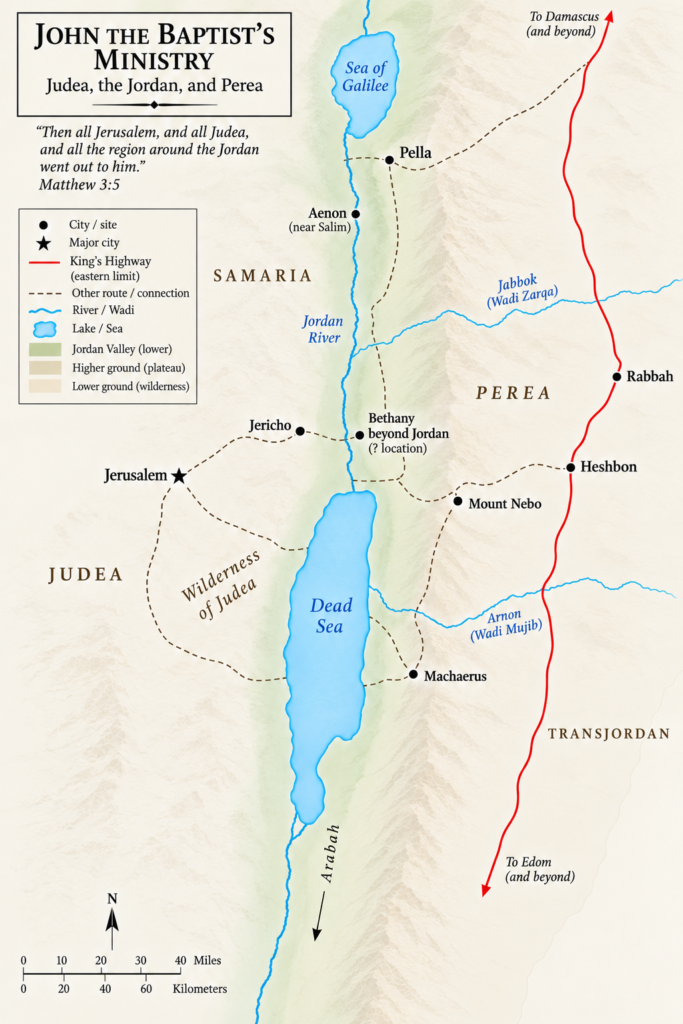
Jordan River
The Jordan River was an important river in the history of Israel.
We tend to think that the Jordan River is the boundary of Israel. That is because it is described as crossing the Jordan River into the Promised Land.
“The eastern boundary will start at Hazar-enan and run south to Shepham, then down to Riblah on the east side of Ain. From there the boundary will run down along the eastern edge of the Sea of Galilee, and then along the Jordan River to the Dead Sea. These are the boundaries of your land” (Num. 34: 10-12 NLT).
That doesn’t mean the area east of the river – the Transjordan – wasn’t important. It was in that area that the tribes of Reuben, Gad, and the half tribe of Manasseh settled.
The two and a half tribes were seen as refusing to enter the Promised Land. It was seen as the dividing line between faith in divine faithfulness and unbelief.
I always thought it was fitting that Israelites’ wandering after their exodus was bookended between two miraculous events that showed the power of Jehovah. Just as He parted the Red Sea that ensured their departure, He parted the Jordan for their entrance.
Questioned by the Religious Leaders
“But when he saw many Pharisees and Sadducees coming to watch him baptize, he denounced them. ‘You brood of snakes!’ he exclaimed. ‘Who warned you to flee the coming wrath? Prove by the way you live that you have repented of your sins and turned to God. Don’t just say to each other, “We’re safe, for we are descendants of Abraham.” That means nothing, for I tell you, God can create children of Abraham from these very stones. Even now the ax of God’s judgment is poised, ready to sever the roots of the trees. Yes, every tree that does not produce good fruit will be chopped down and thrown into the fire” (Mt. 3: 7-10 NLT)
“When the crowds came to John for baptism, he said, ‘You brood of snakes! Who warned you to flee the coming wrath? Prove by the way you live that you have repented of your sins and turned to God. Don’t just say to each other, “We’re safe, for we are descendants of Abraham.” That means nothing, for I tell you, God can create children of Abraham from these very stones. Even now the ax of God’s judgment is poised, ready to sever the roots of the trees. Yes, every tree that does not produce good fruit will be chopped down and thrown into the fire’” (Lk. 3: 7-10 NLT)
Pharisees
The Pharisees struggled with John’s message.
We tend to make the Pharisees into one of the villains, but we shouldn’t. They were doing what they thought Jehovah had called them to do.
Pharisees weren’t priests. They didn’t have any role in the Temple system.
What Pharisees were was a lay movement devoted to the careful study, preservation, instruction, and practice of the Law of Moses. That made them guardians of the law. They were the bridge between the Law of Moses and the people.
Unfortunately, many Pharisees were keeping the Law in a way that had become detached from repentance, mercy, and inward change. They added to the Law that resulted in a distortion of the Law. Also, they elevated tradition over the Law.
Sadducees
It was the Sadducees’ responsibility, though not always priests, to maintain the elements of Temple worship.
Known for their acceptance of the Torah as their primary authority, this powerful group read Scripture in a conservative way. Their desire was to preserve existing structures.
Many collaborated with the Roman authorities to maintain their status. This made them appear to be more concerned with politics than religion. Many served in the Sanhedrin, gaining a majority in the highest court in Israel.
Because of this accommodation with the Romans, common Jews didn’t relate to the Sadducees as they did the Pharisees. It didn’t help, either, that the Sadducees were upper class and wealthy – therefore, out of touch with the common Jewish people.
You Snakes
John loved to call the Pharisees and Sadducees names.
Here, it was snakes. Yep, John did not cut them any slack. He called them on their sincerity.
Sometimes translated as brood of vipers, John was calling them sons of serpents. He was referring to their legalism, hypocritical attitudes, and corruption.
Shaan Sharma, who played Schmuel in The Chosen, had a really good observation. He said, “When we think of all of them [the Pharisees] all as a block and try to ascribe a quality to them all like all Pharisees are bad or whatever, that just doesn’t make sense. Even the apostles did not fully understand what Jesus was trying to tell them.”
Resource
No, you and I can’t pass judgment on the genuineness of another’s salvation. That is only up to Jehovah.
Pastors are to counsel their congregation when they see someone sinning. It is for the strength of the congregation.
Who Warned You
We don’t know for sure what John’s question was about.
More than likely, John was asking a rhetorical question. He wasn’t looking for a name.
If we look ahead, we may get a clue. Connect “Prove by the way you live …” (Mt. 3: 8 NLT) and “… we are descendants of Abraham …” (Mt. 3: 10 NLT).
The who warned you isn’t as important as what makes you think you can escape it.
Think about it. The Pharisees have shown up for baptism. And John was saying, “Wait a second. So, you know judgment is coming, too?”
They know Jehovah’s judgment is coming. Their belief in Jehovah and Scripture wasn’t being questioned.
But to answer the question, we can figure several possibilities. They were at the Jordan, so they heard John’s preaching. That means they recognized the prophetic significance of him.
Their presence may have been sincere. We know some of the Pharisees did believe in Yeshua.
We also know that not all did. John may have been exposing their insincerity.
John could have been telling them that outward actions alone aren’t what Jehovah is after. He was saying reality has to be shown in our hearts.
Jehovah looks for repentance, not self-righteousness.
We must truly repent for salvation.
Who Warned You
We don’t know for sure what John’s question was about.
More than likely, John was asking a rhetorical question. He wasn’t looking for a name.
If we look ahead, we may get a clue. Connect “Prove by the way you live …” (Mt. 3: 8 NLT) and “… we are descendants of Abraham …” (Mt. 3: 10 NLT).
The who warned you isn’t as important as what makes you think you can escape it.
Think about it. The Pharisees have shown up for baptism. And John was saying, “Wait a second. So, you know judgment is coming, too?”
They know Jehovah’s judgment is coming. Their belief in Jehovah and Scripture wasn’t being questioned.
But to answer the question, we can figure several possibilities. They were at the Jordan, so they heard John’s preaching. That means they recognized the prophetic significance of him.
Their presence may have been sincere. We know some of the Pharisees did believe in Yeshua.
We also know that not all did. John may have been exposing their insincerity.
John could have been telling them that outward actions alone aren’t what Jehovah is after. He was saying reality has to be shown in our hearts.
Ax of God’s Judgment
Jehovah will judge us according to the condition of our hearts.
We may think the ax is the punishment for bad behavior. It isn’t.
John is making use of prophetic imagery. We may not recognize it, but his audience did.
The audience would have heard already laid at the root of the trees. They would have understood imminence.
The woodcutter has already arrived, cutting off the opportunity for the Pharisees and Sadducees having even one more season to prove themselves. The ax is placed at the root. This isn’t a pruning. It is a fundamental failure of character.
Tree imagery was often used in the Old Testament to represent people, rulers, nations – especially when Jehovah’s judgment was involved.
They wouldn’t have seen this as a call to be a better person. They would have heard the language of the prophets – judgment is coming.
Abraham Is Our Father
Their belief was their reliance on Abraham’s ancestry.
John said that being Abraham’s descendants alone wasn’t going to save them.
I am sure the Pharisees were tripping over this. What I think it is saying is that Jehovah can make anyone a descendant of Abraham — Jews and Pharisees.
Jehovah chooses how we are saved. He said it is only through belief and imitation of Yeshua. “There is salvation in no one else! God has given no other name under heaven by which we must be saved” (Ac. 4: 12 NLT).
It is also Jehovah’s choice as to who is saved. He had long said that all people would be offered salvation (Gen. 12: 3).
Prove by the Way You Live – Produce Good Fruit
We prove that we are living the way Jehovah wants us to when we produce the fruit He wants.
Okay, John was talking to the Pharisees, but he was telling them to produce fruit. I bet that went over like a led balloon.
Remember, the Pharisees thought they were so righteous. But Yeshua was battling for their hearts.
And Yeshua doesn’t pull punches.
We see the word fruit, and we think of fruit of the spirit (Gal. 5: 22-23). That isn’t what is being discussed here.
Producing fruit is the byproduct when we live a life that builds our relationship with Jehovah. Seeking Him, trusting Him, and abiding in Him result in righteousness.
We have to prove our sincerity by walking with Jehovah.
Making the Connections #1
Conder gave us a physical description of the Jordan River. He wrote,
“The Jordan rises as a full-grown river, issuing from the cave at Banihs, about 1,000 feet above the level of the Mediterranean …. In twenty-six and half miles, there is a fall of 1,682 feet, or more than sixty feet to the mile ….”
Resource
Making the Connections #2
I have been puzzling over something since Yeshua was presented at the Temple. But we need to set some background first.
It had been 400 years since Israel had a prophet. The last one had been Malachi.
That is widely accepted.
But when Yeshua was presented at the Temple, Anna was called a prophet. “Anna, a prophet, was also there in the Temple …” (Lk. 2: 36 NLT).
How can they say they had no prophets if they recognized Anna as a prophet?
Well, Anna’s role was different than John’s. She only appears in the Temple, waiting for and recognizing Yeshua. That was a single event that didn’t speak to the nation of Israel.
John had a whole ministry in the wilderness. He was saying that Jehovah’s promised intervention was arriving.
We also have to remember that Yeshua called John more than a prophet (Mt. 11: 11; Lk. 7: 28).
The prophets of the Old Testament just proclaimed the arrival of the Messiah. John was saying, “He’s here.”
Does that mean there could have been more prophets between Malachi and John? Possibly.
It just means that prophetic forecasting was being accomplished through John’s message.
John was the first great prophetic voice to arise in Israel’s wilderness since the days of the Old Testament prophets, and his ministry marked the long-awaited transition from prophetic anticipation to the arrival of the Messiah.
Making the Connections #3
John – and Yeshua – had to combat the Pharisees’ and Sadducees’ belief that being Abraham’s descendants was enough. Part of the reason was because the Messiah was fulfilling a covenant promise.
They had trouble seeing that the promise was made long before the covenant was struck between Jehovah and Abraham. The promise wasn’t made to Abraham. He was just the vehicle through which the promise was fulfilled.
Heart Check
Think about the battle Yeshua is engaged in for your heart. Ask yourself the following questions.
- Am I trusting Jehovah, or am I trusting my religious identity?
- Am I genuinely repenting, or am I only going through religious motions?
- Am I producing the fruit Jehovah wants, or am I producing the fruit I want?
- Am I following Jehovah’s way, or am I relying on my own way?
How Do We Apply This?
- Ask Jehovah to reveal where we have become self-righteous.
- Don’t use our heritage, church attendance, or religious service as evidence of salvation.
- Take repentance seriously.
- Let our actions demonstrate what we believe.
- Prepare our hearts to follow Yeshua wherever He leads.
Father God. Thank You for those who bring Your message to us. Help them to boldly tell us Your words that we need to hear. Help us to open our hearts so that Your message transforms us into who You want us to be. Amen.
If you don’t understand something and would like further clarification, please contact me.
If you have not signed up for the email providing the link to the devotions and the newsletter, do so below.
If God has used this devotion to speak with you, consider sharing it on social media.