Category: Ministry

  • The Call through Fish

    Many of us have grown up believing the miraculous catch of fish happened when Peter, Andrew, James, and John were called to be Yeshua’s disciples. This devotional reading looks to see if that were the case.

    Nuggets

    • Yeshua would have been fulfilling His mission to bring first-century Jews to a better understanding of Jehovah.
    • Luke went on to say that Yeshua was preaching, one of the first indications that His ministry had started.
    • It looks like Yeshua just commandeered the boat.
    • The Craftsman told the fisherman how to fish.
    • Simon probably had every reason not to do what Yeshua asked, but he was obedient.
    • Through this encounter, Simon acknowledged his awareness of sin.
    Many place this miracle to have occurred at the calling of Peter, Andrew, James, and John’s to follow Yeshua. While it does have the reference of fishing for men and following Him, it doesn’t actually have Him saying, “Follow me.”

    In the last devotion, we saw the two passages in Matthew 4 and Mark 1 that – almost verbatim – issue the call.

    How do we reconcile the three passages? Let’s see what Luke has to say before we get there. Then what happens when we add John 1 into the mix????

    Let’s Put It into Context

    To read devotions in The Battle for the Heart theme

    Devotions in the The Early Ministry of the Messiah series

    Yeshua Teaching

    “One day as Jesus was preaching on the shore of the Sea of Galilee, great crowds pressed in on him to listen to the word of God. He noticed two empty boats at the water’s edge, for the fishermen had left them and were washing their nets. Stepping into one of the boats, Jesus asked Simon, its owner, to push it out into the water. So he sat in the boat and taught the crowds from there” (Lk. 5: 1-3 NLT)

    One Day as Jesus Was Preaching

    Yeshua would have been fulfilling His mission to bring first-century Jews to a better understanding of Jehovah.

    Luke began his passage by identifying Yeshua’s actions. It wasn’t that He was walking by the shore of the Sea of Galilee, which were His actions in Matthew 4: 18 and Mark 1: 16.

    It was that Yeshua had already arrived. And He was fulfilling His mission – He was preaching.

    Well, we could say Yeshua had to walk to preach. He may have been walking, the crowds gathered around, and He stopped so they could hear better.

    Yeah, that seems like a lot more detail than we usually get in any Gospel passage. Many explain that by Luke being a Greek writing to a Gentile audience. More than that, it is detail we really don’t need to focus on in the story.

    So, why discuss it now? It trips up some people when there are seemingly two differing accounts of what is purported to be the same event. We may be fine with brevity; someone else may not.

    One goal in writing these devotions is to see things as Peter, Andrew, James, and John saw it. When we do a surface read, we – from a different culture and time – may miss a lot of things. Besides, my Springfield Mom may not want to get bogged down in the minutia while my cousin Willi is looking for those details.

    Since I think this is very important, we look.

    Noticed Two Empty Boats at the Water’s Edge

    Luke went on to say that Yeshua was preaching, one of the first indications that His ministry had started.

    A great crowd had gathered around Yeshua to hear His preaching. This crowd would have consisted of fishermen. Yeshua had come to their workplace.

    It may have consisted of vendors selling fish. If that was the case, then possibly customers would have been present. It is possible that there was someone just walking along the shore.

    In any case, the crowd was pressing in on Yeshua. That not only would have made it more difficult for Him, but it also would have made it more difficult for them.

    Yeshua’s solution was to borrow one of the two empty boats right there. He probably thought that, by being in the boat, He would put a little distance between Him and the crowd so they could hear Him better.

    What exactly was Yeshua borrowing? Simon’s place of business – his workplace.

    Simon, Its Owner

    It looks like Yeshua just commandeered the boat.

    Yeshua just walked on the boat and told the owner of the boat to push off. The owner was Simon.

    Simon – and probably Andrew as they were partners – were a little distance away washing nets. This tells us the point that they were at in the day. Well, actually, night. Fishing was generally done at night as the fish were closer to the surface. It also helped that temperatures were cooler.

    Fish wasn’t the only thing that was caught in the net when it was cast. Debris – including aquatic vegetation, mud, and other material – needed to be cleaned from the nets before they could be reused. This also allowed them to be dried, checked, and repaired if needed.

    The Greek verb used is plynō (πλύνω). It means to wash or cleanse and describes the ordinary physical task of washing objects. He wasn’t talking purification or being ceremonially unclean.

    The important thing to remember is that this had to be done every time they docked from a period of fishing. It had nothing to do with whether fish were caught or not. They ended their period of work by taking care of the nets.

    Think about it. If they were net fishing, the nets wouldn’t have been as strong as the more durable nets used on the boats. They may have needed more repair.

    Either way, the fishermen would have taken care of them. Even though they were linen, they weren’t disposable, one-use nets.

    This parallels Matthew 4: 21 and Mark 1: 19. Simon and Andrew were only washing their nets. James and John had to mend their nets.

    Bottom line, fishing at night was normal. The fishermen were finishing their work.

    But we have to stop right here and address the timeline. Did Yeshua already know Simon and Andrew?

    Maybe. If John 1 happened before Luke 5, they would have spent at least some of the late afternoon/early evening hours with the Messiah. But if it had, Yeshua would have already renamed Simon to Peter.

    To me, John 1 couldn’t have happened after Luke 5. John wouldn’t have had to point Yeshua out to Andrew. They probably would have already known He was the Messiah. But Simon’s name would have been correct.

    Go Fish

    “When he had finished speaking, he said to Simon, ‘Now go out where it is deeper, and let down your nets to catch some fish.’ ‘Master,’ Simon replied, ‘we worked hard all last night and didn’t catch a thing. But if you say so, I’ll let the nets down again.’ And this time their nets were so full of fish they began to tear! A shout for help brought their partners in the other boat, and soon both boats were filled with fish and on the verge of sinking” (Lk. 5: 4-7 NLT)

    Now Go Out

    The Craftsman told the fisherman how to fish.

    When Yeshua was done preaching, He wanted the fishermen to go fishing again. Think about what might have been going through Simon’s mind.

    • We’ve been out all night.
    • We didn’t have anything to show for our labors.
    • We’ve already cleaned the nets.

    Simon was done.

    We can see Simon had every reason to feel this way. His experience wasn’t wrong. He was stating facts.

    But it was even more than that. Yeshua was asking him to do the wrong thing at the wrong time in the wrong place.

    Ooo, baby. Don’t we do that? We know so much more than our Savior and Creator knows – at least we think we do.

    We don’t.

    Yeshua shows us time and time again that we need to trust in Him and Jehovah’s plan for our lives.

    And worse luck, Yeshua told Simon to put out in deeper water. Depth or deep water.

    That is what the Greek word – bathos (βάθος) – means. Its practical application means going from control to uncertainty, from skill to trust.

    Simon had a measure of control because he had knowledge and experience of fishing. He had always picked the times he and Andrew took the boat out – and when they didn’t.

    Now, Yeshua was asking Simon to go out in the daytime when the temperature was warmer. Some of the fish could have been at the bottom of the lake instead of closer to the top.

    Simon was going from the controllable to the uncertain.

    Ooo, baby. Yeshua calls us to go from the comfy, cozy life we have in sin to follow Him into the unknown for us – but known to Him.

    Would Simon rely on his experience, or would he say Yeshua was the final authority when given a different instruction?

    But If You Say So

    Simon probably had every reason not to do what Yeshua asked, but he was obedient.

    Simon was tired. He was probably hungry. He more than likely just wanted to get home to his wife.

    But Simon was game. If the Man said so, he’d do it.

    This is the perfect picture of obedience. It goes against what we want. It doesn’t take into account what we know. What we can do or not do has no bearing on it.

    Simon’s obedience wasn’t unquestioning compliance. It was a decision.

    Obedience steps up and says, “But if You say so, I’ll do it.”

    That is one element of faith: trusting Yeshua’s word over our experience. Trusting His word, even when we think it impossible.

    Faith doesn’t require that we pretend we know nothing. It requires us to recognize that our knowledge and experience have limits.

    Trust isn’t the absence of questions or the inability to recognize difficulties. Trust is choosing how to respond when we recognize those difficulties.

    Nets Were So Full

    Simon’s obedience was immediately rewarded.

    Ooo, baby. Was Simon in for a surprise. They caught so many fish that the nets began to tear.

    Now, Simon not only had to rewash them, but he also had to mend them.

    I would guess that Simon wasn’t focusing on that.

    Yeshua provided so many fish, Simon and Andrew had to call James and John. They needed their partners to help.

    Jehovah’s blessing often exceeds individual capacity.
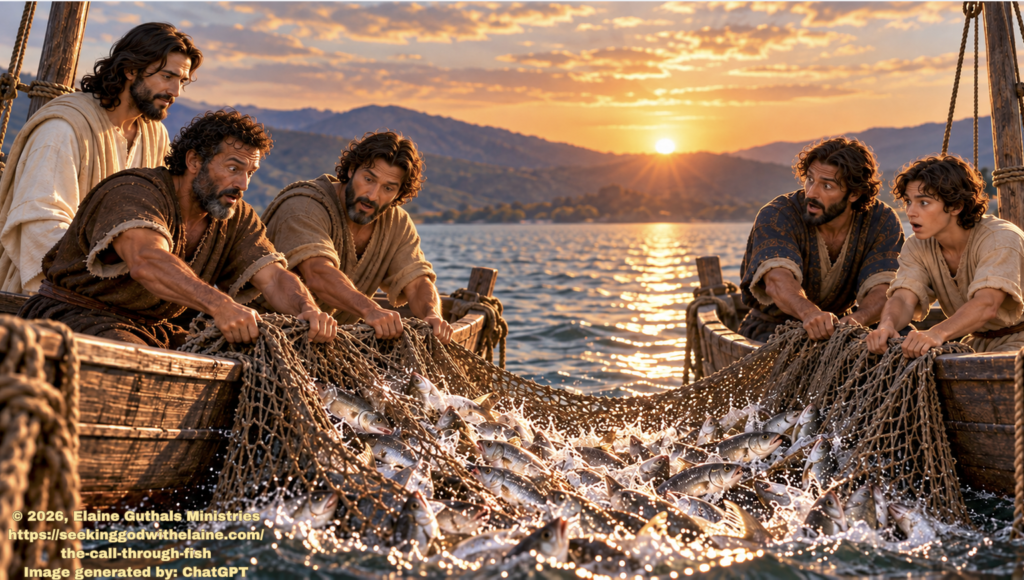
    But it had an element we probably think shouldn’t have been a part of the catch. The boat started to sink.

    How can something bad be a part of something good? That is what we think, don’t we? When we are doing the Lord’s work, nothing bad should happen.

    It doesn’t work that way.

    I’m a Sinful Man

    “When Simon Peter realized what had happened, he fell to his knees before Jesus and said, ‘Oh, Lord, please leave me — I’m such a sinful man.’ For he was awestruck by the number of fish they had caught, as were the others with him” (Lk. 5: 8-9 NLT)

    Through this encounter, Simon acknowledged his awareness of sin.

    Remember when we said Simon was going from the controllable to the uncertain? The uncertain became the unbelievable.

    But more than that, it became a display of Yeshua’s power and authority. It drove home the point that Simon wasn’t in control. Yeshua was.

    Simon had his eyes opened. He saw the Messiah in front of him.

    But what Simon saw was his own unworthiness. Instead of looking for salvation, Simon told the Messiah to depart from him. Why?

    We have to go back to first-century Messianic expectations. Remember John the Immerser’s message. Repent of your sins.

    Many people of the day thought they had to become righteous and then the Messiah would come. Simon acknowledged he wasn’t righteous, so he may have felt he was not worthy to be addressing the Messiah.

    Fishers of Men

    “His partners, James and John, the sons of Zebedee, were also amazed. Jesus replied to Simon, ‘Don’t be afraid! From now on you’ll be fishing for people!’ 11 And as soon as they landed, they left everything and followed Jesus” (Lk. 5: 10-11 NLT)

    The promise in Luke is the same as that in Matthew and Mark.

    Yeshua told Simon, Andrew, James, and John that they would catch men. The Greek word there is zōgreō (ζωγρέω). It means capture alive.

    Jehovah calls people after exposing their inadequacy – not before.

    The disciples’ response? They left everything and followed the Messiah.

    Reconciling These Passages with John 1: 35-42, Matthew 4: 18-22, and Mark 1: 16-20

    Reconciling These Passages with John 1: 35-42, Matthew 4: 18-22, and Mark 1: 16-20

    So, let’s look at all of this and see if we can piece it together.

    Event

    Gospel

    Supports

    Contradicts

    Yeshua walking along the shore

    Matthew 4: 18;

    Mark 1: 16

    At first glance they do contradict. Could be the walking announced His arrival at the shore, then He started preaching.

    Yeshua preaching on the shore

    Luke 5: 1

    Simon, also called Peter, and Andrew

    Matthew 4: 18

    Calling him Simon may indicate that his name hadn’t be changed yet.

    Simon and Andrew

    Mark 1: 16

    Simon

    Luke 5: 3

    Two boats belonging to Simon

    Luke 5: 3

    Neither supports nor denies this. As Simon was a fisherman, it would be expected that several of the boats could have been his. If he were partners with Zebedee, who we know had hired men, maybe Simon did, too.

    Throwing out a net

    Matthew 4: 18;

    Mark 1: 16

    These verses indicate different places Peter and Andrew were in the fishing day. Casting nets meant they were still in the act of fishing; washing nets meant they were done fishing.

    Washing their nets

    Luke 5: 2

    Push out to deeper water

    Luke 5: 4-5

    This event only appears in Luke’s Gospel.

    Enough fish came to begin to tear the nets

    Luke 5: 4-5

    The Craftsman told the fisherman how, where, and when to fish. A large catch was netted.

    Simon and Andrew call for James and John to help.

    Luke 5: 7

    This event only appears in Luke’s Gospel.

    Simon’s declaration of sin.

    Luke 5: 8-9

    This event only appears in Luke’s Gospel.

    James and John were amazed.

    Luke 5: 10

    Matthew and Mark don’t include that interpretation.

    Come, follow me

    Matthew 4: 19;

    Mark 1: 17

    Luke does not contain a call for the two disciples.

    Fish for people

    Matthew 4: 19;

    Mark 1: 17; Luke 5: 10

    All three Gospels include the same declaration.

    Simon and Andrew left their nets at once

    Matthew 4: 20;

    Mark 1: 18

    James and John a little further up shore

    Matthew 4: 21;

    Mark 1: 19

    Luke 5 doesn’t tell us James and John’s activities when they answered Simon and Andrew’s shout for help. So, he neither confirms nor denies what the other two accounts agree upon.

    Sitting in a boat with Zebedee

    Matthew 4: 21

    Repairing their nets

    Matthew 4: 21;

    Mark 1: 19

    He called them, too

    Matthew 4: 21;

    Mark 1: 19

    Luke 5: 11 should be coupled with these verses. Luke summarizes all were obedient while Matthew and Mark show how each family of brothers was obedient.

    Immediately left boat and father

    Matthew 4: 22;

    Mark 1: 20

    While Luke summarized what the four gave up, Matthew and Mark explain what they left behind. This  does not necessarily mean the accounts are different. It could be the men merely focused on different aspects of what was given up.

    They left everything

    Luke 5: 11

    Left boat with hired hands

    Mark 1: 20

    Event

    Gospel

    Supports

    Contradicts

    Two of John’s disciples spend time with Yeshua

    John 1: 35-39

    For Andrew to be introduced to Yeshua as he was in John’s account, the meeting between Yeshua and the two disciples (one of which was Andrew) had to happen before the encounter on the seashore.


    Andrew, of the two disciples, brought his brother Simon to Yeshua

    John 1: 40-43


    We may or may not be able to make our decisions on timeline because of the name Andrew’s brother is called. While he may have been Simon before the call occurred, we know that names of people and towns are given as the name most commonly recognized by the readers of the account.

    Yeshua goes to Galilee to call Philip

    John 1: 43

    If Yeshua traveled to Galilee to call Philip, that meant Andrew and Simon didn’t meet with Yeshua in Galilee in John 1. Matthew 4/Mark 1 would have occurred at a least a minimum of a couple of days earlier after the encounter with Yeshua in John 1.


    Yeshua met Simon, Andrew, James, and John on the seashore.

    Matthew 4: 18;

    Mark 1: 16

    An earlier meeting wouldn’t make a meeting at the seashore unlikely.


    Yeshua called them and/or told them they would be fishers of men.

    Matthew 4: 19;

    Mark 1: 17; Luke 5: 10

    Regardless of Yeshua actually said the words, “Come, follow me,” He did tell them what their job would become – witnessing to others. He didn’t call Simon, Andrew, and John in John 1, and James was not present there.


    Yeshua caused a miraculous catch of fish.

    Luke 5: 4-7


    I really don’t see that occurring during Simon, Andrew, James, and John’s call.

    It always amazes me that Luke was the only Gospel writer to include the miraculous catch of fish. Wouldn’t Mark, who supposedly transcribed Peter’s memories, have included it and Peter’s wonderful answer?

    That tells me the miraculous catch didn’t happen at Peter, Andrew, James, and John’s call.

    Making the Connections #1

    We could have put this miracle in the next series, The Miracles of Christ. The overflowing catch of fish was miraculous.

    But it was more than that.

    This miracle was a direct challenge to Simon. It challenged his identity, expertise, and control.

    How did Simon respond? “At Your word.”

    Making the Connections #2

    Who really was the first disciple called? I would say that the first one we are told of the calling is Philip.

    I really don’t see Luke 5 telling the same story as Matthew 4 and Mark 1. True, some elements are the same – especially all three using the fishers of men terminology.

    But there are too many other elements, in my mind, that make the miraculous catch occur at a different time.

    Making the Connections #3

    So, the question becomes what are we going to do with this? Are we going to be an ostrich and say tradition/what we’ve been taught stands? Or are we going to allow the Holy Spirit to guide us to a different interpretation?

    True, we may not have all the evidence needed to make an informed – or correct – decision. We may need to leave this in the UNR book – understanding not required.

    But it brings up a much more important point. How teachable are we? Do we make what we read fit into our understanding and beliefs, or do we let Jehovah reveal Himself to us through the Holy Spirit?

    We each have to decide that for ourselves.

    Heart Check

    Think about the battle Yeshua is engaged in for your heart. Ask yourself the following questions.

    • When Yeshua challenges what I know, do I trust my experience and understanding more than His word, or am I willing to obey even when I recognize the difficulties?
    • When I encounter something in Scripture that challenges our assumptions, do I dismiss it because it doesn’t fit what I’ve always believed, or do I examine it and allow Jehovah to teach me?
    • When we recognize my own sinfulness in the presence of Yeshua, do I draw away because we feel unworthy, or do I turn to Him in repentance?
    • When Scripture raises questions I can’t fully answer, do I pretend the difficulties don’t exist, or do I remain teachable while seeking to understand what Jehovah has revealed?

    Resource

    How Do We Apply This?

    • Trust Yeshua’s word even when our experience gives us reasons to hesitate
    • Recognize the limits of our own knowledge and expertise
    • Examine our assumptions in light of Scripture
    • Acknowledge our sinfulness and respond to Jehovah in repentance
    • Remain teachable when Scripture challenges our understanding
    • Trust Jehovah without pretending we have all the answers

    Father God. Let us be like Simon. When we stand in front of Yeshua, let us see what that encounter reveals in us. But let us not push Him – or You – away. Let us repent of our sins and respond to You. Amen.

    If you don’t understand something and would like further clarification, please contact me.

    If you have not signed up for the email providing the link to the devotions and the newsletter, do so below.

    If God has used this devotion to speak with you, consider sharing it on social media.
  • The Call by the Sea

    Yeshua called disciples individually, as he did Philip; but He also called several together. This devotional reading looks at the call of Simon, Andrew, James, and John.

    Nuggets

    • The Sea of Galilee is in northern Israel.
    • We’ve already met Simon Peter and Andrew.
    • Several tasks make up a fisherman’s work.
    • The jury is out as to whether Peter – and Andrew as his partner – were successful or not in their fishing occupation.
    • Peter and Andrew’s call to follow Yeshua demanded a very different kind of commitment from what we usually mean when we talk about following Him.
    • Yeshua gave them an idea of what they would be doing, just not a travel itinerary.
    • There were a lot of things Yeshua didn’t tell them right then – but they were immediately obedient.
    • James was the first Apostle who lost his life because of his belief in Yeshua.
    • Yeshua emphasized that we should put Him before all other relationships.
    • The Book of Mark gave us a clue as to the size of Zebedee’s fishing operation.

    I have to admit. I started arranging verses into headings. And I had to just stop.

    You know that this study started out being a chronology study. That is one reason we have been looking so closely at the next day and following day designations.

    But what happens when today’s study calls into question yesterday’s teaching? Well, not just yesterday – but lifelong!

    What if Peter, Andrew, James, and John weren’t the first four disciples called? What if the miraculous catch of fish didn’t occur when the four were called?

    I know. That is hard to wrap our heads around since some of us have been taught that our entire lives. But before you write me off as a crazy chick, let’s look at the passages.

    PROGRAMMING NOTE: This devotion ran long, so if you want all the answers to both questions I asked, you’ll have to come back for the next devotion.

    Let’s Put It into Context

    To read devotions in The Battle for the Heart theme

    Devotions in the The Early Ministry of the Messiah series

    Peter and Andrew Working

    “One day as Jesus was walking along the shore of the Sea of Galilee, he saw two brothers — Simon, also called Peter, and Andrew — throwing a net into the water, for they fished for a living” (Mt. 4: 18 NLT)

    “One day as Jesus was walking along the shore of the Sea of Galilee, he saw Simon and his brother Andrew throwing a net into the water, for they fished for a living” (Mk. 1: 16 NLT)

    One Day

    We aren’t given any clue as to the timing of this event.

    Many of us are taught that this is the first time Yeshua called disciples to follow Him. We also believe that this is very early on during His ministry.

    One problem is we don’t know when one day was. It is totally different than either the next day or the following day. It isn’t connected to another event.

    No, that doesn’t make it unimportant. It just means that we aren’t given context surrounding this event.

    That is important to our lining up events in our minds.

    The Shore of the Sea of Galilee

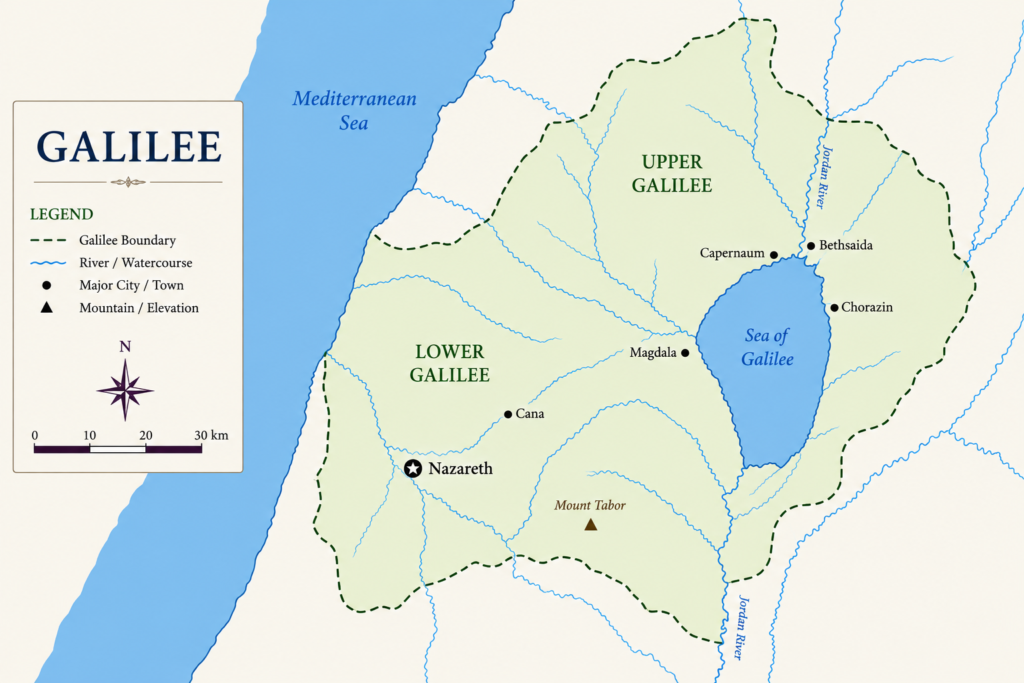
    The Sea of Galilee is in northern Israel.

    It is interesting to know that the Sea of Galilee was also known by other names. It was also called the Sea of Tiberias and the Lake of Gennesaret. In the Old Testament, it was associated with the region of Kinneret (Num 34: 11; Josh. 13: 27).

    Okay, Sea. Lake. Which is it? Well, geographically it is a freshwater lake. I wonder if it was considered a sea because the Jordan River flows into and out of it. That does make it a moving body of water.

    A medium-sized lake (13 miles long by 8 miles wide at its widest point), it is a substantial body of water. However, it wasn’t an obstacle to first-century Jews to moving around among the surrounding working settlements.

    Its size made the lake substantial enough to host a thriving commercial fishing industry. It was also large enough to accommodate a number of boats at once.

    The lake sits in a deep basin surrounded by hills. But this position also allows for dangerous storms to form. In fact, it resulted in sudden, violent storms.

    Still, to the people of the region, the Sea of Galilee represented life. It was a source of food and the backbone of their economy.

    Simon Peter and Andrew

    We’ve already met Simon Peter and Andrew.

    Andrew was a disciple of John the Immerser (Jn. 1: 35-42). He and another disciple followed Yeshua after John pointed Him out to them.

    Sometime that day, Andrew brought Simon to meet Yeshua. Some Gospel writers say that was when He changed Simon’s name to Peter.

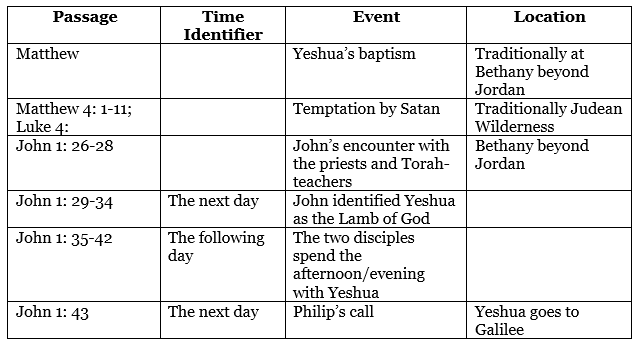
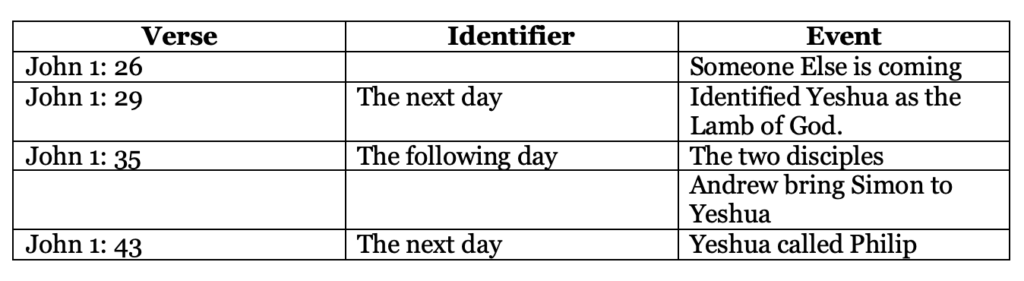
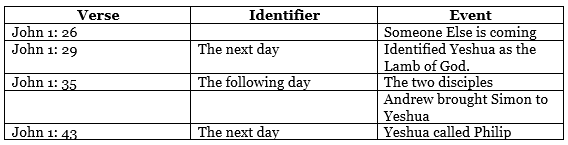
    Now, if your mind is going like mine, you are remembering the table that I included to keep our timeline straight.

    One thing we have to keep in mind is that – if we read it as written – Yeshua didn’t call either Peter or Andrew to be His disciple that day. It was only their initial encounter with the Messiah.

    Throwing a Net into the Water

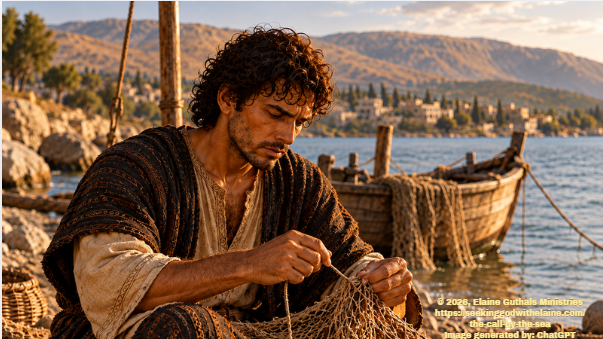
    Several tasks make up a fisherman’s work.

    Going out on the Sea and catching the fish is an important part of a fisherman’s work. That can happen either during the day or at night.

    But it isn’t the only part.

    Sometimes, the fishermen fished from the shore, called net fishing. They did this by casting their net into the water. Archaeological research supports the use of several net-fishing techniques in first-century Galilee, including cast nets and heavier nets used from boats.

    Resource

    All that fishing – hopefully netting large amounts of fish – was hard on the nets. They would have to take time to repair them. Daily maintenance included washing the nets.

    For They Fished for a Living

    The jury is out as to whether Peter – and Andrew as his partner – were successful or not in their fishing occupation.

    We don’t know how successful Peter and Andrew were at fishing. Scripture doesn’t tell us.

    Grey said that Peter is seen as having had a modest existence. This lifestyle was accompanied by Aramaic speech, little formal education, and the lack of knowledge of the Greek language. This would have made Peter a conservative Jew.

    Others, according to Grey, believe Peter prospered and was sophisticated enough to have a good grasp of Greek to write the books of Scripture attributed to him.

    Resource

    Where they came from is interesting knowledge. Where they were going is more relevant to the story.

    Peter and Andrew Called

    “Jesus called out to them, ‘Come, follow me, and I will show you how to fish for people!’  And they left their nets at once and followed him” (Mt. 4: 19-20 NLT)

    “Jesus called out to them, ‘Come, follow me, and I will show you how to fish for people!’ And they left their nets at once and followed him” (Mk. 1: 17-18 NLT)

    Come, Follow Me

    Peter and Andrew’s call to follow Yeshua demanded a very different kind of commitment from what we usually mean when we talk about following Him.

    Our mission statement is to follow Yeshua’s instructions to “… give up your own way, take up your cross daily, and follow me”’” (Lk. 9: 23 NLT). But it looks different from what Yeshua had in store for Peter and Andrew – and James, John, Philip, Nathanael, and the rest.

    • They left their nets (Mt. 4: 20; Mk. 1: 18).
    • They left family (Mk. 1: 20)
    • They left everything (Lk. 5: 11).

    Think about it. They weren’t signing up to attend church regularly (if they weren’t already doing that). They weren’t going to fit in a Bible study session after a hard day of fishing.

    They were being asked to give up their jobs – their means of making a living. We know Peter was married. Others may have been, too – they just didn’t have a mother-in-law in need of healing.

    At a minimum, some were more than likely being asked to leave parents. James and John surely weren’t the only ones there, either.

    No, this doesn’t mean they sold everything and closed up shop. This doesn’t mean they dissolved every relationship.

    I am sure they came back home at times.

    Show You How to Fish for People!

    Yeshua gave them an idea of what they would be doing, just not a travel itinerary.

    Yeshua told them that they would be interacting with others. He just didn’t say what that interaction would look like.

    Yes, it would be nice to get a data dump upon responding to Yeshua’s call. We want to know the obstacles we’ll face, have assurance the job we do will be successful, and what time frame we’re talking about.

    Yeshua didn’t give them any of that. They didn’t really know what experience they were signing up for.

    Talk about trust out of the starter’s box.

    But think about it. From the passages in Matthew and Mark, we haven’t been told they have even heard Yeshua preach. They didn’t know much – if anything – about His message.

    The Apostles didn’t know what their reward would be. Three years later when the Messiah was being crucified, they still didn’t understand everything.

    All they knew was that they were going to build a relationship with Yeshua. They were called to follow the Savior, not a movement. They weren’t signing up for a religious organization.

    They were responding to the One Who called them – the One they would come to understand more fully as they walked with Him.

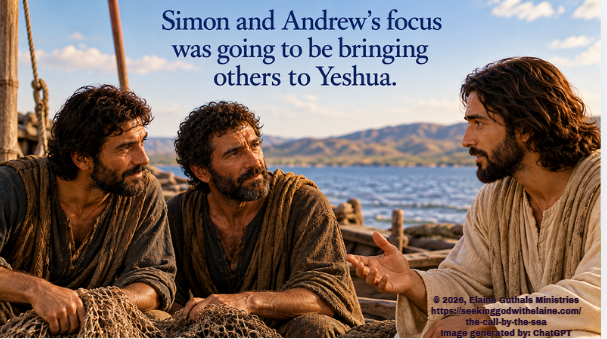
    What Simon and Andrew did know was that their focus was going to be other people. We can say now that their focus was bringing others to Yeshua.

    They Left Their Nets at Once

    There were a lot of things Yeshua didn’t tell them right then – but they were immediately obedient.

    Peter and Andrew didn’t worry about the unknown. They didn’t ask what they really knew about this Man.

    They followed their heart and followed their Savior.

    The best part is they made a split-second decision to follow their Savior for the rest of their lives. True, they didn’t understand, and they were going to fail – but they were also going to grow.

    James and John Called

    “A little farther up the shore he saw two other brothers, James and John, sitting in a boat with their father, Zebedee, repairing their nets. And he called them to come, too. They immediately followed him, leaving the boat and their father behind” (Mt. 4: 21-22 NLT)

    “A little farther up the shore Jesus saw Zebedee’s sons, James and John, in a boat repairing their nets. He called them at once, and they also followed him, leaving their father, Zebedee, in the boat with the hired men” (Mk. 1: 19-20 NLT)

    James (Ya ’acov)

    James was the first Apostle who lost his life because of his ministry.

    We know a little more about James than we know of most of the Apostles. Most of what we know about him mirrors what we know about his brother John – at least until after the crucifixion and resurrection.

    James was called to follow Jesus at the same time as John was. His father was Zebedee; and his mother was Salome, possibly the sister of Mary.

    We do know Zebedee operated a fishing business on the Sea of Galilee with his sons. It sounds extensive because they did have hired workers (Mk. 1: 20). They appear to have been partners with Simon Peter and Andrew (Lk. 5: 7).

    James was known for having a temper. Yeshua called him and John the sons of thunder. This nickname came from their reaction to the Samaritan village (Lk. 9: 51-56).

    They both seemed to develop characters more like Yeshua wanted.

    Still, he, along with Peter and John, made up Yeshua’s inner circle. They got to witness events the others didn’t, such as on the mount of transfiguration and His agony in Gethsemane.

    After the ascension, James’ mission field was Jerusalem. Tradition also associates him with Spain.

    We aren’t told how most of the Apostles died – not so with James. We are told about his death in Acts 12: 2.

    King Herod Agrippa targeted the leadership of Yeshua’s followers. He had Peter arrested and James beheaded around AD 44.

    Bradford said that Agrippa would have been looking at the situation as a political one, not a religious one. The growing number of believers would have – in his mind – posed a threat to his rule. It had grown to include zealots, who were committed to resistance to the Roman occupation and eventually became an organized movement that was more of a revolutionary group. These groups stressed covenant faithfulness.

    Resource

    Agrippa’s hope may have been to stop the growth of the early church, but it wasn’t totally successful. Tradition says that one of the Roman officers guarding James was won over by James’ defense of his faith, professed faith, and was executed beside James.

    Leaving Their Father, Zebedee

    Yeshua emphasized that we should put Him before all other relationships.

    Some might be a little disturbed by the fact that James and John left their father to follow Yeshua. We shouldn’t be.

    Yeshua has told us that we shouldn’t put our family above Him.

    • “If you want to be my disciple, you must, by comparison, hate everyone else — your father and mother, wife and children, brothers and sisters — yes, even your own life. Otherwise, you cannot be my disciple” (Lk. 14: 26 NLT).
    • “If you love your father or mother more than you love me, you are not worthy of being mine; or if you love your son or daughter more than me, you are not worthy of being mine. If you refuse to take up your cross and follow me, you are not worthy of being mine. If you cling to your life, you will lose it; but if you give up your life for me, you will find it” (Mt. 10: 37-39 NLT).
    • “And everyone who has given up houses or brothers or sisters or father or mother or children or property, for my sake, will receive a hundred times as much in return and will inherit eternal life” (Mt. 19: 29 NLT).

    Now, don’t get upset that Luke 14: 26 says that we are to hate everyone else. It just means that we are to love Yeshua more than them. That doesn’t contradict the love-one-another commandment.

    With the Hired Men

    The Book of Mark gave us a clue as to the size of Zebedee’s fishing operation.

    Mark listed that hired hands were present with James, John, and Zebedee where Matthew did not. Does that mean the passages contradict each other?

    I don’t think so. If the operation was big enough to have hired hands, I would bet some were there.

    In my way of thinking, it would seem that Matthew’s focus was not on the size of the operation. Rather, he was trying to emphasize the fact that the brothers left their father.

    Making the Connections #1

    How does the Apostles’ calling differ from ours?

    Their Circumstances

    The Continuing Principle

    They physically traveled with Yeshua from place to place.

    Discipleship means following His teachings and making them the focus of our lives.

    Some left fishing businesses and family work.

    Following Him may require an occupation change, but it may not. It does mean that we will have to change priorities to make Him #1 since He wasn’t before.

    Some left family.

    Following Him may mean we have to surrender competing loyalties.

    They learned directly from Him during His earthly ministry.

    We learn His teaching from His Word and the guidance of the Holy Spirit.

    They didn’t receive a complete itinerary at the initial call.

    We aren’t given a complete itinerary at our initial call. Even as a disciple of His, we are called to obey without knowing every detail of what lies ahead.

    Yeshua was calling them out of the familiar into a world they couldn’t yet fully comprehend. Yeah, that is hard and scary.

    Still today, we are called from the familiar into the unknown.

    We just have to trust Him.

    Making the Connections #2

    One thing that hasn’t changed since that day by the Sea of Galilee is that just knowing Yeshua doesn’t make Him our Savior.

    Peter and Andrew had spent time with Yeshua on the day that John pointed Him out. That makes them acquaintances.

    We can be acquainted with Yeshua. We have head knowledge of Him.

    Until we ask Him to be our Savior and Redeemer and commit to allow Him to win the battle for our hearts, we don’t become His disciples and gain salvation.

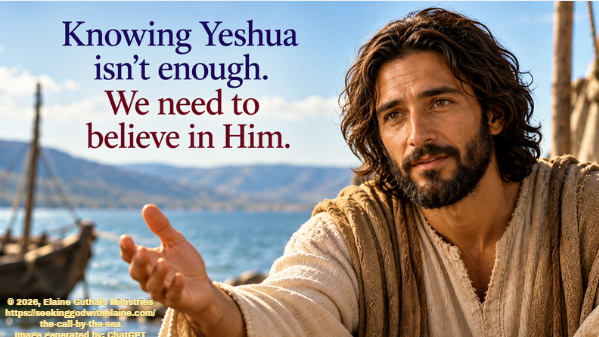
    Knowing Yeshua isn’t enough. We need to believe in Him.

    Making the Connections #3

    Yes, the Apostles ended up establishing the early Church. That isn’t what they started out to do. They were bringing people to the Messiah.

    We can get so focused on church activities, programs, and institutions that we forget the reason it exists in the first place. We are to follow Yeshua. Everything else must flower from that.

    Heart Check

    Think about the battle Yeshua is engaged in for your heart. Ask yourself the following questions.

    • Am I willing to follow Yeshua immediately, even when I don’t know what lies ahead, or do I want to know the whole plan before I commit to it?
    • Am I following the Savior, or have I become more focused on religion and everything surrounding it?

    How Do We Apply This?

    • Trust Yeshua with the unknown
    • Put the Savior before competing loyalties
    • Follow Yeshua rather than merely knowing about Him
    • Allow Yeshua to shape our lives as we grow in Him
    • Keep the Messiah at the center of everything we do

    Father God. Thank You for calling men who became strong in their faith and were obedient to Your mission of sending Your message to others. Thank You for Your children who told us about You or provided us with the resources needed to study Your Word. May we always listen to Your call. Amen.

    If you don’t understand something and would like further clarification, please contact me.

    If you have not signed up for the email providing the link to the devotions and the newsletter, do so below.

    If God has used this devotion to speak with you, consider sharing it on social media.
  • Philip Brought Nathanael to Jesus

    Andrew wasn’t the only disciple who brought someone to Jesus. This devotional reading looks at how Philip brought Nathanael to Jesus.

    Nuggets

    • Who was Nathanael?
    • Both men were steeped in Scripture.
    • Nathanael wasn’t buying what Philip was selling Him.
    • We have the responsibility to offer the invitation, but it is up to the other to accept it.

    Recently, we talked about John the Immerser pointing Yeshua out to two of his disciples. One was identified as Andrew. Most tradition identifies the other as John.

    Some, however, believe that disciple was Philip. I know, most tradition says it was John – and Scripture itself doesn’t tell us, so we don’t really know.

    It seems more likely that the other disciple was John rather than Philip. But think about it.

    If the other disciple was Philip, they were two for two. Both went to someone else and brought them to Yeshua.

    Let’s Put It into Context

    To read devotions in The Battle for the Heart theme

    Devotions in the The Early Ministry of the Messiah series

    Witnessing to a Friend

    “Philip went to look for Nathanael and told him, ‘We have found the very person Moses and the prophets wrote about! His name is Jesus, the son of Joseph from Nazareth.’ ‘Nazareth!’ exclaimed Nathanael. ‘Can anything good come from Nazareth?’ ‘Come and see for yourself,’ Philip replied” (Jn. 1: 45-46 NLT)

    Looked for Nathanael

    Who was Nathanael?

    We know surprisingly little about Nathanael from Scripture. What we do know gives us a glimpse of the man Philip went looking for.

    Nathanael appears by name in John’s Gospel, but not in the other three Gospels. He is sometimes identified as Bartholomew, one of the Twelve Apostles listed in Matthew 10:3, Mark 3:18, and Luke 6:14.

    Scripture never explicitly tells us that Nathanael and Bartholomew were the same person. This identification comes from comparing the Gospel accounts, particularly because Philip is associated with Bartholomew in the lists of the Twelve and with Nathanael in John’s account. It is a longstanding Christian tradition, but we cannot establish it with certainty they were the same person.

    John tells us that Nathanael was from Cana in Galilee (Jn. 21: 2). Yeshua describes him as a man of complete integrity (Jn. 1: 47).

    What happened to Nathanael after Yeshua’s resurrection? Scripture gives us no detailed account of his later ministry. Christian tradition, however, identifies him with Bartholomew and associates Bartholomew with missionary work in several regions, including Asia Minor, the area of present-day Turkey, as well as Armenia and India. The accounts differ, and we cannot establish a reliable itinerary for his missionary work.

    Tradition also remembers Bartholomew as a martyr in Armenia, where he was reportedly flayed alive — his skin removed. Other accounts describe his death differently, including crucifixion or beheading. The details of his death cannot be verified from Scripture, and the later traditions disagree about what happened.

    That is what we can piece together about Nathanael. We know his hometown, we have Yeshua’s testimony about his character, and we see his initial response when he encounters the Messiah. Beyond that, we must distinguish what Scripture records from what later generations have passed down.

    Moses and the Prophets

    Both men were steeped in Scripture.

    Think about what Philip was saying when he talked about Moses and the prophets. He wasn’t simply telling Nathanael that he had met an interesting man. He was connecting Yeshua with the Scriptures they had been learning since childhood.

    Moses wrote the Torah — the first five books of Scripture. These books established the foundation for understanding Jehovah’s covenant with Israel, His instructions for His people, and His promises concerning their future. The prophets continued to call Israel back to faithfulness while revealing more about Jehovah’s purposes and the One who would come.

    Philip’s statement shows that he understood Yeshua in light of those Scriptures. He wasn’t separating this new discovery from what Jehovah had already revealed. He was recognizing a connection between the promises they knew and the Man he had encountered.

    Notice, too, that Philip expected Nathanael to understand what he meant. He didn’t stop to explain who Moses was or why the prophets mattered. They shared a scriptural background that gave meaning to his words.

    This doesn’t mean we know exactly which passages Philip had in mind. John didn’t identify specific prophecies in this verse. We should not assume that Philip was referring to one particular prediction when the text doesn’t tell us which passages he meant.

    What we can see is that Philip understood the importance of reading what was happening in the present in light of what Jehovah had already revealed through Scripture.

    That is an important lesson for us, too. We shouldn’t separate our understanding of Yeshua from the Scriptures that tell us who He is. We need to read the whole story, allowing what Jehovah revealed earlier to help us understand what He reveals later.

    Can Anything Good?

    Nathanael wasn’t buying what Philip was selling Him.

    Ooo, baby! Nathanael wasn’t impressed by Philip’s announcement. Philip had just told him that they had found the One Moses and the prophets wrote about. Then he identified Yeshua as Jesus of Nazareth.

    Why would Nathanael respond that way?

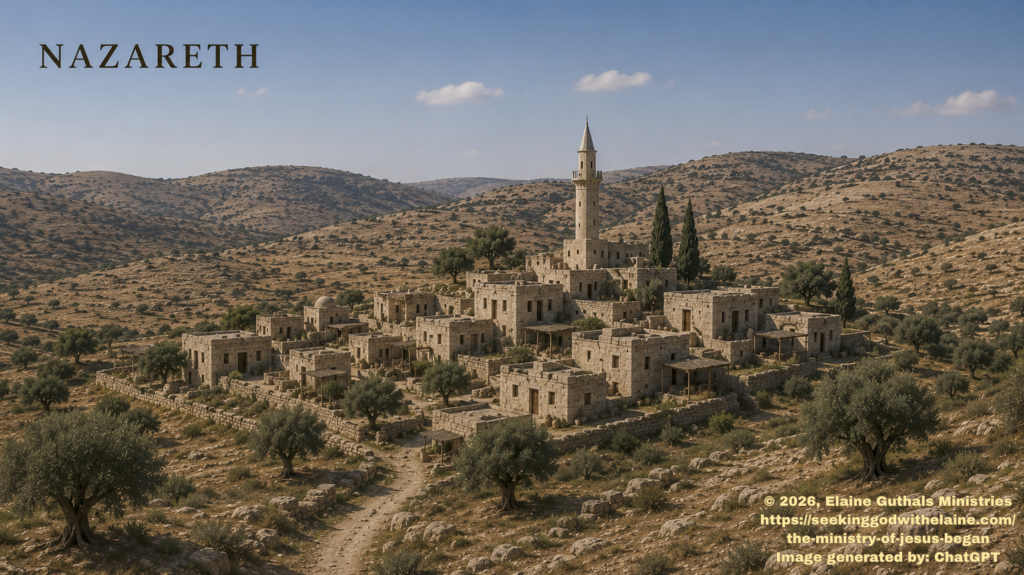
    Nazareth was a small settlement in Galilee. It wasn’t Jerusalem, the center of Jewish worship, or a royal city associated with the house of David. It wasn’t a place that Scripture specifically identified as the hometown of the Messiah.

    We need to be careful here. John doesn’t tell us exactly why Nathanael asked his question. We can’t say with certainty that he was prejudiced against Nazareth or that he believed the Messiah couldn’t come from Galilee. His words may reflect a dismissive view of an insignificant village, surprise at Philip’s claim, or questions about how Yeshua could fulfill what they understood from Scripture.

    Nathanael was possibly responding to the opinion of others. When we don’t have enough information, we sometimes do let others’ opinions influence us.

    When witnessing, we do sometimes need to respond to actual or perceived issues. How we do that can help our cause – or shut it down entirely.

    Whatever prompted his response, Nathanael wasn’t ready to accept Philip’s announcement simply because Philip believed it.

    Come and See

    We have the responsibility to offer the invitation, but it is up to the other to accept it.

    Ooo, baby. Nathanael’s response could have burned Philip.

    Here Philip was, sharing his excitement with Nathanael. Both were strong in the Jewish faith. Both were longing for the Messiah.

    Philip went to Nathanael and said, “He’s here!” Nathanael’s response? “You gotta be kidding me.”

    Philip could have handled this a number of ways. He could have gotten mad that Nathanael questioned his belief. He could have argued to get his point across. He could have walked away in disgust.

    None of that happened. Instead, Philip’s response was “Come and see for yourself.”

    There is something important here for us. When someone questions what we believe, our first response doesn’t always have to be an argument. We can explain what we believe, point to Scripture, and invite that person to examine the evidence.

    Faith isn’t strengthened by pretending questions don’t exist. We can bring our questions to Scripture and seek to understand what Jehovah has revealed.

    Nathanael had a question about Nazareth. Philip invited him to meet the Man he believed was the Messiah.

    Sometimes the most helpful thing we can do is invite someone to take the next step toward discovering the truth.

    Philip invited Nathanael to encounter Yeshua rather than settle the question through an argument. He didn’t try to answer every possible objection. He encouraged Nathanael to investigate for himself.

    Isn’t that how we reach some people? Our words might have some effect.

    But they have to see for themselves. They have to work it out and figure it out.

    More importantly, we each have to personally respond to the Holy Spirit’s prompting. Philip couldn’t make the decision for Nathanael to believe in Yeshua. Our parents can’t make it for us – our spouse can’t.

    We have to come and meet Yeshua because He is our personal Savior.

    Making the Connection

    We encounter Yeshua in different ways. Let’s look at a few.

    All Scripture tells us about Philip’s call is that Yeshua went to Galilee and found him. That sounds calm – but it is very personal, too.

    Nathanael was invited to learn about Yeshua through a friend. His initial reluctance didn’t hold any animosity, but Nathanael struggled with what Philip was telling him.

    Then there was Paul. Ooo, baby. Did he have a conversion story or what?!?

    Paul actively worked against the spreading of Christianity. His actions went all the way from imprisonment to murder.

    We know Paul made murderous threats (Ac. 9:1). We know that part of the persecution he inflicted on early Christians included their punishment (Ac. 22: 4-5). He felt responsible for the deaths, calling himself the chief among sinners (I Tim. 1: 15).

    Then, one day, Yeshua – even though He was dead, resurrected, and ascended – again personally appeared to Paul. He gave him a ministry from the start.

    That ministry came to the Philippian jailer where he worked. Because Paul would be obedient even when it got personally hard and painful for him, a man and his entire household was saved because:

    • a man went to work.
    • he listened to what someone he may have looked down upon had to say.
    • he didn’t discount the impossible when it happened before his eyes.
    • he opened his heart in compassion.
    • he wanted to share this wonderful gift with those he loved most.

    We all may not have a conversion experience that had the Hollywood splash that Paul did. But our call is just as personal and just as real.

    Yeshua knows our hearts and minds. He knows what our experiences have been.

    Our call is going to be designed around us.

    Heart Check

    Think about the battle Yeshua is engaged in for your heart. Ask yourself the following questions.

    • Do I invite others to discover Yeshua, or do I expect them to accept what I say?
    • When someone questions my faith, do I respond with patience or defensiveness?
    • Do I distinguish what Scripture says from what I assume?
    • Am I willing to examine the evidence when something challenges my understanding?
    • Do I recognize that Yeshua can reach people in ways different from how He reached me?

    How Do We Apply This?

    • Invite someone to encounter Yeshua rather than trying to win an argument.
    • Listen carefully to the questions people ask about faith.
    • Use Scripture to explain what we believe.
    • Respect that each person must make a personal response to Yeshua.
    • Recognize and encourage the different ways Jehovah works in people’s lives.

    Father God. Thank You for preparing a way that our relationships with You can be restored. Help us to seek Yeshua — through Scripture and through spending time with Him and You. Amen.

    If you don’t understand something and would like further clarification, please contact me.

    If you have not signed up for the email providing the link to the devotions and the newsletter, do so below.

    If God has used this devotion to speak with you, consider sharing it on social media.
  • Who Was Philip?

    Andrew wasn’t the only disciple who brought someone to Jesus. This devotional reading looks at how Philip brought Nathaniel to Jesus and their interactions.

    Nuggets

    • The events of this day took place the day after Yeshua met with Andrew, Simon, and the other disciple.

    • Yeshua left where He was and traveled to Galilee to meet Philip.

    • Following Yeshua has to be more than just words.

    • Bethsaida was located near the northern end of the Sea of Galilee.

    • Philip shared a hometown association with Andrew and Peter, but that doesn’t fit cleanly with what we know about the brothers.

    Recently, we talked about John the Immerser pointing Yeshua out to two of his disciples. One was identified as Andrew. Most tradition identifies the other as John.

    Some, however, believe that disciple was Philip. I know, most tradition says it was John – and Scripture itself doesn’t tell us, so we don’t really know.

    But humor me.

    If the other disciple was Philip, they were two for two. Both went to someone else and brought them to Yeshua.

    Let’s Put It into Context

    To read devotions in The Battle for the Heart theme

    Devotions in the The Early Ministry of the Messiah series

    Let’s Put It into Context #2

    #dailydevotionalreading #harmonyofthegospelstudy

    The Calling of Philip

    “The next day Jesus decided to go to Galilee. He found Philip and said to him, ‘Come, follow me’” (Jn. 1: 43 NLT)

    The Next Day

    The events of this day took place the day after Yeshua met with Andrew, Simon, and the other disciple.

    We’ve been slowing down to make sure we have the time transitions correct. Even though the next/following day can be straight forward, those little nuggets are easy to overlook.

    To me, that is important. Let’s put it into context to determine why that is so.

    Andrew, Philip – if the second disciple in John 1: 35-40 was Philip – and later Simon would have just spent time with Yeshua the previous day. It could have been several hours (4 pm to sundown).

    Yet, Yeshua didn’t call any of them to follow Him during that initial meeting.

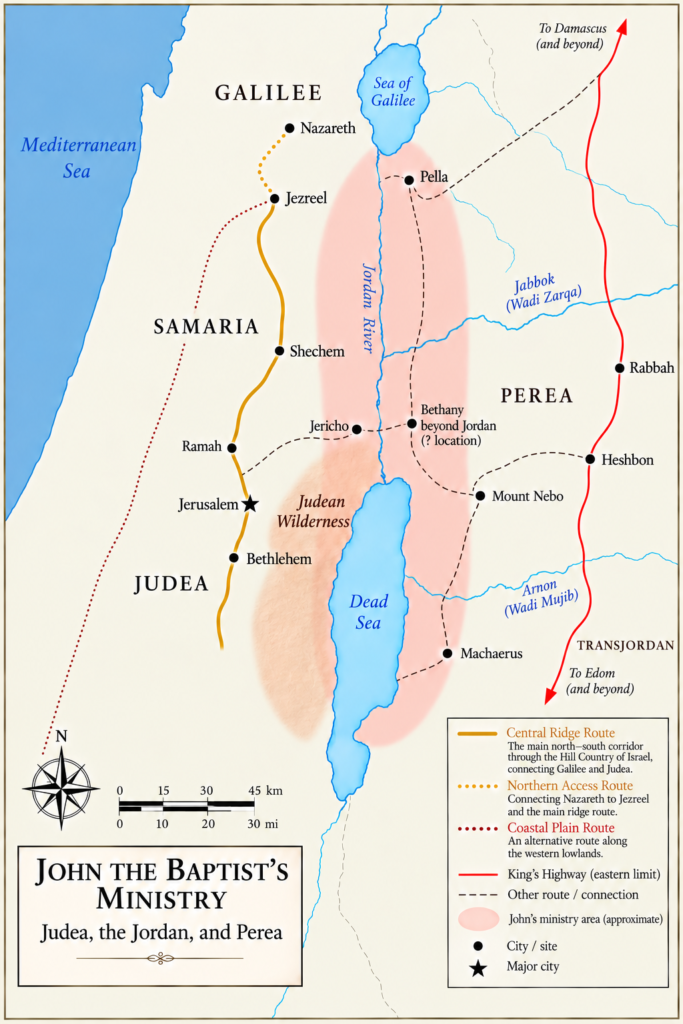
    We’ve also spent some ink trying to figure out where these events took place. Post-Yeshua’s baptism, John was baptizing people around Bethany across the Jordan (Jn. 1: 29).

    It may be safe to assume that John the Immerser stayed put for three days. Yeshua was there for at least two.

    Andrew and the other disciple were considered disciples of John – even if they were there only part of the time. We know Andrew had a day job.

    Hold that thought.

    Galilee

    Yeshua left where He was and traveled to Galilee to meet Philip.

    If we assume John the Immerser was still at Bethany beyond Jordan – as there is no indication that he moved – that means Andrew, Simon, and Philip had to come from Bethsaida and/or Capernaum to Bethany.

    John doesn’t tell us what Philip did for a living. He may have been a fisherman like Simon and Andrew, but we aren’t told that.

    I would think it was safe to assume that Yeshua, Andrew, Simon, and the other disciple were not in Galilee on the day of their meeting. Otherwise, Yeshua didn’t have to go to Galilee.

    You know, I think this is a good argument for Philip not being the other disciple.

    Yes, for this devotion, it would have been nice to have Philip as the other disciple with Andrew. We may not know his occupation but do know what Philip became after he encountered the Messiah.

    Come, Follow Me

    Following Yeshua has to be more than just words.

    Wait! What?? Yeshua found Philip and told him to follow Him. What did Philip know about Yeshua at this point?

    Since we now believe that Philip wasn’t the other of John’s disciple to spend the afternoon with Yeshua, we don’t know whether they had interacted before. Had Philip heard about Him from the Immerser? Was he just going into this blind?

    John doesn’t tell us everything that happened between them. We cannot fill in the conversation with things Scripture doesn’t give us. But we do know that Yeshua called Philip to follow Him.

    The Greek word translated follow is akoloutheō (ἀκολουθέω). It means to follow or accompany someone. In the context of discipleship, it means more than walking behind someone from one place to another. A disciple follows a teacher, learning from him and becoming his student.

    Philip was invited to become a student of Yeshua.

    Think about that for a minute. Yeshua didn’t tell Philip to go home and study for another year. He didn’t tell him to get his life straightened out first. He called him to follow.

    But that doesn’t mean Philip could just sit around listening to the lecture.

    Following Yeshua would mean learning from Him, listening to His teaching, and discovering who He was.

    Philip would have much to learn. He didn’t have all the answers yet. But he could begin by responding to the One who called him.

    We sometimes think we must understand everything before we can follow Yeshua. We want every question answered, every uncertainty removed, and every detail explained. But learning to follow a teacher means becoming his student. We learn as we walk with him.

    Then we think we are no longer the student when we gain salvation. But we have to watch.

    Salvation isn’t the finish line. It just begins the sanctification process – the second part of salvation that will take the remainder of our lives.

    We can learn about Yeshua without actually following Him. We can know the stories, recognize the names of the disciples, and even explain what the Bible teaches about the Messiah. But knowing facts about Him is not the same as becoming His genuine disciple.

    It is more than just spending time with Yeshua. We actively become involved in the relationship we are building with Him. We allow that to change us.

    When we begin to understand who Yeshua is, that knowledge should affect how we live. Following Him changes more than we know. It changes on whom we trust, whose teaching we receive, and the direction in which we walk.

    Bethsaida

    “Philip was from Bethsaida, Andrew and Peter’s hometown” (Jn. 1: 44 NLT)

    Bethsaida

    Bethsaida was located near the northern end of the Sea of Galilee.

    Bethsaida is commonly understood to mean house of fishing or house of the fisherman. Given its location, fishing would have been an important part of life in the surrounding region. People also supported themselves through farming, trade, and related work.

    Does that mean Philip was a fisherman? Not necessarily. Scripture identifies Peter and Andrew with fishing, but it never tells us what Philip did for a living. He may have worked in the fishing trade, but we cannot state that as a fact.

    Bethsaida also had an interesting political history. Herod Philip, one of the sons of Herod the Great, developed the settlement into a city and renamed it Julias in honor of Julia, a member of the Roman imperial family. This gives us a glimpse into the changing world in which Philip lived. The region was under Roman influence, and local rulers were developing their territories.

    There is some uncertainty about the exact location of biblical Bethsaida. Two archaeological sites, et-Tell and el-Araj, have been proposed, and scholars continue to debate which one corresponds to the town mentioned in the Gospels. We can identify the general region without claiming that its precise location has been settled.

    Bethsaida appears in several accounts of Yeshua’s ministry. He performed mighty works in the region, and the Gospels associate the town with the healing of a blind man and the feeding of the five thousand. Yet Yeshua also rebuked Bethsaida because the mighty works performed there had not produced the response they should have (Matthew 11:21–22).

    Think about that for a minute. Living near where Yeshua ministered didn’t automatically make someone His disciple. Witnessing His works didn’t guarantee that a person would respond to Him in faith.

    Philip’s hometown tells us something about where he came from. His response to Yeshua tells us something about the direction his life was taking.

    We may not know about Philip’s occupation before he became a disciple, but we know that he became a witness to the Messiah. His story reminds us that following Yeshua is more than knowing where He lived, knowing what He taught, or knowing the stories about Him. It means responding to Him and allowing that relationship to change the direction of our lives.

    Andrew and Peter’s Hometown

    Philip shared a hometown association with Andrew and Peter, but that doesn’t fit cleanly with what we know about the brothers.

    Peter and Andrew are associated with both the villages of Bethsaida and Capernaum (the modern site of Tel Hum). John identified Bethsaida as the city of the brothers.

    However, Gospel accounts also associate the brothers with Capernaum (Mk. 1: 21, 29-31; Mt. 8: 14). So, how do we account for both places?

    One possibility is that Bethsaida was where the brothers originated, while Capernaum was where they lived when Yeshua began His ministry. A person’s hometown and place of residence don’t always have to be the same.

    However, Scripture doesn’t tell us when or why a move from Bethsaida to Capernaum occurred. We should be careful not to turn a possible explanation into a biblical fact.

    What we can establish is that John associates Philip, Andrew, and Peter with Bethsaida, while the other Gospel accounts place the brothers in Capernaum. The accounts give us both pieces of information without explaining the circumstances that connect them.

    This also reminds us that knowing someone’s hometown doesn’t necessarily tell us everything about where that person lives or works. We have to allow each passage to tell us what it actually says, connect it with other passages, and not add details the biblical writers haven’t provided.

    Heart Check

    Think about the battle Yeshua is engaged in for your heart. Ask yourself the following questions.

    • Am I following Yeshua, or am I mainly learning facts about Him?
    • Do I believe I have to understand everything before I can respond to what Yeshua is asking of me?
    • Am I allowing my relationship with Yeshua to change how I live, whom I trust, and whose teaching I follow?
    • Do I distinguish between what Scripture actually says and what I assume or believe might have happened?
    • Am I willing to examine what I believe, even when doing so means reconsidering an assumption I’ve held for a long time?

    How Do We Apply This?

    • Follow Yeshua even when you don’t have all the answers.
    • Allow your relationship with Yeshua to change how you live.
    • Study Scripture in context rather than relying on assumptions.
    • Distinguish what Scripture says from what you think might have happened.
    • Help someone else take a step toward Yeshua.

    Father God.  Thank You that You personally call us to be Your children. May we all accept Your gift of salvation. Help us to learn to walk with You. May we keep learning until You call us home. Amen.

    If you don’t understand something and would like further clarification, please contact me.

    If you have not signed up for the email providing the link to the devotions and the newsletter, do so below.

    If God has used this devotion to speak with you, consider sharing it on social media.
  • Andrew Brought Simon to Jesus

    It is wonderful to get to know our Savior. This devotional reading looks at what our response should be as we get to know Him more.

    Nuggets

    • Andrew wasted no time in bringing his brother to the Messiah.
    • Andrew was so sure that Yeshua was the Messiah, he wanted his brother to know that, too.
    • Simon was an interesting man.
    • His birth name was Simon, but Yeshua changed his name to Peter.

    In the last devotion, we talked about John pointing Yeshua out to two of his disciples. One was identified as Andrew. Most tradition identifies the other as John.

    Andrew had an almost immediate response to his meeting with Yeshua. Let’s dig in.

    Let’s Put It into Context

    To read devotions in The Battle for the Heart theme

    Devotions in the The Early Ministry of the Messiah series

    Andrew Witnessed

    “Andrew, Simon Peter’s brother, was one of these men who heard what John said and then followed Jesus. Andrew went to find his brother, Simon, and told him, ‘We have found the Messiah’ (which means ‘Christ’)” (Jn. 1: 40-41 NLT)

    Brought

    Andrew wasted no time in bringing his brother to the Messiah.

    John had been very precise in the chronology of the previous events. He specifically noted when events took place the following day.

    In this passage, John didn’t identify when the next day occurred until the following verse. If we are taking him at his word regarding when events occurred in the individual days, we must believe that Andrew’s bringing his brother Simon to Yeshua occurred on the same day that Andrew and the unidentified disciple spent time with Yeshua.

    This is important. Remember what verse 39 said. “… It was about four o’clock in the afternoon when they went with him to the place where he was staying, and they remained with him the rest of the day” (Jn. 1: 39 NLT).

    The Greek text says it was approximately the tenth hour. This also reflects the Jewish practice of counting daylight hours from sunrise. Therefore, when modern versions translate this as 4:00 p.m., they are correct.

    How long would the rest of the day have conceivably been? The Greek is emeinan (ἔμειναν), from menō (μένω), meaning to remain, stay, abide, continue, dwell.

    It is conceivable to think they spent the daylight hours with Yeshua.

    So, when did Andrew go get Simon? After they asked, “Where are you staying,” did Andrew go pick up Simon and meet them there? Did Yeshua, the other disciple, and Andrew talk a while, and then Andrew go get Simon?

    We can reasonably conclude that Andrew spent up to a couple of hours with Yeshua, and then he went to get his brother.

    We don’t really know for sure when it happened; but since John doesn’t switch days until after Simon gets there, we know it was on the same day that Andrew met Yeshua.

    We Have Found the Messiah

    Andrew was so sure that Yeshua was the Messiah, he wanted his brother to know that, too.

    Think about it. Many people were actively and eagerly watching for the Messiah to show up. Regardless of which Messianic expectations they believed in after He did come, they were looking for it to be soon.

    Andrew seems to be one of those who were actively watching. He was a disciple of the one who prepared the way for the Messiah.

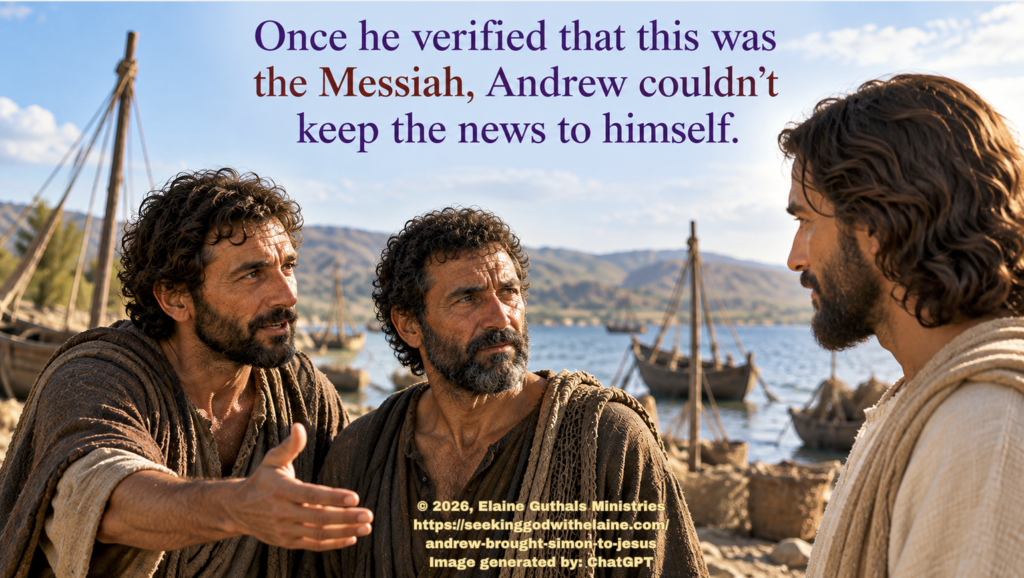
    Once he verified that this was the Messiah, Andrew couldn’t keep the news to himself. He had to share it with Simon.

    It is part of our marching orders that we are to share our faith with others. Our love for Jehovah and Yeshua should bubble out of us and spill onto others.

    • “And then he told them, ‘Go into all the world and preach the Good News to everyone’” (Mk. 16: 15 NLT).
    • “Therefore, go and make disciples of all the nations, baptizing them in the name of the Father and the Son and the Holy Spirit. Teach these new disciples to obey all the commands I have given you. And be sure of this: I am with you always, even to the end of the age” (Mt. 28: 19-20 NLT).

    Simon Peter

    “Then Andrew brought Simon to meet Jesus. Looking intently at Simon, Jesus said, ‘Your name is Simon, son of John — but you will be called Cephas’ (which means ‘Peter’)” (Jn. 1: 42 NLT)

    “Now I say to you that you are Peter (which means ‘rock’), and upon this rock I will build my church, and all the powers of hell will not conquer it” (Mt. 16: 18 NLT)

    “Simon (whom he named Peter) … (Lk. 6: 14 NLT)

    “… Simon (whom he named Peter)” (Mk. 3: 16 NLT)

    Simon Peter [Shim’on/Kefa]

    Simon was an interesting man.

    We know many things about Peter. Part of that is because he seems to be the spokesperson of the group.

    At times, it seems like Peter had a larger-than-life personality. We get right away that Peter was loyal and sincere in his faith. He was the one who called Yeshua the Messiah when asked who they thought He was (Mt. 16: 16).

    Peter could also be impulsive and narrow minded. At times, he was inconsistent and thoughtless.

    We might have called Peter a wild card.

    Peter wasn’t afraid to ask questions when he needed clarification or wanted to gain knowledge. But that is a good thing, because he asked many of the questions that we would have.

    Peter’s faith was so strong that Jesus called him a rock (Mt. 16:18). Yet, we see in Peter a pendulum of faith. He not only was the only one to walk on the water with Yeshua (Mt. 14: 22-33), but he also denied Him three times the night of His trial (Mt. 26: 69- 75; Mk. 14: 66-72; Lk. 22: 54-62; Jn. 18: 15-18, 25-27).

    John told us that Peter and Andrew’s hometown was Bethsaida (Jn. 1: 44). However, Mark 1: 29-31 states that the healing of Peter’s mother-in-law took place in Peter and Andrew’s home in Capernaum.

    Either town was a fishing community.

    Circumstantial evidence from an archeological dig indicates that a house excavated in Capernaum belonged to Peter. BAS Staff indicated that the function of the house changed from a residential place to a communal gathering place.

    Resource

    Peter and Andrew may have grown up in Bethsaida. They may have moved to Capernaum when they were older.

    You Will Be Called

    His birth name was Simon, but Yeshua changed his name to Peter.

    All four Gospels say that Yeshua changed Simon’s name to Peter. Only John tells us when and how. It was the first time Simon met Yeshua.

    Matthew and Luke acknowledge that Simon was already Peter when Yeshua called him by the seashore.

    • “When Simon Peter realized what had happened, he fell to his knees before Jesus and said, ‘Oh, Lord, please leave me — I’m such a sinful man’” (Lk. 5: 8 NLT).
    • “One day as Jesus was walking along the shore of the Sea of Galilee, he saw two brothers — Simon, also called Peter, and Andrew — throwing a net into the water, for they fished for a living” (Mt. 4: 18 NLT).

    The interesting thing is the Gospel of Mark didn’t. “One day as Jesus was walking along the shore of the Sea of Galilee, he saw Simon and his brother Andrew throwing a net into the water, for they fished for a living” (Mk. 1: 16 NLT).

    Why is that interesting? To me it is because Mark was said to have compiled Peter’s sermons – either before or after he had died. That means – in my mind – that Peter called himself Simon there.

    Does that mean Yeshua hadn’t renamed Simon yet? Not necessarily. All the other Gospel writers pulled a Moses and used the name early church members would have been most familiar.

    Making the Connections #1

    Okay, I have to process something. It was fairly easy to keep track of the changing of the day. I am having a little trouble as to figuring out where they were.

    Where in the world are these guys?

    If we look at the passage with Andrew and Simon, it doesn’t tell us where they were at. But we get a clue in the next verse – John 1: 43. “The next day Jesus decided to go to Galilee …” (Jn. 1: 43 NLT).

    Now, let’s go backwards to the last time we had a location stamp. “This encounter took place in Bethany, an area east of the Jordan River, where John was baptizing” (Jn. 1: 28 NLT).

    The encounter being discussed was the discussion with the priests and temple assistant that John had at Bethany beyond the Jordan.

    Bethany beyond the Jordan is believed by many to be the location where John baptized Yeshua. But we have to be very careful here in John 1.

    John 1: 32-34 is a discussion of an event that happened earlier: Yeshua’s baptism. Matthew, Mark, and Luke all give us actual narrative accounts. Here, John the Immerser is only recounting what transpired when he baptized the Messiah.

    This is relevant when we add the temptation into the picture. Look at the chain of events.

    • “And a voice from heaven said, ‘This is my dearly loved Son, who brings me great joy’” (Mt. 3: 17 NLT).
    • “Then Jesus was led by the Spirit into the wilderness to be tempted there by the devil” (Mt. 4: 1 NLT).

    Tradition tells us that the wilderness Yeshua went into to be tempted was the Judean Wilderness. We don’t know for sure.

    Then after the forty days of testing, Yeshua went back to where John was.

    This is the only timeline that makes sense to me. The next day after the encounter with the priests and assistants, John makes his famous “… Look! The Lamb of God who takes away the sin of the world!” (Jn. 1: 29 NLT).

    The next day after His baptism, Yeshua would be in the wilderness, not walking by John. He especially wouldn’t be spending time with John’s two disciples the day after that.

    Another piece of evidence that this is the correct timeline is that John didn’t know who the Messiah was until He baptized Him.

    Remember John’s testimony. “‘I did not recognize him as the Messiah, but I have been baptizing with water so that he might be revealed to Israel.’” Then John testified, ‘I saw the Holy Spirit descending like a dove from heaven and resting upon him. I didn’t know he was the one, but when God sent me to baptize with water, he told me, ‘The one on whom you see the Spirit descend and rest is the one who will baptize with the Holy Spirit.’ I saw this happen to Jesus, so I testify that he is the Chosen One of God” (Jn. 1: 31-34 NLT).

    John couldn’t say, “Look!” before the baptism – which is discussed in the verses after his famous identification of the Messiah.

    Making the Connections #2

    Andrew brought Simon to Yeshua. He didn’t have to explain everything about the Messiah to his brother. He simply brought him to the One he had found.

    We know much more about Peter’s life than we know about Andrew’s. Peter’s words and actions fill the Gospel accounts.

    But we shouldn’t overlook the brother who brought him to Yeshua in the first place. Where would we be if he hadn’t?

    Andrew’s witness made a difference in Simon’s life. We may never know the full impact of our own witness, either. We aren’t responsible for making someone believe. We are responsible for pointing people toward Yeshua.

    We, too, are called to bring others to Yeshua. We should start with our family members. They mean the most to us, and we should want to share Him with them.

    Then, just as Andrew was, we may be called to bring total strangers to Yeshua. We have to be ready to do whatever He calls us to do.

    Heart Check

    Think about the battle Yeshua is engaged in for your heart. Ask yourself the following questions.

    • Am I bringing others to Yeshua or keeping Him to myself?
    • Am I willing to share what I know about Him, even when I don’t have all the answers?
    • Do I look for opportunities to share my faith, or do I wait for someone else to do it?
    • Am I more concerned about what I cannot explain or about introducing others to the One I know?

    How Do We Apply This?

    • Share what Yeshua has done in your life with those who currently don’t know Him as their Savior.
    • Look for opportunities to introduce others to Him.
      Invite others to come and see for themselves.
    • Trust Jehovah with the results of your witness.
    • Remember that your responsibility is to point people to Yeshua, not to make them believe.

    Father God. You call us to You. You call us to lead others to You. Help us boldly speak Your name to family, friends, coworkers — even strangers. Amen.

    If you don’t understand something and would like further clarification, please contact me.

    If you have not signed up for the email providing the link to the devotions and the newsletter, do so below.

    If God has used this devotion to speak with you, consider sharing it on social media.
  • The First Two Disciples

    As it was time to begin His ministry, Yeshua was beginning to gather followers. This devotional reading looks at the first two disciples who began to follow Him.

    Nuggets

    • The event that began this progression was when John was being questioned by Pharisees.
    • John’s ministry was all about others.
    • From His birth, Yeshua was identified as the Sacrifice needed to restore us from sin.
    • The two disciples immediately left John and followed Yeshua.
    • We have to seek the Savior for the right reason.
    • The disciples had to determine why they were seeking Yeshua.
    • Yeshua recognized the importance of the two disciples coming and seeing for themselves.

    Yeshua knew that the Plan of Salvation would call first century Jews – and eventually all people – to change their lifestyle to better align with what Jehovah expected. He knew that He would need students to learn about the need for restoration and to learn how to walk with Jehovah.

    Those students would then have to tell others.

    That meant Yeshua would have to choose the right men for the job. Those who followed Him were called disciples.

    Let’s Put It into Context

    To read devotions in The Battle for the Heart theme

    Devotions in the The Early Ministry of the Messiah series

    John Again Identified Yeshua

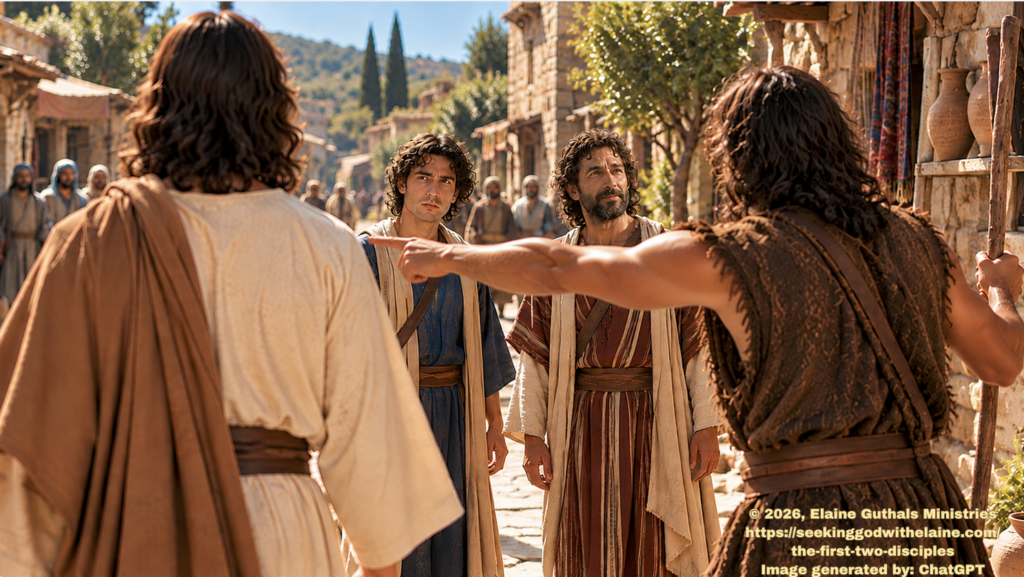
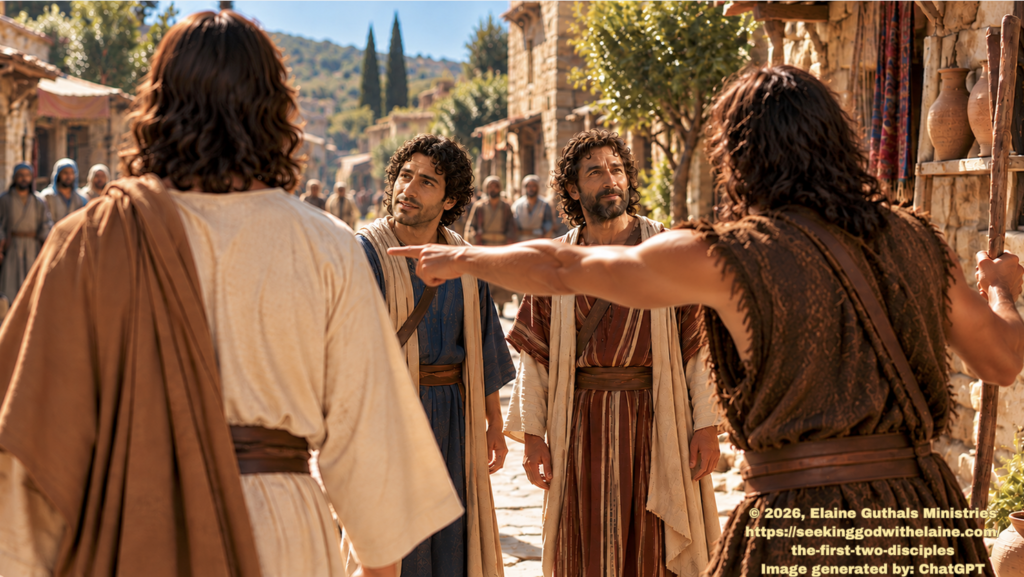
    “The following day John was again standing with two of his disciples. As Jesus walked by, John looked at him and declared, ‘Look! There is the Lamb of God!’” (Jn. 1: 35-36 NLT)

    The Following Day

    The event that began this progression was when John was being questioned by Pharisees.

    A lot of things had been happening that were identified by the following day language. It is easy to get lost in the quick day changes.

    “John told them, ‘I baptize with water, but right here in the crowd is someone you do not recognize. Though his ministry follows mine, I’m not even worthy to be his slave and untie the straps of his sandal’” (Jn. 1: 26-27 NLT).

    John Was Standing with Two Disciples

    John’s ministry was all about others.

    We have already seen where John the Immerser pointed to Yeshua as the Messiah at His baptism. Once again, John pointed to Him – this time to two of his disciples.

    The Hebrew word for disciples is talmidim – תלמידים. It means learners or students. The singular is talmid (תלמיד).

    We have to know what kind of learning is being discussed here. It isn’t a straight transfer of information. It could involve learning the teacher’s interpretation, conduct, and way of life.

    John could have said, “Hey, these are my disciples. Don’t come poaching. Go find Your own.”

    No, John knew his mission – to prepare for the Messiah.

    What would have been the point of John’s ministry to prepare for the Messiah if he didn’t want his disciples to follow the Master? The purpose of his ministry wouldn’t have been about the Messiah – it would have been about himself.

    John’s message was incomplete – until Yeshua arrived on the scene. But then his mission was completed.

    So, John encouraged his two disciples to follow the Messiah.

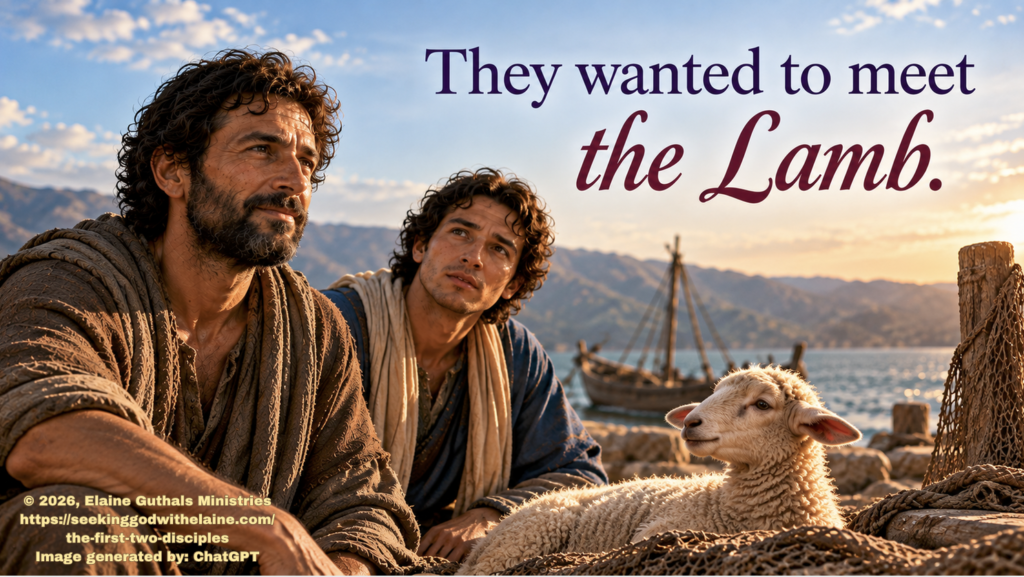
    There Is the Lamb of God

    From His birth, Yeshua was identified as the Sacrifice needed to restore us from sin.

    When we think of a sheep, most of us probably think about a fluffy animal that, when given a haircut, provides us with yarn to make some warm clothes. Maybe we think about some milk to drink.

    That wouldn’t have been what the first-century Jews thought. They would have thought of sacrifice in the Temple.

    They wouldn’t have connected that with the Messiah – the One Who was to save them from Roman occupation.

    Yeshua’s mission was to be a substitute for sinful humans. He came to take away the sin of the world (Jn. 1: 29).

    If He hadn’t been the Lamb Who was slain, we would forever be separated from our Creator. To some, that may be fine since that is all we have ever known.

    But come Judgment Day, that isn’t going to be fine. The consequences of that separation will be eternal – and painful.

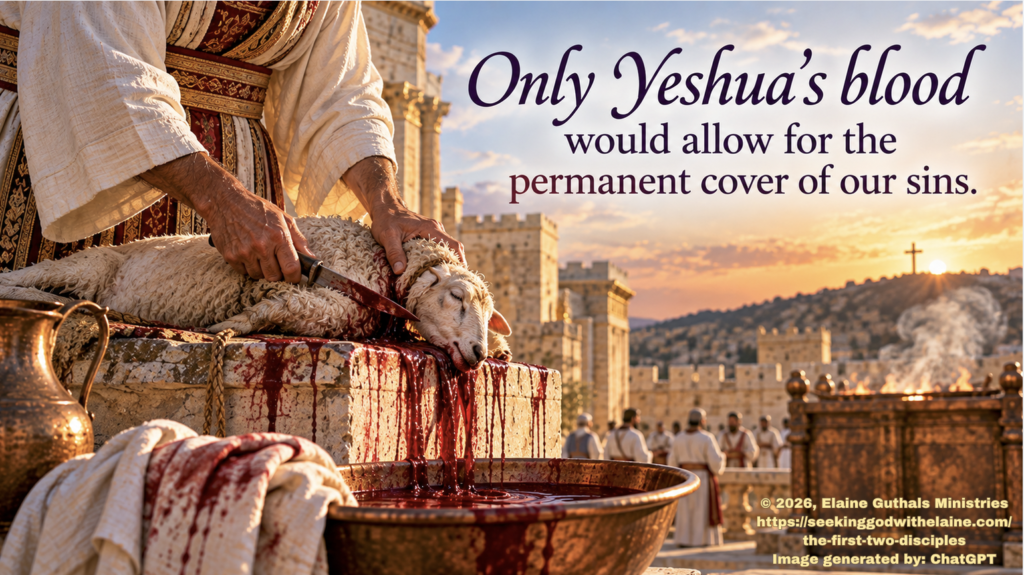
    What Yeshua accomplished that a regular lamb couldn’t was to remove our sins. The lamb’s sacrifice would allow temporary cover for our sins.

    Only Yeshua’s blood would allow for the permanent cover of our sins.

    What can we learn from this? Two things. Sin is real, and it is seriously bad. Jehovah loves us so much that He would provide His own Sacrifice – the only Sacrifice – to eliminate its eternal consequences once and for all.

    The Disciples React

    “When John’s two disciples heard this, they followed Jesus. Jesus looked around and saw them following. ‘What do you want?’ he asked them. They replied, ‘Rabbi’ (which means ‘Teacher’), ‘where are you staying?’ ‘Come and see,’ he said. It was about four o’clock in the afternoon when they went with him to the place where he was staying, and they remained with him the rest of the day” (Jn. 1: 37-39 NLT)

    They Followed Jesus

    The two disciples immediately left John and followed Yeshua.

    Once John made his identification of Yeshua, the disciples had a choice to make. Were they going to stay with John – i.e., stay with what they had always known?

    Or were they going to pursue a relationship with Yeshua?

    No, don’t mistake this for their becoming His followers at that moment. On the other hand, don’t see this as some first-century type of stalking.

    They wanted to meet the Lamb.

    Knowing that we have the need to meet the Savior is the first step into becoming a child of Jehovah. Head knowledge of the Sacrifice has to come first.

    But it can’t stop there. Head knowledge does not make Yeshua our Savior.

    We have to build a relationship with Him.

    What Do You Seek?

    We have to seek the Savior for the right reason.

    Yeshua asked the disciples a great question. “What do you seek?”

    Ooo, baby. Yeshua is still asking us that question today. In fact, that is a foundational discipleship question.

    There are a variety of answers that we can give. Some may say they are looking for a better life.

    That may be a good answer – but it also may be a wrong answer. If we are looking for an easier life or a more prosperous life, that would be the wrong answer.

    If we are seeking Yeshua to be our Savior and Redeemer, that is the right answer. Our motivation for seeking must be to submit our lives and our will to Him.

    Where Are You Staying?

    The disciples had to determine why they were seeking Yeshua.

    I always thought the response of the two disciples to Yeshua’s question was interesting. If John had prepared them for the coming Messiah – and he did – and then he told them this was the One, wouldn’t they have come up with a better answer than “Where do You live?”

    Maybe that was a polite way of inviting themselves over. Maybe that showed they wanted a relationship with Him.

    Whatever the reason behind structuring the answer in that way, the two disciples showed respect by addressing Him as Rabbi.

    Come and See

    Yeshua recognized the importance of the two disciples coming and seeing for themselves.

    In order to ask Yeshua to be our Savior and Redeemer, we have to have knowledge of Who He is. We have to have personal experience in listening to and following Him.

    We have to seek and find Yeshua.

    Andrew

    “Andrew, Simon Peter’s brother, was one of these men who heard what John said and then followed Jesus” (Jn. 1: 40 NLT)

    While Andrew didn’t get as much ink time as his brother Simon Peter, he is also one of the most recognizable disciples.

    I have to start out with a disclaimer. We are going to start introducing the Apostles. Scripture tells us very little about them.

    Tradition tells us more, but it is only that – tradition. Some traditions may be more reliable than others.

    So, long story short, if Scripture itself doesn’t say it, it may be wrong or it may be right.

    Andrew is the first disciple we meet. Of the two disciples who followed the Lamb at John the Immerser’s direction, he is the only one explicitly named.

    But then the Apostle John, who wrote the Gospel book, identified Andrew as being Simon Peter’s brother. I wonder how often he felt he was in his brother’s shadow?

    They fished together, and they were called together (Mt. 4: 18-22). They may have even lived together (Mk. 1: 29).

    Still, it is Andrew to whom we are first introduced. By being a disciple of John’s, he showed his earnest pursuit of salvation before ever meeting the Messiah. That leads us to believe he accepted John’s message of the coming One.

    Punshon had a great observation about the disconnect between first-century Messianic expectations and the demeanor of the Lamb introduced to Andrew. He wrote,

    “He came to Jesus with an openheartedness worthy of imitation. He had his own notions, doubtless, about the grandeur of Israel’s Messiah; but was not offended when the solitary, unattended man was pointed out to him. Some, in the hasty revulsion of feeling, would have turned away in disdain. But Andrew’s faith mastered his prejudice.”

    Resource

    That tells us that Andrew didn’t just believe what everyone expected the Messiah to be. He made up his own mind, probably in large part due to what John told him – this is the Lamb of God.

    Andrew was faithful to the ministry after Yeshua’s death. According to tradition, he spread the Gospel to Asia Minor, Greece, and Scythia. It was in Patras, Greece, that, according to tradition, he was crucified on an x-shaped cross after being severely whipped by seven soldiers. It is said that two days passed before death came.

    Making the Connections #1

    The other disciple with Andrew that day wasn’t named. But that hasn’t stopped us from trying to figure out who he was.

    Most agree on two candidates. It could have been John, but it also could have been Philip.

    Most believe the disciple was probably John. He was an important disciple.

    If John did write this Gospel account, I can see why he didn’t identify himself as the disciple. He never really identified himself throughout the book – just as the beloved disciple. This, however, wasn’t verified by any other canonical writer.

    We do know that John was the son of Zebedee and the brother of the Apostle James (Mt. 4: 21). Their family operated a fishing business on the Sea of Galilee. It sounds extensive because they did have hired workers (Mk. 1: 20). They appear to have been partners with Simon Peter and Andrew (Lk. 5: 7).

    It is tradition that John’s mother Salome was the sister of Mary. If so, James and John would have been cousins of Yeshua.

    John is also memorable because he and James got nicknames. Yeshua called them the sons of thunder. This nickname came from their reaction to the Samaritan village (Lk. 9: 51-56).

    John wrote other New Testament books besides the Book of John. He may have written the Books of First John, Second John, and Third John and the Book of Revelation.

    John’s mission field was Jerusalem and Ephesus.

    Many know that John was exiled to the Island of Patmos. What some may not know is that he, according to early church tradition, was boiled in oil before he got there. When he didn’t die from that hideous torture, which was an execution method of the Roman Empire, he was banished (possibly by Domitian) to the prison on the Island of Patmos.

    John was eventually freed. He then served as Bishop of Ephesus (modern-day Turkey). He died peacefully – the only one to die of natural causes according to tradition – sometime after AD 98.

    Less is known about Philip. John 1: 44 indicates that he was from Bethsaida.

    We do know that Philip was a man who asked practical questions (Jn. 14: 8-9). He, like Andrew, was more quiet about his evangelism. Philip’s mission field became Greece, Syria, Phrygia, and Hierapolis (Asia Minor).

    Little is known about his life and death. Tradition says that he was the father of daughters. He is believed to have been martyred by either crucifixion or stoning. He is buried in Hierapolis.

    The other disciple with Andrew could have been either John or Philip. Or it could have been someone else entirely. The truth is we just aren’t told.

    Making the Connections #2

    I like what Punshon said. He wrote, “Christianity requires intelligence, reliance, not blind credulity.”

    Resource

    Anyone who believes Jehovah demands blind submission has profoundly misunderstood Who He is. He wants us to make informed, genuine decisions to deny ourselves, choose Him daily, and follow Him and His ways (Lk. 9: 23).

    Heart Check

    Think about the battle Yeshua is engaged in for your heart. Ask yourself the following questions.

    • Am I seeking Yeshua for an easier life, or am I seeking Him as our Savior and Redeemer?
    • Am I content with head knowledge about Yeshua, or am I building a relationship with Him?
    • Am I holding on to what we have always known, or am I willing to follow Yeshua where He leads?
    • Am I accepting what others tell us about Yeshua without examining it, or am I making informed, genuine decisions to follow Him?

    How Do We Apply This?

    • Recognizing our need for Yeshua as our Savior and Redeemer
    • Moving beyond head knowledge into a personal relationship with Yeshua
    • Examining our motives for seeking the Savior
    • Submitting our lives and our will to Yeshua
    • Seeking and finding Yeshua through personal experience in listening to and following Him
    • Making informed, genuine decisions to deny ourselves, choose Jehovah daily, and follow His ways

    Father God. You call us to be students of You — Your character, Your history, Your interactions with humans. You call us so that You can use us to expand Your kingdom. Most of all, You call us so You can save us from our sins. Thank You. Amen.

    If you don’t understand something and would like further clarification, please contact me.

    If you have not signed up for the email providing the link to the devotions and the newsletter, do so below.

    If God has used this devotion to speak with you, consider sharing it on social media.
  • The Ministry of Jesus Began

    Once Yeshua was baptized, it was time to start His ministry. This devotional reading looks at the first things He did.

    Nuggets

    • Once Yeshua started His ministry, there was no need for someone to prepare the way.
    • Yeshua left Galilee and traveled south to the Jordan, where John was baptizing.
    • Nazareth was the village in which Yeshua grew up.
    • Set on the northwestern shore of the Sea of Galilee, Capernaum was more than just a dot on the map and different from Nazareth.
    • Yeshuah’s move to Capernaum had prophetic significance.
    • Zebulun was the sixth and last son of Jacob and Leah (Gen. 30: 19-20) and was Jacob’s tenth son.
    • Naphtali was Jacob’s sixth son, born by Rachel’s servant girl Bilhah (Gen.30: 7-8).
    • In the Gospel of John, John portrayed Yeshua as the eternal Word, the source of life, and the true Light.
    • The difference in their messages was that John was talking about Yeshua, and Yeshua was talking about Himself.
    • In the Old Testament, the primary Hebrew concept is expressed through shuv (שׁוּב), meaning to turn, return or go back, and nacham (נָחַם), which can express regret, relenting, or a change of mind/intent.
    • More than just turning away from sin, we have to turn back to Jehovah.
    • The foundation of the Plan of Salvation is that we believe Yeshua is the Son of God and was sent to save us from our sins.
    • The Kingdom of Heaven really wasn’t a place – it was a reign.

    Yeshua chose to be obedient to Jehovah. He submitted Himself for baptism by John the Immerser.

    After a period of temptation, Yeshua was ready to begin His ministry.

    We aren’t told a lot about what that looked like. Let’s see if we can piece things together.

    To read devotions in The Battle for the Heart theme

    Devotions in the The Early Ministry of the Messiah series

    Traveling in Israel

    “When Jesus heard that John had been arrested, he left Judea and returned to Galilee” (Mt. 4: 12 NLT)

    “Later on, after John was arrested, Jesus went into Galilee, where he preached God’s Good News” (Mk. 4: 14 NLT)

     After John Was Arrested

    Once Yeshua started His ministry, there was no need for someone to prepare the way.

    I have always thought it sad how short of a time John the Immerser was able to conduct his ministry. No, we aren’t told the amount of time, but it probably would have been fairly short.

    Think about it. Yeshua began His ministry when He was around 30 years old. “Jesus was about thirty years old when he began his public ministry …” (Lk. 3: 23 NLT).

    John was six months older than Yeshua. It is logical that he started when he was around 30.

    Priests actively served from age 30 until age 50, after which their physical duties were reduced. “Then the LORD said to Moses and Aaron, ‘Record the names of the members of the clans and families of the Kohathite division of the tribe of Levi. List all the men between the ages of thirty and fifty who are eligible to serve in the Tabernacle’” (Num. 4: 1-3 NLT).

    No, John wasn’t a priest, but Jehovah works in patterns. Many things in Yeshua’s ministry were patterned after the Temple and priests.

    With John and Yeshua being so close in age and Him being 30, that would mean that John probably wasn’t that much older.

    Regardless of age, it is logical that John’s role would have to diminish after Yeshua began His ministry. There was no more reason to prepare when He started.

    I guess it is logical, too, that John had to die. People didn’t need to go to the messenger. They needed to go to the Message.

    Left Judea and Returned to Galilee

    Yeshua left Galilee and traveled south to the Jordan, where John was baptizing.

    It is fairly safe to say that John was in Judea when Yeshua came for baptism. “One day Jesus came from Nazareth in Galilee, and John baptized him in the Jordan River” (Mk. 1: 9 NLT).

    John’s ministry was associated with the Jordan Valley, particularly the wilderness region. In his Gospel, the Apostle John identified Yeshua’s baptism as occurring near Bethany beyond Jordan (Jn. 1: 28-29). Unfortunately, the exact location of where that village was is debated.

    Villages Associated with Yeshua’s Ministry

    “He went first to Nazareth, then left there and moved to Capernaum, beside the Sea of Galilee, in the region of Zebulun and Naphtali” (Mt. 4: 13 NLT

    First to Nazareth

    Nazareth was the village in which Yeshua grew up.

Nazareth was an insignificant village. Its only claim to fame was that it was where the Messiah lived during childhood and early adulthood.

    A small Galilean village in the hills of Lower Galilee, the village probably had only 200 to 400 inhabitants. It was tucked into the hills, so there was no trade route associated with it.

    Archaeology indicates a modest village that was Torah-observant but poor. Archeologists have found simple stone homes, many which are at least partly cave based.

    The village was tucked in the hills of Galilee, a rural and quiet area often overlooked. It wasn’t mentioned in the Old Testament at all.

    We get a hint of Nazareth’s reputation in John 1: 46. “‘Nazareth!’ exclaimed Nathanael. ‘Can anything good come from Nazareth?’ ‘Come and see for yourself,’ Philip replied” (Jn. 1: 46 NLT).

    The eventual return of the family to Nazareth after their sojourn in Egypt fulfilled prophecy. Joseph had another dream, telling him to go to Galilee.

    We hear little about Yeshua and His childhood. All we are told is that He grew both in wisdom and in God’s favor.

    Moved to Capernaum

    Set on the northwestern shore of the Sea of Galilee, Capernaum was more than just a dot on the map and different from Nazareth.

    Where Nazareth had been a small, rural village, Capernaum (Kfar Nahum – כְּפַר נַחוּם) was no isolated farming hamlet. Instead – while still a village – archeology had proven that it was a busy fishing and commercial community. Its location was strategically important for Yeshua’s ministry.

    In our minds, we may see the call of Peter, Andrew, James, and John taking place on an isolated spot on the shore of the Sea of Galilee. That probably wasn’t the case.

    Capernaum boasted substantial harbor installations, including a seawall and piers. The fishing industry was essential to the economy of the town.

    We should see a group of young men spending a leisurely afternoon fishing. They were working men engaged in an established commercial occupation.

    That several of His disciples came from the same town would have been helpful to Yeshua. More importantly, Yeshua Himself moved to Capernaum and made it His base of operations.

    Being a commercial hub meant that the town was located on important routes that connected Galilee with the surrounding territories. Part of this was due to the fact the village sat near a territorial boundary. That, however, meant the lake, because of its size, sat within several different jurisdictions. This meant that fisherman could be taxed when moving their catch across those boundaries.

    Probably of greatest importance was the fact that Capernaum had a substantial synagogue during first-century Israel. It was a place where Jewish communities gathered, heard Scripture read, and discussed its interpretation.

    That meant that all of Capernaum believed Yeshua was the Messiah come to save them from their sinful nature? Not really. In fact, Capernaum earned Yeshua’s condemnation before His death.

    “And you people of Capernaum, will you be honored in heaven? No, you will go down to the place of the dead. For if the miracles I did for you had been done in wicked Sodom, it would still be here today” (Mt. 11: 23 NLT).

    This solidifies the difference between head knowledge and heart knowledge. We must not only know Jesus as a first-century Jewish figure, a healer and miracle worker. But we must also know His mission and its purpose.

    That knowledge has to transform our hearts into being disciples of Yeshua. Being disciples – students – means that we are students of His Word, His life, and His promises.

    Prophecy Fulfilled

    Yeshuah’s move to Capernaum had prophetic significance.

    Matthew quoted most of Isaiah 9: 1-2 as one of the reasons for the relocation from Nazareth to Capernaum.

    “Nevertheless, that time of darkness and despair will not go on forever. The land of Zebulun and Naphtali will be humbled, but there will be a time in the future when Galilee of the Gentiles, which lies along the road that runs between the Jordan and the sea, will be filled with glory. The people who walk in darkness will see a great light.
    For those who live in a land of deep darkness, a light will shine” (Isa. 9: 1-2 NLT).

    First, Zebulun and Naphtali were sons of Jacob.

    Zebulun

    “Zebulun will settle by the seashore and will be a harbor for ships; his borders will extend to Sidon” (Gen. 49: 13 NLT)

    Zebulun was the sixth and last son of Jacob and Leah (Gen. 30: 19-20) and was Jacob’s tenth son.

    Courageous in battle, Zebulun showed up when it mattered. The tribe were willing to risk itself for Jehovah’s purposes.

    Zebulun’s future did occur as Jacob prophesied — sort of. The land allotted for the tribe in Joshua 19: 10-16 wasn’t on the coast. It was in lower Galilee.

    The territory was in a strategic position. Not only did they have the benefits of the Sea of Galilee in the region, but they also had Mediterranean trade routes. Their border was near the city of Zidon, leading to commercial relations with the Phoenicians.

    Known for its courage in battle, the tribe supported David when he became king. They also fought with Deborah and Barak (Jdgs. 5: 15).

    Naphtali

    “Naphtali is a doe set free that bears beautiful fawns” (Gen. 49: 21 NLT)

    Naphtali was Jacob’s sixth son, born by Rachel’s servant girl Bilhah (Gen.30: 7-8).

    The blessing Jacob gave him was talking about freedom and descendants who are right with Jehovah.

    Whitfield addressed this blessing this way. He wrote, “In Naphtali we have the Christian enjoying the liberty and freedom and happiness in Christ, and testifying of Christ to others.”

    Resource

    The liberty of our souls from sin is a joyous thing. Because Yeshua has paid the debt, we are no longer slaves to sin. Our chains have been broken, and we are free.

    The linkage between Zebulun and Naphtali occurred frequently. They fought alongside Deborah and Barak (Jdgs. 5: 15). Both were in Galilee.

    Because of this, the two tribes were listed when the Messiah was prophesied. “But there will be no gloom for her who was in anguish. In the former time he brought into contempt the land of Zebulun and the land of Naphtali, but in the latter time he has made glorious the way of the sea, the land beyond the Jordan, Galilee of the nations” (Isa. 9: 1 ESV).

    The first-century Jews wouldn’t have necessarily gone back to the men themselves, especially when they said that they were humbled. The Hebrew used there is hêqal (הֵקַל) from the root q-l-l (קלל). This carries the ideas of to make light, make insignificant, treat as of little account, or bring into contempt.

    The two tribes had been brought low during the Assyrian conquest of the northern territories. Naphtali especially felt the brunt of this attack.

    Tiglath-pileser III attacked during the reign of Pelah, king of Israel, the Northern Kingdom (II Kgs. 15: 29-30). Galilee and the entire territory of Naphtali were captured as well as a number of important cities. The captured Israelites were deported to Assyria.

    This humiliation had lasting consequences throughout the region. Isaiah later called the area Galilee of the nations. We’re talking the northern Galilean region here. Yes, the area where Yeshua began his ministry in Galilee, in the territory formerly held by Zebulun and Naphtali.

    The people in this area were close to the great international movement of people, armies, trade, and imperial power. This led them to feel the consequences of being on the front edge of Israel’s northern vulnerability.

    By the time the first century came around, the Jews probably weren’t going around saying, “I’m from the tribe of Zebulun.” Don’t get me wrong. They would have still known.

    However, the tribal territories weren’t functioning in the same way they had in Joshua’s day when the allotment was given. But the tribal names were still part of Israel’s scriptural and historical memory.

    The prophecy said that this humiliation wouldn’t last forever. It contrasted hēqal with hikbîd – הִכְבִּיד (taken from the root k-b-d – כבד). That means to make heavy, which can carry the sense of giving weight, honor, or glory.

    In other words, Galilee was going to go from humiliated to honored. This honor was going to be because of the Light.

    Light

    In the Gospel of John, John portrayed Yeshua as the eternal Word, the source of life, and the true Light.

    From the beginning, the Light is tied to creation and symbolizes life, truth, order, revelation, and Jehovah’s presence.

    In contrast, darkness symbolizes sin, death, ignorance, distortion, and separation from the life the Word gives. The Light entered the darkness, which could not overcome it.

    John the Baptist was not the Light but its witness, sent under Jehovah’s authority to prepare Israel through repentance and foster faith before the Messiah appeared. His ministry prepared people to receive the One who was coming.

    Then the Light entered the world as Yeshua — the eternal Word and giver of life at creation — taking human form within His own creation. The Light is not merely Yeshua’s teaching; it is His identity. He gives spiritual life and salvation, exposes what darkness conceals, and reveals Jehovah.

    The struggle between Light and darkness is ultimately a battle for the human heart. Darkness may cloud and distort our perception, but it cannot defeat the Light. Jehovah’s plan will prevail as He leads people from darkness into the Light of redemption and forgiveness

    Yeshua’s Message

    ““From then on Jesus began to preach, ‘Repent of your sins and turn to God, for the Kingdom of Heaven is near’” (Mt. 4: 17 NLT) “‘The time promised by God has come at last!’ he announced. ‘The Kingdom of God is near! Repent of your sins and believe the Good News!’” (Mk. 1: 15 NLT)

    The difference in their messages was that John was talking about Yeshua, and Yeshua was talking about Himself.

    Yeshua’s message was the same as John the Baptizer’s message. “In those days John the Baptist came to the Judean wilderness and began preaching. His message was, 2 ‘Repent of your sins and turn to God, for the Kingdom of Heaven is near’” (Mt. 3: 1-2 NLT).

    Repent of Your Sins

    In the Old Testament, the primary Hebrew concept is expressed through shuv (שׁוּב), meaning to turn, return or go back, and nacham (נָחַם), which can express regret, relenting, or a change of mind/intent.

    This carried into the New Testament as to change one’s mind or way of thinking.

    Remember, Israel had a covenant relationship with Jehovah. The problem Israel’s leaders encountered was they forgot that was a relationship, rather than just ritual ceremony.

    While Yeshua did come to restore Israel to covenant fulfillment, He came to individually save us from our sins.

    • “Jesus answered him, ‘I tell you the truth, unless you are born again, you cannot see the Kingdom of God’” (Jn. 3: 3 NLT).
    • “Jesus answered, ‘I assure you, no one can enter the Kingdom of God without being born of water and the Spirit’” (Jn. 3: 5 NLT).

    Turn to God

    More than just turning away from sin, we have to turn back to Jehovah.

    Choosing not to sin isn’t enough. We have to turn back to Jehovah and walk with Him.

    The goal is not to eliminate sin in our lives. It is to restore our relationships with Him.

    Through the Plan of Salvation, Yeshua is opening up the opportunity to restore that relationship. We can’t approach Jehovah unless our sins have been washed through the blood of the Lamb.

    Believe

    The foundation of the Plan of Salvation is that we believe Yeshua is the Son of God and was sent to save us from our sins.

    • “For this is how God loved the world: He gave his one and only Son, so that everyone who believes in him will not perish but have eternal life” (Jn. 3: 16 NLT).
    • “They replied, ‘Believe in the Lord Jesus and you will be saved, along with everyone in your household’” (Ac. 16: 31 NLT).
    • “If you openly declare that Jesus is Lord and believe in your heart that God raised him from the dead, you will be saved” (Rom. 10: 9 NLT).

    Believing in Yeshua has to come from our hearts, not our heads. We have to genuinely believe in Him and want all that He has to offer – that includes the responsibilities involved.

    When we believe in Yeshua, we trust Him as our Savior and Redeemer. We put our faith in Him even though we are believing something we can’t see.

    The Kingdom of Heaven

    The Kingdom of Heaven really wasn’t a place – it was a reign.

    It is about the rule of God becoming manifest.

    So, it had nothing to do with where the kingdom would be – rather it told Who was going to rule the kingdom.

    John called Israel to prepare itself as a people for the arrival of its King. Yeshua said that the Kingdom was near. To me, that makes it sound like it is close but not here yet.

    The Complete Jewish Study Bible said this is one of those three-meaning words. The Kingdom of God is near, it is present, and it’s not here yet.

    • “But since they don’t have deep roots, they don’t last long. They fall away as soon as they have problems or are persecuted for believing God’s word” (Mk. 4: 17 NLT).
    • “Realizing how much the man understood, Jesus said to him, “You are not far from the Kingdom of God.” And after that, no one dared to ask him any more questions” (Mk. 12: 34 NLT).
    • “You won’t be able to say, ‘Here it is!’ or ‘It’s over there!’ For the Kingdom of God is already among you” (Lk. 17: 21 NLT).
    • “Jesus answered, ‘My Kingdom is not an earthly kingdom. If it were, my followers would fight to keep me from being handed over to the Jewish leaders. But my Kingdom is not of this world’” (Jn. 18: 36 NLT).
    • “So when the apostles were with Jesus, they kept asking him, ‘Lord, has the time come for you to free Israel and restore our kingdom?’ He replied, ‘The Father alone has the authority to set those dates and times, and they are not for you to know’” (Ac. 1: 6-7 NLT).

    We tend to combine Kingdom of God with Heaven. Maybe. Maybe not.

    Everyone — believers and non-believers — are going to live forever. The emphasis is not on the eternal part — the quantity part. The emphasis is on the life part — the quality part.

    Where we live is going to determine how we live. Non-believers — those who do not have their names written in the Book of Life — will spend eternity in torment. “And if anyone’s name was not found written in the book of life, he was thrown into the lake of fire” (Rev. 20: 15 ESV).

    Believers will be as Jesus is and spend eternity in Paradise. “The one who conquers will have this heritage, and I will be his God and he will be my son” (Rev. 21: 7 ESV). So, eternal life is really addressing the wellbeing of our soul. Will it experience spiritual death?

    Making the Connections

    Sparrow said something interesting. He wrote, “He [Jesus] is triumphing now in every individual that is converted to God, in every increase of holiness in the Church, in every new introduction or further spread of the gospel in heathen or Mahometan lands.”

    Resource

    If Jesus isn’t triumphing now in our hearts, we have to really examine our salvation. That would put us as a goat masquerading as a sheep.

    Heart Check

    Think about the battle Yeshua is engaged in for your heart. Ask yourself the following questions.

    • Am I following Yeshua, or am I simply learning about Him?
    • Is there an area of my life where I know what God’s Word says, but I have not turned back to Him?
    • When Yeshua exposes something in my life, do I repent, or do I try to justify it?
    • Am I trusting Yeshua as my Savior and Redeemer, or am I depending on what I know about Him?
    • Is His Kingdom becoming evident in the way I live, or am I still trying to rule my own life?
    • If Jehovah changed or ended something I believe He has given me to do, would I trust Him with the outcome?
    • lAm I willing to decrease so that Yeshua can increase?

    How Do We Apply This?

    • Don’t settle for simply recognizing sin – repent and turn back to Him.
    • Make changes when Yeshua reveals something in our life that needs to change.
    • Move beyond head knowledge.
    • Live as a citizen of the Kingdom.
    • Remember that our purpose isn’t to make ourselves important.
    • Trust Jehovah with our assignment.
    • Be willing to let Jehovah change the assignment.
    • Keep our eyes on the King.

    Father God. Thank You for messengers such as John, who are faithful to point us to You. Thank You for the Message — the life, death, and resurrection of Yeshua, which allows us to restore our relationships with You. Amen.

    If you don’t understand something and would like further clarification, please contact me.

    If you have not signed up for the email daily or weekly providing the link to the devotions and the newsletter, do so below.

    If God has used this devotion to speak with you, consider sharing it on social media.
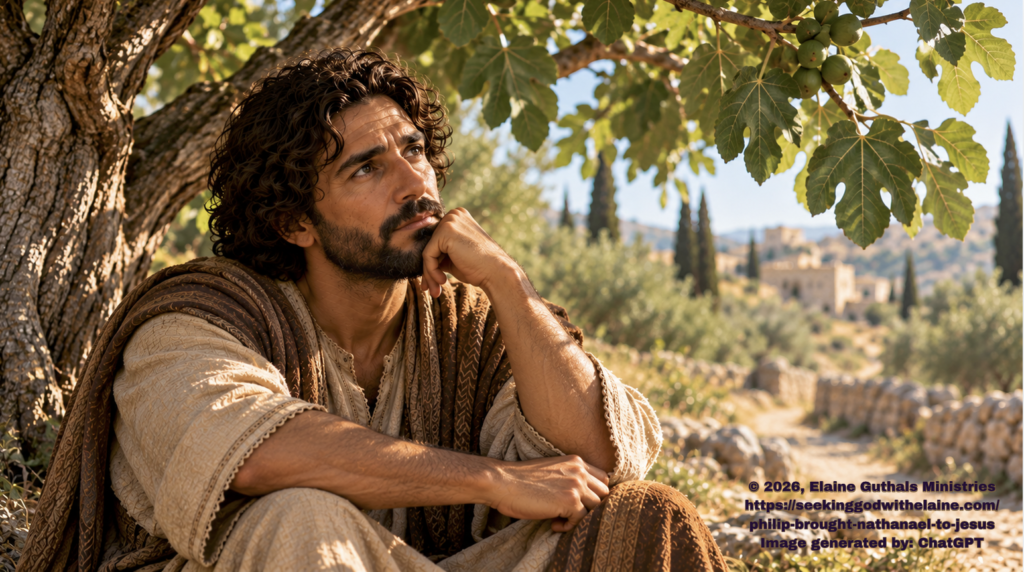
  • The Source of Grace

    When the time was right, Jehovah sent His grace and truth to the world to redeem it. This devotional reading looks at Who the source is.

    Nuggets

    • Moses and Yeshua have similarities, but Yeshua isn’t merely another Moses.
    • Moses gave instructions while Yeshua embodies grace and truth.
    • John wasn’t saying the Law was bad while grace is good.
    • Everything Moses pointed toward comes to fulfillment in Yeshua.
    • Yeshua was the source of grace and truth.
    • Grace is finding favor is Jehovah’s eyes, and truth is reality according to God.

    Yeshua had a mission here on earth. His ministry was to be the Savior of the world.

    The foundation of that ministry was that, the fullness of Jehovah’s time, we received His grace and truth. Because of His unending and overflowing grace, Jehovah sent Yeshua to be the Sacrifice that we needed.

    In other words, Yeshua was the source of Jehovah’s grace.

    Let’s Put It into Context

    To read devotions in The Battle for the Heart theme

    Devotions in the The Early Ministry of the Messiah series

    The Source of Law: Moses

    “For the law was given through Moses …” (Jn. 1: 17 ESV)

    Moses and Yeshua

    “Come, I will send you to Pharaoh that you may bring my people, the children of Israel, out of Egypt” (Ex. 3: 10 ESV)

    “She will bear a son, and you shall call his name Jesus, for he will save his people from their sins” (Mt. 1: 21 ESV)

    Moses and Yeshua have similarities, but Yeshua isn’t merely another Moses.

    First-century Jews would have known all about Moses. Even to them – as covenant mediator – he would have been a Hall of Famer.

    The exodus from Egypt was an important event in Israel’s history. Their release from slavery allowed them to become the nation of Israel.

    John placed Yeshua in a recognizable Moses-shaped pattern so that first-century Jews – and us – see the continuity. That connection was deliberate.

    The differences between Moses and Yeshua are recognizable. They aren’t equals.

    Yeshua does more than just lead His people. He offers a different kind of deliverance – a new covenant.

    Yeshua came to deliver us from the bondage of sin.

    We may see the parallels of Moses and Yeshua. One thing we have to realize is that Yeshua was walking into Israel’s story.

    Yeshua never intended to start a new story. He specifically said that He came to be a part of that story.

    The plan was for Yeshua to step into a centuries-old story. It was a story of deliverance, covenant, rebellion, judgment, mercy, and Jehovah’s faithfulness to His people.

    Moses had done his part. The exodus and the covenant had been part of that story.

    Yeshua walked into that story – but it wasn’t the only story. He wasn’t merely fulfilling the covenant given to Abraham, Moses, and David. He was fulfilling the covenant given to Adam.

    All who accept Yeshua as the Savior would be delivered and redeemed. Our judgment would be taken by Yeshua because of Jehovah’s mercy and grace.

    The Giving of the Law Verses the Coming of Grace and Truth

    “Do not think that I have come to abolish the Law or the Prophets; I have not come to abolish them but to fulfill them. For truly, I say to you, until heaven and earth pass away, not an iota, not a dot, will pass from the Law until all is accomplished. Therefore whoever relaxes one of the least of these commandments and teaches others to do the same will be called least in the kingdom of heaven, but whoever does them and teaches them will be called great in the kingdom of heaven” (Mt. 5: 17-19 ESV)

    Moses gave instructions while Yeshua embodies grace and truth.

    Both Moses and Yeshua went up a mountain – but for different reasons. Moses went up Mt. Sinai to receive the Law – more importantly, the covenant terms.

    Yeshua, at the Sermon on the Mount, teaches. But really what He was teaching about was Himself.

    But Yeshua was more than just a Teacher. In order to understand that, we have to understand the difference between the Law and grace.

    What John Is and Isn’t Saying about the Law

    “For by works of the law no human being will be justified in his sight, since through the law comes knowledge of sin” (Rom. 3: 20 ESV)

    John wasn’t saying the Law was bad while grace is good.

    Some think the Law can save us. If we keep the Law, we don’t sin. Therefore, keeping the Law is supposedly what we need for eternal life.

    It doesn’t work that way.

    • “We ourselves are Jews by birth and not Gentile sinners; yet we know that a person is not justified by works of the law but through faith in Jesus Christ, so we also have believed in Christ Jesus, in order to be justified by faith in Christ and not by works of the law, because by works of the law no one will be justified” (Gal. 2: 15-16 ESV).
    • “For all who rely on works of the law are under a curse; for it is written, ‘Cursed be everyone who does not abide by all things written in the Book of the Law, and do them.’ Now it is evident that no one is justified before God by the law, for ‘The righteous shall live by faith.’ But the law is not of faith, rather ‘The one who does them shall live by them’” (Gal. 3: 10-12 ESV).
    • “You are severed from Christ, you who would be justified by the law; you have fallen away from grace.” (Gal. 5: 4 ESV).

    Let’s unpack those.

    The Law gives knowledge of sin. Basically, a sin is when we do something that disobeys Jehovah. The Laws show us Jehovah’s character.

    In other words, the Law doesn’t just tell us, “You are going 90 miles per hour in a 55-mile-per-hour zone.” It says, “Your actions aren’t being performed in a way that obeys Jehovah.”

    So, when we are breaking the Laws, we are acting outside of Jehovah’s character.

    Being a Jew didn’t justify first-century Jews – or any that came before them. Justification is where we are declared righteous before Jehovah. Our guilt is removed and we are accepted as righteous because of our faith in the Messiah.

    Some like to think justification is a New Testament concept. It really isn’t.

    Abraham was declared righteous – therefore, justified – when he believed (Gen. 15: 6). Noah was a righteous man because he walked with Jehovah (Gen. 9: 9). Job was blameless and upright (Job 1: 1).

    They weren’t justified by their actions. They were justified by their belief in Jehovah.

    No one is justified by the Law. We can keep the law, but still not be walking with Jehovah. We may be trying to do everything He says, but we may not believe that we should submit our lives to Him.

    That speaks to motivation. Are we walking with Jehovah because we want to do His will, or do we just think it is the right thing to do?

    To me, the bottom line is that the Law doesn’t help us to rectify a situation when we have broken the Law. There may be punishment associated with the Law, but the stain of the sin is still there.

    That stain is still there because the Law doesn’t provide the means of justification and final redemption for sin. It doesn’t include the Plan of Salvation.

    Only Yeshua’s mission carries that.

    Why Moses and Yeshua Are in This Relationship

    “For if you believed Moses, you would believe me; for he wrote of me. But if you do not believe his writings, how will you believe my words?” (Jn. 5: 46-47 ESV)

    Everything Moses pointed toward comes to fulfillment in Yeshua.

    Moses was considered the mediator of the covenant because Jehovah chose him to be the intermediary between Himself and the Israelites. His job was to deliver the Law, intercede for the people, and formalize the covenant on Mt. Sinai.

    The whole purpose of giving the Law was so that Jehovah would be revealed to the Israelites – and us. Moses took these revelations from Him and communicated them to the people.

    The Law could only go so far, though. Think about Moses striking the rock and, as punishment, losing the chance to enter the Promised Land. That case showed the limitations of the Law.

    The case showed that the Law could identify disobedience and establish its consequences, but it couldn’t provide the final redemption from sin.

    Yeshua made it clear that He wasn’t replacing the Law. He was fulfilling it.

    Think about it. Many see the Law as a list of do’s and don’ts. It is – but it really isn’t.

    The Law shows us Jehovah’s character. It shows us that toward which we are to strive.

    Where the Law had its limitations, grace bridged the gap between disobedience and restoration. Yeshua’s death paid the penalty for our sins.

    Yeshua’s covenant fulfills the promises of Jeremiah 31: 31-34 and Ezekiel 36: 26-27. It offers a transformed life to those who accept a personal relationship with Him. It was established in Luke 22: 20.

    • “Behold, the days are coming, declares the Lord, when I will make a new covenant with the house of Israel and the house of Judah, not like the covenant that I made with their fathers on the day when I took them by the hand to bring them out of the land of Egypt, my covenant that they broke, though I was their husband, declares the Lord. For this is the covenant that I will make with the house of Israel after those days, declares the Lord: I will put my law within them, and I will write it on their hearts. And I will be their God, and they shall be my people. And no longer shall each one teach his neighbor and each his brother, saying, ‘Know the Lord,’ for they shall all know me, from the least of them to the greatest, declares the Lord. For I will forgive their iniquity, and I will remember their sin no more” (Jer. 31: 31-34 ESV).
    • “And I will give you a new heart, and a new spirit I will put within you. And I will remove the heart of stone from your flesh and give you a heart of flesh. And I will put my Spirit within you, and cause you to walk in my statutes and be careful to obey my rules” (Ezek. 36: 26-27 ESV).
    • “And likewise the cup after they had eaten, saying, “This cup that is poured out for you is the new covenant in my blood” (Lk. 22: 20 ESV).

    Yeshua’s covenant provides forgiveness of sin.

    The Source of Grace: Yeshua

    “For the law was given through Moses; grace and truth came through Jesus Christ” (Jn. 1: 17 ESV)

    Charis and Aletheia

    Yeshua was the source of grace and truth.

    In the last devotion, we talked about grace and truth.

    • Charis (χάρις) means grace (grace, favor, graciousness, goodwill, or a gracious gift).
    • Aletheia (ἀλήθεια) means truth (what is true, genuine, real, reliable, and not concealed).

    What John is saying here is what came through Yeshua didn’t come through Moses.

    Wait! What??

    Are we trying to say that grace only appeared where Yeshua first stepped foot on earth? No, we know Jehovah was always gracious toward His people.

    • “The Lord is gracious and merciful, slow to anger and abounding in steadfast love.” (Ps. 145: 8 ESV).
    • “Gracious is the Lord, and righteous; our God is merciful” (Ps. 116: 5 ESV).
    • “‘Yet even now,’ declares the Lord, ‘return to me with all your heart, with fasting, with weeping, and with mourning; and rend your hearts and not your garments.’ Return to the Lord your God, for he is gracious and merciful, slow to anger, and abounding in steadfast love; and he relents over disaster” (Joel 2: 12-13 ESV).
    • “But the Lord was gracious to them and had compassion on them, and he turned toward them, because of his covenant with Abraham, Isaac, and Jacob, and would not destroy them, nor has he cast them from his presence until now” (II Kgs. 13: 23 ESV).

    But the fullness of Jehovah’s grace wasn’t made known until He sent Yeshua.

    Jehovah isn’t telling us, “Go and be gracious like me.” He is saying, “You can only be gracious through me.”

    Then there is truth. Yeshua didn’t just tell the truth. He was the truth.

    One isn’t given to us without the other.

    Grace and Truth

    “… and we have seen his glory, glory as of the only Son from the Father, full of grace and truth” (Jn. 1: 14 ESV).

    Grace is finding favor is Jehovah’s eyes, and truth is reality according to God.

    We looked at grace and truth in the last devotion. However, I used an incorrect Hebrew word. So, I am going to correct that here.

    The Hebrew Scriptures also describe Jehovah Himself as chanun (חַנּוּן), meaning gracious. When Jehovah reveals His character to Moses, He says that He is “… merciful and gracious, slow to anger, and abounding in steadfast love and faithfulness” (Ex. 34: 6 ESV).

    More importantly, it is finding favor in another’s eyes – namely Jehovah. The Hebrew concept is matza chen b’ene (מָצָא חֵן בְּעֵינֵי).

    John doesn’t separate grace from the person of Christ. “So the Word became human and made his home among us. He was full of unfailing love and faithfulness.” (Jn. 1: 14 NLT).

    We have to be very careful about its meaning, though. Grace doesn’t mean that Jehovah simply overlooks sin. It means that Jehovah acts toward people from His own gracious character rather than because they have established a claim upon Him.

    Grace doesn’t say: “Sin does not matter.” Grace says: “God has acted graciously toward you; therefore, live differently.”

    Truth in the Hebrew Scriptures isn’t merely information that happens to be accurate. The primary Hebrew word translated truth is ’emet (אֱמֶת’). It describes something that is dependable, trustworthy, established, and true to reality.

    The Hebrew understanding, therefore, joins two ideas that modern English can sometimes separate: truthfulness and faithfulness.

    Biblical truth is something upon which a person can stand.

    This means that when Scripture speaks about truth, it is not presenting truth as something detached from character.

    • Truth is dependable because it is firm.
    • Truth is trustworthy because it is faithful.
    • Truth can be believed because it is reliable.

    Truth is reality according to God.

    Heart Check

    Think about the battle Yeshua is engaged in for your heart. Ask yourself the following questions.

    • Am I obeying Jehovah because I love Him and want to walk with Him, or simply because I believe I should?
    • Where am I knowingly acting outside of Jehovah’s character?
    • Am I treating Jehovah’s grace as permission to continue in sin, or am I allowing His grace to lead me toward restoration and a changed life?
    • Am I trusting Yeshua as the One who provides the forgiveness and redemption the Law cannot provide?
    • Is my life being shaped by the truth of who Jehovah is?

    How Do We Apply This?

    • Recognize where you are walking outside of Jehovah’s character.
    • Receive the grace Yeshua provides.
    • Let grace lead you toward restoration.
    • Walk in the truth according to Jehovah.
    • Live differently because of the grace you have received.


    Father God. Lord, let us receive Your grace so that our relationships with You will be restored. We choose daily to walk with You. Amen.

    If you don’t understand something and would like further clarification, please contact me.

    If you have not signed up for the email providing the link to the devotions and the newsletter, do so below.

    If God has used this devotion to speak with you, consider sharing it on social media.
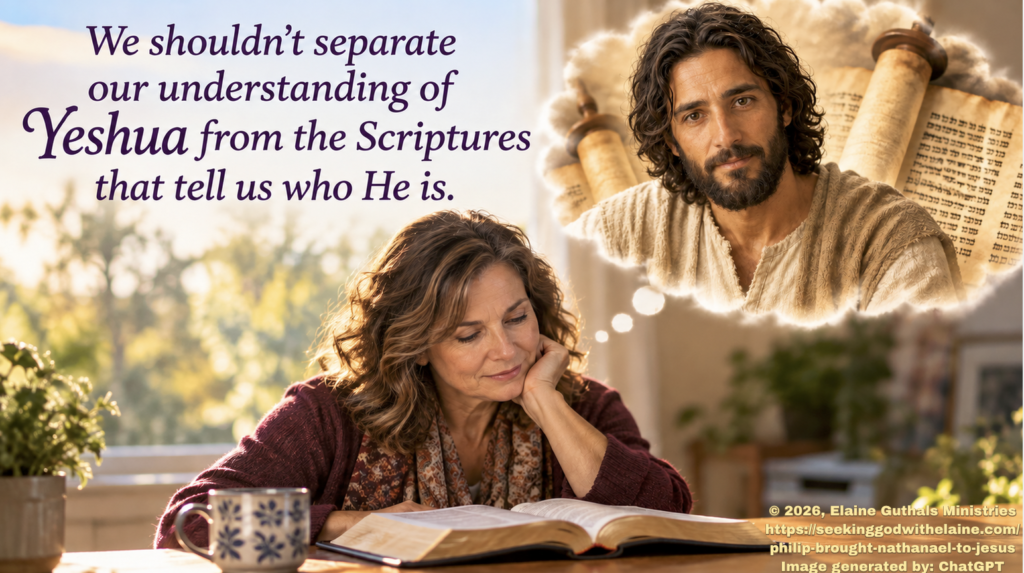
  • Grace upon Grace

    One task Yeshua had was to show us the Father. This devotional reading looks at the grace Yeshua brought from the Father.

    Nuggets

    • The source of what we receive is not our fullness.
    • Yeshua was the Word Jehovah sent to us.
    • Yeshua was instrumental in the creation of the universe.
    • Jehovah introduced Yeshua as light on Day 1 of creation.
    • More than Yeshua being the true light or the false light, it is about Him being genuine – the real deal.
    • Yeshua was totally human and totally divine.
    • The primary Hebrew word associated with grace is chen (חֵן), meaning favor, grace, acceptance, graciousness, attractiveness, or goodwill.
    • Our receiving is the consequence of what John has told us about the Word.
    • What we receive is Jehovah’s grace and truth.

    Yeshua had a mission here on earth. His ministry was to be the Savior of the world.

    The foundation of that ministry was Jehovah’s fullness of grace. Because of His unending and overflowing grace, Jehovah sent Yeshua to be the Sacrifice that we needed.

    Let’s Put It into Context

    To read devotions in The Battle for the Heart theme

    Devotions in the The Early Ministry of the Messiah series

    Jehovah’s Fullness

    “For from his fullness …” (Jn. 1: 16 ESV)

    The source of what we receive is not our fullness.

    When we think about Jehovah’s fullness, our first thoughts may tend to fall on the fullness of His time. Everything happens according to His plan. Completion.

    John may have been considering the overall plan here – the Plan of Salvation. But I think he was focused on something more specific.

    The fullness is the fullness of Jehovah’s love and grace.

    The Greek word John used is plērōma (πλήρωμα). Derived from the root plēroō (πληρόω), it means to fill, make full, complete, or bring to fullness.

    Plērōma, however, doesn’t rely on one Hebrew word to convey the thought. And the concept of fullness is a very Hebrew thought.

    Meloʾ (מְלֹא) carries the idea of fullness, that which fills, abundance, or the full measure of something. It is substantial and present.

    What if John was meaning the totality of what fills something? It doesn’t mean we stuffed ourselves at our Thanksgiving dinner and are now full.

    It means everything – the turkey, gravy, stuffing, green bean casserole, pumpkin pie, and anything else that made it to the menu – belongs to Jehovah.

    The concept is that the entirety of what belongs within something belongs to the Creator.

    We read that and think, “Everything that constitutes His fullness is overflowing toward us.” But John has already told us what is flowing: grace and truth.

    The Word Was God

    “In the beginning was the Word, and the Word was with God, and the Word was God” (Jn. 1: 1 ESV).

    Yeshua was the Word Jehovah sent to us.

    When the creation story began in Genesis 1, we aren’t told who God is – now Jehovah is introducing a new creation.

    Genesis 1 doesn’t shed any light on Who Jehovah is. We are told only that He created the heavens and earth.

    Matthew organized his Gospel as a new creation story. The setting is the same, but the purpose has changed.

    Now, the purpose is to introduce Yeshua – the Word. The Gospels and their message – in fact, the whole message of the entire Scripture – is about the Messiah, the Savior of the world.

    With this new purpose comes what seems like new words that must be used to tell the story. They include law, grace, truth, faith, sons, and sin.

    True, some of those words existed in the Old Testament – the Tanak. They were an introduction to the fullness to come.

    The Word Created Everything

    “All things were made through him, and without him was not any thing made that was made” (Jn. 1: 3 ESV).

    Yeshua was instrumental in the creation of the universe.

    In everything that Jehovah created, Yeshua was right here by His side.

    Yeshua not only existed, but Jehovah worked through Him to organize and actively make everything. He didn’t just design the place we live now and the place we will one day inhabit. He designed the pathway that leads us to Jehovah.

    Yeshua is the message and Messenger of the Gospel. He is the entire meaning itself, and the Gospel is how He communicates that meaning to us.

    The Word is the source of life and gives life to everything. This is more than merely physical. It is spiritual.

    The Light of Humanity

    “In him was life, and the life was the light of men” (Jn. 1: 4 ESV).

    Jehovah introduced Yeshua as light on Day 1 of creation.

    The first thing Jehovah introduced after He created the heavens and earth was light. His exact words were, “Then God said, ‘Let there be light,’ and there was light” (Gen. 1: 3 NLT).

    This spiritual light was Yeshua.

    • “Again Jesus spoke to them, saying, ‘I am the light of the world …” (Jn. 8: 12 ESV).
    • “The light shines in the darkness …” (Jn. 1: 5 ESV).
    • “Your word is a lamp to my feet and a light to my path” (Ps. 119: 105 ESV).
    • “As long as I am in the world, I am the light of the world” (Jn. 9: 5 ESV).
    • “The Lord is my light and my salvation …” (Ps. 27: 1 ESV).
    • “The people who walked in darkness have seen a great light ….” (Isa. 9: 2 ESV).
    • “… They will need no light of lamp or sun, for the Lord God will be their light …” (Rev. 22: 5 ESV).

    Jehovah reveals Himself through Yeshua as the Word and the Light – Yeshua is both.

    True Light Came into the World

    “The true light, which gives light to everyone, was coming into the world” (Jn. 1: 9 ESV).

    More than Yeshua being the true light or the false light, it is about Him being
    genuine – the real deal.

    No, we don’t all receive the Light in the same way. We are different people. We have different beliefs and experiences – foundations.

    Plus, not everyone accepts the Light. John had just told us that. “But to all who did receive him, who believed in his name, he gave the right to become children of God, who were born, not of blood nor of the will of the flesh nor of the will of man, but of God” (Jn. 1: 12-13 NLT).

    Still, Yeshua came to give all the opportunity to accept and receive the grace offered by Jehovah. The decision is ours.

    Look closely at the wording. It didn’t say Yeshua was in the world. It says He came into it.

    Yeshua was already the Light – we saw that in Genesis 1: 3. He was coming into the world in a different form – as flesh – a human form.

    Yeshua came bearing spiritual liberation from internal corruption.

    Yeshua didn’t give up His divinity to come to earth. He couldn’t change Who and what He is.

    Instead, Yeshua gave up the privileges of His divinity. “who, though he was in the form of God, did not count equality with God a thing to be grasped, but emptied himself, by taking the form of a servant, being born in the likeness of men.” (Phil. 2: 6-7 NLT).

    He Became Flesh

    “And the Word became flesh and dwelt among us …” (Jn. 1:  14 ESV).

    Yeshua was totally human and totally divine.

    Jesus, in His humanity, shared the human nature of those made in the image of God. He got hungry and ate, got tired and slept.’’

    So, yes, Yeshua was both human and divine.

    • “Christ is the visible image of the invisible God. He existed before anything was created and is supreme over all creation” (Col. 1: 15 NLT).
    • “For in Christ lives all the fullness of God in a human body” (Col. 2: 9 NLT).

    That was why Yeshua could accomplish the Plan of Salvation.

    Full of Grace and Truth

    “… and we have seen his glory, glory as of the only Son from the Father, full of grace and truth” (Jn. 1: 14 ESV).

    The primary Hebrew word associated with grace is chen (חֵן), meaning favor, grace, acceptance, graciousness, attractiveness, or goodwill.

    More importantly, it is finding favor in another’s eyes – namely Jehovah. The Hebrew concept is matza chen b’ene (מָצָא חֵן בְּעֵינֵי).

    John doesn’t separate grace from the person of Christ. “So the Word became human and made his home among us. He was full of unfailing love and faithfulness.” (Jn. 1: 14 NLT).

    We have to be very careful about its meaning, though. Grace doesn’t mean that Jehovah simply overlooks sin. It means that Jehovah acts toward people from His own gracious character rather than because they have established a claim upon Him.

    Grace doesn’t say: “Sin does not matter.” Grace says: “God has acted graciously toward you; therefore, live differently.”

    Truth in the Hebrew Scriptures isn’t merely information that happens to be accurate. The primary Hebrew word translated truth is ’emet (אֱמֶת’). It describes something that is dependable, trustworthy, established, and true to reality.

    The Hebrew understanding, therefore, joins two ideas that modern English can sometimes separate: truthfulness and faithfulness.

    Biblical truth is something upon which a person can stand.

    This means that when Scripture speaks about truth, it is not presenting truth as something detached from character.

    • Truth is dependable because it is firm.
    • Truth is trustworthy because it is faithful.
    • Truth can be believed because it is reliable.

    Truth is reality according to God.

    Receiving Jehovah’s Fullness

    “For from his fullness we have all received …” (Jn. 1: 16 ESV)

    Our receiving is the consequence of what John has told us about the Word.

    We can admire Jehovah’s fullness all we want. If we don’t receive it, it means little to us.

    John had clearly shown us that fullness comes from Him. Our receiving has nothing to do with us: not our goodness, our religious efforts, our understanding, or even our ability to receive.

    Our receiving comes out of Jehovah’s fullness. It is because of His grace and truth that we can receive the Plan of Salvation.

    And we must receive it. We are not entitled to it. We don’t get it without accepting His fullness and agreeing upon the covenant responsibilities.

    Southern Baptists like to say salvation is free — and it is because we can’t earn it or buy it. But we do have things we have to do.

    Grace is freely given — but receiving the covenant relationship means entering into the relationship Jehovah established — and that relationship carries responsibilities. We have to

    • walk with Jehovah.
    • take up our cross daily and follow Him.
    • seek Him.
    • change our lifestyles where appropriate.
    • surrender our will to His.

    We have to receive all of Jehovah’s fullness – not a partial piece of His fullness. We can’t merely be somewhat committed to Jehovah. We have to surrender our complete lives to
    Him.

    Grace upon Grace

    “For from his fullness we have all received, grace upon grace” (Jn. 1: 16 ESV)

    What we receive is Jehovah’s grace and truth.

    We don’t merely encounter the fullness of Christ, we receive it when we allow Him to win the battle for our hearts.

    The Greek is charin anti charitos (χάριν ἀντὶ χάριτος). Literally, the words can carry the idea of grace in place of grace, or grace corresponding to grace, which is why English translations handle the phrase differently.

    Receiving Jehovah’s grace isn’t a one-time shot. It doesn’t only occur at conversion.

    We receive grace daily – again and again and again and again. Grace replaces grace. It enhances grace. Grace follows grace.

    That means there is an abundance of grace.

    Making the Connections #1

    We don’t receive grace at conversion and then move on to something more advanced. Neither do we graduate from grace. We continue to receive it.

    • Grace for the sinner who first comes to Him.
    • Grace for the disciple who fails.
    • Grace for the believer who doesn’t understand.
    • Grace for the person who has exhausted his own strength.
    • Grace for the person who thinks s/he ought to have it all figured out by now.

    Making the Connections #2

    John put grace and truth together. Grace doesn’t mean that God stops dealing with us truthfully.

    Some may think that grace allows us to continue in our sin. It doesn’t work that way.

    We must heed John the Immerser’s message. We must repent of our sins and turn back to Jehovah.

    Making the Connections #3

    There can be times when we feel like we should have used up our supply of Jehovah’s grace.

    Not going to happen. Why?

    It is Jehovah’s supply – not ours.

    We are relying on Jehovah’s fullness, not our own. His fullness never diminishes. It remains constant.

    Making the Connections #4

    Free grace doesn’t mean costless discipleship. Yehovah Himself told us there was a cost to following Him (Lk. 14: 25-33).

    Don’t things mean more when we have to pay for them? When we have to willingly give up one thing to get something better?

    I like what Bonhoeffer had to say. He wrote, “Cheap grace means the justification of sin without the justification of the sinner. Grace alone does every thing, they say, and so
    everything can remain as it was before.”

    Resource

    We don’t want to cheapen Jehovah’s grace by not recognizing what it truly is. We definitely don’t want to recognize what it truly is – and reject it in part or in whole.

    Justification of sin doesn’t get us salvation. Yeshua came in flesh to gain the justification of the sinner.

    Heart Check

    Think about the battle Yeshua is engaged in for your heart. Ask yourself the following questions.

    • Am I living as though Jehovah’s grace is sufficient for me, or am I trying to earn His favor through my own efforts?
    • Have I received His grace while still holding on to sins or habits He is calling me to surrender?
    • Am I allowing Jehovah’s truth to change the way I live, or am I using grace as an excuse to remain comfortable?
    • What is Jehovah asking me to surrender so that I can follow Him more completely?
    • When I fail, do I run from Jehovah because of my failure, or do I return to the One whose fullness never diminishes?

    How Do We Apply This?

    • Receive Jehovah’s grace.
    • Walk in His truth.
    • Surrender our sin.
    • Seek Jehovah daily.
    • Follow Yeshua wherever He leads.
    • Take up our cross.
    • Trust His fullness.
    • Return to Him when we stumble.
       
      Prayer

    If you don’t understand something and would like further clarification, please contact me.

    If you have not signed up for the email providing the link to the devotions and the newsletter, do so below.

    If God has used this devotion to speak with you, consider sharing it on social media.
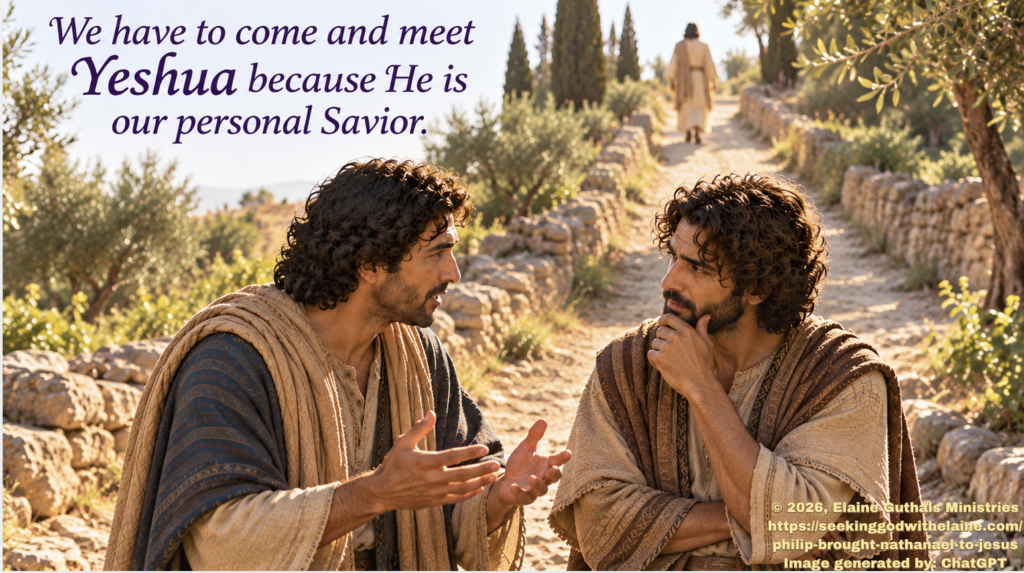
  • The Death of John the Baptist

    It was time for John the Baptist’s ministry to draw to a close.. This devotional reading looks at his imprisonment and death.

    Nuggets

    • Herod Antipas was one of the sons of Herod the Great who received part of his divided kingdom.
    • Some in John’s audience thought he was the prophet Elijah.
    • The only other named prophet John was compared to was Jeremiah, though John was also compared to unnamed prophets.
    • Herod thought Yeshua was John because He could perform miracles.
    • Herod must have had a guilty conscience if he thought Yeshua was John.
    • Herodias was the daughter of Herod the Great’s son Aristobulus and Berenice.
    • John had a specific reason for calling out Herod Antipas and Herodias – their marriage was against Jehovah’s laws.
    • Herod had conflicting feelings about John.
    • Herodias took matters into her own hands.
    • The vow was important because of the audience.
    • Once the reward was established, Herod had to follow through.

    John the Baptist had a very important role to play in Jehovah’s Plan of Salvation. However, it was time for Yeshua to take center stage.

    That meant John’s ministry was over.

    Let’s Put It into Context

    To read devotions in The Battle for the Heart theme

    Devotions in the The Ministry of John the Baptist series

    Herod’s Uncertainty as to the Identity of Yeshua

    “When Herod Antipas, the ruler of Galilee, heard about Jesus, he said to his advisers, ‘This must be John the Baptist raised from the dead! That is why he can do such miracles.’” (Mt. 14: 1-2 NLT)

    “Herod Antipas, the king, soon heard about Jesus, because everyone was talking about him. Some were saying, ‘This must be John the Baptist raised from the dead. That is why he can do such miracles.’ Others said, ‘He’s the prophet Elijah.’ Still others said, ‘He’s a prophet like the other great prophets of the past.’ When Herod heard about Jesus, he said, ‘John, the man I beheaded, has come back from the dead’” (Mk. 6: 14-16 NLT)

    “When Herod Antipas, the ruler of Galilee, heard about everything Jesus was doing, he was puzzled. Some were saying that John the Baptist had been raised from the dead. Others thought Jesus was Elijah or one of the other prophets risen from the dead. ‘I beheaded John,’ Herod said, ‘so who is this man about whom I hear such stories?’ And he kept trying to see him” (Lk. 9: 7-9 NLT)

    Herod Antipas

    Herod Antipas was one of the sons of Herod the Great who received part of his divided kingdom.

    Herod Antipas became tetrarch of Galilee and Perea, including the area where John conducted his ministry. His reign lasted from 4 BC to AD 39.

    The capital of Herod’s territory was Tiberias. There was also a fortress and royal palace in Machaerus.

    Thomas noted that Herod was a Sadducee. He listed him as an “… avowed patron and protector of the sect …”

    Resource

    Herod didn’t know what to think about Yeshua. Everyone was talking about Him, so it didn’t take long for Herod to hear about Him, too.
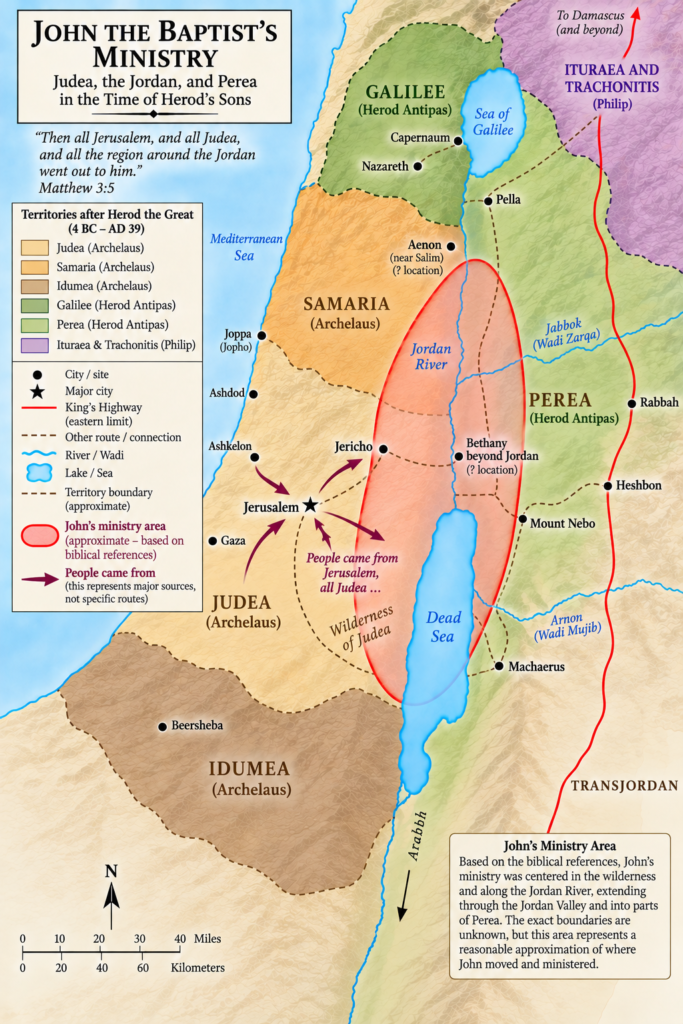
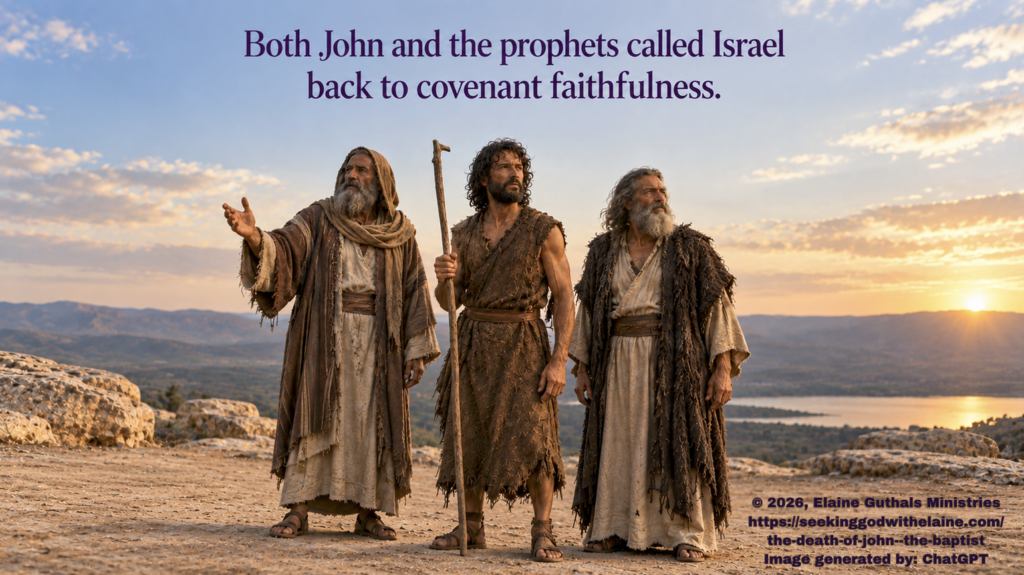
    But Herod had no clue as to Who Yeshua was. He had to go on who others said that He was.

    Elijah

    Some in John’s audience thought he was the prophet Elijah.

    “Look, I am sending you the prophet Elijah before the great and dreadful day of the Lord arrives. His preaching will turn the hearts of fathers to their children, and the hearts of children to their fathers. Otherwise I will come and strike the land with a curse” (Mal. 4: 5-6 NLT).

    John’s and Elijah’s messages were pretty much the same: repent and turn back to Jehovah. The two men wore similar attire (II Kgs. 1: 8; Mt. 3: 4). They carried out their mission in the wilderness (Mt. 3: 1).

    What John had done was to come in the spirit of Elijah. “He will be a man with the spirit and power of Elijah. He will prepare the people for the coming of the Lord. He will turn the hearts of the fathers to their children, and he will cause those who are rebellious to accept the wisdom of the godly” (Lk. 1: 17 NLT emphasis added).

    I know. That isn’t exactly what Jesus said.

    • “And from the time John the Baptist began preaching until now, the Kingdom of Heaven has been forcefully advancing, and violent people are attacking it. For before John came, all the prophets and the law of Moses looked forward to this present time. And if you are willing to accept what I say, he is Elijah, the one the prophets said would come” (Mt. 11: 12-14 NLT).
    • “‘But I tell you, Elijah has already come, but he wasn’t recognized, and they chose to abuse him. And in the same way they will also make the Son of Man suffer.’ Then the disciples realized he was talking about John the Baptist” (Mt. 17: 12-13 NLT).

    No, Yeshua did not lie. John was a type of Elijah; however, the audience probably wouldn’t have accepted a no, but because that wasn’t the answer they wanted.

    A Prophet

    The only other named prophet John was compared to was Jeremiah, though John was also compared to unnamed prophets.

    “‘Well,” they replied, “some say John the Baptist, some say Elijah, and others say Jeremiah or one of the other prophets” (Mt. 16: 14 NLT).

    Both John and Jeremiah called for Israel to return to covenant faithfulness. Their messages were of repentance and moral change.

    Both were deeply concerned with the spiritual condition of Israel. They knew that Israel could not only rely on Abraham being their ancestor. Instead, they confronted religious hypocrisy.

    Both endured persecution. That was understandable since both confronted kings and political leaders about their behaviors.

    Both were looking forward to the new covenant that Yeshua ushered in. “‘But this is the new covenant I will make with the people of Israel after those days,’ says the Lord. ‘will put my instructions deep within them, and I will write them on their hearts. I will be their God, and they will be my people’” (Jer. 31: 33 NLT).

    John, though, was also compared to some unnamed prophets. “… other great prophets of the past’” (Mk. 6: 15 NLT).

    It is understandable that John was compared to the prophets. Both John and the prophets called Israel back to covenant faithfulness.

    Why He Can Do Such Miracles

    Herod thought Yeshua was John because He could perform miracles.

    This always puzzles me. I can’t see why Herod would think Yeshua was John because of miracles.

    We aren’t told that John performed miracles. So, why would the ability to perform miracles identify Yeshua as John?

    Maybe none of the Gospels report the miracles John performed. They couldn’t report everything he did. Besides, John wasn’t the main character of the Gospels.

    I Beheaded John

    Herod must have had a guilty conscience if he thought Yeshua was John.

    Herod thought Yeshua was John raised from the dead. John had been beheaded at Herod’s direction.

    What! What???? John was dead???????

    This is one of those oh-by-the-way moments in the Gospels. We’re told after the fact.

    John’s Imprisonment

    “For Herod had arrested and imprisoned John as a favor to his wife Herodias (the former wife of Herod’s brother Philip). John had been telling Herod, ‘It is against God’s law for you to marry her.’ Herod wanted to kill John, but he was afraid of a riot, because all the people believed John was a prophet” (Mt. 14: 3-5 NLT)

    “For Herod had sent soldiers to arrest and imprison John as a favor to Herodias. She had been his brother Philip’s wife, but Herod had married her. John had been telling Herod, ‘It is against God’s law for you to marry your brother’s wife.’ So Herodias bore a grudge against John and wanted to kill him. But without Herod’s approval she was powerless, for Herod respected John; and knowing that he was a good and holy man, he protected him. Herod was greatly disturbed whenever he talked with John, but even so, he liked to listen to him” (Mk. 6: 17-20 NLT)

    John also publicly criticized Herod Antipas, the ruler of Galilee, for marrying Herodias, his brother’s wife, and for many other wrongs he had done. So Herod put John in prison, adding this sin to his many others” (Lk. 3: 19-20 NLT)

    Herodias (the former wife of Herod’s brother Philip)

    Herodias was the daughter of Herod the Great’s son Aristobulus and Berenice.

    Herodias’ first husband is commonly identified as Herod II. He was also known as Herod Philip (not Philip the Tetrarch). It is through this union that Salome was born.

    We aren’t told why Herodias left her marriage with Herod Philip. We just know that she did.

    Herod Antipas also had a prior marriage. He had been married to the daughter of Aretas IV, the king of Nabataea. (Nabataea was a kingdom centered at Petra.) That marriage ended in divorce.

    So, in other words, Herod married his niece.

    It Is Against God’s Law

    John had a specific reason for calling out Herod Antipas and Herodias – their marriage was against Jehovah’s laws.

    When given the laws, specifics were given concerning family members. Punishment for breaking these laws was also given.

    • “Do not have sexual relations with your brother’s wife, for this would violate your brother” (Lev. 18: 16 NLT).
    • “You must keep all my decrees and regulations by putting them into practice; otherwise the land to which I am bringing you as your new home will vomit you out” (Lev. 20: 22 NLT).

    Of course, John called Herod on this. He was to call Israel back to repentance and covenant faithfulness.

    Herod was Jewish although he was not an Israelite. He was from Idumea.

    John was calling all Jews to covenant faithfulness. If Herod truly considered himself a Jew, John knew that Herod should walk with Jehovah and obey His laws.

    Herod Wanted to Kill John but Was Afraid

    Herod had conflicting feelings about John.

    So, was Herod afraid of John or fascinated by him? In one verse – Mark 6: 20 – we get the whole gamut of feelings.

    • knew he was a good and holy man
    • protected him
    • greatly disturbed
    • liked to listen to him

    Herod knew John possessed a moral authority. He wasn’t just being a troublemaker.

    John was a common Jew. Yes, both of his parents had come from a priestly line. Herod knew he was a holy man.

    But compared to the king, John was a common man. He was the common man who made Herod afraid.

    This really came out when Herod was listening to John. He didn’t want to hear what John had to say, but he knew John was a righteous man with authority.

    But Herod didn’t want to hear what John was saying. He was comfortable in his marriage with Herodias.

    Herod was protecting John from Herodias. While he had arrested John as a favor to her, it doesn’t sound like he did any other than put him in jail in Machaerus – at least at first.

    Machaerus was a heavily fortified Herodian royal complex in Perea, containing both a fortress and a magnificent palace. It was one of Herod Antipas’ important residences as it strategically sat on the frontier.

    The Greek word is aporeō (ἀπορέω), carrying the sense of being perplexed, troubled, or at a loss about what to do.

    Isn’t that a human response? We are called to Jehovah and His Word – but we just aren’t comfortable with it. We feel His call, but we resist it.

    What was Herod going to do with a man he knew was right but didn’t want him to be right?

    Herod’s Birthday Party

    “But at a birthday party for Herod, Herodias’s daughter performed a dance that greatly pleased him, so he promised with a vow to give her anything she wanted. At her mother’s urging, the girl said, ‘I want the head of John the Baptist on a tray!’ Then the king regretted what he had said; but because of the vow he had made in front of his guests, he issued the necessary orders. So John was beheaded in the prison, and his head was brought on a tray and given to the girl, who took it to her mother. Later, John’s disciples came for his body and buried it. Then they went and told Jesus what had happened” (Mt. 14: 6-12 NLT)

    “Herodias’s chance finally came on Herod’s birthday. He gave a party for his high government officials, army officers, and the leading citizens of Galilee. Then his daughter, also named Herodias, came in and performed a dance that greatly pleased Herod and his guests. ‘Ask me for anything you like,’ the king said to the girl, ‘and I will give it to you.’ He even vowed, ‘I will give you whatever you ask, up to half my kingdom!’ She went out and asked her mother, ‘What should I ask for?’ Her mother told her, ‘Ask for the head of John the Baptist!’ So the girl hurried back to the king and told him, “I want the head of John the Baptist, right now, on a tray!” Then the king deeply regretted what he had said; but because of the vows he had made in front of his guests, he couldn’t refuse her. So he immediately sent an executioner to the prison to cut off John’s head and bring it to him. The soldier beheaded John in the prison, brought his head on a tray, and gave it to the girl, who took it to her mother. When John’s disciples heard what had happened, they came to get his body and buried it in a tomb” (Mk. 6: 21-29 NLT)

    Salome Danced

    Herodias took matters into her own hands.

    Herodias must have gotten tired of Herod protecting John. I’m sure she felt it an affront to her that John was saying Herod and Herodias’ marriage was wrong.

    The perfect opportunity presented itself at Herod’s birthday party. But she had to enlist help.

    That help came from Salome, Herodias’ daughter. This same Salome was the wife of Philip the Tetrarch – but probably not at this precise moment.

    The Greek word is korasion (κοράσιον), which means young girl or young woman. What we do know is that she was old enough to participate in the banquet.

    Salome danced for Herod. We are told nothing of this dance, but many jump to the conclusion that it was erotic, provocative, or seductive.

    Maybe. Maybe not. By this time, sexually provocative dances by professional dancers – the role which Salome took for this party – were frowned on in some Jewish circles.

    I can see two holes in that. Some circles do not mean all circles. Herod was Jewish, but it doesn’t sound like he was a practicing Jew.

    But the thought that Salome danced a provocative dance in order to get Herod to reward her kind of falls apart.

    If Herodias enlisted Salome to dance to secure a reward, wouldn’t she have told her what to ask for when she asked her to dance? But she didn’t. Salome had to go back to Herodias and ask what the reward should be.

    That says nothing as to why a wife would have her daughter dance a sexual dance for her husband.

    Promised with a Vow

    The vow was important because of the audience.

    Herod obviously liked the dance. He said that Salome could ask for a reward that was up to half of his kingdom.

    Just stop right there. No, nowhere do the Gospels say it was a seductive dance. What else could it be to get this type of reward?

    What would make Herod willingly give up half his kingdom? It wasn’t because Herod was thinking of retiring and divesting himself of land. Besides, would he really give the rule to a young woman?

    But that is what Herod stipulated. The reward could be up to half his kingdom.

    Whatever triggered Herod’s response was something significant. He wouldn’t have made this offer to just any professional dancer. There had to be something in his stepdaughter’s dance that struck a chord.

    Was Herod so sure that Salome wouldn’t take his kingdom? Was he thinking jewels or money?

    Herod obviously didn’t expect the answer he got from Salome. But he couldn’t back out of it. He couldn’t lose face in front of all the dignitaries that were in attendance.

    This wasn’t just a family birthday party. The birthday of the king would have been a political and social affair. His advisors would be there. The ruling elite were present. Wealthy citizens from the area would have been there.

    Herod couldn’t say, “I know what I promised you, but this request isn’t acceptable.” He had laid no parameters around the reward – except it couldn’t be more than half his kingdom.

    His Head Was Brought on a Tray

    Once the reward was established, Herod had to follow through.

    We aren’t sure how long John was imprisoned in Herod’s fortified palace. However long it was, it wouldn’t have been comfortable for him.

    Herod followed through on his vow. He rewarded Salome for her dance by killing John the Baptist.

    We think it was gory bringing John’s head to Salome on a silver platter.  There was no mistaking that John was dead.

    Herodias was given visible proof.

    Making the Connections #1

    We could say that Herod made a foolish promise. He opened the door wide open for any reward.

    Herod had to have known Herodias’ feelings against John. He had to know the pull she had over Salome.

    Look at the progression.

    • Herod was afraid of John because he spoke God’s truth.
    • Herod protected John because of John’s righteousness.
    • Herod was affected by John’s words, so he listened to him.
    • Herod put more store in his social standing and being seen as a decisive ruler than he feared disobeying Jehovah.

    John lost his head because Herod knew John was right but lacked the courage to stand on what he knew. He died because he wouldn’t stop telling the truth.

    Making the Connections #2

    We talked about Herod having a conscience. We can’t mistake the Holy Spirit for our conscience. Everyone has one.

    Not everyone has the Holy Spirit living inside them.

    Atterbury helped us understand the difference. He wrote “That the reprehensions of conscience are not a continued, but intermitting, disease.”

    Resource

    In other words, sometimes we may be affected by our consciences. Sometimes, we may not be.

    If we are not being led by the Holy Spirit, our human consciences may sometimes be influenced by our outward actions.

    Heart Check

    Think about the battle Yeshua is engaged in for your heart. Ask yourself the following questions.

    • Do I accept something Jehovah has already shown me through His Word that I know is true, or am I resisting it? 
    • Am I listening to and applying Jehovah’s Word, or an I refusing to let it change me? 
    • Do I care more about what other people think of me, or do I care more about obeying Jehovah? 
    • Am I protecting my reputation, my relationships, my comfort, or my position, or am I standing on what I know Jehovah has said? 
    • If I know what is right, what is keeping me from doing what is right?

    How Do We Apply This?

    • Listen even more carefully when Jehovah’s Word makes us uncomfortable.
    • Don’t confuse knowing with obeying.
    • Don’t let other people determine our obedience.
    • Stand on truth before the pressure comes.
    • Remember that truth doesn’t become less true because it makes us uncomfortable.

     
    Father God. Thank You that You allow us to work for Your kingdom. Help us to see when You are calling us to move on. May we be faithful and obedient to You until You call us home. Amen.

    If you don’t understand something and would like further clarification, please contact me.

    If you have not signed up for the email providing the link to the devotions and the newsletter, do so below.

    If God has used this devotion to speak with you, consider sharing it on social media.