Once Yeshua was baptized, it was time to start His ministry. This devotional reading looks at the first things He did.
Nuggets
- Once Yeshua started His ministry, there was no need for someone to prepare the way.
- Yeshua left Galilee and traveled south to the Jordan, where John was baptizing.
- Nazareth was the village in which Yeshua grew up.
- Set on the northwestern shore of the Sea of Galilee, Capernaum was more than just a dot on the map and different from Nazareth.
- Yeshuah’s move to Capernaum had prophetic significance.
- Zebulun was the sixth and last son of Jacob and Leah (Gen. 30: 19-20) and was Jacob’s tenth son.
- Naphtali was Jacob’s sixth son, born by Rachel’s servant girl Bilhah (Gen.30: 7-8).
- In the Gospel of John, John portrayed Yeshua as the eternal Word, the source of life, and the true Light.
- The difference in their messages was that John was talking about Yeshua, and Yeshua was talking about Himself.
- In the Old Testament, the primary Hebrew concept is expressed through shuv (שׁוּב), meaning to turn, return or go back, and nacham (נָחַם), which can express regret, relenting, or a change of mind/intent.
- More than just turning away from sin, we have to turn back to Jehovah.
- The foundation of the Plan of Salvation is that we believe Yeshua is the Son of God and was sent to save us from our sins.
- The Kingdom of Heaven really wasn’t a place – it was a reign.
Yeshua chose to be obedient to Jehovah. He submitted Himself for baptism by John the Immerser.
After a period of temptation, Yeshua was ready to begin His ministry.
We aren’t told a lot about what that looked like. Let’s see if we can piece things together.
To read devotions in The Battle for the Heart theme
Devotions in the The Early Ministry of the Messiah series
Traveling in Israel
“When Jesus heard that John had been arrested, he left Judea and returned to Galilee” (Mt. 4: 12 NLT)
“Later on, after John was arrested, Jesus went into Galilee, where he preached God’s Good News” (Mk. 4: 14 NLT)
After John Was Arrested
Once Yeshua started His ministry, there was no need for someone to prepare the way.
I have always thought it sad how short of a time John the Immerser was able to conduct his ministry. No, we aren’t told the amount of time, but it probably would have been fairly short.
Think about it. Yeshua began His ministry when He was around 30 years old. “Jesus was about thirty years old when he began his public ministry …” (Lk. 3: 23 NLT).
John was six months older than Yeshua. It is logical that he started when he was around 30.
Priests actively served from age 30 until age 50, after which their physical duties were reduced. “Then the LORD said to Moses and Aaron, ‘Record the names of the members of the clans and families of the Kohathite division of the tribe of Levi. List all the men between the ages of thirty and fifty who are eligible to serve in the Tabernacle’” (Num. 4: 1-3 NLT).
No, John wasn’t a priest, but Jehovah works in patterns. Many things in Yeshua’s ministry were patterned after the Temple and priests.
With John and Yeshua being so close in age and Him being 30, that would mean that John probably wasn’t that much older.
Regardless of age, it is logical that John’s role would have to diminish after Yeshua began His ministry. There was no more reason to prepare when He started.
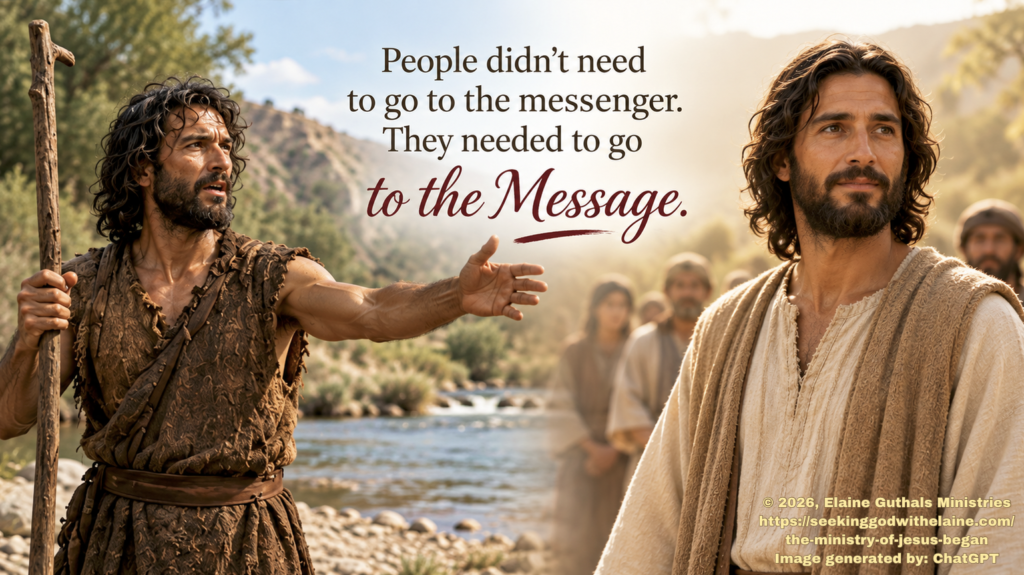
I guess it is logical, too, that John had to die. People didn’t need to go to the messenger. They needed to go to the Message.
Left Judea and Returned to Galilee
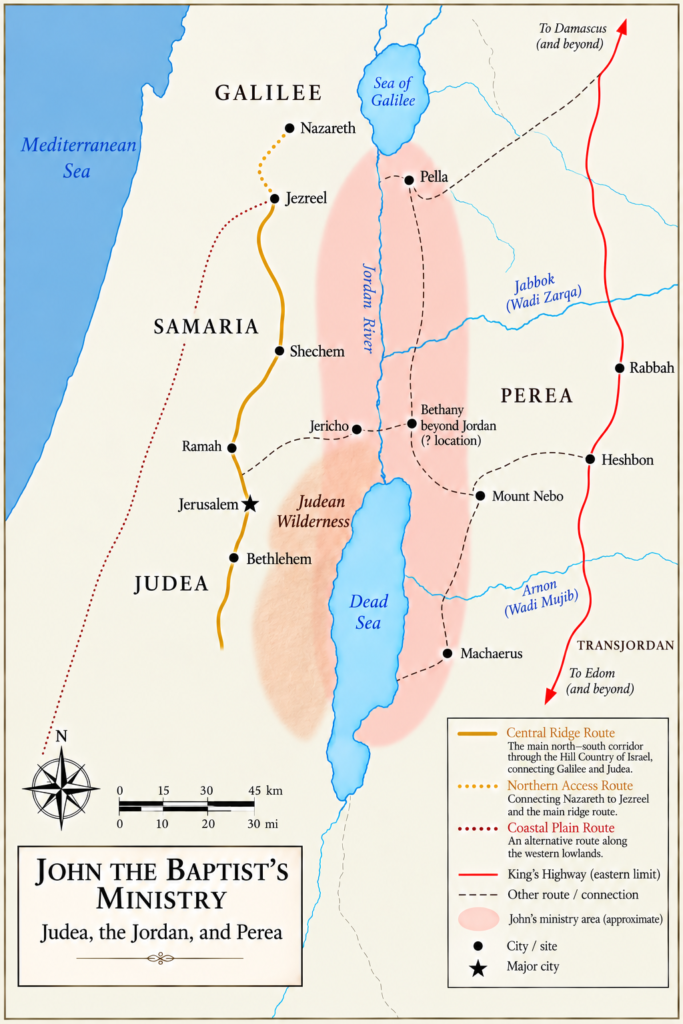
Yeshua left Galilee and traveled south to the Jordan, where John was baptizing.
It is fairly safe to say that John was in Judea when Yeshua came for baptism. “One day Jesus came from Nazareth in Galilee, and John baptized him in the Jordan River” (Mk. 1: 9 NLT).
John’s ministry was associated with the Jordan Valley, particularly the wilderness region. In his Gospel, the Apostle John identified Yeshua’s baptism as occurring near Bethany beyond Jordan (Jn. 1: 28-29). Unfortunately, the exact location of where that village was is debated.
Villages Associated with Yeshua’s Ministry
“He went first to Nazareth, then left there and moved to Capernaum, beside the Sea of Galilee, in the region of Zebulun and Naphtali” (Mt. 4: 13 NLT
First to Nazareth
Nazareth was the village in which Yeshua grew up. Nazareth was an insignificant village. Its only claim to fame was that it was where the Messiah lived during childhood and early adulthood.
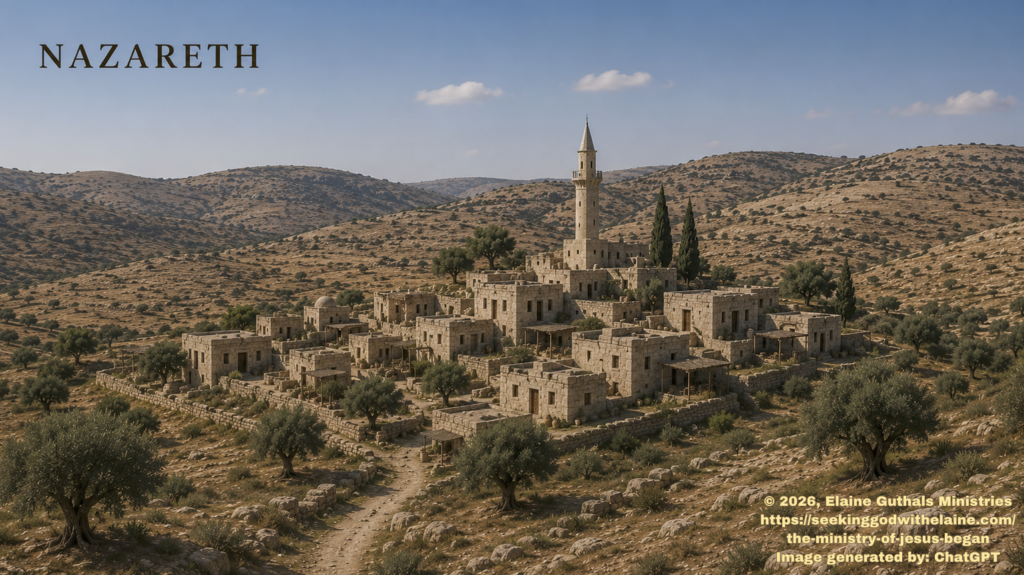
A small Galilean village in the hills of Lower Galilee, the village probably had only 200 to 400 inhabitants. It was tucked into the hills, so there was no trade route associated with it.
Archaeology indicates a modest village that was Torah-observant but poor. Archeologists have found simple stone homes, many which are at least partly cave based.
The village was tucked in the hills of Galilee, a rural and quiet area often overlooked. It wasn’t mentioned in the Old Testament at all.
We get a hint of Nazareth’s reputation in John 1: 46. “‘Nazareth!’ exclaimed Nathanael. ‘Can anything good come from Nazareth?’ ‘Come and see for yourself,’ Philip replied” (Jn. 1: 46 NLT).
The eventual return of the family to Nazareth after their sojourn in Egypt fulfilled prophecy. Joseph had another dream, telling him to go to Galilee.
We hear little about Yeshua and His childhood. All we are told is that He grew both in wisdom and in God’s favor.
Moved to Capernaum
Set on the northwestern shore of the Sea of Galilee, Capernaum was more than just a dot on the map and different from Nazareth.
Where Nazareth had been a small, rural village, Capernaum (Kfar Nahum – כְּפַר נַחוּם) was no isolated farming hamlet. Instead – while still a village – archeology had proven that it was a busy fishing and commercial community. Its location was strategically important for Yeshua’s ministry.
In our minds, we may see the call of Peter, Andrew, James, and John taking place on an isolated spot on the shore of the Sea of Galilee. That probably wasn’t the case.
Capernaum boasted substantial harbor installations, including a seawall and piers. The fishing industry was essential to the economy of the town.
We should see a group of young men spending a leisurely afternoon fishing. They were working men engaged in an established commercial occupation.
That several of His disciples came from the same town would have been helpful to Yeshua. More importantly, Yeshua Himself moved to Capernaum and made it His base of operations.
Being a commercial hub meant that the town was located on important routes that connected Galilee with the surrounding territories. Part of this was due to the fact the village sat near a territorial boundary. That, however, meant the lake, because of its size, sat within several different jurisdictions. This meant that fisherman could be taxed when moving their catch across those boundaries.
Probably of greatest importance was the fact that Capernaum had a substantial synagogue during first-century Israel. It was a place where Jewish communities gathered, heard Scripture read, and discussed its interpretation.
That meant that all of Capernaum believed Yeshua was the Messiah come to save them from their sinful nature? Not really. In fact, Capernaum earned Yeshua’s condemnation before His death.
“And you people of Capernaum, will you be honored in heaven? No, you will go down to the place of the dead. For if the miracles I did for you had been done in wicked Sodom, it would still be here today” (Mt. 11: 23 NLT).
This solidifies the difference between head knowledge and heart knowledge. We must not only know Jesus as a first-century Jewish figure, a healer and miracle worker. But we must also know His mission and its purpose.
That knowledge has to transform our hearts into being disciples of Yeshua. Being disciples – students – means that we are students of His Word, His life, and His promises.
Prophecy Fulfilled
Yeshuah’s move to Capernaum had prophetic significance.
Matthew quoted most of Isaiah 9: 1-2 as one of the reasons for the relocation from Nazareth to Capernaum.
“Nevertheless, that time of darkness and despair will not go on forever. The land of Zebulun and Naphtali will be humbled, but there will be a time in the future when Galilee of the Gentiles, which lies along the road that runs between the Jordan and the sea, will be filled with glory. The people who walk in darkness will see a great light.
For those who live in a land of deep darkness, a light will shine” (Isa. 9: 1-2 NLT).
First, Zebulun and Naphtali were sons of Jacob.
Zebulun
“Zebulun will settle by the seashore and will be a harbor for ships; his borders will extend to Sidon” (Gen. 49: 13 NLT)
Zebulun was the sixth and last son of Jacob and Leah (Gen. 30: 19-20) and was Jacob’s tenth son.
Courageous in battle, Zebulun showed up when it mattered. The tribe were willing to risk itself for Jehovah’s purposes.
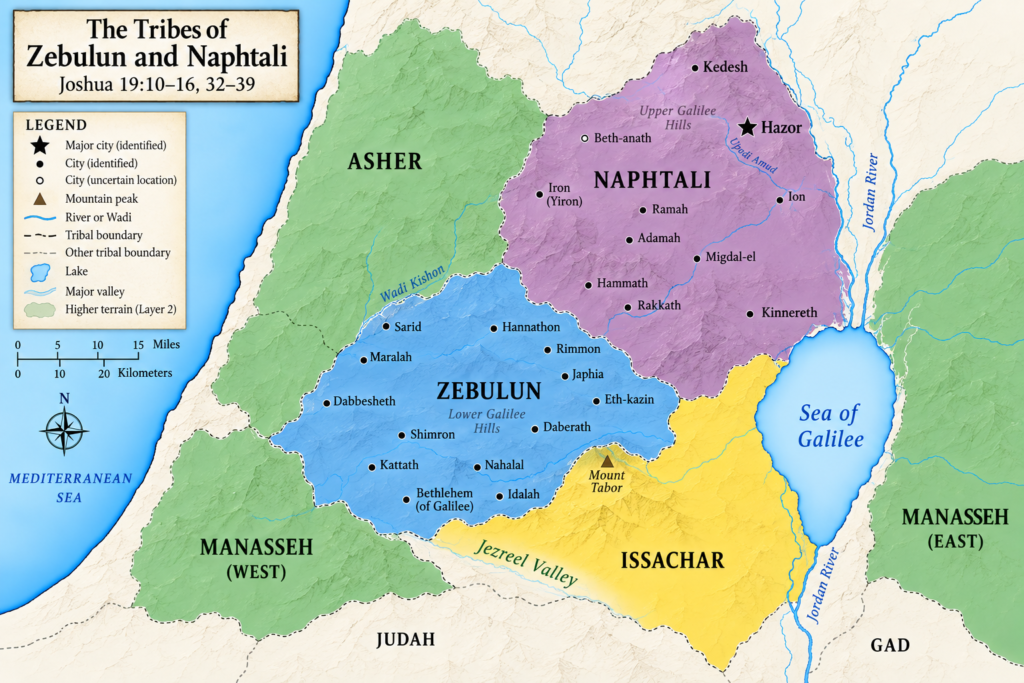
Zebulun’s future did occur as Jacob prophesied — sort of. The land allotted for the tribe in Joshua 19: 10-16 wasn’t on the coast. It was in lower Galilee.
The territory was in a strategic position. Not only did they have the benefits of the Sea of Galilee in the region, but they also had Mediterranean trade routes. Their border was near the city of Zidon, leading to commercial relations with the Phoenicians.
Known for its courage in battle, the tribe supported David when he became king. They also fought with Deborah and Barak (Jdgs. 5: 15).
Naphtali
“Naphtali is a doe set free that bears beautiful fawns” (Gen. 49: 21 NLT)
Naphtali was Jacob’s sixth son, born by Rachel’s servant girl Bilhah (Gen.30: 7-8).
The blessing Jacob gave him was talking about freedom and descendants who are right with Jehovah.
Whitfield addressed this blessing this way. He wrote, “In Naphtali we have the Christian enjoying the liberty and freedom and happiness in Christ, and testifying of Christ to others.”
Resource
The liberty of our souls from sin is a joyous thing. Because Yeshua has paid the debt, we are no longer slaves to sin. Our chains have been broken, and we are free.
The linkage between Zebulun and Naphtali occurred frequently. They fought alongside Deborah and Barak (Jdgs. 5: 15). Both were in Galilee.
Because of this, the two tribes were listed when the Messiah was prophesied. “But there will be no gloom for her who was in anguish. In the former time he brought into contempt the land of Zebulun and the land of Naphtali, but in the latter time he has made glorious the way of the sea, the land beyond the Jordan, Galilee of the nations” (Isa. 9: 1 ESV).
The first-century Jews wouldn’t have necessarily gone back to the men themselves, especially when they said that they were humbled. The Hebrew used there is hêqal (הֵקַל) from the root q-l-l (קלל). This carries the ideas of to make light, make insignificant, treat as of little account, or bring into contempt.
The two tribes had been brought low during the Assyrian conquest of the northern territories. Naphtali especially felt the brunt of this attack.
Tiglath-pileser III attacked during the reign of Pelah, king of Israel, the Northern Kingdom (II Kgs. 15: 29-30). Galilee and the entire territory of Naphtali were captured as well as a number of important cities. The captured Israelites were deported to Assyria.
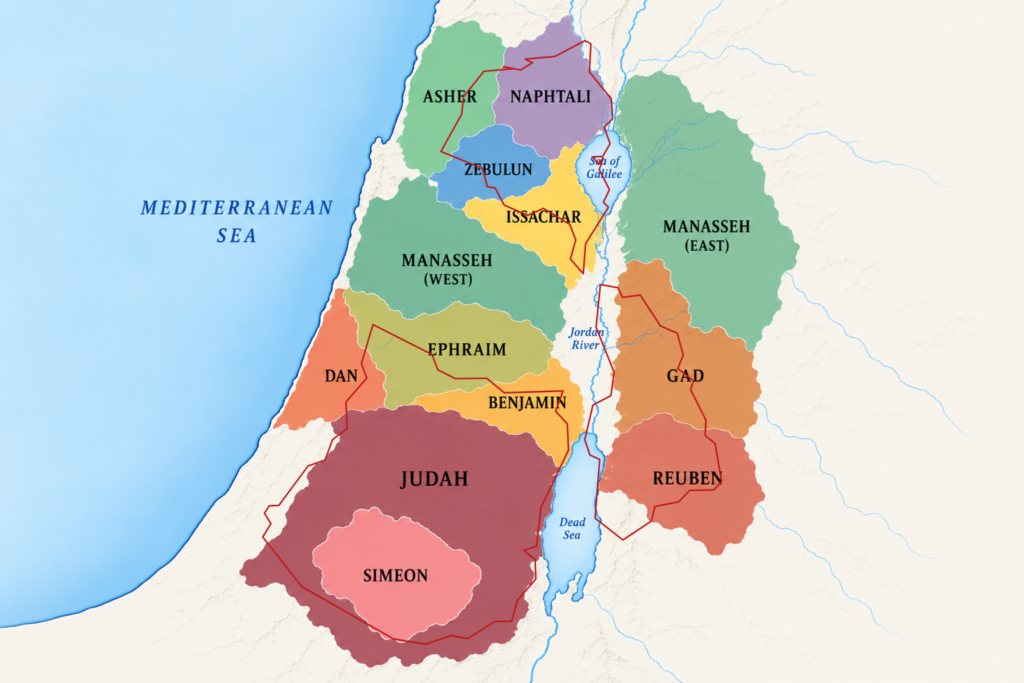
This humiliation had lasting consequences throughout the region. Isaiah later called the area Galilee of the nations. We’re talking the northern Galilean region here. Yes, the area where Yeshua began his ministry in Galilee, in the territory formerly held by Zebulun and Naphtali.
The people in this area were close to the great international movement of people, armies, trade, and imperial power. This led them to feel the consequences of being on the front edge of Israel’s northern vulnerability.
By the time the first century came around, the Jews probably weren’t going around saying, “I’m from the tribe of Zebulun.” Don’t get me wrong. They would have still known.
However, the tribal territories weren’t functioning in the same way they had in Joshua’s day when the allotment was given. But the tribal names were still part of Israel’s scriptural and historical memory.
The prophecy said that this humiliation wouldn’t last forever. It contrasted hēqal with hikbîd – הִכְבִּיד (taken from the root k-b-d – כבד). That means to make heavy, which can carry the sense of giving weight, honor, or glory.
In other words, Galilee was going to go from humiliated to honored. This honor was going to be because of the Light.
Light
In the Gospel of John, John portrayed Yeshua as the eternal Word, the source of life, and the true Light.
From the beginning, the Light is tied to creation and symbolizes life, truth, order, revelation, and Jehovah’s presence.
In contrast, darkness symbolizes sin, death, ignorance, distortion, and separation from the life the Word gives. The Light entered the darkness, which could not overcome it.
John the Baptist was not the Light but its witness, sent under Jehovah’s authority to prepare Israel through repentance and foster faith before the Messiah appeared. His ministry prepared people to receive the One who was coming.
Then the Light entered the world as Yeshua — the eternal Word and giver of life at creation — taking human form within His own creation. The Light is not merely Yeshua’s teaching; it is His identity. He gives spiritual life and salvation, exposes what darkness conceals, and reveals Jehovah.
The struggle between Light and darkness is ultimately a battle for the human heart. Darkness may cloud and distort our perception, but it cannot defeat the Light. Jehovah’s plan will prevail as He leads people from darkness into the Light of redemption and forgiveness
Yeshua’s Message
““From then on Jesus began to preach, ‘Repent of your sins and turn to God, for the Kingdom of Heaven is near’” (Mt. 4: 17 NLT) “‘The time promised by God has come at last!’ he announced. ‘The Kingdom of God is near! Repent of your sins and believe the Good News!’” (Mk. 1: 15 NLT)
The difference in their messages was that John was talking about Yeshua, and Yeshua was talking about Himself.
Yeshua’s message was the same as John the Baptizer’s message. “In those days John the Baptist came to the Judean wilderness and began preaching. His message was, 2 ‘Repent of your sins and turn to God, for the Kingdom of Heaven is near’” (Mt. 3: 1-2 NLT).
Repent of Your Sins
In the Old Testament, the primary Hebrew concept is expressed through shuv (שׁוּב), meaning to turn, return or go back, and nacham (נָחַם), which can express regret, relenting, or a change of mind/intent.
This carried into the New Testament as to change one’s mind or way of thinking.
Remember, Israel had a covenant relationship with Jehovah. The problem Israel’s leaders encountered was they forgot that was a relationship, rather than just ritual ceremony.
While Yeshua did come to restore Israel to covenant fulfillment, He came to individually save us from our sins.
- “Jesus answered him, ‘I tell you the truth, unless you are born again, you cannot see the Kingdom of God’” (Jn. 3: 3 NLT).
- “Jesus answered, ‘I assure you, no one can enter the Kingdom of God without being born of water and the Spirit’” (Jn. 3: 5 NLT).
Turn to God
More than just turning away from sin, we have to turn back to Jehovah.
Choosing not to sin isn’t enough. We have to turn back to Jehovah and walk with Him.
The goal is not to eliminate sin in our lives. It is to restore our relationships with Him.
Through the Plan of Salvation, Yeshua is opening up the opportunity to restore that relationship. We can’t approach Jehovah unless our sins have been washed through the blood of the Lamb.
Believe
The foundation of the Plan of Salvation is that we believe Yeshua is the Son of God and was sent to save us from our sins.
- “For this is how God loved the world: He gave his one and only Son, so that everyone who believes in him will not perish but have eternal life” (Jn. 3: 16 NLT).
- “They replied, ‘Believe in the Lord Jesus and you will be saved, along with everyone in your household’” (Ac. 16: 31 NLT).
- “If you openly declare that Jesus is Lord and believe in your heart that God raised him from the dead, you will be saved” (Rom. 10: 9 NLT).
Believing in Yeshua has to come from our hearts, not our heads. We have to genuinely believe in Him and want all that He has to offer – that includes the responsibilities involved.
When we believe in Yeshua, we trust Him as our Savior and Redeemer. We put our faith in Him even though we are believing something we can’t see.
The Kingdom of Heaven
The Kingdom of Heaven really wasn’t a place – it was a reign.
It is about the rule of God becoming manifest.
So, it had nothing to do with where the kingdom would be – rather it told Who was going to rule the kingdom.
John called Israel to prepare itself as a people for the arrival of its King. Yeshua said that the Kingdom was near. To me, that makes it sound like it is close but not here yet.
The Complete Jewish Study Bible said this is one of those three-meaning words. The Kingdom of God is near, it is present, and it’s not here yet.
- “But since they don’t have deep roots, they don’t last long. They fall away as soon as they have problems or are persecuted for believing God’s word” (Mk. 4: 17 NLT).
- “Realizing how much the man understood, Jesus said to him, “You are not far from the Kingdom of God.” And after that, no one dared to ask him any more questions” (Mk. 12: 34 NLT).
- “You won’t be able to say, ‘Here it is!’ or ‘It’s over there!’ For the Kingdom of God is already among you” (Lk. 17: 21 NLT).
- “Jesus answered, ‘My Kingdom is not an earthly kingdom. If it were, my followers would fight to keep me from being handed over to the Jewish leaders. But my Kingdom is not of this world’” (Jn. 18: 36 NLT).
- “So when the apostles were with Jesus, they kept asking him, ‘Lord, has the time come for you to free Israel and restore our kingdom?’ He replied, ‘The Father alone has the authority to set those dates and times, and they are not for you to know’” (Ac. 1: 6-7 NLT).
We tend to combine Kingdom of God with Heaven. Maybe. Maybe not.
Everyone — believers and non-believers — are going to live forever. The emphasis is not on the eternal part — the quantity part. The emphasis is on the life part — the quality part.
Where we live is going to determine how we live. Non-believers — those who do not have their names written in the Book of Life — will spend eternity in torment. “And if anyone’s name was not found written in the book of life, he was thrown into the lake of fire” (Rev. 20: 15 ESV).
Believers will be as Jesus is and spend eternity in Paradise. “The one who conquers will have this heritage, and I will be his God and he will be my son” (Rev. 21: 7 ESV). So, eternal life is really addressing the wellbeing of our soul. Will it experience spiritual death?
Making the Connections
Sparrow said something interesting. He wrote, “He [Jesus] is triumphing now in every individual that is converted to God, in every increase of holiness in the Church, in every new introduction or further spread of the gospel in heathen or Mahometan lands.”
Resource
If Jesus isn’t triumphing now in our hearts, we have to really examine our salvation. That would put us as a goat masquerading as a sheep.
Heart Check
Think about the battle Yeshua is engaged in for your heart. Ask yourself the following questions.
- Am I following Yeshua, or am I simply learning about Him?
- Is there an area of my life where I know what God’s Word says, but I have not turned back to Him?
- When Yeshua exposes something in my life, do I repent, or do I try to justify it?
- Am I trusting Yeshua as my Savior and Redeemer, or am I depending on what I know about Him?
- Is His Kingdom becoming evident in the way I live, or am I still trying to rule my own life?
- If Jehovah changed or ended something I believe He has given me to do, would I trust Him with the outcome?
- lAm I willing to decrease so that Yeshua can increase?
How Do We Apply This?
- Don’t settle for simply recognizing sin – repent and turn back to Him.
- Make changes when Yeshua reveals something in our life that needs to change.
- Move beyond head knowledge.
- Live as a citizen of the Kingdom.
- Remember that our purpose isn’t to make ourselves important.
- Trust Jehovah with our assignment.
- Be willing to let Jehovah change the assignment.
- Keep our eyes on the King.
Father God. Thank You for messengers such as John, who are faithful to point us to You. Thank You for the Message — the life, death, and resurrection of Yeshua, which allows us to restore our relationships with You. Amen.
If you don’t understand something and would like further clarification, please contact me.
If you have not signed up for the email daily or weekly providing the link to the devotions and the newsletter, do so below.
If God has used this devotion to speak with you, consider sharing it on social media.