Andrew wasn’t the only disciple who brought someone to Jesus. This devotional reading looks at how Philip brought Nathanael to Jesus.
Nuggets
- Who was Nathanael?
- Both men were steeped in Scripture.
- Nathanael wasn’t buying what Philip was selling Him.
- We have the responsibility to offer the invitation, but it is up to the other to accept it.

Recently, we talked about John the Immerser pointing Yeshua out to two of his disciples. One was identified as Andrew. Most tradition identifies the other as John.
Some, however, believe that disciple was Philip. I know, most tradition says it was John – and Scripture itself doesn’t tell us, so we don’t really know.
It seems more likely that the other disciple was John rather than Philip. But think about it.
If the other disciple was Philip, they were two for two. Both went to someone else and brought them to Yeshua.
Let's Put It into Context
To read devotions in The Battle for the Heart theme
Devotions in the The Early Ministry of the Messiah series
Witnessing to a Friend
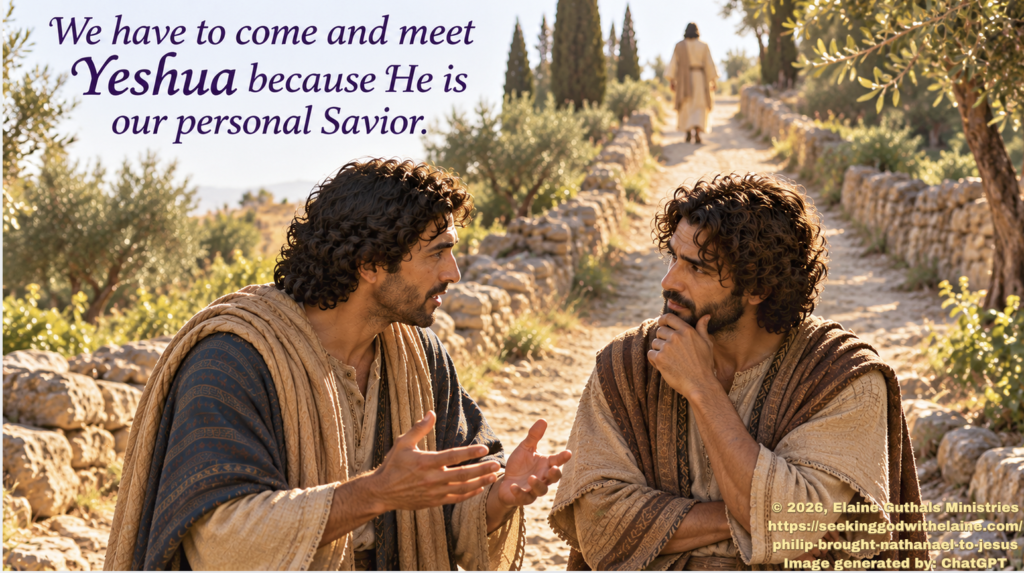
“Philip went to look for Nathanael and told him, ‘We have found the very person Moses and the prophets wrote about! His name is Jesus, the son of Joseph from Nazareth.’ ‘Nazareth!’ exclaimed Nathanael. ‘Can anything good come from Nazareth?’ ‘Come and see for yourself,’ Philip replied” (Jn. 1: 45-46 NLT)
Looked for Nathanael
Who was Nathanael?
We know surprisingly little about Nathanael from Scripture. What we do know gives us a glimpse of the man Philip went looking for.
Nathanael appears by name in John’s Gospel, but not in the other three Gospels. He is sometimes identified as Bartholomew, one of the Twelve Apostles listed in Matthew 10:3, Mark 3:18, and Luke 6:14.
Scripture never explicitly tells us that Nathanael and Bartholomew were the same person. This identification comes from comparing the Gospel accounts, particularly because Philip is associated with Bartholomew in the lists of the Twelve and with Nathanael in John’s account. It is a longstanding Christian tradition, but we cannot establish it with certainty they were the same person.
John tells us that Nathanael was from Cana in Galilee (Jn. 21: 2). Yeshua describes him as a man of complete integrity (Jn. 1: 47).
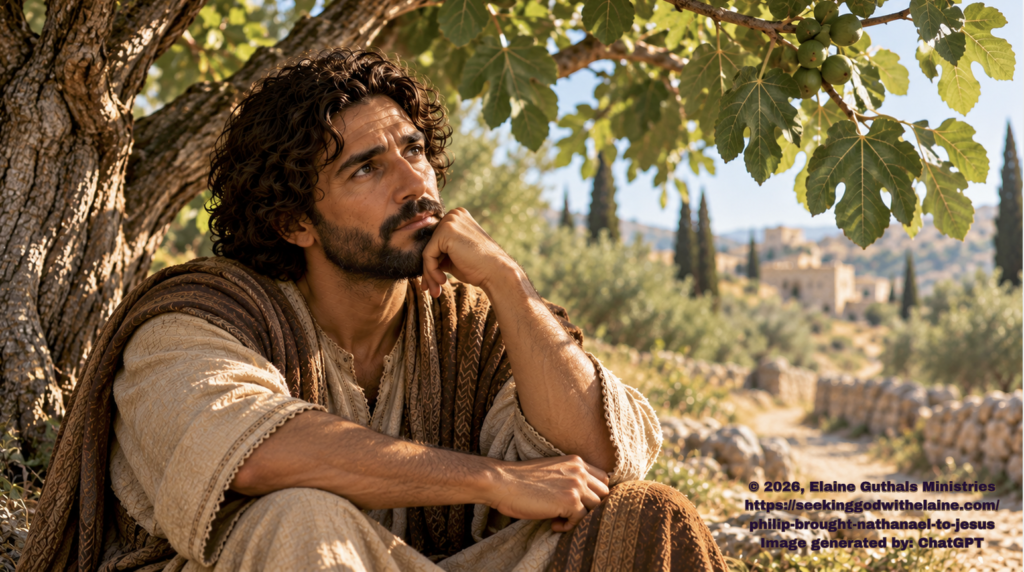
What happened to Nathanael after Yeshua’s resurrection? Scripture gives us no detailed account of his later ministry. Christian tradition, however, identifies him with Bartholomew and associates Bartholomew with missionary work in several regions, including Asia Minor, the area of present-day Turkey, as well as Armenia and India. The accounts differ, and we cannot establish a reliable itinerary for his missionary work.
Tradition also remembers Bartholomew as a martyr in Armenia, where he was reportedly flayed alive — his skin removed. Other accounts describe his death differently, including crucifixion or beheading. The details of his death cannot be verified from Scripture, and the later traditions disagree about what happened.
That is what we can piece together about Nathanael. We know his hometown, we have Yeshua’s testimony about his character, and we see his initial response when he encounters the Messiah. Beyond that, we must distinguish what Scripture records from what later generations have passed down.
Moses and the Prophets
Both men were steeped in Scripture.
Think about what Philip was saying when he talked about Moses and the prophets. He wasn’t simply telling Nathanael that he had met an interesting man. He was connecting Yeshua with the Scriptures they had been learning since childhood.
Moses wrote the Torah — the first five books of Scripture. These books established the foundation for understanding Jehovah’s covenant with Israel, His instructions for His people, and His promises concerning their future. The prophets continued to call Israel back to faithfulness while revealing more about Jehovah’s purposes and the One who would come.
Philip’s statement shows that he understood Yeshua in light of those Scriptures. He wasn’t separating this new discovery from what Jehovah had already revealed. He was recognizing a connection between the promises they knew and the Man he had encountered.
Notice, too, that Philip expected Nathanael to understand what he meant. He didn’t stop to explain who Moses was or why the prophets mattered. They shared a scriptural background that gave meaning to his words.
This doesn’t mean we know exactly which passages Philip had in mind. John didn’t identify specific prophecies in this verse. We should not assume that Philip was referring to one particular prediction when the text doesn’t tell us which passages he meant.
What we can see is that Philip understood the importance of reading what was happening in the present in light of what Jehovah had already revealed through Scripture.
That is an important lesson for us, too. We shouldn’t separate our understanding of Yeshua from the Scriptures that tell us who He is. We need to read the whole story, allowing what Jehovah revealed earlier to help us understand what He reveals later.

Can Anything Good?
Nathanael wasn’t buying what Philip was selling Him.
Ooo, baby! Nathanael wasn’t impressed by Philip’s announcement. Philip had just told him that they had found the One Moses and the prophets wrote about. Then he identified Yeshua as Jesus of Nazareth.
Why would Nathanael respond that way?
Nazareth was a small settlement in Galilee. It wasn’t Jerusalem, the center of Jewish worship, or a royal city associated with the house of David. It wasn’t a place that Scripture specifically identified as the hometown of the Messiah.
We need to be careful here. John doesn’t tell us exactly why Nathanael asked his question. We can’t say with certainty that he was prejudiced against Nazareth or that he believed the Messiah couldn’t come from Galilee. His words may reflect a dismissive view of an insignificant village, surprise at Philip’s claim, or questions about how Yeshua could fulfill what they understood from Scripture.
Nathanael was possibly responding to the opinion of others. When we don’t have enough information, we sometimes do let others’ opinions influence us.
When witnessing, we do sometimes need to respond to actual or perceived issues. How we do that can help our cause – or shut it down entirely.
Whatever prompted his response, Nathanael wasn’t ready to accept Philip’s announcement simply because Philip believed it.
Come and See
We have the responsibility to offer the invitation, but it is up to the other to accept it.
Ooo, baby. Nathanael’s response could have burned Philip.
Here Philip was, sharing his excitement with Nathanael. Both were strong in the Jewish faith. Both were longing for the Messiah.
Philip went to Nathanael and said, “He’s here!” Nathanael’s response? “You gotta be kidding me.”
Philip could have handled this a number of ways. He could have gotten mad that Nathanael questioned his belief. He could have argued to get his point across. He could have walked away in disgust.
None of that happened. Instead, Philip’s response was “Come and see for yourself.”
There is something important here for us. When someone questions what we believe, our first response doesn’t always have to be an argument. We can explain what we believe, point to Scripture, and invite that person to examine the evidence.
Faith isn’t strengthened by pretending questions don’t exist. We can bring our questions to Scripture and seek to understand what Jehovah has revealed.
Nathanael had a question about Nazareth. Philip invited him to meet the Man he believed was the Messiah.
Sometimes the most helpful thing we can do is invite someone to take the next step toward discovering the truth.
Philip invited Nathanael to encounter Yeshua rather than settle the question through an argument. He didn’t try to answer every possible objection. He encouraged Nathanael to investigate for himself.
Isn’t that how we reach some people? Our words might have some effect.
But they have to see for themselves. They have to work it out and figure it out.
More importantly, we each have to personally respond to the Holy Spirit’s prompting. Philip couldn’t make the decision for Nathanael to believe in Yeshua. Our parents can’t make it for us – our spouse can’t.
We have to come and meet Yeshua because He is our personal Savior.
Making the Connection
We encounter Yeshua in different ways. Let’s look at a few.
All Scripture tells us about Philip’s call is that Yeshua went to Galilee and found him. That sounds calm – but it is very personal, too.
Nathanael was invited to learn about Yeshua through a friend. His initial reluctance didn’t hold any animosity, but Nathanael struggled with what Philip was telling him.
Then there was Paul. Ooo, baby. Did he have a conversion story or what?!?
Paul actively worked against the spreading of Christianity. His actions went all the way from imprisonment to murder.
We know Paul made murderous threats (Ac. 9:1). We know that part of the persecution he inflicted on early Christians included their punishment (Ac. 22: 4-5). He felt responsible for the deaths, calling himself the chief among sinners (I Tim. 1: 15).
Then, one day, Yeshua – even though He was dead, resurrected, and ascended – again personally appeared to Paul. He gave him a ministry from the start.
That ministry came to the Philippian jailer where he worked. Because Paul would be obedient even when it got personally hard and painful for him, a man and his entire household was saved because:
- a man went to work.
- he listened to what someone he may have looked down upon had to say.
- he didn’t discount the impossible when it happened before his eyes.
- he opened his heart in compassion.
- he wanted to share this wonderful gift with those he loved most.
We all may not have a conversion experience that had the Hollywood splash that Paul did. But our call is just as personal and just as real.
Yeshua knows our hearts and minds. He knows what our experiences have been.
Our call is going to be designed around us.
Heart Check
Think about the battle Yeshua is engaged in for your heart. Ask yourself the following questions.
- Do I invite others to discover Yeshua, or do I expect them to accept what I say?
- When someone questions my faith, do I respond with patience or defensiveness?
- Do I distinguish what Scripture says from what I assume?
- Am I willing to examine the evidence when something challenges my understanding?
- Do I recognize that Yeshua can reach people in ways different from how He reached me?
How Do We Apply This?
- Invite someone to encounter Yeshua rather than trying to win an argument.
- Listen carefully to the questions people ask about faith.
- Use Scripture to explain what we believe.
- Respect that each person must make a personal response to Yeshua.
- Recognize and encourage the different ways Jehovah works in people’s lives.
Father God. Thank You for preparing a way that our relationships with You can be restored. Help us to seek Yeshua — through Scripture and through spending time with Him and You. Amen.
If you don’t understand something and would like further clarification, please contact me.
If you have not signed up for the email providing the link to the devotions and the newsletter, do so below.
If God has used this devotion to speak with you, consider sharing it on social media.