Judah had moved away from his family – the covenant family. This devotional reading looks at how he continued to move farther away from the covenant.
Nuggets
- While some is relative, years is plural – meaning it took time for the story to continue.
- Judah reentered public life with an old friend.
- Tamar reentered the story by learning about Judah’s plans.
- Judah propositioned Tamar, who was disguised as a prostitute.

We’ve been walking through Genesis 38. It is a snapshot in Judah’s life.
More importantly, it is a story about repentance, forgiveness, and restoration.
But we aren’t there yet. We’re still setting up what went wrong.
Programming note: I am going to wait to do the connections and application at the end of the chapter.
Let's Put It into Context
To read devotions in the Creating Everything theme, click the button below.
Devotions in the Joseph the Savior of Israel series
Picking Up the Story
“Some years later Judah’s wife died. After the time of mourning was over, Judah and his friend Hirah the Adullamite went up to Timnah to supervise the shearing of his sheep. Someone told Tamar, ‘Look, your father-in-law is going up to Timnah to shear his sheep.’ Tamar was aware that Shelah had grown up, but no arrangements had been made for her to come and marry him. So she changed out of her widow’s clothing and covered herself with a veil to disguise herself. Then she sat beside the road at the entrance to the village of Enaim, which is on the road to Timnah” (Gen. 38: 12-14 NLT)
Judah’s Wife Died
While some is relative, years is plural – meaning it took time for the story to continue.
The story continued by anchoring it around the death of Judah’s wife. We were first introduced to Mrs. Judah in Genesis 38: 2.
Maybe Moses didn’t feel the need to give us her name because she was a Canaanite woman. He knew that Jehovah would not be pleased with that marriage.
Still, Jehovah had blessed that union with three sons. Er and Onan had been killed by Jehovah because of their wickedness. Shelah was the youngest son.
We may think it strange that Moses securing the rest of the story around Mrs. Judah’s death. But let’s dig in a little bit — and try not to read too much into it, but enough.
Moses specifically stated, “… After the time of mourning was over …” (Gen, 38: 12 NLT). There was no fixed “mourning period,” but Judah obviously mourned his wife’s passing and re-enters public life.
The time of grief and loss can be a very tumultuous time emotionally for some. People can feel emotionally exposed and less guarded. We don’t always make the best decisions when we are mourning what was and what no longer is.
That is especially true when we are trying to “get back to normal” when we are making a new normal. Add to that a time of celebration.
Judah and Hirah Supervised the Shearing of Sheep
Judah reentered public life with an old friend.
When Judah first moved to Adullam in the Shephelah (lowland hills), he stayed with Hirah. Remember, Adullam was about 10 to 15 miles south of Hebron.
In Genesis 38: 12, Judah and Hirah were going to Timnah in the Sorek Valley region. That was a five-to-ten-mile jaunt to the northwest. It was about a half-day walk uphill.
It wouldn’t have been a big deal to head over to Timnah. It sounds like it is in a different region, but both Adullam and Timnah sound like they are on their respective borders.
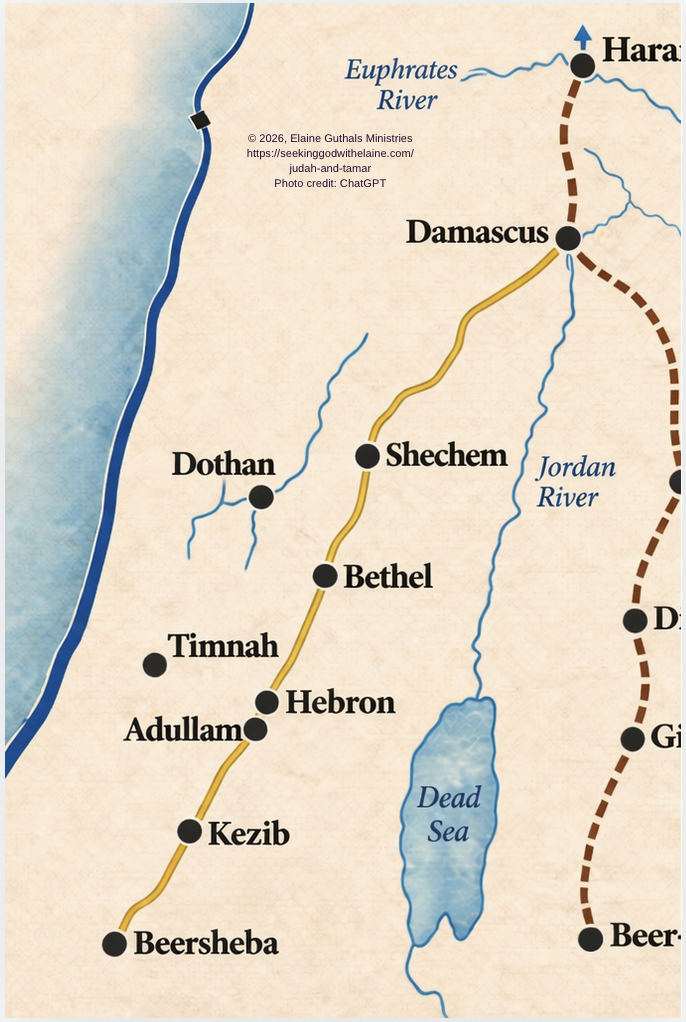
Bottom line is this isn’t a huge move away from home, it sounds like it is a usual sheep trip.
We may not think of sheep shearing as a time of celebration, but then most of us haven’t sheared any sheep lately.
Sheep weren’t raised just as a food source — or as just a sacrificial animal. Their wool was a major source of wealth. It could be sold as trade good or clothing.
To get the wool off the sheep, they had to be sheared. This was a celebration because it meant the flock survived another year and the production could be collected.
In essence, it was a harvest festival for livestock. This “festival” occurred pretty much the same time each year in spring to early summer.
But it consisted of a lot of work. It required multiple workers and coordination. What happens when people gather together? It becomes a social event.
We see one such event described in I Samuel 25. Nabal lived like a king, drinking heavily, during his sheep-shearing feast. That shows us that food, drink, and excess were normal.
This was especially true when the work was done. Not only would there be a harvest festival atmosphere, but there would also be the harvest wrap party and payday all wrapped into one.
This was an event. People traveled to attend, including business partners and wanna-be business partners. In other words, it wasn’t a private party — it was public and communal with all the hospitality laws in force.
Superimpose the party atmosphere over the grief atmosphere. Was Judah having conflicting emotions? Or was he more than ready to live it up some?
Someone Told Tamar
Tamar reentered the story by learning about Judah’s plans.
When Er died (Gen. 38: 7), he left a wife named Tamar without an heir to keep his line going. Onan, Er’s younger, married may or may not have brother Tamar through the levirate marriage provision (Gen. 38: 8). However, Onan didn’t fulfill his duty, and Jehovah took his life as well (Gen. 38: 9-10).
Judah sent Tamar back to her parents’ home. What he didn’t tell her was that he had no intention of allowing Tamar to marry Shelah (Gen. 38: 11).
Tamar had figured this out when the time had come without any marriage ceremony taking place. So, she took matters into her own hand.
Is there any significance that Tamar was still in widows’ clothing? Maybe, but maybe not.
While there was no fixed “mourning period,” Tamar may have remained in a widow’s garb more because of her status than because of emotion. Her legal status was widow, but she was also childless and promised to Shelah. That last piece is the kicker.
Besides, Judah’s instructions in Genesis 38: 11 were to live as a widow, not remarry, and wait under family authority.
But Shelah had become of marrying age and crickets. No marriage ceremony, not even a save-the-date card.
We may look at Tamar’s actions and think they are just as suspect as Judah’s. How can her having sex with her father-in-law be permissible?
We have to look at it through Ancient Near Eastern norms. Tamar was seeking her legal right to offspring. She was still a member of that family, and she was preserving her place within it.
One thing that would resonate with many of us is that Tamar was forcing justice when the system had failed her. Well, we could say when Judah failed to follow the system as he should have.
There was nothing radical about Tamar’s actions.
The Act Occurred
“Judah noticed her and thought she was a prostitute, since she had covered her face. So he stopped and propositioned her. ‘Let me have sex with you,’ he said, not realizing that she was his own daughter-in-law. ‘How much will you pay to have sex with me?’ Tamar asked. ‘I’ll send you a young goat from my flock,’ Judah promised. ‘But what will you give me to guarantee that you will send the goat?” she asked. ‘What kind of guarantee do you want?” he replied. She answered, ‘Leave me your identification seal and its cord and the walking stick you are carrying.’ So Judah gave them to her. Then he had intercourse with her, and she became pregnant (Gen. 38: 15-18 NLT)
Judah propositioned Tamar, who was disguised as a prostitute.
Yeah. Judah just lost his wife, but he was hooking up with a prostitute.
No, that isn’t something that was unlawful. But it is morally revealing.
But isn’t that one reason Genesis 38 is following Genesis 37? We started the last devotion with the question about the significance of its placement.
Judah was already on a downward spiral spiritually after the wanting-to-kill-but-ended-up-selling-Joseph episode. He was spiritually corrupt.
This is an indication that Judah continued to drift. He and his brothers weren’t caught in their deception to Jacob. Their secret was safe for the time being. Who besides Hirah would know of his indiscretion now?
So, to tie all this up, the death of Mrs. Judah set the stage by creating the conditions in which Judah’s character was revealed. Our character must be revealed before repentance and forgiveness can occur.
To pick up the story, Judah noticed who he thought was a prostitute. How did he make that determination?
Go back to Genesis 38: 14. “… So she changed out of her widow’s clothing and covered herself with a veil to disguise herself. Then she sat beside the road at the entrance to the village of Enaim, which is on the road to Timnah” (Gen. 38: 14 NLT).
The veil wasn’t assigned ritual or covenantal symbolism, but it was more than just an element of disguise. In the Ancient Near East culture, it would signify sexual availability in certain contexts.
Judah read the signal exactly as Tamar intended. But let’s tie it back to something even further.
“Then the brothers killed a young goat and dipped Joseph’s robe in its blood. They sent the beautiful robe to their father with this message: “Look at what we found. Doesn’t this robe belong to your son?’” (Gen. 37: 31-32 NLT).
Where Judah used a garment to conceal his actions, Tamar used a garment to reveal the truth.
When Jehovah orchestrates an opportunity of repentance, forgiveness, and renewal, He snips all the lose threads. He restore everything, sometimes what look as if it is in reverse order.
The veil also functions as a mechanism of justice. Tamar has been denied her rightful place within Judah’s family and is left without security or future. By veiling herself, she operates outside the constraints that have been imposed upon her. This allows her to create a situation in which Judah’s failure is brought to light. The concealment is temporary, but the revelation it produces is permanent.
We are going to see in a couple more verses where Judah acknowledges the role reversal. The wronged widow, even in the appearance of a prostitute, highlights the moral failure of a patriarch.
Judah and Tamar make arrangements for the financial aspects of the transaction. Would a goat have been a standard, reasonable payment.
Well, yes. Goats were common, portable, and valuable but not excessive. Young goats were often used as food, gifts, and transactions. In other words, if Tamar didn’t want to/couldn’t keep it for personal use, it would be good currency for a future transaction.
But then, this could be another loose end that Jehovah was snipping. Look a couple of paragraphs back to where we looked at Genesis 37: 31. The animal used to supply the blood that stained Joseph’s coat was a goat.
Why wouldn’t Judah have offered a sheep? Well, a sheep was not only an animal, but it was also a money maker. The wool provided more of a revenue than a goat – even selling its milk – would have provided.
The way it reads to me is that Tamar accepted payment but was saying, “What is your collateral that I can hold until I get the payment?” Who says you are going to keep up your end of the bargain and send me payment?
But being the smart girl that Tamar was, she also wanted something more tangible. She also wanted something more recognizable as Judah’s.
Tamar asked for three things: Judah’s seal or signet, the cord, and his walking stick. What was the significance of each?
Let’s look at the walking stick first. It probably wasn’t some limb just pulled off a tree. More than likely it was uniquely shaped and identifiable. It could have even functioned as a tribal marker of authority.
Why would that have been important to Tamar. Judah had used his tribal authority to send her back to her parents and to tell her to wait for the next levirate marriage.
The seal or signet was essentially Judah’s signature. He used it to seal documents and authorize transactions. It was his legal identity marker.
When attached to the cord, it was Judah’s wearable identity. It was something he would have and probably would have taken with him, much as we do with a driver’s license or state ID.
This is the one that always got me. Why would Judah give up something so important?
Not only was it important, but the seal was also irreplaceable. Yes, Judah was giving up his signature and authorization. He was giving up his identity, authority, and legal power.
All for a roll in the hay with someone he thought he didn’t know.
Ooo, baby. Did Judah underestimate Tamar and the situation! It was an anonymous transaction. It was never meant to be temporary. It was very high-risk for Tamar.
Object. Recognition. Truth revealed. Wasn’t that what Judah wanted when he and his brothers sent the tunic to Jacob? Only they didn’t want truth revealed. They wanted the deception to hold.
Father God. There are so many times that we are thrown into situations that we never thought we would find ourselves. We are glad that You are in control. Help us to keep our focus on You and to always be obedient to Your Will. Amen.
If you don’t understand something and would like further clarification, please contact me.
If you have not signed up for the email providing the link to the devotions and the newsletter, do so below.
If God has used this devotion to speak with you, consider sharing it on social media.