Category: Attitude

  • Focusing Our Labor on God

    Jesus told the Parable of the Vineyard Workers, which seems to condone idleness. This daily devotion looks at what the parable is really talking about.

    Nuggets

    • God calls us to salvation for differing lengths.
    • God’s salvation is offered to all regardless of what we have done.

    To read devotions in the Redo for Godliness series, click the appropriate button below.

    To read devotions in the How Can We Live Godly Lives? series, click the button below.

    In the last devotion, we started talking about how God does not want us to be idle. Jesus told a Parable of the Vineyard Workers that seems to contradict that.

    If we don’t have the confidence in what Scriptures say, we won’t be able to focus on God. So, even though it isn’t about thoughts, let’s take a look.

    “Avoid idleness. Serious callings do naturally compose men’s spirits, but too much recreation makes them blaze out in vanity. Idle souls as well as idle spirits will be ranging” (Charnock, The Sinfulness and Cure of Thoughts)

    Let’s Put It into Context #1

    We’ve been looking at Charnock’s sermon entitled The Sinfulness and Cure of Thoughts to show us how to cleanse, a.k.a. sanctify, our thought processes. Charnock has taught us 

    • that we cleanse our thoughts when we return to having a strong relationship with God. We can do that by studying the Scriptures, meditating on God, contemplating on His creation, and praising Him.
    • that we focus our thoughts by being humble instead of prideful, following God instead of the worldview, and working instead of being idle.

    Resource

    Glossary

    Here is a running list of what we’ve discussed previously.

    Let’s Put It into Context #2

    Bible Verse

    Idleness is the sin of wanting to obtain a reward without working for that reward.

    Workers of Different Longevity

    “For the kingdom of heaven is like a landowner who went out early in the morning to hire workers for his vineyard. After agreeing with the workers on one denarius, he sent them into his vineyard for the day. When he went out about nine in the morning, he saw others standing in the marketplace doing nothing. He said to them, ‘You also go into my vineyard, and I’ll give you whatever is right.’ So off they went. About noon and about three, he went out again and did the same thing. Then about five he went and found others standing around and said to them, ‘Why have you been standing here all day doing nothing?’ ‘Because no one hired us,’ they said to him. ‘You also go into my vineyard,’ he told them” (Mt. 20: 1-7 CSB)

    God calls us to salvation for differing lengths.

    It is easy to look at this parable as a story about idleness in our careers. The vineyard workers don’t find work until the end of the day.

    But it isn’t about that at all. We’ll get to that.

    First, we have to remember the workers who weren’t hired still showed up at the interview. They didn’t just sign up for unemployment and not try to get work.

    The workers weren’t idle by choice. True, we don’t know why they weren’t hired, but they had waited, as Gray said, as was the custom when they weren’t hired right off.

    Resource

    Jesus’ purpose for telling this parable was to apply it to our spiritual growth. It is all about spiritual idleness. Tucker reminded us that spiritual idleness is detrimental to us and others.

    Resource

    It seems like, in many instances, we leave the bulk of the work to only a few workers. We can’t do that. We need to step up and do our share.

    Sometimes, that may mean not waiting for the Nominating Committee to come to us. We may have to go to them.

    I know. How many times do we feel that we are not qualified to do something God is calling us to do? Well, that just means we have to put in the work to get qualified.

    What is sad is when we don’t feel qualified in doing what God is calling us to do and we use it and other reasons to not follow through. Let’s say God is calling us to be a missionary. Instead of us going, we throw financial support to an already established missionary.

    Yay for the other missionary, but God isn’t going to accept the substitute. We have chosen to not follow His Will.

    We’ve got to do the work when God calls. God may give us a limited opportunity to complete it. We know Satan is going to do everything in his power to stop God’s work from going forward.

    We don’t want to miss out on our blessing. God will help us when we are faithful. He will give us the strength and wisdom we need to complete the task.

    Atherton detailed what this wisdom is. We learn about ourselves. More importantly, we learn about God.

    Resource

    Okay. I have to do an Elaine-speak on something else Atherton wrote.

    • Some people don’t work because they don’t have a job.
    • Some have a job, but don’t like their employer, their job, or their wages.
    • Some say they can’t work for some reason.
    • Some are looking for work but can’t get hired.
    • Some don’t want to give up our old way of life.

    God is not calling us to what Guthrie called busy idleness. We can do a lot of things that amount to nothing.

    Resource

    I wondered, when I read this, if our attempts to serve Him when He really didn’t call us to do that would fall under here. What God calls us to do in His service will be pleasant and profitable.

    God Rewards Those He Calls

    “When evening came, the owner of the vineyard told his foreman, ‘Call the workers and give them their pay, starting with the last and ending with the first.’ When those who were hired about five came, they each received one denarius. So when the first ones came, they assumed they would get more, but they also received a denarius each. When they received it, they began to complain to the landowner: ‘These last men put in one hour, and you made them equal to us who bore the burden of the day’s work and the burning heat.’ He replied to one of them, ‘Friend, I’m doing you no wrong. Didn’t you agree with me on a denarius? Take what’s yours and go. I want to give this last man the same as I gave you. Don’t I have the right to do what I want with what is mine? Are you jealous because I’m generous?’ ‘So the last will be first, and the first last.’” (Mt. 20: 1-16: CSB)

    God’s salvation is offered to all regardless of what we have done.

    This set of verses inform the usual interpretation of this parable. How long we have had salvation is not as important as that we are saved. Only children of God will be rewarded.

    • Salvation is the gift of life through the deliverance from condemnation and sin to acceptance and holiness and changes us from being spiritually dead to spiritually alive.
    • Sins are actions by humans that disobey God and break one of His reasonable, holy, and righteous laws and commandments, goes against a purpose He has for us, or follows Satan’s promptings.
    • Holiness is the transcendent excellence of His nature that includes elements of purity, dedication, and commitment that lead to being set apart. Purity means possessing God’s moral character, having eliminated the stain of sin.
    • Spiritual death is the spiritual separation from God that occurred as a consequence of Adam and Eve’s original sin. The spiritually alive are those who have ABCDed, so they are no longer separated from God.//////

    The ABCDs of Salvation

    If you have not become a believer in Christ, please read through the
    Plan of Salvation and prayerfully consider what God is asking you to do.

    A – admit our sins
    B – believe His Son Jesus is our Redeemer
    C – confess God as Sovereign Lord

    D – demonstrate that commitment by making any changes needed in our lives to
    live the way in which God has called us

    The Disciple’s Job Description

    Glossary

    Salvation is the same for all who ABCD. We all are changed from being spiritually dead to spiritually alive. We all are given access to Sovereign God. We all are given eternal life.

    Why? We are given these rewards because God shows us mercy. God’s mercy is an act of sovereign will that produces an unexpected and undeserved response from God as He responds in love to our needs.

    God is the One who designed the Plan of Salvation. He decided what would satisfy Him to pay the price for our disobedience.

    What salvation entails was determined by God. He figured out what we would have to do to gain it. We have to believe that Jesus died for our sins.

    Then, God calls us to salvation. He calls each and every one of us. Some, He may call when we are young. Others He will call when we are older.

    God alone knows when He will call us home. It may be when our life here is over. It may be when all life here is over.

    But it is all God’s Plan.

    Taylor was right when he said that no employer would give what equates to a part-time employee the salary equaling that of a full-time employee. But God is not just any employer. He gave what He promised.

    We have to remember a very important passage. “‘For my thoughts are not your thoughts, and your ways are not my ways.’ This is the Lord’s declaration. ‘For as heaven is higher than earth, so my ways are higher than your ways, and my thoughts than your thoughts’” (Isa. 55: 8-9 CSB).

    What this tells us is that the doing isn’t the main ingredient here. Yes, some of them performed their ministry for a long time. Not all of them did.

    So, quantity wasn’t what was rewarded. It was quality.

    Those who were late to the labor gave God their all. It was like Taylor’s sermon title said. The worth of work is determined by the spirituality of its motive.

    Resource

    They served God fully.

    Perfection is about being. It is about obtaining the character of God.

    It wasn’t about the doing. It was about the being. That is what perfection is about.

    Of course, those that worked all day grumbled. “We were the ones who worked all day in the hot sun. Why didn’t we get more than those who put in such little work?”

    Ooo, baby! Can’t we disciples grumble when we think someone is getting too much — or not enough! Taylor equated the day-long workers with the older brother in the Parable of the Prodigal Son.

    To read a related devotion, click the button below.

    We have to watch when we start grumbling. Taylor wrote, “Work in this spirit, however great it may seem, is small in the sight of God. The ‘perfect’ and the ‘chosen’ labour for love.”

    Resource

    We shouldn’t be a disciple for what we get out of it — or what we get out of. We should be a disciple because we love God.

    We shouldn’t be a disciple for what we get out of it — or what we get out of. We should be a disciple because we love God.

    But look at it this way. After the question of “Why have you stood out here more almost 12 hours?” nothing more was said about the men being idle.

    Jesus did not condone the full-time laborer’s envy. Their complaining did not get them what they wanted.

    I always got where the all-day group were paid the agreed upon amount (Mt. 20: 14). What I missed was this was the negotiated amount. “After agreeing with the workers on one denarius …” (Mt. 20: 2 CSB).

    Ooo, baby. Apply that to today. Some want to rewrite Scriptures. They want to bargain to have things their way.

    They will always be dissatisfied.

    Huntingdon made another good point. He wrote, “Christ nowhere offers us heaven as a price for good behaviour, as foolish parents, or rather wicked parents, lure their children to obey with sweetmeats and toys.”

    Resource

    Only true children of God are rewarded. “But to all who did receive him, he gave them the right to be children of God, to those who believe in his name” (Jn. 1: 12 CSB).

    That means it takes faith. Faith is the conviction that the doctrines revealed in God’s Word are true, even if we do not understand all aspects of them, a belief which impacts our lives.

    FocusinOnLaborOnGodPin

    Making the Connections

    Huntington summed it up nicely.

    “The early and late workers have alike the promised penny, the common and open privilege of the gospel and Church. But have you turned the Christianity of condition and privilege into the personal Christianity of choice and character? The length of time you have been in the Church is now of little consequence; all that is over. Are you Christ’s men? What are your feelings toward the brother-souls that live and work near you? The parable strikes a blow at the notion that any works of ours are profitable, to trod, or even to our salvation. The quality, not the performance, is the accepted thing, the heart of faith and love, not any self-complacent operations.”

    Resource

    • It isn’t about longevity.
    • It isn’t about earning our way to Heaven.
    • It is about genuine salvation.
    • It is about character.
    • It is about the second greatest commandment.

    Glossary

    How Do We Apply This?

    • Believe God will follow through as He promised.
    • Love others instead of envy their blessings.
    • Don’t compare ourselves with other disciples.
    • Complete the work assigned to us.

    Resource

    We are called to work for God. Idleness is detrimental to all.

    Father God. We hear Your call to do Your Will. We choose to do it Your way. Amen.

    What do you think?

    Leave me a comment below (about this or anything else) or head over to my Facebook group for some interactive discussion.

    If you don’t understand something and would like further clarification, please contact me.

    If you have not signed up for the email daily or weekly providing the link to the devotions and the newsletter, do so below.

    If God has used this devotion to speak with you, consider sharing it on social media.

  • Focusing Our Energies on God

    God never intended for us to be idle. This daily devotional looks at how God wants us to focus our energies by working for Him.

    Nuggets

    • God calls us to work to provide for ourselves.
    • God calls us to work to know Him.

    To read devotions in the Redo for Godliness series, click the appropriate button below.

    To read devotions in the How Can We Live Godly Lives? series, click the button below.

    Idleness is a big issue these days. When is it acceptable to be idle, and what is society’s obligation when we choose to be idle?

    Charnock partially addressed that. We’ve been looking at Charnock’s sermon entitled The Sinfulness and Cure of Thoughts. Charnock has taught us so far that we cleanse our thoughts when we return to having a strong relationship with God.

    Resource

    Let’s see what the Scriptures have to say about disciples working.

    “Avoid idleness. Serious callings do naturally compose men’s spirits, but too much recreation makes them blaze out in vanity. Idle souls as well as idle spirits will be ranging” (Charnock, The Sinfulness and Cure of Thoughts)

    Let’s Put It into Context #1

    We’ve been looking at Charnock’s sermon entitled The Sinfulness and Cure of Thoughts to show us how to cleanse, a.k.a. sanctify, our thought processes. Charnock has taught us 

    • that we cleanse our thoughts when we return to having a strong relationship with God. We can do that by studying the Scriptures, meditating on God, contemplating on His creation, and praising Him.
    • that we focus our thoughts by being humble instead of prideful and not following the worldview.

    Resource

    Glossary

    Here is a running list of what we’ve discussed previously.

    Let’s Put It into Context #2

    Richardson had a great definition of idleness, only he called it slothful. He wrote, “The slothful man wants to attain the end without the use of the proper means. He would be rich without labour, learned without study, and respected without doing anything to deserve respect.”

    Resource

    Hardwood called it “… a sin against the ordinance of God.” Ordinances are an expression of the disciples’ obedience.

    Resource

    Avoid the Idle Body

    “For even when we were with you, we would give you this command: If anyone is not willing to work, let him not eat. For we hear that some among you walk in idleness, not busy at work, but busybodies. Now such persons we command and encourage in the Lord Jesus Christ to do their work quietly and to earn their own living” (II Thess. 3: 10-12 ESV)

    God calls us to work to provide for ourselves.

    Paul was specifically talking temporal work here, not spiritual work. He said with no hesitation, “Work. No work, no eat.”

    Well, the Energizer Bunny for God never was one to sugarcoat anything. He called them like God told him to.

    Richardson gave a long list of the consequences of idleness.

    • Becomes a burden on others.
    • Loses the respect of others.
    • Hurt those around them.
    • Covet the property of others because of envy
    • Lose contentment with our lives.
    • Commit other sins

    Resource

    Glossary

    The opposite of idleness is to work. We know God worked six days in creating the universe; then, He rested.

    God expected all along for us to work. He put Adam to work in the garden. “The Lord God took the man and placed him in the garden of Eden to work it and watch over it” (Gen. 2: 15 CSB). This was before the original sin.

    Glossary

    Diggle expanded on this. He wrote, “When God placed man in the Garden of Eden, He placed him there not for the sole purpose of contemplation, but to dress the garden and keep it.”

    Resource

    But God is still working. “For it is God who is working in you both to will and to work according to his good purpose” (Phil. 2: 13 CSB).

    If God hasn’t stopped working, it is logical that He would not want us to stop working.

    Avoid the Idle Soul

    “The soul of the sluggard craves and gets nothing, while the soul of the diligent is richly supplied” (Prov. 13: 4 ESV)

    God calls us to work to know Him.

    Did you catch that? Right before Philippians 2: 13 that we talked about in the last section is the work-out-your-salvation verse.

    “Therefore, my dear friends, just as you have always obeyed, so now, not only in my presence but even more in my absence, work out your own salvation with fear and trembling” (Phil. 2: 12 CSB).

    God didn’t just give us the whole kit and caboodle at salvation. I believe when we ABCD, He changes us from being spiritually dead to spiritually alive.

    • Salvation is the gift of life through the deliverance from condemnation and sin to acceptance and holiness and changes us from being spiritually dead to spiritually alive.
    • Sins are actions by humans that disobey God and break one of His reasonable, holy, and righteous laws and commandments, goes against a purpose He has for us, or follows Satan’s promptings.
    • Holiness is the transcendent excellence of His nature that includes elements of purity, dedication, and commitment that lead to being set apart. Purity means possessing God’s moral character, having eliminated the stain of sin.
    • Spiritual death is the spiritual separation from God that occurred as a consequence of Adam and Eve’s original sin. The spiritually alive are those who have ABCDed, so they are no longer separated from God.

    The ABCDs of Salvation

    If you have not become a believer in Christ, please read through the
    Plan of Salvation and prayerfully consider what God is asking you to do.

    A – admit our sins
    B – believe His Son Jesus is our Redeemer
    C – confess God as Sovereign Lord

    D – demonstrate that commitment by making any changes needed in our lives to
    live the way in which God has called us

    The Disciple’s Job Description

    Glossary

    But we have to change in order to have His character. Plus, we still are in this physical body with our human nature, so we will continue to sin. That is sanctification or working out our salvation.

    • Sanctification is the transformation of mind, body, and soul, which begins with regeneration, gradually changes our nature through the promptings of the Holy Spirit, and ends with perfected state of spiritual wholeness or completeness.
    • Regeneration is being changed from spiritually dead to spiritually alive and the internal requickening in us that God brings about through the work of the Holy Spirit to give us new character.
    • The perfected state indicates the combination of the spiritual graces which, when all are present, form spiritual wholeness or completeness.
    • Spiritual graces are worldly morals that have been submitted to God to further His kingdom instead of enhancing this world.

    Glossary

    Finally, when God calls us home, He will change us — give us new bodies — so that we will no longer sin. That is the ultimate salvation.

    Idleness is disastrous when we apply it to our relationships with God. Richardson wrote, “God will be found only of them who diligently seek Him.”

    Resource

    If we are not seeking God, there is no way He can sanctify us. We are definitely not working at our salvation.

    Harwood called it disobedience instead of expressing obedience to God. It is that important. Since it is a thing we don’t do instead of do, it is a sin of omission.

    If we are taking the easy way out with the least amount of work possible, we won’t find God.

    Resource

    If we are taking the easy way out with the least amount of work possible, we won’t find God.

    Why is not being idle so important? It deals with our character. Remember, our character is our thoughts, feelings, and actions all added together.

    If through our actions are not seeking God, then we can’t be like God.

    Because face it. Seeking God takes time and energy — work.

    Searching for and Seeking God

    Hearing His Word (Rom. 10: 17).
    Reading His Word (Rev. 1: 3).
    Praying to Him (Heb. 4: 16).
    Studying His Word (Ac. 17: 11).
    Meditating on His Word (Ps. 1: 1-2).
    Memorizing His Word (Ps. 119: 11).

    I love what the Homilist’s called it. We must be soul-craving. It was written in the sermon that “Souls have a hunger as well as bodies, and the hunger of the soul is a much more serious thing.”

    Resource

    We know that we can find that which our soul hungers for, but we must yearn to know God. That is, we must want it badly.

    The only way to do that is to be diligent in seeking God. Diligence is a consistent, persistent effort through repentance to obey God’s laws and commandments. We’ve talked about this before.

    To read a related devotion, click on the appropriate button below.

    Watts stressed that this diligence should be exercised in every part of our walk. This not only includes throwing our hearts into it, but also putting in the time to do it.

    Resource

    It also means being on guard to withstand whatever Satan hurls our way. This watchfulness is more than that, though.

    Watchfulness is a continual conscious examination of ourselves and all events so that we may follow God in all things. We can’t be idle and quit examining where we are in our journey and what we need to do to become more in line with what God wants.

    I know. That is hard. We not only have to set aside the time to do the evaluation, but we also must be honest with ourselves. It doesn’t do us any good if we can’t look at ourselves like God looks at us.

    But when our soul craves a relationship with Sovereign God, we do the work.

    I see you jumping up and down. What about grace? Doesn’t grace negate the sin and all that work?

    Okay. I have never heard this world before. Antinomianism is the fancy name for thinking that grace allows us to no longer follow the moral laws because we have salvation. What I always say!

    Salvation does not give us license to continue sinning. Grace does not give us a pass to not do what God has called us to do. That includes working.

    Close took it one step further. He wrote, “And if this be true individually in what we have to do in working out our own salvation, how much more in our labours of love. Here nothing is done without toil. You need but look at all the benevolent institutions of the country to see that no real good is done without trouble.”

    Resource

    Let’s look at it this way. All year, we have had one picture about the greatest commandments and perfection.

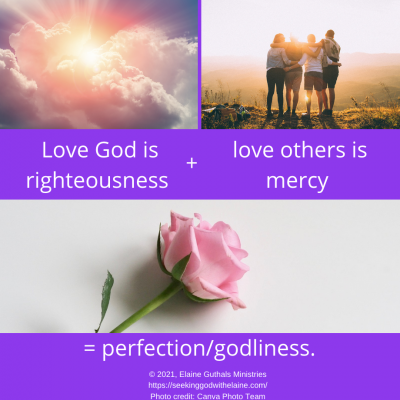
    Love God is righteousness + Love people is mercy = perfection/godliness

    If God is expecting us to work to love Him, shouldn’t we expect to work to love others?

    FocusingOurEnergiesOnGodPin

    Making the Connections

    I wonder how many opportunities we miss because of idleness. That means we miss the blessings.

    Watts told us the blessing we get because we are diligently seeking God.

    • We find success.
    • We access God’s promises.
    • We guard against temptations.
    • We make progress on the Sanctification Road.
    • We become useful to ourselves and to those around us.
    • We are rewarded with peace, hope, and joy.

    Resource

    How Do We Apply This?

    God calls us to work for a reason. Diggle wrote, “There is probably no means of grace more strengthening against temptation, more healthful for the spirit, more uplifting towards God, than honest, earnest work.”

    Resource

    • Diligently pursue our careers and calling from God so that we can be rewarded with plenty and comfort.
    • Work to change to have God’s character.

    Resource

    We’ve had some worksheets in the past that might help us now.

    We need to work to make our relationships with God what He wants them to be.

    Father God. We want to become what You call us to be – like You. We know the only way doing that is putting in the work. Help us to be diligent and not become discouraged because we know it is a life-long process. Amen.

    What do you think?

    Leave me a comment below (about this or anything else) or head over to my Facebook group for some interactive discussion.

    If you don’t understand something and would like further clarification, please contact me.

    If you have not signed up for the email daily or weekly providing the link to the devotions and the newsletter, do so below.

    If God has used this devotion to speak with you, consider sharing it on social media.

  • Focusing Our Thoughts Off of the World

    Jesus told his disciples that we are to be in the world, but not of the world. This daily devotion looks at how our thoughts help us focus on God instead of the world.

    Nuggets

    • The Holy Spirit is more powerful than Satan, meaning we can conquer Satan.
    • Jesus chose us; we have to choose Him.

    To read devotions in the Redo for Godliness series, click the button below.

    To read devotions in the How Can We Live Godly Lives? series, click the button below.

    One of the things we talk about all the time is how we are not to compromise with the worldview. God wants us to follow His laws and commandments, not accommodate what Satan’s followers want. (If we are not following God, we are following Satan.)

    “Avoid entangling yourselves with the world. This clay will clog our minds, and a dirty happiness will engender but dirty thoughts” (Charnock, The Sinfulness and Cure of Thoughts)

    Charnock warned us to not get caught up in this world. It will impede our growth on the Sanctification Road.

    Let’s take a look at some verses that warn us to be in the world but not of the world.

    Let’s Put It into Context

    We’ve been looking at Charnock’s sermon entitled The Sinfulness and Cure of Thoughts to show us how to cleanse, a.k.a. sanctify, our thought processes.

    • Charnock has taught us that we cleanse our thoughts when we return to having a strong relationship with God. We can do that by studying the Scriptures, meditating on God, contemplating on His creation, and praising Him.
    • In order to control evil thoughts, we need to address our pride.

    Resource

    Here is a running list of what we’ve discussed previously.

    Holy Spirit versus Satan

    “You are from God, little children, and you have conquered them, because the one who is in you is greater than the one who is in the world. They are from the world. Therefore what they say is from the world, and the world listens to them.” (I Jn. 4: 4-5 CSB)

    The Holy Spirit is more powerful than Satan, meaning we can conquer Satan.

    Many worldview people think that goodness alone is sufficient. It isn’t. Tillotson reminded us that goodness comes from God’s doctrines.

    Tillotson noted there is another benefit in following God’s doctrines. He wrote, “Besides the goodness of the doctrines which are from God, and the external confirmation of them by miracles, the Spirit of God doth likewise illuminate good men, and those who are desirous to know the truth, and hath promised to lead them into it, and to assist them in discerning between truth and falsehood (John 7:17).”

    Resource

    If we believe that Jesus is God’s Son and ABCDed, we believe in His doctrines. We believe there is another world to which we are aspiring.

    The ABCDs of Salvation

    If you have not become a believer in Christ, please read through the
    Plan of Salvation and prayerfully consider what God is asking you to do.

    A – admit our sins
    B – believe His Son Jesus is our Redeemer
    C – confess God as Sovereign Lord

    D – demonstrate that commitment by making any changes needed in our lives to
    live the way in which God has called us

    The Disciple’s Job Description

    The Holy Spirit assists us in overcoming the temptations of this life. He is more powerful than Satan. Tillotson wrote, “He is more able and ready to assist men to good purposes than the devil is to tempt and help forward that which is evil.”

    Resource

    Why is the Holy Spirit more powerful than Satan? The Holy Spirit comes from Sovereign God. God’s sovereignty means He has supreme power, giving Him control over all things without accountability to a higher power.

    Candlish believed one reason is because God created the world and fashioned it spiritually. He originally created Adam and Eve to be like Him. However, they committed the original sin and created within us a sinful nature.

    Resource

    Glossary

    After we have ABCDed, God abides within us through His Word. “Having purified your souls by your obedience to the truth for a sincere brotherly love, love one another earnestly from a pure heart, since you have been born again, not of perishable seed but of imperishable, through the living and abiding word of God” (I Pet. 1: 22-23 ESV).

    But God Himself does abide in us, too. “Jesus answered him, ‘If anyone loves me, he will keep my word, and my Father will love him, and we will come to him and make our home with him.’” (Jn. 14: 23 ESV).

    We will come. Make our home with him. Jesus and God will both live within us — as well as the Holy Spirit.

    Man, you would think there wouldn’t be enough room for Satan to get a toehold in.

    Go back a second. Pierson looked at this and saw that Satan was acknowledged as a formidable foe.

    Resource

    The verses say nothing about Satan being weak. It definitely doesn’t say he isn’t a threat.

    What it says is God, Jesus, and the Holy Spirit are greater than Satan. It doesn’t matter how formidable Satan is. He isn’t more powerful than Omnipotent God.

    To read a related devotion, click the button below.

    But what does all of that have to do with our thoughts? Edger wrote, “Evil, which is necessarily selfish, limits the objects of our thought and life to our own mean, narrow selves. It knows no large and noble objects or ends. Good embraces all things, all beings, all great and lofty ends.”

    Resource

    Ooo, baby. I bet the worldview people would argue that. But the worldview does limit the objects of our thoughts. It does try to keep the focus on us.

    Yes, we can and do think of others. But how much time is spent on our jobs, our family, and ourselves? We set our goals, and most of them do have us as the center. Not others. Not God.

    Satan will do everything in his power to keep our thoughts off God. We have to choose to think about God.

    We can conquer our thoughts because the Holy Spirit that lives within us is more powerful than Satan.

    We can conquer our thoughts because the Holy Spirit that lives within us is more powerful than Satan.

    Jesus Chooses Us

    “If the world hates you, understand that it hated me before it hated you. If you were of the world, the world would love you as its own. However, because you are not of the world, but I have chosen you out of it, the world hates you” (Jn. 15: 18-19 CSB)

    Jesus chose us; we have to choose Him.

    We’ve talked about verse 19 a couple of times. It makes a good point that true disciples of Christ really don’t fit into this world.

    Verse Commentary

    I don’t know if we have specifically looked at verse 18. The sermons associated with it give us a definition of the world.

    It isn’t just those who are obviously following Satan’s prompting and visibly breaking God’s laws and commandments. World is used to identify any who have not been regenerated — in other words, have not ABCDed.

    This backs up the belief that, if we have not made a genuine profession of faith in God, we are still sinners. Not making a decision whether we will follow God or not is a decision to not follow Him.

    That is kind of like the worldview says today about keeping silent. If we keep silent about some atrocity, we are condoning it.

    If we don’t choose to follow God, we are in realty choosing to follow Satan.

    Van Doren gave us a good snapshot of what it means to be a worldview person. We already knew this, but it is a good refresher.

    • Worldview people follow Satan by living for the present instead of planning for eternity.
    • They conduct their actions by what makes sense to them, not by God’s laws and commandments.
    • That means they put more store on what mankind has said in its customs and opinion that what God has said.

    Resource

    But does any of the sermons say how our thoughts fit in? Well, sorta.

    Jesus said He has chosen us out of the world. “However, because you are not of the world, but I have chosen you out of it, the world hates you” (Jn. 15: 19 CSB).

    Thomas told us what it meant for Jesus to call us it of this world. He wrote, “Christ penetrates men with the idea of the true God. He draws the curtain of materialism and reveals the spiritual world. He destroys selfishness and constrains men with His own love. This work is represented by an emancipation, regeneration, resurrection, creation — and none of these words are too strong.”

    Resource

    • Regeneration is being changed from spiritually dead to spiritually alive and the internal requickening in us that God brings about through the work of the Holy Spirit to give us new character.
    • Spiritual death is the separation from God that occurred as a consequence of Adam and Eve’s original sin. The spiritually alive are those who have ABCDed, so they are no longer separated from God.

    Glossary

    God frees us, changes us, revives us, and remakes us. But it starts with the idea of Him.

    We get the concept of Who God is from Scriptures. We don’t get a full picture. He waits until we are His children to really start revealing Himself to us.

    Glossary

    This is why we say our belief is in our minds. We don’t have a visual of God. We just know Him in our hearts and minds.

    If we focus our minds on Him, we don’t give Satan the toehold to get in.

    FocusingOurThoughtsOffOfTheWorldPin

    Making the Connections

    Satan is of the world. Paul called him the prince of this world. “And you were dead in the trespasses and sins in which you once walked, following the course of this world, following the prince of the power of the air, the spirit that is now at work in the sons of disobedience among whom we all once lived in the passions of our flesh, carrying out the desires of the body and the mind, and were by nature children of wrath, like the rest of mankind” (Eph. 2: 1-3 ESV).

    The Holy Spirit is part of the Trinity. That makes Him God.

    To read a related devotion, click on the appropriate button below.

    The Homilist reminded us that we can resist Satan. “Submit yourselves therefore to God. Resist the devil, and he will flee from you” (Jas. 4: 7 ESV).

    But we can also resist the Holy Spirit. “And do not grieve the Holy Spirit of God, by whom you were sealed for the day of redemption” (Eph. 4: 30 ESV). We grieve the Holy Spirit by continuing to sin.

    To read a related devotion, click the button below.

    How Do We Apply This?

    • If we are to overcome the power of Satan through God abiding in us through His Word, we have to be buried in His Word.
    • We need to be totally seeking Him.
    • We need to follow His doctrine as that is the seed that represents living principle, as Pierson called it.

    Resource

    Searching for and Seeking God

    Hearing His Word (Rom. 10: 17).
    Reading His Word (Rev. 1: 3).
    Praying to Him (Heb. 4: 16).
    Studying His Word (Ac. 17: 11).
    Meditating on His Word (Ps. 1: 1-2).
    Memorizing His Word (Ps. 119: 11).

    The pull of the world is great. We won’t be able to counteract it ourselves. Only through the power of God with the Holy Spirit within us can we conquer Satan.

    Father God. Once we invite You into our hearts and lives, You come to live within us. Only through Your power can we conquer Satan and break his hold on us. May we not be in the world but focused on You. Amen.

    The Disciple’s Job Description

    Complete Job Description

    Individual Description

    Job Duty #4
    Proclaim the Gospel (Mark 16: 15)

    Job Duty #6
    Make Disciples (Matthew 28: 19-20)

    What do you think?

    Leave me a comment below (about this or anything else) or head over to my Facebook group for some interactive discussion.

    If you don’t understand something and would like further clarification, please contact me.

    If you have not signed up for the email daily or weekly providing the link to the devotions and the newsletter, do so below.

    If God has used this devotion to speak with you, consider sharing it on social media.
  • Guarding Our Hearts from Prideful Thoughts

    Not all our thoughts are good. This daily devotional looks at how our evil thoughts promote pride.

    Nuggets

    • Humility helps keep prideful thoughts at bay.
    • Evil thoughts come from the heart.

    To read devotions in the Redo for Godliness series, click the appropriate button below.

    Here is a running list of what we’ve discussed previously.

    We’ve been looking at Charnock’s sermon entitled The Sinfulness and Cure of Thoughts to show us how to cleanse, a.k.a. sanctify, our thought processes. Charnock has taught us so far that we cleanse our thoughts when we return to having a strong relationship with God. We can do that by studying the Scriptures, meditating on God, contemplating on His creation, and praising Him.

    Resource

    In our last devotion, Barrow was describing industry, but he said this nugget about our thoughts. He wrote, “But the direction of our mind to some good end, without roving or flinching, in a straight and steady course, drawing after it our active powers in execution thereof, doth constitute industry; the which therefore usually is attended with labour and pain; for our mind is not easily kept in a constant attention to the same thing; and the spirits employed in thought are prone to flutter and fly away, so that it is hard to fix them …”

    Resource

    It is hard to corral our thoughts, but what about when they turn bad? The next section that Charnock looked at was preventing bad thoughts.

    I know. Is that even possible? Let’s see what he says.

    Let’s Put It into Context #1

    Here is a running list of what we’ve discussed previously.

    Let’s Put It into Context #2

    Pride doesn’t have to be sinful. “I am very frank with you; I have great pride in you. I am filled with encouragement; I am overflowing with joy in all our afflictions” (II Cor. 7: 4 CSB).

    Unfortunately, too often we take our pride to the self-focused and self-elevating level. Oh, yeah. We puff ourselves up with arrogance.

    Pride is a sin because it takes our focus off God. In fact, it is considered one of the seven deadly sins.

    The problem with pride is it lies to us. “Your arrogant heart has deceived you …” (Obad. 1: 3 CSB). So, pride is an attitude or way of thinking.

    Let’s Put It into Context #3

    • Wisdom is an enlightened acceptance of God’s principles that leads to knowledge, discernment, and good sense that is put into practice through salvation, increasing our goodness and virtue.
      • Discernment means we can evaluate the situation and recognize right from wrong.
      • Salvation is the gift of life through the deliverance from condemnation and sin to acceptance and holiness and changes us from being spiritually dead to spiritually alive.
        • Sins are actions by humans that disobey God and break one of His reasonable, holy, and righteous laws and commandments, goes against a purpose He has for us, or follows Satan’s promptings.
        • Holiness is the transcendent excellence of His nature that includes elements of purity, dedication, and commitment that lead to being set apart.
          • Purity means possessing God’s moral character, having eliminated the stain of sin.
        • Spiritual death is the spiritual separation from God that occurred as a consequence of Adam and Eve’s original sin. The spiritually alive are those who have ABCDed, so they are no longer separated from God.
      • God’s goodness is His holy, pure, and righteous behavior.
        • Holy means to be set apart, perfect, and morally pure while possessing all virtues.
        • Pure means not being sinful or having the stain of sin.
      • Virtues are standards of moral excellence.

    Glossary

    Exposure to Evil Thoughts

    “When pride comes, then comes disgrace, but with the humble is wisdom” (Prov. 11: 2 CSB)

    “Exercise frequent humiliations. Pride exposeth us to impatient and disquieting thoughts, whereas humility clears up a calm and serenity in the soul” (Charnock, The Sinfulness and Cure of Thoughts)

    Humility helps keep prideful thoughts at bay.

    You would think that, after the original sin and mankind’s fall from grace, we would see ourselves as we are. Warner wrote, “When we consider the nature of man, fallen and far gone from original righteousness, one might well think that men should of their own accord see the propriety, the necessity, of the grace of humility in their character.”

    Resource

    We not only don’t see the need for humility, but we also go the other way and bump up the pride.

    Warner noted that in which we take pride. Pride is a unrealistic high opinion of oneself that is based on faulty self-esteem.

    • Appearances
    • Social status
    • Wealth
    • Talent
    • Intelligence and judgment
    • Bad passion

    Resource

    This opinion is how we see ourselves. In other words, it is how we think about ourselves.

    Thomas made a great point. He said that we not only are faulty in how we see ourselves, but we also do not see the standard of character correctly. He wrote, “When we lose sight of the eternal law of rectitude, and judge ourselves only by the imperfect standards around us, pride is likely to come.”

    Resource

    Worldview standards feed the chaos of the world because they are divisive. It is real easy to become arrogant and prideful when we buy into the worldview.

    Glossary

    The worldview promotes the I’m-number-one attitude. God doesn’t.

    God wants to be the priority in our lives with us being humble. Humility is a character trait that diminishes pride and places dependence on God while holding a modest view of our importance with respect to others.

    Glossary

    If we look at pride the way Taylor did, we consider pride as the end result. This end result is dangerous to us and to others.

    Resource

    Pride means that the picture that we have of ourselves is faulty. It also usually means that the picture we have of others is also faulty. This stops us from fulfilling the second greatest commandment: love others.

    Glossary

    It does seem somewhat amazing that we do, in some instances, tie our pride to our comparison with others. What happens when they grow? Or we meet someone “better” than us? Our pride takes a kick.

    Taylor gave a list of what pride can foster when it focuses on wealth. It can lead to cheating, corruption, violence, and extortion. It can also lead to envy.

    The bottom line is humility helps keep prideful thoughts at bay.

    Source of Evil Thoughts

    “For from within, out of people’s hearts, come evil thoughts, sexual immoralities, thefts, murders” (Mk. 7: 21 CSB)

    Evil thoughts come from the heart.

    Jesus pinpointed the source of our evil thoughts. They come from the corrupt heart.

    Sadler reminded us that the heart isn’t all bad. He wrote, “We should not, I think, have put evil thoughts amongst the things which come out of the heart, because we suppose them to be in the heart. But is not what the Saviour says true of that which He alone knows — the very nature and substance of the soul? In its very centre, or close to its centre, the evil has its root or fountain.”

    Resource

    The very core of our hearts are sinful. “The heart is deceitful above all things, and desperately sick; who can understand it?” (Jer. 17: 9 ESV).

    But we still have free will. Free will is the ability within us to make decisions, which determine actions that produce character.

    When Satan pops an evil thought in our hearts, it is our choice whether we are going to cultivate and water it so it can grow or pull it out by the roots. If our will is right with God, the latter is going to happen. If not, break out the watering can.

    Swinnock called it right. He wrote, “Though they cannot sin outwardly, for want of strength of body or a fit opportunity, yet they act sin inwardly with great love and complacency.”

    Resource

    We know Jesus talked about thinking about sinning was as much of a sin as actually committing the sin. (Mt. 5: 27-28).

    Owes argued that our thoughts reflect our character. True, a lot of our thoughts amount to nothing — they are just a waste of time and focus.

    Resource

    The issue is “For as he thinketh in his heart, so is he …” (Prov. 23: 7 KJV). Our thoughts become who we are. The rest end of Mark 7: 21 and Mark 7: 22-23 talks about what comes from the evil thoughts — a whole laundry list of sins.

    Sin starts out simple and hidden. Then, bam! It has us by the throat.

    Spurgeon told us how that happens. He wrote, “This is the way of sin, to begin with a proud conceit of our own thoughts, ending with folly and stupidity. What a range there is between these two points, what a variety of sin thus enumerated! Sin is a contradictory thing: it takes men this way and that, but never in the right way.”

    Resource

    How does that hook to pride? Pride generally tries to justify the sin.

    GuardingOurHeartsFromPridfulThoughtsPin

    Making the Connections

    I am sitting here reading all of this and thinking, I know some will think this is the pat answer. But, to me, it is the answer.

    Perfection is about being like God. We go a long way in corralling our prideful thoughts when we focus on being like God.

    Perfection is about being. It is about obtaining the character of God.

    How Do We Apply This?

    When we focus on Who He is instead of who we think we are, the evil thoughts don’t have room to grow. Scriver said that means our devotion has to remain genuine.

    Resource

    We can’t be on autopilot when we read our devotions or say our prayers. It has to reach heart level.

    Owen said throwing a dam in the river of our thoughts isn’t going to stop the evil thoughts from getting through. He wrote, “There are but two ways of relief from them; the one respecting their moral evil, the other their natural abundance.”

    Resource

    We need God’s grace to help us defeat Satan and the evil thoughts.

    Father God. We need You to help us to conquer our evil thoughts. Satan loves to use them to pull us away from You. Help us to remain firmly in Your Will. Amen.

    What do you think?

    Leave me a comment below (about this or anything else) or head over to my Facebook group for some interactive discussion.

    If you don’t understand something and would like further clarification, please contact me.

    If you have not signed up for the email daily or weekly providing the link to the devotions and the newsletter, do so below.

    If God has used this devotion to speak with you, consider sharing it on social media.

  • Controlling Our Thoughts through Contemplation and Praise

    We can control our thoughts when we take it outside of ourselves. This daily devotional looks at looking to the heavens and raising our praises to God to help us control our thoughts.

    Nuggets

    • Contemplating the beauty and majesty of our world can calm our thoughts and give us peace.
    • Praising God helps us to control our thoughts.

    To read devotions in the Redo for Godliness series, click the appropriate button below.

    Devotions in the How Do We Live Godly Lives? series

    We can be so insular at times. That doesn’t help when we get locked into the thoughts in our heads.

    There are times we need to break out of that. We can do that by contemplating on the heavens and praising God.

    We are looking at Charnock’s sermon entitled The Sinfulness and Cure of Thoughts to show us how to cleanse, a.k.a. sanctify, our thought processes.

    Resource

    Let’s Put It into Context

    Here is a running list of what we’ve discussed previously.

    Using Objects for Spiritual Influence

    “When I look at your heavens, the work of your fingers, the moon and the stars, which you have set in place, what is man that you are mindful of him, and the son of man that you care for him?” (Ps. 8: 3-4 ESV)

    “Draw spiritual inferences from occasional objects. David did but wisely consider the heavens, and he breaks out into self-abasement and humble admirations of God (Psalm 8:3, 4)” (Charnock, The Sinfulness and Cure of Thoughts)

    Contemplating the beauty and majesty of our world can calm our thoughts and give us peace.

    This has long been a favorite verse of mine. What I see David saying is look up. We see a big, beautiful sky. Sometimes, it is blue. Sometimes gray. Sometimes black.

    At times, there is not a cloud in the sky. At other times, we can have fun picking out shapes in the clouds.

    Move on beyond that, we find stars, moons, and other planets. That leads to galaxies, black holes, and nebulas — along with a lot of other stuff.

    God created all of that.

    And we think He can’t handle anything that comes up in our lives? Wrong!

    David knew that He could rely on God. Witherspoon wrote, “The words carry a general confession of the influence of Divine Providence upon every event, and in particular with respect to salvation, or deliverance from impending danger.” Providence is God’s acts of meeting the needs of His creation.

    Resource

    We can be confident that God will provide for us. God is omnipotent. Omnipotent means God is all-powerful.

    To read a related devotion, click the button below.

    When we contemplate all of this, it should help us simmer down our thoughts. We aren’t in this alone. We are in this with Someone Who is much stronger than us.

    When we contemplate how trustworthy God is, we can control our thoughts and be content.

    When we contemplate how trustworthy God is, we can control our thoughts and be content.

    Using Praise to Secure Blessings

    “Salvation belongs to the Lord; may your blessing be on your people. Selah” (Ps. 3: 8 CSB)

    “Glean matter of instruction to yourselves, and praise to your Maker, from everything you see; it will be a degree of restoration to a state of innocency, since this was Adam’s task in paradise” (Charnock, The Sinfulness and Cure of Thoughts)

    Praising God helps us to control our thoughts.

    Another way to corral our thoughts is to praise God. Praising Him brings blessing upon us.

    Blessings don’t mean just gaining material possessions and happiness. Birch said that it was “not merely when we have what we wish, but far more when we do not wish what we have not.”

    Resource

    Salvation is the greatest blessing that we can be given.

    • Salvation is the gift of life through the deliverance from condemnation and sin to acceptance and holiness and changes us from being spiritually dead to spiritually alive.
    • Sins are actions by humans that disobey God and break one of His reasonable, holy, and righteous laws and commandments, goes against a purpose He has for us, or follows Satan’s promptings.
    • Holiness is the transcendent excellence of His nature that includes elements of purity, dedication, and commitment that lead to being set apart. Purity means possessing God’s moral character, having eliminated the stain of sin.
    • Spiritual death is the spiritual separation from God that occurred as a consequence of Adam and Eve’s original sin. The spiritually alive are those who have ABCDed, so they are no longer separated from God.

    The ABCDs of Salvation

    If you have not become a believer in Christ, please read through the
    Plan of Salvation and prayerfully consider what God is asking you to do.

    A – admit our sins
    B – believe His Son Jesus is our Redeemer
    C – confess God as Sovereign Lord

    D – demonstrate that commitment by making any changes needed in our lives to
    live the way in which God has called us

    The Disciple’s Job Description

    Glossary

    We have so much for which to praise God.

    Parker gave us a great way to determine if we are being blessed. He wrote, “When you feel that you must do more work, God’s blessing is upon you. Be sure of that confidence. When you want to be idle, God has withdrawn from you because you have withdrawn from Him.”

    Resource

    I get that. When we are gung-ho for God, work isn’t work. It is a joy — it is praise. We feel Him there every step of the way.

    When God isn’t there because we have turned away, it is a struggle. It is work. There is no joy.

    Kennion had an interesting sermon entitled The People of God. In the Old Testament, the nation of Israel was declared to be the people of God.

    In the New Testament, Jesus clarified that. He said that we must individually become children of God. Kennion wrote, “We are redeemed, not with corruptible things, such as silver and gold, but with the blood of Christ.”

    Resource

    We have to become children of God to fully praise Him and know His blessings. He won’t bless us if we are not following His laws and commandments.

    We have to become children of God to fully praise Him and know His blessings.

    Making the Connections

    Okay. Let’s recap the previous two devotions for a second plus add in what we’ve said here. Charnock has taught us so far that we cleanse our thoughts when we return to having a strong relationship with God. We can do that by studying the Scriptures, meditating on God, contemplating on His creation, and praising Him.

    What all of this is telling me is we need to focus on God. We look up; we dig deep into His Word; we surround ourselves with Him.

    I know. That can be hard when we are in the midst of all the chaos. It is also hard when we are hurting because we just don’t see a purpose or an end.

    ControllingOurThoughtsThroughContempationAndPraisePin

    How Do We Apply This?

    Through it all, we have to focus on God. We have to do more than what we regularly do if we feel we are in a really bad spot.

    If we do daily devotions, we have to do a deeper dive into Scriptures. We have to schedule extra prayer time.

    For the past three years, I’ve gone on two-day retreats by myself. I don’t think I am going to get to go this year, and that makes me very sad.

    We have to find our way to shut ourselves off from the world and focus fully on Him.

    Lord, I Have Shut theDoor
    Vocalist: Elaine Guthals
    Keyboard: Chris Vieth

    Meditating on God means thinking on Him. We do that by praising Him and acknowledging Who He is.

    Father God. We praise You. We honor You. We will focus our thoughts on You. Amen.

    What do you think?

    Leave me a comment below (about this or anything else) or head over to my Facebook group for some interactive discussion.

    If you don’t understand something and would like further clarification, please contact me.

    If you have not signed up for the email daily or weekly providing the link to the devotions and the newsletter, do so below.

    If God has used this devotion to speak with you, consider sharing it on social media.

  • Controlling Our Thoughts through Meditation

    In order to live godly lives, we need to control our thoughts. This daily devotional looks at how we control our thoughts by meditating on God through the sanctification process.

    Nuggets

    • Meditating on God helps us in the sanctification process.
    • Our thoughts are a good indicator of who we are.
    • Meditation puts us in the presence of the Sovereign God and our Redeeming Savior.

    To read devotions in the Redo for Godliness series, click the appropriate button below.

    Devotions in the How Do We Live Godly Lives? series

    We are looking at Charnock’s sermon entitled The Sinfulness and Cure of Thoughts to show us how to cleanse, a.k.a. sanctify, our thought processes.

    Resource

    We can do that through meditation. This isn’t Eastern meditation.

    This is Scriptural meditation. “I will meditate on your precepts and fix my eyes on your ways” (Ps. 119: 15 ESV).

    It is thinking thoughts the right way.

    Let’s Put It into Context #1

    Here is a running list of what we’ve discussed previously.

    Let’s Put It into Context #2

    Phillips had a really good definition on meditation. He wrote, “Meditation is the action of the thoughts upon subjects which present themselves to the mind.”

    Resource

    Don’t we sometimes think that meditation is just the thinking part? It is also the action in the form of planning. It has an element of evaluation in it.

    Meditating on God

    “Oh how I love your law! It is my meditation all the day” (Ps. 119: 97 ESV)

    “Ballast your heart with a love to God. David thought all the day of God’s law, as other men do of their lusts, because he inexpressibly loved it”

    “I hate the habit of faith is attended with habitual sanctification, so the acts of faith are accompanied with a progress in the degrees of it. That faith which brings Christ to dwell in our souls will make us often think of our Inmate” (Charnock, The Sinfulness and Cure of Thoughts)

    Meditating on God helps us in the sanctification process.

    We are going to start this out with a kind of funky quote from Charnock. We get the first part. Meditating stabilizes our hearts and minds and calms us as we think about the love of God.

    Charnock wrote that he hated that sanctification was a process. The way I read that was he would have rather it would have been a one-time gift.

    We probably all have felt that way at some point or another. Instead, we get the struggle.

    That struggle is caused by the fact that, even though we are new creations, our old sinful nature is still within us. Satan is still trying his best to get us to sin against God.

    Glossary

    Yes, that does present itself in our actions. It begins, however, in our thoughts. That is where Satan launches his attack.

    That is where we must shore up our defenses.

    Enter the meditating all day. If we are thinking of God all day, there is no room for Satan to get a toehold.

    If we are thinking of God all day, that makes Him the Inhabitant — the Inmate — of our heart.

    Meditating for Us

    “For as he thinketh in his heart, so is he: Eat and drink, saith he to thee; but his heart is not with thee” (Prov. 23: 7 KJV)

    “Accustom yourself to a serious meditation every morning. Fresh-airing our souls in heaven will engender in us a purer spirit and nobler thoughts. A morning seasoning would secure us for all the day. In this meditation, look both to the matter and manner. First, Look to the matter of your meditation. Let it be some truth which will assist you in reviving some languishing grace, or fortify you against some triumphing corruption; for it is our darling sin which doth most envenom our thoughts …” (Charnock, The Sinfulness and Cure of Thoughts)

    Our thoughts are a good indicator of who we are.

    Tuck wrote that our thoughts tell God the intent of our hearts. Words and actions can be manipulated to portray any motive we want. Our thoughts are more authentic.

    Resource

    Our journey on the Sanctification Road includes sanctification of our thoughts. That means that we can learn to control them.

    I know. There are many times that we don’t think we can.

    We can, but only with God’s help.

    Have you ever considered that sin generally comes from our thoughts? Even when it has a visual or auditory component, we have to consider whether we will give into the temptation.

    Maybe that is why it is so hard to corral our thoughts after we become disciples! Satan doesn’t want to give up that inroad to getting us to deny God.

    We have some control. It isn’t a free-for-all in our minds. And Satan does slap evil thoughts into our minds.

    Tuck wrote “Thinking is the combining, comparing, and rearranging of the actual contents of the mind.”

    Resource

    One phrase that caught my attention was when Tuck said the power of renewed will.

    • Yes, it is a habit.
    • Yes, it is a redo.
    • The power is from God through the Holy Spirit, Who lives within us.

    Tuck identified what it feels like to not regulate our thoughts: helplessness.

    Think about when we get our thoughts corralled. We can’t say it is us mastering ourselves. It is all God. “Search me, O God, and know my heart! Try me and know my thoughts!” (Ps. 139: 23 ESV).

    But it is about knowing ourselves. Walter wrote, “The thoughts of men’s hearts do evidence what their spiritual state is.”

    Resource

    But then it seems Walters contradicts himself. He said that our heartbroken thoughts doesn’t tell us the state of our souls.

    Hmmm. Isn’t that when we tell ourselves that we are at rock bottom all the way around? Isn’t that when we tell ourselves we are worthless?

    That is when, though, our thinker is impaired. We’re not combining, comparing, and rearranging in the undamaged order.

    We’ve been looking at character all year. Mitchell told us that our character finds its home in our heart. Clifford called our thoughts the index of character. Cuyler stated that “The character of a man’s thoughts determines the character of his life.”

    Resource

    We express ourselves through our actions. Our thoughts show our purpose.

    If we think of the Sanctification Road as a progress — really — life is, too. Clifford contends that sanctification utilizes our thoughts to accomplish regeneration. Regeneration is being changed from spiritually dead to spiritually alive and the internal requickening in us that God brings about through the work of the Holy Spirit to give us new character. Spiritual death is the separation from God that occurred as a consequence of Adam and Eve’s original sin. The spiritually alive are those who have ABCDed, so they are no longer separated from God.

    The ABCDs of Salvation

    If you have not become a believer in Christ, please read through the
    Plan of Salvation and prayerfully consider what God is asking you to do.

    A – admit our sins
    B – believe His Son Jesus is our Redeemer
    C – confess God as Sovereign Lord

    D – demonstrate that commitment by making any changes needed in our lives to
    live the way in which God has called us

    The Disciple’s Job Description

    I almost didn’t put that. To me, the progression is salvation, regeneration, sanctification, perfection.

    I can see what Clifford is saying if we look at regeneration as one of the past, present, and future words. I was regenerated at the moment of salvation. I am in the process of being regenerated through salvation. Once eternity begins, I will fully be regenerated.

    “May my meditation be pleasing to him, for I rejoice in the LORD” (Ps. 104: 34 ESV)

    Secondly, Look to the manner of it. First the glances of the eye, soon on and soon off; they make no clear discovery, and consequently raise no sprightly affections. Secondly, Let it be affectionate and practical. Meditation should excite a spiritual delight in God, as it did in the Psalmist: ‘My meditation of Him shall be sweet: I will be glad in the Lord’ (Psalm 104:34); and a Divine delight would keep up good thoughts, and keep out impertinencies” (Charnock, The Sinfulness and Cure of Thoughts)

    Meditation puts us in the presence of the Sovereign God and our Redeeming Savior.

    Horton gave us a really good history on the Hebrew meaning of meditation. It has three aspects to it.

    The first is the aspect of meditation. We examine our thoughts, which, as Horton wrote, “… are of great importance to us, and that as they are a very great discovery of the frame and temper of our hearts.” Thoughts that stick show who we really are.

    Resource

    The second is the aspect of prayer. Horton talked about conversing and communing with God. By doing this, we find contentment.

    Spurgeon reminded us that meditation is not lazy. When we think on God, we lay the best possible foundation we could have.

    Spurgeon also reminded us that it is our meditation. “May my meditation be pleasing to him, for I rejoice in the LORD” (Ps. 104: 34 ESV emphasis added). This is our connection with God.

    Resource

    The third is the aspect of discourse. Horton said this was the communion of the saints. He wrote, “Christians find a great deal of contentment in holy and religious communication; not only when they think upon Him within themselves, which is meditation, not only when they speak unto Him, which is done in prayer, but also when they speak of Him, and about Him in converse, and Christian discourse.”

    Resource

    I know. That takes the scenic route to the period. What Horton is saying is our meditation and conversations with God spill over into our conversations with others.

    The Weekly Pulpit had an interesting description of meditation. They said that “it is not the pressing act of mind, as when pursuing knowledge, or seeking to unravel some mystery, but the mind, in its own seclusion, dwelling calmly and seriously on matters affecting life and death.”

    Resource

    I like Garbett’s description of calling meditation attentive thought. We must focus our thoughts away from worldly things and put it solely on God.

    Resource

    Think about how this clears our thoughts. We go from the chaotic, divisive thoughts of this world to God’s pure and holy thoughts.

    We talked in Where Is the Balance? about the work of God. His working in us is the only way we are going to know Him.

    We must focus our thoughts away from worldly things and put it solely on God.

    To read a related devotion, click the button below.

    Part of that is remembering. Reflecting back on something that has happened can impact us more now than it did at the time.

    That may be because we are out of the heat of the moment. We can evaluate it better. Maybe we can hook it to other experiences that we can’t pull up in the chaos of the event.

    This introspection does help us slow down and think about what is important. It gives us time to consider what God wants us to be and do and allows us to plan to do that.

    Meditation leads to what Bogg called moral excellence. He defined it as “… that which renders them at all attractive, and to the reflecting, and cultivated mind, is the direct object of esteem and love.”

    Resource

    Oh, wait. That reflecting and cultivated mind kind of slipped in there on me. I wasn’t expecting that.

    But doesn’t that fit? It is apt. It combines the thinking and the work that it takes to think and plan.

    To me, our moral excellence is what we are striving for. It is doing what is right and not doing what is wrong God’s way.

    ControllingOurThoughtsThroughMeditationPin

    Making the Connections

    We control our actions. We can control our thoughts and feelings through meditating on God. Horton wrote, “God’s servants are much employed and taken up in the thought of God, in holy and Divine meditation.”

    Resource

    I liked what Bogg said. He wrote, “IN ALL THESE CHARACTERS OUR MEDITATION OF HIM SHOULD DELIGHT THE SOUL; because all that is great, and excellent, and glorious, and good, and attractive, passes before our minds in contemplating the character, the works, the ways, and the purposes of God; objects, the contemplation of which, not only gives scope for the exercise of its noblest powers, but excites all the most pleasing affections of the soul; reverence, esteem, love, gratitude, faith and hope.”

    Resource

    How Do We Apply This?

    Horton said that when we are engaged in prayer, reading and hearing the Word, and other godly activities, they promote holy thoughts and meditations.

    Resource

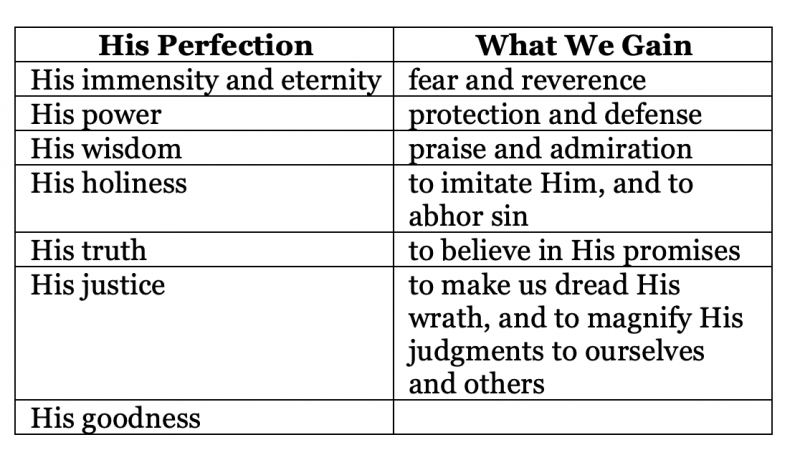
    Hannam gave us a little more direction on how to apply our meditation. He said we should meditate on God’s perfections and told us what we gain.

    MeditationOnGodsPerfection

    What I get from all of this is we need set times to do the thinking. Oh, yeah. We all can have our moments when we turn on the reflections. But this is talking about a defined, intentional process to tie into God’s plan for our lives.

    We shouldn’t leave our meditation to chance. But so often, we do (four fingers pointing back at me, here).

    Shedd reminded us that our happiness depends on the quality of our thoughts. When God is the focus of our thoughts, our happiness is secured.

    Resource

    Father God. We want to meditate on You all day long. Help us to think on You in our hearts and in our minds so that we may please You. Amen.

    What do you think?

    Leave me a comment below (about this or anything else) or head over to my Facebook group for some interactive discussion.

    If you don’t understand something and would like further clarification, please contact me.

    If you have not signed up for the email daily or weekly providing the link to the devotions and the newsletter, do so below.

    If God has used this devotion to speak with you, consider sharing it on social media.

  • How Do We Overcome the Corruption of Bad Thoughts?

    We are on the Sanctification Road to become more like God. Beginning a study on thoughts and meditation, this daily devotional looks at studying Scripture and returning to our first love.

    Nuggets

    • Studying the Scriptures cleanses bad thoughts.
    • We cleanse our thoughts when return to having a strong relationship with God.

    To read devotions in the Redo for Godliness series, click the appropriate button below.

    Devotions in the How Do We Live Godly Lives? series

    How Do We Use Our Thoughts through Meditation?
    How Do We Prevent Bad Thoughts?
    How Do We Order Our Evil Thoughts?
    How Do We Focus on Good Thoughts?

    We’re going to be looking at part of Charnock’s sermon entitled The Sinfulness and Cure of Thoughts. His intent was to show us how to cleanse, a.k.a. sanctify, our thought processes. He described our thoughts as the “… inward operations of the souls of men …”

    I love how Charnock described how described what happened when Satan tempted Adam and Eve. He wrote, “Original corruption stuffs us with bad thoughts …”

    Resource

    That made me laugh. It also made me feel like a Thanksgiving turkey.

    Let’s start off by seeing how Charnock suggested we cleanse those bad thoughts.

    Studying Scripture

    “And it is my prayer that your love may abound more and more, with knowledge and all discernment so that you may approve what is excellent, and so be pure and blameless for the day of Christ” (Phil. 1: 9-10 ESV)

    Studying the Scriptures cleanses the bad thoughts.

    Let’s address the last verse first. We are doing the redo for godliness so that we can improve. That improvement equates to successfully completing the Sanctification Road.

    Our goal is to be “… pure and blameless for the day of Christ” (Phil. 1: 10 ESV). That will lead to perfection.

    We get to perfection through prayer, love, knowledge, and discernment. Charnock focused on the knowledge part of the verse. He zeroed in on studying the Scriptures. Still, the knowledge increases our prayer, love, and discernment.

    We get to perfection through prayer, love, knowledge, and discernment.

    Let’s focus on the knowledge and love. The two are linked together. Knowledge is needed to grow love.

    That being said, Liddon wrote, “He [Paul] does not pray that their knowledge may abound more and more in love. Whenever knowledge and love are put in competition, the precedence is always given to love. As compared with knowledge love is intrinsically stronger, and worth more practically.”

    Resource

    Liddon argued that thought must also be linked with love and knowledge. Gordon agreed. He wrote, “Knowledge reveals character and character draws out love.”

    Resource

    Isn’t it true that we lack knowledge of the Scriptures? I know for years I didn’t study them like I should have. We don’t give reading them the priority we should. That doesn’t even address studying them and meditating on them.

    Knowledge supplies the foundation for love. We can’t love something about which we know nothing.

    Emmons reminded us that this won’t be perfect knowledge. We aren’t God. God isn’t going to tell us everything. Some of what He tells us, we aren’t going to understand.

    But Emmons had it right. We have to love the True God. We can’t say we love God because He gives a pass to sinners. Sinners are all people who have not made a genuine profession of faith — who have not sincerely ABCDed.

    The ABCDs of Salvation

    If you have not become a believer in Christ, please read through the
    Plan of Salvation and prayerfully consider what God is asking you to do.

    A – admit our sins
    B – believe His Son Jesus is our Redeemer
    C – confess God as Sovereign Lord

    D – demonstrate that commitment by making any changes needed in our lives to
    live the way in which God has called us

    The Disciple’s Job Description

    God really doesn’t overlook sin. He gives a pass to sinners who repent. Repentance is acknowledging our separation from God and expressing sorrow for breaking God’s laws and commandments by making the commitment to changing ourselves through obedience so that we no longer do the wrong things.

    Resource

    It is clear that, in order to know God, we have to search for Him and seek Him. It can’t be a halfhearted encounter.

    Searching for and Seeking God

    Hearing His Word (Rom. 10: 17).
    Reading His Word (Rev. 1: 3).
    Praying to Him (Heb. 4: 16).
    Studying His Word (Ac. 17: 11).
    Meditating on His Word (Ps. 1: 1-2).
    Memorizing His Word (Ps. 119: 11).

    We must delve into the Scriptures to find the many facets of the Sovereign God. We do that not only by hearing and reading His Word, but by studying it, meditating on it, and memorizing it.

    We must bathe all of that with prayer. Prayer is a two-way communication with God in which we pour out our soul to Him. It is only through this direct communication do we truly come into contact with our Heavenly Father.

    Returning to Our First Love

    “But I have this against you, that you have abandoned the love you had at first” (Rev. 2: 4 ESV)

    We cleanse our thoughts when return to having a strong relationship with God.

    We’ve talked about falling away from our first love before. Jesus accused the Church of Ephesus of doing this.

    To read a devotion in the First Love series, click on the appropriate button below.

    We’ve considered about this overall. However, we did not look at this through the lens of losing our first love through our frame of mind. Let’s see what we can see.

    “Reflect often upon the frame of your mind at your first conversion. None have more settled and more pleasant thoughts of Divine things than new converts when they first clasp about Christ, partly because of the novelty of their state, and partly because God puts a full stock into them; and diligent tradesmen at their first setting up, have their minds intent upon improving their stock. Endeavour to put your mind in the same posture it was then” (Charnock, The Sinfulness and Cure of Thoughts)

    Our thoughts play a role in salvation and returning us to our first love.

    Let’s start with a review. Our faith begins in our mind. Jay wrote, “All religion commences in serious thought. There is nothing more useful than self-recollection; there is no means better for reviving the soul than a review of former experiences.”

    Resource

    That is where it starts before we get it to the heart level. However, thoughts continue to play a role.

    Mitchell argued that it is difficult to identify when disciples have lost their first love. He wrote, “The soul itself is perhaps hardly conscious of it. Or if conscious of anything, it is that prayer is not so easy and pleasant as it used to be, that the thoughts are more wandering, that temptation is more attractive, and thanksgiving is irksome, unreal, and unblessed. The whole tendency of our being is to deteriorate.”

    Resource

    Oh, yeah. Those wandering thoughts get us every time.

    But these thoughts also help us, don’t they? They are how we evaluate ourselves.

    If our thoughts are wandering all over kingdom come, it is harder to corral them to take an in-depth assessment of how things really are. We either don’t start or give up before we get ours reconciled with God.

    Unfortunately, Aitken called it right when he said that many times we lose our first love through thoughtlessness. That makes sense when we tie it to what Bushnell says about “… the heavenly in feeling [becoming] the heavenly in choice, thought, judgment, and habit …”

    Resource

    God gives us the choice of whether or not we are going to follow Him. It is called free will. Free will is the ability within us to make decisions, which determine actions that produce character.

    That choice means God is not a dictator. He does not force us to do His Will.

    But that also makes us to choose daily whether we are going to follow Him. “This Book of the Law shall not depart from your mouth, but you shall meditate on it day and night, so that you may be careful to do according to all that is written in it. For then you will make your way prosperous, and then you will have good success (Josh. 1: 8 ESV).

    What is meditate? It is to think about it, reflect on it, deliberate and engage in it. (We will look at it more in depth in the next devotion.)

    Doing all of that is what is needed to reconcile us with God. That shows us where our relationships with God is out of kilter and what we need to do to fix them.

    HowDoWeOvercomeTheCorruptionOfBadThoughtsPin

    Making the Connections

    Spring described holiness as obedience to the truth. Wow! I like that.

    Resource

    • Holiness is the transcendent excellence of His nature that includes elements of purity, dedication, and commitment that lead to being set apart.
      • Purity means possessing God’s moral character, having eliminated the stain of sin.
    • Obedience means to hear, conform to, and carry out the instructions that God gives us.
      • God’s truth is faithfulness that leads to godliness.

    The best way to gain knowledge is to experience something. The best way to know God is to experience His love and grace.

    How Do We Apply This?

    • We cleanse our thoughts by focusing on God.
    • We have to reflect God’s love, not just worldly love.
    • We should study God’s perfections and attributes, the mystery of the gospel, and Christ’s teachings.

    Resource

    Father God. We want to know of You. We want to focus our thoughts on You. Tell us what we need to know and can understand. Amen.

    What do you think?

    Leave me a comment below (about this or anything else) or head over to my Facebook group for some interactive discussion.

    If you don’t understand something and would like further clarification, please contact me.

    If you have not signed up for the email daily or weekly providing the link to the devotions and the newsletter, do so below.

    If God has used this devotion to speak with you, consider sharing it on social media.

  • The Silence of Waiting on God

    We probably are more able to link silence and waiting in our minds because we picture the absence of action in those words. This daily devotional looks at how waiting silently on God is filled with action.

    Nuggets

    • God wants us to wait silently on Him, not compare ourselves to worldview people who are considered successful.
    • We are called to wait and rest in God, but that doesn’t mean we aren’t doing anything.

    To read devotions in the Redo for Godliness series, click the appropriate button below.

    Devotions in the Silence of the Soul series

    I just realized I don’t have a definition for waiting. I don’t even have a glossary entry for it.

    Wow! Have we not really talked about this before?

    Let’s Put It into Context

    Our soul is our spiritual part that is immortal. The mind is a component of the soul that controls our will. It is in our minds that we process and make judgments and decisions.

    If we synthesize what Spurgeon said, we come up with a decent definition of rest: the act of being securely content and confident in order to wait on God’s Will. It is a defining characteristic of being a disciple of Christ.

    Resource

    Crofts provided us with the elements for a definition of wait. To wait is to endure something for however long we are called to do so by the Lord.

    Resource

    Here is a running list of what we’ve discussed previously.

    Waiting Means not Fretting

    “Be still before the Lord and wait patiently for him; fret not yourself over the one who prospers in his way, over the man who carries out evil devices!” (Ps. 37: 7 ESV)

    God wants us to wait silently on Him, not compare ourselves to worldview people who are considered successful.

    Psalms 37: 7 tells us two things. We are to silently wait on God, and we aren’t supposed to be envious. Let’s take that last part first.

    It can get frustrating when it seems like sin is winning. If we were calling the shots, we would have the punishment immediately follow the sin.

    God doesn’t work that way. He will judge the sinful and sentence them accordingly on His timeline.

    So, disciples have to wait for good to overcome evil.

    Short gave us some good advice. When we have questions about circumstances, he advised us to “… not vainly argue the question; be silent to God, and he will speak by-and-by and explain the difficulties of his providence.”

    Resource

    Ooo, baby. Don’t we want to argue the question? “Why does Tom get the nice fancy house when he doesn’t live his life for You?” “Sally doesn’t deserve the promotion because she doesn’t have Your character.” “Elaine has made so many bad choices in her life that You shouldn’t be rewarding her in this way.”

    What we are really saying is I don’t, I do, and I haven’t. Where is mine?

    Hmmm. Now we are trying to tell God how to run His world???? That is arrogant of us.

    Wilcox gave us a list of why we should wait in silence on God rather than think we need to call the shots. He gives us

    • His provision
    • His guidance
    • His protection
    • His faithfulness
    • His promises
    • His love

    Resource

    That is especially true when the root of our dissatisfaction is envy. We want what they have — the house, the promotion, and the rewards — along with a long list of other things!

    We also sometimes get on a wild hair thinking God has to explain His actions to us. He doesn’t. He is the One in control, not us. That is probably more critical than being envious.

    Don’t get me wrong. Being envious is bad enough. But when we start questioning God — and start finding fault in Him — that is when things have really gone from bad to worse.

    We really don’t want the envy to slide into anger. If we are not careful, we let them destroy our faith.

    Instead, the psalmist tells us to silently trust in God. We are told to hold still.

    We are told to be content with what we have. Paul told us in Philippians 4: 12 that “I know what it is to be in need, and I know what it is to have plenty. I have learned the secret of being content in any and every situation, whether well fed or hungry, whether living in plenty or in want” (NIV). Anything less, we would be ungrateful to God.

    If we are looking at the situations of others, we aren’t focusing on our inward selves. God is more interested in the inward.

    If we are looking at the situations of others, we aren’t focusing on our inward selves.

    Ooo, baby. I know it is difficult to keep the focus inward when everything outward is a royal mess.

    Short said another great thing. He wrote, “But the righteous have an inward life that turns outward things into gold; they feast royally at the table of God, as is said in the twenty-third psalm.”

    Resource

    If we get the inward right, the outward will fall into place.

    But by then, the outward isn’t as important.

    Waiting Means Trusting

    We are called to wait and rest in God, but that doesn’t mean we aren’t doing anything.

    The King James Version translated be still as “rest in the LORD, and wait patiently for him …” (Ps. 37: 7 KJV). Bailey reminded us how detrimental it is to our health to not get rest.

    Resource

    That doesn’t mean just hitting the snooze button in God’s presence. It means turning control of our lives over to Him.

    Wilberforce called it a quality of mind. The quality is degraded when we are bitter about the present and fear for the future. He wrote, “We need to be silent before God in order to realize our personal reconciliation with Him through the blood of Atonement, to walk in His Spirit, to spend our lives as His obedient, trusting children. Now, this is the essence of Christianity.”

    Resource

    We like to think resting and waiting means doing nothing — there are no actions required of us. Davies reminds us that there is nothing further from the truth.

    Resting and waiting are actions. They are conscious decisions.

    Resting and waiting are actions. They are conscious decisions.

    Okay. I have to figure out what Davies is saying, so here goes Elaine-speak.

    Salvation begins with repentance — but we’ve said before that salvation is a three-step process.

    Step one is only being changed from spiritually dead to spiritually alive. Step two is going from milk babies to steak adults.

    That is where the work of the Sanctification Road takes place. This is where the deep change to obtain God’s character happens.

    Changing takes waiting. It doesn’t happen overnight — it happens over our lifetime.

    Growth can be hard to measure because, as Wilberforce reminded us, growth is silent — it is gradual. He also reiterated that this growth wouldn’t be natural.

    Resource

    Davies wrote, “To wait patiently upon the Lord is a means of grace, but it is also a feature of a lofty spirit. Our God is the ‘God of patience.’”

    It is through God’s grace that we gain His character. We have to wait on His gift. The only actions that are required of us are those of obedience.

    We have to respond to God’s call to turn everything over to Him. I was just thinking of a bumper sticker that was popular when I was growing up. It said, “Jesus is my Co-Pilot.” The problem with that is we think we are the pilot.

    We aren’t. God is the Pilot — Jesus is the Co-Pilot — and we are in the passenger’s seat.

    Oh, yeah. We had to buy the ticket to board the plane — and we have to do more than just sit there.

    But God is in control.

    TheSilenceOfWaitingOnGodPin

    Making the Connections

    Huntingdon said something real interesting. He wrote, “Goodness is not so much specific deeds as a faithful heart.”

    Resource

    All the good deeds in the world will add up to nothing if they aren’t done to please and praise God.

    That sums up what I am forever trying to say. It isn’t the deed that is important; it is the motivation behind it. All the good deeds in the world will add up to nothing if they aren’t done to please and praise God.

    Huntingdon agreed with me in that perfection is about being rather than doing. The heart waiting in silence for God to speak and work is what goodness is about, not what deeds we perform.

    Perfection is about being. It is about obtaining the character of God.

    How Do We Apply This?

    • We are to be meek. Meekness is a personality trait exhibiting a mild or moderate disposition that places dependence on God.
    • We shouldn’t worry about the prosperity of others. We need to focus on strengthening our own faith.
    • We should pray for others instead of being envious.
    • We are to rest in the Lord — acknowledge He is Judge and Jury and be okay with it.
    • We are to be in the world but not of it.
    • We have to actively rest and wait on God. This is how He prepares us for His service.
    • We shouldn’t lose heart or expectation. We should remain confident to do whatever God calls.
    • We need to choose to rest in God in everything, not what we pick and choose.

    Resource

    Psalms 37: 7 tells us to wait and rest in the Lord. We are able to do that — with God’s help. He wouldn’t tell us to do that if He couldn’t or wouldn’t make that happen.

    We have to choose to be God’s children. God doesn’t force us to decide to follow Him. It is totally voluntary.

    That also means we need to choose to wait and rest in silence. We have to let God accomplish that in us.

    God is in it to win it. We have to be, too.

    Father God. We choose to wait for You, Lord. We rest in You. Help us to follow Your Will for our lives. Amen.

    What do you think?

    Leave me a comment below (about this or anything else) or head over to my Facebook group for some interactive discussion.

    If you don’t understand something and would like further clarification, please contact me.

    If you have not signed up for the email daily or weekly providing the link to the devotions and the newsletter, do so below.

    If God has used this devotion to speak with you, consider sharing it on social media.

  • The Silence of Humble Confession

    We need to silence ourselves so that we can focus on God as He is calling us to salvation. This daily devotional looks at what a humble confession is and how and why we confess.

    Nuggets

    • Silence is the foundation of a humble confession.
    • Salvation comes only through believing God sent Jesus to die to pay the penalty for our sins and, because of that belief, submitting to Him as Sovereign Lord.
    • There is an important reason why we are silent and confess to God.

    To read devotions in the Redo for Godliness series, click the appropriate button below.

    Devotions in the Silence of the Soul series

    The intersection of faith and repentance is confession. But how does that provide us silence in our soul?

    Let’s Put It into Context

    Our soul is our spiritual part that is immortal. The mind is a component of the soul that controls our will. It is in our minds that we process and make judgments and decisions.

    Confession is a declaration that we have sin in our lives and are a repentant sinner, a conscious request to God for forgiveness of that sin, and the commitment of faith that God, as Sovereign Lord, can and will forgive those sins.

    Here is a running list of what we’ve discussed previously.

    What Is a Humble Confession?

    “For thus said the Lord God, the Holy One of Israel, ‘In returning and rest you shall be saved; in quietness and in trust shall be your strength.’ …” (Isa. 30: 15 ESV)

    Silence is the foundation of a humble confession.

    We were separated from God as a consequence of the original sin. That necessitates the return.

    Glossary

    God sends His Holy Spirit to convict us of our sins. Sins are actions by humans that disobey God and break one of His reasonable, holy, and righteous laws and commandments, goes against a purpose He has for us, or follows Satan’s promptings. The Spirit teaches us how to return to Him.

    We won’t know true silence until we return to God. We start to experience the silence so that we can focus on the Holy Spirit’s promptings.

    The silence, however, is also a product of our turning to God, Look where it comes in: returning, rest, quietness, and trust.

    Robins brought up a dichotomy within God’s church. While God teaches us collectively, He also teaches us individually.

    God is teaching us all, however, the same thing. Robins wrote that it was “… that upon Him they are to depend, and not upon human help.” We are to look to God alone for our protection and provision of our needs.

    Resource

    When we figure that our dependence is on Him, we fully return to Him. We humbly confess to Him by ABCDing.

    The ABCDs of Salvation

    If you have not become a believer in Christ, please read through the
    Plan of Salvation and prayerfully consider what God is asking you to do.

    A – admit our sins
    B – believe His Son Jesus is our Redeemer
    C – confess God as Sovereign Lord

    D – demonstrate that commitment by making any changes needed in our lives to
    live the way in which God has called us

    The Disciple’s Job Description

    We sometimes talk of returning to God broken. Don’t think of that in worldview terms. We aren’t talking about a physical brokenness.

    This is more of a concept of our knowing just how much we need God in our lives. We are broken in terms of struggling against and resisting Him.

    The cessation of our struggles against God brings us rest. This is tied up in our dependence of Him. We don’t have to be the Lone Ranger, struggling against Satan ourselves.

    Norwood reminded us that quietness and confidence are states of the mind. Merry defined those concepts for us. He wrote, “‘Quietness’ is just collectedness, repose, equanimity, freedom from excitement and boisterousness. ‘Confidence’ is trust, reliance, upon God, producing, if not implying, a calm and steadfast courage.” He called them strength of character.

    Resource

    I love how Norwood corrected our thinking on quietness. It is easy to buy into the worldview opinion that being quiet shows weakness. Instead, Norwood said that “it means strength of purpose, combined with calm collectedness of thought as well as of word and act.”

    Resource

    There is nothing weak about resting in God.

    Confidence is a skill that we can grow. I love that Norwood called it “… faith in exercise” and our link to God.

    We exercise that faith by searching for and seeking God. Faith is the conviction that the doctrines revealed in God’s Word are true, even if we do not understand all aspects of them, a belief which impacts our lives. We grow our endurance as we grow our faith.

    Searching for and Seeking God

    Hearing His Word (Rom. 10: 17).
    Reading His Word (Rev. 1: 3).
    Praying to Him (Heb. 4: 16).
    Studying His Word (Ac. 17: 11).
    Meditating on His Word (Ps. 1: 1-2).
    Memorizing His Word (Ps. 119: 11).

    It is a progression, isn’t it? Once we return to God, we find rest in Him. As we quiet our souls to listen to His promptings, our trust in Him grows.

    We exercise that faith by searching for and seeking God.

    How Do We Confess to God?

    “To the choirmaster: according to Jeduthun. A Psalm of David. For God alone my soul waits in silence; from him comes my salvation. He alone is my rock and my salvation, my fortress; I shall not be greatly shaken” (Ps. 62: 1-2 ESV)

    Salvation comes only through believing God sent Jesus to die to pay the penalty for our sins and, because of that belief, submitting to Him as Sovereign Lord.

    David showed us in the first couple of verses of Psalm 62 what confidence looked like. His soul waited in silence because God was his fortress.

    Spurgeon wrote that these verses extend our discussion on knowing and learning about God. That is important because He is the only avenue to salvation. “There is salvation in no one else, for there is no other name under heaven given to people by which we must be saved” (Ac. 4: 12 CSB).

    Resource

    Salvation is deliverance from evil and the consequences of sins to replace them with good and eternal life. The consequences of sin are spiritual death and physical separation from God. Spiritual death is the spiritual separation from God that occurred as a consequence of Adam and Eve’s original sin. The spiritually alive are those who have ABCDed, so they are no longer separated from God. Eternal life is the promise of living eternally – even if we have died in this life – because we have admitted our sins, believed Jesus as Savior and Redeemer, and confessed God as Sovereign Lord.

    We just need to put our faith in Him. Maclaren described the silent faith as perfect submission.

    The description Maclaren gave reminded me of what we think of being balanced. He wrote, “His whole being is one of great stillness, broken by no clamorous passions; by no loud-voiced desires; by no remonstrating reluctance.”

    Resource

    Glossary

    Maclaren said that we first must use our free will to determine our being silent. We decide how we are going to respond to God’s call of salvation.

    Why Do We Confess to God?

    “Be silent before the Lord God! For the day of the Lord is near; the Lord has prepared a sacrifice and consecrated his guests” (Zech. 1: 7 ESV)

    There is an important reason why we are silent and confess to God.

    One day, we will stand silently before the Lord. This will be called day of the Lord because it is when we will be called home.

    It will be judgment day. Judgment day is a day in the future when this heaven and earth end and God uses Jesus to judge whether sinners have ABCDed and punish them accordingly.

    This is where Jesus will separate the sheep from the goats. How we spend eternity will depend on which cut we make.

    Glossary

    Which cut we make depends solely upon whether we have ABCDed.

    Which cut we make depends solely upon whether we have ABCDed. Have we asked Jesus to be our Savior and lived like we made that decision?

    Making the Connections

    Krause pointed out that Israel’s problem was that they believed something different from what God said. That got them in trouble.

    Resource

    It can get us in trouble, too. The worldview wants us to believe that what God calls sins really isn’t.

    They are going to find out differently because their leader — Satan — is going to lose the war. God alone gets to say what sins are — not Satan and not us.

    Coe warned us that we need to make sure we can identify the worldview. In fact, he felt we need to be able to discriminate between the subtle differences of positions even when we are in agreement.

    Resource

    Robins had another great nugget. He wrote, “Faith has indeed oftentimes its best exercise in the time of the heaviest trial[.] It is made to bring forth its richest and rarest fruits.”

    Resource

    God does put a testing in front of us or allows Satan to throw out a trial in our path. He let’s us figure out for ourselves that we have to depend on Him.

    Then God is right there to hear our confession when we come back to Him. The rewards God brings for successfully navigating those trials are phenomenal.

    TheSilenceOfHumbleConfessionPin

    How Do We Apply This?

    • The strength promised in Isaiah 30: 15 is conditional on our confessing and returning to God. That means we need to confess.
    • We need to trust in God always, regardless of the circumstances.
    • Maclaren reminds us to follow God’s Will in our lives.
    • We should keep worldview thoughts at bay by focusing on God.

    Resource

    Quietness and confidence are strength of character. That means we need to cultivate them during our redo for godliness. Merry gave us a list of components associated with them.

    • Thought
    • Reflection
    • Judgment
    • Self-control

    Merry also gave us this reminder to accomplish our redo. He wrote, “All religious progress depends, primarily and efficiently, upon the grace of God.”

    Resource

    I can see the connection between the quietness and confidence. One is like a giving up and one is like a receiving. We give us the chaos and turmoil to gain the trust.

    It is very important for us to use our free will and make a decision whether or not we are going to accept God’s offer of the Plan of Salvation. Our eternal life is depending on our decision.

    Father God. We know we are separated from You. We admit that we are sinners. We believe that through Jesus is the only way that our relationships with You can be restored. We confess You as our Sovereign God. We dedicate our lives to becoming sanctified so that we will have Your character. Amen.

    What do you think?

    Leave me a comment below (about this or anything else) or head over to my Facebook group for some interactive discussion.

    If you don’t understand something and would like further clarification, please contact me.

    If you have not signed up for the email daily or weekly providing the link to the devotions and the newsletter, do so below.

    If God has used this devotion to speak with you, consider sharing it on social media.

  • Mastering Silence of the Tongue

    Have you ever heard the saying, silence is golden? That means that, sometimes, it is better not to speak. This daily devotional looks at how God wants disciples of Christ to gain silence in our souls.

    Nuggets

    • Silence is a natural cycle.
    • Silence of the tongue doesn’t mean nothing is happening.
    • Learning to govern our tongues to be silent when needed will help us.

    To read devotions in the Redo for Godliness series, click the appropriate button below.

    Devotions in the Silence of the Soul series

    We don’t like silence these days. We play devices so that we can have noise going.

    Silence isn’t golden anymore. We keep talking and talking to get our points across.

    God says that we should be silent so that we can listen to Him. Let’s dig into what He has to say.

    Let’s Put It into Context

    Our soul is our spiritual part that is immortal. The mind is a component of the soul that controls our will. It is in our minds that we process and make judgments and decisions.

    Here is a running list of what we’ve discussed previously.

    Mastering the Ebb and Flow of Silence

    “A time to tear, and a time to sew; a time to keep silence, and a time to speak” (Ecc. 3: 7 ESV)

    Silence is a natural cycle.

    Ecclesiastes 3 is a familiar passage in Scriptures. Even some who do not attend services regularly know of this passage.

    It talks about cycles. There is a normal ebb and flow to the world around us: spring follows winter, summer follows spring – and so on and so on. Each has its own time.

    Speaking has its time – but then, so does silence.

    What this tells me is that silence should not have less of a value than speaking.

    The Homilist tells us of three kinds of silence.

    • Silence of emotional fullness
    • Silence of resignation.
    • Silence of self respect.

    Resource

    It is easy to get choked up when we get emotional. As much as we may want to speak, the words just won’t come.

    The examples the Homilist used for resignation were those of people standing silently before God. I doubt being called to the principal’s office when we were kids would hold a candle to the fear and trembling we would be experiencing in front of Almighty God.

    Jesus provided us an example of self respect. He silently stood before his accusers, confident in his mission, willing to be our Savior.

    Mastering a Working Silence

    “Know this, my beloved brothers: let every person be quick to hear, slow to speak, slow to anger” (Jas. 1: 19 ESV)

    Silence of the tongue doesn’t mean nothing is happening.

    We sometimes tend to focus on what comes out of our mouths — our opinions, our judgments, and our values. God wants us to simmer down.

    God wants us to focus on Him. By doing that, we can hear what He has to tell us.

    Hearing has two products. We are slow to speak and slow to anger.

    Thomas pointed out that what we listen to matters. It needs to be “… the pure, the generous, [and] the true.”

    Resource

    The listening makes us docile — teachable. That is what God wants.

    Devotions in the The Beatitudes Show Us How to be Docile series

    God wants to be able to change us to reflect His character. He wants us to follow the Holy Spirit’s instructions when we navigate the Sanctification Road.

    Isn’t that what it is all about? We can’t hear the Holy Spirit’s promptings when we are too busy running at the mouth. Listening and not talking is a major component of success on the Sanctification Road.

    Glossary

    I really don’t think, like Thomas pointed out, that James was talking about how quickly the words came out of the speaker’s mouth. It is the thoughtfulness behind the utterances.

    To me, it all ties up with the free will. Free will is the ability within us to make decisions, which determine actions that produce character.

    God isn’t a dictator. He doesn’t make decrees and expect us to blindly follow them.

    Instead, God wants us to make conscious, informed decisions as to whether or not we are going to ABCD. Yes, we have an option to reject the Plan of Salvation.

    In order to make that informed decision, we have to actively listen to God. We have to let Him lead.

    That is part of the problem with talking, isn’t it? We are always leading when we are talking.

    Yep, that is where we like to be — in control.

    I guess we have circled around to what our major obstacle in not talking is. We don’t want to give up control.

    Jones pointed out that this verse talks about being both slow and swift at the same time. What I think James is getting at here is that we need to be balanced.

    Resource

    Think about it. If we are always talking and never listening, chances are we are going to get angry if we don’t get our way.

    God calls us to be sober. Sober is a character trait distinguished by self-control, genuineness, and sound moral judgment. It is a calm and temperate disposition.

    We may not be calm if we are clamoring to be heard.

    But don’t take this to the other extreme. Do not read this to say that we should not talk at all. It means that we should speak judiciously. We should speak so that people say, “When you do speak, I know it’s something worth listening to.”

    Jones also reminded us where this verse was in relation to the previous verses. James is a book all about perseverance when experiencing trials.

    James 1: 17 just told us that “every good and perfect gift is from above, coming down from the Father of lights, who does not change like shifting shadows” (CSB). See, if he could say this in the midst of trials, he thought they were spa days, too!

    To read a related devotion, click the button below.

    Paisley made a pretty good point. He noted that the ear, tongue, and heart make a good trifecta in impacting the conduct of mankind. Our heart governs it, but it is influenced with what we do or don’t do with the ear and tongue.

    What is the purpose of all of this? James goes on in the next verse and said, “for human anger does not accomplish God’s righteousness” (Jas. 1: 20 CSB).

    Resource

    That is what it is all about — God’s kingdom work. It is about finding lost souls and introducing them to the Savior.

    And how instrumental are the ear and tongue for kingdom work? Those lost souls will not know the Savior if they do not use their ears to hear what we teach them with our tongues.

    We are only sent off to witness to the lost after we are equipped. We need to be taught, also.

    That can be interesting, sometimes. We know God has that still, small voice He uses. Then, He may take His time talking.

    Other times, we may think we know what God is trying to tell us and steer us toward. But it ends up, we don’t have a clue.

    All of that means that we have to listen carefully when God speaks to us. We need to focus on what He is teaching us.

    Thomas and Paisley both said that following the instructions in this verse should keep us free of prejudice. Thomas felt like it was because we are teachable.

    Mastering the Governance of Silence

    “Whoever keeps his mouth and his tongue keeps himself out of trouble” (Prov. 21: 23 ESV)

    Learning to govern our tongues to be silent when needed will help us.

    Nolan reminded us that two of the Ten Commandments deal with issues of the tongue.

    • “You shall not take the name of the Lord your God in vain, for the Lord will not hold him guiltless who takes his name in vain” (Ex. 20: 7 ESV).
    • “You shall not bear false witness against your neighbor” (Ex. 20: 16 ESV).

    Nolan went on to explain why the breaking of these commandments is critical. He wrote, “A careless, unreflecting use of the holy name betrays a trifling and unstable heart. But with reference to his neighbour, the Christian has the greatest need of caution as to the government of his tongue. What irreparable injury a severe remark, whether carelessly or wickedly whispered against the character of another, is sure to produce.”

    Resource

    The Homilist gave us a list of what troubles we bring when we do not learn to silence our tongues.

    • Moral and social trouble on ourselves
    • Trouble on others

    Resource

    The Homilist made a great point. We control our tongues. It doesn’t work on its own.

    That means we can self-discipline ourselves to govern our tongues. Oh, yes, it will be hard, but we will not do it alone. We can’t self-discipline without God.

    MasteringSilenceOfTheTonguePin

    Making the Connections

    God wants us to be swift to hear and obey His call to salvation. We don’t want to be too late.

    We will all get the opportunity to obey God’s call. We don’t want to deny Him.

    We want to swiftly ABCD.

    The ABCDs of Salvation

    If you have not become a believer in Christ, please read through the
    Plan of Salvation and prayerfully consider what God is asking you to do.

    A – admit our sins
    B – believe His Son Jesus is our Redeemer
    C – confess God as Sovereign Lord

    D – demonstrate that commitment by making any changes needed in our lives to
    live the way in which God has called us

    The Disciple’s Job Description

    How Do We Apply This?

    We need to

    • Recognize God as Sovereign God.
    • Grow in grace and knowledge.
    • Not just learn but to be eager to learn.
    • Continue to be swift to hear because we still have much to learn.
    • Be consistent in our attendance with like-minded believers.
    • Bury ourselves in His Word.

    Resource

    Silence and hearing must be linked, especially when we are listening to God. We must speak of Him to others. In short, we must follow His Will.

    Father God. The chaos of this world can drown You out. Some of that noise is coming from us. Focus us to look solely to You. Amen.

    What do you think?

    Leave me a comment below (about this or anything else) or head over to my Facebook group for some interactive discussion.

    If you don’t understand something and would like further clarification, please contact me.

    If you have not signed up for the email daily or weekly providing the link to the devotions and the newsletter, do so below.

    If God has used this devotion to speak with you, consider sharing it on social media.