Category: Attitude

  • Improving Silence in Our Mind

    Sometimes, it seems our minds are the hardest to corral. This daily devotional looks at how disciples of Christ can focus to silence our minds from the chaos of the world.

    Nuggets

    • Our mind has to trust in God in order to find peace.
    • Part of regeneration into a new creation includes renewing the spirit of our minds.

    To read devotions in the Redo for Godliness series, click the appropriate button below.

    Devotions in the Silence of the Soul series

    When we think of silencing ourselves, we need to think of more than just stopping talking. We need to silence our minds.

    Stennet told us that it is a disciple’s duty to be still. I know. When we are knee deep in trials, it is hard to think that it is our responsibility and obligation to be motionless and rooted.

    What is really hard is when we let our minds control what is going on within those trials. Our mind is not at peace when there are trials. However, we are told that “to be still is to preserve a calm and composed temper of mind under affliction.”

    Resource

    What we are looking at is a state of mind that feeds the silence of the soul. That means the mind is at peace.

    I got a lot of resource materials on this. We may need to revisit this after this series and after we are done with Easter.

    For right now, let’s take a quick look.

    Let’s Put It into Context

    Our soul is our spiritual part that is immortal. The mind is a component of the soul that controls our will. It is in our minds that we process and make judgments and decisions.

    Here is a running list of what we’ve discussed previously.

    Trusting in God Provides Silence

    “You will keep the mind that is dependent on you in perfect peace, for it is trusting in you” (Isa. 26: 3 CSB)

    Our mind has to trust in God in order to find peace.

    We think that we should have peace from an outward perspective. Farrar reminded us that “it is not the promise of freedom from sorrow; it is not, by any means, a promise of success or prosperity on earth: but it is a promise of that inward peace — of that heart’s ease in the breast — with which sorrow itself is a tolerable burden, and without which prosperity itself is a questionable boon.”

    Resource

    When we see peace as the absence of conflict, we take our eyes off of God. God wants us to see and know his peace within the conflict.

    Our mind has a tendency to call up everything we have ever done. The problem is that it tends to paint a gloom and doom picture.

    What the mind tends to showcase is all of our failures. Watkinson wrote, “… this confession is wrung from all when the law comes home and we know ourselves as we are known of God.”

    Resource

    Ooo, baby. Wait a second. Doesn’t that fit into reality of what God wants?

    We tend to think that God sees us as we will be in Heaven — perfect. The perfected state indicates the combination of the graces which, when all are present, form spiritual wholeness or completeness.

    And that is true — after we have ABCDed. This verse talks about having faith. Faith is the conviction that the doctrines revealed in God’s Word are true, even if we do not understand all aspects of them, a belief which impacts our lives.

    We have to realize we are sinners before we can ever think about turning our lives over to God. That only happens when we take an honest look at our sins.

    Forgiveness is still the avenue through which God’s peace flows to us.

    After we’ve become a child of God, we still have to look at our sins. This helps us to confess them so that we may receive God’s forgiveness. Forgiveness is still the avenue through which God’s peace flows to us.

    So, let’s take the flip side of that. If peace flows through forgiveness, discord flows through sin. Discord comes from the opposite of “for I delight in the law of God, in my inner being” (Rom. 7: 22 ESV).

    To read a related devotion, click the button below.

    We can’t have true peace of mind living outside of God’s Will. What Watkinson said in Elaine-speak was that the conflict of the soul begins with the hardships of human life. But he was not meaning social structure as society seems to have latched on these days.

    Watkinson argued that it was because life had lost its purity, we have lost our peace. Only God can make us pure again.

    Trusting on God is dependent on our attitude. But it is more than that.

    It is redoing our character for godliness. We have to imitate Him. Only then can we get the peace that passes understanding (Phil. 4: 6).

    When we look at our circumstances, we are seeking the world. Our focus is not on God. We are looking only at what this life provides. What Knight said when he was talking about the soul can be applied to the mind as well. We need to put our trust in God regardless of the situation.

    Resource

    When we keep our minds focused on God, we put our confidence in Him. That is what God wants. The Weekly Pulpit wrote “that He seeks the trust of His people.” God is actively looking for us.

    Resource

    Brock went one better. He wrote, “The peace which God bestows arises not merely from a consciousness of pardon and restoration to the Divine favour, it springs further from the calming influence which He exerts on the mind by the transforming of the affections from things earthly to things heavenly.”

    Resource

    If we think of trusting as leaning on God, it ties in beautifully with the concept of being dependent upon Him. We not only see that as an anchor but also as a shelter.

    Maclaren kept talking about being steadfast. What popped in my mind was that we are as peaceful as our trust is steadfast. If we aren’t holding onto God as our anchor, our peace isn’t steadfast. Maclaren said that our reward for our steadfastness is being kept by God.

    Resource

    Leaning on God and trusting Him to strengthen and sustain us silences our minds.

    Renewing Our Minds Provides Silence

    “To put off your old self, which belongs to your former manner of life and is corrupt through deceitful desires, and to be renewed in the spirit of your minds, and to put on the new self, created after the likeness of God in true righteousness and holiness” (Eph. 4: 22-24 CSB)

    Part of regeneration into a new creation includes renewing the spirit of our minds.

    Beecher expanded our definition of purity. Purity means possessing God’s moral character, having eliminated the stain of sin.

    Beecher talked about some of the morals at play in these verses. He wrote, “Truth, in opposition to lies; honesty, in opposition to craft and stealing; purity, in opposition to all manner of corrupt desires; general integrity and uprightness — these are inculcated as the indispensable prerequisites of Christian life. Taking them in their inverse order, by ‘purity’ I understand the dominance in the soul of the higher affections and sentiments over the lower appetites and passions.”

    Resource

    How I see what Beecher talked about in application here is the fact that the new creation is going to battle with the old nature. That is going to happen a lot in our minds.

    Think about what we are actually doing there. Benson said we were taking off our sinful nature and putting on holiness. We have to because we are corrupt through and through, including the soul — remember, the mind is a part of the soul.

    Resource

    We absolutely have to take off the old creation and put on the new. If we don’t, we’re just doing lip service to get fire insurance. Benson said that doing that makes us even more guilty.

    The new creation was made by God. We obtain the creation by “… hunger[ing] and thrust[ing] after righteousness …” (Mt. 5: 6 ESV).

    When we think specifically of renewing our mind, Eadie cautioned us that it wasn’t only the mind that was being renewed. He contended that the spirit was also being regenerated. It is, according to Eadie, “… the spirit which inhabits and governs it is entirely changed.”

    Resource

    That makes sense. God isn’t renewing the physical body — that will one day go away. He is renewing the soul and the spirit, which is immortal. He is changing us from being spiritually dead to spiritually alive.

    Spiritual death is the spiritual separation from God that occurred as a consequence of Adam and Eve’s original sin. The spiritually alive are those who have ABCDed, so they are no longer separated from God.

    In all of this, did you catch that the mind is where we make our decisions. We have the free Will to make those decisions.

    We must decide to have a renewal for God. It must be a mental and moral renewal. We’ve got to turn ourselves over to Him.

    ImprovingSilenceInOurMindPin

    Making the Connections

    Peace in our hearts tells us the condition of our minds. Farrar wrote, “The existence or the absence of peace in our hearts is no slight indication of our true condition, for, as peace must exist with the righteous even in the midst of adversity, it cannot exist in the hearts of the wicked, however smiling, however prosperous their lot.”

    Resource

    We know that absence of peace is when Jesus is absent from our hearts. Watkinson said that the peace is absent because of a “… profound moral mistake …” — namely the mistake of sin in our lives. Only through the life and peace to be obtained through Jesus can that mistake be rectified.

    Resource

    Unfortunately, though, I think too many people want perfect peace that means no discomfort of the soul. That is not going to happen, even among disciples. The only time we will have a trouble-free life is when this life is over. Those who have never ABCDed, will continue to experience a troubled life.

    How Do We Apply This?

    • To obtain peace in our minds and our souls, we must ABCD.
    • Our souls need to trust in God in both our present situation and future salvation. To do this, we proclaim His name. Sometimes, that feels like all we can do.
    • Faith is in the mind. As we grow our faith, we should strengthen and calm our mind.
    • We must strengthen our confidence in Him, remain calm, and exercise a consistent trust.
    • We need to bag pride and self-will. We need to focus on God instead.

    The ABCDs of Salvation

    If you have not become a believer in Christ, please read through the
    Plan of Salvation and prayerfully consider what God is asking you to do.

    A – admit our sins
    B – believe His Son Jesus is our Redeemer
    C – confess God as Sovereign Lord

    D – demonstrate that commitment by making any changes needed in our lives to
    live the way in which God has called us

    The Disciple’s Job Description

    Resource

    Our minds and souls will know peace to the proportion that we have placed our confidence in God.

    Our minds and souls will know peace to the proportion that we have placed our confidence in God. Birch wrote, “When the mind leans for strength upon itself it cannot be at peace.” We have to lean on God.

    Resource

    Picture Jesus standing in between you and your circumstances. God isn’t on the other side of your circumstances. He is right beside you.

    Notice, this peace only comes from God and only comes through trusting God. There will be no substitutes.

    We have to focus our minds on God, as we do that, we will fall silent as we see Him work in our lives.

    Father God. It is so easy to get caught up in the rat race of this world. To keep up, our minds go zero to 60 in .0002 seconds. Help us to calm our minds. We can only do that by focusing on You. Silence our mind so we at hear You still, small voice. Amen.

    What do you think?

    Leave me a comment below (about this or anything else) or head over to my Facebook group for some interactive discussion.

    If you don’t understand something and would like further clarification, please contact me.

    If you have not signed up for the email daily or weekly providing the link to the devotions and the newsletter, do so below.

    If God has used this devotion to speak with you, consider sharing it on social media.

  • Promoting Silence in Our Soul

    With the chaos and uncertainty happening, we want our redo for godliness to bring peace to our souls. To do that, we need to silence our souls. This devotion begins our look on what that means.

    Nuggets

    • When we have silence in our soul, we allow the peace of God to counteract Satan’s chaos of this world.
    • We need to sit in silence and listen to God when He is calling us to salvation and regeneration.
    • God’s priority is our salvation.

    To read devotions in the Redo for Godliness series, click the appropriate button below.

    I came across Edwards’ sermon Of Taking Up the Cross when we were doing the What Should We Do about Who Jesus Is? devotion. Edwards talked about the hindrances and impediments of Christianity. While he also talked about the outward hindrance, I want to focus on the inward hindrance.

    Edwards talked about patience and submission. I really liked one of the phrases he used when talking about being patient. He wrote, “There is not only a silence of the soul, but of the tongue, which is another ingredient of this duty.”

    On the flip side, Edwards wrote, “Consider, that impatience and fretting are no ease at all to us in our calamities, but, on the contrary, they render our grievances heavier and more intolerable.” Oh, yeah! Impatience and trials don’t mix well.?

    Resource

    To read a related devotion, click the button below.

    I really loved the phrase silence of the soul. We need that, but I don’t know if we get there very often. I read all of his other components that made up patience, and I really thought they hinged on silence of our soul.

    So, how do we get from impatience to patient? How do we switch the other chaos of our souls to silence?

    Let’s start off with what silence of the soul is.

    Devotions in the Silence of the Soul series

    Promoting Silence in Our Souls
    Improving Silence in our Minds
    Mastering the Silence of Our Tongues

    The Silence of Humble Confession
    The Silence of Waiting on God
    The Silence of Cheerfulness and Rejoicing

    Let’s Put It into Context

    Our soul is our spiritual part that is immortal. The mind is a component of the soul that controls our will. It is in our minds that we process and make judgments and decisions.

    What Is Silence of the Soul?

    “Be still, and know that I am God. I will be exalted among the nations, I will be exalted in the earth!” (Ps. 46: 10 ESV)

    When we have silence in our soul, we allow the peace of God to counteract Satan’s chaos of this world.

    Yeah, we’ve just had a year where sheltering at home made many who were going full speed ahead to slow down, if not stop all together. Even so, the chaos was still felt.

    But I think being still with God is more than that. Maurice said this: “Only the belief of a Presence near us, with us, can inspire habitual awe, can keep us steady when all things are rocking around us, can take away the eagerness to move, or the cowardice which paralyzes movement.”

    Resource

    Silence of our soul starts out with being in the Presence of God. The Holman Bible Dictionary defines the Presence of God as “God’s initiative in encountering people.”

    Resource

    Yes, it is God knocking on the door of our hearts, so that we will accept Him. He comes to us, offering His peace.

    But that is something that we have to accept. We can only accept when we know. We can only know by being still.

    Moffat made a good point. Most of us think “Be still, and know that I am God …” (Ps. 46: 10 ESV) is an invitation.

    Resource

    We also sometimes think we will only hear “be still” in times of trials. The way we read this is to not fear anything.

    Instead, we should look at “be still” as a command that we have to obey every day.

    Thomas made an interesting comment. He wrote, “Self-knowledge, God-knowledge — these can never be had until we have learned to be still.”

    Resource

    Look at it this way. God has an individual relationship with each of us. No two relationships are alike.

    The only way we are going to build and strengthen that relationship is to listen to what the Holy Spirit has to tell us. We only hear when we settle down and are still.

    We should be willing to listen because He is God. Thomas wrote , “… there is a knowledge which is to be had only in the stillness of devout meditation — the soul’s personal knowledge of God.”

    Resource

    Oh, that is so against our nature. We are doers. We want to be able to depend on ourselves, do it ourselves, earn our salvation because of our works.

    It doesn’t work that way.

    We need to sit still. We need to keep the focus on God. O’Meara called it “… silence from all other voices …” Jowett argued that we can only gain knowledge about God through silence.

    Resources

    The only work we do is to work out our salvation. We are to work in a specific way. Macleane wrote, “When we are called upon to work out our own salvation it is with fear and trembling indeed, but with the calm assurance nevertheless that it is God which worketh in us to will and to do of His good pleasure.”

    Resource

    There are different ways that we need to know God. First, we need to know He exists. “… know that I am God …” (Ps. 46: 10 ESV).

    Second, we have to know God really does possess all the attributes. We have to acknowledge His greatness.

    To read a devotions in the Finding Our Center series, click on the button below.

    Third, we need to personally know God. That is the only way we will be able to take the focus off the chaos of this world.

    That is where the work comes in. We have work to settle ourselves so that we can be taught by the Holy Spirit.

    We have work to settle ourselves so that we can be taught by the Holy Spirit.

    Waiting in Silence for God

    “Let him sit alone in silence when it is laid on him” (Lam. 3: 28 ESV)

    We need to sit in silence and listen to God when He is calling us to salvation and regeneration.

    Lamentations 3 is an interesting chapter. It talks about a person who has been punished by God. The first 20 verses are all gloom and doom.

    Then comes verses 21-23. “But this I call to mind, and therefore I have hope: The steadfast love of the Lord never ceases; his mercies never come to an end; they are new every morning; great is your faithfulness” (Lam. 3: 21-23 ESV).

    Jeremiah wrote that God wants us to wait quietly. What we are waiting for is His salvation (Lam. 3: 26).

    Once we are alone with God, we can truly search for and seek Him. He will spend the time with us to convict us and to answer our questions.

    Searching for and Seeking God

    Hearing His Word (Rom. 10: 17).
    Reading His Word (Rev. 1: 3).
    Praying to Him (Heb. 4: 16).
    Studying His Word (Ac. 17: 11).
    Meditating on His Word (Ps. 1: 1-2).
    Memorizing His Word (Ps. 119: 11).

    To me, this just fleshes out how we are to “be still, and know that I am God …” (Ps. 46: 10 ESV). We are to

    • Sit alone (Lam. 3: 28).
    • Keep hope (Lam. 3: 29).
    • Give up our sense of entitlement and arrogance by turning the other cheek (Lam. 3: 30).
    • Self-evaluate (Lam. 3: 40).
    • Praise God (Lam. 3: 41).
    • Call upon the name of the Lord (Lam. 3: 55).

    I love what Spurgeon called it. He called it submissive silence. I think that is what silence of the soul is all about.

    Resource

    Silence of the Flesh

    “Be silent, all flesh, before the Lord, for he has roused himself from his holy dwelling” (Zech. 2: 13 ESV)

    God’s priority is our salvation.

    This verse takes silence a different way — but does it?

    Watson took being silent before God as accepting either His mercy or His judgment. He wrote, “When wickedness prevails, when error spreads, when the Church is wasted, then the Almighty is represented as shutting His eyes, turning away His face, withholding His hand, and resting in His holy place. But when He makes Himself manifest in judgment or mercy, when He has nations to punish or to bless, when His Church calls for protection and help, then He is ‘raised up out of His holy habitation,’ and ‘all flesh’ is commanded to ‘keep silence’ before Him.”

    Resource

    I can see that. When we are corrected, we generally do not feel like talking. When we are shown mercy, sometimes we are overwhelmed and can’t talk, either.

    But if we look at the rest of Zechariah 2, we see Zechariah is sent to witness to someone. This is about calling the Israelites back from the Babylonian captivity.

    That speaks to me. If we think about it, the flesh is our human nature. When we do the substitutions, it makes sense to me.

    Be silent, human nature. Stop sinning before the Lord, for he has judged you and sentenced you to the Babylonian captivity. But now He has mercy on you and is calling you to salvation.

    That is what happened. Adam and Eve were God’s children. Then, they caved to Satan’s temptation. God passed judgment on their sin and they were cast out of the Garden of Eden.

    But God showed mercy on them. He designed the Plan of Salvation. He sent His Son Jesus to die to pay the penalty for our sins.

    Glossary

    God is always going to put our salvation experience as a priority. Our spiritual translation is more important than anything in His eyes.

    PromotingSilenceInOurSoulPin

    Making the Connections

    It is really important that we chill and let God work His salvation and regeneration in us. “This is what the Sovereign LORD, the Holy One of Israel, says: ‘Only in returning to me and resting in me will you be saved. In quietness and confidence is your strength …’ (Isa. 30: 15 NLT).

    Only in resting in the Sovereign God will we be saved. We can do nothing on our own to save us — only God can. Remember, after conversion, we are working out our salvation through regeneration.

    Yet, we try to work it out ourselves. “We sometimes leave too small a part for God in our work. We think that our carefully prepared sermon or lesson will do its own work, and forget to pray that the Holy Spirit may carry it home. We can teach truth. God alone can make that truth life-giving.”

    Resource

    How Do We Apply This?

    • Look for God working in our lives, not making sure God is working our plan out.
    • Take a step back when we want to get judgmental.
    • Practice submissive silence.
    • Humbly confess our sins.
    • Don’t run ahead of God.
    • Don’t sit back and wait for God to give us everything. We serve Him.
    • Don’t practice idle talk.
    • Don’t make excuses for our sin.
    • Don’t judge God and complain about Him.
    • Bag our arrogance and holier-than-thou attitudes.
    • Don’t try to elevate ourselves to be equal to or above God.

    Resources

    Really, what it all boils down to is when we are still and focused on God, we are submitting to Him. Whatever God calls us to do, whoever He calls us to be — we need to say, “Yes, Lord.”

    Resources

    Silence of the soul is a fancy way of saying focus on God. There are several other things we need to silence to have the best focus. In the next devotion, we will be talking about silencing our minds.

    Father God. We want to silence our souls. We want to take our focus off the chaos of this world and put it firmly on You, the giver of peace. Help us tune out everything except Your still small voice. Amen.

    What do you think?

    Leave me a comment below (about this or anything else) or head over to my Facebook group for some interactive discussion.

    If you don’t understand something and would like further clarification, please contact me.

    If you have not signed up for the email daily or weekly providing the link to the devotions and the newsletter, do so below.

    If God has used this devotion to speak with you, consider sharing it on social media.

  • Improving Our Discipleship through Our Morality

    In the last three devotions, we have been looking at how to improve our discipleship through our morality. This daily devotional reviews what we’ve discussed and makes the connections and applications.

    To read devotions in the Redo for Godliness series, click the appropriate button below.

    Devotions in the Moralities Lead to Godliness series

    We are looking at how Manton began to tie up his sermon entitled The Moralities of Christianity. Our purpose in this devotion is to make the connections and applications for this section. We have covered a lot of ground in the last three devotions alone.

    Resources

    Let’s Put It into Context

    The definition of moral, according to the Merriam-Webster Dictionary, is “of or relating to principles of right and wrong in behavior.” Morality, then, is “a doctrine or system of moral conduct.” When it is the plural form — moralities — it is a “particular moral principles or rules of conduct.”

    Resources

    Our morals determine our character. Character, according to the Merriam-Webster Dictionary, is “the complex of mental and ethical traits marking and often individualizing a person, group, or nation.”

    Resource

    Making the Connections

    The Moral Code Given through the Law

    • God gives us definite instructions as to what is right and wrong. Our morality is contingent on the grace of God. We are moral people because grace teaches us to be holy (Improving Our Discipleship through Right and Wrong).
    • The laws show us God’s character. But they aren’t the end-all, be-all. The law won’t save us as faith is more than just a rote memorization of the laws and commandments that make up the morals. We could be a good person who follows the laws perfectly and still miss heaven. We have to expand the morals to make them graces (How Do Morals Improve our Discipleship?).
    • Our intent in coming to God should be so that we become in harmony with Him. The laws and commandments must change our character at the heart level to be like His. We can’t do this by ourselves (How Do Morals Improve our Discipleship?).
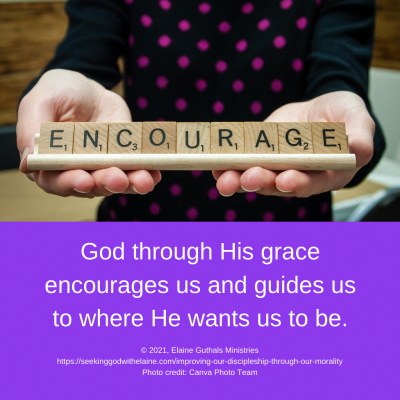
    • God through His grace encourages us and guides us to where He wants us to be. The laws are no longer threatening but instructive. He will use our Sanctification Roads to be more like Him. As we grow our character, we need to use reflection on our previous experiences (How Do Morals Improve our Discipleship?).
    God through His grace encourages us and guides us to where He wants us to be.
    • We glorify God when we have a clear moral conscience. Our consciences attest to the quality of our actions. That validates the need for us to be knowledgeable with God’s code of morals (Improving Our Discipleship through Glorifying God).
    • It is a two-step process in attesting to the quality of God’s moral code. We need to affirm that God’s law is pure. We need to confess we are far from pure (Improving Our Discipleship through Glorifying God).

    Morality Enforced through Our Walk

    • Our morality increases from the sanctification process. Morality is a system of conduct where we determine right from wrong. Isn’t that what the Sanctification Road is teaching us through the Holy Spirit? What we are learning through grace as we navigate our roads is what makes up “… all goodness, righteousness, and truth” (Eph. 5: 9 CSB) (How Do Morals Improve our Discipleship?).
    • Our outward conversations and actions are the visible aspects of our lives. God expects our relationships with Him to be visible to others. Worldview people have to be able to see what we believe. But that stems from the inside (How Do Morals Improve our Discipleship?).
    • God is love (I Jn. 4: 8). When we become like God, we love. When we focus on the greatest commandments, we go a long way to getting there. Love is the root of virtue. God is love. God is the root of virtue (How Do Morals Improve our Discipleship?).
    • We have to approach worldview people with love but realistically. We can’t approach them in ways that accentuates the divide, but we cannot tolerate sin (Improving Our Discipleship through Right and Wrong).
    • The fruit — or rewards — of our walk as children of God are that God can work within us to build a solid relationship that leads to godliness. These morals come from one thing — obedience to God through faith in Jesus. If God isn’t at the core of our morals, the only reward we will receive for doing them is here on earth (How Do Morals Improve our Discipleship?).
    • The “… all goodness, righteousness, and truth” (Eph. 5: 9 CSB) is a packaged deal. We don’t get to choose the goodness and pass on the righteousness part. If we do, we are passing on the God part. They are interwoven. Think of the foundation that builds when the three areas are braided together. The package deal has to become our character (How Do Morals Improve our Discipleship?).
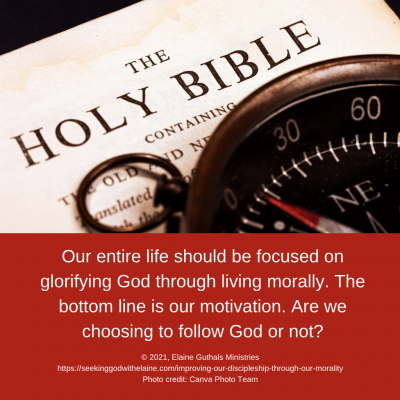
    • Our entire life should be focused on glorifying God through living morally. The bottom line is our motivation. Are we choosing to follow God or not? (Improving Our Discipleship through Glorifying God).
    Our entire life should be focused on glorifying God through living morally.
    • We need to make the choices that bring glory to God. Nothing is too small or too large that it can’t be used to do that. We don’t have to keep finding the next best thing. He wants to be glorified in our everyday lives. When we glorify God through our being and our doing, we are making a big statement that He is worthy of our praise (Improving Our Discipleship through Glorifying God).
    • Worldview people just see the ceremony of religion rather than the relationship for which God is actually striving. They see morality as a man-to-man exercise, not as man-to-God (Improving Our Discipleship through Glorifying God).
    • We glorify God by the good works performed through His righteousness in us. Our being and doing should be to glorify God (Improving Our Discipleship through Glorifying God).
    • We know these works do not justify us in God’s eyes. We use them to express our respect of, tribute to, and obedience to Him (Improving Our Discipleship through Glorifying God).
    • A clear conscience can only come from fulfilling our duties as children of God — to fulfill the greatest commandments. Using them as the bow, we tie together God’s rules and our actions (Improving Our Discipleship through Glorifying God).
    A clear conscience can only come from fulfilling our duties as children of God — to fulfill the greatest commandments.
    • Even though we have a conscience, the decision is still ours. We can follow our conscience’s direction to be a moral person or we can choose not to (Improving Our Discipleship through Glorifying God).
    • Being a memory ties the conscience to our past, formed by our past experiences and past knowledge. It is shaped by the morals to which we have ascribed (Improving Our Discipleship through Glorifying God).
    • Our conscience is not stagnant and can change. It can grow to be more godly (Improving Our Discipleship through Glorifying God).
    • The outward walk without the inward faith means nothing to God. Morals have to be grounded in faith. If our morals don’t come through our submission to God, they are just worldly morals, not Christian graces (How Do Morals Improve our Discipleship?).

    Morality Enforced through Our Faith

    • Our morality is a reflection of our faith and is expressed through love (How Do Morals Improve our Discipleship?).
    • It isn’t just the knowledge of God and what Jesus has done for us. It is having the faith to believe we could never be restored on our own (How Do Morals Improve our Discipleship?).
    • We should come to God in order to become like Him as He is different from us. We want to be obedient and follow His laws and commandments. But it is more than what we do or don’t do. When we submit our will to Him, we truly become like Him (How Do Morals Improve our Discipleship?).
    • We will be forced to make a number of choices choices for or against God every single day. We need to choose what is right and good in order to combat evil (Improving Our Discipleship through Right and Wrong).
    Our morality is a reflection of our faith and is expressed through love

    Morality Is More Choosing Good over Evil than Right Over Wrong

    • In God’s Word, good is always right and evil is always wrong, so to be morally correct, we need to repay evil with good (Improving Our Discipleship through Right and Wrong).

    • Some worldview people see Matthew 25: 31-46 as believing disciples should work to eliminate the social injustices of the world. But let’s flip the narrative and redefine good as our spiritual condition (which is God’s priority), not our physical condition.

      • For I was hungry for the Word of God, and you introduced me to it and helped me understand.
      • I was thirsty, and you took me to the well of Living Water and gave me drink. 
      • I was a stranger searching for God, and you welcomed me and guided me to find Him.
      • I was naked, and you clothed me (Isa. 61: 10).
      • I was sick because sin is an illness, and you visited me with the cure.
      • I was in prison (Gal. 3: 22) because all sinners are prisoners to sin, and you came to tell me how to break out (Improving Our Discipleship through Right and Wrong).

    • Repaying evil for evil escalates the situation, not fixes anything. Repaying good for good looks okay on the surface but also doesn’t fix anything. Repaying good with evil does not show God’s love. That can only be done when repaying evil with good (Improving Our Discipleship through Right and Wrong).
    • Overcoming evil is done by mastering our morality. When we discipline our passions and make good judgments, we provide a good witness and build relationships (Improving Our Discipleship through Right and Wrong).
    Overcoming evil is done by mastering our morality.
    • Evil (a.k.a. Satan) is going to want us overwhelmed. He will want us caught up in our passions, not thinking about God or what He wants us to do. He wants us surfing the moment on a downhill wave (Improving Our Discipleship through Right and Wrong).
    • We can withstand Satan’s onslaught. We have the Sovereign God in our corner. He is greater than anything we face — even Satan himself. Now we just have to convince ourselves of that. All we see Satan coming at us from all sides (Improving Our Discipleship through Right and Wrong).
    • We have to balance the situation and determine what God is really calling us to do. We are not giving into evil and “losing” the battle when we forgive the offense and let it go. We do that when we give into the temptation and respond as a worldview person would (Improving Our Discipleship through Right and Wrong).
    • How we react to adversaries of the gospel and approach evil is important. We don’t want to condone the evil, but we don’t want to alienate the person to whom we are witnessing. We definitely don’t want to be tempted by it. We don’t want to be antagonistic. We can’t have a holier-than-thou attitude (Improving Our Discipleship through Right and Wrong).
    • Even though we may hate something that is evil, we may not necessarily have victory over it. We have to make sure that the hatred is evidenced by our not associating ourselves with it (Improving Our Discipleship through Right and Wrong).
    ImprovingOurDiscipleshipThroughOurMoralityPin

    How Do We Apply This?

    • We have to believe we could never be restored to a relationship with God on our own.
    • We have to know what God’s instructions say. We should use the packaged deal of “… all goodness, righteousness, and truth” (Eph. 5: 9 CSB) as a springboard to grow our faith and morals.
    • We have to increase our faith so that our morals are not just worldly morals, but Christian graces.
    • We need to be in harmony with God by changing our character to be like His and make the daily choices that bring glory to God and help us grow to be more godly.
    • We need to focus our entire life on glorifying God through living morally with the correct motivation.
    • We have to strive to have a clear moral conscience by keeping our outward conversations and actions consistent with what God wants.
    • We have to approach worldview people with love but realistically.
    • We perform the good works by being and doing to fulfill the greatest commandments.
    • We have to master our morality by disciplining our passions and making good judgments to overcome evil.
    • We need to focus on God when Satan tries to overwhelm us.
    • We have to watch how we approach evil and balance the situation to determine what God is really calling us to do.

    Gracious Heavenly Father. We want to be more like You. If we change our moral character, we can. We know we won’t be perfect until You call us home. Thank You for forgiving us when we fail. Amen.

    What do you think?

    Leave me a comment below (about this or anything else) or head over to my Facebook group for some interactive discussion.

    If you don’t understand something and would like further clarification, please contact me.

    If you have not signed up for the email daily or weekly providing the link to the devotions and the newsletter, do so below.

    If God has used this devotion to speak with you, consider sharing it on social media.

  • How Do Morals Improve Our Discipleship?

    Now that we know what we are talking about when we discuss morality, how do those make us better disciples?

    Nuggets

    • Our morality increases from the sanctification process.
    • Our morality is a reflection of our faith.
    • Our morality is our faith expressed through love.
    • Our morality is contingent on the grace of God.

    To read devotions in the Redo for Godliness series, click the appropriate button below.

    Devotions in the Moralities Lead to Godliness series

    We’ve covered a lot of ground in the devotions in this series. Being a moral person is important, but what does it mean? How do we use them to grow closer to God?

    The last devotions in this series are going to tie it up. I am not saying how many there are going to be because these two topics look intense. We will leave the connections and the application to whenever all the topics have been discussed. So, endings might be a little abrupt.

    We are back to Manton’s sermon entitled The Moralities of Christianity to give us the framework of our discussions. Let’s see what we are to do with the morality we have found.

    Resources

    Let’s Put It into Context

    “Finally brothers and sisters, whatever is true, whatever is honorable, whatever is just, whatever is pure, whatever is lovely, whatever is commendable — if there is any moral excellence and if there is anything praiseworthy — dwell on these things” (Phil. 4: 8 CSB)

    The definition of moral, according to the Merriam-Webster Dictionary, is “of or relating to principles of right and wrong in behavior.” Morality, then, is “a doctrine or system of moral conduct.” When it is the plural form — moralities — it is a “particular moral principles or rules of conduct.”

    Resources

    Our morals determine our character. Character, according to the Merriam-Webster Dictionary, is “the complex of mental and ethical traits marking and often individualizing a person, group, or nation.”

    Resource

    Morality Enforced through Sanctification

    “for the fruit of the light consists of all goodness, righteousness, and truth” (Eph. 5: 9 CSB)

    Our morality increases from the sanctification process.

    Morality is a system of conduct where we determine right from wrong. Isn’t that what the Sanctification Road is teaching us — right from wrong? Good from evil?

    The Holy Spirit is the one who is teaching us. Manton said that, according to these verses, the Spirit is teaching us to walk in the light. Walking is the term used to describe how we live our lives.

    Tillotson had a narrower definition of walking. He said it was “…a metaphor which signifies the outward conversation and actions of men.”

    I can see that. Those are the visible aspects of our lives.

    God does expect our relationships with Him to be visible to others. They have to be able to see what we believe. But that stems from the inside and touches on the how aspect.

    Resource

    Glossary

    The Sanctification Road is bathed in the light of Jesus. We are in it because we are now children of God.

    What we are learning as we navigate our roads is what makes up “… all goodness, righteousness, and truth” (Eph. 5: 9 CSB). Think about it.

    • Good, in the biblical sense, is the workings of God within His people.
    • Righteousness is the result of a solid relationship with God built by a sincere life of conscientious obedience to God’s laws and commandments.
    • God’s truth is faithfulness that leads to godliness.

    The fruit — or rewards — of our walk as children of God are that God can work within us to build a solid relationship that leads to godliness.

    That leads to Him. Remember, Jesus said He was the Truth (Jn. 14: 6).

    Glossary

    The fruit — or rewards — of our walk as children of God are that God can work within us to build a solid relationship that leads to godliness.

    Still, that isn’t an exhaustive list of fruits. We get a larger list of fruits of the Spirit in Galatians.

    These morals come from one thing — obedience to God through faith in Jesus. If God isn’t at the core of the our morals, the only reward we will receive for doing them is here on earth.

    Yes, worldview people can be what they define as good. But being a good person isn’t good enough.

    Manton put it this way. He wrote, “The world is most capable of knowing and approving these things, … for all our goodness, justice, and truth must come from love and obedience to God, and faith in Christ, as their true and proper principle, or else they are but moral virtues, not Christian graces.”

    Resource

    Note, Paul said “… all goodness, righteousness, and truth” (Eph. 5: 9 CSB). It is a packaged deal. We don’t get to choose the goodness and pass on the righteousness part. If we do, we are passing on the God part.

    The package deal has to become our character. Paul wasn’t talking only about the acts that we do. We can do something for a variety of reasons — none of which have God as the focus.

    Boston called them interwoven. I love that! Think of the foundation that builds when the three areas are braided together.

    Resource

    God wants to change us all the way down to our core — our hearts. We can’t do this by ourselves. Just as we can’t self-discipline alone, we can’t change our inner beings without God. We need God through the Holy Spirit.

    To read a related devotion, click on the appropriate button below.

    God wants to change us all the way down to our core — our hearts.

    Morality Enforced through Principles

    “Therefore, my brothers and sisters, you also were put to death in relation to the law through the body of Christ so that you may belong to another. You belong to him who was raised from the dead in order that we may bear fruit for God” (Rom. 7: 4 CSB)

    Our morality is a reflection of our faith.

    Woo, hoo. Hebrews 11: 6 showed up again. We’re going to slide right around that since we just talked about it.

    Verse Commentary

    Okay. It is cold and dreary here. My sinuses are draining, so my head is pounding. I read this verse and went, what? But I thought the laws shows us God’s character!

    Yes, they do. But they aren’t the end-all, be-all. The law won’t save us. Just being a good person who follows the rules won’t save us.

    The outward walk without the inward faith means nothing to God. Oh, it may mean something to the worldview people, but the worldview is temporary.

    The outward walk without the inward faith means nothing to God.

    Morals have to be grounded in faith. Faith is the conviction that the doctrines revealed in God’s Word are true, even if we do not understand all aspects of them, a belief which impacts our lives.

    Remember, we just said that, if our morals don’t come through our submission to God, they are just worldly morals, not Christian graces.

    “For in Christ Jesus neither circumcision nor uncircumcision accomplishes anything; what matters is faith working through love” (Gal. 5: 6 CSB)

    Our morality is our faith expressed through love.

    What I see Paul saying here is that the law does not save us. We could keep all the laws perfectly and still miss heaven. Spurgeon said that faith is more than just a rote memorization of the laws and commandments that make up the morals.

    Resource

    It isn’t about what we do or don’t do. It is about what Jesus has done for us. It is about God designing the Plan of Salvation so there would be an acceptable way for us to be restored to Him.

    It is also about the laws and commandments changing our character to be like God’s. We have to expand the morals to make them graces.

    I have to process what Maclaren said. He wrote, “Religion is the harmony of the soul with God, and the conformity of the life to His law. Obedience must be the obedience of a man, and not of his deeds only; it must include the submission of the will and the prostration of the whole nature before God. To be godly is to be godlike.”

    Resource

    Our intent of coming to God should be so that we become in harmony with Him. It shouldn’t be what we gain — or think we should gain. It isn’t just fire insurance.

    It isn’t just the knowledge of God and what Jesus has done for us. It is having the faith to believe we could never be restored on our own because it is more than who we are and what we do.

    We should come to God in order to become like Him. He is different than we are, and we need to be like Him. We want to be obedient and following His laws and commandments.

    But it is more than what we do or don’t do. When we submit our will to Him, we truly become like Him.

    God is love (I Jn. 4: 8). When we become like God, we love. How do we get there?

    When we focus on the greatest commandments, we go a long way to getting there. “‘And you shall love the Lord your God with all your heart and with all your soul and with all your mind and with all your strength.’  The second is this: ‘You shall love your neighbor as yourself.’ There is no other commandment greater than these” (Mk. 12: 30-31 ESV).

    Look at what Maclaren said. He wrote, “Love to God is no idle emotion or lazy rapture, no vague sentiment, but the root of all practical goodness, of all strenuous effort, of all virtue, of all praise.”

    Resource

    Love is the root of virtue. God is love. God is the root of virtue.

    “For the grace of God has appeared, bringing salvation  for all people, instructing us to deny godlessness and worldly lusts and to live in a sensible, righteous, and godly way in the present age” (Ti. 2: 11-12 CSB)

    Our morality is contingent on the grace of God.

    We are moral people because grace teaches us to be holy. Manton wrote, “It teaches by way of direction what duties we ought to perform, and so it makes use of the moral law as a rule of life.”

    Resource

    God through His grace encourages us. The laws are no longer threatening but instructive.

    Remember at the beginning of this devotion, we said that what we are learning as we navigate our roads is what makes up “… all goodness, righteousness, and truth” (Eph. 5: 9 CSB). We are taught that through grace.

    We are taught to live “… a sensible, righteous, and godly way in the present age” (Ti. 2: 11-12 CSB). The King James Version tells us to live a sober life, being a person of moral character. Graham wrote, “It denotes soundness of mind, as well as temperance regarding the indulgence of the appetites.”

    Resource

    God will use His grace to guide us to where He wants us to be. He will use our Sanctification Roads to grow us to be more like Him.

    Father. You want us to walk as Your children so that You can work within us to build a solid relationship that leads to godliness. That is what we want, too. Help us to live “… sensible, righteous, and godly …” (Ti. 2: 11-12 CSB) lives so that we can have Your moral character. Amen.

    HowDoMoralsImproveOurDiscipleship?Pin

    What do you think?

    Leave me a comment below (about this or anything else) or head over to my Facebook group for some interactive discussion.

    If you don’t understand something and would like further clarification, please contact me.

    If you have not signed up for the email daily or weekly providing the link to the devotions and the newsletter, do so below.

    If God has used this devotion to speak with you, consider sharing it on social media.
  • The Morality of Being Hopeful

    We think of hope being an attitude or a choice, but we generally do not think of it as a virtue. This daily devotional looks at how disciples of Christ are to grow their hope until it is part of them.

    Nuggets

    • Our hope is to build on the acknowledgement of Jesus.
    • We form hope as a virtue through obedience.
    • Our hope grows as we grow to be more holy.

    To read devotions in the Redo for Godliness series, click the appropriate button below.

    Devotions in the Moralities Lead to Godliness series

    Our last look at Bird’s sermon entitled Christian Morality before we get back to Manton’s The Moralities of Christianity looks at hope as a character trait. We’ve looked at hope before but as assurance of future expectation.

    Resources

    But think about it. Hope is to be so engrained in us that is drives who we are and how we act.

    That is deep. But what does that actually mean?

    We are going to do things a little differently today. Instead of using the verses as the foundation, we are going to use three sermons. (Each sermon, though, is tied to the same passage.)

    Hopefully, they can give us enough information to get us to the deep end. Let’s dig in.

    Let’s Put It into Context

    “Finally brothers and sisters, whatever is true, whatever is honorable, whatever is just, whatever is pure, whatever is lovely, whatever is commendable — if there is any moral excellence and if there is anything praiseworthy — dwell on these things” (Phil. 4: 8 CSB)

    The definition of moral, according to the Merriam-Webster Dictionary, is “of or relating to principles of right and wrong in behavior.” Morality, then, is “a doctrine or system of moral conduct.” When it is the plural form — moralities — it is a “particular moral principles or rules of conduct.”

    Resources

    Our morals determine our character. Character, according to the Merriam-Webster Dictionary, is “the complex of mental and ethical traits marking and often individualizing a person, group, or nation.”

    Resource

    Hope is a future expectation, called a living hope, based on the confidence that our names will be found in the book of life. Virtues are standards of moral excellence.

    Glossary

    Hope as a Product of Grace

    “Therefore, with your minds ready for action, be sober-minded and set your hope completely on the grace to be brought to you at the revelation of Jesus Christ” (I Pet. 1: 13 CSB)

    Resource

    Our hope is to build on the acknowledgement of Jesus.

    I can see what Pierson was saying. He wrote, “When we speak of the grace that is revealed we think of what is already manifested, of Golgotha with its Cross, of Gethsemane with its agony.” Grace is a free and unmerited gift from Heavenly Father given through His Son, Jesus Christ that enables salvation and spiritual healing to believers by the work of the Holy Spirit.

    Oh, yeah. We even go back further than that. We think of God’s infinite grace through which He devised the Plan of Salvation that made Jesus our Redeemer in order to forgive us of our sins.

    Occasionally, we might even acknowledge the grace God shows us as we are navigating the Sanctification Road. We need that gift to keep forgiving us as we still break God’s laws and commandments as we learn to be like Him.

    Sanctification is the transformation of mind, body, and soul, which begins with regeneration, gradually changes our nature through the promptings of the Holy Spirit, and ends with perfected state of spiritual wholeness or completeness. Regeneration is the change in us that God brings about when we go from being spiritually dead to spiritually alive. Spiritual death is the separation from God that occurred as a consequence of Adam and Eve’s original sin. The spiritually alive are those who have ABCDed, so they are no longer separated from God.

    Glossary

    The ABCDs of Salvation

    If you have not become a believer in Christ, please read through the
    Plan of Salvation and prayerfully consider what God is asking you to do.

    A – admit our sins
    B – believe His Son Jesus is our Redeemer
    C – confess God as Sovereign Lord

    D – demonstrate that commitment by making any changes needed in our lives to
    live the way in which God has called us

    The Disciple’s Job Description

    Oh, yeah. That road will wind. It definitely will not be a straight shot.

    Remember a couple of devotions ago, we equated our success in navigating the Road to the coming and going of the tides? The ebb and flow of our obedience makes our Sanctification Road as curvy as that street in San Francisco.

    But how many times does it sink in that God isn’t done yet? “… set your hope completely on the grace to be brought to you at the revelation of Jesus Christ” (I Pet. 1: 13 CSB).

    There is still grace to come. God will really show us His grace when Jesus comes back.

    God will really show us His grace when Jesus comes back.

    You know what is running through my mind? We can all picture a little kid at Christmas. The excitement, the boundless energy, the anticipation.

    What if God is that excited, has that much anticipation, at the thought of finally seeing us face to face? What if He is expending that energy to get all of the ducks in a row that need to happen before Jesus can come?

    What if God is leaning over and whispering in Jesus’ ear? “Get ready. It is going to be soon. Is Your cloud handy? Have You oiled the sickle lately?”

    Then, for the rest of eternity, God will be able to shower His grace on us firsthand. Thank You, Heavenly Father!

    But that is what hope is, right? It is a future expectation. We have living hope because our expectation is that our names are written in the Book of Life.

    Fun Fact

    Jesus riding His cloud and judgment day are future occurrences. But how is hope a virtue?

    Unlike the worldly hope, disciples can truly believe that the object of our hope is permanent. It will last throughout eternity.

    Since we can rely on God’s grace being given to us forever, that makes us a totally different person. We have the peace and confidence to calm our inner spirits.

    Pierson put it this way. He wrote, “But, blessed be God, the point at which human hopes are utterly blasted is the point at which Christian expectations only arrive at their consummation.”

    That becomes our foundation.

    Hope as a Product of Obedience

    “As obedient children, do not be conformed to the desires of your former ignorance” (I Pet. 1: 14 CSB)

    Resource

    We form hope as a virtue through obedience.

    Chaunter gave us some very good … hope. He said that hope can grow, just like faith.

    Hope is different than faith. Faith is the conviction that the doctrines revealed in God’s Word are true, even if we do not understand all aspects of them, a belief which impacts our lives.

    Hope is an expectation. Faith is a conviction, a belief.

    Hope is an expectation. Faith is a conviction, a belief.

    Chaunter described the difference this way. He wrote, “Faith relates to all things which Almighty God has revealed in Scripture, bad as well as good; whereas hope has only to do with the good things of our Heavenly Father.”

    We hope in the good things.

    I can see the difference. Faith includes a self-reflection piece so we can decide what we truly believe. Hope takes that look outside of us and focuses on what God will do for us.

    Oh, yeah. Uncertainly is an element of the hope.

    But it is countered with a big dose of assurance. Assurance is having security in our beliefs.

    Okay. I have to process this. Chaunter wrote, “You believe with full assurance, and it is a matter of faith that the righteous go to heaven. But that you individually are righteous, and shall finally go to heaven, is the subject of hope.”

    It is easy to say the righteous go to heaven. Righteous means we are free from sin because we are following God’s moral laws.

    We say God can and will forgive us of all of our sins except the unpardonable sin, which I think is unbelief. The reward for living under His moral laws is heaven.

    Glossary

    But how many times do we say to ourselves, “That doesn’t mean me.” “That doesn’t mean this sin.”

    That is where the hope comes in — the expectation. “I don’t see how or why God will forgive me for this sin, but He has promised that He would if I asked. So, I am asking. Now, I have certainty that He will do what He promised.”

    Chaunter talks about the power of that hope. Oh, yeah. We see it.

    I saw it when I lost my job. We see it when a friend is cured of cancer. We can see God navigating us through a wide variety of circumstances. He is right there, pulling us through.

    No, we may not be pulled through like we are expecting and hoping. Instead, Chaunter wrote, “He had no certainty of deliverance, but his hope was of sufficient power to make him persevere until he found the path, or was discovered by others and rescued.”

    The “… all things work together for good …” (Rom. 8: 28 ESV) does focus on the good. Good, in the biblical sense, is the workings of God within His people.

    God is working to save us and change our character to be like His.

    We have to grab onto this hope. We do that by doing anything and everything that God asks us to do. We are obedient to Him.

    Hope as a Product of Being Holy

    “But as the one who called you is holy, you also are to be holy in all your conduct; for it is written, Be holy, because I am holy” (I Pet. 1: 15-16 CSB)

    Resource

    Our hope grows as we grow to be more holy.

    What does it mean to be holy? Holy means to be set apart, perfect, and pure. Holiness is more than a character trait; it is purity, dedication, and commitment that lead to being set apart. The perfected state indicates the combination of the graces which, when all are present, form spiritual wholeness or completeness. Purity means we are without the stain of sin.

    Oh, no. God doesn’t flip a switch and conversion, and we are suddenly perfect and pure.

    This is something we grow into as we navigate the Sanctification Road.

    When talking about how a king, prince, or nobleman grows to understand his position, Howe wrote, “… as he comes to understand his quality, his spirit grows with his hopes of what he shall attain to; his very hopes greaten his spirit, ennoble him, and make him think of living like one that expects to be in such a state as that to which he is born.”

    As a child of the King, we need to grow into being His prince and princesses. We learn what all that means and how we are expected to accomplish the transformation. It makes us aspire to growing into princes and princesses.

    TheMoralityOfBeingHopefulPin

    Making the Connections

    I’ve been thinking a lot lately about the end times and the persecution that disciples will be called to endure.

    Chaunter wrote, “When the Christian soldier has taken his oath of service to Jesus Christ, and calmly considers the duties which are necessary to his reward, when he thinks of the enemies who encompass him, and of his own frailness and alienated affections, what can lead him to the contest and keep him undismayed? What but a sure and certain hope of Christ’s continued assistance?”

    We have hope through the good times and the bad times. God is in control.

    Resource

    How Do We Apply This?

    • We’ve got to grow our faith. If we grow in faith, we will grow in hope.
    • We have to make decisions based on that hope. We begin making it a habit. Eventually, it will be character.

    Gracious Heavenly Father. You have given us promises for the future. That gives us hope for future. Let this hope be so much a part of us that it is part of our character. We want to be solely, wholly focused on You. Amen.

    What do you think?

    Leave me a comment below (about this or anything else) or head over to my Facebook group for some interactive discussion.

    If you don’t understand something and would like further clarification, please contact me.

    If you have not signed up for the email daily or weekly providing the link to the devotions and the newsletter, do so below.

    If God has used this devotion to speak with you, consider sharing it on social media.
  • The Morality of Good Report

    As disciples of Christ, we have a responsibility to non-believers to witness to them. However, they may raise objections to that sting. This daily devotional looks at how we stay away from evil and respond when non-believers call us for our failure to do so.

    Nuggets

    • Disciples of Christ must stay away from some situations, as appearances can be deceiving.
    • Non-believers may make false accusations – or point out our failures in following God’s laws and commandments – but we need to act the way God wants us to.

    To read devotions in the Redo for Godliness series, click the appropriate button below.

    Devotions in the Moralities Lead to Godliness series

    We’ve been stepping through Manton’s sermon entitled The Moralities of Christianity to see what we can glean to aid us in redoing our character. The next section discusses something that we don’t always want to hear. Manton wrote, “There are some things which have no express evil in them, but they are not of good fame.

    Resource

    Let’s see where the verses take us.

    Let’s Put It into Context

    The definition of moral, according to the Merriam-Webster Dictionary, is “of or relating to principles of right and wrong in behavior.” Morality, then, is “a doctrine or system of moral conduct.” When it is the plural form — moralities — it is a “particular moral principles or rules of conduct.”

    Resources

    Our morals determine our character. Character, according to the Merriam-Webster Dictionary, is “the complex of mental and ethical traits marking and often individualizing a person, group, or nation.”

    Resource

    Evil is equated with sin because it is that which goes against God and His purposes.

    Disciples of Christ Need to Be Conscious of Temptations

    “Stay away from every kind of evil” (I Thess. 5: 22 CSB)

    Disciples of Christ must stay away from some situations, as appearances can be deceiving.

    I try to use the newer versions for verses to cut down on the Shakespeare speak. But sometimes the versions seem to soft petal what the verse says in the King James Version.

    Case in point. The newer versions of translate First Thessalonians 5: 22 to say just stay away from evil.

    The King James Version translated it as “abstain from all appearance of evil” (I Thess. 5: 22 KJV). Stay away from anything that even looks like evil.

    I think what Manton is getting at is appearances can be deceiving. We have to look below the surface to see the temptations it presents us.

    We can’t put ourselves into positions that are tempting us to sin. Brooks wrote, “A man will never begin to be good till he begins to decline those occasions that have made him bad …” That means we have to turn away from the opportunities to sin.

    Resource

    The small sins can be just as dangerous as the large sins. Well, sometimes they can be even more dangerous because of their deceptive nature. They can take on a variety of forms.

    It boils down to what sort of temptation is leading us away from God.

    God commanded the Israelites to destroy all the idols of the nations they conquered (Deut. 12: 2-3). They weren’t supposed to leave them around to tempt them into sinning.

    We have to be careful as to how others interpret sin. We are never going to totally agree that something is a sin. (Case in point. Abortion: is it murder or not?)

    We have to watch what obstacles we put in someone else’s path. “Therefore let us not pass judgment on one another any longer, but rather decide never to put a stumbling block or hindrance in the way of a brother” (Rom. 14: 13 ESV).

    Paul used food as an example. “Therefore, if food makes my brother stumble, I will never eat meat, lest I make my brother stumble” (I Cor. 8: 13 ESV). It is better to give up something that really isn’t a sin than to have you or someone else commit the sin because of it.

    Beddome cautions that this must be within reason. We need not give up something because someone has an unreasonable belief that it is a sin but has no substantiation in Scriptures.

    Resource

    Then there are the things that border sinfulness or could lead to sinfulness. David walking around the rooftop in the middle of the night wasn’t sinful. The sin came in when he didn’t turn away from the sight of Bathsheba. Instead, he chose to commit adultery and murder (II Sam. 11).

    We have to remember that our relationship with God is an inward thing that presents itself outwardly. Peck wrote, “Hence outward religion comes to be magnified at the expense of inward holiness.”

    Don’t read that to mean our actions aren’t important. They are. Peck also said that “… the appearance of evil is an essential attribute of entire sanctification.” Sanctification uses our actions to change our character to be like God’s.

    Resource

    Glossary

    Deems encouraged us to focus on what this passage was really trying to tell us. If it is truly is a sin, abstinence is our best bet to keep us from committing it — whatever form it morphs itself into. It just may not look at it at first glance.

    Resource

    Man, I feel like we circled around a lot of things there. But that goes to show how difficult it is to resist sin. The only way we can do it is to be grounded in God.

    Disciples of Christ Need to Watch Their Witness

    “Conduct yourselves honorably among the Gentiles, so that when they slander you as evildoers, they will observe your good works and will glorify God on the day he visits” (I Pet. 2: 12 CSB)

    Non-believers may make false accusations – or point out our failures in following God’s laws and commandments – but we need to act the way God wants us to.

    Peter stopped me for a second with what he said first. “Conduct yourselves honorably among the Gentiles …” (I Pet. 2: 12 CSB).

    Is Peter trying to tell us we act differently depending on who we are around? We act differently Sunday morning when in worship service than we do Monday morning at work???

    Should we? Peter answered with a big no. We are to conduct ourselves honorably. That tells us a couple of things.

    • We are to be in the world. We are to have contact with non-believers.
    • We are to be consistent in our behavior.

    Easy-peasy? No way!

    To read a related devotion, click the button below.

    When we make a profession of faith, we need to make sure we do the turn-away part of repentance. Repentance is acknowledging our separation from God and expressing sorrow for breaking God’s laws and commandments by making the commitment to changing ourselves through obedience so that we no longer do the wrong things.

    Paul talked about becoming all things to all men (I Cor. 19-23). We do need to do that to a point. However, we cannot change our beliefs — and commit sins — to fit in with others.

    What Peter is really getting at here is that we have to remain pure in heart regardless of our location and company at the time.

    Arnot explained this for us. He wrote, “… the sense in this text is, the whole habit and life course of a person — his character and temper and conduct in presence of his fellows. At all times, and in all circumstances, walk circumspectly, for you never know who may be looking on.”

    Resource

    This is talking about our walk. We are directed to walk in the Spirit.

    To read a related devotion, click the button below.

    A couple of devotions ago, we said that honest, according to the Merriam-Webster Dictionary, is a “adherence to the facts” and “fairness and straightforwardness of conduct.” Arnot described that this way: “Let all the circumference of your life shine in the beauty of holiness.”

    Resource

    Isn’t it a little scary that Peter said, “… so that when they slander you as evildoers …” (I Pet. 2: 12 CSB). Not if. When.

    Paul said about the same exact thing. He did give us a little clue as to how to accomplish the good works.

    “In everything set them an example by doing what is good. In your teaching show integrity, seriousness and soundness of speech that cannot be condemned, so that those who oppose you may be ashamed because they have nothing bad to say about us” (Ti. 2: 7-8 NIV).

    We are going for an honest, pure life. We want to keep it pure because those watching — and non-believers will be watching — usually believe what feels the opposite of what we do.

    All disciples have the job description of preach the gospel and make disciples. But many of us aren’t comfortable with doing that.

    The Disciple’s Job Description

    Complete Job Description

    Individual Description

    Job Duty #4
    Proclaim the Gospel (Mark 16: 15)

    Job Duty #6
    Make Disciples (Matthew 28: 19-20)

    We see all of our sins and think God can’t use us. We forget, as Barrow said, that “Christianity itself never supposes its followers to be without fault, that its influence can secure unerring obedience to its own laws.”

    Resource

    God calls us to live our lives as a witness — and to use our words to tell about Him. But He doesn’t take away our free will. Free will is the ability within us to make decisions, which determine actions that produce character.

    We have to make daily choices to follow God. Unfortunately, sometimes we make the wrong choices. God will forgive us when we ask. Forgiveness is, when we ask, God pardons us because we have broken His laws and commandments and restores our relationship with Him.

    Peter reminded us that the good works we do are to glorify God. It is not so we get attaboys and attagirls. We are performing kingdom tasks to expand His kingdom.

    I had no idea what Peter was talking about when he wrote, “… on the day he visits” (I Pet. 2: 12 CSB). Rogers explained that is the day of conversion.

    Resource

    The only way we can glorify God is to accept His gift of salvation. Salvation is deliverance from evil and the consequences of sins to replace them with good and eternal life.

    God, through His mercy, comes to us to call us to salvation. It doesn’t matter what we have done or have not done. God can forgive us of our sins.

    TheMoralityOfGoodReportPin

    Making the Connections

    Deems reminded us that “the most important thing about any man is his faith.” Faith is the conviction that the doctrines revealed in God’s Word are true, even if we do not understand all aspects of them, a belief which impacts our lives. Our beliefs reveal themselves in our actions.

    Resource

    Paul was big on unity. “There is one body and one Spirit — just as you were called to one hope at your calling — one Lord, one faith, one baptism, one God and Father of all, who is above all and through all and in all” (Eph. 4: 4-6 CSB).

    Still, are we really going to all believe the same thing? What some believe is a sin, others won’t. We aren’t going to have total agreement. Plus, if we do agree it is a sin, we won’t have agreement on how to avoid it.

    If all parties involved believe that we have to

    • admit that mankind was separated from God after the original sin, making us sinners;
    • believe Jesus paid the penalty for those sins to become our Savior and Redeemer;
    • confess God as Sovereign God; and
    • demonstrate that commitment by submitting our lives to follow His laws and commandments,

    we shouldn’t sweat the small stuff.

    How Do We Apply This?

    We need to “keep thy heart with all diligence; for out of it are the issues of life” (Prov. 4: 23 KJV). It is more than just keeping it “above all else” as the newer versions translate it. It is the diligence — a consistent, persistent effort.

    We have to hook that with watchfulness. The situation may not be sending up red flags that evil is in the building. We have to be ever mindful of how God wants us to act.

    Doesn’t that flip the narrative? It isn’t about do this, don’t do this. It is about being. Our goal must be to always obey God by having His godly character as our own.

    When non-believers give us a bad report, we need to look to God and see how He wants us to change. Then we make sure that we are living what we profess.

    Father. We want to be like You. We want to have Your character. That is more than just doing the do’s and not doing the don’ts. We are preparing ourselves for the day You will call us home. Amen.

    The ABCDs of Salvation

    If you have not become a believer in Christ, please read through the
    Plan of Salvation and prayerfully consider what God is asking you to do.

    A – admit our sins
    B – believe His Son Jesus is our Redeemer
    C – confess God as Sovereign Lord

    D – demonstrate that commitment by making any changes needed in our lives to
    live the way in which God has called us

    The Disciple’s Job Description

    What do you think?

    Leave me a comment below (about this or anything else) or head over to my Facebook group for some interactive discussion.

    If you don’t understand something and would like further clarification, please contact me.

    If you have not signed up for the email daily or weekly providing the link to the devotions and the newsletter, do so below.

    If God has used this devotion to speak with you, consider sharing it on social media.
  • The Morality of Being Lovely

    Disciples of Christ are to have God’s character. This daily devotional looks at how we get His lovely character.

    Nuggets

    • Our lovely character is evidenced in how we treat others.
    • Instead of retaliating, disciples are to pursue good – God’s working within us.
    • We need to be committed and consistent in seeking God so that we can imitate His character.

    To read devotions in the Redo for Godliness series, click the appropriate button below.

    Devotions in the Moralities Lead to Godliness series

    Sometimes, we say someone has a lovely character. But what does that mean?

    Manton described three traits that make up a lovely character. They are affability, peaceableness, and usefulness.

    Resource

    Let’s Put It into Context

    The definition of moral, according to the Merriam-Webster Dictionary, is “of or relating to principles of right and wrong in behavior.” Morality, then, is “a doctrine or system of moral conduct.” When it is the plural form — moralities — it is a “particular moral principles or rules of conduct.”

    Resources

    Our morals determine our character. Character, according to the Merriam-Webster Dictionary, is “the complex of mental and ethical traits marking and often individualizing a person, group, or nation.”

    Resource

    Peace is a fruit of righteousness manifested in an inward tranquility resulting from a balanced life with spiritual order, equity, and truth that implies cooperation, humility, integrity, communication, and cohesiveness.

    Our Peace Depends on Our Treatment of Others

    “So then, let us pursue what promotes peace and what builds up one another” (Rom. 14: 19 CSB)

    Our lovely character is evidenced in how we treat others.

    Our inner character is shown through the decisions we make. Possibly one of the best ways to show that is in how we treat others.

    How we treat others either makes the situation peaceful or causes strife. Tarson provided a list of things that contribute to peace.

    • “Righteousness” Righteousness is the result of a solid relationship with God built by a sincere life of conscientious obedience to God’s laws and commandments.
    • “Humility” Humility is a character trait that diminishes pride and places dependence on God while holding a modest view of our importance with respect to others.
    • “Love” Love is an intense feeling of deep affection.
    • “Faith” Faith is the conviction that the doctrines revealed in God’s Word are true, even if we do not understand all aspects of them, a belief which impacts our lives.

    Resource

    Oh, yes. Peace comes from God. Without God, we don’t know true peace.

    To read a related devotion, click the button below.

    The Biblical Illustrator noted that we promote peace in our lives by watching our temper and implementing peaceable measures and methods.

    Resource

    Tarson stated the the end result is eternal life. He is correct if he means that, because we have ABCDed and changed our character to imitate God’s, we gain eternal life.

    If we are banking on being a good person without submitting our lives to God for admission to heaven, we will be in for a huge let down. God only gives eternal life to those who have submitted their lives to Him.

    But peace isn’t just about us. It is about edifying others and building others up.

    The ABCDs of Salvation

    If you have not become a believer in Christ, please read through the
    Plan of Salvation and prayerfully consider what God is asking you to do.

    A – admit our sins
    B – believe His Son Jesus is our Redeemer
    C – confess God as Sovereign Lord

    D – demonstrate that commitment by making any changes needed in our lives to
    live the way in which God has called us

    The Disciple’s Job Description

    Our Treatment of Others Doesn’t Depend on Their Treatment of Us

    “See to it that no one repays evil for evil to anyone, but always pursue what is good for one another and for all” (I Thess. 5: 15 CSB)

    Instead of retaliating, disciples are to pursue good – God’s working within us.

    Paul gave us a good definition for retaliation: “… repays evil for evil …” (I Thess. 5: 15 CSB). He cautioned us that is not the action that a disciple of Christ should take.

    Barlow told us why. He wrote, “Retaliation betrays a weak and cruel disposition.”

    Resource

    If our temperamental makeup is to reflect God, it should not be a cruel disposition or even a weak one. We should reflect His love and concern for the spiritual condition of others.

    In other words, we don’t retaliate when we are wronged. The actions of others don’t guide our reactions. God does.

    Worldview people may think they are more forgiving and less likely to retaliate than disciples. Birch contended that “it is easier to do good than to be good.”

    Resource

    We have to remember that we cannot earn our way into Heaven. The focus has to be on Him, not our actions.

    Well, think about it. Good, in the biblical sense, is the workings of God within His people. Evil is equated with sin because it is that which goes against God and His purposes.

    God wants us to live our lives obeying Him and following His lead.

    God wants us to live our lives obeying Him and following His lead.

    Paul instructed disciples to do good for one another instead of retaliating. If we respond with good instead of evil, we are exhibiting God’s character.

    Yes, everything we do is all about God and following His laws and commandments. Every decision we make is a decision about whether we are going to follow His Will or not.

    Oh, yeah. It might be hard to respond in good instead of retaliating with evil.

    Look what Matthew added to the discussion. “But I tell you, love your enemies and pray for those who persecute you, so that you may be children of your Father in heaven. For he causes his sun to rise on the evil and the good, and sends rain on the righteous and the unrighteous” (Mt. 5: 44-45 CSB).

    Yep, it goes back to the second greatest commandment. That is why Jesus said all the others hinge on those two commandments: love God and love others.

    Glossary

    How Do We Grow Our Lovely Character?

    “Every day they devoted themselves to meeting together in the temple, and broke bread from house to house. They ate their food with joyful and sincere hearts, praising God and enjoying the favor of all the people. Every day the Lord added to their number those who were being saved” (Ac. 2: 46-47 CSB)

    We need to be committed and consistent in seeking God so that we can imitate His character.

    Manton gave us some verses from Paul to show us what the lovely character should look like. In these verses, he added the following to the mix:

    • Worship regularly
    • Fellowship with other believers (and include food!)
    • Live joyfully
    • Praise God
    • Be known for our lovely character

    Being lovely takes work. We must devote ourselves to building our character every day. That translates to consistent.

    When we are consistent, it is easier. It is easier to pray when we are used to praying. It is easier to get up for services when we are used to getting up. We form a habit.

    That also translates to committed. We can’t be lovely only when we feel like it. No, we shouldn’t be fake. We should be sincere and genuine.

    Do you get that our character being lovely is tied to our worship of sovereign God? That is why we are to worship regularly, praise him continuously, and live joyfully because of all he is doing for us – even in the rough spots.

    Beecher explains that the Jews would have known what it was like to be joyful. He wrote, “The Jewish religion was the only one which ever organised joy as an integral and important part of its services. Christ and the apostles were Jews, and the same joyous spirit came with the new faith; and although they entered upon the organisation of the new life under circumstances calculated to make men bigoted and bitter, yet all the early periods of Christianity were sweet and calm.”

    Resource

    Paisley wrote that singleness of heart — a sincere heart — was when “their hearts were not divided between God, or Christ, and the world, and, being wholly the Lord’s, they rejoiced in the Lord.” We are to focus solely on God and Jesus. That produces gladness.

    Resource

    Arnot made a good point. He wrote, “If godliness were always to obtain the favour of the world, counterfeits would spring up; if it were always to bring down the world’s enmity, the spark of Divine truth in humanity would be quenched. God holds the balance, and permits as much of the wrath of man as suffices to praise Himself and purge the Church, and then He restrains the remainder.”

    Resource

    It isn’t a prosperity gospel in that disciples never face trials. Disciples prosper because we are forged to imitate the character of God.

    TheMoralityOfBeingLovelyPin

    Making the Connections

    Lyth cautioned us that having a lovely character is more than being honest. It also means that we follow God’s Will.

    Another thing Lyth wrote was that disciples “should be inferior to none in moral and social excellence.” So, when non-believers make the statement that they are better than disciples in being honest and caring, that should not be true.

    Resource

    Okay. I have to process. Barlow wrote, “The perceptive morality of Christianity is a signal evidence of its transcendent glory.”

    Resource

    The insightful system of moral conduct of children of God is an outward sign to incite action of its holiness.

    Hmmmm. I read that to mean that, when disciples follow the moral conduct God wants us to, we see a glimpse of His holiness and we want to act accordingly. This helps us to become even more like Him.

    But instead, we focus on our failures. Birch encourages us to keep trying. Don’t give up being obedient to God.

    Resource

    How Do We Apply This?

    • Aim high. Don’t settle for being a good person. Strive to imitate Jesus.
    • Get your inner missionary on.
    • Be a positive force in your community.
    • Strive for peace by finding that on which we can agree.
    • Seek God to gain knowledge and faith.
    • Encourage others to grow.

    Searching for and Seeking God

    Hearing His Word (Rom. 10: 17).
    Reading His Word (Rev. 1: 3).
    Praying to Him (Heb. 4: 16).
    Studying His Word (Ac. 17: 11).
    Meditating on His Word (Ps. 1: 1-2).
    Memorizing His Word (Ps. 119: 11).

    Resource

    God. We want a redo so that we are more like You. We want to have Your character. In order to do that, we will follow Your laws and commandments and see You in all things. Lord, only You can accomplish this redo. We can’t do it ourselves. Change us to be like You. Amen.

    What do you think?

    Leave me a comment below (about this or anything else) or head over to my Facebook group for some interactive discussion.

    If you don’t understand something and would like further clarification, please contact me.

    If you have not signed up for the email daily or weekly providing the link to the devotions and the newsletter, do so below.

    If God has used this devotion to speak with you, consider sharing it on social media.
  • The Morality of Peace

    When we choose right over wrong, we gain peace. This daily devotional looks at how peace comes within when we avoid sin.

    Nuggets

    • Inner peace is fostered by what comes out of us.
    • Inner peace stems from our avoidance of sin, even secret sins.

    To read devotions in the Redo for Godliness series, click the appropriate button below.

    Devotions in the Moralities Lead to Godliness series

    We’ve been stepping through Manton’s sermon entitled The Moralities of Christianity to see what we can glean to aid us in redoing our character. We’ve come to an interesting section. Manton wrote, “Peace. Nothing obscene or unchaste should be seen or heard from a Christian.”

    Resources

    Hmmm. Our speech is not exactly what we think of first when we think of peace. I can’t wait to see what verses Manton uses for backup.

    Let’s Put It into Context

    “Finally brothers and sisters, whatever is true, whatever is honorable, whatever is just, whatever is pure, whatever is lovely, whatever is commendable — if there is any moral excellence and if there is anything praiseworthy — dwell on these things” (Phil. 4: 8 CSB)

    The definition of moral, according to the Merriam-Webster Dictionary, is “of or relating to principles of right and wrong in behavior.” Morality, then, is “a doctrine or system of moral conduct.” When it is the plural form — moralities — it is a “particular moral principles or rules of conduct.”

    Resources

    Our morals determine our character. Character, according to the Merriam-Webster Dictionary, is “the complex of mental and ethical traits marking and often individualizing a person, group, or nation.”

    Resource

    Peace is a fruit of righteousness manifested in an inward tranquility resulting from a balanced life with spiritual order, equity, and truth that implies cooperation, humility, integrity, communication, and cohesiveness.

    Watch Your Mouth!

    “No foul language should come from your mouth, but only what is good for building up someone in need, so that it gives grace to those who hear” (Eph. 4: 29 CSB)

    Inner peace is fostered by what comes out of us.

    Our words are very important. I wonder, though, if we realize how impactful they can be on our sense of peace.

    Heygate gave a good description of what our words are. He wrote, “They are results: the completion and effect of certain passions and states of feeling.” They are an outward view of what we are feeling inside.

    Resource

    We know that God wants us to guard our speech.

    • Set a guard, O LORD, over my mouth; keep watch over the door of my lips! (Ps. 141: 3: ESV).
    • Let there be no filthiness nor foolish talk nor crude joking, which are out of place, but instead let there be thanksgiving (Eph. 5: 4 ESV).
    • Too much talk leads to sin. Be sensible and keep your mouth shut (Prov. 10: 19 NLT).
    • But I tell you that everyone will have to give account on the day of judgment for every empty word they have spoken. For by your words you will be acquitted, and by your words you will be condemned (Mt. 12: 36-37 NIV).
    • But no man can tame the tongue. It is an unruly evil, full of deadly poison (Jas. 3: 8 NKJV).
    Let there be no filthiness nor foolish talk nor crude joking, which are out of place, but instead let there be thanksgiving (Eph. 5: 4 ESV).

    Yeah, I know. Sometimes, we can do okay with guarding our speech. Sometimes, we can’t.

    That is especially true with our self-talk. Heygate points out how easy it is to go from peace to anger just by working ourselves up in our minds.

    Resource

    Rogers identified the foul language as profanity and indecent talk. He also cautioned we should not talk against God and our neighbors. Jortin identified that as talking derisively about God, ridiculing His ways. Instead of talking about our love of God and His ways, we talk about how we love worldview things.

    Resource

    We should make our conversations count. God expects us to tell others of the good He is going in our lives. We should use our words to build people up — not just give prideful, selfish discourses of ourselves.

    Our humor has to be appropriate. It shouldn’t be derogatory humor and banter.

    Instead, too many times our words tear down our witness. Worldview people can have high expectations of disciples. They may expect a 100% toeing the line — but a worldview line.

    Stay Away from Sin!

    “Don’t participate in the fruitless works of darkness, but instead expose them. For it is shameful even to mention what is done by them in secret” (Eph. 5: 11-12 CSB)

    Inner peace stems from our avoidance of sin, even secret sins.

    Manton didn’t include verse 11 in his argument that guarding our conversations promoted peace. I thought we needed it for context.

    Paul first cautioned us about staying away from “… the fruitless works of darkness …” (Eph. 5: 11 CSB). In another place, he identified that as “… sexual immorality, impurity, passion, evil desire, and covetousness, which is idolatry” (Col. 3: 5 ESV).

    Manton contended that there were several reasons they are considered works of darkness — a.k.a. sin.

    • They are done apart from God.
    • Satan uses them to tempt us.
    • They won’t stand up under scrutiny in the Light.
    • Those participating in unforgiven acts of sin are doomed to eternal darkness — a.k.a. hell.

    Resource

    Did you catch that? The command goes beyond performing the acts of sin. “… it is shameful even to mention what is done by them in secret” (Eph. 5: 11-12 CSB).

    Don’t do it, and don’t talk about it.

    Manton warned that talking about sin could be construed as an attempt to “… counsel, persuade, allure, or entice others to sins.” We want to make sure our beliefs are not twisted.

    Resource

    God does not want us to condone sin. We are to reprove, rather than approve, sin. According to Manton, He wants us to

    • Do God’s Will.
    • Love God and follow His laws and commandments.
    • Watch the company we keep.
    • Keep in communication with God.

    Resource

    In a different sermon, Manton addressed secret sins. He wrote that “… all sense of right and wrong, good and evil, is not wholly extinguished in the heart of man; for here the unbelieving Gentiles, though they did abominable things, yet they did them in secret, which showeth some relics of natural conscience and shame in them.”

    Resource

    Elaine-speak. We do things in secret because we have a conscience and see the shame in our actions because we do know good from evil.

    Because we have been called into the Light, we see what sin is. Sins are actions by humans that disobey God and break one of His reasonable, holy, and righteous laws and commandments, goes against a purpose He has for us, or follows Satan’s promptings.

    We have to realize that nothing is secret from God. He is all-seeing and all-knowing. We see the sin exposed.

    To read a related devotion, click on the appropriate button below.

    Instead of showcasing the sin, we need to reflect the Light. We need to ask forgiveness for all of our sins. “But who can discern their own errors? Forgive my hidden faults” (Ps. 19: 12 NIV).

    Let’s come at this from another direction. The “don’t participate in …” (Eph. 5: 11 CSB) was translated as “have nothing to do with …” (Eph. 5: 11 NIV) and “And have no fellowship with …” (Eph. 5: 11 KJV).

    Pritchett reminded us that the intent here was not to eliminate our contact with those who sin. We are called to witness to those who need God’s forgiveness. This contact could be within our families, our workplace, or throughout our daily walk.

    We are to abstain from sin and not support those who continue to commit sins. We are not to change a sin into an acceptable action.

    Resource

    We are to abstain from sin and not support those who continue to commit sins.

    Making the Connections

    We have to remember that God hates every sin. There are not different degrees of sin. All have done one thing: broken an express law, commandment, or directive from God. In reality, lying is just as bad as murder.

    • “Do not steal or cheat or lie” (Lev. 19: 11 GNT).
    • “Do not commit murder” (Ex. 20: 13 GNT).

    Rogers reminded us that worldview people don’t always try to convince us to give up our relationship with God. They just try to limit our witnessing to them. They want us to bury it when we are around them.

    Resource

    TheMoralityOfPeacePin

    How Do We Apply This?

    • Repent and turn away from sin.
    • Don’t lead others into sin by teaching or tempting them or condoning the sin (i.e., don’t tolerate sin).
    • Don’t provoke other into sin.
    • Don’t abdicate our job of reproving the sins of others.
    • Instead, imitate God.
    • Watch our language.
    • Don’t lie to deceive others.
    • Learn to be silent.
    • Pick our friends wisely.

    Resource

    We gain peace when we are doing God’s Will. He wants us to remain pure in all ways.

    Father God. Lord, we see so many ways that we are not pure. Help us to refrain from sin. Show us any hidden sins so that we may repent and turn from them. Sovereign God, we want to have Your character. Amen.

    What do you think?

    Leave me a comment below (about this or anything else) or head over to my Facebook group for some interactive discussion.

    If you don’t understand something and would like further clarification, please contact me.

    If you have not signed up for the email daily or weekly providing the link to the devotions and the newsletter, do so below.

    If God has used this devotion to speak with you, consider sharing it on social media.
  • The Morality of Being Just

    Disciples should treat others justly and fairly. This will demonstrate how God treats us. This daily devotional looks at how disciples of Christ treat those who are superior, inferior, and equal to them.

    Nuggets

    • God requires that we honor those who have authority over us without denying Him His ultimate authority.
    • We are to treat those over whom we have authority as God would treat us.
    • Bottom line is, regardless of their position in life, we are to treat others as equals.
    • Following the Golden Rule helps us treat others justly.

    To read devotions in the Redo for Godliness series, click the appropriate button below.

    Devotions in the Moralities Lead to Godliness series

    Manton wrote that we must be fair to all with whom we come into contact. This includes superiors, inferiors, and equals.

    Manton discussed that in his sermon entitled The Moralities of Christianity. We are going to step through his sermon and see what we can glean to aid us in redoing our character.

    Resources

    Let’s Put It into Context

    “Finally brothers and sisters, whatever is true, whatever is honorable, whatever is just, whatever is pure, whatever is lovely, whatever is commendable — if there is any moral excellence and if there is anything praiseworthy — dwell on these things” (Phil. 4: 8 CSB)

    The definition of moral, according to the Merriam-Webster Dictionary, is “of or relating to principles of right and wrong in behavior.” Morality, then, is “a doctrine or system of moral conduct.” When it is the plural form — moralities — it is a “particular moral principles or rules of conduct.”

    Resources

    Our morals determine our character. Character, according to the Merriam-Webster Dictionary, is “the complex of mental and ethical traits marking and often individualizing a person, group, or nation.”

    Resource

    The definition we use for just is those men and women who have been regenerated and who live lives showing evidence they are following God’s laws and commandments and fulfilling every moral obligation. Regeneration is the change in us that God brings about through the work of the Holy Spirit when we go from being spiritually dead to spiritually alive.

    Spiritual death is the separation from God that occurred as a consequence of Adam and Eve’s original sin. The spiritually alive are those who have ABCDed, so they are no longer separated from God.

    The ABCDs of Salvation

    If you have not become a believer in Christ, please read through the
    Plan of Salvation and prayerfully consider what God is asking you to do.

    A – admit our sins
    B – believe His Son Jesus is our Redeemer
    C – confess God as Sovereign Lord

    D – demonstrate that commitment by making any changes needed in our lives to
    live the way in which God has called us

    The Disciple’s Job Description

    The Just Treatment of Our Superiors

    “… Then he said to them, ‘Give, then, to Caesar the things that are Caesar’s, and to God the things that are God’s’” (Mt. 22: 21 CSB)

    God requires that we honor those who have authority over us without denying Him His ultimate authority.

    The Pharisees were trying to trap Jesus. They were using their hatred of being ruled by the Romans to do it.

    However, they hated Jesus as much, if not more. Seiss wrote, “Here was a profession of great piety and holiness, conjoined with very inexcusable hatred. The Pharisees were the most pretentious religionists of the day; this no proof of genuine piety. They could not refute Christ, but hated Him.” They wanted to look like they loved God, but their character did not substantiate that.

    Resource

    The Pharisees convincingly sold the dilemma. They teamed up with someone else they hated — the Herodians, who were their enemies — to make it sound like Jesus was telling them which one was correct in their opinion. They poured on just enough flattery.

    But the bottom line was still the same. The Pharisees wanted to trick Jesus.

    I am sure the Pharisees wanted Jesus to say that the church was above the secular government. It isn’t.

    God expects us to acknowledge those in authority and submit to that authority freely. “Let every person be subject to the governing authorities. For there is no authority except from God, and those that exist have been instituted by God” (Rom. 13: 1 ESV).

    True, the government should not enslave people. Neither should it dictate their religious conscience.

    Bersier argued that Christianity shouldn’t align itself with any political party. One, it is not dependent on majority rule. Two, political parties focus on this world, not eternity.

    Resource

    Jesus took their question a step further. He said that, just as the penny was made in Caesar’s likeness, we are made in God’s image. We need to have His character, His morals.

    Glossary

    What Jesus was saying was that the earthly governments have the authority to govern actions of this world. While they have their rights, they cannot govern God.

    Noel wrote, “His rights are supreme, and the rights of the human government terminate where the rights of God begin.” Governments are still subordinate to God.

    Resource

    So, how does this fit with our morality? It think the first, most obvious one is that, if we refuse to submit to authority here on earth, how are we going to submit to the authority of a God we do not see?

    Second, we can’t have the whole we-make-our-own-decisions-no-one-can-tell-us-what-to-do thing going. We have to allow the all-knowing God to inform our decisions.

    To read a related devotion, click on the appropriate button below.

    But we aren’t just talking governments when we say we can have superiors. We are talking employers, parents, spouse, etc. We have to follow God’s laws and commandments and fulfill every moral obligation.

    The Just Treatment of Our Inferiors

    “Masters, deal with your slaves justly and fairly, since you know that you too have a Master in heaven” (Col. 4: 1 CSB)

    We are to treat those over whom we have authority as God would treat us.

    Most of us are not slave owners. We can, however, have people who report to us and who are under our authority.

    Haynes contended that this verse is about respecting the relationship we have with those under our authority. We are all human beings and should be respected as such.

    Resource

    We are all human beings and should be respected as such.

    Byfield presented a good list of how we are unjust in our treatment of our subordinates. When we ask them to preform more than they are able — either through their abilities or sheer time to devote to the project — we are being unjust.

    Another way is when we inconvenience them in order to show our superiority. This could be either by making them perform the task on our timeline regardless of their responsibilities or asking them to do something totally out of “other duties as assigned.”

    Unjust supervisors work their subordinates through breaks — whether lunch breaks or days off. This can even manifest itself as working when we are sick.

    How we treat those over whom we have authority shows them God’s treatment of us. We show His love and provision. We show His concern. It shows evidence we are following God’s laws and commandments.

    Resource

    The Just Treatment of Our Equals

    “Do not owe anyone anything, except to love one another, for the one who loves another has fulfilled the law.” (Rom. 13: 8 CSB)

    Bottom line is, regardless of their position in life, we are to treat others as equals.

    We start by giving others the respect they deserve as creations of God. We give them their due.

    But we are to go beyond that and love them. That is what the second greatest commandment says. “The second is this: ‘You shall love your neighbor as yourself.’” (Mk. 12: 30 ESV).

    Glossary

    Romans 13: 8 tells us that we owe a debt of love. To me, that means we are to love because God loved us enough to design the Plan of Salvation to pay the penalty for our sins.

    Hambleton contended that, if we obey the second greatest commandment, we will give others their due. We will recognize that we have a duty to them.

    How do we pay this debt? Hambleton said it was by loving God.

    Resource

    Remember, grace does not allow us to ignore the laws. The moral laws are still in tact. The ceremonial laws and civil laws have been fulfilled, but we still have to follow the moral laws.

    Krotel said something that got me thinking. He said that our relationship with God is the highest we can have. Some non-believers argue they don’t have one.

    Resource

    But they do. We all do — even without knowing it. God told Jeremiah that, “Before I formed you in the womb I knew you …” (Jer. 1: 5 NIV).

    No, Jeremiah wasn’t the only one who was gifted with this honor. God knows all of us before He forms us.

    God has a relationship with us — even if we don’t acknowledge it.

    That means we have obligations to God. Yes, He gives us the free will to choose whether we are going to fulfill those obligations. Free will is the ability within us to make decisions, which determine actions that produce character.

    Did you see that? Our choices to follow God’s laws and commandments and His Will produces our actions. Our actions make our moral character.

    Krotel said something else that I liked. He wrote, “Love is the inexhaustible fountain out of which all words and deeds of kindness flow. That fountain must ever remain open and full.

    Resource

    The fountain is to run 24/7/36. It comes from God and is inexhaustible.

    This love fulfills the law. The law also tells us what sin is. Thankfully, it leads us to Christ, through Whom we can ask forgiveness.

    This love fulfills the law. The law also tells us what sin is. Thankfully, it leads us to Christ, through Whom we can ask forgiveness.

    The Just Treatment of Others as Ourselves

    “Therefore, whatever you want others to do for you, do also the same for them, for this is the Law and the Prophets” (Mt. 7: 12 CSB)

    Following the Golden Rule helps us treat other justly.

    We’ve talked about this verse, known as the Golden Rule, several times. We said

    • Our responses have been determined prior to the situations take place — we have to choose to respond the way in which God wants.
    • The whole law is fulfilled in one word: love.
    • We are to love our neighbors (i.e., everyone) because, when we do, we are imitating God.

    To read a related devotion, click on the appropriate button below.

    Tollotson brought up a good point. He wrote, “The equity of the rule stands upon these foundations.”

    Resource

    If mankind does not love mankind, the equity will not be there. The worldview definition of tolerance as love does not get down to the personal level. It stays on the action level. It can’t be a surface love.

    Tolerating someone else’s actions does not mean we approve of the actions. It does not strengthen a relationship — or even start one in the first place. It leads to staying away from that person.

    That doesn’t lead to love.

    TheMoralityOfBeingJustPin

    Making the Connections

    How we treat others is not a prerequisite for salvation. It is evidence that regeneration has occurred.

    How Do We Apply This?

    • We need to give God our time, talents, hearts, and loved ones — every aspect of our lives.
    • We need to treat others as God treats us.

    Resource

    Father. Relationships are important to us. They are also important to You as we use these relationships to witness to others and disciple them. Help us to treat others how You treat them — with love. Amen.

    What do you think?

    Leave me a comment below (about this or anything else) or head over to my Facebook group for some interactive discussion.

    If you don’t understand something and would like further clarification, please contact me.

    If you have not signed up for the email daily or weekly providing the link to the devotions and the newsletter, do so below.

    If God has used this devotion to speak with you, consider sharing it on social media.
  • The Morality of Honesty

    Manton saw the seriousness in religion. He felt that disciples should be serious also. This daily devotional looks at how that seriousness applies to honesty — and it’s not what we think.

    • Disciples should be trustworthy rather than liars.
    • Disciples should not only walk righteously but should also act righteously.
    • Our morality is about our relationship with the Holy Spirit.
    • Disciples of Christ must focus on God.
    • Disciples of Christ follow God’s laws and commandments to create order.
    • Good lives are defined as being godly.

    Nuggets

    To read devotions in the Redo for Godliness series, click the appropriate button below.

    Devotions in the Moralities Lead to Godliness series

    We are stepping through Manton’s sermon entitled The Moralities of Christianity to see what we can glean to aid us in redoing our character to be more like God’s character.

    Resource

    There is a problem, though. I am totally confused on the verses Manton chose. So, I went to Nave’s Topical Bible and looked up honesty.

    Well, I guess this is the reason we looked at lying during the first devotion of this series. Now, we are going to look at the flip side.

    Let’s Put It into Context

    “Finally brothers and sisters, whatever is true, whatever is honorable, whatever is just, whatever is pure, whatever is lovely, whatever is commendable — if there is any moral excellence and if there is anything praiseworthy — dwell on these things” (Phil. 4: 8 CSB)

    The definition of moral, according to the Merriam-Webster Dictionary, is “of or relating to principles of right and wrong in behavior.” Morality, then, is “a doctrine or system of moral conduct.” When it is the plural form — moralities — it is a “particular moral principles or rules of conduct.”

    Resources

    Our morals determine our character. Character, according to the Merriam-Webster Dictionary, is “the complex of mental and ethical traits marking and often individualizing a person, group, or nation.”

    Resource

    Honest, according to the Merriam-Webster Dictionary, is a “adherence to the facts” and “fairness and straightforwardness of conduct.”

    Resource

    According to the Merriam-Webster Dictionary, to lie is “to make an untrue statement with intent to deceive.” Secker wrote, “Since actions and gestures, as well as words, may be employed to express what we think, they may also be employed to express what we do not think, which is the essence of a lie.

    Resource

    Disciples of Christ Having Trustworthy Morals

    “The LORD detests lying lips, but he delights in people who are trustworthy” (Prov. 12: 22 NIV)

    Disciples should be trustworthy rather than liars.

    Prescott had an interesting take on the connection between truth and lies. He contended that we are being honest if we speak on an issue because we believe it to be true — even if it isn’t.

    What I see Prescott saying is that the intent to deceive was not present, so our words are not lies.

    We have a tendency, however, to sugarcoat things. We try to make them easier to stomach. The problem is we are not being totally honest.

    It is really hard to live with someone who is not being honest. Prescott wrote, “No peace can be where there is no trust.” Lies are a quick way to destroy relationships.

    Resource

    Still, as much as we value honesty, lies abound.

    God, as Truth, despises lies. I am sure one reason is because sin entered this world because of a lie. Newton reported that lying is the sin most warned against in the strongest of terms.

    Resource

    So, a lie is words, actions, and gestures knowingly and voluntarily used to promote something that is not true.

    Dods told us about trustworthiness. He noted that the outcome wasn’t the issue. It is whether, as Dods said, “… we have shown the spirit which above all else a steward should show …”

    Resource

    Hmmm. That isn’t much about trustworthiness.

    Disciples of Christ Having Righteous Morals

    “Those who walk righteously and speak what is right, who reject gain from extortion and keep their hands from accepting bribes, who stop their ears against plots of murder and shut their eyes against contemplating evil” (Isa. 33: 15 NIV)

    Disciples should not only walk righteously but should also act righteously.

    Okay, how much more general can we get than that — live and speak? Luckily, Isaiah does go on to say we shouldn’t extort, accept bribes, or murder. I don’t know about you, but those aren’t everyday temptations in my life.

    But isn’t that how God works? He doesn’t give us a checklist of do’s and don’ts. He wants us to build our character so we have the integrity to make the decisions following His Will.

    God doesn’t give us a checklist of do’s and don’ts. He wants us to build our character so we have the integrity to make the decisions following His Will.

    Spurgeon summarized what “… walk righteously …” (Isa. 33: 15 NIV) meant. He wrote, “The true people of God who in the time of danger will be preserved are a people who display a humble, patient, present faith in God.” We pray and wait for God to act.

    Resource

    But let’s look at it this way. Isaiah talked about our mouths, hands, ears, and eyes.

    We have to keep watch over our tongues. “For ‘Whoever desires to love life and see good days, let him keep his tongue from evil and his lips from speaking deceit’” ( I Pet. 3: 10 ESV).

    We generally think about having clean hands before we eat. Youard noted that the Jews also stressed clean hands before worship.

    Resource

    The explanation as to why clean hands are important is because we use our hands in so many of our activities. Being concerned with keeping our hands clean means we acknowledge that our conduct must be morally clean.

    We can’t go through life with our eyes closed. We can, however, choose to not look on sinful things.

    But where is honesty?

    The Pure Heart of Disciples Show Disciples Being Moral

    “The one who has clean hands and a pure heart, who does not trust in an idol or swear by a false god” (Ps. 24: 4 NIV)

    Our morality is about our relationship with the Holy Spirit.

    Okay, I have to process this. Holland wrote that being moral isn’t about our actions based on a certain standard. Instead, it is about our relationship with the Holy Spirit. He wrote, “As soon as spirit touches spirit there springs up between them a relationship which we call moral.” Our actions that flow from this relationship are considered morally good.

    Okay. Part of me can see that. We aren’t operating under the worldview definition of moral. Instead, we are focusing on the new moral obligation that God expects from us.

    Taking that a step further, Holland wrote, “The Church is a moral conception, a moral condition, by which we are to determine character.” Our character is to flow from our relationship with God.

    Resource

    That character comes from our heart, stressing the need for it to be pure. We want our hearts to be pure because we know how much God hates sin. We want pure hearts like God’s heart.

    As usual, we need to use God’s definition of pure in heart. Our’s usually isn’t the same as His. Youard wrote, “By a pure heart is meant not simply a chaste heart, but an altogether uncorrupt heart, of which chastity is only one of many forms.”

    Resource

    Macmillan wrote, “Impurity in him is caused by the loss of spiritual life. He has broken the law and order of his existence, and his whole nature has disintegrated in an atmosphere of sin.”

    Resource

    The Object on which Disciples of Christ Focus

    “Let your eyes look straight ahead; fix your gaze directly before you” (Prov. 4: 25 NIV)

    Disciples of Christ must focus on God.

    Spurgeon contended that Solomon was not limiting that only our eyes were fixed on God. He believed Solomon meant that all of our bodies need to be focused on God. We need to watch every aspect of our lives to ensure we are in God’s Will.

    Resource

    The way we do that is to choose to imitate Jesus. That has to be our singleness of motive.

    Roberts said that we look straight ahead through faith. Faith is the conviction that the doctrines revealed in God’s Word are true, even if we do not understand all aspects of them, a belief which impacts our lives.

    Woo hoo! Roberts finally mentioned honesty! He wrote, “It [the text] is an exhortation to a close and constant obedience to the revealed will of God, and to the duty of Christian integrity — to an honest, upright, guileless conduct in all our dealings with mankind.”

    Resource

    Pursuing Justice to be Moral

    “Follow justice and justice alone, so that you may live and possess the land the LORD your God is giving you” (Deut. 16: 20 NIV)

    Disciples of Christ follow God’s laws and commandments to create order.

    Justice is order in creation. I would say that would equate to everyone following God’s Will. Therefore, everyone would be benefitting by being children of God.

    Hmmmm. Let’s try this. The just are those men and women who have been regenerated and who live lives showing evidence they are following God’s laws and commandments and fulfilling every moral obligation.

    Okay. Caussin helped us out. He wrote, “To be just is to be all that which an honest man may be, since justice is to give everyone what appertaineth to him.”

    Resource

    Being just is equated with honesty.

    Living Good Lives Means Being Moral

    “Live such good lives among the pagans that, though they accuse you of doing wrong, they may see your good deeds and glorify God on the day he visits us” (I Pet. 2: 12 NIV)

    Good lives are defined as being godly. Good, in the biblical sense, is the workings of God within His people.

    We have to live godly lives no matter with whom we come into contact. We can’t act one way with believers and another way with non-believers. We have to be consistent because we may be witnessing without knowing it.

    Our actions must not depend upon other’s reception of them. They are going to judge us based on worldview definitions. God is going to want us to use His definitions.

    Our actions must not depend upon other's reception of them.

    Arnot defined honest for us. He wrote, “The modern meaning of honest is, that you do not cheat in a bargain; but as used here, and in ancient times generally, it signifies beautiful — first a material and then a moral winsomeness.”

    Resource

    So, what Arnot is really saying is that honest behavior is really good, godly behavior.

    TheMoralityOfHonestyPin

    Making the Connections

    That makes me feel so much better. I was just telling my Insomnia Buddy that, even though these verses were listed under the honesty topic, they generally don’t say anything about honesty.

    That is because I was using the don’t-lie definition. I wasn’t using the be-godly definition.

    But let’s look back. We talked about trustworthy, walking in the Spirit, keeping our eyes fixed on God, being just, and being a good witness.

    To me, that makes the definition of honest as being a genuine child of God.

    How Do We Apply This?

    We can’t expect God to just automatically reward us. He is going to expect us to be trying to imitate Jesus.

    That means we have to strive to be pure in heart. Mottet and Spurgeon told us how to do that.

    • Resist evil thoughts and imaginations.
    • Watch the company we keep.
    • Watch what we read [and I would add what we watch on the screen].
    • Look to God instead of man.
    • Don’t have ulterior motives.
    • Put away sinful things.

    Resource

    We need to continue to pray to God, even if our prayers are not immediately answered. God isn’t a gum ball machine where we put in the quarter and immediately get our candy.

    No, it isn’t going to be easy. Satan will try to derail us whenever he can.

    We have to choose God instead.

    Father God. We do choose You. Help us to be pure in heart. Help us to be honest and genuine. We want Your character. Amen.

    Heading

    Heading

    The ABCDs of Salvation

    If you have not become a believer in Christ, please read through the
    Plan of Salvation and prayerfully consider what God is asking you to do.

    A – admit our sins
    B – believe His Son Jesus is our Redeemer
    C – confess God as Sovereign Lord

    D – demonstrate that commitment by making any changes needed in our lives to
    live the way in which God has called us

    The Disciple’s Job Description

    Searching for and Seeking God

    Hearing His Word (Rom. 10: 17).
    Reading His Word (Rev. 1: 3).
    Praying to Him (Heb. 4: 16).
    Studying His Word (Ac. 17: 11).
    Meditating on His Word (Ps. 1: 1-2).
    Memorizing His Word (Ps. 119: 11).

    If you have not admitted that your relationship is not right with God,

    have not asked Jesus to be your Lord and Savior,

    and have not confessed your sins,

    please read through the Plan of Salvation and prayerfully consider what God is asking you to do.

    Related Links

    Related Links

    Related Links

    Artist

    Related Links

    I have created a worksheet of the questions above. Click on the button below to access it.

    Don’t know what your spiritual gifts are?

    Take this Spiritual Gifts Inventory

    The Disciple’s Job Description

    Complete Job Description

    Individual Description

    The Disciple’s Job Description

    Complete Job Description

    Individual Description

    Job Duty #4
    Proclaim the Gospel (Mark 16: 15)

    Job Duty #6
    Make Disciples (Matthew 28: 19-20)

    It Was Enough
    Vocalist: Elaine Guthals
    Keyboard: Chris Vieth

    What do you think?

    Leave me a comment below (about this or anything else) or head over to my Facebook group for some interactive discussion.

    If you don’t understand something and would like further clarification, please contact me.

    If you have not signed up for the email daily or weekly providing the link to the devotions and the newsletter, do so below.

    If God has used this devotion to speak with you, consider sharing it on social media.