Category: Attitude

  • How Do Mature Disciples Control Conflict?

    When we think that God would like disciples to be composed, how do react when we encounter conflict? This devotion looks how an attitude of patience and acquiescence will help defuse the situation.

    Nuggets

    • We can understand why God says stop the dispute before it breaks out as He is love and peace.
    • Solomon told us that a gentle answer will cut off conflict before it starts.
    • Patience does help us make better choices in how we react to people and situations.
    • Solomon told us that no resolution comes until cooler heads prevail.

    Devotions in the Maturity Is Composure series

    How Do Mature Disciples Control Conflict?

    How Do Mature Disciples Control Anger?
    How Do Mature Disciples Control Envy?

    Flowers with title How Do Mature Disciples Control Conflict?

    We are all going to have conflict in our lives. Sometimes, it can be as simple as picking a restaurant at which to eat.

    Sometimes, though, it is an angry confrontation. It escalates into a bitter disagreement.

    As disciples, we want to keep our composure in those times. We don’t want the circumstances to cause us to sin.

    Let’s Put It into Context

    Composure is a mental steadiness, keeping a even temper under stress.

    We each have a spirit that encompasses thoughts, passions, and emotions. Our spirit is that core of us that houses our character. It is, essentially, the us in us.

    We need to control that spirit — not have it control us. If our spirit controls us, Satan is controlling us.

    Cutting Conflict Off at the Pass

    “To start a conflict is to release a flood; stop the dispute before it breaks out” (Prov. 17: 14 CSB)

    “A hot-tempered person stirs up conflict, but one slow to anger calms strife” (Prov. 15: 18 CSB)

    Have you ever been in a situation where it just went downhill fast? You were going along fine, and then one or all of you stopped listening to reason.

    Everyone involved is trying to champion their viewpoint, and it gets messy and hurtful real fast. Nothing anyone can do seems to be deescalating the situation.

    The flood part comes in when the strife starts to spread. The conflict can move into other situations or pick up other people as it barrels along.

    We can understand why God says stop the dispute before it breaks out. God is love and peace. That is the opposite of strife and conflict.

    How to Not Escalate

    “A gentle answer turns away anger, but a harsh word stirs up wrath” (Prov. 15: 1 CSB)

    So, how can we cut off conflict before it starts? Solomon told us that a gentle answer will do that.

    I don’t think Solomon was saying not answer. I think he was saying watch how we answer.

    I don’t think Solomon was saying ditch our thoughts, feelings, or opinions. I think he was saying presentation goes a long way.

    I don’t think Solomon was saying play dumb. I think he was saying to be smart on how we portray what a disciple is supposed to be like.

    Reading reminds us that, sometimes, those gentle answers have to be submissive answers. This is especially true when we are talking back to God.

    Resource

    Examples

    “So, Abram said to Lot, ‘Let’s not have any quarreling between you and me, or between your herders and mine, for we are close relatives. Is not the whole land before you? Let’s part company. If you go to the left, I’ll go to the right; if you go to the right, I’ll go to the left’” (Gen. 13: 8-9 NIV)

    Abraham could have said he was top dog and taken whatever land he wanted. He was the elder in this instance.

    But Abraham and Lot’s herdsmen were already quarreling. Abraham didn’t want to conflict to flood to include him and Lot.

    So, Abraham’s gentle answer was, “Lot, you mean more to me than having the best land. I want to see you settled, happy, and thriving. Where do you want to live?”

    “Jacob sent messengers ahead of him to his brother Esau in the land of Seir, the country of Edom. He instructed them: ‘This is what you are to say to my lord Esau: ‘Your servant Jacob says, I have been staying with Laban and have remained there till now. I have cattle and donkeys, sheep and goats, male and female servants. Now I am sending this message to my lord, that I may find favor in your eyes’” (Gen. 32: 3-5 CSB)

    Jacob wasn’t sure what kind of reception he was going to get from Esau. When he had left those twenty years before, Jacob had to high tail it out of there because he thought Esau was going to kill him.

    Now, Jacob is coming home an influential man. He has all these kids and herds that are coming with him.

    But Jacob couldn’t know if Esau was still steamed about his birthright and blessing theft. Oh, yeah. Esau had the choice to sell him his birthright, but it wasn’t something really Jacob should have approached.

    Jacob approached this correctly, though. He didn’t blindside Esau — he gave him fair warning.

    Another thing Jacob gave Esau was animals. Along with his gentle words, Jacob tried to materially makes up some that Esau could not access because he was no longer had the rights to being firstborn.

    “And he added, ‘Why is my lord pursuing his servant? What have I done, and what wrong am I guilty of? Now let my lord the king listen to his servant’s words. If the Lord has incited you against me, then may he accept an offering. If, however, people have done it, may they be cursed before the Lord! They have driven me today from my share in the Lord’s inheritance and have said, ‘Go, serve other gods.’ Now do not let my blood fall to the ground far from the presence of the Lord. The king of Israel has come out to look for a flea — as one hunts a partridge in the mountains’” (II Sam. 26: 18-20 NIV)

    Probably one of the best examples is David and Saul. Saul was the current king. David had been anointed to be his successor.

    Saul wasn’t having anything to do with that.

    In fact, Saul was so opposed with David succeeding him that Saul was trying to kill David.

    David wouldn’t kill Saul, even when he had the chance. Saul was sleeping, and David snuck into camp and took his spear and water jug that was right by Saul’s head.

    This was after the time in First Samuel 24 when David and Saul ended up in the same cave. David didn’t kill him that time either — or let his men touch Saul.

    Yeah, David had some gentle words to tell Saul. His actions were even more gentle.

    A Choice

    “A person’s insight gives him patience, and his virtue is to overlook an offense” (Prov. 19: 11 CSB)

    Patience does help us make better choices in how we react to people and situations. Patience is a steadfast endurance in opposition without losing a positive attitude.

    Ooo, baby. When the conflict is raging, don’t we feel we need endurance to get through it?

    Think about it. Patience = steadfast endurance. Composure = mental steadiness.

    Don’t you need both to have one? You don’t have the steadfast endurance if the mental isn’t steadfast. You don’t have the mental steadiness if you don’t choose to endure.

    It does all come down to a choice, doesn’t it? What is that saying? Swindoll said, “Life is 10% what happens to you and 90% how you react to it.”

    Resource

    Woman

    At times, we may feel like the situations dictate our responses, but they do not. This is just another reminder that we have to continually choose to live like God wants us to live.

    No Resolution

    “Mockers inflame a city, but the wise turn away anger. If a wise person goes to court with a fool, there will be ranting and raving but no resolution” (Prov. 29: 8-9 CSB)

    This is how the conflict flood plays out. It rolls along, picking up people as it moves, until it has engulfed the whole city. Sometimes, the whole country and the whole world.

    We see in this era of protests how quickly they spring up — and how destructive the looting can occasionally be.

    Solomon told us that no resolution comes until cooler heads prevail.

    Making the Connections

    Usher pointed out that Abraham, Jacob, and David exhibited the same characteristics.

    • They acquiesced in the situation. They knew they had God’s backing in the situation, so they could have forced their position. They didn’t.
    • Instead, they were submissive in words and in manner.
    • Their actions were very generous.

    Resource

    No, the choice isn’t easy. Even if it is easy to make the choice, it isn’t always easy to carry out the decision.

    That is because we are battling against Satan. He is wanting us to sin and escalate the division.

    Satan is all about division. Once he draws the battle lines, he can prod us until the city is in shambles.

    Making the Connections to Self-Discipline

    We can use self-discipline to help us control conflict. We can evaluate what our triggers are that make us impatient. We can learn to wait and focus on the important things in life. We can teach ourselves to just breath in difficult situations.

    How Do We Apply This?

    • When we respond with a soft answer, we imitate Jesus.
    • Many times, the soft answer has to be coupled with a forgiving spirit.
    • We have to show non-believers how to be gracious and modest.
    • How we react to conflict is especially important if we are supervisors. We must be the calm in the store to help diffuse the situation for our co-workers.

    Father. We don’t like conflict. Satan does. He sees it as opportunities to divide us and to get us to sin. Forgive us when we make the choices You do not want us to make. Help us to be the voice of reasons in those situations. Help us to imitate You. Amen.

    What do you think?

    Leave me a comment below (about this or anything else) or head over to my Facebook group for some interactive discussion.

    If you don’t understand something and would like further clarification, please contact me.

    If you have not signed up for the email daily or weekly providing the link to the devotions and the newsletter, do so below.

    If God has used this devotion to speak with you, consider sharing it on social media.

  • How Are We to be Children of God?

    In answering the disciples’ question, Jesus told them that they needed to have an attitude of a child. This devotion looks at the characteristics of children so that we can emulate them when depending on our Heavenly Father.

    Nuggets

    • Places a dependence on God is complex.
    • Competence speaks to having the relationships that God wants us to have with Him.
    • We have to believe beyond a shadow of a doubt that what God is telling us is true.
    • Disciples need to not only be connected to God, but we also have to be connected with each other.
    • Building the character of God is what being a disciple is all about.
    • God has a job for each one of us to do.
    • God helps us cope in those times of trials.
    • We do have to control ourselves and our sinful nature, but it is more about God being in total control.

    Devotions in the What I Believe series

    Devotions in the Family category

    Flowers with title How Are We to be Children of God?

    Let’s Put It into Context #1

    Family is, according to the Holman Bible Dictionary, “the basic household unit which provides a person’s central relationships, nurture, and support.”

    Resource

    Let’s Put It into Context #2

    “At that time the disciples came to Jesus and asked, ‘So who is greatest in the kingdom of heaven?’” (Mt. 18: 1 CSB)

    I wonder what the disciples were really asking Jesus when they asked, “… ‘So who is greatest in the kingdom of heaven?’” (Mt. 18: 1 CSB). Asked in the correct way, we could make an argument that there was nothing wrong with the question. If we are asking it to grow closer to God, that is exactly what God wants.

    At least some of the disciples were looking for the military Messiah. If they were asking based on a military assumption, they were heading down the wrong path.

    We know the disciples really didn’t get what the kingdom of God was. They didn’t get that it is eternal or that it is within us in our hearts.

    I think Jesus was addressing ambition here. No, I don’t think He was telling us we shouldn’t try to improve ourselves. We know we are to grow in grace and knowledge (II Pet. 3: 18).

    Jesus was always focused on the spiritual. God wants us to focus more on the spiritual than the physical. The disciples were asking the question wrong.

    It is probably a pretty safe bet that the disciples did not expect Jesus’ answer. Jesus was good at saying the unexpected.

    The Answer

    “He called a small child and had him stand among them. ‘Truly I tell you,’ he said, ‘unless you turn and become like little children, you will never enter the kingdom of heaven. Therefore, whoever humbles himself like this child — this one is the greatest in the kingdom of heaven. And whoever welcomes one child like this in my name welcomes me’” (Mt. 18: 2-5 CSB)

    Sometimes we think we know the answer. It is a simple “be humble like a child” admonition. Humility is a character trait that diminishes pride and places dependence on God while holding a modest view of our importance with respect to others.

    But places a dependence on God is complex. How are we to place a child-like dependence on God?

    I looked up a list of characteristics of children. I found a couple of teach-your-children-this lists.

    I was looking for more of a children-are-this list. The closest thing that I found is a resilient-children-are-this list. It is Mead’s 7 Key Characteristics of Resilient Children. It works.

    Resource

    Competence

    Competence means we know how to do something or have the skills to do it. When we apply it to what Jesus was talking about, we know God.

    That speaks to having the relationships that God wants us to have with Him. It isn’t just about the head knowledge or the ritual of religion.

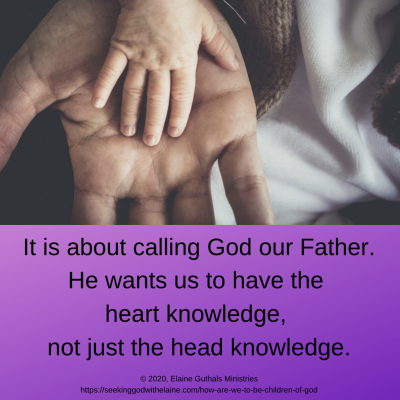
    It is about calling God our Father. He wants us to have the heart knowledge, not just the head knowledge.

    Parent hand and child hand

    Confidence

    Confidence is about having certainty in something. In churchy words, we say we believe in God. We have to have faith and trust.

    Faith is the belief that the doctrines stated in God’s Word are true, even if we do not understand all aspects of them. Trust is assurance that the promises of God are true.

    Assurance is another good word. It talks about certainty, too.

    Assurance leads to hope. Hope is where we desire for something that we believe is obtainable.

    We have to believe beyond a shadow of a doubt that what God is telling us is true. If He says we are spiritually dead if we haven’t ABCDed and that means we are going to be spending eternity in hell, that is what we have to believe. If He tells us that He wants us to put the devotions we’ve been writing online so others can read them, we have to have the confidence to do that — even if we are shaking in out boots the whole way.

    The ABCDs of Salvation

    If you have not become a believer in Christ, please read through the
    Plan of Salvation and prayerfully consider what God is asking you to do.

    A – admit our sins
    B – believe His Son Jesus is our Redeemer
    C – confess God as Sovereign Lord

    D – demonstrate that commitment by making any changes needed in our lives to
    live the way in which God has called us

    The Disciple’s Job Description

    Connected

    Disciples need to not only be connected to God, but we also have to be connected with each other. God has built a community of believers. We aren’t supposed to be insulated.

    Resource

    But it isn’t just a fellowship thing. We have a job to do.

    • “And he said to them, ‘Go into all the world and proclaim the gospel to the whole creation’” (Mk. 16: 15 ESV).
    • “Go therefore and make disciples of all nations, baptizing them in the name of the Father and of the Son and of the Holy Spirit, teaching them to observe all that I have commanded you. And behold, I am with you always, to the end of the age” (Mt. 28: 19-20 ESV).

    We are to support others. We just said in a recent devotion that disciples provide charity to widows when needed. Charity means showing others love flavored with acts of benevolence. 

    Character

    Building the character of God is what being a disciple is all about. That is why we are on the sanctification road.

    Sanctification is the transformation of mind, body, and soul beginning with regeneration and ending with perfected state of spiritual wholeness or completeness. Regeneration is the change in us that God brings about when we go from being spiritually dead to spiritually alive. The perfected state indicates spiritual wholeness or completeness.

    We are to have the disposition of a child. Our disposition is our temperamental makeup.

    Oh, yeah. That means change.

    Jesus was all about our need to change. That is what conversion is. Conversion is a change of mind, heart, and conduct. We have to have this change to enter the kingdom of God.

    Resource

    Sanctification is a process. Pool said it the best when he wrote “that even converted souls have need of a daily conversion.”

    Resource

    What Jesus was getting at was we need to be trusting and submissive rather than ambitious. That is what we need to turn toward in repentance.

    Glossary

    Contributors

    God didn’t call us to be back-seat Baptists. He wants us to contribute. He has a job for each one of us to do.

    That is why the Great Commission has all of those action words (Mt. 28: 19-20).

    • Go
    • Make
    • Baptize
    • Teach

    To read a related devotion, click the button below.

    God knows that the only way we are going to truly understand some of His ways are by doing them. We have to put them into practice.

    Cope

    Oh, yeah. Being a disciple is not going to be easy. Satan is going to throw all he has at us because he wants to derail us.

    But God helps us cope in those times of trials. We have to know that He is our protector in times of trouble.

    • “There is no one holy like the LORD. There is no one besides you! And there is no rock like our God” (I Sam. 2: 2 CSB).
    • “The Lord is my rock, my fortress, and my deliverer, my God, my rock where I seek refuge, my shield and the horn of my salvation, my stronghold” (Ps. 18: 2 CSB).
    • “He will cover you with his feathers; you will take refuge under his wings. His faithfulness will be a protective shield” (Ps. 91: 4 CSB).

    The thing is, God doesn’t want us to go it alone. He wants us to depend on Him for everything — the big stuff and the little stuff.

    Person sitting on dock

    Control

    That is a good segue to the next topic. We talked at the beginning of the year that I thought about making self-control my word for the year. It is a fruit of the spirit.

    We do have to control ourselves and our sinful nature. We do that through self-discipline.

    But we can’t just think we are in control. Remember, God told me, “Well, Chick, you can’t do self-discipline without Me.”

    It is more about God being in total control. We have to submit to Him.

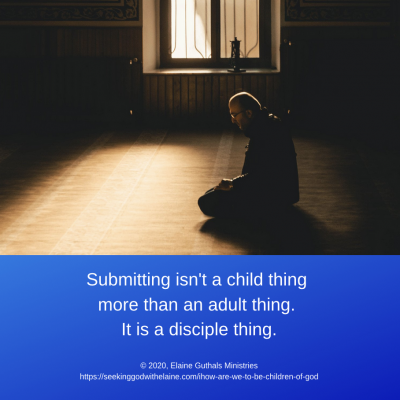
    Oh, yeah. We think submitting is more of a child thing than an adult thing. But it isn’t. It is a disciple thing.

    Person kneeling

    Making the Connections

    We have said before that repentance was turning from sin. Now we know what we are to turn toward — a child-like disposition.

    Don’t worry. Nicodemus had trouble with this you-must-be-born-again/become-a-child directive.

    Paul really didn’t explain it much better to some peoples’ estimation. “Therefore, if anyone is in Christ, he is a new creation. The old has passed away; behold, the new has come” (II Cor. 5: 17 ESV). How can be brand new?

    Vaughan helped us understand. He wrote, “This image does not convey the idea of a perfectly new being, but of an old being begun again, that it may do better.”

    Resource

    With all of the C words up there, we need to add a D Word. We need to be docile. Docile means easily taught.

    Jay noted that we should “not [be] like them in ignorance, not in fickleness, not in waywardness.” We should be willing to be taught and changed.

    Resource

    Making the Connections to Self-Discipline

    Submission is a bad enough word to some worldview people. When we tell them child-like, they may turn around and walk away. How do we describe what God is wanting us to be?

    We’ve been looking at defending our beliefs when we are witnessing. That means we have to be secure enough to convince someone to accept our beliefs.

    Our questions should still serve us to determine on what we need to focus.

    • What does the Scriptures say?
    • What do I believe?
    • Why do I believe the same/differently than the Scriptures?
    • What are the talking points when witnessing to a non-believer?

    Related Links

    I have created a worksheet of the questions above. Click on the button below to access it.

    How Do We Apply This?

    We have to understand that the resistance is in us, not just the worldview people. Vaughan wrote, “We as men fancy ourselves independent and self-sufficient; we must get back to simplicities, self-renunciation, to a babyhood of trust.”

    Resource

    How do we know that we have become child-like? In Jay and Various’ Conversion, it was written, “The change is to be judged of by its effect.” Have we become more dependent on God?

    Resource

    Oh, yes. We have to discuss the elephant in the room. We have to be ready for the discipline for when we mess up. Isn’t that what children do? They push the boundaries or just plain get it wrong — and have to face the consequences.

    Now we know what we are turning to when we turn away from repentance. We just have to do it.

    Father. We come to You as our Father. We come to You as Your children. That means we come in humility and submission. Grow us to be who You want us to be. Refine us until our character matches Yours. Sustain us on this sanctification road and help us to reach our end destination — being perfected in Your sight. Amen.

    What do you think?

    Leave me a comment below (about this or anything else) or head over to my Facebook group for some interactive discussion.

    If you don’t understand something and would like further clarification, please contact me.

    If you have not signed up for the email daily or weekly providing the link to the devotions and the newsletter, do so below.

    If God has used this devotion to speak with you, consider sharing it on social media.
  • The Hopeful Family

    Infertility is difficult for couples who are wanting to start or expand their family. There is a story in the Scriptures that show how Hannah approached her infertility. This devotion looks at how she placed her faith and trust in God to hold on to the hope that God would give her a child.

    Nuggets

    • Hannah’s deep hurt came out in tears and pleading with God.
    • God will always let us come to Him when we are hurting and upset.
    • It is sinful to want something that is not in God’s plan for us, but it is not sinful to long for His plan to be fulfilled in us.

    Devotions in the What I Believe series

    Devotions in the Family category

    In Support of Widows
    Instructing Our Children
    Who Is the Greatest in the Kingdom of Heaven?

    Flowers with title The Hopeful Family

    Let’s Put It into Context #1

    Family is, according to the Holman Bible Dictionary, “the basic household unit which provides a person’s central relationships, nurture, and support.”

    Resource

    Ordinances are an expression of the disciples’ obedience. Marriage is an ordinance.

    Let’s Put It into Context #2

    “There was a man from Ramathaim-zophim in the hill country of Ephraim. His name was Elkanah son of Jeroham, son of Elihu, son of Tohu, son of Zuph, an Ephraimite. He had two wives, the first named Hannah and the second Peninnah. Peninnah had children, but Hannah was childless” (I Sam. 1: 1-2 CSB)

    It was called polygamy. That is where a spouse has more than one spouse – at the same time. It could be that I would have two husbands, but usually in the Scriptures, it was the husband having a couple of wives.

    God did make provision for it. “If he takes another wife to himself, he shall not diminish her food, her clothing, or her marital rights” (Ex. 12: 10 ESV). That reads to me that God did not make it unlawful to take more than one wife – the husband couldn’t stop providing for her if he did.

    We know God wanted marriage to be honored. “Let marriage be held in honor among all, and let the marriage bed be undefiled, for God will judge the sexually immoral and adulterous” (Heb. 13: 4 ESV). He wanted a harmonious family.

    That didn’t seem like it happened in most of the cases in the Scriptures where there was more than one wife. Abraham didn’t have good luck with that, and neither did Jacob. David even had his issues.

    It didn’t seem that it worked out for Elkanah, either. Hannah may have been Wife #1, but when Peninneh started having kids, someone who shall be nameless, but her initials are Peninneh started being a bully.

    Let’s Put It into Context #3

    We’ve been equating the family to the church in this series. It works here, too.

    The family structure had its issues. So did the church.

    Guthrie explained what was happening. He wrote, “Outraged and disgraced by the crimes of its ministers, religion sank into public contempt, and, almost mortally “wounded in the house of its friends,” seemed ready to expire. At first indignant, and in the end demoralized (sic), the people deserted the house of God. and abandoned the profession of a religion which the crimes of its priests had made to stink in their nostrils.”

    It was bad.

    Resource

    Deals for What We Want

    “Deeply hurt, Hannah prayed to the Lord and wept with many tears. Making a vow, she pleaded, “Lord of Armies, if you will take notice of your servant’s affliction, remember and not forget me, and give your servant a son, I will give him to the Lord all the days of his life, and his hair will never be cut’” (I Sam. 1: 10-11 CSB)

    We talked about how God’s first blessing got a little hairier after the judgment.

    • “God blessed them, and God said to them, ‘Be fruitful, multiply, fill the earth, and subdue it. Rule the fish of the sea, the birds of the sky, and every creature that crawls on the earth’” (Gen. 1: 28 CSB).
    • “He said to the woman: I will intensify your labor pains; you will bear children with painful effort. Your desire will be for your husband, yet he will rule over you” (Gen. 3: 16 CSB).

    Instead of children being a blessing, childlessness was looked on as being blessed. Whyte wrote, “Till it came to be nothing short of a mark of a special election, and a high calling, and a great coming service of God in Israel to have no children.” Oh, yeah. That sounds worldview, doesn’t it?

    Resource

    Hankinson contradicted Whyte. He argued, “The desire of Jewish women to be the mothers of families was connected with religious feeling: children were regarded as a blessing from the Lord, and the withholding of them was considered a token of the Divine displeasure.” I lean more this way.

    Resource

    Brooke argued that motherhood completes a woman’s nature. At least for Hannah – maybe not for all – this seems to be the case. Hannah was “deeply hurt …” (I Sam. 1: 10 CSB).

    Resource

    Hannah’s deep hurt came out in tears and pleading with God. Still, Hannah approached God with hope. We learn a couple of things from Hannah’s short prayer.

    “Lord of Armies …” (I Sam. 1: 11 CSB)

    Hannah recognized that the final decision rested with God as to whether she was going to be a mother or not. No fertility pills or treatments were going to get her pregnant. Only God could do that.

    All of Hannah’s actions show she wanted to do God’s Will. She and her family came annually to worship. “This man would go up from his town every year to worship and to sacrifice to the Lord of Armies at Shiloh, where Eli’s two sons, Hophni and Phinehas, were the Lord’s priests” (I Sam. 1: 3 CSB). So, Hannah and Elkanah were both God-fearing people.

    To chase a rabbit a second, it was obvious what Elkanah’s feelings were toward Hannah. Even though he may have – probably – taken Peninneh as a wife because no kids were coming, he still was cognizant of Hannah’s feelings.

    “‘Hannah, why are you crying?’ her husband, Elkanah, would ask. ‘Why won’t you eat? Why are you troubled? Am I not better to you than ten sons?’” (I Sam. 1: 8 CSB).

    Guthrie described Elkanah’s words this way. He wrote, “In what esteem Elkanah held her, how fondly he cherished her, and how kind he was to her, appears in the very strong and tender terms with which he essays to soothe her grief …”

    Resource

    Elkanah’s actions also backed up his words of love. He would always give Hannah a double portion of the sacrificial meat (I Sam. 1: 5). Her being childless did not alter his feelings toward her.

    “… if you will take notice of your servant’s affliction, remember and not forget me, and give your servant a son …” (I Sam. 1: 11 CSB)

    Since God is Lord of Armies, Hannah approached Him as being His lowly servant with hope. She knew He was probably more concerned with whatever war was raging at the time – physical or spiritual. But she knew He was still concerned with her and her affliction.

    God will always let us come to Him when we are hurting and upset. He can stand the tears. He is big enough to be asked why. When we are bullied or feel like we have been dealt an unfair hand, God lets us question.

    As long as we question in faith. As long as we acknowledge He is Lord of Armies.

    Our attitude has to be right. We have to approach Him as Sovereign God.

    “… I will give him to the Lord all the days of his life, and his hair will never be cut” (I Sam. 1: 11 CSB)

    I don’t think we talk God into giving us a spouse or a child. I don’t think we make deals to get what we want.

    He has a plan already designed based on the decisions He knows we will make. Remember, He is omniscience.

    To read a related devotion, click the button below.

    I think we convince Him we are where He wants us to be to have a spouse or a child. It all has to be in His Will.

    Hannah didn’t just pour her sorrow out on God and expect Him to immediately answer it. She kept worshiping Him. She got up the next morning with praise on her lips.

    Person

    Honoring Her Vow

    “‘Please, my lord,’ she said, ‘as surely as you live, my lord, I am the woman who stood here beside you praying to the Lord. I prayed for this boy, and since the Lord gave me what I asked him for, I now give the boy to the Lord. For as long as he lives, he is given to the Lord.’ Then he worshiped the Lord there’” (I Sam. 1: 26-28 CSB)

    In time (and we don’t know how much time), Samuel was born. Hannah acknowledged that he was a gift from God.

    It is sinful to want something that is not in God’s plan for us. It is not sinful to long for His plan to be fulfilled in us.

    When I was growing up, I thought it was so sad that Hannah had to give up the baby for whom she had cried so passionately. God used her obedience.

    Oh, to be a fly on the wall when Hannah went back to Eli with Samuel in tow. “Hey, remember me? I was the lady you thought was drunk (I Sam. 1: 13). Nope, I got a kid instead of a hangover. He’s yours now.”

    Hannah’s prayer came full circle. She prayed asking for a son and promised specific action on her part. God provided the son. Hannah acted.

    Nowhere in these verses do we see where Hannah tried to get out of her vow. Yes, “… Hannah stayed there and nursed her son until she weaned him” (I Sam. 1: 23 CSB).

    Hannah knew that the first three years, Samuel needed to learn how to be a human. He needed to learn to walk, talk, eat, dress himself, etc.

    After he had learned the basics, Samuel could go to Eli and learn what God had in store for Him.

    We know the rest of the story. We know who Samuel grew up to be. Israel was much blessed because they had the Prophet Samuel leading them. Samuel is one of the Hall of Famers.

    God had plans to provide for His church – His family. He used Hannah’s request to work things out for both of their good.

    Church

    Making the Connections

    Why does God not give children to those who want and are well-suited for motherhood when He gives them to those who definitely aren’t and shouldn’t be? I don’t know. That is above my paygrade.

    What I do know is God knows why. It isn’t to hurt us. We know that “… God causes everything to work together for the good of those who love God and are called according to his purpose for them” (Rom. 8: 38 NLT).

    I know He has a reason – a good reason.

    Meyer made a good point. Yes, Hannah was approaching God in the right way, as we discussed. But she was also approaching Him with the attitude that a prayer for a kid was something easy for Him to fulfill.

    Resource

    Hannah didn’t doubt at all. She wasn’t wishy-washy about what she wanted and what she would do when God fulfilled the prayer. Oh, there was no doubt but that He was going to fulfill the prayer.

    This story is further proof that God wants to be the God of the big things as well as God of the little things. He wants us to feel comfortable to come to Him with anything that is making us sorrowful.

    Making the Connections to Self-Discipline

    This story could bring up several questions with which non-believers would struggle. We touched on the infertility issue. They also may question why God would accept Hannah’s vow of giving Samuel to God, especially if we are to go forth and multiply – and God wasn’t keeping up His end of that.

    We’ve been looking at defending our beliefs when we are witnessing. That means we have to be secure enough to convince someone to accept our beliefs.

    Our questions should still serve us to determine on what we need to focus.

    • What does the Scriptures say?
    • What do I believe?
    • Why do I believe the same/differently than the Scriptures?
    • What are the talking points when witnessing to a non-believer?

    Related Links

    I have created a worksheet of the questions above. Click on the button below to access it.

    How Do We Apply This?

    Oh, that we would have Hannah’s prayer life! We need her comfort in approaching Sovereign God. We need to have her faith that our prayers will be answered. May we be as devout disciple as she was.

    We barely touched on the fact that Hannah’s prayer was short. She didn’t need a long prayer, because her relationship with God was right. She could give the short prayer then.

    Obviously, Eli saw Hannah praying. However, he didn’t hear her prayer. That was just between her and God. We need to keep our prayers private also.

    God is going to provide for His people. That is the hope that we have. We have that hope in Him.

    Father, You love us and provide for us. You answer our prayers when we pray in Your Will. May we always look for Your Will rather than our own. Amen.

    What do you think?

    Leave me a comment below (about this or anything else) or head over to my Facebook group for some interactive discussion.

    If you don’t understand something and would like further clarification, please contact me.

    If you have not signed up for the email daily or weekly providing the link to the devotions and the newsletter, do so below.

    If God has used this devotion to speak with you, consider sharing it on social media.

  • What Else Is Expected of Disciples?

    When interacting with others, we are to show them the character of God. This devotion concludes our look at what is expected of disciples to do that.

    Nuggets

    • Meekness is a personality trait exhibiting a mild or moderate disposition that places dependence on God.
    • We’ve got to stand firm patiently.
    • We not only give up the right to retaliate, but we also initiate the forgiveness.
    • Compassion, kindness, humility, gentleness, patience, forbearance, and forgiveness all filter up into love.

    Devotions in the What I Believe series

    Devotions in the Social Order category

    Flowers with title What Else is Expected of Disciples?

    We started in the last devotion to look at what is expected of disciples from God and from the world. We talked about

    • God chose mankind to whom to show His love.
    • He has special blessings set aside for those who admit their sins, believe in Jesus as their Savior and Redeemer, and confess Him as Sovereign Lord.
    • God expects us to have a heartfelt sympathy for others.
    • Love is expressed through kindness – kindness is the action.
    • Humility means we have a real perspective about ourselves.

    Let’s see what else we can add to our list.

    Let’s Put It into Context

    We are going to use the following definition from the Merriam-Webster Dictionary for social. It is defined as “of or relating to human society, the interaction of the individual and the group, or the welfare of human beings as members of society.”

    Resource

    Gentleness

    “Therefore, as God’s chosen ones, holy and dearly loved, put on compassion, kindness, humility, gentleness, and patience, bearing with one another and forgiving one another if anyone has a grievance against another. Just as the Lord has forgiven you, so you are also to forgive” (Col. 3: 12-13 CSB)

    The word is translated gentleness here. In some cases, it is translated meekness. We’ve talked about that before.

    To read a related devotion, click the button below.

    Meekness is “a personality trait of gentleness and humility, the opposite of which is pride. Meekness does not refer to weakness or passivity but to controlled power.”

    Resource

    So, in order to find out what meekness is, we need to find out what humility (which we just talked about in the last devotion) and gentleness are. Of course, gentleness sends us to gentle.

    • Humility is a character trait that diminishes pride and places dependence on God while holding a modest view of our importance with respect to others.
    • Gentle is “free from harshness, sternness, or violence.”

    Resource

    Hmmm. Don’t you love when they tell you what something is by only telling you what it isn’t?

    We have to look to Daille to tell us that. He wrote that gentleness “… receives every one with an open heart and pleasing countenance, takes things in good part, and is proof against self-injurious irritations.”

    Resource

    So, I see someone who is gentle as having a mild or moderate disposition that doesn’t show favoritism. They don’t have the big mood swings from one extreme to another.

    That would make meekness a personality trait exhibiting a mild or moderate disposition that places dependence on God.

    The mild disposition is characterized by not taking offense (Barlow). This touches on self-control in the trials (Horton).

    Resources

    Hamilton suggested that, all wrapped up in meekness, is a self-evaluation component. He wrote, “It is the disciple praying and watching for the improvement of his talents, the mellowing of his temper, and the amelioration of his character.” We learn to detest our sinful nature and seek to imitate Jesus.

    Resources

    Glossary

    Patience

    We talked about patience in Patience as a Virtue. It is a steadfast endurance in opposition without losing a positive attitude. Patience is also translated as longsuffering.

    To read a related devotion, click the appropriate button below.

    Maclaren provides the distinction between patience and longsuffering. He wrote, “[Patience] is the temper which accepts God’s dealings, or evil inflicted by men without resistance, and its opposite is rudeness or harshness; [longsuffering] the long holding out before giving way to a temptation to an action or passion, and its opposite is swift resentment. While long-suffering floes not get angry soon, meekness does not get angry at all.”

    Resource

    Do you see how it builds on the meekness? Byfield showed how that plays out in real life.

    • We follow God’s opinions, not our own.
    • We don’t argue — if we answer at all.
    • We don’t pay back evil with evil.

    Resource

    Have you ever had a worldview person try to test your patience on something? I have. It is hard. It is frustrating.

    We’ve got to stand firm patiently. God gave me this passage today.

    “Here is my servant whom I have chosen, my beloved in whom I delight; I will put my Spirit on him, and he will proclaim justice to the nations. He will not argue or shout, and no one will hear his voice in the streets. He will not break a bruised reed, and he will not put out a smoldering wick, until he has led justice to victory. The nations will put their hope in his name” (Mt. 12: 18-21 CSB emphasis added).

    We’ve got to put our faith and trust in God, Whom we serve.

    Church steeple

    Forbearance and Forgiveness

    We tried looking at forbearance before. That was how we got to longsuffering last time.

    With it tied to patience last time, I found it interesting that, in this passage, it was tied to forgiveness.

    Maclaren made an interesting observation. He wrote, “Forbearing and forgiving are meekness and long-suffering in exercise. A man may forbear and bite his lips till the blood come rather than speak unkindly, but forgiveness is an entire wiping of enmity and irritation out of the heart.”

    Resource

    Barlow takes forgiveness a step further. He instructed that we shouldn’t participate in the quarrel in the first place.

    Resource

    E.T.E.B. took forbearance a level up, though. It was written that forbearance is not only forgiving another, but it is also going the extra distance to meet them halfway.

    Resource

    Ooo, baby. Doesn’t E.T.E.B. know how hard it is to forgive someone in the first place?

    Just think about it. We not only give up the right to retaliate, but we also initiate the forgiveness. Plus, we give up the hurt feelings.

    No, unfortunately, relationships aren’t always going to be put back together after forgiveness is given. In instances of abuse and manipulation, forgiveness isn’t going to make that go away.

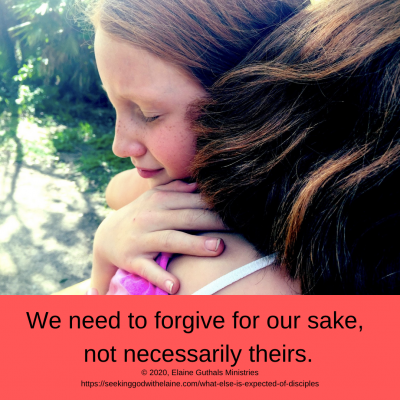
    We need to forgive for our sake, not necessarily theirs.

    Children hugging

    Above All

    “Above all, put on love, which is the perfect bond of unity. And let the peace of Christ, to which you were also called in one body, rule your hearts. And be thankful” (Col. 3: 14-15 CSB)

    Does love sum it up or is it an overarching element? Either way, compassion, kindness, humility, gentleness, patience, forbearance, and forgiveness all filter up into love.

    Sometimes the word is translated as charity. Charity means showing others love flavored with acts of benevolence.

    Devotions in the What Is Charity? series

    Charity is also identified as a grace. Tuck noted that “Charity covers the whole life and relationships of the Christian …”

    Resource

    Why can’t everyone just love everyone else? Sin bashed that. Sin is actions by humans that disobey God and break one of His laws and commandments, goes against a purpose He has for us, or follows Satan’s promptings.

    Horton questioned the use of “… put on …” (Coll 3: 14 CSB). This isn’t a slip-your-head-and-arms-through-and-smooth-it-down type of deal.

    This is one of the character changes that we have to make. No matter how loving we are, we have to change to imitate God’s loving. That means we have to get to heart level.

    To read a related devotion, click the button below.

    Glossary

    Yes, the world loves differently than Jesus does. The worldview people have confused tolerance with love. Disciples are to tolerate their sins to show that we love them.

    Let’s look at it this way. Let’s take Tom.

    Tom and I are sitting at the airport waiting for our planes to take off. Someone comes and shoots Tom.

    Even though Tom and I don’t know each other, I bet it would be a safe bet that Tom would want me to love him enough to call an ambulance. At the screaming outside, Tom would be grateful if I bundled him up and took him to the hospital.

    I believe Tom has not ABCDed. I know that one day, if he hasn’t, Tom is going to stand before God at judgment day. God is going to look at Jesus, who will say, “Don’t look at Me. He’s not one of mine.” And Tom will be sentenced to an eternity in the fury of hell.

    The ABCDs of Salvation

    If you have not become a believer in Christ, please read through the
    Plan of Salvation and prayerfully consider what God is asking you to do.

    A – admit our sins
    B – believe His Son Jesus is our Redeemer
    C – confess God as Sovereign Lord

    D – demonstrate that commitment by making any changes needed in our lives to
    live the way in which God has called us

    The Disciple’s Job Description

    To read a devotion in the Hell Does Have Fury series, click on the appropriate button below.

    But worldview people don’t want disciples to love them enough to warn them about their future.

    Making the Connections

    Thomas perfectly described what meekness is. One of the things he said was it was “… boldness with humility …” In reality, that is what being a disciple is.

    Resource

    Some think disciples have to be doormats. That isn’t true. God knows we will encounter spiritual warfare — especially as we do more for Him.

    Making the Connections to Self-Discipline

    We’ve been looking at defending our beliefs when we are witnessing. That means we have to be secure enough to convince someone to accept our beliefs.

    Our questions should still serve us to determine on what we need to focus.

    • What does the Scriptures say?
    • What do I believe?
    • Why do I believe the same/differently than the Scriptures?
    • What are the talking points when witnessing to a non-believer?

    Related Links

    I have created a worksheet of the questions above. Click on the button below to access it.

    How Do We Apply This?

    I know. Every characteristic seems tied to the next. Yet, Barlow wrote, “The unity of Christian character is made up of many separate essential graces.”

    What that is telling me is that we have to work on them as a package deal.

    Oh, yes. I am a I’ll-work-on-this-first-and-that-next type of girl. That isn’t what I am reading here.

    So, let’s dig a moment.

    What we are doing is navigating the sanctification road so that we will imitate Jesus and grow into the character of God. Sanctification is the transformation of mind, body, and soul beginning with regeneration and ending with perfected state of spiritual wholeness or completeness. Regeneration is the change in us that God brings about when we go from being spiritually dead to spiritually alive.

    The end goal is being perfected. The perfected state indicates spiritual wholeness or completeness. Christian perfection is achieving the two greatest commandments.

    Glossary

    So, we should run everything we do through the greatest commandments. Is what we are going to say going to keep those commandments or break them? Does our attitudes foster patience, forbearance, gentleness, etc.? If we don’t love, we don’t have the right attitudes.

    Father. We want to love Your those You have made in Your image. We can do that through compassion, kindness, humility, gentleness, patience, forbearance, and forgiveness. It is our hope that they see You when they look at us. Amen.

    What do you think?

    Leave me a comment below (about this or anything else) or head over to my Facebook group for some interactive discussion.

    If you don’t understand something and would like further clarification, please contact me.

    If you have not signed up for the email daily or weekly providing the link to the devotions and the newsletter, do so below.

    If God has used this devotion to speak with you, consider sharing it on social media.
  • What Is Expected of Disciples?

    When interacting with others, we are to show them the character of God. This devotion begins to look at what is expected of disciples to do that.

    Nuggets

    • God chose mankind to whom to show His love.
    • He has special blessings set aside for those who admit their sins, believe in Jesus as their Savior and Redeemer, and confess Him as Sovereign Lord.
    • God expects us to have a heartfelt sympathy for others.
    • Love is expressed through kindness – kindness is the action.
    • Humility means we have a real perspective about ourselves.

    Devotions in the What I Believe series

    Devotions in the Social Order category

    Flowers with title What Is Expected of Disciples?

    So, if disciples are to be light in the world, what is expected of us in our interactions with others? Paul discussed just that.

    Oh, yeah. We have discussed it previously, too. We’ve even used some of these verses sometimes.

    But we are looking at it through a different lens. We are looking at it through society’s lens. How does what is expected of us, as disciples, impact how we interact with society?

    This started running long, so I am going to break it into two devotions.

    Let’s Put It into Context

    We are going to use the following definition from the Merriam-Webster Dictionary for social. It is defined as “of or relating to human society, the interaction of the individual and the group, or the welfare of human beings as members of society.”

    Resource

    God’s Chosen Ones

    “Therefore, as God’s chosen ones, holy and dearly loved, put on compassion, kindness, humility, gentleness, and patience, bearing with one another and forgiving one another if anyone has a grievance against another. Just as the Lord has forgiven you, so you are also to forgive” (Col. 3: 12-13 CSB)

    God chose us. I think the best way to describe it is there are two different types of chosen ones.

    God chose mankind to whom to show His love. After we disobeyed Him, He has provided His plan of salvation for all who will accept. He doesn’t offer it to Tom, but not to Sally or Elaine. God offers it to everyone.

    There is no evidence that God does not love non-believers. In fact, there is evidence to the opposite.

    • “For God so loved the world, that he gave his only Son, that whoever believes in him should not perish but have eternal life” (Jn. 3: 16 ESV).
    • “But God showed his great love for us by sending Christ to die for us while we were still sinners” (Rom. 5: 8 NLT).

    To read a related devotion, click the button below.

    His Chosen People

    That being said, God loves His chosen people. “… as God’s chosen ones, holy and dearly loved …” (Col. 3: 12 CSB).

    God loves those who love and submit to Him. He has special blessings set aside for those who admit their sins, believe in Jesus as their Savior and Redeemer, and confess Him as Sovereign Lord.

    The ABCDs of Salvation

    If you have not become a believer in Christ, please read through the
    Plan of Salvation and prayerfully consider what God is asking you to do.

    A – admit our sins
    B – believe His Son Jesus is our Redeemer
    C – confess God as Sovereign Lord

    D – demonstrate that commitment by making any changes needed in our lives to
    live the way in which God has called us

    The Disciple’s Job Description

    Being God’s chosen people make us His treasure. “The LORD has declared today that you are his people, his own special treasure, just as he promised, and that you must obey all his commands” (Deut. 26: 18 NLT).

    To read a related devotion, click the button below.

    Elect

    His chosen people are also called the elect. We’ve talked about that before. Election is that God chose to accomplish the plan of salvation to restore His people. When we choose to accept the gift of salvation, we become the elect.

    Glossary

    But we can’t think election is just one sided. Daille wrote, “Election is ever accompanied by conversion and sanctification. No one knows of his election but by its effects.”

    Resource

    Until we experience conversion, we are not the elect. Once we do, we have to be navigating the sanctification road to be changing our character to be more like God’s. Paul tells us characteristics on which to focus.

    The defining aspect of being God’s elect is we are all to be holy. Holy means to be set apart, perfect, and pure. When non-believers see the evidence of our being pure and set apart, they begin to equate that with our being God’s elect.

    To read a related devotion, click the button below.

    Compassion

    God expects us to have a heartfelt sympathy for others. The Holman Bible Dictionary defines compassion as “to feel passion with someone, to enter sympathetically into their sorrow and pain.”

    Resource

    We are to feel pity when someone is experiencing suffering or distress. Love softened by sorrow must be felt from the heart and result in actions.

    Resource

    Couple

    Because it is felt from the heart, that means the words spoken are not careless or cruel. Instead, it is mercy. Our interactions are real.

    Davenant stated that what the Jews called bowels of mercies is a part of regeneration. It is called this because it is a gut feeling. Regeneration is the change in us that God brings about when we go from being spiritually dead to spiritually alive.

    Resource

    Glover argued that, to be a true disciple, pity and love must follow repentance. Repentance is expressing sorrow for breaking God’s laws and commandments by making the commitment to changing ourselves through obedience so that we no longer do the wrong things.

    Resource

    It is only through faith that disciples attempt to imitate Jesus and exhibit true compassion, pity, and love.

    Kindness

    We’ve talked about kindness before, labeling it a virtue. The Holman Bible Dictionary defines kindness as “the steadfast love that maintains relationships through gracious aid in times of need.”

    To read a related devotion, click the button below.

    Resource

    I like how Daille described kindness. He wrote, “Kindness is a goodness of nature that takes pleasure in obliging and avoids injuring. We are obliged to this by our stewardship of God’s manifold grace.”

    Resource

    Love is expressed through kindness. Kindness is the action.

    Barnes noted kindness should be shown by one disciple to another who is gripped in sin. We are told that, “brothers and sisters, if someone is overtaken in any wrongdoing, you who are spiritual, restore such a person with a gentle spirit, watching out for yourselves so that you also won’t be tempted” (Gal. 6: 1 ESV).

    Resource

    But in this series, we are looking at disciples’ interactions with others. How do we equate that to showing kindness when pointing out sins to non-believers?

    Worldview people want disciples to believe that we can’t point out that their actions are sins. They tell us we should not judge (Mt. 7: 1) — which is true.

    However, how we do or do not approach the non-believer does not change the fact that God has determined what is sin and what isn’t. God will judge them on His timetable.

    We have to show kindness and compassion as we witness to them.

    Humility

    Humility is a character trait that diminishes pride and places dependence on God while holding a modest view of our importance with respect to others. This doesn’t mean we bite on ourselves for no reason.

    It means we have a real perspective about ourselves. But we have to realize that we should focus on our character, not our intelligence.

    Resource

    And what do we keep saying? We have to change our character to imitate God. We only deserve blessings because of what He has done for us. We would be nothing without Him.

    Glossary

    But it does mean more than just how we perceive ourselves. Not only do we have a modest demeanor, but we also elevate others.

    Look what Daille said. He wrote, “Humility is the mother of patience and the nurse of charity.”

    Resource

    Making the Connections

    Compassion, kindness, and humility. I can see the first two have a definite link.

    Some may think the link humility has with the other two is a little more obscure. But really, we won’t have much of the first two if we don’t have the last one, will we?

    Making the Connections to Self-Discipline

    We’ve been looking at defending our beliefs when we are witnessing. That means we have to be secure enough to convince someone to accept our beliefs.

    Our questions should still serve us to determine on what we need to focus.

    • What does the Scriptures say?
    • What do I believe?
    • Why do I believe the same/differently than the Scriptures?
    • What are the talking points when witnessing to a non-believer?

    Related Links

    I have created a worksheet of the questions above. Click on the button below to access it.

    How Do We Apply This?

    Things may be a little less hectic these days – for some – but they are more stressful in many ways. It is really easy to just react when we are going ninety to nothing through our day.

    When we get into a situation where we just want to start spewing, we need to stop and take a breath. God will accept a “HELP!!!” prayer. (Remember, we have said we don’t have to pray in the King James Version, as poetic as it is.)

    I know. Satan wants us to just respond. He wants us to come out in defensive – or even offensive – mode. He wants the confrontation.

    We have to imitate God in these situations. That is especially true when we are interacting with non-believers. We are showing them God.

    I think another way to become more compassionate, kind, and humble is to examine our reactions at the end of the day. Get out of the heat of the moment. Get into reflection mode. Ask ourselves the following questions:

    • Was this a normal reaction in situations such as this?
    • What was the trigger that made us react as we did?
    • What would have been a better way to react?
    • What can we do to react in a better way in the future?

    To many, compassion and kindness seem like basic responses we all should have for others. That is true in one way. We, as disciples, should have more, though, as we are imitating God’s limitless compassion and kindness.

    Father God. We want our character to imitate Yours. Help us to be compassionate and kind to those with whom we interact. We pray for humility to replace our pride. Help us to grow more like You so that we can show others who You are. Amen.

    What do you think?

    Leave me a comment below (about this or anything else) or head over to my Facebook group for some interactive discussion.

    If you don’t understand something and would like further clarification, please contact me.

    If you have not signed up for the email daily or weekly providing the link to the devotions and the newsletter, do so below.

    If God has used this devotion to speak with you, consider sharing it on social media.

  • An Unjust World

    How is slavery addressed in the Bible? This devotion looks at several passages that Paul wrote on the topic.

    Nuggets

    • We are all to obey because God tells us to do so.
    • Masters are under the same rules as slaves.
    • We should be content no matter our lot in life.

    Devotions in the What I Believe series

    Devotions in the Social Order category

    Flowers with title An Unjust World

    Slavery is a huge topic these days. It isn’t something that was instituted in the last couple of hundred years.

    It is addressed in Scriptures. Let’s look to see what it has to say.

    Let’s Put It into Context #1

    We are going to use the following definition from the Merriam-Webster Dictionary for social. It is defined as “of or relating to human society, the interaction of the individual and the group, or the welfare of human beings as members of society.”

    Resource

    Let’s Put It into Context #2

    The Holman Bible Dictionary defines a slave as a “person totally responsible to and dependent upon another person.” A widely-accepted and used practice in the Bible times, people found themselves as slaves for a variety of reasons:

    • Prisoner of war
    • Owed a debt
    • Sold themselves or were sold into slavery because of lack of support
    • Born into slavery
    • Committed a crime
    • Were kidnapped and put into slavery

    For the most part, even though slaves had no rights, they were not treated inhumanely. Except if they were gladiators. That usually didn’t end well.

    Paul gave slaves and masters some direction in Ephesians. This was not the first time slavery was addressed in the Bible. Slavery laws were included in Exodus, Leviticus, and Deuteronomy.

    • Exodus 21: 1-11
    • Leviticus 25: 39-55
    • Deuteronomy 15: 12-18

    Directions to Slaves

    “Slaves, obey your human masters with fear and trembling, in the sincerity of your heart, as you would Christ. Don’t work only while being watched, as people-pleasers, but as slaves of Christ, do God’s will from your heart. Serve with a good attitude, as to the Lord and not to people, knowing that whatever good each one does, slave or free, he will receive this back from the Lord” (Eph. 6: 5-8 CSB)

    Paul started out telling slaves to obey their masters. He didn’t say kick and scream because you have found yourself in a predicament in which you don’t belong. He said, “Do what you are told to do.” We are all to obey because God tells us to do so.

    Here is the thing. Paul knew there was always going to be someone telling us what to do — who would be our master. We start off with our parents telling us right from wrong. Then we get to teachers. Then we get to employers. Sometimes we have a spouse telling us what to do. Hopefully, we won’t find ourselves in a position where we need a policeman to give us orders.

    What is this all about? It is about submitting to the authority figure. God wants us to do that.

    Do what they tell us to do. Don’t talk back. Don’t do the opposite of what they say. Obey.

    If we aren’t going to submit to the authority figure here on earth, how are we going to submit to God?

    Paul knew that. He wrote, “… as you would Christ” (Eph. 6: 5 CSB).

    How many of us are tripping over the “… fear and trembling …” (Eph. 6: 5 CSB)? This takes us back to the fear of the Lord. The fear of the Lord means reverence and love, not terror.

    Glossary

    God doesn’t want us to be afraid of Him — unless He is unleashing His wrath. He does want the reverence.

    What Paul is saying is to exhibit faith, trust, and loyalty. Brown stated we should be diligent in whatever task we are given. We should be consistent in our walk with God.

    Resource

    To read a related devotion, click the button below.

    For Paul, it was all about attitude. We choose what attitude we are going to exhibit. We want to choose an attitude pleasing to God. Obeying and submitting to Him is pleasing to Him.

    We shouldn’t have the attitude of pride. We need the attitude of humble. How many times did God tell us to do things secretly?

    • “But when you pray, go into your room and shut the door and pray to your Father who is in secret. And your Father who sees in secret will reward you” (Mt. 6: 6 ESV).
    • “You are a hiding place for me; you preserve me from trouble; you surround me with shouts of deliverance. Selah” (Ps. 32: 7 ESV).
    • “So that your giving may be in secret. And your Father who sees in secret will reward you” (Mt. 6: 4 ESV).

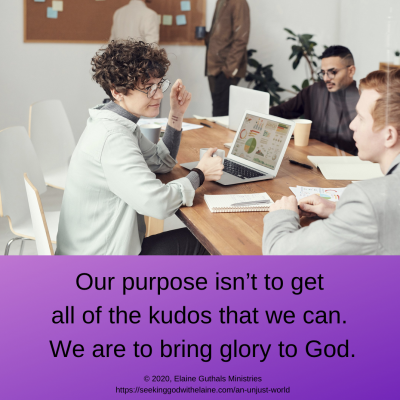
    Our purpose isn’t to get all of the kudos that we can. We are to bring glory to God.

    People

    Spurgeon explained it this way. He wrote, “In the service of God we should use great care to accomplish our very best, and we should feel a deep anxiety to please Him in all things.”

    Resource

    I love the rest of verse 6. “… as slaves of Christ, do God’s will from your heart” (Eph. 6: 6 CSB). We shouldn’t be out for our own agenda. We should be ready to do whatever God calls us to do — wholeheartedly.

    We shouldn’t complain. “Do everything without grumbling and arguing, so that you may be blameless and pure, children of God who are faultless in a crooked and perverted generation, among whom you shine like stars in the world, by holding firm to the word of life …” (Phil. 2: 14-16 CSB).

    Most of all, whoever we do in this life should be done for the Lord. We must work the plan He has for us.

    Directions to Masters

    “And masters, treat your slaves the same way, without threatening them, because you know that both their Master and yours is in heaven, and there is no favoritism with him” (Eph. 6: 9 CSB)

    Look what Paul tells the masters. They are under the same rules as slaves. Why? Because, ultimately, we all have the same Master — God.

    Paul said that makes slaves and masters in the same boat. Blencowe wrote, “The law of equity may be considered as binding a master to kindness, forbearance, and concern for the souls of his servants. It bids him show kindness, and thus extends further than the strict rule of justice. Reason and conscience are its umpires.”

    Resource

    Notice Blencowe didn’t use the word equality. He used equity.

    To read a related devotion, click the button below.

    This goes back to what Paul said in Ephesians 5: 21. He said that one of the ways of being filled by the Spirit was “submitting to one another in the fear of Christ” (Eph. 5: 21 CSB).

    We have a responsibility to others to treat them appropriately. We choose how to treat others.

    People

    Slavery a Calling

    “Let each of you remain in the situation in which he was called. Were you called while a slave? Don’t let it concern you. But if you can become free, by all means take the opportunity. For he who is called by the Lord as a slave is the Lord’s freedman. Likewise he who is called as a free man is Christ’s slave. You were bought at a price; do not become slaves of people. Brothers and sisters, each person is to remain with God in the situation in which he was called” (I Cor. 7: 20-24 CSB)

    We all have a Plan A. God calls each of us to serve Him. He wants us to be steady on that path.

    “Were you called while a slave? Don’t let it concern you. But if you can become free, by all means take the opportunity” (I Cor. 7: 21 CSB).

    Wait! What? God calls some of us to be slaves????

    Paul said it didn’t matter. Lyth wrote, “A slave may be free. The freeman a slave.”

    Resource

    I take that to mean that we should be content no matter our lot in life. “I don’t say this out of need, for I have learned to be content in whatever circumstances I find myself. I know how to make do with little, and I know how to make do with a lot. In any and all circumstances I have learned the secret of being content—whether well fed or hungry, whether in abundance or in need” (Phil. 4: 11-12 CSB). We shouldn’t worry about the external stuff.

    If we look at it another way, we were all born into bondage. We were all born into the bondage of sin.

    The gospel frees us. Jesus has redeemed us and freed us from the consequences of sin.

    But then we are Jesus’. As Maclaren reminded us, “He is the owner and we are the slaves.” Our unconditional submission answers to His absolute authority.

    Resource

    Making the Connections

    So, does this mean that God approves of slavery? I don’t think so.

    In Fulfilling Scriptures to Interact with Society, we said that Leviticus 25 explains the year of Jubilee to us. Basically, it was a year of reset. Every fifty years, slaves were freed among other things.

    No, I don’t think God condones slavery. If He did, He would have plopped the Israelites in Egypt and left them there. They would have never became a Wilderness Wanderers.

    Cohen made a good point. The slaves are supposed to serve Christ where they are. We are supposed to serve God wherever He plops us down at. Whatever He puts in our way, we are supposed to serve Him.

    Resource

    So, why doesn’t God abolish slavery if He doesn’t really approve? This is an unjust world because Satan is in control. He wants this world to not follow God’s Will. He wants the slavery and human trafficking to be prevalent.

    God will one day end slavery. But that will be on judgment day when this earth goes away. People who haven’t admitted their sins, believed on Jesus as their Savior, and confessed God as Sovereign Lord will be sentenced to eternity in hell. Then He will have his just world back again.

    Making the Connections to Self-Discipline

    We’ve been looking at defending our beliefs when we are witnessing. That means we have to be secure enough to convince someone to accept our beliefs.

    Our questions should still serve us to determine on what we need to focus.

    • What does the Scriptures say?
    • What do I believe?
    • Why do I believe the same/differently than the Scriptures?
    • What are the talking points when witnessing to a non-believer?

    Related Links

    I have created a worksheet of the questions above. Click on the button below to access it.

    How Do We Apply This?

    Wherever we are at in life, we need to be honest — to ourselves and others. When we build things on delusion, they will come tumbling down.

    We have to be sober. Sober is a character trait distinguished by self-control, genuineness, and sound moral judgment.

    We need to respect those in authority. Even if we don’t respect the person, we need to respect the office.

    We have to be obedient — to God and to those in authority. We have to submit to God because He knows what is best for us.

    A positive attitude helps us stay obedient to God. It helps us be content — no matter the circumstances.

    We have to believe. We have to believe God is the Creator of the universe. We have to believe that Jesus is our Savior.

    Our attitude helps us be content, even if we feel our freedom is a thing of the past. God will be with us as He never leaves us.

    Father. We submit to You. You are in control of our lives. Help us to live for You. Amen.

    What do you think?

    Leave me a comment below (about this or anything else) or head over to my Facebook group for some interactive discussion.

    If you don’t understand something and would like further clarification, please contact me.

    If you have not signed up for the email daily or weekly providing the link to the devotions and the newsletter, do so below.

    If God has used this devotion to speak with you, consider sharing it on social media.

  • How Should We Handle God’s Discipline?

    After looking at rewards for obedience, Solomon turns to discipline for disobedience. This devotion looks at what our attitude should be when God send discipline in the form of trials our way.

    Nuggets

    • We aren’t supposed to despise it when God corrects us.
    • Because God is using the corrections to grow us, we shouldn’t be overwhelmed by them.
    • God discipline us because He love us.
    Flowes with title How Should We Handle God's Discipline?

    No one likes the trials that God sends us. Sometimes, these trials are sent to discipline us.

    They are not fun, but they are needed to help us grow to imitate God.

    Let’s Put It into Context

    “Honor the Lord with your possessions and with the first produce of your entire harvest; then your barns will be completely filled, and your vats will overflow with new wine” (Prov. 3: 9-10 CSB)

    Solomon had just given ten verses on how God rewards faithfulness. One of the verses we said looked like it could be the poster child for the prosperity gospel.

    The rest of the verses focus on remembering not only God’s laws and commandments, but also his love for us. Out goal is to strengthen our relationship with Him so that He will completely fill and overflow us by making us godly, holy, and righteous.

    To read a related devotion, click the appropriate button below.

    Then Solomon did a quick turnaround in verses 11 and 12. We go from rewards to discipline in the form of trials.

    But think about it. Solomon told us that we would be rewarded for obedience. He was now telling us that disobedience would be disciplined. Doesn’t that follow?

    Not Liking Discipline

    “Do not despise the Lord’s instruction, my son, and do not loathe his discipline” (Prov. 3: 11 CSB)

    We aren’t supposed to despise it when God corrects us.

    Seriously? But that will hurt, won’t it? We don’t like to hurt.

    Also, we don’t like having our decisions questioned, at a minimum, or being told we are downright wrong, at a maximum. We like having control of our own lives.

    Those disciplines usually come in the form of trials. The opposite of despising the trials is peacefulness. That is what we want, instead.

    Spencer contended that this passage has practical wisdom for disciples on their walks. He wrote, “It has reference to those dealings of God with men which have a stern and severe aspect, which are in themselves painful and unwelcome, and under which the human soul cannot well be satisfied or sustained aside from the two considerations, first, that they are the appointments of God, and second, that they are designed to be instrumental of our good.”

    One of Spencer’s advice was to view most trials as disciplinary actions from God. We know God does correct us when we sin. “For the LORD disciplines those he loves, and he punishes each one he accepts as his child” (Heb. 12: 6 NLT). Bryce seems to agree with that opinion, as he wrote that life in part is disciplinary.

    Yes, God uses trials to discipline us, and they do closely follow when we have sinned. No, He doesn’t especially like it, but He does it.

    But not all trials are discipline. Remember when Jesus addressed this? The disciples were asking why a man was blind. “‘It was not because of his sins or his parents’ sins,’ Jesus answered. ‘This happened so the power of God could be seen in him.’” (Jn. 9: 3 NLT). Some trials are God testing us.

    To read a related devotion, click the button below.

    Whether it is discipline or tempting, the reason is still the same. God is trying to get us to change our character to be more like His.

    Johnson wrote that God is trying to purify us from evil. Evil is equated with sin because it is that which goes against God and His purposes.

    Because God is using the corrections to grow us, we shouldn’t be overwhelmed by them. We like to hold onto what Paul said. “… And God is faithful. He will not allow the temptation to be more than you can stand” (I Cor. 1o: 13 NLT).

    We have a tendency to forget about the last part of the verse. “… When you are tempted, he will show you a way out so that you can endure” (I Cor. 1o: 13 NLT). We may not be able to handle the trial on our own, but God will give us the ability to handle it.

    One aspect of any trial is its capacity to increase our endurance. The rough patches in our walk come up, but we keep putting one foot in front of the other. And we navigate them patiently and watching for God in all we go through.

    We get stronger as we endure the trials because God is giving us strength. “I pray that he may grant you, according to the riches of his glory, to be strengthened with power in your inner being through his Spirit, and that Christ may dwell in your hearts through faith. I pray that you, being rooted and firmly established in love, may be able to comprehend with all the saints what is the length and width, height and depth of God’s love, and to know Christ’s love that surpasses knowledge, so that you may be filled with all the fullness of God” (Eph. 3: 16-19 CSB).

    To read a related devotion, click the button below.

    God doesn’t want to destroy us. “Say to them, As I live, declares the Lord God, I have no pleasure in the death of the wicked, but that the wicked turn from his way and live; turn back, turn back from your evil ways, for why will you die, O house of Israel?” (Exek. 33: 11 ESV). Non-believers are identified in Scriptures by the terms wicked, dead, cursed, and evil.

    Bryce also made the comment that, if we were not disciplined, we would not know the purpose for our lives. We were created to worship God. A component of that is imitating Him — changing our character to be more like Him.

    Clarkson warns us about thinking trials are accidental. I would add to this that we not only think trials just happen, but we also sometimes refuse to believe they come from God. This decreases our subordination to Him.

    Oh, yeah. It is easy to say God is love and a loving God wouldn’t allow hurtful things.

    We forget God is a wrathful God. Even though we can’t see God, we know when He is angry at our sinfulness. God’s anger is used to get us back on His track.

    Glossary

    To read a related devotion, click the appropriate button below.

    Reasons Why

    “for the Lord disciplines the one he loves, just as a father disciplines the son in whom he delights” (Prov. 3: 12 CSB)

    Why does God discipline us? Why does any good parent discipline their child?

    Because God loves us.

    I know. I am repeating myself. “For the LORD disciplines those he loves, and he punishes each one he accepts as his child” (Heb. 12: 6 NLT).

    God loves us. He wants us to turn and follow His ways.

    Let’s face it. We have a lot of areas in which we have to improve — pride, selfishness, submission, unity — just to name a few.

    But God is addressing us as a Father addresses a child. Yes, those who have ABCDed, are His children. “But to all who did receive him, who believed in his name, he gave the right to become children of God” (Jn. 1: 12 ESV).

    Henderson made a good observation. Most parents try to convince the child to obey before they break out the discipline. God is the same way. He tries to convince us to follow Him before He brings out the trial.

    Because God is trying to get us to positively build our character, He works with us in the best way possible. Sometimes, it might be tenderly. Sometimes, it might more like tough love.

    Johnson told us how we should approach trials in the following ways:

    • In humility
    • Seeking endurance

    Making the Connections

    Our attitude plays a big part in how we perceive God’s corrections. Bryce wrote, “Life is a discipline, but life may not be in any true sense a discipline to this individual and to that, because so much depends upon the attitude of the soul to God, and to His will. It remains with each man to enter into God’s redeeming purpose, and to become a fellow-worker with Him.”

    Our attitude shows how much we are truly submitting to God. Yes, it starts out with obedience, but we are not going to be 100% obedient in this life. (That doesn’t give us license to sin, but it means we don’t have to beat ourselves up after every sin.)

    It all boils down to how much are we truly committed to God.

    How much are we truly committed to God?

    How Do We Apply This?

    • Keep evaluating where we are in walking with the Spirit.
    • Evaluate the trial to see why we are being disciplined and what changes we need to make to draw us closer to God.
    • Faithfully submit to the discipline.
      Not grow weary.

    We’ve got to keep our attitude focused on God. Then when the disciplines come in the form of trials, we will be hidden in the palm of His hand.

    Father God. Because of our physical nature, we continue to sin, even after our conversion. We don’t want to do that, but we continue to give into temptations. Forgive us, Lord. Strengthen us so that we will follow You. Amen.

    What do you think?

    Leave me a comment below (about this or anything else) or head over to my Facebook group for some interactive discussion.

    If you don’t understand something and would like further clarification, please contact me.

    If you have not signed up for the email daily or weekly providing the link to the devotions and the newsletter, do so below.

    If God has used this devotion to speak with you, consider sharing it on social media.
  • Thirst from the Cross

    Jesus asked for one thing for His comfort on the cross. He asked for a drink. This devotion looks at the patience and endurance Jesus was teaching us through this.

    Nuggets

    • Jesus didn’t seek any respite from the torture of the cross until after His mission was finished.
    • Jesus’ suffering from thirst also emphasized His humanity.

    Devotions in the Sayings from the Cross series

    Flowers with title Thirst from the Cross

    We’ve been looking at what Jesus said when He was hanging on the cross. The first three saying showed His concern for others.

    The previous devotion centered on Jesus’ comment that God abandoned Him while He was on the cross. It was an effective vehicle in turning our attention from men to God.

    This is important in that the final three sayings focus on Jesus’ mission. We know that Jesus was totally focused on His mission.

    Spurgeon noted that this was the shortest of Jesus’ sayings from the cross. Let’s take a look.

    Let’s Put It into Context

    “Immediately one of them ran and got a sponge, filled it with sour wine, put it on a stick, and offered him a drink” (Mt. 27: 48 CSB)

    Back when the soldiers, crowd, and His cross mate were mocking Him, Jesus was offered sour wine to drink. He chose not to take it.

    Adams couldn’t determine any ulterior motive for the soldier giving Jesus the wine. In fact, Adams thought the soldier felt more compassion for Jesus than ill will.

    If wine was given to alleviate the pain, Jesus didn’t go that route. Maybe He didn’t want to control the pain – He wanted to feel everything.

    Jesus didn’t want to be alcohol impaired. He wanted a clear head.

    Mission Accomplished

    “Jesus knew that his mission was now finished …” (Jn. 19: 28 CSB)

    I think it is telling that Jesus didn’t seek any respite from the torture of the cross until after His mission was finished. No, we don’t know what all that entailed. Maybe it was Jesus had taken responsibility for all of the sins for all people for all time, and His blood had covered them.

    Maybe it was that the aroma of His sacrifice had pleased the Lord. “And all its fat he shall remove, as the fat is removed from the peace offerings, and the priest shall burn it on the altar for a pleasing aroma to the LORD. And the priest shall make atonement for him, and he shall be forgiven” (Lev. 4: 31 ESV). God has accepted His sacrifice.

    Jesus on cross

    Thirsty Work?

    “… and to fulfill Scripture he said, ‘I am thirsty’” (Jn. 19: 28 CSB)

    The way this is written leads us to question whether Jesus was really thirsty. It reads kind of like the only reason He made the request was because He was directed to in Scriptures.

    The Scripture that is probably being referenced is Psalm 22: 15. “My strength is dried up like baked clay; my tongue sticks to the roof of my mouth. You put me into the dust of death” (Ps. 22: 15 CSB). We discussed this chapter in the last devotion where we talked about Jesus’ saying of abandonment by God.

    If we look at all Jesus had been through, we could see that He had to have been thirsty. Trench wrote that everything done to Him was done with the intention of making Him thirsty.

    You know, I have never not known where my next meal was coming from and when. I have always had water when I needed it.

    But this reinforces that food and drink have a purpose but should not be the focus. One of the first things Jesus told us was “… don’t worry about your life, what you will eat or what you will drink; or about your body, what you will wear. Isn’t life more than food and the body more than clothing?” (Mt. 6: 25 CSB).

    Our focus is to be on God. He will provide what we need to live — even in trying times.

    Jesus’ suffering from thirst also emphasized His humanity. This wasn’t the ghost of Easter present on the cross. Jesus was totally 100% human. He could hurt. He could thirst — He could die.

    Forsyth reminded us that Jesus fed the multitudes on several occasions. Yet here, the Bread of Life and Living Water has to ask for a simple drink. Add that to the humiliation list.

    To read a related devotion, click the button below.

    Talmage said this drink was vinegar, not really wine. It was the drink the soldiers drank. It was meant more as an insult.

    It may seem a little strange that Jesus would accept the insult. Talmage listed the insults that Jesus was accepting was betrayal, pain, poverty, and bereavement.

    Again, Jesus was thinking about us. He wanted to be able to say, “Been there, done that, bought the tee-shirt” to everything — e-v-e-r-y-t-h-i-n-g.

    Making the Connections

    Spurgeon pointed out that, where I-am-thirsty pointed to Jesus’ 100% human side, the why-have-You-forsaken-Me pointed to His 100% God side. He was invested in the plan of salvation body and soul.

    But think of the other point Spurgeon made. Think of the bookends of Jesus’ life. He had the no-room-at-the-inn birth to the vinegar-drink-insult death. How many times do we deny Him His sovereignty?

    Still, Jesus hung on the cross for us — for every Tom, Sally, and Elaine. He was all about accomplishing the plan of salvation.

    I know I am a broken record on Jesus was way more concerned with the spiritual than the physical. He was.

    So, let’s look at what Jesus was thirsty for from a spiritual aspect. Watkins did that for us. Jesus would have been thirsting for

    • “The love of men
    • “The salvation of men
    • “Reunion with His Father.”

    How Do We Apply This?

    We can be thirsty these days. The cause of our thirst, however, is sin. Just as Rich Guy thirsted in hell, so too do we thirst when we do not have Jesus to satisfy us.

    To read a related devotion, click the button below.

    We find that satisfaction by admitting our sins, believing Jesus hung on that cross to become our Savior and Redeemer, and confess God as our Sovereign Lord. “Repent, then, turn to God, so that your sins may be wiped out, that times of refreshing may come from the Lord” (Ac. 3: 19 NIV). We do this by ABCDing.

    The ABCDs of Salvation

    If you have not become a believer in Christ, please read through the
    Plan of Salvation and prayerfully consider what God is asking you to do.

    A – admit our sins
    B – believe His Son Jesus is our Redeemer
    C – confess God as Sovereign Lord

    D – demonstrate that commitment by making any changes needed in our lives to
    live the way in which God has called us

    The Disciple’s Job Description

    We need to obey God’s laws and commandments. “No one who abides in him keeps on sinning; no one who keeps on sinning has either seen him or known him” (I Jn. 3: 6 ESV).

    It should be our hope that our trials do not make us thirsty. If we take our focus off God, we will get thirsty.

    Instead of kicking and screaming because we see the pain and the negatives, we need to go through the trials with patience, submitting to God’s Will. We need to cut out any sin God is showing us is still in our lives and learn what He is wanting us to learn.

    I think a lot of times we think we just have to endure our trials. Endurance is “the ability to withstand hardship or adversity.” But unfortunately, we do the kicking and screaming then.

    Instead, we have to add patience to that. Being patient means “bearing pains or trials calmly or without complaint.”

    So, endurance is making it through the trial. Patience is our attitude during the trial. We just talked about these.

    To read a related devotion, click on the appropriate button below. a related devotion, click the button below.

    If we look at Jesus and His lack of liquid, He did endure. But He patiently endured. He didn’t kick and scream and rail against His captures.

    Jesus looked past what was happening at that moment. He looked to completion.

    We need to do that also. Our goal should be to make this verse our reality. “For we are to God the pleasing aroma of Christ among those who are being saved and those who are perishing” (II Cor. 2: 15 NIV). That will happen when we are a living sacrifice to Him.

    Father God. It is amazing that You did not cut ties with man when we disobeyed You. Instead, You sent Your Son to die so that our relationship could be restored. In Him, You showed us how we are supposed to obey You. You showed us that it can be done. Lord, forgive us when we disobey. Teach us patience and endurance so that we can grow to be the holy people You are calling us to be. Amen.

    What do you think?

    Leave me a comment below (about this or anything else) or head over to my Facebook group for some interactive discussion.

    If you don’t understand something and would like further clarification, please contact me.

    If you have not signed up for the email daily or weekly providing the link to the devotions and the newsletter, do so below.

    If God has used this devotion to speak with you, consider sharing it on social media.

  • Is Peace an Attitude?

    If God is a God of peace, why don’t we have peace in the world today? Isn’t He to blame for the lack of peace? This devotion looks at how peace is an attitude.

    Nuggets

    • Satan wants to steal our peace and blame it on God.
    • God can still be in control and not be blamed for the results of sin.
    • Man and Satan are to be blamed for the results of sin, not God.
    • The god of this world is Satan, not God.
    • God can stop this at any time — and we’ve been told He is going to do just that.
    Flowes with title Is Peace an Attitude?

    Don’t you love when Paul starts a sentence off with the word “therefore”? He not only hooks what he is going to say back with what he already said, but he also sends up a flag either saying because of this or but it is different now.

    Let’s Put It into Context

    “Therefore, since we have been declared righteous by faith, we have peace with God through our Lord Jesus Christ” (Rom. 5: 1 CSB)

    In this case it is but it is different now. “… since we have been declared righteous by faith …” (Rom. 5: 1 CSB) means we have been justified. Justification means the act of making something righteous before God.

    If we are justified before God — made right before God — that means something was wrong. The wrongs were

    • We were spiritually dead.
    • We were separated from God.
    • We were living a sinful life.

    When we accepted salvation, we were justified, so those things were fixed. Salvation is the deliverance from the consequences of sin. This deliverance is necessitated by the original sin committed by Adam and Eve in the Garden of Eden, which made everyone sinners.

    God is the God of Peace

    “… we have peace with God through our Lord Jesus Christ” (Rom. 5: 1 CSB)

    Have you realized how much Paul has talked about peace? That was one of the major themes in Ephesians. Now he is talked about it to the Romans.

    Glossary

    And we like to think the “good old days” like he was living in were a lot slower and simpler — and more peaceful.

    Paul probably talks about peace so much because — regardless of the age — that is a favorite target of Satan. Satan wants to steal our peace and blame it on God.

    Look what Paul says about peace here. If we don’t have the faith, we don’t have the peace.

    You would think that would be a hard statement for the worldview people to argue. There is no peace in this world today. That is obvious by the brokenness of the world.

    The problem as I see it is that the worldview people forget about Satan. They may acknowledge that there is a God, but they don’t think Satan is real.

    We talked about this before. According to a study, even disciples have problems believing that Satan is real. That means, to many people, that the blame falls on God.

    Yes, disciples are concerned about the state of the world today. But we know God is in control.

    I had a reader put some comments on a previous devotion on which he wanted my opinion. One of his comments was “If you believe God controls everything you are blaming HIM for disease, accidents, murders, suicides, children to starve, children to be used as sex slaves, wars etc. See Job. 1:7, 2 Cor. 4:4, John 10:10.”

    God can still be in control and not be blamed for the results of sin. Let’s look at some things.

    Forrest

    Disease Entered After Sin

    We know God created a paradise (Gen. 1). There was no disease, death, poverty — in other words, there was no sin.

    The “disease, accidents, murders, suicides, children to starve, children to be used as sex slaves, wars etc.” are the results of sin. Satan said bite — Eve bit — Adam bit — sin came into the world — disease, accidents, murders, yada, yada, yada came into the world.

    Man and Satan are to be blamed for the results of sin, not God.

    To read a related devotion, click the button below.

    When I hear statements like the comment, part of me thinks, “What? You want to be able to break God’s laws and commandments and have no punishment?” Because that is what the disease, accidents, murders, yada, yada, yada are: punishment for sin.

    If Adam and Eve would have obeyed God, yada yada yada wouldn’t be in the world today. We can say that there is this connection because of what Jesus said when the friends brought the paralytic for healing in Luke 5: 17-26.

    “Which is easier: to say, ‘Your sins are forgiven,’ or to say, ‘Get up and walk’?” (Lk. 5: 22 CSB).

    What Jesus was saying here was, yeah, He could heal the paralysis. But why treat the symptom without treating the disease? The disease was caused by sin.

    No, all the yada, yada, yada in the world does not mean God is not in control. It means He is allowing us to suffer the punishment of our sins.

    Policeman

    Satan Was Responsible for Job’s Troubles

    “The Lord asked Satan, ‘Where have you come from?’ ‘From roaming through the earth,’ Satan answered him, ‘and walking around on it’” (Job 1: 7 CSB)

    I have to admit, I am a little confused by this verse reference. God and Satan talking does not mean God is not in control. To me, this verse shows Satan is ruling the earth.

    Some believe, however, that Job content predates Genesis content. I got one of those read-the-Bible-chronologically lists. We read Job first.

    If Job is pre-fall, God would definitely be in control because Satan would still be one of His angels. But it really doesn’t matter about timing.

    “‘Very well,’ the Lord told Satan, ‘everything he owns is in your power. However, do not lay a hand on Job himself.’ So Satan left the Lord’s presence” (Job 1: 12 CSB).

    God didn’t take everything away from Job. Satan did. How can you blame God for what Satan did?

    Oh, yes. God allowed it. But all of Job’s trials came from Satan — not God. The trial was to test Job’s faith in God. Trials come from Satan; testings come from God.

    To read a related devotion, click the appropriate button below.

    Satan Is in Control of This World Right Now

    “The god of this age has blinded the minds of unbelievers, so that they cannot see the light of the gospel that displays the glory of Christ, who is the image of God” (II Cor. 4: 4 CSB)

    The god of this world is Satan, not God. So, I don’t see how it can be used as support that God can be blamed about what is happening in the world today.

    We’ve talked before about Satan blinding people from seeing God’s light. Satan, who fell from heaven because because of pride and arrogance, desires to dethrone God. He has blinded this world by pride, prejudice, and passion. He is doing this to deceive people so they do not become believers and disciples of Jesus.

    To read a related devotion, click the appropriate button below.

    God would not be blinding people from His gospel. He is the One “who wants all people to be saved and to come to a knowledge of the truth” (I Tim. 2: 4 NIV). He would not send His Son to die this horrific death to pay the price for our sins — and then not tell us about it.

    It is in our job description that we are to tell others about God’s sovereignty over the world. Why would He say “nor do people light a lamp and put it under a basket, but on a stand, and it gives light to all in the house” (Mt. 5: 15 ESV) if He was expecting that to happen?

    The Disciple’s Job Description

    Complete Job Description

    God is not blinding people of this world. Satan is.

    Just because God is allowing Satan to blind people right now doesn’t mean He isn’t in control. We have free will. We get to choose who we are — or are not — going to follow.

    Satan Is the Thief

    “The thief comes only to steal and kill and destroy; I have come that they may have life, and have it to the full” (Jn. 10: 10 NIV)

    This is a really good description of Satan. He is the one who brought destruction into the world. He wanted to rule God, but He found out he wasn’t strong enough.

    Because of his anger at that, Satan unleashed all of this bad stuff on us. He is the destroyer.

    Jesus brought life — eternal life. We have to get our focus off this world and put it onto the new heaven and earth. That means we have to be working the process of sanctification so that we are becoming holy and righteous.

    God Can Stop This at Any Time

    God is in control. Why else do I believe this. I believe God can stop this at any time — and we’ve been told He is going to do just that.

    • Jesus said that He was coming back, but He didn’t give us a day or time (Mt. 24: 36)
    • Satan will be defeated (Rev. 19: 20)
    • Satan will be punished (Rev. 20: 2, 10)
    • This heaven and earth will end (Rev. 20: 11)
    • A new heaven and earth will replace these (Rev. 21: 1)

    To read a related devotion, click the button below.

    Just reading Revelation clearly shows God is in control. Even with the confusing symbolism, there is no mistaking that God is in control.

    We don’t have to understand what is going to happen when. Revelation clearly shows that what will happen will happen because God is making it happen.

    So, yes, ultimately God is in control. When everyone has heard His gospel and all who are giving to choose Him have made that choice, He will shut this world down. Period. He can do that. He is Sovereign God.

    But What About No Plan B?

    Oh, yes. I see you over there waiving your arms and saying, “Chick, what about what you said in What Is the Relationship Between Righteousness and Obedience? You said Adam and Eve sinning was Plan A, not Plan B.”

    I said there that God always knew we were going to be disobedient. If we were going to remain faithful (which is He would rather have happened), He wouldn’t have needed to design the plan of salvation before He made us.

    To read a related devotion, click the button below.

    Making the Connections

    Okay, I am not finding it in a post. Maybe I talked with my Ladies about it, but it wasn’t in my Sunday morning Bible study notes, either.

    Anyway, I remember a while back talking with someone about why God allowed man to disobey. I mean, if He knew Adam and Eve were going to bite, couldn’t He work it where they didn’t?

    Somewhere I read — and no, I can’t find it — that God allowed the original sin because, while man had free will, it showed the angels what love really is. There were a couple of reasons.

    • It showed the angels what true love is. We can say we love someone, but our actions make our words true.
    • It showed the angels — and us — how far God would go to restore the relationship because that was what showed how deep the love was.

    What does Jason Gray’s song say?

    “If it’s random or providence
    “Neither are a comfort to me
    “Are You cruel if You planned it,
    “Or weak if You allowed it to be?

    Related Links

    Jason Gray

    If God wanted us to be disobedient, it could be argued that God is to blame.

    But remember Romans 8: 28: “And we know that in all things God works for the good of those who love him, who have been called according to his purpose” (NIV).

    Good things come out of bad situations. It may be just what we need.

    Making the Connections to Self-Discipline

    Okay, so this started off with peace before it morphed.

    But did it?

    Peace is an attitude. Our attitude is affected if we are blaming God. If we are blaming God, are we accepting the peace He wants to give us? No.

    How Do We Apply This?

    We can work on our attitude. Attitude is a choice. Blaming God is a choice — and not a smart one.

    Instead of blaming God, we should seek Him.

    Searching for and Seeking God

    Hearing His Word (Rom. 10: 17).
    Reading His Word (Rev. 1: 3).
    Praying to Him (Heb. 4: 16).
    Studying His Word (Ac. 17: 11).
    Meditating on His Word (Ps. 1: 1-2).
    Memorizing His Word (Ps. 119: 11).

    God. You are Sovereign God. You are love, and You give us peace. Forgive us when we blame You for Satan’s evil. Amen.

    What do you think?

    Leave me a comment below (about this or anything else) or head over to my Facebook group for some interactive discussion.

    If you don’t understand something and would like further clarification, please contact me.

    If you have not signed up for the email daily or weekly providing the link to the devotions and the newsletter, do so below.

    If God has used this devotion to speak with you, consider sharing it on social media.
  • How to Study Scriptures

    Many of us want to study the Scriptures more, but what does that entail? This devotion looks at how we can go about increase our time in God’s Word.

    Nuggets

    • We need to prepare ourselves to read the Scriptures.
    • We need to let worship shape our attitude to read the Scriptures.
    • We need to expect we will be given a personal message from God as we frequently read His Word.
    • We need to diligently study the God’s Word so that we can understand.

    Devotions in the What I Believe series

    Devotions in the The Scriptures category

    Flowers with title How to Study Scriptures

    This devotion is a continuation of the last devotion, where we looked at why to read the Scriptures. Now, we are looking at how.

    How Do We Apply This?

    “Search and read the scroll of the Lord: Not one of them will be missing, none will be lacking its mate, because he has ordered it by my mouth, and he will gather them by his Spirit” (Isa. 34: 16 CSB)

    Many times, we just dive in reading God’s word. We don’t prepare our hearts in any way. Watson gave us a list of how to do that.

    Organize our thoughts first

    We need to think about what we know about the passage of Scripture that we will be reading. That should help us pull up the knowledge blocks so that we can more easily evaluate information from the current read and retain it better.

    Clear our minds of worldly pulls

    Our lives are so hectic that it is difficult sometimes to sit down and focus. We all know we need to eliminate distractions. Maybe we can put on some tunes to help filter out background noise. If our eyes keep going elsewhere, we can use our fingers to help corral them.

    There are other things we need to take into consideration and can do when reading Scriptures.

    Worship first

    We have to approach the Scriptures after we worship. Yes, “… Joshua read aloud all the words of the law…” (Josh. 8: 34 CSB). But first, he “built an altar …” to worship God (Josh. 8: 30 CSB).

    We do this by beginning with a prayer. It is so easy to just pick up the book and read.

    Shape your attitude

    Attitude plays a major part in our devotional time. We should read the Scriptures

    • Reverently
    • Diligently
    • Humbly
    • Submissively
    • Dependently

    Read frequently

    We will get more out of our devotion time if it is not hit and miss. This is especially true if the devotions over several days are about one topic. We leave less time to forget about what we read.

    I don’t know all that I should know. You don’t know all that I should know. No one is exempt from studying the Scriptures.

    Take it seriously

    When I was younger, I really didn’t take a devotional time seriously. It looked like reading Bible stories that I had already read in Sunday School.

    We have to read Scriptures for the right reasons. We have to read it looking to grow our relationship with God and to change our character.

    Read it expectantly

    We have to expect to get something out of our reading. It goes back to attitude again, like we talked about in the last devotion.

    We won’t get anything out of reading Scriptures if we think there is nothing to get.

    Read it personally

    If you can’t tell, I like to look at old sermons and see what I can learn from them. (Remember, with these devotions, God talks to me before He talks to you.) Boardman cautioned us to see what is God telling us (not what he told someone else to tell us).

    Read carefully

    It think at times (four fingers pointing back) we do our daily devotion time to check it off the to-do list. The problem with that is it can make us skin and read quickly.

    We’ve got to make sure we allow ourselves enough time to read the passage thoroughly. Then we have to read it for understanding.

    Hunt

    A lot of times, we hope what we read is self-contained. What I mean by that is all the Bible verses are written out instead of just noted. All the examples are thoroughly described.

    For example, in the last devotion, I made a quick mention of not trying to understand what God is trying to tell us if we are reading with the there-is-no-way-a-donkey-talked attitude. Someone who hasn’t grown up in church but is searching may not get the reference to Balaam and his donkey that talked.

    So, I put the link to the previous devotion where we talked about that. But that mean clicking elsewhere and reading all or part of another devotion.

    To read a related devotion, click the button below.

    I know. It depends on how much time we schedule for our devotional time. (We do schedule, don’t we? We don’t leave it up to just fitting it in, right?)

    But we have to understand what we are reading, or we don’t grow like God wants us to. Sometimes we have to dig deeper to find the meaning.

    Boardman also gave excellent suggestions. We have to understand the Israelites to understand the Scriptures. Where did they live? How did they live? What are the principles of their poetry and prophesy?

    I can say, “yes, yes” to that. Last summer Pastor Delbert has a Sunday night series. It was part geography, part history. It really opened my eyes to meanings of several Bible passages.

    Compare

    When we read one passage of Scripture, we have to think about what other passages say. Do they say the same thing? Do they seemingly contradict? Comparatively — what do other Scriptures say?

    Watch others

    Follow the examples shown in Scriptures — especially the example of Jesus. What can we learn from Moses? Daniel? David? Jonah? Paul? Stephen?

    Look for its application

    It is so easy to read a passage and just read it. We need to read it looking for how we can apply it.

    Newberry reminds us that all Scriptures are applicable to our lives. Some passages we may read and go, “Huh?” We have to make sure we remember God isn’t always talking literally. He is wanting to build our character.

    Maybe it would be easier to apply it if we hooked it on to past knowledge and experiences first. If we think about what we already know, what this is teaching us, and the differences between the two, maybe we will get a clearer picture of what changes we need to make.

    • Look for its directions. Look for the do’s and don’t — especially the implied ones. Romans 2: 11 says, “For there is no favoritism with God.” The implied command is we are to treat everyone equally, as God does.
    • Seek to understand. I know I said it already. I will probably say it a couple of more times so we get it lodged in our brains. We cannot just read to read. This isn’t a novel. It is a textbook. How did you study in school when you read your textbooks? Did you take notes (use a journal now)? Did you have other books for reference (use a Bible dictionary or commentaries)?
    • Make inquiries. Google is good, although we always have to evaluate what we read online. If we don’t understand something, we need to get with our Pastor Chad-types.

    Then we have to figure out ways we can put into practice what we read. How does God want us to act on what we have read?

    Keep track

    Keep a list of Scriptures that talk to us. It not only gives us a list we can access when things aren’t going so well, but it can also show us how God is growing us.

    Read it orderly

    There are different ways we can read the Scriptures. We can start at Genesis and read to Revelation. Some might get bogged down in Leviticus or Numbers, though.

    We can read an Old Testament book and then a New Testament book. That might help some since the New Testament tends to be an easier read.

    One thing I am trying to do is read the Bible chronologically. It starts out in Job and goes through.

    Bottom Line, Though

    In The Reading of the Law, we are given ways to grow our relationships with God.

    • “daily reading of the Bible
    • “attendance on the public ordinances of God’s house
    • “Christian conversation
    • “giving heed to the voices of conscience and the Divine Spirit.”

    I know, I know. You all were looking for some new way to kick start devotion time.

    I get it. Zig Zeigler said something like, “You can’t expect different results by doing the same thing.” We are looking for improved devotional time.

    But we look for some gimmick to help us, some resource by someone we see as a with-it disciple.

    It really doesn’t start there.

    It starts in our hearts. It starts with our dedication. It starts with our relationships with God.

    I know I said a long time ago that I get a lot of mileage out of this graphic.

    Searching for and Seeking God

    Hearing His Word (Rom. 10: 17).
    Reading His Word (Rev. 1: 3).
    Praying to Him (Heb. 4: 16).
    Studying His Word (Ac. 17: 11).
    Meditating on His Word (Ps. 1: 1-2).
    Memorizing His Word (Ps. 119: 11).

    That is what it all boils down to for disciples. We have to hear His Word, read it, study it, meditate on it, and memorize it. All through that, we need to be in prayer, asking God to provide the meaning.

    That isn’t going to change. Props aren’t going to change our desire or our commitment to do that — not really.

    The only thing that is going to get us to where we need to be in reading the Scriptures is our firm desire to want to change to be the disciple God wants us to be.

    Father God. We want to learn of You. We want to be the children and disciples You want us to be. Help us to change our attitudes and priorities. Help us to focus on Your Scriptures and understand them. Help us to hear You telling us what we need to know. Amen.

    What do you think?

    Leave me a comment below (about this or anything else) or head over to my Facebook group for some interactive discussion.

    If you don’t understand something and would like further clarification, please contact me.

    If you have not signed up for the email daily or weekly providing the link to the devotions and the newsletter, do so below.

    If God has used this devotion to speak with you, consider sharing it on social media.