After she had received a visit from an angel to tell her of her pregnancy, Mary went to visit her relative, Elizabeth. This devotional reading looks at the greeting between the two women and the unique situations in which they found themselves.
Nuggets
- Mary chose to go visit her relative Elizabeth, who was also pregnant, to process what was happening to her.
- Mary and Elizabeth lived in totally different places.
- Luke didn’t record the town in which Elizabeth and Zechariah lived.
- More than Elizabeth greeted Mary.
- Filled with the Holy Spirit, Elizabeth began to prophecy.
- Blessed among women was not new language about Mary.
- Yeshua was called Lord before He was born.
- Elizabeth affirmed Mary’s faith.
It wasn’t every day that an angel paid a human a visit. It wasn’t every day that a virgin was told she was going to have a baby. It wasn’t every day that a virgin was told that her relative, who was beyond childbearing age, was going to have a baby.
All that once in 2 million lifetimes meant that a road trip was needed. Mary decided to go see her relative.
Let's Put It into Context
To read devotions in The Battle for the Heart theme
Devotions in the Preparing for the Christ Child series
Mary Visited Elizabeth
“A few days later Mary hurried to the hill country of Judea, to the town where Zechariah lived… (Lk. 1: 39-40 NLT)
A Few Days Later
Mary chose to go visit her relative Elizabeth, who was also pregnant, to process what was happening to her.
We don’t know if Mary talked to Joseph before she left town. She may have gotten out while the getting was good, but I don’t really think so.
Stowe felt this trip highlighted Mary’s character. She wrote, “The next step taken by Mary is in accordance with the calmest practical good sense, and displays an energy and a control over other minds which must have been uncommon.”
Resource
Mary was a woman of integrity, so I would think she talked to Joseph first. Besides, he probably already knew about the pregnancy when the angel came to talk with him.
Some versions say that Mary “… went into the hill country with haste …” (Lk. 1: 39 KJV). The Greek word is meta spoudēs (μετὰ σπουδῆς); it means haste, eagerness, diligence, earnestness, zeal, and promptness.
Hebrew doesn’t have a direct word that translates to this. Several express the same idea. One is mahēr (מַהֵר), which means hasten, hurry, and make haste. Another is ḥāpaz (חָפַז), meaning to hurry or be in haste.
That follows Mary’s faith. She immediately submitted in obedience when Gabriel said she was going to carry God’s Son.
Everything Gabriel said was said for a reason. That means he told Mary about Elizabeth’s pregnancy for a reason.
As she was also involved in Jehovah’s plan, Elizabeth may have been the one person most likely to have understood.
I wonder if Mary was concerned about what Elizabeth’s reception of her would be. Would Mary’s news be accepted, or would she be seen as someone who was delusional?
The Hill Country of Judea
Mary and Elizabeth lived in totally different places.
Nazareth, where Mary lived, was a small inconsequential village. Its only claim to fame was that was where the Messiah lived during childhood and early adulthood.
The hill country (har Yehudah – הַר יְהוּדָה) was something entirely different. It would have been considered the heartland of Judah.
It stretched from Jerusalem to Hebron. This was the place where Abraham settled. It is where Abraham, Sarah, Isaac, Rebekah, Jacob, and Leah are buried.
It was also home to King David while he was fleeing Saul. Also, his first capital was in the region before it was moved to Jerusalem.
Mary would have then passed many spots where Israel history had been made. (She would make the same journey again within nine months.)
It was the rugged mountainous region, within the land of Judah, which surrounded Jerusalem. There were fairly large mountains at 2,500 to 3,300 feet above sea level. Because of this, the area was characterized by limestone ridges, steep valleys, and terraced hillsides, and scattered villages built from local stone.
The arid climate fostered the growth of olive groves and vineyards. The stony ground would have made their growth difficult and cause extensive cultivation.
Because of its proximity to Jerusalem, it hosted many priestly settlements.
Where Zechariah Lived
Luke didn’t record the town in which Elizabeth and Zechariah lived.
Early Christian tradition identified it as Ein Kerem, a village five miles southwest of Jerusalem. This is where a known priestly settlement – one of many – was located in the hill country.
Geikie felt that what was meant was Mary went to the city of Judah – or Juttah. He argued that just saying a city in Judah was too vague.
Resource
The journey from Nazareth to Ein Kerem would have been considerable in first-century Israel. It was approximately 80 to 100 miles. A normal trip would take four to six days to make on foot.
No, that wasn’t a trip Mary would have taken alone. She would have traveled with a caravan of pilgrims, merchants, or other relatives heading toward Jerusalem.
Even with other people, she was probably traveling alone – meaning no parents or siblings went with her. That took courage and determination.
But get there, Mary did.
Now, Mary may or may not have used the Central Ridge Route to get to the Hill Country. That went right through Samaria – and most Jews bypassed that. It would have depended on what the caravan or whoever was leading the trip decided.
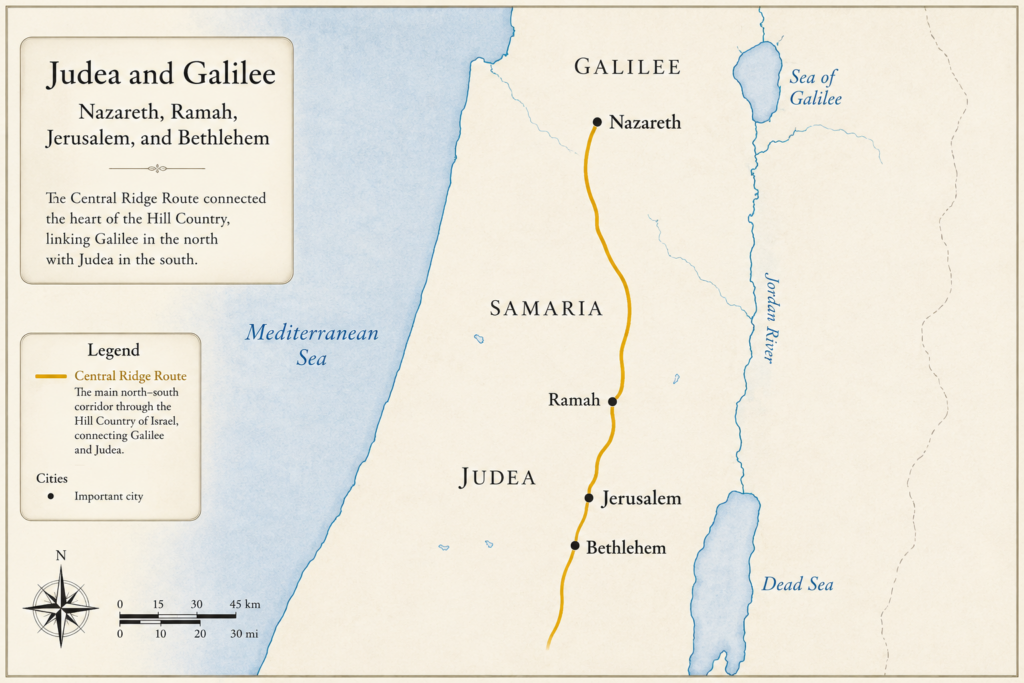
The young virgin from an overlooked village traveled to the ancient covenant heartland, where the first public recognition of Israel’s Messiah would occur.
Greeting
“… She entered the house and greeted Elizabeth. At the sound of Mary’s greeting, Elizabeth’s child leaped within her, and Elizabeth was filled with the Holy Spirit” (Lk. 1: 40-41 NLT)
More than Elizabeth greeted Mary.
It doesn’t sound like Mary even got to tell her news. Elizabeth was told by the Holy Spirit. Mary greeted – John leaped – Elizabeth was filled with the Holy Spirit.
John greeted Jesus’s mother. More importantly, before either were born, John was already greeting unborn Yeshua.
We shouldn’t be surprised. Gabriel said John would be filled with the Holy Spirit in the womb (Lk. 1: 15).
No, the first recognition of the Messiah was not Zechariah, the priest – or any priest in the Temple. It was in a faithful elderly couple’s home by the forerunner of the Messiah.
Jehovah’s plan was known to its principal players.
Elizabeth Was Filled with the Holy Spirit
“Elizabeth gave a glad cry and exclaimed to Mary, ‘God has blessed you above all women, and your child is blessed. Why am I so honored, that the mother of my Lord should visit me? When I heard your greeting, the baby in my womb jumped for joy. You are blessed because you believed that the Lord would do what he said’” (Lk. 1: 42-45 NLT)
Gave a Glad Cry
Filled with the Holy Spirit, Elizabeth began to prophecy.
No, Elizabeth didn’t suddenly have insight on her own. There was no way she would have known that Mary was pregnant.
They didn’t have phones or internet in that day. The media wouldn’t have been alerted.
Elizabeth was filled with the Holy Spirit. That is the way He worked in Old Testament times. (This occurred before Pentecost, when the Holy Spirit permanently indwelt believers.)
The Holy Spirit landed on people for a specific purpose. He didn’t indwell in them yet.
Mary may have been there because of Elizabeth, but Elizabeth quickly turned the focus onto Mary.
God Has Blessed You above All Women
Blessed among women was not new language about Mary.
I wonder what Mary thought when Elizabeth started the blessing. “Blessed are you among women …” (Lk. 1: 42 ESV).
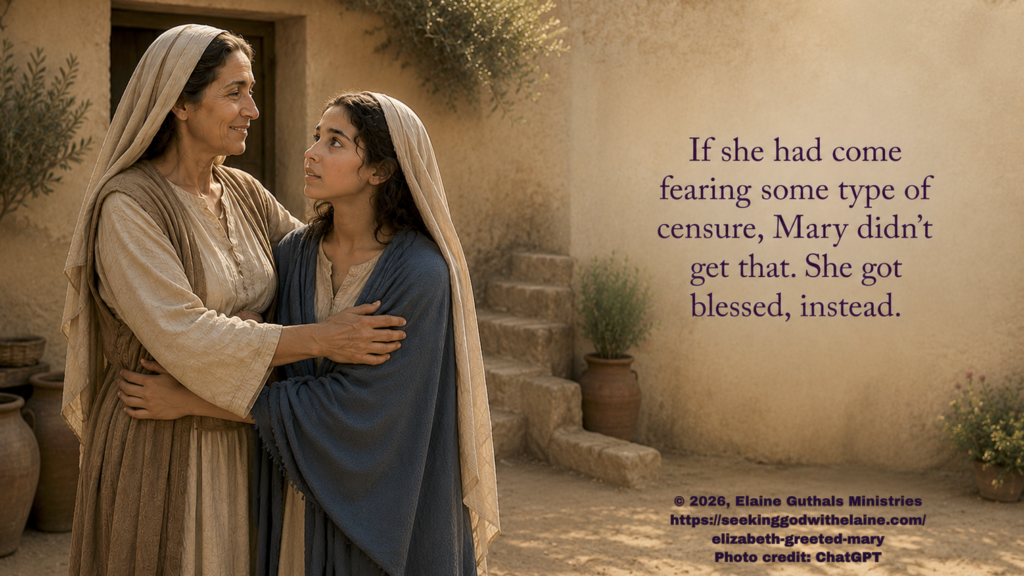
If she had come fearing some type of censure, Mary didn’t get that. She got blessed, instead.
Other women had been blessed in Scripture. “Most blessed among women is Jael, the wife of Heber the Kenite. May she be blessed above all women who live in tents” (Jdgs. 5: 24 NLT). In Jewish tradition, there is also Judith, in the Book of Judith, who was blessed among women.
No, this didn’t elevate Mary above humanity in any way. It means that she had received an unparalleled privilege in Jehovah’s redemptive plan.
The Mother of my Lord
Yeshua was called Lord before He was born.
It is one thing that Elizabeth recognized that Mary was pregnant without being told. But to know that her child was Krios – Lord – this she would have only gotten from the Holy Spirit.
Elizabeth recognized the identity of Mary’s child. Before Jesus ever performed a miracle, preached a sermon, or called a disciple, He was already acknowledged as Lord.
True, the title has an element of respect to it. Luke, however, repeatedly uses it in ways that echo the divine covenant name, especially when quoting or alluding to the Old Testament.
Because You Believed
Elizabeth affirmed Mary’s faith.
Again, Elizabeth didn’t know about the conversation between Gabriel and Mary. But she could tell Mary’s obedience.
Zechariah had been visited by Gabriel and was made speechless because of his disbelief. Mary stood before Elizabeth talking, joyful, and free. She had responded with faith and obedience.
Just think how Mary would have felt. She was a teenager who was asked to have a baby when everything in that society would have seen that as a huge sin.
This visit was another indication to Mary that everything was going to be okay.
Making the Connections #1
When we read through the whole passage, what comes flowing out of it is the joy. Both ladies approach their situations with joy.
- Mary traveled with eager obedience.
- Elizabeth was filed with the Holy Spirit.
- Even John got into the action by leaping in the womb.
- Blessings are spoken repeatedly.
- Faith is celebrated.
Nowhere was fear mentioned. Those who trust Jehovah do so with joy. That trust produces joyful recognition and worship.
Making the Connections #2
Knowing that Jehovah exists isn’t faith. It is knowledge.
It is listening to Jehovah, trusting Him, and being obedient to His call.
Making the Connections #3
This was a quiet family visit. Two women, both miraculously pregnant, taking comfort from each other.
Yes, this was a religious event.
No priests – because we hear nothing about Zechariah being present.
No Temple.
But the Holy Spirit was there.
The Holy Spirit confirmed the identity of the Messiah. The forerunner rejoiced.
Mary and Elizabeth responded because they believed God’s Word.
Making the Connections #4
Did you catch that? Yeshua hasn’t been born yet. He hasn’t preached a sermon. More importantly, He hasn’t done a miracle.
Later, how many people would only believe because of the miracles? How many would see the miracles and still not believe?
Heart Check
Think about the battle Yeshua is engaged in for your heart. Ask yourself the following questions.
- Do I respond to God’s leading with eager obedience like Mary?
- Do I rejoice when I see God working in someone else’s life?
- Am I willing to trust God before I understand everything He is doing?
- Does my faith produce joy, or does fear dominate my response?
How Do We Apply This?
- Worship Jehovah with joyful expectation.
- Trust Jehovah’s timing even when you don’t understand His plan.
- Keep your eyes on Jehovah instead of your circumstances.
- Encourage someone else’s faith the way Elizabeth encouraged Mary’s.
- Respond to God’s Word with immediate obedience.
Father God. Thank You for families that lead us to You and encourage us when we are anxious about Your calling. Thank You when we can go to brothers and sisters in Christ and get encouragement. Amen.
If you don’t understand something and would like further clarification, please contact me.
If you have not signed up for the email providing the link to the devotions and the newsletter, do so below.
If God has used this devotion to speak with you, consider sharing it on social media.