Yeshua’s mission, recorded in the Gospels, had one specific purpose. Our next theme looks at how His mission to make salvation possible is really a battle for our hearts.

We went from studying the Book of Revelation to the Book of Genesis. Right after we started Genesis, I knew I wanted the next theme to be Harmony of the Gospels.
That meant I have known since early 2025 that I was going to do this. I went back and forth on how to do this, so I’ve put a lot of thought into it.
I first wanted it to be chronological. Well, I wanted it to be as chronological as we know it to be. (That is when I thought the Gospels covered all three of the years of Yeshua’s ministry.)
But then I thought maybe the miracles might need to be taken together – look at all the healing the blind at once, etc.
So, I am trying to make the best of both worlds. The series within the theme will be:
- Preparing for the Christ
- The Birth and Early Childhood of Christ
- John the Baptist’s Ministry
- The Temptation of Christ
- The Early Ministry of Christ
- Miracles of Christ
- Jesus’ Parables
- Jesus’ Ministry
- Holy Week
- Jesus’ Death and Resurrection
I may hook the ascension on the end, even though it isn’t in the Gospels. It is an important part of Yeshua’s story.
It is important that we study this. True, first-century Jews thought their battlefield was Rome. We see how Yeshua battled the Pharisees and the Sadducees – and think that was it.
We’ll find out that much more was at stake.
Before we decide if we can take the word of the men who wrote the Gospels, we have to know who they are. This matters because the battle for the heart is the central theme of what they write about.
Authors
I hadn’t realized this until I started my research into this, but none of the authors identified themselves. Only the Book of Luke looks like it was written as a letter, as it identifies the person to whom it was written.
We aren’t given names, perspectives of the audience (Jewish or Gentile), or reasons why we are to take their word for it.
Matthew
The Book of Matthew gives the greatest evidence that it was written by a Jewish believer. It relies heavily on references to Old Testament scripture and Hebraic terms.
There is a copy of Matthew’s gospel written in Hebrew, which some may or may not believe to be the original. There are also copies of it translated into Greek.
Some questions exist as to whether the Book of Matthew or the Book of Mark was written first. Bradford noted the date the book was optimally written. He wrote,
“These ancient records state unequivocally that the Gospel of Matthew was written while Peter and Paul were still alive (early 60’s A.D.), and that Matthew was a Hebrew, and that he published a Gospel in his own dialect (which could have been either Hebrew or Aramaic as they are close-cousin languages and both were spoken fluently among ordinary Jewish folk in the 1st century A.D.).”
Resource
That would mean that there was a copy of the Book of Matthew before Jerusalem fell in 70 AD.
We traditionally believe that the first gospel was written by one of Yeshua’s Apostles, Matthew, the son of Alphaeus (Mk. 2: 14).
Mark
Some think that the Book of Mark is the oldest Gospel. Though the author is not named, it is attributed to John Mark, a contemporary of both Paul and Peter, whom both valued.
Possibly one of the better-known character studies in the New Testament, Mark, the cousin (anepsios) of Barnabas, is known for beginning Paul’s first missionary journey but bailing. Later —after Mark had matured — he became an asset to Paul’s ministry.
- “Aristarchus my fellow prisoner greets you, and Mark the cousin of Barnabas (concerning whom you have received instructions — if he comes to you, welcome him)” (Col. 4: 10 ESV).
- “Luke alone is with me. Get Mark and bring him with you, for he is very useful to me for ministry” (II Tim. 4: 11 ESV).
Possibly written mid- to late-60s AD, it is believed to have been written before the destruction of Jerusalem in 70 AD. It is thought to be a transcription of Peter’s memories, possibly compiled after his death.
The audience is believed to be disciples living under persecution in Rome. This is another point of evidence that Mark received his information from Peter, as his ministry field was Rome. Aramaic terms are translated, indicating the audience would not be familiar with the Jewish terms.
Mark attempted to encourage them by telling of Yeshua’s humbleness, persecution, and endurance.
Evidence of this may be seen as Peter is featured prominently. His successes are documented — as well as his failures. It includes
- Peter’s calling
- His confession at Caesarea Philippi
- A complete account of his denial of Christ in brutal detail
Also, the stories seem to be eyewitness accounts written from Peter’s perspective and from his preaching after the ascension. Details are included that only a witness would know. For example, Mark included the detail of Jesus sleeping on a cushion (Mk. 4: 38) and the color of the grass when feeding the five thousand (Mk. 6: 39).
In fact, Peter called Mark his son in faith. “She who is at Babylon, who is likewise chosen, sends you greetings, and so does Mark, my son” (1 Pet. 5: 13 ESV).
It was to Mark’s mother’s house he went to after being released from jail by the angel.
“When he realized this, he went to the home of Mary, the mother of John Mark, where many were gathered for prayer” (Ac. 12: 12 ESV).
Growing up in a gathering place for new believers, the family connection with Barnabas, the possible mentorship by Peter, and the work in Paul’s ministry put Mark in a unique position to pen the Gospel account.
Luke
“Many people have set out to write accounts about the events that have been fulfilled among us. They used the eyewitness reports circulating among us from the early disciples. Having carefully investigated everything from the beginning, I also have decided to write an accurate account for you, most honorable Theophilus, so you can be certain of the truth of everything you were taught” (Lk. 1: 1-4 NLT)
Luke was a physician. His mind would have been logical and ordered. This is evident as he opened his Gospel as a historian would.
Many People Have Set Out to Write Accounts
We also know Luke’s was not the first Gospel written. He acknowledged others had been written (Lk. 1: 1). It is estimated that he wrote his Gospel anywhere between 60 and 85 AD.
I also think Luke’s mind would be opened. He would have known that nothing he did may have saved his patients. It would have had to be God.
Having Carefully Investigated Everything
Luke took pains to ensure his reader don’t believe he was an eyewitness to the events he wrote about. Instead, in the following years, Luke researched happenings and reported them.
Later, Luke was an eyewitness to happenings in the early Church. We know Luke sometimes traveled with Paul.
Luke seems to suggest that there were many writings about the life of Christ, not just those in the Gospel. That would be logical.
Yeshua’s impact would have been far reaching. It would have required a response.
I know, in writing these devotions, I do this to align my thoughts and beliefs. First-century Jews may have also done that.
They may have also, like Paul, written to others to witness to them and grow their faith. Just because those writings did not survive until today doesn’t mean they weren’t available at that time.
From reading what Luke says, it appears that he took those accounts — probably by friends of Yeshua’s teaching though inaccurate in some way — the Gospels that were already written, and stories that he was told by eyewitnesses to compile his Gospel. He urged Theophilus to seek out eyewitnesses. That would ensure the account was factual.
Luke knew that faith could come by hearing. For centuries, first called Hebrews, then called Israelites, now called Jews, they relied on oral tradition. This was what Moses had documented in the Torah. The Gospels document the oral teaching of Yeshua.
Why were the Gospels written? The four men who wrote these books recognized that the teachings of Yeshua must be written down for others to know. This is critical because of man’s condition after the Fall – our hearts are damaged.
White explained it this way. He wrote, “That man has lost himself by losing [the] knowledge of his God; and that he can recover himself, with the knowledge of his own nature and eternal destiny, only by recovering the knowledge of his Maker.”
Resource
This perfectly describes the purpose of the battle of our heart. We are separated from Jehovah, and there is nothing that we can do on our own to restore that relationship.
Winning this battle is fundamental for the peace of our souls. This win is also imperative for us to have the quality of moral character required by Jehovah. Again, we can’t gain this level of character without Him.
Theophilus
Luke is the only one who addressed his Gospel to someone. We don’t know, however, who that person – Theophilus – was.
Most think he was a Roman government official because of the greeting – here translated as most honorable Theophilus. This is believed because of that title was given to those who hold a high office.
At least, this is what I grew up thinking, not knowing there were conflicting stories as to his origin.
There are also some who think Theophilus was a high priest. Not only that, but they also put him in the line of Ananus (Annas). Yes, that would be of the Annas and Caiaphas dynasty.
Whoever Theophilus was, Luke’s writings were not his initiation into the story of Yeshua. Maurice called Theophilus a disciple.
Resource
We know names meant something in first-century Israel. Theophilus meant friend of God.
Certain of the Truth
Luke told us we can be certain of the Gospel. What he meant was that we can be sure of the Gospel of Jehovah.
Wait! What???? Isn’t the Gospel about Yeshua?
Well, yes and no. The Gospels tell the story about how Yeshua came to earth to die as the sacrifice for our sins.
But the whole Plan of Salvation is Jehovah’s. What does Yeshua’s name mean? God saves.
Another thing Luke was certain about was that there is nothing we can do to earn salvation. Being a good person won’t work. Salvation is only gained through belief in Yeshua.
Tradition says that Luke was hanged in Greece.
John
“Peter turned around and saw behind them the disciple Jesus loved — the one who had leaned over to Jesus during supper … This disciple is the one who testifies to these events and has recorded them here. And we know that his account of these things is accurate. Jesus also did many other things” (Jn. 21: 21, 24 NLT)
The Gospel of John was written, according to early Church tradition, by the Apostle John. John, the son of Zebedee and Salome and brother to James, was the youngest apostle.
Instead of being named, the author is referred to as the beloved disciple. As he was also identified as being at the Last Supper, it had to have been one of the Twelve Apostles. He is also credited with writing three epistles and the Book of Revelation.
Written decades – possibly 80 to 98 AD – after the other Gospels possibly by the request of the bishop of Asia Minor, it is totally different from the others. Where the other Gospels focused on the year following the death of John the Immerser, this Gospel looked at doctrine from beginning to end.
Doesn’t that seem logical considering the amount of time from when the other Gospels were written to this one? John would have heard the question raised, so – being the good teacher – answered them as he went along with the story.
Continuity — or Contradiction — of the Gospels
So, those are the men who wrote the Gospels. But each Gospel is unique and has its own stories the others don’t tell. However, there are a few things all four tell about. Other things may be told in two or three of the Gospels.
But what happens if the accounts aren’t exactly the same? Do they contradict each other, or do they expand our knowledge?
How can we tell which is correct so that we don’t choose wrong in the battle for our heart?
Looking through the different passages, we see similarities and differences. How can all of them be right?
Each author looked at the passage from a different perspective. How can that be if they are all looking at the same thing?
Think of it this way. Four people are standing outside my house on different sides.
- The person on the east side sees the huge front yard and trees. You see the deck, front door, and big picture window into the dining room. At night, you can clearly see the kitchen light over the stove that is on 24/7.
- The person on the north side of the house just sees windows. Time it just right, and you will probably see a cat or two in the windows. The person sees the driveway which leads from front to back.
- The person on the west side sees the sunroom. They see we have a basement. They don’t think we have any yard to speak of because they mostly see driveway.
- The person on the south side sees the back porch and overhang. Most of all, you get a good look at the church to which this house used to be the parsonage.
Can you see the church when you are on the east side of the house? Well, it depends on where you are standing. The pine trees planted right on the property line make a good curtain.
Look how Parker described it. He wrote,
“Mark observed a good many things that Luke never saw, or at least never recorded. Matthew also had his own way of looking at things; and as for St. John, what was he looking at? Apparently at nothing, for his inner eyes were fastened on the soul of Christ. If Luke had sharp eyes, what ears John had! for he heard whisperings of the heart, throbbings and beatings and sighings: and what a gift of expression I (sic) for he turned all that he heard into noble, sweet music for the soul’s comforting in all the cloudy days of Church time.”
Resource
Multiple people may be involved in a conversation, but each may focus on different aspects of it. That is because one thing is more important to them than others.
Think about it. If we didn’t have Luke’s account, we wouldn’t have the birth. If we didn’t have Matthew, we wouldn’t have the Magi. If we didn’t have John, we wouldn’t know Nicodemus. If we didn’t have Mark, we wouldn’t have the Parable of the Growing Seed (Mk. 4: 26-29).
Differences may be because of the different audiences to whom they were writing. Matthew was writing to Jews, where Luke was writing to Greeks. Mark, on the other hand, was writing to Romans. John was writing to everyone.
It also may be because of different audiences who heard the teaching of them. My opinion – Yeshua taught His parables and teachings multiple times to different audiences.
Yes, there would be some – like the Apostles – who heard it several times. Don’t we sometimes need to hear things more than once?
But there would be others who were specific to that recorded setting. Who is to say that Yeshua didn’t tweak them to fit the audience at the time?
We have to remember that they didn’t have a written New Testament. This wasn’t a letter that He had written to them.
This was their ears actually hearing it. Yeshua had to tell things multiple times to get His message across.
That doesn’t make the passages contradictory. It make different tellings recorded.
The Battle for the Heart
It is easy to pick up the Gospels and do a 100-yard dash read. There is only a couple of verses on each topic, and then it quickly goes on to the next.
That makes it surface reads. That may be okay for our schedule so we can check it off our list, but it doesn’t help our walk.
What was the reason Yeshua came to earth? He came to pay the penalty for our sins. That restores our relationship with Jehovah.
But that means Yeshua has to battle Satan for us. He does that by exposing several things:
- Self-trust
- Spiritual pride
- Fear disguised as piety
- Control disguised as zeal
- Tradition elevated above truth
The battlefield wasn’t Rome. It wasn’t the Pharisees or the Sanhedrin. It wasn’t even Satan in isolation.
It’s inside us. Pastor Steve said, “Christianity isn’t behavior modification, it is heart transformation.”
Resource
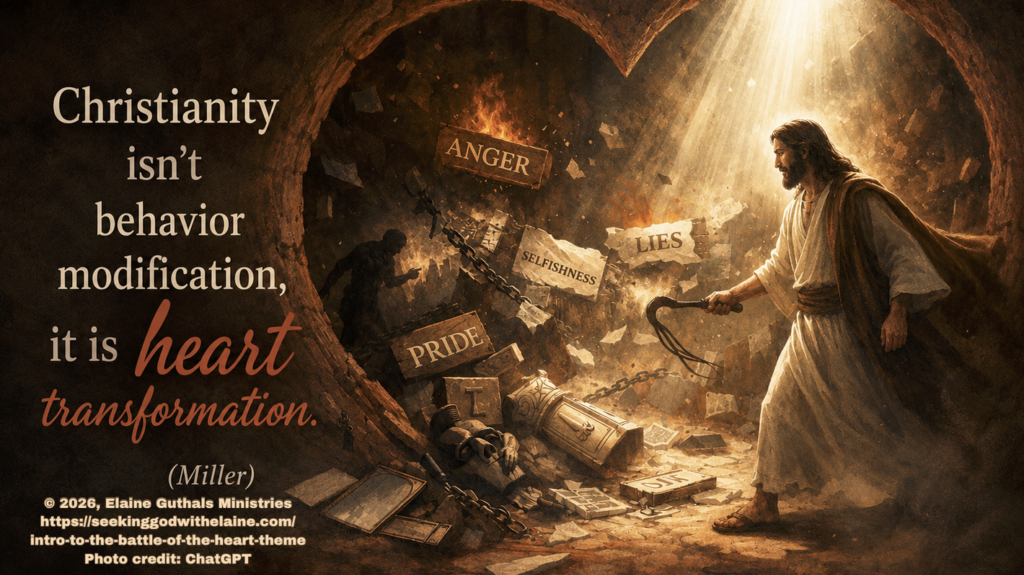
Reading the Gospels correctly means that we have to take a lot of things into consideration.
- The Old Testament
- Messianic Expectations
- Second Temple
- Covenant Identity
Knowing that puts Yeshua v. Pharisees into perspective. It deepens the why of the miracles. It shows the dividing line of the parables. It emphasizes spiritual warfare.
Why is that important for disciples? There are too many goats in the sheep pen.
We are like the Pharisees. We think we are okay.
Ooo, baby. We are so Pharisees. “We’ve never done it that way in this Church!”
The issue is that our hearts aren’t right. Yeshua has to battle to get them right.
We tend to think that knowledge comes before faith. In a way it does. We can’t have faith in something we don’t know.
But just knowing something doesn’t necessarily bring us to Faith. We may choose not to pursue faith, or not to accept faith.
James told us in his epistle that even the demons have knowledge of Christ. That isn’t enough. Faith must be present for salvation.
Jehovah only give us an introduction in His Word. As our hearts become right with Him, He will reveal Himself to us.
That gives us victories in the Battle for the Heart.
Over the coming studies we won’t simply watch Jesus heal diseases or answer His critics. We’ll watch Him expose pride, dismantle false religion, confront Satan’s lies, fulfill centuries of prophecy, and call ordinary people into true discipleship. Every miracle, every parable, every confrontation asks the same question: Who will rule your heart?
If you don’t understand something and would like further clarification, please contact me.
If you have not signed up for the email providing the link to the devotions and the newsletter, do so below.
If God has used this devotion to speak with you, consider sharing it on social media.