Author: admin

  • Spiritual Desires after God

    We need to desire to grow spiritual habits to strengthen spiritual worship. This devotional reading looks at what these desires are made of and what their focus should be.

    Nuggets

    • Desire should be fueled by spiritual motivation, resulting in spiritual worship.
    • Desire leading to spiritual worship should be intense.
    • Desire leading to spiritual worship should focus on seeking God.

    We’ve been talking about spiritual worship. The foundation of the series has been Charnock’s portion of the sermon Spiritual Worship.

    Resource

    Charnock had been discussing what is needed to develop spiritual habits.. I put his words as the title of this devotion. He talked about spiritual desires.

    Let’s take a look at the verses Charnock referenced to support his point.

    Let’s Put It into Context

    To read devotions in the Habitual Holiness of Heart and Life theme, click the button below.

    Here is a running list of nuggets for the theme.

    Devotions in the Finding Jesus through Spiritual Worship study

    Here is a running list of nuggets for the study.

    The foundation of this series is Menander and Charnock’s Spiritual Worship.

    Resource

    I used Charnock’s wording as the section headings.

    Desire in Terms of Motivation

    “I have seen you in your sanctuary and gazed upon your power and glory” (Ps. 63: 2 NLT)

    Desire should be fueled by spiritual motivation, resulting in spiritual worship.

    Some may think the word desire mainly has a sexual connotation. It doesn’t.

    Desire is synonymous with want. Pastor Steve said something about going to Dairy Queen the other night. We didn’t get there, but I have been desiring it ever since.

    I wasn’t really sure what the verse Charnock referenced had to do with desire.

    But the very first line from the very first sermon I read is a great one. Jay wrote, “Desires are, in some respects, better evidences of real religion than actions themselves.”

    Resource

    Oh, yeah. Just stepping foot into the sanctuary isn’t enough. Acknowledging God’s power is great, but is that even enough?

    The last thing we want to do is be insincere when we go into God’s house.

    In other words, our desires must be the product of spiritual motivation. The object of our actions must be God. Therefore, God must be in our motivations.

    Our desires must be more than “Hey, a dilly bar sounds pretty good right now.” There has to be a longing associated with them. “As the deer longs for streams of water, so I long for you, O God” (Ps. 42: 1 NLT).

    The intent of our spiritual worship should be to see God in all His power and glory.

    Where did David say he was going to see God? In His sanctuary. In His house.

    Yes, God is with us 24/7/365. That doesn’t mean we never have to set foot into a church building.

    As disciples, we should want to attend church regularly. We should desire the closeness with God that we can only get by meeting Him at His place. There is no substitute for corporate worship.

    We need to want to meet with like-minded believers. We learn so much from them. When our worship is combined with theirs, God is praised even more.

    This is all part of seeking God. We must hear His Word.

    Searching for and Seeking God

    Hearing His Word (Rom. 10: 17)
    Reading His Word (Rev. 1: 3)
    Praying to Him (Heb. 4: 16)
    Studying His Word (Ac. 17: 11)
    Meditating on His Word (Ps. 1: 1-2)
    Memorizing His Word (Ps. 119: 11)

    What? Are you questioning whether we really can see God’s power and glory? Power is God’s energy. Glory expresses the essence of God — His majesty, splendor, and beauty — representing the attributes of God resulting from the authority and holiness of God.

    We can see God’s glory. We see it every day in the world He has created.

    But more importantly, we see God’s glory in our soul.

    We also see God’s power in the world He created. His energy is needed to sustain all that He has created.

    James argued that we can only see that with committed attendance at worship in God’s sanctuary. This isn’t a once a year — not even once a month — attendance. This is regular attendance.

    Resource

    We come to the house of the Lord to learn of Him. We know beyond a shadow of a doubt that His promises are true.

    By growing closer to Him, we turn away from the power of this world. We gain in strength.

    To read a related devotion, click the button below.

    Desire in Terms of Intensity

    “I cling to you; your strong right hand holds me securely” (Ps. 63: 8 NLT)

    Desire leading to spiritual worship should be intense.

    David told us the intensity we are to exhibit when we desire something. Since we desire God, we are to cling to Him.

    Think about a toddler clinging to the parent. The more scared the little one is, the tighter the grasp.

    For disciples, this clinging is to bring spiritual obedience.

    Is it just me, or does it seem like we are adding the word spiritual to new things? Spiritual worship. Spiritual motivation. Spiritual obedience.

    It is logical. Our worship, motivation, and obedience must get to the heart level. It is based on faith.

    Tonse told us of the support God gives us when we do get our spiritual worship to the heart level. We are rescued from falling by His right hand, which sustains us. We are kept from fainting.

    Resource

    The King James Version translates clings as follows after. I can see that.

    We are to follow Jesus. “Then he said to the crowd, ‘If any of you wants to be my follower, you must give up your own way, take up your cross daily, and follow me’ (Lk. 9: 23 NLT).

    If we use our terminology, we say we have to seek Jesus. We have to seek Him in faith and love, as we talked about in the last devotion.

    Listen to how Shanks said this ties into desire. He wrote, “Desire is the stepping of the soul in the way toward God, the fountain of our blessedness and glory; and the stronger and more lively desire is, our motion in following after Him will be quicker and faster.”

    Resource

    We are to want to follow God through the good times and the bad.

    What David is saying is we have to adhere to God. New Testament terminology calls is abiding in Christ. Abiding in Christ means to permanently be in God in mind, spirit, and heart; resting in Him; and completing His purpose for our lives. 

    We have to grab onto God, latch on, and keep on so we can follow Him and be sustained by Him.

    We have to grab onto God, latch on, and keep on so we can follow Him and be sustained by Him.

    Desire in Terms of Thirsting

    “I thirst for God, the living God. When can I go and stand before him?” (Ps. 42: 2 NLT)

    Desire leading to spiritual worship should focus on seeking God.

    We talked about the verse before this one in the first section. It is about the deer panting for water.

    Liddon interpreted this psalm for us. He said the psalmist was probably in exile, cut off from temple worship.

    Resource

    But the psalmist isn’t missing the worship. He is missing God.

    Tuck agreed. He put it this way: “This Levite thought that he wanted Jerusalem, and the Temple, and the sacrifices, and the feasts, and the music. But a self-revealing time came, and he found that his soul was really craving for God. His love was athirst for God.”

    Resource

    It isn’t about the spectacle of the service. It isn’t about good music, good sermon, and good friends.

    It is about spending time with our Heavenly Father. It’s about building our relationship with Him.

    Maurice had a really interesting sermon. Let me try to summarize it.

    We are to thirst after God, but there are some in our worship services that aren’t really doing that.

    Our first thought may be to jump up and down and call them Matthew 7: 21 disciples.

    Maurice cautioned us to remember we were once there and we may get there again. Thirsting for God us what we are striving for because it is His way, but His ways are so far above ours (Isa. 55: 8-9).

    Resource

    I think Maurice’s bottom line is people who are not thirsting after God have to examine the motivation behind why they are not thirsting. If they are sincerely trying and not succeeding, that is one thing. But if their goal is not to thirst after God, something is wrong.

    I also see that our church must be made up of believers and non-believers. If there are no non-believers in our midst, we are not fulfilling the Great Commission to make new disciples.

    Everyone is seeking some form of god, whether they acknowledge it or not. It can’t be some worldly draw. This isn’t an intellectual pursuit.

    We have to make sure we are seeking the One true God to put our faith and trust in Him. We have to seek the living God.

    We can’t gloss over the intensity part. We have to be wholeheartedly seeking God. It has to be continual.

    But Tuck made a really good point. The psalmist realized he needed God when he was not engaged at all in spiritual worship. Basically, Tuck said things had calmed down enough for him to see what he was missing.

    That was so much better than the rich man in Jesus’ parable. He was thirsty, but what he was wanting was relief from hell fires.

    We don’t want to wait that long to be thirsty.

    spiritual-desires-after-godFB

    Making the Connections

    Why is our desire to follow God busted? We would jump up and say that it is the pull of the world.

    Shanks begged to differ. Yes, he did say that we allow worldly things too much importance. He also said there are some character flaws, such as unbelief, pride, and sinfulness, that have too great of a hold on us.

    But Shanks gave two other good reasons.

    • We don’t keep track of the state of our hearts. We don’t evaluate where we are at on the Sanctification Road.
    • We don’t follow what God says to keep on track. We don’t seek Him.

    Resource

    To me, that smacks of not being genuine disciples. We want the blessings, but we don’t want to put in the work to be exactly who God calls us to be.

    We have to make sure our hearts are right.

    How Do We Apply This?

    • Renounce and turn away from the world.
    • Choose God.
    • Align our motivations with His.

    Resource

    Father God. It is our desire to worship You to please You. We want our total focus to be on You. Help us as we seek You.  Amen. 

    What do you think?

    Leave me a comment below (about this or anything else) or head over to my Facebook group for some interactive discussion.

    If you don’t understand something and would like further clarification, please contact me.

    If you have not signed up for the email providing the link to the devotions and the newsletter, do so below.

    If God has used this devotion to speak with you, consider sharing it on social media.

  • Elements Needed for Building Habits for Spiritual Worship

    Faith and love are essential elements for spiritual worship. This devotional reading looks at how both lead to genuine worship and why we should evaluate where we are at.

    Nuggets

    • Our worship should flow out of our faith for God because He wants us to simply believe in Him.
    • Our worship should flow out of our love for God because He has adopted us as His children to remove our bondage.
    • God calls us to evaluate our faith so that we know that we are worshiping God correctly and determine where our weaknesses are.

    Faith and love are the elements we need for building habits for spiritual worship. If they are not present, we do not have spiritual worship.

    God doesn’t call for much. He says we can do wonders through Him when we have faith the size of a mustard seed (Mt. 17: 20).

    What God does call for our faith and love to be sincere. That is the measure He uses. To what extent do we truly believe in Him?

    We are called to evaluate ourselves to find out where we are in the sanctification process. God wants us to determine our weaknesses.

    Charnock said faith and love are necessary for spiritual worship. Let’s take a look at the verses he referenced.

    Let’s Put It into Context

    To read devotions in the Habitual Holiness of Heart and Life theme, click the button below.

    Here is a running list of nuggets for the theme.

    Devotions in the Finding Jesus through Spiritual Worship study

    Here is a running list of nuggets for the study.

    The foundation of this series is Menander and Charnock’s Spiritual Worship.

    Resource

    I used Charnock’s wording as the section headings.

    Faith

    “When these things were all in place, the priests regularly entered the first room as they performed their religious duties” (Heb. 9: 6 NLT)

    Our worship should flow out of our faith for God because He wants us to simply believe in Him.

    I love when we start verses with references to what was already discussed — not. We sit here, scratching our heads, going, “What?”

    The writer of Hebrews started Chapter 9 with a discussion of the covenant with Abraham. Specifically, he talked about regulations for worship. His purpose was to compare the covenant with Abraham with the covenant with Jesus.

    Glossary

    The writer in Hebrews was focusing on our communication with God through Jesus, our High Priest. God had provided ways for us to approach Him through temple worship. Now, the way was through Jesus.

    Bruce made an interesting observation. He wrote, “The epithet κοσμικόν here applied to the tabernacle evidently signifies belonging to this material world, in opposition to the heavenly sanctuary (ver, 11) not made with hands out of things visible and tangible.”

    Resource

    I bet the ancient Jews would have pitched a fit if they would have heard the temple described as belonging to the earth. It is understandable, though.

    The writer of Hebrews talked about candlestick, censors, the Ark of the Covenant – these are all man-made things. Yes, the blueprints for construction were given by God, but the actual creating of what they saw was done by men. We are even given their names.

    Regardless of how the articles matched exactly God’s specifications, they are just tools to be used in worship. It is when they are used to worship God correctly that they become tools of worship. Only then is worship acceptable to God.

    In other words, if we do not have sincere faith in God, our worship and our tools of worship are suspect. Faith is a gift from God and a work of the Spirit that enhances the conviction that the doctrines revealed in God’s Word are true, even if we do not understand all aspects of them, a belief which impacts our lives and distinguishes us from others.

    Glossary

    The writer of Hebrews tells us about that, too. “Now faith is the assurance of things hoped for, the conviction of things not seen” (Heb. 11: 1 ESV emphasis added).

    We don’t want to worship based on earthly things. But we must worship. That is the foundation of all the covenants God has made with us.

    Caird talked about the simplicity of worship. Instead of the regulations of the law, we get spiritual habits. The simplicity of worship is an indication of where our hearts are.

    We do have some symbols. Baptism and the Lord’s Supper give us a framework but not step-by-step instructions on how to perform them. Caird said that He was “… leaving all accessories to be filled in, as the varied needs of His people, in different times and places and circumstances, should dictate.”

    Resource

    Isn’t that amazing? God tells us to worship Him but doesn’t tell us how to do it.

    God doesn’t tell us to sing hymns or contemporary music. He doesn’t tell us to plan our church services to be for an hour or two — or all day.

    Instead, God wants us to worship Him His way. God doesn’t want us to stop at the water in baptism and the bread and wine in the Lord’s Supper. He wants us to get to Him.

    God wants us to worship Him His way. God doesn’t want us to stop at the water in baptism and the bread and wine in the Lord's Supper. He wants us to get to Him.

    God doesn’t want us to replace ritual for our relationship with God. He has supplied the truth (Jesus) to give us spiritual truth. It gives us spiritually of mind and heart.

    Love

    “So you have not received a spirit that makes you fearful slaves. Instead, you received God’s Spirit when he adopted you as his own children. Now we call him, ‘Abba, Father’” (Rom. 8: 15 NLT)

    Our worship should flow out of our love for God because He has adopted us as His children to remove our bondage.

    After the original sin, we became slaves of sin. This spirit of bondage is the work of Satan.

    We know that we are set free when we accept the gift of salvation. “And you will know the truth, and the truth will set you free” (Jn. 8: 32 NLT).

    Salvation is the gift of life through the deliverance from condemnation and sin to acceptance and holiness and changes us from being spiritually dead to spiritually alive.

    • Sin is not believing that Jesus is our Savior to save us from our actions by humans that disobey God and break one of His reasonable, holy, and righteous laws and commandments, goes against a purpose He has for us, or follows Satan’s promptings.
      • Holy means to be set apart — because of our devotion to God — to become perfect, and morally pure while possessing all virtues and to serve and worship God.
        • Perfection means we reach a state of maturity because the combination of the spiritual graces form, when all are present, spiritual wholeness or completeness — holy, sanctified, and righteous.
          • Spiritual graces are worldly morals that have been submitted to God to further His kingdom instead of enhancing this world.
          • Sanctified means to be set free from sin.
          • Righteous means we are free from sin because we are following God’s moral laws.
        • Pure means not being sinful or having the stain of sin. 
        • Virtues are standards of moral excellence.
      • Holiness is the transcendent excellence of His nature that includes elements of purity, dedication, and commitment that lead to being set apart.
        • Purity means possessing God’s moral character, having eliminated the stain of sin.
      • Spiritual death is the spiritual separation from God that occurred as a consequence of Adam and Eve’s original sin.
        • The spiritually alive are those who have ABCDed, so they are no longer separated from God.

    The ABCDs of Salvation

    If you have not become a believer in Christ, please read through the
    Plan of Salvation and prayerfully consider what God is asking you to do.

    A – admit our sins
    B – believe His Son Jesus is our Redeemer
    C – confess God as Sovereign Lord

    D – demonstrate that commitment by making any changes needed in our lives to live the way in which God has called us

    The Disciple’s Job Description

    Glossary

    But salvation does not give us license to sin. Some think that disciples can do whatever we want after conversion. We can’t.

    Roberts looked at this through a different lens. He also saw bondage as our performing our duties as a disciple solely because we feel we must.

    Resource

    Do we only go to church because it is a duty? Do we only read these devotions because it is a duty? Do we read these devotions because we don’t want to read God’s Word?

    Pastor Steve said something great in one of his sermons. He said, “We are free in Christ, but we are called to live as bond servants.”

    Spurgeon told us what that means.

    • We must feel the conviction of sin.
    • We have to know we will be punished for those sins.
    • Doing the works of the law is pointless.

    Resource

    We must want to perform the duties of being a disciple. In doing that, we draw closer to God because we want to be with Him.

    Yes, the bond servant is one who served without wages. However in Roman times, this service was voluntary.

    God calls us to voluntarily accept the Plan of Salvation. He wants us to choose to follow Him.

    This bondage should lead us to fear God. The fear of the Lord means awe, reverence and love, not terror. Spurgeon said this will lead to righteousness, not self-righteousness.

    Glossary

    God adopts us so that we become children of God. This adoption liberates us from the spirit of bondage to Satan. Adoption is the act of grace where we are accepted into God’s family when Jesus redeems us and changes to be spiritually alive like God.

    Glossary

    We should be thankful for this adoption into God’s family. In other words, we are to worship Him. This plays out by our remaining child-like, so that we imitate Him.

    We call God Abba and Father when we pray to Him. It is logical that we would call Him this when we become His children.

    Beddome described it this way. He wrote, “Prayer is the very breath of a child of God; the first effort of Divine grace in the heart.”

    Resource

    Yes, there is a familiarity in addressing God as Abba. However, we have to do so in reverence. Trust has to be present.

    A Spiritual Sensibility of Our Own Weakness

    God calls us to evaluate our faith so that we know that we are worshiping God correctly and determine where our weaknesses are.

    God doesn’t want us to be worshiping only through lip service. He wants a strong relationship with us.

    Therefore, we need to know when we are attending church only because we feel it is a duty. We have to examine our reasons for reading devotions over God’s Word.

    Why is it so important to evaluate where we are at? We don’t want to be the Matthew 7: 21 disciple. “Not everyone who calls out to me, ‘Lord! Lord!’ will enter the Kingdom of Heaven. Only those who actually do the will of my Father in heaven will enter” (Mt. 7: 21 NLT).

    elements-needed-for-building-habits-for-spiritual-worshipFB

    Making the Connections

    God can be exact in wanting us to worship as He chooses. At other times, He may choose sincerity over preciseness.

    Moore told us three ways to show our sincerity of worship. We must be reverent, cheerful, and confident.

    Resource

    How Do We Apply This?

    • Work to follow God’s laws and commandments.
    • Spend more time with God in prayer.
    • Mortify our sins.
    • Allow God to humble us.
    • Realize we cannot save or sanctify ourselves.

    Resource

    Father God. We stand in awe that Sovereign God would want to adopt those who have disobeyed Him to be His children. We know we are unworthy. We know You are worthy. We come to You in faith and love to worship You in spirit and in truth. Amen.

    What do you think?

    Leave me a comment below (about this or anything else) or head over to my Facebook group for some interactive discussion.

    If you don’t understand something and would like further clarification, please contact me.

    If you have not signed up for the email providing the link to the devotions and the newsletter, do so below.

    If God has used this devotion to speak with you, consider sharing it on social media.

  • Spiritual Habits in Spiritual Worship

    All year, we have been looking at habitual holiness. This devotional reading looks at how spiritual worship should be habitual.

    Nuggets

    • In order to worship spiritually, we need to get our hearts involved.
    • In order to worship spiritually, we need to build spiritual habits.

    Charnock has been helping us dig into what spiritual worship is. He wrote next about spiritual activity and habits.

    Let’s Put It into Context

    To read devotions in the Habitual Holiness of Heart and Life theme, click the button below.

    Here is a running list of nuggets for the theme.

    Devotions in the Finding Jesus through Spiritual Worship study

    Here is a running list of nuggets for the study.

    The foundation of this series is Menander and Charnock’s Spiritual Worship.

    Resource

    Discharged with Spiritual Activity

    “Wake up, my heart! Wake up, O lyre and harp! I will wake the dawn with my song” (Ps. 57: 8 NLT)

    In order to worship spiritually, we need to get our hearts involved.

    The activity of worship has to come out of our desire to praise Him. Praise is our response to God, but it usually involves music.

    We must fix our hearts on God. Tuck said that our hearts are our true-life force.

    Resource

    But what does fixing our hearts mean? Maclaren helped us with that. We have to have

    • Fixed determination
    • Steadfast affection
    • Continuous dependence

    Resource

    Determination is talking about strength of character. That is what we are growing as we navigate the Sanctification Road. Sanctification is the transformational process of the mind, body, and soul, which begins with regeneration; gradually changes our nature and morals through the promptings of the Holy Spirit; and ends with perfected state of spiritual wholeness or completeness.

    • Regeneration is being changed from spiritually dead to spiritually alive and the internal new birth and requickening that God brings about through the work of the Holy Spirit to give us new character.
      • Spiritual death is the separation from God that occurred as a consequence of Adam and Eve’s original sin.
        • The spiritually alive are those who have ABCDed, so they are no longer separated from God.
      • Perfection means we reach a state of maturity because the combination of the spiritual graces form, when all are present, spiritual wholeness or completeness — holy, sanctified, and righteous.
        • Spiritual graces are worldly morals that have been submitted to God to further His kingdom instead of enhancing this world.
        • Sanctified means to be set free from sin.
        • Righteous means we are free from sin because we are following God’s moral laws.

    The ABCDs of Salvation

    If you have not become a believer in Christ, please read through the
    Plan of Salvation and prayerfully consider what God is asking you to do.

    A – admit our sins
    B – believe His Son Jesus is our Redeemer
    C – confess God as Sovereign Lord

    D – demonstrate that commitment by making any changes needed in our lives to live the way in which God has called us

    The Disciple’s Job Description

    Glossary

    Isn’t that comforting? We don’t think we have a strong faith now, but it can grow with work on our part. Faith is a gift from God and a work of the Spirit that enhances the conviction that the doctrines revealed in God’s Word are true, even if we do not understand all aspects of them, a belief which impacts our lives and distinguishes us from others.

    Glossary

    Spiritual worship can only come out of a strong faith.

    Think of it this way. I kind of tripped when I thought of worship as an activity. We think of an activity as doing.

    Our focus shouldn’t be doing worship. The focus should be on God, with worship an outpouring of our hearts.

    The focus should be on God, with worship an outpouring of our hearts.

    Stevenson connected the dots. He wrote, “‘My heart is fixed;’ this is the fact; and hence, apparently, the resolution, ‘I will sing and give praise.’”

    Resource

    The foundation is in our hearts. If we don’t fix our hearts on God, we haven’t really accepted His gift of salvation. Salvation is the gift of life through the deliverance from condemnation and sin to acceptance and holiness and changes us from being spiritually dead to spiritually alive.

    • Sin is not believing that Jesus is our Savior to save us from our actions by humans that disobey God and break one of His reasonable, holy, and righteous laws and commandments, goes against a purpose He has for us, or follows Satan’s promptings.
      • Holy means to be set apart — because of our devotion to God — to become perfect, and morally pure while possessing all virtues and to serve and worship God.
      • Pure means not being sinful or having the stain of sin. 
      • Virtues are standards of moral excellence.
    • Holiness is the transcendent excellence of His nature that includes elements of purity, dedication, and commitment that lead to being set apart.
      • Purity means possessing God’s moral character, having eliminated the stain of sin.

    Glossary

    But it is hard to keep our hearts fixed on God. We are bombarded by many temptations. Doubt and uncertainty can reign if we aren’t careful.

    In those times, we need to even more have our hearts fixed on God. We have to choose to put our faith in God.

    Paul said in all things we must be content. “Not that I was ever in need, for I have learned how to be content with whatever I have.  I know how to live on almost nothing or with everything. I have learned the secret of living in every situation, whether it is with a full stomach or empty, with plenty or little. For I can do everything through Christ, who gives me strength” (Phil. 4: 11-13 NLT).

    It would probably be safe to assume that David thought the same way. He may have been king and a man after God’s own heart, but he didn’t have an easy life.

    Yet, this psalm came from him. David said he would “… wake the dawn with my song” (Ps. 57: 8 NLT).

    Regardless of the circumstances in which we find ourselves, we must praise God.

    Oh, yeah. It is going to fluctuate. We have to have steadfast love for God.

    That isn’t just a warm fuzzy feeling. It isn’t an entitled feeling.

    What it is is what Vincent calls a sanctified emotion. It has nothing to do with worldview emotions and everything to do with heavenly praise and worship.

    Resource

    It is a true belief that our Sovereign God loves us so much that He would provide the Plan of Salvation for us to restore us to Him.

    Vincent added, in my opinion, a fourth bullet point to Maclaren’s three.

    • Habitual preparation.

    Resource

    Our focus has to totally be on God. We have to have constant communion with Him. He has to have influence in every part of our lives and in every decision.

    Our faith is a decision; our worship is a result and a duty.

    Discharged with Spiritual Habits

    “Let all that I am praise the LORD; with my whole heart, I will praise his holy name” (Ps. 103: 1 NLT)

    In order to worship spiritually, we need to build spiritual habits.

    Why do we praise God?

    • God is righteous.
    • He gives us infinite forgiveness.
    • He is our Heavenly Father.
    • He shows us mercy and grace.
    • God constantly showers us with good things.

    Resources

    God’s mercy is an act of sovereign will that produces an unexpected and undeserved response from God as He responds in love to our needs.
    Grace is a free and unmerited gift of love from the Heavenly Father, given through His Son, Jesus Christ, that enables salvation and spiritual healing to believers by the work of the Holy Spirit.

    Glossary

    Pearce tied this psalm to spiritual worship. He wrote, “The psalmist is solicitous that his praise should be spiritual. It is his soul and not his lips he addresses. He wants nothing formal, mechanical, lifeless, spiritless.”

    Resource

    The psalmist also says spiritual worship must be with the whole heart. We can’t hold anything back.

    We recently talked about being united with God. Spurgeon brought up that we have to be united with ourselves.

    Spurgeon elaborated on why this is so important. He wrote, “It is necessary that the whole nature bless God, for at its best, when all engaged in the service, it fails to compass the work, and fails short of Jehovah’s praise.”

    Resource

    Even our very best praise and worship falls short of what Sovereign God deserves.

    But God still says it is our duty to worship Him. He accepts our praise and worship.

    Another thing the psalmist pointed out was that it has to be my whole heart. Yes, we are to participate in corporate worship.

    More importantly, we have to worship God individually. Spiritual worship isn’t a Sunday-and-done thing.

    Spiritual worship is 24/7/365/eternity.

    Spiritual worship is 24/7/365/eternity.
    spiritual-habits-in-spiritual-worshipFB

    Making the Connections #1

    Tuck made a great connection when we talked about being fixed. He talked about neither being hot nor cold.

    Resource

    Jesus talked about a lukewarm church. “I know all the things you do, that you are neither hot nor cold. I wish that you were one or the other!” (Rev. 3: 15 NLT).

    What would that look like today? It would probably be safe to say that is compromising with the worldview.

    We see that we have to be in the world even though we are not of it. Many think we have to find a happy medium, so we are not persecuted.

    Wrong thought process. Jesus said we are going to be persecuted for His name (Mt. 24: 9).

    We can’t think Jesus was just referring to the Twelve there.

    Making the Connections #2

    I love how Pearce described what praise is. He wrote, “In praising God, we perform one of the highest and purest acts of religion. In praise, we largely eliminate the element of self, and are like the angels in performing the unpolluted services of the skies.”

    Resource

    Through praise and spiritual worship, we take the focus off ourselves and become like angels.

    Making the Connections #3

    So, let’s focus on habits for a second. What needs to be habitual?

    • Fixed determination
    • Steadfast affection
    • Continuous dependence
    • Habitual preparation.

    Resources

    If we have those, we will be reading God’s Word, praying to Him, and praising and worshiping Him with our whole hearts.

    How Do We Apply This?

    • Fix our hearts in God.
    • Complete the service God has assigned us.
    • Seek God.
    • Pray.
    • Work to expand God’s kingdom.
    • Praise God to eliminate doubts.
    • Guard that life does not loosen the bonds we have with Christ.
    • Expand the mental hold God has on us.

    Resources

    Searching for and Seeking God

    Hearing His Word (Rom. 10: 17)
    Reading His Word (Rev. 1: 3)
    Praying to Him (Heb. 4: 16)
    Studying His Word (Ac. 17: 11)
    Meditating on His Word (Ps. 1: 1-2)
    Memorizing His Word (Ps. 119: 11)

    Father God. We praise You with everything we have. We worship You continuously with our whole heart. Help us to keep our determination, affection, and dependence focuses totally on You. Help us to prepare for live with You eternally. Amen.

    What do you think?

    Leave me a comment below (about this or anything else) or head over to my Facebook group for some interactive discussion.

    If you don’t understand something and would like further clarification, please contact me.

    If you have not signed up for the email providing the link to the devotions and the newsletter, do so below.

    If God has used this devotion to speak with you, consider sharing it on social media.

  • United of Heart in Spiritual Worship

    One of the purposes of spiritual worship should be to unite us with God. This devotional reading looks at how we do — and do not — accomplish that.

    Nuggets

    • We unite our hearts with God when we walk with Him.
    • We unite our hearts with God when we are sincere.
    • We unite our hearts with God when we separate ourselves to be with God.
    • We cannot be united with God if we do not spend time with Him.

    We are way into our study on spiritual worship. Charnock was describing what spiritual worship is. He said that it is “performed with unitedness of heart.”

    Look at the four verses Charnock identified. At first glance, the connection isn’t readily noticeable. Let’s see what we can piece together.

    Let’s Put It into Context

    To read devotions in the Habitual Holiness of Heart and Life theme, click the button below.

    Here is a running list of nuggets for the theme.

    Devotions in the Finding Jesus through Spiritual Worship study

    Here is a running list of nuggets for the study.

    The foundation of this series is Menander and Charnock’s Spiritual Worship.

    Resource

    United in Learning

    “Teach me your ways, O LORD, that I may live according to your truth! Grant me purity of heart, so that I may honor you” (Ps. 86: 11 NLT)

    We unite our hearts with God when we walk with Him.

    When we first ABCD, our character isn’t like God’s. It is a process to learn to be like Him.

    Parry told us about the three phases of religion. He wrote, “In the expressions ‘teach,’ “fear,’ ‘walk,’ we have religion presented to us in the three aspects of knowledge, feeling, and conduct.”

    Resource

    God teaches us in many ways. This is how we gain knowledge of Him.

    We read God’s Word to gain an introductory knowledge of Him. After we become His children, He reveals Himself to us through the Holy Spirit and His creation. At times, God uses Pastor Steve-types and even Springfield Mom-types to increase our depth of understanding.

    Several times we have said that we cannot put faith in God if we do not know Him. Gaining knowledge of Him is part of navigating the Sanctification Road.

    Faith is a gift from God and a work of the Spirit that enhances the conviction that the doctrines revealed in God’s Word are true, even if we do not understand all aspects of them, a belief which impacts our lives and distinguishes us from others.
    Sanctification is the transformational process of the mind, body, and soul, which begins with regeneration; gradually changes our nature and morals through the promptings of the Holy Spirit; and ends with perfected state of spiritual wholeness or completeness.

    • Regeneration is being changed from spiritually dead to spiritually alive and the internal new birth and requickening that God brings about through the work of the Holy Spirit to give us new character.
      • Spiritual death is the separation from God that occurred as a consequence of Adam and Eve’s original sin.
        • The spiritually alive are those who have ABCDed, so they are no longer separated from God.
      • Perfection means we reach a state of maturity because the combination of the spiritual graces form, when all are present, spiritual wholeness or completeness — holy, sanctified, and righteous.
        • Spiritual graces are worldly morals that have been submitted to God to further His kingdom instead of enhancing this world.
        • Sanctified means to be set free from sin.
        • Righteous means we are free from sin because we are following God’s moral laws.

    The ABCDs of Salvation

    If you have not become a believer in Christ, please read through the
    Plan of Salvation and prayerfully consider what God is asking you to do.

    A – admit our sins
    B – believe His Son Jesus is our Redeemer
    C – confess God as Sovereign Lord

    D – demonstrate that commitment by making any changes needed in our lives to live the way in which God has called us

    The Disciple’s Job Description

    Glossary

    God wants us to learn more about Him.

    What is God teaching us? His laws and commandments. By learning them, we learn about God’s character.

    We learn to fear God as we gain this knowledge. The fear of the Lord means awe, reverence, and love, not terror. It is how we exhibit our child-like faith.

    We do not have faith in God if we do not have fear of Him, displayed in the feelings of awe, reverence, and love.

    We do not have faith in God if we do not have fear of Him, displayed in the feelings of awe, reverence, and love.

    Yes, the knowledge part and the reverence part must go hand in hand. That leads to walking with God.

    Walking is the term used to describe how we live our lives, specifically our habitual state of mind, behavior, and manners. Walking with God means we are humble, reverent, teachable servants of God. 

    Many would say that walking is how we conduct our lives. Do we imitate God? Do we have the child-like characteristics of sweetness and trust?

    God told Jeremiah that He has plans for us. “‘For I know the plans I have for you,’ says the LORD. ‘They are plans for good and not for disaster, to give you a future and a hope’” (Jer. 29: 11 NLT).

    We need to look to God so that He can reveal those plans to us. They are plans to fix our spiritual condition so that we can worship Him.

    United in Sincerity

    “So my people come pretending to be sincere and sit before you. They listen to your words, but they have no intention of doing what you say. Their mouths are full of lustful words, and their hearts seek only after money” (Ezek. 33: 31 NLT)

    We unite our hearts with God when we are sincere.

    Okay, switch gears.

    I thought Charnock was talking about how to be united with God. This verse doesn’t say that.

    Let’s think about it for a second. Don’t we sometimes learn how to do things by learning how not to do things? Case in point — not touching a hot stove.

    What is the list of things in this verse that we don’t’ want to do?

    • Pretend to be sincere.
    • Listen without acting on them.
    • Have the wrong focus.
    • Have the wrong motivation.

    Lyth called this person a formalist. A formalist is a person who gives the appearance of being a disciple but isn’t.

    Resource

    Nominal disciples are similar. Nominal disciples are those boasting they love God without even trying to imitate Him — those who dig on religion and its rituals without having a change in heart.

    We would say that these are the Matthew 7: 21 Christians. “Not everyone who says to me, ‘Lord, Lord,’ will enter the kingdom of heaven, but the one who does the will of my Father who is in heaven” (Mt. 7: 21 ESV).

    The sad part is some of thing think they are doing things exactly right. But they aren’t.

    The really sad part is, sometimes, it may be difficult to tell formalists apart from real disciples. Punshon said both are in the same room worshiping together. The formalist may even be responding to God’s Word.

    But, somehow, they just aren’t right with God. There is some resistance.

    We have to respect God’s truth. We can’t be trying to rewrite God’s Word and redefining sin.

    That means we have to know God’s laws and commandments – and do them – all of them.

    Some question whether we must keep the letter of the law or the spirit of the law. Parker discussed that. He wrote, “The people come to hear the letter only, and there is no letter so disappointing as the letter of the Bible.”

    Resource

    I know. That makes it hard for list checkers.  Comparing and contrasting letter and spirit is probably too deep for this current discussion.

    So, let’s keep on track.

    Lyth said that a formalist didn’t get it down to the heart level. Their hearts haven’t been regenerated. Regeneration is being changed from spiritually dead to spiritually alive and the internal new birth and requickening that God brings about through the work of the Holy Spirit to give us new character.

    Glossary

    But then wouldn’t the letter/spirit fit into that, too? We think we are following the law correctly when we are following it to the law/spirit level.

    We have to do things God’s way. We have to sincerely follow His direction.

    Learning by Separation

    “But when you pray, go away by yourself, shut the door behind you, and pray to your Father in private. Then your Father, who sees everything, will reward you” (Mt. 6: 6 NLT)

    We unite our hearts with God when we separate ourselves to be  with God.

    It can be difficult at times to focus on God. We let life slip in when we are reading God’s Word or praying to Him.

    Going into our prayer room can help keep our focus on God. That sets the environment for uniting with Him.

    Barnes said it is our duty to offer secret prayers.

    Resource

    The sermon by the American Homiletic Monthly lists why we benefit from going into our prayer room. They are

    “1.       To be alone with God.
    “2.       To cultivate heart-religion.
    “3.       To obtain needed supplies of grace.”

    Resource

    What this tells me is we have to focus on God. We can’t do that when we let the world come in and distract us.

    We can’t be united with God when we don’t spend quality time with Him.

    Learning by Staying with Him

    “I have tried hard to find you — don’t let me wander from your commands” (Ps. 119: 10 NLT)

    We cannot be united with God if we do not spend time with Him.

    Relationships take work. Our relationship with God is no different.

    We must spend time with God — seek Him — if we are going to imitate Him.

    Searching for and Seeking God

    Hearing His Word (Rom. 10: 17)
    Reading His Word (Rev. 1: 3)
    Praying to Him (Heb. 4: 16)
    Studying His Word (Ac. 17: 11)
    Meditating on His Word (Ps. 1: 1-2)
    Memorizing His Word (Ps. 119: 11)

    The Homilist said we have one big problem. One line in their sermon said that we have the capacity or “power to wander from the Divine law.”

    Resource

    Ouch but true.

    We have the ability to wander off because we have free will. Free will is the ability within us to make decisions, which determine actions that produce character.

    We are not united with God if we are wandering away from Him. For that reason, we need to ensure we stay in lock step with Him.

    united-of-heart-in-spiritual-worshipFB

    Making the Connections

    Did you notice how sincerity slipped into the discussion? We can’t be united with God if we aren’t sincere.

    We have to sincerely walk with God so we aren’t Matthew 7:21 people. That means getting His Will down to the heart level. We can only do that by spending quality time with Him.

    How Do We Apply This?

    • Be humble, reverent, teachable servants of God. 
    • Be sincere in worshiping God.
    • Utilize our prayer rooms.

    Resource

    Father God. We worship You. Lord, it is our prayer that we be united with You. Teach us so that we can walk with You. Amen.

    What do you think?

    Leave me a comment below (about this or anything else) or head over to my Facebook group for some interactive discussion.

    If you don’t understand something and would like further clarification, please contact me.

    If you have not signed up for the email providing the link to the devotions and the newsletter, do so below.

    If God has used this devotion to speak with you, consider sharing it on social media.

  • June 2023 Newsletter

    Main Nugget

    • Spiritual worship doesn’t follow the requirements of ceremonial law (Ceremonial Law v. Spiritual Worship).
    • Spiritual worship is all about having a heart that is right with God (Spiritual Worship v. Ceremonial Law).
    • Spiritual worship requires a change of reliance (Ceremonial Law v. Spiritual Worship).
    habitual-holiness-of-heart-and-life-theme

    Forming Our Habits to Grow Our Relationship with God

    • We get that we can’t see God because He is spirit, but that makes us question if He is real (The Concept of the Spirit).
    • We are an image of God, but we are really, really flawed. If Jesus was just an image of God, would He have been the perfect Sacrifice? I don’t think so. Jesus had to be 100% God and 100% Man. That was the only way that He would be the appropriate substitute to serve the penalty for our sins (The Concept of the Spirit).
    • Worshiping God in spirit and truth means we worship God for Who He is. True spiritual worship focuses on God, not us (Spiritual Worship v. Ceremonial Law).
    • We have to take the focus off ourselves and our selfishness and put it on God. This is what makes the distinction between thanksgiving and praise – it isn’t about us. It isn’t about us. It is about Sovereign God and what He has done for us (True Spiritual Worship; Spiritual Worship v. Ceremonial Law).
    • God has to have top priority. Our submission to him must be complete. (Only half a bull was never sacrificed — it was the whole animal.) (Why the Ceremonial Law Didn’t Work)
    • We can’t focus solely on how we want worship and what we see as truth. We have to worship God’s way (The Concept of the Spirit).
    • The original sin was committed because of selfishness. Sacrifice, therefore, is a renunciation of the selfishness. Instead, it is giving our best and first to God (Why the Ceremonial Law Didn’t Work).
    • After Adam and Eve committed the original sin, the ball was in God’s court. He could either condemn them or restore them. Actually, God did both. He condemned mankind and designed the Plan of Salvation to restore us to Him (True Spiritual Worship).
    • God is pure, so He cannot associate with sin. That is the reason mankind was condemned after the original sin (True Spiritual Worship).
    • True spiritual worship is a duty. Our duties to God are based on Who He is. We have an obligation to worship God in spirit. He is still God whether we worship Him or not, but it is for our benefit that we do. We gain peace through our worship of Him. It brings refreshment (True Spiritual Worship; God’s Displeasure with the Ceremonial Law).
    • Jesus was chosen to be praised because of His qualifications. Regardless of His lineage, He was and will always be the only one who is pure enough to be a priest (Ceremonial Law v. Spiritual Worship).
    • God chooses us based on our faithfulness to Him. Then He equips us for service (Ceremonial Law v. Spiritual Worship).
    • God considers us the same. We have all sinned (Spiritual Worship v. Ceremonial Law).
    • Our sanctification is all about becoming as He is. God intended that each of us change from what we were to be more like Him. That includes being merciful as He is (God’s Displeasure with the Ceremonial Law).
    • God didn’t want the early Church to go backwards (Why the Ceremonial Law Didn’t Work).
    • God doesn’t want us to go to church because that is just what we do every Sunday morning. He especially doesn’t want us to go just to have fellowship with the other attendees. God wants us to go to church to meet Him. While we are communing with Him, we are to be worshiping Him (God’s Displeasure with the Ceremonial Law).
    • The first instance where the My people designation came up was in Exodus (Ex. 6: 7). The Israelites saw this as an exclusive privilege. And it was. But it wasn’t because of their nationality. He set them apart for a reason. God always intended that His People would expand from just being the Jews to being all mankind (The Transitory Intent of the Ceremonial Law).
    • Sanctification is about growth. It is growing our character to be like God’s. That means change — being transitory (The Transitory Intent of the Ceremonial Law).
    • God’s commands aren’t random. But neither is He a dictator. God wants us to understand our calling and readily, cheerfully, and completely obey (Putting Spiritual Worship into Practice).
    • The original sin was a physical act of disobedience against God. Yes, the choice was made to sin in the mind. It had to be carried out with the body (Spiritual Worship with Our Bodies).
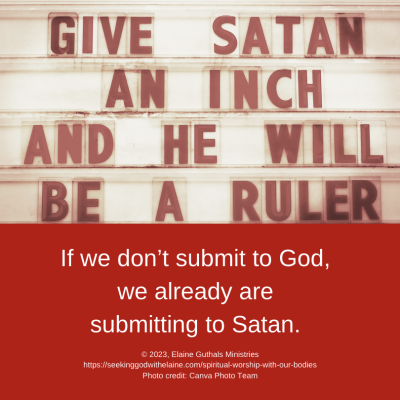
    • God wants us to yield our will to His. What we don’t always think about is that, if we are not submitting to God, we are submitting to Satan (Spiritual Worship with Our Bodies).
    • The Holy Spirit assists us in our prayers. No, the Holy Spirit doesn’t say our prayers for us. We still have to take an active part in them. The Holy Spirit is interceding for us (Prayer in Spiritual Worship).
    • The Holy Spirit assists us in our spiritual worship (Prayer in Spiritual Worship).
    • God knows we will be weak. He uses us despite our weaknesses. No, God uses us because of our weaknesses (Prayer in Spiritual Worship).
    • God has good reason to want our hearts. He wants to cleanse them with Jesus’ atoning blood. Then, He wants to fill us with wisdom and understanding through the work of the Holy Spirit (The Sincerity of Spiritual Worship).
    • It is understandable why God wants our hearts. If we give Him that, in essence, we are giving Him all of us — our will, strength, and love (The Sincerity of Spiritual Worship).
    • God knows our limitations because He is the one Who gave us our skills and abilities. He expects what He has given us be used for Him (Sincere Praise, Obedience, and Faith in Spiritual Worship).

    Glossary

    Asking God for forgiveness is a form of worship.

    Forming Our Habits to Grow Our Maturity


    • True spiritual worship is rewarding true submission (True Spiritual Worship).
    • It would be horrible for us to start this new life of faith and spiritual privilege and keep keep hold of the old way of life (Ceremonial Law v. Spiritual Worship).
    • It isn’t about us doing the do’s and not doing the don’ts. God isn’t interested in a checklist, much less our success rate in completing it. God is interested in our devotion to Him. No, that does not negate our duty to God. He still expects things from us. We should want to serve Him because He is Creator. It reinforces that we cannot earn salvation (Spiritual Worship v. Ceremonial Law).
    • One of the biggest rewards we get is that we get to be ministers of the gospel. We get to tell others the good news. We get privileges that non-believers do not get (Spiritual Worship v. Ceremonial Law).
    • We shouldn’t boast of the privilege we think comes along with being children of God any more than we should boast of ourselves. We are only made righteous through Jesus’ sacrifice (Spiritual Worship v. Ceremonial Law).
    • Our actions are not necessarily representative of our character. Our words may not mirror our hearts and thoughts. We can’t just go on our own thoughts and feelings. We can’t even rely solely on our belief system. Those are transitory at best and delusional at worst. Instead, God wants our character to change to be like His (Spiritual Worship v. Ceremonial Law).
    • We have to get our submission to God down to the heart level. Our focus must be on God (Spiritual Worship v. Ceremonial Law).
    • We don’t become God. We become like God, just as a shadow is like the person but really isn’t the person. Take that a step further. The shadow does everything the person does, just as we are to do what God does. It breaks down on the flip side, though. The shadow doesn’t do anything the person doesn’t do. We, however, do things that God doesn’t — we sin (Why the Ceremonial Law Didn’t Work).
    • Jesus said He wasn’t doing away with the law. That means we have to live by the moral law. Its principles still apply (God’s Displeasure with the Ceremonial Law).
    • We can’t just worship through our actions. We can’t just be a good person. We can’t just do good deeds to others. We have to worship God in spirit and in truth. And that means really worship. Not just show up. Worship. It goes back to our hearts being right (God’s Displeasure with the Ceremonial Law).
    • Until we get that sinful nature under control and out of us, we can’t enter Heaven. We get it under control in this life by exercising discipline to build godly habits. We get it out of us by completing the Sanctification Road. No, we are not talking about going through some self-help program. We can’t discipline ourselves. Only God can (The Transitory Intent of the Ceremonial Law).
    • We have to be ready to serve God when He calls. We have to remain sober minded and spiritually clean to pick up the tasks God has for us (Putting Spiritual Worship into Practice).
    • Worship isn’t just singing. It isn’t just reading God’s Word and praying. It is putting what we have learned through the Holy Spirit into practice to show the changes He has made in our lives (Putting Spiritual Worship into Practice).
    • We are called to live consecrated lives. That means we devote our lives to serving God the way He calls us (Putting Spiritual Worship into Practice).
    • We are all required to worship, just as we are all called to be priests. No one gets a pass worship free card. This isn’t Monopoly (Putting Spiritual Worship into Practice).
    • We worship God with our bodies as we carry out the actions associated with our choices (Spiritual Worship with Our Bodies).
    • Body, soul, and spirit are all connected. The soul bone and the spirit bone are connected to the body bone. Total submission to God can’t happen without all three (Spiritual Worship with Our Bodies).
    • We have to remember that bodies doesn’t just mean our physical skeleton. It means our nature, too. It means our character and identity. We have to identify as God’s child.
    • God doesn’t want to dictate who we are and what we are. He gives us a choice. We have to want to choose Him (Spiritual Worship with Our Bodies).
    • We are to imitate Jesus, Who gave His body as a sacrifice for God. The worship Jesus gave to God indicated that He would do whatever God asked, regardless of the consequences (Spiritual Worship with Our Bodies).
    • We don’t have to be some wonderful, strong disciple. We just have to be obedient to God’s Will (Prayer in Spiritual Worship).
    • Our will and affections aren’t subjugated to God. He allows our personalities to stay intact. But we have a new nature (Prayer in Spiritual Worship).
    • We grow in sanctification by prayer (Prayer in Spiritual Worship).
    • Prayer helps us grow more than service activities do. Doing the Matthew 25: 35-36 good deeds help us, but prayer is the key to becoming more like God (Prayer in Spiritual Worship).
    • It seems like most of our prayers center around the physical health of us and others. We focus on earthly needs. Worse than that, what we pray for isn’t always in God’s Will. We keep putting kinks in God’s plans (Prayer in Spiritual Worship).
    • In order to worship God, our prayers should focus on praising Him, following His Will, and expanding His kingdom (Prayer in Spiritual Worship).
    • We should continually worship God in the Spirit (Prayer in Spiritual Worship).
    • We are to be sincere, but sincerely alone isn’t what we are talking about. Saul was sincere about serving God the way he thought was right. It wasn’t. That tells us how much Saul changed to be Paul. Paul worshiped God through his belief in Jesus. He did it right (The Sincerity of Spiritual Worship).
    • We can be sincere about feeding the hungry, caring for the sick — all the sheep and goat activities. They mean nothing if we aren’t sincere about worshiping God (The Sincerity of Spiritual Worship).
    • We have to submit all our heart to God. We can’t hold some back for ourselves. We can’t give God lip service (The Sincerity of Spiritual Worship).
    • When we ask Jesus to be our Savior and Redeemer, we have to truly desire to become like Him. We have to genuinely repent and not commit our sins again (The Sincerity of Spiritual Worship). 
    • Our intent in performing our actions must be to worship God in spirit and truth (The Sincerity of Spiritual Worship).
    • We should worship God in spirit and truth because of our love for Him. God asks for our love. It is our choice whether or not to give it to Him (The Sincerity of Spiritual Worship).
    • By giving God our hearts, we pledge to seek His Will rather than our own. We give God our hearts to show God our love and gratitude. We also acknowledge that He is Sovereign God (The Sincerity of Spiritual Worship).
    • The choice to give God our hearts is ours. He acknowledges our dignity (The Sincerity of Spiritual Worship).
    • We must give all of our hearts to God. We can’t be double minded (Jas. 1: 7-8) (The Sincerity of Spiritual Worship).
    • The praise is good. But it has to be more than that. It has to come out of our mouths initially. The proof is when it comes out of our actions (Sincere Praise, Obedience, and Faith in Spiritual Worship).
    • The sincerity part comes when we offer the praise freely. It has to come from our free will. It has to be unrestrained, continuous praise (Sincere Praise, Obedience, and Faith in Spiritual Worship).
    • Our sincerity has to be shown in our acceptance of the laws and commandments (Sincere Praise, Obedience, and Faith in Spiritual Worship).
    • We won’t have a personal or corporate response of admiration (confession, thanksgiving, praise, etc.) for God if our attitude to God’s presence is not one of love and we don’t imitate His character (Sincere Praise, Obedience, and Faith in Spiritual Worship).
    • Intellectual faith would be in the mind. We would rely on ourselves to make sense of things. But when we get our knowledge down to the heart level, we take the knowledge from the mind and combine that with our mental state and run them through a biblical processor (Sincere Praise, Obedience, and Faith in Spiritual Worship).
    • Our sincerity of faith is proportional with our belief in God. That belief is necessary to realize obedience to God’s laws. Perfection/maturity is the end result for which we are shooting (Sincere Praise, Obedience, and Faith in Spiritual Worship).


    spiritual worship comes out of God’s concern for the condition of our souls.

    Glossary

    Forming Our Habits to Grow Our Relationship with Others

    • We cannot condone sin as a way of loving others (God’s Displeasure with the Ceremonial Law).
    • Worldview people can throw it up in our faces when they think who we are is too spiritual or godly. To them, it is a bad thing. To us, it is a good thing. That is the way God thinks of us (Putting Spiritual Worship into Practice).
    Having faith isn’t worshiping God. Worshiping requires more of a response.

    Ceremonial Law

    • There are eternal consequences if we hold onto the ceremonial law (Spiritual Worship v. Ceremonial Law).
    • The whole purpose of the law was to point out we were doing it wrong, and we couldn’t fix it ourselves. We can do nothing to gain salvation until we accepted the gift that God gave us – Jesus as our Savior (Spiritual Worship v. Ceremonial Law).
    • Neither do the ceremonial laws don’t change our hearts nor do they purify our consciences like spiritual worship does (Why the Ceremonial Law Didn’t Work).
    • The ceremonial laws served the purpose to show us that we need a Savior (Why the Ceremonial Law Didn’t Work).
    • Ceremonial law does not cleanse as spiritual worship does (Why the Ceremonial Law Didn’t Work).
    • God saw moving from ceremonial law to spiritual worship as an exchange. People saw it as a change. It had to be an exchange if Jesus was completing it, not abolishing it. The hope of the coming Messiah was exchanged for the faith in the risen Savior (Why the Ceremonial Law Didn’t Work).
    • Instead of abolishing the law, we are to write it on our hearts (Why the Ceremonial Law Didn’t Work).
    • The ceremonial laws could take us only so far because Jesus hadn’t completed the Plan of Salvation (God’s Displeasure with the Ceremonial Law).
    • The laws show us what sin is. It does not, however, grant us righteousness (God’s Displeasure with the Ceremonial Law).
    • The covenant of Abraham was replaced by the covenant of Jesus, providing the opportunity for the switch of the priests coming from the tribe of Levi to the tribe of Judah (Ceremonial Law v. Spiritual Worship).
    If we don’t submit to God, we already are submitting to Satan.

    Sacrifices

    • A sacrifice is a gift. They were to bring something of themselves to give it to God.
    • God wants us to perform sacrifices His way, not the way we want to do (God’s Displeasure with the Ceremonial Law).
    • Sacrifices didn’t demonstrate the law. How can killing animals demonstrate righteousness? The laws show us God’s character. We are to imitate that character (Why the Ceremonial Law Didn’t Work).
    • The sacrifices did nothing to show us Who God really is. For that matter, we really can’t know God by studying His Word. He has to reveal Himself to us through the Holy Spirit. God will only reveal Himself to His children. We only become His children by believing in Jesus. So, we can’t “reason out” Who God is (Why the Ceremonial Law Didn’t Work).
    • These sacrifices were the Jew’s worship. The worship wasn’t the killing part. The worship was the giving part (Why the Ceremonial Law Didn’t Work).
    • We still make sacrifices today for God. They are just different sacrifices — not animal sacrifices (God’s Displeasure with the Ceremonial Law).
    • If the sacrifice is living, it is a 24/7/365/eternity practice. It isn’t something we take on and off. It is continuous (Putting Spiritual Worship into Practice).
    • When we think of living sacrifice, we think of what we do. When we think of spirituality, we think of who we are. But living sacrifice is equated with spirituality (Putting Spiritual Worship into Practice).
    • We might call it the two D’s: doctrine and duty. In today’s vernacular, it is more well received if we call the duty service. It is what James calls faith and works (Putting Spiritual Worship into Practice).
    • We also have to offer our bodies. This is another way of saying that we must offer real, continuous, active, voluntary service (Putting Spiritual Worship into Practice).
    • Our sacrifice has to be total — mind, body, and soul. That way the good actions are the foundation. They lead to other good actions. If the sacrifice wasn’t complete, we would be unclean. Iffy actions would be the foundation. Yeah, we might get some good actions — but we would also get bad actions (Spiritual Worship with Our Bodies).
    Doing the Matthew 25: 35-36 good deeds help us, but prayer is the key to becoming more like God.

    Spiritual Worship

    • The main difference between the ceremonial law and spiritual worship is what we are presenting. Law required a dead animal. Spiritual worship requires a continuous offering of a living us. We are to give of our time, talents, and money. Those mean nothing if we do not offer ourselves — our hearts (Putting Spiritual Worship into Practice).
    • Putting spiritual worship into practice entails the right motives. We can’t be doing it for personal reasons. We can’t be doing it just to escape hell. We have to worship God because we love the Sovereign God (Putting Spiritual Worship into Practice).
    • We think of spiritual worship as formal worship. That isn’t necessarily so. We think we have to pray in the King James Version. Or we have to set our clocks by when we pray. No. We just have to sincerely talk to God. We have to use the full range of prayer. True, at times they may just be sentence prayers. Those sentences can be packed when they are an at-the-end-of-our-rope desperate appeal. But prayer is more than that. It is building a relationship with our Heavenly Father. That takes time and commitment.
    • We have to have habitual contact with God. No pretense. No ulterior motive. It has to be a desire to spend time with God. Prayer has to be a part of us (Prayer in Spiritual Worship).
    • Giving God our hearts is spiritual worship (The Sincerity of Spiritual Worship).
    • Spiritual worship contains elements of praise and obedience (Sincere Praise, Obedience, and Faith in Spiritual Worship).
    • An offering is a present. God gives us the gift of salvation. We give Him the gift of obedience (Sincere Praise, Obedience, and Faith in Spiritual Worship).
    • Spiritual worship contains elements of faith (Sincere Praise, Obedience, and Faith in Spiritual Worship).
    • Faith is an important element in spiritual worship. Faith is believing in God (Sincere Praise, Obedience, and Faith in Spiritual Worship).
    • Spiritual worship provides more rewards than ceremonial law did (Spiritual Worship v. Ceremonial Law).
    GoodDeeds

    Making the Connections

    • Because ceremonial law doesn’t work, we need to focus on spiritual worship rather than today’s equivalent (Why the Ceremonial Law Didn’t Work).
      • Circumcision can be replaced by baptism as an outward duty we can elevate to too high a standing. Baptism cannot bring us salvation any more than circumcision could (Spiritual Worship v. Ceremonial Law).
      • Being born of Jewish parents can be replaced by being born of Christian parents. We must individually choose to believe in Jesus (Spiritual Worship v. Ceremonial Law).
      • The Jews thought knowing the law rather than doing the law was fine. Believers sometimes think the same (Spiritual Worship v. Ceremonial Law).
      • The Pharisees thought they could add laws on things in which God is indifferent. Don’t some believers think others have to believe the way they do? (Spiritual Worship v. Ceremonial Law)
      • The Jews put too much emphasis on rituals and not enough on their moral duties of the law. Don’t we sometimes just follow God on Sundays and not the rest of the week? (Spiritual Worship v. Ceremonial Law).
    • The ceremonial laws are not a hindrance to spiritual awareness. But we make them hindrances because we latch onto them and don’t see their purpose. One purpose was to show we couldn’t save ourselves. We need Jesus as our Savior and Redeemer (God’s Displeasure with the Ceremonial Law).
    • Another purpose was to set Israel apart from the other nations. Their ceremonial laws showed that they were God’s people. Until Jesus came, people needed to show that they were worshiping God (God’s Displeasure with the Ceremonial Law).
    • Maybe the ceremonial laws were for the milk babies, and spiritual worship is for the steak adults. No, not necessarily for individual people, but for the Church as a whole. It couldn’t be a Church until Jesus came. Abraham, Moses, David, and all the rest were only babies because the Plan of Salvation hadn’t come to fruition. But they needed the spiritual milk to get to the spiritual steak. This is the same concept as sometimes we have to sin to realize what obedience and submission are (God’s Displeasure with the Ceremonial Law).
    • Bottom line is we cannot have spiritual worship if we didn’t have the ceremonial laws. That tells me that God isn’t displeased with His laws since we had to have the ceremonial laws to show the need for spiritual worship. What God is displeased with is our observance of them. God didn’t see the sacrifices being offered to worship Him.
    • Originally, there was no difference between mercy and sacrifice. Our love for God and the sacrifices we give to worship Him have the same intent as our love for others. We can’t say that our only sacrifice for God is serving others (God’s Displeasure with the Ceremonial Law).
    • We put spiritual worship into practice when we live our lives totally committed to God (Putting Spiritual Worship into Practice).
    God wants us to focus on our walk with Him.

    To read devotions in the Redo for Godliness series, click the appropriate button below.

  • We’re Moving!

    Today is a music day. To read and hear the song, click here.

    I wanted to take a minute and let you know some things that are happening in my life. They impacted my devotion for today, and may impact some more in the future.

    Pastor Steve has been called as a pastor to a different church. We are so excited to start ministering to a wonderful group of disciples!

    The challenging part is we are moving 100 miles away. We went over and signed the lease for a new home yesterday — and I had to go back today to deal with something.

    So, I didn’t get the newsletter done for today. Sorry.

    Even though the furniture is going to be going in a couple of weeks, we will be staying there the next two weekends.

    It is our goal to get the internet hooked up before we get all the way over there. Oh, I hope so.

    The last time I moved while I was putting out devotions, it didn’t go smoothly. I am hoping that we have a much easier time this time.

    My plan is to not have any interruptions to posting my devotions. Hopefully, you will continue to see devotions on Tuesdays, Thursdays, and Saturdays.

    I just wanted to let you know in case something throws a kink into it. You know, best laid plans ……

    God has been so good to us so far. We know that He will continue to be in control.

    Here is a song about putting our trust in God regardless of the situations in which we find ourselves.

    Even If
    Vocalist: Elaine Guthals
    Keyboard: Louise Guthals Weiss

    were-movingFB

    What do you think?

    Leave me a comment below (about this or anything else) or head over to my Facebook group for some interactive discussion.

    If you don’t understand something and would like further clarification, please contact me.

    If you have not signed up for the email daily or weekly providing the link to the devotions and the newsletter, do so below.

    If God has used this devotion to speak with you, consider sharing it on social media.

  • Sincere Praise, Obedience, and Faith in Spiritual Worship

    In determining what spiritual worship is, we must look at its elements. This devotional reading looks at how praise, obedience, and faith show the sincerity of our relationship with God.

    Nuggets

    • Spiritual worship contains elements of praise and obedience.
    • Spiritual worship contains elements of faith.

    We’ve been identifying what spiritual worship is. The first point is we are to be sincere, but sincerely alone isn’t what we are talking about. We have to be sincere about serving God the way He says is right. We should worship God in spirit and truth because of our love for Him.

    Major elements in spiritual worship must be praise, obedience, and faith. Let’s take a look.

    Let’s Put It into Context

    To read devotions in the Habitual Holiness of Heart and Life theme, click the button below.

    Here is a running list of nuggets for the theme.

    Devotions in the Finding Jesus through Spiritual Worship study

    Here is a running list of nuggets for the study.

    The foundation of this series is Menander and Charnock’s Spiritual Worship.

    Resource

    Praise and obedience in Spiritual Worship

    “Lord, accept my offering of praise, and teach me your regulations” (Ps. 119: 108 NLT)

    Spiritual worship contains elements of praise and obedience.

    What a great description of spiritual worship!

    The Homilist said that this prayer sought God’s receiving and affirming of our offering of true worship. What I really liked was when it said, “The soul rings out aloud in speech and song its devotion.”

    Resource

    An offering is a present. God gives us the gift of salvation. We give Him the gift of obedience.

    Praise and obedience is what spiritual worship is in a nutshell. We acknowledge Who God is and live for Him.

    Praise and obedience is what spiritual worship is in a nutshell. We acknowledge Who God is and live for Him.

    The praise is good. But it has to be more than that.

    It has to come out of our mouths initially. The proof is when it comes out of our actions.

    The sincerity part comes when we offer the praise freely. That means two things to me.

    • It has to come from our free will. Free will is the ability within us to make decisions, which determine actions that produce character. It has to be our choice.
    • It has to be unrestrained, continuous praise.

    Yes, our sincerity has to be shown in our acceptance of the laws and commandments. The laws tell us God’s character.

    We can’t know God’s character until we know God’s laws. Nothing is more important than that.

    We can’t know God’s character until we know God’s laws.

    I know. How can little ol’ us offer anything acceptable to Sovereign God. Cowper said it is His grace that He does accept our offerings.

    Resource

    We think it is difficult to give our parents birthday and Christmas presents. Try the Creator of the World! Everything we have is what He has given us.

    Cowper said size isn’t the determining factor on the acceptance of the offering. The sincerity of our hearts is.

    Resource

    Think of the song lyrics. “If just a cup of water I place within your hand, then just a cup of water is all that I demand.”

    God knows our limitations because He is the one Who gave us our skills and abilities. He expects what He has given us it be used for Him.

    Faith in Spiritual Worship

    “For it is by believing in your heart that you are made right with God, and it is by openly declaring your faith that you are saved” (Rom. 10: 10 NLT)

    Spiritual worship contains elements of faith.

    When I first saw this verse included on the list, I wondered about its inclusion. Then in the last section, we talked a lot about confessing as worship.

    So, what else can we learn about worship here?

    Lyth reminded us of the relationship between faith and confession.

    Faith is an important element in spiritual worship. Faith is believing in God.

    We won’t have a personal or corporate response of admiration (confession, thanksgiving, praise, etc.) for God if our attitude to God’s presence is not one of love and we don’t imitate His character.

    We talked about knowing God’s laws in the last section. Knowledge is important, but God isn’t looking for intellectual faith.

    Pilkington helped us with this. He wrote, “In belief of the heart, the mind as well as the affections is implied, for the heart, in scriptural language, is said to reason (Mark 2:6), to meditate (Luke 3:15), and to understand (Matthew 13:15).”

    Resource

    I know, first read doesn’t read well. But let’s think about this.

    Intellectual faith would be in the mind. We would rely on ourselves to make sense of things.

    But when we get our knowledge down to the heart level, we take the knowledge from the mind and combine that with our mental state and run them through a biblical processor.

    • “But some of the teachers of religious law who were sitting there thought to themselves,” (Mk. 2: 6 NLT).
    • “As the people were in expectation, and all were questioning in their hearts concerning John, whether he might be the Christ,” (Lk. 3: 15 ESV).
    • “For the hearts of these people are hardened, and their ears cannot hear, and they have closed their eyes — so their eyes cannot see, and their ears cannot hear, and their hearts cannot understand, and they cannot turn to me and let me heal them” (Mt. 13: 15 NLT).
    ThinkQuestionUnderstand

    How many of us have wondered if our faith is enough? Have we ever questioned if we were really saved?

    Like, all of us at some point or another.

    We don’t think faith the size of a mustard seed is good enough, even though Jesus said it was. We question whether God’s Word is true or not.

    Our sincerity of faith is proportional with our belief in God. Spurgeon said we must truly believe to be sincere in our faith.

    Resource

    That belief is necessary to realize obedience to God’s laws. Perfection/maturity is the end result for which we are shooting.

    sincere-praise-obedience-and-faith-in-spiritual-worshipFB

    Making the Connections

    Our being a living sacrifice is the best form of worship we can give God. We can’t be a sacrifice if we do not possess faith and have it present itself through praise and obedience.

    Are we flawed? Yes. Do we still sin? Yes.

    But when we have a genuine attitude of love and reverence for a Sovereign God Who loves us, God accepts that as a sincere offering.

    How Do We Apply This?

    • Turn away from our worldliness and sin to believe in God.
    • Know that the testimony that God gives about His Son is true (I Jn. 5: 9-11).

    Resource

    Father God. We are so flawed. Sin has taken Your creation and mangled it. Thank You for providing one way to triumph over that sin. We have placed our faith in Jesus as our Savior and Redeemer. Sanctify us so that we may be more like You. Amen.

    What do you think?

    Leave me a comment below (about this or anything else) or head over to my Facebook group for some interactive discussion.

    If you don’t understand something and would like further clarification, please contact me.

    If you have not signed up for the email providing the link to the devotions and the newsletter, do so below.

    If God has used this devotion to speak with you, consider sharing it on social media.

  • The Sincerity of Spiritual Worship

    We must be sincere in worshiping God. This devotional reading looks at serving God with all our hearts.

    Nuggets

    • We are to be sincere, but sincerely alone isn’t what we are talking about.
    • We should worship God in spirit and truth because of our love for Him.

    Last year, our theme was getting our sanctification to the heart level. We know the heart is the seat of our thoughts, intellect, will, and affections that produces our character, from which all things spring, including controlling our spiritual position.

    Getting our faith to the heart level means a couple of things. The first is that our faith has to impact all our thoughts, intellect, will, and affections. We can’t give God only part of us.

    The second thing is that we have to be sincere. We can’t give God lip service. We have to mean it when we say we submit to God.

    Charnock agreed that our spiritual worship has to be sincere. This must be the foundation of our living sacrifice.

    Let’s Put It into Context

    To read devotions in the Habitual Holiness of Heart and Life theme, click the button below.

    Here is a running list of nuggets for the theme.

    Devotions in the Finding Jesus through Spiritual Worship study

    Here is a running list of nuggets for the study.

    The foundation of this series is Menander and Charnock’s Spiritual Worship.

    Resource

    Worship Because of Intent

    “God knows how often I pray for you. Day and night I bring you and your needs in prayer to God, whom I serve with all my heart by spreading the Good News about his Son” (Rom 1: 9 NLT)

    We are to be sincere, but sincerely alone isn’t what we are talking about.

    Pope called our attention to Paul himself. He was one way when he was Saul.

    • “I am a Jew, born in Tarsus in Cilicia, but brought up in this city, educated at the feet of Gamaliel according to the strict manner of the law of our fathers, being zealous for God as all of you are this day” (Ac.  22: 3 ESV).
    • “… If anyone else thinks he has reason for confidence in the flesh, I have more: circumcised on the eighth day, of the people of Israel, of the tribe of Benjamin, a Hebrew of Hebrews; as to the law, a Pharisee; as to zeal, a persecutor of the church; as to righteousness under the law, blameless” (Phil. 3: 4-6 ESV).

    Saul was sincere about serving God the way he thought was right. It wasn’t.

    See what Pope said. He wrote, “The service he offered was sincere, but ignorant and bigoted, a service which rejected Christ and persecuted His saints.”

    Resource

    That tells us how much Saul changed to be Paul. Paul worshiped God through his belief in Jesus. He did it right.

    We can be sincere about feeding the hungry, caring for the sick — all the sheep and goat activities. They mean nothing if we aren’t sincere about worshiping God.

    Glossary

    This isn’t the first time we’ve talked about being sincere. (It probably won’t be the last time.)

    We have to submit all our heart to God. We can’t hold some back for ourselves. We can’t give God lip service.

    When we ask Jesus to be our Savior and Redeemer, we have to truly desire to become like Him. We have to genuinely repent and not commit our sins again. Repentance is acknowledging our separation from God and expressing sorrow for breaking God’s laws and commandments by making the commitment to change our sinful ways to ways of righteousness through obedience.

    • Sin is not believing that Jesus is our Savior to save us from our actions by humans that disobey God and break one of His reasonable, holy, and righteous laws and commandments, goes against a purpose He has for us, or follows Satan’s promptings.
      • Holy means to be set apart — because of our devotion to God — to become perfect, and morally pure while possessing all virtues and to serve and worship God.
        • Perfection means we reach a state of maturity because the combination of the spiritual graces form, when all are present, spiritual wholeness or completeness — holy, sanctified, and righteous.
          • Spiritual graces are worldly morals that have been submitted to God to further His kingdom instead of enhancing this world.
          • Sanctified means to be set free from sin.
        • Pure means not being sinful or having the stain of sin. 
        • Virtues are standards of moral excellence.
    • Righteous means we are free from sin because we are following God’s moral laws.
    • Obedience means submitting ourselves to the will of God as it is presented to us and living our lives accordingly.

    Glossary

    Our intent in performing our actions must be to worship God in spirit and truth.

    Worship Because of Love

    “O my son, give me your heart. May your eyes take delight in following my ways” (Prov. 23: 26 NLT)

    We should worship God in spirit and truth because of our love for Him.

    Why is God asking for our hearts? Because He loves us.

    Spurgeon told us how that works. He wrote, “Only love seeks after love.”

    Resource

    Love is an attribute of God’s. “So we have come to know and to believe the love that God has for us. God is love, and whoever abides in love abides in God, and God abides in him” (I Jn. 4: 16 ESV).

    Love is the essence of God. It is Who He is.

    We read this verse, and some may think it is a direct command. No, it is a request.

    God asks for our love. It is our choice whether or not to give it to Him.

    Spurgeon also told us why we have to give God our whole heart. He wrote, “You cannot give Christ a piece of a heart, for a heart that is halved is killed.”

    Resource

    Jesus gave the why of that. “No one can serve two masters. For you will hate one and love the other; you will be devoted to one and despise the other. You cannot serve God and be enslaved to money” (Mt. 6: 24 NLT).

    By giving God our hearts, we pledge to seek His Will rather than our own.

    We do this to show God our love and gratitude. We also acknowledge that He is Sovereign God.

    God has good reason to want our hearts. He wants to cleanse them with Jesus’ atoning blood. Then, He wants to fill us with wisdom and understanding through the work of the Holy Spirit.

    The choice to give God our hearts is ours. He acknowledges our dignity.

    It is understandable why God wants our hearts. If we give Him that, in essence, we are giving Him all of us — our will, strength, and love.

    I know. This goes against our human nature. But it brings us back to our made-in-His-image nature.

    Only God can do that — sanctify us. Sanctification is the transformational process of the mind, body, and soul, which begins with regeneration; gradually changes our nature and morals through the promptings of the Holy Spirit; and ends with perfected state of spiritual wholeness or completeness.

    • Regeneration is being changed from spiritually dead to spiritually alive and the internal new birth and requickening that God brings about through the work of the Holy Spirit to give us new character.
      • Spiritual death is the separation from God that occurred as a consequence of Adam and Eve’s original sin.
        • The spiritually alive are those who have ABCDed, so they are no longer separated from God.

    The ABCDs of Salvation

    If you have not become a believer in Christ, please read through the
    Plan of Salvation and prayerfully consider what God is asking you to do.

    A – admit our sins
    B – believe His Son Jesus is our Redeemer
    C – confess God as Sovereign Lord

    D – demonstrate that commitment by making any changes needed in our lives to live the way in which God has called us

    The Disciple’s Job Description

    Glossary

    What has this to do with worship? Giving God our hearts is spiritual worship.

    the-sincerity-of-spiritual-worshipFB

    Making the Connections #1

    Bird made a great observation that addresses sincerity. He wrote, “How much of God’s worship is performed outwardly when it is inwardly disliked.”

    Resource

    How many times have we heard it? Have we said it?

    • I don’t like praying in public.
    • I don’t like praying period.
    • I can’t sing, so I don’t.
    • I don’t like to read.
    • I can’t understand what I read in the Bible, so I will read some devotion like Seeking God with Elaine’s to interpret it for me.

    Suck it up. All of those are worship. We have to worship how God calls us to worship.

    If we don’t, we aren’t sincere. We’re a Matthew 7: 21 disciple.

    Making the Connections #2

    Not long ago, we talked about the sacrifices required of the Jews. We said Jesus fulfilled the ceremonial law, making it so we do not have to sacrifice animals.

    Instead, we have to be a living sacrifice. A living sacrifice is the embodiment of becoming sanctified and giving everything to God after being forgiven of our sins.

    Smith had a great explanation of this. He wrote,

    “Once God required offerings and sacrifices which men were unwilling to give, because it was a dear service of God; but now He saith that the heart is more than all burnt-offerings and sacrifices. Thy alms to the poor, thy counsel to the simple, thy inheritance to thy children, thy tribute to Caesar, but thy heart to God. Not a piece of thy heart, not a room in thy heart, but thy heart. Some have a double heart, but God acknowledgeth only one heart. God doth not require the heart as though He required no more but the heart. The heart carrieth the whole man with it.”

    Resource

    Okay, let’s try that in Elaine-speak.

    Smith felt that the Jews had trouble with the animal sacrifices because they were asked to give up something that cost them. The gift of their hearts was more important.

    Doing the sheep and goats activities are great. They are not the most important.

    We must give all of our hearts to God. We can’t be double minded (Jas. 1: 7-8).

    To read a related devotion, click the button below.

    How Do We Apply This?

    • Sanctify our hearts so that our bodies will be temples unto God.
    • Make it a habit to focus on our inward transformation while we hid with Jesus in God.
    • Make prayer a habit.
    • Sincerely accept God’s request for our love.
    • Guard our hearts so we do not give our love to Satan.
    • Decide to love God how so that our hearts are occupied and does not continue to be occupied by evil.
    • Abandon all that God has forbidden.
    • Believe in God’s promises.
    • Seek God.
    • Give God our hopes, fears, joy, desire, love, and delight.
    • Hate evil.
    • Delight in following God’s laws and commandments.
    • Rejoice in obeying Him and accept His correction when we don’t.
    • Work to understand the whys of His ways, not to understand hows of His wisdom.

    Resources

    Searching for and Seeking God

    Hearing His Word (Rom. 10: 17)
    Reading His Word (Rev. 1: 3)
    Praying to Him (Heb. 4: 16)
    Studying His Word (Ac. 17: 11)
    Meditating on His Word (Ps. 1: 1-2)
    Memorizing His Word (Ps. 119: 11)

    Father God. We give our hearts to You. We sincerely love You. Help us to seek You. Amen.

    What do you think?

    Leave me a comment below (about this or anything else) or head over to my Facebook group for some interactive discussion.

    If you don’t understand something and would like further clarification, please contact me.

    If you have not signed up for the email providing the link to the devotions and the newsletter, do so below.

    If God has used this devotion to speak with you, consider sharing it on social media.

  • Prayer in Spiritual Worship

    Prayer is an element of spiritual worship. This devotional reading looks at how the Holy Spirit assists us in continually worshiping God through prayer.

    Nuggets

    • The Holy Spirit assists us in our spiritual worship.
    • We should continually worship God in the Spirit.

    Sometimes, it is easy to have a narrow view at what constitutes worship. We think it is only what happens on Sunday morning in the church building.

    Worship is more than that. Spiritual worship includes prayer.

    Let’s Put It into Context

    To read devotions in the Habitual Holiness of Heart and Life theme, click the button below.

    Here is a running list of nuggets for the theme.

    Devotions in the Finding Jesus through Spiritual Worship study

    Here is a running list of nuggets for the study.

    The foundation of this series is Menander and Charnock’s Spiritual Worship.

    Resource

    The first heading is Charnock’s words.

    By the Influence of the Spirit of God

    “And the Holy Spirit helps us in our weakness. For example, we don’t know what God wants us to pray for. But the Holy Spirit prays for us with groanings that cannot be expressed in words” (Rom. 8: 26 NLT)

    The Holy Spirit assists us in our spiritual worship.

    I was looking at the Bible study guide from Adam’s church. Pastor Will had asked an interesting question. “Have you ever considered our weakness as a gift?”

    Most of us would probably answer that with a big emphatic NO!

    God knows we will be weak. He uses us despite our weaknesses.

    No, God uses us because of our weaknesses.

    “But he said to me, ‘My grace is sufficient for you, for my power is made perfect in weakness.’ Therefore I will boast all the more gladly of my weaknesses, so that the power of Christ may rest upon me” (II Cor. 12: 9 ESV).

    God uses us because of our weaknesses.

    That is a kicker. We don’t have to be some wonderful, strong disciple. We just have to be obedient to God’s Will.

    One of our weaknesses is our prayer lives. It seems like many people will say they have trouble in that area.

    They don’t pray as often as they should. They don’t think they pray right.

    Many of us think our prayer lives are a mess.

    Isn’t it great? The Holy Spirit assists us in our prayers.

    No, the Holy Spirit doesn’t say our prayers for us. We still have to take an active part in them.

    The Holy Spirit is interceding for us. But Horton said He enables us to speak for ourselves.

    Resource

    That makes sense. God is not a dictator. We need to do for ourselves.

    Manton put it this way. He wrote,

    “First, there is the spirit of a man, for the Holy Ghost makes use of our understandings for the actuating of our will and affections; He bloweth up the fire, though it be our hearts that burn within us. Secondly, the new nature in a Christian is more immediately and vigorously operative in prayer than in most other duties; and the exercise of faith, love, and hope in prayer doth flow from the renewed soul as the proper inward and vital principle of these actions; so that we, and not the Spirit of God, are said to repent, believe, and pray.”

    Resource

    Let’s step through that.

    • Our will and affections aren’t subjugated to God. He allows our personalities to stay intact.
    • But we have a new nature, as we talked about in the last devotion.
    • We grow in sanctification by prayer.
    • Prayer helps us grow more than service activities do. Doing the Matthew 25: 35-36 good deeds help us, but prayer is the key to becoming more like God.
    Doing the Matthew 25: 35-36 good deeds help us, but prayer is the key to becoming more like God.

    The problem is Paul said that we don’t know that for which we should pray. I would agree with that statement.

    It seems like most of our prayers center around the physical health of us and others. We focus on earthly needs.

    Worse than that, what we pray for isn’t always in God’s Will. We keep putting kinks in God’s plans.

    In order to worship God, our prayers should focus on praising Him, following His Will, and expanding His kingdom.

    Praying in the Spirit

    “Pray in the Spirit at all times and on every occasion. Stay alert and be persistent in your prayers for all believers everywhere” (Eph. 6: 18 NLT)

    We should continually worship God in the Spirit.

    How we pray is important. We are to pray in the Spirit.

    We’ve already said the Spirit helps us in our prayers but doesn’t pray them for us. So, what else is there?

    Vincent talked about there being different approaches or techniques of prayer. We know about public and private prayers. Yes, we do need to do both.

    Then there is what we say. We need acknowledgement, confession, thanksgiving, and petition/supplication (which includes intercession) to be a part of our prayers.

    Ooo, baby! We’ve got the supplication down pat.

    But Vincent said that isn’t all there is. He wrote,

    “It is not all asking. Sometimes it is only interchange, without any petition at all – talking to God for the pleasure of communion; sometimes a sharp, short cry for help, like Peter’s ‘Lord, save me!’ when he felt himself sinking; sometimes merely the aspiration of the heart to God without a word; sometimes a half-conscious sympathy of thought with God; sometimes a formal, public petition; sometimes a struggle to climb over self to God.”

    Resource

    How many times do we just talk to God? I don’t know about you, but I have a lot of conversations in my head.

    I run through what I am going to tell my Springfield Mom. I get counseling from my BFF and my sister. I talk with my Insomnia Buddy.

    But do we ever just talk to God? Rarely.

    Too often, we just use prayer as a gum ball machine. We want something, so we put our quarter prayer in and expect our gum ball.

    I sometimes think that we have a skewed notion of prayer. We think of spiritual worship as formal worship.

    That isn’t necessarily so.

    We think we have to pray in the King James Version. Or we have to set our clocks by when we pray.

    No. We just have to sincerely talk to God.

    We have to use the full range of prayer. True, at times they may just be sentence prayers. Those sentences can be packed when they are an at-the-end-of-our-rope desperate appeal.

    But prayer is more than that. It is building a relationship with our Heavenly Father. That takes time and commitment.

    It also takes giving of ourselves. We have to be honest and real. Vincent said we have to have habitual contact with God.

    No pretense. No ulterior motive.

    It has to be a desire to spend time with God. Prayer has to be a part of us.

    Vincent called in the Spirit the element and atmosphere of prayer. The Holy Spirit has to be directing us.

    • It comes from the heart.
    • It is meaningful, not just routine, empty words.
    • It shows our love for God.

    To read a devotion in the Communication series in the Commit to Grow Our Habits study, click on the button below.

    Go back to what Vincent said about crawling over self to get to God. Yes, the focus has to be on God, but isn’t it when we are crawling over self?

    We are in a pickle of a situation, but we talk to God. We show Him we know He is in control.

    We just have to take the focus off the crawling part and put it on the talking part.

    A big part of prayer as spiritual worship is the faith in which we say them. Faith is a gift from God and a work of the Spirit that enhances the conviction that the doctrines revealed in God’s Word are true, even if we do not understand all aspects of them, a belief which impacts our lives and distinguishes us from others. God’s faithfulness is the constancy He displays in His interaction with mankind based on His character, name, and Word.

    Glossary

    Lip service prayers aren’t going to get past the ceiling. Why pray for healing if we really don’t believe God is going to heal us?

    But praying like it is a done deal? That is powerful.

    We just have to remember that God doesn’t always answer the prayers the way we pray them. Healing my lead to physical death so healing can take place in Heaven.

    That is why we have to pray for God’s Will.

    Wilmot-Buxton made a good point. Sometimes, people float a prayer just to see if God will answer it or not. Laying out a fleece is one thing (Jdg. 6).

    Resource

    Trying to see if God is real or not isn’t. We can only approach the throne of God through faith. Thinking God really isn’t real isn’t faith.

    Prayer as spiritual worship doesn’t expect God to answer the prayer the moment we pray it. We know that He will answer on His timetable.

    prayer-in-spiritual-worshipFB

    Making the Connections

    I love what Horton had to say. He wrote, “When the body is out of frame, it puts the soul out of frame also, and indisposes it to that which is good.

    Resource

    It is even more meaningful when we hook it to what Vincent said. He wrote, “Prayer is the medium of communion with God, and without that communion there is no Christian living.”

    Resource

    We are out of sorts when we aren’t in communication with God. We aren’t content. Things just don’t go right.

    But there is a much more important reason to have a solid prayer life. We don’t want our soul getting out of sorts with God. That may mean we are a Matthew 7: 21 disciple — we really aren’t a disciple.

    We want a strong relationship with God. That depends on prayer as spiritual worship.

    How Do We Apply This?

    • Pray when we can so we will be able to pray when we should.
    • Pray with reverence for and in humility to God.
    • Persistently pray to God.
    • Take God with us everywhere.
    • Always ask for God’s counsel.
    • Evaluate our prayer lives and make a habit to spend more time in communication with God.
    • Keep track of answered prayers.
    • Don’t focus on ourselves — focus on God and others.
    • Focus on our prayers, don’t let our thoughts run rampant, and fill our prayers with love for God.
    • Don’t give up.

    Resource

    Father God. We worship You. We want our prayers to be true worship. Help us to pray to give You the glory and honor You deserve. Amen.

    The ABCDs of Salvation

    If you have not become a believer in Christ, please read through the
    Plan of Salvation and prayerfully consider what God is asking you to do.

    A – admit our sins
    B – believe His Son Jesus is our Redeemer
    C – confess God as Sovereign Lord

    D – demonstrate that commitment by making any changes needed in our lives to live the way in which God has called us

    The Disciple’s Job Description

    What do you think?

    Leave me a comment below (about this or anything else) or head over to my Facebook group for some interactive discussion.

    If you don’t understand something and would like further clarification, please contact me.

    If you have not signed up for the email providing the link to the devotions and the newsletter, do so below.

    If God has used this devotion to speak with you, consider sharing it on social media.

  • How Spiritual Worship Helps Us Change Who We Are

    Spiritual worship is tied with our being made new creations. This devotional reading looks at how spiritual worship helps us in sanctification.

    Nuggets

    • Spiritual worship can only come after we have been made a new creation.
    • It is only through the influence of the Holy Spirit that we engage in spiritual worship.

    Ever since I ran across Menander and Charnock’s sermon, I have been scratching my head, wondering why Charnock waited so long to talk about what spiritual worship is. Why didn’t that go before putting it into practice?

    Well, the verses are different, so we will look at them. Surely, there will be others nuggets from which to glean.

    Let’s Put It into Context

    To read devotions in the Habitual Holiness of Heart and Life theme, click the button below.

    Here is a running list of nuggets for the theme.

    Devotions in the Finding Jesus through Spiritual Worship study

    Here is a running list of nuggets for the study.

    The foundation of this series is Menander and Charnock’s Spiritual Worship.

    Resource

    The headings are Charnock’s words.

    From a Spiritual Nature

    “For we are God’s masterpiece. He has created us anew in Christ Jesus, so we can do the good things he planned for us long ago” (Eph. 2: 10 NLT)

    Spiritual worship can only come after we have been made a new creation.

    God created mankind in His image. “So God created man in his own image, in the image of God he created him; male and female he created them” (Gen. 1: 27 NLT).

    Glossary

    Yes, the original sin put a kink in that. “When Adam was 130 years old, he became the father of a son who was just like him — in his very image. He named his son Seth” (Gen. 5: 3 NLT).

    God straightened out the kink when Jesus paid the sacrifice for our sin. “So we have stopped evaluating others from a human point of view. At one time we thought of Christ merely from a human point of view. How differently we know him now! This means that anyone who belongs to Christ has become a new person. The old life is gone; a new life has begun!” (II Cor. 5: 16-17 NLT).

    Everyone who ABCDs becomes new creations. If we don’t, we need to question our conversion experience — we haven’t really received salvation.

    The ABCDs of Salvation

    If you have not become a believer in Christ, please read through the
    Plan of Salvation and prayerfully consider what God is asking you to do.

    A – admit our sins
    B – believe His Son Jesus is our Redeemer
    C – confess God as Sovereign Lord

    D – demonstrate that commitment by making any changes needed in our lives to live the way in which God has called us

    The Disciple’s Job Description

    Glossary

    Conversion is the product of repentance, when we turn away from our sins and return to God, that secures salvation.

    • Repentance is acknowledging our separation from God and expressing sorrow for breaking God’s laws and commandments by making the commitment to change our sinful ways to ways of righteousness through obedience.
    • Sin is not believing that Jesus is our Savior to save us from our actions by humans that disobey God and break one of His reasonable, holy, and righteous laws and commandments, goes against a purpose He has for us, or follows Satan’s promptings.
      • Holy means to be set apart — because of our devotion to God — to become perfect, and morally pure while possessing all virtues.
        • Perfection means we reach a state of maturity because the combination of the spiritual graces form, when all are present, spiritual wholeness or completeness — holy, sanctified, and righteous.
          • Spiritual graces are worldly morals that have been submitted to God to further His kingdom instead of enhancing this world.
          • Sanctified means to be set free from sin.
          • Righteous means we are free from sin because we are following God’s moral laws.
        • Pure means not being sinful or having the stain of sin. 
        • Virtues are standards of moral excellence.
    • Obedience means submitting ourselves to the will of God as it is presented to us and living our lives accordingly.

    Salvation is the gift of life through the deliverance from condemnation and sin to acceptance and holiness and changes us from being spiritually dead to spiritually alive.

    • Holiness is the transcendent excellence of His nature that includes elements of purity, dedication, and commitment that lead to being set apart.
      • Purity means possessing God’s moral character, having eliminated the stain of sin.


    Glossary

    That is what Paul is talking about here in Ephesians. We can only be justified through Christ. Justification is the act through the merits of Christ that makes us free from sin because we are following God’s moral laws. Jesus justifies us when we put our lives in His hand.

    Glossary

    But Harris cautioned us that justification is not received only through faith. He wrote, “But here St. Paul finds it necessary to put in a word of caution to those who are the very foremost in accepting his teaching, and the most earnest in looking to their faith as the sole instrument of their justification.”

    Resource

    Wait! What?!?

    Remember, Paul had just told his readers that. “God saved you by his grace when you believed. And you can’t take credit for this; it is a gift from God. Salvation is not a reward for the good things we have done, so none of us can boast about it” (Eph. 2: 8-9 NLT).

    We don’t gain salvation through our own merit. It is a gift from God. We have to not only believe Jesus is our Savior and Redeemer, but we also have to accept the gift and live it out. We have to change to become like God.

    We do that by navigating the Sanctification Road. Sanctification is the transformational process of the mind, body, and soul, which begins with regeneration; gradually changes our nature and morals through the promptings of the Holy Spirit; and ends with perfected state of spiritual wholeness or completeness.

    • Regeneration is being changed from spiritually dead to spiritually alive and the internal new birth and requickening that God brings about through the work of the Holy Spirit to give us new character.
      • Spiritual death is the separation from God that occurred as a consequence of Adam and Eve’s original sin.
        • The spiritually alive are those who have ABCDed, so they are no longer separated from God.


    Glossary

    This makes more sense when we tack on the verse James wrote. “You say you have faith, for you believe that there is one God. Good for you! Even the demons believe this, and they tremble in terror” (Jas. 2: 19 NLT).

    Having faith isn’t worshiping God. Worshiping requires more of a response.

    Having faith isn’t worshiping God. Worshiping requires more of a response.

    The response we are to have is to change to become more like God. Only by being obedient and following His laws and commandments – having His character – brings maturity in our salvation.

    By the Influence of the Holy Spirit

    “Therefore, dear brothers and sisters, you have no obligation to do what your sinful nature urges you to do. For if you live by its dictates, you will die. But if through the power of the Spirit you put to death the deeds of your sinful nature, you will live” (Rom. 8: 12-13 NLT)

    It is only through the influence of the Holy Spirit that we engage in spiritual worship.

    We can’t continue in our sinful nature after we receive God’s salvation. To do so would mean we are still dead in our sins.

    Yes, we are still in our sinful bodies, so we will continue to commit sins. This is talking about attitude. Do we have the mind of Christ?

    To read a related devotion, click the button below.

    If we have the mind of Christ, we possess an attitude of spiritual worship.

    We are talking again about mortifying our sins. Mortify means to place a death penalty on our sins.

    The Holy Spirit through His power is the One Who mortified sin. This comes through sanctification. Burder told us how.

    • Awareness and abhorrence of sin
    • Faith to ask for forgiveness, being made righteous, and strength to withstand temptations.

    Resource

    When Paul talk about “… you will live” (Rom. 8: 13 NLT), he is talking about eternal life. We have a home in Heaven, where we will live with God for eternity.

    What will we be doing in Heaven? Worshiping.

    “After this I saw a vast crowd, too great to count, from every nation and tribe and people and language, standing in front of the throne and before the Lamb. They were clothed in white robes and held palm branches in their hands. And they were shouting with a great roar, ‘Salvation comes from our God who sits on the throne and from the Lamb!’” (Rev. 7: 9-10 NLT).

    Haydn explained what John saw. He wrote, “There are no notes of discord in the song they sing — no praises but of One and the efficacy of His atoning blood, Rejecting Christ as the Lamb slain from the foundation.”

    Resource

    Everyone is standing around the throne — as one — and worshiping our Lord and Savior.

    how-spiritual-worship-helps-us-change-who-we-areFB

    Making the Connections

    Spurgeon put it very succinctly. He wrote, “The spiritual life cannot come to us by development from our old nature.”

    Resource

    Faith alone is not enough. We have to accept the gift of salvation and allow God to change us.

    Worshiping God is a big part of this change. Plus, it has to be spiritual worship, not our brand of worship.

    We have to show God’s workmanship in us. We do this through works of obedience (including spiritual worship) and works of love.

    How Do We Apply This?

    • Navigate the Sanctification Road to become more like God.
    • Mature in our faith.
    • Recognize salvation is a gift that we accept.

    Father God. We worship You. We want to be like You. Help us as we navigate the Sanctification Road to follow Your laws and commandments. Amen.

    What do you think?

    Leave me a comment below (about this or anything else) or head over to my Facebook group for some interactive discussion.

    If you don’t understand something and would like further clarification, please contact me.

    If you have not signed up for the email providing the link to the devotions and the newsletter, do so below.

    If God has used this devotion to speak with you, consider sharing it on social media.