Author: admin

  • Spiritual Worship with Our Bodies

    God wants us to worship Him with body, soul, and spirit. This devotional reading looks at how we worship with our bodies.

    Nuggets

    • We worship God with our bodies as we carry out the actions associated with our choices.
    • Body, soul, and spirit are all connected.
    • We are to imitate Jesus, Who gave His body as a sacrifice for God.

    Charnock had just got done telling us that our acts of service must stem from the motivations of love for and faith in God. Then, he says something interesting. He wrote, “Yet the worship of our bodies is not to be rejected.”

    Resource

    Hmmm. What in the world did Charnock mean by that? Luckily, he gave us two out of three verses for his points.

    Let’s Put It into Context

    To read devotions in the Habitual Holiness of Heart and Life theme, click the button below.

    Here is a running list of nuggets for the theme.

    Devotions in the Finding Jesus through Spiritual Worship study

    Here is a running list of nuggets for the study.

    The foundation of this series is Menander and Charnock’s Spiritual Worship.

    Resource

    The headings are Charnock’s words.

    Bodily Worship Is Due God

    “Don’t you realize that your body is the temple of the Holy Spirit, who lives in you and was given to you by God? You do not belong to yourself, for God bought you with a high price. So you must honor God with your body” (I Cor. 6: 19-20 NLT)

    We worship God with our bodies as we carry out the actions associated with our choices.

    We are told that we need to present our bodies to God. Kelly said that this is because the body as well as the soul are redeemed.

    Resource

    I can see that. The original sin was a physical act of disobedience against God.

    Yes, the choice was made to sin in the mind. It had to be carried out with the body.

    I also see this as a total submission to God. We have to be all in. “Do not let any part of your body become an instrument of evil to serve sin. Instead, give yourselves completely to God, for you were dead, but now you have new life. So use your whole body as an instrument to do what is right for the glory of God.” (Rom. 6: 13 NLT).

    I know. We are still in sinful bodies. We aren’t going to be 100%-fruit-of-the-Spirit perfect.

    It still matters. Chrysostom told us why. He wrote, “For sacrifice can be made only of that which is clean; sacrifice is a firstfruit of other actions.”

    Resource

    I think we get the clean part. We can sometimes space out on the other actions part.

    Our sacrifice has to be total — mind, body, and soul. That way the good actions are the foundation. They lead to other good actions.

    If the sacrifice wasn’t complete, we would be unclean. Iffy actions would be the foundation. Yeah, we might get some good actions — but we would also get bad actions.

    David also told us why it is important. “The sacrifice you desire is a broken spirit. You will not reject a broken and repentant heart, O God” (Ps. 51: 17 NLT).

    No, that doesn’t mean a shattered heart and a dejected attitude.

    The broken part means we don’t put ourselves over God. We admit that we have sinned and are separated from Him. We know Jesus is the only one who can save us.

    That is where the repentant heart comes into play. Repentance is acknowledging our separation from God and expressing sorrow for breaking God’s laws and commandments by making the commitment to change our sinful ways to ways of righteousness through obedience.

    • Sin is not believing that Jesus is our Savior to save us from our actions by humans that disobey God and break one of His reasonable, holy, and righteous laws and commandments, goes against a purpose He has for us, or follows Satan’s promptings.
      • Holy means to be set apart — because of our devotion to God — to become perfect, and morally pure while possessing all virtues and to serve and worship God.
        • Perfection means we reach a state of maturity because the combination of the spiritual graces form, when all are present, spiritual wholeness or completeness — holy, sanctified, and righteous.
          • Spiritual graces are worldly morals that have been submitted to God to further His kingdom instead of enhancing this world.
          • Sanctified means to be set free from sin.
        • Pure means not being sinful or having the stain of sin. 
        • Virtues are standards of moral excellence.
    • Righteous means we are free from sin because we are following God’s moral laws.
      • Obedience means submitting ourselves to the will of God as it is presented to us and living our lives accordingly.

    Glossary

    I know people don’t like the word submit. They think more of subjugation. That isn’t what God is going for.

    God wants us to yield our will to His.

    What we don’t always think about is that, if we are not submitting to God, we are submitting to Satan. “Don’t you realize that you become the slave of whatever you choose to obey? You can be a slave to sin, which leads to death, or you can choose to obey God, which leads to righteous living” (Rom. 6: 16 NLT).

    If we don’t submit to God, we already are submitting to Satan.
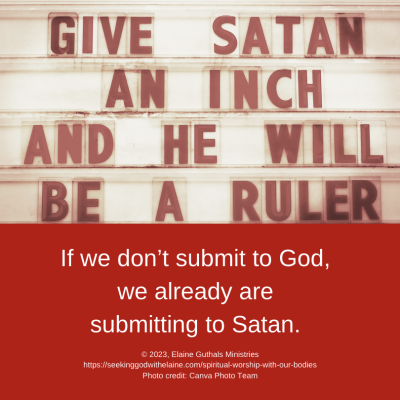
    If we don’t submit to God, we already are submitting to Satan.

    Spiritual Worship Can’t be without Bodily Expression

    Body, soul, and spirit are all connected.

    Since there was no verse associated with this, I wondered what we were going to do with this. Martin helped us out. He wrote,

    “But as the body is the visible part of our nature, the organ of practical activity, as soul and spirit cannot now be devoted to God, except as connected with the body, nor themselves without the body, and as the body cannot be presented as a sacrifice separate from the spirit; moreover, as the allusion to the ancient sacrifices required the recognition of the material part of our nature, we may conclude that by ‘your bodies’ is intended ‘yourselves.’”

    Resource

    What Martin is saying here is the soul bone and the spirit bone are connected to the body bone. Total submission to God can’t happen without all three.

    We have to remember that bodies doesn’t just mean our physical skeleton. It means our nature, too. It means our character and identity.

    We have to identify as God’s child.

    Isn’t it better that way? God isn’t interest in us being robots. He wants us to have free will. Free will is the ability within us to make decisions, which determine actions that produce character.

    God doesn’t want to dictate who we are and what we are. He gives us a choice. We have to want to choose Him.

    Christ Worshiped with His Body

    “He walked away, about a stone’s throw, and knelt down and prayed, ‘Father, if you are willing, please take this cup of suffering away from me. Yet I want your will to be done, not mine’” (Lk. 22: 41-42 NLT)

    We are to imitate Jesus, Who gave His body as a sacrifice for God.

    Jesus used His body to give the ultimate worship.

    Okay, Jesus did pray to not to have to go through the crucifixion. He knew it was going to be a hard row to hoe.

    Jesus gave His life anyway.

    No, it wasn’t because Jesus didn’t want to return to the Father. He really did.

    Jesus knew He would be flogged. He knew He would die.

    Jesus knew it was going to hurt.

    Jesus gave His life anyway.

    Look at Jesus’ prayer. “Father, if you are willing, please take this cup of suffering away from me. Yet I want your will to be done, not mine” (Lk. 22: 42 NLT).

    We are to imitate Jesus. That means we are to worship God as He did.

    The worship Jesus gave to God indicated that He would do whatever God asked, regardless of the consequences.

    Will God ask us to die for Him? Maybe. We have to be willing.

    spiritual-worship-with-our-bodiesFB

    Making the Connections

    Look at it this way. Let’s say Tom and Sally both ABCD on the same day. Tom’s actions change to follow God’s laws and commandments. Sally’s don’t.

    Most will probably question whether Sally’s conversion experience was genuine. It looks like she is giving lip service.

    We don’t want that to happen. We want to genuinely be saved.

    How Do We Apply This?

    • Yield ourselves completely to God for the entirety of our lives.
    • Be inwardly holy.
    • Sacrifice to God what is pleasing to Him.

    Resource

    Father God. We admit that we are sinners and are separated from You. We believe that the only way to remedy that is to ask Jesus as our Savior and Redeemer. We confess You as Sovereign God. But Lord, until we begin obeying Your laws and commandments and walking in the Spirit, our conversion experience is not genuine. Help us to walk with You. Amen.

    What do you think?

    Leave me a comment below (about this or anything else) or head over to my Facebook group for some interactive discussion.

    If you don’t understand something and would like further clarification, please contact me.

    If you have not signed up for the email providing the link to the devotions and the newsletter, do so below.

    If God has used this devotion to speak with you, consider sharing it on social media.

    The headings are Charnock’s words.

  • Putting Spiritual Worship into Practice

    If spiritual worship is a hard concept to grasp, how are we going to be able to put it into practice? This devotional reading looks at how we are to be living sacrifices to do just that.

    Nuggets

    • We put spiritual worship into practice when we live our lives totally committed to God.
    • Putting spiritual worship into practice entails the right motives.

    I wonder if sometimes we consider worshiping in spirit and truth an unsolvable mystery. If we can’t understand it, how are we going to do it?

    Hopefully, in the last six devotions, we have figured out what spiritual worship is. The goal of this devotion is to start figuring out how we put it into practice.

    Let’s Put It into Context

    To read devotions in the Habitual Holiness of Heart and Life theme, click the button below.

    Here is a running list of nuggets for the theme.

    Devotions in the Finding Jesus through Spiritual Worship study

    Here is a running list of nuggets for the study.

    The foundation of this series is Menander and Charnock’s Spiritual Worship.

    Resource

    Living Right

    “And so, dear brothers and sisters, I plead with you to give your bodies to God because of all he has done for you. Let them be a living and holy sacrifice — the kind he will find acceptable. This is truly the way to worship him” (Rom. 12: 1 NLT)

    We put spiritual worship into practice when we live our lives totally committed to God.

    We talked about the sacrifices required under the ceremonial law in the Ceremonial Law series. After Jesus being the Sacrifice, we are called to make a living sacrifice. A living sacrifice is the embodiment of becoming sanctified and giving everything to God after being forgiven of our sins.

    If the sacrifice is living, it is a 24/7/365/eternity practice. It isn’t something we take on and off. It is continuous.

    We have to be ready to serve God when He calls. We have to remain sober minded and spiritually clean to pick up the tasks God has for us.

    Glossary

    Charnock equated living sacrifice with spirituality. He wrote, “The gospel service is spiritual. Spirituality is the genius of the gospel.”

    Resource

    That puts a little different slant on things. When we think of living sacrifice, we think of what we do. When we think of spirituality, we think of who we are.

    Worldview people can throw it up in our faces when they think who we are is too spiritual or godly. To them, it is a bad thing.

    To us, it is a good thing. That is the way God thinks of us.

    Barnes told us how ministers of the gospel should act. Remember, we are

    He wrote, “Ministers of the gospel should be gentle, tender, and affectionate. They should be kind in feeling, and courteous in manner — like a father or mother.”

    Resource

    This is a good description of how others should see us being living sacrifices. It is also a good description of who we should be, not just what we do.

    Isn’t that really what spiritual worship is really about? It is how we put into practice the doctrines we are learning through sanctification. Sanctification is the transformational process of the mind, body, and soul, which begins with regeneration; gradually changes our nature and morals through the promptings of the Holy Spirit; and ends with perfected state of spiritual wholeness or completeness.

    • Regeneration is being changed from spiritually dead to spiritually alive and the internal new birth and requickening that God brings about through the work of the Holy Spirit to give us new character.
      • Spiritual death is the separation from God that occurred as a consequence of Adam and Eve’s original sin.
        • The spiritually alive are those who have ABCDed, so they are no longer separated from God.
    • Perfection means we reach a state of maturity because the combination of the spiritual graces form, when all are present, spiritual wholeness or completeness — holy, sanctified, and righteous.
      • Spiritual graces are worldly morals that have been submitted to God to further His kingdom instead of enhancing this world.
      • Sanctified means to be set free from sin.
      • Righteous means we are free from sin because we are following God’s moral laws.

    The ABCDs of Salvation

    If you have not become a believer in Christ, please read through the
    Plan of Salvation and prayerfully consider what God is asking you to do.

    A – admit our sins
    B – believe His Son Jesus is our Redeemer
    C – confess God as Sovereign Lord

    D – demonstrate that commitment by making any changes needed in our lives to live the way in which God has called us

    The Disciple’s Job Description

    Glossary

    We might call it the two D’s: doctrine and duty. In today’s vernacular, it is more well received if we call the duty service.

    It is what James calls faith and works. “So also faith by itself, if it does not have works, is dead” (Jas. 2: 17 ESV).

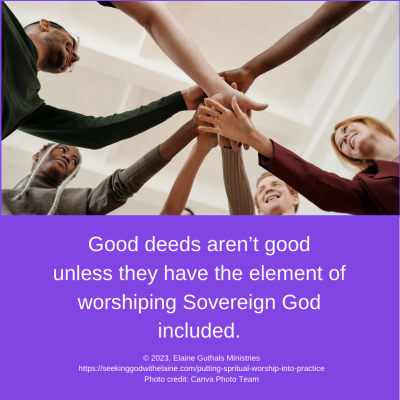
    The New Living Translation translates works as good deeds. Good deeds aren’t good unless they have the element of worshiping Sovereign God included.

    GoodDeeds

    Worship isn’t just singing. It isn’t just reading God’s Word and praying.

    It is putting what we have learned through the Holy Spirit into practice to show the changes He has made in our lives.

    In other words, we can’t come on Sunday morning, expect the Pastor Steve-types to give us the warm fuzzies, and go on our merry way to go back to doing what we were doing.

    Our worship of God has to be the outpouring of our changed selves.

    Our worship of God has to be the outpouring of our changed selves.

    We are called to live consecrated lives. That means we devote our lives to serving God the way He calls us.

    Arnot made a great observation. He wrote, “It is not the arbitrary though loving command addressed by a father to his infant son, that he may be trained to habits of unquestioning obedience; it is rather the work prescribed by the father to an adult son, which the son understands, and in which he intelligently acquiesces.”

    Resource

    God’s commands aren’t random. But neither is He a dictator.

    God wants us to understand our calling and readily, cheerfully, and completely obey.

    But let’s focus more on the worship aspect. We are all required to worship, just as we are all called to be priests. “But you are not like that, for you are a chosen people. You are royal priests, a holy nation, God’s very own possession …” (I Pet. 2: 10 NLT).

    No one gets a pass worship free card. This isn’t Monopoly.

    Tyson said just the opposite. He wrote, “Every believer is assumed to be anointed, to have passed through the preliminary purification, to have been called and separated (1 Peter 2:9), and to have passed through the consecration ritual (Revelation 1:5, 6). Therefore every one of them has ‘boldness to enter into the holiest (Hebrews 10:19; Ephesians 3:12). And therefore they are all here summoned to holy service.”

    Resource

    I think it is the preliminary purification that trips us up. We think the preliminary either didn’t take or wasn’t enough.

    But it did and it was.

    Jesus saved us from our sins. We became children of God.

    That was enough.

    Glossary

    It Was Enough
    Vocalist: Elaine Guthals
    Keyboard: Chris Vieth

    Because we are priests, it is our job to tell others. “… As a result, you can show others the goodness of God, for he called you out of the darkness into his wonderful light. ‘Once you had no identity as a people; now you are God’s people. Once you received no mercy; now you have received God’s mercy” (I Pet. 2: 10 NLT).

    The main difference between the ceremonial law and spiritual worship is what we are presenting. Law required a dead animal.

    Spiritual worship requires a continuous offering of a living us. Oh, yes. We are to give of our time, talents, and money.

    Those mean nothing if we do not offer ourselves.

    Yes, we are to offer our hearts. Miller said that is the altar.

    Resource

    We also have to offer our bodies. This is another way of saying that we must offer real, continuous, active, voluntary service.

    Crowther reminded us that this sacrifice was not a gift to God. He has the right as our Creator to expect our worship. We do not have the entitlement to withhold it.

    Resource

    God calls us to be totally committed to Him. He expects our lives to show that commitment.

    Right Motives

    “For the law was given through Moses, but God’s unfailing love and faithfulness came through Jesus Christ” (Jn. 1: 17 NLT)

    Putting spiritual worship into practice entails the right motives.

    I saw this verse and said, “Huh? How is this about putting spiritual worship into practice?”

    Since we just got finished contrasting spiritual worship and ceremonial law, I can see the reference to Moses. Many would say he presented Judaism.

    Then I reread what Charnock said. He wrote, “Spirituality is the genius of the gospel (Romans 12:1). Its matter — love of, and faith in, God — its motives (John 1:17), its manner, its assistances, are all spiritual.”

    Resource

    Ooo, baby. That makes perfect sense. We have to have the right motivation when we worship God.

    We can’t be doing it for personal reasons. We can’t be doing it just to escape hell.

    We have to worship God because we love the Sovereign God.

    The thing we don’t want to do is give God lip service. We don’t want to play at worshiping Him.

    We have to totally believe that we are sinful creatures. Without a shadow of a doubt, we have to know that Jesus provided the only way for remission of those sins (Jn. 14: 6). We have to totally submit our lives and our beings to God.

    True faith is the only motive God is going to accept.

    putting-spiritual-worship-into-practiceFB

    Making the Connections #1

    Fiddes reminded us that the only acceptable sacrifice to God is a holy one. “For the Scriptures say, ‘You must be holy because I am holy’” (I Pet. 1: 16 NLT).

    Resource

    If our living sacrifice and spiritual worship are all intertwined, then it doubly shows that God must be the center of both. Acts of kindness not done in God’s name won’t count.

    God has to be the center.

    Making the Connections #2

    Maclaren got it right. He said we can’t hold anything back when we offer a sacrifice to God.

    God calls us to reasonable service. Maclaren told us what that is. He wrote, “It is a service or worship rendered by the inner man, transacted by the mind or reason, and thus, as indicating the part of our nature which performs it, is reasonable.”

    Resource

    But what that really means is spiritual service. God wants our devotion — singular.

    How Do We Apply This?

    • Be a living sacrifice.
    • Continue our spiritual worship all week long by putting it practice the doctrine God has revealed to us.
    • Live a consecrated life.
    • Keep our motivations right.

    Resource

    Father God. We want to worship You in spirit and in truth. We want to be living sacrifices for You. Help us to totally focus on You. Amen.

    What do you think?

    Leave me a comment below (about this or anything else) or head over to my Facebook group for some interactive discussion.

    If you don’t understand something and would like further clarification, please contact me.

    If you have not signed up for the email providing the link to the devotions and the newsletter, do so below.

    If God has used this devotion to speak with you, consider sharing it on social media.

  • The Transitory Intent of the Ceremonial Law

    In the previous devotion, we talked about how God never intended the ceremonial to be a permanent avenue to salvation. This devotional reading looks at two verses that gives evidence to the temporary status of only the Jews being His people and the continuation of the world.

    Nuggets

    • God always intended that His People would expand from just being the Jews to being all mankind.
    • God intended that each of us change from what we were to be more like Him.

    If you’ve been reading the other devotions in the Ceremonial Law series, you’ve figured out that God never intended the law to be the end-all, be-all. It was intended to lead them to salvation, not give them salvation.

    Charnock acknowledged that. He wrote that God “… often mentioned a coming spiritual change …” He offered three verses to back up that statement.

    Resource

    Let’s Put It into Context

    To read devotions in the Habitual Holiness of Heart and Life theme, click the button below.

    Here is a running list of nuggets for the theme.

    Devotions in the Finding Jesus through Spiritual Worship study

    Here is a running list of nuggets for the study.

    The foundation of this series is Menander and Charnock’s Spiritual Worship.

    Resource

    All Will Honor God

    “‘But my name is honored by people of other nations from morning till night. All around the world they offer sweet incense and pure offerings in honor of my name. For my name is great among the nations,’ says the LORD of Heaven’s Armies” (Mal. 1: 11 NLT)

    God always intended that His People would expand from just being the Jews to being all mankind.

    When God gave Abraham his marching orders, He didn’t say that Abraham’s descendants would be His people. He just said he would make him a great nation.

    “The Lord had said to Abram, ‘Leave your native country, your relatives, and your father’s family, and go to the land that I will show you. I will make you into a great nation. I will bless you and make you famous, and you will be a blessing to others. I will bless those who bless you and curse those who treat you with contempt. All the families on earth will be blessed through you’” (Gen. 12: 1-3 NLT).

    The first instance where the My people designation came up was in Exodus. “I will take you to be my people, and I will be your God, and you shall know that I am the Lord your God, who has brought you out from under the burdens of the Egyptians” (Ex. 6: 7 ESV).

    The Israelites saw this as an exclusive privilege. And it was.

    God didn’t call the Canaanites, the Hittites, or all those other people groups. He called the Israelites.

    But it wasn’t because of their nationality. He set them apart for a reason.

    In a recent devotion, we talked about performance of the ceremonial law set the Israelites apart from the other nations. It was tied up in the laws and commandments given to Moses for Abraham’s descendants.

    But Jesus ushered in a new covenant that opened that up. Disciples are still set apart, but any person can be welcomed into the family if they believe Jesus is their Savior and Redeemer.

    “There is no longer Jew or Gentile, slave or free, male and female. For you are all one in Christ Jesus. And now that you belong to Christ, you are the true children of Abraham. You are his heirs, and God’s promise to Abraham belongs to you” (Gal. 3: 28-29 NLT).

    But look at the address of the section verse. God said way back in Malachi that He was worshiped all around the world.

    Good thing. “For the Scriptures say, ‘As surely as I live,’ says the Lord, ‘every knee will bend to me, and every tongue will declare allegiance to God’” (Rom. 14:  11 NLT).

    Every knee shall bow is going to happen at Judgment Day.

    That goes along with Lessey’s take. Even those they are present tense verbs, Lessey said that it is prophecy.

    Resource

    Jesus said He came mostly for the Jews. However, He did have many encounters with Gentiles.

    • Healed a demoniac (Mt. 8: 28 – 34)
    • Healed a Samaritan leper (Lk. 17: 12-19)
    • Talked with the Samaritan woman at the well (Jn. 4: 5-42)
    • Healed a Canaanite woman’s daughter (Mt. 15: 24-28)
    • Healed the Roman centurion’s servant (Mt. 8: 8-12)
    • Talked with a group of Greeks (Jn. 12: 23-32)

    Go back to all around the world. The English Standard Version translated it as in every place.

    That makes it spiritual worship. Remember, spiritual worship is the product of knowledge. God reveals Himself to us through His Word and His revelation by the Holy Spirit, and we worship Him.

    Worship comes through faith. Faith is a gift from God and a work of the Spirit that enhances the conviction that the doctrines revealed in God’s Word are true, even if we do not understand all aspects of them, a belief which impacts our lives and distinguishes us from others.

    Glossary

    Malachi said that incense would be offered over the whole world. Lilley said that the incense would come from our devout hearts.

    Resource

    That is a lot off change that has to happen. But it is much needed.

    Our sacrifice – our worship – has to come from the heart level, not from the ceremonial law.

    Our sacrifice – our worship – has to come from the heart level

    All Will Grow

    “They have to obey their guardians until they reach whatever age their father set” (Gal. 4: 2 NLT)

    God intended that each of us change from what we were to be more like Him.

    There is a saying that, if something isn’t growing, it is dying. That can be said about our relationship with God.

    Sanctification is about growth. Sanctification is the transformational process of the mind, body, and soul, which begins with regeneration; gradually changes our nature and morals through the promptings of the Holy Spirit; and ends with perfected state of spiritual wholeness or completeness.

    • Regeneration is being changed from spiritually dead to spiritually alive and the internal new birth and requickening that God brings about through the work of the Holy Spirit to give us new character.
      • Spiritual death is the separation from God that occurred as a consequence of Adam and Eve’s original sin.
        • The spiritually alive are those who have ABCDed, so they are no longer separated from God.
      • Perfection means we reach a state of maturity because the combination of the spiritual graces form, when all are present, spiritual wholeness or completeness — holy, sanctified, and righteous.
        • Spiritual graces are worldly morals that have been submitted to God to further His kingdom instead of enhancing this world.
        • Sanctified means to be set free from sin.
        • Righteous means we are free from sin because we are following God’s moral laws.

    The ABCDs of Salvation

    If you have not become a believer in Christ, please read through the
    Plan of Salvation and prayerfully consider what God is asking you to do.

    A – admit our sins
    B – believe His Son Jesus is our Redeemer
    C – confess God as Sovereign Lord

    D – demonstrate that commitment by making any changes needed in our lives to live the way in which God has called us

    The Disciple’s Job Description

    Glossary

    It is growing our character to be like God’s. That means change — being transitory.

    We know that this physical world is transitory. “And I saw a great white throne and the one sitting on it. The earth and sky fled from his presence, but they found no place to hide” (Rev. 20: 11 NLT).

     Vaughan instructed us that even the Church is transitory. He wrote, “And the Divine government, which is now, is mainly to illustrate the government which is to come. We have churches now; but they are only to prepare us for a state where there shall be no church — because every spot shall be holy.”

    Resource

    That is why we say this life is preparing us for eternal life. We are learning now what we will be doing then.

    Vaughan said that training comes in three areas.

    • Gaining knowledge through instruction
    • Learning new ways to direct our hearts and minds through education
    • Changing our character through the creation of new habits through discipline

    Now, don’t think getting knowledge is learning everything God knows. Never going to happen.

    Instead, we are to learn the things of God.

    • What is Heaven like? (Read Revelation).
    • What will we be doing? (Worshiping!).

    We have to  daily find some new beauty in Jesus. We can only do that by being buried in the Word and in communication with God. We have to be in tune with the Holy Spirit.

    I love what Vaughan said. He reminded us that the education — the ways to direct our hearts and minds — pulls out that which is already in us. He wrote, “But, be sure of this, there is that in you which, if you will, and if you will only let it, can expand into all that is happy, and all that is holy, and all that is useful, and all that is Divine, here and for ever.

    Resource

    It is in us because we are made in God’s image. God’s character is in us. It has just been buried by our sinful nature.

    Until we get that sinful nature under control and out of us, we can’t enter Heaven. We get it under control in this life by exercising discipline to build godly habits. We get it out of us by completing the Sanctification Road.

    No, we are not talking about going through some self-help program. We can’t discipline ourselves. Only God can.

    Remember, God corrects us through love. “For the LORD corrects those he loves, just as a father corrects a child in whom he delights” (Prov. 3: 11-12 NLT).

    Oh, there are going to be times that we don’t care for the discipline. But we need the struggle to get the sin out.

    And think of the sweet victory!

    Our job in this life is to form sinful habits and form godly ones. That is how we transition to Heaven.

    Garbett said something that I hadn’t thought of it this way. He said that, really, people serving under the ceremonial law were in bondage.

    Resource

    I get that in a way. People were still in spiritual bondage until Jesus came as the Sacrifice.

    They had to have Old Testament faith to be set free from that bondage.

    Vaughan made a great point. We will never grow out of being children of God.

    Resource

    Adam has grown up now. He is an adult. Therefore, our relationship has changed because he now makes more decisions for himself. He has to do more things for himself.

    We never grow to that point in our relationship with God. He will always be the Father. We will always be the child.

    But that puts us in a great position. We are heirs in the kingdom of God.

    the-transitory-intent-of-the-ceremonial-lawFB

    Making the Connections #1

    Since God is spiritual, He dwells within us. “Jesus answered him, ‘If anyone loves me, he will keep my word, and my Father will love him, and we will come to him and make our home with him’” (Jn. 14: 23 ESV).

    We know God does. We feel his presence.

    Lessey explained that. He wrote, “A real Christian carries about with him a solemn sense of the spiritual presence of God; and he connects with that the presence of all His attributes — of power and purity and love. Wherever we go we have a present God.”

    Resource

    Now, I see you jumping up and down over there. You’re saying, “But I don’t feel God!”

    We can’t limit God because of our earthly feelings. He is there. He has promised never to leave us.

    That doesn’t mean that sometimes He doesn’t go quiet. He has growing our faith, because faith is belief in the unseen.

    If we were to always feel God’s presence, that wouldn’t be the unseen part. God has to keep silent so we can grow.

    Making the Connections #2

    Irons had an interesting take on what is acceptable worship for God. Yes, he said it was worshiping in spirit and truth.

    It was Irons’ explanation of that that got me. He wrote, “The first idea relative to God’s ordination of worship is, that human inventions in the worship of God are rejected as hateful to Him. Open vice is not more evil in the sight of God than the mockery which is offered in human inventions. There is one offering that is pure, and that is the offering of God in Christ for us, and that alone God will accept. Its purity constitutes its value.”

    Resource

    Elaine-speak

    • Nothing that we create or can do on our own is acceptable for worship to God.
    • Our worship has to be given to exalt God’s name. We cannot worship Him in a sinful way.
    • Our worship will only be excepted when we have received Jesus as our Savior and Redeemer.

    We have to worship God His way.

    How Do We Apply This?

    • Continue to present our best offerings to God.
    • Inform our minds about God.
    • Exalt the name of God.
    • Worship God His way.

    Resource

    Father God. We thank You that You want us to change. We want to be more like You. Help us to grow closer to You as we turn away from the sinful elements present in us. Amen.

    What do you think?

    Leave me a comment below (about this or anything else) or head over to my Facebook group for some interactive discussion.

    If you don’t understand something and would like further clarification, please contact me.

    If you have not signed up for the email providing the link to the devotions and the newsletter, do so below.

    If God has used this devotion to speak with you, consider sharing it on social media.

  • God’s Displeasure with the Ceremonial Law

    In the last devotion, we saw that the ceremonial laws didn’t work. This devotional reading looks at how that displeased God — and what didn’t.

    Nuggets

    • The ceremonial laws could take us only so far because Jesus hadn’t completed the Plan of Salvation, and we didn’t understand that.
    • God didn’t see the sacrifices being offered to worship Him.
    • God wants us to perform sacrifices His way, not the way we want to do.

    Here at Seeking God with Elaine, we’ve been looking at sacrifices and laws in the Ceremonial Law series in the Finding Jesus in Spiritual Worship study. We’ve contrasted the two and saw why the ceremonial law didn’t work.

    But wouldn’t you think that God would have “gotten it right” the first time? Why was His plan always to have Abraham’s covenant to switch it to Jesus’ covenant?

    And didn’t this failure of the law increase God’s wrath? Why was God displeased with the law?

    Let’s Put It into Context

    To read devotions in the Habitual Holiness of Heart and Life theme, click the button below.

    Here is a running list of nuggets for the theme.

    Devotions in the Finding Jesus through Spiritual Worship study

    Here is a running list of nuggets for the study.

    The foundation of this series is Menander and Charnock’s Spiritual Worship.

    Resource

    We are going to be looking at the verses in a different order than Charnock presented them.

    Taking Us Part Way

    “God gave the promises to Abraham and his child. And notice that the Scripture doesn’t say ‘to his children,’ as if it meant many descendants. Rather, it says ‘to his child’ — and that, of course, means Christ” (Gal. 3: 16-17 NLT)

    The ceremonial laws could take us only so far because Jesus hadn’t completed the Plan of Salvation.

    Okay, in this first section, I wasn’t sure Charnock spoke English. Yes, he wrote it in English — it was Greek to me. Plus, he didn’t give us a verse to steer us where he was heading.

    What am I having trouble understanding?  Charnock wrote, “Neither are they hindered spiritual affections; because the people sunk down to the things themselves, and refused to perceive their spiritual intent.”

    Resource

    Let’s figure this out. The they Charnock is talking about is the ceremonial laws. So, he is saying the ceremonial laws are not a hindrance to spiritual awareness. But we make them hindrances because we latch onto them and don’t see their purpose.

    What was their purpose? We’ve already said that one purpose was to show we couldn’t save ourselves. We need Jesus as our Savior and Redeemer.

    Another purpose was to set Israel apart from the other nations. Their ceremonial laws showed that they were God’s people.

    Until Jesus came, people needed to show that they were worshiping God.

    Something just flitted through my mind. I may be totally off track here, but here goes.

    Sanctification is all about growth. Sanctification is the transformational process of the mind, body, and soul, which begins with regeneration; gradually changes our nature and morals through the promptings of the Holy Spirit; and ends with perfected state of spiritual wholeness or completeness.

    • Regeneration is being changed from spiritually dead to spiritually alive and the internal new birth and requickening that God brings about through the work of the Holy Spirit to give us new character.
      • Spiritual death is the separation from God that occurred as a consequence of Adam and Eve’s original sin.
        • The spiritually alive are those who have ABCDed, so they are no longer separated from God.
    • Perfection means we reach a state of maturity because the combination of the spiritual graces form, when all are present, spiritual wholeness or completeness — holy, sanctified, and righteous.
      • Spiritual graces are worldly morals that have been submitted to God to further His kingdom instead of enhancing this world.
      • Sanctified means to be set free from sin.
      • Righteous means we are free from sin because we are following God’s moral laws.

    The ABCDs of Salvation

    If you have not become a believer in Christ, please read through the
    Plan of Salvation and prayerfully consider what God is asking you to do.

    A – admit our sins
    B – believe His Son Jesus is our Redeemer
    C – confess God as Sovereign Lord

    D – demonstrate that commitment by making any changes needed in our lives to live the way in which God has called us

    The Disciple’s Job Description

    Glossary

    Maybe the ceremonial laws were for the milk babies, and spiritual worship is for the steak adults.

    No, not necessarily for individual people, but for the Church as a whole. It couldn’t be a Church until Jesus came.

    So, Abraham, Moses, David, and all the rest had to really rely on the things-not-seen part of faith (Heb. 11: 1). They were only babies because the Plan of Salvation hadn’t come to fruition yet.

    But they needed the spiritual milk to get to the spiritual steak. This is the same concept as sometimes we have to sin to realize what obedience and submission are.

    Ritenbaugh reminded us that there were three things needed so sacrifices could be performed: the temple, the altar, and the priest. The priest could be interchangeable. The temple and the altar couldn’t.

    God allowed the temple and altar to be destroyed and the priests scattered so that we wouldn’t focus on the ceremonies. God wants us to focus on our walk with Him.

    God wants us to focus on our walk with Him.

    Remember, Jesus said He wasn’t doing away with the law. That means we have to live by the moral law. Its principles still apply.

    How? Rittenbaug told us. He wrote “Those laws that define sin, which guide us in the way of God, are just as binding as they ever have been, and they will remain so because God is using them to prepare us to live at one with Him and His Family.”

    Resource

    The laws show us what sin is. It does not, however, grant us righteousness.

    We still make sacrifices today for God. They are just different sacrifices — not animal sacrifices.

    “And so, dear brothers and sisters, I plead with you to give your bodies to God because of all he has done for you. Let them be a living and holy sacrifice — the kind he will find acceptable. This is truly the way to worship him” (Rom. 12: 1 NLT).

    Hey, that is in our job description!

    The Disciple’s Job Description

    Complete Job Description

    Bottom line is we cannot have spiritual worship if we didn’t have the ceremonial laws. That tells me that God isn’t displeased with His laws since we had to have the ceremonial laws to show the need for spiritual worship.

    What God is displeased with is our observance of them.

    Taking Us away from God

    “I want you to show love, not offer sacrifices. I want you to know me more than I want burnt offerings” (Hos. 6: 6 NLT)

    God didn’t see the sacrifices being offered to worship Him.

    No, God didn’t have a problem with the original intent. The original intent was to worship Him. They were to show the coming sacrifice of Jesus.

    Originally, there was no difference between mercy and sacrifice. Pusey explained it this way. He wrote, “For, if they were united, they would not be contrasted.”

    Resource

    Oh, we know from Pastor Steve’s What Is the Purpose of the Church? devotion that people can have differing opinions and still be unification. We aren’t talking subjugation here.

    To read a related devotion, click the button below.

    What I see it as saying is our love for God and the sacrifices we give to worship Him have the same intent as our love for others. We can’t say that our only sacrifice for God is serving others.

    That makes serving others more important than serving God. That was not God’s intent.

     “Jesus replied, ‘The most important commandment is this: “Listen, O Israel! The Lord our God is the one and only Lord. And you must love the Lord your God with all your heart, all your soul, all your mind, and all your strength.” The second is equally important: “Love your neighbor as yourself.” No other commandment is greater than these’” (Mk. 12: 29-31 NLT).

    Loving God is the greatest commandment. Others come second — yes, a very close second — but second. The relationship has to be preserved.

    Glossary

    But there is so little area between the two that equally important really means equal.

    I think Hutcheson described it the best. He wrote, “His ‘not desiring sacrifice’ is not to be understood simply, as if the Lord did not approve, even of the external performances which were enjoined by Himself; but comparatively, that He desired moral duties more than burnt-offerings. To which may be added, that in some cases, when moral duties come in competition with ceremonials, the Lord doth not desire ceremonials at that time, but moral duties.”

    Resource

    Don’t read that to say we can break one of God’s laws to perform our moral duties and equate those to serving others. We cannot condone sin as a way of loving others.

    Burroughs made a great distinction. He didn’t define ordinances, but the definition we use is ordinances are an expression of the disciples’ obedience. Baptism and the Lord’s Supper are ordinances. (I need to rewrite that, don’t I?)

    The description Burroughs used for duties was basically the same way Jesus did. “… ‘give to Caesar what belongs to Caesar, and give to God what belongs to God’ …” (Mk. 12: 17 NLT).

    But Burroughs added a caveat. He wrote, “… which we should have been required to [fulfill] if there had been no written law in relation to them. By instituted duties understand those which, if God had not revealed them, would have had no claim on us.”

    Our duties to God does not have that caveat. Burroughs wrote, “Natural duties refer to attributes in God’s nature and character, instituted, to the expression of His will.”

    Resource

    Our duties to God are based on Who He is.

    Burroughs did list some limitations on sacrifices.

    • The sacrifices have to be made within the spirit.
    • The duties to others do not make atonement for our sins.
    • The sacrifices must be done God’s way, not whatever way we want to do them.

    Why is mercy better than sacrifice?  Mercy is one of the attributes of God. It is tied in with His goodness.

    Our sanctification is all about becoming as He is. That includes being merciful as He is.

    Taking Us the Meaningless Way

    “‘The multitude of your sacrifices — what are they to me?’ says the Lord. ‘I have more than enough of burnt offerings, of rams and the fat of fattened animals; I have no pleasure in the blood of bulls and lambs and goats. When you come to appear before me, who has asked this of you, this trampling of my courts? Stop bringing meaningless offerings! Your incense is detestable to me. New Moons, Sabbaths and convocations — I cannot bear your worthless assemblies. Your New Moon feasts and your appointed festivals I hate with all my being’” (Isa. 1: 11-14 NLT)

    God wants us to perform sacrifices His way, not the way we want to do.

    I love these verses. How many times do we think more is better?

    God doesn’t look at it that way.

    We have to put these verses into context. Hambleton helped us with that. He wrote, “So, with regard to the other rites, when the Jews would substitute them for true religion, then they became an object of aversion to God.”

    Resource

    You know, God doesn’t want us to go to church because that is just what we do every Sunday morning. He especially doesn’t want us to go just to have fellowship with the other attendees.

    God wants us to go to church to meet Him. While we are communing with Him, we are to be worshiping Him.

    Remember, our whole study is on spiritual worship. Hambleton had a great observation. He wrote,

    “Worship offered to the Divine being must have some correspondence to His nature, and accordance with His will and Word. If God had a body, and were not a Spirit, then a religion of bodily exercise might serve without any regard to the inward state of the worshipper’s mind and heart. But God has no corporeal form, and therefore bodily service, without spiritual worship, is no worship at all.”

    Resource

    We can’t just worship through our actions. We can’t just be a good person. We can’t just do good deeds to others.

    We have to worship God in spirit and in truth. Kingsley told us what that looks like. He wrote, “To adore God for His goodness, and to pray to Him to make us good, is the sum and substance of all wholesome worship.”

    Resource

    And that means really worship. Not just show up. Worship.

    It goes back to our hearts being right. Hambleton tied it back to what Charnock was talking about.

    • “No, a true Jew is one whose heart is right with God. And true circumcision is not merely obeying the letter of the law; rather, it is a change of heart produced by the Spirit. And a person with a changed heart seeks praise from God, not from people” (Rom. 2: 29 NLT).
    • “And the LORD your God will circumcise your heart and the heart of your offspring, so that you will love the LORD your God with all your heart and with all your soul, that you may live” (Deut. 30: 6 ESV).

    We have to praise God for Who He is and ask to be made like Him.

    gods-displeasure-with-the-ceremonial-lawFB

    Making the Connections #1

    Sacrifices were a compensation for sin. Unfortunately, the Jewish sacrifices probably didn’t touch their inward being. We know the animal blood can’t cleanse our consciences.

    The sacrifices prepared the way for Jesus’ final sacrifice of His shed blood. It showed them His sacrifice could.

    We need Jesus’ sacrifice because our sins are offensive to God.

    Making the Connections #2

    God isn’t displeased with the laws themselves. He is displeased with our keeping of them.

    We don’t.

    But then, God always knew we couldn’t and wouldn’t. They showed us our need for Jesus.

    God isn’t displeased at that.

    How Do We Apply This?

    • Ask God to create in us a clean heart.
    • Don’t pretend to make sacrifices.
      Follow God’s Will in making the sacrifices.
    • Make the inward sacrifices.
    • Show mercy.
    • Get our purpose of mercy right.
    • Circumcise our hearts.

    Resource

    Father God, we worship You for Who You are. We thank You that You have sent Your Son so that we can be restored to You. Lord, change us so that we are like You. Amen.

    What do you think?

    Leave me a comment below (about this or anything else) or head over to my Facebook group for some interactive discussion.

    If you don’t understand something and would like further clarification, please contact me.

    If you have not signed up for the email providing the link to the devotions and the newsletter, do so below.

    If God has used this devotion to speak with you, consider sharing it on social media.

  • Why the Ceremonial Law Didn’t Work

    The Jews were convinced that ceremonial laws would lead them to God’s salvation. This devotional reading looks at why they couldn’t, and why spiritual worship can.

    Nuggets

    • Neither do the ceremonial laws don’t change our hearts nor do they purify our consciences like spiritual worship does.
    • Ceremonial law does not cleanse as spiritual worship does.
    • Because ceremonial law doesn’t work, we need to focus on spiritual worship rather than today’s equivalent.

    We’ve been comparing the ceremonial law to spiritual worship. The Jews thought the ceremonial law would bring them salvation.

    God, however, never planned that to be the case. He always knew that He would send His Son to be the Sacrifice for us.

    Charnock told us why the ceremonial laws wouldn’t work. He wrote, “The legal ceremonies were not a fit means to bring the heart into a spiritual frame. They had a spiritual intent, but did not work spiritual affections in the soul.”

    Resource

    We started talking in the last devotion that the reason the ceremonial laws didn’t work was because they didn’t get our relationship to God down to the heart level. This devotion looks at why the ceremonial law did not work.

    Let’s Put It into Context

    To read devotions in the Habitual Holiness of Heart and Life theme, click the button below.

    Here is a running list of nuggets for the theme.

    Devotions in the Finding Jesus through Spiritual Worship study

    Here is a running list of nuggets for the study.

    The foundation of this series is Menander and Charnock’s Spiritual Worship.

    Resource

    We are going to be looking at the verses in a different order than Charnock presented them.

    Doesn’t Touch the Consciences

    “This is an illustration pointing to the present time. For the gifts and sacrifices that the priests offer are not able to cleanse the consciences of the people who bring them” (Heb. 9: 9 NLT)

    Neither do the ceremonial laws don’t change our hearts nor do they purify our consciences like spiritual worship does.

    The writer of Hebrews focused on the ceremonial laws of sacrifice. A sacrifice constituted the Jews’ worship that presented an outward expression of their inner devotion or thanksgiving or or a request for forgiveness.

    The Jews were required to kill their own animal in four of the five types of sacrifice.

    Unfortunately, it looks like the Jews many times were just going through the motions. They didn’t use them to increase their faith and draw closer to God. They did not confess their sins to God.

    Our conscience is the part of our nature that impacts our moral decisions as it points us to what is right and gives us pain or pleasure depending on the choice.

    The conscience is not where our character is developed. Our conscience only influences the decisions that are made. Decisions are made and, therefore, our character developed, in the heart.

    Alford said something that really resonated with me. The original sin was committed because of selfishness. Sacrifice, therefore, is a renunciation of the selfishness. Instead, it is giving our best and first to God.

    Resource

    A sacrifice is a gift. They were to bring something of themselves to give it to God.

    David gave us a good example of this in First Chronicles 21. When he had taken a census not required by God, God sent a pestilence that killed thousands of people. It would be ended when David made a sacrifice.

    In order to give the sacrifice, David had to buy a threshing floor from Ornan. Ornan wanted to give it to David along with oxen, wood, and grain, but David refused to make a sacrifice that did not cost him personally.

    This also ties in with denying ourselves. “Then he [Jesus] said to the crowd, ‘If any of you wants to be my follower, you must give up your own way, take up your cross daily, and follow me’” (Lk. 9: 23 NLT).

    God has to have top priority. Our submission to him must be complete. (Only half a bull was never sacrificed — it was the whole animal.)

    Alford also stated a second purpose for the law, even though it didn’t bring us salvation. It prepared us for the One Who could. It developed the understanding that there would be a substitute for us, specifically the Passover lamb.

    The ceremonial laws served the purpose to show us that we need a Savior.

    A Shadow of the Real

    “The old system under the law of Moses was only a shadow, a dim preview of the good things to come, not the good things themselves. The sacrifices under that system were repeated again and again, year after year, but they were never able to provide perfect cleansing for those who came to worship” (Heb. 10: 1 NLT)

    Ceremonial law does not cleanse as spiritual worship does.

    We may read this verse to mean that the law is/was useless. That isn’t the case.

    Edwards gave us a great caution. He wrote, “He [the writer of Hebrews] is careful not to say that the Law was itself but a shadow. On the contrary, the very promise includes that God will put His laws in the heart and write them upon the mind.”

    Resource

    Jesus said the law was still important. “Don’t misunderstand why I have come. I did not come to abolish the law of Moses or the writings of the prophets. No, I came to accomplish their purpose.  I tell you the truth, until heaven and earth disappear, not even the smallest detail of God’s law will disappear until its purpose is achieved” (Mt. 5: 17-18).

    In one aspect, I don’t think the first century was much different from today. People didn’t like change.

    They didn’t want to be made to feel they had been doing something wrong. Plus, they didn’t want to get out of their comfort zones.

    God saw it as an exchange. People saw it as a change.

    It had to be an exchange if Jesus was completing it, not abolishing it. The hope of the coming Messiah was exchanged for the faith in the risen Savior.

    Instead of abolishing the law, we are to write it on our hearts. “For this is the covenant that I will make with the house of Israel after those days, declares the Lord: I will put my laws into their minds, and write them on their hearts, and I will be their God, and they shall be my people” (Heb. 8: 10 ESV).

    We were just talking about the need to commit with our hearts and minds. We begin doing that by getting the laws there to solidify that to which we are committing.

    Then those laws need to impact our actions.

    To read a devotion in the Committing to Grow Our Habits series, click on the button below.

    So, what does it mean about being a shadow? Edwards told us that, too. He wrote, “The Law was holy, righteous, and good; but the manifestation of its nature in sacrifices was unreal, like the dark outline of an object that breaks the stream of light.”

    Resource

    Sacrifices didn’t demonstrate the law. How can killing animals demonstrate righteousness? Righteousness is the indwelling goodness that is the result of a solid relationship with God built by a sincere life of conscientious obedience to God’s laws and commandments and from which all virtues flow.

    Maybe that is why some people have so much trouble with the killing of animals.

    The laws show us God’s character. We are to imitate that character. I can see how that can be described as a shadow.

    We don’t become God. We become like God, just as a shadow is like the person but really isn’t the person.

    Take that a step further. The shadow does everything the person does, just as we are to do what God does.

    It breaks down on the flip side, though. The shadow doesn’t do anything the person doesn’t do. We, however, do things that God doesn’t — we sin.

    But what does all that have to do with conscience? Edward said – and Elaine speak — that these were recurring sacrifices. They were required because they did not truly cleanse the Jews from their sins.

    It was their choice if they did not perform the sacrifice. The conscience is would have been activated if they made the moral decision not to do the sacrifice, as it would have gone against God’s requirement, bringing pain.

    Now, remember these sacrifices were the Jew’s worship. The worship wasn’t the killing part. The worship was the giving part.

    Don’t Go Back

    “So now that you know God (or should I say, now that God knows you), why do you want to go back again and become slaves once more to the weak and useless spiritual principles of this world?” (Gal. 4: 9 NLT)

    Because ceremonial law doesn’t work, we need to focus on spiritual worship rather than today’s equivalent.

    In Paul’s day, there were people who were trying to tell new Christians that they had to continue to follow some aspects of the Jewish law. These false teachers are called Judaizers.

    God didn’t want the early Church to go backwards.

    The sacrifices did nothing to show us Who God really is. For that matter, we really can’t know God by studying His Word. He has to reveal Himself to us through the Holy Spirit.

    God will only reveal Himself to His children. We only become His children by believing in Jesus. “But to all who believed him and accepted him, he gave the right to become children of God” (Jn. 1: 12 NLT).

    Let me process this. Smyth said — in Elaine-speak — God and immortality are not the results of argument. The definition of argument used here is the set of reasons to persuade others of the validity of an action or idea.

    Resource

    So, we can’t “reason out” Who God is.

    But then Smyth said that we cannot reason ourselves out of these beliefs. Ooo, baby! Don’t worldview people try to today?

    Isn’t that our way of going back today? We leave what God tells us to do and go back to the worldview way. If we don’t go back all the way, we try to compromise to have the best of both worlds.

    It doesn’t work that way.

    Going back to the worldview means we give up the knowledge that we do have of God. We take the gift of salvation and the grace through which He gives it and throw it back in His face.

    We go back to spiritual bondage. That doesn’t work any more than the ceremonial laws did.

    why-the-ceremonial-law-didnt-workFB

    Making the Connections

    We could never make atonement for ourselves. Instead of focusing on making up for past sins, we should now focus on doctrines to change us to be more righteous.

    How Do We Apply This?

    The ABCDs of Salvation

    If you have not become a believer in Christ, please read through the
    Plan of Salvation and prayerfully consider what God is asking you to do.

    A – admit our sins
    B – believe His Son Jesus is our Redeemer
    C – confess God as Sovereign Lord

    D – demonstrate that commitment by making any changes needed in our lives to live the way in which God has called us

    The Disciple’s Job Description

    • Worship God in spirit and truth.

    Father God. Thank You for the ceremonial law. It showed us we could not save ourselves. We need Jesus as our Savior and Redeemer. Amen.

    What do you think?

    Leave me a comment below (about this or anything else) or head over to my Facebook group for some interactive discussion.

    If you don’t understand something and would like further clarification, please contact me.

    If you have not signed up for the email providing the link to the devotions and the newsletter, do so below.

    If God has used this devotion to speak with you, consider sharing it on social media.

  • Spiritual Worship v. Ceremonial Law

    In the Finding Jesus through Spiritual Worship study, we been doing a series on the ceremonial law. The devotional reading concludes the contrast of the two.

    Nuggets

    • Spiritual worship provides more rewards than ceremonial law did.
    • Spiritual worship is all about having a heart that is right with God.

    In the last devotion, we started looking at how ceremonial law was replaced by spiritual worship. There are a couple of more points to consider.

    Let’s Put It into Context

    To read devotions in the Habitual Holiness of Heart and Life theme, click the button below.

    Here is a running list of nuggets for the theme.

    Devotions in the Finding Jesus through Spiritual Worship study

    Here is a running list of nuggets for the study.

    The foundation of this series is Menander and Charnock’s Spiritual Worship.

    Resource

    In this devotion, we’re going to shake up the order of the verses from what they had them.

    New Expectations

    “Shouldn’t we expect far greater glory under the new way, now that the Holy Spirit is giving life?” (II Cor. 3: 8 NLT)

    Spiritual worship provides more rewards than ceremonial law did.

    The main point of the last devotion was that the ceremonial law could not provide salvation. God didn’t want the Jew’s outward obedience alone. He wanted their inward transformation to holiness.

    Dickson agreed with that. He called the law the ministration of condemnation.  On the other hand, he called the gospel the ministration of righteousness.

    Parker gave a good example to explain that. I took his example and made it a little more descriptive.

    Resource

    Think about it this way. There is a family that lives in a house down the street. When you were a kid, they were always letting you cut through their yard to get somewhere.

    But they moved. A man moved in who didn’t want boy or dog to even step one foot off the sidewalk. If you did, you were accused of trespassing — and he wanted to punish you!

    The new homeowner made a “law.” Okay, in the movies, he may have gotten the shotgun out to defend his property — intimating that the punishment is death.

    The law of staying off his property puts it in the ministration of condemnation category. Laws limit our freedom.

    Jesus sets us free. “So if the Son sets you free, you are truly free” (Jn. 8: 36 NLT).

    No, not to do whatever we want. To do what God wants.

    We are to walk righteously.

    Look at it this way. How many times are things touted as new and improved? I know. We questioned that at times.

    This time, it is really the case!

    Our problem is that we hold onto the past. A lot of times, we think it is better. Sometimes, we hold on because it is just more comfortable.

    There are eternal consequences if we hold onto the ceremonial law.

    Dickson talked about some may have thought that spiritual worship is less rigorous than the ceremonial law. Remember, the Torah had all these laws, and then the Pharisees made up more. The first-century Jews were lawed to death!

    I wonder how many Pharisees thought that made spiritual worship an inferior worship. Isn’t it better when we do more?

    No, it isn’t. That mindset takes the focus off God and puts it on us.

    It isn’t about us doing the do’s and not doing the don’ts. God isn’t interested in a checklist, much less our success rate in completing it.

    God is interested in our devotion to Him.

    No, that does not negate our duty to God. He still expects things from us. We should want to serve Him because He is Creator.

    It reinforces that we cannot earn salvation. “God saved you by his grace when you believed. And you can’t take credit for this; it is a gift from God. Salvation is not a reward for the good things we have done, so none of us can boast about it” (Eph. 2: 8-9 NLT).

    Dickson made a great comment about the ceremonial law not leading to salvation. He wrote, “All precepts, and threatenings, and promises, were insufficient for this purpose [justification of transgressors], without the quickening and renewing influence of the Holy Ghost.”

    Resource

    Ooo, baby. Don’t the Pharisees come off as a threatening bunch?

    Let’s go back and talk about the glory. “Shouldn’t we expect far greater glory under the new way…” (II Cor. 3: 8 NLT). Glory is worshipful praise, honor, and thanksgiving.

    It is more than just taking credit for salvation. It is being revered for it.

    It think, in this verse, it is focusing on the honor part of the definition. It is focusing, in my opinion, more on rewards than worship.

    One of the biggest rewards we get is that we get to be ministers of the gospel. We get to tell others the good news. We get privileges that non-believers do not get.

    Parker’s point was the whole purpose of the law was to point out we could it wrong. I would have said we were doing it wrong and that we couldn’t fix it ourselves.

    We could do nothing to gain salvation until we accepted the gift that God gave us – Jesus as our Savior.

    New Hearts

    “No, a true Jew is one whose heart is right with God. And true circumcision is not merely obeying the letter of the law; rather, it is a change of heart produced by the Spirit. And a person with a changed heart seeks praise from God, not from people” (Rom. 2: 29 NLT)

    Spiritual worship is all about having a heart that is right with God.

    How many times are we proud of being children of God like the Jews were proud of being God’s chosen people?

    Glossary

    But how many times have both groups seen that as entitlement? How much do we expect because we have brought ourselves to the point where we accept what God has to offer?

    No, no, no. It isn’t about us. It is about Sovereign God and what He has done for us.

    We shouldn’t boast of the privilege we think comes along with being children of God any more than we should boast of ourselves. We are only made righteous through Jesus’ sacrifice.

    I have always thought of circumcision as a ceremonial law, although I haven’t found anyone else to say that. Covenant circumcision was the physical sign the Israelites agreed with the covenant. The cutting off of the flesh of the foreskin was to be a visual representation of cutting off and casting away the sins of the flesh.

    Glossary

    Horton made a great observation when he wrote, “… circumcision was never meant to be a substitute for personal holiness, and can never be accepted as such, while uncircumcision will not place at a disadvantage any virtuous and well-meaning Gentile.”

    Resource

    God is more interested in circumcision of the heart. Circumcision of the heart is where God changes our hearts.

    The Jews had a hard time understanding that it was about inward transformation, not outward appearance.  We think this is because it is only a New Testament concept. We would be wrong.

    • “Look, the highest heavens and the earth and everything in it all belong to the LORD your God. Yet the LORD chose your ancestors as the objects of his love. And he chose you, their descendants, above all other nations, as is evident today.  Therefore, change your hearts and stop being stubborn” (Deut. 10: 14-16 NLT emphasis added).
    • The LORD your God will change your heart and the hearts of all your descendants, so that you will love him with all your heart and soul and so you may live!” (Deut. 30: 6 NLT emphasis added).
    • “Then I will sprinkle clean water on you, and you will be clean. Your filth will be washed away, and you will no longer worship idols. And I will give you a new heart, and I will put a new spirit in you. I will take out your stony, stubborn heart and give you a tender, responsive heart. And I will put my Spirit in you so that you will follow my decrees and be careful to obey my regulations” (Ezek. 36: 25-27 NLT emphasis added).
    • “O people of Judah and Jerusalem, surrender your pride and power. Change your hearts before the LORD, or my anger will burn like an unquenchable fire because of all your sins” (Jer. 4: 4 NLT emphasis added).

    But then, sometimes, we have trouble understanding it, too. We want the checklist so we can show which laws we’ve kept and which ones we haven’t.

    God doesn’t want that. Our actions are not necessarily representative of our character. Our words may not mirror our hearts and thoughts.

    Instead, God wants our character to change to be like His. We are to have “… pure and reverent lives” (I Pet. 3: 2 NLT).

    We can’t just go on our own thoughts and feelings. We can’t even rely solely on our belief system.

    Those are transitory at best and delusional at worst.

    We have to get our submission to God down to the heart level. Our focus must be on God. We have to say as Jesus said, “… Yet I want your will to be done, not mine” (Mt. 26: 39 NLT).

    We can’t think that being a good person is going to be good enough. It won’t be. Remember, we said our actions will not cover our sins. We’ve said before that our motives count.

    Our actions will not cover our sins.

    Hambleton sort of took this a different way. While he agreed that an outward religion wasn’t what God was after, he noted that an inward religion meant everyone was the same.

    God agrees with that. “There is no longer Jew or Gentile, slave or free, male and female. For you are all one in Christ Jesus” (Gal. 3: 28 NLT).


    God considers us the same. We have all sinned.

    The problem with the Jews and the ceremonial law was they only saw things one way – their way. Hambleton nailed it when he described them. He wrote, “The apostle is proving that both Jews and Gentiles are all under sin. He has shown this respecting the Gentiles. He next comes to the Jew, and there is a harder task, for the Jew was so blinded, prejudiced, and self-righteous. There was nothing which the Jew more gloried in than in that of circumcision. … They accounted this one rite equal to the keeping of all the commandments of God.”

    Resource

    In other words, they didn’t listen to Moses – and Jeremiah and Ezekiel. Moses didn’t mince words. “Therefore, change your hearts and stop being stubborn” (Deut. 10: 16 NLT).

    We’ve talked before about sheep and the goats. I always assumed that was believers and non-believers.

    Boston had a different slant. He believe the sheep are believers and the goats those who think they are believer but aren’t.

    Resource

    To Boston, the goats are the Matthew 7: 21 people. “Not everyone who calls out to me, ‘Lord! Lord!’ will enter the Kingdom of Heaven. Only those who actually do the will of my Father in heaven will enter” (Mt. 7: 21 NLT).

    I don’t know. I think I am going to have to think on that.

    Think it is just the Jews that can place too high a value on outward religion practices. Sharp says think again.

    • Circumcision can be replaced by baptism as an outward duty we can elevate to too high a standing. Baptism cannot bring us salvation any more than circumcision could.
    • Being born of Jewish parents can be replaced by being born of Christian parents. We must individually choose to believe in Jesus.
    • The Jews thought knowing the law rather than doing the law was fine. Believers sometimes think the same. “But don’t just listen to God’s word. You must do what it says. Otherwise, you are only fooling yourselves” (Jas. 1: 22 NLT).
    • The Pharisees thought they could add laws on things in which God is indifferent. Don’t some believers think others have to believe the way they do?
    • The Jews put too much emphasis on rituals and not enough on their moral duties of the law. Don’t we sometimes just follow God on Sundays and not the rest of the week?

    Resource

    Bottom line is we want our hearts to be focusing on becoming holy as God is. We want circumcision of the heart.

    spiritual-worship-v-ceremonial-lawFB

    Making the Connections

    We may be questioning whether this change from ceremonial law to spiritual worship does prove God does change (making Him a liar).

    No, God didn’t change. It was always God’s intent to make a new covenant.

    “‘The day is coming,’ says the LORD, ‘when I will make a new covenant with the people of Israel and Judah. This covenant will not be like the one I made with their ancestors when I took them by the hand and brought them out of the land of Egypt. They broke that covenant, though I loved them as a husband loves his wife,’ says the LORD. ‘But this is the new covenant I will make with the people of Israel after those days,’ says the LORD. ‘I will put my instructions deep within them, and I will write them on their hearts. I will be their God, and they will be my people. And they will not need to teach their neighbors, nor will they need to teach their relatives, saying, “You should know the LORD.” For everyone, from the least to the greatest, will know me already,’ says the LORD. ‘And I will forgive their wickedness, and I will never again remember their sins’” (Jer. 31: 31-34 NLT).

    Plus, we also know that God had designed the Plan of Salvation before the foundation of the world. He knew before He created us that the covenant with Abraham would be replaced.

    Glossary

    How we worship God may change. The requirement that we do will not. The requirement that we accept His gift of salvation to cover our sins will not.

    How Do We Apply This?

    • Work out our salvation through the Sanctification Road.
    • Mortify sinful prejudices.
    • Focus on the inward transformation, not outward actions.
    • Obey all God’s laws and commandments.
    • Seek God’s approval, not man’s.
    • Be humble.

    Resource

    Father God. We want to worship You with a circumcised heart. We want to work out our salvation so that we may be more like You. Help us to worship You in the manner You want. Amen.

    What do you think?

    Leave me a comment below (about this or anything else) or head over to my Facebook group for some interactive discussion.

    If you don’t understand something and would like further clarification, please contact me.

    If you have not signed up for the email providing the link to the devotions and the newsletter, do so below.

    If God has used this devotion to speak with you, consider sharing it on social media.

  • Ceremonial Law v. Spiritual Worship

    The Jews in first-century Israel were all about the ceremonial law. This devotional reading begins to look at the differences between ceremonial law and spiritual worship.

    Nuggets

    • Spiritual worship doesn’t follow the requirements of ceremonial law.
    • Spiritual worship requires a change of reliance.

    There were many ceremonial laws given to Moses in the Torah, the first five books of God’s Word. They pertained to festivals, priests, and sacrifices.

    Disciples today do not have to follow these laws. Charnock told us why. He wrote, “The ceremonial law was abolished to promote spirituality of worship.”

    Resource

    • Jesus was the Sacrifice, negating the need for any other.
    • God comes to us individually through His Holy Spirit, eliminating the need for an intermediary.

    The ceremonial law, while it brought cleansing, did not bring atonement. “For that old system deals only with food and drink and various cleansing ceremonies — physical regulations that were in effect only until a better system could be established” (Heb. 9: 10 NLT).

    God didn’t want a stopgap anymore. His motive was, as Guyse wrote, “… to establish a more pure and spiritual worship and government …” It allows our motivations to be more pure and less sinful, strengthening our desire to be made like Him.

    Resource

    Let’s look at what verses in God’s Word used to explain why spiritual worship replaced ceremonial law. This review is going to take two devotions.

    Let’s Put It into Context

    To read devotions in the Habitual Holiness of Heart and Life theme, click the button below.

    Here is a running list of nuggets for the theme.

    Devotions in the Finding Jesus through Spiritual Worship study

    Here is a running list of nuggets for the study.

    The foundation of this series is Menander and Charnock’s Spiritual Worship.

    Resource

    New Requirements

    “Jesus became a priest, not by meeting the physical requirement of belonging to the tribe of Levi, but by the power of a life that cannot be destroyed” (Heb. 7: 16 NLT)

    Spiritual worship doesn’t follow the requirements of ceremonial law.

    If we look at the genealogy in Matthew 1, we quickly run into a problem. Matthew 1: 2 indicates that Jesus sprang from the tribe of Judah, not Levi.

    What’s the big hairy deal about that?  “But appoint the Levites over the tabernacle of the testimony, and over all its furnishings, and over all that belongs to it …” (Num. 1: 50 ESV).

    Tribe of Levi, not Judah. Priests weren’t supposed to come from the tribe of Judah (Heb. 7: 14).

    Edwards argued that this meant there was a shift in the tribe of priests. He wrote, “The commandment that constituted Aaron priest has not indeed been violently abrogated; [but] it was thrust aside in consequence of its own inner feebleness and uselessness. It has been lost, like the light of a star, in the spreading ‘dawn’ of day.” The priesthood was being transferred to Judah.

    Resource

    I can see this. The covenant of Abraham was replaced by the covenant of Jesus, providing the opportunity for the switch. Smith gave the reason as Judah being not only one of the strongest tribes, but also only one of two tribes who remained faithful to the house of David.

    To read a related devotion, click the button below.

    Glossary

    Resource

    Jesus was chosen to be praised because of His qualifications. Regardless of his lineage, He was, and will always be the only one who is pure enough to be a priest.

    I can also see a second shift. “But you are a chosen race, a royal priesthood, a holy nation, a people for his own possession, that you may proclaim the excellencies of him who called you out of darkness into his marvelous light” (I Pet. 2: 9 ESV).

    We, too, are now priests.

    I know. We don’t feel qualified to be priests.

    Title reminded us that priests were not chosen because of their gifts. They were chosen because they knew they didn’t have those gifts.

    Resource

    Sounds familiar, doesn’t it? Some may have felt that they did not possessed what it took to be a priest. God chose them anyway.

    God chooses us based on our faithfulness to Him. Then He equips us for service.

    “Now may the God of peace — who brought up from the dead our Lord Jesus, the great Shepherd of the sheep, and ratified an eternal covenant with his blood — may he equip you with all you need for doing his will. May he produce in you, through the power of Jesus Christ, every good thing that is pleasing to him. All glory to him forever and ever! Amen” (Heb. 13: 20-21 NLT).

    Paul was praying for us, too. He just didn’t know it at the time.

    Title also said something else really interesting. He said Jesus was chosen to be priest because this was what was in Him.

    Think about it. Yeah, the 100% God part remained pure. It was Jesus’ choice that the 100% Man part did also.

    We are called to choose God daily. “Then he said to the crowd, ‘If any of you wants to be my follower, you must give up your own way, take up your cross daily, and follow me’” (Lk. 9: 23 NLT).

    Melchizedek’s name is also floated around. Remember, he was the king and priest that blessed Abraham in Genesis 14: 18-20. Jesus, too, is a Priest and King.

    Spiritual worship can only replace the ceremonial law because Jesus is the Lord of lords and King of kings.

    Neither Jesus’ priesthood nor kingship is temporary. Jesus will be our High Priest and King for eternity. That means our spiritual worship will never end.

    When the writer of Hebrews wrote, “… the power of a life that cannot be destroyed” (Heb. 7: 16 NLT), Ker said that wasn’t talking about Jesus’ previous life in Heaven. He said it was taking about Jesus always being our mediator.

    I like how Ker described the power. He wrote, “The words mean an indissoluble or indestructible life, safe against the assault of all enemies, and secure from all decay, or possibility of diminution.”

    Resource

    Nothing is going to be successful against that power! What hope that brings us!!!

    Change can be a good thing. We have to not hold onto the old ceremonial law when the new spiritual worship offers so much more.

    Neither Jesus’ priesthood nor kingship is temporary. Jesus will be our High Priest and King for eternity.

    New Lives

    “How foolish can you be? After starting your new lives in the Spirit, why are you now trying to become perfect by your own human effort?” (Gal. 3: 3 NLT)

    Spiritual worship requires a change of reliance.

    We’ve talked several times about becoming new creations when we submit to God. “This means that anyone who belongs to Christ has become a new person. The old life is gone; a new life has begun!” (II Cor. 5: 17 NLT).

    Glossary

    Included in that different way of seeing ourselves is the change in priorities. We are to focus on God rather than ourselves.

    It would be horrible for us to start this new life of faith and spiritual privilege and keep hold of the old way of life.

    The King James Version translates the end of the verse this way: “… are ye now made perfect by the flesh?” The flesh is our human, sinful nature.

    We are looking to God but holding on to our old way of doing things.

    God doesn’t want us to rely on ourselves any more than He wanted us to rely on the ceremonial law for salvation.

    Paul had two other great verses in the letter to the Galatians.

    • “So now that you know God (or should I say, now that God knows you), why do you want to go back again and become slaves once more to the weak and useless spiritual principles of this world?” (Gal. 4: 9 NLT).
    • “When you follow the desires of your sinful nature, the results are very clear: sexual immorality, impurity, lustful pleasures” (Gal 5: 19 NLT).

    God wants to get us out of that terrible situation and into His love and protection.

    Ceremonial law is still law, and the law will not gain us salvation. We can only come to salvation through Jesus Christ.

    To read a related devotion, click the button below.

    We shouldn’t think we can rely on ourselves more than we can on God. He is all-knowing, all-seeing, and all-powerful. He will never leave us.

    It should be our choice to focus on Him. “Trust in the Lord with all your heart; do not depend on your own understanding” (Prov. 3: 5 NLT).

    We are blown every which way by circumstances. God never changes. We can rely on Him to see us through whatever life throws our way.

    Holding onto self-reliance rather than fully embracing spiritual worship is not good. We have to be totally submitted to and truly worshiping Him.

    ceremonial-law-v-spiritual-worshipFB

    Making the Connections #1

    Sometimes, disciples are like first-century Jews. We like the name children of God as much as they liked God’s chosen people. They liked all the entitlements they thought came with it.

    Glossary

    Truth be known, so do we.

    But really, we, they, and non-believers all are sinful. Children of God have just asked God to forgive them of their sins and submit their lives to them.

    Making the Connections #2

    The first-century Jews thought their ceremonial law was enough for salvation. God didn’t want their outward obedience alone. He wanted their inward transformation to holiness.

    God wants the same for us.

    The ceremonial law may not have been able to provide salvation, but God’s moral law perfects us. We need it for the Sanctification Road.

    Salvation is the gift of life through the deliverance from condemnation and sin to acceptance and holiness and changes us from being spiritually dead to spiritually alive.

    • Sin is not believing that Jesus is our Savior to save us from our actions by humans that disobey God and break one of His reasonable, holy, and righteous laws and commandments, goes against a purpose He has for us, or follows Satan’s promptings.
      • Holy means to be set apart — because of our devotion to God — to become perfect, and morally pure while possessing all virtues and to serve and worship God.
        • Perfection means we reach a state of maturity because the combination of the spiritual graces form, when all are present, spiritual wholeness or completeness — holy, sanctified, and righteous.
          • Spiritual graces are worldly morals that have been submitted to God to further His kingdom instead of enhancing this world.
          • Sanctified means to be set free from sin.
          • Righteous means we are free from sin because we are following God’s moral laws.
        • Pure means not being sinful or having the stain of sin. 
        • Virtues are standards of moral excellence.
    • Holiness is the transcendent excellence of His nature that includes elements of purity, dedication, and commitment that lead to being set apart.
      • Purity means possessing God’s moral character, having eliminated the stain of sin.
    • Spiritual death is the spiritual separation from God that occurred as a consequence of Adam and Eve’s original sin.
      • The spiritually alive are those who have ABCDed, so they are no longer separated from God.

    Sanctification is the transformational process of the mind, body, and soul, which begins with regeneration; gradually changes our nature and morals through the promptings of the Holy Spirit; and ends with perfected state of spiritual wholeness or completeness.

    • Regeneration is being changed from spiritually dead to spiritually alive and the internal new birth and requickening that God brings about through the work of the Holy Spirit to give us new character.

    The ABCDs of Salvation

    If you have not become a believer in Christ, please read through the
    Plan of Salvation and prayerfully consider what God is asking you to do.

    A – admit our sins
    B – believe His Son Jesus is our Redeemer
    C – confess God as Sovereign Lord

    D – demonstrate that commitment by making any changes needed in our lives to live the way in which God has called us

    The Disciple’s Job Description

    Glossary

    How Do We Apply This?

    • Grow our recognition that the world needs Jesus and fulfill the Great Commandment to spread His gospel to all creatures.
    • Pray constantly that God Will transform us on the Sanctification Road.
    • Grow to have Jesus’ heart and sympathy.
    • Understand we grow to be more like Him through our labors.
    • Cultivate our patience to be like Christ’s.
    • Increase God’s joy present in our lives through self-sacrifice.
    • Start with the end in mind and continue as we started.

    Resource

    Father God. Thank You for sending Your Son to be our Savior when the ceremonial law was not enough to save us. Help us to obey Your moral law to aid us on the Sanctification Road. Amen.

    What do you think?

    Leave me a comment below (about this or anything else) or head over to my Facebook group for some interactive discussion.

    If you don’t understand something and would like further clarification, please contact me.

    If you have not signed up for the email providing the link to the devotions and the newsletter, do so below.

    If God has used this devotion to speak with you, consider sharing it on social media.

  • True Spiritual Worship

    God wants us to sincerely worship Him in spirit and truth. This devotional reading begins looking at what true spiritual worship is.

    Nuggets

    • True spiritual worship is a duty.
    • True spiritual worship focuses on God, not us.
    • True spiritual worship is rewarding true submission.

    If you were with me for the content part of the Committing to Grow Our Habits study (the last devotion), you know we did an overview of spiritual worship. Where I wanted to go with it was outside the focus of that study.

    I found a sermon that will lead us through a comprehensive study of what spiritual worship is. Yes, I know. Sometimes going through other people’s sermons can be a good thing; sometimes, it is a bad thing.

    We are going with it being a good thing.

    God has been telling Pastor Steve that the Church has been missing Jesus. If we’ve been doing it wrong, we need to find out how to do it right.

    Let’s Put It into Context

    To read devotions in the Habitual Holiness of Heart and Life theme, click the button below.

    Here is a running list of nuggets for the theme.

    Devotions in the Finding Jesus through Spiritual Worship study

    Here is a running list of nuggets for the study.

    The foundation of this series is Menander and Charnock’s Spiritual Worship.

    Resource

    In this devotion, we’re going to shake up the order of the verses from what they had them.

    The Way We Worship

    “It is good to give thanks to the LORD, to sing praises to your name, O Most High; to declare your steadfast love in the morning, and your faithfulness by night, to the music of the lute and the harp, to the melody of the lyre” (Ps. 92: 1-3 ESV)

    True spiritual worship is a duty.

    We have an obligation to worship God in spirit.

    After Adam and Eve committed the original sin, the ball was in God’s court. He could either condemn them or restore them.

    Actually, God did both. He condemned mankind and designed the Plan of Salvation to restore us to Him.

    Both responses stem from God’s nature. “But you are pure and cannot stand the sight of evil. Will you wink at their treachery? Should you be silent while the wicked swallow up people more righteous than they?” (Hab. 1: 13 NLT).

    God is pure, so He cannot associate with sin. That is the reason mankind was condemned after the original sin.

    But God loves us too much to give up on us. He sent His Son Jesus to be our propitiation. Propitiation means that a substitute is offered to avoid God’s wrath.

    Menander said that spiritual worship comes out of God’s concern for the condition of our souls. I can see that.

    spiritual worship comes out of God’s concern for the condition of our souls.

    We usually think about God’s concern for our condition. But we have to be just as concerned.

    We not only have to accept God’s Plan of Salvation, but we also have to totally embrace God and how He is calling us to live and worship.

    Charnock warned us the result of our choice not to worship God. He wrote, “He that denies worship to be due to God denies His Deity; he that waives spiritual worship, denies His spirituality.”

    Resource

    So, what does our duty to worship look like? Worship is our personal or corporate response of admiration (confession, thanksgiving, praise, etc.) based on our attitude to God’s presence and our imitation of His character.

    Be Thankful

    We have much for which to be thankful. That thankfulness must be expressed in our worship.

    We are to give thanks in all circumstances in our lives. At times, that seems really hard to do. We lose a loved one, a job, our peace of mind, and our thankfulness goes out the window.

    But look what Lewis said. He wrote, “… the natural heart is apparently more susceptible of this Christian grace than of any other, so that they who show right feeling in nothing else have seemed moved at times to gratitude to God.”

    Resource

    We are more sensitive to thank God than any other spiritual grace. But I wonder how much of that is caught up in we are thankful for the good things.

    Does God really need us to thank Him? No. He doesn’t need us to stroke His ego.

    Why should we thank God? Wells said it was because thanksgiving not only helps us in this life but also enlarges our spiritual capacity by making it more perceptible. It does this by increasing our love for and confidence in God.

    Resource

    Doesn’t that make sense? We become freer with our gratitude as our thankfulness increases. We do become more confident that God is Who He says He is and will do what He says He will.

    Praise God

    The thankfulness should ring through our praise for Him. Praise is our response to God, but it usually involves music.

    Why should we worship God? Because it pleases Him. Yes, He enjoys our attempts at worship.

    Also, we should worship God because He deserves it. He is our Creator and Redeemer. We would be nothing without Him.

    When we try to explain away things through science, that isn’t praising and worshiping God. That is denying His deity.

    Yes, He is still God whether we worship Him or not, but it is for our benefit that we do. We gain peace through our worship of Him. It brings us refreshment.

    We want to be like the angels and magnify God’s name.

    We want to be like the angels and magnify God’s name.

    Love God

    Wells told us this psalm was sung in the morning Sabbath service. It was sung when the drink offering was given with the offering of the first lamb.

    What a reminder that we should love God at the beginning and end of the day — and every moment throughout!

    Spurgeon reminded us that we shouldn’t get ritualistic in our worship. True spiritual worship is fresh.

    Resource

    What ways do we become ritualistic? Well, we can’t change the order of the service, not even to shuffle them around. Then just mention changing the look of the bulletin, and it is considered heresy.

    Worse yet is when we become ritualistic because it becomes the same ol’, same ol’. This is one instance when becoming a habit may not necessarily be a good thing.

    Spurgeon reminded us about meditating before praying. This is a good habit before worship.

    True spiritual worship of God eliminates the discord that sin has caused. We show God our true faith in Him.

    The Way We Serve

    “Make a joyful noise to the LORD, all the earth! Serve the LORD with gladness! Come into his presence with singing!” (Ps. 100: 1-2 ESV)

    True spiritual worship focuses on God, not us.

    We have to take the focus off ourselves and our selfishness and put it on God. That is what makes the distinction between thanksgiving and praise — it isn’t about us.

    This switch of focus occurs as we grow to know God more. This is a part of sanctification. Sanctification is the transformational process of the mind, body, and soul, which begins with regeneration; gradually changes our nature and morals through the promptings of the Holy Spirit; and ends with perfected state of spiritual wholeness or completeness.

    • Regeneration is being changed from spiritually dead to spiritually alive and the internal new birth and requickening that God brings about through the work of the Holy Spirit to give us new character.
      • Spiritual death is the separation from God that occurred as a consequence of Adam and Eve’s original sin.
        • The spiritually alive are those who have ABCDed, so they are no longer separated from God.
    • Perfection means we reach a state of maturity because the combination of the spiritual graces form, when all are present, spiritual wholeness or completeness — holy, sanctified, and righteous.
      • Spiritual graces are worldly morals that have been submitted to God to further His kingdom instead of enhancing this world.
      • Sanctified means to be set free from sin.
      • Righteous means we are free from sin because we are following God’s moral laws.

    The ABCDs of Salvation

    If you have not become a believer in Christ, please read through the
    Plan of Salvation and prayerfully consider what God is asking you to do.

    A – admit our sins
    B – believe His Son Jesus is our Redeemer
    C – confess God as Sovereign Lord

    D – demonstrate that commitment by making any changes needed in our lives to live the way in which God has called us

    The Disciple’s Job Description

    Glossary

    But it is more than just knowing God. It is changing to become like Him. “For although they knew God, they did not honor him as God or give thanks to him, but they became futile in their thinking, and their foolish hearts were darkened” (Rom. 1: 21 ESV).

    We honor God with our transformation.

    I love what the Homilist said. “Worship is at once the duty of all duties, the service of all services, the joy of all joys.”

    Resource

    When we come to know God more and more, we find out Who He really is. We find how His character is good.

    We want to grow more like Him.

    We want to serve Him more. We want to expand His kingdom. We want to be involved in His work.

    As we grow to know God more, we can’t keep the worship to ourselves. We have to witness and share.

    We have to serve the Lord with gladness. Service is a product of our worship. It can only be a result of our faith in and love of Him. Faith is a gift from God and a work of the Spirit that enhances the conviction that the doctrines revealed in God’s Word are true, even if we do not understand all aspects of them, a belief which impacts our lives and distinguishes us from others.

    Glossary

    Spurgeon reminded us that someone who is walking with God is one with the right mindset to serve. Walking with God means we are humble, reverent, teachable servants of God. 

    Resource

    We know we are serving God because we are no longer under the bandage of sin. That should make us want to jump for joy!

    The Way We Submit

    “The LORD your God will make you abundantly prosperous in all the work of your hand, in the fruit of your womb and in the fruit of your cattle and in the fruit of your ground. For the LORD will again take delight in prospering you, as he took delight in your fathers, when you obey the voice of the LORD your God, to keep his commandments and his statutes that are written in this Book of the Law, when you turn to the LORD your God with all your heart and with all your soul” (Deut. 30: 9-10 ESV)

    True spiritual worship is rewarding true submission.

    I always worry when we come across verses like these. We have to make sure we read it the way God intended.

    Nowhere in God’s Word does it say we will have a prosperity gospel. We aren’t guaranteed a mansion in this life. We can’t expect no money problems or any other kind of worries.

    Don’t get me wrong. God does provide for us. He gives us food, clothing, family – He gives us everything.

    Verse 10 tells the requirements for God to reward us for our service to Him.

    • Obey the Lord.
    • Keep his commandments and his statutes.
    • Turn to God with all our heart and soul.

    What this verse means is we have to continuously obey Him. We have to submit to Him with all our being.

    I know. We’re human. We can’t be 100%-fruit-of-the-Spirit perfect.

    When we do disobey and break a law or commandment, we ask God for forgiveness. Asking God for forgiveness is a form of worship.

    Asking God for forgiveness is a form of worship.

    Charnock reminded us that spiritual worship is always expected by God. I read that to say that there is never a holiday for worshiping Him. His disciples are expected to worship Him 24/7/365/eternity.

    Resource

    There is a big difference between Old Testament worship to New Testament worship. Before Christ, worship was all wrapped up in the laws and commandments.

    Unfortunately, the people in those days didn’t realize there was no way we could keep them. They didn’t see that the law’s purpose was to show us our need for a Savior.

    These days, some don’t like the idea that we need someone else to save us. That is too simplistic for them.

    What is required now is a relationship with God. Yes, He wants us to submit to Him, but He also wants us to be in communication and communion with Him.

    true-spiritual-worshipFB

    Making the Connections

    Spurgeon made an interesting comment. He wrote, “The more hypocritical a people are, the more solemnly miserable their outward aspect when at worship.”

    Resource

    Hmmm. What is the best word for hypocritical? Insincere? Two-faced? Phony?

    Yeah, they all say about the same thing, but they can have different nuances. I can see insincere as meaning some of it but not all. Phony is just plain false.

    No, that is the opposite of true spiritual worship.

    True worship is sincere reverence to God.

    How Do We Apply This?

    • Be thankful always.
    • Meditate before worship and prayer.
    • Praise God in the morning.
    • Be thankful in the evening.
    • Worship God daily.

    Resource

    Father God. Forgive us for not worshiping You in spirit and in truth. Show us how to fully submit to You and fill our worship with praise and thankfulness. Amen.

    What do you think?

    Leave me a comment below (about this or anything else) or head over to my Facebook group for some interactive discussion.

    If you don’t understand something and would like further clarification, please contact me.

    If you have not signed up for the email providing the link to the devotions and the newsletter, do so below.

    If God has used this devotion to speak with you, consider sharing it on social media.

  • The Concept of the Spirit

    We need to commit to even the hard things to understand. This devotional reading looks at what worshiping in spirit and truth means.

    Nuggets

    • We get that we can’t see God because He is spirit, but that makes us question if He is real.
    • Worshiping God in spirit and truth means we worship God for Who He is.

    We are at the last word of the acrostic. (Well, remember we switched the order because I wasn’t sure what I was going to do with concept).

    What does concept have to do with commitment?

    A concept is a conceptualization or theory. In more religious terms, it is a belief or conviction.

    That got me thinking about a concept that is difficult to grasp. How can we commit to something difficult?

    We know God is a spirit. We can’t see Him, and not just because He is in Heaven and not here.

    The kicker is how are we to worship God in spirit and in truth? We can’t suddenly become a spirit. What is God going for when it comes to worship?

    But when I got into it, I found a really great sermon that was opening up what spiritual worship really meant. The problem was it was taking us away from commitment.

    I think we are going to have an introduction/overview in this devotion. Then we are going to really dig into worship.

    So, let’s dig in.

    Let’s Put It into Context

    To read devotions in the Habitual Holiness of Heart and Life theme, click the button below.

    Here is a running list of nuggets for the theme.

    Devotions in the Commit to Grow Our Habits study

    Here is a running list of nuggets for the study.

    God as a Spirit

    “God is spirit, and those who worship him must worship in spirit and truth” (Jn. 4: 24 ESV)

    We get that we can’t see God because He is spirit, but that makes us question if He is real.

    Sometimes, it feels like the only thing we know about being a spirit is that it isn’t flesh and bones so we can’t see it.

    But then we question how we can be made in God’s image. We’ve talked about this before.

    We are made in God’s image because we have His attributes. As children of God, we are to be more like God than worldview people.

    Glossary

    To read a devotion in the Finding Our Center series, click on the button below.

    Barrass got it in one when he said that we should be grateful for God’s revelations. The only way we can understand Who He is, is when He tells us Himself.

    Resource

    Duryea made an interesting comment. He wrote, “A spirit can only be known by its operations through a material body. God manifests Himself not to sense, but to experience.”

    Resource

    I agree and disagree.

    Pastor Steve and I were just rewatching The Chosen episodes. We just rewatched the one where Nicodemus and Shmuel had their first knock heads session.

    Nicodemus questioned Shmuel about his putting God in a box. Shmuel didn’t think that God could take on a human form.

    Yes, God is transcendent and all-seeing. A human form would limit Him.

    God’s Word tells us several times where God took human form. Jesus is just one instance. He also took the form of man to talk to Abraham (Gen. 18: 1).

    Since many of us are visual learners and social people, God taking human form makes a lot of sense. We can truly experience Him.

    But ooo, baby! Duryea really missed the mark when he said a spirit can only be made known through a physical body.

    Case in point, the Holy Spirit. The Holy Spirit makes Himself known quite often, and He is never said to have taken a physical body.

    I get where Duryea said that God would be limited by a human form – if He took it permanently. But if He couldn’t, Jesus couldn’t have come to earth, died, and become our Savior.

    That would have been a really bad scene!

    Duryea explained Jesus as being the revelation of humanity in Christ. He wrote that Jesus was “the image of the invisible God.”

    Could Jesus have really been the Savior if He was just an image and not really a Man? Worse, if He was not really God?

    Think about it this way. We are an image of God, but we are really, really flawed. If Jesus was just an image of God, would He have been the perfect Sacrifice? I don’t think so.

    Jesus had to be 100% God and 100% Man. That was the only way that He would be the appropriate substitute to serve the penalty for our sins.

    Even with God being a spirit, we can feel His presence and be introduced to His knowledge.

    That makes us want to know God more.

    Charnock believed that one reason for the separation from sinful people is impure people can’t approach God is because He is a spirit. (Sorry, I struggled how to word that and am not really sure I got it right.)

    Resource

    Charnock’s justification for this was that there are several big not words that we associate with God. In the less churchy version, we say God is not ending, not measurable, and not changeable. We say God can be those things only because He is a spirit.

    I get the not measurable, but part of me wonders what the unending and unchangeable really has to do with God being pure. We could be all those things in our sinful nature and still not be able to approach God.

    If we can’t approach God because we are sinful, the only thing that really has to do with the list is that we die.

    I guess we can look at it as, if we have hardened our hearts and are unchangeable in our sinfulness, we can’t approach God. But that is more about being impure than unchangeable.

    Usually in these devotions, I facilitate the flow of knowledge from someone else to you. I don’t think I did that here.

    But isn’t that what we are to do when we evaluate new information? We have to examine it for its validity. Does it mesh with what we believe is true. If it doesn’t, we need to discount it.

    What we can’t do is to buy into the belief that, since there is this confusion, God isn’t real. He is real.

    Worshiping in Spirit and Truth

    “…  and those who worship him must worship in spirit and truth” (Jn. 4: 23-24 ESV)

    Worshiping God in spirit and truth means we worship God for Who He is.

    Jesus said that we have to worship God in spirit and truth. We’re still physical, so it can’t be that it is spiritual.

    I have to think about what Barrass said for a second. He wrote, “Elevation and enlargement in contrast to the Samaritan worship ‘in the mountain’ and to that of the Jews at Jerusalem. No creature was allowed to be offered to God, ‘except such as could run and fly.’”

    Resource

    My eyes latched onto the Samaritan/Jewish worship because we just rewatched The Chosen episode where Jesus was talking with the Samaritan woman at the well. The Samaritan woman wanted to deflect from her personally by using the bickering that each group thought theirs was the correct way to worship.

    To me, what Barrass is saying the correct way to worship is God’s way: elevation and enlargement.

    We are to be elevated to God’s level. We are to be sanctified to have His character. Sanctification is the transformational process of the mind, body, and soul, which begins with regeneration; gradually changes our nature and morals through the promptings of the Holy Spirit; and ends with perfected state of spiritual wholeness or completeness.

    • Regeneration is being changed from spiritually dead to spiritually alive and the internal new birth and requickening that God brings about through the work of the Holy Spirit to give us new character.
      • Spiritual death is the separation from God that occurred as a consequence of Adam and Eve’s original sin.
        • The spiritually alive are those who have ABCDed, so they are no longer separated from God.
      • Perfection means we reach a state of maturity because the combination of the spiritual graces form, when all are present, spiritual wholeness or completeness — holy, sanctified, and righteous.
        • Spiritual graces are worldly morals that have been submitted to God to further His kingdom instead of enhancing this world.
        • Sanctified means to be set free from sin.
        • Righteous means we are free from sin because we are following God’s moral laws.

    The ABCDs of Salvation

    If you have not become a believer in Christ, please read through the
    Plan of Salvation and prayerfully consider what God is asking you to do.

    A – admit our sins
    B – believe His Son Jesus is our Redeemer
    C – confess God as Sovereign Lord

    D – demonstrate that commitment by making any changes needed in our lives to live the way in which God has called us

    The Disciple’s Job Description

    Glossary

    We can’t focus solely on how we want to worship and what we see as truth. We have to worship God’s way.

    The sanctification part is the enlargement part. God wants us to grow once we ABCD. He doesn’t want us to stay as we are.

    Watson told us why worship has to be a part of sanctification. He wrote, “It is in acts of religious worship that we acquire just views of ourselves.”

    Resource

    That touches on God’s desire for us to evaluate ourselves. We have to know where we stand with Him. He can’t be the only one saying, “Elaine, you’re on the right track. Elaine, you just took an exit off the Sanctification Road.”

    We have to know that for ourselves. We have to realize what aspect in our walk isn’t up to His standards.

    Let’s try something for giggles and grins. How about we try some substitution in John 4: 23-24?

    But the hour is coming, and is now here, when the true worshipers will worship the Father in Christ, for the Father is seeking such people to worship him. God is spirit, and those who worship him must worship in Christ.

    Think about it.

    • We have to worship in spirit. God is spirit, so we have to worship Him as He is.
    • Jesus imitated God, and we are to imitate Jesus. If we are imitating Jesus’ worship of God, and Jesus worshiped God as He is, then we, too, are worshiping God as He is.
    • The only way we can worship God is through belief in Jesus as our Savior and Redeemer. We can only worship Him when we are in Christ. If we are in Christ, we are in truth. “Jesus answered, ‘I am the way and the truth and the life. No one comes to the Father except through me’” (Jn. 14: 6 NIV).
    • That also means we can’t worship God through the law. God’s laws and commandments do not bring us salvation. They bring us God’s character. In a way, we can say they bring us God Himself.

    One way we worship God is to serve Him. Our desire to serve Him has to sincerely come from the heart.

    We can’t just give God lip service. That is what got the Israelites in trouble time and time again!

    We have to remember that the connecting word is and, not or. We don’t get to do one or the other.

    We can’t act like we are interested in the Jewish/Samaritan controversy — or today’s equivalent — because we pick a side and think that makes us religious. We can’t want to do worldly acts of kindness, call them spiritual but leave Jesus out of the picture and think that makes it all good.

    What we are talking about here is worship in the heart, soul, and mind — with all our being. We have to be totally submitted to God.

    Robertson made a great statement. He wrote, “It is not what a man professes that constitutes worship.”

    Resource

    We may think we believe in a good cause. If that “cause” isn’t God, it does us no good.

    the-concept-of-the-spiritFB

    Making the Connections #1

    I love what Charnock had to say. He said worship can’t just be “… a picture, an echo, voice, and nothing else.”

    Resource

    Worship has to be real. Going into our war room and bringing today’s problems with us does us no good. It has to be totally focused on God.

    Making the Connections #2

    We gain so much when we worship God’s way. We do get elevated to His level, which deepens our gratitude. We are placed in the palm of His hand, which shelters us from the care of this world.

    Most importantly, we get ready to spend eternity with Him. We are changed in this life so that we are set to get our new bodies to be able to come into His presence.

    How Do We Apply This?

    Realize God is searching our hearts to ensure we truly are sincere.
    Approach God regularly so that we are not pulled from Him.
    Worship God to put the focus on Him, not us.
    Blessings are in the obedience, so don’t expect them when we don’t worship Him.

    Resource

    Father God. We worship You in spirit and in truth. We worship You because we have belief in Jesus. Amen.

    What do you think?

    Leave me a comment below (about this or anything else) or head over to my Facebook group for some interactive discussion.

    If you don’t understand something and would like further clarification, please contact me.

    If you have not signed up for the email providing the link to the devotions and the newsletter, do so below.

    If God has used this devotion to speak with you, consider sharing it on social media.

  • The Sincerity of Spiritual Worship

     We must be sincere in worshiping God. This devotional reading looks at serving God with all our hearts.

    Nuggets

    • We are to be sincere, but sincerely alone isn’t what we are talking about.
    • We should worship God in spirit and truth because of our love for Him.

    Last year, our theme was getting our sanctification to the heart level. We know the heart is the seat of our thoughts, intellect, will, and affections that produces our character, from which all things spring, including controlling our spiritual position.

    Getting our faith to the heart level means a couple of things. The first is that our faith has to impact all our thoughts, intellect, will, and affections. We can’t give God only part of us.

    The second thing is that we have to be sincere. We can’t give God lip service. We have to mean it when we say we submit to God.

    Charnock agreed that our spiritual worship has to be sincere. This must be the foundation of our living sacrifice.

    Let’s Put It into Context

    To read devotions in the Habitual Holiness of Heart and Life theme, click the button below.

    Here is a running list of nuggets for the theme.

    Devotions in the Finding Jesus through Spiritual Worship study

    Here is a running list of nuggets for the study.

    The foundation of this series is Menander and Charnock’s Spiritual Worship.

    Resource

    Worship Because of Intent

    “God knows how often I pray for you. Day and night I bring you and your needs in prayer to God, whom I serve with all my heart by spreading the Good News about his Son” (Rom 1: 9 NLT)

    We are to be sincere, but sincerely alone isn’t what we are talking about.

    Pope called our attention to Paul himself. He was one way when he was Saul.

    • “I am a Jew, born in Tarsus in Cilicia, but brought up in this city, educated at the feet of Gamaliel according to the strict manner of the law of our fathers, being zealous for God as all of you are this day” (Ac.  22: 3 ESV).
    • “… If anyone else thinks he has reason for confidence in the flesh, I have more: circumcised on the eighth day, of the people of Israel, of the tribe of Benjamin, a Hebrew of Hebrews; as to the law, a Pharisee; as to zeal, a persecutor of the church; as to righteousness under the law, blameless” (Phil. 3: 4-6 ESV).

    Saul was sincere about serving God the way he thought was right. It wasn’t.

    See what Pope said. He wrote, “The service he offered was sincere, but ignorant and bigoted, a service which rejected Christ and persecuted His saints.”

    Resource

    That tells us how much Saul changed to be Paul. Paul worshiped God through his belief in Jesus. He did it right.

    We can be sincere about feeding the hungry, caring for the sick — all the sheep and goats activities. They mean nothing if we aren’t sincere about worshiping God.

    Glossary

    This isn’t the first time we’ve talked about being sincere. (It probably won’t be the last time.)

    We have to submit all our heart to God. We can’t hold some back for ourselves. We can’t give God lip service.

    When we ask Jesus to be our Savior and Redeemer, we have to truly desire to become like Him. We have to genuinely repent and not commit our sins again. Repentance is acknowledging our separation from God and expressing sorrow for breaking God’s laws and commandments by making the commitment to change our sinful ways to ways of righteousness through obedience.

    • Sin is not believing that Jesus is our Savior to save us from our actions by humans that disobey God and break one of His reasonable, holy, and righteous laws and commandments, goes against a purpose He has for us, or follows Satan’s promptings.
      • Holy means to be set apart — because of our devotion to God — to become perfect, and morally pure while possessing all virtues and to serve and worship God.
        • Perfection means we reach a state of maturity because the combination of the spiritual graces form, when all are present, spiritual wholeness or completeness — holy, sanctified, and righteous.
          • Spiritual graces are worldly morals that have been submitted to God to further His kingdom instead of enhancing this world.
          • Sanctified means to be set free from sin.
        • Pure means not being sinful or having the stain of sin. 
        • Virtues are standards of moral excellence.
    • Righteous means we are free from sin because we are following God’s moral laws.
    • Obedience means submitting ourselves to the will of God as it is presented to us and living our lives accordingly.

    Glossary

    Our intent in performing our actions must be to worship God in spirit and truth.

    Worship Because of Love

    “O my son, give me your heart. May your eyes take delight in following my ways” (Prov. 23: 26 NLT)

    We should worship God in spirit and truth because of our love for Him.

    Why is God asking for our hearts? Because He loves us.

    Spurgeon told us how that works. He wrote, “Only love seeks after love.”

    Resource

    Love is an attribute of God’s. “So we have come to know and to believe the love that God has for us. God is love, and whoever abides in love abides in God, and God abides in him” (I Jn. 4: 16 ESV).

    Love is the essence of God. It is Who He is.

    We read this verse, and some may think it is a direct command. No, it is a request.

    God asks for our love. It is our choice whether or not to give it to Him.

    Spurgeon also told us why we have to give God our whole heart. He wrote, “You cannot give Christ a piece of a heart, for a heart that is halved is killed.”

    Resource

    Jesus gave the why of that. “No one can serve two masters. For you will hate one and love the other; you will be devoted to one and despise the other. You cannot serve God and be enslaved to money” (Mt. 6: 24 NLT).

    By giving God our hearts, we pledge to seek His Will rather than our own.

    We do this to show God our love and gratitude. We also acknowledge that He is Sovereign God.

    God has good reason to want our hearts. He wants to cleanse them with Jesus’ atoning blood. Then, He wants to full us with wisdom and understanding through the work of the Holy Spirit.

    The choice to give God our hearts is ours. He acknowledges our dignity.

    It is understandable why God wants our hearts. If we give Him that, in essence, we are giving Him all of us — our will, strength, and love.

    I know. This goes against our human nature. But it brings us back to our made-in-His-image nature.

    Only God can do that — sanctify us. Sanctification is the transformational process of the mind, body, and soul, which begins with regeneration; gradually changes our nature and morals through the promptings of the Holy Spirit; and ends with perfected state of spiritual wholeness or completeness.

    • Regeneration is being changed from spiritually dead to spiritually alive and the internal new birth and requickening that God brings about through the work of the Holy Spirit to give us new character.
      • Spiritual death is the separation from God that occurred as a consequence of Adam and Eve’s original sin.
        • The spiritually alive are those who have ABCDed, so they are no longer separated from God.

    The ABCDs of Salvation

    If you have not become a believer in Christ, please read through the
    Plan of Salvation and prayerfully consider what God is asking you to do.

    A – admit our sins
    B – believe His Son Jesus is our Redeemer
    C – confess God as Sovereign Lord

    D – demonstrate that commitment by making any changes needed in our lives to live the way in which God has called us

    The Disciple’s Job Description

    Glossary

    What has this to do with worship? Giving God our hearts is spiritual worship.

    the-sincerity-of-spiritual-worshipFB

    Making the Connections #1

    Bird made a great observation that addresses sincerity. He wrote, “How much of God’s worship is performed outwardly when it is inwardly disliked.”

    Resource

    How many times have we heard it? Have we said it?

    • I don’t like praying in public.
    • I don’t like praying period.
    • I can’t sing, so I don’t.
    • I don’t like to read.
    • I can’t understand what I read in the Bible, so I will read some devotion like Seeking God with Elaine’s to interpret it for me.

    Suck it up. All of those are worship. We have to worship how God calls us to worship.

    If we don’t, we aren’t sincere. We’re a Matthew 7: 21 disciple.

    Making the Connections #2

    Not long ago, we talked about the sacrifices required of the Jews. We said Jesus fulfilled the ceremonial law, making it so we do not have to sacrifice animals.

    Instead, we have to be a living sacrifice. A living sacrifice is the embodiment of becoming sanctified and giving everything to God after being forgiven of our sins.

    Smith had a great explanation of this. He wrote,

    “Once God required offerings and sacrifices which men were unwilling to give, because it was a dear service of God; but now He saith that the heart is more than all burnt-offerings and sacrifices. Thy alms to the poor, thy counsel to the simple, thy inheritance to thy children, thy tribute to Caesar, but thy heart to God. Not a piece of thy heart, not a room in thy heart, but thy heart. Some have a double heart, but God acknowledgeth only one heart. God doth not require the heart as though He required no more but the heart. The heart carrieth the whole man with it.”

    Resource

    Okay, let’s try that in Elaine-speak.

    Smith felt that the Jews had trouble with the animal sacrifices because they were asked to give up something that cost them. The gift of their hearts was more important.

    Doing the sheep and goats activities are great. They are not the most important.

    We must give all of our hearts to God. We can’t be double minded (Jas. 1: 7-8).

    To read a related devotion, click the button below.

    How Do We Apply This?

    • Sanctify our hearts so that our bodies will be temples unto God.
    • Make it a habit to focus on our inward transformation while we hid with Jesus in God.
    • Make prayer a habit.
    • Sincerely accept God’s request for our love.
    • Guard our hearts so we do not give our love to Satan.
    • Decide to love God how so that our hearts are occupied and does not continue to be occupied by evil.
    • Abandon all that God has forbidden.
    • Believe in God’s promises.
    • Seek God.
    • Give God our hopes, fears, joy, desire, love, and delight.
    • Hate evil.
    • Delight in following God’s laws and commandments.
    • Rejoice in obeying Him and accept His correction when we don’t.
    • Work to understand the whys of His ways, not to understand hows of His wisdom.

    Resource

    Searching for and Seeking God

    Hearing His Word (Rom. 10: 17)
    Reading His Word (Rev. 1: 3)
    Praying to Him (Heb. 4: 16)
    Studying His Word (Ac. 17: 11)
    Meditating on His Word (Ps. 1: 1-2)
    Memorizing His Word (Ps. 119: 11)

    Father God. We give our hearts to You. We sincerely love You. Help us to seek You. Amen.

    What do you think?

    Leave me a comment below (about this or anything else) or head over to my Facebook group for some interactive discussion.

    If you don’t understand something and would like further clarification, please contact me.

    If you have not signed up for the email providing the link to the devotions and the newsletter, do so below.

    If God has used this devotion to speak with you, consider sharing it on social media.