Author: admin

  • Spiritual Wisdom Leads to Righteousness

    It is God’s goal for us to reach the end of the sanctification road and gain righteousness. In order to do that, we need wisdom to get us there. This daily devotional looks at how fearing God in our hearts and submitting to His corrections lead to righteousness.

    Nuggets

    • God is all about giving us an orderly life based on His ways.
    • We need to use reflection and evaluation to determine where our hearts are at on the sanctification road — leading us to righteousness.
    • Sometimes, on the sanctification road, God has to correct us.
    • When we are navigating the sanctification road, we are doing what God wants us to do.
    Flowers with title Spiritual Wisdom Leads to Righteousness

    Wisdom and righteousness both come from God. There is a correlation. We’ve discussed this before.

    To read a related devotion, click the button below.

    Let’s see what we can add to that.

    Let’s Put It into Context

    Wisdom is knowledge, discernment, and good sense that leads to goodness and virtue, which can be applied to life.

    So far, Solomon has told us

    • It isn’t enough to just have the wisdom — head knowledge isn’t enough.
    • We get to where God wants us to be by using wisdom to reason out what He is wanting us to understand as we seek Him.
    • The result of wisdom is a closer relationship with God (righteousness), which is to be prized above religion.
    • Our wisdom has to align with God’s if we are going to flourish in the world.
    • We are righteous because we are free from sin by following God’s moral laws.
    • God judge us daily because He hates sin, which causes all of the strife that is in the world today.
    • Sometimes, we try to equate simple with sensible, but it isn’t always.
    • God is allowing people free will at the present time, but that isn’t always going to be the case.

    To read a related devotion, click on the appropriate button below.

    Fear of the Lord Leads to Righteousness

    “The fear of the Lord is what wisdom teaches, and humility comes before honor” (Prov. 15: 33 CSB) Better a little with righteousness than great income with injustice” (Prov. 16: 8 CSB)

    If you’ve read my devotions before, you know I start out with making sure that I remember what all of the words really mean in the Scriptures. We’ve got several here that we’ve talked about and defined before.

    • The fear of the Lord means awe, reverence and love, not terror.
    • Humility is a character trait that diminishes pride and places dependence on God while holding a modest view of our importance with respect to others.
    • Honor means to esteem and respect another because of a good reputation.
    • Righteousness is the result of a solid relationship with God built by a sincere life of conscientious obedience to God’s laws and commandments. It is more the right principles under which we live.

    I know we’ve talked about justice before, but my fuzzy brain this morning isn’t pulling out the definition or if we’ve even discussed injustice. So, we are going to take a minute to look at that.

    According to the Holman Bible Dictionary, justice is “the order God seeks to reestablish in His creation where all people receive the benefits of life with Him.” Justice is the central theme in the Old Testament.

    Resource

    Ooo, baby. That is totally different than the worldview definition. The Merriam-Webster Dictionary defines justice as “the maintenance or administration of what is just especially by the impartial adjustment of conflicting claims or the assignment of merited rewards or punishments.”

    Resource

    The way I read that is God is all about giving us an orderly life based on His ways. The worldview just wants to make sure everyone gets the good things they think should be coming to them. (Face it, these days merit doesn’t mean what it used to mean.)

    What worldview people haven’t figured out yet is that God’s way is the best way. He only deals with us through love.

    Oh, yes. When God corrects us and punishes us, that is done through love. “For the LORD corrects those he loves, just as a father corrects a child in whom he delights” (Prov. 3: 12 NLT).

    So, let’s see if I can get this straight.

    • Reverencing and loving God is what knowledge, discernment, and good sense teaches, and diminished pride and dependence on God comes before esteem and respect (Prov. 15: 33).
    • It is better to have a little with a solid relationship with God than great income without the order and benefits of life with Him (Prov. 16: 8).

    God will give us that wisdom if we ask. “If any of you lacks wisdom, you should ask God, who gives generously to all without finding fault, and it will be given to you” (Jas. 1: 5 NIV).

    Muir noted that this passage is written referring to wisdom as a person. Actually, that should be Person. “God has united you with Christ Jesus. For our benefit God made him to be wisdom itself. Christ made us right with God; he made us pure and holy, and he freed us from sin” (I Cor. 1: 30 NLT).

    Resource

    We get wisdom by asking Jesus into our lives. Yes, we have to ask. God doesn’t force Himself on us.

    SpiritualWisdomLeadsToRighteousnessPin1

    Our Hearts Lead to Righteousness

    “The reflections of the heart belong to mankind, but the answer of the tongue is from the Lord” (Prov. 16: 1 CSB)

    “The Lord has prepared everything for his purpose — even the wicked for the day of disaster. Everyone with a proud heart is detestable to the Lord; be assured, he will not go unpunished” (Prov. 16: 4-5 CSB)

    “A person’s heart plans his way, but the Lord determines his steps” (Prov. 16: 9 CSB)

    Our hearts are important in our journey as a disciple of Christ. We need to use reflection and evaluation to determine where our hearts are at on the sanctification road — leading us to righteousness.

    I really liked the word reflections in verse 1. God wants us to stop and seriously consider where we are in the sanctification road. Sanctification is the transformation of mind, body, and soul beginning with regeneration and ending with perfected state of spiritual wholeness or completeness.

    Two word immediately popped into my mind when I read that. They were meditation and evaluation. We’ve talked about both before.

    Meditation, according to the Holman Bible Dictionary, is “the act of calling to mind some supposition, pondering upon it, and correlating it to one’s own life.”

    Resource

    To me, that is an awful lot like evaluation. But if we look at the Merriam-Webster Dictionary, it says evaluation is “determination of the value, nature, character, or quality of something or someone.”

    Resource

    Okay. I see. Let’s take the Honor the Sabbath Day commandment as our example. We meditate and think about what it means and how it applies to us. Then, we evaluate it to see how it adds value to our lives.

    But it has to be more than a head thing. We can think about it and think about it — and it will come to nothing.

    We have to get it down to our hearts. Yep, we’ve talked about this before.

    Glossary

    But read verse 1 again. “The reflections of the heart belong to mankind, but the answer of the tongue is from the Lord” (Prov. 16: 1 CSB).

    What does the tongue have to do with it? Wardlaw explained this verse by writing that “The meaning appears to be, that whatever thoughts and purposes are in a man’s mind — whatever sentiments it may be his intention to utter, if they are such as are likely to have any influence, or to produce effects of any consequence — they are all under supreme control.”

    Wardlaw used Balaam as an example. Remember when Balak wanted Balaam to curse the Israelites? Balaam wanted to — but God wouldn’t let him.

    To read a related devotion, click the button below.

    Resource

    God is preparing everything for His purposes. Everything happens for a reason — “For everything there is a season, and a time for every matter under heaven” (Ecc. 3: 1 ESV).

    No, God is not forcing us to do anything. We still have free will. Free will is the ability within us to make decisions, which determine actions that produce character.

    But God is all-seeing and all-knowing. He knows every decision we are ever going to make — knew this before we were even born. “Before I formed you in the womb I knew you, and before you were born I consecrated you …” (Jer. 1: 5 ESV).

    To me, that means God is stepping us along the sanctification road to righteousness. Unfortunately, we will take scenic routes and head off the exit ramp, but God will get us back on track. “Everyone with a proud heart is detestable to the Lord; be assured, he will not go unpunished” (Prov. 16: 5 CSB).

    Sparrow took that a different way, though. He believed the everything for its purpose meant “… that eventually the use and condition of every person and thing in the universe will be found to correspond with its character.”

    Resource

    In today’s vernacular, we would say that we will grow into the person we are meant to be. I see that, too.

    Do those concepts have to be mutually exclusive? I don’t think so.

    God’s Just Correction Leads to Righteousness

    “God’s verdict is on the lips of a king; his mouth should not give an unfair judgment. Honest balances and scales are the Lord’s;
all the weights in the bag are his concern” (Prov. 16: 10-11 CSB)

    Sometimes, on the sanctification road, God has to correct us. He is always just when He does that.

    This version translates it as honest balances and scales (NIV, NKJV, CSB, HSCB). Others do just (ESV, NASB, KJV). One says accurate (NLT).

    Let’s go with just for a second. If just is guided by justice, what does that make just balances and scales?

    A just balance and scale would be based on God’s desire to reestablish us in His kingdom. The kingdom of God is a spiritual kingdom that describes His sovereign reign.

    That tells me that God is going to fairly discipline us when we sin. He does this to change our character to be more like His.

    Non-believers may think that God doesn’t care about them and just ignores them. Horton told us that this is not true. He wrote, “It is a part of the Lord’s watchful activity and direct connection with all the affairs of human life that He is interested in our business and trade.”

    Resource

    Disciples can even get into that mindset. I worked in education for 34 years. That wasn’t my mission or anything — like writing these devotions.

    But it was. We have to look at it as — whatever we are doing — is ordained by God. “A person’s heart plans his way, but the Lord determines his steps” (Prov. 16: 9 CSB). God has us where we will benefit His kingdom the most.

    Person working in office

    Loyalty and Faithfulness Lead to Righteousness

    “Iniquity is atoned for by loyalty and faithfulness, and one turns from evil by the fear of the Lord. When a person’s ways please the Lord, he makes even his enemies to be at peace with him” (Prov. 16: 6-7 CSB)

    When we are navigating the sanctification road, we are doing what God wants us to do. That means we are being loyal and faithful to Him.

    We know that iniquity is another name for sin. Sin is actions by humans that disobey God and break one of His reasonable, holy, and righteous laws and commandments, goes against a purpose He has for us, or follows Satan’s promptings.

    When we ABCD, we repent. Repentance is expressing sorrow for breaking God’s laws and commandments by making the commitment to changing ourselves through obedience so that we no longer do the wrong things.

    The ABCDs of Salvation

    If you have not become a believer in Christ, please read through the
    Plan of Salvation and prayerfully consider what God is asking you to do.

    A – admit our sins
    B – believe His Son Jesus is our Redeemer
    C – confess God as Sovereign Lord

    D – demonstrate that commitment by making any changes needed in our lives to
    live the way in which God has called us

    The Disciple’s Job Description

    That means we have experienced regeneration. Regeneration is the change in us that God brings about when we go from being spiritually dead to spiritually alive. That also started us on the sanctification road.

    We stay on the sanctification road by being loyal and faithful. By following God’s laws and commandments and doing what He tells us to do, we progress to righteousness.

    Making the Connections

    The bottom line is that God will reward us when we submit to Him and follow His ways. He will correct us when we don’t.

    How Do We Apply This?

    Furse gave us a really important reminder. He wrote, “We must allow no habits of mind to grow upon us which shall unfit us for making the best opportunities of life when they come.”

    Resource

    It is our choice as to where we are going to let our mind wander. If we keep letting it wander somewhere it shouldn’t, we have formed a habit.

    We have to make sure we remain loyal and faithful. We do that by keeping our heart right. When we need corrected, we need to learn from it.

    The rewards will be phenomenal.

    Father. We want our hearts to be right with You. We want to be navigating the sanctification road so that we are gaining righteousness. Help us to live for you. Amen.

    What do you think?

    Leave me a comment below (about this or anything else) or head over to my Facebook group for some interactive discussion.

    If you don’t understand something and would like further clarification, please contact me.

    If you have not signed up for the email daily or weekly providing the link to the devotions and the newsletter, do so below.

    If God has used this devotion to speak with you, consider sharing it on social media.

  • Spiritual Wisdom Leads Us to be Sensible People

    Spiritual wisdom helps us to make the decisions that we need to make in our lives. Unfortunately, not everyone makes good decisions. This daily devotional looks at how spiritual wisdom leads us to be sensible and the consequences of not being sensible.

    Nuggets

    • Sometimes, we try to equate simple with sensible, but it isn’t always.
    • What non-believers don’t realize is that sin is what caused all of the strife that is in the world today.
    • We may think we know others, but we see only what they choose to let us see.
    • God is allowing people free will at the present time, but that isn’t always going to be the case.
    Flowers with title Spiritual Wisdom Leads Us to be Sensible People

    We have been looking at various passages in Proverbs. Solomon has been instructing his son so he could grow in knowledge about God.

    That instruction can also help us to grow. Let’s take a look about what Solomon has to tell us in Proverbs 14.

    Let’s Put It into Context

    Wisdom is knowledge, discernment, and good sense that leads to goodness and virtue, which can be applied to life.

    So far, Solomon has told us

    • It isn’t enough to just have the wisdom — head knowledge isn’t enough.
    • Our wisdom has to align with God’s if we are going to flourish in the world.
    • We are righteous because we are free from sin by following God’s moral laws.
    • Wisdom is to be prized above religion.
    • We get to where God wants us to be by using wisdom to reason out what He is wanting us to understand as we seek Him.
    • Only God gives us lasting wealth and righteousness.
    • The results of wisdom are a closer relationship with God.
    • God judge us daily because He hates sin.

    To read a related devotion, click the appropriate button below.

    The Sensible Person

    “The sensible person’s wisdom is to consider his way, but the stupidity of fools deceives them” (Prov. 14: 8 CSB)

    “The inexperienced one believes anything, but the sensible one watches his steps” (Prov. 14: 15 CSB)

    Simple. It hasn’t been simple. The world had gotten so complicated.

    Just try to get a new computer. That is anything but simple. Or a new phone. Once we are forced into the switch, we generally want to throw up our hands in defeat before it is over.

    But it feels like God has given us a do over, doesn’t it? Slow down. Reconnect with family. Reconnect with Him.

    Sometimes, we try to equate simple with sensible. It isn’t always. Sensible is having a good reasoning process. Simple is more of an innocence or modesty.

    Both of these verses talk about a sensible person. A sensible person makes their choices through wisdom or prudence.

    These Sunday Morning Bible Study devotions have been all about wisdom. It has been a while since we talked about prudence. According to the Merriam-Webster Dictionary, prudence is “the ability to govern and discipline oneself by the use of reason.”

    Resource

    So, there is a difference between wisdom and prudence. Wisdom is the ability to judge the qualities. Prudence is how we discipline ourselves to use that wisdom. It is practical judgment.

    I think that this ties back into our composure series. God doesn’t want us to hit the extremes – either good or bad. He wants us to be even keeled.

    When we are, people can recognize our consistency in character. Parker wrote, “No character is more admirable than that which is marked by simplicity and consequent trustfulness; it is only because the heart is deceitful above all things and desperately wicked, and the courses of this world are so much out of line, that simplicity is not only undervalued, but sometimes contemned.”

    Resource

    The verses bring out another important concept. We are supposed to plan our lives, not just go with the flow. “… consider his way …” (Prov. 14: 8 CSB) and  “… watches his steps” (Prov. 14: 15 CSB).

    Oh, yes. God may have – and often does – have other plans for us. But if we plan for the future, we are looking to Him for guidance as to where He is taking us.

    We know that – wherever that will be – is going to be good for His kingdom and us. “‘For I know the plans I have for you’ — this is the Lord’s declaration — ‘plans for your well-being, not for disaster, to give you a future and a hope’” (Jer. 29: 11 CSB).

    God knows we have to watch our steps. If we don’t, we give Satan a toe-hole into our lives.

    Unfortunately, Satan has convinced worldview people that simple means stupid. That is just one of the lies Satan has forced on us.

    Let’s look at it this way. Another “characteristic” of a simple person according to the worldview is that anything will be believed.

    Not true. Read those verses again. “… consider his way …” (Prov. 14: 8 CSB) and “… watches his steps” (Prov. 14: 15 CSB).

    When we consider something, we are looking at all sides before we make our decision. That isn’t blindly believing something.

    If God wanted us to blindly believe Him, why would He want us to grow in knowledge? Rather, He wants us to make a conscious decision to follow Him.

    To read a related devotion, click the button below.

    SpiritualWisdomLeadsUsToBeSensiblePeoplePin1

    People Who Don’t Have Spiritual Wisdom

    “Fools mock at making amends for sin, but goodwill is found among the upright” (Prov. 14: 9 NIV)

    “The disloyal one will get what his conduct deserves,
and a good one, what his deeds deserve” (Prov. 14: 14 CSB)

    On the flip side to those who have spiritual wisdom, we have what Solomon called the foolish and the disloyal ones. Their actions make them earn those harsh nicknames.

    Channing made an excellent point. Outside of church – and daily devotionals – how often do we hear the term sin?

    Oh, we hear someone broke the law. We hear that there are bad people.

    But Joe Cool on the street doesn’t really throw around, “I am a sinner.” That is, unless someone is joking or bragging about it.

    Wilberforce wrote that the mocking sin eases the fear of it.

    Resource

    Ooo, baby. Just wait. Channing wrote, “According to Scripture there is nothing so evil, so deformed, so ruinous, as sin.” Judgment day is coming.

    Resource

    What non-believers don’t realize is that sin is what caused all of the strife that is in the world today. One snack sent forth a ripple effect that is still being felt today.

    Think about it. Why aren’t non-believers more aware of their sinful state? Why is sin not a common word?

    Rogers believed it is because mankind wants the forbidden more than the offered. How many of us know people who want what they can’t have?

    But it is more than that. (And this isn’t a bash to disciples who aren’t witnessing.)

    Rogers explained that, too. He wrote, “Whatever weakens these restraints must, in the same proportion, occasion the increase of all ungodliness.”

    Resource

    Sin came in and weakened the restraints. It told us we could have what was forbidden (and the fruit was forbidden (Gen. 2: 17).

    And it snowballed from there. Restraints weakened. Ungodliness increased.

    Remember, it all starts out with a willful violation. It is our choice – not our parents’ choice, not society’s choice. Our choice alone.

    Each of us has to decide for ourselves if we are going to believe in and submit to God.

    Women

    Bitterness and Grief Because No Spiritual Wisdom

    “The heart knows its own bitterness, and no outsider shares in its joy” (Prov. 14: 10 CSB)

    “Even in laughter a heart may be sad, and joy may end in grief” (Prov. 10: 13 CSB)

    When we don’t have spiritual wisdom, we experience bitterness and grief. It is very easy to keep those emotions hidden deep inside of us.

    Spurgeon felt these verses were describing someone who was self-contained. We might call them introverts these days.

    To me, self-contained is a good description. It is not only within us, but it is also about us – the private us.

    Resource

    We are such individual people. Yes, there are similarities between my sister and I – but there are also differences.

    Even though we grew up together and had the same upbringing, we had different experiences. Our paths diverged once we got off the farm. We had different careers, different family lives, and different thoughts and opinions.

    We may think we know others, but we see only what they choose to let us see. We are good at hiding things, aren’t we? There is a variety of reasons that we do that – some good, some bad.

    Sometimes, when we have bitterness in our lives, we let it spew. Other times, we bury it because it is so hurtful.

    Oh, yeah. We may fake the laugh. We may plaster on a smile that means nothing.

    Doing that, we wallow in our grief and bitterness. We feel so alone.

    But we are not alone. God is always with us. He told us time and time again that He would never leave us.

    • “It is the LORD who goes before you. He will be with you; he will not leave you or forsake you. Do not fear or be dismayed” (Deut. 31: 8 ESV).
    • “Have I not commanded you? Be strong and courageous. Do not be frightened, and do not be dismayed, for the LORD Your God is with you wherever you go” (Josh. 1: 9 ESV).
    • “Fear not, for I am with you; be not dismayed, for I am your God; I will strengthen you, I will help you, I will uphold you with my righteous right hand” (Isa. 41: 10 ESV).

    How many times have we wished just one person would call us so we could talk things through? We don’t need technology. We have prayer.

    God is right there with us. He not only will never leave us, but He also knows us – and He still won’t leave us!

    Let’s look at this another way. We don’t know someone’s heart. We don’t know if they have genuinely made a profession of faith. Only God knows the condition of their heart.

    We are called to witness. God wants us to show them He can alleviate their bitterness and grief.

    Eternal Consequences of Not Being Spiritually Wise

    “The house of the wicked will be destroyed, but the tent of the upright will flourish” (Prov. 14: 11 CSB)

    “There is a way that seems right to a person, but its end is the way to death” (Prov. 14: 12 CSB)

    God is allowing people free will at the present time to make their own decisions. But the end times have been prophesied.

    God has given us all we need to believe. We just have to use our free will to make the decision to do just that. Free will is the ability within us to make decisions, which determine actions that produce character.

    Some may think that God is being weak and ineffective. That isn’t always going to be the case. One day, God will call, “Judgment day!”

    Satan and all of his followers (i.e., those who have not genuinely ABCDed), will stop laughing. They will figure out the what they thought was right was, in reality, totally wrong. Dreadfully wrong.

    All those who thought there was no God, who thought He wouldn’t judge because He is a loving God, and who thought being a good person was good enough will find out what being spiritually dead really means. Spiritual death is the separation from God that occurred as a consequence of Adam and Eve’s original sin.

    Those who have mocked sin will suffer the consequences of that decision. They will spend eternity in hell.

    To read a devotion in the Hell Does Have Fury series, click on the appropriate button below.

    Afford shed some insight on Proverbs 14: 12. He noted that it is not speaking to non-believers. Instead, Solomon is speaking to those Jesus called out in Matthew 7: 21. “Not everyone who says to me, ‘Lord, Lord,’ will enter the kingdom of heaven, but only the one who does the will of my Father in heaven” (Mt. 7: 21 CSB).

    Resource

    We have to be letting God lead our lives. We can’t be in control. We have to be totally submitted to Him.


    Making the Connections

    So, what do all of these verses tell us? Maybe simple isn’t the right word to use these days.

    Cautious may be a better one. Parker wrote, “It is that life should be spent in a temper of caution; when we seem most secure we may be most exposed to danger; not only is our enemy a roaring lion, whose voice can be heard from afar, he is also a cunning and silent serpent, drawing himself towards us without making any demonstration, and not revealing himself until he is within striking distance.”

    Resource

    But what does that mean?

    • It is when things are going smoothly, and we are secure in our relationship with God, that we can expect Satan to come tempt us. He isn’t going to come tempt us to sin if we are already sinning.
    • But don’t expect a declared war. Satan is going to try to slip up on us. If he can get us by deceit first, he will.

    When we went on the mission trip last year, we were cautioned that many of the people in the region were indifferent to religion. They really didn’t care that if there was a God or not.

    Unfortunately, I think that viewpoint is prevalent. Many will find out they were wrong.

    How Do We Apply This?

    We have to genuinely ABCD. We have to submit to God and believe on Him.

    The ABCDs of Salvation

    If you have not become a believer in Christ, please read through the
    Plan of Salvation and prayerfully consider what God is asking you to do.

    A – admit our sins
    B – believe His Son Jesus is our Redeemer
    C – confess God as Sovereign Lord

    D – demonstrate that commitment by making any changes needed in our lives to
    live the way in which God has called us

    The Disciple’s Job Description

    Sovereign God. You are all-knowing. Your wisdom is matchless. We bow in awe of You. Amen.

    What do you think?

    Leave me a comment below (about this or anything else) or head over to my Facebook group for some interactive discussion.

    If you don’t understand something and would like further clarification, please contact me.

    If you have not signed up for the email daily or weekly providing the link to the devotions and the newsletter, do so below.

    If God has used this devotion to speak with you, consider sharing it on social media.

  • How Do Mature Disciples Control Their Envy?

    We know that envy is one of the seven deadly sins. This daily devotional looks at how mature disciples of Christ can control envy.

    Nuggets

    • We tend to look out for ourselves first.
    • Sometimes, rivalry can be for a noble purpose.
    • Envy is one of those things that can slip up on us – and then engulf us.

    Devotions in the Maturity Is Composure series

    Flowers with title How Do Mature Disciples Control Envy?

    Listed as one of the seven deadly sins, envy is an emotion that can be very destructive. Delany wrote that envy is “… the most malignant and hateful passion in human nature, the worst weed of the worst soil.”

    However, envy is very common in the world today. Let’s take a look at it.

    Let’s Put It into Context

    Composure is a mental steadiness, keeping a even temper under stress.

    We each have a spirit that encompasses thoughts, passions, and emotions. Our spirit is that core of us that houses our character. It is, essentially, the us in us.

    We need to control that spirit — not have it control us. If our spirit controls us, Satan is controlling us.

    Delany defined envy as “… a pain or uneasiness, arising from an apprehension of the prosperity and good fortune of others; not because we suffer for their welfare, but merely because their condition is bettered.”


    Resource

    Ooo, baby. Isn’t it easy to read envy is because someone’s condition is better than ours. But if you look at this, it reads, “… their condition is bettered.”

    They moved up in the world somehow, and we didn’t in ours. That fits more in line with Blagrave’s definition of envy. He saw the discontentment coming from our acknowledgment of someone else’s prosperity, which causes our hatred and vindictiveness to surface.

    Resource

    What Is Envy?

    “A stone is heavy, and sand a burden, but aggravation from a fool outweighs them both. Fury is cruel, and anger a flood, but who can withstand jealousy?” (Prov. 27: 3-4 CSB)

    Ooo, baby. I started reading the research for this post and hit a doozy two paragraphs in.

    Delaney wrote, “That all mankind in reality consult their own interest best, when they contribute to the good of the whole.”

    Resource

    We tend to look out for ourselves first. Oh, yes. We may be contributing to society as a whole — and it may be for society’s good.

    But it is for our good first. We may be wanting to save the kids — but first, we want to feel like we are contributing. We want to experience the pleasure we get from our actions. Sometimes, we just want to tell ourselves that we have an excess to share.

    You are probably saying, “Well, okay, Chick. But what does that have to do with envy?”

    Envy puts the whole kibosh to the pleasure we get from serving others. That is bad news.

    Service is an act based on belief in God that comes from a response of worship by acknowledging His power through our submission. Envy means we are focusing on ourselves and the worldview notion of competition rather than this coming out of a worship experience.

    It boils down to what really is the trigger. Are we saving the kids because the kids need saving. Or is it because someone famous is getting recognition for being in this organization, and we want a piece of that recognition?

    Another word we use for envy is jealousy. Jealousy focuses on the rivalry. That makes it more of a competition.

    I thought it was interesting that Blagrave’s pointed out that envy comes when the status of those perceived as inferior or equal to us changes. He did not mention those we perceive as superior to us in whatever circumstance.

    Resource

    How I read that is we can be resigned to the fact that those who we see as “better off” than we are are in that position, even if that gap is widening. We don’t like thinking someone we see as inferior or equal are leap frogging over us.

    We can work on overtaking those who we see are better off than us. If someone passes us up, we’ve “lost” whatever race we are running.

    Maclaren addressed what fool meant in these verses. He said a fool is someone who concentrates in the insignificant while ignoring the significant. We know we want to focus on the most significant and the most urgent things.

    Resource

    We just have to keep in mind that we have to use God’s definition of most significant and most urgent. We can’t just focus on our priorities or the world’s.

    When Is Envy a Good Thing?

    But then Delany threw in another kicker. He wrote, “There is a strong jealousy of preeminence and superiority implanted in our nature by Almighty God, for wise and noble purposes.”

    Wait! What? God is the One Who made us jealous??? It didn’t come as a result of the original sin??????

    Glossary

    I have to process this. Sometimes, rivalry can be for a noble purpose.

    Delany called this emulation. In other words, we are wanting to imitate someone else because we want what they have.

    Oh, yeah. Like we are supposed to emulation Jesus. We want His character because His character is like God’s character.

    Blagrave throws out a big caution, though. We have to make sure we know the difference between what is emulation and what is envy.

    Resource

    Satan twists things around until we are envying world things that others have. That makes envy a sin.

    What Are the Signs of Envy?

    Envy is one of those things that can slip up on us – and then engulf us. The thought may slip into my head that Sally is prettier than I am.

    The thought itself isn’t necessarily a sin. It is what we do with it.

    If we say, “I am so glad for Sally,” it’s all good. If we say, “I hate Sally because she is prettier than me,” we’ve just tipped into sin.

    Resource

    Then Sally gets into an accident, and she has to have stitches all over her face. We are talking major scars.

    If we say, “What can we do for Sally to ease her recuperation?,” we’re good. If we say, “Serves her right. Now, her beauty is taken away,” we’ve not only tipped but we’ve dived headfirst into sin.

    Maybe Tom is the one who is trying to ease her recuperation. If we try to help him, we’re good. If we tell him, “Oh, but Sally isn’t appreciative of your efforts” — especially when she is — we have sinned.

    We can get really cantankerous the more envy we feel. Not good, people.

    Lawson cautioned us that it is harder to see envious behavior. We can be fairly adept at masking it.

    Resource

    So, what are the signs that envy is creeping up within us?

    • We cut ourselves down when comparing us to others.
    • We increasingly become mean-spirited to other people.
    • We begin to interfere with their relationships with others.

    Making the Connections

    But how does all of this hook to composure? Remember back in How Do Mature Disciples Control Our Dispositions?, we said that God is looking for us to be even keeled.

    God isn’t look for us to go to an extreme – which envy is. It is extreme anger or extreme jealousy.

    Oh, yes. Envy can lead quickly to anger. Ann felt that we need God to help us keep anger and envy in balance. He doesn’t think we can do this by ourselves.

    Resource

    I thought it was interesting that Blagrave stated that “envy is its own punishment.” I think that is true. Once we get on the I-want-what-they-have kick, it will be hard to stop it.

    When will what we have be enough?

    If we are never satisfied, that leads us to even more dissatisfaction. That lets the anger step in and sabotage it even more.

    Then, we are anything but composed.

    We also have to think about how envy is caused by vanity. When we have an inflated image of ourselves — either who we are or what we deserve — that makes us envious of those we see who have it.

    Making the Connections to Self-Discipline

    We have to watch the effects of envy by utilizing self-discipline. If we are evaluating ourselves so that we can improve, envy is a biggy for which we will have to keep alert.

    How Do We Apply This?

    • Change our attitude. We have to set our minds on following God’s laws and commandments.
    • Watch our attitude to keep it in check so that we are content with what He gives us.
    • Choose what is right in God’s eyes over what we want.
    • Continually evaluate where we are on the sanctification road.
    • Work on being humble.
    • Work on truly being submissive to God.
    • Work on our love for others.

    Resource

    Glossary

    This is setting us up for where we are going in the next series. We are going to be looking at contentment. Before we do that, I am going to throw in a couple of Sunday Morning Bible Study devotions.

    Father God. We don’t want to be envious of other people. We don’t want to think we are better than them or in a competition with them. We want to emulate Jesus. We want to strive to have His character. When we do, we will respond in love to our neighbors. Help us to succeed in becoming like Jesus. Amen.

    What do you think?

    Leave me a comment below (about this or anything else) or head over to my Facebook group for some interactive discussion.

    If you don’t understand something and would like further clarification, please contact me.

    If you have not signed up for the email daily or weekly providing the link to the devotions and the newsletter, do so below.

    If God has used this devotion to speak with you, consider sharing it on social media.

  • How Do Mature Disciples Control Their Anger?

    Nuggets

    • Regardless of how we discipline ourselves, we will become angry at times.
    • James told us we were to be slow to anger.
    • Instead of sinful anger, we are supposed to be patient.
    • Through this patience, we are to strive for understanding.

    Devotions in the Maturity Is Composure series

    How Do Mature Disciples Control Anger?
    How Do Mature Disciples Control Envy?

    Flowers with title How Do Mature Disciples Control Anger?

    In the last devotion, we looked at conflict. A lot of the conflict can come from — or produce — anger. This devotion looks at anger separately to see what anger is acceptable, and what anger isn’t.

    Let’s Put It into Context

    Composure is a mental steadiness, keeping a even temper under stress.

    We each have a spirit that encompasses thoughts, passions, and emotions. Our spirit is that core of us that houses our character. It is, essentially, the us in us.

    We need to control that spirit — not have it control us. If our spirit controls us, Satan is controlling us.

    Boston described anger as a commotion in the spirit caused by an actual or perceived injury. The Homilist noted that anger is an expression of love, making it “… as holy a passion as love.”

    Resource

    That make sense, doesn’t it? Something has to mean something to us in order to elicit that intense of an emotion.

    Slow to Anger

    “A patient person shows great understanding, but a quick-tempered one promotes foolishness. A tranquil heart is life to the body, but jealousy is rottenness to the bones” (Prov. 14: 29-30 CSB)

    “A quick-tempered person acts foolishly, and one who schemes is hated” (Prov. 14: 17 CSB)

    “A person’s insight gives him patience, and his virtue is to overlook an offense” (Prov. 19: 11 CSB)

    Anger brings a side helping of unhappiness. Regardless of how we discipline ourselves, we will become angry at times.

    I think a lot of times we forget that anger, itself, is not a sin (Homilist). Boston reminded us that anger against sin is acceptable, because we are honoring God. In fact, Arnot said that an anger against sin is the only justifiable anger.

    Resource

    Unfortunately, most instances of anger are sin (Arnot). When does anger become sinful?

    Resource

    Anger becomes sinful when, even though it may be just, it is excessive or misdirected in some way. It is always sinful when it is unjust or without cause. It becomes sinful when it causes other sinful actions.

    God doesn’t want the anger to take over the city, as we talked about in the last devotion. Anger can roll along picking up people as it moves, until it has engulfed the whole city.

    We all know that it is very possible for anger to increase. Sometimes, it seems anger takes on a life of its own and just grows exponentially.

    James told us we were to be slow to anger. “Know this, my beloved brothers: let every person be quick to hear, slow to speak, slow to anger; for the anger of man does not produce the righteousness of God” (Jas. 1: 19-20 ESV).

    Try Patience Instead

    Instead of sinful anger, we are supposed to be patient. Patience is a steadfast endurance in opposition without losing a positive attitude.

    Companion to that is to be our meekness. Meekness is a personality trait exhibiting a mild or moderate disposition that places dependence on God.

    Patience is important because anger (or wrath, as it used to be called) can lead to harsh words. Arnot wrote, “Wrath generates grievous words, and grievous words aggravate the wrath that produced them.

    Resource

    We have to control anger. Boston wrote, “Anger is a servant to the meek, but a master to the passionate.”

    Resource

    Through this patience, we are to strive for understanding. When we stop to determine the triggers of the anger, we can see what ways we can serve them. Service is an act based on belief in God that comes from a response of worship by acknowledging His power through our submission.

    Making the Connections

    We have to realize how detrimental anger can be. At times, we can brush aside someone’s anger. If it isn’t an important issue or we don’t feel something to the level the angry person does, we tend to write it off.

    That refusal to acknowledge someone else’s feeling can destroy the relationship — usually while it is escalating it to an all-out war.

    Anger can also take a huge toll. Along with what it does to us physically, it hurts society as a whole. Boston is correct when he said that it clouds reason.

    Resource

    Just like everything else in this world, Satan has taken anger and corrupted it. He has distorted it until it furthers his objective to divide and conquer us.

    There is only one answer for us – Jesus Christ. He showed us how to not respond in anger. He showed us true love. He defeated Satan.

    How Do We Apply This?

    How do we turn away from and control anger? The Homilist suggested that we learn to defer our anger. I think counting to ten before reacting would fall under that category. Walking away would also.

    Resource

    I have a Scarlett box. A co-worker gave me a box years ago when she retired. Our supervisor had given it to her.

    The instructions were that, when I was angry or overwhelmed – or anything I couldn’t handle at that exact moment – I was supposed to put it in the Scarlett box.

    Why did I call it the Scarlett box? You know, that last scene in Gone with the Wind. Scarlett says, “After all, tomorrow is another day!”

    Resource

    My co-worker said I was supposed to put my anger, my upset, my feelings of inadequacy – whatever – into the box when I couldn’t deal with them. I was supposed to leave them in there until I was ready to deal.

    Think about getting your own box for your issues.

    We have to deal with anger appropriately as it comes. We have to put on our patient and understanding hats.

    Horton wrote that we can’t allow anger character. Our character is supposed to be like God’s. He is peace and love.

    Resource

    It comes down to a choice again. We will have to choose whether or not we are going to let anger roll over us. We have to choose if we will react in patience.

    We need to choose God. We need to choose to imitate Jesus.

    Gracious Heavenly Father. Forgive us for disobeying You and allowing Satan to gain control of this world. He has perverted anger so that he tries to divide us. Help us to react the way Jesus would – with love and patience. Help us to imitate Him. Amen.

    What do you think?

    Leave me a comment below (about this or anything else) or head over to my Facebook group for some interactive discussion.

    If you don’t understand something and would like further clarification, please contact me.

    If you have not signed up for the email daily or weekly providing the link to the devotions and the newsletter, do so below.

    If God has used this devotion to speak with you, consider sharing it on social media.

  • How Do Mature Disciples Control Conflict?

    When we think that God would like disciples to be composed, how do react when we encounter conflict? This devotion looks how an attitude of patience and acquiescence will help defuse the situation.

    Nuggets

    • We can understand why God says stop the dispute before it breaks out as He is love and peace.
    • Solomon told us that a gentle answer will cut off conflict before it starts.
    • Patience does help us make better choices in how we react to people and situations.
    • Solomon told us that no resolution comes until cooler heads prevail.

    Devotions in the Maturity Is Composure series

    How Do Mature Disciples Control Conflict?

    How Do Mature Disciples Control Anger?
    How Do Mature Disciples Control Envy?

    Flowers with title How Do Mature Disciples Control Conflict?

    We are all going to have conflict in our lives. Sometimes, it can be as simple as picking a restaurant at which to eat.

    Sometimes, though, it is an angry confrontation. It escalates into a bitter disagreement.

    As disciples, we want to keep our composure in those times. We don’t want the circumstances to cause us to sin.

    Let’s Put It into Context

    Composure is a mental steadiness, keeping a even temper under stress.

    We each have a spirit that encompasses thoughts, passions, and emotions. Our spirit is that core of us that houses our character. It is, essentially, the us in us.

    We need to control that spirit — not have it control us. If our spirit controls us, Satan is controlling us.

    Cutting Conflict Off at the Pass

    “To start a conflict is to release a flood; stop the dispute before it breaks out” (Prov. 17: 14 CSB)

    “A hot-tempered person stirs up conflict, but one slow to anger calms strife” (Prov. 15: 18 CSB)

    Have you ever been in a situation where it just went downhill fast? You were going along fine, and then one or all of you stopped listening to reason.

    Everyone involved is trying to champion their viewpoint, and it gets messy and hurtful real fast. Nothing anyone can do seems to be deescalating the situation.

    The flood part comes in when the strife starts to spread. The conflict can move into other situations or pick up other people as it barrels along.

    We can understand why God says stop the dispute before it breaks out. God is love and peace. That is the opposite of strife and conflict.

    How to Not Escalate

    “A gentle answer turns away anger, but a harsh word stirs up wrath” (Prov. 15: 1 CSB)

    So, how can we cut off conflict before it starts? Solomon told us that a gentle answer will do that.

    I don’t think Solomon was saying not answer. I think he was saying watch how we answer.

    I don’t think Solomon was saying ditch our thoughts, feelings, or opinions. I think he was saying presentation goes a long way.

    I don’t think Solomon was saying play dumb. I think he was saying to be smart on how we portray what a disciple is supposed to be like.

    Reading reminds us that, sometimes, those gentle answers have to be submissive answers. This is especially true when we are talking back to God.

    Resource

    Examples

    “So, Abram said to Lot, ‘Let’s not have any quarreling between you and me, or between your herders and mine, for we are close relatives. Is not the whole land before you? Let’s part company. If you go to the left, I’ll go to the right; if you go to the right, I’ll go to the left’” (Gen. 13: 8-9 NIV)

    Abraham could have said he was top dog and taken whatever land he wanted. He was the elder in this instance.

    But Abraham and Lot’s herdsmen were already quarreling. Abraham didn’t want to conflict to flood to include him and Lot.

    So, Abraham’s gentle answer was, “Lot, you mean more to me than having the best land. I want to see you settled, happy, and thriving. Where do you want to live?”

    “Jacob sent messengers ahead of him to his brother Esau in the land of Seir, the country of Edom. He instructed them: ‘This is what you are to say to my lord Esau: ‘Your servant Jacob says, I have been staying with Laban and have remained there till now. I have cattle and donkeys, sheep and goats, male and female servants. Now I am sending this message to my lord, that I may find favor in your eyes’” (Gen. 32: 3-5 CSB)

    Jacob wasn’t sure what kind of reception he was going to get from Esau. When he had left those twenty years before, Jacob had to high tail it out of there because he thought Esau was going to kill him.

    Now, Jacob is coming home an influential man. He has all these kids and herds that are coming with him.

    But Jacob couldn’t know if Esau was still steamed about his birthright and blessing theft. Oh, yeah. Esau had the choice to sell him his birthright, but it wasn’t something really Jacob should have approached.

    Jacob approached this correctly, though. He didn’t blindside Esau — he gave him fair warning.

    Another thing Jacob gave Esau was animals. Along with his gentle words, Jacob tried to materially makes up some that Esau could not access because he was no longer had the rights to being firstborn.

    “And he added, ‘Why is my lord pursuing his servant? What have I done, and what wrong am I guilty of? Now let my lord the king listen to his servant’s words. If the Lord has incited you against me, then may he accept an offering. If, however, people have done it, may they be cursed before the Lord! They have driven me today from my share in the Lord’s inheritance and have said, ‘Go, serve other gods.’ Now do not let my blood fall to the ground far from the presence of the Lord. The king of Israel has come out to look for a flea — as one hunts a partridge in the mountains’” (II Sam. 26: 18-20 NIV)

    Probably one of the best examples is David and Saul. Saul was the current king. David had been anointed to be his successor.

    Saul wasn’t having anything to do with that.

    In fact, Saul was so opposed with David succeeding him that Saul was trying to kill David.

    David wouldn’t kill Saul, even when he had the chance. Saul was sleeping, and David snuck into camp and took his spear and water jug that was right by Saul’s head.

    This was after the time in First Samuel 24 when David and Saul ended up in the same cave. David didn’t kill him that time either — or let his men touch Saul.

    Yeah, David had some gentle words to tell Saul. His actions were even more gentle.

    A Choice

    “A person’s insight gives him patience, and his virtue is to overlook an offense” (Prov. 19: 11 CSB)

    Patience does help us make better choices in how we react to people and situations. Patience is a steadfast endurance in opposition without losing a positive attitude.

    Ooo, baby. When the conflict is raging, don’t we feel we need endurance to get through it?

    Think about it. Patience = steadfast endurance. Composure = mental steadiness.

    Don’t you need both to have one? You don’t have the steadfast endurance if the mental isn’t steadfast. You don’t have the mental steadiness if you don’t choose to endure.

    It does all come down to a choice, doesn’t it? What is that saying? Swindoll said, “Life is 10% what happens to you and 90% how you react to it.”

    Resource

    Woman

    At times, we may feel like the situations dictate our responses, but they do not. This is just another reminder that we have to continually choose to live like God wants us to live.

    No Resolution

    “Mockers inflame a city, but the wise turn away anger. If a wise person goes to court with a fool, there will be ranting and raving but no resolution” (Prov. 29: 8-9 CSB)

    This is how the conflict flood plays out. It rolls along, picking up people as it moves, until it has engulfed the whole city. Sometimes, the whole country and the whole world.

    We see in this era of protests how quickly they spring up — and how destructive the looting can occasionally be.

    Solomon told us that no resolution comes until cooler heads prevail.

    Making the Connections

    Usher pointed out that Abraham, Jacob, and David exhibited the same characteristics.

    • They acquiesced in the situation. They knew they had God’s backing in the situation, so they could have forced their position. They didn’t.
    • Instead, they were submissive in words and in manner.
    • Their actions were very generous.

    Resource

    No, the choice isn’t easy. Even if it is easy to make the choice, it isn’t always easy to carry out the decision.

    That is because we are battling against Satan. He is wanting us to sin and escalate the division.

    Satan is all about division. Once he draws the battle lines, he can prod us until the city is in shambles.

    Making the Connections to Self-Discipline

    We can use self-discipline to help us control conflict. We can evaluate what our triggers are that make us impatient. We can learn to wait and focus on the important things in life. We can teach ourselves to just breath in difficult situations.

    How Do We Apply This?

    • When we respond with a soft answer, we imitate Jesus.
    • Many times, the soft answer has to be coupled with a forgiving spirit.
    • We have to show non-believers how to be gracious and modest.
    • How we react to conflict is especially important if we are supervisors. We must be the calm in the store to help diffuse the situation for our co-workers.

    Father. We don’t like conflict. Satan does. He sees it as opportunities to divide us and to get us to sin. Forgive us when we make the choices You do not want us to make. Help us to be the voice of reasons in those situations. Help us to imitate You. Amen.

    What do you think?

    Leave me a comment below (about this or anything else) or head over to my Facebook group for some interactive discussion.

    If you don’t understand something and would like further clarification, please contact me.

    If you have not signed up for the email daily or weekly providing the link to the devotions and the newsletter, do so below.

    If God has used this devotion to speak with you, consider sharing it on social media.

  • How Do Mature Disciples Control Our Dispositions?

    When we think that God would like disciples to be composed, how do we control our dispositions? This devotion looks how we control our spirits and hearts.

    Nuggets

    • Our disposition is given to us by God Himself.
    • God expects us to maintain a sober disposition – not one extreme or the other – so that we showcase what He does for us.
    • Our hearts are our foundation.
    • Unfortunately, our self-esteem is usually based on what others see of us.
    Flowers with title How Do Mature Disciples Control Our Dispositions?

    Oh, wow. We finished the What I Believe series! But we still haven’t mined all of the points from Vincent’s sermon.

    This year, we are looking at self-discipline. We are using Vincent’s The Lesson of Ripeness sermon to look at the need to grow in our relationship with God. We morphed learning enough to be a teacher into determining some areas we need to grow so we can be mature disciples.

    Vincent made a comment that really struck a chord with me. He wrote, “And time ought to have ripened faith in the sense of restfulness. We count it strange if natural manhood does not bring with it increased composure, tranquillity, balance. Shall we count it any less strange if, with the lapse of time, Christian manhood does not become better poised, more restful and quiet, less easily thrown off its balance?”

    Resource

    Do we consider our navigation on the sanctification road a restful journey? Or are we constantly thrown here and there by Satan’s onslaught?

    For the next couple of weeks, we are going to look at the composure, tranquillity, and balance aspect of the life of a mature disciple. We are going to start with composure.

    Devotions in the Maturity Is Composure series

    How Do Mature Disciples Control Our Dispositions?
    How Do Mature Disciples Control Conflict?

    How Do Mature Disciples Control Anger?
    How Do Mature Disciples Control Envy?

    Let’s Put It into Context #1

    Composure is a mental steadiness, keeping a even temper under stress.

    We each have a spirit — and we are not just talking about the Holy Spirit. Yes, He is within us, but we have a spirit, too.

    Saurin explained what our spirit is. He wrote, “Spirit is used sometimes for the thoughts of the mind, the passions of the heart, the emotions of sense, phantoms of imagination, and illusions of concupiscence.”

    Resource

    Our spirit is that core of us that houses our emotions and character. It is, essentially, the us in us.

    We need to control that spirit — not have it control us. If our spirit controls us, Satan is controlling us.

    Let’s Put It into Context #2

    “Patience is better than power, and controlling one’s emotions, than capturing a city” (Prov. 16: 32 CSB)

    I haven’t had much experience in having cities captured. Saurin had to help me out on this one. We would say that someone was living on their laurels.

    Remember a couple of devotions back, Solomon was talking about receiving garlands for obeying our parents? “for they will be a garland of favor on your head and pendants around your neck” (Prov. 1: 9 CSB).

    To read a related devotion, click the button below.

    These wreaths were made of laurels. Living on our laurels means we are satisfied with the accomplishments we already made and are done trying for more.

    Controlling Our Disposition

    “A person who does not control his temper is like a city whose wall is broken down” (Prov. 25: 28 CSB)

    We generally think of temper as it is associated with tantrum. We are really, really angry, and everyone in the surrounding counties know about it.

    Temper also has other meanings, according to Merriam-Webster Dictionary.

    • “heat of mind or emotion : proneness to anger : PASSION”
    • “calmness of mind : COMPOSURE”
    • “state of feeling or frame of mind at a particular time usually dominated by a single strong emotion”
    • “a characteristic cast of mind or state of feeling : DISPOSITION”

    Resource

    Those don’t necessarily limit themselves to anger. We are going to be looking at our composure with regard to our disposition. Our disposition is our temperamental makeup.

    This disposition is given to us by God Himself. We each have an individual character by which we can be known. This character is what makes us us.

    Resource

    Controlling Our Spirit

    Gerard said that another name for temper or disposition is spirit. Saurin explained what it means to control our spirit.

    Saurin wrote, “To rule the spirit is never to suffer one’s self to be prejudiced by false ideas, always to see things in their true point of view, to regulate our hatred and our love, our desires and our inactivity, exactly according to the knowledge we have obtained after mature deliberation that objects are worthy of our esteem or deserve our aversion that they are worth obtaining or proper to be neglected.”

    Resource

    Self-control means moderation. Shedd likened moderation to sobriety. Sober is a character trait distinguished by self-control, genuineness, and sound moral judgment.

    Resource

    Macmillan wrote that we get the ability to control our spirit from God. Once we rule our spirit, we can rule our lives.

    Resource

    Abernethy noted that our spirit has a natural sovereignty. The reasons for this sovereignty were

    • We have a conscience.
    • We can discern right from wrong (duty from sin).
    • We can distinguish between moral good and evil.
      • Praise comes from the moral good.
      • Disapproval comes from the evil.
    • We have natural inclinations associated with particular events.

    Resource

    Controlling Our Heart

    “A tranquil heart is life to the body, but jealousy is rottenness to the bones” (Prov. 14: 30 CSB).

    We have to control our heart. What we are going for is a sound heart.

    The greatest commandment tells us — in some version — to love the Lord with all your heart, soul, strength, and mind (Deut. 6: 5; Mt. 22: 37; Mk. 12: 30; Lk. 10: 27). Heart is always mentioned first and is always mentioned.

    Saurin notes that an aspect of controlling our heart is recreating ourselves. We have to choose what character traits we are going to exhibit. Are we going to respond in anger in a given situation or compassion? When we choose compassion, we make ourselves into a better person — because we are choosing to be like God.

    Resource

    Controlling Our Self-Love

    Ooo, baby. Don’t we do that? We think we control something the importance of the city, so we go full peacock. We really jack up the love we have for ourselves.

    Our self-esteem is usually based on what others see of us. Fancy clothes. Fancy cars. Fancy house. Fancy jobs.

    Questionable character.

    We have to be able to rule our passions, including how we feel about ourselves. If we are passionate for something God has called a sin and our self-worth is tied up in that, it will be easier for us to drown out the promptings of the Holy Spirit.

    Instead, we need to imitate God. We want to love ourselves because we reflect His character.

    In the Sunday a Morning Bible Study devotions, we’ve seen that a major theme of Proverbs is wisdom. Wisdom is knowledge, discernment, and good sense that leads to goodness and virtue, which can be applied to life.

    Possessing this wisdom — God’s wisdom — changes our character to be more like His. This wisdom, coupled with understanding, increases our ability to be cautious (another virtue).

    Rouse made a very good point. He wrote, “To exercise rule over others is more of an art and policy than a moral virtue.”

    Resource

    We think all of the skill and glory come from being the leader and champion of the city. It really doesn’t.

    Making the Connections

    Oh, yeah. We don’t do a good job of controlling our hearts and emotions. This is especially true when we are locked in the spiritual tornadoes. Trees, cars, animals, houses — you name it — are all winging by our head at breakneck speed.

    We’re just trying to stay upright in one spot. Too many times, we are focused on the storm.

    Controlling our emotions — working on our disposition — means focusing on God. We have to follow His lead.

    One reason why we don’t control our hearts and emotions is because, sometimes, we have the mistaken notion that self-control is bad. Nothing could be further from the truth. God wants us to control ourselves because, if we don’t, we are led into sin.

    But just think about it. Isn’t ruling ourselves more important than ruling cities? Yeah, we get the kick of being top dog ruling cities, but if we rule ourselves, we get the kick of having the top character.

    Won’t we think more of ourselves if we have top character?

    I know. That is the exact opposite of what the worldview is telling us. It tells us to be successful. Top of the ladder. A-list celebrities. Star quarterback.

    No, we just want to reflect God in all we do.

    Making the Connections to Self-Discipline

    Ooo, baby. Control is all about self-discipline. Growing our character is all about self-discipline.

    How Do We Apply This?

    First off, we have to ABCD if we haven’t already.

    The ABCDs of Salvation

    If you have not become a believer in Christ, please read through the
    Plan of Salvation and prayerfully consider what God is asking you to do.

    A – admit our sins
    B – believe His Son Jesus is our Redeemer
    C – confess God as Sovereign Lord

    D – demonstrate that commitment by making any changes needed in our lives to
    live the way in which God has called us

    The Disciple’s Job Description

    What is our goal? Self-mastery. Newman defined self-mastery as “… the harmonious action of sensibilities, of all our mental appreciations, of all our physical functions, in harmony with the purpose for which they were created.”

    Resource

    Control takes exercise. We have to do the reps to condition ourselves — and loose the excess sinful nature. Exercise makes it a habit.

    Resource

    I know. That is a lot of selfs in there: self-discipline, self-control, self-mastery. But it really isn’t about self. It is about God.

    The only part of self in this is self-denial. We have to give up what we want and what we think is right to follow God’s laws and commandments. We have to follow His Will and purposes.

    We have to set down our wants and desires and focus on God’s wants and desires.

    We have to remember what Newman said about self-consecration. He wrote, “Conscious weakness is more often an element of real strength and victory than conscious power, for weakness may lean on the strength of God.”

    Resource

    In order to accomplish this self-mastery, we have to seek God.

    Searching for and Seeking God

    Hearing His Word (Rom. 10: 17).
    Reading His Word (Rev. 1: 3).
    Praying to Him (Heb. 4: 16).
    Studying His Word (Ac. 17: 11).
    Meditating on His Word (Ps. 1: 1-2).
    Memorizing His Word (Ps. 119: 11).

    Resource

    We control our emotions and dispositions by submitting fully to God.

    Father God. Your ways are better than our ways. You love us with an unfailing love. We submit our hopes and desires to You. Grow us so that our character becomes like Yours. Amen.

    What do you think?

    Leave me a comment below (about this or anything else) or head over to my Facebook group for some interactive discussion.

    If you don’t understand something and would like further clarification, please contact me.

    If you have not signed up for the email daily or weekly providing the link to the devotions and the newsletter, do so below.

    If God has used this devotion to speak with you, consider sharing it on social media.

  • How Are We to be Children of God?

    In answering the disciples’ question, Jesus told them that they needed to have an attitude of a child. This devotion looks at the characteristics of children so that we can emulate them when depending on our Heavenly Father.

    Nuggets

    • Places a dependence on God is complex.
    • Competence speaks to having the relationships that God wants us to have with Him.
    • We have to believe beyond a shadow of a doubt that what God is telling us is true.
    • Disciples need to not only be connected to God, but we also have to be connected with each other.
    • Building the character of God is what being a disciple is all about.
    • God has a job for each one of us to do.
    • God helps us cope in those times of trials.
    • We do have to control ourselves and our sinful nature, but it is more about God being in total control.

    Devotions in the What I Believe series

    Devotions in the Family category

    Flowers with title How Are We to be Children of God?

    Let’s Put It into Context #1

    Family is, according to the Holman Bible Dictionary, “the basic household unit which provides a person’s central relationships, nurture, and support.”

    Resource

    Let’s Put It into Context #2

    “At that time the disciples came to Jesus and asked, ‘So who is greatest in the kingdom of heaven?’” (Mt. 18: 1 CSB)

    I wonder what the disciples were really asking Jesus when they asked, “… ‘So who is greatest in the kingdom of heaven?’” (Mt. 18: 1 CSB). Asked in the correct way, we could make an argument that there was nothing wrong with the question. If we are asking it to grow closer to God, that is exactly what God wants.

    At least some of the disciples were looking for the military Messiah. If they were asking based on a military assumption, they were heading down the wrong path.

    We know the disciples really didn’t get what the kingdom of God was. They didn’t get that it is eternal or that it is within us in our hearts.

    I think Jesus was addressing ambition here. No, I don’t think He was telling us we shouldn’t try to improve ourselves. We know we are to grow in grace and knowledge (II Pet. 3: 18).

    Jesus was always focused on the spiritual. God wants us to focus more on the spiritual than the physical. The disciples were asking the question wrong.

    It is probably a pretty safe bet that the disciples did not expect Jesus’ answer. Jesus was good at saying the unexpected.

    The Answer

    “He called a small child and had him stand among them. ‘Truly I tell you,’ he said, ‘unless you turn and become like little children, you will never enter the kingdom of heaven. Therefore, whoever humbles himself like this child — this one is the greatest in the kingdom of heaven. And whoever welcomes one child like this in my name welcomes me’” (Mt. 18: 2-5 CSB)

    Sometimes we think we know the answer. It is a simple “be humble like a child” admonition. Humility is a character trait that diminishes pride and places dependence on God while holding a modest view of our importance with respect to others.

    But places a dependence on God is complex. How are we to place a child-like dependence on God?

    I looked up a list of characteristics of children. I found a couple of teach-your-children-this lists.

    I was looking for more of a children-are-this list. The closest thing that I found is a resilient-children-are-this list. It is Mead’s 7 Key Characteristics of Resilient Children. It works.

    Resource

    Competence

    Competence means we know how to do something or have the skills to do it. When we apply it to what Jesus was talking about, we know God.

    That speaks to having the relationships that God wants us to have with Him. It isn’t just about the head knowledge or the ritual of religion.

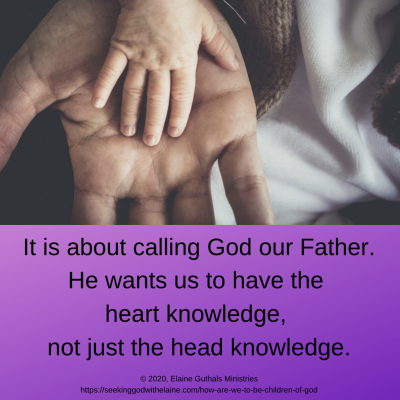
    It is about calling God our Father. He wants us to have the heart knowledge, not just the head knowledge.

    Parent hand and child hand

    Confidence

    Confidence is about having certainty in something. In churchy words, we say we believe in God. We have to have faith and trust.

    Faith is the belief that the doctrines stated in God’s Word are true, even if we do not understand all aspects of them. Trust is assurance that the promises of God are true.

    Assurance is another good word. It talks about certainty, too.

    Assurance leads to hope. Hope is where we desire for something that we believe is obtainable.

    We have to believe beyond a shadow of a doubt that what God is telling us is true. If He says we are spiritually dead if we haven’t ABCDed and that means we are going to be spending eternity in hell, that is what we have to believe. If He tells us that He wants us to put the devotions we’ve been writing online so others can read them, we have to have the confidence to do that — even if we are shaking in out boots the whole way.

    The ABCDs of Salvation

    If you have not become a believer in Christ, please read through the
    Plan of Salvation and prayerfully consider what God is asking you to do.

    A – admit our sins
    B – believe His Son Jesus is our Redeemer
    C – confess God as Sovereign Lord

    D – demonstrate that commitment by making any changes needed in our lives to
    live the way in which God has called us

    The Disciple’s Job Description

    Connected

    Disciples need to not only be connected to God, but we also have to be connected with each other. God has built a community of believers. We aren’t supposed to be insulated.

    Resource

    But it isn’t just a fellowship thing. We have a job to do.

    • “And he said to them, ‘Go into all the world and proclaim the gospel to the whole creation’” (Mk. 16: 15 ESV).
    • “Go therefore and make disciples of all nations, baptizing them in the name of the Father and of the Son and of the Holy Spirit, teaching them to observe all that I have commanded you. And behold, I am with you always, to the end of the age” (Mt. 28: 19-20 ESV).

    We are to support others. We just said in a recent devotion that disciples provide charity to widows when needed. Charity means showing others love flavored with acts of benevolence. 

    Character

    Building the character of God is what being a disciple is all about. That is why we are on the sanctification road.

    Sanctification is the transformation of mind, body, and soul beginning with regeneration and ending with perfected state of spiritual wholeness or completeness. Regeneration is the change in us that God brings about when we go from being spiritually dead to spiritually alive. The perfected state indicates spiritual wholeness or completeness.

    We are to have the disposition of a child. Our disposition is our temperamental makeup.

    Oh, yeah. That means change.

    Jesus was all about our need to change. That is what conversion is. Conversion is a change of mind, heart, and conduct. We have to have this change to enter the kingdom of God.

    Resource

    Sanctification is a process. Pool said it the best when he wrote “that even converted souls have need of a daily conversion.”

    Resource

    What Jesus was getting at was we need to be trusting and submissive rather than ambitious. That is what we need to turn toward in repentance.

    Glossary

    Contributors

    God didn’t call us to be back-seat Baptists. He wants us to contribute. He has a job for each one of us to do.

    That is why the Great Commission has all of those action words (Mt. 28: 19-20).

    • Go
    • Make
    • Baptize
    • Teach

    To read a related devotion, click the button below.

    God knows that the only way we are going to truly understand some of His ways are by doing them. We have to put them into practice.

    Cope

    Oh, yeah. Being a disciple is not going to be easy. Satan is going to throw all he has at us because he wants to derail us.

    But God helps us cope in those times of trials. We have to know that He is our protector in times of trouble.

    • “There is no one holy like the LORD. There is no one besides you! And there is no rock like our God” (I Sam. 2: 2 CSB).
    • “The Lord is my rock, my fortress, and my deliverer, my God, my rock where I seek refuge, my shield and the horn of my salvation, my stronghold” (Ps. 18: 2 CSB).
    • “He will cover you with his feathers; you will take refuge under his wings. His faithfulness will be a protective shield” (Ps. 91: 4 CSB).

    The thing is, God doesn’t want us to go it alone. He wants us to depend on Him for everything — the big stuff and the little stuff.

    Person sitting on dock

    Control

    That is a good segue to the next topic. We talked at the beginning of the year that I thought about making self-control my word for the year. It is a fruit of the spirit.

    We do have to control ourselves and our sinful nature. We do that through self-discipline.

    But we can’t just think we are in control. Remember, God told me, “Well, Chick, you can’t do self-discipline without Me.”

    It is more about God being in total control. We have to submit to Him.

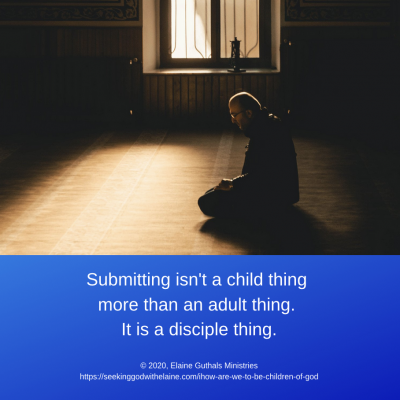
    Oh, yeah. We think submitting is more of a child thing than an adult thing. But it isn’t. It is a disciple thing.

    Person kneeling

    Making the Connections

    We have said before that repentance was turning from sin. Now we know what we are to turn toward — a child-like disposition.

    Don’t worry. Nicodemus had trouble with this you-must-be-born-again/become-a-child directive.

    Paul really didn’t explain it much better to some peoples’ estimation. “Therefore, if anyone is in Christ, he is a new creation. The old has passed away; behold, the new has come” (II Cor. 5: 17 ESV). How can be brand new?

    Vaughan helped us understand. He wrote, “This image does not convey the idea of a perfectly new being, but of an old being begun again, that it may do better.”

    Resource

    With all of the C words up there, we need to add a D Word. We need to be docile. Docile means easily taught.

    Jay noted that we should “not [be] like them in ignorance, not in fickleness, not in waywardness.” We should be willing to be taught and changed.

    Resource

    Making the Connections to Self-Discipline

    Submission is a bad enough word to some worldview people. When we tell them child-like, they may turn around and walk away. How do we describe what God is wanting us to be?

    We’ve been looking at defending our beliefs when we are witnessing. That means we have to be secure enough to convince someone to accept our beliefs.

    Our questions should still serve us to determine on what we need to focus.

    • What does the Scriptures say?
    • What do I believe?
    • Why do I believe the same/differently than the Scriptures?
    • What are the talking points when witnessing to a non-believer?

    Related Links

    I have created a worksheet of the questions above. Click on the button below to access it.

    How Do We Apply This?

    We have to understand that the resistance is in us, not just the worldview people. Vaughan wrote, “We as men fancy ourselves independent and self-sufficient; we must get back to simplicities, self-renunciation, to a babyhood of trust.”

    Resource

    How do we know that we have become child-like? In Jay and Various’ Conversion, it was written, “The change is to be judged of by its effect.” Have we become more dependent on God?

    Resource

    Oh, yes. We have to discuss the elephant in the room. We have to be ready for the discipline for when we mess up. Isn’t that what children do? They push the boundaries or just plain get it wrong — and have to face the consequences.

    Now we know what we are turning to when we turn away from repentance. We just have to do it.

    Father. We come to You as our Father. We come to You as Your children. That means we come in humility and submission. Grow us to be who You want us to be. Refine us until our character matches Yours. Sustain us on this sanctification road and help us to reach our end destination — being perfected in Your sight. Amen.

    What do you think?

    Leave me a comment below (about this or anything else) or head over to my Facebook group for some interactive discussion.

    If you don’t understand something and would like further clarification, please contact me.

    If you have not signed up for the email daily or weekly providing the link to the devotions and the newsletter, do so below.

    If God has used this devotion to speak with you, consider sharing it on social media.

  • Who Is the Greatest in the Kingdom of Heaven?

    It was a simple question that the disciples asked Jesus. Who is the greatest in the kingdom of heaven? This devotion begins looking at the question they asked.

    Nuggets

    • I wonder what the disciples were really asking Jesus.
    • Wanting to be great is part of the human makeup, isn’t it?
    • It is easy to look down at the disciples because they didn’t get it – most of the time, we don’t either.
    • At a minimum, we struggle greatly with the concept; at a maximum, God’s ways are higher than ours, and we just can’t understand.
    • God wants us to focus more on the spiritual than the physical.

    Devotions in the What I Believe series

    Devotions in the Family category

    Who Is the Greatest in the Kingdom of Heaven?
    How Are We to be Children of God?

    Flowers with title Who Is the Greatest in the Kingdom of Heaven?

    This devotion may be pushing the boundaries of the Family category a little bit. It has to do more with maturity than status in the family.

    That is, until we look at it as we are to be children in God’s family. We know we call God our Father. We know we are children of God.

    Glossary

    But is that more than just a title? Does it have some expectations associated with it?

    The answers to those questions are also pushing the limits of this devotion. So, it is going to get split into two.

    Let’s Put It into Context

    Family is, according to the Holman Bible Dictionary, “the basic household unit which provides a person’s central relationships, nurture, and support.”

    Resource

    The Question

    “At that time the disciples came to Jesus and asked, ‘So who is greatest in the kingdom of heaven?’” (Mt. 18: 1 CSB)

    I wonder what the disciples were really asking Jesus. They had asked, “… ‘So who is greatest in the kingdom of heaven?’” (Mt. 18: 1 CSB).

    Were they asking whether men where greater than angels? Were they going through the list of Hall of Famers and asking was Moses greater than Noah or Job?

    Was it just their ambition that made them ask the question? It reads like it is the whole group, not just one of them or even a handful approaching Jesus.

    Was this just their desire to gain a position? Were they expecting a “you are” answer?

    Wanting to be great is part of the human makeup, isn’t it? If we didn’t desire to be great, Jesus wouldn’t have had to say, “… So the last will be first, and the first last” (Mt. 20: 16 ESV).

    Because, face it. We are usually very competitive.

    Asked in the correct way, we could make an argument that there was nothing wrong with the “… ‘So who is greatest in the kingdom of heaven?’” (Mt. 18: 1 CSB) question. If we are asking it so we can grow closer to God, that is exactly what God wants. If we are trying to find out what we should work on next on our sanctification road, more power to us.

    However, if we are letting Satan plant seeds of pride and prejudice, we are in trouble. Satan can work his way in this way and plant sin in our lives before we know it.

    Farindon and Bonar didn’t think the disciples were asking the question in the right way. Farindon wrote, “The disciples were mistaken in the terms of their question, for neither is greatness that which they supposed, nor the kingdom of heaven of that nature as to admit of that greatness which their fancy had set up.”

    Resource

    When we think about it, Farindon is correct. At least some of the disciples — okay, probably most — were looking for the military Messiah.

    To read a related devotion, click on the appropriate button below.

    If they were asking based on a military assumption, that isn’t what Jesus was. They were heading down the wrong path.

    We know the disciples really didn’t get what the kingdom of God was. They didn’t get that it is eternal. They didn’t get that it is within us in our hearts.

    Glossary

    It is easy to look down at the disciples because they didn’t get it. We have to remember – most of the time, we don’t either.

    At a minimum, we struggle greatly with the concept of God’s Kingdom. At a maximum, God’s ways are higher than ours, and we just can’t understand (Isa. 55: 8-9).

    I think what Jesus was addressing here was ambition. No, I don’t think He was telling us we shouldn’t try to improve ourselves. We know we are to grow in grace and knowledge (II Pet. 3: 18).

    Ambition tries to tell us we will be a better person if we are higher up on the food chain. If we strive to achieve a better paying job or a nicer house, we will be better off in God’s eyes.

    Wrong.

    Bonar added that the disciples could have been just being selfish. They could have been asking the question, hoping the answer was them.

    Resource

    I love the title to one of Farindon’s sermons. It is Greatness Adds Nothing to Virtue. A virtue is a moral standard of excellence.

    Resource

    To read a related devotion, click the appropriate button below.

    Virtue speaks more to character. God wants us to work on our character, not our bank account.

    Jesus was always focused on the spiritual. I think, however, veiled in what-is-the-spiritual-going-to-be-like question was the how-close-is-it-to-here? aspect.

    God wants us to focus more on the spiritual than the physical. The disciples were asking the question wrong.

    So, think about the answer they were expecting. They probably – really – were not going for a list of characteristics that they needed to exhibit.

    Maybe they were going for examples. “Name the person whose life we can emulate, so we can get it right the first time.”

    But usually that translates into “we want to be able to say we were as good as Moses.” Back to that competition.

    Yeah, Jesus did the unexpected. It is probably a pretty safe bet that the disciples did not expect Jesus’ answer.

    Children. Be like a child.

    Jesus was good at that, wasn’t He? He was good at saying the unexpected.

    Also, Jesus was good at telling His audience, “You don’t have it right.” The Pharisees thought they had it right by doing the do’s and not doing the don’ts — but they didn’t have it right, either.

    Instead, Jesus called some little kid over and said, “This. Be like this.”

    But not just be, though — become. Make yourself like a child.

    Ooo, baby. Change. He expected them — and expects us — to transform.

    But that is for the next devotion.

    Making the Connections

    Jay noted that we should “not like them in ignorance, not in fickleness, not in waywardness.” We should be willing to be taught and changed.

    Resource

    Making the Connections to Self-Discipline

    The kingdom of God can be confusing to those of us who are trying to equate it to what we know. We need to look at what we believe to be ready to answer those questions.

    We’ve been looking at defending our beliefs when we are witnessing. That means we have to be secure enough to convince someone to accept our beliefs.

    Our questions should still serve us to determine on what we need to focus.

    • What does the Scriptures say?
    • What do I believe?
    • Why do I believe the same/differently than the Scriptures?
    • What are the talking points when witnessing to a non-believer?

    Related Links

    I have created a worksheet of the questions above. Click on the button below to access it.

    How Do We Apply This?

    We like our independence. We like being in control.

    We need to give it over to God. All of it.

    We can’t fall into the same trap that the disciples did. They were thinking the world’s definition of greatest. We have to think — are we the best that God wants us to be.

    We have to get over this worldview notion that we can earn our way into Heaven. We can’t. It is all based on what Jesus did for us and have we accepted Him as our Savior.

    Yes, it is human nature to want to be great. We have to remember that God has us exactly where He wants us. We are exactly how He wants us to be.

    Being what God wants us to be is what we are working towards.

    Father. It is so hard for us to give up this world. We need to do just that. We need to look at things Your way. We need to work to be the children You want us to be. Thank You for forgiving us when we repent. Amen.

    What do you think?

    Leave me a comment below (about this or anything else) or head over to my Facebook group for some interactive discussion.

    If you don’t understand something and would like further clarification, please contact me.

    If you have not signed up for the email daily or weekly providing the link to the devotions and the newsletter, do so below.

    If God has used this devotion to speak with you, consider sharing it on social media.
  • Instructing Our Children

    As parents, we try to teach our children our beliefs. However, it seems that they are increasingly rejecting those beliefs. This devotion looks at what advice Solomon gave his son.

    Nuggets

    • Worldview logic says if we are given free will, we should use it – not just believe our parents.
    • Parents got listed right after God because He knows how important being a parent is.
    • We get the garland for listening to our parents.

    Devotions in the What I Believe series

    Devotions in the Family category

    Instructing Our Children
    Who Is the Greatest in the Kingdom of Heaven?

    Flowers with title Instructing Our Children

    My Ladies were supposed to be studying Proverbs during Sunday Morning Bible Study. The lessons have been built on a parent teaching the child about God and His wisdom.

    Wisdom is knowledge, discernment, and good sense that leads to goodness and virtue, which can be applied to life.

    So far, Solomon has told us:

    • It isn’t enough to just have the wisdom — head knowledge isn’t enough.
    • Our wisdom has to align with God’s if we are going to flourish in the world.
    • We are righteous because we are free from sin by following God’s moral laws.
    • Wisdom is to be prized above religion.
    • We get to where God wants us to be by using wisdom to reason out what He is wanting us to understand as we seek Him.
    • Only God gives us lasting wealth and righteousness.
    • The results of wisdom are a closer relationship with God.
    • God judge us daily because He hates sin.

    I put this lesson in the Family folder when it came up. It is kind of a step backwards chapter wise, but it fits better in a family series than it would have in a wisdom series.

    Let’s Put It into Context

    Family is, according to the Holman Bible Dictionary, “the basic household unit which provides a person’s central relationships, nurture, and support.”

    Resource

    Ordinances are an expression of the disciples’ obedience. Marriage is an ordinance.

    Children, Follow Instructions

    “Listen, my son, to your father’s instruction, and don’t reject your mother’s teaching” (Prov. 1: 8 CSB)

    Ooo, baby. This verse is under attack these days. The worldview tells our kids to question most — if not all — of their parents’ beliefs. Why is that?

    It isn’t just because we are given free will. Free will is the ability within us to make decisions, which determine actions that produce character.

    It seems like, a lot of times, that is what our kids are told. Worldview logic says if we are given free will, we should use it – not just believe our parents.

    The underlying goal, though, is for kids to reject the Christian beliefs of their parents. They don’t want all these things their parents have called sin to remain labeled as sin. They want to be able to do what they want and not face any consequences.

    The problem is, however, that they are not just rejecting their parents. They are rejecting God.

    God is the One who labels things a sin. Sin is actions by humans that disobey God and break one of His laws and commandments, goes against a purpose He has for us, or follows Satan’s promptings.

    Okay, I have to check this out. I read that Arnot wrote, “The first and great commandment is the fear of God, and the second, which is next to it and like to it, is obedience to parents.”

    Resource

    Let me process. So, what is a Arnot really trying to say? The fear of the Lord means to love and revere God.

    Glossary

    We know Commandment #1 is “You shall have no other gods before me” (Ex. 20: 3 ESV). But we also know Commandment #2 is “You shall not make for yourself a carved image, or any likeness of anything that is in heaven above, or that is in the earth beneath, or that is in the water under the earth” (Ex. 20: 4 ESV). That has nothing to do with parents.

    Also, Jesus told us what the greatest commandments are. “And one of them, a lawyer, asked him a question to test him. ‘Teacher, which is the great commandment in the Law?’ And he said to him, ‘You shall love the Lord your God with all your heart and with all your soul and with all your mind. This is the great and first commandment. And a second is like it: You shall love your neighbor as yourself’” (Mt. 22: 35-39 ESV).

    That says love others, not obey your parents. So, let’s look at it through the Ten Commandments.

    A while back, I gave my Elaine-speak version. Starting at the top until we get to parents, they are

    • Love God first and foremost.
    • Don’t worship anything but Him.
    • Watch how you use His name.
    • Find a community of people who believe like you do and meet with them regularly.
    • Honor your parents.

    To read a related devotion, click the button below.

    If we look at the top four, they are all about how we show our love to God. We love Him, worship Him, and don’t take His name in vain.

    I can see how that can be grouped as one. Then we get to the parents.

    Oh, wow. Did you see? Parents got listed right after God. He knows how important being a parent is.

    Johnson pointed out that the duties of parents and teachers are analogous. It is the parents’ responsibility to teach their children how to be a person.

    Resource

    We also have a responsibility to teach children about God. Let’s chase a rabbit a second. Don’t think because we have reached a certain age and are no longer children, we are done learning. We can always learn, no matter what age we are.

    Also, family is not just blood. We can adopt anyone into our family. We can teach them, too.

    So, don’t think just because you have no children, you aren’t a teacher. Don’t think that just because you are a teenager or younger, you can’t learn.

    Back to children listening to their parents. They are not going to get a more loving teacher. No one will understand them like a parent does.

    God knows that we need to pass on the lessons we have learned to others. That is how we make the Scriptures real to us. What better place than within the family? That way our family members can really see our faith being lived out.

    Bible

    Head Coverings and Jewelry?

    “for they will be a garland of favor on your head and pendants around your neck” (Prov. 1: 9 CSB)

    Hmmm. Interesting.

    Kids think that having their own way will be very rewarding. Really, it isn’t. Following Satan’s way leads to chaos and hurt.

    A garland was a wreath that was worn on someone’s head. The Holman Bible Dictionary said that “garlands symbolized instruction or the benefit of wisdom.” That is why we see the gods in mythology wearing them.

    Resource

    We get the garland for listening to our parents???? Isn’t that the exact opposite of what kids think? They think the last thing they would earn was a garland for obeying their parents.

    Clarkson listed what obeying parents showed.

    • Humility
    • Their reacting to parents’ love
    • Their acknowledging that wisdom comes with age (and experience)
    • Their acceptance of a natural order.

    Resource

    Listening to our parents (or our employer or someone else) shows we are willing to acknowledge someone who is over us. We recognize that they have some authority over us.

    If we can’t listen to our parents, how are we going to obey God? But that is the premise kids go on, isn’t it? We don’t have to listen to anyone because we can make our own decisions.

    Making the Connections

    The problem with that is God does have laws and commandments. We break the laws, we suffer the consequences.

    God doesn’t want us to just know about the laws and commandments. He wants us to live them.

    Why? The laws and commandments show us God’s character. When we obey them, we become like God.

    That is the goal. God wants us to be like Him.

    How Do We Apply This?

    Raising kids is hard. I was reading a devotion today by a fellow blogger, Tabatha, that tells us six tips the Scriptures give us on how to do that.

    Resource

    I’ve been really lucky. Adam never really rebelled against me. There were other things that we had to deal with, but I didn’t have the problems other parents encounter.

    I just asked Adam why that was. After the initial, “I don’t know,” we figured a couple of things out.

    Adam knew if I told him something, I was shooting straight with him. I wasn’t lying to get him to act or think a certain way. I was giving him the best instructions that I knew.

    Another thing Adam knew was I spoke Adam. I got how he thought through things. I knew the words he used.

    I didn’t just say, “I am the Mom. You will …” unless I really had to for a very good reason. I would cringe every time one of his teachers or someone else would go into dictator mode with him.

    Oh, yes. I wasn’t a perfect parent. I know I’ve told you about the time I tried to get Adam to eat some chicken nuggets I made — Cajun chicken nuggets. It wasn’t pretty.

    My best advice is that we need to establish the relationship with our children. Yes, they have to honor us as parent. Yes, we have to honor them as human beings.

    The parent-child relationship is like any other relationship. It will need give and take. It will need patience and forgiveness.

    It is worth it.

    Father. You have made Yourself our Father. You didn’t need to make us an family when You created us. You wanted us. Even after we disobeyed You, You still wanted us. In fact, as the song says, You didn’t want Heaven without us so You brought Heaven down. Help parents and children to love each other as You do. Give us patience and forgiveness. Most of all, help us teach our children about You so that they may call You Father. Amen.

    What a Beautiful Name
    Vocalist: Elaine Guthals
    Keyboard: Chris Vieth

    What do you think?

    Leave me a comment below (about this or anything else) or head over to my Facebook group for some interactive discussion.

    If you don’t understand something and would like further clarification, please contact me.

    If you have not signed up for the email daily or weekly providing the link to the devotions and the newsletter, do so below.

    If God has used this devotion to speak with you, consider sharing it on social media.

  • In Support of Widows

    Families have a multi-generational component to them. James and Paul discussed how children – and the church – are to support widows. This devotion looks at how God see supporting widows as an indication of faith.

    Nuggets

    • It is intended that disciples provide charity to widows when needed.
    • Paul qualified that families should be the first support for the widows.
    • If we can’t love and support our family, how can we love God?

    Devotions in the What I Believe series

    Devotions in the Family category

    In Support of Widows
    Instructing Our Children
    Who Is the Greatest in the Kingdom of Heaven?

    Flowers with title In Support of Widows

    Society used to be a patriarchal society. Women were restricted to roles within the home and family.

    Jesus, however, elevated women to be equals. No, He didn’t revamp societal structure. He did include them in His kingdom and in His ministry.

    Women still had problems when they became widows. Their financial support and protections were generally gone.

    Peloni explained their hardships. He wrote, “Among the Jews, as among most Oriental races of the ancient world, widows and orphans were of all classes the most liable to plunder and oppression. Their inheritance was often filched from them under forms of law, now that they bad (sic) no strong arm to protect them, by an unjust judge whom they were unable to bribe, or even forcibly wrested from them by some rapacious kinsman or neighbour.”

    This wasn’t what God intended. “You shall not mistreat any widow or fatherless child. If you do mistreat them, and they cry out to me, I will surely hear their cry, and my wrath will burn, and I will kill you with the sword, and your wives shall become widows and your children fatherless” (Ex. 22: 22-24 ESV).

    But how is that supposed to play out? There are some passages in the New Testament that help shed some light on what is intended.

    Let’s Put It into Context

    Family is, according to the Holman Bible Dictionary, “the basic household unit which provides a person’s central relationships, nurture, and support.”

    Resource

    Ordinances are an expression of the disciples’ obedience. Marriage is an ordinance.

    Visit the Widows

    “Religion that is pure and undefiled before God, the Father, is this: to visit orphans and widows in their affliction, and to keep oneself unstained from the world” (Jas. 1: 27 ESV)

    It is intended that disciples provide charity to widows when needed. Charity means showing others love flavored with acts of benevolence. Butler described that as “in any want or distress wherein they need and are capable of our assistance.” That shows others the loving character of God.

    James was well aware that there are destitute and afflicted of every class. His intended recipients, though, are those described as those who need the help the most. He was describing those who are ill or elderly who truly in a dire situation.

    Resource

    We want to make sure we use the right definition of want. James is not talking about what is desired. It is the needy and destitute definition that he is talking about here.

    We also have to look at what is meant by the word visit. It doesn’t mean go, play a game or two of pinochle, catch up on what is going on in everyone’s lives, and go back home.

    That isn’t how God visits us — and God does visit us. “You visit the earth and water it; you greatly enrich it; the river of God is full of water; you provide their grain, for so you have prepared it” (Ps. 65: 9 ESV).

    God isn’t just checking in for His duty call. He is really looking at how we are doing and figuring out what we need. Then, He goes about providing that and improve our circumstances.

    Field and church

    Family Provides First

    “Support widows who are genuinely in need. But if any widow has children or grandchildren, let them learn to practice godliness toward their own family first and to repay their parents, for this pleases God. The widow who is truly in need and left all alone has put her hope in God and continues night and day in her petitions and prayers” (I Tim. 5: 3-5 CSB)

    Paul qualified who should be the first support for the widows. He instructed the families to take care of the women within their family who have found themselves widowed.

    Rowland noted that “the idea is that we owe a debt of gratitude to those from whom we have derived existence, and to whom we owe the support, care, and education we have received. We are bound to see that to the utmost of our ability their wants in old age are met.” Mom and Dad took care of my sister and me when we were growing up. We took care of them when they were growing old.

    Resource

    What Paul was getting at here was each family member has rights. We must respect those rights, especially when their situations change. Mothers didn’t lose their rights when fathers died.

    Our character as disciples must first be evident in the home. Macgregor reminds us that “Our tenderest relations, our strongest affections, our highest joys, our deepest sorrows, all are touched by the thought of home.”

    Resource

    Of course, our character is most tested at home. That is generally where we let our guard down. Plus, our family members know us the best, so can sometimes hurt us the worst.

    We still have family responsibilities. That shows how our character is imitating God’s character. If we can’t exemplify God in our home life, how are we going to when we are out and about?

    Family

    No Support, No Faith

    “Command this also, so that they will be above reproach. But if anyone does not provide for his own family, especially for his own household, he has denied the faith and is worse than an unbeliever” (I Tim. 3: 7-8 CSB)

    Paul doesn’t pull any punches, does he? He just lays it out there in plain sight.

    But really, this is what James was saying. “Religion that is pure and undefiled before God, the Father, is this: to visit orphans and widows in their affliction, and to keep oneself unstained from the world” (Jas. 1: 27 ESV).

    If we can’t love and support our family, how can we love God? How can we be true disciples?

    How do we deny the faith? Faith is the belief that the doctrines stated in God’s Word are true, even if we do not understand all aspects of them.

    If we don’t love and support our family, we are saying that the God’s doctrines aren’t true. His love is not true. The Trinity is not true, because that is about family.

    Paul said it again. “But if anyone does not provide for his own family, especially for his own household, he has denied the faith and is worse than an unbeliever” (I Tim. 5: 8 CSB).

    We not only have to believe that God’s doctrines are true, but we also have to believe that He holds us accountable for implementing them. We have to believe that they are supposed to impact our character and influence our daily lives.

    We want to have a pure conscience — a conscience where we have not disobeyed God in any way. We want to work toward obeying Him completely.

    God and Lady Justice

    Don’t Burden the Church

    “If any believing woman has widows in her family, let her help them. Let the church not be burdened, so that it can help widows in genuine need” (I Tim. 5: 16 CSB)

    At first glance it may seem cold that Paul would say to not burden the church with widow care. I can think of a couple of reasons he may have said that — beyond it being the duty of the family.

    Paul may see it as a way of keeping the family unit in tact. The widows won’t have to give up that to which they have been accustomed. The younger women have the opportunity to thank the widows for all the love and care that they have provided them over the years.

    Church resources can be limited at times. If the family is able to meet the widow’s needs, that does leave those resources free for someone else who may need the help more — like those who have no remaining family.

    I can see Paul not wanting to take the focus off of the spiritual needs. We can’t take our eyes off God to focus on this world. We have to focus on Him.

    Making the Connections

    Tied with the charity is mercy. Disciples’ mercy is a characteristic of compassion for the needs of others, especially those who are in distress. In this way, we show God’s mercy. God’s mercy is the unexpected way God responds in love to our needs.

    If we as disciples say God’s ways are higher than the worldview ways (Isa. 55: 8-9), then we must interact within our families in a higher way than the world interacts with theirs. To do less would be an insult to Christ.

    Making the Connections to Self-Discipline

    We’ve been looking at defending our beliefs when we are witnessing. That means we have to be secure enough to convince someone to accept our beliefs.

    Our questions should still serve us to determine on what we need to focus.

    • What does the Scriptures say?
    • What do I believe?
    • Why do I believe the same/differently than the Scriptures?
    • What are the talking points when witnessing to a non-believer?

    Related Links

    I have created a worksheet of the questions above. Click on the button below to access it.

    How Do We Apply This?

    Somewhere in my reading, I read that we are expected to do the unexpected. We could take that a couple of ways.

    It could mean that what we do to support the widows is supposed to mean something. It is not just a duty.

    It is a service. Service is an act based on belief in God that comes from a response of worship by acknowledging His power through our submission.

    It could also mean that our service is supposed to be over and beyond what is expected. That ties in with the unexpected ways God responds in love.

    How do we deal with multi-generational issues? With patience.

    I got such a charge out of what Talmage said. He wrote, “Prayers in the household will not make up for everything.”

    Resource

    We can’t just pray for God to take care of our widows. We have to be God’s hands and feet and do it.

    We can’t just pray for a cohesive family. We have to work to make it so.

    God has given us families to love, support, and instruct us. We are families through the good times and bad, through the beginning of life and ending of life. We need to follow God’s way through it all.

    Father God. You have given us family. May we love them and support them in the way they need. May this especially be true when circumstances change and our family members find themselves widows. May we show them Your love and provision. Amen.

    What do you think?

    Leave me a comment below (about this or anything else) or head over to my Facebook group for some interactive discussion.

    If you don’t understand something and would like further clarification, please contact me.

    If you have not signed up for the email daily or weekly providing the link to the devotions and the newsletter, do so below.

    If God has used this devotion to speak with you, consider sharing it on social media.