Author: admin

  • The Morality of Having a Sober Character

    Possessing a quiet dignity is an element of having a sober character. This daily devotional shows two ways that plays out through the words we use.

    Nuggets

    • Our quiet dignity is impacted by our conversation, determining our purity and holiness.

    • We must be very careful in swearing oaths to ensure they are not abusing God’s name or giving into temptation.

    To read devotions in the Redo for Godliness series, click the appropriate button below.

    Devotions in the Moralities Lead to Godliness series

    We are augmenting our look at Manton’s sermon entitled The Moralities of Christianity with Bird’s Christian Morality. We’ve already added diligence to the mix. Now we are adding being sober.

    Bird wrote that sobriety “… does not refer to what we call temperance. It is that calm, quiet dignity which so well befits a Christian man, and which raises him above the flighty, giddy, thoughtless throng of worldly people. There is something noble in his character.”

    Resources

    We’ve looked at being sober — or having self-control — several times. It sounds like there is more to it than that.

    But this is a devotion that I call a potpourri devotion. The verses I am looking at aren’t really meshing together. So, let’s see what each have to tell us.

    Let’s Put It into Context

    The definition of moral, according to the Merriam-Webster Dictionary, is “of or relating to principles of right and wrong in behavior.” Morality, then, is “a doctrine or system of moral conduct.” When it is the plural form — moralities — it is a “particular moral principles or rules of conduct.”

    Resources

    Our morals determine our character. Character, according to the Merriam-Webster Dictionary, is “the complex of mental and ethical traits marking and often individualizing a person, group, or nation.”

    Resource

    Sober is a character trait distinguished by self-control, genuineness, and sound moral judgment. It is a calm and temperate disposition. From Bird’s definition, we can add noble dignity.

    Glossary

    Words that Build Us Up

    “Let no corrupting talk come out of your mouths, but only such as is good for building up, as fits the occasion, that it may give grace to those who hear” (Eph. 4: 29 ESV)

    Our quiet dignity is impacted by our conversation, determining our purity and holiness.

    We just got done looking at this verse in another devotion in this series. We looked at it then as fostering peace.

    Verse Commentary

    If we look at it this time as our quiet dignity is exhibited through our conversation, we see that as an argument for guarding our speech. Words are an inward and outward expression. What comes out of our mouths is a product of what is inside us. We act out through our words.

    When we think about the “… but only such as is good for building up …” (Eph. 4: 29 ESV) part, I wonder how many times we consider this only to be implying we are talking about someone else. You know, if you can’t say something nice, don’t say it.

    I wonder if we ever consider how what comes out of our mouths build us up or tears us down. Our self-talk doesn’t even have to come out of our mouths. It can just roost in our minds.

    Heygate noted the difficulty in guarding our speech. He wrote, “No doubt one cause of this carelessness is the difficulty of the work; but another is disbelief in its necessity. We cannot bring ourselves to believe that words are acts.”

    Resource

    Pulsford reminded us the damage done when corrupt things come out of our mouths. The corruption is no longer just in us. It is now is others, also. Spreading the corruption is not what God has in mind.

    Resource

    Rogers expanded that to say that our corrupt conversations defile us as well as on others. “It is not what goes into the mouth that defiles a person, but what comes out of the mouth; this defiles a person” (Mt. 15: 11 ESV). That makes us unclean.

    Glossary

    If we are unclean, we are not pure. If we are not pure, we are not holy.

    If we are not holy, we are not godly.

    Yeah, just because of what comes out of our mouths.

    God wants us to show His grace to others. “… that it may give grace to those who hear” (Eph. 4: 29 ESV). This replaces our corrupt language, which is

    • Profane, irreligious, or immodest discourses
    • Language that slanders and defames
    • “… compliance with the faults of others” (Jortin)
    • Prideful

    Resource

    God wants us to use our conversation to tell others about Him, promote unity, and knit the family together.

    Are Oaths Acceptable or Not?

    “But most of all, my brothers and sisters, never take an oath, by heaven or earth or anything else. Just say a simple yes or no, so that you will not sin and be condemned” (Jas. 5: 12 NLT)

    We must be very careful in swearing oaths to ensure they are not abusing God’s name or giving into temptation.

    Okay, I need to look up what an oath is. Oh, I know it is, as the Easton Bible Dictionary says, “a solemn appeal to God …” Barrow said we are asking God to be our witness.

    Resource

    Oaths are permitted when appropriate. “‘If you, Israel, will return, then return to me,’ declares the LORD. ‘If you put your detestable idols out of my sight and no longer go astray, and if in a truthful, just and righteous way you swear, “As surely as the LORD lives,” then the nations will invoke blessings by him and in him they will boast” (Jer. 4: 2 NIV).

    Elaine-speak on the requirements for the oath.

    • Our relationships with God need to be right.
    • We have to work on becoming clean and staying clean.
    • We need to swear in a way that acknowledges God it is a living God.

    In other words, it is very important that we get the oath right. We have to be totally within God’s Will.

    Why is it so important? If the requirements are the if section, the then section is nations will be blessed.

    No, not just the people involved in the oath. It is nations — plural — who will be blessed.

    But how does that mesh with Matthew 5: 34? “But I tell you, do not swear an oath at all: either by heaven, for it is God’s throne” (Mt. 5: 34 NIV).

    Barrow addressed this. He said that abusing God’s name and challenging His authority is a sin.

    Resource

    Plummer gave us a big caution. He contended that “the use of oaths is an index of the presence of evil; it is a symptom of the prevalence of falsehood.” Evil is equated with sin because it is that which goes against God and His purposes.

    Resource

    What I am reading that to mean is the situations in which we feel we must use oaths many have an element of temptation in it. Temptation is a suggestion in our mind that would lead us to sin rather than following God’s Will. It is also that period of time between conception and execution of doing what is sinful.

    Well, think about it. When do we feel we have to take oaths? Sometimes, isn’t it when we are in some sort of trouble? Deems argued that we put our confidence in the oaths, not in God.

    Resource

    We need to make sure we are resisting Satan’s temptations.
    TheMoralityOfHavingASoberCharacterPin

    Making the Connections

    Barrow contended that our swearing should be seen as worship. He was talking about oaths — really, it should be applied to all of our conversations. He wrote it “… piously [acknowledges] His principal attributes and special prerogatives; it also intimates a pious trust and confidence in Him.”

    Resource

    Did you see the word attribute? Yeah, character trait. Everything we do must imitate God. Everything we say must follow His character.

    How Do We Apply This?

    • Keep our confidence in God, not ourselves — either words or actions
    • Guard our tongues so only build up who we are talking with, including ourselves
    • Worship God with all we say
    • Be modest and sober

    Resource

    Okay, so back to quiet dignity. I think these verses took us on the scenic route, but we can see how important our words are. Whether we build ourselves and each other up or tear us down — whether we feel we have to use an oath to et us out of trouble, our words must point to God.

    Father God. We want to follow you. What are words to encourage others to see you and us. Help us to guard our witnesses to have the impact needed to expand Your kingdom.

    What do you think?

    Leave me a comment below (about this or anything else) or head over to my Facebook group for some interactive discussion.

    If you don’t understand something and would like further clarification, please contact me.

    If you have not signed up for the email daily or weekly providing the link to the devotions and the newsletter, do so below.

    If God has used this devotion to speak with you, consider sharing it on social media.

  • Spiritual Healing versus Physical Healing

    We started looking in the last devotion at the four friends who brought another to Jesus for healing. Jesus focused on his spiritual healing rather than his physical healing. This daily devotional looks at getting our priorities straight.

    Nuggets

    • Jesus knows what we are thinking because He has access to our hearts.
    • Jesus is more concerned about our inward spiritual condition than our outward physical condition.
    • Salvation requires more than just our acceptance; we have to implement it into our lives.
    • Everyone was amazed at Jesus’ power to heal.

    Devotions in the Luke’s Diagnosis and Prescription series

    Devotions in the Faith and Forgiveness series

    Spiritual Healing versus Physical Healing

    Sometimes, it feels as if God has a totally different focus than we do. That is probably because He does.

    God’s main concern is not our lives here in this world. He is more concerned about our spiritual lives.

    That was evident in the story about the four friends bring the paralytic to Jesus. Let’s jump back into the story.

    Let’s Put It into Context

    “Seeing their faith he said, ‘Friend, your sins are forgiven.’ Then the scribes and the Pharisees began to think to themselves, ‘Who is this man who speaks blasphemies? Who can forgive sins but God alone?’” (Lk. 5: 20-21 CSB)

    It seems like it was a common occurrence for the Pharisees and teachers to be in the audience when Jesus was teaching. They saw that He had the power to heal, but they didn’t believe He was the Messiah.

    It wasn’t just the means of getting the paralytic to Jesus that He gained His approval. Jesus rewarded their faith. Faith is the conviction that the doctrines revealed in God’s Word are true, even if we do not understand all aspects of them, a belief which impacts our lives.

    Nothing the friends did saved the paralytic. But everything they did got him to the point where he could be saved. Salvation is deliverance from evil and the consequences of sins to replace them with good and eternal life.

    DidntSaveButGotToPoint

    Jesus’ focus is always on saving us from our sins. Healing the man from paralysis was secondary.

    Luke didn’t record any words passed between the five men and Jesus. It is probably a safe bet to say the man and his friends had prayed for healing in the past. Jesus was gauging their faith on what was in their hearts.

    That spiritual healing was not expected was of no consequence to Jesus. God will look at the overall picture — our overall plan — and answer our prayers accordingly. He will answer them in the best way for us.

    The Pharisees thought Jesus had committed blasphemy because they believed only God could forgive sins. They were correct isn’t thinking that no mere human can forgive sins. They were incorrect because Jesus was no mere human.

    Which Is It Easier for God to Heal — Spiritual or Physical?

    “But perceiving their thoughts, Jesus replied to them, ‘Why are you thinking this in your hearts? Which is easier: to say, “Your sins are forgiven,” or to say, “Get up and walk”?” (Lk. 5: 22-24 CSB)

    Jesus knows what we are thinking because He has access to our hearts.

    It wasn’t just intuition that Jesus could discern what the Pharisees were thinking. The whole crowd probably had a pretty good clue that they were not buying what Jesus was selling.

    Jesus knew what everyone in the crowd was thinking because He is God. God knows our thoughts. “You know when I sit down and when I stand up; you understand my thoughts from far away” (Ps. 139: 2 CSB).

    Oh, yeah. Jesus can not only see into our minds, but He also can see into our hearts. He knows the condition of our hearts. He knows if He is in them or not.

    Jesus can not only see into our minds, but He also can see into our hearts.

    Shedd discussed this concept, equating it to our own self- evaluation. He wrote, “… we will make the extreme supposition that he [mankind] arrests every thought as it rises, and looks at it; that he analyzes every sentiment as it swells his heart; that he scrutinizes every purpose as it determines his will; even if he should have such a thorough and profound self-knowledge as this, God knows him equally profoundly and equally thoroughly.”

    Resource

    The thing is, God knows us better than we know ourselves. We may not recognize something as a sin. Sins are actions by humans that disobey God and break one of His reasonable, holy, and righteous laws and commandments, goes against a purpose He has for us, or follows Satan’s promptings.

    God does.

    Ooo, baby. That can be a scary thought at times, can’t it? We can’t hide anything from God.

    But doesn’t that present hope also? As Shedd wrote, God has seen us at our worst and deemed us forgivable anyway. Perfect God has looked at imperfect man and said, “I can not only forgive you, but I can make you clean again.”

    Glossary

    That is what Jesus was offering to the paralytic that day.

    Spiritual Healing v. Physical Healing

    Jesus is more concerned about our inward spiritual condition than our outward physical condition.

    I have always thought that Jesus’ question was interesting. “Which is easier: to say, ‘Your sins are forgiven,’ or to say, ‘Get up and walk’?” (Lk. 5: 23 CSB). Parker pointed out the fearlessness Jesus exhibited in asking this question of the Pharisees.

    When Jesus healed the many people, how many times did He specifically say that their sins were forgiven? I don’t remember many others — maybe once.

    That means the two are not interconnected. Jesus can heal the physical without healing the spiritual. He is able to start at either end.

    To me, it also means Jesus did not just hand out forgiveness of sins. There had to be something more than the person showing up for physical healing.

    They had to have faith that Jesus was the Messiah and could save them from their sins. Parker wrote, “His answer to the faith of man was always in proportion to the fulness and courage of that faith.”

    Resource

    This man made the choice to believe, and His sins were forgiven. Healing his body showed that he was obedient. Spurgeon wrote, “He did his Lord’s bidding, and he did it accurately, in detail, at once, and most cheerfully. Oh! how cheerfully; none can tell but those in like case restored. So, the true sign of pardoned sin, and of paralysis removed from the heart, is obedience.”

    Resource

    Get Up and Walk

    But so that you may know that the Son of Man has authority on earth to forgive sins’ — he told the paralyzed man, ‘I tell you: Get up, take your stretcher, and go home’” (Lk. 5: 23 CSB)

    Salvation requires more than just our acceptance; we have to implement it into our lives.

    Notice Jesus wanted the paralytic to immediately get up. He was asking for a visual indication that he accepted the healing. Cox wrote, “He bids us ‘arise and walk,’ to prove our victory over sin, to show that we have found new life in Him.”

    Resource

    The Crowd Responds

    “Immediately he got up before them, picked up what he had been lying on, and went home glorifying God. Then everyone was astounded, and they were giving glory to God. And they were filled with awe and said, “We have seen incredible things today’” (Lk. 5: 25-26 CSB)

    Everyone was amazed at Jesus’ power to heal.

    Smyth thought Jesus went about His ministry in the right way. Forgiving mankind of their sin is harder than healing them of their physical ailments.

    Resource

    But that is and always was Jesus’ focus. Our spiritual condition is much more important than our physical condition.

    Parker brought up a good point. If the Pharisees were amazed at Jesus’ power, it didn’t last long. Pretty soon, they went back to seeing Jesus as the enemy.

    Resource

    SpiritualHealingVersusPhysicalHealingPin

    Making the Connections

    I love how Pentecost described faith. He wrote, “Faith is not merely a sentiment which believes something to be, but a vitalized affection which starts all our faculties into action and sets us to work to accomplish something.

    Resource

    Faith isn’t just an attitude. We may believe something to be true. That belief has to give us strength and devotion to impact our lives.

    A couple of devotions ago, we said that knowledge is the precursor to faith, and faith is the precursor to salvation. It all hinges on free will.

    To read a related devotion, click the button below.

    I think we need to modify that to knowledge is the precursor to faith; faith is the precursor to forgiveness: and forgiveness is the precursor to salvation.

    How Do We Apply This?

    We can’t say this enough. Cox wrote, “There must be faith before there can be healing; the man’s sins must be forgiven before he can be made whole from his disease. But then, when our sins are really forgiven us, forgiveness implies a free restoration to health.”

    Resource

    That means we must ABCD if we haven’t already.

    The ABCDs of Salvation

    If you have not become a believer in Christ, please read through the
    Plan of Salvation and prayerfully consider what God is asking you to do.

    A – admit our sins
    B – believe His Son Jesus is our Redeemer
    C – confess God as Sovereign Lord

    D – demonstrate that commitment by making any changes needed in our lives to
    live the way in which God has called us

    The Disciple’s Job Description

    Foote told us to be a friend such as these four were to those in need.

    Resource

    More importantly, we need to bring the lost to Christ. We need to be more concerned about their spiritual condition than their physical condition.

    Eternity is more important than this temporary world. God has the right priorities. We need to adopt them.

    Father God. You love us so much. You don’t want to spend eternity without us. That is why You designed the Plan of Salvation. That is why You sent Jesus to be our Savior. May we have Your priorities. Help us focus on You and bringing others to know You. Amen.

    What do you think?

    Leave me a comment below (about this or anything else) or head over to my Facebook group for some interactive discussion.

    If you don’t understand something and would like further clarification, please contact me.

    If you have not signed up for the email daily or weekly providing the link to the devotions and the newsletter, do so below.

    If God has used this devotion to speak with you, consider sharing it on social media.

  • How Are Faith and Forgiveness Connected?

    Four friends brought another friend to Jesus for healing. Instead of just healing his physical condition, Jesus also healed his spiritual condition. This daily devotional looks at faith and God’s forgiveness.

    Nuggets

    • Jesus has the power to heal us, but it takes faith.
    • Illness entered the world as the result of sin, making sin the underlying cause for illness.

    Devotions in the Luke’s Diagnosis and Prescription series

    One of the most well-known of Jesus’ miracles is the four friends bringing another to Jesus for healing. Luke’s diagnosis – as was Jesus’ – was that there was something more important that needed healing.

    Let’s dig into it to see what we can see. This is going to take two devotions. We’ll keep the connections and application until the next devotion.

    Accessing the Jesus’ Power

    “On one of those days while he was teaching, Pharisees and teachers of the law were sitting there who had come from every village of Galilee and Judea, and also from Jerusalem. And the Lord’s power to heal was in him. Just then some men came, carrying on a stretcher a man who was paralyzed. They tried to bring him in and set him down before him. Since they could not find a way to bring him in because of the crowd, they went up on the roof and lowered him on the stretcher through the roof tiles into the middle of the crowd before Jesus” (Lk. 5: 17-19 CSB)

    Jesus has the power to heal us, but it takes faith.

    It was an ordinary day for Jesus. He had been gaining in popularity, if not for His teaching for His healing. “But now even more the report about him went abroad, and great crowds gathered to hear him and to be healed of their infirmities” (Lk. 5: 15 CSB). The Pharisees and teachers also came from all over.

    It seems like it was a common occurrence for the Pharisees and teachers to be in the audience. I wonder if Jesus ever got tired of the scrutiny. It had to be wearing to be under the spotlight so they could dissect everything He said and did.

    We like to think Jesus was out there preaching every day. We know He was later in Luke. “Each day Jesus was teaching at the temple …” (Lk. 21: 37 NIV). Did He ever get burned out? He would have to if He was going to feel everything we feel.

    Jesus’ Power to Heal

    Spurgeon explained Jesus’ power to heal. In the gospels when Jesus’ power is displayed, it is usually in the act of healing. Yes, He calmed the sea, but most of the time it was healing sickness and driving out demons.

    I have to think about the reasoning Spurgeon gave as to why Jesus could heal. I always knew it was because Jesus was Divine. However, Spurgeon contended that “although our Lord Jesus healed as Divine, remember that He also possessed power to heal because of His being human. He used no other remedy in healing our sin-sickness but that of taking our sicknesses and infirmities upon Himself.”

    Resource

    I don’t know if I buy that. What I hear Spurgeon saying was, because He was human, Jesus could heal others of their illnesses. But He didn’t give them aspirin, stitch up their cuts, and operate on them in the field.

    Generally, Jesus healed people with His touch and words (Mt. 9: 27-30; Mk. 10: 46-52). Sometimes, He used props (Mk. 8: 22-26; Lk. 9: 1-6). That takes more than human abilities. It takes Divine.

    I have the biggest issue thinking that “He used no other remedy in healing our sin-sickness but that of taking our sicknesses and infirmities upon Himself.”

    Yes, Jesus took our sins upon Himself. But it wasn’t just because He was human.

    Don’t get me wrong. If Jesus hadn’t been part human, His taking our sins upon Himself wouldn’t have the same effect on us. He had to be one of us to make the healing applicable to us.

    That is the only way Jesus’ humanness heals our sin-sickness. Most importantly, we can be healed because He is Divine and did not sin. If He would have been 100% human only, He would not have been eligible to be the Sacrifice because He would only have sinful nature in Him and would have sinned. God would not accept a blemished sacrifice.

    It really intrigued me when Luke wrote, “… And the Lord’s power to heal was in him” (Lk. 5: 17 CSB).

    What? Did that mean Jesus could only heal on certain days?

    Spurgeon gave us his take on that, too. He wrote, “The verse before us says that on a certain day the power of the Lord was present to heal, by which I understand, not that Christ is not always God, not that He was ever unable to heal, but this — that there were certain periods when He pleased to put forth His Divine energy in the way of healing to an unusual degree.” I read that to mean that He was healing for a higher reason than just curing ails.

    Resource

    If I were to hazard a guess as to why Jesus had the power this day, I would say it was more that He was going to get to make the connection between forgiveness and healing.

    Okay, it may have been as Spurgeon mentioned. Jesus had just been on a retreat. “Yet he often withdrew to deserted places and prayed” (Lk. 5: 16 CSB).

    But Jesus was in daily contact with His Father. He was Divine. I don’t think He needed to be prayed up to get His power. Davies wrote Jesus had infinite power.

    Resource

    Faith of the Friends

    It wasn’t just the means of getting the paralytic to Jesus that He gained His approval. Jesus rewarded their faith. Faith is the conviction that the doctrines revealed in God’s Word are true, even if we do not understand all aspects of them, a belief which impacts our lives.

    Jesus may have had the power this day because the paralytic and the four friends had faith. They didn’t show up just for the man to be healed. They showed up for the Messiah to heal him. They knew without a shadow of a doubt that Jesus could and would heal him.

    Verse 18 says the friends tried to bring him in the normal way — through the front door. But Jesus always drew a crowd, and there are only so many people that can fit into a building.

    I wonder if the friends planned it out before they got there. “Now, there is going to be a crowd. What if we can’t get in the front door? How are we going to get him to the Master’s feet? Hey, we should be able to access the roof. It will be really easy to take up some of the tiles and lower him down. So, we need to take some rope with us.”

    Or were they really quick thinking on their feet? However much preparation they had, they had persistence. They didn’t give up until they got their friend where he needed to be — at the feet of Jesus.

    What if they had given up even before they got to where Jesus was? “Oh, the crowd will be too big. We won’t even get near Jesus, so we had better stay home.” What if they would have gotten there, then turned around?

    Nothing the friends did saved the paralytic. But everything they did got him to the point where he could be saved. Pentecost wrote, “It is only men of faith who can truly do good to others.”

    Resource

    Bruce extended that to say healing came because of the intercessory prayer of the friends. God wants us to pray for ourselves, but He also wants us to pray for others.

    Resource

    We have to do all within our power to get people to the point where they can be saved — and leave the rest to Jesus.

    We have to do all within our power to get people to the point where they can be saved — and leave the rest to Jesus.

    Jesus’ Business Is to Forgive Sins

    “Seeing their faith he said, ‘Friend, your sins are forgiven.’ Then the scribes and the Pharisees began to think to themselves, ‘Who is this man who speaks blasphemies? Who can forgive sins but God alone?’” (Lk. 5: 20-21 CSB)

    Illness entered the world as the result of sin, making sin the underlying cause for illness.

    Forgiveness is Based on Faith

    Jesus’ focus is always on saving us from our sins. Healing the man from paralysis was secondary.

    That is why Jesus started out with “… Friend, your sins are forgiven” (Lk. 5: 20 CSB). Sins are actions by humans that disobey God and break one of His reasonable, holy, and righteous laws and commandments, goes against a purpose He has for us, or follows Satan’s promptings. Forgiveness is, when we ask, God pardons us because we have broken His laws and commandments and restores our relationship with Him.

    Luke didn’t record any words passed between the five men and Jesus. Jesus was gauging their faith on what was in their hearts.

    Bacon called it an unspoken prayer. It is probably a safe bet to say the man and his friends had prayed for healing in the past.

    Resource

    No, Jesus didn’t make the paralytic say the words, “Will You please heal me?” They had put feet to their prayers.

    To read a related devotion, click the button below.

    Bacon made another interesting observation. Have you caught that many of healings Jesus performed were for the blind and the paraplegic? Those showcase the helplessness and the need of the person — that which only Jesus can meet.

    Resource

    That spiritual healing was not expected was of no consequence to Jesus. God will look at the overall picture — our overall plan — and answer our prayers accordingly. He will answer them in the best way for us.

    Reactions

    I wonder how everyone responded to Jesus’ statement. We know the Pharisees and the teachers took issue with it. They didn’t see Jesus as the Messiah. They definitely didn’t see Him as God’s Son.

    The Pharisees thought Jesus had committed blasphemy because they believed only God could forgive sins. They were correct isn’t thinking that no mere human can forgive sins.

    They were incorrect because Jesus was no mere human. He was Divine. He is One with God, so He can forgive sins.

    What did the friends think at first? They had carried him all that way and gone to extraordinary levels to get him at Jesus’ feet.

    And Jesus didn’t immediately heal him??? What was He thinking?

    I wonder what that paralytic himself thought. There had to be some expectation that built while they were bringing him to Jesus. And then nothing.

    I wonder how the crowd responded. Smyth pointed out that, at this point, it would have looked to the crowd, too, as a failure. We judge success by what we see. Jesus doesn’t.

    Resource

    In reality, there are many times when God responds differently than we ask. He hijacks our prayers to answer them in the way we most need, rather than the way we think we want.

    God hijacks our prayers to answer them in the way we most need, rather than the way we think we want.

    Foote made an interesting observation. Were they there for the preaching or the healing? We may be in the sanctuary and listening to the preaching, but are we getting what we really need to be getting?

    Resource

    It could mean that we are focusing on the wrong thing. That means we need to submit our focus to God. We limit what He can do in our lives by the choices we make.

    Father God. We come to You in faith. We ask Your forgiveness of our sins. Our spiritual condition is much more important than our physical condition. Help us to always put that and You as our priority. Amen.

    HowAreFaithAndForgivenessConnectedPin

    What do you think?

    Leave me a comment below (about this or anything else) or head over to my Facebook group for some interactive discussion.

    If you don’t understand something and would like further clarification, please contact me.

    If you have not signed up for the email daily or weekly providing the link to the devotions and the newsletter, do so below.

    If God has used this devotion to speak with you, consider sharing it on social media.

  • Diligently Forgetting Sin and Focusing on Godliness

    As diligence is a work in progress, Paul gave us a hint into the one thing he does to ensure consistent and persistent actions. This daily devotional shows the correspondence of forgiveness to godliness.

    Nuggets

    • Forgetting the past is hard to do but important for disciples of Christ.
    • We get a redo so that we can pursue the goal of godliness.

    To read devotions in the Redo for Godliness series, click the appropriate button below.

    Devotions in the Moralities Lead to Godliness series

    We have been taking the scenic route from looking at Manton’s sermon entitled The Moralities of Christianity. We’ve added additional essential moralities devotions from Bird’s Christian Morality. This is the last devotion on diligence.

    Resources

    Let’s Put It into Context

    “Finally brothers and sisters, whatever is true, whatever is honorable, whatever is just, whatever is pure, whatever is lovely, whatever is commendable — if there is any moral excellence and if there is anything praiseworthy — dwell on these things” (Phil. 4: 8 CSB)

    The definition of moral, according to the Merriam-Webster Dictionary, is “of or relating to principles of right and wrong in behavior.” Morality, then, is “a doctrine or system of moral conduct.” When it is the plural form — moralities — it is a “particular moral principles or rules of conduct.”

    Resources

    Our morals determine our character. Character, according to the Merriam-Webster Dictionary, is “the complex of mental and ethical traits marking and often individualizing a person, group, or nation.”

    Resource

    Diligence is a consistent, persistent effort. We’ve talked about this before.

    Devotions in the Consistency Needed for Spiritual Growth series

    Diligently Putting the Past Behind Us

    “… But one thing I do: Forgetting what is behind …” (Phil. 3: 13 CSB)

    Forgetting the past is hard to do but important for disciples of Christ.

    Sometimes, we may not fully understand what “… forgetting what is behind …” entails (Phil. 3: 1 CSB). Oh, we understand we are to forget and quit the past sins — which may mean changing our circle of friends.

    Alexander pointed out that we have to forget the past good works. That may seem a little strange to us. I mean shouldn’t the good mean it is still good?

    Resource

    When we performed that good work, we were not doing it to glorify God. Our goal was not to expand His kingdom.

    Our goal was probably tied up with trying to make something better in this world. It has nothing to do with our spiritual condition.

    Maclaren added that we need to forget the past circumstances. Whether they brought good or bad is not the issue.

    Resource

    Many times, we feel — like Paul — that it is the bad stuff that we are carting around as baggage. Paul showed us here how he was working on his progression.

    For Paul, he boiled it down to one thing: he was aiming for perfection, knowing he wouldn’t achieve it here. Robertson wrote that “the mark was perfection of character — the prize was blessedness.” What Paul was aiming for was the mark, not the prize.

    Resource

    Time out. So, we are not supposed to be aiming for blessedness or perfection. Blessedness means we have been perfected. The perfected state indicates the combination of the graces which, when all are present, form spiritual wholeness or completeness. We aren’t supposed to aim for the nice, shiny prize of Heaven.

    We are to aim for what gets us there — changing our character to be like God’s. Maclaren described it as the mark being made like Jesus with the prize any other blessings that may be coming our way.

    Resource

    Pentecost, however, did see our attainment of God’s character as the prize. I can see that, too. We aren’t going to be totally successful in the change until we get to Heaven.

    Resource

    To me, it just strengthens the fact that — aim or prize — it is all about what our character is and Who it looks like. Gaining Heaven is secondary. Being with and like God is primary.

    Robertson gave us a wonderful explanation of what perfection is. We tend to think of perfection as doing all the do’s and not doing all the don’ts. That isn’t going to happen — even after we become disciples.

    Perfection is about being. It is about obtaining the character of God.

    Resource

    Perfection is about being. It is about obtaining the character of God.

    No, that doesn’t give us license to go out and sin. It gives us the assurance that God will continue to forgive us when we ask as we work through our salvation on the Sanctification Road.

    Glossary

    But we are so caught up with thinking we have to do everything just so in order to earn that perfection. We have to give up that notion.

    To do that, we have to let the past be past. That includes the past before we knew there was a loving God. The big forget is our past sins and the associated guilt.

    Oh, yeah. In part, there is a big not going to happen involved. We can’t just flip a switch and shut off those memories. On top of that, Paul wanted us to remember before we were in Christ. Now he is saying forget.

    Glossary

    Tullock explained that Paul meant we should forget being concerned about it. So, we committed [insert sin]. We have asked God to forgive us. He did. That sin is now a non-issue.

    Resource

    What Paul did was to take the emphasis off of this life and put it on spiritual things.

    We may be saying that there is no way we can live up to the Energizer Bunny for God’s example. We don’t need to.

    All we have to do is follow the promptings of the Holy Spirit — the same Spirit that prompted Paul. We can be obedient in whatever way the promptings lead, just as Paul was.

    Let me process this. Maclaren said, “Our highest condition is not the attainment of perfection, but the recognition of heights above us as yet unreached.”

    So, we are to be making progress, all the while knowing there is more progress to be made. We are not only mortifying sin but also replacing it with God’s likeness — all the while knowing we are going to come up short.

    Glossary

    We talked not long ago about whether God asked us to give up everything. Whatever He has asked us to give up, we need to forget about.

    To read a related devotion, click on the appropriate button below.

    Ooo, baby. Jenkins said that another important thing to forget was our doubts. Hopefully, we, too, have been able to put aside our doubts as to whether God really did save us and whether He is there when we really can’t feel His presence.

    Resource

    But we have a lot of other doubts, don’t we? We keep asking God what His Will is. But what we are asking is what job we should have, who our significant other should be, etc. He keeps saying, “Obey my laws and commandments” and “Have my character.”

    King reminded us that God gives us three absolutes:

    • Absolute pardon
    • Absolute assurance
    • Absolute conformity

    Resource

    When we sincerely ask for forgiveness of our sins, God will forgive them and give us assurance that He has done that.

    But that means, when God says He wants us to conform to His character, He means just that. He won’t let us integrate it with the worldview character.

    When we sincerely ask for forgiveness of our sins, God will forgive them and give us assurance that He has done that.

    Diligently Reaching toward the Future

    “… and reaching forward to what is ahead, I pursue as my goal the prize promised by God’s heavenly call in Christ Jesus” (Phil. 3: 13-14 CSB)

    We get a redo so that we can pursue the goal of godliness.

    There are so many times in life where we beg God for a redo. We messed up, and we want a second, third, fourth chance with God.

    God gives us that chance. Robertson wrote, “But in Christian life, every moment and every act is an opportunity for doing the one thing of becoming Christ-like.”

    Resource

    Every single moment of our lives can be a redo. We are given the opportunity.

    We just have to grab it and do it right.

    Yes, we have to reach for it. God isn’t just going to give us perfection without us ABCDing and redoing our character.

    The ABCDs of Salvation

    If you have not become a believer in Christ, please read through the
    Plan of Salvation and prayerfully consider what God is asking you to do.

    A – admit our sins
    B – believe His Son Jesus is our Redeemer
    C – confess God as Sovereign Lord

    D – demonstrate that commitment by making any changes needed in our lives to
    live the way in which God has called us

    The Disciple’s Job Description

    Wadsworth made a great point. We kick ourselves for not having God’s character.

    But we never give ourselves credit for being dissatisfied with who we are. Wadsworth wrote, “Dissatisfaction is always the first step in improvement.”

    Resource

    We have to want to change our character to be godly.

    Wadsworth went on to say we should never be satisfied. Our growing process must be a life-long process. We never arrive while here on earth.

    We shouldn’t become complacent with where we are on the Sanctification Road. We can also do better at imitating God.

    We shouldn’t become complacent with where we are on the Sanctification Road.

    Making the Connections

    Progress. Aim. Forgiveness. Pursuing.

    We can’t lackadaisically go through life and think we are fulfilling God’s purpose in our lives.

    Instead, we have a limitless opportunity for growth. Maclaren wrote, “No bounds can be set to that progress of growth.”

    Resource

    DiligentlyForgettingSinAndFocusingOnGodlinessPin

    How Do We Apply This?

    How do we redo our character? It is all wrapped up in the decisions we make. Those decisions have to follow God’s laws and commandments. They have to take into consideration what God is calling us to do.

    It is as simple as that. There really is no three-step process that guarantees results every time.

    We have to make the decision to make God a priority — and He will do the rest.

    Pentecost gave us a list of how to do that.

    • We just have to love God. We can’t forget God’s mercy that He has shown to us. We’ve got to grab hold of the fact that He is in control.
    • We have to give up our earthly goals and ambitions. We have to focus on what God is calling us to do.
    • We have to always try to do better. We can’t settle for good enough.

    Resource

    We are only going to redo our character and be successful at it if we are totally committed to God. We need to “… love the Lord your God with all your heart and with all your soul and with all your mind and with all your strength” (Mk. 12: 30 ESV).

    Father God. Lord, we do sin. Forgive us when we do not follow Your laws and commandments — do not exhibit Your character. Help us to diligently strive to have Your character. Amen.

    Searching for and Seeking God

    Hearing His Word (Rom. 10: 17).
    Reading His Word (Rev. 1: 3).
    Praying to Him (Heb. 4: 16).
    Studying His Word (Ac. 17: 11).
    Meditating on His Word (Ps. 1: 1-2).
    Memorizing His Word (Ps. 119: 11).

    If you have not admitted that your relationship is not right with God,

    have not asked Jesus to be your Lord and Savior,

    and have not confessed your sins,

    please read through the Plan of Salvation and prayerfully consider what God is asking you to do.

    Related Links

    Related Links

    Related Links

    Artist

    Related Links

    I have created a worksheet of the questions above. Click on the button below to access it.

    Don’t know what your spiritual gifts are?

    Take this Spiritual Gifts Inventory

    The Disciple’s Job Description

    Complete Job Description

    Individual Description

    The Disciple’s Job Description

    Complete Job Description

    Individual Description

    Job Duty #4
    Proclaim the Gospel (Mark 16: 15)

    Job Duty #6
    Make Disciples (Matthew 28: 19-20)

    It Was Enough
    Vocalist: Elaine Guthals
    Keyboard: Chris Vieth

    What do you think?

    Leave me a comment below (about this or anything else) or head over to my Facebook group for some interactive discussion.

    If you don’t understand something and would like further clarification, please contact me.

    If you have not signed up for the email daily or weekly providing the link to the devotions and the newsletter, do so below.

    If God has used this devotion to speak with you, consider sharing it on social media.

  • Diligence Is a Work in Progress

    The morality of diligence talks about consistent and persistent actions. This daily devotional looks at how we are to focus on what matters while we are a work in progress.

    Nuggets

    • The Sanctification Road is a journey, not a teleport, to godliness.
    • God wants us to concentrate on being in unity with Him.

    To read devotions in the Redo for Godliness series, click the appropriate button below.

    Devotions in the Moralities Lead to Godliness series

    In the last devotion, we started taking the scenic route from looking at Manton’s sermon entitled The Moralities of Christianity. Our three devotions from Bird’s three additional essential moralities turned into five devotions.

    Resources

    Let’s see if there are some more nuggets that we can learn from Paul in Philippians.

    Let’s Put It into Context

    The definition of moral, according to the Merriam-Webster Dictionary, is “of or relating to principles of right and wrong in behavior.” Morality, then, is “a doctrine or system of moral conduct.” When it is the plural form — moralities — it is a “particular moral principles or rules of conduct.”

    Resources

    Our morals determine our character. Character, according to the Merriam-Webster Dictionary, is “the complex of mental and ethical traits marking and often individualizing a person, group, or nation.”

    Resource

    Diligence is a consistent, persistent effort. We’ve talked about this before.

    Devotions in the Consistency Needed for Spiritual Growth series

    We Are Still a Work in Progress

    “Brothers and sisters, I do not consider myself to have taken hold of it …” (Phil. 3: 13 CSB)

    The Sanctification Road is a journey, not a teleport, to godliness.

    When we ask Jesus to be our Savior and Redeemer, we are changed. We go from being spiritually dead to being spiritually alive.

    The Sanctification Road is a journey, not a teleport, to godliness.

    Spiritual death is the separation from God that occurred as a consequence of Adam and Eve’s original sin. The spiritually alive are those who have ABCDed, so they are no longer separated from God.

    The ABCDs of Salvation

    If you have not become a believer in Christ, please read through the
    Plan of Salvation and prayerfully consider what God is asking you to do.

    A – admit our sins
    B – believe His Son Jesus is our Redeemer
    C – confess God as Sovereign Lord

    D – demonstrate that commitment by making any changes needed in our lives to
    live the way in which God has called us

    The Disciple’s Job Description

    However, it is not a one-and-done. We have to work out our salvation. Salvation is deliverance from evil and the consequences of sins to replace them with good and eternal life.

    We have to work it out because we still have our sinful nature. We have to determine what sin is in our lives in order to cut it out.

    We do that on the Sanctification Road. Sanctification is the transformation of mind, body, and soul, which begins with regeneration, gradually changes our nature through the promptings of the Holy Spirit, and ends with perfected state of spiritual wholeness or completeness. Regeneration is the change in us that God brings about when we go from being spiritually dead to spiritually alive.

    Glossary

    I know. Sometimes, don’t we wish God would have flipped a switch and changed us now?

    Alexander had an interesting take on why God didn’t do that. He wrote, “This [our change] is the only satisfactory evidence that religion exists at all. It is also the chief source of happiness here, and a large ingredient in it hereafter.”

    Resource

    The challenge we face is that these changes are not always visible. Worse than that, Alexander likened them to the tide — they come and go. This retrograde movement — when we do see it — is why worldview people think disciples are hypocrites.

    Well, think about it. We have to do a 180 degree change — in our allegiance if not in our actions. That is a big change.

    On top of that, we do nothing to foster the change — except seek God. Only God has the power to cause the change.

    Ooo, baby. I have to process what Alexander said next. The changes are not something that would ordinarily happen. Yes, we gain wisdom by diligently studying the topic at hand. We control that.

    But the type of wisdom we are talking about here is godly wisdom. It doesn’t come from something in this world. We can only receive it from God.

    Because of that, we can’t just rest on our laurels. There is something more we need to attain.

    Instead of keeping things at status quo, God sent Jesus to be our Savior and Redeemer. We have to grow in knowledge of Him.

    The operative word is grow. It is a daily process, one that won’t be complete until God calls us home.

    That may be a change in our way of thinking. I know growing up, all I heard was come and be saved, and you are good to go. Liddon thought this might be the reason Paul included these verses to the Philippians. From what he said previously, they may have gotten the impression it was one-and-done.

    Resource

    I love how Liddon called it the law of progress. Yes, it is a progression.

    It is an upward progress, not a downward progress. It didn’t just deal with the past. It dealt with the future, too.

    The progress is to be applied over all of our nature. God isn’t interested in fixing only one or two aspects of our character.

    God is going for a total redo.

    For some, as Liddon said, that consists mainly of a growth of the mind. I would say that would be applied to those the world considers good people.

    To read a related devotion, click the button below.

    God calls us to grow in our knowledge of Him. That is so we know Him, not so the knowledge can replace Him. Liddon wrote, “Pure intellectualism is apt to fall short even of the lower measures of duty, and when unbalanced by a warm heart and a vigorous will, the mere cultivation of mind makes a man alternately selfish and weak.”

    Resource

    Liddon said that grace isn’t just a good will gesture from God. It is His actions. “Now to him who is able to do far more abundantly than all that we ask or think, according to the power at work within us” (Eph. 3: 20 ESV).

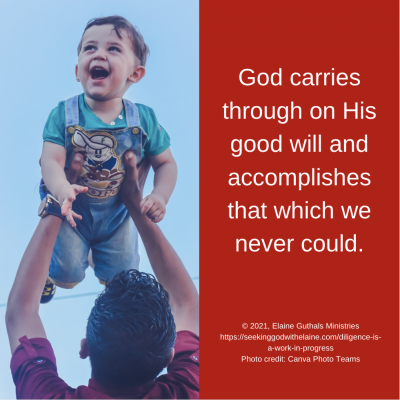
    It is that God carries through on His good will and accomplishes that which we never could.

    God carries through on His good will and accomplishes that which we never could.

    Paul like to equate our walk or journey through life as a race. We make a decision to run a marathon. We don’t just go out that day and run it.

    We have to train for the marathon. We start slow and get our bodies used to running. We learn the right ways to run and the wrong ways. (Oh, yes. We learn what to stay away from doing.)

    It takes us months to train. (Okay, for me it would take years.)

    Sibbes equated the race to the life of disciples. He reminded us that not everyone’s race is the same. He also told us what can hinder us in the race.

    • “Hope of long life.
    • “A conceit that when we have given our names to Christ we must bid adieu to all delight.
    • “A despair of getting through.”

    Resource

    Spurgeon reminded us that all we have to do to gain salvation is believe. It isn’t something that we earn. It is what Jesus did for us — and that has been completed.

    Resource

    Our diligence has to be tied with what the Holy Spirit is doing in us. He is One guiding us down the Sanctification Road.

    Diligently Focusing on What Matters

    “… But one thing I do …” (Phil. 3: 13 CSB)

    God wants us to concentrate on being in unity with Him. We are to imitate God.

    Vaughn believed there are two ways to have religion manifest itself in one thing. One way is abstinence of anything non-religious. The other way is more inclusive, when we draw things toward our religion.

    Resource

    We must focus our lives to ensure they bring glory to God. In that way, we have our purpose in the forefront.

    DiligenceIsAWorkInProgressPin

    Making the Connections

    We have to watch how we use our concept of progress. That is something prized by worldview people. Disciples of Christ have to make sure that their motive for progress is to redo our character to imitate God.

    Resource

    What is the whole purpose of this change in us? Alexander told us what it is not.

    • “Not deliverance from present pain.
    • “Not mere deliverance from future misery.
    • “Nor, indeed, man’s restoration by itself. If the end were in man he would usurp God’s place.”

    We are called to be disciples for God’s glory. Glory expresses the splendor representing the attributes of God resulting from the authority of God.

    Resource

    How Do We Apply This?

    In order to go onward and upward, we have to take stock of where we are. We not only have to figure out where we are but also where we need to grow. Spurgeon warned us we should neither feel self-complacent nor self-satisfied.

    Resource

    We aren’t going to complete our progression of changing our character to be like God’s until we are called home. While we are still progressing, we have to diligently work on our motives and obedience.

    Sibbes gave us a couple of aspects that must make up our diligence. We have to have resolve, fortitude, and cheer.

    Resource

    Through all of this, we must show our love for Christ. We need to be ready to serve Him.

    We can only be disciples of Christ when we have Christ at our center. We can only have success when we work through Christ.

    Father God. We want to be diligent. We want to be diligent in the right way. We want to diligently seek You so that we can be like You. Amen.

    Searching for and Seeking God

    Hearing His Word (Rom. 10: 17).
    Reading His Word (Rev. 1: 3).
    Praying to Him (Heb. 4: 16).
    Studying His Word (Ac. 17: 11).
    Meditating on His Word (Ps. 1: 1-2).
    Memorizing His Word (Ps. 119: 11).

    What do you think?

    Leave me a comment below (about this or anything else) or head over to my Facebook group for some interactive discussion.

    If you don’t understand something and would like further clarification, please contact me.

    If you have not signed up for the email daily or weekly providing the link to the devotions and the newsletter, do so below.

    If God has used this devotion to speak with you, consider sharing it on social media.

  • The Morality of Diligence

    We must approach our redo for godliness with diligence. This daily devotional looks at why God requires us to be diligent when we seek Him.

    Nuggets

    • We must diligently sustain and grow our faith in order to please God.
    • Without faith, our relationship with God cannot be restored.
    • Disciples of Christ have to be diligent because faith isn’t easy.
    • Faith unlocks all the blessings associated with being God’s children.
    • We have to diligently seek Him to grow faith.

    To read devotions in the Redo for Godliness series, click the appropriate button below.

    Devotions in the Moralities Lead to Godliness series

    For the next three devotions, we are going to take a right turn. We have been looking at Manton’s sermon entitled The Moralities of Christianity. Bird’s sermon Christian Morality added three other essential moralities that will help us in redoing our character.

    Resources

    Let’s Put It into Context

    “Finally brothers and sisters, whatever is true, whatever is honorable, whatever is just, whatever is pure, whatever is lovely, whatever is commendable — if there is any moral excellence and if there is anything praiseworthy — dwell on these things” (Phil. 4: 8 CSB)

    The definition of moral, according to the Merriam-Webster Dictionary, is “of or relating to principles of right and wrong in behavior.” Morality, then, is “a doctrine or system of moral conduct.” When it is the plural form — moralities — it is a “particular moral principles or rules of conduct.”

    Resources

    Our morals determine our character. Character, according to the Merriam-Webster Dictionary, is “the complex of mental and ethical traits marking and often individualizing a person, group, or nation.”

    Resource

    Diligence is a consistent, persistent effort. We’ve talked about this before.

    Devotions in the Consistency Needed for Spiritual Growth series

    Our Diligence Is Required by God

    “Now without faith it is impossible to please God, since the one who draws near to him must believe that he exists and that he rewards those who seek him” (Heb. 11: 6 CSB)

    We must diligently sustain and grow our faith in order to please God.

    Oh, man. Is this verse packed!

    • Faith is essential.
    • Faith isn’t necessarily easy.
    • Faith is worth it.
    • Seeking Him is essential.

    If faith is essential, what is it? Faith is the conviction that the doctrines revealed in God’s Word are true, even if we do not understand all aspects of them, a belief which impacts our lives.

    Noel added an interesting expansion to that definition. He wrote, “… the term, faith, ‘expresses a confidence or persuasion of the truth of anything not self-evident, received upon the testimony of another.’” He added the element of the belief of others informing our beliefs.

    Resource

    Faith Is Essential

    Without faith, our relationship with God cannot be restored.

    We have to take someone else’s testimony and determine if we believe that to be true. This testimony can either be through the written Word or through other disciples sharing their faith.

    That means we have to believe the source is credible. Some non-believers may question that because there are things we will never understand. We just have to take them on … faith.

    Let’s look at it this way. God will tell us what we need to know. He will reveal Himself to us — even more than is in the Scriptures — once we have submitted our lives to Him.

    God will reveal Himself to us — even more than is in the Scriptures — once we have submitted our lives to Him.

    Okay, I have to process this. Tillotson asked the question, Can our response to divine revelation be called faith? Let’s work through Tillotson’s arguments.

    • A narrow notion of faith says we can’t have a divine revelation because we would need another divine revelation to convince us that the first really was a divine revelation.
    • The broader notion of faith believes that the persuasion of the mind can be fostered by anything — one which “thing” can be a divine revelation.
    • The determining factor is if we believe it is a divine revelation.

    Tillotson gave us the perfect explanation of how divine revelation can happen. He wrote, “God can work in the mind of man a firm persuasion of a thing by giving him a clear and vigorous perception of it; and if so, then God can accompany His own revelations with such a clear and overpowering light as shall discover to us the divinity of them, and satisfy us thereof beyond all doubt and scruple.”

    Resource

    Noel reminded us why it is harder to accept divine testimony. He contended that our judgment is impaired because of sin.

    Resource

    Faith Isn’t Necessarily Easy

    Disciples of Christ have to be diligent because faith isn’t easy.

    Is it easier to believe the written Word than someone else’s testimony? The written Word is God Himself talking to us. Wouldn’t that be easier to accept.

    What helps us believe in God?

    • It isn’t a case of seeing is believing in the usual sense of the word. Instead, we have to see with the eyes of our hearts.
    • A person who is attached to the worldview would have a hard time embracing the Godview. Faith calls us to turn away from worldview standards and submit to God’s laws and commandments.
    • In order to believe, we have to have some knowledge. No, we won’t understand it all. If we did, it wouldn’t be faith driving our acceptance of God.

    To read a related devotion, click the button below.

    Spurgeon gave us a snapshot of the process. He said that knowledge is the precursor to faith, and faith is the precursor to salvation. It all hinges on free will.

    Resource

    Then after we choose to believe, we have to make changes in our lives to align with what we now believe. That can be very difficult at times!

    Tillotson gave us a couple of hints on how it can be easier. The ease of our accepting our faith is tied to our disposition and habits. If our makeup allows us to declare God is our Sovereign and pattern our lives to reflect that, it is easier.

    Resource

    Faith Is Worth It

    Faith unlocks all the blessings associated with being God’s children. One of those blessings is having faith in the future reward. Noel used the words triumph and rest to describe those rewards.

    We know that God’s rewards will be good because He is good. He will reward us in this life.

    But God will save the best for last. That future reward is eternal life with Him. We will get to spend eternity in His presence.

    This reward isn’t for the select few. It is for everyone who puts their faith and trust in Him and confesses that He is Sovereign God.

    Cilpin reminded us that the best rewards will be for His children. He wrote, “But if the reward be holy, the expectation of it, or, if you please, the making it a motive of action, must be virtuous likewise.”

    Resource

    How can we expect to get a holy reward for an unholy lifestyle? Are we thinking He is just going to give us a participation trophy?

    No, God rewards obedience. He rewards faith. He rewards submission.

    Seeking Him Is Essential

    But what does that have to do with diligence? We have to diligently seek Him to grow faith.

    It is going to take more than a one-hour-on-Sunday-morning deal. It is going to take more than a five-minute-daily-appointment-to-read-these-devotions deal.

    Those are starts.

    It is going to take commitment and effort to truly seek God. It will take daily communion with Him.

    Searching for and Seeking God

    Hearing His Word (Rom. 10: 17).
    Reading His Word (Rev. 1: 3).
    Praying to Him (Heb. 4: 16).
    Studying His Word (Ac. 17: 11).
    Meditating on His Word (Ps. 1: 1-2).
    Memorizing His Word (Ps. 119: 11).

    Tillotson wrote that faith is a persuasion of the mind. To me, that kind of smacks with we talk ourselves into believing.

    Resource

    While we do process to get to the point of belief in God, I believe it is more of a choice. Are we going to believe and submit or not?

    Verse Commentary

    Making the Connections

    So, this devotion has not gone the way I thought it would when I sat down to write. I guess someone needed to hear this today. I will have to save the rest for the next devotion.

    What does faith have to do with diligence?

    I think it is the other way around. Diligence has everything to do with faith.

    We must be diligent in searching for God before we ABCD. Yes, God is going to come calling us. He won’t force us to choose Him.

    The ABCDs of Salvation

    If you have not become a believer in Christ, please read through the
    Plan of Salvation and prayerfully consider what God is asking you to do.

    A – admit our sins
    B – believe His Son Jesus is our Redeemer
    C – confess God as Sovereign Lord

    D – demonstrate that commitment by making any changes needed in our lives to
    live the way in which God has called us

    The Disciple’s Job Description

    That means we must be consistent and persistent in our efforts to learn about him. Knowledge is the precursor to faith.

    However, just because we have the knowledge doesn’t mean we have the faith. Similarly, just because we have some faith doesn’t mean we have a rooted and grounded faith.

    Glossary

    There is only one avenue through which we gain faith. “Jesus answered, ‘I am the way and the truth and the life. No one comes to the Father except through me’” (Jn. 14: 6 NIV).

    In order to become children of God, we have to admit that mankind was separated from God after the original sin, making us sinners. We have to believe Jesus paid the penalty for those sins to become our Savior and Redeemer. That leads to our confessing God as Sovereign God. We demonstrate the commitment we are making by submitting our lives to following His laws and commandments.

    Noel brought up a great point. God really works hard to restore our relationships with Him.

    • God devised the Plan of Salvation to address the penalty for our sins.
    • He sets out to prove His existence and show His love for us our need of Him.
    • He sends the Holy Spirit to us to convict us and to start mending the relationship.

    Spurgeon told us why faith is so essential in our quest to redo for godliness. We can’t attain holiness without faith.

    Resource

    Glossary

    I never looked at it this way before. Spurgeon wrote, “Unbelief takes away the common ground upon which God and man can meet.”

    Resource

    Even though we are made in God’s image, before faith we don’t have anything in common. Our goals are different. Our standards are different.

    We are nothing like God.

    Glossary

    Faith changes us. It restores us to being holy like God.

    TheMoralityOfDiligencePin

    How Do We Apply This?

    We have to see God the way Noel described that a disciple should. He wrote, “The man who thus confides believes that God is, not simply that He exists, but that He exists as a kind, compassionate, generous God, to the soul that seeks Him.” We have to see God as Someone in Whom we can trust.

    Resource

    Spurgeon said that we have to do three things in order to get to the point of faith. News flash, we have to continue to do these.

    • We have to follow God’s moral laws instead of our own or the worldview’s.
    • We have to respect and admire Christ and Who He is.
    • We have to obey all of God’s laws and commandments, not pick and choose or try to rewrite them.

    Resource

    We, too, have to answer the question Jesus asked His disciples. “‘But what about you?’ he asked. ‘Who do you say I am?’” (Mt. 16: 15 NIV).

    Gracious Heavenly Father. We are to diligently seek You. When we do, we will find You. Find us and change us so that our character is more like Yours. Amen.

    What do you think?

    Leave me a comment below (about this or anything else) or head over to my Facebook group for some interactive discussion.

    If you don’t understand something and would like further clarification, please contact me.

    If you have not signed up for the email daily or weekly providing the link to the devotions and the newsletter, do so below.

    If God has used this devotion to speak with you, consider sharing it on social media.

  • The Morality of Good Report

    As disciples of Christ, we have a responsibility to non-believers to witness to them. However, they may raise objections to that sting. This daily devotional looks at how we stay away from evil and respond when non-believers call us for our failure to do so.

    Nuggets

    • Disciples of Christ must stay away from some situations, as appearances can be deceiving.
    • Non-believers may make false accusations – or point out our failures in following God’s laws and commandments – but we need to act the way God wants us to.

    To read devotions in the Redo for Godliness series, click the appropriate button below.

    Devotions in the Moralities Lead to Godliness series

    We’ve been stepping through Manton’s sermon entitled The Moralities of Christianity to see what we can glean to aid us in redoing our character. The next section discusses something that we don’t always want to hear. Manton wrote, “There are some things which have no express evil in them, but they are not of good fame.

    Resource

    Let’s see where the verses take us.

    Let’s Put It into Context

    The definition of moral, according to the Merriam-Webster Dictionary, is “of or relating to principles of right and wrong in behavior.” Morality, then, is “a doctrine or system of moral conduct.” When it is the plural form — moralities — it is a “particular moral principles or rules of conduct.”

    Resources

    Our morals determine our character. Character, according to the Merriam-Webster Dictionary, is “the complex of mental and ethical traits marking and often individualizing a person, group, or nation.”

    Resource

    Evil is equated with sin because it is that which goes against God and His purposes.

    Disciples of Christ Need to Be Conscious of Temptations

    “Stay away from every kind of evil” (I Thess. 5: 22 CSB)

    Disciples of Christ must stay away from some situations, as appearances can be deceiving.

    I try to use the newer versions for verses to cut down on the Shakespeare speak. But sometimes the versions seem to soft petal what the verse says in the King James Version.

    Case in point. The newer versions of translate First Thessalonians 5: 22 to say just stay away from evil.

    The King James Version translated it as “abstain from all appearance of evil” (I Thess. 5: 22 KJV). Stay away from anything that even looks like evil.

    I think what Manton is getting at is appearances can be deceiving. We have to look below the surface to see the temptations it presents us.

    We can’t put ourselves into positions that are tempting us to sin. Brooks wrote, “A man will never begin to be good till he begins to decline those occasions that have made him bad …” That means we have to turn away from the opportunities to sin.

    Resource

    The small sins can be just as dangerous as the large sins. Well, sometimes they can be even more dangerous because of their deceptive nature. They can take on a variety of forms.

    It boils down to what sort of temptation is leading us away from God.

    God commanded the Israelites to destroy all the idols of the nations they conquered (Deut. 12: 2-3). They weren’t supposed to leave them around to tempt them into sinning.

    We have to be careful as to how others interpret sin. We are never going to totally agree that something is a sin. (Case in point. Abortion: is it murder or not?)

    We have to watch what obstacles we put in someone else’s path. “Therefore let us not pass judgment on one another any longer, but rather decide never to put a stumbling block or hindrance in the way of a brother” (Rom. 14: 13 ESV).

    Paul used food as an example. “Therefore, if food makes my brother stumble, I will never eat meat, lest I make my brother stumble” (I Cor. 8: 13 ESV). It is better to give up something that really isn’t a sin than to have you or someone else commit the sin because of it.

    Beddome cautions that this must be within reason. We need not give up something because someone has an unreasonable belief that it is a sin but has no substantiation in Scriptures.

    Resource

    Then there are the things that border sinfulness or could lead to sinfulness. David walking around the rooftop in the middle of the night wasn’t sinful. The sin came in when he didn’t turn away from the sight of Bathsheba. Instead, he chose to commit adultery and murder (II Sam. 11).

    We have to remember that our relationship with God is an inward thing that presents itself outwardly. Peck wrote, “Hence outward religion comes to be magnified at the expense of inward holiness.”

    Don’t read that to mean our actions aren’t important. They are. Peck also said that “… the appearance of evil is an essential attribute of entire sanctification.” Sanctification uses our actions to change our character to be like God’s.

    Resource

    Glossary

    Deems encouraged us to focus on what this passage was really trying to tell us. If it is truly is a sin, abstinence is our best bet to keep us from committing it — whatever form it morphs itself into. It just may not look at it at first glance.

    Resource

    Man, I feel like we circled around a lot of things there. But that goes to show how difficult it is to resist sin. The only way we can do it is to be grounded in God.

    Disciples of Christ Need to Watch Their Witness

    “Conduct yourselves honorably among the Gentiles, so that when they slander you as evildoers, they will observe your good works and will glorify God on the day he visits” (I Pet. 2: 12 CSB)

    Non-believers may make false accusations – or point out our failures in following God’s laws and commandments – but we need to act the way God wants us to.

    Peter stopped me for a second with what he said first. “Conduct yourselves honorably among the Gentiles …” (I Pet. 2: 12 CSB).

    Is Peter trying to tell us we act differently depending on who we are around? We act differently Sunday morning when in worship service than we do Monday morning at work???

    Should we? Peter answered with a big no. We are to conduct ourselves honorably. That tells us a couple of things.

    • We are to be in the world. We are to have contact with non-believers.
    • We are to be consistent in our behavior.

    Easy-peasy? No way!

    To read a related devotion, click the button below.

    When we make a profession of faith, we need to make sure we do the turn-away part of repentance. Repentance is acknowledging our separation from God and expressing sorrow for breaking God’s laws and commandments by making the commitment to changing ourselves through obedience so that we no longer do the wrong things.

    Paul talked about becoming all things to all men (I Cor. 19-23). We do need to do that to a point. However, we cannot change our beliefs — and commit sins — to fit in with others.

    What Peter is really getting at here is that we have to remain pure in heart regardless of our location and company at the time.

    Arnot explained this for us. He wrote, “… the sense in this text is, the whole habit and life course of a person — his character and temper and conduct in presence of his fellows. At all times, and in all circumstances, walk circumspectly, for you never know who may be looking on.”

    Resource

    This is talking about our walk. We are directed to walk in the Spirit.

    To read a related devotion, click the button below.

    A couple of devotions ago, we said that honest, according to the Merriam-Webster Dictionary, is a “adherence to the facts” and “fairness and straightforwardness of conduct.” Arnot described that this way: “Let all the circumference of your life shine in the beauty of holiness.”

    Resource

    Isn’t it a little scary that Peter said, “… so that when they slander you as evildoers …” (I Pet. 2: 12 CSB). Not if. When.

    Paul said about the same exact thing. He did give us a little clue as to how to accomplish the good works.

    “In everything set them an example by doing what is good. In your teaching show integrity, seriousness and soundness of speech that cannot be condemned, so that those who oppose you may be ashamed because they have nothing bad to say about us” (Ti. 2: 7-8 NIV).

    We are going for an honest, pure life. We want to keep it pure because those watching — and non-believers will be watching — usually believe what feels the opposite of what we do.

    All disciples have the job description of preach the gospel and make disciples. But many of us aren’t comfortable with doing that.

    The Disciple’s Job Description

    Complete Job Description

    Individual Description

    Job Duty #4
    Proclaim the Gospel (Mark 16: 15)

    Job Duty #6
    Make Disciples (Matthew 28: 19-20)

    We see all of our sins and think God can’t use us. We forget, as Barrow said, that “Christianity itself never supposes its followers to be without fault, that its influence can secure unerring obedience to its own laws.”

    Resource

    God calls us to live our lives as a witness — and to use our words to tell about Him. But He doesn’t take away our free will. Free will is the ability within us to make decisions, which determine actions that produce character.

    We have to make daily choices to follow God. Unfortunately, sometimes we make the wrong choices. God will forgive us when we ask. Forgiveness is, when we ask, God pardons us because we have broken His laws and commandments and restores our relationship with Him.

    Peter reminded us that the good works we do are to glorify God. It is not so we get attaboys and attagirls. We are performing kingdom tasks to expand His kingdom.

    I had no idea what Peter was talking about when he wrote, “… on the day he visits” (I Pet. 2: 12 CSB). Rogers explained that is the day of conversion.

    Resource

    The only way we can glorify God is to accept His gift of salvation. Salvation is deliverance from evil and the consequences of sins to replace them with good and eternal life.

    God, through His mercy, comes to us to call us to salvation. It doesn’t matter what we have done or have not done. God can forgive us of our sins.

    TheMoralityOfGoodReportPin

    Making the Connections

    Deems reminded us that “the most important thing about any man is his faith.” Faith is the conviction that the doctrines revealed in God’s Word are true, even if we do not understand all aspects of them, a belief which impacts our lives. Our beliefs reveal themselves in our actions.

    Resource

    Paul was big on unity. “There is one body and one Spirit — just as you were called to one hope at your calling — one Lord, one faith, one baptism, one God and Father of all, who is above all and through all and in all” (Eph. 4: 4-6 CSB).

    Still, are we really going to all believe the same thing? What some believe is a sin, others won’t. We aren’t going to have total agreement. Plus, if we do agree it is a sin, we won’t have agreement on how to avoid it.

    If all parties involved believe that we have to

    • admit that mankind was separated from God after the original sin, making us sinners;
    • believe Jesus paid the penalty for those sins to become our Savior and Redeemer;
    • confess God as Sovereign God; and
    • demonstrate that commitment by submitting our lives to follow His laws and commandments,

    we shouldn’t sweat the small stuff.

    How Do We Apply This?

    We need to “keep thy heart with all diligence; for out of it are the issues of life” (Prov. 4: 23 KJV). It is more than just keeping it “above all else” as the newer versions translate it. It is the diligence — a consistent, persistent effort.

    We have to hook that with watchfulness. The situation may not be sending up red flags that evil is in the building. We have to be ever mindful of how God wants us to act.

    Doesn’t that flip the narrative? It isn’t about do this, don’t do this. It is about being. Our goal must be to always obey God by having His godly character as our own.

    When non-believers give us a bad report, we need to look to God and see how He wants us to change. Then we make sure that we are living what we profess.

    Father. We want to be like You. We want to have Your character. That is more than just doing the do’s and not doing the don’ts. We are preparing ourselves for the day You will call us home. Amen.

    The ABCDs of Salvation

    If you have not become a believer in Christ, please read through the
    Plan of Salvation and prayerfully consider what God is asking you to do.

    A – admit our sins
    B – believe His Son Jesus is our Redeemer
    C – confess God as Sovereign Lord

    D – demonstrate that commitment by making any changes needed in our lives to
    live the way in which God has called us

    The Disciple’s Job Description

    What do you think?

    Leave me a comment below (about this or anything else) or head over to my Facebook group for some interactive discussion.

    If you don’t understand something and would like further clarification, please contact me.

    If you have not signed up for the email daily or weekly providing the link to the devotions and the newsletter, do so below.

    If God has used this devotion to speak with you, consider sharing it on social media.

  • The Morality of Being Lovely

    Disciples of Christ are to have God’s character. This daily devotional looks at how we get His lovely character.

    Nuggets

    • Our lovely character is evidenced in how we treat others.
    • Instead of retaliating, disciples are to pursue good – God’s working within us.
    • We need to be committed and consistent in seeking God so that we can imitate His character.

    To read devotions in the Redo for Godliness series, click the appropriate button below.

    Devotions in the Moralities Lead to Godliness series

    Sometimes, we say someone has a lovely character. But what does that mean?

    Manton described three traits that make up a lovely character. They are affability, peaceableness, and usefulness.

    Resource

    Let’s Put It into Context

    The definition of moral, according to the Merriam-Webster Dictionary, is “of or relating to principles of right and wrong in behavior.” Morality, then, is “a doctrine or system of moral conduct.” When it is the plural form — moralities — it is a “particular moral principles or rules of conduct.”

    Resources

    Our morals determine our character. Character, according to the Merriam-Webster Dictionary, is “the complex of mental and ethical traits marking and often individualizing a person, group, or nation.”

    Resource

    Peace is a fruit of righteousness manifested in an inward tranquility resulting from a balanced life with spiritual order, equity, and truth that implies cooperation, humility, integrity, communication, and cohesiveness.

    Our Peace Depends on Our Treatment of Others

    “So then, let us pursue what promotes peace and what builds up one another” (Rom. 14: 19 CSB)

    Our lovely character is evidenced in how we treat others.

    Our inner character is shown through the decisions we make. Possibly one of the best ways to show that is in how we treat others.

    How we treat others either makes the situation peaceful or causes strife. Tarson provided a list of things that contribute to peace.

    • “Righteousness” Righteousness is the result of a solid relationship with God built by a sincere life of conscientious obedience to God’s laws and commandments.
    • “Humility” Humility is a character trait that diminishes pride and places dependence on God while holding a modest view of our importance with respect to others.
    • “Love” Love is an intense feeling of deep affection.
    • “Faith” Faith is the conviction that the doctrines revealed in God’s Word are true, even if we do not understand all aspects of them, a belief which impacts our lives.

    Resource

    Oh, yes. Peace comes from God. Without God, we don’t know true peace.

    To read a related devotion, click the button below.

    The Biblical Illustrator noted that we promote peace in our lives by watching our temper and implementing peaceable measures and methods.

    Resource

    Tarson stated the the end result is eternal life. He is correct if he means that, because we have ABCDed and changed our character to imitate God’s, we gain eternal life.

    If we are banking on being a good person without submitting our lives to God for admission to heaven, we will be in for a huge let down. God only gives eternal life to those who have submitted their lives to Him.

    But peace isn’t just about us. It is about edifying others and building others up.

    The ABCDs of Salvation

    If you have not become a believer in Christ, please read through the
    Plan of Salvation and prayerfully consider what God is asking you to do.

    A – admit our sins
    B – believe His Son Jesus is our Redeemer
    C – confess God as Sovereign Lord

    D – demonstrate that commitment by making any changes needed in our lives to
    live the way in which God has called us

    The Disciple’s Job Description

    Our Treatment of Others Doesn’t Depend on Their Treatment of Us

    “See to it that no one repays evil for evil to anyone, but always pursue what is good for one another and for all” (I Thess. 5: 15 CSB)

    Instead of retaliating, disciples are to pursue good – God’s working within us.

    Paul gave us a good definition for retaliation: “… repays evil for evil …” (I Thess. 5: 15 CSB). He cautioned us that is not the action that a disciple of Christ should take.

    Barlow told us why. He wrote, “Retaliation betrays a weak and cruel disposition.”

    Resource

    If our temperamental makeup is to reflect God, it should not be a cruel disposition or even a weak one. We should reflect His love and concern for the spiritual condition of others.

    In other words, we don’t retaliate when we are wronged. The actions of others don’t guide our reactions. God does.

    Worldview people may think they are more forgiving and less likely to retaliate than disciples. Birch contended that “it is easier to do good than to be good.”

    Resource

    We have to remember that we cannot earn our way into Heaven. The focus has to be on Him, not our actions.

    Well, think about it. Good, in the biblical sense, is the workings of God within His people. Evil is equated with sin because it is that which goes against God and His purposes.

    God wants us to live our lives obeying Him and following His lead.

    God wants us to live our lives obeying Him and following His lead.

    Paul instructed disciples to do good for one another instead of retaliating. If we respond with good instead of evil, we are exhibiting God’s character.

    Yes, everything we do is all about God and following His laws and commandments. Every decision we make is a decision about whether we are going to follow His Will or not.

    Oh, yeah. It might be hard to respond in good instead of retaliating with evil.

    Look what Matthew added to the discussion. “But I tell you, love your enemies and pray for those who persecute you, so that you may be children of your Father in heaven. For he causes his sun to rise on the evil and the good, and sends rain on the righteous and the unrighteous” (Mt. 5: 44-45 CSB).

    Yep, it goes back to the second greatest commandment. That is why Jesus said all the others hinge on those two commandments: love God and love others.

    Glossary

    How Do We Grow Our Lovely Character?

    “Every day they devoted themselves to meeting together in the temple, and broke bread from house to house. They ate their food with joyful and sincere hearts, praising God and enjoying the favor of all the people. Every day the Lord added to their number those who were being saved” (Ac. 2: 46-47 CSB)

    We need to be committed and consistent in seeking God so that we can imitate His character.

    Manton gave us some verses from Paul to show us what the lovely character should look like. In these verses, he added the following to the mix:

    • Worship regularly
    • Fellowship with other believers (and include food!)
    • Live joyfully
    • Praise God
    • Be known for our lovely character

    Being lovely takes work. We must devote ourselves to building our character every day. That translates to consistent.

    When we are consistent, it is easier. It is easier to pray when we are used to praying. It is easier to get up for services when we are used to getting up. We form a habit.

    That also translates to committed. We can’t be lovely only when we feel like it. No, we shouldn’t be fake. We should be sincere and genuine.

    Do you get that our character being lovely is tied to our worship of sovereign God? That is why we are to worship regularly, praise him continuously, and live joyfully because of all he is doing for us – even in the rough spots.

    Beecher explains that the Jews would have known what it was like to be joyful. He wrote, “The Jewish religion was the only one which ever organised joy as an integral and important part of its services. Christ and the apostles were Jews, and the same joyous spirit came with the new faith; and although they entered upon the organisation of the new life under circumstances calculated to make men bigoted and bitter, yet all the early periods of Christianity were sweet and calm.”

    Resource

    Paisley wrote that singleness of heart — a sincere heart — was when “their hearts were not divided between God, or Christ, and the world, and, being wholly the Lord’s, they rejoiced in the Lord.” We are to focus solely on God and Jesus. That produces gladness.

    Resource

    Arnot made a good point. He wrote, “If godliness were always to obtain the favour of the world, counterfeits would spring up; if it were always to bring down the world’s enmity, the spark of Divine truth in humanity would be quenched. God holds the balance, and permits as much of the wrath of man as suffices to praise Himself and purge the Church, and then He restrains the remainder.”

    Resource

    It isn’t a prosperity gospel in that disciples never face trials. Disciples prosper because we are forged to imitate the character of God.

    TheMoralityOfBeingLovelyPin

    Making the Connections

    Lyth cautioned us that having a lovely character is more than being honest. It also means that we follow God’s Will.

    Another thing Lyth wrote was that disciples “should be inferior to none in moral and social excellence.” So, when non-believers make the statement that they are better than disciples in being honest and caring, that should not be true.

    Resource

    Okay. I have to process. Barlow wrote, “The perceptive morality of Christianity is a signal evidence of its transcendent glory.”

    Resource

    The insightful system of moral conduct of children of God is an outward sign to incite action of its holiness.

    Hmmmm. I read that to mean that, when disciples follow the moral conduct God wants us to, we see a glimpse of His holiness and we want to act accordingly. This helps us to become even more like Him.

    But instead, we focus on our failures. Birch encourages us to keep trying. Don’t give up being obedient to God.

    Resource

    How Do We Apply This?

    • Aim high. Don’t settle for being a good person. Strive to imitate Jesus.
    • Get your inner missionary on.
    • Be a positive force in your community.
    • Strive for peace by finding that on which we can agree.
    • Seek God to gain knowledge and faith.
    • Encourage others to grow.

    Searching for and Seeking God

    Hearing His Word (Rom. 10: 17).
    Reading His Word (Rev. 1: 3).
    Praying to Him (Heb. 4: 16).
    Studying His Word (Ac. 17: 11).
    Meditating on His Word (Ps. 1: 1-2).
    Memorizing His Word (Ps. 119: 11).

    Resource

    God. We want a redo so that we are more like You. We want to have Your character. In order to do that, we will follow Your laws and commandments and see You in all things. Lord, only You can accomplish this redo. We can’t do it ourselves. Change us to be like You. Amen.

    What do you think?

    Leave me a comment below (about this or anything else) or head over to my Facebook group for some interactive discussion.

    If you don’t understand something and would like further clarification, please contact me.

    If you have not signed up for the email daily or weekly providing the link to the devotions and the newsletter, do so below.

    If God has used this devotion to speak with you, consider sharing it on social media.

  • Being Called as Disciples of Christ

    Jesus called 12 disciples to share in His ministry. This daily devotional will look at two of them: Peter and Matthew.

    Nuggets

    • Christ can call us even in the most mundane daily tasks to be a success for Him
    • Jesus calls all men and women to follow Him.
    • Jesus came to save sinners.

    Devotions in the Luke’s Diagnosis and Prescription series

    It is interesting that both Peter and Matthew were called to be Jesus’ disciple when they were at work. Both of them may have been discouraged in their jobs at that moment.

    Luke’s diagnosis was that, even if we are gainfully employed, we still need to do what Jesus calls us to do. His prescription was to be obedient to Jesus’ instructions.

    Calling the Fisherman at Work

    “When he had finished speaking, he said to Simon, ‘Put out into deep water and let down your nets for a catch.’ ‘Master,’ Simon replied, ‘we’ve worked hard all night long and caught nothing. But if you say so, I’ll let down the nets.’ When they did this, they caught a great number of fish, and their nets began to tear. So they signaled to their partners in the other boat to come and help them; they came and filled both boats so full that they began to sink.” (Lk. 5: 4-7 CSB)

    Christ can call us even in the most mundane daily tasks to be a success for Him.

    Jesus had expanded the mission. He took it out of the known synagogues into the unknown countryside. He is usually going to test our faith.

    On the day in the passage, Jesus had been preaching and commandeered Peter’s boat to use as a platform. Then Jesus wanted Peter to take the boat out. He wanted them to go fishing again.

    Fun Fact

    Let’s think of it this way. The crowd was on dry ground. Jesus pushed out a little from shore to teach them. What He was asking Peter and his coworkers to do was jump off the deep end.

    Now, Peter and the guys were lucky. The first mission Jesus was asking them to accomplish involved something they already had success doing.

    How many times do we think that our jobs don’t count as our ministry? Could Jesus have said a bigger “WRONG!!”?

    Did you catch that? Jesus let Peter say, “Oh, but the opposite.” Jesus let Peter process to get to “I’ll do what you say.” He let him take Him at His word.

    Notice, Peter didn’t commit for the other guys. He focused solely on his relationship with Jesus.

    But let’s flip that, like Spurgeon did. What if James and John had each let down nets? What if Andrew was there and kicked in his net? There were others there. What if they contributed nets?

    Resource

    The huge haul may have been spread around among the nets, making it easier on everyone. Or maybe, it would have been an even bigger haul.

    But wait! James and John did get in on the haul. “So they signaled to their partners in the other boat to come and help them; they came and filled both boats so full that they began to sink” (Lk. 5: 7 CSB).

    Let’s mesh Brown’s sermon with Hieron’s. What if the Church (the boat) is operating in the shallows? What if we are afraid to push off and go into the deep end (the world) where the lost crowd (the fish) really is? The ministers (Peter and the gang) have to have the gospel (the nets) ready to go where called.

    Resource

    What if the Church (the boat) is operating in the shallows? What if we are afraid to push off and go into the deep end (the world) where the lost crowd (the fish) really is?

    Oh, yeah. We expect people to come to us. If they don’t know the dates and times of our services, all they have to do is look on the internet or call us.

    This pandemic has gotten us off the shore and into the water. But have we really gotten into the deep water?

    Let’s take that a step further. Peter didn’t think he was a success at the moment. They hadn’t caught any fish even though they had fished all night.

    We are in the deep water. How are we supposed to gauge our success?

    How am I supposed to gauge these devotions are successful? Is it the number of followers I get? But what about the ones who follow but never read beyond the nuggets — if that?!?

    What if some read these but never allow God to speak to them? They don’t apply these to their lives to grow closer to God. [How would you change these questions to apply it to your life?]

    Rothe gave us some encouragement. He wrote, “In the case of sensible labour, there always is some result.” God will always use our obedience to Him.

    Resource

    Sometimes, we have to remember success is solely defined as we are doing what God has called us to do. We are being obedient to Him.

    Our success is based on our willingness to obey God. We have to do like Peter did. We have to keep throwing out the net.

    God is going to do the rest. He will make the fish swarm.

    To read a related devotion, click the button below.

    Sometimes, we have to remember success is solely defined as we are doing what God has called us to do.

    Giving the Tax Collector a New Lease on Life

    “After this, Jesus went out and saw a tax collector named Levi sitting at the tax office, and he said to him, ‘Follow me.’ So, leaving everything behind, he got up and began to follow him” (Lk. 5: 27-28 CSB)

    Jesus calls all men and women to follow Him.

    All of the newer versions translate publican as tax collector. The King James Version keeps the publican.

    Really, for us, tax collector is a better description of Matthew’s job. But I don’t think it conveys the contempt that went along with the position.

    Publicans were seen as second-class citizens — if that. Because their employer was the Roman government, they were excommunicated. They couldn’t testify in court. Stapfer contended they had little more rights than the heathens. No fundamental Jew would talk to, let alone eat with, a publican.

    Resource

    The publican Jesus was calling was went by two names: Matthew or Levi. I learned some things about Matthew from Cox and Alford.

    I knew Matthew was the son of Alphaeus. What I didn’t know — or had totally forgotten — is that Alphaeus’ other name was Cleopas.

    Cox contended that Matthew’s father was probably the Cleopas on the Emmaus Road. He also thought that Cleopas was married to Mary’s older sister. That would make Jesus and Matthew cousins. Cox wrote, “It would be a keen joy to the Lord Jesus to give joy to such good people as His uncle and aunt and cousins, to restore peace and union to the family in which He had lived so long.”

    Resource

    To read a related devotion, click the button below.

    The Holman Bible Dictionary thought Cleopas of Emmaus Road fame was a different person than Cleophas, whose wife’s name was Mary. This Mary was at the crucifixion. If it was all one person, Mary couldn’t have been Mary’s sister.

    Resource

    It could be that Mary was the wife of Alpheus and the mother of James, another one of Jesus’ disciples, making Matthew and James half brothers.

    Resource

    Whoever he was or had been, Matthew was obedient when Jesus called him to follow.

    Whoever he was or had been, Matthew was obedient when Jesus called him to follow.

    What’s Next after Being Called?

    “Then Levi hosted a grand banquet for him at his house. Now there was a large crowd of tax collectors and others who were reclining at the table with them. But the Pharisees and their scribes were complaining to his disciples, ‘Why do you eat and drink with tax collectors and sinners?’ Jesus replied to them, ‘It is not those who are healthy who need a doctor, but those who are sick. I have not come to call the righteous, but sinners to repentance’” (Lk. 5: 29-32 CSB)

    Jesus came to save sinners.

    Matthew had found great joy in the Lord. He wanted his friends and coworkers to experience the same joy.

    To facilitate that, Matthew threw a banquet. It is interesting that, even though the fundamental Jews wouldn’t talk to a tax collector, they came to eat with him. Hmmmmm.

    Arnold reminded us that we have to have frequent contact with those to whom we need to witness. We have to build a relationship in order to show them Jesus in us.

    Resource

    Watson brought though the fact that some non-believers want us to not talk about our relationship with Christ around them. They want us to ignore our job description.

    The Disciple’s Job Description

    Complete Job Description

    Individual Description

    Job Duty #4
    Proclaim the Gospel (Mark 16: 15)

    Job Duty #6
    Make Disciples (Matthew 28: 19-20)

    Clayton said it exactly right. He wrote, “Medicine is for the sick. Salvation is for sinners.”

    How many times do we cover up our illnesses, though? We don’t want others to know that something is wrong.

    Worse yet, as disciples, we cover up things for which God has already forgiven us. We try to portray that we are perfect already — when we are not.

    That causes non-believers to think we are hypocrites when they see we continue to sin. Even worse, they do not see God’s forgiveness when they see us trying to pretend we are perfect.

    Glossary

    Kingsley brought up a good point. Wouldn’t we think like the Pharisees? Would we expect Jesus to be associating with those who are doing His Will? Wouldn’t He be rewarding us for living for Him?

    But that’s it, isn’t it? Disciples aren’t just supposed to live for Him. We aren’t only to do the do’s and not do the don’ts.

    Our job description says that we are to preach the gospel and make disciples. That means we have to go to the sinners, to the tax collectors — to the sick.

    Kingsley put it this way. He wrote, “Make merry with them He could not, but He certainly so behaved to them that they were glad to have Him among them, though He was so unlike them in thought, and word, and look, and action.”

    Resource

    Elaine-speak. We can’t join them in sinful behavior. That will probably make us totally opposite in personality and action and make it harder for them to want to be our friends. We still have to forge a relationship that lays a foundation for us to witness.

    The whole purpose of Jesus’ mission was to pay the penalty for our sins. He agreed to be the sacrifice so that our relationships with God could be restored.

    To read a related devotion, click the button below.

    BeingCalledAsDisciplesOfChristPin

    Making the Connections

    Too many times, we try to do things our way. We try to stay in the shallows with failure to launch and broadcast our nets there. Even worse, we sometimes try to stay on dry land.

    If we do launch, we still try to do it on our own. We either rush out before God gives us marching orders, or we pull a Jonah and run the other way.

    God is going to call us where our fish are. But He is going to start where we are and grow us to where He wants us to be.

    Let’s look at Matthew a second. Here was a hated tax collector and author of one of the gospels. How was he going to get the Jews to read what he wrote? He used Old Testament prophecies. “Don’t listen to what I say; you know what they said.”

    We need to be like Peter and Matthew. When God calls, we need to lay down what we are doing, get up, and follow Him.

    We try to make it harder than that, though. We have to know chapter and verse of how God is going to provide for our needs. We need to have clear-cut marching orders.

    No, we need to put down what we are doing, leave our sin behind, get up, and fall in line.

    How Do We Apply This?

    To get from the shallows to the deep end, we need to seek God. We need to do the work He has called us to do — regardless of our perceived outcome.

    Searching for and Seeking God

    Hearing His Word (Rom. 10: 17).
    Reading His Word (Rev. 1: 3).
    Praying to Him (Heb. 4: 16).
    Studying His Word (Ac. 17: 11).
    Meditating on His Word (Ps. 1: 1-2).
    Memorizing His Word (Ps. 119: 11).

    Then we have to take God at His Word. He said He would forgive us when we ask. He said He would never leave us and would, instead, provide for us.

    What about when we are feeling unsuccessful, like Peter?

    • Don’t give into the depression that accompanies our perception of failure. God may not be thinking it is a failure.
    • How can we use this failure as a witness to others
    • Is there something we should be doing differently to better be in God’s Will?

    Resource

    Baring-Gould equated Jesus’ asking Peter to take them out on the Sea of Galilee with our prayer life.

    • We should be concentrating on Him.
    • We should be focused solely on Him.
    • We should be earnest.
    • We should be committed to Him.
    • We should be dedicated for the long haul.

    Resource

    Father. You call us to do kingdom work. Help us to step out the first time You call. Let us boldly do Your Will. May we know we are successful when we obey You. Amen.

    What do you think?

    Leave me a comment below (about this or anything else) or head over to my Facebook group for some interactive discussion.

    If you don’t understand something and would like further clarification, please contact me.

    If you have not signed up for the email daily or weekly providing the link to the devotions and the newsletter, do so below.

    If God has used this devotion to speak with you, consider sharing it on social media.

  • The Morality of Peace

    When we choose right over wrong, we gain peace. This daily devotional looks at how peace comes within when we avoid sin.

    Nuggets

    • Inner peace is fostered by what comes out of us.
    • Inner peace stems from our avoidance of sin, even secret sins.

    To read devotions in the Redo for Godliness series, click the appropriate button below.

    Devotions in the Moralities Lead to Godliness series

    We’ve been stepping through Manton’s sermon entitled The Moralities of Christianity to see what we can glean to aid us in redoing our character. We’ve come to an interesting section. Manton wrote, “Peace. Nothing obscene or unchaste should be seen or heard from a Christian.”

    Resources

    Hmmm. Our speech is not exactly what we think of first when we think of peace. I can’t wait to see what verses Manton uses for backup.

    Let’s Put It into Context

    “Finally brothers and sisters, whatever is true, whatever is honorable, whatever is just, whatever is pure, whatever is lovely, whatever is commendable — if there is any moral excellence and if there is anything praiseworthy — dwell on these things” (Phil. 4: 8 CSB)

    The definition of moral, according to the Merriam-Webster Dictionary, is “of or relating to principles of right and wrong in behavior.” Morality, then, is “a doctrine or system of moral conduct.” When it is the plural form — moralities — it is a “particular moral principles or rules of conduct.”

    Resources

    Our morals determine our character. Character, according to the Merriam-Webster Dictionary, is “the complex of mental and ethical traits marking and often individualizing a person, group, or nation.”

    Resource

    Peace is a fruit of righteousness manifested in an inward tranquility resulting from a balanced life with spiritual order, equity, and truth that implies cooperation, humility, integrity, communication, and cohesiveness.

    Watch Your Mouth!

    “No foul language should come from your mouth, but only what is good for building up someone in need, so that it gives grace to those who hear” (Eph. 4: 29 CSB)

    Inner peace is fostered by what comes out of us.

    Our words are very important. I wonder, though, if we realize how impactful they can be on our sense of peace.

    Heygate gave a good description of what our words are. He wrote, “They are results: the completion and effect of certain passions and states of feeling.” They are an outward view of what we are feeling inside.

    Resource

    We know that God wants us to guard our speech.

    • Set a guard, O LORD, over my mouth; keep watch over the door of my lips! (Ps. 141: 3: ESV).
    • Let there be no filthiness nor foolish talk nor crude joking, which are out of place, but instead let there be thanksgiving (Eph. 5: 4 ESV).
    • Too much talk leads to sin. Be sensible and keep your mouth shut (Prov. 10: 19 NLT).
    • But I tell you that everyone will have to give account on the day of judgment for every empty word they have spoken. For by your words you will be acquitted, and by your words you will be condemned (Mt. 12: 36-37 NIV).
    • But no man can tame the tongue. It is an unruly evil, full of deadly poison (Jas. 3: 8 NKJV).
    Let there be no filthiness nor foolish talk nor crude joking, which are out of place, but instead let there be thanksgiving (Eph. 5: 4 ESV).

    Yeah, I know. Sometimes, we can do okay with guarding our speech. Sometimes, we can’t.

    That is especially true with our self-talk. Heygate points out how easy it is to go from peace to anger just by working ourselves up in our minds.

    Resource

    Rogers identified the foul language as profanity and indecent talk. He also cautioned we should not talk against God and our neighbors. Jortin identified that as talking derisively about God, ridiculing His ways. Instead of talking about our love of God and His ways, we talk about how we love worldview things.

    Resource

    We should make our conversations count. God expects us to tell others of the good He is going in our lives. We should use our words to build people up — not just give prideful, selfish discourses of ourselves.

    Our humor has to be appropriate. It shouldn’t be derogatory humor and banter.

    Instead, too many times our words tear down our witness. Worldview people can have high expectations of disciples. They may expect a 100% toeing the line — but a worldview line.

    Stay Away from Sin!

    “Don’t participate in the fruitless works of darkness, but instead expose them. For it is shameful even to mention what is done by them in secret” (Eph. 5: 11-12 CSB)

    Inner peace stems from our avoidance of sin, even secret sins.

    Manton didn’t include verse 11 in his argument that guarding our conversations promoted peace. I thought we needed it for context.

    Paul first cautioned us about staying away from “… the fruitless works of darkness …” (Eph. 5: 11 CSB). In another place, he identified that as “… sexual immorality, impurity, passion, evil desire, and covetousness, which is idolatry” (Col. 3: 5 ESV).

    Manton contended that there were several reasons they are considered works of darkness — a.k.a. sin.

    • They are done apart from God.
    • Satan uses them to tempt us.
    • They won’t stand up under scrutiny in the Light.
    • Those participating in unforgiven acts of sin are doomed to eternal darkness — a.k.a. hell.

    Resource

    Did you catch that? The command goes beyond performing the acts of sin. “… it is shameful even to mention what is done by them in secret” (Eph. 5: 11-12 CSB).

    Don’t do it, and don’t talk about it.

    Manton warned that talking about sin could be construed as an attempt to “… counsel, persuade, allure, or entice others to sins.” We want to make sure our beliefs are not twisted.

    Resource

    God does not want us to condone sin. We are to reprove, rather than approve, sin. According to Manton, He wants us to

    • Do God’s Will.
    • Love God and follow His laws and commandments.
    • Watch the company we keep.
    • Keep in communication with God.

    Resource

    In a different sermon, Manton addressed secret sins. He wrote that “… all sense of right and wrong, good and evil, is not wholly extinguished in the heart of man; for here the unbelieving Gentiles, though they did abominable things, yet they did them in secret, which showeth some relics of natural conscience and shame in them.”

    Resource

    Elaine-speak. We do things in secret because we have a conscience and see the shame in our actions because we do know good from evil.

    Because we have been called into the Light, we see what sin is. Sins are actions by humans that disobey God and break one of His reasonable, holy, and righteous laws and commandments, goes against a purpose He has for us, or follows Satan’s promptings.

    We have to realize that nothing is secret from God. He is all-seeing and all-knowing. We see the sin exposed.

    To read a related devotion, click on the appropriate button below.

    Instead of showcasing the sin, we need to reflect the Light. We need to ask forgiveness for all of our sins. “But who can discern their own errors? Forgive my hidden faults” (Ps. 19: 12 NIV).

    Let’s come at this from another direction. The “don’t participate in …” (Eph. 5: 11 CSB) was translated as “have nothing to do with …” (Eph. 5: 11 NIV) and “And have no fellowship with …” (Eph. 5: 11 KJV).

    Pritchett reminded us that the intent here was not to eliminate our contact with those who sin. We are called to witness to those who need God’s forgiveness. This contact could be within our families, our workplace, or throughout our daily walk.

    We are to abstain from sin and not support those who continue to commit sins. We are not to change a sin into an acceptable action.

    Resource

    We are to abstain from sin and not support those who continue to commit sins.

    Making the Connections

    We have to remember that God hates every sin. There are not different degrees of sin. All have done one thing: broken an express law, commandment, or directive from God. In reality, lying is just as bad as murder.

    • “Do not steal or cheat or lie” (Lev. 19: 11 GNT).
    • “Do not commit murder” (Ex. 20: 13 GNT).

    Rogers reminded us that worldview people don’t always try to convince us to give up our relationship with God. They just try to limit our witnessing to them. They want us to bury it when we are around them.

    Resource

    TheMoralityOfPeacePin

    How Do We Apply This?

    • Repent and turn away from sin.
    • Don’t lead others into sin by teaching or tempting them or condoning the sin (i.e., don’t tolerate sin).
    • Don’t provoke other into sin.
    • Don’t abdicate our job of reproving the sins of others.
    • Instead, imitate God.
    • Watch our language.
    • Don’t lie to deceive others.
    • Learn to be silent.
    • Pick our friends wisely.

    Resource

    We gain peace when we are doing God’s Will. He wants us to remain pure in all ways.

    Father God. Lord, we see so many ways that we are not pure. Help us to refrain from sin. Show us any hidden sins so that we may repent and turn from them. Sovereign God, we want to have Your character. Amen.

    What do you think?

    Leave me a comment below (about this or anything else) or head over to my Facebook group for some interactive discussion.

    If you don’t understand something and would like further clarification, please contact me.

    If you have not signed up for the email daily or weekly providing the link to the devotions and the newsletter, do so below.

    If God has used this devotion to speak with you, consider sharing it on social media.