Blog

  • The Brothers Arrived in Egypt

    Jacob had sent ten of his sons to Egypt to buy grain because of the famine. This devotional reading looks at their arrival and meeting with their brother Joseph.

    Nuggets

    • The brothers came to Joseph because he was distributing grain.
    • Joseph’s dream came true.
      Joseph recognized his brothers immediately, but they didn’t recognize him.
    • True, he was speaking to his brothers through an interpreter, but Joseph had to tell the interpreter what to say.
    • The brothers had to be honest.
    • Joseph devised a way that he could test whether his brothers had changed or not.

    the-brothers-arrived-in-egypt

    Jacob was concerned that the family would starve to death in the famine. He sent ten of his sons to Egypt to buy grain.

    Little did the brothers know they were on a collision course with their past and their future.

    All hinged on the reception of one man.

    Let’s Put It into Context

    To read devotions in the Creating Everything theme, click the button below.

    Devotions in the Joseph the Savior of Israel  series

    Joseph’s Brothers Arrive

    “Since Joseph was governor of all Egypt and in charge of selling grain to all the people, it was to him that his brothers came. When they arrived, they bowed before him with their faces to the ground. Joseph recognized his brothers instantly, but he pretended to be a stranger and spoke harshly to them. ‘Where are you from?’ he demanded. ‘From the land of Canaan,’ they replied. ‘We have come to buy food.’ Although Joseph recognized his brothers, they didn’t recognize him. And he remembered the dreams he’d had about them many years before …” (Gen. 42: 6-9 NLT)

    It Was to Him that His Brothers Came

    The brothers came to Joseph because he was distributing grain.

    It has always amazed me that Joseph would have had any part in the actual sale of grain to people. Wouldn’t his time have been best served in fulfilling his administrative duties?

    Remember, we said that his position description would have been varied.

    • Advisor
    • Administrator
    • Economic planner
    • Judge
    • Distributor
    • Overseer of labor
    • Overseer of storage
    • Pharaoh’s executive authority.

    It would be hard for Joseph to judge disputes if he was actually distributing grain himself. Maybe it was just in this day that Joseph had such a hands-on stake in the process.

    This was the day Joseph needed to be exactly where he was.

    But isn’t Jehovah like that? When He is orchestrating the situation, doesn’t everything just seem to fall into place?
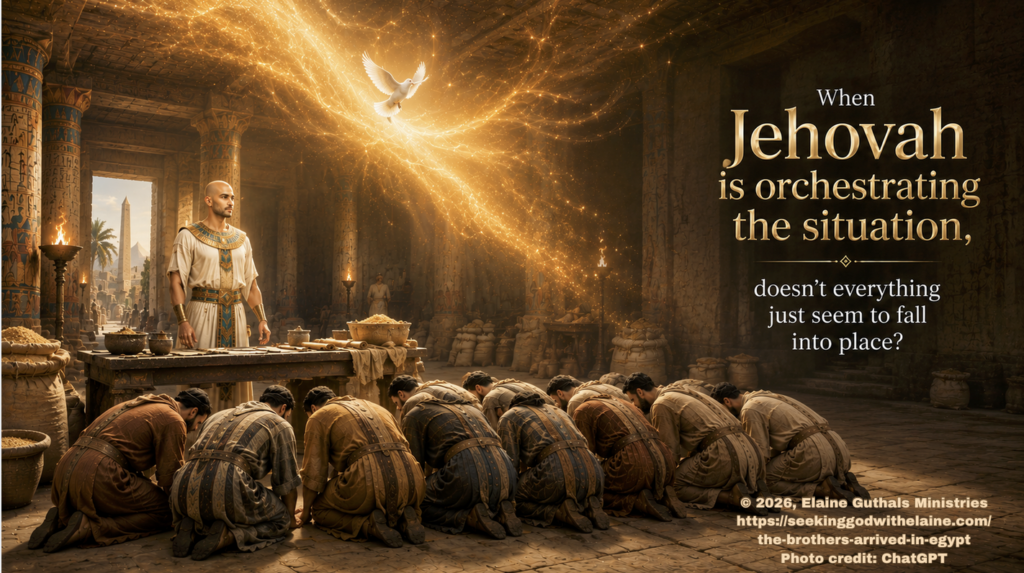
    Since Jehovah knew the back story as well as the end of the story, He knew there was some healing that needed to take place.

    As Joseph had named Ephraim saying, ‘God has made me fruitful in this land of my grief’” (Gen. 41: 52 NLT), we know he found contentment in his life. But I wonder what he felt in that first second when he spotted his brothers — the men who had betrayed him.

    Yes, Joseph was content — he was also human. His heart had to have thumped at least once — from the surprise if nothing else.

    Think about it. Joseph had probably closed that book in his life. His contentment now had to include letting go of his past.

    But there they were — and not just standing in front of him.

    They Bowed Before Him

    Joseph’s dream came true.

    The second thump of Joseph’s heart had to be the realization that his dream was coming true. His brothers were bowing before him.

    And this wasn’t a bend-at-the-waist-bob-your-head sort of bow. The Hebrew word used — shāḥâ (שָׁחָה) meant prostrate oneself in submission or reverence.

    That must have been a moment for Joseph. It may have been the a-ha moment when he realized Jehovah’s plan.

    Even if he had been expecting them eventually, surely the poignancy of the moment didn’t escape him.

    I debated using the word poignancy. If Joseph was content, did he feel great sorrow?

    Joseph had lost 13 years of being with his father. Maybe he had a girl he was eyeing back then. He would have had friends that he was ripped away from.

    Did Joseph have to take a minute? Joseph probably knew by then that he was exactly where Jehovah had designed for him to be.

    But that doesn’t mean giving up everything to do God’s ministry is all rainbows and unicorns. It doesn’t have to be a sharp sense of loss.

    I know I have wondered several times over the last three years what it would have been like if we would have stayed in the same town as my Springfield mom. I had thought we would always be there when she called, “Hey, can Adam come fix my computer” or whatever little chore she had for us. I thought I would be closer to my sister if and when she needed me.

    That doesn’t mean I want to have things go back to where they were. I don’t want to give up the ministry that Jehovah has called us to do.

    I don’t think Jehovah is upset when we are reminded what we gave up for Him — not when it is done in a way that reaffirms our choice in doing His Will.

    Now if Joseph — or we — would start railing against Jehovah’s Will, that would be a different story. We wouldn’t be serving Him in obedience.

    But Joseph had to have had some memories dancing through his head when he saw his brothers. That would be human nature.

    Moses doesn’t give us a hint as to how the brothers were reacting. We’re they still the proud men that Joseph knew? Were they fearful being in a foreign court? They didn’t have Jacob there to smooth things over.

    “His brothers responded, ‘So you think you will be our king, do you? Do you actually think you will reign over us?’ …” (Gen. 37: 8 ESV).

    Pretended to be a Stranger

    Joseph recognized his brothers immediately, but they didn’t recognize him.

    We all change some as we age. If Joseph was 32 when the brothers showed up to buy grain, the brothers would be 32 to 37 or so. They would have changed some.

    Joseph had changed dramatically. Oh, he may have looked somewhat the same — if he had hair and wasn’t dressed up as an Egyptian.
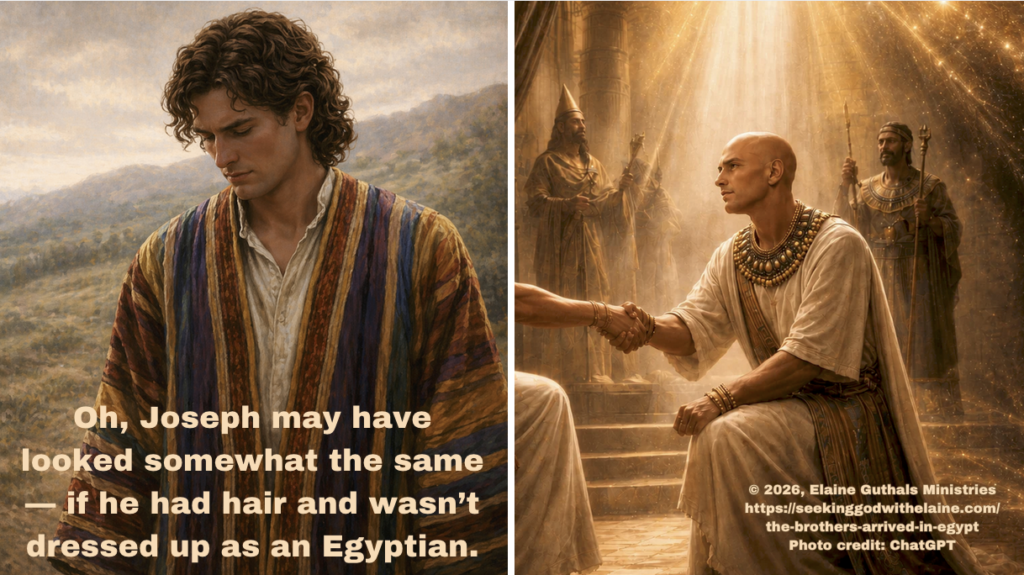
     The brothers had no reason to believe the man in front of him was anything but what he was supposed to be — the Vizier of Egypt. Joseph did not speak to them directly, so they didn’t know he spoke Hebrew.

    Besides, probably in their minds, their brother was dead or lost.

    Joseph did not disabuse them of that thought.

    So, when they were bowing down to the man in front of them, they had no clue that they were fulfilling the dream they scoffed at 13 years earlier. Jehovah had bided His time before making its fulfillment come to pass.

    Was it Jehovah’s irony that these sheaves of grain that bowed down in Joseph’s dream were bowed before him to buy grain?

    Recognition

    Joseph recognized his brothers instantly, but he pretended to be a stranger and spoke harshly to them. ‘Where are you from?’ he demanded. ‘From the land of Canaan,’ they replied. ‘We have come to buy food.’ Although Joseph recognized his brothers, they didn’t recognize him. And he remembered the dreams he’d had about them many years before …  He said to them, “You are spies! You have come to see how vulnerable our land has become.’ ‘No, my lord!’ they exclaimed. ‘Your servants have simply come to buy food. We are all brothers — members of the same family. We are honest men, sir! We are not spies!’” Yes, you are!’ Joseph insisted. ‘You have come to see how vulnerable our land has become.’ ‘Sir,’ they said, ‘there are actually twelve of us. We, your servants, are all brothers, sons of a man living in the land of Canaan. Our youngest brother is back there with our father right now, and one of our brothers is no longer with us.’ But Joseph insisted, “As I said, you are spies! ” (Gen. 42: 6-9 NLT)

    Spoke Harshly to Them

    True, he was speaking to his brothers through an interpreter, but Joseph had to tell the interpreter what to say.

    Joseph spoke roughly — qāšeh (קָשֶׁה) — hard, severe, or difficult. If he was content, if he recognized Jehovah was orchestrating everything, why would he be harsh with his brothers?

    No, I don’t think Joseph was trying to pay back for the pit, the years of slavery, and the years of prison. He knew none of that was random.

    Joseph accused them of being spies. Specifically, he said they were checking out ʿervat hāʾāreṣ (עֶרְוַת הָאָרֶץ) — the nakedness of the land.

    Knohl noted evidence that invaders tried to take Egypt by force to capture grain depots during a famine.

    Resource

    That makes Joseph’s accusation more than empty words.

    But Joseph never believed the brothers to be spies. He tested them to see what kind of men they had become.

    The brothers were being accused of trying to find the following in Egypt’s security:

    • exposed areas
    • weak points
    • undefended regions
    • vulnerable borders
    • places open to attack or exploitation

    Wouldn’t the famine do that economically, politically, socially, and spiritually?

    But where my mind flipped was to Joseph in the pit. He was stripped — not totally naked — but his identity, status, and righteousness. Instead, he was treated deceptively and made vulnerable.

    Wasn’t — in a way — Joseph accusing the brothers of treating Egypt as they did him?

    Joseph had to determine who his brothers were now. The best way to figure out their hearts was to put pressure on them.

    There Are Actually Twelve of Us

    The brothers had to be honest.

    It was interesting how some versions described Joseph. “… and one is no longer living”” (Gen. 42: 13 CSB). Some say, “… one is no more” (Gen. 42: 13 ESV). The CJB says, “… another one is gone” (Gen. 42: 13 CJB).

    Well, gone and is no more are accurate statements because they did not know what happened to Joseph. Since they sold Joseph into slavery, they may have thought – to them – he was dead. Not knowing how or where he ended up, they may have believed it was possible that he died.

    It was interesting that they didn’t give the party line that he was killed by a wild animal, the line they fed Jacob at the time of the sale.

    The Hebrew is kind of ambiguous. The phrase used is wĕhāʾeḥād ʾênennû (וְהָאֶחָד אֵינֶנּוּ). In Genesis, it is used to denote mysterious disappearances or loss.

    Mysterious disappearance didn’t really fit in this case — except in the narrative the brothers created. Had they gotten to the point where they felt Joseph’s loss?

    The brothers didn’t know at this point that the lost had been found.

    The Test

    “This is how I will test your story. I swear by the life of Pharaoh that you will never leave Egypt unless your youngest brother comes here! One of you must go and get your brother. I’ll keep the rest of you here in prison. Then we’ll find out whether or not your story is true. By the life of Pharaoh, if it turns out that you don’t have a younger brother, then I’ll know you are spies.’ So Joseph put them all in prison for three days” (Gen. 42: 15-17 NLT)

    Joseph devised a way that he could test whether his brothers had changed or not.

    Why did Joseph demand Benjamin? Think back.

    The year was 1692 BC. Rachel was pregnant. She died in childbirth.

    Who was Rachel’s child that was born? Benjamin.

    Joseph was 17 years old. He went from being the youngest to having a baby brother.

    But in — probably — a short amount of time, Joseph received a tunic from Jacob. This showed not only that Joseph was Jacob’s favorite, but — more than likely — Jacob was giving Joseph firstborn status. Then, he has his dreams.

    Then, he is on a caravan bound and on his way to Egypt.

    All in a year.

    So, Joseph really didn’t know Benjamin. At the most, Benjamin may have been walking and cooing when Joseph was sold.

    Joseph’s asking about Benjamin wasn’t necessarily about Benjamin — it was about his brothers’ repentance.

    Joseph probably surmised — correctly — that Jacob transferred favorite son status to Benjamin. He was the only other son born to him by Rachel.

    Will they sacrifice Benjamin as they did Joseph?

    Making the Connections #1

    Where did the arrogant brothers go? It is almost as if someone had kidnapped them and switched them with these fearful, doubting counterparts.

    Did their consciences pull up the memory weekly? Or was it easy to forget they had another brother?

    Watkinson’s description of the brothers seems fitting. He wrote,

    “They were guilty of malice, falsehood, treachery, murder. Their conduct was unmanly, unbrotherly, unfilial. They were not spies, but they were liars, impostors, kidnappers, fratricides, monsters.”

    Resource

    It didn’t seem that they wanted to come to Egypt. It sure wasn’t their plan on how to beat starvation.

    They get to Egypt, and their fears are justified. They are treated rudely, accused of a crime they weren’t even thinking about committing, and thrown in prison.

    And Joseph was treated rudely by the brothers as they threw him into the pit and sold him, accused of attempting to rape a Mrs. Potiphar, and thrown in prison.

    They may not have known Jehovah was tying off elements of the original sin. But He was.

    Making the Connections #2

    Look what Robertson said. He wrote, “Where sin is voluntary wrong-doing, the language of the human heart inevitably connects the penalty with the wrong-doing.”

    Resource

    Jehovah orchestrates testings that allow us to break free of the stain of sin. We don’t have to continue to carry the guilt. We can be restored with those we have wronged.

    Making the Connections #3

    We don’t know how long the brothers had an audience with the Vizier of Egypt. 15 minutes? Half an hour?

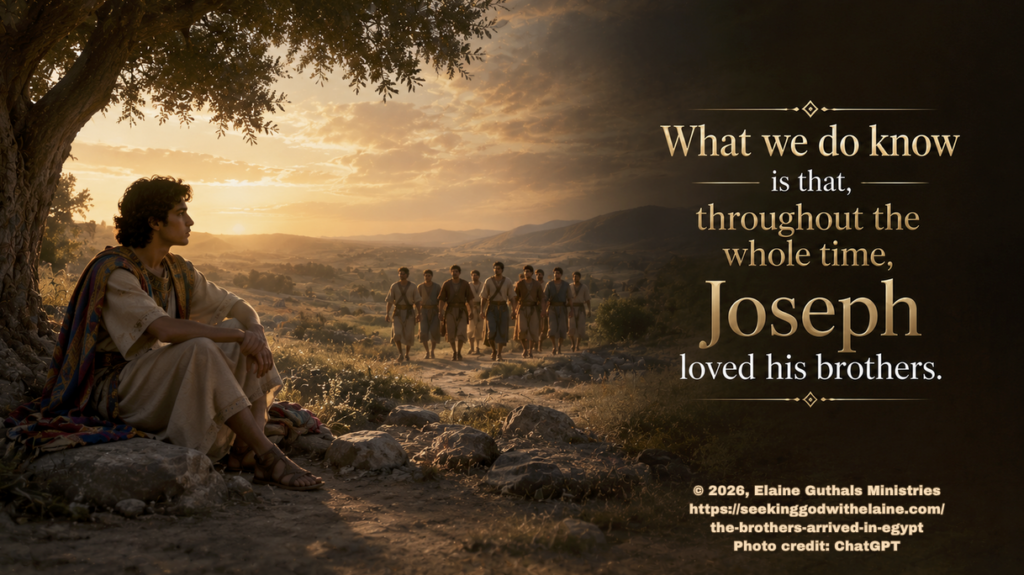
    What we do know is that, throughout the whole time, Joseph loved his brothers.
    That didn’t mean Joseph didn’t do his duty as Vizier. He did.

    How Do We Apply This?

    • Confess the surface sin as well as the buried sin.
    • Do not mistake delayed consequences for erased sin.
    • Allow God to expose what needs healing instead of resisting conviction.
    • Continue loving people even while dealing truthfully with them.
    • Recognize that God may revisit painful places in order to bring healing.
    • Wait on Jehovah instead of forcing situations into place yourself.
    • Accept that sanctification may involve uncomfortable exposure before restoration.

    Father God. You orchestrate everything. At the right time, things fall into place. Help us to wait on You. Help us when we are blindsided when You work. Amen.

    If you don’t understand something and would like further clarification, please contact me.

    If you have not signed up for the email providing the link to the devotions and the newsletter, do so below.

    If God has used this devotion to speak with you, consider sharing it on social media.
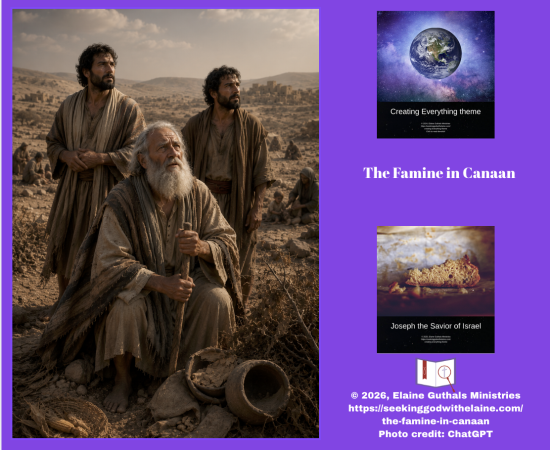
  • The Famine in Canaan

    While the famine was occurring in Egypt, it was also occurring in Canaan. This devotional reading looks at how it impacted Jacob and his family.

    Nuggets

    • Jacob realized that the family could not survive the famine by waiting it out because of its severity.
    • Salvation was available elsewhere.
    • The brothers’ reaction to the famine is interesting.
    • The brothers went to Egypt so, as Jacob said, “… that we may live and not die” (Gen. 42: 2 ESV).
    • Jacob’s favoritism never diminished.
    the-famine-in-canaan

    We have been focusing on the abundance and famine in Egypt. We don’t know if there was abundance for those seven years — 1679 – 1673 BC — in Canaan.

    If there was, it sounds like they didn’t catch it.

    We do know is the seven years of famine started in Canaan at the same time it did in Egypt — 1672 BC. How do we know? Genesis 42 tells us.

    Let’s Put It into Context

    To read devotions in the Creating Everything theme, click the button below.

    Devotions in the Joseph the Savior of Israel  series

    Let’s Put It into Context #2

    Egypt became Ground Zero as the survival center for the world during the famine. There was only one reason for that.

    Jehovah had used Joseph to warn them.

    First, we have to look at the extent of the famine.

    The world-wide famine began in 1672 BC. Do we actually know what constitutes the world in 1672 BC?

    Well, not exactly. (And we have to remember that it looks nothing like the map of the world today).

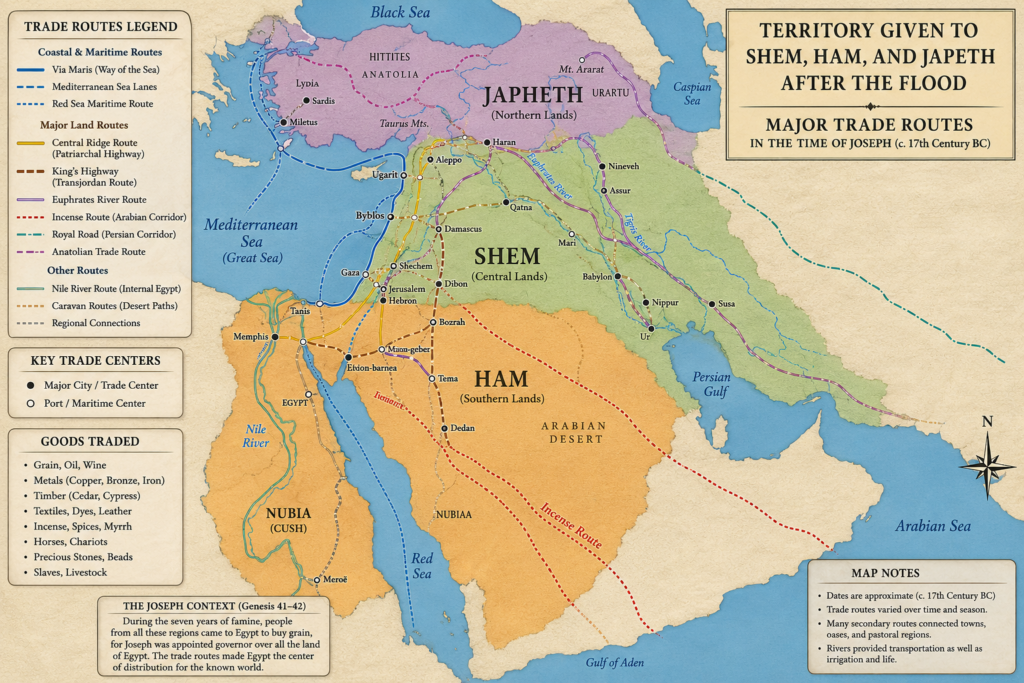
    Think all the way back in Genesis 10. We had a map that listed where Noah’s sons — Shem, Ham, and Japheth — settled.

    That is a good starting place. But let’s add trade routes to it.

    If we look at the Hebrew phrase used, it is kol-hāʾāreṣ (כָּל־הָאָרֶץ). The end part, also seen as ereṣ (אֶרֶץ), can mean the following: earth, land, territory, region, or country.

    If world-wide is the correct terminology to use, it would have meant the known world at that time.

    But the Table of Nations wasn’t just a genealogy list. It was a theological geography of humanity after the flood.

    So, when Genesis 41: 57 says “all countries came to Egypt to Joseph to buy grain” (Gen. 41: 57 NLT), it could be making a theological point instead of a technical census point.

    Jehovah caused humankind to scatter after the Tower of Babel (Gen. 11: 8). Now they are coming back to Joseph, who points to Yeshua.

    The emphasis should be on overwhelming scope, international dependence, and Jehovah’s providential elevation of Joseph. It was not necessarily a technical census of every inhabited location on earth.

    Joseph becomes a preservation instrument for the post-flood world.

    Starving in Canaan

    “When Jacob heard that grain was available in Egypt, he said to his sons, ‘Why are you standing around looking at one another? ” (Gen. 42: 1 NLT)

    When Jacob Heard

    Jacob realized that the family could not survive the famine by waiting it out because of its severity.

    This was probably 1671 BC — if not the end of 1672 BC.  The famine started in 1672, and Jacob and his family moved down to Egypt in 1670.

    There had to be some time for them to realize this famine wasn’t going to go away anytime soon. Then they had to get down to Egypt and back (Gen. 42: 3-29). Next, they had to eat all that food they bought. Then, they had to get down to Egypt and back again (Gen. 43: 15 – 45: 25). It also probably took some time to prepare the household and all its possessions for the move (Gen. 46: 1).

    The Hebrew word for famine is rāʿāb (רָעָב). It describes a consuming deprivation.

    Let’s stop a second and take a look at the last time we saw Jacob. He had just recognized Joseph’s bloody tunic.

    “Then Jacob tore his clothes and dressed himself in burlap. He mourned deeply for his son for a long time. His family all tried to comfort him, but he refused to be comforted. ‘I will go to my grave mourning for my son,’ he would say, and then he would weep” (Gen. 37: 34-35 NLT).

    Jacob assumed Joseph was dead and was paralyzed with grief. He wasn’t putting his trust in Jehovah.

    Was Jacob able to continue as patriarch because of his grief? It doesn’t sound like it.

    At least not for a while. Here, Jacob did step up and take control of the situation.

    These weren’t exactly words of love and encouragement. But given the situation, they were probably the words needed.

    Grain Was Available in Egypt

    Salvation was available elsewhere.

    Some people may say it was luck that had Egypt collecting all that grain in the good years. Some would say it was coincidence that the brothers went where Joseph was.

    It was neither. It was God’s divine plan.

    Was Jehovah interested in Jacob? In Joseph? In Judah? Yes.

    Sovereign God was more interested in His people. It wasn’t just about the individual person (as much as He loves us individually). It was about furthering His kingdom.

    Why Are You Standing

    The brothers’ reaction to the famine is interesting.

    When Jacob talked to his sons, they were frozen in fear. There was a real possibility the family would starve — and none of the sons wanted to take responsibility for saving the family. They didn’t want to act.

    Yeah, this sounds a lot different from the ten decisive men who violently captured their brother and sold him into slavery. And no, it does not seem they have changed for the better.

    Had they already heard there was food in Egypt? Did they not want to go to where they had banished Joseph? Surely, it didn’t cross their minds that they would run into him.

    Was their consciences still bothering them after 13 years? Were they sorry for their actions? Or were they sorry that Jacob’s favoritism had just switched to Benjamin?

    Joseph’s Ten Older Brothers Went Down to Egypt

    “I have heard there is grain in Egypt. Go down there, and buy enough grain to keep us alive. Otherwise we’ll die.’ So Joseph’s ten older brothers went down to Egypt to buy grain” (Gen. 42: 2-3 NLT)

    The brothers went to Egypt so, as Jacob said, “… that we may live and not die” (Gen. 42: 2 ESV).

    Why did all ten of them go down to Egypt? Did they have to walk and carry the sacks? Did each buy for his own family and then get extra for Jacob and Benjamin?

    I think — whatever the “excuse” to get them all there — they were all in this together. They were all in on the sale of Joseph, even if Reuben wasn’t in it wholeheartedly.

    When we were looking at Judah and Tamar’s story, we said several times that Jehovah was using something to tie it back to when the sin occurred. For example, when Tamar sent the signet, cord, and staff asking, “Please identify” (Gen. 38: 25) echoed when the boys sent the bloody tunic asking, “Do you recognize this?” (Gen. 37: 32).

    The brothers had sold Joseph to traders that were heading down to Egypt. They had to go down to Egypt to tie off that part of the sin.

    They all had a hand in accomplishing getting Joseph to where he needed to be. They should all see first-hand what had become of him. They all needed restoration.

    This drives home the point that, though we may feel our actions are right, and the situation may turn out alright in the end — our actions can still be wrong.

    It was wrong to sell Joseph as a slave. It would have been wrong to kill him.

    Yes, we learn more from our sins and mistakes. That doesn’t give us license to commit them.

    They are still wrong.

    Jacob Wouldn’t Let Benjamin Go

    “But Jacob wouldn’t let Joseph’s younger brother, Benjamin, go with them, for fear some harm might come to him. So Jacob’s sons arrived in Egypt along with others to buy food, for the famine was in Canaan as well” (Gen. 42: 1-5 NLT)

    Jacob’s favoritism never diminished.

    Benjamin did not have to go on this trip because, while he had already been born when Joseph had been sold, he was still in diapers. He had no part in the sale.

    I wonder what kind of life Benjamin had. It doesn’t really seem like Jacob learned his lesson. The “favorite son” title just passed from Joseph to Benjamin. It sounds like Jacob coddled and protected Benjamin.

    The Hebrew word for harm is ʾāsôn (אָסוֹן) meaning disaster, calamity, or fatal tragedy. Since Jacob probably never forgave himself for sending Joseph to check in his brothers, he wasn’t about to send Benjamin on this perilous journey.

    If we look at the Interlinear Bible for verse 5, we see that the brothers are called the sons of Israel. This name is used when the covenant identity is stressed.

    Resource

    Jacob is frozen by his grief, in the same manner that the brothers are frozen in their fear; but the covenant plan is moving along as Jehovah intended.

    Making the Connections

    Trials come packaged in a variety of ways. In our minds, we may be going through a situation that has the same consequences that Jacob and his sons were facing.

    We may have to do something just as distasteful to us in order “… that we may live and not die” (Gen. 42: 2 ESV).

    When those trials do come — and they will — we need to follow Smith’s advice. He wrote, “When distresses and trials come, we should be ready to trust that God means to do good by them in some way, though we may not know how.”

    Resource

    We may be more familiar with it being expressed another way. “And we know that for those who love God all things work together for good, for those who are called according to his purpose” (Rom. 8: 28 ESV).

    How Do We Apply This?

    • Trust Jehovah even when you do not understand what He is doing.
    • Move forward in obedience even when the path is uncomfortable or frightening.
    • Refuse to let fear paralyze you spiritually.
    • Examine whether unresolved sin is affecting your relationship with God or others.
    • Stop interpreting difficult providences as evidence that
    • Jehovah has abandoned you.
    • Recognize that God may use hardship to expose, correct, and restore.
    • Submit to Jehovah’s covenant purposes instead of focusing only on personal comfort.
    • Remember that divine providence does not excuse sinful choices.
    • Seek restoration where sin has damaged relationships.
    • Be willing to revisit painful places if Jehovah uses them for healing and growth.
    • Trust that Jehovah is working for your sanctification even during seasons of deprivation.
    • Act in faith instead of waiting passively for circumstances to improve.
       
      Father God. Thank You that You are with us during the good times and the bad times. Help us to see You providing hand in our lives. Bring us to the point where we must confess our sins to You. Amen.

    If you don’t understand something and would like further clarification, please contact me.

    If you have not signed up for the email providing the link to the devotions and the newsletter, do so below.

    If God has used this devotion to speak with you, consider sharing it on social media.
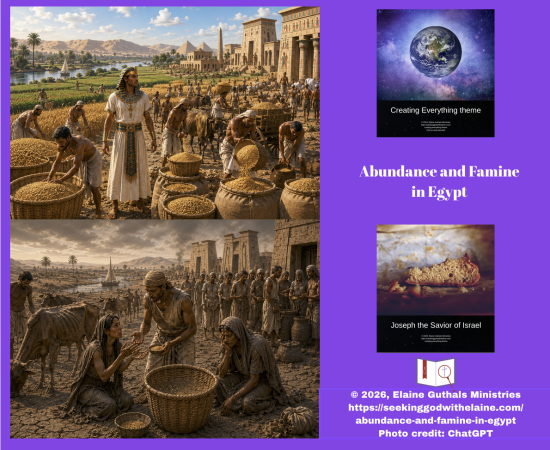
  • Abundance and Famine in Egypt

    After Joseph had been made Vizier of Egypt, the seven years of plenty came. This devotional reading looks at what occurred during the period of plenty and the beginning of the famine.

    Nuggets

    • The Hyksos Pharaoh, who had adopted Egyptian ways, got Joseph to do the same — at least in outward appearance.
    • The seven years of plenty came as Joseph prophesied.
    • While Joseph was Vizier, his family grew.
    • After seven years of plenty, the seven years of famine began.
    abundance-and-famine-in-egypt

    At the end of the last devotion, Pharaoh had just told Joseph about his dreams, and Joseph had interpreted them. What was Pharaoh’s response?

    Let’s Put It into Context

    To read devotions in the Creating Everything theme, click the button below.

    Devotions in the Joseph the Savior of Israel  series

    Joseph’s Personal Life

    “Then Pharaoh gave Joseph a new Egyptian name, Zaphenath-paneah. He also gave him a wife, whose name was Asenath. She was the daughter of Potiphera, the priest of On. So Joseph took charge of the entire land of Egypt. He was thirty years old when he began serving in the court of Pharaoh, the king of Egypt. And when Joseph left Pharaoh’s presence, he inspected the entire land of Egypt” (Gen. 41: 45-46 NLT)

    The Hyksos Pharaoh, who had adopted Egyptian ways, got Joseph to do the same — at least in outward appearance.

    Joseph received an Egyptian name as well as an Egyptian wife. Why was this important? Because he was a foreigner, it removed social barrier. He was now one of them.

    The meaning of Joseph’s name is interesting. Maclaren cited Brugsch as reporting that it meant “… ‘governor of the district of the dwelling-place of the living one,’ …” That jives with what Hilprecht noted, though he was speaking of the position — Tare or “chief of the entire administration.”

    Resource

    Wait! What????

    First, Joseph is called Vizier. Then he is called Tare.

    So, which one is it?

    Well, actually they are the same but different.

    • Vizier means second-in-command.
    • Tare is the actual Egyptian administrative title.

    I can see that. Have you ever asked a person, “What is your title?” Then you had to ask, “Okay, so tell me what you do.”

    It would be hard to put Joseph’s duties under one title.

    • Advisor
    • Administrator
    • Economic planner
    • Judge
    • Distributor
    • Overseer of labor
    • Overseer of storage
    • Pharaoh’s executive authority

    Tare has been preserved on monuments. It was usually given to a chief priest or prince. This is important to Joseph’s story because he would have been governor, judge, and treasurer.

    Now, this wife wasn’t just anyone. She was the daughter of a priest. Her father was a priest of On, who merged with another to become Amon-Re, the most powerful god in Egypt.

    Bountiful Years Came to Pass

    “As predicted, for seven years the land produced bumper crops. During those years, Joseph gathered all the crops grown in Egypt and stored the grain from the surrounding fields in the cities. He piled up huge amounts of grain like sand on the seashore. Finally, he stopped keeping records because there was too much to measure” (Gen. 41: 47-49 NLT)

    The seven years of plenty came as Joseph prophesied.

    The abundance happened just as Joseph prophesied. And Egypt was ready.

    There probably had been some storage places already built. Joseph had them build more. There was no way they had enough storage places to store seven years’ worth of grain.

    Notice, these storehouses weren’t rural. They weren’t in one city. Joseph had them built all over Egypt.

    It says that the Egyptians gathered so much that they stopped counting. It was too much to count.

    Jehovah is like that. The fulfillment of Jehovah’s promises brings us more than we imagined.

    They were able to do this because Jehovah came to Pharaoh and prepared him for this. Because He did, Joseph’s first dream came true.

    Joseph’s Sons Were Born

    “During this time, before the first of the famine years, two sons were born to Joseph and his wife, Asenath, the daughter of Potiphera, the priest of On. Joseph named his older son Manasseh, for he said, ‘God has made me forget all my troubles and everyone in my father’s family.’ Joseph named his second son Ephraim, for he said, ‘God has made me fruitful in this land of my grief’” (Gen. 41: 50-52 NLT)

    While Joseph was Vizier, his family grew.

    Jehovah was good to Joseph while he was a ruler in Egypt. He had two sons named Manasseh and Ephraim.

    Joseph acknowledged Jehovah’s intervention in his life by the names he gave his sons. That showed that he honored Jehovah in his home as well as in his work that He gave him.

    Names were very important to the Hebrews. Remember, they have to do with the child’s behavior.

    Manasseh helped restore the importance of family to Joseph. He could give up on the hurt and focus on raising a family to honor Jehovah

    By the time Ephraim was born, Joseph was content where he was living.

    Through the names he gave his children, we see Joseph’s acceptance of his situation.

    Famine Comes to Pass

    “At last the seven years of bumper crops throughout the land of Egypt came to an end. Then the seven years of famine began, just as Joseph had predicted. The famine also struck all the surrounding countries, but throughout Egypt there was plenty of food. Eventually, however, the famine spread throughout the land of Egypt as well. And when the people cried out to Pharaoh for food, he told them, ‘Go to Joseph, and do whatever he tells you.’ So with severe famine everywhere, Joseph opened up the storehouses and distributed grain to the Egyptians, for the famine was severe throughout the land of Egypt. And people from all around came to Egypt to buy grain from Joseph because the famine was severe throughout the world” (Gen. 41: 53-57 NLT)

    After seven years of plenty, the seven years of famine began.

    Ooo, baby. Then the bad came to pass. The famine was just as bad as Joseph said it would be.

    But on the other hand, it was much worse. Joseph had only talked about its effects on Egypt. This famine hit all lands.

    Of course, the hungry people went to Pharaoh. He directed them to Joseph.

    Joseph opened the storehouses and started selling grain. He didn’t want to open them too early and risk running out of food. He didn’t want to open them too late and have people dying from starvation.

    Think about this. Some may have still considered Joseph a foreigner. But they couldn’t have let that stand in their way to food.

    If they said they wouldn’t buy food from Joseph, that would have been an affront to Pharaoh. They would have been harming themselves because they would not have gotten food.

    Part of us has probably said at one time or another how horrible it was that the government sold food to its own people. It was the grain supplied by the people that was sitting in the storehouses.

    Well, no it wasn’t. Remember, there was a “… one-fifth of all the crops …” (Gen. 41: 34 NLT) on all the grain grown in the bountiful years.

    It was the government’s grain now. Governments rarely do anything for free.

    But Egypt wasn’t just feeding themselves. They also sold to people from other countries. The famine was worldwide.

    Making the Connections #1

    How does preparing for the future differ than “Don’t store up treasures here on earth…” (Mt 6: 19)?

    Lawson argued that the verse does not cancel out the preparation. It emphasizes that we should rely on divine guidance for all provision of our needs.

    Resource

    The deciding factor of preparedness is whether, by preparing, we are relying more on ourselves than Jehovah. In other words, our attitude is the deciding factor.

    Making the Connections #2

    Next, we can go to the New Testament and take a different track. Let’s compare Joseph’s elevation to Vizier to the restoration of the Prodigal Son in Luke 15.

    • Both received the best robe.
    • Both received a ring.
    • Both had a public element to it — public elevation and public feast.

    Joseph’s brothers may have captured him in private and threw him into the cistern. His restoration was anything but. There was a public declaration.

    Jehovah can sometimes give us a public restoration, but He also may do it in private.

    The pattern is always the same, though.

    • Humiliation
    • Return
    • Forgiveness
    • Restoration
    • Celebration

    Jehovah restores far more than what we have lost.

    Making the Connections #3

    It is important to note that Joseph was 30-years old now. He had been sold to Egypt in 1692 BC when he was 17. That means for close to half his life, he had been away from his God and family.

    We can’t miss the fact that, now in 1679 BC, Joseph was 30 years old when he was released from prison and began serving in the position Jehovah had prepared for him. It is the same age as Yeshua was when He started His ministry and priests when they begin serving in the Temple.

    Joseph had been in Egypt 13 years. During the whole time, he had either been a slave or in prison – causing 13 years of suffering.

    I think this is important, too. Prevailing theory at the time said each region had their own gods. They were just powerful in that region.

    Jehovah showed that He is powerful anywhere, any time

    How Do We Apply This?

    • Be faithful in hidden seasons.
    • Trust Jehovah’s provision.
    • Remain faithful in foreign places.
    • Prepare wisely for the future.

    Father God. You give us wonderful promises. When You fulfill those promises – even when You make us wait – You do so abundantly. Help us, like Joseph, accept our situation. Amen.

    If you don’t understand something and would like further clarification, please contact me.

    If you have not signed up for the email providing the link to the devotions and the newsletter, do so below.

    If God has used this devotion to speak with you, consider sharing it on social media.

  • Joseph Made Vizier of Egypt

    At the end of the last devotion, Pharaoh had just told Joseph about his dreams, and Joseph had interpreted them. This devotional reading looks at how Pharaoh reacted to the impending famine.

    Nuggets

    • After interpreting Pharaoh’s dreams, Joseph suggested how to deal with the abundance as well as the shortage.
    • Pharaoh didn’t hesitate to accept Jehovah’s interpretation of the dreams.
    joseph-made-vizier-of-egypt

    Joseph had just gotten done interpreting Pharaoh’s dreams, but he also proposed a plan to prepare for the famine that was coming. What was Pharaoh’s response?

    Let’s Put It into Context

    To read devotions in the Creating Everything theme, click the button below.

    Devotions in the Joseph the Savior of Israel  series

    Find Someone

    “Therefore, Pharaoh should find an intelligent and wise man and put him in charge of the entire land of Egypt. Then Pharaoh should appoint supervisors over the land and let them collect one-fifth of all the crops during the seven good years. Have them gather all the food produced in the good years that are just ahead and bring it to Pharaoh’s storehouses. Store it away, and guard it so there will be food in the cities. That way there will be enough to eat when the seven years of famine come to the land of Egypt. Otherwise this famine will destroy the land’” (Gen. 41: 33-36 NLT)

    After interpreting Pharaoh’s dreams, Joseph suggested how to deal with the abundance as well as the shortage.

    We might think that it was a little forward of Joseph to, immediately after interpretation of the dreams, suggest what Pharaoh should do to prepare for the years of famine. It wasn’t because he thought they wouldn’t come up with a plan.

    Joseph had the solution because Jehovah was still in control. Since it was Jehovah interpreting the dreams, He would also be the One to immediately present the plan to address the famine.

    No, it wasn’t just for the Egyptians salvation. It was for the Israelites.

    We just have to listen and follow Jehovah’s practical directions.

    If Jehovah was intent on making sure Egypt survived — because He knew that is where the Hebrews would end up — it is logical He would give chapter and verse. In that way, they would know exactly how He wanted them to survive.

    There are instances of this happening. Jehovah gave Noah specific instructions on how to build the ark (Gen. 6: 14-16). He gave Moses specific instructions on how to build the Tabernacle (Ex. 35-40).

    But most of the time, Sovereign God doesn’t micromanage. He tells us what we are to do, and we are supposed to figure out how to get it done.

    Oh, there are nudges from the Holy Spirit to keep us on path. But most of the time, we would kick and scream if He micromanaged all the time.

    Sovereign God made us in His image, so we have some intelligence. He wants us to choose Him.

    In this instance, it does seem like a no brainer. During the good years, save. During the bad years, use.

    What is interesting is the twenty percent tax. To be that specific, it appears to come from God.

    This brings up an important point. Jehovah has no problem with us saving for the future. It is when we start putting stock in that savings and forget that they are there because of Him that we get into a sinful attitude.

    We just have to listen and follow God’s directions.

    Joseph Made Ruler of Egypt

    “Joseph’s suggestions were well received by Pharaoh and his officials. So Pharaoh asked his officials, ‘Can we find anyone else like this man so obviously filled with the spirit of God?’ Then Pharaoh said to Joseph, ‘Since God has revealed the meaning of the dreams to you, clearly no one else is as intelligent or wise as you are. You will be in charge of my court, and all my people will take orders from you. Only I, sitting on my throne, will have a rank higher than yours.’ Pharaoh said to Joseph, ‘I hereby put you in charge of the entire land of Egypt.’ Then Pharaoh removed his signet ring from his hand and placed it on Joseph’s finger. He dressed him in fine linen clothing and hung a gold chain around his neck. Then he had Joseph ride in the chariot reserved for his second-in-command. And wherever Joseph went, the command was shouted, ‘Kneel down!’ So Pharaoh put Joseph in charge of all Egypt. And Pharaoh said to him, ‘I am Pharaoh, but no one will lift a hand or foot in the entire land of Egypt without your approval’” (Gen. 41: 37-44 NLT)

    Pharaoh didn’t hesitate to accept Jehovah’s interpretation of the dreams.

    Everyone liked Joseph’s proposal. But being possible cousins to the Hebrews, we would think they would be more open to acknowledging God as the Hebrew’s God.

    The Hyksos Pharaoh knew enough to know the power of Sovereign God. With all that was riding on what was soon going to happen, he didn’t want to discount this revelation.

    So, probably in the Egyptians’ minds, the Hyksos Pharaoh promoted another outsider.

    Then again, it may be that Joseph surprised Pharaoh. Here was this prisoner who was presenting noble qualities.

    It doesn’t seem like it took long for Joseph to win the room. What, maybe an hour — probably less.

    Davies addressed that. He wrote,

    “He was entrusted with supreme authority. Such was the high estimate of Joseph, created in all minds, that they felt he was worthy of the largest trust. They could trust him as they trusted the law of gravitation. A Christian will never abuse his power.”

    Resource

    But remember, this was the job for which Jehovah was preparing Joseph.

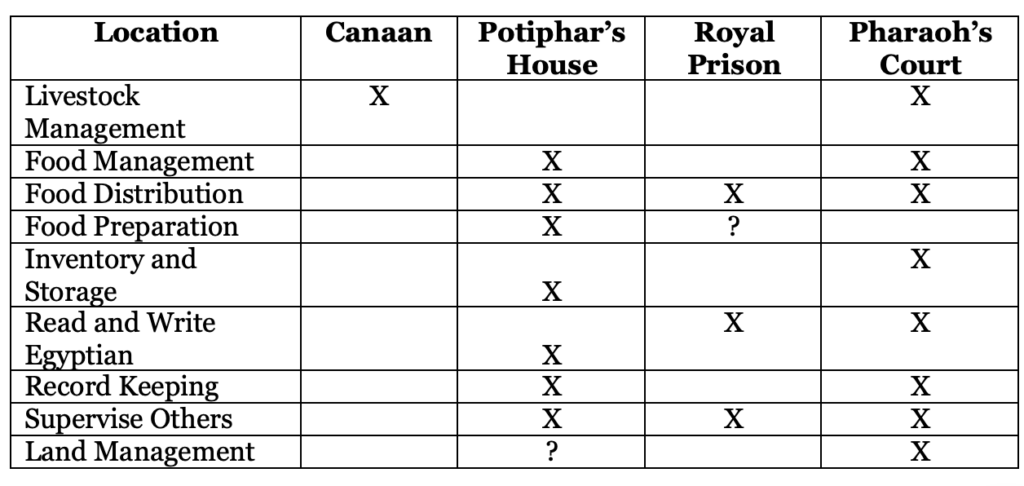
    Joseph would have had many duties in his activities under Potiphar and the prison warden. Look at this.

    At each place where Joseph was held against his will, he was given responsibilities that grew in size, complexity, and reach, preparing him for what was ahead. Through it all, his obedience remained the same.

    In today’s terms, we would probably call it an apprenticeship.

    I think the most important thing Joseph learned at Potiphar’s house and in prison was administration. It would be safe to say that Joseph had an analytical mind to root out any problems and forge a solution.

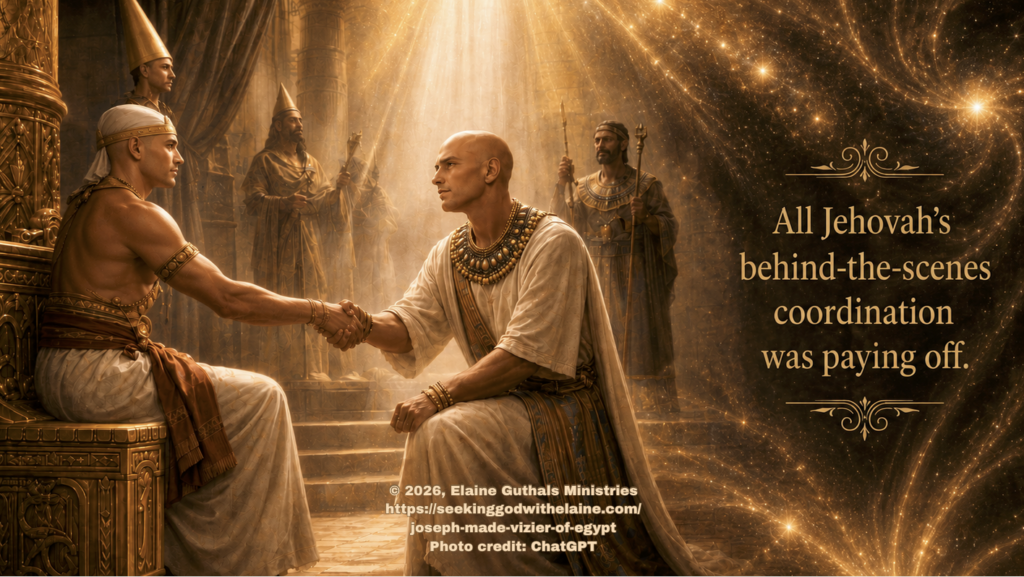
    All Jehovah’s behind-the-scenes coordination was paying off.

    We also have to think that part of what sold Pharaoh and his advisors to choose Joseph was the unshakable confidence evident as he was laying out the interpretation. That confidence comes from and in Jehovah.

    Joseph was made Vizier of Egypt. Egyptians and Hyksos alike were to bow down to him. He was second only to Pharaoh — and he put a qualifier on that. It was only when he was on the throne that he was higher than Joseph.

    Joseph was going to be a hands-on leader. Pharaoh wanted him to be recognized as leader.

    • The signet ring symbolized governmental authority.
    • The fine linens showed honor and status.
    • The gold chain indicated public recognition.
    • The second chariot exhibited power.
    • There were people to tell others to bow to him.

    In other words, Joseph was given absolute authority.

    Remember Joseph’s first dream? The grain bundles bowed down to his. We’ve always associated this with his brothers bowing to him.

    What if it meant non-family members would bow to him first?

    Look at the bottom line, though. In Dothan, Joseph was rejected by his brothers. In Egypt, Joseph is elevated among foreign rulers.

    Making the Connections #1

    Joseph was devoted to Jehovah back in Hebron. He was devoted to Jehovah at Potiphar’s house, even though he had been betrayed by his brothers. He was devoted to Jehovah in the prison, even though he was imprisoned for a crime he did not commit.

    Of course, Joseph would continue to be devoted to Jehovah as second-in-command of the nation of Egypt.

    This is an example of Jehovah wanting our obedience regardless of the circumstances we are in.

    Making the Connections #2

    Would Joseph have been elevated to Vizier if the Pharaoh had been an Egyptian? Probably not.

    This is just another example of Jehovah working behind the scenes to further His plan.

    Because the Pharaoh was Hyksos, he was not as opposed to a Semite being elevated. In fact, the Hyksos capital of Avaris had a Semitic population. In other words, Joseph wouldn’t have been the only foreigner in the city.

    Joseph rose to power in a political environment where Semitic rulers governed Egypt, making his background less a barrier and possibly even an advantage.

    How Do We Apply This?

    • Trust Jehovah’s preparation.
    • Be faithful in hidden seasons.
    • Be obedient regardless of circumstances.
    • Use the wisdom God provides.
    • Remain faithful in foreign places.

    Father God. We hear Your promises, and we wait for them. When Your fulfillment comes, it blows us away. Thank You how You love and provide for us. Amen.

    If you don’t understand something and would like further clarification, please contact me.

    If you have not signed up for the email providing the link to the devotions and the newsletter, do so below.

    If God has used this devotion to speak with you, consider sharing it on social media.

  • Joseph Interpreted Pharaoh’s Dreams

    Pharaoh had two dreams that his people could not interpret. This devotional reading looks at who he got to interpret them – Joseph.

    Nuggets

    • Pharaoh called for Joseph to be brought to him.
    • Giving credit where credit is due, Pharaoh should get points for admitting the magicians and wise men were stymied.
    • Pharaoh retold the dreams — with commentary this time.
    • Joseph interprets the dreams not based on what Pharaoh already understands and adds what Jehovah is telling him.
    • Make no mistake – the prophecy of the dreams will come true soon.
    joseph-interpreted-pharaoh-dreams

    Joseph had asked one thing of the cupbearer when he interpreted his dream, “Remember me (Gen. 40: 14). Help me get out of here.”

    The day came when the cupbearer remembered. Joseph was called upon to interpret two dreams for Pharaoh.

    Let’s Put It into Context

    To read devotions in the Creating Everything theme, click the button below.

    Devotions in the Joseph the Savior of Israel  series

    Joseph before Pharaoh

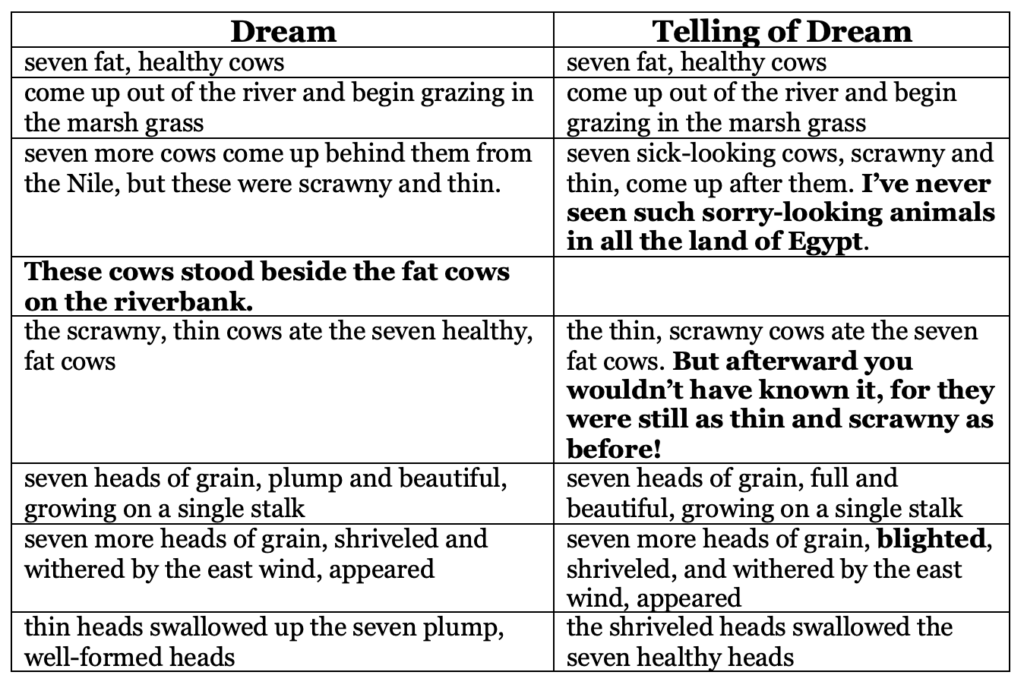
    “Pharaoh sent for Joseph at once, and he was quickly brought from the prison. After he shaved and changed his clothes, he went in and stood before Pharaoh. Then Pharaoh said to Joseph, ‘I had a dream last night, and no one here can tell me what it means. But I have heard that when you hear about a dream you can interpret it.’ ‘It is beyond my power to do this,’ Joseph replied. ‘But God can tell you what it means and set you at ease.’ So Pharaoh told Joseph his dream. ‘In my dream,’ he said, ‘I was standing on the bank of the Nile River, and I saw seven fat, healthy cows come up out of the river and begin grazing in the marsh grass. But then I saw seven sick-looking cows, scrawny and thin, come up after them. I’ve never seen such sorry-looking animals in all the land of Egypt. These thin, scrawny cows ate the seven fat cows. But afterward you wouldn’t have known it, for they were still as thin and scrawny as before! Then I woke up. In my dream I also saw seven heads of grain, full and beautiful, growing on a single stalk. Then seven more heads of grain appeared, but these were blighted, shriveled, and withered by the east wind. And the shriveled heads swallowed the seven healthy heads. I told these dreams to the magicians, but no one could tell me what they mean’” (Gen. 41: 14-24 NLT)

    Pharaoh Sent for Joseph at Once

    Pharaoh called for Joseph to be brought to him.

    We probably think Joseph was cleaned up to be presented to Pharaoh because he had been in prison for more than two years. We would expect him to be rough and unkempt looking.

    True, there was no way Joseph was going to have a royal audience looking like a prisoner!

    In reality, Joseph was shaved and clothed due to a cultural requirement. He was being made presentable for an audience with the Pharaoh.The problem was that he looked non-Egyptian — and that had to change.

    Hebrew men usually had beards because it was a sign of maturity. Egyptians didn’t — and priests even removed body hair for spiritual purity.

    Remember when Joseph got the tunic from Jacob, we said it represented status. The clothes put on Joseph also reflected purity and readiness.

    Do you get it? Joseph was being adapted to meet Egyptian expectations.

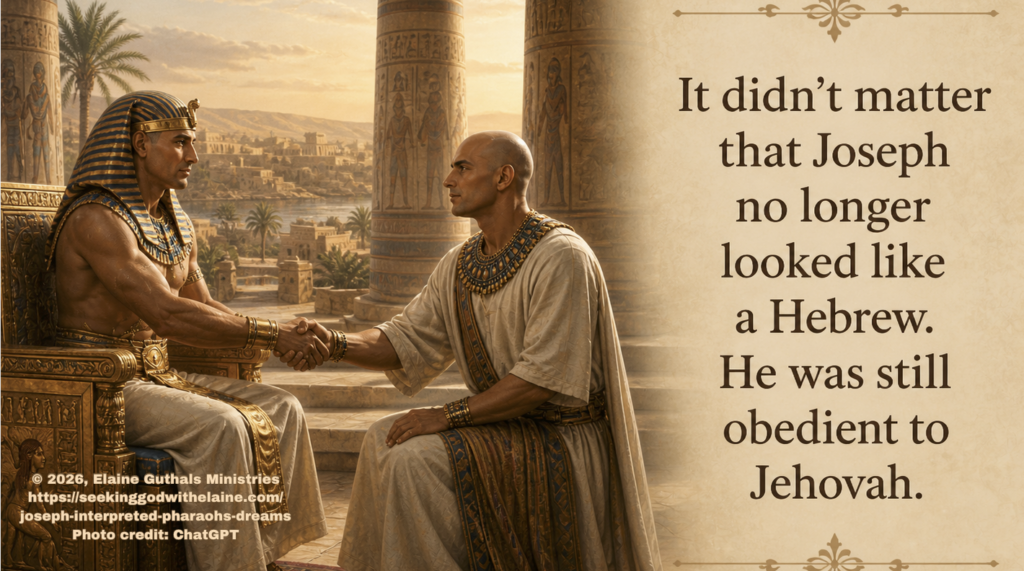
    It didn’t matter that Joseph no longer looked like a Hebrew. He was still obedient to Jehovah.

    Jehovah expects us to live righteously regardless of the circumstances we are and how the world tries to change us. He wants us to be true to Him regardless of what the world is telling us.

    From the start, Joseph gave Sovereign God the credit for the dream interpretations.

    Joseph knew that Jehovah never left him. He knew He would supply the interpretation because He was the one to send the dream.

    No One Could Tell Me What They Mean

    Giving credit where credit is due, Pharaoh should get points for admitting the magicians and wise men were stymied.

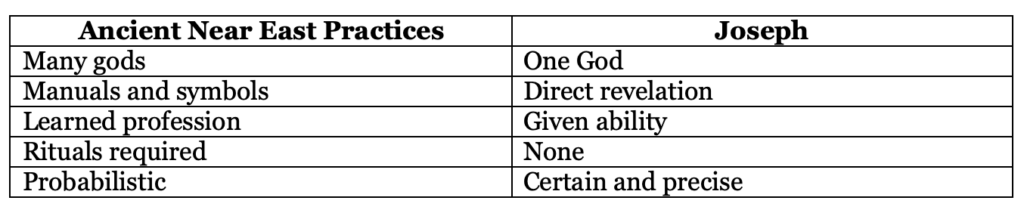
    We kind of hammered home in the last devotion the contrast between the Ancient Near East’s dream interpretation system and Joseph’s. Those who interpreted dreams were usually priests, magicians, and trained diviners.

    Pharaoh said that he had asked the magicians to interpret the dream. The Hebrew word for magician is ḥarṭummîm (חַרְטֻמִּים). These were the learned priestly class attached to the royal court. This class included elite court scholars, experts in sacred texts, dream interpreters, and practitioners of ritual and divination. In other words, this one group had multiple functions.

    Priests, as would be expected, were trained in temple knowledge. This included reading omens, interpreting dreams, performing rituals, and consulting divine will.

    Pharaoh also called the wise men – ḥăkāmîm (חֲכָמִים). They were the advisors, scholars, and counselors.

    We can’t miss this. Pharaoh asked anyone he thought could interpret the dreams to give it a shot. Their best-trained experts had no answer.

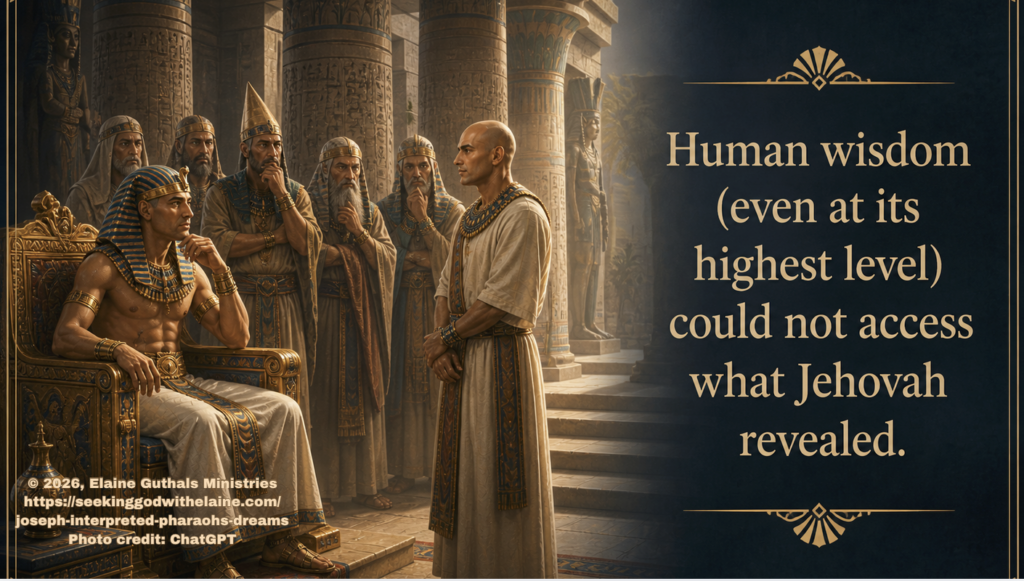
    Human wisdom (even at its highest level) could not access what Jehovah revealed. God may reveal broadly, but understanding comes through His people.

    Joseph immediately gave the glory to Jehovah. He refused any credit for the interpretations.

    We can see this by Joseph not making a huge speech. He didn’t explain how he would know the interpretation was correct.

    Instead, Joseph basically said, “Believe what I am going to tell you.”

    What stands out here is Joseph’s humility. Here he was standing — physically alone — in front of the royal court of Egypt. He didn’t swing the conversation to himself at all.

    Joseph knew the famine, the dreams, and the interpretations were all about Jehovah.

    We see Joseph remaining calm in light of Pharaoh’s disturbed mind.

    I had a dream last night

    Pharaoh retold the dreams — with commentary this time.

    When Moses recorded Pharaoh having the dream, he didn’t include anything but the basics of the dreams. Those were included when Pharaoh recounted the dreams for Joseph. He put in his feelings and his reactions.

    Pharaoh added more commentary on the version he told Joseph. The sick cows were the thinnest he had ever seen. They ate, and it didn’t change anything. The heads of grain weren’t just shriveled and withered — they were blighted.

    Let’s think about this. Sin is a disease. “He personally carried our sins in his body on the cross so that we can be dead to sin and live for what is right. By his wounds you are healed” (I Pet. 2: 24 NLT).

    Sin, like disease, takes a toll on the body. It can present itself from tiredness after excessive partying to physical changes caused by alcoholism and drug abuse.

    The added part I especially like is that the sick cows and the healthy cows. The sick cows — after they had good by them a while — ate the healthy cows — and didn’t change! We see the bright and shiny aspects of sin, get amine to it, and think it will beautify and change our lives for the better.

    In reality, sin doesn’t add beauty — it takes it away. It makes our lives worse because it separates us from You.

    The Dreams’ Interpretations

    “Joseph responded, ‘Both of Pharaoh’s dreams mean the same thing. God is telling Pharaoh in advance what he is about to do. The seven healthy cows and the seven healthy heads of grain both represent seven years of prosperity. The seven thin, scrawny cows that came up later and the seven thin heads of grain, withered by the east wind, represent seven years of famine. This will happen just as I have described it, for God has revealed to Pharaoh in advance what he is about to do. The next seven years will be a period of great prosperity throughout the land of Egypt. But afterward there will be seven years of famine so great that all the prosperity will be forgotten in Egypt. Famine will destroy the land. This famine will be so severe that even the memory of the good years will be erased. As for having two similar dreams, it means that these events have been decreed by God, and he will soon make them happen” (Gen. 41: 25-32 NLT)

    Years of Prosperity and Years of Famine

    Joseph interpreted the dreams based on what Pharaoh already understood and added what Jehovah was telling him.

    We said in the last devotion that Pharaoh would understand this was about economy and survival. What Joseph added was that Jehovah had decided this was coming.

    Pharaoh would immediately understand the seriousness of this.

    The sick cows not changing after eating the fat cows meant that the famine wouldn’t be relieved. It would consume everything.

    As for Having Two Similar Dreams

    Make no mistake – the prophecy of the dreams would come true soon.

    This isn’t the first time that we’ve seen two dreams occurring at the same time. Joseph had had two dreams in Genesis 37. There were two dreams on the same night in Genesis 40 – the cupbearer’s dream and the baker’s dream.

    This time, Pharaoh had two dreams.

    Joseph knew the reason for that. He said that the matter was established by Jehovah.

    It was going to happen exactly as Jehovah said it would.

    Making the Connections #1

    Leale made a great observation. He said that Joseph didn’t owe Pharaoh anything. When he summoned him from prison, it wasn’t to release him.

    The summons was only to get the dreams interpreted.

    Joseph wasn’t even indebted to the cupbearer. I mean, the man forgot about him for two years! If he hadn’t known about Pharaoh’s dreams, he still wouldn’t have remembered!!!!

    This was Jehovah controlling the circumstances from beginning to end.

    Resource

    It is easy to assume that this was a judgment from Jehovah. It may have been. It may not have been.

    Either way, it was Jehovah taking care of His creation.

    Making the Connections #2

    Leale talked about how Joseph was a true prophet. He was bold, direct, and entrusted with authority.

    Resource

    Joseph didn’t fear the man who held his existence in his hand. Face it, if Pharaoh hadn’t like what Joseph said, he could have had him executed.

    In spite of that, Joseph laid it all out.

    How Do We Apply This?

    • Give Jehovah the credit.
    • Be humble.
    • Speak truth without fear.
    • Trust Jehovah’s revelation.
    • Be ready when Jehovah calls.

    Father God. Thank You for reminding us that wisdom does not come from us, but from You. Help us to be like Joseph — humble in every situation and quick to give You the credit for what You do in and through us. Amen.

    If you don’t understand something and would like further clarification, please contact me.

    If you have not signed up for the email providing the link to the devotions and the newsletter, do so below.

    If God has used this devotion to speak with you, consider sharing it on social media.
  • Pharaoh Had Two Dreams

    Interpreting the dreams of the cupbearer and the baker set Joseph up for interpreting other dreams. This devotional reading looks at Pharaoh’s dreams that he will be asked to interpret.

    Nuggets

    • “Later” was long enough for the cupbearer to forget about Joseph.
    • The Pharaoh in power in the chapters from here on out in Genesis is often associated with the Hyksos.
    • The Pharaoh had two dreams.
    • One dream featured seven cows; the other had grain.
    • That the meaning of the dream alluded Pharaoh disturbed him.
    • So, Pharaoh called his magicians and wise men to interpret the dreams for him.
    • The cupbearer finally had his memory jogged.
    pharaoh-had-two-dreams

    Joseph had asked one thing of the cupbearer. Help get me out of here.

    But the cupbearer forgot about him. Until …..

    Let’s Put It into Context

    To read devotions in the Creating Everything theme, click the button below.

    Devotions in the Joseph the Savior of Israel  series

    Waiting for Dreams

    “Two full years later, Pharaoh dreamed that he was standing on the bank of the Nile River” (Gen. 41: 1 NLT)

    Two Full Years Later

    “Later” was long enough for the cupbearer to forget about Joseph.

    The Hebrew phrase used vayehi miqqēṣ shenatayim yamim (וַיְהִי מִקֵּץ שְׁנָתַיִם יָמִים) means at the completion of a fixed period or at the end two years of days.

    Wait! What???

    What does it mean by using days and years?

    When the Hebrews used years in their writing, they didn’t always mean a full 365-day cycle the way we think of it. We sometimes do something similar.

    One time when I was 45, halfway through my year I started saying I was 46. Of course, when my birthday rolled around, I said it was my 47th birthday.

    My point is that people sometimes speak of years inclusively or round them conversationally. Adding of days clarified that Joseph had been there for two complete years — a full duration.

    Joseph wasn’t forgotten because of a random delay. Jehovah worked on His timing. He waited until the fullness of time to work His plan.

    I don’t think we should gloss over the fact that Joseph wasn’t elevated until Jehovah’s work with him was completed. Did he need a couple of more bricks on his Sanctification Road? Was He working on something dealing with Joseph’s moral character?

    Was Jehovah was working on something dealing with Pharaoh’s journey or Egypt’s? We don’t know. Maybe Joseph didn’t.

    How much we do have to realize what our Sanctification Road events are? I believe that Jehovah is working within us through the Holy Spirit that we may or may not be conscious of it happening.

    Pharaoh

    The Pharaoh in power in the chapters from here on out in Genesis is often associated with the Hyksos.

    The Hyksos (heqa khasut or rulers of foreign lands) were a mixed-race people of primarily West Semitic origin. Their rule became known as the 15th Dynasty (1650 to 1550) or during the Second Intermediate Period. They probably came from what is modern-day Syria and the Levant.

    It is believed that they were a ruling elite back in their country who were driven out by an invasion in their homeland. When they prospered in Egypt, they called for others to join them.

    While Egyptian sources portray their rise as an invasion, archaeological evidence suggests a more gradual infiltration and consolidation of power rather than a sudden military conquest. Over time, they established themselves in Egypt’s Nile Delta, eventually gaining political control. They made their base in Avaris.

    The Hyksos are credited with introducing or expanding the use of key military technologies in Egypt, including horse-drawn chariots and advanced bronze weaponry. These innovations would later become central to Egyptian military strength, including the pursuit of the Israelites in the Exodus account.

    To native Egyptians living under Hyksos rule, the later rise and prosperity of the Hebrews in Egypt may have felt familiar — another Semitic people gaining influence and favor within the land. This context helps explain how Joseph, a Hebrew, could rise to such a position of authority in Egypt during this period.

    In this light, Joseph’s rise is no longer an isolated miracle of politics, but a moment where divine providence intersects with a unique window in Egyptian history.

    Pharaoh’s Dreams

    “In his dream he saw seven fat, healthy cows come up out of the river and begin grazing in the marsh grass. Then he saw seven more cows come up behind them from the Nile, but these were scrawny and thin. These cows stood beside the fat cows on the riverbank. Then the scrawny, thin cows ate the seven healthy, fat cows! At this point in the dream, Pharaoh woke up. But he fell asleep again and had a second dream. This time he saw seven heads of grain, plump and beautiful, growing on a single stalk. Then seven more heads of grain appeared, but these were shriveled and withered by the east wind. And these thin heads swallowed up the seven plump, well-formed heads! Then Pharaoh woke up again and realized it was a dream” (Gen. 41: 2-7 NLT)

    The Pharaoh had two dreams.

    We’ve talked a lot about dreams – ḥălôm (חֲלוֹם) – in the past couple of devotions. They were considered divine revelations.

    The Nile River

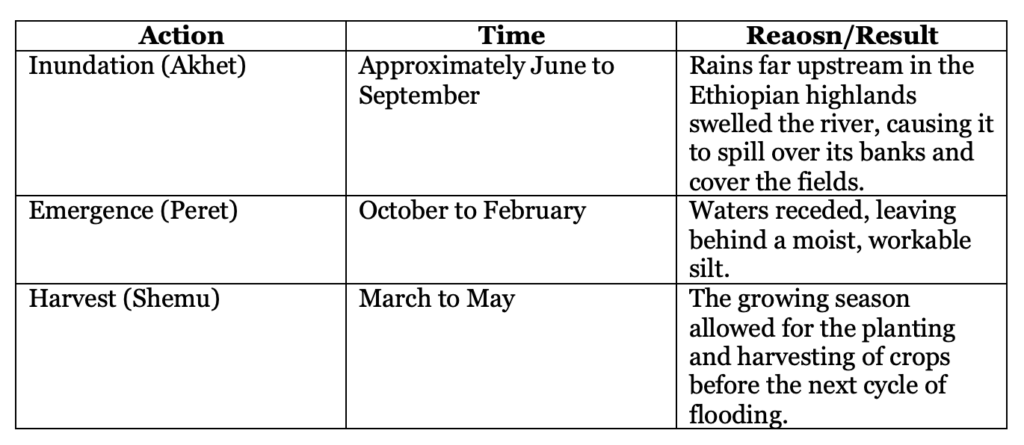
    In his dream, Pharaoh was standing on the bank of the Nile River. This river was very important to the region. Its flooding each year brought water and silt to the desert.

    The Nile would overflow following an established pattern.

    The growing season allowed for the planting and harvesting of crops before the next cycle of flooding.

    If the Nile didn’t overflow, nothing grew. That made it the foundation of life itself.

    • Agriculture depended on it
    • The economy ran on grain production
    • Transportation moved along it
    • Religion even centered around it (they saw the flood as divine provision)

    So, to me, it is very important that this was the location of the dream. It was like God was saying, “I can hit you in your seat of power. I control the Nile.”

    The Dreams

    One dream featured seven cows; the other had grain.

    Seven healthy cows were eaten by seven skinny cows. Then seven plump and beautiful heads of grain were swallowed up by seven shriveled and withered heads of grain appeared, carried by the east wind.

    When I was young, I had this hilarious vision of the skinny cows eating the fat cows. Living on a farm that had milk cows, I knew how big they could get.

    In my mind, it was like the skinny cows eating elephants.

    That would wake me up, too!

    We might question how familiar Pharaoh would have been with cows and grain.  In reality, he would have been very familiar.

    The entire Egyptian economy was agricultural. As king, he would have been expected to maintain order (ma’at). That would have included overseeing grain production and storage and preventing famine.

    Preventing famine? How could Pharaoh do that? Well, a large part of maintaining order would have been maintaining the Nile flood cycle.

    In other words, Pharaoh would have been very involved in crop cycles, yield expectations, and grain supply logistics.

    Grain would not only have been Egypt’s food source, but it was also used for trade and wages. Livestock – especially cattle – were economic indicators.

    So, Pharaoh might have been seeing cows and grain in his dream. He would have been thinking national prosperity and collapse.

    That isn’t even getting into the symbolism. Cattle symbolized fertility and abundance. Full grain heads would have symbolized a bountiful harvest.

    Pharaoh wouldn’t have needed anyone to interpret that part of the dreams. He would see the record yields followed by total agricultural collapse.

    Ooo, baby. Pharaoh would have been upset since he understood the imagery but not the meaning.

    The Cupbearer Remembered

    “The next morning Pharaoh was very disturbed by the dreams. So he called for all the magicians and wise men of Egypt. When Pharaoh told them his dreams, not one of them could tell him what they meant. Finally, the king’s chief cup-bearer spoke up. ‘Today I have been reminded of my failure,’ he told Pharaoh. ‘Some time ago, you were angry with the chief baker and me, and you imprisoned us in the palace of the captain of the guard. One night the chief baker and I each had a dream, and each dream had its own meaning. There was a young Hebrew man with us in the prison who was a slave of the captain of the guard. We told him our dreams, and he told us what each of our dreams meant. And everything happened just as he had predicted. I was restored to my position as cup-bearer, and the chief baker was executed and impaled on a pole’” (Gen. 41: 8-13 NLT)

    Pharaoh Was Very Disturbed by the Dream

    That the meaning of the dream alluded Pharaoh disturbed him.

    Dreams were very important to people in those days because they could tell the future. Pharaoh’s ability to understand the imagery but inability to understand the meaning would have agitated him.

    Wouldn’t that have terrified Pharaoh? He was this great ruler with an enormous army at his back.

    But this was a divine revelation. What if the god was really God — which it was!

    Called for All the Magicians and Wise Men

    So, Pharaoh called his magicians and wise men to interpret the dreams for him.

    He may have had the title Pharaoh, but he was not independent. He was dependent on advisors.

    But sorcery comes from Satan, not God. Our wisdom and knowledge are far less than God’s.

    • “For example, never sacrifice your son or daughter as a burnt offering.  And do not let your people practice fortune-telling, or use sorcery, or interpret omens, or engage in witchcraft, or cast spells, or function as mediums or psychics, or call forth the spirits of the dead. Anyone who does these things is detestable to the Lord. It is because the other nations have done these detestable things that the Lord your God will drive them out ahead of you.” (Deut. 18: 10-12 NLT).
    • “‘My thoughts are nothing like your thoughts, says the Lord. ‘And my ways are far beyond anything you could imagine. For just as the heavens are higher than the earth, so my ways are higher than your ways and my thoughts higher than your thoughts’” (Isa. 55: 8-9 NLT).

    Here, only a true believer would be able to interpret the dream. I think it was more than just Joseph giving Jehovah the credit for the interpretation. Joseph’s humble attitude played a big part, in my opinion.

    Finally, the Cupbearer Remembered

    The cupbearer finally had his memory jogged.

    Moses had warned us at the end of Genesis 40 that the cupbearer forgot the one thing Joseph had asked him to do. How many times have we mentally  all but yelled at a man who has been long dead?

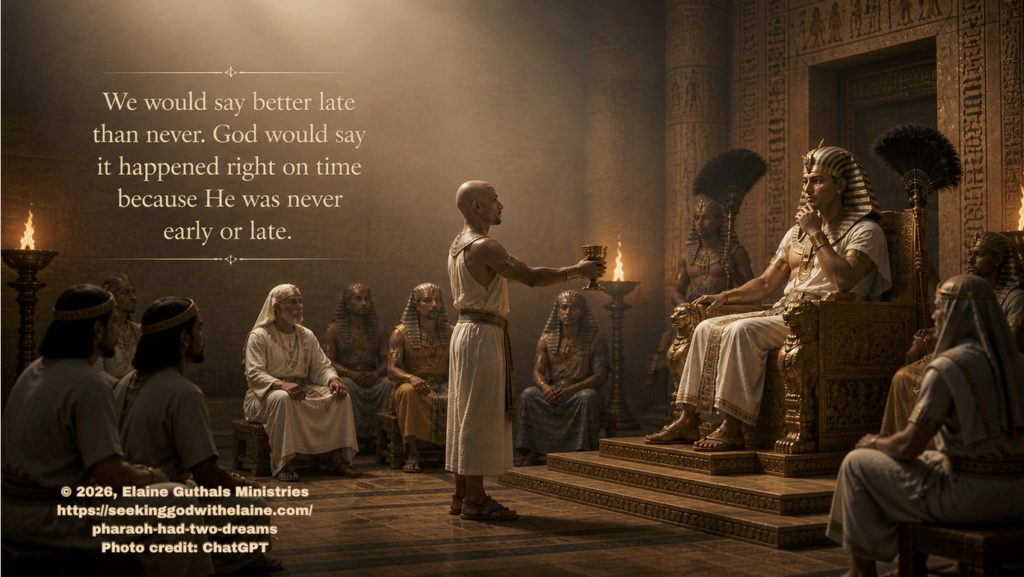
    But when Pharaoh had his dreams, it all came flooding back to the cupbearer. He finally remembered.

    We would say better late than never. God would say it happened right on time because He was never early or late.

    The first thing up of the cupbearer’s mouth was, “I messed up.” His conscience began to bother him.

    It is important that we recognize and remember our faults. We all have them. God wants us to take responsibility for them and come to Him for healing.

    What made the cupbearer remember? Someone was in the position he had been in two years earlier.

    Mordecai told Esther, “… Who knows if perhaps you were made queen for just such a time as this?” (Est. 4: 14 NLT). I have long paraphrased this as, “Maybe something happened to prepare me or set me up for what is happening now.”

    The cupbearer described Joseph as the Hebrew servant. It didn’t acknowledge how he had risen in the prison hierarchy. He was still described by a low status.

    What the cupbearer said that I think Pharaoh would have gravitated to was that Joseph’s interpretations proved to be true.

    Making the Connections #1

    I wonder if Joseph had great hopes for the first day or two. Maybe he didn’t expect anything to happen for the first week.

    But then the weeks turned to months, and the months turned to years.

    Did Joseph suffer? Oh, yes. Was he content where he was? I think so.

    We have to be content in whatever situation in which Jehovah allows for us. We shouldn’t focus on situations and circumstances. Our focus must be on Jehovah.

    Making the Connections #2

    Sometimes, God’s provision for us means we have to depend on others. I know. That is a big kick in the pants to our independence.

    We want to do things for ourselves, especially our own way.

    My mom was very independent. She knew what it was like to have your life planned one way and have God say, “Nope. I’ve got something else for you.”

    When she got cancer, Mom got to the point where she couldn’t do for herself. I remember her saying, “I have to let other people do for me in order for them to get their blessing.”

    Yes, they got their blessing, but this passage shows us how the person surrendering to dependence can be blessed and be a blessing to others.

    Joseph, through his obedience during the seven years of plenty, didn’t just provide for the Egyptian people. He provided for the Hebrew people. I am sure if those in Canaan knew there was food in Egypt, people from surrounding nations and people groups found their way there also.

    Jehovah’s salvation extends to all who will believe in His Son.

    Making the Connections #3

    Are we surprised that Jehovah allowed a non-believer to have such an important role in His plan? We shouldn’t.

    Jehovah’s salvation is for anyone who believes. How is one of the best ways to convince them to believe?

    To show them firsthand. To let them have a part in seeing how He provides.

    How Do We Apply This?

    • Be faithfulness in hidden seasons.
    • Understand Jehovah will prepare us before He promotes us.
    • Wait for Jehovah’s appointed time.
    • Understand that Jehovah is working behind the scenes.

    Father God. Even when we don’t see You working, You are. When the time is right, You will work Your plan. Help us to wait on You and to focus on You so we can listen to You. Amen.

    If you don’t understand something and would like further clarification, please contact me.

    If you have not signed up for the email providing the link to the devotions and the newsletter, do so below.

    If God has used this devotion to speak with you, consider sharing it on social media.

  • Joseph Interpreted Two Prisoners’ Dreams

    In the last devotion, Joseph was beginning to comfort the two other prisoners, each who had had a dream. This devotional reading looks at the interpretation of those dreams.

    Nuggets

    • The dream that the cupbearer described was one full of life, growth, and restoration.
    • Joseph interpreted the dream to mean the cupbearer would be restored by the Pharaoh in three days’ time.
    • Joseph just asked one thing for interpreting the dream.
    • Joseph remained faithful to Jehovah by honestly telling the baker the interpretation of his dream regardless of its unfavorable conclusion.
    • In the Ancient Near East, dream interpretation had one major litmus test.
    • Divine timing often includes delays that feel like neglect.
    joseph-interpreted-two-prisoners-dreams

    When we left Joseph at the end of the last devotion, he was getting ready to interpret the two royal officials; dreams.

    Yeah, this was something. Jehovah was revealing truth to Egyptians – through a Hebrew prisoner.

    Let’s Put It into Context

    To read devotions in the Creating Everything theme, click the button below.

    Devotions in the Joseph the Savior of Israel  series

    The Cupbearer’s Dream

    “So the chief cup-bearer told Joseph his dream first. ‘In my dream,’ he said, ‘I saw a grapevine in front of me. The vine had three branches that began to bud and blossom, and soon it produced clusters of ripe grapes. I was holding Pharaoh’s wine cup in my hand, so I took a cluster of grapes and squeezed the juice into the cup. Then I placed the cup in Pharaoh’s hand.’ ‘This is what the dream means,’ Joseph said. ‘The three branches represent three days. Within three days Pharaoh will lift you up and restore you to your position as his chief cup-bearer. And please remember me and do me a favor when things go well for you. Mention me to Pharaoh, so he might let me out of this place. For I was kidnapped from my homeland, the land of the Hebrews, and now I’m here in prison, but I did nothing to deserve it’” (Gen. 40: 9-15 NLT)

    In My Dream

    The dream that the cupbearer described was one full of life, growth, and restoration.

    The vivid image the cupbearer described was a growing branch that represented the growth process of a grapevine. It would bud, bloom, and produce grapes. Remove any one of those steps, and the grape would not be produced.

    The culmination of the dream was the cupbearer placing the wine from the grapes in his dream in Pharaoh’s hand.

    This Is What the Dream Means

    Joseph interpreted the dream to mean the cupbearer would be restored by the Pharaoh in three days’ time.

    We’ve talked before where some of the three-day references are really talking about the third day of the week. It isn’t here.

    The Hebrew phrase used here is bəʿôd šəlōšet yāmîm (בְּעוֹד שְׁלֹשֶׁת יָמִים). It means in yet three days or within three days. This is a count down method (like, “there are three days until Christmas).

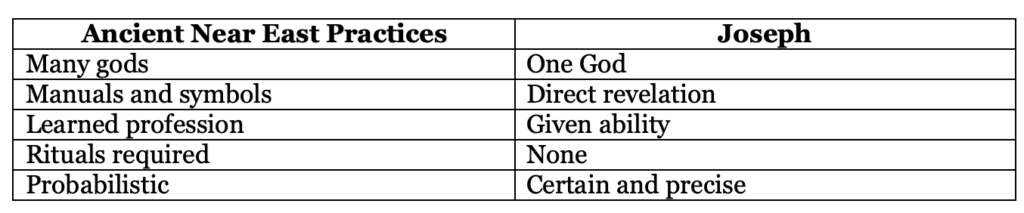
    While Joseph didn’t utilize the established Ancient Near East symbol system to determine patterns and cultural symbolism, that doesn’t mean he didn’t have to engage the imagery. He told the cupbearer what those images meant.

    • The vine symbolized life and productivity.
    • Three branches symbolized three-days’ time.
    • Serving Pharaoh symbolized his restoration.

    So, was Joseph saying one thing and doing another? No, he wasn’t.

    The difference was Who was the source behind the dream and the interpretation. That is Jehovah.

    But look at it a little closer. Whatever Jehovah ordains – whether trial or restoration – He uses it for our sanctification.

    That means the most important thing is how Jehovah is glorified.

    The cupbearer got good news from his dream. In three days, he would be restored to his position beside the Pharaoh.

    And Please Remember

    Joseph just asked one thing for interpreting the dream.

    This was the only time recorded that Joseph expressed his own suffering. He told the cupbearer that he was kidnapped from his country and was imprisoned unjustly.

    Wait! What????

    Joseph was sold by his brothers, not kidnapped. Why wouldn’t he say that?

    What Joseph told the cupbearer was a summary of what really happened. The Hebrew expression gunnōv gunnavtî (גֻּנֹּב גֻּנַּבְתִּי) conveys the act of being stolen.

    Well, Joseph’s life as he knew it was stolen away.

    Joseph didn’t get into the loss of identity. He just presented himself as one wrongly removed.

    If we look at it in today’s terminology, we would say that he was taken against his will, trafficked, and placed into circumstances that he didn’t choose. But Joseph didn’t want to get into all of that.

    So, Joseph left it as he had been treated unjustly and didn’t belong in prison.

    And, really, that was all the cupbearer needed to know. The cupbearer had been a royal official, but it would not have been his decision to free Joseph. Joseph was not making an emotional appeal, but a measured request within his situation.

    It was, also, probably the right tone to take. Joseph wasn’t giving an emotional account. He was just stating the facts.

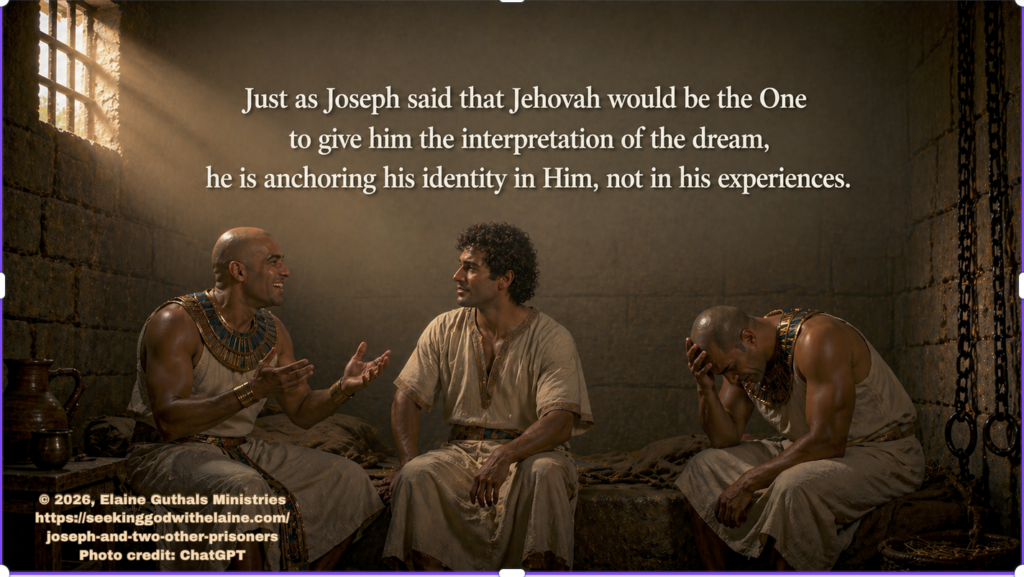
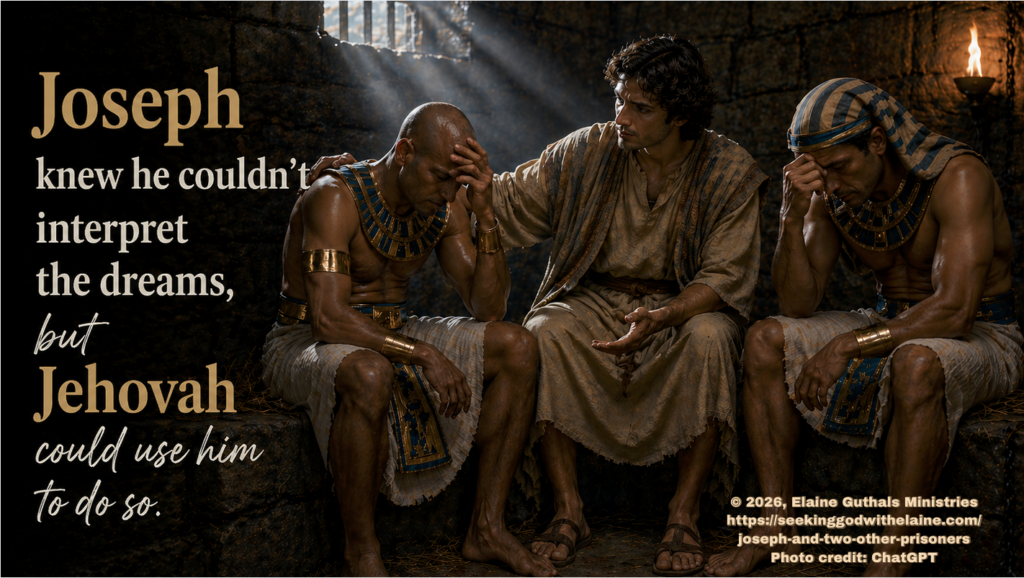
    Just as Joseph said that Jehovah would be the One to give him the interpretation of the dream, he is anchoring his identity in Him, not in his experiences.

    Jehovah governs both what is hidden and what is revealed. Truth belongs to Him—not only in its meaning, but also in its timing and its measure.

    This passage brings up an important theological lesson. We are to depend on Jehovah. We must put our trust in Him to provide for us.

    Sometimes, that provision will come because of some action we have taken. Jehovah will use human means to bring the restoration to fruition.

    The Baker’s Dream

    “When the chief baker saw that Joseph had given the first dream such a positive interpretation, he said to Joseph, ‘I had a dream, too. In my dream there were three baskets of white pastries stacked on my head. The top basket contained all kinds of pastries for Pharaoh, but the birds came and ate them from the basket on my head.’ ‘This is what the dream means,’ Joseph told him. ‘The three baskets also represent three days. Three days from now Pharaoh will lift you up and impale your body on a pole. Then birds will come and peck away at your flesh” (Gen. 40: 16-19 NLT)

    I Had a Dream, Too

    Joseph remained faithful to Jehovah by honestly telling the baker the interpretation of his dream regardless of its unfavorable conclusion.

    The baker’s dream was similar. It also used symbolism.

    • The three baskets symbolized three-days’ time.
    • The food symbolized provision.
    • The birds eating symbolized loss and judgment.

    The baker probably thought that it would have a similar outcomes. He shouldn’t have assumed

    The dream didn’t have as good of an outcome. Pharaoh was going to lift up the baker’s head from him.

    Joseph’s interpretation did not contain the good news that the cupbearer’s dream did. He told the baker that, in three days, he would be executed.

    That’s the thing. Jehovah doesn’t base His plans on our expectations.

    We know Jehovah has plans for us. We also know that He uses those experiences to sanctify us. “And we know that God causes everything to work together for the good of those who love God and are called according to his purpose for them” (Rom. 8: 28 NLT).

    Regardless of what Jehovah brings our way, He will use that as bricks for our Sanctification Road.

    The Dreams Fulfilled

    “Pharaoh’s birthday came three days later, and he prepared a banquet for all his officials and staff. He summoned his chief cup-bearer and chief baker to join the other officials. He then restored the chief cup-bearer to his former position, so he could again hand Pharaoh his cup. But Pharaoh impaled the chief baker, just as Joseph had predicted when he interpreted his dream” (Gen. 40: 20-22 NLT)

    In the Ancient Near East, dream interpretation had one major litmus test.

    Did the interpretation come true? The answer is yes.

    • Both interpretations happened exactly as Joseph said they would.
    • The timeline of three days was accurate.
    • The differing outcomes occurred exactly as Joseph said they would.

    Now, think back to the last devotion. We said that dreams were usually interpreted by priests, magicians, and trained diviners. Joseph was none of those things.

    And Joseph got it right. It was shown to be a revelation from Jehovah.

    Everything happened as Joseph had interpreted. The baker died, but the cupbearer was restored. Unfortunately, he didn’t remember Joseph as requested.

    Birthday celebrations were common in the Ancient Near East during that time. One usual occurrence was the rulers using these celebrations to issue rulings or pardons.

    The Hebrew used here is bayyōm haššəlîšî (בַּיּוֹם הַשְּׁלִישִׁי). It means on the third day.

    Yes, the Hebrew is different than what was in Genesis 40: 13 and 19. This is not a different timeframe, but the fulfillment point of the countdown previously given.

    So, the alarm went off and Christmas has arrived – actually a birthday in this case.

    Forgotten Again

    “Pharaoh’s chief cup-bearer, however, forgot all about Joseph, never giving him another thought” (Gen. 40: 23 NLT)

    Divine timing often includes delays that feel like neglect.

    Everything happened as Joseph had interpreted. The baker died, but the cupbearer was restored. He was faithful to Jehovah and compassionate to others.

    Unfortunately, the cupbearer didn’t remember Joseph as requested.

    How many times are we guilty of the same thing? We get so caught up in our own world that we forget — or don’t see — someone else. Jehovah doesn’t want that. He wants disciples to encourage one another.

    Making the Connections

    In this passage, Joseph interpreted two dreams – but there were two people. The impact of the interpretation focused just on those two people.

    But it was setting up the interpretation of two dreams for one person – one very influential person.

    Let’s compare the Ancient Near East practices and Joseph’s way to interpret dreams.

    What he was doing here was redefining dream interpretation. It wasn’t about divination – it was about revelation.

    It didn’t follow the normal system for dream interpretations. It was built on a relationship with Jehovah.

    It had nothing to do with Joseph and his skill. It had everything to do with depending on Jehovah and His plan.

    We look at this now because Genesis 40 is setting up Genesis 41. It was really important that Jehovah be shown as not only responsible for the dreams but also responsible for the situations within the dreams.

    Joseph’s interpretation was not the result of skill, system, or experience. It was the result of revelation. The timing, the outcomes, and the fulfillment all belonged to Jehovah. What appeared to be two isolated dreams were actually part of a larger movement that Joseph himself could not yet see. This passage reminds us that Jehovah is not only revealing meaning — He is orchestrating events. And both unfold according to His timing, not ours.

    How Do We Apply This?

    • Be attentive to others as Joseph was.
    • Recognize the limits of our control.
    • Wait for Jehovah to reveal meaning.
    • Trust Jehovah’s timing – even when it doesn’t align with our expectations.
    • Submit to Jehovah’s use of every circumstance for sanctification.

    Father God. You still come to us today. Reveal Your Will to us. Help us to obey.

    If you don’t understand something and would like further clarification, please contact me.

    If you have not signed up for the email providing the link to the devotions and the newsletter, do so below.

    If God has used this devotion to speak with you, consider sharing it on social media.

  • Joseph and Two Other Prisoners

    Joseph, in performing his assigned duties. Comforts two other prisoners. This devotional reading looks at who those prisoners were and why they were upset.

    Nuggets

    • Joseph had been in prison long enough to have risen in the ranks.
    • The cupbearer and the baker would have been high-ranking officials.
    • Jehovah was working behind the scenes to bring about the offense of Pharaoh’s cupbearer and baker so that they would be sent to prison.
    • The two servants stood suspended between accusation and outcome, unable to determine what came next.
    • Joseph remained faithful to Jehovah by being attentive to other prisoners.
    • Jehovah was working behind the scenes so that both servants had dreams on the same night
    joseph-and-the-two-other-prisoners

    Joseph’s life was about to change. He didn’t know it yet – and it would take a long time.

    But the events of one night were going to have a huge impact on the rest of his life.

    Let’s Put It into Context

    To read devotions in the Creating Everything theme, click the button below.

    Devotions in the Joseph the Savior of Israel  series

    Two Other Prisoners

    “Some time later, Pharaoh’s chief cup-bearer and chief baker offended their royal master. Pharaoh became angry with these two officials, and he put them in the prison where Joseph was, in the palace of the captain of the guard. They remained in prison for quite some time, and the captain of the guard assigned them to Joseph, who looked after them” (Gen. 40: 1-4 NLT)

    Some Time Later

    Joseph had been in prison long enough to have risen in the ranks.

    Even if this was a prison under Potiphar’s authority, it may have taken some time for Joseph to win the warden’s trust. But then again — since Potiphar didn’t automatically have Joseph killed — he may have known of Joseph’s value and suggested the position..

    Either way, Jehovah was working behind the scenes. How can we tell? It wasn’t coincidence that the three main characters of this part of the story were in the same prison.

    Jehovah works out His plan — even if we have no clue what that plan is.

    But look at this from Joseph’s perspective. He was still smack dab in the middle of a hard situation. It looked like Jehovah is doing nothing to get him out of it.

    Or is He?

    Chief Cupbearer and Chief Baker

    The cupbearer and the baker would have been high-ranking officials.

    We would be more familiar with the baker. He oversaw food preparation.

    Less familiar to us would be the responsibilities of the cupbearer — unless we have read about it in some other stories. Important people who were afraid of being poisoned had someone taste their drink first.

    In this instance, the cupbearer was responsible for the Pharaoh’s drink. That would have made him a well-trusted servant.

    Offended Their Royal Master

    Jehovah was working behind the scenes to bring about the offense of Pharaoh’s cupbearer and baker so that they would be sent to prison.

    We don’t know the offenses that landed the two servants there because the word translated offended – ḥāṭāʾ (חָטָא) – is intentionally vague.

    The offenses could have fallen anywhere on a continuum from negligence to suspected conspiracy. We also need to remember the purpose of this prison. It was not a place for convicted criminals but a detention center for the accused while their guilt or innocence was determined.

    What is striking about the Hebrew word is that it doesn’t define the action itself. It defines responsibility. Whatever they had done, they were considered guilty in Pharaoh’s eyes.

    That means the specific offense is not the primary focus of the text. However, understanding enough about Ancient Near Eastern customs helps us grasp why these two men would be placed in such a position—while still recognizing that the ultimate reason was that Jehovah was working behind the scenes to bring them there.

    If we ignore the cultural context, we risk minimizing the seriousness of their situation. We need a clear enough understanding to recognize why their presence in the prison matters.

    To make sense of this, let’s look first at the positions they held when things went wrong for them. Both men were Egyptian elites – high-ranking officials within Pharaoh’s administration. These were positions of significant authority because both controlled the food and drink that entered Pharaoh’s body.

    Access to the Pharaoh’s food and drink meant access to his life.

    Even negligence could have led to the Pharaoh’s death. It wouldn’t have required a deliberate act of poisoning; even a failure in oversight could have created an opportunity for someone else to act. What might seem minor in a modern context could have been life-threatening in that setting.

    Such a failure could easily lead to an accusation of treason. Any breach – whether intentional or accidental – carried the weight of potential assassination.

    We also can’t overlook that the offense was severe enough to warrant imprisonment yet not established enough to result in immediate execution. This indicates that the matter was still under investigation.

    So, what can we reasonably conclude from the text?

    • A breach in protocol occurred.
    • There may have been a suspicion – whether real or perceived – of an attempt to poison Pharaoh.
    • The possibility of conspiracy can’t be dismissed, given that both men oversaw Pharaoh’s food and drink.

    Whatever the exact offense, it must be understood as a serious threat to Pharaoh’s safety.

    What we do know is this: both men — whether guilty or innocent — were under suspicion. They, like Joseph, had no control over their own outcome. They existed in a state of suspension, caught between accusation and judgment, waiting for a decision they could neither influence nor predict.

    Remained in Prison for Quite Some Time

    The two servants stood suspended between accusation and outcome, unable to determine what comes next.

    This is another clue that their offense, though not named, was not trivial. Both men remained in prison for an unspecified amount of time. We are only told that it was a long time.

    Would we have wanted out of prison like yesterday? Of course. Would we be glad that a thorough investigation was being conducted. Yes – especially if we were innocent.

    But again, we have to remember that prisons were not used to house convicted criminals. In terms we would use today, it was a temporary detention center while due process was being conducted.

    Assigned Them to Joseph

    Joseph remained faithful to Jehovah by being attentive to other prisoners.

    We said in the last devotion that one of Joseph’s responsibility was probably managing prisoners. This confirms that.

    It also gives us a little insight into how Joseph performed that responsibility. We’ll see in the next passage that he knew those under his care well enough to see when something was wrong.

    My mind went back to the passage where Joseph was tattling on his half-brothers. “… He worked for his half brothers, the sons of his father’s wives Bilhah and Zilpah. But Joseph reported to his father some of the bad things his brothers were doing” (Gen. 37: 2 NLT).

    Joseph was probably tasked with the duty of watching over the prisoners to determine if any were going to cause trouble. The warden would have wanted that information passed on.

    Think about it, though. This is the second time Joseph has been betrayed. Neither time had he done anything wrong.

    Joseph didn’t turn away from other people. He didn’t harden his heart against life.

    Joseph put his faith and trust in Jehovah.

    The Servants Are Upset by Their Dreams

    While they were in prison, Pharaoh’s cup-bearer and baker each had a dream one night, and each dream had its own meaning. When Joseph saw them the next morning, he noticed that they both looked upset. ‘Why do you look so worried today?’ he asked them. And they replied, ‘We both had dreams last night, but no one can tell us what they mean.’ ‘Interpreting dreams is God’s business,’ Joseph replied. ‘Go ahead and tell me your dreams’” (Gen. 40: 5-8 NLT)

    Each Had a Dream One Night

    Jehovah was working behind the scenes so that both servants had dreams on the same night.

    In the Ancient Near East, dreams were seen as messages from one of the gods of the region. In this case, it was — it was a message from Jehovah Himself.

    If the dreamer was lucky, they would receive a dream containing a direct message. No interpretation would be needed because the god would speak clearly in the dream.

    The people of Egypt, as well as those in Mesopotamia and Canaan, would have believed omen dreams needed interpretation through an established symbol system. These symbols had actually been collected and out into manuals. These written guides showed pattern recognition and cultural symbolism.

    Now, some of the people of the time would seek out dreams — called dream incubation. They would do anything from performing rituals to sleeping in the temple.

    Joseph Noticed They Both Looked Upset

    The two servants didn’t seek out the dreams because they thought there was no one to interpret them.

    Think about it. The servants were upset because they dreamed and there was no one to interpret the dreams.

    Those who interpreted dreams were usually priests, magicians, and trained diviners. The servants wouldn’t have seen any of those people in the prison.

    Their anxiety was cultural, not just emotional.

    Interpreting Dreams Is God’s Business

    Jehovah worked behind the scenes to have Joseph in that prison that day to point to Him.

    Here’s where Joseph’s ability to dream started to be handy. Both men had a dream they could not interpret.

    That is a very important theological concept. We can’t determine our own fate. We can’t secure it. We can’t even change it.

    When the meaning is hidden from us, we have to wait on revelation from Jehovah to enlighten us.

    But Joseph’s statement of “… ‘Interpreting dreams is God’s business,’ …” (Gen. 40: 8 NLT) would have been as foreign to them as Joseph was. Dream interpretation was a skill and a system, not a revelation — and definitely not from a single God.

    Joseph knew he couldn’t interpret the dreams, but God could use him to do so. God can use us to do the impossible when we let Him.

    That statement that revelation belongs to Jehovah would have been something huge for the servants to accept. Joseph was rejecting the entire Ancient Near Eastern framework. He wouldn’t be using a manual. He wouldn’t perform any rituals first.

    Joseph would immediately give them a clear interpretation.

    Making the Connections #1

    We kept saying that Jehovah was acting behind the scenes to place all the needed elements for the desired conclusion of this story. Since it was behind the scenes, no one saw it.

    But I wonder if Joseph sat there on sleepless nights pondering if this was Jehovah working. Did he put events together and ask, “Where is He going with this?”

    Yes, that is purely speculation. But isn’t that what we do – when we slow down long enough to evaluate our Sanctification Road.

    Making the Connections #2

    We kept saying that Jehovah was acting behind the scenes to place all the needed elements for the desired conclusion of this story. Since it was behind the scenes, no one saw it.

    But I wonder if Joseph sat there on sleepless nights pondering if this was Jehovah working. Did he put events together and ask, “Where is He going with this?”

    Yes, that is purely speculation. But isn’t that what we do – when we slow down long enough to evaluate our Sanctification Road.

    Making the Connections #3

    “… ‘Interpreting dreams is God’s business,’ …” (Gen. 40: 8 NLT)

    Joseph was right when he said that interpreting dreams was God’s business. The interpretation came through revelation. Revelations come from God.

    Think about it. There are just some things that we are never going to figure out. No matter how much we research, investigate, or reason, we aren’t going to know.

    God only makes Himself known through revelation. He has revealed Himself in His Word, and He continues to do so through the Holy Spirit.

    Revelation boils down to what the Hebrew calls gālah (גָּלָה). It means to uncover, expose, or lay bare.

    To be uncovered, something must first be covered – hidden. We usually use terminology such as “We can’t see …”

    If we can’t see it, we can’t uncover it.

    The same thing happens with revelations. If revelation started with. us, then knowledge of God would be built on culture, intellect, and imagination.

    That would mean our knowledge would be worldly, limited, and more than likely wrong.

    It is only when Jehovah reveals Himself that we truly learn of Him. Truth is anchored in Him, not our faulty perception of Him.

    That means we receive not invent. To know – in Hebrew yādaʿ (יָדַע) – means we have to actively accept what Jehovah is telling us about Himself.

    Joseph was talking about unraveling what was hidden – pithrōn (פִּתְרוֹן), from pāthar (פתר). He understood that true interpretation depends entirely upon revelation. Symbols do not explain themselves. Even when imagery is present, it is God who assigns its meaning.

    Jehovah reveals. We do not discover – we receive.

    How Do We Apply This?

    • Be attentive to others to determine when they are struggling.
    • Recognize when outcomes are beyond your control.
    • Wait on Jehovah to reveal what is hidden.
    • Be receptive to Jehovah’s revelation when He makes it known.
    • Trust that Jehovah is working—even when you cannot see it.

    Father God. When we are upset, You send others to comfort us. Open the eyes of our hearts to Your revelations so that we can seek the meaning which You are giving. Amen.

    If you don’t understand something and would like further clarification, please contact me.

    If you have not signed up for the email providing the link to the devotions and the newsletter, do so below.

    If God has used this devotion to speak with you, consider sharing it on social media.
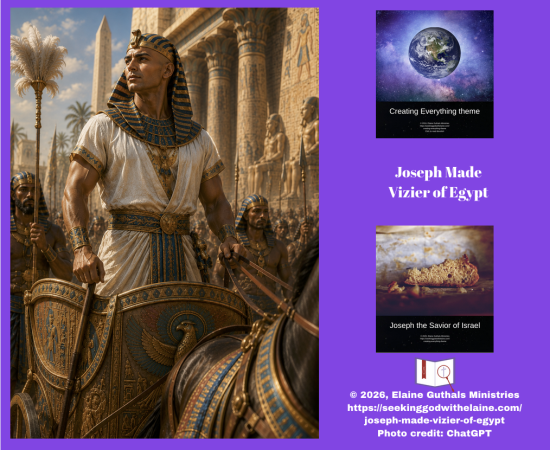
  • What a Beautiful Name

    Today is a music day.

    Well, I don’t think I’ve done this before. Adam and I went to a church family funeral today. That meant three hours driving.

    When I pulled up my post to put the finishing touches on it, I realized I wasn’t done with it.

    That is the last thought I had. Seven hours not-moving later, I am resurfacing. 

    So, I think we are going to do a music day today. I got to talk with Pastor Chris while at the funeral, and he said that he had just been remembering recording songs for me to share with you.

    I don’t know if this is the song he remembered, but it is one of my favorites from the time.

    I hope it comforts you today.

    What a Beautiful Name
    Vocalist: Elaine Guthals
    Keyboard: Chris Vieth

    how-do-we-love-godFB

    What do you think?

    Leave me a comment below (about this or anything else) or head over to my Facebook group for some interactive discussion.

    If you don’t understand something and would like further clarification, please contact me.

    If you have not signed up for the email daily or weekly providing the link to the devotions and the newsletter, do so below.

    If God has used this devotion to speak with you, consider sharing it on social media.

  • Joseph Was Thrown into Prison

    Wrongfully accused, Joseph was thrown into prison. This devotional reading looks at what that meant in his time.

    Nuggets

    • Potiphar had several reasons to be furious.
    • Joseph wasn’t thrown in a city jail, not even really a prison.
    • Once again, Joseph was rewarded for faithfulness.
    • Three times in Genesis 39, we are told that Jehovah was with Joseph (Gen. 39: 2; Gen. 21; and Gen. 39: 23).
    joseph-was-thrown-into-prison

    Joseph must have thought he hit rock bottom when he was sold in slavery to Egypt. He would have been wrong.

    During the early years of his captivity (and we don’t know how many), Joseph was well provided for in Potiphar’s house. He was put into a position of authority.

    But that safe lifestyle was about to change.

    Let’s Put It into Context

    To read devotions in the Creating Everything theme, click the button below.

    Devotions in the Joseph the Savior of Israel  series

    Potiphar Was Furious

    “Potiphar was furious when he heard his wife’s story about how Joseph had treated her.” (Gen. 39: 19 NLT)

    Potiphar had several reasons to be furious.

    We don’t know how long Joseph would have been a slave in Potiphar’s house. We do know it was long enough for him to come up the ranks.

    He would have started as a lowly slave running errands and carrying out simple instructions. As he showed his trustworthiness, his duties would have expanded.

    What kind of things might Joseph have been steward over? One probability over food and management. As it would entail distributing food rations and preparation flow, it was involved in daily survival.

    But then again, Joseph may have been a steward in inventory and storage. He would have to track what came and went out in order to determine if they had enough. In other words, he would have been overseeing the storehouses.

    Both positions – and I would think he would have cycled through both – would have prepared Joseph for what was to come.

    Joseph’s position as a steward would have meant he would have been taught to read and write Egyptian. He would have had to keep records and communicate things up the chain.

    It is even possible within these duties that Joseph would have supervised other servants as a steward. That ability would have definitely been needed as overseer.

    I would think that Potiphar’s estate was attached to land. If Joseph had maybe started out with the livestock – because he knew animals – he might have gotten experience in agricultural matters. He knew animals, but had he gotten enough knowledge and skill in Canaan about crops?

    Joseph would definitely need that!

    All that to say, Potiphar had invested a lot of time in Joseph. He would have been furious that his investment was no longer viable.

    Then there is the trust aspect. Joseph would have had to prove himself trustworthy to reach the position of overseer.

    Joseph didn’t abuse power. He didn’t cut corners. He didn’t take advantage of Potiphar.

    Because of that, Joseph was promoted to overseer. He was put in charge – pāqad (פָּקַד).

    One thing we may not think about is that Joseph probably was still functioning in some way as a steward even when promoted to authority. Joseph was made overseer in position, but he lived as a steward in practice — holding authority without ever forgetting it was entrusted, not owned.

    Remember what was said way back in verse 6. “So Potiphar gave Joseph complete administrative responsibility over everything he owned. With Joseph there, he didn’t worry about a thing — except what kind of food to eat! …” (Gen. 39: 6 NLT).

    And now that trust was all gone.

    That doesn’t even get into Potiphar’s feelings about Joseph allegedly attacking Mrs. Potiphar.

    Threw Him into the Prison Where the King’s Prisoners Were Held

    “So he took Joseph and threw him into the prison where the king’s prisoners were held, and there he remained” (Gen. 39: 20 NLT)

    Joseph wasn’t thrown in a city jail, not even really a prison.

    We said that Potiphar was the Captain of Pharaoh’s Guard. We said that the Hebrew phrase for that literally means chief of the slaughterers. As head of royal security, Potiphar oversaw royal prisons.

    Think about that a second. Potiphar oversaw both prisons and executions. Normally, slaves would have been executed.

    Joseph was imprisoned. Maybe Potiphar didn’t believe Mrs. Potiphar’s story. Or maybe he thought Joseph was too important to kill.

    It wasn’t a common dungeon, as we think of prisons at that time. It was a royal detention center (Gen. 39: 20). We know this because we are going to meet two players shortly.

    The normal prisoners were royal officials, political prisoners, and the accused but not condemned. There were probably about 20 to 80 prisoners at a time. Those held there would have been selective and high in value.

    This was not a crowded prison of forgotten men, but a controlled holding place for Pharaoh’s servants. It was small enough to be managed, yet significant enough to shape the course of a nation.

    This was a holding center until cases were resolved. Again, we know this because of the two men who will soon be held there.

    Some may have been being held there until trial, judgment, or execution. That would have made the normal term either weeks or months.

    That makes Joseph’s tenure here unusual. He stayed over two years (Gen. 41: 1). Did that mean his case was left unresolved, forgotten, or buried?

    Why so long? Well, maybe it was a sanctification reason. Maybe Jehovah was not positioning Joseph – but positioning Egypt.

    Let’s take a look at the prison itself — one that Potiphar may have administered. Look at this layout.

    This layout represents a fortified compound. The outer walls were thick mudbrick or stone. There would have been limited access points — and all guarded.

    The interior courtyard was an open-air space. It is possible that this was a congregating space. It may have been a place where they could have moved “freely.”

    The holding cells would have been small, enclosed rooms. Lighting would have been minimal. They might have been grouped by status.

    Of course, there would have been administrative space and guard quarters.

    The Lord Was With Joseph

    “But the Lord was with Joseph in the prison and showed him his faithful love. And the Lord made Joseph a favorite with the prison warden” (Gen. 39: 21 NLT)

    Three times in Genesis 39, we are told that Jehovah was with Joseph (Gen. 39: 2; Gen. 21; and Gen. 39: 23).

    The first time was when Joseph reached Egypt. He was just settling into Potiphar’s.  house.

    The second time was when Joseph was punished for a crime that he did not commit. Not only that, but he was also being punished for choosing to remain faithful.

    In this verse, we are told that Joseph found favor — ḥēn (חֵן). This is grace that produces visible acceptance.

    Ooo, baby. How many times have we wanted something — anything — visible from Jehovah. But would we know it if we saw it?

    What if Joseph though Jehovah’s favor would only be evident when he got out of the prison? It would have been a long two years.

    But Jehovah’s favor was easing Joseph’s situation in the prison.

    The third time we are told Jehovah was with Joseph was when he had been in the prison for an undisclosed amount of time. It had been, though, time enough for him to become second-in-command at the prison.

    Since we know the rest of the story, we know that this was all in God’s plan.  Even in prison, God’s presence didn’t leave Joseph. He still prospered because God was still with him.

    In Charge of All the Other Prisoners and Everything that Happened in the Prison

    “Before long, the warden put Joseph in charge of all the other prisoners and over everything that happened in the prison. The warden had no more worries, because Joseph took care of everything. The Lord was with him and caused everything he did to succeed” (Gen. 39: 22-23 NLT)

    Once again, Joseph was rewarded for faithfulness.

    We aren’t told exactly what Joseph’s responsibilities as second-in-command entailed. We are just told that he took care of everything.

    One responsibility was probably managing prisoners. We know that Joseph had personal interaction with the other prisoners. He played a big role on the situation of two such prisoners.

    Joseph probably was in charge of distributing resources. Food would have been a big item. I would think that any health care needed would be under his watch. Basically, he would be overseeing daily operations.

    Surely, the prisoners had chores to do within the prison. Joseph possibly supervised them.

    Look at this.

    At each place where Joseph was held against his will, he was given responsibilities that grew in size, complexity, and reach, preparing him for what was ahead. Through it all, his obedience remained the same.

    Even in prison, Joseph was in proximity to power. He was placed to intersect with those to take him to the next level.

    Making the Connections #1

    Joseph was faithful in whatever circumstance he was in. He didn’t wait to get promoted before he became faithful. He didn’t demand freedom before he would give his faithfulness.

    As we said in the last devotion – Joseph allowed Sovereign God to use him wherever He put him. His circumstances changed, but his obedience did not.

    Joseph didn’t need Jacob to retain his integrity. He didn’t need an accountability structure. He didn’t need witnesses.

    Jehovah was the only Witness Joseph needed. He chose righteousness.

    Making the Connections #2

    Have you ever looked at Joseph’s time in prison was actually an attitude adjustment? He would have had to be upset when he was suddenly removed from what he would have seen as a good job and accused of a crime he didn’t commit.

    But Joseph went from being accused in Potiphar’s house to being trusted again in prison.

    Joseph was not thrown away — he was transferred. The prison was not a dead end, but a corridor within Pharaoh’s system, placing him exactly where the next door would open.

    Making the Connections #3

    If Jehovah was with Joseph in his trials, won’t He be with us in ours? We, too, can find favor with Him when we are content in whatever situation in which He puts us.

    Remain faithful in all things.

    Making the Connections #4

    Let’s compare Judah and Joseph.

    Judah’s story shows us what happens when covenant identity is abandoned. Joseph’s story shows us what happens when covenant identity is maintained under pressure.

    How Do We Apply This?

    • Reflect on our own challenges to recognize Jehovah’s presence.
    • Persevere, maintain integrity, and rely on Him.

    Prayer

    If you don’t understand something and would like further clarification, please contact me.

    If you have not signed up for the email providing the link to the devotions and the newsletter, do so below.

    If God has used this devotion to speak with you, consider sharing it on social media.