Wrongfully accused, Joseph was thrown into prison. This devotional reading looks at what that meant in his time.
Nuggets
- Potiphar had several reasons to be furious.
- Joseph wasn’t thrown in a city jail, not even really a prison.
- Once again, Joseph was rewarded for faithfulness.
- Three times in Genesis 39, we are told that Jehovah was with Joseph (Gen. 39: 2; Gen. 21; and Gen. 39: 23).

Joseph must have thought he hit rock bottom when he was sold in slavery to Egypt. He would have been wrong.
During the early years of his captivity (and we don’t know how many), Joseph was well provided for in Potiphar’s house. He was put into a position of authority.
But that safe lifestyle was about to change.
Let's Put It into Context
To read devotions in the Creating Everything theme, click the button below.
Devotions in the Joseph the Savior of Israel series
Potiphar Was Furious
"Potiphar was furious when he heard his wife’s story about how Joseph had treated her.” (Gen. 39: 19 NLT)
Potiphar had several reasons to be furious.
We don’t know how long Joseph would have been a slave in Potiphar’s house. We do know it was long enough for him to come up the ranks.
He would have started as a lowly slave running errands and carrying out simple instructions. As he showed his trustworthiness, his duties would have expanded.
What kind of things might Joseph have been steward over? One probability over food and management. As it would entail distributing food rations and preparation flow, it was involved in daily survival.
But then again, Joseph may have been a steward in inventory and storage. He would have to track what came and went out in order to determine if they had enough. In other words, he would have been overseeing the storehouses.
Both positions – and I would think he would have cycled through both – would have prepared Joseph for what was to come.
Joseph’s position as a steward would have meant he would have been taught to read and write Egyptian. He would have had to keep records and communicate things up the chain.
It is even possible within these duties that Joseph would have supervised other servants as a steward. That ability would have definitely been needed as overseer.
I would think that Potiphar’s estate was attached to land. If Joseph had maybe started out with the livestock – because he knew animals – he might have gotten experience in agricultural matters. He knew animals, but had he gotten enough knowledge and skill in Canaan about crops?
Joseph would definitely need that!
All that to say, Potiphar had invested a lot of time in Joseph. He would have been furious that his investment was no longer viable.
Then there is the trust aspect. Joseph would have had to prove himself trustworthy to reach the position of overseer.
Joseph didn’t abuse power. He didn’t cut corners. He didn’t take advantage of Potiphar.
Because of that, Joseph was promoted to overseer. He was put in charge – pāqad (פָּקַד).
One thing we may not think about is that Joseph probably was still functioning in some way as a steward even when promoted to authority. Joseph was made overseer in position, but he lived as a steward in practice — holding authority without ever forgetting it was entrusted, not owned.
Remember what was said way back in verse 6. “So Potiphar gave Joseph complete administrative responsibility over everything he owned. With Joseph there, he didn’t worry about a thing — except what kind of food to eat! …” (Gen. 39: 6 NLT).
And now that trust was all gone.
That doesn’t even get into Potiphar’s feelings about Joseph allegedly attacking Mrs. Potiphar.
Threw Him into the Prison Where the King’s Prisoners Were Held
"So he took Joseph and threw him into the prison where the king’s prisoners were held, and there he remained" (Gen. 39: 20 NLT)
Joseph wasn’t thrown in a city jail, not even really a prison.
We said that Potiphar was the Captain of Pharaoh’s Guard. We said that the Hebrew phrase for that literally means chief of the slaughterers. As head of royal security, Potiphar oversaw royal prisons.
Think about that a second. Potiphar oversaw both prisons and executions. Normally, slaves would have been executed.
Joseph was imprisoned. Maybe Potiphar didn’t believe Mrs. Potiphar’s story. Or maybe he thought Joseph was too important to kill.
It wasn’t a common dungeon, as we think of prisons at that time. It was a royal detention center (Gen. 39: 20). We know this because we are going to meet two players shortly.
The normal prisoners were royal officials, political prisoners, and the accused but not condemned. There were probably about 20 to 80 prisoners at a time. Those held there would have been selective and high in value.
This was not a crowded prison of forgotten men, but a controlled holding place for Pharaoh’s servants. It was small enough to be managed, yet significant enough to shape the course of a nation.
This was a holding center until cases were resolved. Again, we know this because of the two men who will soon be held there.
Some may have been being held there until trial, judgment, or execution. That would have made the normal term either weeks or months.
That makes Joseph’s tenure here unusual. He stayed over two years (Gen. 41: 1). Did that mean his case was left unresolved, forgotten, or buried?
Why so long? Well, maybe it was a sanctification reason. Maybe Jehovah was not positioning Joseph – but positioning Egypt.
Let’s take a look at the prison itself — one that Potiphar may have administered. Look at this layout.
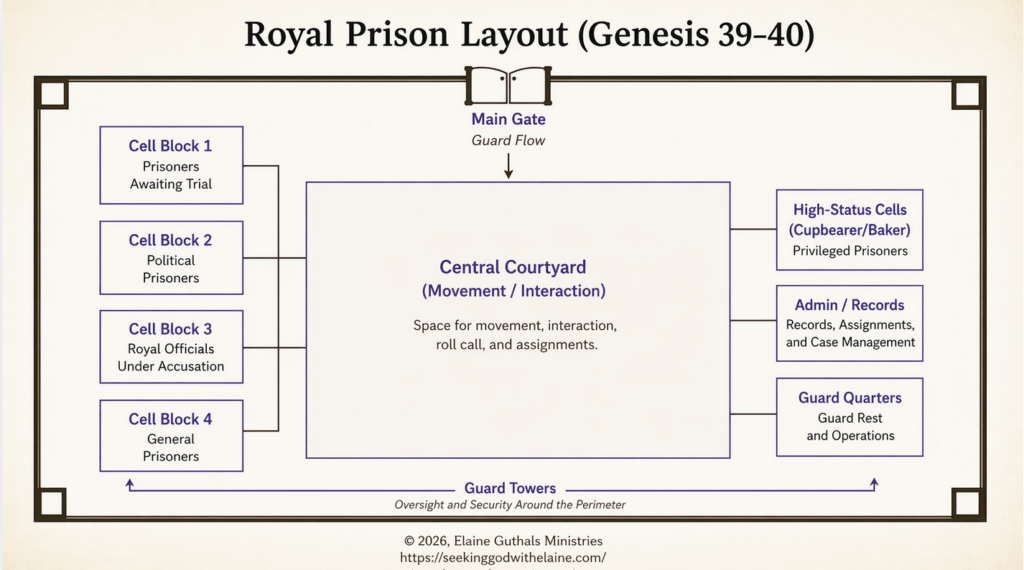
This layout represents a fortified compound. The outer walls were thick mudbrick or stone. There would have been limited access points — and all guarded.
The interior courtyard was an open-air space. It is possible that this was a congregating space. It may have been a place where they could have moved “freely.”
The holding cells would have been small, enclosed rooms. Lighting would have been minimal. They might have been grouped by status.
Of course, there would have been administrative space and guard quarters.
The Lord Was With Joseph
"But the Lord was with Joseph in the prison and showed him his faithful love. And the Lord made Joseph a favorite with the prison warden" (Gen. 39: 21 NLT)
Three times in Genesis 39, we are told that Jehovah was with Joseph (Gen. 39: 2; Gen. 21; and Gen. 39: 23).
The first time was when Joseph reached Egypt. He was just settling into Potiphar’s. house.
The second time was when Joseph was punished for a crime that he did not commit. Not only that, but he was also being punished for choosing to remain faithful.
In this verse, we are told that Joseph found favor — ḥēn (חֵן). This is grace that produces visible acceptance.
Ooo, baby. How many times have we wanted something — anything — visible from Jehovah. But would we know it if we saw it?
What if Joseph though Jehovah’s favor would only be evident when he got out of the prison? It would have been a long two years.
But Jehovah’s favor was easing Joseph’s situation in the prison.
The third time we are told Jehovah was with Joseph was when he had been in the prison for an undisclosed amount of time. It had been, though, time enough for him to become second-in-command at the prison.
Since we know the rest of the story, we know that this was all in God’s plan. Even in prison, God’s presence didn’t leave Joseph. He still prospered because God was still with him.
In Charge of All the Other Prisoners and Everything that Happened in the Prison
"Before long, the warden put Joseph in charge of all the other prisoners and over everything that happened in the prison. The warden had no more worries, because Joseph took care of everything. The Lord was with him and caused everything he did to succeed” (Gen. 39: 22-23 NLT)
Once again, Joseph was rewarded for faithfulness.
We aren’t told exactly what Joseph’s responsibilities as second-in-command entailed. We are just told that he took care of everything.
One responsibility was probably managing prisoners. We know that Joseph had personal interaction with the other prisoners. He played a big role on the situation of two such prisoners.
Joseph probably was in charge of distributing resources. Food would have been a big item. I would think that any health care needed would be under his watch. Basically, he would be overseeing daily operations.
Surely, the prisoners had chores to do within the prison. Joseph possibly supervised them.
Look at this.

At each place where Joseph was held against his will, he was given responsibilities that grew in size, complexity, and reach, preparing him for what was ahead. Through it all, his obedience remained the same.
Even in prison, Joseph was in proximity to power. He was placed to intersect with those to take him to the next level.
Making the Connections #1
Joseph was faithful in whatever circumstance he was in. He didn’t wait to get promoted before he became faithful. He didn’t demand freedom before he would give his faithfulness.
As we said in the last devotion – Joseph allowed Sovereign God to use him wherever He put him. His circumstances changed, but his obedience did not.
Joseph didn’t need Jacob to retain his integrity. He didn’t need an accountability structure. He didn’t need witnesses.
Jehovah was the only Witness Joseph needed. He chose righteousness.
Making the Connections #2
Have you ever looked at Joseph’s time in prison was actually an attitude adjustment? He would have had to be upset when he was suddenly removed from what he would have seen as a good job and accused of a crime he didn’t commit.
But Joseph went from being accused in Potiphar’s house to being trusted again in prison.
Joseph was not thrown away — he was transferred. The prison was not a dead end, but a corridor within Pharaoh’s system, placing him exactly where the next door would open.
Making the Connections #3
If Jehovah was with Joseph in his trials, won’t He be with us in ours? We, too, can find favor with Him when we are content in whatever situation in which He puts us.
Remain faithful in all things.
Making the Connections #4
Let’s compare Judah and Joseph.
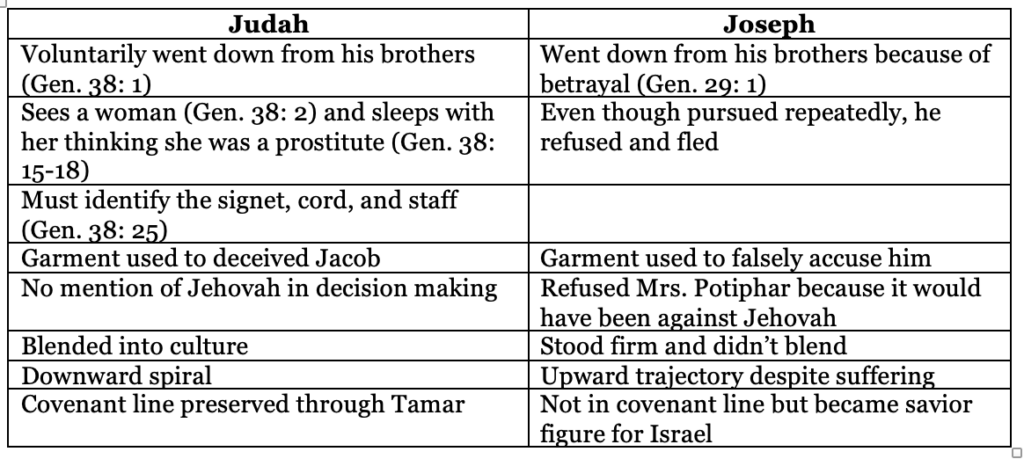
Judah’s story shows us what happens when covenant identity is abandoned. Joseph’s story shows us what happens when covenant identity is maintained under pressure.
How Do We Apply This?
- Reflect on our own challenges to recognize Jehovah’s presence.
- Persevere, maintain integrity, and rely on Him.
Prayer
If you don’t understand something and would like further clarification, please contact me.
If you have not signed up for the email providing the link to the devotions and the newsletter, do so below.
If God has used this devotion to speak with you, consider sharing it on social media.