While the famine was occurring in Egypt, it was also occurring in Canaan. This devotional reading looks at how it impacted Jacob and his family.
Nuggets
- Jacob realized that the family could not survive the famine by waiting it out because of its severity.
- Salvation was available elsewhere.
- The brothers’ reaction to the famine is interesting.
- The brothers went to Egypt so, as Jacob said, “… that we may live and not die” (Gen. 42: 2 ESV).
- Jacob’s favoritism never diminished.
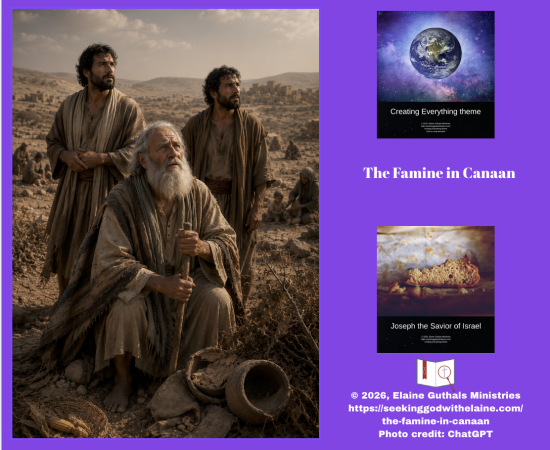
We have been focusing on the abundance and famine in Egypt. We don’t know if there was abundance for those seven years — 1679 – 1673 BC — in Canaan.
If there was, it sounds like they didn’t catch it.
We do know is the seven years of famine started in Canaan at the same time it did in Egypt — 1672 BC. How do we know? Genesis 42 tells us.
Let's Put It into Context
To read devotions in the Creating Everything theme, click the button below.
Devotions in the Joseph the Savior of Israel series
Let's Put It into Context #2
Egypt became Ground Zero as the survival center for the world during the famine. There was only one reason for that.
Jehovah had used Joseph to warn them.
First, we have to look at the extent of the famine.
The world-wide famine began in 1672 BC. Do we actually know what constitutes the world in 1672 BC?
Well, not exactly. (And we have to remember that it looks nothing like the map of the world today).
Think all the way back in Genesis 10. We had a map that listed where Noah’s sons — Shem, Ham, and Japheth — settled.
That is a good starting place. But let’s add trade routes to it.
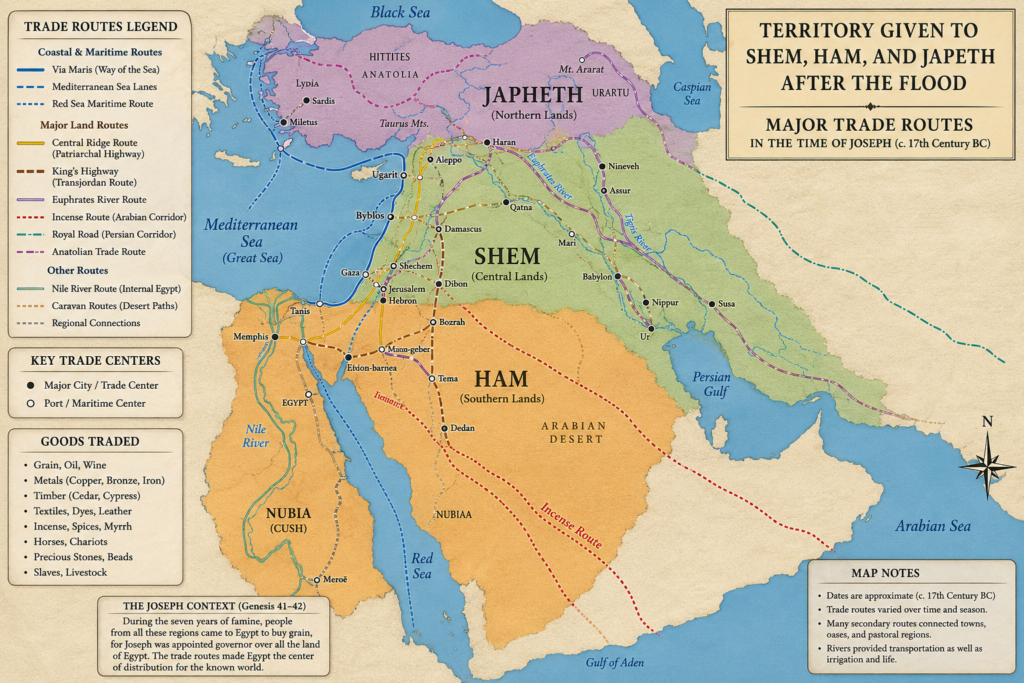
If we look at the Hebrew phrase used, it is kol-hāʾāreṣ (כָּל־הָאָרֶץ). The end part, also seen as ereṣ (אֶרֶץ), can mean the following: earth, land, territory, region, or country.
If world-wide is the correct terminology to use, it would have meant the known world at that time.
But the Table of Nations wasn’t just a genealogy list. It was a theological geography of humanity after the flood.
So, when Genesis 41: 57 says “all countries came to Egypt to Joseph to buy grain” (Gen. 41: 57 NLT), it could be making a theological point instead of a technical census point.
Jehovah caused humankind to scatter after the Tower of Babel (Gen. 11: 8). Now they are coming back to Joseph, who points to Yeshua.
The emphasis should be on overwhelming scope, international dependence, and Jehovah’s providential elevation of Joseph. It was not necessarily a technical census of every inhabited location on earth.
Joseph becomes a preservation instrument for the post-flood world.
Starving in Canaan
“When Jacob heard that grain was available in Egypt, he said to his sons, ‘Why are you standing around looking at one another? ” (Gen. 42: 1 NLT)
When Jacob Heard
Jacob realized that the family could not survive the famine by waiting it out because of its severity.
This was probably 1671 BC — if not the end of 1672 BC. The famine started in 1672, and Jacob and his family moved down to Egypt in 1670.
There had to be some time for them to realize this famine wasn’t going to go away anytime soon. Then they had to get down to Egypt and back (Gen. 42: 3-29). Next, they had to eat all that food they bought. Then, they had to get down to Egypt and back again (Gen. 43: 15 – 45: 25). It also probably took some time to prepare the household and all its possessions for the move (Gen. 46: 1).
The Hebrew word for famine is rāʿāb (רָעָב). It describes a consuming deprivation.
Let’s stop a second and take a look at the last time we saw Jacob. He had just recognized Joseph’s bloody tunic.
“Then Jacob tore his clothes and dressed himself in burlap. He mourned deeply for his son for a long time. His family all tried to comfort him, but he refused to be comforted. ‘I will go to my grave mourning for my son,’ he would say, and then he would weep” (Gen. 37: 34-35 NLT).
Jacob assumed Joseph was dead and was paralyzed with grief. He wasn’t putting his trust in Jehovah.
Was Jacob able to continue as patriarch because of his grief? It doesn’t sound like it.
At least not for a while. Here, Jacob did step up and take control of the situation.
These weren’t exactly words of love and encouragement. But given the situation, they were probably the words needed.
Grain Was Available in Egypt
Salvation was available elsewhere.
Some people may say it was luck that had Egypt collecting all that grain in the good years. Some would say it was coincidence that the brothers went where Joseph was.
It was neither. It was God’s divine plan.
Was Jehovah interested in Jacob? In Joseph? In Judah? Yes.
Sovereign God was more interested in His people. It wasn’t just about the individual person (as much as He loves us individually). It was about furthering His kingdom.
Why Are You Standing
The brothers’ reaction to the famine is interesting.
When Jacob talked to his sons, they were frozen in fear. There was a real possibility the family would starve — and none of the sons wanted to take responsibility for saving the family. They didn’t want to act.
Yeah, this sounds a lot different from the ten decisive men who violently captured their brother and sold him into slavery. And no, it does not seem they have changed for the better.
Had they already heard there was food in Egypt? Did they not want to go to where they had banished Joseph? Surely, it didn’t cross their minds that they would run into him.
Was their consciences still bothering them after 13 years? Were they sorry for their actions? Or were they sorry that Jacob’s favoritism had just switched to Benjamin?
Joseph’s Ten Older Brothers Went Down to Egypt
"I have heard there is grain in Egypt. Go down there, and buy enough grain to keep us alive. Otherwise we’ll die.’ So Joseph’s ten older brothers went down to Egypt to buy grain” (Gen. 42: 2-3 NLT)
The brothers went to Egypt so, as Jacob said, “… that we may live and not die” (Gen. 42: 2 ESV).
Why did all ten of them go down to Egypt? Did they have to walk and carry the sacks? Did each buy for his own family and then get extra for Jacob and Benjamin?
I think — whatever the “excuse” to get them all there — they were all in this together. They were all in on the sale of Joseph, even if Reuben wasn’t in it wholeheartedly.
When we were looking at Judah and Tamar’s story, we said several times that Jehovah was using something to tie it back to when the sin occurred. For example, when Tamar sent the signet, cord, and staff asking, “Please identify” (Gen. 38: 25) echoed when the boys sent the bloody tunic asking, “Do you recognize this?” (Gen. 37: 32).
The brothers had sold Joseph to traders that were heading down to Egypt. They had to go down to Egypt to tie off that part of the sin.
They all had a hand in accomplishing getting Joseph to where he needed to be. They should all see first-hand what had become of him. They all needed restoration.
This drives home the point that, though we may feel our actions are right, and the situation may turn out alright in the end — our actions can still be wrong.

It was wrong to sell Joseph as a slave. It would have been wrong to kill him.
Yes, we learn more from our sins and mistakes. That doesn’t give us license to commit them.
They are still wrong.
Jacob Wouldn’t Let Benjamin Go
"But Jacob wouldn’t let Joseph’s younger brother, Benjamin, go with them, for fear some harm might come to him. So Jacob’s sons arrived in Egypt along with others to buy food, for the famine was in Canaan as well” (Gen. 42: 1-5 NLT)
Jacob’s favoritism never diminished.
Benjamin did not have to go on this trip because, while he had already been born when Joseph had been sold, he was still in diapers. He had no part in the sale.
I wonder what kind of life Benjamin had. It doesn’t really seem like Jacob learned his lesson. The “favorite son” title just passed from Joseph to Benjamin. It sounds like Jacob coddled and protected Benjamin.
The Hebrew word for harm is ʾāsôn (אָסוֹן) meaning disaster, calamity, or fatal tragedy. Since Jacob probably never forgave himself for sending Joseph to check in his brothers, he wasn’t about to send Benjamin on this perilous journey.
If we look at the Interlinear Bible for verse 5, we see that the brothers are called the sons of Israel. This name is used when the covenant identity is stressed.
Resource
Jacob is frozen by his grief, in the same manner that the brothers are frozen in their fear; but the covenant plan is moving along as Jehovah intended.
Making the Connections
Trials come packaged in a variety of ways. In our minds, we may be going through a situation that has the same consequences that Jacob and his sons were facing.
We may have to do something just as distasteful to us in order “… that we may live and not die” (Gen. 42: 2 ESV).
When those trials do come — and they will — we need to follow Smith’s advice. He wrote, “When distresses and trials come, we should be ready to trust that God means to do good by them in some way, though we may not know how.”
Resource
We may be more familiar with it being expressed another way. “And we know that for those who love God all things work together for good, for those who are called according to his purpose” (Rom. 8: 28 ESV).

How Do We Apply This?
- Trust Jehovah even when you do not understand what He is doing.
- Move forward in obedience even when the path is uncomfortable or frightening.
- Refuse to let fear paralyze you spiritually.
- Examine whether unresolved sin is affecting your relationship with God or others.
- Stop interpreting difficult providences as evidence that
- Jehovah has abandoned you.
- Recognize that God may use hardship to expose, correct, and restore.
- Submit to Jehovah’s covenant purposes instead of focusing only on personal comfort.
- Remember that divine providence does not excuse sinful choices.
- Seek restoration where sin has damaged relationships.
- Be willing to revisit painful places if Jehovah uses them for healing and growth.
- Trust that Jehovah is working for your sanctification even during seasons of deprivation.
- Act in faith instead of waiting passively for circumstances to improve.
Father God. Thank You that You are with us during the good times and the bad times. Help us to see You providing hand in our lives. Bring us to the point where we must confess our sins to You. Amen.
If you don’t understand something and would like further clarification, please contact me.
If you have not signed up for the email providing the link to the devotions and the newsletter, do so below.
If God has used this devotion to speak with you, consider sharing it on social media.