The tension is building in Jacob’s household and is fixing to blow a gasket. This devotional reading looks at what can happen when brothers do nothing to check their anger and jealousy.
Nuggets
- Joseph arrived to complete his father’s mission but was betrayed by his brothers.
- The cistern was built to hold life-giving water; but for Joseph, it became the place where everything was stripped away.
- The brothers took care of Joseph and sat down to eat.
- Trade caravans were a familiar sight along established trade routes.
- A suggestion was made that saved Joseph’s life.
- The amount the brothers sold Joseph for is significant.
- Well, Reuben’s intent was to rescue Joseph, but he didn’t.
- Once the brothers had betrayed their brother, they had to deceive their father.
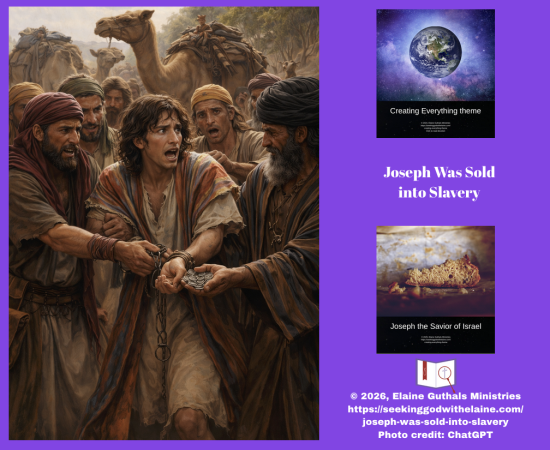
Joseph arrived at Dothan to accomplish the mission Jacob had given him. “Go to your brothers and see how they and the flocks are doing.” It was supposed to be just a jaunt to Shechem.
But the brothers weren’t there. They had moved on to Dothan.
Jacob was obedient to his mission and followed them there. He had no clue what was facing him.
Let's Put It into Context
To read devotions in the Creating Everything theme, click the button below.
Devotions in the Joseph the Savior of Israel series
The Brothers’ Plan Implemented
“So when Joseph arrived, his brothers ripped off the beautiful robe he was wearing. Then they grabbed him and threw him into the cistern. Now the cistern was empty; there was no water in it. Then, just as they were sitting down to eat, they looked up and saw a caravan of camels in the distance coming toward them. It was a group of Ishmaelite traders taking a load of gum, balm, and aromatic resin from Gilead down to Egypt” (Gen. 37: 23-25 NLT)
Joseph Arrived
Joseph arrived to complete his father’s mission but was betrayed by his brothers.
I would believe that the first thing the brothers did after Joseph arrived and was captured was to take Joseph’s tunic. That would be a symbolic stripping him of his status. Remember, this may have been Jacob’s symbol of making Joseph his firstborn.
Removing the tunic would have been very important to the brothers. It highlighted their jealousy of him. It helped them bond together in their hatred of Joseph.
By divesting Joseph of the gift given by their father, they humiliated him. It was also a dig at their father, when they sent it to him to identify Joseph.
What would it mean to Joseph? Beyond highlighting his brothers’ jealousy and betrayal, it stripped Joseph of his status as favored son. But it also stripped him of his identity.
Beyond that, it sets the stage for future events. It sets in motion the next phase of Jehovah’s plan. It foreshadows the hardships he will endure in Egypt.
Threw Him into the Cistern
The cistern was built to hold life-giving water; but for Joseph, it became the place where everything was stripped away.
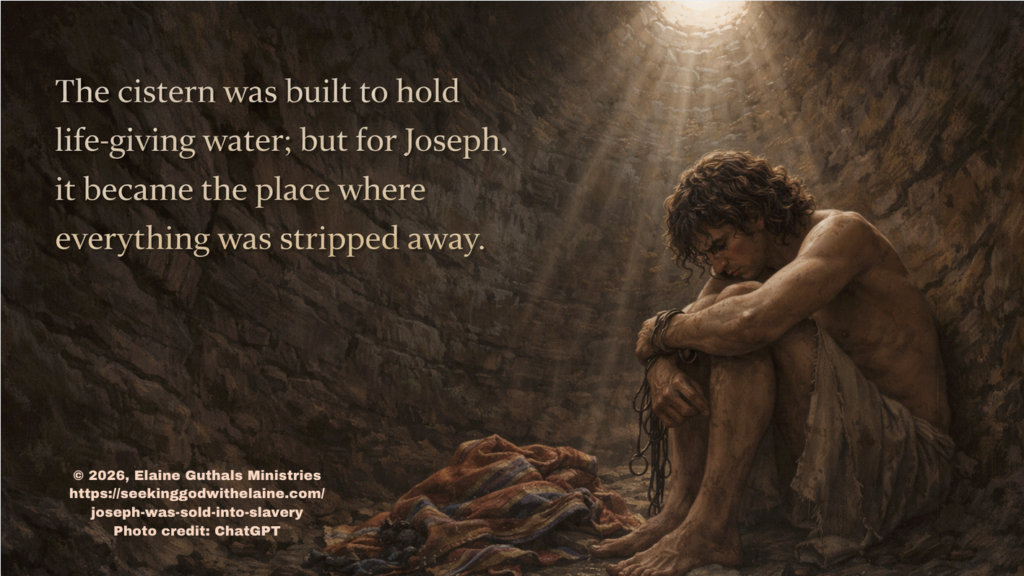
If we look at the Hebrew, we see the word bôr – pit. If we use the functional definition, we see that it is a man-made water reservoir – or what we call a cistern.
Growing up on the farm and at the house in the country subdivision we lived in when Adam was born, we had a cistern. My sister has a cistern at her house.
In fact, the day my sister hosted the baby shower for Adam, the well ran out of water. If wells can, cisterns can. Just because the tank is buried in the yard doesn’t mean that it has water that can be used.
We had talked about the brothers moving from Shechem to Dothan probably in search of water and grass. If the cistern was empty, that probably meant it was the dry season.
In order to catch precious rainwater, people would carve deep chambers into rock and plaster the inside. The bottom of the chamber was probably somewhat roomy, but the top was a narrow opening.
It was deep enough that Joseph couldn’t climb out of it, but then, it didn’t have a ladder for Joseph to climb down into it. That meant he was thrown into this dark, enclosed space.
It was in one of those water reservoirs that Joseph was placed. The only way out was for Reuben – or someone else – to lift him out.
Just as They Were Sitting Down to Eat
The brothers took care of Joseph and sat down to eat.
Talk about Jehovah working things in a hurry! It didn’t sound like much time passed at all before Jehovah started the next phase of His plan.
But kick that around in your mind a second. One minute, the brothers throw Joseph into the pit. The next minute they say, “Let’s eat. I’m starved.”
Are they laughing? Slapping each other on the back?
Once again, Joseph is at a totally different place than his brothers.
Saw a Caravan
Trade caravans were a familiar sight along established trade routes.
Trade had been occurring in caravans such as this for a long time. Caravans were specialized traders moving luxury goods across regions. The routes connected Canaan to both Egypt to the south and Mesopotamia to the north.
We are talking fixed routes established because of water access, safety, and terrain. There were known stops along the way.
One of the major north-south routes was called the Via Maris. Dothan connected to routes feeding into the Via Maris. To me, that was why it was important to Jehovah’s plan that the brothers and the flocks travel to Dothan for Joseph to follow them.
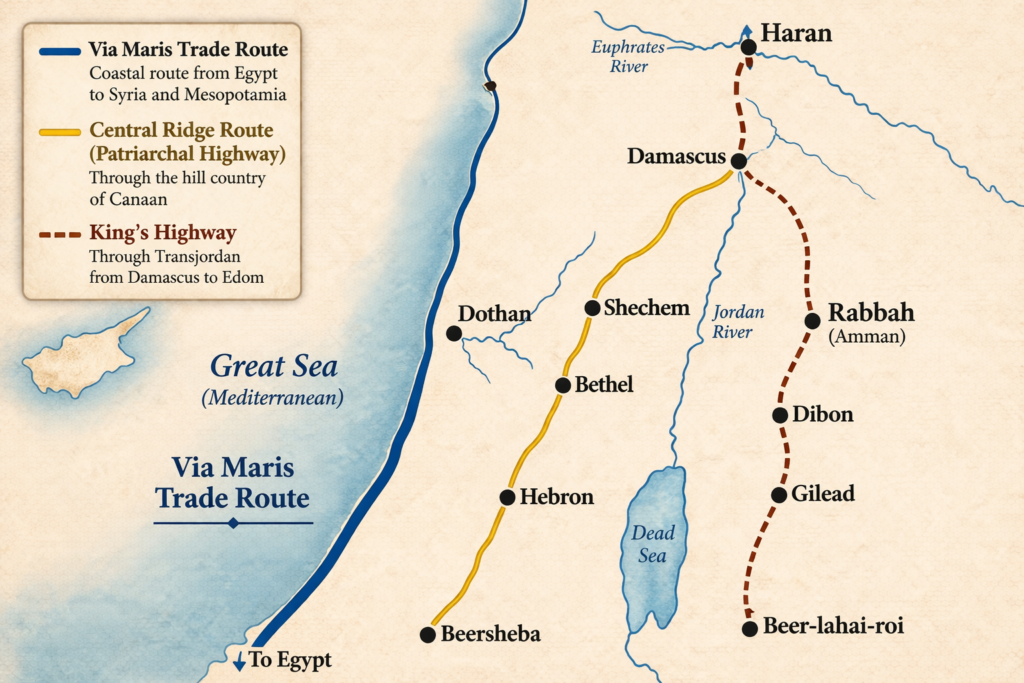
So, these traders were moving along an established route. These caravans had regular and predictable movements.
These traders carried balm, resin, and myrrh. These were used in medicine, perfume, and embalming. Traders also transported slaves, moved labor, and facilitated human exchange.
The New Living Translation noted the traders were Ishmaelites who were Midianites.
Wait! What????
Ishmael was Abraham’s son by Hagar. Midian was Abraham’s son by Keturah.
The Ishmaelites were major traders at that time. Somewhere along the line, the Ishmaelites began operating together with the Midianites as an interrelated trading people.
Yep, the brothers sold Joseph to their grandfather’s brothers’ relatives. No, there was no love lost in the family, but come on. Yes, it was a fractured family line.
Did the Ishmaelites know who the brothers were? Did they know they were buying their kin?
It probably wouldn’t have mattered if they did or didn’t. They were known as the slave-traders of the period.
The Midianites were also important to Israel’s history. Those were who Moses would run to after killing the Egyptian.
Judah Suggested Selling Joseph
“Judah said to his brothers, ‘What will we gain by killing our brother? We’d have to cover up the crime. Instead of hurting him, let’s sell him to those Ishmaelite traders. After all, he is our brother — our own flesh and blood!’ And his brothers agreed. So when the Ishmaelites, who were Midianite traders, came by, Joseph’s brothers pulled him out of the cistern and sold him to them for twenty pieces of silver. And the traders took him to Egypt” (Gen. 37: 26-28 NLT)
A suggestion was made that saved Joseph’s life.
When Judah saw the traders, he got a brilliant idea. Let’s sell Joseph.
What made Judah steer away from murder? The first reason was profit. They would gain nothing tangible by Joseph’s death.
There was still good in Judah. He was, at least, preserving life.
But then, Joseph was going to Egypt to be the savior of the family. Jesus was from the tribe of Judah.
It surprises us when we see Jehovah’s plan being carried forward through human betrayal. He will use believers as well as non-believers, good as well as evil to serve His own ends.
That tells us that Jehovah is in control of every situation. He knows exactly how situations are going to end. He knows the circumstances that will have to be navigated to reach the end.
But it also tells us that we are not immune from the consequences of our choices when He uses our sin to advance His plan. Joseph’s brothers and their descendants paid dearly for their betrayal.
Sold Him for Twenty Pieces of Silver
The amount the brothers sold Joseph for is significant.
Joseph was sold for 20 shekels of silver. It was the standard price of a young slave in Joseph’s time.
That was what Joseph would be considered at 17. Also, it was what he would become.
In fact, Moses wrote in the Law that this was the value of a boy. “A boy between the ages of five and twenty is valued at twenty shekels of silver; a girl of that age is valued at ten shekels of silver” (Lev. 27: 5 NLT).
We can’t help but think about another Man that was sold for silver. Yeshua was sold for 30 shekels — the price of a slave (Ex. 21: 32).
Reuben’s Plan Foiled
“Some time later, Reuben returned to get Joseph out of the cistern. When he discovered that Joseph was missing, he tore his clothes in grief. Then he went back to his brothers and lamented, ‘The boy is gone! What will I do now?’” (Gen. 37: 29-30 NLT)
Well, Reuben’s intent was to rescue Joseph, but he didn’t.
These two verses bring up a question. Where was Reuben when the traders were there?
In the last devotion, I made the comment that Reuben was going to have to watch Joseph. Just because Joseph was in a cistern, it didn’t mean he was safe. He was in the wilderness.
But Reuben relied on the cistern construction to contain Joseph. There would be no need to guard him constantly because he could not get out on his own.
Apparently, Reuben didn’t think his best-laid plans were going to go wrong. They did, and he panicked.
I wonder what was the focus of Reuben’s question – what was he going to do now? Was he concerned that he couldn’t return Joseph to Jacob? Or was he concerned that he no longer had a peace offering to try to get back in Jacob’s good graces?
Sent a Message
“Then the brothers killed a young goat and dipped Joseph’s robe in its blood. They sent the beautiful robe to their father with this message: ‘Look at what we found. Doesn’t this robe belong to your son?’ Their father recognized it immediately. ‘Yes,’ he said, ‘it is my son’s robe. A wild animal must have eaten him. Joseph has clearly been torn to pieces!’ Then Jacob tore his clothes and dressed himself in burlap. He mourned deeply for his son for a long time. His family all tried to comfort him, but he refused to be comforted. ‘I will go to my grave mourning for my son,’ he would say, and then he would weep” (Gen. 37: 31-35 NLT)
Once the brothers had betrayed their brother, they had to deceive their father.
One sin usually leads to another. In this case, the brothers had to figure out what they were going to tell their father.
Way back in Genesis 37: 19, they had decided they would tell their father that Joseph had been killed by a wild animal. They probably took much glee to tear up the tunic and cover it with blood.
I am this many years old before I realized that the brothers didn’t have the courage to face their father. They sent a message, probably with a servant.
Did they think that it didn’t make it a lie because they never said, “Joseph was killed by a wild animal”? They let Jacob come up with that deduction himself.
The brothers should have expected Jacob’s inconsolable sorrow.
Think about it. If we are right and Rachel died in 1692 BC giving birth to Benjamin, and in 1692, Jacob was led to believe that Joseph was killed by a wild animal, then Jacob had good reason to be inconsolable. No wonder he kept a tighter grip on Benjamin.
But was Jacob right in not allowing himself to be comforted? Jehovah tells us that the mourners will be comforted (Isa. 61: 2-3).
Jacob is so consumed by grief that he is not receiving what Jehovah provides. Was Jacob railing against Jehovah for taking Rachel and Joseph from him? Did he lose trust in Him?
Making the Connections #1
Okay, let’s taken inventory of the brothers.
Reuben had slept with one of his father’s concubines. Simeon and Levi had killed the men of Shechem.
Judah, on the other hand, found the way to save Joseph’s life and put him on the path to Egypt.
Making the Connections #2
Something flitted through my mind. We talked about Jacob giving Joseph the tunic around the time of Rachel’s death. It might have been a show of favoritism to his favorite wife’s firstborn son.
It may have been Jacob’s notice that he was replacing Reuben as the firstborn son. Reuben had mounted a coup to replace Jacob.
I wonder if Joseph’s age factored into timing. I know sons were given more responsibilities at younger ages than they are now.
But Joseph may have thought his death was many years down the road. That is, until Rachel died. He may have been planning to make the switch for years. He only had to wait until Joseph was old enough to step up.
Making the Connections #3
In all these verses, Benjamin’s name is not spoken. That is because — if Rachel just died — he was an infant.
Benjamin was never involved in the conflict against Joseph. The issues the boys had with Joseph were not transferred to him.
Making the Connections #4
It is interesting to know that Isaac was still alive when Joseph was sold by his brothers. Joseph was sold in 1692 BC. Isaac died in 1680 BC. He lived 12 years after Joseph was gone.
In fact, Isaac’s death occurred shortly before the transition to Joseph’s story really kicks into gear in Egypt with dream translations.
How Do We Apply This?
- Realize how uncertain tomorrow is.
- Watch how feelings escalate in families.
- Don’t try to defeat Jehovah.
- Don’t return too late to do Jehovah’s Will.
Father God. Our hearts are heavy at what family members can do to each other. But Lord, we are humbled that this was all in Your plan. You worked this to Your good – and our good (Rom. 8: 28). Thank You that You are in control of all our lives. Amen.
If you don’t understand something and would like further clarification, please contact me.
If you have not signed up for the email providing the link to the devotions and the newsletter, do so below.
If God has used this devotion to speak with you, consider sharing it on social media.