With Joseph on his way to Egypt, the story in Genesis switched to Judah. This devotional reading looks his separation from his family.
Nuggets
- Judah was doing more than leaving home.
- Judah was doing more than moving away.
Judah was moving away from the covenant community. - When Judah’s oldest son grew up, Judah found a wife for him, who also became the wife of the second son..
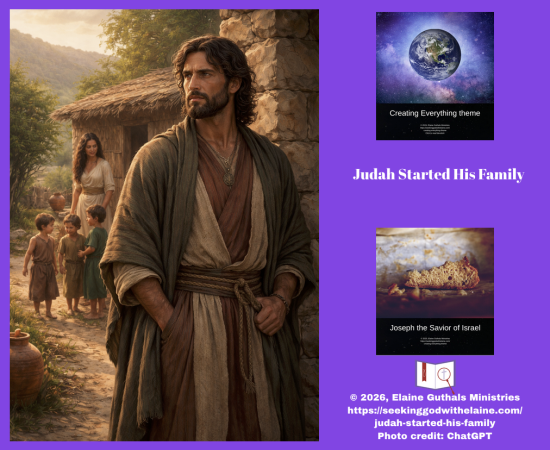
There have been a couple of times over the past seven years that I have been posting these devotions on my website that I have had to do a we-interrupt-this-program post. Life got in the way, and I was unable to complete a post.
At first glance, it seems like Moses interrupted Joseph’s story to give us this little snapshot into Judah’s family life. But it serves a much bigger purpose.
Let’s dig in.
Let's Put It into Context
To read devotions in the Creating Everything theme, click the button below.
Devotions in the Joseph the Savior of Israel series
Let's Put It into Context #2
In order to know why this chapter is not out of place, we have to remember what happened in Genesis 37. That was the start of the story that will be told over the remaining chapters in Genesis.
Joseph was betrayed and sold by his brothers. It was the beginning of his descent into suffering.
Why this chapter here now? Judah presents a stark contrast to Joseph. In this chapter, we will see Judah’s sexual choices. In the next, we will see Joseph’s.
This chapter is in exactly the position it needs to be because we need to follow Judah on his transformation. Yes, He was the one to suggest selling Joseph instead of killing him.
But Judah suggested selling Joseph. We see in this chapter how his downward spiral continues.
Judah Went Out on His Own
“About this time, Judah left home and moved to Adullam, where he stayed with a man named Hirah. There he saw a Canaanite woman, the daughter of Shua, and he married her. When he slept with her, she became pregnant and gave birth to a son, and he named the boy Er. Then she became pregnant again and gave birth to another son, and she named him Onan. And when she gave birth to a third son, she named him Shelah. At the time of Shelah’s birth, they were living at Kezib” (Gen. 38: 1-5 NLT)
Judah Left Home
Judah was doing more than leaving home.
We have been estimating that Judah was born around 1712 BC to Jacob and Leah. While we don’t know when this story occurred, we do know that it is after 1692 BC. That was when Joseph was sold.
We may look at the words “… Judah left home …” (Gen 38: 1 NLT) and scratch our heads. Isn’t that what parents are supposed to do – raise our children to move out on their own?
Well, there are two things we have to take into consideration. The family society in Jacob’s time was built around the clan. It was an extended family household centered on the authority of the patriarch.
But it went deeper than this. Jehovah’s covenant with Abraham, Isaac, and Jacob was carried through the family line. Judah was part of that covenant family. Remember, the term בְּרִית (berit) refers to a binding agreement or covenant.
Judah had already participated in resisting Jehovah’s revealed will. When Joseph shared the dreams given to him, his brothers simply did not question them – they rejected them and acted against them. In doing so, they opposed what He had revealed while still remaining with the covenant family.
Moved to Adullam
Judah was doing more than moving away.
Adullam wasn’t that far away from Hebron – only about 10 to 15 miles. But we have to look at the Hebrew to catch what is meant.
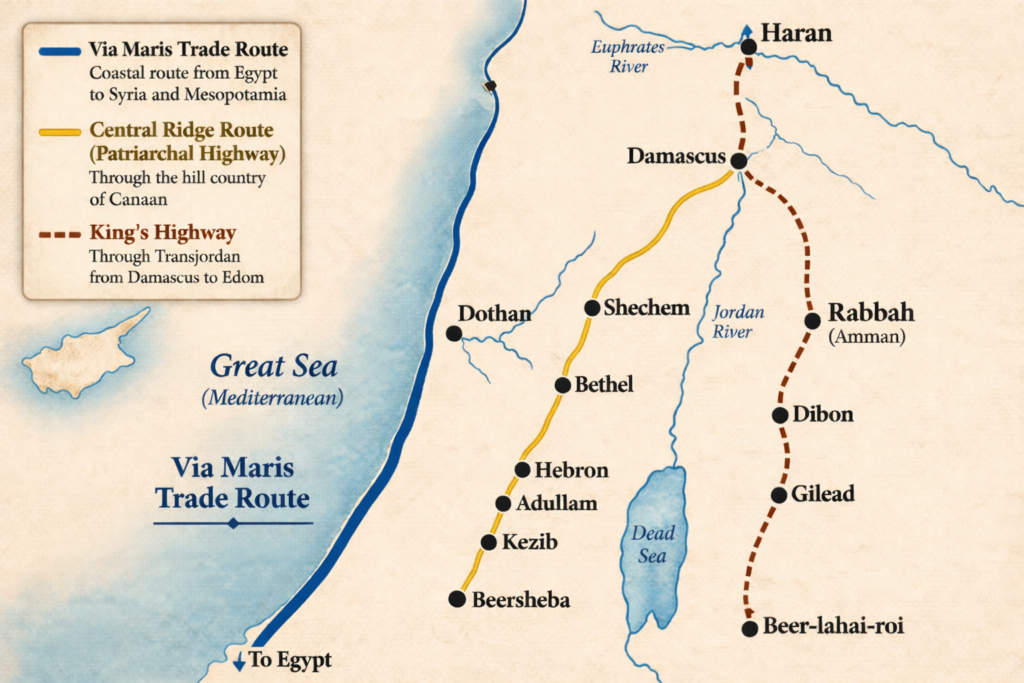
Look at this verse in The Schocken Bible. “Now it was at about that time that Yehuda went down, away from his brothers and turned aside to an Adullamite man — his name was Hira” (Gen. 38: 1 TSB).
Resource
What verb used in Hebrew is יָרַד (yarad) can means went down. The same pattern was used when Lot went down to Sodom. It shows movement away from a place of blessing or stability.
It is narrative theology. It is a step out of the covenant center.
He Married
Judah was moving away from the covenant community.
First, Judah met a man named Hirah. When he moved to the area, he stayed with this man.
Then, Judah found a wife. But there was a problem.
When Isaac reached marriageable age, Abraham went back to his family in Haran to find a wife for his son. When Jacob was way past marriageable age, Isaac sent him back to Rebekah’s family also.
Judah didn’t do that. He took a Canaanite woman as a wife. (We don’t know her name. We only know she was Shua’s daughter.)
In other words, Judah embedded himself among the Canaanites.
The term כְּנַעֲנִי (kena‘ani) – the word we translate to Canaan — carries both ethnic and moral connotations in Genesis. It represents not just a people group, but a cultural system opposed to covenant values. Judah’s union with a Canaanite woman signals assimilation into that system.
We know that, when the Israelites came back from their slavery in Egypt, they were directed by Jehovah to not intermarry with the Canaanites. Judah was not under this law, but that was the expectation.
“When the Lord your God brings you into the land you are about to enter and occupy, he will clear away many nations ahead of you: the Hittites, Girgashites, Amorites, Canaanites, Perizzites, Hivites, and Jebusites. … When the Lord your God hands these nations over to you and you conquer them, you must completely destroy them. Make no treaties with them and show them no mercy. You must not intermarry with them. Do not let your daughters and sons marry their sons and daughters, for they will lead your children away from me to worship other gods …” (Deut. 7: 1-4 NLT).
Judah Had a Family
“In the course of time, Judah arranged for his firstborn son, Er, to marry a young woman named Tamar. But Er was a wicked man in the Lord’s sight, so the Lord took his life. Then Judah said to Er’s brother Onan, ‘Go and marry Tamar, as our law requires of the brother of a man who has died. You must produce an heir for your brother.’ But Onan was not willing to have a child who would not be his own heir. So whenever he had intercourse with his brother’s wife, he spilled the semen on the ground. This prevented her from having a child who would belong to his brother. But the Lord considered it evil for Onan to deny a child to his dead brother. So the Lord took Onan’s life, too. Then Judah said to Tamar, his daughter-in-law, ‘Go back to your parents’ home and remain a widow until my son Shelah is old enough to marry you.’ (But Judah didn’t really intend to do this because he was afraid Shelah would also die, like his two brothers.) So Tamar went back to live in her father’s home” (Gen. 38: 6-11 NLT)
When Judah’s oldest son grew up, Judah found a wife for him, who also became the wife of the second son.
Er, Judah’s firstborn son, married Tamar. We are given little information on who she was. We assume that she was probably Canaanite.
That is logical. If Judah found a Canaanite wife for himself, why would he find a covenant wife for his son?
Still, if she was Canaanite, Tamar was not criticized for that. Only Judah’s failure is noted.
Once Tamar married Er, she became tied to Judah’s family. Ancient Near Eastern marriage agreements included the transfer of guardianship rights from the father to the husband on the wedding night.
This is a very important piece of information, especially since Er did not follow Jehovah.
We aren’t given any specifics. We are just told that Er was רַע (ra‘) – evil or wicked – so that Jehovah took his life.
Look at the last part – (vaymitehu YHWH). It means He caused him to die. Jehovah took out Er for not following Him.
That put Tamar in a precarious position. She was widowed and childless. Because of that, provisions were made for a levirate marriage.
A levirate marriage was required to protect widows and inheritance rights. This was not only a covenant requirement but also an Ancient Near Eastern practice. It is documented in the Code of Hammurabi and on the Nuzi Tablets.
Because Tamar was childless, Er died without a son to carry on the family line. By providing an heir, land could stay within the clan.
The practice also provided protection for Tamar. She remained within the family and was provided for and had status. She could also fulfill her Ancient Near Eastern duty of bearing children.
Judah’s second son, Onan, looked as if he were going to perform his duty and provide Er with an heir. It doesn’t specify, but he would have had to marry Tamar to have relations with her.
The problem looks to be on the surface that Onan wanted all of the sons he fathered to be his children. So, he did his duty and married Tamar, but he ensured she didn’t get pregnant.
The root sin may have been that Onan wanted the pleasure without the responsibility. If he didn’t want to father the child, did he marry Tamar?
Even deeper than that was Onan’s child with Tamar would be considered Er’s heir (therefore receiving the firstborn son inheritance from Judah — not him). With no son attributed to Er, Onan would become the firstborn and inherit.
We probably don’t realize what a big deal this refusal was. Deuteronomy 25: 7-10 outline the actions the widow was to take if this happens.
- The widow publicly confronts him
- She removes his sandal
- Spits in his face
- He is shamed as he failed his family, brother, and covenant duty.
Tamar didn’t have to worry about doing accusing Onan. Jehovah took Onan’s life also.
Judah’s third son, Shelah, was not at an age where he could marry. Tamar was sent back to her parents’ house.
But Moses added a little tidbit of information. Judah had no intention of allowing the marriage of Shelah and Tamar. He was afraid that he would suffer the same fate as his two older brothers.
To me, that reads like Judah thought his sons died because of Tamar’s actions, not their own. His refusal to see the sons’ actions as wrong showed that Judah was not following Jehovah.
There were several other things Judah of which guilty. He refused the levirate marriage for Shelah and Tamar.
I almost wrote that Judah broke his promise of the levirate marriage. But he didn’t promise, did he? He deceived Tamar into thinking the marriage would take place.
In acting that way, Judah put Tamar’s future on hold. She couldn’t remarry. That meant she had no husband to provide for her and give her children.
That was a legal and moral failure.
Making the Connections #1
Inquiring minds may want to know how the levirate marriage compares to the practice of the kinsman-redeemer that we see in the Book of Ruth.
The levirate marriage applies only to a brother, who is expected to marry the widow of his deceased brother in order to produce an heir in the dead brother’s name. The kinsman-redeemer is a close relative. He acts to restore land, lineage, and family security.
How are the practices similar?
- Both function within the clan system.
- That obligation is required of a close male relative.
- The purpose for both is to preserve the dead man’s name and maintain inheritance continuity.
- By protecting the widow, family survival is ensured.
- Both function within the covenant structure.
But they were different practices.
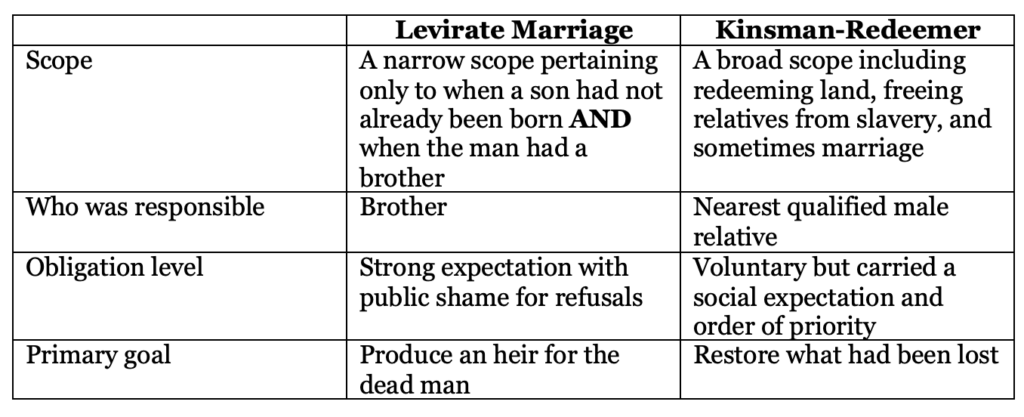
We can’t miss the fact that both systems provided redemption through substitution. Regardless of the reasons or responsibilities, one man stepped in for a relative. Life is raised and preserved. The name, inheritance, and future is secured.
Making the Connections #2
Back to Joseph and Judah. Why was this story told now?
Joseph’s story is about his actions to preserve the physical life of Jehovah’s people. Judah’s story is about how Jehovah preserved the covenant seed. We’ll look at that more in the next devotion.
How Do We Apply This?
- Faithfully walk the path that leads to Jehovah.
Father God.Your grace and mercy humble us. Forgive us when we turn away from You. Lead us back into Your fold. Amen.
If you don’t understand something and would like further clarification, please contact me.
If you have not signed up for the email providing the link to the devotions and the newsletter, do so below.
If God has used this devotion to speak with you, consider sharing it on social media.