Category: Sin

  • Abraham and Abimelech

    After Abraham deceived Abimelech, Abimelech confronted Abraham. This devotional reading looks at Abraham’s defense and the resolution.

    Nuggets

    • Abimelech had two arguments in his defense.
    • Jehovah acknowledged that Abimelech had not done nothing wrong – but only because He hadn’t allowed it.
    • Abimelech defended himself, but he immediately returned Sarah to Abraham.
    • Abimelech called Abraham out on his actions, and Abraham defended himself.
    • Abimelech gives Abraham many gifts.
    • God had Abraham intercede for Abimelech.

    abraham-and-abimelech

    We left our patriarch in a pickle. Abraham had deceived Abimelech, and Jehovah called Abimelech on it. Now it was Abimelech’s time to confront Abraham.

    Let’s Put It into Context

    To read devotions in the Creating Everything theme, click the button below.

    Devotions in the Abraham the Patriarch series

    Abimelech Defends Himself

    “But Abimelech had not slept with her yet, so he said, ‘Lord, will you destroy an innocent nation? Didn’t Abraham tell me, ‘She is my sister’? And she herself said, ‘Yes, he is my brother.’ I acted in complete innocence! My hands are clean” (Gen. 20: 4-5 NLT)

    Abimelech had two arguments in his defense.

    We can see Abimelech’s outrage. He was just acting on the information he had been given. There was no way he would know if it was truth or a lie.

    Isn’t that how we comfort ourselves? We make the best decision we can with the information that we have at that time. What else can we do?

    Besides, Abimelech hadn’t slept with Sarah yet.

    It doesn’t seem that Abimelech had any trouble understanding what the dream meant.  A God was talking to Him, albeit one he didn’t know.

    But as a pagan, Abimelech may have believed that there were many gods. Some believed each region had their own gods. As Abraham was from a different region, Abimelech may have thought that this was Abraham’s God – which it was.

    Still, that would have been something foreign to Abimelech. Yes, they believed there were gods over regions, but they didn’t believe that those gods could function outside of those regions. To have one to come with Abraham all this way would have been unnormal.

    Whatever Abimelech thought, he knew he was talking to a god. “But Avimelech had not come near her; and he said, Adonoi, wilt Thou slay also a goy tzaddik [non-Jew righteous one]? (Gen. 20: 4 OJB).

    See. Abimelech gave Jehovah the title Adonoi – Lord.

    God’s Response

    “In the dream God responded, ‘Yes, I know you are innocent. That’s why I kept you from sinning against me, and why I did not let you touch her. Now return the woman to her husband, and he will pray for you, for he is a prophet. Then you will live. But if you don’t return her to him, you can be sure that you and all your people will die’” (Gen. 20: 6-7 NLT)

    Jehovah acknowledged that Abimelech had not done nothing wrong – but only because He hadn’t allowed it.

    So, what Jehovah was saying was, if Abimelech would have bedded Sarah, he would have suffered the death penalty. Not knowing Sarah’s status wasn’t enough to commute the sentence.

    In this instance, Jehovah accepted Abimelech’s ignorance in the situation. That is not always the case.

    But the ball was in Abimelech’s court. If he would have pursued the path that led to bedding Sarah, he would have been put to death by Jehovah.

    It is interesting that God would call Abraham a prophet. We think of him as Patriarch, not a seer.

    God gave Abimelech the opportunity to do what was right.

    We talked about Abimelech being a Gentile, not a Jew. But I don’t think that can make us automatically lump Abimelech in with the sinners.

    Even if Abimelech didn’t acknowledge God as Sovereign Lord, he listened to Him when he came to him in the dream. He did what God said – and immediately.

    Plus, Jehovah recognized his intentions. We can’t judge someone else’s relationship with Jehovah. We don’t know their hearts or intentions.

    We can only make sure we have a right relationship with Jehovah.

    Making It Right

    “Abimelech got up early the next morning and quickly called all his servants together. When he told them what had happened, his men were terrified” (Gen. 20: 8 NLT)

    Abimelech defended himself, but he immediately returned Sarah to Abraham.

    Hmmm. I bet Abimelech was ticked at Abraham. Abimelech could have died because Abraham lied.

    Abimelech probably knew Jehovah meant business. If he didn’t immediately return Sarah to Abraham, He would make good His word and make Abimelech a dead man.

    We have to give Abimelech his due. It quickly set up getting Sarah back.

    Yes, Abimelech did have to explain what had happened. No, kings don’t always have to explain themselves, but I think it was wise for him to explain his actions.

    Called Out

    “Then Abimelech called for Abraham. ‘What have you done to us?’ he demanded. ‘What crime have I committed that deserves treatment like this, making me and my kingdom guilty of this great sin? No one should ever do what you have done!  Whatever possessed you to do such a thing?’ Abraham replied, ‘I thought, “This is a godless place. They will want my wife and will kill me to get her.” And she really is my sister, for we both have the same father, but different mothers. And I married her. When God called me to leave my father’s home and to travel from place to place, I told her, “Do me a favor. Wherever we go, tell the people that I am your brother”’” (Gen. 20: 9-13 NLT)

    Abimelech called Abraham out on his actions, and Abraham defended himself.

    Abimelech didn’t mince words with Abraham. He said that people just don’t do this to others.

    Abraham was allowed to defend himself. The problem was that it showcased his doubt that God would protect them.

    The fact that Sarah really was Abraham’s sister caused him to believe he really wasn’t telling a lie.

    Well, yes. Sarah was Abraham’s sister, but it was a lie because she was his wife, also.

    But Abraham’s insecurities all stemmed from him believing Abimelech was a godless man. Instead of fearing for his life this time, Abraham said that he was afraid Abimelech didn’t reverence God.

    No amount of whining from Abraham was going to make it less a lie. He should have just left it at, “I lied.”

    I had missed this before. Abraham blamed this on God. “When God called me to leave my father’s home and to travel from place to place …” (Gen. 20: 13 NLT).

    That isn’t a smart thing to do.

    The choice was Abraham’s. He could have chosen to tell the truth, but he chose to lie.

    Restitution

    “Then Abimelech took some of his sheep and goats, cattle, and male and female servants, and he presented them to Abraham. He also returned his wife, Sarah, to him. Then Abimelech said, ‘Look over my land and choose any place where you would like to live.’ And he said to Sarah, ‘Look, I am giving your ‘brother’ 1,000 pieces of silver in the presence of all these witnesses. This is to compensate you for any wrong I may have done to you. This will settle any claim against me, and your reputation is cleared’” (Gen. 20: 14-16 NLT)

    Abimelech gives Abraham many gifts.

    Once again, Abraham was rewarded handsomely for lying.  Abimelech gave him everything the Pharaoh gave him except donkeys and camels.

    Instead, Abimelech gave Abraham 1,000 pieces of silver. That wasn’t too shabby.

    Well, at least Abraham wasn’t kicked out of the country this time. He just got loot again – making him even more wealthy.

    But don’t we question when Jehovah rewards sinful behavior? We question why Abraham should have – again – increased his wealth for telling a lie.

    Another Intercessory Prayer

    “Then Abraham prayed to God, and God healed Abimelech, his wife, and his female servants, so they could have children. For the Lord had caused all the women to be infertile because of what happened with Abraham’s wife, Sarah (Gen. 20: 17-18 NLT)

    God had Abraham intercede for Abimelech.

    What Abraham was interceding for was for the ability of Abimelech’s wives and concubines to become pregnant. Hmmmm.

    Bradford thought that meant this story took several months to transpire. That makes sense to me.

    If the consequence was done in a night, it wouldn’t be much of a consequence. It had to be felt.

    God had Abraham pray for Abimelech for a couple of reasons. We build that faith by spending time with God in prayer. Even though Abraham was righteous, there was more work needed to be done in him.

    Bradford addressed another reason why the prayer was needed. He wrote, “For the idea was that the innocent Abraham would plead on the guilty Abimelech’s behalf, and since Abraham was a righteous man, God would listen.”

    Resource

    Think about it this way. Abraham had to be gracious and truthful in praying for Abimelech. If he rebelled about what Jehovah would have him do, He wouldn’t answer the prayer.

    But remember. Jehovah called Abraham a prophet. This after calling him His friend.

    I wonder if part of the reason was because the last time Abraham tried to intercede – for Sodom and Gomorrah – it didn’t go so well.

    Remember, the 20 questions that Abraham asked Jehovah about finding the righteous in Sodom and Gomorrah. That was him interceding with Him.

    In reality, Abraham was interceding for Lot. That was accomplished. But his prayer was also for the whole cities of the plains. That didn’t succeed.

    But as he stood looking at the smoke across the plain (Gen. 19: 28), Abraham’s heart had to be breaking.

    Did Abraham think Jehovah hadn’t answered his prayer? Did He ignore his intercession?

    At that point, Abraham didn’t know Lot’s fate. He probably felt his intercessory prayers wouldn’t be answered.

    God wanted to prove differently to Abraham.

    Making the Connections #1

    Have you ever contrasted Abraham’s actions with Abimelech’s?

    Abraham didn’t trust God. Abimelech respectfully defended himself and obeyed.

    Abraham lied. Abimelech’s actions were virtuous.

    Abraham disrespected Sarah as a wife, a woman, and his son’s mother. Abimelech actions demonstrated equity.

    Abraham reacted in fear. Abimelech reacted in moderation.

    The thing is that Abimelech only looks better on the outside. He hadn’t received a transformation on the inside.

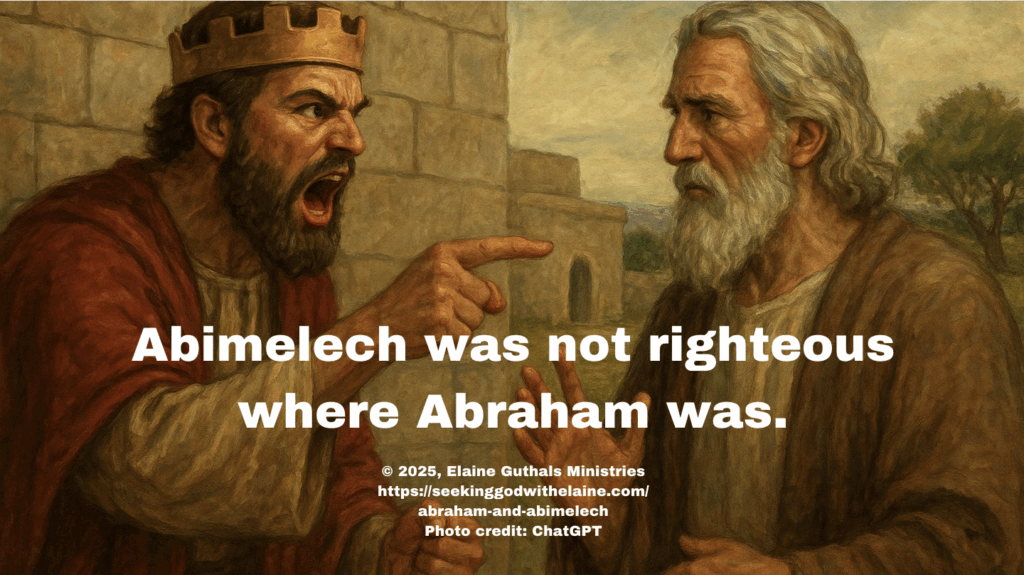
    Abimelech was not righteous where Abraham was.
    If Abimelech would have been a true child of Jehovah, we would probably have learned more about in in consequent chapters.

    But no. Abimelech rides off into the sunset.

    The Biblical Illustrator makes a good point. The Prejudice said part of the problem was Abraham’s arrogant attitude. He felt superior to Abimelech because he was righteous and Abimelech wasn’t.

    Resource

    How many times do disciples rail over Jehovah giving blessings to non-believers? But that isn’t how He works.

    Making the Connections #2

    Leale had some great points.

    • Disciples aren’t the only ones who know right from wrong.
    • Societal values also exhibit ethical principles, such as compassion and integrity.
    • Relationships are also based on moral relations.
    • Society also requires restitution when wrongs have been committed.

    Resource

    Again, it is not the actions that determines our status with God. It is our inward transformation to restore our relationship with God.

    Making the Connections #3

    Bradford said something interesting. He wrote, “We have in these actions a type and pattern of Moses being developed for us.”

    Resource

    How many times did Moses have to intercede for the Wilderness Wanderers?

    Jehovah wants us to pray for others. He doesn’t want us to buckle when He doesn’t answer our prayers the way we pray them.

    How Do We Apply This?

    • Work to eliminate the effects of our sins.
    • Acts committed are not as important as the life lived.

    Resource

    Father God. We get ourselves into so many difficult situations. Thank You for when You rescue us. Help us to fully trust You at all times. Amen.

    If you don’t understand something and would like further clarification, please contact me.

    If you have not signed up for the email providing the link to the devotions and the newsletter, do so below.

    If God has used this devotion to speak with you, consider sharing it on social media.
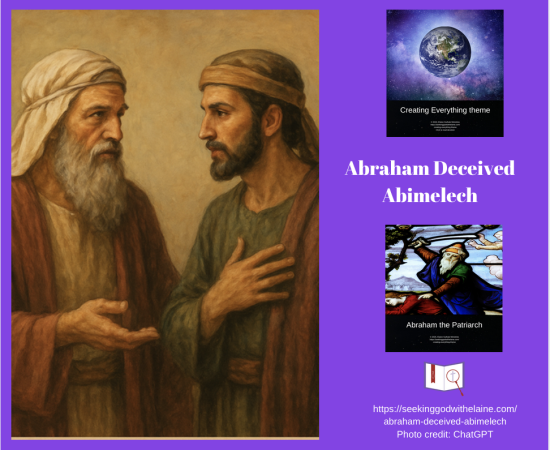
  • Abraham Deceived Abimelech

    After Sodom and Gomorrah were destroyed, Abraham left Mamre. This devotional reading looks at a time of temptation that would had him slide back into old habits.

    Nuggets

    • God’s Word does not tell us why Abraham moved again.
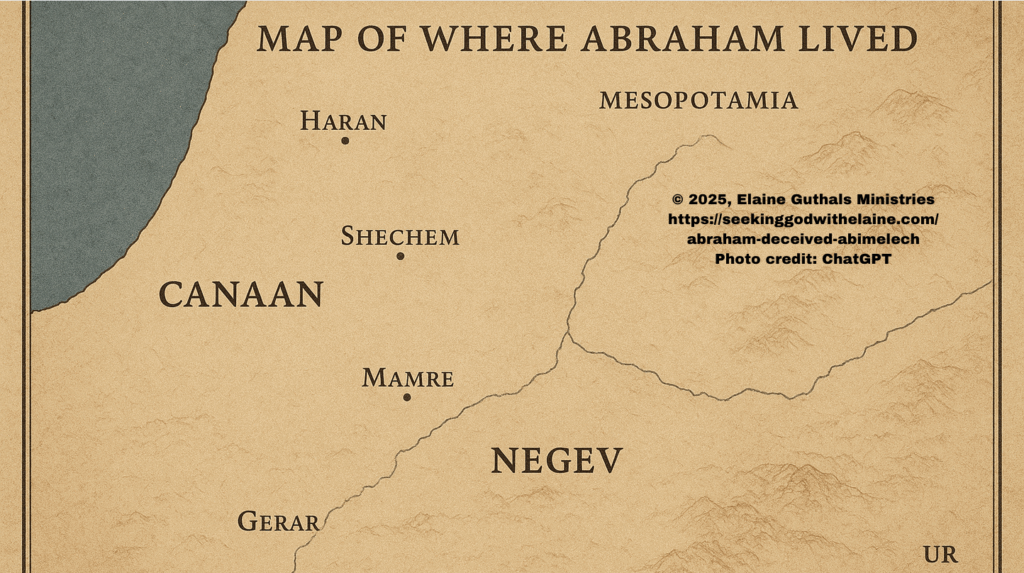
    • Whatever the reason, Abraham first moved between Kadesh and Shur (modern-day Egypt).
    • Then, Abraham moved his household to Gerar, which was on one of the branches of Wady Sheri`a.
    • Abraham’s dysfunctional family reared its head again as he lied about Sarah not being his wife.
    • Abraham didn’t learn the first time in claiming Sarah was his sister.
    • We can’t say for certain that King Abimelech was a Philistine – or pre-Philistine, but he probably was.
      Jehovah again stepped into stop the deception.
    • Since Abimelech was a Gentile, we may question how he knew it was Jehovah.
    • Jehovah came out playing hardball.
    abraham-deceived-abimelech

    Here we go again. Abraham isn’t trusting that God will protect him. He thinks someone is going to kill him just to get to his wife.

    Notice: This ran long, so I had to break it in two at a funky place.

    Let’s Put It into Context

    To read devotions in the Creating Everything theme, click the button below.

    Devotions in the Abraham the Patriarch series

    Moving Day

    “Abraham moved south to the Negev and lived for a while between Kadesh and Shur, and then he moved on to Gerar …” (Gen. 20: 1 NLT)

    God’s Word does not tell us why Abraham moved again.

    We have to remember that Abraham was a shepherd. In other words, he was a nomad.

    Abraham’s herds had to eat.

    More than likely, at Mamre, Abraham had used up its resources. He had to move on to find grazing lands and water for his flocks and herds.

    Was it a famine as it was when Abraham and Sarah moved to Egypt? Maybe a famine that wasn’t as severe as the earlier one?

    Or maybe Abraham now just had too many animals for the pastureland.

    We talked when Abraham went to Egypt that we weren’t told that God moved him. We aren’t told that He initiated this move, either. But Bradford thought He did this time.

    Resource

    We don’t know that for sure. Again, Moses didn’t reference God here.

    Between Kadesh and Shur

    Whatever the reason, Abraham first moved between Kadesh and Shur (modern-day Egypt).

    Bradford had an interesting tidbit. He wrote, “… that the Kadesh spoken of here is the same as the Biblical Kadesh-Barnea.”

    Resource

    Gerar

    Then, Abraham moved his household to Gerar, which was on one of the branches of Wady Sheri`a.

    Gerar was in the land that – in the future – would be the land of Philistia, aka the Gaza Strip. Yes, the Philistines are the modern-day Palestinians – the Greek translation of Philistine.

    Gerar was on the eastern border.

    Abraham Deceived Abimelech

    “… While living there as a foreigner, Abraham introduced his wife, Sarah, by saying, ‘She is my sister.’ So King Abimelech of Gerar sent for Sarah and had her brought to him at his palace” (Gen. 20: 1-2 NLT)

    Abraham’s dysfunctional family reared its head again as he lied about Sarah not being his wife.

    She Is My Sister

    Abraham didn’t learn the first time in claiming Sarah was his sister.

    Abraham did it again. He said that Sarah was his sister, not his wife.

    Bradford thought Abraham’s take on Egypt was that it came out okay. Hmmm.

    Resource

    In Genesis 13, we said that Abram was heading home, not just heading home, but was heading home forgiven and favored. Remember all the loot he got – possibly including Hagar – for being deceitful.

    I read that favored by Jehovah. But what if it was favored and forgiven by Pharaoh?

    Isn’t it easy to forget about what went wrong when it ended up okay? I mean, it had been 24 years since the last deception. Memories fade.

    Doesn’t that also show us that, when we think we have learned from one temptation, it will probably come up again to make sure we have learned it?

    But since Abraham had been tempted once – and caved – and was being tempted again and caved, wouldn’t that make this sin worse in our way of thinking?

    Lathrop said Abraham’s issue was the same as it was in Egypt. He wrote,

    “Though Abraham supposed that there was no sense of GOD and religion among the people of Gerar, yet he seems not to have entertained the least suspicion that they would insult the [honor] of his family, either by rape or seduction. His apprehension was that they would kill him for his wife’s sake.”

    Resource

    Abraham was more concerned about his life in the lawless region – again – than his wife’s safety.

    Lathrop reminded us that Abraham hadn’t given a relationship with Abimelech a chance to start building. He just assumed jealousy.

    There may have been something worse at play here. We’ll find out in a future verse that Abraham did this because he thought Abimelech was a godless man.

    Does Jehovah allow us to throw out His laws and commandments just because we live in the world? A big emphatic NO!

    The opposite is true. Jehovah doesn’t want us to compromise His laws and commandments, let alone throw them out altogether. He wants us to be the example in a lawless society.

    I think many disciples have done compromised today. We want to be very careful doing that. When we find we have, we need to repent and turn from those actions and thoughts.

    We are to be a light to the dark world, not a light that we have blown out.

    King Abimelech

    We can’t say for certain that King Abimelech was a Philistine – or pre-Philistine – but he probably was.

    I know. We’re going to find this first meeting was mostly peaceful.

    Abimelech, though, wasn’t only a name. It was also a title that meant my father is king. So, we don’t know if this Abimelech was king or prince. I think the way we should look at it is that this Abimelech’s father the king died making him, the prince, king.

    Sarah was taken again. Yep, a 90-year-old woman was taken for her beauty.

    Bradford had a thought that I think I can believe more than she was taken for her beauty. She may have been taken to force an alliance with Abraham. Alliances were made through marriage.

    I have to process that, though.

    Since the visit was mostly peaceful, it wasn’t the kidnapping the Egypt situation may have been.

    But if – going into this – knowing it was all about an alliance – a marriage – was Abraham going to give up his wife????

    Didn’t Abraham think about his covenant with Jehovah? “Then one of them said, ‘I will return to you about this time next year, and your wife, Sarah, will have a son!’” (Gen. 18: 10 NLT).

    I don’t think this would be a while-you-are-here alliance. Sarah was probably going to have to get pregnant soon – if she wasn’t already as Fuller thought – because she was still 90 when Isaac was born.

    Resource

    Abraham was gambling with Sarah’s virtue and Isaac’s purity.

    Abimelech’s Dream

    “But that night God came to Abimelech in a dream and told him, ‘You are a dead man, for that woman you have taken is already married!’” (Gen. 20: 3-4 NLT)

    Jehovah Came to Abimelech

    Jehovah again stepped into stop the deception.

    Once again God came to deal with the situation. Abraham appears to have been okay with it going on.

    God wasn’t.

    Abraham had agreed to put his faith and trust in God. He was to rely on Jehovah’s provision.

    That went out the window again.

    It may interesting to some that Jehovah came to Abimelech. He came to a Gentile.

    What? Do we think Jehovah only comes to His children? We’ll find out in the next section how wrong that is.

    Let’s see what Bradford had to say about that. He wrote “God is sovereign and He is all-powerful; while God does not often move a man against His own will, He will do so when it serves His purposes.”

    Resource

    In Elaine-speak, God will use believers and non—believers to further His plan.

    Jehovah is going to do what He has to do to get done what He wants done. He will use any of His creation.

    In a Dream

    Since Abimelech was a Gentile, we may question how he knew it was Jehovah.

    Dreams were probably the more common way for Jehovah appears to people.

    • “And he [Jacob] slept, he dreamed of a stairway that reached from the earth up to heaven. And he saw the angels of God going up and down the stairway” (Gen. 28: 12-13 NLT).
    • “But the previous night God had appeared to Laban the Aramean in a dream and told him, ‘I’m warning you — leave Jacob alone!’” (Gen. 31: 24 NLT).
    • “One night Joseph had a dream, and when he told his brothers about it, they hated him more than ever” (Gen. 37: 5 NLT).
    • “And they replied, ‘We both had dreams last night, but no one can tell us what they mean.’ ‘Interpreting dreams is God’s business,’ Joseph replied. ‘Go ahead and tell me your dreams’” (Gen. 40: 8 NLT).
    • “Joseph responded, ‘Both of Pharaoh’s dreams mean the same thing. God is telling Pharaoh in advance what he is about to do’” (Gen 41: 25 NLT).
    • “Earlier, during the first year of King Belshazzar’s reign in Babylon, Daniel had a dream and saw visions as he lay in his bed. He wrote down the dream, and this is what he saw.” (Dan. 7: 1 NLT).
    • “The Lord continued to appear at Shiloh and gave messages to Samuel there at the Tabernacle” (I Sam. 3: 21 NLT).
    • “That night the Lord appeared to Solomon in a dream, and God said, ‘What do you want? Ask, and I will give it to you!’” (I Kgs. 3: 5 NLT).
    • “As he [Joseph] considered this, an angel of the Lord appeared to him in a dream. “Joseph, son of David,” the angel said, “do not be afraid to take Mary as your wife. For the child within her was conceived by the Holy Spirit” (Mt. 1: 20 NLT).
    • “When it was time to leave, they [the wise men] returned to their own country by another route, for God had warned them in a dream not to return to Herod” (Mt. 2: 12 NLT).
    • “After the wise men were gone, an angel of the Lord appeared to Joseph in a dream. ‘Get up! Flee to Egypt with the child and his mother,’ the angel said. ‘Stay there until I tell you to return, because Herod is going to search for the child to kill him’” (Mt. 2: 13 NLT).

    But that doesn’t tell us how Abimelech knew God was a god.

    I don’t think we are going to know. It has to go in our UNR book – understanding not required.

    Judgment

    Jehovah came out playing hardball.

    Abimelech was a dead man because of what he had done.

    Fuller had an interesting take. He thought Abimelech hadn’t been charged with the sin yet but was warned if he did sin, he would die.

    But Fuller took it a step farther. He wrote, “It is intimated, however, that if he had come near her he should in so doing have sinned against God, whether he had signed against Abraham or not; and this perhaps owing to her being in a state of pregnancy, of which, in that case, he could not have been ignorant.”

    Resource

    I’m sorry. I’m tripping over Abimelech taking a pregnant woman for an alliance. If she was showing – as much as children, especially sons, were valued – I don’t see him taking someone else’s son if this was a peaceful alliance.

    My first thought – until I got to the pregnant part – was what Jesus said. “But I say, anyone who even looks at a woman with lust has already committed adultery with her in his heart” (Mt. 5: 28 NLT).

    Making the Connections #1

    When we were talking Noah, we said that even the righteous sin. That is because we are still in this impure body.

    Abraham is the same way. He was righteous. He still sinned.

    Lathrop described it this way. He wrote,

    “Even they whose faith is strong must guard against the prevailing influence of fear, and call into exercise that confidence in God which is the best security against the terrors of the world. In times of apparent danger, and threatening temptation, they have need to be peculiarly watchful. We are never so safe as when we invariably follow the path of virtue and integrity. He who walks uprightly, walks surely; but he who perverts his way, shall fall. Duplicity and artifice, to avoid an evil, will but embarrass us the more.”

    Resource

    • We can’t rest on our salvation to keep us from sin. We must be constantly on guard.
    • A source of our sin is fear. We must trust Jehovah to be bigger than anything we fear.
    • When things get the worst, we have to watch the most.
    • Walking with Jehovah is our best bet to be safe – and to have help when we are tempted.
    • The path lined with virtue and integrity means to have the character of Jehovah.

    Making the Connections #2

    Okay. I have to process what Parker said. He wrote,

    “Observe, first of all, that if the Divine purpose was to be turned aside by the fault or blemish found in individual character, the Divine government of man is at an end, and human progress is an impossibility. Adam failed, so did Noah, so Abraham, so did Lot. It was not Adam that sinned, or Noah, or Abraham, it was human nature that sinned.”

    Resource

    If Jehovah won’t forgive us when we sin – and we are going to sin since Adam. Noah, Abraham, and Lot all sinned – His divine plan would have immediately been shut down when Adam sinned. Not only that, but His government would also have been over.

    Making the Connections #3

    Lathrop helped us with the laws of the time and Jewish law. He wrote,

    “By the ancient laws of Draco and Solon, the husband of an adulteress, if he detected her in her guilt, might immediately kill both the criminals, or [stigmatize] them, or put out their eyes, or might exact of the adulterer a heavy fine. But, by the law of Moses, they were both to be put to death with public infamy; and, in ordinary cases, there was no dispensation.”

    Resource

    Let’s get this straight. The laws in Abraham’s time gave several options both the adulteress and the man. The Law of Moses took those options away.

    So, if I am reading this correctly – which I may or may not be – marriage wasn’t as highly regarded in Abraham’s day. While those laws don’t say that any type of adultery is forbidden, they do make it seem like some instances are more acceptable than others.

    If it was the husband giving the wife over to adultery, there would probably be no consequence.

    Making the Connections #4

    We said that, in this instance, Jehovah accepted Abimelech’s ignorance in the situation. That is not always the case.

    Someone’s proclaimed ignorance will not be accepted on the Day of the Lord. If we have not chosen to follow Jehovah, believe Yeshua as our Messiah, and walk with Him, we will have chosen against Him.

    How Do We Apply This?

    • Do not practice any type of deception.
    • Do not revert to sin.
    • Express gratitude for God’s provision.

    Resource

    Father God. Lord, thank You for the story of when Abraham didn’t resist temptation for the second time. In it, You show us how much you truly love us. You forgive us when we haven’t conquered our temptation. Help us to resist Satan.

    If you don’t understand something and would like further clarification, please contact me.

    If you have not signed up for the email providing the link to the devotions and the newsletter, do so below.

    If God has used this devotion to speak with you, consider sharing it on social media.
  • Lot and His Daughters

    After the destruction of Sodom and Gomorrah, Lot and his daughters had to start over again. This devotional reading looks at how God used a disturbing situation to create two new nations.

    Nuggets

    • Though Lot had been saved from the destruction of Sodom, that really didn’t help him after that.
    • While we go ewwww at the incest, Jehovah made nations out of the offspring.
    • The nations that descended from Lot’s sons were enemies of God’s covenant people.
    lot-and-his-daughters

    After the horror of the destruction of Sodom and Gomorrah, Lot and his two daughter must start over. They had a rough start.

    But that led to a bad decision.

    Let’s Put It into Context

    To read devotions in the Creating Everything theme, click the button below.

    Devotions in the Abraham the Patriarch series

    After Zoar

    “Afterward Lot left Zoar because he was afraid of the people there, and he went to live in a cave in the mountains with his two daughters” (Gen. 19: 30 NLT)

    Though Lot had been saved from the destruction of Sodom, that really didn’t help him much after that.

    We saw that Lot didn’t save himself. Only Jehovah did. It was only through Jehovah’s grace that he was saved.

    But even after lot reached Zoar, he didn’t turned his life over to Jehovah. He didn’t live in worship and praise.

    Why was Lot afraid of the residents of Zoar? Wasn’t he the one who requested to go there?

    Leale had an interesting thought about that. He wrote, “Lot could not trust God fully, and therefore the infinite charity of God stooped to his infirmity.”

    Resource

    Did Lot think that the destruction would follow him?  Was he having survivor guilt? Did he just never get over the death of Mrs. Lot?

    Did Lot prescribe to the better-late-than-never theory because he did end up in the mountains where God told him to go in the first place? We really don’t know if Jehovah prescribes to that.

    But we think that could be the case. Look at the Parable of the Two Sons.

    “But what do you think about this? A man with two sons told the older boy, ‘Son, go out and work in the vineyard today.’ The son answered, ‘No, I won’t go,’ but later he changed his mind and went anyway. Then the father told the other son, ‘You go,’ and he said, ‘Yes, sir, I will.’ But he didn’t go. ‘Which of the two obeyed his father?’ They replied, ‘The first’” (Mt. 21: 28-31 NLT).

    Jehovah would prefer immediate obedience. There are times when He accepts delayed obedience.

    Bottom line is Lot put himself in a worse position by not trusting Jehovah completely.

    Well, don’t we do that sometimes? God saves us, but we are so focused on the horror that we keep focused on the sin rather than on Him.

    Probably worse than that is when we won’t do what Jehovah says. We ask for Plan B instead.

    We think we know better than Jehovah.

    Why didn’t Lot go back to Abraham? He didn’t take anything with him, so it wasn’t because they would be competing for resources anymore.

    Surely, Lot knew about the promised child. Did he think he shouldn’t/couldn’t go back because he was no longer the heir apparent?

    That isn’t addressed. It has to go into our UNR book – understanding not required.

    The best thing Lot could have done was follow Jehovah’s directions. Next best would be to go to Abraham.

    Lot did not choose wisely. And things went downhill from there.

    The Older Daughter’s Plan

    “One day the older daughter said to her sister, ‘There are no men left anywhere in this entire area, so we can’t get married like everyone else. And our father will soon be too old to have children. Come, let’s get him drunk with wine, and then we will have sex with him. That way we will preserve our family line through our father.’ So that night they got him drunk with wine, and the older daughter went in and had intercourse with her father. He was unaware of her lying down or getting up again. The next morning the older daughter said to her younger sister, ‘I had sex with our father last night. Let’s get him drunk with wine again tonight, and you go in and have sex with him. That way we will preserve our family line through our father.’ So that night they got him drunk with wine again, and the younger daughter went in and had intercourse with him. As before, he was unaware of her lying down or getting up again” (Gen. 19: 31-35 NLT)

    While we go ewwww at the incest, Jehovah made nations out of the offspring.

    After Lot and his daughters head to the mountains, the oldest daughter became concerned about their situation. I get that. Their society had one job for women – get married and have babies, sons preferably.

    Once the family got to the mountains, the oldest daughter was concerned that there no men in the area. I keep reading sermons and articles that said the girls probably thought they were the only ones left on earth.

    I just don’t see that. Yeah, they probably knew the story about the flood. They may have thought Jehovah judged the whole earth again and wiped out all but one family.

    But they lived in Zoar for a while — we aren’t told how long. Moses said Lot was afraid of them (Gen. 19: 30), so they knew they were there. Plus, the angel said Zoar would not be destroyed (Gen. 19: 21).

    The older daughter hatched a plan for both girls to become pregnant by their father. She was concerned about preserving the family line.

    Where was Lot in all of this? Well, they didn’t ask him. In fact, they got him drunk so that the plan could work. (I know. We usually think of incest as being instigated by the parent/adult.)

    But then, this was the man who was ready to hand his daughters over to be raped by the townspeople.

    The Nations Are Born

    “As a result, both of Lot’s daughters became pregnant by their own father. When the older daughter gave birth to a son, she named him Moab. He became the ancestor of the nation now known as the Moabites. When the younger daughter gave birth to a son, she named him Ben-ammi. He became the ancestor of the nation now known as the Ammonites” (Gen. 19: 36-38 NLT)

    The nations that descended from Lot’s sons were enemies of God’s covenant people.

    Moabites

    Moab was the son born to Lot and the oldest of Lot’s two daughters mentioned in Genesis 19.

    The land of Moab lay east of the Dead Sea, starting at the southeastern boarder of the Sea. Sauter gave us a specific location. She wrote, “The kingdom of Moab stretched ‘north and south of the Arnon River’ with its capital at Dibon.”

    Resource

    Notable Moabites were Ruth and King Balak. Ruth was the widow who remained with her mother-in-law (Ruth 1). King Balak hired Balaam to curse the Israelites as they returned from slavery in Egypt to capture the Promised Land (Num. 22).

    The Moabites were a sinful nation. They worshiped a god named Chemosh.

    They were driven from their land by the Amorites shortly before the Israelites’ exodus from Egypt. It was in this land that the Israelites’ made their last encampment before entering the Promised Land (Num. 22: 1: Josh. 13: 32).

    As punishment for their sins, they were destroyed by David.

    Ammonites

    Ben-ammi was the son born to Lot and the youngest of Lot’s two daughters mentioned in Genesis 19. The Ammonites were a nomadic people, roaming the land of Amon (present-day Jordan).

    From the time of the judges down to King David, the Ammonites were enemies of Israel. Even before that, the Ammonites refused to aid the Israelites heading to the Promised Land.

    The Ammonites were a sinful nation. They primarily worshiped a god named Milcom. They also worshiped Molech, causing Jehovah to forbid intermarriage between them and Israelites.

    Making the Connections #1

    I hadn’t thought of it before I read Robertson’s sermon. He said the daughters were the only ones who obediently left Sodom.

    Ooo, baby. It had to be hard for them. They were suddenly expected to leave their home, the promise of their future home.

    Those two are the only ones who weren’t specifically called out for hesitating or looking back. (Yeah, the angel did take their hands and move them along, but it doesn’t say they were hesitating.)

    Robertson noted their condition. He wrote, “His sons and daughters left it in apparent obedience, but with the spirit of the inhabitants of the plain; it was not so with Lot’s wife.”

    Resource

    I don’t know where the sons came from. But the daughters still had the spirit of the inhabitants of the plains. That reared it’s head in verse 32.

    Roberson questioned whether Lot’s hesitation was from the concern over having to start over yet again. Thinking it through, I don’t know.

    I know in a previous devotion, I said this would be the second time Lot lost everything.

    But Lot really didn’t lose everything to King Elam. Yeah, he was taken prisoner and his stuff taken.

    Didn’t Abraham get everyone and everything back (Gen. 14: #). Lot only lost everything for a while.

    That might have made an impact. Why did Jehovah allow this bad thing to happen to me?

    If we already have a shaky faith, that can make it worse.

    Making the Connections #2

    The story of Sodom and Gomorrah remind us to be vigilant in our interactions with the world.

    Look what it says in the sermon entitled The Lessons of the Day. The author wrote,

    “Lot went to Sodom because he thought it a secularly desirable place. (Genesis 13:10.) He went there, and there his own piety was injured, his own children contaminated, and the partner of his own bosom became a victim of Divine judgment. The beauty of his home was his curse. The spirit of Lot is still common.”

    Resource

    We may think we are immune to the world. We may believe our faith or our will is able to withstand Satan’s warfare.

    We are not.

    Making the Connections #3

    The story the destruction of Sodom and Gomorrah and the other cities of the plains reminds us that – one day – we will be judged for our sins.

    But we are slow to admit our sins, aren’t we? We drag our feet. We rationalize why we think we didn’t disobey God.

    The problem is we are mired in sin. It is like we have stepped into quicksand and just keep sinking – especially when we are fighting to get out.

    In short, we procrastinate. We think there will always be time to get right with God.

    One day there won’t be.

    How Do We Apply This?

    Don’t linger in sin — run away from it.
    Don’t return to sin or even look back for former friends.
    Don’t move ahead of Jehovah, rather follow His every direction.

    Resource

    Father God. We know You know all of our steps before we even walk the path. We know You allow sinful things to happen to grow us or to further Your plan. Help us to understand and accept You perfect Will. Amen.

    If you don’t understand something and would like further clarification, please contact me.

    If you have not signed up for the email providing the link to the devotions and the newsletter, do so below.

    If God has used this devotion to speak with you, consider sharing it on social media.

  • The Destruction of Sodom and Gomorrah

    God had provided a way for Lot and his family to be saved from the destruction of Sodom and Gomorrah. This devotional reading looks at how the destruction played out and what happened to Lot and his family.

    Nuggets

    • Fire and burning sulfur were the chief weapons used in a direct act of Jehovah in the destruction of the cities.
    • We sometimes forget that there were other cities destroyed beside Sodom and Gomorrah.
    • Mrs. Lot disobeyed a specific direction the angels gave – don’t look back – and was immediately punished.
    • That Abraham could see it possibly up to 50 miles away speaks to the scale of the destruction.
    • Even though the wicked were not saved, Jehovah answered Abraham’s prayer.
    the-destruction-of-sodom-and-gomorrah

    The time had finally arrived. Sodom, Gomorrah, and the other cities of the plains were to be judged.

    But what would happen to Lot and his family?

    Let’s Put It into Context

    To read devotions in the Creating Everything theme, click the button below.

    Devotions in the Abraham the Patriarch series

    Judgment Day for Sodom and Gomorrah

    “Then the Lord rained down fire and burning sulfur from the sky on Sodom and Gomorrah. He utterly destroyed them, along with the other cities and villages of the plain, wiping out all the people and every bit of vegetation. But Lot’s wife looked back as she was following behind him, and she turned into a pillar of salt” (Gen. 19: 24-26 NLT)

    Fire and Burning Sulfur

    Fire and burning sulfur were the chief weapons used in a direct act of Jehovah in the destruction of the cities.

    It was not part of the angels’ mission to call down the fire and sulfur onto Sodom and Gomorrah. Jehovah doesn’t delegate our punishment.

    Sovereign God does it Himself.

    Ooo, baby. Put yourself in Sodom and Gomorrah that day in 1861 BC. Did the destruction start out slow? I doubt it – especially since it has been described as an overthrow. It would have started suddenly.

    Picture what fell out of the sky. Maclaren described what the King James Version called brimstone as a gaseous form of bitumen, a form of petroleum, that could be airborne along with mud.

    Resource

    Along with what was falling from the sky, there were hazards on the ground. Remember, the area was the plains of the Dead Sea. Called the Vale of Siddim, the area contained bitumen deposits.

    While these deposits would have helped grow the local economy, it is highly flammable. It would not mix well with the fire falling from the sky, especially if it was accompanied by an earthquake as some feel.

    Foster thought that there was also an earthquake associated with the cities’ destruction. I can see that as Jehovah would use every tool in His arsenal to mete out judgment on the wicked. But Dawson disagreed as an earthquake is not mentioned.

    Resources

    There was nowhere the wicked could hide.

    Foster said that the people probably didn’t have time to think. They were only able to react – in terror.

    But I bet Jehovah did put in their minds the reason why this was happening. No, it wasn’t a fluke storm.

    It was punishment.

    Dawson described the judgment as unexpected to the wicked in the area. I have to process this.

    That would mean that, when the angels were in Lot’s house and he was out dealing with the crowd, the angels did not plan to offer them a chance to repent.

    Well, Sovereign God is not going to give us any more signs than what we have in His Word. We know enough to repent. We just have to do it.

    We cannot diminish the fact – as much as the worldview tells us otherwise – that there is good and evil. Because of that, the good will be rewarded and the evil punished.

    I like what Walker said. He wrote, “Their sin was very grievous, or heavy. Like a black cloud, gathering increased density from accumulated [vapors] of human wickedness until it becomes so charged with rain, thunder, lightning, and tempest, that it must at length empty itself upon the devoted earth over which it lowers.”

    Resource

    We also cannot deny that God does delay punishment.

    However, when the destruction came to Sodom and Gomorrah, it was complete and permanent.

    Along with the Other Cities and Villages of the Plain

    We sometimes forget that there were other cities destroyed beside Sodom and Gomorrah.

    Just as we talked in our discussion of the flood, some may not see how a God of Love can destroy not only Sodom and Gomorrah, but also the towns and villages around them. They forget that He is the God of Wrath, also.

    No, one does not exclude the other. We call it a law of physics. There is an opposite reaction.

    God loves truth. He hates lying.

    God loves obedience. He hates disobedience.

    God was well within His right to destroy the cities of Sodom and Gomorrah as well as the surrounding population. They disobeyed Him.

    Judgment Day is coming for the entire world. Those who have lived their lives disobeying Him will be punished. “And anyone whose name was not found recorded in the Book of Life was thrown into the lake of fire” (Rev. 20: 15 NLT).

    Dawson said something interesting. He thought this was almost to the level of an eyewitness account.

    Resource

    We don’t know how Moses obtained the information. If it was from God, it was an eyewitness account.

    Pillar of Salt

    Mrs. Lot disobeyed a specific direction the angels gave – don’t look back – and was immediately punished.

    Dawson explained what happened to Mrs. Lot – along with probably other bodies. They were covered with a brine or saline mud – the Hebrew word which is translated brimstone.

    Other translations are sulfur or pitch. It is interesting to note that the pitch is also translated as gopher, the material used to build the ark.

    Resource

    Maybe. Look what Rothschild said. He wrote,

    “She is a ‘Netziv melech’ a standing monument made out of an easily eroded material. Salt represents value and wealth, it is used to preserve food, it has medicinal qualities, the beautiful crystals reflect light, it speaks to us of the sea and of tears. Salt is the symbol of the covenant (see Lev 2:13, according to Talmud salt from Sodom was burned in temple ritual (Ker 6a) and it is present to this day on the Kiddush table alongside the challah as an echo of that ritual. Lot’s wife escapes the fate of the rest of her family, she is preserved at one with her environment before the descent into degradation that follows.”

    Resource

    That almost sounds like it is making Mrs. Lot a heroine.

    While the how remains a mystery, the most important thing is the why.

    We may think looking back is such a little thing. We may think that Lot’s wife just wanted to see the show. How was God going to destroy whole cities in the region?

    It wasn’t little. Mrs. Lot looked by longingly. That meant it wasn’t just a momentary glance back.

    Remember, the destruction couldn’t begin until they got to where they were going. Mrs. Lot must have all but stopped to be close enough to get salted.

    More than likely, Mrs. Lot stopped, turned her body around to get a good look, and sighed deeply.

    Jesus Himself told us why the family didn’t want to leave and why she looked back. “Remember what happened to Lot’s wife! If you cling to your life, you will lose it, and if you let your life go, you will save it” (Lk. 17: 32-33 NLT).

    We cannot hold on to our old lifestyle after conversion. We have to let go of sinful things.  We have to be transformed internally.

    We have to remember that these little decisions also play a role in forming our character.

    Spurgeon had a great thought. How much did Lot’s hesitation in leaving Sodom encourage Mrs. Lot to turn back – maybe she was thinking for one last look?

    Resource

    Mrs. Lot may have looked at the hesitation by Lot earning only a get-going shove from the angels. Maybe that is what she expected for a look-back look.

    We can’t look back, longing for the sin we left behind.

    But I like Hughes’ explanation best. He wrote, “Lot’s wife is an example of the inevitable fate of those who outwardly, but reluctantly, conform to the requirements of the gospel, but whose heart is in the world.”

    Resource

    Just because Mrs. Lot was Mrs. doesn’t mean that she inherited Lot’s righteousness when she married him. Just because she went through religious motions — if she did — doesn’t mean her salvation was genuine.

    If that is the case, we will see Judas in Heaven.

    • “Not everyone who calls out to me, ‘Lord! Lord!’ will enter the Kingdom of Heaven. Only those who actually do the will of my Father in heaven will enter. On judgment day many will say to me, ‘Lord! Lord! We prophesied in your name and cast out demons in your name and performed many miracles in your name.’ But I will reply, ‘I never knew you. Get away from me, you who break God’s laws.” (Mt. 7: 21-23 NLT).
    • “Our lives are a Christ-like fragrance rising up to God. But this fragrance is perceived differently by those who are being saved and by those who are perishing. 16 To those who are perishing, we are a dreadful smell of death and doom. But to those who are being saved, we are a life-giving perfume. And who is adequate for such a task as this?” (II Cor. 2: 15-16 NLT).

    Mrs. Lot struggled with unbelief and indecision. She also had a large dose of ingratitude.

    Jehovah doesn’t give leeway. A sin is a sin. Our opinion isn’t taken into account.

    Jehovah expects us to obey Him. When we are presumptuous enough to think we can disobey Sovereign God and not suffer any consequences, we will be punished.

    Yes, Jehovah will forgive us when we are truly repentant.

    But we have to ask for that forgiveness. We have to turn away from our sin.

    Gray had a great nugget. He wrote, “None who are on the way to heaven can look back longing on the world they leave without injury.”

    Resource

    How we can read this was that Mrs. Lot liked her life in Sodom and didn’t want to give it up when Jehovah said go.

    Abraham Saw the Destruction

    “Abraham got up early that morning and hurried out to the place where he had stood in the Lord’s presence. He looked out across the plain toward Sodom and Gomorrah and watched as columns of smoke rose from the cities like smoke from a furnace. But God had listened to Abraham’s request and kept Lot safe, removing him from the disaster that engulfed the cities on the plain” (Gen. 19: 27-29 NLT)

    Abraham Watched

    That Abraham could see it possibly up to 50 miles away speaks to the scale of the destruction.

    I wonder what Abraham felt as he stood watching the smoke. Concern for Lot. Sadness that ten righteous people weren’t found.

    Also, I wonder about what others in the area — all the way to Beer-sheba —thought. They hadn’t gotten Abraham’s warning. They just woke up one morning to smoke.

    Spurgeon believed that Abraham went back to the spot that he interceded with Jehovah for sparing Sodom. That would have been logical, especially since Sodom was in sight.

    Resource

    But isn’t Jehovah like that? Sometimes, He will give a final warning. Sometimes, He just brings judgment.

    God Had Listened

    Even though the wicked were not saved, Jehovah answered Abraham’s prayer.

    Yeah, the cities of the plains were destroyed. The wicked were not saved.

    No, Jehovah couldn’t find ten righteous people. But He saved Abraham’s family.

    Why? Leale reminded us that Jehovah blends justice with mercy. He wrote, “He overcomes the hindrances and obstacles to salvation which arise in our minds.”

    Resource

    Grace is freely given to us. It is through this grace that individuals overcome sin. It is through that grace He sent Jesus to be our Savior and gave the Holy Spirit to convict, guide, and empower us.

    It is through this grace that Jehovah wants to see each of His children saved from the punishment meted out to the wicked.

    Making the Connections #1

    Do we think Lot was worthy enough to be saved? We probably think as Monte did. He wrote, “Few characters in the Bible are more full of comfort than Lot’s. Weak in disposition, faulty in his general life, erring after repeated warnings, irresolute even when he stood on the verge of ruin, God was yet willing to save him.”

    Resource

    We may have characterized Lot as weak instead of sinful. I can see that. We might save the sinful designation for those who intentionally sin. Lot do sound like he may have characterized his sins as unintentional.

    God does distinguish between intentional and unintentional sin. The sacrificial system is built to address unintentional sins.

    God did save Lot, his wife, and his two daughters (Gen. 19: 15). Well, he tried to save the wife, but she looked back. He tried to save the future sons-in-law, but they wouldn’t believe.

    Making the Connections #2

    Do we think the cities should not have been judged?

    Well, they did sin and were unrepentant about it. Their moral condition opened them up for judgment.

    Just as God judged the entire earth and sent the flood to destroy sin, He also judged the cities and sent fire and brimstone to judge the cities.

    God is still just even though He destroyed the two cities for wickedness. “O God, you take no pleasure in wickedness; you cannot tolerate the sins of the wicked” (Ps. 5: 4 NLT).

    Making the Connections #3

    There are times that we think judgment will only come on Judgment Day. Wrong.

    God can and will judge us when He thinks that correction will serve the best purpose for our sanctification. Remember each testing, trial, and judgment creates another brick on our Sanctification Road.

    Making the Connections #4

    I loved what Meade said. He wrote, “… conviction for sin and conversion to God are two very different things. A sinner under conviction is a sinner waked up to his guilt and danger. A sinner converted is a sinner who has hasted away to Christ for pardon and mercy, who is made safe in the strong mountain of God’s love and grace.”

    Resource

    The Holy Spirit convicts us of sin, and we may be sorry that we committed that sin. That gains us nothing.

    We have to ask Jehovah’s forgiveness of sin, turn away from it, and start to walk with Jehovah.

    Meade made a very good point. Mrs. Lot ran away from Sodom, probably as fast as her little feet could take her.

    Was she running from the sin or running from judgment? There is a big difference.

    In today’s vernacular, we would say was she sorry she sinned, or was she sorry she got caught? There is a big difference.

    Almost persuaded isn’t good enough.

    Related Links

    John Rogers Acapella Gospel Hymns

    Making the Connections #5

    We like to say there are no strings attached to salvation. Well, we cannot buy it or earn it.

    We have to accept the gift of salvation.

    But in doing so, we have responsibilities that we have agreed to take on. We agree to turn away from sin. We agree to follow all of God’s laws and commandments. We agree to ask forgiveness when we don’t.

    Strings? Maybe. Maybe not.

    But they are our responsibilities in the covenant.

    In other words, God can and should expect obedience from us.

    This is just like the original sin. God was only asking for obedience on this day. Nothing else, just do what I say.

    No, humans hadn’t progressed any, had they?

    Making the Connections #6

    Should Abraham feel that God didn’t answer his prayer? No, Lot and most of his family were saved.

    • “Then the Lord rained down fire and burning sulfur from the sky on Sodom and Gomorrah” (Gen. 19: 24 NLT).
    • “God remembered Abraham and sent Lot out of the midst of the overthrow when he overthrew the cities in which Lot had lived” (Gen. 19: 29 NLT).

    No, the cities themselves were not saved. Their sin was too much.

    We shouldn’t rail on God when our answers are not the answers received. We are to pray in His Will, not our own.

    How Do We Apply This?

    • Don’t be the disciples who mourns for prior sin because judgment will be yours, too.
    • Listen and obey Jehovah’s commands.
    • Seek God so that our hearts grow closer to Him.
    • Expect judgment when we rebel, sometimes immediately.

    Resources

    Father God. We don’t want to be like Lot. We want to completely walking with You every day of our lives. We want to be obedient the first time You command us. Strengthen us and sanctify us. Amen.

    If you don’t understand something and would like further clarification, please contact me.

    If you have not signed up for the email providing the link to the devotions and the newsletter, do so below.

    If God has used this devotion to speak with you, consider sharing it on social media.
  • The Angels’ Mission Carried Out

    Part of the angels’ mission was to rescue Lot. This devotional reading looks at how the angels got Lot and his family out of Sodom.

    Nuggets

    • We can be certain that the righteous will be saved.
    • Lot had a hard decision to make — and it took him a bit to make it.
    • Angels love humans.
    • Jehovah wants us to choose Him, not the world.
    • Lot was told to start over again in the mountains.
    • Lot asked to go to the small town of Zoar instead of the mountains.
    • Jehovah did not start the destruction of Sodom and Gomorrah until after Lot and His family had arrived where they were going.
    the-angels-mission-carried-out

    The night before Jehovah’s judgment on Sodom, Gomorrah, and the other cities of the plains was chaotic. The angels’ mission was unveiled.

    Dawn has broken. Now it was time to actually complete the plan.

    Let’s Put It into Context

    To read devotions in the Creating Everything theme, click the button below.

    Devotions in the Abraham the Patriarch series

    Leave the City

    “At dawn the next morning the angels became insistent. ‘Hurry,’ they said to Lot. ‘Take your wife and your two daughters who are here. Get out right now, or you will be swept away in the destruction of the city!’” (Gen. 19: 15 NLT)

    We can be certain that the righteous will be saved.

    Have you ever started on a road trip early in the morning? I remember when I was in high school, Mom, Dad, Aunt Bert, and I went to Kansas to visit relation. We left at 5:30 in the morning.

    Dad was hurrying the womenfolk along. We had a long drive ahead of us, and daylight – even though it was still dark at that point – was burning.

    Look at what verse 15 says in the Hebrew. “And when the shachar [dawn, daybreak] came, then the malachim [angels] urged Lot, saying, Arise, take thy isha [wife], and thy two banot [daughters], which are here or thou be swept away in the avon [sin, iniquity] halr [the city]” (Gen. 19: 15 OJB).

    The angels were trying to push Lot along, also. There was good reason.

    If Lot and family didn’t leave the city, they would be swept away in the sin of the city.

    Yes, the cities were going to be destroyed. That was for one reason, and one reason only. Sin.

    Lot, Mrs. Lot, and the two daughters had a decision to make. Were they going to obey Jehovah or disobey Him?

    If they obeyed, they would live. If they disobeyed, they would die.

    Was this just a physical death or a spiritual death also?

    Well, that would be up to Jehovah, wouldn’t it?

    The Pull of Sin

    When Lot still hesitated, the angels seized his hand and the hands of his wife and two daughters and rushed them to safety outside the city, for the Lord was merciful. When they were safely out of the city, one of the angels ordered, ‘Run for your lives! And don’t look back or stop anywhere in the valley! Escape to the mountains, or you will be swept away!’” (Gen. 19: 16-17 NLT)

    Lot Hesitated

    Lot had a hard decision to make — and it took him a bit to make it.

    Abraham stopped at ten righteous people. But while Jehovah didn’t save the city, He started out saving four people.

    But Lot was dragging his feet at the last minute. As Lot did, we can get immune to sin because we are in the world. We focus on worldly attractions and domestic ties instead of focusing on God.

    Spurgeon made a good point. When Lot hesitated when told to get out of Dodge, he was telling the sons-in-law that what he said was imminent really wasn’t. How could Lot convince them he believed destruction was coming when he hesitated?

    Resource

    Ooo, baby. Humans would tend to say that Lot was giving the future sons-in-law more time to come to him.

    But does Jehovah want us to wait to be obedient to Him?

    But still, knowing Lot, he didn’t seem to be a courageous man. He already wasn’t liked He was thought of as a second-class citizen.

    This – in Lot’s mind – may exacerbate the situation. When Lot’s God destroyed the cities, how would those remaining alive (such as in Mamre, Beer-sheba, etc.) look at Lot being the sole survivor with his daughters?

    Lot had a house. Did he own other property in the city? Was that the loss he was mourning?

    Were the daughters mourning the loss of the future husbands? Were they grieving for neighbors and friends?

    So, the angels grabbed everyone’s hands and pulled them along. “If you are not going to move, I am going to move you.”

    Gray made a statement I kind of bristled at. He wrote, “Strange that men need to be coerced into acceptance of a great deliverance.”

    Resource

    At first I thought this applied to salvation. Coercion flies against free will.

    But this isn’t taking about that. Luckily, Spurgeon explained it.

    Think about it. We talked about Lot being in the world instead of it. Truth be told, many disciples today would lose that test.

    Layer on top of that our track record at being obedient. We lose the race time and again.

    That is especially true for the 100-yard dash. We aren’t quick getting out of the starting block. Where we might eventually be obedient, many times it takes us a while before God can talk us into doing what He wants us to do.

    That’s true for a lot of spiritual things. The things we have to be talked into are butting bricks on our Sanctification Road

    Spurgeon gave us a list of why that is.

    • Weak flesh
    • Lack of perseverance
    • More focus on worldly activities than spiritual activities
    • Too much leisure time

    Resource

    The pull of the world can be great, and we can have trouble enduring. We focus too much on worldly things — especially leisure time — and give into temptation.

    The wonder is that God will give us warning about impending judgment. So will He give warning to us.

    God will always rescue His children, even if it is against our will.

    Angels Seized Hands

    Angels love humans.

    No, I am not talking the romantic kind of love that we talked about in Genesis 6. But look at how they interact with humans in God’s Word.

    When we see angels coming to see humans in the past, they were usually in a protective and guiding role. They would bring messages of love and support from Jehovah to us.

    That doesn’t even deal with the thought that each of us has a guardian angels.

    Spurgeon summed up their role. He wrote, “Observe, also, that as those angels set us an example in using all their power, so they also encourage us to perseverance, for they ceased not to exhort till they had brought Lot out of danger.”

    Resource

    In Elaine-speak, angels will encourage us to listen to and obey God and endure to the end.

    Now, don’t be biting on the angels, thinking they should have been more polite. What were they supposed to say. “Oh, Lot. We know this has been your home for several years, but we really want you to think about leaving. I know that will be hard, but you need to think about what is the best for you.”

    They dealt with Lot’s inability to just make a quit cut with the worldview, but they did get the job done. And right now, the job is rescuing Lot.

    Don’t Look Back or Stop

    Jehovah wants us to choose Him, not the world.

    I can see several reasons why the angels told the family not to look back. They didn’t need to see friends/neighbors/acquaintances/fellow townsmen dying a hideous death.

    But mostly, I think Jehovah wanted them to make a clean break from the world. They had to show discipline and self-control.

    Oh, the escape was going to be rough on the family. If they listened to the angels, they would have accepted the urgency with which they had to get out of Sodom.

    Each step would probably have been agonizing. Not just because of the terrain, but they had to have been feeling great sorrow and loss.

    Did you ever think about why God didn’t want the family looking back? I always figured it was a test of obedience.

    Hilprecht had a different idea. He wrote, “To witness with human and profane eyes God’s holy acts was regarded as fatal to the beholder. We find this fact as it existed among the old Hebrews expressed in many passages of the Old Testament.”

    Resource

    Think about the smoke about Mount Sinai. “On the morning of the third day, thunder roared and lightning flashed, and a dense cloud came down on the mountain. There was a long, loud blast from a ram’s horn, and all the people trembled. Moses led them out from the camp to meet with God, and they stood at the foot of the mountain. All of Mount Sinai was covered with smoke because the Lord had descended on it in the form of fire. The smoke billowed into the sky like smoke from a brick kiln, and the whole mountain shook violently. As the blast of the ram’s horn grew louder and louder, Moses spoke, and God thundered his reply. The Lord came down on the top of Mount Sinai and called Moses to the top of the mountain. So Moses climbed the mountain” (Ex. 19: 16-20 NLT).

    Flee to the Mountains

    Lot was told to start over again in the mountains.

    Hardy told us why it was important for Lot to head for the mountains. He wrote, “God warns us to flee from the low-level life of sin to the mountain of purity and peace.”

    Resource

    Hardy equated this with the desire to keep our pet sin. God doesn’t want us to do that. He wants us to repent of all sin.

    But the problem with little sins is that they either grow into or set the way for bigger sins.

    The way they work is like boiling a frog in water. At first, you just have him in a pot of nice, cool water. Then you gradually increase the heat. By the time the water gets to boiling, the poor frog is acclimated to it — and it’s too late.

    If God wants to be the God of the little things as well as God of the big things, He is going to be concerned about little sins — especially little, pet sins.

    Part of the reason little sins are so harmful is they are, in actuality, indulgences. We don’t necessarily need them — but we sure do want them. We may even think we are entitled to them.

    Negotiating New Living Arrangements

    “‘Oh no, my lord!’ Lot begged. ‘You have been so gracious to me and saved my life, and you have shown such great kindness. But I cannot go to the mountains. Disaster would catch up to me there, and I would soon die.  See, there is a small village nearby. Please let me go there instead; don’t you see how small it is? Then my life will be saved.’ ‘All right,’ the angel said, ‘I will grant your request. I will not destroy the little village” (Gen. 19: 18- 21 NLT)

    Lot asked to go to the small town of Zoar instead of the mountains.

    The angels who rescued Lot and his family told them where they should go next. Lot had the nerve to say, “No, I don’t want to go there. Can we go here instead?”

    Seriously???? They just saved their lives. And he don’t want to do what they were told????????

    Did Lot think God couldn’t protect them in the mountains? Or was he just being selfish?

    Well, Dods made a good point. Lot didn’t ask God to save the city. He just went to see the sons-in-law as told.

    Resource

    It is so interesting that Lot didn’t want to move to the mountains. He would rather move to a small town.

    Wouldn’t the destruction of the large cities give Lot pause when thinking about why it happened?  Wouldn’t he have seen the connection to sin?

    What Zoar had going for it was that it was small. It was probably a half-day’s journey from Sodom.

    But later, Lot and his daughters finally do make it to the mountains (Gen. 19: 30).

    At this point, Lot still didn’t want to give up the sinful atmosphere of a city. Gray verified this. He wrote, “Even then Lot did not wish to go as far as he could from destruction, but to remain as near as possible.”

    Resource

    Still, God saved Lot, even as imperfect as he was.

    Escape

    “But hurry! Escape to it, for I can do nothing until you arrive there.’ (This explains why that village was known as Zoar, which means ‘little place.’) Lot reached the village just as the sun was rising over the horizon” (Gen. 19: 22- 23 NLT)

    Jehovah did not start the destruction of Sodom and Gomorrah until after Lot and His family had arrived where they were going.

    We know Lot and his family were not really wanting to leave the city of Sodom.

    • “When Lot still hesitated, the angels seized his hand and the hands of his wife and two daughters and rushed them to safety outside the city, for the Lord was merciful” (Gen. 19: 16 NLT)
    • “But Lot’s wife looked back as she was following behind him, and she turned into a pillar of salt” (Gen. 19: 26 NLT).

    We can’t be pulled by the lure of this world. We have to keep our focus on God.

    Making the Connections #1

    There is hope for us, isn’t there? If Lot can be forgiven and called a righteous man, so can we be forgiven and called righteous by Jehovah.

    Ryle told us why. He wrote, “… let us remember that a true Christian may have many a blemish, many a defect, many an infirmity, and yet be a true Christian nevertheless. We do not despise gold because it is mixed with much dross. We must not undervalue grace because it is accompanied by much corruption.”

    Resource

    Remember, not perfect. Honest enough to ask forgiveness.

    There is a great song by CeCe Winans. It is called Come Jesus Come. My favorite line is

    He’ll come for the weak And the strong just the same.

    Remember, faith of a mustard seed

    Related Links

    CeCe Winans featuring Cody Johnson

    Making the Connections #2

    Look at what Grout said. He wrote, “Judgment is a work He does not love. His will is that none should perish. But the cup of Sodom was now overflowing; nor was there any longer hope of its repentance.”

    Resource

    No, Jehovah didn’t want to destroy the cities. He wanted them to repent.

    Jehovah will go to great means to get us on the Sanctification Road. But judgment is a real thing.

    Yeah, Lot might have been shaking in his worship of Jehovah, but there was something real in it.

    Making the Connections #3

    The angels were giving Lot and his family the opportunity to run for their lives.

    Yeah, Jehovah was calling Lot into the unknown. But we have to remember that is what faith is all about. “Faith shows the reality of what we hope for; it is the evidence of things we cannot see” (Heb. 11: 1 NLT).

    Lot had to make a decision. He had to genuinely decide to follow Jehovah or go home. And home would mean death and destruction.

    How Do We Apply This?

    • Determine why you are lingering.
    • Remember time is growing short.
    • Remember the uncertainty of life.
    • Don’t look for small work for Jehovah.
    • Hate the devil and don’t tempt him to come to us.
    • Keep up the battle, don’t long for peace.
    • Understand when Jehovah’s long-suffering quits, judgment will immediately follow.
    • Recognize that those who are given Jehovah’s mercy will not perish.
    • Pay attention to smaller things so they don’t take let small sins in.
    • Be afraid of little sins.

    Resources

    Father God. You specifically sent Your messengers, Your angels, to Sodom to rescue Lot and his family. Lord, You come to rescue us. Thank You. Help us to listen to Your directions and obey. Amen.

    If you don’t understand something and would like further clarification, please contact me.

    If you have not signed up for the email providing the link to the devotions and the newsletter, do so below.

    If God has used this devotion to speak with you, consider sharing it on social media.

  • The Angels Reveal Their Mission

    Lot and the men of Sodom were outside Lot’s house in a situation that was deescalating. This devotional reading looks at how the angels stepped in to reveal their mission.

    Nuggets

    • There are some who think the primary sin of Sodom was homosexuality while others think it was a lack of hospitality.
    • The men of Sodom didn’t even acknowledge Lot’s offer of his daughter, instead focused on their original intent to rape the visitors.
    • The men of Sodom considered Lot a second-class citizen, one they didn’t have to listen to or respect.
    • The men of Sodom threatened violence against Lot.
    • The anger stemming from Lot’s judgmental ways helped fuel the townsmen to attempt to break down Lot’s door and forcibly remove the visitors.
    • The angels rescued Lot from the townspeople.
    • The men of Sodom were physically blinded, but they were also mentally blinded.
    • Lot was supposed to be in the city of Sodom but not of it, but he really wasn’t.
    • We have to wonder if Abraham stopped at ten righteous people when he was questioning Jehovah because he thought surely there were ten people in Lot’s household that believed in Him.
    • Lot had witnessed to his future sons-in-law but didn’t have any effect.
    the-angels-reveal-their-mission

    The situation outside of Lot’s house deteriorated. So, the angels stepped in,

    Let’s Put It into Context #1

    To read devotions in the Creating Everything theme, click the button below.

    Devotions in the Abraham the Patriarch series

    Let’s Put It into Context #2

    There is some who think the primary sin of Sodom was homosexuality while others think it was a lack of hospitality.

    Let’s look at what God’s Word says about homosexuality.

    • “Do not practice homosexuality, having sex with another man as with a woman. It is a detestable sin” (Lev. 18: 22 NLT).
    • “If a man practices homosexuality, having sex with another man as with a woman, both men have committed a detestable act. They must both be put to death, for they are guilty of a capital offense” (Lev. 20: 13 NLT).
    • “That is why God abandoned them to their shameful desires. Even the women turned against the natural way to have sex and instead indulged in sex with each other. And the men, instead of having normal sexual relations with women, burned with lust for each other. Men did shameful things with other men, and as a result of this sin, they suffered within themselves the penalty they deserved” (Rom. 1: 26-27 NLT).
    • “Don’t you realize that those who do wrong will not inherit the Kingdom of God? Don’t fool yourselves. Those who indulge in sexual sin, or who worship idols, or commit adultery, or are male prostitutes, or practice homosexuality, or are thieves, or greedy people, or drunkards, or are abusive, or cheat people — none of these will inherit the Kingdom of God” (I Cor. 6: 9-10 NLT).
    • “For the law was not intended for people who do what is right. It is for people who are lawless and rebellious, who are ungodly and sinful, who consider nothing sacred and defile what is holy, who kill their father or mother or commit other murders. The law is for people who are sexually immoral, or who practice homosexuality, or are slave traders, liars, promise breakers, or who do anything else that contradicts the wholesome teaching 11 that comes from the glorious Good News entrusted to me by our blessed God” (I Tim. 1: 9-11 NLT).

    Let’s look at what God’s Word says about hospitality.

    • “When God’s people are in need, be ready to help them. Always be eager to practice hospitality” (Rom. 12: 13 NLT).
    • “Don’t forget to show hospitality to strangers, for some who have done this have entertained angels without realizing it!” (Heb. 13: 2 NLT).
    • “Cheerfully share your home with those who need a meal or a place to stay” (I Pet. 4: 9 NLT).
    • “For I was hungry, and you fed me. I was thirsty, and you gave me a drink. I was a stranger, and you invited me into your home” (Mt. 25: 35 NLT).

    We have to look at hospitality from a spiritual perspective. The article from God’s Faithbook does just that. It says, “As we reflect on these lessons [from Abraham and Lot], it becomes clear that hospitality is not merely an act of kindness; it is a fundamental expression of our values and beliefs. By embracing a spirit of hospitality, we can create environments that promote understanding, acceptance, and love.”

    Resource

    For that night, I think it started with homosexuality, making it a sexual immorality sin; but it was directed at visitors, making it a hospitality sin. We see from the verses above, sexual immorality will keep humans from inheriting the kingdom of God, not being hospitalitable doesn’t.

    The primary sin causing the destruction of the cities would not be based on something that would not keep them from inheriting the kingdom of God. So, the primary sin that we know of at this point is homosexuality.

    The Crowd Responded to Lot’s Offer

    “‘Stand back!’ they shouted. ‘This fellow came to town as an outsider, and now he’s acting like our judge! We’ll treat you far worse than those other men!’” (Gen. 19: 9 NLT)

    The men of Sodom didn’t even acknowledge Lot’s offer of his daughter, instead focused on their original intent to rape the visitors.

    Outsider and Judge

    The men of Sodom considered Lot a second-class citizen, one they didn’t have to listen to or respect.

    As a foreigner in the city, the men of Sodom wouldn’t have respected Lot. He wasn’t “one of them.”

    Plus, it sounds like Lot didn’t approve of their lifestyle. Go back to why we said Lot may have been by the gate. He was screening the wickedness of the townspeople.

    Wouldn’t they have been incensed at that? Here is this immigrant, telling them  how to act or not act. This sojourner is condemning their behavior.

    Lot probably appeared to them to be judge, jury, and executioner.

    Our takeaway here is that Lot was not liked because he examined the people and found their actions sinful, and they felt his condemnation.

    If we are living set apart — in the world but not of it — we will experience the same anger directed at us.

    Yes, it says not to judge others, take the mote out of our eye, etc.

    But we are also to stay away from those who can lead us astray. We have to be discerning.

    Treat You Worse

    The men of Sodom threatened violence against Lot.

    Let’s think about it a second. The two men (that we know were angels) showed up and went home with Lot. The men of Sodom demanded the men be handed over so they could rape them.

    So, instead of offering hospitality, the townsmen offered hostility.

    Let’s see what verse 9 says in Hebrew. “And they said, Stand back. And they said again, This one fellow came in to sojourn as a ger (alien), and he will now play the shofet [judge]; now will we deal worse with thee, than with them. And they pressed strongly upon the man, even Lot, and came near to break down the delet” (Gen. 19: 9 OJB).

    Lacey tried to explain it. He wrote, “Simply put, the Sodomites were not promiscuous men looking for intercourse — they sought to violently assault Lot and rape his guests.”

    Resource

    I don’t know. I keep tripping over not promiscuous men looking for intercourse.

    I agree that rape is dominance and humiliation. I agree they were upping it to violence.

    They were looking for a sexual encounter. Look at some of the synonyms for promiscuous: licentious, sexually indiscriminate, debauched.

    If Jehovah created sex to be between a man and a woman — which He did — promiscuous is being unselective. Choosing something that doesn’t keep within Jehovah’s directive makes them unselective.

     “… Bring them out to us so we can have sex with them!’ (Gen. 19: 4-5 NLT).

    They were promiscuous.

    Worse than that, they were talking violence. They were talking about assaulting Lot.

    The Men of Sodom Force the Angels to Step In

    “And they lunged toward Lot to break down the door. But the two angels reached out, pulled Lot into the house, and bolted the door. Then they blinded all the men, young and old, who were at the door of the house, so they gave up trying to get inside” (Gen. 19: 10-11 NLT)

    Break Down the Door

    The anger stemming from Lot’s judgmental ways helped fuel the townsmen to attempt to break down Lot’s door and forcibly remove the visitors.

    Ooo, baby. The mob was not going to be denied.

    We have to give some credit to Lot. There were no other righteous men in the city (the three others led out before the destruction began were women).

    With his selfishness and greed, Lot was probably seen as a hypocrite.

    But still, Lot had the courage to stand up to the crowd. Dods put it this way. He wrote,

    “That he had the courage which lies at the root of strength of character became apparent as the last dark night of Sodom wore on. To go out among a profligate, lawless mob, wild with passion and infuriated by opposition — to go out and shut the door behind him — was an act of true courage.”

    Resource

    All of this for strangers.

    Angels Reached Out

    The angels rescued Lot from the townspeople.

    The angels let the argument go on for a while. Remember, one of their missions was to find out what was actually going on in the region. “I am going down to see if their actions are as wicked as I have heard. If not, I want to know” (Gen. 18: 21 NLT).

    They found out. However, if they hadn’t stepped in when they did, Lot would have become a victim of their violence.

    Blinded Them

    The men of Sodom were physically blinded, but they were also mentally blinded.

    When the visitors had enough, they took over the situation. Their power showed Lot that they really were angels, not human men.

    Godman told how we could know that judgment is near.

    • Jehovah leaves us to our sin.
    • The warnings don’t have the desired effect.
    • The righteous are removed from the situation.
    • Those facing judgment feel secure rather than concerned.

    Resource

    Yeah, I would say that describes the men of Sodom.

    You would have thought the townsmen would have known something was up when everyone of them was blinded. But it sounds like they were slow on the uptake.

    The New Living Translation said the men of Sodom just gave up. The Orthodox Jewish Bible says that they grew weary and stopped.

    “And they struck the men that were at the petach [open] of the bais [house] with blindness, both katan [small] and gadol [big, great]; so that they wearied themselves to find the petach” (Gen. 19: 11 OJB).

    To me, that is a big difference. Yeah, we could say that they gave up after a while. But we could also think they gave up after five minutes.

    The Orthodox Jewish Bible gave us the why the men gave up. They tried their best to get the job done – even blinded – but they couldn’t make it.

    Isn’t it sad that they were so rooted in their sin that, even thought they got a preliminary judgment of blindness, they refused to repent and turn away from their sin? They had to keep banging and banging on sin’s door.

    I wonder if Jehovah did the same thing here as He did to the Arameans.

    “Then Elisha prayed, ‘O Lord, open his eyes and let him see!’ The Lord opened the young man’s eyes, and when he looked up, he saw that the hillside around Elisha was filled with horses and chariots of fire. As the Aramean army advanced toward him, Elisha prayed, ‘O Lord, please make them blind.’ So the Lord struck them with blindness as Elisha had asked” (II Kgs. 6: 17-18 NLT).

    The Mission Revealed to Lot

    “Meanwhile, the angels questioned Lot. ‘Do you have any other relatives here in the city?’ they asked. ‘Get them out of this place — your sons-in-law, sons, daughters, or anyone else. For we are about to destroy this city completely. The outcry against this place is so great it has reached the Lord, and he has sent us to destroy it.’ So Lot rushed out to tell his daughters’ fiancés, ‘Quick, get out of the city! The Lord is about to destroy it.’ But the young men thought he was only joking” (Gen. 19: 12-14 NLT)

    Lot was supposed to be in the city of Sodom but not of it, but he really wasn’t.

    Just as disciples today live among worldview people, so, too, did Lot. This is explained in Yeshua’s Parable of the Tares and Wheat.

    When Abraham and Sarah went down to Egypt and took Lot with them, we talked about how Lot may have been dazzled by the splendor and grandeur of Egypt. That may have conditioned Lot to want sinful things.

    Ker noted Lot’s lack of converts to make up the other six people needed for ten righteous people to save the cities. He points to this as evidence that Lot was more of the city than in it.

    Resource

    Think about it. Lot lost all his possessions back in Genesis 14 when he was taken captive. Now, he was losing them again.

    Disciples are to understand that this life is temporary. We must focus on preparing for eternal life.

    • “So we don’t look at the troubles we can see now; rather, we fix our gaze on things that cannot be seen. For the things we see now will soon be gone, but the things we cannot see will last forever” (II Cor. 4: 18 NLT).
    • “And this world is fading away, along with everything that people crave. But anyone who does what pleases God will live forever” (I Jn. 2: 17 NLT).
    • “For we know that when this earthly tent we live in is taken down (that is, when we die and leave this earthly body), we will have a house in heaven, an eternal body made for us by God himself and not by human hands” (II Cor. 5: 1 NLT).

    Think back to Genesis 13, when the land could not support both Abraham’s and Lot’s herds. Instead of saying, “Oh, no, Uncle – you choose” when they agreed to separate, Lot chose the garden-like area.

    Lot put more emphasis on worldly possessions than having a moral character.

    Other Relatives

    We have to wonder if Abraham stopped at ten righteous people when he was questioning Jehovah because he thought surely there were ten people in Lot’s household that believed in Him.

    Ooops.

    It is interesting what the angels asked who Lot went to save. The angels said, “… ‘Get them out of this place — your sons-in-law, sons, daughters, or anyone else” (Gen. 19: 12 NLT). “So Lot rushed out to tell his daughters’ fiancés …” (Gen. 19: 14 NLT).

    That tells me Lot didn’t have sons. I don’t think Moses would have told us the fiancés refused to come and not say sons did, too.

    I would use the same reasoning to think Lot and Mrs. Lot only had two daughters.

    Lot’s daughters’ fiancés would have been his sons-in-law eventually. “And Lot went out, and spoke unto his chosonim [chosen], which were pledged to marry his banot [girls] …” (Gen. 19: 14 OJB).

    This tells us that the daughters were in the betrothal stage of the marriage. They were pledged to be married but weren’t yet. They were in the preparation stage.

    Outcry Against this Place

    We talked in Genesis 18 how Jehovah said that He had heard an outcry. The outcry came from the cities themselves. Creation was calling to its Maker for relief.

    Walker took a stab at how creation did that. He wrote, “A cry of blood, like that of Abel’s from the ground, for vengeance against the murderer (Genesis 4:10). Murder, no doubt, was rife in Sodom; and He who had demanded blood for blood, could not overlook it.”

    Resource

    It doesn’t say if Lot’s voice was also heard in the outcry. But he made a silent cry.

    “But God also rescued Lot out of Sodom because he was a righteous man who was sick of the shameful immorality of the wicked people around him. Yes, Lot was a righteous man who was tormented in his soul by the wickedness he saw and heard day after day” (II Pet. 2: 7-8 NLT emphasis added).

    If he was feeling this much anguish about the state of his fellow townspeople, wouldn’t Lot be crying out to Jehovah for relief?

    We can’t gloss over the fact that Lot probably didn’t know the visitors were from Jehovah until verse 13. That is the first time they told him about their mission.

    Let’s go back to the angel’s mission for a second. They were there because Jehovah wanted His messengers to have first-hand knowledge of the extent of the wickedness.

    Oh, yeah. Jehovah knew, but He didn’t make this important judgment until He had all the facts. He knew He could send His trusted messengers to accurately evaluate the situation and report back to Him.

    Jehovah carefully evaluates our relationship with Him before He enacts judgment upon us. I think He looks at our motivations, the situation, the chooses available to us, and our ultimate decision. I would think He takes into consideration what type and degree of punishment we need to get us back on track with Him.

    We are not punished just for punishment’s sake. Jehovah punishes us sanctify us.

    Thought He Was Joking

    Lot had witnessed to his future sons-in-law but didn’t have any effect.

    Lot went to tell the men his daughters were betrothed to that the city was going to be destroyed. The future sons-in-law thought Lot was pulling their legs. They couldn’t see Jehovah destroying one city, let alone all the Cities of the Plains.

    That tells us Lot hadn’t been telling them much about his relationship with Jehovah. He had been planning on yoking his daughters with non-believers.

    Because he hadn’t shown himself set apart from the townspeople, Lot’s warning was dismissed by the two men.

    We can’t ignore or tolerate sin.

    Making the Connections

    “For God made Christ, who never sinned, to be the offering for our sin, so that we could be made right with God through Christ” (II Cor. 5: 21 NLT)

    Jehovah is the Judge Who determines what righteousness is. We don’t.

    Our self-righteousness means nothing to Jehovah. We aren’t saved because we are good people.

    Look what Walker said. He wrote,

    “If this means those whom God shall find naturally righteous, when He comes to take account of such as shall be saved, then the whole human race must be excluded from its benefits, for never since the day of Adam’s fall, was there a man, woman, or child on the earth whom God would or could admit to be righteous in themselves.”

    Resource

    No one is righteous unless Jehovah says we are. Paul said we all have sinned. “For everyone has sinned; we all fall short of God’s glorious standard” (Rom. 3: 23 NLT).

    How Do We Apply This?

    • Live our lives so that worldview people see we are different from them.
    • Don’t discount or disregard a relationship with God.
    • Don’t neglect our relationship with God.

    Resource

    Father God. When we need You, You come to rescue us. Thank You for protecting us and caring for Your children. Amen.

    If you don’t understand something and would like further clarification, please contact me.

    If you have not signed up for the email providing the link to the devotions and the newsletter, do so below.

    If God has used this devotion to speak with you, consider sharing it on social media.

  • Arriving for the Destruction of Sodom and Gomorrah

    God had decided to bring judgment on Sodom and Gomorrah and the cities of the plains. This devotional reading looks at the arrival of the angels and the last chance given to Sodom.

    Nuggets

    • Sodom, as it held the first position in the list of the Cities of the Plains, was the major city of the region.
    • The two angels tasked with checking out Sodom and Gomorrah would have been looking for Abraham’s beloved nephew, Lot.
    • Lot showed the visitors hospitality.
    • Because Lot knew the wickedness of the city, he knew the visitors shouldn’t spend the night in the square.
    • Twice that day, the angels ate because they were in human form.
    • The men of Sodom had wicked plans for the visitors.
    • We tend to think that homosexuality was the sin because of which the cities were destroyed.
    • God doesn’t want us to combat the commission of one sin with another.
    arriving-for-the-destruction-of-sodom-and-gomorrah

    When we left Genesis 18, the angels had left Jehovah so that he could talk to Abraham. They were heading to Sodom to fulfill the mission Jehovah was discussing with Abraham.

    In this chapter, the angels arrive and complete the mission.

    Let’s Put It into Context

    To read devotions in the Creating Everything theme, click the button below.

    Devotions in the Abraham the Patriarch series

    Let’s Put It into Context #2

    Let’s take a look at our timeline.

    1960 BC — Abram born (Gen. 25: 7)
    1890 BC — Terah, Abram, Sarai, and Lot move from Ur to Haran (Gen. 11: 31)
    1885 BC — Abram called at age 75 (Gen. 12: 1-3)
    c. 1880 – 1875 BC — Abram defeats King Chedorkiamer to rescue Lot (Gen. 14)
    1875 BC — God promises an 85-year-old Abram that he will have a son (Gen. 15)
    1874 BC — Ishmael born (Gen. 16: 15)
    1861 BC — God reestablished His covenant with Abram; and Abraham, Ishmael, and males are circumcised (Gen. 17)
1861 BC — Sodom and Gomorrah are destroyed one year before the birth of Isaac (Genesis 18 – 19).

    Resource

    The Visitors Arrived in Sodom

    “That evening the two angels came to the entrance of the city of Sodom. Lot was sitting there, and when he saw them, he stood up to meet them. Then he welcomed them and bowed with his face to the ground” (Gen. 19: 1 NLT)

    Entrance of the City of Sodom

    Sodom, as it held the first position in the list of the Cities of the Plains, was the major city of the region.

    Compared to the garden of the Lord, the plain was well watered. Lot chose it when he separated from Abraham because it was rich in pastureland. It was rich enough to have the four kings in Genesis 13 want it for themselves.

    While we don’t know the city’s exact location, it is believed that Sodom was at the southern end of the Dead Sea. Today, we don’t think of the Dead Sea region as being pastureland.

    The northeastern gate is thought to have been the main entrance to the city. Usually when we hear about the entrance or the gate to a city, we think about it as the place townspeople gathered to govern the city or conduct their business there.

    I like Meyer said was the possible motivation for the angels’ visit.

    • Their love for us
    • Abraham’s prayer
    • Jehovah’s mercy

    Resource

    I like how Meyer contrasted the reasons for Lot and the angels had for being in the city. Lot went for selfish reasons. The angels went for redemptive reasons. That is why the angels were unaffected by the sin while Lot caved to it.

    Meyer also made another great point. The angels were satisfied to complete the mission knowing they would have few that they would be leading out of the cities before its destruction.

    How many times do we feel the success of our ministry means we have led many souls to Christ?

    But look at it this way. How many souls are saved if they don’t have personal engagement with a disciple?

    This one-at-a-time method that Yeshua employs is time consuming and fraught with risks. We are probably going to have a lot more rejections than acceptances.

    Our marching orders are that we are called to spread the message. Acceptance or rejection comes from the work of the Holy Spirit.

    • “And then he told them, ‘Go into all the world and preach the Good News to everyone’” (Mk. 16: 15 NLT).
    • “Therefore, go and make disciples of all the nations, baptizing them in the name of the Father and the Son and the Holy Spirit. Teach these new disciples to obey all the commands I have given you. And be sure of this: I am with you always, even to the end of the age” (Mt. 28: 19-20 NLT).
    • “… And you will be my witnesses, telling people about me everywhere—in Jerusalem, throughout Judea, in Samaria, and to the ends of the earth” (Ac. 1: 8 NLT).

    We can’t forget the fact that the angel’s warning went up the evening before the destruction was set at dawn. They had one night to process their final warning and make their choice to obey or disobey Jehovah.

    Lot Was Sitting There

    The two angels tasked with checking out Sodom and Gomorrah would have been looking for Abraham’s beloved nephew, Lot.

    They found him right away. In fact, they found Lot as they entered the city of Sodom.

    Since it was evening, though, Lot may have just been sitting at the gate to enjoy the evening.

    But Dods had an interesting take. He wrote, “His sitting at the gate in the evening to offer hospitality may fairly be taken as an indication of his desire to screen the wickedness of his townsmen, and also to shield the stranger from their brutality.”

    Resource

    Well, I can see that. Gate police would have been a good indication that Lot was sick about the state of Sodom.

    It would have been a way for Lot to put actions to his feelings. “Yes, Lot was a righteous man who was tormented in his soul by the wickedness he saw and heard day after day” (II Pet. 2: 8 NLT emphasis added).

    We don’t know for sure why Lot was at the gate. All we know is that he was there.

    Lot’s Hospitality

    “‘My lords,’ he said, ‘come to my home to wash your feet, and be my guests for the night. You may then get up early in the morning and be on your way again.’ ‘Oh no,’ they replied. ‘We’ll just spend the night out here in the city square.’ But Lot insisted, so at last they went home with him. Lot prepared a feast for them, complete with fresh bread made without yeast, and they ate” (Gen. 19: 2-3 NLT

    Lot showed the visitors hospitality.

    Be My Guests for the Night

    Lot had lost his father, though we don’t know at what age. It sounds like Abraham had basically raised Lot.

    So, it is logical that Lot would show the same tendencies for hospitality that Abraham did.

    The thing is, if Lot started out with Abraham’s faith in God, he lost some of it along the way. He was tied into the society in Sodom and Gomorrah – and enjoyed it. “When Lot still hesitated, the angels seized his hand and the hands of his wife and two daughters and rushed them to safety outside the city, for the Lord was merciful” (Gen. 19: 16 NLT).

    Lot did provide the visitors with what was needed to wash their feet. Feet washing was an important part of hospitality because sandals were the type of shoes worn. These open shoes allowed the dust – depending on how far they had traveled – to cake on the feet. When they got where they were going, they needed a good wash.

    At a minimum, the host would offer water. If the host had servants or slaves, they would be given the task to perform.

    Lot did show hospitality to the angels. Yes, selfish Lot opened his home to strangers.

    Spend the Night in the Square

    Because Lot knew the wickedness of the city, he knew the visitors shouldn’t spend the night in the square.

    Lot knew they wouldn’t be safe sleeping overnight in the square. In short, he feared for their lives.

    No, Lot probably didn’t see them as angels first off. He just saw them as vulnerable men. His actions should be seen as protection for the defenseless.

    Prepared a Feast

    Twice that day, the angels ate because they were in human form.

    This would have been the second feast the visitors would have had that day. We remember Abraham took out all the stops in preparing his meal.

    When we read verse 3 in the Hebrew, it is interesting. “And he pressed upon them greatly; and they turned in unto him, and entered into his bais [home]; and he made them a mishteh (meal, feast), and did bake matzot, and they did eat” (Gen 19: 3 OJB).

    Matzot is unleavened bread. We know the importance of unleavened bread from the Passover Sadar meal.

    “The bread you eat must be made without yeast from the evening of the fourteenth day of the first month until the evening of the twenty-first day of that month. During those seven days, there must be no trace of yeast in your homes. Anyone who eats anything made with yeast during this week will be cut off from the community of Israel. These regulations apply both to the foreigners living among you and to the native-born Israelites. During those days you must not eat anything made with yeast. Wherever you live, eat only bread made without yeast” (Ex. 12: 18-20 NLT).

    It wasn’t only about the Israelites not having time to have the bread made with yeast rise – although that is a big part. It was also about yeast being a symbol of sin.

    Having the unleavened bread served two purposes. It was a symbol of holy living. It also separated the Israelites from those around them.

    The Song of Israel article showed how the matzah also tied to the Messiah. The bread is striped (as Yeshua was from the whip) and pierced (as He was from the nails).

    Resource

    But of course, that was way after Lot’s time. I just thought it was interesting that this unleavened bread was for the angels.

    Surrounded

    “But before they retired for the night, all the men of Sodom, young and old, came from all over the city and surrounded the house. They shouted to Lot, ‘Where are the men who came to spend the night with you? Bring them out to us so we can have sex with them!’ (Gen. 19: 4-5 NLT)

    All the Men of Sodom

    The men of Sodom had wicked plans for the visitors.

    Poor Lot. He was only trying to provide hospitality for two strangers. He never thought a consequence of that would be every single man from Sodom showing up at his doorstep and surrounding his house.

    That supports Jehovah’s decision to destroy the cities. If every single man in the town was wicked, we can see evidence that Jehovah made the right decision.

    But don’t miss the fact that God gave every man there the final opportunity to repent. How could any repent if they didn’t receive the warning?

    I know. Does that leave out the women and children? Were they just sorry, out of luck?

    I don’t think so. Part of the man’s/husband’s role as spiritual advisor to the family would be to lead his family to Jehovah. Remember, the priestly institution hadn’t been set up yet. The firstborn males were de facto priests.

    The men were to shepherd the women and children to Jehovah.

    That night, they didn’t.

    Let’s look at this in the Hebrew for a second. “But before they lay down, the men of the Ir [city], even the anshei [people] Sodom, surrounded the bais [house], from na’ar [boy] to zeken [beard], all the people from every quarter [of the city]” (Gen. 19: 4 OJB).

    I’d say this was functionally translated. Where the New Living Translation says young and old, the Orthodox Jewish Bible says boy and beard.

    I know. Beard sounds a little funky.

    In Judaism, beards were important. It was more than just an appearance thing.

    Beards represented maturity in Jewish culture. This is not only in wisdom but also in spirituality.

    Moss explained that. He wrote, “It [The beard] is the bridge between mind and heart, thoughts and actions, theory and practice, good intentions and good deeds.”

    Resource

    But think about it. The word translated as perfect really means mature. In other words, the beard expressed – hopefully – a sincere walk with God.

    So We Can Have Sex with Them

    We tend to think that homosexuality was the sin because of which the cities were destroyed.

    I can see how that is thought. The men of Sodom came to Lot’s house interrogate the two visitors at best and rape them at worst.

    But I think it is safe to go with the sexual definition. “And don’t forget Sodom and Gomorrah and their neighboring towns, which were filled with immorality and every kind of sexual perversion. Those cities were destroyed by fire and serve as a warning of the eternal fire of God’s judgment” (Jude 1: 7 NLT).

    It isn’t the only one. “Sodom’s sins were pride, gluttony, and laziness, while the poor and needy suffered outside her door. She was proud and committed detestable sins, so I wiped her out, as you have seen” (Ezek. 16: 49-50 NLT).

    Jehovah will hear the cry of the oppressed. He will see the injustice and lack of compassion. He will not put up with sin.

    Walker reminded us that Jehovah had called the people of The Cities of the Plains to be His children. Remember who we said they were back in Genesis 14.

    Yep, four of the towns contained family. “… The Canaanite clans eventually spread out, and the territory of Canaan extended from Sidon in the north to Gerar and Gaza in the south, and east as far as Sodom, Gomorrah, Admah, and Zeboiim, near Lasha” (Gen. 10: 18-19 NLT emphasis added).

    Just as Jehovah had judged His children in Genesis 11 for building the tower of Babel, He judged the people of the Plains.

    Trying to Deescalate the Situation

    “So Lot stepped outside to talk to them, shutting the door behind him. ‘Please, my brothers,’ he begged, ‘don’t do such a wicked thing. Look, I have two virgin daughters. Let me bring them out to you, and you can do with them as you wish. But please, leave these men alone, for they are my guests and are under my protection’” (Gen. 19: 6-8 NLT)

    God doesn’t want us to combat the commission of one sin with another.

    Lot tried his best to deescalate the situation. He went out to talk with the men and try to reason with them.

    It is interesting that Lot even called them brothers. Remember, in actuality they were cousins. He did that to make a connection with them.

    In today’s society, we question Lot’s decision to offer his two daughters in exchange for protection for two visitors.

    Talk about a moral dilemma! God’s Faithbook brought up a good point. Hospitality in that society seems like it included protection for the visitors. But must the host provide that much protection to his guests at the detriment of his family?

    Resource

    I don’t think Lot believed the men of Sodom only wanted to interrogate the angels, or he wouldn’t have offered his daughters in exchange.

    Look at it this way. The crowd was wanting homosexuality. Lot was offering fornication. Both are sins.

    ·      “Do not practice homosexuality, having sex with another man as with a woman. It is a detestable sin” (Lev. 18: 22 NLT).
    ·      “For out of the heart proceed evil thoughts, murders, adulteries, fornications, thefts, false witness, blasphemies:” (Mt. 15: 19 KJV).

    Still, I can’t see how Jehovah could condone either choice. In the end, the angels provided the protection before it got to that point.

    Lot needed to let Jehovah do His work and not try to take it over or do it on our own.

    Really, Lot put himself into this position. He chose to live in Sodom knowing the moral depravity of the townspeople.

    Do you think that isn’t applicable to today’s society? Think again!

    Don’t we lock our doors? If someone rings the doorbell we don’t know, do we want to answer?

    What if that person asks for money? Asks for a place to stay????

    If you are out driving and see someone broken down on the roadside, and they flag you down, do you stop?

    What do you do?

    Making the Connections #1

    Satan loves to tell us that Jehovah won’t save us because our sin is too great. Or is too engrained in us. Or any other excuse he thinks will manipulate us into not asking Jehovah for forgiveness.

    Satan is wrong. Jehovah knows we are imperfect.

    Jehovah knows our salvation depends on the strength of the cross, not on our strength to do the do’s and don’t do the don’ts.

    Making the Connections #2

    I have to process what Dods said. Let break them down together.

    Dod’s wrote,

    “In the first few hours of his last night in Sodom there is much that is admirable and pathetic in Lot’s conduct. But when we have said that he was bold and that he hated other men’s sins, we have exhausted the more attractive side of his character. The inhuman collectedness of mind with which, in the midst of a tremendous public calamity, he could scheme for his own private [well]-being is the key to his whole character. He had no feeling, lie was cold-blooded, calculating, keenly alive to his own interest, with all his wits about him to reap some gain to himself out of every disaster; …”

    ·      Lot started the evening’s activities by doing the right thing.
    ·      He had a shallow character, even if some part was good.
    ·      He was always working a deal.
    ·      His selfish greed led to him being cold-blooded and calculating.
    ·      He always looked to gain something from every disaster.

    Resource

    I know. That list just doesn’t jive with the two verses in Hebrew.

    “But God also rescued Lot out of Sodom because he was a righteous man who was sick of the shameful immorality of the wicked people around him. Yes, Lot was a righteous man who was tormented in his soul by the wickedness he saw and heard day after day” (II Pet. 2: 7-8 NLT emphasis added).

    It reiterates the fact that salvation isn’t based any anything we do or do not do. It is based on our acceptance of a Savior.

    We have to remember that Lot chose this life himself. He chose to move to Sodom.

    We have to protect our salvation. Living among lowness, wicked people won’t do that.

    How Do We Apply This?

    • Be prepared for judgment even as we go through our daily responsibilities for God.
    • Listen to God when He warns us.
    • Exercise discernment when faced with moral dilemmas.
    • Do not compromise our moral character to fit in with the world.

    Resource

    Father God. Thank You for giving us warning when we have disobeyed You. Unfortunately, some thing we meed more warning than just Your Word. Some think we need angels to come to us. Help us, Lord, to be obedient. Help us to ask forgiveness when we aren’t.

    If you don’t understand something and would like further clarification, please contact me.

    If you have not signed up for the email providing the link to the devotions, do so below.

    If God has used this devotion to speak with you, consider sharing it on social media.

  • A Breakdown of Hospitality

    Sarah’s response was less than favorable to God’s restatement of the promise of a child. This devotional reading examines how Sarah’s response to the proclamation compared to Abraham’s.

    Nuggets

    • Sarah shouldn’t have been in the tent.
    • Sarah shouldn’t have laughed at the promise.
    • Sarah not only laughed, but she also denied that she laughed.
    a-breakdown-of-hospitality

    Sarah played an important role in the covenant between God and Abraham. She was the mother of the promised child.

    Sometimes, we don’t think about how much it probably was Sarah’s covenant, also. Part of that reason is because God never really talks to her.

    Even when God came to talk with Abraham in Genesis 18, Sarah didn’t perform the normal hospitality duties of the wife. When God finally says three words to Sarah, they were a mild rebuke.

    Let’s Put It into Context

    To read devotions in the Creating Everything theme, click the button below.

    Devotions in the Abraham the Patriarch series

    Hiding in the Tent

    “‘Where is Sarah, your wife?’ the visitors asked. ‘She’s inside the tent,’ Abraham replied” (Gen. 18: 9 NLT)

    Sarah shouldn’t have been in the tent.

    I don’t know enough about hospitality practices in Abraham’s time. When I googled it, it said that Sarah would have been expected to welcome and serve guests.

    So, why was she eavesdropping in the tent?

    If we look at the three Visitors as strangers, we might think it off that the One would ask where Sarah was.  Wouldn’t a total stranger who was benefiting from your hospitality ask if all your family was well? Of course, he would ask after the wife.

    Same may think it was strange when we know it was God asking.

    Yes, God is all knowing and all-seeing. But He isn’t a dictator. He asks us to join in the conversation. He allows us to truly converse with Him.

    God knows me well enough to know that talking it through clarifies things for me. Who better to talk it through with than the One in control?

    This shows that God was approaching Abraham as a friend. He didn’t have to stop there that day. He didn’t have to answer the questions Abraham asked when He was leaving.

    God came to visit His friend Abraham — just as He is our friend.

    What? Did you think Jesus was the only One Who is our friend? God and Jesus are both our friends.

    • “Inside the Tent of Meeting, the Lord would speak to Moses face to face, as one speaks to a friend. Afterward Moses would return to the camp, but the young man who assisted him, Joshua son of Nun, would remain behind in the Tent of Meeting” (Ex. 33: 11 NLT).
    • “I no longer call you slaves, because a master doesn’t confide in his slaves. Now you are my friends, since I have told you everything the Father told me” (Jn. 15: 15 NLT).

    We know that God wants to have an intimate relationship with us.

    God knew Sarah better than she knew Him. He knew she was going to doubt His promise. He knew her faith was weaker.

    God used Sarah anyway.

    A Timeline to Fulfill the Promise

    “‘Then one of them said, ‘I will return to you about this time next year, and your wife, Sarah, will have a son!’ Sarah was listening to this conversation from the tent. Abraham and Sarah were both very old by this time, and Sarah was long past the age of having children. So she laughed silently to herself and said, ‘How could a worn-out woman like me enjoy such pleasure, especially when my master — my husband — is also so old?’” (Gen. 18: 10-12 NLT)

    Sarah shouldn’t have laughed at the promise.

    This isn’t the first time God told Abraham that Sarah was going to give him a son. “Then the Lord said to him, “No, your servant will not be your heir, for you will have a son of your own who will be your heir” (Gen. 15: 4 NLT).

    This was the first time God out it on the calendar.

    Why does God tell us when some things are going to happen and other times not? Either way, He is testing our faith.

    Why does God tell us that He will answer our prayers in some impossible way? So that, when it happens in just that way, we can say that it was only God Who did it and did it the way He promised.

    When God doesn’t tell us how or when He will answer our prayers, He is expecting us to see His hand in it when it does happen.

    At first, we think we can’t come down hard on Sarah for laughing. That was Abraham’s response, too. “Then Abraham bowed down to the ground, but he laughed to himself in disbelief” (Gen. 17: 17 NLT).

    Well, yes, we can. Abraham believed when he was called on it. Sarah denied.

    Leale talked about our faith being paralyzed by fear. Abraham wasn’t, but Sarah was. Compare both of their responses.

    • “So Abraham said to God, ‘May Ishmael live under your special blessing!’” (Gen. 17: 18 NLT).
    • “Sarah was afraid, so she denied it, saying, ‘I didn’t laugh.’ But the Lord said, ‘No, you did laugh’” (Gen. 18: 15 NLT).

    Resource

    Yes, Abraham laughed because he knew it was impossible, so he offered Ishmael as a second choice. I don’t think that Abraham thought the rest of the covenant couldn’t happen.

    As Leale said, Abraham’s paralyzation was momentary. Sarah’s was a bit longer.

    I think God expects us to question Him a little — through faith — when He promises to do the impossible. If we didn’t, we may be telling Him that we thought it was possible naturally.

    How can we be worshiping the God of the Impossible if we just go, “Oh, okay,” when he says he is going to have old people become parents, or a virgin become a mother — or untested people like us — regardless of our age — do whatever He is calling us to do?

    We have to acknowledge that something is happening only because God is powerful enough to make it happen. “I have no idea how You are going to pull this off, but then, You know a lot more than I do and can do anything You want.”

    A Sin Leading to Another Sin — Once Again

    “Then the Lord said to Abraham, ‘Why did Sarah laugh? Why did she say, “Can an old woman like me have a baby?” Is anything too hard for the Lord? I will return about this time next year, and Sarah will have a son.’ Sarah was afraid, so she denied it, saying, ‘I didn’t laugh.’ But the Lord said, ‘No, you did laugh’” (Gen. 18: 13-15 NLT)

    Sarah not only laughed, but she also denied that she laughed.

    Maybe it was a knee-jerk reaction. Probably not.

    In essence, Sarah was calling God a liar because He was speaking the truth. God knows what is on our minds, so we can’t hide anything from Him.

    Maybe worse yet, Sarah may not have thought the promise would really come to fruition. Then, here sits God says, “Hey, it’s now on the calendar. There is no way out.”

    Aren’t there times that we think even the promise we asked for is nice and shiny – until it is on the calendar. We are forced to think about all the diapers we will have to change, runny noses we will have to wipe, terrible two tantrums to teenage rebellion that the only way we are going to get through is to just deal.

    Cue incredulity. All the sudden it doesn’t look. So shiny. How do we do a 180o and still save face?

    That may have been a part of Sarah’s response.

    We can’t forget the fact that Abraham and Sarah have been waiting so long. It will be 25 years since God first told Abraham that he would have descendants.

    1885 BC — Abram called at age 75 (Gen. 12: 1-3)
    1875 BC — God promises an 85-year-old Abram that he will have a son (Gen. 15)
    1861 BC — God reestablished His covenant with Abram (Gen. 17)
    1860 BC — Isaac born (Genesis 35: 28)

    Resource

    That’s a long time.

    Aren’t there times when we want some kind of confirmation that God is going to keep His promise regardless of how long it is taking and how impossible it is? Oh, yeah.

    While I was writing this, Honest by Leanne Crawford came on. It seemed to fit here.

    Related Links

    Leanna Crawford

    Look at God’s response. “Yes, you did” lie. That was pretty mild.
     
    I think what this probably tells us is that Sarah’s faith wasn’t as rock solid as Abraham’s, but that doesn’t mean she didn’t have faith.
     
    It was more than that, though, wasn’t it? We talked about Leale saying part of Abraham’s response was adoration and joy. The Homilist said Sarah’s response was incredulity.

    Resources

    In other words, Abraham’s response was worship. Sarah’s was a sin.

    Sarah may have thought she was being sensible in not betting the bank on an impossible promise. God doesn’t want to hear that. He wants obedient acceptance.

    This is another instance of one sin leading to another. We have to be careful.

    Making the Connections #1

    Let’s take a minute to check the score card. Dod’s told us what to look at.

    • Sarah was impulsive in yielding her wifely rights in her plan to get a son.
    • She was even seemingly generous in her conduct towards Hagar – at first.
    • She couldn’t follow through when she got the result she wanted.
    • Sarah isn’t fulfilling her duties as hostess.
    • She thought she knew more than God.
    • She didn’t truly believe in God’s promise.

    Yeah. I doubt we would call Srah blameless. God still used Sarah to be mom to Isaac and great, great … great grammy to Jesus.

    But then, we may see ourselves in Sarah. Dods thought so. He wrote, “Does not our faith, like Sarah’s, vary in proportion as the promise to be believed is unpractical?”

    Resource

    Guilty. We like the idea of the promise. We like the reward of the promise.

    We don’t like the work of the promise. We don’t like what we think we have to give up.

    Making the Connections #2

    “I no longer call you slaves, because a master doesn’t confide in his slaves. Now you are my friends, since I have told you everything the Father told me” (Jn. 15: 15 NLT)

    Okay, we have to chase a rabbit for a second. I have never heard John 15: 15 translated as slaves before. Usually, it is translated as servants.

    I really have problems with Jesus calling the Apostles slaves. They were students in my book. I thought that was what disciple meant.

    “No longer do I call you avadim [slaves], because the eved [slave] does not have da’as [wisdom] of what his Adon [Master] is doing. But you I have called chaverim [friends], because all things which I heard from HaAv [Father] of me, of all these things I gave you da’as. [SHEMOT 33:11]” Jn. 15: 15 OJB).

    We have to dig further. The Jewish Virtual Library had a large explanation. It reads,

    “The Hebrew term for slave, ‘eved (pl. ‘avadim), is a direct derivation from the verb ʿbd, ‘to work’; thus, the slave’ is only a worker or servant. The eved differs from the hired worker (sakhir) in three respects: he receives no wages for his work; he is a member of his master’s household (cf. Gen. 24:2; Lev. 22:11 …); and his master exercises patria potestas over him; for example, the master may choose a wife for the slave and retains ownership of her (Ex. 21:4) and he has proprietary rights in him ….”

    Resource

    Talk about confusion. It says an eved is a slave who is only a servant, but it differs from the hired worker.

    Let’s pull out the Scripture verses first.

    • “One day Abraham said to his oldest servant [eved zekan – old slave], the man in charge of his household, “Take an oath by putting your hand under my thigh” (Gen. 24: 2 NLT).
    • “However, if the priest buys a slave [nefesh with his kesef – soul with his money] for himself, the slave may eat from the sacred offerings. And if his slaves have children, they also may share his food” (Lev. 22: 11 NLT).
    • “If his master gave him [Hebrew slave who was a thief or a pauper – eved Ivri] a wife while he was a slave and they had sons or daughters, then only the man will be free in the seventh year, but his wife and children will still belong to his master” (Ex. 21: 4 NLT).
    • “Inside the Tent of Meeting, the Lord would speak to Moses face to face, as one speaks to a friend. Afterward Moses would return to the camp, but the young man who assisted him, Joshua son of Nun, would remain behind in the Tent of Meeting” (Ex. 33: 11 NLT).

    Okay, At least it got the friend part right. Let’s summarize the rest of what the Jewish Virtual Library said.

    • Only Hebrews who had stolen something and was unable to make restitution could be forced to be a slave.
    • The only other way a Hebrew could become a slave is voluntarily giving himself into bondage, usually to satisfy debts.
    • Slaves who were Hebrew were to be freed in the Year of Jubilee (the seventh year), but this wasn’t implemented into practice.
    • There was to be no difference between a paupers who had been redeemed by a stranger and a hired laborer (Lev. 25: 4- 53).

    When reading the article, it led me to Exodus 21. 8. It didn’t really inform what we were looking for, but I saw one interesting tidbit. In the Orthodox Jewish Bible, it defined redeemed as, “… [i.e., let her freedom be purchased] …” (Ex. 21: 8 OJB).

    We are redeemed from the slavery of sin.

    Well, on second thought, that is the only thing that I read that would make the term slave logical when applied to the Apostles.

    Doesn’t that just turn things around! I have always considered the students – Apostles – were graduating and would be taking over the ministry.

    No, it didn’t have anything about Jesus passing the ministry baton to His followers.

    It had to do with their spiritual condition. They were no longer slaves to sin, so they could be the Messiah’s friends.

    How Do We Apply This?

    • Trust God even when it stretches what we know is possible.
    • Laugh with joy instead of disbelief.
    • Wait for God’s fullness of time to perform His promise.

    Resources

    Father God. So many times, we react wrong when You make or remake a promise to us. We either doubt You or we doubt Your word. Forgive us, Lord. Grow our faith until we react in obedient acceptance. Amen.

    What do you think?

    Leave me a comment below (about this or anything else) or head over to my Facebook group for some interactive discussion.

    If you don’t understand something and would like further clarification, please contact me.

    If you have not signed up for the email providing the link to the devotions and the newsletter, do so below.

    If God has used this devotion to speak with you, consider sharing it on social media.
  • God Saw and Blessed Hagar

    Hagar was on the run from Sarai’s harsh treatment. This devotional reading looks at how God revealed Himself to her to comfort and redirect her.

    Nuggets

    • God saw Hagar’s distress and blessed her.
    • God wanted Hagar to go back to her station and rank.
    • Okay, we may look at this and say it wasn’t a very good promise from the Israelite’s viewpoint, but it was for Hagar and her son.
    • Hagar, a Gentile, responded to Abram’s God.
    • Hagar returned to Mamre to have her son.
    god-saw-and-blessed-hagar

    Sarai had come up with a plan to “help” God fulfill His promise of her having a son. He was taking too long by her estimation, so she came up with a way to get a kid.

    Hagar, the slave, would be a surrogate. But things went downhill after they implemented Sarai’s plan.

    Sarai started treating Hagar harshly, so the slave girl ran away. (We know where Ishmael got his wildness from!).

    Let’s go on with the story

    Let’s Put It into Context

    To read devotions in the Creating Everything theme, click the button below.

    Devotions in the Abraham the Patriarch series

    Promised Blessings

    “The angel of the Lord found Hagar beside a spring of water in the wilderness, along the road to Shur. The angel said to her, ‘Hagar, Sarai’s servant, where have you come from, and where are you going?’ ‘I’m running away from my mistress, Sarai,’ she replied. The angel of the Lord said to her, ‘Return to your mistress, and submit to her authority.’  Then he added, ‘I will give you more descendants than you can count.”  And the angel also said, “You are now pregnant and will give birth to a son. You are to name him Ishmael (which means ‘God hears’), for the Lord has heard your cry of distress. This son of yours will be a wild man, as untamed as a wild donkey! He will raise his fist against everyone, and everyone will be against him. Yes, he will live in open hostility against all his relatives’” (Gen. 16: 7-12 NLT)

    God saw Hagar’s distress and blessed her.

    The Angel of the Lord Found Hagar

    Hagar jumped ship before the baby was born. She wasn’t going to put up with Sarai’s abuse.

    No, it doesn’t say Sarai kicked Hagar out, just that she treated her harshly. That may have been the ulterior motive, but it was Hagar’s decision to leave on the day she did.

    God had other plans.

    In this translation, it says God sent an angel to comfort her. This is the first time God sent a messenger on His behalf.

    If we go back to the Hebrew, the way I read it is it says God came Himself. “And the Malach Hashem [the Lord is, was, and always will be King] found her by a spring of mayim [water] in the midbar [wilderness], near the spring on the road to Shur” (Gen. 16: 7 OJB).

    Yes, Hagar was an Egyptian and, therefore, a Gentile. God still came to her to provide for and comfort her.

    It would be logical to think — at a minimum — she knew about Abram’s God. She probably became Sarai’s servant when they were in Egypt. “Then Pharaoh gave Abram many gifts because of her — sheep, goats, cattle, male and female donkeys, male and female servants, and camels” (Gen. 12: 14-16 NLT emphasis added).

    We figured that Abram and Sarai went to Egypt between 1885 and 1880. We split the difference and called the year 1882. This would have been 1875 to early 1874.

    That means Hagar would have been with Abram and Sarai for five to ten years. No, in the big scheme of things, that wouldn’t be a long time. It may have felt like it, though.

    Still, an observant slave would have had some kind of clue as to the God of her master and mistress.

    Yes, God did call Hagar Sarai’s slave-girl. He didn’t elevate Hagar’s status, either. “And he said, Hagar, Sarai’s shifchah, from where camest thou? And where wilt thou go? And she said, I flee from the face of my gevirah [female head of the household] Sarai” (Gen. 16: 8 OJB emphasis added).

    Fuller thought the angel did this to make forbid any marriage that may have taken place. That would be logical as God would want to preserve the sanctity of marriage.

    Resource

    Gladden asked a great question. If the angel knew Hagar’s name, don’t you think he would know where she was going – especially if it was God Himself.

    Resource

    Doesn’t God many times ask us questions to which He knows the answer? He wants us to articulate it. He doesn’t just step in and save the day. He doesn’t force Himself on us.

    Dykes said something interesting – and true. He said Hagar was probably telling herself it was time to return. The Holy Spirit does have a way of working on us to nudge us in the right direction.

    Resource

    God was gracious to her. No, He didn’t elevate her, but He didn’t start accusing her, either. God came to her with pity.

    This might have been brought on by the desperation she felt. God was going to throw her a lifeline.

    Notice Hagar didn’t answer the angel’s second question. She either didn’t know where she was going or didn’t want to say. She may not have thought it was an option to return, even if the Holy Spirit was prompting her.

    God had plans for who Hagar’s baby would be. One of those plans was to be raised by Abram.

    God knew He wasn’t going to make Hagar’s son the firstborn even though he was born first. (God has a way of usually doing that.) That privilege was saved for Sarai’s firstborn.

    But that didn’t mean God left Hagar high and dry. He came to comfort her.

    Return and Submit

    God wanted Hagar to go back to her station and rank.

    We have to remember that Hagar was an escaped slave. As much as we may want to cheer for her freedom, she legally was in the wrong.

    Still, God came and found Hagar.

    God really didn’t cut Hagar any slack. Some would think she was entitled to a pass because of the harsh treatment of Sarai against her.

    Nope, God had specific directions for slaves to follow.

    • “You who are slaves must submit to your masters with all respect. Do what they tell you — not only if they are kind and reasonable, but even if they are cruel” (I Pet. 2: 18 NLT).
    • “Everyone must submit to governing authorities. For all authority comes from God, and those in positions of authority have been placed there by God” (Rom. 13: 1 NLT).
    • “Slaves must always obey their masters and do their best to please them. They must not talk back” (Ti. 2: 9 NLT).
    • “Slaves, obey your earthly masters with deep respect and fear. Serve them sincerely as you would serve Christ” (Eph. 6: 5 NLT).
    • “Slaves, obey your earthly masters in everything you do. Try to please them all the time, not just when they are watching you. Serve them sincerely because of your reverent fear of the Lord” (Col. 3: 22 NLT).

    I know. We generally hate the word submit. God doesn’t.

    God expects submission from all of us.

    unknown.png

    If we can’t obey our earthly leaders, how are we going to obey God, Whom we can’t see and Who has much more authority over us?

    We are to perform our duties. Hagar’s duty as a slave in that culture was to submit to her master and mistress.

    We talked a little about what Dykes said in the last devotion. Here is a more complete quote of what he wrote.

    “The other [peculiarities of society in Abram’s day] was the complete surrender of a serf’s legal and social rights into the hand of his master, which in the East characterized domestic servitude. Every home slave stood at the disposal of his lord for whatever service the lord might require. His very children were not his own, but his master’s.”

    Resource

    It was Hagar’s duty to go back. Yes, that grates on our sensibilities in today’s society, but we cannot judge ancient society. We have to learn from it.

    Most of all, we need to see what God says about it. He worked Hagar’s plan out just as He did Abram’s and Sarai’s.

    The difference here is that Hagar got a definite push. Thankfully, she followed God’s directions.

    Remember what God told Abram? “I will bless those who bless you and curse those who treat you with contempt …” (Gen. 12: 3 NLT).

    What Hagar’s descendants forgot was something else God said. “… Whoever blesses Israel will be blessed, And whoever curses Israel will be cursed” (Num. 24: 9).

    God’s Promise

    Okay, we may look at this and say it wasn’t a very good promise from the Israelite’s viewpoint, but it was for Hagar and her son.

    Regardless of her status in life, God had plans for Hagar and her son. He laid out who he would become.

    Because of this, Hagar knew that God saw her and had showed mercy to her. Think about it.

    • Hagar was upset and probably angry. She had been forced out of, if not what she considered her home, the place she was living. She was forced out of her job. At least where she was, food, clothing, and shelter would have been provided to her.
    • No where does it say where her intended destination was. It says she ran away and was found at a well.
    • Hagar had to be feeling all kinds of emotions — anger, hurt, despair, loneliness, unworthiness.

    Hagar must have been wandering how things worked out the way it did. But in a way, didn’t she bring it on herself.

    No, Hagar probably didn’t have any say in the matter about becoming Abram’s secondary wife. She did have a say about the contempt and disrespect she felt for Sarai.

    Circumstances do not condone our disobedience. We have to remain faithful regardless of the situation.

    unknown_1.png

    Hagar’s offspring are now called Arabs. Ishmael with the interesting personality description would be a ruler. They have been at odds with the Israelites since Day 1.

    God could have removed the conflict. He didn’t.

    But we’ll talk about them later.

    For now, let’s just say that God gave Hagar a promise that was not dependent on any contingencies. Aldis reminded us that was the way it was going to be. He wrote that it was “A bare announcement of what would be the physical, moral, and social condition of the person or persons to whom the passage refers.”

    Resource

    The description of Ishmael – and therefore, his descendants – is interesting. “This son of yours will be a wild man, as untamed as a wild donkey! He will raise his fist against everyone, and everyone will be against him. Yes, he will live in open hostility against all his relatives” (Gen. 16: 12 NLT).

    Ishmael would be a free man, but he would have a hostile disposition. But is that what it really says?

    Let’s look at this in the Hebrew. “And he will be a pere adam [wild man]; his yad [hand] will be against kol [all], and kol yad against him; and he shall dwell in the presence of all his brethren” (Gen. 16: 12 OJB).

    • Nothing is said about a donkey.
    • It doesn’t reiterate the part about open hostility.
    • Instead, it says they will live in proximity to each other.

    God wants us to be a family, but He knows there will be black sheep within the family. We’ve got to love them and help draw them back to Him.

    God could have made it so Sarai didn’t get the wild hair to give Hagar to Abram in the first place. He didn’t.

    God does not remove our trials and tribulations. He guides us through them.

    The God Who Sees

    “Thereafter, Hagar used another name to refer to the Lord, who had spoken to her. She said, ‘You are the God who sees me.’ She also said, ‘Have I truly seen the One who sees me?’ So that well was named Beer-lahai-roi (which means ‘well of the Living One who sees me’). It can still be found between Kadesh and Bered” (Gen. 16: 13-14 NLT)

    Hagar, a Gentile, responded to Abram’s God.

    I have always wondered what Hagar was feeling at this point. God had found her in her wandering and spoke to her.

    If she had known anything about Abram’s God, she would have known he had never seen Him. He was always up in Heaven.

    But here God was — on earth — talking to Hagar — a Gentile.

    Well, God is all-seeing. “The Lord is watching everywhere, keeping his eye on both the evil and the good” (Prov. 15: 3 NLT).

    Not only does God see us, but He also sees the real us. He knows our thoughts and motives. He knows what our actions will be before we do them.

    Most of all, God sees our response to Him. Are we His child or just one of His creation? Does our faith produce obedience and fruit, or do we even believe He is God?

    God knows where we have been without asking. He knows where we are going, even if we don’t. He knows if we are walking on the Sanctification Road.

    God sees the good, bad, and the ugly in us — and loves us anyway.

    Denham reminded us that God is no spectator. He is a hands-on Father.

    Resource

    Because God came to Hagar and ministered to her in her time of need, she obeyed Him and returned to Mamre.

    I like what Redford said. He wrote, “The faith which initiates practical obedience is a progressive blessedness.”

    Resource

    Faith that provides obedience leads to ongoing blessings. Remember, blessings are in the obedience, which is the product of faith.

    Hagar responded to God. In the same way, we are to respond to Him.

    How many times so we ask why God has come to us? We may think we are irredeemable. We may not feel like we are a normal disciple He would choose.

    But choose us He does. If He had His way, all would choose Him.

    The Firstborn but not the Chosen One

    “So Hagar gave Abram a son, and Abram named him Ishmael. Abram was eighty-six years old when Ishmael was born” (Gen. 16: 15-16 NLT)

    Hagar returned to Mamre to have her son.

    Remember, Hagar was Egyptian. We are not told how much she believed in Abram’s God before this encounter.

    What we do know is that Hagar listened. She went back and had her baby.

    We question why God didn’t make Isaac the firstborn if so much was put on being firstborn. This has to go in the UNR book — understanding not required.

    Making the Connections #1

    Why was Sarai’s plan and Abram’s acceptance of her plan so detrimental to ancient marriage? Dykes told us. He wrote,

    “For a mistress, therefore, to seek by means of a female slave and favourite attendant what Providence had denied to herself, was regarded under such a state of feeling as neither immoral nor revolting. It was not even held to be any real departure from the law of monogamy, or any infraction of conjugal fidelity. There is no doubt, however, that it did involve a certain lowering of the original conception of marriage. It paved the way for concubinage of a less excusable description. And in the majority of cases, as in the present instance, it could scarcely fail to turn out ill.”

    Resource

    This is the first of Shem’s line to even have some semblance of going outside of their wedding vows. As with other sins, this snowballed.

    Making the Connections #2

    Murphy gave us a quick Angels 101 class.

    • They are spiritual beings as God is. “Therefore, angels are only servants — spirits sent to care for people who will inherit salvation” (Heb. 1: 14 NLT).
    • They are moral, intelligent, and strong.
    • They carry out God’s commands through the abilities God gave them. “Praise the LORD, you angels, you mighty ones who carry out his plans, listening for each of his commands” (Ps. 103: 20 NLT).
    • They are ageless and eternal.
    • They worship God. “And all the angels were standing around the throne and around the elders and the four living beings. And they fell before the throne with their faces to the ground and worshiped God” (Rev. 7: 11 NLT).
    • They minister to believers. “Therefore, angels are only servants—spirits sent to care for people who will inherit salvation” (Heb. 1: 14 NLT).

    Resource

    Making the Connections #3

    This is a great reminder of just how loving God is. Hagar wasn’t a Hebrew — she was a Gentile Egyptian. She wasn’t sinless — God reminded her that she walked away from her duty.

    Yet, there God was, hearing her affliction and coming to her.

    This is becoming SOP — God comes to us. He comes to us because He sees us. He know exactly what we have done and what we are going through.

    I like what Leale said. He wrote, “God not only sees us, but sees through us, and knows us altogether.”

    Resource

    God can see and see through worldview people. It isn’t just His children in which He can do that. He can do it in all His creation. 

    Making the Connections #4

    We aren’t told about Hagar’s reception from Sarai on her return. We don’t know if she continued to treat her harshly or not.

    We do know that Hagar and Ishmael stayed with Abram and Sarai for over a decade. We know God did eventually tell Abram to cut them loose.

    Making the Connections #5

    How many times would we rather God not see us? We want to hide our sins from Him, but we can’t. He sees us.
     
    But look at it this way. When we, too, were in sin and running away from Him, God came to us and called us to salvation.

    Yes, we continue to sin, but we need to continue to repent.

    How Do We Apply This?

    • Don’t blame those we see as responsible for the problem for our response to the problem.
    • Remain meekly submissive to God and His promises.
    • Remember that God see our misery and distress.
    • Know that God hears our prayers.
    • Guard against the sins of distrust and presumption.
    • Be grateful that God is patient, tender, and compassionate toward us.
    • Strive to be honest and sincere.
    • Never forget that God sees us 24/7/365/eternity.
    • Worship God with all our hearts.
    • Don’t think we have to understand and comprehend God.
    • Truly worship God.

    Resources

    Father God. It was in Your plan that Abram have a son by Hagar. It is Your plan that Ishmael and his descendants would be at odds with Isaac and his descendants. We praise You that You brought that plan to fruition. Amen.

    What do you think?

    Leave me a comment below (about this or anything else) or head over to my Facebook group for some interactive discussion.

    If you don’t understand something and would like further clarification, please contact me.

    If you have not signed up for the email providing the link to the devotions and the newsletter, do so below.

    If God has used this devotion to speak with you, consider sharing it on social media.
  • The Worldview Way to Deal

    We can approach waiting on God’s promises in two ways: wait for Him or deal with it in a human way. This devotional reading look at how Sarai and Abram dealt with waiting for their promised son.

    Nuggets

    • Sarai tried to take matters into her own hands to get Abram an heir, but it only shows how dysfunctional Abram’s family is.
    • Sarai had a slave named Hagar.
    • A slave in that culture could be used as a surrogate mother, but that isn’t what God wanted.
    • In the Hebrew, Hagar was given the title isha (wife), not philegesh (concubine).
    • Sarai’s plan came to fruition – and it didn’t work out the way she wanted.
    • After she became pregnant, Hagar held Sarai in contempt.
    • Sarai blamed Abram, even though it had been her plan.
    • We don’t read that status elevation happened in Abram’s eyes, either.
    • When Sarai treated Hagar harshly, Hagar ran away.
    the-worldview-way-to-deal

    A couple of devotions back, we said that Sarai and Lot both gave Abram troubles. We’ve seen how Lot did.

    Now, it is Sarai’s turn. It wasn’t because of her beauty.

    Sarai knew about God’s promise, but she wanted to help it along.

    Let’s Put It into Context #1

    To read devotions in the Creating Everything theme, click the button below.

    Devotions in the Abraham the Patriarch series

    Let’s Put It into Context #2

    All of Genesis 15 was God reassuring Abram that he would get a son. Remember our timeline.

    • 1960 BC — Abram born (Gen. 25: 7)
    • 1890 BC — Terah, Abram, Sarai, and Lot move from Ur to Haran (Gen. 11: 31)
    • 1885 BC — Abram called at age 75 (Gen. 12: 1-3)
    • c. 1880 – 1875 BC — Abram defeats King Chedorkiamer to rescue Lot (Gen. 14)
    • 1875 BC — God promises an 85-year-old Abram that he will have a son (Gen. 15)
    • 1876 BC — Ishmael born

    Resource

    If Abram had been in Canaan ten years (Gen. 16: 3), Chapter 16 had to happen fairly soon after the events of Genesis 15.

    Isn’t that so like God. He gives us a mountaintop experience to immediately throw us into a testing.

    Sarai and Hagar

    “Now Sarai, Abram’s wife, had not been able to bear children for him. But she had an Egyptian servant named Hagar. So Sarai said to Abram, ‘The Lord has prevented me from having children. Go and sleep with my servant. Perhaps I can have children through her.’ And Abram agreed with Sarai’s proposal. So Sarai, Abram’s wife, took Hagar the Egyptian servant and gave her to Abram as a wife. (This happened ten years after Abram had settled in the land of Canaan.)” (Gen. 16: 1-3 NLT) 

    Sarai tried to take matters into her own hands to get Abram an heir, but it only shows how dysfunctional Abram’s family is.

    Sarai Was Barren

    It was very important for women to bear children in those days.

    It would have been difficult for Abram because it was his legacy. It would be an embarrassment that Sarai was barren.

    Remember what God said in the last chapter. “Then the Lord said to him, ‘No, your servant will not be your heir, for you will have a son of your own who will be your heir’” (Gen. 15: 4 NLT).

    They were going to have a baby — together. It was a promise from the Sovereign God.

    But seriously! They were 85 and 75 respectively. It was impossible, right?

    Two things. They were looking at the promise from their perspective. They thought they needed to understand before it could happen. They were wrong on both counts.

    Added to that, they were unwilling to wait on God for His time.

    Hagar the Slave

    Sarai had a slave named Hagar.

    First off, let’s establish Hagar’s status in this verse. “Now Sarai Avram’s isha bore him no children; and she had a shifchah [female slave of the lowers rank], an Egyptian, whose shem was Hagar” (Gen. 16: 1 OJB).

    Don’t let our modern translations fool you. Hagar was a slave, not a bondservant.

    In fact, Hagar performed menial duties. She wasn’t a slave that was a leader of the household like Joseph was. He was a mefake’ach or overseer.

    It sounds like Hagar was a slave with one of the lowest ranks.

    We aren’t really told much about Hagar. She was Egyptian.

    Sarai’s Plan

    A slave in that culture could be used as a surrogate mother, but that isn’t what God wanted.

    Sarai couldn’t see how God was going to keep His promise that she would have a biological son. So, she took matters into her own hands.

    We tend to look at things around us and try to figure out what can help us to get the promise fulfilled. This especially happens when we can’t see how the promise can be fulfilled.

    Sarai did just that. Her slave would serve as a surrogate so that Abram and Sarai would have a child.

    Surrogacy was a common practice. In fact, there were even laws regulating the practice.

    In today’s society, Abram would have donated sperm, and Sarai would have donated eggs. Hagar would just have a gestational surrogacy.

    That wasn’t what happened here, but it was even more than a traditional surrogacy. This wasn’t a clinical fertilization.

    Abram “… went in unto Hagar …” (Gen. 16: 4 OJB).

    Dykes instructed us as to how the practice originated. He felt that the inhabitants of the earth at that time were compelled to replenish the population of the earth. Maybe, maybe not as the earth with right back to its lawless state.

    The other reason given by Dykes was the culture of servitude. He wrote,

    “The other [peculiarities of society in Abram’s day] was the complete surrender of a serf’s legal and social rights into the hand of his master, which in the East characterized domestic servitude. Every home slave stood at the disposal of his lord for whatever service the lord might require.”

    Resource

    In other words, messing with the slave girl wouldn’t be looked upon as broken marriage vows.

    So, what is really at stake here? Leale had an interesting statement. He wrote, “Religion hereby degenerates into fanaticism.”

    Resource

    Think about it. We know it solely isn’t about religion — the worship aspect. It is about building a relationship with Sovereign God.

    We haven’t any clue where Sarai is at on the Sanctification Road. In fact, we don’t know if she has even jumped on it.

    We are only told about Abram’s faith and obedience.

    Did Sarai have as strong a faith as Abram did? Or did she just say, “I’ll believe that when I see it!”

    We can see that Sarai was all in on the plan of her having a child. It probably was natural instinct to do all in her power to get the baby she had probably wanted for years.

    The problem was that her desire for a child overshadowed the fact that it was going to be God Who gave it to her. She probably had a little fear in the back of her mind as as to whether or not God could do as He promised.

    But what if Sarai’s faith was as strong as Abram’s? Maybe Sarai fell into the trap we all do at some point or another — we try to make it a works-based salvation, not a faith-based salvation.

    None of our fleshly works can justify us with Jehovah God.

    Besides, did Sarai really think this plan was going to be the answer? Doesn’t “two is company, three is a crowd” apply to marriage?

    God is One to keep clean blood lines.

    • Abram and Sarai were both children of Terah (Gen. 20: 12).
    • Judah and Tamar, a descendant of Shem (Gen. 38: 18).
    • Joseph and Mary were both descendants of King David (Mt. 1: 6; Lk. 3: 31).

    God was going to have the line to the Messiah go through Sarai, not an Egyptian slave. (True, Jesus’ ancestors did have Gentiles in it, but not in this case.)

    Dykes brought up an interesting argument. Sarai sacrificed the sanctity of her marriage in an unselfish act to, in her mind, make sure that a son could be born. (Note, Dykes thinks marriage to Hagar was not considered by either Abram or Sarai.)

    Resource

    From a worldview perspective, that is admirable. But it wasn’t what God had in mind.

    Regardless, Sarai’s faith here was bruised at best. So, she thought she would hurry things along by instituting her own plan.

    Wife or Still a Slave?

    In the Hebrew, Hagar was given the title isha (wife), not philegesh (concubine).

    Let’s look at what Sarai actually said. “And Sarai Avram’s isha took Hagar her shifchah the Egyptian, after Avram had dwelt ten years in Eretz Kena’an, and gave her to her husband Avram to be his isha” (Gen. 16: 2 OJB emphasis added).

    Looks the same status to me. Yes, Sarai would have had a little more prestige being the first wife, but Hagar was a wife. Concubine would have been philegesh, or a secondary wife with lower legal and social status.

    In a couple of verses, we have another Hebrew word used. “And Sarai said unto Avram, My wrong be upon thee; I have given my shifchah [female slave of the lowers rank] unto thy kheyk [closest intimacy]; and when she saw that she had conceived, I was despised in her eyes; Hashem judge between me and thee” (Gen. 16: 5 OJB emphasis added).

    Well, I don’t know if we can interpret anything from that. Abram and Hagar were having a close, intimate relationship even if feelings and emotion weren’t involved.

    But this seems to go against what Dykes said about society wouldn’t have seen as Abram as breaking his marriage vows by messing with Hagar. I tend to go with that, as I’ll support in the next section.

    Sarai’s Plan Implemented

     “So Abram had sexual relations with Hagar, and she became pregnant. But when Hagar knew she was pregnant, she began to treat her mistress, Sarai, with contempt. Then Sarai said to Abram, ‘This is all your fault! I put my servant into your arms, but now that she’s pregnant she treats me with contempt. The Lord will show who’s wrong — you or me!’ Abram replied, ‘Look, she is your servant, so deal with her as you see fit.’ Then Sarai treated Hagar so harshly that she finally ran away” (Gen. 16: 4-6 NLT)

    Sarai’s plan came to fruition – and it didn’t work out the way she wanted.

    The Result of Hagar’s Pregnancy

    After she became pregnant, Hagar held Sarai in contempt.

    What was Abram thinking? How did he even think that was going to turn out well?

    Most importantly, why did Abram think God would sanction this?

    If Abram’s God was not Sarai’s God, why did he go along with the plan? Why was he letting a non-believer — if that was what she was — call the shots on implementing the promise to him?

    Part of the problem was Hagar’s actions. It says that “… when she saw that she had conceived, she looked with contempt on her mistress” (Gen. 15: 4 ESV). Maybe Hagar thought she was going to be elevated from concubine to wife when she produced an heir.

    Sarai’s Response

    Sarai blamed Abram, even though it had been her plan.

    Part of the problem could have been Sarai. She could no longer in her mind say she wasn’t the problem that she and Abram didn’t have kids.

    Instead of taking responsibility for her actions, Sarai tried to shift the blame onto Abram. It hadn’t been his idea. It was hers.

    But then, if Sarah gave Hagar to Abram as his isha, she shouldn’t have switched back to shifchah. “And Sarai said unto Avram, My wrong be upon thee; I have given my shifchah unto thy kheyk …” (Gen. 16: 5 OJB emphasis added).

    Sarai may have been a little mad that her plan blew up in her face.

    But then, how many times do we complain about the bad things that happen because of our great plans? We try anything to excuse ourselves of the fault associated with our actions.

    Abram’s Response

    We don’t read that status elevation happened in Abram’s eyes, either.

    Back to the Hebrew.

    I doubt someone Abram considered his wife would have been treated as a servant. “But Avram said unto Sarai, Hinei, thy shifchah [female slave of the lowest rank] is in thy hand; do to her as it pleaseth thee. And when Sarai dealt harshly with her, she fled from her face” (Gen. 16: 6 OJB). That shows how little Abram thought of Hagar.

    Both still considered Hagar the shifchah, not isha. 

    I tried to look up hinei but didn’t really get anywhere on it. I did find another place in God’s Word where it is used.

    “And he laid it upon my mouth, and said, Hinei, this hath touched thy lips; and thine avon (iniquity) is taken away, and kapporah is made for the purging of thy chattat (sin). Also I heard the voice of Adonoi, saying, Whom shall I send, and who will go for Us? Then said I, Hineini; send me” (Isa. 6: 7-8 OJB).

    In both instances, it translated in some form of look or see. I could see Abram saying, “Look. Keep me out of the middle.” I can hear the seraphim saying, “Pay attention, Isaiah.”

    The interesting one is in Isaiah 6: 8. The Hineini is usually translated as here. But if we add a little jumping up and down while waving his arms, I can see Isaiah saying, “Hey, look. I’m right here. Don’t look any farther.”

    I wonder if this goes back to the kind of man Abram was. Remember when they went to Egypt, Abram’s deception may have been borne of his dislike of confrontation. He was, in essence, a peaceful man.

    Hagar’s Response

    When Sarai treated Hagar harshly, Hagar ran away.

    But Hagar didn’t understand the function of a surrogate. “… she looked on me with contempt …’” (Gen. 16: 5 NLT). The son was now Sarai’s, not hers.

    It seems to me that Hagar thought she was better than her mistress. It probably stemmed from the fact that Hagar could provide what Sarai couldn’t – a child.

    Yep, pride stepped in. Insolence was given a breeding ground to flourish.

    Because Sarai was probably mad on a couple of fronts, she mistreated Hagar. She was taking her frustration and hurt out on the person she put in the middle in the first place.

    I get it that Hagar may have thought she was going to get to be an isha, but she was still a shifchah in everyone’s eyes but her own. She was asked to do one thing – which would have, in her mind, elevated her son to firstborn status and set him for life.

    Hagar’s response was to run away. That wasn’t what God wanted.

    We might judge the situation based on culture today. We shouldn’t. Rather, we should put it into context of the culture of that time in that place.

    To me, probably both women were at fault. Sarai should have trusted in God and not taken things into her own hands. Hagar should have realized what was expected of her because Sarai’s status wasn’t going to change, especially in Abram’s eyes. But then Abram has his share of the blame if he still treated her as a servant instead of a wife.

    Making the Connections #1

    I have to take a deeper look at what Spurgeon said. He wrote,

    “When the soul is graciously enabled to perceive its complete justification by faith, then it more distinctly discerns its calling. Now, the believer perceives his privileged separation, and discerns why he was convinced of sin, why he was led away from self-righteousness and the pleasures of this world, to live the life of faith; now he sees his high calling and the prize of it, and from the one blessing of justification he argues the blessedness of all the inheritance to which he is called.”

    Resource

    • Seeing our complete justification. If we don’t fully believe that Jesus has justified us by Hs death and resurrection and our accept of the Plan of Salvation, we’ve missed Jesus’ mission.
    • We more clearly see the purpose of salvation. We are are convicted of our sin.
    • We turn from thinking we are righteous in our own right to knowing we are only righteous and following worldview pleasures to living a life of faith.
    • Because Abram kept faith, we all are blessed through One of his descendants — Jesus.

    Making the Connections #2

    We have to get over thinking that God’s promises are going to be fulfilled almost instantaneously. There are going to be what we see as hindrances and delays.

    We have to leave it to God to do what He is planning.

    Making the Connections #3 

    We tend to think of God’s promises as a reward. “You are My child, so I am going to give you this wonderful thing because you’ve been such a good boy/ girl.”

    What if we flip that around and look at it as a testing? Testings aren’t given  just to evaluate our faith, but it is also used to grow it.

    We might think we are a strong disciple, but even we can be tested — and fail the test. “If you think you are standing strong, be careful not to fall” (I Cor. 10: 12 NLT).

    It might be easy to say this was Sarai’s testing, as she came up with the plan. However, God can and does use others to test us — Abram included.

    Because really, Abram failed the test, too. Yes, it was Sarai’s plan, but it was Abram’s son that was born nine months later.

    Yes, Abram had been doing things right. He was walking with God. He believed. God called him righteous (Gen. 15: 6).

    Ooo, baby! Can things change in an instance!!!!

    This is what we are told to remain strong. “But the one who endures to the end will be saved” (Mt. 24: 13 NLT).

    How Do We Apply This?

    • Focus on the promise God gives us, even if it seems impossible, rather than how it will come to pass.
    • Resist any temptation to help a Father out to get the promise fulfilled.
    • Realize our flesh is going to promote that we act instead of wait.
    • Resist temptation.

    Resource

    Father God. So many times, we get impatient waiting on Your promises. Forgive us. We would be much better waiting for Your time. Amen.

    What do you think?

    Leave me a comment below (about this or anything else) or head over to my Facebook group for some interactive discussion.

    If you don’t understand something and would like further clarification, please contact me.

    If you have not signed up for the email providing the link to the devotions and the newsletter, do so below.

    If God has used this devotion to speak with you, consider sharing it on social media.