The shepherds had been given a wonderful message. This devotional reading looks at how they respond – after the angel praise time.
Nuggets
- The one angel was then joined by a multitude of angels.
- The host of angels were acknowledging Jehovah’s act of love.
- The angels praised Jehovah in Heaven.
- Jehovah was providing a way to have peace with Him as well as have peace with others.
- Peace must come from Jehovah’s good will.
- The outcasts who were not allowed in the temple knew the message was from Adonai.
- They said, “Let’s go,” and off they went in a hurry.
- Regardless of the acceptability of the shepherds in society, the first visitors to see the Baby were Jewish shepherds.
- First to Mary and Joseph, then to anyone they met, the shepherds told their story to all who would listen.
- Mary was a person who thought things through.
- After we meet Messiah, we return to our lives – transformed.
The shepherds had a choice to make. Were they going to do what the angel charged them to do, or were they going to stay put?
But first, the shepherds witnessed an angel worship service.
Let's Put It into Context
To read devotions in The Battle for the Heart theme
Devotions in the The Birth and Early Childhood of Christ series
The Host of Angels
“Suddenly, the angel was joined by a vast host of others — the armies of heaven — praising God and saying, ‘Glory to God in highest heaven, and peace on earth to those with whom God is pleased’” (Lk. 2: 13-14 NLT)
Joined by a Vast Host of Other Angels
The one angel was then joined by a multitude of angels.
We know the shepherds were the first human evangelist, but the angel was really the first.
The shepherd couldn’t tell others about the Christ Child until they were told themselves. Their messenger was an angel.
If that wasn’t amazing enough, the one angel was soon joined by a host – an innumerable company – of other angels. The night sky was filled with them.
It is through that lens that we must view the multitude of angels.
Wouldn’t this have been considered a humiliation – a god come down to earth and lived among the people in human form? How many of the false gods have done that? None.
Instead, the heavenly host brought the celebration to the shepherds. They did what they do best — sang praises to Jehovah.
Sibbes described singing as a form of praise and a fitting expression of joy. The angels’ joy was because the Christ Child was born.
Resource
Songs conveyed that any goodwill from heaven or peace on earth must align with the glory of God to be imparted to humanity. They encourage devotion and awaken deeper love within the soul.
We read of much music in Heaven. Music reflects the enduring nature of heavenly existence, embodying both freedom and pleasure. This flows from the joy received from Jehovah when doing His Will.
Why did the heavenly host show up after the first angel had already given the pertinent message? Hacker said it was because Jehovah likes to be worshiped by multitudes.
Resource
Jehovah deserves or praise and worship.
Think about it. Before His birth, the angels would have been giving constant praise to Yeshua.
The divine Yeshua lowered Himself – but the angels still praised Him anyway.
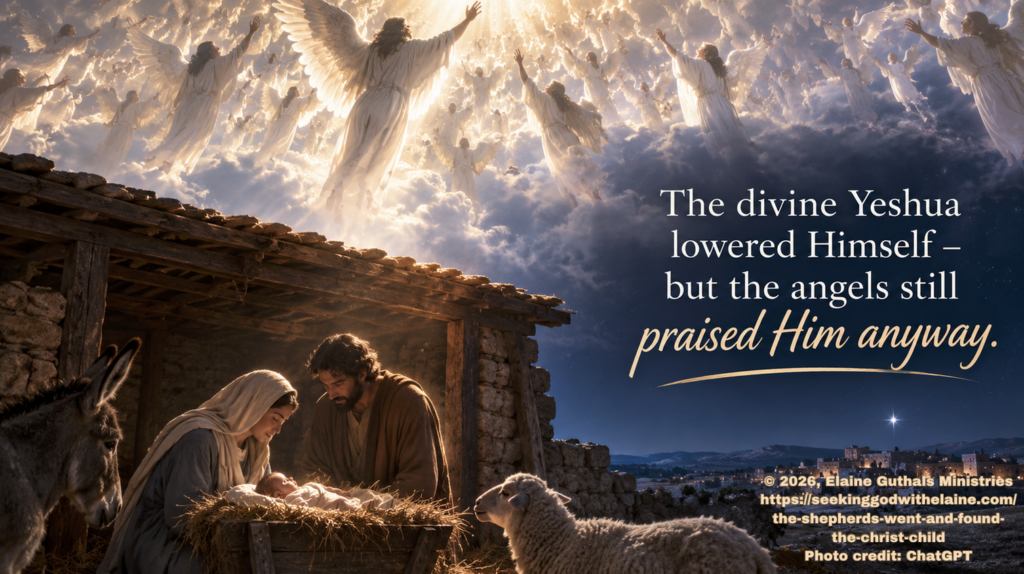
The angels were praising Yeshua because they knew He would secure our salvation.
Glory to God
The host of angels were acknowledging Jehovah’s act of love.
We should give glory to Jehovah every Christmas Day – and every other day. The reasons are
- God is with us.
- He conquered Satan and sin.
- Our salvation has arrived.
Spurgeon noted that this salvation was what gave Jehovah His highest glory. This showed Jehovah’s wisdom and power. It also celebrated His justice. He was sending His Son to suffer for us who had rebelled and broken His law.
Resource
Gumming agreed. To him, glory had three foundations: the substance of the Gospel, how it was disseminated, and the outcomes it had on transforming the hearts and habits of men.
Resource
I get that. Redemption had begun! But that redemption was offered to us, not forced upon us. Redemption didn’t take hold until we are transformed.
Yes, sanctification is a life-long process. We have to be committed to it to start it.
The angels knew to what we could be elevated because – now – Messiah had come as promised.
Because of that, Jehovah’s name should be praised. Only He could provide the Sacrifice worthy enough for the mission.
What is the best way for us to show glory to God? Accept the gift of salvation.
In Highest Heaven
The angels praised Jehovah in Heaven.
Jehovah, through this act of sending His Son to be our Savior, showed the angels who knew no sin what redemption from our sins.
The host of angels were focusing humans’ attention on a fair and just Sovereign God.
Peace on Earth
Jehovah was providing a way to have peace with Him as well as have peace with others.
Hmmm. I thought, under Rome, they were supposed to have Pax Romana – peace – in the Roman empire. Maybe, but this earthly peace isn’t the only kind of peace being offered.
Jehovah is offering to make peace with humans after we rebelled against Him, our Creator. He is offering peace within our hearts.
It is not some type of generic peace that can be imposed or enforced. This is shalom (שָׁלוֹם). It is for those who have found favor with Jehovah.
Peace is the product of righteousness. “… Be joyful. Grow to maturity. Encourage each other. Live in harmony and peace. Then the God of love and peace will be with you” (II Cor. 13: 11 NLT).
Think about it. Ask Jehovah to give us this: May your peace be on earth, as it is in heaven.
It is only when we ask Sovereign God for that true peace and believe only He can offer and provide it that we can receive it.

The host of angels were declaring what Micah 5: 5 had prophesied. “And he will stand to lead his flock with the Lord’s strength, in the majesty of the name of the Lord his God. Then his people will live there undisturbed, for he will be highly honored around the world. And he will be the source of peace …” (Mic. 5: 4-5 NLT).
Those with Whom God Is Pleased
Peace must come from Jehovah’s good will.
We’ve also taken the emphasis off who gets the peace. It isn’t peace for mankind. It is peace for those who have ABCDed.
With whom God is pleased? Good will to men, to me doesn’t translate to God is pleased with us. That takes the focus off Jehovah and puts it onto us.
God wasn’t pleased that sin is in the world, so He sent His beloved Son to fix that. Only He could do that, and it pleased Him to do so.
Why would a Sovereign God Who despises sin go to so much trouble to redeem those who rebelled against Him? He loves us that much. His love and mercy shines through this act.
This goodwill is toward humans. Jehovah didn’t offer salvation to Satan and the demons who sinned.
The Complete Jewish Bible has a different take on this along the lines of my take. “Suddenly, along with the angel was a vast army from heaven praising God: ‘In the highest heaven, glory to God! And on earth, peace among people of good will!’” (Lk. 2: 13-14 CBJ).
If we go back to the Greek, it literally says, “Glory in the highest to God, and on earth peace, among people of [God’s] good pleasure/favor.”
The phrase I am questioning is eudokias (εὐδοκίας). That comes from εὐδοκία (eudokia) — pleasure, good will, favor, or good pleasure.
That ς – s – makes a big difference. It makes the phrase mean people of God’s good pleasure or people who have God’s favor.
So, New Living Translation and Complete Jewish Bible aren’t really saying the same thing. True, they are related – and sound similar.
They aren’t.
We have to understand it as God’s good pleasure/favor, not just that were are nice, peaceful, well intentioned people.
This focuses the peace onto Jehovah’s people, not His creation. Believers – not everyone.
Let’s put all this together. Human discord – even those that lead to wars – was not going to stop. The announcement was that Jehovah’s peace was arriving through his Messiah and resting upon those who are recipients of His favor.
Obeying the Angel’s Command
“When the angels had returned to heaven, the shepherds said to each other, ‘Let’s go to Bethlehem! Let’s see this thing that has happened, which the Lord has told us about.’ They hurried to the village and found Mary and Joseph. And there was the baby, lying in the manger. After seeing him, the shepherds told everyone what had happened and what the angel had said to them about this child. All who heard the shepherds’ story were astonished, but Mary kept all these things in her heart and thought about them often. The shepherds went back to their flocks, glorifying and praising God for all they had heard and seen. It was just as the angel had told them” (Lk. 2: 15-20 NLT)
Let’s Go to Bethlehem!
The outcasts who were not allowed in the temple knew the message was from Adonai.
Even the poorest, simplest, most insignificant person can come to Yeshua for salvation. Though shepherds were seen as ignorant men, they knew enough to listen to the angels and obey Jehovah.
It is hard, when animals are involved, to drop everything and go somewhere. I remember when Grandma died, and we had to drive 350 milts the next day to attend the funeral the day after that.
There weren’t many people around that could milk the cows – and they sure didn’t milk themselves. Dad was only able to go to the funeral because my uncle was on vacation and could do the milking.
The point of the story – animal husbandry includes responsibility for the animal’s production and wellbeing.
We said in the last devotion that the shepherds were keeping watch through the different segments of the dark hours. They were protecting the sheep from wild animals.
Yet, Luke doesn’t tell of any cautionary remarks. No, “Hey, who is going to take care of the flock?” No, “Ooo, baby. We are going to lose our job if the owner finds out about this.”
They turned to each other and said, “Let’s go!”
Look what it says. They were going to search for the manger because they were convinced that the birth had already happened.
Hurried to the Village
They said, “Let’s go,” and off they went in a hurry.
The way I would read it is the shepherds left immediately and ran all the way to the manger. They didn’t wait.
Think about it. In the last devotion, we didn’t say the shepherds were waiting. We said they were watching.
Isn’t watching an active task of waiting? We can wait without watching, but we can’t watch without waiting.
The shepherds – as all of Israel was – were waiting for Messiah to come. They were actively watching for Him to appear.
At least this group of men took the proclamation and acted on it.
Remember, these shepherds had started out afraid of the angel. Now, they are not afraid. It doesn’t even sound like they are confused.
They are confident that the message is from Jehovah.
There Was the Baby, Lying in the Manger
Regardless of the acceptability of the shepherds in society, the first visitors to see the Baby were Jewish shepherds.
This is another good example of hearing not being enough. We have to act on the knowledge that we receive about Messiah. We have to come to Him.
The shepherd found the Baby exactly as the angel said they would. Here was this baby in ordinary swaddling clothes. He was in the extraordinary position of laying in the manger.
Told Everyone
First to Mary and Joseph, then to anyone they met, the shepherds told their story to all who would listen.
Think about it. The men whose testimony was not accepted were given the assignment of being the first to spread the news of Messiah’s birth.
Why? Jehovah chooses the willing. He chooses those who will step up when opportunities present themselves for sharing the Gospel. He chooses those who look for that opportunity. He even chooses those who are willing to post teaching on the internet.
No, nothing we have done makes us worthy of serving Jehovah. We are made worthy because He has chosen us.
The shepherds proved themselves as willing. They told all who would listen.
We have to make our decisions – after the angels have left, after we’ve been to the manger. True, there are many times within the process that we have to make choices.
We have to be committed to the end.
Mary Kept All These Things in Her Heart
Mary was a person who thought things through.
What does that mean? Mary connected the dots. She knew about prophecy. She thought through what Gabriel had told her, what Elizabeth had told her, and what transpired. She saw what meshed.
Everything meshed.
Of course, it did. If Jehovah promises something is going to happen it is going to happen.
If it is important, Jehovah is going to tell us about.
Oh, we aren’t necessarily talking about something specific to us. We are talking about what is promised for a significant number of people.
Went Back to their Flocks, Glorifying and Praising God
After we meet Messiah, we return to our lives – transformed.
What happens after we meet the Christ Child? The shepherds went back to work.
Did we think that they were going to keep evangelizing? If that is what Jehovah would have wanted, that is what would have happened.
Instead, it was not in their plan for them to become a disciple or even an apostle of Messiah.
Wonnacott explained it this way. He wrote,
“And if for you the world has been transfigured, and common things have received the impress of heaven by the vision of God’s salvation, then in the place where your daily lot is cast, in the sphere of your common duties and [labors], stand forth a witness for righteousness and for God, preach the gospel of peace and salvation to the sin-stricken, sorrow-laden men and women all around you.”
Resource
They went home to become preachers. Jehovah wanted them to spread the good news to those with whom they came into contact.
They also went home to keep watching and protecting the sheep. This may have been a lowly employment but watching sheep that may – or may not – have been later sacrificed to the Lord God, King of the Universe, was humbling.
Making the Connections #1
There is some discussion on the status of shepherds.
However they were accepted, it was not disputed that they were Jews. The first guests to see the Baby were from the House of Israel – to whom Messiah had come. “Then Jesus said to the woman, ‘I was sent only to help God’s lost sheep — the people of Israel’” (Mt. 15: 24 NLT).
Making the Connections #2
Cox had a wonderful way to state what our daily walk should be like. He wrote,
“The sages [wise men] and the shepherds were men who looked before as well as after, men who knew little and were aware of it, or men who knew much and yet accounted that much but little compared with what God had to teach. Let us be followers of them, ever looking for more truth while we walk by the truth we know. And, walking in the light we have, it will grow larger and purer; using the gifts we possess, more will be added unto us.”
Resource
- Regardless of how much or how little we know, we know less than Jehovah.
- Jehovah is willing to teach us if we are willing to learn.
- We have to seek for Jehovah’s truth.
- Continued growth leads to purity of character.
Making the Connections #3
Think about David a second. He was born in the same area that Messiah was. He went out from there to do the work that Jehovah had for him.
Really, that is what Yeshua would do. He was born here and went out to do Jehovah’s Will.
Making the Connections #4
Think about what Spurgeon said. He wrote,
“From henceforth, when God looks upon man, He will remember that His own Son is a man. As in the case of war, the feud is ended when the opposing parties intermarry, so there is no more war between God and man, because God has taken man into intimate union with Himself. Herein, then, there was cause for joy.”
Resource
Jehovah no longer sees our sin. He sees His Son’s blood covering them.
Making the Connections #5
Think about the way Yeshua came to earth. He was here to right what we did wrong. What King ever did that?
Yeshua was here to take our sin upon Himself. That would mean He would lose access to Jehovah.
The form of execution was a shame and humiliation in itself. But Yeshua suffered all of this.
Why? Because He loves us. He wanted our relationship restored with Jehovah.
Making the Connections #6
The shepherds did everything right. They sought out the Baby in the manger. They told everyone they came into contact with that Messiah was born. They praised Jehovah.
Heart Check
Think about the battle Yeshua is engaged in for your heart. Ask yourself the following questions.
- Have I acted on what Jehovah has shown me, or am I still standing where I was when I heard it?
How Do We Apply This?
- Act on what Jehovah has shown you.
- Seek Messiah rather than merely knowing about Him.
- Don’t keep the news about Messiah to themselves.
- Return to our daily responsibilities transformed.
- Keep watching for what Jehovah wants to teach us.
Father God. We may feel like the shepherd – lowly people who society rejects. Thank You that You don’t reject us when we genuinely follow Messiah. Transform us from the inside out to become more like You. Amen.
If you don’t understand something and would like further clarification, please contact me.
If you have not signed up for the email providing the link to the devotions and the newsletter, do so below.
If God has used this devotion to speak with you, consider sharing it on social media.