Category: Obedience

  • Love and Obedience: The Last Two Steps in Salvation
    In order to restore our relationship with Him, God designed the plan of salvation. We’ve already talked about the first step of belief. This devotion discusses the last two steps: love and obedience.

    Nuggets

    • Once we have faith in our Sovereign God, we grow to love Him.
    • God wants us to obey His laws and commandments.
    • Duty, self-control, obedience, patience, perseverance — it is all about trying to please God.
    • We don’t earn salvation by doing the do’s and not doing the don’ts, but that does come after conversion.
    • Imitating Jesus because we love Him takes it out of feeling like a duty.

    Devotions in the What I Believe series

    Devotions in the Salvation category

    Flowers with title Love and Obedience: The Last Two Steps in Salvation

    In the last devotion, we began looking at Maclaren’s sentence about salvation. He wrote, “The ladder that has its summit in heaven has for its rungs, first, ‘believe’; second, ‘love’; third, ‘obey.’”

    The last devotion looked at “believe.” This devotion is going to look at “love” and “obey.”

    Let’s Put It into Context

    “Now without faith it is impossible to please God, since the one who draws near to him must believe that he exists and that he rewards those who seek him” (Heb. 11: 6 CSB)

    The foundation of salvation is belief. That has components of faith, access, and reward.

    Faith is the belief that the doctrines stated in God’s Word are true, even if we do not understand all aspects of them. It starts with knowledge.

    But our faith is limited to our understanding. So, we have to trust God in what we don’t understand. Trust is confidence that the promises of God are true.

    Because we have faith, we seek God. In order to approach God, we have to believe there is a God. We have to believe that our relationships with Him need to be restored.

    We have to have faith that, as we ask in prayer, God will reward us.

    Love

    “And he answered, “You shall love the Lord your God with all your heart and with all your soul and with all your strength and with all your mind, and your neighbor as yourself’” (Lk. 10: 27 ESV)

    Once we have faith in our Sovereign God, we grow to love Him. We’ve talk about the two greatest commandments before. For this devotion, we are just going to focus on loving God.

    Staney asserted that love for God should govern our entire being. He felt this should stem for our search for truth and find expression in how we tend ourselves in order to live our lives.

    Searching for and Seeking God

    Hearing His Word (Rom. 10: 17).
    Reading His Word (Rev. 1: 3).
    Praying to Him (Heb. 4: 16).
    Studying His Word (Ac. 17: 11).
    Meditating on His Word (Ps. 1: 1-2).
    Memorizing His Word (Ps. 119: 11).

    Thomson reminded us that this love was to be fear of the Lord reverence. He wrote, “Accustomed to see their enemies punished by the immediate interference of the Deity; and sensible of the sufferings inflicted on themselves for their idolatry and their incessant hankering after the imaginary gods of the heathens, they contemplated the true God rather as an object of fear than of love.”

    But we have to remember that New Testament godliness is equivalent to Old Testament fear of the Lord. That is where we see God’s mercy and love.

    To read a related devotion, click the appropriate button below.

    Maclaren wrote, “No man becomes ‘godly’ by mere desiring. The bridge between faith and godliness is made of manly strength, discrimination and discernment of duty, rigid self-control, patient perseverance.” That has a lot packed into it!

    Okay, we are going to look at duty when we get to the Church category. For now, let’s consider duty as doing God’s Will.

    What does God want us to do? He wants us to obey His laws and commandments.

    We talked about self-control a couple of times. I had considered making self-control my word of the year but went with self-discipline instead. We also talked about it when we talked virtues. Obedience can only be attained when human passions can be controlled.

    To read a related devotion, click the appropriate button below.

    We’ve also talked patience and perseverance lately — in fact, we said they were linked. Perseverance is all about calmly enduring going from milk babies to steak adults.

    Duty, self-control, obedience, patience, perseverance — it is all about trying to please God. Because we love Him, we want to do what He wants us to do. We show that by spending time with Him in prayer and obeying His laws and commandments.
    Canyon

    Obey

    “I will place my Spirit within you and cause you to follow my statutes and carefully observe my ordinances” (Ezek. 36: 27 CSB)

    I know I am repeating myself. To love God is to obey Him.

    So many times, in the past, I think people have been told that all they have to do is love God. And that is true.

    We don’t earn salvation by doing the do’s and not doing the don’ts. But that does come after conversion.

    We can’t stop at the love God part. We have to show that love by obeying Him.

    This is where we should imitate Jesus. Guthrie wrote, “They who would live like Jesus must look to Jesus.” This is evidence of submission.

    Glossary

    What greater motive to imitate Jesus than to love Jesus? That takes it out of feeling like it is a duty. It makes it more genuine.

    Making the Connections

    I think salvation is one of those three-part words. We were saved the instant that God forgave our sins.

    But that didn’t mean salvation was over. Our job description says we need to work out our salvation. We do that as we navigate the sanctification road. Sanctification is the transformation of mind, body, and soul beginning with regeneration and ending with perfected state of spiritual wholeness or completeness. That makes salvation a process.

    The Disciple’s Job Description

    Complete Job Description

    Individual Description

    Job Duty #2
    Work Out Our Salvation (Philippians 2: 12)

    Yes, we don’t reach the end of the sanctification road until we are made perfect. That isn’t going to happen until we reach heaven.

    Glossary

    Making the Connections to Self-Discipline

    The plan of salvation can be difficult for non-believers to understand. We need to get them to realize that it is a process that they will be undertaking for the rest of their lives.

    We are also considering what we would say if a non-believer asked us about this process. Here is the worksheet again. What would you tell someone who questions God authority to judge sin?

    • What does the Scriptures say?
    • What do I believe?
    • Why do I believe the same/differently than the Scriptures?
    • What are the talking points when witnessing to a non-believer?

    Related Links

    I have created a worksheet of the questions above. Click on the button below to access it.

    How Do We Apply This?

    Do we sometimes feel like the lawyer in Luke 10? Do we feel like we cannot love God enough?

    Segaud had a great list that we can use to evaluate where we are so we can determine what changes need to be made.

    • “Do you obey all that He commands?”
    • “Do you obey in such a manner as He requires of you?”
    • “Do you obey because God commands?”
    • Do you possess a love of subjection and dependence?
    • “Do you say with Job, ‘“The Lord gave,’” and the Lord takes away? (Job 1:21).
    • “Do you complain, as though God was unjust?”
    • “Do you embrace the cross [God sends you diseases and afflictions]”?
    • “Do you honour and love Him [when He punishes you]”?
    • “Do you love God more than all else?”
    • “Do you love whatever God loves, and hate whatever He hates?”
    • “Does it afford you delight to reflect on God, to converse with Him by prayer, &c.?”
    • “Do you long for the possession of God?”

    God offers us the gift of salvation, but He does have expectations that come with it.

    Loving Heavenly Father. We want to imitate You. You are love, so we want to be love. We want to obey You. Help us to follow Your laws and commandments so that we may become holy and righteous like You. Amen.

    What do you think?

    Leave me a comment below (about this or anything else) or head over to my Facebook group for some interactive discussion.

    If you don’t understand something and would like further clarification, please contact me.

    If you have not signed up for the email daily or weekly providing the link to the devotions and the newsletter, do so below.

    If God has used this devotion to speak with you, consider sharing it on social media.

  • The Nominal Disciple

    Can we be disciples in name only? This devotion looks at the passage where Paul was biting on the Jews for being nominal disciples.

    Nuggets

    • Paul was biting on the Jews for boasting they loved God without even trying to imitate Him.
    • Religion and its rituals are not what God wants; God is looking for a change in heart.
    • God wants to see evidence that we have chosen Him.
    • If we say we are disciples of God, we have to live obediently and not have double standards.
    • Circumcision of the heart is accomplished by the Holy Spirit using the atoning blood of Jesus.
    Flowers with title The Nominal Disciple

    The Jews were very proud of their Jewishness. They loved being the chosen ones. Horton wrote that they felt it was a high honor.

    But how many times have we shook our heads at the Jews? They were not exactly poster children for obedience. Remember, obedience means to hear and carry out the instructions that God gives us.

    Instead, they were nominal disciples. What can we learn from them?

    The Boast

    “Now if you call yourself a Jew, and rely on the law, and boast in God, and know his will, and approve the things that are superior, being instructed from the law, and if you are convinced that you are a guide for the blind, a light to those in darkness, an instructor of the ignorant, a teacher of the immature, having the embodiment of knowledge and truth in the law” (Rom. 2: 17-20 CSB)

    Part of the reason was they nominal disciples was because they were very boastful. Another part was they thought that being God’s chosen people gave them a pass where they didn’t have to obey God’s laws and commandments. (Did they think they were for the other nations???)

    So, what Paul was biting on them for boasting they loved God without even trying to imitate Him. “Now if you call yourself a Jew …” (Rom. 2: 17 CSB). He was telling them that isn’t going to fly.

    The Jews were especially proud of being circumcised. It was the seal of the covenant. The problem was, as Tyson put it, “the seal is not the treasure sealed.” The seal itself isn’t important; it is the treasure inside.

    Religion and its rituals are not what God wants. God didn’t want the circumcision without the holiness. He doesn’t want baptism without the holiness. There is no purity in the artificial or that which is designed to impress the worldview people.

    Human nature is not clean. Our hearts will always be wicked (sinful) because of our human nature (Jer. 17: 9) – unless we ask God to purify us. Only God can remove the sin in our lives.

    To read a related devotion, click the button below.

    Paul gave several and additions in these verses.

    • “and rely on the law” (Rom. 2: 17 CSB)
    • “and boast in God” (Rom. 2: 17 CSB)
    • “and know his will” (Rom. 2: 18 CSB)
    • “and approve the things that are superior, being instructed from the law” (Rom. 2: 18 CSB)
    • “and if you are convinced that you are a guide for the blind” (Rom. 2: 19 CSB)
    • “[and] a light to those in darkness” (Rom. 2: 19 CSB)
    • “[and] an instructor of the ignorant” (Rom. 2: 20 CSB)
    • “[and] a teacher of the immature, having the embodiment of knowledge and truth in the law” (Rom. 2: 19-20 CSB)

    What Paul was trying to get across was that circumcision is surface. God is looking for obedience, submission, and service. God is looking for a change in heart.

    I know. I know. Back to the heart. We’ve talked about our hearts before. We talked about the greatest commandment before in How Do We Love God?. Depending on which book you read, it is love the Lord with all your heart, soul, strength, and mind.

    We’ve talked in Peace, Mercy, and Love about God’s peace, mercy and love is at our center. Our center is considered our hearts. That is our foundation.

    Also, we’ve talked in The Fullness of God’s Love about how Jesus is the Word (Jn. 1: 1) that we are to hide in our hearts (Ps. 119: 11). Jesus is a major part of that foundation.

    In Have We Lost Our First Love?, we talked about how we have to open our hearts to allow Jesus to take full residence within them. We lose our first love when we either don’t allow Him full control or we kick Him out after a while.

    Obedience has to come from the heart. In Getting Obedience to the Heart Level, we said God’s Word is supposed to be a part of us. His laws and commandments are supposed to affect our character or our core – our heart level. If we are to engrave God’s laws and commandments on our hearts, we internalize them, and they change us.

    In How Are Disciples Pure in Heart?, we said God wants us to get back to where Adam and Eve were before the original sin, which we can get there through grace. Nothing we can do or give up will purify us. Only God can remove our sins — when we ask and repent of our sins. If we don’t have the pure heart — or at least are not working toward it — we don’t see God.

    To read a related devotion, click the appropriate button below.

    Let’s go back to the Jews thinking they got a pass. We’ve talked a couple of times that God isn’t selling fire insurance. We can’t admit our sins, believe He is our Savior and Redeemer, and confess God as our Sovereign Lord – and drop it. God wants to see evidence that we have chosen Him.

    That evidence is our obedience. We have to live like we were converted. We have to do the progression. We have to undergo the sanctification. We have to submit.

    To read a related devotion, click the appropriate button below.

    Paul wanted to make sure they knew that their heritage and outward seals weren’t enough.

    Double Standards

    “you then, who teach another, don’t you teach yourself? You who preach, “You must not steal” — do you steal? You who say, “You must not commit adultery” — do you commit adultery? You who detest idols, do you rob their temples? You who boast in the law, do you dishonor God by breaking the law? For, as it is written: The name of God is blasphemed among the Gentiles because of you” (Rom. 2: 21-24 CSB)

    Ooo, baby. Paul was really getting after the Jews now. He was calling them on double standards.

    You preach something, but you go ahead and do it.

    Don’t we just hate double standards? Don’t we hate it when someone tells us not to do something but then goes ahead and does it themselves?

    This passage is interesting if we hook it with James. “Not many should become teachers, my brothers, because you know that we will receive a stricter judgment” (Jas. 3: 1 CSB). Paul is saying that teachers with double standards are going to get a really strict judgment.

    What I get from this is that we have to be consistent. If we say we are disciples of God, we have to live obediently and not have double standards.

    We just finished a series on being consistent. We said that we have to be diligent in following God’s Word.

    Devotions in the Consistency Needed for Spiritual Growth series

    I also get from this that we are to use our experiences when we witness. Robinson wrote, “That truth is most effective which, having proved itself forceful in reaching our own consciences, goes from its success there upon the intrenchments of another.” Translation – If I say this is something that happened to me or helped me in my walk as a disciple (it’s proved itself), you would be more open to trying it for yourself.

    Heart Matter

    “Circumcision benefits you if you observe the law, but if you are a lawbreaker, your circumcision has become uncircumcision. So if an uncircumcised man keeps the law’s requirements, will not his uncircumcision be counted as circumcision? A man who is physically uncircumcised, but who keeps the law, will judge you who are a lawbreaker in spite of having the letter of the law and circumcision. For a person is not a Jew who is one outwardly, and true circumcision is not something visible in the flesh. On the contrary, a person is a Jew who is one inwardly, and circumcision is of the heart—by the Spirit, not the letter. That person’s praise is not from people but from God” (Rom. 2: 25-29 CSB)

    We’ve talked before about circumcision of the heart. Circumcision of the heart is where God changes our hearts. Unlike covenant circumcision, which was the physical sign the Israelites agreed with the covenant, this is where God wants us to cut out the old sin and replace it with His love and grace. He doesn’t want it to just be a ritual or symbolic. God wants the change to be real, personal, and genuine.

    Our hearts will always be wicked (sinful) because of our human nature (Jer. 17: 9). That doesn’t mean we get a pass because of that. We will still have to pay the consequences of our sins.

    Worldview followers do not have a circumcised heart, which could be interpreted as heartless. That, too, is understandable when they refuse to acknowledge God as Sovereign Lord.

    To read a related devotion, click the appropriate button below.

    Circumcision of the heart is accomplished by the Holy Spirit using the atoning blood of Jesus. We don’t do it on our own. I would say this is part of the sanctification process. Sanctification is the transformation of mind, body, and soul beginning with regeneration and ending with perfected state of spiritual wholeness or completeness.

    But it is really interesting to me what Paul is saying here.

    We benefit when we obey the law, whether we are circumcised or not.
    If we disobey the law, we can lose what we have.

    We can’t take this to mean that worldview people who have not ABCDed will get a pass. They have to be blessed to get a pass according to Matthew 25: 34. We are only blessed when we ABCD.

    The ABCDs of Salvation

    If you have not become a believer in Christ, please read through the
    Plan of Salvation and prayerfully consider what God is asking you to do.A – admit our sins

    B – believe His Son Jesus is our Redeemer

    C – confess God as Sovereign Lord

    If you have not become a believer in Christ, please read through the Plan of Salvation and prayerfully consider what God is asking you to do.


    D – demonstrate that commitment by making any changes needed in our lives to

    live the way in which God has called us

    The Disciple’s Job Description

    Making the Connections

    Haven’t we heard of worldview people questioning whether disciples are Christians? Their lifestyles do not provide enough evidence to convict them. We should shake our heads at ourselves, too.

    Remember, God doesn’t want this to just be an outward religion. He wants it to be an inward transformation.

    The problem is we are self-willed creatures, according to Horton. Instead, we need to submit to God. We need to practice self-denial, patience, and perseverance.

    To read a related devotion, click the appropriate button below.

    How Do We Apply This?

    What I get from this passage is that we have to be genuine when we ABCD. We have to truly submit to God. We have to obey His laws and commandments.

    Yes, that is going to go against our human nature. That is part of the reason we go through the process of sanctification. God will help us as we show Him that we will submit to Him.

    Father God. Circumcise our heart. We want to live for You. Amen.

    What do you think?

    Leave me a comment below (about this or anything else) or head over to my Facebook group for some interactive discussion.

    If you don’t understand something and would like further clarification, please contact me.

    If you have not signed up for the email daily or weekly providing the link to the devotions and the newsletter, do so below.

    If God has used this devotion to speak with you, consider sharing it on social media.

  • How Are Disciples Pure in Heart?

    How can any of us see God if we are expected to be pure? This devotion looks at how God can expect humans to be pure.

    Nuggets

    • God wants us to get back to where Adam and Eve were before the original sin, which we can through grace.
    • Nothing we can do or give up will purify us.
    • Only God can remove our sins — when we ask and repent of our sins.
    • If we don’t have the pure heart — or at least are not working toward it — we don’t see God.

    Devotions in the The Beatitudes Show Us How to be Docile series

    Flowers with title How Are Disciples Pure in Heart?

    Okay, I am not going to lie. To me, this verse is one of the scariest in the Bible.

    How is anyone — especially me — going to get to see God?

    We aren’t pure. Far from it.

    But we are studying docile, so there is hope for us yet.

    Let’s Put It into Context

    Docile means easily taught. As we grow in our relationship with God, we are blessed.

    Blessedness means we have been perfected. For the disciple, perfection is holy, sanctified, and righteous.

    Holy means to be set apart, perfect, and pure. Sanctification is the process where our lives are changed, and we made holy. Righteousness is the result of a solid relationship with God. Blackall said that righteousness is “living a life in sincere and perfect obedience to all the laws of God.”

    Yep. Here we go with the heart again.

    We talked about the greatest commandment before in How Do We Love God?. Depending on which book you read, it is love the Lord with all your heart, soul, strength, and mind. Heart is always listed first.

    We’ve talked in Peace, Mercy, and Love about God’s peace, mercy and love being at our center. Our center — our innermost being — is considered our hearts. That is our foundation.

    Also, we’ve talked in The Fullness of God’s Love about how Jesus is the Word (Jn. 1: 1) that we are to hide in our hearts (Ps. 119: 11). Jesus is a major part of that foundation.

    In Have We Lost Our First Love?, we talked about how we have to open our hearts to allow Jesus to take full residence within them. We lose our first love when we either don’t allow Him full control or we kick Him out after a while.

    Obedience has to come from the heart. In Getting Obedience to the Heart Level, we said God’s Word is supposed to be a part of us. His laws and commandments are supposed to affect our character or our core – our heart level. If we are to engrave God’s laws and commandments on our hearts, we internalize them, and they change us.

    To read a related devotion, click the appropriate button below.

    When we look up purity in the Holman Bible Dictionary, it sends us to the definition of clean/unclean, which we have also talked about before.

    The Holman Bible Dictionary states that “cleanness was thus fundamental to the establishing and preservation of holiness in the Israelite community.”

    It isn’t just knowing the difference between good and evil. It isn’t just keeping as far away from evil as we can. We have to discipline our minds to remain pure.

    To read a related devotion, click the button below.

    We Are Clean

    “Blessed are the pure in heart …” (Mt. 5: 8 CSB)

    God calls us to be pure in heart. He wants us to get back to where Adam and Eve were before the original sin. We can do that through grace (Caroming).

    Jordan stated that purity is “… the purity of the thoughts and desires” and “… leads to purity of worship” and life. I can see this because it has to incorporate our mind and soul. All of that bubbles out of us as worship.

    We know the concept. “Jesus replied, ‘You must love the Lord your God with all your heart, all your soul, and all your mind’” (Mt. 22: 37 NLT).

    However, God know our hearts are not pure because of the sin in our lives. Hull wrote, “But, there is no purity apart from the absolute authority of God in the affections. Man is not made by negatives.”

    Let’s break that apart. Human nature is not clean. Our hearts will always be wicked (sinful) because of our human nature (Jer. 17: 9).

    Let’s restate that. Our hearts will always be wicked (sinful) unless we ask God in our hearts to purify us. Only God can remove the sin in our lives.

    Look at the “… in the affectations.” There is no purity in the artificial or that which is designed to impress the worldview people.

    We have to have God as Sovereign Lord to have the purity. Nothing we can do or give up will purify us. (Doing the do’s and not doing the don’ts doesn’t make us pure.)

    Think about it this way. The worldview notion is that we have to fight for our success.

    God’s notion is that purity comes from the heart. It is more who we are — our character — than what we do. It is where Jesus and the Holy Spirit live within us.

    We can have motivations that are, in reality, taking us down a wrong path. We can do and do and do that will get us nowhere.

    Only God can remove our sins — when we ask and repent of our sins. He wants to restore our balance.

    Candles

    Seeing God

    “… for they will see God” (Mt. 5: 8 CSB)

    We had a whole series awhile back on seeing God.

    To read devotions in the Seeking God series, click the appropriate button below.

    We generally think of “seeing God” to mean face to face. And we will — whatever that means. We will be in His Presence.

    But we can see God now. We can see

    • How He satisfies our desires.
    • How He gives us hope.
    • How He sustains us through our trials.
    • How He is correcting us when we sin.
    • How He is transforming us through sanctification.
    • How He is fulfilling the promises in His Word.
    • The peace and the joy that He brings.

    But if we don’t have the pure heart — or at least are not working toward it — we don’t see God. He gets lost in the rat race of this world. We take our focus off Him and put it no ourselves and our own lives.

    Water

    Making the Connections

    One thing we don’t focus on is that it is not about us. The only way we begin to become pure is to admit our sins, believe Jesus is our Savior and Redeemer, and confess God as Sovereign Lord.

    The ABCDs of Salvation

    If you have not become a believer in Christ, please read through the
    Plan of Salvation and prayerfully consider what God is asking you to do.A – admit our sins

    B – believe His Son Jesus is our Redeemer

    C – confess God as Sovereign Lord

    If you have not become a believer in Christ, please read through the Plan of Salvation and prayerfully consider what God is asking you to do.


    D – demonstrate that commitment by making any changes needed in our lives to

    live the way in which God has called us

    The Disciple’s Job Description

    Once we do, God call us to have a change of heart. This happens two ways: regeneration and sanctification. Oh, yeah. Churchy words.

    Regeneration is the change in us that God brings about when we go from being spiritually dead to spiritually alive. This change has to be in our hearts.

    It is where God breaks Satan’s hold on us. Only God has the power to do that, and He only does when we admit our sins, believe on Jesus as Redeemer, and confess God as Sovereign Lord.

    To read a related devotion, click the button below.

    We’ve talked a lot about sanctification recently. It can be a little difficult for some to understand.

    Sanctification is “the process of being made holy resulting in a changed life-style for the believer” (Holman Bible Dictionary). We are sanctified through faith. It is the evidence of justification and our conversion and how we get to righteousness.

    It is learning — acquiring wisdom — so that we can grow in grace and knowledge. Sanctification happens at conversion, but it is also a growing process.

    Sanctification separates us from our old lives and builds a new life in Christ. This is done by the work of the Holy Spirit’s promptings.

    The transformation discussed in Romans 12: 2 happens in sanctification. This growth in grace and knowledge changes our nature.

    Sanctification should be a complete deal. It should be mind, body, and soul. We are to submit to God’s loving kindness with all of our being.

    Making the Connections to Self-Discipline

    I love what Caroming said. He wrote, “[Purity] is a living principle, ever powerful, ever resisted, yet never beaten, growing daily in aspirations and likeness, until it is made perfect by seeing Christ as He is, when we shall be like Him, because we shall see Him as He is.”

    It is a living principle. It is growing daily. It is being sanctified.

    Being sanctified is a process built on our learning — our growth. We have to be disciplined in that growth.

    How Do We Apply This?

    Good cautioned us that we can have the purity without the holiness. But it won’t get us anywhere.

    Well, that shoots down the worldview people’s assumption that they can just be good and get to heaven.

    To read a related devotion, click the button below.

    How do we achieve purity? Purity is:

    • “the mind renewed,
    • “the disordered spirit restored, and
    • “conformed to the ‘image of God,’ in righteousness and true holiness.”

    Talk about the outcome of sanctification!

    But it has to be genuine. We must be working to transform ourselves to imitate God. We have to take responsibility for our actions and inactions.

    God calls us to be pure in heart. I think that is another instance of the past, present, and future aspects in one word.

    At conversion, we are made pure because we are given God’s heart. But it is a process to become like Him. That process won’t be complete until we reach heaven.

    God calls us to be pure in heart. Let that be our goal today.

    Father God. We want to have a heart like Yours — pure and holy. Lord, change us until that is accomplished. Amen,

    What do you think?

    Leave me a comment below (about this or anything else) or head over to my Facebook group for some interactive discussion.

    If you don’t understand something and would like further clarification, please contact me.

    If you have not signed up for the email daily or weekly providing the link to the devotions and the newsletter, do so below.

    If God has used this devotion to speak with you, consider sharing it on social media.

  • What Is the Relationship Between Righteousness and Obedience?

    If holiness leads to righteousness, how does obedience fit? It may be easy to think that God focuses on our obedience. This devotion looks at how God was after the righteousness all along.

    Nuggets

    • God knew before He created us that we would be disobedient.
    • When we are disobedient, we have to confess our sins and repent in order to earn God’s forgiveness.
    • God was always planning on forgiving us.
    • God’s goal has always been being reunited with mankind.

    To read a devotion in the What Is Righteousness? series, click on the button below.

    Flowers with the title What is the Relationship Between Righteousness and Obedience?

    For the past few devotions, we have been looking at righteousness. In the last devotion, we looked at the relationship between righteousness and holiness. In this devotion, we looked at the relationship between righteousness and obedience.

    Let’s Put It into Context

    “Righteousness will be ours if we are careful to follow every one of these commands before the LORD our God, as he has commanded us” (Deut. 6: 25 CSB)

    God’s laws and commandments are good. Their purpose was so that we could gain righteousness. Yes, we need salvation, but obedience to the laws is how we transform to be more like God.

    The laws and commandments show us the extent of a God’s love for us. They also show us God’s character.

    These laws and commandments were established for a reason — for our good. That is why God is called a benevolent God.

    No, mankind broke the laws and commandments pretty darn quickly. But God knew that we would.

    God Never Had a Plan B

    “Even before the world was made, God had already chosen us to be his through our union with Christ, so that we would be holy and without fault before him” (Eph. 1: 4 GNT)

    God chose us even before He created us. We were to worship Him. He chose us to be saints.

    To read a related devotion, click the appropriate button below.

    But God knew before He created us that we would be disobedient. If we weren’t going to be disobedient, He wouldn’t have “… already chosen us to be his through our union with Christ …” (Eph. 1: 4 GNT).

    If we had been good boys and girls and always been obedient, Christ would not have had to pay the penalty for our sins. We weren’t — He did.

    It has always been about obedience and disobedience.

    But look at it this way. God was ready for the disobedience.

    Oh, yeah. He could have squashed that bug real fast. But He didn’t. He let it play out because He had the plan of salvation set in stone. He was always going to have Jesus redeem us.

    It wasn’t based on anything we did — or didn’t do. Remember, not created yet.

    And what is our reward? “… so that we would be holy and without fault before him” (Eph. 1: 4 GNT). Being holy produces being righteous.

    I had never thought of it this way. “But since we were chosen m (sic) Christ ‘before the foundation of the world,’ let us joy with reverence over the priority of our original nature, and not confound ourselves with any of the products of time. We are clothed upon with temporal nature, but we are not children of time. We are fallen into time, but we are from eternity” (Pulsford).

    “Long before the geological eras began, long before the great chaotic age, and long before that first of all the sad changes, namely, the angel fall, God beheld His final human race, perfect in His Son. Whatever we have become through the two great falls, in heaven, and in earth, in Christ Jesus we are the holy children of eternity. Our right home is in our Father’s house, amid the first-born eternal glories” (Pulsford).

    Wow! “… we are holy children of eternity.” I always knew about eternity from here on out. I hadn’t realized from creation forward.

    Repentance Is Not Optional

    “If we confess our sins, he is faithful and just and will forgive us our sins and purify us from all unrighteousness” (I Jn. 1: 9 NIV)

    So, since God knew — and still knows — we are going to be disobedient, we can skip the repentance part, right?

    I mean, repentance not only means expressing sorrow for things we’ve done wrong, but it also means making the commitment to changing ourselves so that we no longer do the wrong things. That means giving up our pet sins.

    Wrong. When we are disobedient, we have to confess our sins and repent in order to earn God’s forgiveness.

    God has no problem forgiving us when we genuinely ask for forgiveness. But we have to ask and be active in turning away from the sin.

    Make no mistake, God knows when we have sinned. He sees and knows everything.

    God still makes us ask for forgiveness. It means more to us that way. We don’t grow to think we are entitled.

    Praying hands

    Forgiveness Is Guaranteed

    “He will pray to God, and God will delight in him. That person will see his face with a shout of joy, and God will restore his righteousness to him” (Job 33: 26 CSB)

    When we pray and sincerely ask for forgiveness and start obeying God, He will delight in us. Let’s roost a little on God forgiving us. God — in all of His mercy — forgives us when we ask.

    Nothing is too big. Nothing is too small. God forgives all of our sins — when we admit that He is Sovereign God.

    God was always planning on forgiving us. There is only one thing that we can do that He won’t forgive — not admitting our sins, believing Jesus is our Savior, and confessing He is our Sovereign Lord. Everything else can be forgiven — if we confess and repent.

    Because we continue to sin, we have to pray every day for forgiveness. Since we have to choose every day to obey God, we have the opportunity to sin daily. While the initial forgiveness of our sins changes us from spiritually dead to spiritually alive, it isn’t a once and done for subsequent sins.

    What is God looking for in repentance? He is looking for us too acknowledge that the sin was against Him. He wants us to be sorry that we committed that sin.

    Righteousness Has Always Been the Goal

    Look at Job 33: 26 again. “… God will restore his righteousness to him” (Job 33: 26 CSB). Righteousness has always been the goal. God always wanted us restored to holy children of eternity.

    Righteousness is a gift from God. We can’t me set apart, perfect, and pure without Him.

    We can’t be perfect and pure while we are in these sinful bodies. We still have the capacity to sin.

    God’s goal has always been a new heaven and new earth with us having new bodies. His goal has always been being reunited with mankind.

    Person

    Making the Connections

    Do you feel loved? Do you feel special? God did all of this for you and me — for every Tom, Sally, and Elaine.

    Doesn’t God know us so well? Some might ask, if righteousness was always the goal, why didn’t He just start with that?

    Well, He did. Adam and Eve were the ones to choose unrighteousness. It was their choice.

    What? If God is all-powerful, couldn’t He have created people who would be obedient?

    But then we wouldn’t know how much God loves us. We wouldn’t know that He would go to this extent to get us back again.

    Making the Connections to Self-Discipline

    What does God ask from us? Obedience. Love. Worship.

    Back in What Is Obedience?, we said obedience was “to hear God’s Word and act accordingly” (Holman Bible Dictionary).

    To read a related devotion, click the button below.

    Obedience to God’s laws and commandments makes us holy. Holiness brings us righteousness.

    We can discipline ourselves — with God’s direction — to to be more obedient. Why do I say this? Because the bottom line is I believe it is a choice.

    It is our choice to put ourselves into situations where we may be tempted to not be obedient. We choose to say something, buy something, think something, yada, yada, yada.

    No, obedience is not easy. Satan wants us to think we have no say in the matter. But we do — it is called free will.

    If we discipline ourselves, it is easier to control our actions and reactions. Booth, Hennessy, and Doyle wrote, “Self- regulatory skills make it easier to sustain attention, suppress emotional and behavioral impulse responses, and ultimately attain long-term goals.”

    Resource

    Journal of Child and Family Studies (2018) 27:3767–3781

    How Do We Apply This?

    Ooo, baby. Did you catch that — suppress emotional and behavioral impulse responses. That is a biggy, isn’t it? We react with our emotions full throttle, and our behavior can go way south.

    A lot of times, those emotional responses sabotage our desire to obey God. We have to make sure God is in control, not our emotions.

    Remember a couple of years ago, there was the whole What Would Jesus Do? movement? We were supposed to insert Jesus into whatever we were facing and determine what His response would be.

    That is good advice on two levels. The first level is don’t lead with the emotional response. Catch our breaths, think about it, and then respond.

    The second level reminds us to choose obedience. Jesus always obeyed God, just as we are called to do.

    If we choose the obedience, we get the holiness and righteousness. It is well worth the choice.

    Loving Father. If we have admitted our sins, believed on Jesus as our Redeemer, confessed You as our Sovereign Lord, and obey Your laws and commandments, we will become holy as You are. As we grow our relationships with You, we will become righteous. Our goal is to imitate You. Help us to regulate our emotional and behavioral impulse responses so that, in every situation, we will respond as Jesus would have. Amen.

    What do you think?

    Leave me a comment below (about this or anything else) or head over to my Facebook group for some interactive discussion.

    If you don’t understand something and would like further clarification, please contact me.

    If you have not signed up for the email daily or weekly providing the link to the devotions and the newsletter, do so below.

    If God has used this devotion to speak with you, consider sharing it on social media.

  • Getting Obedience to the Heart Level

    How do we remember all of these laws and commandments so that we can obey them? We need to get them to change us. This devotion looks at getting God’s laws and commandments to our heart level.

    Nuggets

    • God’s Word is supposed to be a part of us.
    • His laws and commandments are supposed to affect our character or our core – our heart level.
    • We are to constantly be in teacher mode as we have to teach by example.
    • If we are to engrave God’s laws and commandments on our hearts, we internalize them, and they change us.
    • We remember better when we write things down.
    • Not only are we to obey the laws and commandments in our own homes, but they are also to be the laws of our cities.
    Flowers with title Getting Obedience to the Heart Level

    When we think about obeying God’s laws and commandments, that mean we have to actually live them. We do that by bringing them into our hearts – bringing it down to heart level.

    Engraved on Our Hearts

    “These words that I am giving you today are to be in your heart” (Deut. 6: 6 CSB)

    I know. We’ve talked about our hearts a lot lately. We talked about the greatest commandment before in How Do We Love God?. Depending on which book you read, it is love the Lord with all your heart, soul, strength, and mind.

    We’ve talked in Peace, Mercy, and Love about God’s peace, mercy and love is at our center. Our center is considered our hearts. That is our foundation.

    Also, we’ve talked in The Fullness of God’s Love about how Jesus is the Word (Jn. 1: 1) that we are to hide in our hearts (Ps. 119: 11). Jesus is a major part of that foundation.

    In Have We Lost Our First Love?, we talked about how we have to open our hearts to allow Jesus to take full residence within them. We lose our first love when we either don’t allow Him full control or we kick Him out after a while.

    To read a related devotion, click the appropriate button below.

    In this verse, we are told that God’s Word is supposed to be a part of us. We aren’t supposed to leave the Bible on the shelf and not read it. But then, we are supposed to do more than just read it.

    God’s laws and commandments are supposed to affect our character or our core – bringing it down to our heart level. They are to change us until we are more like Him. They are to make us holy and righteous.

    Yes, words can do that when they come from God. How?

    God’s Word leads to salvation. “Truly I tell you, anyone who hears my word and believes him who sent me has eternal life and will not come under judgment but has passed from death to life” (Jn. 5: 24 CSB).

    So, we have to hear God’s Word, read it, believe it, and let it change us. We have to choose it.

    Listen to what Adeney said about it. “Our religion must not be a mere matter of taste, of sentiment, and of philosophic speculation. It must be regarded as obedience to the will of our supreme Lord and Master.”

    If we choose not to believe — or make the choice by not making the choice — we will pay the consequences of our sins.

    But it isn’t a once and done choice. Having God’s Word engraved on our hearts is only the beginning. It has to permeate our lives.

    Permeating Our Homes

    “Repeat them to your children. Talk about them when you sit in your house and when you walk along the road, when you lie down and when you get up” (Deut. 6: 7 CSB)

    We just talked about teaching in How Did Moses Say Goodbye?. We talked about the reasons we should teach our children – and others.

    To read a related devotion, click the appropriate button below.

    We reviewed what we said in the When We Give Up on God series. We are expected to mature enough in our relationship with God so that we could teach others – not just children. We need to learn enough so that we can make disciples of others.

    To read a devotion in the When We Give Up on God series, click on the appropriate button below.

    So, we are going to concentrate on the last part of the verse. What I get out of that is we are to constantly be in teacher mode. To me, that means our heart level has to be ready to teach by example.

    Think about it. If we are to engrave God’s laws and commandments on our hearts, we internalize them, and they change us. So, when we others watch us, we are teaching by example.

    We are witnessing as people see us living our lives. Don’t get me wrong. We need to be doing more than that when we witness, but our lifestyles are also a witness.

    Witnessing begins at home with our family. They see us studying God’s Word. Not just reading – studying. They see us praying. They see our faithful attendance. They see how we treat others – as Jesus would.

    I like what Beecher said. He wrote, “Like produces like.” It amazes me sometimes how like me Adam is. My nut didn’t fall far from my mom’s tree.

    Yes, children can be the exact opposite of their parents. Children raised in a horrible situation can use that situation as a catapult to a better life in adulthood. Children raised in a Christian household can follow the worldview, instead.

    Where I was going with this was “Start a youth out on his way; even when he grows old he will not depart from it” (Prov. 22: 6 CSB). Teaching our family – especially when they are young – is important. They not only hear our words, but they also see our hearts.

    Children

    Use Props

    “Bind them as a sign on your hand and let them be a symbol on your forehead. Write them on the doorposts of your house and on your city gates” (Deut. 6: 8-9 CSB)

    Yep, back to remember. God wants us to remember His laws and commandments. He wants us to remember how He has provided for us in past trials.

    To read a related devotion, click the appropriate button below.

    God is also very fine with us using crutches to help us remember. No, I don’t know if God really is literal here with the binding and the writing. We know He can be symbolic.

    We do need to put this into context a little. During Moses’ time, they didn’t have books. They had stone tablets and scrolls which stayed with the priests. The average Tom, Sally, and Elaine couldn’t read them if they had them.

    Tom, Sally, and Elaine had to make do with memorizing. Taking nuggets of scripture and keeping it with them would be very helpful.

    Today, we may have other things. Remember my Warrior Princess bracelet? That is one of my props.

    To read a related devotion, click the button below.

    We’ve got good props these days. We have Bibles in a variety of translations. We have the internet to find devotions and other resources. We can have verses sent to our emails on a daily basis.

    I liked two things Moses had to say. “Write them …” (Deut. 6: 9 CSB). I liked the writing part. We remember better when we write things down. That is why we take notes in school.

    Moses had two interesting suggestions as to where to write them. “… on the doorposts of your house and on your city gates” (Deut. 6: 9 CSB). Not only are we to obey the laws and commandments in our own homes, but they are also to be the laws of our cities.

    Making the Connections

    Why all of the repetition? Well, the Wilderness Wanderers didn’t have it written down. If they were going to remember God’s laws and commandments, they had to hear it again and again.

    Yes, we are lucky because we have it written down. But do we take it to heart level? Or do we just keep it surface level?

    If obedience to God’s laws is going to get to our heart levels, we have to open our hearts and accept it all the way in us so that it changes us. Yes, that means repetition so it will get through our hard heads and hard hearts.

    Heart

    How Do We Apply This?

    We have to search for and seek God until we do have it at heart level.

    • Until we believe with all our hearts that Jesus is our Savior and Redeemer and God is our Sovereign Lord.
    • Until we are living God’s laws and commandments.

    Moses knew the Wilderness Wanderers needed the repetition. We do, too.

    Father God. We admit our sins, believe that Jesus is our Savior and Redeemer, and confess You as our Sovereign Lord. Lord, we will write Your words on our hearts. More than that, we will live out Your laws and commandments. Forgive us when we fail to do that. Remind us again and again until we imitate You. Amen.

    Searching for and Seeking God

    Hearing His Word (Rom. 10: 17 NLT).
    Reading His Word (Rev. 1: 3 ESV).
    Praying to Him (Heb. 4: 16 ESV).
    Studying His Word (Ac. 17: 11 NLT).
    Meditating on His Word (Ps. 1: 1-2).
    Memorizing His Word (Ps. 119: 11 NLT).

    To read Has God Provided Everything We Need?, click the button below.

    What do you think?

    Leave me a comment below (about this or anything else) or head over to my Facebook group for some interactive discussion.

    If you don’t understand something and would like further clarification, please contact me.

    If you have not signed up for the email daily or weekly providing the link to the devotions and the newsletter, do so below.

    If God has used this devotion to speak with you, consider sharing it on social media.
  • How Do We Benefit from Being God’s People?

    Nuggets

    • A benefit is eternal life.
    • When we admit our sins, believe on Jesus as Redeemer, and confess God as Sovereign Lord, we are forgiven of our sins.
    • Some probably wouldn’t see being held accountable and experiencing correction as being a benefit; but isn’t it?
    • God developed the plan of salvation because of His grace.
    Flowers with title How Do We Benefit from Being God's People?

    Being obedient to God’s Will brings us many benefits. One of them is we are called His people. This devotion looks at what some of those benefits are.


    Let’s Put It into Context #1

    “I will confirm my covenant that is between me and you and your future offspring throughout their generations. It is a permanent covenant to be your God and the God of your offspring after you” (Gen. 17: 7 CSB)

    Genesis 17: 7 was the second time that God said “I have a covenant with you” to Abraham. Strong called this instance a renewal.

    Why were they renewing? Why wouldn’t it be an unending covenant?

    Well, Adam had chosen to break the first covenant. We choose daily if we are going to follow God. We can break it, also. Even if we don’t flat out break it, our sins tarnish it.

    We break our covenant with God by disobeying Him. When we do, we need to ask forgiveness and repent.

    Let’s Put It into Context #2

    “In the same way, after the supper he took the cup, saying, ‘This cup is the new covenant in my blood, which is poured out for you’” (Lk. 22: 20 NIV).

    Jesus established a new covenant when He died to pay the penalty for our sins. Sin is when we disobey God and break one of His laws and commandments.

    Salvation is the deliverance from the consequences of sin. We are offered this salvation by God’s grace.

    Grace is a free and unmerited gift from Heavenly Father given through His Son, Jesus Christ that enables salvation and spiritual healing to believers. Because of God’s infinite grace, He devised the plan of salvation that made Jesus our Redeemer in order to forgive us of our sins.

    Redemption is where something is used in exchange for something else to gain or regain something. Jesus is our Redeemer because He was born of a virgin, making Him 100% God and 100% man; gave His life on the cross for us so that His blood could pay the price for our sins; and because of God’s great might and power, rose from the grave, conquering death and paying the price for our sins. Redemption allows us to receive forgiveness for our sins.

    We talked, in Is the Old or New Covenant Better?, how God promised Abraham that all the world would be blessed through him. “I will bless those who bless you, and whoever curses you I will curse; and all peoples on earth will be blessed through you” (Gen. 12: 3 NIV). The world was blessed through the birth, death, and resurrection of Jesus, a descendant of Abraham.

    To read a related devotion, click the appropriate button below.

    We enter into Christ’s covenant by accepting Him as our Savior and Redeemer. That makes us one of God’s people.

    So, how do we benefit from being God’s people?

    We Gain the Benefit of Eternal Life

    “Whoever believes in the Son has eternal life, but whoever rejects the Son will not see life, for God’s wrath remains on them” (Jn. 3: 36 NIV)

    When we ABCD, we enter into a covenant agreement with God. A benefit is eternal life.

    The ABCDs of Salvation

    If you have not become a believer in Christ, please read through the
    Plan of Salvation and prayerfully consider what God is asking you to do.A – admit our sins

    B – believe His Son Jesus is our Redeemer

    C – confess God as Sovereign Lord

    If you have not become a believer in Christ, please read through the Plan of Salvation and prayerfully consider what God is asking you to do.


    D – demonstrate that commitment by making any changes needed in our lives to

    live the way in which God has called us

    The Disciple’s Job Description

    Eternal life is “the quality of life including the promise of resurrection which God gives to those who believe in Christ.” Aspects of quality of life includes the following:

    • “life imparted by God
    • “transformation and renewal of life
    • “life fully opened to God and centered in Him
    • “a constant overcoming of sin and moral evil
    • “the complete removal of moral evil from the person and from the environment of that person” (Holman Bible Dictionary).

    John told us how we should know that we have eternal life. “And this is the way to have eternal life—to know you, the only true God, and Jesus Christ, the one you sent to earth” (Jn. 17: 3 NLT).

    We Gain the Benefit of Salvation from our Sins

    “If we confess our sins, he is faithful and just and will forgive us our sins and purify us from all unrighteousness” (I Jn. 1: 9 NIV)

    When we admit our sins, believe on Jesus as Redeemer, and confess God as Sovereign Lord, we are forgiven of our sins.

    We don’t have to clean up our acts before God forgives us. That comes after when we are working out our salvation.

    To read a related devotion, click the appropriate button below.

    We didn’t do anything to earn this covenant. We did not become perfect, so God would say, “Ooo. Tom, Sally, and Elaine look good, so I am going to let them into the covenant.”

    God looked at us and saw we would be open to Him making us holy — eventually.

    Unfortunately, we sometimes don’t forgive ourselves. Many times, we don’t forget. That is one reason we need ongoing purification.

    Person

    We Gain the Benefit of Being Held Accountable

    “For the LORD disciplines those he loves, and he punishes each one he accepts as his child” (Heb. 12: 6 NLT)

    Some probably wouldn’t see being held accountable and experiencing correction as being a benefit. But isn’t it?

    If we are doing something the wrong way, shouldn’t we be grateful that Someone points it out? Don’t we — shouldn’t we — want to do things right?

    God loves us enough to get us on the right track. “For the LORD disciplines those he loves, and he punishes each one he accepts as his child” (Heb. 12: 6 NLT).

    Okay, it may mean punishment. That all falls under being accountable.

    We Gain the Benefit of Grace

    “For I know the plans I have for you,” declares the LORD, “plans to prosper you and not to harm you, plans to give you hope and a future” (Jer. 29: 11 NLT)

    God developed the plan of salvation because of His grace. Grace is a free and unmerited gift from Heavenly Father given through His Son, Jesus Christ that enables salvation and spiritual healing to believers.

    Grace gave us access to salvation. Salvation purified us.

    It not only gave us unlimited opportunity to be in God’s presence, it also gives us hope in this life.

    No, that doesn’t mean that it will be smooth sailing. It means that it will be worth it because it makes us better — more holy.

    Making the Connections

    Usually, when we hear the term His people, we think that the Wilderness Wanderers are the ones being referenced. They are, generally, the ones to whom are being referred.

    While the New Testament disciples were generally called children of God, they — and we — are still God’s people. We are still covenant people.

    How Do We Apply This?

    First off, we have to make sure we are God’s people. If we have not already ABCDed, we need to be searching for Him.

    Searching for and Seeking God

    Hearing His Word (Rom. 10: 17 NLT).
    Reading His Word (Rev. 1: 3 ESV).
    Praying to Him (Heb. 4: 16 ESV).
    Studying His Word (Ac. 17: 11 NLT).
    Meditating on His Word (Ps. 1: 1-2).
    Memorizing His Word (Ps. 119: 11 NLT).

    To read Has God Provided Everything We Need?, click the button below.

    Even after conversion, we will not always be obedient to God’s laws and commandments. When we have sinned, we need to confess our sins and repent.

    We need to take Strong’s advice. We need to frequently recommit and reconfirm our covenant with God.

    Then, we have to make sure we continue to grow in knowledge of God and in His grace.

    Father. We are humbled that You love us enough to call us Your people. You even go so far to call us Your children. Lord, we thank You f0r the blessings that brings us. Amen.

    What do you think?

    Leave me a comment below (about this or anything else) or head over to my Facebook group for some interactive discussion.

    If you don’t understand something and would like further clarification, please contact me.

    If you have not signed up for the email daily or weekly providing the link to the devotions and the newsletter, do so below.

    If God has used this devotion to speak with you, consider sharing it on social media.
  • God Teaches Us Obedience

    Since obedience can be so hard at times, how can we learn to do it? This devotion encourages us to be taught by the Master Teacher.

    Nuggets

    • David taught us how to approach God and for what to ask.
    • God is teaching us about Himself and His ways.
    • Only God is going to be able to teach us His Will, which He does through the Holy Spirit.
    • We’ve got to take obedience to the next level and do it, not just hear it.

    To read a devotion in the What Is Obedience? series, click on the button below.

    God Teaches Us Obedience

    Flowers with title God Teaches Us Obedience

    When I was in my Philosophy of Education class, I was taught that, in Eastern philosophy, students would seek out “the best” teacher from whom to learn. They wanted to make sure that they learned all that they could.

    Shouldn’t we want the same thing when we look to learn about obedience. Shouldn’t we go to the Master?

    Let’s Put It into Context

    “Let me hear of your unfailing love each morning, for I am trusting you. Show me where to walk, for I give myself to you” (Ps. 143: 8 NLT)

    David was in the middle of a crisis — again. So, he wrote this psalm.

    The first part is all about what David is experiencing. The last part is all about God.

    Now, this Psalm doesn’t talk about obedience — at all. But, to me, it shows us how God does teach us to obey His laws and commandments. Let’s see if you agree with me.

    Who Teaches Us What?

    “Teach me to do your will …” (Ps. 143: 10 NLT).

    David taught us how to approach God. We come to Him humbly and sincerely.

    David also taught us for what to ask. One thing that is evident is that this great king didn’t even pretend to know everything.

    Bottom line is David wanted to be more like God. He wanted to follow God’s plan. So, David wanted God to teach Him.

    God is not only the Teacher, but He is also teaching us about Himself and His ways. David asked to learn His Will.

    Maclaren wrote, “But the main burden of his prayer is for a closer knowledge of God, the sound of His lovingkindness in his inward ear, light to show him the way wherein he should walk, and the sweet sunshine of God’s face upon his heart.”

    Did that melt you like it did me? Knowledge. Love. Light. Sunshine. Isn’t that what we are supposed to want? Prayer and obedience gives us that.

    God’s Will is for us to follow His laws and commandments. His Will is for us to be obedient.

    Knowledge of God shows us how we are to live our lives. We are called to imitate Him.

    To read a related devotion, click the button below.

    We know we learn in the struggle of trying to be obedient. I wonder if it saddens God that we so many times ask Him to take away those struggles.

    We just want them gone. Better yet, we don’t want them to show up in the first place.

    God teaches us to submit. We can’t do that on our own. Our human nature is generally taught that we should be independent. We need Him to teach us how to do it right.

    Why Go to God’s School?

    “… for you are my God …” (Ps. 143: 10 NLT).

    A couple of paragraphs back we said that David didn’t even pretend to know everything. He knew, however, to Whom to go.

    But look what David called God — my God. He made this personal — relational.

    David went to God because He was … well … God. David could feel God’s love for him. He knew He was Creator and holy. He knew God was love.

    God knows all that has happened before, all that is happening now, and all that will happen in the future. He allows it to happen.

    Why wouldn’t David go to the all-powerful God? Why wouldn’t he go to the best?

    Only God is going to be able to teach us His Will. He does that through the Holy Spirit.

    Dove

    Guidance by the Holy Spirit

    “… May your gracious Spirit lead me forward on a firm footing” (Ps. 143: 10 NLT).

    I think I am going to be a broken record whenever we talk about obedience. We’ve got to take it to the next level and do it. We can’t just hear it.

    Maclaren said, “Action, not thought, is the end of God’s revelation and the perfecting of man.” That is what “… lead mean forward …” (Ps. 143: 10 NLT) means to me.

    We have to be practicing obedience to God’s Will. How do we learn the most? Many of us are hands-on learners. You can talk us to death, and we think we have a clue. But it isn’t until we get in the lab or in the project where things really start clicking.

    Where is our lab with God? In the middle of the trials. Ouch. I know. Those hurt a lot of times.

    We learn faster when doing something. It sticks with us longer.

    Saxton made a good point. He said, “The more we do what we have been taught, the more will the Lord our God reveal to us of His will.” Think of this along the foundation line of thinking.

    We start out small in the obedience area. That may be because the trust area is low.

    We trust God and we obey. That feels pretty good. It boosts our confidence.

    Here comes another temptation — a little more involved this time. Repeat — trust, obey, confidence.

    Pretty soon, we have a good foundation. We know that however hard and scary the temptation is, God won’t leave us and will help us through it.

    We don’t have to feel like we are alone — because we aren’t. We have the Holy Spirit to guide us.

    Making the Connections

    Adam is taking a capstone course for app design this semester. It wasn’t offered, so he is taking it by directed study. Basically, what that means is he is responsible for the work without having regular class attendance. He does, however, have access to the instructor (who is one of the best).

    Adam ran into a snag last week. He contacted the instructor, and they exchanged emails trying to work out his problem. Yesterday, they met in person and got it ironed out.

    If you are like me, we really like having that access to the instructor. We can learn on our own, but we like someone there to answer our questions when we run into a snag.

    Sometimes, we may not see that what is in the Bible is in black and white. We may see some gray in it.

    Who better to go to than the Master Teacher who wrote the laws and commandments?

    We are called to obey God’s Will — actively obey. If it says love, we have to love. If it says honor the sabbath, we attend church. If it says don’t lie, we don’t lie.

    It isn’t just the hearing. It is also the doing.

    The bottom line is we have to be obedient in doing God’s Will. We have to consciously decide to submit to Him.

    We have to be all in when we obey God. We have to be consistent and not hesitate.

    God will teach us what He wants and how He wants us to do it.

    How Do We Apply This?

    We start out by praying David’s prayer. Next, we seek God. Then we do what God tells us to do.

    “Teach [us] to do your will, for you are [our] God. May your gracious Spirit lead [us] forward on a firm footing” (Ps. 143: 10 NLT).

    Searching for and Seeking God

    Hearing His Word (Rom. 10: 17 NLT).
    Reading His Word (Rev. 1: 3 ESV).
    Praying to Him (Heb. 4: 16 ESV).
    Studying His Word (Ac. 17: 11 NLT).
    Meditating on His Word (Ps. 1: 1-2).
    Memorizing His Word (Ps. 119: 11 NLT).

    To read Has God Provided Everything We Need?, click the button below.

    What do you think?

    Leave me a comment below (about this or anything else) or head over to my Facebook group for some interactive discussion.

    If you don’t understand something and would like further clarification, please contact me.

    If you have not signed up for the email daily or weekly providing the link to the devotions and the newsletter, do so below.

    If God has used this devotion to speak with you, consider sharing it on social media.
  • The Correlation Among Fear of the Lord, Wisdom, and Obedience

    What does fear of the Lord and wisdom have to do with obedience? This devotion looks at how the three are correlated.

    Nuggets

    • Because we revere God, we not only want to serve Him and be devoted to Him, but we also want to be like Him.
    • We are not going to want to be like God until we know Him and have faith in Him.
    • God’s instructions — His laws and commandments — tell us the right end and the right way to get there.
    • We revere God and possess knowledge and wisdom by obeying His laws and commandments.

    To read a devotion in the What Is Obedience? series, click on the button below.

    The Correlation Among Fear of the Lord, Wisdom, and Obedience

    Flowers with title The Correlation Among the Fear of the Lord, Wisdom, and Obedience

    The more that I delve into the Bible, the more complexities surface. I guess the saving grace with that is that they surface frequently.

    Well, that is a good thing. We learn by tacking new information onto previous knowledge. If the topics have surfaced before, at least we have something on which the new information can tack!

    Let’s dive in and see what we can see.

    Let’s Put It into Context

    “Fear of the Lord is the foundation of true wisdom. All who obey his commandments will grow in wisdom” (Ps. 111: 10 NLT)

    Fear of the Lord

    We’ve talked about fear of the Lord before. We learned in What Does Fear of the Lord Mean? that the fear of the Lord means reverence and love, not terror. In Finding Favor by Acknowledging God, we talked about how our following God’s laws and commandments shows that we fear God.

    Walking in the Spirit should promote the fear of the Lord (What Does It Mean to Walk in the Spirit?). According to What Constitutes an Obedient Disciple?, we said that, when we fear God and give honor to Him, we want to serve Him.

    In What Constitutes an Obedient Disciple?, we said that outside of God, we never will be able to understand things. We have to do more than just understand God’s ways; we have to embrace them, leading to reverence.

    To read a related devotion, click the appropriate button below.

    Wisdom

    We’ve also talked about wisdom. In How Can We Gain Wisdom?, we talked about wisdom as the attribute of having experiences, knowledge, and good judgment. Wisdom comes from God, but we can ask Him for it.

    God uses the Holy Spirit to impart His wisdom to us (What is the Spirit of Wisdom?). The Holy Spirit will teach us what God has instructed Him to say. His promptings influences us to to seek God and learn more of Him. The promptings urge us to learn more deeply of Him.

    To read a related devotion, click the button below.

    Obedience

    Obedience means to hear and carry out the instructions that God gives us (What Is Obedience?). We are to respond in faith and do God’s Will.

    To read a related devotion, click the button below.

    Fear of the Lord and Wisdom

    “Fear of the Lord is the foundation of true wisdom….” (Ps. 111: 10 NLT)

    Let’s focus on the reverence for a bit. It is sometimes translated as piety. Sometimes, it has been translated as religion itself. But, let’s stick with reverence here.

    Partridge said that fear of the Lord encompasses “… piety in general, the service of God, and the devotion of the heart to Him.” He also said that wisdom “… is a virtue which makes a man not only skilful [sic] and intelligent, but also good and virtuous.”

    Because we revere God, we not only want to serve Him and be devoted to Him, but we also want to be like Him. Being like Him is being good and virtuous. Our hearts are exactly right.

    So, reverence is the foundation of wisdom. We are not going to want to be like God until we know Him and have faith in Him. Once we have ABCDed, we are called to imitate Him. We are called to be good and virtuous.

    The ABCDs of Salvation

    If you have not become a believer in Christ, please read through the
    Plan of Salvation and prayerfully consider what God is asking you to do.A – admit our sins

    B – believe His Son Jesus is our Redeemer

    C – confess God as Sovereign Lord

    If you have not become a believer in Christ, please read through the Plan of Salvation and prayerfully consider what God is asking you to do.


    D – demonstrate that commitment by making any changes needed in our lives to

    live the way in which God has called us

    The Disciple’s Job Description

    Arnot put it this way. He said, “The ‘fear of the Lord’ is the foundation, ‘knowledge’ is the imposed superstructure.”

    Alford added a new twist to the definition of fear of the Lord. He said it is “… an abiding and reverent sense of the presence of God and of accountableness to Him.”

    Ooo, baby. That adds complexity.

    An “… abiding and reverence sense of the presence of God …”

    Can you see that? If it is reverence and love, we have to have Someone to revere and love. It is abiding — long term, not short term.

    Wisdom and Instruction

    “The fear of the Lord is the beginning of knowledge; fools despise wisdom and instruction” (Prov. 1: 7 ESV).

    Davies made an interesting point. He said that “wisdom consists in two things: choosing a right end, and using right means to obtain it.”

    God’s instructions — His laws and commandments — tell us the right end and the right way to get there.

    Wisdom can also be described as knowing the truth. That fits. “Jesus told him, ‘I am the way, the truth, and the life. No one comes to the Father except through me’” (Jn. 14: 6 CSB). Also, we learn His truths.

    Instruction is “teaching or exhortation on aspects of Christian life and thought directed to persons who have already made a faith commitment” (Holman Bible Dictionary).

    Paul wrote “All Scripture is inspired by God and is profitable for teaching, for rebuking, for correcting, for training in righteousness” (II Tim. 3: 16 CSB). From here is where we gain wisdom through instruction.

    The Bible is our instruction book that increases our wisdom. It was specifically written to do just that.

    We might be tempted to say we have wisdom when we just have understanding. Understanding is a comprehension. Taylor said that “There is need of wisdom to guide both the understanding and the will.”

    Don’t get me wrong. We have to comprehend. “The fear of the LORD is the beginning of wisdom, and knowledge of the Holy One is understanding” (Prov. 9: 10 NIV).

    Wisdom is equated more with righteousness. It is more application than just head knowledge.

    Book

    Obedience

    “The end of the matter; all has been heard. Fear God and keep his commandments, for this is the whole duty of man” (Ecc. 12: 13 ESV).

    How do we show that we revere God and possess knowledge and wisdom? We obey His laws and commandments.

    We take what is written in His Word and what He tells us through the Holy Spirit’s promptings — and do it.

    We understand what our duties are and do it.

    Orton said, “Besides living soberly, righteously, and godly, it requireth faith in Christ, love to Him, trust in Him, an humble dependence on the help of the Holy Spirit, and a compliance with the institutions of Baptism and the Lord’s Supper, which are commandments of God, as being enjoined by Jesus Christ, who was a teacher sent from Him. Doing His commandments implies avoiding everything that is evil (Job 28:28). It includes also learning to do well, and practising every duty which God requiteth of us. It is not sufficient to study the commandments of God as a science, to understand their meaning and extent, and to be able to explain them with the most critical exactness. It is not sufficient to talk of them, to admire their suitableness and excellency, but we are to do them, to do them sincerely, cheerfully, and constantly, unmoved by any temptations that would lead us to neglect the observance of them.”

    We are to be obedient in following the laws and commandments — and be obedient in allowing them to change us.

    Countryside

    Making the Connections

    Wow! Is your head spinning, too?

    Ever since I started pulling the research and going through it to see what I was going to write, I had this picture in my head.

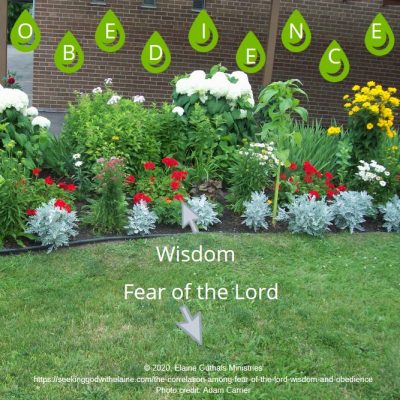
    Flowers

    Okay. So, the ground is the foundation. That is the fear of the Lord.

    We plant seeds or transplant plants onto that foundation. That is the wisdom we gain by growing in grace and knowledge of God.

    The plants grow through the nourishment of the rain. We grow by being obedient to God’s laws and commandments always — especially in trials.

    Let’s try saying it this way. We fear God, which makes us want to dive into His Word and know Him better. That not only helps us be more obedient when the trials hit, but it also makes us more obedient all the way around.

    It grows us in the right direction. Our relationship with God — our reverence and love for Him — becomes the foundation of our lives.

    Go back to Alford’s definition of fear of the Lord. He said it is “… an abiding and reverent sense of the presence of God and of accountableness to Him.”

    Accountablity. Because we love God and want to obey Him, we are accountable to Him.

    That means we obey all the laws and commandments. We don’t compromise with the world. We don’t keep our pet sin.

    We are all in.

    How Do We Apply This?

    • We read God’s Word.
    • We study it and meditate on it so we know how He is calling us to act.
    • We pray to Him asking Him to shore up the foundation.
    • We allow God to change us.

    In other words, we seek God. We know His character well — well enough to make it our own.

    Searching for and Seeking God

    Hearing His Word (Rom. 10: 17 NLT).
    Reading His Word (Rev. 1: 3 ESV).
    Praying to Him (Heb. 4: 16 ESV).
    Studying His Word (Ac. 17: 11 NLT).
    Meditating on His Word (Ps. 1: 1-2).
    Memorizing His Word (Ps. 119: 11 NLT).

    To read Has God Provided Everything We Need?, click the button below.

    Father. We are in awe of You. That You love us enough to send Your Son to die to pay the price for our sins is beyond our understanding. But we know You did, and that sacrifice paid the price for our sins. Lord, we want our fear of the Lord to be the foundation on which we build wisdom of You. May we always be obedient to do Your Will. Amen.

    What do you think?

    Leave me a comment below (about this or anything else) or head over to my Facebook group for some interactive discussion.

    If you don’t understand something and would like further clarification, please contact me.

    If you have not signed up for the email daily or weekly providing the link to the devotions and the newsletter, do so below.

    If God has used this devotion to speak with you, consider sharing it on social media.

  • Isn’t It Impossible to be Obedient?

    When we really get down to it, isn’t it impossible to keep all of God’s laws and commandments? Aren’t we always going to break some? This devotion looks at how burdensome keeping God’s laws and commandments really is.

    Nuggets

    • Keeping God’s laws and commandments all boils down to love for God.
    • We may feel obedience is impossible when it is just challenging for us.
    • The laws and commandments show us God’s character, which is holy and righteous.
    • Not following God’s laws and commandments does not make us pure.
    • Even with a light yoke, it is not going to be smooth sailing.

    To read a devotion in the What Is Obedience? series, click on the button below.

    Isn’t It Impossible to Be Obedient?

    Flowers with title Isn't It Impossible to Be Obedient?

    In the last devotion, we talked about keeping God’s commandments. Unfortunately, some of us find some almost impossible to keep some of them. Let’s take a look.

    Let’s Put It into Context

    “Loving God means keeping his commandments, and his commandments are not burdensome” (I Jn. 5: 3 NLT).

    Obedience means “to hear God’s Word and act accordingly” (Holman Bible Dictionary). We think of the word obey, but there are several words that the Bible uses: hear, listen, and trust.

    Obedience Is Not Burdensome

    “Loving God means keeping his commandments, and his commandments are not burdensome” (I Jn. 5: 3 NLT).

    Obeying isn’t as hard as Satan makes it out to be.

    Let’s go back a second to what we said in the last devotion. Keeping God’s laws and commandments all boils down to love for God. If we love God, we are going to want to please Him. Keeping the laws and commandments expresses that love.

    Aren’t things easier when we do them out of love? Our minds don’t put up as many roadblocks. The tasks don’t seem as daunting. We see success and blessings at the end of the line.

    When we really out our hearts into it, we are blessed. When we are blessed, things become easier. When things are easier, it is easier to be obedient.

    A good cycle!

    Besides, doesn’t Jesus say that “… [His] yoke is easy and [His] burden is light” (Mt. 11: 30 CSB)? Light is not burdensome.

    But there is a reason for them being light. “I love those who love me, And those who seek me diligently will find me” (Prov. 3: 17 NKJV).

    Newman said it this way. “Now it is obvious that obedience to God’s commandments is ever easy, and almost without effort to those who begin to serve Him from the beginning of their days; whereas those who wait awhile find it grievous in proportion to their delay.”

    I read this to mean they become habits. They become our normal.

    I grew up singing in front of an audience. That was my normal.

    A while back, I stopped singing. I wasn’t in a choir; I wasn’t doing solos. My normal changed.

    When I started back in front of an audience, boy was I nervous! It wasn’t easy because it wasn’t my normal.

    But Is It Impossible?

    Sharp makes a really good point. Is it really impossible?

    Let’s say it is hard for us to pray daily. We may even say it is impossible.

    But is it? People do that. People make the choice to be obedient and pray daily.

    So, it isn’t impossible. It is just challenging for us.

    Sometimes, we just use that as a copout. We don’t want to put forth the time and effort to be obedient. Or we don’t want to give up the sin.

    There are times it does seem totally impossible to us. We may be looking at past history, the depth of our commitment, or a variety of other reasons — excuses — we use to say it is impossible.

    We aren’t really focusing on God then. We are focusing on our inabilities and our understanding.

    Remember, “… nothing will be impossible with God” (Lk. 1: 37 CSB). If God wants us to be obedient — and He does — it is possible to follow His Will.

    Church

    Is Some Disobedience Allowed?

    I am still processing one of Sharp’s comments. “All that our religion forbids is the irregularity and exorbitancy of our passions.”

    I see that on some things, like wealth. We talked about how we shouldn’t put an exorbitant priority on gaining wealth.

    I can see where God doesn’t want us to just pray occasionally. He wants regular communication.

    But I see other things that we are just downright forbidden in which to engage. I will have to keep thinking on this.

    Let’s come at it from an angle. Some say that there are no guilty pleasures — if they give us pleasure, there should be no guilt involved.

    Others say that if we succeed in this world, that is a blessing from God — regardless of whether we had to disobey God’s laws and commandments to succeed.

    Look, think about this. The laws and commandments show us God’s character. God’s character is holy and righteous.

    Holy means to be set apart, perfect, and pure. Righteousness is the product of being holy, created by having faith and loving as Jesus does.

    Not following God’s laws and commandments does not make us pure. It makes us human.

    We want spiritual.

    Yes, we are still human and are going to be until we are changed (I Cor. 15: 51). We are not going to get it right every time.

    Still, we are called to be perfect. “But you are to be perfect, even as your Father in heaven is perfect” (Mt. 5: 38 NLT).

    So, It Is Going to Be Smooth Sailing?

    With a light yoke, that means it is going to be smooth sailing, right?

    Wrong.

    We are still going to struggle. We will still have to make the daily choice — sometimes minute by minute — to choose God.

    Satan is going to make that as rough as he can.

    What are the definitions of light and heavy? (You had to know Dictionary Chick would show up some time, didn’t you?)

    Let’s look at these definitions of light.

    • public knowledge
    • a particular aspect or appearance presented to view

    When we seek God, we grow in knowledge of Him. Now, the public aspect doesn’t fit because God only reveals Himself to His children. But He takes what little is in the Bible and presents Himself more fully to us.

    • a particular illumination
    • something that enlightens or informs

    God is really good at showing our sins to us. He wants us to see them as He sea them so that we can eradicate them.

    • having little weight : not heavy
    • designed to carry a comparatively small load
    • having relatively little weight in proportion to bulk
    • containing less than the legal, standard, or usual weight

    Is not the peace that coms when we are obedient to God so much lighter than the burden of sin’s guilt?

    A lot of the definitions for heavy, as you would imagine, are the exact opposite. But let’s point out a couple.

    • difficult to bear
    • borne down by something oppressive
    https://www.merriam-webster.com/dictionary/heavy

    There are some that don’t think sin is oppressive. All they see is the pleasure and shiny.

    Sin is oppressive because it leads to spiritual death.

    Making the Connections

    We do know that we cannot be obedient without God. God is fighting the spiritual warfare. We cannot exhibit self-discipline without Him.

    We also have to remember that we are tested through temptations. We just talked about that.

    To read a related devotion, click the button below.

    Let’s look at this. “The temptations in your life are no different from what others experience. And God is faithful. He will not allow the temptation to be more than you can stand. When you are tempted, he will show you a way out so that you can endure” (I Cor. 10: 13 NLT).

    • This is a standard temptation. Others have been tempted in this way, too.
    • God doesn’t leave us.
    • He is always there to help us get through the temptation.
    • He provides the pathway to obedience.

    So, if others can withstand the temptation and be obedient, so can we. Remember, it isn’t impossible.

    People

    How Do We Apply This?

    • We have to make obedience our normal.
    • We have to make it practical.
    • We have to seek obedience with all of our hearts.
    • We have to seek the blessings from it.

    The next time we feel obedience is impossible, we need to pray for God’s help to withstand. We need to claim His victory over Satan. We need to seek Him with all of our hearts.

    Loving Father. Your Word tells us that nothing is impossible for You (Lk. 1: 37). We cannot withstand temptation without You. Strengthen us so that we can be obedient to You. Amen.

    What do you think?

    Leave me a comment below (about this or anything else) or head over to my Facebook group for some interactive discussion.

    If you don’t understand something and would like further clarification, please contact me.

    If you have not signed up for the email daily or weekly providing the link to the devotions and the newsletter, do so below.

    If God has used this devotion to speak with you, consider sharing it on social media.

  • What Is Obedience?

    What is one of the first things that pop up when we think about self-discipline? We don’t discipline ourselves to follow all of God’s laws and commandments all the time. This devotion looks at what obedience is from God’s perspective.

    Nuggets

    • God is Sovereign God and expects our obedience.
    • God gives us laws and commandments to follow.
    • God’s laws and commandments are true because they came from Him.
    • We have to let God’s Word — His laws and commandments — change our character.
    • Obeying God’s laws and commandments does bring us rewards.
    Flowers with the title What Is Obedience?

    While some may say it is too difficult to obey all of God’s laws and commandments, others may question why we are being obedient to Him in the first place.

    Let’s Put It into Context

    “Yours, LORD, is the greatness and the power and the glory and the splendor and the majesty, for everything in the heavens and on earth belongs to you. Yours, LORD, is the kingdom, and you are exalted as head over all” (I Chron. 29: 11 CSB)

    God is Sovereign God. He is omnipotent, omniscient, and omnipresent.

    God created “… everything in the heavens and on earth …” (I Chron. 29: 11 CSB). That means He made us.

    Instead of forcing His rule on us, God allows us free will to choose to submit to Him. When we do submit to Him, He expects obedience.

    What Is Obedience?

    “Loving God means keeping his commandments, and his commandments are not burdensome” (I Jn. 5: 3 NLT).

    Obedience means “to hear God’s Word and act accordingly” (Holman Bible Dictionary). We think of the word obey, but there are several words that the Bible uses: hear, listen, and trust.

    We are supposed to respond in faith and do God’s Will. In other words, hearing alone is not good enough. We have to put into practice what God is telling us. This is one way we worship God.

    God gives us laws and commandments to follow. These are stated in the Bible. They not only tells us how we should and should not act, but they also tell us of God’s character.

    Melvill made an interesting statement. He said, “we naturally look to the New Testament for additional motives rather than for additional commandments.”

    The Old Testament was all about telling us what the laws and commandments were. The New Testament was all about calling us to obey those laws and commandments and giving us reasons to do so. We obey by loving God.

    Remember, Jesus said that the greatest commandment was “… Love the Lord your God with all your heart and with all your soul and with all your mind” (Mt. 22: 37 NIV). That is our priority

    To read a related devotion, click the appropriate button below.

    Why did Jesus pick that one (and love your neighbor)? “All the Law and the Prophets depend on these two commands” (Mt. 22: 40 CSB). It all boils down to love for God.

    If we love God, our obedience stems from that love. If we love God, we are going to want to please Him. Keeping the laws and commandments expresses that love.

    Hands shaped as heart

    Delight in the Law

    “Surround me with your tender mercies so I may live, for your instructions are my delight” (Ps. 119: 77 NLT).

    Let’s think about it this way. God’s Word is true. God never changes. He doesn’t lie.

    That means God’s laws and commandments are true because they came from Him.

    When mankind originally disobeyed Him, God could have written us off. He could have closed the door and not had anything to do with us ever again. Or worse, He could have just killed us.

    Instead, God showed us mercy. Mercy is the unexpected way God responds in love to our needs. “Great is his faithfulness; his mercies begin afresh each morning” (Lam. 3: 23 NLT). He gives us mercy every day.

    To read a related devotion, click the button below.

    This is especially so when we are obedient to God. His mercies protect us.

    It’s not a bad thing to want God’s mercies. It’s not a bad thing to want more of His mercies. When we do that, we are wanting more of Him in our lives. That is a good thing.

    But look what it is really saying (Cowper). “Because I delight in your instructions, give me more mercy.” Because I am obedient, reward me. I don’t want to sin.

    We don’t see obedience as a license to sin in other instances. “Well, I mostly get it right, so God is going to ignore this sin.” Doesn’t work that way.

    Obedience to God means we are all in. We try to obey all of His laws and commandments.

    Obedience Required

    “Joyful are those who obey his laws and search for him with all their hearts” (Ps. 119: 2 NLT).

    We are charged to obey God’s laws. Yes, we are rewarded, but this is how we seek Him.

    In order to obey God, we have to search His Word. But His words can’t just stay on the pages of the book or the screen of whatever device we use.

    We’ve got to bury God’s Word in our hearts. I know, we’ve talked several times about how hard it is to memorize. It is more than that.

    Searching for and Seeking God

    Hearing His Word (Rom. 10: 17 NLT).
    Reading His Word (Rev. 1: 3 ESV).
    Praying to Him (Heb. 4: 16 ESV).
    Studying His Word (Ac. 17: 11 NLT).
    Meditating on His Word (Ps. 1: 1-2).
    Memorizing His Word (Ps. 119: 11 NLT).

    To read Has God Provided Everything We Need?, click the button below.

    We have to let God’s Word — His laws and commandments — change our character. We have to let them help us to imitate Him.

    That means we have to believe what we are reading. We have to really dive into the Bible. It has to increase our faith.

    I like having a strategic plan. When I went on my first retreat, I developed a new one for my life. Okay, some of the things have worked out; some have to go to a different year’s operational plan. But it is a guide.

    The Bible is like that in a way, but not. It is our guide. It shows us how we are to work to become holy and righteous.

    Obeying God’s Word is not optional. Some things don’t give us wiggle room. There is no fudging with God’s laws and commandments. Millard said, “We must take it as the guide of our daily conduct, as the inspiration of thought and emotion, as the determining factor in our daily actions, as the light to lead us along life’s dark and difficult ways, As the food upon which the soul is nourished it must affect all our thought and feeling, speech and action; it must penetrate to the remotest corners of our life and give form and colour and character to every experience.” It has to permeate our lives.

    The Value of Obedience

    “Your instructions are more valuable to me than millions in gold and silver” (Ps. 119: 72 NLT).

    Obeying God’s laws and commandments does bring us rewards. Now, we are going to get into some of the benefits obedience brings in another series.

    For now, let’s look at a this. Dunlop and the Homilist give us lists of things that are upgraded for us — but not from the world’s perspective.

    • Food: “‘I am the bread of life,’ Jesus told them. ‘No one who comes to me will ever be hungry, and no one who believes in me will ever be thirsty again’” (Jn. 6: 35 CSB).

    To read a related devotion, click the button below.

    • Clothes: “I clothed myself in righteousness, and it enveloped me; my just decisions were like a robe and a turban” (Job. 29: 11 CSB).
    • Friends: “I no longer call you servants, because a servant does not know his master’s business. Instead, I have called you friends, for everything that I learned from my Father I have made known to you” (Jan. 15: 15 NIV).
    • Homes: “In my Father’s house are many mansions: if it were not so, I would have told you. I go to prepare a place for you” (Jn. 14: 2 KJV).
    • Culture: “So if the Son sets you free, you are truly free” (Jn. 8: 36 NLT).
    • Power: “For God has not given us a spirit of fear, but one of power, love, and sound judgment” (II Tim. 1: 7 CSB).
    • Higher enjoyments: “Now may the God of hope fill you with all joy and peace as you believe so that you may overflow with hope by the power of the Holy Spirit” (Rom. 15: 13 CSB).
    • A higher world: “For God so loved the world that he gave his one and only Son, that whoever believes in him shall not perish but have eternal life” (Jn. 3: 16 NIV).

    Wow! All of that because we are obedient!

    Don’t get me wrong. We need money for food, clothing, and homes in today’s world. It isn’t wrong to pursue earning a living — as long as we keep God as top priority of those lives.

    Making the Connections

    “Jesus replied, ‘But even more blessed are all who hear the word of God and put it into practice’” (Lk. 11: 28 NLT).

    Again, it comes down to knowing the laws and commandments and obeying them. We can read and read and read. Head knowledge won’t get us too far.

    We have to put what we read into practice — we have to obey.

    Our joy and blessings come from believing Jesus is our Savior and Redeemer. Yes, that is the B of our ABCDs.

    The ABCDs of Salvation

    If you have not become a believer in Christ, please read through the
    Plan of Salvation and prayerfully consider what God is asking you to do.A – admit our sins

    B – believe His Son Jesus is our Redeemer

    C – confess God as Sovereign Lord

    If you have not become a believer in Christ, please read through the Plan of Salvation and prayerfully consider what God is asking you to do.


    D – demonstrate that commitment by making any changes needed in our lives to

    live the way in which God has called us

    The Disciple’s Job Description

    How Do We Apply This?

    We don’t want to be like the one type of soil in Jesus’ parable. “The seed on the rocky soil represents those who hear the message and immediately receive it with joy. But since they don’t have deep roots, they don’t last long. They fall away as soon as they have problems or are persecuted for believing God’s word” (Mk. 4: 16-17 NLT).

    We have to hear to be saved, but we have to do everything God calls us to do. “But don’t just listen to God’s word. You must do what it says. Otherwise, you are only fooling yourselves” (Jas. 1: 22 NLT). Obedience calls for action.

    We have to seek God to learn what He is calling us to do. Then we have to put it into practice.

    Loving Father. You have given us laws and commandments to show us Your character. Help us to obey them so that we can imitate You. Accept our obedience as our worship of You. Amen.

    What do you think?

    Leave me a comment below (about this or anything else) or head over to my Facebook group for some interactive discussion.

    If you don’t understand something and would like further clarification, please contact me.

    If you have not signed up for the email daily or weekly providing the link to the devotions and the newsletter, do so below.

    If God has used this devotion to speak with you, consider sharing it on social media.