Category: Love

  • How to Promote Peace

    God wants His disciples to be unified in peace. This daily devotional looks at how humility, love, and faith promote peace and why that is important.

    Nuggets

    • Humility, love, and faith promote peace.
    • Because God’s disciples are united in peace, His work can be completed in a timely manner.

    To read devotions in the Redo for Godliness series, click the appropriate button below.

    Devotions in the Transformed to Perfection series

    Paul has been working with his readers to who them that they needed to be unified. He has warned all not to be judgmental. He has told the strong in faith not to bite on those who are weak in their faith.

    In the last devotion, Paul began to discuss how our actions impact the kingdom of God. Here, he continues to discuss the effects as disciples are called to pursue peace.

    Let’s Put It into Context #1

    Here is a running list of what we’ve discussed previously.

    The Promotion of Peace

    “So then, let us pursue what promotes peace and what builds up one another” (Rom. 14: 19 CSB)

    Humility, love, and faith promote peace.

    In the previous couple of verses, Paul had been talking about righteousness, peace, and joy. He continues on with the topic of peace. I can see that because what builds up peace builds love.

    We talked in the last devotion that we need the righteousness to be able to find peace. Tarson added humility, love, and faith to the list. Lyth said these are the things that instruct us.

    Resource

    Humility is a character trait that diminishes pride and places dependence on God while holding a modest view of our importance with respect to others. It is that quest for importance that tends to amp up the stress. The humility diminishes the pull of this world and puts our focus on God, creating the environment in which the peace can thrive.

    Love will also grow in that environment. Not only is God righteousness, but God is also love. Love and peace go hand in hand.

    God is going to offer His love freely to each and everyone of us. But we have to reach out and grab it. That is what faith is about. Faith is the conviction that the doctrines revealed in God’s Word are true, even if we do not understand all aspects of them, a belief which impacts our lives.

    Oh, yeah. Faith isn’t easy. We will have to grow it.

    Growing the peace in our lives isn’t easy, either. This will take work. We will have to keep our temper in check. We can’t go out looking for skirmishes.

    Lyth gave us, instead, a list of what gives us peace.

    • We all have essentials in our lives that promote peace. My essentials are my family and my church family. I get peace from being around them.
    • There are things we all want and that gives us peace. We all want happiness. We want to be able to provide for those for whom we are responsible.
    • God blesses us in so many ways, which brings us peace. The blessings provide us happiness with give us a peaceful outlook on life.

    Resource

    There is some element of choice in being peaceful. We choose to put our trust in God, which brings us peace.

    The Reason for the Peace

    “Do not tear down God’s work because of food. Everything is clean, but it is wrong to make someone fall by what he eats” (Rom. 14: 20 CSB)

    Because God’s disciples are united in peace, His work can be completed in a timely manner.

    Paul was limiting his admonition to don’t be contentious about food. We could substitute any number of things into the sentence.

    We have to be very, very careful. We don’t want to have the focus taken off of God and His work and put onto us and our petty earthly squabbles.

    We want to make sure we are doing God’s work on His timetable. We don’t want to derail His plan.

    More than that, we don’t want to damage the ministry of the church. Have you ever heard of someone saying a non-believer wouldn’t go to a certain church because of the way the members acted? How many times do non-believers call disciples hypocrites?

    Paul was tying this back to the judging because disciples felt something was unclean. Cleanness has to do with the Israelites remaining holy.

    Glossary

    This is all about remaining sin-free. No, we still sin. Sins are actions by humans that disobey God and break one of His reasonable, holy, and righteous laws and commandments, goes against a purpose He has for us, or follows Satan’s promptings.

    The key is asking God’s forgiveness. Forgiveness is, when we ask, God pardons us because we have shown repentance for breaking His laws and commandments.

    Glossary

    I think Paul is also reminding us that people are very important to God. Whether they are a strong disciple or a weak disciple today isn’t how He sees them. He sees them as perfected.

    Yes, we may be weak, but we are as God made us. Yes, we may we strong, but we may be fall into temptation and lose our way.

    HowToPromotePeacePin

    Making the Connections

    Lyth gave us pointers on how to keep peace within the family of God.

    • When we know situations will be continuous, steer clear of them.
    • Be encouragers rather than detractors.
    • Put loving others over being right and performing some activity.

    Resource

    Put loving others over being right and performing some activity.

    How Do We Apply This?

    • Earnestly strive for humility, love, and faith.
    • Have a strong prayer life.

    Resource

    We’ve got to keep as a priority God and His mission for us. In order to accomplish it, we have to work together.

    Father God. We love You, Lord. We humbly come before You, thanking You that You are love, which will promote an environment for peace for us. Help us to work together to complete the work You have called us to do. Amen.

    What do you think?

    Leave me a comment below (about this or anything else) or head over to my Facebook group for some interactive discussion.

    If you don’t understand something and would like further clarification, please contact me.

    If you have not signed up for the email daily or weekly providing the link to the devotions and the newsletter, do so below.

    If God has used this devotion to speak with you, consider sharing it on social media.

  • The State of the Kingdom of God

    The kingdom of God is a spiritual kingdom. This daily devotional looks at how godliness in His kingdom leads to righteousness, peace, and joy.

    Nuggets

    • The kingdom of God is a soul kingdom so that God can control our character.
    • We are to have the right qualities to serve Christ.

    To read devotions in the Redo for Godliness series, click the appropriate button below.

    Devotions in the Transformed to Perfection series

    As Sovereign God, He has a kingdom. It isn’t a kind of kingdom with which we are familiar.

    Instead, it is a spiritual kingdom. Paul described it in Romans 14: 17. He notes that those who enter it are equipped for service.

    Let’s Put It into Context #1

    Here is a running list of what we’ve discussed previously.

    The State of Being in the Kingdom

    “for the kingdom of God is not eating and drinking, but righteousness, peace, and joy in the Holy Spirit” (Rom. 14: 17 CSB)

    The kingdom of God is a soul kingdom so that God can control our character.

    The kingdom of God is a spiritual kingdom, founded on the unequivocal difference between right and wrong, that describes His sovereign reign. We are told in Matthew 6: 33 to “… seek ye first the kingdom of God, and his righteousness …” (KJV).

    When we seek first the kingdom of God, that means we submit our whole hearts and lives to God. Submitting means committing to live a sin-free life.

    We think the kingdom of God will be in Heaven, presumably after judgment day, but what if it was now? Morison described it as “Christ’s spiritual kingdom established here on earth … This is a kingdom totally diverse from all others — one not in word or mere outward form, but in soul-subduing, life-transforming power, one that ultimately brings every thought into harmony with Christ’s holy mind and will.”

    Resource

    God’s kingdom is found in our soul. Beecher wrote, “… since a man’s disposition is the fountain from which all his enjoyments that are worth having spring in this world, the condition of the soul becomes a kingdom in the sense that it represents to men the idea of felicity.”

    Resource

    Okay, Dictionary Chick. Felicity means, according to the Merriam-Webster Dictionary, “the state of being happy.” It is the appropriate expression of our thoughts.

    Resource

    Beecher noted, more importantly, God’s kingdom controls our character. That is what we have been saying.

    God wants to control our character — our thoughts, feelings, and actions.

    God wants to control our character — our thoughts, feelings, and actions.

    We touched on the eating and drinking in a previous devotion. Morison, too, equated that to ritualistic observances that will no longer be present in God’s kingdom.

    Griffiths made a great point. He wrote, “Godliness is at a low ebb when great importance is attached to external rites.”

    Resource

    Sometimes, we use the outward ceremony to mask the inward desolate condition of our hearts. We don’t realize God has 20-20 vision in our hearts.


    Screen Shot 2021-05-13 at 9.37.42 PM

    Yeah, God is interested in the outward appearance. He is way more interested in the inward condition.

    We definitely don’t see this verse as giving us license to eat and drink anything we want any more than we see believing in God giving us liberty to committing any sin we want. We must live the way in which God wants us to and follow His laws and commandments.

    If we take the eating thing a step farther, we will no longer need the Lord’s Supper to remind us of Christ’s death and resurrection. That was the whole purpose of the ordinance — our remembering. In Heaven there will be no forgetting what Christ has done for us.

    To read a related devotion, click the button below.

    NoForgettingInHeaven

    It is all about what God has done for us. Paul said don’t worry about what we think we are going to have to give up.

    We are going to get righteousness. Righteousness is the indwelling goodness that is the result of a solid relationship with God built by a sincere life of conscientious obedience to God’s laws and commandments and from which all virtues flow.

    We think that is what God transforms us into in the end. Along the way, He gives us peace and joy. Peace is a fruit of righteousness manifested in an inward tranquility resulting from a balanced life with spiritual order, equity, and truth that implies cooperation, humility, integrity, communication, and cohesiveness.

    Ooo. Robinson got me thinking in pictures.  I immediately hooked it to our nornal picture of perfection.

    Resource

    RighteousnessPeaceJoyPerfection
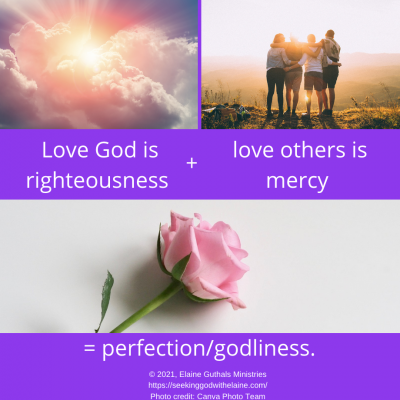
    Love God is righteousness + Love people is mercy = perfection/godliness

    Righteousness is all about God. It is our relationship with Him. We are justified and freed from sin to follow God’s moral laws.

    The peace is for us, too, but that is what we extend to others. Buddicom wrote, “Peace hath been made by the blood of the Cross. This is one of the most gracious, as it is one of the most blessed, fruits of the Spirit.”

    Resource

    Having joy in all circumstances designates us a child of God. We get the joy from Him as part of our adoption.

    Ooo, baby. Griffiths just shot a zinger in that. He said righteousness is the foundation with peace in the middle and joy as the crowning state. Hmmm.

    Resource

    And here I was just thinking I had peace and joy backwards.

    But I don’t think so. The joy has to come before the peace. The unbridled happiness that produces the tranquility, not the other way around.

    Do we want the peace before the joy because that means we are doing it instead of God?

    Lyth gave a good description about what the kingdom of God isn’t all about. It isn’t just about abstinence. On the flip slide, it isn’t just about becoming by doing the do’s and not doing the don’ts while observing all of the appropriate rituals. And loving doing it!

    Resource

    What God is looking for is a life change. It is built on faith. He wants us to be at peace with both Him and others.

    The State of Serving in the Kingdom

    “Whoever serves Christ in this way is acceptable to God and receives human approval” (Rom. 14: 18 CSB)

    We are to have the right qualities to serve Christ.

    We have to remember what we are talking about: whoever serves Christ is righteous, peaceful, and joyous. We serve Him in the spiritual exercises.

    Thomas described what it means to serve Christ. He wrote, “To serve Christ is the grand end of being; to serve Christ is to serve in the highest sense your own interests, the good of the universe, and the will of God.”

    Resource

    We must possess these three qualities to serve Christ. If we don’t, we don’t really serve Him. We are just going through the motions.

    Well, think about it. We have to be righteous. That is, we have to be right with God.

    If we aren’t right with God, there is no need to serve. If we don’t have the peace or the joy, we aren’t going to want to serve.

    TheStateOfTheKingdomOfGodPin

    How Do We Apply This?

    Limont wrote, “God, as the rightful sovereign of all men everywhere, commands them to return to their allegiance.” We need to obey that command.

    Resource

    We do that by ABCDing.

    The ABCDs of Salvation

    If you have not become a believer in Christ, please read through the
    Plan of Salvation and prayerfully consider what God is asking you to do.

    A – admit our sins
    B – believe His Son Jesus is our Redeemer
    C – confess God as Sovereign Lord

    D – demonstrate that commitment by making any changes needed in our lives to
    live the way in which God has called us

    The Disciple’s Job Description

    We just had a devotion that looked at a verse that said every knee will bow to Him.

    To read a related devotion, click the button below.

    God calls us to love Him, praise Him, and serve Him. We will find peace and joy when we do.

    Father God. You created us knowing we would disobey You — and You created us anyway. You sent Your only Son to die to restore us to You — and You allow us to choose whether or not we will accept that restoration. You ask us to praise You and serve You. We give You all the praise and honor we can. It isn’t enough, but You accept it when it is genuine. Amen.

    What do you think?

    Leave me a comment below (about this or anything else) or head over to my Facebook group for some interactive discussion.

    If you don’t understand something and would like further clarification, please contact me.

    If you have not signed up for the email daily or weekly providing the link to the devotions and the newsletter, do so below.

    If God has used this devotion to speak with you, consider sharing it on social media.

  • Don’t Slander Our Good

    When we are witnessing, we don’t want our goodness to be questioned. This daily devotional looks at ways disciples can sabotage our own good.

    Nuggets

    • There is only one standard but which we will all be judged.
    • We damage our good ourselves by the choices we make.
    • God wants us to be genuine in serving Him.
    • Reputation and character are two different things, but both are important.

    To read devotions in the Redo for Godliness series, click the appropriate button below.

    Devotions in the Transformed to Perfection series

    This is one of those devotions where it seems like the sermons used for the research took it a lot of different places. Let’s go.

    Let’s Put It into Context #1

    Here is a running list of what we’ve discussed previously.

    Let’s Put It into Context #2

    • Good, in the biblical sense, is the workings of God within His people.
    • Evil is equated with sin because it is that which goes against God and His purposes.

    Let’s Put It into Context #3

    We are going to take care of this now, because Romans 14: 16 starts with a therefore. What it is thereforing to is

    • Disciples are not to have an opinion on something someone else does if God hasn’t made a law or commandment about it.
    • Too many times we stick our noses into someone else’s relationship with God where it doesn’t belong.
    • It is all about letting people believe what they believe when it does not violate God’s laws and commandments.

    When Speaking Bad of Good

    “Therefore, do not let your good be slandered” (Rom. 14: 16 CSB)

    There is only one standard but which we will all be judged.

    Really, we have spoken of this before. It is about the weak biting on the strong for taking what they perceive as liberties, and the strong biting on the weak for — basically — being weak.

    We have to remember, Paul is talking about disciples interacting with other disciples here. He isn’t talking about our interchanges with non-believers.

    Hodge reminded us that we are to represent Jesus. He listed the following as the two ways we fail at that representation:

    • We compromise with the worldview to break God’s laws.
    • We, as Hodge wrote, “… act on right principles as to give those principles a bad character, or so conduct themselves as to mislead others as to the true nature of the gospel.”

    Resource

    How many devotions have we done since I am doing fewer verses at a shot that we’ve talked about the eating and drinking? Is it just about that?

    Or is it about the ritual? Back in Jesus’ day, eating and drinking was part of the ritual. It was part of what we would call the service.

    Jesus didn’t want them to be all about the ritual. He wanted them — and us to be about the relationship. In what state is our relationship with God?

    We don’t want to get bogged down in the observance. We need to focus on the praise and worship.

    But how can someone look at our good and say it is bad? Hamilton warned us that could happen if we adopt unpleasant biases. Jesus didn’t show favoritism as He allowed all — Jews and Gentiles — to come to Him.

    Resource

    We don’t want to become selfish, but sometimes we do. It becomes about us because we don’t want to give up anything and we won’t work at what God tells us to work at.

    Unfortunately, sometimes disciples are accused of holding others to a harsher rule than we hold ourselves to. That isn’t right.

    God holds us all to one standard. We should hold ourselves and others to that standard.

    When We Ourselves Sabotage Our Good

    We damage our good ourselves by the choices we make.

    Sometimes, we can be our own worst enemies. Watkinson and Lyth gave us good lists of how we do that.

    There are times we talk about things we really don’t know about. We may know part of it. We know none of us know everything God knows. We blow it.

    Other times, we make light of something we shouldn’t. (Pointing four fingers back at me, here.) Humor does go a long way, but it can also be inappropriate.

    Many times, disciples are called narrow by worldview people. They see disciples’ self-denial as excessively strict — needlessly strict.

    Moroseness is a descriptive word. That is what Lyth called it. Watkinson called it sadness.

    Either way, it is the exact opposite of what God calls us to be. We are to be filled with joy, not ill temper.

    There is a balance. Watkinson wrote, “A man who is all laughter counts for little, a man who is all groans counts for less; but he who lets a hopeful spirit shine through all his religion does much to recommend his faith.”

    The bad part is when we sabotage the good when we think we should have better. We think discipleship should be smooth sailing. When it isn’t, we start looking for a better good, which in reality is bad.

    All we are wanting, like Lyth said, is stability. We are only going to find that in God.

    Lyth called it improvidence. It means thoughtlessness or not having foresight. I would say in this case it means not keeping our eyes on God.

    Resource

    When Good Isn’t Good

    God wants us to be genuine in serving Him.

    Watkinson brought up the point that some try to fake that they are good. His example was the Pharisees.

    Person of Interest

    They thought their religious ceremonies would cut it. Jesus said no. It is about relationship, not ceremony.

    God doesn’t want us on autopilot. He wants to be our Pilot.

    Resource

    Don’t Assassinate Our Character

    Reputation and character are two different things, but both are important.

    Reputation is who others think we are; character is who we really are.

    To read a related devotion, click the button below.

    The Homiletic Monthly wrote, “You may be years, a life-time even, in building it [reputation] up, and yet a moment, a single act, may suffice to destroy it.”

    Resource

    It is important that disciples have a good name. It can weaken our testimonies if we do not.

    Thomas brought up an interesting point. He wrote, “All men instinctively feel that goodness is an excellency, and those who have it not naturally envy those who possess it.”

    Resource

    But goodness speaks more to character than reputation. That is where we want to focus. We want to focus on who we are, not who people think we are.

    Goodness is an attribute of God. God’s goodness is His holy, pure, and righteous behavior.

    • Holy means to be set apart, perfect, and morally pure while possessing all virtues.
    • Purity means possessing God’s moral character, having eliminated the stain of sin.
    • Righteous means we are free from sin because we are following God’s moral laws.

    To read a related devotion, click the button below.

    See what that keeps talking about: moral character. It doesn’t say a word about reputation.

    Still, reputation is important. We must have credibility with those to whom we are witnessing.

    DontSlanderOurGoodPin

    Making the Connections

    I read all these sermons that the others wrote, and they are good sermons. They are real encouraging to us.

    But not one sermon addressed anything to do with the therefore.

    • Disciples are not to have an opinion on something someone else does if God hasn’t made a law or commandment about it.
    • Too many times we stick our noses into someone else’s relationship with God where it doesn’t belong.
    • It is all about letting people believe what they believe when it does not violate God’s laws and commandments.

    “Therefore, do not let your good be slandered” (Rom. 14: 16 CSB).

    Maybe it is just me. I was expecting Paul to give some instructions on what to do when people did stick their noses into where they didn’t belong or they did try to force others to believe what they believed.

    How Do We Apply This?

    • We have to be consistent in seeking God.
    • We have to remember we serve Christ.
    • We have to watch our motives.

    Resource

    Thomas gave us an interesting word of advice. He wrote, “A man’s power to do good depends greatly upon the faith that society has in his goodness. If society suspects his genuineness or disinterestedness, he may preach like Paul, but he will accomplish but little good. Hence it has often happened that truly good men and powerful preachers have, by disregarding certain recognised (sic) proprieties of society, destroyed their usefulness for ever. Conclusion: Hence, because of this danger and evil, let us walk “circumspectly,” not as fools, but as wise; let us avoid the very appearance of evil, knowing that the loss of reputation tends to disqualify us for usefulness.”

    Resource

    What this is telling me is we have to protect our witness. We don’t want to jeopardize the work God has called us to do because we have lost credibility with those to whom we are witnessing.

    Father God. You have called us to be good like You. That means we are to be holy, pure, and righteous. May our character be Yours and our reputation be such that those we are witnessing to know that we are a credible witness for You. Amen.

    What do you think?

    Leave me a comment below (about this or anything else) or head over to my Facebook group for some interactive discussion.

    If you don’t understand something and would like further clarification, please contact me.

    If you have not signed up for the email daily or weekly providing the link to the devotions and the newsletter, do so below.

    If God has used this devotion to speak with you, consider sharing it on social media.

  • Guarding against Offense

    God expects His church to be unified. This daily devotional looks at how disciples of Christ are to look through love, not through uncleanness, to promote harmony.

    Nuggets

    • Judgment can cause stumbling blocks to be put into place.
    • Something can be unclean to one person that is not unclean to another.
    • We are to influence our fellow disciples whether we intend to or not.

    To read devotions in the Redo for Godliness series, click the appropriate button below.

    Devotions in the Transformed to Perfection series

    In my Bible, Romans 14: 13 starts a new section: The Law of Love. However, when we read verses 13 through 15, they seem like they are replaying the theme Paul had been discussing.

    • What you eat.
    • Don’t judge.

    Let’s see if we can figure out how it meshes with love.

    Let’s Put It into Context #1

    Here is a running list of what we’ve discussed previously.

    Don’t be Stumbling Blocks

    “Therefore, let us no longer judge one another. Instead decide never to put a stumbling block or pitfall in the way of your brother or sister” (Rom. 14: 13 CSB)

    Judgment can cause stumbling blocks to be put into place.

    Paul started the verse with the word therefore. He was tying this back to what he had previously said.

    Disciples are not to have an opinion on something someone else does if God hasn’t made a law or commandment about it. Lyth wrote that Paul was saying that a disciple “respects the convictions of others.”

    Resource

    Disciples are not to have an opinion on something someone else does if God hasn’t made a law or commandment about it.

    Paul was tying some concepts together here: the don’t judge, the weak/strong faith interaction, and brotherly love. He was zooming in on the aspect of love that denies itself without outright stating it.

    What Paul was saying was, Stronger Disciple, keep your opinion to yourself if God hasn’t made it a law or commandment. You aren’t loving Weaker Disciple when you are trying to force them to believe the way you do. In fact, you may be making them turn away from God.

    I know. This is hard. We feel like we are right in everything.

    We are’t.

    Beecher reminded us that the highest are to serve the lowest. That goes back to Matthew 20: 16. “So the last shall be first, and the first last: for many be called, but few chosen” (Mt. 20: 16 KJV).

    Resource

    We are talking about things that are not forbidden here. Lyth said we are talking about things that don’t have moral value. We interpret the stumbling blocks to mean things that lead to sin, so we think they should be forbidden.

    Resource

    I think too many times we stick our noses into someone else’s relationship with God where it doesn’t belong. Yes, we are to preach to others and make disciples, but our relationships with God are private.

    The Disciple’s Job Description

    Complete Job Description

    Individual Description

    Job Duty #4
    Proclaim the Gospel (Mark 16: 15)

    Job Duty #6
    Make Disciples (Matthew 28: 19-20)

    We are to remember we are talking about interactions between two believers here. We are not talking about an interaction between a disciple and a non-believer.

    God wants us to look to Him for … everything.

    • The rules that guide our lives.
    • The character that forms us.
    • How we interact with others.

    Nothing Is Originally Unclean

    “I know and am persuaded in the Lord Jesus that nothing is unclean in itself. Still, to someone who considers a thing to be unclean, to that one it is unclean” (Rom. 14: 14 CSB)

    Something can be unclean to one person that is not unclean to another.

    We’ve talked about cleanness before. Cleanness has to do with the Israelites remaining holy.

    Holy means to be set apart, perfect, and morally pure while possessing all virtues. Purity means possessing God’s moral character, having eliminated the stain of sin.

    So, the end goal is to be pure as God is. If we are, we will be holy.

    Glossary

    I have to process what Lyth said. When he was talking about things that were not forbidden and have no moral value, he was saying that sometimes that was known only to those who were more knowledgeable in the faith.

    They ceased to be indifferent when they became stumbling blocks and started violating the law of love. They now became the exact opposite of what God wants.

    Resource

    It becomes a fine line that we walk — our personal liberty (Rom. 14: 1-12) and our love for others (Rom. 14: 13-23). It is all about letting people believe what they believe when it does not violate God’s laws and commandments. It is living together within the church, loving God and each other.

    If we look at this life as training for the next, that means we should strive to be pure and sacred in this life — as God is. Beecher wrote that one of the tenants is love one another. That is the second greatest commandment.

    Love God is righteousness + Love people is mercy = perfection/godliness

    When Satan tempts us to judge, he is not tempting us to judge on God’s standards. He is wanting us to judge on some convoluted version.

    Oh, Satan doesn’t want us to really know what God wants us to do. That would mean we were studying His Word and meditating on it. That is how we seek Him. When we seek Him, we find Him.

    We will always find God when we truly look because, when we take one step toward God, He is running ten steps toward us. Satan does not want to take that chance.

    GodRunningTowardUs

    Lyth noted that all creatures God has made is good. I am not sure that this verse, though, limits it to creatures. It says “… nothing is unclean in itself …” (Rom. 14: 15 CSB emphasis added).

    Resource

    The problem with that is a lot of good things can lead to sin if we take the the wrong way. Good relationships can lead to sin if we make them our priority instead of God. Good jobs can become that in which we put our faith and trust.

    Influencing Fellow Disciples

    “For if your brother or sister is hurt by what you eat, you are no longer walking according to love. Do not destroy, by what you eat, someone for whom Christ die” (Rom. 14: 15 CSB).

    We are to influence our fellow disciples whether we intend to or not.

    Much emphases is given these days to living in a peaceable manner with our neighbors. Packard wrote, “In the constant movements towards a better social life more and more attention is given to the poor and the oppressed, to the victims of appetite and of evil in all its forms, and more is asked of every Christian to-day in the way of personal sacrifice than ever before.”

    Resource

    God wants His church to be unified. But we have to be careful.

    We like to think everyone is either all good or all bad. When talking about strong and weak disciples, Anderson reminded us that isn’t the case. He wrote, “A recognition of the Lord’s authority, a desire to execute the Lord’s purpose, and a confession of the Lord’s goodness, characterise both parties. But while there is good on both sides, there are on both sides manifestations of evil.” There is good and bad in everyone.

    Resource

    We don’t have control what truth really is. Beyond that, we have no clue about what people’s motivations are.

    It is hard to read the words that some will be destroyed. It is even harder to read that something we may or may not do can cause that destruction. Thomas wrote, “One man can and often does spiritually ruin another by his suggestions, his spirit, his example.”

    Resource

    We need to watch our actions to ensure that we are not bringing spiritual ruin to other disciples.

    GuardingAgainstOffensePin

    Making the Connections

    I loved Anderson’s terminology: uncharitable criticism. In our Charity series, we said charity means showing others love flavored with acts of benevolence.

    Resource

    We can have the love in our hearts all we want. Until we act on that love others don’t know it.

    We have to put aside our belief that we always have to be right. We have to say, “You know, I, personally, believe something different, but that’s okay. We’re different people, and God loves both of us, and I love you, brother/sister.”

    I can’t tie it up any better than Anderson did. He wrote, “Justice is conformity to a standard; the Christian standard of life is the loving nature of God. I cannot therefore be just in the Christian sense unless I have love. Not what is good for me alone, nor what is good for my brother alone, but what is best for all, is to determine my action as a child of God. But the law of love is not satisfied with the attainment of anything less than the best good of all.”

    Resource

    How Do We Apply This?

    Packard wrote, “Practical duties in the New Testament are seen to be the sequence of sublime truths.” We are to live out God’s truths.

    Resource

    • Stand firm in our faith.
    • Keep away from sin.

    Resource

    Anderson said what I’ve been saying all year. It isn’t about checking off the do’s and the don’ts from some big checklist. It is about redoing for godliness and getting His character.

    Resource

    I don’t think we can say it enough. God wants us to live together in harmony. He doesn’t want us to sin, and He doesn’t want us to cause others to sin.

    Father God. It is easy for us to focus on the doing part of sanctification. It is harder for us to focus on the being part. That part includes the submission part. We totally submit to You so that we may live in harmony with our brothers and sisters in Christ both now and throughout eternity. Amen.

    What do you think?

    Leave me a comment below (about this or anything else) or head over to my Facebook group for some interactive discussion.

    If you don’t understand something and would like further clarification, please contact me.

    If you have not signed up for the email daily or weekly providing the link to the devotions and the newsletter, do so below.

    If God has used this devotion to speak with you, consider sharing it on social media.
  • Submitting to Love

    Submitting to God should be made easy by love. This daily devotion looks at how, by loving others, we fulfill God’s laws and commandments.

    Nuggets

    • God calls us to submit our finances to Him and depend on Him.
    • Love is a debt we will always owe.
    • Love fulfills all the other commandments.

    To read devotions in the Redo for Godliness series, click the appropriate button below.

    Devotions in the Transformed to Perfection series

    In our transformation to perfection, we need to submit to God. To achieve perfection, we need to love.

    Paul talks about this in Romans 13. Let’s take a look.

    Let’s Put It into Context

    Here is a running list of what we’ve discussed previously.

    Submitting Our Finances to God

    “Do not owe anyone anything …” (Rom. 13: 8 CSB)

    God calls us to submit our finances to Him and depend on Him.

    The beginning of this verse has had differing interpretations. Chalmers said some interpret that as pay your debts while others interpret it as don’t get in debt at all.

    I can see don’t get into debt. If we are spending more than we are making, then we could be submitting to this world instead of God. Charters said it also shows our selfishness.

    For many people — me included — there are times that we have to go into debt. There is no way around it.

    God wants us to be good managers of our resources. So, I can also see the pay your bills on time.

    I think it all comes down to living as God wants us to live. We have to submit to Him.

    In my opinion, submitting means committing to live a sin-free life. That includes our finances.

    We want to focus on God, not on the world. We don’t want to submit to the worldview.

    One way we submit to the worldview is when we try to keep up with our neighbors. They get a new car – we get a new car. They remodel their house — we remodel our house. It feeds our pride.

    Why is this so important? Lyth wrote, “[Being in debt] robs the debtor of his independence, and not unfrequently (sic) of his moral principle.”

    Resource

    That could be read as our morals go out the door the more we get into debt. I can see where that could be an issue for some.

    As we get deeper and deeper in debt, we could feel that we are just buried in it. The desperation can lead us to make questionable choices.

    Charters gave us three words to help us when we do get into debt.

    • Diligence.
    • Frugality.
    • Exactness.

    Resource

    What Charters meant when he said exactness was do a budget. He also suggested punctuality was another way to be exact.

    Submitting to Loving One Another

    “Do not owe anyone anything, except to love one another, for the one who loves another has fulfilled the law” (Rom. 13: 8 CSB)

    Love is a debt we will always owe.

    But if we hook the second phrase onto the first, it changes the meaning all together. “Do not owe anyone anything, except to love one another …” (Rom. 13: 8 CSB).

    Lyth contended that we have to be honest with others. But love, he said, was even more than that.

    Resource

    Jesus said loving others was the second greatest commandment. Then He said, “All the Law and the Prophets hang on these two commandments” (Mt. 22: 40 NIV).

    Hambleton reminded us that we “… owe duties to every one, and these you are to fulfil. In every relationship of life you have dues to render, and all your various duties to man result from your supreme duty to God.” Loving others is the second greatest commandment because love should be universal and impartial.

    Resource

    Jesus has paid our debts to God. Therefore, we are to be spreading God’s love to others.

    We are never going to complete the commandment to love others. Regardless of our age and occupation, we will always be called on to go ye into whatever world God directs and tell of Him.

    Krotel took a scenic route. The way I read it is he didn’t limit this to disciples. He said everyone should love one another — even in the relationships we did not choose to enter into.

    As God is our Creator, all have a relationship with Him. We just need that relationship restored.

    Krotel explained, “In the preceding verses Paul speaks of the relation of the subject to the ruler; the citizen to the state. Our birth introduces us to the rights of citizenship, but we are born to duties just as much as to rights; and as long as we remain under the protection of the State, we are bound to render to Caesar the things that are Caesar’s, just as we are bound to render unto God the things that are God’s; and that, as Paul informs us, ‘for conscience’ sake.’ The debts we owe the State are just as binding as any debts we voluntarily contract. And these dues (ver. 7) lead Paul to speak of that greatest debt, loving one another.”

    Resource

    All are to love all.

    Submitting to the Commandments

    “The commandments, Do not commit adultery; do not murder; do not steal; do not covet; and any other commandment, are summed up by this commandment: Love your neighbor as yourself. Love does no wrong to a neighbor. Love, therefore, is the fulfillment of the law” (Rom. 13: 9-10 CSB)

    Love fulfills all the other commandments.

    That doesn’t mean that I show my love for people by working in a homeless shelter or serving on a soup line — so I don’t have to “… Go ye into all the world, and preach the gospel to every creature” (Mk. 16: 15 KJV).

    It means that, if love is the foundation of our actions, we will choose God’s way to fulfill the laws.

    Perfection is about being. It is about obtaining the character of God.

    It is more than just doing the acts of love. It is to have God’s character of love. It is about imitating God by being like Him.

    Lyth stated that we have to fulfill the law by both the letter and the spirit of it. Emmons said that both the spirit and the letter of the law is fulfilled because it comes out of a pure heart.

    Resource

    Jesus was asked to define who our neighbor was. Through the Parable of the Good Samaritan, He said anyone and everyone.

    To read a related devotion, click on the appropriate button below.

    Butler extended what is meant by loving our neighbor. He said it wasn’t just benevolence — compassion or goodwill. It was also “… seeking the good of others …”

    Way back at the beginning of the year we said that the two greatest commandments added together to form perfection. Butler said that the “… noblest form [of loving our neighbor] is the perfection of God.

    Resource

    Love God is righteousness + Love people is mercy = perfection/godliness

    Emmons wrote “If the moral perfection of man consists in conformity to the moral perfection of God, and the moral perfection of God consists in love, then love must be the fulfilling of the law.”

    Resource

    Emmons wrote “If the moral perfection of man consists in conformity to the moral perfection of God, and the moral perfection of God consists in love, then love must be the fulfilling of the law.”

    Resource

    Butter also explained what the as ourselves meant. He wrote, “That it is to bear a certain proportion to our love for ourselves. What this proportion is to be is not easily decided, for affection is not easily measured; but as to actions, the expression of affection, the more others occupy our thoughts the better, provided we neglect not ourselves.”

    Resource

    God is really wanting us to have an active love, not a passive one. Lyth said we do this by seeking the good of others in deed, word, and thought.

    I can see why love has to be active. Mellor said that it is the means of expression or the center of the law. The center has to be shown.

    Resource

    Lyth was right in saying that we need to take every opportunity to love others, which talks to consistency. It must be a sincere love, done to the best of our abilities.

    Resource

    We must make a conscious effort to love others.

    SubmittingToLovePin

    Making the Connections

    Okay, so the way I read what Krotel was saying was that love one another was a commandment all of God’s creations must follow — whether we are children of God or just made in His image.

    Glossary

    God expects us to live in an orderly, peaceful manner. He does want us to benefit from knowing Him.

    How Do We Apply This?

    • Don’t spend money we don’t have.
    • Don’t buy what we don’t need.
    • Don’t borrow money that we have no conceivable way to pay back.
    • Obey God.
    • Love all without qualification.

    Resource

    We are to submit to God through love. In doing so, we fulfill the laws and commandments.

    Father God. We love You. We want to show that love to others by sharing Your gospel message with them. Help us to be strong and secure in You. Amen.

    What do you think?

    Leave me a comment below (about this or anything else) or head over to my Facebook group for some interactive discussion.

    If you don’t understand something and would like further clarification, please contact me.

    If you have not signed up for the email daily or weekly providing the link to the devotions and the newsletter, do so below.

    If God has used this devotion to speak with you, consider sharing it on social media.

  • Are Disciples to Ignore Sin Because of Love?

    If disciples are commanded to love others, does that mean we should ignore their sin? Isn’t that what Peter and James say? This daily devotional looks at what they were saying when talking about covering sins.

    Nuggets

    • When Peter told us to love one another, he was talking to and about disciples.
    • God’s love covers our sins when a backsliding disciple is returned to the fold.

    The worldview says disciples are to tolerate sin to show love to others. The second greatest commandment directs us to love others. Does that mean we should allow them to go on sinning?

    Glossary

    Doesn’t I Peter: 4: 8 and James 5: 19-20 back up that assertion? Peter is quoting the last part of Proverbs 10: 12. “Hatred stirs up conflicts, but love covers all offenses” (Prov. 10: 12 CSB).

    So, this isn’t just a command that Peter got from Jesus. It is a Old Testament God command.

    Let’s dig in and see what we can find out.

    Love Helps Us not to Sin

    “Above all, maintain constant love for one another, since love covers a multitude of sins” (I Pet. 4: 8 CSB)

    When Peter told us to love one another, he was talking to and about disciples.

    • “Peter, an apostle of Jesus Christ: To those chosen, living as exiles dispersed abroad in Pontus, Galatia, Cappadocia, Asia, and Bithynia, chosen according to the foreknowledge of God the Father, through the sanctifying work of the Spirit, to be obedient and to be sprinkled with the blood of Jesus Christ. May grace and peace be multiplied to you” (I Pet. 1: 1-2 CSB emphasis added).
    • “Finally, all of you be like-minded and sympathetic, love one another, and be compassionate and humble, not paying back evil for evil or insult for insult but, on the contrary, giving a blessing, since you were called for this, so that you may inherit a blessing” (I Pet. 3: 8-9 CSB emphasis added).

    This isn’t talking about how we deal with worldview people. It is talking about how we deal with other disciples.

    Vaughan reminded us that this verse doesn’t say we use love to cover someone else’s sins. The love covers our sins. Sins are actions by humans that disobey God and break one of His reasonable, holy, and righteous laws and commandments, goes against a purpose He has for us, or follows Satan’s promptings.

    Glossary

    To use this verse as saying anyone should get a free pass to sin is misunderstanding it. It is all about how disciples respond when others sin against us.

    Ainger reminded us that loving God isn’t just about head knowledge and love. It is about submitting to giving up our love for sin and choosing to navigate the Sanctification Road so that we can be more like Him.

    Resource

    • Sanctification is the transformation of mind, body, and soul, which begins with regeneration, gradually changes our nature through the promptings of the Holy Spirit, and ends with perfected state of spiritual wholeness or completeness.
    • Regeneration is being changed from spiritually dead to spiritually alive and the internal requickening in us that God brings about through the work of the Holy Spirit to give us new character.
    • Spiritual death is the spiritual separation from God that occurred as a consequence of Adam and Eve’s original sin. The spiritually alive are those who have ABCDed, so they are no longer separated from God.
    • The perfected state indicates the combination of the spiritual graces which, when all are present, form spiritual wholeness or completeness.
    • Spiritual graces are worldly morals that have been submitted to God to further His kingdom instead of enhancing this world.

    The ABCDs of Salvation

    If you have not become a believer in Christ, please read through the
    Plan of Salvation and prayerfully consider what God is asking you to do.

    A – admit our sins
    B – believe His Son Jesus is our Redeemer
    C – confess God as Sovereign Lord

    D – demonstrate that commitment by making any changes needed in our lives to
    live the way in which God has called us

    The Disciple’s Job Description

    Glossary

    Love is a distinguishing mark of our being disciples. “By this all people will know that you are my disciples, if you have love for one another” (Jn. 13: 35 ESV).

    Ainger called love “… a disposition of the mind …” It does have to be part of our character.

    We just have to remember that the love comes from God, not our desire to do right in the world.

    Ainger described it this way. He wrote, “When the favour of God, the present blessings of this life, and the eternal joys of another, are promised to charity, it is not such and such special acts of benevolence which shall be so signally rewarded; but it is the earnest inclination to benefit our fellow creatures, and the continual and diligent habit of doing good which are of such high price before God.”

    That is telling me that it is not the specific acts of love that are considered love. It is the character of love. It is being, not doing.

    Perfection is about being. It is about obtaining the character of God.

    So, how are we supposed to “cover” someone else’s sin? Vaughan wrote that we “… love, by silence and by veiling, hides from man; and by prayer and by converting, hides from God.” That means, when others sin, we are not to judge them for it. We are not to play judge, jury, and executioner.

    Resource

    The reason sometimes used to explain about covered sins is that Christ’s righteousness covers our unrighteousness. It does — when we repent of our sins.

    If we don’t repent, it doesn’t.

    We have to remember what repentance is. Repentance is acknowledging our separation from God and expressing sorrow for breaking God’s laws and commandments by making the commitment to changing ourselves through obedience so that we no longer do the wrong things.

    • Realizing it is a sin.
    • Asking for forgiveness.
    • Stopping the commitment of the sin.

    Is this really what the worldview person is asking, or are they just trying to get a pass so they can keep on sinning and shut disciples down?

    Back to “… love covers a multitude of sins” (I Pet. 4: 8 CSB). The only way Jesus covers our sins is when He applies His righteousness to them. The only way He does that is for us to ask for salvation.

    • Salvation is the gift of life through the deliverance from evil and the consequences of sins to replace them with good and eternal life.
    • The consequences of sin are spiritual death and physical separation from God.
    • Eternal life is the promise of living eternally – even if we have died in this life – because we have admitted our sins, believed Jesus as Savior and Redeemer, and confessed God as Sovereign Lord.

    Glossary

    Ainger thought the sins that will be covered are not those we commit against others that love covers. We aren’t perfect yet, so we don’t have the grace that would stop us from committing those sins.

    Ainger wrote, “It is equally certain that charity towards men cannot atone for our sins against God; for though the love of our neighbour be a characteristic badge of our Christian profession, though it is vain to pretend our love towards our Heavenly Father, whilst we hate our fellow creatures; though the second commandment necessarily springs from the first, and is like unto it in its nature, still it cannot be made in any degree to supersede it. It can only mean, therefore, that charity will cover, or conceal, and forgive the sins which they commit against us.”

    It isn’t talking about our actions toward other disciples. It is talking about how we respond to their actions against us.

    We are to love and forgive them.

    Go back to Proverbs. That verse is talking something totally different. It is contrasting hatred and love.

    What I read that to be saying is hatred causes more sins to occur. Love forgives, so it disparages the anger, eliminating the opportunities to sin.

    This is very applicable to the context that I Peter 4: 8 is in. He is telling them to maintain love for one another in the end times.

    Peter is telling the church to be strong.

    Our Sins Are Covered by His Love

    “My brothers, if anyone among you wanders from the truth and someone brings him back, let him know that whoever brings back a sinner from his wandering will save his soul from death and will cover a multitude of sins” (Jas. 5: 19-20 ESV)

    God’s love covers our sins when a backsliding disciple is returned to the fold.

    James also talked about covering sins. It is in the context of heresy. Heresies are the belief in something — opinions or feelings — that are different from what the church believes or the opposite of the truth.

    Again, James was talking to disciples, not worldview people. “My brothers, if anyone among you wanders from the truth and someone brings him back …” (Jas. 5: 19 ESV emphasis added).

    James was talking about disciples who did not follow God’s laws and commandments. In fact, they paid no attention to the gospel.

    Parker made an interesting statement. He wrote, “Men may think falsely, and live virtuously; or they may live immorally, and think correctly. The one class are intellectual sinners: the other moral transgressors.”

    Resource

    If we try to be good people but miss the fact of God, that should be met with love. The other is a conscious decision to live opposite to what God wants.

    True, both will be judged on judgment day to be a goat on the left because they have not consciously chosen to be a sheep on the right. An indecision is a decision against God.

    Glossary

    But remember, we are talking backsliders here, not someone who has never made a profession of faith.

    Barfield gave us reasons that disciples backslide.

    • “A false estimate of the requirements of discipleship.
    • “A false estimate of one’s own strength.
    • “Intellectual pride.
    • “Neglect of the means of grace.”

    Resource

    We are to help fellow disciples come back into the fold. Yes, we are our brother’s keeper.

    There are several ways, according to McGatrie, to help a backsliding disciple to come back to God. We are to encourage them. We can use our influence and example to show them the way. We always should pray for them.

    Resource

    McEwen cautioned that we need to follow God’s plan for our lives. It is in following that plan that we will be happiest.

    In the last part of the verse, James talks about saving his soul from death. McEwen contended that James was talking about the “for the wages of sin is death …” (Rom. 6: 23 ESV) verse.

    We could probably see the judgment as fitting the crime when we consider that the sinner committed a multitude of sins. But we are to respond in love.

    Resource

    AreDisciplesToIgnoreSinBecauseOfLovePin

    Making the Connections

    Sometimes, it is really hard to convince people that something is a sin. McEwen noted that it is hard to convince some on a heart level all of the sins that they have committed. He wrote,

    “Sometimes slowly, but sometimes in a moment, it dawns upon him that every page and every line of the [book] of his life must be read aloud. And then, dear friends, when that truth gets hold of us, when we see what a shabby, shameful, damning story it would be, how we should be stung with shame and filled with remorse as one secret sin after another was disclosed, how absolutely helpless we should be to justify ourselves — then we feel how blessed a thing it is to have all ‘hidden,’ all that multitude hidden through God’s great mercy and the merits of our Saviour.”

    Resource

    “We are, therefore, never nearer to Christ than when we are making ourselves, in any way we can, the coverers of sin.”

    Resource

    God wants His people to be loving and forgiving. He wants them to be unified.

    How Do We Apply This?

    We need to ask God to forgive us of our sins and repent of them.

    So, how do we cover someone else’s sins?

    • Don’t be a gossip. It isn’t our story to tell.
    • Don’t cut someone else down to build ourselves up.
    • Build others up by focusing on their good qualities.
    • Look for extenuating circumstances when a sin has been identified.
    • Imitate God by forgiving others.
    • Don’t give sin an opportunity.
    • If you can’t just forget it, correct others with love.
    • Help others to come back to God by reminding them of God’s truth.
    • Help others come back to God through our influence and example.

    Resource

    There is only one way in coming to God to have Him forgive us of our sins. That process begins with us admitting our sins. If we don’t do that, Jesus will not use His blood to cover our sins.

    We have to genuinely ABCD.

    Father God. We admit our sins. We believe in Jesus as our Savior. We confess that You are Sovereign God. Help us to demonstrate this as we interact with other disciples. Amen.

    What do you think?

    Leave me a comment below (about this or anything else) or head over to my Facebook group for some interactive discussion.

    If you don’t understand something and would like further clarification, please contact me.

    If you have not signed up for the email daily or weekly providing the link to the devotions and the newsletter, do so below.

    If God has used this devotion to speak with you, consider sharing it on social media.
  • What Affections Are We Talking About?

    God creates an environment that is conducive to change. This daily devotional looks at how that environment includes love, desire, and joy.

    Nuggets

    • Because we are recipients of God’s unchanging love, He creates the environment conducive to change.
    • Disciples’ desire should be the eternal life we gain through salvation.
    • Disciples are to find joy in fulfilling the laws and commandments of God.

    To read devotions in the Redo for Godliness series, click the appropriate button below.

    Devotions in the On Things Above series

    The good thing about doing devotions from sermon outlines is it is easier to fit them into the topic I am doing. The bad thing is that, sometimes, I have no clue about what they were trying to get across.

    Case in point. We are going through a sermon by Beveridge entitled Setting the Affections on Things Above.

    This section of the outline says:

    “III. WHAT BY AFFECTIONS?
    “1. The understanding and meditation.
    “2. The will and affections.
    “(1)Love.
    “(2)Desire.
    “(3)Joy.”

    Resource

    Here is my take.

    In order to change, we have to understand Who God is. We have to meditate on how His character is different from ours.

    The change isn’t going to occur if we don’t meditate. Just reading God’s Word isn’t going to do it. We have to apply it to our walk and see what actions we need to take.

    To read a related devotion, click the button below.

    God’s Word has to touch us. That is where the love, desire, and joy come into play. When we experience those, they will help us to make needed change. Let’s dig into them.

    Let’s Put It into Context #1

    Here is a running list of what we’ve discussed previously.

    Let’s Put It into Context #2

    When we look up the definition of affection in the Merriam-Webster Dictionary, it says, “the state of being affected.” Affect means “to act on and cause a change in (someone or something).”

    To read a related devotion, click the appropriate button below.

    Being Changed through Love

    “The LORD your God is in your midst, a mighty one who will save; he will rejoice over you with gladness; he will quiet you by his love; he will exult over you with loud singing” (Zeph. 3: 17 ESV)

    Because we are recipients of God’s unchanging love, He creates the environment conducive to change.

    God uses His Word to encourage us. Payson wrote that He does this “by assurances of God’s everlasting, unchanging love, and of His gracious designs respecting her. He has formed an unalterable determination to save her.”

    Resource

    Zephaniah said that God “… will quiet you by his love …” (Zech. 3: 17 ESV). We need the quiet in this chaotic world. That will help us to focus on Him.

    Lord, I Have Shut the Door
    Vocalist: Elaine Guthals
    Keyboard: Chris Vieth

    As we focus on Him, we can see the areas in which God is working. We know, because of His love, He is working all things out for His and our good (Rom. 8: 28).

    Wait a minute. That isn’t what the King James Version said. It translated it as “… he will rest in his love …” (Zeph. 3: 17 KJV emphasis added).

    That puts a totally different spin on it. God is the One Who is resting. He is calmly watching over us in love.

    God isn’t stressing over what is happening. We need to remember that He is omniscient. He is also unchanging.

    That means God’s love for us will never change. Yes, God is going to love us regardless of our actions.

    To read a related devotion, click the button below.

    But we can’t use that as an excuse not to change. We can’t read the New International Versions’ translation of “… in his love he will no longer rebuke you …” (Zeph. 3: 17 NIV) as a license to keep on sinning.

    We aren’t playing Monopoly. We don’t get a Pass Go card at conversion.

    In fact, it is just the opposite. “For the LORD disciplines those he loves, and he punishes each one he accepts as his child” (Heb. 12: 6 NLT). When we sin, God doesn’t turn a blind eye.

    Who are God’s children? “But to all who did receive him, who believed in his name, he gave the right to become children of God” (Jn. 1: 12 ESV).

    Glossary

    Because He loves us, God wants us to change from our sinful ways.

    Because He loves us, God wants us to change from our sinful ways.

    Being Changed through Desire

    “Hope deferred makes the heart sick, but a desire fulfilled is a tree of life” (Prov. 13: 12 ESV)

    Disciples’ desire should be the eternal life we gain through salvation.

    Okay. One sermon.

    Arnot told us that the “‘tree of life’ belongs only to the hope of the holy.”

    Resource

    • The tree of life was mentioned first in Genesis 2: 9 as being in the Garden of Eden. In Revelation 2: 7, it says that only the ones who conquer will receive its fruit to eat.
    • Hope is a future expectation, called a living hope, based on the confidence that our names will be found in the book of life.
    • Holy means to be set apart, perfect, and morally pure while possessing all virtues.

    The fruit of the tree of life will only be given to those who have been set apart and perfected because they are morally pure and have their names written in the book of life.

    That means the disciples who have navigated the Sanctification Road and had their character changed to that of God’s will be rewarded for their obedience to God.

    Glossary

    Look what else Arnot said. He wrote, “Many, after waiting long, and expecting eagerly, discover, when at last they reach their object, that it is a withered branch and not a living tree. There is no peace to the wicked.”

    Resource

    That ties with Matthew 7: 21. “Not everyone who says to me, ‘Lord, Lord,’ will enter the kingdom of heaven, but the one who does the will of my Father who is in heaven” (Mt. 7: 21 ESV).

    The will of God is that we change our character to be like His. We are to become holy and set apart so that we can be perfected.

    If we don’t, we will be the ones saying, “Lord, Lord.”

    Being Changed through Joy

    “The commandments of the Lord are right, bringing joy to the heart. The commands of the Lord are clear, giving insight for living” (Ps. 19: 8 NLT)

    Disciples are to find joy in fulfilling the laws and commandments of God.

    The Holman Bible Dictionary defined joy as “the happy state that results from knowing and serving God.”

    Resource

    Sowden gave us instructions on how to find that joy. He wrote, “Two things are necessary ill (sic) order to produce true and rational joy in the human mind, namely, objects suited to its faculties, and faculties in proper disposition to receive impressions from them. In each of these views the Holy Scriptures, as they contain the Divine laws, are calculated to produce this happy temper.”

    Resource

    • We have to know what these statutes (i.e. laws and commandments) are.
    • We have to use those statutes to change our disposition — our temperamental makeup.

    Scriptures were written so that we could know the laws and commandments, they could change us, and we could receive the joy.

    These laws and commandments are not going to change — no matter how much the worldview people think they should. God has decreed what is a sin and what is not. That isn’t going to change.

    Hankinson reminded us that the laws are pure. That means they do not have the stain of sin.

    Resource

    I had to laugh at what Talmage said. He wrote, “Many of the national libraries are merely the cemeteries of dead books. Some were virtuous, and accomplished a glorious mission. Some went into the ashes through inquisitorial fires.”

    Resource

    The Bible will never be a dead book in a library cemetery. It will be a living, breathing document that prophesies the future — until that prophecy is fulfilled.

    What does Scriptures tell us?

    • Man sinned against God, making mankind sinners.
    • We need to admit we have been separated from God.
    • We have to believe that Jesus is our Savor and Redeemer and the only way our relationships with God will be restored.
    • We have to confess that God is Sovereign God and in control of all things.
    • We have to live our lives demonstrating that commitment by navigating the Sanctification Road so that we become holy and pure.

    This is what God wants. What did Zephaniah say? “The LORD your God is in your midst, a mighty one who will save; he will rejoice over you with gladness; he will quiet you by his love; he will exult over you with loud singing” (Zeph. 3: 17 ESV).

    Why is God rejoicing? He is rejoicing in our salvation.

    • Salvation is the gift of life through the deliverance from evil and the consequences of sins to replace them with good and eternal life.
    • The consequences of sin are spiritual death and physical separation from God.
    • Spiritual death is the spiritual separation from God that occurred as a consequence of Adam and Eve’s original sin. The spiritually alive are those who have ABCDed, so they are no longer separated from God.
    • Eternal life is the promise of living eternally – even if we have died in this life – because we have admitted our sins, believed Jesus as Savior and Redeemer, and confessed God as Sovereign Lord.

    The ABCDs of Salvation

    If you have not become a believer in Christ, please read through the
    Plan of Salvation and prayerfully consider what God is asking you to do.

    A – admit our sins
    B – believe His Son Jesus is our Redeemer
    C – confess God as Sovereign Lord

    D – demonstrate that commitment by making any changes needed in our lives to
    live the way in which God has called us

    The Disciple’s Job Description

    Glossary

    Jay gave a really good description of salvation. He wrote, “Salvation includes redemption from the curse of the law, deliverance from the powers of darkness, freedom from the sting of death, release from the dominion and being of sin.”

    Resource

    WhatAffectionsAreWeTalkingAboutPin

    Making the Connections

    Wow! We covered a lot of ground in a short amount of time. So, let’s recap.

    • God’s love for us will never change. Yes, God is going to love us regardless of our actions. But we can’t use that as an excuse not to change.
    • The will of God is that we change our character to be like His. We are to become holy and set apart so that we can be perfected. If we don’t, we will be the ones saying, “Lord, Lord.”
    • The disciples who have navigated the Sanctification Road and had their character changed to that of God’s will be rewarded for their obedience to God.
    • Scriptures were written so that we could know the laws and commandments, they could change us, and we could receive the joy.

    How Do We Apply This?

    In order to become children of God, we have to admit that mankind was separated from God after the original sin, making us sinners; believe Jesus paid the penalty for those sins to become our Savior and Redeemer; confess God as Sovereign God; and demonstrate that commitment by submitting to living our lives following His laws and commandments.

    Once we do that, we need to faithfully navigate the Sanctification Road. We do that by seeking God.

    Searching for and Seeking God

    Hearing His Word (Rom. 10: 17).
    Reading His Word (Rev. 1: 3).
    Praying to Him (Heb. 4: 16).
    Studying His Word (Ac. 17: 11).
    Meditating on His Word (Ps. 1: 1-2).
    Memorizing His Word (Ps. 119: 11).

    We won’t be alone navigating the Sanctification Road. God will be there guiding us and doing the changing. We can count on Him.

    Father God. We do put our faith and trust in You. Change us, Lord. We don’t want to be sinful creatures. We want to be pure and holy, as You are. Amen.

    What do you think?

    Leave me a comment below (about this or anything else) or head over to my Facebook group for some interactive discussion.

    If you don’t understand something and would like further clarification, please contact me.

    If you have not signed up for the email daily or weekly providing the link to the devotions and the newsletter, do so below.

    If God has used this devotion to speak with you, consider sharing it on social media.

  • Reckless Love

    Hey, guys. I am going to do a music day for this post. I took some time for me today. I needed to reconnect with people rather than just spend time with my iPad.

    We’re going to do the Sunday Morning Bible Study lesson next, then we will get back to the Growing our Soul series.

    Reckless Love
    Vocalist: Elaine Guthals
    Keyboard: Chris Vieth

    RecklessLovePin

    What do you think?

    Leave me a comment below (about this or anything else) or head over to my Facebook group for some interactive discussion.

    If you don’t understand something and would like further clarification, please contact me.

    If you have not signed up for the email daily or weekly providing the link to the devotions and the newsletter, do so below.

    If God has used this devotion to speak with you, consider sharing it on social media.

  • The Cross Was a Gift

    Salvation is a gift from God. This daily devotional looks at how the cross was the gift that — when we accept the gift — restores our relationship with God.

    Nuggets

    • Because of His love for us, God gave the best gift He could — part of Himself.
    • Because God wanted our relationships restored, He gave Jesus freely and willingly to die to be our Sacrifice.
    • We can only gain salvation through God’s gift, secured by Jesus.

    Devotions in the Love Led to the Cross series

    When we love someone, we want to give them things. Broad categories include shiny stuff, support, and time. The most important gifts are gifts of ourselves.

    God gave a very important gift to us — the gift of Jesus. He did what is less common — giving up Someone we love for the benefits of others.

    Let’s see what we can find out.

    Let’s Put It into Context

    “For God so loved the world, that he gave his only Son, that whoever believes in him should not perish but have eternal life” (Jn. 3: 16 ESV)

    Nuggets from previous devotions in the series:

    • God’s character is love.
    • God does not discriminate on who He loves.

    God Gave Part of Himself

    “… that he gave his only Son …” (Jn. 3: 16 ESV)

    Because of His love for us, God gave the best gift He could — part of Himself.

    God has an immense amount of love for us. That is the reason He did not turn His back on mankind when Adam and Eve chose to disobey Him.

    Glossary

    Our relationship with Him was broken, however because we were no longer upright. “For the LORD is righteous, he loves justice; the upright will see his face” (Ps. 11: 7 NIV).

    So, God had to come up with a way to fix our relationships. He designed the Plan of Salvation with Jesus as the Sacrifice. Beith noted, “The origin of Christ’s mission was the love of God.”

    Resource

    God sent His most valuable gift to accomplish the Plan of Salvation because restoring those relationships meant that much to Him. We know the gift was valuable to Him because Jesus was His “… one and only Son …” (Jn. 3: 16 CSB).

    Peter put it this way. “For you know that God paid a ransom to save you from the empty life you inherited from your ancestors. And it was not paid with mere gold or silver, which lose their value. It was the precious blood of Christ, the sinless, spotless Lamb of God” (I Pet. 1: 18-19 NLT).

    It had to be a valuable gift to make reparation for the crimes committed. Our disobeying God was a big deal. The restitution had to be a big deal, also.

    We recently talked about the fact that Jesus and God are One in the Trinity but separate in personality. The Trinity is God the Father, God the Son, and God the Holy Spirit, three distinct Persons within one indivisible Divine nature.

    To read a related devotion, click the button below.

    God the Father and God the Son have the same attributes, but They have different functions. God the Father is the Creator. God the Son is the Redeemer.

    God Wants the Relationship Restored

    Because God wanted our relationships restored, He gave Jesus freely and willingly to die to be our Sacrifice.

    Yes, God sent Jesus down to earth knowing full well that He was sending Him to die. Barnes thought there couldn’t be a higher sacrifice.

    Resource

    Not only did God know Jesus was going to die, He knew that the death would be for someone considered an enemy. Let’s face it. Unsaved mankind is not God’s friend.

    Enter Jesus. He came, as Spurgeon said, “… as an exile to be born in a manger, to toil as a carpenter, and to die as a felon.”

    Resource

    I know. That seems the direct opposite of the righteous, just, and upright we just talked about.

    Well, it is. But it is like us. Jesus became just like us — except He didn’t sin.

    Jesus was still righteous, just, and upright. He took on our sins so He could pay the penalty for them.

    Why? Why did Jesus have to die?

    Jesus needed to shed His blood. The sacrifice had to be a blood sacrifice.

    Glossary

    It was all in God’s plan that Jesus was to die. “This man was handed over to you by God’s deliberate plan and foreknowledge; and you, with the help of wicked men, put him to death by nailing him to the cross” (Ac. 2: 23 NIV).

    God’s gift stemmed from His love. It was not selfishness. It was us.

    We Can’t Save Ourselves

    “For it is by grace you have been saved, through faith — and this is not from yourselves, it is the gift of God” (Eph. 2: 8 NIV)

    We can only gain salvation through God’s gift, secured by Jesus.

    God told Adam and Eve not to bite. They said they didn’t have to listen to Him. They rejected that He had any say in their being.

    Enter sin. All of mankind are now spiritually dead.

    What? Is the independent person in you asking why God didn’t just make forgiveness as an achievement that we accomplish rather than having Someone accomplish it for us?

    • Forgiveness is, when we ask, God pardons us because we have broken His laws and commandments and restores our relationship with Him.
    • Salvation is the gift of life through the deliverance from evil and the consequences of sins to replace them with good and eternal life.
    • The consequences of sin are spiritual death and physical separation from God.
    • Spiritual death is the spiritual separation from God that occurred as a consequence of Adam and Eve’s original sin. The spiritually alive are those who have ABCDed, so they are no longer separated from God.
      • Eternal life is the promise of living eternally – even if we have died in this life – because we have admitted our sins, believed Jesus as Savior and Redeemer, and confessed God as Sovereign Lord.

    Isn’t that the point? It isn’t about us — it is about God and Jesus and what They have done for us — what we can’t do for ourselves.

    If God would have our forgiveness based on something we could accomplish, then our salvation would be on us, not Him.

    Yeah, there is the bit about we aren’t worthy to make/be the sacrifice. But let’s focus on God.

    We know that we cannot rely on works for salvation. “Salvation is not a reward for the good things we have done, so none of us can boast about it” (Eph. 2: 9 NLT).

    We can’t do anything that would be good enough to merit the atonement for sin. Besides, it does not fit the bill for being the sacrifice.

    Remember, payment for our sins needed a blood sacrifice. Anything we normally try to argue should fit the bill has nothing to do with blood.

    Besides, our blood would not be acceptable for a sacrifice. Our blood is tainted with sin.

    Only Jesus can save us. God wants us to keep the focus on Him.

    God wants us to realize all that He does for us. He wants us to acknowledge what we can’t do that He can.

    TheCrossWasAGiftPin

    Making the Connections

    God wanted our relationships with Him restored. He wanted us to be His children again.

    Glossary

    Think of it this way. God used to walk with Adam and Eve in the Garden of Eden.

    Now God — in the form of Jesus — got to walk with His disciples along the Sea of Galilee.

    More than anything, God wanted that connection again.

    We have to remember that dying on the cross was Jesus’ idea, too. “No one takes it from me, but I lay it down of my own accord. I have authority to lay it down and authority to take it up again. This command I received from my Father” (Jn. 10: 18 NIV). God may have designed the Plan of Salvation, but Jesus was all in.

    How Do We Apply This?

    The only way we can get back to being children of God and in a restored relationship with Him is through belief that Jesus is Savior and Redeemer. “In him and through faith in him we may approach God with freedom and confidence” (Eph. 3: 12 NIV).

    Resource

    We do this by ABCDing.

    The ABCDs of Salvation

    If you have not become a believer in Christ, please read through the
    Plan of Salvation and prayerfully consider what God is asking you to do.

    A – admit our sins
    B – believe His Son Jesus is our Redeemer
    C – confess God as Sovereign Lord

    D – demonstrate that commitment by making any changes needed in our lives to
    live the way in which God has called us

    The Disciple’s Job Description

    We have to do more than just a single act of ABCDing. Newton wrote, “Nor is this one act merely; it is an act repeated till a habit is formed, a habit which gives a distinctive denomination to the person — ‘believer.’”

    Resource

    Elaine-speak — we have to believe enough so that we change our lifestyles to reflect God’s laws and commandments. When we do that, we gain His character.

    How do we do that?

    • Strive to gain His character.
    • Work to grow our faith.
    • Love as God loves.

    Resource

    Jesus was the gift of salvation God gave to us to restore our relationships with Him. In the next devotion, we will specifically look at what the Plan of Salvation is.

    Loving Heavenly Father. Thank You that You did not turn Your backs on mankind when we disobeyed You. Thank You for loving us enough to send Your Son to accomplish the Plan of Salvation. We admit that we cannot save ourselves. We need Jesus’ blood to cleanse us of our sins. We need You. Amen.

    What do you think?

    Leave me a comment below (about this or anything else) or head over to my Facebook group for some interactive discussion.

    If you don’t understand something and would like further clarification, please contact me.

    If you have not signed up for the email daily or weekly providing the link to the devotions and the newsletter, do so below.

    If God has used this devotion to speak with you, consider sharing it on social media.

  • The Cross Shows God’s Love

    We associate the cross with Easter. We may not, however, immediately think of John 3: 16 as an Easter verse. This daily devotional shows how God’s love is the foundation of the cross.

    Nuggets

    • God’s character is love.
    • God does not discriminate on who He loves.

    Devotions in the Love Led to the Cross series

    We use the word love in many different ways. Unfortunately, that can make the meaning ambiguous sometimes.

    We never have to question God’s usage of the word. It describes His character and is unchangeable.

    There are some verses in Scriptures that give us the gospel in a nutshell. John 3: 16 is one of them.

    To me, the verse talks about two things: God’s love and Jesus’ cross. If not for the cross and Jesus shedding His blood for us, God’s love wouldn’t have an outlet.

    This Easter season, we are going to look at John 3: 16 through the lens of the cross. I can’t wait.

    God So Loved

    “For God so loved the world, that he gave his only Son, that whoever believes in him should not perish but have eternal life” (Jn. 3: 16 ESV)

    God’s character is love.

    God knew before He created us that we were going to disobey Him. He created us anyway because He loves us.

    But God didn’t stop there. Even before He created us, He designed the Plan of Salvation. We’re going to get into what that is in the next devotion. We are going to stick with the why here.

    Salvation is the gift of life through the deliverance from evil and the consequences of sins to replace them with good and eternal life. The consequences of sin are spiritual death and physical separation from God. Spiritual death is the spiritual separation from God that occurred as a consequence of Adam and Eve’s original sin. The spiritually alive are those who have ABCDed, so they are no longer separated from God. Eternal life is the promise of living eternally – even if we have died in this life – because we have admitted our sins, believed Jesus as Savior and Redeemer, and confessed God as Sovereign Lord.

    Glossary

    The ABCDs of Salvation

    If you have not become a believer in Christ, please read through the
    Plan of Salvation and prayerfully consider what God is asking you to do.

    A – admit our sins
    B – believe His Son Jesus is our Redeemer
    C – confess God as Sovereign Lord

    D – demonstrate that commitment by making any changes needed in our lives to
    live the way in which God has called us

    The Disciple’s Job Description

    Think about it a second. From forever, God knew that the proof of His love for us was going to be the cross.

    That means nothing has changed. God’s plan of action has always stayed with Plan A.

    Barnes pointed out that that means God hasn’t changed either. He wrote, “No change has been wrought in His character by the plan of salvation.”

    Resource

    From forever, God knew that the proof of His love for us was going to be the cross.

    Mankind did what God saw he would do. Adam and Eve chose to disobey God.

    As Daniell said, mankind was no longer perfect. The perfected state indicates the combination of the graces which, when all are present, form spiritual wholeness or completeness. We were no longer the beings created in His image who were very good.

    Resource

    Nothing that mankind could do could pay the penalty for our sin. We are corrupt, so we wouldn’t be eligible to be a substitute.

    But God didn’t even wait for us to ask for forgiveness and salvation. He put into place the remedy before we were even sorry.

    Designing the a plan of Salvation for us tells us of the character of God. Glover wrote that “It reveals the heart of God” and “His habit of sacrifice.”

    Resource

    Newton pointed out that God designed the Plan of Salvation without us even asking Him to fix our disobedience. He said it was unsolicited — probably even undesired.

    Resource

    Yeah, we may think we don’t want salvation — but we need it.

    God So Loved the Whosoevers

    “For God so loved the world … that whoever believes in him …” (Jn. 3: 16 ESV)

    God does not discriminate on who He loves.

    All of Scripture documents God’s love for all of mankind. God’s call for salvation is to all. “For God does not show favoritism” (Rom. 2: 11 NIV).

    This is the foundation for redemption. Redemption is where something is used in exchange for something else to gain or regain something. Jesus is our Redeemer because He was born of a virgin, making Him 100% God and 100% man; gave His life on the cross for us so that His blood could pay the price for our sins; and because of God’s great might and power, rose from the grave, conquering death and paying the price for our sins. Redemption allows us to receive forgiveness for our sins.

    Glover wrote about “His compassion for every soul” and “His desire to save all.” He loves us individually — personally.

    Resource

    God loves us — even though by His standards — He should have deemed us unlovable. “But God demonstrates his own love for us in this: While we were still sinners, Christ died for us” (Rom. 5: 8 NIV). He will forgive us where we are.

    We don’t have to clean up our acts before we can come to God for forgiveness. Eadie wrote, “Yet without any change in our claims or character He loved us.”

    Resource

    Be careful here, though. God loves the sinner; God does not love the sin.

    Eadie described it this way. He wrote, “Man’s sin is not his misfortune, but his fault. And the marvel is there is nothing God hates so much as sin, and yet no one He loved so much as the sinner.” Barnes wrote, “God was originally so full of mercy that He was willing to stoop to any sacrifice except that of truth and justice in order to save man.”

    Resource

    Why can’t God love the sin if He can love us? “For the LORD is righteous, he loves justice; the upright will see his face” (Ps. 11: 7 NIV).

    Righteousness is the result of a solid relationship with God built by a sincere life of conscientious obedience to God’s laws and commandments. Justice is order in creation.

    To worldview people, it may seem as if God is tolerating the sin. They could argue, “Where is the judgment?”

    The judgment is coming. It will be a final judgment. But it isn’t going to be a judgment on whether we are liars or murderers. It will be a judgment on whether we have admitted that mankind was separated from God after the original sin, making us sinners; believed Jesus paid the penalty for those sins to become our Savior and Redeemer; confessed God as Sovereign God; and demonstrated that commitment by submitting to living our lives following His laws and commandments.

    God is waiting for everyone who will accept His gift of salvation to do so. He is leading with love and mercy instead of justice at the present time.

    God is waiting for everyone who will accept His gift of salvation to do so.

    Making the Connections

    Why does God love us so much? His grace. Grace is a free and unmerited gift from Heavenly Father given through His Son, Jesus Christ that enables salvation and spiritual healing to believers by the work of the Holy Spirit.

    But what does God get out of the Plan of Salvation? Barnes said it was to “… save the name, character, and government of God.”

    Resource

    Morris said something that struck me. He wrote, “The love of God was practical in the most costly way. The test of love is sacrifice; the criterion of its strength is the measure of the sacrifice. The Cross was the self-denial of God.”

    Resource

    Generally, if we think something is costly, we don’t associate that with practical.

    Love and it’s strength is tested by sacrifice.

    Manton reminded us that Satan tries desperately to get us to believe God does not love us. Satan wants us to think we cannot be loved and that God’s mercy does not extend that far. God’s mercy is the unexpected way God responds in love to our needs.

    Resource

    Satan would be wrong.

    Just as an aside — we’ve been taking a break from our Finding Our Center series on the attributes of God. Beith said that God’s attributes are refinements and expressions of His love.

    Resource

    TheCrossShowedGodsLovePin

    How Do We Apply This?

    According to Manton, we need to realize:

    • God doesn’t have to love us. He chooses to do so.
    • The gift He gave is so great because of His love, not because it is a great gift.
    • There is nothing we did or will ever do to deserve the gift God bestows on us.

    Manton also said we need to meet God’s love with our love. But that is just a start. We have to seek God and grow in our love and knowledge of Him (II Pet. 3: 18).

    Resource

    Searching for and Seeking God

    Hearing His Word (Rom. 10: 17).
    Reading His Word (Rev. 1: 3).
    Praying to Him (Heb. 4: 16).
    Studying His Word (Ac. 17: 11).
    Meditating on His Word (Ps. 1: 1-2).
    Memorizing His Word (Ps. 119: 11).

    We need to follow God’s example. No, most of us aren’t going to be asked to sacrifice a son or daughter.

    We may be called upon to sacrifice an opinion. Maybe even a dream.

    We will have to love God enough to say, “God, You know best. I give it up to further Your kingdom.”

    Morris said that “Love is as deeds, not words, desires, or feelings.” If we hook that with the two greatest commandments, we set service. Service is an act based on belief in God that comes from a response of worship by acknowledging His power through our submission.

    Resource

    That means obeying God and witnessing to and discipline others.

    The cross shows us an example of God’s love. It has a specific purpose, which we will discuss in the next devotion.

    Loving Heavenly Father. Your character is love. Because of Your love, You were not willing to allow our disobedience to alienate us from You for eternity. To rectify that, You designed the Plan of Salvation to include the horror of the cross. We are humbled that You loved us so much. Help us to search for You and seek You. Amen.

    What do you think?

    Leave me a comment below (about this or anything else) or head over to my Facebook group for some interactive discussion.

    If you don’t understand something and would like further clarification, please contact me.

    If you have not signed up for the email daily or weekly providing the link to the devotions and the newsletter, do so below.

    If God has used this devotion to speak with you, consider sharing it on social media.