Category: Love

  • The Eternal Aspects of Love

    Love is one of the spiritual gifts given to us. This daily devotional looks at which ones are temporary and which ones are eternal and how we grow in Him.

    Nuggets

    • Spiritual gifts are temporary, but love is not.
    • Prophecy and knowledge were used as examples of spiritual gifts that are temporary.
    • Paul’s intent was to use our physical developmental stages to show spiritual developmental stages.
    • What we see now with the eyes of our hearts, we will see and know fully then.

    Devotions in How to Love Our Neighbors series

    Paul had been discussing spiritual gifts. Then he started discussing how love is related.

    In these verses, Paul continued that discussion. He showed how love is eternal and spiritual gifts are temporary.

    Let’s Put It into Context

    Here is a running list of nuggets for the series.

    Temporary v. Eternal

    “Love never ends. As for prophecies, they will pass away; as for tongues, they will cease; as for knowledge, it will pass away” (I Cor. 13: 8 ESV)

    Spiritual gifts are temporary, but love is not.

    Love is the first gift listed in the spiritual gifts list. It is a spiritual grace that is never going to end.

    Of course not. God is love, and God is eternal.

    There is no way love is going to end.

    Paul identified some of the spiritual gifts as temporary. The gifts won’t be complete until we are perfected.

    When Jesus returns, we won’t need the special gifts because we have been perfected. Prophecy is going to end because we will be with God eternally. We won’t need to have the future prophesied for us.

    I was surprised that knowledge was listed. To me, when we get to Heaven, we will have all knowledge. Faith will become sight, which, to me, brings the knowledge.

    Blackburn explained this was exactly why it would end. He wrote, “We are here to grow in knowledge in childhood and employ our gifts till we come to the full stature of Christian manhood (ver. 11; Ephesians 4:11-13).” Lyth argued that knowledge disappears because of a higher event.

    Resource

    The event is our coming home and being perfected.

    The spiritual gifts were designed for this world. They have to pass away.

    We will be changed into our perfected being and become as Jesus is. We will truly be made new.

    Knowledge and Prophecy

    “For we know in part and we prophesy in part, but when the perfect comes, the partial will pass away” (I Cor. 13: 9-10 ESV)

    Prophecy and knowledge were used as examples of spiritual gifts that are temporary.

    Have you ever made the connection between prophecy and knowledge? Prophecy is knowing something about the future that others don’t. The prophet shared that knowledge with the others.

    I have never thought of this before, but the gifts themselves are not perfect. We love — but not everyone and not all the time. We know our knowledge is limited because we don’t have God’s knowledge.

    We also have to understand the knowledge that we do have may not be totally correct. We don’t understand God’s ways. Science is only man’s way trying to understand God’s ways. It doesn’t prove anything.

    I know. We get all caught up sometimes in the fact that the Holy Spirit doesn’t reveal everything to us.

    Our pride is threatened, and our independence is weakened.

    Parsons reminded us why these imperfections exist in this life.

    • We have a sinful nature.
    • We aren’t as intellectually strong as we think we are.
    • This is part of God’s plan.

    Resource

    Elsewhere, Paul described our lack of knowledge the result of having a veil present. “But the people’s minds were hardened, and to this day whenever the old covenant is being read, the same veil covers their minds so they cannot understand the truth. And this veil can be removed only by believing in Christ” (II Cor. 3: 14 ESV).

    The veil is removed by believing in Christ. We know that Christ is revealed to us all throughout our lives.

    God wants us to live right now by faith, not by knowledge and sight. He wants us to put our trust in Him.

    One day, “…the partial will pass away” (I Cor. 13: 9-10 ESV). Then all the sorrow and the imperfections will be removed.

    As We Mature

    “When I was a child, I spoke like a child, I thought like a child, I reasoned like a child. When I became a man, I gave up childish ways” (I Cor. 13: 11 ESV)

    Paul’s intent was to use our physical developmental stages to show spiritual developmental stages.

    Paul did something unusual here. He referenced his own childhood.

    What Paul was saying could apply to anyone. We all display childlike characteristics until we mature.

    Robertson argued that even our most mature selves should be equated to being childlike when compared to our heavenly being.

    Resource

    Jesus told us several times that we needed to be like children. “ And said, “Truly, I say to you, unless you turn and become like children, you will never enter the kingdom of heaven” (Mt. 18: 3 ESV).

    We need to have childlike simplicity, wonder, and faith. We shouldn’t lose our sense of truthfulness. We need to stay humble.

    But God doesn’t want us to stay milk babies. We need to grow in grace and knowledge as we navigate the Sanctification Road. This process of sanctification is how we become steak adults.

    Sanctification is the transformation of mind, body, and soul, which begins with regeneration; gradually changes our nature and morals through the promptings of the Holy Spirit; and ends with perfected state of spiritual wholeness or completeness.

    • Regeneration is being changed from spiritually dead to spiritually alive and the internal new birth and requickening that God brings about through the work of the Holy Spirit to give us new character.
      • Spiritual death is the separation from God that occurred as a consequence of Adam and Eve’s original sin.
        • The spiritually alive are those who have ABCDed, so they are no longer separated from God.
      • Perfection means we reach a state of maturity because the combination of the spiritual graces form, when all are present, spiritual wholeness or completeness — holy, sanctified, and righteous.
        • Spiritual graces are worldly morals that have been submitted to God to further His kingdom instead of enhancing this world.
        • Sanctified means to be set free from sin.
        • Righteous means we are free from sin because we are following God’s moral laws.

    The ABCDs of Salvation

    If you have not become a believer in Christ, please read through the
    Plan of Salvation and prayerfully consider what God is asking you to do.

    A – admit our sins
    B – believe His Son Jesus is our Redeemer
    C – confess God as Sovereign Lord

    D – demonstrate that commitment by making any changes needed in our lives to live the way in which God has called us

    The Disciple’s Job Description

    Glossary

    We grow through obedience. We have to diligently seek God.

    Rogers and Rawnsley gave us a list of what we should give up as we mature in our faith.

    • Ignorance
    • Narrowness
    • Feebleness
    • Silliness
    • Selfishness
    • Lack of self control

    Resource

    We have to remember here that we are talking about mature love. Armitage reminded us that mature love is self-sacrificing and yielding. We have to get it down to the heart level.

    Resource

    Knowing because Seeing

    “For now we see in a mirror dimly, but then face to face. Now I know in part; then I shall know fully, even as I have been fully known” (I Cor. 13: 12 ESV)

    What we see now with the eyes of our hearts, we will see and know fully then.

    We can’t physically see God. We don’t understand all of His ways.

    I mean, can’t the Trinity be difficult to understand? Do we really grasp everything in the how and why Jesus redeems us?

    Then we have the whole process of salvation to wade through. Salvation is the gift of life through the deliverance from condemnation and sin to acceptance and holiness and changes us from being spiritually dead to spiritually alive.

    • Sin is not believing that Jesus is our Savior to save us from our actions by humans that disobey God and break one of His reasonable, holy, and righteous laws and commandments, goes against a purpose He has for us, or follows Satan’s promptings.
      • Holy means to be set apart — because of our devotion to God — to become perfect, and morally pure while possessing all virtues.
        • Pure means not being sinful or having the stain of sin. 
        • Virtues are standards of moral excellence.
    • Holiness is the transcendent excellence of His nature that includes elements of purity, dedication, and commitment that lead to being set apart.
      • Purity means possessing God’s moral character, having eliminated the stain of sin.

    Glossary

    What we do see of Him is seen through the eyes of our heart.

    We don’t always see each other clearly. Many times, we don’t see them through love.

    Chapin nailed it. He wrote, “Faith, therefore, is the only legitimate conclusion from the capacity of seeing at all.”

    Resource

    We can only see God through faith. Faith is a gift from God that enhances the conviction that the doctrines revealed in God’s Word are true, even if we do not understand all aspects of them, a belief which impacts our lives and distinguishes us from others.

    Glossary

    God only reveals part of Himself in Scriptures. He waits until we are His children to reveal more. Part of me thinks He will be revealing Himself to us throughout eternity.

    To read a related devotion, click the button below.

    the-eternal-aspects-of-loveFB

    Making the Connections

    Knowledge shouldn’t be our goal. Foster told us why. He wrote, “But knowledge is not a state of the dispositions, but an intellectual relation with anything which can come within the sphere of its apprehension.”

    Resource

    Knowledge isn’t who we are. Love is supposed to be who we are.

    That love comes from God. Edwards told us how. He wrote, “The love of God the Father flows out toward Christ the head, and to all the members through Him.”

    Resource

    God loves non-believers, but His love for us is funneled through His Son. If we don’t accept Jesus through the Plan of Salvation, we don’t receive all the love we can. He has made it abundantly clear that His loving us alone is not enough.

    The love has to flow through Jesus.

    How Do We Apply This?

    • We should desire love because we are to reflect God’s love.
    • We must return God’s love.
    • Jealousy shouldn’t be an option as it diminishes love.
    • The worldview will try to steal it — we can’t let it.
    • Love has to be expressed through decency and wisdom.
    • We should be childlike, not childish.
    • We must approach God humbly.
    • We are called to diligently seek God.
    • All we do in this life should make us want Heaven more.
    • Be grateful for what God does reveal to us.
    • Be patient as we grow in grace and knowledge.

    Resource

    Father God. Thank You for revealing to us what we need to know when we need to know it. Help us to understand what You tell us and be patient when You don’t reveal everything to us. Most of all, help us grow in grace and knowledge. Amen.

    Searching for and Seeking God

    Hearing His Word (Rom. 10: 17).
    Reading His Word (Rev. 1: 3).
    Praying to Him (Heb. 4: 16).
    Studying His Word (Ac. 17: 11).
    Meditating on His Word (Ps. 1: 1-2).
    Memorizing His Word (Ps. 119: 11).

    What do you think?

    Leave me a comment below (about this or anything else) or head over to my Facebook group for some interactive discussion.

    If you don’t understand something and would like further clarification, please contact me.

    If you have not signed up for the email daily or weekly providing the link to the devotions and the newsletter, do so below.

    If God has used this devotion to speak with you, consider sharing it on social media.

  • Rejoicing in Love

    Love brings joy when we are immersed in the truth. This daily devotional looks at how love is associated with joy and shows the four factors that make up love.

    Nuggets

    • Love rejoices in the truth about God.
    • Love is complex and overarching.

    Devotions in How to Love Our Neighbors series

    Paul had just completed a list of components that make up love. He showed us the positive and negative things associated with love. From there, Paul moved on to an overview of love.

    Let’s Put It into Context

    Here is a running list of nuggets for the series.

    Sin and Truth

    “it does not rejoice at wrongdoing, but rejoices with the truth” (I Cor. 13: 6 ESV)

    Love rejoices in the truth about God.

    God does not want us to rejoice in committing acts of sin. Rather, He wants us to rejoice in being made perfect and righteous.

    Here, the word is translated wrongdoing. I don’t know. To me, that kind of sugarcoats it.

    In the King James Version, the word is translated iniquity. Iniquities are sins of wanting to be like everyone else instead of God.

    We can’t look only at the first part of the verse and skip the second part. It isn’t just about doing what is right and what is wrong. It is about our relationship with God.

    So, let’s take another swing at iniquities/wrongdoing. Cross had a little different definition. He wrote, “… a want of rectitude or moral principle.”

    Resource

    The Holman Bible Dictionary combined both definitions. According to them, iniquity means “… almost any action in opposition to God’s standard of righteousness.”

    Resource

    Righteousness is the indwelling goodness that is the result of a solid relationship with God built by a sincere life of conscientious obedience to God’s laws and commandments and from which all virtues flow.

    Let’s connect some dots on iniquities.

    • We are choosing not to gain God’s goodness, i.e., be like God.
    • We are choosing not to follow God’s laws and commandments, which show us God’s character and provide us with moral principles.

    The only difference in the definitions is that – wherever I got it from and put it into my own words – stressed that we choose to be more like the worldview when we commit sins of iniquity.

    Cross saw iniquities as being in contradiction of God’s love. Practicing iniquities does not give God the honor that He deserves because it undermines His authority.

    That doesn’t give us cause to rejoice!

    Instead, we are to rejoice in truth. Cross defined Truth as “… God’s gracious revelation to man contained in His written Word.” We practice truth by conforming to His revelation.

    Resource

    Love brings us joy. Love is in the truth because God is love and truth is about God.

    Wilkinson cautioned us that we can’t be too humble or too loving. That might lead to arrogance.

    Resource

    Worldview people can balk at our saying God’s revelation is true. They don’t realize that His revelation is wisdom. He is all-knowing and pure, so He knows what is right and what is wrong.

    The Four Corners of Love

    “Love bears all things, believes all things, hopes all things, endures all things” (I Cor. 13: 7 ESV)

    Love is complex and overarching.

    Hmmm. I know the saying goes that love is blind. That kind of fits here.

    Barfield argued that, in reality, this is more of a hide-the-faults instead of identify-the-faults.

    Resource

    I think in today’s vernacular we would say that we give others the benefit of the doubt. We don’t lead thinking they are full of evil and unsaveable.

    This goes along with what Peter said. “Above all, keep loving one another earnestly, since love covers a multitude of sins” (I Pet. 4: 8 ESV).

    No, that doesn’t mean people won’t be held accountable for their sins. Proverbs makes that abundantly clear. “Whoever conceals his transgressions will not prosper, but he who confesses and forsakes them will obtain mercy” (Prov. 28: 13 ESV).

    We also have to realize Peter was talking to the church here, not unbelievers. We are to approach others in love.

    It is up to them to confess their own sins. Other than us witnessing and telling them about Jesus, they don’t need any help from us. It is between them and God.

    Love helps us to endure without having a running negative commentary. To help others, we will stand firm and bear anything in silence — without complaining.

    Robertson tied this back to spiritual gifts. Remember, we said this chapter was talking about spiritual gifts rather than love for our soul mate.

    Spiritual gifts have a purpose. They are given to sanctify us to become more like God in character. They are our reward for when we do.

    Love, on the other hand, is the fruit — perfection.

    Robertson said Paul will explain this more in verses 11 and 12. (So, check back for the next devotion and have it made clearer.)

    Resource

    Spurgeon took it a different way. He said that the identification of the four factors — bearing, believing, hoping, and enduring — show how complex and difficult it is to love others.

    Resource

    We do see how the four factors are connected. They can’t work alone — or even without just one.

    We are promised hope. Our faith gives us hope for ourselves and hope for others.

    Love will be victorious. We know that God will win in the end, and God is love.

    We are called to endure to the end by being Christlike in our walk. “But the one who endures to the end will be saved” (Mt. 24: 13 ESV).

    rejoicing-in-loveFB

    Making the Connections

    We have to remember that Paul does not limit our actions toward others in any way. This isn’t be polite toward one set of people, but you don’t have to be polite to that set.

    We are to love all.

    How Do We Apply This?

    • Show love through kindness freely.
    • Follow the Golden Rule.
    • Possess a meek and gentle spirit.
    • Strive to offend no one.
    • Be humble and modest.
    • Endure sufferings as Jesus did.

    Resource

    Father God. You are love. You are truth. We want to be like You. Amen.

    What do you think?

    Leave me a comment below (about this or anything else) or head over to my Facebook group for some interactive discussion.

    If you don’t understand something and would like further clarification, please contact me.

    If you have not signed up for the email daily or weekly providing the link to the devotions and the newsletter, do so below.

    If God has used this devotion to speak with you, consider sharing it on social media.

  • The Description of Love

    Love is complex. This daily devotional looks at what love is and isn’t.

    Nuggets

    • Love is complex.
    • Love remains in character when provoked.
    • Love is kind in mind and in actions.
    • Envy is the opposite of being content.
    • Love eliminates boasting by changing pride to humility.
    • Love helps us to maintain a realistic view of ourselves, giving us the right amount of self-respect.
    • Love calls us to be polite and fair, not rude.
    • Looking to always get our own way is selfishness, not love.
    • Love has no room for bitter resentments.
    • Love is not suspicious.

    Devotions in How to Love Our Neighbors series

    Paul wanted us to know exactly what love is and isn’t. He gave us a whole list of components that make up love.

    Sometimes, Paul focused on the positive of love. Other times, he showed us that for which we don’t want to aim.

    All in all, Paul did a pretty good job of breaking down the complex concept of love. Let’s take a look.

    Let’s Put It into Context

    Here is a running list of nuggets for the series.

    The Beauty of Love

    “Love is patient and kind; love does not envy or boast; it is not arrogant or rude. It does not insist on its own way; it is not irritable or resentful” (I Cor. 13: 4-5 ESV)

    Love is complex.

    Try to explain what love is to someone. It is all but impossible to do it with one word.

    That is because it has aspects that make up the other spiritual graces. We talked in the last devotion about how the other spiritual graces have no value without love. They all have to coexist.

    Paul’s list shows us what is beautiful about love. It also talks to us about what sows discord.

    One benefit of love is that it gives us hope. “This hope will not disappoint us, because God’s love has been poured out in our hearts through the Holy Spirit who was given to us” (Rom. 5: 5 CSB).

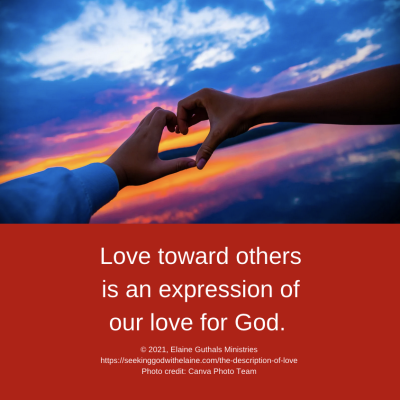
    Love toward others is an expression of our love for God. Because we love God, we become docile. We allow Him to teach us what we need to know because we trust Him. We want others to have what we have.

    Love toward others is an expression of our love for God.

    Let’s look at the different aspects which describe what love is and isn’t.

    Patient

    Love remains in character when provoked.

    Ooo, baby. We don’t want suffering to have any acquaintance with love!

    But this is life. Things happen to upset our apple cart. People are unkind to us and oppose us. We are injured — both our feelings and physically.

    How we react when bad things happen shows who we really are. Do we react with complete confidence in God? Or do we break character and worry instead of putting our faith in Him?

    Taylor talked about holding the mind. That is an interesting way to put it.

    Resource

    We can’t give up on love. Things will get tough. We won’t always feel God’s presence.

    We can’t chuck it all. We have to keep our mind focused on God.

    We can describe patience a lot of different ways. Pratt wrote, “This is almost identical with ‘not easily provoked,’ ‘beareth all things,’ ‘endureth all things.’ These manifold expressions reveal love as a personage of great moral strength, as well as of unrivalled [sic] loveliness.” Thomas also linked patience with gentleness, unsuspiciousness, tolerance, and forgiveness.

    Resource

    When we are patient, we conduct ourselves with dignity for ever how long it takes. We are sober and even keeled.

    Glossary

    Being patient isn’t a weakness. It doesn’t show that we are spineless or indifferent.

    It shows that we have the character of God. Jesus was patient.

    Patience shows meekness. Meekness is a personality trait exhibiting a mild or moderate disposition that places dependence on God.

    Glossary

    To read a related devotion, click the button below.

    Kind

    Love is kind in mind and in actions.

    When we think about being considerate and generous, we have to do more than do that. We have to be that.

    Kindness is an inner beauty that shines through. It encompasses gentleness and goodness.

    This isn’t an option for disciples. We have a duty to be kind.

    If we are doing something kind for someone, our thoughts have to match. We really aren’t being kind — the way God wants us to be — if we are performing a task but wishing we could be anywhere but. Or if we are thinking the person we are doing it for doesn’t really deserve it.

    Pratt had a great way to describe kindness. He wrote, “Her self-forgetful love makes her gracious, benignant, generous, and forgiving under all circumstances.”

    Resource

    There are many benefits to being kind. Also, it does go a long way to help us being forgiving.

    To read a related devotion, click the button below.

    Envy

    Envy is the opposite of being content.

    God doesn’t want us to see what others have and be envious. The churchy word for that is covetousness. Covetousness is an inordinate greed for wealth and possessions.

    Paul could relate to that. He told us that he battled covetousness.

    The problem with envy is when we don’t limit it to that. It may lead to lying, stealing, unfairness, and cruelty. We allow our selfishness to run rampant.

    God doesn’t want us to make it into a competition with others. He wants us to evaluate our lives against His standards.

    Envy is the polar opposite of what God wants because, Cross noted, it encompasses an element of hate.

    Resource

    Envy can quickly steal our joy while it, at times, paints an unrealistic picture. It is an example of another time that we need to keep our focus on God.

    To read a related devotion, click the button below.

    Devotions in the Contentment Leads to Tranquility series

    Boasting

    Love eliminates boasting by changing pride to humility.

    Love isn’t delusional. It sees things for what they are.

    Instead of having an undue pride, we are humble. Christian humility is our yielding our dependence to Christ to serve Him and others.

    This also has an element of modesty. The counterpart of that is vanity.

    Lyth said this smacks of not having care for others’ feelings.

    Resource

    We should never forget that everything we have — including our knowledge, skills, and abilities — comes from God. We would be nothing without Him.

    Arrogant

    Love helps us to maintain a realistic view of ourselves, giving us the right amount of self-respect.

    It is a balancing act. We are to be humble and kind instead of boastful and arrogant.

    Too often, the problem when we build ourselves up is that it is at the expense of someone else. We are tearing them down to show how good we are. Or we want them to see how good we are.

    Yep, we are full of vanity and pride.

    That is the exact opposite of how Jesus taught us. “But when you give to the needy, do not let your left hand know what your right hand is doing, so that your giving may be in secret. And your Father who sees in secret will reward you” (Mt. 6: 3-4 ESV).

    We shouldn’t be doing acts of service so all of our friends and family pat us on the back. We should be doing them so God alone sees them.

    Rude

    Love calls us to be polite and fair, not rude.

    It isn’t just attitude. It is behavior. Love wants us to be considerate of others’ feelings.

    But it is also more than that. This is where discernment fits in. Discernment means we can evaluate the situation and recognize right from wrong. We can take that a step further to say act appropriately.

    We are called to honor others. Honor means to esteem and respect another because of a good reputation.

    Own Way

    Looking to always get our own way is selfishness, not love.

    Selfishness stifles a generous heart. Instead of looking to others, we look to number one.

    We are looking for our own pleasure and honor. We want to get a leg up.

    God wants us to focus on others in His name. He calls us to be self-sacrificing and merciful.

    I like what Wilkinson had to say. He wrote, “Charity seeks charity, or God, who is Love. It cares little or nothing for aught else. It knows that all the rest will come in time.”

    Resource

    We can’t go to the other extreme and think we are to hate ourselves. That isn’t what is wanted here.

    We need to love ourselves as God loves us. We also have to love others as God loves us.

    Irritable and Resentful

    Love has no room for bitter resentments.

    This goes back to being sober and even keeled. We need to be calm and not easily provoked.

    We keep our anger in check. It shouldn’t smack of revenge or be unwarranted. We should not blow things out of proportion.

    Our temper can sometimes stem from our selfishness. We’ve already talked about that being contrary to love.

    The King James Version translates this as being provoked. That does bring with it another connotation.

    Satan is trying to get us to fly off the handle. He is trying to get us to react to the trial instead of focusing on God.

    That brings with it the possibility of the anger being ungoverned. God doesn’t want that. He wants us — and Him — to be in control.

    Thinking of Evil

    Love is not suspicious.

    The King James Version translates the end of verse 5 a little differently than the English Standard Version. It reads, “… thinketh no evil” (I Cor. 13: 5 KJV).

    Love doesn’t think the worst of others. It doesn’t harbor resentments.

    Well, that tracks. We just said that we need to love ourselves and others as God loves us.

    God is forgiving, not resentful.

    We also don’t want to see faults in others that aren’t there. Unfortunately, we have a tendency to see things from our perspective, not from realities’ viewpoint.

    We have to slip out of our own little word and lead with kind thoughts of others.

    Wilkinson defined thinking evil as judging others. We aren’t supposed to judge others.

    Resource

    I know. We do it anyway.

    However, it is above our pay grade. Only God can truly judge others.

    The churchy word for this is censoriousness. Censoriousness means being critical of others.

    Usually when we are critical of others, we are overlooking their good qualities. We can’t see the good for the bad.

    That may be fallout from our pride and building ourselves up.

    One way it manifests itself is in gossip. Man, are we good talking about others!

    Burrell had a great way to combat this critical attitude. He wrote, “Love puts the best construction on everything it sees.”

    Resource

    We really have to be careful judging others. Judgments are based on a lot of assumptions. Those assumptions may — or may not — be correct.

    Instead of judging, we are supposed to show mercy to others. In reality, we are no better than they are.

    the-description-of-loveFB

    Making the Connections

    Is it me, or did we talk about the same things over and over? Selfishness stood out to me. Pride did, too.

    But then again, we talked about soberness and forgiveness over and over again. Humility and honor came up a lot.

    We have to remember that Paul does not limit our actions toward others in any way. This isn’t be polite toward one set of people, but you don’t have to be polite to that set.

    We are to love all.

    How Do We Apply This?

    • Freely show love through kindness.
    • Follow the Golden Rule.
    • Possess a meek and gentle spirit.
    • Strive to offend no one.
    • Be humble and modest.
    • Seek to please and glorify God.

    Resource

    Father God. There are so many different ways to show love. Help us to reflect Your love. Amen.

    What do you think?

    Leave me a comment below (about this or anything else) or head over to my Facebook group for some interactive discussion.

    If you don’t understand something and would like further clarification, please contact me.

    If you have not signed up for the email daily or weekly providing the link to the devotions and the newsletter, do so below.

    If God has used this devotion to speak with you, consider sharing it on social media.

  • The Importance of Love

    Love is more than just a feeling. This daily devotional looks at the importance of love in contrast to our spiritual gifts and spiritual graces.

    Nuggets

    • Our spiritual gifts mean nothing if we do not serve through love.
    • We don’t have faith if we don’t have love.
    • Trials teach us nothing if we do not navigate them through love for God.

    Devotions in How to Love Our Neighbors series

    When we hear First Corinthians 13, we immediately think of romance and weddings. That wasn’t on Paul’s mind.

    What?!? The love chapter isn’t talking about our soul mate?!?!?! ?!?

    No. If we look at Chapter 12 and Chapter 14, we see Paul was writing about spiritual gifts.

    Now, I know Paul chased a lot of rabbits, but I don’t think he would have squirreled on something as important as this.

    We only gain perfection — spiritual maturity — through love. Our spiritual gifts not only give us God’s character, but they also show that we are maturing.

    So, let’s switch our focus and look at love through the lens of being perfected.

    Let’s Put It into Context #1

    Here is a running list of nuggets for the series.

    Let’s Put It into Context #2

    Perfection means we reach a state of maturity because the combination of the spiritual graces form, when all are present, spiritual wholeness or completeness — holy, sanctified, and righteous.

    • Spiritual graces are worldly morals that have been submitted to God to further His kingdom instead of enhancing this world.
      • Holy means to be set apart — because of our devotion to God — to become perfect, and morally pure while possessing all virtues.
        • Pure means not being sinful or having the stain of sin. 
    • Sanctified means to be set free from sin.
      • Sin is not believing that Jesus is our Savior to save us from our actions by humans that disobey God and break one of His reasonable, holy, and righteous laws and commandments, goes against a purpose He has for us, or follows Satan’s promptings.
    • Righteous means we are free from sin because we are following God’s moral laws.
    • Virtues are standards of moral excellence.

    Glossary

    Communicating through Love

    “If I speak in the tongues of men and of angels, but have not love, I am a noisy gong or a clanging cymbal” (I Cor. 13: 1 ESV)

    Our spiritual gifts mean nothing if we do not serve through love.

    When we were talking about spiritual gifts, we really didn’t talk about what speaking in tongues was. Let’s dig in now.

    When I have thought about tongues, I thought it was a heavenly language. It does say here “If I speak in the tongues … of angels, but have not love …” (I Cor. 13: 1 ESV).

    We don’t know how we are going to communicate in Heaven. We know we will. “And I heard every creature in heaven and on earth and under the earth and in the sea, and all that is in them, saying, ‘To him who sits on the throne and to the Lamb be blessing and honor and glory and might forever and ever!’” (Rev. 5: 13 ESV).

    We tend to think this is a spiritual gift that is high up in the hierarchy of spiritual gifts. We think of this as God’s language.

    But that isn’t all it is talking about here. It is also talking about If I speak in the tongues  of men … but have not love …” (I Cor. 13: 1 ESV).

    So, what is important here?

    • The ability to communicate.
    • The ability to build a relationship.
    • The opportunity to witness.

    The foundation of this communication has to be grace. Garbett pointed that out in his sermon. He wrote, “The very words themselves have something about them of the grace which they describe.”

    Grace is a free and unmerited gift of love from the Heavenly Father, given through His Son, Jesus Christ, that enables salvation and spiritual healing to believers by the work of the Holy Spirit.

    Resource

    Glossary

    Grace is the foundation of communication, but it comes out of love. If you think about it, love does have three components: humility, gratitude, and generosity.

    • Love is not about being prideful. It focuses on the recipient rather than ourselves.
    • Love is not about feeling entitled. We do not expect it but are thankful for it.
    • Love is not about being stingy. Love is about what we give, not receive.

    True love comes from God. It is more than just our disposition and acts.

    It is a fruit of the Spirit. That makes it not only God’s character but also a reward for our obedience.

    Think of it this way. We are to witness to others to tell them of the gospel. We are to help them understand God’s love for them and their need for salvation. We can’t do that if we don’t communicate through love.

    Loving through Faith

    “And if I have prophetic powers, and understand all mysteries and all knowledge, and if I have all faith, so as to remove mountains, but have not love, I am nothing” (I Cor. 13: 2 ESV)

    We don’t have faith if we don’t have love.

    Paul went on talking about things that didn’t matter if they were not accompanied by love. What he mentioned was something that we should want to have a lot of — faith.

    Coolidge argued that love is superior to the spiritual gifts. He felt that way because these are not moral gifts.

    Resource

    I don’t know. In a way, I can see it.

    So, we can see the future and have all sorts of knowledge. They have no value without love.

    I see love as the foundation of faith, too. If we don’t love God, faith has no value.

    But does that make love superior to prophecy and faith?

    Love is the single element of the greatest commandments. But if we don’t have faith in God, our love is meaningless. “You believe that there is one God. Good! Even the demons believe that—and shudder” (Jas. 2: 19 NIV).

    I would be more comfortable saying love is the reason for faith rather than it being superior to the other gifts.

    Still, either way we look at it, one is worthless without the other.

    I think Blackburn explained it better than Coolidge. He said that spiritual graces are more valuable than gifts. Spiritual graces are worldly morals that have been submitted to God and elevated to His character in order to further His kingdom instead of enhancing this world.

    Resource

    Spiritual graces deal more with our character than our gifts do. Gifts are our skills and abilities. Graces are who we are.

    Charity through Love

    “If I give away all I have, and if I deliver up my body to be burned, but have not love, I gain nothing” (I Cor. 13: 3 ESV)

    Trials teach us nothing if we do not navigate them through love for God.

    The King James Version translates the word as charity. All other versions translate it as love.

    In verse 3, Paul talked about what we would call charity. We are providing for others in their need. To do this, we give away something we possess.

    Alford didn’t see Paul talking about a body being burned as roasting it on a bon fire. He saw it as all the toil and sacrifice we do being useless.

    Resource

    Yes, we’ve said many times that we grow through the trials we face. The trials can’t be the only element.

    Edwards explained this. He wrote, “It is not the work or the suffering that is, in itself, worth anything in the sight of God.” The Scripture he used was “… For the Lord sees not as man sees: man looks on the outward appearance, but the Lord looks on the heart” (I Sam. 16: 7 ESV).

    Resource

    We’ve got to get the lesson we are to learn to the heart level. We do that by using the trial to deepen our love for God.

    the-importance-of-loveFB

    Making the Connections

    Let’s look at all three verses together.

    “If I speak in the tongues of men and of angels, but have not love, I am a noisy gong or a clanging cymbal. And if I have prophetic powers, and understand all mysteries and all knowledge, and if I have all faith, so as to remove mountains, but have not love, I am nothing. If I give away all I have, and if I deliver up my body to be burned, but have not love, I gain nothing” (I Cor. 13: 1-3 ESV).

    What was Paul talking about here? One thing is communicating with others, especially what God was going to do in the future, so they could believe.

    But it is also talking about our relationship with God. Sacrifice alone isn’t going to cut it. We have to have genuine faith in Christ.

    It all comes down to motivation. It isn’t going to cut it if we do the right thing for the wrong reason.

    Does that mean God isn’t going to use our service if we are doing it wrong? Not necessarily.

    What won’t happen is we get a reward for doing it — or as great a reward.

    God wants things done His way in His time for His glory.

    How Do We Apply This?

    • Ensure our views match those of Jesus.
    • Look at situations through the lens of God’s love.
    • Never underestimate the power of the cross, because Jesus’ death on it was an act of love.
    • Pray that the Holy Spirit creates love within us.
    • Mortify our prayers temper, pride, and selfishness.
    • Show others love by meeting their needs.
    • Put love in its place and realize we shouldn’t be praised for it or blamed for the lack of it.
    • Possess a generous moral sympathy for all.
    • Reveal love to others to show Christ to them.
    • Examine our hearts for love.
    • Witness to others.
    • Seek love through diligent prayer.

    Resource

    Father God. We thank You that our love for You is the basis for all we do. Only with Your love in us can we have the foundation we need to love others. Help us to communicate to them their need for Jesus as their Savior and Redeemer. Amen.

    What do you think?

    Leave me a comment below (about this or anything else) or head over to my Facebook group for some interactive discussion.

    If you don’t understand something and would like further clarification, please contact me.

    If you have not signed up for the email daily or weekly providing the link to the devotions and the newsletter, do so below.

    If God has used this devotion to speak with you, consider sharing it on social media.
  • Love Makes Neighbors

    God wants us to meet the needs of others as necessary. This daily devotional looks at how loving others helps us to serve those in our proximity to make them neighbors.

    Nuggets

    • Love is an investment.
    • We serve others through love.

    Devotions in How to Love Our Neighbors series

    We’ve been looking at the Parable of the Good Samaritan. We finish up by looking at the Samaritan himself. He is a good example of love in action and how this love makes us neighbors.

    Let’s Put It into Context

    Here is a running list of nuggets for the series.

    The Good Samaritan

    “But a Samaritan, as he journeyed, came to where he was, and when he saw him, he had compassion. He went to him and bound up his wounds, pouring on oil and wine. Then he set him on his own animal and brought him to an inn and took care of him. And the next day he took out two denarii and gave them to the innkeeper, saying, ‘Take care of him, and whatever more you spend, I will repay you when I come back’” (Lk. 10: 33-35 ESV)

    Love is an investment.

    In the last devotion, we talked about the symbolism of the parable. Let’s chase a rabbit a second before we get back to the symbolism surrounding the Samaritan.

    Aitken pointed out the symbolism of the victim going from Jerusalem to Jericho. He was leaving God’s city to go to worldly Jericho. He was turning his back on God.

    Resource

    Back on track.

    It is logical that the Samaritan represents Jesus. The binding of the wounds represents how Jesus has provided His Spirit to grow us to a restored relationship through grace (the oil).

    Resource

    Jesus had compassion on us, also. Jesus, “who, though he was in the form of God, did not count equality with God a thing to be grasped, but emptied himself, by taking the form of a servant, being born in the likeness of men” (Phil. 2: 6-7 ESV).

    Jesus not only loved us enough to be born into this world, but He also loved us enough to die for us.

    The Samaritan did have to invest in the victim. It may not have been convenient for him to stop and minister him, but he did.

    Ministering to the victim also meant the Samaritan gave up some comforts. When he put the victim on his animal, that meant that he had to walk.

    Time was not only invested, but the Samaritan also paid a significant amount for his care. I hadn’t really thought about it before as to what the robbers had taken. They had taken his money and his clothes – everything.

    And the Samaritan did all of this for a man who may or may not have looked down upon him because of who he was! Who the victim was or what he had done or his opinions did not enter into the equation of whether the Samaritan was going to minister to him.

    But isn’t that how serving God is going to be? It is going to be challenging. We can’t expect an easy road.

    Satan is going to do everything in his power to cause us not to be successful in our doing God’s work. He can really cause us grief.

    And isn’t that how Jesus is? He is going to meet all of us where we are to offer us salvation.

    Spurgeon put it into perspective. He wrote, “If God forgive little sinners only, then He is little in His mercy.” He will forgive all who ask.

    Resource

    The Samaritan had to invest his time to get God’s character. He didn’t just show up that day and say, “Hey! I am going to turn over a new leaf and show kindness to this person.” He was a compassionate person before he needed to be.

    For us, that means we need to serve others regardless of their religion and other differences from us. It shouldn’t be based on what we like and where we want to serve. We have to serve where God calls us to serve.

    We have to possess God’s character so we can minister to all who are in need. We need to have enough to get it out of our head thinking about it and into our hands and feet doing it.

    Love

    “‘Which of these three, do you think, proved to be a neighbor to the man who fell among the robbers?’ He said, ‘The one who showed him mercy.’” And Jesus said to him, ‘You go, and do likewise’” (Lk. 10: 36-37 ESV)

    We serve others through love.

    Let’s look at the Samaritan’s act of love for a second. There were three things that it was not.

    • It was not dependent on anything other than someone was in need. The Samaritan met the victim’s needs without asking any questions.
    • It was not a “let’s think this through” situation. The Samaritan didn’t hesitate but went right over to minister to the one in need.
    • It was not a situation where he considered whether the robbers would come back. He wasn’t afraid to do what needed to be done.

    Dods gave us a good definition of neighbor. He wrote, “The true neighbour is the man who has a compassionate heart and a friendly spirit.”

    Resource

    We bestow this compassion and friendly spirit on anyone who is in our proximity.

    To me, this parable shows that we are dependent on each other. Things happen. We shouldn’t be so independent that we don’t ask for help or allow others to help. It tells me we shouldn’t be so arrogant or hardhearted that we do not offer help or do what we can when we are asked.

    One thing has stuck with me from when Mom was battling cancer 30 years ago. Independent Old Gray Mare said that she had to let others help her so that they could get their blessing. If we continue to try to do things on our own, others lose.

    They get their blessing and happiness. Hughes said something I really like. He wrote, “Happiness is not an emotion, but the fruit of love.”

    Resource

    love-makes-neighborsFB

    Making the Connections

    Let’s contrast the lawyer and the Samaritan. They are totally opposite.

    The lawyer had it all going for him. He was an orthodox Israelite who knew the law. He had the right answer. He just wasn’t applying it correctly.

    Seiss thought there was some sincerity in the lawyer. He had to have some desire to follow God.

    The problem the lawyer had was, even though he was following the law, he wasn’t righteous. He had some head knowledge, but he didn’t have the correct heart knowledge.

    The Samaritan, on the other hand, would have been labeled a heretic. He was one of those dreaded half Jews. Seiss wrote, “His churchliness was thoroughly defective and reprehensible.”

    Resource

    Instead, the Samaritan had mercy and compassion for his fellow man.

    Too bad we couldn’t add the lawyers knowledge of the law with the Samaritan’s practical application of it.

    How Do We Apply This?

    • Know the law and apply it with compassion.
    • See all of mankind as needing our compassion and give it.
    • Practice self-denial.
    • Serve others voluntarily in whatever way is needed.
    • See the work through until the end.
    • Know there will always be more work to do for God.
    • Find ways to identify with others so that we may serve them.
    • Be humble.
    • Regardless of recipient or act, serve God in the way He calls.
    • Pay attention when opportunities of service are dropped into our pathway.
    • Look for opportunities to serve.
    • Don’t put ourselves above others.

    Resource

    Father God. Thank You for the example of the Samaritan. More importantly, thank You for Jesus as our example. Thank You for His salvation. Help us to look for ways to serve others. Amen.

    What do you think?

    Leave me a comment below (about this or anything else) or head over to my Facebook group for some interactive discussion.

    If you don’t understand something and would like further clarification, please contact me.

    If you have not signed up for the email daily or weekly providing the link to the devotions and the newsletter, do so below.

    If God has used this devotion to speak with you, consider sharing it on social media.

  • How not to Show Love 

    When the lawyer asked Jesus for clarification on who we are to love, Jesus answered him by showing him what not to do. This daily devotional looks at the beginning of the Parable of the Good Samaritan. 

    Nuggets

    • We show what is in our hearts when we try to justify ourselves. 
    • Jesus started the Parable of the Good Samaritan off with a description of how not to show love. 

    Devotions in How to Love Our Neighbors series

    Sometimes, we can start out on a strong foot. But then we soon stick that foot in our mouths. 

    The lawyer telling Jesus that we gained eternal life by obeying the greatest commandments started out strong. But then he asked for clarification of who is our neighbor. 

    Let’s take a look. 

    Let’s Put It into Context

    Here is a running list of nuggets for the series.

    Asking the Right Question Wrong 

    “But he, desiring to justify himself, said to Jesus, ‘And who is my neighbor?’” (Lk. 10: 29 ESV) 

    We show what is in our hearts when we try to justify ourselves. 

    Ooo, baby. We are so quick to justify our actions and opinions! 

    I get it. We don’t want to be wrong. 

    The lawyer sure didn’t want to be wrong. He was an educated man — a Pharisee. He couldn’t be seen as weak or not knowing what he was talking about. 

    So, the lawyer asked a good question that was supposed to limit who was to be loved. 

    Yes, prejudice is learned. But oftentimes our environment — not saying this is right — does a pretty good job of teaching us what to consider right or wrong. 

    That, coupled with the fact that we gravitate to likeminded people, may hinder us from breaking out when we realize that we do have a flawed opinion. 

    Parker argued that the question really didn’t need to be asked. In our hearts, we know the answer is everyone. 

    Resource

    The problem is that, when we are fighting a battle with self-justification, we aren’t focusing on our need for a Savior. 

    Jesus said we need to die to self. “And he said to all, ‘If anyone would come after me, let him deny himself and take up his cross daily and follow me’” (Lk. 9: 23 ESV). 

    To read a related devotion, click the button below.

    To read a devotion in the What Does It Mean? series, click on the appropriate button below. 

    The issue the lawyer had with that, according to Parker in another sermon, was he saw himself no worse than those around him. He was behaving exactly as the world was behaving. 

    Resource

    God doesn’t call us to be like the world. What they call right and good is not always what God calls right and good. 

    We need to use God’s standards. 

    Parker brings up a good point. How does the fact that we have many denominations impact the witness of a church? 

    I’ve read things about how worldview people question which set of beliefs are correct because there are so many differences within the different churches. Parker thought that was an invalid excuse to not believe in Christ. 

    To put it into context, it is like saying we are going to give up on dieting because there are so many different diet plans. That is crazy! 

    There are different interpretations of things. We have to remember no one is going to get it totally right because God’s ways are higher than ours (Isa. 55: 8-9). 

    We just have to make sure we believe the essential doctrines. We won’t gain eternal life if we don’t believe these and have submitted our lives to God. 

    Glossary

    Doing Things Wrong 

    “Jesus replied, ‘A man was going down from Jerusalem to Jericho, and he fell among robbers, who stripped him and beat him and departed, leaving him half dead. Now by chance a priest was going down that road, and when he saw him he passed by on the other side. So likewise a Levite, when he came to the place and saw him, passed by on the other side’” (Lk. 10: 30-32 ESV) 

    Jesus started the Parable of the Good Samaritan off with a description of how not to show love. He didn’t recommend this. 

    Let’s get the symbolism out of the way first. Keach helped us with this. 

    • Wounded man — all fallen mankind 
    • Fallen among robbers — mankind became sinful 
    • Stripped him — took our original righteousness 
    • Half dead — left us spiritually dead even though we are living 
    • The priest — the law 
    • The Levite — sacrifices 
    • Passing by — there is no salvation found in either the law or sacrifices. 

    Resource

    If we see love as wanting to fulfill the needs of others, the priest and the Levite did not show love. The man obviously had a need. He was seriously wounded. 

    If we consider Satan is symbolized by the thieves, Keach really put into perspective how Satan and evil steal from us. He wrote,  

    1. “Because they are soul-thieves, and seek to rob us of our choice and chiefest treasure.
    2. “Because they are cruel and bloody thieves, murdering thieves.” 

    Resource

    We lose when Satan steals from us. 

    It is important to note the direction in which everyone was traveling. The victim was “… going down from Jerusalem to Jericho …”  (Lk. 10: 30 ESV). The priest “… was going down that road …”  (Lk. 10: 31 ESV). It also says, “So likewise a Levite …” (Lk. 10: 32 ESV). 

    The priest and Levite were not heading to Jerusalem to perform their duties. Their becoming unclean by helping the victim would not have kept them from performing their duties in the temple. 

    There was no excuse for not showing love to the victim. They were just being selfish. 

    But then how many times have we passed on the other side? When have we not shown love for whatever reason? 

    Oh, yeah. Sometimes, we aren’t any better than the priest and the Levite. 

    how-not-to-show-loveFB

    Making the Connections #1 

    We don’t have to be out and about very long before we realize that everyone has needs. Everyone is fighting some kind of battle. 

    That really raises the opportunities for service! 

    We just have to remember two things. 

    We are called to serve where God wants to use us. We need to ask Him where He is working and join Him there. 

    The last thing we want to do is limit where we will serve to our own ideas. We may be doing that because of the wrong motivation. 

    Our goal is not to be a social server. Jesus wasn’t a social savior. 

    Jesus was a spiritual Savior. We have to be more concerned about someone’s spiritual condition than their physical condition. We are to be a spiritual server. 

    Making the Connections #2 

    Jesus didn’t answer the lawyer’s question. He didn’t tell him what he should “… do to inherit eternal life?’” (Lk. 10: 25 ESV). 

    But then again, in all practicality Jesus did. When we love others and show them compassion in Jesus’ name, we are fulfilling both of the greatest commandments. We are gaining perfection, which we will get when we begin our eternal life. 

    Don’t read that too fast and read over that we have to do it in Jesus’ name. We can’t do it just because we are a good person. 

    How Do We Apply This?

    • Join God where He is working. 
    • Focus on the spiritual, not the physical. 
    • Die to self daily. 
    • Recognize everyone not only as a neighbor but as a brother. 
    • God calls us to love. 
    • We are to choose good, not evil. 
    • Selfishness is not a part of love. 
    • Learn to question the right way. 
    • Live out the greatest commandments. 
    • Don’t focus on religion — focus on relationship with God. 
    • Fulfill the law by showing love. 
    • Write God’s laws into our heart. 

    Resource

    Father God. We praise You because You are love. Thank You for interacting with us in love. Help us to show that love to others. Amen. 

    What do you think?

    Leave me a comment below (about this or anything else) or head over to my Facebook group for some interactive discussion.

    If you don’t understand something and would like further clarification, please contact me.

    If you have not signed up for the email daily or weekly providing the link to the devotions and the newsletter, do so below.

    If God has used this devotion to speak with you, consider sharing it on social media.

  • Who Is Our Neighbor?

    Loving one another is how we fulfill the second greatest commandment. This daily devotional begins looking at what that means by determining who are our neighbors.

    Nuggets

    • The lawyer asked how to gain eternal life, but he already knew the answer.
    • Loving our neighbors mean we love them as God does.
    • We gain eternal life by obeying God’s command to love. 

    Devotions in How to Love Our Neighbors series

    In our Sunday Morning Bible Study, we are starting to look at how to love our neighbors. The first lesson discusses the Parable of the Good Samaritan.

    Let’s start out by looking at the question the lawyer asked that resulted in the parable.

    Let’s Put It into Context

    Here is a running list of nuggets for the series.

    The Inquisitor

    “And behold, a lawyer stood up to put him to the test, saying, ‘Teacher, what shall I do to inherit eternal life?’ He said to him, ‘What is written in the Law? How do you read it?’ And he answered, ‘You shall love the Lord your God with all your heart and with all your soul and with all your strength and with all your mind, and your neighbor as yourself’” (Lk. 10: 25-27 ESV)

    The lawyer asked how to gain eternal life, but he already knew the answer.

    Hmmm. How do these verses give us knowledge as to how to love our neighbor?

    One answer to that question is that they are setting up the context of why Jesus told the parable He is going to tell.

    The more important answer is our love for others have to come from our love for God.

    We’ve talked many times that these are the two greatest commandments. The first one is love God. The second one is love others.

    Glossary

    One problem with the lawyer’s question is that it is asking what he can do. We know perfection is more about being.

    This is because perfection means maturity. We only gain maturity by growing.

    We can do and do and do. But if we aren’t growing into God’s character, we are just going through the motions, regardless of the motivation.

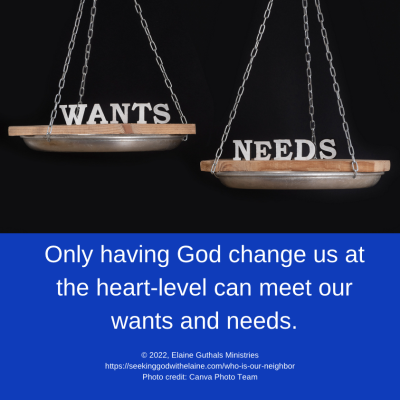
    That is why loving God is the greatest commandment. Only having God change us at the heart-level can meet our wants and needs.

    Only having God change us at the heart-level can meet our wants and needs.

    Another problem with the lawyer’s question was the motivation through which it was asked. He wanted to tempt Jesus, not really to learn from the answer he received.

    The Pharisees had a hard time finding something with which to condemn Jesus because He was fulfilling all the laws they so pushed. They kept looking for ways to trip Him up.

    Parker thought the lawyer was asking Jesus for His interpretation. The lawyer asked the question in hopes that Jesus would show how much he was against the Pharisees’ beliefs.

    Resource

    Jesus made the lawyer answer his own question. The answer was Deuteronomy 6: 5. “You shall love the Lord your God with all your heart and with all your soul and with all your might” (Deut. 6: 5 ESV).

    I see advantages both ways. If Jesus would have answered first, He would tell us exactly what God is expecting.

    But Jesus’ point was that the answer had already been given. The lawyer, as a Pharisee – an educated man – should be able to give the answer. It ended up he had the head knowledge (but did he have wisdom????)

    Ooo, yes! You have an eagle eye!

    The lawyer did add the part about loving our neighbor as ourselves. No, he didn’t rewrite Scriptures.

    It is in Leviticus. “You shall not take vengeance or bear a grudge against the sons of your own people, but you shall love your neighbor as yourself: I am the Lord” (Lev. 19: 18 ESV)

    The Practical Definition of Loving Our Neighbor

    “And he answered, ‘You shall love … your neighbor as yourself’” (Lk. 10: 25, 27 ESV)

    Loving our neighbors mean we love them as God does.

    But I, personally, don’t think the neighbor part is totally right. He said we are to love “… your neighbor as yourself” (Lk. 10: 27 ESV).

    If you have read past devotions, you know I have a problem with that. I’m not going to look them up right now, but I know I have gotten up on my soap box and talked about how we don’t love ourselves. If we don’t love ourselves, how are we going to love others?

    No, I am not supposed to love my neighbor only as I love me. I am supposed to love my neighbor as God loves me. To me, that is what the “… as yourself” (Lk. 10: 27 ESV) means.

    But I also see how this helps us approach others humbly. We know how flawed we are, so maybe our pride will take a day off while we love our neighbors.

    This all brings up a really good point. The law is about doing, but it is also about believing. We have to believe and obey.

    So, who is our neighbor? Jesus said that everyone is our neighbor – but Scriptures say in many instances that this especially refers to disciples loving other disciples.

    Foote gave us some practical ways that we are to love our neighbors.

    • Speak well of others.
    • Don’t repeat prejudicial reports about others.
    • Believe mistakes are made by negligence than wickedness.
    • Deal faithfully with others.

    Resource

    To me, this says that we look for the positive in others rather than the negative.  It does rest some on choosing to love others.

    But Robertson says there is more to it than that. He wrote, “… love cannot be produced by a direct action of the soul upon itself. You cannot love by a resolve to love.”

    Resource

    We have to love by doing the things that love require. We can only do this by meditating the love of God.

    Since God is love, we tap into it to love others. Dykes explained it this way. He wrote, “The affection which fulfils the whole law is an ethical principle, and not simply an instinctive or generous affection.”

    Resource

    Hmmm, an ethical principle. That circles back to spiritual graces.

    God isn’t interested in us just being a good, ethical person. He wants us focused on Him.

    Eternal Life

    “And he said to him, ‘You have answered correctly; do this, and you will live’” (Lk. 10: 28 ESV)

    We gain eternal life by obeying God’s command to love. 

    Let’s circle back to the discussion on eternal life.  The greatest commandments require love for fulfillment. We show that love by obeying all the other laws and commandments.

    But that isn’t why we have eternal life. Emmons wrote, “God does not promise eternal life to all who obey His commands, because their sincere and cordial obedience atones for their sin, and lays a foundation for pardon, for forgiveness, or justification in His sight. … Nor does God promise eternal life to those who obey Him, because their obedience merits eternal life. … He does promise eternal life to them because their obedience is a proper ground, reason, or condition, for bestowing upon them such a gracious and unmerited reward.”

    Resource

    We don’t earn eternal life by merit. We can’t earn it by doing the do’s and not doing the don’ts.

    We gain eternal life by asking Jesus to be our Savior and Redeemer. We get it by loving God.

    who-is-our-neighborFB

    Making the Connections

    When we say love, we are talking love, not tolerance. We have to obey God’s definition.

    We can’t compromise with the world.

    How Do We Apply This?

    Searching for and Seeking God

    Hearing His Word (Rom. 10: 17).
    Reading His Word (Rev. 1: 3).
    Praying to Him (Heb. 4: 16).
    Studying His Word (Ac. 17: 11).
    Meditating on His Word (Ps. 1: 1-2).
    Memorizing His Word (Ps. 119: 11).

    Father God. We look to You for the pure definition of love. That is what we want to possess for You and for others. Help us to love as You love us. Amen.

    What do you think?

    Leave me a comment below (about this or anything else) or head over to my Facebook group for some interactive discussion.

    If you don’t understand something and would like further clarification, please contact me.

    If you have not signed up for the email daily or weekly providing the link to the devotions and the newsletter, do so below.

    If God has used this devotion to speak with you, consider sharing it on social media.

  • Reckless Love

    Today is a music day.

    Well, the devotion I started writing yesterday didn’t look any better today than it did then. So, I am going to quit while I am behind.

    I’ll figure something out for the next devotion, but that is for later.

    Today has been an emotional day. Shorty, who belonged to my Springfield Mom, had to be put to sleep. We met her in a previous devotion.

    To read a related devotion, click the button below.

    That sweet fur baby gave a lot of love to my Springfield Dad, my Springfield Mom, their family, Adam, and I.

    God has a lot of love to give us, too. He has already given us a lot. He sent His Son to die for us.

    We didn’t have to change our character to match God’s before He gave us salvation. We didn’t have to go through an orientation process.

    We had to make a choice. We had to love God and Jesus. We had to admit, believe, and confess.

    Then, God’s love was ours.

    Reckless Love
    Vocalist: Elaine Guthals
    Keyboard: Chris Vieth

    reckless-love-3FB

    What do you think?

    Leave me a comment below (about this or anything else) or head over to my Facebook group for some interactive discussion.

    If you don’t understand something and would like further clarification, please contact me.

    If you have not signed up for the email daily or weekly providing the link to the devotions and the newsletter, do so below.

    If God has used this devotion to speak with you, consider sharing it on social media.

  • The Compassion of Jesus

    Jesus is known for His compassion and tenderness. This daily devotional looks at Jesus’ response when we mourn.

    Today didn’t work out as planned. I have been working all day on Wilkinson’s next point.

    Resource

    But it wasn’t working for me. I didn’t think it would work for you as it currently stands.

    One concept stuck out to me. It talked about Jesus’ compassion and tenderness.

    Remember, the shortest verse in the Bible is “Jesus wept” (Jn. 11: 35 ESV). It was when He was standing outside the tomb of Lazarus.

    Think about it. Jesus hadn’t run right to Bethany when the messenger came to tell Him Lazarus was sick. He knew he was dying, but took His time anyway.

    Now, Jesus is at the tomb. Lazarus is already dead.

    But Jesus knows what is going to happen. He knows He will bring Lazarus back to life.

    Jesus cried anyway.

    A big mystery in Scriptures is what happened to Joseph. The consensus is that he died.

    If Joseph died, then Jesus knew what it felt like to have your heart pulled out of your chest. He knew what Mary and Martha were feeling.

    Remember before Pastor Steve and I went to minister where we are now, I was teaching my Ladies’ Sunday School class. One of my Ladies died this weekend.

    Her daughter and son-in-law are mourning. Jesus is mourning along with them.

    Oh, Jesus knows they all will have a family reunion in Heaven some day. But He is crying with them because they are hurting.

    That is the compassion of Jesus. He isn’t saying, “But it is all going to be okay in the end.” Neither is He saying, “But I am going to fix it.”

    Jesus is saying, “I feel what you feel. Feelings are important.”

    We are striving toward our feelings have to be in line with Jesus’. We are always to submit to Him.

    the-compassion-of-jesusFB

    So, I don’t know what I am going to do with the half-written devotion. We’ll see if it shows up for the next devotion. Or we may go back to the Sunday Morning Bible Study’s lessons on the Holy Spirit.

    We’ll see where God takes us.

    Father  God. You know what we feel.  You have given us a Savior Who cries along with us. Lord, we rest in Your arms. Amen.

    What do you think?

    Leave me a comment below (about this or anything else) or head over to my Facebook group for some interactive discussion.

    If you don’t understand something and would like further clarification, please contact me.

    If you have not signed up for the email daily or weekly providing the link to the devotions and the newsletter, do so below.

    If God has used this devotion to speak with you, consider sharing it on social media.

  • Love Can Take Us by Surprise

    A couple of devotions ago, we hear about Pastor Steve’s journey to find love. This daily devotional looks at my journey.

    To read a related devotion, click on the button below.

    In the devotion before the last one, Pastor Steve told his story about how a man walked into a church. Let me tell you mine.

    I was on my own for a year and four months before Adam moved in with me. I had given him the choice of staying or moving out with me when I moved out. He chose to stay with the dogs.

    My sister told me it was probably better that way. It gave me a chance to heal.

    Let’s just say my marriage ended up not being a biblical marriage. He was controlling and manipulative. My marriage ended when he made it clear to me that he was going to put his unrealistic desires before the welfare of the family.

    I didn’t give up on marriage. I knew that, even though I didn’t have a good one, that wasn’t a slap against the institution of marriage.

    I prayed that God would send me someone with whom I could have a real marriage. I wanted to try again.

    But I was also terrified of trying again. How much of the failed marriage was my fault?

    I wasn’t sure if I could trust someone else. What if I thought I had found Mr. Right, only to have him again be Mr. Wrong in disguise?

    Then there was the issue that I had been on my own and with Adam for ten years. Am I so set in my ways I don’t need someone? Am I willing to let someone in?

    Am I willing to love someone? Can I risk my heart again?

    These were all of the questions that I was asking myself.

    I kept asking God, can I meet someone at church if You really want someone in my life?

    Then God told me that He wanted me to be a preacher’s wife. I wasn’t sure He had the right lady for the job.

    I told God that it would be okay if He wanted to rethink that. He reminded me that He never changed His mind.

    Then a man walked into a church.

    No, I didn’t remember him right off. It took me long enough to remember Julie — and I felt so horrible that I didn’t remember her right off.

    Julie and I had a great time in choir. She was one of my best friends at the time.

    But we didn’t make arrangements to keep track of each other after choir ended. Maybe we thought we would have another class together. Maybe we just thought we would see each other around campus.

    We didn’t keep track. I did see her one day in Walmart. She said she had married a guy from choir. (I didn’t remember him then, either.)

    I mean, we didn’t ever say a single word to each other. He was just some cute guy across the room.

    I was too much of a mouse. I would never strike up a conversation with a cute guy — then.

    But here Pastor Steve was at church. I was the good church member and welcomed the guest.

    Let’s put this in context, though. This was two days after I got the seizure diagnosis. The first horrible medicine hadn’t started working on me.

    It didn’t take long.

    So Pastor Steve saw me go from being a functioning adult to someone we thought was dying.

    I was walking like a 100-year-old woman. Adam had to help me out of bed sometimes.

    One Sunday, Pastor Steve wasn’t at church. Later that night, he sent me a message through Facebook to see how I was doing.

    Yep. Pastor Steve had gone out of town — but was thinking about me and my health.

    About a month later, Pastor Steve messaged me again. And he did daily — eventually a couple of times a day.

    Then in October, Pastor Steve asked me to go to supper with him. I had figured the texting had to either fizzle out or go up to the next level.

    Pastor Steve has had to put up with my bone-chilling terror as I worked through all those questions I asked earlier — and more. He has started to show me what love can be — what it is supposed to be.

    I just wasn’t sure if I could do marriage again. I know I had prayed for it.

    What is the saying? Be careful what you pray for — you might get it.

    That was about where I was. Until one day, God tapped me on the shoulder. He said, “You don’t have to trust Him. You have to trust Me.”

    The walls started coming down. Pastor Steve has shown me that I can trust Him.

    Most importantly, I can trust God.

    I had given up on finding love again. God brought Pastor Steve to me.

    Father God. Thank You that You have plans for our lives. We make decisions based on feelings and limited vision. You make decisions on what is best for Your kingdom. Thank You for bringing Pastor Steve and I together. We seek to serve You. Amen.

    love-can-take-us-by-surpriseFB

    What do you think?

    Leave me a comment below (about this or anything else) or head over to my Facebook group for some interactive discussion.

    If you don’t understand something and would like further clarification, please contact me.

    If you have not signed up for the email daily or weekly providing the link to the devotions and the newsletter, do so below.

    If God has used this devotion to speak with you, consider sharing it on social media.