Category: Faith

  • The Sign of Abram’s Covenant

    One aspect of a covenant was a sign, a tangible symbol to show the validity of the covenant. This devotional reading looks at how God proved through prophecy that Abram would have a son.

    Nuggets

    • God wants us to remember how He has kept His promises in the past so we don’t give up waiting in the present.
    • We would think that Abram would have been assured by God’s words, but he was still doubting.
    • God told Abram to bring a sacrifice.
    • God is love and wrath.
    • God gave Abram a glimpse of what was in store for his descendants.
    • Abram was told the good and the bad.
    • Regardless what the distant future would bring, God assured Abram his peace would be with Him.
    • Everything happens in God’s time.
    • The firepot and torch moving through the sacrifice indicated that God had accepted it.
    the-sign-of-abrams-covenant

    For the last several verses, God had been reassuring Abram that the promises associated with the covenant He made with him would come to pass. Abram had waited a long time without reaping the most important thing in his mind: a son.

    God used the sign of the covenant to reassure Abram that the promise would occur.

    Let’s Put It into Context

    To read devotions in the Creating Everything theme, click the button below.

    Devotions in the Abraham the Patriarch series

    Assembling the Sacrifice

    “Then the Lord told him, ‘I am the Lord who brought you out of Ur of the Chaldeans to give you this land as your possession.’ But Abram replied, ‘O Sovereign Lord, how can I be sure that I will actually possess it?’ The Lord told him, ‘Bring me a three-year-old heifer, a three-year-old female goat, a three-year-old ram, a turtledove, and a young pigeon.’  So Abram presented all these to him and killed them. Then he cut each animal down the middle and laid the halves side by side; he did not, however, cut the birds in half.  Some vultures swooped down to eat the carcasses, but Abram chased them away” (Gen. 15: 7-11 NLT)

    Then the Lord Told Him

    God wants us to remember how He has kept His promises in the past so we don’t give up waiting in the present.

    Abram may have just had his first salvation experience – we aren’t told if he had previously believed. 

    So, I am thinking he hadn’t. If he did, this was just a reaffirmation.

    The first thing God told Abram was to remember. Remember a past mountain-top experience. More than that, remember your obedience.

    God had asked Abram to do something hard – and Abram aced it.

    Abram was not only watching for God’s response, but he also was guarding the sacrifice. He was showing his dedication.

    Ooo, baby. Isn’t that what we have to do. We have to watch for God in order not to miss His still, small voice. We have to guard our hearts so that we don’t slip away from Him.

    Think about it. This is the third time that God told Abram He was going to give him land. He is going to tell him one more time.

    How many times does God have to tell Abram before he starts believing?

    How many times does God have to tell us something before we start believing?

    How Can I be Sure that It Will Actually Possess It?

    We would think that Abram would have been assured by God’s words, but he was still doubting.

    All Abram wanted was a sign, verification that the plan was still moving forward. God gave it to him.

    We can’t bite on Abram for still questioning (God didn’t). If we look at everything, he had very little evidence that God was real, was Who He said He was, and would do what He said.

    When we start to doubt, we have to figure out what we are doubting.

    • Are we doubting Who God is?
    • Are we doubting He can and will do what He said?
    • Are we doubting He can and will do what He said for us?

    If we do the first two, we are doubting God. If we do the last, we are doubting us.

    If it is the last, that isn’t good.

    The Sacrifice

    God told Abram to bring a sacrifice.

    Abram went and got the animals. Then he waited. But he was watching as he waited.

    In other words, Abram was expectant. He knew God was going to continue the conversation – when He was ready. He was going to continue the assurance.

    The significance of all the animals has always been a puzzle to me. But try this.

    “Because you have broken the terms of our covenant, I will cut you apart just as you cut apart the calf when you walked between its halves to solemnize your vows. Yes, I will cut you apart, whether you are officials of Judah or Jerusalem, court officials, priests, or common people — for you have broken your oath. I will give you to your enemies, and they will kill you. Your bodies will be food for the vultures and wild animals” (Jer. 34: 18-20 NLT).

    Ooo, baby. The way that started, my tummy sunk. I’m going, “Wait, wait, wait!!! I always thought this was God reassuring Abram.

    Then I got to the last part of verse 18. “… as you cut apart the calf when you walked between its halves to solemnize your vows” (Jer. 34: 18 NLT).

    Picture me wiping my brow. Abram was okay.

    This was just part of the covenant.

    Divine Presence

    “As the sun was going down, Abram fell into a deep sleep, and a terrifying darkness came down over him. Then the Lord said to Abram, ‘You can be sure that your descendants will be strangers in a foreign land, where they will be oppressed as slaves for 400 years. But I will punish the nation that enslaves them, and in the end they will come away with great wealth. (As for you, you will die in peace and be buried at a ripe old age.) After four generations your descendants will return here to this land, for the sins of the Amorites do not yet warrant their destruction” (Gen. 15: 12-16 NLT)

    A Deep Sleep and a Terrifying Darkness

    God is love and wrath.

    We know sometimes death and sleep are used interchangeably. I don’t think Abram died here.

    But it is interesting that Abram fell into a terrifying darkness. Darkness is usually associated with sin, not a sacrifice to God.

    Gray labeled this in a way as being overwhelming but also a good contrast. He wrote, “The hour, the work the circumstances, filled him with awe. He expected he hardly knew what. The profound darkness would make the light that appeared more visible.”

    Resource

    God will use everything to His benefit. “And we know that God causes everything to work together for the good of those who love God and are called according to his purpose for them” (Rom. 8: 28 NLT).

    Think about it this way. The darkness was a demonstration of God’s awful majesty. God is love and wrath.

    Resource

    We usually think of God’s majesty as being beautiful. His Shekinah – His glory – is described as amazing.

    But what God has to tell Abram is probably going to be hard to hear. Wouldn’t Abram be confused if God shows up all rainbows and unicorns and tells him about hardship and slavery?

    True, the end would work out. But the road to get there was going to be challenging.

    Then the Lord Said to Abram

    God gave Abram a glimpse of what was in store for his descendants.

    Abram just had stood up and said he believed God. God comes back with a prophecy.

    God showed to Abram the outcome of his waiting. Yes, it was just mere words, but Abram got to “see” what his faith would bring.

    We can’t for a minute forget that, at this point, Isaac was just a hopeful memory.

    Smith said something I have to figure out. He wrote, “God allows Abram to see a symbol of the Divine Presence.”

    Resource

    I know. There are times when I wish the author would have elaborated a little more instead of only making a statement and moving on or out.

    Strangers in a Foreign Land

    Abram was told the good and the bad.

    God didn’t hold back.

    • You’re going to have a son because a daughter wouldn’t pass on the line in that culture.
    • You’re going to have descendants – plural.
    • They are going to become slaves.
    • I’ll bring them home.
    • I’ll give them the land I promised you.
    • The land isn’t ready to be given to you yet.

    You Will Die in Peace

    Regardless what the distant future would bring, God assured Abram his peace would be with Him.

    I can just hear God saying, “Yeah, all this bad stuff is going to happen to your descendants, but it will be after you are gone. You won’t have to see it firsthand.”

    Welcome to life. Sometimes, you win some; sometimes, you lose some. Sometimes, you don’t have any control; sometimes, everything is smooth sailing.

    But all through whatever was going to happen – to Abram, to his descendants – God was going to be there with them.

    Go back to Abram being in a deep sleep. I think there is something we tend to gloss over. Yeah, Abram is out of it.

    God didn’t send this to Abram in a dream. He didn’t make him see his great-great-great grandkids as slaves.

    All that Abram is getting is words – and that was probably bad enough. But these words will ultimately become the Word.

    Gray reminded us that God is giving this to Abram personally. He isn’t reading this in some book thousands of years after-the-fact. He is hearing it real time.

    Resource

    Yes, what God said was hard to hear – more road trips, forced service. Contrast that with divine deliverance, wealth, occupying the land.

    Sins of the Amorites

    Everything happens in God’s time.

    Sometimes, it takes years for God’s promises to come into fruition. Abraham wouldn’t be alive to see this.

    It has nothing to do with Abram’s faith or lack of faith. It had to do with the Amorites. (We’re going to talk about who they were in the next devotion.)

    God is patient. He will wait until sinners have reached the line in the sand He has.

    This is God’s mercy. What they deserve, He has put on hold.

    But that will stop one day. God will bring forth the sentence He has passed on them.

    Payson explained what that isn’t. He wrote,

    “… when we say, God waits until sinners have filled up a certain measure of iniquity before He destroys them, we do not mean that He waits upon all, till they have filled up the same measure. In other words, we do not mean that all sinners are equal in sinfulness and guilt at the hour of their death.”

    Resource

    Just like each disciple is on our own Sanctification Road, non-believers have their own highway to hell. While all non-believers will end up at the same place, they each have their own time and way to get there.
    How does God know non-believers are filled up? He knows their feelings, thoughts, words, and actions, according to Payson.

    Well, yeah. What we believe comes out through our feelings, thoughts, words, and actions.

    Firepot and Torch

    “After the sun went down and darkness fell, Abram saw a smoking firepot and a flaming torch pass between the halves of the carcasses” (Gen. 15: 17 NLT)

    The firepot and torch moving through the sacrifice indicated that God had accepted it

    As usual, we don’t know how much time passed between when God finished talking with Abram and when the firepot and torch appeared. It doesn’t matter.

    Abram stayed in watch mode.

    Hastings identified the smoking pot as a furnace. He saw this as a purification process. We know God is in the process of purifying us from our sin.

    Hastings and Gray’s Watching and Visions

    https://www.biblehub.com/sermons/auth/hastings/watching_and_visions.htm

    If this was Abram’s conversion experience, this might be a visual example of how God moves through us to purify us. It is nice to know that – however He does it – God does purify us.

    Whitefield got a little more specific. The pieces of the animals are Jesus’ cut body. The smoking furnace are the trials we go through to sanctify us. The light are God’s presence and joy.

    Resource

    As the covenant says to pass through the cut pieces, that means we are hidden in Jesus’ wounds.

    Hastings reminded us that the lamp not only provides divine light but also guidance.

    Think about it. We know Jesus is described as being the Light.

    • “Then God said, ‘Let there be light,’ and there was light” (Gen. 1: 3 NLT).
    • “Jesus spoke to the people once more and said, ‘I am the light of the world. If you follow me, you won’t have to walk in darkness, because you will have the light that leads to life’” (Jn. 8: 12 NLT).
    • “The light shines in the darkness, and the darkness can never extinguish it” (Jn. 1: 5 NLT).
    • “Your word [Jesus] is a lamp to guide my feet and a light for my path” (Ps. 119: 105 NLT).
    • “But while I am in the world, I am the light of the world” (Jn. 9: 5 NLT).
    • “A psalm of David. The Lord is my light and my salvation – so why should I be afraid? The Lord is my fortress, protecting me from danger, so why should I tremble?” (Ps. 27: 1 NLT).

    Yeah, God was showing all of this to reassure him that He will keep His promises. But He is also saying, “You aren’t going to be alone because My Lamp – My only Son – is going to be the lamp to guide you.”

    Jesus Himself talked about this. “Your father Abraham rejoiced as he looked forward to my coming. He saw it and was glad” (Jn. 8: 56 NLT).

    Remember, a couple of sections back, we talked about Smith saying something was a symbol of the Divine Presence. Gray answered that.

    Resource

    The lamp symbolized God’s Shekinah – the glory of the divine presence.

    We are told we are to reflect Jesus’ light. “You are the light of the world—like a city on a hilltop that cannot be hidden. No one lights a lamp and then puts it under a basket. Instead, a lamp is placed on a stand, where it gives light to everyone in the house. In the same way, let your good deeds shine out for all to see, so that everyone will praise your heavenly Father” (Mt. 5: 14-16 NLT).

    Making the Connections

    How do we look at ourselves? It is in the moment.

    Maybe we will think about one or two things of the past. Maybe.

    We don’t get the chance Abram had. The writer of Hebrews, which may have been Paul, gave a summary of Abram’s life.

    “For example, there was God’s promise to Abraham. Since there was no one greater to swear by, God took an oath in his own name, saying: ‘I will certainly bless you, and I will multiply your descendants beyond number.’ Then Abraham waited patiently, and he received what God had promised. Now when people take an oath, they call on someone greater than themselves to hold them to it. And without any question that oath is binding. God also bound himself with an oath, so that those who received the promise could be perfectly sure that he would never change his mind” (Heb. 6 13-17 NLT).

    What can we gain from that? Bad days, addressed the correct way, are okay. God can use the, too, to grow us.

    We have to. Make sure we keep God on His Sovereign throne.

    God knows that Tom is going to have to believe God with little evidence. He knows Sally is never going to believe in Him. He knows Elaine has to process for a couple of minutes and then say, “Whatever You want, God.”

    How Do We Apply This?

    • Believe in God’s promises.
    • Obey God.

    Father God. Your promises are gold. What You promise, You will do — no matter how long it takes. Help us wait and obey. Amen.

    What do you think?

    Leave me a comment below (about this or anything else) or head over to my Facebook group for some interactive discussion.

    If you don’t understand something and would like further clarification, please contact me.

    If you have not signed up for the email providing the link to the devotions and the newsletter, do so below.

    If God has used this devotion to speak with you, consider sharing it on social media.

  • When Waiting Goes on too Long

     It is easy for us to get tired waiting for God. This devotional reading looks at how Abram began to question God’s promises because they hinged on one thing — the son he didn’t yet have.

    Nuggets

    • God knew that Abram was right – all the promised blessing hinged on Abram having a son.
    • Abram didn’t have any children yet, but God said he would have as many descendants as the stars.
    when-waiting-goes-on-too-long

    We get that Abram was faithful. He was obedient.

    But every once in a while, Abram would start to doubt. He would start to question.

    God, You promised. So, what are you waiting for?

    God is okay with that — provided the faith and the obedience doesn’t stop.

    Let’s Put It into Context

    To read devotions in the Creating Everything theme, click the button below.

    Devotions in the Abraham the Patriarch series

    Promise of a Son

    “Then the Lord said to him, ‘No, your servant will not be your heir, for you will have a son of your own who will be your heir’” (Gen. 15: 4 NLT)

    God knew that Abram was right – all the promised blessing hinged on Abram having a son.

    Remember back to Abram’s call in Genesis 12. All Abram was asked to do was move. God promised blessings if he obeyed.

    • I will make you a nation (Gen. 12: 2).
    • I will bless you (Gen. 12: 2).
    • I will make your name great (Gen. 12: 2).
    • I will bless those who bless you, curse those who curse you (Gen. 12: 3).
    • All will be blessed through you (Gen. 12: 3).

    Before, God promised blessings. What God had offered Abram now was Himself. 

    God really didn’t elaborate on make a nation as Abram having kids — or specifically kid singular. But Abram was saying, “What good would any other blessing be if I don’t have a son?”

    Abram only wanted to know. It wasn’t that he didn’t believe. He only needed a little reassurance.

    We have to watch as we question God. Mary questioned Him, and it was fine. Zechariah questioned Him, and he was punished.

    God answered Abram’s whine. He said, “Have faith. You are going to have a son.”

    I like what Davis said. He wrote, “The blessing faith asks for and receives today is the type of a richer one tomorrow. To Abram, childless, wandering in a strange land, the highest imagined good was a son and a home. These God promised.”

    Resource

    Davis showed how important what God was promising to Abram was. God was just asking Abram to wait for His timing, not Abram’s.

    We want things when we want them. We are not good at waiting.

    No, we don’t know why God asked Abram to wait for a son. But we do know one thing. “And we know that God causes everything to work together for the good of those who love God and are called according to his purpose for them” (Rom. 8: 28 NLT).

    God had his reasons. Maybe Abram knew them. Maybe he didn’t.

    We aren’t always told why. We are told to obey anyway. Abram did.

    Light and Life

    “Then the Lord took Abram outside and said to him, ‘Look up into the sky and count the stars if you can. That’s how many descendants you will have!’ And Abram believed the Lord, and the Lord counted him as righteous because of his faith” (Gen. 15: 5-6 NLT)

    Abram didn’t have any children yet, but God said he would have as many descendants as the stars.

    Think about it. Here was this possibly despondent man. It definitely sounds like he was frustrated.

    God told him, “You may not hear pitter patter of little steps right now, but eventually you are going to have as many descendants as there are stars in the sky.”

    Magee pointed out the connection of verses 5 and 6. They talk of life and light.

    We can usually see both of those in verse 5. Sky is the light. Descendants are life.

    But verse 5 tells us to look up to the Light — Jesus. Verse 6 says that faith means life.

    But let’s look into this more deeply. “And he believed the Lord, and he counted it to him as righteousness” (Gen. 15: 6 ESV).

    This showed Abram’s salvation experience. Yes, he not only obeyed, but he also believed.

    Oh, Abram may have had a salvation experience before this. Probably did and it wasn’t recorded by Moses. We aren’t told until now.

    (This is really important for when we get to the next discussion of the covenant in Genesis 17.)

    What is salvation? “God saved you by his grace when you believed. And you can’t take credit for this; it is a gift from God. Salvation is not a reward for the good things we have done, so none of us can boast about it” (Eph. 2: 8-9 NLT).

    What does believe mean? I have to check out Parker’s definition. He wrote,

    “‘Believed’ means supported, sustained, strengthened; Abram nourished and nurtured himself in God; Abram hid his life and his future in this promise, as a child might hide or nestle in a mother’s breast. That is faith.”

    Resource

    Sustained and fed by God. How are we fed by God? We seek Him.

    Searching for and Seeking God

    Non-believers search for God.
    Disciples seek Him.

    Hearing His Word (Rom. 10: 17)
    Reading His Word (Rev. 1: 3)
    Praying to Him (Heb. 4: 16)
    Studying His Word (Ac. 17: 11)
    Meditating on His Word (Ps. 1: 1-2)
    Memorizing His Word (Ps. 119: 11)

    Believing is having faith. That faith is in God — in Himself as well as His Plan of Salvation.

    God called, Abram believed — even the impossible — and he walked with God and obeyed.

    God said, “This is what I am going to do.” Abram said, “I believe You. You are going to do it some time in the future. I’m good with that.”

    God called Abram righteous. He wasn’t righteous until God called him so.

    If there was no faith — even if there was obedience — there would be no righteousness. Obedience is a product of faith, not the cause or a substitute.

    Righteousness isn’t based on works. It is based on an entire surrender to God. It comes through mercy and grace.

    Counted is an interesting word. Until righteousness was counted, Abram wasn’t regarded as righteous. He didn’t possess that quality.

    No, we are not righteous on our own.

    God accepted Abram for righteousness.

    Magee told us why faith is counted as righteousness. He wrote,

    “Because, as all sin lies folded in one thought of distrust, so in one thought of trust lies all possible righteousness — its patience, its hope, its heroism, its endurance, its saintliness; and therefore He who sees the end from the beginning reckons it as righteousness.”

    Resource

    We can’t do anything about our sin. Only Jesus’ blood can.

    Making the Connections #1

    I love what Magee said. He wrote, “His faith was no intellectual assent to a demonstrated proposition; it was the trust of the heart in the voice of God. It was the belief, not that solves difficulties, but that rises above them.”

    Resource

    It didn’t have anything to do with our intellect. Yes, we may have to do a little processing, but no, we don’t have to understand.

    Abram got that.

    Making the Connections #2 

    In the last devotion, we talked about Abram being the first to have the full religious equipment. This included a relationship, worship, duty, principle, and faith.

    But how did this compare to Noah?

    Each were called righteous – Noah in Genesis 6: 9, and Abram in Genesis 15: 6.

    Noah was obedient. He built the ark.

    Abram, on the other hand, was credited with faith and obedience. He was said to have believed.

    Nowhere in the flood story did it say Noah believed. It was stressed several times that he was obedient.

    While we see both as models as faith, Noah’s faith was based on survival. Abram had a deeper relationship with God.

    That is what God is all about – building a relationship with us.

    Can we be like Noah and just have the obedience? No.

    Can we be like Abram and have the faith but maybe not so much the obedience? No.

    Obedience is the product of faith.

    Making the Connections #3

    I have to think about what Murphy said. He wrote,

    “That in him which is counted for righteousness is faith in Jehovah promising mercy. In the absence of righteousness this is the only thing in the sinner that can be counted for righteousness.”

    Resource

    Faith must be a component of righteousness. The foundation of faith is belief – but it has to be more than mere belief.

    We can believe in God and not obey Him. Even the demons believe in God (Jas. 2: 19). They definitely don’t obey Him!

    We have to add trust to the mix. We have to have enough faith to obey His laws and commandments. We don’t do that for gain. We obey because of our deep relationship with God.

    Obeying doesn’t make us righteous. But it allows us to be counted for righteousness –accepted by God for righteousness.

    Making the Connections #4

    Have you ever wondered if the Old Testament Hall of Famers were really saved since they came before Jesus finished the Plan of Salvation? Wonder no more!

    Fuller explained it. He wrote,

    “To establish the doctrine of justification by the righteousness of Christ, it is not necessary to maintain that the faith of Abram means Christ in whom he believed. … The truth appears to be this: It is faith, or believing, that is counted for righteousness; not, however, as a righteous act, or on account of any inherent virtue contained in it, but in respect of Christ, on whose righteousness it terminates

    Resource

    Duh! “… Believe in God; believe also in me” (Jn. 14: 1 ESV).

    Truly believing in God was always enough for them when it produced faith and obedience.

    • Abram had to believe in order to leave Ur, but this wasn’t to be the model of justification. Only those instances in which there was direct regard for the person of the Messiah were considered relevant.
    • Their faith had to point to Christ – and Abram’s did as Christ was his descendant.
    • Because of this, God could enter into a covenant agreement with Abram.
    • Yes, Jesus saves us, but it is through our faith that He can. Healing cannot occur without faith.

    How Do We Apply This?

    • Have belief, faith, trust, and obedience.
    • Patiently wait.


    Father God. Everything works in the fullness of Your time. Forgive us when we wish You would follow our tine. Come to us when we doubt — but may our faith and obedience always remain solid. Amen.

    What do you think?

    Leave me a comment below (about this or anything else) or head over to my Facebook group for some interactive discussion.

    If you don’t understand something and would like further clarification, please contact me.

    If you have not signed up for the email providing the link to the devotions and the newsletter, do so below.

    If God has used this devotion to speak with you, consider sharing it on social media.
  • God Came to Abram

    After Abram rescued Lot, God came to him to continue to outline His covenant with him. This devotional reading looks at God’s patience with Abram’s struggling to believe His promises.

    Nuggets

    • In the sign of the covenant with Abram, God promised him protection and reward — including a son.
    • We don’t want to whine to God.
    god-came-to-abram

     God interacts with us in steps. He gave Abram the covenant by its elements. It was a progression.

    There are times, though, when we look at the promise and look at our situation and say, “How in the world is A going to get to B?”

    Let’s Put It into Context #1

    To read devotions in the Creating Everything theme, click the button below.

    Devotions in the Abraham the Patriarch series

    Let’s Put It into Context #2

    It was with Abram the covenant that made the Israelites God’s people was established. We may think it is three different covenants, but it really is all part of one.

    • Covenant established (Gen. 12: 1-3)
    • Blessings of the covenant (Gen. 12: 7; Gen. 13: 14-17)
    • Sign of the covenant (Gen. 15: 1-21)
    • Acceptance of the responsibilities of the covenant Gen. 1: 17: 1-27)
    • Promise of the covenant (Gen. 18: 9-15).

    Covenants are agreements, contracts, or promises between two parties to perform the responsibilities listed in the covenant. The parties can either have equal standing or be unequal parties, such as kings and subjects. When parties had unequal footing, the one in the king position would outline the protection offered through the agreement, and the subjects would pledge their loyalty to the king.

    God always initiated and designed the covenants made between He and humans. This is important because it solidifies our position as recipient, not contributor. We are to accept what God offers. Covenants from beginning to end are about God.

    While we do have free will to accept salvation and enter into a covenant with God, it is an all-inclusive covenant. Those who do not obey His covenant will be punished.

    A bond would be formed to mutually benefit both parties. Acceptance of the responsibilities of the covenant is shown by giving an oath.

    There were several elements in covenants. Many included a time of fellowship centered around a meal.

    Others included shedding of blood, usually an animal given as a sacrifice. A sacrifice was especially appropriate as a penance when one of the parties was offended. It was to precede a reconciliation.

    There would be provisions for rewards and punishments when the agreement was kept or broken. These blessings and cursings show that God will bless obedience and punish disobedience.

    Let’s Put It into Context #3

    “Some time later …” (Gen. 15: 1 NLT)

    Moses wasn’t good about putting things on a timeline. Someone has gone back and tried.

    I think it just helps trying to put things into perspective. Here is what we know so far and the next entry on the timeline.

    • 1960 BC — Abram born (Gen. 25: 7)
    • 1890 BC — Terah, Abram, Sarai, and Lot move from Ur to Haran (Gen. 11: 31)
    • 1885 BC — Abram called at age 75 (Gen. 12: 1-3)
    • c. 1880 – 1875 BC — Abram defeats King Chedorkiamer to rescue Lot (Gen. 14)
    • 1875 BC — God promises an 85-year-old Abram that he will have a son (Gen. 15)

    Resource

    Depending on when the events of Genesis 14 happened, this could be right after Abram rescued Lot. I can see the importance of God reaffirming His covenant with Abram at that time.

    God Comes to Abram

    “Some time later, the LORD spoke to Abram in a vision and said to him, ‘Do not be afraid, Abram, for I will protect you, and your reward will be great’” (Gen. 15: 1 NLT)

    In the sign of the covenant with Abram, God promised him protection and reward.

    Abram and God had a relationship going. This is the fourth time we have see that God appeared to Abram.

    • Abram’s call (Gen. 12: 1-3)
    • God giving Abram land (Gen. 12: 7)
    • God’s clarification of the land He was giving him (Gen. 13: 14)

    For 10 years, Abram has been walking with God, following His commandments. Sometimes, he did a good job. Sometimes, he didn’t.

    God never gave up on Abram. He knew Abram would become Abraham, the father of Israel.

    On this day, God came to Abram. He had a revelation for him. (Yeah, God still reveals Himself to us.)

    God told Abram not to fear. What did Abram have to fear?

    • Famine, which had occurred and may again (Gen. 13)
    • War, which already had occurred once and probably would again (Gen. 14).
    • Persecution, considering he was surrounded by idol worshipers.
    • Pain, because it is customary to humans.

    Abram already knew God would protect Him. He showed him that in Egypt (Gen. 13).

    I hadn’t thought about this. Where we at when Genesis 14 ended?

    Abram had just had a great victory over the King of Elam and his cronies. Even though he was a descendant of Shem as Abram was, that doesn’t mean he couldn’t have come back and tried Round 2.

    We don’t know how long “Some time later …” (Gen. 15: 1 NLT) was. Maybe, that is why God used shield as protection.

    Personally, I don’t think God would have waited too long — but his clock and calendar are different than ours.

    So, yeah — afraid. Maclaren thought Abram had grown despondent.

    Resource

    But here God came with assurance. Remember, He had come to Abram with reassurance after he and Lot had separated. That was how God sanctified Abram — through separations.

    God had also stepped in when Abram had deceived the Pharaoh about Sarai being his sister and not his wife.

    Remember, God had come to Adam and Eve in the Garden of Eden after the original sin. He knew they had sinned, and He came anyway.

    God knew we were going to sin, and He created us anyway.

    How many times will God come for us? How many times will we make Him?

    God promised Abram to protect and reward/fulfillment of desires him, which Munger said are the two things we need in this world. But is that really what the Hebrew says?

    Resource

    After Abram had not accepted the spoils of the war, this would have been affirming. But is that really what the Hebrew says?

    “After these things the Devar Hashem came unto Avram in a vision, saying, Fear not, Avram; I am thy mogen, [shield, buckler, protector, defense] and thy exceeding great sachar (reward)” (Gen. 15: 1 OJB).

    God said, “I am they shield and reward.” Not that “… your reward will be great” (Gen. 15: 1 NLT).

    Will we have great rewards? Definitely.

    A relationship with God is the greatest reward we can have.

    It isn’t that we will live eternally in Heaven. It is that we will live eternally with God.

    If you can’t stand to live with God now, you aren’t going to Heaven. If you can’t stand to do His laws and commandments by His interpretation, you aren’t going to Heaven.

    Because God Himself is our reward, we have a surety of Him being our shield. He will keep us safe. King said He would defend us by his providence and grace.

    King also said, “God is the portion of His people. He gives them Himself.” What did he mean by that?”

    Resource

    God is our portion means He is the definitive source of our happiness, fulfillment, and inheritance. In all things, we can be content in Him.

    Does that mean we won’t die? Won’t have accidents? Won’t have periods of  trials?

    No. But God will be right there with us.

    Our joy and happiness — in fact, life current and eternal  — is only through Him.

    “… If God is for us, who can ever be against us?” (Rom. 8: 31 NLT).

    If God is for us, what do we have to fear?

    Oh, yes. Satan is a big thing — but God is bigger. Others and what they can do to us  — but God is bigger.

    I know. Some of the trials we are called to endure are huge and very hurtful.

    As I write this, my heart breaks for the trial Erika Kirk is going through right now. To lose her husband. To have her husband’s assassination shown on many videos. To have two small children who will never have memories of their loving father.

    But they will have videos of their dad standing up for his faith — which is why he was murdered.

    • “So God created human beings in his own image. In the image of God he created them; male and female he created them” (Gen. 1: 27 NLT).
    • “Do not practice homosexuality, having sex with another man as with a woman. It is a detestable sin” (Lev. 18: 22 NLT).
    • “Look out for the dogs, look out for the evildoers, look out for those who mutilate the flesh” Phil. 3: 2 ESV).
    • “A woman must not put on men’s clothing, and a man must not wear women’s clothing. Anyone who does this is detestable in the sight of the Lord your God” (Deut. 22: 5 NLT).
    • Jesus said, “Don’t misunderstand why I have come. I did not come to abolish the law of Moses or the writings of the prophets. No, I came to accomplish their purpose. I tell you the truth, until heaven and earth disappear, not even the smallest detail of God’s law will disappear until its purpose is achieved” (Mt. 5: 17-18 NLT).

    God doesn’t want us to be afraid to stand up for our belief in Him.

    What Good Are All Your Blessings?

    “But Abram replied, ‘O Sovereign Lord, what good are all your blessings when I don’t even have a son? Since you’ve given me no children, Eliezer of Damascus, a servant in my household, will inherit all my wealth. You have given me no descendants of my own, so one of my servants will be my heir’” (Gen. 15: 2-3 NLT)

    We don’t want to whine to God.

    Importantly, God had promised Abram a son. He was just taking a while to fulfill that promise.

    God was looking into the future when He came to Abram to repeat the promise of the covenant. Abram was looking into the future, too, but he wasn’t seeing what God was seeing. He didn’t see how he was going to get there.

    What Abram was seeing was that he was old and Sarai was old. That left a servant for his heir – not exactly what God was promising.

    I like how Parker put it. He wrote, “God had given Abram everything but a child, and therefore it seemed to him that all this flow of God’s love was running into a pool where it could only stand still.”

    Resource

    Oh yeah. This was probably building up for a while. Ten years is a long time to wait.

    Abram wasn’t just saying, “I don’t have a son.” He was saying, “I can’t take my eyes off of today’s problems, so they are blocking the view of tomorrow.”

    Don’t we get tunnel vision in times like that, too? We focus on problems, not promises.

    The thing is we have to watch how we approach God. We don’t want to whine. We definitely don’t want to doubt.

    We need to remember that we can be rock solid when we are standing on God’s promises. If He has promised it, He will see it through to completion.

    It had to take faith — even more faith than Abram realized.

    The problem is that the promise was going to take years to come to fruition. Abram had to wait a long time.

    Abram wasn’t doubting. He was just impatient.

    Notice, God wasn’t slapping Abram down for questioning. He wasn’t upset at Abram because he was going through a hard time.

    Just the opposite. “I am your shied and your reward because you belong to Me. You are mine.”

    It doesn’t matter if our trials come through nature or Satan himself – even if we bring them on ourselves — God is right there with us.

    Making the Connections #1

    Ooo, baby. The first recording of Abram carrying on a conversation with God — and Abram whines. He isn’t happy with how God is dealing with him.

    Taking his life in his hands, isn’t Abram?

    Maclaren thought it wasn’t distrust that made Abram ask his question. He thought he was looking for the assurance God was giving Him. Maybe there was a little hope that God was saying nine months from then would be the day.

    Resource

    God knows unbelief from something else. We aren’t going to fool Him.

    And remember, God is fine with steps. He allows processing in faith.

    Even when we question, we have to be content where we are. If we aren’t content with what He has given us, why should He give us something “bigger” and “better”?

    We shouldn’t rail against God about Him working on His time schedule instead of ours. He has a plan for each of our lives, and if we are kicking and screaming on what is happening in our plan, how does that tell Him we think His plan is best?

    My spiritual tornado went a long way in showing me how to be content where I was. It was easy when I had been where I thought I was supposed to be. I had to prove that I could be content when things were no longer smooth, familiar, and comfortable.

    Making the Connections #2

    Munger had a great discussion of what it means to walk with God and how Abram did that. He wrote,

    “Abram is the first man who had a full religious equipment. He had open relations to God; he had gained the secret of worship; he had a clear sense of duty, and a governing principle, namely, faith or trust in God.”

    Resource

    •  Relationship
    • Worship
    • Duty
    • Principle
    • Faith

    That is a good list. What are God’s principles? His laws and commandments that we are to keep and not rewrite.

    Making the Connections #3

    Do we think that, just because God made a covenant with Abram, it should be easy? It doesn’t work that way.

    Do we think that, just because God made a covenant with Noah not to flood the entire world again, it should be easy? There is still flooding. People still drown in the flooding – even young kids.

    At the moment God came to Abram, it sounds like he was thinking it was hard to keep his end of the covenant. God came to him anyway.

    We keep saying that God is the God of the big things and the small things. God is also the God of the good times and the bad times.

    God is in every aspect of our lives. He is all-seeing and all-knowing.

    Making the Connections #4

    Watson talked about why nothing, but God, can be our reward.

    • The shiny things of sin may look pretty but end up being a lie.
    • “Whom have I in heaven but you? I desire you more than anything on earth” (Ps. 73: 25 NLT).

    How Do We Apply This?

    • Build God an altar.
    • Praise Him.
    • Hold tight to God.
    • Be grateful for His protection.
    • Don’t fear our surrounding enemies.
    • Don’t fear threatening dangers.
    • Don’t fear trials in which we must go through.
    • Don’t fear to sacrifice possessions and desires in God’s name.
    • Be confident in God.

    Resource

    Father God. Let our faith be so that You come to us as You did Abram. Let our focus to be fully on You and Your Will, not this world. Amen.

    If you don’t understand something and would like further clarification, please contact me.

    If you have not signed up for the email providing the link to the devotions and the newsletter, do so below.

    If God has used this devotion to speak with you, consider sharing it on social media.

  • Giving Abram the Land

    Abram was starting a new chapter in his life. This devotional reading looks at the comfort God gave Abram after his separation from Lot.

    Nuggets

    • God gave the land of Canaan to Abraham as a permanent possession.
    • God gave the land to Abraham and his descendants — but Abraham didn’t have either promise yet.
    • God was already setting up His eventual blessing of the nation of Israel.
    • Abram made his home in Mamre in Hebron.
    giving-abram-the-land

    Abram’s world had been rocked. He and Lot separated.

    Since Lot’s father/Abram’s brother Haran died, uncle and nephew had been living closely, if not together. Surely since their emigration, they traveled together.

    But now both had become wealthy men. The problem was they did not own land in their new country on which to graze their flocks. This led to them separating.

    Let’s Put It into Context

    To read devotions in the Creating Everything theme, click the button below.

    Devotions in the Abraham the Emigrant series

    Land to Come

    “After Lot had gone, the Lord said to Abram, ‘Look as far as you can see in every direction — north and south, east and west. I am giving all this land, as far as you can see, to you and your descendants as a permanent possession’” (Gen. 13: 14-15 NLT)

    God gave the land of Canaan to Abraham as a permanent possession.

    Once Lot moved, God came to Abram. Yes, this is another instance of God coming to humans.

    God had a special reason for coming. He clarified what land He was giving to Abram and his descendants.

    God gave Abraham the land “… as far as you can see in every direction — north and south, east and west” (Gen. 13: 14 NLT). That is a lot of land.

    But wait a second. Where are we again?

    Bethel

    The last location reference we had was somewhere in the land of Canaan. “So Abram settled in the land of Canaan, and Lot moved his tents to a place near Sodom and settled among the cities of the plain” (Gen. 13: 12 NLT).

    In other words, Lot went east, and Abram went west toward the Mediterranean Sea.

    Can we get any closer than that? “From the Negev, they continued traveling by stages toward Bethel, and they pitched their tents between Bethel and Ai, where they had camped before” (Gen. 13: 3 NLT)

    Take a look at this map that ChatGPT created for me.

    This is important. I kept thinking, why would God tell Abram to look in all directions?

    Bethel was in the land that – in the future – would be given to the tribe of Benjamin. That was considered the middle of the Promised Land.

    It became an important place in the future.

    • It was a home for the Ark of the Covenant during the time of the Judges.
    • It was a buffer between the Northern Kingdom and the Southern Kingdom.
    • In fact, it was sanctuary city and religious center for the Northern Kingdom.

    So, yes, Abram could see all of the Promised Land from where he was standing.

    It is hard to tell it on this map, but Bethel was in the Hill Country. This area was a strategic position.

    The Covenant Extended

    We talked before about God’s covenant with Abram. We may think it is three different covenants, but it really is all part of one.

    • Covenant established (Gen. 12: 1-3)
    • Blessings of the covenant (Gen. 12: 7; Gen.13: 14-17)
    • Sign of the covenant (Gen. 15: 1-21)
    • Acceptance of the responsibilities of the covenant (Gen. 17: 1-27)
    • Promise of the covenant (Gen. 18: 9-15).

    When God initially called Abram, He didn’t say anything about land. He came back later and say, “Oh, yeah. There is land included.”

    Now, God probably blew Abram’s mind. It wasn’t, “Oh, I’ll give you and the son I am going to give you a couple of acres.”

    Ooo, baby. “Do a 360o turn. Everything you can see is yours.”

    Talk about a gift!

    What does Abram have to do for his part? He has to have faith and be obedient.

    Keep doing what you are doing!

    Children to Come

    “And I will give you so many descendants that, like the dust of the earth, they cannot be counted!” (Gen. 13: 16 NLT)

    God gave the land to Abraham and his descendants — but Abraham didn’t have either promise yet.

    Abram struggled with the promise of descendants for the next four chapters or so. Giving Abram the land meant nothing if he didn’t have descendants – and he doesn’t have any descendants at this point.

    Think about it. Abram’s Sanctification Road was about separation and faith. What is faith? “Faith shows the reality of what we hope for; it is the evidence of things we cannot see” (Heb. 11: 1 NLT). Faith that what we cannot see will come to fruition.

    At some point, Abram may have thought that Lot was going to be his descendant. But they were separated.

    Currier thought that God gave this reminder of the promise to Abram because Lot had just left. He wrote, “He gave him His own friendship in the place of Lot’s, for whose departure he sorrowed.”

    Resource

    What does Pastor Steve say? “Blessings are in the obedience” – even when the obedience is hard.

    Road Trip

    “Go and walk through the land in every direction, for I am giving it to you” (Gen. 13: 17 NLT)

    God was already setting up His eventual blessing of the nation of Israel.

    Yes, God has a plan. He doesn’t wait until the last minute to implement His plan.

    God knew that the only land Abram was going to own in his lifetime was where he was going to be buried. But He had something bigger in mind.

    God knew that, even though Abram would have a dysfunctional family, he was a family man.

    So, God made sure Abram saw the land that would be given to his descendants. “It’s not yours but look at it.”

    Isn’t that the same thing, basically, that God said to Moses (Deut. 3: 27). “You can’t go in the Promised Land, but you can see it.”

    This road trip would have made it more tangible for Abram. He could see the land on which he was walking.

    But think about it. Abram could only see that day. God could see hundreds of years into the future.

    God was already setting things up that would not be needed until those hundreds of years were past.

    Also, God was setting up things that would happen thousands of years in the future. It was all one big plan.

    Move to Mamre

    “So Abram moved his camp to Hebron and settled near the oak grove belonging to Mamre. There he built another altar to the Lord” (Gen. 13: 18 NLT)

    Abram made his home in Mamre in Hebron.

    Mamre was a village. Hood and Kalisch described it.

    • A small mountain hamlet.
    • A distance of 22 Roman miles from Jerusalem.
    • Fertile ground.
    • Closely tied to the city of Hebron.
    • Where Isaac was born.
    • Where Abraham, Sarah, Isaac, Rebekka, Jacob, and Leah were buried.

    Resource

    I like what Hood said when he compared Abram’s Mamre with Noah’s Ararat. He wrote, “If Ararat was the cradle of the races of our world, Mamre was the cradle of the Church.”

    Resource

    Because God chose to save Noah from the floodwaters, humans c0ntinued to live. Because Abram was faithful and obedient, because he was a righteous man, one of His descendants – Jesus – saved us from our sins.

    Hood had another great observation. He reminded us that Abram emigrated from the plain of Shinar where they tried to construct the Tower of Babel. He said that there were stories that have survived documenting Abram’s hatred of idolatry.

    In Mamre, Abram built another altar to worship and honor Sovereign God.  He used these altars as a place to worship God and as a visual reminder of His presence. Not only could Abram fulfill his duty toward God, but he could also pour out his gratitude toward Him on the altar.

    That devotion gave life to our faith today.

    Making the Connections #1

    We said that, after Lot left, God told Abram to keep on doing what he was doing.

    The Pharisees thought they were going to get the same thing. Jesus said, “But what you are doing is wrong.”

    Look at what I just read in Hebrew Yeshua v. Greek Jesus. Gordon wrote, “The second fundamental principle of Rabbinic/Pharisaical Judaism is the belief that the Rabbis have absolute authority to interpret Scripture, and what they say in religious matters is binding, even if it is known to be factually untrue.”

    Resource

    Even if it went against God’s commandment, the interpretation of the rabbis was law.

    Yeah, I can see why Jesus was biting on the Pharisees.

    God is not going to sanction that which goes against His laws and commandments. He makes the laws. He interprets them.

    Our opinions are not taken into consideration when God does this.

    Making the Connections 2

    Okay. Let’s say that Abram stayed in Ur. What may have happened?

    Well, Terah still would have died.

    But what else?

    • Abram may or may not have built altars because we aren’t told that he did build altars to God before he left.
    • He may or may not be promised descendants.
    • He may or may not have been promised land.

    Yeah, I said may or may not, but I really believe it was not.

    I say this because of what Meyer and Meyer said. In Elaine-speak, doing for ourselves brings us way worse results than doing it God’s way. He chooses who He will bless and what gifts they will receive.

    Resources

    We won’t get nearly as far alone as we do when we have our faith and obedience in God.

    Making the Connections #3

    No, Abram isn’t less of a person because he was faithful and obedient to God. He was not weak.

    Meek doesn’t not mean weak.

    Abram gave Sovereign God the glory that He is due. He listened to His Creator.

    Yes, God makes some choices for us. We have to determine if we are going to obey Him.

    How Do We Apply This?

    • Have a practical faith and righteousness by which we regulate our lives.
    • Live in peace with others.
    • Listen when God speaks to us so that our reverence and duty are deepened.
    • Believe in God’s promises.
    • Leave what God is calling us to leave for His honor.

    Resources

    Father God. Your promises to us are far more then we can imagine – and much more than we deserve. Grow us so that we have a faith as strong as Abram’s. May our obedience be like his. Amen.

    What do you think?

    Leave me a comment below (about this or anything else) or head over to my Facebook group for some interactive discussion.

    If you don’t understand something and would like further clarification, please contact me.

    If you have not signed up for the email providing the link to the devotions and the newsletter, do so below.

    If God has used this devotion to speak with you, consider sharing it on social media.
  • The Blessing in Abram’s Covenant

    When God called Abram, He established a covenant with him. This devotional reading looks at the last blessing in that call.

    Nuggets

    •  We use this verse to say that those who bless Israel will be blessed, and those who curse Israel will be cursed.
    • God had an ideal in view when He made the choice of Israel to be His peculiar people.
    the-blessing-in-abrams-covenant

    God’s call to Abram – His first covenant with him – promised that his descendants would become a great nation. They would be blessed.
     
    But God said that all would be blessed through him. What was that all about?

    Let’s Put It into Context

    To read devotions in the Creating Everything theme, click the button below.

    Devotions in the Abraham the Emigrant series

    Blessing to Others

    “I will bless those who bless you and curse those who treat you with contempt …” (Gen. 12: 3 NLT)

    We use this verse to say that those who bless Israel will be blessed, and those who curse Israel will be cursed.

    Maybe. Maybe not.

    I think the bless those that bless you part is talking about Jesus. God has already talked about the Messiah (Gen. 3: 15). He is going to take care of our spiritual condition before a physical condition.

    Don’t get me wrong. The bless/curse Israel part is written out specifically later. “The nation is like a mighty lion; When it is sleeping, no one dares wake it. Whoever blesses Israel will be blessed, And whoever curses Israel will be cursed” (Num. 24: 9).

    So those calling for global intifada best be careful.

    This is a general, descendant-wide blessing. But this is also an individual blessing. It is for Abram, Isaac, Jacob, Joseph, David, Mary, Peter, Paul – and every other Tom, Sally, and Elaine.

    Evans made a good point. The Jews almost made Abraham into a god himself.

    Resource

    • “‘But we are descendants of Abraham,’ they said. ‘We have never been slaves to anyone. What do you mean, “You will be set free”’? (Jn. 8: 33 NLT).
    • “‘Our father is Abraham!’ they declared. ‘No,’ Jesus replied, ‘for if you were really the children of Abraham, you would follow his example’” (Jn. 8: 39 NLT).

    The Jews thought salvation came through Abraham. Jesus said, “Wrong. It comes through Me.”

    Pearse told us exactly how God blessed Abram. He blesses us in the same way.

    • God Himself came to Abram and told him what was required.
    • God Himself told Abram what He wanted Abram to know about Him.
    • God Himself told Abram what He wanted Abram to do.

    Resource

    God comes to us. He doesn’t force Himself on us. We have to be obedient, like Abram, and listen to His call.

    Bless You; Blessing to Others

    “… All the families on earth will be blessed through you” (Gen. 12: 3 NLT)

    God had an ideal in view when He made the choice of Israel to be His peculiar people.

    One promise was to bless everyone through Abram. Yes, he was going to have enough descendants to become a nation. But even people not his descendants were going to be blessed – even Ham’s descendants including Nimrod’s.

    We just have to grab hold of that blessing. “But blessed are those who trust in the Lord and have made the Lord their hope and confidence” (Jer. 17: 7 NLT).

    The opposite is to be cursed. “This is what the Lord says: ‘Cursed are those who put their trust in mere humans, who rely on human strength and turn their hearts away from the Lord” (Jer. 17: 5 NLT).

    God’s Word gives us another way to say that. “Trust in the Lord with all your heart; do not depend on your own understanding” (Prov. 3: 5 NLT).

    Aitken is correct. He wrote, “These two types of experience are contrasted with each other — not primarily, with respect to their outward moral characteristics.”

    Resource

    It has nothing to do with our moral characteristics – being a good person. Salvation is based only on our relationship with God. We have to be a good, not evil, person before we can do good for others – spiritual or physical.

    From our review of God’s Word, He hasn’t — at this point — really given us many clues on how He wanted us to live. He didn’t do this until after the Exodus.

    But we talked about the Noachite Laws. Some believe were given to Adam on Day 1 of creation.

    To read a related devotion, click the button below.

    If they were given to Adam — even if they weren’t given until Noah — God’s requirement for our behavior was already given. Even if they weren’t written down, Abram knew how God wanted him to act.

    Because Abram was obedient to the Noachite Laws, God gave Abram five promises.

    • I will make you a nation (Gen. 12: 2).
    • I will bless you (Gen. 12: 2).
    • I will make your name great (Gen. 12: 2).
    • I will bless those who bless you, curse those who curse you (Gen. 12: 3).
    • All will be blessed through you (Gen. 12: 3).

    We don’t want to miss this. God made one man – Adam – and, through his family, created all humankind. God made one man – Noah – and, through his family, saved humankind from distinction. God made one man – David – and, through him, really made Israel into a nation. God made one man – Jesus – and, through His sacrifice, saved all humankind from our sins when we accept Him as our Savior.

    Don’t think one person doesn’t have influence.

    Think of how many years it has been since Abram was alive. We still know his name and at least some of his descendants.

    We could call that being famous. But really, we know about him because we know about God.

    Yes, the “… Leave your native country, your relatives, and your father’s family …” (Gen. 12: 1 NLT) part meant Abram gave up a lot. God promised him a lot in return.

    The most important thing Abram gain was that his descendant – Jeus – became the Savior for all, not just the Hebrews/Israelites/Jews. That is what everyone from Adam on down needed/needs.

    Making the Connections #1

    The problem with the covenant with Abram was that the Israelites focused on the covenant. “I will make you into a great nation …” (Gen. 12: 2 NLT emphasis added).

    They took the you as a singular you instead of a plural you. They missed “… All the families on earth will be blessed through you” (Gen. 12: 3 NLT).

    It seems to me that — every once in a while — the Israelites felt that the covenant gave them a pass. (Ooo, baby. That sounds familiar.)

    Making the Connections #2

    The covenant with Abram — and the old laws — could not save them — or us.

    So, yes. They were God’s chosen people, but there was still this sin issue.

    That did not mean their election failed.

    It meant that was only Step One of the plan. God always intended to send Jesus to be our Savior and Redeemer.

    Making the Connections #3

    So, was the act of leaving – Abram’s works – what justified him? No.

    Abram wasn’t relying on his knowledge and abilities to make the journey. He was relying on God that he was to go to Canaan – without even knowing that was his destination. He believed God to make the plan and get his there.

    Making the Connections #4

    Whether Abram was called from Ur or Haran – or both – he was being called from the fallen people. He was coming from the Land of Nod – anywhere where the Garden of Eden wasn’t – to where God wanted hm to be.

    But even from the move from Ur, Abram had to have faith. Talking about Stephen’s speech at his stoning, Ness reminded us of this fact. He wrote,

    “This that blessed pro-martyr Stephen (being filled with the Holy Ghost) [intimated], to convince those superstitious and bloodthirsty Jews (who conceited that religion was confined to Canaan or Jerusalem) that Abraham had the true religion even in Chaldea and in Charan, before ever he saw Canaan or received circumcision, or before any ceremonies were appointed by the ministry of Moses, and before there was either tabernacle or temple.”

    Resource

    Abram moved from Ur to Haran to Canaan because the Sovereign God – the God of Shem – told him to go. Whatever he knew in Ur was enough to get him going – and he grew from there.

    Making the Connections #5

    Several sermons talked about this being the first time we see a personal religion. I don’t know if I agree with that.

    • Abel’s faith was personal because Cain did not share it.
    • Noah was thought to have been the only righteous man before the flood, even though three sons and all their wives went with him on the ark.
    • Enoch was taken without dying because he walked with God.

    Making the Connections #6

    Dods stated that this passage reported the first time that God revealed Himself to Abram. Yeah, God could have just nudged Abram to leave Ur.

    Resource

    If this would have been given in Genesis 11 when Abram was in Ur, I could see that.

    I don’t know. Wouldn’t Abram have needed a little more than a nudge? Wouldn’t God have wanted the call to be more than an unknown nudge from Someone?

    Wouldn’t Abram have thought it was just one of the false gods he was worshiping in Ur? Wouldn’t God have wanted him to know it wasn’t?

    I mean, how was Abram supposed to sell this to dear old dad? “I’ve got this feeling that I am supposed to leave everything here to go somewhere unknown.  You want to come with me?”

    I don’t think God wanted Abram to rattle off a name of one of the false gods he was worshiping and credit the move to it.

    This is God appearing to Abram just as He appeared to Noah to warn him of the flood. Did God use this as a type of conversion experience? Maybe.

    I think Moses put this out of place. He should have put the call before explaining all about Terah’s family.

    Whenever and wherever the call came, it did begin a lifelong journey of faith in an unseen God. What we do know is that Abram obeyed that call immediately.

    How Do We Apply This?

    • Go immediately when God calls, whether we know the complete plan or Step 1.
    • Trust on God, knowing that we are going to be different from the worldview people.
    • Make it a habit to always trust God.

    Resources

    Father God. You do ask us to give up sin. Sometimes, You ask us to give up other — harder — things: family, dreams, preferences. But when we are obedient, You bless us beyond our imagination. Thank You. Amen.

    What do you think?

    Leave me a comment below (about this or anything else) or head over to my Facebook group for some interactive discussion.

    If you don’t understand something and would like further clarification, please contact me.

    If you have not signed up for the email providing the link to the devotions and the newsletter, do so below.

    If God has used this devotion to speak with you, consider sharing it on social media.

  • The Obedience of Noah

    The theme that flows through Genesis 6 is that Noah was obedient to God in all he was and did. This devotional reading looks at Noah getting the notification of the impending flood and his response to God’s commands.

    Nuggets

    • God had made up His mind that He would punish the wicked by destroying everything that breathes – and nothing was going to change His mind.
    • God passed judgment on the wicked, but He rewarded Noah because of his faithfulness and obedience.
    • Noah was completely devoted to being obedient to God.
    • God wanted enough provisions on board to feed His people, knowing it would just be the eight in Noah’s family.
    • Noah was completely devoted to being obedient to God.
    the-obedience-of-noah

    Up to this point, Noah probably had a normal life. Sure he probably had highs and lows.

    But now, Noah was going to get hit with a major life change. How was he going to react when the going got tough?

    Let’s Put It into Context

    To read devotions in the Creating Everything theme, click the button below.

    Devotions in the Creation’s Do-Over series

    Impending Flood

    “Look! I am about to cover the earth with a flood that will destroy every living thing that breathes. Everything on earth will die” (Gen. 6: 17 NLT)

    God had made up His mind that He would punish the wicked by destroying everything that breathes – and nothing was going to change His mind.

    God shared His plans for destroying the earth with the one that He was closest to – Noah.  The world was wicked, and every living thing would be destroyed.

    True, Noah already knew he and his family were going to be saved because he already had the dimensions of the ark. He knew he was safe.

    But I bet Noah’s heart still hurt. All those cousins, maybe even some brothers and sisters – they would be gone.

    It also is amazing that Noah didn’t question what rain was. Some believe that it hadn’t rained yet. “… For the Lord God had not yet sent rain to water the earth…” (Gen. 2: 5 NLT).

    It is believed that God had encased the earth in a canopy. The resulting greenhouse effect would have provided dew.

    Maybe. Who knows? That is one for the UNR book – understanding not required.

    Browne thought it was the perfect image to show the wicked where they were in their spiritual walk. They were perishing in the waves and depths of their sin.

    Resource

    Too many people think they are going to escape the consequences of their actions. Unfortunately for them, they think it is only their physical actions that will be judged – if any judgment at all is going to take place.

    News flash. Judgment for their spiritual condition is coming.

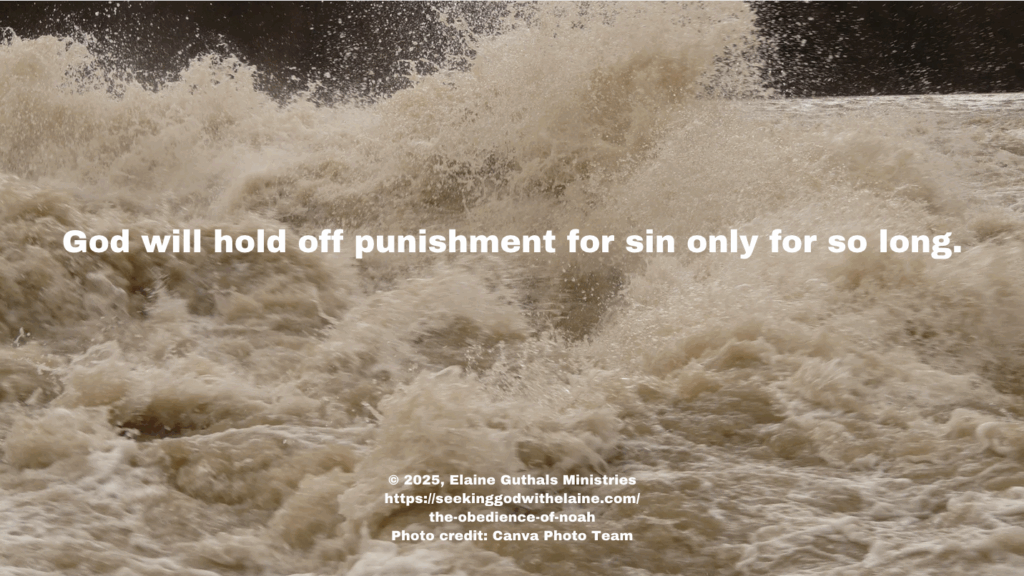
    God will hold off punishment for sin only for so long.

    Just as the wicked did not escape the flood waters, they did not escape the consequences of their sins. They were cut off from God and spiritually dead.

    They only way they would have escaped was to join Noah in his faith. Only that would secure a ticket on the ark.

    God sent the flood because of the spiritual condition of the people. Wicked is a term that is used interchangeably with sinner.

    It seemed like it was a huge ark for eight people. That doesn’t seem like many for animal care.

    But then, Noah wasn’t like Abraham and tried to bargain for the salvation of those around him. He accepted their fate as punishment for their lifestyle of sin.

    Noah didn’t talk back — at least not what is recorded. He built.

    Fuller made a great observation. Instead of building the ark, why didn’t God just take Noah as He did Enoch?

    Instead, Noah was singled out from everyone else. Fuller told us why. He wrote,

    “If he had been destroyed with the world, God could have taken him to Himself, and all would have been well with him; but then there had been no public expression of what he loved, as well as of what he hated.”

    Resource

    Gray added a nice little tidbit. The warning didn’t come directly to the others. It was only given to Noah.

    Resource

    True, the wicked may have not known what a flood or rain was any more than Noah did. But Noah took the warning as an absolute truth. They didn’t when Noah told them.

    No one else bought a ticket for the ark.

    Is that the same as those who won’t believe Jesus is God’s Son because He didn’t physically come to them personally? Not everyone believed when He did.

    God’s Covenant with Noah

    “But I will confirm my covenant with you. So enter the boat — you and your wife and your sons and their wives” (Gen. 6: 18)

    God passed judgment on the wicked, but He rewarded Noah because of his faithfulness and obedience.

    We talked about this already. “But Noah found favor with the Lord. This is the account of Noah and his family. Noah was a righteous man, the only blameless person living on earth at the time, and he walked in close fellowship with God” (Gen. 6: 8-9 NLT).

    We also talked about the fact that Noah was the only righteous man God found. That means the triplets didn’t get the same classification.

    But they – and their wives and mother – were given an ark ride because of the righteousness of Noah. This was part of Noah’s reward here on earth.

    No, I don’t think it means that we can grab onto someone’s coat tails for salvation. That has to be a personal confession.

    But for this time, they were safe.

    I like how Browne described it. He wrote,

    “The eight souls saved from the deluge are types of that little flock which rides safely and triumphantly, though the floods lift up their waves and the billows break over them. And their safety is assured to them, because they are in Christ.”

    Resource

    Since we know the rest of the story, we know that Shem and Japheth were obedient to God. We know Ham wasn’t.

    But here, they were described as being in Christ.

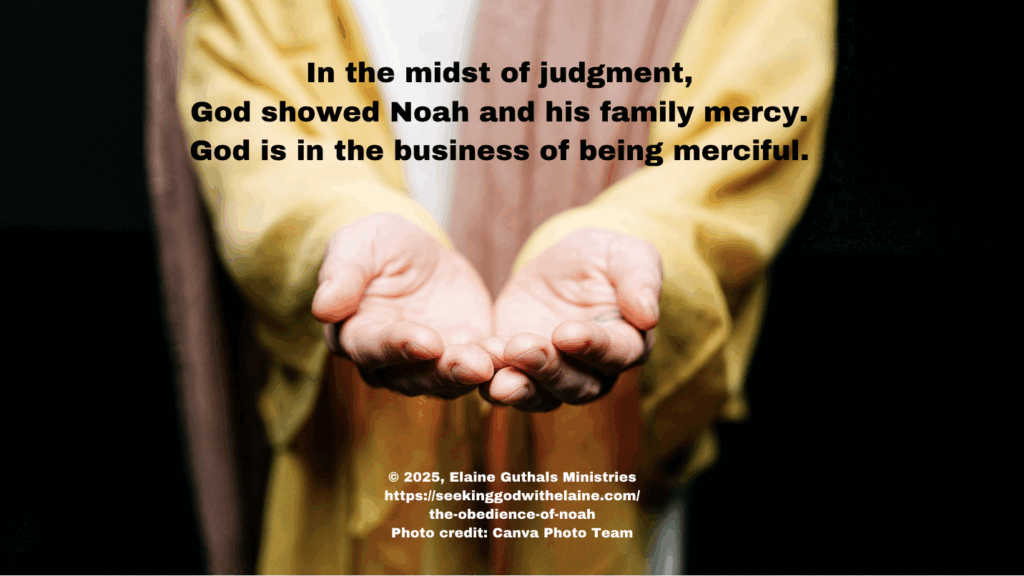
    In the midst of judgment, God showed Noah and his family mercy. God is in the business of being merciful.

    God made a covenant with Noah because he was the one righteous man on earth. As part of that covenant, He gave Noah a blessing.

    Fuller explained what God was telling Noah. He wrote, “To say, ‘With thee will I establish My covenant,’ was saying in effect, ‘I will not treat with thy ungodly posterity: whatever [favor] I show them, it shall be for thy sake.”

    Resource

    Yes, God loves everyone unconditionally, but love isn’t enough. We have to be obedient in order to be blessed. He will bless us for His sake, not ours.

    Animal Travelers

    “Bring a pair of every kind of animal — a male and a female — into the boat with you to keep them alive during the flood. Pairs of every kind of bird, and every kind of animal, and every kind of small animal that scurries along the ground, will come to you to be kept alive” (Gen. 6: 19-20 NLT)

    God made provision for the animals.

    We’re going to talk about the animals two more times, so I am going to focus just on what it says here.

    Verse 19 talks about a pair – singular – where verse 20 talks about pairs – plural. That gets addressed later when Noah gets more specific instruction.

    Let’s just say that God made sure every animal species would be represented on the ark, and every animals species would have the means by which to repopulate the world. He didn’t want them to come off the ark and not be able to go forth and multiply because there were two males or two females.

    That would have killed the species.

    The animals came to Noah. He didn’t have to round them up.

    That was probably a good thing. He didn’t have to take time out of building the ark to be animal wrangler.

    Food for the Ark Occupants

    “And be sure to take on board enough food for your family and for all the animals” (Gen. 6: 21 NLT)

    God wanted enough provisions on board to feed His people, knowing it would just be the eight in Noah’s family.

    Verse 21 stopped me. We are so quick to say that Noah was witnessing during the 120 years that it took to build the ark.

    That is our marching orders. Those orders will not change until Jesus returns.

    • “And then he told them, ‘Go into all the world and preach the Good News to everyone’” (Mk. 16: 15 NLT).
    • “Therefore, go and make disciples of all the nations, baptizing them in the name of the Father and the Son and the Holy Spirit. Teach these new disciples to obey all the commands I have given you. And be sure of this: I am with you always, even to the end of the age” (Mt. 28: 19-20 NLT).

    But even before the first board was sawed for the ark, God didn’t tell Noah to prepare for anyone else but his family.

    God was done with the wicked, even before the rain came down and the floods came up – even before one nail was cast into the ark.

    This makes it obvious. God will shut off our opportunity for salvation.

    He had already condemned the rest of the population. He was no longer drawing near to them.

    But still, as Noah was building the ark, he was preaching. If the wicked people weren’t his audience, who was?

    Remember, we said the triplets weren’t born when Noah started building the ark. Noah had to raise them in the way of the Lord.

    The triplets were his audience.

    So, I would say Burns was wrong. Noah was a successful preacher. His three sons and their wives got tickets on the ark. Shem, in fact, was the ancestor of Jesus.

    Resource

    Noah’s Total Obedience

    “Noah did this; he did all that God commanded him” (Gen. 6: 22 ESV)

    Noah was completely devoted to being obedient to God.

    Look at Noah. God knew what was coming when Noah didn’t. Noah probably had no clue as to what a flood was — because rain was a new concept. He may not have any idea what a boat was.

    Ooo, baby. We’re the circumstances sounding dire or what?!?

    Didn’t matter what Noah did or didn’t know. Didn’t matter how things looked. One day, God said to him. “Height, width, and depth. Do it.”

    Noah’s response was, “Good plan.”

    Noah could have started strong but fail to persevere. With all the mocking going on alongside the strenuous labor, he could have easily thrown up his hands and quit.

    Noah didn’t.

    God wanted to save him, but Noah still had a choice. He could have said, “Bad plan.”

    But then Noah would have been deep sea diving without the wet suit – just like everyone else.

    The whole purpose of the ark was to save lives. That is the business God is in — salvation. He sent His Son to die on a cross so that we could accept the gift of salvation.

    God always knows what is needed to save His creation — even if we don’t know or are too independent to follow His guidance.

    God will always provide for His saints. We just have to submit and obey — even when it is beyond our understanding.

    God already has our lives planned out before we are born. We still have the choice to do what He says or not, but He — as all-knowing God — already has those choices figured into the plan.

    So, when God says something, do we listen? Usually not.

    We decide we know what is best. We get scared about what God asks us to do. We tell ourselves He couldn’t possibly know what is best because He doesn’t know how we feel.

    We’re good at snow jobs, aren’t we?

    For some of us, it boils down to we don’t want anyone else making the decisions for us. We know how to get to where we are wanting to go.

    The control must remain in our hands at all times. We know what is best for us.

    The kicker is that God does know what is best for us. Remember, He has that plan for us.

    The things God is going to call us to are going to be hard. Persecution hard. Mockingly hard. We could lose lots.

    We have to obedient until the end. “But the one who endures to the end will be saved” (Mt. 24: 13 NLT).

    Noah taught us what to do.

    • Be righteous.
    • Be ready when God calls.
    • Don’t talk back.
    • Obey the first time.
    • Follow God’s directions to the letter.
    • Put in the work to get it done.
    • When the going gets tough — for whatever reason — keep on going.
    • Praise God at the beginning, during, and at the end.

    Ooo, baby. When God calls us to something we don’t like, obey. When God’s work takes longer than we think we signed up for, obey.

    God wants the ending to be a happy one. And if we do follow His specific instructions, we are much happier than if we go off on our own.

    Hasn’t that been proven that in the past?

    Making the Connections #1

    Have you ever been so fed up with the world that you wished a flood would engulf them? Or have you prayed for fire and brimstone to destroy them as it did Sodom and Gomorrah?

    We want an Act of God to take out everyone who is making our lives miserable in some way.

    Parker expanded on that. He wrote,

    “The idea may be put roughly thus: Bring together all prisoners, all idlers, drunkards, thieves, liars, and every known form of criminal; take them out into the middle of the Atlantic and sink them there, and at once society will be regenerated, and paradise will be regained.”

    Resource

    Well, sorry to say, that is probably a human way to think. But it doesn’t work that way.

    But Parker was talking about eliminating all wicked people again, not just the ones we think are harassing us. He estimated that within half a century, the wicked would be back on this earth.

    I don’t think it even took that long. It was somewhere in the 350 years that Noah lived after the flood.

    We do know that Ham – aka the father of Canaan – brought wickedness back into the world. His sin was great enough that Noah cursed him in his Last Will and Testament blessing.

    “Then he cursed Canaan, the son of Ham: ‘May Canaan be cursed! May he be the lowest of servants to his relatives.’  Then Noah said, ‘May the Lord, the God of Shem, be blessed, and may Canaan be his servant! May God expand the territory of Japheth!
    May Japheth share the prosperity of Shem, and may Canaan be his servant.” (Gen. 9: 25-27 NLT).

    Making the Connections #2

    Parker made a great point. He wrote, “Water cannot drown sin. Fire cannot burn out sin. Prisons cannot cure theft and cruelty. We must go deeper.”

    Resource

    It isn’t the water itself any more than it is the fire that destroys the I’m-going-to-get-you attitude of ungodliness.

    Baptism does not save us from our sins. It shows our obedience but doesn’t take away our sins.

    In other words, we can’t think that turning over a new leaf and doing good deeds will gain us salvation.

    Fire has no effect on sim. That is logical.

    Making the Connections #3

    Yes, God has absolute control over the natural world.

    • He made it.
    • He sent the ten plagues, all using the natural world as the foundation. He controlled rivers, animals, weather, and even death.
    • He caused famine, sometimes by holding off the rain.
    • He calmed the storms.

    I like the first two purposes Gilfillan listed. He wrote,

    • “It [the flood] swept away an effete and evil generation, which had become of no use, except to commit sin and thus deprave and weaken the general stock of humanity.
    • “The flood was calculated to overawe mankind, and to suggest the idea that other such interpositions might be expected when they were required.”

    Resource

    God didn’t destroy the earth and all living things without a purpose. That purpose was to further His kingdom of peace.

    Making the Connections #4

    God created us. He has retained control of us.

    Yes, we make our own decisions — and are punished for decisions that make us disobedient to God.

    God isn’t going to make His command unintelligible. He isn’t going to ask us to do something we can’t.

    Oh, we may think we can’t, but how do we grow if we keep doing the easy stuff?

    How Do We Apply This?

    • Accept Jesus as our Savior while we have the opportunity.
    • Obey God and do His work.
    • Keep working until God says we are done.
    • Keep working when the going gets tough.
    • Obey God and spread His message through our marching orders.
    • Witness to others by both what we say and do.
    • Pray for faith like Noah’s.
    • Don’t argue with God, just believe.
    • Show God our reverent fear.
    • Be obedient to gain the blessings.
    • Keep our courage.
    • Accept that our success is in our obedience, not the outcome.
    • Obey God because of love, not fear.
    • Obey all, not just some, of God’s commands.

    Resources

    Father God. Thank You for showing us how You punish those who are disobedient to You. We need to know that You will – in the fullness of Your time – crush sin. We commit to be obedient and walk with You. Amen.

    What do you think?

    Leave me a comment below (about this or anything else) or head over to my Facebook group for some interactive discussion.

    If you don’t understand something and would like further clarification, please contact me.

    If you have not signed up for the email providing the link to the devotions and the newsletter, do so below.

    If God has used this devotion to speak with you, consider sharing it on social media.
  • Noah’s Command to Build the Ark

    God had a plan to punish the wicked people that were inhabiting the earth, but He needed Noah’s cooperation to save humankind. This devotional reading looks at the command Noah received from God to build the ark.

    Nuggets

    • Humankind had the years it took Noah built the ark to turn back to God or be destroyed.
    • God gave Noah the specific dimensions of the ark.
    • We don’t know exactly how Noah got the ark built.
    • The ark, not Noah, was a type of Christ.
    • A different sermon from Jessop talked about the ark being a type of Church.
    noahs-command-to-build-the-ark

    While we are given the dimension of the ark, it doesn’t really give us a clue as to what it really looked like. But it brings up some interesting thoughts on the ark.

    Let’s Put It into Context

    To read devotions in the Creating Everything theme, click the button below.

    Devotions in the Creation’s Do-Over series

    Timing

    “Build a large boat from cypress wood and waterproof it with tar, inside and out. Then construct decks and stalls throughout its interior. Make the boat 450 feet long, 75 feet wide, and 45 feet high. Leave an 18-inch opening below the roof all the way around the boat. Put the door on the side, and build three decks inside the boat — lower, middle, and upper” (Gen. 6: 14-16 NLT)

    Humankind had the years it took Noah built the ark to turn back to God or be destroyed.

    Some feel it took 120 years to build the ark because of verse 3. “Then the Lord said, ‘My Spirit will not put up with humans for such a long time, for they are only mortal flesh. In the future, their normal lifespan will be no more than 120 years’” (Gen. 6: 3 NLT).

    Resources

    Yeah, we took it to be lifespan when we discussed verse 3. But which is it?

    Let’s go to the Orthodox Jewish Bible. I know I stumble on the Hebrew, but let’s see what we can see.

    “And Hashem [God] said, My Ruach [Hakodesh] [Holy Spirit] shall not always strive with Adam [man], for that he also is basar [mortal]: yet his yamim [lifespan] shall be a hundred and twenty shanah [year]” (Gen. 6: 3 OJB).

    It would be logical to think humans would no longer live around 900 years, but 120. God was wanting to cut down the opportunity to sin.

    But a 120-year lifespan isn’t the norm. Did God change it again and not tell us?

    Also, when I googled the meaning in Hebrew, words that referred to lifespan had another word in front of yamim.

    I can see where the 120 years would be limited to those alive at that time. Their lifespan was going to be cut short because of their disobedience.

    Maybe it is both to which the verse is referring. We aren’t really told how long it took Noah to build the ark.

    Dimensions of the Ark

    God gave Noah the specific dimensions of the ark.

    If you are like me, reading the dimensions of the ark mean nothing to you. Others who know a lot more than I do say that this is a massive ship.

    Part of the problem is we aren’t exactly sure how much a cubit was, which was the measurement back then. So, the figures given in verse 15 are estimates. (That is four and a half football fields for length.)

    Well, it would have to be big to hold enough to repopulate the earth of every kind of living creature.

    Building the Ark

    We don’t know exactly how Noah got the ark built.

    It amazes me how Noah would have been able to build the ark. We have no idea what Noah did for a living, but this wasn’t exactly by water.

    We have to remember Tubal-Cain created tools. “Lamech’s other wife, Zillah, gave birth to a son named Tubal-cain. He became an expert in forging tools of bronze and iron …” (Gen. 4: 22 NLT).

    True, Cain’s descendants were off in the Land of Nod – which one explanation says was anywhere Eden wasn’t. Someone somewhere down the line would have brought the bronze and iron tools – or even the knowhow to make them – back.

    When we look at the pyramids, we know ancient civilizations weren’t total dummies. They could build big things to last.

    Noah or even one of his sons may have had the tools or the knowhow to build the ark. What we do know is God gave that ability to someone in Noah’s family because the ark got built.

    Whether Noah had the skills or he knew that someone in his family did – even if none of them did – he knew that God would provide what was needed to get the ark built.

    We know that God provided skills later in building the tabernacle. “Then the LORD said to Moses, ‘Look, I have specifically chosen Bezalel son of Uri, grandson of Hur, of the tribe of Judah. I have filled him with the Spirit of God, giving him great wisdom, ability, and expertise in all kinds of crafts’” (Ex. 31: 1-3 NLT).

    How ever God provided the necessary skills to whomever, Noah’s faith never wavered that He would.

    The wood has been translated here as cypress wood. The Complete Jewish Bible stated that it was gofer-wood (usually translated as gopher wood). Since we are unsure what gopher wood is, cypress is a lot less confusing.

    But this may be another instance where our modern translations have changed things for our ease. We don’t want to rewrite God’s Word to make it say what we think it should say.

    The focus shouldn’t be on the how but on the why. God was blessing the obedient and punishing the disobedient.

    All we know is that it needed to be a strong, resilient wood to withstand all the water associated with the flood. The tar or pitch would help make it waterproof.

    The Ark and Christ

    The ark, not Noah, was a type of Christ. This came from a sermon by Jessop.

    Resource

    Mocked

    We talked about the wicked may have not known what a flood or rain was any more than Noah did. What happens when someone has a different viewpoint than ours — the wicked especially, but sometimes disciples, too?

    The mocking begins. “How can you believe what you believe? That is the stupidest thing I have ever heard. What other dumb thing can you believe?”

    Oh, yeah. I bet people in Noah’s time could say things just as cutting as those today can.

    Jesus was mocked, too. We aren’t told that Noah had to suffer the physical mocking that He did.

    “Some of the governor’s soldiers took Jesus into their headquarters and called out the entire regiment. They stripped him and put a scarlet robe on him. They wove thorn branches into a crown and put it on his head, and they placed a reed stick in his right hand as a scepter. Then they knelt before him in mockery and taunted, ‘Hail! King of the Jews!’ And they spit on him and grabbed the stick and struck him on the head with it. When they were finally tired of mocking him, they took off the robe and put his own clothes on him again. Then they led him away to be crucified” (Mt. 27: 27-31 NLT).

    Escape

    Once of the things that Noah was probably mocked for was building a boat. Did they even know what a boat was?

    If they didn’t know what a boat was,  and they didn’t know what a flood was (because it can’t flood if it hadn’t rained), how were they going to recognize the ark as a means of escape?

    How could a guy dying be our Savior? How could His death take away our sins? “He personally carried our sins in his body on the cross so that we can be dead to sin and live for what is right. By his wounds you are healed” (I Pet. 2: 24 NLT).

    How does that happen? Jesus’ blood covers our sins.

    • “But if we are living in the light, as God is in the light, then we have fellowship with each other, and the blood of Jesus, his Son, cleanses us from all sin” (I Jn. 1: 7 NLT).
    • “He is so rich in kindness and grace that he purchased our freedom with the blood of his Son and forgave our sins” (Eph. 1: 7 NLT).
    • “And since we have been made right in God’s sight by the blood of Christ, he will certainly save us from God’s condemnation” (Rom. 5: 9 NLT).
    • “In fact, according to the law of Moses, nearly everything was purified with blood. For without the shedding of blood, there is no forgiveness” (Heb. 9: 22 NLT).

    Because God loves us so much — even though we are sinful and disobey us — God did everything He could to restore our relationship with Him. This is really important.

    Some day — probably sooner rather than later — Jesus is going to come back, and this world will be judged again. The outcome is going to be the same. The wicked will die, and the righteous will escape that punishment.

    Which side are you on?

    Life Preserver

    The ark saved the physical lives of Noah and his family. Jesus saves our spiritual lives.

    It is important to save our spiritual lives. We just talked about the punishment. It is going to be a big one for those that don’t choose God.

    “And anyone whose name was not found recorded in the Book of Life was thrown into the lake of fire” (Rev. 20: 15 NLT).

    Door

    There was only one door into the ark. God let Noah and his family come in, and then He shut it.

    Jesus is the door to the sheep pen. “I am the door. If anyone enters by me, he will be saved and will go in and out and find pasture” (Jn. 10: 9 NLT).

    We can only enter Heaven through Jesus.

    • “Salvation is not a reward for the good things we have done, so none of us can boast about it” (Eph. 2: 9 NLT).
    • “There is salvation in no one else! God has given no other name under heaven by which we must be saved” (Ac. 4: 12 NLT).
    • “You must not have any other god but me. You must not make for yourself an idol of any kind or an image of anything in the heavens or on the earth or in the sea” (Ex. 20: 3-4 NLT).
    • “Jesus told him, ‘I am the way, the truth, and the life. No one can come to the Father except through me’” (Jn. 14: 6 NLT). ” (Rev. 20: 15 NLT).

    Window

    The ark had one window. “After another forty days, Noah opened the window he had made in the boat” (Gen. 8: 6 NLT).

    No, Jesus is specifically called a window. But windows are a way we can see inside. They open.

    Paul told us to open the eyes of our hearts. “having the eyes of your hearts enlightened, that you may know what is the hope to which he has called you, what are the riches of his glorious inheritance in the saints” (Eph. 1: 18 ESV).

    It is said that the eyes are the windows of the soul. Think about it.

    The eyes of the heart (faith) is the window the soul (the spiritual part of us that is immortal).

    Jesus is the foundation of our faith. We see God through Him.

    The Ark and the Church

    A different sermon from Jessop talked about the ark being a type of Church.

    Resource

    Built by Degrees

    It is said that it took 120 years to build the ark, even though that isn’t verified in God’s Word. It seems logical that it would take a long time.

    We talked about not knowing Noah’s occupation when he was called to build it. Even if he was a carpenter/builder of things, it is probably a safe bet to say he had never built anything to the scale that the ark was.

    Regardless, think about building a house. It has to be a process — by degrees. You have the foundation dug first. Then you shore it up.

    You have to put the frame of the house up next. You can’t put up the drywall if there are no walls on which to hang it.

    But you have to start on the outside before you start on the inside. Don’t want things to get wet or stolen.

    Besides, before you put the walls up, you have to run electrical, plumbing, central vac, and other things. You don’t want all that on the outside of the walls.

    You get the picture. A house isn’t built in a day.

    Christ wasn’t “built” in a day either. He was alive long before creation, and He knew the Plan of Salvation was in His future. “Even before he made the world, God loved us and chose us in Christ to be holy and without fault in his eyes” (Eph. 1: 4 NLT).

    When God said, “Let there be light,” I think He was putting Jesus in this world. No, it wasn’t His physical self. God enlightened the world with the presence and knowledge of Jesus.

    In the fullness of time — when God deemed the time was right — Jesus was born on earth. Jesus died and rose again to finish the Plan of Salvation.

    When the time is right, Jesus will come again. It is a process.

    • Jesus had to be introduced to the world.
    • A way had to be made to allow people to return to a relationship with God.
    • When everyone who is going to ABCD has, Jesus will call everyone home and fully defeat Satan and sin.

    Receptacle for All

    The ark was a big boat. It had to be to hold all those animals.

    There are going to be multitudes in Heaven. “After this I saw a vast crowd, too great to count, from every nation and tribe and people and language, standing in front of the throne and before the Lamb …” (Rev. 7: 9 NLT).

    Don’t think all means every person ever born from Adam on down. All means those who have ABCDed. We have to choose God.

    Allowed Free Will

    The animals came to Noah. He didn’t go out and round them up.

    We have to choose to obey God and turn our backs on Satan. God doesn’t force us to be obedient to Him.

    Deluged by God

    One thing we may or may not think about is that God had to hold off 120 years until the ark was built. He waited to destroy everything until the man who believed in Him was ready.

    God is going to wait until everyone who will ABCD has done so. Then He will totally destroy this earth that He created in Genesis 1.

    Making the Connections #1

    God can be very exacting at times. He know what He wants, and He knows exactly what we need.

    We shouldn’t feel restricted when God gets specific. We should be glad that we know what is right.

    Making the Connections #2

    “It was by faith that Noah built a large boat to save his family from the flood. He obeyed God, who warned him about things that had never happened before. By his faith Noah condemned the rest of the world, and he received the righteousness that comes by faith” (Heb. 11: 7 NLT)

    The whole purpose Noah built the ark was to save the family. He took it on faith that God was going to do as He said even if it was something new. “Faith shows the reality of what we hope for; it is the evidence of things we cannot see” (Heb. 11: 1 NLT).

    But this translation didn’t say what I was expecting it to say. Let’s try that again.

    “By trusting, Noach, after receiving divine warning about things as yet unseen, was filled with holy fear and built an ark to save his household. Through this trusting, he put the world under condemnation and received the righteousness that comes from trusting” (Heb. 11: 7 CJB).

    Well, that has the holy fear for which I was looking. It is about the why Noah did what he did.

    The focus isn’t on Noah built an ark. It is on God warned him, and he obeyed.

    Noah was moved by reverence to do what he was told and save his household.

    I surprised me that it said “… Noah condemned the rest of the world …” (Heb. 11:7 NLT). I question that Noah was given the authority to put others under condemnation.

    What I am thinking about is John 3: 18. “There is no judgment against anyone who believes in him. But anyone who does not believe in him has already been judged for not believing in God’s one and only Son” (Jn. 3: 18 NLT).

    Oh, no. This isn’t about showing up at the Judgment Seat for sentencing.

    “Whoever believes in him is not condemned, but whoever does not believe is condemned already, because he has not believed in the name of the only Son of God” (Jn. 3: 18 ESV).

    This is our destiny because of our choice.

    Making the Connections #3

    We know God will always find a way to save His children when it is in His Will. Yeah, we need saving a lot when we are surrounded by a corrupt world.

    There are probably sometimes that we don’t even realize God has saved us because He didn’t have a build an ark. Those saves may just be a prompting of the Holy Spirit.

    There are other time when we have to be completely involved. We have to give up on this world, accept that we may be mocked and hassled for our beliefs, and do our part.

    We, like Noah, have to put our faith and trust in God’s plan.

    Making the Connections #4

    Gray pulled out something that I had already figured out. He wrote, “480 years of age when he began, he toiled on for 120 years.”

    Resource

    When Noah started the ark, Shem, Ham, and Japheth weren’t even alive. They were born 20 years later.

    All they would have known was doom was coming to those who didn’t believe.

    How Do We Apply This?

    • Have the faith of Noah when God commands us to do the impossible, the unknown, the unpopular, and the seemingly unending.

    Father God. You don’t always ask us to do simple things. We can find a million reasons why we can’t do what You ask. Help us to have the faith of Noah to not talk back, but to obediently jump right in serving You. Amen.

    What do you think?

    Leave me a comment below (about this or anything else) or head over to my Facebook group for some interactive discussion.

    If you don’t understand something and would like further clarification, please contact me.

    If you have not signed up for the email providing the link to the devotions and the newsletter, do so below.

    If God has used this devotion to speak with you, consider sharing it on social media.
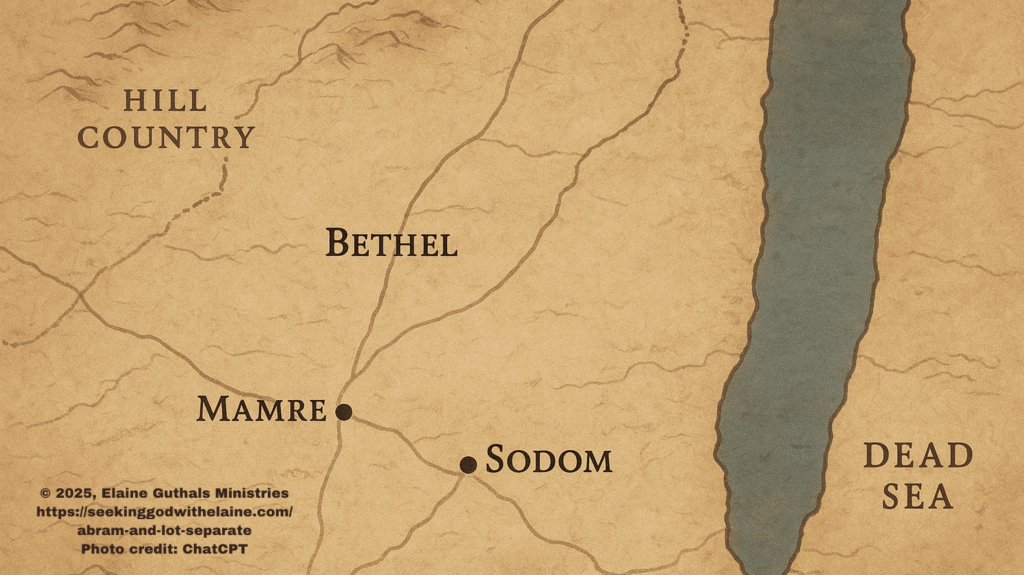
  • The Story of Noah

    The story of Noah in the ark is interesting. This devotional reading looks at the most important element of the story — why Noah was the one in the ark.

    Nuggets

    • Only Noah had remained faithful to God.
    • Noah was “… a righteous man” (Gen. 6: 9 NLT).
    • We are “… [a] blameless person …” (Gen. 6: 9 NLT) when we seek God.
    • We “… [walk] in close fellowship with God” (Gen. 6: 9 NLT) when we submit our lives to Him.
    • While there were other passengers than Noah on the ark, they were not credited as being blameless as Noah was.
    the-story-of-noah

    We now get to one of the greatest Hall of Famers of the Old Testament – Noah. His story is familiar to many people, even if they don’t know much else about the Bible.

    I have to tell you. God has opened my eyes to several things that I hadn’t even thought to consider before.

    Let’s Put It into Context

    To read devotions in the Creating Everything theme, click the button below.

    Devotions in the Creation’s Do-Over series

    Noah

    “But Noah found favor with the Lord. This is the account of Noah and his family. Noah was a righteous man, the only blameless person living on earth at the time, and he walked in close fellowship with God” (Gen. 6: 8-9 NLT)

    Only Noah had remained faithful to God.

    There was a silver lining to the increasing corruption of the world. Noah remained a righteous man.

    We’ve talked a little about Noah before. He was the grandson of Methuselah and the great-grandson of Enoch.

    Remember, Methuselah meant when he dies, it will come. Well, Methuselah is dead.

    It was coming. It was the flood.

    But let’s not get ahead of ourselves. We need to learn a little more about Noah.

    We find favor with God when we have faith and obey Him.

    There are three different ways in which Moses, the writer of Genesis, indicated how Noah found favor with God.

    Righteous

    Noah was “… a righteous man” (Gen. 6: 9 NLT).

    Righteousness is one of those churchy words. It is a very important element in walking with God.

    But what does it mean? Let’s look how God’s Word to see what it says.

    “God blesses those who hunger and thirst for justice, for they will be satisfied” (Mt. 5: 6 NLT). Ooops.

    Well, that is sort of what we are trying to get. Justice is bringing order back to God’s creation so that all people receive the rewards He has for His children.

    Righteousness is a part of the order God is trying to restore.

    We want to come back to a relationship with God and be more like Him. But that is more the how and the what.

    What is righteousness? Righteousness is the comprehension of a kinship with God where we understand that we were not only made in His image but that we also have to have His character.

    Let’s try that verse again. “Blessed are those who hunger and thirst for righteousness, for they shall be satisfied” (Mt. 5: 6 ESV).

    What are some other verses?

    • “This Good News tells us how God makes us right in his sight. This is accomplished from start to finish by faith. As the Scriptures say, ‘It is through faith that a righteous person has life’” (Rom. 1: 17 NLT emphasis added).
    • “But now God has shown us a way to be made right with him without keeping the requirements of the law, as was promised in the writings of Moses and the prophets long ago. We are made right with God by placing our faith in Jesus Christ. And this is true for everyone who believes, no matter who we are” (Rom. 3: 21-22 NLT emphasis added).
    • “The Lord is more pleased when we do what is right and just than when we offer him sacrifices” (Prov. 21: 3 NLT emphasis added).
    • “The eyes of the Lord watch over those who do right, and his ears are open to their prayers. But the Lord turns his face against those who do evil” (I Pet. 3: 12 NLT emphasis added).
    • “There is joy for those who deal justly with others and always do what is right” (Ps. 106: 3 NLT emphasis added).
    • “Little children, let no one deceive you. Whoever practices righteousness is righteous, as he is righteous” (I Jn. 3: 7 NLT emphasis added).

    We have to remember this isn’t talking about right and wrong. This is talking about doing what and being who God is. It is having God in us.

    Kingsley explained it this way. He wrote,

    “Noah and Abraham believed God, and so became heirs of the righteousness which is by faith; not their own righteousness, not growing out of their own character, but given them by God, who puts His righteous Spirit into those who trust in Him.”

    Resource

    Righteousness doesn’t have anything to do with any human characteristic — being right. It doesn’t come from our actions — doing right.

    Righteousness comes to God’s children from Him through His Holy Spirit.

    Blameless

    We are “… [a] blameless person …” (Gen. 6: 9 NLT) when we seek God.

    The King James Version did us no favors when it translated blameless as perfect. He wasn’t just a man of flawless integrity.

    No, blameless doesn’t mean we will no longer sin. Blameless means we are aware we are sinners and look to God for salvation, asking Him for forgiveness that doesn’t hold us accountable for those sins. When we ABCD, our sins will be forgiven, and we will be held blameless.

    A blameless person displays the fruit of the Spirit in life. “But the Holy Spirit produces this kind of fruit in our lives: love, joy, peace, patience, kindness, goodness, faithfulness, gentleness, and self-control. There is no law against these things!” (Gal. 5: 22-23 NLT).

    A huge element of being blameless is being patient. We have to wait on God to show us His Will and to do His Will.

    We have to talk about something. Noah is said to be there only one who was found blameless.

    Where was the rest of Noah’s family? He had to have had brothers and sisters alive.

    Pastor Steve has been reading a book that estimated there were a million people alive then. Surely, he had a lot of cousins in there.

    With Methuselah around, you would think they all had a similar role model.

    Why wasn’t the rest of Noah’s family blameless?

    It goes back to our relationship with God is an individual decision. We can’t coast on our parents’ laurels. We have to decide — and live — for God on our own.

    But that also brings up another point. God will always have His remnant.

    • “No, God has not rejected his own people, whom he chose from the very beginning. Do you realize what the Scriptures say about this? Elijah the prophet complained to God about the people of Israel and said, ‘LORD, they have killed your prophets and torn down your altars. I am the only one left, and now they are trying to kill me, too.’ And do you remember God’s reply? He said, ‘No, I have 7,000 others who have never bowed down to Baal!’ It is the same today, for a few of the people of Israel have remained faithful because of God’s grace—his undeserved kindness in choosing them” (Rom. 11: 2-5 NLT).
    • “In that day the remnant left in Israel, the survivors in the house of Jacob, will no longer depend on allies who seek to destroy them. But they will faithfully trust the LORD, the Holy One of Israel. A remnant will return; yes, the remnant of Jacob will return to the Mighty God.But though the people of Israel are as numerous as the sand of the seashore, only a remnant of them will return. The LORD has rightly decided to destroy his people” (Isa. 10: 20-22 NLT).
    • “But I will gather together the remnant of my flock from the countries where I have driven them. I will bring them back to their own sheepfold, and they will be fruitful and increase in number. Then I will appoint responsible shepherds who will care for them, and they will never be afraid again. Not a single one will be lost or missing. I, the LORD, have spoken!” (Jer. 23: 3-4 NLT).

    It is easy to see this as God will always have His people. No, God will always have a group of righteous, blameless sons and daughters who are walking in close fellowship with Him.

    That would also create a lonely atmosphere for Noah. Sure, he had companionship, especially with other family members.

    But Noah wouldn’t have much in common with the men of violence (Gen. 6: 11).

    Walked in Close Fellowship

    We “… [walk] in close fellowship with God” (Gen. 6: 9 NLT) when we submit our lives to Him.

    Enoch walked in close fellowship with God for 300 years of his life. “After the birth of Methuselah, Enoch lived in close fellowship with God for another 300 years, and he had other sons and daughters” (Gen. 5: 22 NLT).

    Enoch would have taught Methuselah, and Methuselah would have taught Lamech and Noah.

    We had a long list of what it meant to walk with God. To summarize, it means we continually think about God, follow His laws and commandments, exhibit spiritual graces, and continue on the Sanctification Road.

    The focus isn’t on the outward walk — our actions. It is on our inward relationship with God.

    We do not have true righteousness if we do not communicate with God.

    If the inward is right, the outward follows suit. We are not pretentious or vain. We are sincere.

    Noah was a well-rounded person in his relationship with God. As Maclaren said, he continued to sin.

    Resource

    It means we are not perfected — yet. What perfect means is that we are maturing. That suggests our close fellowship with God is growing closer.

    Other Ark Passengers

    “Noah was the father of three sons: Shem, Ham, and Japheth” (Gen. 6: 10 NLT)

    While there were other passengers than Noah on the ark, they were not credited as being blameless as Noah was.

    We have heard a little about Noah’s sons. “After Noah was 500 years old, he became the father of Shem, Ham, and Japheth” (Gen. 5: 32 NLT).

    Yeah, it sounds like they were triples. It wasn’t written as it was for Lamech’s sons. “Adah gave birth to Jabal, who was the first of those who raise livestock and live in tents. His brother’s name was Jubal, the first of all who play the harp and flute. Lamech’s other wife, Zillah, gave birth to a son named Tubal-cain. He became an expert in forging tools of bronze and iron. Tubal-cain had a sister named Naamah” (Gen. 4: 20-22 NLT).

    If Jabal and Jabal would have been twins, I think Moses would have written it more in the line of how Noah’s sons were born.

    But let’s focus on Noah’s sons. Maclaren stated their importance. He wrote, “Learn, too, that the true place for the saint is ‘in his generations.’”

    Resource

    Disciples are charged to teach others. “Therefore, go and make disciples of all the nations, baptizing them in the name of the Father and the Son and the Holy Spirit. Teach these new disciples to obey all the commands I have given you. And be sure of this: I am with you always, even to the end of the age” (Mt. 28: 19-20 NLT).

    We must first and foremost testify to our families. It is their choice whether or not to submit to God, but it is our duty as disciples to try to make disciples of our sons and daughters.

    Burns called Noah an unsuccessful preacher. No.

    Resource

    Disciples are called to be obedient in all that God has for us to do. If we do as we are called, we are successful. The outcome isn’t on us.

    We aren’t the ones to save people. We witness; they listen and make their choice. But God is the only One to forgive and save them.

    Noah may have been the only one to be blameless, but his three sons and their wives along with Mrs. Noah benefited. Did they get an ark ride because of Noah or because they were maturing correctly on the Sanctification Road?

    Does this mean there are blameless sheep and saved sheep – two levels of those who are called God’s children?

    Did Noah have other kids? If he and Mrs. Noah did, they didn’t get the same ticket.

    Were the other kids goats masquerading in sheep’s clothing? Or were they just plain wicked?

    Hughes addressed this. He wrote, “The holiest parent cannot bring forth a holy seed; that is, born of grace. Noah could not. … In the visible Church may be such as are not saints, indeed; but far from it. … Mixtures in the Church not destructive to its being, were permitted not to divide, but to put them upon purging it.”

    Resource

    That is different from what I’ve always been taught. I am taught we are all saints.

    I know. I sure don’t feel like one – yet. We do still sin in this life.

    If Noah was 500 when the triplets were born and 600 when the flood came, the triplets were 100 years old. All three were married, but it doesn’t say kids came with them.

    Did they not have kids yet, or were the kids too wicked? Was God waiting until post-flood to give them kids so they would repopulate the earth?

    I know. I am throwing out questions again for which I don’t really have answers. But I do feel we should think about this.

    Making the Connections #1

    Kingsley gave a great observation contrasting the wicked world and righteous Noah. He wrote,

    “The Bible gives us a picture of the old world before the flood — a world of men mighty in body and mind, fierce and busy, conquering the world round them, in continual war and turmoil; with all the wild passions of youth, and yet all the cunning and experience of enormous old age; everyone guided only by self-will, having cast off God and conscience, and doing every man that which was right in the sight of his own eyes. And amidst all this Noah was steadfast; he at least knew his way; he ‘walked with God, a just man and perfect in his generations.’”

    Resource

    The world was guided by self-will, and Noah was guided by God.

    That is what God requires of us today. Disciples are to be in the world but not of the world. He wants us to be be different from them.

    We clearly see here that God has His eye on both — those who follow Him and those who don’t. God will offer salvation to those who have not totally rejected Him.

    Making the Connections #2

    Maclaren gave us some insight into what Matthew 7: 21-23 means to disciples. “Not everyone who calls out to me, ‘Lord! Lord!’ will enter the Kingdom of Heaven. Only those who actually do the will of my Father in heaven will enter. On judgment day many will say to me, ‘Lord! Lord! We prophesied in your name and cast out demons in your name and performed many miracles in your name.’ But I will reply, ‘I never knew you. Get away from me, you who break God’s laws.’” (Mt. 7: 21-23 NLT).

    We may think that applies only to Church leadership. No.

    Listen to what Maclaren said. He wrote,

    “He does not grudge commendation, but takes account of the deepest desires and main tendencies of a life, and sees the germ as a full-blown flower, and the bud as a fruit. Learn, too, that solitary goodness is possible. Noah stood uninfected by the universal contagion; and, as is always the case, the evil around, which he did not share, drove him to a more rigid abstinence from it.”

    Resource

    What is our focus? What are the priorities of our lives? Is it God?

    Or have we compromised with the worldview? Do we try to rewrite God’s laws? Do we say they do not apply to today’s society?

    Go back to what we said about a remnant. God will always have a group of righteous, blameless sons and daughters who are walking in close fellowship with Him.

    We don’t think the remnant will be within the Church itself. But it is going to be.

    How Do We Apply This?

    • Continue to walk with God so that we are righteous and blameless through Him.
    • Follow God — even when those around us don’t.
    • Keep in constant communication with God.
    • Perform the duties required of us by God.
    • Don’t compromise with the worldview.
    • Be sure of our inward transformation.
    • Resist and oppose sin.
    • Fulfill our marching orders.

    Resources

    Father God. Thank You that faith and obedience are rewarded. Let us have the faith and obedience that Noah did. Amen.

    What do you think?

    Leave me a comment below (about this or anything else) or head over to my Facebook group for some interactive discussion.

    If you don’t understand something and would like further clarification, please contact me.

    If you have not signed up for the email providing the link to the devotions and the newsletter, do so below.

    If God has used this devotion to speak with you, consider sharing it on social media.
  • Making the Connections of Practical Godliness

    When we walk with God, we exercise practical godliness. This devotional reading looks at making the connections after we discuss how Enoch was taken by God.

    Nuggets

    • God Omnipotent took Enoch off this earth to where He is because He loved him.
    • Enoch was Noah’s great-grandfather.
    making-the-connections-of-practical-godliness

    Enoch is credited with walking with God. Because of that, God had a special reward for him.

    God took Enoch. Let’s take a look.

    Let’s Put It into Context

    To read devotions in the Creating Everything theme, click the button below.

    Devotions in the The Influence of Sin series

    God Took Him

    Enoch walked with God, and he was not, for God took him” (Gen. 5: 23-24 NLT)

    God Omnipotent took Enoch off this earth to where He is because He loved him.

    This has always baffled me. We are told that God took Enoch. All it says was he was no more.

    Did God physically take Enoch as He did Elijah? “As they were walking along and talking, suddenly a chariot of fire appeared, drawn by horses of fire. It drove between the two men, separating them, and Elijah was carried by a whirlwind into heaven” (II Kgs. 2: 11 NLT).

    Or maybe God buried Enoch as he did Moses. “So Moses, the servant of the LORD, died there in the land of Moab, just as the LORD had said.  The LORD buried him in a valley near Beth-peor in Moab, but to this day no one knows the exact place” (Deut. 34: 5-6 NLT).

    Burns believed that God took Enoch’s body and all. He didn’t separate the body from the soul in this instance.

    Resource

    No, that is not normal. But that is what happened to Elijah.

    It sounds like it was sudden. More than that, it sounds miraculous.

    What we should focus on is two things. God loved Enoch, and He took him to where He is. We would say He took him to Heaven.

    We need to focus on the why, not the how.

    “So there is a special rest still waiting for the people of God. For all who have entered into God’s rest have rested from their labors, just as God did after creating the world” (Heb. 4: 9-10 NLT).

    Parker reminded us that it is God’s right to take Enoch — and us. He is Sovereign God.

    Resource

    One way we shouldn’t take this is that God does not have a hand in all of our deaths. Only God numbers our days. Only He allows or doesn’t what happens to us.

    The story of Enoch confirms that — even in the Old Testament — the faithful were taken to be with God.

    We can’t close this out without thinking how this affected Methusaleh, the rest of Enoch’s family, and his friends. We normally don’t call family interactions as fellowship, but they would have some of the same feelings.

    Aitken talked about fellowship. He wrote, “The life of fellowship must needs be the product of a state of consecration.”

    Resource

    The outcome of our walk with God has to be its effect on those around us. That is one of our marching orders.

    How many days are there in a year? 365. How many years did Enoch live? 365 years.

    Did God plan that for a reason? Probably.

    Methuselah to Noah

    “When Methuselah was 187 years old, he became the father of Lamech. After the birth of Lamech, Methuselah lived another 782 years, and he had other sons and daughters. Methuselah lived 969 years, and then he died. When Lamech was 182 years old, he became the father of a son. Lamech named his son Noah, for he said, ‘May he bring us relief from our work and the painful labor of farming this ground that the Lord has cursed.’ After the birth of Noah, Lamech lived another 595 years, and he had other sons and daughters. Lamech lived 777 years, and then he died. After Noah was 500 years old, he became the father of Shem, Ham, and Japheth.” (Gen. 5: 25-32 NLT)

    Enoch was Noah’s great-grandfather.

    The three big role models of practical godliness were Enoch, Methuselah, and Noah. It is important to note how close their generations are.

    No, Enoch was gone before Noah was born. But Methuselah died the same year as the flood happened. (He had to have died before the flood, or he would have been on the ark.)

    I am sure Enoch raised Methuselah right. Methuselah would have had a big influence on Noah.

    Look what Lamech said about Noah. “Lamech named his son Noah, for he said, ‘May he bring us relief from our work and the painful labor of farming this ground that the LORD has cursed’” (Gen. 5: 29 NLT).

    This is a little different than the Orthodox Jewish Bible says. “And he called shmo [name] Noach, saying, Zeh yenachamenu (this shall comfort us) in our work and toil of our hands, because of the adamah [ground] which Hashem [God] hath cursed” (Gen. 5: 29 OJB).

    This shall comfort us is not really relief. While relief is consolation and reassurance, it isn’t a cessation of the curse. The birth of Noah was not going to lift the curse on farming the land.

    In other words, the birth of Noah was to be a comfort.

    Raleigh talked about the significance of Lamech’s words. He wrote, “Lamech, ‘the powerful,’ is not ashamed to confess that he needs comfort; and when this child comes to him he accepts him as a Divine gift, as a commissioned, competent, and thrice-welcome messenger of comfort from God.”

    Resource

    We just said that humility was not a weakness. But it is so hard for us to ask for help, to ask for comfort.

    Children are a great comfort to us. There have been times when Adam and I have doubled over in laughter, giving both of us so much enjoyment. He is constantly asking if Pastor Steve and I are okay, or do we need something.

    It just seems interesting to me that Lamech made this big speech when Noah was born. Oh, we are used to the names meaning something. But he really isn’t talking about what the name means (rest).

    Okay, Pastor Steve just told me something interesting. He said that the name Methusaleh meant when he dies, it will come.

    Remember, Methuselah died the same year as the flood happened. That was prophesy.

    Methusaleh lived the longest at 969 years. They probably didn’t know that was going to happen.

    Let me tell you. I know how old my parents were when they died, and in six years, I will be my mom’s age when she died.

    If Lamech thought Noah was going to provide rest from grueling farming, he needed to think again.

    We have no idea if Lamech had been given a heads-up that it was the flood. Or maybe he just assumed that it would come in his son’s lifetime.

    Lamech talked about the curse of the ground. That refers back to Adam’s punishment for the original sin.

    “And to the man he said, ‘Since you listened to your wife and ate from the tree whose fruit I commanded you not to eat, the ground is cursed because of you. All your life you will struggle to scratch a living from it. It will grow thorns and thistles for you, though you will eat of its grains. By the sweat of your brow will you have food to eat until you return to the ground from which you were made. For you were made from dust, and to dust you will return’” (Gen. 3: 17-19 NLT).

    But wasn’t a flood a bigger curse on the ground? Well, yes and no. It allowed a huge do-over.

    But let’s look at this another way. Since they lived so long, who was alive when their great-grandfather and more was alive?

    The first way to look at it is that Adam’s grandson Enosh was still alive when Noah was born. He would have been Noah’s great-great-great-great-great-grandfather. Enoch was the only one who had died.That was a lot of family support.

    We also have to go back to the other sons and daughters. Adam was alive 900 years after Seth was born. Enoch was 65 when Methusaleh was born. Noah was 500 years old when Shem, Ham, and Japheth (who sound like triplets) were born.

    It seems that they were old before their kids started. Maybe these were not the firstborns. Times would have been hard. Some may have died. I know my father’s mother lost many of her siblings.

    But we do know that the purpose was to multiply. “… ‘Be fruitful and multiply. Fill the earth …’” (Gen. 1: 28 NLT).

    Let’s say they could have kids at 20. Assuming the wives were about the same age, they could have kids until they were — say — 800. That would be 780 kids plus any multiple births.

    We should keep that in mind as we slide into Genesis 6.

    Making the Connections #1

    Walking with God has some distinct benefits and advantages.

    • “Seek his will in all you do, and he will show you which path to take” (Prov. 3: 6 NLT).
    • “I will instruct you and teach you in the way you should go; I will counsel you with my eye upon you” (Ps. 32: 8 NLT).
    • “I know the LORD is always with me. I will not be shaken, for he is right beside me” (Ps. 16: 8 NLT).
    • “Don’t be afraid, for I am with you. Don’t be discouraged, for I am your God. I will strengthen you and help you. I will hold you up with my victorious right hand” (Isa. 41: 10 NLT).
    • “God is our refuge and strength, always ready to help in times of trouble” (Ps. 46: 1 NLT).
    • “The way of the righteous is like the first gleam of dawn, which shines ever brighter until the full light of day” (Prov. 4: 18 NLT).

    Making the Connections #2

    Morris had it right. He wrote, “True religion is, walking ‘with God.’”

    Resource

    All that we’ve talked about is necessary for a genuine relationship with God. Don’t do one with the right motivation, and our relationship isn’t secure.

    The interesting thing is doesn’t say Enoch walked with God until after Methuselah was born. “Enoch walked with God after he fathered Methuselah 300 years and had other sons and daughters” (Gen. 5: 22 NLT). It appears that he did not for the 65 years before the birth.

    Well, once we become parents, we can have a big change take place. We are no longer insulated as we have a life to take care of outside of ourselves.

    This shows us how God can be a Father to us. We see the love that can be felt between a parent and a child.

    But this shows us that we can come to God at any age. We don’t have to chronologically be a child. We have to think as one.

    “Then he said, ‘I tell you the truth, unless you turn from your sins and become like little children, you will never get into the Kingdom of Heaven’” (Mt. 18: 3 NLT).

    Making the Connections #3

    There were a lot of verses in the sermons that I didn’t get to look at when I was going through. Let’s check some of them out now.

    “I love all who love me. Those who search will surely find me” (Prov. 8: 17 NLT)

    Everything we do should be based on our love for God. It isn’t that we just love Jesus — the Guy Who died for us.

    We have to love God, too. Yeah, the One Who set up the laws and commandments and controls us. We have to search for and seek Him.

    Searching for and Seeking God

    Hearing His Word (Rom. 10: 17)
    Reading His Word (Rev. 1: 3)
    Praying to Him (Heb. 4: 16)
    Studying His Word (Ac. 17: 11)
    Meditating on His Word (Ps. 1: 1-2)
    Memorizing His Word (Ps. 119: 11)

    “So fear the LORD and serve him wholeheartedly. Put away forever the idols your ancestors worshiped when they lived beyond the Euphrates River and in Egypt. Serve the LORD alone. But if you refuse to serve the LORD, then choose today whom you will serve. Would you prefer the gods your ancestors served beyond the Euphrates? Or will it be the gods of the Amorites in whose land you now live? But as for me and my family, we will serve the LORD” (Josh. 24: 14-15 NLT)

    Walking with God has a big element of service in it. We have duties to perform.

    There are the marching orders. There is also the job description.

    The Disciple’s Job Description

    Complete Job Description

    Individual Description

    It can be summarized as growing closer and closer to God so that we can do His Will.

    “Restore to me the joy of your salvation, and make me willing to obey you” (Ps. 51: 12 NLT).

    God understands the difficulties we have in obeying Him. Of course, He does — He made us.

    Whether sin was created specifically by God (Isa. 45: 7) or it is the opposite choice of free will, God knows the cause of sin and its pull on us.

    That doesn’t give us a pass when we sin. We are still held accountable.

    God knows with what He is dealing. Only He can restore us when we sin. Only He can increase our desire to obey Him.

    “They passed on to the people the truth of the instructions they received from me. They did not lie or cheat; they walked with me, living good and righteous lives, and they turned many from lives of sin” (Mal. 2: 6 NLT)

    Part of our service is to tell others of God. Walking with God is a big component. When we do that, we live a righteous life, choosing His good over evil.

    A big component of repentance is turning from our sins. Two of those sins is lying and cheating.

    “You must not follow the crowd in doing wrong. When you are called to testify in a dispute, do not be swayed by the crowd to twist justice” (Ex. 23: 2 NLT)

    “Don’t copy the behavior and customs of this world, but let God transform you into a new person by changing the way you think. Then you will learn to know God’s will for you, which is good and pleasing and perfect” (Rom. 12: 2 NLT)

    “But my servant Caleb has a different attitude than the others have. He has remained loyal to me, so I will bring him into the land he explored. His descendants will possess their full share of that land” (Num. 14: 24 NLT)

    We talked about walking with God as being counterculture to the worldview. These verses give examples of compromising with the worldview.

    • Not standing up for the truth, but rather say what everyone else is saying.
    • Not changing our actions, even when we know they are wrong.
    • Not having a different attitude — the mind of Christ — but allowing the worldview dominate our point of view.

    We are to follow justice. We are to follow God’s way of thinking. We are to remain loyal to God.

    “Therefore, the LORD, the God of Israel, says: I promised that your branch of the tribe of Levi would always be my priests. But I will honor those who honor me, and I will despise those who think lightly of me” (I Sam. 2: 30 NLT)

    It is really easy to apply this to the Israelites. They were called to be God’s people — but they had/have to obey Him.

    Disciples are called to a holy priesthood. “But you are not like that, for you are a chosen people. You are royal priests, a holy nation, God’s very own possession. As a result, you can show others the goodness of God, for he called you out of the darkness into his wonderful light” (I Pet. 2: 9 NLT).

    We have to choose daily to honor God. “Then he said to the crowd, ‘If any of you wants to be my follower, you must give up your own way, take up your cross daily, and follow me’” (Lk. 9: 23 NLT).

    How are we one who “… think[s] lightly of me [God]” (I Sam. 2: 30 NLT)?

    • We make decisions to do what we want when we know God wants something else.
    • We face life — even the challenges and difficulties bringing hardship and suffering — with obedience and sacrifice.
    • We use Jesus as our role model to adopt His teachings, thereby living a life of faith, obedience, and love.

    If we start denying ourselves, taking up our crosses daily, and following Jesus but stop doing them, God will despise us.

    What happens then? “Other seeds fell on shallow soil with underlying rock. The seeds sprouted quickly because the soil was shallow. But the plants soon wilted under the hot sun, and since they didn’t have deep roots, they died. Other seeds fell among thorns that grew up and choked out the tender plants” (Mt. 13: 5-7 NLT).

    “Physical training is good, but training for godliness is much better, promising benefits in this life and in the life to come” (I Tim. 4: 8 NLT).

    No, walking with God isn’t going to be easy. We do have to train for godliness.

    Godliness is against our sinful nature, so we have to daily seek God. Let’s review the list from Baker that we talked about in the last devotion. He wrote that we walk with God

    “1. By studying the Scriptures.
    “2. By constant and earnest prayer.
    “3. By watching the dealings of God without.
    “4. The motions of God within.
    “5. Walking in ordinances.
    “6. Walking in providences.
    “7. In the communion of saints.
    “8. And by meditation.”

    Resource

    We do all of these under God’s watchful care.

    How Do We Apply This?

    • Walk humbly with God, giving Him glory and honor.
    • Do deep dives to study about God.
    • Seek to do God’s Will.

    Resource

    Father God. How or when You take us to be with You doesn’t matter. We want to walk with You until then. Then, we want to be with You for eternity. Amen.

    What do you think?

    Leave me a comment below (about this or anything else) or head over to my Facebook group for some interactive discussion.

    If you don’t understand something and would like further clarification, please contact me.

    If you have not signed up for the email providing the link to the devotions and the newsletter, do so below.

    If God has used this devotion to speak with you, consider sharing it on social media.
  • The Blessedness of Practical Godliness

    When looking at Adam’s descendants listed in Genesis 5, Enoch is one of the most important. This devotional reading looks at how we put righteousness into practice as we walk with God.

    Nuggets

    • Enoch was the son of Jared, making Enoch the great-great-great-great grandson of Adam.
    • We walk with God by faithfully showing our love to Him.
    • Once we love God, we have to repent and turn from our sinful ways.
    • When we have faith in God, we want to please and obey Him.
    • Constantly walking with God takes persistence and determination.
    • Because we love God, we want to spend time with Him in meditation, prayer, and praise.
    • We are to tell others about God.
    • We need to walk in truth, love, and justice.
    • Walking with God must be put into practice in our everyday lives.
    • God takes us where we are and grows us to where He wants us to be.
    • The only way we can truly walk with God is to have a deep knowledge and extraordinary wisdom of Him.
    • Each of us must decide for ourselves what our relationship with God will be.
    • We have to have a genuine relationship with God.
    the-blessedness-of-practical-godlines

    Enoch is credited with walking with God.

    We only get the regular information about Enoch. But we got one other tidbit about Enoch. He walked with God.

    Ooo, baby! Three simple, complex words. So, what does that phrase mean?

    Walking with God means we are humble, reverent, teachable servants of God. Okay, so what does that mean?

    It is all about walking with God. This is how we are perfected.

    Maclaren talked about that. He wrote, “… the perfected condition is not reached by surrender only, but by assimilation; and that assimilation comes by contemplation.”

    Resource

    Okay, so how do we not only contemplate but also put into practice this surrender and assimilation?

    Note: This ran long, so I have split it into two devotions.

    Let’s Put It into Context

    To read devotions in the Creating Everything theme, click the button below.

    Devotions in the The Influence of Sin series

    Who Was Enoch?

    “When Enoch had lived 65 years, he fathered Methuselah. Enoch walked with God after he fathered Methuselah 300 years and had other sons and daughters. Thus all the days of Enoch were 365 years. Enoch walked with God, and he was not, for God took him” (Gen. 5: 21-24 NLT)

    Enoch was the son of Jared, making Enoch the great-great-great-great grandson of Adam.

    Enoch’s father was 162 years old when Enoch was born. He was 65 years old when his son Methusaleh was born.

    Cain’s descendants were credited with inventing several societal things. Enoch was the only one that had more than dates listed for him. His was about his righteousness.

    Enoch was the first one mentioned to have a relationship with God. It is important that we study that to help us in our walk with God.

    Walking with God

    Love God

    We walk with God by faithfully showing our love to Him.

    Walking with God starts with faith in God. “It was by faith that Enoch was taken up to heaven without dying — ‘he disappeared, because God took him.’ For before he was taken up, he was known as a person who pleased God. And it is impossible to please God without faith. Anyone who wants to come to him must believe that God exists and that he rewards those who sincerely seek him” (Heb. 11: 5-6 NLT).

    That faith is bound up in the greatest commandments. “Jesus replied, ‘The most important commandment is this: “Listen, O Israel! The Lord our God is the one and only Lord. And you must love the Lord your God with all your heart, all your soul, all your mind, and all your strength.” The second is equally important: “Love your neighbor as yourself.” No other commandment is greater than these’” (Mk. 12: 29-31 NLT).

    We have to surrender our will to God, and then we have to obey His Will in our dealings with others.

    Reconcile with God

    Once we love God, we have to repent and turn from our sinful ways.

    While Jesus is the only way to salvation, it is easy to think that believing in Jesus is the only thing we need. Wrong. “There is salvation in no one else! God has given no other name under heaven by which we must be saved” (Ac. 4: 12 NLT).

    Believe is really a two-step action verb. It does have the heart-knowledge part. It also has an action part. “Since we are living by the Spirit, let us follow the Spirit’s leading in every part of our lives” (Gal. 5: 25 NLT).

    It is easy to equate believe with love. Our faith has to be more than that.

    When we perform the action part, we truly resolve to fix our impurity issue. Sin corrupted our pure nature and made us impure.

    That has to be fixed so that we can come before God.

    Think about it. This is a two-step deal. Believe. Repent. If we only do one of the steps, we don’t gain salvation.

    I know. The thief on the cross only believed, and he gained Paradise. With nails in his hands and on his last breath, he couldn’t be baptized, He couldn’t do the Matthew 25 to-do list.

    But isn’t the thief on the cross witnessing to us? He shows us the complete turnaround that we need.

    Please and Obey God

    When we have faith in God, we want to please and obey Him.

    Pleasing and obeying God doesn’t have anything to do with our nationality. It has to do with the condition of our hearts.

    “For you are not a true Jew just because you were born of Jewish parents or because you have gone through the ceremony of circumcision. No, a true Jew is one whose heart is right with God. And true circumcision is not merely obeying the letter of the law; rather, it is a change of heart produced by the Spirit. And a person with a changed heart seeks praised from God, not from people” (Rom. 2: 28-29 NLT).

    We talk a lot about self-denial. “Then Jesus said to his disciples, ‘If any of you wants to be my follower, you must give up your own way, take up your cross, and follow me’” (Mt. 16: 24 NLT). We know that means we have to follow God’s Will instead of our own.

    But how do we do that? We walk obediently, humbly, and patiently.

    Walking obediently means more than just diligently obey the commandments. We can do the actions without having the desire to please God.

    McNeile told us how we showed our obedience. He wrote, “And let your obedience be an unreserved, warm-hearted, zealous, faithful obedience, an obedience of love which is ready at all times, as love is ready.”

    Resource

    I think a good way to summarize what McNeile said is that we need to have cheerful obedience. We follow God because we love Him, not kicking back or doing it for some selfish purpose.

    That type of walking would need a huge dose of humility. We acknowledge and act to show God’s superiority over us. We have to revere and respect Him.

    Pleasing God also means that we will patiently endure. Things won’t magically right themselves when we become disciples. They/ won’t instantly become easier.

    Jesus addressed this.

    • “Then they will deliver you up to tribulation and put you to death, and you will be hated by all nations for my name’s sake” (Mt. 24: 9 NLT).
    • “But the one who endures to the end will be saved.” (Mt. 24: 13 NLT).

    Pleasing and obeying God leads to real life.

    Our Walk

    Constantly Walk with God

    Constantly walking with God takes persistence and determination.

    Think about the time in which Enoch lived. Not only had the original sin been committed, but also Cain had separated himself from God to follow a worldview existence. The timeline was closer to Noah than it was to Cain, so the people populating the earth had become more and more sinful.

    But here was Enoch. For 635 years, he had walked with God. He hadn’t been 100% fruit of the Spirit perfect, but he is credited as being the first saint.

    Life wouldn’t have been easy for Enoch. But he had stayed true to God.

    Walking with God isn’t going to be easy. Disciples will find themselves – as Jesus did – as being countercultural.

    What does that mean? We will have beliefs, customs, and desires that are polar opposite than others. We will face persecution and possibly physical harm.

    And we have to stand for God.

    Oh, yeah. We have a wonderful reward waiting for us when we are persistent and determined.

    But it could be a really hard row to hoe to get there. We still have to stand.

    That means our walk with God isn’t a start/stop/repeat journey. It should be 24/7/356/eternity.

    It also means we don’t believe only certain things found in God’s Word. We have to believe and obey it all. We can’t rewrite passages or laws and commandments that we want to keep as pet sins.

    Boston got it right. We have to make walking with God a habit.

    Resource

    It becomes easier to do these things when we do them constantly.

    Spend Time with God in Meditation, Prayer, and Praise

    Because we love God, we want to spend time with Him in meditation, prayer, and praise.

    Yes, God is an unseen, divine Being. But we can — and just — spend time with Him.

    Baker gave us a list of how to remain in constant communication with God. He wrote,

    “1. By studying the Scriptures.
    “2. By constant and earnest prayer.
    “3. By watching the dealings of God without.
    “4. The motions of God within.
    “5. Walking in ordinances.
    “6. Walking in providences.
    “7. In the communion of saints.
    “8. And by meditation.”

    Resource

    It is only by completing these eight practices that we find God’s guidance. The LORD says, ‘I will guide you along the best pathway for your life. I will advise you and watch over you’” (Ps. 32: 8 NLT).

    We don’t have to worry about it being hard or confusing to figure out. God will help us follow Him.

    Pleasing Testimony

    We are to tell others about God.

    Wow! No one except Elijah —that we know of — had the same testimony as Enoch.

    Both were men of God. Both understood the marching orders: we are to tell others about God.

    • “And then he told them, ‘Go into all the world and preach the Good News to everyone’” (Mk. 16: 15 NLT).
    • “Therefore, go and make disciples of all the nations, baptizing them in the name of the Father and the Son and the Holy Spirit. Teach these new disciples to obey all the commands I have given you. And be sure of this: I am with you always, even to the end of the age” (Mt. 28: 19-20 NLT).

    Enoch understood that and acted on those orders. “Enoch, who lived in the seventh generation after Adam, prophesied about these people. He said, “Listen! The Lord is coming with countless thousands of his holy ones to execute judgment on the people of the world. He will convict every person of all the ungodly things they have done and for all the insults that ungodly sinners have spoken against him” (Jude 1: 14-15 NLT).

    Both Enoch’s and later Elijah’s exit from earth showed God’s pleasure in them.

    Walk in Truth, Justice, and Love

    We need to walk in truth, love, and justice.

    Three churchy words are truth, love, and justice. What do they mean?

    John talked about living in truth in his second letter. “How happy I was to meet some of your children and find them living according to the truth, just as the Father commanded” (II Jn. 1: 4 NLT).

    What John was talking about was he was happy to see disciples living out their faith. They saw God’s ways — His commandments — as truth, and they were using them upon which to build their lives. “Teach me your ways, O LORD, that I may live according to your truth! Grant me purity of heart, so that I may honor you” (Ps. 86: 11 NLT).

    We are to walk according to justice. “No, O people, the LORD has told you what is good, and this is what he requires of you: to do what is right, to love mercy, and to walk humbly with your God” (Mic. 6: 8 NLT).

    This says we are to do what is right. It isn’t focusing on doing the do’s and not doing the don’ts. Justice is bringing order back to God’s creation so that all people receive the rewards He has for His children.

    What God requires of us is to bring order back to God’s creation. In other words, witness. Do the spiritual Matthew 25 to-do list rather than the social.

    God wants us to walk in love. This isn’t talking about all the love-one-another commands. “And walk in love, as Christ loved us and gave himself up for us, a fragrant offering and sacrifice to God” (Eph. 5: 2 NLT).

    God wants us to show others Who He is by imitating Him in our walk.

    Boston made an observation.  He wrote, “He gives one rule of walking, extending to man’s whole conversation; and so he that walks with Him, walks regularly, aiming at a holy niceness, preciseness, and exactness, in conformity to that rule in all things (Ephesians 5:15).”

    Resource

    Remember, God gave Adam and Eve only one law. Walking with God has only one rule: be constant.

    Practical

    Walking with God must be put into practice in our everyday lives.

    I agree, and I disagree with Boston. He wrote, “Walking with God is no bodily motion, but a spiritual motion, a moving of the heart and affections; and so it must import necessarily the heart’s going along with Him.”

    Resource

    If you’ve read prior devotions, you know I stress that God is more concerned about the spiritual condition over the physical condition. Before all, we must admit we are sinners, believe Jesus is the only way our relationship with can be restored, and confess God is Sovereign Lord.

    The way we do that is to demonstrate that through our walk – our journey – through life. That is the practical part.

    If our conversion to Christ makes no changes in how we go through our lives through our thoughts and actions, it wasn’t a conversion.

    Jesus Himself said this. “Now that you know these things, God will bless you for doing them” (Jn. 13: 17 NLT).

    Don’t just have the head knowledge. Don’t just have the heart knowledge. Put that knowledge into action.

    Grow in God

    God takes us where we are and grows us to where He wants us to be.
     
    When we come to God for forgiveness and salvation, He accepts us where we are. He doesn’t make us stop sinning before He offers us salvation.
     
    But God doesn’t leave us there. He wants us to become more like Him. “Dear friends, you always followed my instructions when I was with you. And now that I am away, it is even more important. Work hard to show the results of your salvation, obeying God with deep reverence and fear. For God is working in you, giving you the desire and the power to do what pleases him” (Phil. 2: 12-13 NLT).
     
    What we should have is a steady progression toward what God wants us to be. The churchy word is sanctification. It takes us from regeneration to perfection.
     
    We have to grow. We have to change.
     
    No, people do not like change. Get over it. Being a disciple of Jesus is all about change.

    Possessing Knowledge and Wisdom of God’s Character and Laws

    The only way we can truly walk with God is to have a deep knowledge and extraordinary wisdom of Him.

    Enoch had to have had a profound knowledge and great wisdom of God. He knew what God was looking for in our character and actions. He used his knowledge of what God told him to discern His Will.

    The laws and commandments that God would have revealed to Enoch would serve the same purpose as they do with us — they show us God’s character. “And we can be sure that we know him if we obey his commandments” (I Jn. 2: 3 NLT).

    Spurgeon made a great point. Enoch not only walked with God, but God also walked with Enoch. God sends unholy men away from Him — like He did Cain.

    Resource

    We have to have the intelligence and wisdom to discern God’s Will. We have to see what His Word says and apply that to our lives.

    Independent

    Each of us must decide for ourselves what our relationship with God will be.

    Hmmmm. Independent? Where did this come from?

    Griffiths said that. He didn’t clarify that.

    Resource

    My first thought was free will thinking allowed us to think we could have independent thinking. We don’t want anyone or anything to control us.

    Let’s consider what Boston said. He believed walking with God is to be the foundation on which our relationship with God.

    Resource

    That I agree with. I think the independence comes in where we have to choose to do that.

    What Does That All Mean?

    We have to have a genuine relationship with God. That includes surrendering ourselves to Him. “Can two people walk together without agreeing on the direction?” (Amos 3: 3 NLT).

    We have to do things God’s way.

    Father God. We want to walk with You. We want to be closer to You. Amen.

    What do you think?

    Leave me a comment below (about this or anything else) or head over to my Facebook group for some interactive discussion.

    If you don’t understand something and would like further clarification, please contact me.

    If you have not signed up for the email providing the link to the devotions and the newsletter, do so below.

    If God has used this devotion to speak with you, consider sharing it on social media.